Rocky Balboa started his new era at the top of the Art Museum steps Friday.
City crews officially began the installation of the 8-foot-6-inch Rocky statue, which is slated to be completed over the next two weeks and cost roughly $150,000 to install, according to Creative Philadelphia, the city arts office behind the proposal. The statue should be fully installed by the end of September.
Access to the fictional Philly boxer will be closed off to the public for the duration of the work. However, the bronze Italian Stallion will still be visible from behind barricades — tourists just won’t be able to touch him.
Visitors take photos in front of the Rocky statue while a fence surrounds the statue before its installation begins in Philadelphia on Friday. Access to the statue at the top of the Philadelphia Museum of Art steps will be temporarily closed for the duration of the work. Rocky will remain visible throughout construction, but will be secured behind barricades limiting access.Aidan T. Gallo / Staff Photographer
The statue, commissioned by Sylvester Stallone for Rocky III, in which it also appeared, depicts the famous moment in the first Rocky where Stallone thrusts his fists in the air as he takes in the city skyline after a rigorous training montage. An estimated four million tourists visit the statue each year to reenact the moment that inspired fans globally.
Since 2006, the statue has sat at the bottom of the Art Museum steps. Before that, Rocky moved between the museum and the South Philly stadium complex at least six different times since the statue was originally revealed in 1981.
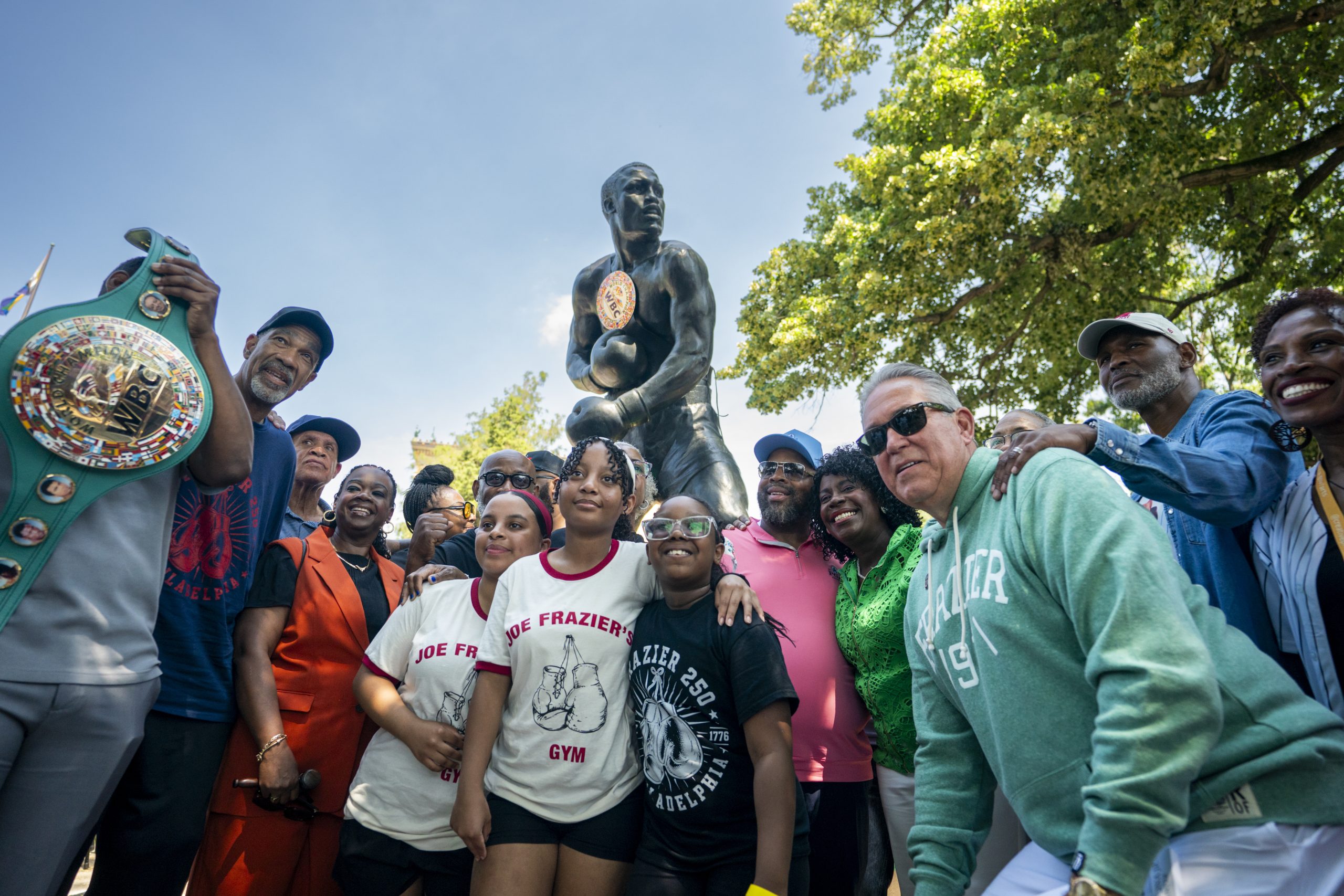
The original statue will be placed on a pedestal around 14 feet back from the edge of the top step, next to where Rocky shoe prints are embedded into the walkway. At the bottom of the steps, where the bronze Balboa had been since 2006, now sits a statue of real-life Philly boxing legend “Smokin’” Joe Frazier.
Mayor Cherelle L. Parker, Frazier family members, boxers, and other dignitaries unveil the new home for its statue of heavyweight boxing champion Joe Frazier on June 29. The statue is installed at the base of the steps of the Philadelphia Museum of Art where a statue of fictional boxer Rocky Balboa once stood.Jessica Kourkounis / For The Inquirer
Placing Rocky at the top of the steps is contentious, though. In an Inquirer survey last fall, 46% of respondents said there shouldn’t be a Rocky statue at the top of the steps, but rather it shouldstay at the bottom where it had been for more than a decade. One out of five respondents said the city shouldn’t have a Rocky statue at all. Even when the statue was revealed more than 40 years ago, some local officials called it “unnecessarily strident.”
Still, that doesn’t stop the millions of people who visit the Art Museum steps just for a glimpse of the bronze boxer. Soon, they’ll be doing it again at the same spot as the movie scene.
Staff writer Nick Vadala contributed to this article.
Four Pennsylvanians who were vaccinated against measles have contracted the highly contagious illness, state officials announced Friday.
Called “breakthrough cases,” such infections in vaccinated people are rare, but sometimes occur if someone’s immune system “did not respond as well” as most patients’ to the vaccine, the CDC says.
Other times, vaccinated people can become sickened by the virus if they’re exposed for a long period to the disease — like living in a house where multiple unvaccinated people have measles. Vaccinated people tend to have a milder illness when this happens, and they’re less likely to spread measles to others.
The four breakthrough cases reported in Pennsylvania occurred in three adults and one child in Centre, Jefferson, Lancaster, and Lycoming Counties.
The state said that all of them were “appropriately vaccinated for their given ages.” None required hospitalization.
Before Friday, the state had identified no cases this year in people who were fully vaccinated. The breakthrough cases reported Friday make up less than 1% of the total cases reported in the state this year.
“When community transmission rises and our overall case numbers increase, we see that a handful of people who were vaccinated will get measles. Even so, vaccination still provides the best protection,” Pennsylvania health secretary Debra Bogen said at a news briefing.
The Centers for Disease Control and Prevention estimates that about three in 100 people who received the two recommended doses of the measles, mumps, and rubella vaccine will contract the disease if exposed. About 7 in 100 people who received one dose will contract the disease.
Sarah Long, a professor of pediatrics at Drexel University College of Medicine who previously served on two federal committees to recommend and license vaccines, called cases in vaccinated people “oddities.”
“This is a fabulous vaccine and a fabulously transmissible virus,” she said, emphasizing that the vast majority of people who get measles are unvaccinated.
A growing outbreak
Pennsylvania is in the midst of the biggest measles outbreak in more than 30 years, with 676 cases reported and 124 people hospitalized as of Friday.
The state recorded 52 new cases in the last two days alone. Local and state health officials have noted that it’s likely many cases are going unreported.
The rapidly rising case count last month, especially among adults ages 25 and 49, merits attention, said Rémy Pasco, research associate at the University of Colorado who helped develop a measles outbreak simulator based on school vaccination rates. In past outbreaks nationally, cases have been more common among children who were not yet old enough to have received both MMR doses.
He said those patterns could indicate the virus reached a community where both adults and children were largely unvaccinated.
The state has reported two deaths associated with the outbreak — namely, deaths where evidence of measles is present, even when the disease may not be assessed by the coroner as the immediate cause of death.
In its latest update Friday, the CDC still had not listed the deaths on its website highlighting data on ongoing measles outbreaks around the country.
Lancaster County’s coroner has said he investigated one death caused by measles, in an infant with a severe genetic disorder, and another in an infant who contracted measles before birth and died shortly after. The coroner has said he does not believe measles caused that child’s death, but rather a lacerated spleen, yet prominent physicians have noted measles can weaken a person’s spleen, putting it at risk of rupture.
Amid the outbreak, Pennsylvania is seeing more interest in vaccination, Bogen said Friday. Typically, healthcare providers in the Commonwealth give out 25,000 doses of the MMR vaccine a month, she said. In August, they gave out 46,000.
“That is 46,000 times Pennsylvanians have chosen to help stop this outbreak by protecting themselves and others,” Bogen said.
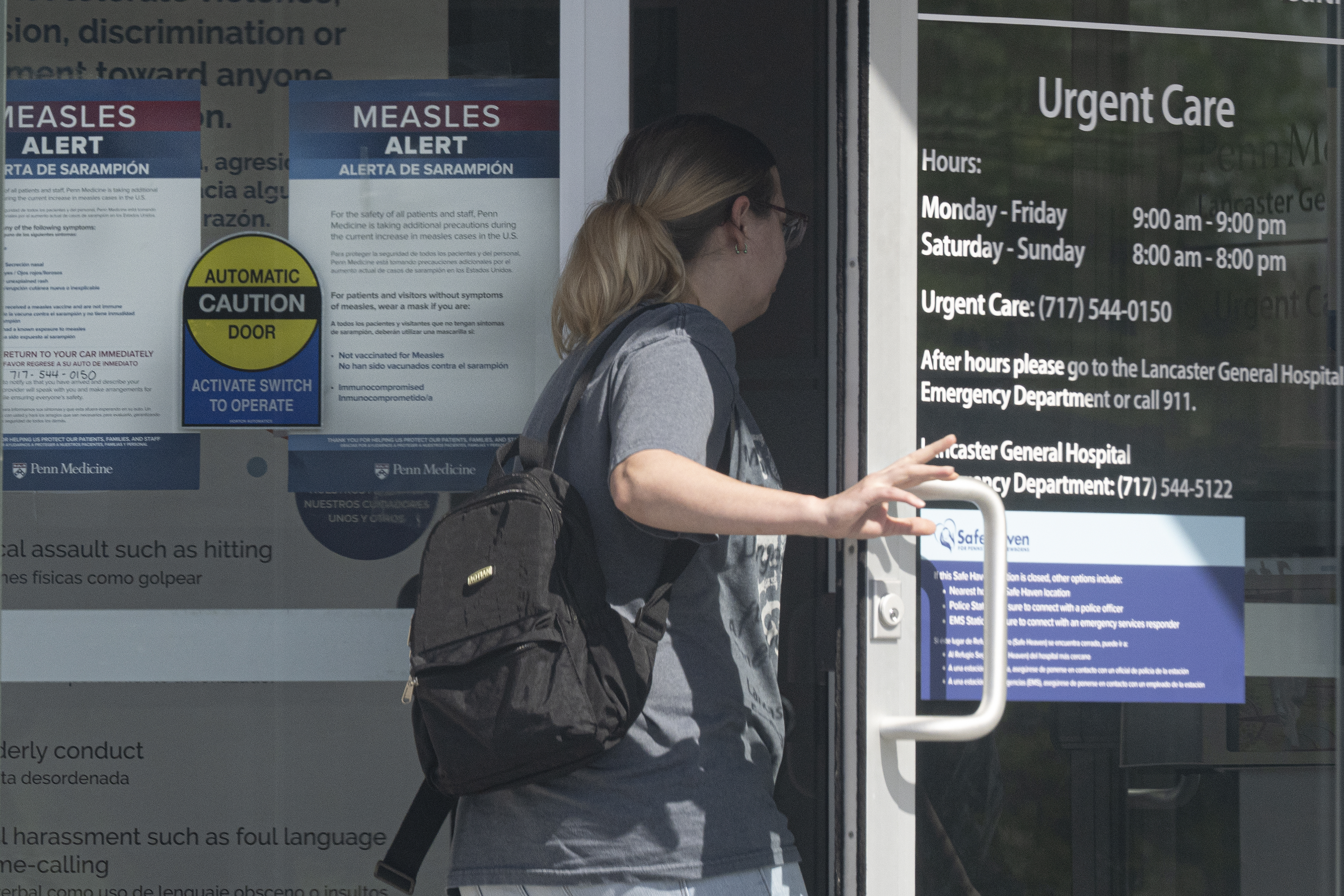
Measles alert signs in English and Spanish are posted on the front doors of an urgent care facility in Lancaster County last month.Jose F. Moreno / Staff Photographer
Breakthrough infections
People born before 1957, before the first measles vaccines became available, are generally considered protected against measles through natural immunity — because the disease was once prevalent in children.
Between 1968 and 1989, most children in the United States received one dose of the MMR vaccine, which is about 93% effective against the virus.
In 1989, measles cases among vaccinated schoolchildren prompted health officials to recommend children receive two doses of the vaccine, which together are 97% effective against the virus, a change that also prompted some older children to get a second shot.
Measles rates plummeted during the 1990s, and the disease was declared eradicated in the United States in 2000.
The MMR vaccine’s 97% effectiveness rate makes it “not perfect, but as good as our vaccines get,” said Rochelle Walensky, who served as CDC director during President Joe Biden’s administration and currently works as a professor of medicine at Harvard Medical School.
Smaller outbreaks with dozens of cases — not hundreds — may not see any breakthrough cases.
“The larger your outbreak, the more likely you’re going to see these,” Walensky said. “It’s just simple math.”
Large outbreaks, with hundreds of cases, will inevitably include breakthrough cases, she said.
Nationwide, 95% of the 3,294 measles cases logged by the CDC so far this year have been among unvaccinated people. The agency said 3% of those cases occurred in people with one dose of the MMR vaccine, and 3% in patients with two doses.
The concern also arose in last year’s major measles outbreak in Texas. A vaccinated person in Bucks County was among those who contracted a mild case of measles last year after traveling there.
Similar stories have emerged from Pennsylvania’s growing outbreak. For example, a mother in Lancaster County told The Inquirer earlier this summer that she was vaccinated and acquired the disease alongside her eight children, who were all unvaccinated; it’s unclear whether hers was one of the breakthrough cases recorded by the state.
Breakthrough illnesses can be contagious, said Paul Offit, a physician and vaccine expert at the Children’s Hospital of Philadelphia who heads the hospital’s Vaccine Education Center.
High levels of immunity in a given community protect everyone living there, Offit said. An unvaccinated person living around mostly vaccinated people is less likely to get measles because the virus has less chance to spread.
But vaccinated people who live around many unvaccinated people are at higher risk of getting a breakthrough case, due to the virus having more opportunities to circulate, he said.
Drexel’s Long recalled caring for children during a 1991 measles outbreak that sickened more than 1,000 people in Philadelphia and killed nine children.
“It’s a horrible, horrible disease. We are extremely grateful we live in the U.S. where these vaccines are developed and proved to be safe and highly effective,” she said.
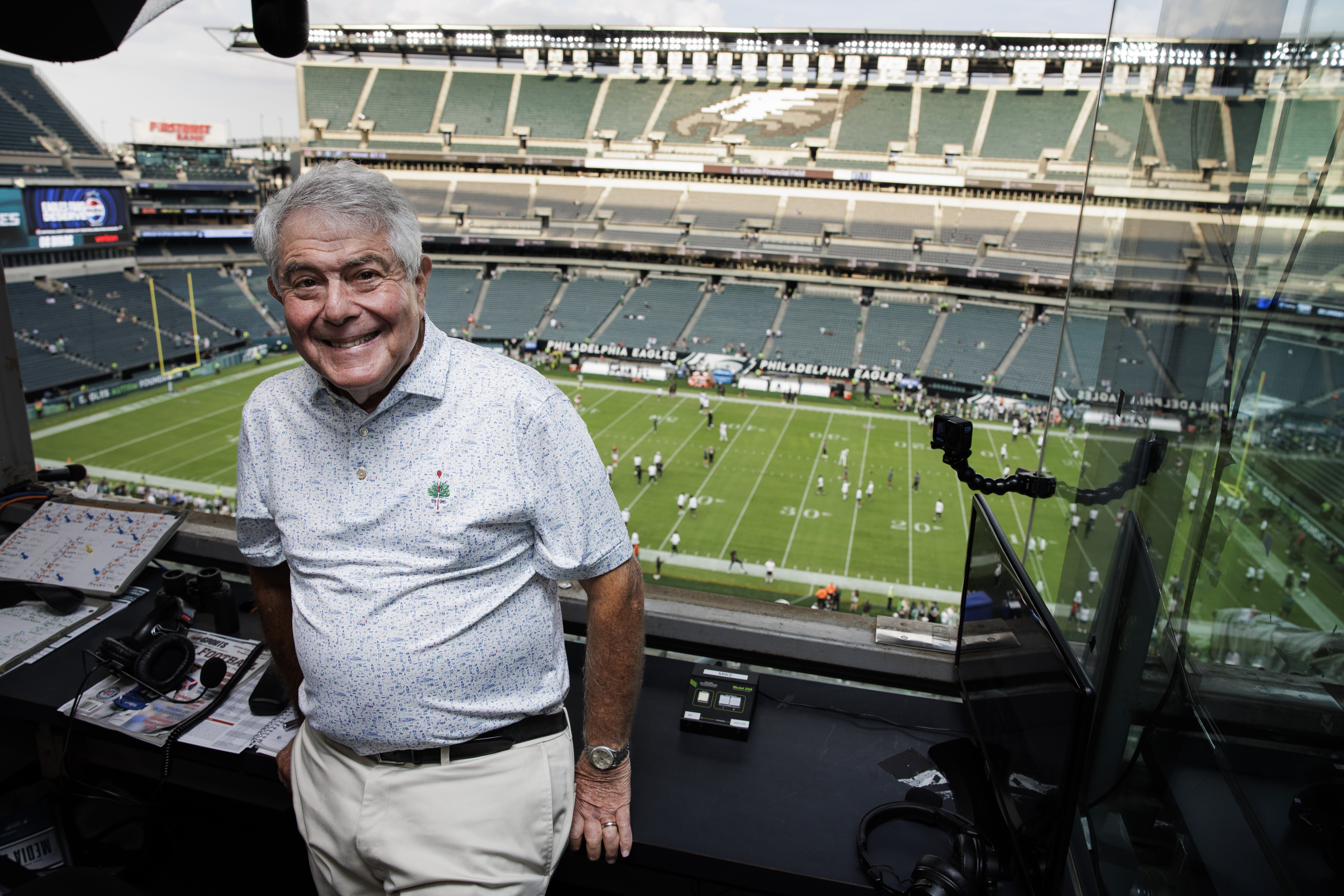
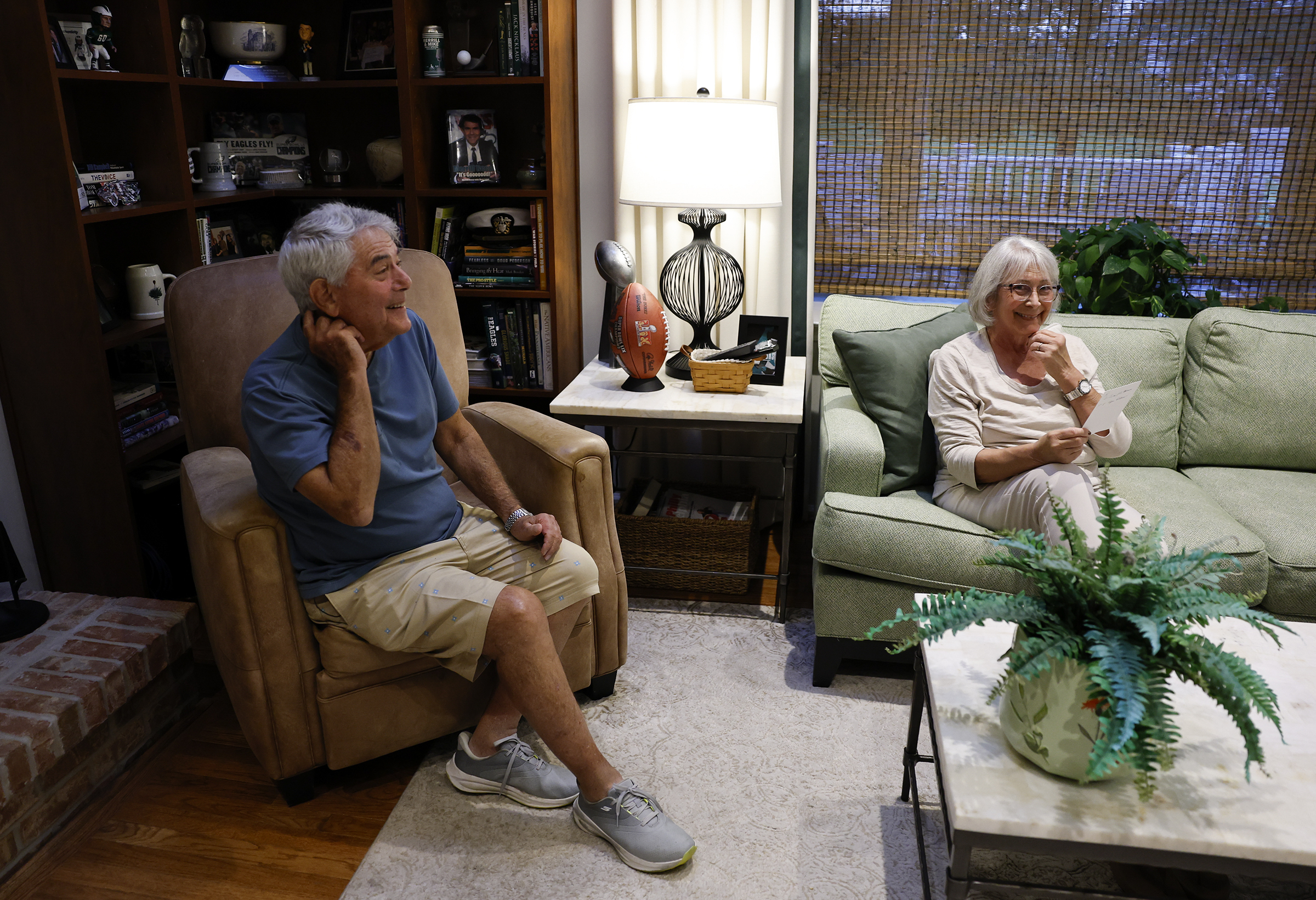
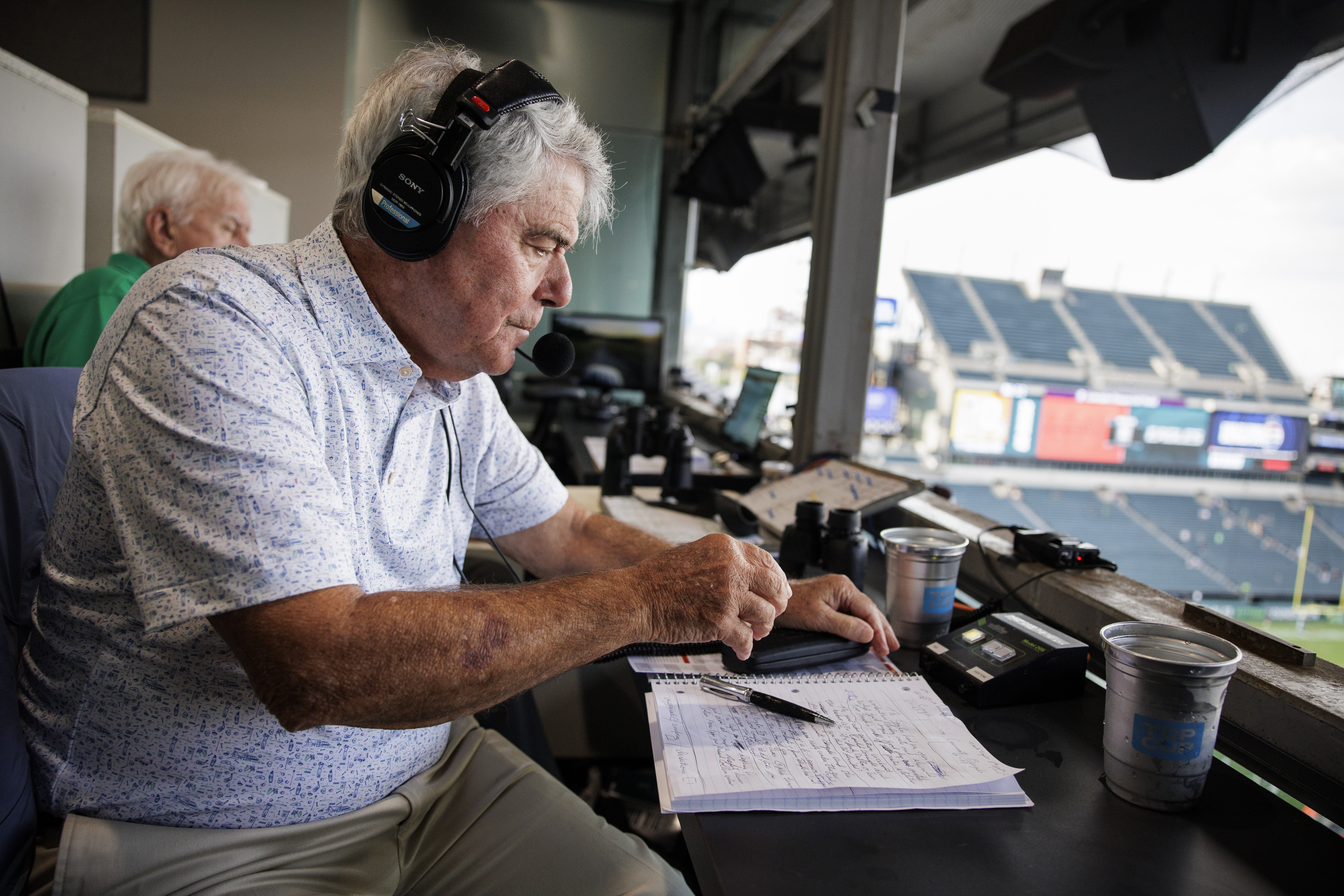
Merrill Reese sat in his living room chair, awaiting the rapid-fire questions from his wife as she prepared the longtime Eagles broadcaster for another game.
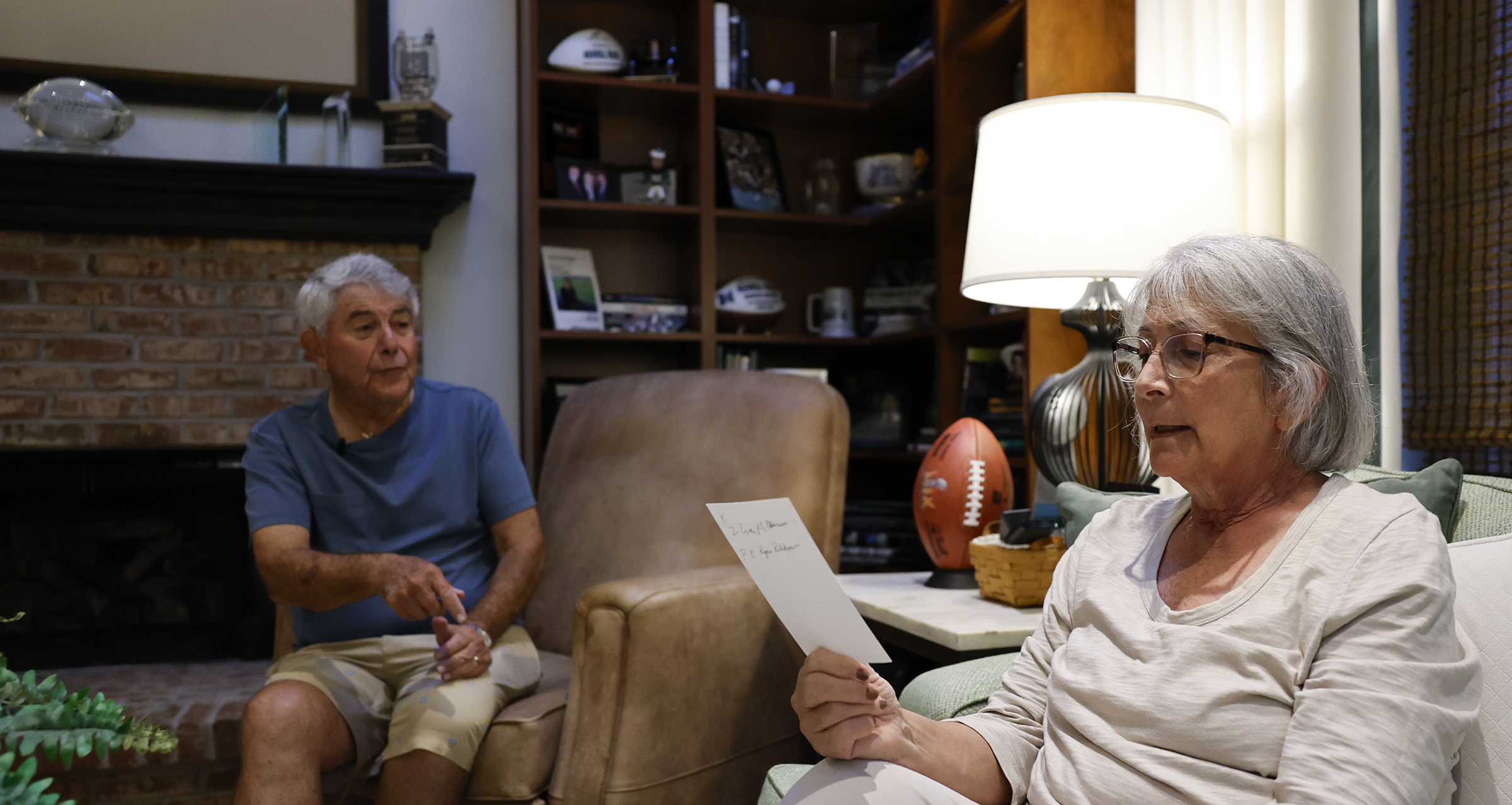
“Thirty-one,” said Cindy Reese, reading off an index card listing Cincinnati Bengals running backs.
Reese — who begins his 50th season on Sunday as the voice of the Eagles — needed a moment to think.
Cindy, who has a doctorate in education and spent 20 years teaching middle schoolers, quizzes him the night before each game on the opposing players. She reads him a number and he spits out a name. They repeat the numbers until he masters it, like a student preparing for a big test.
Reese grew up a Birds fan in Overbrook and would stare at the broadcast booth at Franklin Field while dreaming of being there one day. Now it’s hard to remember a time when Reese wasn’t calling the action in a voice that the Daily News once perfectly described as an “urgent baritone.”
Reese voiced two Super Bowl wins, told you the Eagles stopped ‘em again, and can make the word “good” sound great. He turned 84 earlier this month and has no plans of retiring. His 50th season, Reese said, isn’t a farewell tour.
Cindy Reese holds a note card with the names of Bengals players to help her husband, Merrill Reese, prepare for an Eagles preseason game against Cincinnati.Yong Kim / Staff Photographer
“Forever,” Reese said of how long he plans to call the action. “My word is always forever. I always kiddingly say they’re going to have to remove me with a crane. Look, I love to golf. But I’d rather broadcast an Eagles game than anything in the world. My greatest pleasure is to sit there and broadcast an Eagles game. There’s nothing I love more. I even enjoy doing the preseason games. I can truly tell you that I love it as much or more as I ever loved it. I have no intention of stopping.”
Reese golfs three times a week, stays active, and says his vision is crisp after having cataract surgery a few years ago. And his recall, which he credits to his work as a child actor, stays sharp thanks to those study sessions in his Blue Bell living room where his wife sits on the sofa and asks him who wears No. 31 on the Bengals.
“Kentrel Bullock,” Reese said as Cindy nodded and moved to No. 35.
Merrill Reese is entering his 50th season broadcasting Eagles games.Monica Herndon / Staff Photographer
Chasing a dream
Reese was making $125 a week in the late 1960s at WBCB in Levittown when he heard KYW was having auditions for a radio newscaster. This was his chance. He nailed his tryout, wrote a strong script, didn’t flub any words, and felt good.
KYW’s news director brought Reese into his office and told him he was going to do him a favor.
Reese, who went to Temple before serving in the Navy, started his radio career in towns like Pottstown. Now he thought he was finally going to land a job in the big city.
“I said, ‘Boy this is great,’” Reese said. “But he said, ‘I’m going to tell you that he would be wise to find another profession because you’re never going to work in a major market station.’”
Reese was crushed. He went home and hid in his bedroom until his mother asked him what was wrong. He told her what the KYW boss said.
“He’s right,” his mom said.
Reese was stunned. His mom didn’t think he could cut it? She told her son that if he could be deterred by one detractor then he would never make his dream come true. She was right. Reese went back to work the next day in Levittown, kept pushing, and was working six months later at WWDB in Philadelphia. That news director? Reese said he soon got canned.
Video: unCovering the Birds: Is tight end the biggest area of concern?
Reese’s mother was a kindergarten teacher who loved the performing arts. She took Reese to the theater and signed him up for acting lessons when he was a boy. He was an extra in a Cecil B. DeMille movie starring Jimmy Stewart, regularly appeared on local TV shows like Chuck Wagon Pete, and did commercials as an 8-year-old.
Reese had a part in a live radio drama but was instructed to memorize his lines while the adult actors were allowed to read a script. They thought it would sound too rehearsed if the kid read. So Reese spent every afternoon studying with his mom before going outside with his buddies. The memory that is now sharpened in his living room was being formed.
“I have an unusual memory because I was trained at that age,” Reese said.
Merrill Reese and Cindy, at their Montgomery County home last month, have been married for 47 years.Yong Kim / Staff Photographer
‘How about next Saturday?’
Reese and his wife met on a blind date, went out in the city, and didn’t talk again.
“I was geographically undesirable,” said Cindy, who grew up in Wallingford.
They reunited two years later and went on a double date on the Main Line with Reese’s sister and brother-in-law.
“We had a great time,” Cindy said. “I said, ‘Are you going to wait another two years to call me again?’ He said, ‘How about next Saturday?’ That was that.”
By then Reese parlayed his WWDB job into a gig at WIP, which hired him to do five minutes of sports every hour each morning before naming him the host of their Eagles pregame and postgame show.
He joined the broadcast booth in 1975 as a color analyst and then became the play-by-play man at age 35 in December 1977 after his partner Charlie Swift died by suicide. Reese got a call in the middle of the night that Swift died. That Sunday, Reese had to call the action.
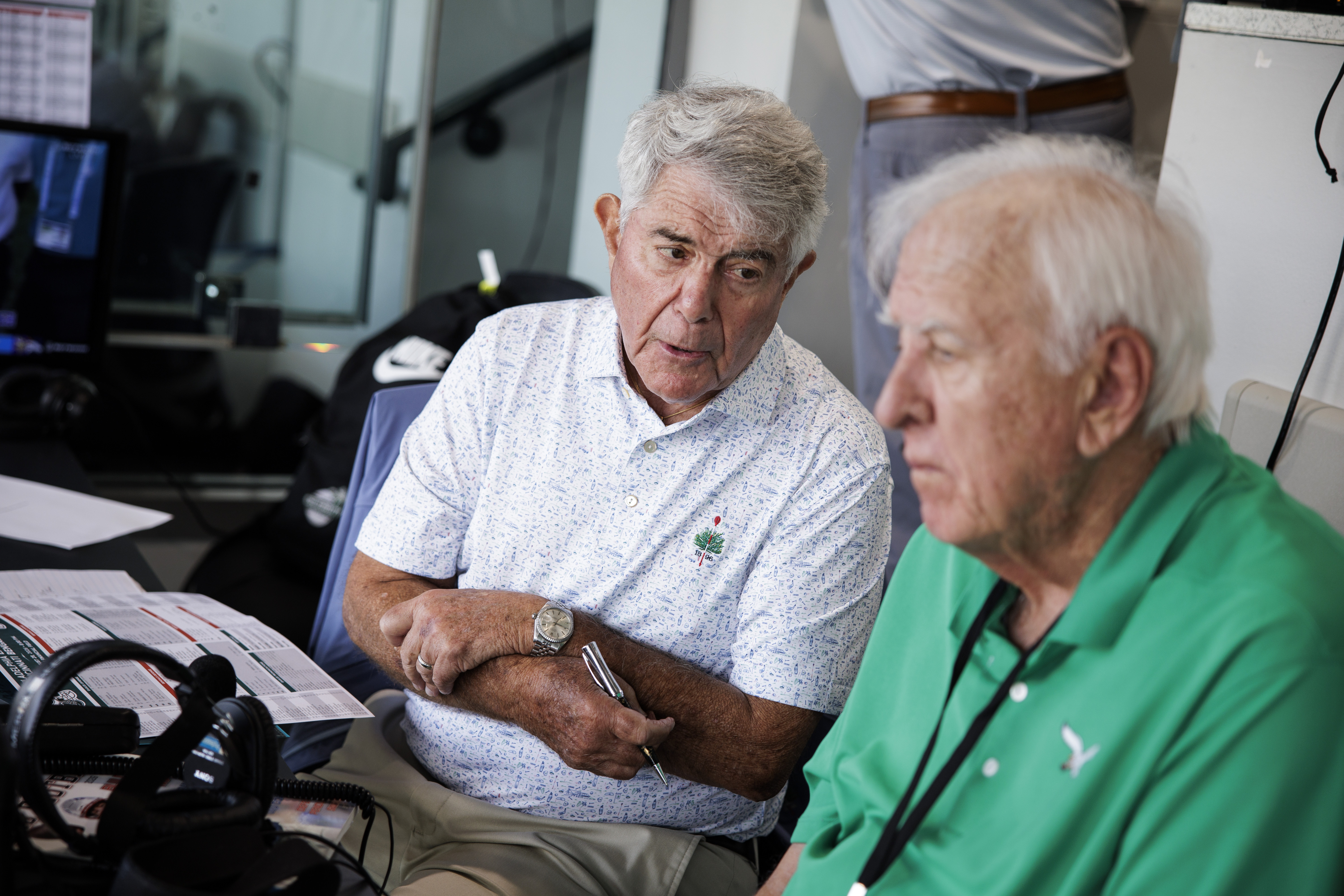
Merrill Reese talks with his longtime spotter Bill Werndl (right) in the broadcast booth before a preseason game against the Bengals on Aug. 28.Monica Herndon / Staff Photographer
“I’m standing there in the booth and the Eagles held a moment of silence for Charlie Swift,” Reese said. “All the players on the sidelines turned and looked at the booth. My knees are literally knocking into each other. I’m hoping something can just come out of my mouth. After that, they queued me and I went on. I did a little remembrance for Charlie Swift, broke for a commercial, and from there on it was all football.”
Reese finished the 1977 season but there was no guarantee that the job would be his in 1978. The station tried to land Al Meltzer, the popular broadcaster who was returning to Philadelphia after a year in Chicago. They told Reese that “Big Al” could sell more advertisements. Reese understood. But he wanted that job.
“I used to dream many times that winter that they called me and told me I had the job,” Reese said. “I would wake up depressed because I didn’t have the job. It was just a dream. Other times, I would go to sleep and dream that they called me and said they decided to go into a different direction. I would wake up relieved because I still wasn’t out of it.”
Meltzer turned down the Eagles’ gig to become the sports director at Channel 10. Reese was thrilled. The job was his.
“It was very exciting,” Cindy said. “It really did launch the trajectory of our relationship because that was going to be our lives.”
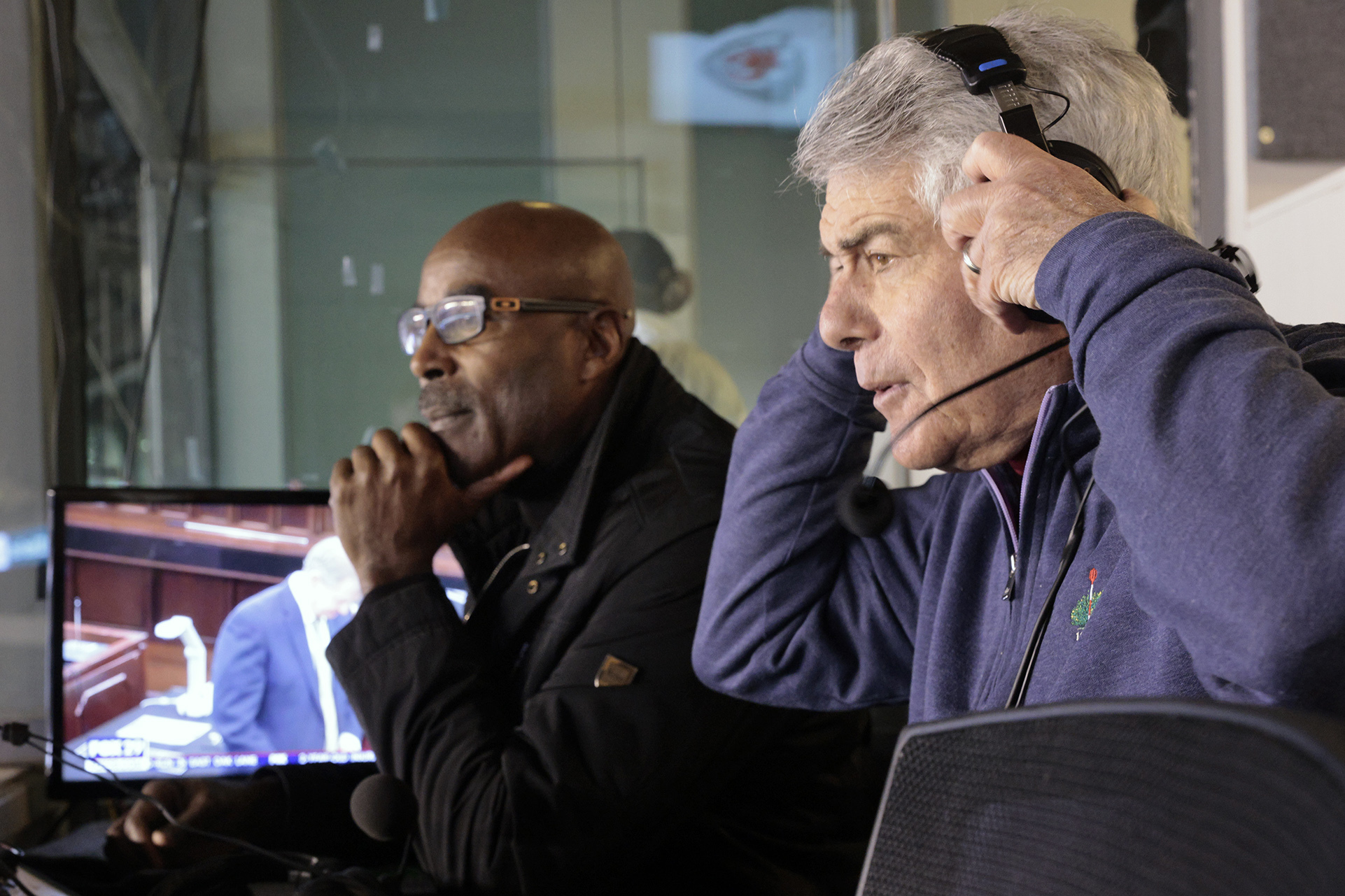
“I believe we’ve become like members of the family (for listeners),” says Merrill Reese, with longtime radio partner Mike Quick.ELIZABETH ROBERTSON / Staff Photographer
Members of the family
Reese and his longtime broadcast partner, former wide receiver Mike Quick, are so popular that fans delay their TV feeds and hit mute to sync their screens with the WIP-FM broadcast. The broadcasters even have their own beer. In Super Bowl seasons or super bad seasons, Merrill and Mike give you a reason to tune in.
“I believe we’ve become like members of the family,” Reese said. “We’re like their old friends who’ve been with them for many, many years. They grew up listening to us and we’ve become somebody who is able to react the way they react. We’re not homers. We don’t paint phony pictures. We don’t make a game exciting. I try to transmit the excitement, but when they’re bad, I’ll say they’re bad. I think people appreciate that. They can identify with us. They feel comfortable with us.”
Reese’s voice — the one that every Eagles fan has tried to imitate — somehow sounds the same year after year.
He said he isn’t a smoker or drinker. He doesn’t scream and tries not to talk on the phone the day before a game. He builds his vocabulary by reading everything from the newspaper to mystery novels. But the secret to Reese’s longevity may be his wife.
“My wife is my partner and basically in everything we do,” said Reese, who married Cindy in June 1979. “Cindy has always helped me prepare. Cindy is my confidant and my friend. We golf together. We do a lot of things together and Cindy is also very accomplished in her own right. She’s a great writer, an environmentalist. She has so many interests. We have a wonderful life together with two great kids and two wonderful grandchildren.”
Cindy listens to each game and gives her husband feedback when he’s off the air. She understands football but isn’t a crazed fanatic.
Cindy Reese holds a note card with the names of Bengals players she uses to quiz her husband in preparation for a game. Yong Kim / Staff Photographer
“I’m an Eagles fan, but I’m really a Merrill fan,” Cindy said.
The couple raised two children — Nolan and Ida — but Reese’s broadcasting gig took him away to training camp every summer, practices during the week, and games on the weekend. There were radio shows, appearances, and hours of preparation. The job is more than just four hours on a Sunday afternoon.
So it was often up to Cindy to make sure everything was in line at home.
“It’s been teamwork. We had to be a team because of the nature of raising a family under those circumstances,” Cindy said. “The thing that makes our relationship different from a woman married to a football player is that there’s a time limitation. There might be four years or six years or whatever that their husband is involved in. With coaches, and people like Merrill, there’s no time frame. It just went on. Here we are. Fifty years.”
The broadcaster used to study the opposing rosters on his own before his wife stepped in. Cindy, who now mentors student teachers at Gwynedd Mercy University, turns their living room into a classroom. They’ve been doing it like this since Reese got the Eagles gig.
Her husband has to be quick during games as an assistant in the booth points to a number after a play to indicate who tipped a pass or forced a fumble. No. 31? No. 97? No. 56? Cindy says the numbers as rapidly as a football shoots from a JUGS machine. The former sixth-grade science teacher makes sure her husband knows them all.
“He’s amazing,” Cindy said. “He can memorize all these numbers. I’ll do the cards with him and when I leave the room, I don’t know the numbers. But he does. I don’t have that kind of memory. He has an amazing memory.”
Merrill Reese “says he wants to do it forever and as long as he’s able and happy with it then it’s great,” said his wife Cindy.Monica Herndon / Staff Photographer
Reese has called Eagles games from Jaws to Jalen Hurts but still wakes up nervous every Sunday. It’s because he cares so much, he said.
So Cindy always does her best to make sure the house is calm in the hours before her husband leaves. He’s too uneasy before kickoff to eat at the stadium so she makes him a stack of apple cinnamon pancakes every Sunday morning to hold him over. First, she sharpens his memory. Then, she fills his stomach. They’ve done it for 50 years and hope to do it forever.
“The station has changed many times, the ownership has changed many times, the coaches have changed many times, but Merrill is the constant,” Cindy said. “He just loves the seat and being involved. He says he wants to do it forever and as long as he’s able and happy with it then it’s great.”
Former New Jersey Gov. Christine Todd Whitman will be 80 years old in a few weeks, with much to celebrate as she marks the moment.
She was twice elected governor and brought a Republican legislature with her both times. She cut income taxes by 30%. She turbo-charged the drive to save the state’s dwindling green space, earning her a seat in the cabinet of President George W. Bush, running the Environmental Protection Agency. She is a woman of grand accomplishment, a pioneer.
And she had the guts to compare Donald Trump to Adolf Hitler, way back in 2015, before it was stylish. So count me among those who would clap and hoot when she blows out the candles at her party.
But … but … but …
She also assured us, one week after the 9/11 attacks, that it was “safe to breathe” the air at ground zero. And we know now that was a mistake of epic proportions; that the dust covering Lower Manhattan was a toxic stew of asbestos, lead, mercury, arsenic, dioxin, and polychlorinated biphenyls. It scorched the lungs of thousands who breathed it, leaving them disabled, and planted the seeds for cancer in thousands more.
“The number of people who have died of 9/11-related health conditions has far surpassed the number of people who died on the day of the attacks,” the September 11th Victim Compensation Fund states in its most recent annual report.
As the illnesses began to pile up, Whitman became an object of scorn to those who felt she had been flat-out lying, bending to pressure from the White House, which was eager to get Wall Street back to work.
She was called before Congress to answer for this in June 2007, soon after Democrats had taken control of the House, and they were ready to pounce. It was a sweltering day in Washington, nearly 90 degrees, and she had to brave a mob of furious protesters screaming at her as she arrived. This was to be the darkest day of her career.
“Our government has knowingly exposed thousands of American citizens unnecessarily to deadly hazardous materials,” said Rep. Jerrold Nadler, the New York Democrat whose district included ground zero. “And because it has never admitted the truth, Americans remain at grave risk to this day.”
But was Whitman really that much of a monster? I had covered her for years as a columnist at the Star-Ledger in Newark, N.J., and I had my doubts. Even today, no one has ever proved she lied about what she knew, or knowingly put people in harm’s way. If she were that evil, it seemed to me, it would be a first.
Still, this episode will rightly be remembered as the low point for Whitman. She may not have been a monster, but she was surely a wimp. She stood back and let Vice President Dick Cheney spin the EPA’s scientific findings out of shape, as the EPA’s own inspector general established two years later. The EPA’s recommendation that homes and businesses hire professional cleaners to eradicate toxins was removed altogether.
The changes to the EPA’s draft news releases were made by the Orwellian-named President’s Council on Environmental Quality, which was effectively run by Cheney. The CEQ had final control of press releases, and the IG report spells out each change it made, every time diminishing the danger and adding reassurance about safety at ground zero. Whitman didn’t make a peep of protest.
She didn’t know for certain she was sending people to their doom, as critics like Nadler claimed. But she was going along with the spin, yielding to Cheney. And many people died who might have stayed away.
At that 2007 hearing, Whitman was having none of it, and was more defiant than I had ever seen her. She was not a liar, she insisted. She based her decision on the best science she had at the time. She had no regrets, and said she was still not sure the toxins at the site were causing illnesses.
I reached out to Whitman, and she offered a written statement saying, “Everyone at the EPA did the best they could with the information, tools, and knowledge available at the time.” But she declined to answer a more personal question: Does she feel she did anything wrong when she issued the all-clear?
My guess is that deep down, she does.
Tom Moran is the author of the Substack Jersey Lowdown and former editorial page editor of the Star-Ledger in Newark, N.J.
The Phillies are exactly where we probably should have expected them to be, which is exactly where they were a week ago. That is, four games behind the Braves with 15 to play heading into this weekend’s three-game series in Atlanta. That’s not necessarily a bad thing, believe it or not. Treading water is as important as making up ground.
Right now, the Phillies number one goal shouldn’t be winning the National League East. It should be avoiding the Braves in the wild-card round. The NL playoff picture has changed considerably with the Dodgers winning seven straight and the Braves losing four of six.
Now that L.A. has a 3½-game lead over Atlanta for the NL’s second bye, it’s looking increasingly likely that the eventual NL East division champs will end up hosting a best-of-three series against the No. 6 seed. Which means the Phillies should be just as focused on maintaining or growing their current 3½-game lead over the Padres, who entered Friday with a half-game lead over the Diamondbacks for the NL’s final playoff spot.
Some folks will scoff at the idea of the Phillies fearing the Braves in an October series. But best-of-three is barely a series. This isn’t about fearing the Braves. It’s about fearing Chris Sale.
Last weekend, the Phillies took their latest dose of medicine from one of the game’s all-time greats when Sale held them to two runs in six innings of a 5-2 Braves win. Atlanta’s presumptive Game 1 starter is not a problem the Phillies are magically going to solve just because the leaves are falling off trees.
The Braves are 3-0 in Sale’s three starts against the Phillies this season and they’ve won five of his seven since joining the team in 2024. His numbers should make you gulp. In his last five starts against the Phillies dating back to May of last season, Sale has allowed a grand total of four runs in 31 innings. He has struck out 40 of the 118 batters he has faced. That’s 33.9%.
Bryce Harper is one of the Phillies with bad career numbers against Chris Sale. He has just two hits in 18 at-bats against the lefty (.111).Yong Kim / Staff Photographer
In a longer series, the Phillies would have a clear starting pitching advantage over the Braves. Grant Holmes and Tyler Mahle have both had some success against the Phillies, most recently holding them to a combined two runs in 12 innings of last weekend’s series. Holmes has allowed just five runs in 20⅔ innings against the Phillies over the last two seasons, while Mahle held them scoreless in seven innings and 5⅔ innings in two of his three starts prior to last weekend (albeit dating back to 2021). Regardless, the Phillies would have a significant advantage in three of the first four games of a five-game series.
In a three-game series, Sale in Game 1 is a monumental equalizer of the odds. They’d much rather take their chances against the Cubs, who would presumably start Clay Holmes and Shota Imanaga, followed by a spin of the roulette wheel in Game 3.
A sigh of relief
Now, about that bullpen …
Give interim manager Don Mattingly credit for getting Alex McFarlane back on the mound in the eighth inning on Wednesday. The 25-year-old right-hander got ground balls from three of the four Astros batters he faced to deliver an 11-7 lead to Jhoan Duran in the ninth. McFarlane didn’t record a strikeout but threw strikes on 12 of his 15 pitches. This wasn’t exactly a high-leverage situation, at least not compared to the last time he walked off the mound. But it was a situation where a true set-up man gets the ball, and Mattingly gave it to him. Which is exactly what the Phillies manager should be doing.
Despite the homer he surrendered to Ronald Acuna Jr. last weekend, Alex McFarlane remains the Phillies’ greatest hope in the eighth inning.Elizabeth Robertson / Staff Photographer
The underdiscussed aspect of McFarlane’s welcome-to-the-bigs moment against Ronald Acuna Jr. and the Braves on Sunday was the fact that he was on the mound at all. Mattingly easily could have pivoted after McFarlane allowed a one-out single to Mike Yastrzemski and a double to Drake Baldwin to bring Acuna up as the tying run in a 4-1 game with a base open. He had a lefty warming and Braves lefties Matt Olson and Michael Harris due up after Acuna. Conventional baseball wisdom says you don’t put the tying run on base. Still, it said something about the Phillies’ estimation of McFarlane that he both remained on the mound and challenged Acuna Jr. throughout the seven-pitch at-bat.
It also says something that Mattingly didn’t flinch after McFarlane allowed a three-run, game-tying home run to Acuna.
“I don’t think you learn anything yet,” Mattingly said after the Phillies’ eventual 5-4 loss. “I think we see how he responds. I feel about the way he’s going to respond. When everything’s going good it’s pretty smooth sailing. Everybody’s going to struggle, what happened to him today is going to happen to everybody if you play long enough. So we’ll see. I think he’ll be fine. He’s been a kid that’s handled everything. The disposition’s been good.”
The Phillies are doing exactly what they should be doing with McFarlane. The first goal is to get to the postseason with an eighth-inning option that is something better than a flip of the coin. The second goal is to get there with somebody who actually gives them a significant advantage like the one they have in the ninth inning with Duran. On both counts, McFarlane is their best hope. Overwhelmingly so. There is nothing like exposure therapy for a big-league reliever. There will be plenty of big spots in October. The Phillies need McFarlane to become a guy who thrives in them.
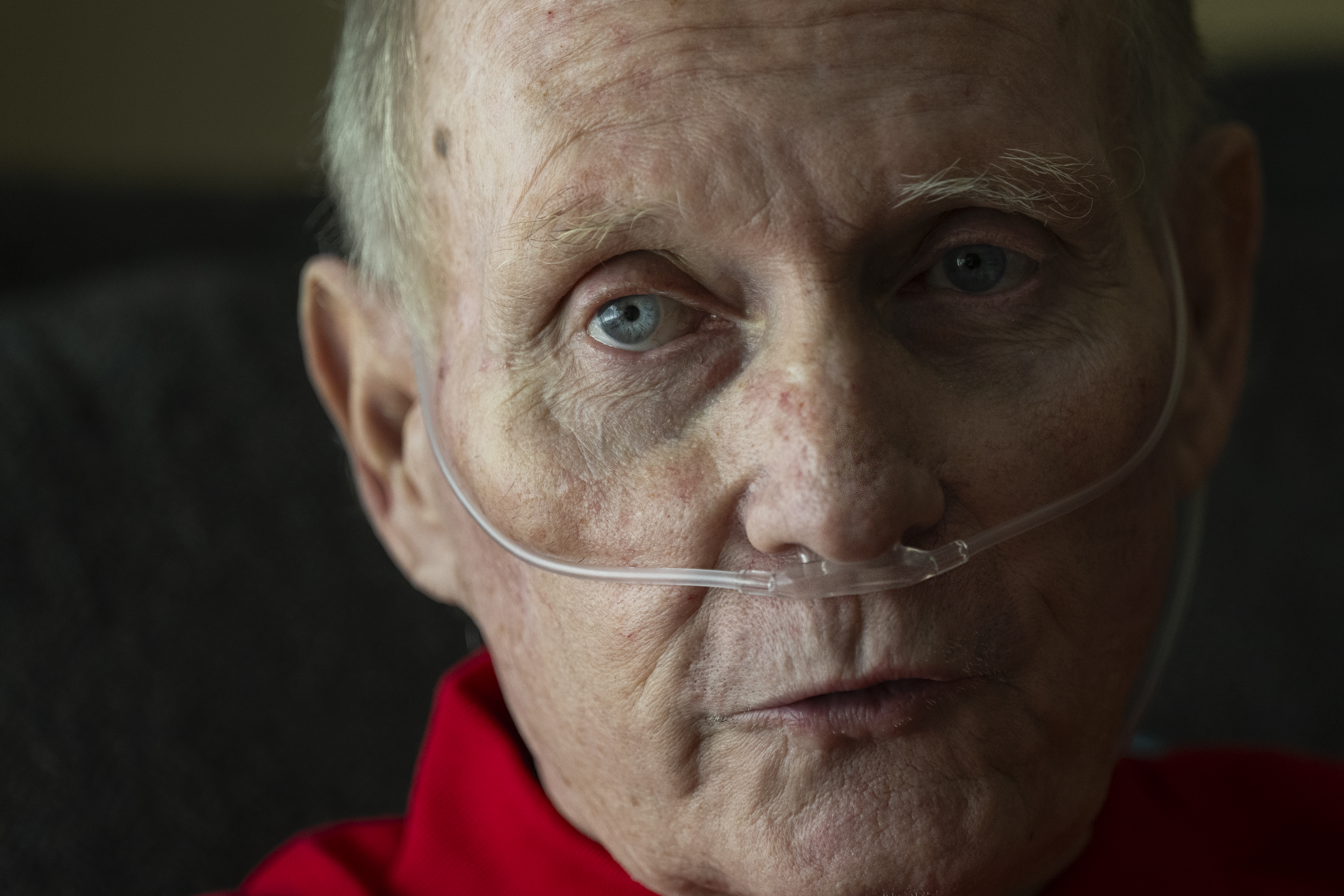
Retired Philadelphia Police Capt. Mark Fisher gets winded and lightheaded while emptying the dishwasher or pushing his gas-powered lawnmower, his lungs forever scarred by the ankle-deep ash that he trudged through at ground zero.
WhenFisherarrived at the nation’s worst crime scene, two days after the Sept. 11, 2001, terrorist attacks, each step he took kicked up a powdery plume, coating his tan work boots. Dense smoke from fires burning beneath the rubble of the World Trade Center site stung his eyes and clogged his lungs.
Then a lieutenant in charge of the Philadelphia department’s crime scene unit, Fisher scoured the wreckage for nearly two weeks. He helped recover the lifeless body of a firefighter crushed under concrete. A torso. The severed arm of a businessman.
The coughing fits started about a year later. Then, about six years after 9/11, a chest X-ray revealed a thick, hardened fluid around his lungs, makingit difficult to breathe. He developedsevere pulmonary disease linked to exposure to toxins.
Fisher, 69, needs a double lung transplant soon, his doctors say, that at best will extend his life by five to seven years. His deteriorating health shows how grossly federal and local health officials underestimated the environmental hazards.
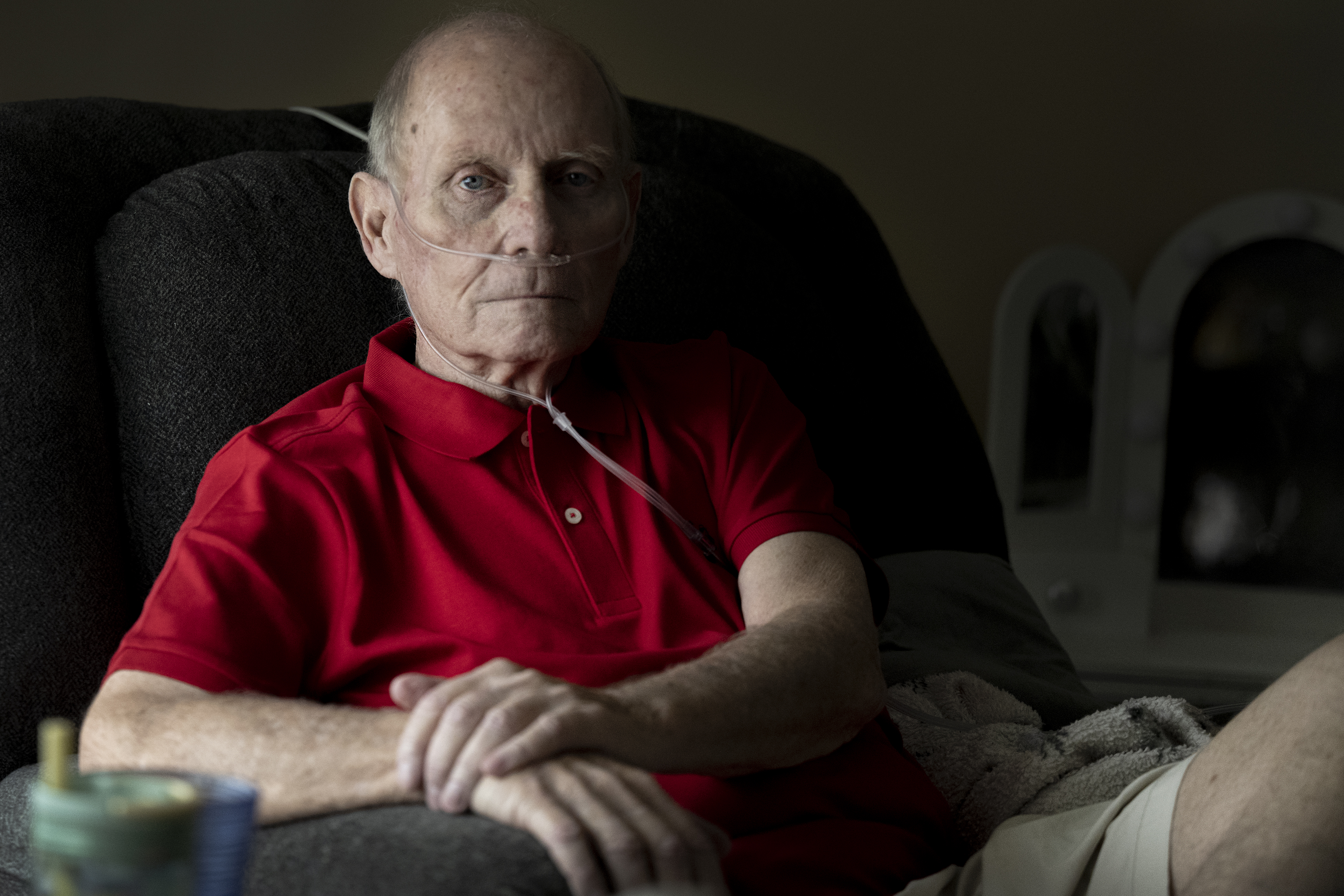
“I can’t breathe worth a darn. My lungs just aren’t going to last,” Fisher said, as he sat in his Northeast Philadelphia home with oxygen prongs in his nostrils and a heating pad against his back.
“Everything aches,” he rasped, coughing relentlessly.
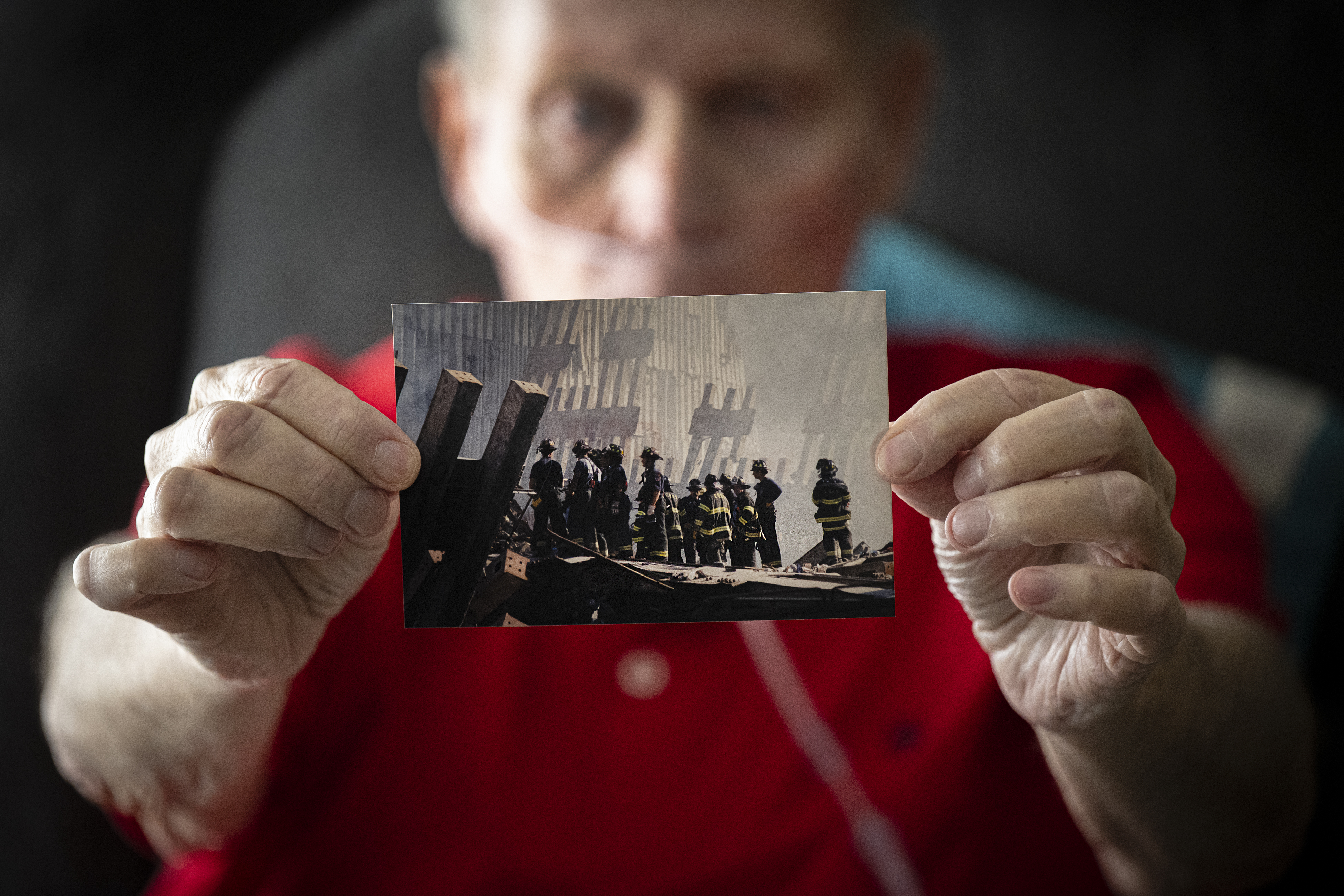
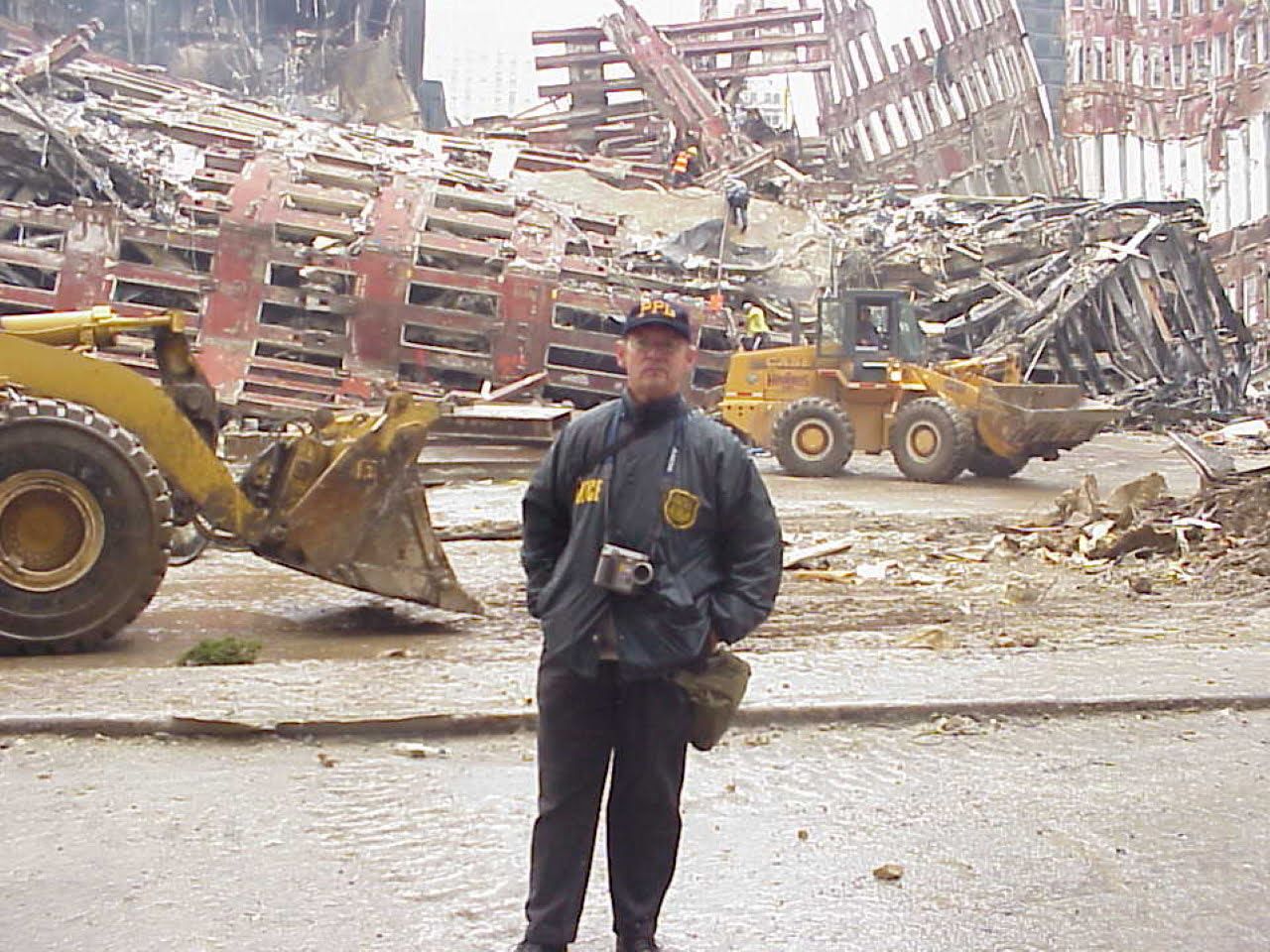
Retired Philadelphia Police Captain Mark Fisher, 69, shows a photograph he took while working as a crime scene investigator at ground zero.Jose F. Moreno / Staff Photographer
Cancer is the fastest-growing diagnosis, now that enough years have passed for tumors and other abnormalities to emerge, soaring from about 3,200 cases to more than 57,000 within the last 11 years.
Most of the toxic dust — as deep as snow drifts in spots — formed when the concrete floor slabs of the 110-story towers collapsed on top of one another in quick succession. The wreckage, known as “The Pile,” contained more than 350 chemicals andmineral agents:potassium hydroxide in concrete, calcium sulfate in wallboard, jet fuel, asbestos, glass insulation fibers, heavy metals — all finely groundand aerosolized.
“It was such a mixture of stuff, like a witch’s brew,” said Iris Udasin, a Rutgers Health doctor who treats 9/11 responders and studies the long-term health effects of the attack.
The alkaline alone in “the cement from all these buildings was toxic in and of itself,” she said. “It basically burned holes in people’s noses and made them more likely to absorb other chemicals and gases that were in the air.”
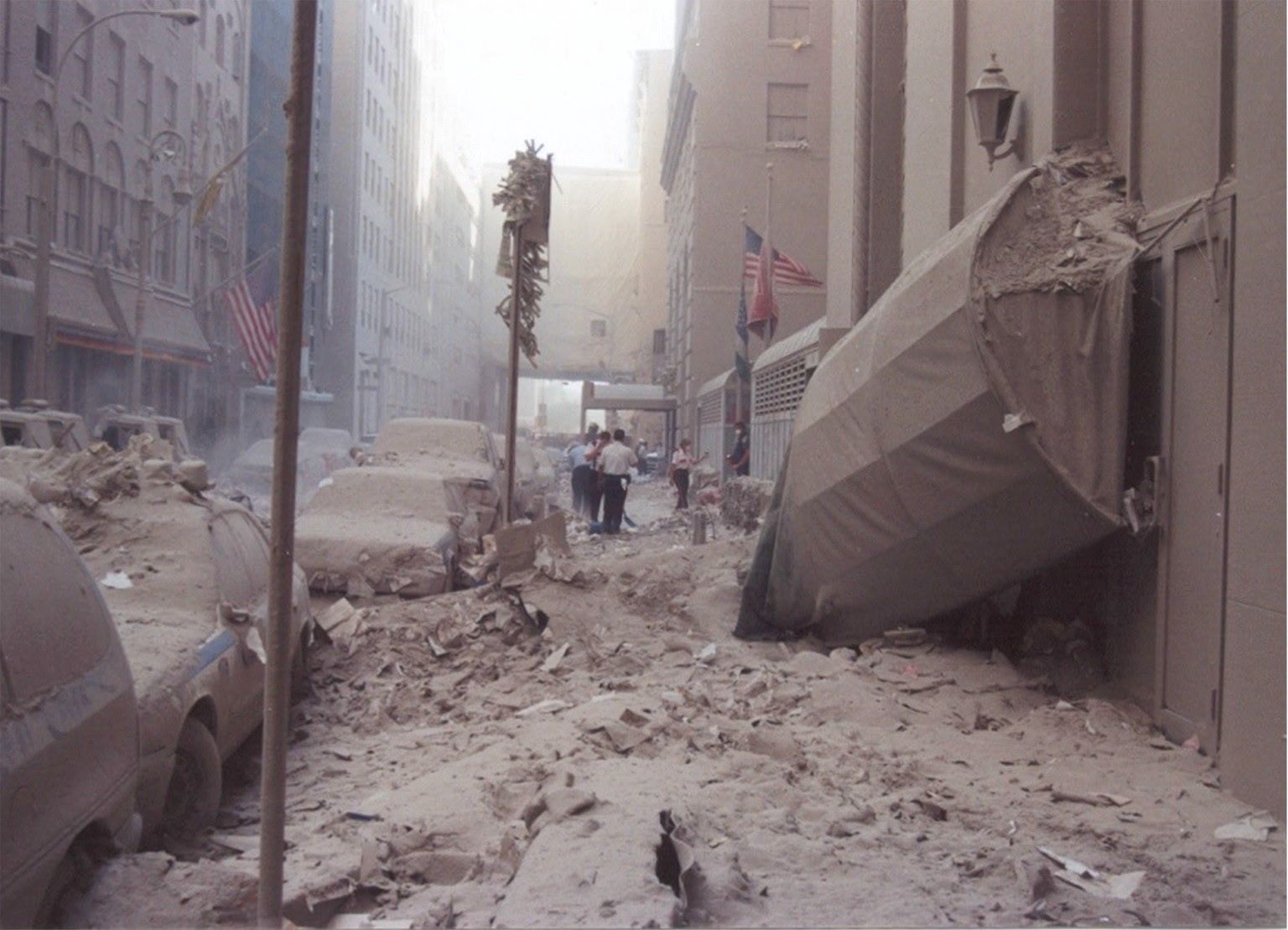
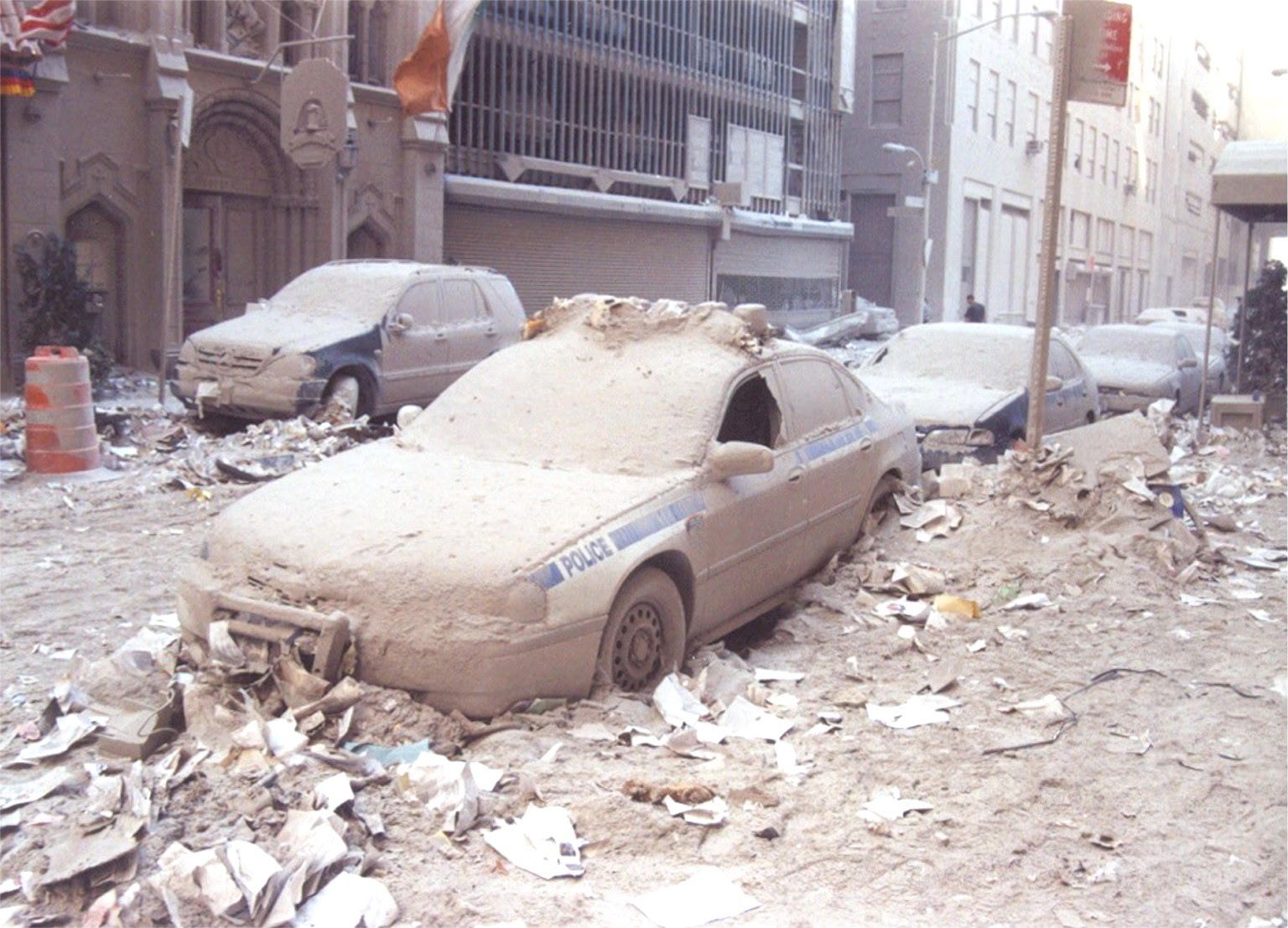
While at ground zero, then-Philadelphia Police Sgt. Greg Masi took photos of the dust and debris. When Masi started wheezing and coughing a few years later, he thought, “I’m just getting old. I didn’t want to believe that the days I was there affected me,” he said. He’s since been diagnosed with asthma, lung nodules, and a type of blood cancer linked to breathing toxic dust. Courtesy of Greg Masi
From WTC cough to lifelong disease
Udasin directs the WTC Health Program at Rutgers University in Piscataway, N.J. — one of six clinics created nationally to treat 9/11 responders.
When it opened in 2003, Udasin mostly treated responders for what she calls “World Trade Center cough,” a dry and persistent hacking that improved with asthma medication.
Now their cases are far more complicated and life-threatening, often requiring referrals to medical specialists, from pulmonologists to oncologists.
Udasin can name many of the roughly 3,000 responders she treats annually by their faces alone. She prefers to relay test results, both good and bad, to patients herself, rather than delegate.
On a recent morning,she escorted an older man from an exam room to the clinic’s lobby and asked: “Do you want me to call you with the results? If you are going to be scared, I can have somebody else call you with the results.”
Her patients, hailed as heroes after 9/11, could not have anticipated how working at ground zero would impact their long-term health.
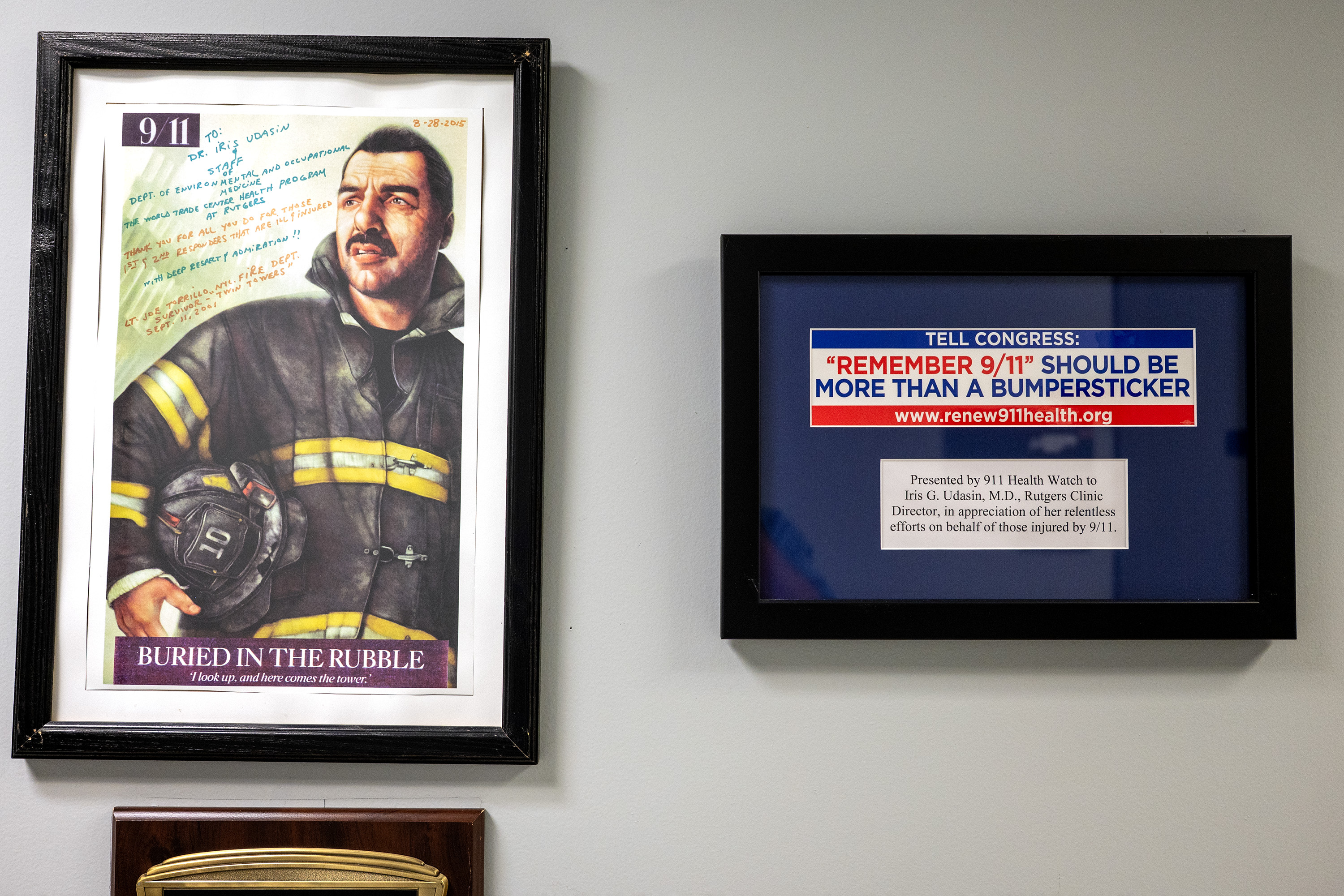
A plaque (right) presented to Iris Udasin, medical director of the World Trade Center Health Program at Rutgers University, hangs on the wall of the patient waiting room. Udasin’s federally funded clinic provides medical monitoring and free treatment to 9/11 responders. Tom Gralish / Staff Photographer
Local and federal officials initially minimized the environmental health hazards. Christine Todd Whitman, who was the head of the Environmental Protection Agency under President George W. Bush, infamously assured the public within days of the attack that the air around the WTC was “safe to breathe.”
“The [EPA] scientists did the best they could with the data that they had and with the knowledge they had at the time,” said Whitman, who had previously served as New Jersey governor.
“It’s a case of you don’t know what you don’t know,” Whitman added in an interview with The Inquirer late last month.
Whitman said her agency did urge responders on “The Pile” to wear protective gear, preferably respirators. The EPA distributed masks, but many refused to wear them, she said.
In hindsight, she said, the masks were not protective enough. Responders are now paying “the price” of breathing toxic air: “It sickens me to say it,” Whitman said.
The Rutgers program grew out of early alarms about air quality hazards, of which details are still emerging. On Tuesday, New York City officials publicly released a trove of documents revealing that toxins lingered in the air for months after the attacks.
Medical monitoring and free healthcare forresponders continue to evolve as the responder population ages.
Researchers evaluated more than 5,000 WTC responders, with an average age of 53 at the start of the eight-year study.
“As this population ages, we are seeing increasing concerns related to memory, attention, and executive functioning, sometimes at ages when the responders themselves are surprised to be experiencing them,” said Jodi Streich, mental health director at Rutgers’ WTC Health Program.
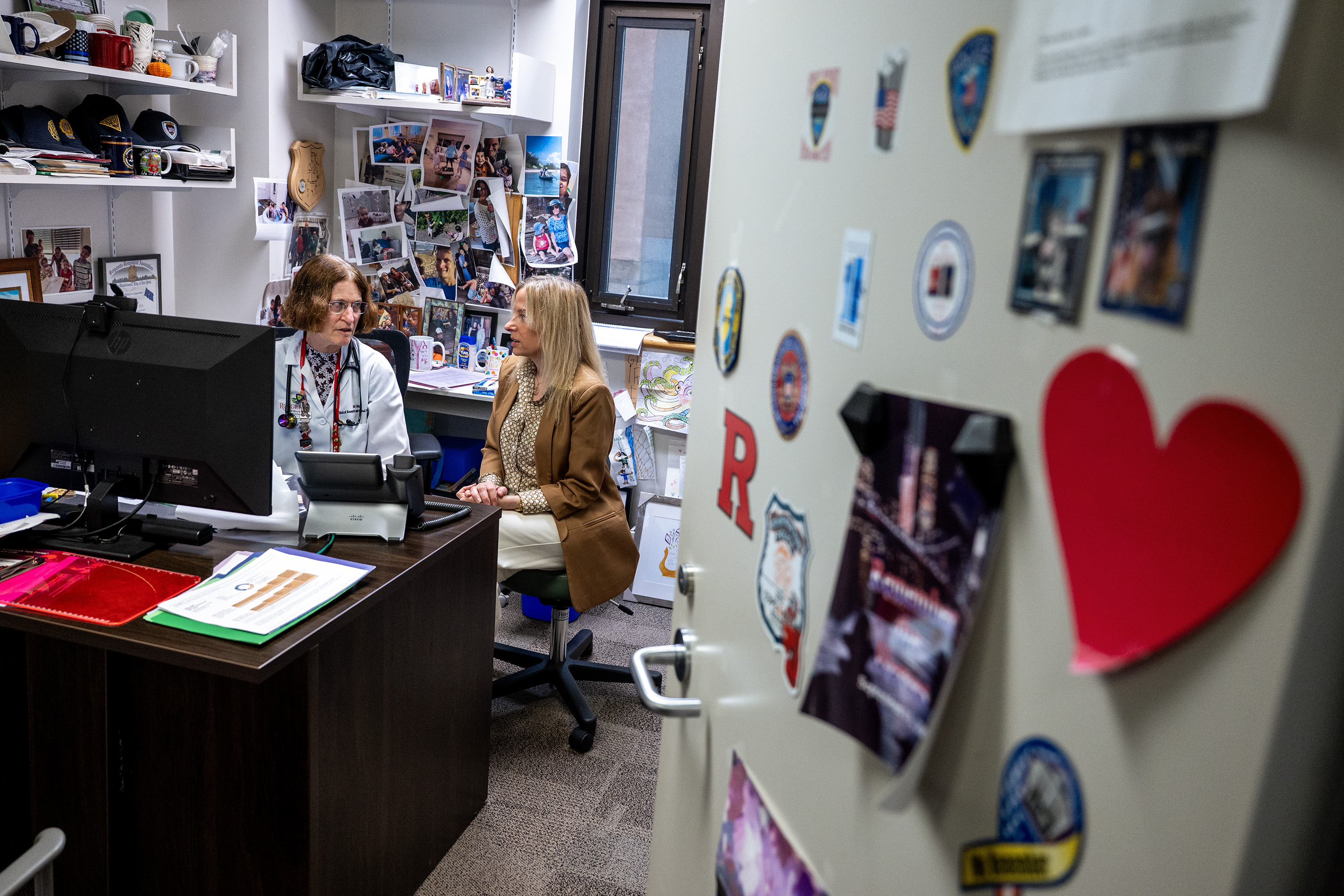
Iris Udasin, medical director, and Jodi Streich (right) mental health director, of the World Trade Center Health Program at Rutgers University sit together in Udasin’s office. They treat responders with WTC-related illnesses at the medical clinic, which is funded by the National Institute for Occupational Safety and Health (NIOSH) within the Centers for Disease Control (CDC). Tom Gralish / Staff Photographer
A stubborn and spreading blood cancer
Udasin’s clinic currently treats 1,177 cancer patients. Research shows that 9/11 responders suffer from thyroid, prostate, lung, and blood cancers at higher rates than the general population.
“The question is: Are certain cancers higher because we looked for them, or are they higher because they’re really higher?” Udasin said. “We really don’t know the answer to that, but my job is to treat everybody.”
In 2023, Udasin successfully lobbiedto have gynecologic cancers, including uterine, included on the list of WTC-related conditions.
Philadelphia Police Department Sgt. Greg Masi at ground zero just days after the twin towers fell. Then-Police Commissioner John Timoney dispatched Masi to New York City because of his expertise in radio communications. He’s developed asthma, lung nodules and T-cell lymphoma from breathing in toxic fumes and dust.Courtesy of Greg Masi
Greg Masi, 71, a retired Philadelphia police sergeant from the Northeast, was diagnosed with a form of blood cancer known as T-cell lymphoma in 2019.
First, red bumps appeared on his left arm. A scaly rash hassince spread over much of his body, killing hair follicles. His oncologists worry the cancer will find “a road map” into his organs.
Light therapy and topical medications did not work. Chemo and radiation would be a last resort. Since there is no cure, the goal is to slow it down.
Masi, an expert in radio communications, can still hear the horns that blared each time responders thought they found someone still alive beneath the rubble at ground zero, or to signal an imminent structural collapse.
The dust that caked cars and blanketed fire escapes struck himas a mere nuisance.
“We figured it was just dust, like dirt,” Masi said. “We had no idea it had harmful toxins in it.”
An avid runner and marathoner, Masi developed bad chest colds with wheezing about five years after Sept. 11. He was later diagnosed with asthma and nodules on his lungs, both common afflictions among responders.
He recently learned that one nodule has doubled in size, and doctors plan to monitor it for signs of cancer.
Then-Philadelphia Police Department Sgt. Greg Masi captured photos of the dust during his time at ground zero. Masi and three other department staffers have been diagnosed with WTC-related illnesses from breathing in deadly dust.Courtesy of Greg Masi
Mental health toll still mounting
Multiple diagnoses are commonly seen in 9/11 responders. Frank Geffre Jr., a retired firefighter from Central Jersey, has asthma, two types of cancer, and post-traumatic stress disorder.
In 2013, surgeons removed a “grapefruit-sized tumor” and parts of his colon and stomach to treat his stage-four colon cancer. Two years later, he learned the cancer had spread to his rectum.
After more than a decade of chemotherapy and radiation, his cancer is in remission. He credits Udasin, his primary care doctor, with saving his life.
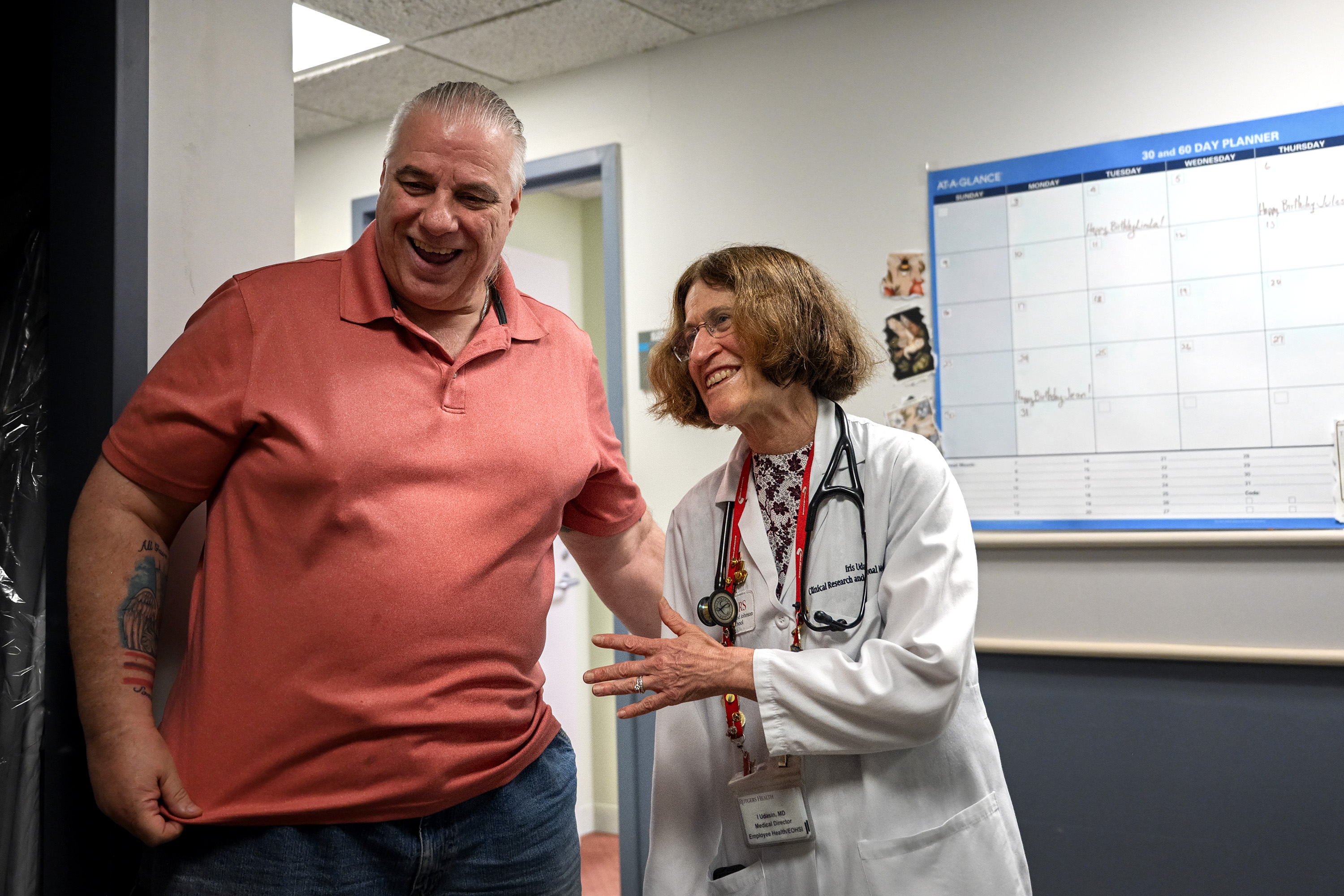
Retired Piscataway firefighter Frank Geffre Jr. shares a laugh with Iris Udasin, medical director at the World Trade Center Health Program at Rutgers University. Geffre credits Udasin and her team at Rutgers with saving his life after he was diagnosed with colon and rectal cancer. “Dr. Udasin is like the quarterback of the team,” he said.Tom Gralish / Staff Photographer
He sees a psychiatrist and a therapist for PTSD, which he finds especially hard to manage as Sept. 11 approaches each year. He lies awake after a recurring nightmare in which he is trapped in Manhattan with his family amid a terrorist attack, and he can’t get them out.
After the first plane struck on 9/11, Geffre and five other firefighters from Fire District No. 3 in Piscataway were immediately dispatched. His team got to ground zero shortly after the second tower violently pancaked.
“It was dark as can be, even though it was daylight. You had smoke clouds so thick you couldn’t even see your hand in front of your face,” Geffre said. “The dust was so thick it was like you had two foot of snow the night before.”
He initially wore respiratory gear, but the oxygen tank ran out as he worked nonstop over the first 30 hours. He saved roughly a dozen people after putting out fires that were blocking their exit from the burning buildings within the World Trade Center complex.
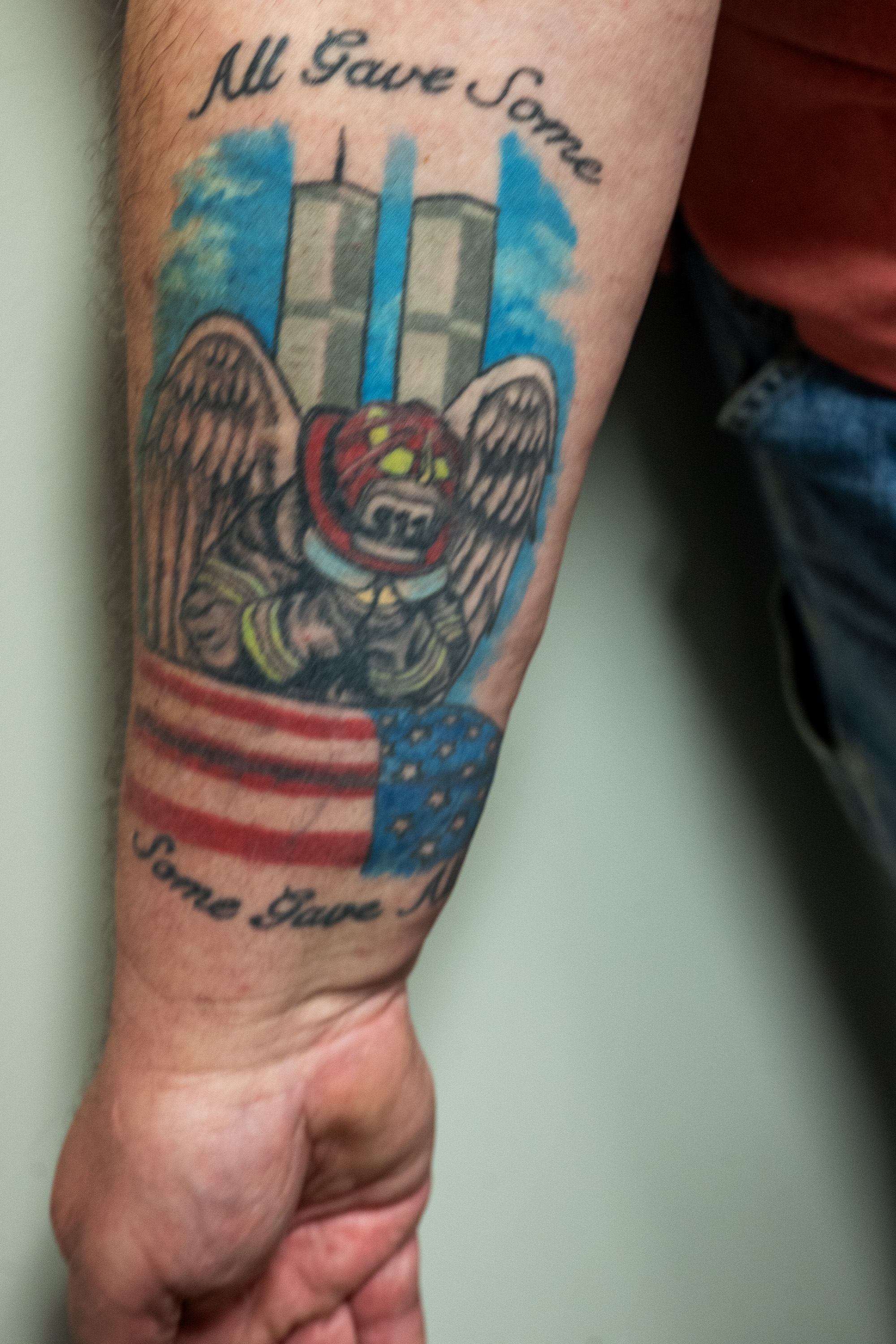
Retired firefighter Frank Geffre Jr. displays his 9-11 tattoo – “All Gave Some – Some Gave All” – during an appointment at the World Trade Center Health Program at Rutgers University. He designed the tattoo from a photo of himself splashing water on his face to rinse off dust and debris from ground zero. His wife said he looked like he was praying in the photo.Tom Gralish / Staff Photographer
He vividly recalls findinga brown dress shoe with a foot still in it. A blue polyester suit jacket with a torso seared to its lining. A wristwatch. A ring.
In all, he worked The Pile for 20 days, smearing Vicks VapoRub under his nose to cope with the“unforgettable, unbearably horrid smell of burning human flesh,” he said.
Now he can’t use the menthol and eucalyptus goo for his bouts of sinusitis, because the scent stirs bad memories.
“It feels like it was yesterday and a lifetime ago,” Geffre said. “The ‘Never Forget’ vow is not for first responders. We won’t ever forget. It’s embedded in us.”
He is ever-vigilant, prone to panic attacks. He avoids movie theaters and other places with crowds. “Too many variables,” he said.
He has a second home in Florida but drives back and forth. He won’t get on a plane. “I get paranoid that somebody on the plane is going to hijack it,” he said.
Two of the five firefighters with him on Sept. 11 have since died of cancer. He keeps in touch with four of the people he helped out of burning buildings. One committed suicide in recent years.
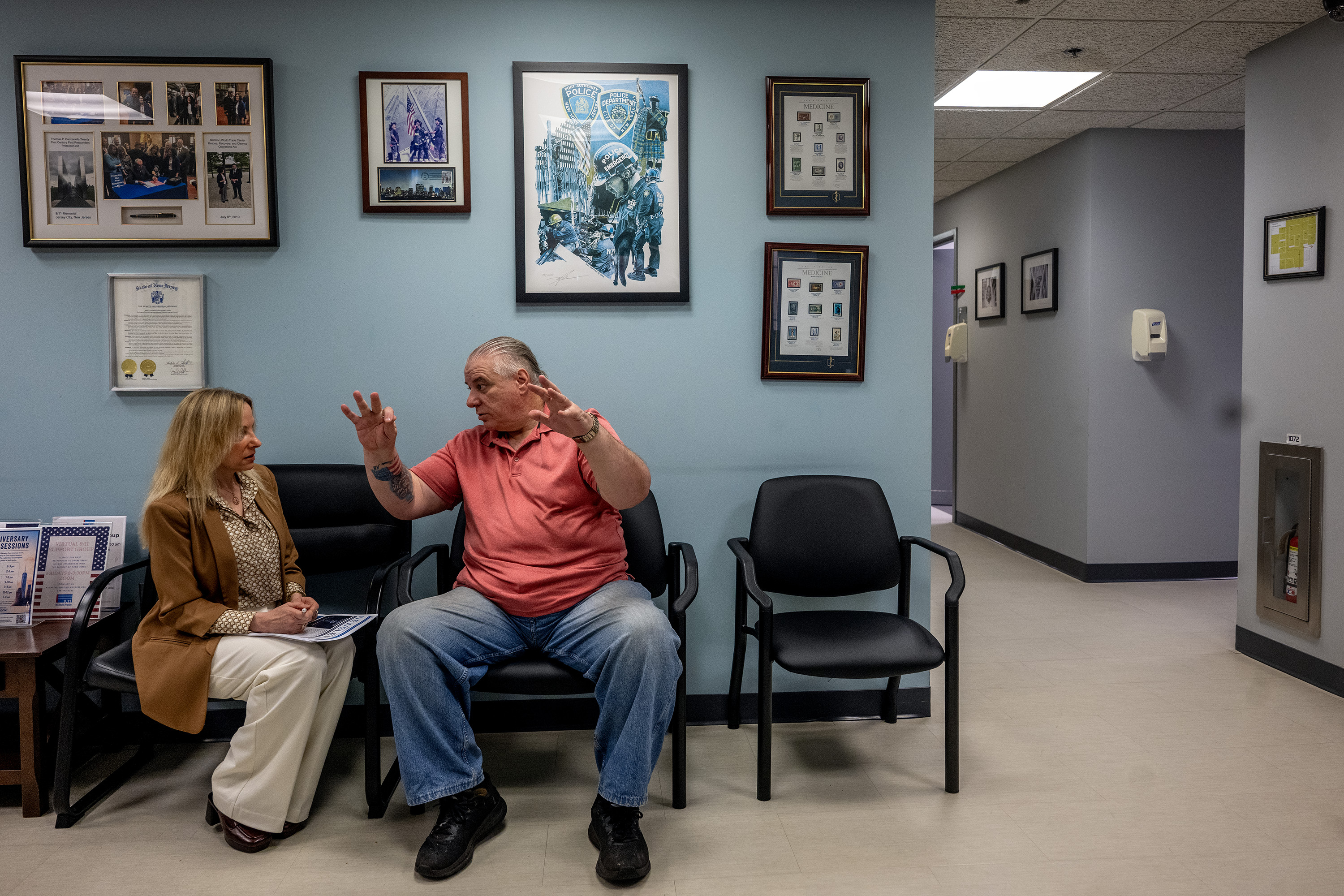
Retired firefighter Frank Geffre Jr. talks with Jodi Streich (left), mental health director of the World Trade Center Health Program at Rutgers University. Rutgers is one of six federally funded health clinics that monitors and treats 9/11 responders, as the health impacts continue 25 years later. The patient waiting room at the Rutgers clinic is adorned with photos of responders. Tom Gralish / Staff Photographer
Geffre, enrolled in the Rutgers program since its start, gets his mental healthcare through the clinic, which has seen a significant increase in demand for these services.
As more responders become ill or die from 9/11-related diseases, some have developed “heightened anxiety and vigilance about their own health,” Streich said.
Having more unstructured time in retirement, along with the loss of job identity and camaraderie, can be detrimental for mental health, she said.
“Things that we once buried — they come fully alive during retirement,” Streich said, adding that the support group she runs for retirees is now the most widely attended after the cancer support group.
Emergency responders who had felt too embarrassed or ashamed to seek help while working — because they feared being seen as weak — are coming in for the first time. Many are unable to eat or sleep, Streich said.
“We see them when they are at rock bottom,” Streich said. “They’ll come in and say, ‘I’m ready to talk about what I’ve been holding in for 25 years.’”
‘Exhaustion, desperation and heartache’
When asked if he regrets being dispatched to ground zero, Mark Fisher is emphatic: “Absolutely not.”
But he is tormented by images of people standing outside makeshift morgues with photos of their missing loved ones.
Fisher recalls becoming so distraught that a Red Cross volunteer pulled apart two tables piled with fresh clothes for responders to reach and embrace him.
“She hugged me for the longest time,” Fisher recalled, blowing air through his lips to steady his breathing and control tears. “I’m an Irish Catholic, so I wear my heart on my sleeve and face. I just had that look of exhaustion, desperation, and heartache.”
These days, he feels exhausted both emotionally and physicallyas his lung disease progresses. Fisher spent most of this summer in the hospital with a kidney infection that required two surgeries.
Five days after he got out of the hospital, his gall bladder became infected. “If I die, I want to die in a Catholic hospital,” he told his wife. Doctors removed his gall bladder in July.
The once-burly cop is rail-thin. He’s lost 35 pounds.
Inside their Northeast Philadelphia home, Sue Fisher (right) talks about the day she learned her husband, Mark Fisher, would need a double lung transplant. The couple’s 3-year-old granddaughter, Morgan Elizabeth Fisher, sits between them. Mark Fisher needs to use a portable oxygen tank to take walks with Morgan. Jose F. Moreno / Staff Photographer
Fisher’s priority right now is spending time with his wife and former sweetheart at Archbishop Ryan High School, and making sure she will be in decent financial shape when he dies.
Fisher, Masi, and two other responders from the Philadelphia Police Department are seeking written assurances from the city that if they die from their World Trade Center-related illnesses, their families will receive line-of-duty death benefits.
The status would enable their spouses to collect their full pensions, rather than half.
City officials said their families can apply to the Philadelphia Board of Pensions and Retirement, which would review each case individually after death.
Sue Fisher tries not to cry in front of her husband of 42 years;she’ll do it behind the shed in their backyard or on a walk with their golden retriever, Bentley.
He wants to delay as long as possible a double lung transplant, for which the survival rate is about five to seven years. “If they say that’s all he’s got, I’ll take it,” SueFisher said. “It’s better than him suffering the way he is.”
At night, she lies awake listening for the sound of Fisher’s breathing. Sometimes, she fears he has stopped. Then she nudges him with her toe until he stirs.
Retired Philadelphia Police Captain Mark Fisher wants the city’s word that if he dies of lung disease from his time at ground zero, his wife will get line-of-duty death benefits. City officials have said that his wife can apply to the pension board after he dies. Jose F. Moreno / Staff Photographer
On Sept. 11, 1990, President George H.W. Bush gave a speech to a joint session of Congress with his vision for a “New World Order.” He promised that instead of the spheres of influence and deadly competition that had dominated international politics, there would now be a future where “the rule of law supplants the rule of the jungle.”
For a while, it seemed like this could be true. War and conflict did not end in the 1990s, but peace seemed plausible.
A United Nations-sanctioned coalition pushed Saddam Hussein out of Kuwait. Israeli and Palestinian leaders signed the Oslo Accords, which promised a shared future of two states for two peoples. Genocidal leaders in Rwanda and Serbia were removed from power. Even the Irish conflict, famously “800 years” old, was ended with the Good Friday Agreement.
The United States reigned as the world’s sole superpower, and the next strongest militaries and economies mostly belonged to our allies. The Pax Americana seemed to have reached an unassailable zenith.
Then it all came crashing down.
When the planes hit the World Trade Center towers on Sept. 11, 2001, most of us did not realize it was the first step in the dismantling of the world we knew. I certainly did not. After all, I was only 12 years old.
My seventh-grade classmates and I initially had no idea what had happened. We knew that our teachers were upset, and we caught a glimpse of maneuvering warships on the faculty lounge TV. The next thing we knew, we were being told to head home. For me, that meant hopping on SEPTA’s 67 bus. My younger brother and I watched news coverage of the devastation from our living room couch.
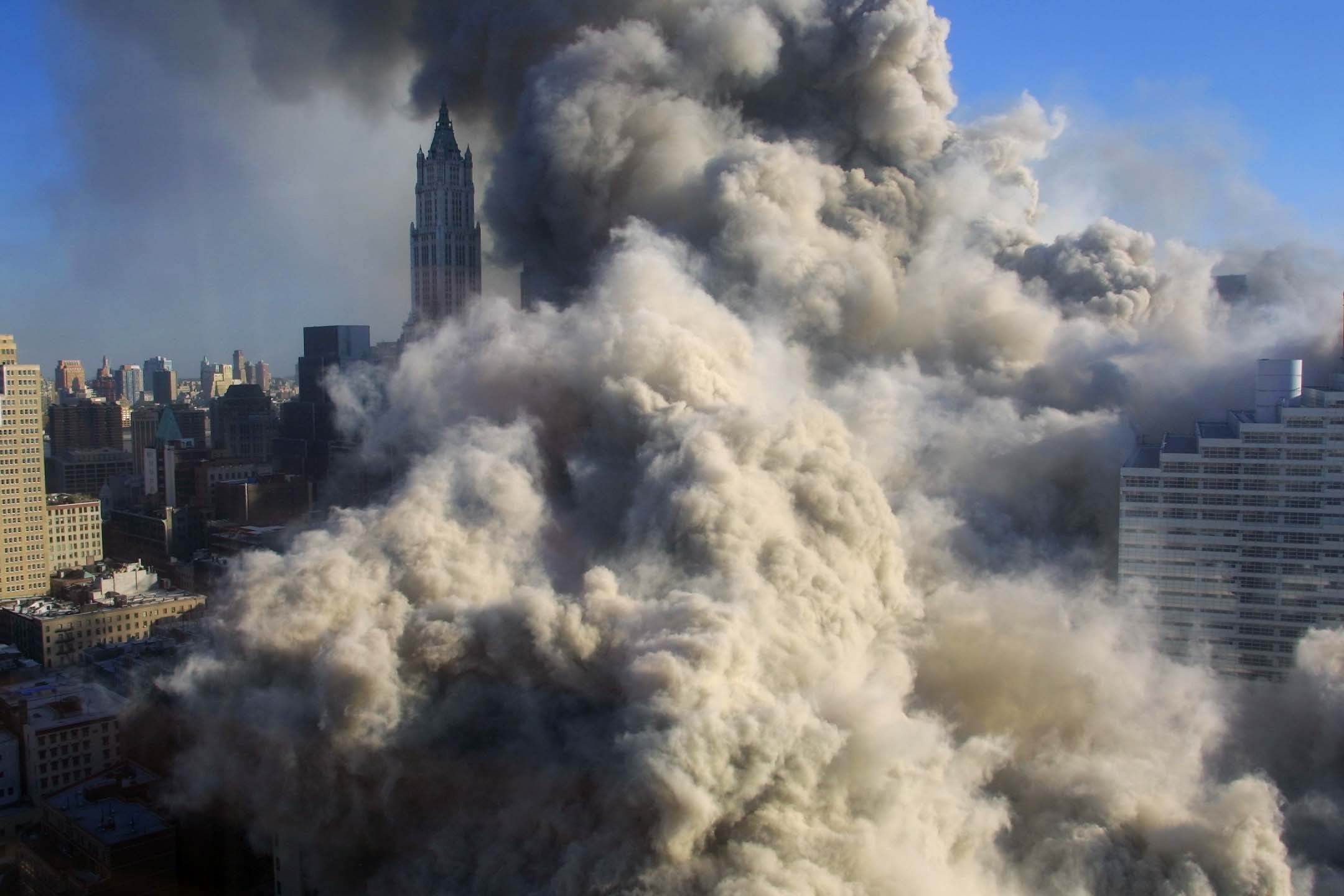
Smoke rises from the collapse of the World Trade Center buildings, seen from the west and framing the Woolworth Building in the distance, in Manhattan on Sept. 11, 2001.TING-LI WANG
At first, the attacks seemed to make the country stronger. We heard the inspiring story of the passengers who fought back on United 93, their plane crashing into a Pennsylvania field instead of its intended Washington target. When President George W. Bush threw out the first pitch at Yankee Stadium on Oct. 30 during the World Series, it felt like everyone was cheering him on, Republican or Democrat, Yankees fan or not. When he delivered a strike despite wearing a bulletproof vest under his pullover, it seemed like a promise that everything would get back to normal.
Much of what went wrong can be traced to our initial efforts to avenge the dead.
When the U.S.-led international coalition invaded Afghanistan in October 2001 to destroy al-Qaeda and bring its leader, Osama bin Laden, to justice, it seemed like a moral and strategic necessity. In March 2003, the Bush administration expanded the war on terror to Iraq under dubious claims of the existence of weapons of mass destruction. A year later, as the justification for the war was falling apart, revelations of brutal torture at Abu Ghraib prison in Iraq destroyed what little credibility and international goodwill Bush had left.
The reaction to 9/11 itself also presaged what was to come. While most Americans rallied to the flag after the attacks, a persistent subculture insisted they were faked in some way. The so-called 9/11 Truth Movement may have been a collection of cranky conspiracy theorists, but they represented a model for where America was heading — a time when people increasingly cannot agree on basic facts and no longer inhabit a shared reality.
President George W. Bush speaks aboard the aircraft carrier USS Abraham Lincoln off the California coast on May 1, 2003.J. Scott Applewhite
It isn’t just failures abroad that have fostered this sense of cynicism. In the ’90s, there was a great spirit of optimism about new technologies. The internet was heralded as a way to break down barriers and foster international cooperation. Initially, this also seemed to be true.
On message boards, once-lonely hobbyists found one another, sharing knowledge about topics as disparate as model trains, hiking, or fashion. Even fierce political opponents like Bill Clinton and Newt Gingrich could agree on letting the internet mostly regulate itself.
Today, 41% of Americans report having little to no confidence in tech companies. Instead of democratizing access to information, social media has flooded the zone with nonsense. Online ad revenue is reaped by tech companies while content providers fight over the scraps. Many local newspapers, their economic model upended, have either disappeared or been hollowed out. More and more, people are getting their news from short-form video apps like TikTok or Instagram, or from influencers who rarely cite their sources or explore the nuance behind any issue. The public’s distrust of Big Tech has somehow not spread to the figures the companies’ algorithms have pushed to the forefront.
The 2008 financial crisis also took a toll. Americans have disagreed over just about everything in our history, but the wave of foreclosures, stagnation in wages, and continued affluence for the country’s wealthiest sapped the public’s faith in the American dream. During the Great Depression, some wealthy figures like Charles Schwab and the Vanderbilts saw their fortunes shrink. During the Great Recession, the big banks received a $700 billion bailout, while 10 million ordinary Americans lost their homes.
Republican senators explain their opposition to President Barack Obama’s financial stimulus package during a news conference at the Capitol in January 2009.
In the 2000 election, both Democratic candidate Al Gore and Republican George W. Bush were viewed favorably by most of the American electorate. These days, a more divisive politics rules. Supporters of Donald Trump, convinced by the president that the 2020 election was stolen, stormed the U.S. Capitol. While it is true the 2000 election was itself controversial, with lawsuits about recounts in Florida ultimately reaching the U.S. Supreme Court, Gore conceded “for the sake of our unity as a people and the strength of our democracy.” Both Gore and President Bill Clinton attended Bush’s inauguration.
Of course, given the failures of the last 25 years, that establishment deserves to be questioned. The mainstream leaders of both parties share responsibility for the erosion in public confidence. Not only have they failed to anticipate the challenges of the 21st century, but their relentless partisanship has also made crafting sustainable solutions impossible. Nor have they offered new ideas that can compete with pledges to put every American on Medicare or claims that all our problems will disappear if we simply deport enough people.
That doesn’t mean the next 25 years can’t be better.
The beautiful thing about government of the people, for the people, and by the people is that we are in control. Just as our predecessors freed themselves from British rule, destroyed the power of slave holders that was corrupting our republic, reined in Gilded Age trusts, defeated fascism, and marched to finally make good on our nation’s stated belief that all men are created equal, those of us charged with the rights and responsibilities of citizenship today can also change our nation for the better. We must.
Even as the Russian invasion of Ukraine drags toward year five, radical Israeli settlers seize land meant for a Palestinian state, and our nation divides itself over every ginned-up bit of culture war ephemera, we retain the same qualities that made us the world’s hegemon in the first place — ingenuity, openness to risk, and drive.
Like the brave passengers on United Airlines Flight 93, we must recognize our predicament, find our resolve, and fight to ensure terror doesn’t win.
SCHUYLKILL HAVEN, Pa. — Brett Sell had a bad feeling about coming to work on July 28. The painting contractor was part of a small work crew rehabbing a two-story commercial property in Orwigsburg — a borough of just over 3,000 people in the heart of east-central Pennsylvania’s coal country — and workers had seen what looked like an unmarked law enforcement vehicle circling the site the day before.
“Yo, look up!” Sell said to his fellow painter, Orlando Rivera.
Police cars from Orwigsburg and neighboring Schuylkill Haven, lights flashing, blocked off the street while agents from U.S. Immigration and Customs Enforcement in tactical vests swarmed the work site. Sell was stunned as he and four other workers were quickly handcuffed by ICE agents — even though Sell and Rivera are native-born U.S. citizens.
Rivera, a biracial Puerto Rican who grew up in Bethlehem and now lives in another Schuylkill County borough, Tamaqua, said he was “embarrassed” as he stood in handcuffs while locals came out into the street to gawk. “I do a lot of work in that town,” he said, adding that “it made me feel like I was portrayed as a criminal.”
And he’s convinced he was handcuffed — even after offering to show the agents his ID — because of his race. “I get that my skin tone is tan,” he said, “but with the Fourth Amendment, they can’t go off my skin color, you know?”
Two workers were detained. One was later released, but the other — Catarino Hernandez Velasquez — a Mexican native who’s lived in Pottsville for at least 14 years, and a well-known contractor who poured concrete for the just-reopened 1928 Miners Hotel — was taken away and sent to ICE’s Moshannon Valley Detention Center in Central Pennsylvania, known for its overcrowding and complaints about lousy food and medical neglect. Kevin Medina, a leader of the local Latino community, bemoaned the arrest of a “very hardworking gentleman with a stable contracting business in the area … very busy.”
Now, gone … in a matter of minutes.
Painting contractors Brett Sell (left, white painting outfit) and Orlando Rivera are handcuffed during an ICE raid on a job site in Orwigsburg, Pa., on July 28. The men — both native-born U.S. citizens — were released without charges.Facebook
The Orwigsburg raid was a dramatic moment, yet such scenes are becoming increasingly common this summer in Schuylkill County, Pa., a constellation of rusty boroughs where coal was king in the 20th century, and Donald Trump got 71% of the vote in 2024.
‘In Schuylkill Haven, they can’t go there’
Since the start of the year, ICE — flush with a whopping windfall of $170 billion shoveled by Congress to the U.S. Department of Homeland Security to amp up immigration raids and detention — has dangled pledges to many tiny police departments. In Schuylkill County, which locals call “the Skook,” more than $1.5 million has been distributed to law enforcement. The police chief and pols all but publicly salivated at the chance — under the controversial program known as 287(g) — to buy a desperately needed new cruiser or other cop tools in return for working with ICE to arrest and hold local immigrants for the feds.
Some 14 law enforcement agencies — the most of any of Pennsylvania’s 67 counties — have inked 287(g) pacts with ICE, launching a new era of beat cops making immigration arrests that has roiled daily life in Schuylkill County. Practically overnight, cops were setting up truck inspections on a busy rural bypass or running checkpoints at places like the Freeze, a popular ice cream joint on the main drag, Route61. Officers were pouncing on immigrants who showed up at the county courthouse in Pottsville, or assisting ICE on workplace raids like the one in Orwigsburg.
Arrests leading to ICE detention and deportation cases skyrocketed across Schuylkill County — more than 100 since the start of the year, with most the result of ICE cooperation under 287(g) — leaving families torn apart while creating a climate of fear among what had been a rapidly growing Latino community in and around Pottsville. Suddenly, essential workers or their loved ones grew terrified that a busted taillight or failing to signal while shifting lanes could turn their world upside down.
One borough with just over 5,000 residents — Schuylkill Haven — has seen at least 59 immigration arrests in about four months, a staggering number. The figures come from Chicago-based ICE watcher Andrew Thrasher, a law-firm staffer and data expert who regularly crunches federal statistics obtained by the Deportation Data Project through Freedom of Information Act (FOIA) requests.
“People are afraid to go out,” Medina — who immigrated to Schuylkill County from Honduras, became a U.S. citizen and a notary and insurance agent, and formed a local Latino support group, Puentes de Apoyo — told me when we met in a Hispanic-owned Pottsville pizza joint. “I’ve got one contractor who told me they’ve got to change routes because now they know that in Schuylkill Haven, even they can’t go over there. And the stress, mentally, that I’m seeing in these families of, ‘What am I goingto do if this happens?’”
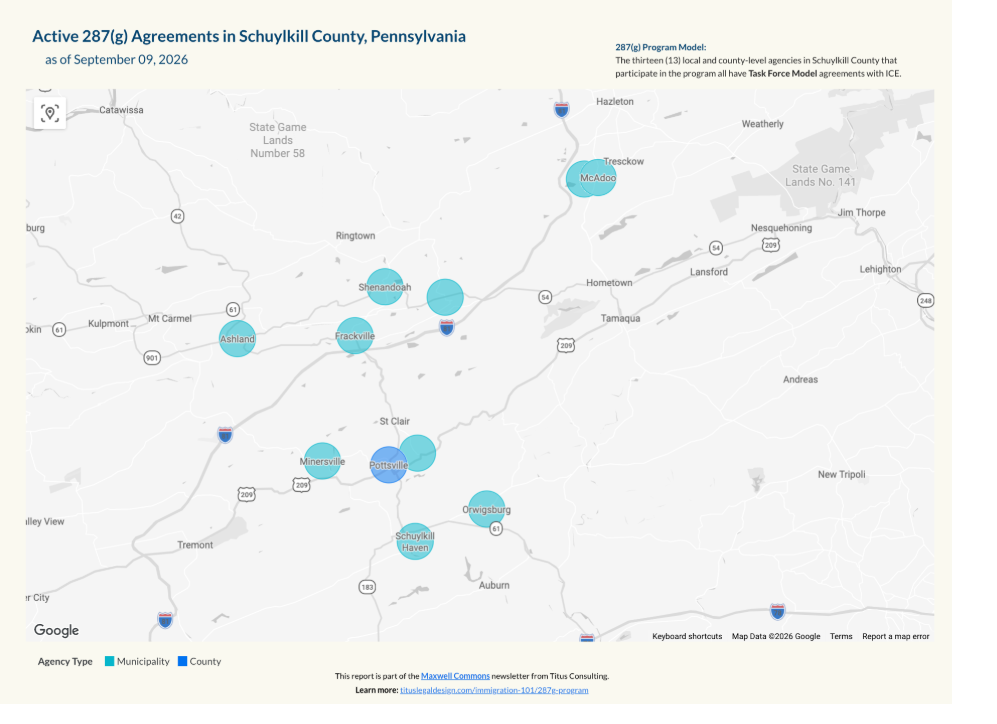
A map, provided by immigration statistics expert Andrew Thrasher, showing 13 current Schuylkill County localities that have signed 287(g) cooperation agreements with ICE. A 14th, Mahanoy Township, is inactive.Andrew Thrasher
The wave of arrests has put Schuylkill County — mostly rural, mostly conservative, and far removed from the glare of media or the kind of organized ICE resistance you see in big cities — on the cutting edge of an aggressive new strategy for mass deportation. This approach is bringing a xenophobic Donald Trump regime closer to fulfilling its once-unthinkable goal of removing one million immigrants from the United States every year.
Trump Country embraces 287(g)
The tag team of local cops and tactical-gear-wearing ICE agents is the biggest reason why federal immigration arrests spiked in July to a Trump-era high of 49,571, or about 1,600 every day. Statisticians who are tracking mass deportation said that 287(g) arrests — named for the section of a 1996 law that authorized the program — involving local police went from less than 3% of the total under Joe Biden to about 15% now, and will only climb higher as hundreds of new departments sign up.
This year, about 58% of the people nabbed by cops and turned over to ICE under 287(g) have no criminal record or pending charges, a higher rate than the typical ICE arrestee. Thrasher found the number for Pennsylvania is even higher, about 70%.
While not as numerous as inbig and heavily conservative states like Texas and Florida, the Keystone State’s 1,216 arrests under the 287(g) program in the first seven months of 2026 rank the commonwealth fourth in the nation — on a Top 15 list made upof states almost exclusively south of the Mason-Dixon Line.
Pennsylvania’s outlier status is punctuated by the fact that two large bordering states — New York and Maryland — have moved, with some bumps, to ban their police agencies from signing 287(g) agreements. Almost all of the Pennsylvania arrests came from smaller cities, exurbs, or rural areas — especially the south-central and northeastern regions of the state, and a smattering of western localities — that voted heavily for Trump and his anti-immigrant message.
The small-town nature of this renewed push for mass deportation is a defining feature of the Trump regime strategy, and not a bug. The race among Schuylkill County’s police departments — many with just three or four cops, including the chief — to sign up for 287(g) and its pumped-up pile of cash came exactly as the two Minneapolis murders of U.S. citizens by immigration cops were fueling growing public outrage.
As a brutal ICE winter ended, the Trump regime ousted Homeland Security Secretary Kristi Noem and the notorious field general Greg Bovino, and ended an era of loud, publicity-seeking operations with catchy names in large blue cities that stirred up local protesters who blew whistles and filmed every move by the masked, armed agents.
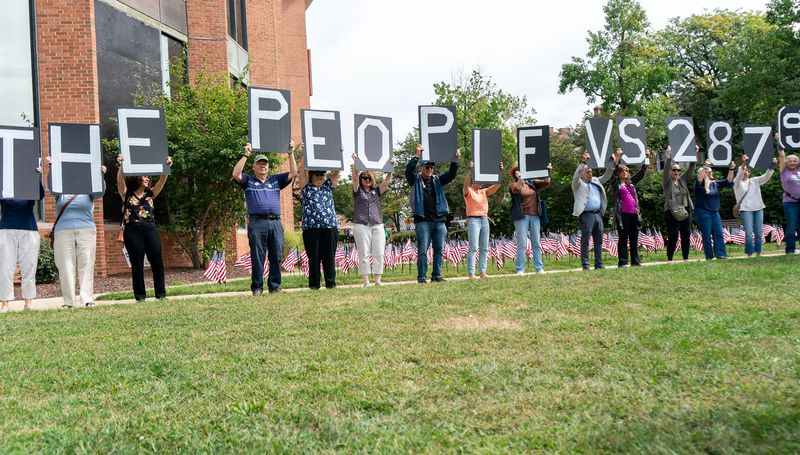
Immigrants’ rights advocacy group members and their supporters hold up letters that read “The people vs 287(g)” during a rally last September in Doylestown against the Bucks County sheriff’s efforts to implement a 287(g) program.Daniella Heminghaus | Bucks Coun
Under new DHS boss Markwayne Mullin, ICE and its allies are focused on what you might call small-batch immigration busts — in courthouses or on airport security lines, and thanks to 287(g), at local traffic stops or truck inspections. No one is blowing whistles, and few of these busts get caught on video. Yet, even here in blood-red Trump Country, some locals are troubled by the intense police focus on immigrants and what it’s doing to the moral fabric of their community.
‘Arrest them like the Gestapo’
“No one’s telling you not to arrest people — I’m telling you not to hunt for them, to do stops on the side of the road and arrest them like the Gestapo,” a Democratic city council member in Pottsville, Andy Wollyung, told me after he tried and failed to stop the county seat from joining 287(g). He later fretted that immigration arrests “will drive a wedge in people, you know? These aren’t unknown people. These are our neighbors.”
“When local police officers serve as a force multiplier for ICE, we know that people become more afraid to report crime,” Nayna Gupta, policy director at the American Immigration Council, told me. “They become less willing to cooperate with local law enforcement when it comes to investigations, including things like homicides. And there’s an overall mistrust of public institutions.”
The irony is that today’s Schuylkill County was built on the backs of immigrants — initially a wave of Irish who dug the 19th-century coal mines and were also persecuted, including six members of the infamous Molly Maguires who were hanged in Pottsville in 1877. They were followed by Eastern Europeans who filled the local mining towns like Mahanoy City and Shenandoah.
Those who stayed behind after the mines started closing in the 1950s and kept its hillside towns of striking Victorian architecture and utilitarian rowhouses alive got a booster shot in the 21st century with an unexpected new wave: Latinos. Many landed in Schuylkill County when seeking a place with cheaper housing and more job opportunities for hard workers than big cities like New York or Philadelphia.
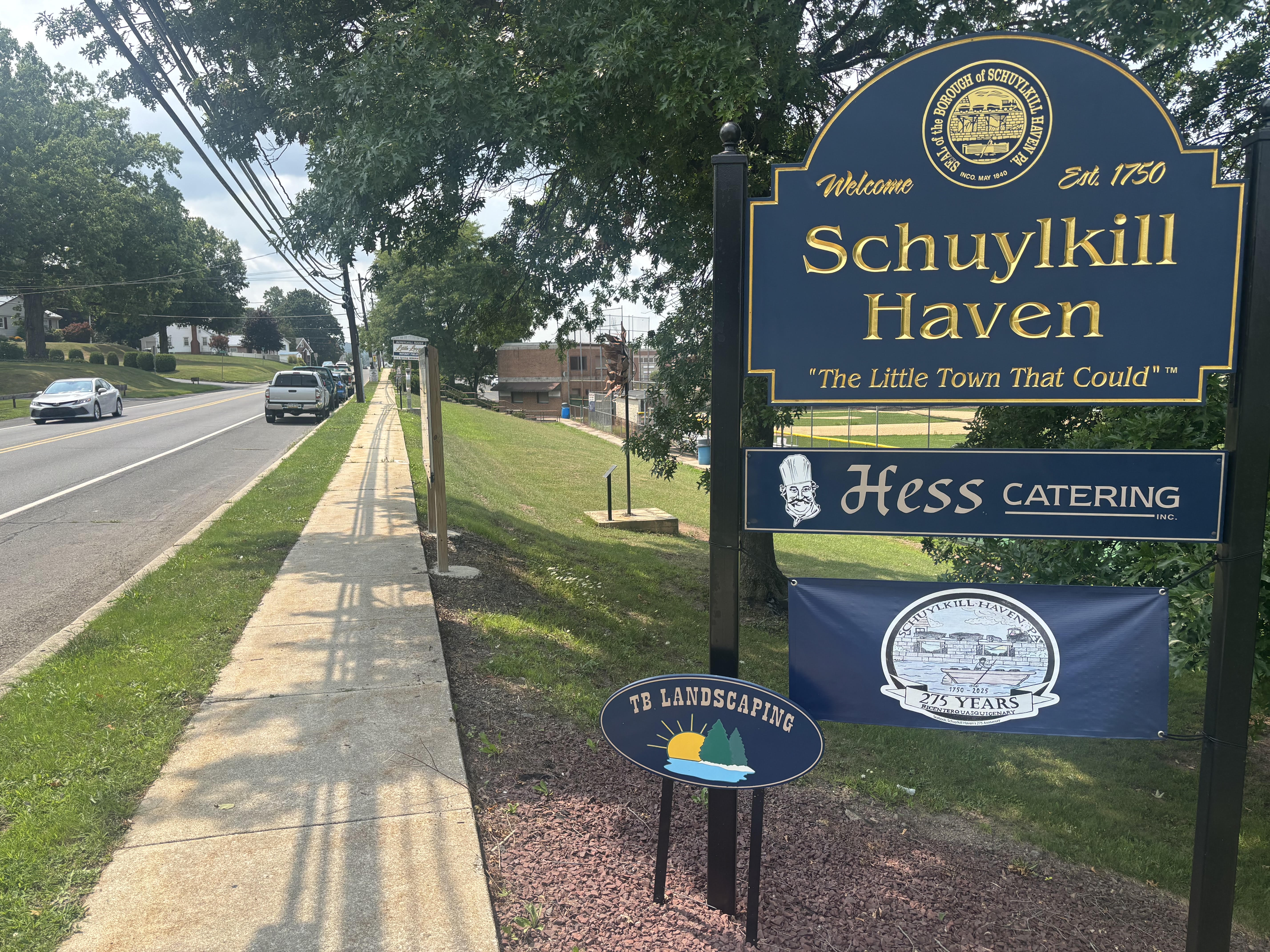
Schuylkill Haven, with a population of just over 5,000, has arrested at least 59 people and turned them over on federal immigration charges since signing a so-called 287(g) agreement with U.S. Immigration and Customs Enforcement (ICE) this spring.Will Bunch
Four years ago, Pastor Luis Rivera and his wife bought a historic local church building in Pottsville and rechristened it as Iglesia Cristiana El Kairos, under the umbrella of the Evangelical New Life Church, to serve a Latino community now growing by leaps and bounds.
“You see a lot of traffic,” the pastor told me. “You see people remodeling more houses. And a lot of the stores are opening around here … It was really dead before, you know?” Today, it’s estimated that about 1,000 of Pottsville’s 14,000 residents are Latino.
A ‘stable’ life is upended
Six of the more recent arrivals were Venezuelan-born Carlos Moreno, his wife, Wendy Martínez, and their blended family of four teenagers. They’d been on the run from government persecution and armed conflict across South America when they came to America in 2023, and stayed in a cramped public shelter in New York City as the family sought asylum and obtained work permits.
When they moved to a narrow rowhouse on a rugged patch of Norwegian Street on the steep hillside up from downtown Pottsville, the couple found jobs at the county’s large Amazon warehouse and even started a small cleaning business, even though Moreno, 37, is legally blind and has severe hearing problems.
“For the first time in years, it felt like our lives were finally becoming stable,” Martínez would later write. “Then, in the fall of 2025, we learned that I was pregnant. It was an unexpected surprise, but a very welcome one.”
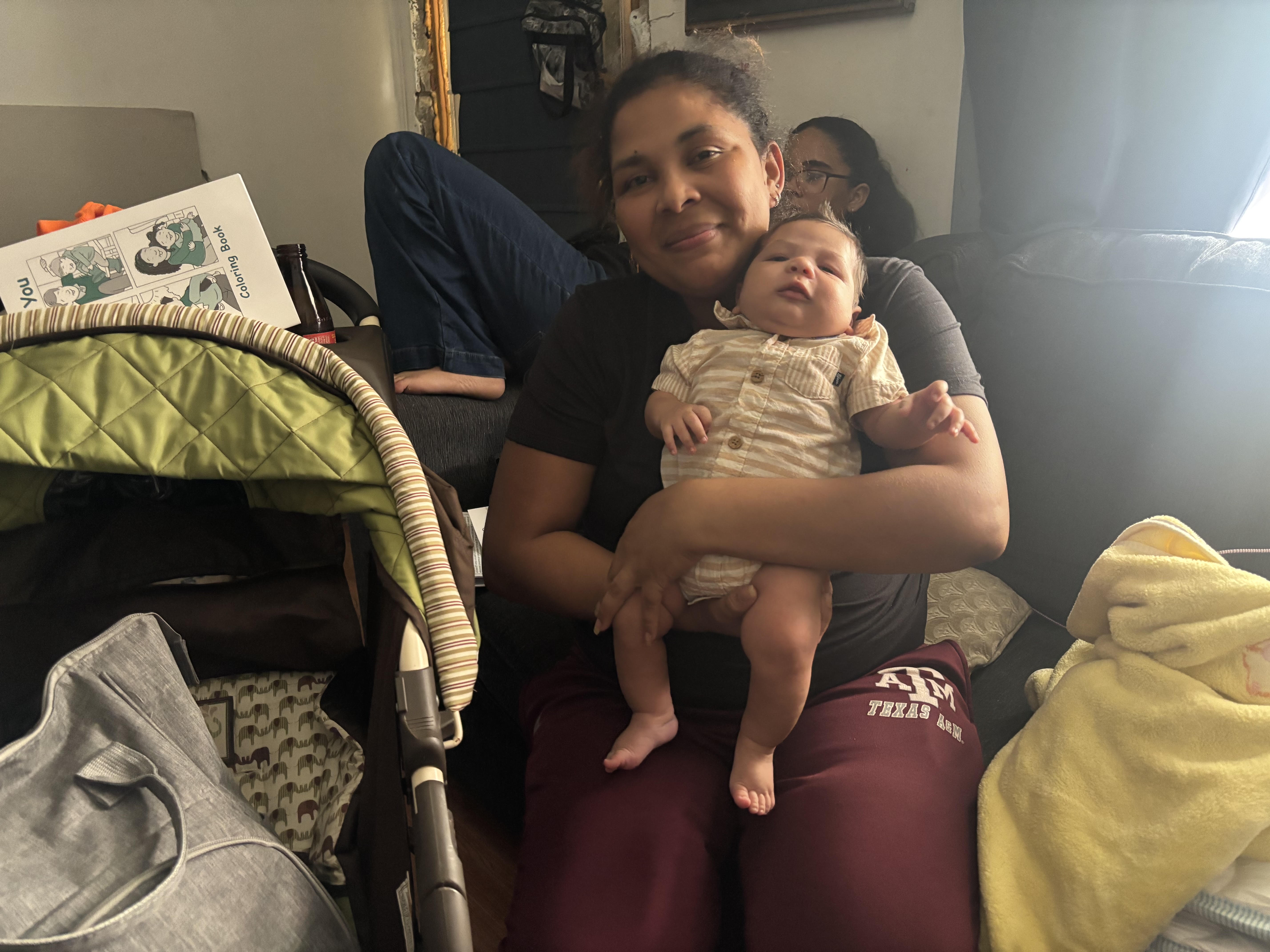
Wendy Martínez, whose husband, Carlos Moreno, a Venezuelan refugee, has been detained by immigration authorities since May after losing a misdemeanor noise complaint at the Schuylkill County Courthouse. She is holding her baby Noah, who was roughly 6 weeks old.Will Bunch
A bigger and less welcome surprise awaited. This spring, a neighbor called police to complain about noise —music from a small boom box — and Moreno received a summons. He decided to challenge it at the Schuylkill County Courthouse a few blocks away, and when he lost, he paid a fine, walked out of the courtroom — and right into ICE agents waiting to arrest him. He was sent to detention in the Cambria County Jail and stayed there as massive earthquakes halted deportations to Venezuela. He was locked up when his son, Noah, was born — on the Fourth of July.
Martínez was alternately rocking and bouncing her then-6-week-old son when I joined Medina in visiting their cluttered, narrow rowhouse in August. The windows were covered with thick blankets that let in only a sliver of light, and Martínez was bookended on a sofa by her two daughters, on their phones, who rarely leave home.
“They told him that he was a dangerous person,” Martínez said in Spanish, interpreted by Medina, as her baby babbled. “There hasn’t been any situation where he was against the law, or anything.” Struggling to pay her bills and support the five children, Martínez launched a GoFundMe page, but has only raised $2,695 of her $4,000 goal. Her husband was recently moved to ICE detention in Louisiana.
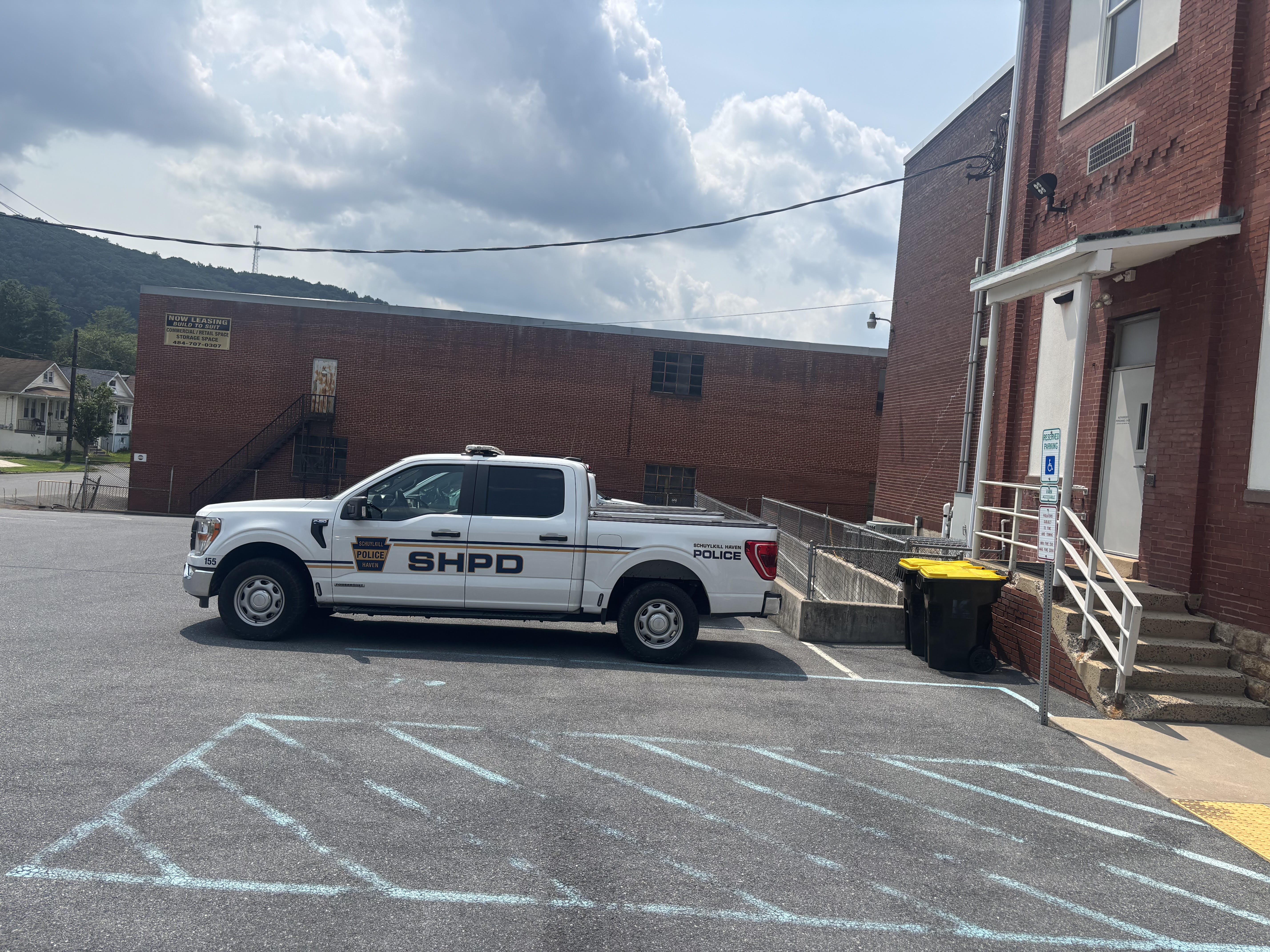
In August, Schuylkill Haven officials said they’re expecting a federal check for $152,000 — money the police department wants to spend on buying the currently leased police headquarters, pictured here.Will Bunch
Like most immigration arrests since 287(g) swept across Schuylkill County, there is an element of mystery about what exactly happened to Moreno. I twice called the Schuylkill County sheriff, Shawn Butler, to ask if his department — the first county agency to join 287(g), back in January — was involved, but he did not get back to me. Not once in a month of reporting did a police chief or municipal official return a call or email from this out-of-town columnist. Secrecy, and a lack of accountability, seems to be baked into the 287(g) program.
‘You don’t answer anything’
“Any Right-to-Know requests, any FOIA requests, anything — you defer that right down to the Department of Homeland Security,” Jody Long, the then-police chief in Mahanoy Township, told the Pottsville City Council when it was voting on a 287(g) agreement in May. “You don’t answer anything with that. That’s right from their legal team.”
In early September, I attended the bimonthly meeting of the Schuylkill Haven borough council hoping to ask Police Chief Jeffrey Walcott, Mayor John Williams, or other officials how and why their small borough just south of Pottsville had managed to make at least 59 immigration arrests since signing a 287(g) pact with ICE on April 5. I didn’t get very far.
In a brief conversation, Walcott suggested, interestingly, that commenting on 287(g) might bring protesters to Schuylkill Haven. When I asked Williams about the program after the meeting, the police chief interrupted our conversation to say there should be “a unified response,” and then later told me any information would need to come from Homeland Security or a FOIA request.
Schuylkill Haven Mayor John Williams (left) at a borough council meeting on Sept. 2. Next to him are borough secretary Kaitlyn Tinari (center) and council president Thomas Gordon (right). Williams said Schuylkill Haven’s cooperation with federal immigration enforcement is going well, but declined to elaborate.Will Bunch
Most of what citizens and the media in Schuylkill County know about the 287(g) programs comes from borough or township council meetings in which a police chief tells elected officials about all the sweeteners that cash-flush ICE added to the program when Congress and Trump enacted the so-called Big Beautiful Bill in 2025.
Police departments or county sheriffs who join the most common 287(g) Task Force model get $100,000 for vehicles or other equipment and $7,500 for each officer who undergoes 40 hours of mostly online training, as well as additional dollars for their time on immigration matters — all contingent on making actual arrests. In August, Schuylkill Haven officials said they’re expecting a federal check for $152,000 — money the borough wants to spend on buying the currently leased police headquarters.
The cash incentives have sparked a kind of deportation arms race across Pennsylvania, which has gone from just a few 287(g) programs at the start of the year to more than 130, with new ones coming online every day. Most of the council debates tread lightly on the question of liability for an officer who makes a bad arrest — a problem ICE is belatedly looking to fix with a proposal to insure each officer up to $500,000 — or the elevated risk that a traffic stop could lead to violence.
Fighting in the Schuylkill
That’s already happened. On May 20, a Schuylkill Haven cop stopped a car on Route61 after he claimed the driver had illegally dark-tinted windows. ICE agents who were in the borough and arrived at the stop ran the license of 34-year-old Yensy Rafael Santana Alvarez of New York City and determined he had an immigration removal order.
According to the Skook News, a court affidavit said the man handed over his car keys and stepped out of his car — then ran for it. Alvarez led the law officers on a wild foot chase across the Schuylkill and back, getting tased once, and allegedly pulling one officer underwater as another suffered minor injuries. He was eventually arrested, and felony charges were filed but then dropped.
Some local critics also questioned whether minimally trained cops making immigration arrests is a good idea in a county where some departments have a history of police abuses. “In northern Schuylkill County, over the last 10 years, we’ve had horrendous police … acting very unprofessional in different departments,” John Hampton, a lawyer who has worked with Mahanoy Township, told me.
A heated and emotional debate over the federal 287(g) immigration enforcement program dominated Monday night’s Pottsville Council meeting.
After initially failing in a 3-2 vote, the resolution was reopened moments later and ultimately passed following a council member changing… pic.twitter.com/kSW1QXhgqS
In 2022, two then-police officers in the borough of Minersville were indicted on still-pending federal police brutality charges for allegedly severely beating a man during a traffic stop and falsifying police reports to cover it up. That didn’t prevent ICE from signing a 287(g) agreement with Minersville police in May.
That same month, local activists pleaded with the Pottsville City Council during a meeting that lasted more than five hours not to join the 287(g) program, arguing that immigration arrests would make tourists and new businesses not want to come there. They thought they’d won in a 3-2 vote, only to have GOP council member Scott Price change his position and demand a revote that flipped the outcome, saying that, in the end, “I have to side with our police officers.”
One of the few pro-287(g) advocates who spoke at that May hearing was Mahanoy Township’s Long, who said his department had been “the leader in the county” by making 10 immigration arrests, mainly at what he called a truck-safety inspection point. “ICE does not come in and tell you what to do,” Long insisted. “We tell them what to do.”
He was joined by one of his officers, Anthony Maldonado, who cited his own heritage as a Puerto Rican to insist there is no racial profiling. “I have family members who are light-skinned, dark-skinned, everywhere in between, so I would take it very personally if we conducted ourself unprofessionally to that effect,” he said.
‘Because you look like a Mexican’
The room in Pottsville did not hear from Moe Montalvo, a gutter contractor from nearby Tamaqua who, in mid-April, passed through the checkpoint on Burma Road operated by cops from Mahanoy Township and assisted by adjacent Ryan Township officers. He said he was part of a two-truck convoy, and the first one with two white occupants was waved through, while his was stopped to allow the officers to ask Montalvo, a 28-year-old U.S. citizen who is half Puerto Rican and half Egyptian, for his ID and grill him about his identity.
Montalvo posted that day on Facebook that when he told an officer he was born in Montgomery County, the cop replied: “Are you sure? Because you look like a Mexican.” Montalvo also quoted the officer: “Why are you worried? The only thing you should be worried about is when I take my Taser out, because I’m going to aim right for your nose piercing.” I confirmed the incident with Montalvo, who told me that “it seems like there was no doubt that racial profiling was involved here.”
Weeks later, the Mahanoy Township Police Department went dark, at least temporarily, after Long, Maldonado, and its other officer all quit in a disagreement with supervisors. One of the supervisors, Republican Tony Merchlinsky, confirmed to me the entire force had resigned after a dispute with supervisors over its refusal to wear body cameras. He said it was triggered by a civilian complaint over an arrest that did not involve immigration, although he added that “it may have involved racial profiling.”
Maldonado took to Facebook to give his side of the story, saying that a different supervisor had told the township officers they were making too many arrests, and that, as quoted by Maldonado, he preferred “a [B]arney Fife department and have his police drive around and wave at people instead of making arrests.” Merchlinsky confirmed that Mahanoy Township — which recently hired a new, albeit part-time, police chief — has yet to see one dime from the feds of the more than $100,000 that was promised.
The checkpoint drama and police tensions in Mahanoy Township demonstrate some of the many problems when beat cops are drafted to join Trump’s mass deportation crusade. Are police really making their towns safer when one part of the community is taking long traffic detours and covering up their windows in terror of any contact with cops? Is the economic gloom over Pennsylvania’s fading coal country really going to be lifted by clamping down on immigrants who’d been flocking there to pour concrete and rehab old buildings?
Does a region whose very DNA is handed down by the immigrants who once came here to shovel anthracite now want to be known in the 21st century as a “show me your papers” police state?
Few of these questions are being asked as one former coal burg after another races to embrace a Trumpian bargain with the 287(g) program. The latest is Mahanoy Township’s next-door neighbor, Ryan Township, which in June voted conditionally to join the ICE mass deportation program, citing as the biggest incentive its need to replace its run-down Ford Explorer, one of the oldest police cars in Schuylkill County.
I’m not saying the world’s most coveted beef is an international marketing conspiracy to compel us all to pay more for steak. I have eaten genuine A5 Wagyu fresh off a grill in Tokyo, and the unique sensation of biting into that cube of quivering-hot meat laced with molten fat and feeling it dissolve into buttery richness is unforgettable. Japan’s famously pampered breed of cattle — whose expense results from an intense feeding regimen over a longer duration than conventional beef — can be very special. Especially in small quantities.
Back here on the front lines of all-you-can-eat wagyu feasting at Ogyu in Ardmore, however, I could not escape the feeling I was in for an experience long on flash — sizzling tabletop grills, swirling plumes of dry ice smoke, digital sparks flying across the room’s giant LED screens — and short on satisfying flavors.
Guests dining in at Ogyu on Friday, Aug. 28, 2026, in Philadelphia.Tyger Williams / Staff Photographer
I was prepped for a 90-minute sprint of carnivorous endurance, limited only by my ability to navigate a DIY iPad menu, forced timing breaks, and the need for a maximalist ordering strategy for Ogyu’s tiered packages,ranging from $39 to $99 per person. Should my appetite stumble? A potential 20% “wasting fee” loomed. (Diners are potentially charged extra if they don’t eat what they order.)
I didn’t want to let our server James down after he successfully upsold us into one of the more expensive packages, whose overlapping lists of meat perks, which gradually increase in quality, reminded me of sussing through the various mysterious options available at a car wash. Sure, my car will be clean no matter which hot wax I select, just as I’ll be full no matter which all-you-can-eat menu I go for. But will I emerge with that ruddy Wagyu shine of beefy bliss?
Definitely not with the entry-level “Silver” ($39) or “Gold” ($59) options, which James wordlessly dispatched as unworthy by comically sticking out his tongue in disdain and slashing his throat with his fingers: “The ‘Diamond’ tier is our most amazing experience,” he counseled.
The Bluefin tartare at Ogyu on Friday, Aug. 28, 2026, in Philadelphia.Tyger Williams / Staff Photographer
We settled on the second-most extravagant option, the $79 “Platinum,” in which some genuine Japanese Wagyu is made available along with prime-grade beef and less-marbled American wagyu from the lower levels of the menu.
As a newcomer to the all-you-can-eat universe, I immediately fumbled the challenge of prioritizing our orders properly. Diners are limited to ordering a maximum of 10 items every 10 minutes, and we foolishly crowded our limited table space with mundane belly-fillers like wagyu dumplings (raggedy), hand rolls (mushy with too much panko filler), spring rolls (so greasy), and pencil-size wands of tempura-fried crustacean so thickly breaded they were unrecognizable as lobster tail. The truffled wagyu stir-fried rice was burnt.
I did appreciate the slow-steeped richness of the bone marrow soup. We also enjoyed the thick-cut bluefin tuna sashimi, as well as a toro tartare with avocado and ponzu. (Ogyu’s owner, Sam Li, says several regulars come here to get their money’s worth exclusively in bottomless sashimi.)
But we were here for the beef. James finally took pity on us, commandeered our iPad, scrolled down to multiple menu panels I’d missed, and began punching up orders for the maximum amount of the A5 Wagyu cuts allowed from Miyazaki Prefecture. I was impressed with the dramatic presentation of the fat-marbled Wagyu rib cap that arrived at our table in branded wooden boxes fuming with smoke — until a server tipped the box too far and the cold water that activated the dry ice smoke streamed right out onto my guest’s lap.
Ogyu Japanese BBQ restaurant is shown on Tuesday, July, 7, 2026 in Ardmore, Pa. The new restaurant by Sam Li offers a modern Japanese steakhouse experience with tabletop cooking, adding to Ardmore’s growing portfolio of restaurants.Jose F. Moreno / Staff Photographer
Ogyu (pronounced “Oh-Gee-You”) is a snazzy space. Li, a chef and sushi entrepreneur who also owns three Osushis (in Ardmore, Wayne, and Marlton) as well as Newtown Square’s Hiramasa, spent $3 million transforming the former Iron Hill into a 300-seat meat palace with sleek black fixtures, marble accents, and illuminated walls. The all-you-can-eat format, a national trend in luxury foods, has been a smart move for this three-month-old restaurant, which grills 1,000 pounds of beef each week, 75% of which is wagyu, roughly 20% of which is from Japan. (A la carte options are launching soon.)
But the overall details do not add up to theluxuryexperience the $120 check average should command, from the cruise ship-level tropical drink program to the tiny plastic plates our servers never bothered to clear between courses until I asked. (Nonetheless, our server preselected a 22% gratuity as the default tip on Ogyu’s mobile payment machine.)
Jason Kan, of Wynnnewood, Pa., and wife Megan Kan, are dining in for the first time at Ogyu on Friday, Aug. 28, 2026, in Philadelphia.Tyger Williams / Staff Photographer
Habitués of all-you-can-eat may understand their task, target, and the rules of the game. Unlike flavorful, marinade-boosted Korean barbecue, this beef is presented relatively unseasoned, in the Japanese yakiniku tradition, to “focus on the quality of the meat itself,” says Li. I only wish someone had bothered to show us the temperature controls on the side of our tabletop grill, which wasn’t set nearly hot enough to properly sear the beef. The A5 Wagyu rib cap itself was legitimately tender and glossed with fatty richness. But served in less-than-prime circumstances, with customers in charge of their own grilling — usually overcooking the meat while simultaneously trying to socialize — it fell flat for me.
A $79 fee, or even $99, is technically a fair deal for a big meal spun around an ingredient that, at its highest quality, sells locally at Barclay Prime for $210 or more for a half-pound portion. But I don’t enjoy Japanese Wagyu in that kind of portion. It’s rich and tender to the point of being mushy. A little goes a long way. But the wider world’s growing appetite for wagyu as a prestige label synonymous with the good life (the global market is projected to grow from $29 to $49 billion between 2025 and 2034) leaves me skeptical.
The Wagyu Mt. at Ogyu on Friday, Aug. 28, 2026, in Philadelphia.Tyger Williams / Staff Photographer
Is wagyu really the lifestyle upgrade we need — not just for occasional splurges, but our everyday burgers and cheesesteaks, too? I don’t think so. It’s just the latest in a long line of token bites of privilege — truffles, caviar, uni — that lose their luster once the industrial food complex latches on for maximum profit, even as standard beef prices hit all-time highs. There is some excellent American wagyu available now, but there’s also enough fake wagyu on the market, let alone less-marbled hybrid versions raised in both America and Australia, to make one question all of it.
Personally, I’d rather sink my teeth into a thick, dry-aged porterhouse that delivers the beefy texture and complex savor of carefully handled meat, not just the fat that gives it richness. I’ll take a well-marinated Korean galbi with all the ssam and banchan fixings at Kim’s, a perfectly cured slice of brisket pastrami (hello, Radin’s deli!), or a grass-fed Brazilian cut roasted over live coals at Picanha over the soft pads of a fatty wagyu splurge.
The Miyazaki rib eye at Ogyu on Friday, Aug. 28, 2026, in Philadelphia.Tyger Williams / Staff Photographer
But the competitive nature in me chafed to learn from James, when I asked him after our meal, that my table of four’s consumption of 32 savory dishes was “below average” for Ogyu. Li later confirmed that his regulars typically order 50 to 60 dishes.
I became determined to run it back for another visit, this time at Diamond-level indulgence, with a disciplined game plan to start with beef and order, order, order at every 10-minute interval. We started at the peak, quite literally, with “Wagyu Mt. Fuji,” a pylon-shaped prong wrapped in American-raised wagyu blade steak whose snow-effect decoration of grated Parmesan had the unfortunate effect of sticking to the grill and causing the beef to shred into worthless flakes whenever we tried to pry it off. Our server whisked away the grill plate before we’d even eaten half.
The Wagyu Mt. Fuji dish at Ogyu in Ardmore, featuring American wagyu blade steak.Tyger Williams / Staff Photographer
I tried the black pepper-marinated eye-of-round to sample a non-Wagyu cut, but these prime-grade strips quickly roasted into unpleasantly twiny ropes that prompted my own impression of James’ pantomimed nixing. It would be almost all Wagyu from here on in as we cycled through multiple 3.3-ounce portions of truffled chuck rib, short rib, strip loin, and thin-cut tongue (too crunchy for my crowd). Piles of empty service trays cluttered our table as the staff arrived with waves of more meat. But few cuts really wowed me, except for the tender New Zealand lamb chops, which I highly recommend.
Among the best menu items was the “Meet Wagyu” nigiri, a sheer strip of beef draped over a nub of rice, topped with a nugget of your choice — uni, caviar, truffles, or foie gras — then briefly torched in the kitchen. It was a composed one-bite delight that highlighted Wagyu’s signature virtues. The one knockout cut that impressed on its own was the A5 rib eye from Miyazaki, a succulent pad of velvety soft beef that our server snipped into glistening morsels.
The Wagyu nigiri topped with uni at Ogyu on Friday, Aug. 28, 2026, in Philadelphia.Tyger Williams / Staff Photographer
After 3 pounds of grilled meat between us, I could have kept going. But my tallow-saturated guests could not. Despite my best efforts, we’d only managed a small bump over the previous visit: just 37 plates. We’d maxed out our quotient on the premium Japanese Wagyu, but as plate volume went, we were still way “below average.”
Once the dry-ice smoke settled, I needed a caffeine boost — only to find that Ogyu won’t even brew a simple pot of tea (lest you linger beyond your 90-minute welcome). At least there’s refreshing green tea-flavored ice cream extruded into strands of “matcha snow ice.” Li says they mix their own ice cream base and pair it with red beans to temper the sweetness. After a meal of such unbridled beefy excess, the final restrained note was perfect.
The matcha snow ice at Ogyu on Friday, Aug. 28, 2026, in Philadelphia.Tyger Williams / Staff Photographer
Lunch served 11:30 a.m. to 3 p.m. Monday through Friday; dinner 3 to 10 p.m. Monday through Thursday, until 11 p.m. Friday, and 11:30 a.m. to 11 p.m. Saturday and Sunday
All-you-can-eat packages through four tiers from $39 to $99.
Wheelchair accessible.
About 70% of the menu (including most meats) are gluten-free or can be modified.
Menu highlights: As much of the A5 Japanese Wagyu as your package allowed. Also, the Wagyu nigiri combos, the lamb chops, bone marrow soup, and matcha snow ice.
Drinks: The tropical cocktails are fine and on-theme but not memorable. There’s plenty of sake and Japanese whiskey for big spenders. Otherwise, stick with a draft of Sapporo or Dogfish Head 60 Minute IPA.
Lounge area at Ogyu Japanese BBQ, 60 Greenfield Ave., Ardmore, on May 21, 2026.Michael Klein / Staff
DALLAS — In a remarkable move for a Democratic lawmaker, U.S. Sen. John Fetterman on Wednesday appeared in a video at the Republican midterm convention — an event specifically designed to boost GOP candidates this fall — in a way that praised President Donald Trump for his support of Pennsylvania steelworkers.
The video was a clear escalation of a monthslong shift in which Fetterman has drifted from the Democratic Party. Though he has repeatedly rejected speculation that he would switch parties — and did so again after the video Wednesday — he has consistently criticized Democrats and praised Trump since the president took office.
In the video — which introduced U.S. Sen. Dave McCormick (R., Pa.) as he took the stage — Fetterman said he and McCormick “will work with President Trump to fight and defend the steel way of life right here in the Steel Valley.”
“I’m always going to stand with America. I’m always going to reject the extremes and socialism, and the anti-American way of life,” he said, repeating a common refrain in which he criticizes the leftist wing of the Democratic Party that has secured several high-profile wins this year.
Fetterman, who was not physically in attendance at the American Airlines Arena in Dallas, was cheered and applauded after McCormick took the stage and said, “How great is John Fetterman, right?”
In addition to McCormick, several vulnerable House GOP incumbents from Pennsylvania were at the convention. Fetterman’s video appearance came shortly after a speech from U.S. Rep. Rob Bresnahan (R., Luzerne), who represents one of the districts Pennsylvania Democrats are hoping to flip this year.
U.S. Rep. Madeleine Dean (D., Montgomery), who traveled to Texas to protest the GOP convention, said she was “gravely disappointed” that Fetterman chose to participate in the GOP event rather putting his energy to electing Democrats in key Pennsylvania races — the latest in a growing list of transgressions.
“I will tell you, from the ground, from suburban Philadelphia, my constituents are livid. Those who went out and knocked doors for him, they are absolutely livid,” she said the following day.
Democratic Gov. Josh Shapiro, who has a frosty relationship with Fetterman, said Thursday at an event in Chester that he did not see the video before adding that he was “not going to get distracted” from his duties as governor and his reelection campaign.
Democrats nationally are aiming to flip both the House and the Senate, which could put Fetterman in a powerful position as a swing vote if Democrats narrowly win control of his chamber.
And while leaders in both parties have reportedly made appeals to him, Fetterman said in a statement after his video went out that he would not switch parties if the Senate changes hands.
“I’m a lifelong Democrat who votes overwhelmingly with my party — and should the Senate flip in November, I will still be the 51st vote that I ran on,” he said, referencing his campaign promise in 2022 to be the Democratic vote that clinched the majority.
On Thursday, a web page soliciting donations to Fetterman’s campaign committee included a link to the video and said Fetterman would “keep standing his ground, speaking his mind, and putting Pennsylvania first.”
Fetterman has long been a supporter of the state’s steel industry as the former mayor of Braddock, the Pittsburgh suburb home to the Edgar Thomson Steel Works mill — which served as a backdrop to the video he shot for the convention.
U.S. Steel has pledged to invest up to $2.5 billion into that mill and other Mon Valley Works plants around Pittsburgh since its sale to Japan-based Nippon Steel last year.
The $15 billion sale had been held up for a year, opposed by both Republicans and Democrats concerned about a foreign takeover of the iconic company. Former President Joe Biden blocked the deal, and both Fetterman and McCormick criticized it before Trump took office.
Trump went on to secure a pledge that Nippon would have an American CEO, not lay off workers, and give the U.S. a so-called golden share in the company. Trump returned to Pennsylvania for his first rally in the state to celebrate the deal with steelworkers outside Pittsburgh.
“Under Joe Biden, Democrats blocked critical investment in U.S. Steel, risking thousands of jobs,” McCormick said on stage Wednesday. “I promised Pittsburgh steelworkers I would fight for the steel way of life, and President Trump did, too. And with the president’s leadership, we delivered a deal protecting and creating over 100,000 American jobs.”
Fetterman’s participation in the GOP conference — in the type of promotional video that is common at party conventions — is extremely rare.
The Pennsylvania Democratic senator’s decision to record a video praising Trump ahead of the election may draw comparisons to Georgia Democratic Sen. Zell Miller’s fiery speech praising President George W. Bush — and denigrating Democratic nominee John Kerry — at the 2004 Republican National Convention.
State Rep. Malcolm Kenyatta, a Philadelphia Democrat who ran against Fetterman in the 2022 Senate primary, drew a different historical comparison.
“John is Benedict Arnold, but lazy. Could barely get off the couch in his million-dollar mansion to kiss Trump’s ring, he phoned it in like everything he does,” Kenyatta, a Democratic National Committee vice chair, said on X.
U.S. Rep. Brendan Boyle, a Philadelphia Democrat, similarly blasted the senator’s video appearance at the rival party’s convention.
“A year ago, I labeled John Fetterman ‘Trump’s favorite Democrat.’ Tonight, he yet again proves why,” Boyle said on X.
And U.S. Rep. Chris Deluzio — a Western Pennsylvania Democrat who, like Boyle and Kenyatta, could be a candidate when Fetterman’s seat is up for election in 2028 — declared in a statement that Fetterman is “not going to be a Senator after 2028 — mark my words.”
“If the failing Republican politicians want him, they can have him,” Deluzio said. “Like them, John Fetterman has failed the Pennsylvanians who elected him, who expected him to fight against White House corruption, health care cuts, and reckless war, not cheerlead it.”
Fetterman has not yet said he will run for reelection and his dismal approval ratings among Democrats could make it difficult to win a primary — unless he switches parties. Among Republican voters, he was even more popular than McCormick in a poll last month from The Inquirer, the New York Times, and Siena University.
Fetterman has developed a close association and friendship with McCormick since the Republican’s election in 2024. While Fetterman rarely makes public appearances in the state he represents, he has appeared at a few with McCormick.
In a striking move, the bipartisan pair also set up a joint fundraising campaign committee this summer as Fetterman’s own fundraising lagged. This past week, McCormick came to Fetterman’s defense after the Wall Street Journal reported that the Democrat frequently avoided meeting with, and privately criticized, constituents and interest groups.
“These stories are the latest example of outrageously disloyal staff and forces on the Left using anonymous leaks to cancel my friend John Fetterman,” McCormick wrote on social media. “They hate that he is an independent thinker who refuses to fall into line so they want to silence him.”
In the convention video, Fetterman called McCormick a “great American, a great senator.”
“Yes, he is in a different party, but I’m proud to count him as my great friend,” Fetterman said.