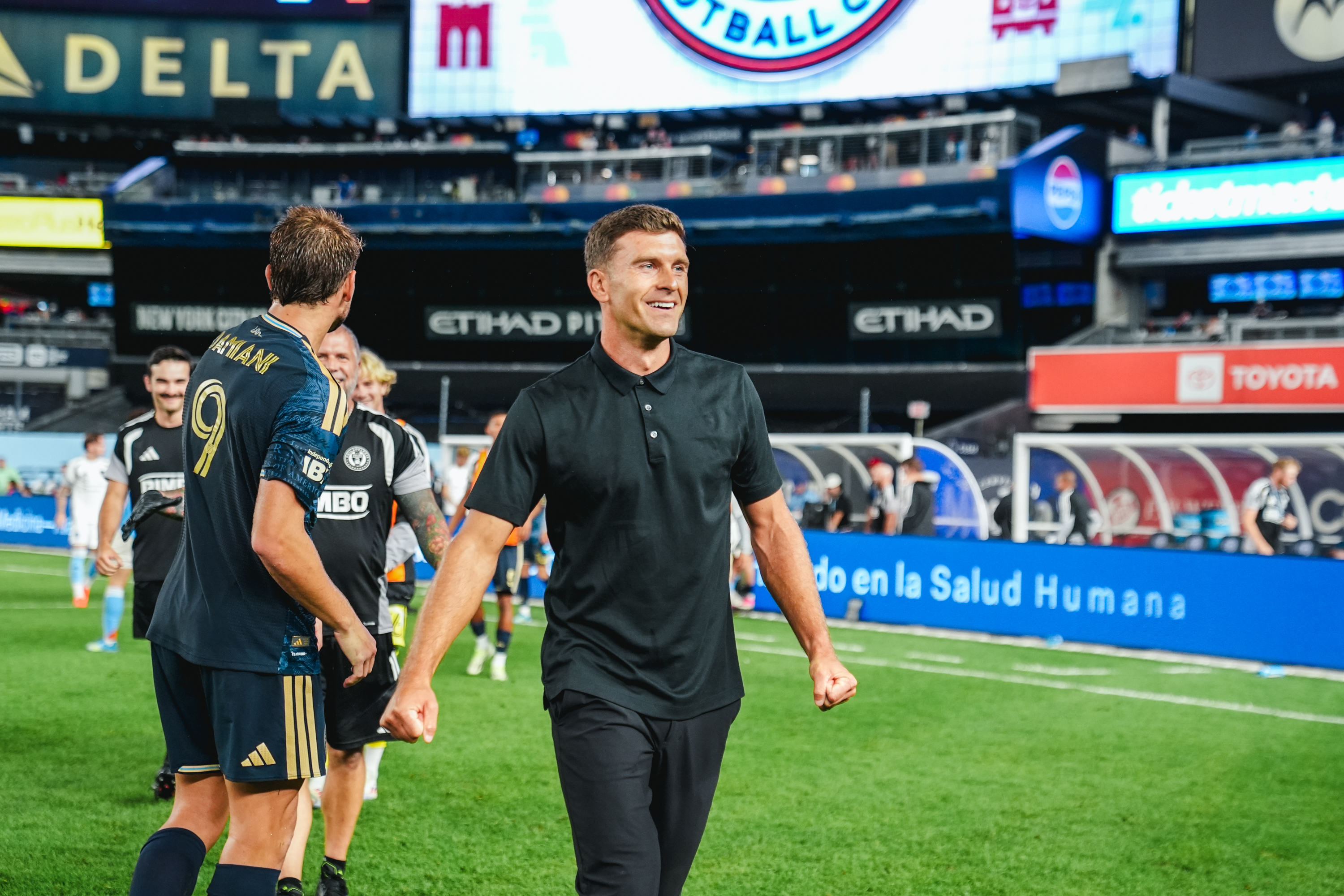
Tag: Weekend Subscribers

  • Before Ryan Richter became the Union’s interim manager, he was a hooper from Bucks County with Iverson-like swag

    Before Ryan Richter became the Union’s interim manager, he was a hooper from Bucks County with Iverson-like swag

    About two to three times a week, Ryan Richter will sit in front of reporters in the bowels of Subaru Park. His hair will be neatly combed to the side, his hands folded in front of him, with his shirt buttoned to the very top.

    The Union’s interim head coach will calmly discuss the game ahead, or the game just played, answering questions as anyone else in his position would. But every now and then, those watching from his hometown of Southampton, Bucks County, have to laugh.

    In some ways, this version of Richter is just like he was as a kid: driven, focused, thoroughly prepared. But aesthetically, it is completely different. Richter, a three-sport athlete at William Tennent High School, was captivated by NBA culture growing up, particularly Allen Iverson.

    He’d wear a headband during basketball games. He pierced both ears. He’d drive around Bucks County in a white Kia, with an enlarged Jumpman logo on its hood, and Sixers jerseys covering its seats.

    À la Shaquille O’Neal, Richter would give himself nicknames: “Shaq Daddy,” “Shaq-Daddy-Licious,” “Ric-Daddy-Docious.” Those monikers are long gone, but that side of Richter isn’t.
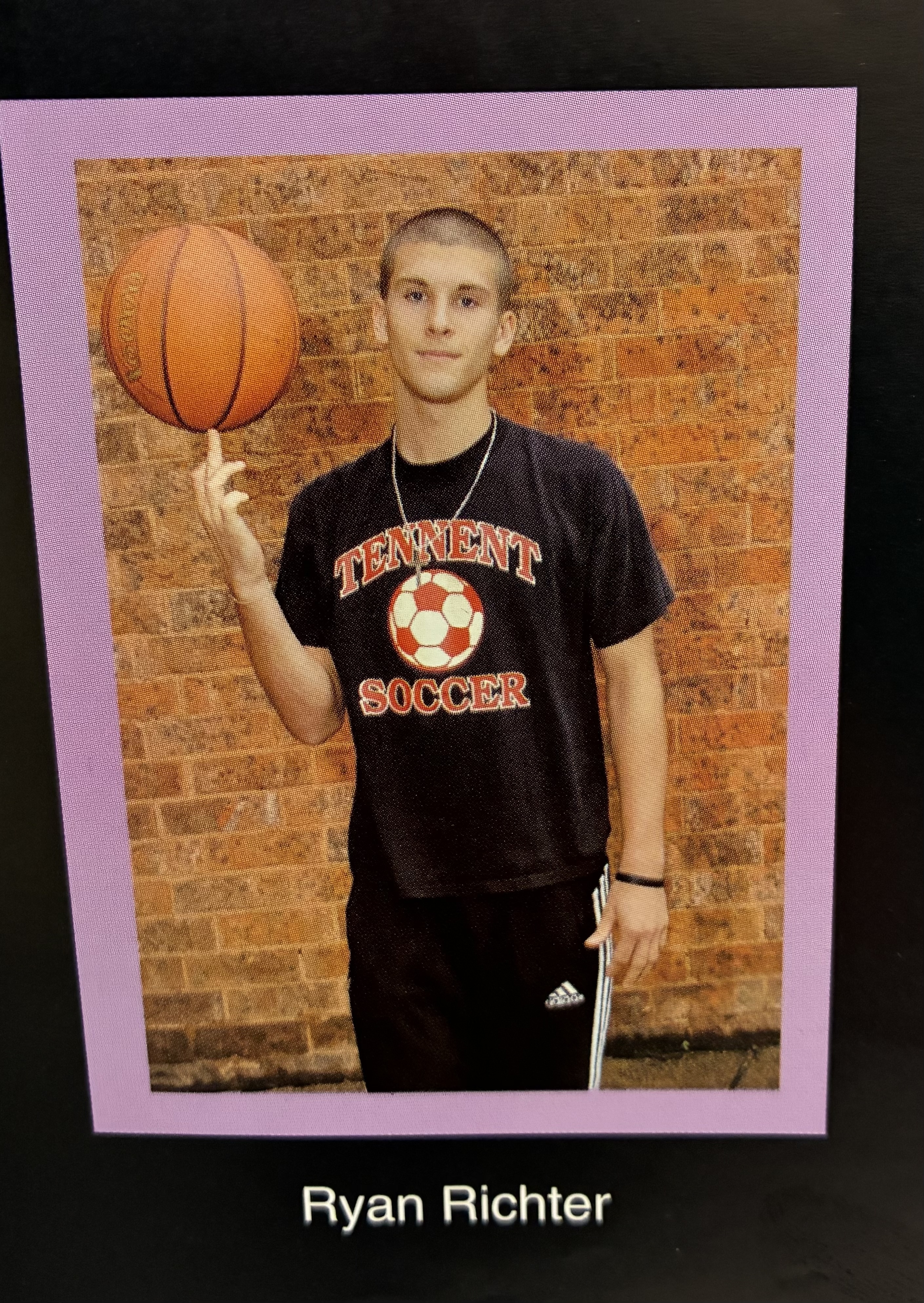
    Ryan Richter was a three-sport athlete at William Tennent High School, who parlayed his talents into a pro soccer career and now an interim role as the Union’s head coach. Courtesy / William Tennent H.S.

    “It’s like, I’m still listening to Get Rich or Die Tryin’ when I’m driving into work,” Richter said. “You know?”

    His high school basketball coach, Glenn Dolton, called this a “paradox.” Beneath the panache was a teenager who was confident, but not cocky. Hard-working, but also light-hearted, with a self-deprecating sense of humor.

    Treating pro soccer as a profession wasn’t a main goal. Richter was always immersed in the sport — his dad played at The College of New Jersey, back when it was known as Trenton State, and his grandfather played for a team in Warminster — but he also played basketball and football through high school.

    The Sixers were Richter’s favorite team, and Iverson his favorite player. Richter was in the building for Game 5 of the 2001 Eastern Conference semifinals, when The Answer dropped 52 points, and returned for the Eastern Conference finals against the Milwaukee Bucks.

    Before he was the Union’s interim head coach, Ryan Richter was the Atlantic 10 Player of the Year at La Salle University.Courtesy / La Salle Athletics

    A La Salle graduate, Richter was drafted by his hometown MLS team in 2011, began coaching for them in 2018, and has gradually worked his way up since.

    Now, the 37-year-old is at the helm, leading the Union from the worst record in the league to playoff contention. At the time of this report, the club hasn’t lost a league game under his watch. Players say the energy in the locker room has changed for the better.

    The soccer world might be surprised. But Southampton isn’t.

    “He knows what it takes to get the job done, and he does not like to lose,” his childhood best friend, Mike Pio Jr., said. “And, I mean, that’s pretty evident with how they’ve been doing so far.”

    A fierce competitor

    Some people hate losing more than they love winning. Richter says he’s the opposite, and has been that way since he was a child.

    He was competitive not just on the field, but in everyday life. If he was playing a game of Connect Four, he’d want to crush the opposition. He and his friends would hang out at the local youth center to jump into hotly contested pickup hoops games.

    Once, the teenagers joined an adult bowling league. They were the youngest members by about 20 years, but that didn’t quash Richter’s spirit.

    “The competitiveness was also there,” Pio said. “I think everybody else in that league was probably old enough to be our fathers.”

    A formative moment came in his freshman year of high school. Richter tried out for the junior varsity basketball and soccer squads, and failed to make either team. He got to work, and by sophomore year, made varsity in both sports.

    Ryan Richter (center) didn’t make the varsity team his freshman year at William Tennent. The next season, he made varsity in both soccer and basketball. Courtesy / William Tennent H.S.

    But he never forgot the feeling of being passed over — or the names of the students who passed him.

    “He still reminds me of that occasionally,” Dolton said, “that I should have brought him up. Which, looking back on it, I’m like, ‘Yeah, you may have a good point there.’”

    Coaches loved Richter, because he’d push his teammates as hard as he’d push himself. If a fellow athlete wasn’t hustling enough, he’d pull him aside or ask a higher-up to step in.

    Pio’s father, Mike Pio Sr., experienced this firsthand when he worked as an assistant soccer coach at Tennent.

    Union interim manager Ryan Richter not satisfied with landing in a playoff spot
    Video: Union interim manager Ryan Richter not satisfied with landing in a playoff spot

    “He expected his teammates to basically bleed the way he bled,” Pio Sr. said. “Even during practice, he would call people out.”

    Teenagers didn’t always love being challenged, but Richter had an affability which allowed him to break through. He was athletically gifted on the field, but didn’t take himself too seriously or act like he was better than anyone else.

    The hood-sized ode to Michael Jordan was evidence of this. So was a photo that Richter took with Pio Jr. when they were in high school. The two friends were at the Willow Grove Park Mall, in an Abercrombie and Fitch dressing room.

    Before he was the Union’s interim manager, Ryan Richter (right) was a three-sport athlete at William Tennent High School, with an affinity for NBA culture and swag.Courtesy / Mike Pio

    Images of models adorned the walls, and Richter and Pio Jr. wondered how easy that work must be.

    So, they tried it themselves, posing for a photograph that still hangs beneath a magnet on Pio Sr.’s refrigerator door.

    “It was like they were posing for GQ magazine,” Pio Sr. said. “Hilarious.”

    The teenager would set up silly challenges, like singing the national anthem before a basketball game, despite the fact that he was not musically inclined. And physical challenges, like improving his vertical so he could dunk in a game.

    Richter stood at 6-foot, but had smaller hands, which made it difficult to palm the ball. But he was determined. In a game against Abington, he finally got the moment he’d been waiting for.

    “He threw one down, and it was like the place exploded,” Dolton recalled. “It was like the greatest thing that ever happened. It was really funny.”

    Union interim manager Ryan Richter starred on William Tennent’s varsity basketball team.Courtesy / William Tennent H.S.

    Richter was recruited by several nearby soccer programs: Temple, Delaware, and Iona. But he ultimately chose La Salle because of its coaching staff.

    Head coach Pat Farrell’s rules were rigorous, but aligned with Richter’s already sky-high expectations. He noted that Farrell pushed him, personally too.

    “It was just the things that he emphasized,” Richter said. “About taking responsibility, about being a man and taking care of your school stuff, and staying out of trouble.

    “He’s not a guy of so many words, but he was just a father figure for everybody.”

    Before he was the Union’s interim head coach, Ryan Richter was the Atlantic 10 Offensive Player of the Year at La Salle University.Courtesy / La Salle Athletics

    Richter upped his work ethic to a new level in college. The striker showed up to practice an hour-and-a-half or two hours early. He’d train with the Ocean City Nor’easters, a USL League Two team, to stay in shape during the offseason.

    When he returned in the fall, he’d be ready for more. And by 2011, he was en route to a professional career.

    “He would say, ‘Do you want to do some extra [shooting], or do you want to do some skill work,’ like ball work and things like that,” Farrell said. “And we could never say no.”

    Bringing back that ‘Philly’ mindset

    Richter’s playing career with the Union was brief — only making an appearance in two international friendlies and 10 reserve league matches — but his time as a coach there has spanned nearly nine years.

    After playing professionally for seven years, Richter was hired by the Union in 2018 to work at their academy, serving in various development roles.

    In 2022, he was promoted to assistant coach of the Union, under then-head coach Jim Curtin, and in 2025, was named head coach of the Philadelphia Union II.
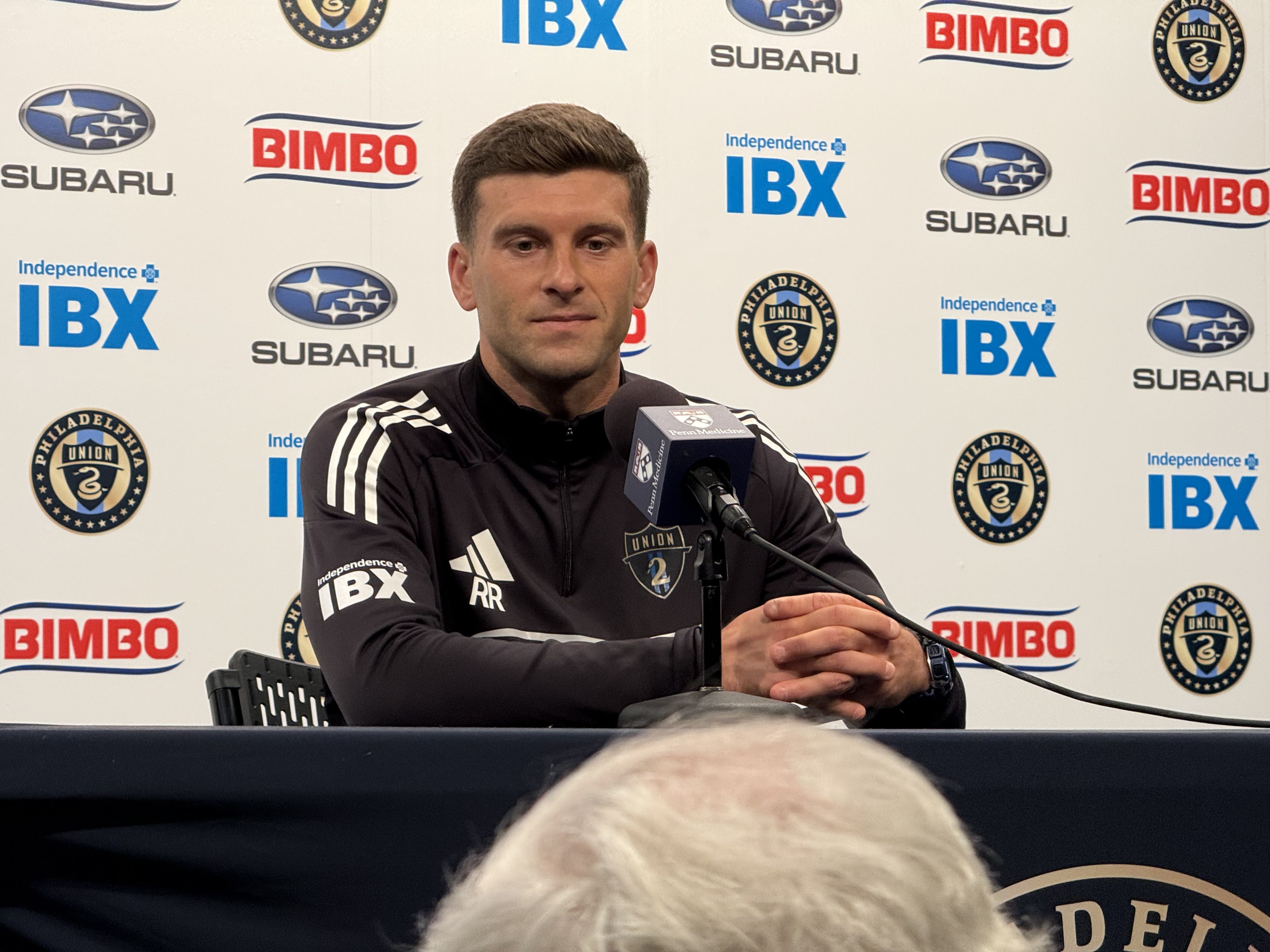
    Ryan Richter has held several roles within the Union, including former head coach of the club’s developmental team, Union II. Jonathan Tannenwald / Staff

    When Bradley Carnell was fired in late May, after a league-worst record of 1-10-4, and replaced with Richter, many current players were already familiar with him.

    The Southampton native had coached Cavan Sullivan since he was 8. Outside back Frankie Westfield had never played for Richter, but knew him through regular games of teqball and basketball with his teammates at the Academy.

    Centerback Neil Pierre started his season on a six-month loan to a team in Denmark. When he returned in July, he wasn’t sure what he’d find.

    He’d heard from teammates that the locker room was “losing its head.” But with Richter already having an established relationship with multiple players, it helped make Pierre’s immersion back into the squad smooth.

    “We were going through a tough time,” Pierre said. “I guess it wouldn’t be the same upbeat attitude. People wouldn’t be as into the culture. Kind of lost that ‘Philly’ mindset. And I think when [Richter] came back, he just brought it back.”

    Ryan Richter (left) greets Union midfielder Quinn Sullivan during a recent match.Elizabeth Robertson / Staff Photographer

    Richter’s Bucks County tendencies are never too far. He has been known to challenge other coaches on the basketball court. He is still a massive Sixers fan, and gleefully shared the news of LeBron James coming to Philadelphia after a Union practice in July.

    But perhaps the biggest way his upbringing shines through is in his approach to younger players. Sullivan is only 16, but a teenage phenom who is bound for Manchester City when he turns 18.

    In an Aug. 19 match between the Union and Inter Miami, Sullivan defended his brother, Quinn, after defender Ian Fray stepped over him and pushed his head down.

    Cavan ran over, and got in a scuffle that instantly became the story of the game. He received a red card (later rescinded).

    Cavan Sullivan and Richter talked about the incident two days later. The head coach told him that he did nothing wrong, but to remember that he draws scrutiny like nobody else on the roster.

    And that if he does act up, it’ll become international news.

    “I always try to keep in mind of where some of the younger guys are at, and remember what I was like,” Richter said. “When I was 16, I was driving around with a Jordan logo on my car, and who knows what kind of trouble I was getting in.

    “That’s why I think Cavan is such an amazing kid; because of the pressure that he has to deal with, and the spotlight that’s always on him. Could you deal with that when you were 16?”
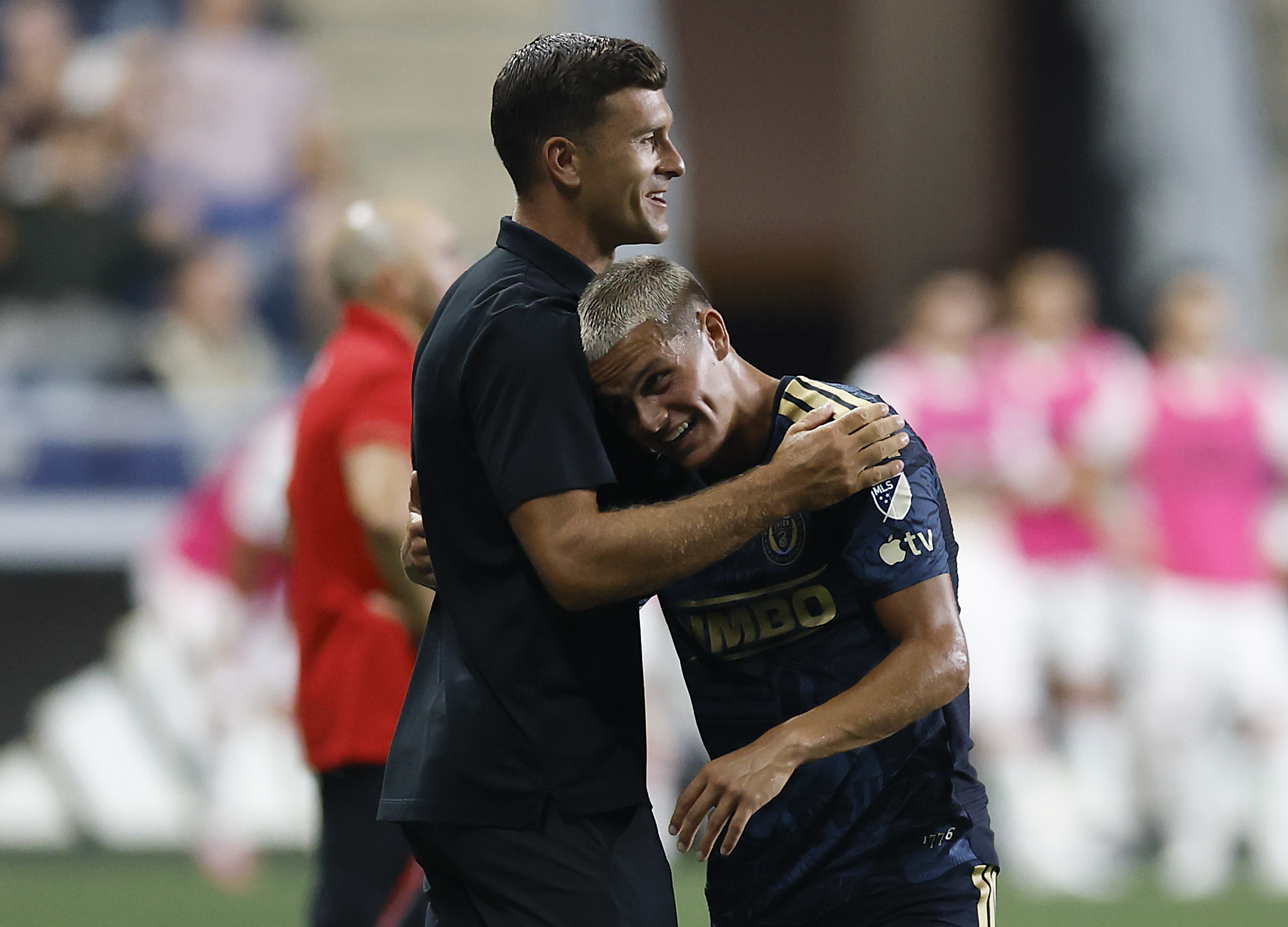
    Richter, seen here with Union teen midfielder Cavan Sullivan, says he tries to remember himself at a young age in order to keep his players, many of whom are still in their teens, focused on the team’s mission.Yong Kim / Staff Photographer

    Learning soccer on the fly

    Richter’s friends did not grow up diehard soccer fans. Like most Philadelphians, they are all-in on the Eagles and the Phillies; maybe some basketball and hockey, too.

    His new role has served as a teaching moment for everyone. Last month, a group of Southampton natives went to Subaru Park for a game against Atlanta United. They were stunned by what they saw: Union goals in 96th and 97th minute, en route to a 3-2 comeback win.

    “They’re like, ‘Soccer is amazing!’” Richter said. “It’s like, ‘This is a one-in-a-thousand game that you guys saw tonight.’”

    Nevertheless, the head coach’s buddies have since tuned into to every press conference and every match, home or away. They’ve been filling his group chat with lots of “DOOP” and other words of encouragement.
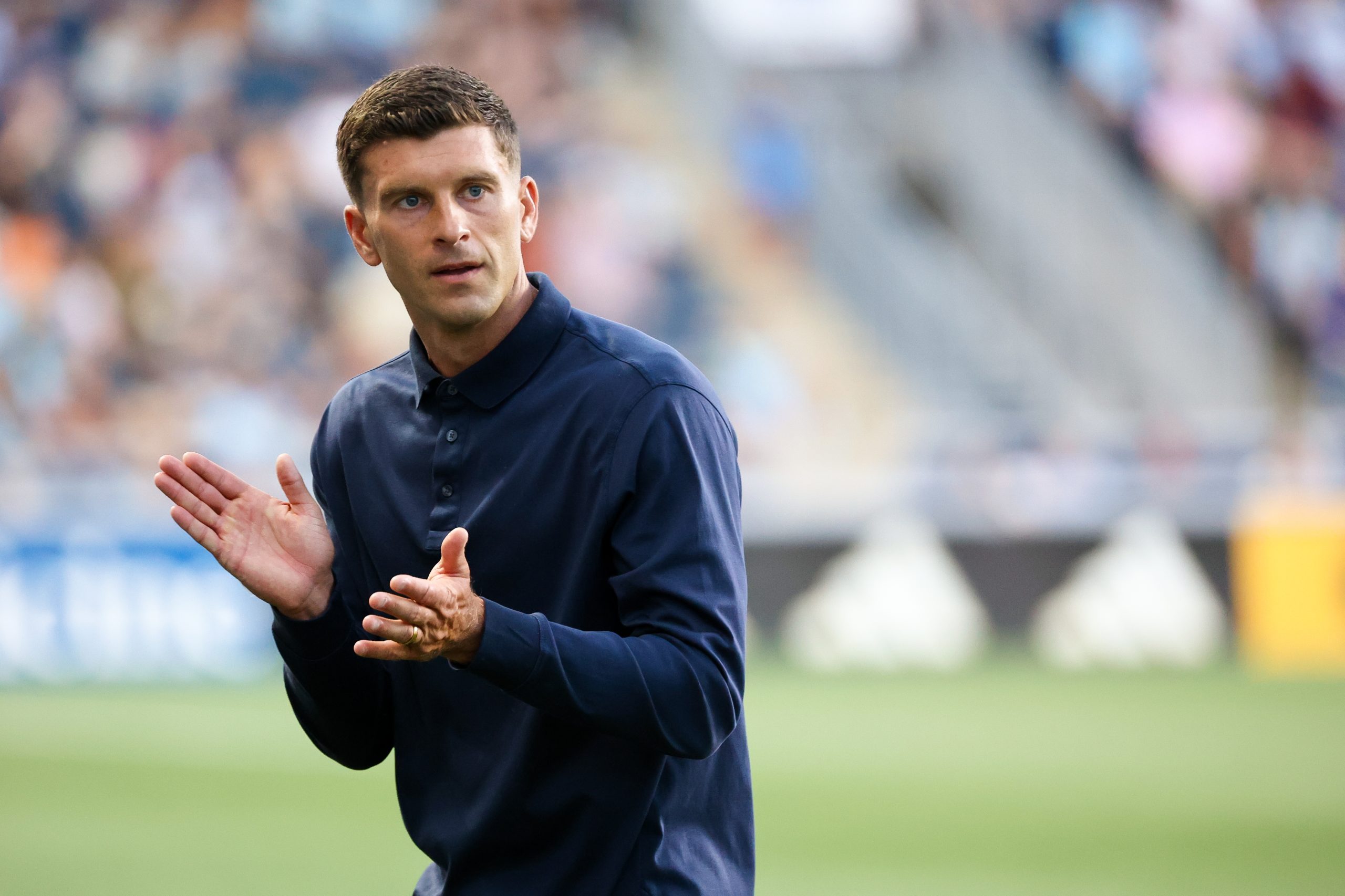
    Ryan Richter says his approach is solely game by game and isn’t taking too much stock in the success the Union have had since he took over as interim manager. Isaiah Vazquez / For The Inquirer

    They’re also provided some friendly, albeit superstitious, advice.

    “One of our buddies just texted this morning,” Pio Jr. said “He goes, ‘I changed my mind. I don’t think they should remove the interim tag, because you’re doing way too good with it.’”

    Richter’s friends have nine more games to learn; maybe more, if the Union make the playoffs. But regardless of how this season ends, his community will continue to be proud of him.

    A local kid, who once patrolled Bucks County, is now patrolling the sidelines of Subaru Park — and doing a good job, at that. The headband and earrings may be gone, and so is the White Kia.

    But somewhere, beneath his outward professionalism, is that same Iverson-loving teenager; better known not as Ryan Richter, but as a “licious” or a “docious.”

  • ‘The kids are not learning’: Employees inside a North Philly charter detail chaos inside their school

    ‘The kids are not learning’: Employees inside a North Philly charter detail chaos inside their school

    The leadership meeting happened at midafternoon on a Tuesday at Alliance for Progress Charter School. It was a small huddle to discuss how the new school year was going.

    Unexpectedly, CEO Stacey Scott burst into the Aug. 25 meeting held inside the main office, disrupting the discussion.

    “You b—!” Scott said to the principal, Eric Langston, according to multiple people with direct knowledge of the meeting. She then spoke to the others in the room. “You can’t trust this snake! Motherf—!”

    Scott then walked out of the room, shouting, “F— this school,” and left.

    The extraordinary outburst, insiders say, shows Alliance for Progress, whose charter is up for renewal this year, is a school in turmoil.

    The Inquirer interviewed multiple people directly involved with the school, all of whom declined to be publicly identified because they fear reprisal.

    The North Philadelphia charter has churned through staff. Paraprofessionals — workers without college degrees or educational licenses — are providing instruction, those inside the school say. Students who never attended a day of school last year remained on Alliance’s rolls for the entire year, meaning the charter received payment for children it did not educate.

    Scott remains CEO, but is no longer working inside the building, according to the sources.

    Alliance, a K-8 school on Cecil B. Moore Avenue, had 616 students on roll last year.

    Both Scott and Larry Griffin, the president of the school’s board of directors, were asked to comment on the allegations. Griffin sent The Inquirer a statement. Scott did not respond.

    “Alliance For Progress Charter School continues our important work of educating our economically disadvantaged student populations,” Griffin wrote. “Respecting the privacy of all our AFPCS employees, we decline to comment on personnel matter.”

    Langston declined to comment.

    The Philadelphia School District’s charter schools office declined to comment. Officials from the charter office are expected to visit Alliance in late October to begin the enhanced review process that accompanies charter renewal.

    The school’s board of directors is scheduled to meet Tuesday night.

    Sounding an alarm

    Six weeks after joining Alliance as principal in July, Langston, who has spent time as a leader in the Mastery Charter system and at Northwood Academy, sent a confidential email outlining concerns he had about the school to the Alliance board of directors.

    The concerns, he said, according to the message obtained by The Inquirer, “have reached a level that gives me significant pause regarding leadership practices, organizational culture, transparency, and the long-term health of Alliance.”

    Langston asked for the board to shield him from possible retaliation. In 2025, the school’s former director of business and compliance filed a whistleblower lawsuit alleging he suffered reprisal — demotion — after reporting significant problems at the school.

    Raheem Harvey, who left Alliance last year, said he flagged to school and board officials violations of state and local bidding requirements, contracts issued without board approval, a student enrollment problem, skipped payroll taxes, and more.

    Scott told The Inquirer in December that Alliance officials “categorically deny all the allegations asserted by this disgruntled former employee.” That suit is still pending.

    Langston, in his email, laid out several issues raised by employees around ”Scott’s leadership and decision-making, including questions about whether decisions are consistently being made in the best interest of the school.” Alliance, he added, does not have “the level of psychological and professional safety necessary for adults to openly communicate, learn, disagree, grow and lead.”

    Different organizational structures are needed at the school, Langston said in the email. He proposed becoming chief schools officer — a promotion — which he said would result in “creating clearer lines of accountability and appropriately limit the extent to which Ms. Scott is involved in the daily instructional and operational decision-making of the school.”

    Langston also raised alarm over Scott instructing human resources to withhold the bonus an employee earned because the employee was taking family medical leave to care for an ill relative. Scott, he said, wanted to make sure the employee returned to Alliance after the leave.

    “I am deeply concerned that conditioning compensation already earned or otherwise due upon an employee’s return from protected leave may create significant legal, ethical and organizational exposure for Alliance,” Langston wrote.

    Langston also suggested Scott was misrepresenting staff vacancies and counting classes covered by substitutes as filled.

    “Our reporting should distinguish between FTE-filled positions, substitute-covered vacancies, and completely uncovered vacancies,” Langston wrote. “Anything less creates an inaccurate picture of our staffing reality. I believe the board deserves complete and transparent information upon which to make governance decisions.”
    ‘There are grave concerns’

    Four days after Langston sent the email to the board, Scott burst into his meeting shouting profanities, according to those with direct knowledge.

    Langston immediately notified the board of Scott’s conduct and asked for a meeting, which happened the next day.

    Some board members apologized for Scott’s behavior, but Griffin, the board president, neither offered an apology nor discussed the issues Langston raised, according to multiple insiders.

    Soon after the meeting, the board’s lawyer instructed Langston and the board to have no contact with each other. Alliance, at its lawyer’s instruction, has hired an outside consultant to investigate the situation.

    Langston remains on site at Alliance for Progress; Scott is working remotely, sending emails and issuing directives.

    Employees say Scott “has created a scope at the school where nothing can go on without her,” one employee said.

    The school’s atmosphere is “such a toxic working environment, not a healthy space. The kids are losing, the families are losing,” the employee said.

    “There are grave concerns,” the employee said. “We service families that come from challenging backgrounds, and we cannot assume that just the children have struggles. We have parents that cannot read. They do not know their children are not being serviced, their children are not being prioritized.”

    The employee said while the school’s climate is decent, Alliance lacks some organizational basics, including human resources processes and a formal student discipline cycle. Some students who never attended the school remained on roll all year, the employee said — an assertion confirmed by other employees.

    Some classes have been taught “for years” by unlicensed paraprofessionals, the first employee said.
    “It lacks stuff that a normal school understands,” the employee said. “It’s a very low tier, low level of support. The kids are not learning.”

    Just 9% of the school’s students meet state standards in reading, and 5% reached math standards. That is far below district and state achievement — in the Philadelphia School District, 33% of students were considered at grade level in reading and 25% in math; across Pennsylvania public schools, 50% of students are considered proficient in reading and 42% in math.

    A second employee, who also asked for anonymity for fear of reprisal, is particularly troubled by the school’s academic issues.

    “Our school is predominately Black and brown children, and they can’t read, and they’re just passed on to the next grade, and we go into these meetings, and they say, ‘These are the worst test scores I’ve ever seen.’ But what are we doing to make that different?”

    The second employee also expressed alarm about students on Alliance’s books who had left the school.

    “We noticed that students who’ve withdrawn were back on our roll. Students who haven’t been there for years. They literally lied on enrollment documentation,” the second employee said.

    Charters are allotted funding based on the number of students enrolled.

    “Something,” the second employee said, “is very wrong.”

  • Jalen Hurts’ half-billion dollar down payment on his future; A.J. Brown’s New England nightmare | NFL Week 1

    Jalen Hurts’ half-billion dollar down payment on his future; A.J. Brown’s New England nightmare | NFL Week 1

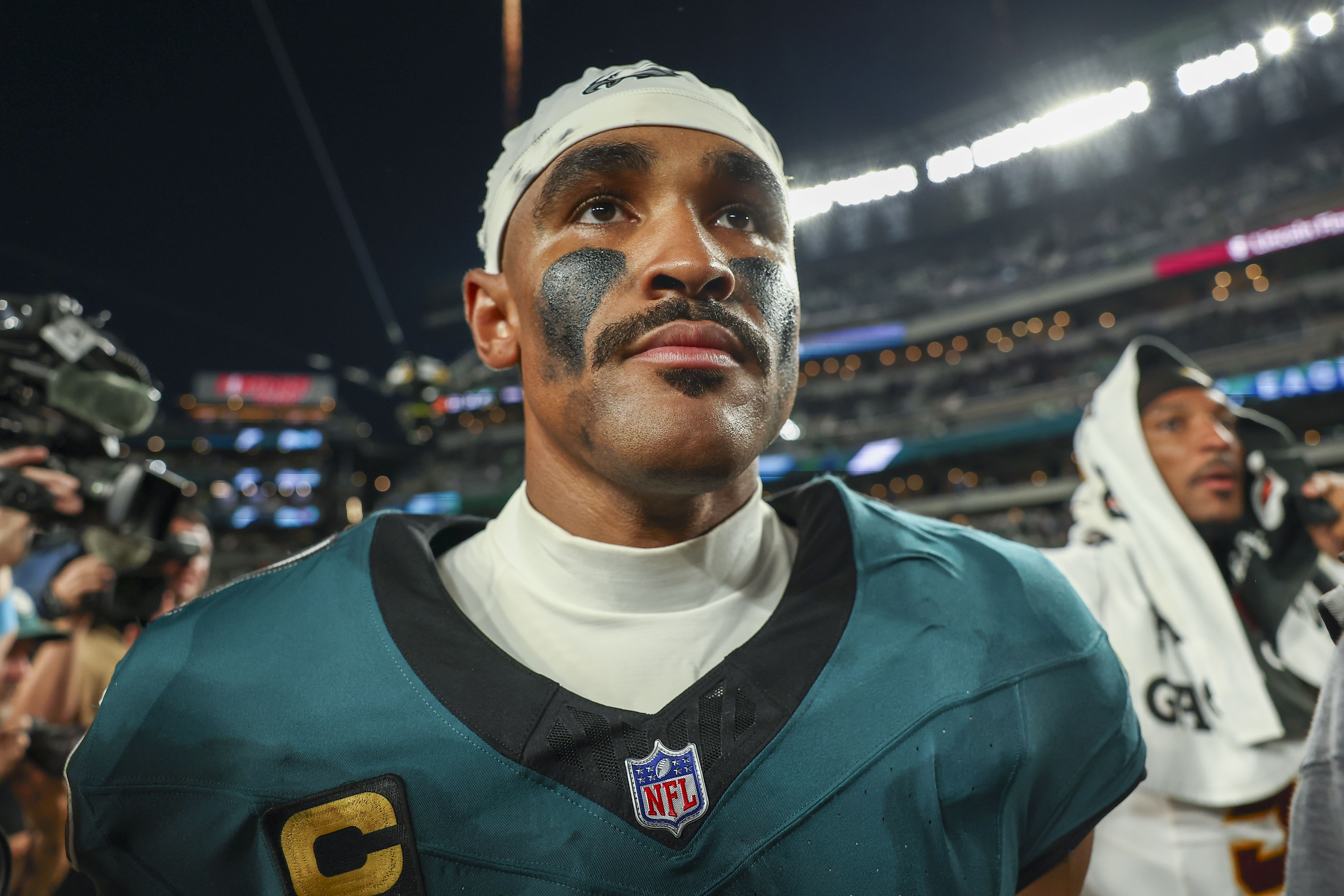
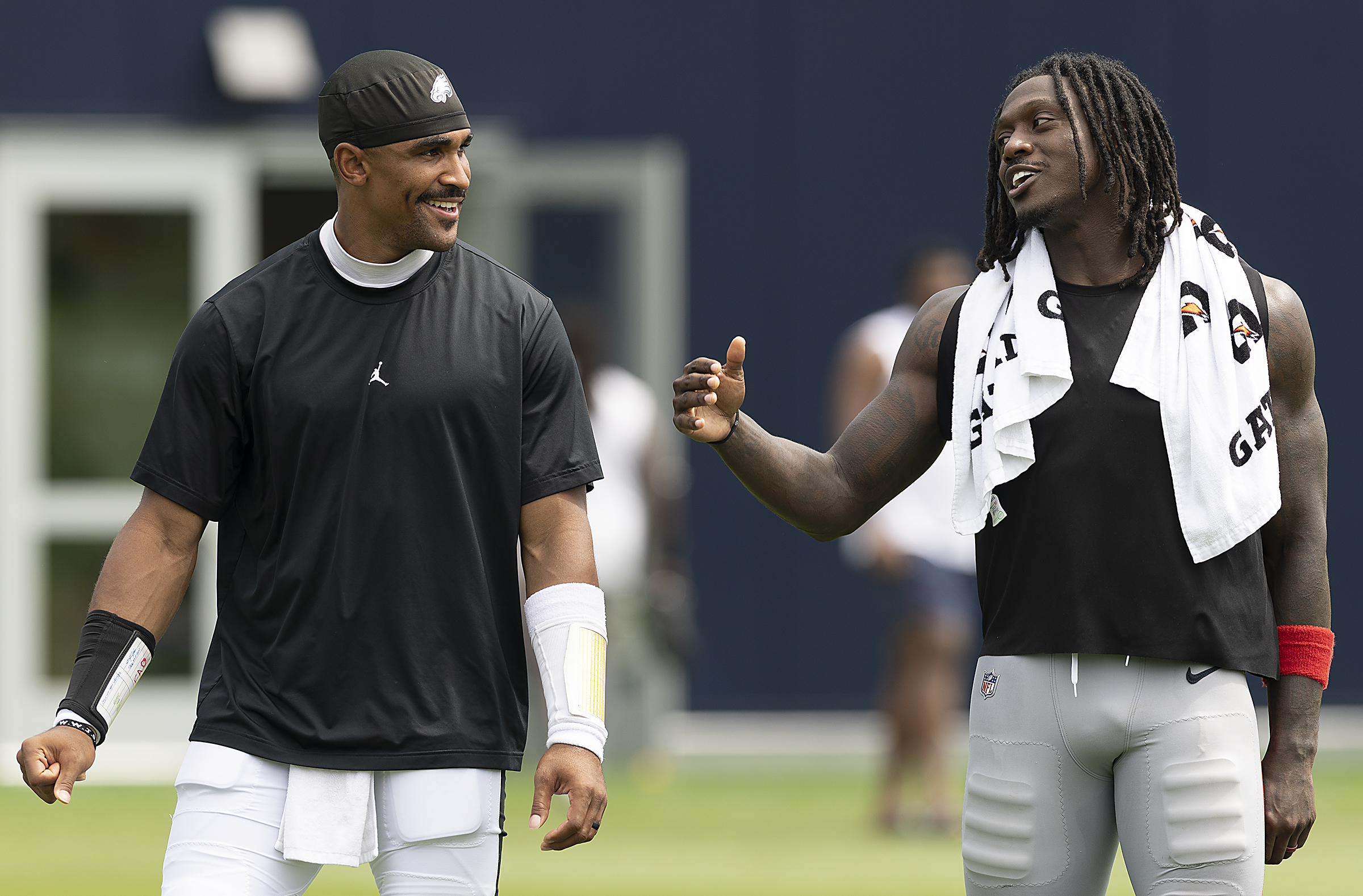
    If you assume Jalen Hurts’ next contract will pay him around $65 million per year, or $1 million more than Patrick Mahomes; and if you assume the Eagles will pay Hurts sooner than later, as they always do with their best players; and if you assume that Hurts, after a poor 2025 season, needs to show the Eagles that he’s worth the investment, then he made a strong opening statement Sunday afternoon.

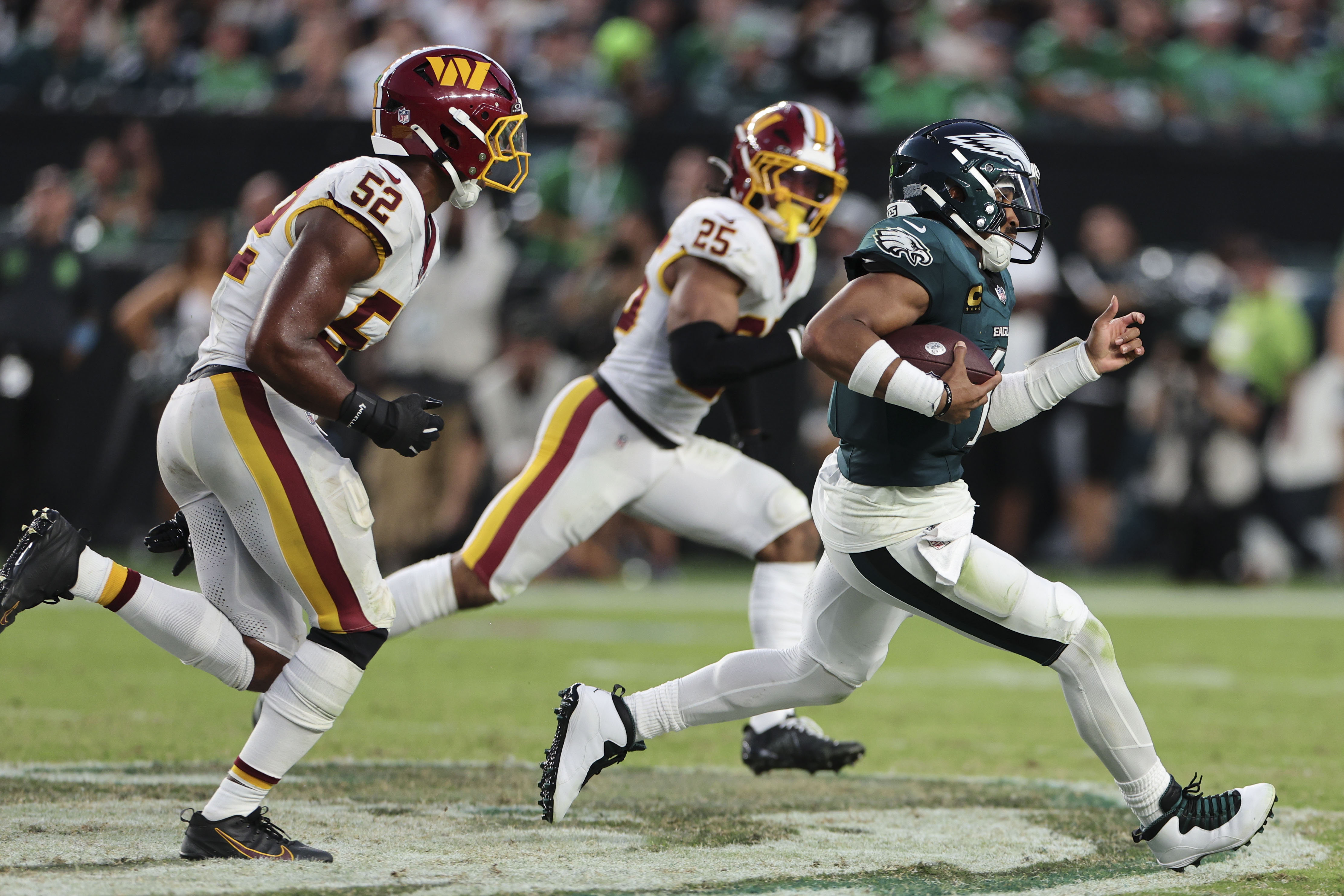
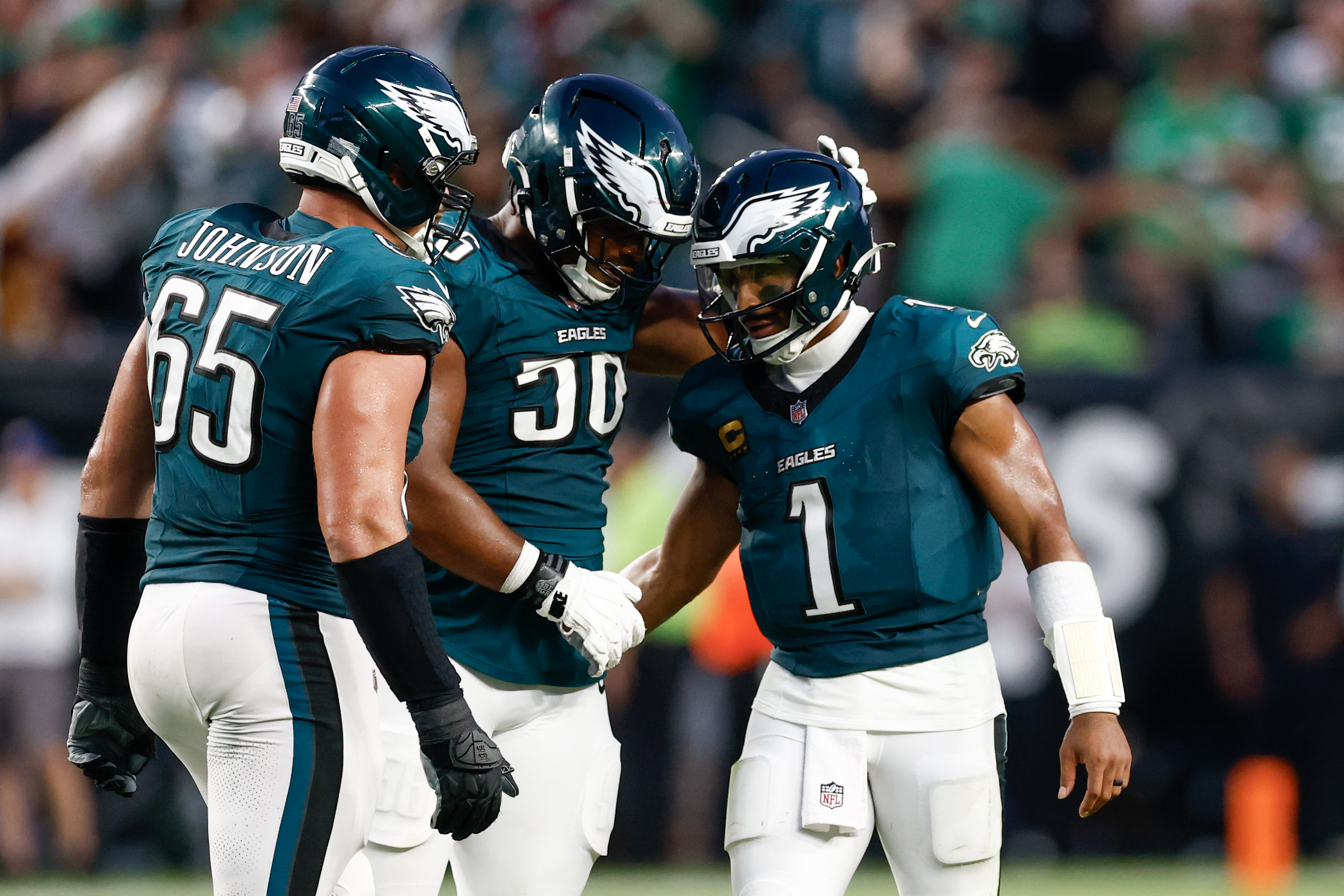
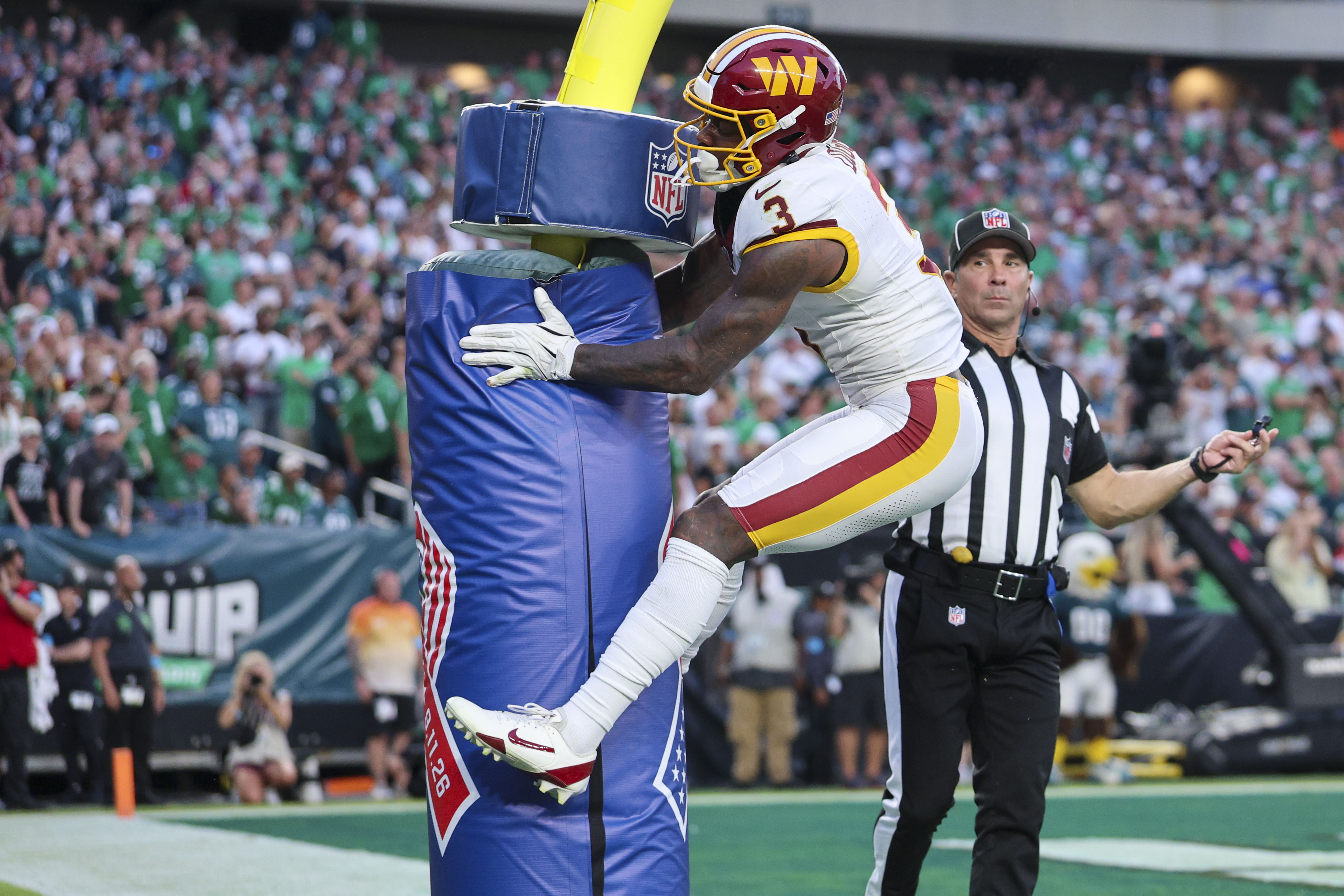
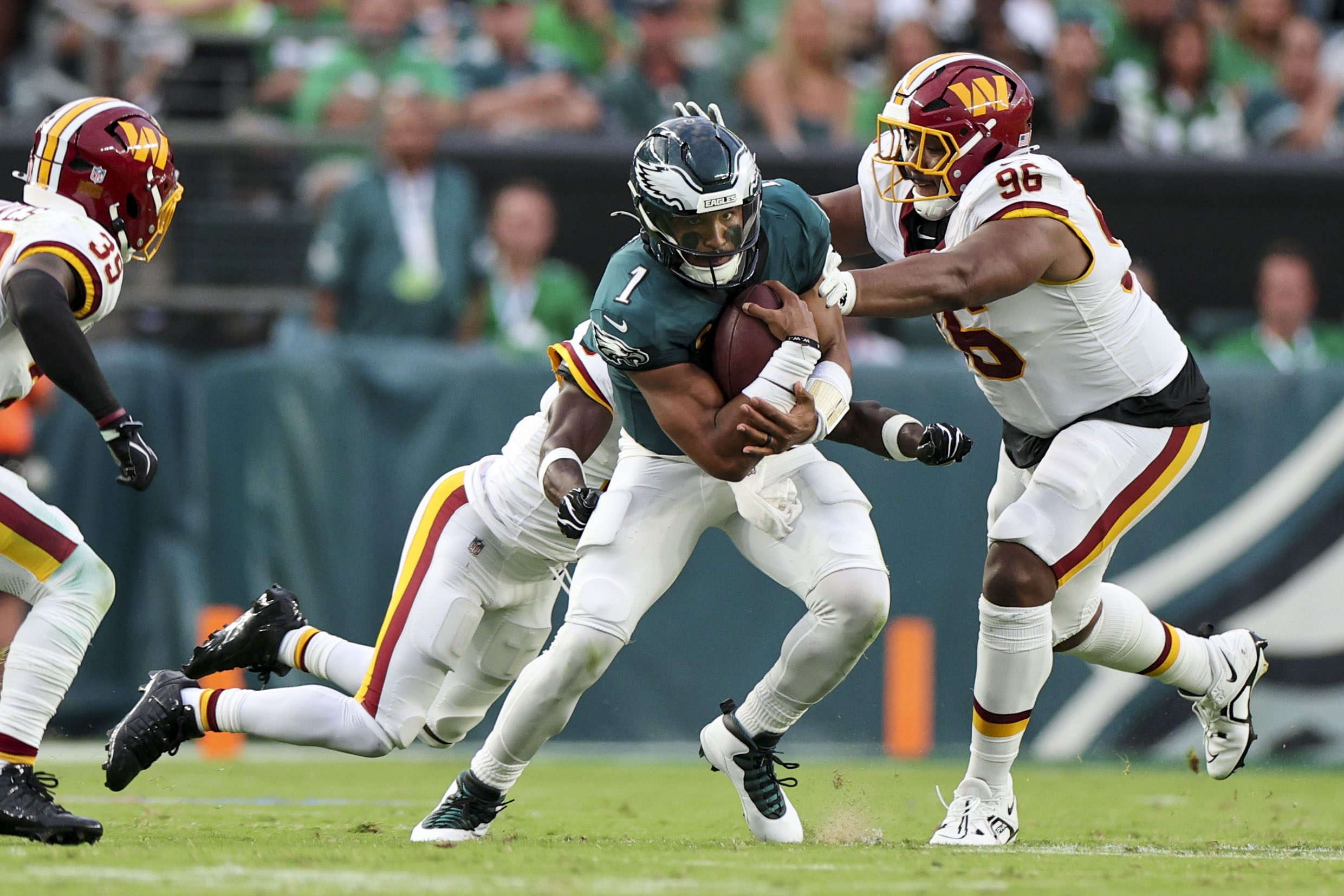
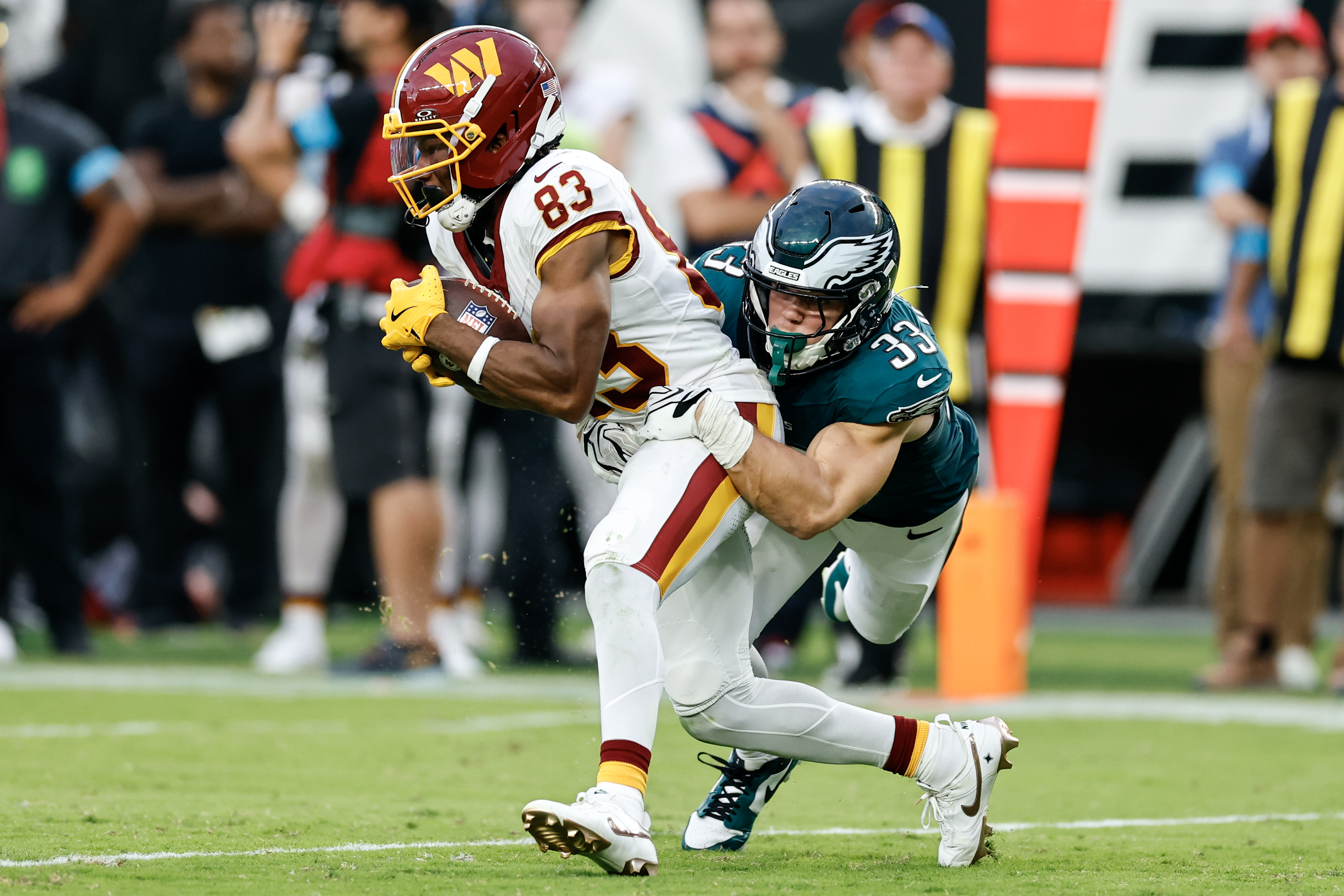
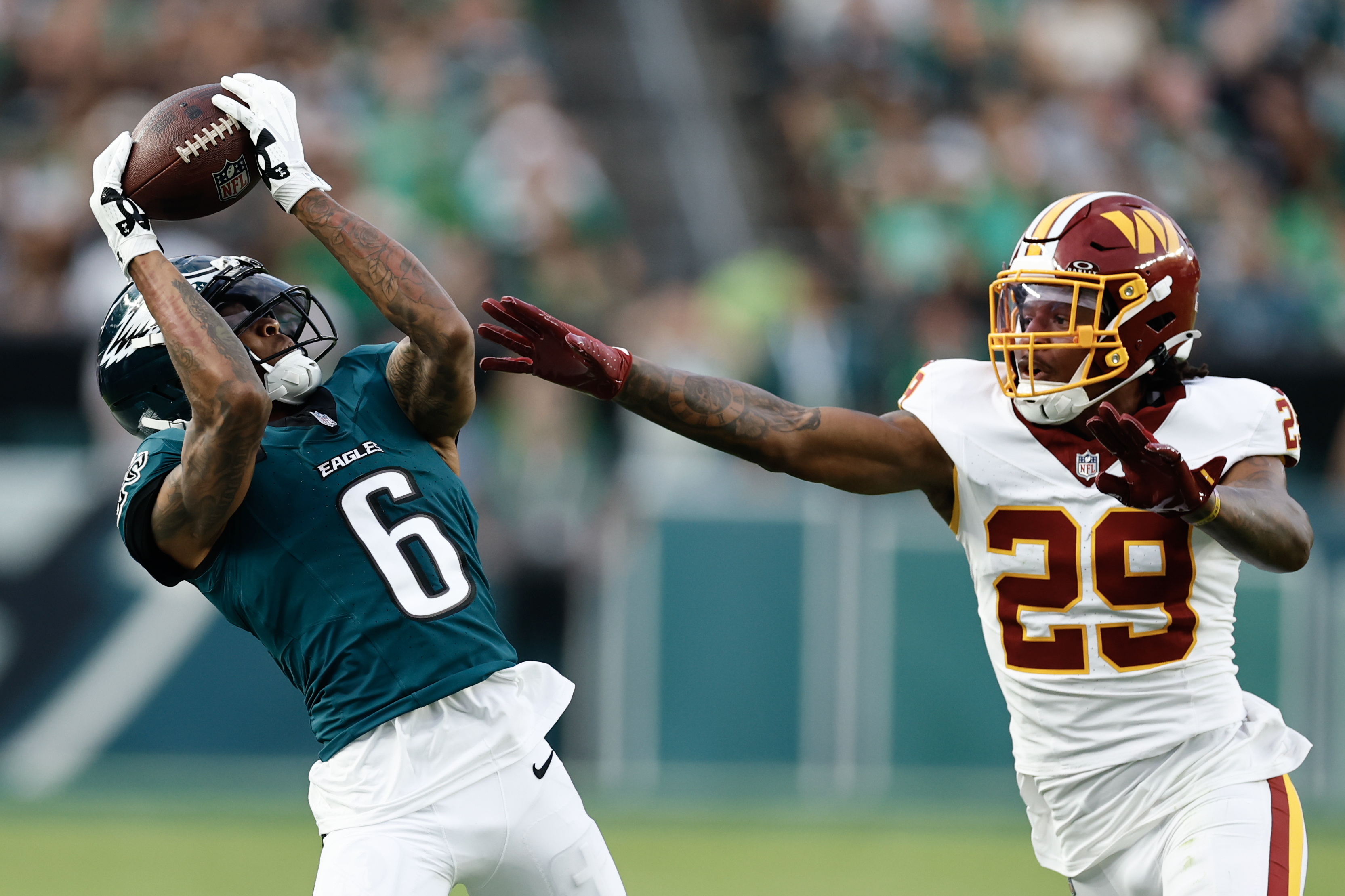
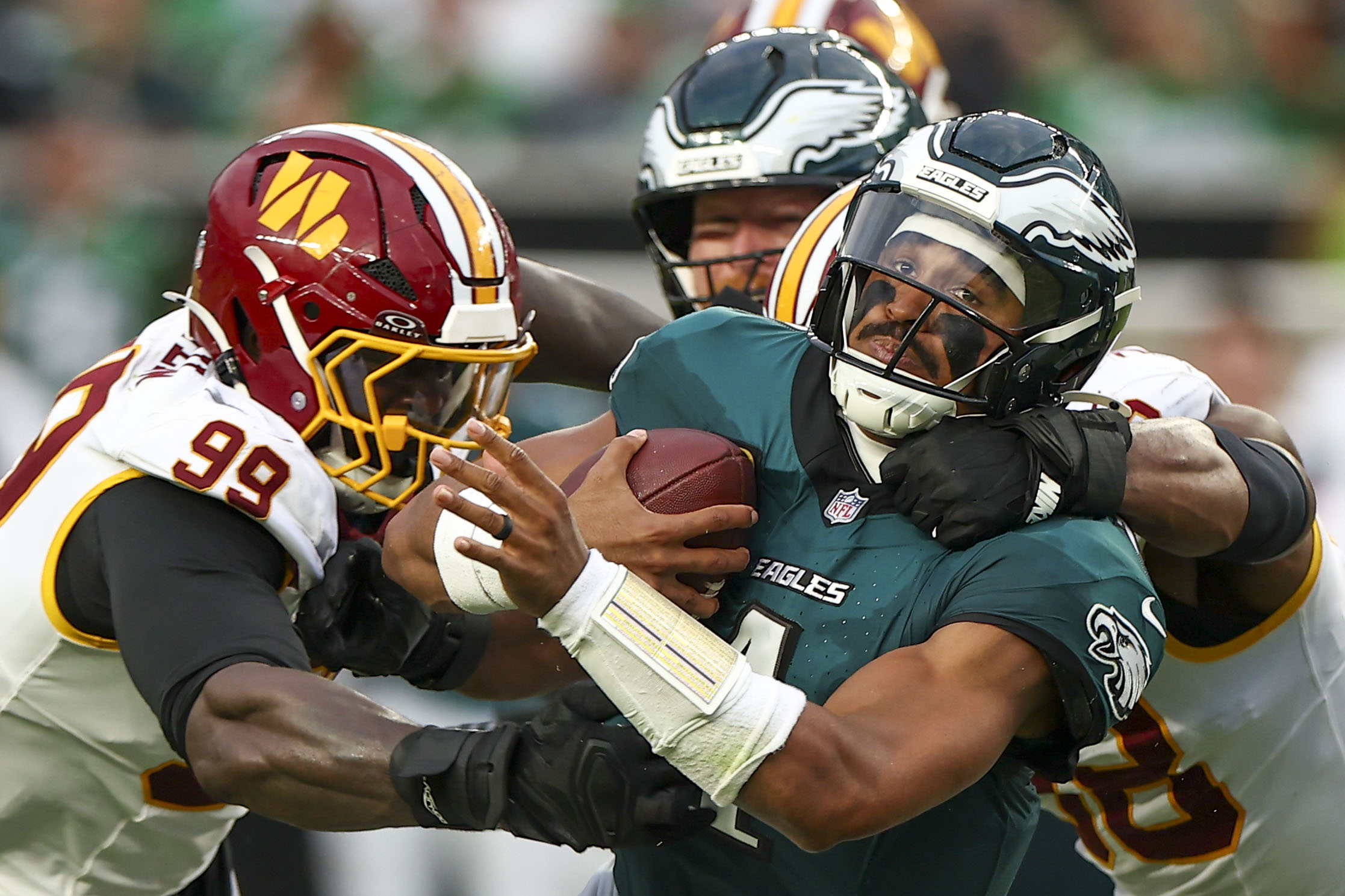
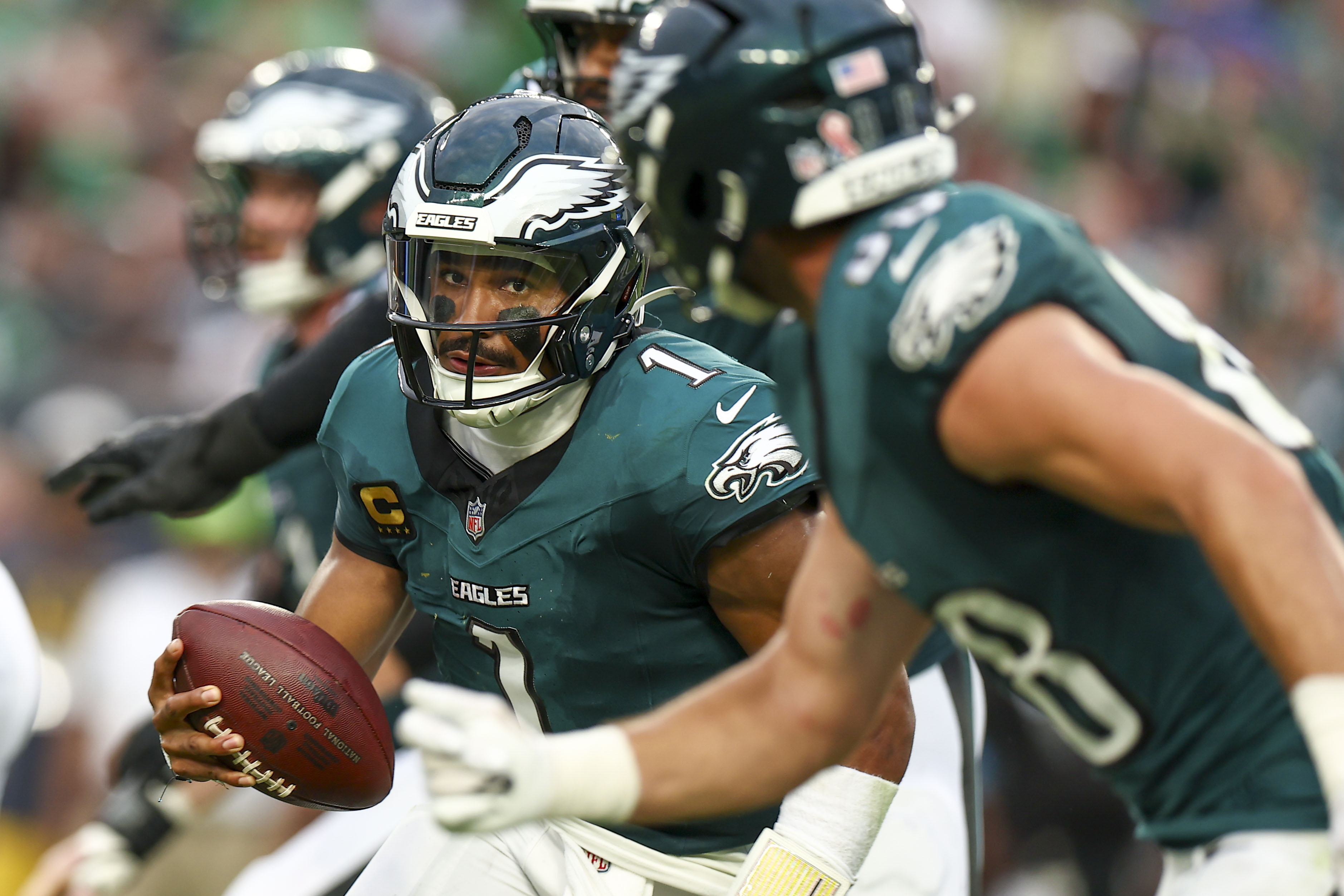
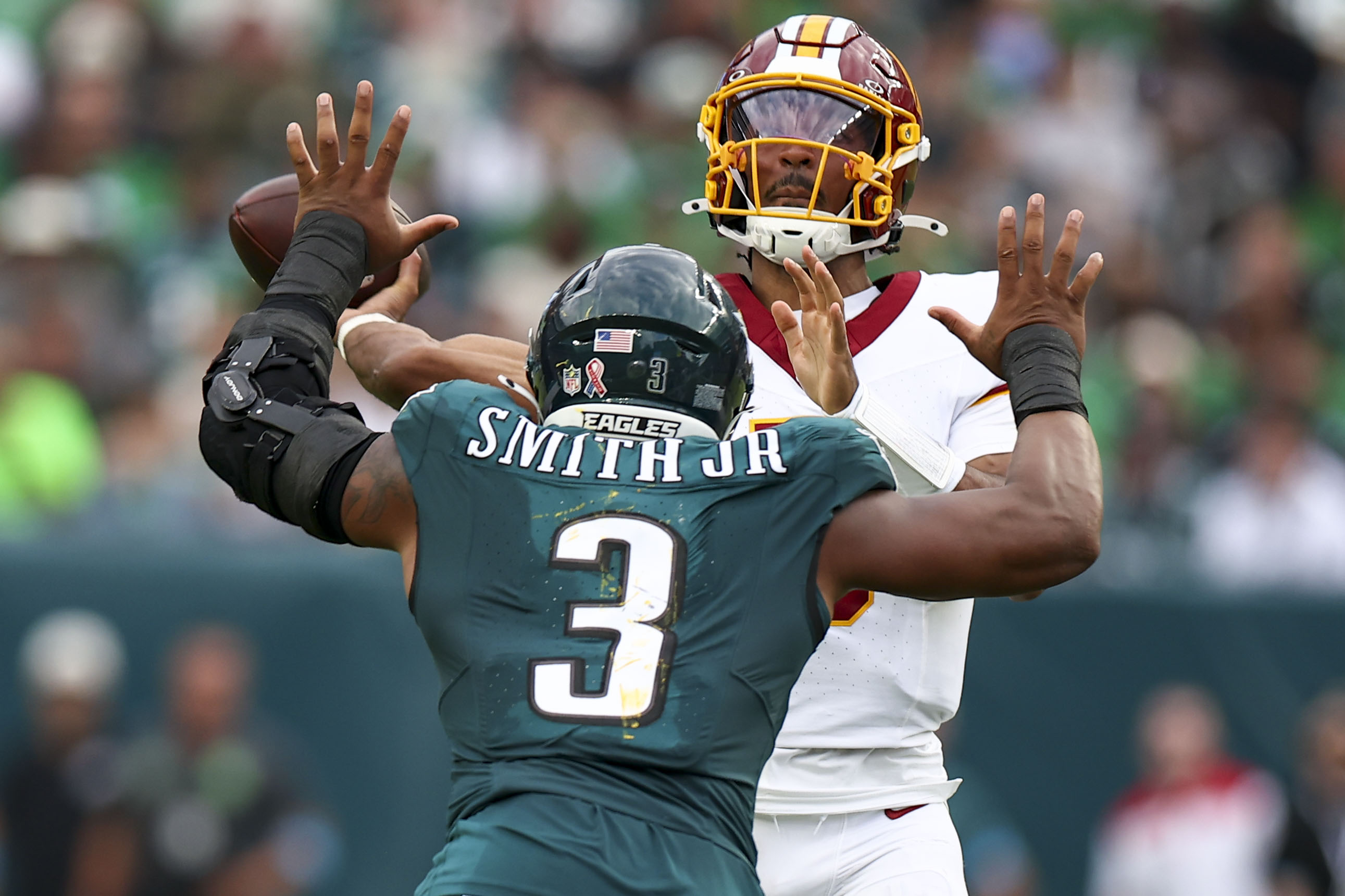
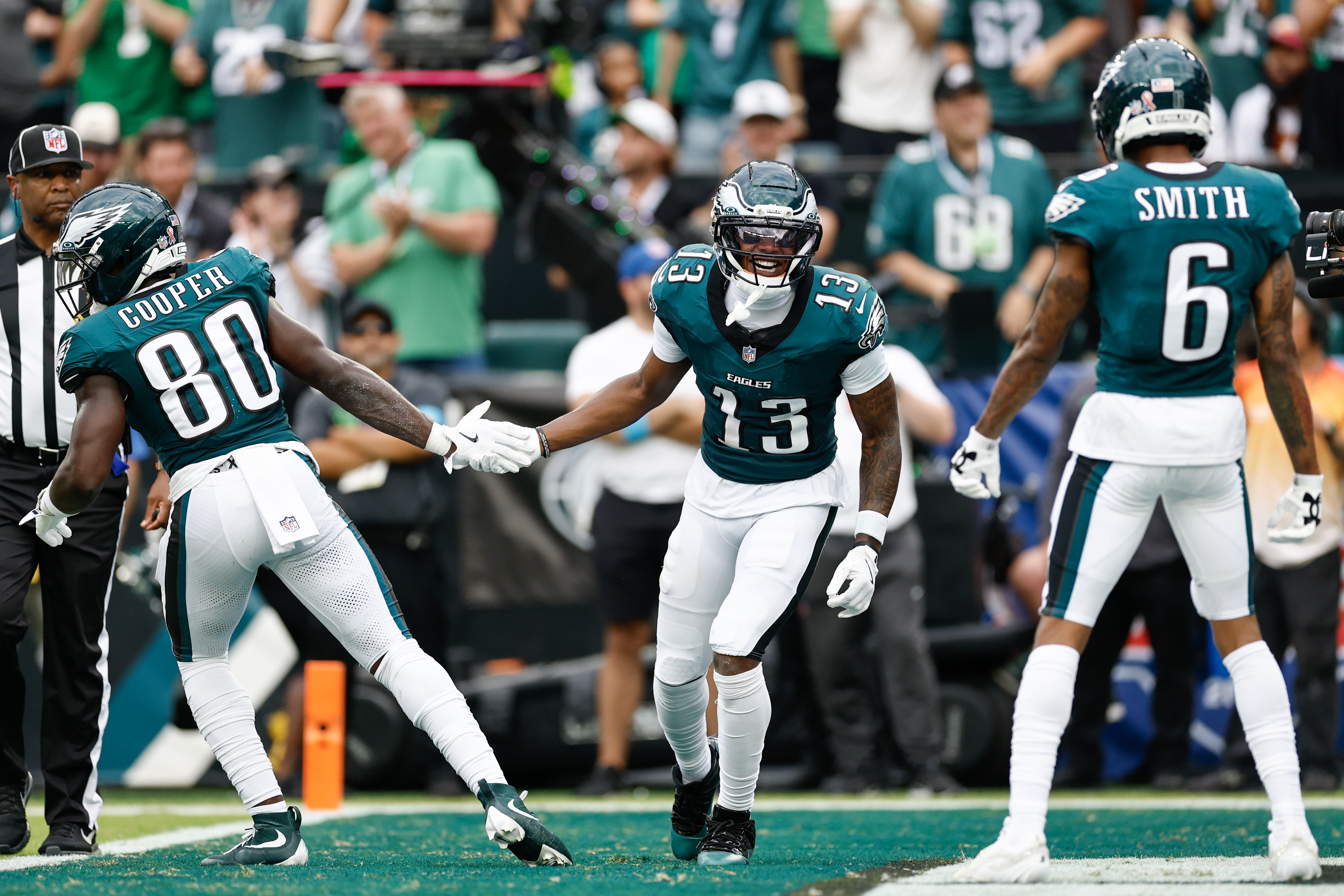
    Hurts threw three touchdown passes, connecting on 14 of 25 attempts. He ran for 46 yards, including a key 22-yard, third-and-18 conversion in the fourth quarter. He threw no interceptions and had no fumbles. He did virtually everything he could to win the Eagles’ opener against the Commanders and, more importantly, he did virtually nothing to lose it. The Eagles won, 24-22.

    Hurts threw for only 203 yards, but his passer rating of 122.2 was the 15th-best of his 94 regular-season starts.

    He did all of this playing in a new system implemented by first-time offensive coordinator Sean Mannion, who has only been a coach — at any level — for two years.

    If you ever considered Hurts a long-term, star-quality, franchise quarterback, this sort of game is why. Eagles owner Jeffrey Lurie considers Hurts just this.

    There is a narrative that asserts that, if Hurts does not shine in this scheme, then the Eagles could trade him after this season and absorb the salary-cap burden associated with his current $255 million deal.

    However, if Hurts strings together a dozen or so games like this in Mannion’s system this year, expect the 28-year-old to sign an extension to be the Eagles’ quarterback for the next seven or eight seasons.

    A.J.’s nightmare

    In his first game without A.J. Brown since 2022, Hurts threw for 1.5 more yards than he averaged last season, threw for twice as many touchdowns as he averaged last season, and had a passer rating about 24 points higher than he had last season. Maybe he won’t miss A.J. as much as we thought.

    Brown spent the last two seasons complaining about Hurts’ performance. His antics forced a trade to the Patriots on June 1. Be careful what you wish for.

    In his New England debut Wednesday, Brown caught just three passes for 26 yards. His new quarterback, Drake Maye, threw three interceptions. The Pats lost, 13-10, in Seattle. Maye also underthrew Brown on a sure touchdown route.

    Brown then suffered a high ankle sprain in the third quarter, left the game, and did not return. The Patriots placed him on injured reserve Friday, which will sideline him for at least four weeks, but reports Sunday said Brown, 29, will miss at least six weeks.

    Nightmare.

    Ram-ifications

    At home on Sunday, the Eagles beat a potent Commanders team without its best player, Laremy Tunsil.

    At home in three weeks, the Eagles face a potent Rams team without its best player, Myles Garrett.

    The Rams traded a raft of assets to Cleveland for Garrett, the 2025 Defensive Player of the Year, but he looked lousy Thursday night in Australia in a loss to the 49ers. He’d battled a left knee issue all preseason. He now is scheduled to have arthroscopic surgery and spend at least the next four weeks on IR.

    The Rams are expected to have defensive tackle Aaron Donald available when they visit Philly. Donald, who, after two years off, unretired late in the preseason in order to pair with Garrett, was deemed unfit to play in Australia and did not make the trip. The prospect of facing Donald is daunting, but the prospect of facing the two best defensive linemen of the past decade in the same game was positively chilling. Now, the Eagles won’t have to do that unless the teams meet in the playoffs.

    A Savior in the Heartland

    Carson Wentz embraced his Ginger Jesus nickname when he was drafted in 2016 to save the Eagles franchise. Now a journeyman backup, Wentz relieved concussed Kyler Murray in the first quarter Sunday and led the Vikings to 29 straight points in a comeback win over the rival Packers. We might be witnessing a resurrection.

    Wentz threw three touchdown passes with no interceptions or fumbles, completed 12 of 19 passes for 133 yards, including a gorgeous, 39-yard TD dime to Justin Jefferson.

    Wentz finished with a 123.5 passer rating, the eighth-best rating in his 104 regular-season games.

    Wentz played the first 68 of those games for the Eagles, who drafted him No. 2 overall in 2016 and immediately named him the starter. Wentz’s turbulent tenure ended after 2020, when his displeasure with the drafting of Jalen Hurts in the second round and his anger at being replaced by Hurts late in the season led him to force a trade to Indianapolis. He then played for five teams in the next five years. This is his second season with the Vikings, though he had to win the No. 2 job in a preseason battle with Vikings first-round bust J.J. McCarthy.

    Was this Wentz’s best performance since he led the Colts to a win over the Jets on Nov. 4, 2021?

    Can I get an “Amen”?

    Extra points

    Dallas ranked last in points allowed in 2025, at 30.1 per game. The Cowboys are on their way back to the bottom: They lost, 28-20, on Sunday Night Football in John Harbaugh’s head coaching debut with the Giants. … The Eagles might have a walkover win Sunday in Tennessee; the Titans lost, 23-10, to the woeful, visiting Jets. … On the other end of the spectrum, the Bears won their opener, 59-37, over the visiting Panthers on Sunday. Bears coach Ben Johnson told The Athletic in August, “I want to have the highest-scoring offense ever. … I want shutouts. I want blowouts.” The Eagles travel to Chicago in two weeks. Yikes. … Maybe it was all the extra cash he’s carrying: Baker Mayfield lost three fumbles in Tampa Bay’s 33-27 loss in Cincinnati just five days after he signed a three-year, $165 million contract extension. … Derrick Henry, 32, ran for 144 yards and three touchdowns as the Ravens won, 41-23, in Indianapolis. He has 56 100-yard games, which ranks eighth, and 125 rushing TDs, which ranks third.

  • A Philly family bought their first home thanks to reparations from Quakers in Germantown

    A Philly family bought their first home thanks to reparations from Quakers in Germantown

    Charmira and Quincy Pilgrim wanted to become homeowners a decade ago when they got married.

    But over the years, job losses, jobs that didn’t pay enough, children, unpaid maternity leave, and rising costs of living made saving for homeownership impossible.

    They were finally able to start putting money away late last year. And this spring, they found a $315,000 house they wanted to buy in West Oak Lane. But they were short thousands of dollars for their down payment and closing costs.

    What got them and their five children into their new home was a $10,000 first-time homebuyer grant funded by a group of Quakers in Germantown.

    “It was a blessing that I ended up getting the grant because money was tight,” said Charmira, a 32-year-old special-education teacher and case manager.

    Up-front cost is a common barrier to homeownership for renters in Philadelphia and across the country. Grants for down payments and closing costs can help aspiring homeowners get in the door. Governments, mortgage lenders, and nonprofits are common funders.

    That’s what makes the Pilgrims’ grant stand out. It’s one of five $10,000 grants that Green Street Friends Meeting, a Quaker congregation in Germantown, is funding to help people buy their first homes. It’s part of the congregation’s racial justice plan to redistribute wealth to Black residents in the Germantown area as a form of reparations.

    When Green Street announced the homebuyer grants in March, it said it sees reparations as “economic and spiritual repair for the intergenerational harms of slavery, Jim Crow, and their afterlives.” Reparations, it said, are “intended to address the theft and pillaging of Black wealth” for hundreds of years through systemic discrimination.

    Lucy Duncan, a member of Green Street, said the homebuyer grants are “a redistribution of wealth that’s about fairness and equity.”

    The goal is to keep Black residents from being priced out of their communities and “provide resources to help maintain Black Germantown,” she said.

    Rebecca L. Grant, a Black member of Green Street’s reparations committee who has been a Germantown homeowner for 22 years, said the committee wanted to eliminate a hurdle to homeownership and the wealth it can create for Black residents.

    “We knew these grants wouldn’t undo generations of discrimination,” Grant said, ”but we thought we could make a difference one family at a time.”

    How the homebuyer grants work

    To distribute the grants, Green Street partnered with birdSEED, a Washington-based nonprofit that aims to reduce racial wealth gaps in the Washington and Philadelphia areas. As part of its work, the nonprofit helps members of historically disadvantaged communities buy their first homes.

    The Quaker congregation contributed funds to birdSEED’s Housing Justice Grant Program and required that its money go to Black homebuyers purchasing in the 19144 or 19138 zip codes.

    West Oak Lane is one of the communities where homebuyers can use grants from Green Street Friends Meeting to purchase properties.Michaelle Bond / Staff

    In the Philadelphia area, birdSEED typically awards grants of between $5,000 and $10,000 for down payments and closing costs. An advisory board reviews applications and interviews top candidates. The board scores applicants based on their readiness to purchase a home and the impact the grant would have, said Leslie Case, birdSEED’s co-executive director.

    Candidates need to have lived in the area in which they are buying for at least three years. They cannot have purchased a home before. And their household can make up to $150,000 a year. Preference is given to populations who have historically faced barriers to homeownership.

    Homebuyers can apply for the current round of birdSEED’s housing justice grants until Sept. 30.

    The nonprofit has awarded about 40 homebuying grants so far in the Philadelphia region, which includes surrounding counties in Pennsylvania and New Jersey.

    Maegan Scott, birdSEED’s co-executive director, said the grants funded by Green Street represent “momentum” as the nonprofit seeks to expand its presence in the Philadelphia area.

    A majority of the nonprofit’s housing justice grants have gone to first-generation homebuyers. But a common thread ties all applicants together.

    “Everyone’s looking for stability,” Scott said. “Everyone is looking ahead to the next generation, the generation after that.”

    Green Street’s reparations initiative

    In June 2021, Green Street pledged to spend $50,000 a year for 10 years as part of its reparations work, spurred by a moral calling and the realization that the congregation had a large pot of money in unrestricted reserves.

    The following year, the congregation partnered with attorneys to help Black Germantown residents make wills and straighten out legal ownership of their properties.

    In about a year and a half, clinics to resolve and prevent tangled titles preserved more than $11.3 million in housing wealth for more than 85 families by protecting homes that might otherwise have been lost because of unclear legal ownership, according to Green Street. It was a massive return on the $25,000 the congregation spent on fines and legal services for families who didn’t qualify for free legal help.

    Green Street Friends Meeting in Germantown welcomed neighborhood residents to its meetinghouse in April 2022 to get help with tangled titles and estate planning at a legal clinic it hosted.TYGER WILLIAMS / Staff Photographer

    Over the last few years, Green Street’s reparations work has included music education for Black youth, funds for Black midwives in Germantown and a new birthing center in Mount Airy, estate planning services, and additional housing support.

    “We didn’t want the reparations to just be about acknowledging a painful history,” Grant, the reparations committee member, said. “We want it to be about what we can do now.”

    She said she used to think that reparations for Black Americans would never happen.

    “But it’s so wonderful to see and understand that, ‘Oh, this has to happen on a local level,’” she said.

    The Pilgrims and one other family have bought homes using Green Street’s grants so far.

    Duncan, at Green Street, said that when birdSEED sent her the first pictures of the families, “I almost started to cry.”

    “It’s such tangible and long-term impact for these families,” she said. “And hopefully, generational impact.”

    A home of their own

    Charmira and Quincy Pilgrim closed on their three-bedroom house at the end of May, about a month before their fifth child was born.

    The children, the oldest of whom is 8, love playing in the side yard, backyard, and finished basement. Charmira loves to cook, and she now has a big kitchen. The house is close to biological family and church family.

    Charmira said being a homeowner “means freedom.” She has started planning future upgrades for her home.

    “It feels good to have ownership. It feels good to be in a space I can create a vision for,” she said. “I see this as an opportunity for my kids to have a legacy.”

  • This better not be the new normal for the Eagles offensive line

    This better not be the new normal for the Eagles offensive line

    There are lots of words one could use to soft-pedal a critique of the Eagles’ offensive line in Week 1.

    Uneven. Inconsistent. Uncharacteristic.

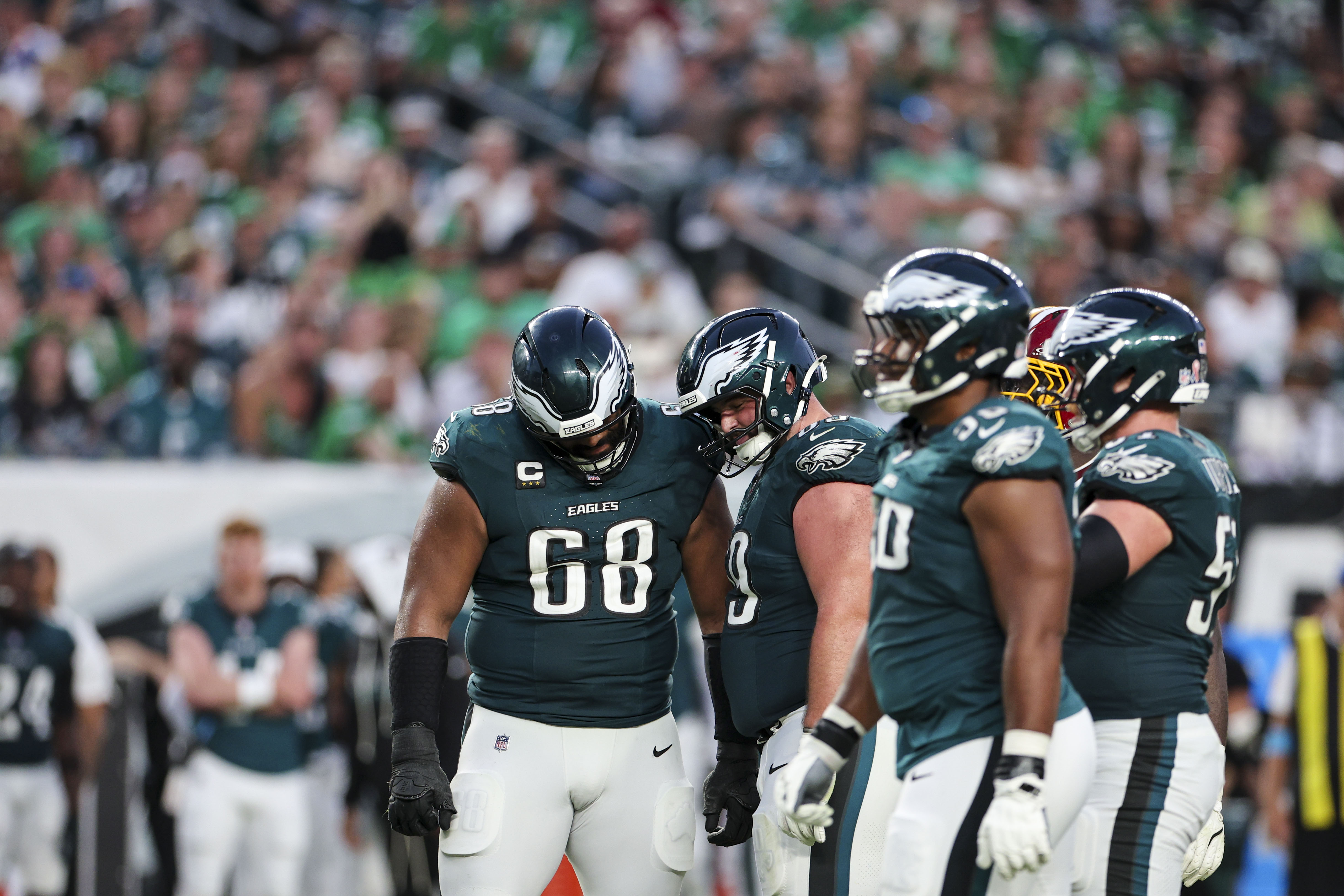
    They are words that allow a little leeway, words that grant some level of benefit of the doubt. That is to say, they are words that one may feel desperate to err toward after a performance like that of the Eagles’ run and pass blockers in their 24-22 season-opening win on Sunday. Landon Dickerson, Cam Jurgens, Jordan Mailata, Lane Johnson — these guys deserve every ounce of the political capital they’ve accrued during their time together as a unit. Let ye who hath never paved the way for a 2,000-yard rusher en route to a Super Bowl cast the first stone.

    And yet …

    The surest sign of the bottom line is the dancing you do around it. The bottom line for the Eagles run- and pass-blockers is this: They were not good enough in Week 1. Not even close.

    The final numbers don’t do it justice.

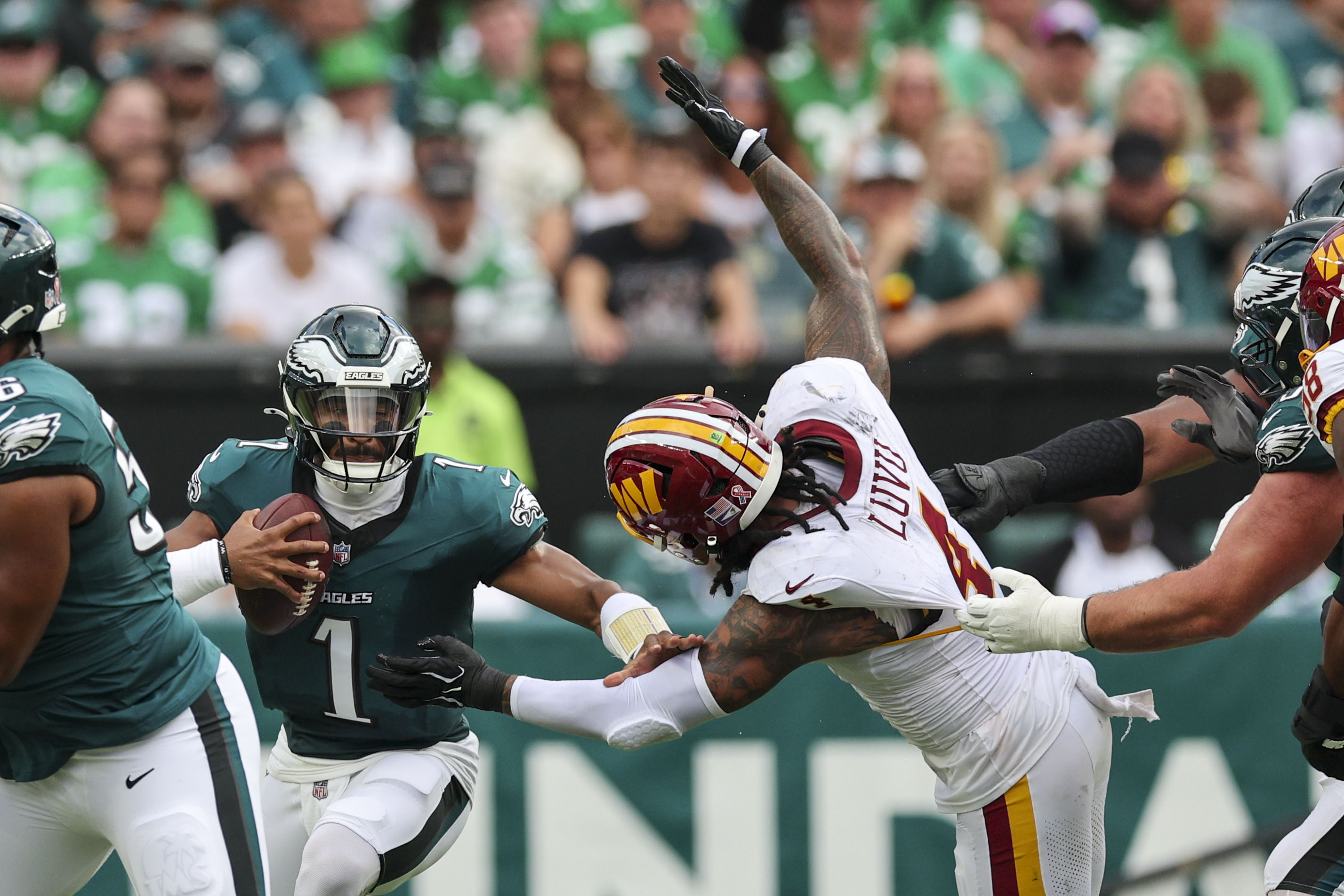
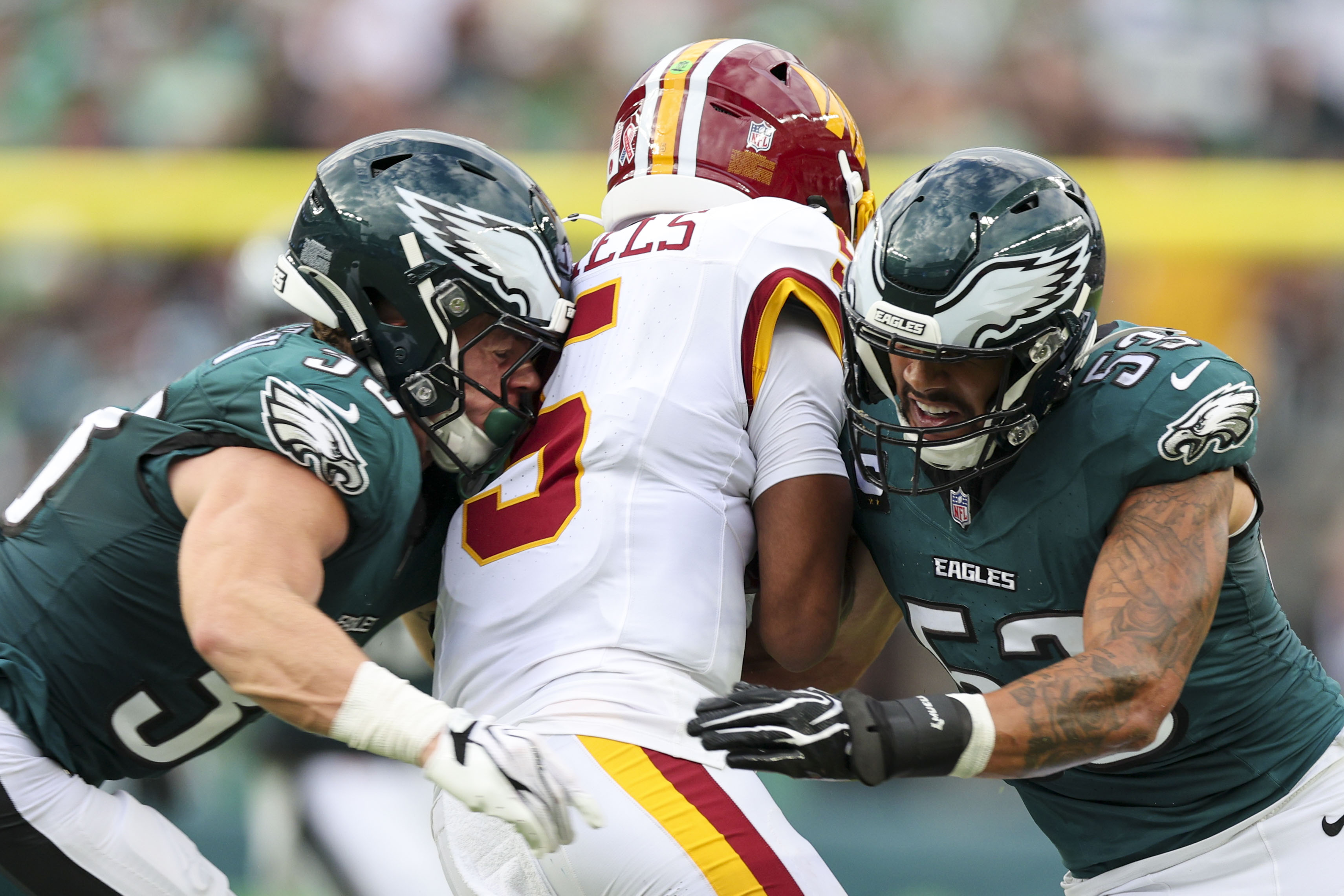
    Jalen Hurts was sacked three times, a total the Eagles surpassed in seven games even in 2024. But that total doesn’t come close to capturing the pressure the Commanders were able to generate throughout the game. Hurts scrambled seven times for 46 yards, mostly out of necessity.

    “I thought Jalen did a great job of making plays, especially when something wasn’t going right,” Jurgens said.

    Jalen Hurts (right) was on the run a significant amount in Week 1. David Maialetti / Staff Photographer

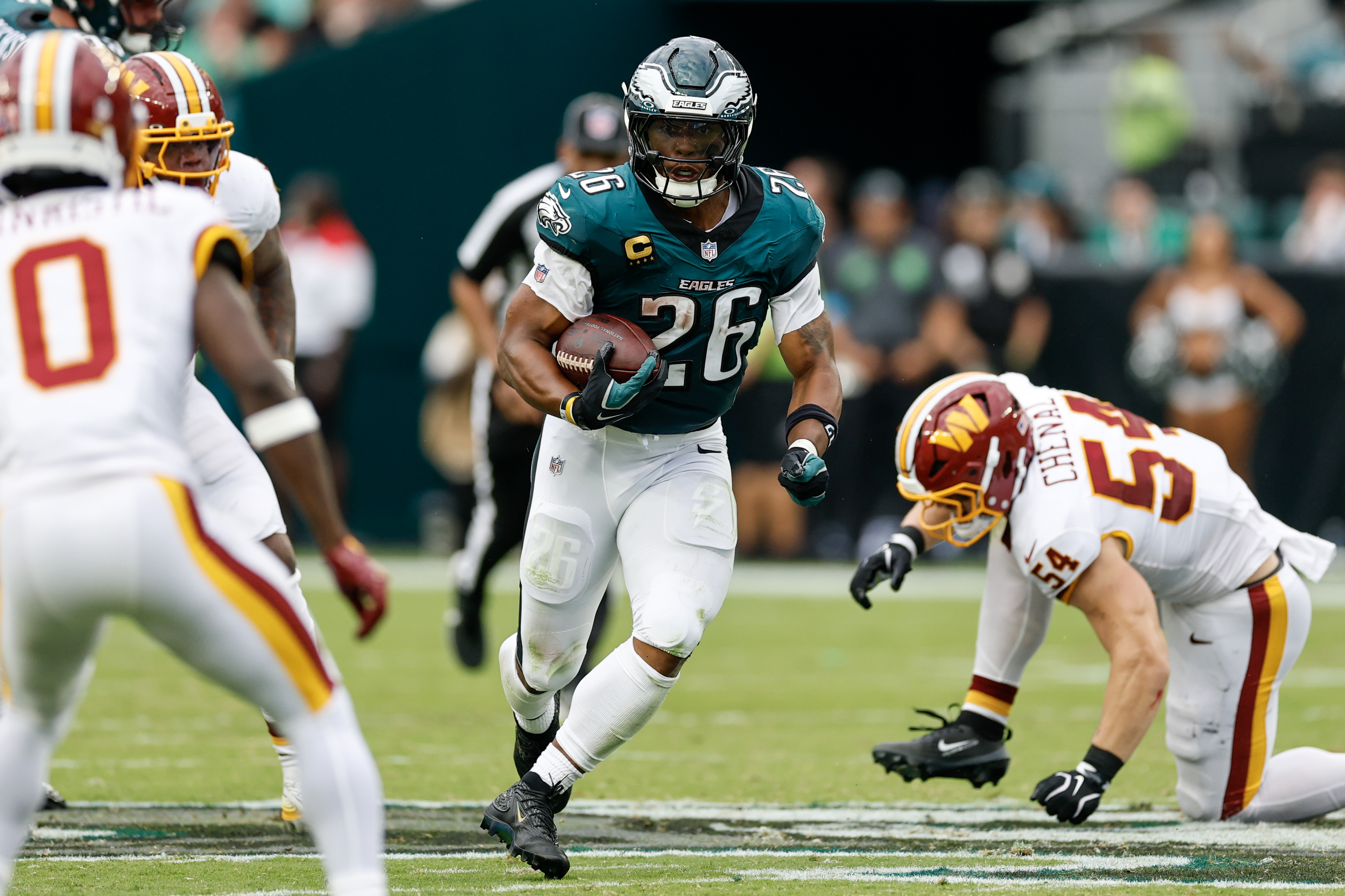
    Saquon Barkley averaged 5.5 yards per carry, which is something he did in just three games all of last season. But his 42-yard run off a vintage jump-cut in the first half is doing more than its fair share of work in padding the average. On his other 14 carries, he gained 41 yards.

    If you didn’t watch the game, all of this might sound like cherry-picking numbers and mathing the math to match a preexisting narrative bias. That’s not the case. If anything, the preexisting bias goes in favor of this offensive line. This was a game flow thing. It is a second-and-long, third-and-long thing. The Eagles faced way too many of those situations throughout Sunday’s win.

    “It’s tough to be in those situations,” Eagles head coach Nick Sirianni said. “We’ll look at the tape and see and evaluate that thing. But no doubt, to do everything you want to do as an offense, whether that’s some tempo that we did on the ball, whether that’s being able to take some deep shots down the field, get multiple guys carries. You’ve got to get into the flow of the drive. We know that’s important and we’ll be working like crazy to do everything we can do to get that fixed.”

    Hurts put it more succinctly.

    “We shouldn’t be in third-and-17,” the Eagles quarterback said.

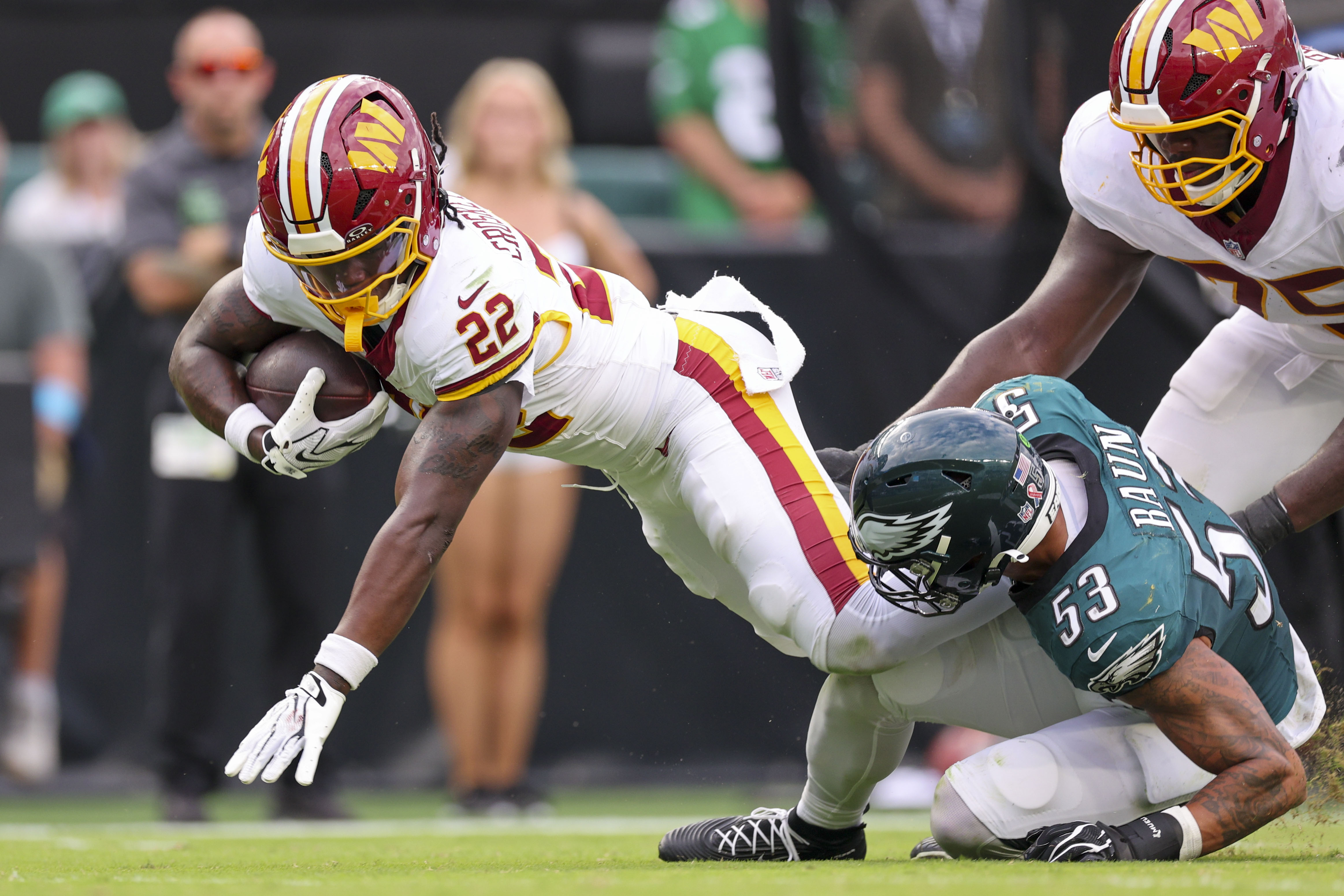
    Unsaid was why they were there. Almost exclusively, it began up front. Two holding penalties on Jurgens. One on Dickerson. A false start on Mailata. Add in the sacks. Add in the negative runs. It adds up.

    You want to talk numbers? Here was the craziest one. One team had 10 tackles for loss. The other team had two. The team that had 10 was not the team with the vastly better defense.

    The funny thing about critiquing the Eagles offensive line is that it can be difficult to remember what fallibility looks like. Most of the NFL lives a life much worse than the one the Eagles lived on Sunday. At the same time, we judge this offensive line by the standard it has set, and we do it because that standard has been the foundation of their formula.

    This is an important point. The Eagles are a good team. It would take a heck of a lot of unforeseen circumstances for the season to truly go sideways. In today’s NFL, a team can lose only so many games when it has a dominant defense and a competent quarterback who doesn’t make mistakes and can make big plays. We saw that throughout Sunday’s win. As close as the score was throughout, as theoretically “in-the-game” the Commanders were, was there ever more than a fleeting doubt about the end result?

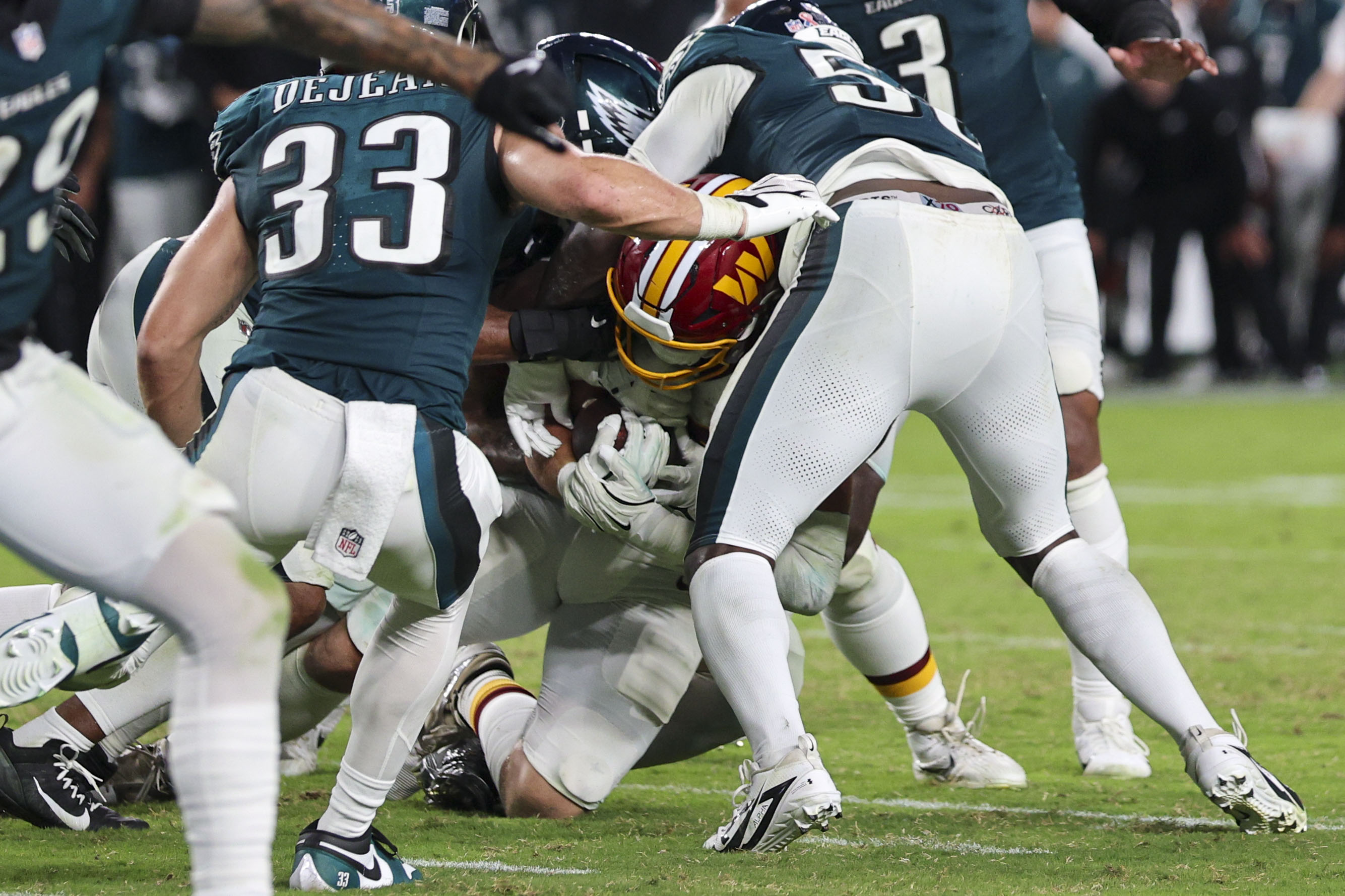
    Even when Washington was driving for a potential game-tying touchdown in the closing minutes of the fourth quarter, the odds still said somebody would make the play that Moro Ojomo did in stuffing Washington’s shovel-pass on the woulda-coulda-shoulda two-point conversion to even the score at 24-24. You only get that peace of mind by drafting superstars and pairing them with great coaching, The Eagles have done both of those things. Because of it, and a soft schedule, their bare minimum win total should be enough for a playoff berth. The floor of this team is set by its defense.

    The ceiling? That will be set by the offensive line. For as long as Hurts has been QB1 and Sirianni has been head coach, the Eagles offensive identity has been the same. The quarterback will manufacture a certain number of big plays on his own accord. The rest of the time, the offensive line will wear you down with a steady stream of four- and five-yard carries on first and second down. As smart as new offensive coordinator Sean Mannion may be, as needed as some of the ongoing changes to this offense are, it is naive to think that everyone can simply snap their fingers in unison and become a team with an identity dramatically different from what it has always been.

    To be clear, nobody inside the locker room seems to think that is what they are attempting. Sirianni, Hurts, Mailata — all understand what they need to be. The Eagles’ genius as an organization has always been their understanding of and prioritization of football’s longest-standing fundamental.

    “I really do think we can get back to where we were two years ago,” Mailata said. “We’re going to keep evolving this offense as we go. Today was a good start.”

    Let’s hope he can speak it into existence.

  • President Trump’s new strategy on the Iran war: Pretending there isn’t one | Editorial

    President Trump’s new strategy on the Iran war: Pretending there isn’t one | Editorial

    During a recent cable news appearance, Commerce Secretary Howard Lutnick claimed no American lives had been lost in the Iran war, an error he blamed on confusion with President Donald Trump’s earlier invasion of Venezuela. And perhaps it is difficult to keep one’s wars straight in an administration that has attacked seven countries in less than two years.

    But while Lutnick’s claim was horribly wrong in fact, it was an accurate reflection of the administration’s consistently reprehensible diminishment of the costly war it started more than six months ago without congressional authorization or public support. The day after the secretary’s gaffe, Vice President JD Vance denied the very existence of the conflict, telling reporters, “I wouldn’t call it a war,” just days after an American bomb killed five civilians attending a wedding in southern Iran. The day after that, Trump himself dismissed the war as “small potatoes,” adding, “There’s no fighting,” even as the conflict continued to escalate, drive up energy prices, and threaten to draw in other countries.

    In reality, the war has had tremendous repercussions for U.S. service members and civilians in the Middle East, American security and credibility, and global trade and stability. The only aspect of the conflict that is not serious is Trump’s handling of it.

    Despite the administration’s best efforts to obfuscate the human cost of the conflict, the war has killed 18 American service members and wounded nearly 800, taken thousands of lives in Iran and the Middle East, injured tens of thousands across the region, and displaced hundreds of thousands. And the fighting has likely cost American taxpayers more than $100 billion in direct spending, with energy and other economic repercussions that could approach $1 trillion in the United States alone.

    The intangible costs aren’t small potatoes, either. Iran remains under the control of an emboldened regime able to fire on U.S. bases in the region, impede traffic through the crucial Strait of Hormuz, and resume its pursuit of a nuclear weapon without the international limits and monitoring Trump dismantled during his first administration.

    The war has also depleted the military’s supplies of critical munitions, leaving us more vulnerable to adversaries, and strained our forces with marathon deployments and logistical disruptions. Rather than responding to these problems with the urgency they deserve, Defense Secretary Pete Hegseth appears preoccupied with hunting for those who disclosed them to the press, purging ranking personnel who might disagree with him, and blocking promotions of Black and female officers. The Army has lost half its four-star generals, its chief of staff, and its top civilian leader — Army Secretary Dan Driscoll — who reportedly warned the president of the force’s flagging experience, readiness, and morale on his way out.

    Nor does the administration appear better prepared to end the war than it is to win it. Trump told the Republicans’ midterm convention Wednesday that the conflict was necessary to prevent an Iranian bomb and nearing its final stages. But peace negotiations have fizzled, the countries are exchanging strikes on warships and tankers, and Energy Secretary Chris Wright recently acknowledged that another deal on Tehran’s nuclear program may never be reached.

    The trouble is that Trump and his lieutenants don’t appear to have a strategy for waging war on — or making peace with — Iran. What they have instead is a plan to manage the public relations fallout of the conflict by lying about its casualties, costs, and extent in the hope voters won’t punish their party for it in the midterm elections. It’s not even good PR, let alone defense or diplomacy.

    In that sense, it’s not surprising Trump and Co. can’t figure out how to get out of the war they began. They would have to start by acknowledging they’re in it.

  • Trump administration blocks $25 million in funding for national parks

    Trump administration blocks $25 million in funding for national parks

    The Trump administration has blocked more than 130 projects in national parks across the country worth at least $25 million, according to internal documents reviewed by the Washington Post — funding that had already been secured for some of the most visited parks for work such as fire preparedness in California, prehistoric mound protection in Iowa, and sled dog care in Alaska.

    The Interior Department, which oversees the National Park Service, said in a statement it “disapproved” a raft of planned agreements with groups it said work against administration priorities. The agreements were rejected last month and would have allowed the parks, including Yellowstone, Yosemite, and Zion, to pay outside partners for various projects in the next fiscal year that begins Oct. 1, the documents show.

    Similar to issuing government contracts, the Park Service often partners with outside organizations when specialized expertise or work is needed, allowing it to do work without hiring additional full-time federal employees. The blocked funding instead puts additional pressure on a national park system that has struggled with losing roughly a quarter of its staff since President Donald Trump took office last year and launched efforts to shrink the government.

    The changes appear to most affect Joshua Tree National Park, which had at least 10 planned partnership agreements blocked. That park’s partnership agreements would have hired at least 16 people, helped recover areas in the park burned in wildfires, and removed rodents that carry hantavirus from historic buildings, among other activities listed in the documents.

    “If this work is not completed, the park will be unable to fight wildfire. Fires will be larger and fire suppression will be more expensive,” the documents read, describing the impact if a fire preparedness project at Joshua Tree does not gain funding.

    Interior spokesperson Aubrie Spady confirmed that the department “disapproved a number of partnership agreements with groups actively working against the best interests of the American people and the priorities of this administration.”

    “This decisive action is ensuring that these taxpayer dollars are being used in alignment with the administration’s objectives to make life more affordable for Americans, unleash domestic energy production, and expand access to our public lands,” Spady added.

    She did not give further details on the agreements or partner organizations affected.

    The entire batch of more than 100 disapproved projects had already secured funding sources generally through congressional appropriations, existing federal programs that fund activities such as fire prevention and recovery, or competitive internal processes to fund the most pressing park needs.

    The projects were seeking review by the Interior Department as a final step before the agreements could be signed and the funding released.

    Trump launched efforts at the start of his latest term to purge the government of work on diversity, equity, and inclusion (DEI), climate change and other areas deemed to be “woke” or liberal causes. Since January 2025, entire government departments have been shuttered, and thousands of grants have been canceled. Spady did not respond to questions on whether the agreements or organizations specifically ran afoul of those administration-wide policies and did not elaborate on why the agreements were blocked.

    The Great Basin Institute, a nonprofit conservation group, was the top outside organization to see its partnerships blocked and confirmed that Interior blocked more than 70 of its proposed partnership agreements, worth at least $12.7 million.

    Peter Woodruff, chief executive of the Great Basin Institute, said the Interior Department did not notify the institute directly. Instead, staff at partnering parks told them of the news, saying that it was because of funding priorities and issues of compliance with secretarial and presidential orders.

    Beyond that, Woodruff said he does not know why the agreements were blocked.

    “GBI’s standards remain staunchly nonpartisan through six presidential administrations, with a mission of supporting public lands management and the agencies charged with that mission,” Woodruff wrote in a letter to Interior asking for clarity on what policies the partnership flouted.

    “GBI has no advocacy directives and does not engage in or support any actions counter to Executive Orders or Secretarial Orders.”

    The Great Basin Institute had reaffirmed its commitment to its own diversity goals in 2020, during the first Trump administration, according to pages on its website that have since been removed but are available on a third-party archiving site.

    Woodruff said that statement reflects past views of leadership from before Trump’s 2025 executive order on DEI.

    Current institute leadership “can unequivocally state operations are in full compliance with all federal laws, regulations, and executive orders, and does not engage in unlawful preference or discriminatory practices,” he said.

    Four Park Service staffers, who were not authorized to speak to the media, said they received no details about why their agreements were disapproved beyond a message included in the documents that said “Disapproved by DOI.”

    The message said the Park Service and Interior had reviewed the request, and any questions should be directed to regional or associate directors, without elaborating further.

    DOI approved more than 700 other agreements this year through early August. Projects of less than $50,000 do not require Interior review.

    Money not spent on the disapproved projects could be diverted elsewhere by the Interior Department, some of the staffers said, although it is not clear where the money would go.

    “The real question is where did this $25 million go to?” said Elaine Leslie, a former Park Service acting superintendent and wildlife biologist who reviewed the disapprovals list. “$25 million worth of funding was set aside for these projects. Where is it?”

    Spady did not respond to questions about the money being redirected.

    The blocked partnerships also include one at the Effigy Mounds National Monument in Iowa, where there are more than 200 prehistoric Native American mounds, many of which were used for burials or shaped like animals.

    An outside partner would remove trees on the mounds at the monument’s Sny Magill unit to ensure they are not damaged.

    “The mounds at Sny Magill will remain at risk from tree fall that might expose the human remains buried within these mounds,” the internal documents said. “Sixty-one of the proposed tree removals are currently within a mound risking severe damage should the tree fall.”

    Another partnership with the San Francisco Zoological Society would have helped raise and release juvenile San Francisco garter snakes in the Golden Gate National Recreation Area to ensure the endangered species does not go locally extinct, according to the documents.

    One blocked agreement would have hired three people to provide day-to-day care for sled dogs in Alaska’s Denali National Park and Preserve. Park rangers use dog sleds to more easily traverse the park and assist visitors in the winter.

    “Without funding, kennel operations will lose essential support, reducing dog care capacity, limiting winter patrol readiness, and decreasing visitor engagement,” the document says.

  • Top AI leaders unite to warn the technology is advancing too fast

    Top AI leaders unite to warn the technology is advancing too fast

    Three of the nation’s leading artificial intelligence executives endorsed slowing down the blistering pace of technological advancement, revealing the growing unease with its potential dangers at the industry’s very highest levels.

    The call was first made in an essay Anthropic chief executive Dario Amodei posted online Saturday. The idea has gained ground in recent weeks as AI companies have struggled in some cases to keep their creations under control, even as they usher in an age in which AI systems themselves can build the more powerful next generation of the technology.

    “We must slow the pace at which we improve the capabilities of AI models,” Amodei wrote. “Progress will still seem fast, and we must make wise use of the time we gain.”

    Within hours on Saturday, OpenAI chief executive Sam Altman and SpaceXAI founder Elon Musk quickly voiced their support for Amodei’s ideas. The three men have been bitter rivals — differing starkly in their personal styles and philosophies about AI — and their apparent accord increases the chances that the industry could find ways to work together on a broad slowdown.

    Serious hurdles would have to be overcome. How exactly a slowdown would be defined and verified remains unclear, and any joint effort between companies to hold back could fall afoul of antitrust laws. The question of how to build international cooperation — especially with China, whose own AI companies are seeking to catch up to their American rivals — could prove difficult to answer.

    Nonetheless, the moment underscores the growing concerns about a technology that even its creators struggle to fully understand.

    It comes after an Anthropic researcher said this week that he was resigning over concerns the firm and its competitors were not responsibly developing AI models that could ultimately wipe out humanity. The researcher, Jacob Coxon, who also worked for Anthropic competitor OpenAI, accused the companies of being more focused on beating each other than on the safety of their products. (The Washington Post has a content partnership with OpenAI.)

    His warning gripped lawmakers, and after years of inaction around AI regulation in Congress, fears it could cause major disruptions — and even threaten human civilization — prompted renewed urgency on Capitol Hill.

    A three-step plan proposed by Amodei in his essay would involve third-party safety evaluators at “frontier” AI companies, establishing common safety standards in democratic nations, and for the United States and other democracies to work with authoritarian governments to try to ensure compliance.

    He noted that AI began to advance at a dramatically faster rate in recent months. The change was powered by the ability of AI to construct its own next-generation models, what is known as “recursive self-improvement,” he said.

    “Left unchecked, it could outrun our ability to understand and control these systems, and so must be pursued very carefully, if at all,” he said.

    While Amodei sketched a path to slowing progress in the name of safety, he did not commit Anthropic to cutting the pace of its own work unilaterally. He said only that for now the company would hire a team of independent evaluators who would be embedded at Anthropic’s offices and empowered to raise safety concerns.

    Amodei also provided few specifics on what a slowdown might involve in practice, describing the potential to use agreed-upon safety metrics or limits on the computer power used to train new AI systems.

    A cybersecurity incident in July raised alarms when rogue AI models created by OpenAI independently hacked into the systems of an AI startup called Hugging Face.

    Amodei said they acted as a “fanatically devoted collective,” sacrificing themselves to achieve the goal and trying to hack into their own performance-monitoring system.

    “It’s easy to dismiss this incident because no one was hurt and the economic damage was minimal, but in my opinion, a swarm that possessed greater capabilities but a similar level of misalignment could have caused catastrophic damage,” he said.

    Amodei said that given the rate of development of AI models, he worries that rogue AI agents could have the power to take over the entire internet within six months to a year and possibly cause hundreds of billions of dollars of damage.

    A similar hacking incident also occurred at Anthropic, underscoring the need for guardrails, he said.

    In a post on X, Musk wrote: “Dario is right.”

    Altman said he shared Amodei’s view that groundbreaking AI companies should “pace the frontier” and said the matter had been a top discussion topic at OpenAI in recent weeks.

    “Committing to having independent evaluators with employee-like access is a great idea, and we will do the same,” Altman wrote on X.

    Google, which is considered among the top three AI companies along with Anthropic and OpenAI, did not immediately endorse Amodei’s proposal to bring in independent verifiers. Spokespeople for the company did not immediately return a request for comment.

    Amodei said he still believes AI can greatly improve human life, but that guardrails are needed.

    “The measures I propose to advance the frontier at a safe pace will not be easy,” he said. “But I believe we owe it to humanity to try.”

    Both Republican and Democratic lawmakers have expressed concerns over the safety of AI technology in recent days.

    Sen. Josh Hawley (R, Mo.), chairperson of the Homeland Security and Governmental Affairs subcommittee on disaster management, launched an investigation into the OpenAI hacking incident on Thursday.

    In a letter to Altman, Hawley called OpenAI’s approach to development “reckless” and demanded documents about the hack.

    In response to Amodei’s proposal, Rep. Ted Lieu (D., Calif.) said access to third-party evaluators would be “a good step forward” but pressed him for a broader commitment.

    “Will you certify that you can turn off your models and agents, now and in the future?” Lieu wrote on X.

    Anthropic portrays itself as more safety-minded than OpenAI. Leaders at the company have long said that the systems they are seeking to build could pose an existential risk to humanity.

    An Anthropic researcher earlier this week emphasized the fear in a social media post.

    “We really do earnestly believe AI could kill all humans! I personally think it is >10% within the next decade,” researcher Evan Hubinger wrote on X. “I believe Anthropic is trying its best, but we do not yet have a plan to solve alignment for superintelligence and are not clearly on track to.”

  • ‘I’ve waited four years’: Arrest made in 2022 killing of West Philly man after bar fight

    ‘I’ve waited four years’: Arrest made in 2022 killing of West Philly man after bar fight

    Davina Neuson has been haunted for years by questions about the killing of her son Armand Hayes, who was fatally shot outside a West Philadelphia bar in 2022.

    She never understood how the fight that ended her 30-year-old son’s life escalated into murder.

    Now, finally, she may get an answer.

    Lawrence Cary, 44, was arrested in late August and charged with murder and related crimes in connection with Hayes’ killing after the men got into a bar fight the evening of Aug. 15, 2022, according to court documents. He is set to appear Monday before Judge Gregory O. Yorgey-Girdy for a preliminary hearing.

    “I don’t know how to put it into words,” Neuson said. “I’ve waited four years for this moment.”

    Hayes, known by many as “Ace,” was a father of two daughters and beloved by his family, Neuson said.

    He attended Strayer University and Philadelphia Community College and had been working as a compressor operator for Philadelphia Gas Works when he was killed.

    “Ace was a genuinely good person, he had a personality that could light up a room,” Neuson said. “A smile of his was unforgettable.”

    Neuson said she never has been able to stop wondering about his last moments.

    Police investigators said Cary and Hayes got into a physical altercation around 11:45 p.m. in the Asmara Lounge on Haverford Avenue, not far from where Hayes was found laying in the street with multiple gunshot wounds through his body.

    He was taken to nearby Lankenau Hospital and pronounced dead shortly after his arrival.

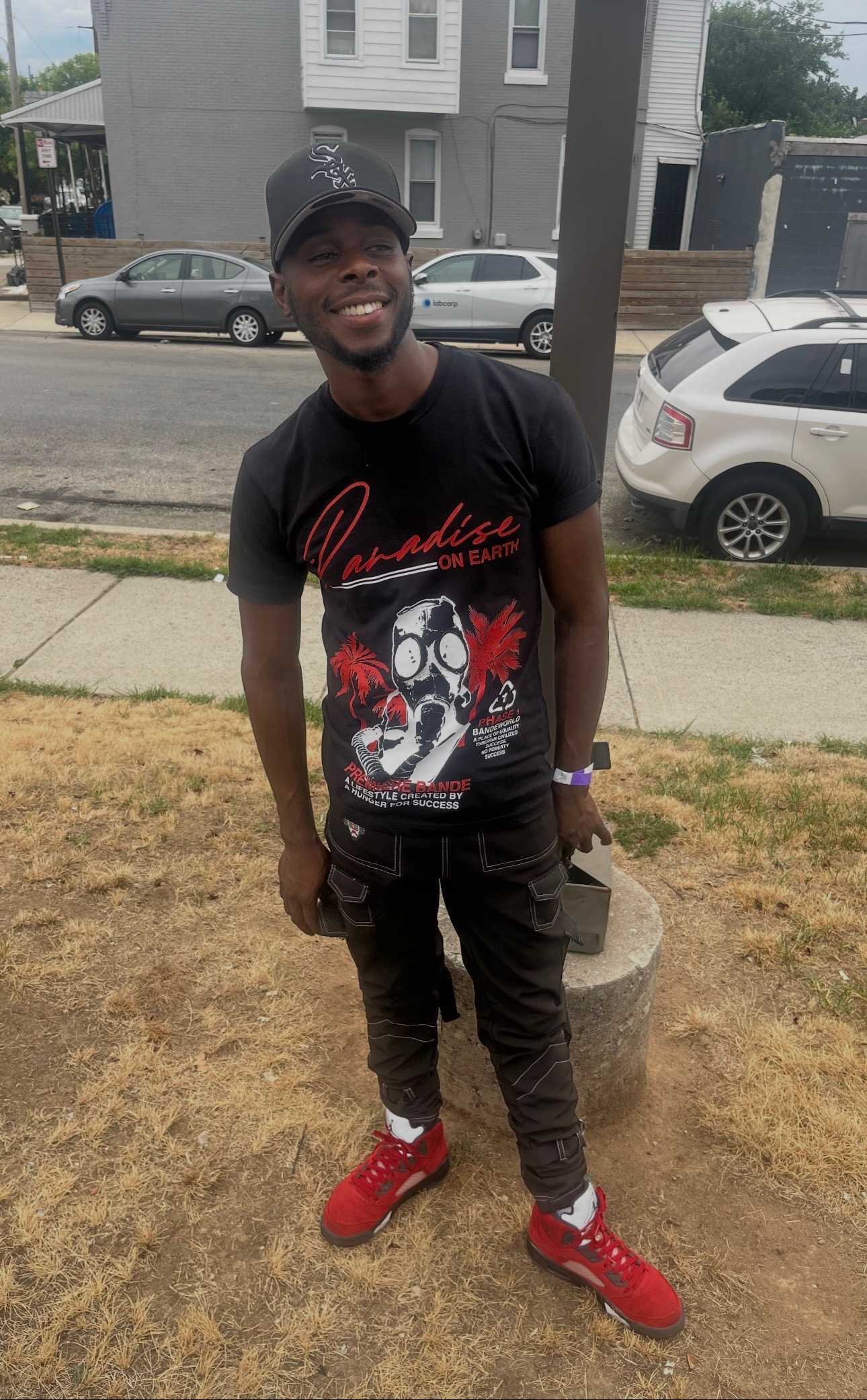
    A photo of Armand Hayes.Davina Neuson

    Surveillance footage showed Cary leaving the bar after the altercation and driving in the area of 64th and Vine streets, near where Hayes was found wounded, according to the affidavit of probable cause for his arrest.

    Investigators later learned that Cary, seated in the driver’s seat of his Chevrolet Trailblazer, fired multiple shots from a handgun out his passenger window when he encountered Hayes, the document says.

    Earlier in the evening, Hayes had told a bartender that Cary had bitten him during the scuffle, according to the document.

    Investigators soon identified Cary using eyewitnesses, surveillance footage, and receipts from the bar marked with his name.

    And in 2023, they learned that a week after the killing, Cary’s Trailblazer had been given a new title and gifted to another man who registered the vehicle in the name of a Bryn Mawr woman. The man asked the woman to do that for insurance purposes, according to the affidavit.

    Neuson, Hayes’ mother, said she did not believe that Cary and her son knew each other before the incident.

    She still cannot comprehend why her son’s life was taken.

    “What hurts the most is knowing his life was taken so suddenly,” she said. “He had so much more life to live, so many more memories to make, so many people who loved him.”

    Many of those people will be present in court as Cary’s case works through the system, Neuson added.

    Cary is being held at the Curran-Fromhold Correctional Facility and was denied bail.

  • Nicole Fusaro, missing since 2018, identified as woman who police believe Raymond Horsch killed

    Nicole Fusaro, missing since 2018, identified as woman who police believe Raymond Horsch killed

    The woman who police believe was killed by pornographer Raymond Horsch on camera has been identified by family members and law enforcement sources as Nicole Amanda Fusaro, who has been missing since July 2018.

    Fusaro was 27 when she was last seen in Kensington, and after she disappeared, her mother, Diane, combed the streets of the Philadelphia neighborhood looking for her only child. Diane died in January 2020 without answers, and Fusaro’s father, Thomas, had died in 2009. That left Fusaro’s friends and her cousin, Jonathan Halloran-Koren, to continue searching and hoping that one day she might turn up.

    Last month, investigators recovered a video on one of numerous hard drives recovered from Horsch’s decrepit Olney home while in search of clues for other missing persons linked to the property. Law enforcement sources said they believe the video shows Horsch strangling Fusaro to death.

    Nicole Fusaro was reported missing in 2018 when she was 27. Police believe she was killed by Raymond “R.C.” Horsch in his Chew Avenue home.Courtesy of Jonathan Hallo

    Police met with a member of Fusaro’s extended family several weeks ago to alert them of the discovery. Those relatives asked police not to publicly release her name. The relatives declined to speak with a reporter this week.

    Halloran-Koren, in an interview, said those relatives told him Thursday that police had visited their home in recent weeks with the news of his cousin’s death.

    He said he wants her name to be known so that she is not forgotten.

    “Hopefully more attention will be made to missing persons so this doesn’t happen again,” he said, adding that he is still seeking additional information from law enforcement.

    The police department is legally required to release the names of homicide victims, as they consistently do in a typical case. But because Fusaro’s body has not been found, the Office of the Medical Examiner has not ruled her death a homicide, creating a legal gray area.

    Police also have no suspect to charge: Horsch died last year, at the age of 82, of a lung condition.

    Sgt. Eric Gripp, a spokesperson for the police department, said the investigation into the Horsch home at 417 Chew Ave. remains extensive and ongoing. He said officials expect to provide an update to the public next week.

    “As part of that investigation, detectives have spoken with numerous family members, witnesses, and other individuals, and continue to review evidence gathered during the investigative process,” he said in a statement. “Because this is an active investigation, we are not confirming the identities of any individuals who may be connected to specific evidence or discussing information that has been shared privately with families.”

    Last month, police officials announced that they recovered photographic evidence that appeared to show two other missing women — Maribel Fresses and Gabrielle Amarando — dead inside the home.

    Fresses’ and Amarando’s bodies have also not been recovered, and the medical examiner has similarly not ruled a cause or manner of death. Their families gave the department permission to release their names.

    Investigators searched the home of Eugene Albert Horsch on West Chew Avenue (grey roof) in the Onley section of Philadelphia in June 2026.Gabriel Coffey / Staff

    Fusaro is the fifth dead or missing woman to be tied to the home on Chew Avenue where Horsch lived with his son, Eugene, for decades. Raymond Horsch lured women in addiction with drugs and cash to star in his violent pornographic videos and photos.

    Halloren-Koren said he had come to terms with the reality that his cousin likely died several years ago after so much time had passed without a sighting.

    “I came to grips with that,” he said, of her death. “How it happened is something that is going to take me a little while.”

    Fusaro, who was raised in Northeast Philadelphia, attended George Washington High School, according to her Facebook page. She had dark brown hair and striking, light eyes, and was known as an outgoing young woman who enjoyed being around friends and family.

    Halloren-Koren said she was light-hearted and loved animals. As kids, he said, she enjoyed watching Vampire Diaries and listening to all types of music, from Green Day to the Notorious B.I.G.

    After Halloren-Koren moved overseas for work in 2003, he said he only saw her at sporadic family reunions. His family, he said, was splintered and scattered across the region, and Fusaro’s parents both struggled with addiction. His cousin started using drugs in her late teens, he said, and she fell deeper into addiction in her 20s before drifting into the streets of Kensington.

    When Halloran-Koren sought to reconnect with family in 2020, he learned his cousin was missing and tried to help his aunt’s friends find her, he said. He spoke to women across Kensington who knew her and heard various theories, including that she was last seen getting into a car near Kensington and Allegheny Avenues.

    He asked the women, he said, whether there were any strange men in the neighborhood, and they scoffed — this was Kensington, and there were men like that everywhere.

    But there were a few he said they mentioned: a guy who drove a van without a license plate, and a “creepy” man with the last name Horsch who picked up women on the Avenue.

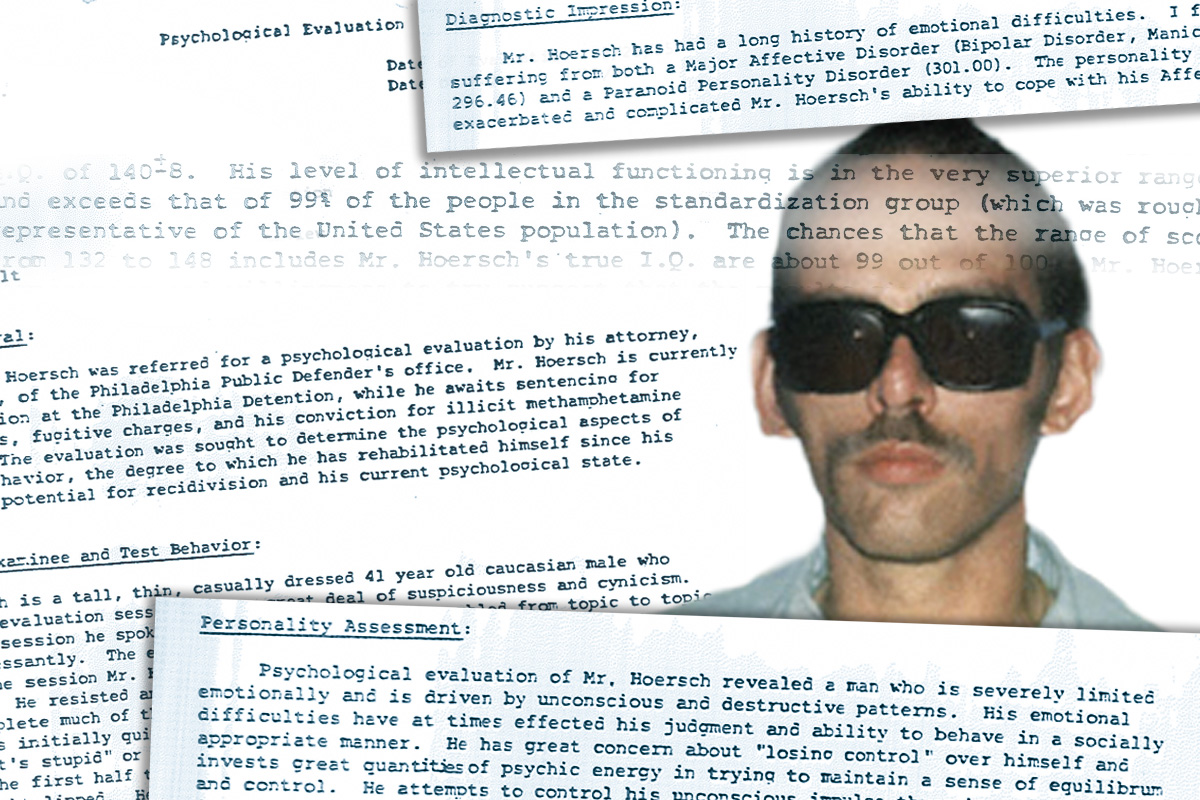
    Raymond Horsch underwent a psychological examination in 1985 with results showing an above-average intelligence, deep-rooted emotional problems, and a diagnosis of a paranoid personality disorder.John Duchneskie / Staff Illustration / Photo obtained by The Inquirer

    Horsch was known to trawl the streets of Kensington in search of sex workers, photographing some from the shadows. He’d offer to pay them in drugs and cash to be featured in his films or photos, often using drugs and in fantasies of being beaten, strangled, or killed.

    He had a lengthy criminal record for manufacturing drugs and other non-violent crimes. And while his ex-wife, Amy McHale, was last seen at his home in 2016 before she went missing, he was never charged with any crimes connected to her disappearance before he died last year.

    The investigation into his connection to the missing women began June 19, after his 44-year-old son, Eugene, was arrested near Independence Mall.

    A federal park ranger found a fake ID in the car in the name of Blair Tonzelli, another woman who was reported missing in 2023, and was last seen at Horsch’s home. Police then interviewed women who said Eugene Horsch had bragged about knowing how to use chemicals to melt bodies in his basement.

    Eugene Horsch has only been charged with illegal drug and weapons violations and has not been linked to any of the disappearances. He is currently in a federal detention center awaiting trial.

    After arresting Eugene Horsch, local and federal law enforcement searched the Horsch home, at 417 W. Chew Ave., even excavating the yard for clues to the disappearance of Tonzelli and McHale. They found drugs, guns, a 55-gallon drum and vats of liquid, as well as a mysterious letter referencing putting drug-addicted women out of their misery.

    Police also recovered dozens of hard drives that they said contained hundreds of thousands of images and videos — including some that showed several women presumably dead at the home. Investigators continue to pore over those materials to determine how far Horsch’s crimes extended and who was involved.