When Buddy Osborne’s phone rings, it’s because something has gone wrong. An accident. A death. A traumatic event on a job site. This past April, it was a catastrophic collapse. A parking garage had fallen, and three construction workers were dead.
Osborne, 67, the chaplain for the Philadelphia Building and Construction Trades Council, arrived at the scene to find an ironworker being interviewed by investigators from the Occupational Safety and Health Administration. The man had witnessed the collapse. The workers who died had been part of his crew. Osborne did not know him. They had never met. But as a chaplain, Osborne was there to help the workers who witnessed the traumatic event. His job, as he put it, was to “render support to workers in distress.”
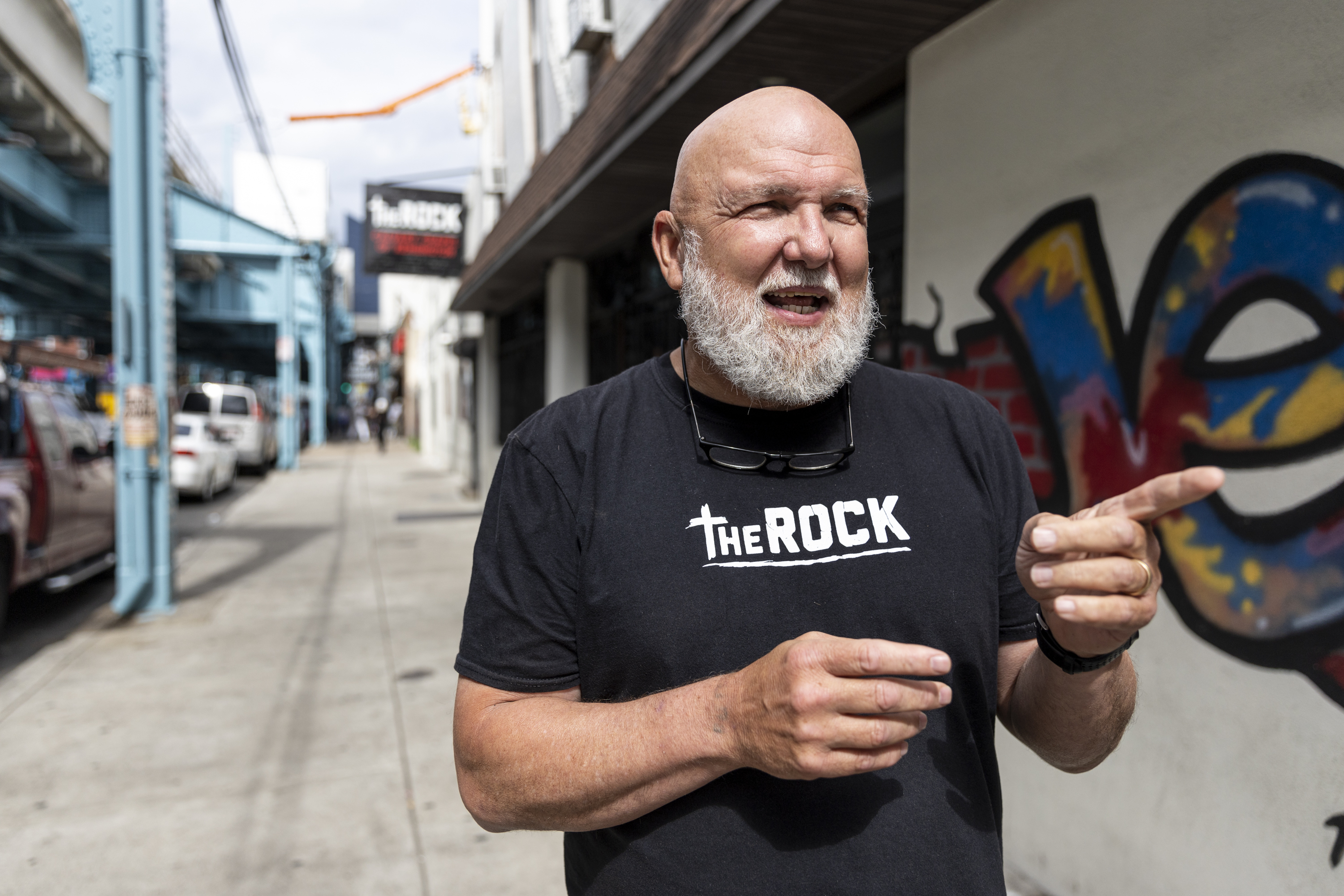
In addition to being a pastor at the Rock Ministry, Buddy Osborne is the chaplain for the Philadelphia Building Trades Council and a former Tyger Williams / Staff Photographer
He waited until the interview ended. Then he walked over, introduced himself, and placed a hand on the worker’s shoulder. “He’s a tough guy,” Osborne said, “but he just broke down.” Osborne hugged the worker as he wept. By the time he pulled away, his shirt was wet with the man’s tears.
The ironworker Osborne comforted was part of a workforce that is deeply woven into Philadelphia’s civic identity. Roughly 121,000 people across the Philadelphia metropolitan area work in construction, following a decade of steady growth. The Philadelphia Building and Construction Trades Council alone represents more than 50 local unions. Politicians court their support. The city celebrates the buildings, roads, and public projects they construct. But behind that civic pride is a workforce in profound distress.
Construction has one of the highest suicide rates of any major industry in the country, according to the Centers for Disease Control and Prevention. More than 5,000 construction workers die by suicide each year, roughly five times the number who die from fatal worksite injuries, and male construction workers are 75% more likely to die by suicide than the general population. Construction workers also die from drug overdoses at a higher rate than workers in any other industry.
Those numbers have set off an urgent effort in Philadelphia to confront the mental health crisis roiling the construction industry. Osborne is but one small part of it. An entire alphabet of organizations, from ATAP, the Allied Trades Assistance Program, and CIASP, the Construction Industry Alliance for Suicide Prevention, to CWC, Carpenters Who Care, and MACSC, the Mid-Atlantic Construction Safety Council, now offer expanded access to mental healthcare and substance use treatment.
There are peer-support networks and suicide prevention training programs. On job sites, there are daily stand-downs and toolbox talks devoted to mental health awareness. There is a Construction Suicide Prevention Week every September, and this past May, for the first time, 50 workers gathered in the Wissahickon for the Greater Philadelphia Construction Hike for Hope, sponsored by the American Foundation for Suicide Prevention.
All of this is to say: Everybody cares. All eyes are on the issue.
As Johnathan Davis, a professor at the University of Iowa’s College of Public Health, put it: “The construction industry has had a phenomenal response to this problem, and the awareness, the destigmatization, and the support programs are important parts of that response.” Indeed, it has never been easier for a construction worker in distress to get help.
Yet the crisis of the distressed construction worker persists, in part because, according to interviews with dozens of workers, the industry itself produces the suffering. And, so far, it has done more to treat it than to prevent it. The focus now, Davis said, needs to be on “upstream solutions.” So, not only helping workers once they hit their breaking points, but also addressing the conditions that bring them there in the first place.
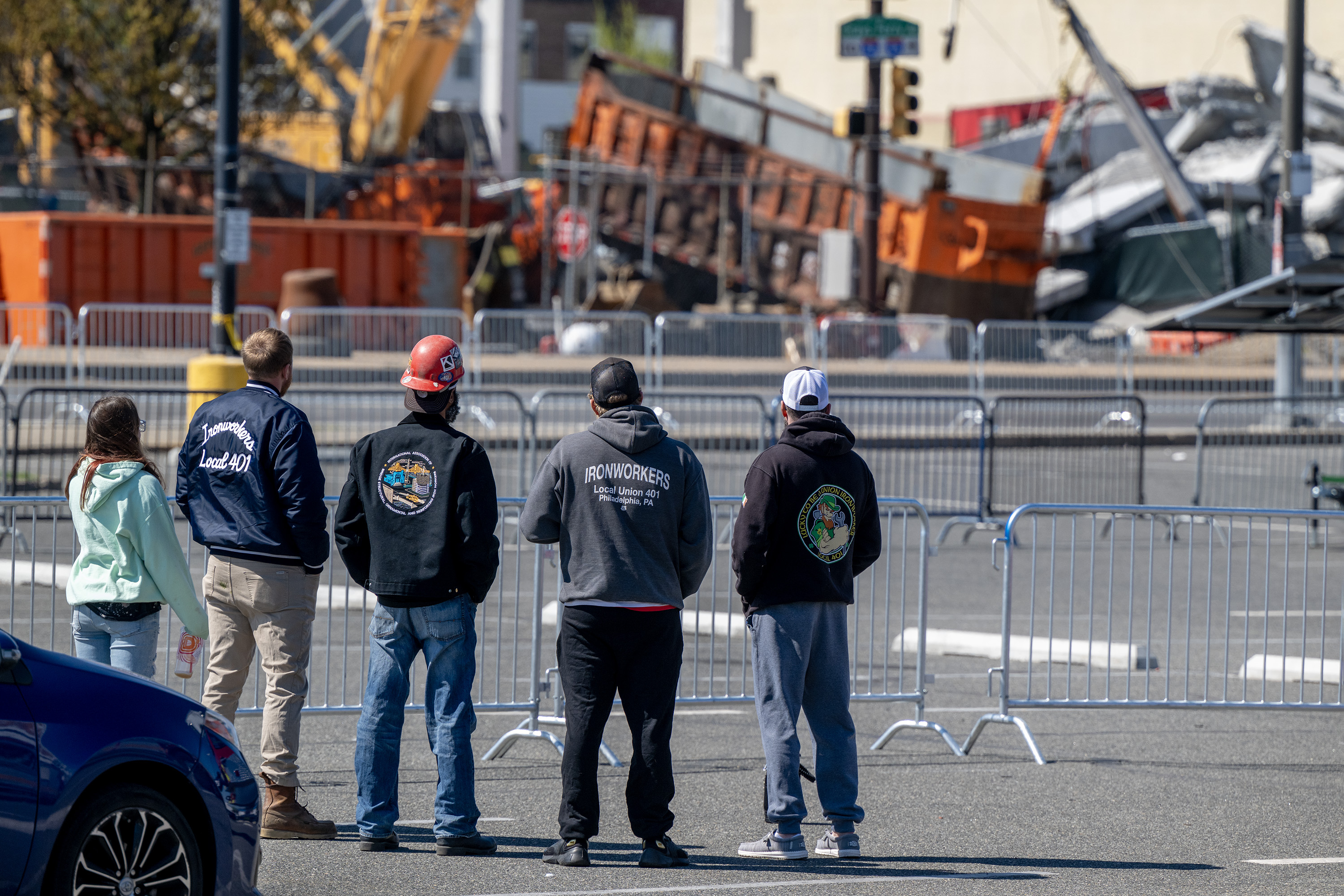
Union workers watch as demolition continues in Grays Ferry on Sunday, April 12, 2026, at the site of the parking garage collapse.Tom Gralish / Staff Photographer
The same day Osborne, who lives in Kensington, was at the parking garage, Marianne Wolfe was meeting with the workers in their union halls.
Wolfe is the managed care supervisor for ATAP, an employee assistance program that provides mental health and substance use services for organized labor. After a tragedy like the parking garage collapse, part of her job is to lead workers through critical incident stress debriefing, a structured, therapist-led conversation meant to help people process the trauma they have just experienced.
In this case, that meant sitting with workers who had witnessed the collapse and were still trying to make sense of it.
“They were just trying to wrap their heads around what took place,” Wolfe said. “Survivor’s guilt. It was a ‘Why wasn’t it me?’ type of thing.”
Trauma, Wolfe said, “is a very tricky thing.” It does not always arrive when expected. It can surface weeks or years later. That is why she expected ATAP to keep receiving calls about the collapse for at least several months. If so, those calls will come into an office that is already busy.
“We’re a high-volume call center,” Wolfe said.
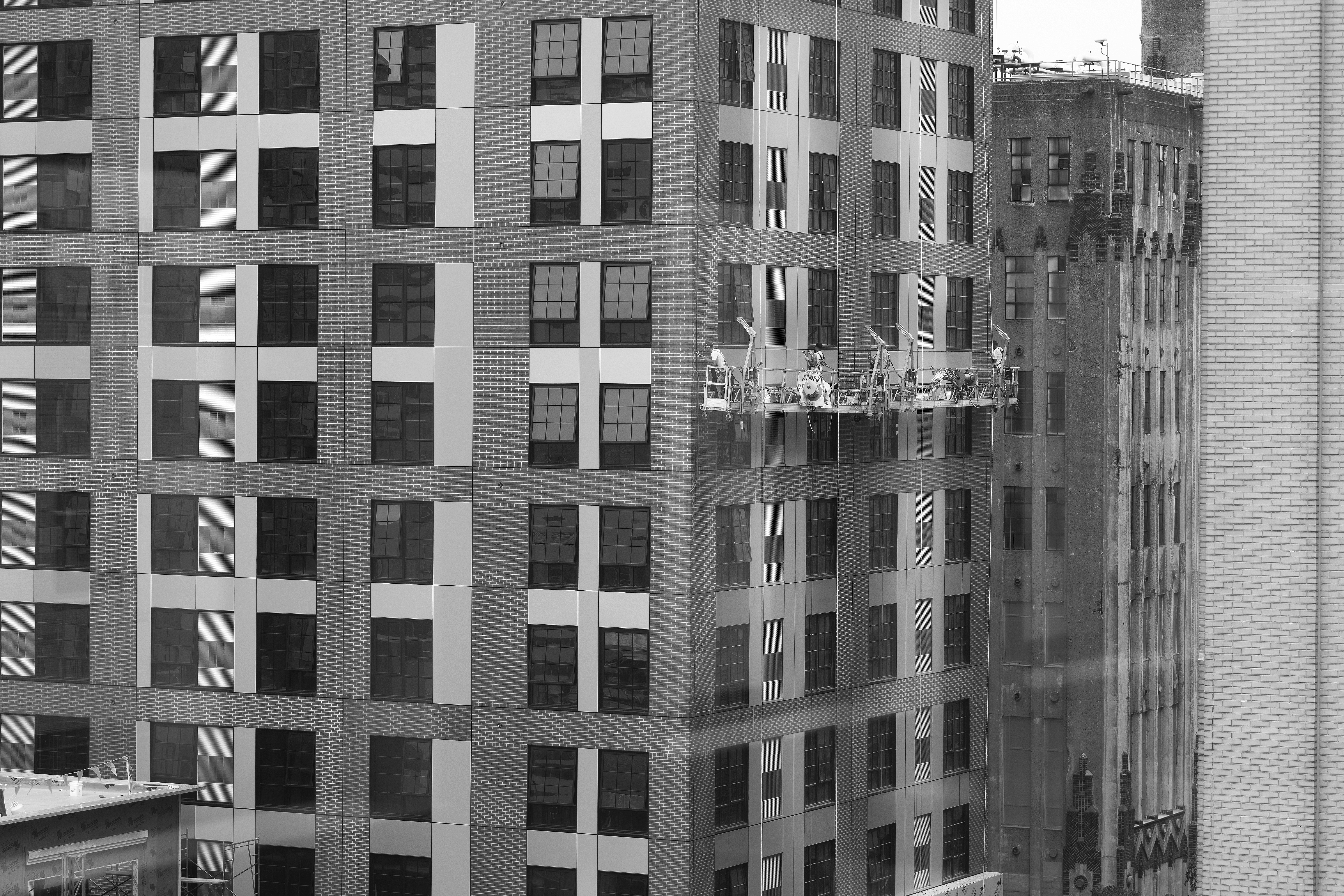
Scaffold workers work on a building on North Broad street in Philadelphia Pa.Jose F. Moreno / Staff Photographer
Workers reach out to ATAP when they need help and don’t know where to turn. They call ATAP’s 24-hour emergency hotline when they are desperate, sometimes actively suicidal, and an ATAP employee quickly connects them to the right level of support, whether that is outpatient counseling, substance use treatment, or immediate inpatient care.
For years, Wolfe said, most of the calls coming into ATAP were about substance use that was exacerbated, in part, by wear and tear from demanding physical labor.
“We were still in the opioid epidemic,” she said. “Now we are in what we’re calling a mental health epidemic.” She attributed the shift to years of education and anti-stigma work that made it easier for workers to ask for help.
Some workers call because they are anxious. Some call to discuss family or work-life balance issues. Sometimes they call because they cannot sleep. Their reasons run the gamut, but they all lead back to a simple truth: “Being a construction worker isn’t an easy job,” Wolfe said.
Layoffs and financial instability are par for the course. The hours are grueling. Some work seven days a week. There is hardly any time to see family. Left unaddressed, those pressures can pile up until a worker feels helpless, or hopeless, or, in Anthony Zecca’s case, both.
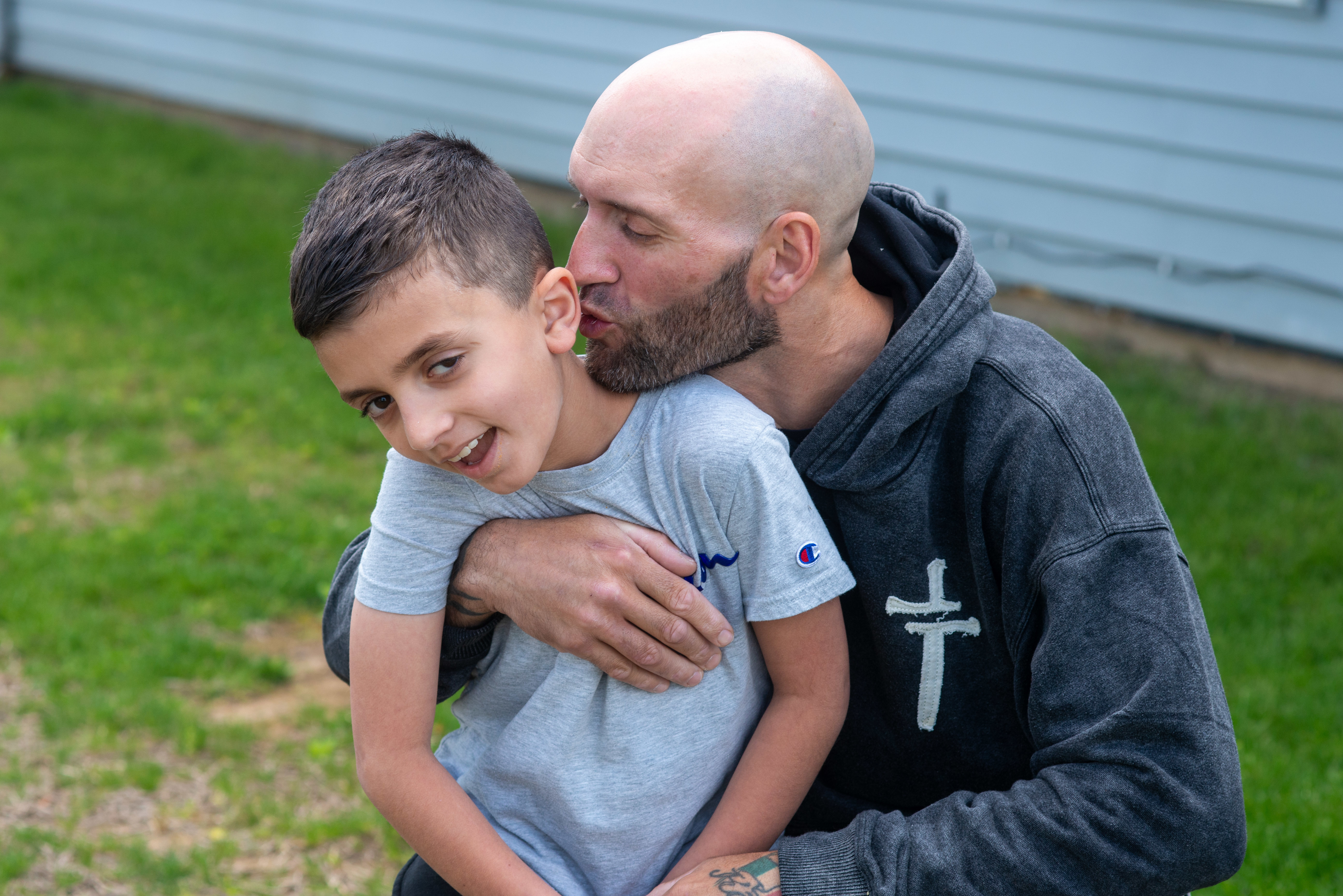
A nonprofit called ATAP helped Anthony Zecca get a psychiatrist and helped find treatment and services for his son, Salvatore, who has autism.William Thomas Cain / For The Inquirer
“I’ll be honest with you,” Zecca, who lives in Fairless Hills, said in April. “I didn’t want to live anymore.”
He was describing how low things had gotten the previous December. His marriage was on the brink of collapse. His father-in-law had warned him that if he couldn’t get his temper under control, he was going to lose his family. He had been having anger issues ever since he got out of prison in 2023, after serving four years for possession of a firearm. “I had a very hard time adjusting,” he said.
At Christmas, Zecca got so angry that he kicked over the tree and broke his toe. He had to get surgery and could not work for six weeks. But the real wake-up call was his daughter’s reaction that night.
“I saw how terrified she was of me, and I just broke down in tears,” he said. “I couldn’t do it anymore.”
Zecca, 41, called ATAP the next day and spoke to Wolfe. “I told her I’m having a lot of problems at home,” he recalled. “I said I’m really depressed. I’m not doing good.”
Wolfe got to work on Zecca’s behalf immediately. She got him into anger management and found him a therapist and a psychiatrist, whom he now sees every month. She helped his 8-year-old son who has autism, too, by connecting him with a behavioral psychologist. Zecca ended up calling ATAP so frequently that Wolfe gave him her personal cell phone number.
Anthony Zecca (CQ) and his son Salvatore Zecca (CQ), 8, pose for a photograph in their yard Friday, May 08, 2026 at private residence in Fairless Hills, Pennsylvania. A nonprofit called ATAP helped get him a psychiatrist and helped find treatment and services for his son, Salvatore, who has autism.William Thomas Cain / For The Inquirer
Life has been much better for Zecca ever since he reached out to ATAP. He and his wife still fight sometimes, mostly about his hours. He is away from 4 a.m. until 7 p.m. every day. But they have not had any major blowouts since Christmas. His psychiatrist put him on Wellbutrin, which Zecca says helps with both his depression and his ADHD. He uses his therapy sessions to work through the different stressors in his life.
Zecca still has many sleepless nights and considers himself an “anxiety-ridden person.” And the construction industry remains his biggest stressor. He wakes up every day worried he will be laid off and out of work for the next month. “It really wears on me,” he said.
Unable to make peace with the industry’s uncertainty, Zecca is trying to change his circumstances.
“I just want a steady job where I don’t have to worry about being laid off,” he said. He is tired of the stress on the job, the demanding timelines, and the endless hours. He is hardly alone.
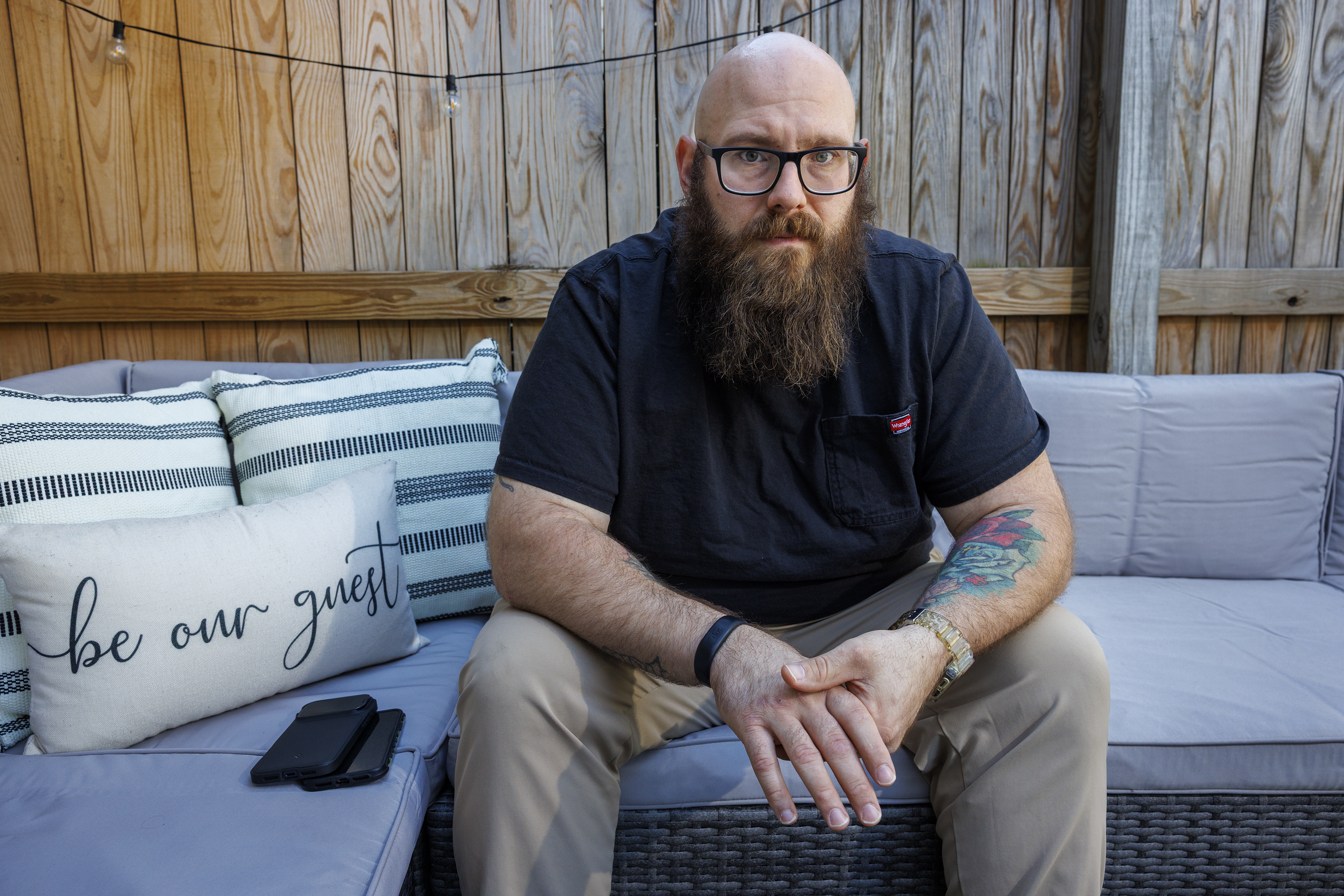
John Sobetsky of Royersford at his home on Tuesday, May 12, 2026. John has been dealing with depression over the years and is a major advocate of mental health treatment in the construction industry.Alejandro A. Alvarez / Staff Photographer
John Sobetsky, 35, was among the workers who gathered in the Wissahickon for the Greater Philadelphia Construction Hike for Hope. For him, the cause is personal: Sobetsky survived a suicide attempt in high school and is now active in the industry’s mental health efforts. He also knows firsthand how the pressures of construction can overwhelm the rest of a person’s life.
The former technician and concrete mixer-turned-business development manager said his life is much more manageable ever since he traded the grind and churn of construction work for a 9-to-5.
“It’s almost night and day,” he said. “I don’t have those deadlines weighing on me. I have freedom. I have flexibility.”
Three years ago, Sobetsky, who lives in Royersford, was managing a construction project that was such a “complete cluster from beginning to end. … I wasn’t sleeping. I wasn’t eating,” Sobetsky recalled. “My anxiety was out of control.”
Eventually, it affected his ability to do his job. “I was missing wire runs,” he said. “I was spending way too much time on tasks that should have taken me half the time because I was just mentally out of it.” It got so bad that his boss asked him if he was OK. That, experts say, is often how distress shows up on the job.
“Warning signs often masquerade as performance issues,” said Sonya Bohmann, executive director of the Construction Industry Alliance for Suicide Prevention. “It’s things like not showing up for work on time anymore. It’s things like jumping to conflict when you’re usually the person who’s really the steady Eddie.”
Those sorts of behavioral changes are opportunities for bosses and supervisors to check in and point workers to available services. But, according to Bohmann, culture frequently gets in the way.
“It’s hard to say I’m going to therapy because people will look at you like you’re weak or selfish,” she said, “and you never want someone to think that you’re not fit for duty under the hard hat because then they don’t want you on their crew.”
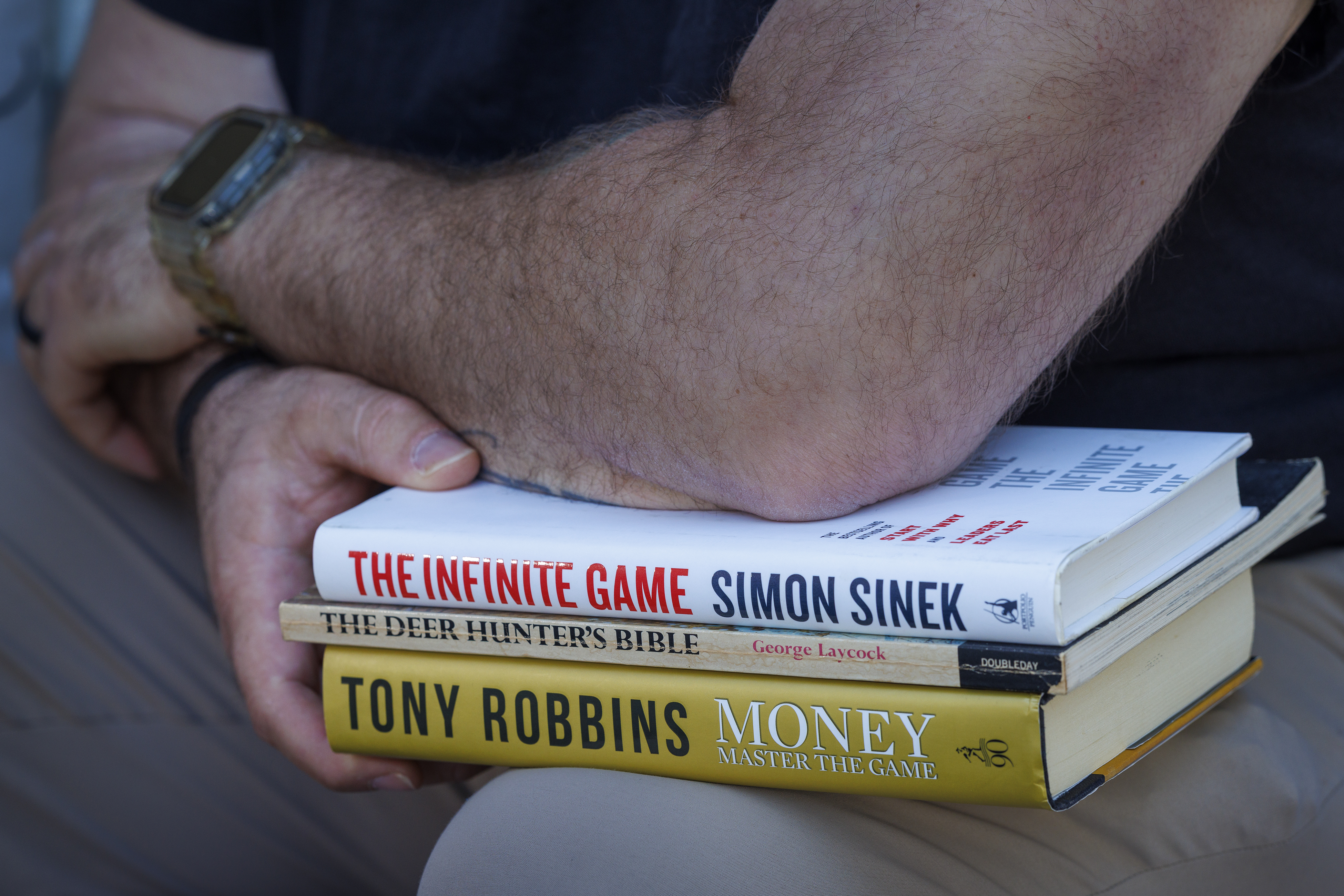
John Sobetsky of Royersford with books that he enjoys reading for relaxation at his home on Tuesday, May 12, 2026. John has been dealing with depression over the years and is a major advocate of mental health treatment in the construction industry.Alejandro A. Alvarez / Staff Photographer
That fear stopped Zecca from seeing the free mental health counselor at his union hall. “I didn’t want a higher-up to see me go in and out of there and think I was a head case,” he said.
According to Sobetsky, until the culture changes, even the best-intentioned services are nothing more than a “checkbox.” Because when a boss or superintendent treats leaving 45 minutes early on a Tuesday to see a therapist as a problem, the help exists only on paper. “Then you don’t really offer it,” Sobetsky said, “because I can’t use it.”
To Bohmann, that is where the work has to move next: from checking the box to creating what she calls a “culture of care,” built on the understanding that the way the industry functions actually affects workers’ mental health.
That’s not just her hunch. It is what new research from professor Davis and the Center for Construction Research and Training (known by its former acronym, CPWR) suggests. Davis conducted an unpublished study that he says shows the presence of family and paid leave policies correlated with lower rates of suicide for construction workers.
“I believe it,” Zecca said when told about the study’s findings. The implications could not be clearer.
As Davis said: “If you as an employer, you as a contractor, you as a union, are interested in lowering the rate of suicide … these are the type of benefits that you should be working into your programs.”
One upstream, preventive solution the industry so desperately needs? It already exists. It is called PTO.
A construction worker stood in a window at 21st and Washington Streets in Philadelphia, Pa. on Thursday, July 27, 2023. Philly had declared a “heat emergency,” when it felt like 106 degrees in the shade.Monica Herndon / Staff Photographer
Jason Scholl, the owner of LK Miller, based in Ambler, recently transitioned all of his workers from hourly to salaried wages. He gives them Friday afternoons off in the summer and generally tries to create a culture where his team feels safe. “I try to give them every tool in my toolbox to help them handle the rigors of what they’re doing on a day-to-day,” Scholl said.
There are concerned bosses, too. Ones who take decisive action, like Mary Pat Geppert, who runs Geppert Bros., the demolition contractor that cleaned up the site of the deadly January 2025 plane crash in Northeast Philadelphia. The work was horrifying, Geppert said. Debris and human remains were spread across a 12-block area. Geppert’s workers would not even bring their boots home because of what they walked through. She knew they needed help, so she brought in Buddy Osborne and gave everyone the morning off to talk about what they had seen. She bought them new boots, too. And reminded them of one of her favorite sayings: “It’s OK to not be OK.”
But it’s what Geppert does not do that she believes makes the biggest difference to her workers’ mental health. She does not lay people off. Or at least she tries very hard not to. Even when Geppert Bros. does not have a contract, she keeps her guys working in the company’s own yard. “That’s our secret sauce,” she said. “We don’t let our guys go back to the hall.”
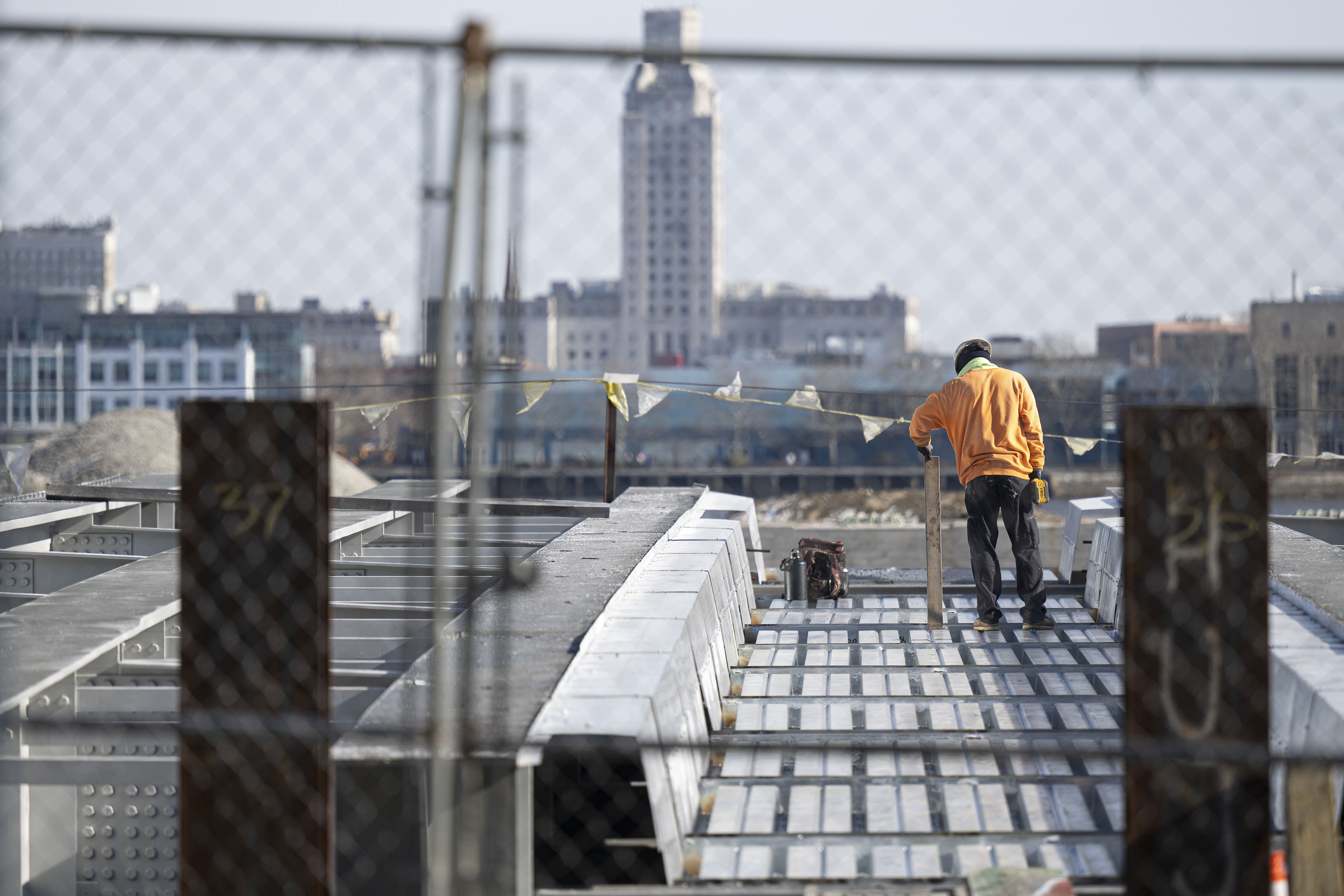
A construction worker works at a construction site near Interstate 95 in Philadelphia, Thursday, Jan. 22, 2026.Jose F. Moreno / Staff Photographer
What Geppert Bros. has figured out is what Davis hopes the industry can move toward: steadier, more long-term employment. Such big conceptual changes, like reconfiguring benefits packages and contracts to increase stability, might take more time, but Davis says the industry is well-suited to address these problems.
Zecca is not waiting for those changes to arrive. For more than a year, he has been trying to land a full-time job with Energy Transfer, an oil and gas company headquartered in Texas. The job would involve maintaining the company’s pipelines in Pennsylvania. Instead of starting over with new bosses, crews, and equipment every few months, he would work with the same team on the same project.
It is his dream job. Not because of the work itself or the money. Because it is steady. He wears the company’s navy-and-white hat every day for good luck.
“I just need something with more consistency,” he said one evening in May.
Two days later, he was laid off.
A construction worker helps guide a section of pre-cast concrete in place in the upper level at the site of the new Eagles Stadium on Friday, May 10, 2002.David Maialetti / Staff Photographer
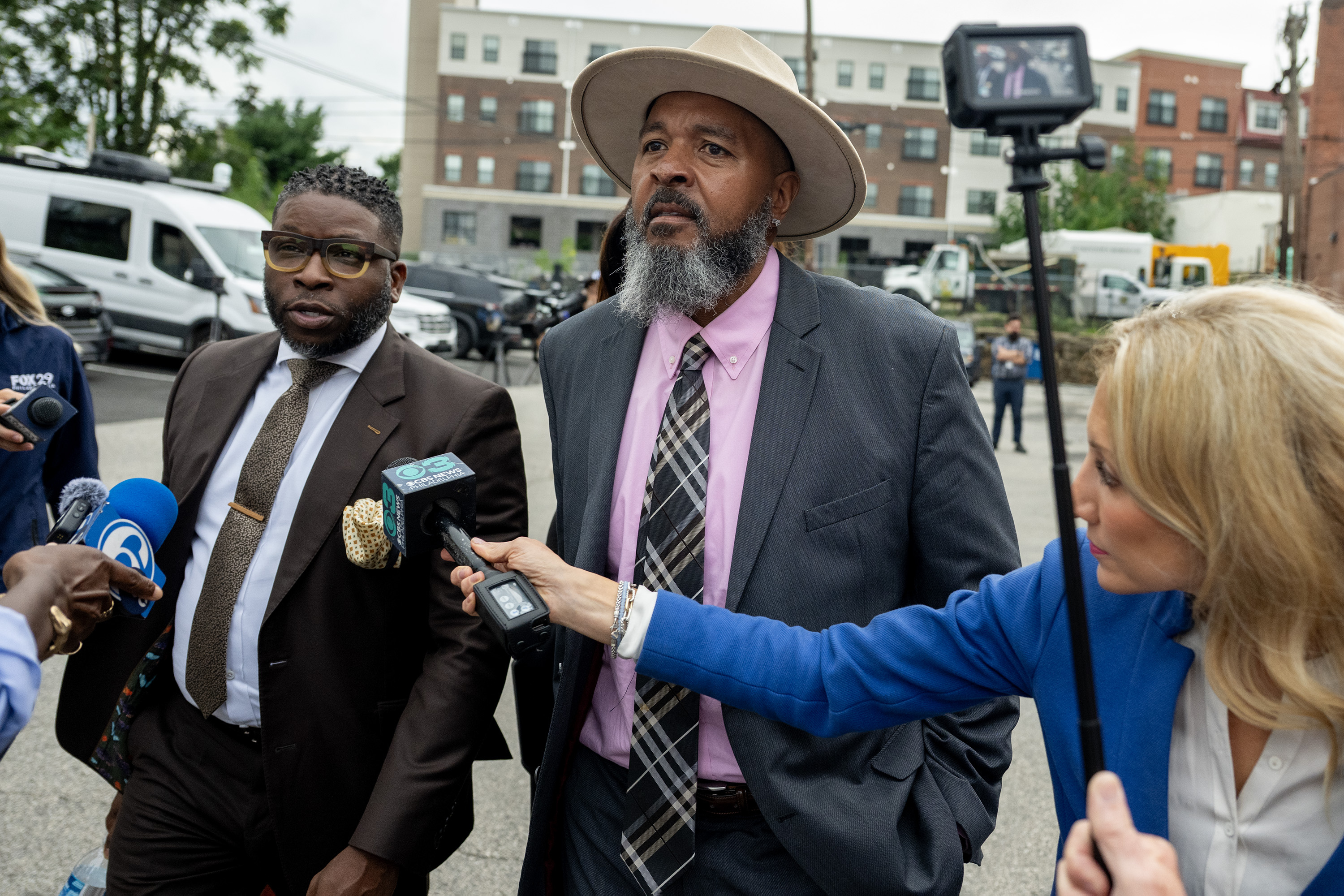
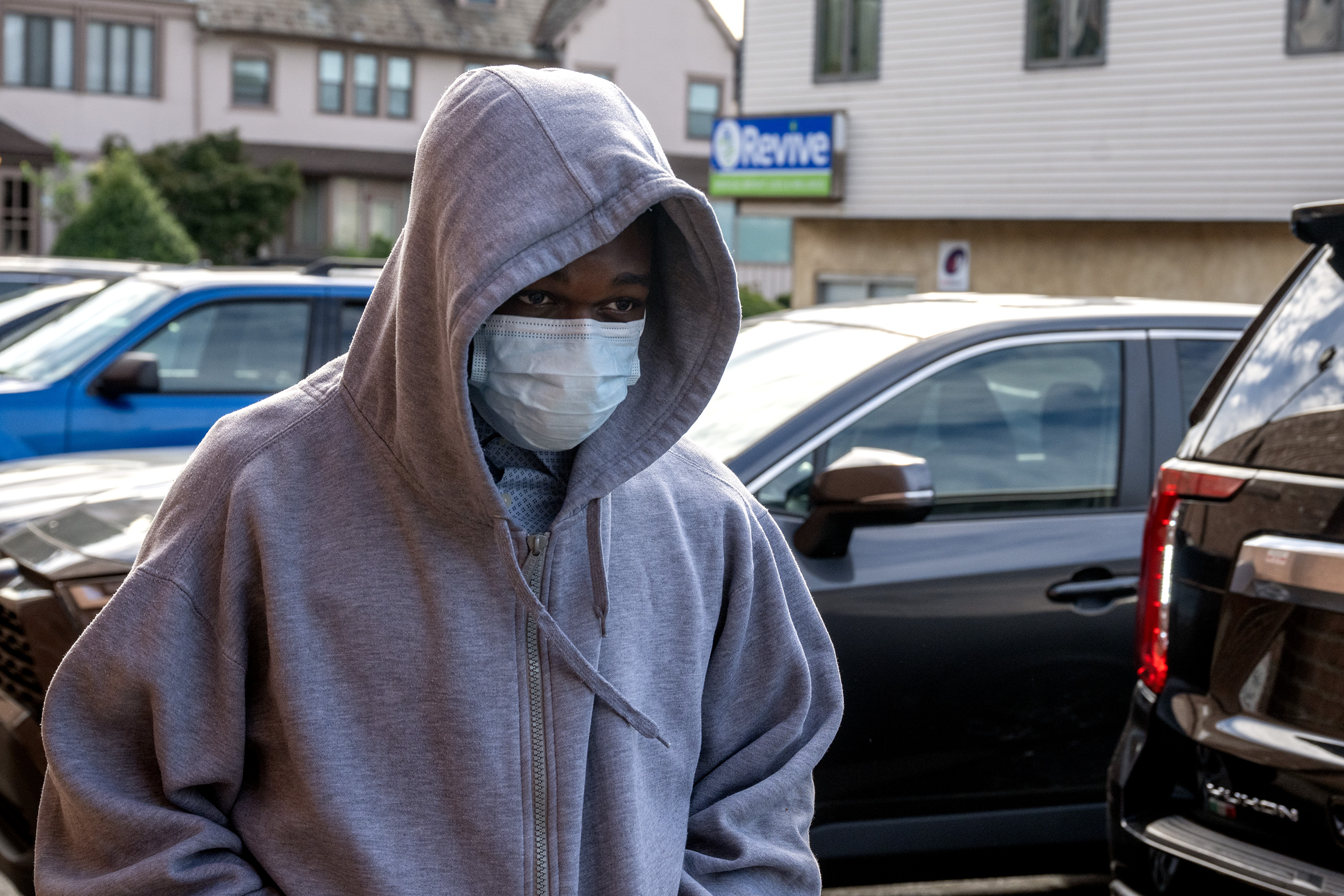
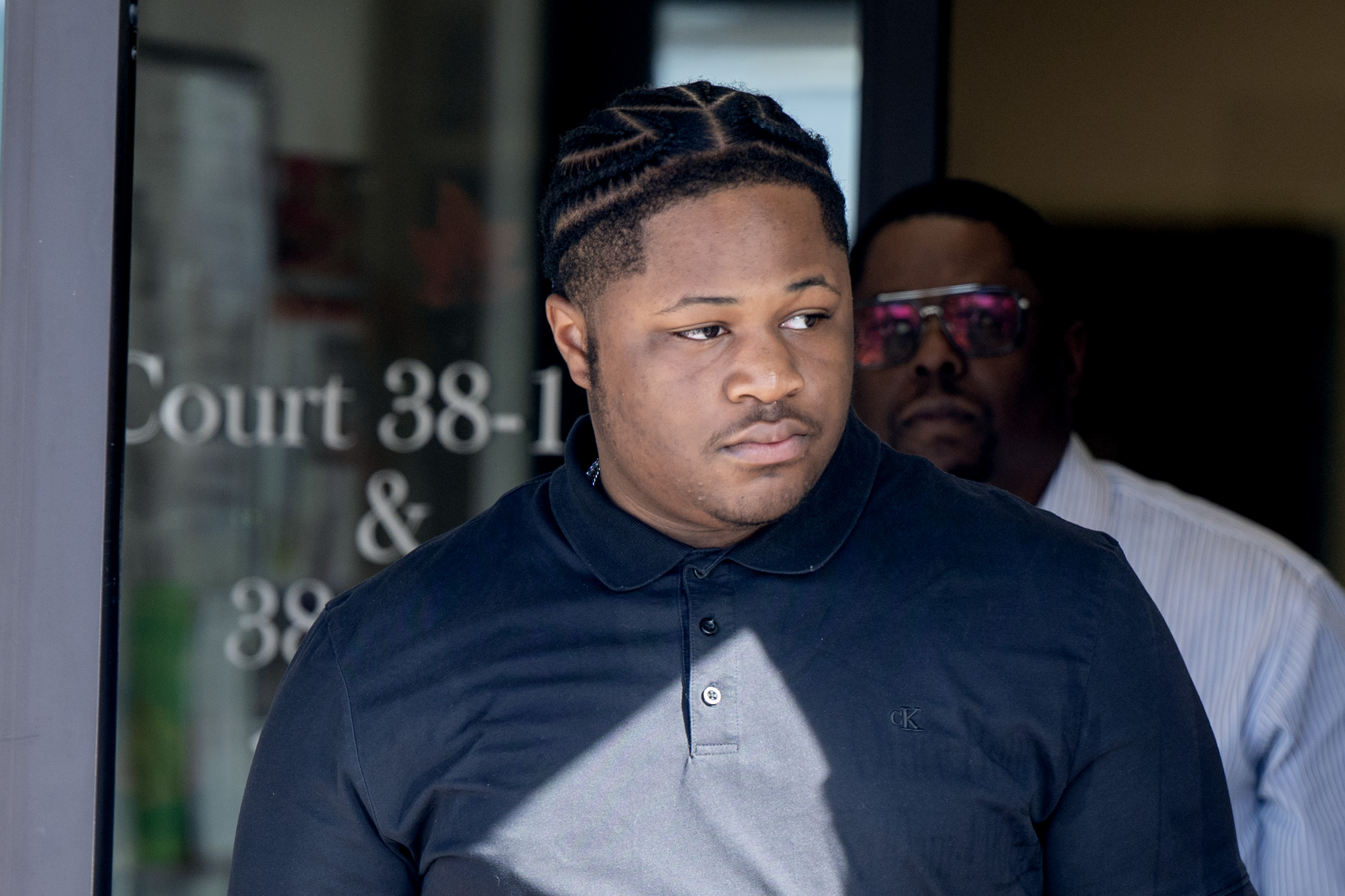
District Judge Christopher Cerski told head coach Terence Tolbert, 55; associate head coach Darian McFadden, 42; assistant coach Benjamin Johnson III, 45; and volunteer coach Ralph Burnley, 60, that they had failed in their duties to protect the then-15-year-old by encouraging him not to tell his mother about the assaults, and insisting on handling the matter themselves.
During the lengthy proceedings, the victim testified about the assaults and how it affected him.
After a marathon preliminary hearing in Jenkintown, Cerski held all four men over for trial on two counts of endangering the welfare of a child and one count of conspiracy, but dismissed another count of conspiracy that they faced.
Their lawyers argued against the merits of the case, saying the coaches were never told the full scope of abuse the teen suffered. He had deliberately downplayed the assault to them, according to testimony Monday, because he was embarrassed that his teammates had used a broomstick to poke at his buttocks.
The group only found out the full details months later, when video of an earlier assault surfaced during Cheltenham School District’s internal investigation.
Tolbert’s attorney, Thomas Egan III, called the prosecution’s “grand conspiracy to stomp on this teen’s voice” completely false.
“[Tolbert] could only act in the scope of what he knew,” Egan said. “He had a player who didn’t have major injuries and intended to still play football and not tell his mother.”
But Assistant District Attorney Samantha Cauffman balked at that theory of the case, saying adults who should have known better were improperly foisting their responsibility onto a teenager.
“This case boils down to the fact that a 15-year-old was beaten up, and you tell him not to tell his mother,” she said. “It doesn’t matter if he didn’t want to tell her. You are the adults in the room.”
Two players charged alongside the former coaches, Isaiah Simpson and Josiah Peeler, both 18, waived their hearings and will also face a Montgomery County judge: Simpson for conspiracy to commit aggravated assault, simple assault, reckless endangerment, and related crimes for his role in the September assault, and Peeler for false swearing for being untruthful to police.
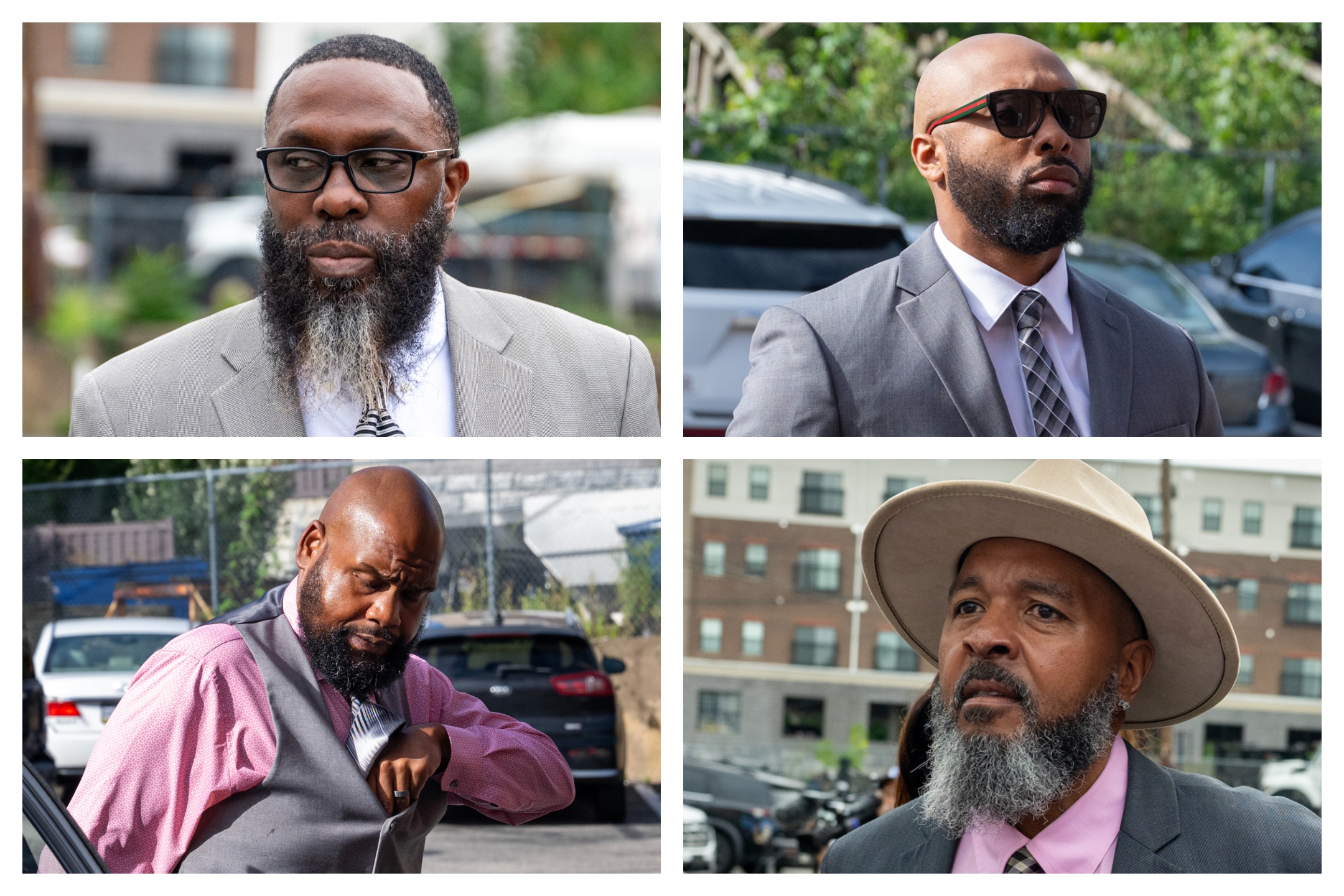
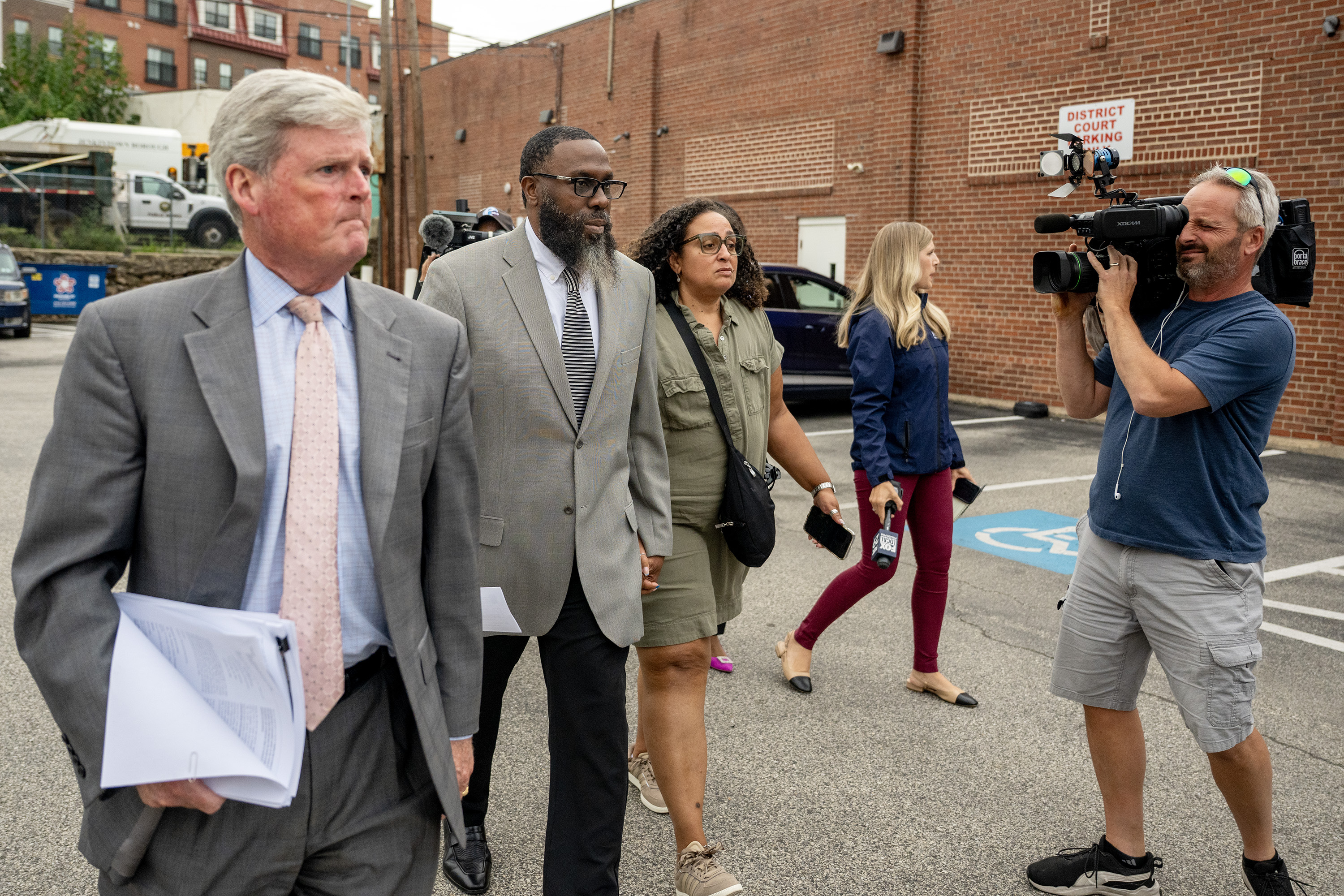
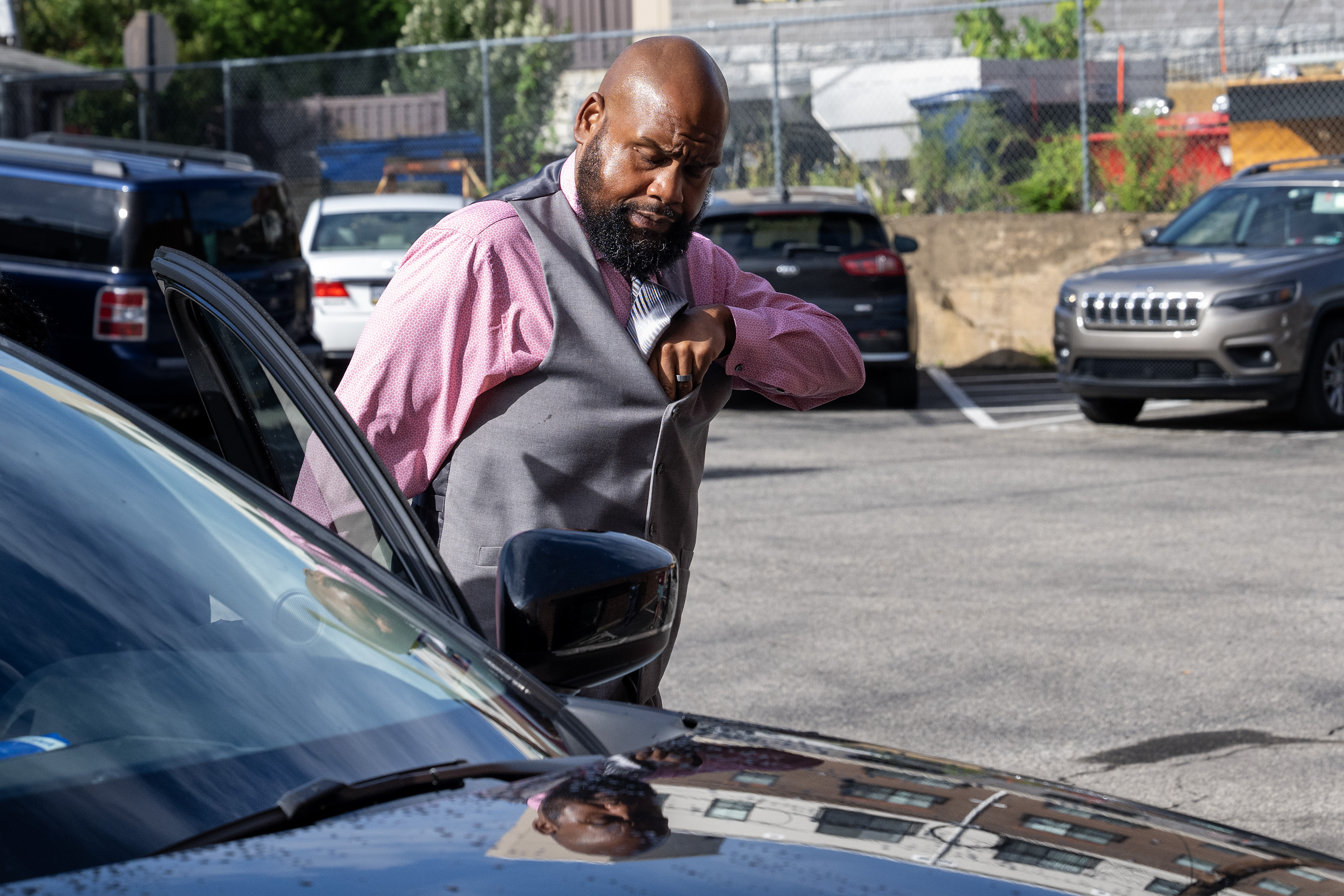
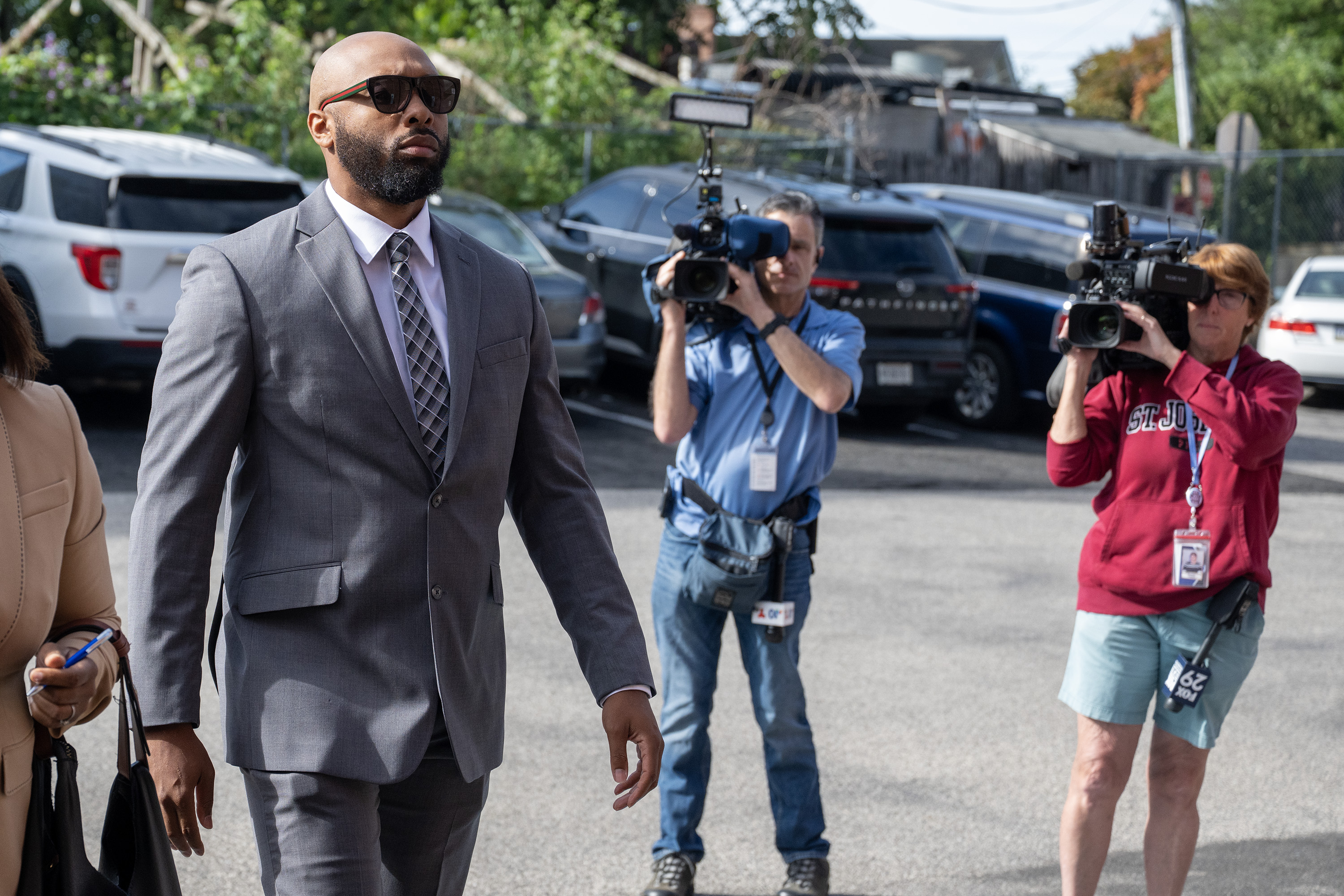
Former head coach Terence Tolbert (second from left), one of six members of the Cheltenham High School football team appearing for their preliminary hearings Monday in Jenkintown Monday, Sept. 21, 2026.Tom Gralish / Staff PhotographerFormer assistant coach Benjamin Johnson III.Tom Gralish / Staff PhotographerFormer associate head coach Darian McFadden.Tom Gralish / Staff PhotographerFormer volunteer coach Ralph Burnley (right).Tom Gralish / Staff PhotographerPlayer Isaiah Simpson.Tom Gralish / Staff PhotographerPlayer Josiah Peeler.Tom Gralish / Staff Photographer
Locker room assault victim takes the stand
The victim of the assault, whom The Inquirer is not naming, testified Monday that Simpson and a group of other players pulled him into the team’s locker room after practice in September 2025 and “jumped him.” The group stomped on his head while wearing cleats, kicked him in the groin, and assaulted him with the broom.
They were acting out a reference to a Meek Mill song, he said, that included the lyrics “broomstick all in his butt, tell him take that.”
In a quiet voice, as he faced his former coaches, the teen said the group attacked him because he had taken Peeler’s shoulder pads after his had been stolen out of his locker. Peeler reported the theft to the coaching staff, who made the entire team run extra laps as a punishment.
After the assault, the teen said he walked outside, asking Burnley for a ride home. He was crying, he said, and icing his groin to ease the pain he felt.
When he explained to Burnley what happened he omitted the detail about the broomstick, feeling embarrassed.
Burnley told him to call his mother. He declined, he said, because he was afraid she’d force him to stop playing football.
As he drove the teen home, Burnley called the other coaches to tell them about the assault. Later, Johnson, Tolbert, and McFadden spoke to him over the phone and told him not to tell anyone about the incident, and that they would handle it internally.
Privately, the coaches sent incriminating text messages to one another, prosecutors said, expressing concern that the incident “has to be handled and kept quiet.”
McFadden wrote “if this gets out we are [expletive]. They will cancel the whole season,” according to messages displayed in court.
However, the teen’s mother learned of the assault a week later from someone in the community, and Cheltenham began investigating the case.
During that probe, the district received video of a similar, earlier assault of the teen, which had taken place in August 2025. The video, played in court, showed a group of players ganging up on the teen to beat and mock him as he cries out for them to stop.
The teen testified that he didn’t disclose that assault to the coaches because he considered it more minor and was closer to “horseplay.”
The four coaches are expected to be arraigned in county court next month.
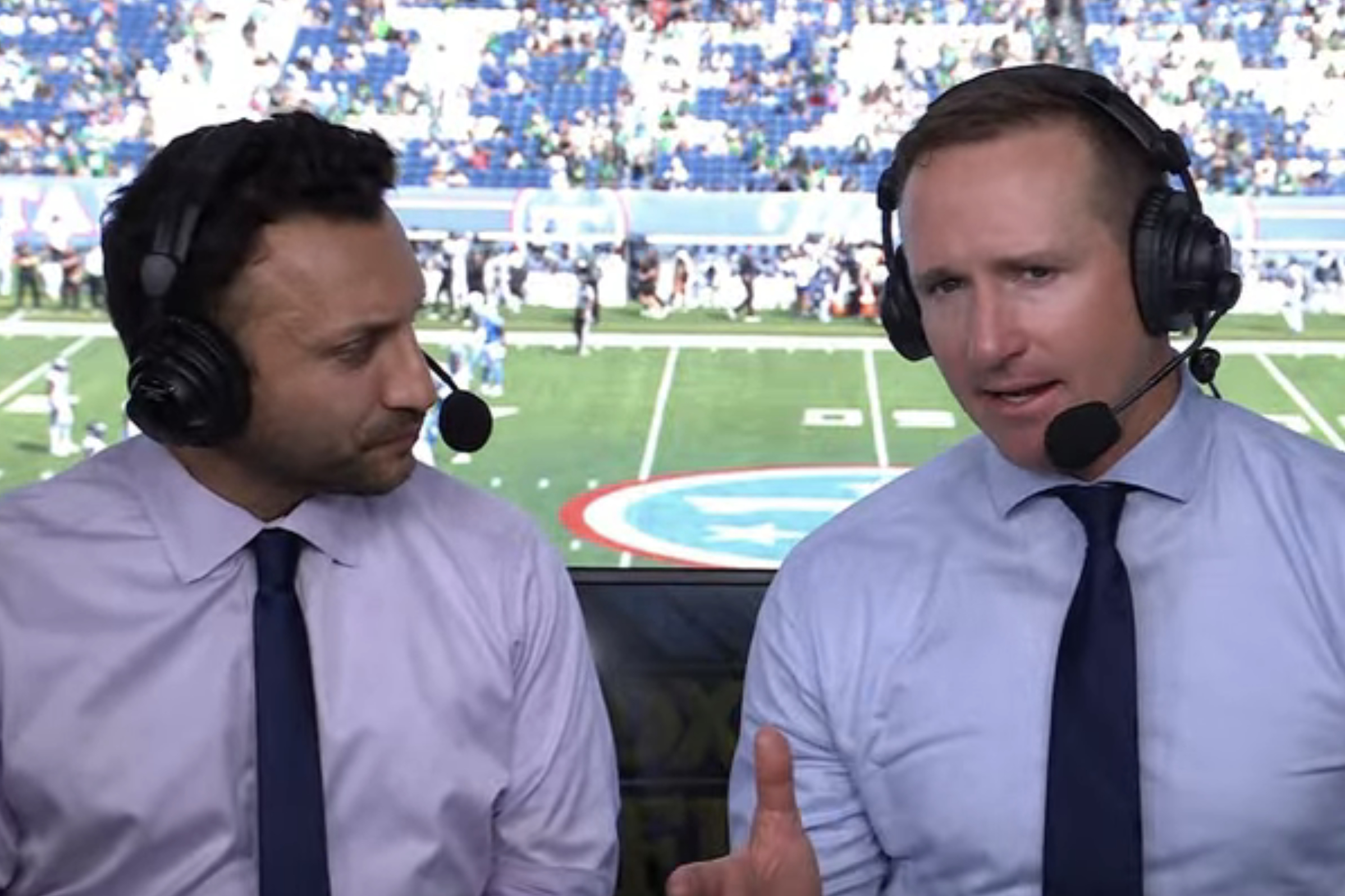
Newly minted Hall of Fame quarterback Drew Brees was a mixed bag calling the Eagles’ 24-20 win against the Tennessee Titans for Fox Sports on Sunday, and a lot of Birds fans were unimpressed.
Count former Eagles wide receiver Jason Avant among them.
Avant, now part of NBC Sports Philadelphia’s Birds pre- and postgame coverage, blasted Brees after the game as one of Jalen Hurts’ “biggest haters” without going into much detail.
“Drew Brees is on the broadcast talking as much crap as anyone, and it was a negative broadcast,” Avant said on Eagles Postgame Live, adding Hurts’ game-winning drive “shut his mouth.”
Brees is certainly a work in progress at Fox; the network hired the former Saints star and Super Bowl MVP early last season to replace former Eagles quarterback Mark Sanchez following Sanchez’s arrest in a downtown Indianapolis fight. Brees hasn’t even called a full season’s worth of NFL games yet — the Birds’ win was just the 11th in his career — but he certainly wasn’t hating on Hurts during the broadcast.
Jalen Hurts led his 8th fourth-quarter comeback since 2023, second-most in the NFL.David Maialetti / Staff Photographer
During the first few drives, Brees repeatedly praised Hurts and the plays being called by new offensive coordinator Sean Mannion. Coming back from halftime, Brees said Hurts’ play was “absolutely outstanding” and highlighted his ability to extend plays with his legs and spread the ball around — as my colleague Jeff McLane noted, Hurts completed passes to nine different receivers for the first time since 2022.
“For the Philly fans out there — if this is what the Sean Mannion offense looks like, you guys are in good hands,” Brees said after the game, calling Hurts’ performance “the next iteration” of his evolution into a “true passer.”
So what ruffled the feathers of Avant and other Eagles fans? A comment Brees made in the second quarter, when Hurts slid during a third-down run to avoid being hit by Titans defenders, something every quarterback is taught to do.
“I was hyping up Jalen Hurts, and now I’m going to get on him,” Brees said. “Lower your shoulder and go get the first down.”
"Lower your shoulder and go get the first down" – Drew Brees did NOT like Jalen Hurts protecting himself with a slide in the second quarter of Week 2 against the Titans pic.twitter.com/q8nePomNdP
Context is important. Would this comment be appropriate in a playoff game or during a game-winning drive? Certainly. But Brees offered his criticism in the first half of a Week 2 game against an opponent that isn’t even in the Eagles’ conference, so his analysis seemed misplaced.
Birds fans also have a long memory. Last year, before Brees entered the booth, he appeared weekly on ESPN’s First Take and omitted Hurts while highlighting other quarterbacks like Jordan Love and Dak Prescott, despite the Birds’ 3-0 start.
“You realize you mentioned these dudes before you mentioned Jalen Hurts, you do know that, right?” asked Stephen A. Smith.
“I do,” Brees said. “I respect Philly. They are winning games … I can’t stand to watch that offense. It’s the most boring offense.”
He was certainly correct about the offense, which cost Kevin Patullo his job in the offseason. But Brees’ comments appear to have been added to the lengthy list of anti-Hurts remarks Eagles fans love to track.
As far as his broadcasting career comes, Brees is fortunate to be paired with Adam Amin, who has a knack for supporting recently retired athletes and isn’t afraid to coach the Hall of Famer on the ins-and-outs of broadcasting.
“I think he’s starting to improve as a presenter,” Amin said of Brees before the game. “He still has to learn some of the timing and rhythm, but a lot of that just comes with doing the job. And the rest of it, the presentation, is going to come with timing and confidence.”
Amin is in his seventh season with Fox after spending nine years at ESPN, and he’s quickly developed into one of the NFL’s best play-by-play voices. He call of Hurts’ game-winning touchdown pass to Darius Cooper hit all the notes, including letting viewers hear the roar of Eagles fans who flooded Nissan Stadium.
Merrill Reese also wasn’t perfect, but had a vintage TD call
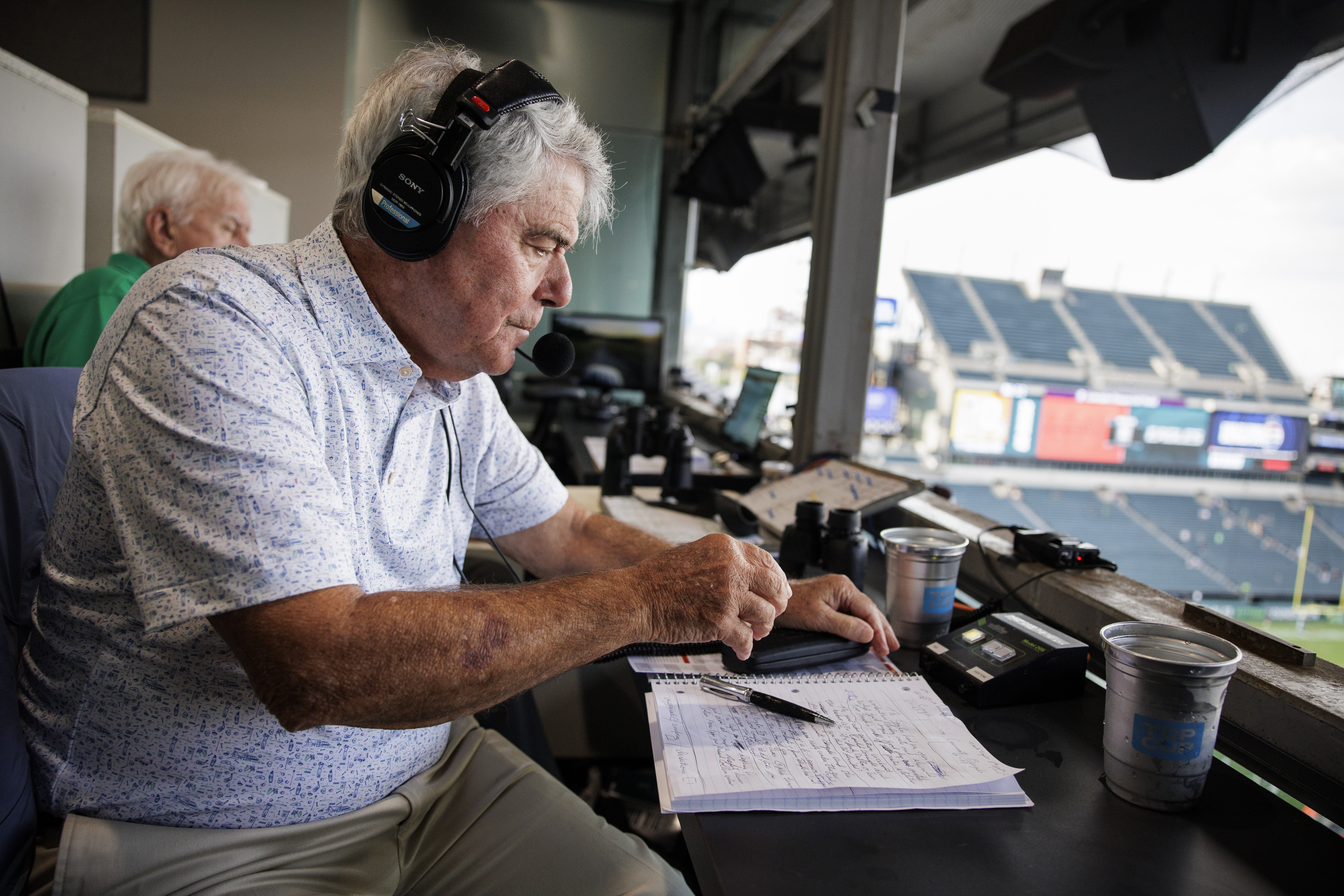
Merrill Reese is in his 50th season as the voice of the Eagles. Monica Herndon / Staff Photographer
While Brees is still learning how to be a broadcaster, even the most experienced announcers can make a mistake now and then.
Over on the radio, Merrill Reese — in his 50th season as the voice of the Eagles — struggled a bit while calling Amani Hooker’s interception of Hurts in the first quarter. Hooker returned the interception 92 yards and ended up being tackled by a hustling Makai Lemon at the Eagles’ 10-yard line, but Reese thought he made it into the end zone.
When the Titans lined up on first down, Reese called it as if the play were a two-point conversion. It wasn’t until the Titans’ Tony Pollard was tackled after a 5-yard run did Reese and broadcast partner Mike Quick finally let listeners know what actually happened.
“They were ruled not in,” a surprised Reese said during the broadcast. “They said [Hooker] was down so that was not for two, that was the play.”
The Hall of Fame broadcaster more than redeemed himself on the Eagles’ game-winning drive, screaming “There’s life!” as the Birds moved down the field in a vintage Merrill Reese performance.
“TOUCHDOWN! DARIUS COOPER!” said Reese, who finished the call after Quick interrupted with some analysis on how the receiver got open. “WHAT A PLAY! HURTS TO DARIUS COOPER! WHAT A DRIVE!”
Reese and Amin weren’t alone in excelling at the end of the game. Spanish radio announcers Rickie Ricardo and Oscar Budejen also offered an A-plus call of the winning touchdown.
During the Cowboys’ win against the Commanders, Jayden Daniels left the game with a dislocated left elbow. The footage was so gruesome it caused Tom Brady to go blue.
Brady wasn’t done. Later in the game, he used language so colorful to describe Dak Prescott’s missile of a pass to receiver CeeDee Lamb we can’t print it in our family newspaper.
Over on CBS, J.J. Watt is in his second week in the No. 1 booth. That means millions and millions more fans are listening to his call, but his broadcast partner Jim Nantz didn’t appear to be among them on a few plays.
“Trees don’t grow to the sky,” the late Vanguard Group founder John C. Bogle Jr. was fond of warning — meaning that it’s a mistake to think happy days and profitable trends will go on forever.
Malvern-based Vanguard itself seemed to defy Bogle’s warning. Led by Vanguard’s index funds simulating the S&P 500 and other broad market benchmarks, founded 50 years ago on Aug. 31, Vanguard grew relentlessly, even accelerating after the dot-com bust and in the Great Recession, when rival Fidelity and other investment firms shrank and cut staff.
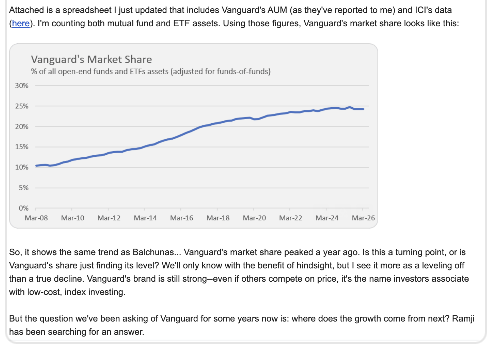
But data posted by Morningstar Inc. and confirmed by other investment trackers show Vanguard’s share of the U.S. mutual fund and exchange-traded industry, a business that now totals $40 trillion, has plateaued in recent years and actually shrank to 27% from 28% over the past year.
Vanguard Group’s market share of U.S. mutual funds and exchange-traded funds (EPS), as measured by Jeff DeMaso, publisher of the Independent Vanguard Adviser, using data collected from the Investment Company Institute and other industry sources. The text also references similar findings by Eric Balchunas, a Bloomberg investments analyst and author of a book on Vanguard’s founder, “The Bogle Effect.”Jeff DeMaso
“SHOCK: Vanguard’s market share of US fund assets has begun to DECLINE after rising for 50 years,” Eric Balchunas, a Bloomberg LP fund analyst and author of The Bogle Effect, posted earlier this month on social media.
It’s not that Vanguard took its eye off the ball, Balchunas said in an interview. Like other fund groups, Vanguard has shifted some retirement-plan assets — it won’t say how much — into other accounts that don’t show up in the publicly traded fund listings.
But the shift marks the end of an era, he said, not so much a loss for Vanguard but “a dream realized” as the legacy of founder Bogle, who died in 2019. Fidelity, BlackRock, Schwab, and other Vanguard rivals “lowered fees and increased value” to shareholders because Vanguard’s strategy forced them to compete with low prices and simple products.
“Vanguard’s market share peaked a year ago,” said Jeff Del Maso, publisher of the Independent Adviser for Vanguard Funds, after reviewing industry data. “I see it more of a leveling off than a true decline. But where does the growth come from next?”
More Vanguard effects?
Salim Ramji, a former BlackRock fund executive tapped by Vanguard’s board in 2024 as the company’s first “outside” CEO, has outlined in public interviews some other areas where Vanguard hopes to transfer its energy. He declined to be interviewed for this article.
Under Ramji, Vanguard has:
Added dozens of new bond funds and other debt investments, which tend to attract investors when interest rates go higher, economic expansion slows, and stock prices slow.
Emphasized a new generation of cash savings accounts, years after Vanguard did away with its old bank-style checking accounts. Under Ramji, Vanguard has expanded promotion of its FDIC-insured Vanguard Cash Plus Account, with yields comparable to bank certificates of deposit in an effort to keep Vanguard customers from moving short-term money to banks and outside firms and to lure in new investors.
Added investor advice. Ramji’s predecessors built advisory services since the 1990s withphone-based,digital, and hybrid systems. Seeing a big still-untapped market, Ramji in August agreed to pay $4.6 billion for Altruist, whose founder, self-described Bogle disciple Jason Wenk, developed Hazel, an “AI-forward” financial tech and custody platform popular with independent investment advisers who sell Vanguard funds. Wenk will run the business, separate from Vanguard’s Digital Advisor and Personal Advisor units, when the deal closes.
Partnered with Wellington Management and Blackstone to launch private investment funds, starting in July. The WVB funds expect to report their holdings after Sept. 30. WVB All Markets and a smaller WVB Blackstone All Privates fund are being sold for now through Bank of America and its Merrill Lynch affiliates.
But Ramji has stopped short of following other investment houses into predictions markets and cryptocurrency investments.
“We believe investments deliver cash flows or have prospects of cash flows,” which these speculative investments don’t, Ramji said last month in an interview with Peter Mallouk of $800 billion asset, Kansas-based financial adviser Creative Planning LLC. Ramji compared such products to “a slot machine where the house always wins. That does harm to the individual investor.”
Avoiding activism
Under Ramji, Vanguard has promised not to use its extra clout — its funds own around 8% of most U.S. stocks — to pressure companies to change policies.
The settlement with the states helped lower Vanguard’s profile in the fraught world of political investing. Ramji went further than other firms. BlackRock and others sued by the states have so far declined to settle similar lawsuits.
Analyst Balchunas is bullish that Ramji has cleared the way to reach more customers, extending “the Vanguard effect,“ even if its fund business has plateaued for a time.
“The Vanguard effect is bigger than Vanguard now,” Balchunas said.
This story has been updated to delete an incorrect figure for the WVB All Markets Fund.
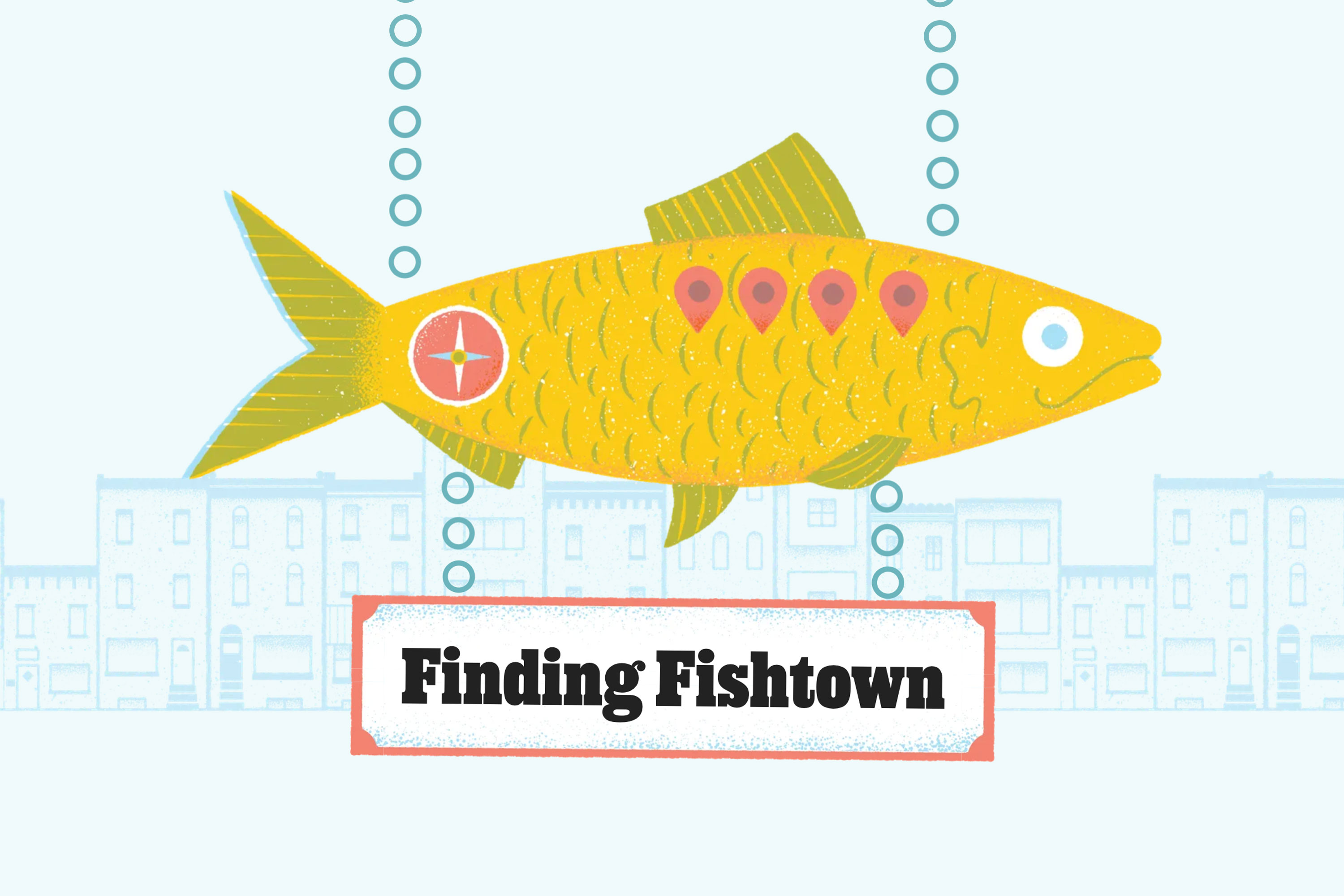
“There never really was a Fishtown, government-wise. It was a localism,” explains Kenneth Milano, a Kensington-born historian and cofounder of the Kensington History Project. Perhaps this is why it’s hard to know exactly where Fishtown’s boundaries are.
“No one [in the old days] would ever call above York Street ‘Fishtown.’ That would have been sacrilege,” Milano said. “With the new folks, they don’t know. The [real estate agent] told them.”
story continues after advertisement
Decades of gentrification in the River Wards have blurred the lines as developers tagged their properties with the coveted Fishtown brand, even as they ventured into what were generally defined as sections of Kensington. (And which Kensington? East Kensington? Olde Kensington? South Kensington? How about Norris Square? And Olde Richmond? And Port Richmond?)
The argument is about more than what to call a few blocks: A neighborhood name can shape a place’s identity, its perceived desirability, and even how it is marketed and valued.
Click anywhere on the map to start drawing your Fishtown boundary
Milano said parish boundaries originally helped reinforce neighborhood identity. Milano, 67, has lived on York Street since age 5 and described the conventional Fishtown as a triangle bounded by Norris, Frankford, and the Delaware River.
The Inquirer’s map of neighborhoods agrees with Milano — although it’s worth mentioning that this map, used internally to help our reporting stay consistent, was created in the 1980s. The Milano-Inquirer definition is definitely conservative when compared to more recent attempts to set boundaries.
By contrast, Zillow’s Fishtown is nearly twice the size. The real estate website includes not only Front Street to the west, but also goes as far north as Lehigh Avenue.
Zillow maintains its own set of neighborhood boundaries “by reviewing sources such as city maps, the Census Bureau, and neighborhood associations,” Zillow spokesperson Briahna Healy said.
There’s some overlap between Zillow’s boundaries and the 19125 zip code. While residents might feel a strong attachment to the last five digits of their address, zip codes exist solely to help route mail. This makes it hard to use 19125’s scraggly borders to define Fishtown — especially when sections that reach that far north are Kensington by any definition.
Somewhere in the middle is the Fishtown Neighbors Association border — sticking with Front Street to the west but extending only as far as York Street to the north. These boundaries “go back about 20 years when FNA was a community organization that needed boundaries to help dictate what projects to work on,” said John Scott, current president of the FNA.
Their boundaries are a single piece in a jigsaw puzzle with surrounding neighboring associations. It explains why some streets are included and others aren’t. For example, the area between Front Street and Frankford Avenue is included because “if we didn’t include them, they would probably be stateless,” Scott said.
This also means that a lot of boundaries are largely codified because the FNA can’t expand without encroaching on neighboring associations — unless, that is, new streets are built, like those in the Northbank development on the Delaware. Now the FNA is about to adjust its boundaries for the first time in a quarter-century to encompass streets south of Schirra Lane.
If we look at all of these definitions at the same time, there is a clear overlap that we can safely call Fishtown.
However, much of the fringe is up for debate. Does Fishtown stop at Front or Frankford, for example? Is York the border, or is it Norris, or even Lehigh?
It’s time for some good, old-fashioned, boots-on-the-ground reporting.
A defining feature of Fishtown are the whimsical fish signs on house facades. Our theory: Surely a painted fish wouldn’t make sense in Kensington. We hit the streets and logged every house that had a fish sign.
Largely, the signs are contained to the FNA-defined borders. But we found a large pocket of signs east of York Street and even a few signs north of Frankford — although they are outnumbered by milk bottle signs to honor Kensington’s old Harbisons Dairy plant.
Fish signs are only one way to delineate Fishtown boundaries. We also looked at restaurants and what neighborhood they describe themselves as belonging to: Fishtown, Kensington, or unsure.
Fishtown has been known for its dining scene since Johnny Brenda’s established the beachhead in 2003. As development marched on, restaurateurs and dining guides followed the cue of developers and real estate agents: We’re in Fishtown.
Today, that’s not entirely the case, as even upscale restaurants are comfortable calling themselves Kensington, though they could claim Fishtown. At Fiore, chefs Ed Crochet and Justine MacNeil use East Kensington for their Italian restaurant north of the York Street roundabout. Directly across is Emilia, chef Greg Vernick’s popular new Italian spot, which doesn’t state its neighborhood in its marketing materials. Resy, its reservation booking platform, calls it Fishtown-East Kensington.
Seemingly everyone says Middle Child Clubhouse is in “Fishtown.” But by dint of its location on the west side of Front Street, it’s arguably in South/Olde Kensington. Yuhiro, a sushi restaurant on Susquehanna Avenue just west of Frankford, markets itself as Fishtown but it could be considered in Kensington.
Then there are the restaurants where it’s even more unclear because they list multiple neighborhoods, or none at all. For example, Picnic, on Martha Street, uses East Kensington in its Instagram bio but has used Fishtown in public relations campaigns. Where is Meetinghouse, a noted bar at Memphis and Cumberland Streets? Chef/co-owner Drew DiTomo thought for a moment: “Its parish is St. Anne’s and I quite like that.”
Finally, we decided to ask people in the gray areas a simple question: “Where are we?”
We found Matt Murphy and Kaitlin Dirkx at Hagert and Tulip Streets — south of Lehigh, north of York, still in 19125. “It’s kind of a curious pocket of the River Wards,” said Murphy, who emphatically called the area “Olde Richmond.” But, as Dirkx added, “they let me into the Fishtown Neighbors Facebook group. My address must have fallen in line.”
Mark Opdyke, who lives on a side street just west of Frankford Avenue near Norris, insisted that his side of Blair Street is in Fishtown. He pointed across the street toward the Blair Garden townhouses, built in 2018 and sold as “Fishtown,” chuckled, and called that side “Kensington.”
At Frankford and Dauphin, Nick Campione’s family has owned AC Auto Repairs for 70 years. Its facade boasts a mural proclaiming, “Welcome to the Neighborhood” with an inscription explicitly describing it as “Fishtown and East Kensington.” Campione won’t take sides: “This is the best of both worlds here.”
Finally, we caught up with Stephanie Goodman and Justin Frye on the west side of Frankford Avenue near Dauphin, in front of the Groove Hound, a doggie day care. Goodman called that stretch Fishtown, adding that it’s two blocks from the house she bought in 2018 across from Philadelphia Brewing Co., which proudly says it belongs to East Kensington. Though Goodman said the real estate agent advertised her block as Fishtown, Frye believes it’s in East Kensington. “Ten different people and 10 different answers,” he said.
So it’s now time for you to decide. Let us know where you think the boundaries of Fishtown are by drawing on the map.
Thanks for drawing your boundaries. Please reach out to interactives@inquirer.com and let us know why you believe these are the boundaries of Fishtown.
This is where the average reader submission currently lays.
Staff Contributors
Design, Development, and Reporting: Sam Morris
Reporting: Michael Klein
Sign Auditors: Sam Morris and Jasen Lo
Illustration: James Olstein
Editing: Charmaine Runes
Copy Editing: Brian Leighton
story continues after advertisement
Subscribe to The Philadelphia Inquirer
Our reporting is directly supported by reader subscriptions. If you want more journalism like this story, please subscribe today
// used for lite color theming and debug buttons only
$colors: (
“purple”: $color-purple,
“pink”: $color-pink,
“red”: $color-red,
“orange”: $color-orange,
“yellow”: $color-yellow,
“green”: $color-green,
“teal”: $color-teal,
“light-gray”: $color-light-gray,
“light-blue”: $color-light-blue,
“blue”: $color-blue,
“black”: $color-black,
“white”: $color-white
);
`;var Wn=tr();var Y=(i=null)=>{let u=Kt.split(`
`),r={};return u.forEach(e=>{let o=e.trim().match(/^$color-([w-]+):s*([^;]+);/);if(o){let s=o[1],n=o[2];r[s]=n}}),i&&r[i]?r[i]:r};var rr=(i,u=null,r=null)=>{r||(r=document.querySelector(“head”));let e=document.createElement(“script”);e.type=”text/javascript”,e.src=i,u&&(e.onload=u),r.appendChild(e)},Ve=()=>(window.PMNdataLayer?.[0]!==void 0&&window.PMNdataLayer[0])?.analytics?.user?.state===”Subscribed”,je=()=>{let u=(window.PMNdataLayer?.[0]!==void 0&&window.PMNdataLayer[0])?.analytics?.user?.state;return window.location.host.includes(“zzz-systest”)||window.location.host.includes(“pmn.arcpublishing.com”)||window.location.host.includes(“stage.fusion.inquirer.com”)||typeof u>”u”},or=()=>{let u=(window.PMNdataLayer?.[0]!==void 0&&window.PMNdataLayer[0])?.analytics?.user?.hasAdsFreeReading;return!!(u&&u==1)},Ae=()=>window.location.host.includes(“localhost”);var To=i=>{(i&&i.querySelector(“.js-loading”))?.setAttribute(“data-state”,”ready”)},Bo=i=>{(i&&i.querySelector(“.js-loading”))?.setAttribute(“data-state”,”loading”)},bo=(i,u)=>{(i&&i.querySelector(“.js-loading”))?.setAttribute(“data-state”,”error”),u&&targetModalErrorEl&&(targetModalErrorEl.textContent=u)},We={stop:i=>To(i),start:i=>Bo(i),error:(i,u)=>bo(i,u)};var ce=document.querySelector(“.js-map-tooltip”),Eo=()=>{ce.classList.remove(“is-hidden”)},Io=()=>{ce.classList.add(“is-hidden”)},ko=(i,u)=>{i&&u&&matchMedia(“(pointer:fine)”).matches?(ce.style.top=i+”px”,ce.style.left=u+”px”):(ce.style.top=””,ce.style.left=””)},Do=(i,u)=>{i==”pre”?ce.textContent=”Click to place the first point”:i==”mid”&&(u{window.addEventListener(“resize”,()=>{ct&&setTimeout(()=>{lr()},300)})},Vo=()=>{rr(“https://interactives.inquirer.com/storage/dependencies/maplibre/5.3.0/maplibre-gl.js”,()=>{let i=new zt;Le=window.maplibregl,Le.addProtocol(“pmtiles”,i.tile);let u=”https://interactives.inquirer.com/melish/1.3″,r=`${u}/north-america.pmtiles`,e=new Oe(r);i.add(e),e.getHeader().then(async()=>{let s=await(await fetch(`${u}/styles/neutral.json`)).json();R=new Le.Map({container:”map”,zoom:13,center:[-75.165222,39.952583],maxBounds:[[-128.362885,24.389629],[-58.886719,52.918839]],attributionControl:!1,interactive:!1,style:{…s,layers:[],sources:{openmaptiles:{type:”vector”,url:`pmtiles://${r}`}}}}),lr(),R.on(“load”,async()=>{for(let f of nr.features)Ko(f.properties.origin,f.geometry);Xo(),st(“people”,sr),st(“signs”,ar),st(“restaurants”,ir),Yo();let y=await(await fetch(“https://interactives.inquirer.com/lyon/2026-fishtown/average.json”)).json();Qo(“readers”,y);let a=R.getCanvas();We.stop(a.closest(“.js-map”)),ct=!0,pt&&ur(pt)}),document.querySelector(“.js-map”).addEventListener(“mousemove”,n=>{jo(n)}),document.querySelector(“.js-map”).addEventListener(“mouseout”,()=>{Wo()}),document.querySelector(“.js-map”).addEventListener(“click”,n=>{Go(n)})})})},lr=()=>{R.fitBounds([-75.14613425987851,39.95952387517457,-75.10908333009395,39.98791745377673],{duration:0})},jo=i=>{if(ve&&ie&&(ue.show(),ue.position(i.clientY,i.clientX),ie==”mid”)){let u=lt(i);xe.features[0].geometry.coordinates[1]=[u.lng,u.lat],R.getSource(“drawing-ghost”).setData(xe),R.setPaintProperty(“drawing-ghost”,”line-opacity”,.5)}},Wo=()=>{ue.hide()},No=()=>{let u=document.querySelector(“.js-map”).getBoundingClientRect().top;u{if(ve){if(ie==”pre”){let u=lt(i);Z.features[0].geometry.coordinates.push([u.lng,u.lat]),xe.features[0].geometry.coordinates[0]=[u.lng,u.lat],document.querySelector(“.js-map-start”).classList.remove(“is-hidden”),pr.setLngLat(u),document.querySelector(“.js-tool-buttons-reset”).disabled=!1,ie=”mid”}else if(ie==”mid”){let u=lt(i);Z.features[0].geometry.coordinates.push([u.lng,u.lat]),xe.features[0].geometry.coordinates[0]=[u.lng,u.lat]}i.target.classList.contains(“js-map-start”)&&Zo(),R.getSource(“drawing-user”).setData(Z),ue.update(ie,Z.features[0].geometry.coordinates.length),ue.show()}},Zo=()=>{ve=!1,ie=”end”;let i=Z.features[0].geometry.coordinates.length,u=Z.features[0].geometry.coordinates[0];Z.features[0].geometry.coordinates[i-1]=u,Z.features[0].geometry.type=”Polygon”,Z.features[0].geometry.coordinates=[Z.features[0].geometry.coordinates],R.getSource(“drawing-user”).setData(Z),R.setPaintProperty(“drawing-user-fill”,”fill-opacity”,.4),R.setPaintProperty(“drawing-ghost”,”line-opacity”,0),document.querySelector(“.js-map-start”).classList.add(“is-hidden”),document.querySelector(“.js-tool-buttons-submit”).disabled=!1},qo=()=>{ve=!0,ie=”pre”,ue.update(ie,0),Z.features[0].geometry.type=”LineString”,Z.features[0].geometry.coordinates=[],R.getSource(“drawing-user”).setData(Z),document.querySelector(“.js-tool-buttons-submit”).disabled=!0,R.setPaintProperty(“drawing-ghost”,”line-opacity”,0),R.setPaintProperty(“drawing-user-fill”,”fill-opacity”,0),document.querySelector(“.js-map-start”).classList.add(“is-hidden”)},lt=i=>{let u=document.querySelector(“.js-map”).getBoundingClientRect(),r=i.clientX-u.left,e=i.clientY-u.top;return R.unproject([r,e])},Jo=()=>{Jt.vote({coordinates:JSON.stringify(Z.features[0].geometry.coordinates[0])})},Ko=(i,u)=>{R.addSource(`boundary-${i}`,{type:”geojson”,data:u}),R.addLayer({id:`boundary-${i}-fill`,source:`boundary-${i}`,type:”fill”,paint:{“fill-color”:Y(“illo-red”),”fill-opacity”:0}}),R.addLayer({id:`boundary-${i}-line`,source:`boundary-${i}`,type:”line”,paint:{“line-color”:Y(“illo-red”),”line-width”:4,”line-opacity”:0}})},Qo=(i,u)=>{R.addSource(`drawing-${i}`,{type:”geojson”,data:u}),R.addLayer({id:`drawing-${i}-fill`,source:`drawing-${i}`,type:”fill”,paint:{“fill-color”:Y(“illo-yellow”),”fill-opacity”:0}}),R.addLayer({id:`drawing-${i}-line`,source:`drawing-${i}`,type:”line”,paint:{“line-color”:Y(“illo-yellow”),”line-width”:4,”line-opacity”:0}})},st=(i,u)=>{let r;window.innerWidth{let i=[{id:”tavern”,coordinates:[-75.13430336980068,39.9690688861316]},{id:”milk”,coordinates:[-75.13290465156766,39.98256059702009]},{id:”pier”,coordinates:[-75.11347715844,39.9714839528569]},{id:”wawa”,coordinates:[-75.11890594948434,39.977239248055895]},{id:”sulimays”,coordinates:[-75.12598489221865,39.971605275979115]},{id:”traffic”,coordinates:[-75.12754751235474,39.98145267435357]}];for(let u of i){let r=document.querySelector(`.js-map-icon[data-id=”${u.id}”]`);new Le.Marker({element:r}).setLngLat(u.coordinates).addTo(R)}},Xo=()=>{R.addSource(“roads”,{type:”geojson”,data:Ne}),R.addLayer({id:”roads”,source:”roads”,type:”symbol”,layout:{“symbol-placement”:”line-center”,”symbol-spacing”:100,”text-field”:”{name}”,”text-font”:[“grot10-regular”],”text-max-angle”:90,”text-pitch-alignment”:”viewport”,”text-rotation-alignment”:”map”,”text-size”:9,”text-transform”:”uppercase”},paint:{“text-color”:”#666″,”text-halo-color”:”#fff”,”text-halo-width”:2}}),cr()},_o=i=>{let u=Object.keys(R.getStyle().sources).filter(r=>r.includes(“boundary-“));for(let r of u){let e=r.includes(i)||i==”all”;R.setPaintProperty(`${r}-line`,”line-opacity”,e?1:0),R.setPaintProperty(`${r}-fill`,”fill-opacity”,e?.2:0)}},en=i=>{let u=Object.keys(R.getStyle().sources).filter(r=>r.includes(“drawing-“)&&!r.includes(“ghost”));for(let r of u){let e=r.includes(i);R.setPaintProperty(`${r}-line`,”line-opacity”,e?1:0),R.setPaintProperty(`${r}-fill`,”fill-opacity”,e?.2:0)}},tn=i=>{let u=Object.keys(R.getStyle().sources).filter(r=>r.includes(“points-“));for(let r of u){let e=r.includes(i);R.setPaintProperty(`${r}`,”circle-opacity”,e?1:0)}},rn=i=>{let u=document.querySelector(“.js-map”);i?u.classList.remove(“is-hiding-icons”):u.classList.add(“is-hiding-icons”)},cr=i=>{let u=JSON.parse(JSON.stringify(Ne.features));u=u.filter(r=>r.properties.defaultVisibility==”visible”),i&&(i=i.split(“,”).map(r=>r.trim()),i=Ne.features.filter(r=>i.includes(r.properties.name)),u=[…u,…i]),R.getSource(“roads”).setData({type:”FeatureCollection”,features:u})},ur=i=>{ct?(i={points:i?.points||null,boundary:i?.boundary||null,drawing:i?.drawing||null,icons:i?.icons||!1,roads:i?.roads||null},_o(i.boundary),en(i.drawing),tn(i.points),rn(i.icons),cr(i.roads)):pt=i},fe={init:()=>{Ho(),Vo()},update:i=>{ur(i)},startDrawing:()=>{ve=!0,ie=”pre”,No()},stopDrawing:()=>{ve=!1},resetDrawing:()=>{qo()},submitDrawing:()=>{Jo()}};var on=()=>{document.querySelector(“.js-tool-buttons-start”).addEventListener(“click”,()=>{pn()}),document.querySelectorAll(“.js-tool-buttons-skip”).forEach(i=>{i.addEventListener(“click”,()=>{fr(),sn(),yr()})}),document.querySelector(“.js-steps-step .js-tool-buttons”).addEventListener(“click”,()=>{nn()}),document.querySelector(“.js-tool-buttons-reset”).addEventListener(“click”,()=>{fe.resetDrawing()}),document.querySelector(“.js-tool-buttons-submit”).addEventListener(“click”,()=>{fe.submitDrawing(),fr(),an(),yr()})},nn=()=>{document.querySelector(“.js-steps-step .js-tool-buttons”).classList.add(“is-hidden”),document.querySelectorAll(“.js-steps-step .js-button”).forEach(i=>{i.disabled=!0})},fr=()=>{document.querySelectorAll(“.js-steps-step.is-hidden”).forEach(i=>{i.classList.remove(“is-hidden”)})},an=()=>{let i=document.querySelector(“.js-tool-buttons-start”).closest(“.js-steps-step”).querySelector(“.inno-p”);i.innerHTML=”This is where you think Fishtown’s borders are.”},sn=()=>{let i=document.querySelector(“.js-steps-step .js-tool-buttons”).closest(“.js-steps-step”),u=parseInt(i.dataset.step),r=document.querySelector(`.js-steps-step[data-step=”${u+1}”]`);r&&r.scrollIntoView({block:”center”})},pn=()=>{document.querySelector(“body”).classList.add(“is-tool-mode”),fe.startDrawing()},yr=()=>{document.querySelector(“body”).classList.remove(“is-tool-mode”),fe.stopDrawing()},mr={init:()=>{on()}};var ln=()=>{or()&&document.querySelectorAll(“.js-adbox”).forEach(u=>{u.classList.add(“is-hidden”)})},dr={init:()=>{ln()}};var me,gr,cn=()=>{me=document.getElementById(“js-inno-toast”)},un=i=>{if(!me)return;me.innerHTML=i,me.classList.add(“is-active”);let u=()=>{me.addEventListener(“transitionend”,fn,{once:!0}),me.classList.remove(“is-active”)};clearTimeout(gr),gr=setTimeout(u,5e3)},fn=()=>{me.innerHTML=””},de={init:()=>{cn()},showToast:un};var Ge,hr=!1,yn=async()=>new Promise(i=>{setTimeout(()=>{console.log(“simulating createShareLink for localhost”),i(“https://inquirer.com/interactives”),mn()},100)}),mn=()=>{let i=document.querySelector(“.js-gift-toast-receiver”);!i||!(i instanceof HTMLElement)||setTimeout(()=>{let u=i?.querySelector(“span”);u&&(u.innerHTML=”Gift link copied to clipboard“)},20)},dn=()=>{let i=window.services?.createShareLink;i&&(Ge=i),Ae()&&(Ge=yn),Ge&&hn()},gn=async i=>{let u=”text/plain”,r=async()=>{try{return await Ge(window.location.pathname)}catch{i.dataset.state=”error”,de.showToast(“Hmm, we couldn’t generate a gift link…”)}},e=new ClipboardItem({[u]:r()});await navigator.clipboard.write([e]).catch(o=>{console.log(o),de.showToast(“Couldn’t copy to clipboard, try again?”),i.dataset.state=”error”}),de.showToast(“Gift link copied to clipboard!”),i.dataset.state=”complete”},hn=()=>{document.querySelectorAll(“.js-gift”).forEach(u=>{(Ve()||Ae()||je())&&u.classList.add(“is-available”)}),document.querySelectorAll(“.js-gift-button”).forEach(u=>{u instanceof HTMLButtonElement&&u.addEventListener(“click”,()=>{u.classList.contains(“disabled”)||(u.dataset.state=”loading”,hr=!0,gn(u),setTimeout(()=>{u.dataset.state=”ready”},2e3))})});let i=document.querySelector(“.js-gift-toast-receiver”);!i||!(i instanceof HTMLElement)||vn(i)},vn=i=>{new MutationObserver(r=>{for(let e of r){let o=[…e.addedNodes].at(0);if(!(o instanceof HTMLElement))return;hr&&de.showToast(o.outerHTML)}}).observe(i,{subtree:!0,childList:!0})},vr={init:()=>{dn()}};var Te,xn=()=>{document.querySelectorAll(“.js-hover”).forEach(i=>{i.addEventListener(“click”,()=>{xr(i)}),i.addEventListener(“mouseenter”,()=>{xr(i)}),i.addEventListener(“mouseout”,()=>{Pr(i)})}),window.addEventListener(“scroll”,()=>{Te!==null&&Pn()})},Pn=()=>{(Te>window.scrollY+100||Te{Pr(i)})},xr=i=>{i.classList.add(“is-visible”),Te=window.scrollY},Pr=i=>{i.classList.remove(“is-visible”),Te=null},wr={init:()=>{xn()}};var Fr=1,ut=class{constructor(u){this.el=u,this.contentPosition=”default”,this.possibleSteps=new Array,this.currentStep=null,this.currentStepEl=null,this.offset=window.innerWidth>960?window.innerHeight*.6:window.innerHeight*.9,this.instanceOfSteps=Fr,Fr++,this.setPossibleSteps(),this.updateContent(),this.bindings()}setPossibleSteps(){this.el.querySelectorAll(“.js-steps-step”).forEach(u=>{u.dataset.step&&this.possibleSteps.push(u.dataset.step)})}bindings(){window.addEventListener(“scroll”,()=>{this.updateContent()}),window.addEventListener(“resize”,()=>{this.updateContent()})}updateContent(){this.updateCurrentStep()}updateCurrentStep(){let u;if(this.el.querySelectorAll(“.js-steps-step”).forEach((e,o)=>{e.getBoundingClientRect().top{let n=”is-“+o,y=”is-“+s;this.possibleSteps.indexOf(o){document.querySelectorAll(“.js-steps”).forEach(i=>{new ut(i)})}};var wn=(i,u,r)=>{document.querySelectorAll(“.js-subscribe”).forEach(e=>{e.classList.toggle(“is-unsubscribed”,!i),e.classList.toggle(“is-preview”,u),e.classList.toggle(“is-dev”,r)})},Cr={init:()=>{wn(Ve(),je(),Ae())}};var Fn=()=>{},Mr={init:()=>{Fn()}};var Ar={init:()=>{Mt.init?.(),mr.init?.(),dr.init?.(),vr.init?.(),wr.init?.(),We.init?.(),fe.init?.(),Sr.init?.(),Cr.init?.(),Mr.init?.(),de.init?.()}};var Sn=()=>{},Lr={init:()=>{Sn()}};var Cn=document.querySelector(“.js-inno”),Tr=()=>{Ar.init(),Lr.init()};Cn?Tr():new MutationObserver((u,r)=>{if(document.querySelector(“.js-inno”)){r.disconnect(),Tr();return}}).observe(document,{attributes:!0,childList:!0,subtree:!0});})();
/*! Bundled license information:
matter-js/build/matter.js:
(*!
* matter-js 0.20.0 by @liabru
* http://brm.io/matter-js/
* License MIT
*
* The MIT License (MIT)
*
* Copyright (c) Liam Brummitt and contributors.
*
* Permission is hereby granted, free of charge, to any person obtaining a copy
* of this software and associated documentation files (the “Software”), to deal
* in the Software without restriction, including without limitation the rights
* to use, copy, modify, merge, publish, distribute, sublicense, and/or sell
* copies of the Software, and to permit persons to whom the Software is
* furnished to do so, subject to the following conditions:
*
* The above copyright notice and this permission notice shall be included in
* all copies or substantial portions of the Software.
*
* THE SOFTWARE IS PROVIDED “AS IS”, WITHOUT WARRANTY OF ANY KIND, EXPRESS OR
* IMPLIED, INCLUDING BUT NOT LIMITED TO THE WARRANTIES OF MERCHANTABILITY,
* FITNESS FOR A PARTICULAR PURPOSE AND NONINFRINGEMENT. IN NO EVENT SHALL THE
* AUTHORS OR COPYRIGHT HOLDERS BE LIABLE FOR ANY CLAIM, DAMAGES OR OTHER
* LIABILITY, WHETHER IN AN ACTION OF CONTRACT, TORT OR OTHERWISE, ARISING FROM,
* OUT OF OR IN CONNECTION WITH THE SOFTWARE OR THE USE OR OTHER DEALINGS IN
* THE SOFTWARE.
*)
*/
Years before police launched an investigation into the missing women connected to Raymond “R.C.” Horsch, the late pornographer stood inside a Kensington art gallery and presented what appeared to be the autopsy photos of a dead, unidentified woman.
His exhibition at the 2014 show ended with a video of the woman’s body being loaded into an incinerator — footage that he said was filmed at “a Kensington warehouse where the city morgue would send unidentified remains,” according to a review published on an art blog at the time.
“The Medical Examiner totally botched the autopsy and didn’t even bother to sew her up properly. My horrible photograph is all that is left of her, the only trace of her short, sad existence,” Horsch wrote in a release promoting the exhibition. “She has nothing else, not even a name.”
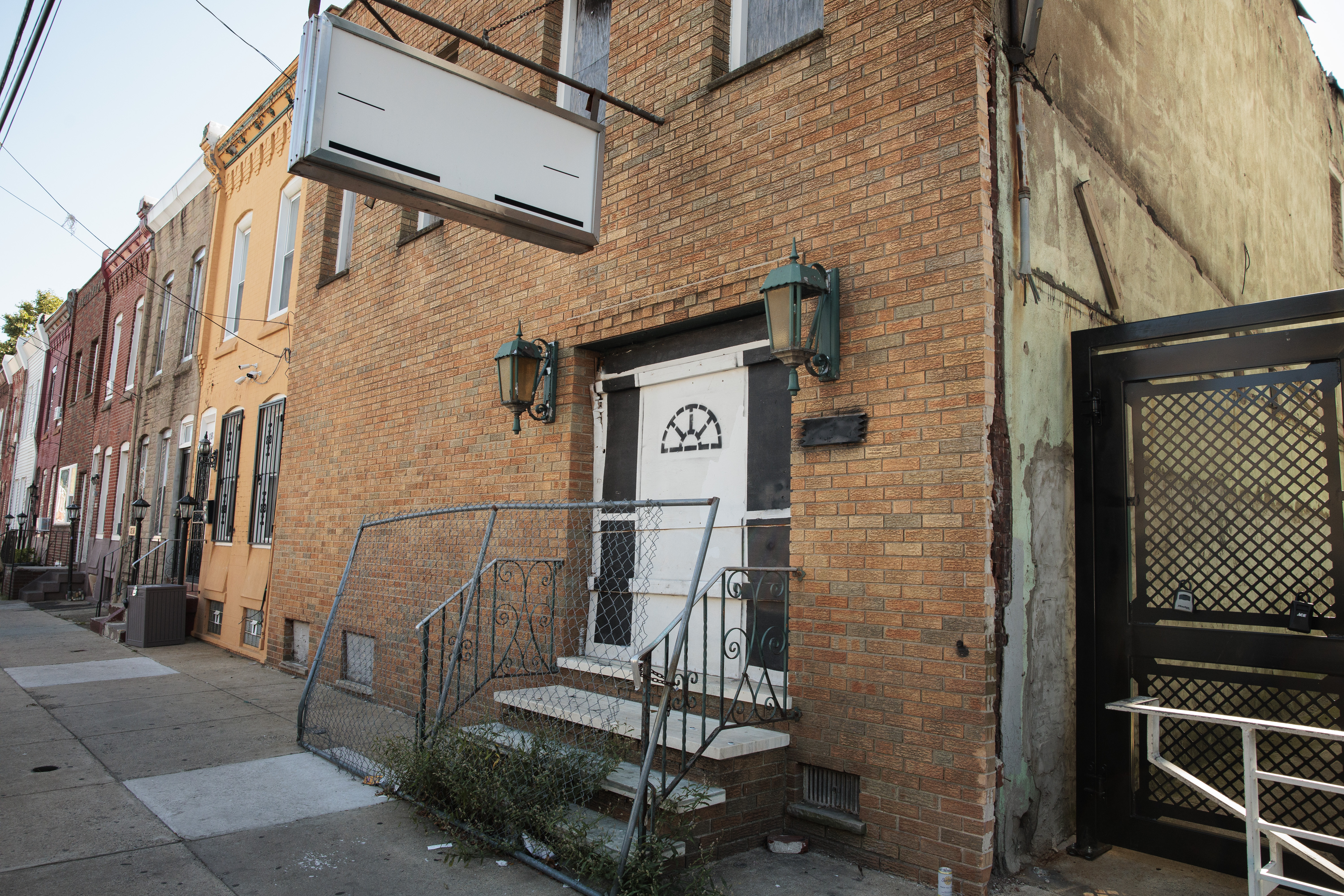
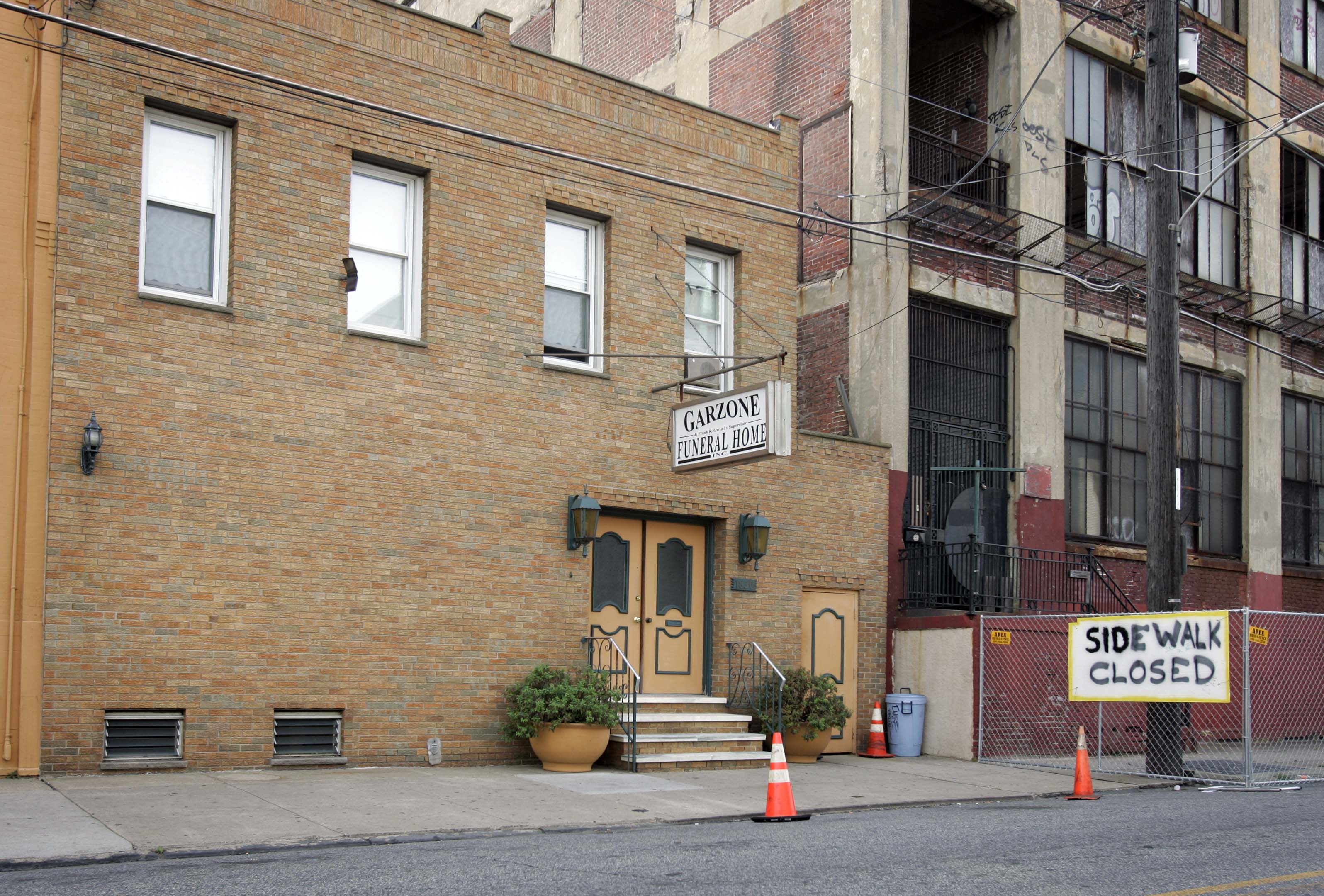
While Horsch was known to distort, embellish, or completely fabricate events, a law enforcement source and people familiar with this period of his life said this much is true: The pornographer had access to a Kensington crematorium connected to the notorious Garzone Funeral Home, which was shuttered over illegal body parts sales.
There, sources said, Horsch gave an employee drugs and cash in exchange for access to the crematorium so he could photograph and film the remains of the dead.
The funeral home and crematorium operated until 2007, when state authorities brought charges against the family-run business alleging the owners were selling body parts on the black market, according to court records and news reports.
Horsch, who died in May 2025 of a lung condition, was not named or charged in that scandal.
But police are looking into Horsch’s relationship to the crematorium as part of a sprawling local and federal investigation into at least seven missing women, according to a law enforcement source who spoke on the condition of anonymity to discuss an ongoing probe.
No bodies have been found, and five women police have identified as likely deceased went missing from 2016 to 2023, years after the crematorium connected to the Garzone Funeral Home had closed. Police are still investigating the women’s whereabouts, including ongoing searches for evidence in Horsch’s Olney home and basement.
The case has been complicated by Horsch’s tendency to blur fact and fiction, and many of his pornographic works featured staged death scenes and fake blood. But police have also recovered numerous videos and photos from Horsch’s home they have said seem to show real violence and actual killings.
At least as far back as the early 2000s, Horsch was known to prowl the streets of Kensington, offering drugs and cash to women in exchange for starring in his violent pornographic films.
He was public about his obsession with taking degrading photographs of women in addiction. Years after Horsch staged his 2014 art show in Kensington, he uploaded a photo series to his website featuring women “imagining and acting their own deaths” interspersed with images of fatal overdose victims. In a description of the gallery, Horsch wrote he took the photos in “unknowing collaboration with the Philadelphia Medical Examiner,” as well as local paramedics.
The Philadelphia Medical Examiner’s Office declined to confirm whether the city sent unclaimed corpses from the morgue to the Garzones’ crematorium.
Louis and Gerald Garzone, who together operated the crematorium connected to the funeral home under the name Liberty Cremations, pleaded guilty to selling over 240 corpses to a New York-based biomedical tissue company in 2008. The tissue cutters illegally stripped the bodies for bones, tendons, and organs, then sold them to hospitals.
Some of the tissue was infected with disease, officials said at the time, and was transplanted into patients without their knowledge. Law enforcement seized the crematorium and funeral home as part of the criminal case, court records show.
Horsch once bragged that he had access to the crematorium through an employee named “George,” whom he paid with drugs, and had filmed a scene for a movie there, according to a woman who worked with Horsch on several films beginning in 2003. She spoke on condition of anonymity to avoid being publicly linked to the pornographer.
Gerald Garzone said in a phone interview that he had never heard of Horsch and had no knowledge of corpses being photographed in his former business. He acknowledged knowing a man named George from the neighborhood but declined to say whether he had ever employed him.
“I don’t know anything about that,” he said.
A 2007 file photo of the Garzone Funeral Home at 1830 E Somerset St., in Philadelphia.Laurence Kesterson / Staff Photographer
Four people familiar with Horsch and Garzone’s business operation identified the man as George Newsome, a Kensington resident who lived a block away from the crematorium at a house on Ruth Street that Horsch was known to frequent.
Newsome was arrested for heroin possession in 2011, court records show, and again for cocaine possession in 2013. He died a year later, according to an obituary.
Investigators continue to sort through more than a million photos and videos on hard drives recovered from Horsch’s home on West Chew Avenue. Local and federal investigators said they have reviewed about 30% of the materials so far and have identified 58 different people in the footage.
Among them, police said, are images of four women who appear to be dead: Maribel Fresses; Gabrielle Amarando; a 25-year-old whose identity relatives asked to remain private; and a woman in her mid-20s whom investigators are still working to identify. Police said they also recovered footage of Horsch filming himself choking 27-year-old Nicole Fusaro with a zip tie until she was dead.
Police began searching Horsch’s Chew Avenue property shortly after a chance car stop on June 19 involving his son, Eugene, uncovered an ID in the name of Blair Tonzelli, who was reported missing in 2023.
Investigators then began reexamining the disappearance of Amy McHale, Raymond Horsch’s ex-wife, who was last seen at the Olney home in 2016.
Inside the property, police found five urns full of cremains, two of which police are still working to identify. The basement contained vats of unknown chemicals and a 55-gallon drum with connections to a sewer drain. There were also pages of writings that referenced serial killer Ted Bundy and described how someone enjoyed hurting a woman with a zip-tie.
Raymond Horsch had previously written in self-published novels about dissolving a woman’s body in chemicals. Police have sent the chemicals and liquids recovered from the basement to a specialized lab in Chicago for testing.
Eugene Horsch remains incarcerated on federal gun and drug charges. He has not been accused of any violent crimes involving the missing women.
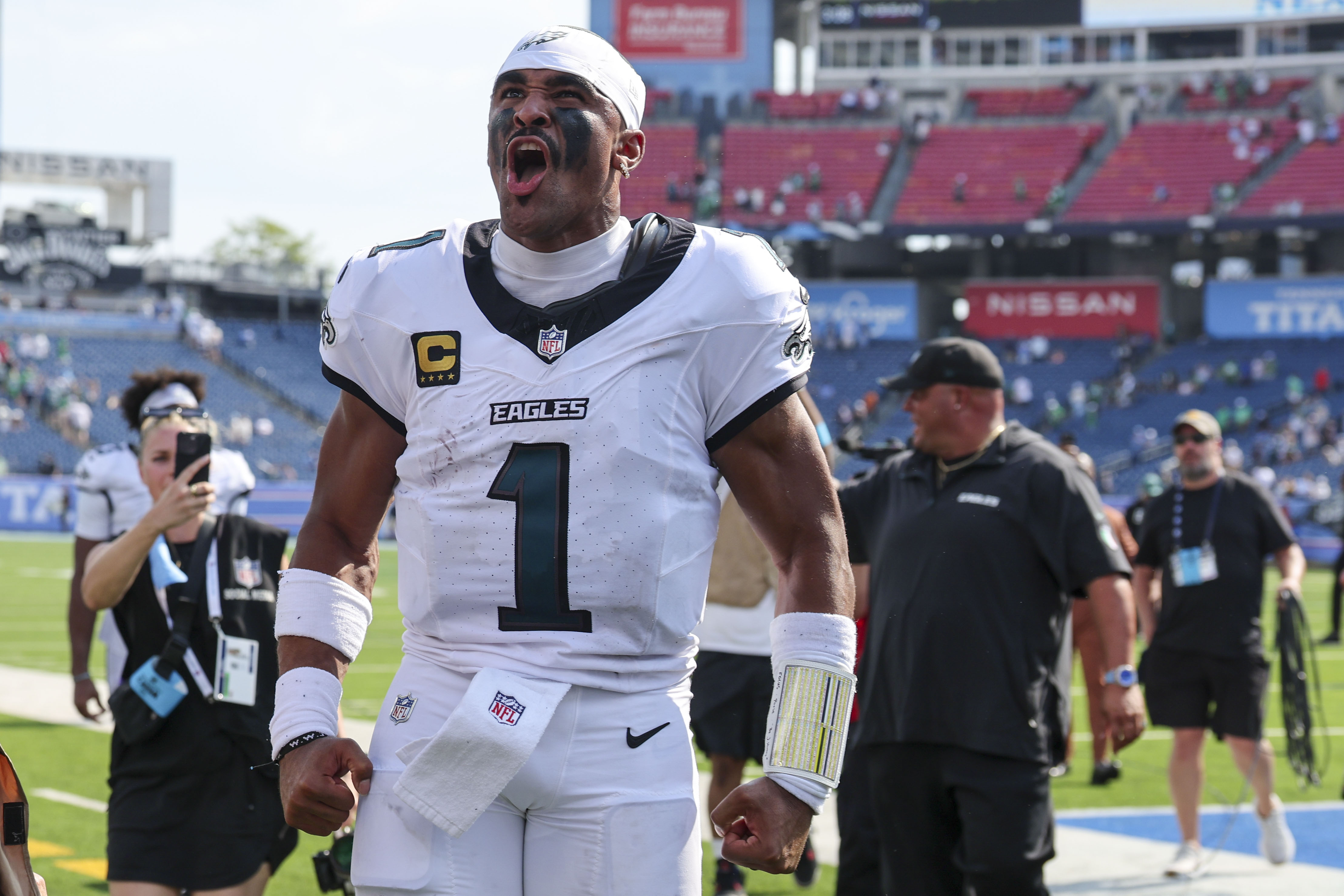
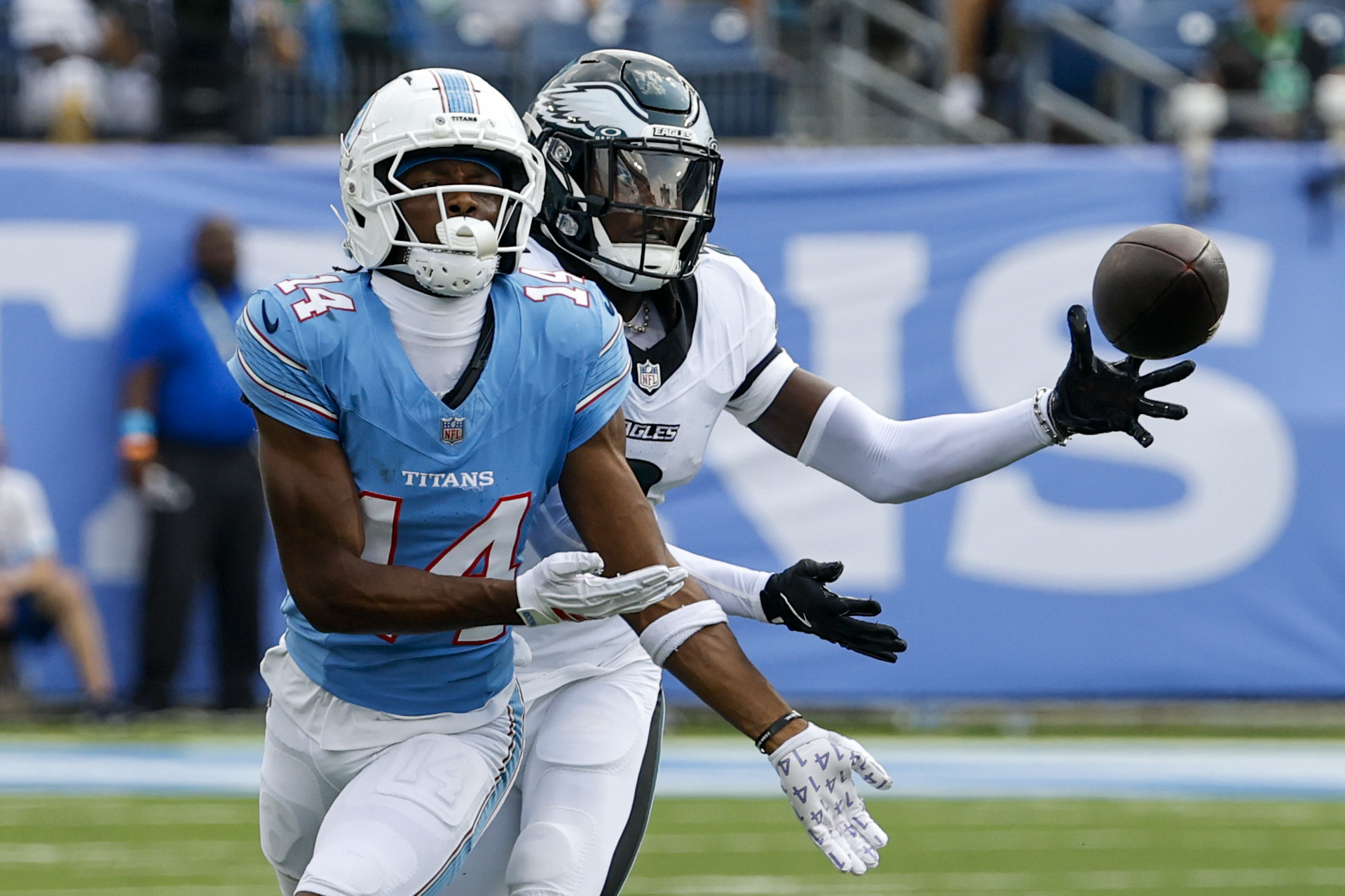
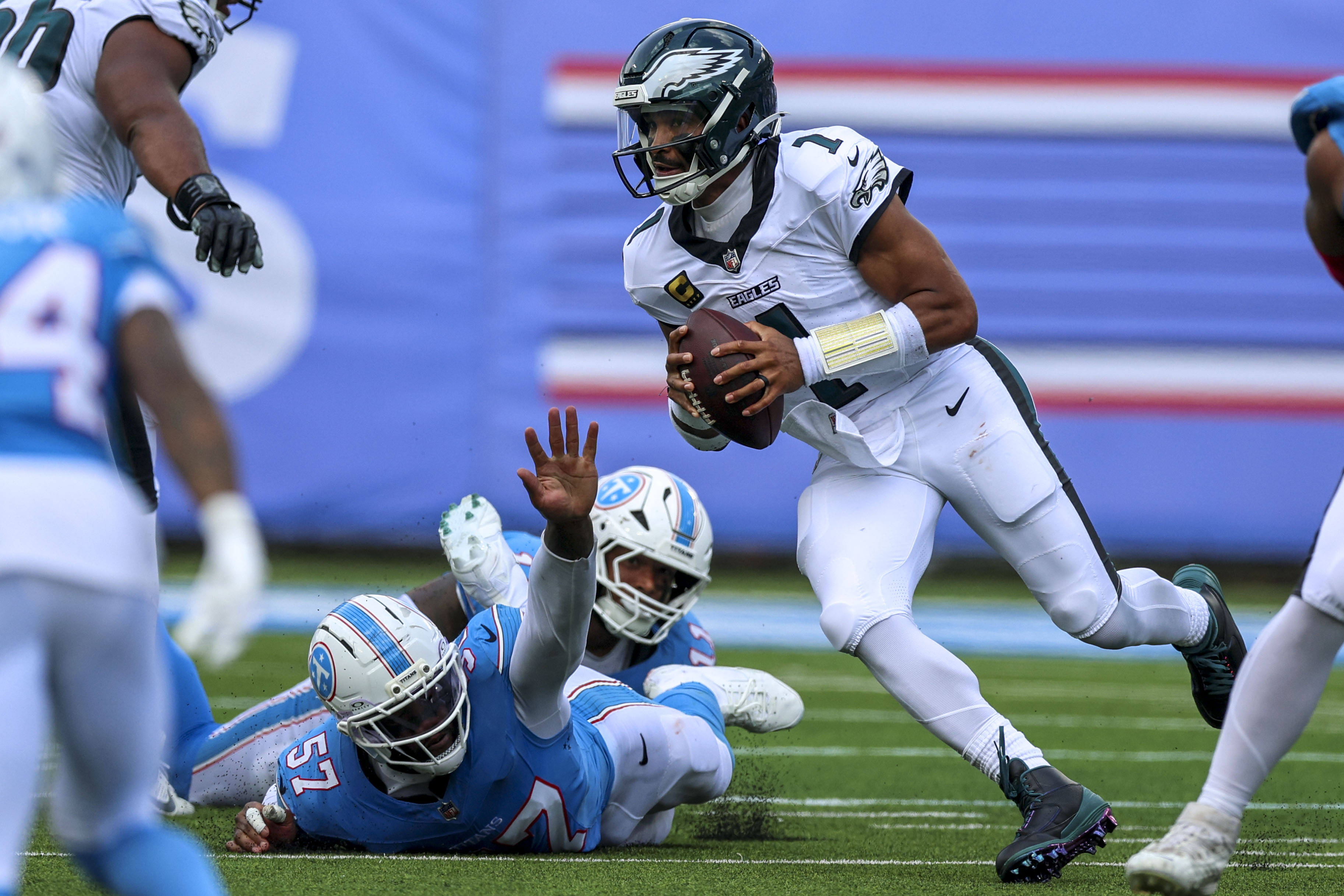
NASHVILLE, Tenn. — Jalen Hurts tossed two costly interceptions. The first was returned 92 yards and converted into a touchdown, while the second came late in the fourth quarter and allowed the Titans to take a 20-17 lead.
And yet, Hurts wasn’t asked a single question about the picks postgame. His performance in rallying the Eagles past Tennessee, 24-20, in nearly every other moment, including a masterful two-minute drive, far overshadowed his two throwing errors.
But there was something unique about Hurts carrying the offense at the scorching Nissan Stadium on Sunday. He’s strapped the Eagles onto his back before. He’s had better games against better opponents when the stakes were much higher. He’s been clutch on many previous occasions.
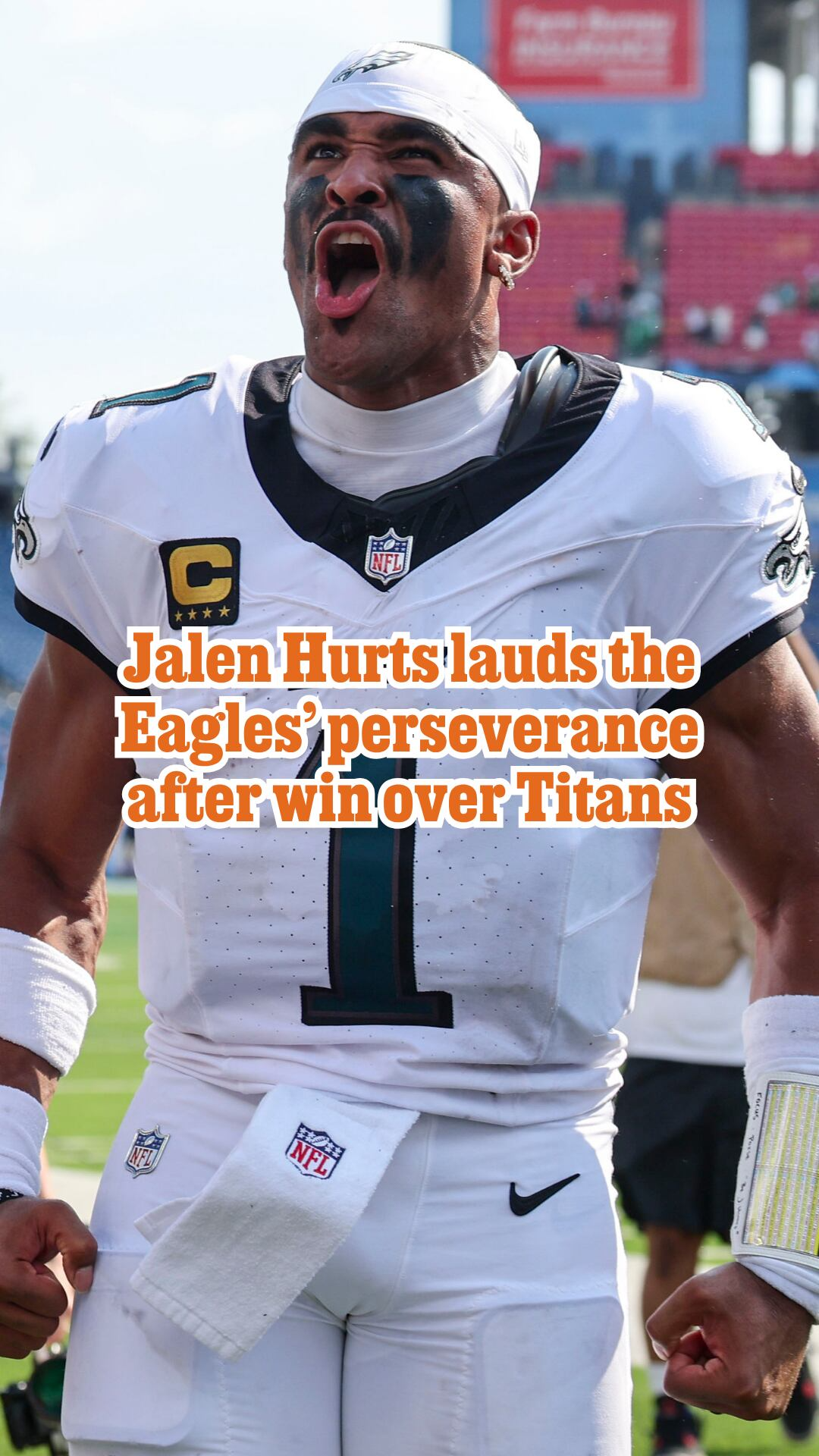
Video: Jalen Hurts lauds the Eagles’ perseverance after win over Titans
No, this was a different Hurts. This was the 2.0 version. This was Hurts evolving as a quarterback in a new scheme that gives him more freedom as a passer. We saw glimpses of it in Week 1 vs. the Washington Commanders. He took another step in Week 2.
If the narrative entering this season was that the 28-year-old faced a make-it-or-break-it tipping point, after another offensive coordinator change and a seemingly unresolved contract situation, Hurts has shown through two weeks that he’s making it.
He’s been that instrumental in the Eagles’ 2-0 start despite the schematic hiccups and struggles on the offensive line.
“I don’t even think words can describe how much you’ve got to manage as a quarterback in this league from a responsibility standpoint, and the weight that comes with the position and the responsibility,” Hurts said when asked about his calm amid an otherwise stormy offensive day.
“Ultimately, you gotta keep the main thing the main thing throughout that. You gotta keep your poise and keep your focus.”
An early injury to Saquon Barkley was one more thing Jalen Hurts was forced to overcome on Sunday. Yong Kim / Staff Photographer
Third down after third down, Hurts and his receivers bailed out the early-down malaise. The Eagles have long needed an offense that establishes the run game. Hurts’ limitations as a dropback passer have partially made that necessary, but it’s also been a byproduct of coach Nick Sirianni’s conservatism.
The Eagles just might not have the pieces to be a run-based unit this season. There were likely to be some early bumps with the new wide-zone blocking scheme. But for as much as Sean Mannion needs the outside-zone runs to set up play action, he can’t keep calling early-down runs or quasi-runs that are passes that fail.
The Eagles have been wretched on first down. They averaged just 0.9 yards in the first game of the season. They were a little better in the second, but the running backs managed just 2.7 yards on 15 first-down rushes vs. the Titans.
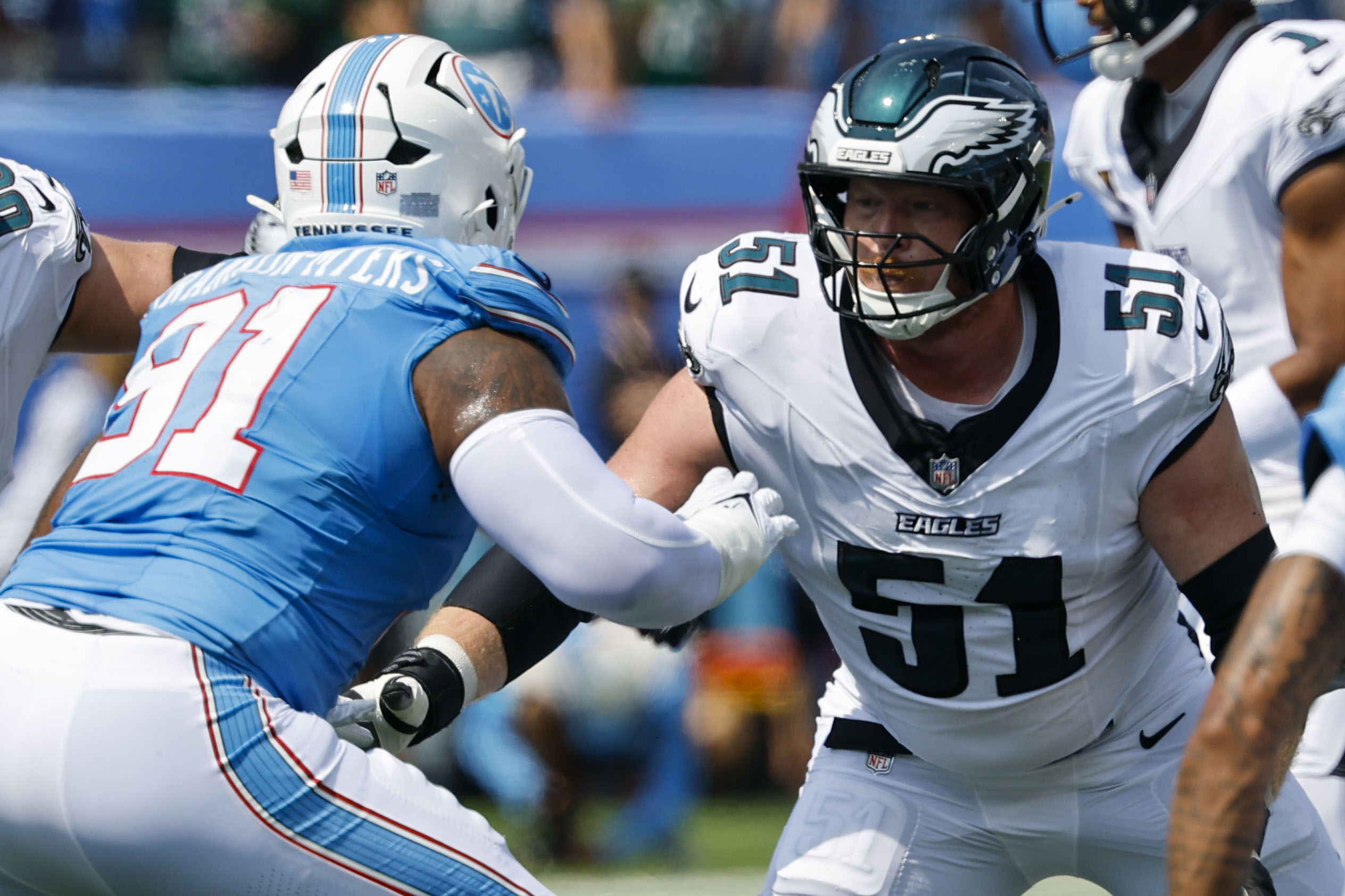
The Eagles shuffled the O-line after Landon Dickerson went to injured reserve last week, moving Cam Jurgens to the vacant left guard spot and inserting Drew Kendall at center. There were going to be miscues with Jurgens having never played guard on that side, especially with Jeffery Simmons lining up over him.
But Mannion kept calling runs even if they often were away from the All-Pro defensive tackle.
“It’s more to do with execution, but then also you know the moving pieces that we had in,” tackle Jordan Mailata said about the run-blocking issues. “This is our first game together as the starting five for us. And I’ve always emphasized the continuity of having the same O-line guys.”
Sirianni wouldn’t divulge whether he’ll stick with the same configuration, but keeping the same core for at least the next three games — or more, depending upon Dickerson’s health — seems likely.
Cam Jurgens (51) and the offensive line has been slow to adjust to the Sean Mannion scheme. Yong Kim / Staff Photographer
“I’m a soldier,” Jurgens said. “I march to my orders, and whatever I’m asked to do, I’m going to do it to my best abilities.”
There were other missing parts. Running back Saquon Barkley left early with a stinger (although he returned), while tight end Dallas Goedert was sidelined with a knee injury. Sirianni said he wouldn’t grade on a curve because of the new faces and scheme changes.
“We want to be able to run it more efficiently,” Sirianni said. “I haven’t seen any of the numbers, but everything comes off of the run and the play action. And so, the guys battled though. That’s what you’re so proud of there. … But there’s definitely room for improvement, as we all know.
The pass protection wasn’t much better, although when the O-line needed to stand tall on the last drive, Hurts mostly had enough time in the pocket. But getting sacked three times, hit an additional three times, and having to Houdini out of pressure isn’t likely sustainable.
According to the advanced analytics site Sumer Sports, the Eagles have the largest difference in early-down offensive success rate vs. late-down offensive success rate to start a season since 2022, with an early-down success rate of 31.5% in the third percentile, and a late-down rate of 60.6% in the 96th percentile.
Hurts kept facing long third downs and kept hitting receivers DeVonta Smith and Dontayvion Wicks downfield. He converted nine third downs of more than 4 yards, three of which were third-and-12.
Jalen Hurts helped facilitate a big day for DeVonta Smith (6) and completed passes to nine different targets on Sunday. David Maialetti / Staff Photographer
But both his interceptions also came on third-and-longs. He kept bouncing back.
“Jalen’s able to flush it and lead us down the field in a critical situation,” Sirianni said. “Just proud of the way he played and the way he had his resolve, but that’s who he is, right? That doesn’t surprise me. He’s that on a daily basis.”
Whether it’s by design or not, Sirianni has had to entrust his 28-year-old quarterback with more responsibility, and that may require accepting a few more interceptions than either has become accustomed to.
If the Kyle Shanahan-type parts of Mannion’s under center, play-action scheme haven’t yet taken hold, the implementation of more full progression reads has. Hurts completed passes to nine receivers for only the fourth time in his NFL career, and the first since 2022.
He got late into his reads on several throws, including the game-winning 3-yard touchdown toss to Darius Cooper. Earlier, he found Cooper for a 23-yard gain when the receiver was beyond his first two reads.
“I think it’s just a byproduct of our approach in our offense,” Hurts said. “I’ve really embraced and enjoyed the teaching progression and how things are taught.”
Hurts has heard the noise about his not being able to diagnose defenses, dating back to his second season when the Tampa Bay Buccaneers said as much in an Eagles wild-card playoff loss. Simmons said the Titans wanted to make Hurts “play quarterback” in the lead-up to the game.
“I heard it,” Hurts said.
He let his play do the talking, though.
“I’m happy we won,” Hurts said when asked for a response.
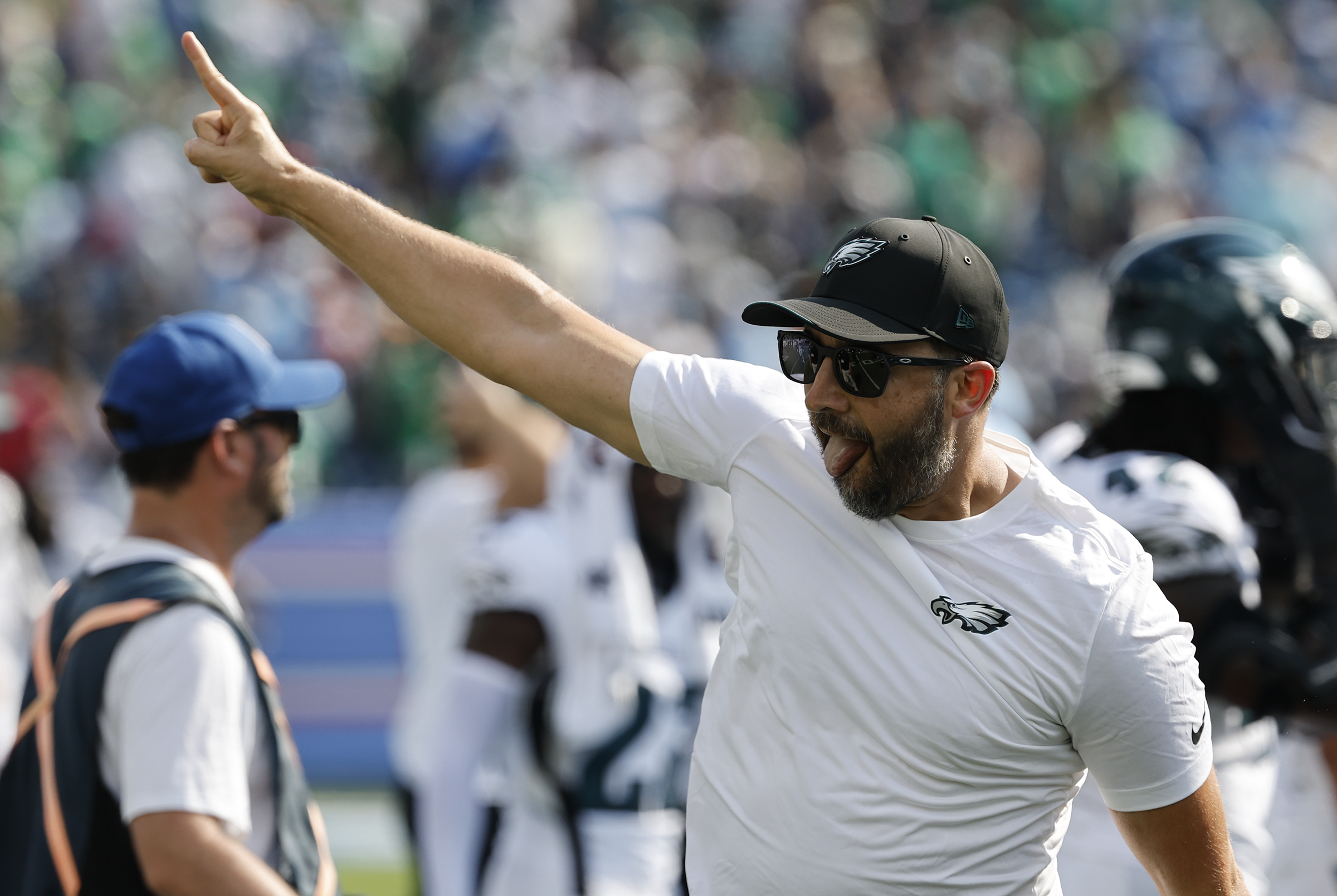
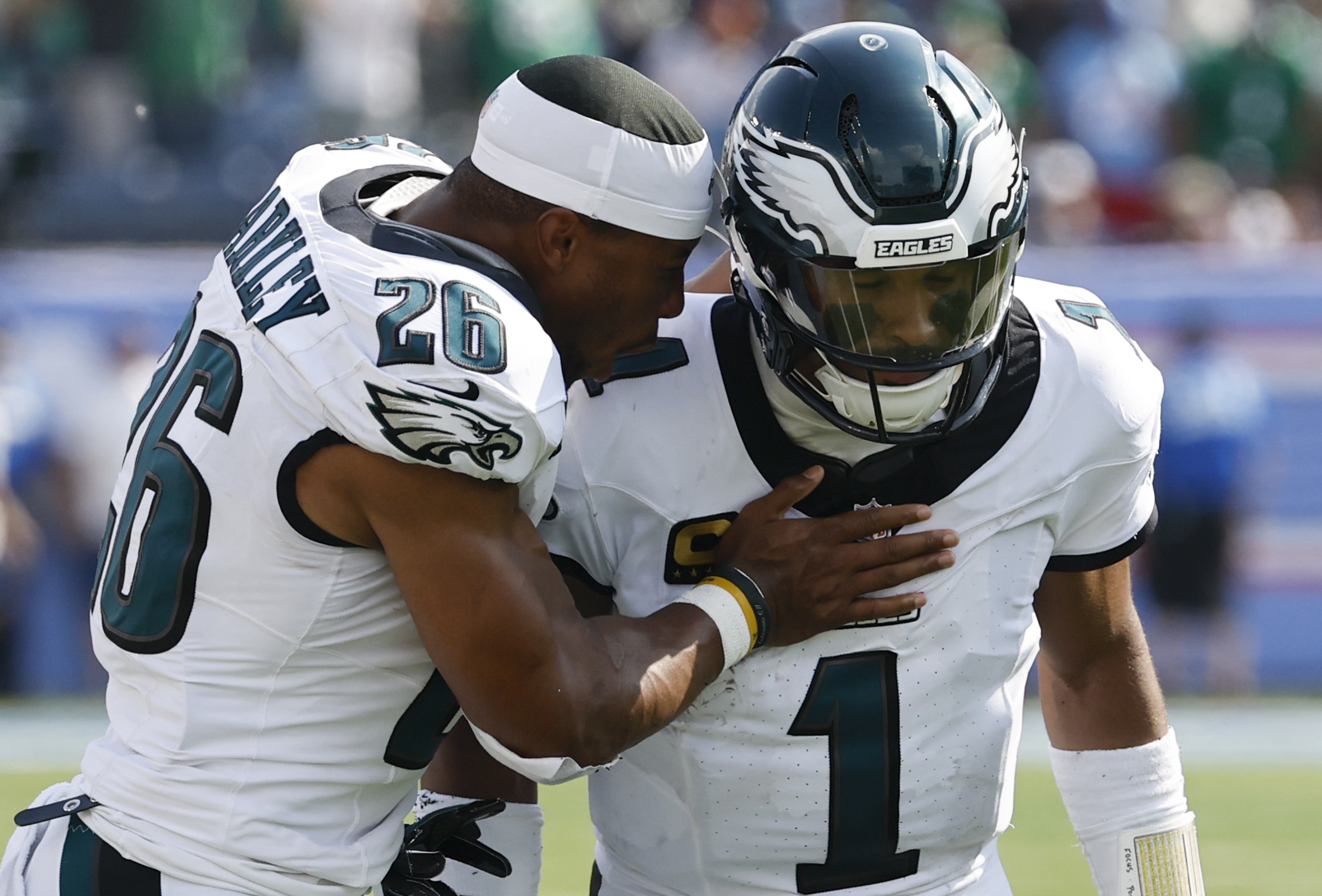
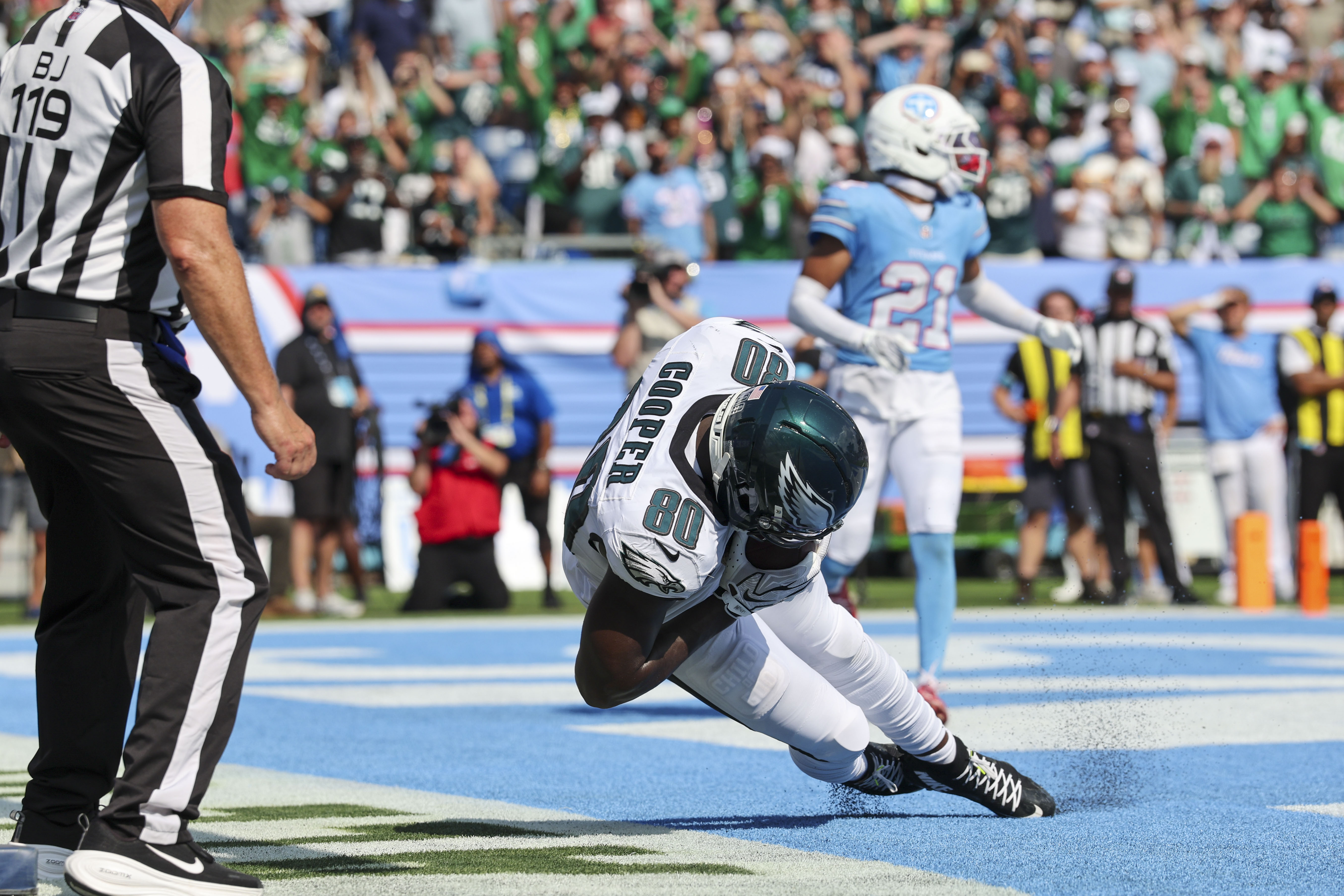
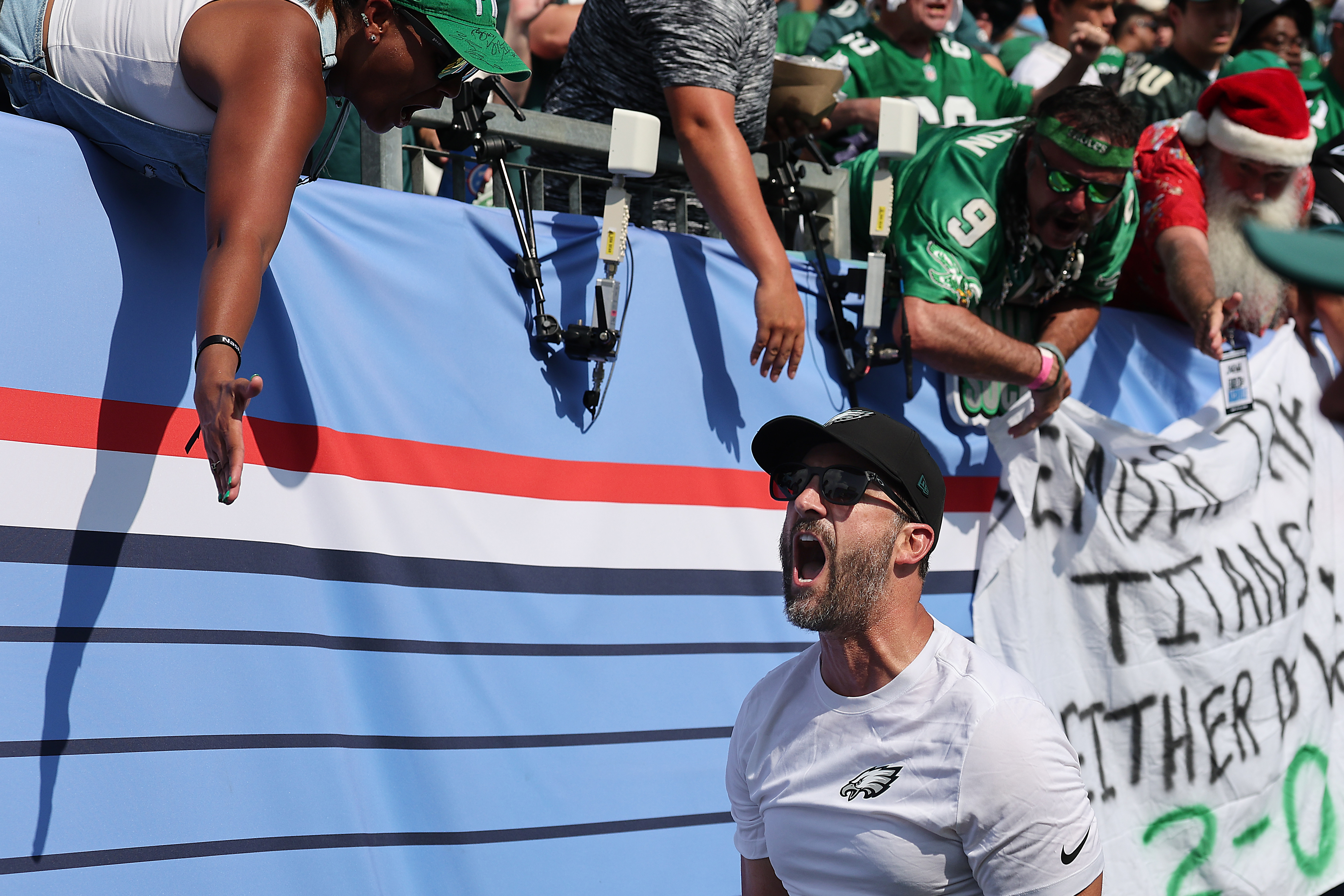
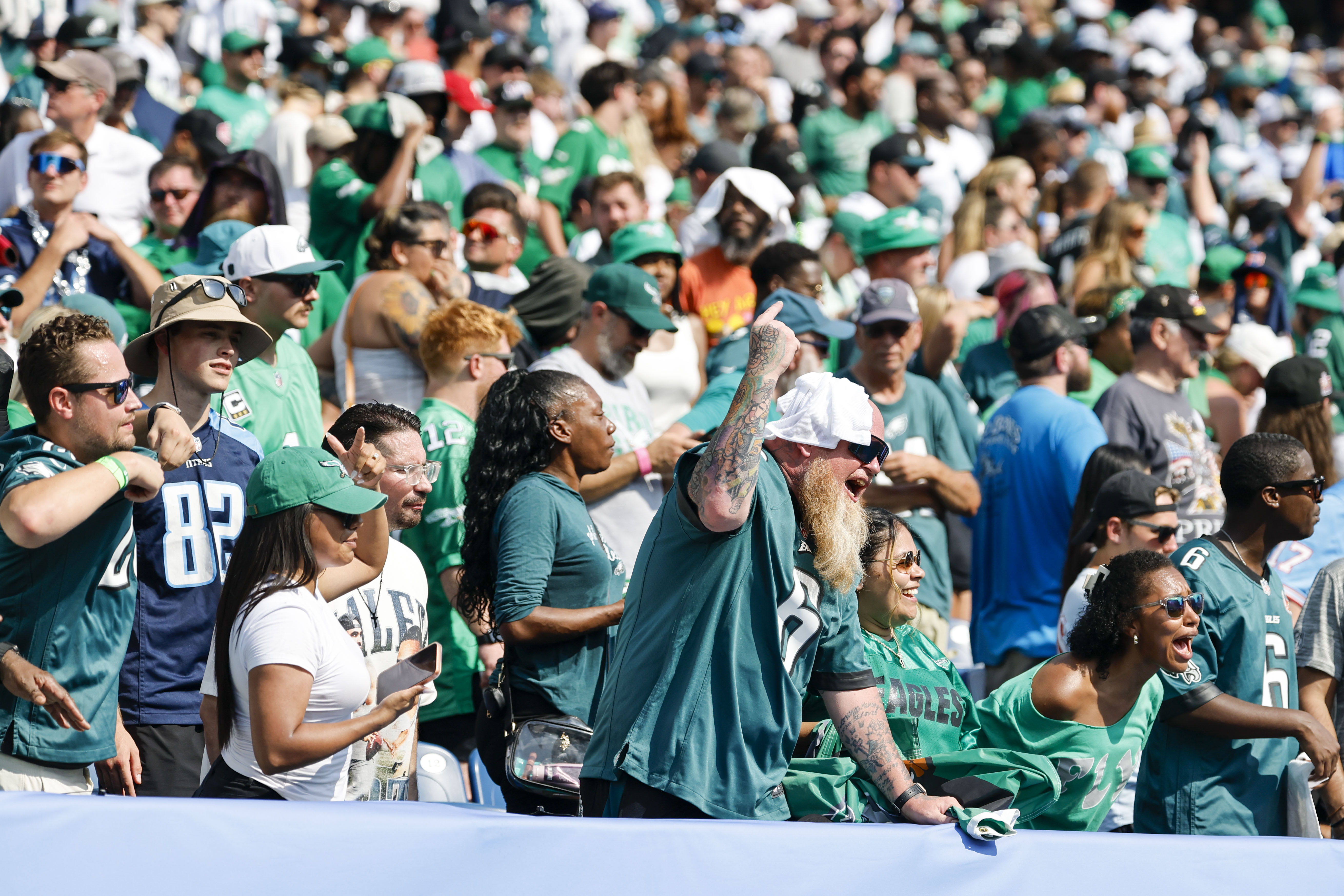
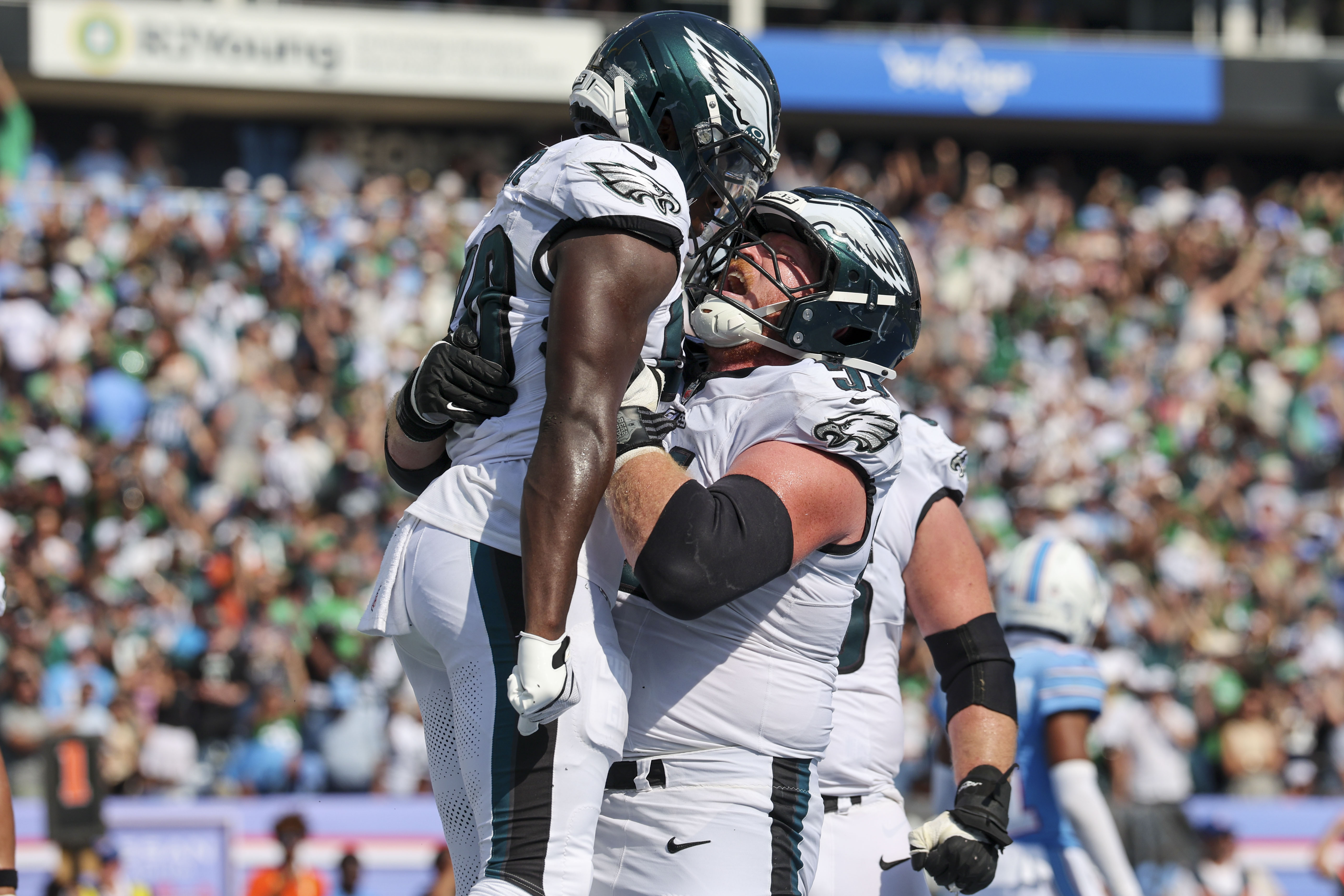
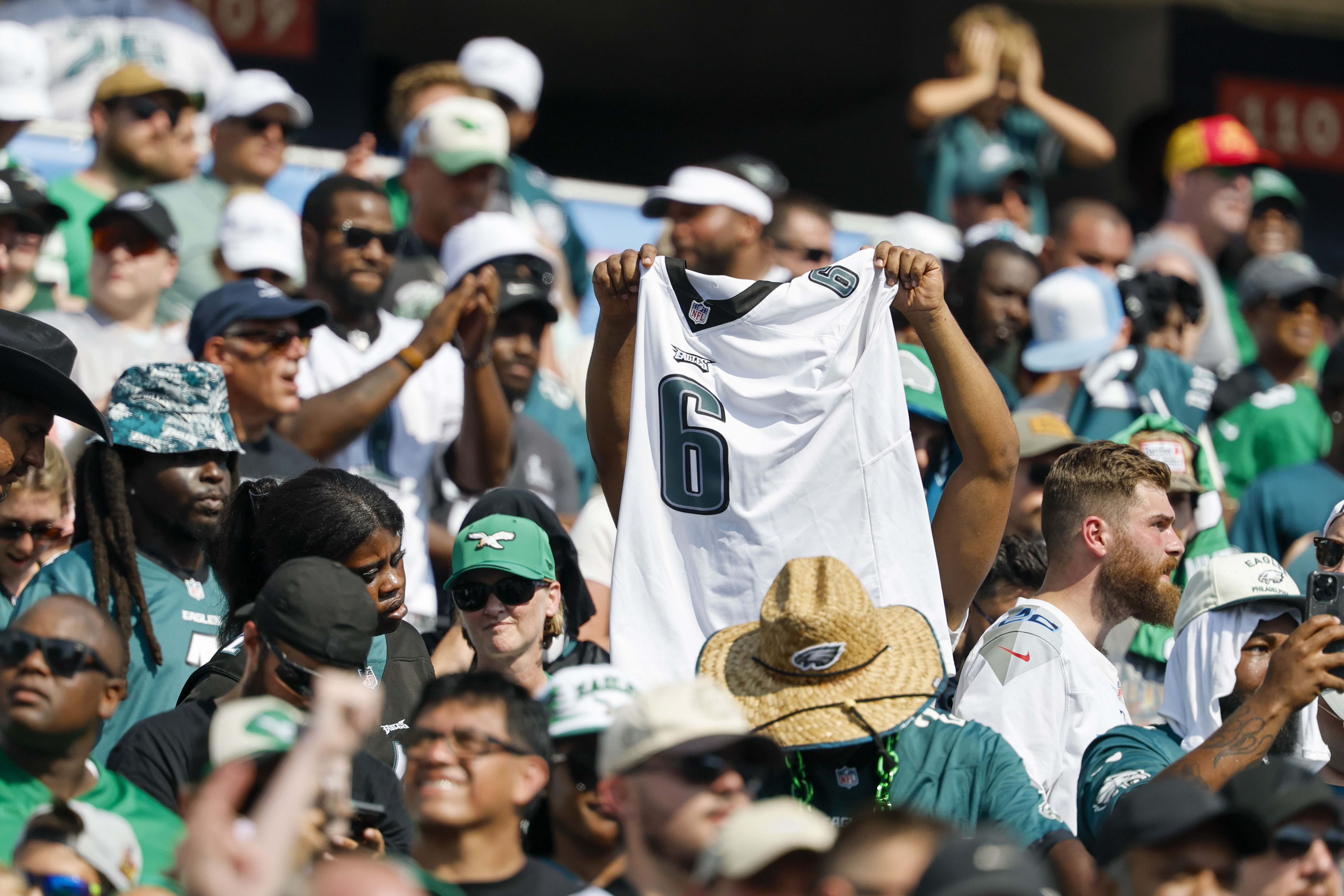
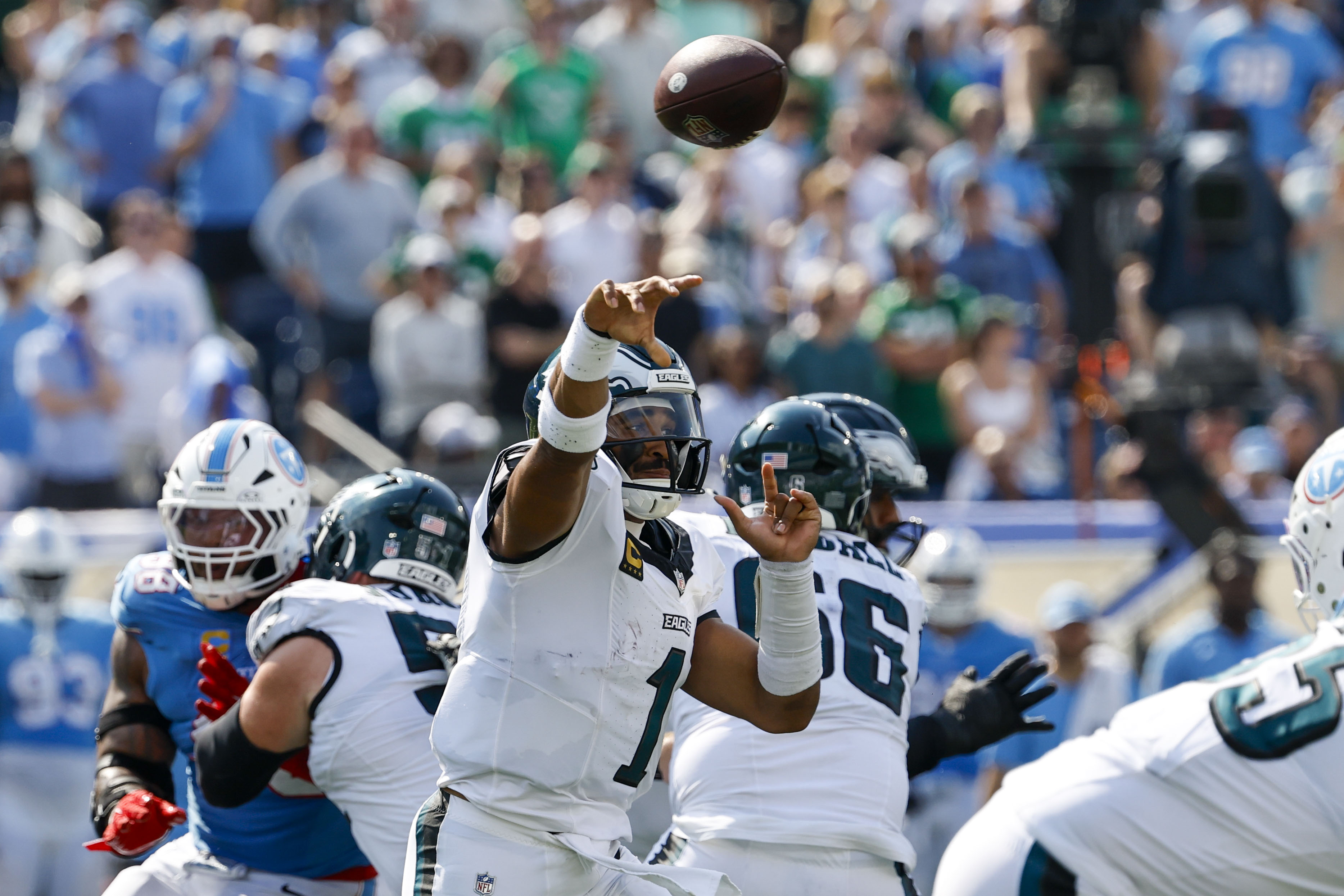
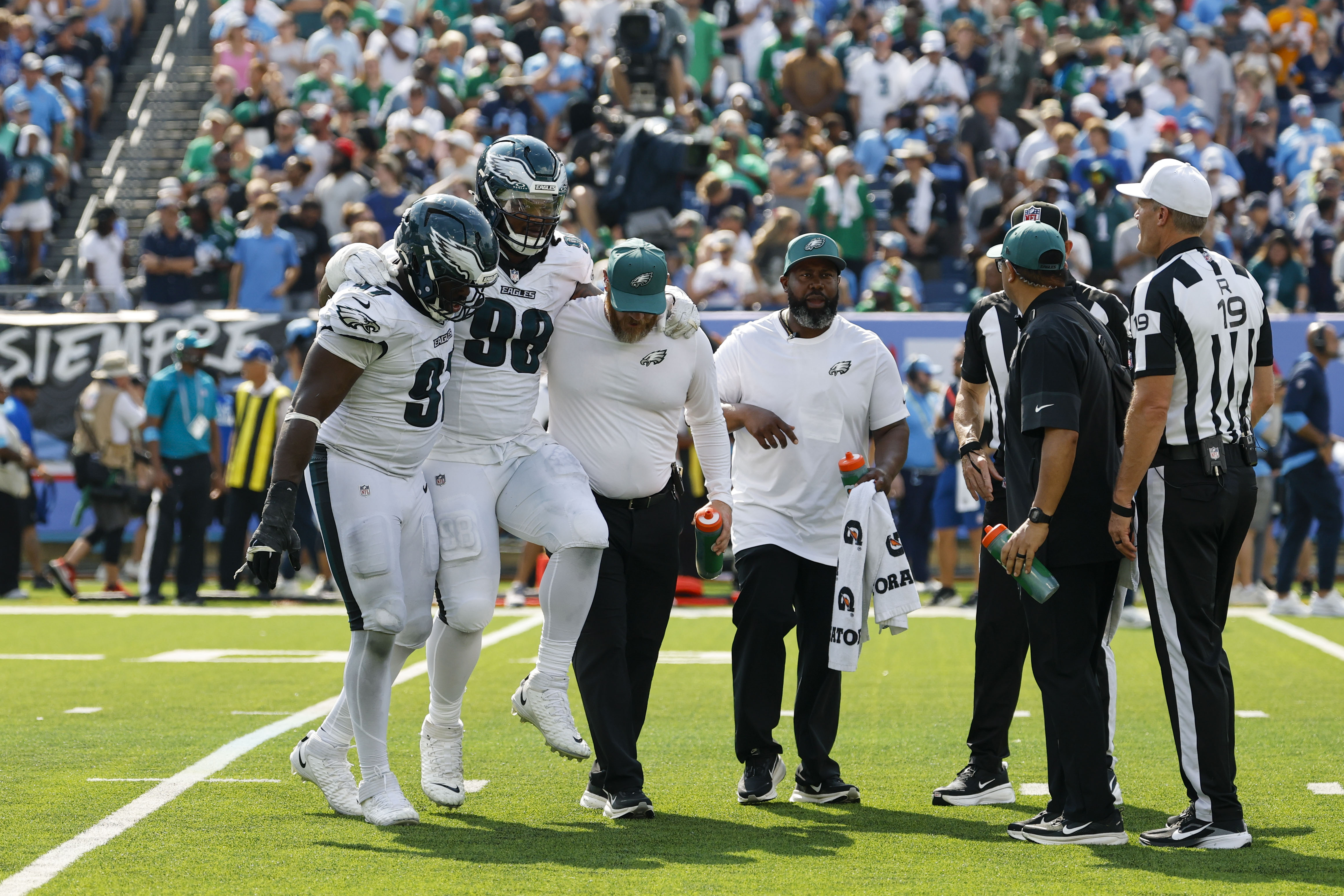
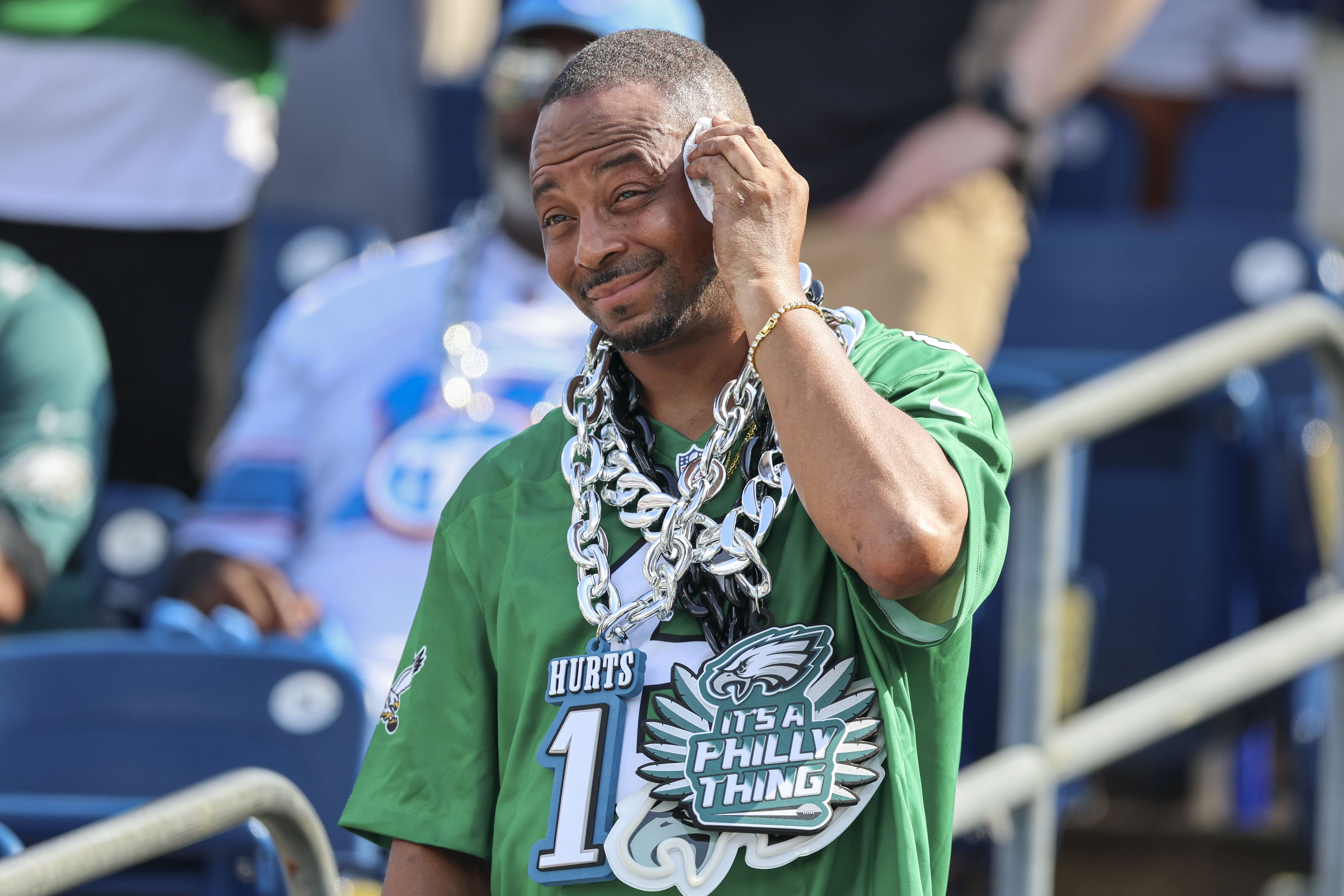
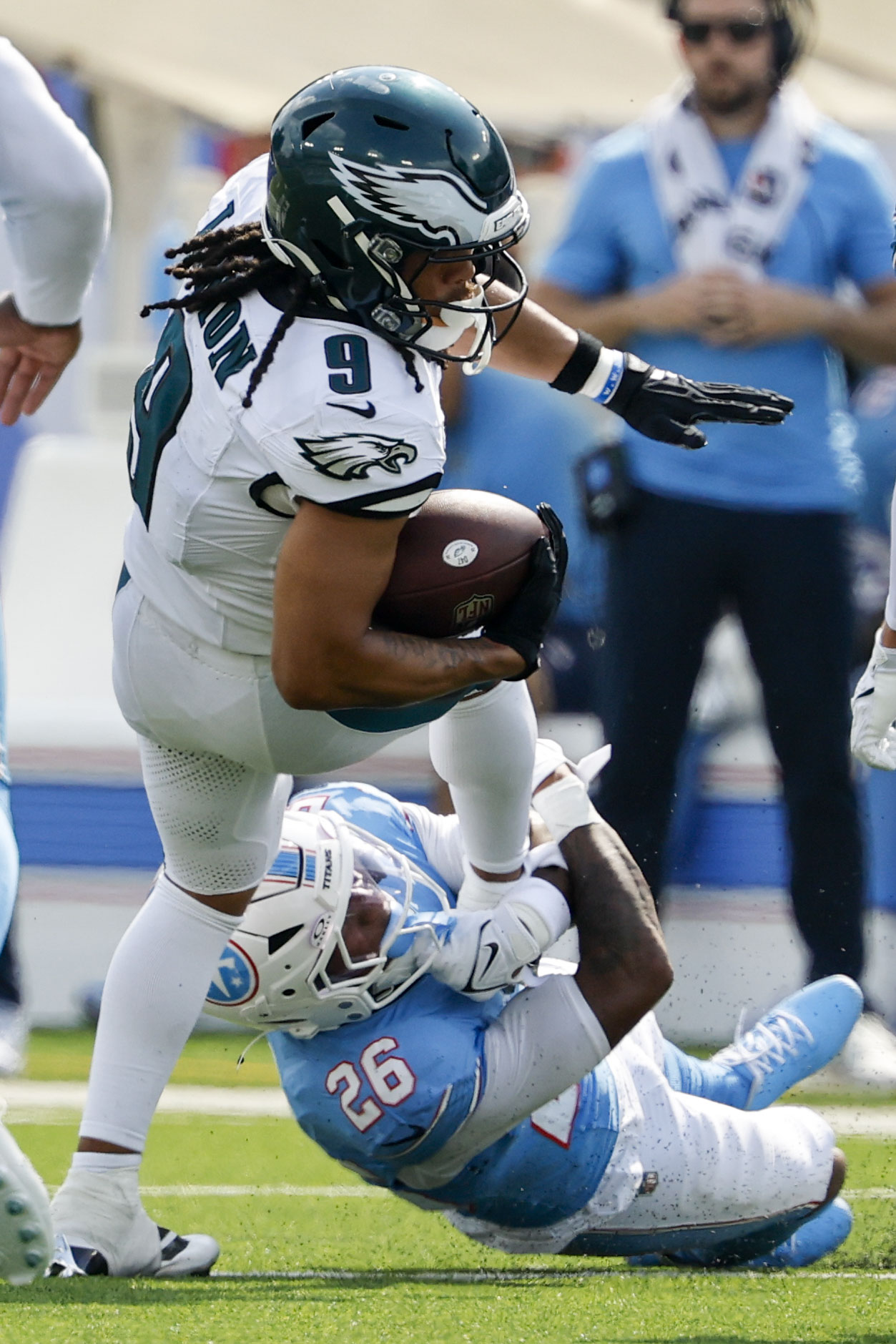
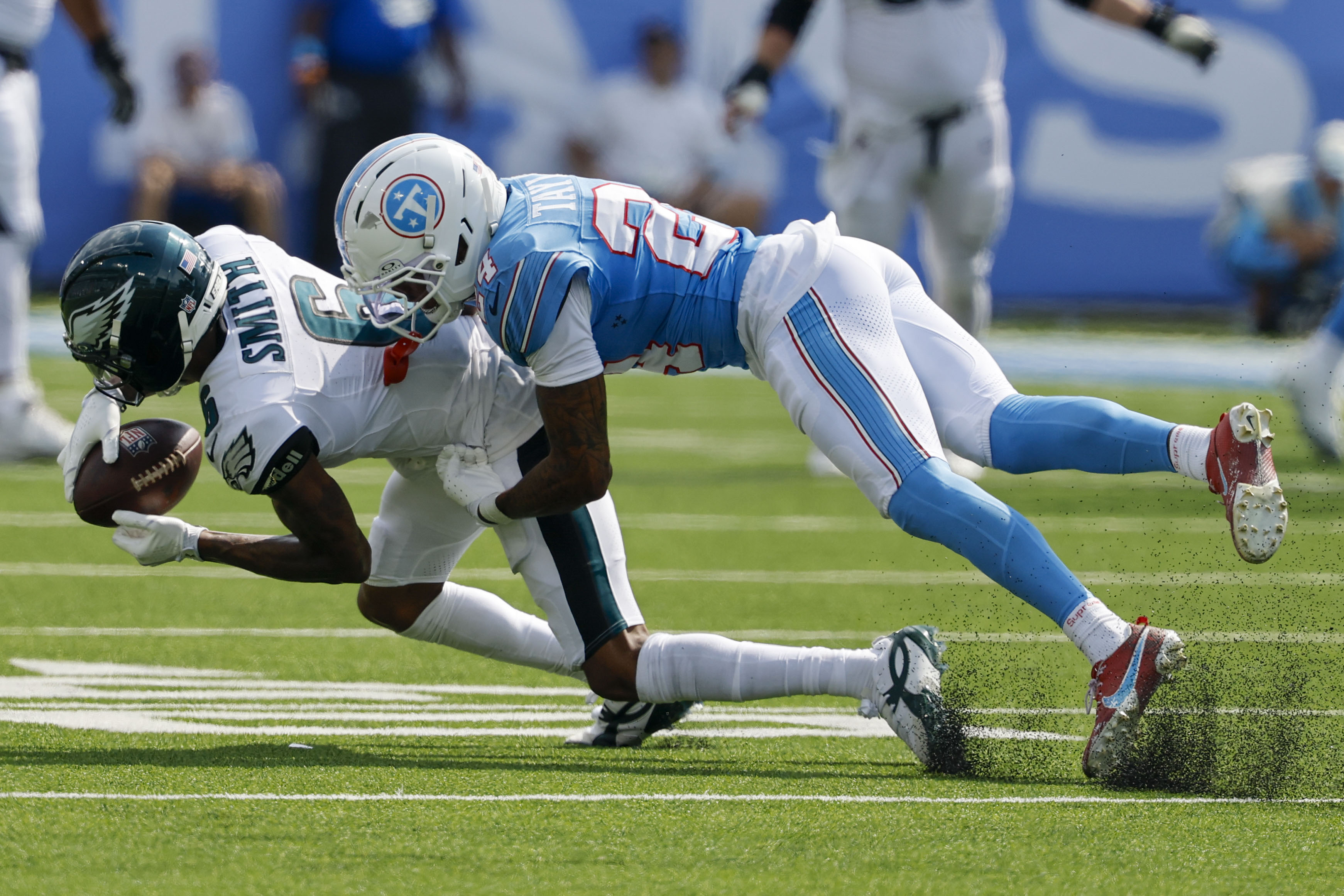
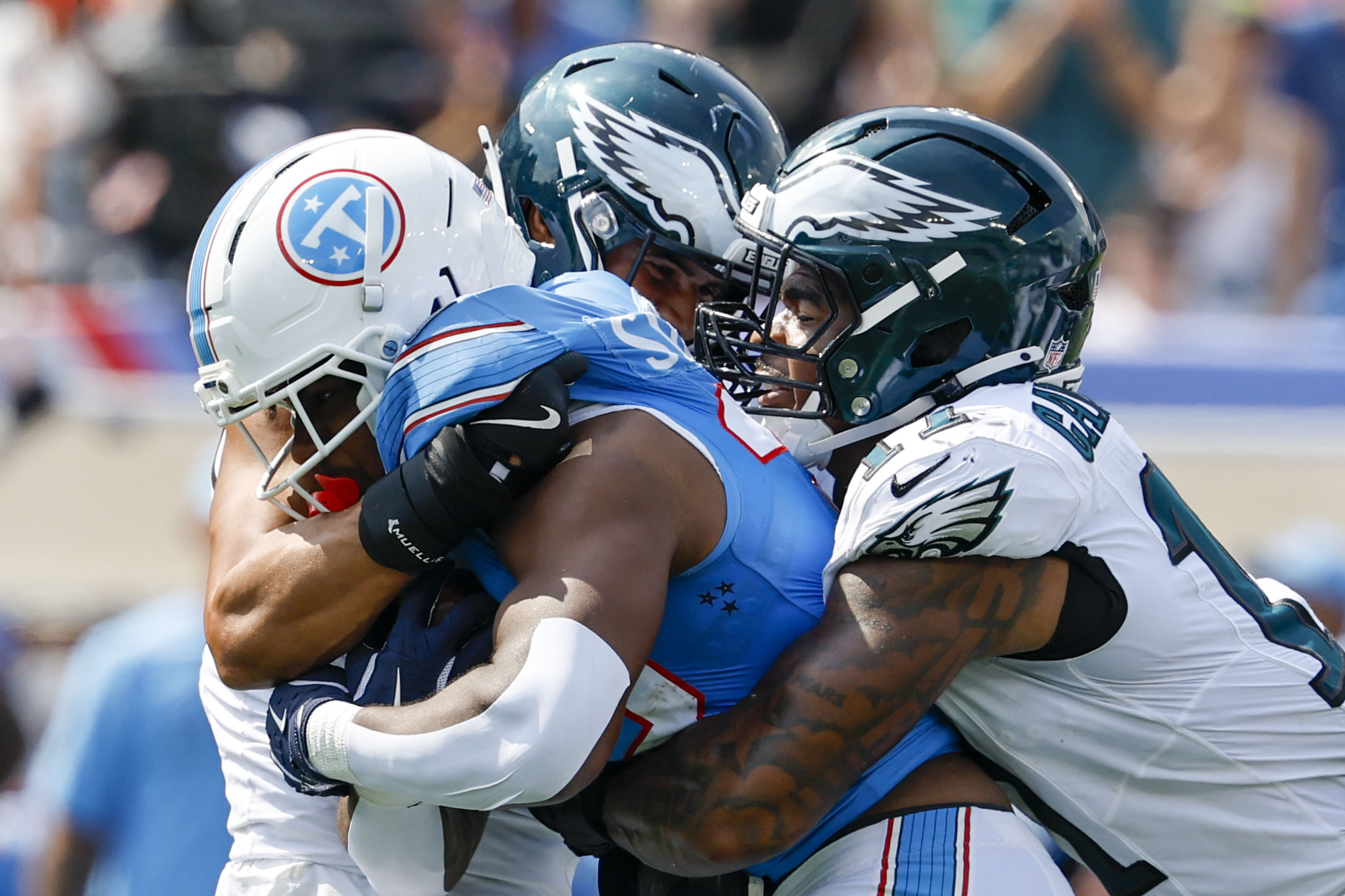
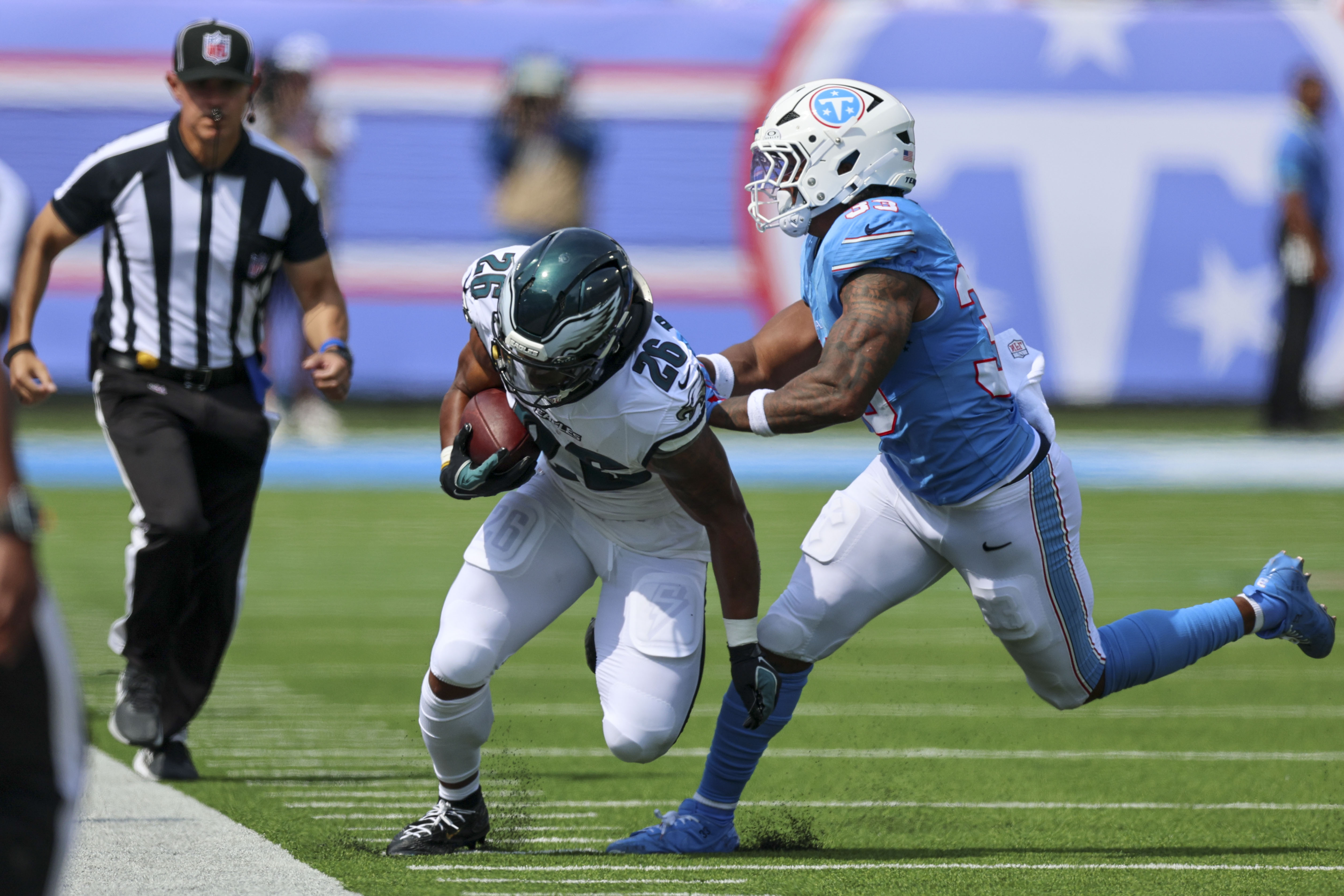
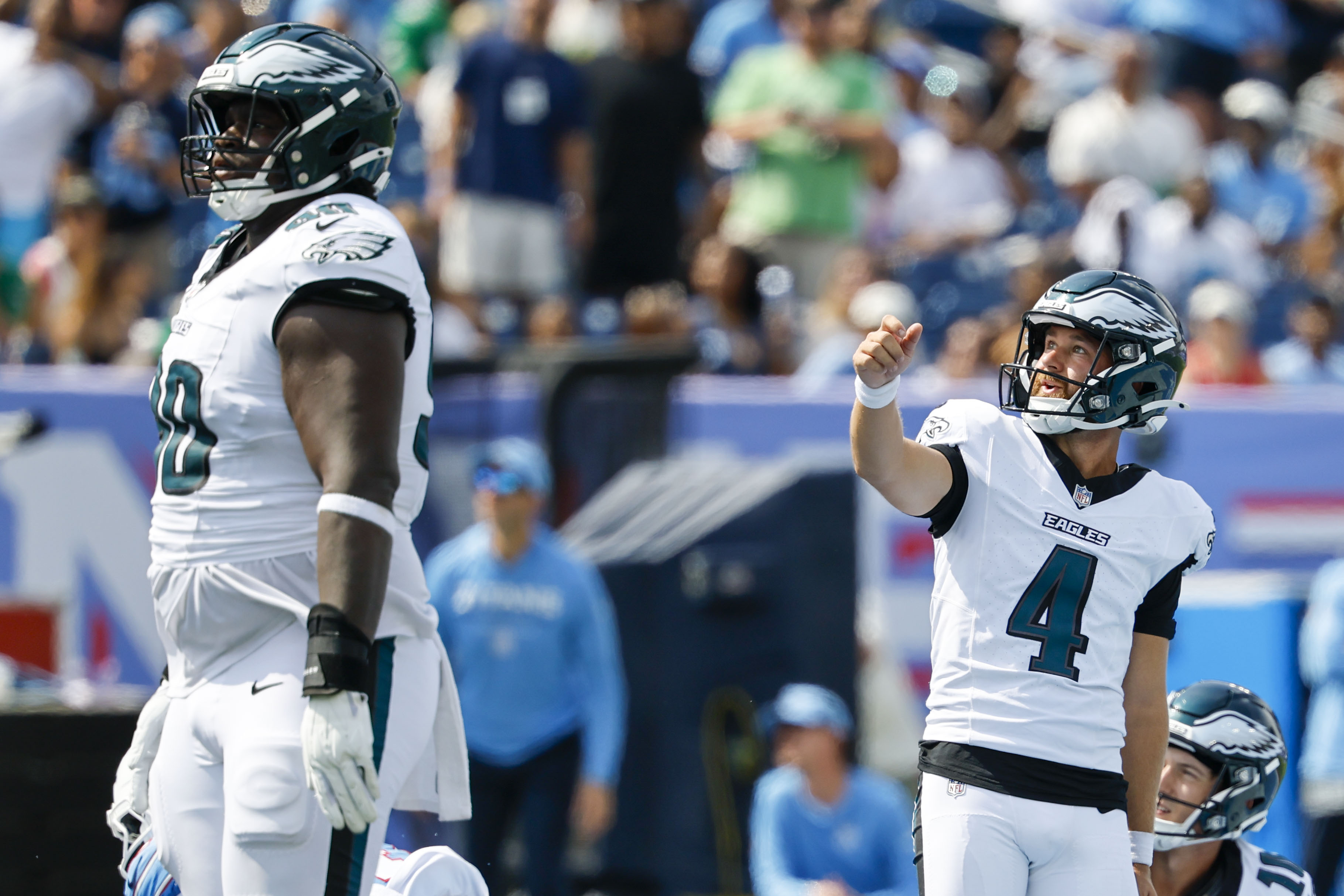
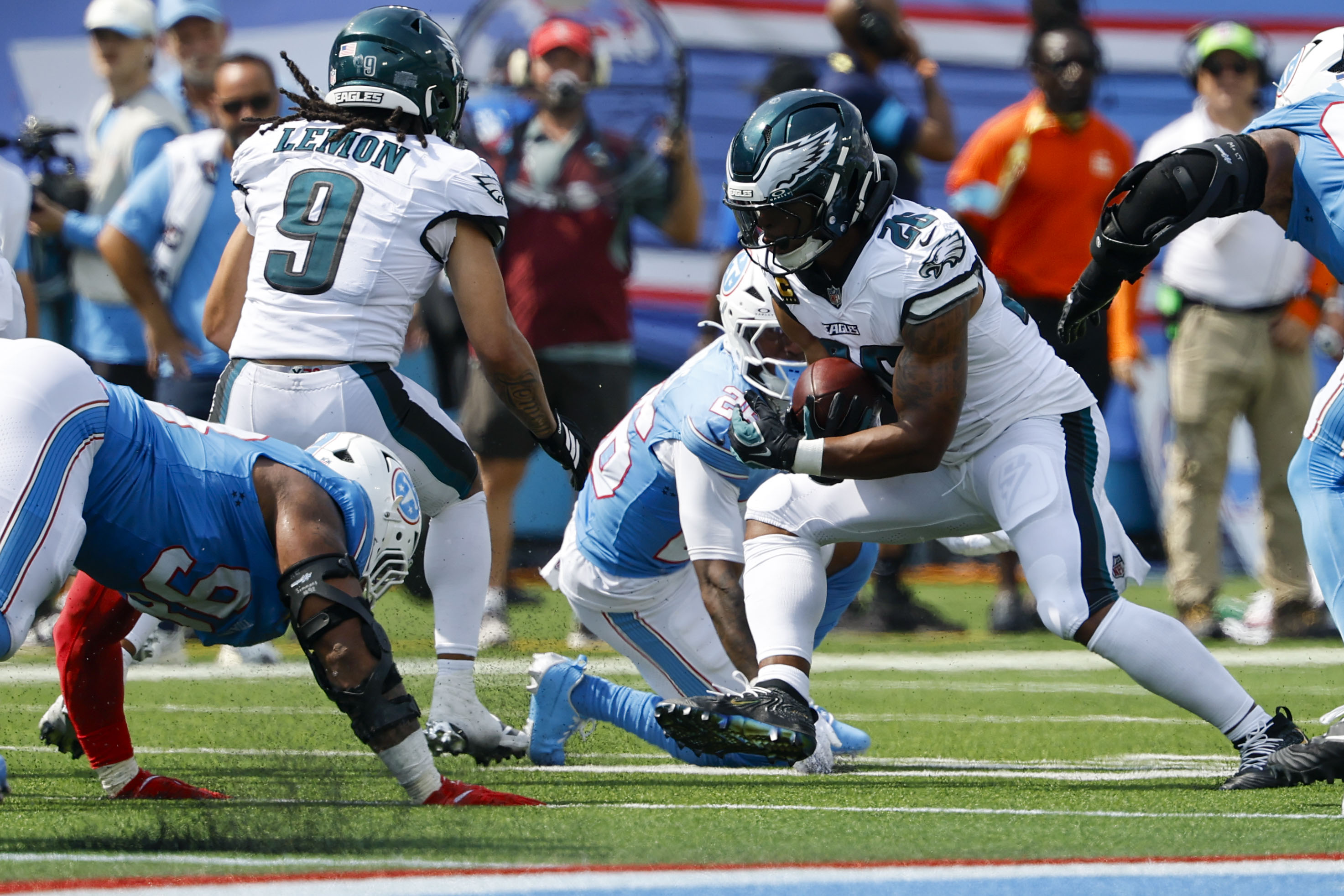
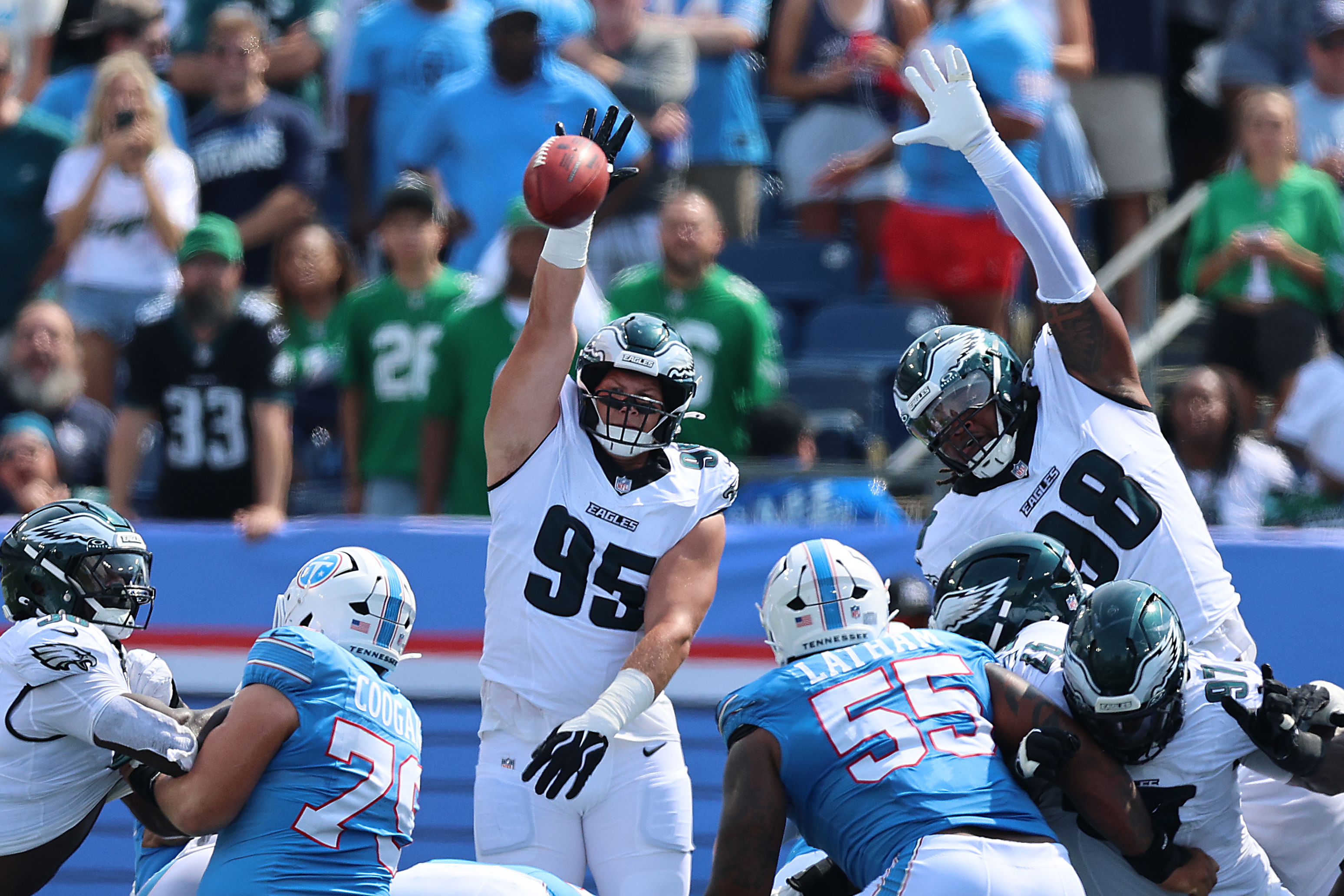
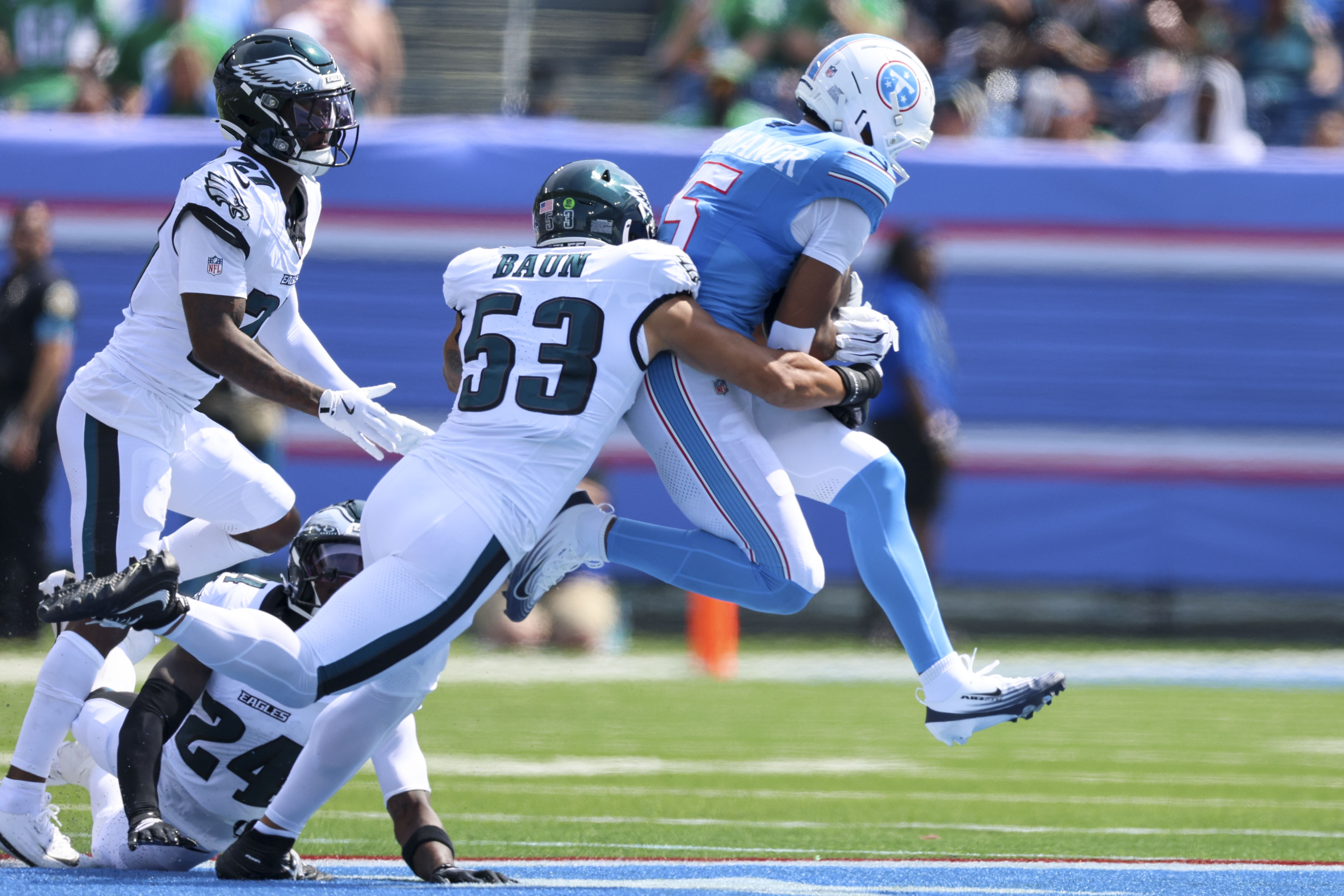
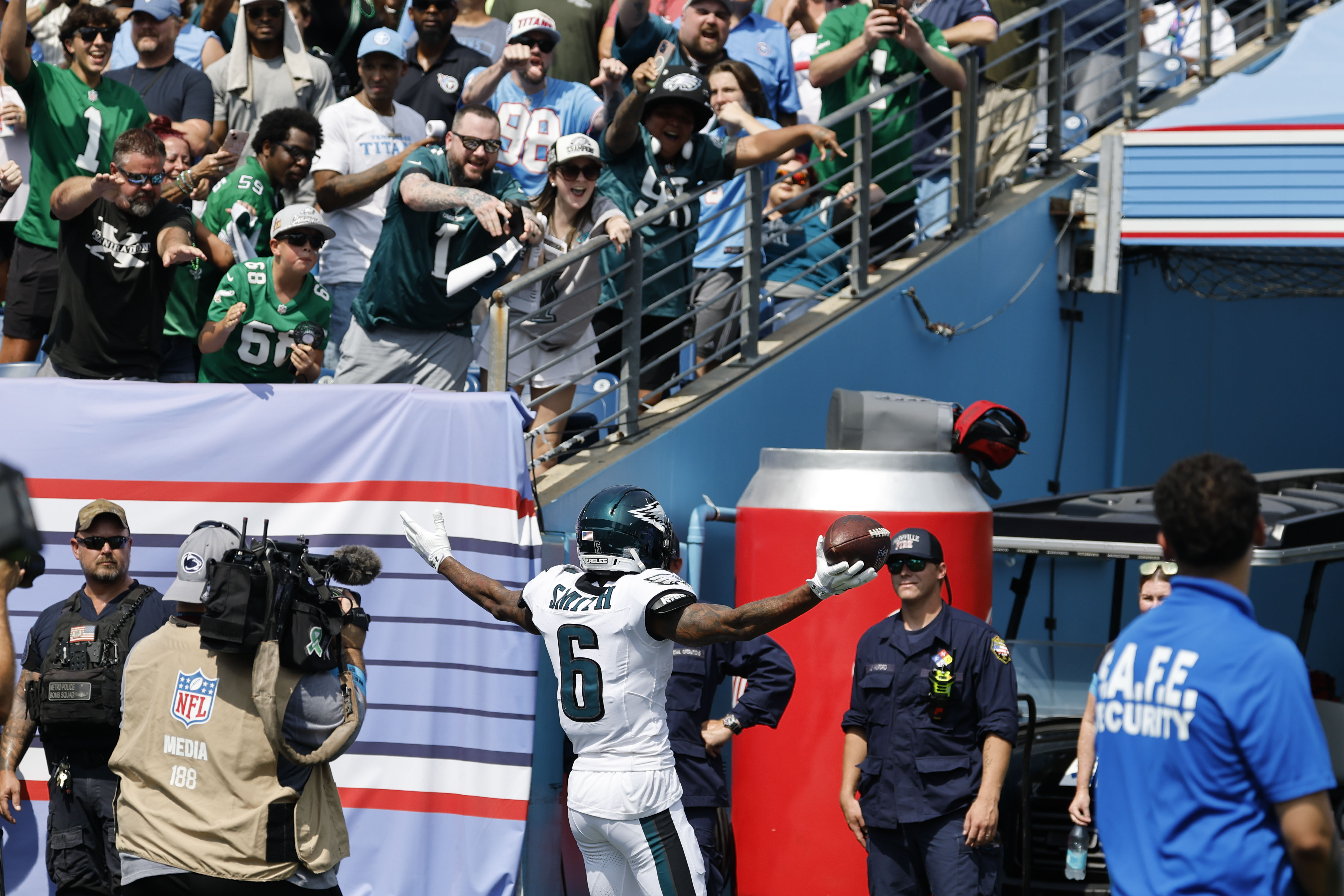
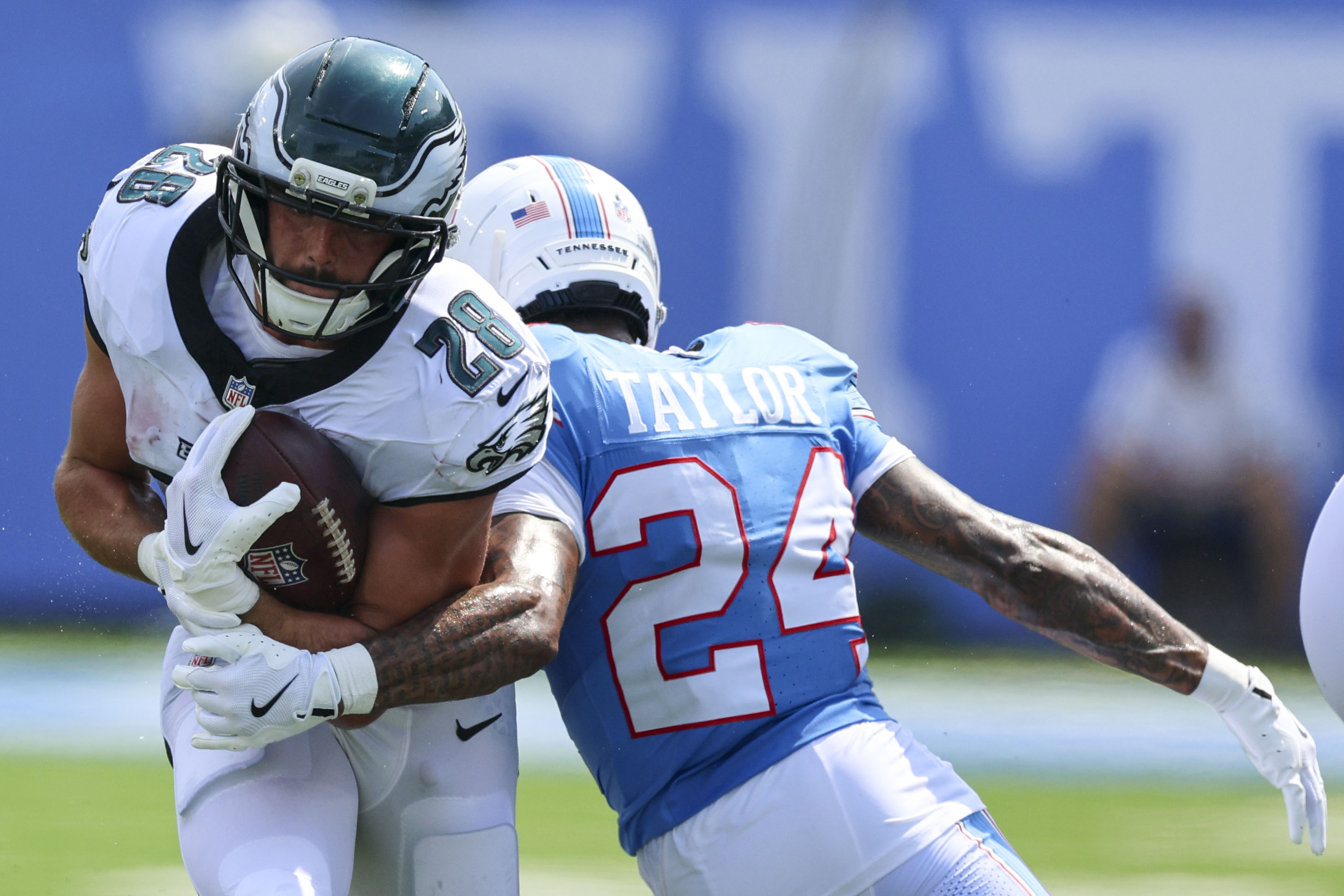
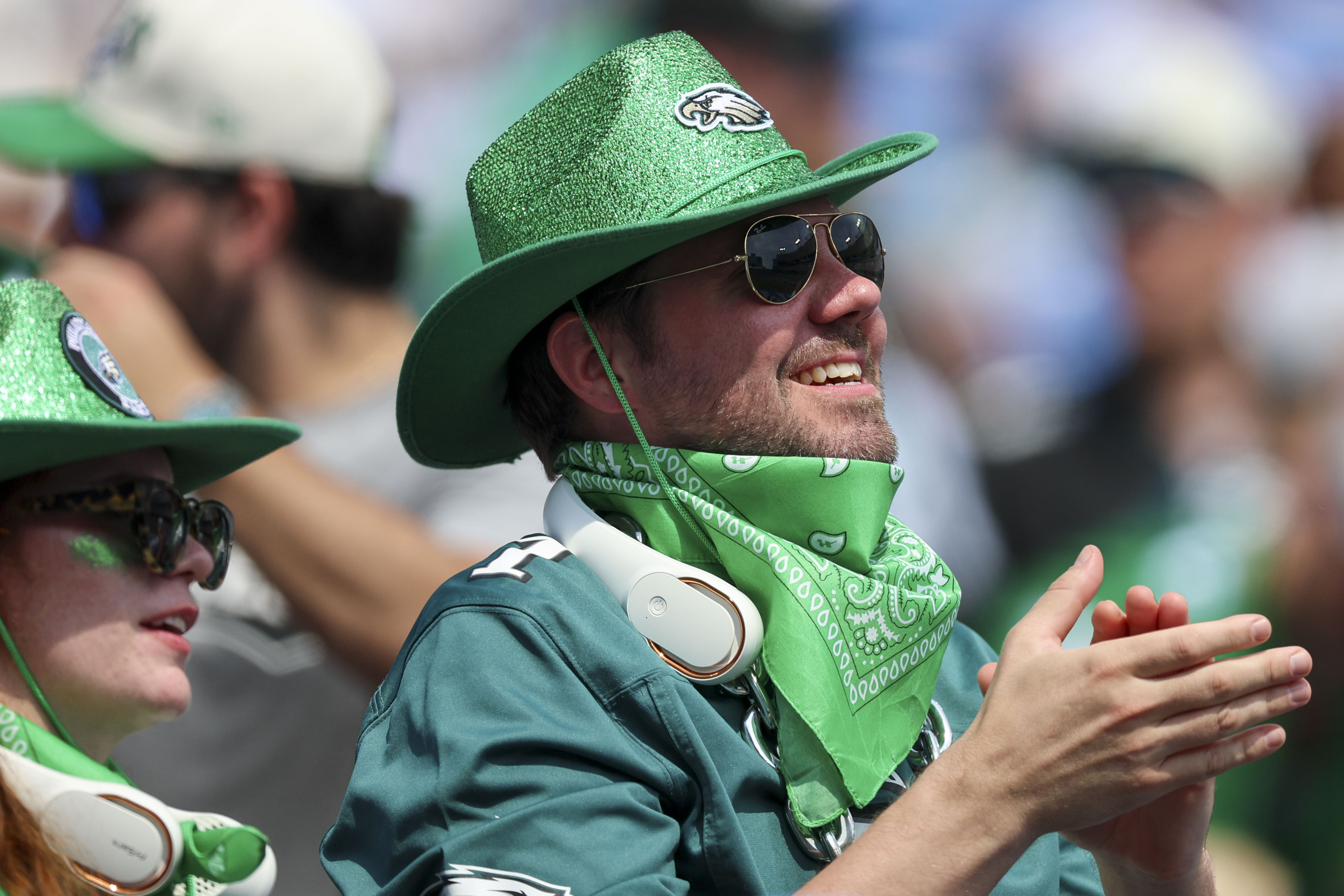
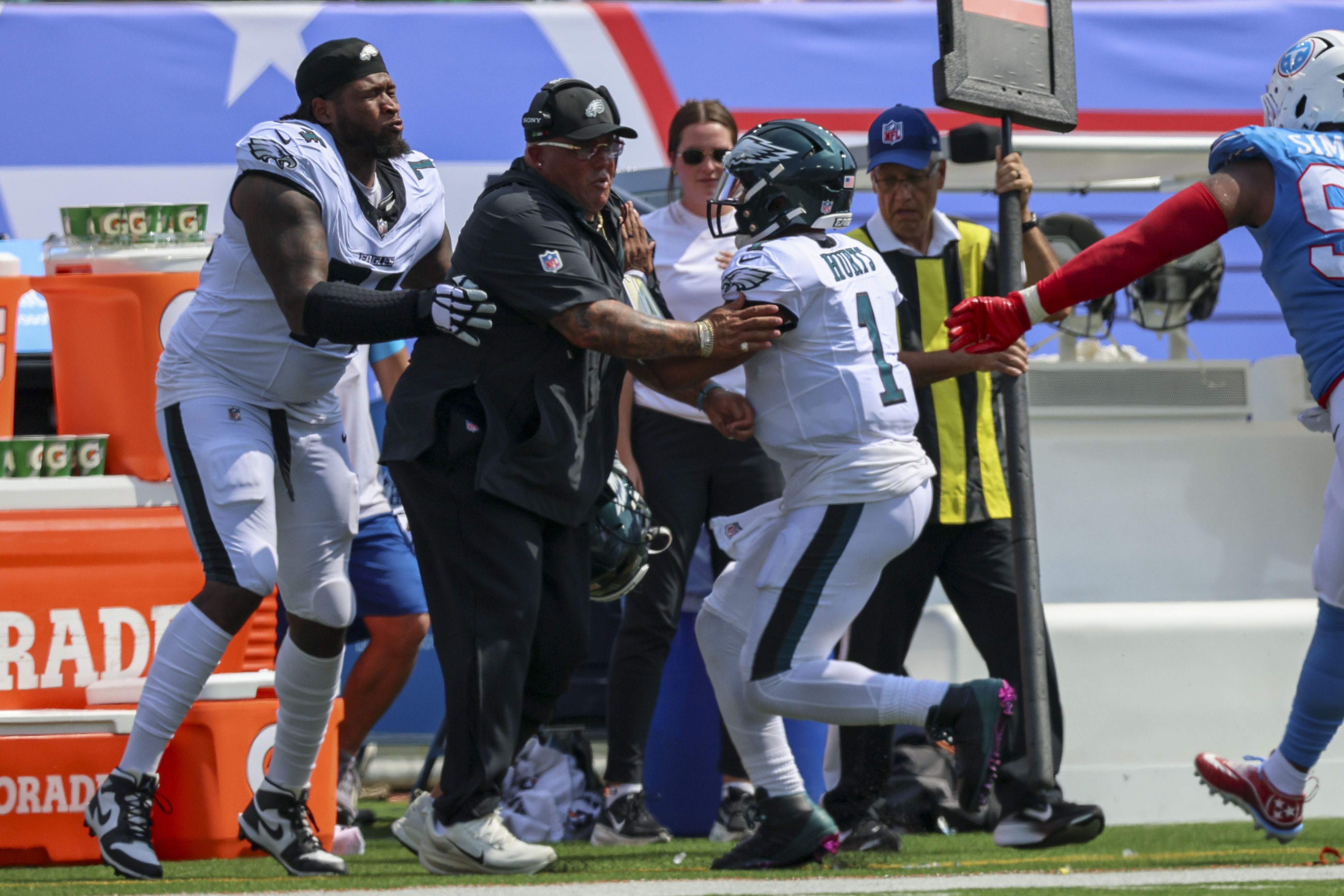
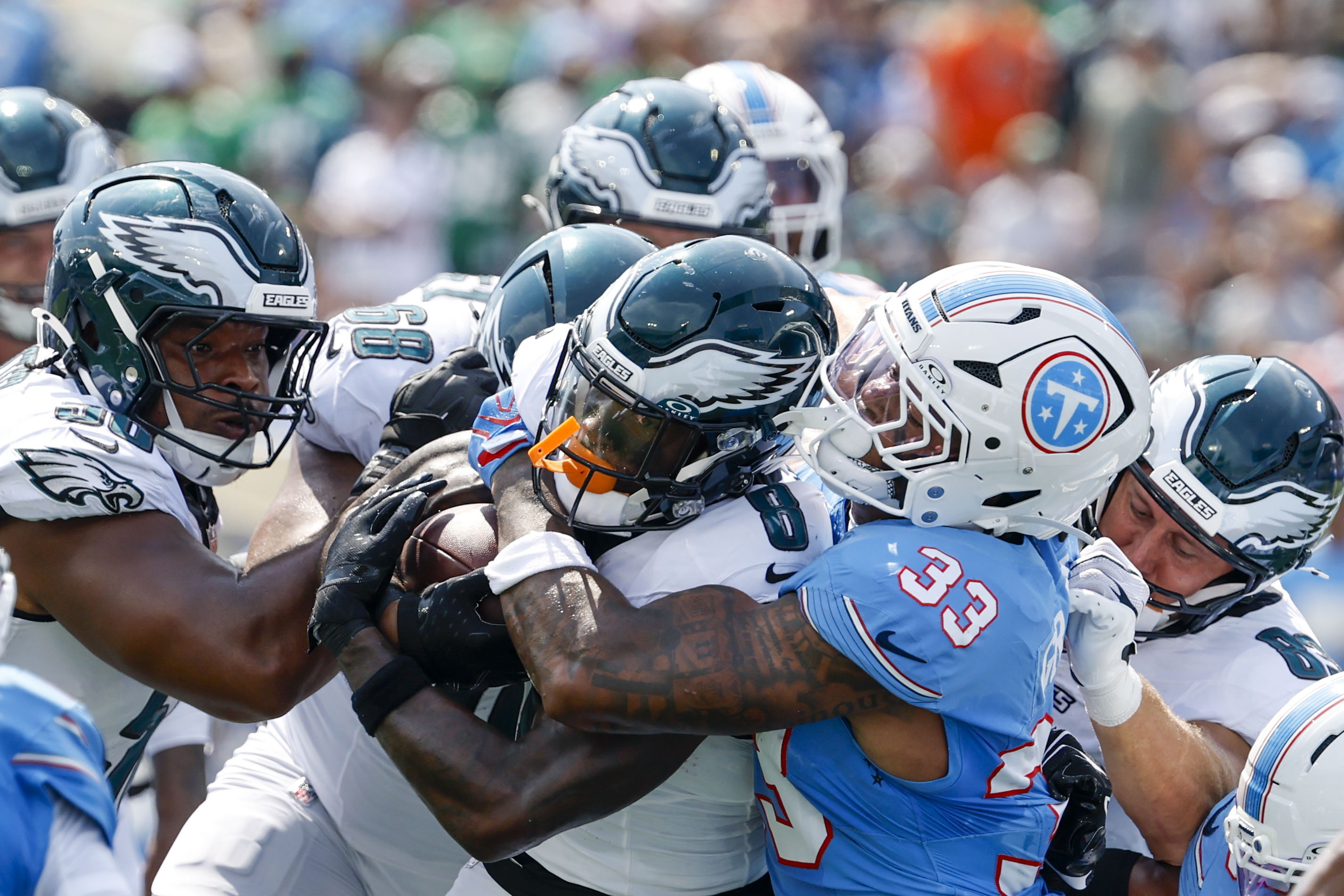
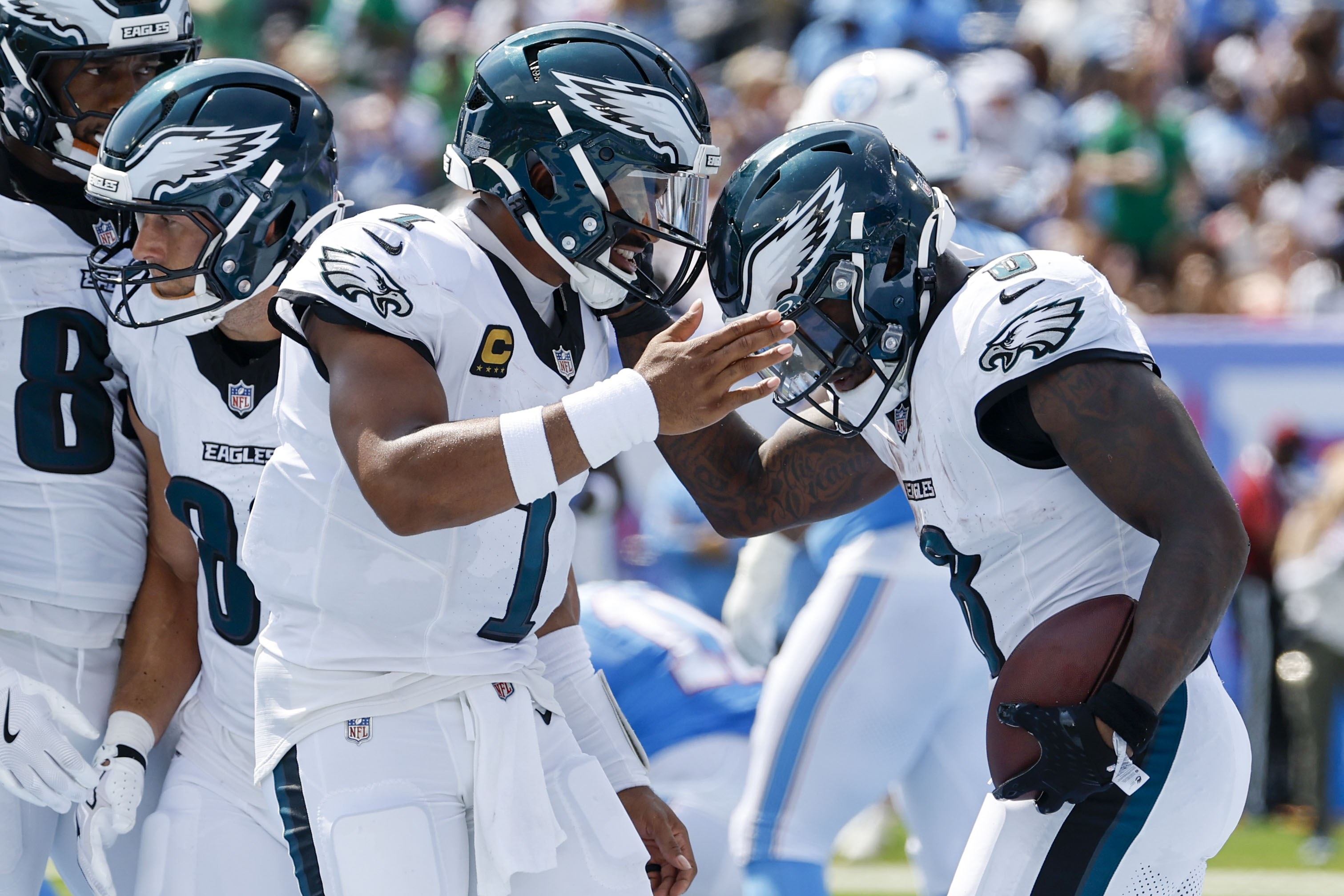
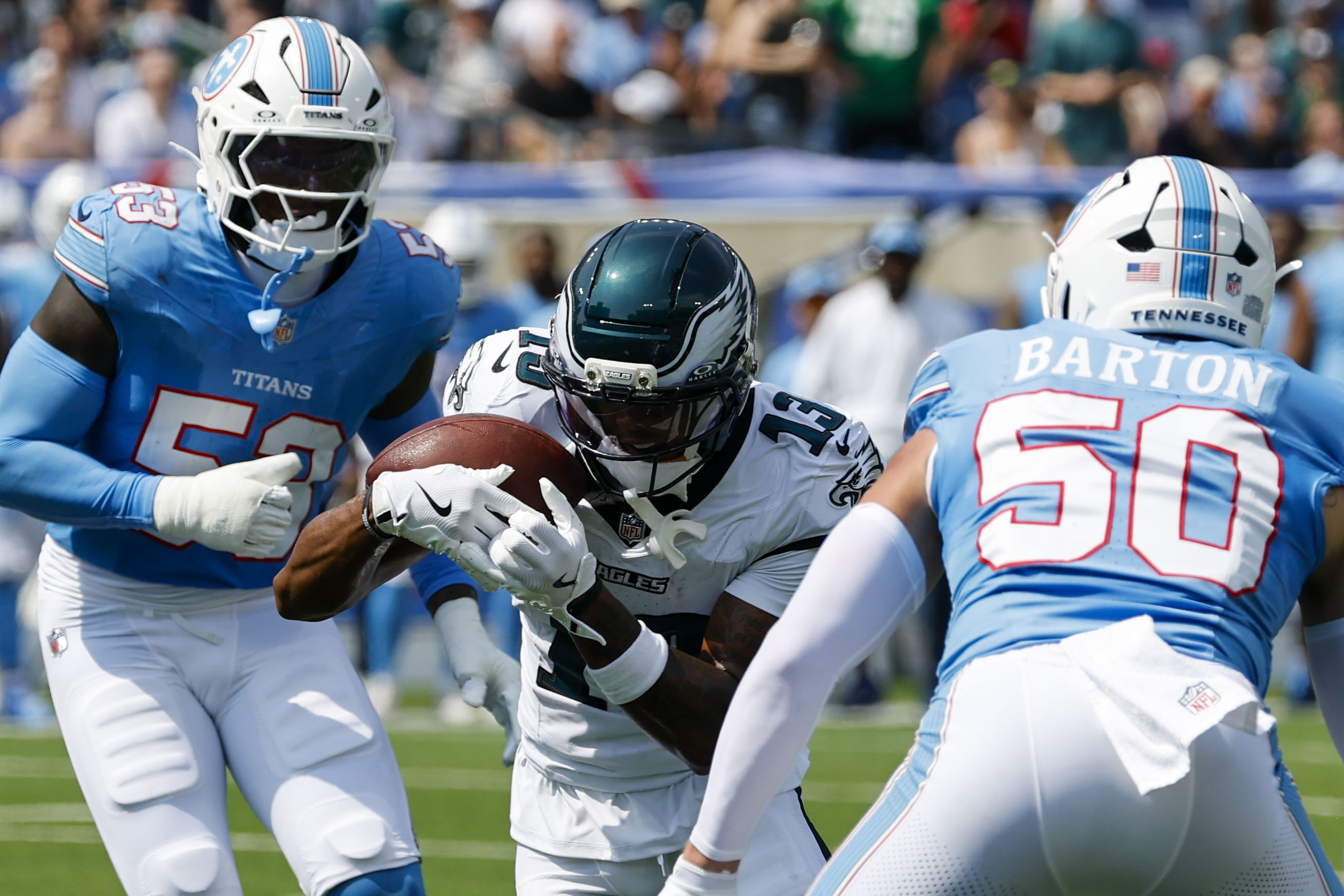
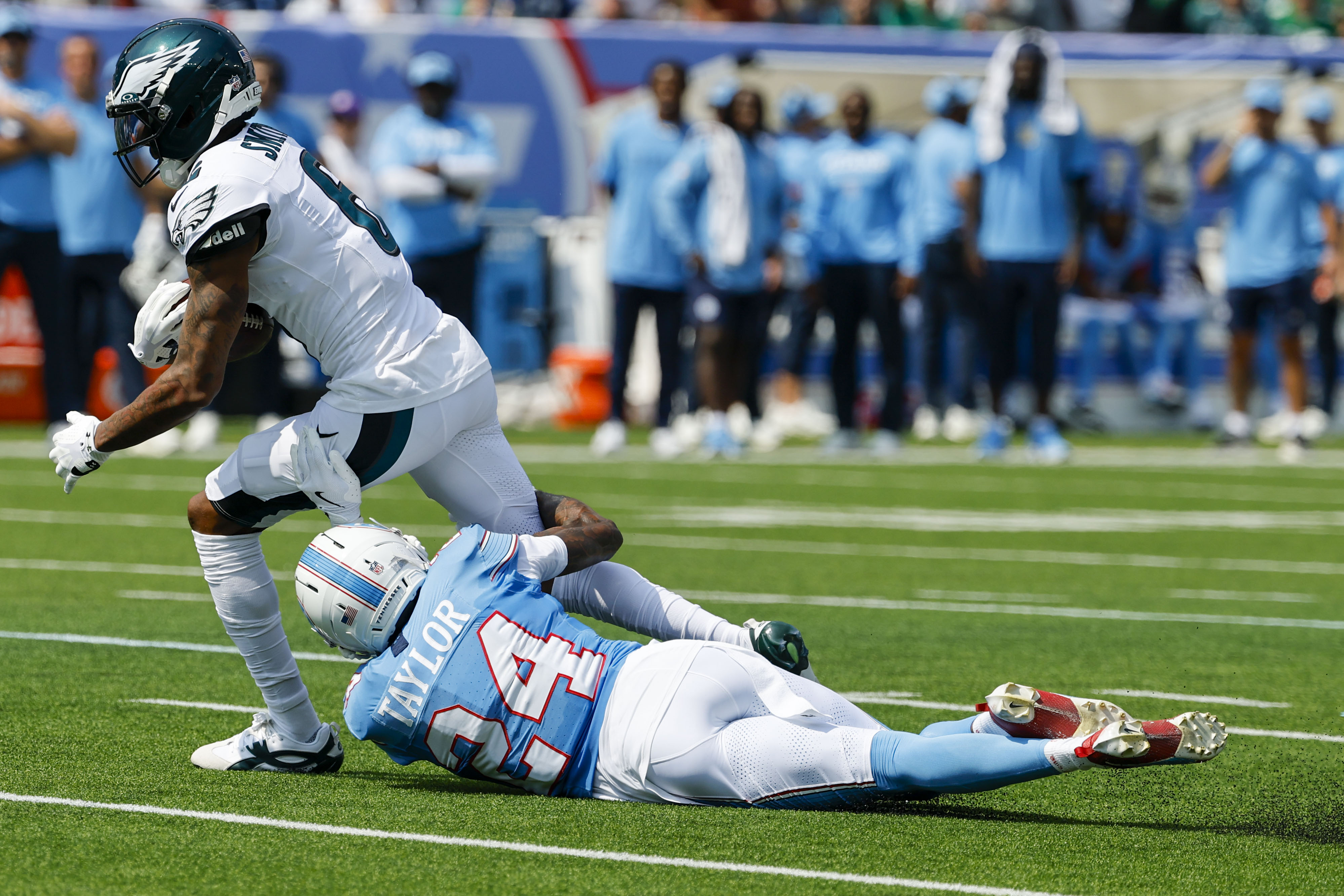
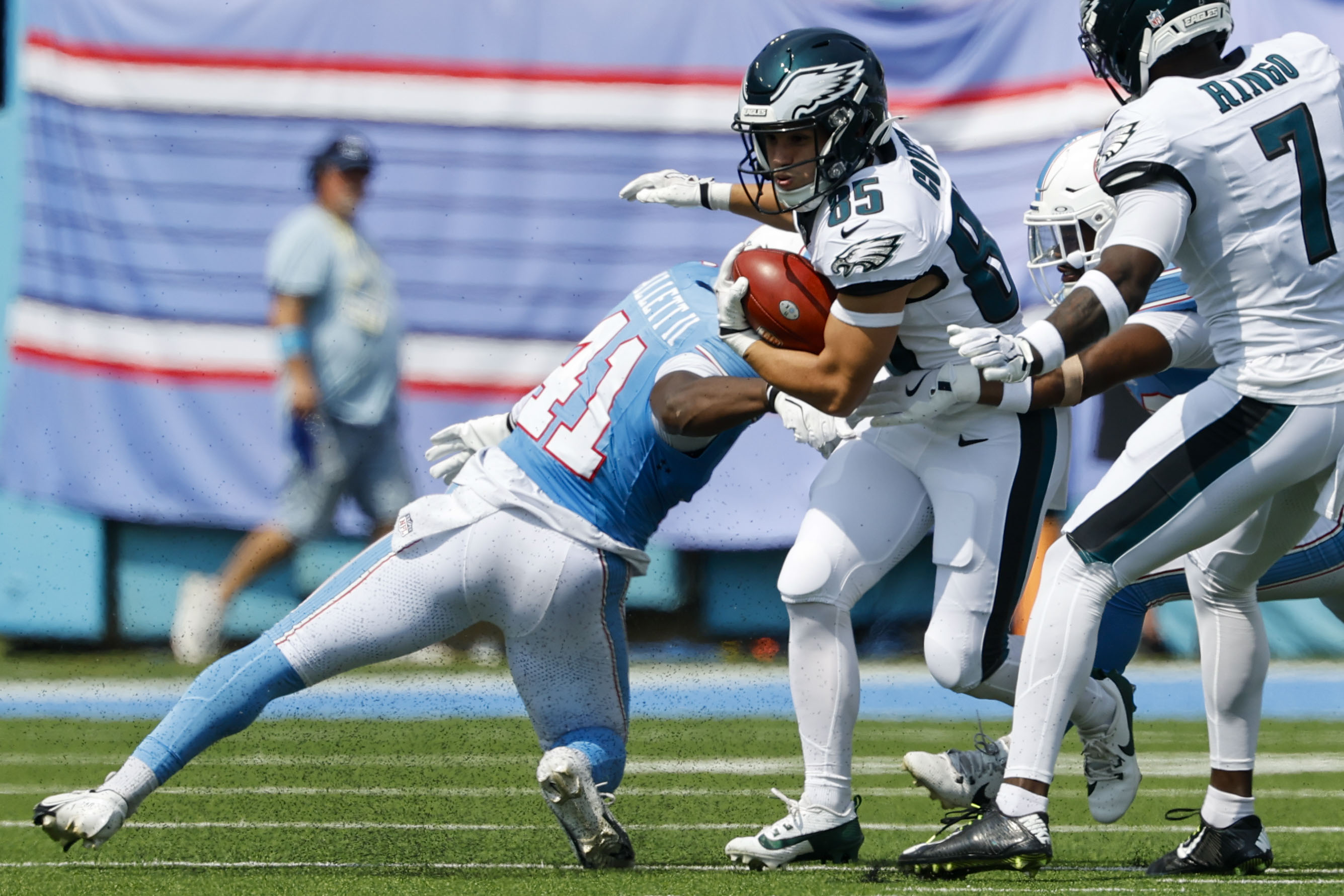
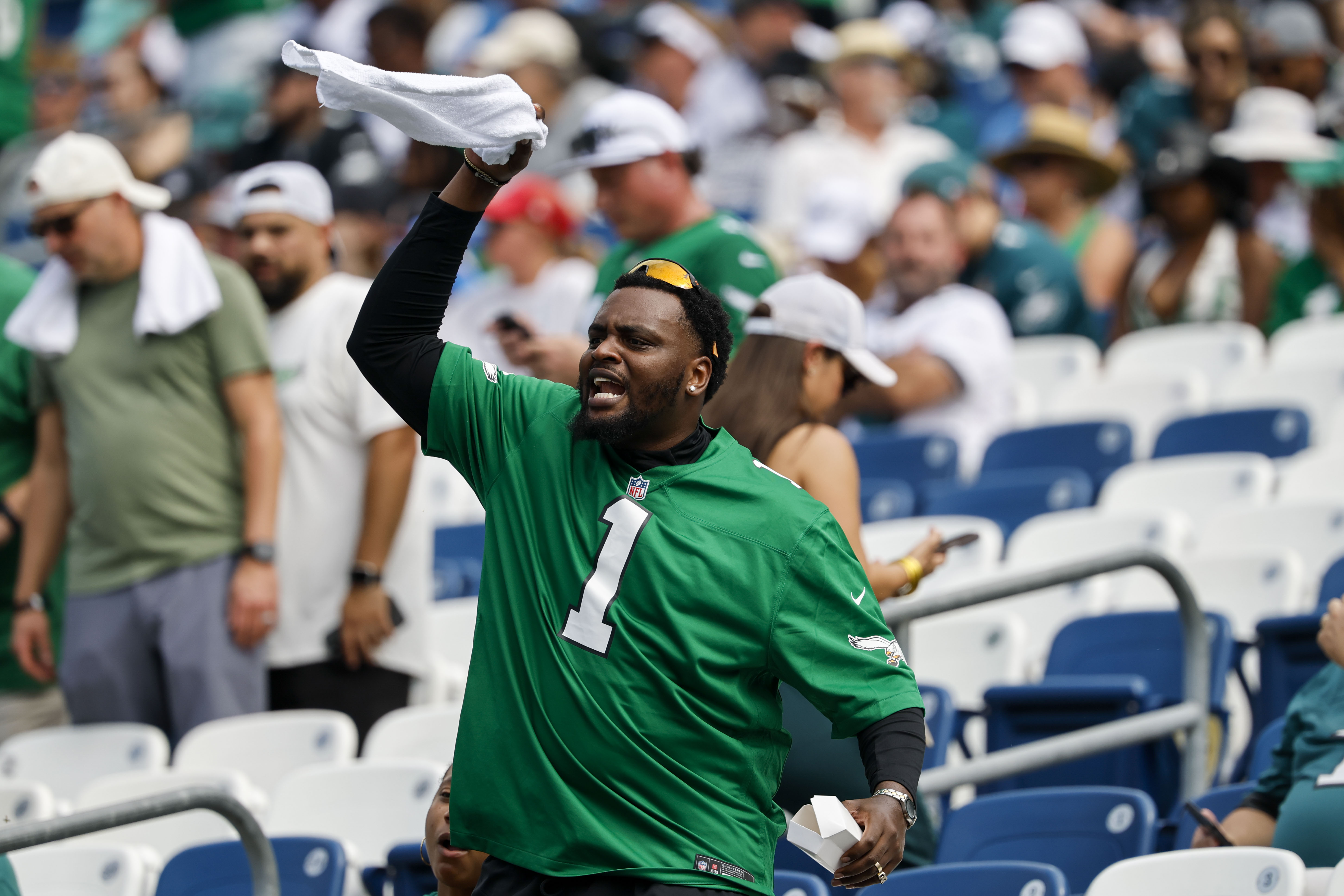
Philadelphia Eagles head coach Nick Sirianni (left) and assistant to the head coach Cole Peterson (right) dance off the field after beating the Tennessee Titans 24-20 in Nashville, Tenn. on Sunday, Sept. 20, 2026.David Maialetti / Staff PhotographerEagles head coach Nick Sirianni celebrates after the Eagles beat the Tennessee Titans.Yong Kim / Staff PhotographerEagles quarterback Jalen Hurts celebrates with running back Saquon Barkley after throwing the game-winning touchdown against the Tennessee Titans.Yong Kim / Staff PhotographerEagles wide receiver Darius Cooper catches the game-winning touchdown late in the fourth quarter.Yong Kim / Staff PhotographerPhiladelphia Eagles wide receiver Darius Cooper catches a touchdown with 9 seconds left in the fourth quarter.David Maialetti / Staff PhotographerPhiladelphia Eagles head coach Nick Sirianni celebrates after they beat the Tennessee Titans.David Maialetti / Staff PhotographerHappy Philadelphia Eagles fans after the Eagles scored a touchdown with seconds left in the fourth quarter.Yong Kim / Staff PhotographerPhiladelphia Eagles center Cam Jurgens lifts up Philadelphia Eagles wide receiver Darius Cooper after Cooper makes the winning touchdown with seconds left in the fourth quarter. David Maialetti / Staff PhotographerPhiladelphia Eagles fan holds up a Philadelphia Eagles wide receiver DeVonta Smith jersey with seconds left in the fourth quarter.Yong Kim / Staff PhotographerPhiladelphia Eagles quarterback Jalen Hurts throws the football late in the fourth quarter.Yong Kim / Staff PhotographerPhiladelphia Eagles defensive tackle Jalen Carter gets help coming off the field in the fourth quarter.Yong Kim / Staff PhotographerPhiladelphia Eagles fan is sweating it out with the Eagles trailing 20-17 in the fourth quarter.David Maialetti / Staff PhotographerPhiladelphia Eagles wide receiver Makai Lemon gets stopped by Tennessee Titans cornerback Marcus Harris.Yong Kim / Staff PhotographerPhiladelphia Eagles wide receiver DeVonta Smith catches first down pass against Tennessee Titans cornerback Alontae Taylor.Yong Kim / Staff PhotographerPhiladelphia Eagles cornerback Riq Woolen defends Tennessee Titans wide receiver Carnell Tate with 12:50 left in the fourth quarter.Yong Kim / Staff PhotographerPhiladelphia Eagles quarterback Jalen Hurts scrambles out of trouble and throws an incomplete pass with 8 seconds left in the third quarter.David Maialetti / Staff PhotographerPhiladelphia Eagles tight end Johnny Mundt is brought down by Tennessee Titans linebacker Cody Barton in the third quarter.David Maialetti / Staff PhotographerPhiladelphia Eagles head coach Nick Sirianni while the Tennessee Titans are driving in the third quarter.Yong Kim / Staff PhotographerPhiladelphia Eagles linebacker Jihaad Campbell and Philadelphia Eagles linebacker Zack Baun stop Tennessee Titans running back Nicholas Singleton in the third quarter.Yong Kim / Staff PhotographerPhiladelphia Eagles running back Saquon Barkley pushed out of bounds by Tennessee Titans linebacker Cedric Gray in the third quarter.David Maialetti / Staff PhotographerPhiladelphia Eagles wide receiver DeVonta Smith hauls in a pass, but it was incomplete during the third quarter against the Tennessee Titans.David Maialetti / Staff PhotographerPhiladelphia Eagles kicker Jake Elliott watches his long field goal in the third quarter.Yong Kim / Staff PhotographerPhiladelphia Eagles running back Saquon Barkley running with the ball in the third quarter.Yong Kim / Staff PhotographerPhiladelphia Eagles defensive tackle Ty Robinson (left) and Philadelphia Eagles defensive tackle Jalen Carter (right) try to block a field goal as time runs out in the first half against the Tennessee Titans in Nashville, Tenn.David Maialetti / Staff PhotographerPhiladelphia Eagles linebacker Zack Baun brings down Tennessee Titans wide receiver Elic Ayomanor after Titans’ drive to the end zone late in the second quarter.David Maialetti / Staff PhotographerPhiladelphia Eagles wide receiver DeVonta Smith celebrates a touchdown against the Tennessee Titans.Yong Kim / Staff PhotographerPhiladelphia Eagles running back Will Shipley runs along the sideline with Tennessee Titans cornerback Alontae Taylor defending.David Maialetti / Staff PhotographerPhiladelphia Eagles fans cheer as the Eagles drive towards the end zone.David Maialetti / Staff PhotographerPhiladelphia Eagles head of security Big Dom DiSandro stops Eagles quarterback Jalen Hurts as he is running out of bounds so he doesn’t hurt himself in the second quarter.David Maialetti / Staff PhotographerPhiladelphia Eagles running back Tank Bigsby runs with the football during the second quarter.Yong Kim / Staff PhotographerPhiladelphia Eagles quarterback Jalen Hurts and Philadelphia Eagles running back Tank Bigsby celebrate Bigsby’s touchdown in the second quarter.Yong Kim / Staff PhotographerPhiladelphia Eagles wide receiver Dontayvion Wicks gets a first-down catch passed Tennessee Titans linebacker Cody Barton and Tennessee Titans linebacker Anthony Hill Jr. in the first quarter.Yong Kim / Staff PhotographerTennessee Titans safety Amani Hooker intercepts the ball from Philadelphia Eagles quarterback Jalen Hurts in the first quarter and runs it just short of the end zone.David Maialetti / Staff PhotographerPhiladelphia Eagles wide receiver DeVonta Smith gets a first down pass with Tennessee Titans cornerback Alontae Taylor defending in the first quarter.Yong Kim / Staff PhotographerPhiladelphia Eagles wide receiver Britain Covey returns the first punt of the game, defended by Tennessee Titans safety Erick Hallett, in the first quarter.Yong Kim / Staff PhotographerPhiladelphia Eagles fans get ready for the game against the Tennessee Titans at Nissan Stadium.Yong Kim / Staff Photographer
Hurts can still do the athletic and mobile things that separate him from many other quarterbacks. He ran twice on designed runs, scrambled two times for 11 yards, and used his lower-body strength to convert on the return of the Tush Push.
But he’s quieted some doubts about how he would adapt to the biggest scheme change of his NFL career, and about how last season ended. In Week 1, he hit Goedert for a touchdown on a four verticals concept similar to the fateful last play in the playoff loss to the San Francisco 49ers. In Week 2, he bested the opposing defensive coordinator in that game — Titans coach Robert Saleh.
It’s early, of course. If the problems on Chris Kuper’s O-line are going to be waved away with the same reason, then Hurts’ strong start should be taken with a grain of salt. The same could be said about the climate — both teams had to suffer through it — even if Eagles players were melting through cleats.
“Was like a NASCAR pit crew helping me get ready for the second half,” said Jurgens, who said he went through two pairs.
It may be another Eagles victory, with agony and outside voices thrilled to complain about it. But Hurts knows better. The work was done. The task at hand remains.
“We’re still progressing,” Hurts said. “Think there’s a lot for us to continue to improve on, to align toward. But you want to do that and find ways to win.”
He’s done that as much as any quarterback over the last five seasons. But he may have to shoulder more than he ever has before.
Remember all those big feelings you had on move-in day as a college freshman? After a long summer, you probably arrived on campus ready to tackle dorm life fortified with new flip-flops, towels, and a duvet. Today held great promise — the start of a new you.
My daughter recently enrolled at Temple University. Her move-in day was scheduled for the final week in August. I was proud, and she was excited. Yet, on our drive to campus, we discovered that something was wrong. She was somehow assigned to an all-male floor. How could this be?
We contacted residence life and chatted with a well-meaning student who told us there was nothing she could do. Could we speak with her supervisor? Yes — another caring individual informed us that her hands were tied and that no other dorm rooms were available. How could this be possible? It was her first day of college.
My daughter is transgender and autistic. Temple University assigned her to a male dorm section despite us working closely with intake counselors and disability resources to ensure a smooth and safe move to a gender-inclusive setting. Somehow, a form was missed that coordinates between the office that ensures students with special needs have the necessary supports and the residence halls that house our students.
Move-in day for Temple students living at 1300 Residence Hall at 13th Street and Cecil B. Moore Avenue in August 2023.Alejandro A. Alvarez / Staff Photographer
We pulled up to her assigned dorm in a packed car for drop-off only to learn my daughter could not be accommodated.
We drove home and unpacked the car. She moved back into her bedroom. It was devastating. There was a lot of crying.
The following day, we were contacted by another staff member who informed us they had found a room for my daughter in a female suite. However, the floor was not gender-inclusive.
My daughter would have to roll the dice and not disclose her gender identity.
We asked what the contingency plan was if her roommates rejected her. There was no plan.
We thanked the staff member and declined the offer. I sought assistance from many university administrators (president, provost, dean, heads of the disability resource center), none of whom responded.
Fail.
Full disclosure, I support the mission of Temple University as an alum, a donor, and tenured full professor in the College of Public Health. I am writing today not as a representative of the university, but as a concerned parent and member of the Philadelphia community.
I am saddened (but not surprised) by how our move-in transpired.
My daughter was collateral damage in an ongoing war for ever-higher enrollment numbers and was let down by an on-campus support system that has been weakened by extreme budget cuts.
Like many American universities, student tuition dollars are integral to Temple’s survival. Student retention and enrollment are both down. The university is facing a well-publicized $25.5 million budget shortfall.
Faculty, librarians, and support staff have been thinned to the breaking point. For example, many of my faculty colleagues in the College of Public Health recently learned that our salaries were to be cut by approximately 20%.
This scenario is not unique to our institution. Indeed, a common cycle is at play.
Tuition revenues fall in tandem with reduced enrollment and poor student retention. These deficits cause financial distress for the university. So administrators relax admissions and increase tuition in anticipation of a financial “sugar rush” that comes with more paying customers and a higher tuition rate.
But many newly accepted students require complex psychosocial and educational supports, and those supports are now largely to be shouldered by a depleted faculty.
Administrators cast instructors as friendly and approachable. Although this is a well-intentioned strategy, the teacher-student relationship is not based on casual friendship.
As instructors, we are compelled to use a boilerplate syllabus template that addresses students using first-person language as if we are addressing them personally:
Feel free to visit us during “drop-in” hours and discuss “anything you need to talk about.”
That could mean anything from personal relationships, dating, intimate partner violence, parental neglect, trauma, financial insecurity, and concerns about immigration policies and enforcement (e.g., Will I be safe here?). Most of my faculty colleagues are not trained as clinical psychologists. Nor do we have sufficient expertise — or in-class support staff — to help students with complex learning disabilities in the context of large (and growing) classroom settings.
When vulnerable students fail and/or withdraw, administration often attributes retention and enrollment dips to faculty — as justification for deeper cuts to classroom instruction and increases to a vast administrative framework.
This cycle is continually baffling to us as teachers, because many of our institution’s most damaging reputational failures have originated in the boardroom rather than the classroom.
I believe in Temple University and in its founder’s vision of a high-quality public education where students from all walks of life benefit from world-class scholars. The university has enriched my own life by providing the training I needed to thrive as a neuroscientist and clinical translational dementia researcher. My colleagues care deeply about the success and well-being of our students.
Yet, many of us fear the university is losing its way.
Unrelenting pressure for new revenue streams, expansion into costly real estate ventures, and lack of reinvestment in teaching and research are eroding the foundation of what makes us so special.
My family experienced these failures up close on my daughter’s first day of college — when we learned there was no place for her here.
Any educational system that fails its vulnerable students and families this badly needs oversight and reform. I hope we find it.
Jamie Reilly is a professor in Temple University’s department of communication sciences and disorders.
Editor’s note: An earlier version of this essay misstated the amount of Temple’s budget deficit; it is $25.5 million.
2026 Toyota 4Runner Hybrid 4WD Platinum: A wilder time off-road, now that fuel will last longer?
Price: $66,360 as tested. $200 for a tailgate LED light; one more option mentioned below.
What others are saying: “Highs: Comfortable ride on-road, massively capable off-road, electric assistance makes it peppy off the line. Lows: Hybrid battery reduces cargo space, no available third row, only moderate fuel-economy gains over the nonhybrid,” says Car and Driver.
What Toyota is saying: “4ever untamed.”
Reality: It’s a better SUV, but don’t plan on big fuel savings dividends.
What’s new: The 4Runner was moved into the marketing department’s world of all-newness for the 2025 model year, when it received a new look, upgraded technology, and the very hybrid motor and engine that give it the 4Runner Hybrid name. So we’re expecting some real fuel stretching this time around, right?
Fuel savings or not, it was definitely overdue for a remake, as noted in the 2023 4Runner review, and heck, even three years before that in a review of the 2020 model.
Up to speed: The 4Runner Hybrid features the usual array of drive settings, including Sport and Sport+, that might sound incongruous with a hybrid.
But the two-part power plant doesn’t slow things down, as the 2.4-liter turbo four-cylinder engine and 48-horsepower hybrid motor make a combined 326 horsepower. These launch the big SUV to 60 mph in 6.7 seconds, according to Car and Driver.
It takes the non-hybrid — the same four-cylinder turbo but lacking 48 of the hybrid motor’s horses — 7.5 seconds to cover the same ground. That’s half a second faster than the previous generation’s models with the 4.0-liter V-6.
Shifty: A normal-geared transmission paired with a hybrid is unusual, and Toyota seems to do its usual good job on the eight-speed transmission. That is, until my final test day, when I began to notice some lag now and again when downshifting, especially when turning.
On the road: The 4Runner seems like a big, ungainly vehicle in the driveway, but like its competitors, it grows on you.
The Sport and Sport+ modes tighten things up, and with a little practice I could feel where the vehicle was in the lane and how it cornered, but it never felt sporty, and definitely fell short of sport-plussy.
The interior of the 2026 Toyota 4Runner features lots of big knobs.Toyota
Driver’s Seat: I’m a fan of the Driver’s Seat. The front seats in the test vehicle were wide and supportive, quite comfortable, heated and ventilated, stitched in blue, and trimmed in leather. We’re definitely beyond the “rugged, rhinoceros hide leather seats” I described in the 2020 version, likening them to something you’d find in a firetruck.
The gauges are standard for Toyota, but the controls are plasticky with touches of matte gray and exterior-matching blue.
Friends and stuff: The rear seat is pretty nice as well; the fabric and cushioning feel soft and comfortable, and still offer good support as well.
Space is at a premium, though, as foot room and headroom are super snug, while legroom is just adequate. A large hump makes the center seat a bad place to be. And the hybrid battery pack cuts into the rear storage as well.
The big console is nice in the front but also cuts into rear legroom.
Cargo space is 42.6 or 82.6 cubic feet, depending on the seats. That’s about 10% less than the nonhybrid 4Runner, which also offers three-row versions.
Both versions of the 4Runner tow up to 6,000 pounds. The right configuration of the Wrangler can tow 5,000 pounds while the Bronco maxes out at 4,500.
Keeping warm and cool: Big dials operate the temperature and toggles work the fan and blower location.
The blower is squeezed vertically next to the giant screen and it seems either too strong or too weak, with no “just right” setting.
Play some tunes: A big dial works the volume and almost everything else is in the ginormous 14-inch touchscreen.
Sound from the 14-speaker Toyota system including JBL portable speaker is quite good, an A- heading to an A. There were points when I was hearing a little more from songs, but not consistently enough.
In and out: The automatic running boards ($1,005) are concierge-worthy in helping entry and exit for this tall beast of a vehicle. They sit nice and low, and made it possible for Mr. Driver’s Seat and his herniated disc to enter without loud groaning.
Fuel economy: I averaged just over 20 mpg with this hybrid vehicle, quite a disappointment.
The 4Runner clocked 17 mpg in 2020 and 18 three years later.
The Bronco averaged 16 mpg in Driver’s Seat testing, while the Wrangler Hemi struggled to reach 13. A 2018 Wrangler averaged 17.
Where it’s built: Tahara, Aichi, Japan
How it’s built:Consumer Reports gives the 4Runner a 5 out of 5 for predicted reliability.
In the end: If you have to have a rugged, off-road-type SUV, there’s just no better way to do it than the 4Runner. Rock-solid reliability, nice road manners, strong towing, and plenty of space help it squash the Wrangler and the Bronco like bugs on a rocky trail.
The little bird of an idea to open a restaurant circled the blue skies of Fred Mogul’s imagination for many years while he was preoccupied with other passions. The first few decades of his career were spent in journalism, working in print and at wire services from Nebraska to Jerusalem, then in public radioas a news reporter, first at WHYY, followed by 18 years at WNYC in New York.
But that little bird persisted, which is how this cheerfully quirky all-day cafe and restaurant in Chestnut Hill — the Blue Warbler — eventually came to be. Having been steeped so long in the perpetual turbulence of the media industry, Mogul was not deterred bythe famously daunting risks of building a restaurant.
“I wanted to do something else for social good and contribute to the world in having a communal gathering place while feeding people,” he said, conjuring a destination that combined the best attributes of a bakery-cafe, a diner, and a local tavern. “But I also want it to be a little surprising, playful, and unpredictable.”
To open such an intriguing place in Chestnut Hill, especially,would absolutely be a good deed. That neighborhood’s chronically underperforming dining scene, despite its abundance of well-to-do residents and quaint retail district lining Germantown Avenue, is such an enduring enigma that the last time I wrote something really nice about a restaurant there was nearly a decade ago when I reviewed Mica, which sadly did not survive the pandemic.
The dining room at the Blue Warbler on Thursday, Sept. 3, 2026 in the Chestnut Hill section of Philadelphia.Monica Herndon / Staff PhotographerThe dining room at the Blue Warbler on Thursday, Sept. 3, 2026 in the Chestnut Hill section of Philadelphia.Monica Herndon / Staff Photographer
But here was Mogul’s vision of the Warbler come to life with such vibrant warmth on a Saturday night, and it was as if this bustling three-month-old newcomer had been ensconced at the corner of Germantown and East Willow Grove Avenues for years.
The slate-blue bar trimmed with white oak was lined with customers sipping Cardamaro spritzes, blushing pink Clover Clubs, and sage gose beer from Germantown’s Attic Brewing Co. Meanwhile, eager diners waited patiently near the front door for their turn in the 71-seat dining room, where comfortable banquettes along the window and a cluster of tables on a raised rear platform create a sense of intimacy within the open space.
As a world-beat soundtrack pulsed with tunes from Brazil, Nigeria, and Afghanistan, the Warbler’s eclectic dinner menu — ranging curiously from Middle Eastern meze to smoked arctic char spread, mushroom kebabs, a tuna melt sandwich, and a faux-meatloaf platter — ultimately landed on the table less chaotically than it reads.
The bacalao, salt cod croquettes with green yogurt and lemon relish at the Blue Warbler.Monica Herndon / Staff Photographer
We swiped rounds of fluffy pita through silky hummus topped with cuminy Moroccan carrots and a spicy-smoky drizzle of harissa crunch. I savored the oceanic tang of warm salt cod fritters against the refreshing coolness of yogurt sauce greened with parsley, dill, and mint.
I’ll admit to the lowest expectations possible for the “meatloaf” made with Impossible meat. But this kitchen, run by chef Daniel Berret (formerly at CO-OP in the Study hotel in University City and Chestnut Hill Brewing Co.), seasoned that loaf nicely with a sweet onion and herb boost, lacquered it with a molasses-ketchup glaze, then added appealing sides of plancha-roasted king oyster mushrooms and fresh-cooked frites with a sriracha mayo dip. It was a comfort winner I’d return for.
Yes, there’s a vaguely retro sensibility to this globe-hopping collection of flavors, as well as the unabashed offering of tofu steaks and wheat meat as entrees in an era when vegetarian cooking has grown into a more vegetable-focused phase. The fact that there is no red meat or poultry on this menu, which does include fish, will be a no go for some.
But as Mogul told my colleague Michael Klein at the Warbler’s opening, he refuses to define this space by “what it lacks” or simply as “that vegetarian place” so much as a neighborhood-centered hub that is inclusive. The handsome dining room and breezy backyard patio are inviting. The service is genuine and outgoing. And the kitchen brings earnestly wrought flavors to everything it makes — including the hand-rolled bagels that anchor much of its daytime cafe menu.
It clearly has the neighborhood’s full attention, as evidenced by the customer who noted that an early version of cinnamon rolls for breakfast was topped with a wave of chai frosting that reminded them of “a Trump combover,” says Mogul. “That image could not be unseen, so we went to DIY schmearing with the frosting in ramekins instead!”
Chocolate hazelnut babka, chai cinnamon roll, and griddled cornbread at the Blue Warbler on June 11. The presentation of the cinnamon roll has since been changed with the frosting served on the side.Jessica Griffin / Staff Photographer
As a restaurant novice, Mogul still has a lot to learn — but he has eagerly embraced input from those with expertise. Just as he turned to Ambit Architecture and In House Studio to tastefully transform the longtime Foster’s Drugstore into its first use as a restaurant (note the salvaged original terrazzo floors and a serious ongoing attempt at soundproofing), he engaged restaurant consultant Arthur Cavaliere to translate his broad vision for the food into workable menus.
It all comes down to execution by Berret and his crew, and for me, the dinner service was the most successful. Aside from the tasty meze nibbles — including salty-sweet haloumi-stuffed dates and a smoky baba ghanoush topped with crispy cornmeal-fried Japanese eggplant — there is an appealing array of grilled skewers to start.
I especially enjoyed the “Chesco” portobello kebab whose long ribbon of mushroom is threaded like an accordion onto the skewer, glazed with date molasses and tamari, then served over a walnut tarator sauce. I also unexpectedly loved another Impossible meat creation: a version of kofta zestily seasoned with onions and garlic in the style of a Balkan ćevapi sausage, garnished with an herbal chimichurri over tzatziki yogurt.
The Chesco skewers at the Blue Warbler on Thursday, Sept. 3, 2026 in the Chestnut Hill section of Philadelphia.Monica Herndon / Staff PhotographerThe Balkan kebab skewers at the Blue Warbler on Thursday, Sept. 3, 2026 in the Chestnut Hill section of Philadelphia.Monica Herndon / Staff Photographer
Such mock-meat successes opened my mind to the panko-crusted, lemon-infused tofu steak. It was not bad, especially over a colorful pile of sauteed asparagus and watermelon radish. But it was a bit boring compared to the most satisfying entree here, a whole smoked eggplant that’s deep-fried into a schnitzel, then placed over a black garlic aioli beneath a juicy tumble of fresh heirloom tomatoes tossed with Thai basil, sesame, and tart sumac.
The grilled whole branzino was a perfectly fine option for those craving fish, but it, too, was ultimately less engaging than that eggplant.
The smoked eggplant schnitzel at the Blue Warbler on Thursday, Sept. 3, 2026 in the Chestnut Hill section of Philadelphia.Monica Herndon / Staff Photographer
The desserts begin with two solid renditions of crème brûlée, including a classic vanilla custard, stylishly dusted with dried rose petals, and a seasonal variation that has so far ranged from strawberry to matcha and corn. I was most impressed by chef de cuisine Renee Rowlett’s creative deconstruction of a peach crisp into something lighter and more seasonal: A half peach caramelized with demerara sugar was posed over a crunchy mound of brown sugar-toasted almonds and buckwheat groats (a nod to the Ashkenazi Jewish thread woven through the Warbler’s menu) beside creamy maple soft-serve.
The peach crisp at the Blue Warbler on Thursday, Sept. 3, 2026 in the Chestnut Hill section of Philadelphia.Monica Herndon / Staff Photographer
Breakfast, lunch, and brunch are obviously key to the Blue Warbler’s success as an all-day cafe. And while this corner room soaks in the sunshine and exudes a pitch-perfect laid-back aura — I’d happily hang out here and drink that bold Cuban roast brew from Mayorga — our daytime meal was not the layup it should have been.
I would have loved my well-cooked omelet with zucchini, onion, peppers, and feta (and especially that side of cuminy tomato shakshuka sauce) but the kitchen forgot to add the zucchini. I’ll never pass up a socca chickpea pancake, but the Warbler’s rendition was unfortunately thick and scorched. The classic American-style pancakes with butterscotch were doughy. The cheddar biscuits were dense. Next time, I’ll definitely try the Turkish breakfast of eggs, tomatoes, and cucumbers over labneh with harissa.
Turkish breakfast at the Blue Warbler, in Philadelphia, June 11, 2026.Jessica Griffin / Staff Photographer
I’ll give the Warbler bonus points for hand-rolling their own bagels, even if the overly fluffy sourdough interior is not my ideal (not to mention the heat bubbles blistering its crust, which should be smooth). It nonetheless worked well enough as a vehicle for a breakfast sandwich stuffed with cheddar, eggs, arugula, and red pepper aioli. I especially liked that bagel hollowed out and stuffed with zesty green herbal tofu purée and tangy red peppadew peppers for the Herbivore sandwich.
All these flaws can surely be fixed with some tweaks. And considering how well the kitchen infuses seasonal creativity into the grab-and-go items that cycle onto the counter display on the bar throughout the day — from the muffin-shaped herb-and-feta “egg bites” to a fig- and fontina-topped schiacciatta bread still warm from the oven — such modifications are easily within their reach.
Mogul has already been so dialed in to all the details since embarking on making his restaurant dream a reality, I’m hopeful the Warbler will do that soon. There is already so much to appreciate at this promising — and needed — new addition to Chestnut Hill, I’ll look forward to watching it grow.
A schiacciata topped with figs and fontina at the Blue Warbler in Chestnut Hill.Craig LaBan / Staff
Breakfast and lunch 7 a.m. to 2 p.m. Monday through Friday. Dinner 5 to 9 p.m. Sunday, Wednesday, and Thursday, until 10 p.m. Friday and Saturday. Brunch 9 a.m. to 2 p.m. Saturday and Sunday. No dinner Monday or Tuesday.
Main plates, $15-$32 (including sharing platters).
Wheelchair accessible.
About a third of the menu is gluten-free or can be modified.
Menu highlights: Dinner: trio of meze dips; bacalao fritters; haloumi dates; smoked arctic char spread; Balkan and Chesco skewers; eggplant schnitzel; Impossible meatloaf; peach crisp. Breakfast-lunch: omelet; the Herbivore; egg bites; schiacciatta.
Drinks: Fresh and fruity takes on classic cocktails — Clover Club, Mai Tai with fresh orgeat, a pear martini, an amaro spritz, a spicy margarita, and fizzy Sgroppino — are worthwhile, alongside a selection of thoughtful N/A options. Local beers on draft and an international selection of well-priced wines by the glass ensure there’s something for everyone.
Owner Fred Mogul at the Blue Warbler, in Philadelphia, June 11, 2026.Jessica Griffin / Staff Photographer