Tag: Weekend Subscribers

  • The Phillies do ‘need some help’ by trades. But they also need some from Bryce Harper and his teammates.

    The Phillies do ‘need some help’ by trades. But they also need some from Bryce Harper and his teammates.

    Help!

    I need somebody …

    Help!

    … not just anybody …

    Help!

    … you know I need someone …

    Helllllllllllllp!

    Nine losses in 12 games over a span of 14 days will have an effect on people, especially when the trade deadline is bearing down.

    It caused Bryce Harper to channel John Lennon.

    “I think we need some help,” Harper told reporters in Miami — and that was before the Phillies gagged a 6-0 lead into an 8-6 loss Wednesday, the worst gut punch at the worst time.

    OK, before we continue: Harper isn’t wrong.

    Everyone can see that the Phillies need, at minimum, a right-handed hitter, a late-inning reliever, and another starting pitcher. The front office is aware; 29 other teams know it, too.

    Some of it is the consequence of bad luck. The Phillies’ most expensive offseason additions — right fielder Adolis García and reliever Brad Keller — went down with season-ending injuries. Mostly, though, it’s an indictment of Dave Dombrowski’s Jenga-tower roster that a team with a $317 million luxury-tax payroll has so many holes.

    And, well, take it away, Bryce.

    “I think we’ve proved pretty much all year, we’ve done a pretty good job, but any time you can get some help in here and reinforcements, I think it helps,” he said. “… I think obviously everybody knows what we need. We need both [hitting and pitching].”

    Bryce Harper (left) and Brandon Marsh have struggled at the plate since representing the Phillies in the All-Star Game.Yong Kim / Staff Photographer

    Harper shared that opinion during All-Star week and reiterated it to MLB.com and The Athletic a few days ago. But because his latest comments were on camera, and because the deadline is Monday, his words were amplified.

    So, can the Phillies get everything they need?

    “I don’t know,” Harper said. “We’ll see. I mean, that’s a Dave question.”

    As in Dombrowski, who irritated Harper after last season by wondering if he was still elite. They talked it out in spring training, and as owner John Middleton said, “I’m confident that everything’s behind us now.” Clearly it isn’t. As long as Harper hits and Dombrowski builds a contending roster, they will co-exist. But Harper’s cry for help, five days before the deadline, likely annoyed the front office.

    In reality, there’s only so much help available on the trade market, with right-handed bats especially scarce.

    Entering play Wednesday, 22 teams were no worse than 3½ games out of a wild-card spot. Within that extreme seller’s market, neither Mike Trout nor Byron Buxton is willing to waive no-trade rights. Buxton (hip) went on the injured list Wednesday, and two more available right-handed bats — Spencer Steer of the Reds and the Giants’ Casey Schmitt — suffered major injuries this week.

    Last weekend, the Red Sox dealt Connelly Early, a 24-year-old lefty with six quality pitches and five years of club control, for infielder Curtis Mead, who was having a breakout season for the Nationals after getting designated for assignment in March. And even before Mead broke his wrist in his first game, rival scouts agreed that Boston overpaid to gain access to a right-handed hitter.

    There’s a larger supply of available starting pitching. The Phillies scouted Giants lefty Robbie Ray last weekend and Mets righty Clay Holmes’ two injury rehab starts in the minors. They reportedly sent scouts to observe the Blue Jays’ Kevin Gausman, the Nationals’ Foster Griffin, the Mets’ Freddy Peralta, and others.

    But the Phillies really need offense. They’re tied for last in the majors in on-base percentage (.303), including a worst-in-the-majors .279 mark and .639 OPS from their right-handed hitters.

    And even if there was a high-impact bat available, the industry consensus is that they lack upper-level talent in the farm system to anchor such a swap.

    In that case, no matter what Dombrowski does before 6 p.m. Monday, Harper’s plea for help must extend to his teammates, too. Because although he’s right about the need for reinforcements, it’s really the stars — three hitters, in particular — that must shine brighter.

    Phillies shortstop Trea Turner has made seven errors since the All-Star break.Yong Kim / Staff Photographer

    Trea Turner

    After winning the batting title and finishing fifth in the National League MVP race last season, Turner is playing at less than replacement level, according to Baseball-Reference’s WAR calculation.

    Turner’s value is dragged down by his defense. He has seven errors since the All-Star break and leads the majors with 19, a striking regression from the best defensive season of his career last year.

    Lately, the Phillies hold their breath on every grounder to shortstop.

    Help!

    “He’s just in a place where he’s searching, and he’s too internal with his thought process,” infield coach Bobby Dickerson said this week on The Inquirer’s Phillies Extra podcast. “The ball’s put in play, and he’s thinking more about what to do with his body than engaging with the ball. … You can see he’s a step late, not as aggressive, not as decisive.

    “Right now he’s in a bad place. And it puts us all in a bad place, really. We just need to get him back to what he can do, and it’s my responsibility to get it done.”

    Not coincidentally, Turner’s problems in the field have come in the midst of his career-worst season at the plate.

    Through June 15, he was batting .216 with a .268 on-base percentage and a .595 OPS. The last six weeks have been better. In his last 35 games, Turner is batting .296 (43-for-145) and slugging .524 with eight homers.

    A midseason position change isn’t under consideration. So, as the Phillies try to fix Turner’s defense, they need at least a high level of production at the plate.

    Turner, as intelligent and self-aware as any player, often overthinks his struggles. Dickerson wants him to “be an artist instead of a scientist.”

    “He wants answers scientifically a lot of times,” Dickerson said. “The more scientific he is, the more he locks himself up. … We had his confidence flying high last year. He felt real confident. Now, he’s almost anticipating, don’t mess up. We’ve got to get it right.”

    Phillies outfielder Brandon Marsh has struggled since starting the All-Star Game.Yong Kim / Staff Photographer

    Brandon Marsh

    It took only 19 days for the Phillies to climb from the 9-19 start that got Rob Thomson fired to the .500 mark.

    Marsh batted .381 during that stretch.

    Kyle Schwarber hit 32 homers before the All-Star break, and yes, Harper was elite. But there wasn’t a more consistent Phillies hitter than Marsh, who played himself not only into the lineup against lefties but also into the cleanup spot for Don Mattingly.

    But Marsh is 5-for-43 with one homer since the break. He stopped hitting lefties, too, and was on the bench last week against the Dodgers’ Eric Lauer and the Yankees’ Ryan Weathers, hardly Chris Sale and Tarik Skubal.

    Help!

    “I was talking to some guys around the All-Star Week, and I was like, ‘Would you rather be an All-Star or win a World Series?’ And the answer is easy. You’d rather win a World Series,” said Marsh, 4-for-30 against lefties since June 25. “… If that means having to take a step back and be more of a role player, then that’s what I’m going to be.”

    Actually, the Phillies need Marsh to be a costar again.

    Because Dombrowski could trade for, say, Lane Thomas from the Royals to split time with Marsh as part of a triple-platoon in the outfield. But it would be easier if the Phillies could count on Marsh every day and add lefty-hitting Daulton Varsho from the Blue Jays or Jake McCarthy from the Rockies, or righty-swinging Jo Adell from the Angels or Taylor Ward, if the Orioles sell.

    “I do believe that [Marsh] is going to be a guy that can be an everyday guy,” Mattingly said. “Something we talked about is understanding how to hit lefties and what you need to do. Understanding ball movement, what do you want to hit, where does [the swing] have to start. He’s a guy that, honestly, at the big league level has really not had the opportunity to continue to do that.

    “But at some point, we’re trying to win games. We need to be better against lefties.”

    Phillies first baseman Bryce Harper is 8-for-43 (.186) with 16 strikeouts since the All-Star break.Yong Kim / Staff Photographer

    Harper

    Help me if you can, I’m feeling down …

    … and I do appreciate you being ’round

    Help me get my feet back on the ground

    Won’t you please, please, help me?

    Harper’s candor is refreshing. He speaks his mind, even when it ruffles feathers.

    “I mean, Dave’s been doing this a while,” Mattingly told reporters Wednesday. “He’s never really backed away from trying to get guys. We’re going to try to get better at the deadline.”

    Asked if he was bothered by Harper’s comments, Mattingly, whose son, Preston, works under Dombrowski as general manager, said he only was concerned with what they implied.

    “If you say something about our team,” Mattingly said, “then you’re saying something about one of our players that you don’t like.”

    “Bryce is Bryce,” Mattingly continued. “He’s going to say what he wants. I’m not really concerned about it. I take it kind of with a grain of salt, knowing how players are over the years.”

    But Harper also isn’t satisfied with how he has swung the bat lately. He’s 8-for-43 (.186) with 16 strikeouts since the break, even after homering in the first inning Monday and tripling home a run in the fifth inning Wednesday.

    As Harper likes to say: “Not enough.”

    The Phillies need more, even if help is on the way.

  • Main Line psychiatrist stripped of her medical license

    Main Line psychiatrist stripped of her medical license

    A Main Line psychiatrist has lost her medical license after a state investigation found she had sex with a young patient for years, all while prescribing him a revolving mix of up to 12 medications, including highly addictive psychotropic drugs, without proper evaluations.

    Amy Mazza MacIntyre, a child, adolescent, and adult psychiatrist in Bryn Mawr, started treating a then-17-year-old cancer survivor in 2004 when he was a senior at Lower Merion High School.

    MacIntyre first had sex with him in February 2011, when he was 24 years old. She stopped billing him for treatment around the same time, though she continued to take patient notes for another 2½ years. She continued prescribing him powerful psychiatric drugs while having sex with him through mid-2017, according to an investigation by the Pennsylvania State Board of Medicine.

    The board revoked her medical license in May, finding she had engaged in sexual misconduct and inappropriate prescribing in violation of state medical licensing laws. She is appealing the disciplinary board’s decision, which followed lawsuits between MacIntyre and the patient, Justin Kopicki, in civil courts.

    The board’s investigation — based partly on emails, texts, and voicemail messages that MacIntyre sent Kopicki — revealed that she gave him a $5,000 saxophone and a Cartier watch, hired him to work in her office, proposed marriage to him, told him she miscarried his baby, sent him naked selfies, and took him on trips, including to Turks and Caicos and Walt Disney World.

    Kopicki, who is now 39, said in an interview that MacIntyre had “groomed” and manipulated him while prescribing “really large quantities” of stimulants and benzodiazepines, including “Xanax and Klonopin mixed together.”

    “If I refused to go away on a trip with her, or I refused to see her, or I wanted to break up with her, she would refuse to prescribe antianxiety medications until I saw her again,” Kopicki said.

    She also prescribed medications to his mother and father, although they were not her patients, the board found.

    The board’s revocation order refers to Kopicki by his initials, but he gave The Inquirer permission to use his name.

    MacIntyre, 52, did not return calls and emails from a reporter. Her lawyer, Gary Samms, said he advised her to decline comment.

    “Dr. MacIntyre is an excellent, caring and compassionate physician,” Samms wrote in an email last week. “The board decision is being appealed to the Commonwealth Court where we believe we will be victorious.”

    The board revoked her license on May 28 and ordered her to “immediately cease practicing medicine.”

    “By engaging in a sexual relationship with a patient while continuing to prescribe medications without appropriate evaluation or oversight, [MacIntyre] compromised the safeguards that protect patients from harm and undermined confidence in the medical profession,” the board wrote in its revocation order.

    A woman who answered the phone at MacIntyre’s Lancaster Avenue office late last week said she was still practicing but unavailable to speak with a reporter. MacIntyre did not reply to a voicemail message asking whether she was still treating patients. Samms did not reply to a follow-up email on the subject.

    Earlier this month, the state board rejected her emergency request to stay the revocation of her license pending her appeal. She plans to argue her case before a judge on Thursday, Commonwealth Court records show.

    ‘Shifting explanations’

    MacIntyre admitted to sexual misconduct and violating medical licensing laws on three other counts: immoral and unprofessional conduct involving a patient; failure to maintain complete medical records; and fraudulent, reckless, or negligent practice.

    During the disciplinary proceedings, MacIntyre had only disputed claims that she engaged in improper prescribing. However, she argued for lighter discipline, such as probation, on all counts.

    She testified at a state hearing last year that she had been fearful of Kopicki and felt “trapped.” She said the sex was not consensual, but coerced, and that she had feared for her safety and that of her family.

    She said she had repeatedly tried to get a protection-from-abuse court order against the patient but did not qualify for one. (Such proceedings are not public record).

    The board rejected her arguments, citing a lack of evidence to support her “claims of coercion,” “shifting explanations,” and inexcusable actions.

    MacIntyre also cited “personal stressors,” including “family losses, the birth of a child, and her mother’s decline due to early dementia,” the report states.

    While treating Kopicki, she introduced him to her young daughter and was married, state and court records show.

    After contact with Kopicki ended in 2017, she said, she went to therapy to address her “understanding of appropriate boundaries.”

    She also limited her interactions with patients to mostly medication management rather than therapy. And she had not violated any regulations for the last decade, she said, arguing for less severe discipline.

    Kopicki said he provided the state with “thousands of text messages,” dating back to 2011, showing she aggressively pursued him and used medication to control him.

    “She put it in writing so it was extremely difficult for her to be like, `It was him. He’s the aggressor,’” Kopicki said.

    Her lawyer, Samms, said he believed MacIntyre’s appeal of the board’s revocation order to the Commonwealth Court will prevail.

    “There are numerous issues and contested facts that support the doctor’s position,” Samms wrote in an email, declining to comment further due to the appeal.

    First treatment, then sex

    Diagnosed with leukemia at age 4, Kopicki received chemotherapy treatments at Children’s Hospital of Philadelphia until age 7, when the cancer went into remission. In high school, he became depressed and anxious. His mother thought his mental health problems stemmed from his cancer history and contacted CHOP, which referred the family to MacIntyre. Then 31, the psychiatrist was considered “relatable to a younger patient,” Kopicki said.

    The board’s order described how her initial therapeutic care morphed into inappropriate sexual contact:

    MacIntyre diagnosed Kopicki with anxiety and agoraphobia at his initial appointment in 2004. She thought he also might have obsessive-compulsive disorder. She started him on medication.

    In 2010, his treatment sessions with MacIntyre “became focused on [Kopicki’s] sexual activity.”

    In early 2011, Kopicki, then 24, expressed feelings for her in an email; the relationship seemed to be crossing professional lines. He was unsure if he should continue treatment with her.

    MacIntyre, then 37, wrote him back, saying she “was sorry if he felt it was best not to meet” and to “let her know if he wanted to be back in touch.”

    During a session a few days later, she told him she “wanted to climb on top on him” and did so, kissing him, the board’s order says.

    They had sex for the first time at his father’s house in early February 2011, and she continued to formally treat him through June 2013, writing patient notes in his medical record, according to the board’s investigation.

    She kept a log of medications she prescribed him through March 2014 and continued prescribing into 2017, the board found.

    When Kopicki tried to cut ties with MacIntyre, he said in the interview, she would change or increase his medications, saying his “mood is out of control.”

    “I trusted her,” he said. “When she was like, ‘You need X, Y, and Z medication,’ I put trust in her.”

    Kopicki said she became very involved with his family, attending dinners and events, including his mother’s wedding in California. She also prescribed medications to his parents.

    In spring 2017, MacIntyre showed up at Kopicki’s father’s house, yelling and demanding to speak with Kopicki. His father called 911, the board found.

    Kopicki cut off all communication with MacIntyre in July 2017.

    ‘Not acceptable’

    Kopicki said he first complained about MacIntyre to the state medical board in 2017, shortly before filing a medical malpractice lawsuit against her in Montgomery County Court.

    His lawyers advised him not to cooperate with the state while the case was in litigation. The state dropped his complaint, he said.

    MacIntyre settled the case with Kopicki in 2020 for an undisclosed amount.

    After the settlement, Kopicki said, he again complained to the board in 2021.

    Later that year, MacIntyre sued Kopicki in civil court for breaching a nondisclosure clause in their settlement agreement that prevented him from discussing her actions with authorities.

    In January, a judge ordered Kopicki to pay MacIntyre $25,000 for violating the agreement, court records show.

    Kopicki, who is now in law school in Oregon, said he intentionally violated the agreement “for the good of the public interest.”

    “This is not acceptable and she needs to be held accountable,” Kopicki said.

  • Four Cheltenham High School football coaches, six players charged in assaults on teammate

    Four Cheltenham High School football coaches, six players charged in assaults on teammate

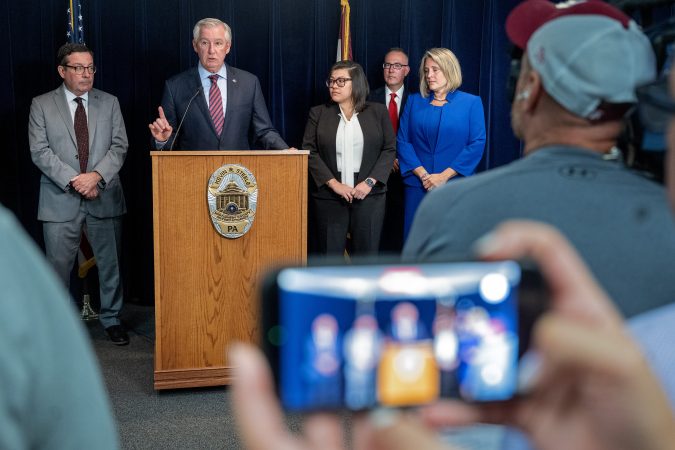
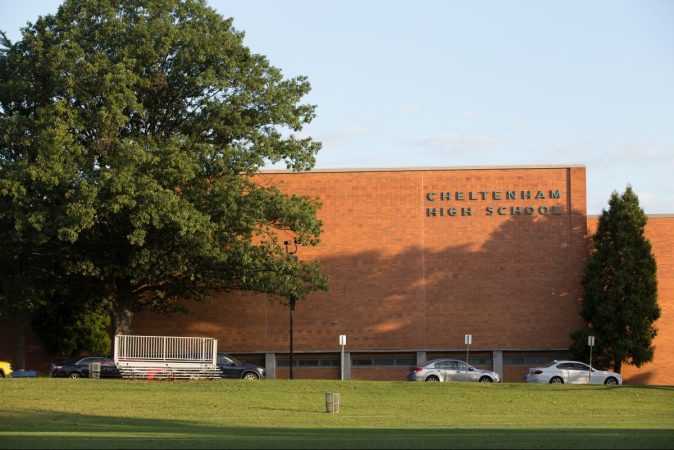
    Four Cheltenham High School football coaches and six players have been charged in connection with two assaults in the school’s locker room that injured a 15-year-old player and led to the cancellation of two football seasons, Montgomery County prosecutors said Wednesday.
    In two violent assaults, District Attorney Kevin Steele said, multiple football players attacked a sophomore on the team, stomped on his chest and groin while wearing cleats, and used a broomstick to poke at his buttocks.

    “The assaults on this victim were not typical goofing around by teammates, or horseplay, as some of the coaches in this case called it,” Steele said at a news conference Wednesday. “They were crimes.”
    After the attacks, which took place last August and September, Steele said, coaches tried to cover them up.
    Head coach Terence Tolbert, 55; associate head coach Darian McFadden, 42; assistant coach Benjamin Johnson III, 45; and volunteer coach Ralph Burnley, 60, have been charged with endangering the welfare of a child and conspiracy. The coaches are no longer with the district.

    Two football players, Isaiah Simpson, and Josiah Peeler, both 18, have been charged as adults — Simpson with conspiracy to commit aggravated assault, simple assault, reckless endangerment, and related crimes for his role in the September assault, and Peeler with false swearing for being untruthful to police. The two were 18, Steele said, when the crimes they are charged with took place.

    The four other players have been charged as juveniles, and were not identified by prosecutors or named in court records. Two of them face charges of conspiracy to commit aggravated assault and related crimes, because authorities say they took part in the attacks. The other two players are charged with false swearing.

    Tolbert, McFadden, Johnson, and Peeler were released on $5,000 unsecured bail. The two other adults had not been arraigned as of Wednesday afternoon. Only two of the defendants, Johnson and Peeler, had attorneys listed in court records.

    Johnson’s attorney, Richard J. Fuschino, said his client “has been humiliated by what occurred and absolutely had nothing to do with it.”

    “I do believe there is a cover-up, and I absolutely do not believe Benjamin Johnson had anything to do with it,” he said. “In fact, quite the opposite: He went out of the way to cooperate with every investigator.”

    Peeler’s attorney, Jessica Mann, did not respond to a request for comment. Attempts to reach the other defendants were not successful Wednesday.

    Cheltenham Superintendent Brian Scriven said Wednesday that the district appreciated prosecutors’ work on the case and the filing of criminal charges. “While no legal outcome can erase the harm that was experienced,” he said, “we appreciate that after nearly a year, charges have been announced and those responsible are being held accountable through the criminal justice system.”

    Prosecutors say coaches wanted incident ‘kept quiet’

    Steele said the charges followed a grand jury investigation in which witnesses described two violent assaults.

    The coaches are criminally liable for the assaults, Steele said, because, while they were not present, they learned of the September incident and encouraged the victim not to tell his parents.

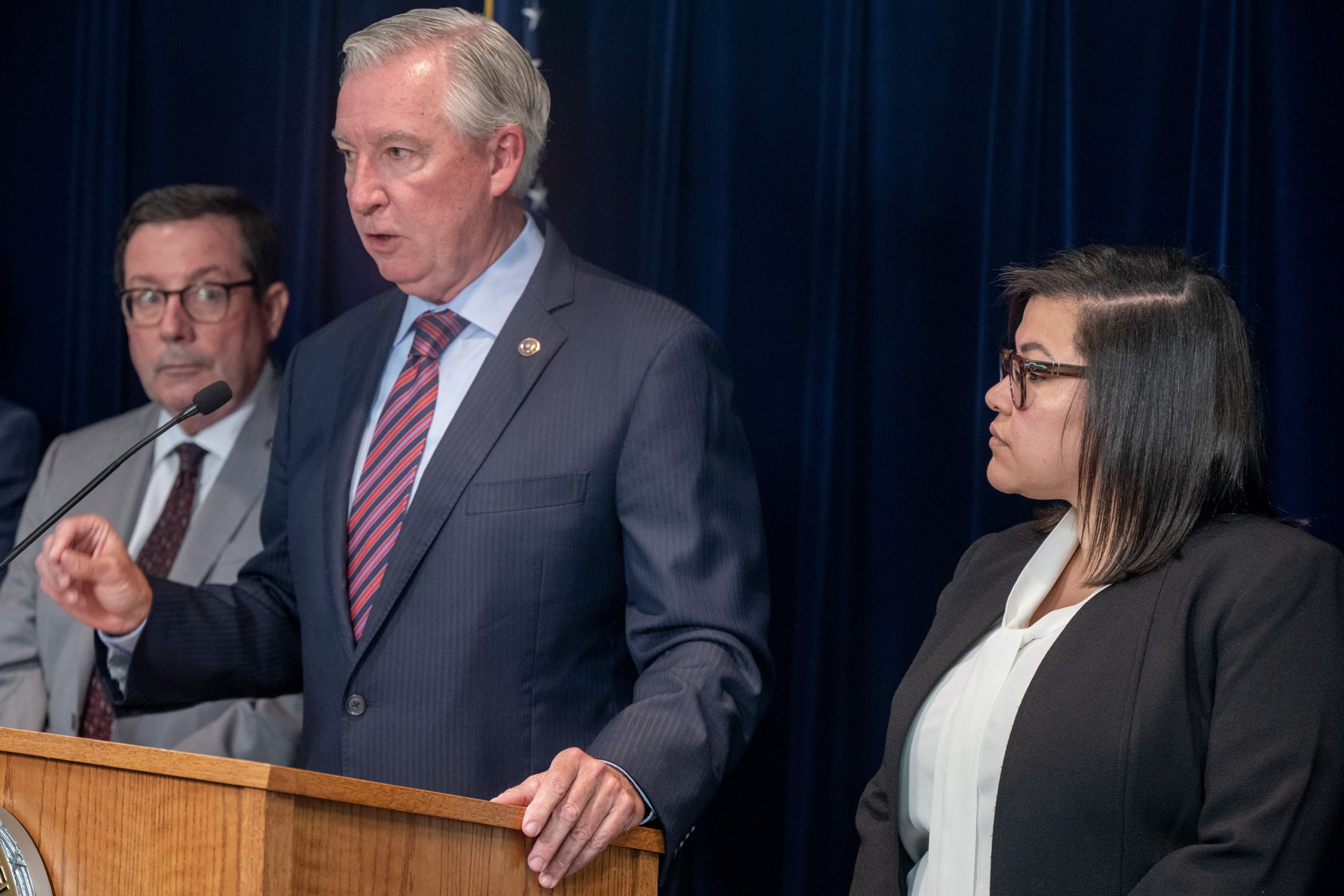
    Montgomery County District Attorney Kevin Steele at a press conference Wednesday.Tom Gralish / Staff Photographer

    Privately, the coaches sent incriminating text messages to one another, Steele said, expressing concern that the incident “has to be handled and kept quiet.”

    McFadden, the former assistant coach, wrote “if this gets out we are [expletive]. They will cancel the whole season,” according to the grand jury presentment.

    The incidents did lead the district to cancel last year’s football season in October, citing hazing allegations. And in May, it announced the forthcoming season would be canceled as well.

    The assaults occurred Aug. 15, after a preseason practice, and Sept. 3, Steele said. He said video footage of the August incident showed several students restraining the victim, while another student poked at his legs and buttocks with a broomstick.

    Players are laughing and yelling in the video, and “at least one player is chanting, ‘broomstick him,’” Steele said.

    A football player who witnessed the assault, but is not charged in the case, told the grand jury that the use of a broomstick was an apparent reference to a TikTok video featuring a Meek Mill song with the lyrics “broomstick all in his butt, tell him take that,” according to the grand jury presentment.

    Steele said there was no evidence that it constituted sexual assault.

    Players didn’t take the incidents seriously

    Several football players who testified before the grand jury characterized the behavior as “horseplay” and said they did not take it that seriously. Others said the victim had a difficult relationship with his teammates and was viewed by them as “someone who did not follow the rules during practices.”

    The Sept. 3 assault, witnesses said, happened after the teen took a pair of shoulder pads from another player’s locker after misplacing his own, an infraction for which the entire team had to do extra conditioning as punishment.

    Steele said that investigators did not have a video of the Sept. 3 assault but that multiple players, including Simpson and two of the juvenile defendants, kicked and stomped the victim.

    The teen reported told investigators that his teammates were “trying to poke him in the butt with the broomstick,” and that they made contact with his buttocks, Steele said. He said the assault broke up when school buses arrived, and teammates left to board them.

    Burnley, one of the coaches, drove the victim home after the attack, and the teen broke down in tears, telling the assistant coach he had been jumped by teammates, the district attorney said.

    Burnley then texted coaches in a group chat and called Tolbert, Steele said. McFadden and Tolbert called the teen and “told him not to tell his mother about the incident because they would handle it,” Steele said.

    He said the coaches were deliberate and calculating in their decision not to report the assault.

    ‘Serious concerns about the response’

    The incident came to light four days later, when the teen’s mother said he told her he had been jumped by teammates and had pain in his genitals. She said she took her son to an urgent care center and texted the high school’s assistant principal, who called her later that day.

    A front view of Cheltenham High School in Wyncote.Tom Gralish / Staff Photographer

    The teen did not tell his mom that his teammates used a broomstick in the attack. He was embarrassed and reluctant to share that detail, the mother said in an interview with The Inquirer in which she spoke on the condition of anonymity to protect the identity of her son.

    She said her son told her that his teammates had tried “to mess with his manhood.”

    She learned about the broomstick later in September, when Cheltenham Township police called to tell her that someone had called Pennsylvania’s Safe2Say hotline to anonymously report that students had used a broomstick during the attack, according to the teen’s lawyers, Alan Yatvin and Gabrielle Turley.

    Sometime in October, the district obtained a video that had been circulating in the community and depicted an assault of the student with a broomstick, the lawyers said.

    Investigators initially believed that footage was from the Sept. 3 assault. It was discovered during grand jury testimony in January that the assault was from August, prosecutors said. The teen, who said he was not shown the video until this spring, also identified it as being from August, revealing for the first time that he had been assaulted more than once, according to the lawyers.

    “Our client and his family are grateful to the Montgomery County District Attorney’s Office, law enforcement investigators, and the grand jury for their careful and thorough work in bringing these deeply troubling events to light and pursuing charges,” Yatvin said in a statement Wednesday. He added that the grand jury investigation “also raises serious concerns about the response by some within the Cheltenham High School community.”

    District accused of failing victim

    The school district said in January that an outside investigator had confirmed that a “student-on-student assault” had taken place in the locker room on Sept. 3. The assault was witnessed by nearly 20 students, according to the district, which did not provide details of the attack.

    The district faulted inadequate supervision in the locker room, “a failure to prioritize student safety” by coaches and volunteers, and “a toxic and negative culture” within the football program.

    District officials have said a Title IX investigation, required by law when sexual assault or harassment is alleged, is ongoing.

    Scriven, the superintendent, said in a statement Wednesday that “every report brought to the district’s attention was addressed based on the information available at the time.” He noted that law enforcement and the grand jury had the power to issue search warrants and compel testimony, which “brought information to light.”

    In April, the district approved separation agreements with Tolbert and McFadden. Officials say none of the coaches from last season is still affiliated with the district.

    The victim, who switched to virtual school after being harassed by peers after the attacks, has continued to struggle, according to his mother. She said he avoids going outside because he fears being taunted about what happened.

    During Wednesday’s news conference, Steele criticized the school district and said it had failed the victim.

    In its report, the grand jurors noted that they — not the school district’s Title IX investigator — discovered that two separate assaults had taken place.

    “I believe the Cheltenham School District has taken the position that they don’t want police in their schools or school resource officers, and so it’s on them to address these issues,” Steele said. “So the grand jury took care of what the school did not.”

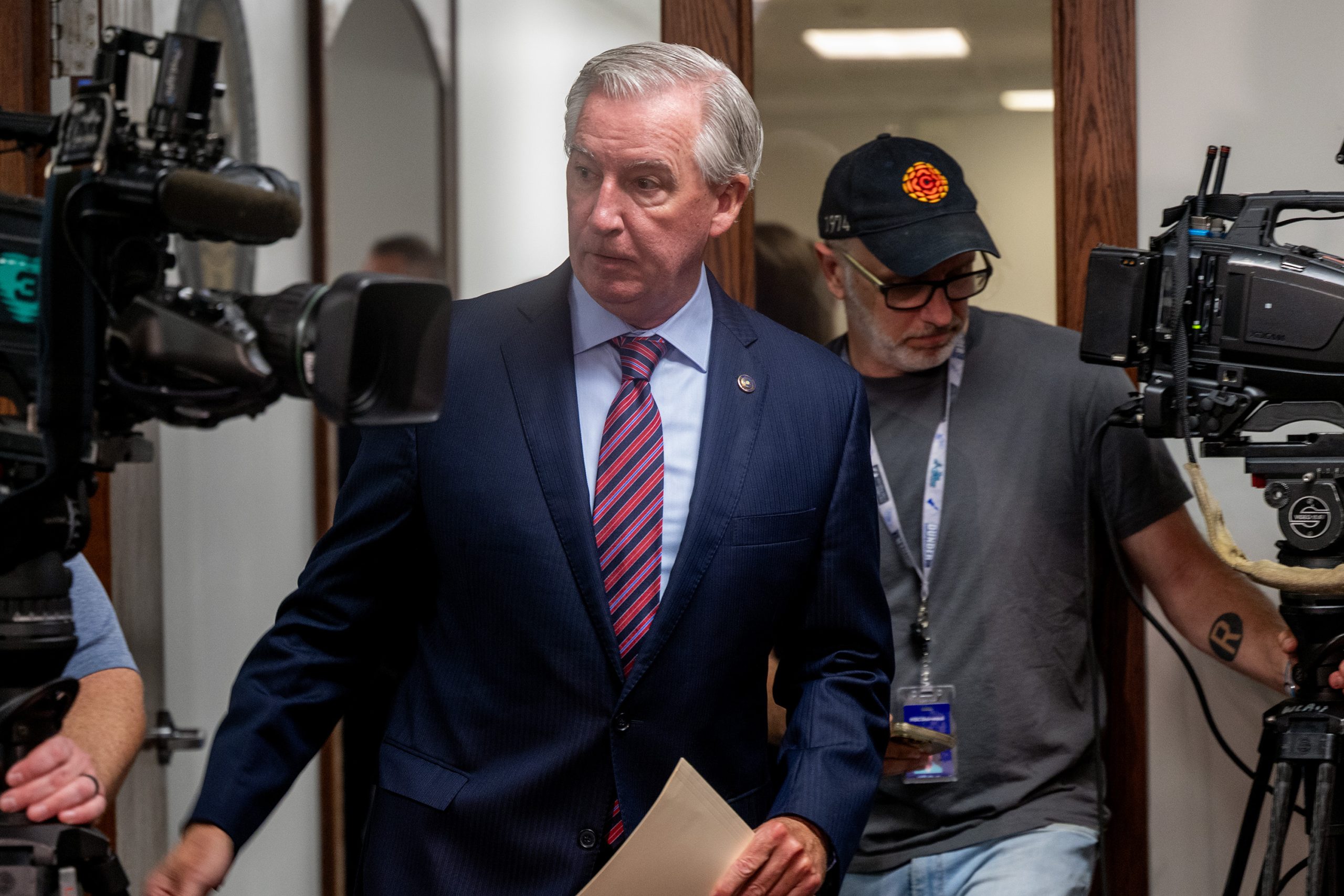
    Montgomery County District Attorney Kevin Steele arrives at a press conference Wednesday to announce multiple charges in connection with two assaults in a Cheltenham High School locker room.Tom Gralish / Staff Photographer

    In addition to recommending criminal charges against the players and coaches involved in the case, the grand jury filed a separate report calling for a change in state law that would require teachers and coaches to report incidents of hazing as a form of child abuse.

    “While the school district claims to ‘protect and prioritize safety and well being,’ their actions in this case say otherwise,” the grand jury report said. “The administration carried out three school-led investigations that were so flawed they failed to even identify that two separate instances of hazing occurred in the locker room.”

    News researcher Ryan W. Briggs contributed to this article.

  • Eagles practice observations: Sean Mannion’s offense starts clicking; Jalen Hurts under center; Jalyx Hunt hunts

    Eagles practice observations: Sean Mannion’s offense starts clicking; Jalen Hurts under center; Jalyx Hunt hunts

    The Eagles held their first practice of training camp on Wednesday at the Jefferson Health Training Complex. Here were my observations from Day 1:

    Healthy Birds

    The Eagles announced that outside linebacker Jonathan Greenard was placed on the Physically Unable to Perform (PUP) list just before practice. He apparently strained a pectoral muscle while lifting prior to camp. Greenard isn’t expected to be out long-term, but starting him on PUP allows the team to save a roster spot if he’s going to miss more than a month in the regular season.

    It’s unclear if the injury had anything to do with his recovery from December shoulder surgery. Greenard didn’t practice much in the spring after he was acquired via trade during the draft. He’s learning a new defense, but he’s been around the block a few times and shouldn’t be held back once healthy.

    Jonathan Greenard (right) was present on Wednesday but will remain sidelined indefinitely with a pectoral injury. Monica Herndon / Staff Photographer

    The Eagles were otherwise full-go. I don’t recall them being as healthy entering camp in all my years on the beat. Every player passed Tuesday’s conditioning test, as coach Nick Sirianni suggested before practice. Linebacker Jihaad Campbell (shoulder), wide receiver Makai Lemon (hamstring) and several other players who were limited in the spring were back in action.

    Campbell, by the way, switched his jersey number from 30 to 11. That should end all talk of the former Eagles wide receiver who previously wore the double ones. Right?

    Positional battles

    There’s really only one “starting” spot up for grabs and it technically isn’t a full-time job: safety. Cooper DeJean is expected to “start” at safety in base personnel alongside Andrew Mukuba. DeJean was there again on Wednesday. Marcus Epps filled the primary nickel role, however, with a splash of Michael Carter II at times. Those two appear to be the frontrunners. General manager Howie Roseman won’t be shy about trading for an upgrade if needed.

    There are some intriguing competitions further down the depth chart. Jonathan Jones was the first cornerback up when starter Quinyon Mitchell took a breather during team drills. Jeremiah Trotter Jr. and Smael Mondon were the backup inside linebackers behind Zack Baun and Campbell.

    A handful of receivers will be vying for the snaps that became available when A.J. Brown was finally traded to the Patriots. DeVonta Smith is the bona fide WR1, but new faces like Dontayvion Wicks, Hollywood Brown and Lemon, along with returnees like Darius Cooper and Johnny Wilson will be contending for playing time.

    Line ’em up

    The first-unit offensive line is set, but swing tackle along with a few other backup spots are up for grabs. New O-line coach Chris Kuper will work some reserve linemen at various positions to create versatility. Here’s how the units looked on Wednesday:

    A few notes:

    Jordan is new after the Eagles signed the veteran guard at the conclusion of minicamp in June. Bell was back in the lineup after sitting out the last day of minicamp. He and Fred Johnson are presumably battling for the swing tackle role, although Kuper could have both active on game days. Hollin Pierce and Jaeden Roberts were with the third unit at left tackle and left guard, respectively, during the period for developmental players.

    Mannion mirror

    New offensive coordinator Sean Mannion continued to implement many of the concepts we saw from the Kyle Shanahan-Sean McVay scheme he brought to the Eagles in the spring: a lot of under center sets, play-action and motion. I’d estimate that more than half of the plays came with the quarterbacks lined up under center.

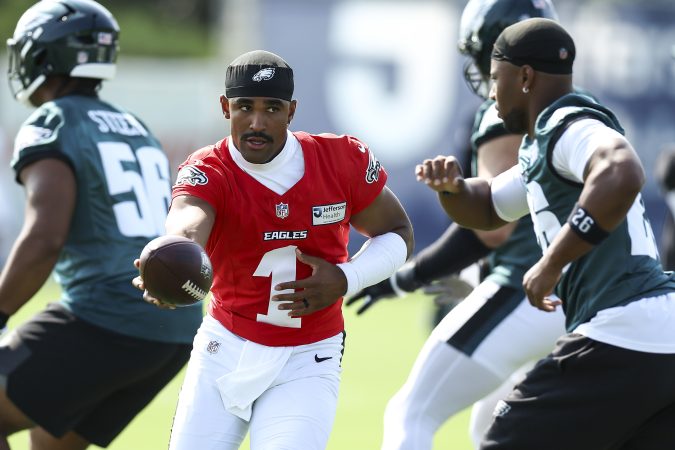
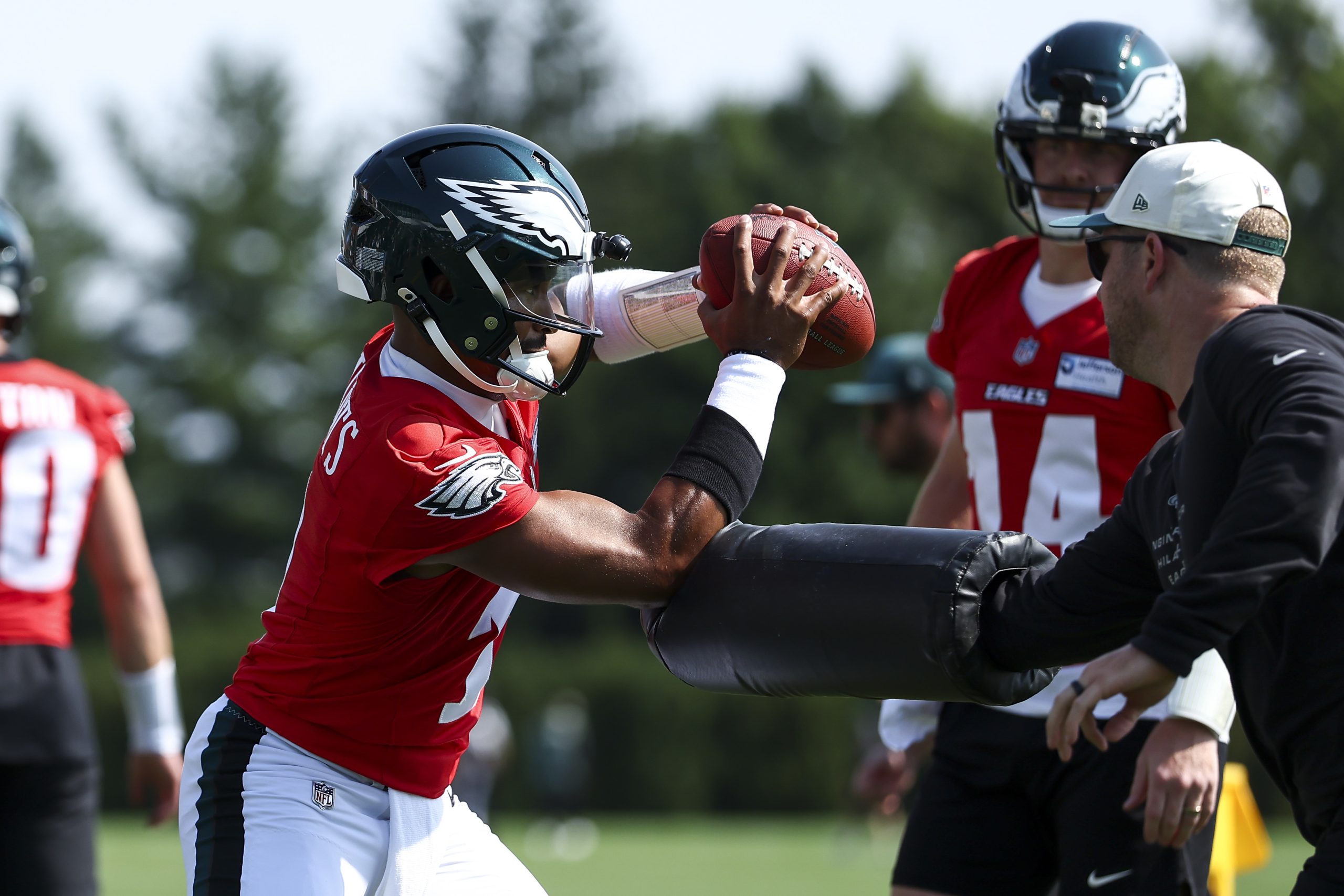
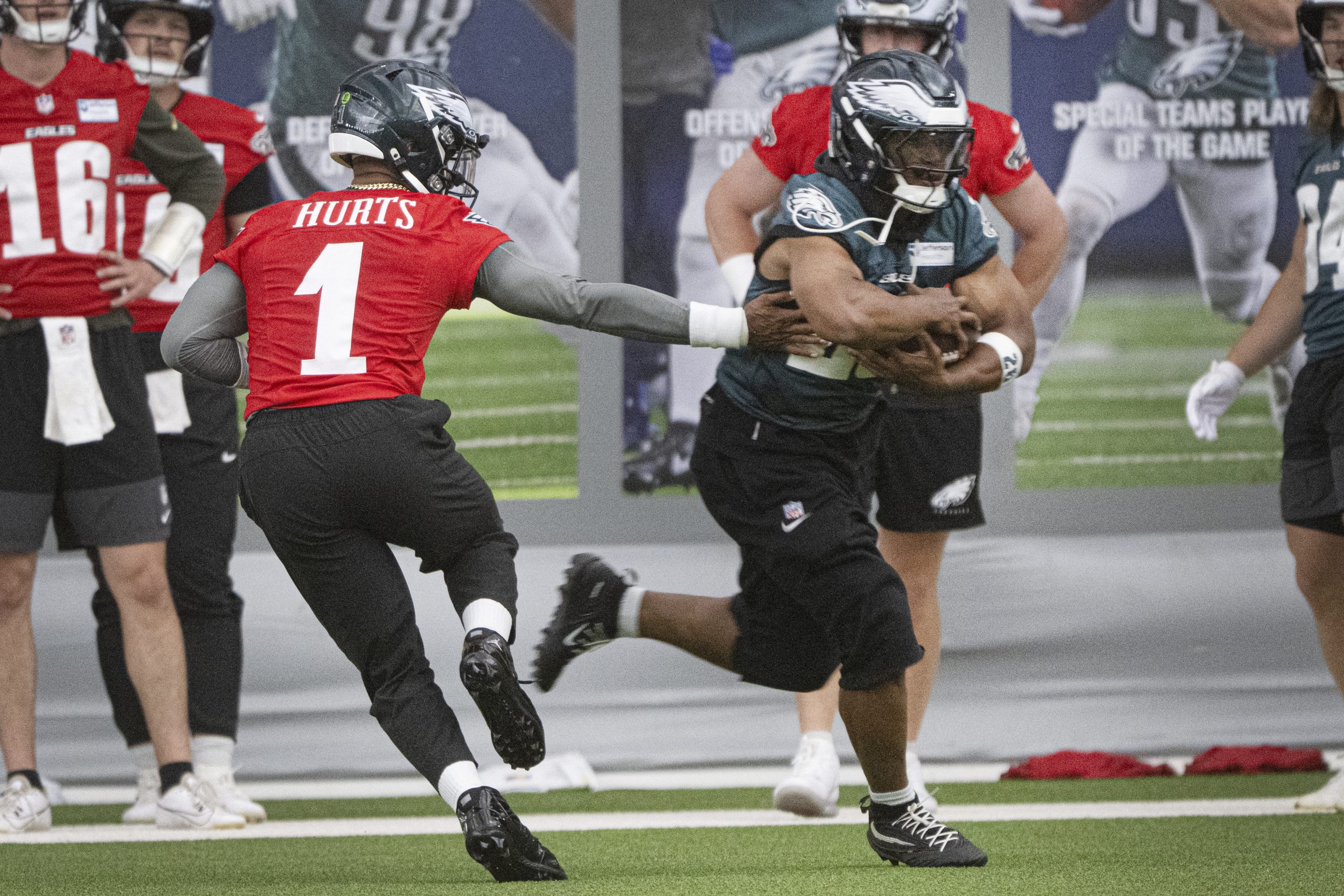
    Jalen Hurts continued to learn the intricacies of the new offense on Wednesday. Monica Herndon / Staff Photographer

    Jalen Hurts has improved from under center since entering the NFL, but he hasn’t done much of it, at least compared to rest of the league. There will be more of him turning his back to the defense on play action and naked bootlegs. An early awkward pass across Hurts’ body to Lemon illustrated that there will be some growing pains.

    Hurts to be…

    There will be an adjustment period for all involved, but mostly Hurts. He’s endured other previous changes in play-calling and scheme with varying results. The offense wasn’t sharp during the spring practices open to reporters. That came as little surprise, and neither should struggles during the summer.

    Hurts’ first pass of camp was a wobbler to Wicks that Mitchell nearly intercepted. But he had some strong moments in the later team portions with good ball placement on a toss to Wicks with cornerback Riq Woolen in coverage and a strike to a crossing Smith just over Mitchell.

    The catch of the day came during seven-on-sevens when Hurts hooked up with Cooper. The receiver got behind DeJean out of the slot and made a diving grab over the middle.

    Saquon Barkley’s ability to adapt to the wide-zone blocking scheme will be worth watching. Monica Herndon / Staff Photographer

    Run it back

    The Eagles won’t be in full pads until the fifth practice of camp on Tuesday, but they were able to incorporate more of the run game into team drills. Some of the biggest changes on offense will come with the move to more wide-zone blocking. Lane Johnson said the new system is “O-line friendly” and should theoretically place less stress on the group in pass blocking situations.

    Running back Saquon Barkley took the first handoff of camp and ran behind Johnson off tackle. He was met near the line of scrimmage by Baun on his next carry. Backup Tank Bigsby’s first touch came on a rush up the middle after Steen climbed to the second level. Could we see more of Bigsby as the inside complement to Barkley this season?

    Hunting season

    Greenard’s absence pushed Jalyx Hunt into the starting spot at right outside linebacker opposite Nolan Smith Jr. Hunt will likely play as many snaps as the other two this season. There’s an argument to be made that he should get more playing time than Smith. Nevertheless, he took advantage of his opportunities with Greenard out.

    Hunt shot into the backfield unblocked and forced Hurts to check down to Cooper on one play-action pass that came from under center. He blew up tight end Dallas Goedert with an edge rush and Hurts had to hurry a dump to Bigsby that wasn’t caught. And he beat Jordan Mailata on back-to-back rushes — one with an inside move and the other from the outside — that blew up pass plays.

    Dallas Goedert (right) rebounded from an early drop in Wednesday’s practice. Monica Herndon / Staff Photographer

    Sloppy go droppy

    Defensive coordinator Vic Fangio enters his third season at the helm with little turnover on his side of the ball. He’s always evolving and will introduce new ideas, but the core of his unit remains intact. The defense should have the upper hand in competitive periods, especially with the offense still ironing out details.

    Mannion’s unit had a couple of false starts from Mailata and Landon Dickerson. Brown lined up illegally at one point. Defensive tackle Jalen Carter, fresh off his contract extension, was flagged for offsides at one point. He slipped by Steen for a would-be tackle of Barkley in the backfield earlier in the session.

    Goedert dropped an early pass, but rebounded later on a short crossing route. Hurts and Barkley had a miscommunication on a botched handoff.

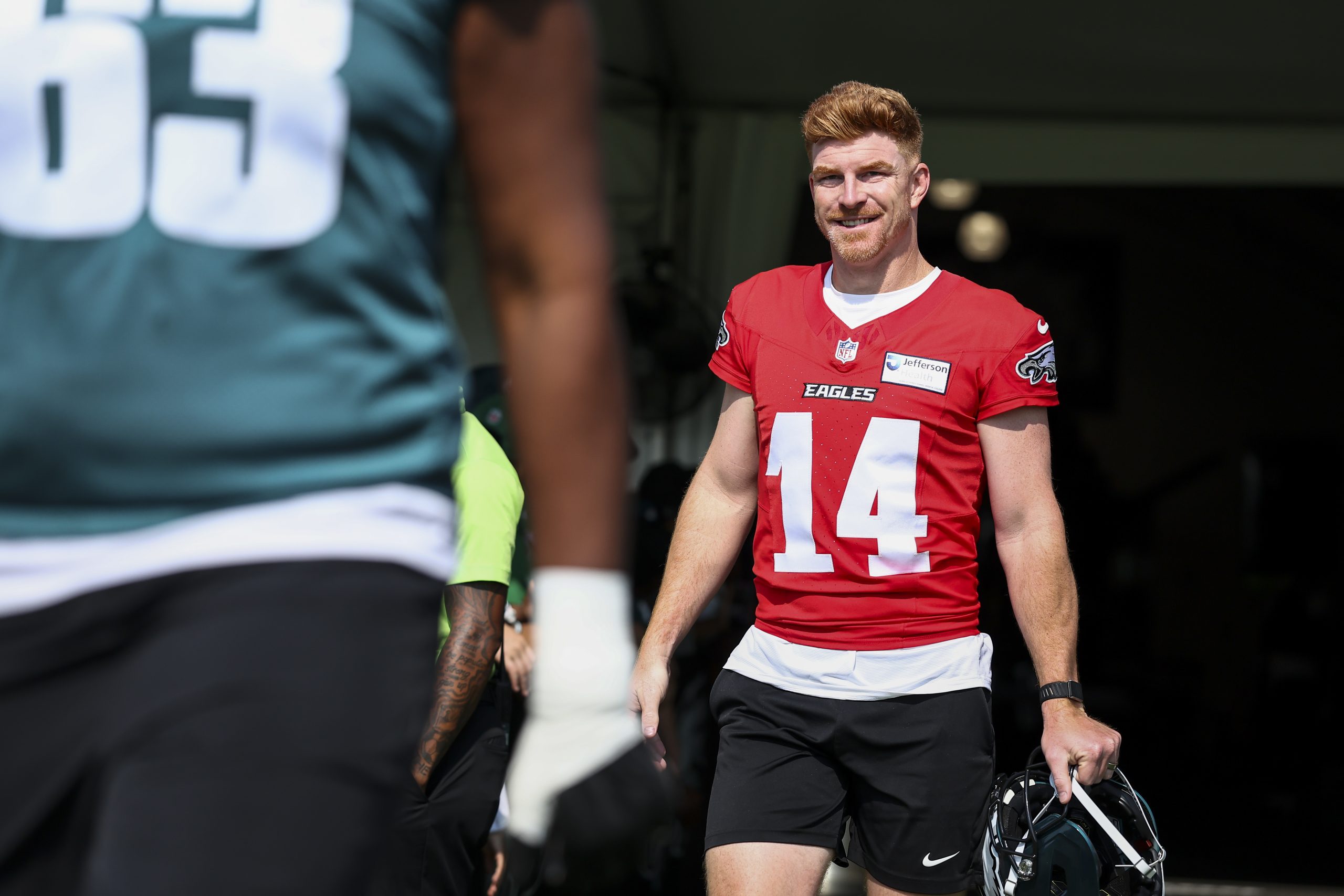
    Andy Dalton (14) is vying for the No. 2 quarterback job. Monica Herndon / Staff Photographer

    Back it up

    Quarterbacks Tanner McKee and Andy Dalton continued to split second unit snaps, much as they did in the spring. McKee’s first completion during seven-on-sevens went to rookie tight end Eli Stowers. Dalton hit Wilson over the middle with a pass only the 6-foot-6 receiver could reach.

    Trotter had a couple of run stops, one time seemingly filling a gap out of nowhere to stop Bigsby in his tracks. Former Texans running back Dameon Pierce was relatively quiet in the spring, but he had a nice cutback on an inside rush.

    Extra points

    Rookie quarterback Cole Payton had his ups and downs in the spring, but he continued to display a willingness to throw downfield a month later. He ripped a pass to receiver Quez Watkins during seven-on-sevens, and found receiver Britain Covey on a deep corner route. … Second-year defensive tackle Ty Robinson was relegated to snaps during the developmental period. Not a good sign. … Lemon fielded punts behind Covey and Elijah Moore. … The Eagles return Thursday for practice and will have a closed-to-reporters walkthrough on Friday.

  • Mayor Parker’s former DEI chief sues the city for discrimination in tell-all lawsuit

    Mayor Parker’s former DEI chief sues the city for discrimination in tell-all lawsuit

    Philadelphia’s former chief diversity, equity, and inclusion officer has said before that Mayor Cherelle L. Parker and top administration officials scapegoated her after she reported sexual harassment in City Hall and then fired her “unjustly.”

    But in an explosive new lawsuit filed in federal court in Philadelphia this week, that officer, Brandee Anderson, claimed her termination was part of a coordinated effort to “suppress” or rebrand diversity work and came as a top Parker administration official made derisive comments about other DEI leaders.

    She claimed Parker — a centrist Democrat who is Black and the city’s first female mayor — said in 2025 that she “did not care about Ms. Anderson’s ‘DEI ideology,’ only minority business.”

    And she alleged in the lawsuit that the mayor threatened to remove any administration official who expressed dissenting views, telling a gathering of senior officials that no one “has a right to have an opinion about where we are going.”

    The suit, filed Monday in U.S. District Court for the Eastern District of Pennsylvania, seeks unspecified damages and payment of lost wages as a result of her firing. Parker is named as a defendant, as are Deputy Mayor Vanessa Garrett Harley, Inspector General Alexander DeSantis, and communications director Joe Grace. Anderson claimed DeSantis and Grace defamed and retaliated against her in statements to the media after her firing.

    Anderson served as Parker’s chief DEI officer beginning in 2024, advising the mayor and administration on matters such as workforce diversity, community engagement, equitable budgeting, and minority business opportunities. She also oversaw offices that serve LGBTQ+ residents and people with disabilities.

    She was fired in 2025 after Tyrell Brown, then the director of the Philadelphia Office of LGBTQ+ Affairs, reported to Anderson that they had received a “semi-nude” photo from a senior administration official. Anderson says in the lawsuit that she was fired days after elevating the matter to Garrett Harley and human resources officials.

    The city declined to comment on the lawsuit and generally does not answer questions about pending litigation.

    The lawsuit was the second filed against the city by a former DEI official during Parker’s tenure. Leslie Marant, the Philadelphia Police Department’s first DEI chief, who was fired in the first days of Parker’s administration, said in a federal lawsuit filed in October that she was a victim of the systemic discrimination that she was tasked with addressing. That litigation is ongoing.

    It was also the second time this month that a former Parker administration official accused senior administration members of fostering a toxic work environment.

    Shania Bennett, the former director of the Philadelphia Office of Youth Engagement, last week posted on social media that working for the city was “the worst experience of [her] life” and that she had quit her job after “unprofessional harassment.”

    Bennett could not be reached for comment.

    ‘Stand down’ on DEI matters

    Anderson, an attorney who founded a firm that creates anti-racist trainings, was hired in October 2024 to lead the city’s DEI efforts. In the lawsuit, she alleges that Parker officials undermined her authority from the outset.

    She claimed Parker forbade her from contacting members of City Council with whom she had existing relationships. And she said Garrett Harley, one of Parker’s most senior officials, told her and other DEI leaders to “stand down” if they expressed dissenting views, saying “if you can’t align with the mayor’s strategy, DEI may not be the job for you.”

    Deputy Mayor Vanessa Garrett Harley speaks during a news conference in Philadelphia, Pa., in June 2024.Tyger Williams / Staff Photographer

    Anderson also claimed Garrett Harley made discriminatory comments about a transgender official, Celena Morrison-McLean, former director of the Philadelphia Office of LGBTQ+ Affairs, who reported to Anderson. Garrett Harley, the lawsuit alleges, instructed Anderson to “document Celena [Morrison-McLean] out,” or create a paper trail leading to her dismissal.

    According to the lawsuit, the deputy mayor also mocked Morrison-McLean during a meeting with several other officials, saying she used a “deep male tone” to intimidate staff.

    Morrison-McLean left her post in November 2024, roughly eight months after she was pulled over by a Pennsylvania State Police trooper in a traffic stop that went viral and resulted in her and her husband’s arrest.

    She is now a consultant, according to her LinkedIn profile. She could not be reached for comment.

    Celena Morrison-McLean reads a statement with Darius McLean (rear) Thursday, Mar. 7, 2024. The married LGBTQ leaders were arrested during a contentious traffic stop over the weekend.Tom Gralish / Staff Photographer

    Anderson said in the lawsuit that Garrett Harley also made comments to her in early 2025 that she saw as fostering a hostile work environment. She claims she disclosed to Garrett Harley that she was the victim of rape and asked for time off to attend a hearing in the criminal case against her alleged assailant.

    “Ms. Garrett-Harley responded,” the lawsuit says, “by questioning how one woman could rape another.”

    In a separate instance, Garrett Harley also instructed Anderson to delete emails documenting dangers to children in the city’s care, according to the lawsuit. The lawsuit did not elaborate on the content of the emails.

    Harassment report and press fallout

    Brown was appointed in March 2025 to succeed Morrison-McLean as the city’s director of LGBTQ+ affairs. In July 2025, Brown reported to Anderson that Christopher Dailey, then a deputy chief of staff in the mayor’s office, had sent them a sexual image on a cruising app.

    At the time, Anderson said Brown told her they did not feel harassed by the photo, partly because it was not clear whether Dailey knew to whom he had sent the image, which included Dailey’s face. Brown’s profile was anonymous, Anderson said, but the app used geolocation, meaning that users would have known they were contacting someone in or near City Hall.

    Anderson elevated Brown’s report to human resources roughly a week later, the complaint says, leading DeSantis, the city’s inspector general, to launch an investigation.

    By July 22, Anderson was fired. DeSantis has said Anderson never possessed the photo, but allowed Brown to display it while another employee besides Anderson, their supervisor, was in the room. That decision, DeSantis said, constituted a violation of the city’s sexual harassment policy.

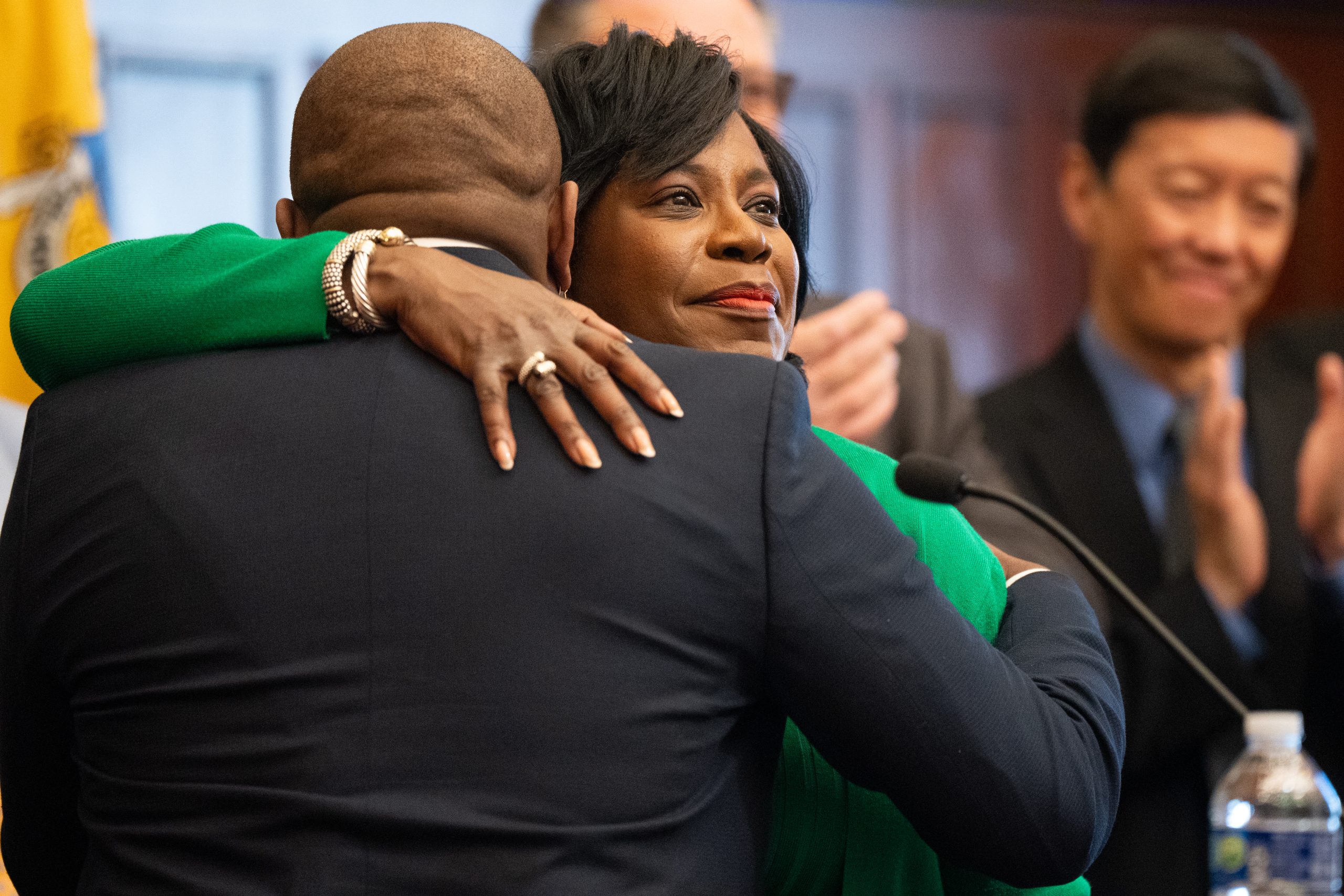
    Mayor Cherelle Parker, right, hugs Tyrell Brown, left, the new Director of LGBTQ+ Affairs, during a press conference to announce new appointments, at City Hall, in Philadelphia, March 21, 2025.Jessica Griffin / Staff Photographer

    Brown was fired the same week as Anderson. Parker tasked Garrett Harley with handling the office’s work through March, when the administration named a replacement.

    Anderson’s lawsuit claims racial discrimination, noting that Dailey, who is white, was not fired, but was instead moved to a new role in a different office. Brown and Anderson are both Black.

    Brown could not be reached for comment.

    Additionally, Anderson claimed that Parker, DeSantis, and Grace each made “false and defamatory” statements in the media after she was fired.

    She cited a July 2025 Inquirer article in which Grace said Anderson’s allegations about the reason for her termination included “outright misstatements of fact.”

    The lawsuit also mentioned an interview with iHeart Radio’s WDAS 105.3 FM that DeSantis participated in last year about the firings, during which he said that Anderson had “mishandled the photograph” and “did something wrong.”

    Anderson, in the lawsuit, said those statements were false.

  • ICE wants to deport a Philly man who has lived legally in the U.S. for 20 years. He fled Guinea after being jailed by the government.

    ICE wants to deport a Philly man who has lived legally in the U.S. for 20 years. He fled Guinea after being jailed by the government.

    Abdoulaye Cherif was asleep when his phone rang that morning, and he answered only because the display showed the call was coming from a prison.

    He was shocked to hear the voice of his father, who was supposed to be at work, driving for Uber.

    Mamadou Fadel Cherif told his son he had been arrested by ICE as he left the family home in West Oak Lane. He said he needed his son to break the news to his mother, because she would be devastated to hear it over the phone.

    Cherif, 21, called his mom at work and told her she needed to come home.

    Now, two weeks after that July 13 morning, “we’re all scrambling,” Cherif said in an interview. “A piece of us is missing.”

    Fadel Cherif, 56, never expected to be arrested by ICE. He lives legally in the United States, having been granted Withholding of Removal almost 20 years ago.

    That status allows him to stay and work, and bars the government from deporting him to his homeland, the West Africa nation of Guinea, where the U.S. government agrees he could be harmed or killed over politics.

    His status, however, does not shield him from being sent to a third country, if ICE can find a nation willing to accept him.

    Those kinds of third-country deportations are difficult for the agency to achieve. But recent ICE guidance tells agents that when immigrants with Withholding of Removal or Convention Against Torture protections report for check-ins, officers should consider the viability of their removal and if they should be detained in the meantime.

    Advocacy groups and immigration lawyers say the Trump administration is increasingly arresting and detaining migrants who have been granted withholding, keeping them in custody while it pursues removal to a third country. Last year, an Iranian immigrant who had fled the regime spent nearly six months in detention before a federal judge ordered his release.

    Officials with U.S. Immigration and Customs Enforcement, who did not initially respond to queries, said Tuesday that they were working on a response to questions about the case.

    (function(){function e(){window.addEventListener(`message`,function(e){if(e.data[`datawrapper-height`]!==void 0){var t=document.querySelectorAll(`iframe`);for(var n in e.data[`datawrapper-height`])for(var r=0,i;i=t[r];r++)if(i.contentWindow===e.source){var a=e.data[`datawrapper-height`][n]+`px`;i.style.height=a}}})}e()})();

    Philadelphia immigration attorney Ricky Palladino, who represents Fadel Cherif, said there is no reason for ICE to detain him. He has no criminal record. He has legal authorization to work, a Social Security number, and a driver’s license.

    Palladino filed a petition in federal court that seeks Fadel Cherif’s immediate release, arguing that he has been denied due process under the law.

    In nearly 20 years, the filing says, no government official has suggested that Fadel Cherif’s deportation was “even remotely likely.” And it says that ICE can return someone with his status to custody only if, on account of changed circumstances, the agency finds “a significant likelihood that the alien may be removed in the reasonably foreseeable future.”

    Immigration attorney Ricky Palladino with Palladino, Isbell & Casazza, LLC, at his office on Walnut Street in Center City Philadelphia in 2022.Alejandro A. Alvarez / Staff Photographer

    Palladino said in an interview that Fadel Cherif is the main support for his wife, who has legal permanent residency, also known as a green card, and for their four American-born sons, including Abdoulaye, a Marines reservist.

    In Guinea, a nation of 12 million people that is roughly twice the size of Pennsylvania, Fadel Cherif was jailed by the government after protesting the results of his country’s 1998 presidential election, which was marred by irregularities. He later fled in fear of being rearrested, using a document that showed a different Guinean identity to enter the United States in New York in November 2003.

    For years he has worked in dining services at La Salle College High School, the private Catholic boys school in Montgomery County, and also drives for Uber.

    Matt Beck, director of dining services for CulinArt at the school, was upset to learn of the arrest, describing Fadel Cherif as an extremely hard worker.

    “He’s a good guy,” Beck said. “The students here love him. And so does the staff.”

    Fadel Cherif’s detention comes as ICE is arresting record numbers of immigrants. In one five-day span this month, the agency detained more than 10,000 people across the country, the New York Times reported.

    The rate of ICE arrests topped 1,300 a day in June ― and grew again to a record 1,474 a day during the first 11 days of July, Syracuse University professor and immigration-data analyst Austin Kocher reported last week.

    “ICE has been touting record high arrest numbers this summer ― and they are not wrong,” Kocher wrote in an analysis.

    The ICE directive issued shortly after President Donald Trump took office meant that people with Withholding of Removal could be detained, noted the Catholic Legal Immigration Network Inc., even if they had no criminal record and had been reporting to ICE for years without incident.

    “Given the increased pressure that ICE has been under to meet quotas for arrests, detentions, and deportations,” the network wrote, “it is not surprising that the agency is focused on those who already have removal orders as being easy targets.”

    Fadel Cherif was denied asylum when he could not prove that he had filed within a year of entering the United States.

    To receive Withholding of Removal, applicants must prove that they were persecuted in the past or that their lives would be threatened in the future, that the government harmed or will harm them ― or failed to control others who might do so. And they must show that moving to a different part of their country would not provide safety.

    Withholding offers fewer benefits than asylum, which includes a path to citizenship and allows people to seek to have their spouses and children join them in the United States.

    When Withholding of Removal is granted, the immigration judge also enters a deportation order, then tells the government it cannot deport the person to their homeland. In that way the removal is “withheld.”

    People with that status cannot leave the United States without triggering deportation, have no path to citizenship, and cannot petition to bring family members to this country.

    While the U.S. government may try, deporting people with withholding to a third country is difficult to accomplish. Nations that willingly accept their own citizens can be disinclined to accept other foreign nationals.

    The Migration Policy Institute estimates that during its first year back in office, the Trump administration carried out about 15,000 removals to third countries, a fraction of the total 396,000 deportations.

    Deportations of those who have Withholding of Removal are even more rare, according to the Amica Center for Immigrant Rights in Washington. The center says it is pointless to detain those people while attempting to deport them. If ICE were to release a foreign national and later identify an appropriate third nation, it could simply detain them again.

    Abdoulaye Cherif near his West Oak Lane home on July 23. His father, Mamadou Fadel Cherif, was arrested by ICE and has been detained for weeks.Yong Kim / Staff Photographer

    Fadel Cherif remains in custody at the Moshannon Valley Processing Center, the ICE facility in central Pennsylvania.

    “My brothers, they need their dad in their life,” said his eldest son, Ahmad, 22, noting that the youngest brothers are 13 and 15. “It’s very important for my dad to be here.”

    Abdoulaye Cherif said his father told him that on that morning, he demanded that the ICE agents show him an arrest warrant signed by a judge. Instead, he said, the officers presented an agency-issued detainer.

    Today, he said, the family is surviving financially on savings. Emotionally, they struggle without their father.

    “He’s like the glue,” Abdoulaye Cherif said. “He directs us, he leads us, he’s the dad. He’s been worried about the situation at home, making sure we get all the bills paid on time.”

    Inquirer staff writer Abraham Gutman contributed to this article.

  • Peco’s new contract gives all workers pensions — but not the kind you might think 

    Peco’s new contract gives all workers pensions — but not the kind you might think 

    When IBEW Local 614 and Peco started negotiating a new contract earlier this year for call center employees, linemen, and other field workers, one thing was clear to local union president Larry Anastasi: He needed to get pensions back for all of his members.

    Roughly 600 of his 1,500 members, hired since 2021, weren’t offered a pension. The rest had differing plans.

    Clawing back pensions for the whole union wouldn’t just be a reversal of Peco’s trajectory. It would buck a cross-industry trend.

    “The trend my entire career, which is now more than 40 years in this business, has been employers want to get away from defined benefit plans, and unions want to maintain them and get them in more places,” said Wendell Young IV, president of United Food and Commercial Workers Local 1776, which represents workers in Pennsylvania and neighboring states.

    In early July, after a three-day strike, Peco and its worker union reached a deal that includes a pension plan for all workers. But it’s not your grandparent’s pension.

    The traditional defined-benefit retirement plan peaked in popularity in the 1970s, when up to 62% of private-sector workers relied on a pension as their sole retirement plan, according to the New York Times. That number shrank to 1% of private-sector workers in 2022.

    Employers in the gas and electric utility industry started moving away from traditional pensions in the 1990s, according to William Dwyer, a professor at the Rutgers University School of Management and Labor Relations, who once worked at PSE&G in New Jersey.

    Under the new Peco union contract, workers will get a cash-balance plan — where employees are promised a specific amount of money in retirement without having to contribute to it themselves. The benefit accrues throughout a worker’s career, unlike the old-school pension that is typically based on total years of employment and how much a worker is earning in the final few years of their career.

    It’s an increasingly popular compromise, said professor Olivia Mitchell of the Wharton School. With workers living and working longer than they used to, traditional pensions become unpredictably costly for employers. The cash-balance option is a chance for both company and worker to better see the future.

    “They accumulate benefits more evenly over a worker’s career,” she said, “making them easier to understand and often less costly and less risky for employers.”

    By getting a pension of any sort, said Young, of UFCW, Peco’s unionized workers “rode against the current” and “achieved a really amazing benefit.”

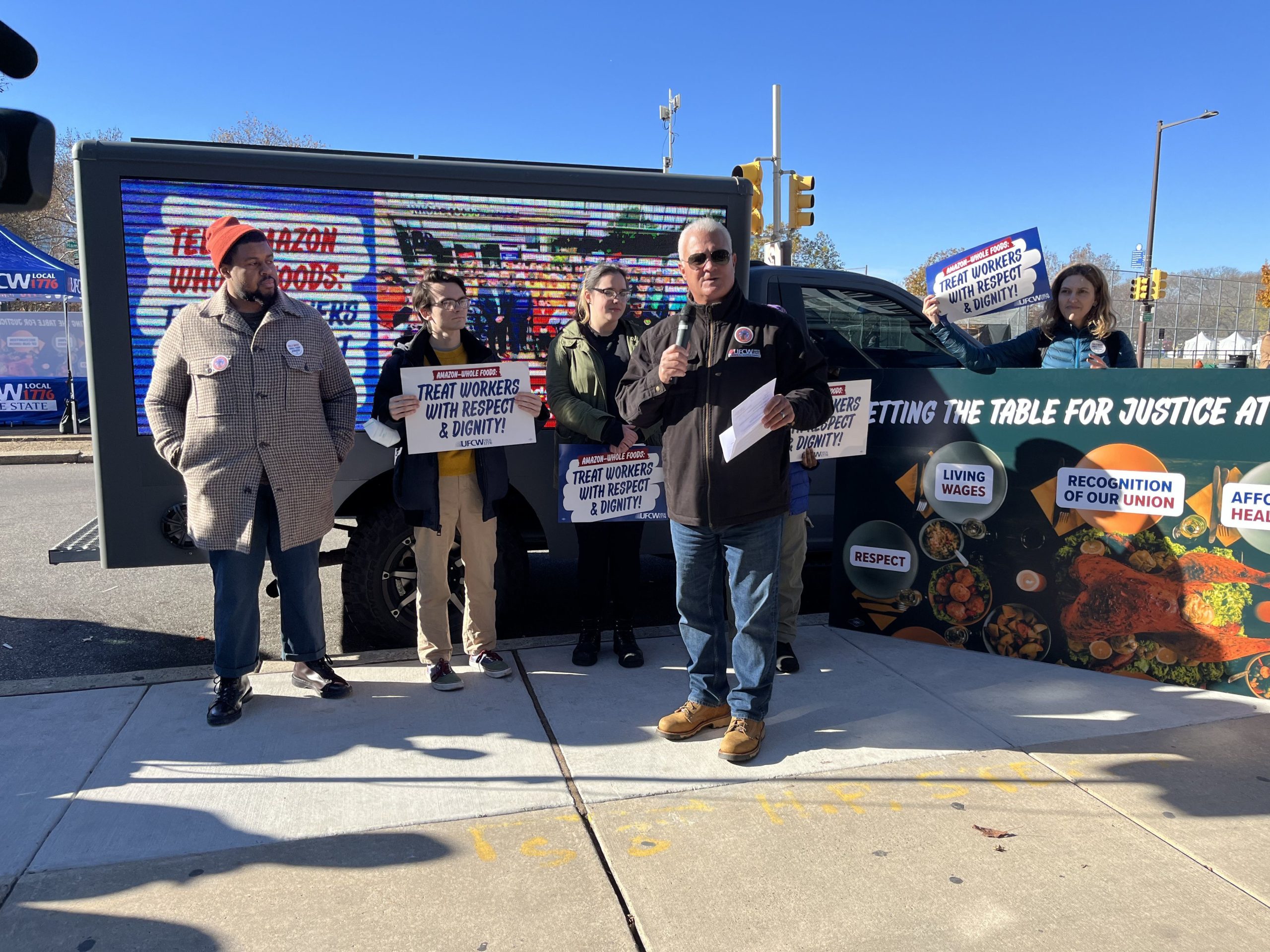
    Wendell Young, president of UFCW Local 1776, gathers with supermarket workers outside the Whole Foods at 2101 Pennsylvania Ave on Nov. 24.Ariana Perez-Castells / Staff

    What is a cash-balance pension plan?

    Cash-balance plans are often seen as a hybrid of the traditional pension and the “defined-contribution” plan, such as a 401(k).

    Like a traditional pension, they are employer-funded and typically don’t require the employee to make their own contributions. But like a 401(k), the amount available to the employee upon retirement is based on a stated account balance rather than expressed as a promised monthly payment for life.

    These plans debuted in the 1980s and gained popularity in recent decades. Some 23,000 employers offered them in 2020, up from 1,477 in 2001, the Wall Street Journal reported.

    Traditional pensions “typically have benefit formulas that rise sharply late in a career, making them expensive for employers with long-tenured workforces and less valuable for employees who change jobs before retiring,” said Mitchell of Wharton.

    Bank of America was the first large company to introduce one, in the 1980s. It offered young employees some flexibility to take their cash balance plan elsewhere if they switched jobs.

    By 1996, some 200 “large companies” had cash balance plans, the New York Times reported. The Campbell’s Co., the food giant based in Camden, was one of them. Some companies faced backlash.

    Despite adoption at several well-known companies, cash-balance plans still aren’t the norm in the private sector. A recent study by the International Foundation of Employee Benefit Plans found that 21% of corporations surveyed had a defined benefit plan, with 5% being the hybrid kind.

    Then CEO of Campbell’s, Mark Clouse, at the company’s investor day on Sept. 10, 2024, in New York City.Ariana Perez-Castells

    How Peco retirement evolved

    Peco employees were given the option to transition to a cash-balance plan in 2001, and roughly 80% of them did so, the union has said, while others kept their traditional pension. This was before Peco workers unionized with IBEW. The company has also offered 401(k)-based retirement programs.

    Peco’s retirement options “have evolved over time in a manner consistent with broader employer and utility industry practices,” the company said in a statement earlier this month.

    Larry Anastasi, president and business manager of IBEW Local 614, joined other Local 614 bargaining committee members as they speak to the media about contract negotiations with Peco outside the Hilton Penn’s Landing Hotel on July 6. Jose F. Moreno / Staff Photographer

    As IBEW laid out its goals for the new contract, including pensions for all, Peco laid out its own position. The company said it wanted a contract that maintained affordable service for customers.

    Unlike other private sector businesses that can raise prices at their sole discretion to cover labor costs, Peco leaders must get approval from the state’s regulating entity, the Pennsylvania Public Utility Commission (PUC) for rate hikes, which is a lengthy process.

    Peco did raise rates in 2025 and tried to do so again this year. While the company’s 2025 profits were up 48% from the previous year, leaders said the business still needed to increase rates to meet customer demand for energy.

    At Peco, “90% of what we receive [from ratepayers] goes right back into our infrastructure, and that includes paying for the wages and benefits for employees so they can go out and restore power and improve our grid,” Peco’s chief operating officer, Nicole LeVine, said earlier this year during bargaining.

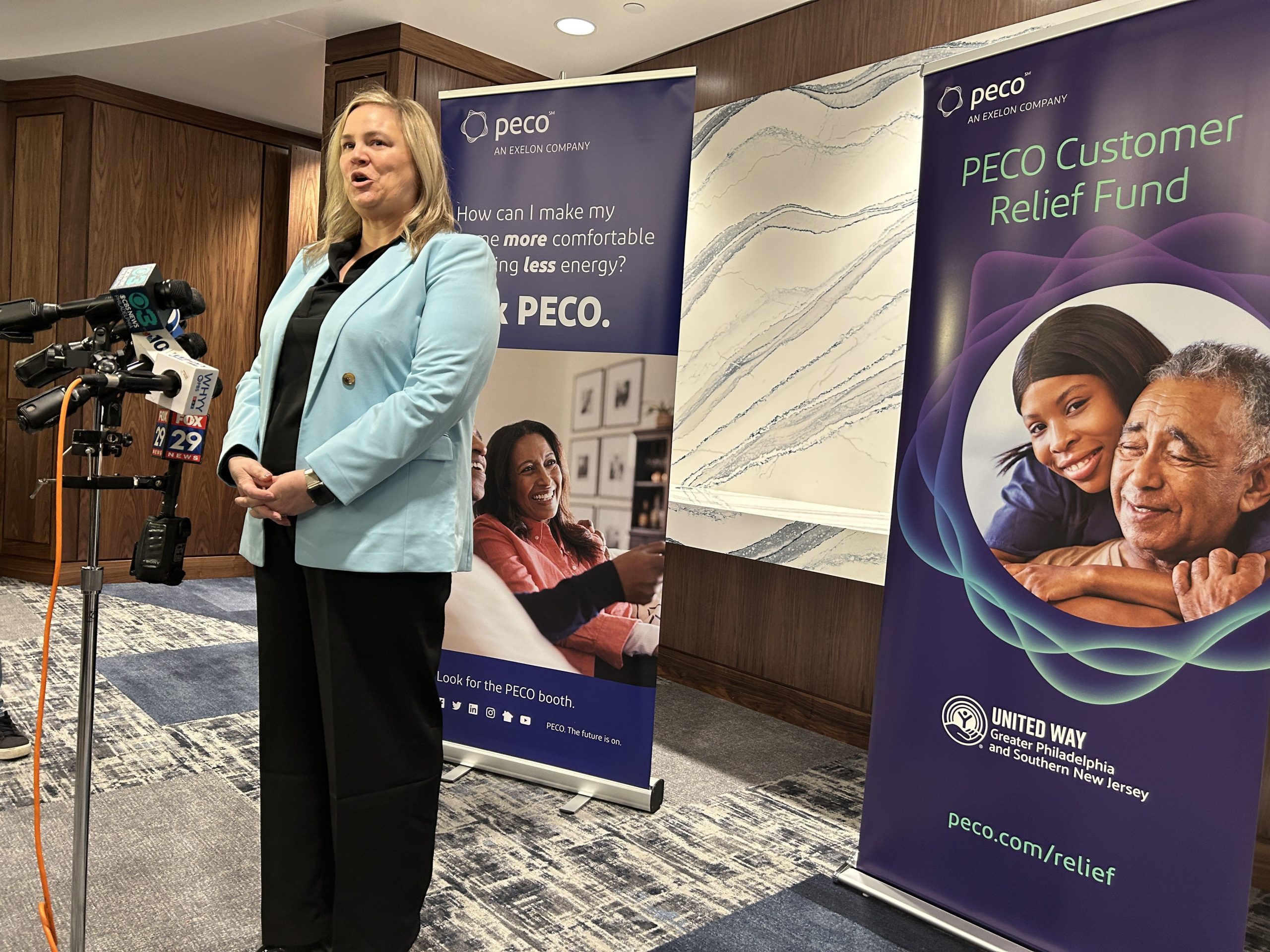
    Nicole LeVine, Peco’s chief operating officer, took questions from reporters on March 31 about the contract negotiations and a proposed rate hike.Ariana Perez-Castells

    After backlash, the utility company rescinded its rake hike request.

    When pensions came up at the bargaining table this year, the cash-balance option prevailed.

    The plan’s similarities with a defined contribution plan, such as a 401(k), make it easier for employees to understand, said Joseph Hicks, consultant and co-owner of Keystone 74 Benefits and Administration, which worked with IBEW local 614 during the recent bargaining process. If employers are spending money on a benefit, they want their workers to be able to understand and appreciate that benefit, Hicks said.

    Peco, upon reaching the tentative agreement July 6, said the deal “recognizes the contributions of our employees while supporting our responsibility to deliver reliable, affordable service across Southeastern Pennsylvania.”

  • Philadelphia Managing Director Adam Thiel resigns from Parker administration

    Philadelphia Managing Director Adam Thiel resigns from Parker administration

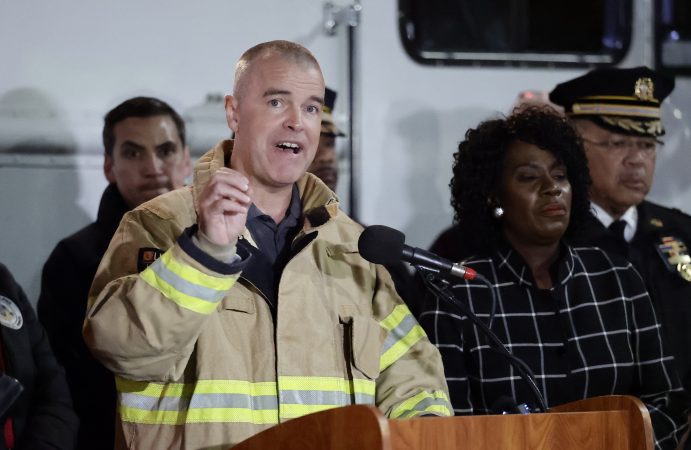
    Philadelphia Managing Director Adam K. Thiel, a top mayoral appointee who supervises many of the government’s day-to-day operations, is resigning from his job in Mayor Cherelle L. Parker’s administration, the mayor announced Tuesday.

    Parker said Thiel is leaving his city role to “reenter the private sector” after serving as managing director for about 2½ years.

    Thiel will be replaced by Carlton Williams, a longtime city official who currently leads the Philadelphia Office of Clean and Green Initiatives. Williams, 57, will assume oversight of a 550-person staff and a vast portfolio of city operations, including health agencies, homeless services, the streets department, parks and libraries, prisons, and the fire department.

    Parker praised Williams’ work implementing new initiatives such as twice-weekly trash collection, and she called him “the individual with all of the attributes the position requires.”

    “Whenever we’ve had a crisis of any kind in this city, he has been on my speed dial,” she said.

    The transition, Parker said, will take place over the next “four to six weeks.” It was not immediately clear who will lead the Philadelphia Office of Clean and Green Initiatives.

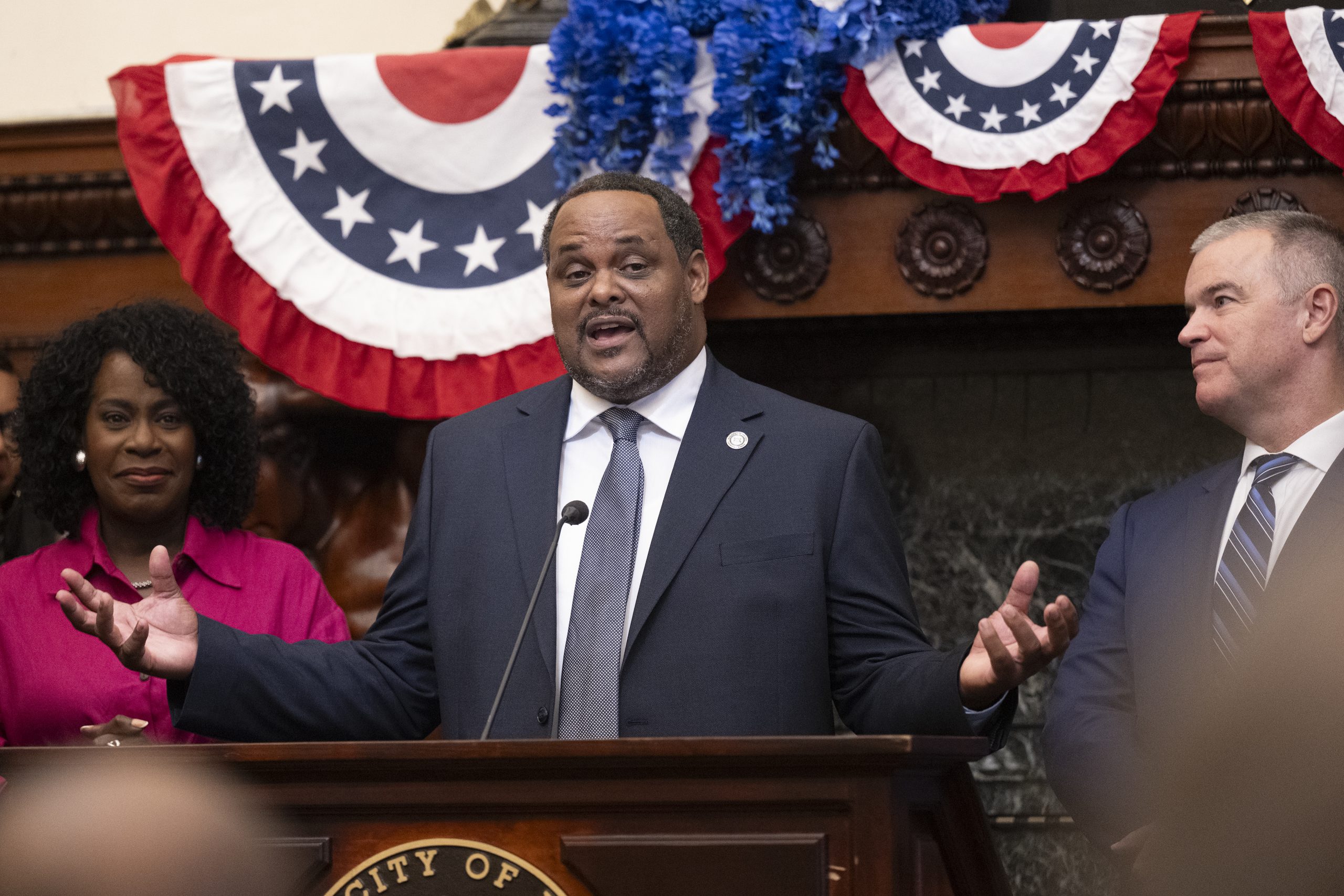
    New Philadelphia Managing Director, Carlton Williams speaks at the podium after being announced by Philadelphia Mayor Cherelle L. Parker, left, during a news conference at City Hall in Philadelphia on Tuesday, July 28, 2026.Jose F. Moreno / Staff Photographer

    Thiel, 54, has been the city’s managing director since Parker took office in January 2024. Prior to being appointed to the role, Thiel spent eight years as the city’s fire commissioner under former Mayor Jim Kenney.

    In the early days of Parker’s tenure, Thiel emerged as a key crisis manager, often flanking the mayor when she responded to emergencies. He was the face of the administration’s strategy in Kensington, where Parker campaigned on ending the sprawling open-air drug market that has persisted in the neighborhood for decades.

    His office also played a critical role in preparing for an array of major events that the city hosted this summer, including FIFA World Cup games and events related to the 250th anniversary of the nation’s founding.

    Details of Thiel’s new job were not immediately clear. He is a major in the Army Reserve, and he has worked as a consultant and an adjunct professor, in addition to his role as managing director. His city salary is $310,000, and last year, he made more than half a million dollars in additional income through his other jobs, according to his financial disclosure.

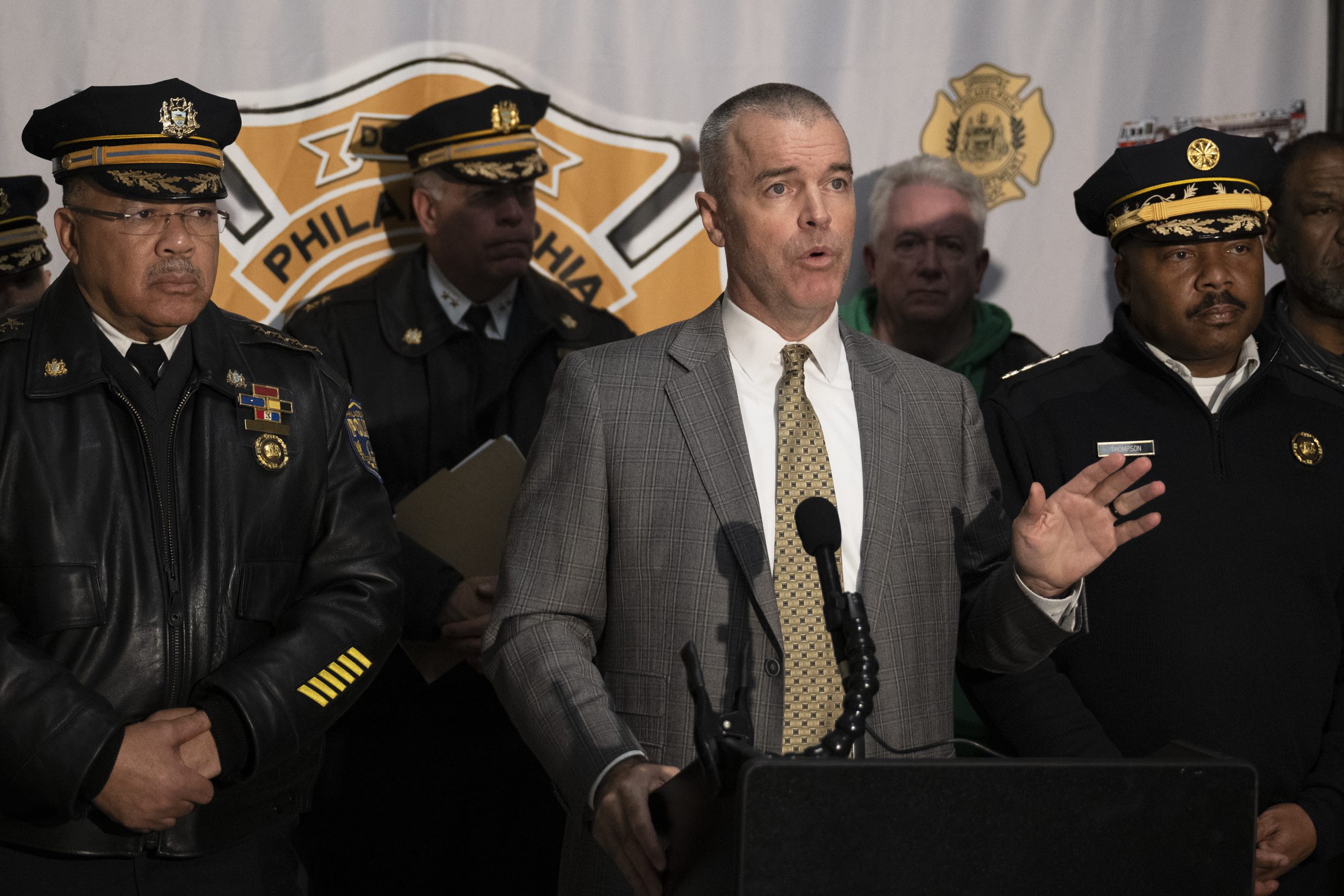
    Managing Director Adam Thiel, center, gives an update on the Northeast Philly plane crash, during a press conference on Tuesday Feb 4, 2025 at the Fire Administration Building in Philadelphia, Pa.Jose F. Moreno / Staff Photographer

    Since Thiel joined the Reserve in August 2024, he has been one of the administration’s least visible senior officials and was frequently on leave. He did not oversee the response to a January snowstorm that was the city’s worst in five years — despite emergency services falling under his purview — and parts of the Kensington strategy are now led by other offices.

    The Inquirer reported in February that Thiel was absent for a total of about five months last year. Of that, six weeks were for military leave — the maximum the city covers for employees — and an additional 13 weeks were for general paid leave, according to city records obtained by The Inquirer. A spokesperson for Thiel said he used most of that time off for military service.

    Thiel refused to discuss his role in the Army Reserve with The Inquirer. A spokesperson for the Army said Thiel is a major assigned to a civil affairs unit based in Staten Island, N.Y. Last year, the Army Reserve paid Thiel about $32,600, according to his financial disclosure paperwork.

    In addition to his jobs with the city and the Army, Thiel has worked on the side as a consultant. Last year, he earned $390,000 as president of Pantheon Global Strategies, an opaque company with little in the way of an online footprint. Thiel has in the past refused to discuss the business in detail.

    He also earned $120,000 last year from FACETS Consulting LLP, an Arizona-based firm that is publicly advertised as a fire safety consultancy. Thiel is a founding partner.

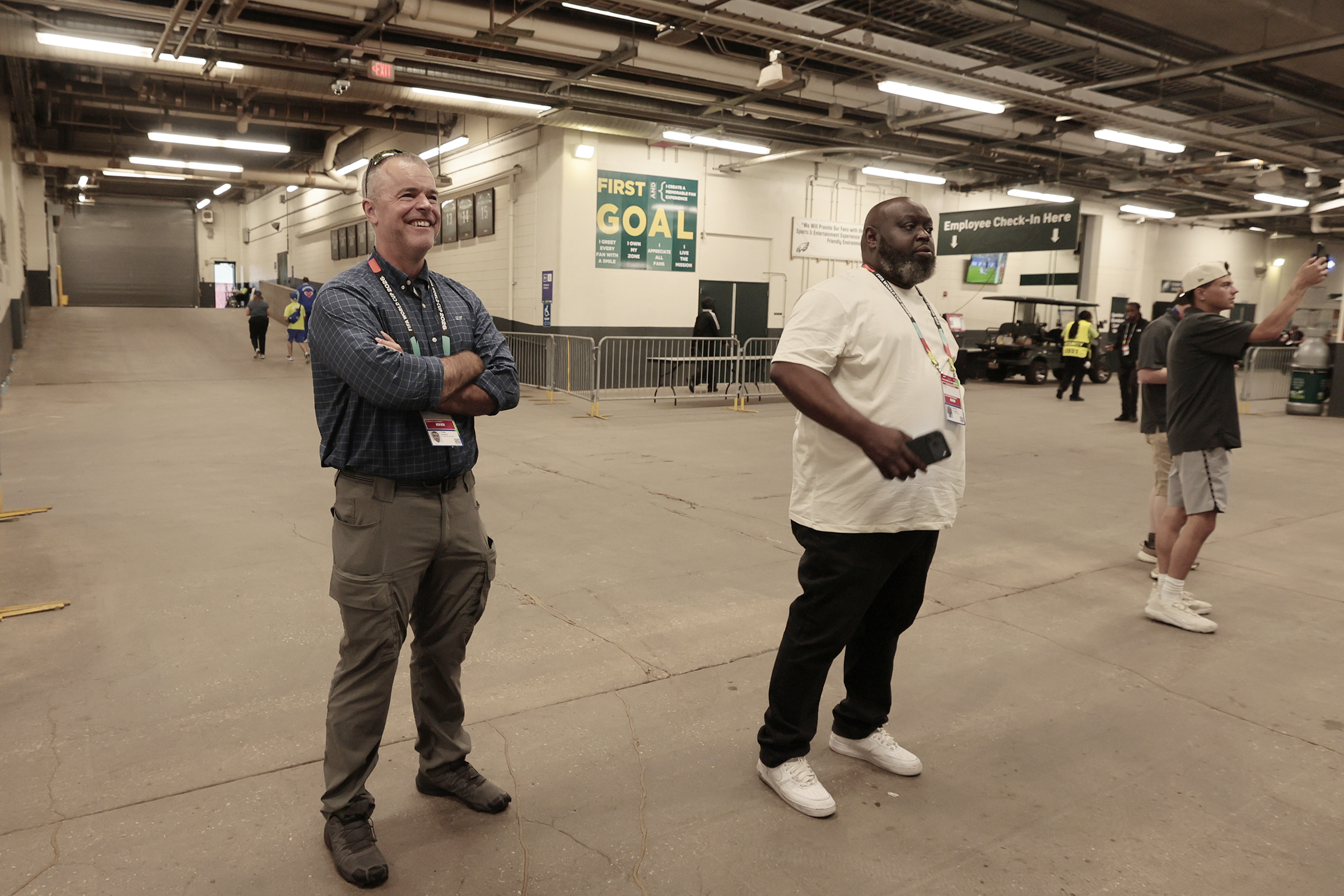
    Philly city managing director Adam Thiel in the bowels of the stadium during the France vs. Iraq 2026 FIFA World Cup Group 1 soccer match at Philadelphia Stadium on Monday, June 22, 2026.Elizabeth Robertson / Staff Photographer

    Thiel has said his consulting work takes fewer than 10 hours per week and did not interfere with his responsibilities as Philadelphia’s managing director. When The Inquirer first reported on Thiel’s consulting work in 2024, he would not disclose his clients but said he followed the city’s ethics guidelines related to conflicts of interest.

    Before coming to Philadelphia in 2016, Thiel worked in a variety of firefighting, disaster response, and emergency preparedness roles around the country, including as Virginia’s deputy secretary of public safety and homeland security.

    He is the third top official to leave Parker’s administration since she took office in January 2024. Former chief deputy mayors Aren Platt and Sinceré Harris, the architects of Parker’s mayoral campaign, each left their posts for jobs in politics outside government.

    In some administrations, the managing director has been the mayor’s clear No. 2, while other mayors have preferred for power to be concentrated among deputy mayors or other staffers in their office.

    Under Parker, chief of staff Tiffany W. Thurman is seen as the mayor’s top adviser and the central figure in her administration. Parker has called Thurman her “chief air traffic controller.”

    She has also placed the execution of much of her agenda on Williams’ shoulders. Earlier this year, he oversaw the city’s response to a major snowstorm, despite that work in the past falling squarely in the managing director’s scope.

    Mayor Cherelle L. Parker walks along Kensington Avenue with Adam Thiel, managing director of city, on Thursday, April 11, 2024. Mayor Parker took the El to attend an event in the Kensington neighborhood in Philadelphia.Heather Khalifa / Staff Photographer

    Still, Thiel oversaw a large team, and the leaders of more than 30 city agencies and offices reported to him.

    One of his major initiatives was coordinating the administration’s efforts to improve quality of life in Kensington. Thiel’s office worked to expand homeless shelter and recovery bed space throughout the city, and he led the development of the Riverview Wellness Village, a city-run recovery house in Northeast Philadelphia that dramatically grew the city’s capacity to house people with substance use disorder.

    Initially, Thiel absorbed scrutiny from community groups and, at times, members of City Council. Lawmakers grilled Thiel on the efforts in Kensington, and they occasionally criticized what they saw as a lack of details coming from the Parker administration about the plan.

    Despite those early hiccups, more than 200 people live at Riverview, which has been open to residents in recovery for more than a year.

    “I’m grateful for what you did,” Parker told Thiel on Tuesday. “And I’m grateful that you had thick skin.”

    And while the drug market in Kensington persists, there have been other markers of success in the neighborhood, including a plummeting shooting rate and a reduction in the number of people living on the street.

    Williams recently toured parts of Kensington alongside Parker and other administration officials to get a sense of the challenges ahead. He said Tuesday that his goal is to be accessible to all residents and to look at the delivery of city services “through the eyes of everyday residents.”

    “You just don’t take these jobs because of the glamour,” he said. “You take the job because you believe that you can make a change.”

    Staff writer Sean Collins Walsh contributed to this article.

  • The Eagles enter training camp with a number of intriguing storylines. We ranked their importance.

    The Eagles enter training camp with a number of intriguing storylines. We ranked their importance.

    The Eagles report to training camp on Tuesday, with their first practice set for the Jefferson Health Training Complex on Wednesday. In advance of that event, reporters Olivia Reiner, Jeff Neiburg and Ryan Novozinsky identified 11 storylines that will be worth tracking in the coming weeks — then ranked them in order of priority.

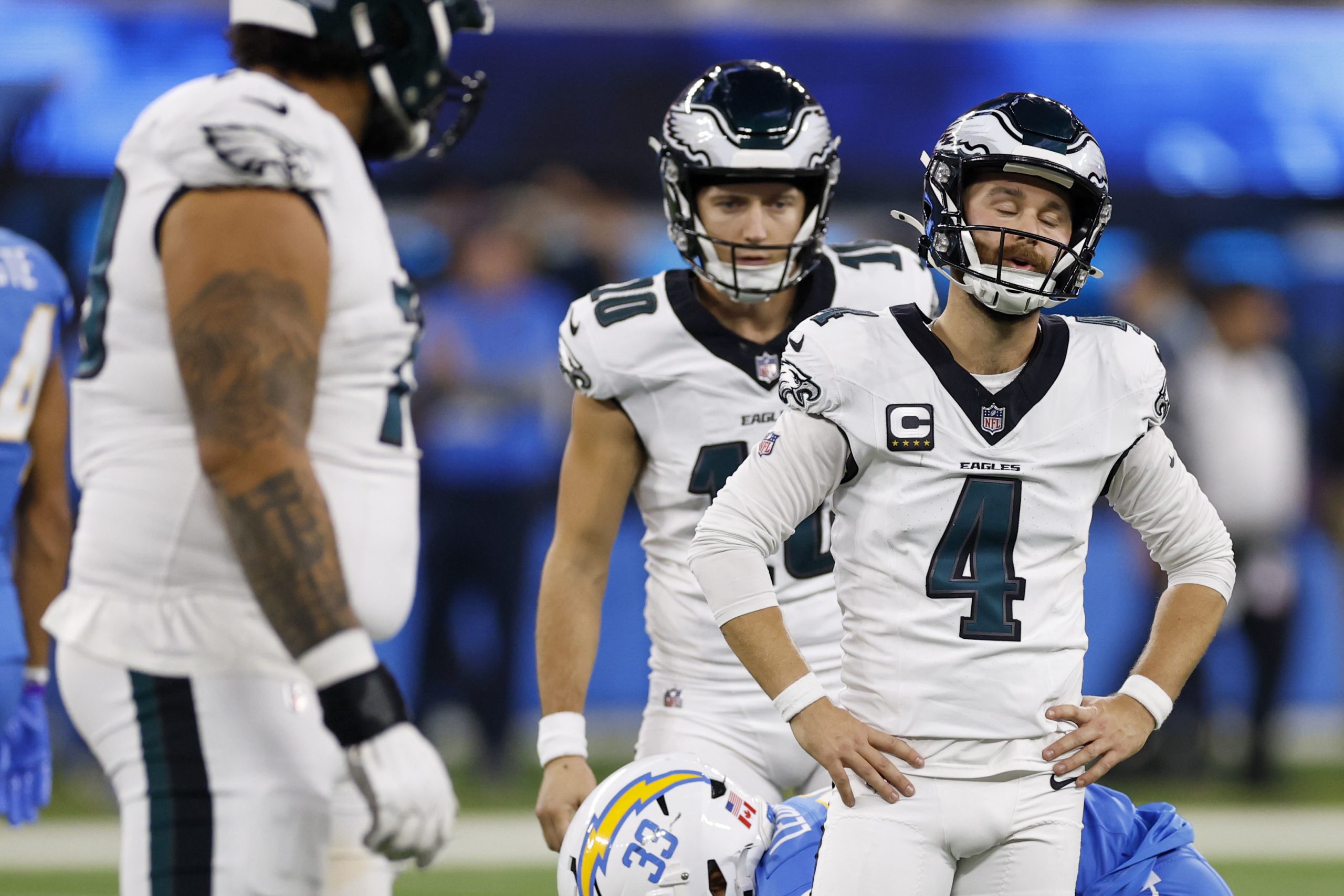
    Jake Elliott (4) was less dependable than usual during an inconsistent 2025 season. Yong Kim / Staff Photographer

    11. Kicker Jake Elliott’s progress after a shaky 2025.

    The two-time Super Bowl champion struggled at times last season, going 20-for-27 on field goals and 4-for-8 from 50-plus yards. Over the past two seasons, Elliott is 5-for-15 from 50-plus yards out, which is dead last in the NFL among the 35 kickers with at least five attempts.

    The Eagles showed faith in their longtime kicker when they restructured his contract in March, but if he doesn’t return to form, he might find his way off the roster sometime soon. A rock-solid training camp showing should ease any concerns the organization may have in the 31-year-old. It’s on Elliott to prove he’s still got it. — Novozinsky

    What will the presence of Jonathan Greenard mean for Nolan Smith Jr.’s playing time off the edge?Monica Herndon / Staff Photographer

    10. How the reps will be divided within an altered edge rusher rotation.

    Out is Jaelan Phillips, in is Jonathan Greenard. That’s the big change at the top of the depth chart, and the only two returning edge rushers in the rotation are Jalyx Hunt and Nolan Smith Jr. Two from that trio will be on the field most of the time for the Eagles, and Hunt may continue to see a higher workload than Smith. But beyond them, the position is an interesting one to watch in camp.

    Arnold Ebiketie is the clear No. 4 as camp begins based on his one-year deal worth more than $7 million. But he’ll face some competition for snaps from players looking to make an impression and claim a spot on the 53-man roster. A.J. Epenesa wants to prove he still has more in the tank. Keyshawn James-Newby, the rookie seventh-round pick, wants to show that he has the skill set to make up for his lack of size. Jose Ramirez is still fighting to stay in the NFL.

    The top trio is going to eat up the first-team reps, and Ebiketie likely will get some looks there, too, but how the Eagles divvy up reps among the unit will be something to monitor as camp gets rolling.

    Plus … will Brandon Graham’s return be necessary? — Neiburg

    Cooper DeJean (33) goes from All-Pro nickel to All-Pro nickel with additional safety responsibilities. Nick Wass

    9. The impact of new faces — and altered duties — in the secondary.

    Vic Fangio’s defense doesn’t have many holes. It may not end up having any holes. It’s a defense with stars at every level, at every position. Still, it’s the defensive back group that will be the most fascinating thing to watch on Fangio’s side of the ball during camp.

    Quinyon Mitchell, an All-Pro last year, is one of the best cornerbacks in the league. Riq Woolen, who signed a one-year deal with $12 million guaranteed, has flashed potential and was one of the standouts of the offseason program. Cooper DeJean, meanwhile, is an All-Pro nickel. But the Eagles plan to use DeJean at safety in their base defense next to second-year safety Andrew Mukuba, and the battle for the second safety spot may be one of the most exciting of the summer.

    The Eagles are only in base about 20% to 25% of the time, which means the safety not named DeJean is going to be on the field pretty often. Right now, that spot is Marcus Epps’ to lose. But Epps is 30, has dealt with injuries, and wasn’t a starter last year until the Eagles needed him after Mukuba went down. Will Michael Carter II take to a position change from nickel and push Epps? Can veteran J.T. Gray, a career special teamer, finally have a breakthrough? Will Andre’ Sam show all that he’s learned in Fangio’s defense the last few seasons? Will rookie Cole Wisniewski go from seventh-round pick to a key role? Undrafted free agents Kapena Gushiken and Maximus Pulley want their names in the mix, too.

    All of this is without mentioning the battle that will take place for the depth-chart spots at corner behind the top three. Veteran Jonathan Jones may be a lock for a spot, and Kelee Ringo has the special teams chops to claim a job. What does that mean for Mac McWilliams and Jakorian Bennett? Time will tell. — Neiburg

    Can Makai Lemon give the receiving game a jolt after missing mandatory minicamp due to injury? Tyger Williams / Staff Photographer

    8. The impact of the Eagles’ top three 2026 draft picks.

    Our first look at the top three draft picks was a bit incomplete during the offseason program. Wide receiver Makai Lemon was held off the field for minicamp with a hamstring injury. Tight end Eli Stowers had a sleeve on his right leg at one point and didn’t go through the entirety of the workout. Then tackle Markel Bell missed the final workout of the spring with an undisclosed injury.

    All three are expected to be at 100% when camp opens this week, which means all three will be under the microscope as the new-look offense takes shape.

    Their importance for the 2026 Eagles is ranked in draft order. Lemon will be expected to take on a pretty significant role in the offense as the Eagles begin life without A.J. Brown. Stowers, meanwhile, won’t have the same kind of pressure. Dallas Goedert is still in town, and Johnny Mundt was brought in to be a blocking specialist. But the Eagles have raved about Stowers’ athleticism and his ability to create mismatches. Will we see some of that in camp?

    As for Bell, the tallest player on the roster (6-foot-9) got the first crack at filling in for Lane Johnson during OTAs. Will he be the preferred swing tackle? Or is that job still Fred Johnson’s? — Neiburg

    Could Tanner McKee’s days in Philly be numbered?David Maialetti / Staff Photographer

    7. The QB depth chart, and how many the Eagles will keep at the position.

    By the end of training camp, the Eagles will have to make a decision about how many quarterbacks they will keep on the initial 53-man roster.

    Typically, that quantity would be three. A fourth quarterback would land on the practice squad. Last season, for example, Tanner McKee and Sam Howell filled out the active-roster depth behind Jalen Hurts, while Kyle McCord signed to the practice squad.

    This year could be different. McKee, 38-year-old Andy Dalton, and fifth-round rookie Cole Payton round out the depth behind Hurts. It seems unlikely that the Eagles would cut Payton, given he was a fifth-round pick. Could the Eagles opt to move McKee or Dalton ahead of the regular season? Or, could they see the value in carrying all four quarterbacks on the initial 53, at least to start the season?

    The Eagles also must choose a primary backup to Hurts by Week 1. McKee held that role last season. The Eagles acquired Dalton from the Carolina Panthers this offseason, seemingly identifying their QB3, but the 15-year NFL veteran split second-string reps with McKee during the offseason program. Dalton didn’t exactly separate himself from McKee in a very early, limited window during OTAs and minicamp. Still, the competition between the two depth quarterbacks could continue in training camp. — Reiner

    A Jalen Carter contract extension has been in the wind throughout the 2026 offseason. Yong Kim / Staff Photographer

    6. Jalen Carter’s health, and his contract.

    (Note: Carter signed a record extension on Tuesday, hours after the publication of this story.) Answers about Carter’s health and the status of a prospective contract extension could be straightforward. Carter, 25, dealt with shoulder injuries last season and missed time as he recovered from procedures. In late May, Fangio said Carter’s shoulders are “fine,” adding that “he’s in a better spot now than he was [last season].” If that is still the case two months later, then there shouldn’t be much concern about Carter’s ability to fully participate in camp.

    Carter did not participate in team drills during the Eagles’ two-day mandatory minicamp in June, however. Was his lack of participation injury-related, or was it something of a hold-in, given Carter is eligible for a contract extension? Nick Sirianni declined to offer an explanation during mandatory minicamp.

    After the Eagles picked up Carter’s fifth-year option this offseason, he has two years left on his rookie deal. The Eagles could theoretically tag him, too, when the time comes to keep him under contract for a third. It isn’t necessarily imperative that the Eagles sign Carter to a new deal before the season.

    But GM Howie Roseman is typically proactive about extending key players. He has also said he prefers not to do new deals during the season. Time is of the essence, as Carter will likely reset the defensive tackle market when he signs his next contract. (Tennessee Titans defensive tackle Jeffery Simmons leads interior defensive linemen at $35.3 million per year.)

    Why has Roseman waited to extend Carter? He likely has his rationale, but he tends not to comment on ongoing or upcoming contract negotiations.

    If Carter is on the field Wednesday fully participating in all drills, then there might not be anything to see here. Perhaps the Eagles want to see another year from Carter before they make a long-term commitment, even if his market value increases in the meantime. If he’s missing or sitting out, bigger questions could arise, either about Carter’s health or the status of his future in Philadelphia. — Reiner

    The Eagles’ fortunes rose and fell at times on the availability of Lane Johnson last season. Monica Herndon / Staff Photographer

    5. The health of Lane Johnson and other veterans coming off injuries.

    Is there a bigger storyline in camp than the health of the offensive line? Sure, you may counter and say duh, it’s the Sean Mannion offense, dummy! But I would counter by saying none of it matters if Lane Johnson, Cam Jurgens, and Landon Dickerson aren’t healthy. Heck, Kevin Patullo might still be the coordinator if the line was healthy, because one would assume that the Eagles, with a sturdier line, would have been able to run the ball a lot better, which means they would have faced a lot fewer third-and-long situations, and so on.

    Johnson is coming off a season-ending foot injury. Jurgens and Dickerson, meanwhile, flew to Colombia separately this offseason to get stem cell therapy treatment to manage pain. Jurgens has had back issues. Dickerson has had many lower-body ailments. How the three of them look during the early stages of camp will be informative.

    Then there are others, like Mukuba, who fractured a fibula and had his rookie season stopped early. Jalen Carter got injections in his shoulders to help him finish out the rest of the 2025 season. Nolan Smith aggravated his triceps injury and was limited to 12 games. Jihaad Campbell spent some time this offseason recovering from a shoulder injury. And Greenard, the major acquisition of the offseason, had his 2025 season ended early due to a shoulder injury.

    All eyes will be on the offensive line, but there are some other Eagles worth monitoring as the training camp workload dials up. — Neiburg

    Can Saquon Barkley (right) find more running room in an offense that has moved away from ex-assistant Jeff Stoutland’s blocking principles?Jose F. Moreno / Staff Photographer

    4. The work of Saquon Barkley and the running game in Year 1 A.S. (after Stoutland).

    The Eagles have a new offensive line coach, Chris Kuper, for the first time in 16 years. Jeff Stoutland’s departure, along with the hiring of a new offensive coordinator in Mannion, is going to have massive ripple effects across the organization — especially in the run game. Barkley, who took a step back last season after a historic 2024, is at the center of these changes.

    Mannion’s new playbook implements a wide zone scheme with concepts that look similar to the schemes of Sean McVay and Kyle Shanahan. Wide zone blocking concepts will stretch opposing defenses horizontally. On paper, Barkley should thrive in a system like this. The onus is on the offensive line to stay healthy and execute the new blocking style properly. If Kuper lives up to the hype — and the early reviews have been positive — the latter point shouldn’t be a concern at all. — Novozinsky

    DeVonta Smith stands to receive more scrutiny from defenses that no longer have to account for A.J. Brown. Yong Kim / Staff Photographer

    3. The post-A.J. Brown pass-catching situation.

    Roseman spent the offseason bolstering the Eagles’ receiving corps ahead of Brown’s trade to the New England Patriots in June. He drafted Makai Lemon in the first round out of USC, acquired and extended Dontayvion Wicks, and added Hollywood Brown in free agency.

    No single player will replace Brown’s precise role and responsibilities on the team, which will feature a revamped offensive scheme under first-time play-caller Mannion. DeVonta Smith is poised to become WR1, but he and Brown possess different body types, skill sets, and strengths. Compensating for the loss of Brown will ultimately be a group effort.

    But how will the targets break down among Eagles receivers during the season? Training camp will offer a peek into the pecking order among Smith, Lemon, Wicks, Brown, and some of the bubble receivers including Elijah Moore, Johnny Wilson, and Darius Cooper. Tight ends Dallas Goedert and second-rounder Eli Stowers and running back Saquon Barkley will factor into the passing game, too. The next couple of months will also offer more insight into how each of those players will be utilized within the scheme. — Reiner

    Fans have high hopes for new coordinator Sean Mannion, despite his relative inexperience. Elizabeth Robertson / Staff Photographer

    2. The Sean Mannion offense.

    The Eagles should be the most prepared team in the league when it comes to transitioning to a new offense. That’s because the Birds have had six offensive coordinators in the past seven seasons.

    But the addition of Mannion feels different — and for good reason. The Eagles brought him in to overhaul an offense that often failed to ignite under Kevin Patullo. Mannion, a disciple of the McVay/Matt LaFleur coaching tree, is hoping to modernize their play-calling with the implementation of outside zone and far more motion.

    How is the install going so far? According to tackle Jordan Mailata, it’s “very easy to follow along, but hard to remember, just because there’s so much to setting up the plays.” There are going to be growing pains — especially during training camp — but if Mannion’s offense works the way it should, the Eagles’ 2026 ceiling becomes limitless. — Novozinsky

    With a new scheme to run and an altered supporting cast around him, Jalen Hurts enters 2026 under more pressure than ever. Yong Kim / Staff Photographer

    1. Jalen Hurts.

    Was there an NFL player under a bigger microscope than Hurts this offseason? Between the ESPN report that detailed friction concerning Hurts, the A.J. Brown saga, the constant debates over his standing among NFL quarterbacks, Hurts dominated headlines all offseason.

    So can he block out that noise and silence his doubters with a strong camp? It’d be easy to say “yes” and just move on, but the reality is that Hurts is at a crossroads. He’s learning another new offense and it’s drastically different from the last one he ran. His new OC gushed about him in his first news conference, but can that honeymoon phase survive a weak training camp/slow start to the season? That’s not to mention the fact that Hurts has a handful of unproven new weapons trying to replace a No. 1 wide receiver in Brown.

    How Hurts deals with these hurdles is easily the most intriguing camp storyline. His future in Philadelphia will be in question all season. He can quell some of that noise with a decent July and August. — Novozinsky

  • He was assaulted by teammates in Cheltenham High’s locker room. Nearly a year later, his mom says he ‘can’t escape the situation.’

    He was assaulted by teammates in Cheltenham High’s locker room. Nearly a year later, his mom says he ‘can’t escape the situation.’

    The mother knew something was wrong the night her son came home from football practice last September and quietly went to his room.

    Four days later, she took him to the doctor after he told her his teammates had jumped him inside the Cheltenham High School locker room after that practice, injuring his genitals.

    It was not until she got a call from police later that month that the mother learned that teammates had used a broomstick in the alleged attack, an act his lawyers described as attempted sexual assault.

    Her son, who was 15 at the time, told her teammates had tried “to mess with his manhood,” the mother said.

    He told her that the school’s football coaches, who knew that his teammates had jumped him, had called him that night and told him not to tell his parents.

    “He didn’t want to talk about it,” said the mother, who spoke to The Inquirer on the condition of anonymity to protect her son’s identity. Her son, she said, “was trying to put it in the back of his head. He was traumatized.”

    Cheltenham abruptly canceled its football season last October, citing hazing allegations. In January, the district said it had confirmed that a “student-on-student assault” took place in its football locker room on Sept. 3, and that nearly 20 students had watched without trying to stop it.

    A video of a locker room attack that investigators thought matched the student’s description of the alleged attack in September surfaced in the fall and was obtained by the district. The teammates who assaulted the student are identifiable in the video, said Gabrielle Turley, a lawyer representing the student. She said the student provided their names to Cheltenham police.

    But this spring, detectives determined the footage actually had been taken in August, according to the student’s lawyers — prompting the student to reveal he had been assaulted more than once.

    Eleven months later, no charges have been filed. A spokesperson for the Montgomery County District Attorney’s Office said it is still investigating but declined to comment further.

    The incidents have reverberated throughout the suburban community, even as the school district has provided few specifics about what happened in the locker room.

    The district announced in May it was canceling the forthcoming football season for the Panthers, but has not disciplined any students.

    A Title IX investigation — which schools are required by federal law to conduct into sexual misconduct allegations — is ongoing. “Unfortunately, the district received extremely limited cooperation from students,” Superintendent Brian Scriven said in a statement in response to questions from The Inquirer about the assaults. Any discipline for students will be imposed once the investigation is done, Scriven said.

    The district in April approved a separation agreement with the team’s head coach, Terence Tolbert, who had been Cheltenham’s top football coach since June 2025.

    Scriven noted that the district also in April approved a separation agreement with another football coach, Darian McFadden. None of the coaches from the 2025-26 season are still affiliated with the district, the superintendent said.

    Scriven declined to address specific questions about the alleged assaults, saying the district attorney’s office had asked school officials not to comment.

    Brian Scriven, superintendent of the Cheltenham School District.Courtesy of Cheltenham School District

    As the new school year approaches, some football players and their families have criticized the district’s cancellation of another season as unfair punishment for a situation they had no part in.

    But students who participated in or witnessed the alleged assaults have been able to move on with their lives, graduating from the 1,450-student Wyncote school or transferring to other schools, the mother of the victim said. Her son has not.

    He was taunted by peers after the September assault and switched to virtual school in the district, where he struggled and was isolated, his mother said. After getting harassed by kids at his local basketball court, he avoids going outside, she said.

    “He can’t escape the situation,” she said.

    Inside the locker room

    Video footage from the August incident after a football training camp at Cheltenham High School shows the student being dragged by his shirt on the floor of the locker room, according to his lawyers.

    About “seven or eight students are making physical contact” with him, while other students are standing by lockers, some with their phones out, said Alan Yatvin, one of the lawyers.

    The video shows one young man holding a broomstick, which is being “poked or thrust at [the student’s] genitals and backside,” Yatvin said.

    Turley, the other lawyer representing the student, said the video shows teammates trying to pick the student up by his shirt, which is ripped, while the student tries to remain seated on the floor.

    “There’s no other reason to be in that area, unless you’re trying to sexually assault somebody,” Turley said of the broomstick she saw in the video of the alleged attack.

    The student did not tell anyone about the August incident because he was embarrassed, his lawyers said.

    But then on Sept. 3, he was assaulted again. The student had taken someone’s shoulder pads because his were missing. Coaches made players run as a punishment, and they blamed the student, the lawyers said.

    Yatvin said that as the student tried to leave the locker room, he was thrown on the floor and punched and kicked in the head and testicles. He said the student reported there were “three main people hitting him.”

    The altercation lasted about five minutes, and the student heard someone say, “‘Get the broomstick,’” Yatvin said. He said the student tried to ball up on the ground and “sat in such a way to avoid the broomstick being stuck in him.”

    A couple of teammates intervened, and the fight broke up, Yatvin said. He said one player went to get a trainer, while another got the student ice.

    A volunteer coach drove the student home. That same night, three coaches, including then-head coach Tolbert, called the student, according to Yatvin.

    “They told him that he shouldn’t tell his mom, because they would handle it. He believed that,” Yatvin said.

    Reached by phone earlier this month, Tolbert declined to comment.

    A mother pushes for answers

    The student’s mother recalls taking her son to an urgent care center four days after the Sept. 3 incident because he was “complaining his pee was burning a little bit,” she said.

    She texted the vice principal, Mark Hoff, to let him know what had happened. “I was very upset,” the mother said. Hoff called her; the school opened an investigation the next day, Yatvin said.

    It was about 12 days later when Cheltenham police called her about a tip that had been submitted through the state’s anonymous Safe2Say line, about a broomstick being used during an assault.

    “I know that’s like a sexual assault — trying to sodomize somebody,” the mother said, noting she works at a prison. “What was going through my mind was, ‘Where did these kids get this from?’”

    At the end of September, lawyers said, the district contacted the mother to ask if she wanted to open a Title IX investigation, given the sexual nature of the allegations. She said yes.

    At the time, the mother did not know her son had been attacked more than once.

    No one had shown her and her son the video of the alleged assault that the district obtained — which had circulated through the school community, Yatvin said — until the spring. Had they seen it earlier, he said, they would have known it was from August, based on the student’s hairstyle at the time.

    The mother said her son was “scared to come forward.”

    “He didn’t want to go through none of this,” she said. “But I kind of pushed the issue.”

    Waiting for accountability

    On Oct. 17, a Friday, Cheltenham announced that it was postponing that night’s football game.

    “Today, the district received anonymous information regarding allegations of hazing in the football program,” Scriven said in a statement. The season was temporarily suspended, he said, and the district had “engaged an external investigator.”

    By that Sunday, Scriven had announced that the season was canceled. The district had received a report “approximately three weeks ago” of a locker room assault, he said in the announcement, and that Friday, it “received additional information, including reports indicating multiple team members engaged in hazing through physical contact.”

    Asked why it took until Oct. 17 for the district to suspend the season when the mother had reported the assault Sept. 7, Scriven drew a distinction between hazing and a “singular incident of assault.”

    The district’s external investigation, which was completed in January, determined there was insufficient supervision in the locker room and “a failure to prioritize student safety by the coaching staff and/or adult volunteers,” as well as a “a toxic and negative culture within the current football program.”

    Scriven said he expected the Title IX investigation to be completed “in the near future.”

    Yatvin believes more students know what happened to his client than have come forward.

    “If all the necessary information was available, there probably would have been something happening with the school’s investigation, and something happening with the district attorney’s investigation,” he said.

    The student’s mother, who is considering filing a lawsuit, said she wants people held accountable for what happened to her son. No one from his school has called and checked on his well-being, she said.

    “You’ve got parents on the news, worrying about their football team, but not necessarily worried about what happened,” she said. “Nobody is focused on what happened to him.”