An artificial intelligence model operated by Anthropic submitted false information about an unsolved Philadelphia homicide to the police department’s public tip forum this summer, law enforcement officials said Friday.
The unprecedented incident occurred in July and raised concern among department leaders, who met with Anthropic representatives to discuss the interaction on Thursday, police said.
Sgt. Eric Gripp, a police spokesperson, said an Anthropic AI model contactedthe department’s tip forum, PhillyUnsolvedMurders.com, around 11:30 p.m. on July 18.
The model gave information purporting to come from someone with information about an unsolved homicide, he said.
It was not immediately clear which homicide the AI told the department it had information about.
The email was flagged as spam and remained in that folder until Wednesday, when Anthropic alerted police to the incident, authorities said. No city or police data was accessed as a result of the interaction, Gripp said.
Anthropic told police the false tip was generated as the company tested interactions between its AI model and “randomly selected websites,” according to Gripp.
A spokesperson for Anthropic did not immediately return a request for comment.
The company discovered the error on Sept. 28. As a result, Gripp said, Anthropic terminated testing for that model and added safeguards for further trials.
The news arrives ahead of the release of a report from Anthropic on Friday that is expected to detail the Philadelphia police incident as well as other instances of unintended behavior from its AI models.
Earlier this summer, the company made international headlines when it announced that its Claude AI models had broken free from isolated testing environments and, in several instances, hacked into the internal infrastructure of outside organizations.
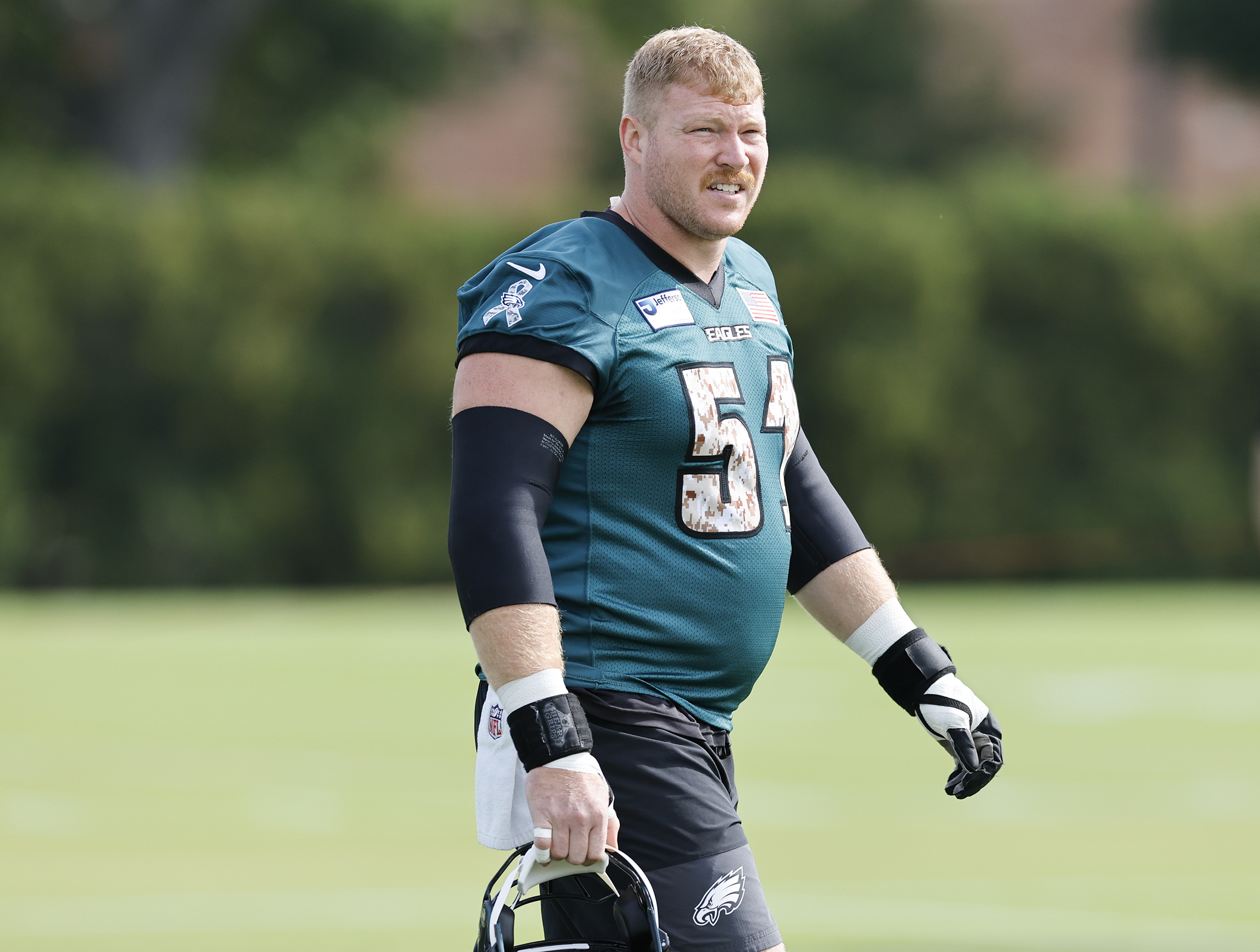
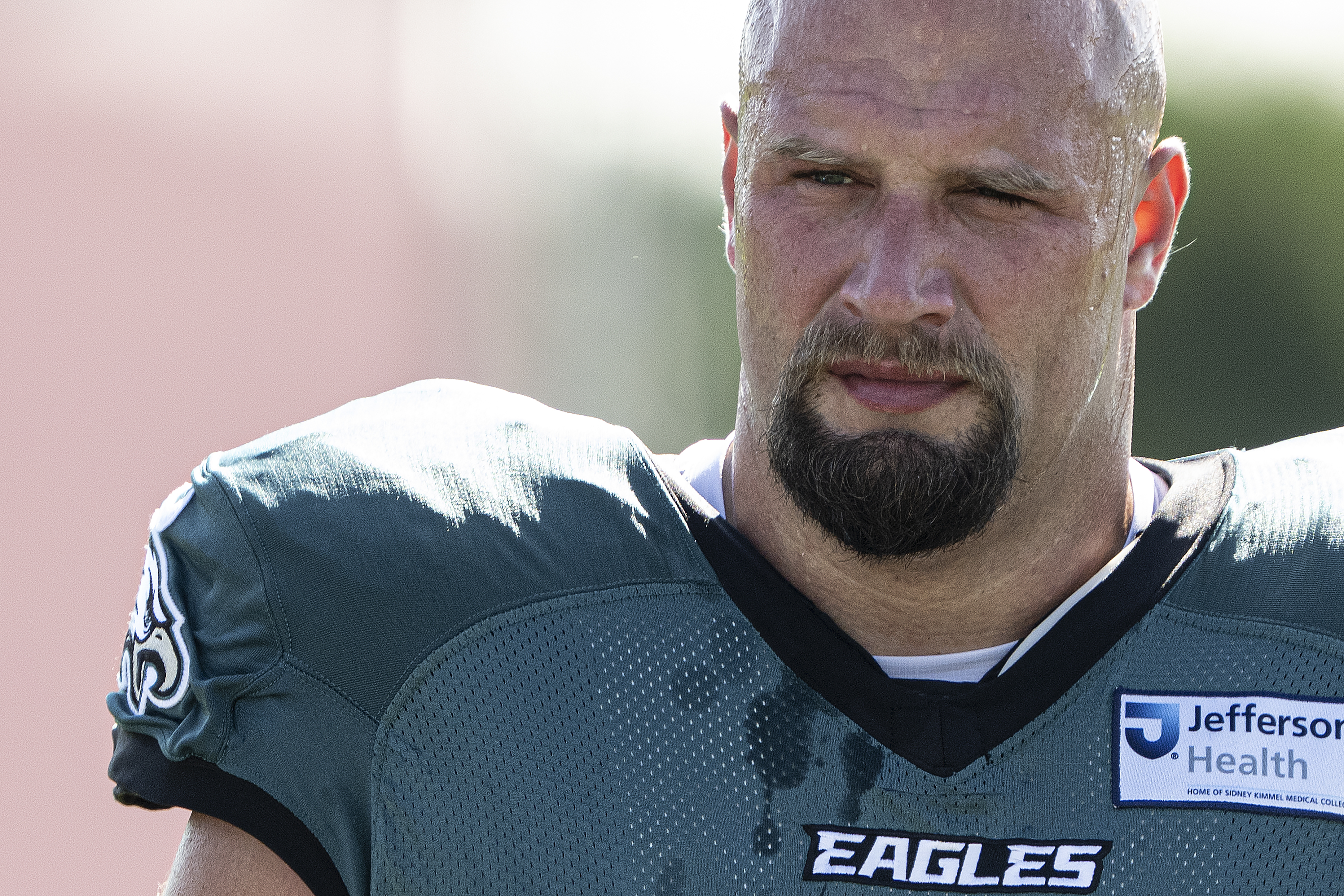
Would three-time Pro Bowl left guard Landon Dickerson, whose ankles and knees also received stem cell treatment, bounce back from an injury-addled 2025 campaign?
And, finally, and possibly most importantly: Would the line withstand the departure of star coach Jeff Stoutland?
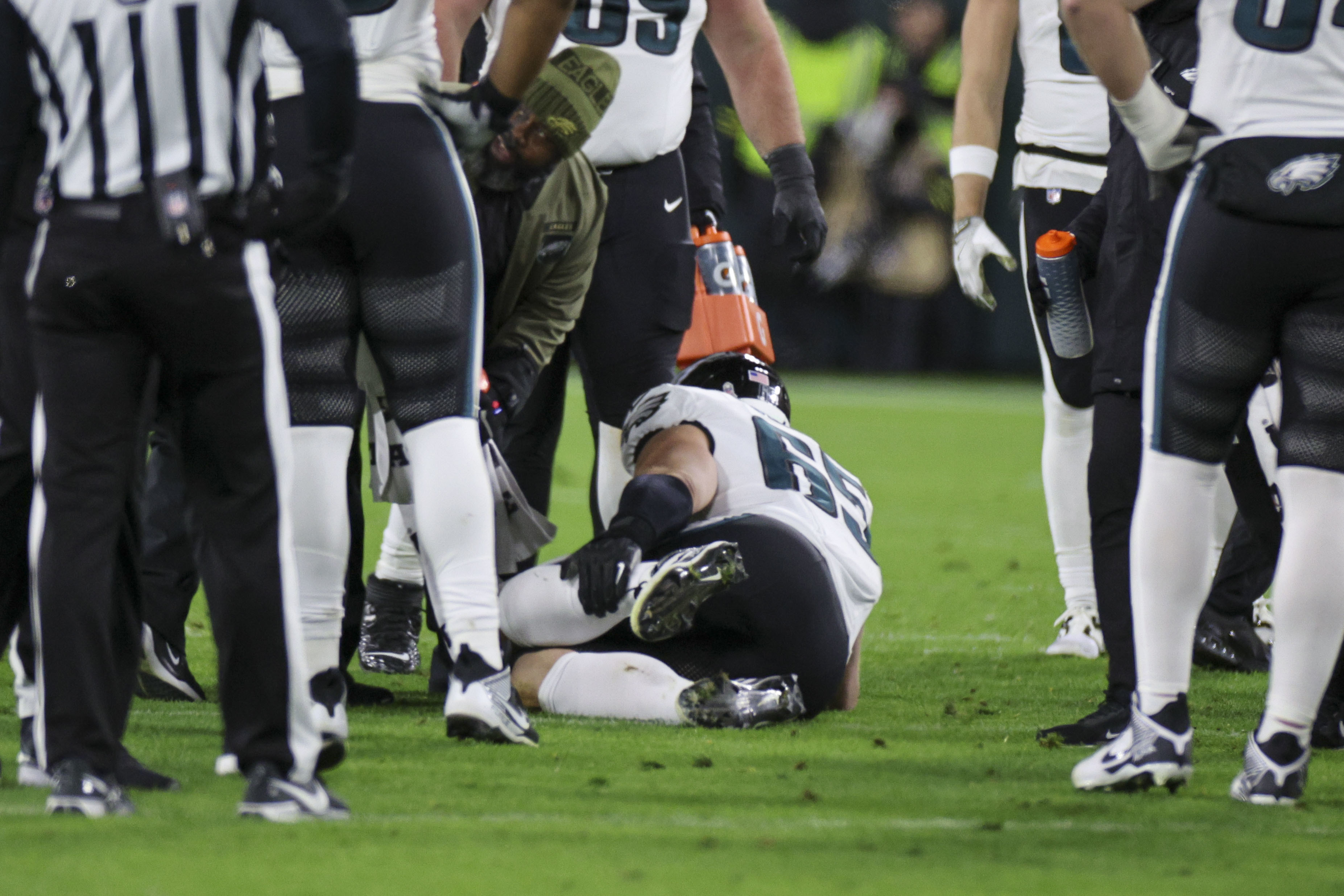
Four games into the season, we have answers. Johnson missed Game 4 on Sunday and abruptly retired on Tuesday. Jurgens has played out of position for three weeks and has performed so badly that the Eagles traded him essentially for a draft pick in 2028. Dickerson is hurt, and out, and so remains a question unanswered.
As it turns out, the most significant question regarded not the players, but the coach.
Stoutland retired in early February, just after the Eagles hired callow Sean Mannion as their new offensive coordinator.
It was the culmination of a series of convulsive events.
In the middle of the 2025 season, Stoutland had been stripped of the run game coordinator responsibilities he‘d held since 2018 by head coach Nick Sirianni and embattled offensive coordinator Kevin Patullo. Sources say Stoutland was livid, and humiliated.
Stoutland also was loyal and committed. Patullo was fired after the season. Stoutland waited until the Birds hired a new OC to decide about his future. When Mannion and Sirianni did not offer Stoutland the run game coordinator job back, Stoutland had enough.
He quit.
Stoutland’s departure might ultimately have crippled the Eagles this season, and might be the worst thing that happens to the Eagles for years to come.
He posted a pointed message on Twitter/X:
Philadelphia,
I’ve decided my time coaching with the Eagles has come to an end.
When I arrived here in 2013, I did not know what I was signing up for. I quickly learned what this city demands. But more importantly, what it gives back.
“Philadelphia, I’ve decided my time coaching with the Eagles has come to an end,” he wrote on social media. “When I arrived here in 2013, I did not know what I was signing up for. I quickly learned what this city demands. But more importantly, what it gives back. The past 13 years have been the great privilege of my coaching career. I didn’t just work here, I became one of you. Stout out.”
Notably, Stoutland did not thank Sirianni. Then again, Sirianni inherited Stoutland, who was a solid-gold carryover from the 2013 hire of Chip Kelly and who lasted through Doug Pederson’s five-year run.
Stoutland was, by far, the best coach on all of those staffs. He maximized the abilities of several players, milked the last good seasons out of Jason Peters, and created Peters’ replacement, star left tackle Jordan Mailata, out of whole cloth.
As significantly, Stoutland did not thank general manager Howie Roseman or owner Jeffrey Lurie in his statement.
These were not unintentional omissions.
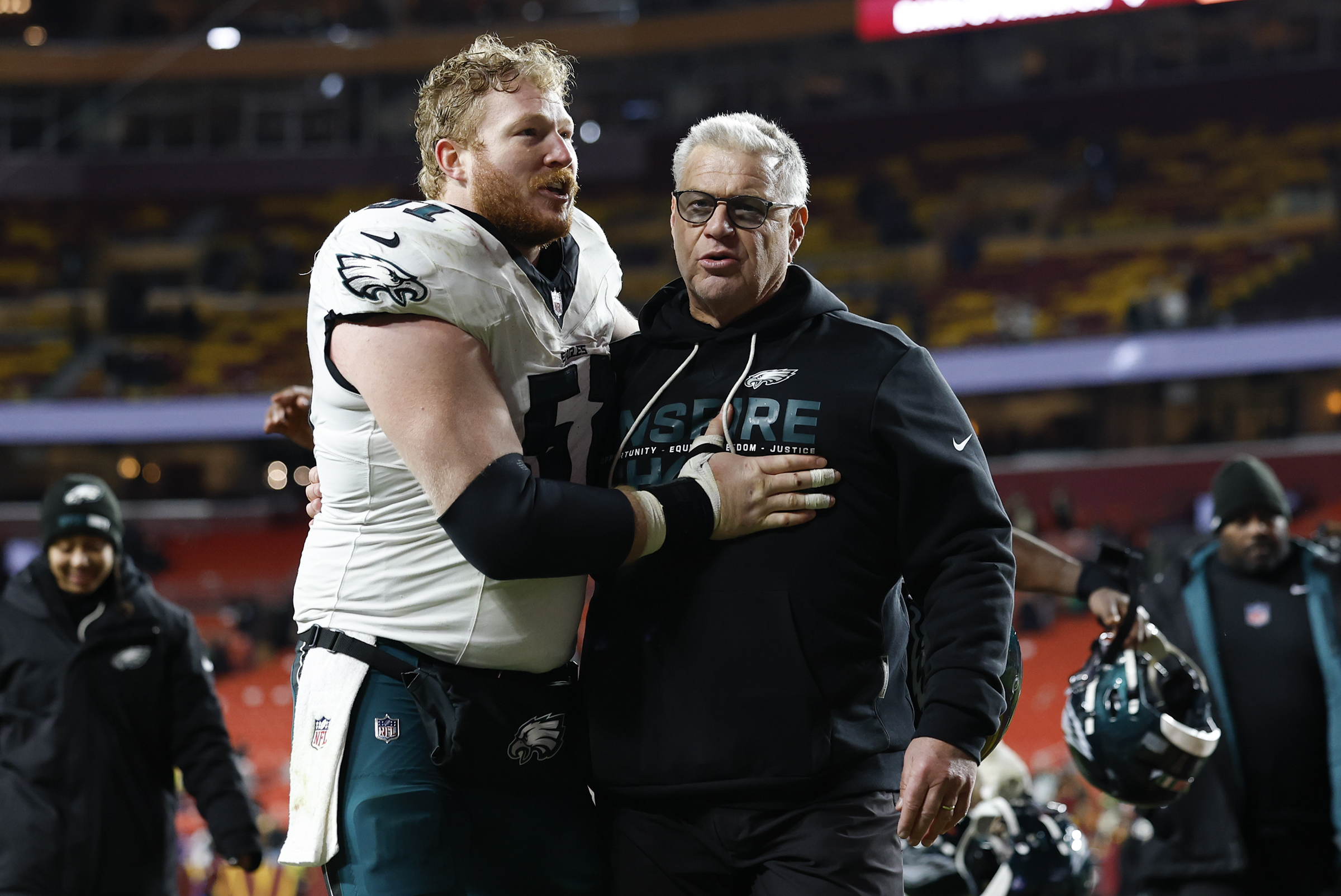
Mannion and Sirianni hired Chris Kuper to replace Stoutland. Kuper was the offensive line coach in Minnesota for one of the seasons in which Mannion was a backup quarterback there. He inherited a talented if high-maintenance group of linemen in Philadelphia — maintenance that Stoutland performed effortlessly.
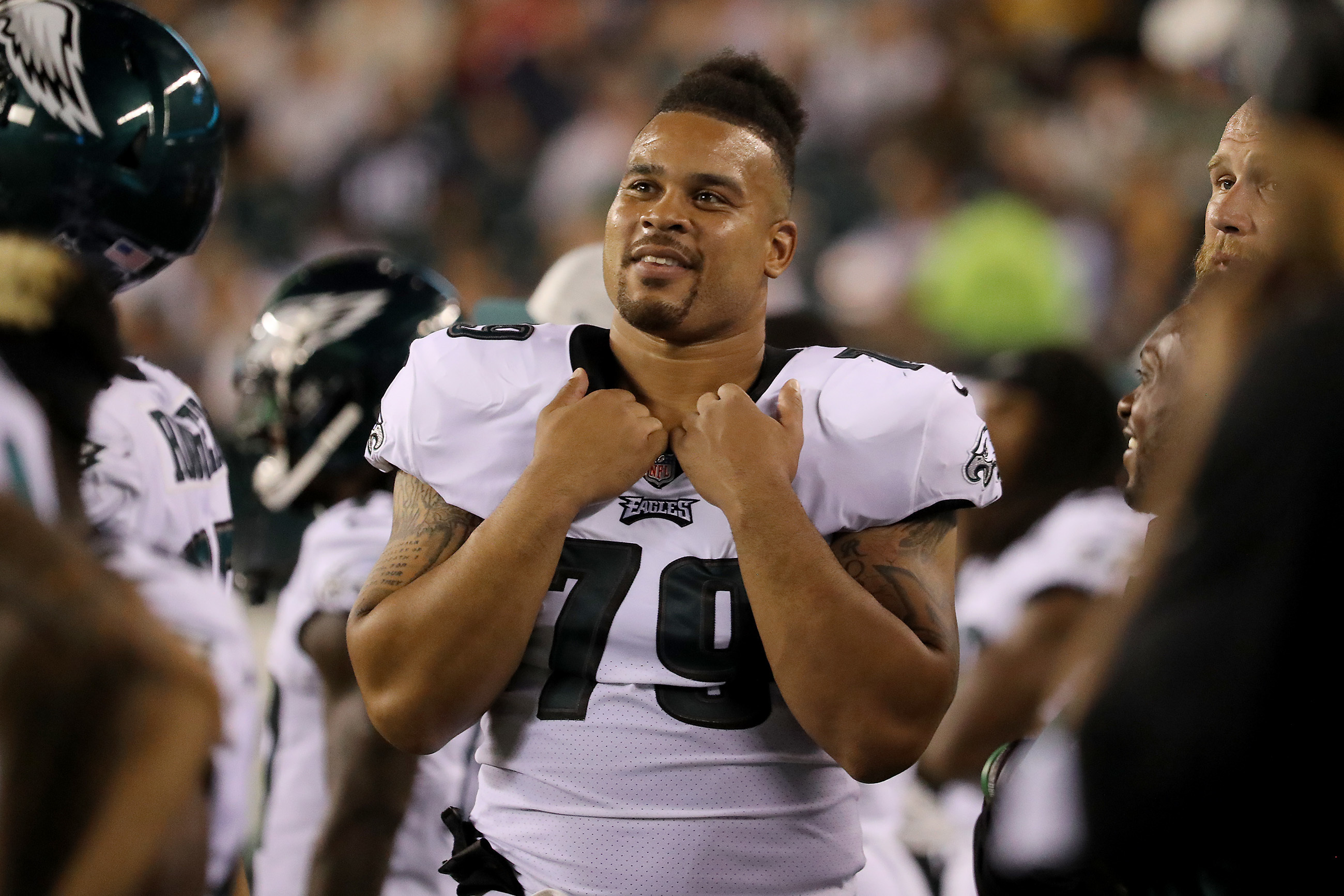
Stoutland managed the mental health issues of Brandon Brooks, who became a Pro Bowl guard and helped the Eagles win their first championship, Super Bowl LII.
Brandon Brooks became a Pro Bowler under Jeff Stoutland’s tutelage. DAVID MAIALETTI / Staff Photographer
Stoutland managed the boiling passion of center Jason Kelce, who became the heart and soul of Pederson’s teams and whose endorsement of Sirianni in 2021, Sirianni’s first season, validated Sirianni in the eyes of the rest of the team.
Stoutland managed the abilities and expectations of Jurgens, who, after a season of mediocre play at right guard, became a Pro Bowl center.
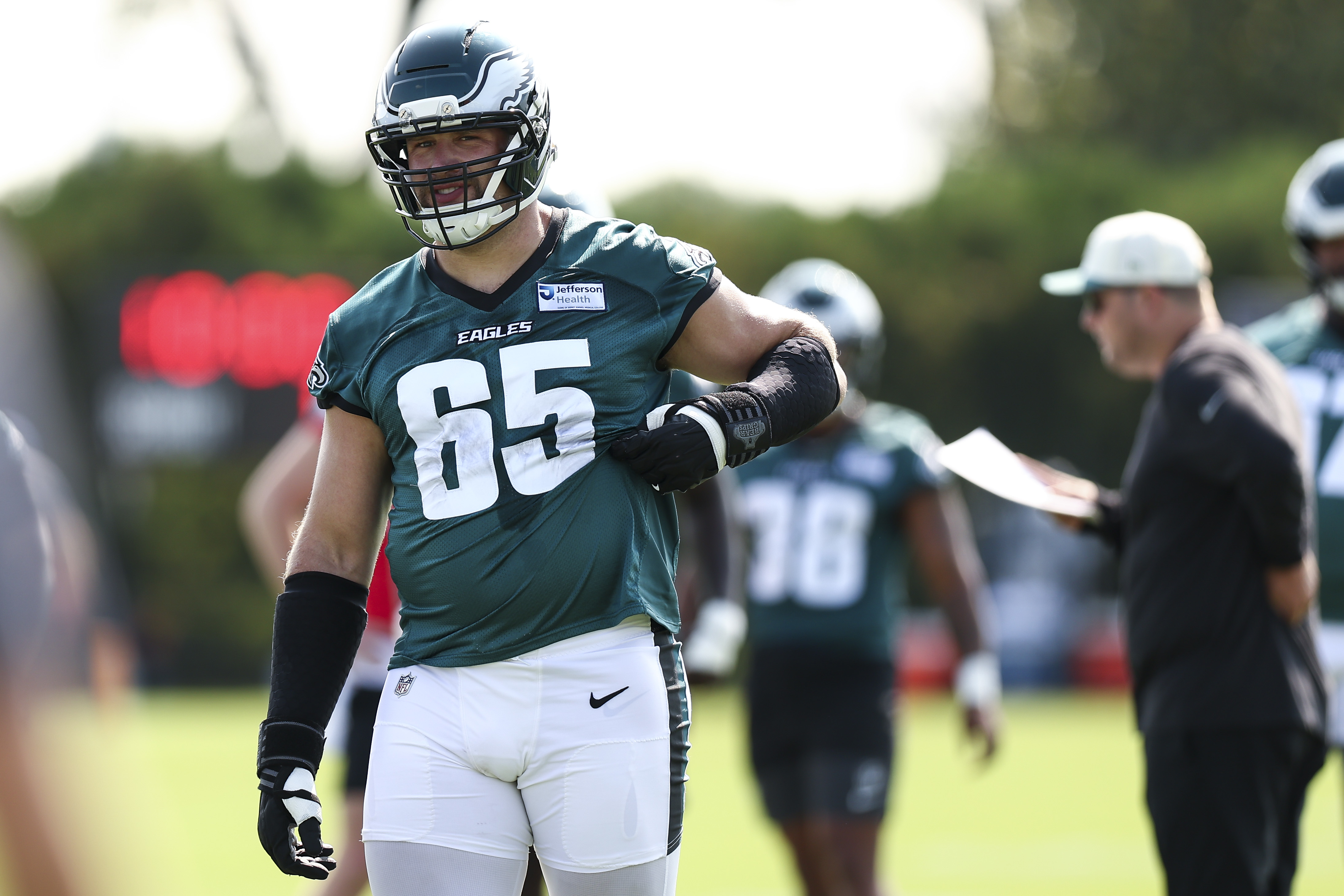
More than anything, though, Stoutland managed the mental health and the ego of Johnson. Stoutland knew how to handle Johnson’s sensitive nature and his natural bravado.
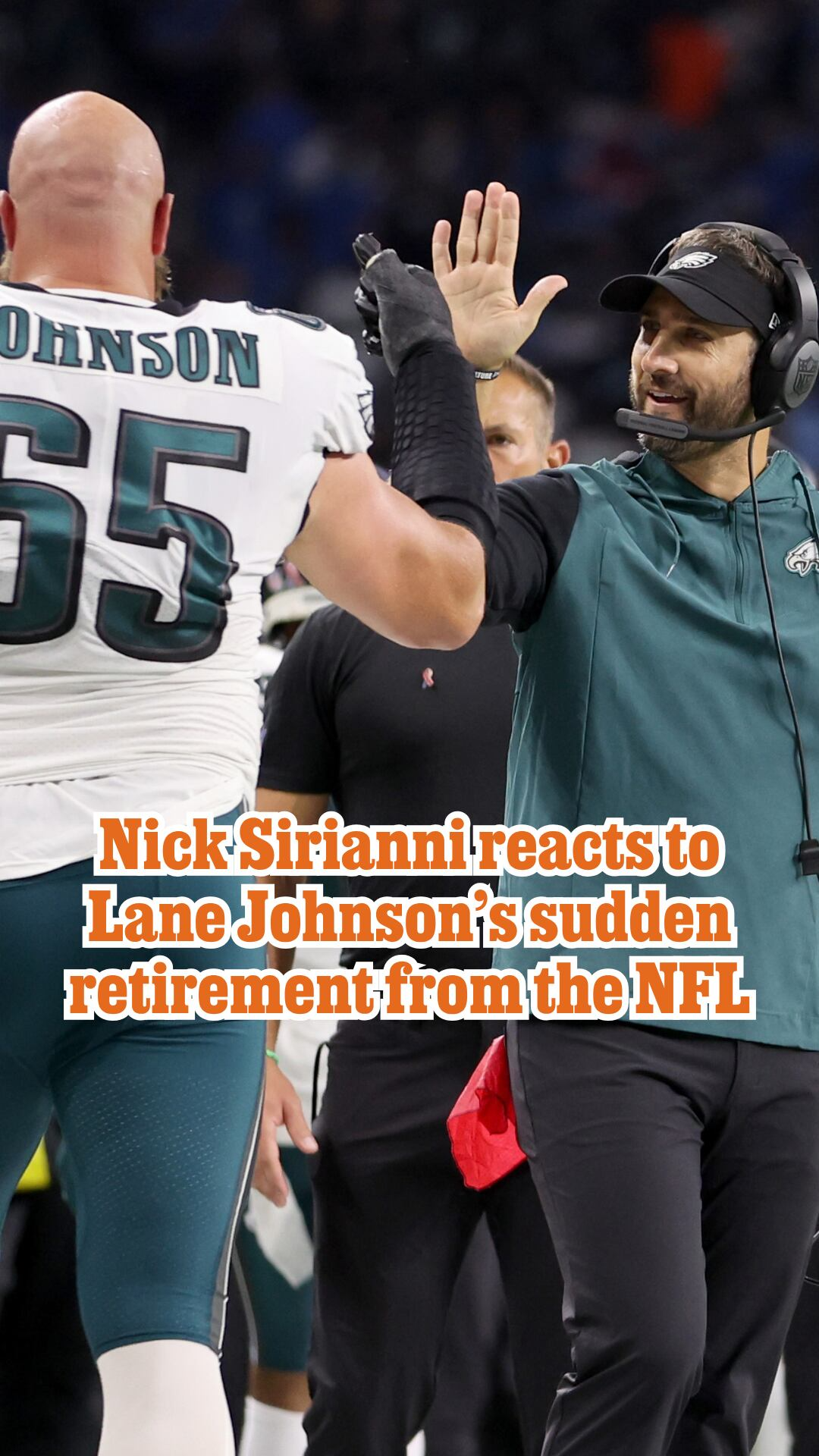
Video: Nick Sirianni reacts to Lane Johnson’s sudden retirement from the NFL
Now?
Without Stoutland, when Landon Dickerson landed on injured reserve with a knee issue after Game 1, the Eagles moved Jurgens off the center position and into the left guard spot. They inserted second-year fifth-rounder Drew Kendall at center. Predictably, Kendall has struggled. However, in the last three games, Jurgens has been, arguably, the worst lineman in the NFL and easily the worst player on the Eagles’ roster.
Would Stoutland have weakened two positions to compensate for one absence? Probably not.
Without Stoutland, Johnson couldn’t take the game any longer.
“Right now it is critical that I focus on my mental health,” Johnson said in a statement.
Would Stoutland have been able to help Johnson navigate one more season? After all, it was Stoutland who convinced Roseman and Kelly to draft Johnson with the No. 4 overall pick. It was a gamble. Johnson had been a high school and college quarterback, a college tight end and defensive end, and he hadn’t played offensive line until his junior year at Oklahoma.
We cannot know if Stoutland’s presence would have salvaged 13 more games out of Johnson. Not for sure.
We do know that Stoutland remains Johnson’s biggest supporter. He posted a message of his pride on Twitter/X: “To say I am proud of the career you built and the man you became would be an understatement. A Hall of Fame career. It’s been a privilege and honor to have coached you. I am so proud of you, Lane.”
It is extremely rare to come across a player like @LaneJohnson65. Extremely rare
In the spring of 2013, I found myself on a field in East Texas working out a young Lane Johnson. I believe he was 22 years old
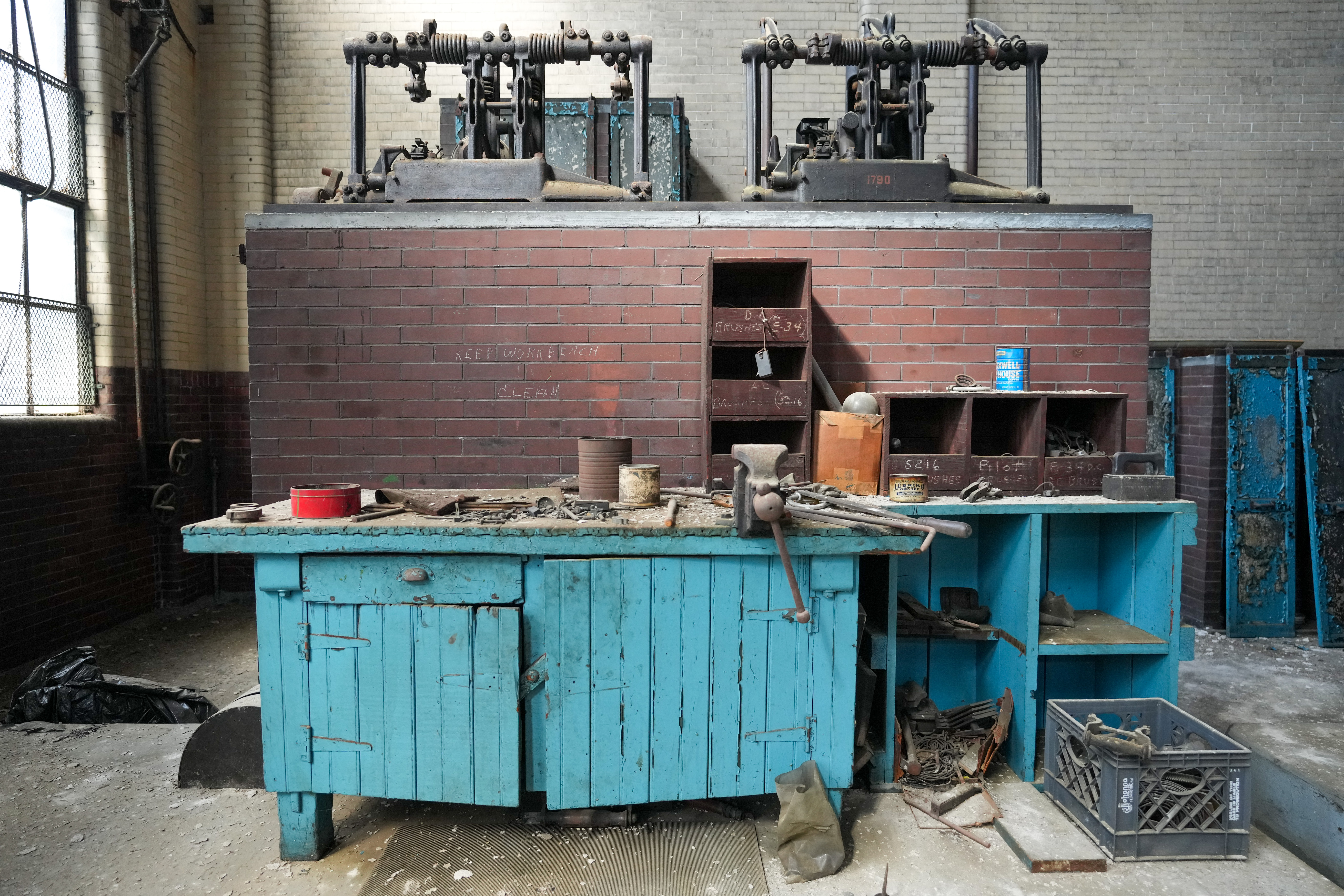
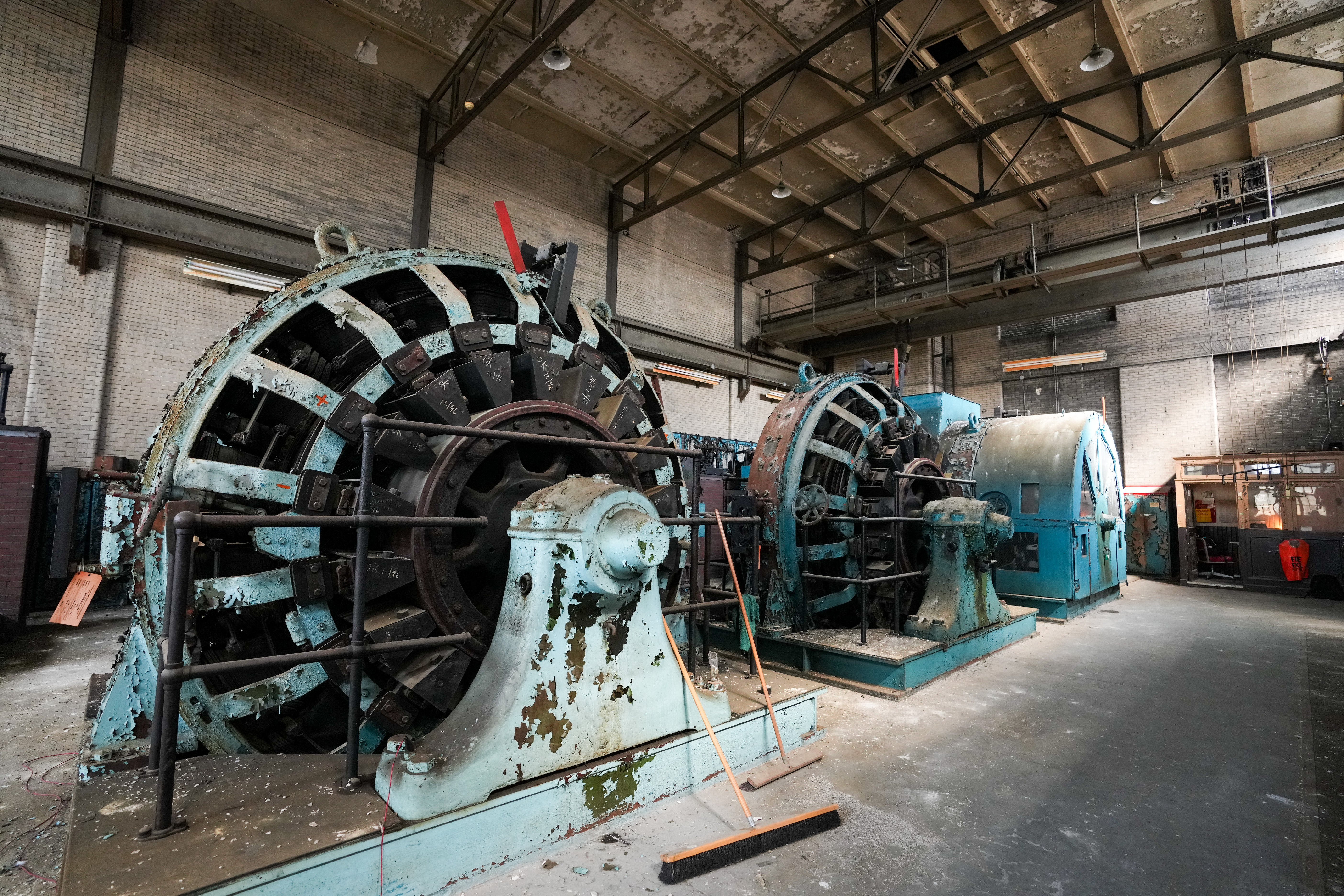
Inside the silent Mifflin Substation, afternoon light filtered by dust illuminated generators and artifacts left behind.
Tools, paper, pencils, a ruler, and paint chips littered a table despite a painted admonition to “Keep workbench clean.“
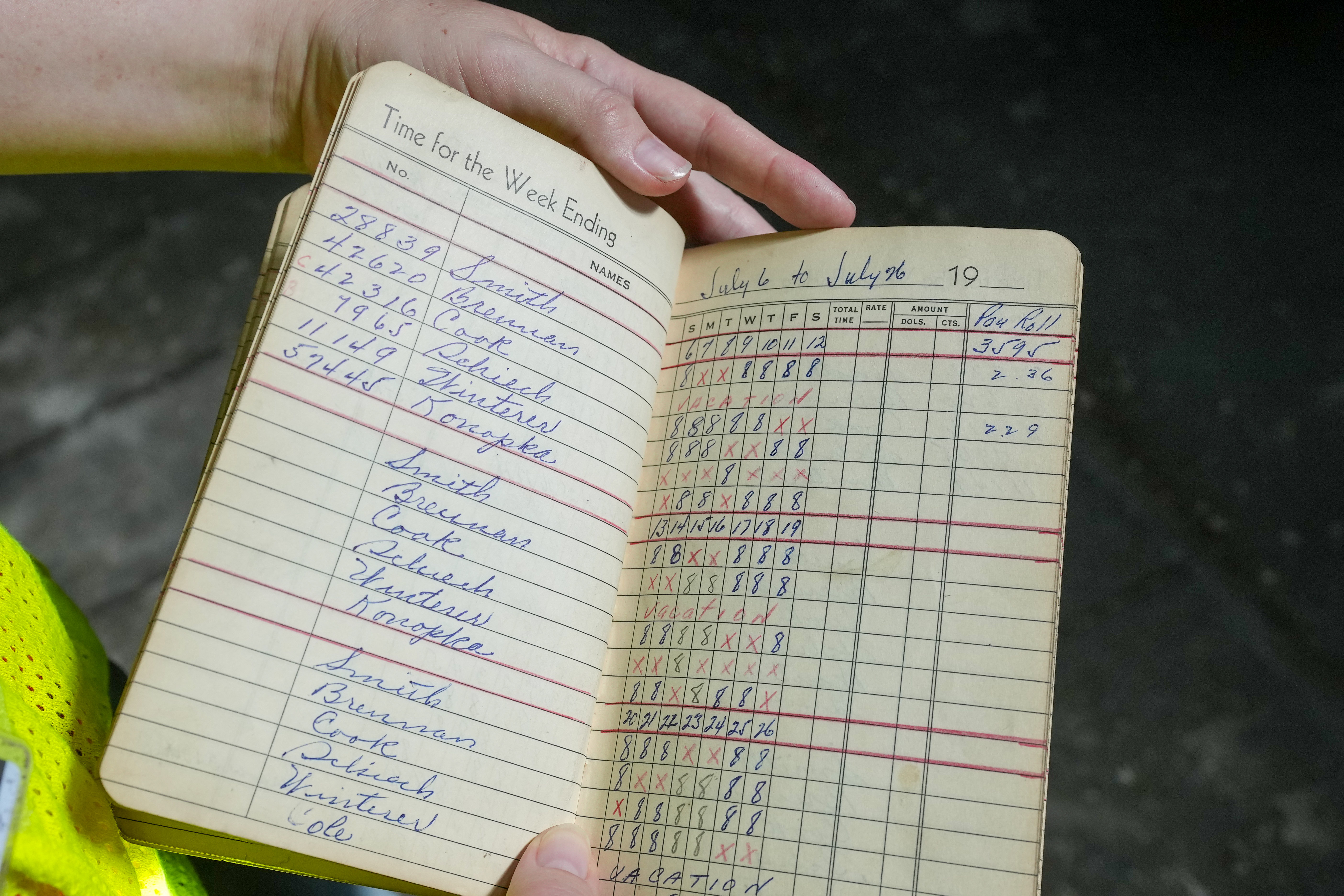
On another wall, cubbyholes held clothbound logbooks dating at least to the 1950s, with the hours worked by those who supplied electricity to trolleys recorded in the neat handwriting taught by old-school South Philadelphia nuns.
“It’s definitely a place of its time,” said Jennifer Dougherty, manager of real estate planning and development at SEPTA, during a tour of the 5,184-square-foot space last week.
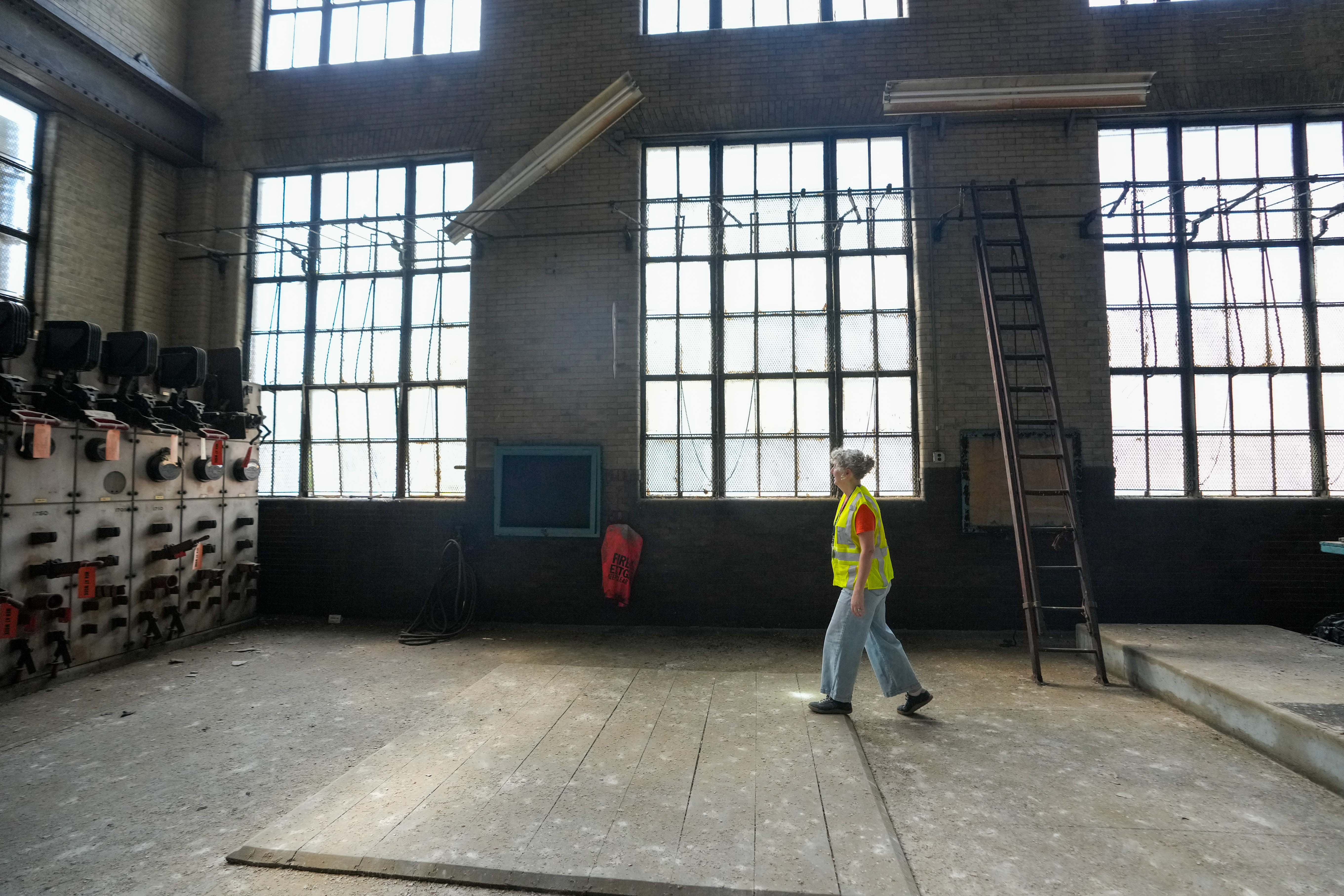
The transit agency is betting that the industrial brick-and-steel aesthetic of the Mifflin Substation — with its 35-foot ceilings, massive windows, and open main floor — can generate income for SEPTA and develop an empty building into a new asset for the East Passyunk Avenue area.
Time sheets for the workers were written neatly in clothbound log books. Dozens of them, some dating back 80 years, are still in the substation.Jessica Griffin / Staff PhotographerA workbench at Mifflin Substation cluttered with tools, cans of nails, bolts, and other debris abandoned at the end of the last shift.Jessica Griffin / Staff Photographer
Built in 1914 by the Philadelphia Rapid Transit Co., the station delivered electric power to trolleys for generations. PRT went bankrupt and reorganized in 1940 as the Philadelphia Transportation Co., in turn absorbed by SEPTA in 1968.
Route 23, the last fixed-track trolley in South Philadelphia, was replaced by diesel buses in 1992. Mifflin Substation was de-energized in 2003 when the Route 79 trackless trolley converted to buses.
A sense of the scale of the trolley power substation, which has 35-foot ceilings and two walls dominated by windows for natural light. Jessica Griffin / Staff Photographer
What could the space become?
Most of the other properties SEPTA has offered for development deals so far have been under- or unused parking lots or land parcels. It has several joint-development deals in the works for new multifamily housing around Regional Rail stations.
“Conceptually, this is more wide open,” said Michael Kendall, SEPTA’s assistant treasurer.
When he walked into the soaring room the other day, Kendall pointed to a generator encased in metal housing and said, “I could see this as a pizza oven!”
Some people have said it could be a venue for concerts or other entertainment, a brewpub, a climbing gym, a high-concept restaurant, or something cultural.
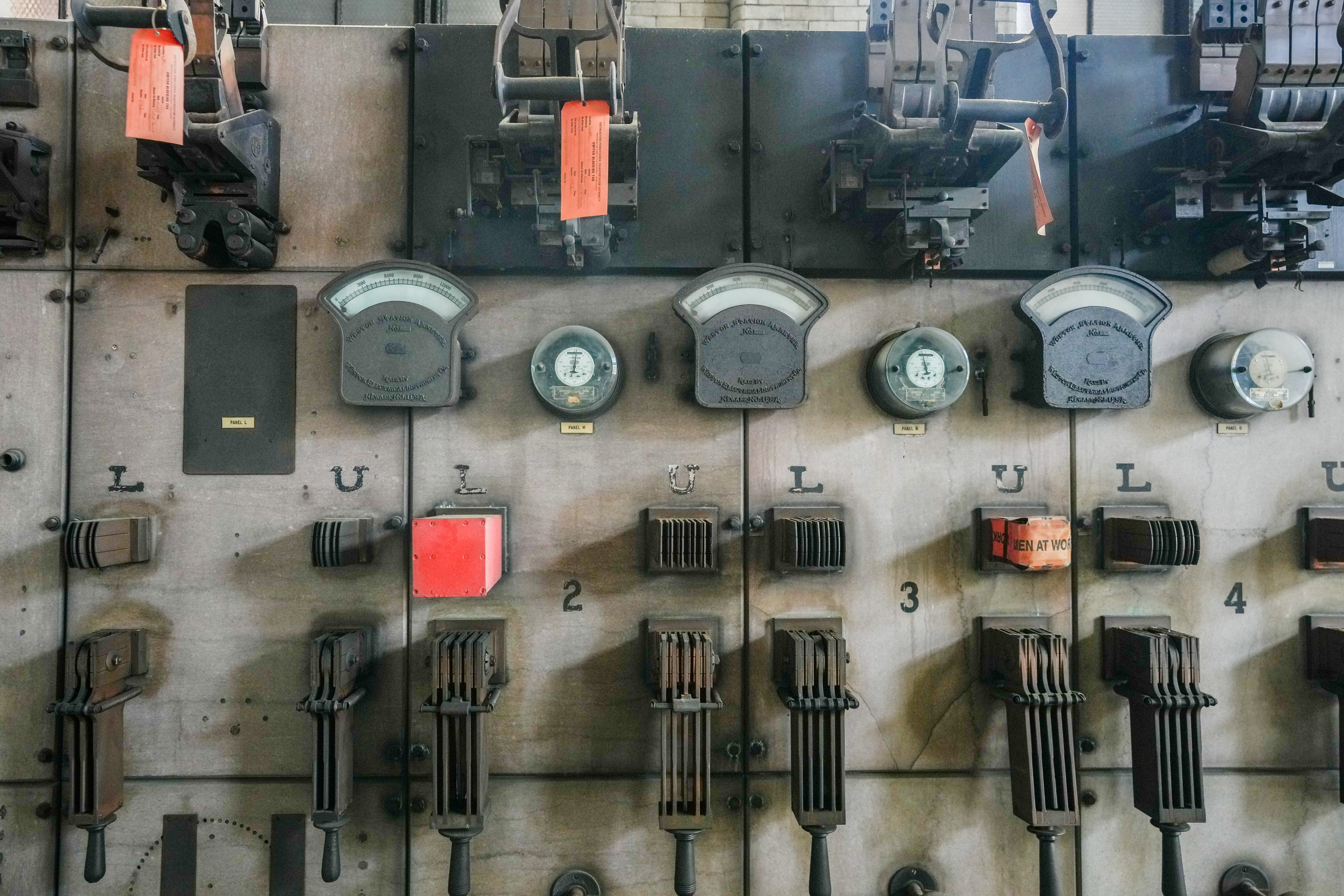
Gauges, switches, and cables in the Mifflin substation, where electric power was meted out to trolleys, which connect to overhead wires via mechanical arms.Jessica Griffin / Staff PhotographerGenerators that pushed power from the Mifflin Substation to wires above trolley routes.Jessica Griffin / Staff Photographer
SEPTA plans to invite the community to help shape an adaptive reuse concept for the plant at 1831-37 S. 13th St. Later, it will invite developers to compete for the job. The winner would lease the property from SEPTA and rebuild.
Some preliminary conversations have begun with business and community groups. A public brainstorming meeting is scheduled for Dec. 9 at the East Passyunk Community Center, 1025 Mifflin St., from 6:30 p.m. to 8 p.m.
Kendall and Dougherty said they’ve even heard a suggestion that the main room be turned into a facility for padel, a Spanish racquet game played on small courts with a squishy ball. “Think pickleball but with four walls,” Kendall said.
Frozen in time
Mifflin Substation sits where East Passyunk Avenue meets South 13th Street and Morris Street. The commercial corridor has a vacancy rate of just 2.4%, SEPTA says, with rents of about $20 per square foot.
Within a one-mile radius, median household income is about $78,700, with more than 3,200 businesses and 20,000 workers nearby, SEPTA says.
While the area has plenty of retail shops and restaurants, there are few entertainment-oriented places, and the transit agency believes that provides an opportunity.
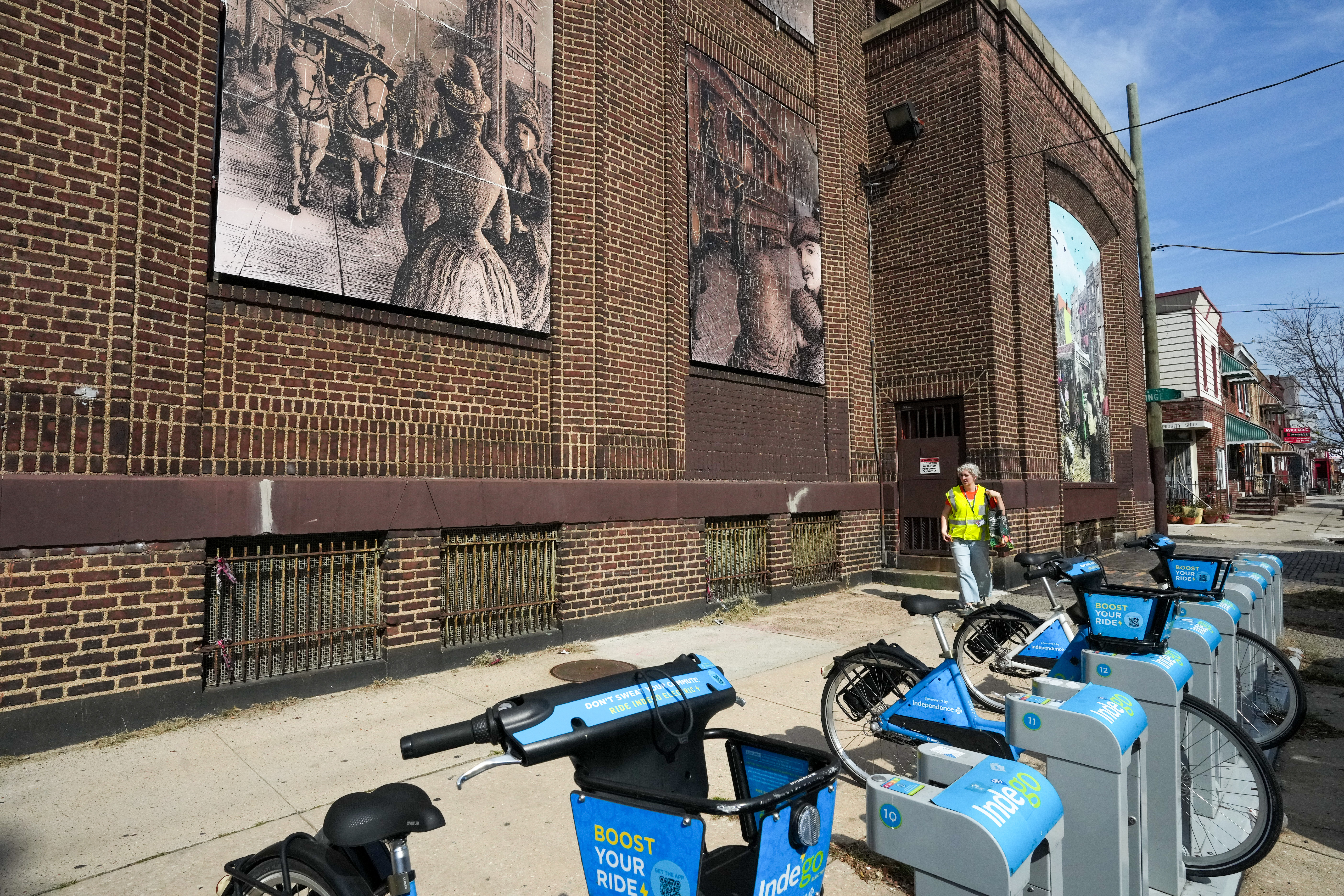
Constructed in 1914, the substation was used by trolleys for the Philadelphia Rapid Transit Co. and, much later, SEPTA. Massive windows currently are obscured by mural panels.Jessica Griffin / Staff Photographer
Adapting the substation will require some environmental remediation — there is asbestos and lead paint in the building, Dougherty said. It’s not known yet if there are PCBs, a toxic compound that historically was used to insulate in electric generating and transformer stations.
Salvageable metals and other materials may need to be removed.
For now the place is frozen in time.
Two dozen antique voltage gauges and dials, a row of manual iron switches, and cables that look like Dr. Frankenstein’s laboratory in a 1930s B-movie.
“These are literal museum pieces,” Kendall said.
“We don’t want to just scrap all this,” Dougherty said.
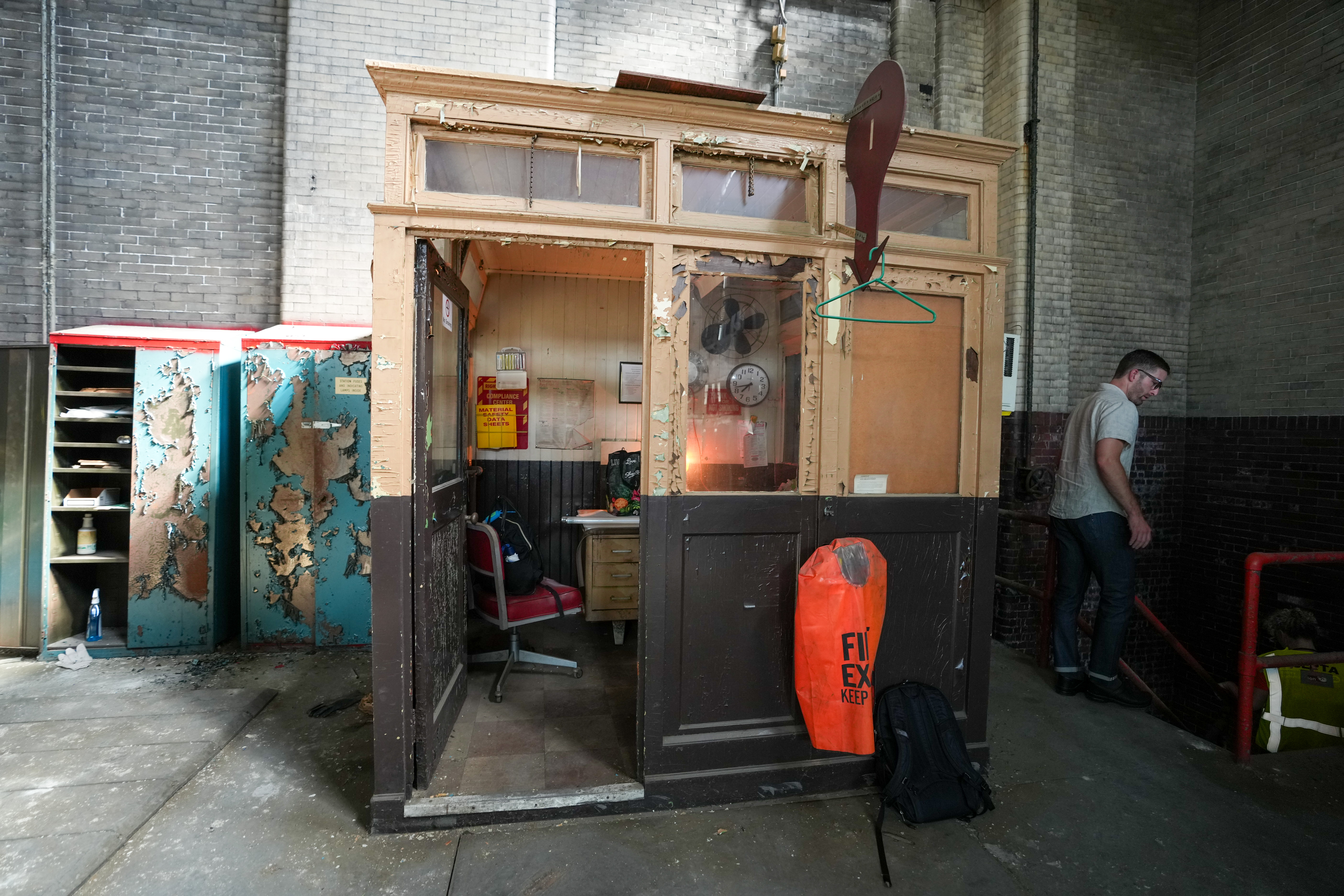
A landline telephone in the substation. Remember those?Jessica Griffin / Staff PhotographerMichael Kendall, SEPTA’s assistant treasurer, who oversees the real estate department, in the Mifflin Substation, in East Passyunk. A supervisor’s office is behind him.Jessica Griffin / Staff Photographer
SEPTA hopes to donate some of the equipment to an institution like the Electric City Trolley Museum in Scranton or the Pennsylvania Trolley museum in Washington, Pa., or perhaps the Railroad Museum of Pennsylvania in Strasburg, southeast of Lancaster.
The South Philadelphia substation is not listed on local or national historic registers, though a developer could seek such a designation to unlock tax credits.
“It’s not going to be demolished. That is off the table,” Dougherty said.
What the industrial relic becomes depends foremost on the imaginations of residents and real estate developers.
Editor’s note: This article has been edited to correct the time of the public brainstorming meeting on Dec. 9.
Phillies pitcher Zack Wheeler wipes his face during a mound meeting with his teammates in the fourth inning against the Toronto Blue Jays on Friday, Aug. 7, 2026 in Philadelphia.Yong Kim / Staff Photographer
Which Phillies Should Stay or Go? Swipe and decide
Another year, another early postseason exit for the Phillies.
It was a turbulent season from start to finish. An early April swoon cost Rob Thomson his job, with Don Mattingly taking his place as interim manager. The Phillies clawed back into the race for the National League East, but were ultimately doomed by a dismal September. They bowed out of the wild-card series against the Braves in three games, leaving them no closer to that elusive World Series trophy.
Two of Dave Dombrowski’s major winter adds, outfielder Adolis García and pitcher Brad Keller, suffered season-ending injuries. None of his trade deadline additions — Luis Arraez, Caleb Kilian, and Brooks Raley — were included on the wild-card roster. Arraez and Kilian had both been injured while Raley was too inconsistent to trust with the ball in the postseason.
story continues after advertisement
“I’d imagine this team looks a lot different next year,” Bryce Harper said after the Phillies’ season-ending Game 3 loss on Thursday.
Indeed, the Phillies are poised for bigger changes than in years past. Seven players are heading toward free agency, and salaries for Taijuan Walker and Nick Castellanos will also be coming off the books. They could have the flexibility for a bigger shake-up this winter.
Make your pick for each player by swiping the cards below — right for Stay or left for Go. Yes, just like Tinder. Finding it hard to decide? We'll also show you how other Inquirer readers have voted so far and what we think the team will do.
*Player ages are as of opening day 2027.
Pitchers
As much as anything, this Phillies team is built around its rotation. But beyond their five starters, they have a serious depth problem, one that was amplified this year when Andrew Painter was in triple A and again when Jesús Luzardo hit the injured list. The bullpen is one of the team’s biggest areas of need. The bridge to Jhoan Duran was an issue all season, and when the playoffs rolled around, the Phillies had no clear setup man for their closer.
#46
José
Alvarado
Crowd says
Contract
Free agent
Age
31
Inky Says Go
March: Alvarado didn’t throw a single pitch in the postseason, an indication of the Phillies’ low level of trust in the lefty. Triple-digit velocity means little if there’s no command of it.
#19
Kyle
Backhus
Crowd says
Contract
Pre-arbitration
Age
29
Inky Says Stay
March: Backhus didn’t stick around in the major leagues as hoped this year, but with his unique arm slot (6 degrees, lower than all qualified lefties) and several years of team control, he is an interesting depth piece.
#58
Tanner
Banks
Crowd says
Contract
Arbitration
Age
35
Inky Says Go
March: Banks majorly regressed from a 3.07 ERA in 2025 to 6.19 in 2026. He returned from an extended absence due to a forearm injury as a multi-inning option, but was a nonfactor in the wild-card series.
#52
Jonathan
Bowlan
Crowd says
Contract
Pre-arbitration
Age
30
Inky Says Stay
March: Bowlan had a meteoric rise to the setup man, and an equally meteoric fall with his September struggles culminating in a groin injury. But the righty still has one of the best strikeout rates (31.9%), whiff rates (31.3%), and chase rates (35.2%) in baseball.
#59
Jhoan
Duran
All-Star
Crowd says
Contract
Arbitration
Age
29
Inky Says Stay
March: Duran became the latest Phillies reliever to surrender a back-breaking postseason home run, but he’s still the best reliever they have and one of the best league-wide. However the Phillies reshape their bullpen, the closer will still be the centerpiece.
#40
Brad
Keller
Crowd says
Contract
Signed thru '27
Age
31
Inky Says Stay
March: Keller’s rehab from the Tommy John surgery he underwent in July could take him through most or even all of next season. He’ll stay through his contract, but it’s not a sure thing that he’ll throw another pitch for the Phillies.
#50
Orion
Kerkering
Crowd says
Contract
Arbitration
Age
25
Inky Says Go
March: Kerkering was once viewed as having the potential to be a homegrown closer, but after extended struggles, he was optioned to triple A in September. Perhaps a change of scenery would be best for all parties.
#56
Caleb
Kilian
Crowd says
Contract
Pre-arbitration
Age
29
Inky Says Stay
March: There’s little to judge Kilian’s Phillies tenure on, as he only made four appearances before an oblique injury ended his season. But he had intriguing numbers with the Giants before the trade, including a 48.8% ground-ball rate.
#44
Jesús
Luzardo
All-Star
Crowd says
Contract
Signed thru '31
Age
29
Inky Says Stay
March: It’s fair to wonder how different the Phillies’ September would have looked if Luzardo hadn’t been dealing with shoulder inflammation. The lefty proved worthy of the extension he got in March with his first career All-Star selection and is one of the co-aces.
#37
Tim
Mayza
Crowd says
Contract
Free agent
Age
35
Inky Says Stay
March: Mayza was an unsung hero in the beleaguered Phillies bullpen, taking the ball in a variety of roles. He isn’t a high-leverage pitcher, but could be a reasonable and inexpensive depth option.
#71
Alex
McFarlane
Crowd says
Contract
Pre-arbitration
Age
25
Inky Says Stay
March: McFarlane showed elite velocity and impressive composure in his rookie season. As one of the Phillies' most exciting homegrown talents, he could be a factor in this bullpen for years to come.
#27
Aaron
Nola
Crowd says
Contract
Signed thru '30
Age
33
Inky Says Stay
March: With his contract, Nola isn’t going anywhere. But his second-half resurgence provides some optimism that he can still be a reliable arm in the back end of the rotation.
#24
Andrew
Painter
Crowd says
Contract
Pre-arbitration
Age
23
Inky Says Stay
March: J.T. Realmuto called his postseason relief appearance a “career-altering performance.” Year 2 of Painter should be exciting to watch.
#30
Brooks
Raley
Crowd says
Contract
Free agent
Age
38
Inky Says Go
March: This was a deadline move that didn't work out. Raley's first-half ERA of 1.96 with the Mets became 7.94 with the Phillies, and he wasn't included on their postseason roster.
#61
Cristopher
Sánchez
All-Star
Crowd says
Contract
Signed thru '32
Age
30
Inky Says Stay
March: Sánchez’s 50⅔ consecutive scoreless innings set a franchise record, something quite difficult to do for a team established in 1883. The rotation continues to be the Phillies’ greatest strength, and Sánchez is at the center of it.
#55
Chase
Shugart
Crowd says
Contract
Pre-arbitration
Age
30
Inky Says Stay
March: Shugart will forever be a trivia answer as a Phillies pitcher who earned both wins in a doubleheader. He could stick around and compete for a middle relief innings-eater spot next season.
#45
Zack
Wheeler
Crowd says
Contract
Signed thru '27
Age
36
Inky Says Stay
March: Wheeler returned one rib lighter but the same competitor as ever. He has been open in the past about retiring at the end of his current contract. Unless he changes his mind, he has one last chance at those elusive goals of a Cy Young Award and World Series trophy.
After starting 122 games behind the plate, the highest total for an age-35 or older catcher since Jason Kendall 17 years ago, J.T. Realmuto said: "I feel healthy and as good as I ever have." Swell. But Realmuto's bat often looked old and slow en route to a 65 OPS+ (100 is average). Pitchers swear by his game-calling, and he's as good as it gets at using ABS to challenge pitches. It's time, though, for the Phillies to find a backup catcher who can play 65 games instead of 35.
#13
Rafael
Marchan
Crowd says
Contract
Arbitration
Age
28
Inky Says Go
Lauber: For J.T. Realmuto's own good, the Phillies need more from their backup catcher. There's little evidence they will get it from Marchan, a former prospect.
#10
J.T.
Realmuto
Crowd says
Contract
Signed thru '28
Age
36
Inky Says Stay
Lauber: There isn't anyone the pitchers trust more to call a game and use ABS. But he should challenge more and play less (100-ish games instead of 125).
#21
Garrett
Stubbs
Crowd says
Contract
Arbitration
Age
33
Inky Says Stay
Lauber: To be clear, the backup catcher spot must be upgraded. It would be wise to keep him around on a minor-league deal, though, for organizational depth.
A year ago, Dombrowski said the infield was "pretty well solidified." How about now? In August, the Phillies displaced three-quarters of the infield after the trade for Arraez. Bryce Harper is expected to return to first base after two months in right field. But Arraez and Alec Bohm are free agents, and Trea Turner could be in line for a position switch after the worst defensive season among shortstops. Everything is on the table.
#4
Luis
Arraez
Crowd says
Contract
Free agent
Age
29
Inky Says Go
Lauber: What's the value of a hitter with extreme contact skills but a low hard-hit rate? If it's more than a one-year commitment, it's too much.
#28
Alec
Bohm
Crowd says
Contract
Free agent
Age
30
Inky Says Go
Lauber: Though miscast as a cleanup hitter, he was a prolific run producer. After two offseasons of trying to trade him, would the Phillies really re-sign him now?
#3
Bryce
Harper
All-Star
Crowd says
Contract
Signed thru '31
Age
34
Inky Says Stay
Lauber: The Face of the Franchise started all 162 games, led the NL in walks, and was tied for seventh in OPS. Can we retire the "elite" debate?
#33
Edmundo
Sosa
Crowd says
Contract
Free agent
Age
31
Inky Says Go
Lauber: If he's looking to play every day, or to get paid accordingly, it won't be here. But he's versatile, popular among teammates, and valuable for the right price.
#5
Bryson
Stott
Crowd says
Contract
Arbitration
Age
29
Inky Says Stay
Lauber: Even if he's only ever a league-average hitter, his defense (at multiple infield positions), speed, and overall baseball IQ are undeniable assets.
#7
Trea
Turner
Crowd says
Contract
Signed thru '33
Age
33
Inky Says Stay
Lauber: Sorry, but with seven years and $191 million left on his contract, he isn't going anywhere. Except maybe to another position. It's time to move him off shortstop.
Stop us if you've read this before: The outfield could look completely different next season. Brandon Marsh went from starting the All-Star Game to not cracking the lineup in an elimination playoff game. Is he a trade candidate? Justin Crawford could either be ready for more responsibility or traded. And there's still a hole in right field. It feels like the only certainty is another 40-plus-homer season from DH Kyle Schwarber.
#2
Justin
Crawford
Crowd says
Contract
Pre-arbitration
Age
23
Inky Says Stay
Lauber: After a rookie season that got mixed reviews, there's still upside. How much? The Phillies' answer will inform whether they trade him or not.
#41
Bryan
De La Cruz
Crowd says
Contract
Arbitration
Age
30
Inky Says Go
Lauber: A Don Mattingly favorite, he played well in a platoon role. But it's only a lack of organizational depth that would keep him from getting nontendered.
#49
Derek
Hill
Crowd says
Contract
Arbitration
Age
31
Inky Says Stay
Lauber: The platoon center fielder provided energy and defense after coming over in a June trade with the White Sox. The Phillies need more depth, not less
#16
Brandon
Marsh
All-Star
Crowd says
Contract
Arbitration
Age
29
Inky Says Go
Lauber: Remember when he started the All-Star Game? Can you believe it was this year? His .482 OPS after July 1 was worst among all hitters (min. 230 plate apps).
#12
Kyle
Schwarber
All-Star
Crowd says
Contract
Signed thru '30
Age
34
Inky Says Stay
Lauber: Few things in life are certain. Forty-plus Schwarbombs per season are among them. He and Bryce Harper are the lineup pillars. But they need help.
#53
Adolis
García
Crowd says
Contract
Free agent
Age
34
Inky Says Go
Lauber: After not hitting for two months, he tore a lat muscle under his right shoulder and had season-ending surgery. At least it's $10 million off the books.
All Outfielders rated!
story continues after advertisement
Staff Contributors
Design and development: Sam Morris, Jasen Lo, Lucas Reasoner, and Garland Fordice
Reporting: Lochlahn March and Scott Lauber
Editing: John Roberts
Copy Editing: Maria McIlwain
Photography: Inquirer Staff, additional photography provided by Associated Press
Sometimes I feel like I missed my window. As a sportswriter, I mean. Paul Simon has a song called “Born at the Right Time” that he released in 1990, which is fitting, because when it comes to covering pro sports, I struggle to shake the sense that I was born at the wrong time.
It would have been cooler, and perhaps more fulfilling, to have been a sportswriter in that era, the mid-1980s into the mid-1990s, not just because the nature of the job was different, but because the nature of sports was, too.
Access to the athletes, coaches, and executives was much greater, of course, and traditional media had a wider reach, more influence, and healthier expense accounts. But the games and teams themselves were themselves more colorful, more daring, full of characters and strategic experimentation.
The most popular terms, trends, and names in the NFL included Buddy Ryan and the 46 defense, the Buffalo Bills and the K-Gun, Jerry Glanville and the run and shoot, Brett Favre, Deion Sanders. It wasn’t unusual to see NHL players score between 65 and 80 goals in a season: Wayne Gretzky, Mario Lemieux, Steve Yzerman, Brett Hull, Teemu Selänne, Alexander Mogilny.
The ’93 Phillies, bawdy and beer-bellied and built to beat you or beat you up, didn’t have to win the World Series to define baseball in this city for a generation. And in the NBA, you could ricochet from the Bad Boy Detroit Pistons dynasty to the 1990-91 Denver Nuggets, coached by West Philly native Paul Westhead, who quoted Shakespeare on the regular, tried to implement his breakneck “system” at the pro level, and won just 20 games … but goosed the offensive stats of such immortals as Michael Adams, Orlando Woolridge, and Blair Rasmussen.
The point is, it’s possible — and I’d argue it was much more common back then — to lose, or to have a season with a disappointing ending, while still being interesting. Why the reminder? Because the last two weeks might have convinced people around here that following their favorite teams must be the emotional equivalent of having Joe Pesci put your head in a vise and start slowly turning the handle.
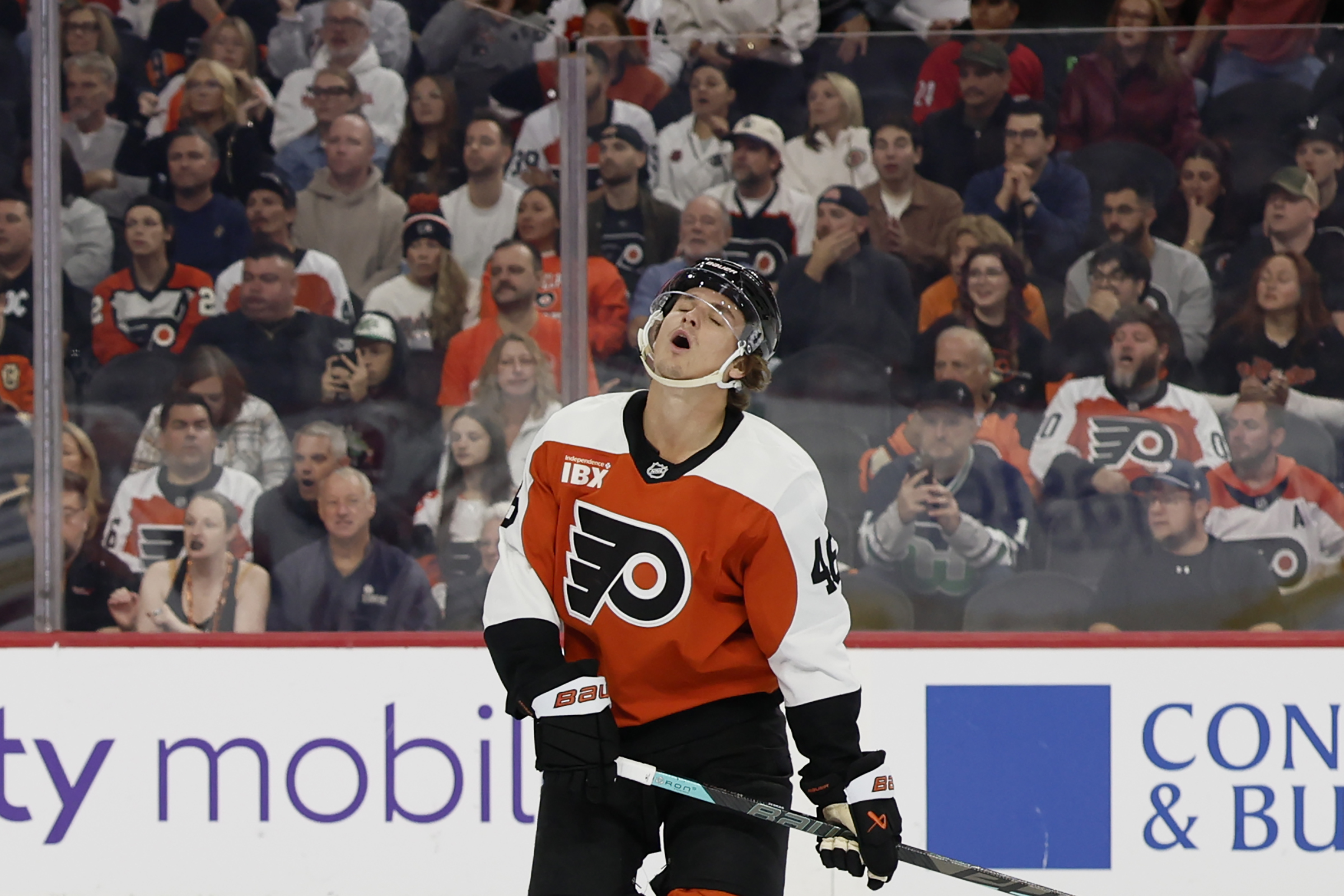
Trevor Zegras and the Flyers are off to one of the worst starts in NHL history.Elizabeth Robertson / Staff Photographer
It has been rough, all right. The Phillies had every baseball-loving teenager in the Delaware Valley asking ChatGPT about “1964 COLLAPSE” before the Braves knocked them out of the National League wild-card round. The Eagles are an injury-riddled, identity-missing mess, fortunate to be 2-2. And over their first four games, the Flyers have done little more than lie down at center ice with their skates in the air.
Even the most dispassionate observer would have to acknowledge that it has been excruciating just to pay attention to these three teams lately, let alone care about them deeply. But the reasons that they’ve been such a hard watch, that so much anger and angst has been bubbling up, go beyond the Phillies’ dropping their fourth straight playoff series or the Eagles’ squandering a double-digit fourth-quarter lead. It isn’t just that these teams have been losing. It’s that these teams have been boring.
The 2026 Phillies were exactly the club that everyone (other than John Middleton and Dave Dombrowski, apparently) expected them to be. They had their moments, thanks to their starting pitching and Kyle Schwarber, but those flickers were snuffed out by the team’s atrocious baserunning, lousy situational hitting, and poor defense. All of those flaws were present and visible when the regular season began, and the Phillies corrected none of them. They were on track most of the season to meet every worst expectation, so it was hardly surprising or fascinating when they did.
A similar dynamic is playing out with the Eagles. Sure, the offense had a new coordinator in Sean Mannion, some question marks along the offensive line, and some work to do to make up for the departure of A.J. Brown. It was natural to think Mannion, Jalen Hurts, and everyone else would need time, maybe a few weeks into the regular season, before they got their footing, except they’re wobbling and wiping out like rookie surfers. (Turns out, converting on third down is kind of important for an offense!)
Hurts can’t operate the system from under center. Lane Johnson retired. Cam Jurgens has been traded. DeVonta Smith, Dallas Goedert, Saquon Barkley, and Landon Dickerson are hurt. The result of all this upheaval, inexperience, and incompetence is that Mannion might as well be drawing up plays in the dirt at FDR Park. OK, Darius, you’re the bottle cap. Elijah, you’re the piece of glass. Remember not to cover up the tight end this time.
The Flyers are a different category of bus crash altogether, because they were supposed to be fun. They were supposed to be the young, up-and-coming team hitting its stride. Instead, they’re the perfect example of the distinction between bad and dull. If they were losing 5-4 or 6-5 every night, if Porter Martone and Matvei Michkov were scoring and setting up one goal after another, if the team merely needed to clean up some defensive deficiencies, that would be one thing. It’s another thing, though, to be outscored, 17-5; to be outshot, 158-77 —tied for the league’s second-highest such differential through four games since 1959 — and to be a shallow speed bump for opponents to drive over.
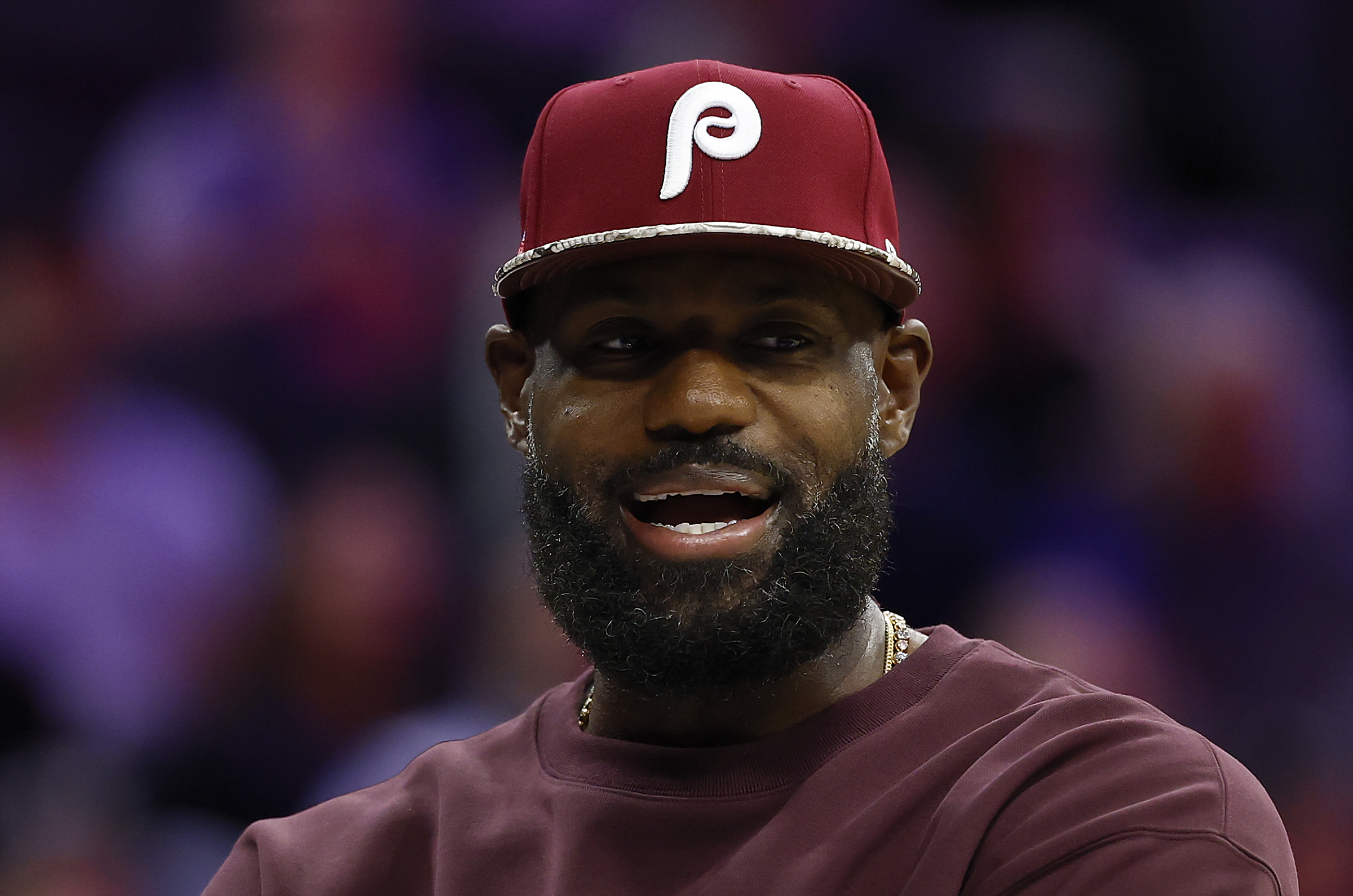
Philadelphia’s hopes for a winner this year might be down to LeBron James and the 76ers.Yong Kim / Staff Photographer
Hopelessness. That’s the prevailing feeling here. The Eagles’ defense might improve enough that they can slog through the rest of the season into the playoffs, dragging the offense along. The Flyers could make a franchise-altering trade or, in theory, straighten things out without one. But at the moment, there’s no sign of either of those happy outcomes on the horizon. There seems to be just the same predictable tedium until Oct. 20, when the 76ers open their regular season. Help us, LeBron. Hey, entertain us, at least.
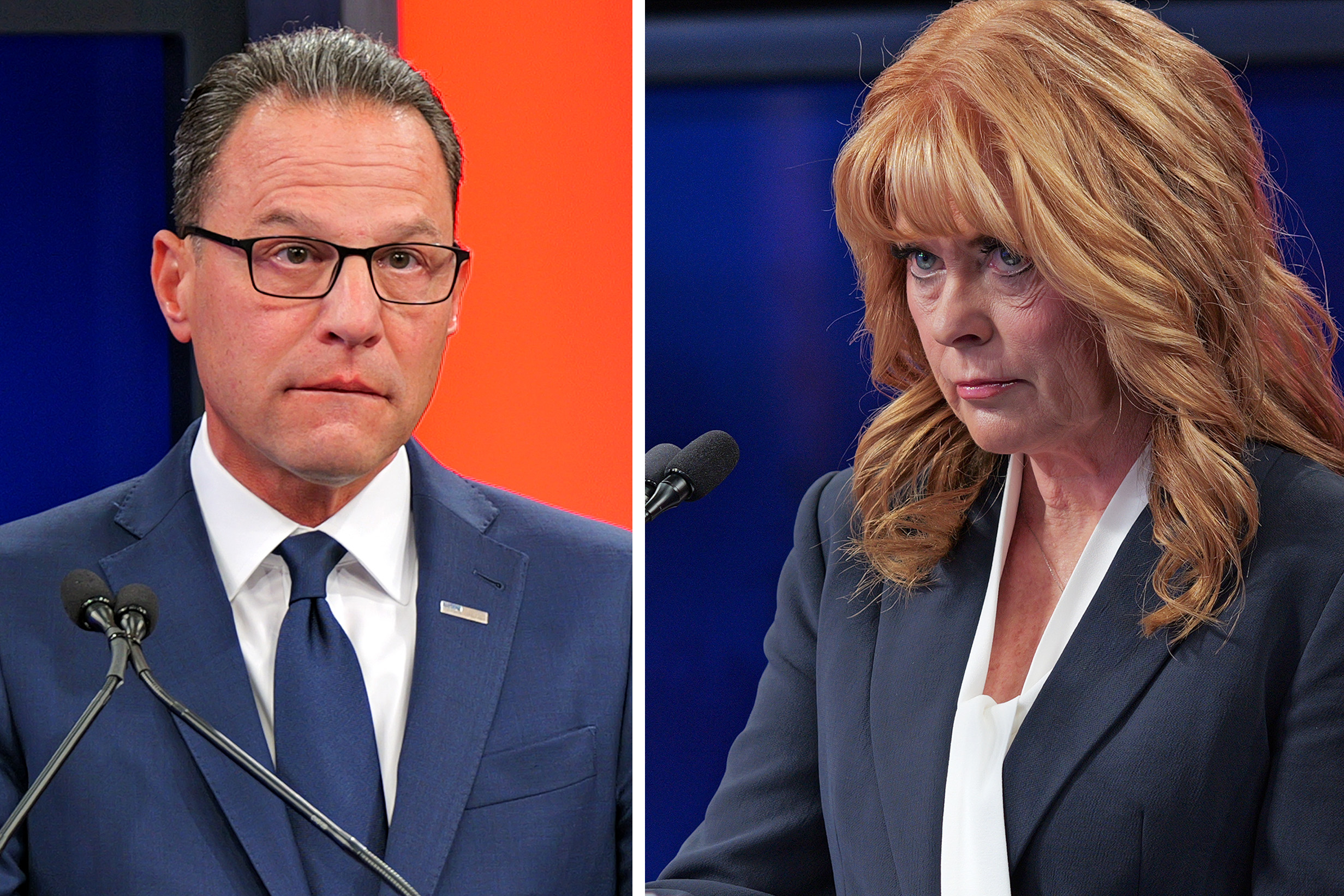
HARRISBURG — Gov. Josh Shapiro and State Treasurer Stacy Garrity on Wednesday sparred over President Donald Trump’s leadership, soaring gas prices, the state budget deficit, and other top issues facing Pennsylvania in their only scheduled debate before Election Day.
And at one point, the gloves came off.
In the wide-ranging and mostly even-tempered debate, Garrity, a Republican who is in her second term as the state’s top fiscal officer, turned to Shapiro after he swiped at her, accusing her of taking direction from Trump by denying the results of the 2020 election. (Garrity in 2022 told a crowd at a Trump rally that “we know that he won” but has since walked back those comments.)
“I don’t even know why you’d say that, and how you can look yourself in the mirror at night,” Garrity said, turning to look at Shapiro across the abc27 studio in Harrisburg, in one of the most heated moments of the night.
Gov. Josh Shapiro and Republican challenger Stacy Garrity at the WHTM-TV studios in Harrisburg Wednesday, Oct. 7, 2026, during their lone debate ahead of next month’s gubernatorial election.Kaylee Lindenmuth / WHTM
The debate, moderated by abc27’s Dennis Owens and WPXI’s Lisa Sylvester, came as Shapiro maintains a double-digit lead in statewide public opinion polls of likely Pennsylvania voters ahead of the Nov. 3 midterm election, including a 25-point advantage over Garrity in a Quinnipiac University poll released Wednesday.
The televised debate, broadcast and streamed for free statewide, marked a consequential night for both candidates. Garrity needed to give an attention-grabbing performance to bring more eyes — and resources — to her struggling campaign. And the night presented Shapiro, who has long been rumored to have his eyes on a White House bid, the chance to show political observers whether he could compete on a crowded Democratic presidential primary stage.
Here are four takeaways from the debate.
With a potential 2028 run, Shapiro doesn’t promise to fulfill another four-year term
Shapiro, 53, from Abington Township, again declined to say whether he would fulfill another full, four-year term as governor if reelected. A well-rehearsed orator with two decades of political experience, Shapiro gave the debate’s moderators the same answer he has repeated to reporters for months:
“The only thing I am focused on is running for reelection as governor,” he said, before restating his frequent refrain about Trump’s chaos, cruelty, and corruption.
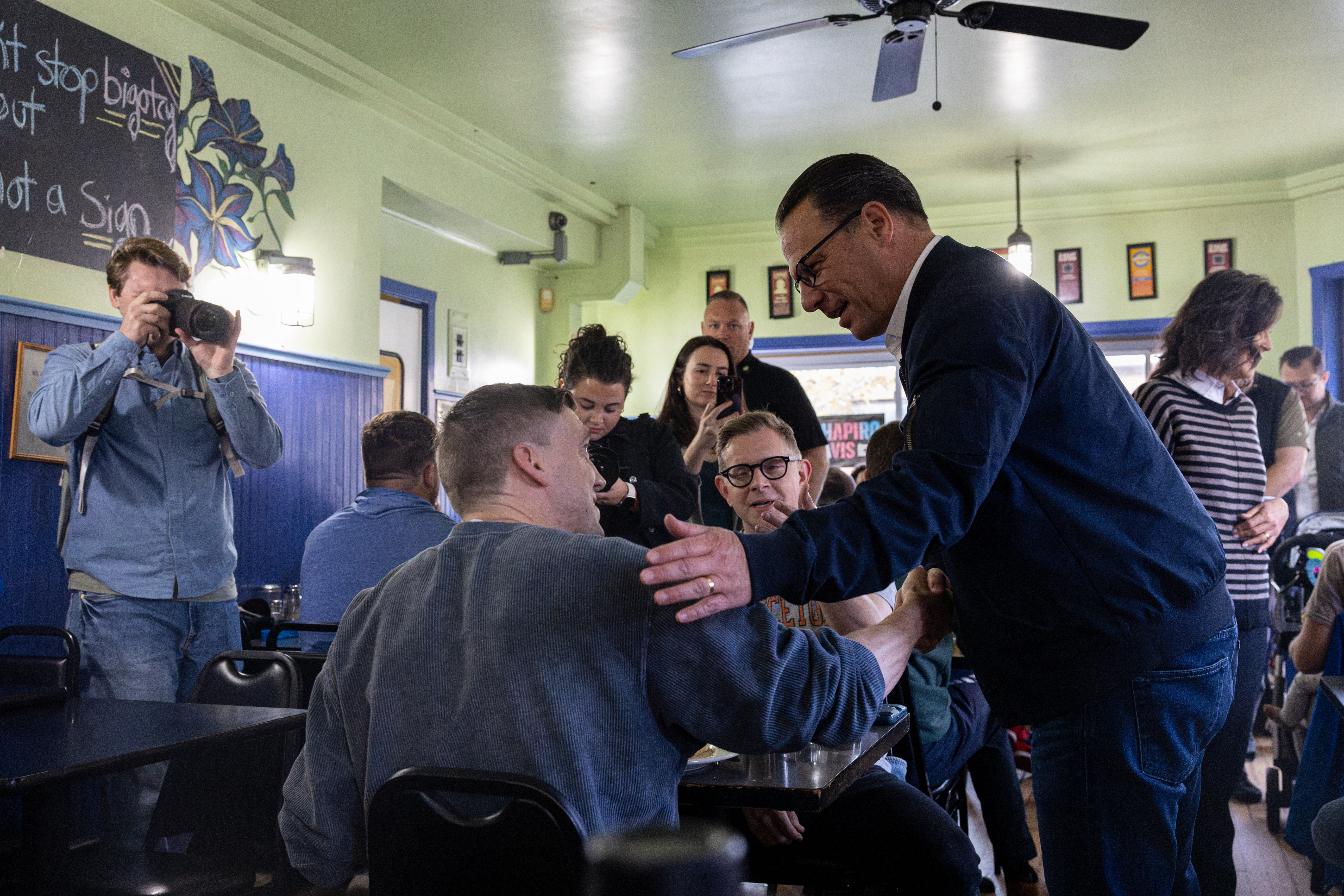
Gov. Josh Shapiro meets with patrons alongside Michigan Gov. Gretchen Whitmer inside Sam’s Morning Glory Diner in South Philadelphia on Friday, Sept. 25, 2026.Aidan T. Gallo / Staff Photographer
Wednesday’s debate took place on the third anniversary of the Oct. 7, 2023, attacks by Hamas on Israeli civilians that marked the start of the war in Gaza — a conflict that has divided Democrats nationally and is certain to remain a top issue in the years ahead.
Shapiro, who is Jewish, was asked by the moderators about a recent Inquirer-New York Times-Siena poll that found 60% of likely Democratic voters in Pennsylvania do not want the U.S. to provide economic and military support to Israel.
After firstlamenting the attacks, Shapiro dodged the question. When he was asked for clarity, Shapiro said he wants “America to have a strong relationship with Israel and with the Israeli government,” which he does not see as possible under Prime Minister Benjamin Netanyahu, whom he has criticized for years.
“I’ve been very, very, consistent in my position, in my love of Israel, and also in my disagreements with the Netanyahu government,” Shapiro said, adding that he hopes Israel chooses a new leader in its forthcoming election.
Garrity, for her part, opened her first response of the night — to a question about data centers — by recognizing “the lives that were stolen” in the Oct. 7, 2023, Hamas attacks.
Garrity distances herself from Trump
Garrity, 62, a retired U.S. Army colonel from Bradford County in Northeastern Pennsylvania, was endorsed by Trump in January and has remained largely loyal to him.
Shapiro’s campaign has seized on this support, running millions of dollars’ worth of negative ads calling her “100% MAGA.” Garrity, meanwhile, has no ads on TV with less than a month before the election, as she struggles to fundraise during an especially challenging midterm year for Republicans.
State Treasurer and Republican candidate for governor Stacy Garrity is seen on a big screen as she speaks to supporters before the arrival of President Donald Trump at Mack Trucks in Macungie on Tuesday, June 23, 2026.Tom Gralish / Staff Photographer
In an interview last month, Garrity said that she would have taken a different, “more targeted” approach to instituting tariffs on other countries, and she has called for a pause on development of data centers, in contrast to Trump’s embrace of them.
During the debate, she also put an arm’s length between herself and members of Trump’s cabinet, including Health and Human Services Secretary Robert F. Kennedy Jr., with whom she stood with at a “Make America Healthy Again” rally in Harrisburg earlier this year.
Garrity on Wednesday said she is vaccinated against measles, mumps, and rubella, and added that she does not share all of Kennedy’s views and that she attended the event to promote healthier food choices for children.
Blame game
Shapiro during his first term has frequently highlighted his ability to bring Democrats and Republicans together, as one of few governors leading a state with a politically split legislature, where Democrats control the House and Republicans control the Senate.
But he has struggled to forge consensus when it comes to solving some of the top issues facing Pennsylvania, including funding mass transit and taxing and regulating skill games. Garrity jabbed at that point multiple times during the debate.
“The governor has consistently … used the excuse that he can’t do anything because he has a divided legislature,” Garrity said. “Well, that’s not what real leadership is. Real leadership, they call the leaders to the table and you negotiate.”
During the debate, Shapiro blamed the legislature for its inaction on: voter ID, establishing new penalties for second-degree murder, temporarily halting the state’s gas tax, and regulating skill games.
Gov. Josh Shapiro delivers his third budget address to a joint session of the state House and Senate in the House chambers at the State Capitol Tuesday, Feb. 4, 2025.Tom Gralish / Staff Photographer
As the candidate at the top of the ticket, Shapiro is campaigning for Democrats up and down the ballot in hopes of flipping the state Senate to Democratic control for the first time in more than 30 years. If Democrats are successful, Shapiro would get the chance to lead a Democratic trifecta in Harrisburg, with the ability to more easily address the party’s top priorities, such as increasing the minimum wage and codifying abortion rights in the state constitution.
Shapiro has negotiated four budgets with the divided General Assembly through the state’s tough fiscal conditions, including one budget impasse over mass transit funding that lasted nearly five months and led to closures and pauses of state services. He noted that he brought lawmakers together to cut taxes for seniors, working residents, and start-up businesses.
“I’ve got a strong track record of bringing Democrats and Republicans together to cut costs for the good people of Pennsylvania, and in a second term, we’ll continue our work to cut taxes, not raise them,” he added.
As for why some Pennsylvanians are struggling, he pointed to Trump’s leadership, his tariffs, and his war in Iran — all of which Garrity supports, he said. (Garrity has recently begun criticizing some of Trump’s tariffs and has said she hopes the war ends soon.)
When asked how he would help make up the state’s budget deficit, Shapiro said: “There’s some priorities that the Republican Senate put in that I would likely cut. We’ll see what the makeup of the legislature looks like next year.”
He also rejected questions about why he had not called the legislature into a special session to handle time-sensitive issues, such as the forthcoming deadline to enforce a court decision that found skill games are illegal slot machines, or to pass a gas tax holiday. While governors can call a special session, they cannot compel lawmakers to consider specific legislation.
“It’s still up to the lawmakers to show up and do their jobs and vote on these matters,” Shapiro added, noting that the GOP-controlled Senate has been in session voting on legislation only 34 days so far this year, with five more days scheduled for the rest of the calendar year.
Should taxpayers pay for stadiums?
Should taxpayer money help fund construction for professional sports stadiums?
In Pennsylvania, where many Philadelphia or Pittsburgh fans are fervently devoted to their teams, state taxpayer money has helped build stadiums and arenas in the past.
But as both the Philadelphia Eagles and the Pittsburgh Steelers eye new stadiums, the moderators asked both Garrity and Shapiro whether Pennsylvanians should help pay for them directly through state contributions or tax incentives.
Jeffrey Lurie, the owner of the Philadelphia Eagles and a contributor to Shapiro’s campaign, has said he is exploring the idea of renovating Lincoln Financial Field or building a new stadium.
He has emphasized that he would make a decision that is “best for the fans” but kept open a range of possibilities that could mean moving out of the city. The Steelers are similarly looking to upgrade their stadium or find a new home.
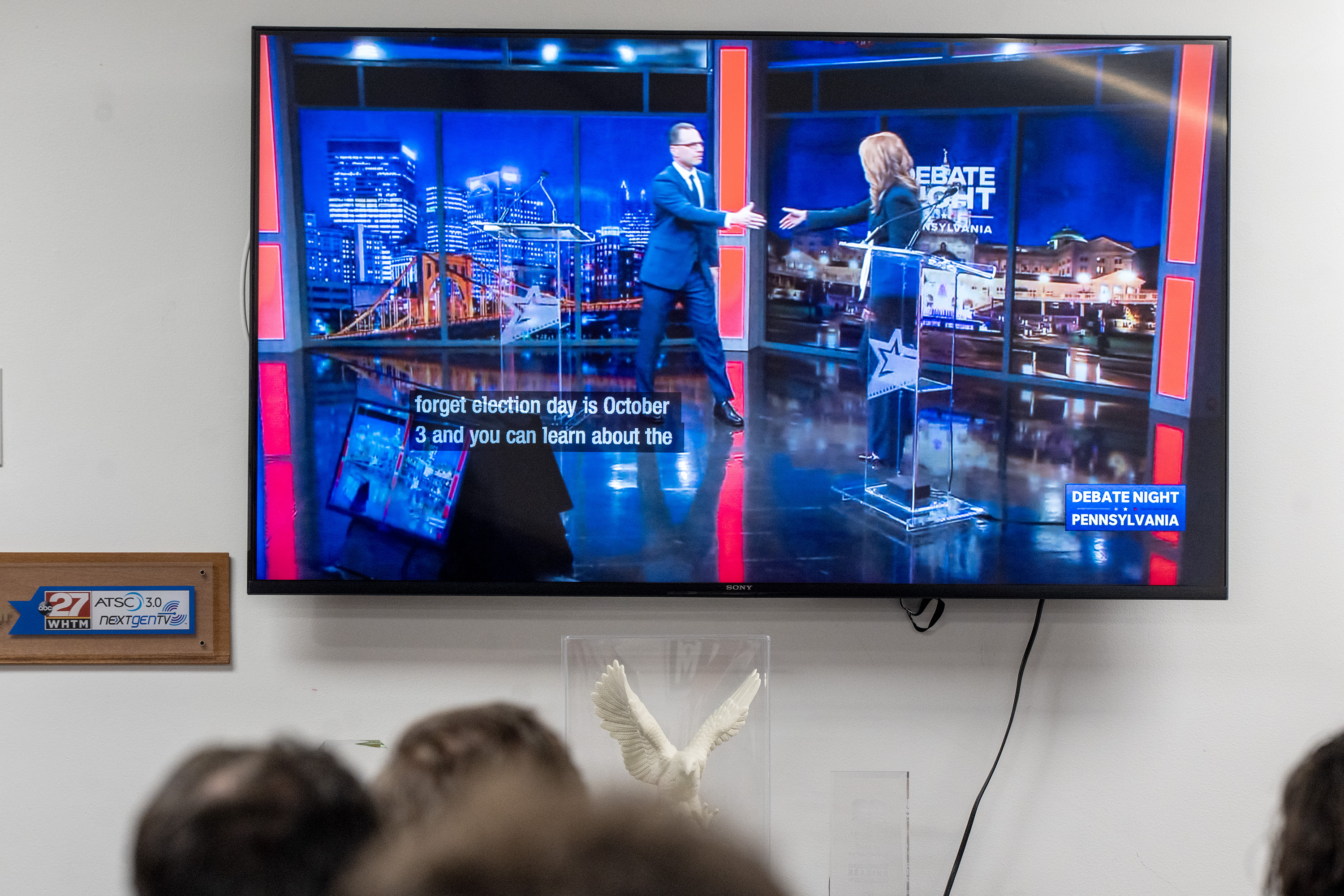
Monitor at the WHTM-TV studios in Harrisburg Wednesday evening Oct. 7, 2026, at the conclusion of the lone debate between Gov. Josh Shapiro and Republican challenger Stacy Garrity ahead of next month’s gubernatorial election. There is no live audience but the one-hour debate was televised on several local stations statewide and streamed on their websites and YouTube channels. Tom Gralish / Staff Photographer
Shapiro said he has already spoken with Lurie and the owners of the Steelers about their new potential stadiums. And he noted that he opposed using public dollars toward the Sixers’ new arena and said he would “be a strong protector of our Pennsylvania taxpayers.”
“On my watch, the Steelers will remain in Pittsburgh, the Eagles will remain in Philadelphia. Period,” Shapiro said. “And as I’ve shown with the Sixers and Flyers scenario, you can do that without providing tax dollars in order to make that happen.”
Garrity, who has said she supports all Pennsylvania sports teams but admitted she is also a Buffalo Bills fan, pledged to make any new stadium costs the responsibility of the owners, not taxpayers.
“I don’t think that we need to be giving taxpayer dollars to billionaire owners,” she said.
The Eagles have agreed to trade Cam Jurgens and a 2027 seventh-round pick to the Baltimore Ravens in exchange for a 2027 fifth-round pick and a 2028 second-rounder, the team announced on Wednesday.
Prior to 2026, Jurgens, 27, spent two seasons as the Eagles’ starter at center (2024-25) and one season as the starter at right guard (2023). Jurgens started the first game of the 2026 season at center, but moved to left guard in Week 2 against the Tennessee Titans in the absence of the injured Landon Dickerson.
With Jurgens at left guard, the Eagles turned to Drew Kendall, the 2025 fifth-round pick out of Boston College, to take over at center. Kendall acquitted himself well in three games at center, while Jurgens struggled at left guard, casting uncertainty about his future role when Dickerson returns to the lineup.
Jurgens entered the concussion protocol on Monday in the aftermath of the Eagles’ Week 4 loss to the Los Angeles Rams.
Howie Roseman said on Wednesday following the trade that he wasn’t looking to move Jurgens initially. However, over the last 24 hours, the Ravens upped the value of the return. The way Roseman views the trade, the Eagles are getting four players in exchange for Jurgens.
“I think for us, when you talk about the two and the five, moving from the seven[th] to the fifth, we’ve had success in the fifth round, plus the money [to pay a player in the future], plus Drew playing [center], we felt like we were getting four players for one,” Roseman said. “And just felt like for us, with all these guys that we got coming up, a lot on the defensive side of the ball that we want to re-sign and want to extend.”
Jurgens’ departure is the second major shake-up to the Eagles offensive line in under 24 hours. Lane Johnson, the team’s two-time All-Pro, six-time Pro Bowl right tackle of 14 seasons, announced his retirement on Tuesday.
Despite those changes, Roseman said he still has “high expectations for the team this year.” He refuted the notion that the Eagles, who have a 2-2 record, are prioritizing the future over the present.
“I think nothing has changed in terms of our goals,” Roseman said. “We’re trying to win this year. I think, from my perspective, just looking at what is the ultimate goal, which is to win the last game of the year. And then to have a run like we’ve had. Obviously, since Coach has been here, we’ve made the playoffs five times, been in two Super Bowls.
“You want to have an extended run, and so my job is to look at how we can have sustained success for a long period of time. And you don’t get many opportunities to get second-round picks in trades and get flexibility. And I think just looking at our team, obviously a lot of guys on long-term deals and being able to create some flexibility is a good situation for us, whether it’s financially and also with picks.”
The Eagles selected Jurgens in the second round of the 2022 draft out of Nebraska as the heir apparent to Jason Kelce. The longtime Eagles center played a role for the Eagles in scouting and assessing Jurgens during the predraft process.
Jurgens was a starter for four of his five years with the Eagles, starting in 45 games (62 games played). Jurgens earned Pro Bowl nods in 2024 and 2025. He won the Super Bowl with the Eagles in 2024, when he played through a back injury. Jurgens later revealed that a disc in his back broke off and wrapped around his sciatic nerve.
He continued to deal with back pain in 2025, prompting him to travel to Colombia this offseason to undergo stem cell therapy. He also dealt with a knee injury and suffered a concussion last season, causing him to miss three games.
With Jurgens en route to Baltimore, the Eagles will likely turn to Kendall the rest of the way to start at center. Roseman said he is “hopeful” that Dickerson returns to action in the next couple of weeks.
Until Dickerson returns, the team could fill the void at left guard with Willie Lampkin, the 2025 undrafted free agent out of North Carolina who spent his rookie season on the Eagles practice squad and made the initial 53-man roster out of training camp.
Philadelphians can expect to see fewer children darting through water geysers in front of City Hall and paddling around the pond at Sister Cities Park in the coming decades.
The city and suburbs are losing their populations of kids, and fast.
Between 2010 and 2025,Philadelphia’s number of residents under 18 dropped by 31,038, to 312,490 children in 2025 — a decline ofabout 9%, according to an Inquirer analysis of Census Bureau data. That trend is even more dramatic for children under 5, whose population fell 12%. Those are notable shifts when compared with the city’s overall population gain of about 3%.
This is not unique to Philly. In the last 15 years, nearlyevery major U.S. city has lost residents under 18, said Katie Martin, who directs research on Philadelphia trends and public opinion for Pew Charitable Trusts. And elsewhere in the Philadelphia region, every suburban county has seen its number of children decline during that span. The trend has the potential to become a big workforce and financial problem if it does not turn around.
Demography expertssay surveyrespondents often cite the climbing cost of living and political concerns as reasons for not having kids. Beyond logistics, people in the Philadelphian area say, the decision to not have children is driven by a desire for freedom and flexibility.
“I feel like I wouldn’t have been able to do and experiment as much … if I had been responsible for other human lives,” said Maureen Ferguson, 44, of Souderton, Montgomery County, who has never looked back on her choice to not have kids, filling her life with artistic endeavors like music, theater, illustration, and stand-up comedy.
The population and societal trends driving Philly’s drop in kids
A confluence of changes in population trends is helping demographers piece together what is driving the drop in kids.
For one, a reduction in teen pregnancies and births is changing the landscape. Teen births in Philadelphia fell from 3,072 in 2010 to 809 in 2025, according to data Martin and Pew sourced from the state.
“That has been a huge change,” Martin said. “Not just in Philadelphia, but something you’re seeing nationwide.”
It is a component of a larger trend of having children later in life, she said, which usually leads to each family having fewer children overall.
The pandemic may have contributed as well, as the data show a particularly sharp decline in the number of children in the city between 2020 and 2023.
The counties around Philly have likewise seen notable drops in their populations of children. Between 2010 and 2025, declines in the number of children ranged from 3% in Montgomery County to 12.7% in Bucks County.
Finances have been a recurring theme, Martin said. In a survey Pew conducted last year in Philly, both women and families rated their financial situation as worse than during the pandemic.
(function(){function e(){window.addEventListener(`message`,function(e){if(e.data[`datawrapper-height`]!==void 0){var t=document.querySelectorAll(`iframe`);for(var n in e.data[`datawrapper-height`])for(var r=0,i;i=t[r];r++)if(i.contentWindow===e.source){var a=e.data[`datawrapper-height`][n]+`px`;i.style.height=a}}})}e()})();
Rising housing and childcare costs are likely contributing to the trend in Philly and beyond, said Genevieve Diebold, a senior planning data specialist with the Delaware Valley Regional Planning Commission. She added that fertility rates started decreasing meaningfully following the Great Recession of 2007-09.
Costs are certainly one thing that have deterred Avery Walker, 32, who lives in Point Breeze.
“I know how expensive children are,” she said. “They are a drain on all of your resources — mentally, emotionally, physically, financially — and I would have to give up a lot.”
Prioritizing freedom and flexibility
For Walker and othersThe Inquirer interviewed who do not have kids and do not plan to, the reasoning runs deeper thancost. It comesfrom a desire to live spontaneously and prioritize hobbies, health, and relationships with partners and friends.
Walker, who works in supply chain, likes living on her own schedule, sleeping in, traveling, trying new restaurants, and attending concerts and does not want to give up or modify how she does those things in the ways she likely would need to if she had kids, she said.
Jennifer Gamba, a 48-year-old paralegal in Fairmount, has been married to her husband for about 14 years. They never had strong feelings one way or another about having kids, Gamba said. Over time, the biological door began to close, and that was OK with them.
“It just wasn’t really something we prioritized,” she said.
Maintaining a good relationship with her husband, managing her rheumatoid arthritis, running marathons, and exploring national parks took precedence over kids.
“I think you have to be all in, and I don’t know that I am all in,” Gamba said. “I think I could do it, but it might not have been the best version of me.”
For Kelley Galloway, a 38-year-old real estate agent in Fishtown, finances and politics are factors. The idea of raising children, especially girls, in this political and economic climate is scary, she said. But those issues just reaffirmed the decision she had made long ago.
Throughout her adulthood, Galloway has focused her energy on buying a home, creating a dinner club for women in Philly, advancing in her career, and traveling.
“I went to three concerts this week, and none of them were planned,” Galloway said. “That’s something I could never do if I had children, and that’s why I moved to the city. I wanted to be able to enjoy my life and experience things.”
Jessica Hawk, 57, always knew she didn’t want kids. She never liked playing with dolls as a child, preferring instead to play manager or teacher.
“Whatever that maternal thing is that drives you to have a child, that is missing in me,” Hawk said.
The retired English teacher in Glassboro, Gloucester County, has one million TikTok followers for her videos about education, but she started receiving attention from a different faction about six years ago when she began posting about being happily child-free. Her videos were seen around the world and resulted in her doing interviews for Russian and German media, she said.
“I had so many women in my DMs saying to me, ‘I wish I could forgo having children but, in my culture or in my family or in my religion, I don’t have a choice,’” Hawk said.
She spoke out, she said, to help women who don’t want kids understand just how many like-minded others are out there.
What does this trend mean for the region’s future?
This population shift could become even more stark, and eventuallyspell major issues for the city and the suburbs.
Foreign-born residents have been driving the region’s population growth in recent years. Since those residents tend to have more children than people born in the United States, the immigrant population may be mitigating the drop in young residents and masking what would be an even more dramatic decline, said Letícia J. Marteleto, a sociology professor at the University of Pennsylvania.
But that balance may be short-lived as President Donald Trump’s administration continues its dramatic efforts to curb immigration.
An uneven distribution ofyounger and older residents could compromise bedrock systems designed to keep people financially secure and physically healthy into old age.
Social Security and Medicare rely on contributions from those in the workforce. If there are fewer young people paying into the system and more older people extracting from it, it is increasingly difficult to cover each older resident.
“The whole thing becomes very expensive,” Marteleto said.
The healthcare system, she said, would become similarly imbalanced, an especially acute problem in a place that dubs itself a city of “eds and meds.”
Those dire consequences are a long ways away, she said, but, at this point, it is hard to imagine the population trends turning around without significant government intervention like affordable childcare, housing, and healthcare.
“If we don’t do the necessary things to provide women with the right circumstances for wanting to have more children,” Marteleto said, “we are going to keep getting what we are getting.”
Correction: Philadelphia’s population change was previously misstated. Population grew by 3%.
Some pizza parlors operate amid a blizzard of social media hype. Not Apizzeria 888 in Elkins Park, which opened a year ago on Old York Road near Church Road.
Sebastian Besiso has done his best to keep his one-man takeout operation hard to find.
The blinds are drawn, the windows are blocked, and the door is locked. He makes fewer than 40 pizzas a night. Reservations are essential. It’s pickup-only. There’s no Grubhub, after he smashed the order tablet in frustration on his first night. There’s no sandwich menu. He tried cheesesteaks but dropped them.
Sebastian Besiso checking the crust of a pizza at Apizzeria 888 in November 2025.Elizabeth Robertson / Staff Photographer
Yet after selling out every night he was open, he is pulling the plug. Oct. 18 will be the finale. Attorneys for Besiso and his landlord confirmed that he was released from his lease after a dispute over the building’s condition.
“It’s heartbreaking, especially after everything I’ve put into this place,” Besiso said. “888 proved something to me. An idea that looked almost impossible on paper worked: one person operating a full brick-and-mortar pizzeria — not a basement, garage, or pop-up — selling roughly $30 14-inch cheese pizzas and selling out every single night I opened, without exception and without ever working with a single influencer.” Though the shop turns out fewer pizzas than most, it has earned a 4.9 Google rating from more than 1,000 reviews.
Video: Apizzeria’s crispy and thin pizza crust
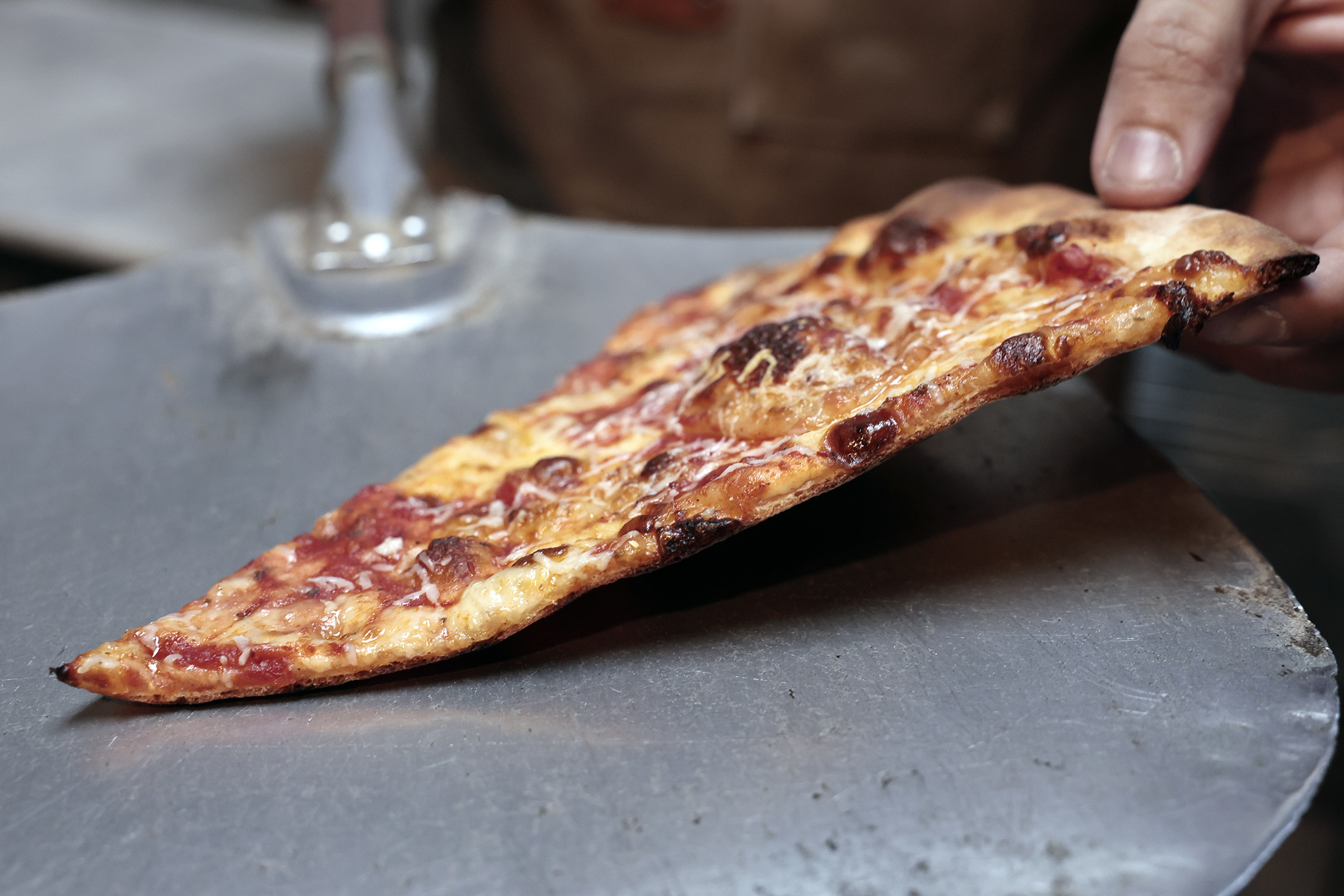
I doubt you’ll find a crispier, thinner crust around Philadelphia than Besiso’s Sofia Romana. This is pizza pushed nearly to its structural limit. A typical 14-inch New York pizza starts with a dough ball weighing 13 to 14 ounces. Besiso’s weighs 7.
That’s a stretch.
The crust almost shatters with each bite, yet holds up beneath the cheeses and toppings, including beef pepperoni. One pizza-geek friend says it has the cracker-like crispness of tonda Romana and the irregular outline and foldability of New Haven apizza.
How to get Apizzeria pies
For now, Sofia Romana, his classic pie, will be available every day, and he may also offer one or two other pizzas each day. He’s extending hours for his final days: 4 to 7:30 p.m. Monday through Friday and 2:30 to 7:30 p.m. Saturday and Sunday.
As it’s still a one-man shop, he will not do walk-ins. Reservation requests are accepted daily from 10 a.m. to 7 p.m. at least a day before pickup. He wants customers to text their name to 213-994-0664 (the Los Angeles area code is correct) or call and leave a voicemail. Besiso will respond between 8 and 10 the evening before the requested pickup to confirm the reservation. For same-day requests, the voicemail will indicate whether he’s sold out. If he still has pies available, he’ll pick up the phone.
The experience
Chatting with Besiso while he works is part of the experience. His workstation is a marble slab in front of a 60-year-old Blodgett gas deck oven with a missing knob.
Sebastian Besiso with a finished pizza at Apizzeria 888 in November 2025.Elizabeth Robertson / Staff Photographer
You can’t be in a hurry. Besiso spends a good 10 minutes stretching the dough until it’s nearly see-through. Then the pizza goes through a series of bakes, starting with an initial blast of heat that puffs the crust before he adds the cheese and toppings.
The crust is exceedingly thin but not frail. Its underside emerges handsomely mottled, with dark freckles and broad patches of golden brown. The irregularly risen rim catches a few spots of aggressive char. Despite a generous blanket of cheese — Besiso keeps the blend secret — the center stays firm, and a lifted slice bends without sagging.
Besiso, a chemical engineer who has worked in and owned traditional pizzerias for two decades, treats the shop as a laboratory and a passion project. He says he spent weeks on hybrid fermentation and cold aging, and worked out the precise ventilation pattern in his pizza boxes, punching each hole by hand.
A pizza from Apizzeria 888 in Elkins Park.Sebastian Besiso
“My engineering background makes me obsessed with questioning things and pushing variables beyond where people normally stop,” he said. “That’s the mentality I want to take into whatever comes next.”
He may not reopen somewhere else, at least not right away. Besiso said he doesn’t yet know what his next big project will be, and doesn’t want to force one. He plans to make limited batches from home, including a Japanese-inspired Neapolitan pizza he’s developing, and to take select catering jobs.
Besiso said he hopes to find people who share his interest in attempting something new if he takes on another major project. “Financial success is important, but it isn’t my driver and never will be,” he said. “I want financial success to be the result of creating something extraordinary, not the reason for creating it.”
Lane Johnson had thought about retiring along with Jeff Stoutland.
The plan was that they’d “go out together,” something they had “talked about before last season,” a source familiar with Johnson’s thinking told The Inquirer.
The Hall of Fame-bound right tackle was initially devastated when Stoutland walked away from the Eagles in February, a move that was precipitated by the organization’s decision to change its offense and strip the longtime offensive line coach of his run game coordinator role.
“I think it’s my sign,” Johnson told a few confidants at the time.
But he didn’t want to make a rash decision. He wanted to hear out Eagles coach Nick Sirianni, new offensive coordinator Sean Mannion and Stoutland’s replacement, Chris Kuper. He was encouraged by what he heard about the Kyle Shanahan-Sean McVay scheme they had planned to implement in Philadelphia.
Johnson made calls to other players who had been coached by Kuper, a former player himself, and the responses were positive. He knew he still had good football left in his then-35-year-old body, despite missing the final eight games of the 2025 season with a Lisfranc foot injury.
Lane Johnson would not play again in 2025 after suffering a foot injury, and would appear in only three more career games overall. David Maialetti / Staff Photographer
And when he finally decided to make his return public, he simply responded to a text message from The Inquirer with a thumbs-up emoji.
But the idea of retirement had long been on Johnson’s radar. He was ready to quit the game in the middle of the 2021 season when his mental health reached a crisis point. A year later, he told The Inquirer he might have two years left.
“F— this game,” he said in November 2022.
Johnson was talking about the never-ending anxiety of playing tackle at the highest level of the sport.
“It’s like Michael Myers always around the bushes,” he said. “That’s the best explanation I can come up with. The job’s never finished. I don’t look forward to any games.”
“Right now, what’s most important to me is continuing to focus on my mental health,” Johnson said in a social media post, “and spending more time with my kids and family.”
The time he took away from the Eagles in training camp was perhaps a strong sign of what was to come for Lane Johnson. Monica Herndon / Staff Photographer
In early August, Johnson took a brief sabbatical at the start of the training camp. He was contemplating retirement again, sources close to the situation said, and when he returned, he spoke about his aging parents and their health and said that this would likely be his last season.
That should be enough to explain why he walked away two months later. Johnson was still playing at a high level. His 97.2% pass block win rate was tops among all NFL tackles through three games.
Stoutland had long placed his tackle on an island with little assistance in pass protection. It’s a luxury that Johnson’s combination of speed, agility, strength, and size allowed the Eagles. No one had a quicker get-off. Stoutland once compared his foot movement to “a hovercraft.”
But Johnson was looking forward to the help Kuper’s blocking scheme would afford him. He might have been most excited about the new run scheme. He had advocated for more running for years and, along with guard Landon Dickerson, nudged Sirianni into altering the offense in 2024 when the Eagles started 2-2.
Coincidentally, they’re 2-2 again. But a similar shift will be difficult in a way that goes beyond losing arguably the Eagles’ pound-for-pound best player.
Johnson pushed coaches for more under-center, play-action in recent seasons. It might have put some stress on his relationship with Stoutland, who had built and had great success with the inside zone, shotgun-heavy run offense.
But defenses had picked up on the Eagles’ tendencies after winning Super Bowl LIX and they were stacking the box to stop Saquon Barkley and the run game. They needed an offense that would keep opponents off-balance and Sirianni knew as much.
Video: unCovering the Birds: What is ailing the Eagles’ offense
It just hasn’t surfaced yet this season. In fact, the Eagles have been under center less than they were previously in the Sirianni-Jalen Hurts era and have been even more inefficient based on success rate analytics. They’re last in the league in both under-center and play-action, which could explain why Mannion hasn’t done it as much.
“We believe in it,” Mannion insisted on Tuesday.
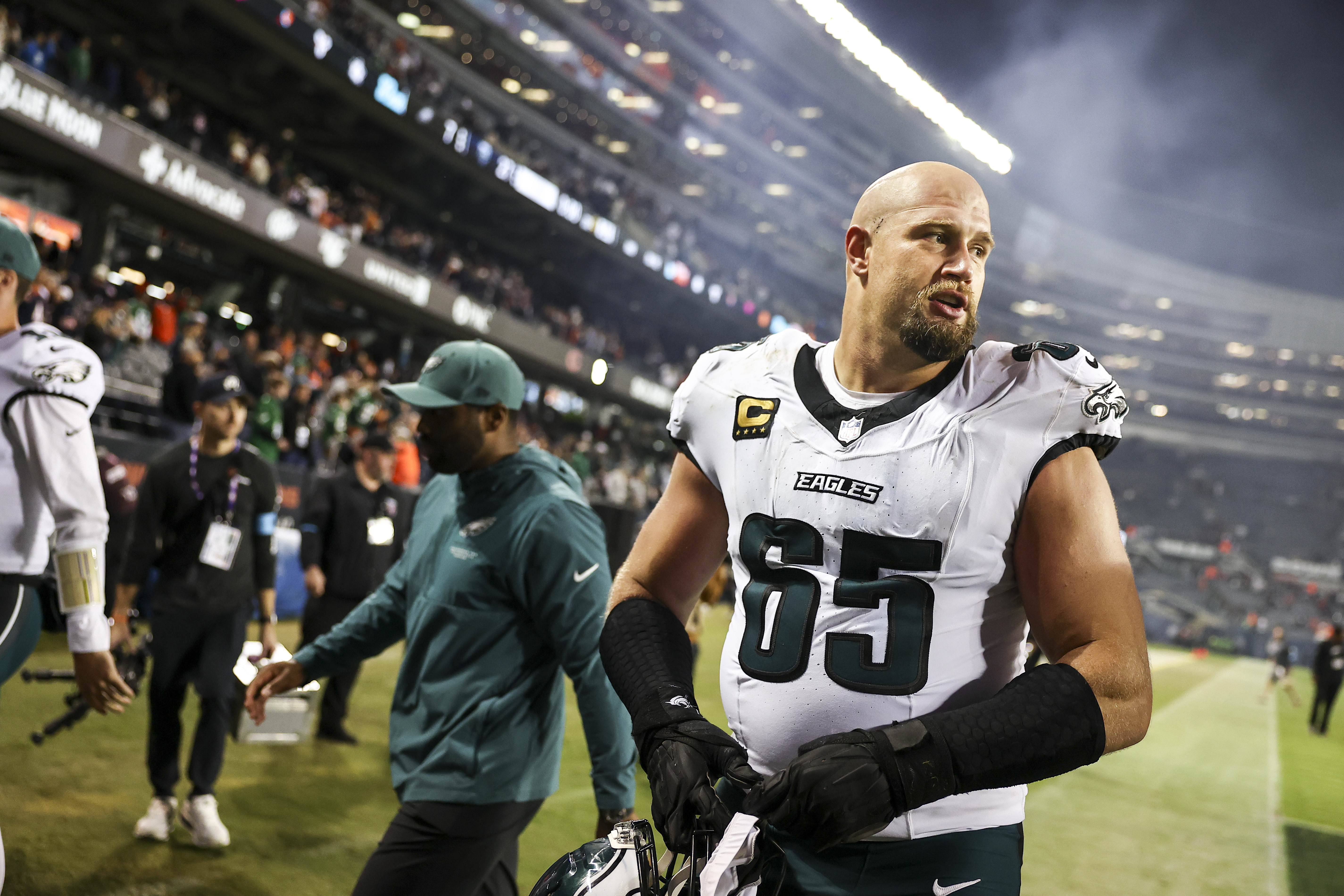
It’s unclear if Johnson still had belief. The Eagles narrowly won their first two games over teams that are now 1-3 and lost in a 27-7 blowout to the Bears in Week 3. Johnson, still dressed in his uniform, was the first to answer questions when reporters entered the postgame locker room in Chicago last week.
He didn’t blame the new scheme. He said nothing to suggest he was unhappy.
“We just didn’t capitalize,” he said about the offense. “Frustrating.”
Lane Johnson lasted only three games into the Sean Mannion era on offense before stepping away. Monica Herndon / Staff Photographer
Six days later, he was inactive for the Rams game for reasons the Eagles cited as “personal.” Rookie Markel Bell took his place, and despite the team’s overall effort in spite of Johnson’s absence and many injuries, L.A. rallied to win, 24-20.
The Eagles lost for many reasons, but their record without Johnson since he was drafted fell to 18-30 (.375). Their overall success since 2013 can be attributed to many, but a record of 122-63-1 (.659) when he’s in the lineup can’t be overstated.
Bell has potential, but he wasn’t drafted until the third round for a reason. The hope was that the 6-foot-9, 346-pound tackle would get a year to develop under Johnson. But the Eagles did too much wishing and hoping when it came to their offensive line.
They’ve known for years that Johnson could retire at any moment. They knew Dickerson thought about retirement himself this offseason after years of injury and is now on injured reserve. They knew that center Cam Jurgens, /who was traded to the Baltimore Ravens on Wednesday, had lost confidence after returning too soon from back surgery last season.
But rather than address the O-line, general manager Howie Roseman drafted wide receiver Makai Lemon and tight end Eli Stowers in the first two rounds. They have a few promising reserves in current center Drew Kendall and backup interior lineman Willie Lampkin to go along with Bell.
And they have, of course, a very good left tackle in Jordan Mailata and a serviceable right guard in Tyler Steen. But the unit is often only as strong as its weakest link, which has been evident so far this season.
Lane Johnson’s career in Philly includes both of the organization’s Super Bowl titles. Yong Kim / Staff Photographer
Johnson knew as well as anyone the mental toll the position can take on O-linemen. And he was one of the best to ever do it.
“It doesn’t change the feelings I felt,” he said to The Inquirer in 2022. “I feel like I got a [bleeper] in the bushes … that’s looking to kill me all the time. I feel paranoid. But at the same time, that’s what makes you good at your job.
“The anxiety is a good thing. It’s going to bring the best version of yourself out, but it’s going to come at a price.”
Johnson increasingly missed the time away from his parents — David, a former bull rider, and his mother, Ray Ann Carpentier, who has been living with Hodgkin’s lymphoma since 2023. He wanted to be a more present father to his three children, who have lived with his ex-wife in Oklahoma. Johnson also remarried in the spring.
“I just want to be a good dad,” he once said to The Inquirer, “and be there to support them and be a normal-ass dude.”
The game kept him from doing that, as did the stress it placed upon his mental health. Football brought him fame and great wealth. It’ll someday land him in the Pro Football Hall of Fame.
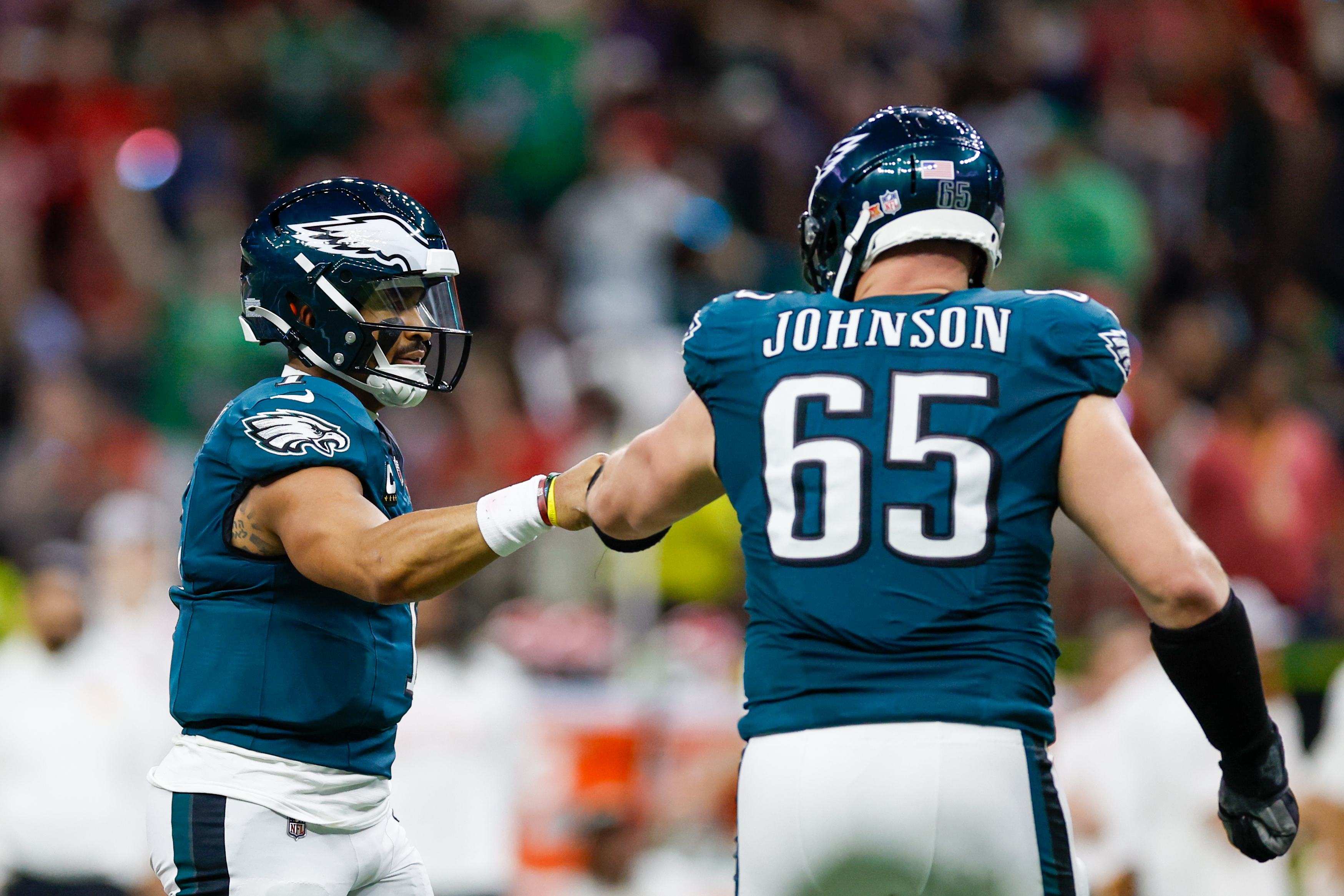
Lane Johnson has protected Jalen Hurts since 2021, and the pair won a Super Bowl together last year.Yong Kim / Staff Photographer
But Johnson doesn’t have to worry about the monster waiting to assault him anymore. He conquered that fear for almost 14 seasons. He doesn’t owe the game or anyone anything. It’s time to start living.
“When I’m done playing I want to kill my identity with sports and just try to find something new,” Johnson said in 2022. “Because I feel like I’ve been focused on sports since I was a young kid. Find another hobby, find something that’s outside of [football].
“Start over, I guess. … Or I can go f— off and fish.”