Tag: Weekend Subscribers

  • Fairmount Park has become a favored target of illegal tire dumpers with U-Hauls

    Fairmount Park has become a favored target of illegal tire dumpers with U-Hauls

    Michael Glatfelter routinely encounters giant piles of tires as he spins through Fairmount Park on his daily bike rides.

    Glatfelter, 74, started spying the illegal dumps in secluded areas two years ago. Now he says he encounters them at least once a month and is disgusted by their persistence — even as the city clears the piles within days.

    “There has to be a way of catching these people,” he said.

    Philadelphia officials say they are also frustrated by the tire whack-a-mole and are strategizing to prevent it. They say there have been at least 40 large-scale illegal dumping incidents on parkland citywide just this year. More than one-third involved tires, with dumpers frequently bringing them in via rented U-Haul trucks.

    On Tuesday, crews from Philadelphia Parks and Recreation cleared 800 tires from Fairmount Park brought in by someone driving a U-Haul. The truck and tires were abandoned near Centennial Arboretum off Avenue of the Republic.

    “This is part of a broader trend,” said Ra’Chelle Rogers, a spokesperson for parks and recreation.

    If caught, the dumper faces millions in fines.

    For his part, Glatfelter doesn’t blame officials. He posted a video to his Facebook page earlier this month of construction trucks cleaning up a massive pile of tires, with a caption describing how sick he was of living in a dirty city.

    “I blame our citizenry. I’m sorry to say, but I think we are totally worthy of that ‘Filthadelphia’ moniker,” he said in an interview.

    The tires dumped illegally Tuesday in Fairmount Park were brought in via a U-Haul truck.Philadelphia Parks and Recreation Department

    ‘So wide-open’

    Fairmount Park is considered a jewel of Philadelphia, with more than 2,000 acres split between the east and west sides of the Schuylkill. But its sprawling network of roads and remote areas also make it easy for dumpers to access undetected.

    “Fairmont Park is so wide-open, which is the beautiful thing about it,” said Natalie Walker, sustainability director for parks and recreation. “The challenge is keeping it beautiful while also preventing the kind of activity that degrades the park and takes away staff time.”

    Officials are asking the public to report any instances via the 311 system and to call 911 if they spot live dumping. They are also asking the public to share information that could identify dumpers if they feel safe doing so.

    The city has installed cameras in various park areas known for persistent dumping, Walker said.

    Violators face fines of up to $5,000 per illegally dumped item. Over the past three years, parks and recreation has issued $1.3 million in violations for illegal dumping on parkland.

    One strategy is to fortify park perimeters by blocking vehicle access without sacrificing the welcoming green space for pedestrians and cyclists, Walker said.

    For example, parks and recreation has installed three new gates near George’s Hill in West Fairmount Park, a dumping hot spot.

    The city has also organized cleanups and installed fencing, gates, and guardrails at other chronic dumping sites. They’ve installed bollards and boulders, as well as lock covers engineered to thwart bolt cutters.

    City crews removing about 800 tires illegally dumped in Fairmount Park near Centennial Arboretum off Avenue of the Republic.Philadelphia Parks and Recreation Department

    A $4 million fine?

    Parks and recreation is working with police to identify the dumper in Tuesday’s incident.

    That cleanup was triggered when park rangers and local partners spotted a stuck U-Haul truck abandoned next to several piles of tires. Officials determined the dump consisted of 8.4 tons of debris, translating to an estimated 800 tires.

    Although the U-Haul was reported stolen, investigators are looking into whether the driver got stuck and possibly falsely reported the theft to escape liability, Walker said.

    Walker said the dumper faces fines of up to $5,000 per item, amounting to about $4 million.

    Illegal dumping occurs when unscrupulous shops pay people to dispose of tires cheaply and avoid disposal costs of about $100 per ton, Walker said.

    The city routinely issues civil notices of violations, Walker said. She noted a 2023 incident when a repeat offender was fined $380,000 after being caught on camera dumping near Ormiston Mansion on Reservoir Drive.

    Walker said parks and recreation has a grant from the William Penn Foundation to implement part of its strategy. For example, park ambassador Dan Lidon conducts daily inspections, maps hot spots, and coordinates with community groups.

    On Aug., 25, 2026, crews from Philadelphia Parks and Recreation removed about 800 tires illegally dumped in Fairmount Park near Centennial Arboretum off Avenue of the Republic. The tires were brought in via a U-Haul truck.Philadelphia Parks and Recreation Department

    Dumping beyond Fairmount

    Residents, community nonprofits, and parks groups say dumping is widespread in other parks, vacant lots, and remote areas.

    In 2024, an estimated 4,000 tires choked a wooded ravine off Newtown and Adams Avenues, a stretch of debris sprawling more than 100 feet through Tacony Creek Park. The city used its own workers as well as a chain of volunteers to remove them.

    And this year, The Inquirer reported on what’s possibly the city’s largest illegal dump off Pennway Street in Northeast Philadelphia, which spans more than a city block and spills down a treacherous slope that’s difficult to access.

    In July, a group of 75 Philadelphia residents representing neighborhood groups and nonprofits gathered at the Discovery Center in Fairmount Park to map, by hand, illegal legacy dumps throughout the city.

    The group is still compiling information and a map that will eventually be posted online.

    Yet despite these efforts, it hasn’t made much of a difference to Glatfelter’s eyes, at least.

    “I know the mayor says, ‘cleaner, greener’ …but I know the city is not clean. It’s just not,” he said.


  • Trump used to say he saw a quick end to his Iran war, but 6 months later he claims he’s in no hurry

    Trump used to say he saw a quick end to his Iran war, but 6 months later he claims he’s in no hurry

    WASHINGTON — President Donald Trump arrives at an awkward moment for his presidency on Friday as the U.S.-Israel war against Iran reaches the six-month mark, a notable milestone for a conflict that the Republican leader repeatedly assured Americans would be a “little excursion” lasting a matter of weeks.

    The war isn’t over, though Trump claims that through bombs and blockade, he has already devastated Iran’s leadership, military and economy.

    And this week his administration said it would turn its focus to increasing economic pressure — rather than military action — to try to finish off Iran. The shifting strategy centers on threats to punish any country or entity that continues to conduct business with Tehran.

    The turn to using sanctions as the cudgel of choice comes as the administration weighs diminished munitions stockpiles after months of war, sparking concerns that the prolonged conflict could undermine U.S. military readiness in other parts of the globe.

    As the conflict grinds on, Trump’s talk of finding a quick end to the war also appears to be fading. He stressed this week that he’s “not in a hurry” to get Iran back to the negotiating table, and he continues making the case that the Islamic Republic’s leadership is on the ropes.

    “They’re not paying their troops. They’re in deep trouble. They have very little capacity,” Trump told reporters Thursday. “We don’t want to speak to them. We’re not looking to meet or anything,” he said.

    It’s unclear how — or if — Trump will address the six-month anniversary of a conflict that has already cost the United States more than $37.5 billion and done damage to his popularity ahead of critical November elections for his party. The president is spending Friday in Houston, where he’ll honor the Artemis II NASA crew for their 10-day mission around the moon earlier this year.

    Trump is declaring ‘mission accomplished’ — a phrase that hurt a Republican predecessor

    On its face, the moment is complicated for the “America First” leader who fiercely criticized his White House predecessors for wasting American taxpayer money and U.S. troops’ lives in Middle East conflicts and vowed on the campaign trail to keep the military out of “endless wars.”

    But Trump has bristled at suggestions that this war — in which no American troops have deployed into Iran — can be compared with the yearslong wars in Iraq and Afghanistan in which more than 7,000 Americans were killed.

    His Republican predecessor, President George W. Bush, was widely mocked for a 2003 speech aboard the USS Abraham Lincoln beneath a White House-produced banner that read “Mission Accomplished.” It came to symbolize a premature declaration of victory for the Iraq War, which would go on for nearly nine more years. More than two decades later, there are still U.S. troops stationed in Iraq.

    Trump’s war has stretched on far longer than he told Americans it would. It didn’t stop him from sharing a social media post this week declaring “MISSION ACCOMPLISHED 2026.” The AI-generated image features Trump against a backdrop of U.S. fighter jets, a warship and American flags above smaller images of Bush and former Iranian Supreme Leader Ayatollah Ali Khamenei, who was killed in an Israeli strike in the opening salvos of the war.

    Trump has consistently emphasized that the U.S. and Israel campaign has been devastating for Iran’s navy and air force. Iranian officials have said the country has suffered $270 billion in direct and indirect damage. Israeli military strikes in the first weeks of the war wiped out much of the theocratic government’s leadership structure, including Khamenei.

    But Iran has found leverage through its own strikes in the critical Strait of Hormuz, where relatively few vessels carrying oil and liquefied natural gas are risking passage. Trump again declared Thursday that the “Strait of Hormuz is open,” saying 24 vessels passed through a day earlier. That’s a fraction of the roughly 130 vessels that passed through the vital waterway daily before the war began.

    Trump is showing little interest in talks

    Mediators Qatar and Pakistan continue to press for a diplomatic off-ramp from the two sides. Qatar’s prime minister, Sheikh Mohammed bin Abdulrahman Al Thani, was in Tehran on Thursday to discuss a proposed plan between Iran and Oman to boost traffic through the Strait of Hormuz.

    But in Washington, Trump has shown little interest in getting back to the preliminary deal reached in June that aimed to reopen the strait and launch talks about Iran’s nuclear program. That deal fell apart within weeks after Iran started attacking ships.

    At the same time, Trump says the U.S. effort to economically choke off Tehran is working, with a U.S. naval blockade preventing Iranian oil from making it to market as the trickle of vessels carrying oil from other Gulf nations pass through.

    “We have control and we have the blockade,” Trump said. “Iran is not getting anything. Nothing is going through.”

    Iran is badly battered, but has a history of showing resilience

    There’s no doubt that the strikes combined with decades of international sanctions have battered Iran, said Aarathi Krishnan, a geopolitical risk analyst at RAKSHA Intelligence Future.

    But as Trump tries to turn to a new chapter in the war, Krishnan argues the Republican may be misguided in concluding that more pressure on Tehran — which has spent decades adapting to international economic sanctions — will produce the political outcome he wants.

    Indeed, Iran’s economy in the run-up to the start of the war was mired in surging inflation, according to the International Monetary Fund. National income per person had fallen from about $8,000 in 2012 to $5,000 in 2024, according to World Bank data.

    But Tehran has also shown resilience, selling discounted oil and establishing opaque shipping and financial networks, Krishnan said.

    “This administration has completely underestimated the Iranian resolve,” Krishnan said. “This is not new to the Iranian regime.”

    Trump must decide how far he’s willing to go with sanctions

    Richard Goldberg, who served as a senior adviser on Iran at the National Security Council during Trump’s first White House term, argues that Iran now finds itself in “uncharted waters” if the administration follows through with a truly biting campaign to pressure Iranian trade partners.

    “What we should be seeing is an attempt to seal off every escape hatch the regime has left,” said Goldberg, who is now at the Foundation for Defense of Democracies, a hawkish Washington think tank. “Use the economic power of the United States to layer a naval blockade with an air and land embargo while dropping the hammer on anyone who gives the regime access to hard currency — whether that’s in the Middle East, China or even Europe.”

    But it remains to be seen how far the administration is willing to go.

    Treasury Secretary Scott Bessent this week unveiled a campaign the White House calls “Operation Economic Outcast,” but only issued warnings to nations to cut trade and has yet to announce any secondary sanctions. Bessent told reporters the administration wanted countries to have a chance to shift away from Iran before it was too late — and acknowledged there was economic risk to the U.S., too, in moving ahead.

    China, which is Iran’s biggest trade partner and oil buyer, responded by expressing its opposition to “illegal unilateral sanctions.”

    Pressed Thursday about why he wasn’t already sanctioning Chinese banks, Trump offered a cryptic response.

    “Who said I’m not? You don’t know if I’m doing it,” Trump said. “I don’t have to announce everything, do I?”

  • 2026 Audi Q3: A hot little SUV. Literally, sometimes.

    2026 Audi Q3: A hot little SUV. Literally, sometimes.

    2026 Audi Q3 S line Quattro: Adding some fun to the premium compact SUV?

    Price: $51,790 as tested. This is the only trim level available but the test model featured about $8,000 in options, so there’s some customization to be had.

    What others are saying: “Highs: Big style in a little package, clever controls that aren’t just a gimmick, improved straight-line performance. Lows: More standard features mean a higher standard price, mandatory all-season rubber limits grip, sluggish dual-clutch transmission,” says Car and Driver.

    What Audi is saying: No real slogan; they’re keeping it low-key.

    Reality: A hot SUV. Literally, sometimes.

    What’s new: The Q3 has been redesigned for 2026, with a more powerful version of its turbocharged engine.

    Competition: Acura ADX, Alfa Romeo Tonale, BMW X1 and X2, Cadillac XT4, Lexus UX, Mercedes-Benz GLA, Mini Cooper Countryman, Volvo XC40.

    Up to speed: The 2-liter turbocharged four-cylinder engine creates 255 horses and gets the small SUV to 60 in 5.3 seconds, according to Car and Driver.

    Shifty: Automakers are all trying something different when it comes to getting into gear, and here’s one I’ve never see before. The gear selector is on a plastic disc thing on a stalk, and it — no lie — reminds me of a makeup compact.

    The shifter works well once you figure it out. Use paddles to select your own gears, but the transmission takes such good care of the driver that I said, “Why bother.” Only once did it get stuck in a low gear, when I passed someone in a real hurry and then was stuck going 55 behind the next car before the upshift occurred.

    On the road: The Q3 is naturally quite a sporty model, with extremely fun handling — that part is not a surprise. But highway driving is also the bomb. I drove along a beat-up right lane on U.S. 202 and the ride was quite smooth — and not just for a lower-priced Audi, but for something far less sporty.

    Audi delivers a Sport mode as a toggle with Drive via the shifter, and that mode is really enough to draw out all the power. For the other selections, Audi has decreed The Screen Must Be Touched. Boo!

    The interior of the 2026 Audi Q3 carries on with the spartan premium appearance the brand is known for. But removing the heater controls was not cool.Audi

    Driver’s seat: As a Mr. Driver’s Seat of a certain age, it can be hard to tell where old-man back problems end and hard seats begin. I first suspected that the leather driver’s seat in parchment beige with steel gray stitching might not be the culprit, and fortunately my aches let up in time to decree — it’s just me. The Q3’s seat is fine, comfortable and supportive just like almost all the rest.

    Friends and stuff: The rear corners provide fairly nice accommodations, with seat comfort matching the front to some extent. The seat back has two or three recline positions; the seat also slides forward and back but it’s for naught; the only usable position is all the way back.

    Cargo space is 29 or 50 cubic feet, depending on the seat origami.

    In and out: The Q3 sits at a nice height for hopping in and out, no ducking or climbing required.

    Play some tunes: The 12.8-inch screen isn’t bad for the stereo operation. I switched into CarPlay most of the time but finding other sources is not too hard.

    Sound from the Sonos system is excellent, an A trending toward an A+. It’s very clear.

    Keeping warm and cool: This is where touchscreen joy goes to die.

    Little icons along the bottom of the screen allow for changing the temperature, auto control, seat heater, defrost, and a few other things. But if you want to change the blower speed, you have to open up the HVAC screen, and the blower buttons are pretty small and hard to locate.

    The location of the big screen also means the center blower vents sit quite low, which can make cooling the vehicle a little slower on a hot day.

    Also, hot days interfere with the touchscreen haptics. Good luck making quick adjustments when starting up on 90-degree days; I have the sweaty back to prove it. Well, had; I promise I’ve showered since.

    Fuel economy: I averaged about 24 mpg in 100 or so miles of testing, not many highway miles.

    Where it’s built: Gyor, Hungary. The countries that supply the most parts are Hungary at 37% and Germany at 27%.

    How it’s built: Consumer Reports hasn’t hazarded a guess yet on the Q3’s reliability. But the previous year’s model garnered a 5 out of 5 rating.

    In the end: The Q3 is a delight to drive and to ride in. It’s almost a few dials away from perfection. Try the Countryman for an equal level of delight.

  • Olivia Li is one of the Curtis Institute’s most promising new students. She’s 7 years old.

    Olivia Li is one of the Curtis Institute’s most promising new students. She’s 7 years old.

    In the lobby of the Curtis Institute of Music’s Lenfest Hall, Olivia Li, in a frilly-sparkly red dress, is running back and forth through a turnstile. A few minutes later, she is at the piano transformed — playing Chopin eyes closed, a countenance most serious, and seemingly a decade more mature.

    If her legs aren’t long enough for her feet to reach the piano’s pedals without an extender, give her time. She is 7 years old.

    Olivia is one of nearly four dozen new students now arriving at Curtis for the fall term. The school on Rittenhouse Square, one of the world’s top music conservatories, has always had its share of young talent. This year it will have 13 musicians entering school under the age of 18.

    But even at a place known for prodigies, Olivia is unusual. She is believed to be the youngest student to study at Curtis since 1950, when 6-year-old violinist Diana Halprin matriculated.

    Olivia Li, 7, plays the piano in a rehearsal room at Lenfest Hall at the Curtis Institute of Music.Tom Gralish / Staff Photographer

    “I was actually preparing for Juilliard,” Olivia said, “but my teacher said I could try for Curtis, and I just did. I didn’t expect I would get in.”

    She got in. Juilliard, too.

    Asked why she chose Curtis, she said, simply, “I just like Curtis better than Juilliard.”

    Michelle Cann, one of two professors with whom Olivia will study at Curtis (the other is Ignat Solzhenitsyn), says that the young pianist has “phenomenal fingers.” Then again, so did others who tried out for the school and did not get in.

    (function(){function e(){window.addEventListener(`message`,function(e){if(e.data[`datawrapper-height`]!==void 0){var t=document.querySelectorAll(`iframe`);for(var n in e.data[`datawrapper-height`])for(var r=0,i;i=t[r];r++)if(i.contentWindow===e.source){var a=e.data[`datawrapper-height`][n]+`px`;i.style.height=a}}})}e()})();

    For the current school year, Curtis received 154 applications to the piano department, a spokesperson said. Sixty-three of those auditioned live in the first round and 15 advanced to the finals. Four were eventually accepted.

    What set Olivia apart in her audition, Cann said, was “how musical she was and how much personality and character about the music-making she had that you don’t expect to see in a 7-year-old. It just stood out so much.”

    Seven-year-old pianist Olivia Li rushes down the stairs of Lenfest Hall at the Curtis Institute of Music on Monday, Aug. 17, 2026. She began studying the piano at age 4 and will receive a full-tuition scholarship to the prestigious institution.Tom Gralish / Staff Photographer

    The sole criterion for admission at Curtis is artistic promise, said provost and dean Nick DiBerardino. “It’s rare for someone as young as Olivia to have won a place at Curtis,” he said, “but it does happen, and when it does, it’s because there was something really special happening at the piano.”

    Curtis has had students younger than Olivia. The school is still in the process of reviewing its records, but to the best of its knowledge the youngest was pianist Ruth Slenczynska, who was 5 years and 2 months old when she arrived in April 1930. She stayed just a few weeks.

    The youngest to come and stay was Sol Kaplan, who was 5 years, 7 months when he began studies in 1924, the year Curtis was founded; he went on to compose music for episodes of the original Star Trek TV series and a slew of movie scores.

    Olivia Li is one of the youngest students to study at the Curtis Institute of Music.Tom Gralish / Staff Photographer

    Olivia is in exceedingly rare company. More than 4,000 composers, conductors, vocalists, pianists, and other instrumentalists have graduated from Curtis in its century-plus existence. Only 13 other students were under the age of 10.

    She comes to Curtis from East Williston, Long Island, N.Y. No one in her family is particularly musically inclined, said her mother, Yanan Zhang, who did study piano as a child and continued to play a bit on a digital piano the family had at home.

    “She just naturally started,” said Zhang of Olivia’s attraction to piano. “She saw me playing, and we hired a teacher to come to home once a week to teach her. So initially it was just for fun.”

    Olivia started studying with a teacher — a Yale and Juilliard graduate — who gave her “very systematic training. So from that time, we took the learning seriously,” Zhang said.

    The teacher told Zhang that Olivia learned fast and had strong fingers.

    Seven-year-old pianist Olivia Li in the lobby of the historic 1726 Locust St. mansion at the Curtis Institute of Music on Monday, Aug. 17, 2026. She began studying the piano at age 4 and will receive a full-tuition scholarship to the prestigious institution.Tom Gralish / Staff Photographer

    “I think he told me several times that she is outstanding, but I didn’t really take it seriously. I thought it’s just encouragement from teachers — that’s how they encourage kids, encourage parents.”

    Olivia was 4 when she started piano, and despite her quick progress, it did not occur to Zhang for a while that there was anything unusual about her daughter.

    “I just thought maybe that’s how all kids do.”

    Olivia, of course, is not like other children, and she won’t be like her fellow students at Curtis, either.

    While students are taking coursework during the day covering music theory and history, Olivia will be attending third grade at Germantown Friends School. After her normal elementary school day, she will go to Curtis for two hours of piano lessons per week and receive individualized instruction in other areas like ear-training, music history, and repertoire studies.

    Olivia Li walks toward the entrance to 1726 Locust St., the one-time mansion that is home to the Curtis Institute of Music.Tom Gralish / Staff Photographer

    Curtis requires students under the age of 18 to live with a parent or guardian, and so Zhang, who works remotely for a bank in risk management, has moved to Philadelphia and set up house locally. Olivia has a younger brother, who loves music but has not yet taken up an instrument.

    How does a 7-year-old integrate socially at a school where some students will be three times her age?

    “We haven’t had a 7-year-old [recently],” DiBerardino said, “but our undergraduate students are very accustomed to playing music with younger people and making a deliberate effort to make them feel welcome.”

    Olivia LiTom Gralish / Staff Photographer

    Some socializing will happen organically, DiBerardino said, but “we do have some structures in place to try to help with that process. We have a dedicated work study program for our undergraduate students who are trained by our student services team to be mentors or big brothers or big sisters. And we regularly check in on students like Olivia. So Olivia definitely would have that support.”

    Outside of practicing, Olivia likes drawing, writing, math, and swimming.

    “When she’s not practicing, she reads a lot,” Zhang said. “She holds a book when she is brushing her teeth.”

    “I like to read fiction,” Olivia said.

    With a Norman Rockwell portrait of Curtis founder Mary Louise Curtis Bok Zimbalist nearby, 7-year-old pianist Olivia Li sits with her stuffed panda.Tom Gralish / Staff Photographer

    Curtis does not have a separate precollege program the way some other music conservatoires do. Olivia won’t be enrolled in a bachelor’s program, but, rather, a diploma program.

    Several forks in the road lie ahead. She could end up continuing at Curtis post-high school, enrolling in the bachelor’s degree program. That means she could end up being at Curtis well over a decade, a prospect that has some Curtis professors joking that they will be retired by the time she graduates.

    Olivia could also decide at some point that she has gotten what she needed from Curtis and move on to another conservatory or music school.

    Asked whether she would like to be a professional pianist, Olivia said she doesn’t know yet. She is also interested in conducting, “because you get to, like, conduct a whole orchestra.”

    Olivia could also decide that music isn’t where she wants to end up. “We don’t know if at some point she’ll say, ‘I don’t want to do this with my life.’ Who is supposed to know that at 7?” Cann said.

    Zhang said she doesn’t have any thoughts on the matter.

    For now, the artist herself seems content to let the endgame play out. She has plenty to do in the meantime. Of what she wants from a Curtis education, she said:

    “I hope that I can play piano really good and learn a lot of pieces and share my music with the world.”

  • Andy Dalton? Tanner McKee? Please. The Eagles lack a real backup quarterback. Unusual. Unsettling.

    Andy Dalton? Tanner McKee? Please. The Eagles lack a real backup quarterback. Unusual. Unsettling.

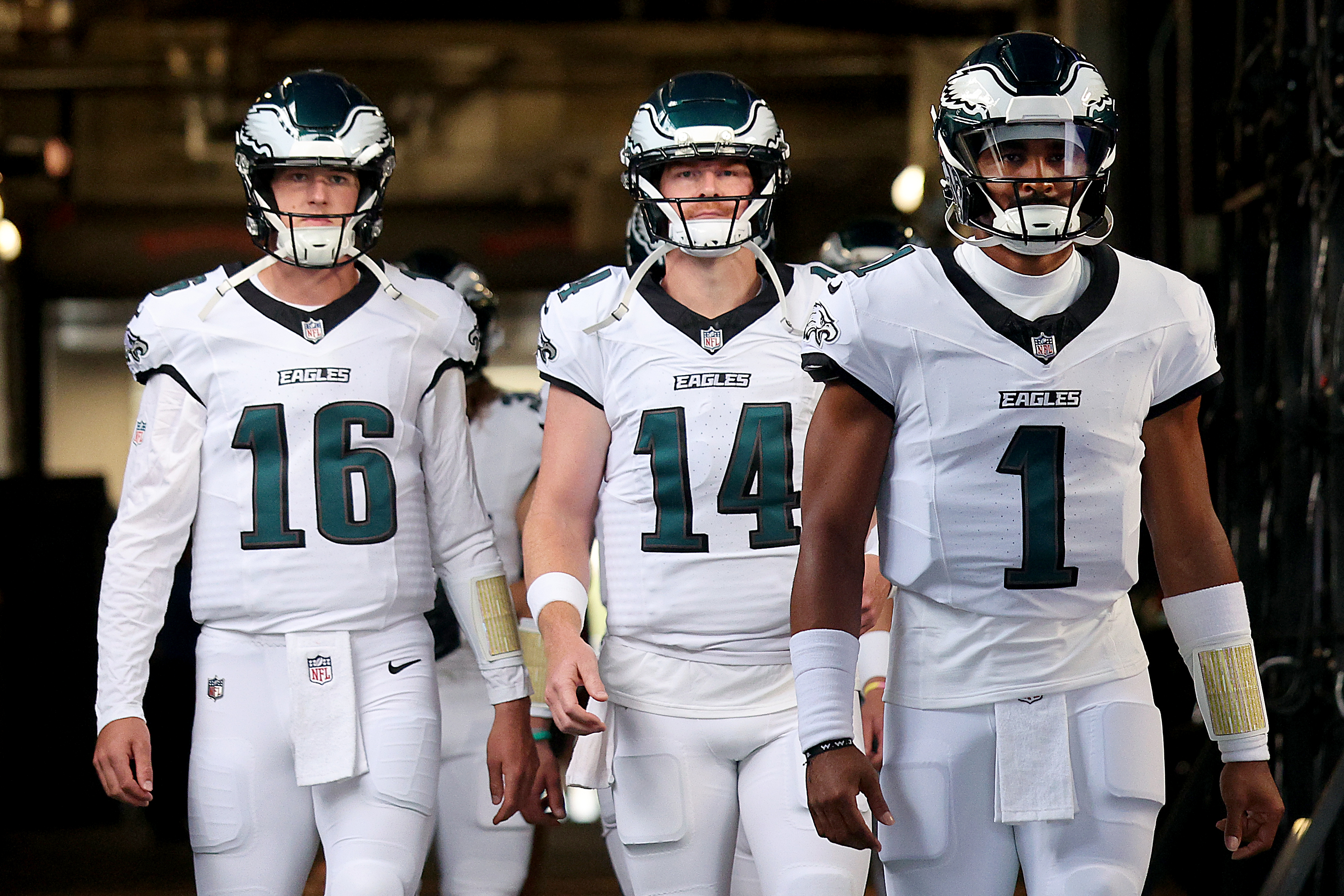
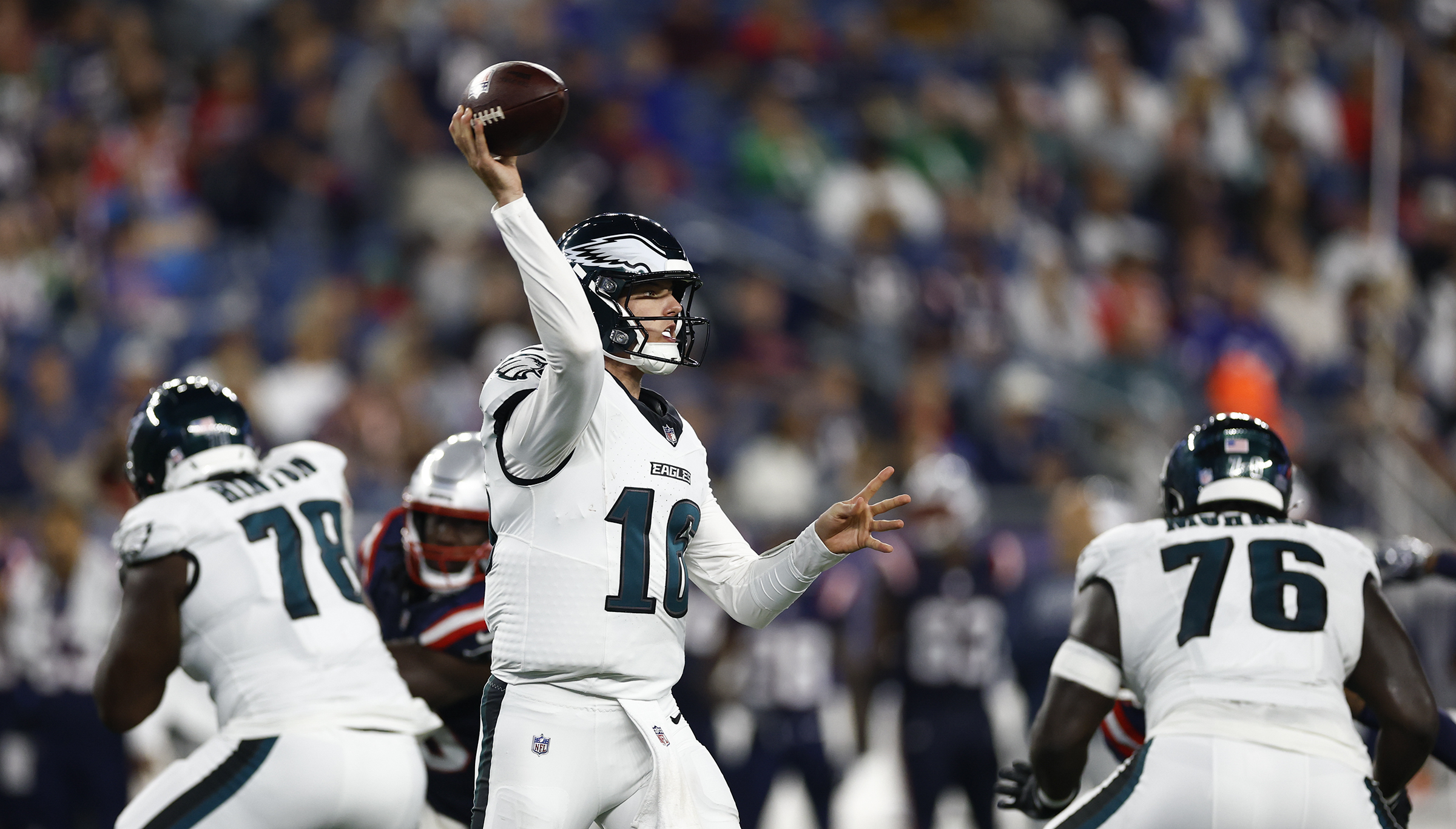
    The Eagles used to value the backup quarterback position, perhaps more than any other team in the NFL. Looking at their rosters in 2025 and 2026, it’s hard to believe they still do.

    This might not matter at all, except Eagles starter Jalen Hurts gets hurt a lot, and quarterbacks are the most important players in all of team sports.

    Still, it seems like a lot of energy to spend on a guy who won’t play much. Backup quarterback angst: The sort of nattering matter that makes the NFL preseason interminable; the sort of infuriating football geek-talk that fantasy nerds Snapchat about.

    You know. Guys like Lurie and Roseman.

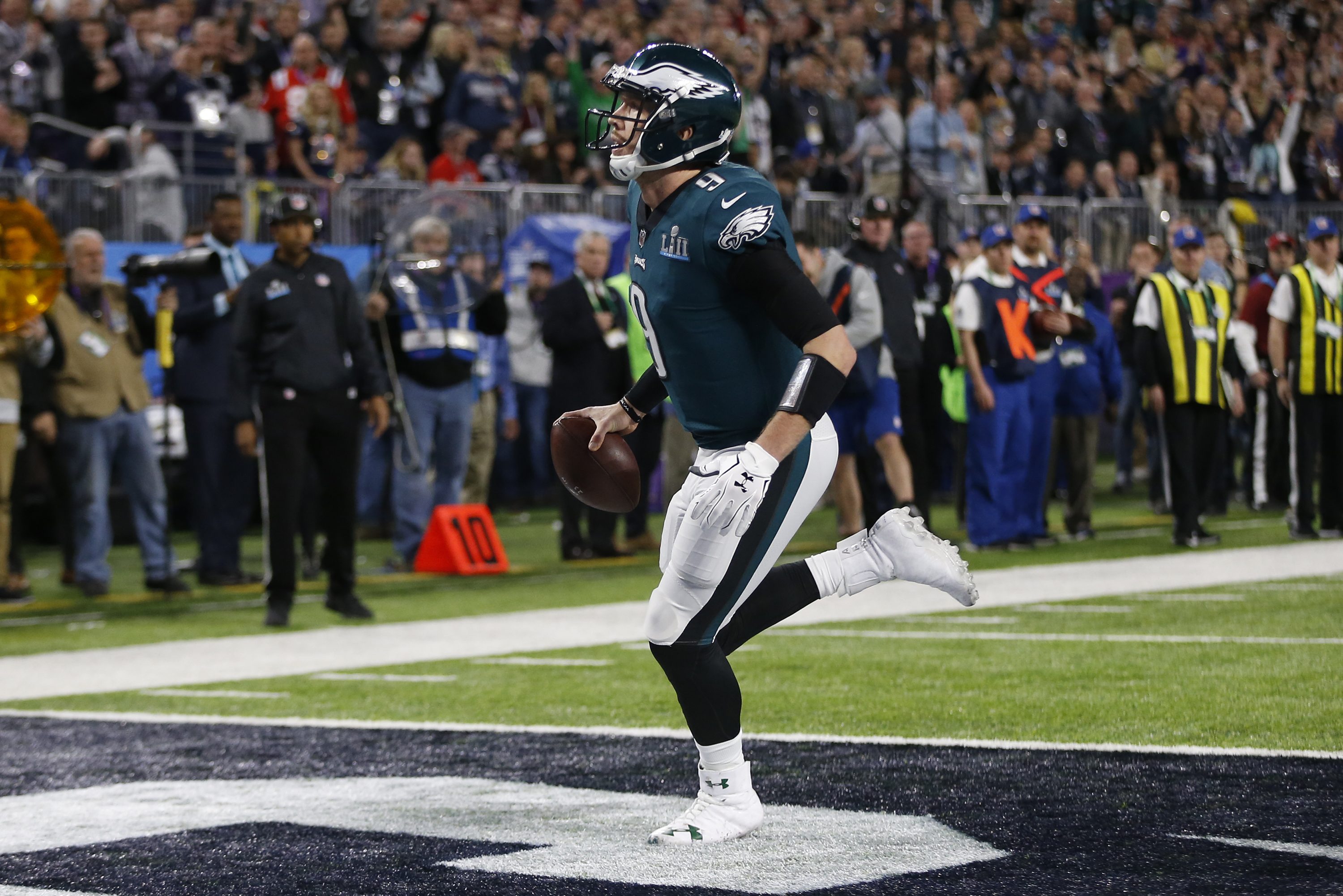
    In 2017, the Eagles committed $11 million to their backup quarterback spot. So important was the position to owner Jeffrey Lurie that he told GM Howie Roseman to sign Nick Foles, whom Andy Reid had just cut from the Chiefs. It meant eating $7 million of the contract of Chase Daniel, whom the Eagles promptly released.

    Despite missing the playoffs in 2016 with rookie Carson Wentz at quarterback, Lurie saw 2017 as a real chance to win the franchise’s first Super Bowl, and he considered Foles, who’d had a strong run as an Eagle, to be a better option than Daniel, who’d never had a strong run anywhere.

    The rest, as they say, is history: Wentz got injured, Foles replaced him, played well down the stretch, and won the MVP award inSuper Bowl LII where he outplayed Patriots legend Tom Brady and outfoxed coach Bill Belichick.

    Nick Foles became an unassailable Eagles legend, but that doesn’t mean all backup quarterbacks are created equal. Michael Bryant / Staff Photographer

    “Our priority, as you’ve seen, is to make sure we have the very best possible other starting quarterback,” Lurie said during Super Bowl week.

    That’s generally been true, and it’s generally made sense for the Birds, since Lurie prefers mobile quarterbacks, who, of course, are more likely to get hurt.

    Lurie signed Michael Vick out of prison in 2009, and Vick supplanted Donovan McNabb the next season and went to the Pro Bowl in his second of four years as an Eagle. Lurie drafted Hurts in the second round in 2020 with plans that Hurts would be the long-term backup to Wentz, but that’s before Ginger Jesus lost his job, and maybe his mind. Lurie sanctioned the recent, sensible acquisitions of Gardner Minshew, Marcus Mariota, and Kenny Pickett.

    But in 2019, Lurie also approved the signing of Josh McCown, a 40-year-old with a 79.7 passer rating with eight other teams. McCown replaced Wentz early in the Eagles’ home wild-card playoff game, played atrociously (predictably), and cost the Birds their postseason.

    Last season, Lurie allowed the Birds to enter the season with third-year sixth-round pick Tanner McKee as the backup of a team defending its second Super Bowl title. It didn’t matter, since Hurts stayed healthy. But McKee got to start game 17 against the Commanders, and he was poor: 21-for-40, 241 yards, one touchdown, one interception, with a forgettable fourth quarter that cost the Eagles their chance to win the game and capture a better seed. It looked OK in the moment, but upon further review, the Eagles (and I) decided that McKee is not the answer.

    The Eagles (not I) determined that Andy Dalton is the answer.

    They were wrong.

    The Eagles’ bet on Andy Dalton does not appear to be going according to plan. Yong Kim / Staff Photographer

    The Birds in March traded a seventh-round pick to the Panthers for Dalton.

    No player at Eagles preseason work or in training camp has been a bigger disappointment than Dalton.

    That isn’t really fair. There should have been minimal expectations of Dalton.

    He’ll be 39 in October. He’s 1-6 in his last seven starts over the past three years, during which time his passer rating is 84.5. Aberration? No. In the five seasons before that, his rating was 85.5 in 57 games. He’s been the backup in Carolina the past three seasons, essentially a big brother for Bryce Young, the underperforming No. 1 overall pick from 2023, and an assistant coach of sorts.

    That’s the role he was expected to serve in Philadelphia, where new offensive coordinator Sean Mannion has installed a new scheme. Dalton can help with the adjustment for Hurts, and you’d think Dalton would have a significant advantage over McKee in executing the offense.

    Tanner McKee again appears to be the best backup option for the Eagles. Yong Kim / Staff Photographer

    But no. Dalton has looked appreciably worse than McKee — so much worse that McKee’s unremarkable performance looks good by comparison.

    Entering the third and final preseason game Friday, the competition, such as it is, for the backup job clearly tilts in McKee’s favor. Which delivers this uncomfortable truth:

    The Eagles, who have made the playoffs five years in a row, don’t really have a viable backup quarterback. That’s the fault of the front office.

    Roseman.

    Lurie.

    What should they have done?

    Maybe they should have signed Mitch Trubisky, who got two years and $10.5 million to back up Cam Ward in Tennessee. Maybe another dance with Minshew, who got $8.25 million to back up Jacoby Brissett in Arizona. Both would have cost a lot more than Dalton’s $1.5 million, but that’s also just about what Tua Tagovailoa got from the Falcons to be the emergency plan if Michael Penix Jr. wasn’t back in time from his knee injury.

    All three of those QBs are in spots where they will have a likelier chance to resurrect their careers. Maybe that’s why the Eagles weren’t able to land one of them, and why they had to trade a pick for Dalton.

    To be fair to Roseman and Lurie, the Birds also drafted a quarterback in April: Cole Payton, in the fifth round, out of North Dakota State, who currently is not close to being an option.

    To be fair to Payton, he might be as good an option as the other two.

  • New trail connector lets bikers ride 70 miles from Philly to Reading. It’s ‘a really, really big deal.’

    New trail connector lets bikers ride 70 miles from Philly to Reading. It’s ‘a really, really big deal.’

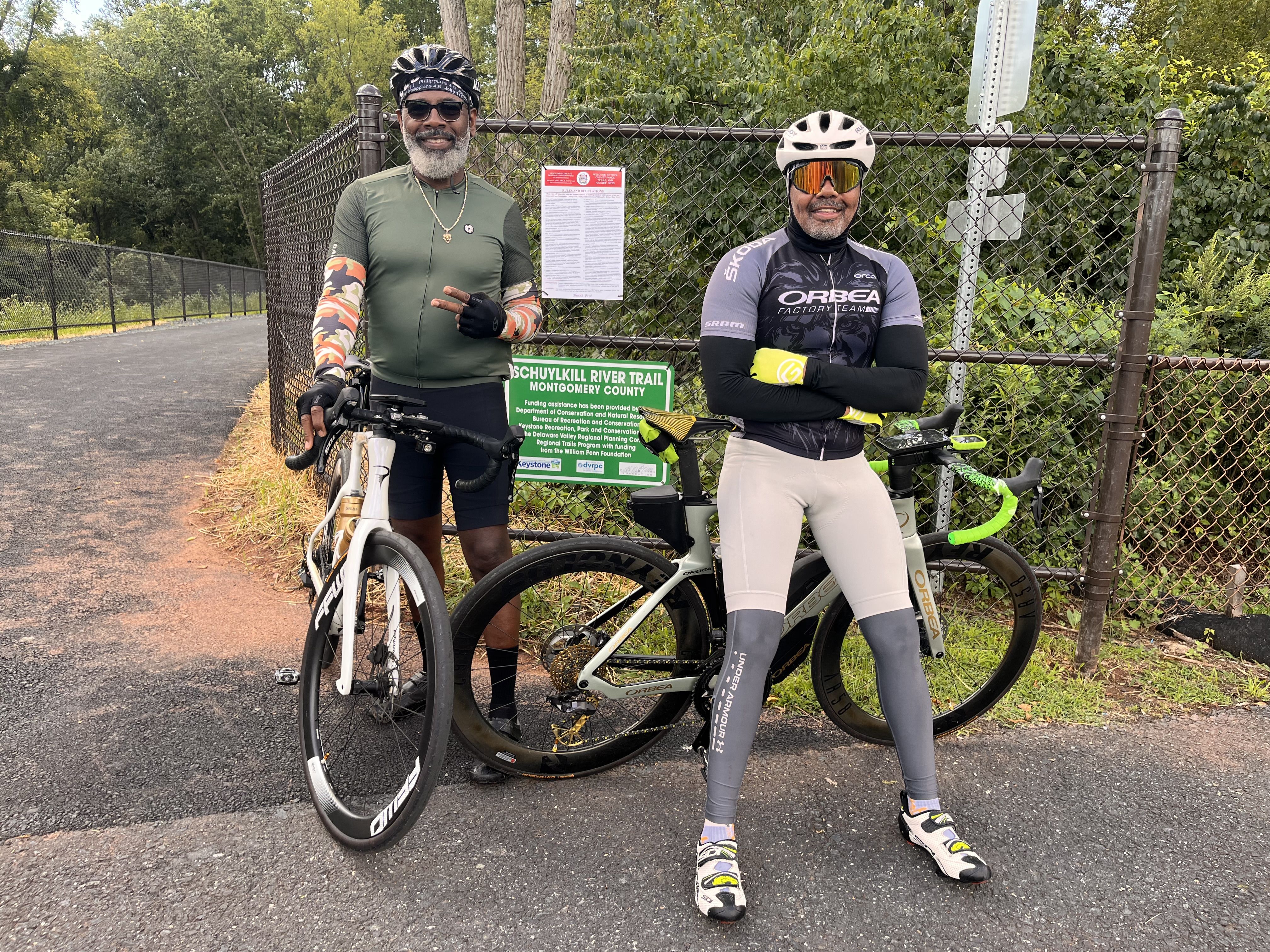
    Cyclists Alvin Morris and Rick Young departed Philadelphia via Shawmont Avenue on the Schuylkill River Trail on Tuesday morning for a heart-pumping, 75-mile round trip ride.

    On previous trips, they, like thousands of other riders, had to stop at a gate where the trail abruptly ended near Pottstown and decide whether to risk traveling a busy alternate route.

    No more.

    Schuylkill River Trail organizers are celebrating the completion of a nearly one-mile connector in Montgomery County that gives cyclists a clear 70-mile path from Philly to Reading. The connector took about 10 years from planning to its Aug. 19 opening.

    “I just found out about the connector Sunday,” Young said. “I love it. I told Al about it. We’re preparing for the [city-to-Shore] MS ride, so we need to get in some distance.”

    The duo planned to continue on the Schuylkill River Trail for a few more miles past the connector before returning to Philly.

    A Montgomery County Planning Commission map of the new Schuylkill River Trail connection between Industrial Highway and the Route 422 bridge near Pottstown. The 0.9-mile section of paved asphalt trail is now open, providing an unbroken path from South Philadelphia to Reading.Frank Kummer

    ‘A really, really big deal’

    Elaine Paul Schaefer, executive director of the nonprofit Schuylkill River Greenways, says the connector is more than just a new trail segment.

    “It’s a really, really big deal,” Schaefer said. “On many, many levels.”

    Schaefer and others believe the unbroken 70-mile stretch could be a tipping point for cycling tourism because it is long enough for cyclists to plan trips that allow them to linger in towns for brews and food, or overnight stays, she said.

    “At that point, the economic impact to towns along the way really exponentially increases,” she said.

    Her group manages the Schuylkill River Greenways National Heritage Area, connecting people to the river and trail. Schuylkill River Greenways has its office in Pottstown, but manages 40 miles of the trail in Berks and Schuylkill Counties, raising money to help maintain it.

    The new connector allows riders pedaling south from Chester County to ride parallel to Route 422 in Pottsgrove Township, Montgomery County, then loop under the busy highway and continue into Pottstown Borough.

    “The trail now connects the population centers of Philadelphia to Montgomery County and Reading,” Schaefer said. “Soon, it will connect beyond that.”

    Elaine Paul Schaefer, executive director of the nonprofit Schuylkill River Greenways, speaks with Sue Shellman, foreground, and her husband, Bill Shellman, in yellow, both of Skippack, at the new connector.Frank Kummer

    A boost for Pottstown?

    Schaefer believes the new connector will lure cyclists willing to stop and spend money in Pottstown, a former steel town whose sizable downtown contains restaurants, inns, and breweries. Pottstown’s Riverfront Park along the trail is already widely used.

    Peggy Lee-Clark, executive director of the nonprofit Pottstown Area Economic Development Inc., said it is too early to judge the impact of the connector, but there is “excitement.”

    “I think that always any connection for the trail is an economic boost,” she said.

    Commuting workers also use the trail, Lee-Clark noted.

    “The river is an important asset to us, as is the trail,” Lee-Clark said. “The connector is just one more thing that brings people to the area and exposes them to all of the other opportunities here in Pottstown.”

    When complete, the Schuylkill River Trail will run about 120 miles from Fort Mifflin near Philadelphia International Airport to Frackville, Schuylkill County. About 80 miles of paved and crushed stone trail are currently open. A swing bridge connecting Grays Ferry to Bartram’s Garden is nearing completion.

    Jason Brudereck, of the nonprofit Schuylkill River Greenways, rides new the Schuylkill River Trail connector as it crosses from Chester County into Montgomery County.Frank Kummer

    How the connector got built

    Montgomery County is planning a formal ribbon-cutting on Sept. 29 for the connector, which is already popular. On Tuesday, dozens of cyclists were riding at midday.

    Scott France, executive director of the Montgomery County Planning Commission, said the county started trying to acquire rights-of-way to the land a decade ago.

    “We are super excited this is open,” France said. “It’s been a long time in the works. This has had its share of challenges, but the fact is that we got there.”

    The connector cost $1.28 million, France said. Most of it was paid for from a $550,000 grant from the Pennsylvania Department of Conservation and Natural Resources, and a $542,000 grant from the William Penn Foundation. The county funded the balance.

    Although the connector is less than a mile, it was a challenge, France said.

    This is the sign cyclists and pedestrians once had to stop at before the connector was finished.Frank Kummer

    The county had to build around a state-owned bridge, work with Peco and Verizon to move utilities, and obtain permits to build in a flood zone. Additionally, crews had to stop work during the breeding season of the northern red-bellied turtle, a threatened species common in the area.

    Bill Hartman, trails and open space planning manager for the commission, said the connector serves another key role.

    “It provides full access to a number of other trails,” Hartman said, including the Cross County and Perkiomen Trails.

    Further, Montgomery County Commissioner Neil Makhija noted that the connector and Schuylkill River Trail are also part of the much wider Circuit Trails network, a planned 850 miles of interconnected trails in the Philadelphia region, including South Jersey.

    Makhija said he plans to celebrate his 40th birthday on Sept. 13 by riding the inaugural Tour de Montco, a 40-mile ride from Pottstown to Bala Cynwyd.

    The new trail segment, Makhija said is, “not just a trail in the woods — it’s a connection, bringing us closer to Philly and Reading and connecting the two.”

    Sue Shellman, foreground, and her husband, Bill Shellman, in yellow, both of Skippack, ride from Chester County onto the new Schuylkill River Trail connector into Montgomery County.Frank Kummer
  • Eagles practice observations: Trending up and down at the completion of camp; cornerback greatness

    Eagles practice observations: Trending up and down at the completion of camp; cornerback greatness

    The Eagles held the 17th and final open practice of their 2026 training camp on Wednesday at the Jefferson Health Training Complex. Here were my observations from Day 17 (and links to Days 1, 2, 3, 4, 5, 6, 7, 8, 9, 10, 11, 12, 13, 14, 15, and 16):

    Ouch couch

    Guard Landon Dickerson and tackle Lane Johnson were back in action and without injury designations after Tuesday night’s open practice at the Linc. Dickerson was given a rest day Tuesday, while Johnson left the scrimmage early, never to return. Cornerback Jonathan Jones also returned after an extended absence due to a shoulder injury. He was limited in what was a light practice without pads.

    The following players were still sidelined: tight end Eli Stowers (hamstring), tackle Markel Bell (thumb/leg), tight end Grant Calcaterra (back), cornerback Jakorian Bennett (knee), and safety Cole Wisniewski (concussion). Center/ guard Willie Lampkin appeared to tweak something late in practice and left team drills. He missed Monday’s workout after suffering a stinger in the second preseason game on Saturday.

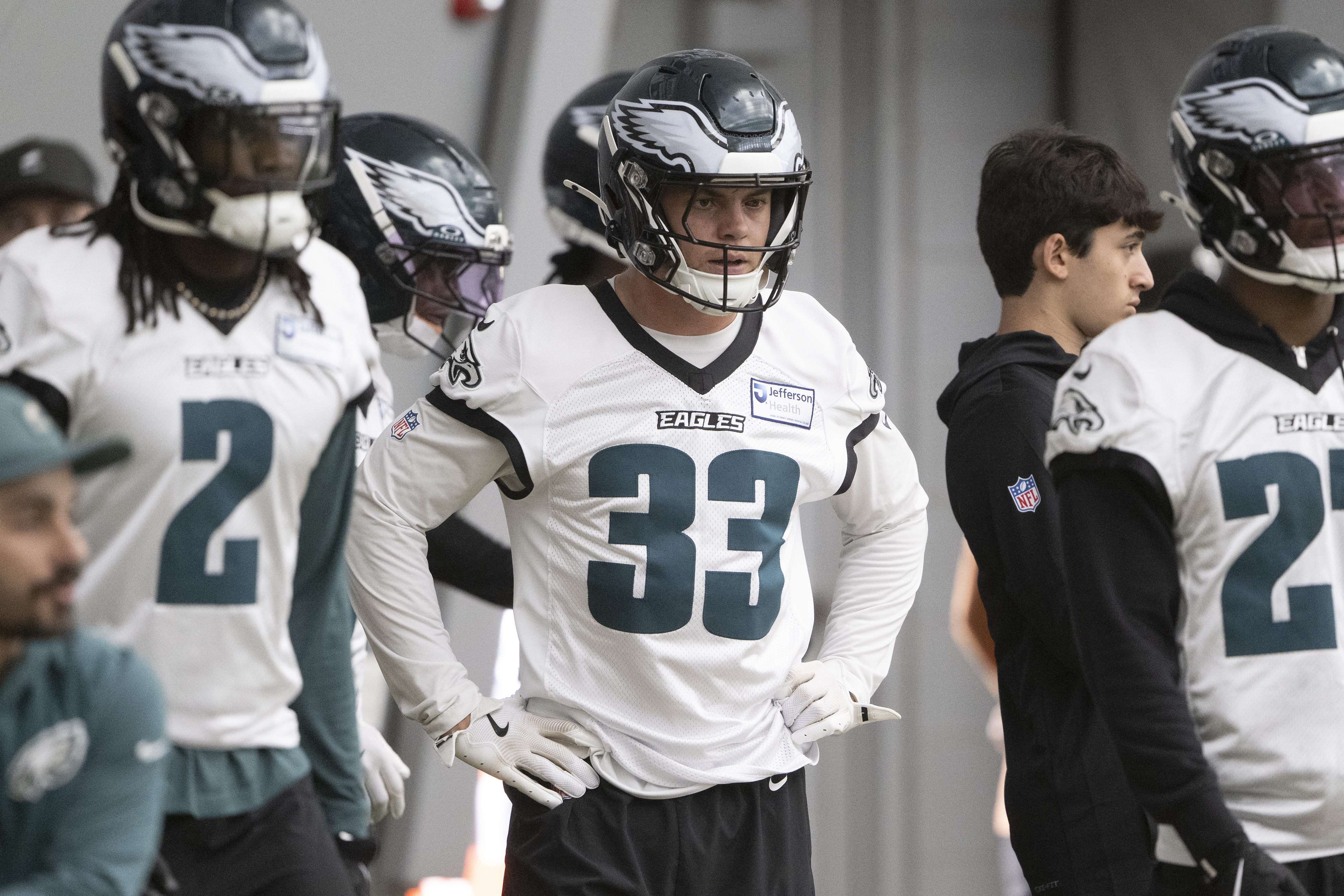
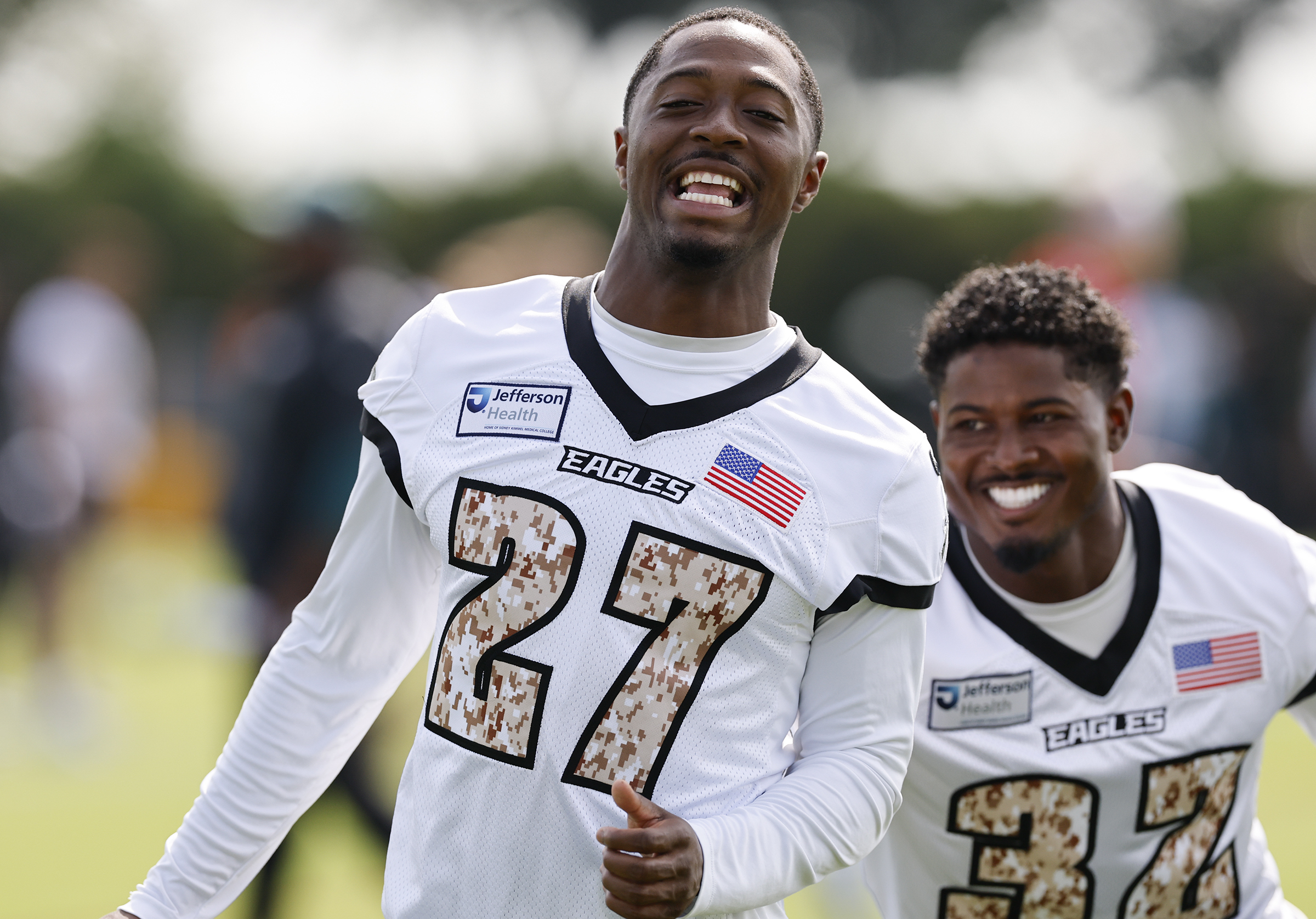
    Quinyon Mitchell (27) has looked every bit the All-Pro in his third training camp as an Eagle. Yong Kim / Staff Photographer

    Corner boys

    Now is as good a time as any to recognize the Eagles’ triumvirate of cornerbacks. They could have the best unit in the NFL, although only time will tell if Riq Woolen can be consistent enough to be mentioned alongside Quinyon Mitchell and Cooper DeJean. He’s had a good camp, with more than five interceptions at last count. There have been down days like the first joint practice in New England. Vic Fangio said before practice that Woolen can get “a little sloppy,” but overall he’s had a solid summer.

    More could be said of Mitchell and DeJean. The occasional struggles of Jalen Hurts and the first-unit offense, as Sean Mannion installs his new scheme, can be partly attributed to all three corners. Woolen broke up Hurts’ first pass in seven-on-sevens to receiver DeVonta Smith. In team drills, Mitchell had sticky coverage on receiver Hollywood Brown and notched a pass breakup. A little later, DeJean didn’t bite on a Smith double move and forced Hurts to throw the ball out of reach.

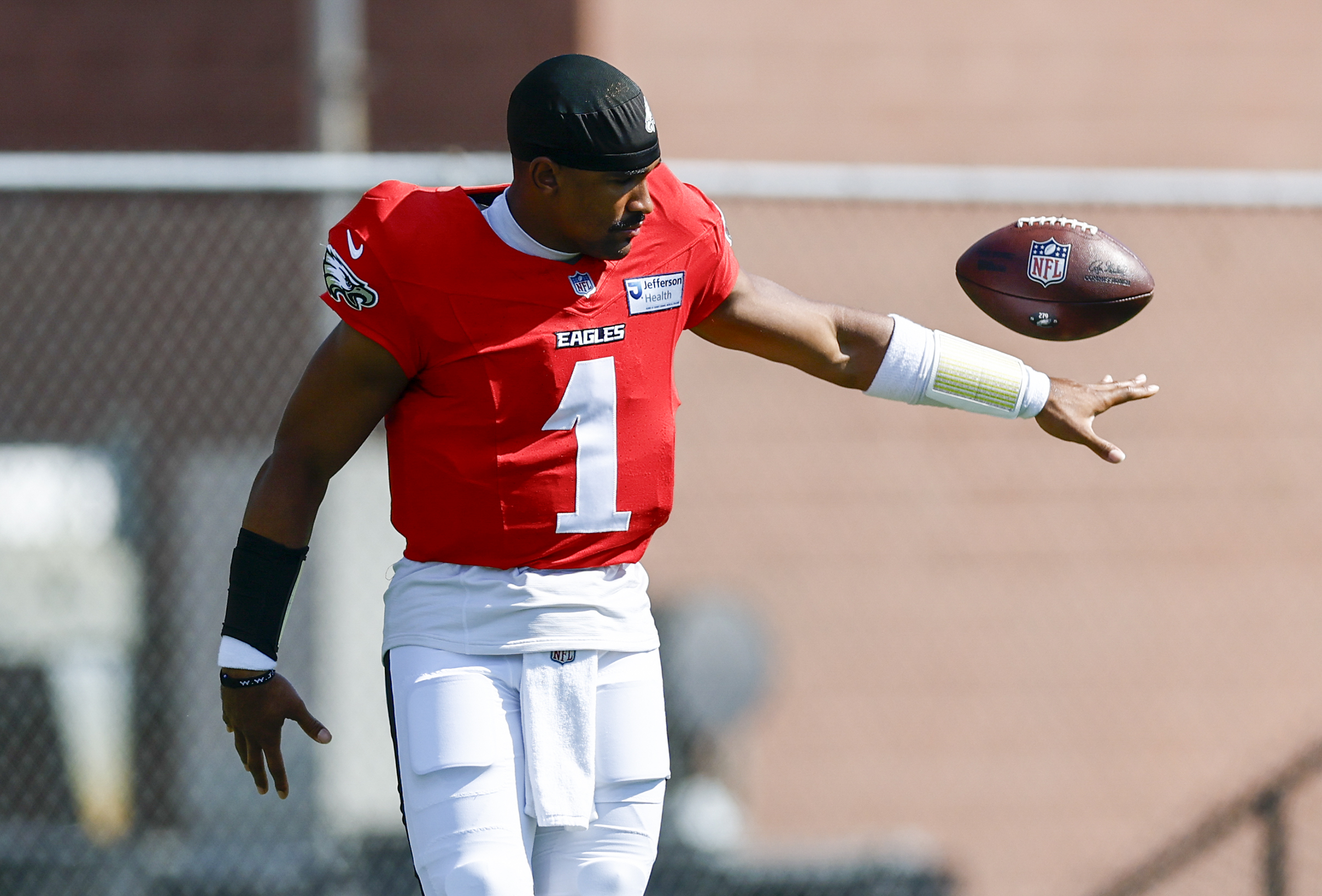
    It was another hot-and-cold practice for Jalen Hurts (1). Yong Kim / Staff Photographer

    Quick draw

    Hurts and the offense had some moments after a messy practice in front of fans at the Linc. He hit Smith on a post route in the back of the end zone vs. zone coverage in seven-on-sevens. Later, in 11-on-11s, Hurts did well to get the ball to an open Makai Lemon after his primary read. He had what appeared to be a touchdown himself off a draw. And in a later set, he dumped to tight end Cameron Latu, who had room after the catch.

    Mannion likes his offense to get out of the huddle and get the play off quickly at times. The change of pace can throw off a defense, although it denies Hurts the chance to read the coverage presnap. Mannion had a play dialed up on Wednesday that got Smith matched up against linebacker Zack Baun after a play-action fake. Hurts just flicked his receiver the ball for a decent gain after the catch.

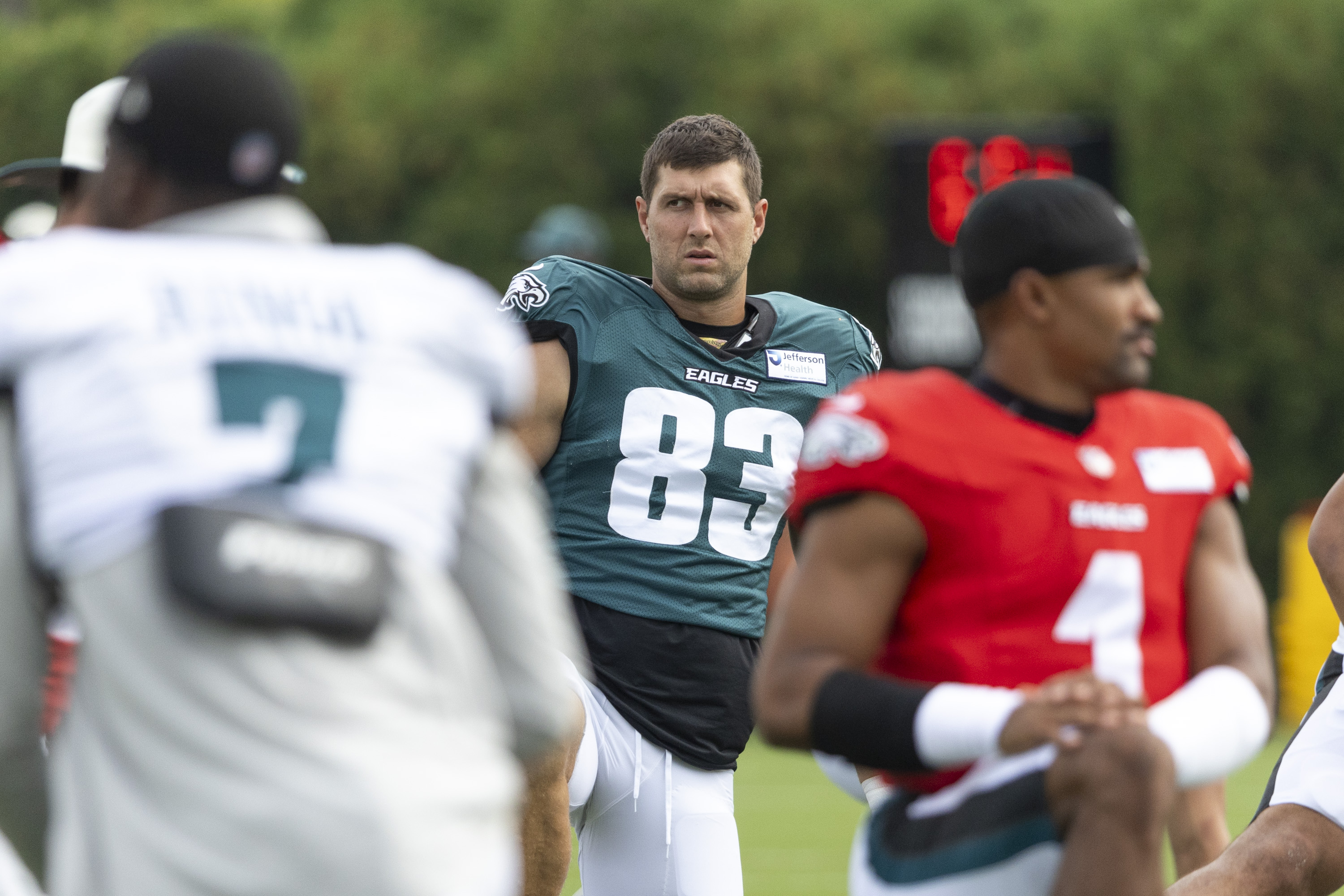
    Johnny Mundt (83) continues to try to build chemistry with quarterback Jalen Hurts (1). Tyger Williams / Staff Photographer

    Tight lies

    There were also unsuccessful moments, of course. Hurts appeared to have Lemon on a dig route over the middle — even if he wasn’t part of his initial read — and left the pocket and threw the ball away. Screens to running backs haven’t been a huge part of the offense in camp, but there have been intermittent sprinkles. Saquon Barkley got the ball in the flat in team drills and received a boundary block from Smith. But left tackle Jordan Mailata couldn’t square up safety Andrew Mukuba, who made the stop.

    Tight ends haven’t been as featured in the pass offense either, but that could come with time or be dependent upon the opponent. Hurts has history with Dallas Goedert. They have had their connections over the last month. Johnny Mundt is the clear “Y” blocking tight end, but when Hurts has gone to him through the air, there have been apparent miscommunications. There was another on a hitch route Wednesday when the ball flew behind Mundt.

    Eagles tight end Stone Smartt works out as special teams coordinator Michael Clay (left) looks on earlier in training camp.Monica Herndon / Staff Photographer

    This and that

    The tight end position is a little uncertain after the top two guys. One guy who hasn’t gotten much mention here, but has performed better the last few weeks is Stone Smartt. He has four years of NFL experience and has showed it of late. He had five catches vs. the New England Patriots on Saturday and a couple on Wednesday, including a snag just ahead of defender Michael Carter II.

    Keyshawn James-Newby missed most of camp with an ankle injury. But the rookie edge is back and he flashed for the first time when he rushed around tackle Myles Hinton for a pressure.

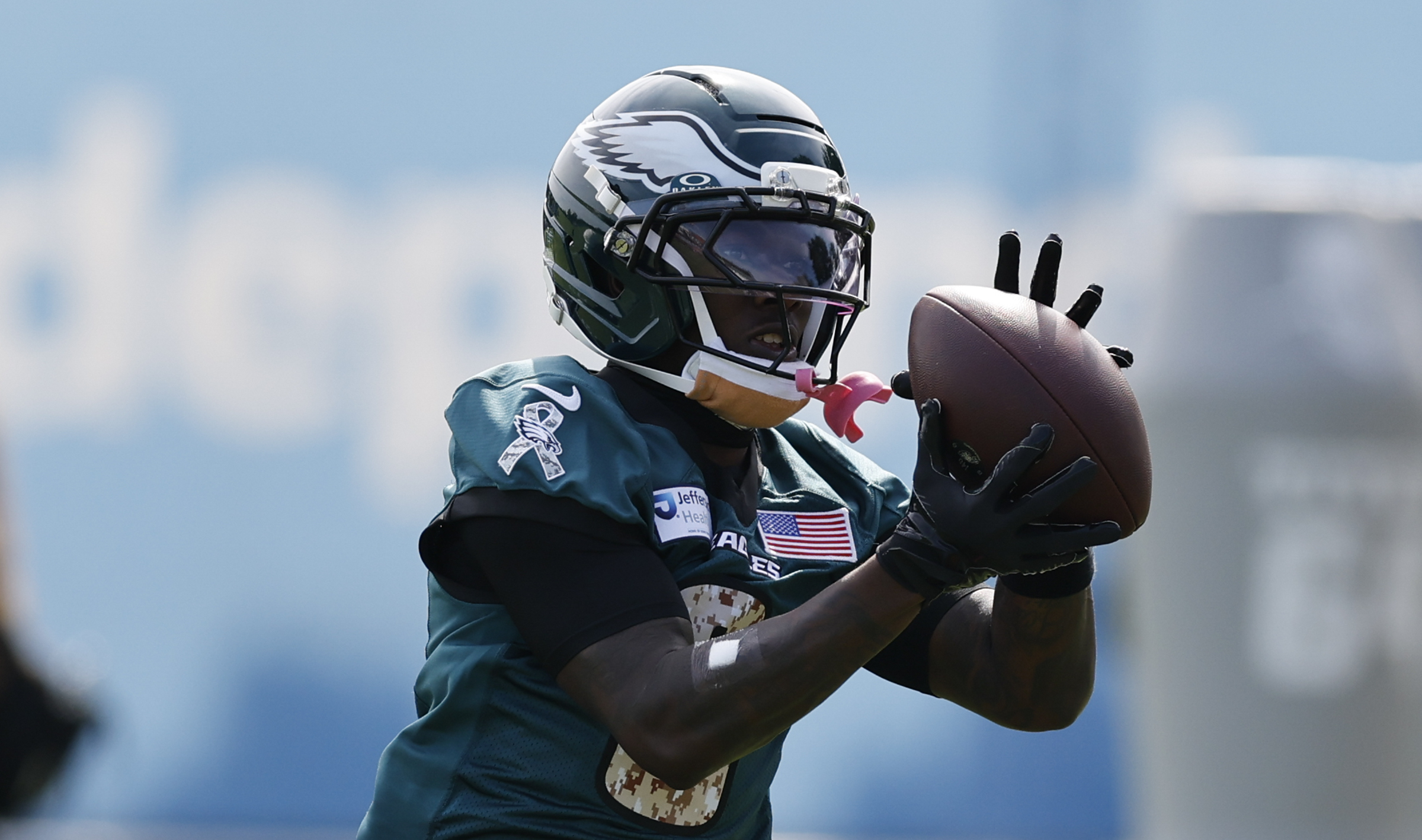
    Tanner McKee (16) appears likely to see action on Friday against the Bengals.Yong Kim / Staff Photographer

    Back to the future

    It seems likely that Andy Dalton and Tanner McKee will play in Friday’s preseason finale, if Nick Sirianni’s claim that the backup quarterback competition not being over is true. McKee was first up during seven-on-sevens. It was a mixed bag. He hit Brown underneath and then Lemon, who still caught the pass after it hit one of the simulated pass rushers. McKee then just oddly tossed a pass into the dirt. But he hooked up with running back Tank Bigsby for a touchdown.

    Both quarterbacks had their moments in team drills. Dalton lofted a touchdown pass to receiver Quez Watkins, while McKee hooked up with receiver Elijah Moore for positive yardage. Latu lost a defender with a double move, but McKee’s strike sailed through his hands. Watkins picked up more than a first down when he had blockers on a downfield screen.

    Trending up

    With camp officially over, and Wednesday’s practice short on competitive periods, here’s one beat reporter’s list for players trending up:

    Jalyx Hunt. The outside linebacker has been one of the best defensive players and drew raves from Patriots people after last week’s joint practices. On Wednesday, Hunt beat Mundt — as he should — and met Barkley in the backfield for a would-be tackle for loss.

    Drew Kendall / Lampkin. I’m splitting this entry between the two second-year interior O-linemen. They were relative unknowns coming into camp, but have seemingly solidified the center and guard backup spots. There are concerns about experience, size and durability with both, but new O-line coach Chris Kuper has them looking ready. Kendall and Lampkin had key blocks on two Dameon Pierce rushes on Wednesday.

    Moro Ojomo. The defensive tackle just keeps raising the bar. Ojomo is in a contract year and will likely price out the Eagles — who just extended Jalen Carter and Jordan Davis — next offseason.

    Tyler Steen. The right guard is another player entering the fourth year of his rookie contract. Steen has a better chance of staying in Philly than Ojomo, but his return could cost some if he continues to grow in confidence.

    Jeremiah Trotter Jr. The inside linebacker is entering his third season and is still a backup. But if either Baun or Jihaad Campbell goes down, Trotter should be able to step in without missing a beat. He’s been that good in camp.

    Honorable mention: Michael Carter II pushed in the safety chase and should be the dime defensive back. Outside linebacker Joshua Weru, despite his inexperience, has flashed enough potential to make the 53-man roster. Marcus Epps never let Carter supplant him at safety. A.J. Epenesa has done enough to earn the third edge spot — for now. Receiver Dontayvion Wicks locked down the No. 2 spot opposite Smith.

    Was down, now up: Ty Robinson was relegated to developmental period duty at the start of camp, but the light bulb went off and the defensive tackle started racking up sacks. Will Shipley didn’t exactly struggle in the early going, but he came on strong and was excellent in the joint practices. Cornerback Kelee Ringo might not have been on the outside looking in, but he needed to show he was more than just a good special teams gunner. He’s got liabilities but should be a roster lock.

    Hollywood Brown has a 1,000-yard NFL season to his credit but his play in training camp was not a revelation. Yong Kim / Staff Photographer

    Trending down

    Hollywood Brown. He’s probably on the 53-man roster, and may end up getting more playing time if Lemon needs developing. But Brown hasn’t popped like the speedster was expected to. He may need some time to adjust to a new scheme.

    Andy Dalton. The veteran quarterback didn’t ask to be traded here. That doesn’t excuse his spotty play in an offense he had experience with. But it’s hard to see why the Eagles felt it necessary to push McKee and cut into his repetitions in a new scheme. Maybe Dalton can turn it on at the end to win the job.

    Dickerson. No one can deny the left guard’s toughness and what he’s already accomplished. He still has gas in the tank. But of the five starting O-linemen, he may not be an ideal fit in the new wide-zone blocking scheme. As for whether he can make it through the season, that is to be determined. An example of Dickerson’s sluggishness in the new scheme came on Wednesday when he was late to the second level and Campbell plugged Barkley.

    Jonathan Greenard. The Eagles’ big offseason trade acquisition has missed all of camp with a pectoral muscle injury. Fangio indicated he might not be ready for the opener. Greenard should be the top edge when healthy, but his start in Philly has been underwhelming.

    Lemon / Stowers. Rookies should be given the benefit of doubt. Lemon and Stowers could end up delivering on their draft stock. But when you’re a first- and second-rounder, expectations are higher and you should be ready to contribute early. Lemon was out for three weeks with a hamstring injury. He’s back, but there’s going to be an obvious learning curve. Stowers was improving, but a recent hamstring injury has set him back. He’s not yet an NFL blocker and has hardly practiced with Hurts. How much can he realistically do early in the season?

    Honorable mention: Jakorian Bennett has been out since injuring his knee in the preseason opener. The corner didn’t look like a roster lock before the setback. Grant Calcaterra is a decent receiver, but blocking isn’t a strength. A recent back injury could end his roster hopes. Fred Johnson has stepped in and helped the Eagles win games the previous two seasons. But like Dickerson, the tackle may not be best-suited to the new scheme. The Eagles may be waiting for another team to cut a more NFL-ready long snapper rather than stick with a rookie in Rocco Underwood.

    Was up, now down: Darius Cooper shined early in camp, especially when Smith and Lemon were sidelined. But he’s been inconsistent of late. Case in point: He eased up on a route on Wednesday and allowed safety Andre Sam to tip the ball to Carter for an interception. Jonathan Jones seemed like the obvious first guy off the bench at outside cornerback. But a shoulder injury has clouded his future. Jones’ experience could keep him inside the bubble.

    Extra points

    Owner Jeffrey Lurie will be inducted into the Eagles Hall of Fame at halftime of the Oct. 26 game vs. the Cowboys at the Linc. … The Eagles will have a closed walkthrough on Thursday ahead of hosting the Cincinnati Bengals in Friday’s final preseason game. … Practices are now closed except for the warm-up and individual drills periods for the rest of the season. This will be my last batch of observations until workouts next spring. Thanks for reading.

  • A newborn baby was one of Pa.’s two measles-related deaths, state says as RFK Jr. questions whether they were ‘fabricated’

    A newborn baby was one of Pa.’s two measles-related deaths, state says as RFK Jr. questions whether they were ‘fabricated’

    A newborn baby from Lancaster County was among the two unvaccinated residents whose deaths were associated with measles, Pennsylvania health officials said Wednesday.

    The state disclosed the age of one of two Lancaster County residents whose measles-related deaths were announced Tuesday. Their deaths were the first in Pennsylvania in 35 years, and the first in the United States this year, tied to the highly contagious disease.

    As vaccination rates decline in the state, an outbreak that began in April this year has sickened more than 400 people in 29 counties — with the epicenter in Lancaster County, where nearly 200 individuals have tested positive for the viral disease. Local physicians and health officials say the true case count is likely much higher.

    The state initially declined to share any information about the deaths, citing privacy concerns, and no information has been released about the second Lancaster resident who died.

    The Pennsylvania Department of Health confirmed information about the newborn’s death on Wednesday only after the Lancaster County coroner publicly stated his office was investigating a newborn who had tested positive for measles and died from a ruptured spleen.

    Lancaster County Coroner Stephen Diamantoni, a physician, said the cause of death was not the measles. The newborn died shortly after birth from a laceration of the spleen. A postmortem test on the baby’s lung tissue showed that the child had a measles infection that was acquired before birth, he said in an interview.

    His description of the death, shared with reporters and a local county commissioner, contributed to a growing uproar on social media over the nature of the deaths and the state’s release of information.

    President Donald Trump’s secretary of health and human services, Robert F. Kennedy Jr., traded attacks with Gov. Josh Shapiro, a Democrat, on X over the deaths and the safety of the measles vaccine.

    In his own posts on X, as well as during a news conference Tuesday, the governor said Kennedy was spreading misinformation about vaccine safety and scaring parents; Kennedy replied that the governor was “gaslighting.”

    Late Wednesday, Kennedy went further in another X post. He accused Shapiro’s administration of potentially having “fabricated” the deaths, after saying in an interview on C-Span that “they cannot find any measles deaths in Lancaster County.”

    He said that Shapiro was not cooperating with the Centers for Disease Control and Prevention or the county in giving information on the deaths.

    Shapiro administration staff said the department has been in regular contact with the agency during the outbreak. Pennsylvania Health Secretary Debra Bogen said in a statement late Wednesday that she “sadly can confirm” two measles-associated deaths in Lancaster County.

    Measles deaths are rare. Most patients recover after mild illness, but the virus can cause pneumonia and brain swelling and kills about one to three patients in 1,000. The disease is so contagious that it can infect nine in 10 unvaccinated people.

    The Pennsylvania Department of Health explained that it reports deaths where measles are present as “measles-associated,” and it “may not be assessed by the medical examiner or coroner to be the immediate cause of death.”

    In Lancaster, the coroner’s office determined that the baby’s primary cause of death was a laceration of the spleen, Diamantoni said.

    Despite the baby’s positive measles test, the forensic pathologist who conducted the autopsy “did not feel it was related to measles,” Diamantoni added.

    His office is seeking to learn whether the baby’s mother had measles at the time of the baby’s birth.

    He said state health officials had not contacted him personally as of Wednesday about the two Lancaster County measles-associated deaths, but his chief deputy spoke to the department prior to Shapiro’s news conference Tuesday.

    Paul Offit, a national vaccine safety expert and physician at Children’s Hospital of Philadelphia, said news of the coroner’s investigation “doesn’t really give us more information” on the death.

    Children can acquire the disease after birth, or can be born with measles if their mother is infected and develops a rash within 10 days of giving birth, he said.

    Measles can cause an enlarged spleen, and birth can cause it to rupture, he said. After a spleen ruptures, Offit said, it is difficult to tell whether it had been enlarged, and he added that the coroner should provide an alternate explanation for the rupture if it had not been caused by measles.

    Diamantoni said the doctor who performed the baby’s autopsy did not note that the spleen was enlarged, and the office is still investigating the cause of the rupture.

    To prevent speculation, the state could release information about the patients’ age, vaccination status, and cause of death while still protecting their privacy, Offit said.

    In conversations with state health officials, he said, he learned that “these patients would not have died were it not for measles.”

    Anti-vaccination advocates “try and completely misdirect and say it really wasn’t measles. They try to do everything they can to distance themselves from it,” he said. “You’re making it a lot easier for them when you don’t give more information.”
    In her statement, Bogen said the department reported the deaths to the CDC on Tuesday morning and met with CDC staff on Wednesday afternoon to discuss the cases.

    “DOH’s Epidemiology team thoroughly investigated and verified both individuals tested positive for measles. The information was not reported to the public until the results of the epidemiological investigations were confirmed,” she said.

    She noted that state health officials are prohibited from releasing death certificate information except under limited circumstances that do not apply to this case.

    A county commissioner questions measles-associated deaths

    The clash over the deaths began within hours of Shapiro’s Tuesday news conference.

    Lancaster County Commissioner Josh Parsons, a Republican, shared the coroner’s account on Facebook, suggesting the state was spreading incorrect information on the deaths.

    In several posts, Parsons questioned whether the patients had died “OF measles or WITH measles” and suggested the state was spreading incorrect information on the deaths.

    “We have ZERO information that corroborates the idea that there were two measles deaths in Lancaster County,” he wrote in a post several hours before the state’s announcement. Later, he shared Kennedy’s remarks on C-Span.

    Parsons has not responded to several requests for comment from The Inquirer about the outbreak over the last several months.

    Democratic County Commissioner Alice Yoder, a registered nurse, said she has been unable to persuade him and the other county commissioner, Ray D’Agostino, a Republican, to post details about the measles outbreak or information encouraging vaccination on the county website.

    Yoder, who attended the Tuesday news conference, said at a Lancaster commissioners meeting Wednesday that she had no additional information on the recent deaths.

    Shapiro and Kennedy clash

    While announcing the deaths Tuesday, Shapiro blamed the federal government’s rhetoric around vaccination for confusing parents and leading to declining vaccination rates.

    The consequences, he said, were apparent in the deaths reported in Pennsylvania. He said he had told Kennedy as much in a recent phone call.

    Later that night, on X, Kennedy said that Shapiro had falsely accused him of spreading misinformation and that drops in the state’s high vaccination rates occurred mostly during President Joe Biden’s administration.

    Kennedy, a longtime anti-vaccine activist, has for years promoted false claims about vaccines.

    Replying to Kennedy on X, Shapiro said that he asked the secretary to help him encourage people to get vaccinated and “stop spreading misinformation.”

    The governor joined a lawsuit earlier this year against Kennedy’s department’s decision to scale back federal vaccine recommendations for children.

    Shapiro noted that Kennedy had visited Lancaster in 2021, during the Biden administration, and told a crowd there that measles could be cured by “chicken soup and vitamin A.”

    Measles has no specific treatments, and although vitamin A is sometimes given to severely ill patients, it cannot prevent the disease and is not a cure.

    Shapiro added that measles cases have increased in the United States and Pennsylvania under Kennedy’s watch.

    Editor’s note: This story has been updated to clarify that the newborn who died had a measles infection acquired before birth.

  • Philly judge imposes six months of outside supervision for sheriff’s auctions

    Philly judge imposes six months of outside supervision for sheriff’s auctions

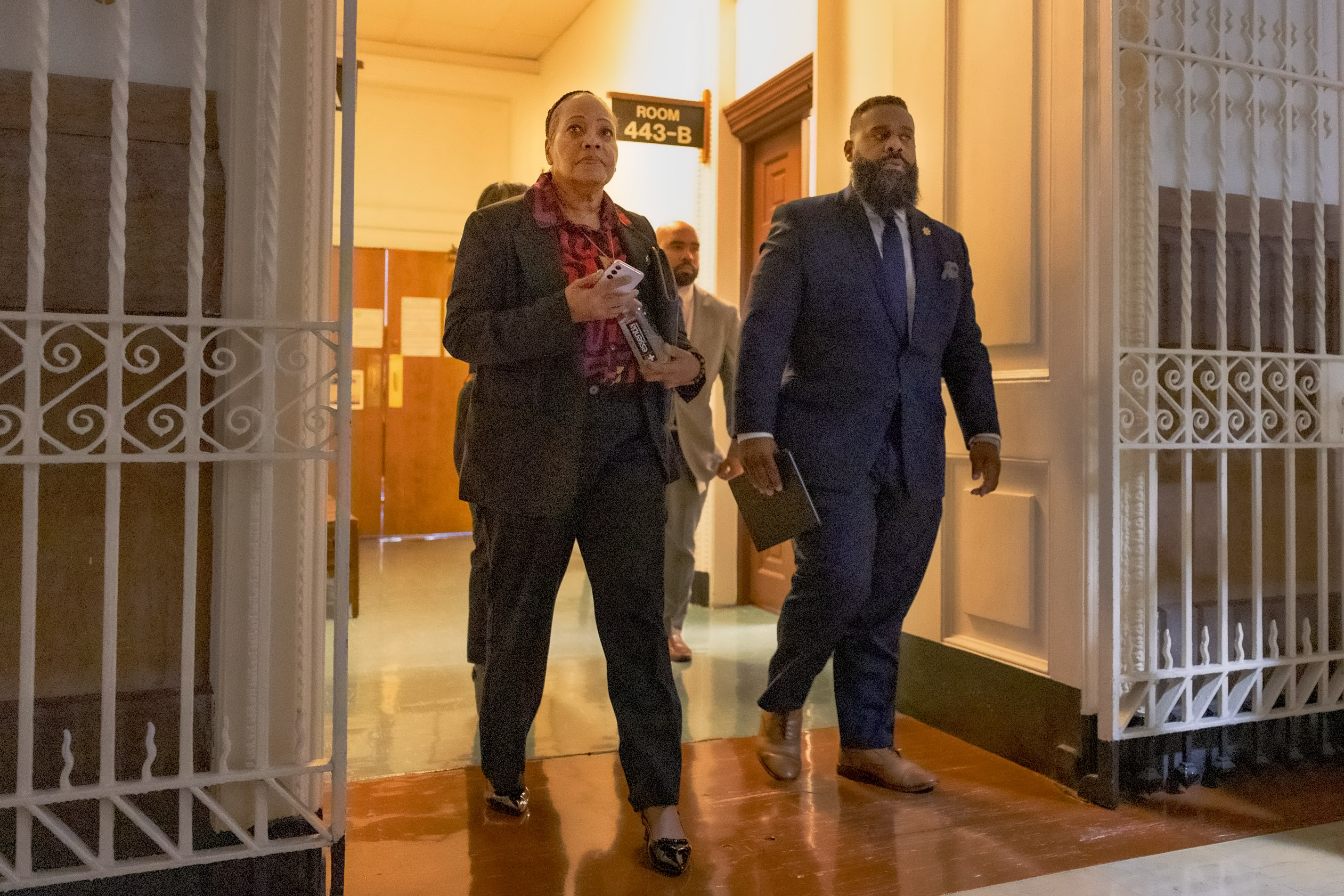
    A Philadelphia judge on Wednesday took the rare step of imposing six months of outside supervision of sheriff sales after years of dysfunction in processing deeds and distributing money from the auctions.

    The decision came after a hearing in City Hall in which a top aide to Sheriff Rochelle Bilal acknowledged withholding thousands of pages of documents the judge had previously requested.

    Common Pleas Court Judge Paula Patrick grilled representatives of Bilal’s office over the surprise revelation, which followed a Monday Inquirer report noting that many of the requested records were missing.

    “My order,” the judge said, “was very specific.”

    Patrick, supervisor of the court’s commerce division, had requested the documents in May and scheduled Wednesday’s hearing following years of complaints about chronic delays in processing deeds and distributing funds from sheriff sales.

    Since at least mid-2024, winning bidders at property auctions have been paying the sheriff, then waiting a year or more for the office to process deeds of sale.

    The courts have been bombarded with petitions for those deeds, which prompted Patrick to take action. She required Bilal to produce, among other things, “a detailed accounting of all sales proceeds received and disbursed” since she took office in January 2020.

    In July, the office submitted thousands of pages of records to an official court docket along with a statement indicating it had resolved many of the deed delays and complied with all terms of the order.

    When The Inquirer asked Friday why none of the submitted records detailed sale revenues distributed after 2023, Bilal and her staff declined to comment.

    Bilal’s representatives admitted in the hearing Wednesday that the records were not submitted.

    On Tuesday afternoon, following the publication of The Inquirer’s report, an attorney for Bilal dropped in excess of 5,000 pages of sales records into the court docket.

    Steven Wakefield, a former city tax attorney appointed in June as deputy undersheriff to clean up the troubled sheriff sale process, said in the hearing that his initial representation to the court, based on assurances from staff that all sales had been pulled, “was not accurate.”

    Wakefield said that after the news organization’s inquiry Friday morning, he immediately followed up with staffers about the missing post-2023 sales records.

    “They said, ‘Oh, yeah, we didn’t do that,’” Wakefield recounted.

    It was unclear Wednesday whether all the records from that time period would ever be turned over.

    “Some of the information the court asked for did not exist,” said Jonathan Rardin, an attorney appointed by the city to represent Bilal.

    Later Wednesday afternoon, Bilal’s staff agreed to allow an outside person or group to monitor how auctions are conducted, then report back to the court in six months. The judge did not name the overseer or say when the outside supervision would begin.

    “This is in essence exactly what we were asking for,” said Daniel Bernheim, a lawyer for JSB Property Group, a real estate investment company that filed a lawsuit in March alleging that Bilal had breached the terms of a 2003 consent order requiring the office to issue deeds within 40 days of settlement.

    Bernheim said Patrick’s order will “have somebody independently come in, take a hard look at what’s going on, ask a lot of the questions that still need to be asked, and make recommendations.”

    Bilal, in civilian dress, sat before the judge silently during the hearing and did not respond when asked by an Inquirer reporter for comment.

    After the hearing, Bilal told a group of reporters that she supported the court supervision.

    “It’s better that we come together and make an agreement so we can continue working together and moving forward,” she said. “That’s all it is.”

    Bilal’s attorney had filed a last-minute motion on Friday seeking to protect the sheriff from having to testify at the hearing, writing that it involved “matters outside her unique personal knowledge.” Patrick denied the motion. But, in the end, Bilal was not called to testify.

    The hearing offered other insights into the sheriff’s office, which has struggled in recent years to perform many of its core functions under Bilal.

    Wakefield blamed the deed delays on a single person: Melissa Simpson, Bilal’s former director of real estate. He said Simpson had been manually filing documents and became overwhelmed when auctions picked up in the aftermath of the pandemic.

    In a certification filed last month, Wakefield claimed Bilal was not even aware of the deed backlog.

    “Simpson was telling everyone it was fine,” Wakefield said Wednesday. “One person can’t do the whole job.”

    Simpson could not be reached for comment. But three current sheriff’s office employees, who were not authorized to speak publicly, disputed that Simpson was solely to blame for the problem.

    Even when more staffers were hired, Wakefield said, the office could process only 40 or 50 deeds a day at most.

    Wakefield also said the slow pace of deed filings was eclipsed by even more serious problems with the issuance of legally mandated distribution sheets, which detail how money from each auction is divided.

    “The distribution backlog is worse than the deed backlog,” he said. “There was a period of time where distribution sheets were not being uploaded.”

    Even so, Wakefield presented a picture of an office that has now been reformed. He said it was moving to automate large parts of the deed process.


    However, he acknowledged that despite his July statement to the court that the outstanding backlog had been cleared, there are still some that must be processed.

    Wakefield told the judge that a recently hired staffer, William A. Brownlee Sr., is conducting an audit to find any sales that were inadvertently passed over.

    One real estate agent told The Inquirer last week that he was still waiting on deeds from auctions that occurred in late 2024.

  • Mr. Edison is flashy and ambitious. Too bad the cooking and service are dim.

    Mr. Edison is flashy and ambitious. Too bad the cooking and service are dim.

    There are ghosts rumbling through the rafters at Mr. Edison. And I’m not sure they’re happy.

    So much energy — both living and remembered — pulses through this dramatic two-story restaurant inside the landmark Bellevue hotel that, as we follow a hostess in what looks like silk pajamas up the long staircase to our table on the mezzanine, the ceiling panels appear to explode with a mirrored tableau of reflected lightning bolts. A chandelier of suspended Edison bulbs showers the plush booths below in a cascade of frozen sparks while a 12-foot brass Ferris wheel nearby cycles slowly over the bar, dangling some of the world’s most extravagant bottles of booze in its hydraulic glass cages.

    Am I the target audience for a $350 pour of the Louis XIII “on rotation”? Definitely not. But Mr. Edison has obviously found them, given its guests supposedly go through a bottle a week of the famed cognac (which retails in Pennsylvania for $5,300).

    The bar at Mr. Edison in the Bellevue Hotel on Tuesday, Aug. 18, 2026 in Philadelphia.Monica Herndon / Staff Photographer

    This carnival of pomp and perpetual motion is overwhelming to take in all at once, along with a live jazz band playing to a crowd tightly cinched into formalwear and glittering jewels. The spirit of Thomas Edison, who in 1904 helped electrify this grand old hotel, would no doubt be moved by this namesake tribute from owner Jeffrey Chodorow, the pioneering restaurateur with a hand in more 60 restaurants, including China Grill and Asia de Cuba.

    While those two stars of late 20th-century dining in New York (and Miami) were trendsetters for the eater-tainment fusion movement, Mr. Edison is a decidedly nostalgic throwback to a 1940s-style supper club. It’s built around updates to classic Philly foods, from fried oysters and chicken salad zapped with kimchi to more dutiful re-creations of cakes from Old Original Bookbinder’s and Frog.

    The Korean fried oysters at Mr. Edison in the Bellevue Hotel on Tuesday, Aug. 18, 2026 in Philadelphia.Monica Herndon / Staff Photographer

    For Chodorow, 76, who studied at Wharton, Mr. Edison’s food is a love letter to legends of the 1970s restaurant renaissance, which he enjoyed while practicing law here in the early 1980s. Names like Le Bec-Fin, Le Panetière, and Jimmy’s Milan are invoked like wishful spells across the menus, which arrive tucked inside a souvenir envelope like wedding invitations. (Chodorow, not coincidentally, threw an elaborate engagement party for his wife at the Bellevue in 1982.)

    If the Ghosts of Philly Restaurants Past have indeed answered their summons, they might be frowning down on these plates with dismay. The galette de crabe “Le Bec-Fin,” known for its use of seafood mousse to produce a delicately puffy soufflé jeweled with sweet crab, arrived here so deflated and overcooked it tasted like a fishy frittata.

    “Chef [Georges Perrier] would probably lock the doors and burn the place down,” replied one of Le Bec’s longtime former chefs after I texted him a picture of my gruesome galette.

    Mr. Edison’s rendition of Le Bec-Fin’s crab galette is a far cry from the original.Craig LaBan / Staff

    In fact, Mr. Edison’s culinary director, Matt Levin, 53, also cooked at Le Bec-Fin early in his career, which subsequently saw him burst onto the scene in the early 2000s at New Hope’s Moonlight and Lacroix at the Rittenhouse before going solo with Adsum and Square Peg, then eventually landing in the catering world. Most recently, he cooked at the Pineville Tavern in central Bucks County. While his recipe might be the same, Levin’s decision to jettison Perrier’s ring mold for a shallow pan was a fateful miscue. The galette evolved by my second meal into a soggy sponge, still not ideal for $45.

    Fewer diners today recall Le Panetière, where Chodorow remembers first tasting Perrier’s food in the late 1960s. But anyone would realize upon one bite of this duck à l’orange tribute that the meaty breast, although still medium-rare, was inexplicably dry and as tough as a chew toy.

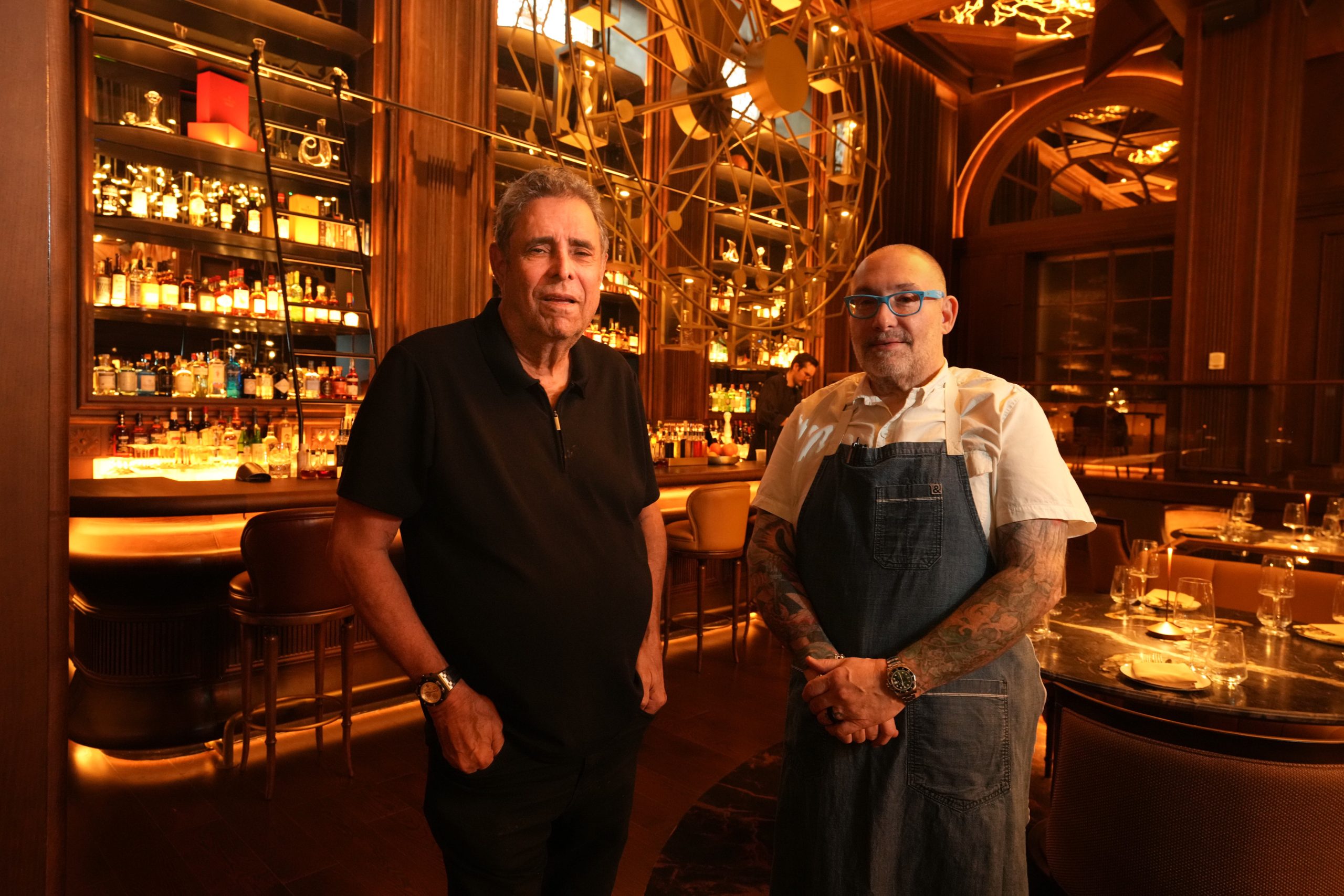
    Jeffrey Chodorow (left) and chef Matt Levin, at Mr. Edison, the new restaurant at the Bellevue, in Philadelphia, on June 23, 2026.Jessica Griffin / Staff Photographer

    If only I could have found the frequently absent captain overseeing our table on the mezzanine before the two-hour-plus mark of our glacially slow meal, when he finally asked us, too late and far too smugly, “Did that hit the spot?”

    “Not very well,” I replied honestly with a detailed report, noting we’d hardly eaten this $90 sharing splurge as a result. He shrugged a faint reply, then handed us our bill with not even the slightest gesture of apology, though I was not surprised. He’d also forgotten so much as a candle for our dessert after we told him upon arrival (after he asked) that we were celebrating a birthday.

    An envelope at each seat holds the menus at Mr. Edison in the Bellevue Hotel on Tuesday, Aug. 18, 2026 in Philadelphia.Monica Herndon / Staff Photographer
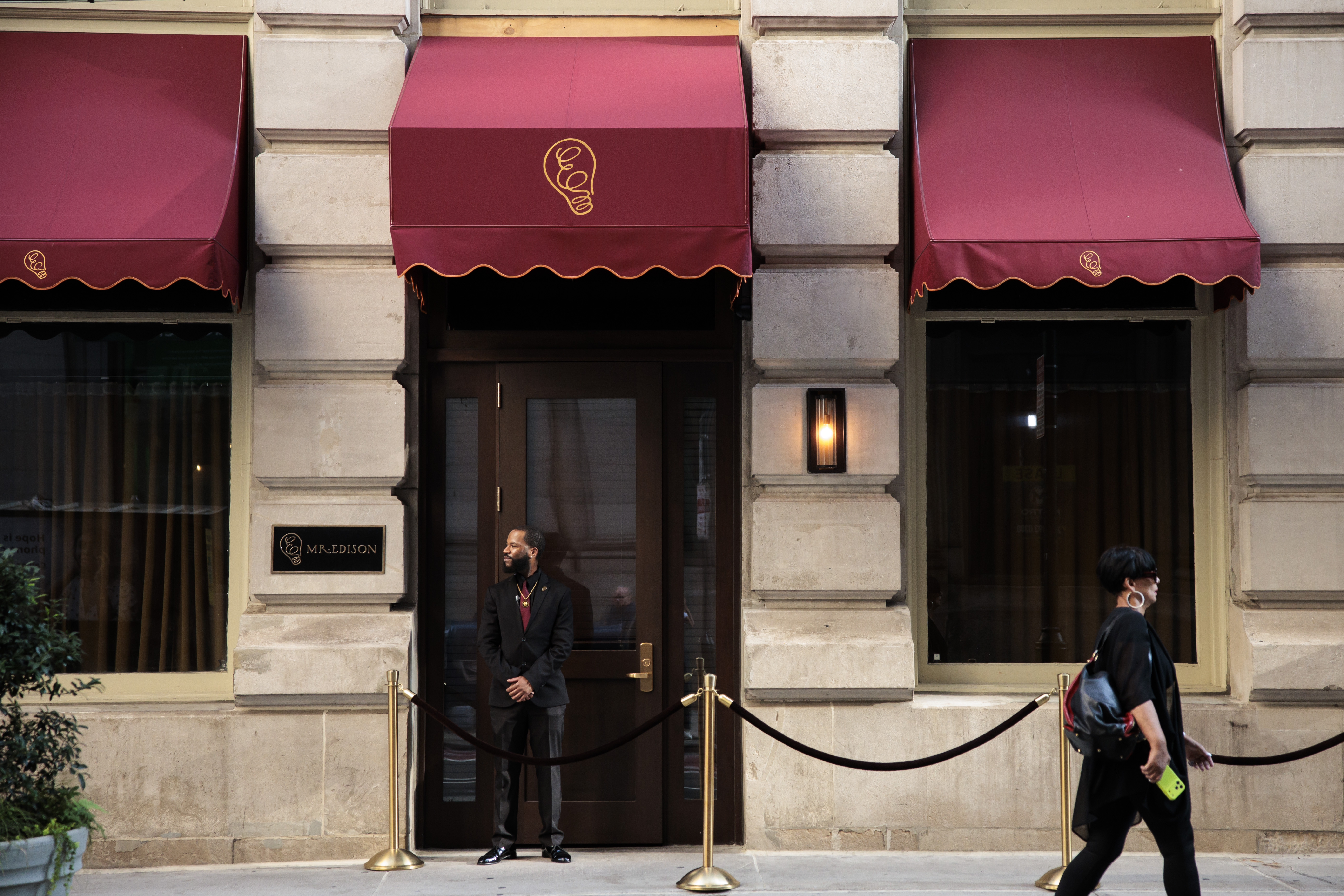
    The exterior of Mr. Edison in the Bellevue Hotel on Tuesday, Aug. 18, 2026 in Philadelphia.Monica Herndon / Staff Photographer

    As a restaurant romantic, I value grand ambitions such as those that shaped Mr. Edison, a $10 million makeover of the former Polo store that recalls the showplace splendor of Walnut Street’s Restaurant Row in the late 1990s (Striped Bass, Susanna Foo, Brasserie Perrier) more than the DIY quirkiness of the restaurant renaissance that preceded it. It’s far preferable to the cookie-cutter chains that otherwise populate South Broad Street. But executing that ideal in a 133-seat room in 2026 — when, as chef Levin noted, people can make more working for food-delivery apps than actually cooking the food — is a challenge. With check averages of $120 (before tip and tax), no customer wants to hear excuses.

    Improvement is within reach. We were seated at my following visit on the daisy wheel banquette that anchors the downstairs dining room, and the service there was much sharper. We had a perfect vantage to hear Drew Nugent & the Midnight Society swing onstage and to drink this bar’s outstanding cocktails, including the large carafe of a superb Negroni (this variation blending Cocchi di Torino and Punt e Mes) poured tableside over giant ice cubes. At $57 for the equivalent of three-plus cocktails, it’s one of Mr. Edison’s best values.

    Bartender Michael Chukinas pours the tableside house Negroni at Mr. Edison in the Bellevue Hotel on Tuesday, Aug. 18, 2026 in Philadelphia.Monica Herndon / Staff Photographer

    I’d definitely return for a seat at the titanium granite bar to enjoy the well-curated lineup of live music, sip other cocktail hits (the white coffee-infused Wizard or tropical 30 Minute Nap), and graze on some of the small plates.

    The Korean fried oysters with kimchi and chicken salad was an intriguing riff on one of my favorite historical Philly food oddities, the spice and fermented funk of the cabbage cutting through the clubby richness. Waffle chips to scoop paddlefish caviar from fancy French onion dip was an accessible alternative to the far pricier sturgeon caviar service. The quail yolk-dotted beef tartare ringed by fried beef tendon puffs was irresistible, while a petite portion of seared filet mignon fanned over a creamy au poivre sauce with morels tapped another red-meat craving without the steakhouse clichés.

    The Jimmy’s Milan salad — essentially crunchy lettuce tossed with bacon, big shrimp, hard-boiled eggs, and a zesty Russian-Italian hybrid dressing — is proof that some vintage pleasures don’t need to be reinvented to be appreciated. The restaurant’s $48 baked potato, stuffed with nearly half a pound of sweet lump crab au gratin, was the most memorable thing I ate at Mr. Edison, a super spud splurge that could hit yet another level with a $40 “blackout” addition of caviar.

    A couple of the small plates fell short. A meaty flap of tuna carpaccio was not pounded thin enough. The corn-encrusted soft-shell crabs over mole verde were not soft enough, leaving me with a mouthful of shells.

    Updating classics is a tricky prospect, and often Levin’s contemporary reworking drifted too far afield for its own good. The baked “Edison meets Rockefeller” oysters were so underdressed, with splashes of Mornay and fines herbes butter replacing the typically lush green puree, it lacked the indulgence to suit its name, even with a crispy nugget of guanciale. A $110 rendition of lobster Thermidor was not simply unrecognizable; without the full shell, into which it is typically stuffed and gratinéed, it was one-dimensional and boring.

    The grilled lamb chops spiced with vadouvan curry with Thumbelina carrots were the most satisfying of the “Grand Plates” for two, while the butterflied whole dorade over chimichurri and the buffalo milk ricotta ravioli were safe bets for the unadventurous.

    The lamb chops at Mr. Edison in the Bellevue Hotel on Tuesday, Aug. 18, 2026 in Philadelphia.Monica Herndon / Staff Photographer

    Too many other big dishes stumbled over the basics of seasoning — like a veal chop Milanese that cradled a handful of flaky salt atop its breaded crust. The brick chicken was so salty that my gums ached until the end of the meal.

    Tucked into the stuffiest far corner of the mezzanine behind the bar for this final visit, I’d hoped an old-fashioned dessert would offer enough sweetness to counter that salty bird. I considered one of the winners I’d already enjoyed at previous visits: a re-creation of the coconut cake from Old Original Bookbinder’s, a tasty nod to Frog’s legendary carrot cake with butter pecan ice cream, or the dense chocolate-and-peanut-butter tart.

    I opted for the crème brûlée to keep it easy, only to find its caramel crust — ideally torched to order and still warm — was cold by the time it ascended to our second-floor perch beneath the lightning-bolt rafters. I looked down toward the bar’s Ferris wheel as it cycled up toward us and couldn’t help but imagine the Ghosts of Philly Restaurants Past riding along with those glass cages, so hopeful for their comeback moment. Rising then falling, again and again, they sent shrugs of disappointment in my direction as they rolled away.

    The carrot cake at Mr. Edison at the Bellevue Hotel on Tuesday, Aug. 18, 2026 in Philadelphia.Monica Herndon / Staff Photographer

    Mr. Edison

    Dinner Sunday through Thursday, 5 to 11 p.m.; Friday and Saturday, until midnight.

    Small plates, $19-$45; Sharing plates for two, $58-$115.

    Fully wheelchair accessible to all parts of the restaurant, including two wheelchair accessible seats at the bar.

    Gluten-free: At least half the menu is either gluten-free or can be modified, including items cooked in a gluten-free fryer.

    Menu highlights: Caviar dip; Jimmy’s Milan salad; Korean fried oysters; filet au poivre; baked potato with crab gratin; buffalo ricotta ravioli; lamb chops; carrot cake.

    Beverage program: Don’t let the ostentatious bling bottles on the Ferris wheel fool you. The bar is Mr. Edison’s strong suit, with well-crafted and thoughtful updates to classic ideas using modern techniques and quality ingredients. The tableside Negroni towers are worth it, along with other cocktail highlights. The wine list is more predictable.

    Mr. Edison, the new restaurant at the Bellevue from Jeffrey Chodorow, in Philadelphia, June 23, 2026.Jessica Griffin / Staff Photographer