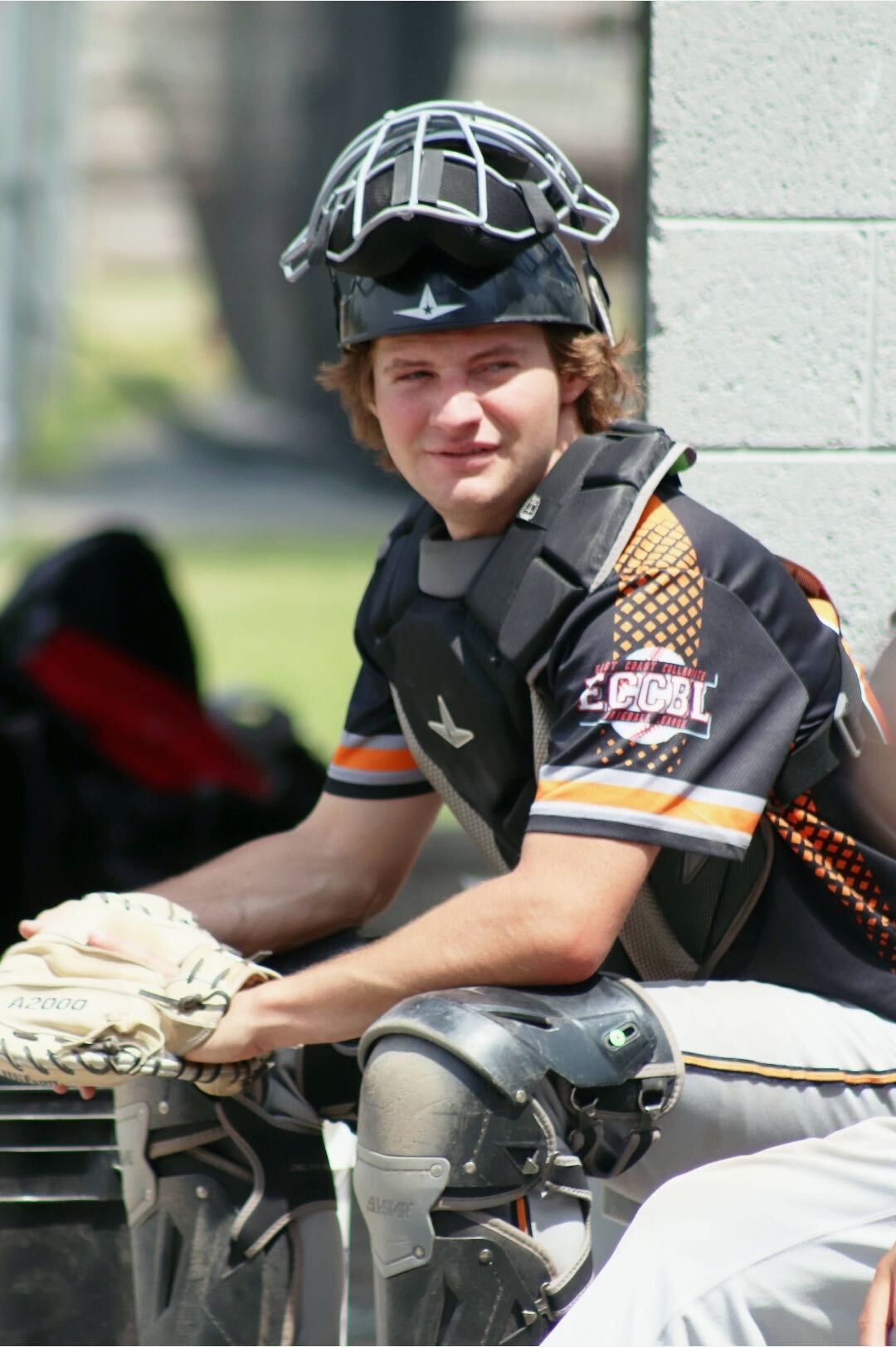
When Erin Pysher dropped her son off Saturday at Frankie & Johnnie’s, the Pottstown bar where one of his friends was celebrating his 21st birthday, she told him she loved him and to be safe.
It was Glenwood Pysher IV’s last weekend of summer fun. Come Monday, he would be at St. Elizabeth University in North Jersey for his senior year and one final season as a college baseball catcher.
Pysher, affectionately called “Bubba” by those who knew the 22-year-old Lower Pottsgrove native best, had his sights set on becoming a history teacher and baseball coach after graduation.
After the bar, Pysher and his friends headed to an after-party at the birthday boy’s home, according to his mother. Later, as Pysher walked to another friend’s house to spend the night, he missed a turn and got separated from the group.
He ended up at the wrong house on Snyder Road, pounding on a door and yelling to be let into what he did not realize was a stranger’s home.
An Upper Pottsgrove police officer, responding to a 911 call for a reported break-in, shot him twice, killing him almost instantly.
The shooting is under investigation by the Montgomery County District Attorney’s Office. A spokesperson for District Attorney Kevin Steele declined to provide any additional details or to identify the officer, citing the investigation.
“It was a senseless loss, and it shouldn’t have happened,” Erin Pysher said, her voice cracking with emotion. “I don’t know what the officer was thinking or doing that his first response was to shoot an unarmed kid.
“This was all a huge mistake, and they killed him.”
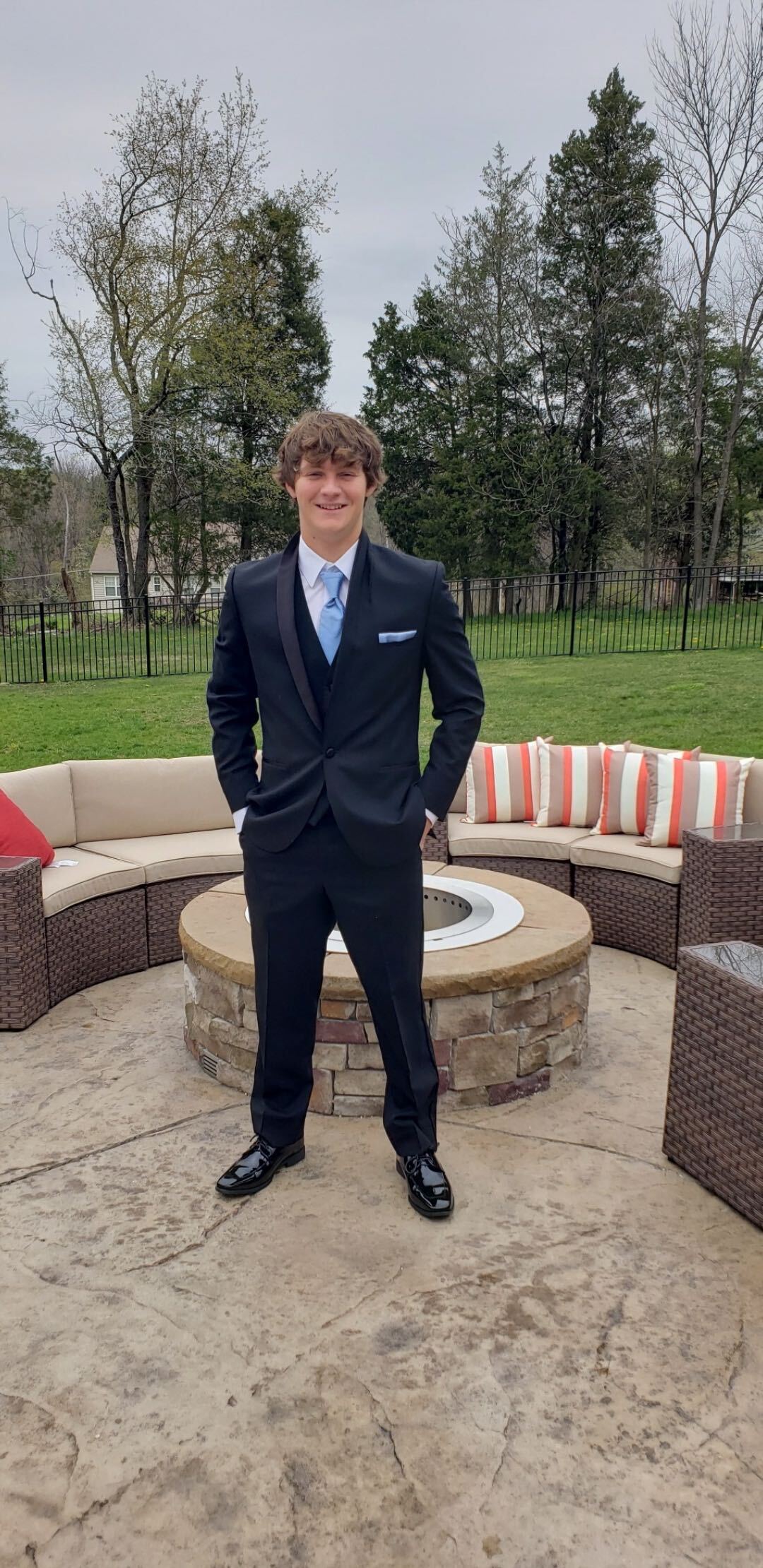
Glenwood Pysher IV was the oldest of four, his mother said. She described him as a lovable, goofy son who spent his summers in between college working.Courtesy Erin Pysher
She said she reviewed her son’s cell phone logs and saw that he had called his friends to pick him up at 12:32 a.m. Sunday after realizing his error. By 12:35, the police-radio call had come out that the officer had shot someone.
Pysher’s friends later told his parents that as they drove to get him, the officer sped past them, lights and sirens activated.
“There was no attempt to stop him another way,” his mother said. “He never got into a fight in his life, never harmed a soul. I don’t believe he had any ill intention toward the officer.”
Pysher was the oldest of four, a lovable, goofy son who, she said, spent most of his summers working at the Walmart store in Pottstown or helping a friend at his seasonal landscaping business.
She laughed while retelling one of her final days spent with him: He had a habit of texting her every day, even while away at college, asking, “What’s for dinner?”
Last week, he joined her for a grocery run for ingredients for that night’s meal. When they got home, Erin Pysher still got that usual text from her son, even as he sat a few feet away from her.
“As a mom, I couldn’t ask for a better kid,” she said.
“All these news reports keep saying, ‘A man was killed,’” she added. “But he wasn’t a man, not to me. He’ll always be my baby.”
A 22-year-old man accused of menacing pedestrians near City Hall while wearing a Halloween mask earlier this month was arrested in Las Vegas, the U.S. Marshals Service said Tuesday night.
Zymire Hughes was being held at the Clark County Detention Center awaiting extradition proceedings, the U.S. Marshals Service said.
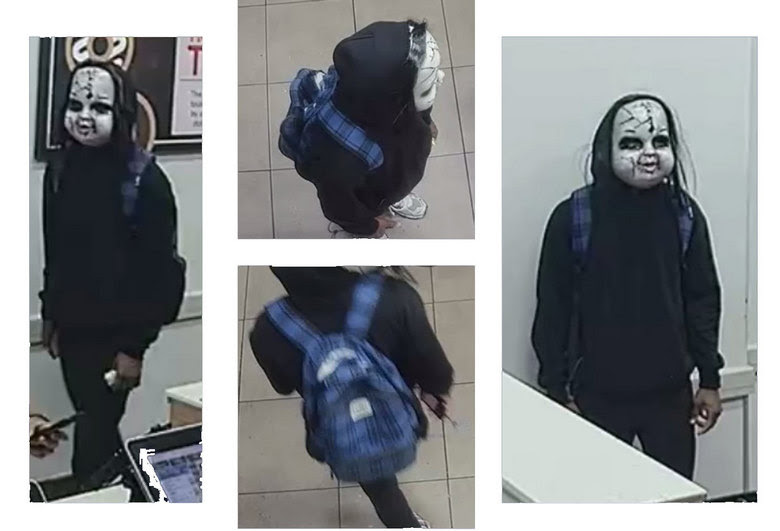
Hughes gained national attention when viral images circulated online showing him allegedly wearing a mask resembling a cracked porcelain doll with a baby face. Masks advertised for Halloween that look very similar to what Hughes allegedly wore are available for sale on both Amazon and eBay.
Zymire Hughes was wanted by @PhillyPolice for terrorizing citizens in Center City Phila. @USMS_Philly and the USMS Nevada Violent Offender Task Force arrested Hughes at 8pm in Las Vegas, Nevada. He is being held in the Clark County Detention Center waiting extradition back to PA. pic.twitter.com/eFfBG0o5Bh
— U.S. Marshals Service Philadelphia (@USMS_Philly) August 26, 2026
On the morning of Aug. 12, a man in the mask — which some also have described as resembling Chucky from the movie Child’s Play — harassed and scared more than a dozen people near City Hall, authorities said, including a 40-year-old woman who was injured when she fell while running from the masked man.
Hughes allegedly harassed around 16 people during a half-hour period that morning, authorities said.
At one point, he allegedly harassed a woman who was jogging and asked her if she was “ready to die,” police said.
Hughes eventually rode a bus to his apartment near 23rd and Venango Streets, authorities said. He later left his apartment with packed bags, and police suspected he was heading to Los Angeles or Las Vegas, where he is believed to have connections through an employer.
Investigators did not believe he intended to physically harm those he harassed, given that he did not produce a weapon during any of the interactions, authorities said.
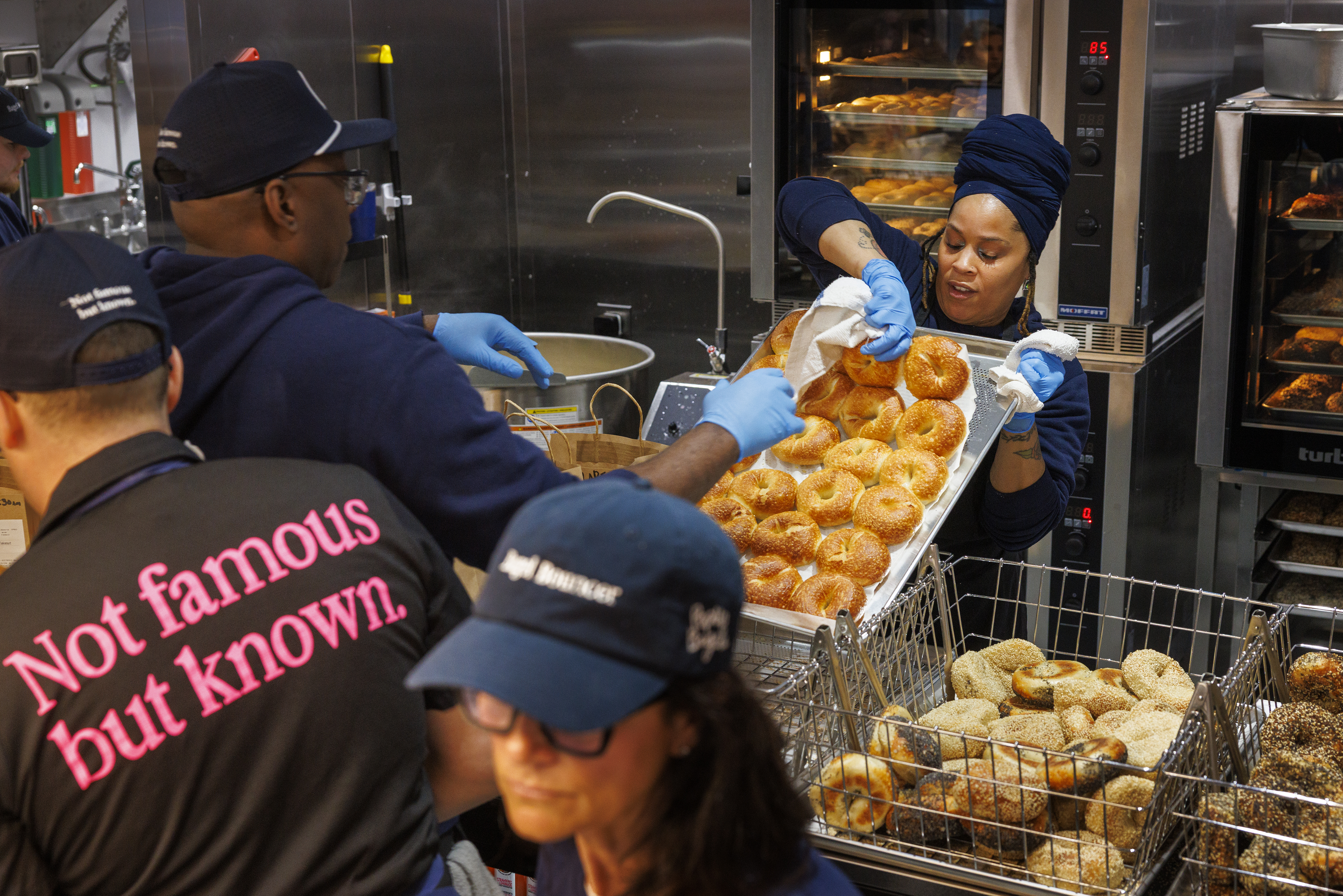
Since the beginning of 2025, nearly a dozen bagel shops have opened or leased space in Philadelphia and its suburbs, bringing new locations from local operators as well as fast-growing out-of-town brands that see the region as fertile ground for expansion.
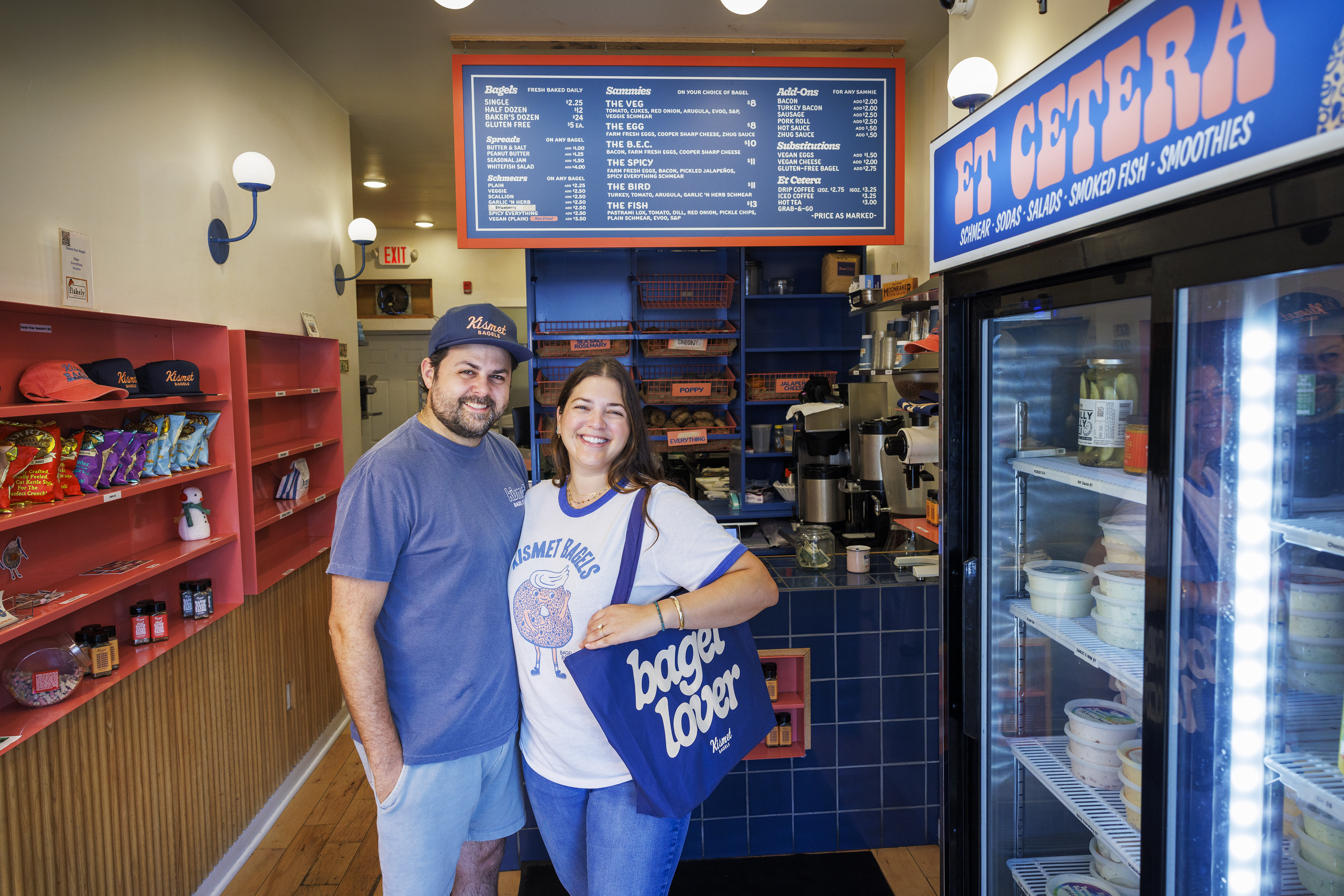
Jacob and Alexandra Cohen, owners of Kismet Bagels, at their location on Girard Avenue in Fishtown in 2024.Alejandro A. Alvarez / Staff Photographer
Kismet Bagels has opened its fourth and fifth shops, in Manayunk and Collingswood. Bart’s Bagels, which has shops in West Philadelphia and Bella Vista, recently expanded to the founders’ hometown of Bala Cynwyd. PopUp Bagels, the Connecticut-born chain that built a following on social media, made its local debut in Ardmore this spring and has signed a lease for a Rittenhouse shop as part of a larger regional expansion.
And Washington, D.C.-based Call Your Mother is preparing three soon-to-open Philadelphia locations — in Fishtown (due first), Rittenhouse, and Washington Square West — committing to all three before serving its first Philadelphia bagel.
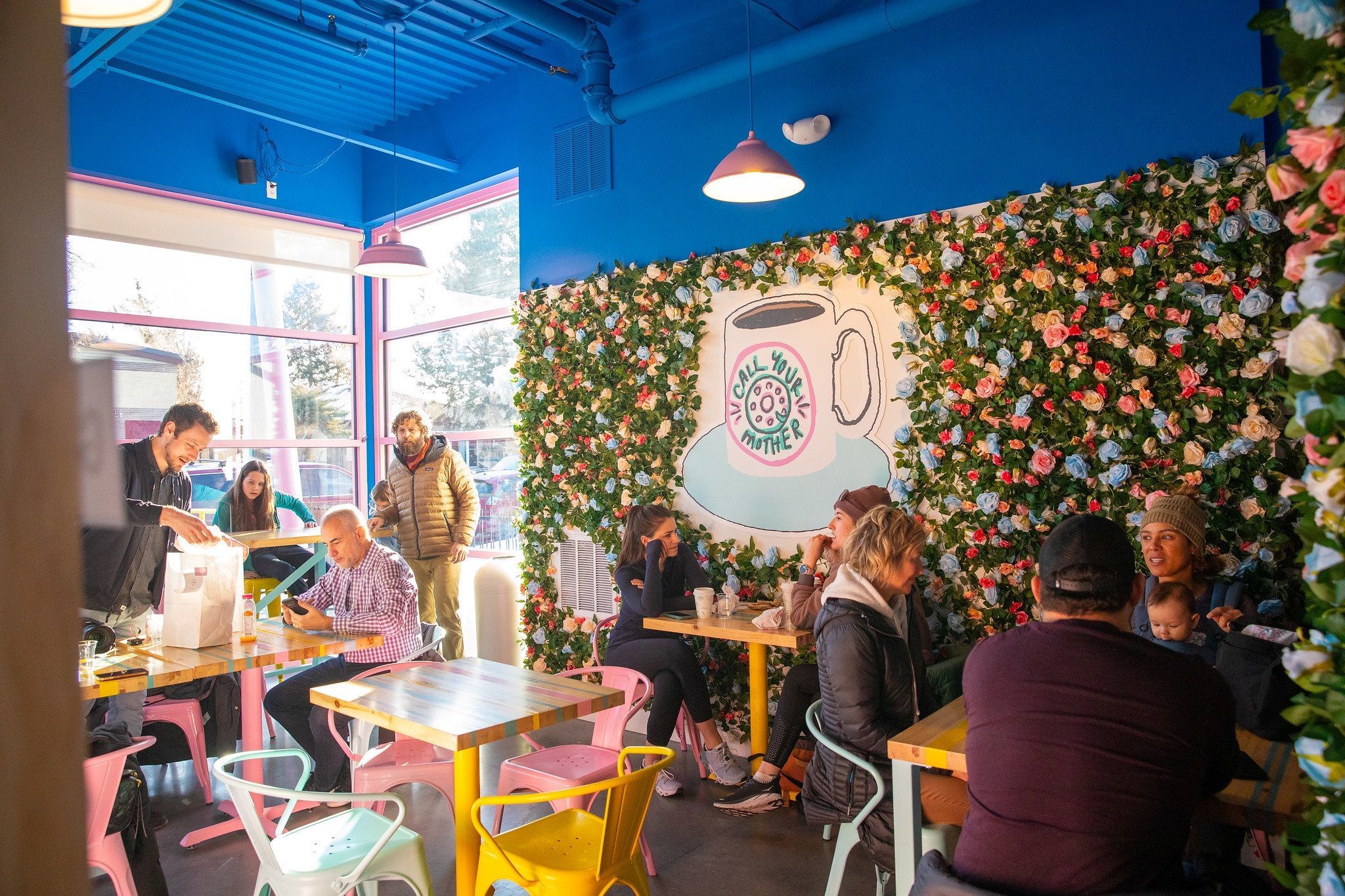
Call Your Mother bagel sandwich shops have a subtropical feel.Courtesy of Call Your Mother
That tally doesn’t include all of the stores that could follow. Florida-based Jeff’s Bagel Run has announced a 10-unit development agreement for Eastern and South Central Pennsylvania, while PopUp franchisee Brian Harrington is scouting additional territory in the Philadelphia suburbs.
All this raises an obvious question: How many bagels can Philadelphia eat?
Plenty, apparently — at least for now.
Jacob Cohen, who started Kismet six years ago with his wife, Alexandra, said the company has seen sales increase even as new bagel shops have entered the market. “I don’t think they’re just dividing the same customer base, because we’ve already had new shops open in Philadelphia and we haven’t seen a decrease in sales,” Cohen said.
But Cohen, who rapidly expanded Kismet before putting thebrakes on growth earlier this year, also sees a limit. “More is not always better,” he said. “I obviously don’t have a crystal ball, but I have a feeling that some of these private-equity bagel companies coming are going to learn that the hard way.”
Bagels are having a moment
Philadelphia is part of a much broader bagel boom. The U.S. bagel market generated an estimated $3.17 billion in revenue in 2025 and is projected to reach $4.51 billion by 2033, according to Grand View Research, a market-research firm. That represents annual growth of about 4.6%. Worldwide, the firm values the bagel market at $5.8 billion in 2025 and projects it will reach $8.6 billion by 2033.
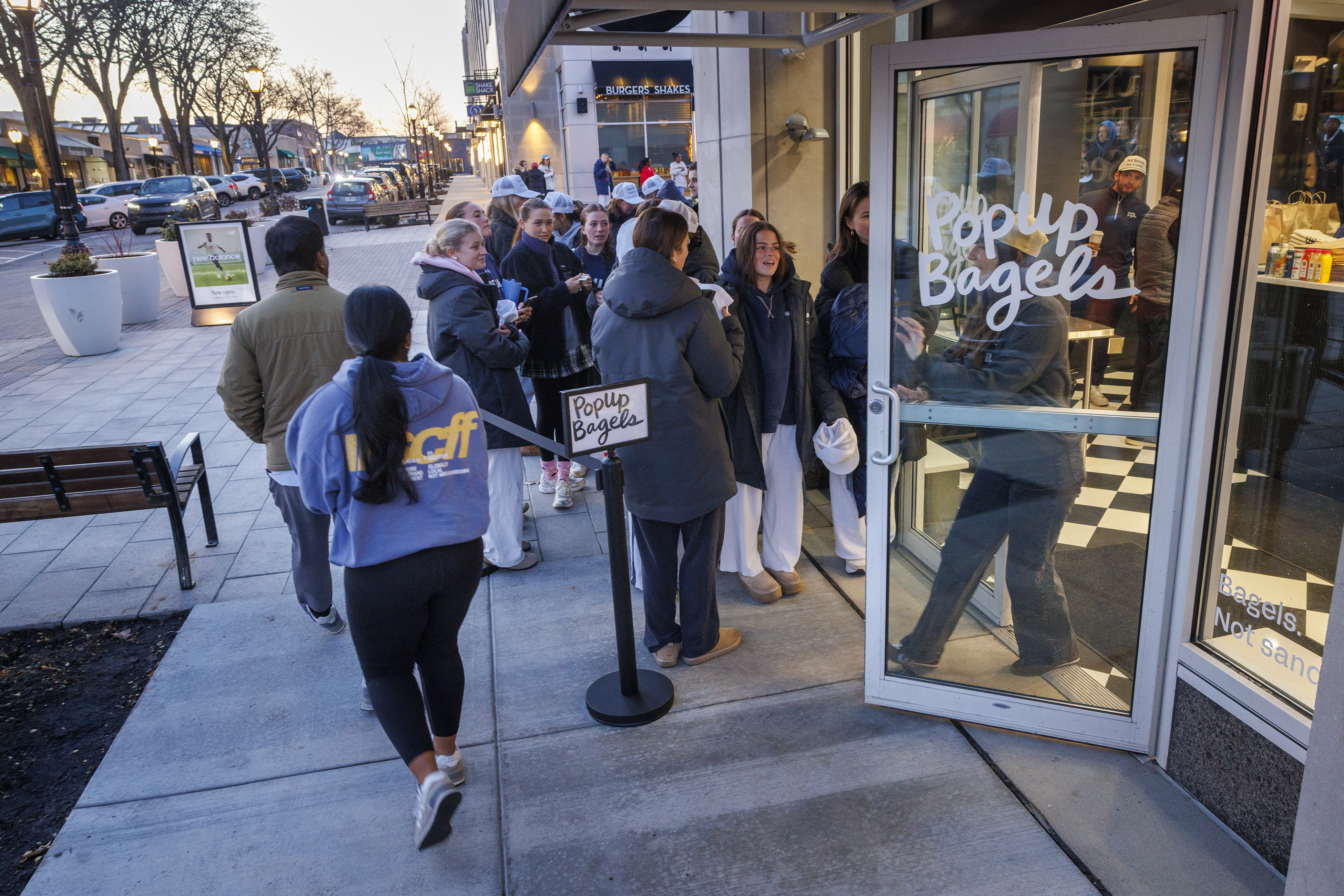
Customers lining up for the grand opening of PopUp Bagels in Ardmore in March.Alejandro A. Alvarez / Staff Photographer
Mike Kostyo, vice president of Menu Matters, a Vermont-based food-industry consulting firm, sees the current surge as the convergence of several trends rather than the sudden discovery of a new food. Artisan baked goods have been rising in popularity for years, he said, after the pandemic produced a generation of home bakers and pop-ups experimenting with sourdough and bagels. At the same time, café culture and the rise of the “little treat” have made consumers more willing to spend on premium versions of everyday foods.
“At its core, the bagel has always been a blank canvas for lots of flavors and toppings,” Kostyo said. “But now, instead of sesame seeds, you see them topped with Flamin’ Hot Cheetos.”
The traditional formula — bagels by the dozen, cream cheese, lox, and coffee — also has evolved into something closer to a breakfast-and-lunch fast-casual restaurant.
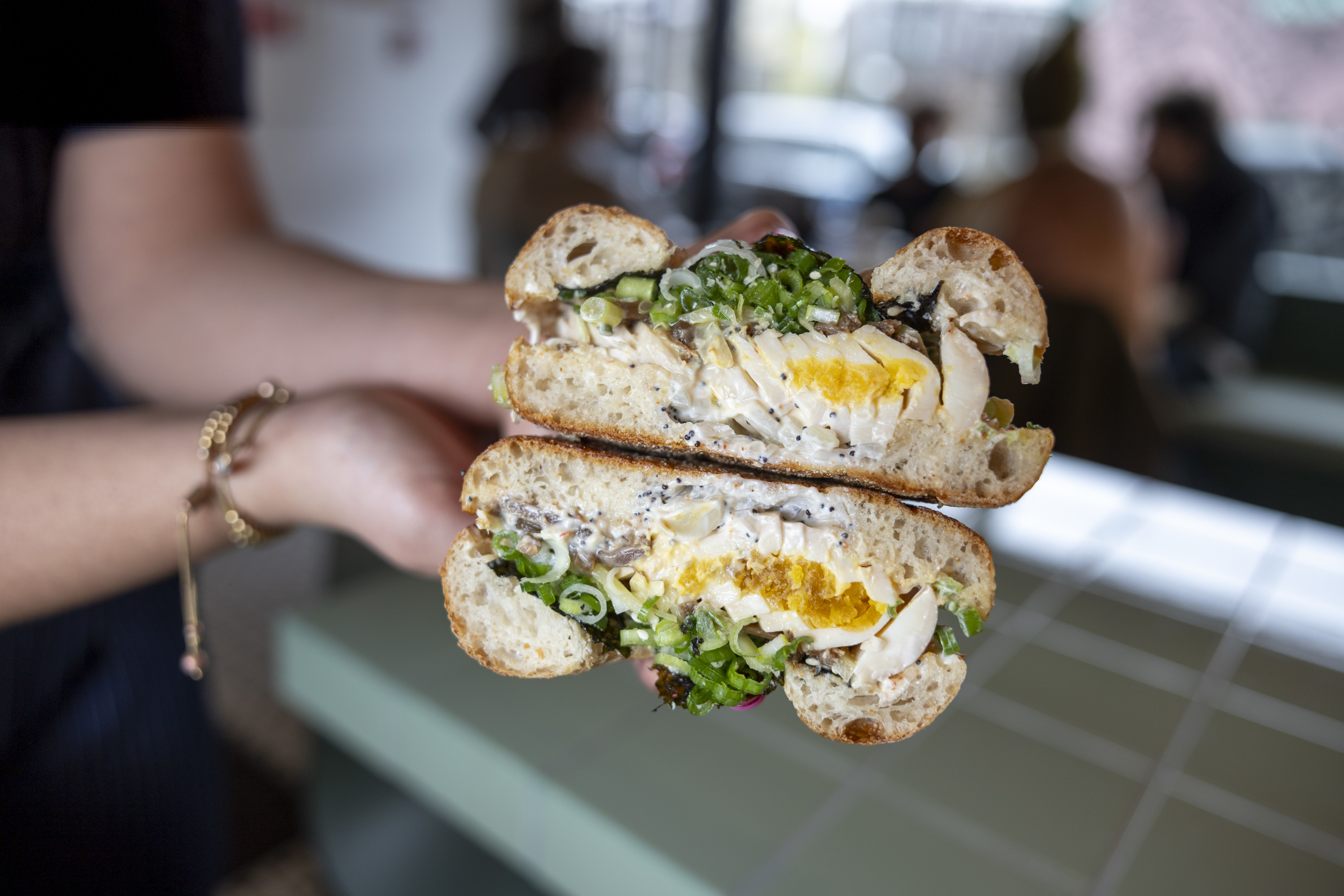
The Ramen Thing bagel sandwich from Cleo Bagels in West Philadelphia.Tyger Williams / Staff Photographer
Bagels become vehicles for egg sandwiches, smoked salmon, avocado, specialty cream cheeses, and elaborate combinations that can command substantially more than a plain bagel and schmear. And operators increasingly are looking beyond breakfast.
“The sandwich factor is so important,” Kostyo said. “You need something that you can sell across multiple occasions, not just to commuters in the morning.”
That versatility helps explain why investors have noticed.
“Investors are always looking for that next category that could blow up,” Kostyo said. “They want Call Your Mother or PopUp Bagels to be the next 7 Brew or Dutch Bros.”
From pandemic project to expansion vehicle
Some of the brands now expanding grew directly out of the pandemic.
The Cohens started Kismet as a pandemic project before turning it into a brick-and-mortar business and eventually growing to five locations — down from seven after the company shuttered a stand at Reading Terminal Market in 2025 and closed a shop in Ventnor earlier this year.
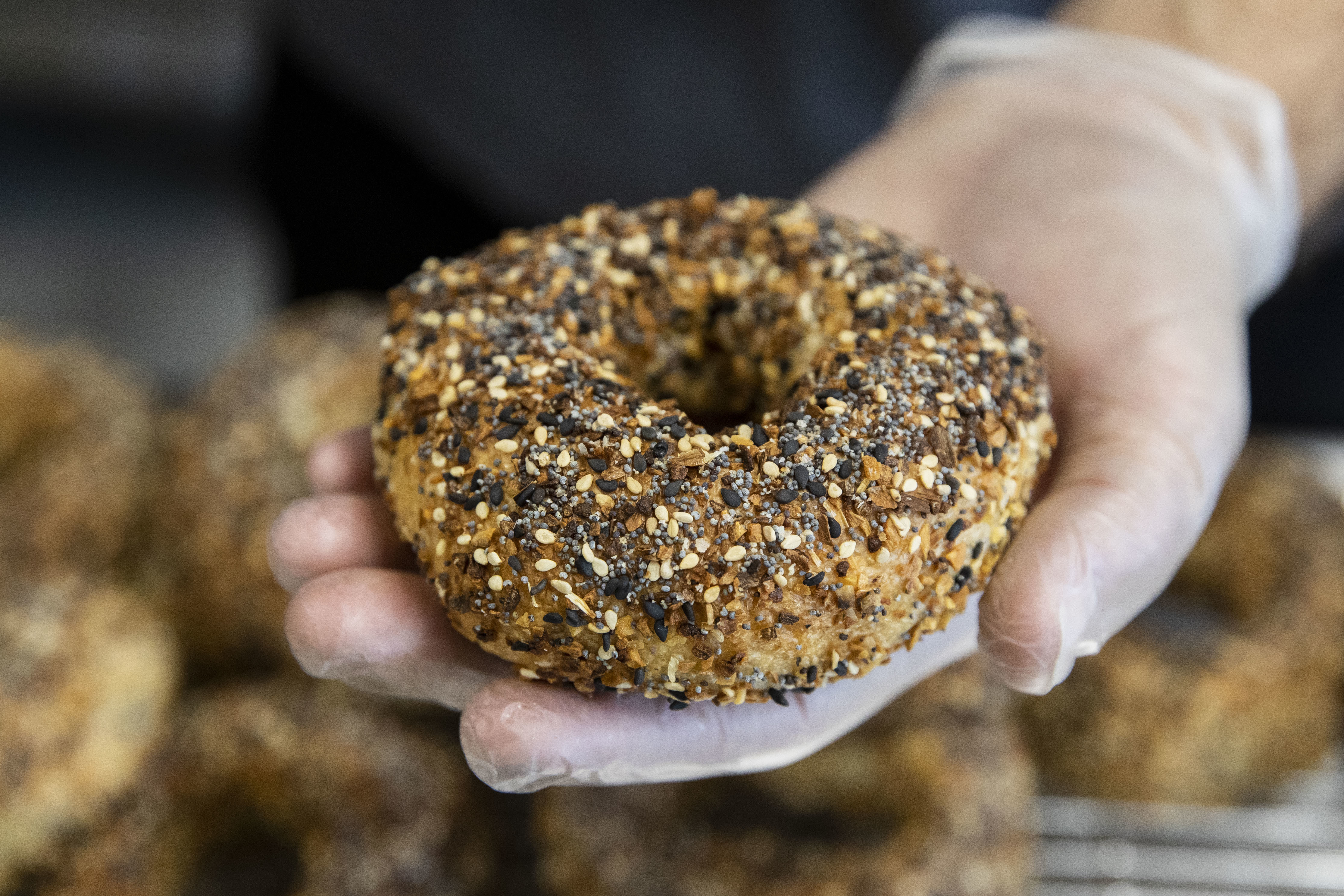
Jacob Cohen of Kismet Bagels holds an everything bagel.MONICA HERNDON / Staff Photographer
PopUp followed a similar trajectory. Founder Adam Goldberg began baking bagels at home during the pandemic and developed the idea into a business built around an unusually stripped-down concept: hot bagels and schmears, rather than the sprawling sandwich menus associated with many modern bagel shops.
Customers are encouraged to “grip, rip, and dip,” tearing apart the bagels and dipping them into containers of cream cheese.
The company’s first Philadelphia-area shop opened in the spring in Suburban Square in Ardmore. Harrington, the franchisee developing PopUp in this region, said sales have remained strong even through the summer.
“We anticipated a little bit of pullback with a lot of our core [teen] clientele getting jobs in Avalon and down the Shore, and with vacations and things like that,” Harrington said. “But it’s been very, very steady.”
In more than 25 years in the restaurant business, Harrington said, he has typically seen sales soften in late June, July, and early August. “We’ve not seen that,” he said.
PopUp has signed for the former Starbucks at 1709 Chestnut St. in Rittenhouse, as reported by the Philadelphia Business Journal. Harrington said he has a deal for a location in Lawrence Township, N.J., near Princeton, that is awaiting its permits. Another South Jersey deal is close, he said, and he sees additional potential in Montgomery County.
Despite the influx of bagel shops, Harrington said he believes PopUp occupies a somewhat different niche.
“We’re not making sandwiches,” he said. “So far, people have found us and enjoyed the way that we do it, and it doesn’t preclude them from going and getting a bacon, egg, and cheese somewhere else.”
Three stores before the first bagel
Call Your Mother is making an even larger initial bet on Philadelphia. Founded in Washington in 2018 by Andrew Dana and his wife, chef Daniela Moreira, the self-described “Jew-ish” deli has expanded beyond the Washington area as New York investment firm Invus acquired a majority stake in the company in January 2025.
Call Your Mother has signed three Philadelphia leases: 1500 Frankford Ave. in Fishtown, the former Metropolitan Bakery at 262 S. 19th St. near Rittenhouse Square, and 12th and Sansom Streets in Washington Square West. Dana said the decision to enter Philadelphia was considerably less scientific than the three-store commitment might suggest.
“My mom grew up there, my grandparents lived there, and I’ve been there so much visiting my friends,” Dana said. “I’ve been in Fishtown on a Sunday when it’s popping, and I’ve been in Rittenhouse Square when it’s super-crowded on the weekend and the market’s going. A lot of it is just gut and feel.”
Dana does not believe Philadelphia lacks good bagels. On a recent trip, he tried Bart’s and came away impressed.
“I think a lot of people are doing a great product in Philadelphia,” he said, “but there’s always room for a different bagel shop. At least I hope so.”
Dana also rejects the idea that taking investment inevitably leads to runaway growth or declining quality.
He described Invus as “patient capital” and said the investment agreement carries no requirement that Call Your Mother open a prescribed number of stores.
“We’re going to do what we can do while still keeping the quality of the food and the service top-notch,” Dana said. “And if that ever slips, we have the ability to hit the pause button.”
Local operators dig in
For some Philadelphia bagel operators, however, the arrival of heavily financed brands is cause for skepticism.
Cohen, at Kismet, is particularly wary.
“I think it’s the rare exception when private equity marries itself to a food brand and they continue to do good things,” he said. “I’d like to keep private equity out of bagels.”
He stressed that Kismet remains owned solely by him and Alexandra, financed through bank loans rather than outside investors.
David Fine, owner of Schmear Bagel Parlor, is also watching the expansion. Fine entered the business in 2013 with his Schmear It food truck and has since acquired the shops owned by Philly Bagels, giving the company eight locations in Philadelphia.
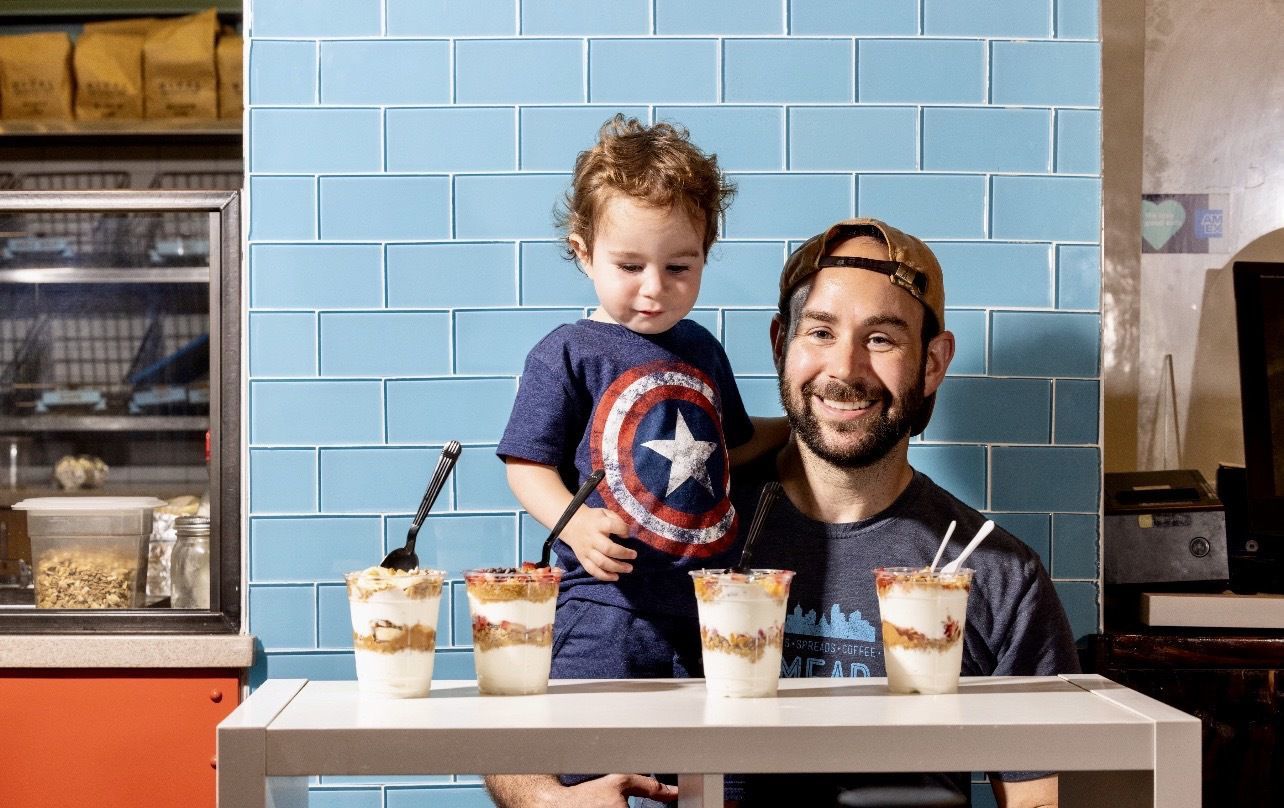
David Fine of Schmear with his son.Courtesy of David Fine
Fine said those stores have not appeared to steal business from one another.
He thinks part of the bagel’s appeal is almost mundane: It is familiar, relatively accessible, portable, and infinitely customizable.
“They’re comfort food at their very core, and they can really appeal to such a wide variety of customers,” he said.
He is less certain about the economics behind the rapid expansion of some competitors.
“The buildouts are expensive,” Fine said. “You have to be quite profitable for quite some time just to recoup that investment.”
Schmear is expanding, too, Fine said, renovating its original brick-and-mortar location at 36th and Market Streets. But he believes that being local gives the company an advantage as more national and regional shops arrive.
“There’s a keen allegiance to local brands,” Fine said.
Built for the feed
Bagels also have another quality particularly suited to the moment: They look good on a phone.
Kostyo points to the now-familiar image of a bagel sandwich sliced in half and held toward the camera, its fillings and schmear exposed.
“The visual factor is also so important in today’s social media age,” he said. “That picture … is the type of indulgent food that people go out of their way for today.”
The lines themselves become part of the marketing. A crowd outside a shop signals that the food is worth leaving home for, he said, while arguments over the proper density, crust, schmear, toppings, and even whether a respectable bagel can be made outside New York keep the category in the conversation.
“In the end, it’s all advertising and marketing,” Kostyo said.
But social media enthusiasm is fickle — witness the rise and fall of cookies and cupcakes — and Kostyo sees the flood of investment and expansion as carrying the seeds of an eventual shakeout.
“This is a pretty classic bubble where some of these brands that are doing a great job and really resonate with people will survive, but a lot will overexpand and shut down in the next few years,” he said.
Cohen, meanwhile, has decided not to test Kismet’s limits.
After years of opening shops, Kismet entered 2026 determined to improve what it already has rather than add more locations. The company is focusing on consistency, profitability, new products, employees, and customers, he said.
He is happy to see Philadelphia’s bagel culture growing and says he does not regard every new shop as a competitor. Years ago, Cohen recalled, Inquirer restaurant critic Craig LaBan told him that Philadelphia did not have enough bagels per capita.
“We might be starting to get there now,” Cohen said.
SEATTLE — Julio Rodríguez unloaded on a two-strike splitter in the first inning here Monday night and set off the foghorn that signals Mariners home runs.
Because the Mariners’ five-foghorn, 9-2 victory was a five-alarm start for Zack Wheeler. Never mind that the Phillies’ nine-game winning streak went up in smoke. There was a more urgent question to keep the team’s pitching brain trust from sleeping in Seattle.
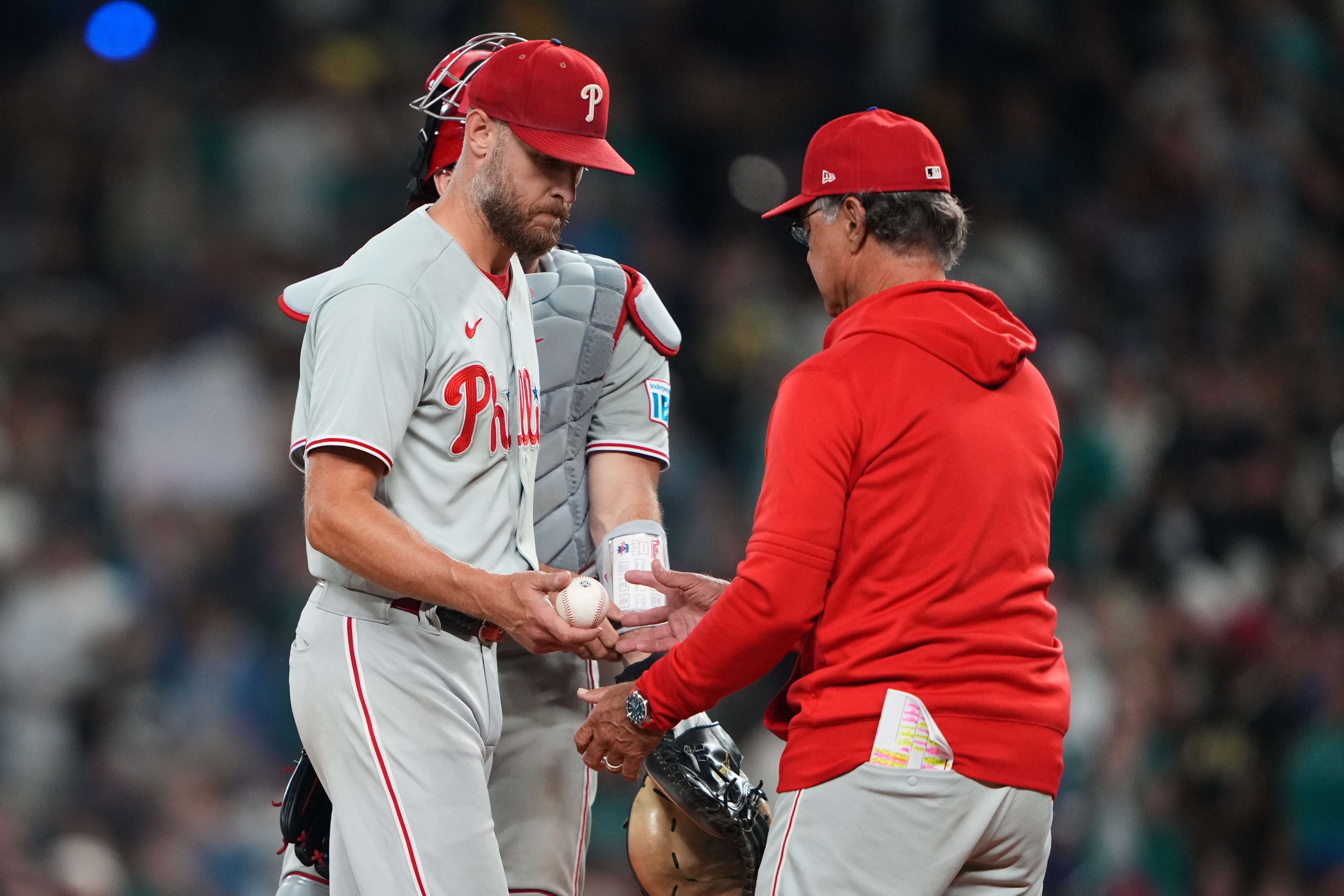
It wasn’t merely what happened against the Mariners, but as long as we’re on the subject: Wheeler allowed eight runs (a season-high) on nine hits, four homers, and five walks, tying season-highs in those categories. He didn’t record an out in the fifth inning after Don Mattingly sent him back out at 94 pitches. His ERA jumped from 2.92 to 3.40.
The Phillies could chalk it up to a one-off, just one of those nights, if not for the fact that the 36-year-old ace has given up at least four runs in four of his last six starts. Related: He has issued at least four walks in back-to-back starts for the first time since July 2017.
“I haven’t had a stretch like this in a while,” Wheeler said. “I mean, I just don’t really have anything else to say.”
At least not after saying this: “To be totally honest with you, I feel perfectly fine, healthy, strong. Everything’s there.” And that’s relevant because Wheeler missed the final six weeks of last season and the first month this year after having a rib removed to relieve a compressed vein that caused a blood clot near his shoulder.
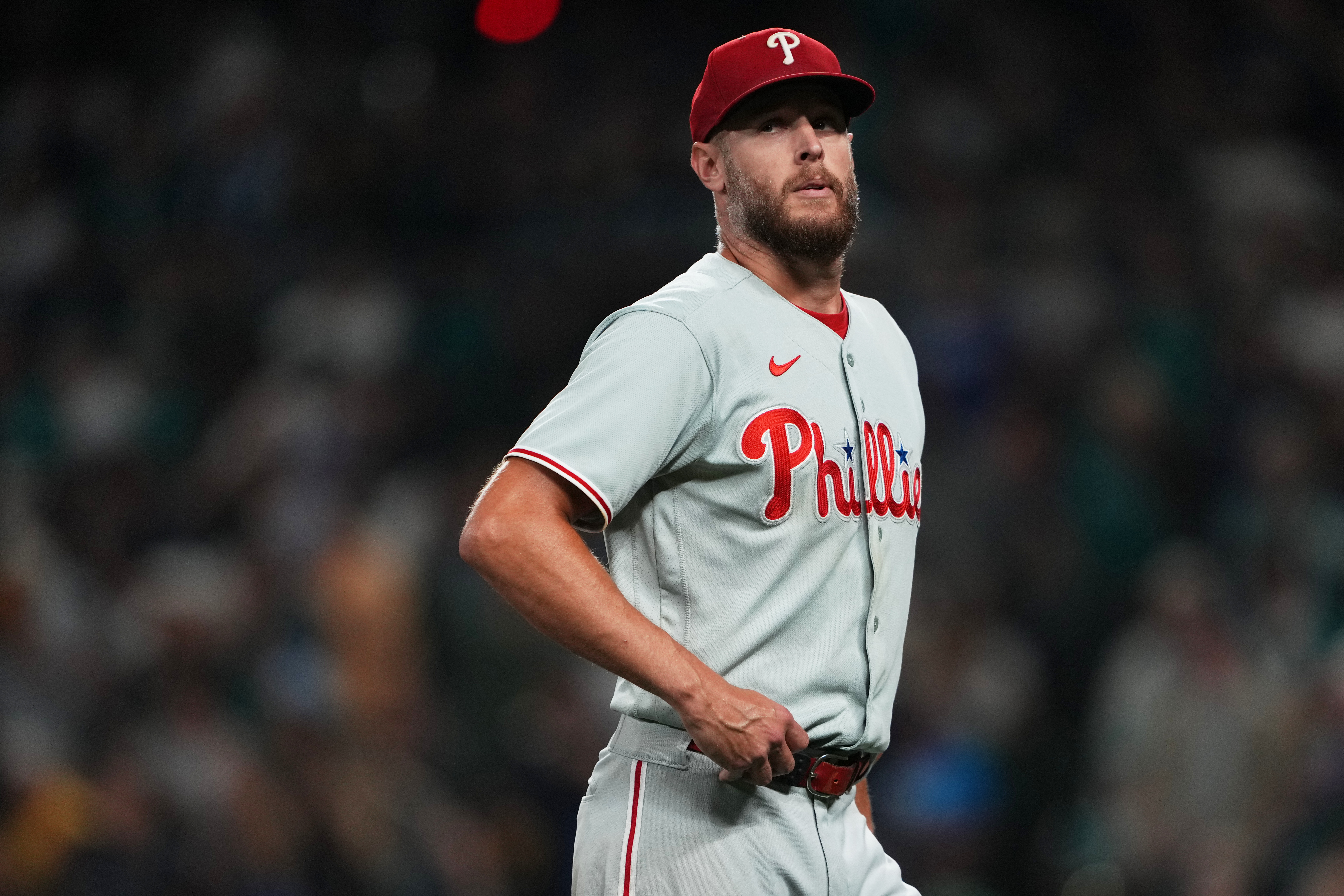
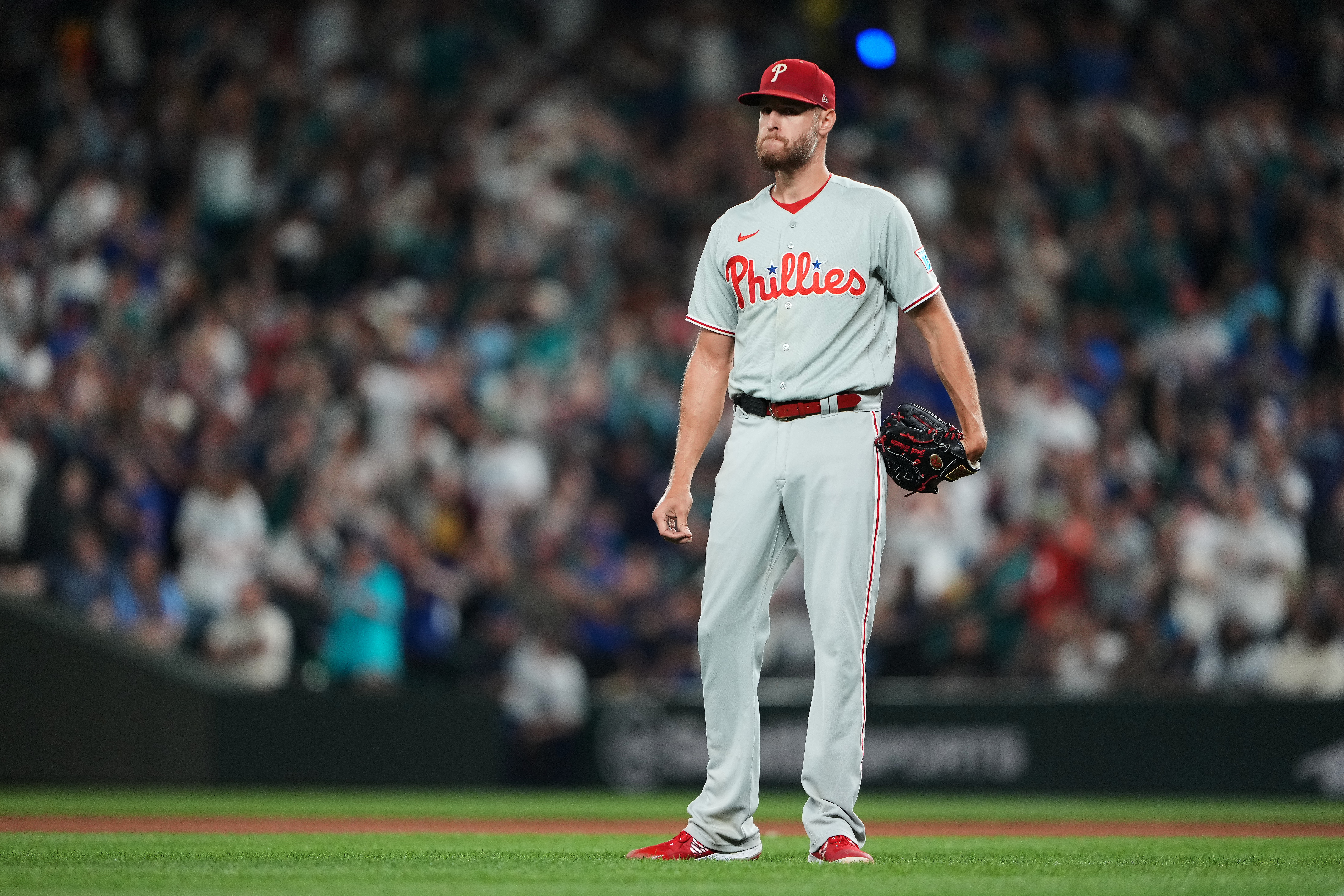
Phillies starting pitcher Zack Wheeler gave up five runs in the first inning of his team’s 9-2 loss. Lindsey Wasson
Wheeler’s velocity readings appear to support his claim. His fastball averaged 94.9 mph, consistent with his 95-mph season average. The Phillies have other metrics that also suggest Wheeler is healthy.
So, if he insists he’s physically fine and not struggling with stamina 124⅓ innings into his comeback season, is there another explanation for walking 15 batters in a four-start span for the first time since … checks notes … May 2014, his second season in the majors?
“That’s why it’s so frustrating right now,” Wheeler said. “Because I’m on a rough stretch and I feel fine. You’ve really got to dig in. That’s what I’m going to do [Tuesday], you know? Sit down, talk, and try to get some stuff figured out.”
OK, start here: Wheeler said the only pitch he was able to throw for a strike was his fastball — “and that’s not even fully consistent.” He gave up homers on his splitter (to Rodríguez and Cole Young), fastball (to Cal Raleigh), and cutter (to Raleigh, the .167-hitting star catcher who went deep a third time against reliever Chase Shugart).
Wheeler gave up five first-inning runs for the first time since Sept. 12, 2023. The first six batters reached base, with the only out coming when Bryce Harper nailed Josh Naylor trying to stretch a single.
It all started by running a 3-1 count to leadoff-hitting Randy Arozarena, who drew a seven-pitch walk.
“I hate walking guys,” Wheeler said. “I used to walk guys a good bit [early in his career] and kind of got away from that, and now that this little stretch has been walking guys, it’s pretty frustrating.”
Considering this is Wheeler, the best pitcher in baseball over the last seven years, the Phillies won’t dismiss any theory for why he’s struggling. Odds are, he isn’t tipping pitches. Just in case, they’ll look into it.
“They were taking really good swings, so first, I’m going to check off the box of, am I doing something to where other teams are seeing it, you know?” Wheeler said. “At this point, you’ve got to check off all the boxes. It’s not where I want to be. But like I said, we’ll sit down and kind of dig in and see what’s really going on.”
Zack Wheeler gave up five first-inning runs and back-to-back homers in the fifth inning of a 9-2 loss Monday night in Seattle.Lindsey Wasson
Maybe it’s a mechanical issue that’s causing Wheeler to lack command. Then again, it’s not like he was missing his spot by an inch or two. Most of his pitches weren’t close to where catcher J.T. Realmuto wanted them.
“I would just say overall it’s more big misses that you’re seeing out of him than usual, and then more pitches in the heart of the plate,” Realmuto said. “As a hitter, it just makes the ball look a little bigger when your misses are big. And then when you do throw it in the zone, it’s covering a little more plate than usual, and that’s obviously not what we’re used to seeing from him.”
Wheeler being Wheeler, he wanted to start the fifth inning, according to Mattingly, who quickly added, “And I kind of wanted him to go back out.” So, although rookie Alex McFarlane was warming to enter a 6-2 game, Wheeler stayed in and gave up back-to-back homers to Raleigh and Young to make it 8-2.
For the sake of the game, Mattingly probably should’ve gone to McFarlane. But in the larger picture, the Phillies aren’t going anywhere if they’re unable to unlock the mystery of Wheeler’s last six starts, in which he has an 8.51 ERA in 24⅓ innings after running a 2.16 ERA in 100 innings through 16 starts.
“The stuff still feels sharp,” Realmuto said. “It’s coming out of his hand good. It’s just, he’s getting into some bad counts, and then throwing the ball too much in the middle of the plate. He’s going through a tough time right now, but we have all the faith in the world that he’s going to come out of it.”
The Phillies are the hottest team in baseball, hotter than they’ve been all year, winners of nine straight for the first time since May of last season and just the second time in the Schwarber Era, which began in 2022.
We’ll call it the Schwarber Era because it was Kyle Schwarber’s 459-foot, two-run, walk-off Schwar-bomb that extended the winning streak Sunday afternoon, and because, with due respect to Bryce Harper and Zack Wheeler, Schwarber is the soul of this ballclub.
Everybody always loves Schwarber. Not everybody loves these Phillies.
Maybe you don’t. Who can blame you? Whether it’s collapses against the Diamondbacks or Mets, or an inexplicable bunt or an unforgivable error against the Dodgers, these Phillies have a way of breaking your heart.
Once bitten, twice bitten, thrice bitten … goodbye?
Paul told the Galatians, “Be ye not faint of heart,” but the greatest apostle would be ashamed of Phillies fans today. Why?
Because these Phillies are for real.
They’re beating good teams by playing mature, sound baseball, and they’re doing it generally without the best efforts of their best players.
Nevertheless, they’re 16-5 in their last 21 games and a season-high 15 games over .500 going into Monday’s series opener in Seattle. They were 9½ games behind the Braves in the NL East when the streak began, but now they’re just three games out with 31 games to go, seven of them head-to-head with Atlanta. The Phils held the No. 2 wild-card slot, two games behind the Cubs, two ahead of the Padres, and four games ahead of the Diamondbacks, the first team out.
The Phillies on Monday began a nine-game, 10-day road trip three time zones west. They face the Mariners, then the Angels, two relatively poor American League teams, by the time they get to Arizona.
They swept Miami, St. Louis, and Minnesota, all teams with valid playoff aspirations, at least until they played the Phillies. That’s the biggest reason why you should learn to love again.
Here are four more.
The Phillies are winning despite middling performances of late from their aces, including Cristopher Sánchez.Yong Kim / Staff Photographer
2: They’re streaking without good starts from the Big 3
During the streak, top three starters Wheeler, Cristopher Sánchez, and Jesús Luzardo all left the game while trailing after an ungainly outing. They surrendered a combined 10 earned runs in 17⅔ innings. The Phillies won anyway.
All three are healthy. They just faced decent offensive teams in the dregs of summer. The Mariners have scored the fewest runs in baseball. The Angels have the second-worst OPS. The next seven days should be a feast for the Big Three.
Luis Arraez is an unconventional but productive cleanup hitter for the Phillies.Elizabeth Robertson / Staff Photographer
3: The Arraez Affect
Since three-time batting champ Luis Arraez, a deadline addition, joined the lineup Aug. 4, the Phillies have mimicked his approach. Their swings are more controlled. The hitters are more on balance.
The result: fewer home runs, but more hits.
They’ve hit nine homers in the nine wins, a rate of 1.0 per game. They’d hit 148 home runs in their first 123 games, a rate of 1.2 homers per game. Sometimes, less is more.
Since Arraez’s arrival and his insertion in the No. 4 spot, No. 3 hitter Bryce Harper has a .506 on-base percentage with 25 walks. No. 5 hitter Alec Bohm saved his season: He’s hitting .393 with a 1.015 OPS and 15 RBIs in 17 games. Bryson Stott, who bats sixth, is hitting .295 with 15 walks.
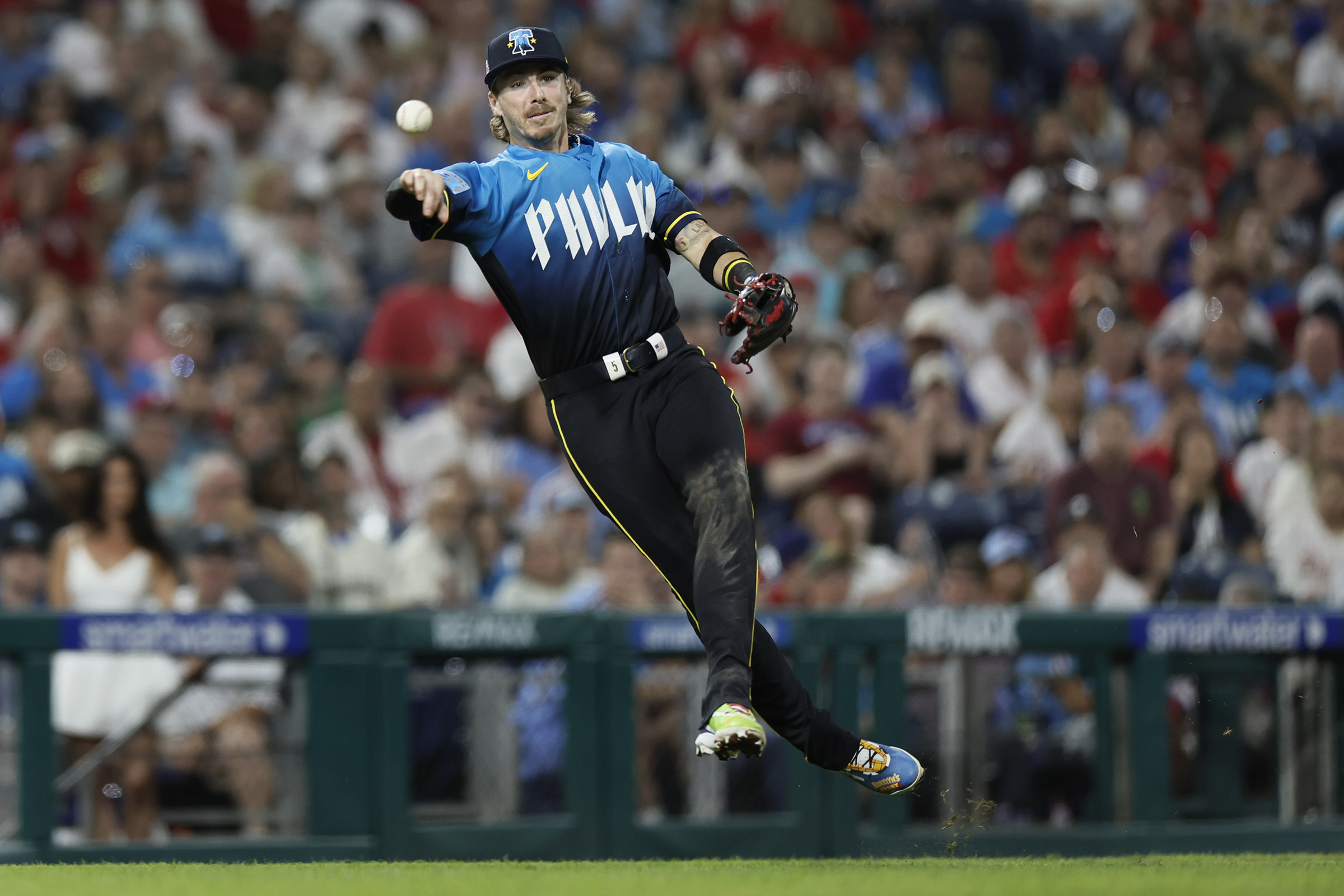
Bryson Stott has been great at third base since his move there following the Arraez trade.Elizabeth Robertson / Staff Photographer
4: The defense got better
The Phillies chose to play Arraez at second base. This meant Stott had to move from second to third base, Bohm had to move from third to first base, and Harper had to move from first back to right field.
The unintended consequence: This is the best Phillies infield since 2011, when Placido Polanco won a Gold Glove at third base and Jimmy Rollins should have won it at shortstop. Granted, this is a low bar — Phillies infields have been atrocious for 15 years — but Stott, a shortstop by birth, already was an elite second baseman, and his play at third has been otherworldly. Bohm is an unnatural third baseman but a natural first baseman, unlike Harper, who is a very good outfielder. Arraez is a fine second baseman, and even Trea Turner looks better at shortstop.
Aaron Nola has been solid of late after a very slow start to his season.Yong Kim / Staff Photographer
5: Andrew Painter and Aaron Nola settled in
Andrew Painter, who is 23, spent all of 2025 in triple A coming back from elbow surgery that cost him all of 2023 and 2024. His big-league debut was March 31. He was inconsistent, and was sent back to triple A in mid-June.
We call this “normal.”
Aaron Nola, who is 33, threw more innings than anyone else from 2018-24. In 2025 he suffered his first significant injury since 2016, which cost him three months in the middle of the season. He struggled the first three months of this season.
Nola’s ERA in his last nine starts is 3.63. He’s had one bad start. He’s learned to lean on his knuckle-curve.
You know what happens when you get 3.6-ish ERAs from fourth and fifth starters? You win divisions, you win pennants, and you win back the hearts of your fans.
Love Hurts
I get it. It’s hard to love a team with a $300 million shortstop hitting .245; a team that had to release $20 million outfielder Nick Castellanos and $18 million starter Taijuan Walker; a team with a bullpen that is injured and ineffective and, with the exception of the closer, utterly maddening.
But in matters of the heart, there are no guarantees. You take a chance, you ride the thrill, and, as fate decides, your devotion is rewarded … or not.
“ ‘Tis better to have loved and lost than never to have loved at all.”
Lord Tennyson was English, and he died in 1892. His grandson, Lionel, became England’s cricket captain, and Tennyson simply wallowed in heartbreak: It took him 17 years to finish the elegy.
In a different time the poet properly known as Alfred, Lord Tennyson — a moderate conservative rashly bearded — surely would have been a baseball fan.
Given his predilection for misery, he probably would have followed the Phillies.
Summer may be nearing its end, but hot dogs aren’t going anywhere. Philly is deep in the throes of a hot dog era. Our inveterate cheesesteak-and-hoagie city hasbeen throughthem before, but what sets apart the current boom is that it’s not so much about standalone hot dog joints. Instead, dogs have nosed their way onto many menus where they once might have been out of place.
That’s a double-edged sword: Hot dog purists may want to avert their eyes. This list, which is focused on Philly proper, has some natural-casing-centric sweet spots for them, but we’ve also included spots that are bucking strict hot dog norms with croissant buns, bonito flakes, carrot salad, and pineapple salsa. Some even deploy the most divisive condiment of all: ketchup. — Jenn Ladd
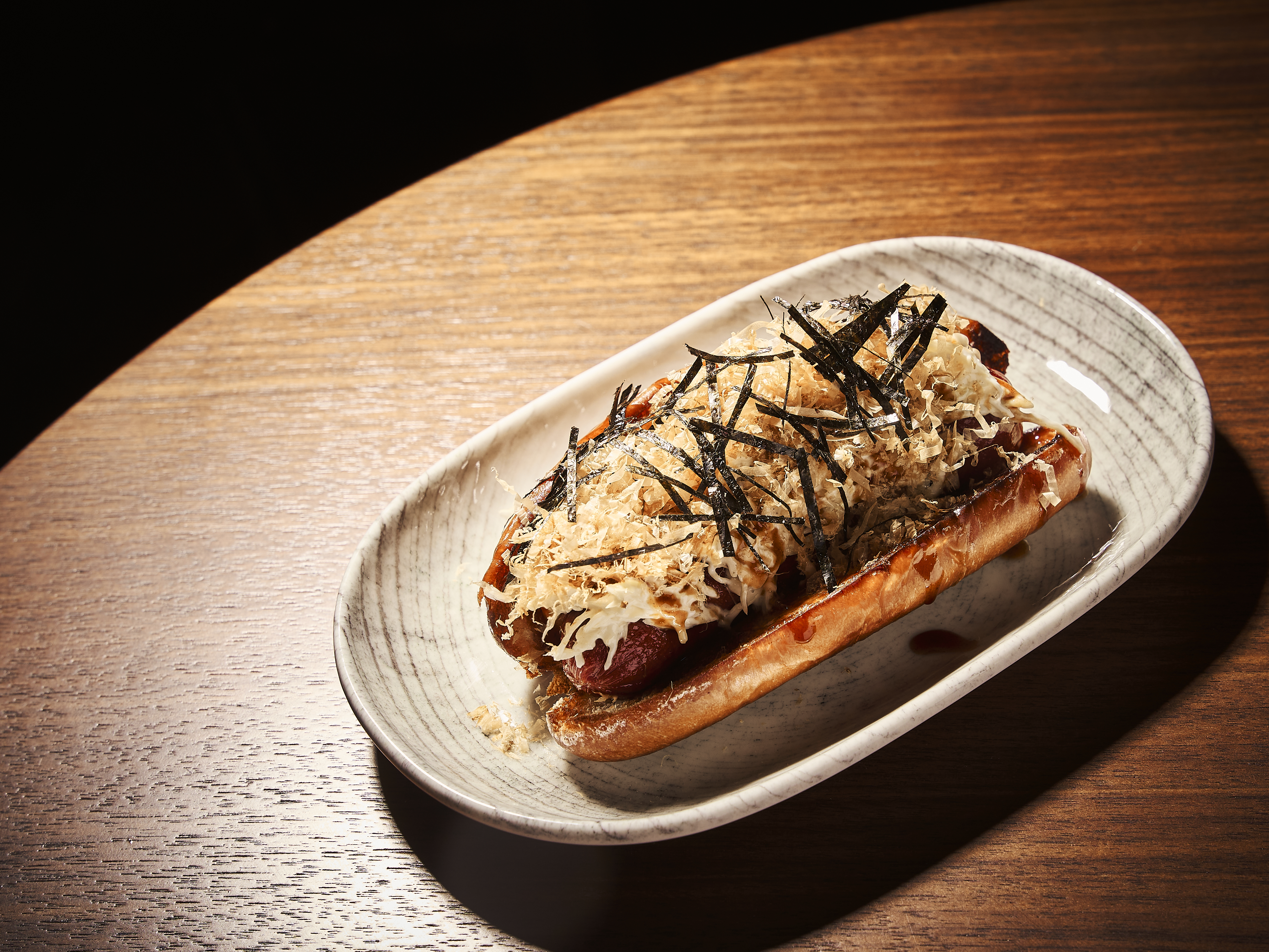
The Wagyu hot dog at Almanac in Old City, topped with tonkatsu sauce, Japanese slaw, bonito flakes, and nori.Stephen Recchia
Almanac
There’s something delightfully incongruous about pairing Almanac’s hot dog with one or two of its painstakingly crafted cocktails, often made from foraged ingredients and house-fermented elixirs. As bar snacks go, the Wagyu hot dog is a bit of an indulgence, but it hits all the notes of salty, fatty, sweet, and umami — the hallmarks of snacks you’d get at a konbini, or Japanese convenience store. The juicy sausage is tucked into a run-of-the-mill yet perfect split-top bun and topped with house-made tonkatsu sauce, a crunchy cabbage slaw, strips of nori, and bonito flakes. It’s a feat of layered textures and contrasting flavors, just as one would expect from one of Philly’s finest omakase chefs. — Kiki Aranita
Almanac, 310 Market St., Second Floor, 215-238-5757, almanacphilly.com
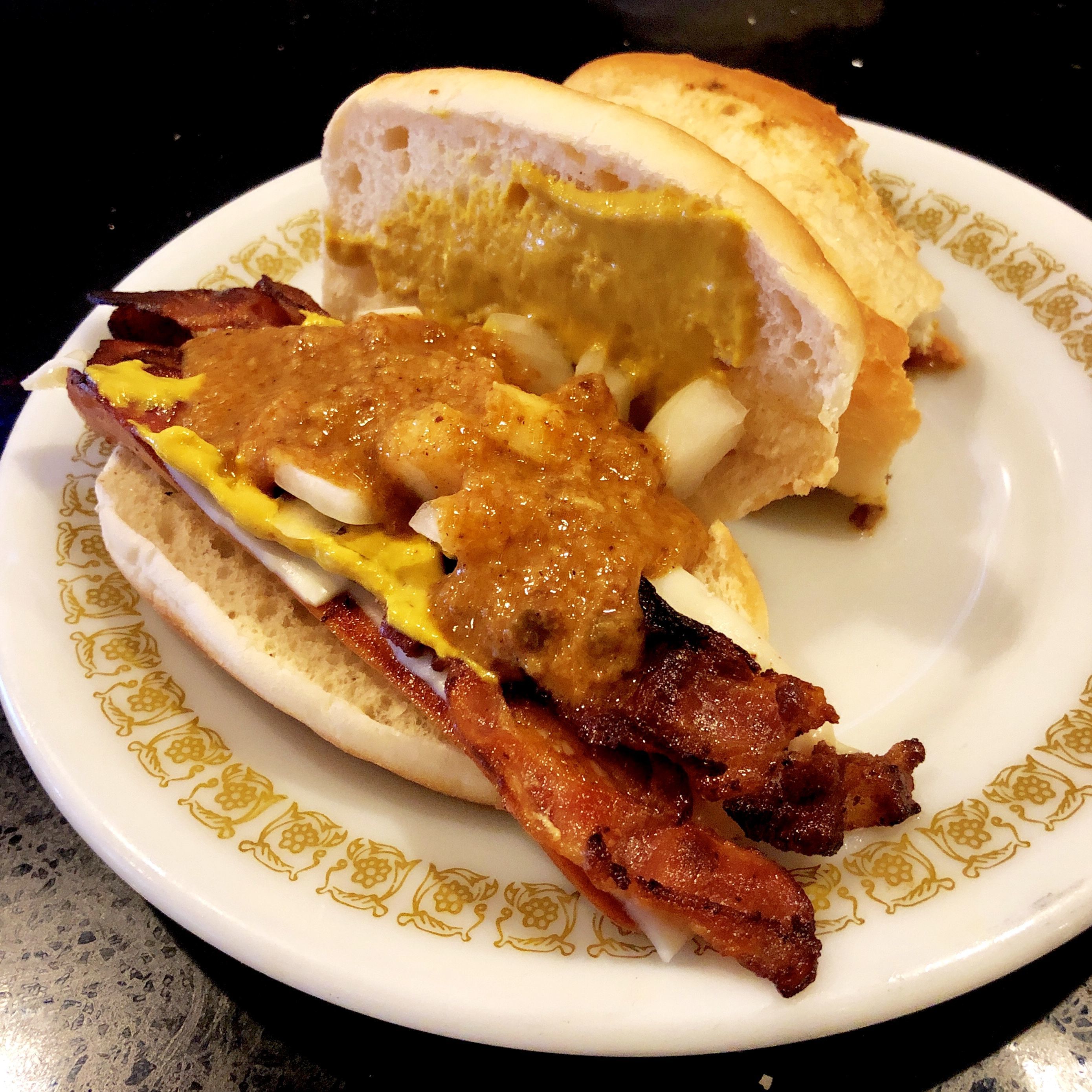
Texas Tommy from A.P.J. Texas Weiner (47 N. 13th St.)Craig LaBan
A.P.J. Texas Weiner
Time has largely forgotten A.P.J. Texas Weiner, a no-frills, old-school luncheonette squished between a bail bondsman’s office and an omakase restaurant on 13th Street just off Filbert, across from the Criminal Justice Center. Greek immigrants Andrew Kanakis, Paul Vasiliades, and John Halkedis opened the joint a century ago, joining an early-20th-century rush of so-called Texas wiener (as it’s usually spelled) joints around town. The “Texas” in a Texas wiener refers to the thin, mild chili perfumed by cinnamon and allspice that the cook spoons onto the grilled, split 5-to-a-pound beef hot dog before adding yellow mustard and chopped onions. In sum: the best $3 snack in Center City. You can dine in, though it’s primarily call-ahead (no apps!) or grab-and-go (from the sweetest counter woman, who won’t skimp on the napkins). — Michael Klein
47 N. 13th St., 215-665-8081
Café Tinto Fishtown
Café Tinto’s hot dogs are only available from 3 to 6 p.m. on weekdays at its buzzy new Fishtown location. The scarcity only adds to the mystique of chef Daniela Garcia’s Colombian-style beef hot dogs, which are all about perfecting the golden ratio of sweet, spicy, and crunchy. Served in soft, buttery house-baked rolls, Café Tinto’s happy hour dogs come topped with Garcia’stangy pineapple salsa and a layer of crushed classic Lays potato chips. There’s something deeply satisfying and oddly nostalgic about the crunch, which reminds me of when I’d stuff Doritos inside my salami sandwich on white bread in elementary school. Chips really do make everything better. — Beatrice Forman
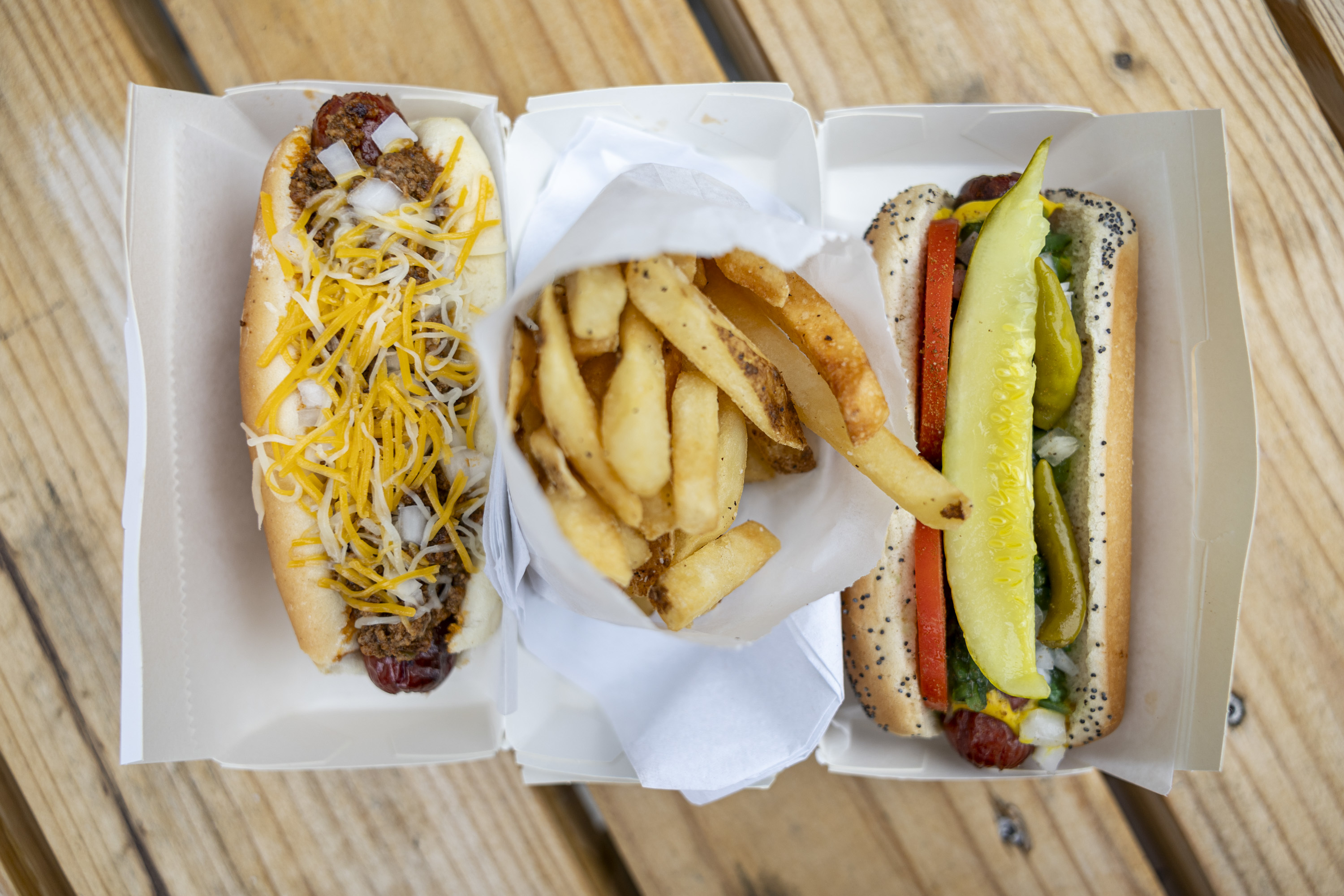
A Chili Cheese Dog and a Chicago Dog with a side of fries from Bad Nina’s grand opening outside Attic Brewing in Philadelphia on Wednesday, July 16, 2025.Tyger Williams / Staff Photographer
Bad Nina’s
In 2025, Attic Brewing owner and Chicago native Laura Lacy decided to capitalize on one of the most intuitive food pairings there is: beer and hot dogs. Lacy and her husband/co-owner, Todd, decked out a vibrant yellow-and-teal food truck that operates noon to dinnertime Friday through Sunday, serving up at least 12 dog variations, including a jalapeño popper dog, a cheeseburger dog, and a classic Chicago-style dog (mustard, relish, chopped white onion, sliced tomatoes, a dill pickle spear, celery salt, and pickled peppers). Bad Nina’s go-tos are Vienna Beef brand hot dogs and Cacia’s Bakery rolls, but there are also Impossible vegan dogs and gluten-free buns (and bratwurst if you’re dogged out). — Jenn Ladd
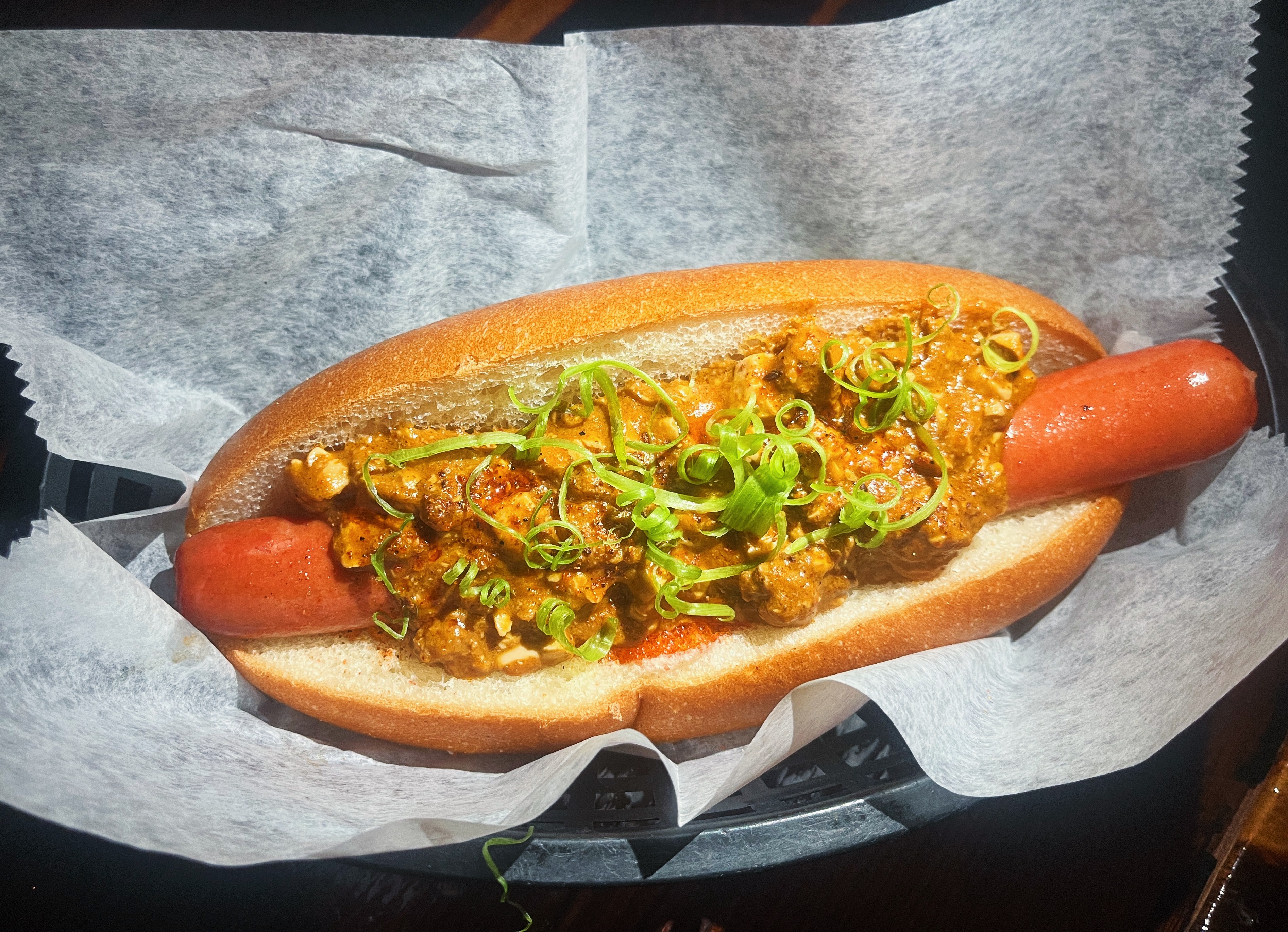
What’s more rock ’n‘ roll than a dive bar hot dog? A dive bar chili dog. Doom technically isn’t a dive, but it is a heavy metal bar with a just-messy-enough hot dog that some dare to call the best in Philly. Doom’s dog starts with a deep-fried, ripper-style beef frank in a split-top bun. Then, it gets topped with a tofu-and-pork Bolognese inspired by mapo tofu, the spicy Sichuan classic. Doom’s version is milder and smokier, transforming the sandwich into something akin to a sloppy joe with a touch of class. Not a drop of chili is to be wasted. We recommend scooping up the inevitable spillage with a side of fries. — B.F.
The mapo chili dog from Doom, a heavy metal bar at 421 N. Seventh St., is inspired by the popular Sichuan dish.Beatrice Forman / Staff
Famous 4th Street Delicatessen
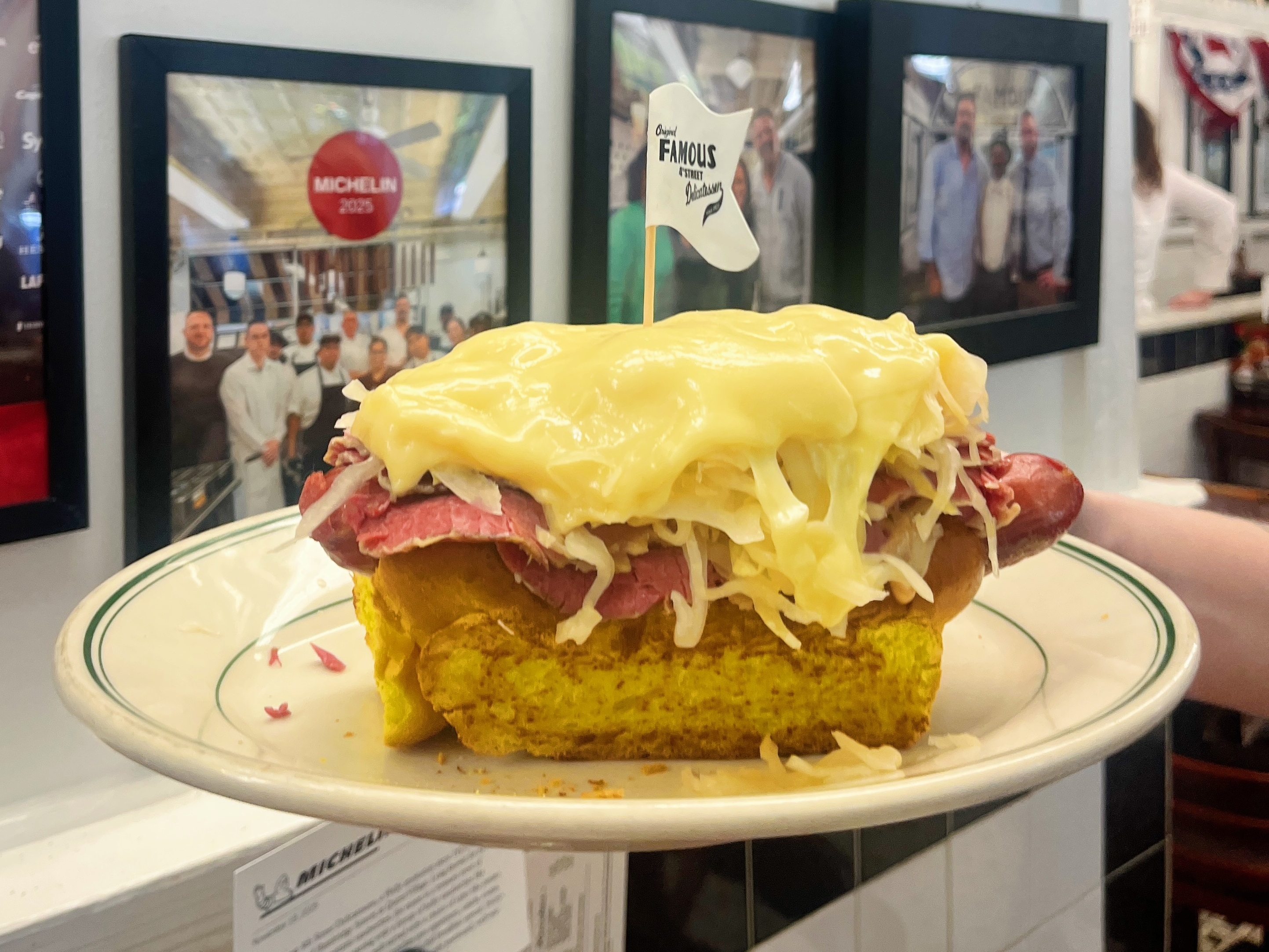
Famous 4th Street’s hot dogs are just how deli magnate Russ Cowan left them when he sold the joint in 2024 to Connecticut-based restaurateur Al Gamble: big and beefy. The Queen Villageinstitution still uses all-beef sausages for its traditional hot dogs and oversized pigs-in-a-blanket, and it still makes its challah buns in house. The only difference? The buns are now buttered and lightly toasted to mimic a Connecticut-style lobster roll, a change that Gamble said “tastes like childhood.” The deli’s classic hot dog is its bestseller, but the true showstopper is the hulking Reuben dog, which piles thin-cut pastrami, hot sauerkraut, and Russian dressing atop a 7-inch frankfurter. It’s just as filling as the sandwich it’s based on — and nearly half the price. — B.F.
The Reuben Dog at Famous 4th Street Delicatessen, 700 S. Fourth St.Beatrice Forman / Staff
Fox & Son
Reading Terminal Market has a certain “state fair” feel anyway, but a stop at this stand will make your day seem even more festive. Rebecca Foxman’s signature, crunchy hand-dipped corn dogs are made with corn batter, a boon to those who are sensitive to gluten. Choose pork-and-beef, all-beef, turkey, spicy pork, or a Beyond veggie dog, then stick with the classic or go fancy. Variations include chili-cheese-scallion, cheddar-jalapeño, and sweet-potato batter with chorizo and cilantro-lime sour cream. For a more lavish version, choose the Korean-style dog with mozzarella, sugar, ketchup, and mustard. — Michael Klein
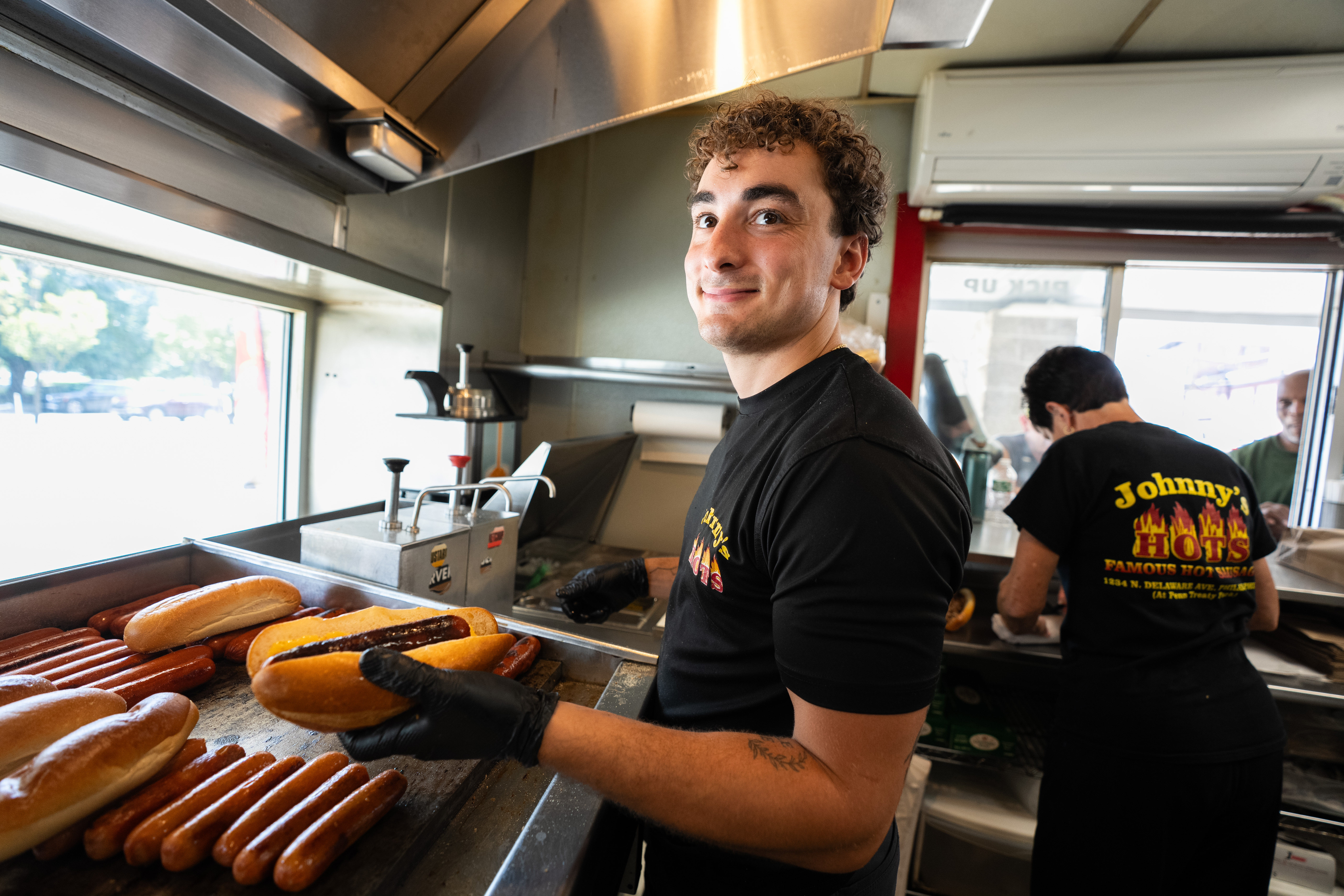
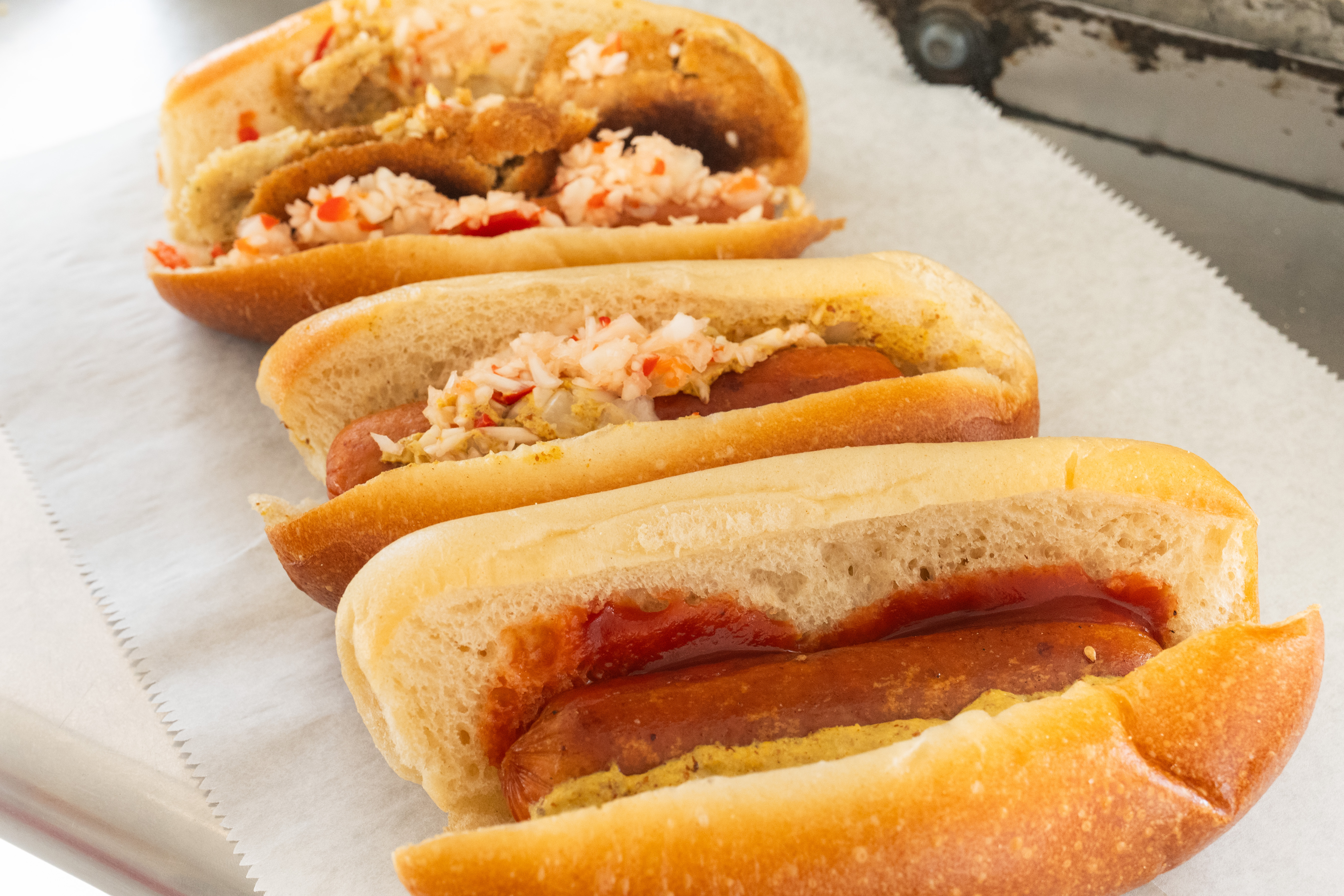
Standard hot dog with ketchup and mustard front, hot dog with pepper hash back, and hot dog with fish cake and pepper hash at Johnny’s Hots, in Philadelphia, Aug. 17, 2026.Jessica Griffin / Staff Photographer
Johnny’s Hots
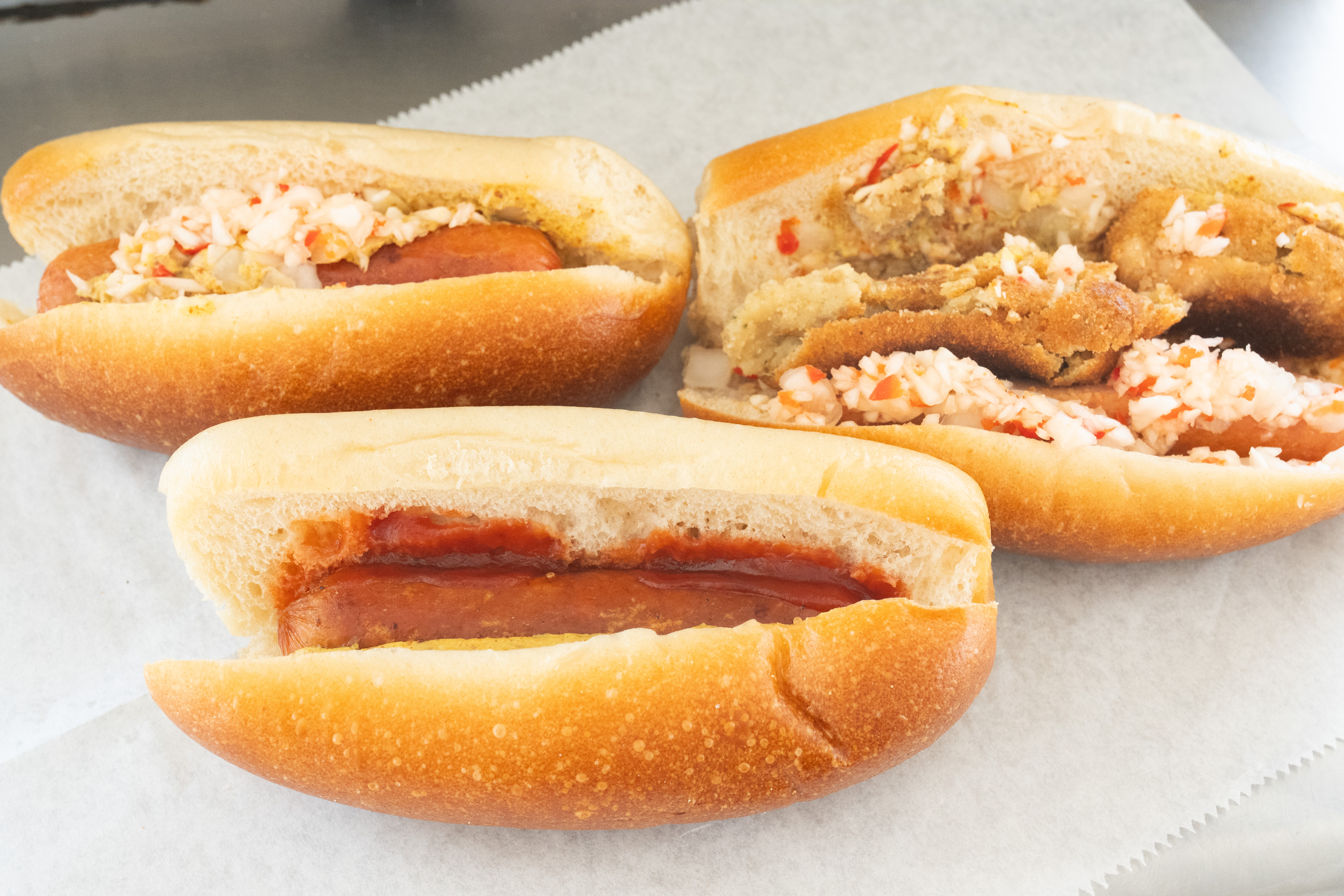
At 5:45 every weekday morning (and at 7:15 on Saturday), the window rolls up at this cash-only stand across from Penn Treaty Park. Ride-share drivers, truckers, and other hungry early birds start pulling up for grilled hot dogs and especially that old-time Philly combo of hot dogs and fish cakes, on soft buns. Johnny’s traces its roots to the 1950s, when Nunzio “John” Danze started serving waterfront workers from a lunch truck. The business later operated from a pier-side shack before moving to its current location on Delaware Avenue. The power move is the namesake spicy sausage, though the menu includes breakfast sandwiches as well as roast pork and cheesesteaks. — Michael Klein
The standard hot dog with ketchup and mustard, hot dog with pepper hash, and hot dog with fish cake and pepper hash at Johnny’s Hots on Aug. 17.Jessica Griffin / Staff Photographer
Juana Tamale
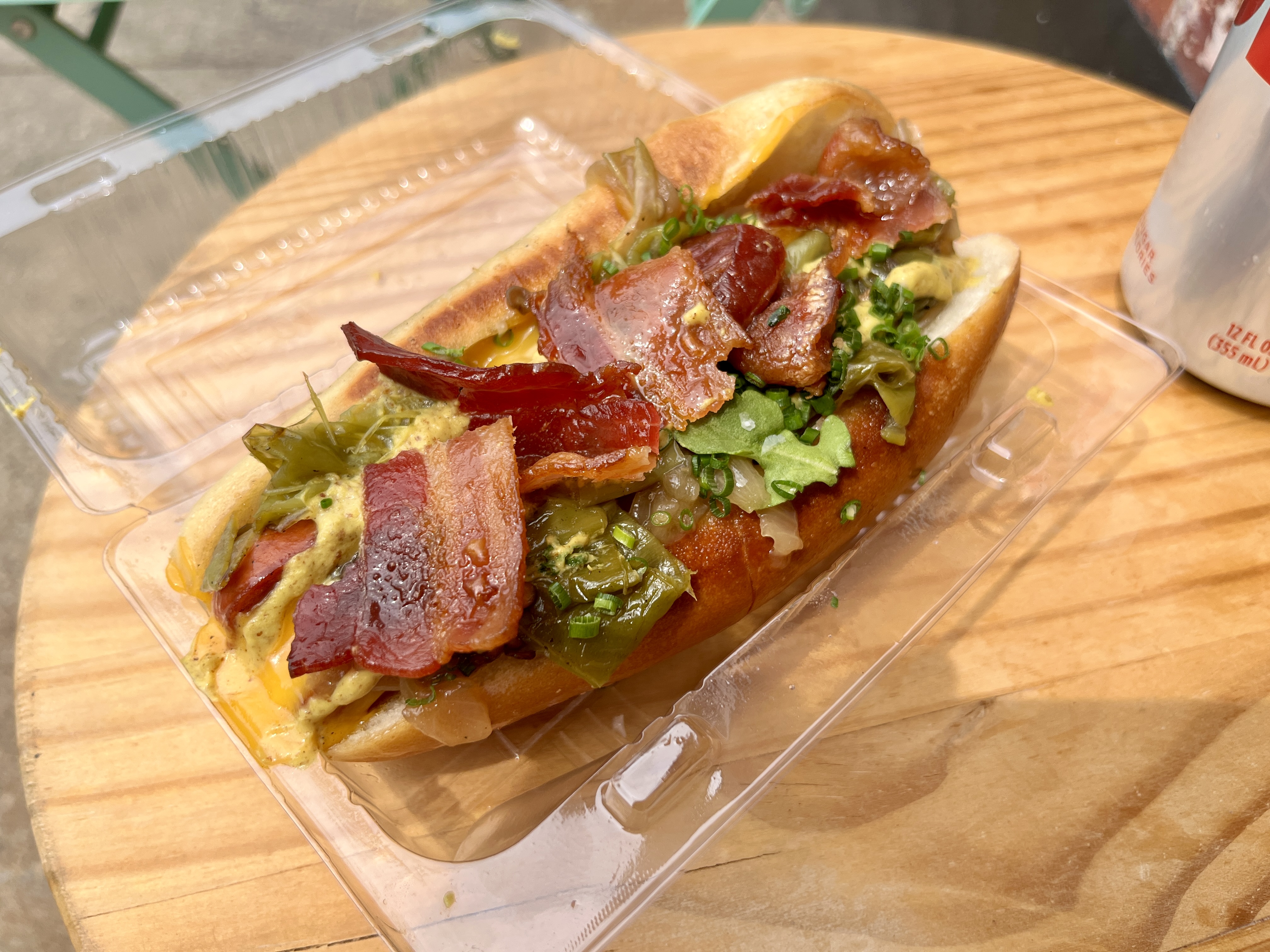
The only thing better than one hot dog is two hot dogs. Juana Tamale’s Jen Zavala serves her Sonoran-style hot dogs in pairs for $8, and prepares them just like they do in Northwest Mexico, where the street food originated before becoming Arizona’s glizzy of choice. A Sonoran dog comes wrapped in bacon and topped with refried pinto beans, Hatch chiles, red and green salsas, mustard, and mayo. Zavala’s one departure from a traditional Sonoran: She uses Amoroso’s Italian rolls instead of fluffy bolillo bread. The two have nearly the same texture, she said, and the Amoroso’s roll adds a touch of Philadelphia to a hot dog steeped in Southwestern spice. The Sonoran dog’s excess was a hard sell at first in Philly, Zavala said, but now, her East Passyunk Avenue Mexican restaurant sells between 200 and 300 a week. The more-is-more approach hits just right for those of us who view the hot dog as a prime vessel for toppings. — B.F.
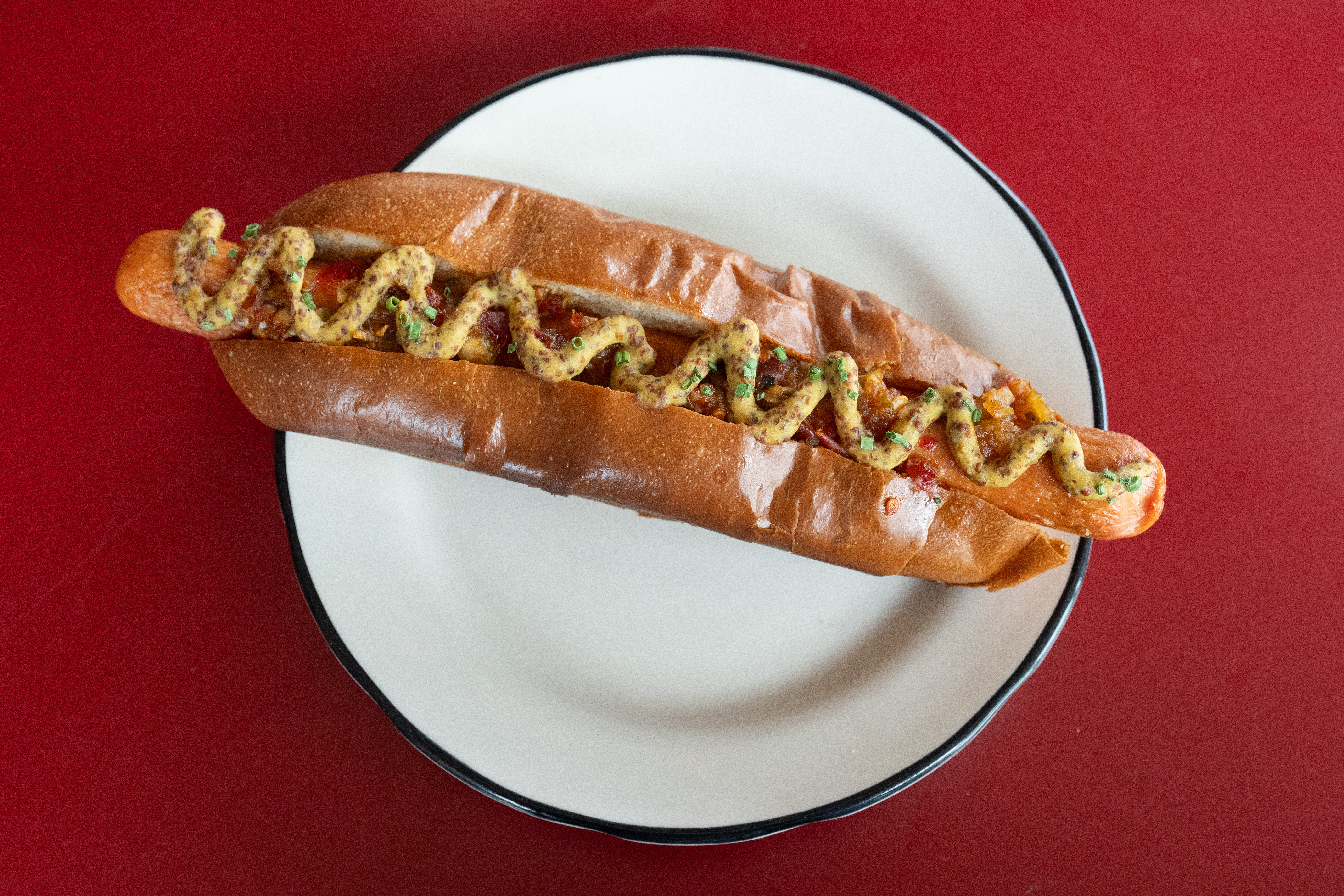
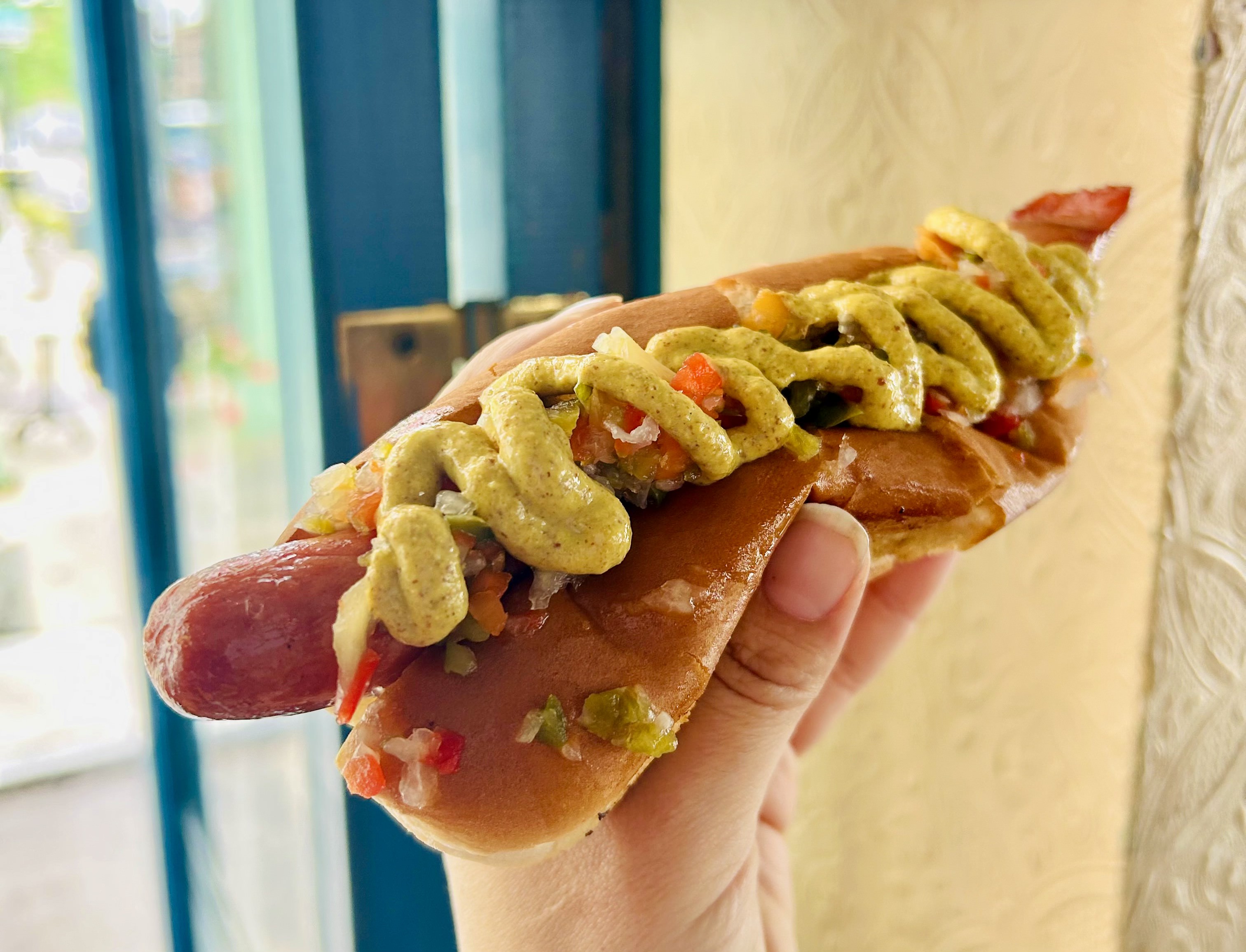
Size matters at Columbus Boulevard’s newest waterfront tavern. Lucky Duck co-chef Sanil Shah claims the bar’s 10-inch wiener is likely the largest you can find in Philly — it pokes comically out the ends of its 6-inch Baker Street Bread roll. The tavern uses a smoky beef-and-pork blend from Reading-based Berks Packing Co. that has an audible snap with every bite. The toppings are simple — just brown mustard and a house-made hot honey-pepper relish that Shahsaid is loosely inspired by the packets of duck sauce that come with Chinese takeout. Bonus: Lucky Duck’s dogs are available until 1 a.m. on Fridays and Saturdays, just in case a late-night glizzy craving hits. — B.F.
501 N. Christopher Columbus Blvd., Suite 2003, 215-964-9345, luckyduckphl.com
A hot dog at Lucky Duck, Aug. 17.Jessica Griffin / Staff Photographer
Lucky’s Last Chance
When Chris Barnes added hot dogs to the Lucky’s Last Chance burger-centric menu six months after it opened its first location in Manayunk in 2011, he hoped to sell “maybe 50 hot dogs a week.” Now, Barnes estimates the shop goes through between 5,000 and 6,000 franks weekly across its four locations, in Queen Village, Manayunk, East Falls, and Ambler. At Lucky’s, Deitz and Watson franks (or Light Life veggie dogs) are the base for 12 variations that push the limits of the “is a hot dog a sandwich” debate. Take the Voodoo, layered with shredded chicken, American cheese, and onion strings. Feels like a sandwich to me. The bacon bits and BBQ sauce-topped Deadwood? A very meaty hot dog. The 1Up, with sautéed mushrooms, provolone, and garlic aioli, is somehow a secret third thing — a hot dog crossed with a French dip. Rich and warm, it resonates even in winter. — B.F.
848 S. Second St., 267-519-2080; 4421 Main St., 215-509-6005; 5154 Ridge Ave., 216-842-5836; 15 S. Ridge Ave., Ambler, 215-367-5881; luckyslastchance.com
Lucky’s Last Chance uses Dietz & Watson dogs and New England-style split-top rolls.Marisa DiSalvatore
Miller’s Twist
Lines often wrap around the edges of this legendary Reading Terminal Market vendor, whose tawny, traditionally knotted Amish-style pretzels are irresistible in their own right. So what’s not to love about that same supple, salt-studded dough wrapped around a hot dog, then baked to juicy perfection? Costco customers will be particularly enthused: The Miller family uses Kirkland brand for their regular and jumbo dogs. (Dietz & Watson supplies their spicy beef and jalapeño dogs.) Buy one with or without cheese, and be sure to spring for a dipping sauce, especially the hot-sweet mustard made by the owner’s Lancaster-based in-laws. (Note that Miller’s does not make Philly soft pretzels; for better or worse, ours are not buttery. If you want a hot dog wrapped in Philly pretzel dough, head to one of three Bernie’s Pretzels in Delco.) — J.L.
Chef Chance Anies’ Filipino riff on Outback Steakhouse is a great place to go for happy hour, and particularly welcoming to kids. One of the draws is the Jollidog: an all-beef dog with mayonnaise mixed with bangus (umami-rich tinned milkfish), sandwiched in a soft bun, and topped with atchara, or pickled green papaya. It’s a perfect snack with a glass of wine, or a great meal for a toddler. Mine ate it up and clamored for another, which we happily ordered. The hot dog is on the regular menu, too, and comes with fries for only a few bucks more at happy hour. — Margaret Eby
When we kids were extra-good and my mom was feeling extra-rich, my mom would buy bacon and American cheese for our usual hot dog nights. She’d pull out the stovetop griddle, split the dogs, wrap them in bacon, and make us each a Texas Tommy — draping a thin slice of American cheese over everything to melt on contact. For me, the smoky, crispy Tommy at the Nifty Fifty’s chain is the perfect throwback to ’60s indulgence, even if the cheese of choice for the pork-and-beef dogs here is Whiz. Get yours topped with chili and eat it with a knife and fork, and don’t forget to use your napkin, as the old luncheonette lady would have reminded you. — M.K.
2491 Grant Ave., 215-676-1950; 2700 S. 10th St., 267-719-1950; 2431 Aramingo Ave., 267-771-1950; 1140 Old York Rd., Abington, 267-833-1950; 503 S. Oxford Valley Rd., Fairless Hills, 267-571-1950; 1900 MacDade Blvd., Folsom, 610-583-1950; 3524 West Chester Pike, Newtown Square, 484-992-1950; 684 York Road, Warminster, 267-802-1950; 1365 Marrows Rd, Newark, Del., 302-742-1950; 4670 Route 42, Turnersville, 856-875-1950; niftyfiftys.com
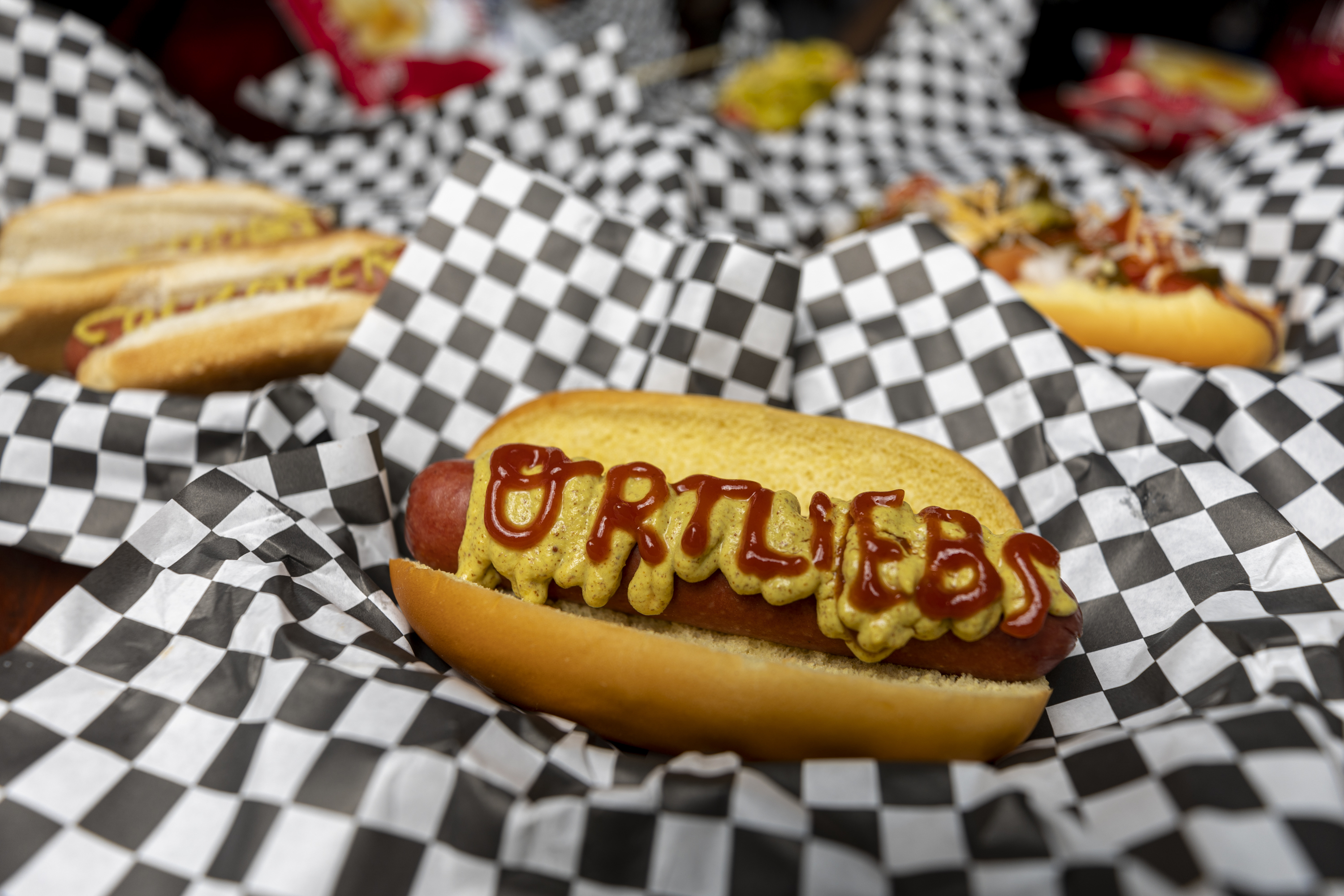
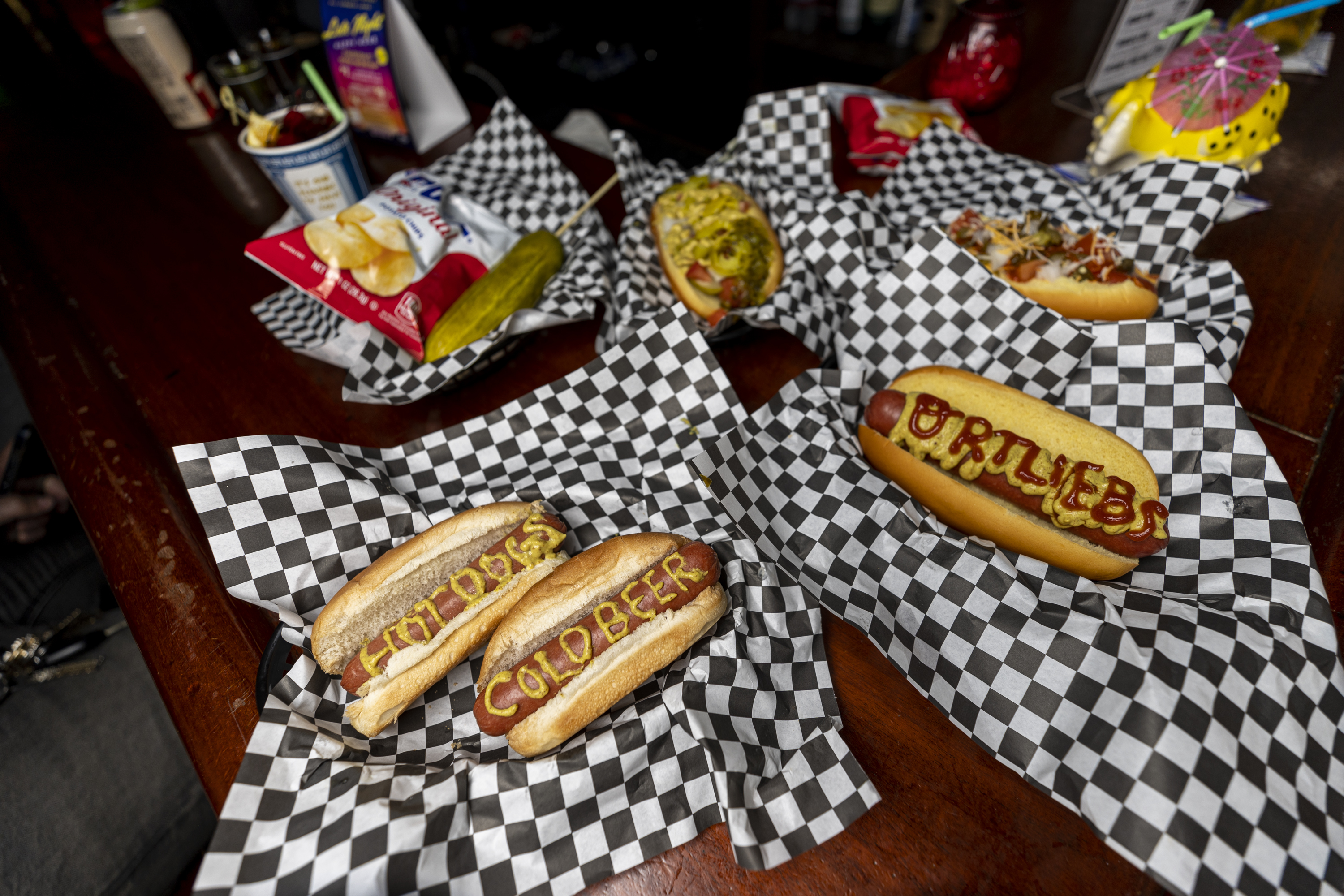
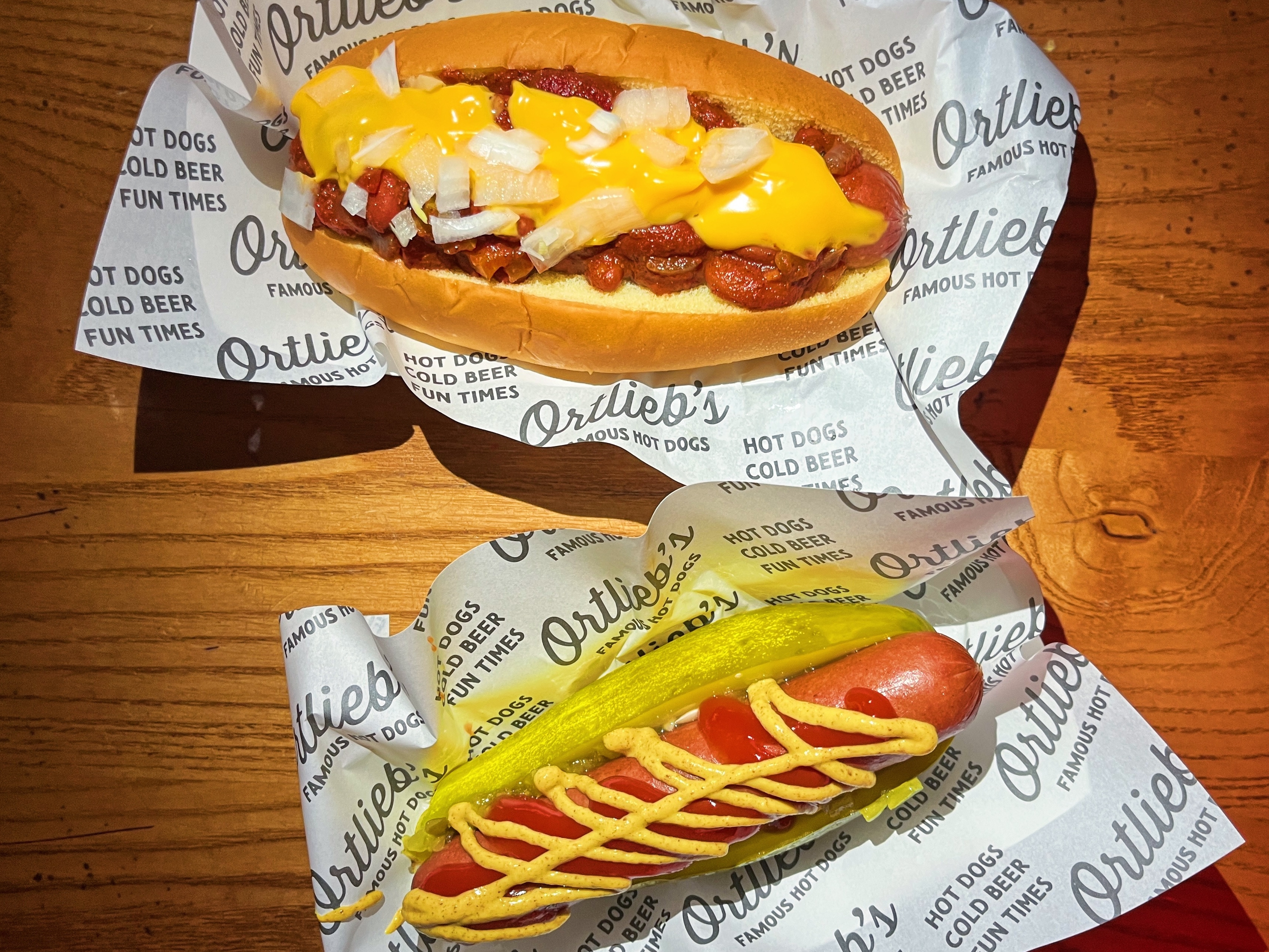
A classic hot dog with Ortlieb’s written on it with mustard and ketchup, in Philadelphia on July 20, 2024.Tyger Williams / Staff PhotographerAn assortment of classic hot dogs with mustard and ketchup writing, Ortileb’s taco dog, a Chicago dog, and a pickle on a stick, at Ortlieb’s on July 20, 2024.Tyger Williams / Staff Photographer
Ortlieb’s
When Kyle Costill dedicated his Northern Liberties bar to the humble hot dog in 2024, “people were laughing at us,” Costill said. “Now, it’s like everybody is doing them.” Since then, Ortlieb’s has built a tiny empire out of no-frills dogs. Costill estimates the bar has sold 30,000 in the past two years thanks to a partnership with music venue Union Transfer and Port Richmond’s Green Rock Tavern, which sells Ortlieb’s-branded steamers behind the bar. The secret to their success is the wiener, a maple wood-smoked beef frank from Nevada-based brand Snap-o-Razzo, whose natural casing is so taut, the dog pops with each bite. (That feeling has inspired Costill to work on a proprietary Ortlieb’s dog that he intends to launch by the end of 2027.) Ortlieb’s has something for everyone: You can swap out a Snap-o-Razzos for a veggie dog, or top either with a vegan three-bean chili, courtesy of chef Alan Lichtestein of Haddonfield’s Little Hen. And pickle lovers will find a new obsession in the bar’s pickle dog, a hot dog cradled in an oddly sturdy half-sour spear. — B.F.
The chili cheese dog (top) and pickle dog (bottom) at Ortlieb’s in Northern Liberties are offered in both meat and vegan versions.Beatrice Forman / Staff
Perfect Together Restaurant & Cafe
Dilbar Nurivinova, the chef at this Bella Vista halal restaurant, grew up eating Uzbek super hot dogs at street food stands across her native Bukhara. So after nearly two decades living abroad, she was eager to recreate this overloaded wiener tribute to home at Perfect Together, the restaurant she opened last year on South Street with a menu that features foods from Uzbekistan and the Czech Republic, her previous place of residence. Nurivinova’s super dog begins with a smoky pink halal beef hot dog, then is piled high with so many fixings — garlicky shredded carrots, tangy beet salad, rice noodles, a hard-boiled egg, Nurivinova’s special sauce (a ketchup zingy with cumin and paprika), and copious gobs of mayo — that it is essentially an entire Uzbek picnic on a bun. Perhaps even better is the kofta variation she makes with a well-spiced kabob of minced beef. There are several other intriguing variations to be found in Uzbek Northeast Philly. — Craig LaBan
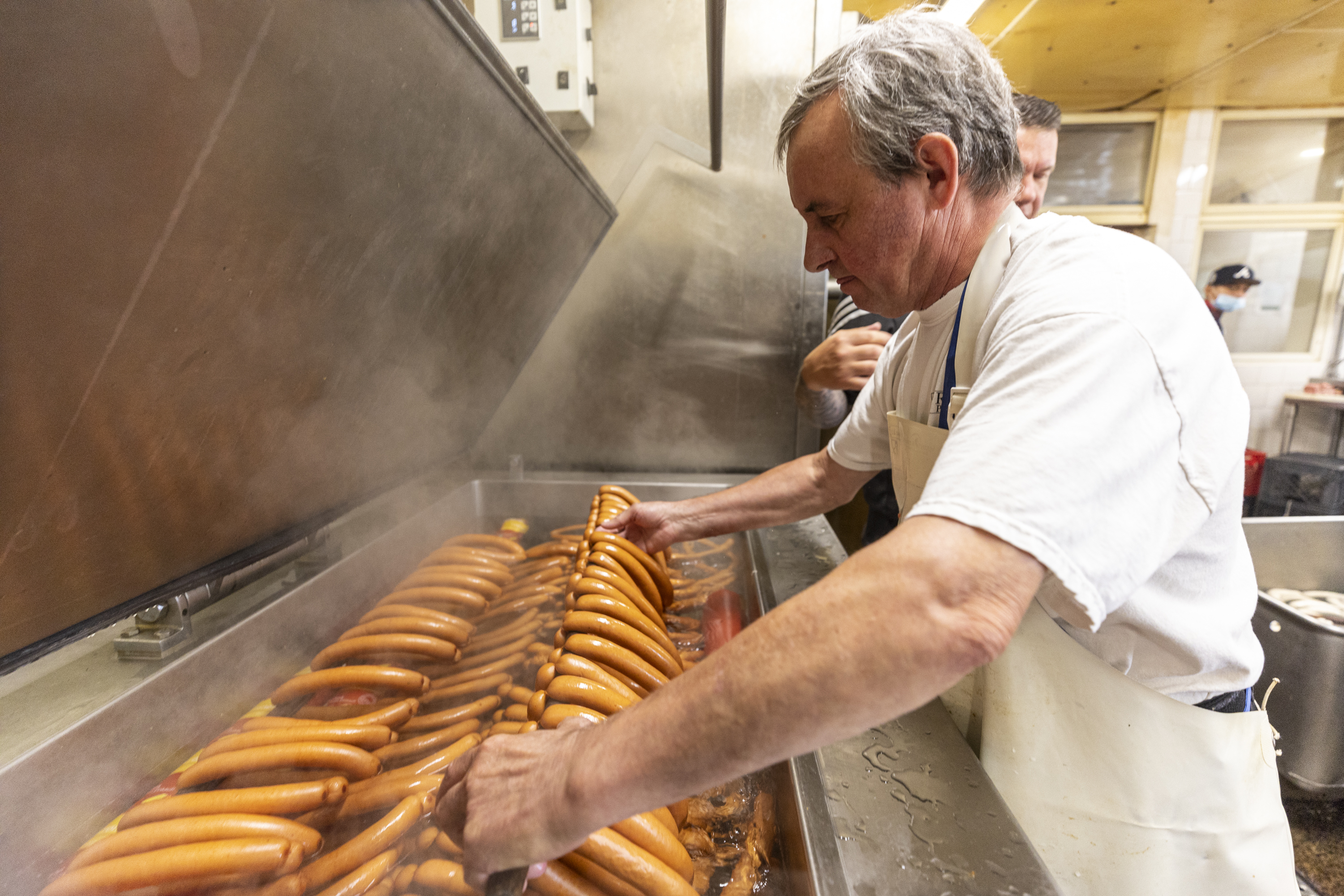
Don’t go to this 54-year-old Fox Chase institution expecting to walk out with a griddled hot dog on a bun. Rieker’s is a market — “German-food wonderland” is probably more accurate — and, particularly, a sausage specialist. The traditional wieners here are handmade in the back, where the staff grinds bull meatwith a blend of beef trimmings, pork butt, granulated onion, paprika, and garlic powder, then makes long links that go into the smokehouse for a hickory-scented steam. You can buy the skinny, snappy wieners by the pound, along with well over a dozen other sausage varieties, plus German potato salad, dried egg noodles, and much more. — J.L.
Alex Naumenko, a sausage maker, pulls wieners from a water bath at Rieker’s Meats in Philadelphia, on July 16, 2024.Tyger Williams / Staff Photographer
Second Daughter
Is there an ordinary treat that Rhonda Saltzman can’t transform into a work of art? The creative genius behind Second Daughter bakes all-beef Nathan’s dogs in ultra-flaky, sesame-seeded croissant shells that give faint crunch to each savory bite. The Second Daughter crew tops the dogs with ketchup and spicy brown mustard squiggles and house-made pickle chips for tangy contrast. The only drawback: The dogs are so popular at both the fourth-floor Bok Building bakery and its Rittenhouse Farmers’ Market stand, they’ve been selling out around noon. On the bright side, Saltzman says they’re not going anywhere, even after summer ends. (Look out for specials like a sloppy joe dog and a baked bean-topped dog.) — J.L.
Essington native and Starr Restaurants alum Mark Gears runs a bustling breakfast and lunch takeout trade from this Kensington corner store, which has some bodega trappings, too. Need paper towels, dish soap, sugar, and spaghetti sauce? Gears has it. That pragmatic mindset led him to add hot dogs to his menu when he opened the shop in October. “Preopening, I went to Cacia’s [Bakery] to talk bread and saw these beautiful little fresh hot dog rolls. Said, how the hell can’t that be tasty,” Gears said. Smalls’ plump griddled all-beef hot dog, served on buns delivered fresh daily, will cost you less than a fiver, but it’s well worth springing for caramelized onions, roasted long hots, and crispy bacon toppings. — J.L.
A loaded hot dog (with roasted long hots, cheddar, bacon, spicy brown mustard, and caramelized onions) at Smalls’ Provisions in Kensington.Jenn Ladd / Staff
Sonnys Cocktail Joint
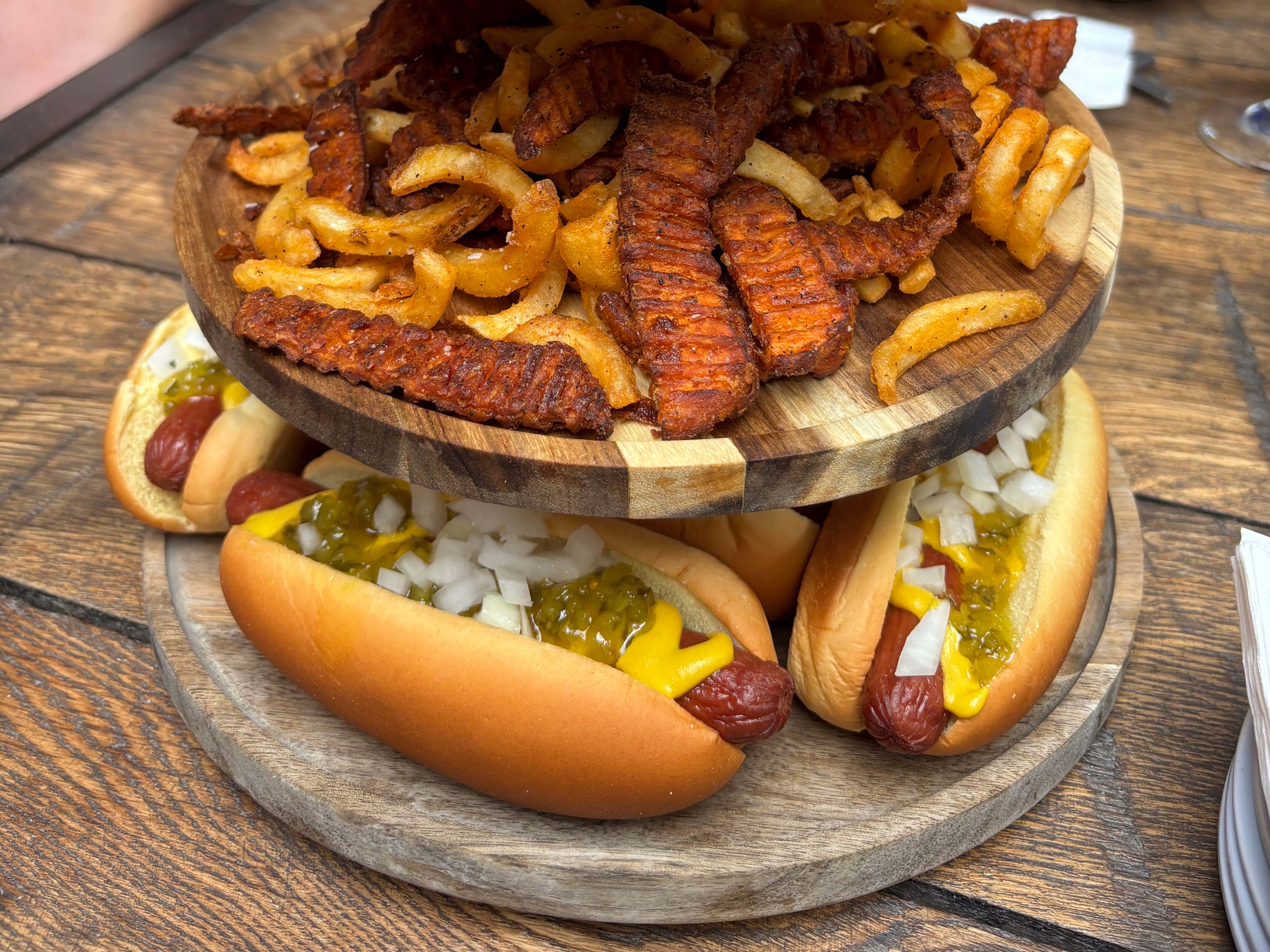
A single hot dog isn’t ideal for sharing. But at Sonnys Cocktail Joint, they’ve solved that particular issue with a hot dog tower, an inspired play on the seafood tower, that replaces oysters and shrimp with hot dogs, french fries (regular and sweet potato), and a top tier filled with little cups of ketchup, ranch, and a peperoncini aioli. A small tower comes with six hot dogs, a large fits 12. The hot dogs aren’t anything fancy — a standard-issue wiener with an array of condiments — but the format is whimsical, and it’s a perfect accompaniment for a couple of cocktails. — M.E.
It’s just about last call for roster hopefuls as Eagles training camp enters its final week.
The team plays its last preseason game Friday night at home vs. Cincinnati, and the initial 53-man roster is due Sunday by 6 p.m.
Only a few practices and one last audition separate those vying for a spot from knowing their fates.
A second preseason game — this one a 24-21 Eagles loss in New England — brought a few changes to our latest 53-man roster projection. Who’s in, and who’s out?
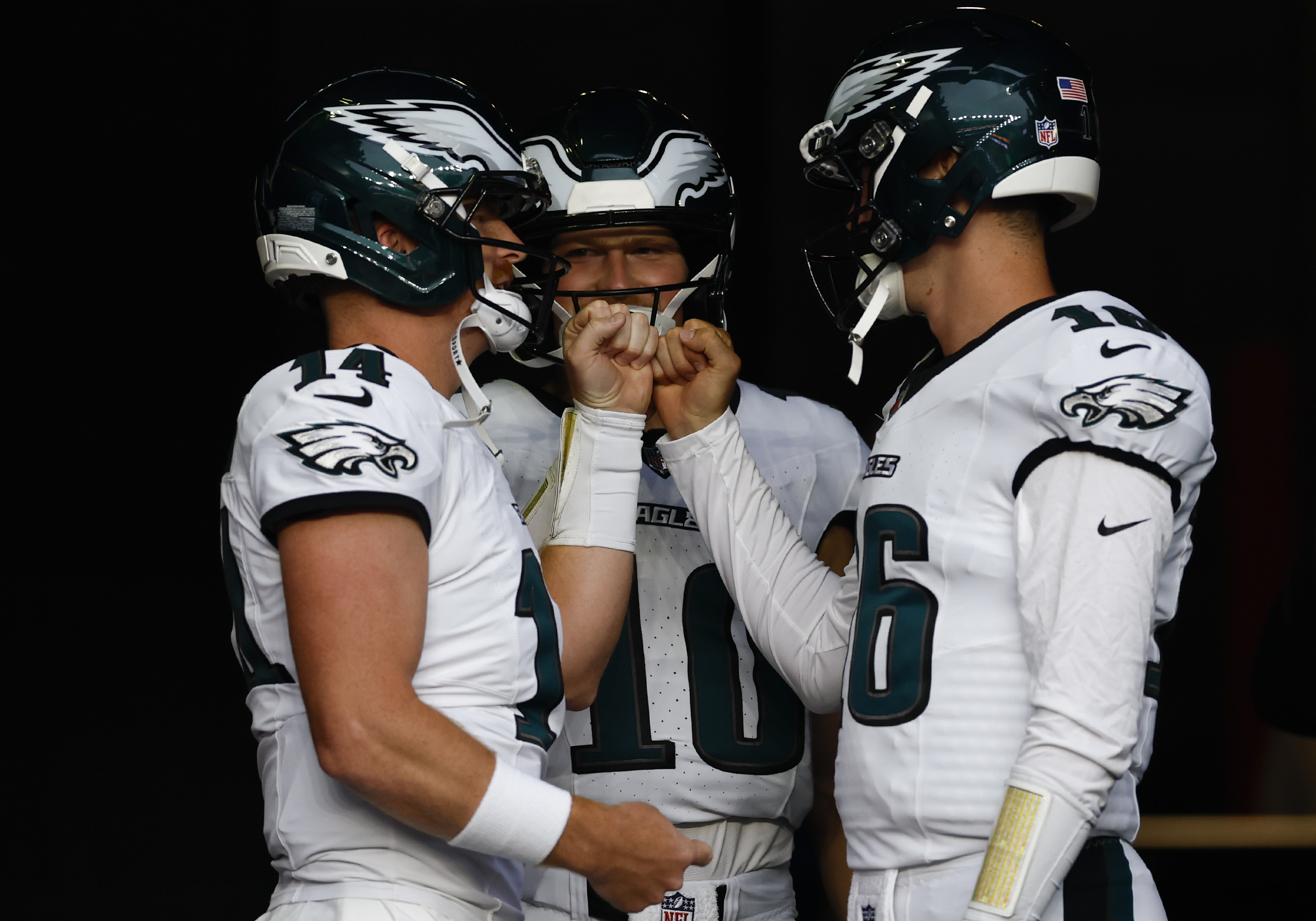
Eagles quarterbacks (from left to right): Andy Dalton, Cole Payton and Tanner McKee prepare for Saturday’s preseason game against the New England Patriots. We don’t expect all three to be on the Eagles roster by next week.Yong Kim / Staff Photographer
We’re sticking with the idea that one of the two quarterbacks hunting for the No. 2 job eventually will be traded, but for the first time this summer, Tanner McKee is in and Andy Dalton is out.
McKee outperformed Dalton Saturday night in New England, and while the Eagles certainly value Dalton’s experience and his practice film much more than two shaky, shortened preseason starts, it’s hard to argue that the 38-year-old looks more viable to back up Hurts than McKee does right now.
That being said, it actually might be Dalton who has more trade value than McKee. Will the Eagles end up flipping Dalton for the same price they paid for him (a seventh-round pick)? Maybe. This time of year, a team looking for a backup may be more likely to want Dalton as an experienced starter who may even mentor a young quarterback than they are to need McKee.
Cole Payton hasn’t wowed, and it remains possible the Eagles keep both Dalton and McKee and cut Payton, their fifth-round pick. But for now, Payton gets the roster spot and doesn’t get exposed to waivers.
Eagles running back Will Shipley carried the ball 11 times for 56 yards against the Patriots. We expect him to make the team’s initial roster.Yong Kim / Staff Photographer
Running backs (3): Saquon Barkley, Tank Bigsby, Will Shipley
Cut: Dameon Pierce, Carson Steele, Ja’Quinden Jackson
No changes here, despite Carson Steele going full Saquon Barkley and hurdling defenders on more than one occasion Saturday night. Steele played like a guy pushing for a roster spot, but the Eagles don’t have the luxury of keeping four running backs with the way their roster is shaped.
Eagles wide receiver Elijah Moore is on the roster bubble.Jose F. Moreno / Staff Photographer
Wide receivers (6): DeVonta Smith, Dontayvion Wicks, Makai Lemon, Darius Cooper, Hollywood Brown, Elijah Moore
Cut: Danny Gray, Britain Covey, Quez Watkins, Erik Ezukanma, Samori Toure, Brandon Hayes
Could Elijah Moore get cut and come back on the practice squad with the promise to be elevated on game day? It’s possible. He’s a vested veteran and doesn’t need to pass through waivers (though he’d be free to sign with any team). But Moore has done enough to make the roster and should be rewarded for having a better camp than Hollywood Brown, the guy the Eagles gave $5 million guaranteed.
Perhaps the Eagles use one of the two as a trade chip in the final week of camp, but they may want some extra insurance at the position considering Makai Lemon’s first NFL training camp has been marred by a hamstring injury.
The Eagles selected tight end Eli Stowers in the second round of April’s NFL draft.Yong Kim / Staff Photographer
Tight ends (3): Dallas Goedert, Johnny Mundt, Eli Stowers
Cut: Cameron Latu, Grant Calcaterra, Stone Smartt, E.J. Jenkins
Cameron Latu is the roster casualty of the Eagles keeping Moore. Latu would need to pass through waivers, but he’s done so before, and the Eagles shouldn’t have trouble getting him through to the practice squad and elevating him for Week 1.
Eli Stowers has had a rocky camp, but the second-round pick isn’t going anywhere. His need for more seasoning, though, makes it pretty important to have a strong fourth option in the building. That could work in Latu’s favor come Sunday evening.
Offensive lineman Tyler Steen, left, is pretty much a lock to return, but Micah Morris’ fate could be determined in the coming week.Jose F. Moreno / Staff Photographer
Offensive line (10): Jordan Mailata, Landon Dickerson, Cam Jurgens, Tyler Steen, Lane Johnson, Fred Johnson, Markel Bell, Drew Kendall, Willie Lampkin, Micah Morris
Cut: Jake Majors, Michael Jordan, John Ojukwu, Myles Hinton, Cameron Williams, Zeke Correll
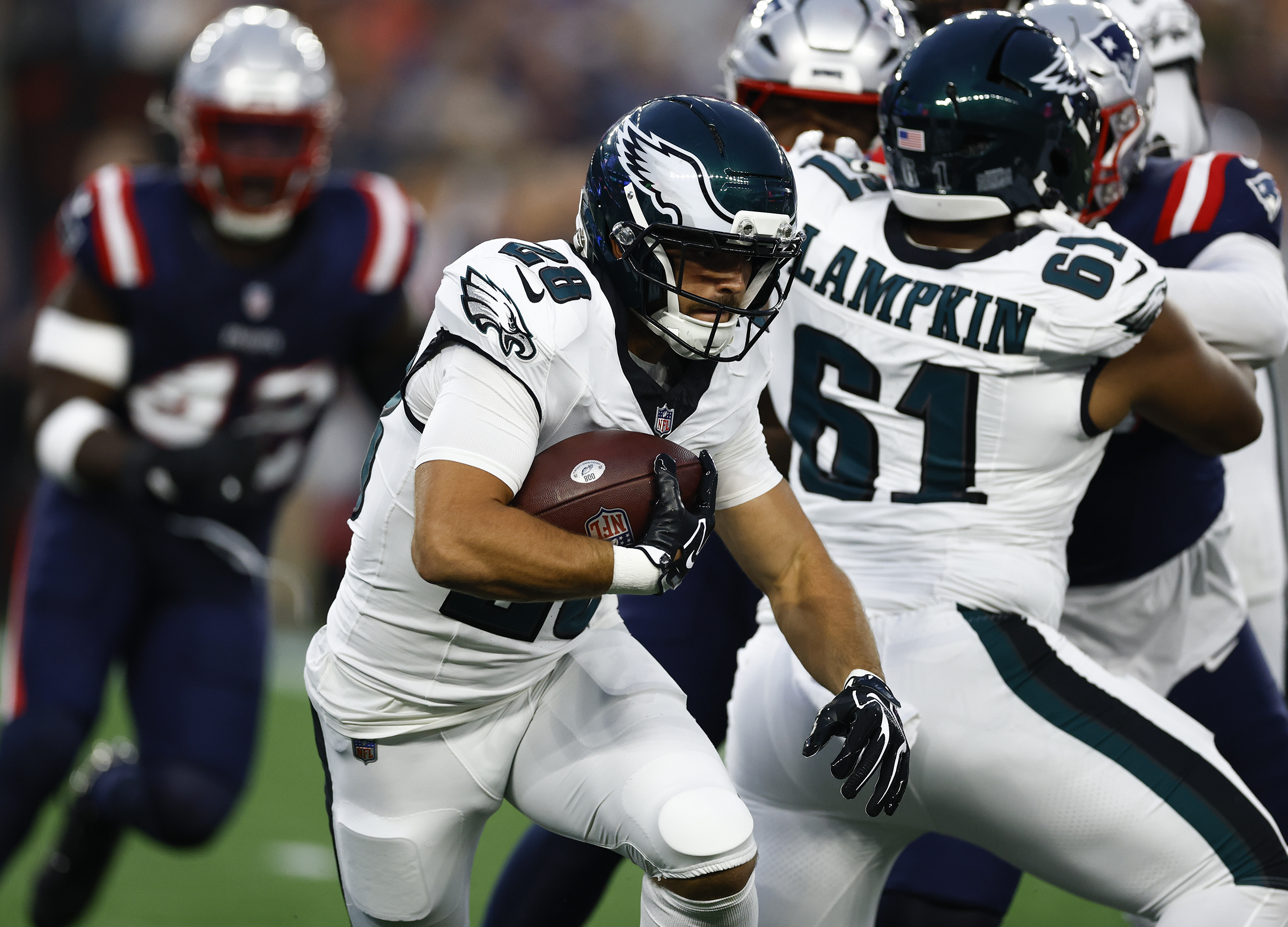
Willie Lampkin’s spot on the 53-man roster might be a lock at this point. The center/guard had another strong performance Saturday. Micah Morris, meanwhile, has shown some athletic traits that should keep the sixth-round pick on the initial roster.
Jake Majors played the entire game Saturday (63 snaps) and had some good moments. Like Lampkin and Drew Kendall, he has the ability to play center and guard. But Morris beats out the 2025 undrafted free agent who landed on the Eagles’ practice squad after training camp last year.
Eagles defensive tackle Ty Robinson had a pair of sacks in Saturday’s preseason game against the Patriots.Yong Kim / Staff Photographer
Defensive tackles (6): Jalen Carter, Jordan Davis, Moro Ojomo, Byron Young, Ty Robinson, Uar Bernard
Cut: Gabe Hall, Zion Wilson, David Blay
No changes here other than Ty Robinson pulling himself off life support (Vic Fangio’s words) and pretty much locking up his roster spot.
The 2025 fourth-round pick had two sacks Saturday and has had a strong last two weeks after working with the developmental group at the beginning of camp.
Uar Bernard played in his second football game Saturday and notched his first tackle. He’s improved throughout his first football camp, and it remains a risk for the Eagles to expose him to waivers even though he won’t play meaningful snaps this season.
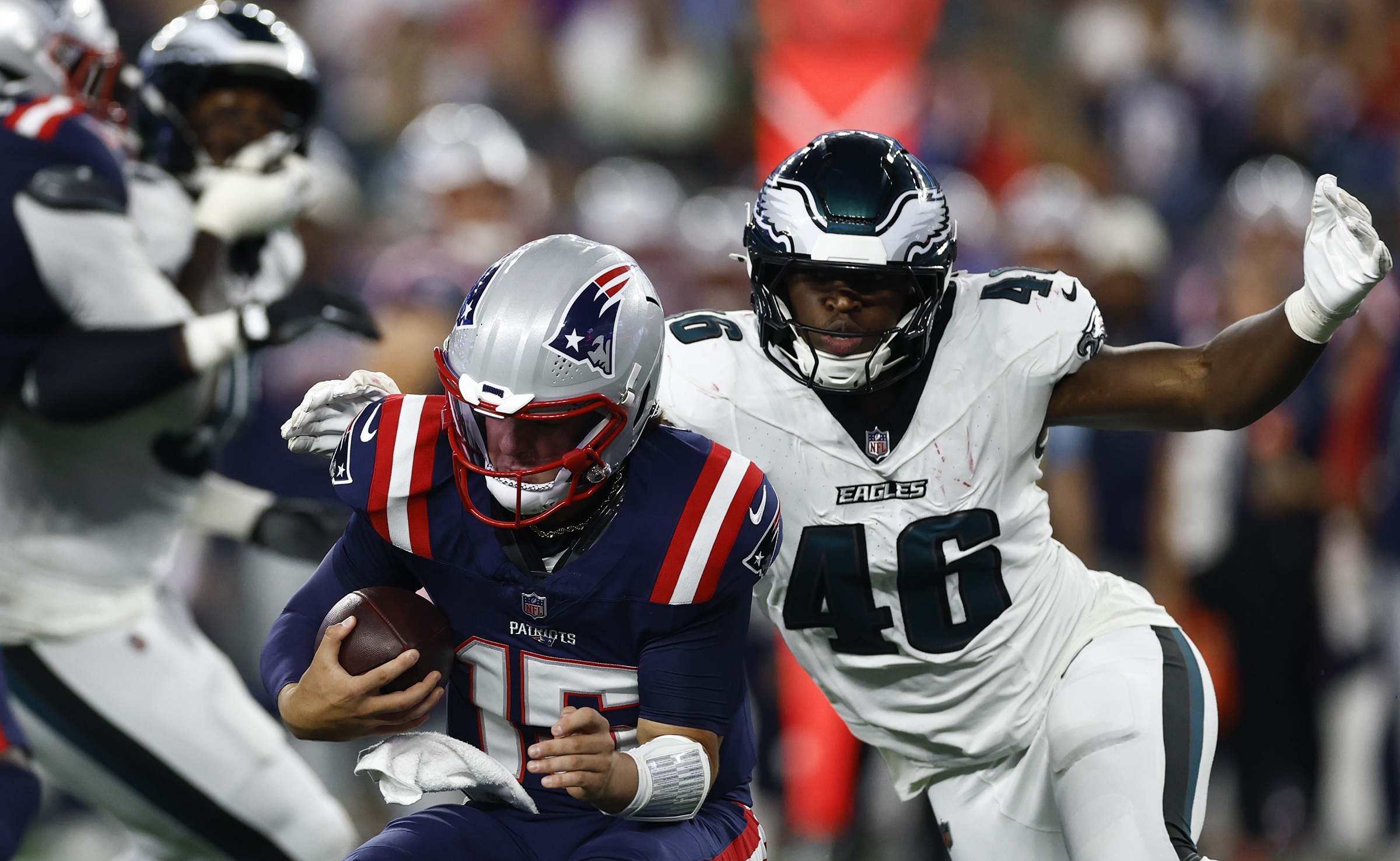
Eagles linebacker Joshua Weru got his first sack against New England Patriots quarterback Behren Morton Saturday night.Yong Kim / Staff Photographer
Edge rushers (6): Jonathan Greenard, Jalyx Hunt, Nolan Smith, Arnold Ebiketie, A.J. Epenesa, Joshua Weru
Cut: Tarron Jackson, Keyshawn James-Newby, Jose Ramirez
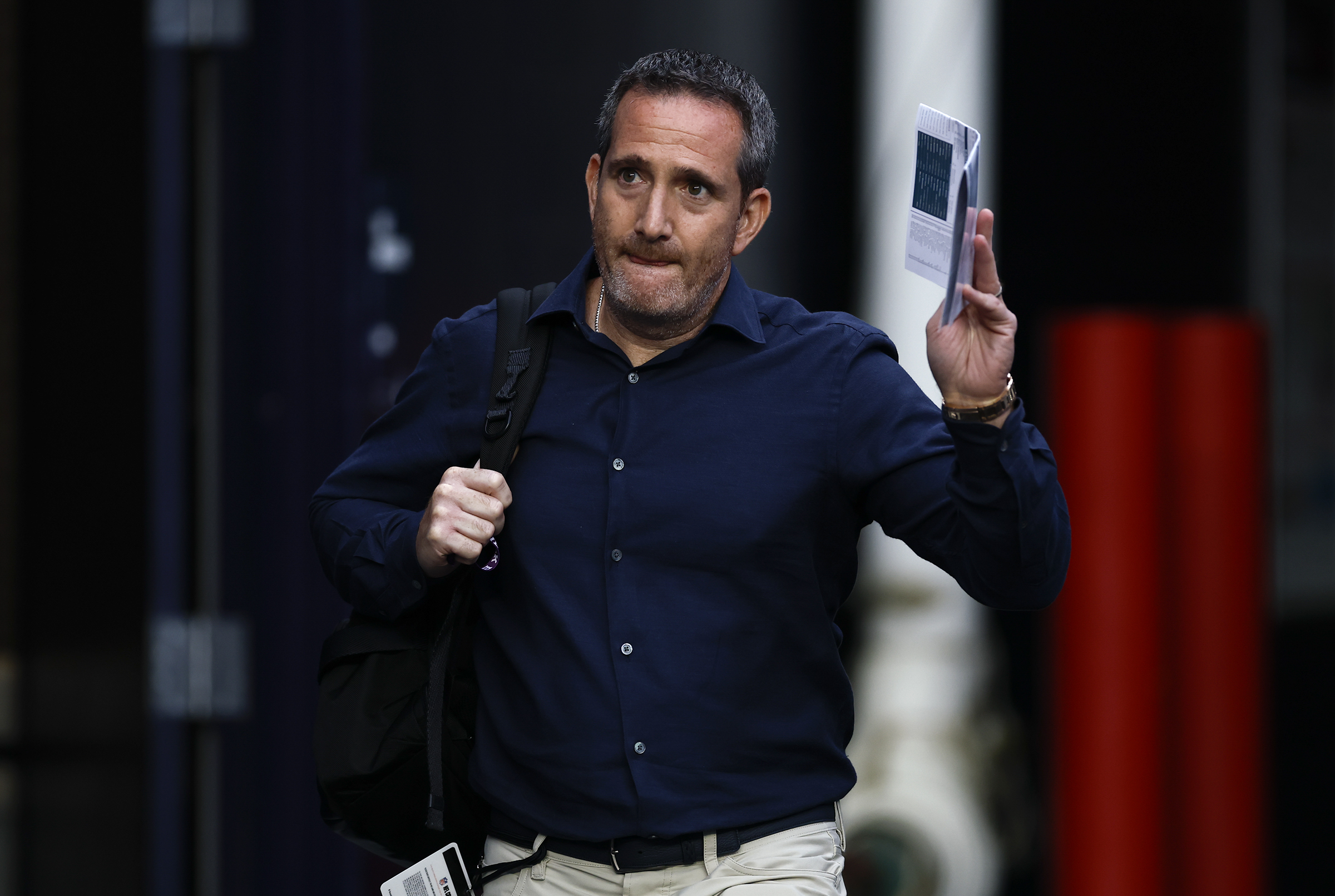
The decision on Joshua Weru will be a fascinating one for Howie Roseman next weekend. The former rugby player one-upped his padded football debut last weekend, when he had a quarterback hit, with his first sack during Saturday’s game. He’s a flashy athlete, and there may be enough on tape out there for one of the 31 other NFL teams to make him their own project and sign him to their 53-man roster if the Eagles decide to cut him.
Fangio expressed some concern Jonathan Greenard might not be ready to return from his pectoral injury for Week 1, though that’s still three weeks away.
Eagles linebacker Jeremiah Trotter Jr. could be a starter on several NFL teams. Will that make him attractive in a potential trade?Yong Kim / Staff Photographer
Cut: Chance Campbell, Deontae Lawson, Brandon George
The Eagles have an abundance of talent here. It’s probably a toss-up between off-ball linebacker and interior defensive line in terms of which position group is their best.
The top four are locks, though Fangio likes Chance Campbell a lot. Still, as we’ve written before during this exercise, the need for a fifth linebacker given this roster construction makes it hard to keep the former Titan.
Could Roseman pull off a trade to make room for him? Smael Mondon Jr. has looked capable, and Jeremiah Trotter Jr. could start on some teams.
Another spot with no changes, though there was more pause before typing Mac McWilliams over Kelee Ringo than last week. Ringo had a decent showing on the road trip to New England, while McWilliams hasn’t had the best couple of weeks.
Ringo’s value on special teams has been well-documented, but is it worth a roster spot? We’ll see.
We have Eagles safety Cole Wisniewski (bottom) making the roster, but that could change this week.Yong Kim / Staff Photographer
Safeties (4): Drew Mukuba, Marcus Epps, Michael Carter II, Cole Wisniewski
Cut: Kapena Gushiken, Andre Sam, J.T. Gray, Max Pulley
The fourth spot here still feels like a bit of a dart throw. Cole Wisniewski returned to the practice field and saw his first game action. He had a nice tackle on special teams, which he’ll need to make a big part of his game if he’s on the roster.
Kapena Gushiken and Max Pulley have had nice camps, Andre’ Sam has been around the team for the last few seasons, and J.T. Gray is an elite special teamer. You can make a worthy argument for any of them to get the fourth spot.
But it’s possible the Eagles go light here and go with three safeties, especially with Cooper DeJean playing on the back end in the base package. That route probably would be good news for Ringo.
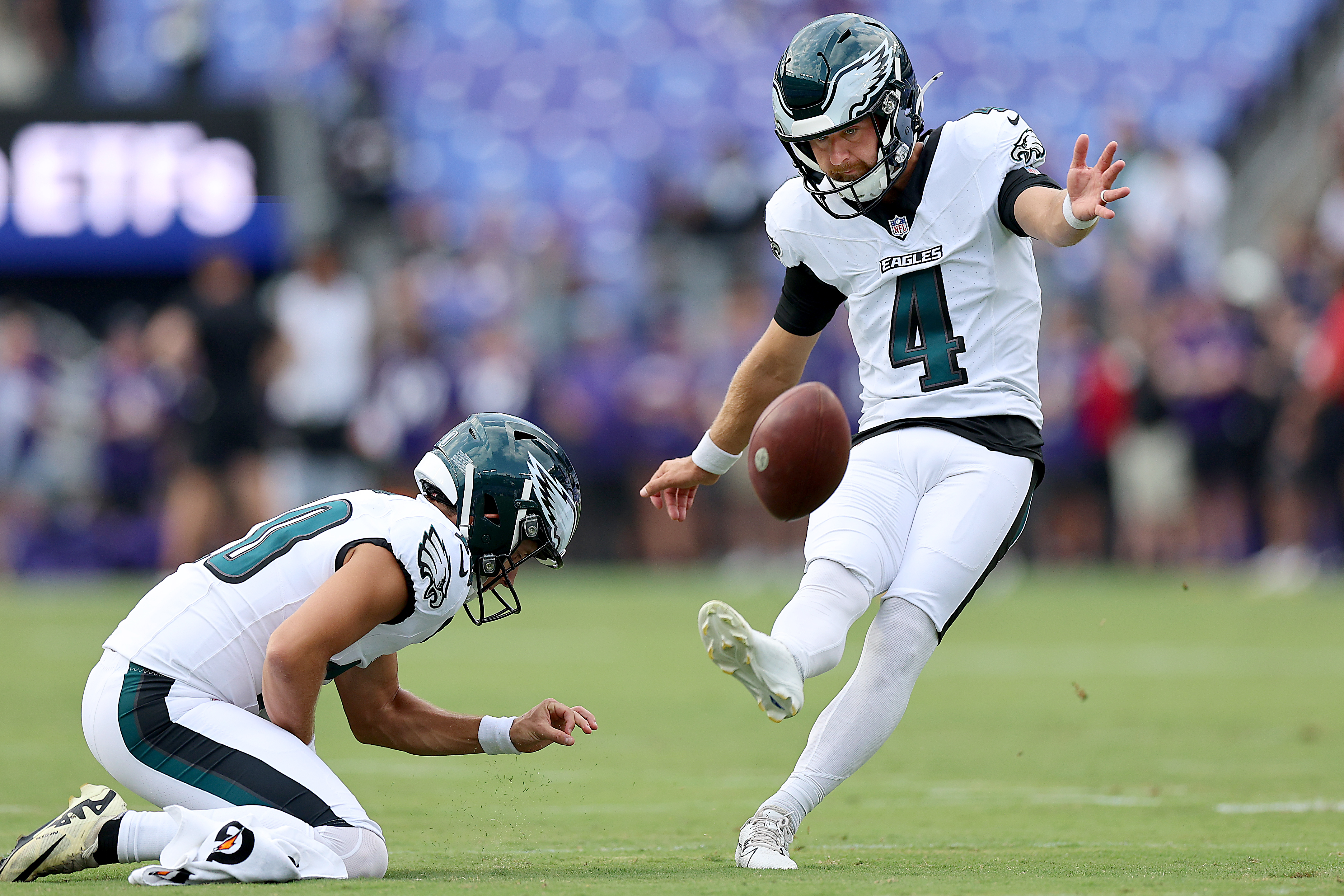
Philadelphia Eagles place kicker Jake Elliott (right) and punter Braden Mann (left) are locks.David Maialetti / Staff Photographer
Special teams (3): Jake Elliott (kicker), Braden Mann (punter), Rocco Underwood (long snapper)
These are the only three specialists on the roster. It’s possible the Eagles punt — excuse the pun — on a bubble decision and cut Rocco Underwood. The team only kept Jake Elliott and Braden Mann on the initial 53-man roster last season before bringing Charley Hughlett back to the active roster a day later during a series of roster moves after initial cuts were made around the league.
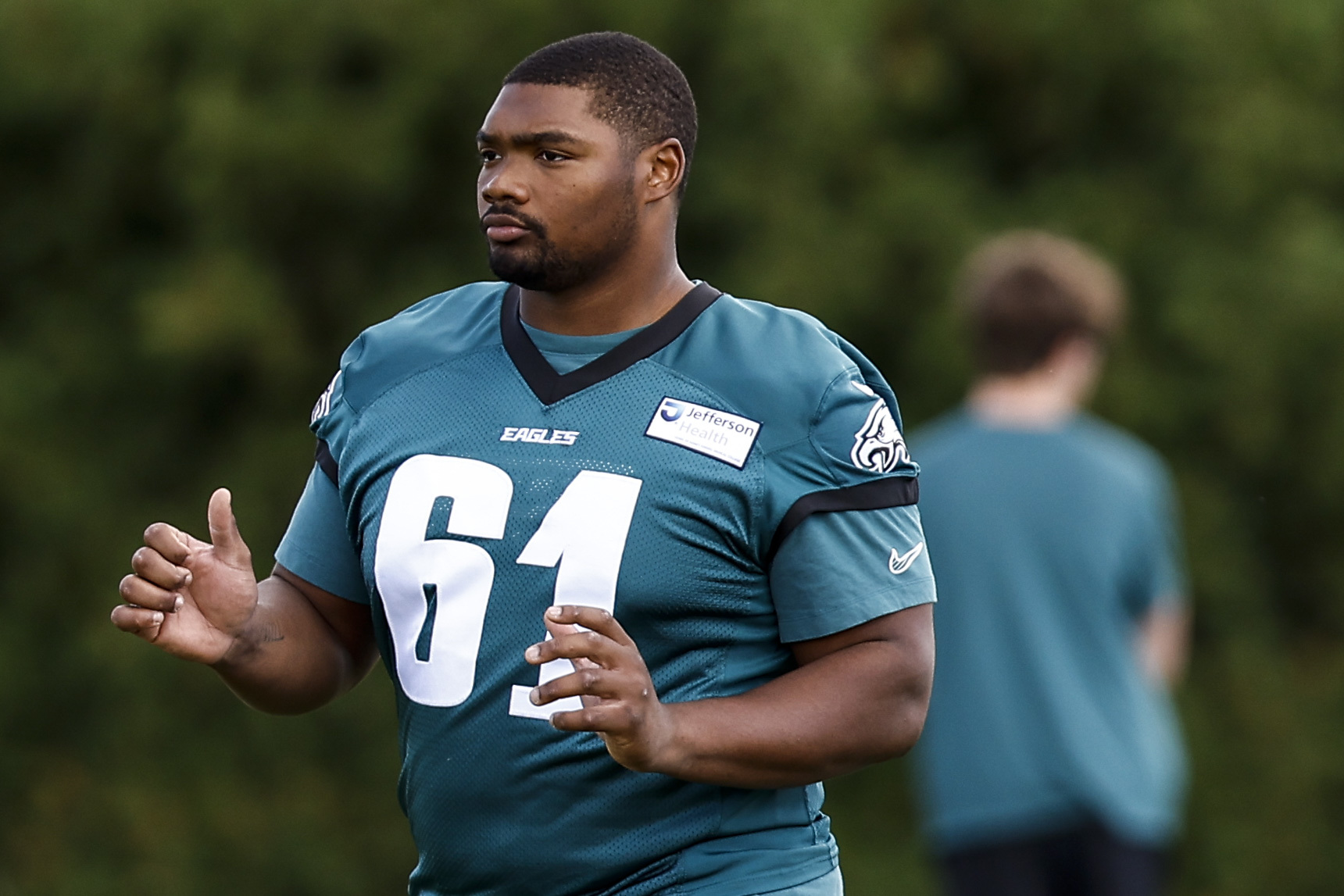
Five plays into the Eagles’ preseason opener against the Baltimore Ravens, Willie Lampkin introduced Ravens defensive tackle Broderick Washington’s backside to the grass — and, in turn, re-introduced himself to the NFL.
Lampkin, 24, had been hidden in plain sight for the past year. The Eagles claimed him off waivers at the end of camp from the Los Angeles Rams, who cut the 2025 undrafted free agent out of North Carolina with an injury designation due to knee and ankle injuries he suffered in their second preseason game. Two days later, the Eagles placed Lampkin on injured reserve for the remainder of the season.
The 5-foot-11, 290-pound interior offensive lineman returned to game action for the first time in 364 days like a wrecking ball, and Broderick was his first victim.
After snapping the ball at center, Lampkin quickly latched on to the 6-2, 315-pound defensive tackle and blocked him 10 yards downfield in pass protection before disposing of him into a pile of bodies.
Later at right guard, he sealed off 6-foot, 300-pound Aeneas Peebles on a Tank Bigsby run, taking him for a ride five yards downfield until the whistle before patting him on the helmet. That love between whistles never lasts longs, as his Eagles teammates know. Lampkin’s preseason excellence, which continued Saturday night against the New England Patriots, has been an extension of the effort they’ve witnessed in training camp this summer.
“I call him a bowling ball of knives, ’cause he’s so short, he’s so small, he’s so stubby, but he is so quick and powerful and precise with his hands that for a taller guy like me, it gives me a lot of trouble,” Jordan Davis said. “It gives me a lot of fits. That’s one of the things that keeps me up at night with Willie.
“He has a certain tenacity about him when he goes and plays a game.”
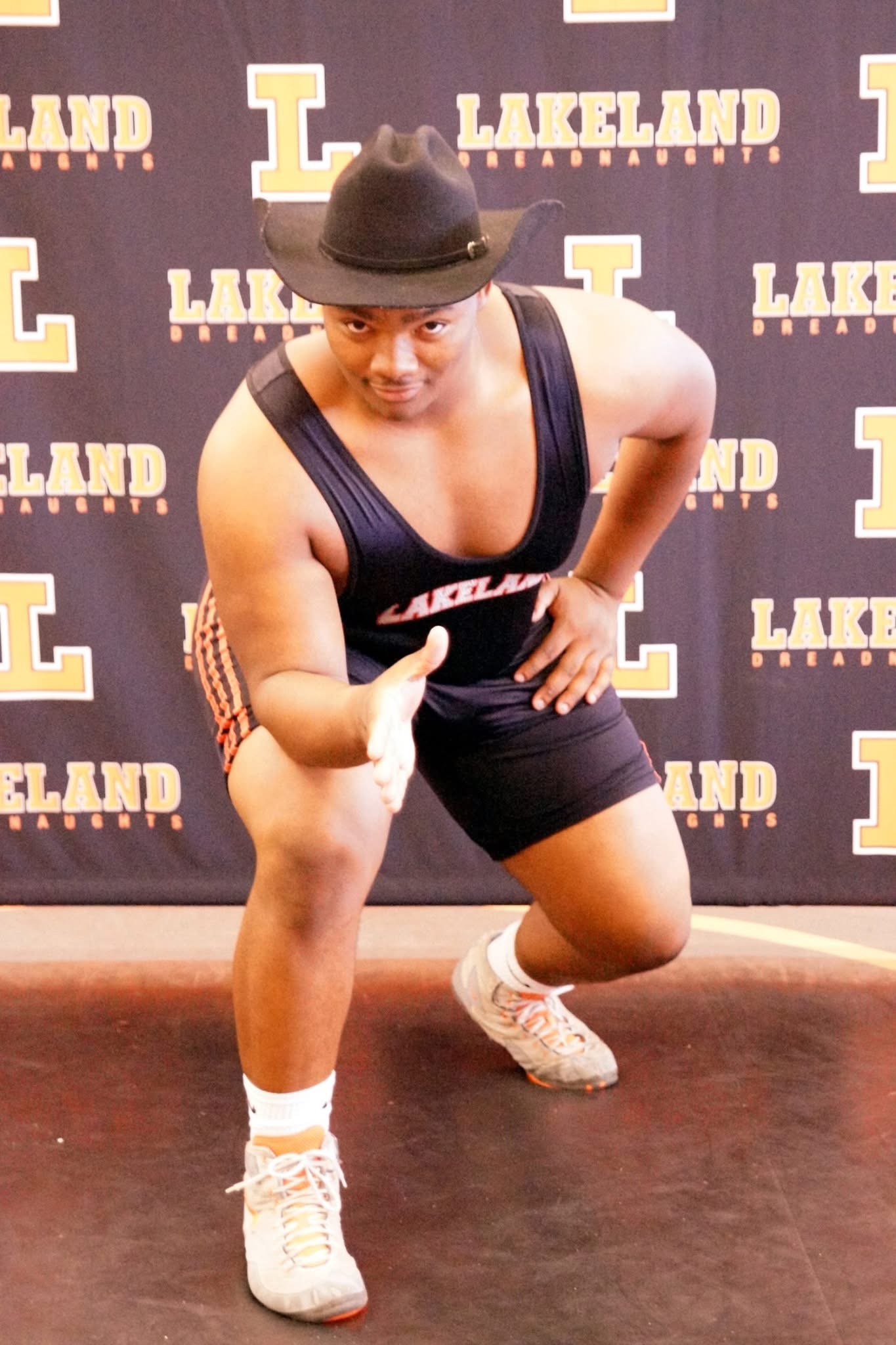
That tenacity, according to Lampkin, is rooted in his wrestling background.
Willie Lampkin was a star wrestler at Lakeland High School in Florida.Courtesy of Winston Phan
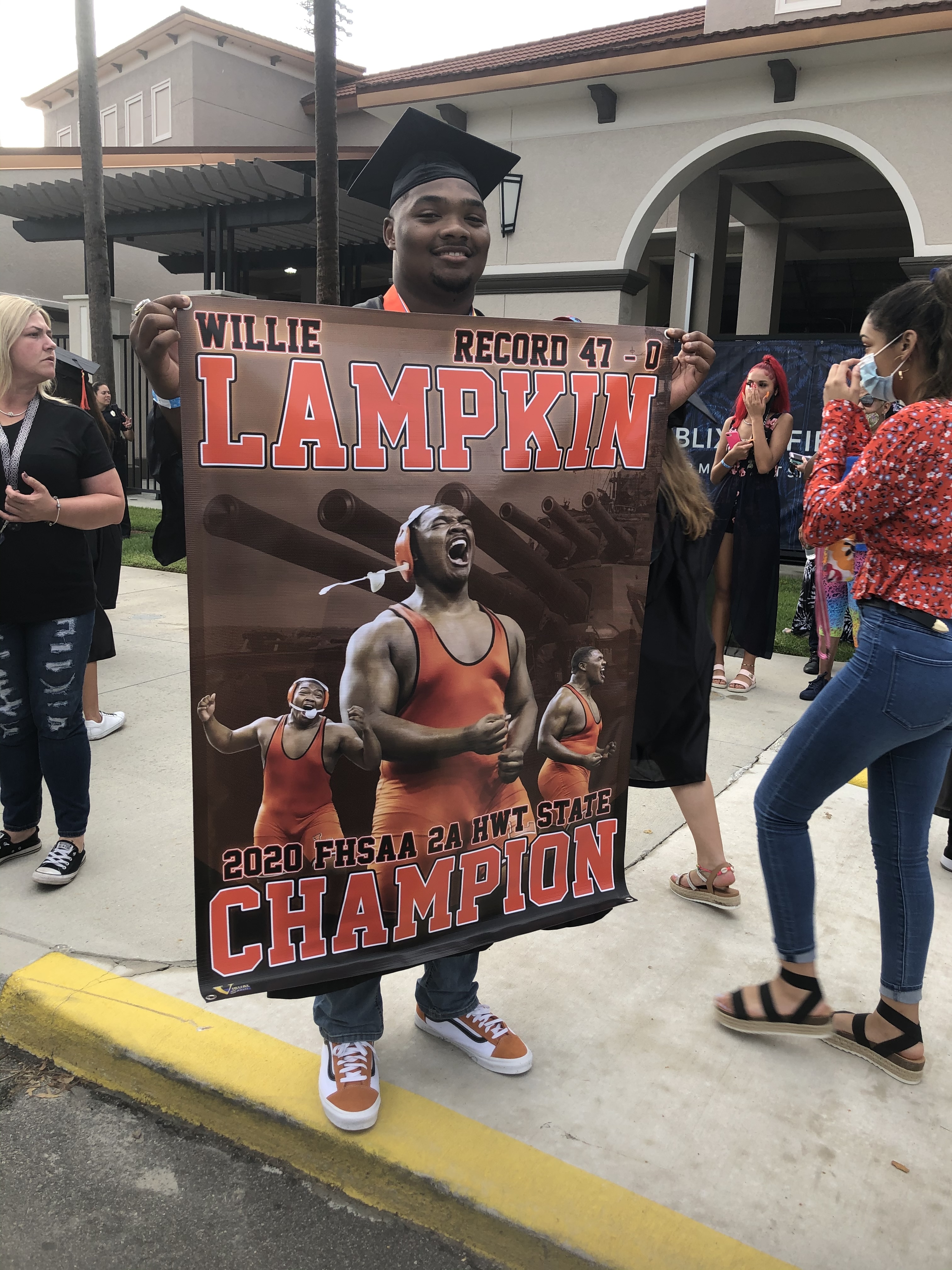
Lampkin began wrestling as a freshman at Mulberry High School in Mulberry, Fla., a city in central Florida with a population of roughly 4,000. Within three years, he was the state tournament runner-up at heavyweight, and within four, he was a champion.
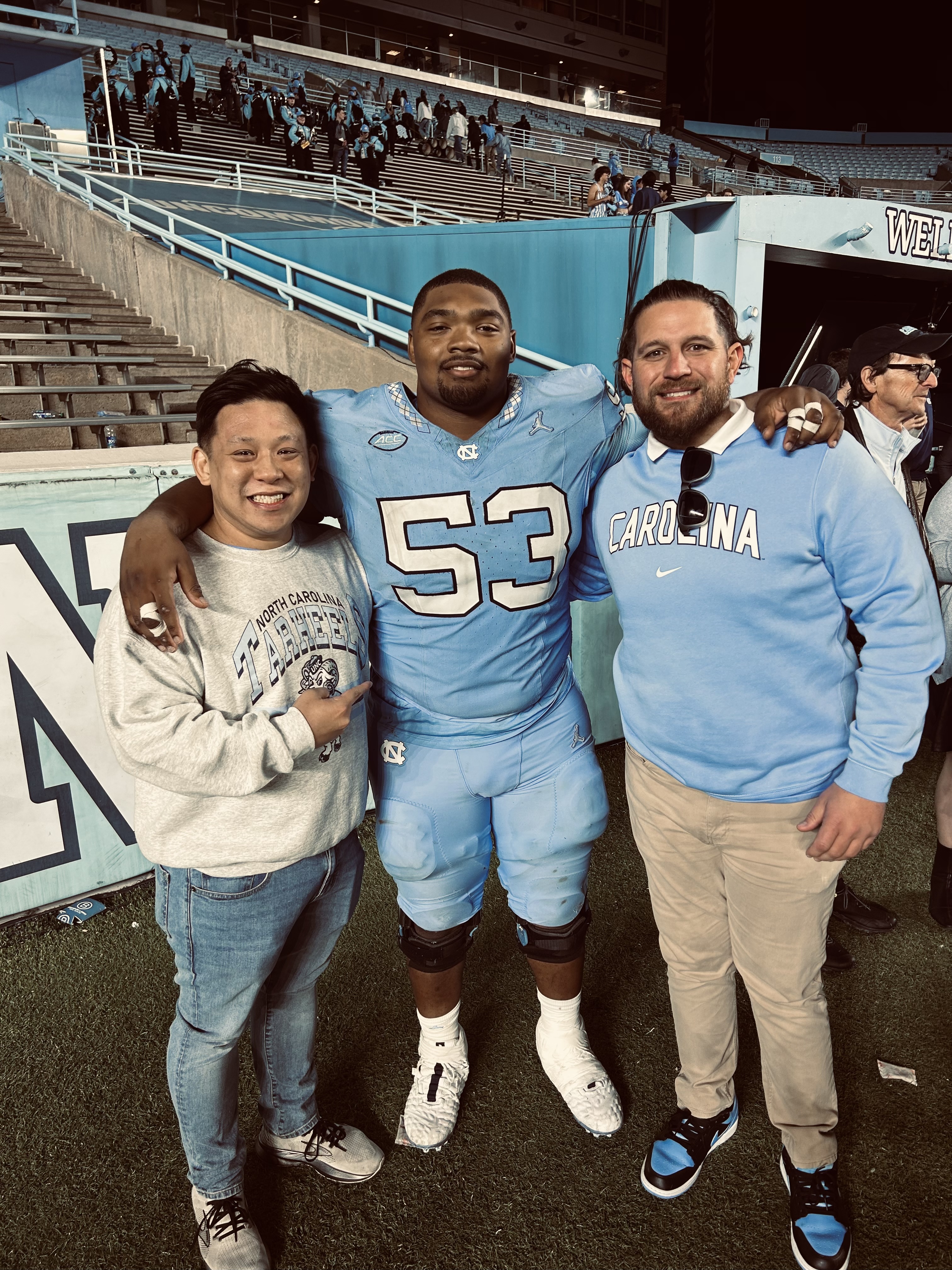
He ultimately chose to pursue football over wrestling in college, playing three seasons at Coastal Carolina and two at UNC before moving on to the NFL as an undrafted free agent. But as he vies for a depth spot on the Eagles’ initial 53-man roster as an undersized, undrafted interior offensive lineman, Lampkin continues to channel the mentality and the skill set he cultivated through wrestling.
“I feel like wrestling just helped me to be more gritty and just try to get after everybody,” Lampkin said.
Wrestlers the ‘ultimate combatants to deal with misery’
Former Mulberry wrestling coach Anthony Cerullo learned about Lampkin from Kyle Jones, one of the assistant football coaches at the school. Jones, who once wrestled for Cerullo in addition to playing football, wanted Lampkin to start wrestling, too.
Cerullo also played both sports. He understood that wrestling taught its athletes about balance, hand usage, and body positioning — all of the fundamentals that apply to sound play in the trenches.
He figured that Lampkin, a varsity starter on the offensive line as a freshman, was a 6-5 “behemoth” who grew faster than his peers. When he met him in line at the concession stand at a junior varsity football game, he quickly learned he was mistaken.
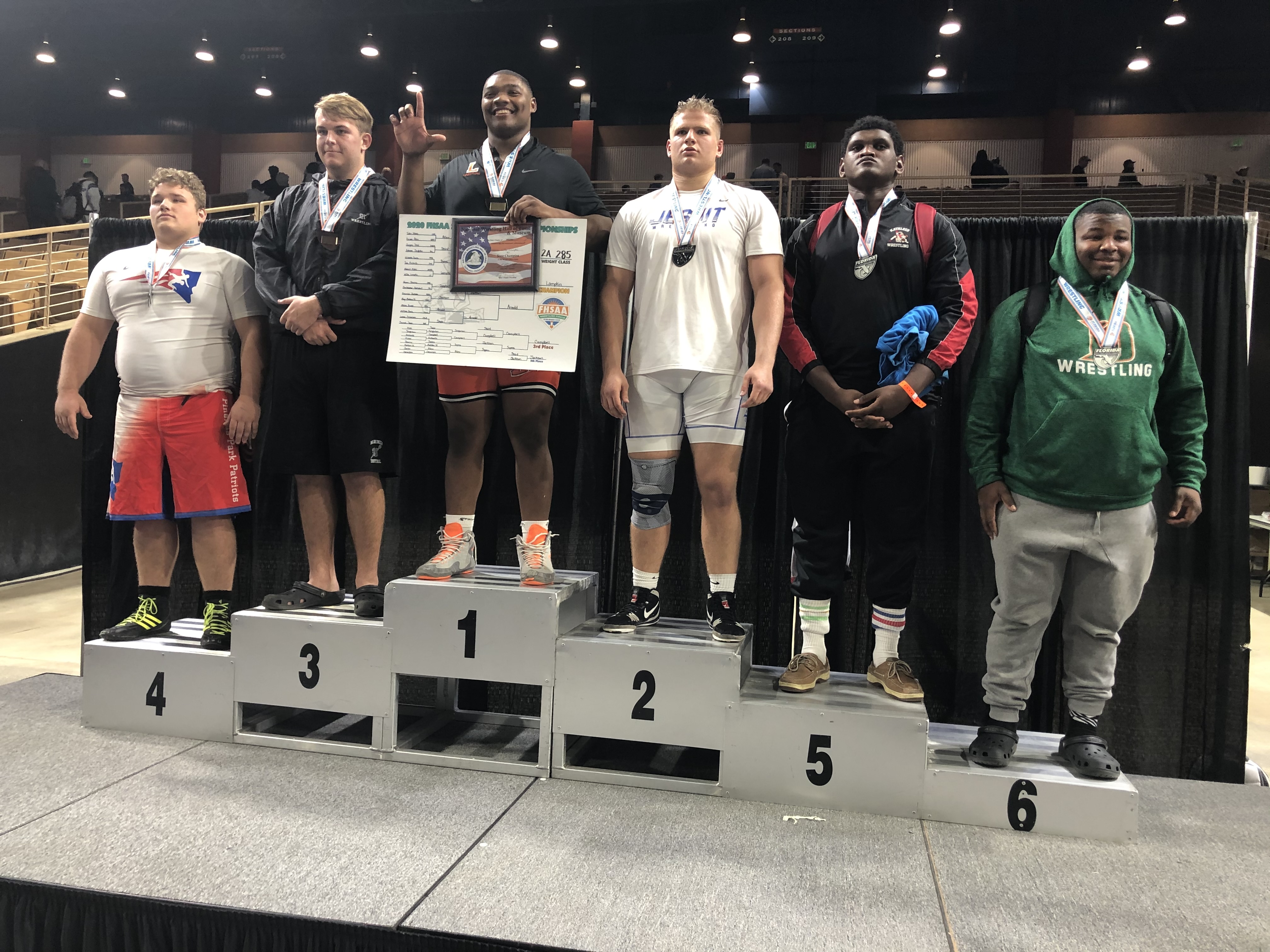
Willie Lampkin stands atop the podium after winning the 2020 2A state wrestling championship as a heavyweight.Courtesy of Winston Phan
He still made his recruiting pitch.
“Coach Jones says you’re going to be on the wrestling team, and I’m the wrestling coach,” Cerullo said.
“Ah, I don’t know about that,” Lampkin said. “He hasn’t said anything to me about it.”
At the end of the football season, Lampkin had his exit interview with his coaches. Afterward, Cerullo grabbed Lampkin as he was leaving for the school bus. Wrestling season was already underway.
“Hey, the wrestling room is not on the bus,” Cerullo said.
Lampkin obliged and followed Cerullo, even though he wasn’t entirely sure why he was there. Early on, Lampkin said he stuck with wrestling because a few of his football teammates had also decided to try it out. Plus, he didn’t want to just go home at the end of the school day in the football offseason.
Cerullo had a plan for Lampkin. In addition to the fundamentals of wrestling that would translate to football, he said he knew the O-lineman would benefit from draining practice sessions on the mat in the long term.
“Wrestlers are the ultimate combatants to deal with misery, right?” Cerullo said. “So we have a saying as wrestlers called ‘embrace the grind.’ So that means that it’s going to suck, it’s going to be hot, it’s going to be sweaty, it’s going to be nasty. You have another person acrossfrom you for two-and-a-half hours a day that’s trying to kill you, and you have to embrace that lifestyle to be great.”
Willie Lampkin has brought wrestling principles to the Eagles practice field. Monica Herndon / Staff Photographer
Cerullo ensured that Lampkin got that work in by serving as his practice partner. He learned firsthand of Lampkin’s athleticism. Lampkin, a heavyweight at roughly 230 pounds as a freshman, wasn’t going to run a 4.4 40-yard dash or jump over a building. But Lampkin was ultra-competitive, which drove his desire for improvement as he figured out how to use his hands and his body to his advantage.
He hated giving up a takedown. He hated not getting an escape. He hated losing. After all, Cerullo said, one person holding another down against their will is something to be taken personally, and Lampkin took every win for his opponent as a slight.
At the beginning, wins in practice were hard for Lampkin to come by against Cerullo, who was 20 years his senior and approximately the same size. Lampkin would ask Cerullo to stay after practice every day to work on different sequences, takedowns, and escapes. Those requests were particularly prevalent if Lampkin didn’t get an escape during practice.
“So we sat there for an hour-and-a-half one practice, and me just breaking him down to his stomach and to his face until he finally exploded up and was able to get an escape,” Cerullo said. “And then to his credit, he’s like, ‘OK, I want to do it twice before I leave.’
“‘Like, Willie, I’ve got to go to work in the morning, buddy. I love you. I’ll see you tomorrow.’”
It took about three weeks for Lampkin to embrace wrestling and the pain that came with it, Cerullo said. Pain turned to pride when he began to win his matches. According to Cerullo, there is something euphoric about the referee grabbing the winning wrestler’s hand at the end of the match and raising it for everyone to see.
Willie Lampkin was unfamiliar with wrestling but embraced the grind it took to become a champion. Courtesy of Winston Phan
Lampkin chased that feeling. He won 50 matches as a freshman, but he was one win shy of qualifying for the state tournament. That shortcoming fueled his offseason development. For the first time, he was lifting with intention to improve at both wrestling and football. He worked in the wrestling room to sharpen his skills, especially his hands.
“Willie has very large hands, and he learned how to make an impact when he put them on you going into that sophomore year,” Cerullo said. “When he would grab you, he had intention behind it. Where before, he was kind of just placing them and being … I’d say a big baby about it to some degree. Not understanding how strong he was. Sophomore year, he definitely knew what to do with his hands and when he put them on you, he meant to put them on you.”
Cerullo estimates that Lampkin took him down his freshman year twice in practice. In the summer leading up to his sophomore year, Lampkin took Cerullo down four times in one practice.
“He started moving his feet much better,” Cerullo said. “I think that he understood some more of the nuances of wrestling and not to put himself in those negative positions.”
That year, Lampkin would qualify for the state tournament, but he was eliminated early after being pinned. He transferred from Mulberry to nearby Lakeland High School the following year, helping the football team win a state championship as a junior. But leaving Mulberry didn’t mean he was leaving wrestling behind.
After the football season, Lampkin would lose weight quickly as he got in wrestling shape. He may have been the biggest wrestler on his team, but according to Lakeland assistant wrestling coach Winston Phan, he was a relatively light heavyweight compared to his peers. That weight class can be very one-dimensional, Phan said.
“A lot of times, they fall on top of each other, and whoever lands on top wins, right?” said Phan, who is now the head coach of the program. “But what Willie had going for him was his technique and his ability to learn all [this] new stuff that we were able to give him and allow him to use in his matches.
“Because people will tell you he didn’t wrestle like a heavyweight. They said he wrestled like somebody that was 106 pounds the way he knew how to do moves and the way he knew how to control somebody on top.”
Lakeland wrestling coaches Winston Phan (left) and Michael Farley visited Willie Lampkin while he was playing college football at North Carolina in 2023.Courtesy of Winston Phan
Phan and the other coaches would teach Lampkin a little bit of everything, even moves that weren’t typically performed by heavyweights. Among them were leg attacks, Phan said. One of Lampkin’s favorite moves that he honed in practice was a single-leg sweep. He kept it in his back pocket until he reached the first-place match at the 2A state championship his senior year.
The prior year, Lampkin lost the state final in sudden-death overtime. He wouldn’t lose it twice. After he went 47-0 during the regular season, Lampkin faced Mason Arnold of Tampa Jesuit in the heavyweight state championship match. They were tied, 1-1, toward the end of the third period.
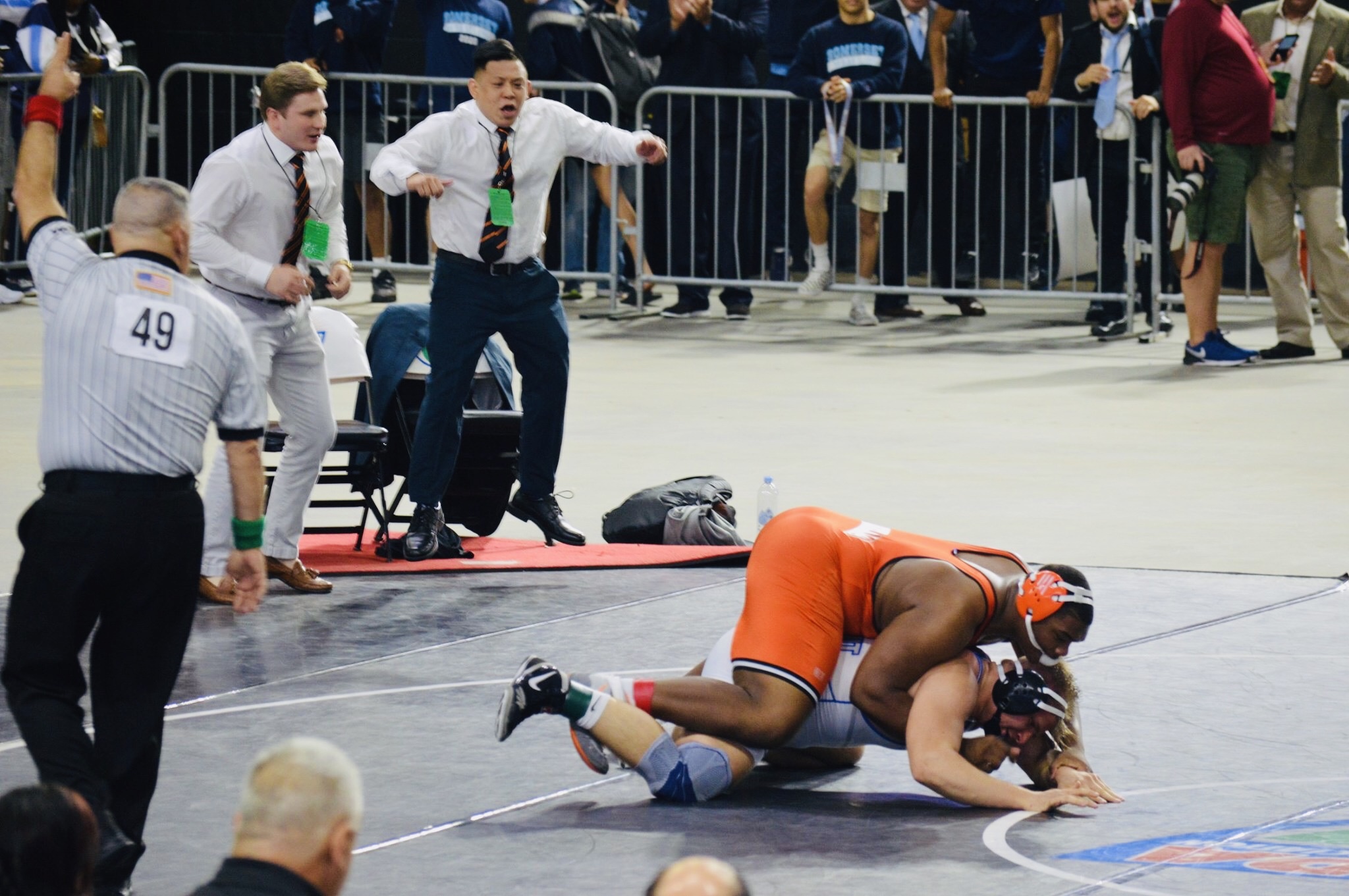
With 34 seconds remaining, Lampkin pulled out the single-leg sweep. Lampkin swung his body around his opponent’s leg, then flung him onto his back, switching off to a double leg to take him down and go up, 3-1. Lampkin rode Arnold out until time expired. He popped up, his headgear askew, and let out a roar before pouncing on top of Phan and assistant coach Chad Kirkman near the corner of the mat.
“It was like a potato jumping on a toothpick,” said Michael Farley, former Lakeland head wrestling coach.
That match marked the end of Lampkin’s wrestling career. His wrestling coaches still kept in touch with Lampkin as he continued on to college and attended his games when they could.
In some ways, the two sports couldn’t have been any different. Lampkin is one of 11 on the football field. In wrestling, he was alone against his opponent on the mat. A play in football lasts a matter of seconds within an hourslong game, while a wrestling match lasts at least six minutes over three periods. But whether Lampkin was wrestling or playing football, Phan saw the same athlete.
“He’s not doing anything differently,” Phan said. “They call the moves different things, but in the sense of it, the name of the game is manhandling your opponent, right? And he knows that that’s what his job is, and that’s what he’s looking to do every time he steps on the line, whether it’s on a wrestling mat or on the football field.”
Willie Lampkin took down Mason Arnold in the 2020 2A heavyweight state championship within the final seconds of the match to win.Courtesy of Winston Phan
In both sports, he used his relatively small size to his advantage. Both Cerullo and Phan said Lampkin’s best asset was his brain, as he was capable of understanding leverage and positioning. Combine that with fast feet in a small area of space on the gridiron, and Lampkin can get his leverage and change direction quickly to seal off bigger, taller defensive tackles.
He never lets up, either, whether he’s mustering a takedown in the waning seconds of the state title match or he’s blocking a defensive tackle into the next zip code through the whistle.
“It doesn’t matter who’s in front of him,” Phan said. “He’s ready to take their heads off and protect the quarterback and do what he has to do to be successful on the line.”
Farley had seen the headlines coming out of Eagles camp about Lampkin. Those labels about his size are nothing new.
“‘Five-11′ or ‘little secret weapon,’” Farley said. “But we know that for Willie, it’s real when the pads come on, and that’s when he can show his true value.”
After two standout preseason performances, the Eagles’ so-called little secret weapon might not be so secret any more.
Restaurateur Bruce Cooper is big on dates. He opened Jake’s in Manayunk on Oct. 19, 1987 — Black Monday, the day the stock market crashed.
He’ll close it on Oct. 19, 2026, the start of its 40th year on Main Street.
In between was another financial crisis, an expansion that reflected changing tastes, a devastating flood, a pandemic — and nearly four decades in which Jake’s evolved along with Manayunk itself.
Cooper, 72, is selling the side-by-side Main Street properties that house what is now Jake’s & Cooper’s Wine Bar. Before the final night, he plans to turn the wind-down into a reunion. Past employees will get a 50% discount on Sundays and Mondays, and the restaurant will extend its September restaurant week (Sept. 14-20) pricing through the final day. On Oct. 19, a party will empty the bar and kitchen, with proceeds going to a local charity.
“I just wanted to get to [the start of] 40 years,” said Cooper. “I wanted to get out two years ago.”
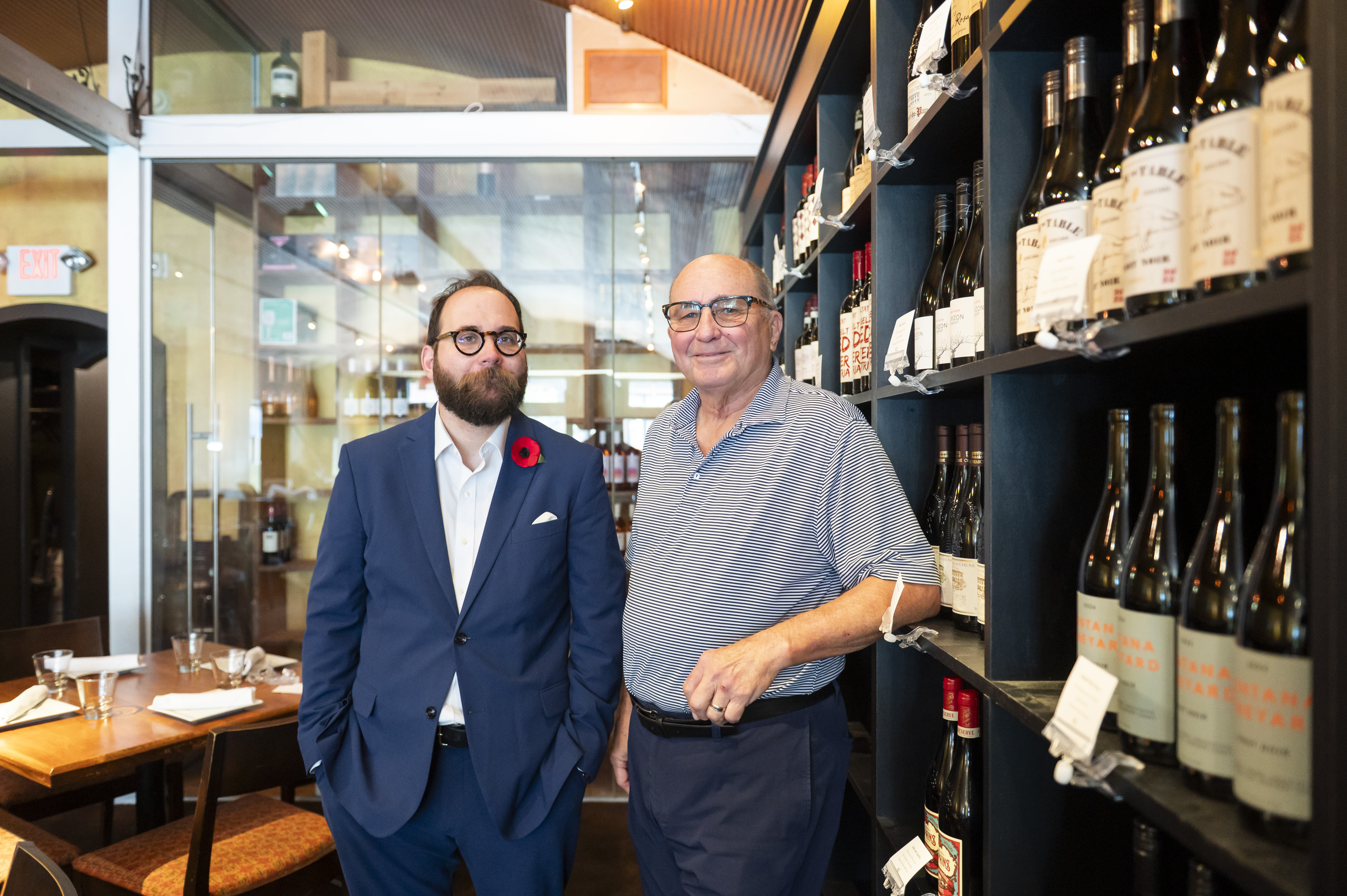
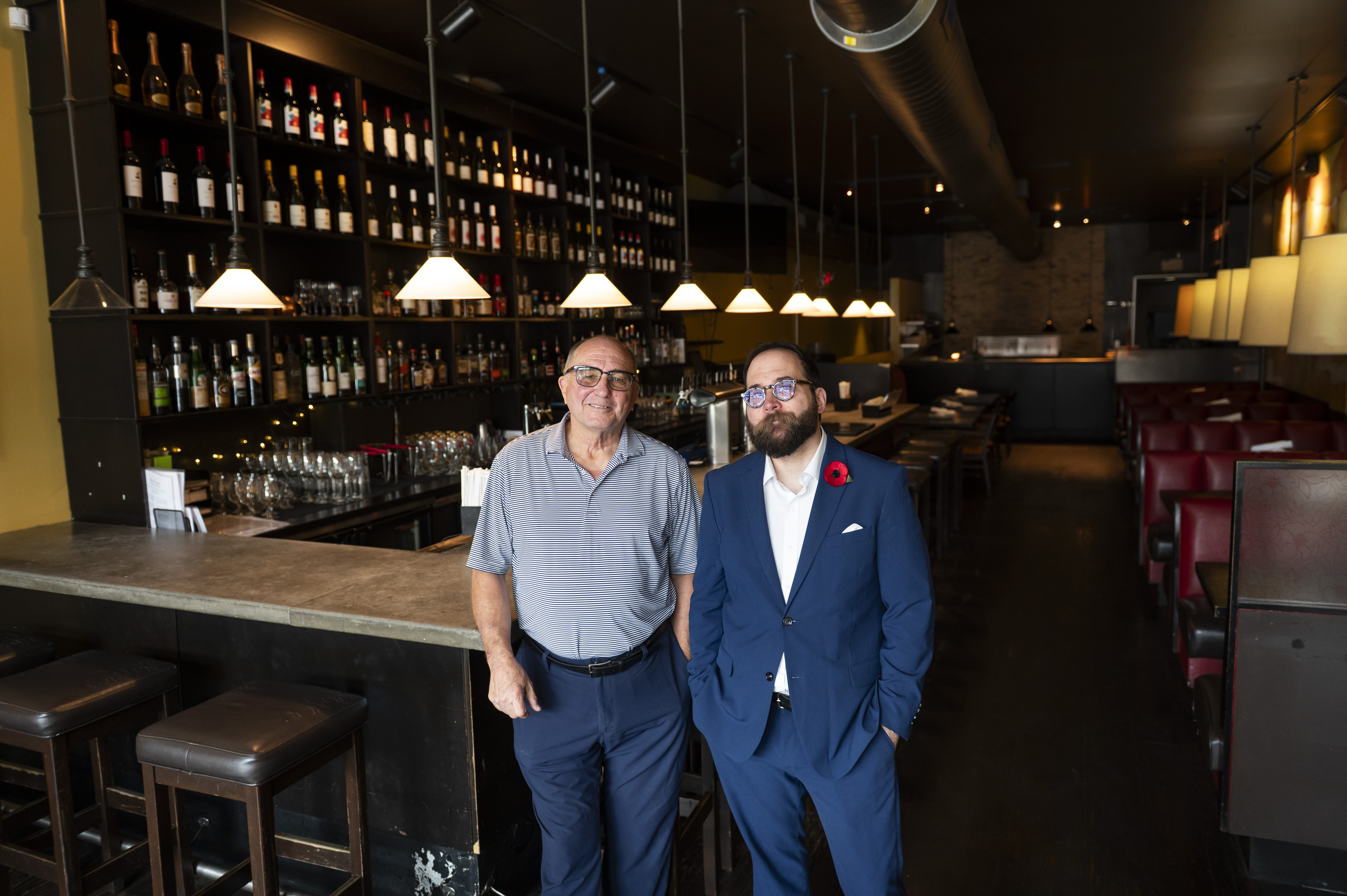
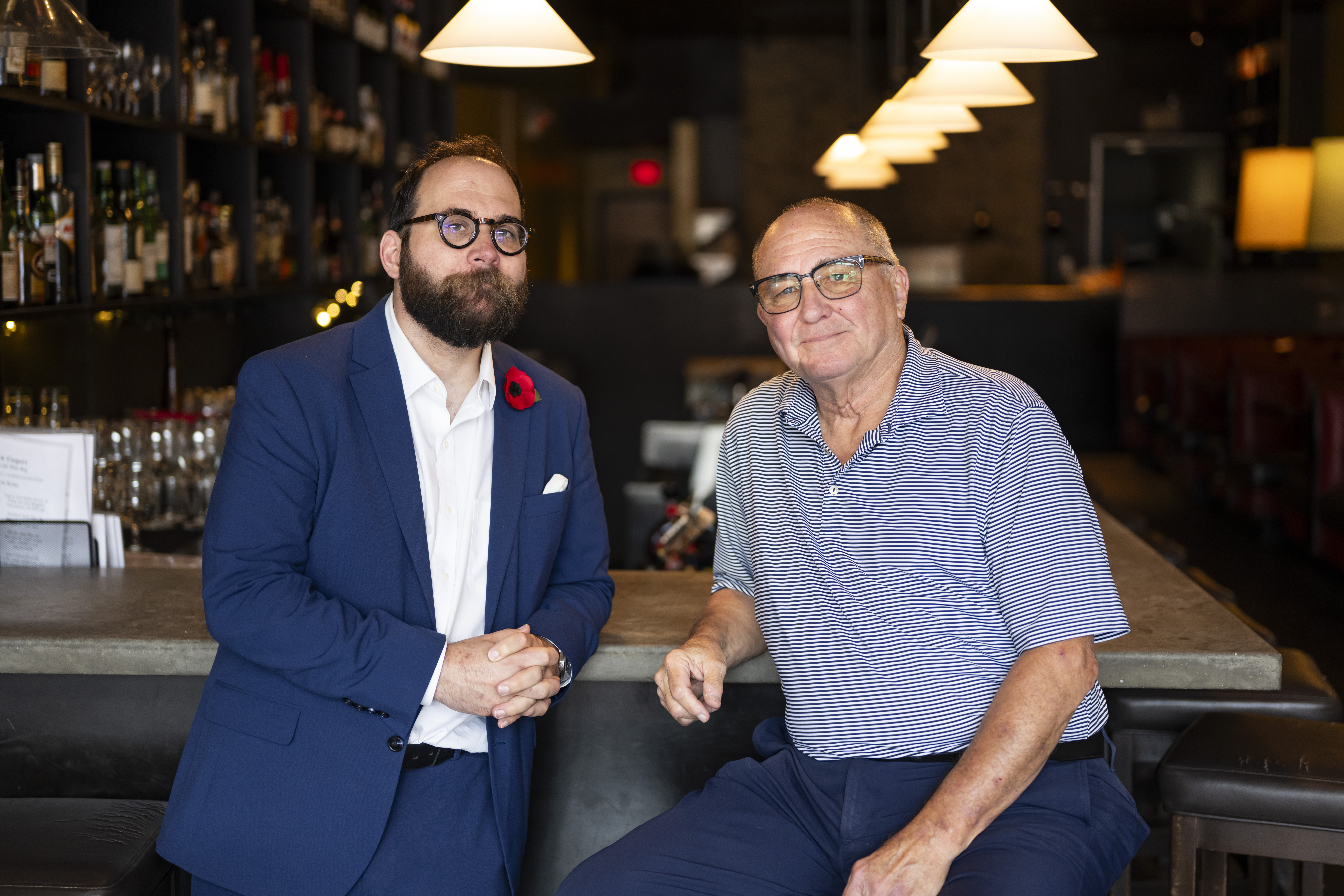
Bruce Cooper with his son, Bruce Joseph Cooper II, inside the wine bar at Jake’s & Cooper’s Wine Bar.Allie Ippolito / For The Inquirer
Cooper, a Culinary Institute of America graduate from Upstate New York, had spent a decade as executive chef at Lankenau Hospital before deciding that he wanted a restaurant of his own. He took business courses at Community College of Philadelphia and St. Joseph’s University and spent years looking at properties before a real estate agent showed him a former print shop in Manayunk in early 1987.
Cooper didn’t commission traffic studies. While walking along Main Street, he noticed Jaguars and other expensive cars rolling up to a posh restaurant called Jamey’s, which had opened a year and a half before. Otherwise, as he remembers it, “there were practically tumbleweeds floating down the street. You could find parking on a Saturday.”
That spring, Cooper bought 4365 Main St. and assembled a group of investors to open Jake’s, his then-wife Helena’s nickname.
Jake’s was conspicuously ambitious: white tablecloths, contemporary artwork, an extensive wine list, and Cooper’s refined cooking, including pastas from scratch. Dishes included crab cakes with raspberry butter, scallops with red pepper and papaya sauces, and duck breast with tangerine sauce.
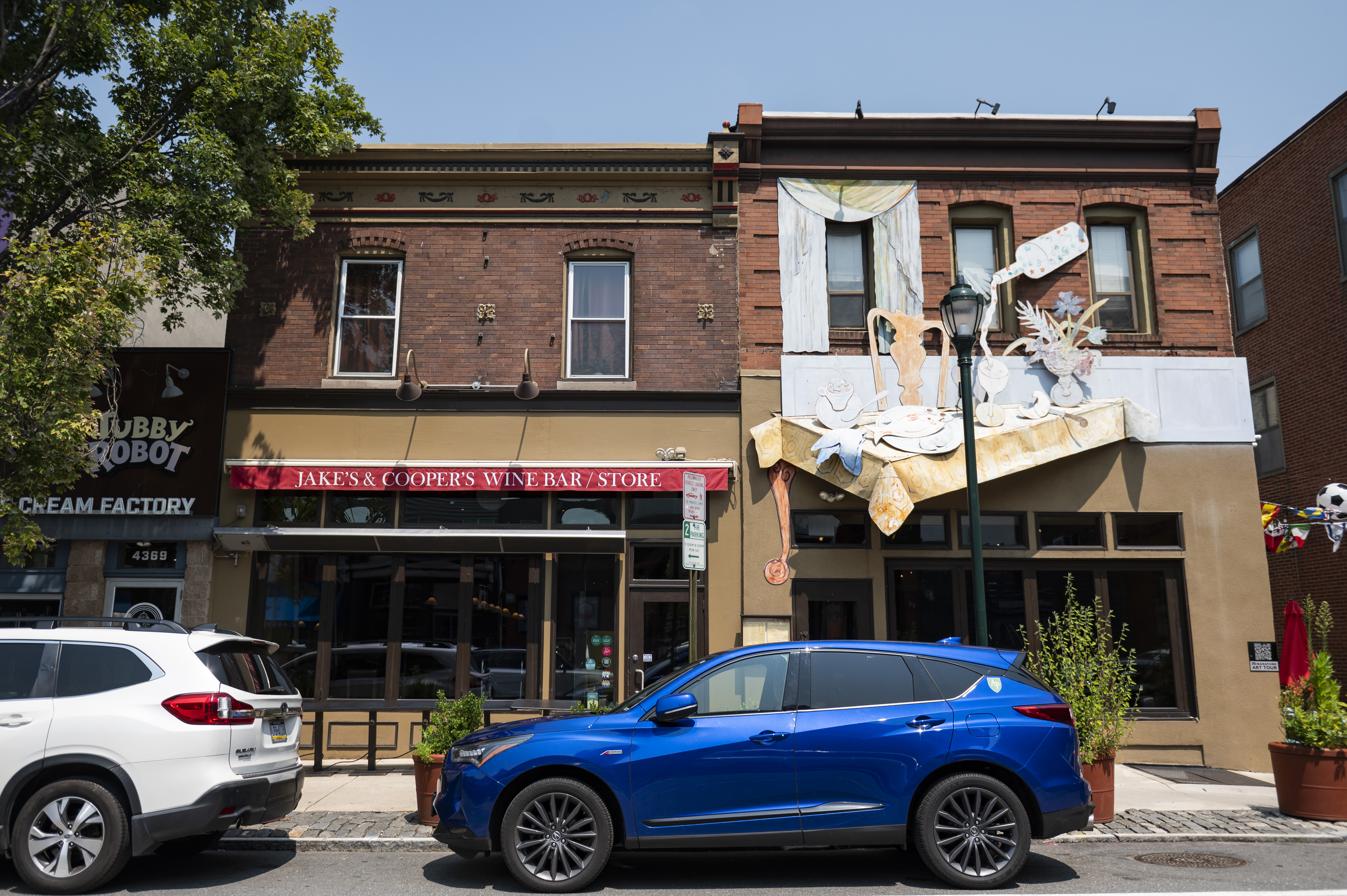
The restaurant’s whimsical facade depicted an oversize table setting, with food spilling from a plate and wine pouring into a glass, surrounded by flowers, flatware, linen, and crystal — designed to suggest both fine dining and a sense of fun.
The exterior of Jake’s & Cooper’s Wine Bar in Manayunk on Monday, Aug. 10, 2026. The bar is closing after 39 years.Allie Ippolito / For The Inquirer
Many early customers came from the Main Line, crossing the Schuylkill over the Green Lane Bridge into the former mill town.
Business grew quickly. When Cooper had put together his business plan, his accountant told him his projected sales were impossible for a 65-seat restaurant. Jake’s reached the projection in its second year, Cooper said.
By the 1990s, Main Street was crowded with boutiques and similarly high-aiming restaurants like Sonoma and Kansas City Prime.
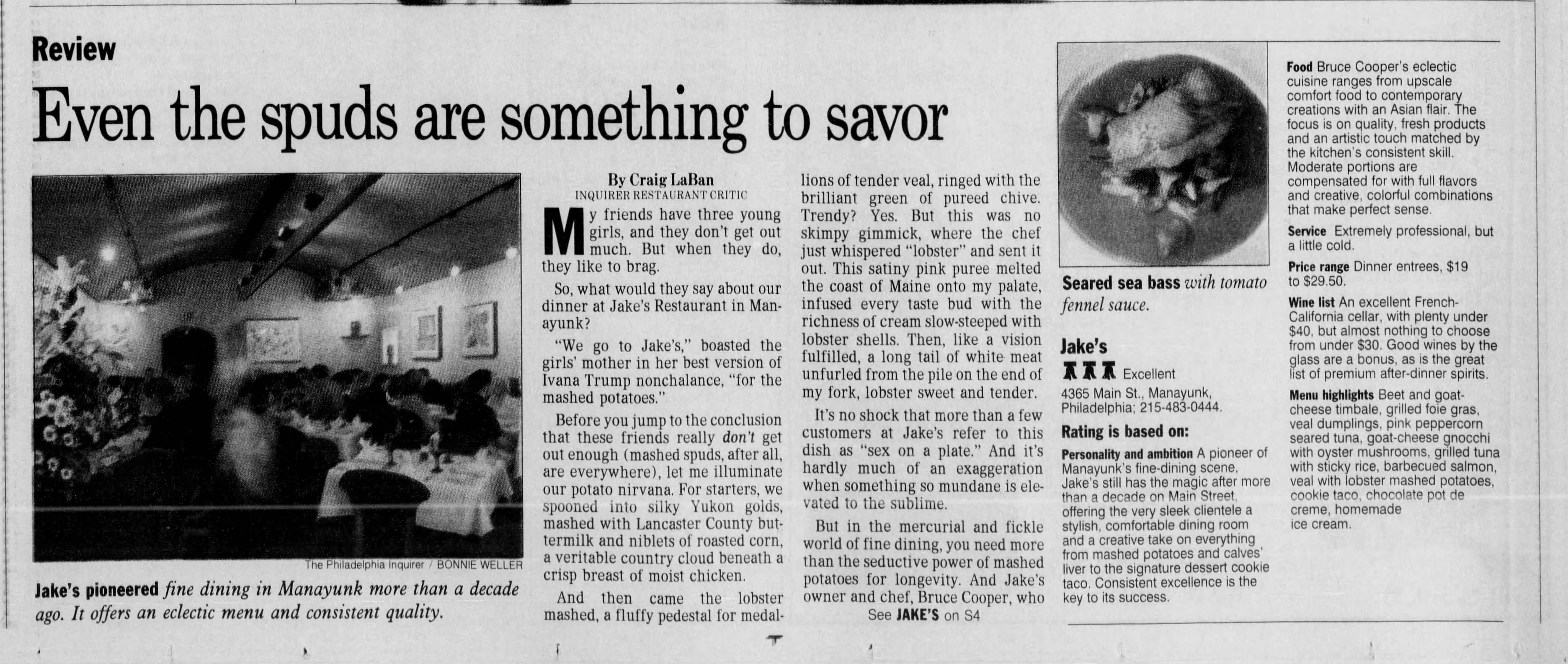
In a 1998 review, Inquirer restaurant critic Craig LaBan described a room of cushioned banquettes, contemporary design, and a stylish but unstuffy clientele. He called out the veal dumplings with caramelized ginger, seared tuna with sticky rice, foie gras with grilled mango, and the barbecued salmon — a signature.
Craig LaBan’s first review of Jake’s, from July 1998.Newspapers.com
And then there were the mashed potatoes. One version paired Yukon gold potatoes with buttermilk and roasted corn. Another, served beneath medallions of veal, was infused with lobster and cream. Patrons, LaBan reported, had taken to calling the latter “sex on a plate.”
LaBan awarded Jake’s three out of four Liberty Bells, the rating system he used at the time. “That’s when it really started to take off,” Cooper said.
Manayunk’s overall success brought its own problems. Friction between residents and the expanding restaurant and bar scene in the late 1990s led then-City Councilmember Michael Nutter to push for a five-year moratorium on new restaurants in the district.
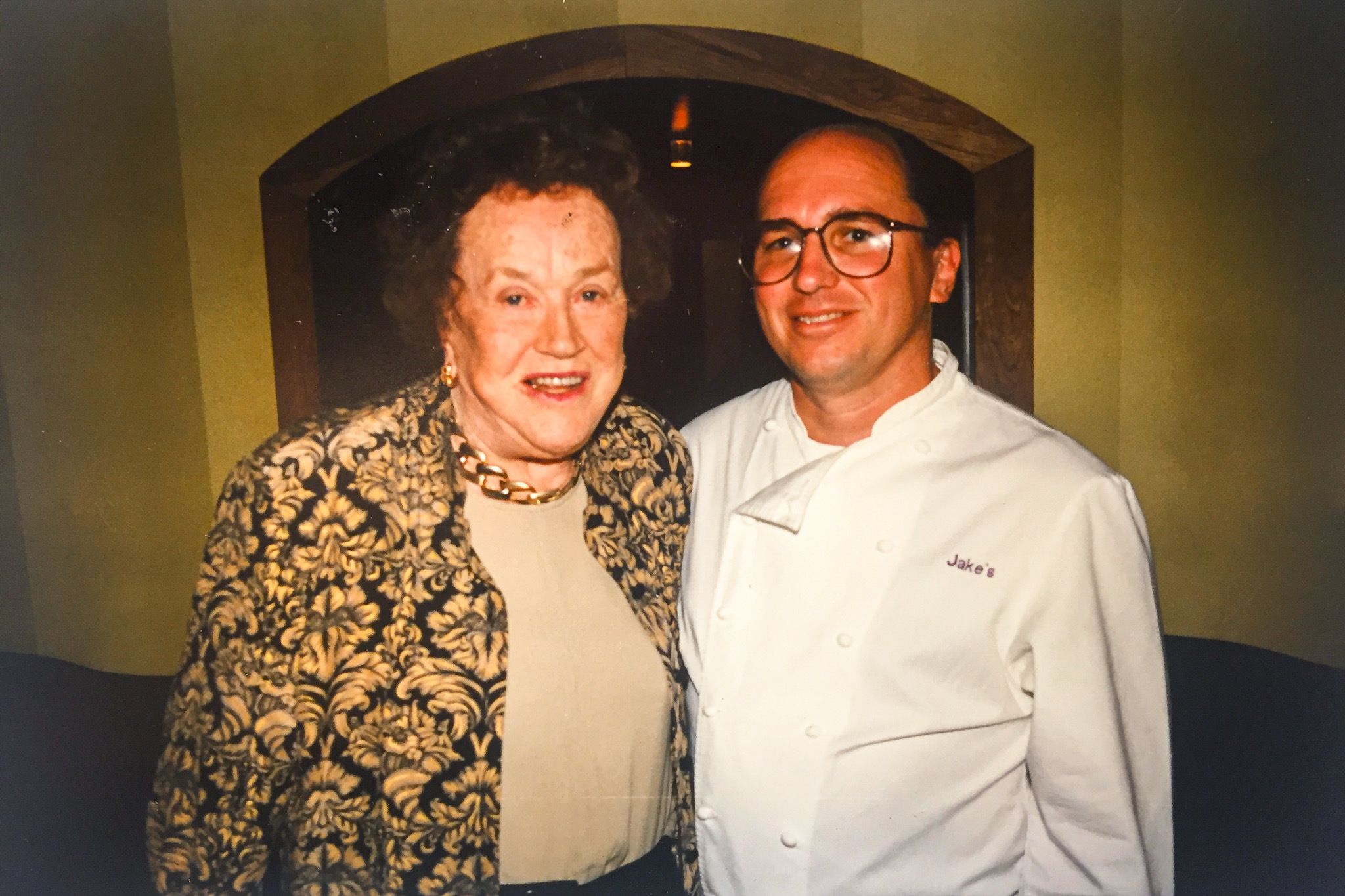
Julia Child with Bruce Cooper at an event in 1996.Courtesy of Bruce Cooper
Cooper, who later served as president of the Manayunk Development Corp., believes that the moratorium lasted too long and helped push Main Street toward nightlife. He later helped develop agreements among restaurateurs, landlords, the business association, and neighborhood groups that placed operating restrictions on new restaurants.
Meanwhile, the style of dining that had made Jake’s successful was changing. White tablecloths were giving way to small-plate menus.
Which leads to another consequential date: March 14, 2008, on the eve of another financial crisis, when Cooper bought the former clothing store next door at 4367 Main St. and opened Cooper’s Brick Oven Wine Bar. Cooper’s is a markedly different restaurant, drawing a younger crowd and serving pizza, small plates, craft beer, and less expensive wines.
The dividing line quickly blurred, Cooper said. Customers at Cooper’s wanted food from Jake’s, and Jake’s customers wanted dishes from Cooper’s. The restaurants shared a kitchen, and Cooper eventually merged their menus and identities as Jake’s & Cooper’s Wine Bar.
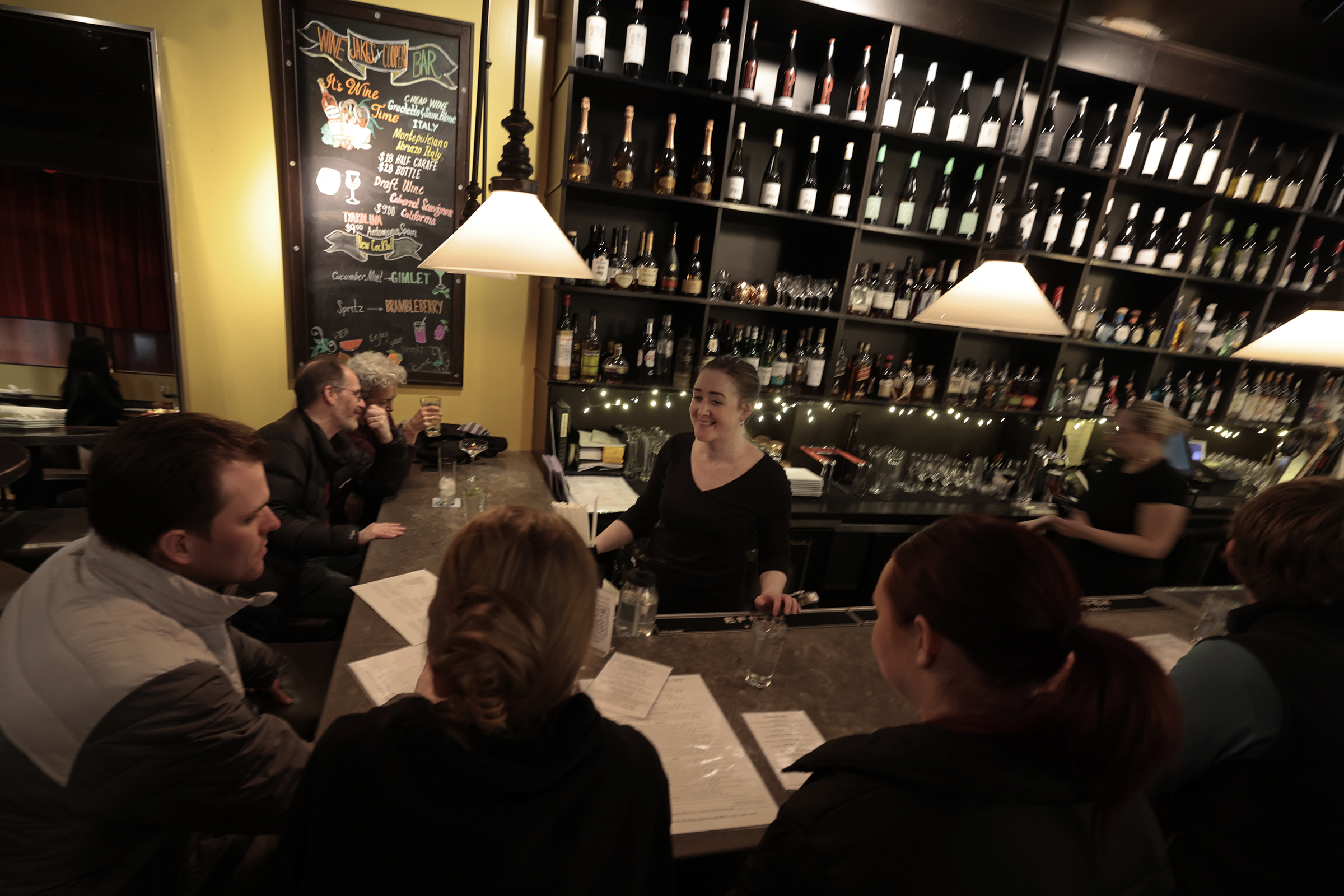
Head bartender Carrie Hice chatting with patrons at Cooper’s Wine Bar in 2023.Elizabeth Robertson / Staff Photographer
Then came July 17, 2016.
Cooper got a middle-of-the-night phone call that a city water main had ruptured outside the restaurant, sending water through the building and destroying the kitchen and the apartments above. He gutted and rebuilt, with business-interruption insurance helping carry the restaurant through a six-month closure.
The experience changed the way Cooper thought about the business.
“When you stop a business and then restart it, there are people who had been coming every week, and then they stopped,” he said. “They got into another routine. They went elsewhere.”
Even months after Jake’s reopened, Cooper said, customers would walk in surprised to discover it had reopened. “That’s when I started looking at things differently,” he said.
Cooper considered selling, but a real estate adviser urged him to wait as residential development accelerated in Manayunk and Roxborough. Three years later came the pandemic. His extended time at home spoiled him, he said.
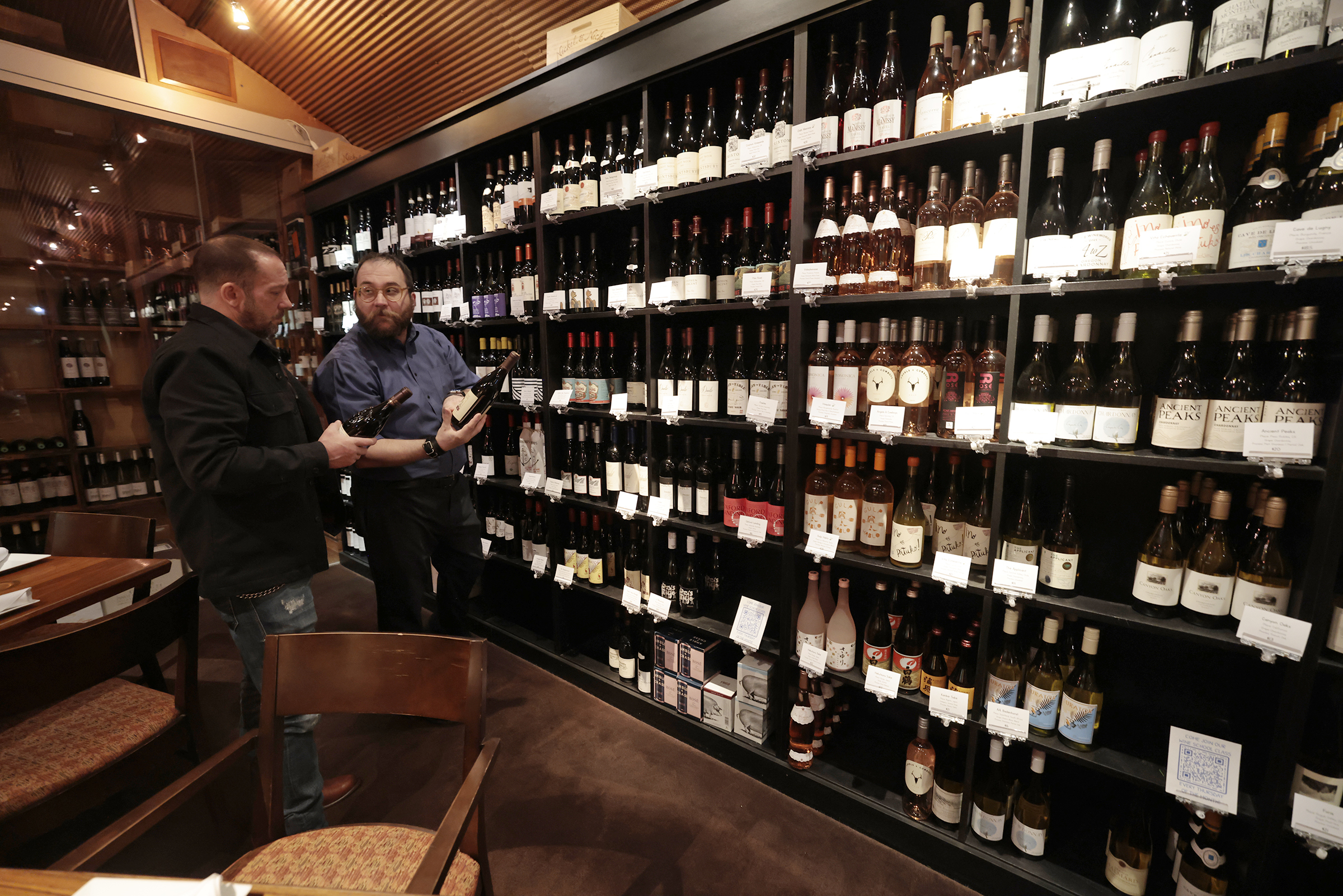
Chris Campana (left), with help from Bruce Joseph Cooper II, choosing a wine from the wall in 2023.Elizabeth Robertson / Staff Photographer
Three years ago, Cooper moved to Delaware. His son, Bruce Joseph Cooper II, 37, now manages the restaurant day to day, while the senior Cooper comes north once or twice a week to handle scheduling, wine orders, and other duties.
In June, Cooper put the properties, including four upper-level apartments, on the market for an undisclosed asking price. Cooper said he wants a clean break rather than passing the restaurant to his son, though neither rules out working together on another project someday.
The closing will end one of the longest remaining restaurant runs from the era that transformed Manayunk. Pitchers Pub (1987) and Zesty’s (1993) are still at it; U.S. Hotel Bar & Grill has been open irregularly since Bill Green, the former mayor and congressman, reopened it in 1986.
For Cooper, that history encompasses more than the people who ate there. “When you look back, you think about the generations of customers —in a lot of cases, we’re talking about three generations,” he said. “But it’s not just the customers. It’s all the people behind the scenes: the banker, the produce person, all those people who helped you get through things.”
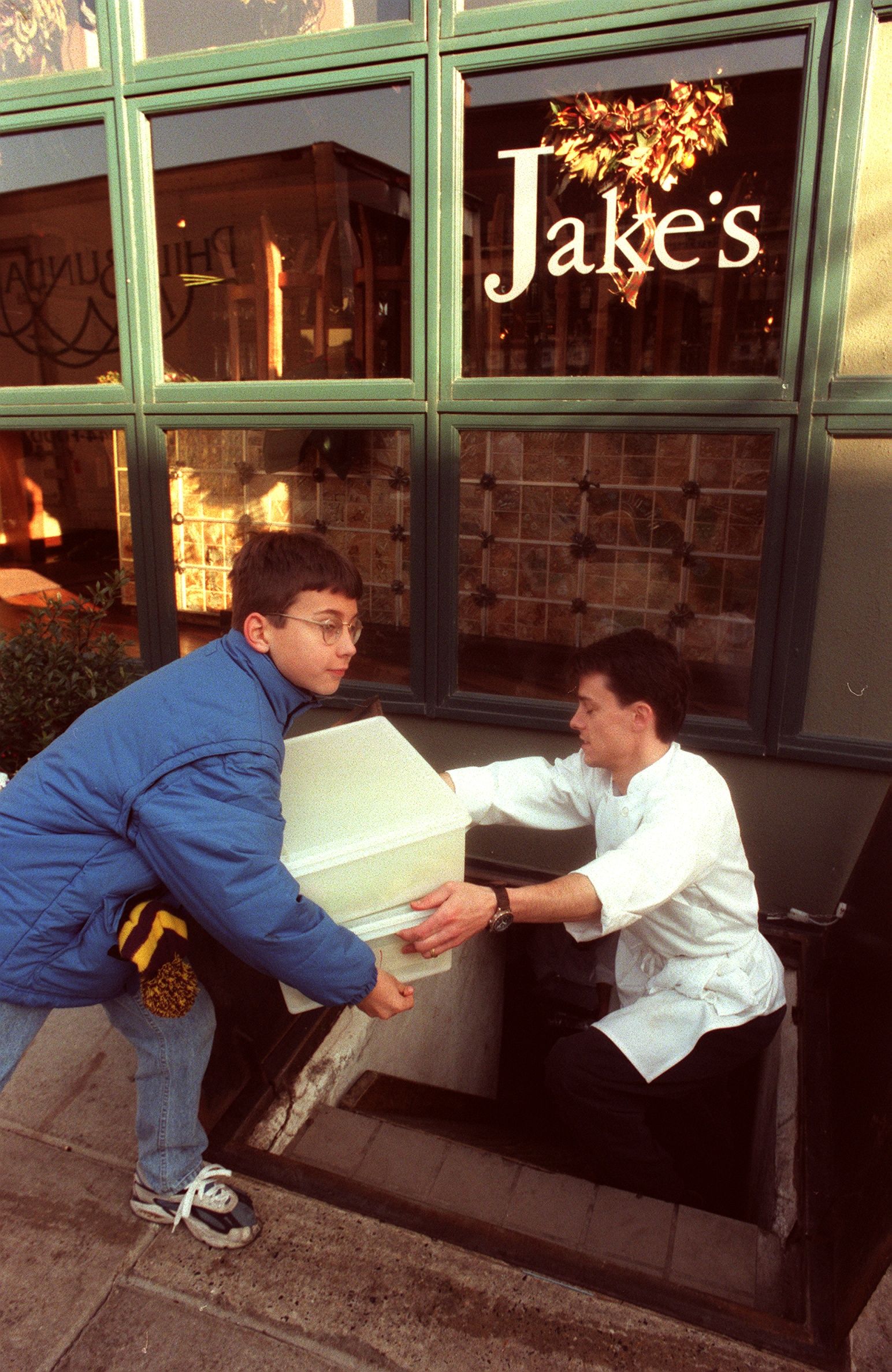
Bruce Joseph Cooper II, then 11, helps chef Bill Murphy carry food from Jake’s basement to be loaded into a truck for a 1999 holiday dinner by Philabundance. Vicki Valerio / Staff Photographer
Cooper’s son grew up at Jake’s, handing out cookies at holiday meals his father helped organize through North Light Community Center. He joined the restaurant full-time during the pandemic, starting as a food runner and eventually taking over management.
Purveyors and other restaurateurs have approached Cooper Jr. with potential job offers, he said, and he would consider working with whoever buys the properties. He once imagined taking over Jake’s himself but is no longer certain that is what he wants.
His father understands.
The restaurant business, the senior Cooper said, demands long hours and constant attention. One lesson he would give a new restaurateur is the one that helped him survive both the flood and the pandemic: Own the real estate if you can.
“If I didn’t own this real estate during COVID, I would have owed the landlord,” he said.
Cooper has begun informally advising other restaurateurs about the economics of getting into, staying in, and getting out of the business. After nearly four decades, he said, he is ready to find out what comes next.
His son thinks about Jake’s in more personal terms.
“Even in my almost five years working as a manager here, I’ve seen kids go from being in the womb to toddlers, and they know me as Uncle Bruce,” the younger Cooper said. “That’s one of the greatest feelings in the world — being able to say, ‘I knew you before you were born, little one.’”
Bruce Joseph Cooper II (left), general manager, and Bruce Cooper (right), owner, inside Jake’s & Cooper’s Wine Bar in Manayunk.Allie Ippolito / For The Inquirer
But for thousands of residents, many of whom live in North Philadelphia, next year’s tax bills are expected to soar.
Nearly 6,000 homeowners in Philadelphia saw their property assessments this year climb by more than 50% compared with two years ago, the last time the city conducted a mass revaluation, according to an Inquirer analysis of city property assessment data released in June.
Of those homeowners, more than 2,200 saw their assessments more than double.
That is likely to result in sticker shock come tax time next year, because property tax bills in the city are calculated based on home values. The revenue is split between the city and the Philadelphia School District.
Homeowners across the city saw a median 3% increase in their property assessments this year compared with the 2025 tax year. Jumps were higher in neighborhoods that border gentrifying areas, such as in parts of Kensington and West Philadelphia.
But this year, two other areas of the city had the densest concentrations of homes where property assessments increased by 50% or more, according to The Inquirer’s analysis.
The steep rises are clustered in the southern end of Strawberry Mansion, the historically Black neighborhood along the Schuylkill, and in the tiny Hartranft neighborhood north of Temple University and east of Broad Street, where residents are predominately Latino.
(function() {
var l2 = function() {
new pym.Parent(‘html_sandwich_2026_property4’,
‘https://media.inquirer.com/storage/inquirer/projects/innovation/arcgis_iframe/html_sandwich_2026_property4.html’);
};
if (typeof(pym) === ‘undefined’) {
var h = document.getElementsByTagName(‘head’)[0],
s = document.createElement(‘script’);
s.type = ‘text/javascript’;
s.src = ‘https://pym.nprapps.org/pym.v1.min.js’;
s.onload = l2;
h.appendChild(s);
} else {
l2();
}
})();
Housing experts and advocates for low-income homeowners have long criticized the city’s assessment system as systemically biased, leaving Black and brown homeowners to pay disproportionately high property taxes. Mayor Cherelle L. Parker convened a task force in 2024 to study the city’s revaluation system, and that group’s recommendations are expected to be released later this year.
Monty Wilson, a senior attorney at Community Legal Services who sits on the task force, said the Philadelphia Office of Property Assessment is the best in the state and has “worked really hard to become more and more accurate.”
But he said bias persists in part because of the unique challenges that assessors face in low-income neighborhoods that can cause volatility in home values, such as higher rates of vacant lots, foreclosures, and other factors.
A 2024 CLS report found that errors were clustered in lower-value neighborhoods where a majority of residents are people of color.
“That means when a property is overassessed,” Wilson said, ”it tends to occur in a Black and brown neighborhood.”
(function(){function e(){window.addEventListener(`message`,function(e){if(e.data[`datawrapper-height`]!==void 0){var t=document.querySelectorAll(`iframe`);for(var n in e.data[`datawrapper-height`])for(var r=0,i;i=t[r];r++)if(i.contentWindow===e.source){var a=e.data[`datawrapper-height`][n]+`px`;i.style.height=a}}})}e()})();
The Parker administration did not respond to requests for comment.
In response to a previous article about this year’s property reassessments, city officials emphasized that some lower-income homeowners pay relatively low tax bills because of the popular homestead exemption tax break. The program, which any homeowners can apply for and obtain if they live in their house as their primary residence, exempts the first $100,000 from a home’s taxable value.
That means that some homeowners in working-class neighborhoods previously paid little to no property taxes. A sudden increase in valuation, like the ones seen this year in pockets of North Philadelphia, could require they pay bills next year that are several hundred dollars more than in the past.
Take the 2500 block of North Marshall Street. The residential North Philly street sits between West Kensington and Broad Street, and nearly every home saw its assessment increase by 60% or more, according to The Inquirer’s analysis.
Most of the homes there had previously been valued at less than $100,000, meaning owners with the homestead exemption owed no property taxes. Now, many of the homes on the block are valued at about $140,000, an amount that would next year yield more than $500 in yearly tax bills for owners with the homestead exemption.
More than 40% of the Hartranft neighborhood’s residents are below the federal poverty level, which is $33,000 a year for a family of four, according to U.S. Census data.
At Left a property on 2500 N. Marshall St., Philadelphia, PA 19133 is shown Wednesday, Aug. 19, 2026, in Philadelphia.Jose F. Moreno / Staff Photographer
City Councilmember Quetcy Lozada, whose district includes parts of Kensington and North Philadelphia, said the Hartranft area is not like sections of Kensington that have seen an influx of development in recent years and where increases in property assessments may be expected.
It is possible, she said, that lower-income residents who have been displaced from parts of Kensington looked to move west of the neighborhood, increasing demand in the Fairhill and Hartranft areas.
Lozada — who has held workshops in the neighborhood to connect residents with property tax relief programs — said she fears her constituents are being asked to pay disproportionately high taxes and not seeing better city services and stronger public schools.
“How is it possible that someone in Fairhill is paying a higher tax for a property that has not had any investment, in a neighborhood that is not as safe, whose school system is not as great, as somebody that lives in Chestnut Hill, for instance?” she said, referring to the upscale Northwest Philadelphia neighborhood with a $109,000 median household income. “There has to be a better way of doing a more accurate evaluation in every neighborhood.”
In Strawberry Mansion, community leaders said that increased assessments are likely a result of market pressure from Brewerytown to its south, a comparatively whiter and higher-income neighborhood.
“The city has to be super transparent about this assessment system so people can better understand it and not feel that sticker stock,” said Tonnetta Graham, president of the Strawberry Mansion Community Development Corp. “If we know how they came to their number, it’s easier to chew.”
The 1700 block of North Newkirk Street on Thursday, Aug. 20, 2026 in Philadelphia.Monica Herndon / Staff Photographer
Councilmember Jeffery Young Jr., whose district includes both Strawberry Mansion and parts of Hartranft, did not respond to requests for comment.
Jalon Alexander, a Strawberry Mansion native who this month launched a campaign to challenge Young for his Council seat next year, said he was recently at a block party in the neighborhood where he heard repeatedly from older homeowners who were concerned about their increased assessments.
“They feel taken advantage of, and they feel like it’s coming out of nowhere,” Alexander said. “This is an area where there’s high levels of poverty, and there is not a lot of political or government attention in this area. I’ve spoken with many people whose rates have almost doubled. It’s the biggest issue in the neighborhood.”
Staff writer Michaelle Bond contributed to this article.