In a world of autonomous food delivery robots and Amazon Prime, Philadelphians might be surprised to find bike messengers zooming across Center City streets, if they even know what one is. But what distinguishes the messengers from other cyclists and delivery drivers is not just the comically large bags they carry and the decked-out single-speed bikes they ride, but their ability to strategically and efficiently navigate the city. While most people rely on Google Maps, full-time bike messengers Brian Campbell, 31, and Orchid Newberger, 29, spend all day hustling through busy streets and traffic-filled intersections with addresses in hand and routes in mind. While Campbell starts his mornings in Old City delivering paystubs, Newberger finds herself riding between South Street and Spring Garden; they end up meeting at the 1700 Market plaza to catch up, smoke cigarettes, and play scratch-off tickets. They are expected to deliver legal documents for lawyers, safely transport medical samples for hospitals, and even serve people subpoenas, all while dodging motor vehicles and e-bikes. Although each dispatch could lead to a potential injury, what makes the job worth it is the freedom that the ride brings. “I’m as free as the breeze and I ride where I please,” Campbell said.
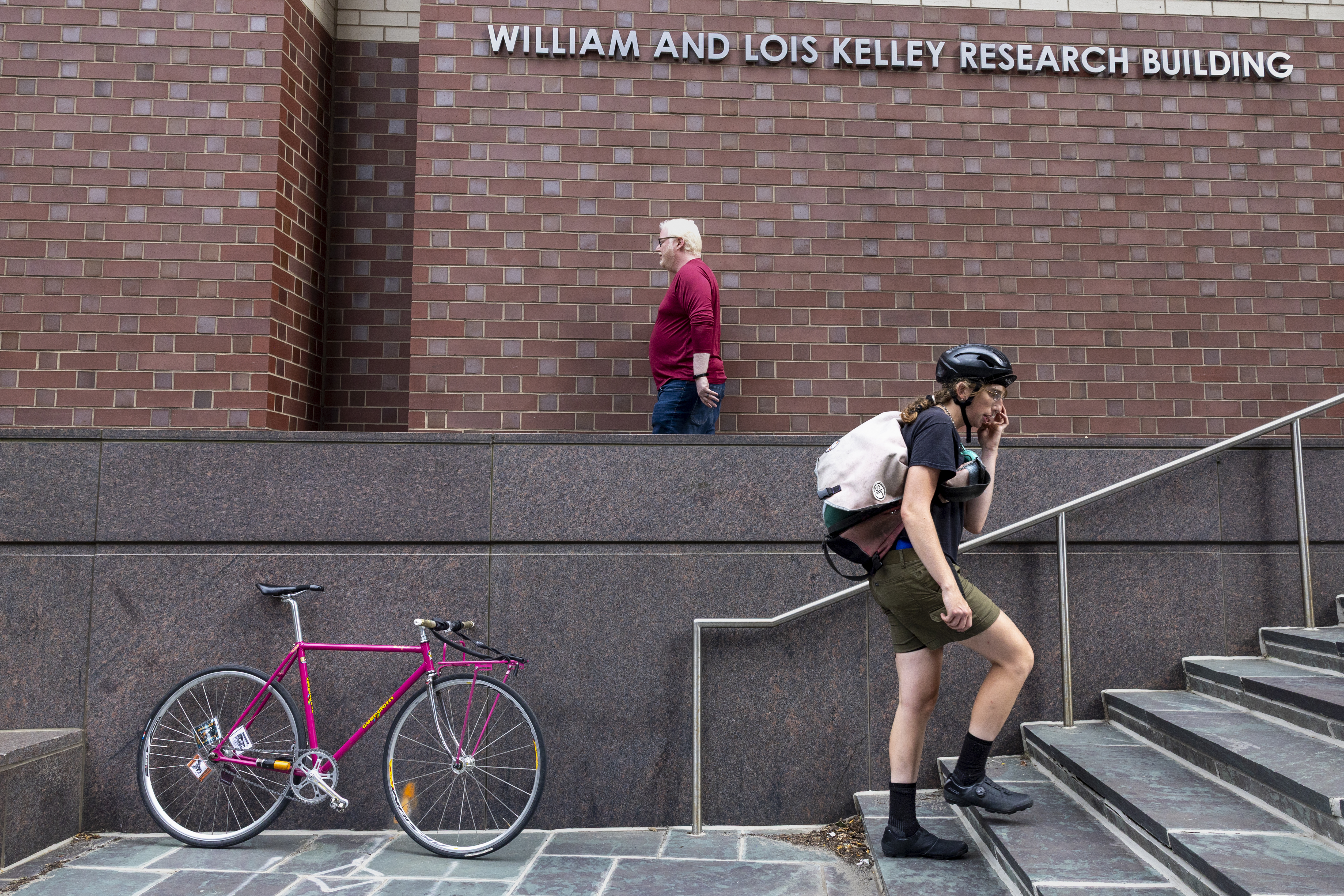
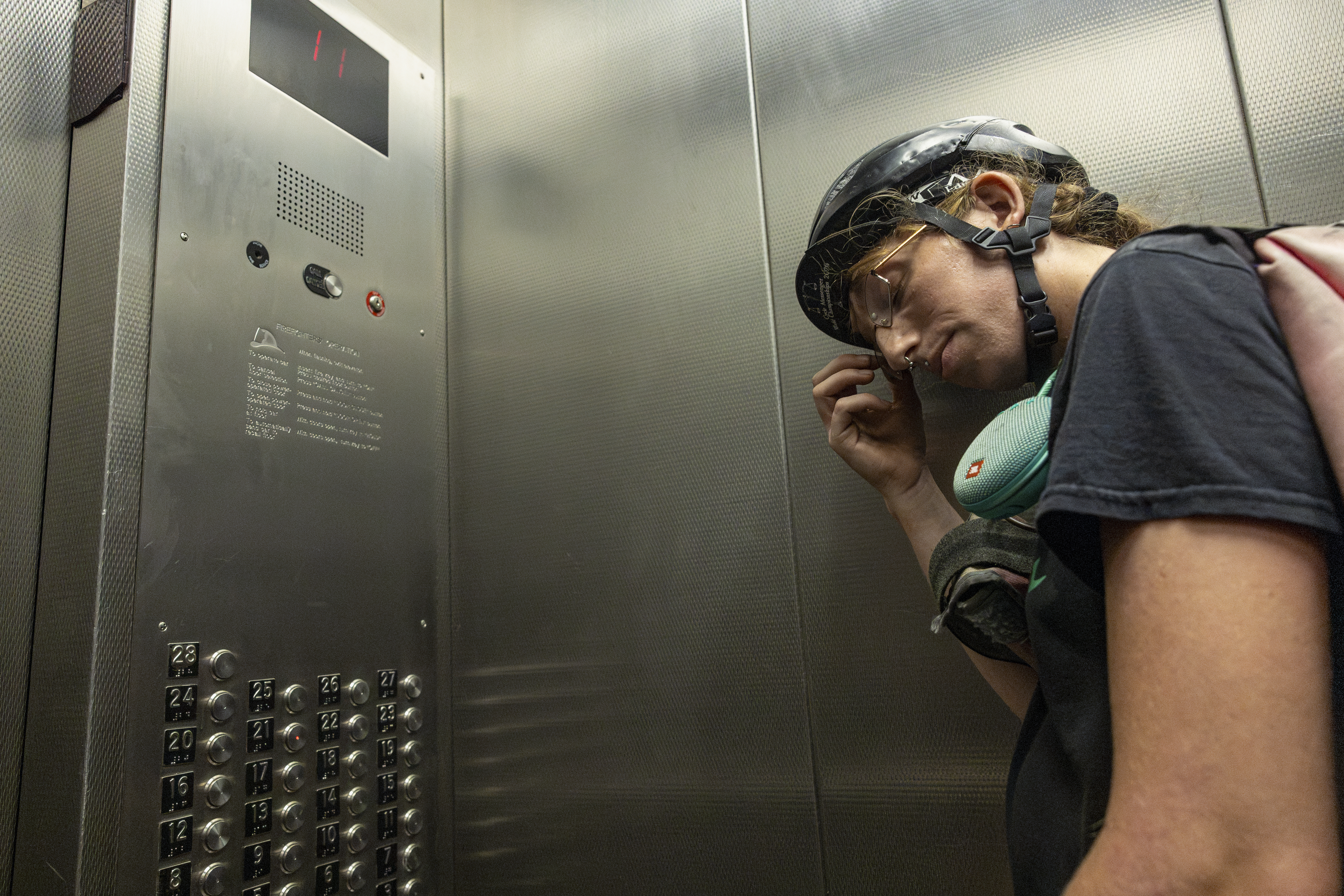
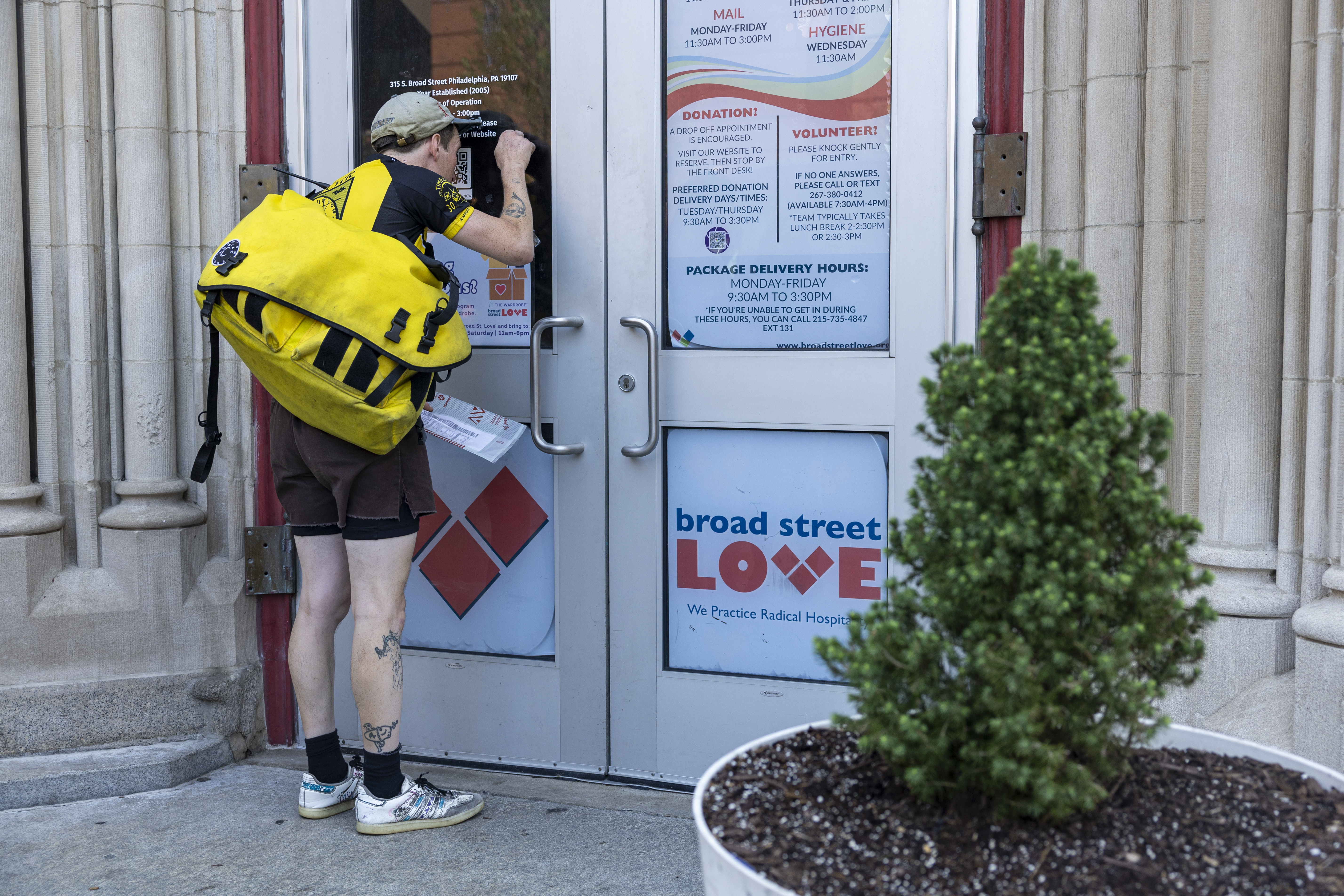
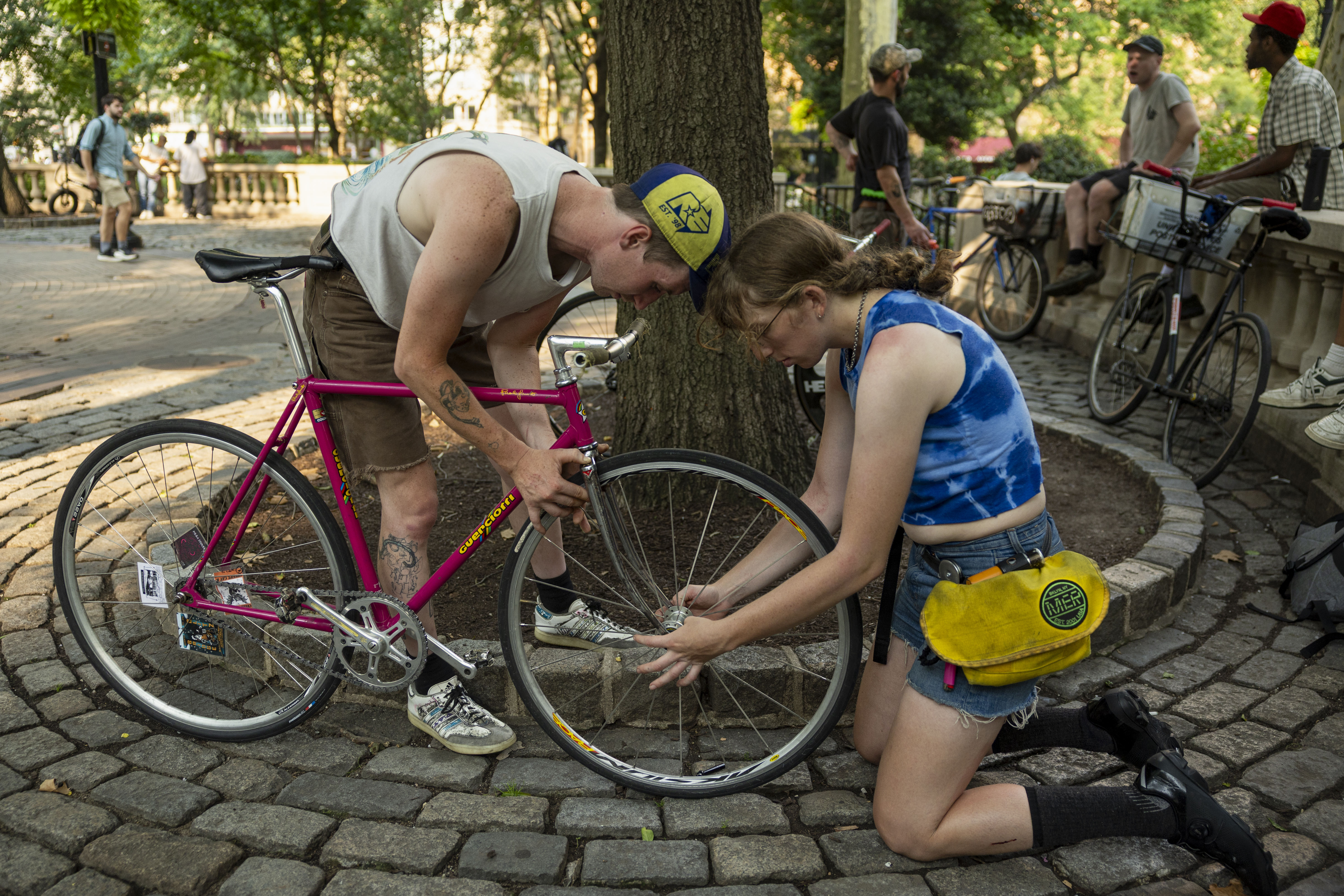
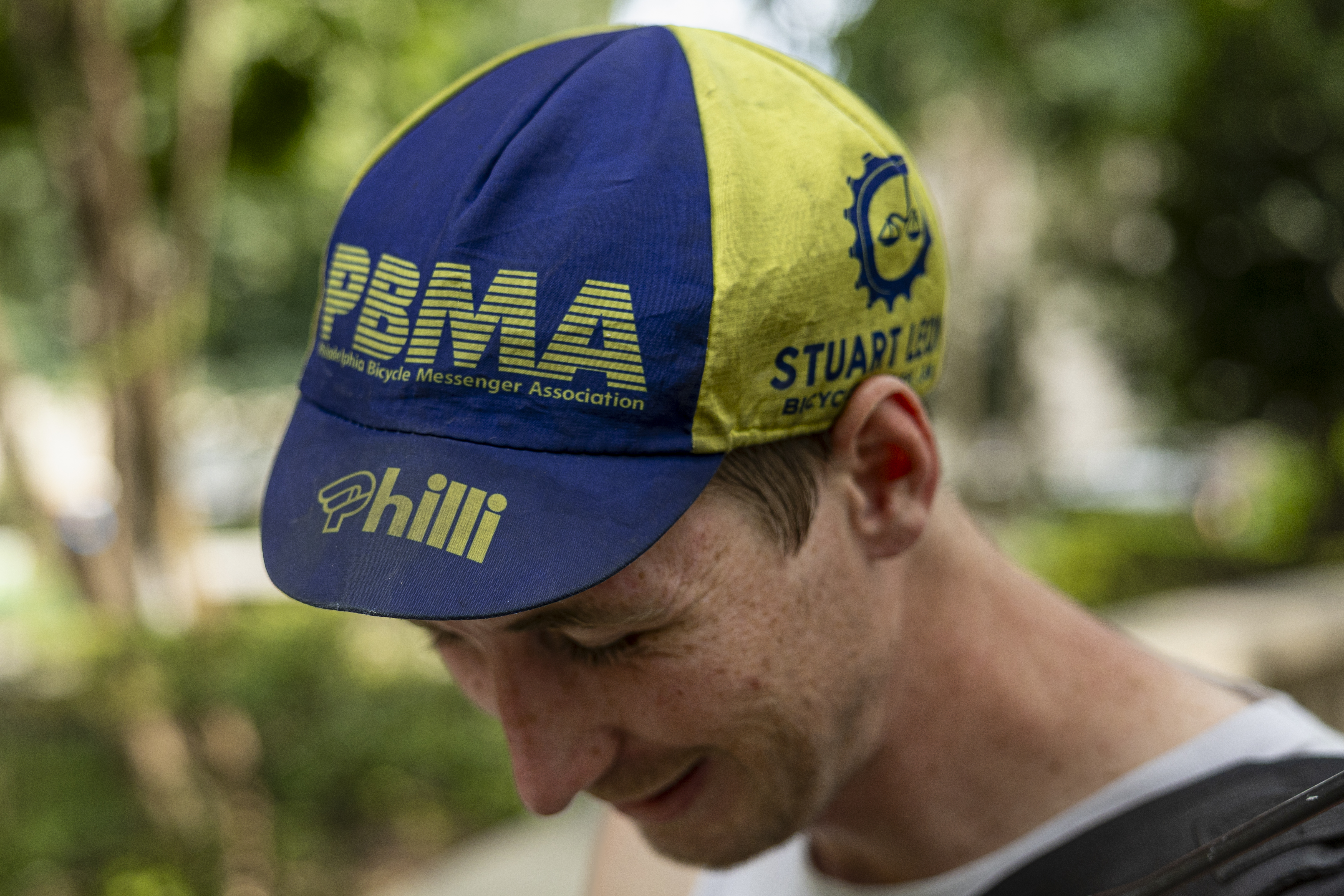
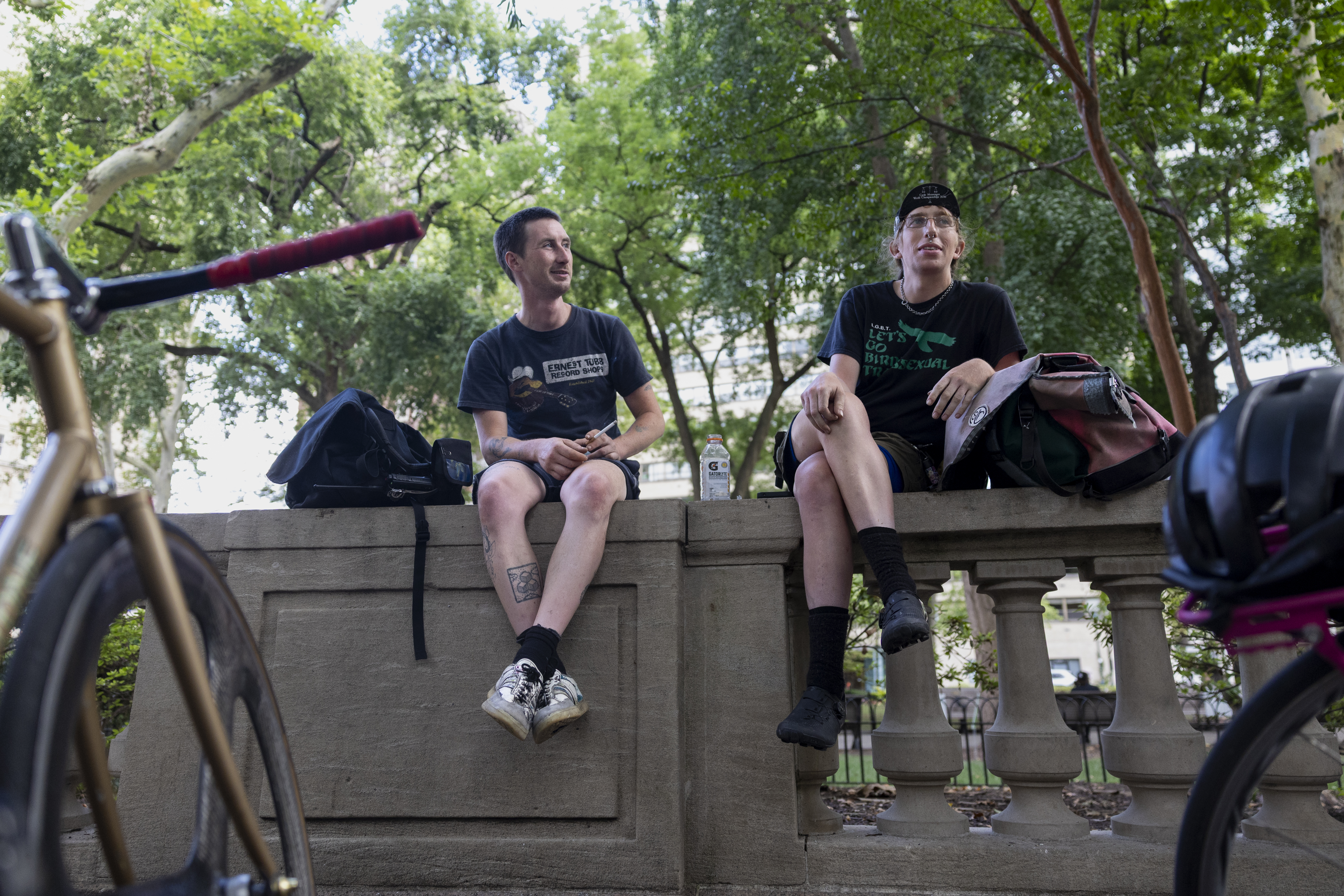
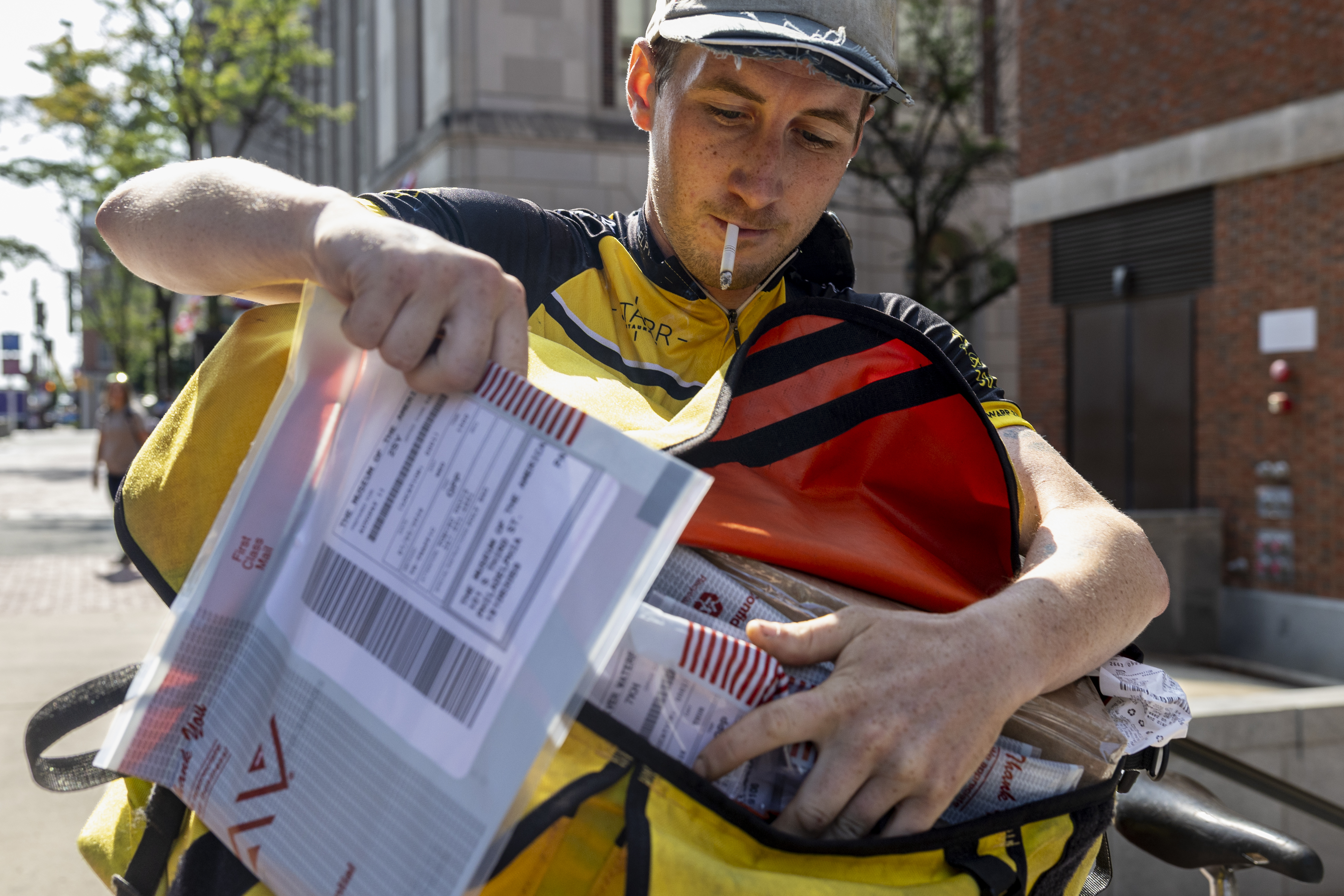
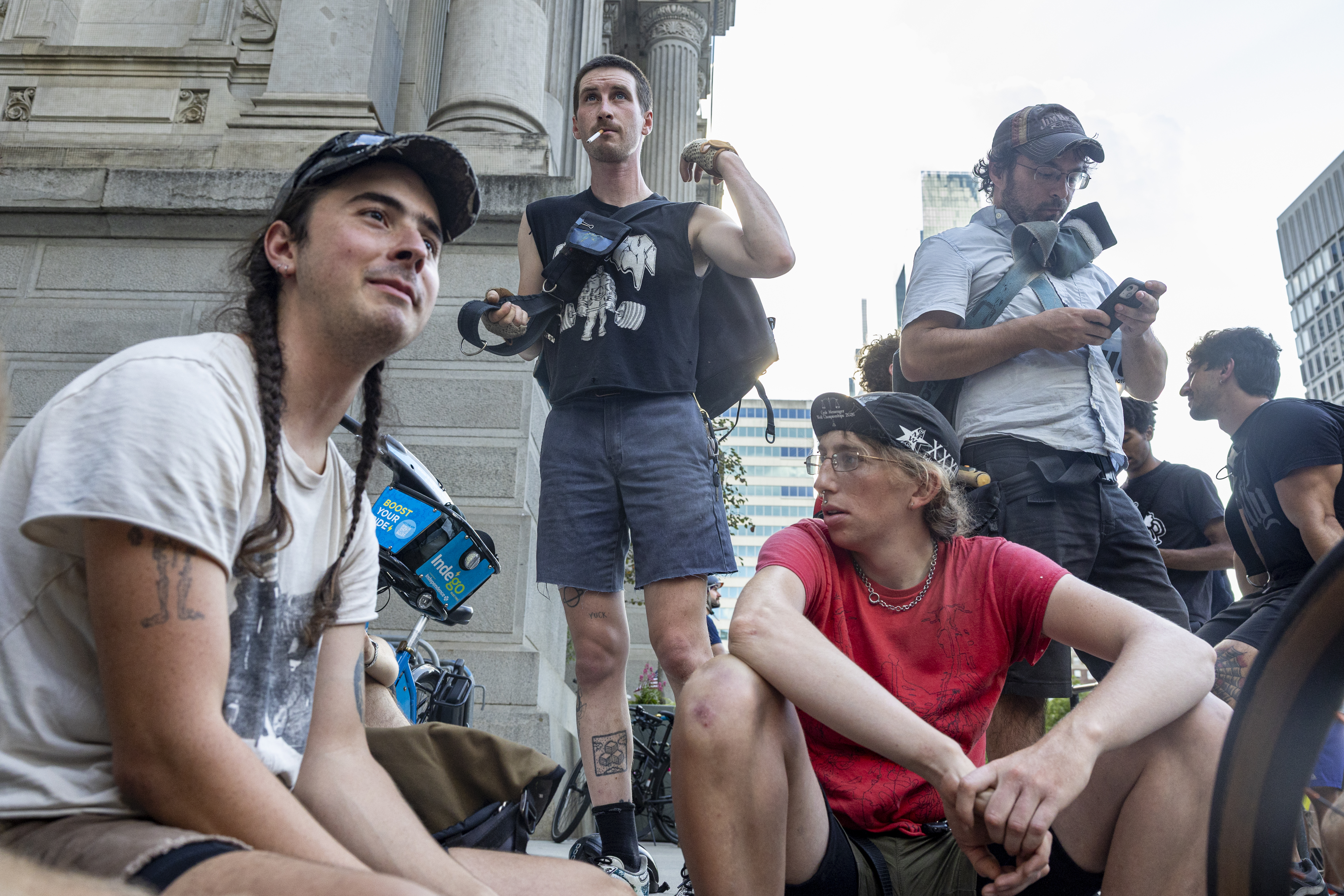
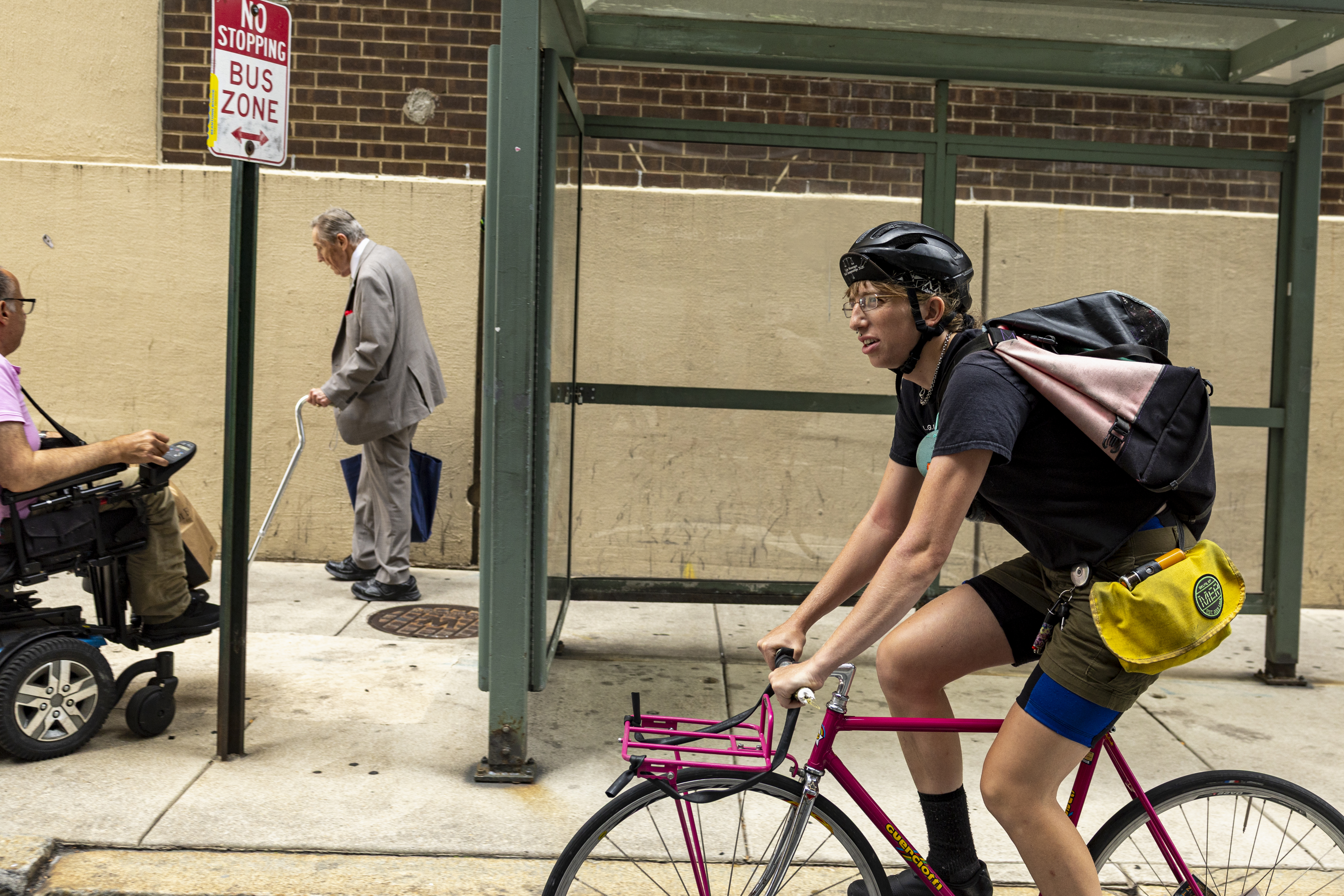
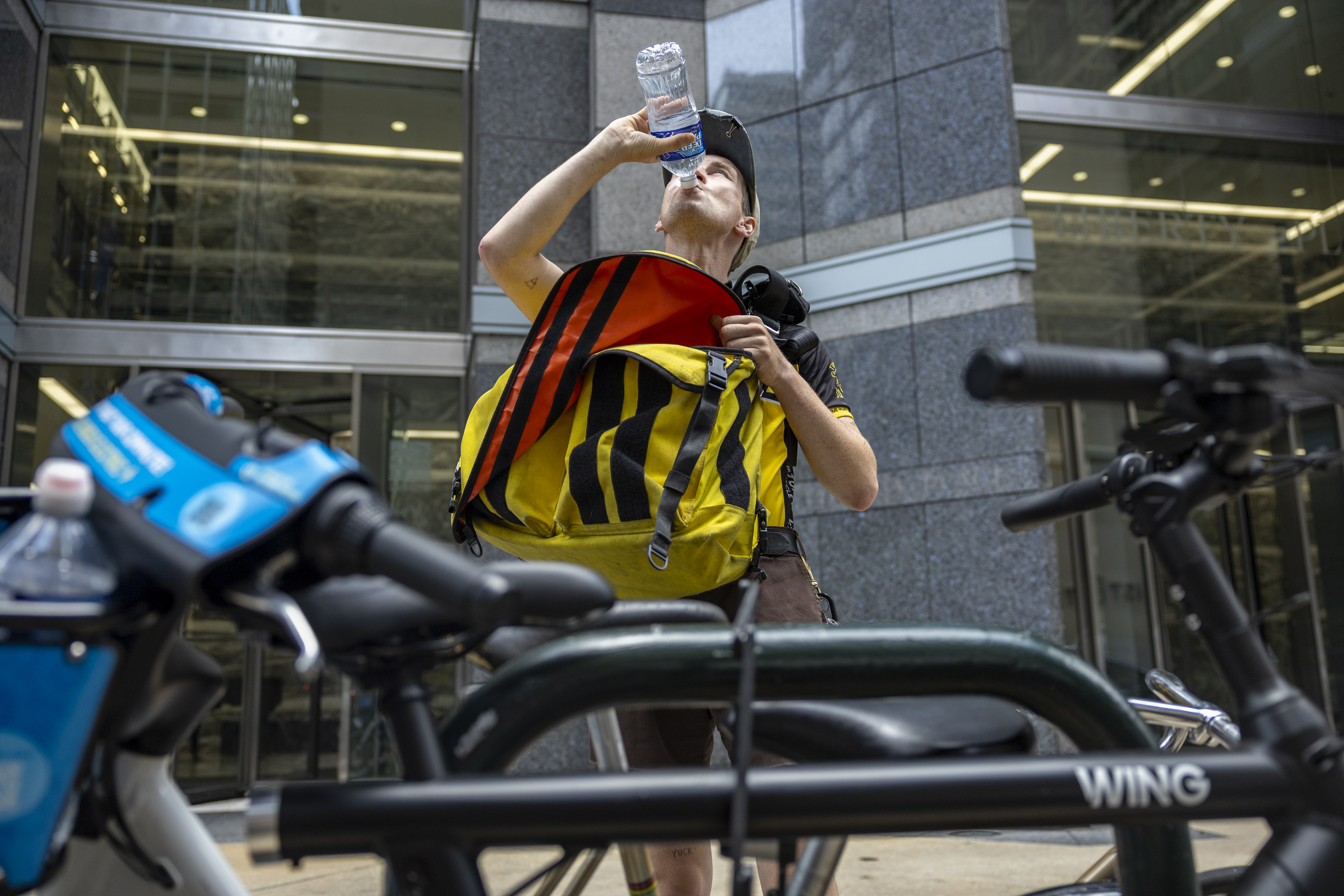
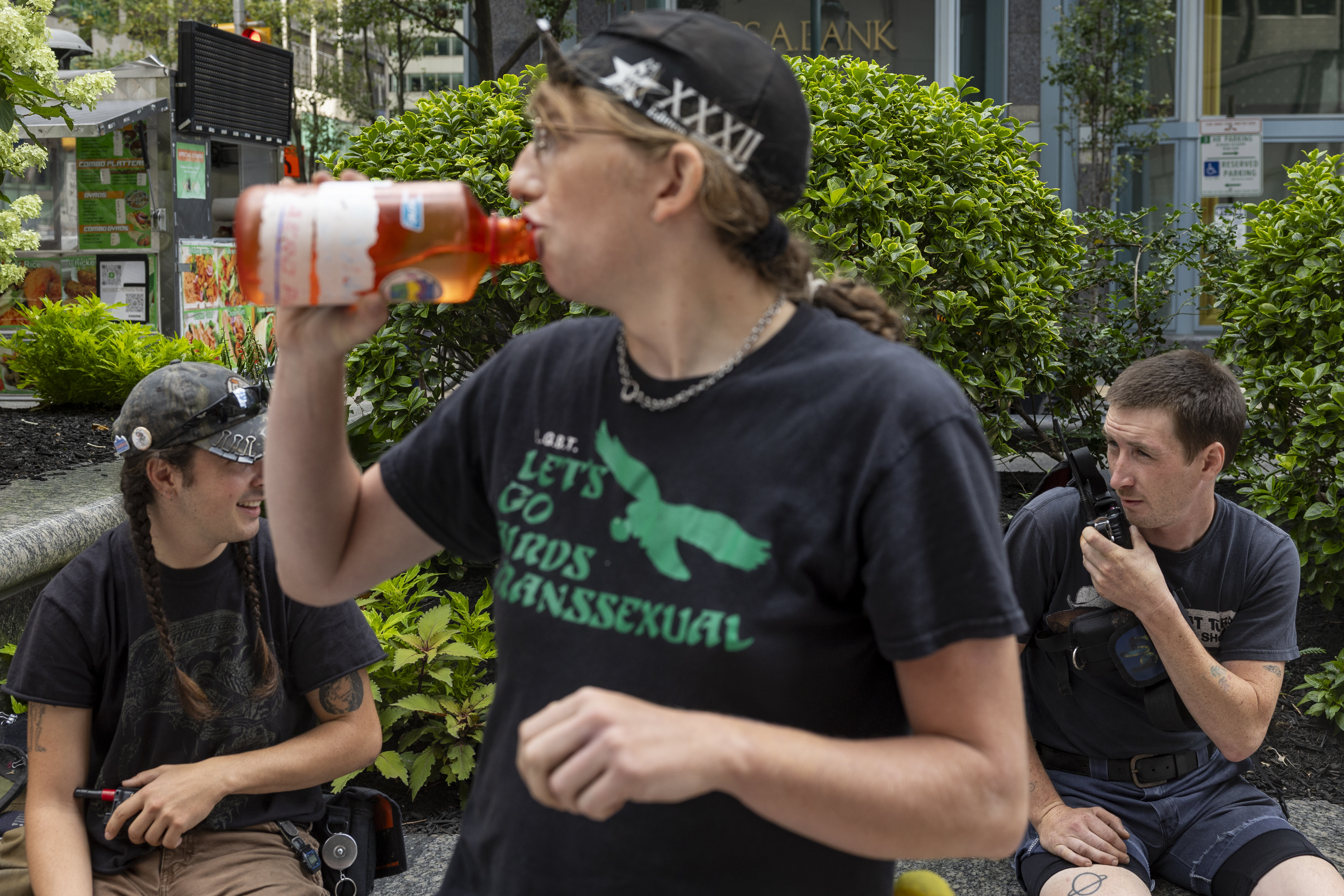
Orchid Newberger, 29, of Fishtown, walks up the entrance stairs of the William and Lois Kelley Research Building on the University of Pennsylvania campus to pick up medical samples on July 30. Newberger graduated from Penn with bachelor’s and master’s degrees in material science engineering but found it hard to both land a job within that field and enjoy it. Newberger picked up bike courier work shortly afterward. “I spent a lot of time in school figuring out that that’s not what I wanted to do with my life.”Aidan T. Gallo / Staff PhotographerNewberger inside an elevator at the Cira Centre building for a pickup. “This isn’t a ‘forever job,’ obviously,” Newberger said.Aidan T. Gallo / Staff PhotographerBike courier Brian Campbell, 31, knocks on a door at the Broad Street Love social services building to deliver payroll stubs on July 22.Aidan T. Gallo / Staff PhotographerCampbell helps Newberger adjust her bike’s front wheel at Rittenhouse Square on July 14.Aidan T. Gallo / Staff PhotographerCampbell wears a Philadelphia Bicycle Messenger Association (PBMA) cap on July 15. As many couriers ride without health insurance, PBMA provides donations to injured couriers for medical expenses. “It’d be really nice to have health insurance at a job like this, like, if I’m sick or hurt I just lose money, and that’s where PBMA comes in because we have to look out for ourselves on that front,” Campbell said.Aidan T. Gallo / Staff PhotographerCampbell and Newberger at Rittenhouse Square after finishing their shifts July 30. They are among many bike couriers who hang out at the park before and after work.Aidan T. Gallo / Staff PhotographerCampbell sorts through his messenger bag to deliver payroll stubs outside the Museum of the American Revolution on July 22.Aidan T. Gallo / Staff PhotographerCampbell adjusts his messenger bag alongside Artemis Darrow (left), 24, and Newberger before participating in the Critical Mass Philly event at City Hall on July 31. The evening event was held to reclaim public streets, promote cyclist safety, and advocate for better bike infrastructure.Aidan T. Gallo / Staff PhotographerNewberger rides past a bus stop on July 30.Aidan T. Gallo / Staff PhotographerCampbell drinks from his water bottle outside the Liberty Place shopping center before heading out for more deliveries.Aidan T. Gallo / Staff PhotographerNewberger drinks from her water bottle while Campbell (right) listens for a dispatch from his walkie talkie at the 1700 Market Plaza on July 30. Aidan T. Gallo / Staff PhotographerNewberger at 16th and Market Streets during her evening shift on Aug. 4.Aidan T. Gallo / Staff Photographer
Broad Street is one of Philadelphia’s great ceremonial boulevards.
A defining urban design element in William Penn’s pathbreaking 1682 plan for Philadelphia, Broad Street intersects with Market at Penn Square, creating the armature for the colonial city that gives Philadelphia its je ne sais quoi — its unique sense of place. For out of this intersection sprang our majestic City Hall, anchoring the four original quadrants of Penn’s city, each coalescing around one of Penn’s great public squares.
South Broad Street is a place where the city comes together. Think of the great swell of civic ecstasy that suffused the street on either of the occasions in recent years when it hosted the Eagles’ Super Bowl victory celebrations. And then there is the perennial only-in-Philadelphia Mummers Day Parade, which animates the street on New Year’s Day as glittering costumes and the strains of string bands bounce and reverberate among the canyons of South Broad.
Still, the street struggles to invite people to linger, stroll, dine, and shop along its sidewalks on a daily basis, never matching the urban vibrancy of the great streets of the world like Fifth Avenue in Manhattan or Oxford Street in London. And it’s not for lack of trying.
The Avenue of the Arts was created to do just this during the Rendell administration. In defining an area for the performing arts, the street soon saw the arrival of the Kimmel Center, the Wilma Theatre, and other arts-based performance spaces. And yet, the street continued to flounder as a welcoming urban place.
Now, to be sure, South Broad has a lot going for it. One need only stand at the intersection of Broad and Walnut, surrounded by handsome towering buildings with majestic light fixtures along the sidewalk, and you have a sense of what the street was — and what it could be. The street certainly needs some TLC, but not radical surgery.
Which makes the recent “improvements” on the block of South Broad in front of the Kimmel Center all the more perplexing.
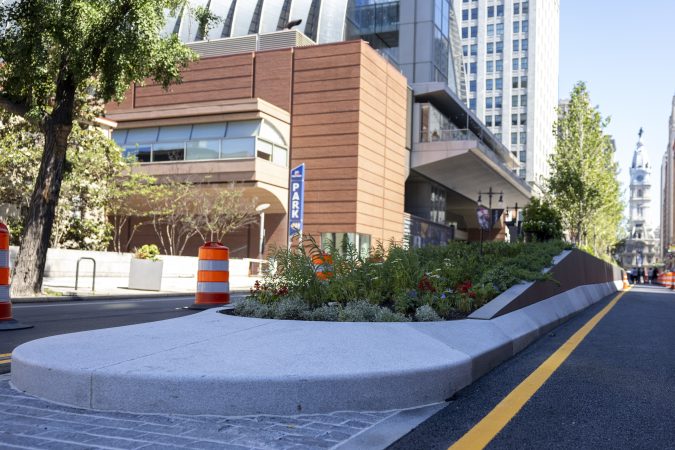
For there, officials have unveiled a beta test for a new Avenue of the Arts streetscape project smack in the middle of South Broad Street that includes an egregious four-foot-high continuous planter with trees on top of it. All intended to increase the attractiveness of the street and thereby encourage a livelier street life.
But therein lies the rub.
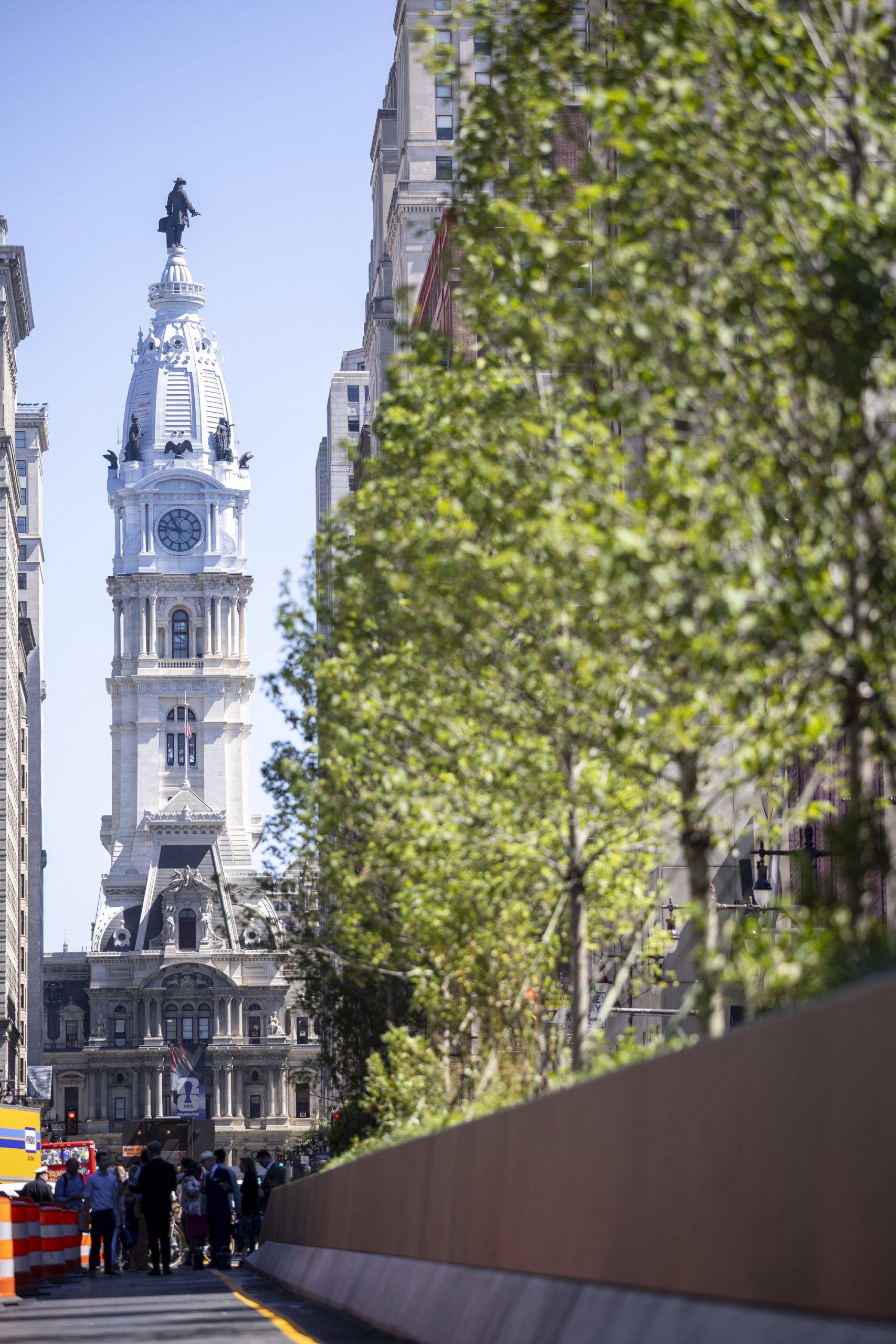
In creating this continuous concrete highway divider-cum-planter in the center of the street, the project actually has a chilling effect on South Broad. Not only do the planter and the trees destroy the primacy of the view of City Hall tower along the street, but it reinforces the nature of Broad Street as a highway, and makes it impossible to see the other side of the street while either walking or driving. And forget about parades and festivals.
The planters and trees destroy the primacy of the view of City Hall Tower along the street, write Alan Greenberger and Harris M. Steinberg.Tyger Williams / Staff Photographer
We are told this is to be replicated on the street from City Hall to Washington Avenue to the tune of $150 million, or $15 million per block. Who thought this was a good idea?
And, as if to add insult to injury, the project proposes outsized planters along the sidewalks that will further isolate the two sides of the street, crowd out whatever street life exists, and create, along with the tall planter in the center of the street, a series of cattle chutes for 10 blocks.
Welcome to Broad Street Narrows.
This can’t stand. The project must not be replicated along the length of the Avenue of the Arts. There are ways to integrate plantings into great streets, such as along Michigan Avenue in Chicago, but they are low in scale, do not include trees in the center of the street, and do not destroy the sensation of the street as a whole.
And the proposed planters have got to go, as well. One could think of planting shade trees along the sidewalk offering respite from the sun and inviting people to sit along the street and have a bite to eat. The subway concourse below South Broad is extremely wide and could undoubtedly accommodate the tree roots below grade.
The goal of increasing street life is crucial. To do so, it would be better to widen the sidewalks to allow for cafes and strolling. Street life needs foot traffic, and foot traffic is generated by people living, working, and shopping in the area, along with attending performances.
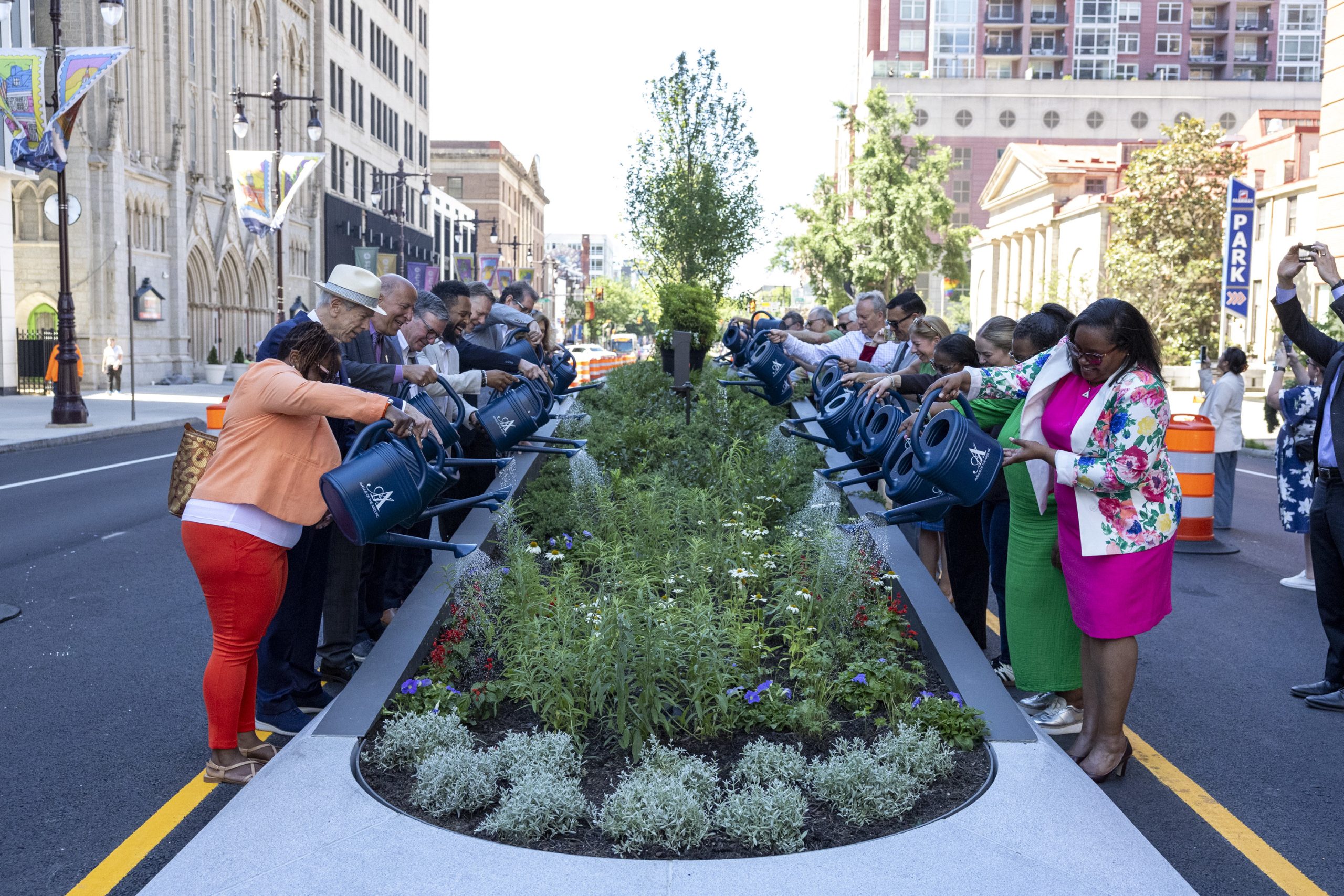
Guests at a June ceremony to unveil one of the redesigned medians water the greenery in its planter just outside the Kimmel Center.Tyger Williams / Staff Photographer
How is it that a street lined with hotels, residences, and offices has only one place for outdoor dining — at Arthaus? Broad Street wants bustling sidewalks, but landscaping and hardscape improvements alone will not increase street life. We learned this the hard way on the ill-fated Chestnut Street Transitway of the 1970s, and the planter fiasco should serve as a cautionary tale for the current design process for Market East.
We must not fall prey to the false choice that in order to maximize urban vibrancy, we must sink millions of dollars solely into landscaping and other surface improvements.
South Broad can be the best it can be with some thoughtful planning and a little gentle nurturing — it doesn’t need a Jersey barrier running down the middle of the street.
Alan Greenberger served as deputy mayor for economic development and director of commerce under Mayor Michael A. Nutter, and chaired the Philadelphia City Planning Commission. Most recently, he served as vice president of real estate and facilities at Drexel University. He is a fellow of the American Institute of Architects. Harris M. Steinberg served as the founding executive director of PennPraxisat the School of Design at the University of Pennsylvania. He led the planning process for the Central Delaware Waterfront, which is currently guiding the development of the riverfront. Most recently, he served as the founding executive director of the Lindy Institute for Urban Innovation at Drexel University. He is a fellow of the American Institute of Architects.
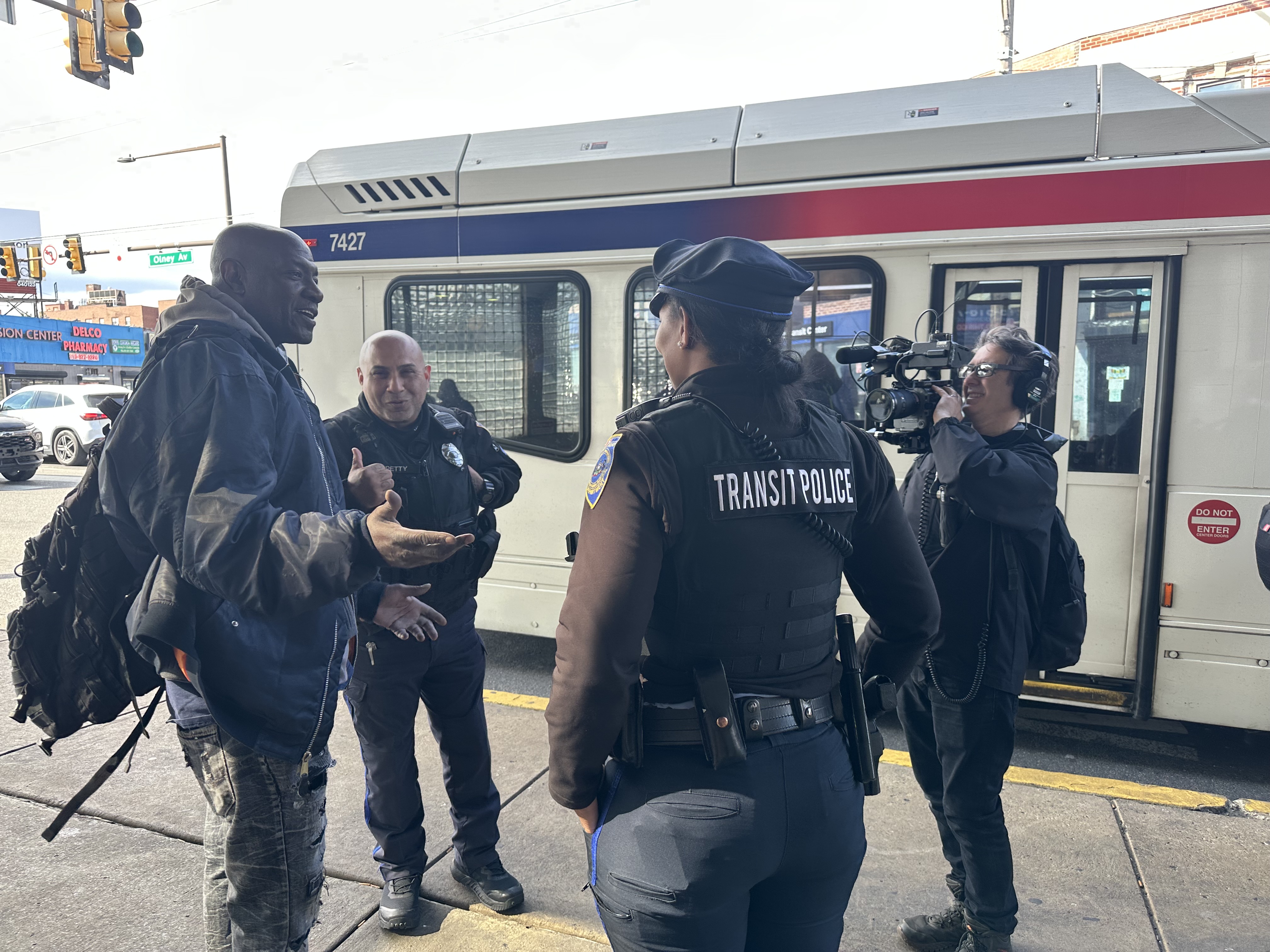
SEPTA said a production company is making a TV docuseries for A&E on the work of the transit police, shadowing officers in Philadelphia as they patrol trains, buses, and streets.
An email was sent to SEPTA employees last week explaining what’s behind filming they might see on the system.
The documentary will ”offer viewers a unique perspective of SEPTA law enforcement, allowing the audience to get to know some of the men and women of SEPTA’s 200-plus strong police force,” the internal message said.
Screenshot of a post on X of an internal email sent to SEPTA employees about the A&E documentary.X.com
The production company has editorial control but has SEPTA’s permission to embed with police units. The transportation authority says it is not receiving any compensation from the production.
SEPTA senior press officer John Golden said the eventual series will not be so-called reality TV.
“There is nothing scripted about this,” he said, and the action as crews follow officers is not staged. It also is not focused only on arrests or confrontations.
Alastair Cook, cofounder and owner of Double Act Productions, emailed that he was traveling and not able to immediately discuss the show.
The company, headquartered in the Brixton district of London, has produced dozens of documentaries and fact-based dramas for outlets like A&E, the BBC, National Geographic, and Discovery+.
A representative for A&E Global Media did not respond to a request for comment.
While walking along a stretch of beach in Sea Isle City earlier this week, a woman reported coming upon something you don’t often see in the South Jersey locale: Nearly 30 small dogfish sharks, all dead, washed up on shore.
They were small — maybe a foot in length. And some had small red marks on their bellies, according to reports.
Was this the result of something deadly in the water? Some new kind of apex predator? The approaching apocalypse?
Probably not, it turns out.
Michelle Greenling made the discovery on Wednesday morning, she told CBS Philadelphia, as she walked a 10-block stretch of the town’s beach. The first couple shark corpses weren’t particularly surprising, she said.
“But when I saw three and four and five,” she told the outlet, “I knew something was up.”
Greenling was initially worried that the sharks had been affected by something in the water.
But that does not appear to be the case, experts said.
Having examined photos of the dead sharks, Thomas Grothues, director of the Rutgers University Marine Field Station in Tuckerton, was confident they could be traced back to a fairly common occurrence.
Basically, when commercial fishing boats inadvertently scoop up fish that its crew is not actively targeting, workers are required to release them back into the water.
“This is super consistent with a commercial bycatch of fish,” said Grothues. “You can get 200 in a trawl [net] easy, and most of them will live — they’re pretty tough. But if a catch is huge and they’re sorting it, then sometimes the weight itself can kill sharks that wouldn’t normally die.”
Lawrence Hajna, media director for the New Jersey Department of Environmental Protection, offered a similar explanation.
“These occurrences are not uncommon in the summer when these fish forage near the shore and sometimes get caught inside sandbars as the tides goes out,” Hajna said in an email Thursday. “It is also possible they were discarded as bycatch from a commercial or recreational fishing trip.”
As for whether the curious incident requires any investigative follow-up?
Hajna said that the agency is not investigating the situation, “as this does not appear to be an unusual event.”
Despite his implication that American hero Dr. Anthony Fauci somehow acted improperly during the COVID-19 pandemic, and despite his denials that he was considering retiring over the winter (he was), Vic Fangio is a compulsive truth-teller — at least, in his own mind. He dogged the Dolphins when he was there, he’s told us that Jalen Carter has been out of shape, and he said last year that Adoree’ Jackson was playing so badly he might not start.
On Tuesday, Veritas Vic revealed a truth about 2025 that had been self-evident:
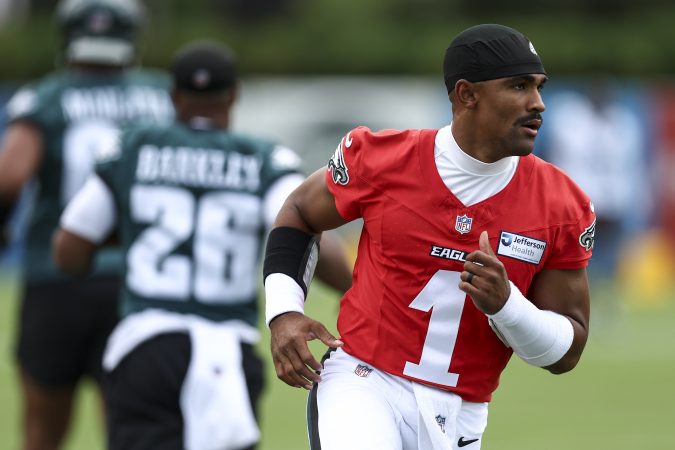
Jalen Hurts lost a step.
From 2021-24, Hurts was the second-most dynamic running quarterback in the NFL, a sabertooth tiger on the hunt. But in 2025 he looked like a woolly mammoth trying to escape the La Brea Tar Pits.
Teams no longer feared his ability to convert first downs and his ability to turn broken plays in the red zone into rushing touchdowns or scramble TD throws.
Expect that fear to return.
In public last year, Hurts, his coaches, and the front office swore that there was no real difference in Hurts’ speed. In Fangio parlance, they pled the Fifth (Fangio last week ripped Fauci’s performance at a Senate hearing: “I’m gonna be like Fauci and just take the Fifth Amendment on all questions.”).
Vic seems to miss Trump taking the 5th 450 times. Classic Trump supporter. https://t.co/UpUqzbq54N
In private, NFL sources swore that Hurts was not the same player in 2025 that he had been in previous seasons.
Just two weeks into 2026 training camp, for Fangio, the difference is palpable.
Fangio was asked his perspective as a defensive coordinator regarding how Hurts was acclimating to the new offense being installed by first-year offensive coordinator Sean Mannion. Fangio did not hesitate:
“He looks faster,” Fangio said.
There you have it.
In training camp practices, Hurts is eluding would-be tacklers the way he used to do. He’s breaking into the clear. He’s turning the corners. He’s finding gears he didn’t have in 2025, and, you can assume, he’ll locate the overdrive level that once struck fear into the hearts of defenders league-wide.
Vic Fangio’s comments on Jalen Hurts’ increased speed were telling. Yong Kim / Staff Photographer
True, it’s just practice, but Fangio made it clear that Hurts didn’t perform this way this time last year. And no, it’s not as if Hurts’ defensive teammates can snag an arm or foot as he blasts past them, but Fangio’s been coaching pro football for more than 40 years, so you can trust him to gauge a quarterback’s potency.
“Obviously, we can’t touch him during practice,” Fangio said. “There’s been a few times where our guys think they had him and they really didn’t. He’s moving good.”
Last year, offseason reports surfaced that said Hurts wanted game plans to include fewer designed runs. Hamstring, ankle, shoulder, and finger issues cost Hurts time from 2020-23. A concussion in Game 16 of 2024 cost him the final two games of the season, though he returned in fine fettle and led the Eagles to the Super Bowl LIX title.
Things clearly changed for Hurts in the 2025 season. In his first four full seasons as a starter he’d averaged 9.9 rushing attempts and 44.8 yards per game. Last season he averaged 6.6 runs for 26.3 yards. He averaged 13 rushing touchdowns in his first four full seasons. He scored eight last year.
There were other factors.
Offensive linemen Lane Johnson, Landon Dickerson, and Cam Jurgens all missed time with chronic injury issues that also diminished their effectiveness when they did play.
After a grueling, record-setting first season as an Eagle, featured back Saquon Barkley was far less explosive.
First-time offensive coordinator Kevin Patullo was overmatched, and head coach Nick Sirianni was powerless to help him.
Star receiver A.J. Brown so badly regressed physically, mentally, and psychologically that the Eagles traded him for pennies on the dollar at a massive salary-cap hit on June 1.
And, finally, defenses realized that, all things being equal, they would rather force Hurts to beat them with his legs than Barkley, since Barkley was a home-run threat every time he was handled the ball. Then defenses realized that Hurts couldn’t beat them with his legs anymore.
Between 2021-24, Hurts ran for 267 first downs, 31 more than 2024 MVP Josh Allen, who was second, and 67 more than 2023 MVP Lamar Jackson, who was third. Hurts averaged 66.8 first downs in those four years. He ran for 37 first downs last season.
Hurts’ absence of speed answers questions independent of his abilities. It answers questions about his motivation.
The insidious question that loomed last season:
Was Hurts protecting himself because, with the Super Bowl title and a Super Bowl MVP in his back pocket, even a modestly productive season was likely to produce a massive contract extension?
Eagles fans saw less running from Jalen Hurts in 2025. Yong Kim / Staff Photographer
Hurts is under contract through 2028, but 2026 is his last fully guaranteed season. Historically, the Eagles reward their best young players with early extensions that generally serve two purposes: Early extensions give the player cash in his pocket right away, and, if the player continues to play well, they give the Eagles a bargain — a player paid below comparable talents at comparable positions.
But Hurts didn’t have a moderately productive season. He had a poor season. The passing game, ranked 23rd, was abysmal considering its weapons. Hurts’ passer rating dropped from 103.7 in 2024, which ranked fifth, to 98.5 in 2025, which ranked 12th. His quarterback rating, which attempts to include all aspects of the position, fell from 62.5 in 2024, which was 10th, to 55.2 in 2025, which was 20th.
There was no extension in the offing. That might change during or after 2026, if, as Fangio says, he’s got his legs back.
If you give a computer a task, it’s going to need electricity to perform it. The more difficult the problem, the more resources it requires. This is at the heart of the fight against the data centers behind AI – often an incredibly complex and power-hungry process.
You might think that tech giants that build and use data centers would cover 100% of the costs. However, the knock-on repercussions of this heavy power drain could impact the amount you owe on your Peco bill. Let us explain.
1946
The first “data center”
If you needed help with a calculation 80 years ago, you could use the ENIAC, the first general-purpose computer, built at the University of Pennsylvania.
It was 1,440 times faster than a hand calculator but at a cost: high energy demands. The ENIAC had its own dedicated power lines and consumed 150 kWh of electricity.
2000
Powering search engines
By the mid-2000s, we could solve the same problem at a fraction of the ENIAC’s speed thanks to search engines like Google.
Data centers don’t just power search engines; they also sustain streaming services, social media, and much more. However, workflows are increasingly shifting to use artificial intelligence.
story continues after advertisement
2022
AI in everything, everywhere, all at once
Today, unless you actively opt out, your Google search will likely be augmented by AI. “Historically, you would just get hyperlinks, and then you would have to click through and read the webpages yourself,” said Benjamin Lee, professor of computer science at the University of Pennsylvania and visiting scientist at Google. “In some sense, generative AI is doing the reading for you and trying to anticipate the actual answer you were looking for.”
The average Google Gemini prompt uses about 10 times the energy of a pre-AI Google search. This is partly because AI technology involves complex algorithms that require more computing power, but it’s also because between the 1960s and 2010s the basic building blocks of computer chips were increasingly getting smaller and more power-efficient. Within that timeframe, our computational ability multiplied by sixfold with only a 6% increase in power usage, according to Lee.
But those efficiency gains eventually stalled.
“When AI came along in late 2022, we realized we needed hundreds – or thousands – times more [computational power], and the transistors weren’t keeping up,” Lee said. “The hardware side slowed down, even as the computational demands went up by a lot.”
To put it in perspective, in a single hour, a hyperscale 1,000,000-kW data center running at peak capacity can consume more electricity than every household in Philadelphia combined.
Hyperscale data centers can consume a city’s worth of electricity in an hour
ENIAC
150 Philly households' energy usage
Conventional
Hyperscale
The typical Peco customer uses about 0.94 kW per hour in July.
If all 679,428 households in Philadelphia consumed that amount of electricity …
… it would still be less than a hyperscale 1 million kW facility’s electricity use – the equivalent of over 1 million Philly households.
A report by Wood Mackenzie, an energy research firm, found that utility customers might already be shouldering some of the cost of servicing heavy users of electricity, including data centers. These hyperscale facilities and their projected demand for power could impact all three categories on your bill: generation, transmission, and distribution.
Let’s walk through each one.
Generation
Generation refers to how power stations produce electricity from primary energy sources like fossil fuels, solar, or wind. Pennsylvania generates about 60% of the state’s electricity with natural gas, according to the American Gas Association.
“There's only so much gas in the market and, with data centers coming online, there's increased competition for it,” said Elizabeth Marx, executive director of the Pennsylvania Utility Law Project, a statewide legal aid program representing low-income consumers and protecting their access to affordable energy and water.
story continues after advertisement
Pennsylvania Gov. Josh Shapiro recently proposed that hyperscale data centers supply their own power to reduce the burden on residential customers to pay for infrastructure costs. However, not everyone agrees that it will work.
“Unless they are building clean generation that doesn't rely on and constrain our gas supply, [data centers are] having an impact on the price of gas,” Marx said, “and [that cost] flows into your electricity bills.”
PJM has a capacity market, where utilities – like Peco – pay power plants to guarantee enough power to meet future energy needs. This ensures that enough electricity will be available at high usage and to avoid blackouts.
“The biggest impact that we're seeing already from data centers is on capacity market prices,” Marx said. In 2024, AI companies started shopping around for power purchasing agreements directly with power suppliers.
The increased demand for capacity without greater supply increased the cost of electricity. The capacity price during the 2024/2025 auction was about $46 per MW/day, according to Monitoring Analytics, an independent market monitor for PJM. The following year, it surged to $297 per MW/day.
In a recent quarterly report, Monitoring Analytics said that “large data center loads have already had a significant and irreversible impact on PJM customers.” Between 2016 and 2025, Peco customers saw a $20.46 increase in the supply portion of their bill, which includes generation and transmission.
Peco’s Price to Compare has increased steadily since 2022
6
8
10
12
14 cents
Jun 2022
Jun 2026
JuneJune
Source: Peco’s Price to Compare is what customers pay if they do not shop around for an alternative electricity supplier
Pa. law requires that Peco is not allowed to profit off generation and transmission; you are just paying the rate set at PJM wholesale auctions. “Supply costs are set by the competitive market, are not controlled by Peco, and do not generate a profit for the company,” said Candice Womer, communications manager at Peco.
Distribution
Distribution is the final phase, where electricity moves from a transmission station to your home. It makes up 50% of your electric bill and, unlike the supply side of the electricity equation, can generate a profit for utility companies.
Almost two-thirds of Americans believe that a major reason behind their rising home energy costs is utility companies’ bottom line, according to a recent Pew Research Center survey.
In its second quarterly report of 2025, Peco reported $136 million in adjusted earnings, compared with $93 million in the same period in 2024. The company said in its earnings report that it used the profits to improve distribution infrastructure.
When utility companies invest in the electric grid to ensure it is ready for peak demand or storms, those investments are often baked into distribution costs. “Peco must balance its obligation to serve new customers with the risk of overbuilding infrastructure,” Womer said. “When distribution upgrades are needed, those costs are paid up front by the data center customer through a Contribution in Aid of Construction, ensuring there is no impact to other customers.”
One of the fees baked into distribution charges on your monthly bill is the Universal Service Fund. This helps fund programs like Peco’s Customer Assistance Program that help low-income households afford their utilities. In her testimony before the Pennsylvania House Energy and Consumer Protection, Technology, and Utilities Commission earlier this year, Marx said that in Pennsylvania, “universal service costs are only allocated to residential customers.”
Despite their direct impact on rising costs, data centers pay nothing to support these programs, she said.
“It’s very hard to reduce the electricity you use in a significant way,” said Vik Patel, managing attorney of the energy and utilities unit of Community Legal Services. “If it's cold outside, you need to have the heater on. Otherwise it can be unsafe. [It’s the] same thing in the summer; you have to have access to cooling.”
story continues after advertisement
Even if electricity feels unaffordable, it can be difficult for customers to lower their use and, therefore, their bill. But if customers can’t pay their bill, they risk losing power completely.
Last year, about 25,000 households in Philadelphia had their electricity terminated and could not afford to have it restored, according to Patel. “There are a lot of collateral effects when someone's electricity is terminated,” he said. “They can get evicted. [They can] lose custody of their kids.”
What happens next
Data centers and their projected demands on the grid are not the only reason electric bills are increasing, but that has not lessened some residents’ concern about their expansion.
There are already dozens of conventional data centers in Philadelphia, according to Data Center Map, a private company that tracks such facilities nationwide. Two hyperscale campuses are being built in nearby Bucks County and Cumberland County, N.J.
At least four more data centers have been proposed in Chester and Montgomery Counties. These local proposals face a groundswell of opposition from residents who worry about the environmental and financial ramifications of having these hyperscale facilities in their backyard.
Note: Amazon’s 600,000-kW data center is currently under construction in Falls Township, as is the 300,000-kW hyperscale data center in Vineland.
“I don't deny we need to upgrade our grid,” Marx said. “And, quite frankly, more frequent storms are absolutely going to cause more infrastructure costs. But I think there's a lack of transparency in what's necessary and what is nice to have. Who’s it for? Who pays for it and at what expense?”
Staff Contributors
Reporting: Charmaine Runes
Design and development: Charmaine Runes, Sam Morris
Graphics: John Duchneskie
Illustration: Glenn Harvey
Editing: Sam Morris, Cynthia Henry
Copy Editing: Addam Schwartz
Subscribe to The Philadelphia Inquirer
Our reporting is directly supported by reader subscriptions. If you want more journalism like this story, please subscribe today
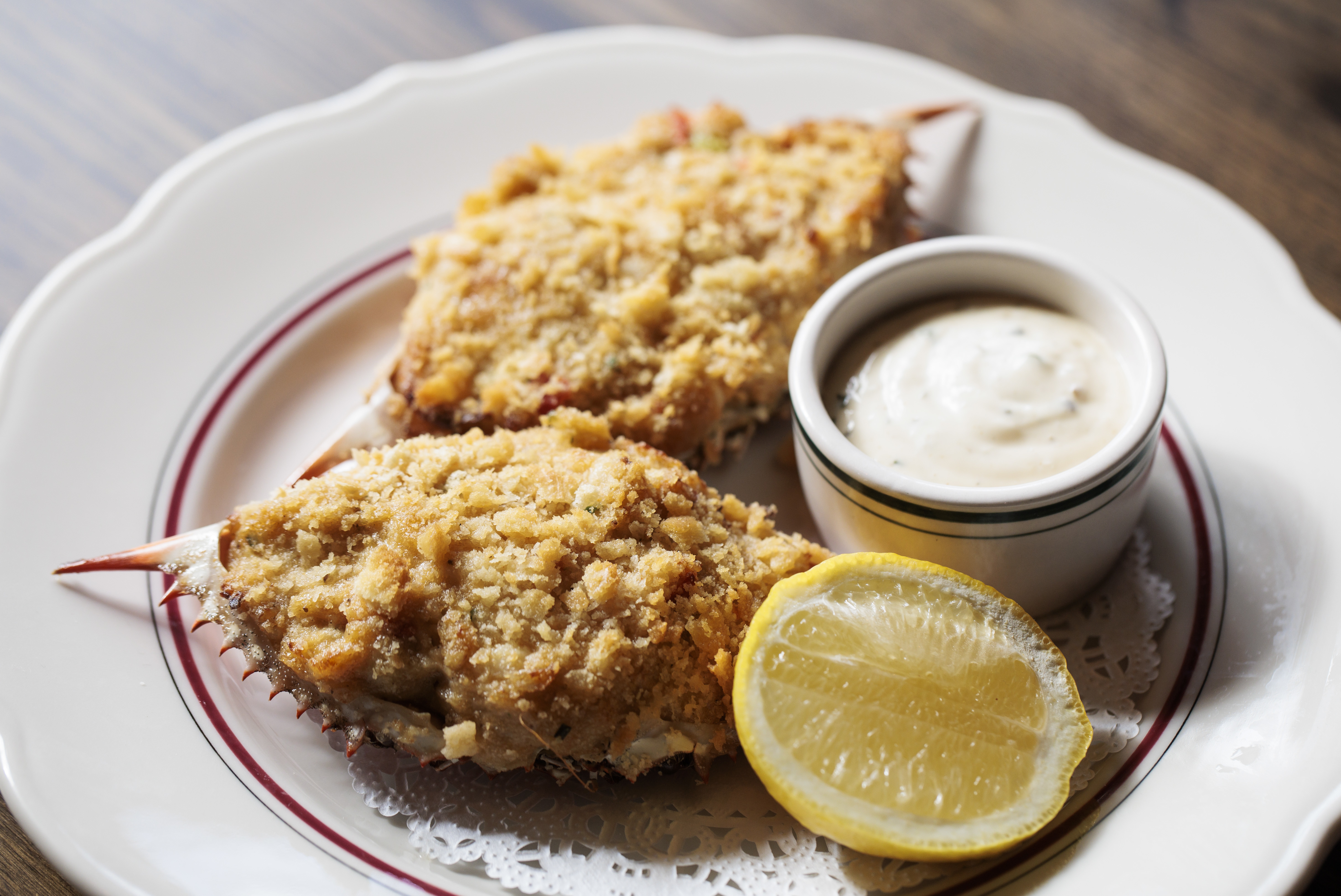
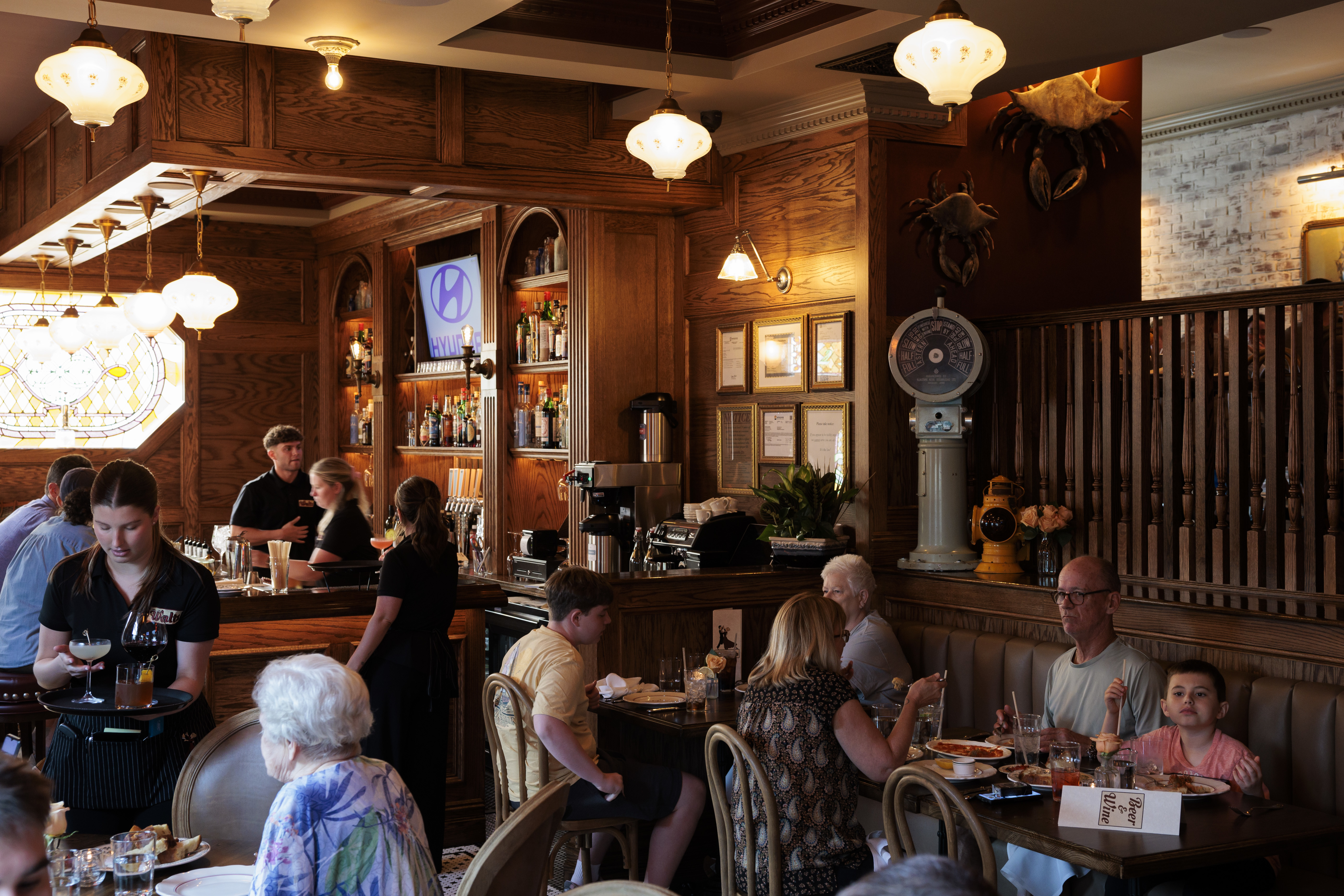
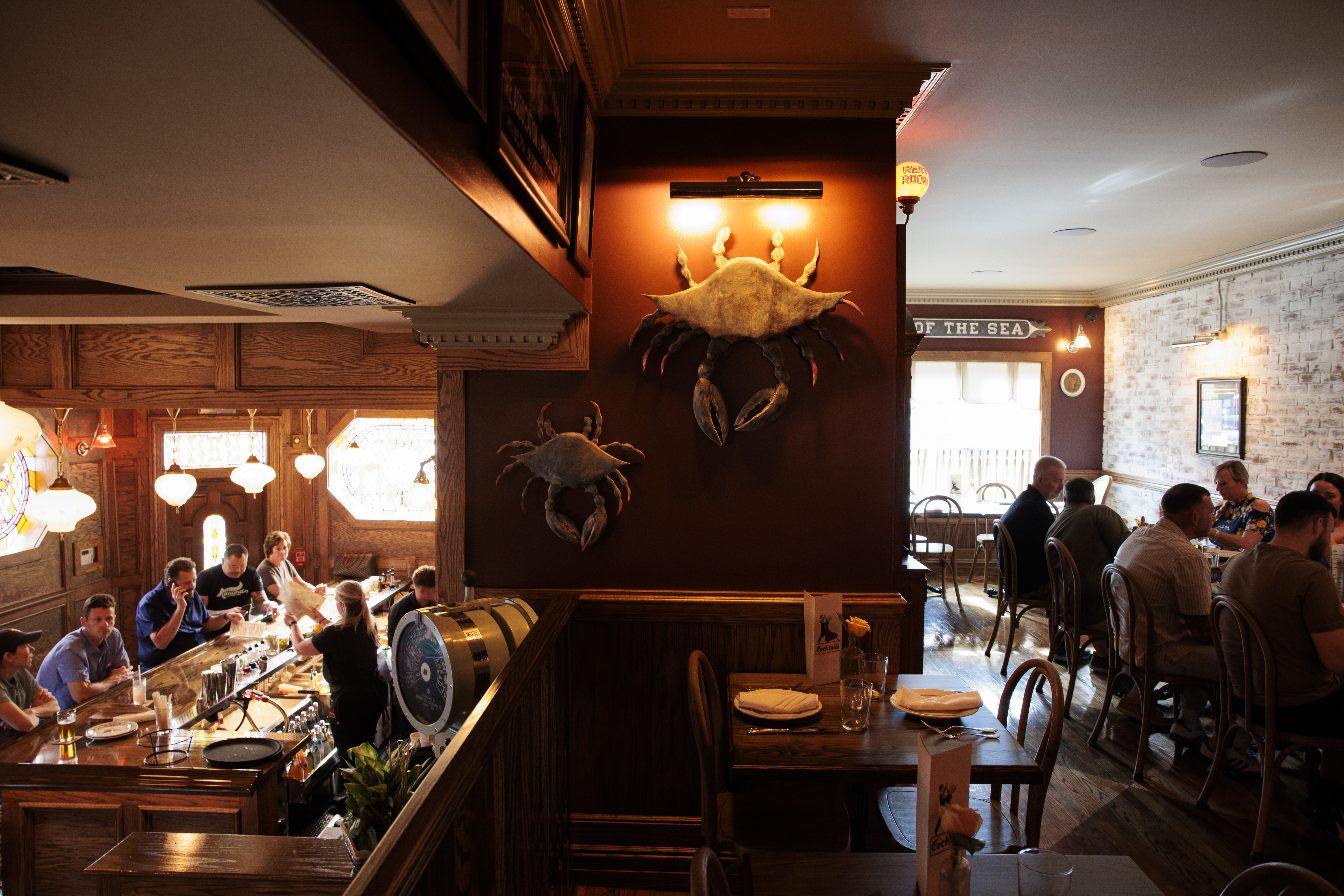
If you didn’t know better, you could be convinced — as you slide a spoonful of lightly breaded crab cake out from its stuffed shell, gaze at the soft light pouring through stained glass windows, and sip a frosty martini — that Waltz, at Front and Ritner, has been dancing on this corner of deep South Philadelphia for decades.
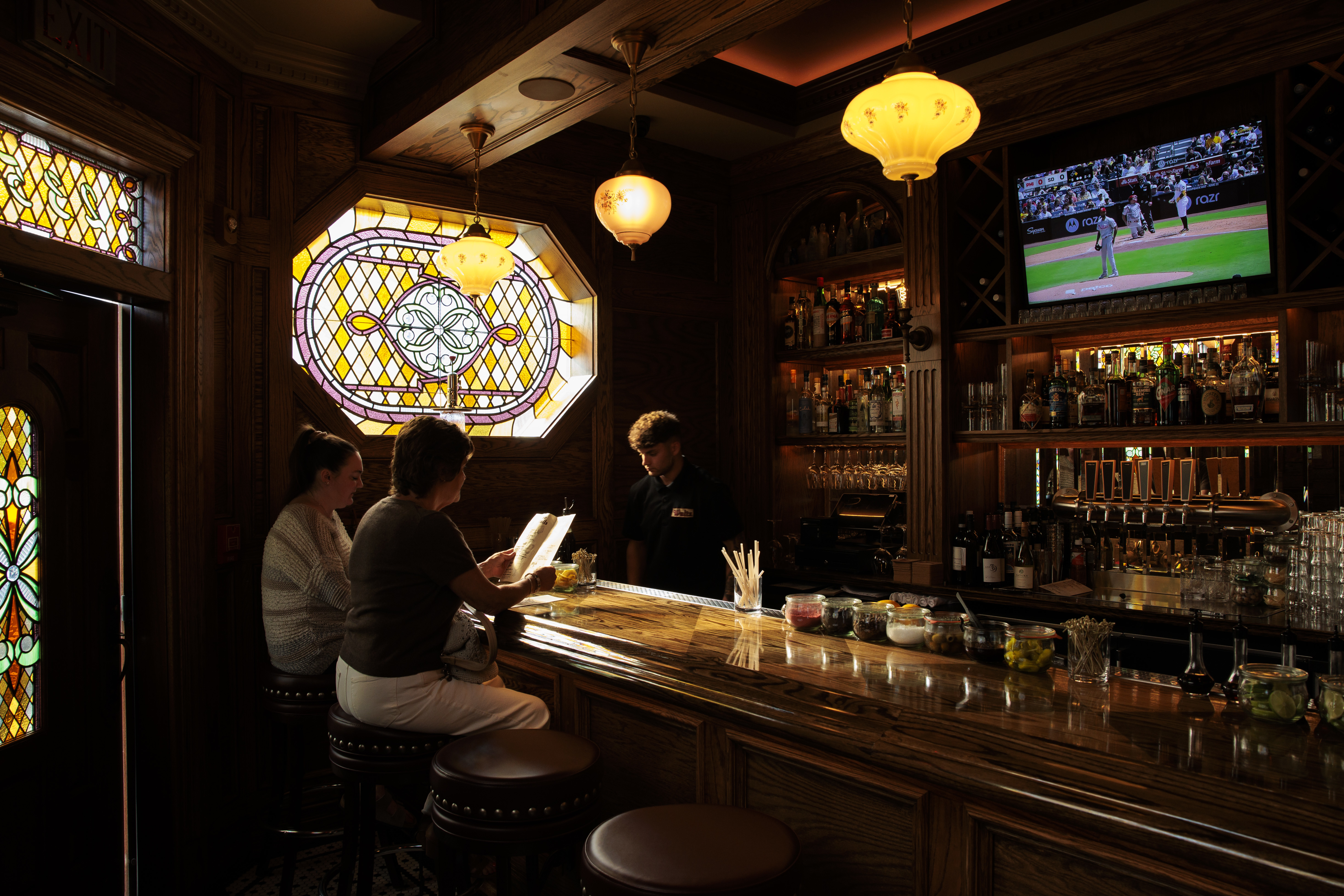
Cue the crowds that reliably fill the bentwood chairs in its wood-paneled downstairs bar and the bustling upper dining room even on weekdays. Forks angle through heaping platters of spaghetti while the Delfonics, O’Jays, and other Philly soul greats croon in the background. The vintage vibes here are pristine — except for the fact that Waltz is not vintage at all, but a five-month-old passion project thatunpretentiously delivers a style of polished Italian American dining that’s been on the slow fade for decades due to demographic shifts and changing tastes.
Celine Tobin and Joey Dougherty work at Waltz on Wednesday, May 27, 2026 in Philadelphia.Monica Herndon / Staff PhotographerThe bar at Waltz on Wednesday, May 27, 2026 in Philadelphia.Monica Herndon / Staff Photographer
This restaurant’s charm is more than just a wistful nod to “they don’t build ’em like that anymore” nostalgia. Waltz is anything but stale from the moment you’re greeted warmly at the maître d’ stand, most likely attended by manager Celine Tobin, who also happens to be co-owner Joey Dougherty’s girlfriend. A wood-fired oven beckons from just beyond in the partially open kitchen, where the 800-degree hearth fuels a menu built around pizzas, roasted meats, and house pastas.
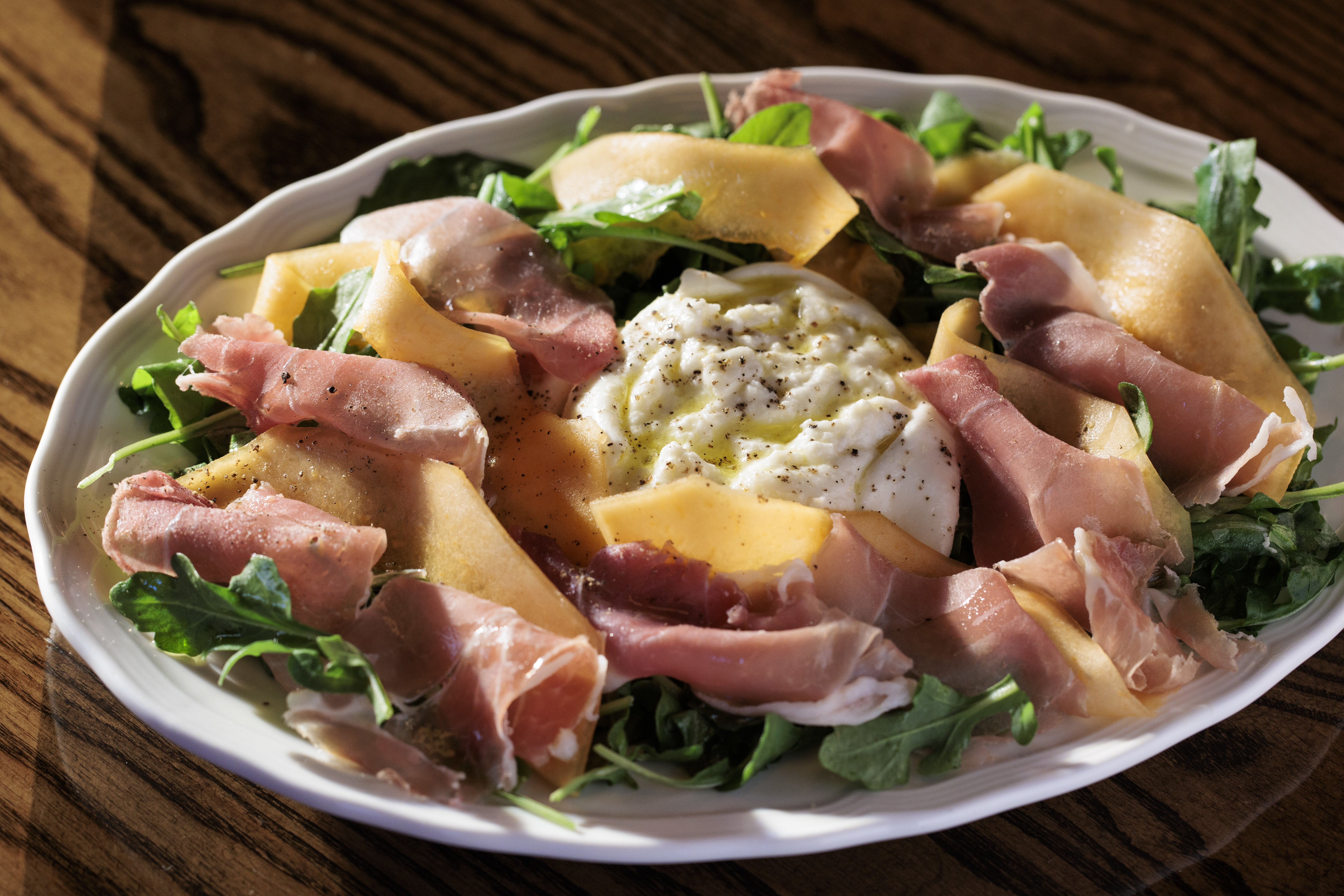
The menu, conceived and implemented by consulting chef Eric Leveillee, formerly of Lacroix at the Rittenhouse, is key to Waltz’s allure, offering a familiar repertoire of popular dishes, then raising the bar with added elements of craft. The mozzarella is hand-pulled from Caputo Bros. Creamery curds just before service, so the milky white burrata — its core stuffed with rosemary-infused mascarpone — is extra sweet when draped with salty pink curls of prosciutto, juicy cantaloupe, and peppery green olive oil. The pizzas are made from sourdough, which lends their crusts an extra crackle, complexity, and tang.
The burrata with prosciutto, melon, and olive oil at Waltz on Tuesday, Aug. 4, 2026, in Philadelphia.Monica Herndon / Staff Photographer
Thehouse-extrudedpastas gain extra vibrance from their springy texture. There’s noticeable resilience in the wide lumache elbows, for example, whose bounce stands up to a spiced blush sauce that’s not simply rich with cream and fistfuls of crab, but boosted by the depth of a freshly steeped crab stock. That pasta, as well as the signature appetizer of crab cakes, is a nod to the hard-shell history of this address’ previous occupant, Anthony’s Crab House.
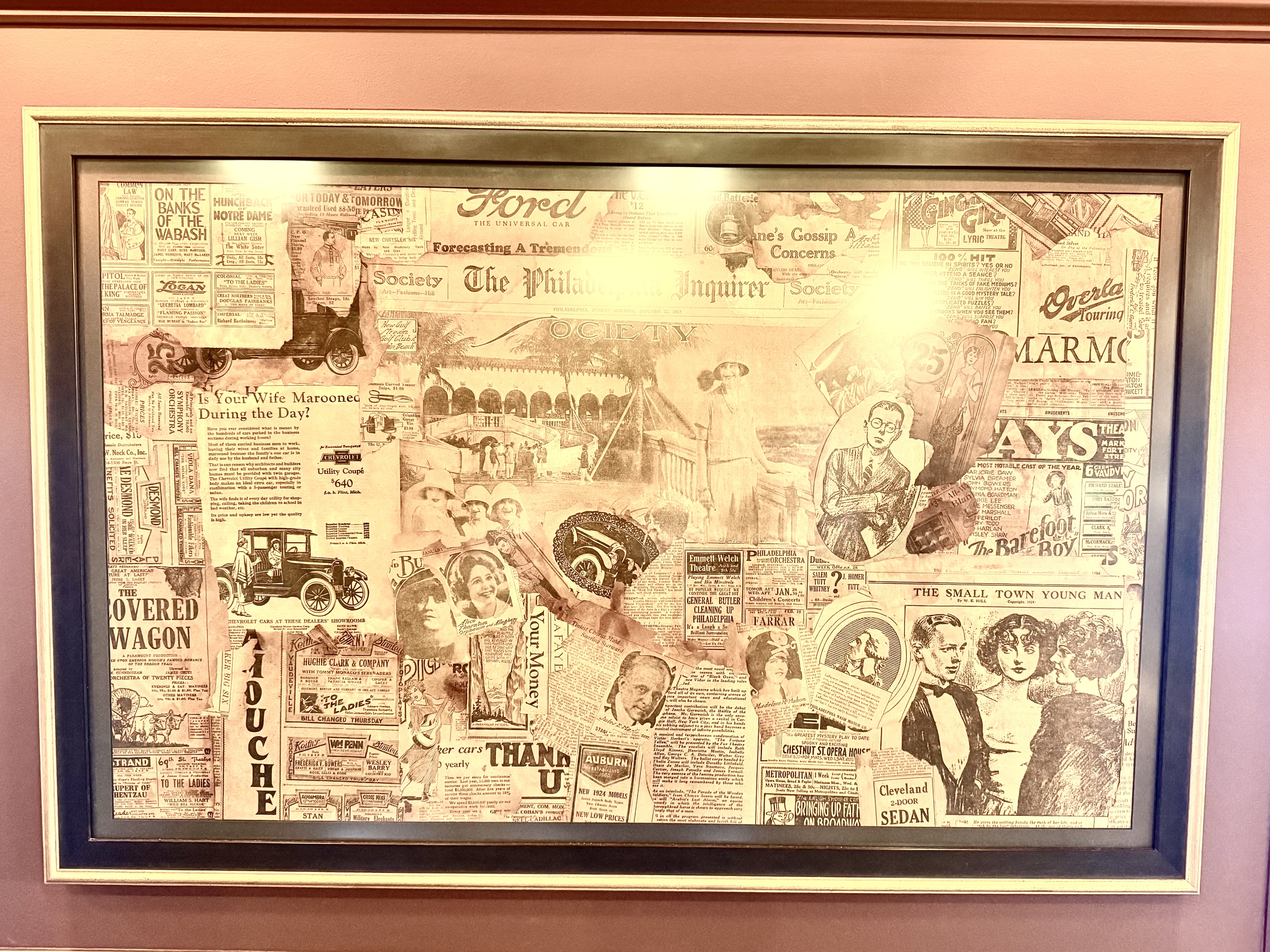
Waltz is a wordplay tribute to the Whitman neighborhood at the city’s southeasternmost corner, an area near the port bordered by railyards and strip malls rich in casual dining options (John’s Roast Pork, Wolf Burger, Oregon Diner, and the newly opened Angelo’s location), but slim on date-night draws. Dougherty aimed to answer that need by rehabbing this corner haunt, which had fallen into disrepair a block from his family’s contracting business, Dougherty Electric. As such projects often go, an intended modest facelift turned into a major renovation: The Doughertys created a wider opening between the dining rooms in two adjoining properties, restored the exterior brick by brick, and completely rebuilt the interior, down to the framed collage of 1924 editions of The Inquirer that had been used inside the walls as insulation.
The stuffed crabs at Waltz on Wednesday, May 27, 2026 in Philadelphia.Monica Herndon / Staff PhotographerThe interior of Waltz on Wednesday, May 27, 2026 in Philadelphia.Monica Herndon / Staff Photographer
Based on the craftsmanship of the fixtures, from the millwork of the wood paneling to the barroom tiles, vintage pendant lights, and even the beautifully outfitted marble bathrooms downstairs, it’s clear the Doughertys used many of their professional contacts here.
They might want a rebate, though, from their HVAC guy. The air-conditioning in the nautical-themed upper dining room cut out halfway through a meal with my boss on a 100-degree day, awkwardly leaving us sweatyover our peperoncini-spiked martinis and the crisply fried fritto misto.
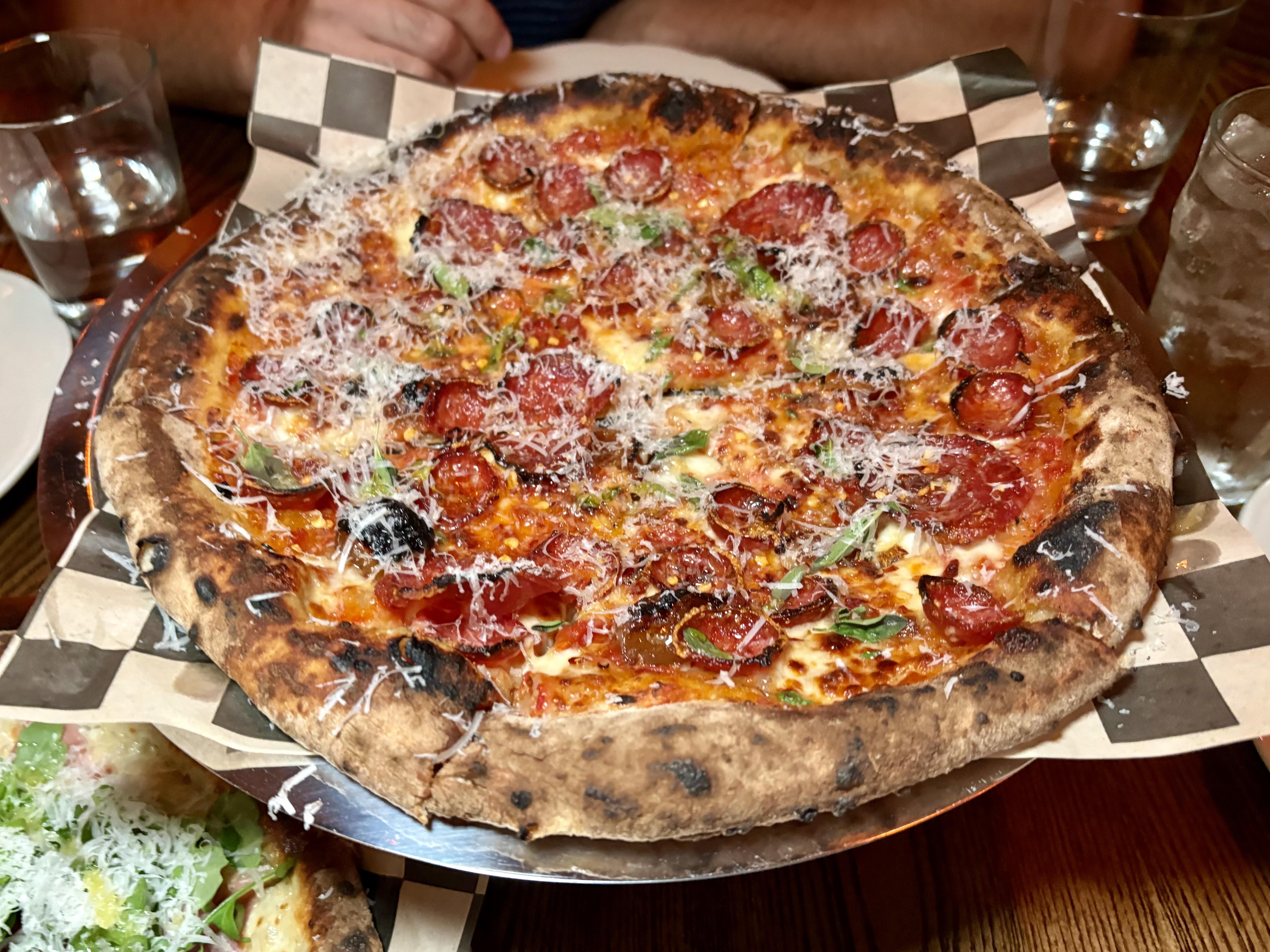
The interior of Waltz on Wednesday, May 27, 2026 in Philadelphia.Monica Herndon / Staff PhotographerThe sourdough piccante pizza at Waltz includes pepperoni, soppressata, hot honey, and onion agrodolce.Craig LaBan / Staff
It’s a tribute to the kitchen that our table remained upbeat despite the sticky heat. The carbonara pizza — a white pie with béchamel and fontina scattered with salty nuggets of guanciale and a golden glaze of egg yolk — was my favorite pizza of that first visit. The piccante — a red pie with pepperoni, soppressata, hot honey, and sweet-tart onion agrodolce — was my pick on a return meal when the AC, thankfully, was working again.
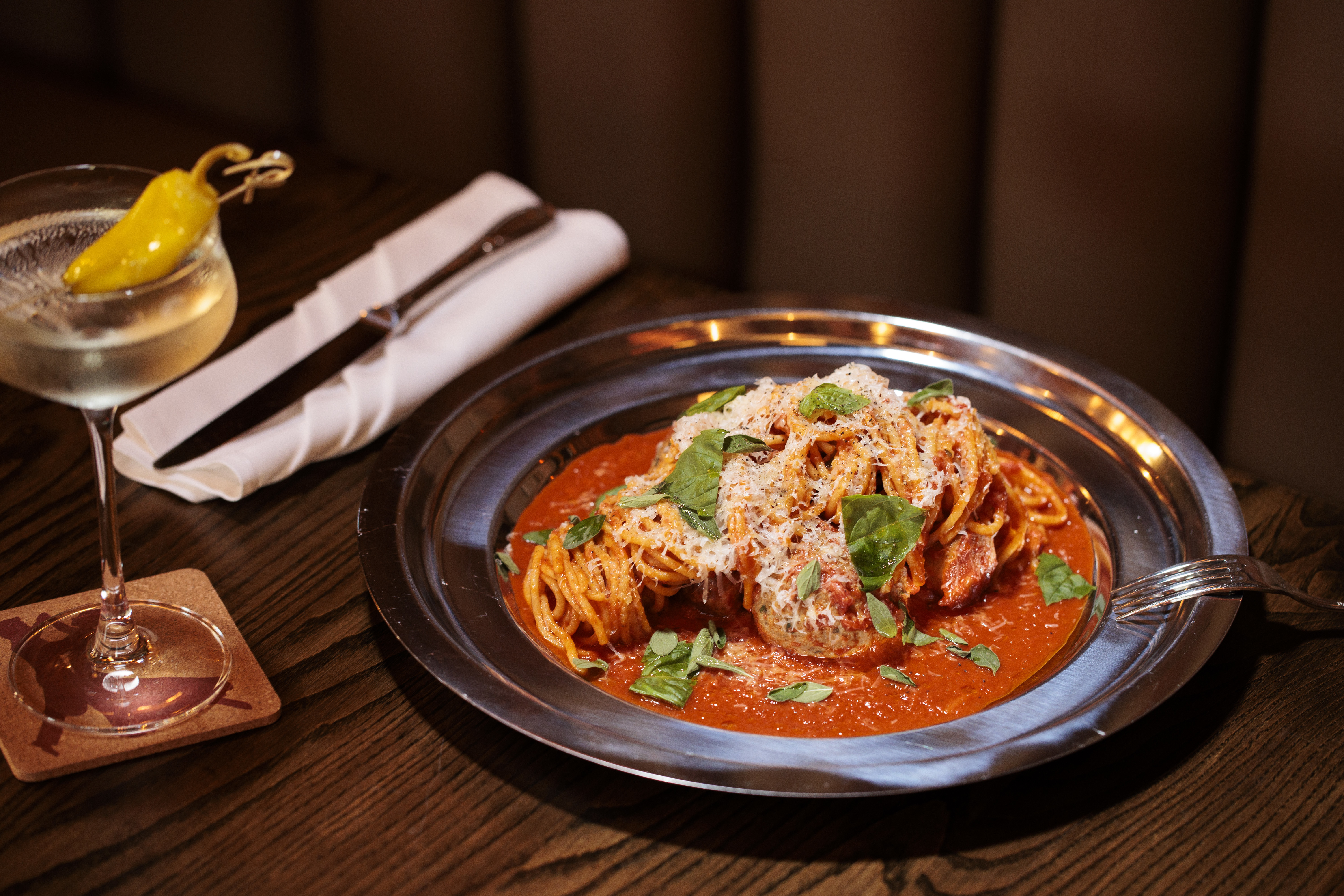
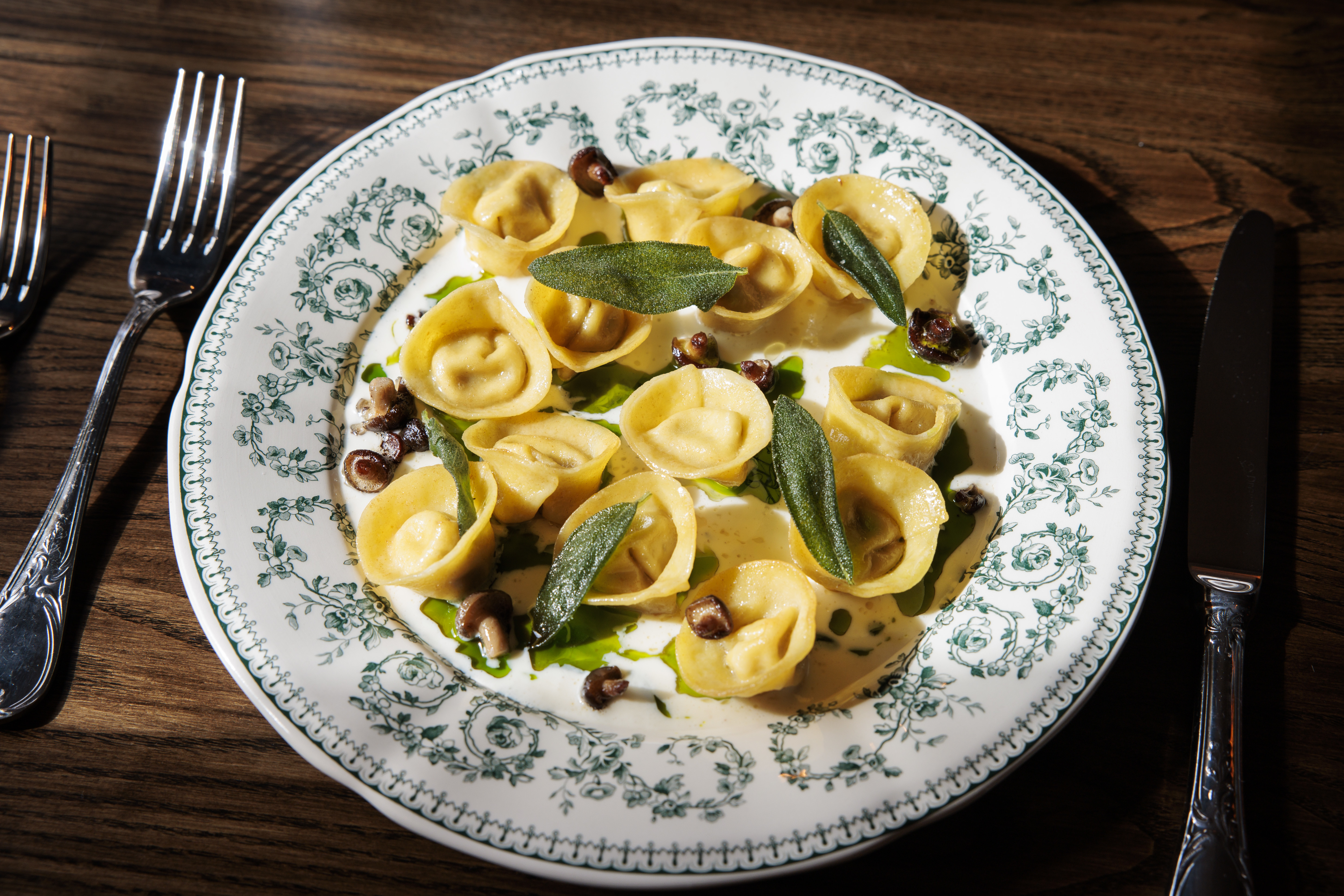
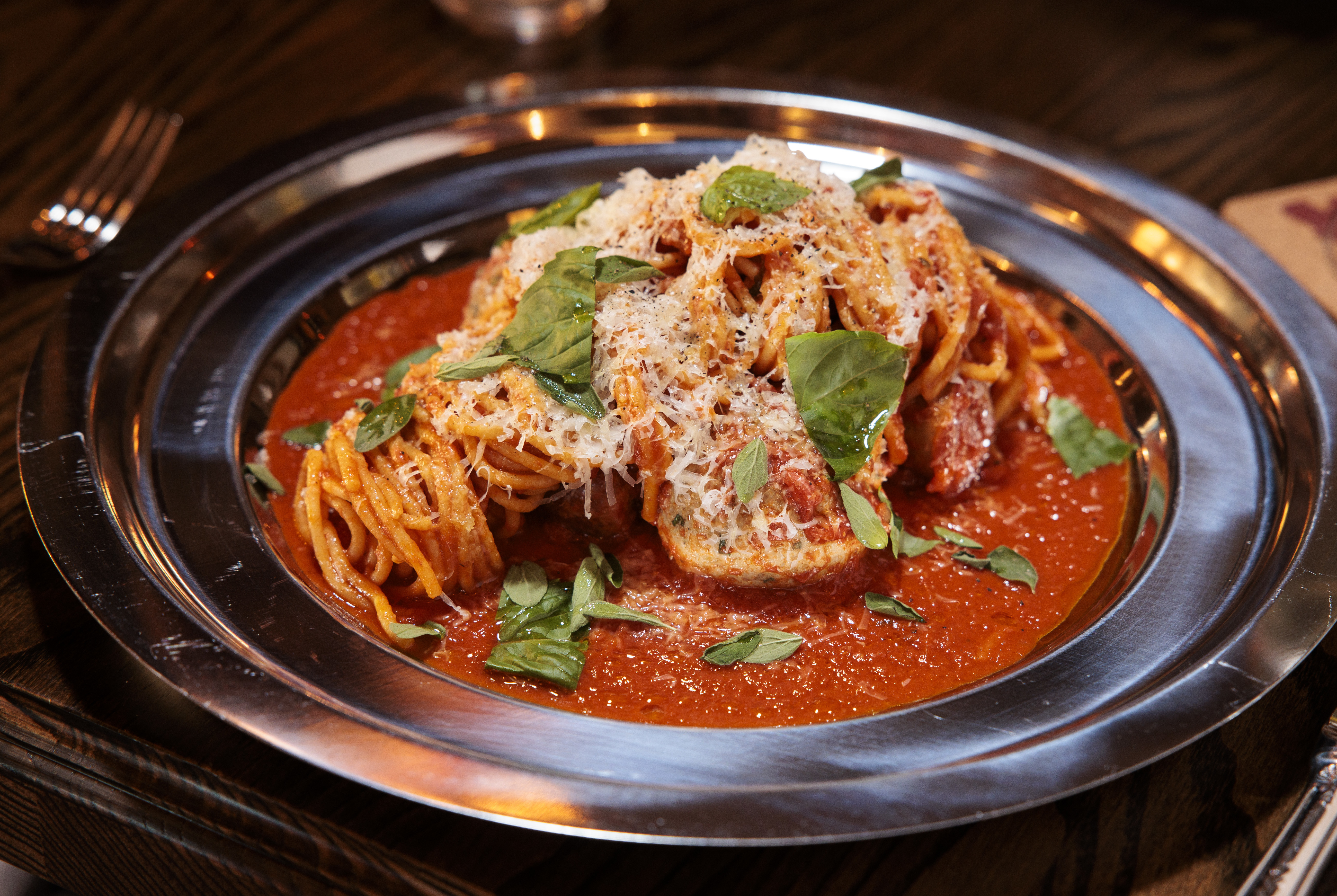
The pastas at Waltz are also consistently excellent, including deftly folded tortellini stuffed with mushrooms in Parmesan cream sauce, and the ruffled-edge ribbons of pappardelle that cradled rustic duck ragù. The snap of fresh noodles lend the already irresistible silver platter of spaghetti with meatballs and sausage in red sauce extra oomph. It was so zesty, I couldn’t help but wonder how this Sunday gravy became a treasured tradition of the Dougherty family in this historically Irish enclave of South Philly.
The tortellini at Waltz on Wednesday, May 27, 2026 in Philadelphia.Monica Herndon / Staff PhotographerThe spaghetti and meatballs at Waltz on Tuesday, Aug. 4, 2026 in Philadelphia.Monica Herndon / Staff Photographer
“We call it ‘Gus’ gravy,’” says Dougherty, noting that his father, Donald “Gus” Dougherty, also a partner at Waltz, learned the recipe in 2008 from some Italian friends he met while he was serving 18 months in federal prison at Fort Dix for defrauding the IBEW Local 98 electricians union, formerly run by his close (but unrelated) associate, John “Johnny Doc” Dougherty. “He’s made it every Sunday since.”
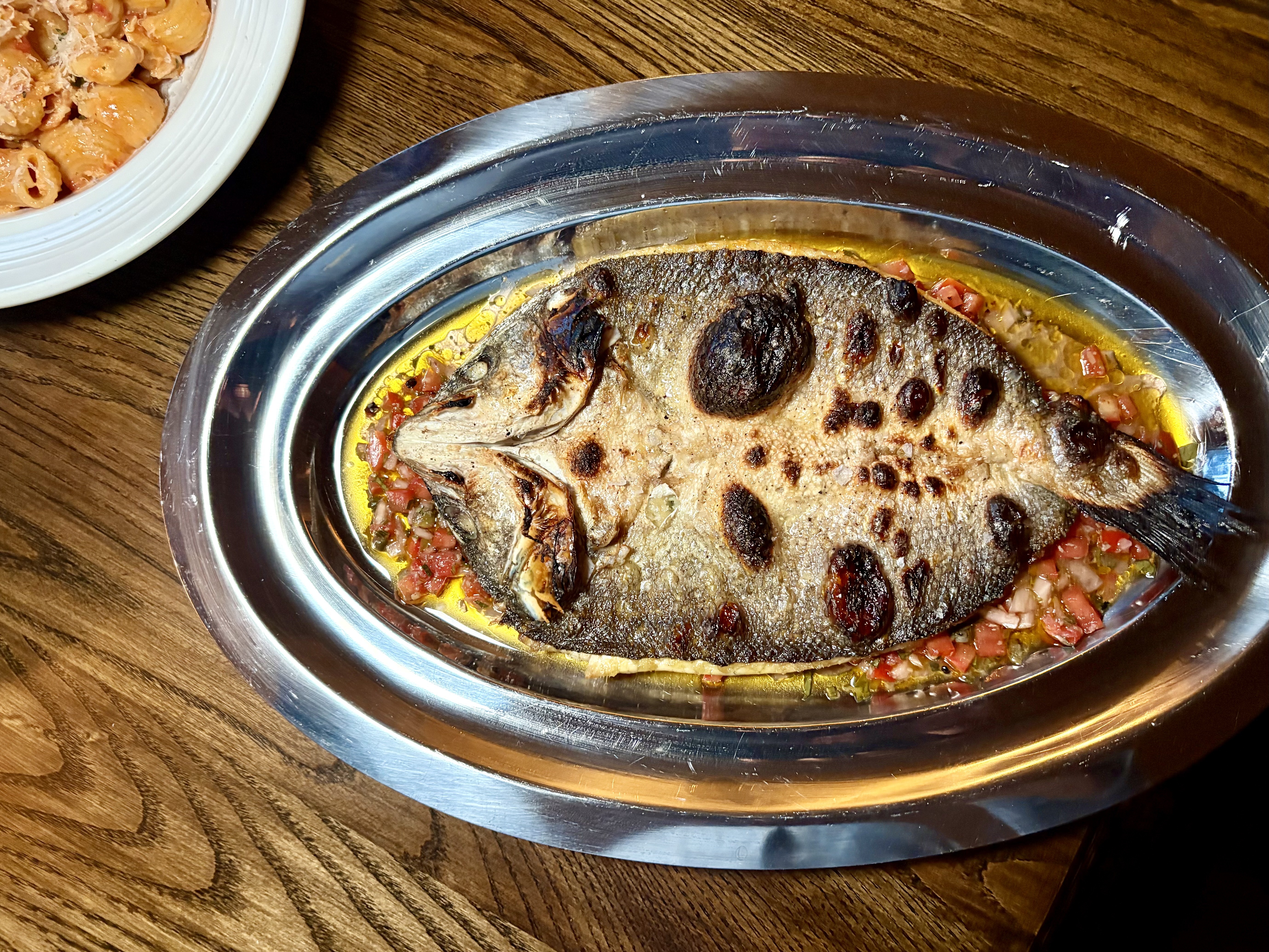
That gravy also features prominently on the chicken Parm, although that is one dish here I found unexciting. Yes, the sharing portion is gigantic, which, at $30, is a reminder that prices here are very fair. But the breading had gone so soggy in all that red sauce the exterior was almost fluffy, leaving this Parm one-dimensional. Your best bets for the handful of large-format sharing dishes emerge from that wood hearth; the heat-blistered silver skin of a butterflied whole branzino, for example, is fantastic over the tangy vinaigrette — called sauce vierge — of fresh tomatoes, capers, and a splash of chili oil that makes it glow.
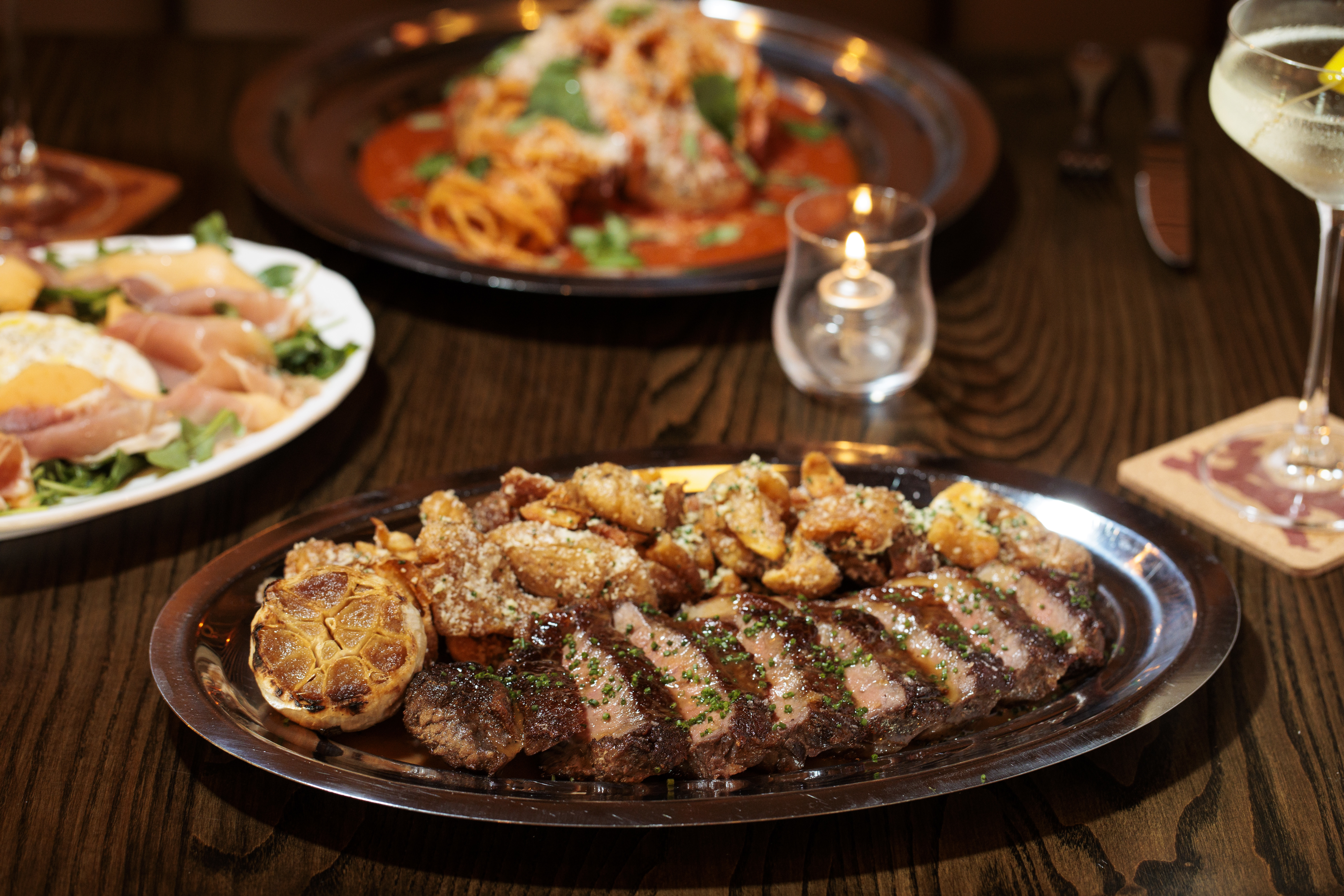
The superbly tender 14-ounce strip steak, meanwhile, roasted to a perfect medium-rare in that pizza oven, was one of the more memorable cuts of beef I’ve eaten this year. It arrivedfanned over a silver platter beside shatteringly crisp fried fingerling potatoes and a head of sweet roasted garlic glossed in a black peppercorn jus that’s a telltale perk from Leveillee’s years of sauce work in French kitchens.
The 14-ounce New York strip steak with smashed fingerling potatoes, roasted garlic, and black pepper jus at Waltz on Tuesday, Aug. 4, 2026 in Philadelphia.Monica Herndon / Staff PhotographerThe whole branzino at Waltz is roasted in the wood-fired oven and paired with a tomato and caper vinaigrette.Craig LaBan / Staff
Between that steak, the crab cakes, pastas, and the retro tavern vibe, I can see why some have likened Waltz to a combination of the Saloon and the newly revived Bomb Bomb Bar. Waltz’s still-evolving repertoire isn’t quite that proven or deep yet, even if I have little doubt executive chef Sergio Mateo — an alum of Ambra, Whetstone, and Lacroix who’ll be carrying the menu forward once Leveillee’s consultancy is finished — has the skills to get there.
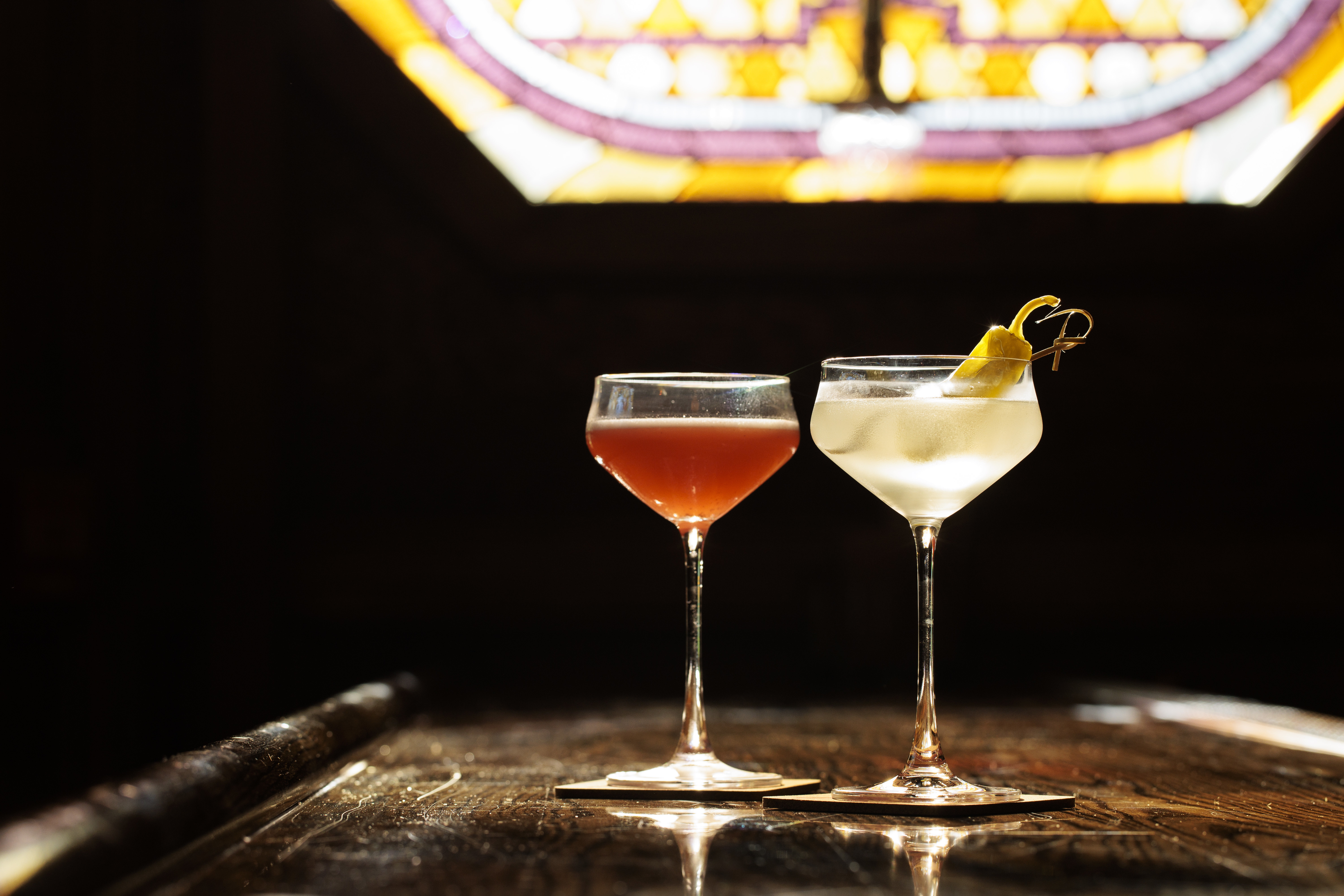
Waltz’s drink program has a bit further to go. The cocktails offer some trendy twists to classics but occasionally landed shy of their promise (the weak foam on the Fluffy Negroni Sour, for example, had deflated by the time it arrived). The potentially clever concept of a cocktail list organized by glass shapes fumbled over its own format: The Centerbe-spiked Waltz Whit Me camein a large martini coupe instead of the Nick and Nora tulip touted on the menu.
The Blush Sour and the Pepperoncini Tini at Waltz on Tuesday, Aug. 4, 2026 in Philadelphia.Monica Herndon / Staff Photographer
At a very reasonable $15 or less a cocktail, however, it’s hard to complain loudly. Joey Dougherty is admirably determined not to overprice Waltz for a neighborhood that currently doesn’t have many upscale dining options. The small wine list is also full of basic Italian wine values for $13 a glass or less, and a tiny reserve bottle list for a Super Tuscan or Brunello di Montalcino. Dinner as a whole is fairly priced considering the quality, with check averages of $55 to $65 including beverage, before tax and tip.
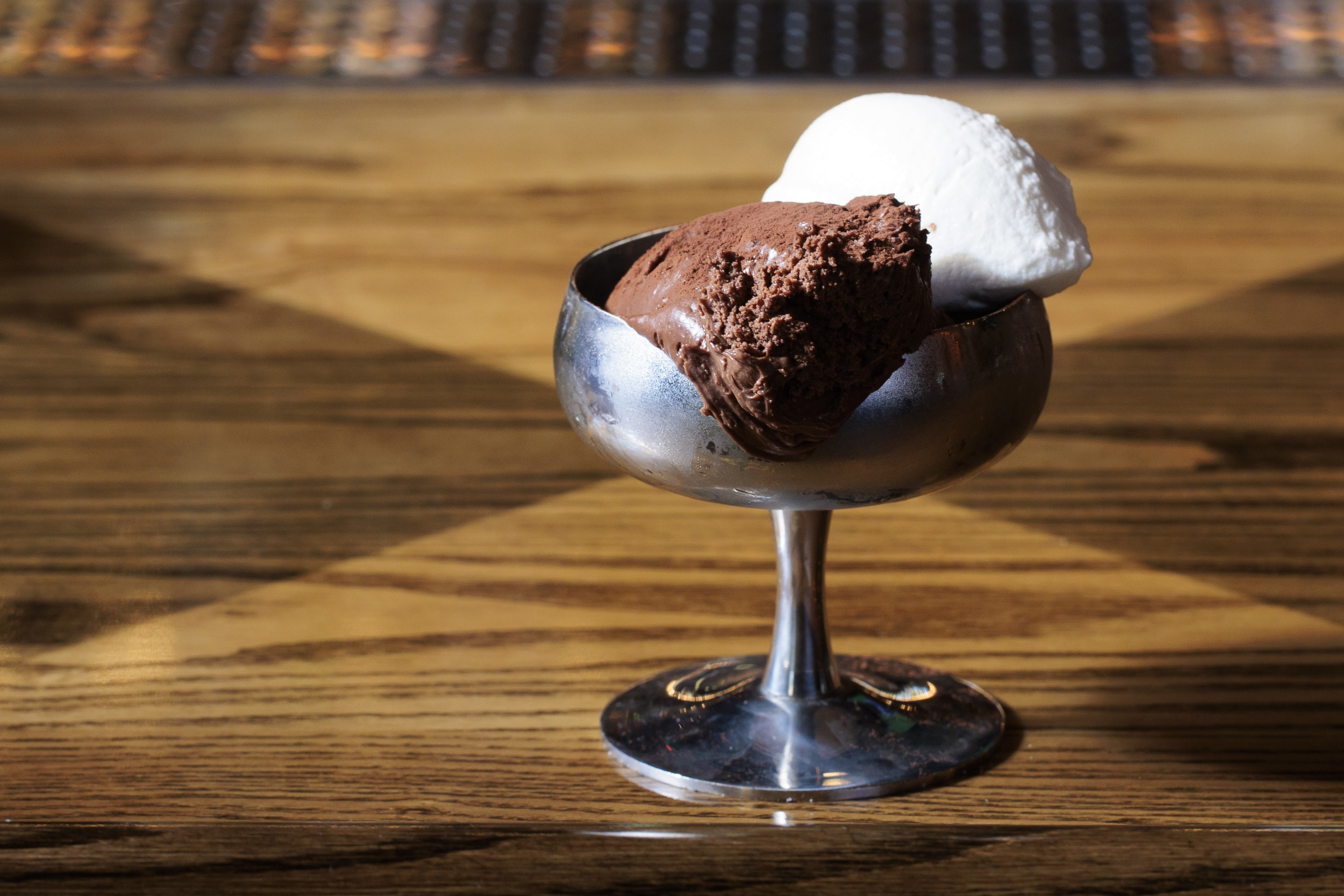
Dinner finishes up strong with good scratch versions of common desserts. The made-to-order tiramisu, whose lady fingers are dunked to order in coffee then layered with sweet cheese, is somewhat controversial among traditionalists who expect it to be already fully saturated, but I enjoyed the faint crunch of those biscuits softening while we ate. There were no quibbles over the lusciously rich chocolate mousse, which is made with 70% Valrhona chocolate and served with raspberry compote and amaretto whipped cream.
The lusciously rich chocolate mousse, made with 70% Valrhona chocolate and served with raspberry compote and amaretto whipped cream, at Waltz on Wednesday, May 27, 2026, in Philadelphia.Monica Herndon / Staff Photographer
Waltz’s finest finishing moves are the exceptional gelati, which are spun daily before service so the textures remain spoonably soft and vivid of flavor. The pistachio is always my go-to, and didn’t disappoint here, but I could also taste the real Tahitian beans (not extract) steeped into the vanilla. I was thoroughly charmed by the Andes Mint flavor topped with a dusting of the grated chocolate-and-crème de menthe candies. Even better was the strawberry sorbetto, which doubled down on berry flavor with a crimson glaze of strawberry compote.
If you’re going to build a new restaurant that feels like an old soul inspired by another era, these are just the kinds of fresh touches required to appeal to diners today.
Pistachio gelato at Waltz on Wednesday, May 27, 2026 in Philadelphia.Monica Herndon / Staff Photographer
Pizzas and pastas: $16-$24; larger sharing plates, $30-$50.
The bar dining room is wheelchair accessible through a side door, but the bathrooms, located in the basement, are not.
About 50% of the menu is gluten-free or can be modified, including availability of gluten-free pastas.
Menu highlights: House burrata with prosciutto and melon; stuffed crabs; fritto misto; pizzas (carbonara, piccante); lumache pasta with spicy crab vodka sauce; tortellini; pappardelle with duck ragù; spaghetti with meatballs and sausage; New York strip steak; branzino; house gelati (pistachio; Andes mint); strawberry sorbetto.
Drinks: Classic cocktails with modern twists are categorized by glass shape (highball, coupe, Nick and Nora) but perplexingly not always served in the advertised glass. The drinks themselves are solid, not spectacular, but fairly priced at $15 or less. The small wine list offers affordable Italian basics, including a Pecorino white and a plush Piemonte Rosso I’d drink all night for $11 a pour.
The owners of Waltz restaurant in South Philadelphia made a collage of articles from a 1924 Inquirer that was found during renovations in the walls of the building at Front and Ritner, where it was used for insulation.Courtesy Waltz restaurant / Joey Dougherty
Philadelphia police now believe at least two women were killed inside the decrepit Olney home at the center of a sprawling missing persons investigation, officials said Wednesday — a stunning breakthrough in a probe that began nearly two months ago after a chance encounter near Independence Mall.
Inspector Raymond Evers said homicide detectives had recovered photos and videos on hard drives inside the home that appeared to show the deaths of two women who had been reported missing — neither of whom had been previously linked to the case.
Evers identified the women as Maribel Fresses, who was 27 when she was reported missing in February 2018, and Gabrielle Amarando, who went missing in September 2012 at the age of 22.
The announcement at a Wednesday news conference was the latest and most striking development in a case that has drawn national attention since police launched an investigation in June into the disappearances of two other women last seen at the home of Eugene Albert Horsch, 44, and his late father, Raymond “R.C.” Horsch.
Eugene Albert Horsch, 44, of Philadelphia.Courtesy of Philadelphia police
Evers said the two-month search of the home, on the 400 block of West Chew Avenue, involved over 95 search warrants and surfaced an “astonishing” array of evidence: five urns of cremated remains, more than 20 containers full of unknown chemicals and oily substances, and 50 hard drives and other electronic devices holding more than 600,000 images, 70,000 videos, and 10,000 pages of writings and drawings.
Inside one of those hard drives, Evers said, detectives found images and videos that appeared to show Fresses and Amarando alive inside the house — followed by “graphic and dark” depictions of what appeared to be their dead bodies.
But the investigation is complicated, he said, because police have not recovered any human remains inside the home. And forensic tests of the substances in the basement, and of what initially appeared to be blood inside the house, did not test positive for human blood or DNA, law enforcement sources have said.
Without the bodies, he said, the Philadelphia Office of the Medical Examiner cannot officially declare the women dead. He said the case would likely have to go through Orphans’ Court.
Philadelphia Police Inspector Raymond Evers gives an update on the investigation into the house on Chew Avenue.Jessica Griffin / Staff Photographer
Still, he said, the medical examiner’s office said that “if the images and the video are real and not altered in any way,” the women are dead.
Police are still working to determine when the women died.
Eugene Horsch has not been charged with any crimes connected to the women’s deaths or disappearances. Evers declined to say whether investigators believed he — or his father, a creator of erotic and pornographic art — may have been involved.
“Eugene lived there. He lived there for a long time. His dad lived there for a long time,” Evers said when asked about their possible connection to the deaths.
He said investigators had reviewed only about 5% of the digital materials so far and had hundreds of thousands more to go through.
A lawyer for Eugene Horsch did not immediately respond to a request for comment Wednesday.
The missing women
Police said they notified the families of Fresses and Amarando on Wednesday morning.
Ricardo Fresses, 61, said that, in his gut, he had known his daughter, Maribel, or “Bella,” was dead.
“She called me every day. Absolutely every day she called me, and one day she stopped calling me,” he said. “And as the years went by I knew she was gone.“
His daughter grew up in Holland, Bucks County, he said, and started using drugs in high school.
“She was a beautiful girl, a loving girl, always daddy’s girl,” he said, even as she slipped into opioid addiction.
He last saw her on June 19, 2018. They met for a slice of pizza in Kensington, and he gave her $50. He never heard from her again. He reported her missing shortly after.
“It’s a horrible situation that my family has to go through,” he said about what police found inside the hard drive.
Amarando’s family said the news followed 14 years of hope that she might finally turn up.
”I’m just so devastated. This brings some closure, but it still hurts,” said Lora Timmons, Amarando’s stepmother. “She was a sweet little girl. She was always just such fun to be with. She and her father were best friends.”
Timmons said Amarando, who grew up in Doylestown, had been interested in modeling from a young age but “always found the wrong crowd.” She had struggled with addiction since she was a teen, her stepmother said.
Amarando would often come to visit Timmons, who lives in North Carolina, and her sisters, but they lost contact in September 2012.
”She just went away,“ she said. “We searched here and there but we never found her. … We always thought she was just off doing her drug thing, living her life.”
Timmons had not heard of the Horsches until Wednesday.
”I always hoped I’d see her again,” she said. “I didn’t want to think the worst.”
Police declined to say how the women might have known Raymond or Eugene Horsch.
For decades before his death, Raymond Horsch offered drugs, cash, and shelter to women struggling with addiction, in exchange for nude photo and video shoots. Horsch’s visual works featured graphic violence — and sometimes death scenes. He also penned semi-autobiographical novels featuring serial killers who preyed on women in addiction.
Raymond “R.C.” Horsch in character for a film role, 2014.S. E. Stokowski / Wikimedia
How the case began
Wednesday’s developments came nearly two months after police began combing through the Horsch home in connection with at least two other missing women, following a chance encounter near Independence Mall.
On June 19, a U.S. park ranger saw Eugene Horsch and a woman acting suspiciously inside his parked BMW. After searching the car, the officer found drugs, guns, and various other weapons, along with a counterfeit U.S. Drug Enforcement Administration badge.
The woman with Horsch was also found with a fake ID in the name of Blair Tonzelli, a woman who was reported missing in 2023 and last seen at Horsch’s Olney home.
That also renewed suspicions about Horsch’s father, who died in May 2025. Raymond Horsch’s ex-wife, Amy McHale, was reported missing in 2016 and last heard from at the Chew Avenue house.
A witness later told police that Tonzelli was a home healthcare aide who had worked for Horsch’s father, and that she believed Tonzelli and Eugene Horsch had a disagreement over money, according to law enforcement sources.
Investigators interviewed people who knew Horsch and were told that, in the past, he had bragged about killing people and melting their bodies with chemicals in his basement, said the sources, who spoke on the condition of anonymity to discuss an ongoing investigation. Horsch, they said, said he could make a body so small it “could be flushed down a toilet.”
Workers and police investigators remove pipes and debris at the entrance to the home of Eugene Albert Horsch on West Chew Avenue in the Olney section of Philadelphia as investigators search for possible evidence on July 22.Jose F. Moreno / Staff Photographer
Since the June arrest, Horsch has remained in federal custody on charges related to illegal gun possession. Police continued to search the Olney home in hopes of learning the whereabouts of Tonzelli and McHale.
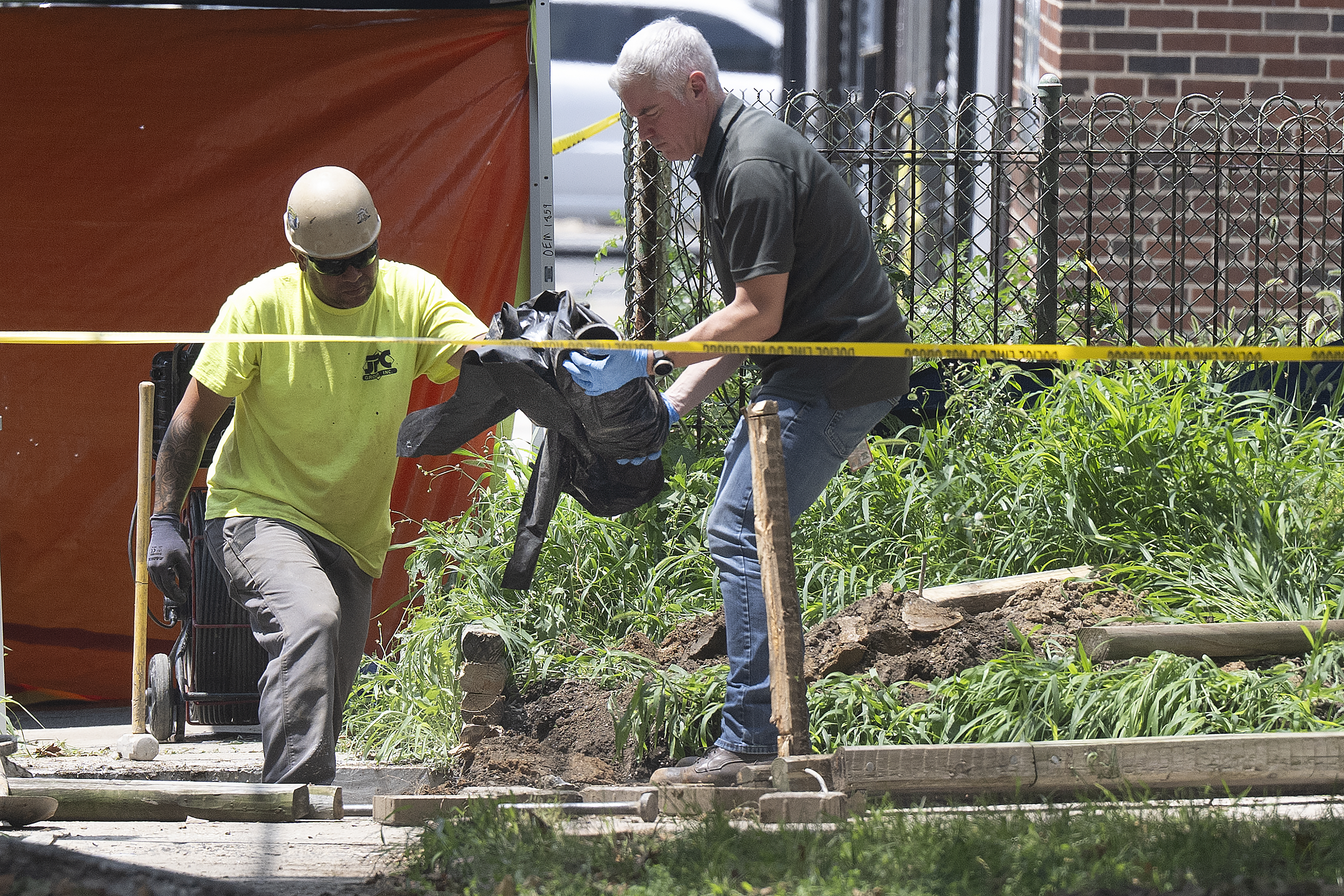
They went so far as to excavate the home’s yard and remove a pipe to test for DNA.
FBI agents, meanwhile, continued examining hundreds of pages of text messages, handwritten and typed documents, CDs, and videos — including many of Raymond Horsch’s artistic works.
It was in there, police said, that there was evidence of Fresses’ and Amarando’s deaths.
Fresses’ father said the discovery confirmed his worst fears. For months, years even, he said, he would wake up in the middle of the night and drive through Kensington. He would look into the faces of the women on the streets, hoping he would see his Bella.
“But I was just hurting myself because I knew she was gone,” he said. “I knew in my heart that my daughter was not around anymore.“
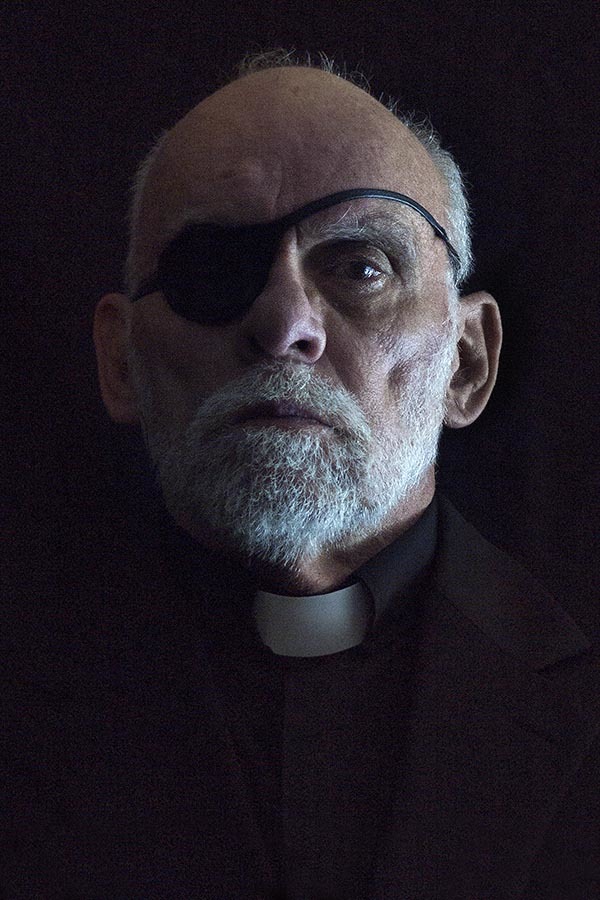
A former cardiac thoracic surgeon at one of Main Line Health’s flagship programs says in a federal lawsuit that he was fired after reporting a series of bad patient outcomes.
Gianluca Torregrossa accuses the nonprofit hospital system in the Philadelphia suburbs of failing to thoroughly investigate a pattern of complications among the patients of another senior surgeon, including one instance that led to a heart transplant.
The Italian physician attempted to have the cases reviewed multiple times during his tenure, which was just short of five years, but instead Torregrossa was marginalized by hospital leadership, suspended, and eventually terminated before the end of his contract, according to the suit.
The termination caused issues with the physician’s visa, which required him to return to Italy without his wife and daughter while he got his new visa in order, according to the complaint. Torregrossa, who began working at Cleveland Clinic in June, says he also lost wages during the three-month period and his reputation suffered.
“Cardiac surgery is a small professional field, and news of his suspension and termination spread nationally and internationally, creating questions about his professional standing despite his clinical outcomes and subsequent employment by Cleveland Clinic,” the suit says.
Torregrossa’s attorney did not respond to a request for comment.
The lawsuit, filed July 31 in the U.S. District Court for the Eastern District of Pennsylvania, names only Main Line Health as a defendant. The health system declined to comment on the active litigation.
“Main Line Health’s Robotic Cardiac Vascularization Program is an important part of our commitment to providing advanced surgical care,” a spokesperson said in a statement. “The program helps ensure patients have access to specialized surgical expertise and innovative, minimally invasive treatment options close to home.”
Torregrossa was recruited by the Montgomery County hospital system in 2021 to assist in expanding the robotic heart surgery programbased at Lankenau Medical Center, the lawsuit says.
The opportunity to join Main Line Health was lucrative. The surgeon signed a five-year contract starting at $800,000 a year, plus bonus, according to the lawsuit.
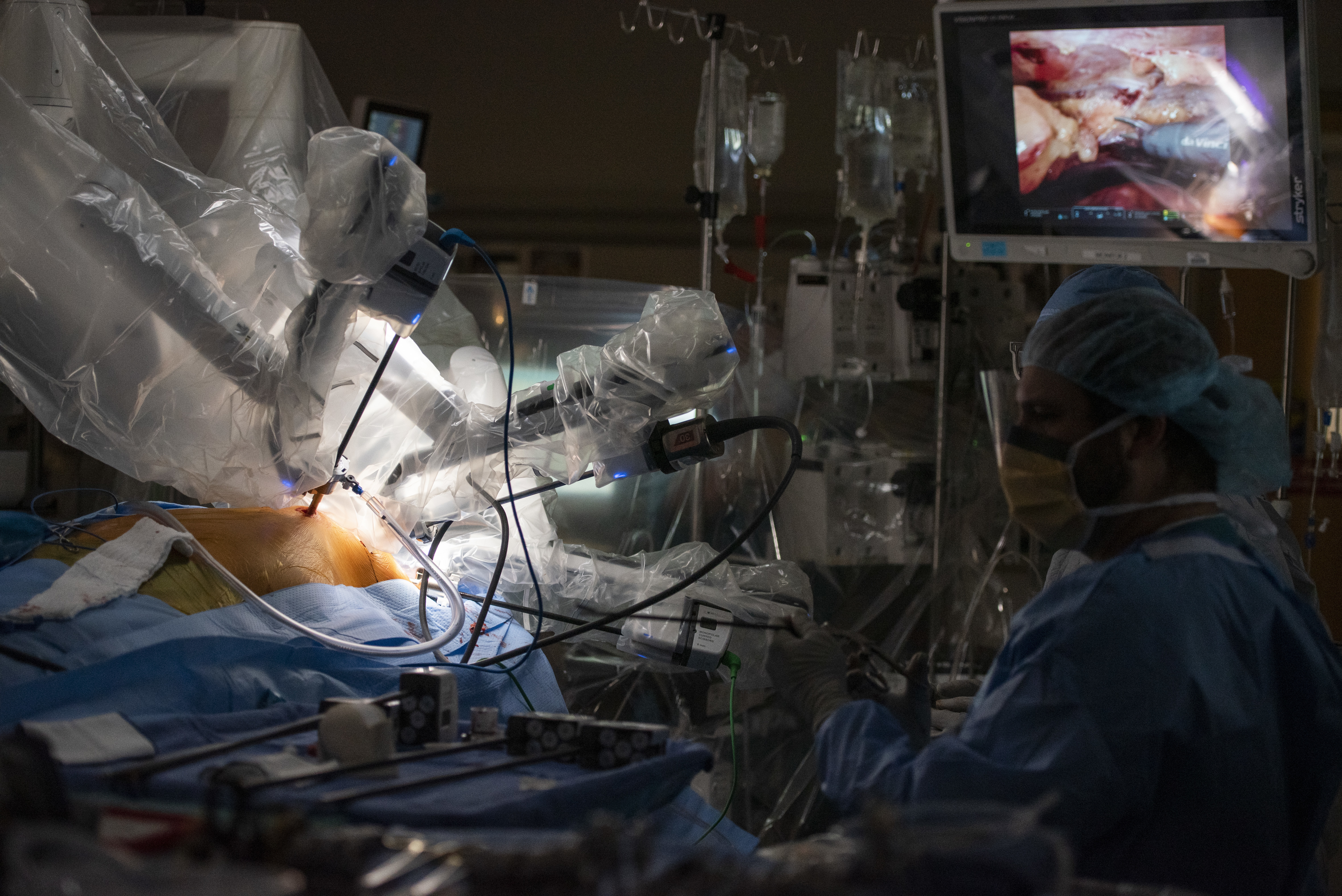
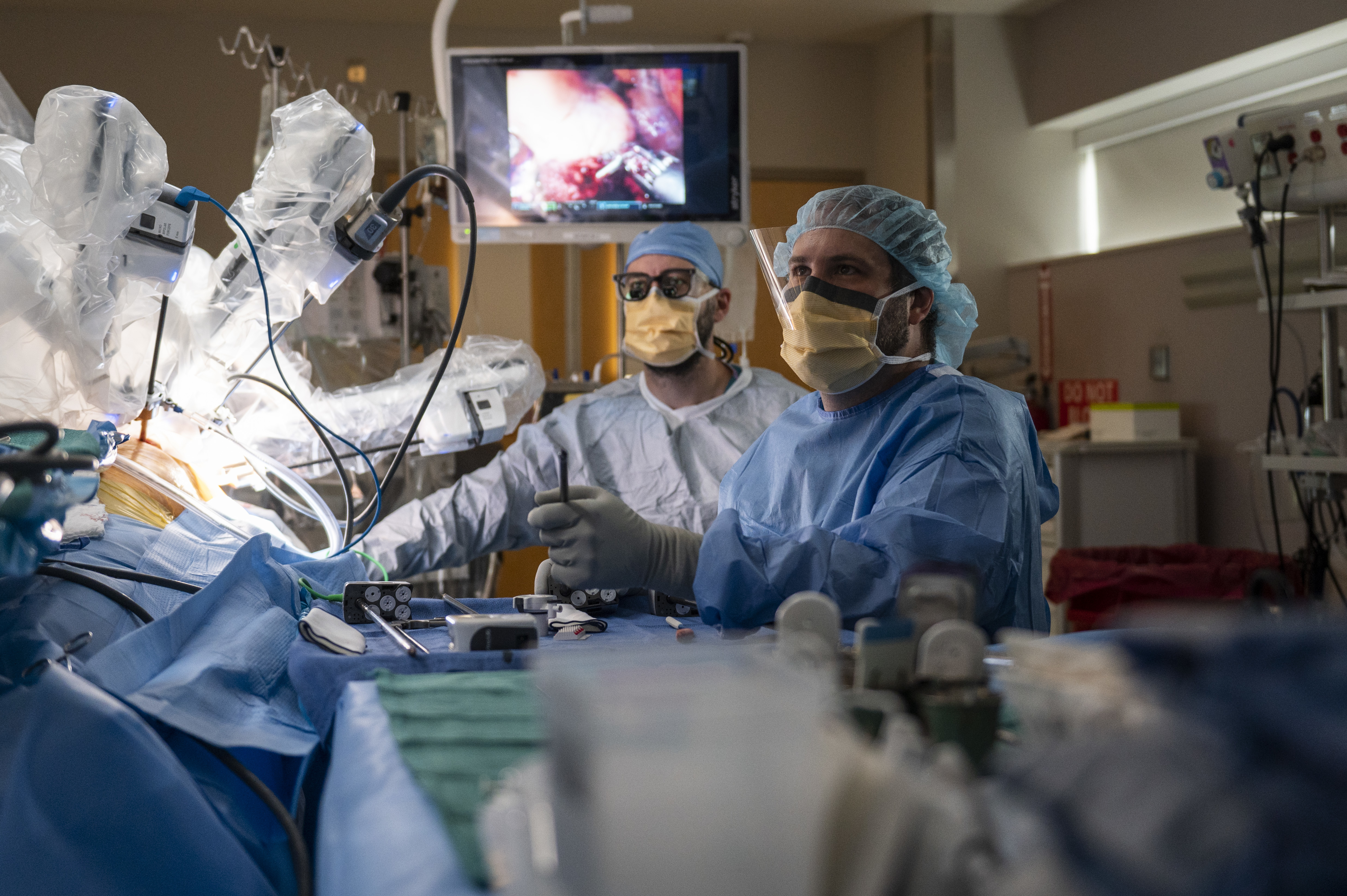
Main Line Health is a national leader in a robotic procedure to replace a clogged artery with a new one, known as coronary artery bypass graft, which is the most commonly performed heart surgery in the United States. But at Main Line it is often performed in an uncommon way.
Shortly after joining Main Line Health, Torregrossa became concerned about the outcomes of patients whom Sutter operated on robotically that the physician believed were preventable, the suit said.
Torregrossa asked in 2023 for a review of seven of Sutter’s cases, the complaint says, but a team discussed them “only superficially, no meaningful follow-up was initiated, and the pattern of complications involving a single surgeon was not examined.”
The physician continued to raise concerns over allegedly preventable complications through 2025, as well as ethical breaches in patient assignment at the program, according to the complaint.
The Inquirer was unable to reach Sutter, who retired in July, based on publicly available records.
Michael Carboine (left), physician assistant, and Jeff Roman (right), scrub nurse, watches the monitor as lead surgeon Francis Sutter moves the robotic instruments in the patient’s heart on Monday, June 26, 2023. Lankenau Hospital, part of Main Line Health, uses robotic coronary bypass surgeries at a higher percent than other hospitals.Allie Ippolito / Staff Photographer
Following his internal reports, the suit says, Torregrossa was marginalized by leaders of the program and hospital.
Human resources opened an investigation into Torregrossa based on a comment he had made in a brief recruitment interview, according to the complaint. The documents do not repeat the comment or provide more context to what was said.
“That HR event reflected a broader pattern in which routine professional interactions involving Dr. Torregrossa were escalated against him, while more serious concerns involving others, like patient safety, were not meaningfully investigated,” the lawsuit says.
In November 2025, the hospital system told Torregrossa that his contract would not be renewed past June 30, the suit says.
Torregrossa continued to push internally for reviews, but his pleas fell on deaf ears, according to the complaint. In January, he submitted an external patient safety report to the Pennsylvania Licensing System and the Joint Commission, a hospital accreditation organization, which conducted a surprise visit to Lankenau shortly after.
The surgeon also circulated an anonymous letter about the Sutter cases in question, the suit says without saying who were the recipients.
Sutter’s medical license is active and Pennsylvania Department of State records show no disciplinary history. Lankenau has passed a series of Pennsylvania Department of Health inspections since January that found the hospital in compliance.
Main Line Health placed Torregrossa on administrative leave in February and barred him from accessing the system’s hospitals and clinics. The system accused him of disparaging the health system during a presentation and engaging in unprofessional conduct.
The lawsuit says both excuses were false and pretextual, leading to his March termination.
The complaint accuses Main Line Health of violating the Pennsylvania whistleblower protection law and breaching his employment agreement. It asks for damages in an unspecified amount greater than $75,000.
“Being removed from practice for approximately three months deprived him of the ability to operate, teach, proctor, maintain case volume, and continue refining a rare and demanding surgical technique,” the lawsuit says.
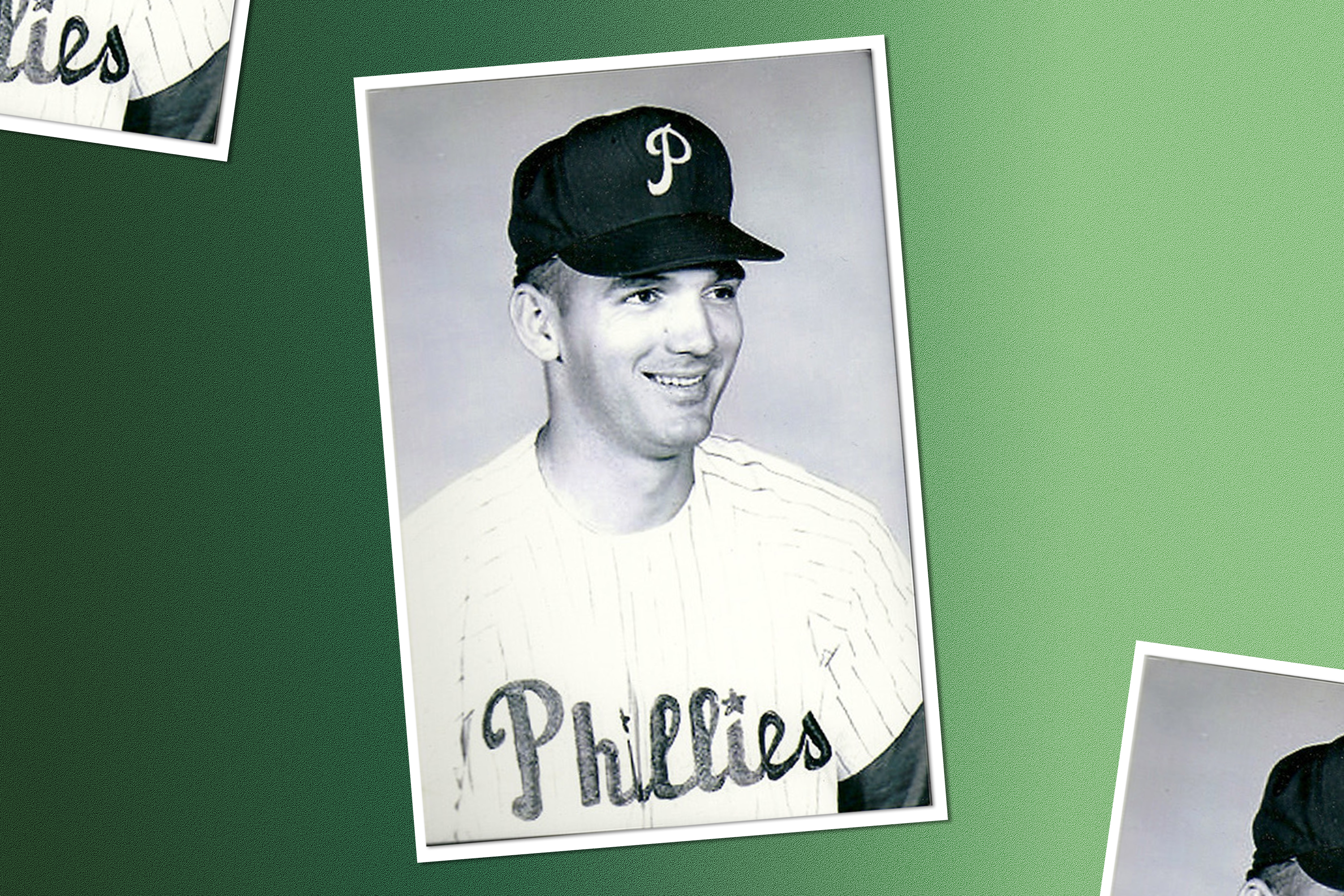
Mickey Harrington played with major leaguers, played against major leaguers, played for major leaguers, and even roomed with major leaguers. But him? Harrington was stuck in the minor leagues in 1963 after signing six years earlier with the Phillies.
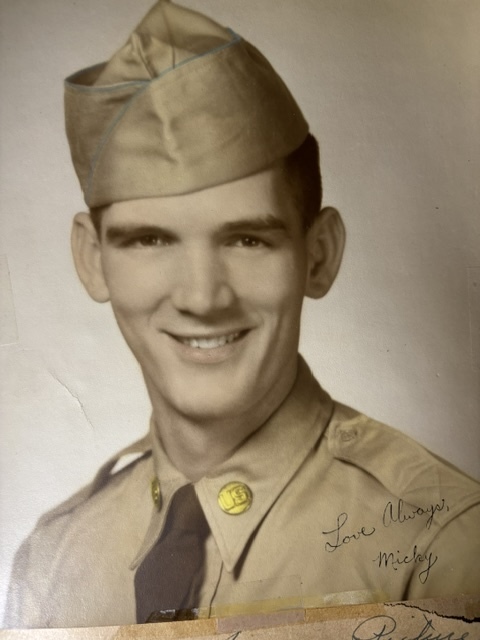
Harrington served two years in the Army and could have played professional basketball after being drafted by the New York Knicks. He picked baseball, believing it was his best chance at a career. And then Harrington watched every season as his teammates left the minors for the majors while he stayed behind.
Finally, he got his chance. The Phillies called up Harrington in July of 1963, flying him from Hawaii where he was playing for a triple-A team. The 28-year-old was a big-leaguer.
Harrington sat on the bench for eight games before manager Gene Mauch used him as a pinch runner on July 10, 1963. Roy Sievers singled to start the eighth inning against the San Francisco Giants at Connie Mack Stadium and Harrington stepped onto the grass at 21st and Lehigh.
The inning ended two batters later when Clay Dalrymple grounded into a double play. Harrington had reached second on a single by Don Hoak before Don Demeter hit a grounder to first. A newspaper account blamed Harrington for “reckless baserunning” as he was tagged after making a wide turn around third base.
Mauch, the fiery manager they called the “Little General,” immediately lifted Harrington from the game and replaced him with Frank Torre. Two days later, the Phillies dropped Harrington back to the minor leagues.
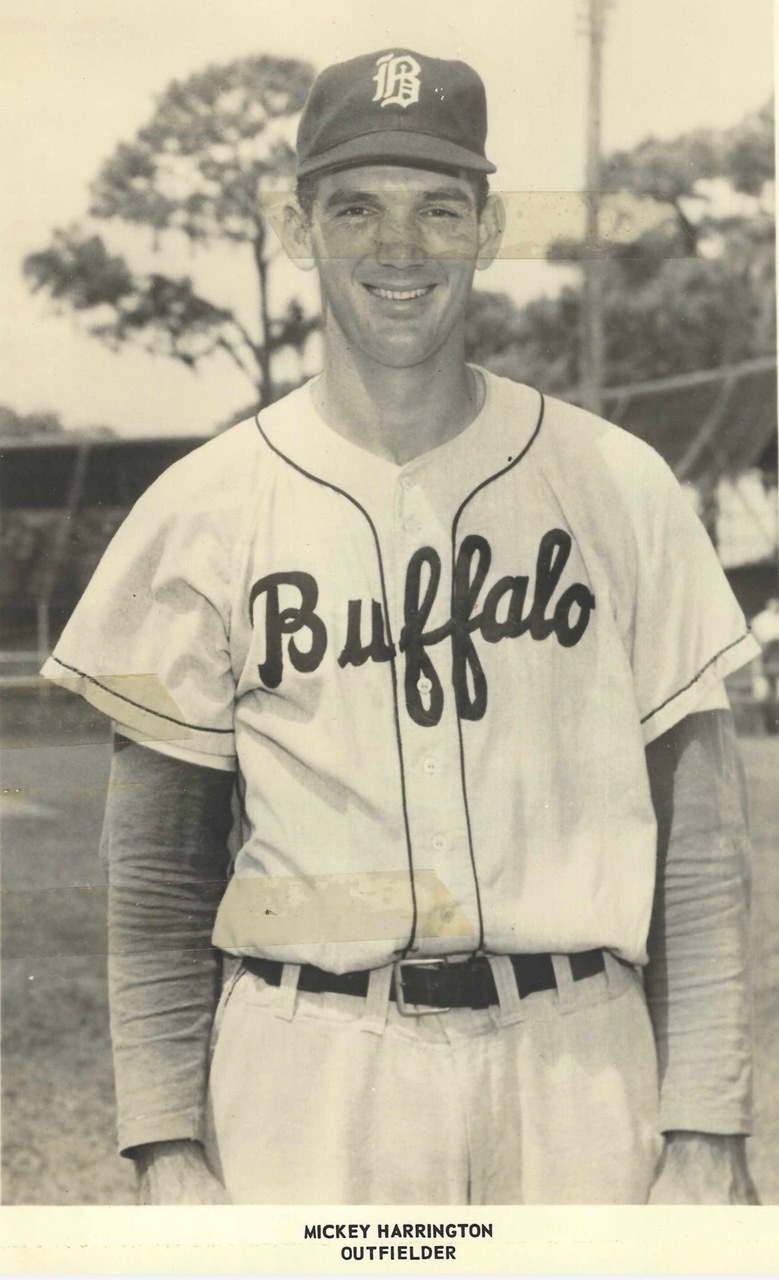
Mickey Harrington as a minor leaguer in Buffalo.Harrington family
He was a professional ballplayer for 10 seasons but his only experience in Major League Baseball was being used once as a pinch runner. He didn’t play the field, score a run, or step into the batter’s box. Harrington, who died in 2017, finally became a big-league player. But his career only lasted a few minutes.
“Deep down, I could read between the lines even though he didn’t say much about it,” said son-in-law Ken Knopp. “I know it hurt him. He felt at some point that he was beating his head against the wall. I know it hurt his feelings. But he never really said that much about it. It was frustrating for him. He couldn’t break in.”
Field of Dreams
The Phillies will play Thursday against the Minnesota Twins in Dyersville, Iowa, the setting for Field of Dreams, the 1989 Hollywood film where a cast of legendary players appear as ghosts on a baseball diamond built by a farmer in the middle of a cornfield.
A thread of the movie was focused on Moonlight Graham, a longtime minor-league player who played one inning in the majors as a defensive substitute in 1905 but never had a chance to hit.
“It was like coming this close to your dreams, and then having them brush past you like strangers in the crowd,” the older Graham character, played by Burt Lancaster, says in the film. “At the time, you don’t think much of it. We just don’t recognize life’s most significant moments while they’re happening. Back then I thought, ‘Well, there’ll be other days.’ I didn’t realize that that was the only day.”
The Iowa diamond brought the ghosts of “Shoeless” Joe Jackson, Mel Ott, Gil Hodges, and other deceased greats out of the cornfield and gave their careers a second life. Graham — wearing an old New York Giants jersey — finally got his chance to bat and hit a sacrifice fly. Jackson asked the farmer if the field was heaven. No, it was Iowa.
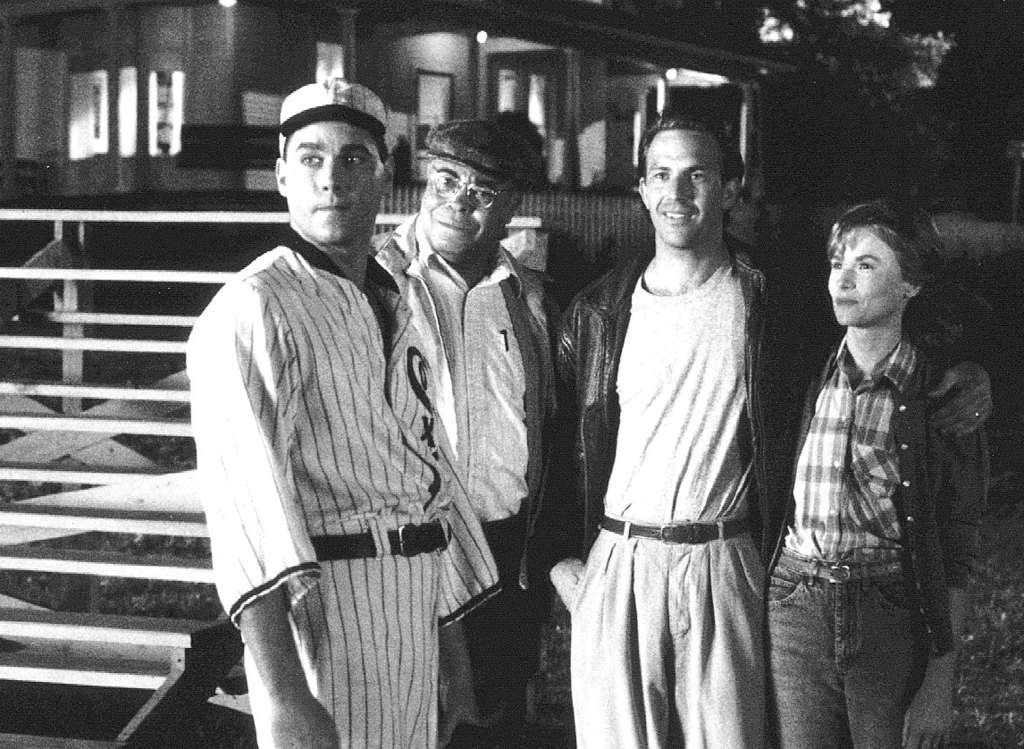
In 1989’s “Field of Dreams,” James Earl Jones (second from left) starred with (from left) Ray Liotta, Kevin Costner, and Amy Madigan.
It was magic and the film, which is routinely ranked among the top sports movies ever made, was nominated for Best Picture at the 1990 Academy Awards.
Harrington’s big-league career was a flash just like Moonlight Graham’s. But the man who grew up in Hattiesburg, Miss., never got to hit on a field of dreams.
“It was a thrill to get there,” Harrington told the Clarion-Ledger of Jackson, Miss., in 2003. “But it was a letdown not getting to bat. It would have been nice to bat one time.”
Playing with legends
Harrington hoped to return to Hawaii after being dropped back to the minors but was instead sent to Little Rock, Ark., where Dick Allen was playing as the team’s first Black player. For Harrington, it was another encounter with the type of players who played on that cornfield.
He roomed with Chuck Tanner, hit against Tommy Lasorda, and played against Sparky Anderson, all future managers. Willie Mays, Willie McCovey, and Orlando Cepeda were on the Giants when Harrington passed through as a pinch runner.
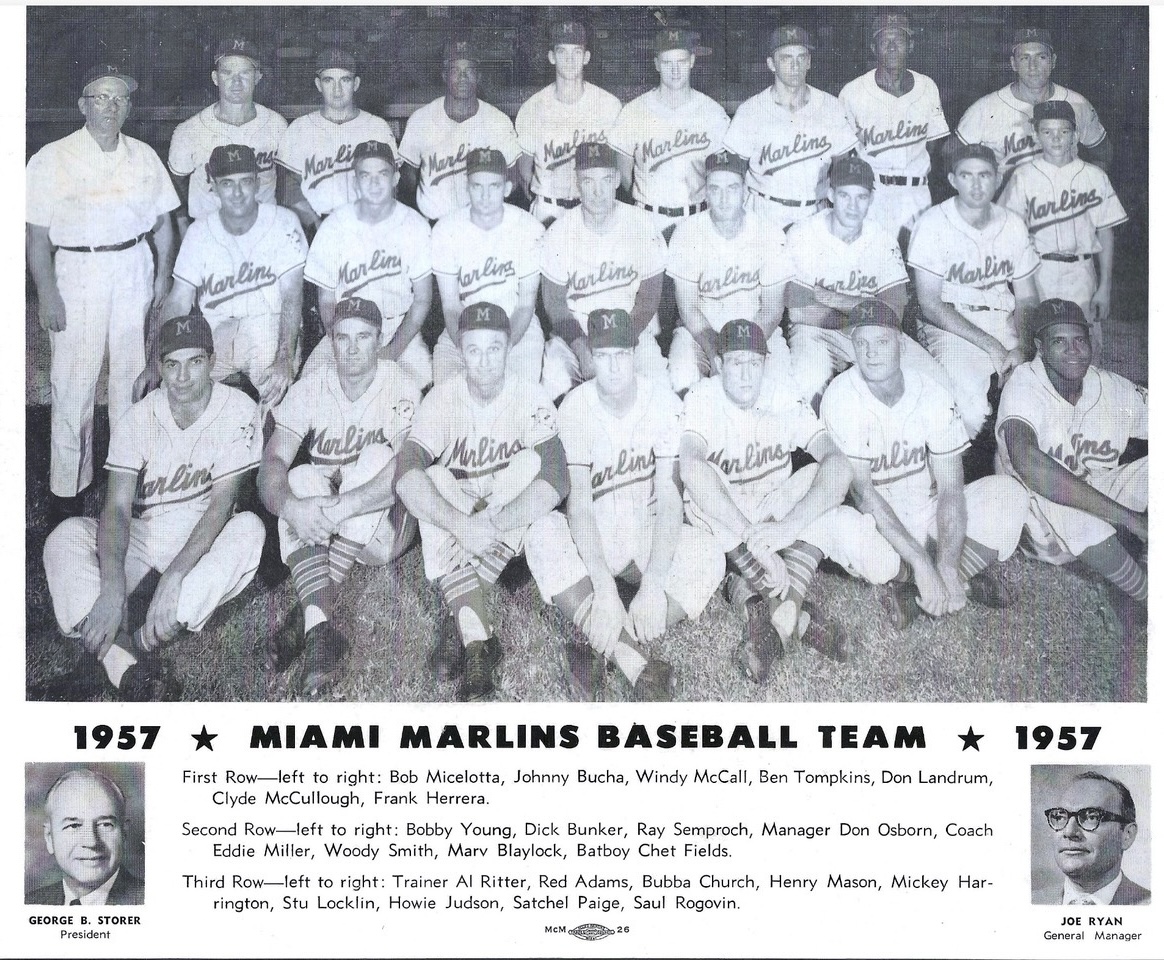
Harrington spent most of his first season in 1957 with Miami, where the Phillies had a triple-A club. He was being teased in the clubhouse for being from Mississippi when an older pitcher asked him where he was from. Hattiesburg, Harrington said. The pitcher grew up 90 minutes away in Mobile, Ala. It was 50-year-old Satchel Paige, another legend for Harrington to cross paths with.
“Satchel Paige stood up,” Knopp said. “‘Hey, y’all leave him alone. He’s my neighbor.’ They became good friends. Satchel Paige took up for him. That’s a pretty good way to be introduced to Satchel Paige.”
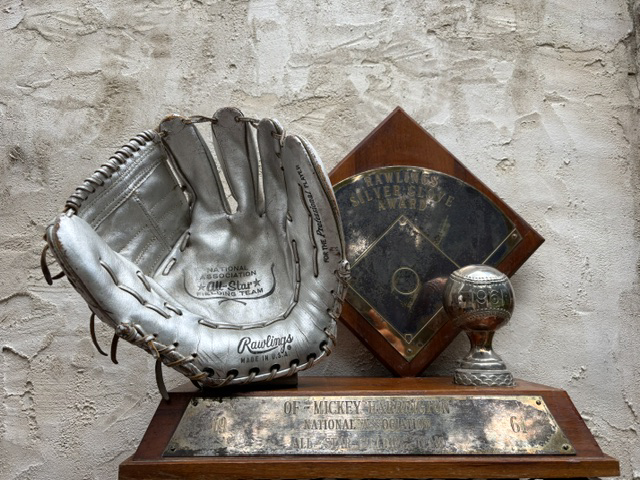
Harrington was hitting .298 with the Hawaii Islanders in 1963 when the Phillies called him to the majors. He batted .305 over the previous four triple-A seasons and won a Silver Glove Award — the minor-league version of the Gold Glove given to the best fielders — in 1961 for his work in the outfield.
A team photo of the 1957 Miami Marlins, a Phillies triple-A team that included legendary pitcher Satchel Paige.Harrington family
Harrington performed in the minors like a prospect, but his only chance at the majors was that Wednesday night at Connie Mack Stadium.
Maybe Harrington’s modesty, Knopp said, caused him to be overlooked. Or maybe those two years in the Army delayed his career enough to keep him stuck in baseball purgatory. Or perhaps he should’ve played basketball.
“In baseball vernacular, they call it a cup of coffee,” Knopp said. “I never understood it. He was a great ballplayer.”
Harrington retired after the 1966 season, returned to Hattiesburg, and worked at his father’s sporting goods store. His first daughter, Heather, was born when he was playing and his second daughter, Hope, was born just after he retired. Harrington filed a patent in 1973 for a batting tee and built a home on a plot of land owned by his father-in-law. He was always using his hands. Harrington turned a shack into a three-bedroom home with two fireplaces and a big living room.
“It’s all cypress wood on the outside,” Knopp said. “He did all the woodwork, carpentry work all by himself. It’s a beautiful house. It’s an amazing house.”
He was soon hired as an assistant coach on the basketball and baseball staffs at Southern Mississippi University, where he played before being drafted by the Army.
Harrington was an all-American basketball player in high school and was a four-year starter in college. He had chances to play at bigger schools but his dad, Smokie, urged him to stay home at Southern Miss. He lived a few minutes from campus after his playing career and became a fabric of the university.
The school president tabbed him in the 1980s to build a 220-acre equestrian center with bleachers for 2,500 people. He had a barn moved to the facility and rallied a group of college students to build the center using supplies that Harrington received through donations.
Mickey Harrington’s Silver Glove Award from 1961, which is the minor-league version of the Gold Glove.Harrington family
The farmer in Iowa built a baseball diamond that brought ghosts of the past. Harrington built a rodeo ring that led to his daughter meeting her husband.
“They were literally screwing down the seats on the bleachers an hour before the first performance started,” Knopp said.
His major league career was just a few minutes but there were always reminders of a guy who spent a decade as a professional athlete. He biked 20 miles a day, even when his knees were shot and he could hardly walk. He competed in the Senior Olympics and was back on his bike just months after a truck hit him in his 70s and broke his neck, shoulder, and ribs. And his hands — the ones big enough to palm a basketball — were a marvel.
“He would have handshake competitions,” his daughter Heather said. “If he didn’t see his nephews in a while, he would put out his hands and his hand would just swallow their hands. They would try not to flinch, but he would tighten down on them. Finally, they’d go ‘OK, Uncle Mike. I give, I give.’ He was a cool human being.”
Mickey Harrington’s Army photo.Harrington family
‘He would’ve got a hit’
Harrington didn’t talk much about his career but Knopp could often find an opening as the two sipped hot chocolate in the winter and ate Klondike bars while watching football in Harrington’s living room.
There was the time he was playing on the baseball team at his Army base and had to tell the general he couldn’t make the trip for that weekend’s game. His captain said Harrington — who was an excellent typist and worked as a clerk — had to finish inputting reports. The base’s general managed the baseball team and said he would handle it.
“Mickey was sitting at his desk, typing away, and he heard the phone ring in the captain’s office,” Knopp said. “He just heard, ‘Yes, sir. Yes, sir. Yes, sir.’ He hung the phone up, went over to Mickey, and said, ‘Mickey, it’s OK. You can go.’”
He told his son-in-law how fans booed him during the Civil Rights Movement whenever the ballpark’s public address announcer said he was from Mississippi. Harrington told them to stop telling the fans where he was from. And there was that time his teammate in the minors blockaded the umpires in their dressing room before the game started.
“The national anthem is over and there are no umpires,” Knopp said. “Finally, someone heard the umpires banging on the door. They moved everything out of the way and they got out. The umpire knew who did it and didn’t say a word. He walked over to Mickey’s dugout, pointed to this guy, and said, ‘You’re out of the game.’”
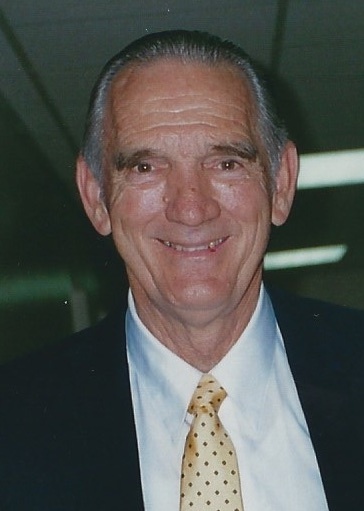
Mickey Harrington later in life. He died in 2017.Harrington family
Harrington told a reporter in 2003 how he never understood why the Phillies used him as a pinch runner since he was a “6-foot-4 and 205 pounds.”
“Maybe that’s why the Phillies never won any ballgames back then,” he cracked. (They actually went 87-75 in 1963.)
But Heather said she always sensed her dad was at peace with how things went. He never seemed bitter or longed for a chance. At his funeral in 2017, Harrington’s nephew Larry said in a eulogy that Uncle Mike stayed positive. He always moved forward and simply believed “it didn’t happen so it didn’t happen.”
Heather agreed. That was her dad. He spent just a few minutes on a field of dreams at 21st and Lehigh. And he was OK with it.
“From the time I was very young I heard how talented he was. But never from him. He never said a word about it,” she said. “He was an incredible person. He made you want to do better. He made you want to live better. He made you want to push harder.”
But what would have happened if Harrington got the chance to hit like Moonlight Graham did that night on that cornfield in Iowa?
“He would’ve got a hit,” Heather said. “Absolutely. Oh, for sure.”