In the final of the inaugural Ennoble Care Philly Open on Penn’s campus on Saturday, Katie Volynets beat Tereza Valentová, 6-3 and 7-5.
The event marked the return of the Women’s Tennis Association to the city after more than two decades. Event organizers Top Notch Management and the Philadelphia Sisters secured a three-year contract for the tournament to be held in the city through 2028, but tournament director Alex Guthrie said the plan is for the Philly Open to become a regular stop on tour.
“We put a lot of time, energy, and investment into this,” Guthrie told The Inquirer. “We want this. We didn’t invest all this time and energy just to do it for three years. We see this as a 10, 20-year thing. I think this has the potential to grow into something special.”
Guthrie said the organizers weren’t sure what to expect from fans. Crowds at WTA 125-level events can vary widely from session to session and tournament to tournament, but the WTA was impressed with the turnout in Philly, especially for the day sessions.
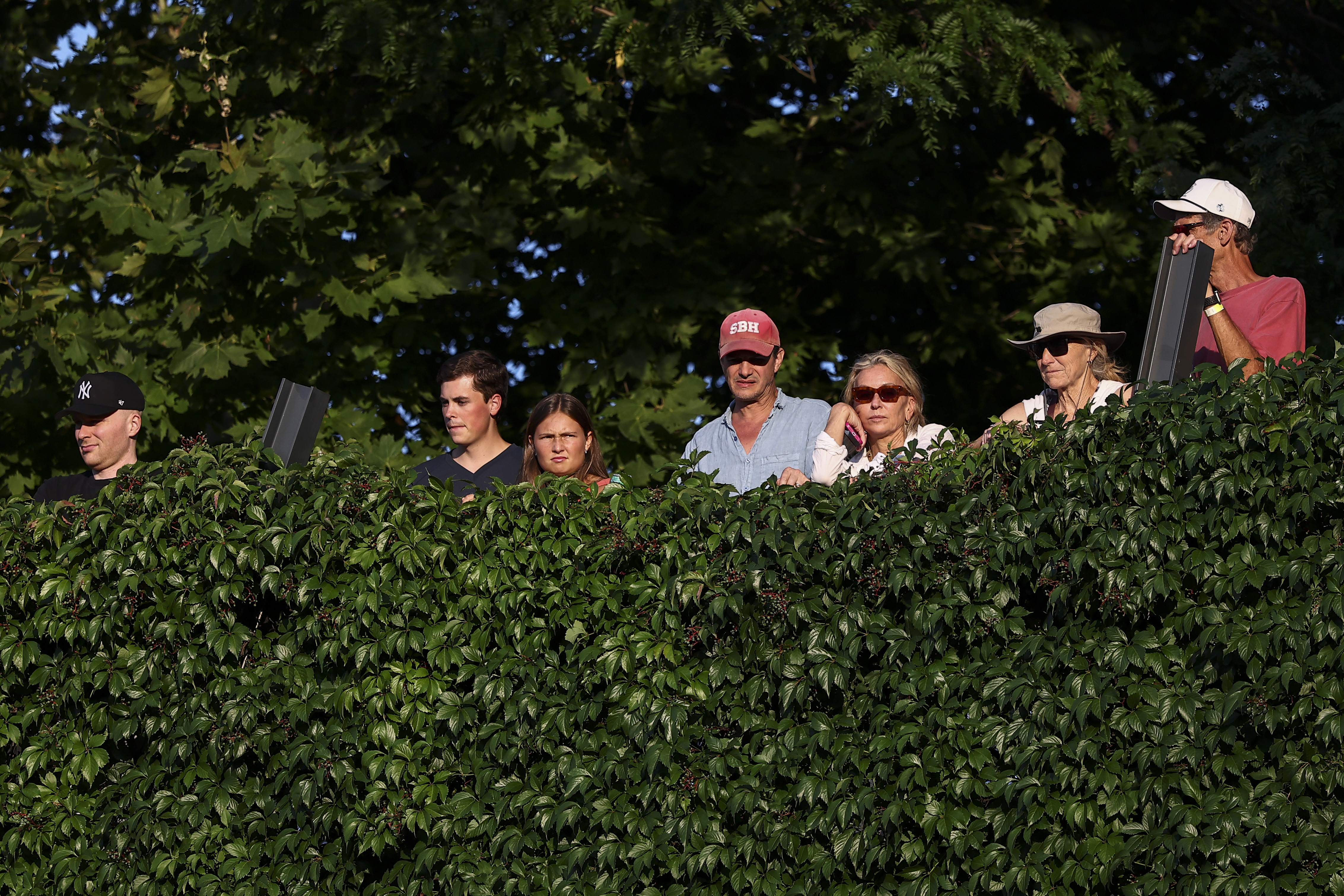
The tournament sold out its opening day on Aug. 23, selling 1,500 tickets, and maintained a solid crowd for the remaining sessions. For the final, fans packed the grandstand, the nearby grass hill, and some unticketed even peeked in from a bridge outside the grounds.
“I was so surprised that even the day it rained, the fans stayed all night and watched the match finish,” Volynets said. “That was really impressive to me, and says a lot about the crowd. I also thought that they cheer so well, because they’re so respectful, they clearly know their tennis. They cheered both sides on while still making me feel like a home favorite.”
Katie Volynets claimed the inaugural Ennoble Care Philly Open on Saturday.Thibault Camus
Hosting the tournament the week before the U.S. Open helped draw a field of several top-100 players, including both finalists (Volynets ranked 91st, while Valentová was 57th). Semifinalist Julia Grabher was a late entry to the field, after a late U.S. Open withdrawal pulled her out of qualifying and straight into the main draw.
“She was already in New York for qualifying, and she texted me, ‘Hey, do you have any wild cards open?’ And a space had literally just opened up for us,” Guthrie said. “If we were anywhere else, she couldn’t just take an hourlong train ride.”
Some players on tour, Guthrie said, avoid first-year events to make sure the facilities and management are up to par before committing. After the success of the 2026 edition, he believes it’ll be an easier sell next year.
Working with a new facility at Penn, which hadn’t previously hosted a professional event before, added a few “quirks and challenges,” but ultimately Year 1 was a success among the players.
“I love these kind of courts,” Volynets said. “They’re grippy, so you can play different spins. If you play a slice, it stays low, if you hit topspin, it goes high. I love how the courts accept the spin. I think it makes tennis so fun to play and so fun to watch.”
Spectators watched from the bridge near Penn’s tennis courts throughout the Philly Open week.Monica Herndon / Staff Photographer
Organizers have already begun conversations with potential sponsors for 2027, and hosted a few prospective sponsors during the week. In order for Philly to attract a larger 250 or 500-level WTA tournament, more sponsorships and funding would be required, according to Guthrie.
But the tournament is on stable footing. The Philadelphia Sisters hope the event will become another permanent installment of women’s sports on the Philly sports calendar.
“From a Year 1 perspective, the foundation was laid very well,” Guthrie said. “Now that it’s happened, and people see what the event is — we were selling something that didn’t exist. Now we have proof of concept, fans know what to expect, and sponsors know what to expect.”
A petroleum distributor has filed suit in federal court alleging it supplied $4 million worth of gasoline sold to multiple Freedom Fuel Network gas stations but has never been paid for it.
That is at least one reason, the civil suit claims, Freedom Fuel Network gas stations have been able to sell gas so cheaply after President Donald Trump touted the brand.
Georgia-based plaintiff Mansfield Oil Co. of Gainesville Inc. filed the civil suit against KRSM Inc. in U.S. District Court in Philadelphia earlier this month.
The suit says that Syed Kazmi, as president of KRSM, requested in May to buy gasoline from Mansfield at Energy Transfer’s Twin Oaks terminal in Aston, Delaware County.
KRSM then took 1.12 million gallons of gasoline and sold it to stations that are part of the Freedom Fuel Network. The price of the purchase was just shy of $4 million, according to the suit.
“KRSM was able to sell such fuel for such low prices and garner such publicity because it never paid [Mansfield] for such fuel,” the suit said.
The suit does not specify which Freedom Fuel locations it says sold gas originally purchased from Mansfield.
The White House promoted Freedom Fuel when it launched its first location in July on Dreshertown Road in Upper Dublin Township, Montgomery County. The station initially sold gas for $3.47 a gallon, a nod to Trump being the 47th president.
“They are doing this because they love the U.S.A.,” Trump wrote on his Truth Social account on July 1.
“The administration has had zero contact or dealings with the defendant: KRSM Inc or Sayed Kazmi,” a White House spokesperson said in a statement Saturday.
Kazmi and his brother, Cherry Hill developer Shamikh Kazmi, are linked to at least eight of Freedom Fuel’s 29 locations. Neither could be reached for comment Saturday. However, attorney Mauro Tucci said in a statement on Saturday: “KRSM disputes the allegations in this case, which is an accounting dispute over fuel invoices mispriced by Mansfield Oil. We will not be commenting further on this pending litigation.”
The Inquirer reported last week that six of the network’s New Jersey stations had racked up environmental violations with the state dating back to 2023.
For its part, Mansfield says in the suit that it initially had difficulty sending invoices to KRSM, but managed to begin doing so by July.
The contract specified that KRSM was to pay the invoices in full within 10 days of receiving them or face 1.5% per month interest on the balance.
Mansfield said that, as of Aug. 17, it had not received any payment for the 150 loads of fuel KRSM purchased at the Twin Oaks terminal.
The suit cites breach of contract and five other counts in seeking $4 million for the fuel, interest, and attorney costs from KRSM.
The Kazmi brothers have been embroiled in at least two lawsuits related to previous gas station ventures, including a 2021 trademark dispute with BP American Inc. and BP Products North America Inc. Additionally, Petroleum Marketing Group Inc., a fuel distribution company, accused the brothers of stealing thousands of gallons of gas from the company.
The network expanded to 29 locations earlier this month, but one Philly station was nearly shut down by the city after it failed a license renewal inspection.
The White House has maintained it is not involved in Freedom Fuel’s operation or provided the company with any subsidies.
“Freedom Fuel Networks is a private company,” a White House spokesperson told The Inquirer in July. “They are not purchasing gasoline at a discount. The administration has not provided any funding. They are simply lowering their costs to make gas more affordable for drivers in PA and NJ.”
Baltimore Ravens assistant coach Randy Brown and former commodities trader Yoni Gontownik signed the company’s certificate of formation in Delaware and have not spoken publicly about the highly touted enterprise.
Freedom Fuel’s owners have been silent about their discount gas operation more than two months after the network was loudly promoted by the White House.
Two masked men, one wielding an AR-15-style rifle, robbed a man of his jewelry and a watch Friday in Center City, according to Philadelphia police.
Central detectives are investigating the incident, which took place about 2:15 a.m. on the 1500 block of Sansom Street. It was the second such robbery in Center City involving an AR-15-style rifle within a week.
Friday’s robbery occurred as a 23-year-old man and two friends were returning home.
Two masked men got out of a light gray or beige four-door sedan with tinted windows, police said. One was carrying the AR-15-style rifle, according to police. The second was armed with a black semiautomatic handgun.
The robbers stole two gold chains off the victim’s neck and demanded his silver diamond watch. They then fled west on Sansom Street, police said.
No one was injured.
Early on the morning of Aug. 23, masked men armed with handguns and what appeared to be an AR-15-style rifle robbed three men in Center City, forcing at least one of the victims to his knees at gunpoint, according to police.
The victims — ages 27, 35, and 36 — were talking on the sidewalk around 3 a.m. on the 1500 block of Locust Street when three robbers stepped out of a gray Hyundai sedan and demanded the men’s belongings, police said.
Two of the men complied but the third resisted, and one of the robbers hit him in the face with a handgun. He was taken to a hospital with injuries that were not life-threatening.
The assailants took cell phones, watches, car keys, wallets, driver’s licenses, and cash, police said.
Surveillance video showed one victim on his knees on the sidewalk as two of the robbers pointed guns at his head.
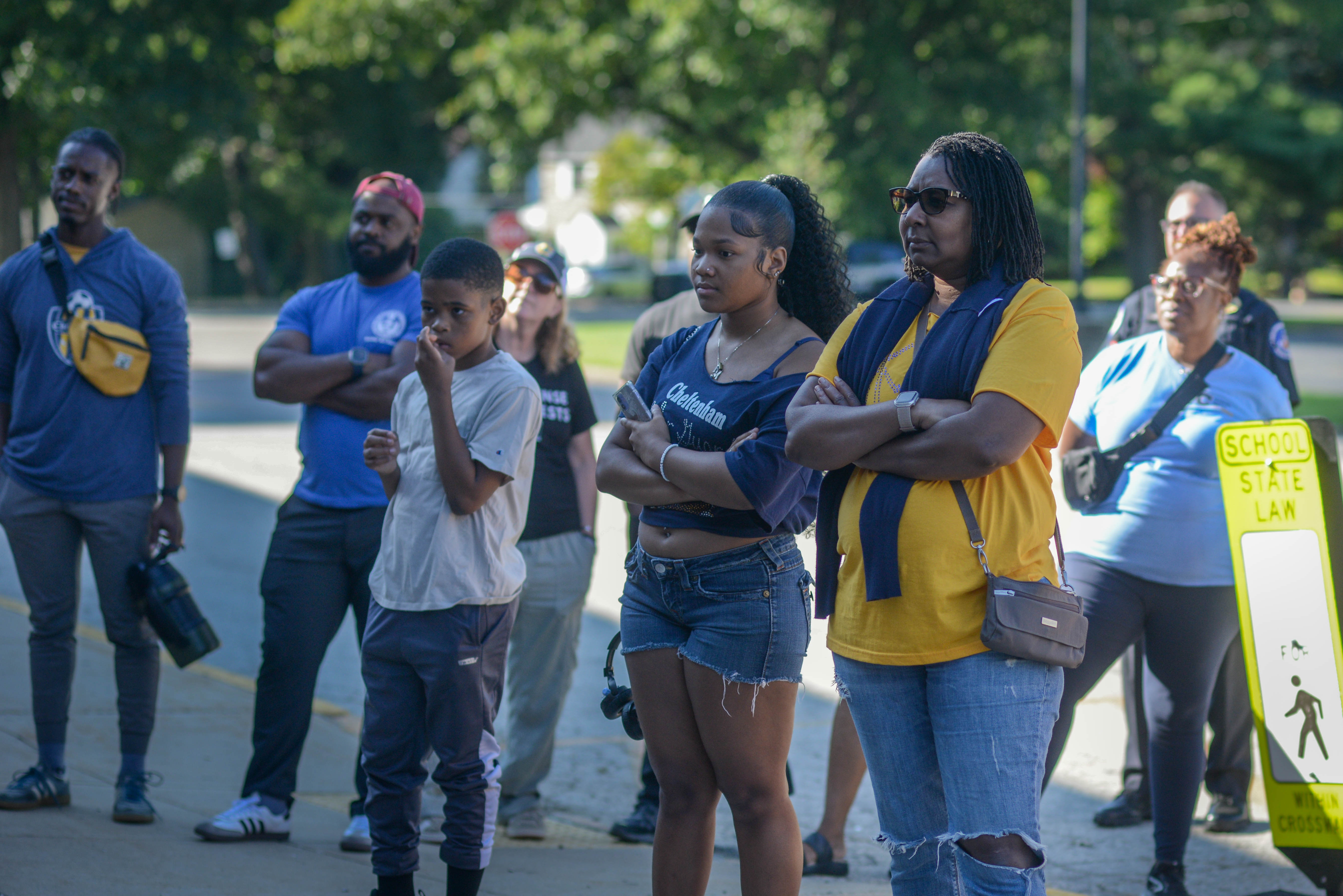
After a football hazing scandal led to criminal charges for coaches and players, about 35 Cheltenham School District parents, students, and school board members marched across town Saturday morning to show their support for students.
The purpose of the march, just days before school starts, was to show students that the community cares about what they are going through, and is calling on the school board to make needed changes, organizers said. Marchers also said it is important to portray the district in a positive light.
“We need to come together as a community, address needed changes, and also push back against some of the false information out there,” said Ikysha Dearry, president of the Cheltenham African American Alliance.
Dearry said the school has faced a barrage of negative attention online from opportunists who want to bring issues like race and the region’s changing demographics into the discussion. “That can have an impact, not just on how our district is viewed, but on how our students are viewed,” she said.
School board director Caroline Watts was one of the first to arrive in the parking lot behind the Cheltenham School District building Saturday morning. She wore athletic shoes for the nearly two-mile walk to the high school. Watts said the message of the march was a “delicate balancing act.”
”We’re addressing what happened, making sure it doesn’t happen again, and we’re starting the school year,” Watts said.
Participants listens as Ikysha Dearry, president of Cheltenham African American Alliance (not shown), addresses the crowd after a community march was held as residents are banding together before the new school year begins to advocate for students, Saturday, Aug. 29, 2026, on Ashbourne Road near the Cheltenham School District Administration Building in Elkins Park. Dr. Brian Scriven resigned as superintendent of the Cheltenham School District in the aftermath of Cheltenham High School football coaches and players being charged with assault in a locker-room hazing incident. Dr. Chris McGinley recently took over as interim superintendent.William Thomas Cain / For The Inquirer
“It’s horrific, what happened,” board vice president Jenny Lowman said before the march. “To think that it happened more than once, it’s also horrifying. Those coaches were responsible for these children. And two of the coaches were parents of students on the football team.”
According to prosecutors, the coaches urged the player not to tell his parents. And according to a grand jury report, high school employees downplayed a complaint from the player’s mother and took then-head coach Terence Tolbert at his word that he had not instructed the boy not to tell his mom.
The report faulted the district’s handling of the situation from the start, saying employees had included Tolbert in their investigation and failed to discover there were two assaults. Employees were also confused about their duties to report child abuse, and at least five football coaches did not have clearances related to mandatory-reporter training, according to the report.
A community march was held as residents are banding together before the new school year begins to advocate for students Saturday, Aug. 29, 2026, on Ashbourne Road near the Cheltenham School District Administration Building in Elkins Park. Dr. Brian Scriven resigned as superintendent of the Cheltenham School District in the aftermath of Cheltenham High School football coaches and players being charged with assault in a locker-room hazing incident. Dr. Chris McGinley recently took over as interim superintendent.William Thomas Cain / For The Inquirer
Cheltenham parent Aubria Nance said the alleged assaults have “absolutely shaken” the students. Nance, a board member of the Cheltenham African American Alliance, said students need to know their concerns are being taken seriously.
“We want the board and the interim superintendent to know that we are advocating for the safety of our students,” Nance said.
Cheltenham parent Kisha Rodwell-Green said the type of hazing she believes to have happened is called “broomsticking.” Searching online, she said, she learned that many other schools had dealt with this.
Rodwell-Green wants the board to approve funding to work with an advocacy group called Stop Hazing. She said the athletic department needs to build a “culture of trust,” one where athletes feel comfortable speaking up if something does not seem right.
“We know we have a lot to correct in our community, and we are starting to see that work being done,” said Rodwell-Green, who also serves as president of a parent-teacher organization called United Parents Group.
Jackson Scott, a student at the high school, speaks to a reporter after a community march was held as residents are banding together before the new school year begins to advocate for students Saturday, Aug. 29, 2026, on Ashbourne Road near the Cheltenham School District Administration Building in Elkins Park. Dr. Brian Scriven resigned as superintendent of the Cheltenham School District in the aftermath of Cheltenham High School football coaches and players being charged with assault in a locker-room hazing incident. Dr. Chris McGinley recently took over as interim superintendent.William Thomas Cain / For The Inquirer
Still, she said, the issues Cheltenham High faces are not unique to the school, and media attention from the hazing incidents has cast an unfair light on a good school.
“Comments on Facebook got very nasty,” Rodwell-Green said. “There’s a microscope on Cheltenham, and we want to take that microscope off.”
For some community members, the criminal charges added fuel to complaints that the district has not been taking safety seriously enough. Parents of football players said they had urged the district not to hire Tolbert, citing concerns he let bullying go unchecked during his one-year stint as Abington’s head football coach.
The district, which in May canceled the forthcoming football season, has responded to the charges by commissioning an outside investigation and hiring a new superintendent. Chris McGinley, a veteran educator who had served as Cheltenham’s superintendent two decades ago, was approved by the board on Aug. 18 to lead the district under a one-year contract. He replaces Brian Scriven, who resigned last month.
The changes also have forced high school students to grapple with the fallout.
Cheltenham senior Jackson Scott, 17, had mixed feelings. Scott, a soccer player, said it was unfair that his friends on the football team had their seasons canceled. Steps must be taken to stop such incidents from happening again, he said, but he also wondered if some of the details of the hazing incidents had been exaggerated.
Senior Isabella Pero, 17, said she was disgusted that other students said nothing despite knowing about the hazing.
Pero said she was shocked to learn that Tolbert, who taught one of her classes and seemed like a nice person, was involved. The same goes for the students involved in the alleged assaults, she said. She struggled to square her impression of the students with the violence.
“In my opinion, in the moment, you’re so hopped up in wanting to win a game, and have a good season, that you make those tainted, not good decisions,” Pero said.
Parent Michelle Gregorio said she hopes athletic director Sam Sheridan will help the district move forward. “And we don’t want to sweep under the rug what happened, but we want to let students know we’re addressing it.”
Justin Smith was grasping for the gun that his pregnantgirlfriend had pressed to her temple, he told a Philadelphia jury last week, when the weapon accidentally went off, firing 12 shots in a matter of seconds — 11 of them into her head.
Smith, 28, took the stand at his trial on murder and related charges in the death of Dianna Brice, 21,in Southwest Philadelphia and said the shooting was an accident.
But a jury rejected Smith’s account and convicted him of first- and third-degree murder on Friday in the 2021 death of Brice and her unborn child. Smithwas also convicted of abuse of a corpse, arson, and related crimes after he admitted to committing those acts to cover up the killing.
Common Pleas Court Judge Anthony Kyriakakis sentenced him to life in prison without the possibility of parole.
During closing arguments, Assistant District Attorney Lauren Crump cast doubt on Smith’s explanation of how his girlfriend died, saying it was impossible for that many shots to have fired into a concentrated area if the gun accidentally went off during a struggle over the weapon, as he suggested.
She pointed to other problems with Smith’s defense, urging jurors to reject his contention that the Glock handgun modified with a semiautomatic “switch” was Brice’s, not his.
And she dismissed Smith’s argument that he covered up the crime and fled Pennsylvania after the killing because he was scared, bidding jurors to recall his swift actions — setting his car on fire and disposing of Brice’s body in trash bags — before heading to Florida in an attempt to reach Cuba.
“That is not panic,” Crump said. “That is premeditation.”
Brice, 21, of Upper Darby, was 14 weeks pregnant with Smith’s child when she died on March 30, 2021, Lindsay Simon, chief medical examiner for the Philadelphia Medical Examiner’s Office, testified during the trial.
Prosecutors said she was last seen with Smith that day driving from a Delaware County laundromat to Philadelphia, where the couple got into a volatile argument after Brice learned she had tested positive for herpes and accused her boyfriend of giving her the sexually transmitted infection.
It was the last time Brice was seen alive.
Police discovered her body seven days later in a wooded area near 58th Street and Eastwick Avenue in Southwest Philadelphia, covered in black trash bags and wrapped in a tan blanket.
She had been shot in the head 11 times at close range and struck once in her right shoulder. Simon, the medical examiner, said the shots would have almost certainly killed Brice instantaneously.
Philadelphia police quickly identified Smith as a suspect: Cell phone records from the day Brice died showed her phone traveling the same path as Smith’s phone — until 1:38 p.m., when the phone’s trail went dark, said Anthony Vega, a former Philadelphia police detective who testified at the trial as a cell site expert.
Police also found Smith’s dark gray Ford Fusion, burned to a blackened shell, near 59th Street and Florence Avenue, about a mile from where Brice’s body was discovered.
Investigators traced the vehicle to Brice’s makeshift grave site, and to where it was found burned, using video footage from street surveillance cameras, Philadelphia Detective Thorsten Lucke testified.
But the cameras did more than capture the Fusion’s path: It also showed Smith and an accomplice, Tylydia Garnett, wearing gloves and loading what appeared to be a large object into the back of a Hyundai, which police traced to the same locations and to a gas station where its driver purchased a canister of fuel used to set the Fusion ablaze, prosecutors said.
While detectives soon suspected Smith was involved, he was not arrested until 2025, when Atlanta police took him into custody after he gave an officer a fake name during a routine traffic stop and fled.
Meanwhile, Philadelphia police arrested his accomplice, Garnett, in April 2021. She pleaded guilty to arson, abuse of a corpse, and related crimes, and was sentenced to 11½ to 23 months.
Last week, Garnett, 27, told jurors at Smith’s murder trial that he had confessed to her that he shot Brice.
She testified that she had helped him flee to Florida before he moved to Georgia, though Smith’s attorney, Samuel Stretton, suggested the woman had inflated details of her story to earn a more lenient sentence.
When Smith testified, he told jurors Brice’s death was a tragic, shocking accident.
During their argument in the car, he said, the exchange escalated as he drove. He denied cheating on her, he said, but Brice became agitated and held a gun to his head before turning the weapon on herself.
“I tried to hurry up and pull it from her,” he testified. Instead, he said, “it went off, and she died.”
In fear for what might happen to him, Smith said, he hatched a plot to dispose of her body and burn the car with the gun still inside it. The gun was never found, prosecutors said.
“Why didn’t you come to your senses and call for help?” Stretton, his attorney, asked.
“I just felt like this wasn’t going to go my way,” Smith said.
Following the jury’s verdict, Brice’s family, who had lined three rows of the courtroom during the three-day trial, expressed relief for the guilty verdict.
Former Phillies pitcher and 1980 World Series champion Larry Christenson died on Friday morning while on a fishing trip with family and friends in Washington state, the team announced. Christenson was 72.
Known as “LC,” he spent his entire major league career with the Phillies after being selected third overall in the 1972 MLB draft. Over 11 seasons, Christenson went 83-71 with a 3.79 ERA and 781 strikeouts in 1,402 ⅔ innings.
“It is with great sadness that we just learned of the passing of Larry Christenson, who was a friend for 50 years,” former Phillies third baseman Mike Schmidt said in a statement. “Larry was very special, the guy that kept in touch with all of us, he always had a smile on his face, he never forgot a moment he spent with you. His passing will leave a hole in all of our hearts. May he rest in peace.”
A native of Everett, Wash., Christenson made his major league debut at 19 on April 13, 1973, and pitched a complete game in a 7-1 win over the New York Mets. He went on to help the Phillies qualify for the postseason six times over his 11 seasons. The 220 games Christenson started rank ninth all-time among Phillies pitchers.
Christenson posted a career-high 19 wins in 1977. In the Phillies’ Sept. 27 victory over the Chicago Cubs that year, which clinched the National League East title, Christenson earned the win on the mound and hit a grand slam in the seventh inning.
“My heart is heavy today,” former Phillies shortstop and manager Larry Bowa said in a statement. “LC was a tremendous teammate, an outstanding pitcher, and a true friend. Win or lose, he was always the life of the clubhouse. He loved the game and enjoyed every minute of his big league career. He will be deeply missed. My thoughts and prayers are with his family.”
Following his retirement, Christenson remained an active supporter of Phillies Charities, according to the team.
“The club and its fans are forever grateful for his contributions and the legacy he leaves behind in Philadelphia,” the Phillies said in the announcement.
Federal prosecutors have convened a grand jury to investigate at least one former Philadelphia Fire Department official who city investigators say facilitated a brazen overtime abuse scheme, according to court records.
Evidence of the probe became public in recent weeks as part of a lawsuit filed against the city by Anthony Hudgins, a former high-ranking fire official who was demoted after two women at the center of the overtime probe accused him of sexual harassment. He maintains that they did so only in retaliation after he exposed their wrongdoing.
Court documents made public this month include a report drafted by the Philadelphia Office of the Inspector General (OIG), which conducted a yearslong investigation into Hudgins’ claims that lower-level employees were abusing overtime. Attorneys for a woman at the center of that probe revealed that she is now the target of a U.S. Department of Justice grand jury, while the woman she is accused of conspiring with suspects she, too, is under federal criminal investigation, according to court records.
Inspector General Alexander DeSantis previously declined to release the findings of the office’s overtime probe into the fire department, saying the investigation was ongoing.
The report, dated September 2025, details claims of rampant overtime abuse by former paramedic Jacqulyn Murphy that amounted to more than $180,000 in “unjust” compensation through 2023 and 2024, well over her $94,549 annual base salary.
Murphy made some of that pay during “impossible shifts,” investigators wrote. In May 2024, for instance, Murphy clocked 22 hours of overtime while she was vacationing in Cancún. And four months later, she was paid to work 12-hour shifts every day while traveling to Las Vegas to get married, including on her wedding day and the day of her return trip home.
Investigators said that she did not act alone. Supervisor Marian Farris, they wrote, rubber-stamped the overtime approvals and manipulated tax withholding statuses for Murphy and herself. The report cited emails from Murphy’s city account showing she made biweekly $500 payments to someone named “Marian F.” for six months in 2024.
“Murphy and Farris worked together to defraud the City of Philadelphia of thousands of dollars in unearned compensation and other benefits,” the OIG report said. It calls for “heavy administrative and criminal consequences.”
Farris and Murphy did not respond to requests for comment.
In a June 4 letter included in the court filing, federal prosecutors based in Philadelphia informed Farris that she is the target of a grand jury investigation concerning bribery and wire fraud. The letter did not elaborate on the nature of the investigation.
Attorneys for Farris filed the target letter in the Hudgins case as part of a request to the court to delay discovery proceedings, citing conflicts with the federal investigation.
Murphy has not yet received a target letter, but she expects she will “given the findings of the OIG that Ms. Farris and Ms. Murphy worked together to commit fraud,” her attorneys wrote in a filing on Friday.
Farris resigned in March 2025. Her attorney did not respond to a request for comment. In an interview earlier this year after Hudgins initially filed his lawsuit and detailed some of the inspector general’s findings, Farris denied receiving cash payments from Murphy in exchange for manipulating time sheets and said any payments were innocent transactions between friends.
The U.S. Attorney’s Office for the Eastern District of Pennsylvania declined to comment.
A spokesperson for the fire department did not comment.
City Solicitor Renee Garcia said in a statement that the city “takes any allegations of fraud, including overtime fraud, very seriously, including allegations of misconduct that predated this administration.” Some of the allegations involving Murphy date back to 2023. Mayor Cherelle L. Parker took office in January 2024.
Garcia declined to comment on “personnel matters,” saying only that “if misconduct is found, we take appropriate action to implement any warranted discipline.”
The publication of the inspector general’s long-guarded report is the latest twist in a saga that has long roiled the fire department. It began with what appeared to be dueling probes, as multiple women contended that Hudgins — who was formerly the fire department’s No. 2 in charge — engaged in sexually inappropriate behavior in the workplace that included unwanted touching and intimidation tactics, The Inquirer reported in 2025.
But Hudgins has maintained those complaints were lodged by Murphy, Farris, and other associates only after he uncovered and reported their overtime inconsistencies.
His timeline was confirmed in the OIG report. Investigators wrote that Hudgins conducted an overtime review that predated a discrimination complaint filed in November 2024 by the union that represents firefighters and paramedics. That complaint listed Murphy as an alleged victim and Hudgins as a respondent.
The OIG report does not offer a conclusion related to the sexual harassment complaints.
Hudgins declined to comment through an attorney on Friday.
The city hired the law firm Campbell Durrant to conduct an investigation into the sexual harassment allegations, but that report has not been made public. Hudgins claims in his lawsuit against the city that the firm cleared him of “verbal misconduct” and found that he had “hugged co-workers.”
Hudgins was reassigned to work remotely, and then was forced to take a leave of absence.
The inspector general recommended that the city implement several reforms to prevent future overtime abuses, including retraining and rehiring the fire department’s payroll and human resources staff. The office also said the fire department should implement new overtime controls.
Garcia did not respond to specific questions about whether those changes had been instituted in the fire department, saying only that “the administration has implemented significant actions across all city agencies to strengthen its overtime procedures and protocols.”
Philadelphia police have recovered video footage that they believe shows the late pornographer Raymond “R.C.” Horsch killing a woman on camera, law enforcement sources said.
The footage, discovered on a hard drive inside Horsch’s house in Olney, appeared to show him strangling the woman at his home, said the sources, who spoke on the condition of anonymity to discuss an ongoing investigation.
Police have not disclosed the woman’s identity, but have notified a relative, the sources said. It was not immediately clear when the footage was taken, and the sources said police have not found her body.
Deputy Police Commissioner Frank Vanore declined to comment Friday. The department has said it is working with forensic experts to discern the authenticity of the materials on the 50 hard drives found in the house, a process that could take months.
The discovery is the most significant breakthrough yet in the sprawling investigation, and means that at least five missing women are now linked to the Chew Avenue property where Horsch lived for decades with his son, Eugene.
Police have digital evidence that they believe indicates at least three of those women are dead, according to the sources. Earlier this month, police said they recovered images that showed two women who had been reported missing were inside the home and were later photographed dead there. The new footage adds a third victim.
Police block the entrance to 417 W. Chew Ave. during an investigation in June. Jose F. Moreno / Staff Photographer
Sources said police expect the number of missing women connected to the home to grow as investigators sort through the hundreds of thousands of videos, photos, and pages of writings recovered on the hard drives at Horsch’s house.
The development also means police may have to confront the possibility that the property and hard drives hold evidence of killings that went undetected for years — and at the hands of a man who spoke and wrote publicly about his fantasies of killing women for decades with little scrutiny.
Horsch built a career luring women in addiction in Kensington to his home with drugs and cash. He photographed and featured them in pornographic films that often depicted graphic violence — including hangings, stranglings, and drownings. He adopted the persona of an “empathetic” serial killer who murdered addicts to end their pain, and he claimed his writings were autobiographical, yet laced with threads of fiction that often left his audience wondering what was real.
Two weeks ago, police said they had recovered “dark and graphic” images on the hard drives that indicated Maribel Fresses, missing since 2018 at the age of 27, and Gabrielle Amarando, who was 22 when she was reported missing in 2012, were dead.
Gabrielle Amarando, (left) missing since 2012 and Maribel Fresses, 27, reported missing in 2018. Police believe they were killed inside the Olney home.Obtained by The Inquirer
Police said they had not recovered footage of the women being killed, but instead had images of both women alive inside the house — and then dead. Officials have not determined what happened to their bodies.
But sources say police have since discovered additional footage that is far more disturbing.
On June 19, police said, a U.S. park ranger came upon Eugene Horsch near Sixth and Market Streets acting suspiciously inside his black BMW. When officers searched the car, they found drugs, two illegal guns, a cattle prod, and a fake drug enforcement badge. What’s more, the woman who was with him presented a license in the name of Blair Tonzelli, who had been reported missing in 2023.
Documents show that police interviewed people connected to Eugene Horsch who said he had bragged about knowing how to mix chemicals that could melt human remains and make a body so small “it could be flushed down a toilet.”
Records show that Tonzelli was reportedly last seen at the Horsch house in 2022, and Raymond Horsch posted at least one nude photograph of her — with a black eye and bloody lip — on his website. Her friends reported her missing in February 2023.
Raymond Horsch’s ex-wife, Amy McHale, who went missing in 2016, was also last seen at the Chew Avenue house. Investigators have since renewed the inquiry into her disappearance.
Amy McHale.Courtesy of the family of Amy McHale
Local and federal law enforcement searched the Horsch home in the weeks that followed the car stop and said they found an “astonishing” amount of evidence: five urns of cremated remains, more than 20 containers full of unknown chemicals and oily substances, and 50 hard drives and other electronic devices holding more than 600,000 images, 70,000 videos, and 10,000 pages of writings and drawings.
Police also found additional guns and drugs. And in the weeks that followed, investigators excavated the yard of the Chew Avenue home and recovered a piece of a pipe for additional forensic testing.
Police continue to investigate the whereabouts of Tonzelli and McHale.
Eugene Horsch, 44, remains in federal custody, charged with illegal gun possession. Police have declined to say whether they believe he played a role in his father’s business. He has not been charged with any crimes connected to the women’s deaths or disappearances.
Gov. Josh Shapiro came to the Philadelphia suburbs on Friday morning to announce a new investment in a local police department. But the first question he fielded at a news conference concerned the growing confusion and political intrigue surrounding his administration’s response to two deaths associated with the state’s spiraling measles outbreak.
For the last three days, Shapiro, a Democrat, and Robert F. Kennedy Jr., the Republican heading the federal Department of Health and Human Services, have clashed over what the state has disclosed about the deaths and the consequences of Kennedy’s longtime anti-vaccination activism.
By Friday, Shapiro wanted to bring the focus back to an outbreak that has grown to more than 400 cases so far this year, saying “getting into a back-and-forth with people online who are spewing irresponsible conspiracy theories” does not “serve the public interest.”
But public health and communications experts say that the state’s initial refusal to share more information on the deaths created an environment in which anti-vaccination skeptics could spread their own narrative.
State officials announced the deaths of two unvaccinated Lancaster County residents at a news conference Tuesday, calling the deaths “measles-associated.” Their ages, causes of death, or their medical histories were not disclosed by the governor or his health secretary.
Within hours, other voices started filling the information vacuum. Lancaster County’s coroner told reporters that he had handled just one of the deaths. Coroner Stephen Diamantoni, a Republican elected official who is also a physician, said his office had examined a newborn who had tested positive for measles, but said the baby had not died from measles.
Soon misinformation and innuendo were spreading online out of the seemingly contradictory and limited details being disclosed by state officials, the local coroner’s office, and federal health leaders — all with their own political affiliations at a time when the safety of the measles vaccine increasingly divides Democrats and Republicans.
In response to the coroner’s statements, state health officials said they define a “measles-associated death” as one in which measles was present, even if measles is not identified as the immediate cause of death. Shapiro’s administration confirmed the newborn’s case was one of the two announced deaths, but offered no information on the second death.
President Donald Trump’s health secretary, Kennedy, pounced on the missing details the next day to spread misinformation. He wrote on X that the deaths may have been “fabricated” by the Shapiro administration and said in a television interview that “they cannot find any measles deaths in Lancaster County.”
Shapiro’s administration has called this inaccurate. Still, his administration has not revealed details of its medical review, beyond saying the state Department of Health’s epidemiology team had “thoroughly investigated.”
By late week, the Centers for Disease Control and Prevention, which operates under HHS, posted on X that state health officials were not sharing “information relevant to the outbreak” as it worked “to clarify conflicting information from Pennsylvania officials about whether the two reported deaths were caused by measles.”
State officials, including Shapiro, have repeatedly said the state is cooperating with the CDC.
But Pennsylvania health officials could have shared information on the patients’ ages, causes of deaths, and reasons for being unvaccinated, said Paul Offit, a physician at the Children’s Hospital of Philadelphia who heads the hospital’s Vaccine Education Center and is a vocal critic of Kennedy.
“It created fertile ground for conspiracy theories to thrive,” he said.
In a statement, a Shapiro spokesperson said the governor understands the “desire for as much information as possible to be made public.”
“However, when an individual dies, it is our legal responsibility to protect their right to privacy by maintaining patient confidentiality,” the statement said, noting this is critical to maintaining trust among communities statewide.
In a highly politicized environment in which measles cases are rising — and vaccination rates dropping — public health experts say it’s imperative for health officials to communicate accurately and transparently.
“You have to be transparent, be very clear about what you know, what you don’t know, what you’re trying to find out, and what questions are outstanding,” said Amesh Adalja, an infectious disease physician at the University of Pittsburgh Medical Center and a senior scholar at the Johns Hopkins Center for Health Security.
A lack of information from the state, he said, “created an information vacuum with people very adept at using information vacuums to spread their message.”
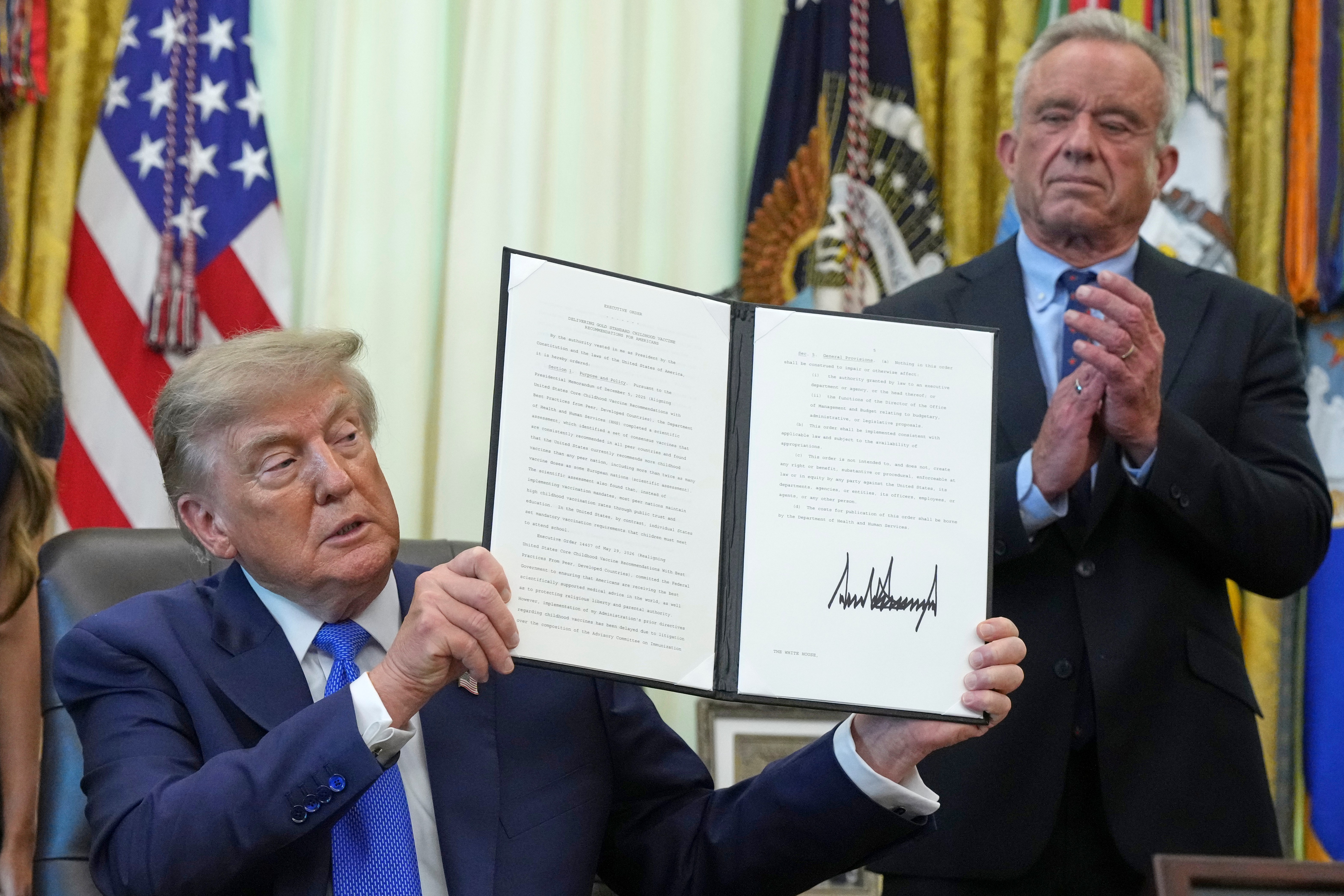
President Donald Trump holds a signed executive order about vaccines as Health and Human Services Secretary Robert F. Kennedy Jr. looks on Aug. 10 in the Oval Office of the White House. Jacquelyn Martin
What’s known about the Lancaster County deaths
Diamantoni said Friday that the baby died shortly after birth at a Lancaster County birthing center on Aug. 14.
Postmortem testing of the baby’s lung tissue showed that the baby had an active measles infection acquired before birth, he said.
He has not talked to the baby’s mother or the midwife who delivered the baby, and has not fully reviewed records from the birthing center where she gave birth, he said in interviews.
He told the Pittsburgh Tribune-Review that measles was listed on the baby’s death certificate, in a section of the certificate that reports other ”conditions contributing to death but not resulting in the underlying cause.”
He told the outlet that measles was included on the death certificate “to offer a broader view of the general health of the child.”
Babies can become infected with measles in utero if the mother is infected with measles and develops a rash within 10 days of giving birth, Offit said.
Diamantoni said a forensic pathologist in his office concluded the baby died of a ruptured spleen and cited trauma to the baby’s torso. He said he was unsure what had caused the trauma, and added that the baby’s spleen did not appear enlarged or infected.
Offit said that measles can cause an enlarged spleen that is then more likely to rupture — including during birth — and that it’s often difficult to tell whether a spleen has become enlarged once it ruptures.
A spleen also doesn’t have to become “massively” enlarged to rupture, he said: Measles can cause the spleen to become fragile, which also heightens the risk of rupture.
In conversations with state health officials, Offit said he learned that the patients who died in Pennsylvania would not have died were they not infected with measles.
He said the coroner should explain why the spleen ruptured, if it was not damaged from measles. Diamantoni said the office is still investigating the cause.
The state has released no additional information on the second death, and Diamantoni said his office was not handling it. He said his chief deputy spoke to the department prior to Shapiro’s news conference Tuesday.
“At no point was the Pennsylvania Department of Health told that this was not a measles-associated death,” a state spokesperson said on Friday. “The Shapiro Administration stands firmly by their comments on Tuesday.”
Public health communications
Pennsylvania’s health department has cited a state law prohibiting public access to death records, saying they cannot release more information on the deaths. Another state law requires the state to keep records of diseases confidential, except when it’s necessary to inform the public of the risk of communicable disease, a department spokesperson said in a statement.
The department “works hard to build and maintain trust in communities all over the Commonwealth — which includes doing everything possible to keep people’s identities confidential,” the statement read.
The department didn’t share information that could be used to “personally identify individuals or their grieving families” because “the circumstances of these individuals’ deaths do not change the Commonwealth’s response: Measles is a serious, highly contagious and preventable disease, and our focus remains on protecting Pennsylvanians, getting people vaccinated, and stopping the spread of this outbreak,” the spokesperson said.
But the state could have been more transparent about how they characterize deaths in a measles outbreak, said Kathleen Hall Jamieson, director emerita of the Annenberg Public Policy Center at the University of Pennsylvania.
People who are not trained in medicine may not understand the term “measles-associated,” for example, or how it differs from a cause of death, and state officials should have taken time at the news conference to explain what they meant by that term.
“You have an obligation to make sure that people don’t mishear on something as fraught as this topic,” she said.
Jamieson added that the political clashes around the deaths could overshadow a crucial point: A highly contagious disease is spreading in an under-vaccinated community, exposing children — including newborns unable to be vaccinated — to a serious illness.
“If we miss that moment, then the public health community has failed,” she said.
And every time, my blood boils at the rampant thuggery on display.
I abhor facile slogans, but as more and more incidents pile up, this one’s an easy call: Abolish ICE.
Smash it up. Close it down. Dismantle it. It shouldn’t be too hard, since it’s already been broken by President Donald Trump and his GOP allies in Congress, who have flooded the agency with billions of dollars and a mission directive that rewards lawlessness and recklessness.
Under Stephen Miller, the architect of the administration’s anti-immigrant policies, the goal is mass arrests and deportations, no matter the cost. A June 2025 post by the president on Truth Social made it explicit: “ICE Officers are herewith ordered, by notice of this TRUTH, to do all in their power to achieve the very important goal of delivering the single largest Mass Deportation Program in History.”
This has led to the foreseeable consequences that are playing out on America’s streets and inside immigration detention centers. The stories of abuse are so common, their number so overwhelming, that I don’t see how the agency survives.
This should not be interpreted as a call for nonexistent borders or unfettered immigration. Having spent much of my life in and around southwest Texas, I count myself among those who have a particular appreciation for the importance of humane, rational, and consistent immigration policies — but, by almost any measure, we’re getting none of the above from ICE as it’s currently formulated.
And it’s not just me or the usual left-leaning advocates who are questioning the national framework on immigration. Nearly three-quarters of Americans believe immigration is a good thing for our country, and most people prefer widening paths to citizenship rather than increasing enforcement efforts.
The prospect of doing away with ICE does not garner nearly as much support from undecided midterm voters, with just 21% of them saying in a recent poll that they favored eliminating the agency.
As I’ve written about how the administration is demonizing immigrants, I’ve heard from conservative readers who say the media is doing the same to ICE, casting it as the worst of the worst and inevitably forcing a critical look at its future.
To answer the question of what the agency might look like in the years to come — or if it should even continue to exist at all — I reached out to a few people who may know ICE better than nearly anyone else: those who’ve worked inside it.
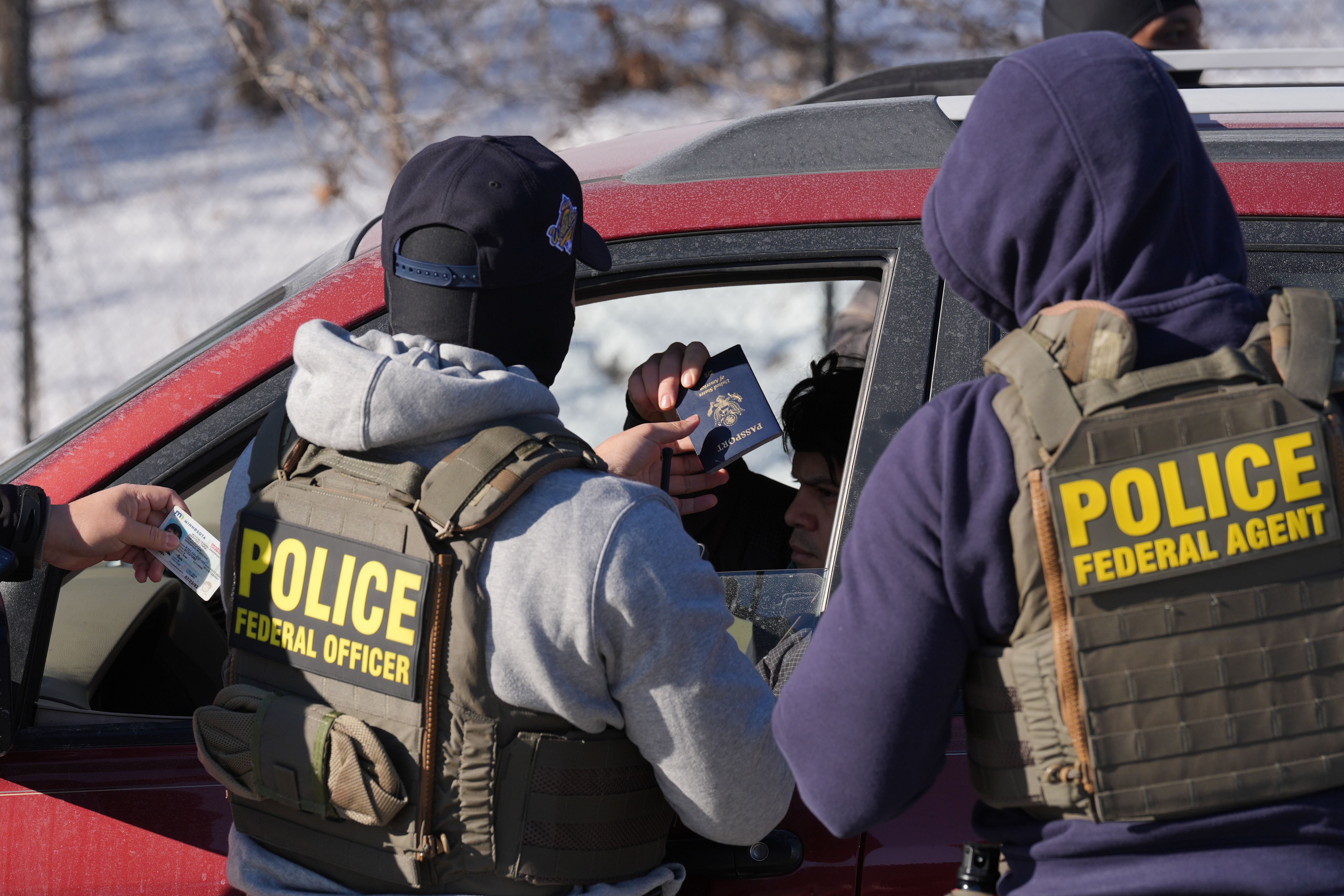
Federal agents make a traffic stop on a U.S. citizen in Minneapolis in January.Adam Gray
Changing tactics
I put the question of ICE’s future and how its agents are regarded to Jason Houser, who spent his government career at the U.S. Department of Homeland Security and is a former ICE chief of staff. The Afghanistan combat veteran told me it starts and ends with leadership.
“The tactical and operational guidance and directives from the administration are putting ICE officers in a place to be demonized,” he said. “There’s a lot of authority and power in law enforcement, and the way that power is being used by this administration for the first 18 months has been disjointed, punitive, shortsighted, and targeted at the most vulnerable communities.”
While the behavior of some agents is inexcusable, and they should be held accountable, the agency is ultimately an instrument wielded by those in power.
For example, some of the same agents who are being maligned today were redeployed to Del Rio, Texas, in 2021 to help humanely and safely process almost 16,000 mostly Haitian immigrants who were living in substandard conditions in a makeshift border camp, Houser noted.
How ICE is operating today cannot be separated from the administration’s demands.
Some of the worst examples of abuse by ICE agents have come during vehicle stops, including the July killing of Lorenzo Salgado Araujo in Houston. Agents have been captured on video in high-speed pursuits, cutting off cars, and smashing windows.
Before Trump returned to office, the agency rarely engaged in these kinds of tactics, let alone used them to target noncriminal immigrants, said Joe Sifuentez, who worked for ICE until he retired in 2020.
“If it’s a bad guy in that vehicle, we have a judicial warrant, we stop them. Then we can break that window and drag that person out of the vehicle,” he said. “But that’s not what’s happening now.”
While the president campaigned on mass deportations, many voters believed the government would focus on immigrants with serious criminal records. Increasingly, that is not the case, with most people being detained only charged with violating civil immigration laws.
And in trying to fill a reported White House quota of 2,000 arrests a day, federal agents are engaged in random sweeps and racial profiling that put people at risk.
“I’m concerned that one of my loved ones could get pulled over tomorrow,” Sifuentez said. “God only knows what can happen.”
Detainees stand at windows at the Delaney Hall immigration detention center in Newark, N.J., in May, as demonstrators gather outside.TODD HEISLER
Bad math
The Republican-controlled Congress has given the administration more than $150 billion for immigration enforcement. The question is what taxpayers are getting in return. It isn’t increasing public safety, the former officials I spoke with said.
Houser pointed to a recent report by the DHS Office of Inspector General that found that as ICE shifted priorities toward immigration enforcement, its efforts to combat fentanyl trafficking declined. From fiscal years 2024 to 2025, the report said, fentanyl investigations decreased by 24%, investigative hours spent countering fentanyl decreased by approximately 30%, and fentanyl seizures decreased by almost 40%.
It’s not just drug trafficking investigations that are falling by the wayside over Trump’s misplaced priorities. ICE agents descending on a Home Depot or a Walmart to fulfill their arrest quotas fail to target the kinds of criminals the agency should be focused on.
“Real sex predators, convicted rapists, murderers, aren’t just hanging out at a Starbucks on a Tuesday, right? They’re not at the corner, walking their kids to school,” Houser said.
Mass arrests also put people in detention who do not have a final order of removal. These are immigrants who are going through the system and would generally be allowed to walk free until they had exhausted their legal options. Instead, the administration is deciding to hold them without bond for what can be an indeterminate amount of time.
Sifuentez, who oversaw ICE’s national fugitive operations program and detention facilities, told me that even under regular circumstances, detention is extremely challenging. As the government works to not only increase the number of such facilities in the country, but also how many people these places hold, the situation is bound to get worse.
“When I was in Atlanta, I oversaw a facility with 2,000 detainees. That in itself was very difficult to oversee and keep your staffing levels intact,” he said. “What do you think it’s going to be like when you ramp it up to 10,000?”
“You’re going to see more suicides. You’re going to see more people die of health conditions. You’re going to see more both mental and physical stress that leads to horrific outcomes,” Houser added. “It’s just math.”
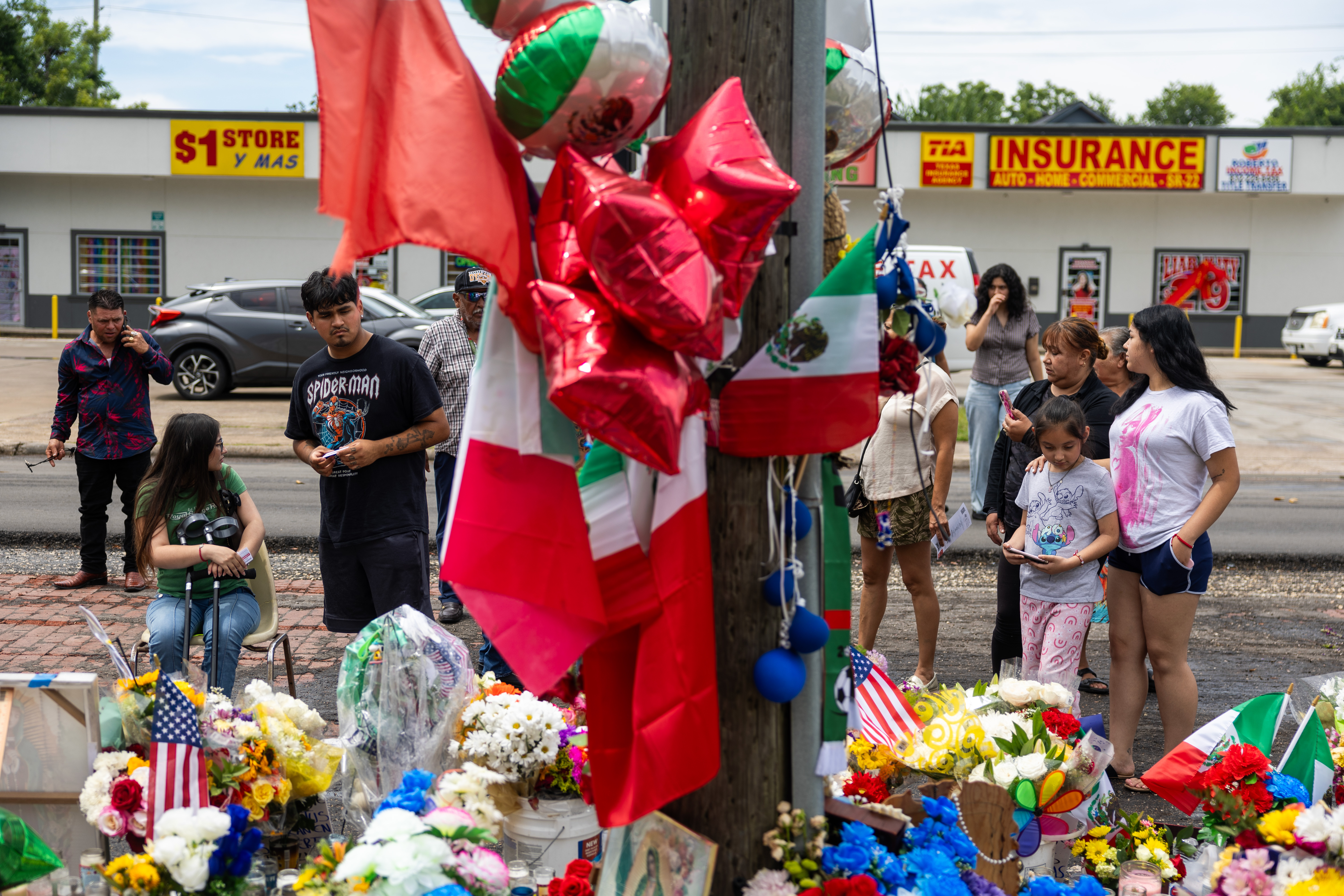
Lorenzo Salgado Araujo, a 52-year-old Mexican immigrant, was fatally shot by ICE agents in Houston in July. A makeshift memorial took shape at the site where he was killed.ANTRANIK TAVITIAN
Abolish ICE
If ICE is being used to indiscriminately terrorize communities, and ignore constitutional protections while disregarding its public safety charge, what is the point of its continued existence? Even if you see it as a tool, if it can be abused so readily and so thoroughly by an out-of-control executive, wouldn’t the cause of sensible and coherent immigration policy be better served by replacing it?
Neither of the former officials I spoke with would endorse the call to abolish ICE, and perhaps their experiential knowledge of the agency’s complexity would keep them from ever embracing what can feel more like a facile bit of political sloganeering than anything else. After all, activists have long called to eliminate the agency, rightly underscoring the need for accountability over the lives that have been destroyed by detention and deportation — but they hardly ever offer realistic or politically viable alternatives.
Indeed, as long as we are a nation of laws, there will be the need for enforcement. In humanitarian terms, whatever agency takes ICE’s place will be judged harshly under those same standards, but exist it must.
Still, Sifuentez, until recently a lifelong registered Republican, said that at the very least ICE should be renamed and its functions divided among other agencies.
“Everybody in America should be very concerned about what’s going on,” he said. “This isn’t about politics. This is about what’s right and what’s wrong, and what’s going on is wrong.”
For his part, Houser stressed that we need migrants in this country, and we need public safety. Immigration enforcement is difficult, nuanced work and should be entrusted to those who have the highest level of training and expertise.
“No matter what the structure and organization of the bureaucracy is, there’s going to be immigration enforcement, and it needs to be handled with professionalism,” he said. “Remembering that 95% of individuals who are coming to this country want the American way of life, and that’s something to be embraced.”