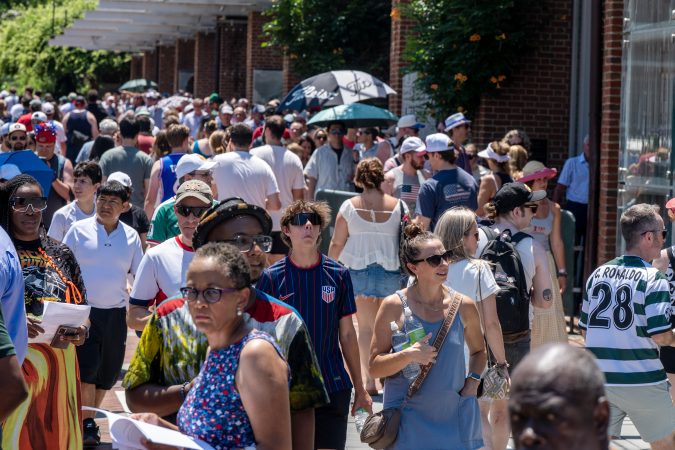
Philadelphia hotels reached nearly 90% occupancy on July 4, according to exclusive new data released Friday by Visit Philadelphia. The number represents the highest average daily rate since the agency began tracking July 4 data in 2007.
The previous high was 60% occupancy on July 4, 2016.
“The July 4 holiday gave us an early glimpse of what’s possible this year,” said Angela Val, president & CEO of Visit Philadelphia, the nonprofit that serves as the city’s official leisure-tourism marketing organization. “Hotels were nearly full, and the strong demand we’re seeing is a great sign for the months ahead.”
City hotels generated nearly $6 million in revenue alone on July 4, the data showed. Overall, Philadelphia County hotels reaped more than $7 million.
The average city hotel daily room rate soared to $459 on July 4 — more than double last year, Val said. Philadelphia County room rates reached $413.
“We’re only halfway through 2026,” Val said. “There are still major events and celebrations to come, and we’re focused on making this a year that inspires people to come back to Philadelphia again and again.”
Those numbers come just as the Philadelphia Convention and Visitors Bureau announced Friday that Philly hotel revenue jumped more than 50% during the city’s six FIFA World Cup matches.
“Philadelphia thrives when our city, business community, and hospitality industry come together to welcome the world and showcase all that our city has to offer,” said Gregg Caren, president and CEO of the PHLCVB. “We anticipate the FIFA World Cup will inspire not only future international travel to the city but serve as a shining example of how we can successfully execute major global events, drawing key future business to Philadelphia.”
In June, officials from the Greater Philadelphia Hotel Association expressed concern that some of Center City’s 14,500 hotel rooms were still available on match days, hosted at Philadelphia Stadium from June 14 to July 4.
On Friday, John Fricke, chair of the GPHA, said the crowds came.
“We’re fortunate that our city and hotel team are used to welcoming guests during major events in Philadelphia,” Frickle said in a statement. “But the FIFA World Cup was something truly unique. Hearing guests share how much they enjoyed Philadelphia’s history, neighborhoods, food, and their overall experience was incredibly rewarding — it was a proud moment for us, and a great reminder of why hospitality is so special.”
More than 400,000 fans from 190 countries attended the matches, while crowds of 250,000 packed into the FIFA Fan Festival at Lemon Hill, according to the Philadelphia Convention and Visitors Bureau.
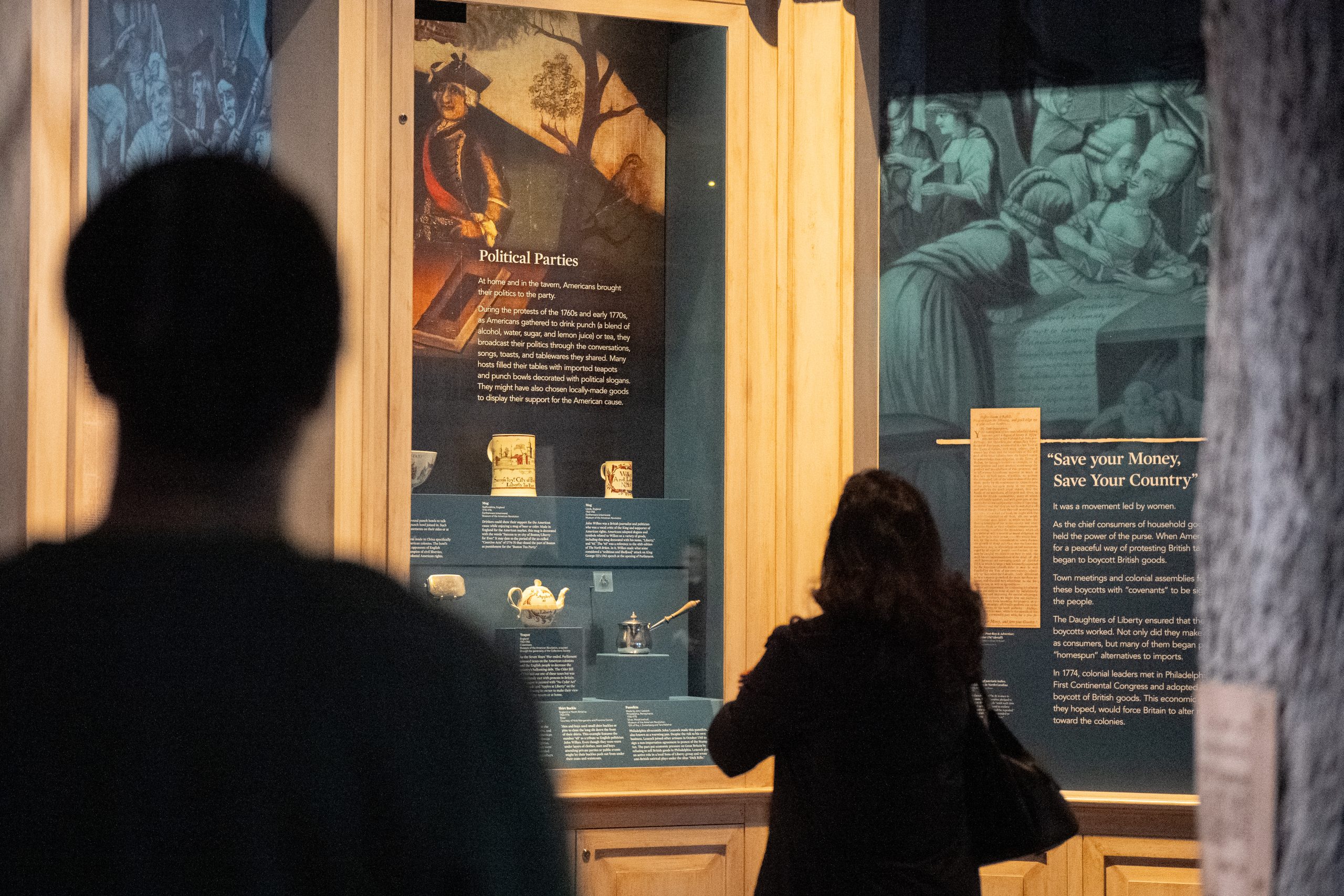
Guests tour the Museum of the American Revolution in Old City.Jessica Griffin / Staff Photographer
Philadelphia cultural institutions also reported historic numbers, with more than 12,000 people visiting the National Constitution Center and the Museum of the American Revolution during Independence Week, according to data released by the city.
The Revolution museum hosted 8,000 visitors over the holiday weekend alone, its highest three-day attendance ever.
“The 1st to the 5th was the biggest week we’ve had,” said Scott Stephenson, president and CEO of the museum, which opened in 2017. “July 3 was our biggest payday since the museum opened.”
The museum was nearly at capacity on July 3 and 4, said Stephenson, who spent hours letting long lines of guests into the museum’s grand theater exhibit featuring George Washington’s original field tent, which ran every 15 minutes instead of once an hour.
And it wasn’t just the crowds. It was the vibe that was special, Stephenson said.
“I was just so positive,” he said. “It was just a lot of pride and optimism. People were chatting with each other and having such a great time together, really celebrating our country.”
“You know we wondered in the years leading up to this if there still was an impulse for families to come to Philadelphia for the 250th,” he said. “The question was, ‘Well, are they going to come?’ And boy, they came.”
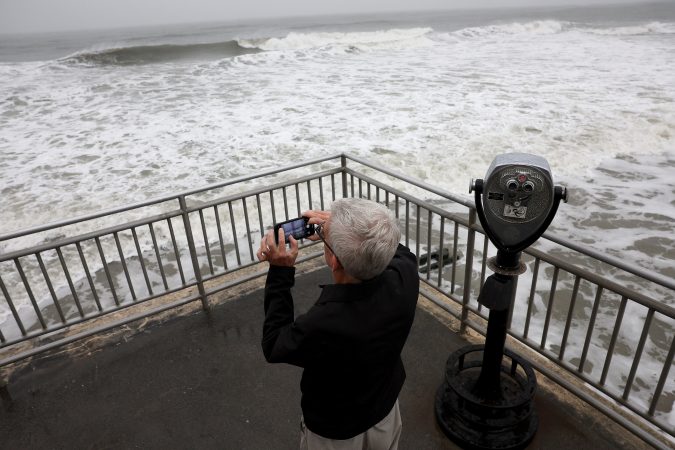
Warming in the tropical Pacific has been intensifying rapidly, and with increasing certainty government meteorologists say this El Niño event could become the strongest in records dating to 1950.
It is all but certain to have profound effects on the Atlantic hurricane season and the winter of 2026-27 across the United States. It’s also going to stick around.
In its Thursday update, the National Oceanic and Atmospheric Administration advised that El Niño would“strengthen through the end of the year, with a 97% chance it will last through early spring 2027.”
Sea-surface temperatures over a critical 2.4 million-square-mile portion of the tropical Pacific are running about 2 degrees Fahrenheit above long-term averages, more than qualifying for El Niño status.
In records dating to 1950, those temperatures have reached as high as 4.5 degrees above normal. In this El Niño event, the temperatureshave a “43% chance” of reaching that level, said Michelle L’Heureux, physical scientist at NOAA’s Climate Prediction Center.
As for what impacts it will have, NOAA scientists point out that El Niňo will not be acting in isolation and that it would be impossible to know. However, based on past strong El Niños, expect unusual levels of strangeness for the next several months.
For Philly, it may have significance for the stubborn drought conditions, but that also could come with a positive development.
And its potentially benign effects on the Atlantic hurricane season may save some lives and yield a robust bonus for the U.S. treasury.
How does El Niño affect the U.S. weather?
El Niño events develop as part of a periodic natural process as east-to-west trade winds that push water into the western Pacific slacken, allowing prodigious, massive amounts of warm water to move eastward.
The warmer water interacts with the overlying air, setting off convective thunderstorms and altering west-to-east upper-air winds that deliver the weather to the United States and other parts of the world.
Reliable responses to El Niño include storminess in the southern United States and warmth in much of the northern states and Canada. For Philly, about the only constant has been weirdness.
How is El Niño affected by other phenomena?
El Niño is a crucial piece of the atmospheric puzzle in long-range forecasting. However, it also interacts with other phenomena, such as the Arctic Oscillation — shifts in atmospheric pressure between the Arctic and the lower latitudes, and an important driver of winter temperatures — and patterns in the North Atlantic, which “may reinforce or counteract each other,” said Johnna Infanti, a climate center meteorologist.
And when it comes to developing outlooks for the seasons, forecasters have to consider earthly phenomena such as changes in soil moisture and sea ice, she said.
“It is important to remember that an El Niño can shift the odds toward certain outcomes,” she said, “but the outcome is not guaranteed.”
That said, “stronger events can tilt the odds more heavily in favor of the expected outcome,” she added.
The short answer in all probability would be no, Infanti said.
In summer, she said, “there is no clear link between above-average temperatures over the United States and El Niño.”
Besides, this El Niño is still a relative toddler. This one is expected to last for about a year, a typical lifespan, L’Heureux said.
While the sea-surface temperature has surpassed the El Niño threshold, “the atmosphere is still aligning,” said Matthew Rosencrans, NOAA’s lead hurricane seasonal forecaster.
As it intensifies and the atmospheric response strengthens, the impacts will become more evident, and they are likely to be significant during the peak of the hurricane season, from mid-August into September, he said.
That may be welcome news for residents and property owners along the Atlantic coast and for U.S. taxpayers.
How will El Niño likely affect the number of Atlantic hurricanes?
El Niño can generate powerful upper-air shearing winds that can suppress hurricane development in the Atlantic Basin.
In the six years in which sea-surfacetemperatures in the key El Niño zone remained 3.5 degrees or higher above normal for three months or more, the Atlantic tropical-storm season was far less active than normal.
The numbers for all named storms, those with winds of 39 mph or higher; hurricanes, which havewinds of at least 74 mph; and “major” hurricanes, those with winds of 111 or higher, were substantially below long-term averages.
(function(){function e(){window.addEventListener(`message`,function(e){if(e.data[`datawrapper-height`]!==void 0){var t=document.querySelectorAll(`iframe`);for(var n in e.data[`datawrapper-height`])for(var r=0,i;i=t[r];r++)if(i.contentWindow===e.source){var a=e.data[`datawrapper-height`][n]+`px`;i.style.height=a}}})}e()})();
Among all federal disaster relief fund disasters, hurricanes are far and away the most expensive. In a congressional study covering the 30-year period through 1992, hurricanes accounted for 44%, or more than $150 billion, of all federal disaster money.
A potential downside would be that fewer storms would lessen the chances for any drought-relieving tropical-storm remnants. (On the plus side, the region would not have to deal with their attendant flooding: See Ida, 2021.)
Will El Niño affect the Philadelphia winter?
Looking way ahead, El Niño is not much help in determining how the winter might play out.
One characteristic of strong El Niños has been persistence of certain patterns. What happens tends to keep happening, since ocean temperatures change slowly.
The six strongest El Niños persisted into winter and left quite a disparate legacy in Philly. The winters of 1991-92 and 1997-98 were nearly snowless, and that of 1972-73 was the only truly snowless winter in Philadelphia history.
An industrious young man in Swarthmore adds to a mountain of snow his father crated from the prodigious January 2016 snowfall.
Conversely, snow was well above normal in the winters of 1965-66, even though no snow had fallen until the end of January; in 1982-83, when an all-out blizzard occurred in February; and in 2015-16, which featured a two-footer in January.
With all due respect to LeBron James, the Sixers’ greatest and most impactful unknown is the same as it has always been.
Mike Gansey acknowledged as much on Thursday.
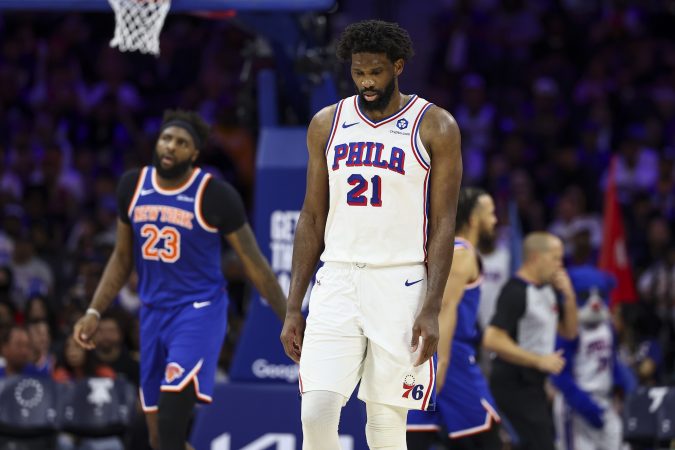
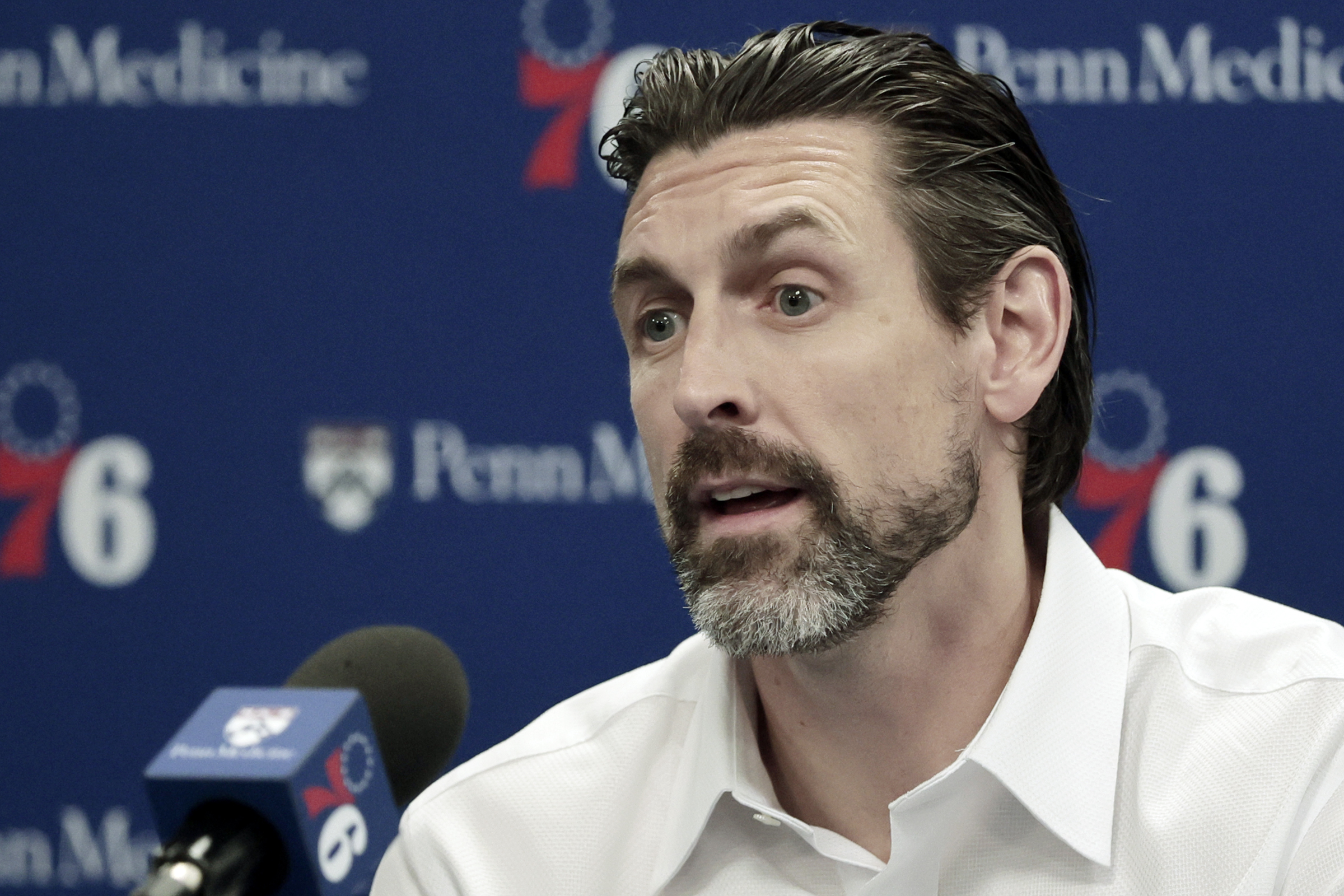
“Obviously,” the Sixers new president of basketball operations said in a courtside interview during ESPN’s broadcast of the team’s summer league opener, “the big fella is the X-factor.”
It speaks to the magnitude of Joel Embiid that such a sentiment can be qualified as obvious. Nothing about the Sixers over the last two months has been obvious. From the firing of Daryl Morey to the hiring of Gansey as his replacement to the dramatic trade of Paul George and a couple of first- and second-round picks to the Celtics for some guy named Jaylen Brown to the front office’s attempt to woo James, the Sixers are in the midst of an overhaul more radical than any Embiid has seen in his decade with the team.
For maybe the first summer of his career, everyone’s focus is elsewhere. Yet, everyone is fooling themselves if they think they can talk about the Sixers as a legitimate contender without factoring the big fella into the equation.
The exact nature of the question has changed. There’s no doubt about that. It is no longer, “How far can Embiid carry the Sixers?” In Tyrese Maxey and VJ Edgecombe, they have young guards who carried them to a Game 2 playoff win over Brown and the Celtics without Embiid. In Brown, they have a player who was overwhelmingly responsible for Boston’s win over the Sixers in Game 1 of the same series. That trio is talented enough to pencil in the Sixers for a playoff spot and, potentially, a top-four seed even if Embiid were not to play a game. At no point prior in the Embiid era have we been able to say such a thing.
That’s more than a good thing. It’s the reason that a jaded city can now deconstruct its emotional walls and allow itself to invest time and energy in the Sixers again. The potential outcomes are no longer as divergent as “championship contention” or “No. 3 overall draft pick.” The exhaustion that people feel with regard to Embiid is in large part a function of his inordinate importance over the years. With him, the Sixers could beat anybody. Without him, there was little point in watching.
So, yeah, the question has changed. But it is still the one that matters most when it comes to handicapping the Sixers’ 2026-27 title odds.
What do they expect out of Embiid?
What will they get?
The first part is more interesting. The organization’s public rhetoric regarding their big man has shifted since the change in regimes.
For Morey, Embiid was something like a mission statement: any time the former president spoke publicly about his team, his comments were centered around the center. He took the job in 2020 with the idea that Embiid was the exact sort of front line, once-in-a-generation superstar that teams need to win a title. The goal was to get him whatever help he needed. Morey professed that belief to (virtually) the bitter end.
Sixers president of basketball operations Mike Gansey says Joel Embiid was excited about the Jaylen Brown trade.Elizabeth Robertson / Staff Photographer
Gansey and ownership proxy Bob Myers have been far less committed in their public sentiments about Embiid. In his introductory press conference a month ago, Gansey avoided talking with much specificity about the big man beyond including him in the framing of the Sixers’ existing roster structure as a “Big Four.”
“They’re our four guys, they’re under contract. We got to do the best to get them to their best self,” Gansey said on his first day on the job, “because I think every night at 7 p.m., we got to get them to their best to help us win.”
Barely a month later, George was en route to Boston and the Sixers “Big Four” was now a “Big Three.”
Perhaps it is notable, then, that Gansey now feels comfortable speaking of Embiid in such terms as the ones he deployed in his ESPN interview on Thursday.
“Joel’s in a good space,” Gansey said. “He’s finally healthy going into the offseason. He’s excited about this summer. He’s getting to work here shortly. He expects to have a good year, as we all do.”
Embiid has been conspicuously silent since the Brown trade. His lone Twitter post in the wake of the deal was about the Tour de France. In an interview with the Sixers’ flagship radio station on Thursday, Gansey said that Embiid was excited and “fired up” when Gansey informed him of the trade.
Whatever the case, the Sixers are well past the point of factoring Embiid’s feelings into their actions. The Brown trade was as much about the Sixers’ ability to compete without him as with him. At the same time, the only way they contend for a title this season is with him.
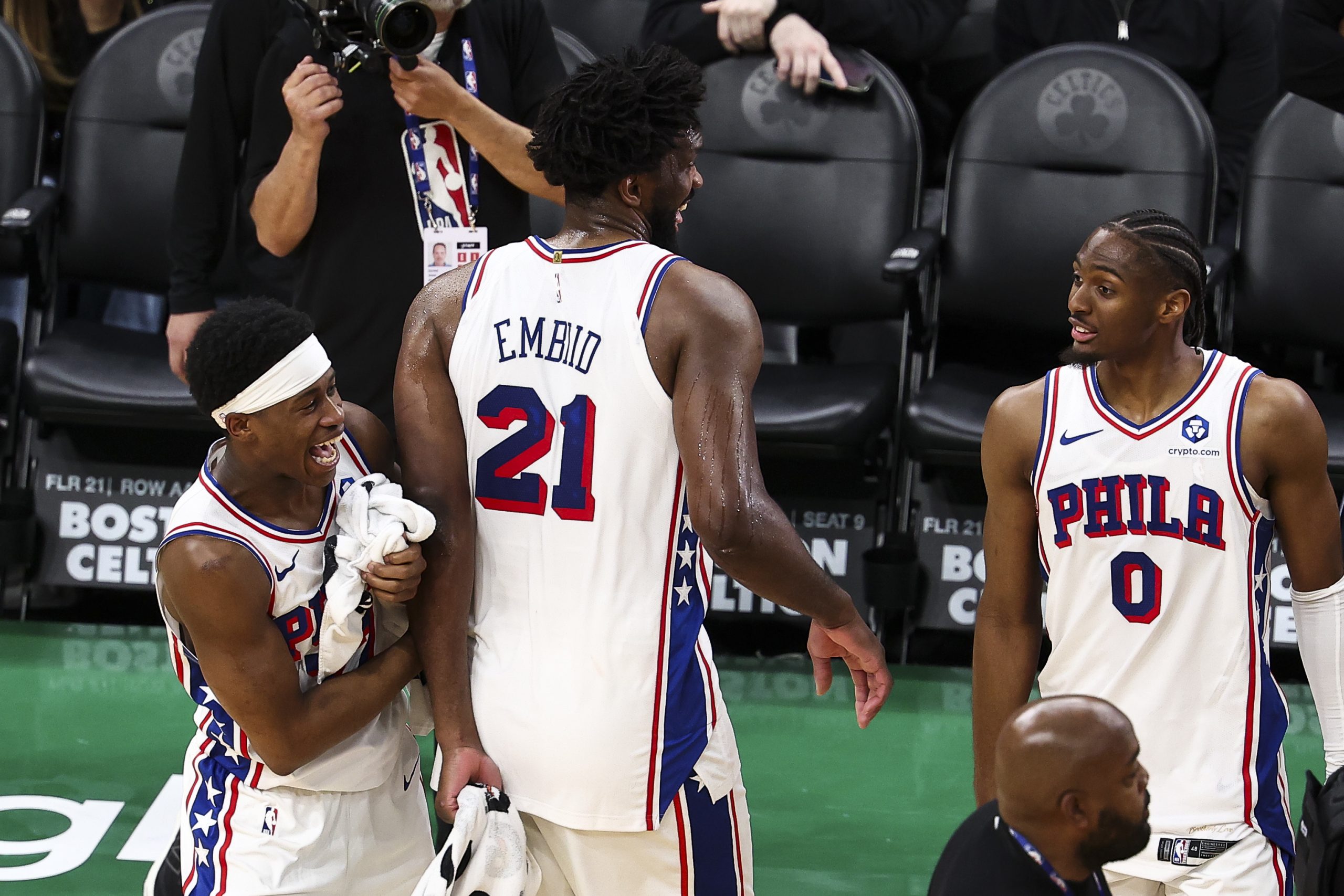
VJ Edgecombe (left), Joel Embiid, and Tyrese Maxey celebrate after winning Game 7 against the Boston Celtics in May.Monica Herndon / Staff Photographer
April’s playoff series against the Celtics offers a tidy encapsulation of where the Sixers are. As dominant as Brown was during various stretches, Boston still lost. As impressive as Maxey and Edgecombe were at times, the Sixers still needed to win a Game 7 against the Jayson Tatum-less Celtics just to earn the right of getting blown out of the playoffs by the Knicks. Celtics coach Joe Mazzulla offered the definitive sound byte after the Sixers finished off their series comeback.
“What changed in this series was Joel Embiid came back and they’re a completely different team,” Mazzulla said.
Embiid missed Game 2 of the next series. The Sixers were outscored by 57 points in the 88 minutes he played against the Knicks. Somewhere on that continuum, their immediate hopes lie.
Felix White worries his ability to keep working — and avoid a health crisis — could be at risk.
The 62-year-old Montgomery County resident relies on Medicaid to afford the insulin he needs to manage his type 1 diabetes.
Beginning in January, people with Medicaid will be required to provide proof that they are working 80 hours a month, unless they are considered too sick to work and qualify for an exemption.
If White fails to submit enough evidence, he could lose Medicaid. Yet without the government-funded coverage, he won’t be able to get the medications and care he needs to stay healthy enough to keep working.
“It would be a death sentence for me,” White said.
A few years ago, White lost his job in computer science — and the private health insurance that once covered the medications, glucose monitor, and specialists he needs to manage type 1 diabetes.
Finding work in his field has been challenging at his age, White said. So instead, he’s relied on a string of odd jobs, such as mowing lawns, for income and Medicaid for healthcare.
Pennsylvania expects 310,000 residents to lose Medicaid when the new rules take effect, and White fears he could be among them.
The work requirements are part of Republicans’ 2025 spending and tax cut bill, which is expected to cut more than $900 billion in Medicaid spending over the next 10 years.
The legislation passed by Congress allowed exemptions for Medicaid recipients considered “medically frail.” The law loosely defined categories of exemptions, such as for people with a substance use disorder, a disabling mental disorder, a “serious or complex” medical condition, and disabilities that limit their daily activities.
White’s Type 1 diabetes is considered a disability that could hinder a person’s ability to work.
But in June, the Centers for Medicare and Medicaid Services provided additional details: To be exempt from the work requirement, people will need to prove not only that they are “medically frail,” but also that their illness is so severe they are unable to work.
Republicans who pushed the legislation argue that work requirements ensure only people with the greatest needs receive the safety-net support, while helping people who have been sick reintegrate into society.
Pennsylvania is among 25 Democrat-led states suing over the interim final CMS rule, which they say oversteps the law, HR 1. The June rule “differed significantly” from initial guidance and “undermines months of work and human and financial resources” Pennsylvania has spent to meet the new requirements outlined in HR 1, the Pennsylvania Department of Human Services said in a statement.
“This redirection poses an even greater threat to health and well-being for Medicaid recipients and the stability of our entire healthcare system,” said Brandon Cwalina, a spokesperson for DHS.
Shifting Medicaid rules
Implementing the new Medicaid rules represents a massive undertaking for states. The law calls for many people to prove on a monthly basis that they are working, and reapply for coverage every six months, instead of once a year. Certain groups of immigrants will no longer be eligible.
These changes have required Pennsylvania and other states to overhaul the type of information they document about Medicaid applicants. Processing renewals twice as often will require more staff.
States also had to devise strategies for alerting people of the changes, for fear they will be dropped from coverage they didn’t know they were at risk of losing.
Pennsylvania DHS “has worked in good faith” to make these changes, sharing designs and plans with CMS leadership, Cwalina said.
The June rules from CMS will require “a more complex, costly, and labor-intensive approach,” he said.
Administrative hurdles for vulnerable patients
The new rules will make it harder for people to get the care they need, patient advocates and health analysts warn, saying it will drive more people to rely on emergency care, further straining the health system.
“What the administration is calling work requirements are really just hurdles for people who deserve Medicaid and access to the care they need,” said Michael Berman, director of Protect Our Care PA, a healthcare advocacy group, who spoke at a virtual press conference Wednesday with stakeholders and patients, including White.
Under the June rules, states are responsible for developing a list of diagnosis codes that qualify for an exemption, and devising a system to determine how a person can prove their diagnosis prevents them from working.
The CMS guidance provides some specific limitations.
People with substance abuse disorder, for instance, will not be eligible for a work requirement exemption if they have been in recovery for at least five years.
Behavioral health workers worry that will lead to more people relapsing.
“We know recovery works, but only when people can consistently access care,” said Jeannine L. Lisitski, CEO of Mental Health Partnerships, which provides mental health and substance abuse services in Pennsylvania.
People with HIV/AIDS and cancer, also considered serious medical conditions, will only be exempt from the work requirement rules if they prove they are too sick to maintain a job.
Gathering the documentation could be especially burdensome for people who are seriously ill.
“For someone who’s in cancer treatment, to go back to a doctor and get another piece of paper filled out is just going to make it harder and less likely they’re able to get the care they need to survive,” Berman said.
On a warm June evening, Aqeel Ahmed and his son Musa Khan eagerly waited outside their recently opened Delco Farmers Market in Folcroft for a minivan and its long-awaited cargo.
The drop-off occurred at 6 p.m., with their Upper Darby supplier pulling up right on schedule.
The 36 boxes of Anwar Ratol, Chaunsa, and Sindhri mangos filled the market’s produce section with a smell that defined Ahmed’s summers growing up in Karachi.
“It smells like you’re in Pakistan. That’s how fresh they are,” Khan said.
The cargo of mangoes had traveled more than 7,000 air miles from Khan and Ahmed’s homeland, where they are considered the “King of Fruits” and celebrated in songs and poetry.
Within six hours, all 36 boxes were sold.
With customs restrictions, high transport costs, and a short shelf life, Pakistani mangoes are difficult to come by in the U.S. despite being approved for import in 2010. A network of mango dealers across the country makes it possible for the diaspora to acquire their homeland’s national fruit, albeit from a limited supply.
Musa Khan (left) and his father, Aqeel Ahmed, pose while holding Sindhri mangos at the Delco Farmers Market on Monday, July 6, 2026, in Folcroft.Monica Herndon / Staff Photographer
“For a group of internet-savvy immigrants and their children, a new option has emerged over the past few years: Middlemen and logistics experts acquire the mangoes from farms in Pakistan and sell them over WhatsApp at a premium, often only a few days after harvest,” James Beard-winning writer Ahmed Ali Akbar wrote in the food publication Eater in 2021.
A member of the Philly-area Muslim and Pakistani communities, Aqeel Ahmed was aware of the vast mango trade network and wanted to sell the fruit even before he opened the supermarket in May.
“When it was illegal to bring Pakistani mangoes, people — not my dad — would smuggle it from Canada, because it was legal to bring [the fruit] there,“ Khan said. ”A lot of people used to drive all the way to Chicago, New York, and California to get these mangoes. So it was a big thing and you always knew who had it.”
Ahmed previously ordered from a mango middleman in Long Island. His son was 12 years old when he had his first bite of a Pakistani mango in America.
“It just tasted better; it was so refreshing,” Khan, 19, said. “They’re juicier — you need to eat it over the sink because every time it’s a mess. And it’s definitely sweeter.”
Ahmed began his search for a local mango dealer in early April. Mango season, which lasts roughly from April to September in Pakistan was around the corner and he knew dealers would be overwhelmed with orders soon. He heard through the WhatsApp grapevine that there was a mango middleman in Upper Darby. So he spent the month calling all the people he knew in the area.
Boxes of Sindhri and Chaunsa mangos from Pakistan are on display at the Delco Farmers Market on Monday, July 6, 2026 in Folcroft.Monica Herndon / Staff Photographer
At the end of April, he made contact.
“My dad called him and said, ‘I’m local in the community as well. We’re opening up a big supermarket and we want to sell Pakistani mangoes,’” Khan said. “It took a little bit of convincing, but [the mango dealer] was able to get us boxes … there’s such a high demand.”
The Upper Darby middleman initially gave the father-and-son duo 12 boxes each of three varieties of mangoes: the small, sweet, and aromatic Anwar Ratol; the almost fiberless, custard-like Chaunsa; and the sweet-tart Sindhri.
Each 4.4-pound box held six or seven mangoes and cost the store $33.
Before the July Fourth holiday, Ahmed ordered another shipment to replenish the first. There were fewer than 200 boxes being sold at the store for $40 each, with a four-to-five day shelf-life.
Pakistani mangoes can go for over $7 apiece due to transportation costs, Akbar said.
After one post about their mango stock, Khan said the store’s Instagram DMs were flooded with people looking to buy. Some even asked if the mangoes could be shipped as far as Kansas, California, and Ohio.
But this was the last order from the mango dealer, Khan said.
With the high demand, the Delco Farmers Market family is looking to cut out the middleman and import directly from Pakistan.
“We didn’t ask [the mango middleman] how he got them,” said Khan, “but we figured out how after a company in Pakistan contacted us on Instagram.”
Middlemen across the country pick up mangoes from airport cargo bays, including Ahmed’s dealer who picks up his stock from the Philadelphia airport. With no direct flights to America from Pakistan, the mangoes need to secure passage to a hub city like Dubai before arriving at an American international airport, said Akbar.
Upon arrival, the fruit is taken to an irradiation facility, quarantined, and then loaded onto another cargo flight.
And all of this needs to happen within a few days of harvest before the fruit spoils.
Boxes of Sindhri and Chaunsa mangos from Pakistan on display at the Delco Farmers Market on Monday, July 6, 2026 in Folcroft.Monica Herndon / Staff Photographer
The next step to going solo, Khan said, is to figure out a way to get the mangoes to Dubai and then to an international airport in Texas or New York.
“Our main goal is to have our own boxes — we want them to say Delco Farmers Market,” Khan said.
Growing up in Lower Merion, Khan never saw a big supermarket dedicated to selling Pakistani and halal products in his neighborhood. The goal for his family, he said, was to be that hub where Philly-area immigrants and diaspora could shop for meat, prepared foods, and fruit from their home country.
“We’re not making anything by selling Pakistani mangoes, but we’re serving the community,” Khan said. “And to have them in our own store after eating it as a kid is a full-circle moment.”
This week’s Shackamaxon covers property tax assessments, state budget negotiations, and Pennsylvania’s gambling dependence.
Assessment anger
Philadelphia property owners have by now received one of the least anticipated pieces of snail mail of the year: our assessment notifications. My own home’s value went up by around $30,000, meaning my family will have to fork over another $400 a year to the city and school district.
Ever since Mayor Michael A. Nutter instituted the Actual Value Initiative in 2013, property taxes in Philadelphia have become an increasingly contentious issue. In the past, valuations stuck around for years — whether or not they matched the overall economic climate.
This meant some property owners were stuck paying more than they should, while others were getting a significant break. By switching to AVI, Nutter hoped to create a system that would be fairer. It also ensured city coffers would benefit from investments in neighborhoods.
This being Philadelphia, however, nothing is so simple.
While many of the underassessed properties were owned by people of significant means, like landlords or vacant-land speculators, the city also has one of the largest concentrations of low-income homeowners in the country. While no one wants to pay an additional $400 a year, this kind of increase is much harder to manage for the nearly 100,000 Philadelphia homeowners who earn less than $50,000.
That is why City Council often feels pressure to provide relief. Sometimes, however, the conversation on this topic would lead one to believe the city currently does nothing for longtime, low-income residents who are struggling with higher bills. Fortunately, this is not the case.
The biggest program on offer is the Homestead Exemption, which allows resident homeowners to deduct roughly $1,400 from their property tax bill. For those whose home is worth less than $200,000, they are getting more than half of their bill eliminated. There’s also the Longtime Owner Occupants Program and the senior tax freeze.
City Hall is also helping homeowners keep up with the costs of repairs. Mayor Cherelle L. Parker’s H.O.M.E. Initiative offers $10,000 to help fix problems like leaky roofs, and the Adaptive Modifications Program ensures residents can age in place or adapt to unexpected physical limitations.
Between those programs, the city is spending hundreds of millions of dollars each year on protecting homeowners. That’s more than the combined receipts for the proposed rideshare tax, the soda tax, and the liquor-by-the-drink tax. Renters, who tend to be poorer and more cost-burdened than homeowners, get comparably little support from City Hall.
When City Council returns this fall and considers how to react to rising assessments, the conversation must reflect how much Philadelphia already does to help struggling homeowners.
Gov. Josh Shapiro delivers his third budget address to a joint session of the state House and Senate at the state Capitol in 2025.Tom Gralish / Staff Photographer
Budget funding
Even though state senators have been called back for budget votes, there’s still no official word on what will be in the document.
Last year, the commonwealth spent just over $50 billion, while bringing in just under $49 billion in revenue. This meant using money from the state’s reserves — although the Rainy Day Fund, which has around $8 billion, was not touched. Instead, state leaders cannibalized other sources, like the Public Transportation Trust Fund, to pay for services without raising taxes.
The plan Gov. Josh Shapiro unveiled in February proposed around $53 billion in spending. Absent new sources of revenue, this would require tapping into the Rainy Day Fund. It remains to be seen whether Harrisburg will finally act on so-called games of skill. Taxing the machines could bring in around $1 billion per year, which would significantly close the gap between projected revenue and the governor’s proposal.
Still, no one expects the Republican-controlled Senate to approve the full proposal. In the past, they’ve objected to any increase in funding for public transit agencies, for which Shapiro has proposed an additional $300 million. There’s also another $565 million in funding for schools, meant to address a structural imbalance that the courts have ordered rectified. Given the emphasis from Mayor Parker, Council President Kenyatta Johnson, and the city’s legislative delegation on education funding, it’d be a surprise if the final deal did not include a significant increase in support for schools.
Philadelphia Phillies first baseman and star hitter Bryce Harper appears in a custom-made video for the betting site FanDual.Obtained by The Inquirer
Aiding in betting
The biggest reason not to tax skill games is that Pennsylvania is already too dependent on gambling to pay the bills.
Between brick-and-mortar casinos and online betting outlets, the commonwealth generated more than $270 million in revenue in just May of this year. The sports betting platform FanDuel even subsidized SEPTA service for the Eagles’ playoff run. While this money does help avoid unpopular service cuts and tax increases, it comes with its own costs. Research says that problem gambling is on the rise, with the ease of betting on your phone a key component.
While gambling has long been a part of human society, the legal online gambling platforms that dominate the scene today are unprecedented. Inquirer reporter David Gambacorta managed to locate one local man who wagered $18.5 million on sports. Along the way, he was offered multiple perks to keep him in the game. Casinos have long sought to keep big spenders happy through meal vouchers, free drinks, and comped accommodations. FanDuel went a step further: It secured a personalized video from Phillies star Bryce Harper.
Part of the justification for legalizing gambling was to clean things up. Legitimate businesses don’t break kneecaps or organize “bust outs.” They had to operate with the kind of regulatory guardrails that simply didn’t apply to illegal bookies who dominated the trade not so long ago.
Stories like these complicate that logic. The more lawmakers in the Keystone State rely on gambling to pay our bills, the more complicit we are in the industry’s misdeeds.
A familiar legend at Delaware County’s Darby Free Library goes as follows.
It was an October day in 1947 when a woman walked into the library and returned a book. The woman had found the library book while going through her late grandfather’s possessions, she said, and she was returning it on his behalf. What was remarkable was that the book had been taken out of the library in the mid-1800s, more than 100 years earlier. It was overdue by a century.
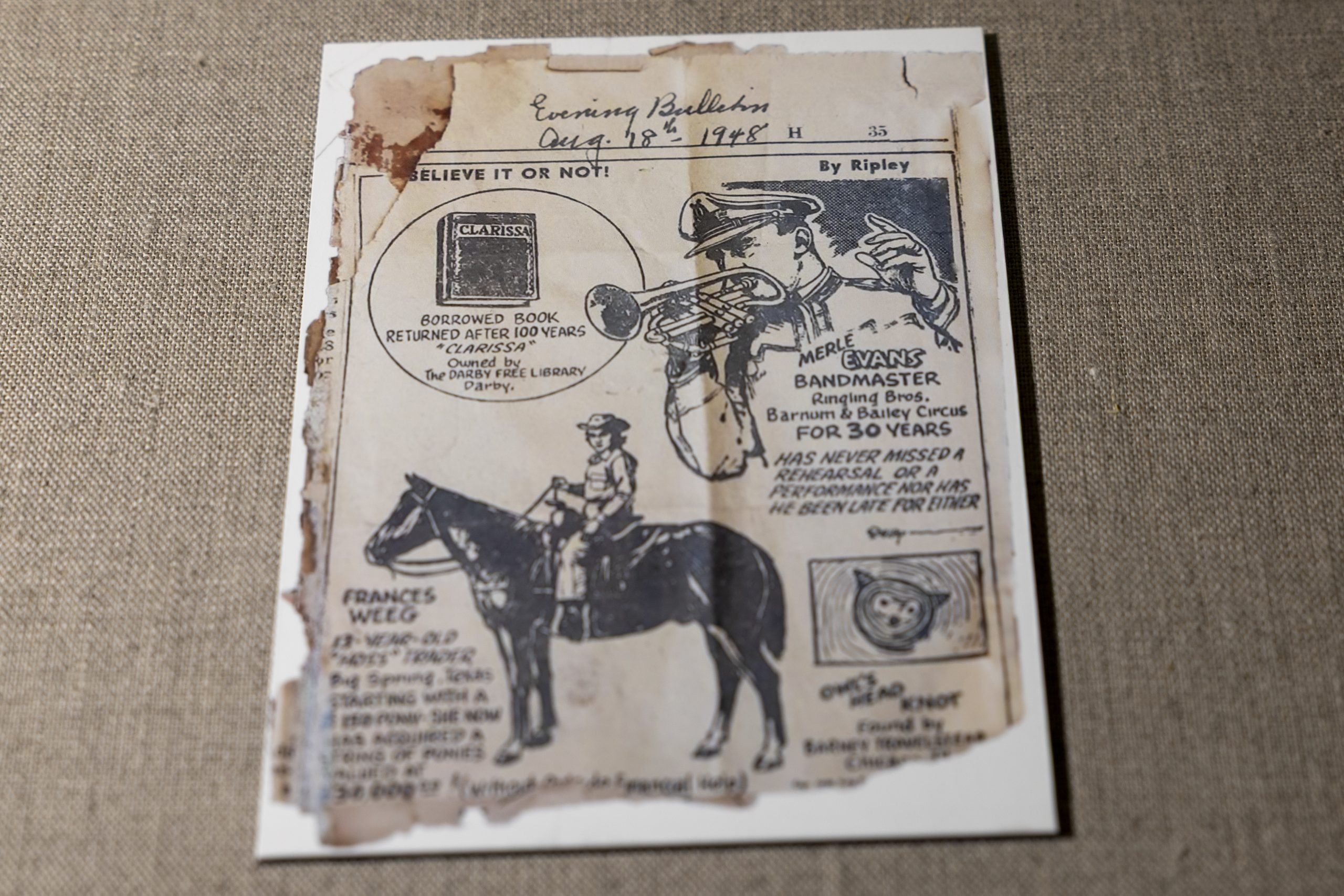
The local paper purportedly caught wind of the story, and on Aug. 18, 1948, the tale was featured in the Ripley’s Believe It or Not! panel and syndicated in over 750 newspapers around the world.
“BORROWED BOOK RETURNED AFTER 100 YEARS,” the Ripley‘s panel declared.
The “Ripley’s Believe It or Not” clipping about the century-overdue volume of “Clarissa” inside the Darby Free Library. Aidan T. Gallo / Staff Photographer
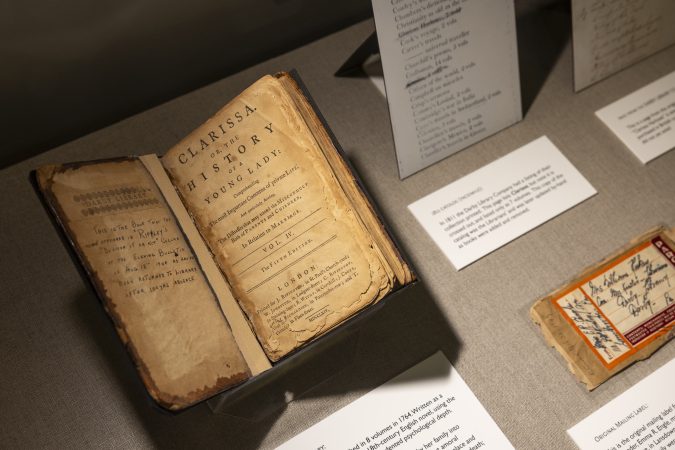
The famed book wasvolume four of Clarissa, a 1748 novel by Samuel Richardson that follows the trials and tribulations of Clarissa Harlowe, a young woman who flees home with a charming but untrustworthy man, Robert Lovelace. The book, considered controversial by many at the time,is written largely in the form of letters between Clarissa and Robert Lovelaceandis thought to bean early great psychological novel, exploring the characters’ inner lives and the complex themes of gender, power, and freedom. Clarissa spans seven to eight volumes and has a word count of nearly one million.
The Darby FreeLibrary’s Emily Finigan was sorting through the library’s collection a few years ago when she came across the famed overdue copy of Clarissa. Finigan found the book inside of a small box adorned with a mailing label. Attached to the mailing label was the Ripley’s clip, and inside the book was an inscription: “This is the book that the incident appeared in ‘Ripley’s Believe It or Not’ column of the Evening Bulletin of Aug. 18th, 1948 as having been returned to library after 100 yrs absence.”
Finigan wears a lot of hats at the library, including fundraising, volunteer work, and, with her husband, managing the library building’s restoration.
Finding Clarissa piqued her interest, and she began to wonder if she could use archival research to uncover the identity of the borrower who first checked out the 100-year overdue book.
Yet a quest to identify the original borrower of volume four of Clarissa sent Finigan down a rabbit hole that left her with more questions than answers: Was Clarissa really a century-old overdue book? And, if not, what really happened to the library’s copy of the 1700s novel?
The “Clarissa” copy inside the Darby Free Library.Aidan T. Gallo / Staff Photographer
The Darby FreeLibrary was founded in March 1743 by a group of Quaker farmers and merchants looking to organize their village’s first cultural institution. The group, made up of 29 townsmen, threw together money to purchase 45 original books, many of which are on display in the library today.
In 1826, the library offered up borrowing rights to anyone who could pay three pounds. In 1898, it became a public library. Nearly a century later, in 1984, the Darby Free Library was adopted into the Delaware County Libraries system.
According to records, the Darby Free Library acquired alleight volumes of Clarissa in 1769for 2 pounds, 6 shillings, and 2 pence.
By 1811, a catalog of the library’s collection only counted seven of eight volumes, a sign that one may have already gonemissing, or had beenborrowed by a reader.
Though the legend of the 100-year overdue volume of Clarissa involved a woman walking into the library to return the book, the copy, Finigan noted, had seemingly been mailed to the library, not returned by a mysterious visitor. So who mailed the package?
The original shipping label identified the sender as Emma Engle, a local librarian who mailed the book from her sister Josephine’s home in Landsdowne. Emma and Josephine’s parents and grandparents weren’t local to the area, according to archival research, making it unlikely that Emma Engle had returned her own grandfather’s book, as the legend went.
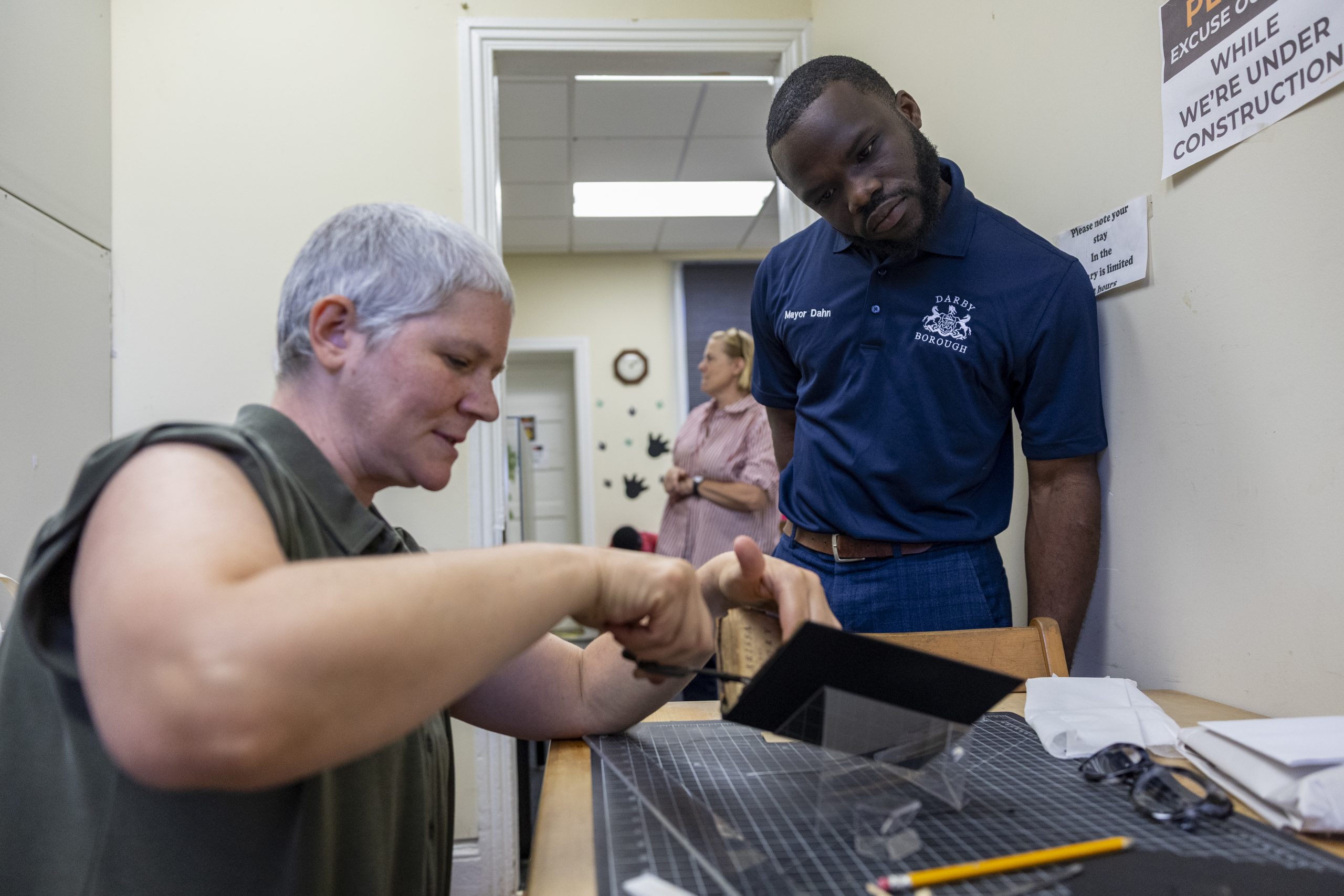
Darby Mayor Joar Dahn looks on while Liz McDermott, a conservation technician, handles a centuries-old copy of “Clarissa” at the Darby Free Library.Aidan T. Gallo / Staff Photographer
Josephine Engle, however, was married to a man named Isaac Rhoads, a member of the Darby Quaker Meeting, which was affiliated with the library. Isaac’s mother, Mary Hibberd Rhoads, was listed as a library member, and his grandfather, Samuel Rhoads, would have been alive around the time Clarissa was taken out of the library.
So was Engle mailing backa long-lost book once taken out, and never returned, by her brother-in-law’s grandfather? That’s one possibility, Finigan said.
Another possibility? The Darby Free Library may have sold off Clarissa in an attempt to clear its shelves of controversial material, and one volume made its way back to the library through Engle.
In 1826, the same year the library opened borrowing rights to the community, it appointed a committee to make a list of books that it “may be expedient … to dispose of.” When they met again the following year, a number of titles had made the chopping block, includingthe seven accounted-for volumes of Clarissa.
Why would the Darby Free Library want to sell Clarissa, among other books? Finigan has a few ideas. In the eighteenth and nineteen centuries, some saw novels as frivolous, distracting, and tempting readers toward vanity. Somenovels with more sinister or self-interested characters may have been viewed as at-odds with the values of honesty and sincerity held by Darby’s Quaker residents, Finigan said.
The Darby Free Library in Delaware County, founded in 1743, is currently undergoing renovations. Aidan T. Gallo / Staff Photographer
So, was the missing volume of Clarissa actually removed from the library in the early 1800s for objectionable content? That would be one explanationas to why seven, not eight, volumes were listed for sale in 1827.
Was volume four actuallysold with the rest of the collection in 1827 before eventually making it back to the library through Emma Engle? Could the list of seven, andnot eight, volumes have been an incorrect count?
Or could it havetruly beenan overdue book, taken out by a relative of Emma Engle’s and returned over 100 years later?
Finigan says the mystery remains, and may never be revealed. But curious minds can view the famed “century overdue” copy of Clarissa at the Darby Free Library from July 10 through Aug. 1 during normal library hours.
“Treasures from the Darby Library: THE 100-YEAR OVERDUE BOOK”
This suburban content is produced with support from the Leslie Miller and Richard Worley Foundation and The Lenfest Institute for Journalism. Editorial content is created independently of the project donors. Gifts to support The Inquirer’s high-impact journalism can be made at inquirer.com/donate. A list of Lenfest Institute donors can be found at lenfestinstitute.org/supporters.
The stampers were runnin’ wild, and state officials wanted their piece.
So it was time to crack down on the ping-pong-ball pullers.
On July 10, 1981, Republican Pennsylvania Gov. Dick Thornburgh signed the Bingo Law.
The bill, which took effect on Nov. 9 of that year, would ensure the popular game remained a tool of charitable groups and remained small-stakes operations. This new law limited prize money to $250 (about $920 today) per game, $2,000 (about $7,300 today) for a so-called jackpot game, and $4,000 (about $14,700 today) in total for any one day.
The bill also specified that only nonprofits that had been existence for at least two years could host the games, and that they could do so no more than twice a week.
Traditionally, bingo games were put on by charitable associations — think church groups and senior centers — that were legitimate nonprofits. Still, it was a prohibited form of gambling, and law enforcement across the state chose to ignore this fact and instead allowed the parlor game to thrive.
The bill, Thornburgh told The Inquirer in 1981, would “end this hypocrisy.”
He added, however, that he was not “convinced that this is the absolute, ideal bill,” and that his administration would continue working with the General Assembly “to ensure that some of the loopholes that have been alleged to exist are addressed.”
The bill-pushers were pumped. Legalizing bingo, they told anyone who would listen, would protect charitable foundations, civic groups, and legitimate nonprofits from what an Inquirer reporter called “unscrupulous bingo entrepreneurs.” It would, theoretically, keep those groups from having to pay taxes on the raised money, and keep it out of organized crime’s reach.
But the bingo bill had noisy detractors, like future Philly Mayor Ed Rendell, then the district attorney, who astutely pointed out that the bill would allow anyone to organize a nonprofit and run bingo games. The bill did not provide much enforcementinfrastructure, either.
Today, bingo licenses run $100 for a year, or $15 for a three-day stint.
They were at a travel ball tournament in Marietta, Ga., 30 miles north of Atlanta. Schwarber played for a team from Ohio, and Harper for, well, who can remember? He was a travel ball star, competing for more than a dozen teams across the country, often against older kids.
“We all knew about him,” Schwarber said.
And once word circulated around the eight fields at the East Cobb Baseball Complex that Harper was somewhere on site, Schwarber and his teammates set off in search of the teenage baseball prodigy.
“I remember we were out, just walking around getting ready to go, and we heard and we’re like, ‘Oh, we’re running over there to go watch him play. Get on the fence,’” Schwarber recalled the other day. “It was fun. As a young kid, you’re like, ‘Oh, he’s on the cover of Sports Illustrated.’ So, it was really cool.”
Schwarber chuckled.
“It’s funny,” he said. “Look where we’re at now. We’re, what, 33? It’s a long time.”
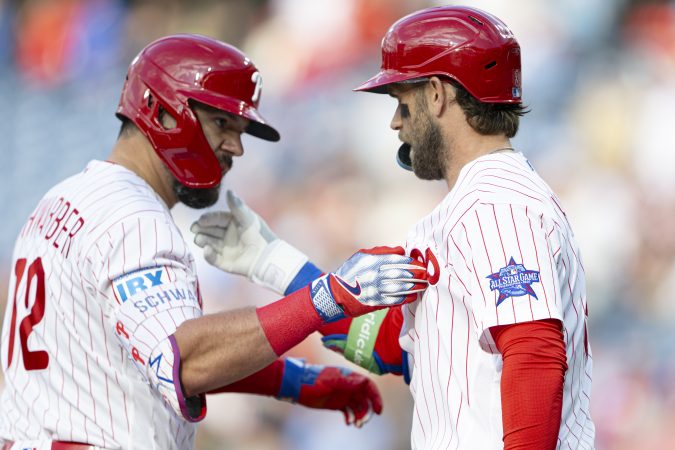
Indeed, look at them now. Harper and Schwarber are not only in their fifth season as Phillies teammates. They’re also the main attractions as baseball gathers for Philly’s first All-Star Game in 30 years.
Harper, the face of the Phillies and among the most marketable players in the sport, announced Thursday on Instagram that he will enter the Home Run Derby for the first time since 2018, when he won it in his then-home ballpark in Washington.
Schwarber, the National League’s preeminent slugger and a consummate leader, a force with his personality as much as his Louisville Slugger, committed to the Derby on Friday, setting up a rematch from his runner-up finish to Harper eight years ago.
Harper hit for the cycle for the first time as a major leaguer, while Schwarber blasted three home runs, two in one inning. They were the second teammates to achieve those feats in the same game, joining Lou Gehrig (four homers) and Tony Lazzeri (cycle), Hall of Fame Yankees, in 1932.
And there’s more. Harper entered the weekend with 20 homers and 383 for his career, and was on pace to finish the season with 397; Schwarber was leading the majors with 32, giving him 372 overall and putting him on pace to finish with 395.
The last teammates to chase down 400 homers in the same season: Mark Teixeira and Carlos Beltrán with the Yankees in 2016.
“I think it’s cool,” Schwarber said. “The fact of having milestones, one, you’re celebrating for yourself. But then also to have someone else doing the same thing as well, it’s impressive, especially for a player of his caliber.”
As their mutual milestone draws closer, and with the All-Star Game upon us, Harper and Schwarber talked recently about one another in separate conversations with The Inquirer.
Kyle Schwarber has 219 homers since he signed with the Phillies in 2022. Only the Yankees’ Aaron Judge has more in that span.Yong Kim / Staff Photographer
Harper on Schwarber
Nobody can top Harper’s view of the Schwarber Show.
“It’s a lot of fun to be on deck to watch him do what he does,” Harper said. “It’s impressive.”
Two things stand out most to Harper: the simplicity of Schwarber’s short, left-handed swing and how often he’s able to repeat it.
Harper is notorious for tinkering. When the hits aren’t falling, he alters his stance or switches batting gloves. Last month, the night he hit for the cycle, he dragged a 35-ounce bat — four ounces heavier than his usual model — to the plate.
“You know how I am: I change crap all the time, or I’m doing something different,” Harper said. “Him being able to repeat each swing, understanding what he needs to do on each pitch, is very impressive. I would say it’s one thing that I would be a little bit jealous about, just because he can repeat it so well.”
Schwarber is also the Benjamin Button of sluggers. He’s aging in reverse.
In his first seven major league seasons, from 2015 to 2021, Schwarber hit 153 homers and was 19% more productive than league average, based on OPS+. Since signing with the Phillies in 2022, he has hit 219 homers and is 35% more productive than league average. His OPS has improved each year since 2023, from .817 to .851, .928, and .945 through Wednesday.
“I think he’s just kind of bought into what he’s good at,” Harper said. “This isn’t anything bad, but I don’t know if he’s ever going to hit over .260, or whatever. But he’s bought into hitting homers and walking, and he’s very, very good at it. I mean, he’s on an elite level doing those things.”
The homers come with high strikeout totals. Schwarber led the majors in strikeouts in 2022 and ‘23 and is on pace for a career-high 238 whiffs this season.
Harper doesn’t mind the tradeoff.
“I kind of throw the strikeouts out the window,” Harper said. “It’s like hitting a ground ball to second, right? You’re still out. I’m glad that he doesn’t take that too much into consideration. He kind of just plays along with it, and it’s like, whatever. And then he goes up there, hits a homer.
“And it’s really cool to see his day-to-day work and why he does things. He’s bought into the DH role so well, and I think that’s helped him, too, over the years, not having to worry about defense. He’s just been able to maintain hitting. And it’s great for him because he can buy into what he’s good at.
“It just makes me laugh because he’s such a good dude. It couldn’t happen to a better person, right? I love watching him play. I love watching him hit. I love guys that hit homers, you know?”
But Schwarber’s career path hasn’t been linear.
Drafted fourth overall by the Cubs in 2014, he reached the majors within 12 months and blasted 16 homers in 69 games. He tore a knee ligament two games into the 2016 season and beat every projection to play in the Cubs’ hex-breaking World Series. He got demoted to triple A in 2017, averaged 31 homers per year from 2017-19 despite lingering doubts that he could handle left-handed pitching, and got nontendered after the 2020 season.
Harper believes Schwarber’s range of experiences contributes to his leadership by making him relatable to teammates at every stage of a career.
“I think that’s why everybody gravitates to Schwarbs so much,” Harper said. “Obviously he’s a great human being, great teammate. But he can be a superstar player; he can also be the guy that got hurt; he can also be the guy that gets [nontendered] and they think he’s the worst player in the league.”
Schwarber bounced from the Nationals to the Red Sox in 2021 and signed a four-year, $79 million contract with the Phillies the following spring. He has hit 46, 47, 38, and 56 homers over the last four years, a mid-career surge that reminds Phillies hitting coach Kevin Long of David Ortiz.
“Yeah, I agree,” Harper said. “Obviously the last couple of years have been incredible. And I just see him doing that again. I just don’t see it going anywhere. And I say that because the swing is so repeatable. I’m impressed by him every day.”
Bryce Harper is a nine-time All-Star in a 15-year major-league career.Yong Kim / Staff Photographer
Schwarber on Harper
It’s one thing to be 11 years old and tell your dad, “I’m gonna be the No. 1 pick.” Or to be 16 and labeled as “Baseball’s Chosen One” by Sports Illustrated. Or to leave high school after two years and enroll in junior college to play against older competition.
“But this guy,” Schwarber said, “has been able to be that kid and do even more in the game.”
As he predicted, Harper got drafted first overall in 2010, four months before his 18th birthday. At 19, he made his major league debut … and the All-Star team … and was crowned NL Rookie of the Year.
Harper has spent almost half his life in the majors. This is his 15th season; he won’t turn 34 until October.
“We’re always like, ‘What were you doing when [Harper] came up?’ ” Schwarber said. “He made his debut in ‘12, I think. I’m like, ‘Well, I was a sophomore in college.’ You know what I mean?”
There are times when Schwarber has to remind himself that he’s only six months younger than Harper.
“No one really knows what it’s like to have expectations at such a young age,” Schwarber said. “There have been people who, when you talk about younger kids and they go, ‘Man, this kid’s going to be a prodigy’ or whatever, and then it doesn’t work out. To have that at such a young age and to be able to be fulfilling it and more, it’s pretty hard to do. Right?
“Even I’m sure now there’s expectation for him. He’s handled it every single year the way he should. He goes out there and he produces, and he’s able to be the same guy on a daily basis, which is awesome.”
It’s Harper’s consistency that stands out to Schwarber.
With a strong first half, Harper quieted all the offseason chatter, fueled by Dave Dombrowski’s answer to a question last October, about whether he’s still “elite.” Was it ever really debatable? Harper has hit at least 20 homers in 10 of the last 11 full seasons. He’s a nine-time All-Star and two-time MVP. He’s eighth among active position players in wins above replacement, according to Fangraphs.
“To be able to do it on a year-in and year-out basis,” Schwarber said, “to be consistent on a year-to-year deal, that’s what makes the greats the greats.“
“Not to be like the nerdy kid, but the way his hips move, the way his hands are able to get to the slot, and the way he’s able to stay inside the ball and hit the ball to left-center for power and still be able to turn on a 98-mph fastball and pull it out to right field,” Schwarber said. “I’ve seen many times where he’s taken the 90-whatever mph fastball on the inside corner and taken it out to left-center field.
“I don’t do that. I wish I could. My body type is not his body type. I’m short and stocky. For him to be able to move the way he does, it’s controlled but also still fast. Those are like the really geeky things I think about. Those are the things that impress me.”
And so, their march to 400 homers continues, with an All-Star detour — and maybe even a Home Run Derby rematch — in their home ballpark this week.
“For the career that he’s had — and that he’s going to continue to have,” Schwarber said, “to be able to be in the same category in one thing with him, I think it would be pretty cool to celebrate together one day.”
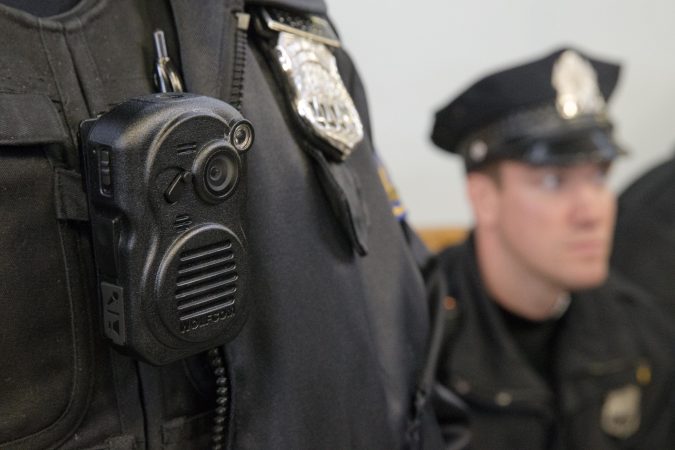
Police officers in one of Philadelphia’s largest districts frequently failed to activate their body-worn cameras during encounters that department policy required them to record, according to a new audit by the Citizens Police Oversight Commission.
The commission’s review of a random sample of 125 police incidents in North Philadelphia’s 22nd District found that officers recorded only 23 of 83 encounters that required camera footage.
The findings, released Wednesday, mark the final report in a series of audits examining body-worn camera compliance in four police districts across Philadelphia. Of the districts reviewed, the 22nd had the lowest rate of required recordings, raising concerns about whether one of the department’s primary accountability tools is being used consistently in the field, the commission said.
Janine Zajac, the commission’s director of auditing, policy, and research, said body-worn cameras are intended to provide accountability for both officers and the public. “It feels concerning when a really important tool for accountability isn’t being used,” she said.
The 22nd District, which spans neighborhoods includingYorktown, Strawberry Mansion, and Brewerytown, was selected alongside the 24th, 18th, and 15th Districts as part of an audit series designed to examine camera use across different parts of the city. The districts were chosen for their geographic diversity, activity levels, and the volume of complaints the commission receives from residents, Zajac said.
The audits looked at several measures of compliance with the department’s policy, including whether officers activated cameras when required, whether all officers on a scene recorded, and whether footage captured the full encounter.
Performance varied across the districts, said Michael Tooley Jr., a senior analyst for the commission. But the 22nd District stood out, he said: Officers recorded only 28% of incidents requiring footage, compared with 62% in the 18th District and 73% in the 15th District, and 88% of vehicle stops in the 24th District.
The commission reviewed incidents from April and June 2025 in the 22nd District, while the other audits examined a single month. Tooley said the commission expanded its review in the 22nd District because so few camera recordings were available from the first month requested.
The missed recordings occurred most often during investigations of premises — a category that includes domestic incidents, minor disturbances, and weapons-related calls — the review found, while vehicle stops and safety checks made up the second-largest share of incidents with absent videos.
The audit found that once officers turned their cameras on, they generally followed department procedures. Of the recordings reviewed, 91% captured the full duration of the encounter, 88% showed proper activation from standby mode, and 97% were correctly labeled and categorized.
Sgt. Eric Gripp said, a police spokesperson, the department takes the findings seriously. “Any instance in which an officer fails to activate a body-worn camera when required is inconsistent with department policy and our expectations,” he said.
Gripp noted that the 22nd District is one of the city’s busiest police districts, generating tens of thousands of body-worn camera recordings each year as officers respond to a high volume of calls and other interactions. While “that workload does not lessen our expectations for policy compliance,” he said, “it does highlight the scale of the body-worn camera program” and the demands placed on officers in the district.
City Councilmember Jeffrey Young, whose district includes much of the area served by the 22nd District, said the audit’s findings underscore the importance of adhering to body-worn camera policies, which “exist to protect everyone involved.”
He added: “I have confidence in [the department’s] ability to address these findings with transparency and professionalism.”
The audits of other districts revealed different weaknesses. In the 24th District, the commission found that nearly four in 10 videos failed to capture the entire traffic stop and that backup officers frequently did not record. In the 15th District, auditors found that officers often powered cameras completely off instead of leaving them in standby mode.
The 18th District in West Philadelphia posted some of the strongest results, with 98% standby-mode compliance and no video-labeling errors.
Joseph Giacalone, an adjunct professor at John Jay College of Criminal Justice and a retired sergeant with the New York City Police Department, said officers often arrive at chaotic scenes where remembering to activate a body-worn camera might not be their first instinct.
“It’s just not a natural thing,” he said.
But he also said departments must find ways to make camera activation routine because the footage can benefit both officers and the public. “Those videos provide better insight into what the police actually do — and most of the time, they’re right when they’re doing it,” he said.
Paula Sen, who coleads the Defender Association of Philadelphia’s police accountability unit and has conducted reviews of officers’ body-worn camera usage, said the footage is equally important for defendants and defense attorneys.
“Every attorney in this office watches hundreds to thousands of body-worn cameras each year,” Sen said. The recordings provide objective evidence that can contradict an officer’s account of an incident, she said, and help defense attorneys successfully challenge evidence in court.
Zajac said police department officials were receptive when the commission shared its findings and recommendations in May, with district leaders expressing interest in better understanding what might be preventing officers from properly using the cameras.
Gripp said the department continues to reinforce its body-worn camera policy through roll-call reminders, additional training, and supervisory oversight. Supervisors are expected to review footage, reinforce compliance, and address deficiencies when they are identified, he said.
Since launching its body-worn cameras more than a decade ago, Gripp said, the department has recorded millions of interactions. “Like any large-scale accountability program, our responsibility is to continually evaluate performance, identify opportunities for improvement, and strengthen compliance,” he said.
Clarification: A quote about the number of body-worn cameras viewed by the Defender Association of Philadelphia has been updated.