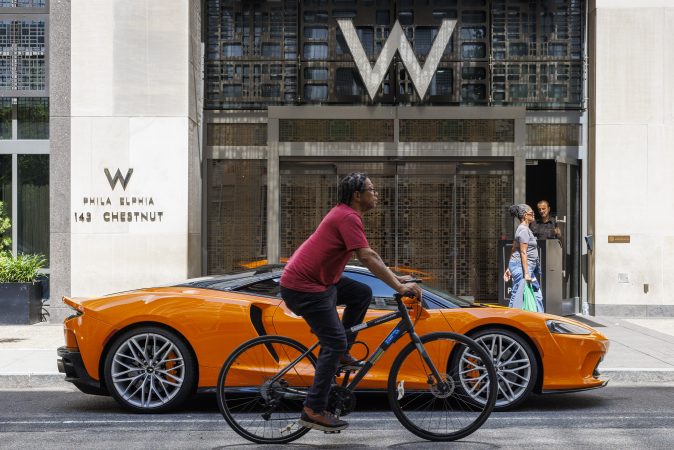
Philadelphia Common Pleas Judge James Crumlish III ordered California-based Tutor Perini Building Corp. to pay $42.4 million in damages to the subcontractor retained to install the building’s exterior, the Chicago-based Ventana DBS LLC.
“Throughout the project, Ventana was forced to navigate numerous obstructions and obstacles, stemming from Tutor Perini’s pervasive material breaches of contract,” Crumlish’s ruling read last week.
A Tutor Perini spokesperson said in April that the firm disagreed with the decision and intended to appeal it.
The contractor declined to comment on the new developments.
“This ruling is an important affirmation of the facts and of the principles that govern successful project delivery,” said Bob Clark, executive chairman of Clayco, a real estate development company that is Ventana’s parent company.
“We are pleased that the Court awarded Ventana $42 million in damages and recognized that Tutor Perini failed to properly coordinate its subcontractors while acting in bad faith by concealing its knowledge of significant concrete defects,” said Clark.
The judgment is the latest in the fallout from a construction project that Crumlish has said in an earlier ruling went “off the rails” because of Tutor Perini. Five years after the W hotel opened, the litigation is ongoing.
Tutor Perini was in court again Tuesday for the start of a new trial, this time for the judge to assess how much a concrete subcontractor, Thomas P. Carney Inc. Construction, owes Tutor for botching the job.
The proceeding had a tense opening as attorneys for Tutor Perini and Carney spent the morning arguing over motions.
Crumlish, who has previously chastised the parties for their animosity and turning the litigation into a “challenging behemoth,” expressed frustrations at times and ordered everyone to stop talking.
“I’m getting cranky, I will admit it,” the judge said at one point.
Disruptive and costly delays
Tutor Perini retained Ventana in 2015 for $14 million to assist in the design and installation of the building’ exterior and window-wall systems for floors nine to 50.
But when Ventana moved to install the hotel’s wall-window systems, they immediately noticed a “big problem,” according to the judge’s October memo. In many places, the concrete was not level or did not meet the elevation requirements in the design.
Tutor Perini denied there was a problem, while quietly attempting to grind the edges of the concrete slabs to address the issue.
By failing to supervise the concrete pours, Crumlish wrote in the recent ruling, Tutor Perini caused the “inefficient, obstructed, and impaired installation” of the window-wall systems.
“Ventana repeatedly encountered disruptive and costly delays due to Tutor’s lack of coordination while attempting to install its window wall systems,” the judge’s memo said.
Tutor Perini, for example, didn’t clear debris left by other subcontractors, the judge said, to allow the Ventana team to transport the window-wall components.
And while Tutor’s consultants confirmed the problem was the concrete pour, the company rejected Ventana’s delay notices and stopped paying the contractor.
Crumlish ordered Tutor to pay Ventana the $7.5 million unpaid subcontractor balance, $7.3 million in labor inefficiency costs, and $2.4 million unpaid change order requests, and $18 million in other costs.
The company is also on the hook for $7.1 million in attorney’s fees, expert witness fees, and litigation costs, bringing the total judgment to $42.4 million.
The W hotel opened in 2021 at 15th and Chestnut Streets, three years after its intended opening date, and it still cannot be fully occupied because some window vents are inoperable.
The project was developed by Brook Lenfest, son of former Inquirer owner H.F. “Gerry” Lenfest, whose foundation continues to own the newspaper.
Editor’s note: This article has been updated with a statement from the subcontractor Ventana’s parent company.
State and local health officials are tracking dozens of cases of an illness caused by an intestinal parasite with symptoms including “explosive” bowel movements.
Cyclosporiasis, caused by the parasite Cyclospora caytanensis, spreads through contaminated food and water.
Pennsylvania had recorded 28 cases this year as of last week, including 14 in Southeastern Pennsylvania. The state identified 40 cases in 2025.
People sometimes contract cyclosporiasis when traveling in tropical or subtropical regions of the world where Cyclospora is endemic, but outbreaks also occur in the United States.
Cases of cyclosporiasis can occur any time of year but tend to rise in the spring and summer months.
Nationwide, the Centers for Disease Control and Prevention’s website says ithas tracked 145 cases in 17 states between May 1 and June 16, including between 1 and 10 people sickened in both Pennsylvania and New Jersey during that time. All those cases were acquired in the United States.
The agency is also tracking an additional 45 cases reported in people who contracted the parasite while traveling outside the country.
Nationwide, 23 people have been hospitalized for cyclosporiasis since May 1.
The CDC warned that the true number of cyclosporiasis cases is likely higher, as some people recover without seeing a doctor or getting tested.
It is not typically life-threatening, state health officials said, but can last more than a month if not treated.
The CDC said it is working with state and local health departments around the country to learn how cyclosporiasis cases have spread, but there is no evidence that the 145 cases reported since May are linked.
“Investigations to identify potential clusters and potential sources of illness are ongoing,” the agency said.
Pennsylvanians experiencing symptoms of cyclosporiasis should call their doctors, state health officials said.
Unlike most states, Pennsylvania health providers are not required to report cyclosporiasis cases to health authorities, but the state health department still collects reports on confirmed cases and notifies federal health officials weekly.
On Saturday night, a violent storm seemed to spell the end of Philadelphia’s music and fireworks celebration of America’s 250th birthday on the Ben Franklin Parkway. The West Philly rapper and actor was back at his hotel, with his scheduled reunion with his musical partner DJ Jazzy Jeff seemingly called off.
Then he got a phone call from “Mrs. Mayor.”
“The mayor called and asked would we go on at midnight,” Smith said in a video posted on his Instagram account on Monday, referring to Cherelle L. Parker, whom he referred to as “Mrs. Mayor” on stage when he finally got to perform at the One Philly: Unity Concert for America.
Of course he would go on at midnight, backed by The Roots, in a special occasion hometown show. It didn’t matter that the weather wound up delaying it from July 4 to the wee hours of July 5.
“This is me,” he said, making a face, as if that would even be a question. “This is me!”
Smith’s Instagram recap of his Independence Day weekend adventures included a clip from his show-closing set — which actually began after 2 a.m. — featuring a shot of the mayor rapping along to the line in The Fresh Prince of Bel Air theme song about being “West Philadelphia, born and raised.”
During the show, which turned out to be the climactic set of the night since scheduled headliner Christina Aguilera did not perform, Smith got specific about his origins. He also spoke of the history he shares with his musical partner, whose given name is Jeffrey Townes, and Roots drummer Ahmir “Questlove’ Thompson.
“Fifty-ninth and Woodcrest,” he said, while parading around the stage in a red Phillies cap and jersey. “I was born and raised at 59th and Woodcrest. DJ Jazzy Jeff, 57th and Rodman. Quest, 52nd and Osage.
“And only a couple thousand yards from here, the dream of this country was born. From the City of Brotherly Love and Sisterly Affection, we sent our message out to the entire world.”
Along with a closing performance of “Summertime,” the 1991 DJ Jazzy Jeff & the Fresh Prince hit and Philly seasonal anthem, the show also included a display of Townes demonstrating his unparalleled turntable skills.
While Townes dazzled, Smith played air DJ, and Questlove sat on his drum throne capturing the moment on his phone, seemingly in awe. Watch that clip below.
On Instagram, Smith also posted a photo from rehearsals with The Roots, with Townes wearing a “Respect the Architects” T-shirt.
And the rapper and star of Ali also shared a clip of his visit to the steps of the Philadelphia Museum of Art to see the newly installed statue of Philly heavy weight champion boxer Joe Frazier.
“Philly LEGEND ‘Smokin’ Joe Frazier right HERE!” he posted. “You kids have no CLUE about that left hook.”
Like many Black children growing up in the ‘70s and ‘80s, Mount Airy author Hilary Beard had fond memories of Afros and Soul Train dancers.
“I was a little Black girl with braids who sat between my mother’s knees every day as she combed my hair and oiled my scalp with Ultra Sheen,” Beard recalled in a recent video chat. “When I was in the seventh grade and cut my hair into an Afro, I used Afro Sheen. I grew up watching Soul Train. I lived in a world created by this man.”
It wasn’t until 40 years later that she realized these hallmarks of Black culture had a common author, George E. Johnson, the father of modern Black hair care.
Three years ago, Beard teamed up with a then 94-year-old Johnson to cowrite his memoir. She combined her warm memories of plaits, kinky blowouts, Black power picks, and the Soul Train Line with more than 2,000 pages of interviews to write Afro Sheen: How I Revolutionized an Industry with the Golden Rule, from Soul Train to Wall Street,a 320-page story of entrepreneurship, civil rights, and Black culture, spanning nearly a century.
“Mr. Johnson’s story sweeps through the Cotton South, the Great Migration, the Jim Crow North, the Jim Crow South, World War II, and the civil rights of the 1950s and 1960s,” Beard said. “And it’s told through the perspective of an African American man. We know many of these stories have not been told, they have also been actively suppressed.”
George Johnson, founder of Afro Sheen, in his Chicago study. Johnson is the founder of the first Black company to go public. He also funded the early episodes of Soul Train, for which the Sound of Philadelphia, Gamble & Huff, wrote the soundtrack.George Johnson
Johnson’s story begins in 1927 Richton, Miss., on a small sharecropping farm. His mother, Priscilla, left his father in 1929, and moved Johnson and his two brothers to Chicago’s South Side. In his early 20s, he worked as a production chemist at the Black-owned cosmetics company Fuller Products, owned by S.B. Fuller, the richest Black man in America at the time.
In the early to mid-20th century, many Black people’s grooming habits included straightening their hair to assimilate, often affording them better jobs in mainstream America. The hair straightening concoctions — a mix of potatoes, lye, and eggs — separated, were messy to apply, and burned.
While working at Fuller Products, Johnson developed Ultra Wave Hair Culture, a creamy emulsified product barbers applied to clients’ hair, giving them the slicked back look popularized in the 1940s by Little Richard, Nat King Cole, and Sammy Davis Jr.
Ultra Wave Hair Culture marked Johnson Products Co.’s debut. In the next decade, JPC introduced Ultra Sheen Cream Satin Press, which hairdressers applied to Black women’s hair before pressing it straight with a hot comb; and Ultra Sheen Relaxer, a lye-based hair straightener for Black women. The “Black is Beautiful” movement birthed Afro Sheen, a spray that left Afros voluminous and glossy.
“A Natural Explosion! Afro Sheen® Blowout Creme Relaxer 1973/2007” from the series “Unbranded: Reflections in Black by Corporate America” by Hank Willis Thomas. MUST CREDIT: Rubell Museum
“The thing that moved my products forward was innovation,” said Johnson, who, at 97, still sounds like a salesman talking to potential customers. “We created something like a new mousetrap, it had never been done before.”
In 1971 — with sales of $12.1 million, or $94 million in today’s dollars — JPC became the first Black-owned company to be publicly traded on the American Stock Exchange, now known as the New York Stock Exchange. Although at the time it was a major achievement, Johnson said that with hindsight, he realized it was a big misstep as he was forced to answer to a board that didn’t understand the Black community.
Creating his lane
Johnson — not to be confused with John H. Johnson, founder of Ebony and Jet magazines — built his empire when banks did not loan money to Black startups, and groceries and drugstores did not stock Black hair care products, let alone place them on endcaps. Johnson remembers struggling to build his business when there were no federal laws to protect him from discrimination. He built his own manufacturing facility and created networks to distribute and advertise his products, and was among the first to sell Black hair care products in mainstream retail outlets.
To see companies like Target and Walmart — which up until recently had a stellar reputation of stocking Black hair care by Black-owned companies — cower under the Trump administration and roll back DEI initiatives is not only disheartening, but it also signals going back to a time when disenfranchisement of minority- and women-owned businesses was standard operating procedure. This reality, Beard says, makes Johnson’s story particularly timely, serving as a road map with young entrepreneurs of color.
“There is a widespread movement to make programs, books, and context that remind us of the bigotry in our nation’s history illegal,” Beard said. “Mr. Johnson is a witness to the overt racism many Americans would like to sweep under the rug. The irony is the very history they don’t want us to know is the reality they are attempting to create.”
JPC was among the first companies to advertise products to Black consumers using images of Black professionals — like doctors, lawyers, and teachers — instead of subservient characters like Aunt Jemima and Uncle Ben.
Johnson created Soul Train with Don Cornelius in 1971 so his advertising dollars could reach Black consumers directly. Soul Train — the hippest trip in America — was modeled after Dick Clark’s American Bandstand, and featured R&B acts, creating the community that bought Afro and Ultra Sheen products. In 1974, Kenny Gamble and Leon Huff wrote Soul Train’s iconic theme song, “T.S.O.P. — The Sound of Philadelphia,” performed by Philadelphia International Records’ The Three Degrees. Soul Train laid the cultural groundwork for MTV and Black Entertainment Television, and “T.S.O.P.” was the first TV theme song to reach No. 1 on the Billboard Hot 100. JPC’s profits nearly tripled to $37 million a year by 1975.
“That was tremendous growth,” Johnson said. “And in 1980, I gave Don my share with the stipulation he keep one minute of advertising time a show to JPC.”
Living history
Johnson never planned to write a book.
“I certainly wouldn’t have waited until I was 94 to do this,” he said. “But I had an epiphany, a real experience and I clearly heard five words, ‘You must tell your story.‘”
Afro Sheen: How I Revolutionized an Industry with the Golden Rule, from Soul Train to Wall Street by George E. Johnson, written with Mount Airy-based author, Hilary Beard.
Beard read 16 books about Black hair care culture and Chicago history. The two-year-long writing process became emotional, especially when Johnson recalled his infidelity and losing his first manufacturing facility to fire.
“When Mr. Johnson contacted me, I thought of the African proverb: when an elder dies, a library burns down,” Beard said. “So, I dropped everything to capture this piece of living history on the page.”
Scrap metal, one of the Philadelphia area’s biggest shipping products, has been piling up in area scrapyards since June 4 when Camden officials closed EMR USA Holdings Inc.’s metal-shredding facilities after the latest in a series of fires affecting the region’s million-ton-a-year scrap shipping industry.
Scrap dealers, faced with bulging inventories, blame the fires on the increased use of lithium-ion batteries — not so much large car batteries but the increasingly ubiquitous, highly combustible smaller batteries slipping into landfills from lawn mowers, construction tools, “smart” infrastructure, and household appliances.
The two-alarm May 29 fire, following a four-alarm Feb. 21, 2025, blaze that sent 100 neighbors fleeing for shelter, is the latest in what Camden code enforcement director Gabriel Camacho said have been up to a dozen “harmful, offensive, or obstructive” blazes at the Camden yard, which is at 1400 S. Front St. near the city’s Beckett Street Terminal.The fires spread smoke and hazardous materials.
Camden officials in statements on the fire have focused on the effects, not the causes, of the fires.
EMR CEO Joseph W. Balzano, whose company sued to reopen, last year agreed to pay the city $4.5 million up front and $2.2 million over five years, plus more for community and facility upgrades. After the May fire, the company promised steps to reduce fire risk.
City Council is scheduled to review the proposal at a meeting Tuesday evening.
The scene at EMR Metal Recycling in Camden on Feb. 22, 2025, the morning after a four-alarm fire sent thick plumes of black smoke over Camden County, causing some residents to evacuate two nearby hotels.Frank Kummer / Staff
EMR, including its offices and auto-parts business as well as its recycling facilities, employs 575 workers — almost 200 are Camden residents — including members of the Teamsters union.Some workers operate shredding and sorting machinery and haul old iron and steel to the South Jersey Port Corp.’s nearby pier, which is named for Balzano’s late father, who headed the port.
EMR shreds and ships steel from smaller dealers, some to foreign users, but most of it, in recent years, to U.S. electric steel mills and other industrial recyclers.
“We haven’t laid anyone off — our people are like family — but we are getting to the end of our rope,” Balzano said last week.
Competing terminals at the port in Fairless Hills, Bucks County, and in Newark, N.J., have picked up some of the business, he said — at a higher price, including the cost of trucking scrap a longer distance.
England-based European Metal Recycling Ltd. acquired and began operating the Camden site since it purchased the former Camden Iron & Metal in 2006.
Scrapyard officials say they tracked the latest fire to a discarded lithium-ion battery, a factor in what they say is a surge of scrap fires.
“It’s the biggest issue all recyclers face,” Balzano said. “Regulations need to be put in place that keep these batteries out of commerce.”
The batteries are used in items like stoves, washing machines, dryers and “things you wouldn’t think of like light ballasts or guard rails,” he said.
“Nine times out of 10, it’s a power-tool lithium-ion battery,” he said. “Contractors throw ‘em in the dumpster, not realizing it’s hazardous once it’s broken out of its original container. Lead-acid batteries, not such a big deal. But lithium batteries burn so hot, you almost have to let ‘em burn out.”
Burns Co., a building-materials recycler whose yard covers more than 12 acres in Philadelphia’s Hunting Park section, needed city help putting out its most recent lithium-ion battery fire in May, said Allen Burns, who runs the family-owned yard, which employs nearly 100.
He points to scorch marks on a concrete-block wall at the facility.
“It took 30 firemen five hours to put out the fire,” Burns said. “They looked on our camera system, dug down, and found a lithium-battery-powered tool. There must be a landfill fire every day from a lithium battery.”
Burns said the Camden shutdown has backed up shipments at yards around the region.
“We have had to bail metal to conserve space,” he said. Disposal costs are up.
David Wiechecki, owner of International Scrap Iron & Metal in Chester, said, “You don’t want to leave [lithium-ion batteries] laying in your yard. It’s a real problem.”
“You go over the loads with a fine-tooth comb, but people who want to sneak them by will do it,” he said. “Meanwhile, prices are down because export demand is down,” leaving scrapyards with more iron and more fire concerns.
Lithium-ion battery fires were blamed last year for burning dozens of decommissioned SEPTA buses and led to the end of SEPTA’s Proterra electric-bus program.
Thomas said his group and national scrap-metal and waste-disposal trade associations want federal legislation forcing manufacturers to pay lithium-ion battery recycling fees.
“But they don’t want them back. It’s cheaper for them to buy virgin material,” he said. “So there’s a big tug of war in state legislatures with the manufacturers. In Pennsylvania, we had a bill stalled in the state Senate just in the last 10 days with no action.”
Staff writer Frank Kummer contributed to this article.
This story has been updated to correct the timing of EMR’s agreement with Camden last year.
Cynthia Martini of Mantua Township visits Mood’s Farm Market every year to pick blueberries. During a typical summer, she collects 40 pounds of them. She used to bring her kids, but now that they’re older, she goes solo.
Her routine on June 30 didn’t look much different from the last 25 years. On a hot morning, she picked two Tupperware containers of blueberries in paint-streaked shorts.
“In an hour I picked 10 pounds,” Martini said. “So not bad.”
But rather than harvesting in the farm’s designated pick-your-own area, Martini kept to to an area typically reserved for staff.
Mood’s, a 180-acre fruit farm in Elk Township, Gloucester County, opened the off-limits fields as one strategy to survive the summer after a spring crop freeze destroyed about two-thirds of its blueberries and all its cherries, plums, nectarines, pears, and peaches. The farm will likely have only a handful of healthy apples come fall. That means no apple hayrides, even though pick-your-own operations are one of its primary revenue streams. A skeleton crew is working the land rather than a full staff, and it’s taking workers longer to pick fruit since there’s less on the bush.
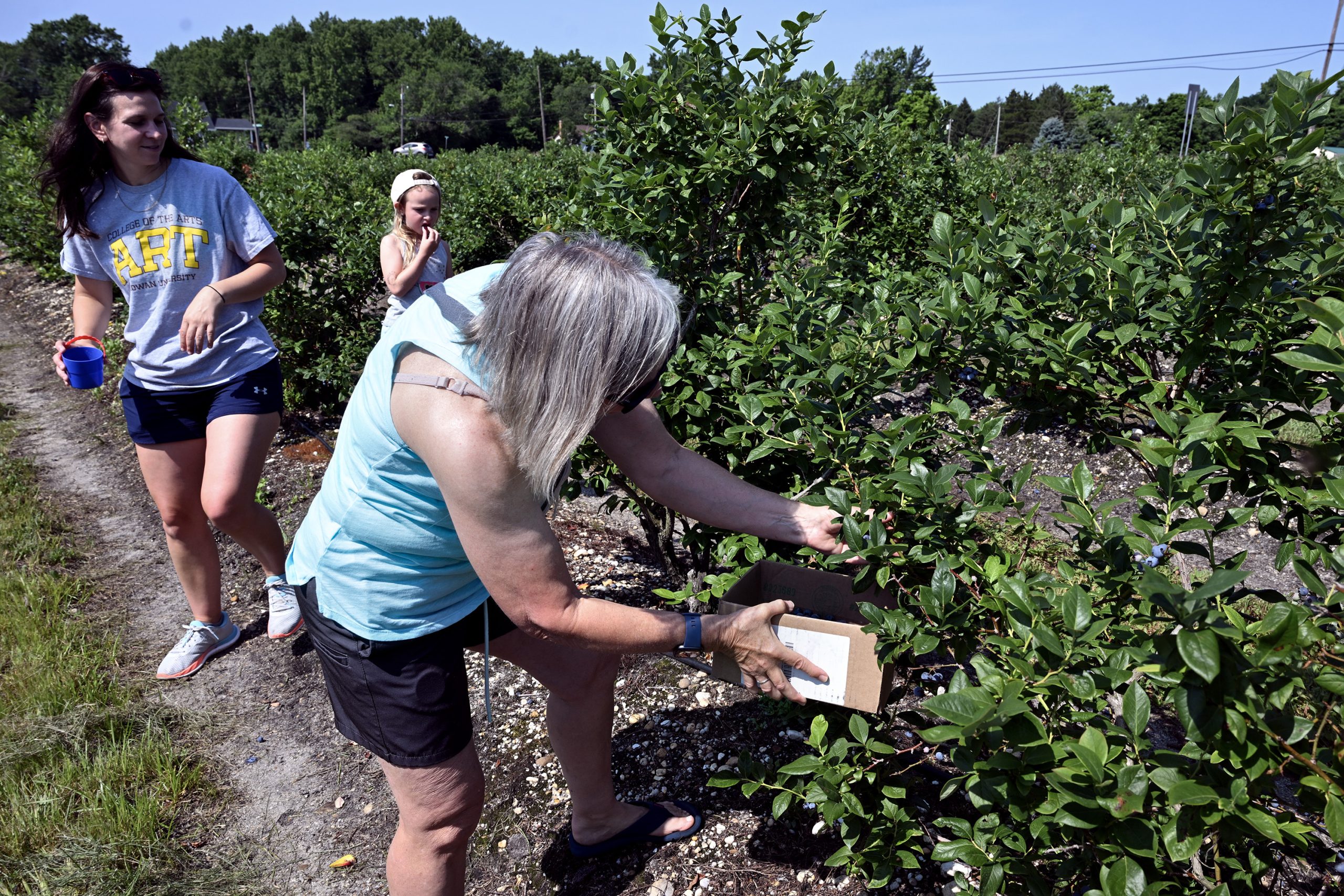
After picking her own blueberries, Cynthia Martini (right) of Mantua talks with owners Richard Mood and daughter Patti Mood at Mood’s Farm in Gloucester County on June 30. Tom Gralish / Staff Photographer
But South Jersey farms like Mood’s are getting creative to survive a summer with depleted income and damaged crops. From promoting frozen fruit to temporary closures to raising prices, here’s how farms are keeping on.
Spend less and plant more
Rowand’s Farm, a 20-acre sweet and sour cherry orchard in Glassboro, Gloucester County, is going through unprecedented circumstances.
Stephen Rowand, the farm’s third-generation owner, said he’s usually excited when a spring frost arrives, since the cold weather thins out the fruit and produces larger cherries.
“This season is unique for us as a first with NO CROP at all,” Rowand said via Facebook Messenger. “No income.”
Rowand decided to close the farm, but that hasn’t meant time off. To ensure the orchard blooms next season, the farm still needs mowing, irrigation, fertilizer, and trimming, and without the ability to hire farmworkers. Rowand, 60, is doing all that work himself through extreme heat. He said he’s currently living off his retirement savings and might have to get a job in the offseason next fall. He’s trying to stay frugal by avoiding vacations and eating out.
But Rowand has managed to find some solutions to survive.
To make sure they stay fed, his family planted a bigger garden of tomatoes, string beans, eggplants, cucumbers, greens, and herbs for their personal diets after figuring out the freeze had eliminated their income. He said he will likely apply for a loan from the USDA’s Farm Service Agency to pay bills, and a GoFundMe, which has raised $25,000 so far, has helped pay for some of Rowand’s farm expenses.
“It’s really helping keep the farm from going into debt,” Rowand said, “which is usually what puts a farm out of business in the end.”
Duffield’s Farm Market in Sewell, Gloucester County, like Mood’s, won’t have peach picking this summer and is still considering whether it’ll apply for loans. Since the freeze halved their apple crop, the farm won’t offer apple picking trips for local schools this fall, either. To ensure people have enough to pick in the fall, owner Tracy Duffield said, farmers planted a field of pumpkins early.
As for labor, without peaches to pit, Duffield said there’s less to do, which means reducing hours for the farm’s migrant workers from Puerto Rico.
“It’s not just us. Everybody is kind of in the same boat,” Duffield said. “Just support your local farm. We’ll recover.”
‘A silver lining’
South Jersey farmers say the natural laws of supply and demand mean fruit prices will rise this year. Mood said their farm’s blueberry prices have doubled, while Duffield’s increased the cost about 50 cents per pound.
“We still have a business to run, and we have to support the families involved with the business,” Duffield said. “They just have to understand for this year, anyway, that things are going to be a bit higher.”
Blueberries for sale at the farm stand at Mood’s Farm in Gloucester County.Tom Gralish / Staff Photographer
Anthony DiMeo owns DiMeo Farms and Blueberry Plants Nursery, which has a large pick-your-own blueberry operation in Hammonton, Atlantic County. With significant damage to his crop, DiMeo said, he anticipates the season to end a couple of weeks early.
“But there’s a silver lining to this, and that is the price is very high,” DiMeo said. “Even for blueberries that might not be the biggest or might not be the best, the price is exceptional.”
DiMeo, though, said he decided not to significantly raise prices this year, keeping blueberries at $2.50 per pint, a cheaper price than most grocery stores and farm markets. The choice to eat the losses was influenced by the price consumers are already paying to get through life right now.
“They’re spending enough as it is with gas and tolls and everything else,” DiMeo said.
‘Just luck’
Bob Fralinger of Fralinger Orchards, a fifth-generation peach and nectarine farm in Bridgeton, Cumberland County, said it was “just luck” that some of his peaches survived the freeze.
His farm sits along the Cohansey River, and the heat emitting from the water kept the temperature a couple of degrees warmer for the crops. Fralinger said he still lost about half his peaches, but since nearby South Jersey farmers weren’t quite as lucky, nearly 100 farm markets, some hours away, have come to him for fruit. Duffield’s and Mood’s are on that list.
The increased interest has meant Fralinger has to make sure he has enough peaches for everyone, including his typical wholesalers. And even though Fralinger is having no problem selling, the reduced harvest means he worries that the revenue won’t be enough to pay next year’s bills.
“Your margins are so close that you can’t survive from one year to the next unless you do things just right, and that’s the problem,” Fralinger said.
Like Fralinger, Robson’s Farm in Wrightstown, Burlington County, also managed to salvage some peaches from the harvest this year, but not nearly enough to meet the summer demand.
Customers travel from out of state for Robson’s peaches, fourth-generation farmer Rose Robson said, and many will be disappointed to arrive to find no peaches in sight.
But once she overcame her initial grief over the lost crops, Robson said, she quickly hatched a plan to adapt to a potentially peachless summer on the farm.
“Just because the farm is really sad and not great in one way doesn’t mean the whole summer has to be,” Robson said. “This could be a really fun opportunity to be creative and to bring some new people to the farm and still have a really great summer.”
Robson had already started developing ways to boost business during the farm’s offseason in the fall, like a walking club on the farm, she said. The spring freeze just forced her to consider starting sooner and making it active year-round.
Plus, Robson’s is focusing on what they can still offer customers.
“We doubled up on our U-pick cut flowers,” Robson said, “which has been growing over the years anyway, so that’s kind of fun.”
But more than anything, Robson said her priority has remained the same: “making the farm as grand an experience as we can possibly make it,” she said.
Sandy Trifiletti (front) of Glassboro and her daughter Hope Welch and granddaughter Rosie, 6, of Pitman, pick their own blueberries June 30 at Mood’s Farm in Gloucester County.Tom Gralish / Staff Photographer
As farms scramble to adapt, South Jersey residents, whether they’re in the market for fresh fruit or flowers, continue to support their local markets.
Back at Mood’s Farm, Hope Welch of Pitman picked blueberries with her two children and her mother, Sandy Trifiletti. The Welches have visited Mood’s for years.
Hope Welch, whose son spoke some of his first words during an annual Apple Festival, asked Mood about the fate of this year’s event. Mood said one would still happen, but it probably wouldn’t revolve around apples, since they won’t have very many.
“That hurts my heart,” Welch said. “We’ll be back for the fall festival. Whatever it’s called.”
Pennsylvania elected officials are mourning the death of former State Sen. Shirley Kitchen, the second Black woman to serve in the state Senate and a champion for progressive issues who represented parts of North Philadelphia for more than two decades. She died Saturdayat 79. A cause of death was not immediately clear.
Kitchen represented the 3rd Senatorial District, composed of parts of North Philadelphia, for 20 years. She is remembered by her former colleagues as a pillar and matriarch of her community who worked tirelessly to improve the lives of low-income people, even after she retired.
“She did so many things for so many people. Now that I’m old enough to appreciate it, I’m not quite sure how she did it — and she did it with such force,” said State Sen. Anthony H. Williams (D., Philadelphia), who served alongside Kitchen in the Senate and had known her for decades. Kitchen was elected to the state Senate in 1996 and served five terms before retiring in 2016.
Her former colleagues, some through tears, credited many of Pennsylvania’s recent criminal justice reforms as being born under Kitchen’s leadership, with her early legislative proposals paving the way for their passage years later. For example, Kitchen authored early drafts of what is now known as the Clean Slate Act, which automatically seals some nonviolent convictions after 10 years, hiding them from most employer and landlord background checks. She first introduced similar legislationin Harrisburg years earlier and it failed. In 2018, two years after Kitchen retired, the Clean Slate Act became law in Pennsylvania and was heralded as a first-in-the-nation model for criminal justice reform.
Elected officials across the city shared their condolences, remembering Kitchen as an advocate who cared deeply for her community.
Mayor Cherelle L. Parker in a social media post on Sunday recalled Kitchen as “fighting for people who often had no one else to fight for them,” and as a trailblazer for Black women in politics.
“Shirley Kitchen cared about working people, and she cared about Philadelphia,” said Parker, the city’s first Black female mayor and a former state representative.
City Council President Kenyatta Johnson said in a statement that Kitchen “never forgot who she was fighting for,” dedicating her life to making people’s lives better.
State Rep. Joanna McClinton (D., Philadelphia), Pennsylvania’s first Black female speaker of the House, wrote in a social media post that Kitchen was “a mentor and her service in the state House and Senate inspired me greatly.”
Williams added that Kitchen also sought to elevate other Black politicians, like himself, to elected office — and laid the groundwork for much of the city’s current political progressivism.
“The reality is that a lot of the infrastructure that helps them, Shirley had everything to do with it, and more,” Williams said, noting her advocacy and experience during the Civil Rights Movement. “I would hope the progressives in this generation would tip their hat to a generation that really created the progressive movement.”
State Sen. Sharif Street (D., Philadelphia) had known Kitchen since he was a child, and said she helped him see the power a Senate seat has in improving the lives of his neighbors. When she decided to retire, Kitchen encouraged Street, who was on her staff at the time, to run to fill the vacancy in the 3rd District following her fifth and final term in the state Senate.
Williams and Street recalled Kitchen as a fair but demanding mentor.
“If she told you to do something, you better do it,” Williams said, with a laugh.
For Street, Kitchen “didn’t limit her advice. She had opinions about everything in my life, including when my wife was right and I needed to listen to her.”
Street said he spoke with Kitchen weekly, and Williams said he remained in touch with her as recently as last month. She often had ideas or issues she wanted the senators to take up. Street spoke with her last week about a forthcoming Registered Community Organization meeting that she was leading about a new proposed development nearby, emblematic of her continued involvement in her community.
Prior to her election to the state Senate, Kitchen was involved in the National Welfare Rights Movement, which was a progressive advocacy group for the dignified treatment of women and children, largely led by Black women, during the 1960s and 1970s, Williams said.
Kitchen served as the minority chair of the Senate Public Health and Welfare committee, in which she often leaned on her social work experience to inform her legislative proposals.
A Democrat in a time where Republicans controlled the state legislature, she served her entire tenure in the minority party, but was still able to garner bipartisan support for some of her legislative proposals.
“This image of her being an urban Black woman from Philadelphia would limit her ability to get stuff done in the Senate just wasn’t true,” Williams added. “She could analyze people and figure out what way to approach them with exceptional skill.”
Born in 1946 in Augusta, Ga., Kitchen attended the Philadelphia School District and graduated from Antioch University in 1979 with a bachelor’s degree in human services, according to her Senate Library biography. She went on to work for former Philadelphia Mayor John Street, Sharif Street’s father, before she was elected to the state House in a special election in 1987. After she lost reelection to the seat in 1989, Kitchen returned to Harrisburg a decade later after her election to represent the 3rd Senatorial District.
“She was a transformational figure that loved her community and understood that the purpose of those of us holding elected power is to be able to make a difference in the lives of the people we serve, in a way that they can feel and see,” Sharif Street added.
Funeral services will be announced in the coming days, he said.
Senator Shirley Kitchen in the audience during speeches in honor of the historical marker that was unveiled at Sullivan Progress Plaza September 14, 2016. The plaza was the first black-owned and operating shopping center in America. Wednesday, Sept. 14, 2016.Margo Reed/ Staff Photographer
When a deal was struck to save 340 classroom-based jobs in the Philadelphia School District, Mayor Cherelle L. Parker and Superintendent Tony B. Watlington Sr. declared it “Christmas in June.”
It’s July now, but manystaffers still don’t have clarity on exactly who’s allowed to come back to positions that were almost cut and how that affects vacancies system-wide.
“It’s a mess, and it’s getting messier,” said Alison Andrawos, a teacher at Potter-Thomas Elementary in North Philadelphia who accepted a job in another district after learning this spring that her position would be cut and still doesn’t know whether it will be restored.
Monique Braxton, the school district spokesperson, said the system is “moving forward with restoring the approximately 340 school-based positions approved in the revised budget,” but that staffing the positions is separate from restoring them.
“We have been meeting with our union partners on implementation and are now working with principals on school staffing,” Braxton said in a statement. “All approved positions will be restored in the district’s budget system by Wednesday, July 9.”
The complex process is causing additional uncertainty for teachers and staff members andprolonging an already tumultuous hiring season as the district deals with fallout from 17 forthcoming school closings and the back-and-forth over millions in cuts stemming from a $300million district budget deficit.
Watlington this spring directed school principals to build their 2026-27 budgets factoring in the cuts, including about $50 million in school-based trims and the elimination of 340 classroom jobs. Parker then proposed a $1-per-trip rideshare tax she said would cancel the classroom cuts, but City Council balked, and for a time, the position losses appeared inevitable.
But restoring the positions was always going to be complicated.
Schools’ hiring timeline means that many of the teachers, counselors, and climate staff who were told they were going to be force-transferred because of the cuts sought and found new jobs over the past few months, either inside the district or elsewhere. Now, those workers eithermust rescind their acceptance of those new jobs or say “no thanks” to returning. Either way, that creates new vacancies in July, months after most schools have filled jobs and when many people are on vacation.
“We haven’t heard whether our positions are going to be reinstated, we don’t know what positions are available, and we don’t know what we’re doing in a few short weeks,”said Andrawos, an English as a second language specialist who began teaching in Philadelphia schools in 1997.
‘I’m pretty sure I’m going to be leaving’
Andrawos saidshedidn’t want to leave the city, but amid the worry of the past few months, she felt she had to explore jobs outside the district. Andrawos has been offered a position at a Delaware County school that comes with a raise and a shorter commute.
“I’m pretty sure I’m going to be leaving the School District of Philadelphia because of this,” Andrawos said.
Shesaid the decision is tough — she’s forged real bonds with her students’ families, and has been fielding messages saying they hope she stays at Potter-Thomas.
It’s not clear whether Andrawos’ position at Potter-Thomas, in North Philadelphia, will be restored because of the complicated way budgets are built, and the latitude principals have to shift positions based on school need and their own judgment calls.
Jobs are filled in city schools two ways — first, by a process called site selection, where principals hire any candidate they choose for open positions. Once the site selection window closes, district staff without positions choose from among open jobs in seniority order. Site selection closed weeks ago; force transfers without jobs have had their hiring sessions pushed back multiple times so far, and are still waiting.
Jane Roh, a spokesperson for the Philadelphia Federation of Teachers, said the union notified members June 19 that all positions cut due to the deficit would be restored; the PFT was told that district notifications to affected employees would immediately follow. So far, that has not happened.
That leaves staff sweating andfrustrated by a lack of answers, some said.
A roller coaster
One K-8 teacher, who asked that his name be withheld because he feared repercussions, was on the force transfer list because of budget cuts. With no notice that’s being walked back, he’s left with the possibility of having to get emergency certified to teach in another subject area, which would mean taking more courses.
The uncertainty is tough, and the answer to every question posed to the district and the union so far has been, we don’t know yet.
“For this whole summer, where teachers are supposed to have the space to reflect and rest and plan, we can’t do that to any degree,” the K-8 teacher said.
A teacher at a district high school, who also asked to remain anonymous because her employment situation is not settled, is in a similar boat. When her position was cut because of the deficit, she site selected into a job at another district high school.
The process has been frustrating, she said. She once got an email saying her transfer was canceled, but that turned out to be incorrect, though she never got official notice from the district about its error and had to make calls herself to figure it out.
When Parker and Watlington made their good-news announcement, she had no idea what to make of it. She still doesn’t, the teacher said.
“I’m on this roller coaster; I literally don’t know which school I’m going to work at in the fall,” said the high school teacher, who would be teaching different classes, depending on where she lands. “I want to prepare for the upcoming school year, and that’s impossible if you don’t know what you’re teaching.”
The school had been overstaffed four years ago as it navigated a complicated, unprecedented transition from a charter school back to a district school. It has soared, adding programs and opportunities and building a strong school culture; the community fears weathering steep staff cuts would jeopardize its progress.
Sarah Apt, a longtime Olney teacher active in the pushback against cuts, said Wednesday that the school was told it’s getting back three of its 17 staffers.
“We’re happy about that, but still fighting for more,” said Apt.
Among those still in limbo is Eric Baker, an Olney English teacher who’s been struggling with the back and forth, and the possible implications for the school he’s come to love — the school recruited students for a college prep track that’s potentially losing most of its teachers, including Baker.
“Because of this uncertainty, I’ve had to interview other places. I don’t know where I’m going to go. I would rather have the certainty of knowing where I’m going to work than having to deal with this,” said Baker. “It’s been frustrating.”
What are the defining characteristics of Media, and how should the borough plan for the next decade?
Those are the questions at the core of “Media 2035,” the comprehensive plan adoptedby Media’s borough council last month designed to shape the next chapter of land use, housing, economic development, traffic planning, and environmental decision making in the 5,900-residentDelaware County community.
“A comp plan is a long-term vision of how a community can look in the future,” Brittany Forman, Media’s borough manager, said.
The 166-page plan, built on feedback from around 500 residents, is centered around four guiding principles: Preserving Media’s character, fostering inclusivity through housing diversity, preserving the environment, and becoming a more connected and less car-dependent borough.
Media’s leaders have been tasked with stewarding a borough that has seen immense economic growth in recent decades, transforming it from a sleepy town wrought by financial disinvestment and crime to a cultural hub and destination for families settling in the suburbs. While Media’s metamorphosis has brought new residents and investment into the borough, it has also pushed the community’s limits around housing affordability, traffic, and growth.
“We’re a victim of our success, and it’s a good thing to be a victim of your own success,” said borough Council President Mark Paikoff. “But careful planning really is helpful.”
Here are fourkey takeaways from Media’s comprehensive plan.
Media’s charm has made it a desirable, and increasingly unaffordable, place to live
Surveyed residents said Media’s “small-town feel,” including its historic architecture, walkability, and diverse local businesses, is the borough’s most important asset. Yet the traits that make Media a great place to live have also made it a harder place to afford tostay.
“For generations, Media has prided itself on being ‘Everybody’s Hometown,’ a motto that reflected a genuine reality: a community where wealthy professionals, hourly service workers, young families, and retirees lived side-by-side,” the comprehensive plan states, adding that economic diversity was made possible by a “varied housing stock that offered entry points for people at every stage of life.”
As demand for walkable, transit-accessible living has surged in the Philly region, rising real estate costs are chipping away at this accessibility, creating a “severe burden” for a large segment of Media, notably seniors, teachers, nurses, and first responders, the plan states.
Recommendations outlined in the plan include deepening partnerships with affordable housing agencies, updating the borough’s zoning code to spur housing development in key areas, and promoting non-traditional housing options like in-law suites. Officials said there’s a significant opportunity in converting underutilized office spaces into housing, as many of Media’s vacant offices are already located in former residential properties.
Paikoff said the borough has had informal conversations with developers who are interested in both renovating older units and building new housing, though he stressed that bringing additional housing to the borough “will take some time.”
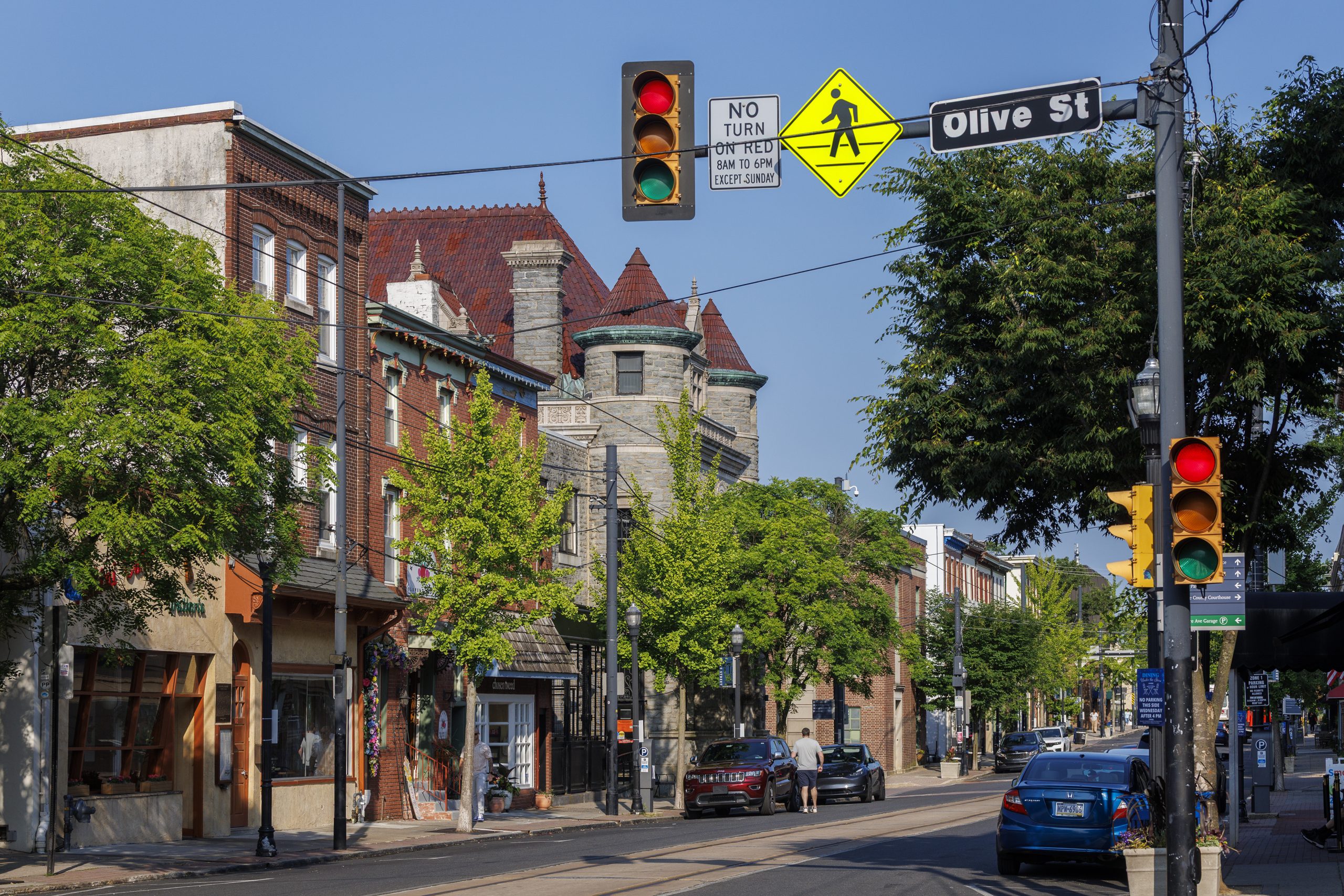
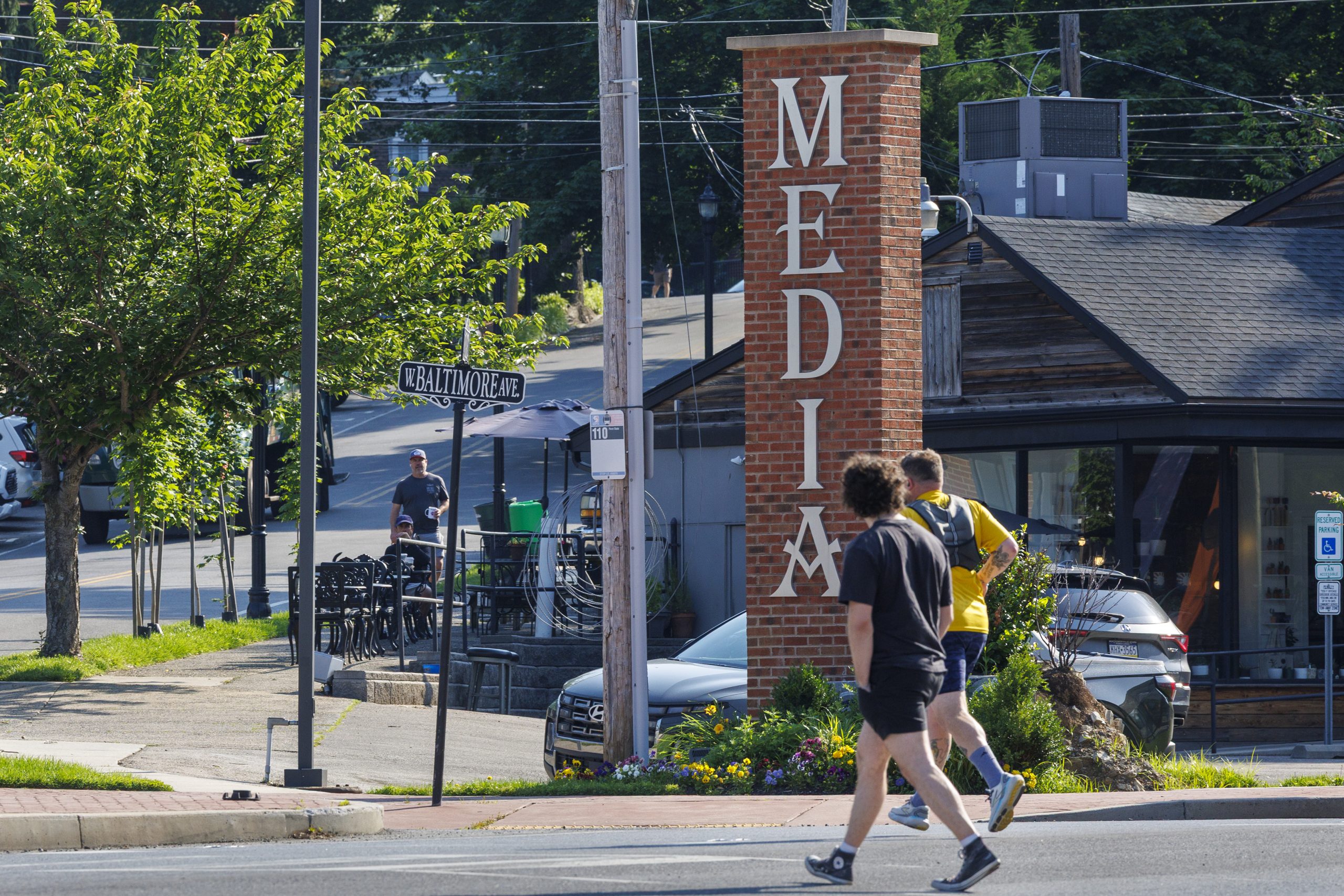
Downtown Media on a June day. Alejandro A. Alvarez / Staff Photographer
Media has strong transit access but ample traffic safety challenges
Media is defined by its density. The borough’s footprint is under one square mile, and it’s a place where pedestrians, cyclists, cars, buses, and SEPTA trolleys regularly interact.
“For a small town, I’d say we’re very sophisticated in terms of multimodal transportation,” said Forman.
Yet Media’s density and busy streets have also created the conditions for traffic safety issues. The borough recorded eight vehicle crashes resulting in serious injury and two resulting in death between 2013 and 2024. A 2020 traffic study conducted by the borough found that drivers regularly speed, especially along Baltimore Avenue, and roll through stop signs. Media’s only bicycle infrastructure comes in the form of painted road markings. Residents expressed a desire for more crosswalks, less disruptive downtown traffic patterns, and protected bike lanes.
Parking, too, remains a “source of friction.” The Baltimore Avenue parking garage is the anchor of the borough’s parking system, but it’s aging and requiring increased maintenance. At the same time, a surge in food delivery services has led to frequent double-parking outside of restaurants and blocking travel lanes. Media’s current parking and loading setup, the plan states, is “largely organized for a world that no longer exists.”
The vast majority of Media’s workforce lives outside the borough
Nearly all workers employed in Media commute from outside the borough. Of the approximately 9,800 primary jobs in Media, only 2.5% are held by residents. While Media’s accommodation, food service, healthcare, and arts and entertainment sectors have grown, its office administration, public administration, and wholesale trade sectors have shrunk. Overall tax revenues have increased in the past decade, led primarily by a growth in earned income tax revenues.
The post-pandemic shift to hybrid and remote work has also “fundamentally altered” travel behavior in the borough, according to the plan. Twenty percent of Media residents worked from home in 2023, up from 3% in 2014, according to estimates from the U.S. Census Bureau. With fewer residents and workers commuting on a daily basis, traditional 9-to-5 traffic on SEPTA’s Regional Rail and trolley lines has shifted, following regional and national trends. Local neighborhood activity, on the other hand, has increased during the workday.
Elizabeth Romaine, borough council vice president, said local businesses are already shifting to meet new consumer patterns, extending their hours or opening on weekdays when they would have previously been closed.
The intersection of W. State Street and Baltimore Pike in Media. Alejandro A. Alvarez / Staff Photographer
Residents love Media’s dining scene, but want more retail options
Nearly 80% of surveyed residents reported satisfaction with Media’s vibrant restaurant scene, which draws diners from across the region. Media’s downtown is viewed as the borough’s “defining economic and social heart,” according to the plan.
At the same time, residents expressed desire for a greater variety of retail, dining, and entertainment options. Non-food destinations and stores that fulfill everyday needs, specifically bakeries, clothing and home goods stores, and fitness centers, are outlined as particular areas of need.
The plan recommends increasing funding for the Media Business Authority, conducting a business-focused parking study and crosswalk inventory, and working to court new retailers. Recommendations also include enhancing programming at the Media Theatre to generate more foot traffic, deepen Media’s identity as a cultural destination, and “further solidify Media’s draw for visitors from across the region.”
This suburban content is produced with support from the Leslie Miller and Richard Worley Foundation and The Lenfest Institute for Journalism. Editorial content is created independently of the project donors. Gifts to support The Inquirer’s high-impact journalism can be made at inquirer.com/donate. A list of Lenfest Institute donors can be found at lenfestinstitute.org/supporters.
When Jasmine Thach began high school four years ago, she wanted to balance academics and extracurricular activities to pursue her college dreams.
By sophomore year, Thach was enrolled in her first college course. She began taking as many as five classes a semester — enough credits to obtain an associate’s degree in May from Camden County College.
Thach picked up her second diploma when she graduated in June as valedictorian from Camden County Technical Schools in Pennsauken.
“I knew that I could do it,” said Thach, 18, of Pennsauken. “I didn’t know how lucky I was.”
Thach is among a record group of 367 students enrolled in New Jersey’s 21 county vocational-technical schools who graduated withassociate’s degrees this yearwhile attending high school. That amounts to30 more than the previous year, said Jackie Burke, executive director of the NJ Council of County Vocational-Technical Schools.
“It’s a great outcome,” said Burke. “This is really an attractive option that more people are looking at.”
Once considered an option mostly for students to pursue skilled trades, vocational-technical schools have become increasingly competitive and are attracting students who want a different pathway to college or careers.
In a tough economy, the vocational-technical schools make it easier and more affordable for students to earn credit for college-level work. Many have partnerships with county colleges and other nearby two- and four-year colleges, Burke said.
“It’s a reflection of students seeing the value of getting a head start,” Burke said. “This is really a way to save on those costs.”
Of the 367 students graduating this year, 31 are from Camden County Technical Schools, which has campuses in Gloucester Township and Pennsauken. The Gloucester County Institute in Deptford has 17 graduates. Burlington County Institute of Technology has students who earned some credits, but none who obtained the full associate’s degree. Cumberland County Technical Education Center in Vineland had the second-highest in the state, with 60 graduates.
For the 2024-25 school year, more than 35,000 students were enrolled in New Jersey’s county-vocational schools. The schools are selective; only about 12,000 of the nearly 30,000 who apply annually statewide are accepted.
Students may study a wide range of disciplines, from traditional vocational fields like cosmetology and construction to engineering and health science.
Under the Early College Associate Degree (ECAD) program, counselors work with students to meet their high school requirements while earning an associate’s degreeand attending some of their classes on college campuses.
In most cases students earn credits at a significantly reduced cost or free. Students can enter four-year colleges as sophomores or juniors, amounting to big savings in time and money.
Here are the stories of a few of this year’s graduates:
Jasmine Thach: Wanted to help fund college
With two siblings already in college, Thach wanted to help ease the financial burdens for her parents. She volunteered as a tutor and participated in performing arts and the newspaper club, all while maintaining her grades.
She graduated from Camden County College with an associate’s degree in liberal arts and sciences, and from Camden County Technical Schools in Pennsauken.
In a nod to her Cambodian heritage, she learned to play the kong thom, a traditional Cambodian musical instrument consisting of gongs, and the violin. Every Sunday she travels with her family to Arlington, Va., to take lessons, part of their quest to preserve their culture.
Jasmine Thach as she graduated from Camden County Technical Schools’ Pennsauken campus last month. Thach, who also received an associate’s degree from Camden County College, plans to attend Johns Hopkins University as a math major.Jose F. Moreno / Staff Photographer
While her mother and sister learned traditional Cambodian dances, Jasmine discovered a passion for music. “I have two left feet,” she quipped.
Jasmine received a full scholarship to attend Johns Hopkins University where she plans to major in applied math and statistics.
She wants to become an actuary and eventually obtain a doctorate and become a college professor.
“I’m very big on math,” she said.
Yeheira Acosta: `I’m just really grateful’
Education has become a family affair for Yeheira Acosta, with her parents and younger sister following in her footsteps to make a better life.
Yeheira Acosta of Vineland, N.J., (third from left) shown with her family, graduated from Cumberland County Technical Education Center and obtained an associate’s degree in computer science from Rowan College of South Jersey. She plans to attend Vanderbilt University in the fall.Courtesy of Yeheira Acosta
A first-generation college student, Acosta has inspired her family. A younger sister is also on track to earn an associate‘s degree while in high school. Her father recently enrolled in a DeVry University online cybersecurity program, and her mother is pursuing a GED.
Acosta, 18, of Vineland, plans to study AI at Vanderbilt University, where she earned a full ride. A Yankees fan, she wants to work in the sports industry.
Although she is excited about the next chapter, Acosta said she will miss her family and her church, the Life of Faith in Vineland, where she provides technical support.
“I‘m just really grateful, not everyone has the same opportunity,” she said. “I don’t take it for granted.”
Max Yeung: An aspiring lawyer
The youngest of three siblings, Max Yeung has set his sights on becoming a personal injury lawyer and a public service advocate.
He obtained an associate’s degree in prelaw from Rowan College of South Jersey in Sewell. Yeung said following a computer science track at the Gloucester County Institute of Technology and an internship he got along the way helped him realize that law is his passion.
Yeung said he landed an internship at an Audubon law firm with assistance from a college professor. His top priority was completing as many credits as possible.
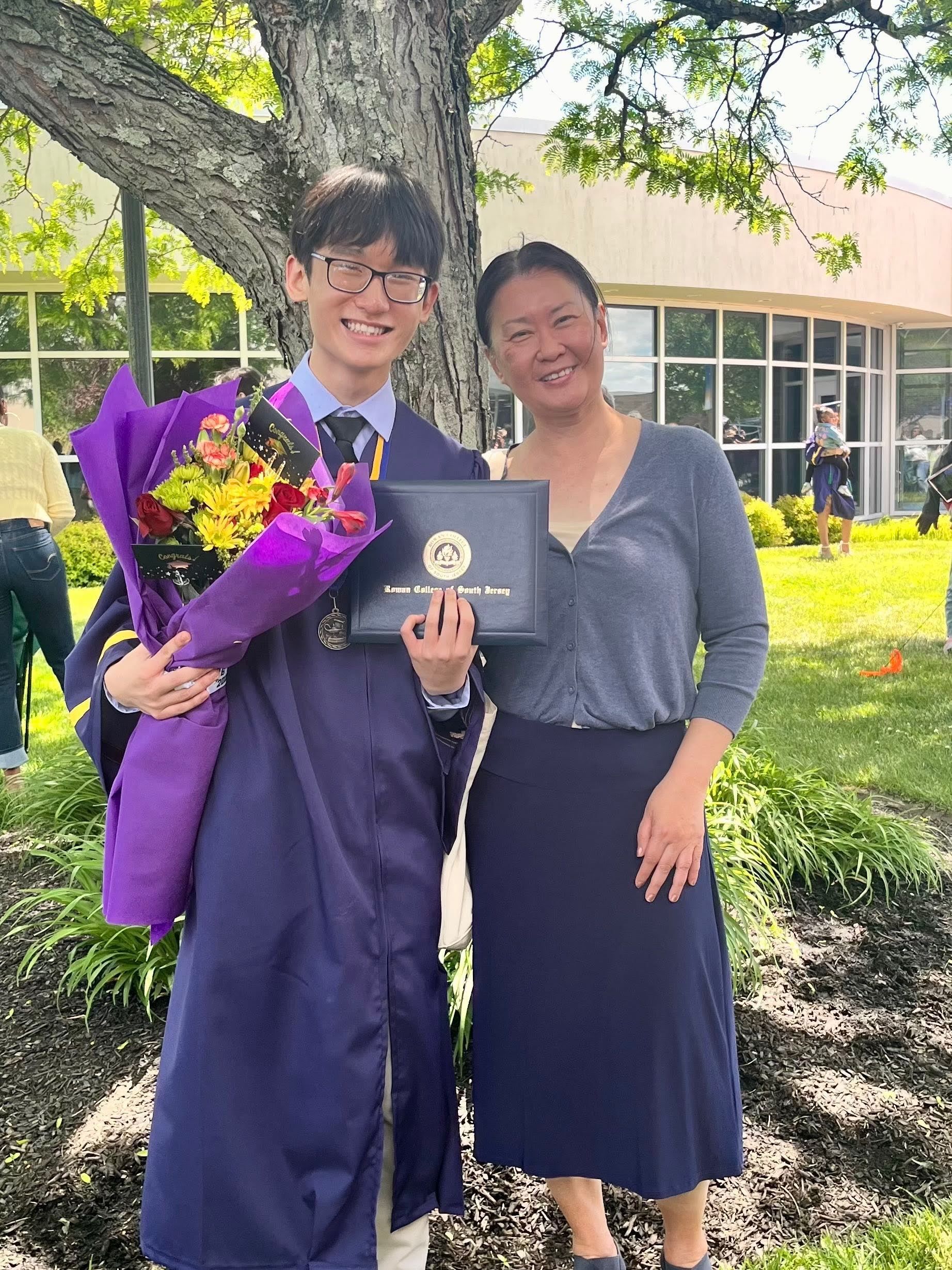
Max Yeung, 17, of Sewell, poses with his mother, Li Khoo, after receiving an associate’s degree from Rowan College of South Jersey.Max Yeung
At his high school, Yeung, 17, of Sewell, founded a nonpartisan civics group that registered students to vote. He was also president of the National Honor Society.
“It was a lot of juggling. There were a lot of moments when I had to huddle down,” he said. “It helped me understand what the college environment looked like.”
Yeung plans to attend Rowan University as a law justice major. Depending on how many credits transfer, he may graduate in a year or two and then hopes toattend Rutgers-Camden Law School.