Kevin McGonigle sat countless times as a fan in Citizens Bank Park, but he still wasn’t sure how the crowd would react Tuesday night when he was introduced before the All-Star Game. He grew up in Delaware County, starred at Bonner-Prendergast, modeled his game after Chase Utley, and was in the stands for Red October.
But he’s a rookie for the Detroit Tigers. McGonigle worried his own people — the Phillies fans he used to cheer with — would boo him.
It was instead a roar as the 21-year-old who grew up just 10 miles from the ballpark was treated like a returning hero. It was the perfect cap to a few days that McGonigle said were unbelievable: He slept in his childhood bed, made his parents cry, finally met Utley, and was an All-Star in the ballpark where he used to dream.
McGonigle had “Detroit” across his chest, but he was at home.
“The kid’s a hometown kid, and it’s a shame Philly didn’t figure it out,” McGonigle’s father, Kevin George, said during the game as the Phillies could have drafted the infielder in 2023. “But that’s the reason it was so loud here. This kid is a winner and he’s always going to be a winner. For him to be here right now in the All-Star Game is beyond my wildest dreams. I never saw it happening this soon. It’s pretty amazing.”
McGonigle received a text message a few days ago from a number he didn’t know. It was Utley. He congratulated McGonigle for making the American League team and said he would look for him in Philly. McGonigle has never been shy about his admiration for Utley, and NBC10 had Utley record a video for McGonigle in 2023 before he was drafted. But the two never met.
McGonigle was on the field for batting practice on Tuesday afternoon when someone told him that Utley was looking for him. McGonigle stopped what he was doing and looked for his idol. The All-Star became a fan again.
DO meet your idols 🤩
Kevin McGonigle meets Phillies legend and his favorite player growing up, Chase Utley. pic.twitter.com/spe3HJ6V0U
“Right when I saw him, I was like, ‘Thank you for everything you’ve done,’” McGonigle said. “Then I stepped back and I was like, ‘Maybe I should act more professional. I’m in the major leagues now.’ But I think that’s the best thing about this game. It’s a kid’s game. The way I played it as a kid and the work I put in as a kid got me to where I am today. I want to keep acting that way. It’s a kid’s game.”
Utley told McGonigle that there was nothing to thank him for. All the credit belonged to McGonigle. The Tigers infielder — who had an Utley poster as a kid in his bedroom — wasn’t thanking Utley for helping him with his swing or with his defense. He thanked him for being an inspiration every time he watched the Phils on TV or sat in those blue seats.
“It’s just the way he played the game,” McGonigle said. “It was the way he hustled on and off the field. The way he never took any pitches off. Of course, his swing is great and his defense. But it’s really just the way he went out and competed. I just wanted to thank him for helping me get to where I am today.”
Kevin McGonigle’s dad, Kevin George, cheering on his son at the All-Star Game on Tuesday at Citizens Bank Park.Matt Breen
McGonigle ended the conversation by asking his favorite player for a photo. All-Stars are fans, too.
“I want to meet Utley next,” McGonigle’s father said.
The path to Tuesday’s game can be traced to a $5,000 investment his father made years ago when he purchased a JUGS pitching machine off the internet.
“And I got a Honda Whisper generator,” McGonigle said as he motioned his arm like was pulling the motor again.
The McGonigles spent countless hours in their backyard building a swing that helped make the Delco kid a rookie sensation. He signed a $150 million contract three weeks into the season and entered the All-Star break with an .812 OPS. He’s the favorite to win the AL Rookie of the Year and could haunt the Phillies for not drafting him as the player they drafted — Aidan Miller — has not played this season due to a back injury.
McGonigle looks like a star. So, was that JUGGS machine the best investment his dad ever made?
“No doubt in my mind,” the father said. “The kid learned to spoil a pitch at a very young age. He’s pretty good at it.”
McGonigle had patches representing Bonner-Prendergast and Delco sewn into the inside of the suit jacket he wore to the ballpark on Tuesday. He’s proud, McGonigle said, to be from Delco. He arrived home on Sunday night and hung out with his neighborhood buddies. McGonigle could have stayed with the All-Stars in a Center City hotel, but he opted to eat his mom’s cooking and sleep in his bedroom that still has a Cole Hamels poster on the wall.
“[My] younger self would be super proud,” McGonigle said. “This is all I ever dreamed of.”
Kevin McGonigle’s mother, Tracy (center) was one of 36 family and friends in attendance of Tuesday night’s All-Star Game.Elizabeth Robertson / Staff Photographer
His mom Tracy cried, McGonigle said, when he was named an All-Star. And his dad was verklempt after he watched his son enter the game on Tuesday night.
“This is a real blur for me,” McGonigle’s dad said. “But this kid has what it takes. We’ll probably see this a few more times before he’s done.”
The public address announcer used the standard intro for most players before the game: “From the San Diego Padres, pitcher Mason Miller.” McGonigle received a special touch: “From the Detroit Tigers, from Delco, shortstop Kevin McGonigle.”
McGonigle had plenty of friends and family in the stands but this roar was louder than the pack of 36 family and friends McGonigle brought from Delco. It sounded like the whole ballpark. Boos? No chance. Philly fans knew that one of them was on the field.
“It was chills, man,” McGonigle said. “Hearing the stadium get loud like that. Just having the support of the fans here today was unbelievable. I can’t thank them enough.”
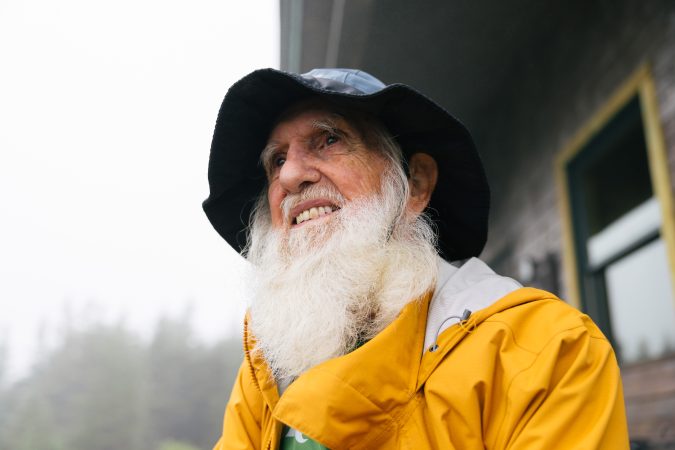
On the first day of summer, just after dawn, Dale Sanders, 91, prepared to start the steep, rocky hike up to Franconia Ridge in New Hampshire’s White Mountains.
Sanders’ mantra might resonate with anyone in their 10th decade: “It’s a ‘don’t fall’ day today,” he said, slinging a small backpack onto his compact, wiry frame.
The roughly 2,190-mile Appalachian Trail runs from Georgia to Maine. Sanders had been chipping away at it since September, in a bid to reclaim his record as the oldest person to hike the full length. (His goal is to complete a thru-hike, by walking the entire trail in a 12-month period.)
If Dale “Grey Beard” Sanders continues at his current pace, the age record will be his again before a 365-day deadline. Sanders said he will soon have to look for a new record: “I’m not going to stop unless physically I simply cannot do it anymore.” Luke Piotrowski
He was roughly 70% finished, but some of the toughest miles were ahead. I joined him for two especially challenging days.
The White Mountains are known for extreme weather, and Sanders said he had been turned away by a concerned trail steward during a heavy storm the previous week: “He said, ‘You know, you’re going to die if you keep going.’”
The weather had calmed somewhat, but soon after he emerged above the tree line and began his traverse of the ridge, roaring gusts of wind brought dense fog and sharp, sideways rain.
The route frequently requires hikers to scramble. As he reached the bottom of a rock slab, he realized he had no memory of this obstacle from the last time he had hiked the trail. That was in 2017, when, at 82, he first set the record. After carefully climbing the ledge, he estimated the hike was twice as hard this time.
Thru-hikers typically use trail names; Sanders is better known as “Grey Beard.” That morning, he had set out with an experienced 28-year-old hiker from Georgia, Garrison Gandy, or “Doublewide,” who had been crashing at the same hostel.
Despite the conditions, the pair made steady progress toward the day’s goal, an off-grid shelter 8 miles down the trail where a hot meal and a bunk were waiting.
The next morning, the first hour of hiking was strenuous — a steep mile to the summit of Mount Lafayette. Sanders lamented that despite hard training, his fitness hit a ceiling that hadn’t existed in earlier decades. “I wanted it to be pretty close to where I was in 2017, and I’ve never reached that,” he said.
As he caught his breath on the summit, the clouds had cleared, revealing a sparkling view of the Pemigewasset Wilderness.
12 miles a day
It was the allure of setting a record that first drew Sanders to the trail.
Sanders, who lives with his wife near Memphis, retired in 2002 after a career working in parks and recreation for the Navy. He marked his 80th birthday by becoming the oldest person to paddle the full length of the Mississippi River, and soon began searching for other age records.
He learned he could set a record by completing the Appalachian Trail. Though he had never spent extended time hiking, his competitive streak was activated.
Sanders credits this part of his personality to being bullied in school while growing up on a Kentucky tobacco farm, and the escape he found through sports.
“I wasn’t good in the books,” he said. Physical activity, on the other hand, “gave me something real.”
His first Appalachian Trail age record was broken in 2021 by a hiker named M.J. Eberhart, trail name “Nimblewill Nomad.” Sanders befriended Eberhart that year and encouraged him to set a new mark.
“He was going to quit several times,” Sanders said. “I actually went up and hiked with him the last few days so that he wouldn’t quit. We’re really close friends.”
Still, Sanders wanted the record back. For the current attempt, he planned to hike 12 miles a day, with one day off a week.
Most thru-hikers tackle the trail from the south to north, starting in Georgia and ending in Maine. But as long as Sanders walks every section of the trail, he can do it in any order and direction he chooses.
To maximize the year’s hiking weather, he began his hike headed south from Harpers Ferry, West Virginia, then returned to that spot to complete the northern half.
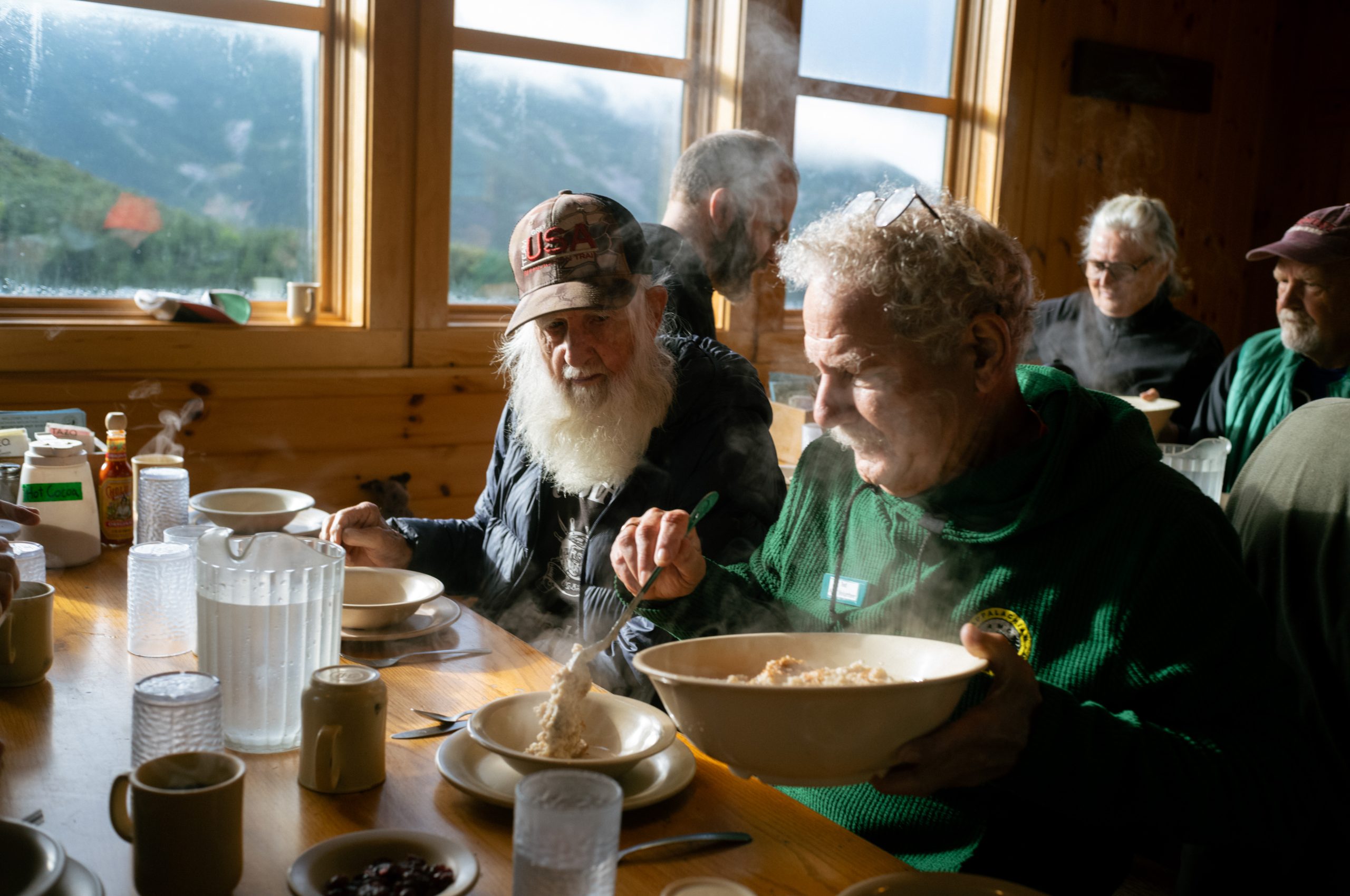
The White Mountains are home to a system of backcountry huts, where dinner and breakfast are served to overnight guests.Luke Piotrowski
While most thru-hikers sleep in a tent or in lean-to shelters, Sanders prefers his truck camper, a simple shelter, labeled “Base Camp on Wheels,” that sits in the bed of a pickup truck. It’s driven by a rotating cast of volunteers, who also cook his dinner and help plan the next day’s mileage. For the first 800 miles, one driver was Eberhart, now 87, who’s helping to break his own record.
Two friends from his Mississippi River descent, Craig and Katie Heaton, a married couple in their mid-60s, are also among Sanders’ crew.
“He won’t tell you how to live your life,” Heaton said, “but he shows by example, and I think that’s what touches me the most.”
Selfies and high fives
Sanders’ appetite for continuing to push his limits in old age has earned him many fans along the trail.
Emma Bartlett — also known as Comfy — had been hiking since March when she paused for a picture as she passed Sanders on the climb up to Franconia Ridge. “Everyone has been talking about you since Georgia,” she told him.
“If I’m even walking at 91, I will be jumping for joy,” said Bartlett, who is 23.
Sanders is comfortable hiking alone, but he would always prefer company. As we parted ways, he found an impromptu hiking partner to accompany him for the next leg.
Nicholas Loukides, 29, who has hiked in the White Mountains since he was in grade school, said the chance to tackle a few miles with Grey Beard was a highlight of his trip. “Every mountain I climb,” he said, “I’m like, ‘Dude, you did this?’”
Dale “Grey Beard” Sanders, who once held the record as the oldest person to complete the 2,190-mile Appalachian Trail and, in the summer of 2026 was months into a bid to complete it again at age 91.Luke Piotrowski
There are formidable obstacles remaining, like Maine’s 100 Mile Wilderness, the trail’s most remote stretch, where there will be very few opportunities for supplies or crew assistance for days. And Sanders still has to finish a section of the Smoky Mountains in North Carolina. But if he continues at his current pace, the age record will be his again before his 365-day deadline.
Sanders said he plans to finish, even if he runs out of time for it to count officially. Either way, he said he will soon have to look for a new record: “I’m not going to stop unless physically I simply cannot do it anymore.”
An intestinal parasite that causes “explosive” diarrhea is sickening people across 34 states, the Centers for Disease Control and Prevention said Tuesday.
Despite outbreaks affecting two states bordering Pennsylvania, the Philadelphia region so far shows no signs of widespread illness from Cyclospora cayetanensis.
Speaking to reporters, federal health officials said they had linked cyclosporiasis cases in a widespread outbreak in Michigan, Ohio, Kentucky, and West Virginia. Michigan alone had reported more than 3,000 cases by Tuesday.
“It’s a much higher number than we typically see in a cyclosporiasis season — much, much higher than last year or the year before,” said Gwen Biggerstaff, the deputy director of CDC’s Division of Foodborne, Waterborne, and Environmental Diseases.
Reporting requirements for cyclosporiasis cases differ in Pennsylvania, but cases here remain relatively low. Cases were also at typical levels in New Jersey, and none has been reported in Delaware since May.
Here’s what you need to know about the parasite and how to prevent it:
How is cyclosporiasis spread?
Cyclosporiasis is caused by a single-celled parasite, cyclospora, that spreads through fecal material. It can infect a person’s gut after consuming food or water contaminated by feces.
Common symptoms include watery diarrhea, a loss of appetite, cramping, nausea, and fatigue. Past outbreaks have been associated with leafy greens and other produce, said Rosemary Trout, an associate professor of food science at Drexel University.
The disease doesn’t spread directly from person to person. It becomes infectious after one to two weeks outside the body, and infected people may not immediately develop symptoms.
“It can take two days to two weeks for symptoms to appear,” said Akhil Vaidya, a distinguished professor in the Department of Microbiology & Immunology at Drexel’s College of Medicine.
“That has been the challenge for tracking where the parasite came from. Most likely it’s in some produce, but which produce it’s coming from is not really clear. People don’t remember what they ate two weeks back.”
How do health officials track cyclosporiasis?
Health officials in 47 states, including New Jersey and Delaware, are required by law to report cyclosporiasis cases to the CDC.
Pennsylvania is among a handful of states where doctors are not required to report cases to health officials, but they do so on a voluntary basis, and state officials investigate and submit case reports to the CDC.
A federal foodborne illness surveillance system, FoodNet, stopped tracking cyclosporiasis last year.
But that program’s goal is to “look at trends over time to inform policy and prevention activities,” not monitor active outbreaks, and only drew data from 10 sites around the country, the CDC’s Biggerstaff said.
“[FoodNet] doesn’t give us the data we have from national surveillance,” she said. That broader program is “unchanged,” she said.
Are there cases in the Philly area?
Though Pennsylvania borders Ohio and West Virginia, two states involved in an ongoing outbreak, cases here have been relatively low. So far this year, state health officials have reported 28 cases, 14 of them in Southeastern Pennsylvania.
New Jersey has reported between 31 and 80 cases since May, when cyclosporiasis cases typically rise, according to the CDC. But health officials there said last week that the state is experiencing “normal seasonal circulation without known clusters or outbreaks.”
Delaware has not reported any cases since May 1, the CDC said.
What about cases elsewhere?
Cases in Michigan, Ohio, Kentucky, and West Virginia are considered part of a “multistate outbreak” that is likely tied to a common source, Biggerstaff said. But it’s still unclear what that source is.
Though the CDC has lagged behind states in confirming cases so far, the agency has confirmed 1,645 cyclosporiasis cases since May, and is monitoring 5,100 additional reported cases that will “require additional analysis to confirm,” Biggerstaff said.
How is cyclosporiasis prevented?
Good handwashing practices are the first line of defense against cyclosporiasis: Wash your hands for at least 20 seconds in hot, soapy water.
Washing produce also helps, but rinsing does not necessarily remove all traces of cyclospora, said Trout, the food safety professor. Heating produce to 150 degrees Fahrenheit can kill the parasite.
Trout said that higher-risk groups — immunocompromised people, young children, elderly people, and pregnant women — may want to avoid fresh produce and instead opt for frozen or canned fruit and vegetables.
Most of those products have been treated with heat at some point in their packaging process.
“If you are in a high risk population, or very worried about it, it’s valid,” she said. “The case number is very high, and it’s proximate to our state.”
Gov. Josh Shapiro on Tuesday visited Vare-Washington Elementary School in South Philadelphia to tout the $678 million in new education funding included in the state budget deal finalized over the weekend.
The new education funding — including $565 million in “adequacy funding” to aid poorer districts — represented one of the most significant victories the first-term Democratic governor took home from the $50.8 billion state budget deal, which did not address lingering issues such as taxing so-called skill games and long-term funding for SEPTA and other public transit agencies.
The Philadelphia School District will receive $137 million in adequacy funding and $20 million in other new funding. The district will also be able to compete for a share of $125 million set aside for school facilities projects.
Philadelphia’s cash-strapped district, which entered this year with a $300 million structural budget deficit, still faces deep challenges. The school board this year approved a facilities plan to close 17 school buildings and renovate 169 more.
“We’re driving this money out to the schools that need it most — school districts like Philadelphia, Norristown, Pottstown, and Allentown, and others in our region,” Shapiro said. “They were getting shortchanged, and now they’re getting the lion’s share of this new funding.”
While it broke little new ground, this year’s state budget deal helped avoid another prolonged impasse involving Shapiro, the Democratic House, and the Republican Senate. Last year, lawmakers failed to reach a compromise until 135 days after the July 1 budget deadline, leaving school districts and local governments across the state in limbo for months.
“I‘m one of the only governors in the country with a divided legislature, one of the only legislatures that has to negotiate with people on the other side who really have a very different view, who don’t think the way we do about investing in public education,” said Shapiro, who was joined by Mayor Cherelle L. Parker and numerous Philadelphia Democratic lawmakers. “We have all been clear that we would not get up from the table in Harrisburg until we fully funded public education, and we’ve done that.”
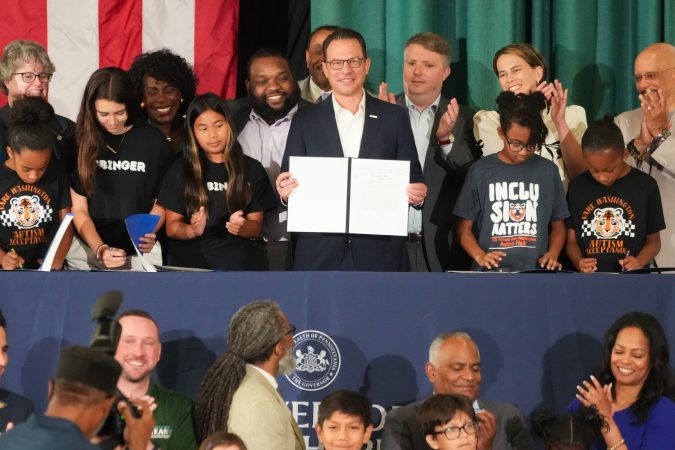
Students applaud speakers at Vare-Washington Elementary School during an assembly highlighting the education investments included in the 2026-27 state budget in Philadelphia, Pa. on July 14, 2026.Jessica Griffin / Staff Photographer
The formula calculated that a majority of Pennsylvania schools were underfunded, by a total of $4.5 billion. For the last three years, the state has given those schools an extra $565 million a year, filling about one-third of the gap. The state plans to fullyaddress the shortfall by 2032.
Advocates for underfunded districts, like Philadelphia’s, have credited the state for sticking with the plan, but have also said the money is flowing too slowly for struggling districts. Meanwhile, Republican lawmakers have challenged the increased funding for poorer districts, saying others are getting shortchanged by the new system.
Mayor Cherelle L. Parker speaks at Vare-Washington Elementary School to highlight the historic education investments included in the 2026-27 state budget, in Philadelphia, Pa. on July 14, 2026.Jessica Griffin / Staff Photographer
Philadelphia’s school district, the only one in the state prohibited from raising its own revenue, relies on city and state lawmakers for its funding.
“We have limited revenue-generating capacity in the city of Philadelphia,” Parker said Tuesday. “I wish I could tell you, as mayor, that we had all of the money that we needed to address problems, but that is not the case. Our city can’t be successful without a strong partnership from Harrisburg.”
Parker thanked Shapiro and the city’s delegation to Harrisburg for “keeping your word” and delivering more education funding to Philadelphia from the state.
During her remarks, Parker led the students assembled at the event in several call-and-response chants, including, “Excellence matters — at Vare-Washington!”
“I want to hear you say, ‘Thank you — Gov. Shapiro!’” Parker said in another chant. “‘Thank you — Harrisburg legislators!’”
Camden County officials announced a $400 million master plan Tuesday to protect the county’s network of rivers, lakes, and streams such as the Cooper River.
They are hoping voters will approve a referendum in the fall to help pay for itover the next decade.
That waterway network is threatened by aging infrastructure, stormwater runoff, industry, and changing regulations that have left it degraded. A comprehensive plan is imperative, officials said.
An ultimate goal, they say, is that residents may one day be able to swim safely in Cooper River Lake without a health risk.
“Repair. Replenish. Recreate,” County Commissioner Jeffrey Nash said. “Those three words summarize the generational change that Camden County is about to embark on to improve the quality of our water bodies.”
County, state, and local officials made the announcement at the Camden County Municipal Utilities Authority headquarters in Camden, backed by representatives from various environmental groups and nonprofits.
To raise the money, officials are assembling federal, state, and government grants and loans, as well as help from private nonprofits.
Voters could be key
But they also said a planned voter referendum on increasing the county’s open space tax to $0.03 per $100 of assessed property value is key to secure permanent funding. Voters will weigh in on Election Day, Nov. 3.
The rate would nudge up from $0.02. That means someone with property assessed at $500,000 would pay $150 a year toward open space, up from the current $100.
Waterways that would see increased protection include:
Cooper River Lake,which spans Camden, Pennsauken, Cherry Hill, Collingswood, and Haddon Township.
Kirkwood Lake in Lindenwold.
Atco Lake in Waterford Township.
Pennsauken Creek,which runs through Pennsauken, Maple Shade, and Cherry Hill.
Big Timber Creek, which spans multiple towns.
Evans Pond and Wallworth Lake in Cherry Hill and Haddonfield.
Nash said the county’s populationgrowth over the last 100 years can be attributed to people drawn to the waterways. But increasedpopulation also resulted in the need for moresewer lines and attention to aging infrastructure.
“We stand at a crossroads, and we have a choice to make: Either we’re going to shrug our shoulders and pass this problem on to the next generation, or we’re going to do something that is generational,” Nash said.
The cost breakdown
The plan calls for:
$200 million to fix aging combined sewer systems that overflow during storms.
$75 million for dredging and other methods to reduce sediment.
$50 million for rehabilitation of sanitary sewer systems across multiple towns.
$50 million to restore recreational lake areas.
$25 million for green infrastructure.
And it includes an unspecified amount for continued planning, monitoring, and management.
Scott Schreiber, executive director of the Camden County Municipal Utilities Authority, called the plan “a comprehensive strategy that addresses every major factor affecting the health of our rivers, lakes, and streams.”
He said it represents a new way of thinking about water quality by coordinating across towns, rather than planning by one municipality at a time.
“Water doesn’t recognize political boundaries or municipal borders,” Schreiber said.
The biggest chunk of money will go to address combined sewer overflows (CSOs), which are now antiquated. A combined sewer system collects rainwater runoff and household sewage into one pipe. Normally, it can transport all of that to a sewage treatment plant. But storms can bring so much water that they can exceed the system’s capacity. When that happens, untreated stormwater and wastewater flow intobodies of water, such as the Delaware River.
Schreiber said projects are being designed and built to capture and treat much more stormwater before it reaches the Delaware.
Separately, money will be used to repair and rehabilitate aging sewer systems, reducing leaks and groundwater infiltration that pollutes waterways.
He said the infrastructure money will also be used to install rain gardens, permeable pavement, and bioswales, which are typically sloped channels covered with vegetation and designed to capture or slow stormwater.
The county will start a regular dredging operation to remove decades of accumulated and contaminated sediment in lakes and ponds to improve aquatic habitat, restore ecological function, and create overall healthier waterways.
And the county plans to restore recreational lakes by improving public access, bolstering shorelines, and boosting overall water quality.
Officials plan to finance part of the plan through the New Jersey Water Bank, an independent state authority that provides low-interest loans for water quality infrastructure projects.
However, Schreiber said, the voter referendum will be key. If voters approve it, the referendum would provide $7 million per year that could be used to pay off that debt and pay for other improvements.
‘Vibrant waterfront communities’
Don Baugh, founder of the nonprofit Upstream Alliance, which has helped Camden County build its first water trail, called the master plan a major step.
“I feel like I should pinch myself,” he said. “This is the dream of restored waterways, swimmable waterways, kids playing in the water, and vibrant waterfront communities.”
Daniela Solano-Ward, mayor of Collingswood, one of five towns that border Cooper River Lake, said the new coordination by the county is vital.
“Collingswood can do very little to alter our geographic reality,” she said. “We are bordered by Cooper River to the north and Newton Lake to the south. Ultimately, protecting urban watersheds has fallen to local government. But with 35 municipalities in Camden County, the weight of this lift is too heavy for any one of us to shoulder alone.”
Pennsylvania Secretary of State Al Schmidt stressed that the state was not in violation of any voting regulations in a response letter to a Department of Justice inquiry that threatened criminal charges over suspicions of noncitizen voting.
The letter, sent Monday, pushed back against the Trump administration’s insistence that allowing federal assistance in inspecting voter rolls was the best way to avoid criminal prosecution for “aiding and abetting the violation” of federal voting laws.
The Trump administration’sletter, sent July 7, was addressed to voting officials in all 50 states and requested a reply within the week. Schmidt’s reply made it clear that Pennsylvania would not hand over voter rolls to the federal government and reiterated that voting regulations were followed meticulously.
“I take seriously the obligations under both federal and Pennsylvania law to ensure that only eligible voters have access to the ballot box and to see to it that Pennsylvania’s voter rolls are appropriately maintained and updated,” wrote Schmidt, an appointee of Democratic Gov. Josh Shapiro.
“That means working with the election officials of our 67 counties who are statutorily responsible for voter list maintenance,” Schmidt said. “Be assured that these dedicated local officials, as well as our employees who serve at the Department of State, work tirelessly to ensure that Pennsylvania’s voter rolls are accurately maintained.”
Pennsylvania officials have warned since last year that turning over the voter rolls to the federal government without redactions could put sensitive information at risk.
The DOJ letter comes after President Donald Trump’s long history of spreading voter fraud conspiracy theories and falsely claiming that he won the 2020 election.
“I have seen the most fantastical things on social media, making completely ridiculous allegations that have no basis in fact at all,” Schmidt told CNN in 2020.
In his capacity as Philadelphia city commissioner, Schmidt in 2017 identified a glitch in the Pennsylvania Department of Transportation’s system that had allowed 168 noncitizens to register to vote.
But noncitizen voting does not happen at a rate that would change presidential election results, Schmidt emphasized in a recent interview with VoteBeat.
“One thing that became very clear through that research and all evidence suggests that noncitizens voting in elections in the United States occurs very rarely,” Schmidt said. “It doesn’t mean that it’s not important. Like I said before, every vote is precious, and we want to make sure that we do everything we can to safeguard and strengthen election integrity. But there’s no evidence to suggest that it happens in any widespread way whatsoever.”
While Schmidt’s letter did not grant the Trump administration access to voter rolls, it did link to the state’s most recent voter registration report, which outlines the outcomes of officials’ efforts to keep the rolls accurate.
According to the report, 338,000 voter registrations were canceled in 2025, most of them because the voter died or moved. In around 120 cases, a registration was recalled because an official found the person was ineligible to vote.
“We [Pennsylvania Department of State] have worked closely with the Department of Justice on matters that have led to criminal charges as recently as this year,” Schmidt wrote in reply to the DOJ. “The Department consistently cooperates with our state and federal partners in their investigations to help ensure that only eligible voters are registered and able to cast ballots in our Commonwealth.”
I understand some folks on social media are very upset with Phillies fans for booing every baseball player but their own during the Home Run Derby at Citizens Bank Park on Monday night.
To those whom we’ve offended, may I humbly say: BOOOOO!!! There’s no crying in baseball, you whiny babies.
I wasn’t there in person so sadly I can’t claim to have been a part of the cacophonous crowd that joyfully jeered player after player as they walked onto the field (except, of course, for Kyle Schwarber and Bryce Harper, who received thunderous applause), but I did laugh like hell while watching the incessant booing on TV.
Philly literally booed these guys just for daring to show up and be introduced at our ballpark. We are so unserious.
Our humor is just as brutal as our honesty and while it may not seem like it on the surface, both come from a place of respect. Sure, we could be fake and feign applause for players from other teams, or we could be “polite” and not say anything at all, but we’d rather be engaged and enjoy a good time and a good ribbing.
Heck, Monday night Phillies fans booed one of the kids picking up baseballs in the outfield because he didn’t catch a fly ball, so yeah, puppies and sunshine should be on high alert.
Over on Threads, users posted: “How totally classless!” and “The Philly crowd booing every single player is really gross” and those people were rightfully and immediately ratioed. Philadelphians responded with brilliant retorts like: “If you don’t get booed in Philly, you’re not an All-Star” and “If those players didn’t want to be booed, they should play for the Phillies.”
You know who didn’t seem to have a problem with the boos? The players who actually got booed! They appeared to get it and have fun with it. Every story that’s really a home run needs a good antagonist and a dramatic arc. For that night, they were our Moriartys and we were theirs.
Phillies Bryce Harper climbs the ropes of the boxing ring during his introduction at the MLB Home Run Derby in Philadelphia on Monday.Yong Kim / Staff Photographer
If you can’t stomach some theatrics when the Home Run Derby is broadcast on Netflix — there was a boxing ring on the field and Will Ferrell was providing unhinged commentary — then you probably should’ve watched the Little House on the Prairie remake instead, Laura Ingalls Wilder.
Listen, I understand being surprised by the boos if you’re not familiar with Philadelphia’s dark and dystopian joie de vivre. Before I moved here, I don’t think I’d ever booed anything in my life or had ever been booed, and I couldn’t imagine a scenario in which either would happen (outside of my nightmares and Renaissance fairs, that is).
But after 19 years in Philly, I can now proudly say I’ve been booed in person, over the phone, via email, and on social media by Philadelphians, and I have participated in many communal and individual booing sessions. I didn’t realize how cathartic it could be or how much I’d been suppressing my medieval side, but I know now and have vowed to boo better.
Philadelphia Phillies fans boo the Houston Astros after batting practice ahead of baseball’s World Series Game 5 in 2022. We boo people at batting practice and you’re surprised we booed players at the Home Run Derby? Charles Fox / Staff Photographer
Most recently, I booed a tourist I was interviewing on July 2 when she told me she was visiting Philly through the 3rd and then heading to Boston to celebrate Independence Day on July 4. I did give her a pass when she later said her son and grandson lived in Boston, but I did not apologize. We can’t be getting soft around here.
I mean this is a city where our mascots throw popcorn at babies, harass opposing coaches, and eat people while at work — and they’re the ultimate Philly fans, so expecting us to treat baseball like the ballet is totally bananas (and I’m not talking about the Savannahs).
For those who remain offended, I suggest looking in a mirror and asking: When is the last time I booed something? If the answer is “never” or “not in a while,” give it a go — you may not realize how much you’ve been holding back.
And if you don’t want to boo yourself, turn on a Phillies game and boo us. We’ll take the compliment, because we can take a joke.
After years of fits and starts, Delaware says it is ready to build a new container port on the Delaware River to attract more cargo — and create jobs.
Not so fast, says an operator of ports upriver in Philadelphia and New Jersey.
Affiliates of Gloucester City-based Holt Logistics Corp. filed a lawsuit last week seeking to block project approvals granted by the U.S. Army Corps of Engineers for construction of Delaware’s proposed terminal in Edgemoor.
If that sounds familiar, it’s because Holt and the Pennsylvania agency that owns Philadelphia’s seaports in 2024 successfully persuaded a federal judge to throw out an Army Corps permit authorizing the same project.
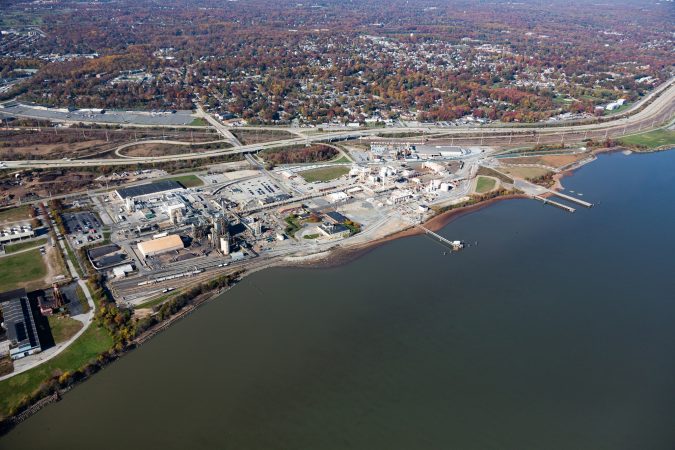
But since then, Delaware’s taxpayer-owned Diamond State Port Corp. requested new approvals, and the Army Corps granted them in April. The following month, Diamond State and its private-sector partner, Massachusetts-based Enstructure, announced they were moving ahead with the $669 million project at the site of a former DuPont chemical plant.
They say the new terminal — three miles northeast of the Port of Wilmington — will bring thousands of construction, warehouse, and longshore jobs to the area. Delaware officials estimate the Edgemoor terminal will be able to handle up to 1.2 million container units annually.
That’s one-third more than Philadelphia’s port handled in 2025, a record year. But Philly’s port — a major gateway for refrigerated cargo, especially fresh fruit from Central and South America — is also expanding.
The Philadelphia Regional Port Authority (PhilaPort), a state agency, last fall bought a 152-acre yard from Norfolk Southern Corp. for $90 million to create more cargo space.
A PhilaPort spokesperson declined to comment on the lawsuit. Diamond State didn’t immediately respond to a request for comment.
“While out-of-state competitors continue their efforts to stop this project, it is time to move forward and make sure Delaware’s port can compete fairly on the Delaware River,” Charuni Patibanda-Sanchez, who as Delaware’s secretary of state serves as Diamond State’s chair, said in May.
Holt — a family-owned company that operates marine terminals in South Philadelphia, Gloucester City, and Paulsboro — now says the Army Corps repeated several mistakes that doomed its earlier approvals.
“Most significantly, the court found that the Army Corps had failed to sufficiently consider the project’s likely impacts on navigation and safety in the Delaware River,” says the suit filed by Holt affiliates Greenwich Terminals LLC and Gloucester Terminals LLC.
“Yet despite the court’s detailed opinion and suggested remedial direction,” it continues, “the Army Corps reissued the project approvals again without conducting a proper evaluation of the applications before it.”
A spokesperson for the Army Corps declined to comment.
It was the first weekend of summer break. Abigail Gillon, an honor student, had just finished sixth grade. She was free.
“My last text to her was at 2:14” on June 14 last year, said Abby’s mom, Lori Kralle.
An hour later, Kralle received a call from an emergency room nurse about her 12-year-old daughter.
Abby had been riding an electric scooter with her best friend, Isabelle, in Aston Township. The girls were sharing the scooter when they drove off the curb and fell into the street. They were struck by an oncoming car at 2:22 p.m. Emergency responders found them holding each other in fetal position, Kralle said. Abigail died two days later. Her friend was severely injured.
“It didn’t just tear away and take away Abigail’s life, it took apart everybody’s life, her friends and family,” Kralle said.
Lori Kralle with her daughter, Abby Gillon.Lori Kralle
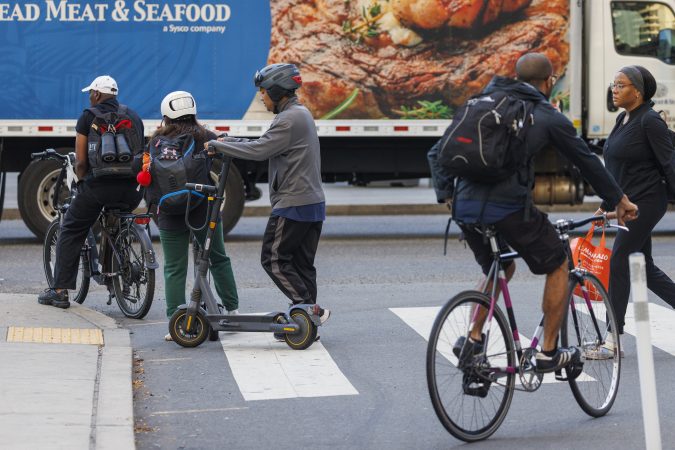
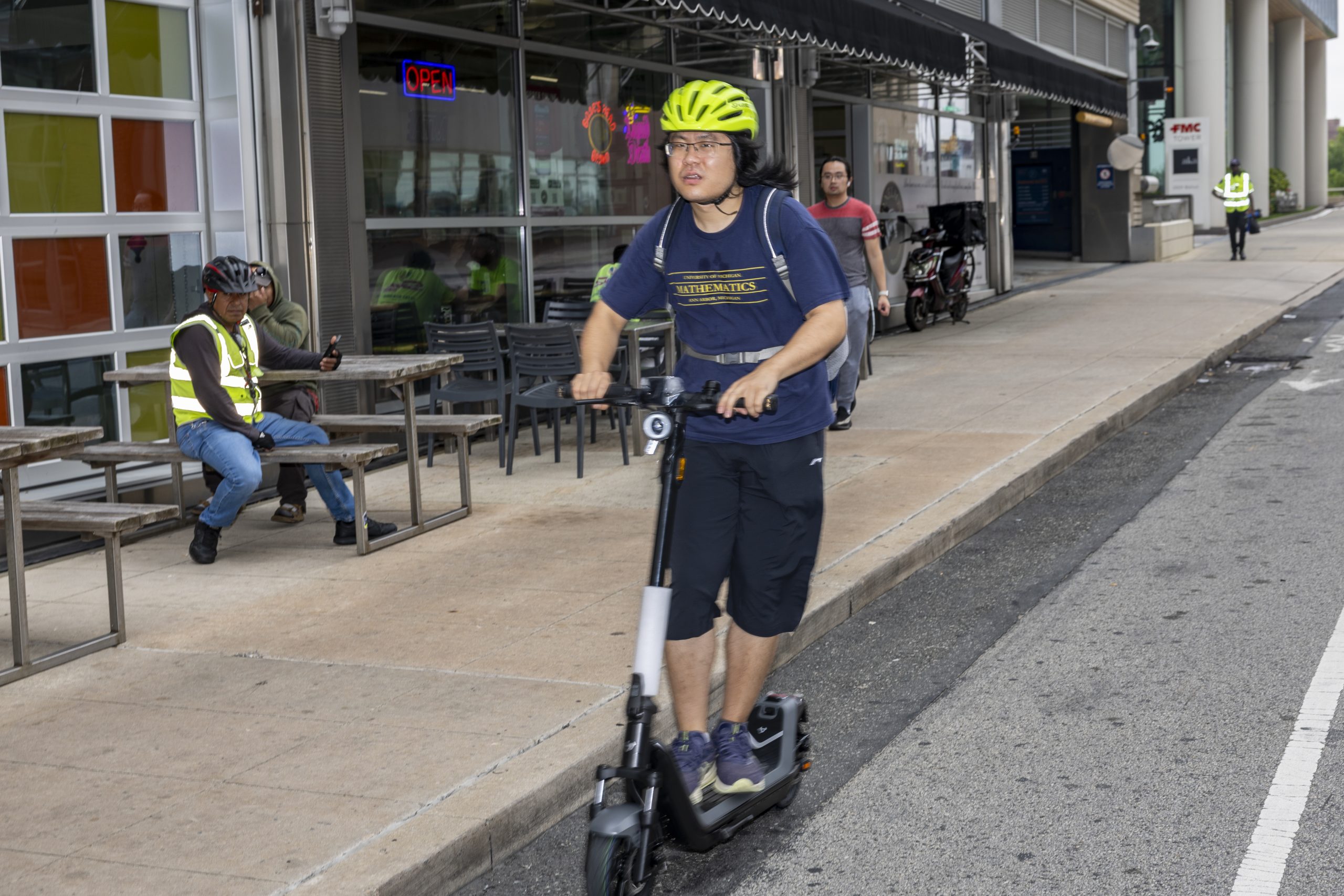
Last year, more traffic crashes causing injury and death in Philadelphia involved electric bikes and scooters than manual ones, according to Pennsylvania Department of Transportation data. The finding highlights a new reality in which e-bikes and e-scooters present a major safety problem, the state confirmed.
The high numbers of injuries and deaths point to the need for legal clarity, statewide safety regulations, and new infrastructure to protect users of e-bikes, e-scooters, and bicycle riders from cars and trucks, traffic safety advocates contend.
(function(){function e(){window.addEventListener(`message`,function(e){if(e.data[`datawrapper-height`]!==void 0){var t=document.querySelectorAll(`iframe`);for(var n in e.data[`datawrapper-height`])for(var r=0,i;i=t[r];r++)if(i.contentWindow===e.source){var a=e.data[`datawrapper-height`][n]+`px`;i.style.height=a}}})}e()})();
“There’s a lot of technology out there and there is no real enforcement and regulation,” said Nicole Brunet, president of PA Safe Roads PAC. “It’s causing devices to be on the road that are unsafe.”
In 2025, e-bikes and e-scooters were involved in 197 crashes on city streets, excluding interstates — a 40% increase over 2024. Four riders were killed and 193 were injured in those collisions, PennDot figures show.
Meanwhile, 193 reported crashes involved standard bikes, more numerous in the city than their electric cousins, as well as traditional foot-propelled scooters, the state figures indicate.
E-bikes and scooters are poorly defined in Pennsylvania law. The ambiguity makes it hard for governments to identify problems; PennDot did not analyze separate crash data for the electric devices until 2024, for instance, due in part to uneven reporting.
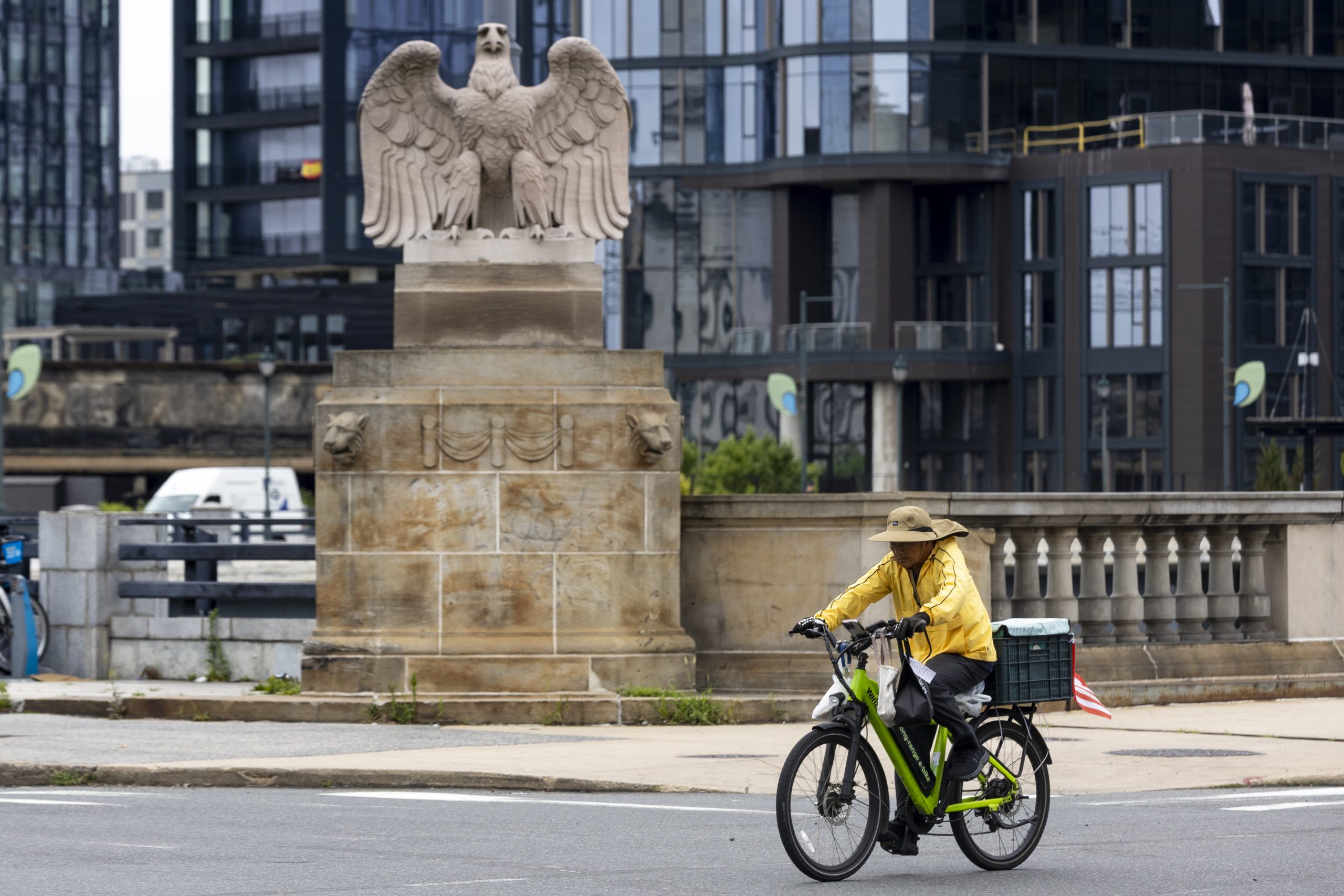
A delivery driver riding an e-bike drives past an intersection on Walnut Street in West Philadelphia on Tuesday, July 7, 2026.Aidan T. Gallo / Staff Photographer
State law authorizes the use of low-speed electric bikes — those that weigh less than 100 pounds, have engines that generate no more than 750 watts, and travel below 20 mph — on public roadways. E-scooters are not street legal in Pennsylvania.
This narrow definition, however, does notdifferentiate among the many new types of electric bikes or e-scooters for sale, which can reach speeds of 60 mph or even 100 mph.
(function() { var l = function() { new pym.Parent( ‘crash-types3__graphic’, ‘https://media.inquirer.com/storage/inquirer/ai2html/crash-types3/index.html’); }; if(typeof(pym) === ‘undefined’) { var h = document.getElementsByTagName(‘head’)[0], s = document.createElement(‘script’); s.type = ‘text/javascript’; s.src = ‘https://pym.nprapps.org/pym.v1.min.js’; s.onload = l; h.appendChild(s); } else { l(); } })();
Two states, two speeds
Governmental response has been uneven, with neighboring states moving in opposite directions and local jurisdictions sometimes banning e-bikes and e-scooters or enacting bespoke rules.
“What we’re seeing right now is sort of a wild, wild west,” said State Sen. Tim Kearney, a Delaware County Democrat.
Kearney wrote and introduced “Abby’s Law” — SB 1008 — in September last year.
The bill says no person under 16 could operate a privately owned “low-speed electric scooter” on public roads; a helmet would be required until age 18. The bill would set a uniform 20 mph speed limit and prohibit tandem riding on e-scooters.
Local police would issue summonses for those and other traffic violations by riders. Municipalities could increase penalties for second and third violations, as long as the fine is no more than $250.
(function() { var l = function() { new pym.Parent( ‘crash-types3__graphic’, ‘https://media.inquirer.com/storage/inquirer/ai2html/crash-types3/index.html’); }; if(typeof(pym) === ‘undefined’) { var h = document.getElementsByTagName(‘head’)[0], s = document.createElement(‘script’); s.type = ‘text/javascript’; s.src = ‘https://pym.nprapps.org/pym.v1.min.js’; s.onload = l; h.appendChild(s); } else { l(); } })();
In New Jersey, former Gov. Phil Murphy, a Democrat, signed the most restrictive electric cycling law in the nation on his last day in officeearlier this year. The law, which takes effect later this month,requires all e-bike users to obtain a license and register their devices with the New Jersey Motor Vehicle Commission, even if they do not go over 20 mph.
Models that can travel between 21 and 28 mph or have a throttle are classified as “motorized bicycles” and must also have liability insurance. The lower-powered e-bikes provide “pedal assist,” which cuts off at 20 mph.
Enforcement could be tricky, especiallyat the Shore. The MVC says out-of-state visitors can ride legally, but language in the law appears to grant the exemption just to people who have registered devices in their home states. That is not an option in Pennsylvania.
The MVC is now taking reservations for appointments; officials have acknowledged the deadline might need to be extended.
E-scooters with a top speed of 19 mph are legal.
In Pennsylvania, more than a year after Abby Gillon’s death, Kearney’s bill has not had a public hearing or a vote in the Senate.
“We need to get people to acknowledge what’s actually happening on the road, and then stop sticking our heads in the sand about the various bureaucratic reasons not to move forward with it,” Kearney said.
Wide use, thin information
Government officials face challenges identifying and classifying the many varieties of electricbikes and scooters — also known as micromobility vehicles — transportation activists and state officials said. That makes information, including about crashes, hard to come by.
PennDot, for instance, began counting electric bikes and scooters separately from pedal cycles, unmotorized scooters, and pedestrians for its annual tally of crashes only in 2024.
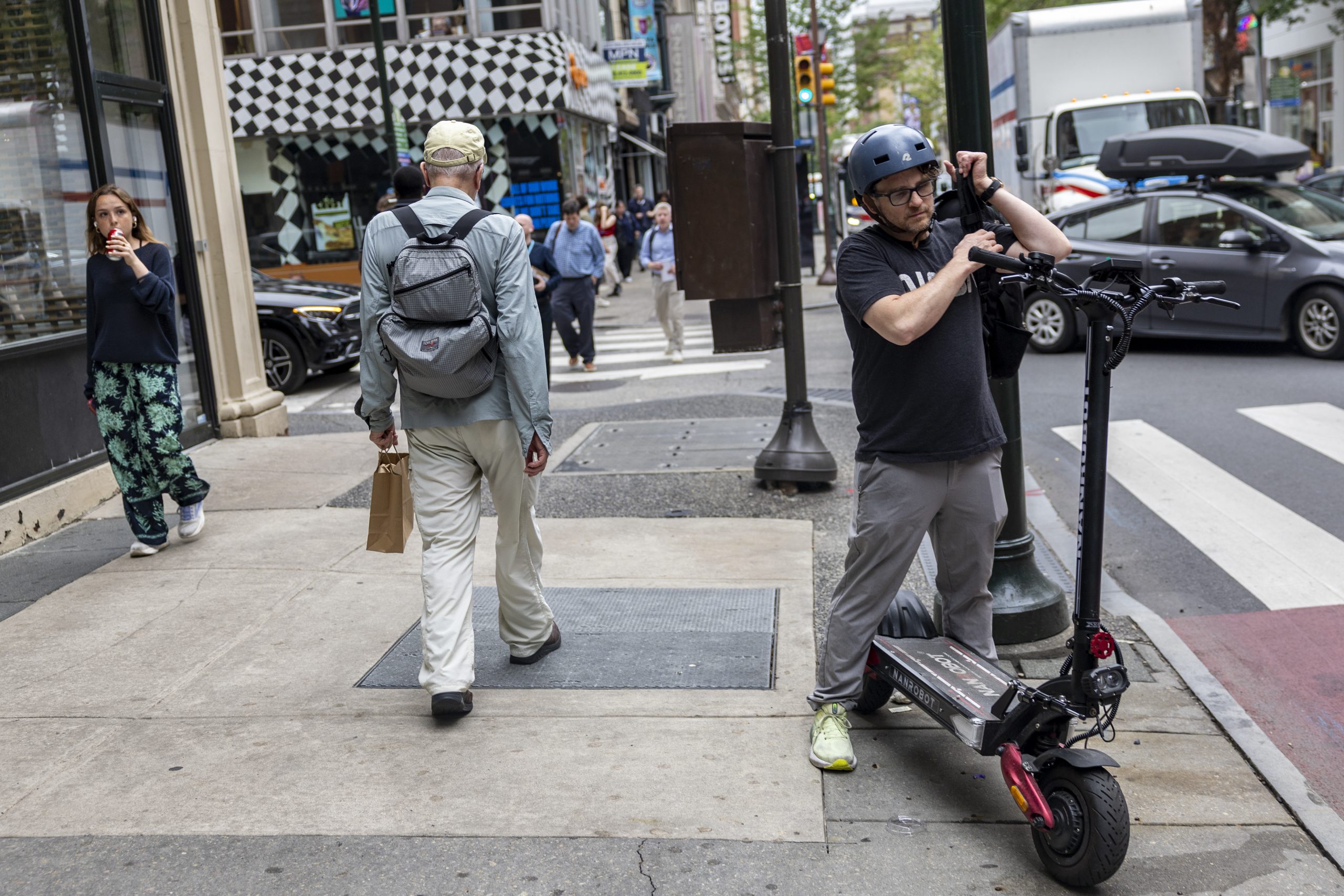
A man gets ready to leave on his electric shooter in Center City.Aidan T. Gallo / Staff Photographer
After a vehicular crash, law enforcement is required to report to PennDot details of crashes that involve injuries, fatalities, or significant damage to vehicles.
Regarding the data prior to 2024, Robert A. Ranieri, crash-analysis manager at PennDot, said via email: “I don’t find that fully reliable since we didn’t look at all the narratives and the police may not have reported them properly at the time.”
While his office works to verify the data, “not all reports are touched by my staff,” Ranieri said.
Similarly, the crash data on electric bikes likely include vehicles known as e-motos, which look like pedal bikes but go faster than 20 mph, said John Boyle, research director at the Bicycle Coalition of Greater Philadelphia.
In general, e-motos being lumped in with e-bikes is causing a lot of issues as communities and states try to regulate the higher-speed micromobility devices, Brunet said.
E-scooter law is ‘basically ignored’
The recently released PennDot data include at least 92 crashes in Philly involving e-scooters, which are technically illegal to ride on public streets in Pennsylvania.
Last year, there were four reported fatalities involving e-scooters, though they made up only 14% of micromobility devices, according to the Bicycle Coalition’s 2025 bike count data.
Standard bikes, in comparison, resulted in the same number, a total of four deaths, last year.
“Some of the e-scooters have a top speed of 60 mph, which is crazy fast,” Boyle said, but “the law is basically ignored.”
There is a gray market of electric scooters and bikes available for purchase, transportation experts told The Inquirer.
“You can purchase electric bikes or scooters for $800 on Amazon and they have 1,000 to 2,000 watts,” Boyle said.
The bikes are sometimes marketed as “Class 2,” meaning their motor tops out at 20 mph, but with a few basic adjustments can easily go faster, Boyle said.
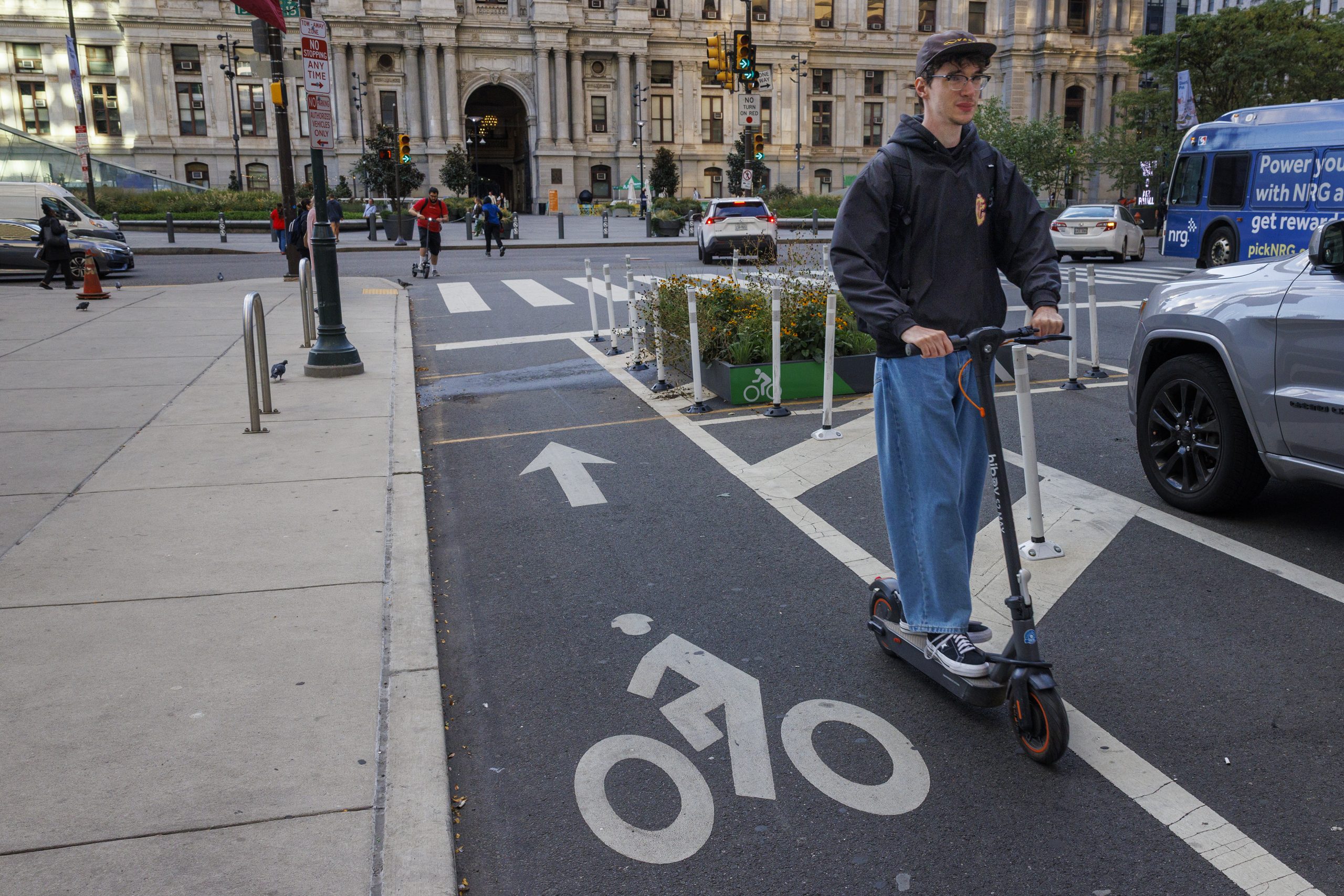
A man rides an electric scooter down a bike lane near Drexel University’s campus.Aidan T. Gallo / Staff Photographer
Motorcycles, unlike e-motos, have quality standards and regulations. When it comes to selling a motorcycle in Pennsylvania, dealerships are required to handle legal requirements, title transfers, and state registrations.
Reiningin the manufacturers and dealers of electric bikes, motos, and scooters is an important step, Boyle said, but the state first needs to better define in the law what electric bikes and scooters are.
Brunet, president of PA Safe Roads PAC, said her organization supports the Safe System approach to transportation safety, which involves education, enforcement, and infrastructure.
“Philly just needs to keep building better bike infrastructure. … There is definitely a lot to do to make roads safer so that the people choosing these devices get home safe,” Brunet said.
Several bills to regulate e-scooters have been proposed in the state legislature, but none have been passed.
Special legislation gave Pittsburgh the right to test a shared e-scooter rental program in partnership with Spin, a private company, from 2021 to 2023, when the trial expired.
Kinkead called it a success, noting her north Pittsburgh district has steep hills and limited transit links.
“What I saw … was not college kids goofing around, it was people who were trying to get around the North Side with grocery bags,” Kinkead said at a recent public hearing on the bill.
The city had 230,000 unique e-scooter users during the test, said Ryan Seiferet, who managed the program for the Pittsburgh Department of Mobility and Infrastructure.
A survey of about 1,000 participants showed 44% of e-scooter riders used them to get to work and one-third to travel between transit stops and home. Regular users tended to have low incomes.
While rules are needed in the state, especially for privately owned scooters, “We want to make sure we aren’t penalizing or disincentivizing a valuable micromobility travel option” for people, said Jessie Amadio, an organizer for Philly Bike Action.
The electric scooter program was relatively safe, with one reported injury per 17,000 rides, according to a DOMI report.
Electric scooters going against directed traffic flow at Market Street at 15th in Center City.Alejandro A. Alvarez / Staff Photographer
News site Next Pittsburgh found, however, that a handful of the injuries were serious and, in some cases, life-threatening. Spin planned to deploy scooters with larger tires for stability, the site reported.
Kinkead said shared e-scooters can be tightly controlled in agreements between a city and an e-scooter firm; in Pittsburgh, the scooters could not exceed 15 mph, enforced by software. E-scooters stopped working if the rider strayed into a town that did not allow them.
Philadelphia, however, is opting out. Mayor Cherelle L. Parker’s administration asked that the city not be included in the shared e-scooter bill, said State Rep. Ed Neilson, a Democrat who represents a Northeast district and chairs the House Transportation Committee.
“Because of the historic nature of the city and the millions of people that come every year, we just don’t want to block or impede that,” Neilson told colleagues in the hearing.
Most agree that the state needs to take some sort of legislative action soon.
“Getting as far as we have gotten [with Abby’s Law] on the Senate’s desk and to still not have anything signed or put into order is very frustrating,” Lori Kralle said.
“What does it take? For another mother to get that phone call?” she added. “I don’t wish that on anybody.”
When a violent microburst storm slammed into Narberth on Saturday, it brought down a 120-year-old Sycamore tree onto a home in the historic Narbrook Park neighborhood.
The fire department in the surrounding Lower Merion Township responded to 98 incidents over the weekend, making numerous water rescues.
And residents are still grappling with the aftermath of a violent storm shaking their communities.
Communities in Montgomery County, along with other spots in the Philadelphia region, suffered vast amounts of damage Saturday afternoon as microburst storms ripped through the area.
A microburst is a highly-localized column of sinking air during a thunderstorm that can produce strong winds and extensive damage and, in some instances, can be life-threatening, according to the National Weather Service.
Peco has continued to restore power to affected households, as of roughly 5:30 p.m. Monday, with 119 outages affecting a little more than 1,500 customers.
Narberth Council Vice President Cyndi Rickards said the skies went from clear to stormy in just a matter of minutes Saturday before a microburst ripped through the Montgomery County community.
Then, just as quickly as it arrived, came the downed trees, power lines, flooding, and power outages.
It was something Rickards, a more than 20-year resident of the community, had never seen before.
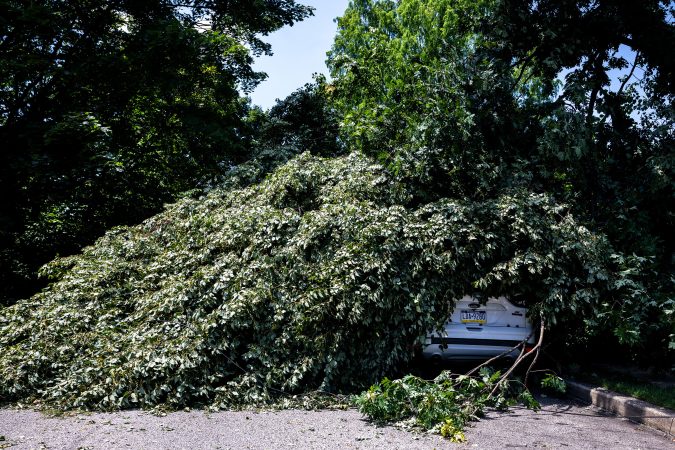
“It became apparent that nearly every street in Narberth had a tree down, a substantial tree on a car,” Rickards said. “I believe we had two that fell on or near houses. Many that narrowly missed houses.”
One of those near misses happened at Hugh Parker’s residence while he was spending time with relatives down the Shore. Once he and his family heard about the 40-foot tree knocked down in their front yard — covering their driveway and the car of his wife, Grace, they rushed home.
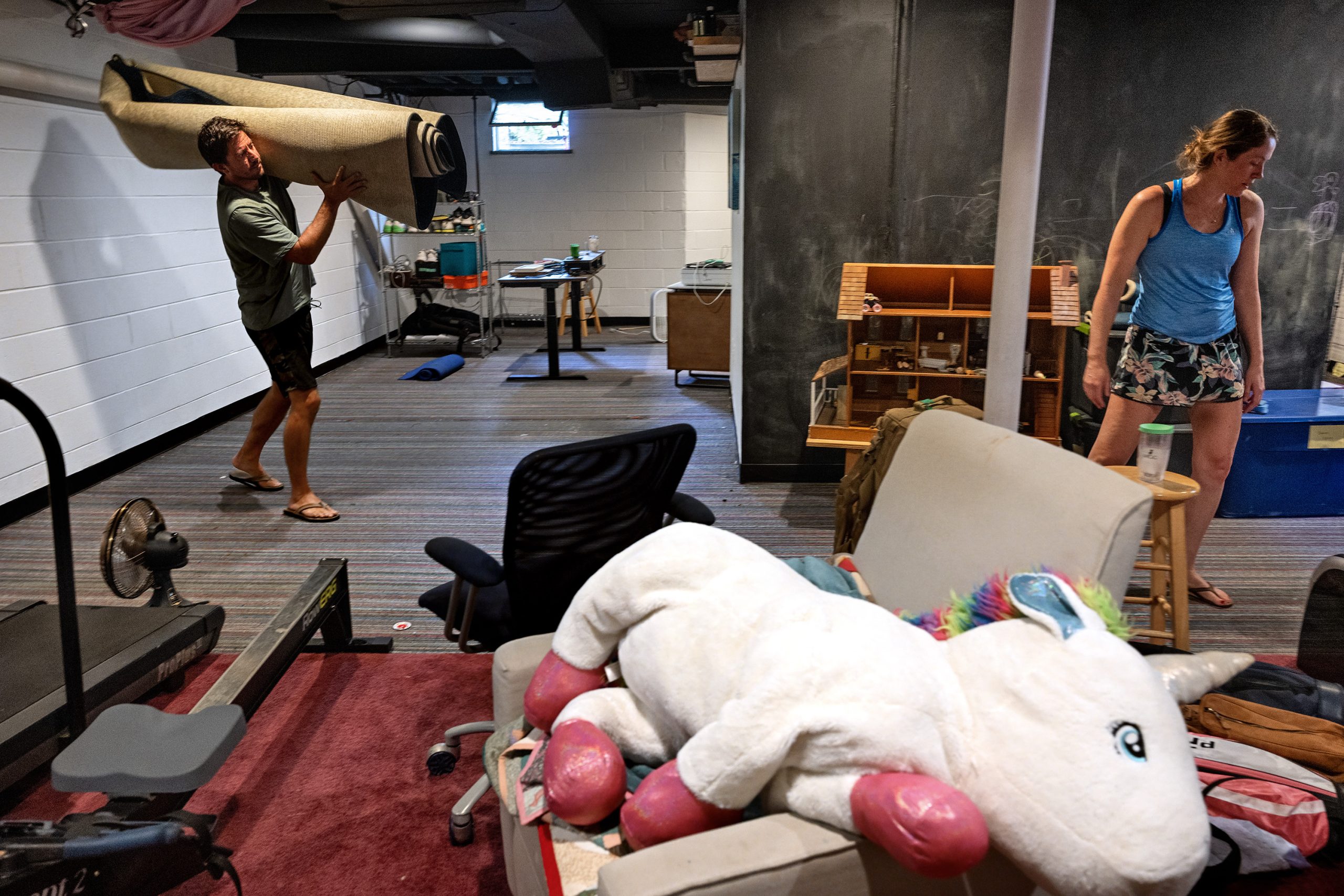
Their basement had also been flooded and the family’s newly reconnected power lines started a fire, which eventually went out on its own.
Hugh and Grace Parker continue the cleanup in the basement of their Narberth home Monday, July 13, 2026, following the weekend’s storm. They weren’t home so don’t know why it flooded, as the house had not had any water enter since it was built in the 1990s. They also had a tree fall in front, crushing one of their cars.Tom Gralish / Staff Photographer
Rickards described the local government’s response to the storm as “such a comprehensive disaster response for a small little borough,” adding that Jeff Eldon, the public works director, closed down any streets where he suspected downed wires or trees.
Narberth Mayor Dana Edwards also declared a state of emergency, which has since been lifted, and has facilitated a spot at the borough hall where residents can cool off and charge their devices. He also indicated that the borough had “great support” from Peco.
“It was really everything we could do just to keep everybody as comfortable as possible,” Edwards said.
In the surrounding Lower Merion Township, commissioner Ray Courtney reported similar issues as Narberth’s, especially when it came to old trees that were toppled by the storm.
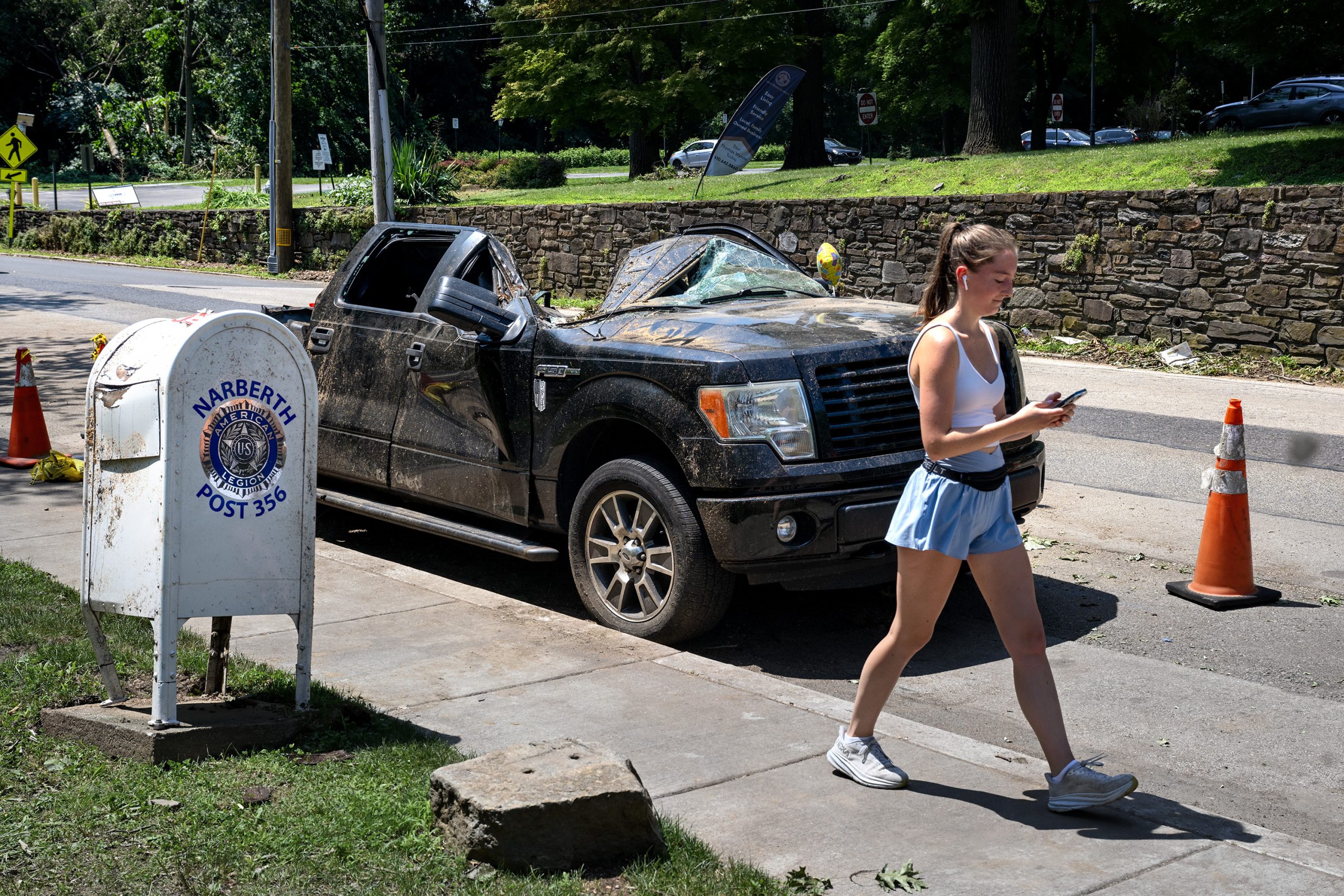
A pickup truck is left crushed Monday, July 13, 2026, after the tree that fell on it had been cleared as the cleanup continued following the weekend’s microbursts that ripped through parts of the city and Montgomery County, downing trees and power lines and causing outages and road closures. This was along Wynnewood Avenue by the baseball fields in Narberth.Tom Gralish / Staff Photographer
When the storm was over, the public works department closed the roads, some of which continued into Sunday morning, said Courtney, who represents parts of Ardmore and Wynnewood. As of Sunday night, crews had cleared 59 downed trees and there were 38 remaining.
For local officials, the episode also underscored a need for further discussions regarding improving local infrastructure and resources for extreme weather events.
Many communities, like Narberth and Ardmore, for instance, have historic infrastructure that cannot always handle aggressive storms.
“I think this is the reality of storms now,” Courtney said. “They are hard, they are intense, and they dump a lot of precipitation in a short period of time, and all local governments, and our state and federal government, need to be thinking about improvements to our infrastructure, and the resiliency against this kind of weather event.”
In the immediate aftermath of Saturday’s storm, residents — especially those whose property has been damaged — are hoping for incremental improvements.
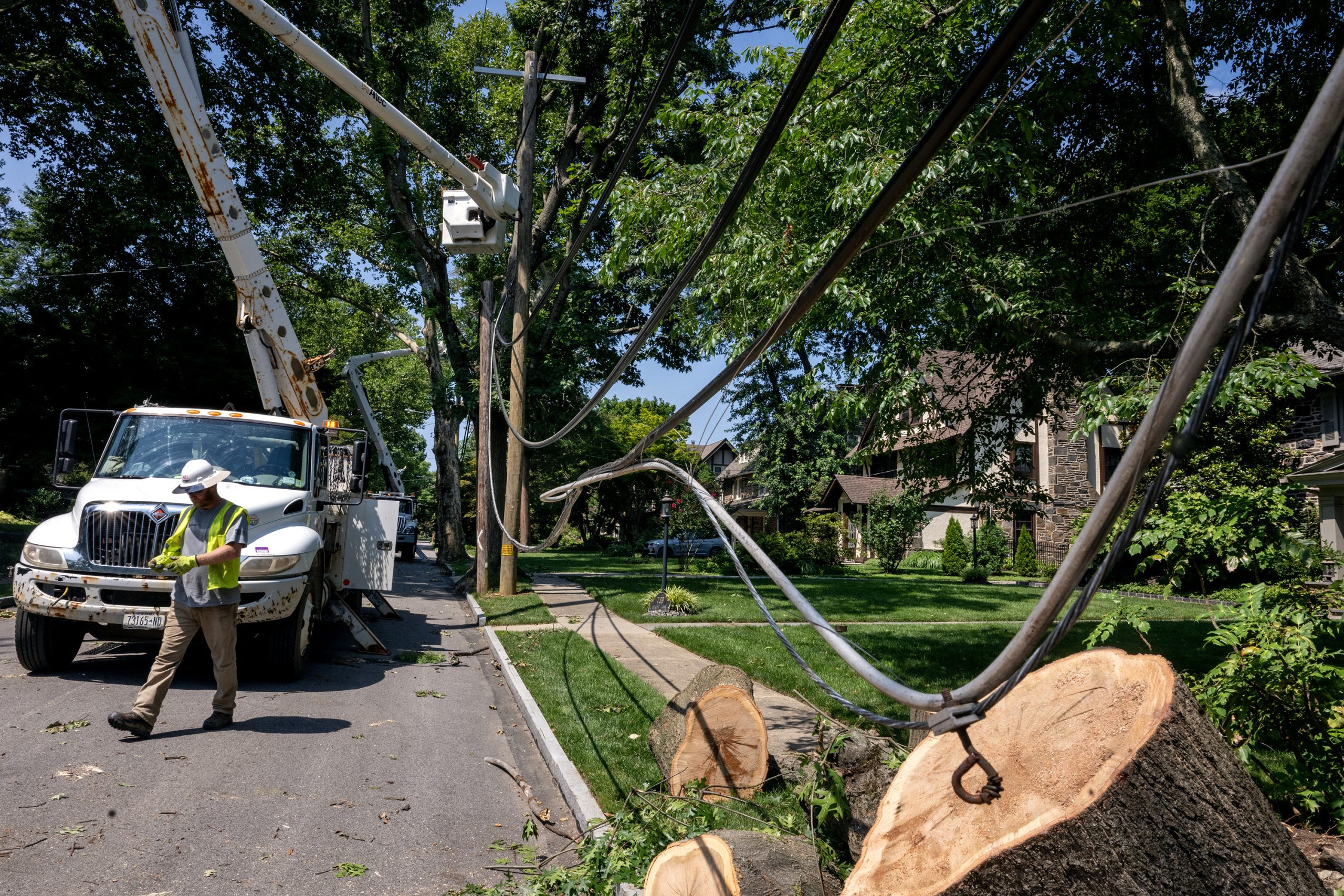
Utility workers restore power on Beacom Lane in Merion Station, Monday, July 13, 2026, as cleanup continues following the weekend’s microbursts that ripped through parts of the city and Montgomery County, downing trees and power lines and causing outages and road closures.Tom Gralish / Staff Photographer
A neighbor’s tree fell on the roof of Robert Hilton’s home on Merion Avenue. Water started dripping into his second-floor bedroom and the carpet remained soaked.
“I’ve lived here for 41 years, and I’ve never seen anything like this,” said Hilton.
The fallen tree, Hilton says, had been a concern for more than 20 years. It was old, unhealthy, and situated at the top of a bank, making it prone to structural instability. The microburst was the final piece of the puzzle, and the uprooted trunk now lays tangled with power lines in the middle of the street.
Hilton lost power during Saturday’s storm, but it was reconnected on Monday at 2:30 p.m. “It’s baby steps,” he said. “That’s all we can hope for.”