Tag: Weekend Reads

  • Memorial honoring woman killed by drunk driver moved hours after its installation on Spruce Street

    Memorial honoring woman killed by drunk driver moved hours after its installation on Spruce Street

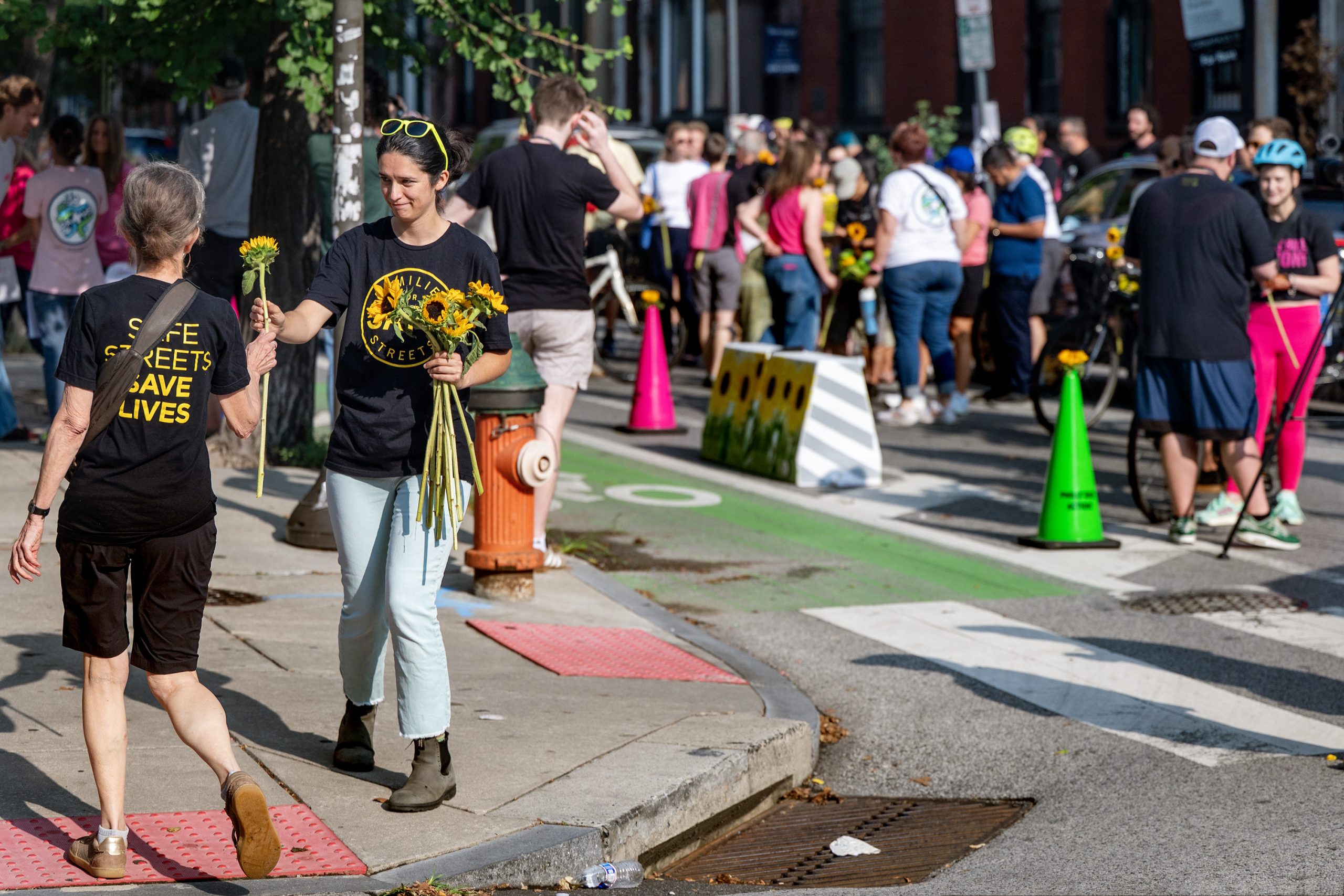
    A four-foot plastic traffic barrier was placed in the bike lanes on 18th and Spruce Streets on Sunday. Painted white and adorned with 12 sunflowers, the small protective barrier would not only protect cyclists from cars, but represent the people killed by drivers since the death of Barbara Friedes, a pediatric doctor who, in 2024, was killed where the painted barrier was placed while riding her bike home from work.

    But just hours after hundreds of people, including City Council President Kenyatta Johnson, helped install the barrier during a memorial for Friedes, it was removed, said Jessie Amadio, an organizer for Philly Bike Action, which organized the memorial.

    The swift removal led the group to suspect city crews may have removed it, sparking an outcry from supporters who contacted city departments and Mayor Cherelle L. Parker.

    “It takes years to protect a bike lane but hours to remove bike lane protection?” Philly Bike Action wrote on Instagram. “Drained and removed on a Sunday like it was the most pressing business in the entire City today.”

    The city has said it was not aware of any removal efforts on its part.

    Later Sunday, Philly Bike Action members found the memorial barrier tucked behind a dumpster in the alleyway behind Temple Beth Zion-Beth Israel, mere feet away from where it was placed. The city contends crews would have taken it to a sanitation facility or other waste removal site.

    Hanna Kahler hands out sunflowers as family, friends, and Philly Bike action members arrive at Barbara’s Angel Bike at 18th and Spruce for a memorial Sunday. Barbara Friedes, a 30-year-old Children’s Hospital of Philadelphia doctor, was killed on her bike on the spot by a drunk driver in July 2024.Tom Gralish / Staff Photographer

    The city’s Managing Director’s Office said it was unaware of any city employee taking part in the memorial barrier’s removal.

    “We just need more time to ask every single person who might have been out there, but everybody who has been asked at this point who worked in that area on Sunday did not remove them,” a spokesperson said.

    The office has been investigating since Sunday afternoon, checking with the Philadelphia Police Department, the Fire Department, the Streets Department, and the Department of Sanitation as to whether one of their crews removed it. The spokesperson said that no city department issued an order for employees to remove the barrier.

    The Police Department reported back that it did not have nearby surveillance footage showing the area where the barrier was placed to identify who may have removed it. Police canvassed the area Monday to gather additional information and doorbell surveillance footage, a spokesperson said.

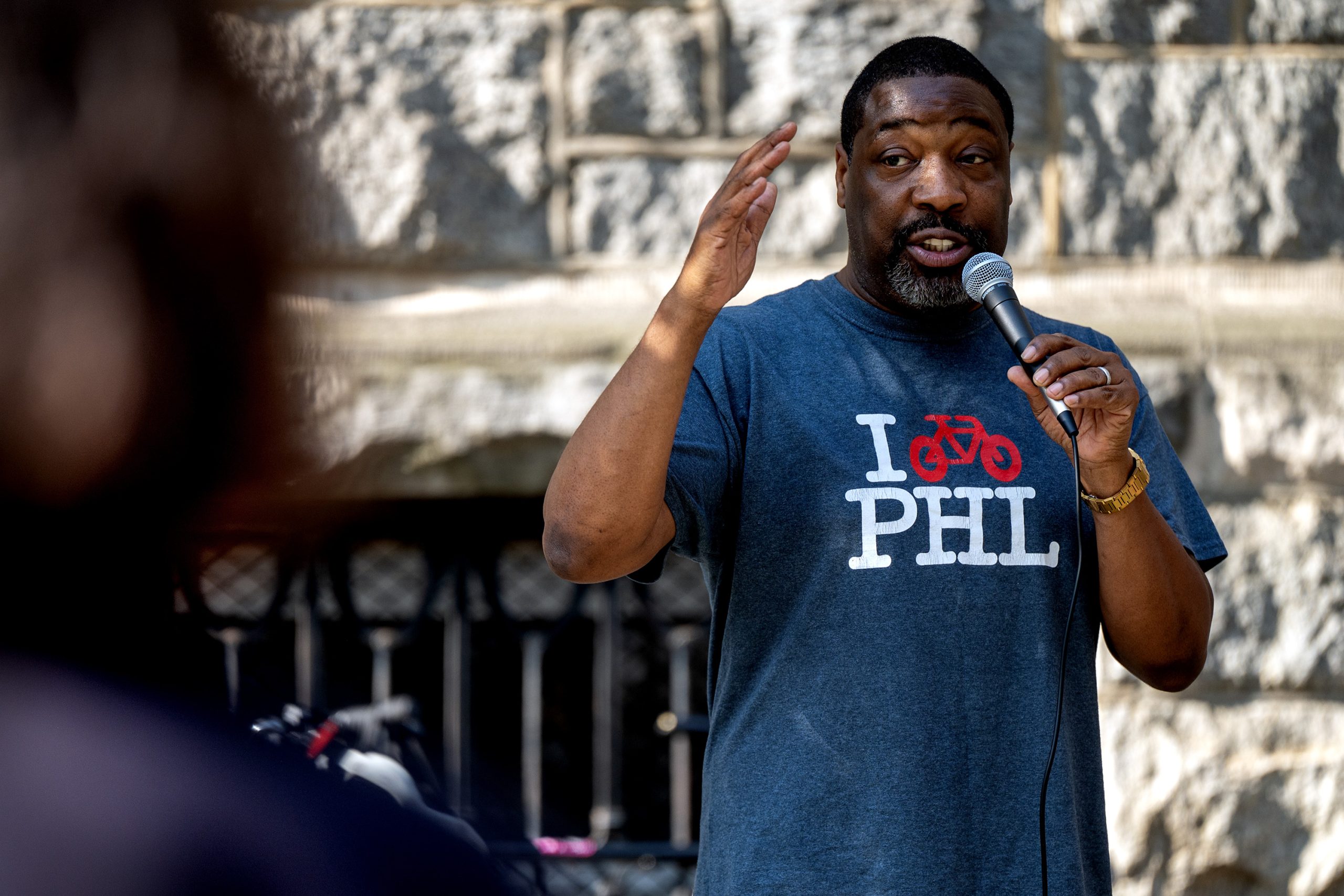
    City Council President Kenyatta Johnson speaks as friends, family, and Philly Bike Action members gather at the angel bike for Barbara Friedes at 18th and Spruce for a memorial Sunday. Friedes, a 30-year-old Children’s Hospital of Philadelphia doctor, was killed on her bike at the intersection by a drunk driver in July 2024. Johnson pledged he would remain committed to finding ways to protect cyclists in Philadelphia.Tom Gralish / Staff Photographer

    In Philadelphia, the majority of people killed in vehicle crashes are pedestrians and cyclists, according to recent PennDot data. While overall crashes have declined since 2020, the number of drivers crashing into non-motorists has stayed the same or increased.

    Following the deaths of Friedes and other cyclists and pedestrians, the city pledged $4.8 million to install permanent concrete bike lane barriers along Spruce and Pine Streets in Center City. Part of this plan was to convert parking spaces along these streets into loading zones intended to give vehicles a place to briefly stop instead of in bike lanes. However, the neighborhood group Friends of Pine and Spruce sued on the grounds that the city had no legal authority to remove parking spaces to create “neighborhood loading zones.”

    A car is parked in the bicycle lane in the 1700 Block of Spruce Street on Sunday even as family, friends, and Philly Bike Action members gather at Barbara Friedes’ Angel Bike at 18th and Spruce for a memorial. Friedes, a 30-year-old Children’s Hospital of Philadelphia doctor, was killed on her bike at the intersection by a drunk driver in July 2024.Tom Gralish / Staff Photographer

    The city has since delayed the Spruce and Pine Streets safety project due to a 2025 court injunction. Common Pleas Judge Damaris L. Garcia recently denied the city’s motion to dissolve the injunction, and the project remains on pause.

    While Philly Bike Action recognizes the need for the city to wait on legal proceedings, the group believes the judge’s order should still allow the construction of barriers as the injunction targets “ongoing construction” and efforts associated with proposed “neighborhood loading zones, or related restrictions on Pine and Spruce Streets.” However, the addition of “related restrictions” introduced ambiguity and has kept the city’s plans stalled.

    “We can’t wait another two to five years,” Amadio said. “The barrier is not much bigger than the curbs on the end of the road and will prevent cars from merging into the bike lane and hurting people.”

  • Citizens Bank says it has ended lending to private prison companies used by ICE

    Citizens Bank says it has ended lending to private prison companies used by ICE

    Citizens Bank no longer funds two private-prison companies that house people detained by federal immigration services, the company said in a statement on its investor page Friday.

    The federal government has purchased some facilities it had been using from private prison operator CoreCivic and plans to buy some from the GEO Group, so those companies no longer need as much capital, according to the bank. Citizens now finds it “appropriate to exit” those lending relationships, the bank said.

    Citizens, based in Rhode Island, has the largest bank branch network in the Philadelphia area, according to FDIC data, and ranks among the dozen largest U.S. commercial banks.

    Opponents of the facilities have asked for “assurances in writing” from Citizens Bank that the GEO Group and CoreCivic relationships are over, said Peyton Fleming, a spokesperson for De-ICE Coalition, which organized protests against the bank.

    Earlier this month, CoreCivic announced the sale of two prisons in California to the U.S. for $1.5 billion.

    Protests against Avelo Airlines’ role in transporting deportees for immigration agencies ended last winter after ICE purchased its own airplanes.

    A billboard near the Route 420 exit of I-95 North in Delaware County pressuring Citizens Bank to stop funding private prison operators who housed deportees for federal agencies.Indivisible Highlands

    De-ICE in a statement Friday called Citizens’ decision “an important victory for the people who refused to let a major bank finance human suffering brought on by ICE detention activities of the current federal administration.”

    De-ICE backers sponsored signs, trucks, a billboard on northbound I-95 near the Route 420 exit, a flyover banner before the Major League All-Star Game, and pickets in the region urging Citizens to drop the prisons. The group took credit for the decision, said Debbie Travers, a healthcare consultant and a leader of Indivisible Highlands and Beyond, a Wilmington-based group opposed to aggressive worker and family deportations.

    Citizens, one of the few big banks to finance private prison companies, also was targeted in New Jersey and other states by local ordinance proposals urging towns to withdraw public accounts from Citizens. Jersey City and Montclair voted earlier this summer to withdraw more than $300 million in total from Citizens, according to NJ.com.

    This truck, adorned with illuminated signs urging “Citizens Bank Stop Financing ICE Detention Centers,” was parked near a Citizens branch in Delaware as part of a national protest March 5. Organizers said they visited 68 branches, including several in the Philadelphia area.Joseph DiStefano

    In its statement, Citizens said that due to privacy concerns, it hadn’t previously commented on its relationships with private prison owners and U.S. Immigration and Customers Enforcement detention center operators CoreCivic, which Citizens had served since 2011, and the GEO Group, which Citizens has financed since 2018.

    Activists, including Philadelphia and Delaware chapters of Indivisible, complained that Citizens funding enabled the GEO Group, of Boca Raton, Fla., to operate the Moshannon Valley Processing Center in central Pennsylvania, Delaney Hall in New Jersey, and more than a dozen ICE prisons where conditions have been criticized. CoreCivic, of Brentwood, Tenn., ran the Elizabeth Detention Center in New Jersey, among others.

    Protest organizers, including local branches of Indivisible, said they had marched outside at least 70 of Citizens’ 988 full-service branches, including locations in Center City and Northwest Philadelphia last winter and spring.

    The bank said it has been “disappointed that the activists have dragged it into what is largely a political matter” and complained they mischaracterized the bank as anti-immigrant, pointing to its record of funding agencies that serve immigrants and other nonprofit support.

    Citizens also said bank regulators don’t allow them “to deny banking services to individuals and to lawful businesses based on political or religious considerations, a practice referred to as ‘debanking.’”

    The federal Office of the Comptroller of the Currency, a bank regulatory agency in the Treasury Department, is reviewing banks and has threatened to punish them for politically motivated debanking, citing private prison operators, gun makers, and oil companies among the industries the administration wants to protect.

    Banks “must consider these regulatory and contractual frameworks in making decisions on who to bank or not bank,” Citizens said. “Fair access to bank funding should be something all should agree with. Political concerns should be addressed through political channels.”

    De-ICE spokesperson Fleming said group members believe “public conscience and community resistance” helped change the policy, adding that “doing some good does not cancel out the harm caused by these business relationships.”

    In 2019, eight large U.S. banks including JPMorgan Chase & Co. and Citibank agreed to stop funding private-prison operators.

    In 2024, Citizens’ banking arm agreed to lead a group of lenders raising $1.3 billion for the GEO Group, which operates 82 prisons for state and federal agencies, some of which house immigration detainees.

    Last year, Citizens led a group of lenders, mostly smaller Southern banks, in raising $500 million for CoreCivic, to pay down debt and “for general corporate purposes.”

  • Strathmere’s free beaches may soon require a beach tag

    Strathmere’s free beaches may soon require a beach tag

    The beaches of tiny, quirky Strathmere may be in their last tag-free season.

    The Upper Township Committee, the governmental body that includes Strathmere and its mainland counterpart, is considering beach tags that would cost as much as $45 for the season, said administrator James Van Zlike.

    Strathmere’s possible move to a paid beach will leave only Atlantic City, Wildwood, North Wildwood, and Wildwood Crest as free oceanfront beaches in Atlantic and Cape May Counties.

    “We didn’t want to do it,” Van Zlike said. He said beach patrol personnel costs alone were over $500,000 per season, and the township was responsible for $2.1 million for the current beach replenishment project. “Beaches are expensive to run and maintain and operate.”

    Proposed pricing for the tags would be $10 daily, $20 weekly, and a seasonal tag of $45 with a pre-season discounted rate of $30, he said, which would generate about $320,000. Veterans and active duty military would be exempt.

    The beach patrol’s headquarters had to be demolished in March after bad weather and beach erosion left it in a precarious state. The township has yet to rebuild it.

    Although ending the free beach status is anathema to many, Mayor Curtis T. Corson Jr., said at the July committee meeting that it came down to beaches or parking, both of which are currently free in Strathmere.

    The township determined it would be more cost effective to hire two roaming beach tag checkers than to retrofit the town’s narrow streets for parking meters, and create a parking enforcement bureaucracy.

    “We don’t have parking meters, we don’t have a parking authority, we don’t have any of that,” the mayor said at the July 13 meeting. “We would actually, because of the narrow streets, lose parking spots.”

    Neighboring Sea Isle’s beach tags max out at $30 for the season, but Corson noted the city takes in $1.7 million in parking meter fees.

    “We take in zero for parking fees,” he said.

    Reaction was mostly negative on Facebook groups, with many questioning why any of the beaches in New Jersey required a beach tag. “Terrible idea,” said one poster. “Residents already pay high taxes.”

    Corson said state law would not allow them to give a discounted price to residents of Upper Township.

    A beach tag ordinance will likely be introduced at an August meeting, Van Zlike said. The township last considered instituting beach tags in 2021.

  • Nick Sirianni’s ability to adapt again will be put to the test in year six with the Eagles

    Nick Sirianni’s ability to adapt again will be put to the test in year six with the Eagles

    A mid-March snowstorm dumped more than 26 inches of snow in Green Bay, the second-largest snowfall on record — according to the National Weather Service — in the city that houses a football stadium nicknamed “The Frozen Tundra.”

    Flights were canceled, which meant new Eagles offensive coordinator Sean Mannion, a few weeks into the job and prior to his family making its move east, was facing a delay returning to the office. It was a few days into free agency, and NFL draft prep was in full swing.

    Mannion could have picked up the phone and called his new boss, Nick Sirianni, to tell him his return trip to Philadelphia would be delayed. Instead, he got in the car and started driving the 900-plus mile route to his new home. Sirianni called his new offensive coordinator to check in and was surprised to learn that Mannion was five hours away.

    “This dude loves football and he loves to work,” Sirianni said last month during an extended interview session with Eagles beat reporters. “I’ve really enjoyed being around him.

    “I think we think — about everybody — ‘Man, he’s just got it.’ But it doesn’t happen — whether it’s a player, whether it’s Sean — without this obsession to get better. Sean has this obsession to get better, this obsession with his craft, which is why he’s excelled in this profession and I’m really looking forward to continuing to work with him.”

    Mannion is the fourth Eagles offensive coordinator in four years, and the Eagles hired him to revamp an offense that took a step back in 2025 for a variety of reasons. The team didn’t come close to defending its Super Bowl title in part because its offense wasn’t capable. The offensive line was too banged up. Jalen Hurts was inconsistent at times. Saquon Barkley, behind a battered line, wasn’t the Barkley that dominated in 2024. A.J. Brown wasn’t happy. And Kevin Patullo, the first-year offensive coordinator, appeared not up for the job.

    Mannion, 34, is another first-year coordinator, but he brings a sense of freshness to the Eagles and Sirianni having worked under a different coaching tree that surely will lead to scheme changes with the Eagles in 2026 and beyond.

    Sean Mannion’s new scheme will receive a great deal of attention throughout camp and into the 2026 season. Elizabeth Robertson / Staff Photographer

    Sirianni is entering his sixth season with the Eagles. It is the longest stretch of time the 45-year-old head coach has spent in one place since becoming a coach. It is not unfair to say his future in Philadelphia could rest on how Sirianni helps the Eagles adapt to another new voice leading the offense and moves the franchise into its next stage.

    Show and tell

    Just five head coaches remain in the league who have been in their position longer than Sirianni has been with the Eagles. Five years at one place isn’t a long time in the grand scheme of a normal working career. In the NFL, it has become a rarity.

    The Eagles under Sirianni have done a lot of winning. Only the Buffalo Bills, who just fired Sean McDermott this offseason, have a better winning percentage since the start of the 2021 season than the Eagles’ 69.4% win rate with Sirianni in charge.

    A handful of key Eagles have been around for the entire Sirianni experience, which means they’ve had the same voice leading team meetings for quite a while.

    How does Sirianni try to keep it fresh?

    “I think it’s constant growth,” he said. “Show and tell is one thing. I always tell these guys, me showing you what it looks like and telling you what it is in this aspect, that’s the easy part. Being relentless with the monotony of it and consistent every single day, that’s the hard part. You do that through film and you do that through practice and their actions and our habits. But then you also try to find stories that paint your picture out there.”

    Sirianni has done his best to not repeat often. Lately, he has found himself going to ChatGPT for inspiration. One day during the offseason program, Sirianni typed a prompt into the artificial intelligence assistant. He wanted to find a “true” — yes, he knows that AI isn’t perfect yet — sports story that exemplified the three-word motto Lane Johnson and DeVonta Smith probably find themselves reciting in their dreams: Tough. Detailed. Together.

    Arizona State’s Anthony Robles, once the nation’s top-rated 125-pound wrestler, is a source of inspiration for Nick Sirianni.

    The chatbot spit out the story of Arizona State wrestler Anthony Robles, who, despite being born with one leg, went undefeated as a senior and won the 2011 national championship at 125 pounds in Philadelphia. Sirianni did some more research on Robles and had his next story for a team meeting.

    Extended time in one place, though, means he’s been able to personalize some of these stories and connect them to his own roster. Sirianni brought up a story former NFL coach Tony Dungy once told about the Immaculate Reception. Sure, there was some luck involved in Franco Harris catching the deflected pass, but Harris had a habit of being around the ball, being in the right place at the right time.

    “Now I’m thinking about that and I’m like, well, that’s Tank Bigsby,” Sirianni said, mentioning the backup Eagles running back. “He is constantly running to the football. He is constantly doing everything he’s supposed to do. And I was able to hit back the story.

    “I guess what I’m saying is … we’ve created stories. We’ve created things that people are looking up on [ChatGPT].”

    ‘You have to adapt’

    The post-Shane Steichen years have been a roller coaster at the offensive coordinator spot. Brian Johnson, an internal hire, lasted less than one full calendar year in the role after the 2023 Eagles collapsed at the end of the season. Kellen Moore, an external hire, helped the Eagles win the Super Bowl before becoming the head coach of the New Orleans Saints. Then came Patullo, another internal hire and Sirianni’s close friend.

    How things work out with Mannion and the new scheme remain to be seen. He is the Eagles’ third coordinator since 2023 who will be calling NFL plays for the first time.

    Football, Sirianni said, is about adapting.

    “You have to adapt in-game, you have to adapt in-season, you have to adapt to all different styles of how you coach different people,” he said. “What’s great about this world is no two people are perfectly alike. We may have similarities and similar traits but everyone is different.”

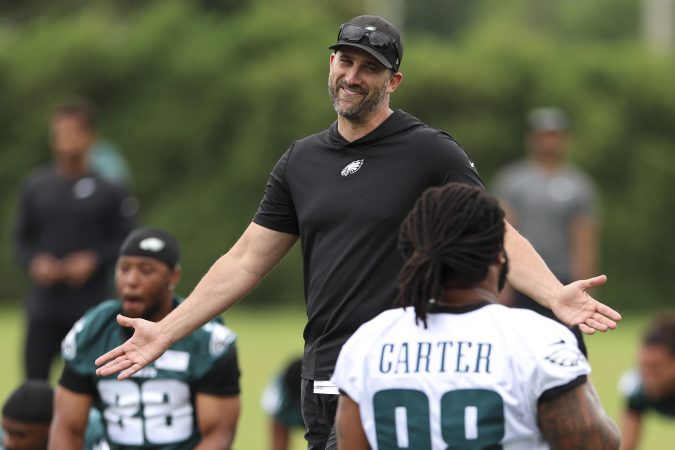
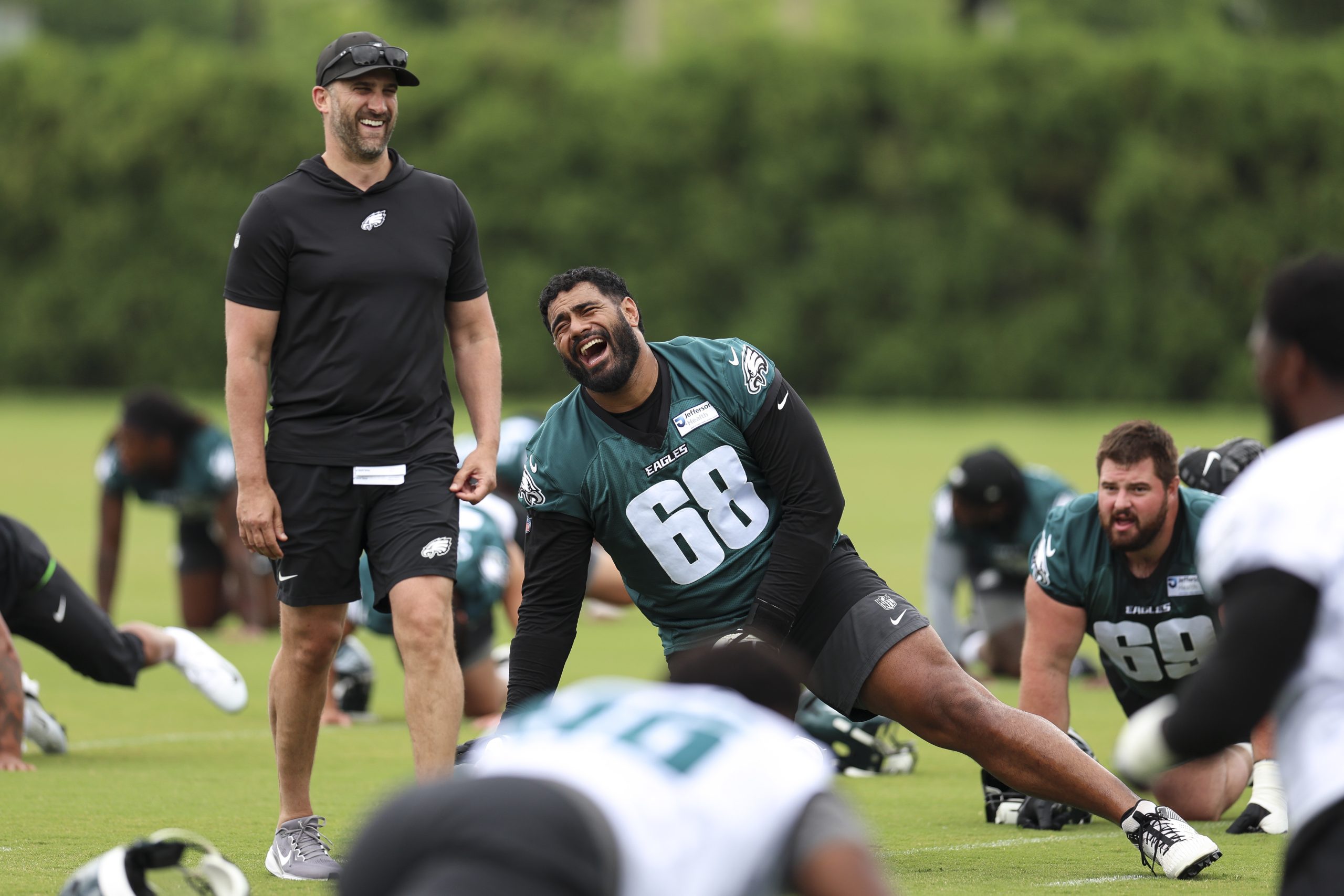
    Nick Sirianni (left) is attempting to guide his team following significant offseason changes. Monica Herndon / Staff Photographer

    Mannion, who Sirianni said tends to beat the head coach to the building, has only been a coach for two seasons. He was on a league roster as recently as 2023. The Eagles have had inexperienced coordinators before, but none quite like Mannion. So Sirianni said he has adapted his approach in some ways. In the past, he might have warned Steichen or Moore about a certain scenario he planned to throw at them in practice. But a third-and-12 from the 3-yard line might be a pop quiz for Mannion this time around.

    “My job is to make sure that I put him in as many scenarios as I possibly can to help him go through that,” Sirianni said.

    That part of Sirianni’s job hasn’t changed, but failures of the past may have informed how he views his role.

    But the more things change, the more they stay the same, as the saying goes.

    Sirianni said he noticed something when watching the NBA and NHL playoffs this year. The Knicks and the Spurs, the Hurricanes and the Golden Knights, they all said the same things, the same messages he’s been repeating her for more than five years.

    “There’s a common denominator of these good teams that they just want to play for each other,” Sirianni said. “We’ve talked a lot about that and tried to live that. That’s tricky and that’s hard. How do you come together as a football team? You come together through shared hardships. You get that through the offseason. You come together through building trust, consistently doing what you’re supposed to do. And you come together through the time that you put in with each other. That time, sometimes it feels like it’s invisible progress.

    “Our best teams since I’ve been here have been the closest teams. We believe in that very much.”

    How close will this team become? How will Mannion bring the offense to the next level? How will Sirianni help the Eagles navigate the changes and reach the high expectations in the building?

    The answers to those key questions won’t be known for a few months. The Eagles begin camp next week, and a key season in Sirianni’s career trajectory is about to get underway.

    “It’s a blessing to be at a place for so long in the NFL,” Sirianni said, “and I look forward to continuing that for years to come.”

  • Abington is paying the feds to ‘harass’ geese with lasers, pyrotechnics, and boats

    Abington is paying the feds to ‘harass’ geese with lasers, pyrotechnics, and boats

    Like many American suburbs, Abington accidentally spent centuries building a goose paradise. Now, the feds will help the township evict the waterfowl from their ideal habitat.

    Abington Township approved a contract with the U.S. Department of Agriculture on July 9 for Canada goose abatement in Alverthorpe Park, where airborne birds are attacking people driving golf carts, digging into sand traps, and dropping slippery, bacteria-laden feces onto walking paths and around the playground, township staff said.

    Goose droppings may also be affecting water quality at the park and interfering with fishing, according to the contract.

    Each goose can deposit up to a pound of feces per day, a USDA spokesperson said.

    “It’s a mess,” said Abington’s assistant parks director, Patricia Platt.

    USDA to harass Abington geese 35 times, may kill some to be used as food

    Between this month and June 2027, USDA personnel will conduct “waterfowl harassment” at the park, according to the contract, with “visual deterrents, use of lasers, and remote controlled boats, pyrotechnics, etc.”

    The service will cost about $15,000 for the yearlong contract.

    “Approximately 35 visits of harassment will be conducted throughout the spring and fall seasons,” the contract reads.

    The pyrotechnics mentioned in the contract are typically propane-powered noisemakers to scare the birds, a USDA spokesperson said.

    “It’s not like fireworks,” spokesperson Tanya Espinosa added.

    Lasers can mean green light beams trained on the ground to deter the birds.

    USDA workers start with less intensive goose-scaring methods and then escalate as needed, township and USDA staff said.

    The feds will also throw away goose eggs and, if the geese start molting, euthanize up to 150 birds for people to eat.

    Abington officials have considered other goose abatement tactics in the past. In 2023, the township’s shade tree commission asked whether a planned development across from Alverthorpe could include more shrubs and trees to reduce the goose habitat, but the engineering consultants said the community was adamant about an expansive grass lawn. The town’s 2023 parks plan suggests that closing some of the town’s outdoor ice rinks, which are wet lawns when not frozen, could help reduce goose habitat. The township parks director, Jessica Tholey, did not return calls and emails.

    Canada goose damage has been a problem across Pennsylvania for at least three decades. In 2010, USDA Wildlife Services received more than 400 “technical assistance requests” for goose damage in the state.

    Falls Township in Bucks County began reducing its resident goose population at a public park in 2015, according to its parks director. Falls spends about $17,000 annually for a private company to chase the geese with border collies.

    Honkers plentiful nationwide, Pa. says

    Goose populations have exploded across the United States in recent decades, rebounding from a dangerous low in the early 1900s when open hunting threatened migratory populations, according to the Pennsylvania Game Commission.

    “There probably are more honkers on the continent today than when the Pilgrims landed,” state officials write.

    Canada geese still migrate through the Philadelphia region — a group dubbed the Atlantic population.

    But many local geese are part of a nonmigratory population that is relatively new.

    Pennsylvania had no year-round populations until 1936, when the state game commission released 30 Canada geese with amputated wing joints at a reservoir near Lake Erie.

    The state added to the reservoir population in the 1950s, and by the 1970s, Southeastern Pennsylvania landowners were complaining about geese, according to a 2011 report from a group of government officials and wildlife biologists.

    Nuisance geese settled in Abington over 40 years ago

    The geese, which prefer open fields with short vegetation near water, thrived on the lawns, golf courses, and fake lakes of the Philadelphia suburbs.

    By the 1980s, the geese had reached Alverthorpe Park, where Abington officials considered balloons and plastic swans to deter them.

    A Philadelphia Inquirer article from April 1984 by Laura Quinn details the nuisance goose population in Alverthorpe Park.Deng-Jeng Lee

    But with tens of thousands of them already settled in the Delaware Valley, The Inquirer reported in 1984, the game commission officer for eastern Montgomery County, William Wasserman, was not optimistic: ”What we’ve got right now with Canada geese is probably going to remain the same to the year 2000 and beyond.”

    This suburban content is produced with support from the Leslie Miller and Richard Worley Foundation and The Lenfest Institute for Journalism. Editorial content is created independently of the project donors. Gifts to support The Inquirer’s high-impact journalism can be made at inquirer.com/donate. A list of Lenfest Institute donors can be found at lenfestinstitute.org/supporters.

  • How thousands of heavy-duty recycling carts made in Hunting Park ended up on construction sites around the U.S.

    How thousands of heavy-duty recycling carts made in Hunting Park ended up on construction sites around the U.S.

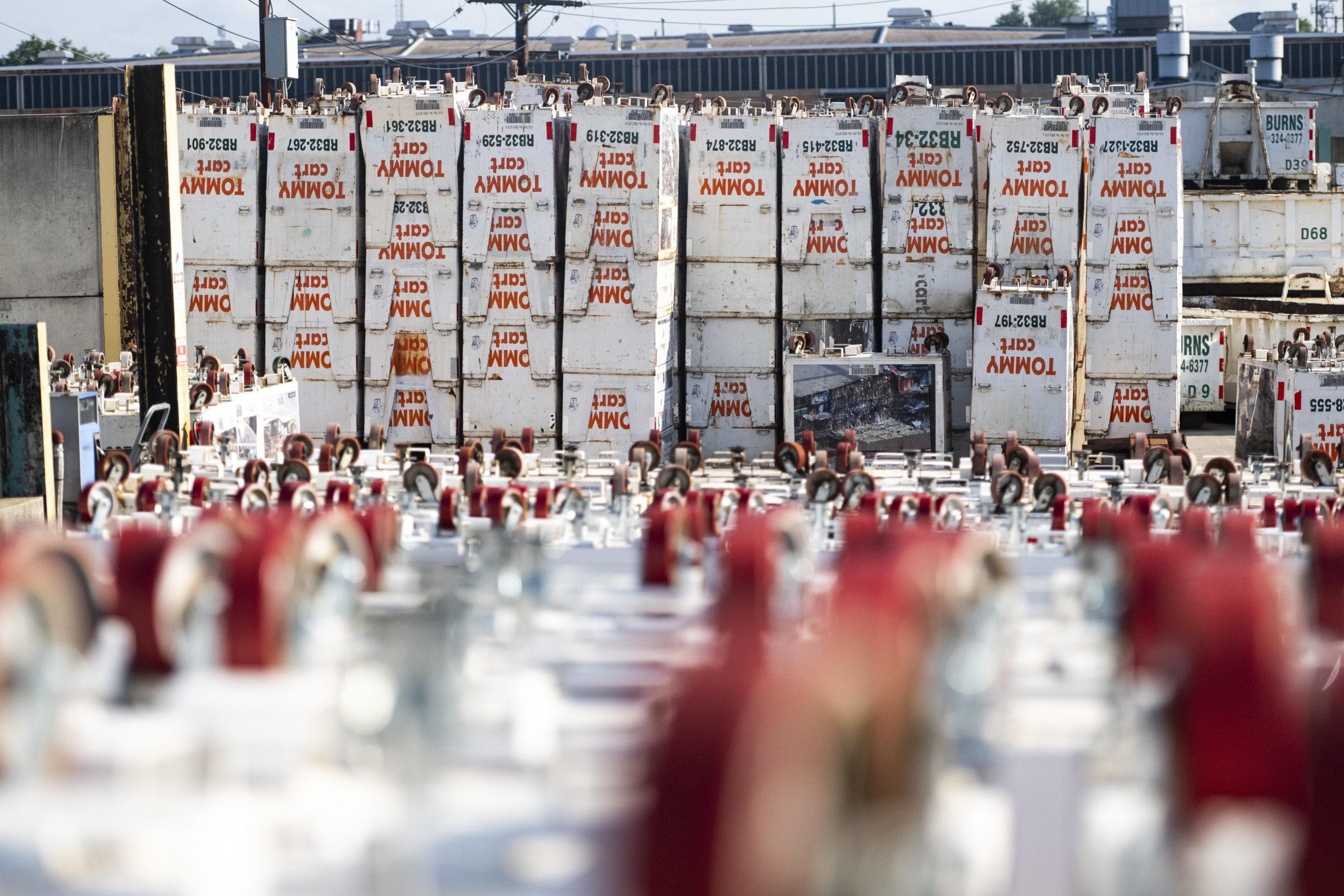
    The TommyCart, a durable, bar-coded, welded-steel recycling wagon made in Philadelphia, is popping up at U.S. construction sites from the Wanamaker Building’s apartment conversion in Center City to the Tennessee Titans’ new stadium in Nashville.

    The carts, specialized for recycling, were developed by Richard S. Burns & Co. at its 13-acre Hunting Park complex where demolition debris is sorted for resale to steel mills, building-materials makers, plastics plants, and other reusers.

    “We were struggling with increasing the quality of recycling material going out the door, and from the increased quantity of material coming in the door,” said Allen T. Burns, who runs the company, now known as Burns Services.

    Allen T. Burns (left), owner of Burns Services, and Ryan Fitzpatrick, director of business development, in front of stacks of TommyCarts, developed and patented by the company. Allie Ippolito / For The Inquirer

    His father, company founder Richard S. Burns, tried automatic sorters but found they chewed up and wasted more than half the material.

    So the family-led team invented and patented a heavy-duty cart, more nimble than the heavy dumpsters used to collect industrial waste. With the carts, they could more easily weigh, measure, and handle materials at crowded building sites. The process was efficient enough to resume hand-sorting and recover far more material to resell.

    Burns ships several thousand TommyCarts back and forth from his Hunting Park complex to regional building sites and has leased thousands more to construction recyclers in Washington, D.C., Pittsburgh, Chicago, and Tennessee.

    Using the TommyCarts, the company can sell about 80% of the recyclables it collects for reuse.

    Burns rolled out its first TommyCarts in 2015. The firm collected a string of patents, began selling the carts to other recyclers in 2023, and won a key industry certification last year. The goal is to produce up to 3,000 TommyCarts in 2027, double this year’s output and triple last year’s.

    How the company grew

    Burns Services has made an average of 500 carts a year since 2015, mostly for its own use at the company’s 13-acre Hunting Park complex. Truckloads and TommyCart-loads of debris — 500 trailers’ worth on a typical day — arrive at the yard, where the materials are sorted and sold.

    “We have six welders, and we can make 15 carts a day. We need to get close to 50 a day to keep up with demand. So we are getting into full robotic welding,” Burns said.

    The carts are named for Burns’ business developer, Tommy Garlick, who is listed as co-inventor on some of Burns’ nine patents.

    “We have rebuilt our maintenance shop, renovated our welding shop, sandblaster, and paint shop to make room for the automation,” Burns said.

    His father, born in an upstate prison, started the company after his Marine Corps service, a semi-pro football career, and a stint at a steel company.

    At the time, recycling was a response to the rising cost of landfills.

    “Dad’s philosophy is that waste is a commodity you haven’t found a market for,” Burns said on a hot June day over the clash of falling debris, sprayed by industrial misters, from the conveyor belt-driven sorting line above two lines of TommyCarts.

    A Burns worker sorts through debris emptied from a TommyCart at the Hunting Park plant.Allie Ippolito / For The Inquirer

    This is no clean-room factory, as where pharmaceuticals or computer chips are made. Carts are assembled in the Burns welding shop, with rectangular grips for forklifts, wheel mountings, and a brake attached below.

    Outside, sorting-line workers stand wrapped, booted, visibility-vested, and goggled like travelers in a sandstorm — though Burns worked gloveless as he lent a hand, flicking wallboard, steel trim, and plastic liners from truck-fed conveyor belts to the TommyCarts waiting below.

    Pre-TommyCart efforts at automated sorting mangled and smeared the loads, so less than a third of the material could be recycled. Next-generation TommyCarts, numbered and coded, are easy to move in confined areas, simple to weigh before and after sorting, and less damaging.

    Fire can be a menace in a scrapyard — more so recently, with rapidly growing incidence of hot lithium-ion fires from improperly discarded tool and appliance batteries. The EMR scrapyard, Burns’ go-to buyer for iron and steel near Camden’s Beckett Street metal-shipping port terminal, was closed after its latest fire in May, forcing area yards like Burns to find new buyers.

    Burns also had fires traced to batteries this summer, noted John Thomas, Hammonton-based president of the Construction & Demolition Recycling Association, which named Burns “Recycler of the Year” for 2025.

    Honky-tonk cleanup

    In 2023, a Nashville builder gutting a 30,000-square-foot site for country star Morgan Wallen’s new bar had a problem: Trucks couldn’t squeeze onto the site in the city’s crowded Lower Broadway honky-tonk strip and had to be hand-loaded from a distance — at prohibitive cost.

    Lincoln Young, a demolition-debris contractor who runs Rockwood Sustainable Solutions in Tennessee, reached out to Burns in Philadelphia. “He has a patented system, a proven process,” for rolling TommyCarts into the building and back to the trucks, Young said, so the material can be easily weighed, sorted, and sold.

    Rockwood leased carts for the job and became Burns’ first outside TommyCart user.

    “The beautiful thing, these carts would cost me maybe $1,200 to make, but leasing them I have no capital cost. I can scale more or less of them when I need them,” Young said. “General contractors around the country are now calling for TommyCarts in their contract specs. We have hundreds of TommyCarts now at the new Titans stadium.”

    A worker pushes a TommyCart to be emptied and sorted at Burns Services in Hunting Park. Allie Ippolito / For The Inquirer

    Burns says verifiable measurement is the key to paid recycling. The conveyor system reads the bar codes and records the gross weights to calculate payment.

    “This is not the cheapest way of doing it,” Burns said. “We have competitors who charge less per container. But this way you have accountability. You can get industry certifications.”

    The carts are welded — 20 feet of weld per cart — joining plates of 3/16-inch steel supplied by distributor Joseph Fazzio in Glassboro from U.S. and foreign mills.

    Burns also has tried automated painting systems for the sandblasted metal surfaces, so carts can go a decade without repainting. A $50,000 automated-spraying rig can pay for itself in two years by using less paint, he said.

    “Automation itself is not the issue. Like any tool, it is how it is used,” said Anton Ruesing, director of the Finishing Trades Institute for the IUPAT painters’ labor union. “Tools that reduce repetitive motion injury, improve safety, increase productivity, or even lower costs can enhance both the worker’s and the contractor’s experience” — as long as the worker remains in control and helps plan the job.

    TommyCarts are used at building and demolition sites to collect recyclable materials and shipped back to Burns Services for sorting and selling.Allie Ippolito / For The Inquirer

    The company’s Philadelphia location helps recruit reliable labor, Burns said. He’s hired industry veterans, immigrants, former prisoners, and family members of employees. Some workers have been targeted by Immigration and Customs Enforcement, incurring legal bills even though they are in the U.S. legally, Burns said.

    Work in the yard starts at $16.50 an hour plus benefits, rising to $38 an hour. Overtime starts with the federally mandated time-and-a-half over 40 hours a week, rising to 1.8 times base pay after 60 hours. Sorters can earn more than $50,000 a year, plus benefits.

    Burns’ sons work there, too. “Me and my brothers, we dropped out of high school and worked for my dad,” he said.

    Burns says he learned more in decades of long work, weeks next to his father in the workshops, and from the lawyers, accountants, architects, engineers, and other professionals that help deal with clients and suppliers.

    “I worked elbow-to-elbow with my father,” he said.

    Burns says automation makes work smarter but doesn’t eliminate the need for people, who come up with in-house solutions to tough problems.

    That’s why, as construction companies are experimenting with artificial-intelligence systems, Burns has built a staff of four full-time software programmers.

    “Off-the-shelf systems don’t do what we need,” Burns said.

  • A WWII veteran who ‘deserves everything’ gets a surprise 100th birthday party and a letter from Gov. Mikie Sherrill

    A WWII veteran who ‘deserves everything’ gets a surprise 100th birthday party and a letter from Gov. Mikie Sherrill

    With a century of life under his belt, it’s not easy to get much past World War II veteran Stephen Anderson.

    But last Tuesday, Anderson was surprised to return home to find a large 100th birthday celebration in his honor with gifts, commendations, and even a letter from Gov. Mikie Sherrill waiting for him.

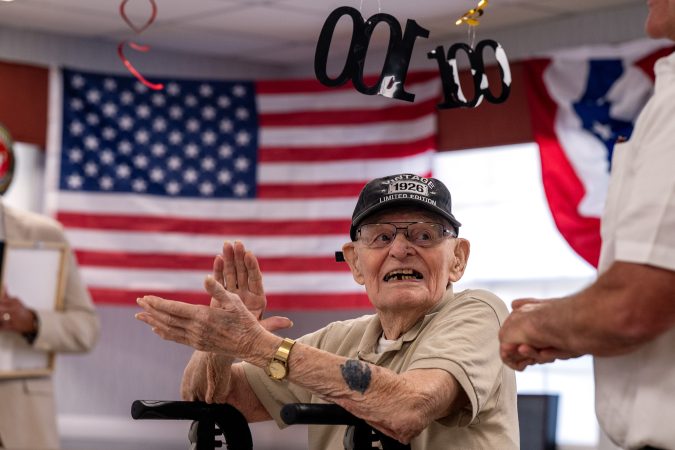
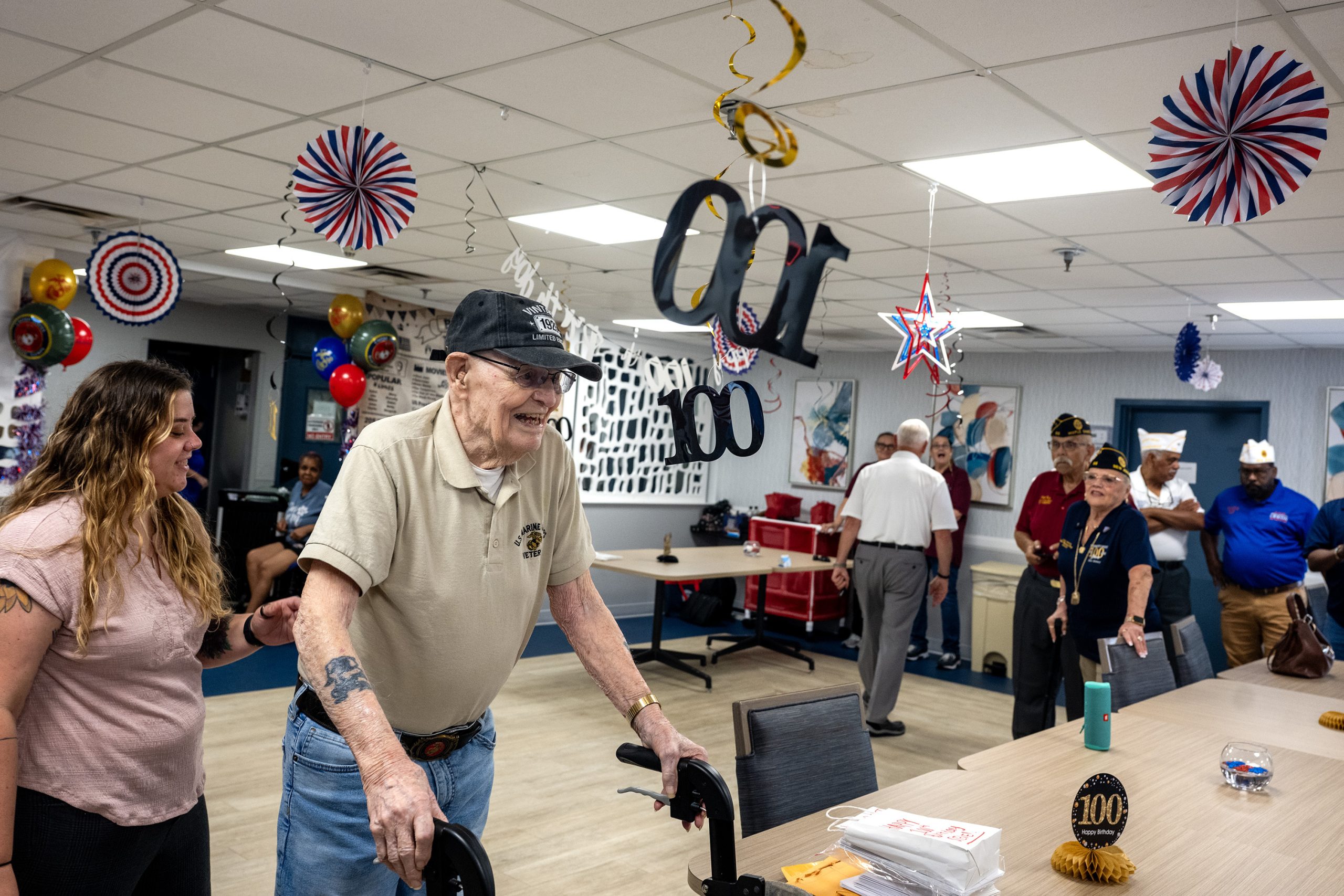
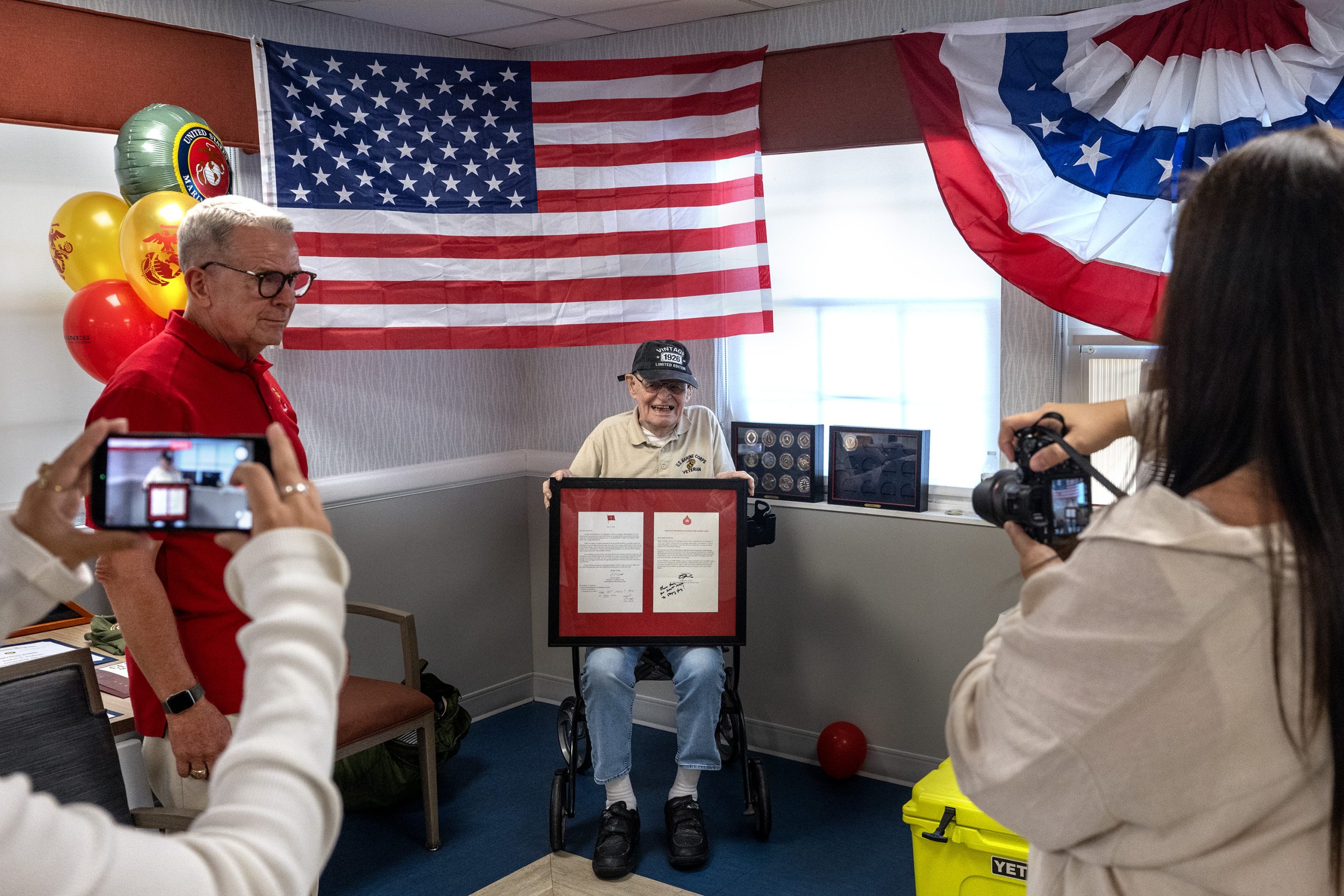
    Wearing both a T-shirt and belt buckle emblazoned with the United States Marine Corps emblem, Anderson entered the dining room at the Wynwood Rehabilitation and Healthcare Center in Cinnaminson with a big smile as his friends, fellow veterans, neighbors, and more sang “Happy Birthday.” Each of Anderson’s arms are adorned with prominent dark tattoos that have now mostly faded to outlines, the finer details lost to time.

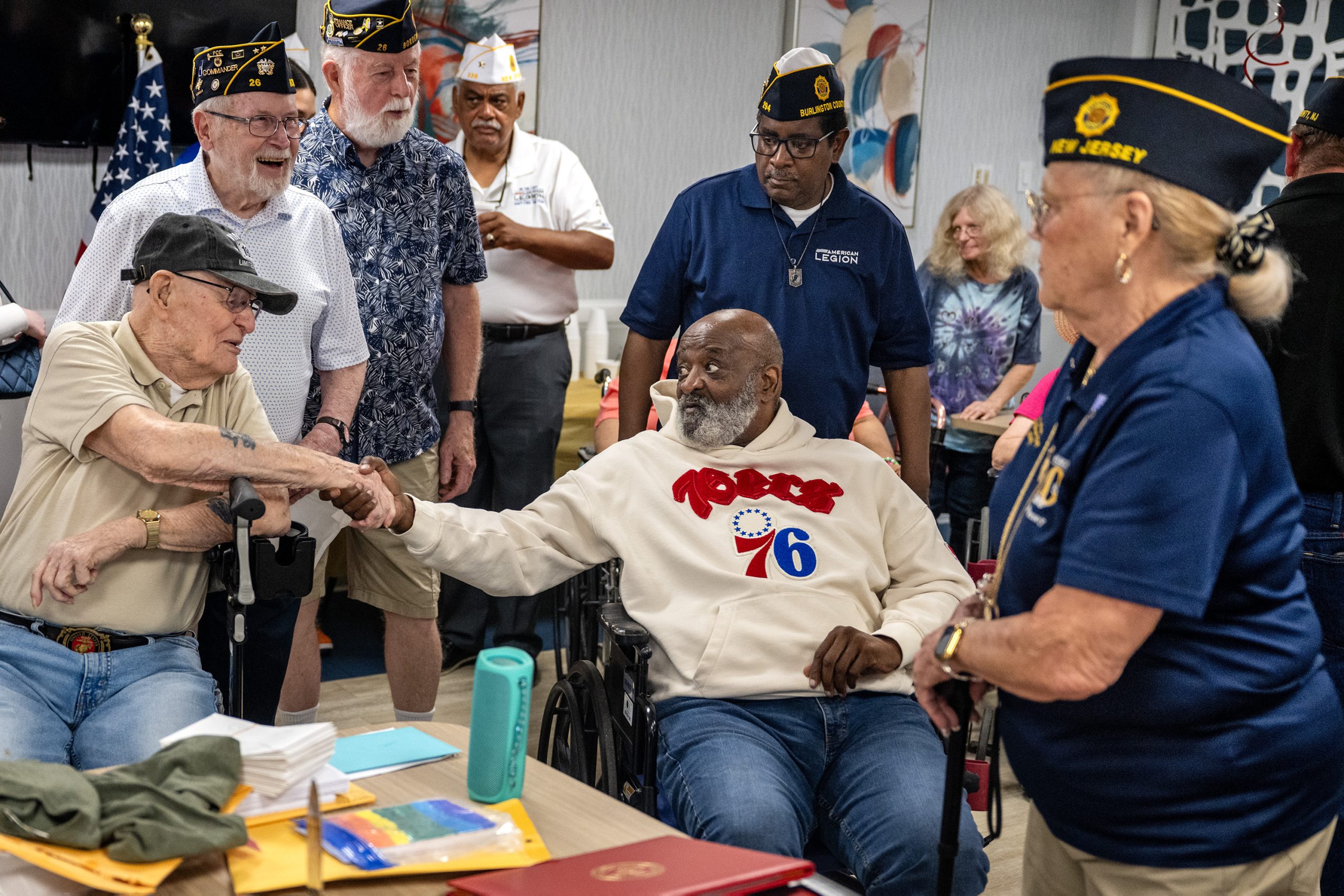
    As cupcakes and ice cream were passed around, Anderson was quick to laugh as he joked with the staff and reunited with longtime friends from the American Legion, where he has been a member for 82 years.

    “It’s amazing,” he said in between bouts of banter with old friends.

    “It’s great because I can’t get out like I used to,” he said. Now, everyone’s come to him.

    WWII U.S. Marine Corps (and U.S. Air Force) veteran Stephen Anderson is surprised by fellow vets who attended his 100th birthday party Tuesday at the Wynwood Rehabilitation & Healthcare Center in Cinnaminson.Tom Gralish / Staff Photographer

    The party was put together by the staff at Wynwood, where he has lived since 2023 and has since become a beloved resident.

    Stephanie Ward, Wynwood’s director of social work, was the driving force behind the celebration, organizing the party and contacting the Legion, the Tun Legacy Foundation, and the governor’s office to recognize Anderson for his lifetime of service.

    “He’s so amazing, he’s got a kind heart,” Ward said. “All the veterans always have a special place in my heart and this big milestone, you’ve got to celebrate it.”

    Cupcakes, including one with topping of iconic flag raising at Iwo Jima, at the 100th birthday party for WWII U.S. Marine Corps (and U.S. Air Force) veteran Stephen Anderson at the Wynwood Rehabilitation & Healthcare Center in Cinnaminson. He was presented with a letter from Gov. Mikie Sherrill, and letters from both the commandant and sergeant major of the Marine Corps, and more.
    Tom Gralish / Staff Photographer

    Not one to draw attention to himself, she joked that Anderson would probably give her a hard time for setting up the elaborate surprise party for him.

    “I’m going to get yelled at later,” she said with a laugh. “But he deserves everything.”

    Separated by oceans and decades, it is clear that Anderson’s military service is still close to his heart.

    Originally from Massachusetts, he enlisted in the Marines at just 17 years old and was quickly sent to fight in some of the most harrowing battles of WWII, the Korean War, and the Vietnam War. A rare two-branch veteran, Anderson also served in the Air Force from 1961 to 1963.

    “Where he fought is legendary. Saipan, Okinawa — some of the largest battles of the war,” said Patrick Dailey, a Marine and founder of the Tun Legacy Foundation, which is working to rebuild Philadelphia’s historic Tun Tavern, where the Marine Corps was born in the 17th century.

    WWII U.S. Marine Corps (and U.S. Air Force) veteran Stephen Anderson arrives for his 100th birthday party with Stephanie Ward (left), director of social services at the Wynwood Rehabilitation & Healthcare Center in Cinnaminson.Tom Gralish / Staff Photographer

    To honor his years of service and sacrifice, Anderson was presented with official letters from Gov. Mikie Sherrill, the New Jersey legislature, and various levels of American Legion leadership.

    Anderson seemed particularly moved by messages from his fellow Marines — personal letters from the Marine Corps commandant, the highest-ranking officer, and the sergeant major of the Marine Corps, the most senior enlisted member of the service.

    He was also gifted an American flag that was flown over the U.S. Marine Corps Memorial by troops in Washington, D.C., on July 4 for him.

    WWII U.S. Marine Corps (and U.S. Air Force) veteran Stephen Anderson (left) is greeted by his roommate Michael Evans (right) at his 100th birthday party Tuesday at the Wynwood Rehabilitation & Healthcare Center in Cinnaminson.Tom Gralish / Staff Photographer

    While Anderson said he expected some of the Wynwood staff might be up to something for his birthday, he said he was not anticipating the celebration that had formed around him.

    Brought to New Jersey in the 60s “by Uncle Sam,” as he put it, Anderson spent many years living in Burlington and has long been a dedicated member of American Legion Local Post 39 based in Roebling, at one point serving as commander.

    Looking back, he said one of the best parts of the job was simply getting to drive all over rural South Jersey.

    “I kind of miss that, I used to travel all the back roads,” he said with a smile.

    WWII U.S. Marine Corps (and U.S. Air Force) veteran Stephen Anderson is photographed with letters and proclamations following his 100th birthday party Tuesday at the Wynwood Rehabilitation & Healthcare Center in Cinnaminson.Tom Gralish / Staff Photographer

    Anderson has lived “a lifetime of service to the military, to the country, to the American Legion,” said longtime friend Chuck Robbins, a former national vice commander of the American Legion who worked with Anderson.

    “You couldn’t ask for a more outstanding vice commander. Somebody who did their job to the fullest and always had my back — I will never forget the service you gave to me,” he said as he presented Anderson with a letter from the national commander of the Legion.

    Looking at the flag in its shadow box, numerous framed commendations, piles of birthday cards and more laid out on the table before him, Anderson joked with Ward that they’d need to work out a plan to accommodate all of his gifts.

    “You better get me a bigger room!” he said, laughing.

  • A former prosecutor said DA Larry Krasner’s Office colluded with defense attorneys to try to overturn a murder conviction

    A former prosecutor said DA Larry Krasner’s Office colluded with defense attorneys to try to overturn a murder conviction

    A former Philadelphia prosecutor who recommended that a man’s murder conviction be overturned said she did so at the direction of her boss — who she said had done no meaningful review of the evidence and instead was “colluding” with defense attorneys to find the most effective way to have the case thrown out.

    While testifying at a unique hearing Friday in federal court, former Assistant District Attorney Jaclyn Mason said supervisors in the district attorney’s office had effectively abandoned their responsibility to independently investigate Dennis Johnson’s appeal and determine if he should be freed from prison.

    Instead, Mason said, her supervisor, Matthew Stiegler, held routine meetings with Johnson’s lawyers, including the Federal Community Defender Office and the Pennsylvania Innocence Project, to strategize the most effective paths to secure Johnson’s release. And neither she nor Stiegler reviewed key evidence in Johnson’s case, she said, including trial transcripts, homicide files, or witness interviews.

    “Matt told me: ‘If it’s good enough for the Innocence Project, it’s good enough for me,’” Mason said.

    Just as strikingly, she said, earlier this spring, when it became clear that that process might be exposed in court, another set of supervisors asked her to lie to a federal judge.

    As Mason recalled, the supervisors were worried that if the judge found out the full extent of the office’s actions in the case, it would exacerbate the already intense public scrutiny the office was under for the way it had acted in other murder appeals.

    According to Mason, the supervisors suggested she simply tell the judge that any mistakes in the case were hers, and hope that that would be enough to avoid a more thorough inquiry.

    Mason said she declined and resigned.

    “I said, ‘I’m not going to go to court to lie to protect the district attorney’s office,” Mason said. “How come telling the truth isn’t an option?”

    The extraordinary testimony came as part of Johnson’s appeal, which has taken an unusual path through the courts and remains pending before U.S. District Judge Paul S. Diamond.

    It also served as the latest chapter in a series of developments that have raised questions about one of District Attorney Larry Krasner’s key policy initiatives: his office’s willingness to review old convictions and seek to overturn those that prosecutors believe were marred by legal problems.

    Just last month, the Pennsylvania Supreme Court ruled that Krasner’s office had misled judges so consistently and flagrantly in appellate matters that moving forward, any time his office recommends that a conviction be overturned, the state attorney general must be brought in to review the matter as well.

    Diamond was also involved in disciplining two top supervisors in Krasner’s office in recent months, finding that they had been “misleading and dishonest” while seeking to overturn an inmate’s death sentence.

    Krasner has made post-conviction review a central part of his reform-oriented agenda, touting the fact that his office has helped free 59 people — mostly Black men — from what he’s called wrongful convictions.

    But judges in both state and federal court have raised pointed questions in recent months about whether Krasner’s office has been sloppy or even intentionally misleading while seeking to advance that agenda.

    And during Friday’s hearing, Diamond expressed occasional bewilderment at some of Stiegler’s admissions on the stand — including that while he led the office’s Federal Litigation Unit, his staff generally did not reinterview witnesses or speak to previous prosecutors before deciding whether to recommend that a conviction be overturned.

    “It’s a smorgasbord of error — and we’re just gonna pick one?” Diamond asked.

    A ‘pawn’ in a preordained process

    The case around which Friday’s hearing was nominally centered was Johnson’s conviction for second-degree murder.

    In 2009, a jury found him guilty of fatally shooting Kenyatta Smith during a robbery outside a North Philadelphia convenience store two years earlier. He was sentenced to life in prison.

    Johnson appealed, in part because he said his trial lawyer was ineffective.

    And in 2022, Mason filed court documents agreeing with that assertion — and saying the error was so pronounced that his conviction should be thrown out.

    “The case against Johnson was not overwhelming from the outset and his counsel was constitutionally ineffective,” Mason wrote. “The post-trial investigation unearthed additional factors that highlight weaknesses in the prosecution and confirm a low level of confidence in the outcome of Johnson’s trial.”

    In court Friday, however, Mason said she was effectively doing Stiegler’s bidding when she filed that brief.

    She’d only been in the office for about four months when Stiegler assigned her Johnson’s case, she said. And she’d never before worked as a prosecutor or handled similar federal appeals.

    The office also gave her close to no training, she said. And from the moment she was assigned Johnson’s case, she said, she got the impression that Stiegler knew how he wanted the matter to go.

    “The decision to concede had been made, and then I was his pawn,” she said. “I was his scribe.”

    In the months that followed, Mason said, she and Stiegler did almost no independent examination of the evidence in Johnson’s case. But they did have meetings with Johnson’s attorneys, she said, at which the two sides sometimes collaborated on legal strategies for how to ensure his petition would succeed.

    When Mason did actually draft the brief supporting the appeal, she said, Stiegler offered edits — all of which made it into the document. Another supervisor, Nancy Winkelman, the onetime head of the Law Division, also made suggestions that were included in the final brief, Mason said.

    Stiegler testified Friday as well, and said he believed that when Mason was assigned the case, she would review it and provide her best assessment to him. That review, he said, was expected to include an examination of key evidence, including trial testimony or witness statements.

    But under questioning by Diamond, he acknowledged that his unit at that time did not regularly reinvestigate cases, either by re-interviewing witnesses or reexamining primary evidence — an admission that seemed to baffle the judge.

    “You did no investigation on your own?” he asked at one point.

    “No,” Stiegler replied.

    As for the decision to agree that Johnson’s conviction should be overturned, Stiegler said: “My recollection is it was a collaborative decision between Ms. Mason and me.”

    But Mason said that wasn’t true.

    “He met and conferred with the Federal Defender and the Innocence Project to decide how it was going to go before it was assigned to me,” she said.

    A sudden resignation

    Still, none of that discord surfaced until this spring, when Diamond — who will ultimately decide whether to overturn Johnson’s conviction — scheduled an evidentiary hearing. At the time, he said he wanted to hear from several key witnesses to evaluate the strength of the evidence against Johnson.

    He also asked the attorney general’s office to review the case, apparently wary that the district attorney’s office was simply agreeing with Johnson’s lawyers.

    At that point, Mason said, a set of different supervisors in the Law Division “started to panic.”

    And after she told them the “collusive” manner in which the appeal had been handled, she said she was told, in essence, to fall on her sword.

    As Mason recalled it, the supervisors told her to tell Diamond that any mistakes in the office’s brief were hers, “and if we do that, the court might get angry, but it won’t find out how this concession got put together — which is what we really want to avoid.”

    “The whole goal [was] that the process by which that concession came to be not be revealed,” Mason said.

    Within days, Mason said, she resigned.

    A few days after that, the supervisors in the Law Division — David Napiorski, Steven Wildberger, Peter Andrews, and Katherine Ernst — filed a motion with Diamond seeking to undo the position that Mason and Stiegler had once recommended, saying the pair’s brief had been based on “material misstatements.”

    Mason said she was “blindsided” by that filing, and that she believed she was being used as a scapegoat to protect the office and its actions in the case.

    “The whole scheme was designed to cover up how that brief was put together,” she said.

    Friday’s hearing ended before the supervisors she accused of wrongdoing had time to testify or respond to her assertions. Diamond said he would schedule another hearing to hear from them.

    Johnson’s fate also remains undecided with the legal issues unresolved.

    Stiegler, meanwhile, denied that he’d pushed Mason to take a specific position in the case, or that he’d had improper interactions with Johnson’s defense lawyers as the office worked on the appeal.

    Mason was definitive in her view of Stiegler’s testimony.

    “Nothing Matt said was true,” Mason said. “Nothing he said was true.”

  • What’s changed at the President’s House with the Trump administration’s new exhibit

    What’s changed at the President’s House with the Trump administration’s new exhibit

    The National Park Service removed early Wednesday the few panels that remained from the slavery exhibit at the President’s House, and replaced them with new panels.

    The original displays were deemed to “inappropriately disparage Americans past or living” following President Donald Trump’s 2025 executive order on “restoring truth and sanity to American history.”

    The newly installed panels include 11 whose renderings were published on the National Park Service’s website and first reported by The Inquirer in April, as well as smaller panels that weren’t previously made public. Among those are additional references to the nine people George Washington enslaved in his Philadelphia home.

    Historians previously criticized the panels for minimizing the brutality of slavery and whitewashing Washington’s culpability in the institution.

    And according to advocates, the additions don’t change much.

    Telling a blatant lie, such as claiming slavery didn’t exist, would be too easily exposed, said Michael Coard, a founding member of Avenging Our Ancestors, a group that advocated for the development of the site.

    “The best lie is one that has a little bit of truth,” Coard said.

    The new panels make light of slavery, the attorney said, and focus on Washington’s “discomfort” instead of the experience of the nine people the United States‘ first president enslaved in Philadelphia.

    Others criticized the panels for drifting away from the site’s original purpose.

    When the site open in 2010, the city and National Park Service said the President’s House exhibit “pays tribute” and “honors lives of enslaved Africans in presidential household.”

    The Department of Interior said Wednesday the new panels “acknowledge the evils of slavery, including its injustices and hypocrisies, and, by telling the stories of the nine slaves that Washington kept in the President’s House, remind us of their essential humanity.”

    The Inquirer photographed the original panels before their removal and the new panels that were installed this week. Here are the differences in the exhibit.

    What’s gone

    The original exhibit included five screens across the site that played reenactments depicting the daily lives of those enslaved at Washington’s Philadelphia home.

    “The site had to tell the stories that are not often told and share the perspectives of the people who up to now have been nameless and voiceless,” said Rosalyn McPherson, the site’s project director, in the 2010 news release.

    Those screens were turned off.

    Also gone are the artistic panels, which included a portrait of Ona Judge, who escaped from slavery at the house, and another about Washington’s signing of the Fugitive Slave Act.

    Workers remove the display of panel for Ona Judge at the President’s House in Independence National Historical Park in January.Tom Gralish / Staff Photographer

    What’s replaced

    The removed panels included information about the suffering of enslaved people.

    A panel titled “The Dirty Business of Slavery” included information about the slave trade, the constitutional compromise to appease slaveholders, the growth of the enslaved population during the presidencies of Washington and John Adams (who also lived at the President’s House), and a timeline of slavery from 1619 and through emancipation.

    Another panel, titled “Life Under Slavery,” discussed the brutality of the notorious institution, resistance efforts, and slavery in Philadelphia.

    It told the story of Absalom Jones and Richard Allen, men who were born into slavery and managed to buy their own freedom.

    “Enslaved people of African descent in the North, deprived of fundamental freedom, endured profoundly difficult lives,” the panel read. ”Controlled by others, their families were always threatened by forced separation, and their work, often exhausting, was nearly always unpaid.”

    Those panels were replaced with ones that include broad descriptions of slavery that do little to unpack the experience of those subjected to it, and focus on the triumph of emancipation.

    The new “Fighting for Freedom” panel discusses the Underground Railroad, quotes Frederick Douglass, Abraham Lincoln’s rise to the presidency, and the Emancipation Proclamation.

    Another panel about “The Constitution and Slavery” begins by stating: “The words ‘slave’ and ‘slavery’ are not in the U.S. Constitution as ratified, nor the word ‘property’ in connection with language alluding to slavery.”

    It discusses “compromises with pro-slavery delegates,” and ends with a section titled “fulfilling the promise” that quotes the Rev. Dr. Martin Luther King Jr.’s “I Have a Dream” speech.

    A panel about “Slavery in the British Colonies” pays homage to Benjamin Franklin and Black abolitionists, and shows the declining numbers of enslaved people in Philadelphia between 1767 and 1847.

    And in a trio of displays called “History Lost & Found,” the Trump administration focuses on how the 2007 archaeological dig of the site worked and discovery of primary sources documents it presents as non-controversial: Washington’s letters and a map of the property.

    Unlike the original panels about the archaeological dig, the new ones have no mention of slavery, the nine people Washington enslaved, or the National Park Service’s initial apprehension about helping to develop the memorial.

    But starkest difference comes in the treatment of slavery at the President’s House itself.

    An original panel included a timeline of the site’s history from the time Indigenous people lived in the area and through the 2002 discovery of slavery at Washington’s household.

    It continued to discuss the collaboration between the city, federal government, and community groups to develop the site.

    The panel’s section on slavery at the house focused on George and Martha Washington ownership of enslaved people, the president’s secret efforts to evade Pennsylvania’s Gradual Abolition Act, and the escapes of Ona Judge and Hercules.

    In contrast, the new panel titled “The Executive Mansion” follows a mention of slavery at the house with a statement that Washington’s views evolved and that he freed his slaves in his will.

    Another new panel that addresses “Presidents Washington and Adams on Slavery” head on says Washington was “caught between his private doubts about slavery and his public responsibilities as president” and privately “often expressed discomfort with the institution.”

    “Slaves living in the President’s House experienced a greater modicum of autonomy than elsewhere in the South such as to explore the city and sometimes even attend the theater, with Washington buying the tickets,” the panel reads.

    On the same wall, a new smaller panels lists the nine people Washington enslaved alongside short bios. The panel tells visitors that Washington “knew and trusted his enslaved house staff,” and repeats that he used to “buy them tickets to the circus and the theater.”

    The wall also includes a smaller panels that briefly tells escape stories of Judge and Hercules, and references Washington’s attempt to recapture them.

    What’s new

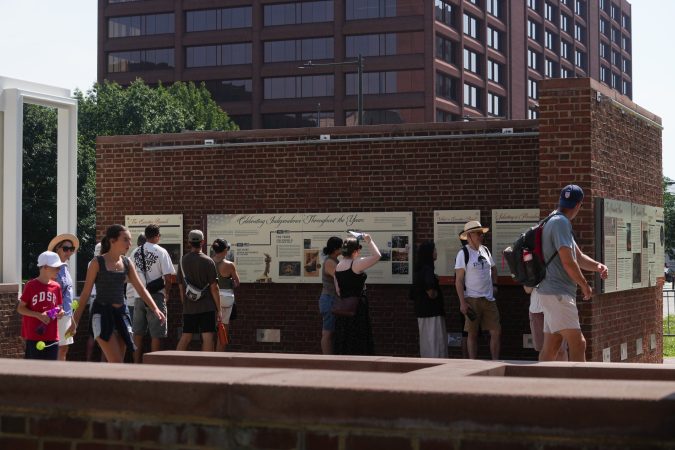
    Multiple panels throughout the exhibit share facts about U.S. history, but bear no connection to the site or slavery. These include “Celebrating Independence” and “Throughout the Years,” which denote the nation’s 100, 150, and 200 year celebrations.

    And a series of panels provide a civic lesson about the history, powers, and role of the commander in chief. Another panel discusses “the need for an executive branch.”

    New panels detail the biographies of George and Martha Washington, John and Abigail Adams, and Benedict Arnold. The biography of William Howe, a British commander who occupied Philadelphia during the Revolutionary War and lived at the President’s House, is also attached to the wall.

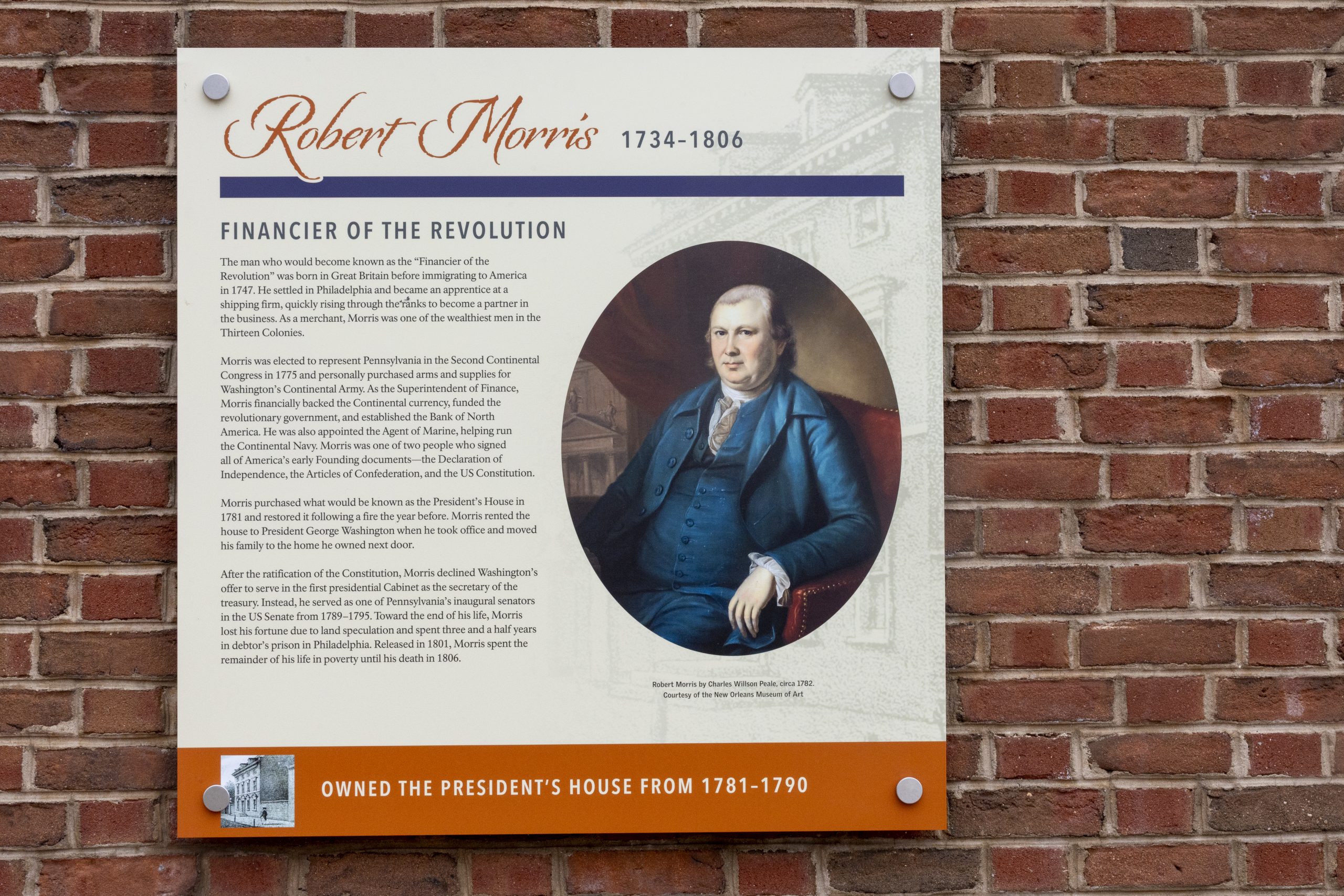
    Finally, the new exhibit pays homage to Robert Morris, known as the “financier of the American revolution” and offered Washington the house as the executive mansion with a panel dedicated to his biography.

    Morris’ ownership of a company that traded slaves is never mentioned.

    A detailed image of one of the new panels installed by the National Park Service at the President’s House this week.Aidan T. Gallo / Staff Photographer
  • LeBron to the Sixers would be bigger than we seem to understand

    LeBron to the Sixers would be bigger than we seem to understand

    On Oct. 28, 2003, the 76ers opened their regular season at home — the arena was called the Wachovia Center then — with an 89-74 victory over the Miami Heat. It was the first game of Randy Ayers’ head coaching career, a career that would last just 52 games before he was fired. The Sixers’ starting lineup that night would make for a trivia question that would stump even the most obsessive hoops historian. Can you name the five? Don’t bother trying. They were Allen Iverson, Eric Snow, Derrick Coleman, Kenny Thomas, and John Salmons. It was, to put it mildly, a long time ago.

    The next night, LeBron James played his first game in the NBA.

    It is not enough to say that James has been with us ever since, for more than 22 years. It is not enough, now that the 76ers are reportedly one of the few franchises for whom James might choose to play this season, to say that he would be a nice, snug fit with Tyrese Maxey, Jaylen Brown, VJ Edgecombe, and Joel Embiid (when Embiid is healthy enough to suit up). For much of those two decades-plus, he has been the dominant figure in professional basketball and, at times, in all of sports. If your primary thought about a James-Sixers union is, He’d be the perfect power forward for this team, you’re shrinking him to a ridiculous size.

    Immediately upon his arrival, he would be the biggest sports star in this city, beyond any of his teammates, beyond anyone on the Eagles or Phillies. A talk-radio debate about Jalen Hurts would be a literary salon next to the daily LeBron discourse.

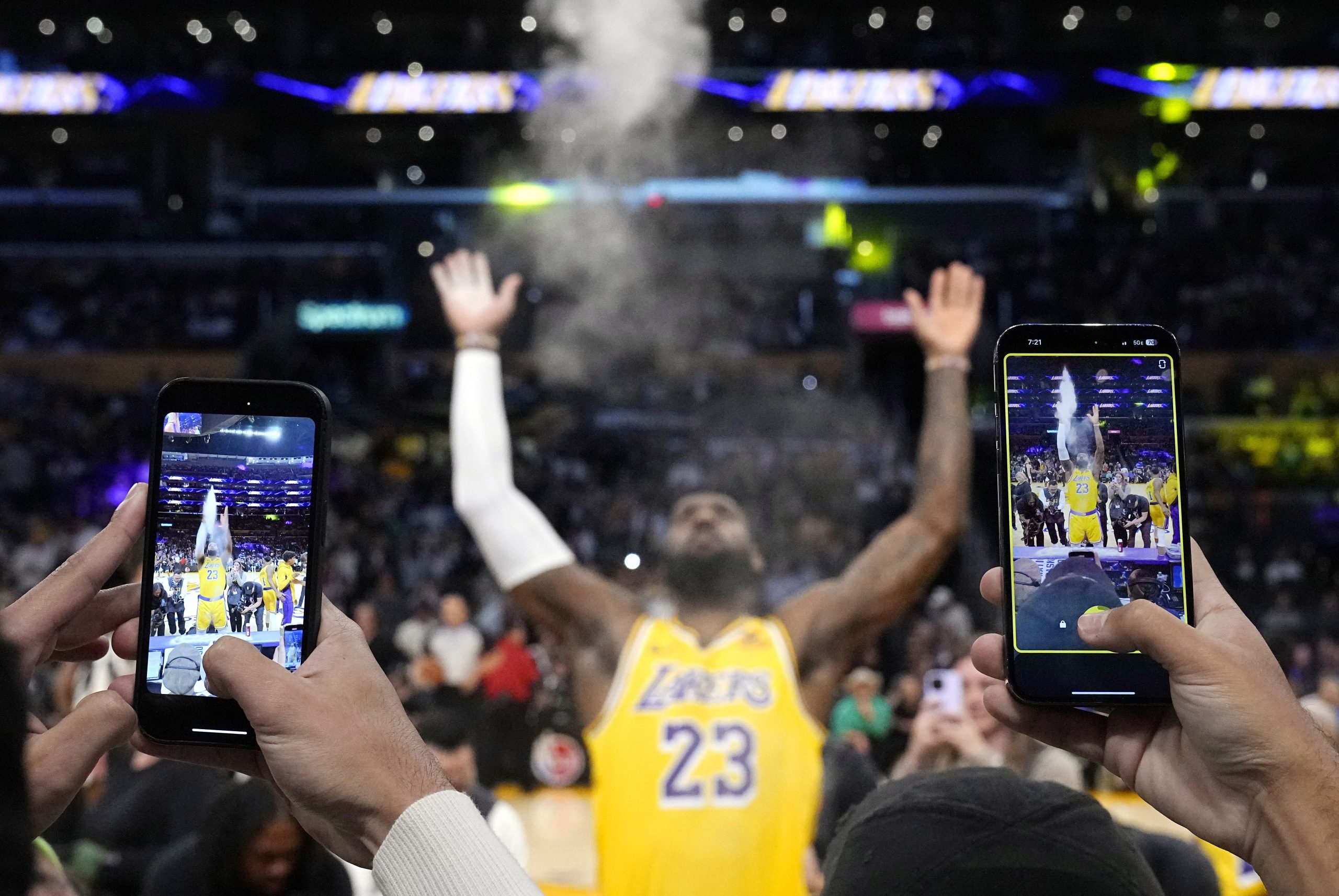
    LeBron James’ arrival would dwarf that of Bryce Harper and other superstars.Mark J. Terrill

    Steph Curry changed the way basketball was played and the way boys and girls around the world wanted to play it, and among the fraternity of NBA players themselves, Kobe Bryant was more respected and feared, for his preparation and cutthroat competitiveness, than James. But James has been greater longer than any other player in the sport (with the possible exception of Kareem Abdul-Jabbar, if you count his Lew Alcindor/UCLA years).

    Set aside, if possible, the four NBA championships and the 10 Finals appearances and the league’s career scoring record and the three Olympic gold medals and the other records he has set. His choreographed announcement in 2010 that he was leaving the Cleveland Cavaliers for the Miami Heat was the 21st century’s answer to the revelation that Kristin Shepard had pumped two bullets into J.R. Ewing’s belly. It changed everything about the power that elite players held over their respective teams because it showed elite players that they held power over their respective teams. Pro sports hasn’t been the same.

    Finding an athlete comparable to James in popularity and influence is difficult enough, let alone one who arrived in Philadelphia during the middle stage or latter half of his career, after he had established his galactic superstardom. Wilt Chamberlain already had been a high school phenom here when the Warriors made him a territorial pick in the 1959 NBA draft. Julius Erving was the “Babe Ruth of basketball” — at least, that’s how Sixers general manager Pat Williams described him in trying to persuade owner Fitz Dixon to cough up the money to acquire Dr. J. But Erving had spent six years in the relative obscurity of the ABA; telling someone you had seen him play for the Virginia Squires or New York Nets, whether in person or on TV, was akin to claiming you had spotted a Sasquatch.

    Allen Iverson was a pop-culture revolutionary with the Sixers for introducing hip-hop style and fashion into the mainstream; his on-court accomplishments, though, don’t stack up to James’. Bryce Harper was as well known as any player in Major League Baseball when he signed with the Phillies in 2019, but he didn’t and still doesn’t have anywhere near the global recognition and cachet that James does. We’re talking an all-timer among all-timers here.

    None of this context and history means that James will sign with the Sixers, and none of it means that they’ll win a championship for the first time since 1983 if he does. But it does provide a good counterbalance to the muted public reaction to the prospect that James could become a Sixer any day now. Yeah, he’s 41. Yeah, he has his coterie of agents and handlers and podcasters and supplicants. Yeah, he could turn out to be a handful or worse, especially if he wants to be the alpha on a team of younger, talented players who believe their time is now and aren’t interested in taking a backseat to anyone, even to one of the five best players ever.

    Cool. I’ll believe LeBron will sign with the Sixers when I see it; if I had to guess, I’d say he opts for a charming third go-round with the Cavaliers. But if he does come here … bring it on. Bring on the hope and expectations and the potential chaos. LeBron James in Philadelphia could be a coup, and it could be a disaster, and that volatility would be the fun and fascinating part of it. When Michael Jordan came out of retirement and joined the Wizards in 2001, just two years before James’ debut, The Washington Post assigned a writer, Michael Leahy, to cover Jordan and Jordan alone — a reporter whose beat wasn’t the cops or the courthouse or the ‘burbs or the basketball team, but one man. To my editors: Sign me up.