Battleship New Jersey will soon undergo another facelift through a $24.25 million redevelopment project tackling work on and off the ship.
The project, which could take about two years to complete, includes an expanded visitor center, double the parking, and a new event space.
Marshall Spevak, Battleship New Jersey’s CEO, said it is the biggest capital investment in the ship since it opened its doors 25 years ago.
Big J, nearly 2½ football fields long, returned to the Camden waterfront in June 2024 after the World War II-era vessel was dry-docked in Philadelphia for 78 days while it received multimillion-dollar routine maintenance, repairs, and a paint job for the first time in three decades.
Back on the water, the Battleship New Jersey Museum and Memorial announced plans Wednesday for infrastructure improvements to the ship, along with landside renovations, that are scheduled to start during the second or third quarter of 2027.
The visitor center at 62 Battleship Place has not changed much since the USS New Jersey went public in 2001, Spevak said.
Camden Mayor Victor Carstarphen finishes his talk on the Battleship New Jersey during a news conference Wednesday, Aug. 12, 2026 to announce the museum’s multimillion-dollar renovation. Tom Gralish / Staff Photographer
At the time, the center was deemed temporary. At less than 4,000 square feet, Spevak said, the structure was comparable to a Butler building — a cost-effective, ready-made storage warehouse — and to a shipping container.
But after 25 years, the nonprofit is looking to build something permanent.
“Right now, we do what we can,” Spevak said. “But this entire project is building a campus that’s worthy of the ship.”
The new $9.5 million visitor center, at the same address, will be about 8,700 square feet, more than double its current size. The facility, three stories with a roof deck, will include a new store, a small cafe with a commercial kitchen, exhibit and collection spaces, and offices for staff.
The plan will also add a level to the current parking lot at Wiggins Marina, which will double visitors’ parking options to 240 spaces.
Battleship New Jersey’s new visitor center, set to start construction in 2027, will sit along the Camden waterfront in South Jersey. This rendering by PS&S shows the northeast aerial view of the upcoming center.PS&S
That $5 million parking project will allow all visitors to park in one place, Spevak said, and hopefully resolve confusion drivers currently face when their GPS devices lead them to various spots along the waterfront.
Battleship New Jersey will also undergo $6 million in upgrades on board, including a new private event space on the main deck, painting and repairs to the ship’s superstructure, new exterior lighting, accessibility improvements, a better generator system, more than $1 million in bathroom renovations, pier repairs, elevator shaft fixes, and more.
The U.S. Army Corps of Engineers is also set to dredge Big J’s berth, or remove sediment and silt from where the ship currently sits. Spevak said that likely will not take place until the second half of 2027, when the ship will close for a couple of weeks while it temporarily relocates during the dredging process.
PS&S, an architectural and engineering firm based in Cherry Hill, is leading the project, Spevak said, with help from engineering firm Pennoni. A general contractor has not been assigned to the project yet, though Spevak said that decision could come later this year.
Battleship New Jersey’s new visitor center, set to start construction in 2027, will sit along the Camden waterfront in South Jersey. This rendering by PS&S shows the west elevation of the upcoming center.PS&S
The New Jersey Economic Development Authority will support the project with $19.9 million in tax credits awarded through its Cultural Arts Facilities Expansion program, according to Camden County officials. The program incentivizes capital projects at arts and culture spots statewide.
Because Battleship New Jersey is a public charity and does not pay taxes, the nonprofit has a buyer lined up to purchase the tax credits, Spevak said, which will allow the organization to pay down its debt service on the project.
Spevak said the nonprofit could not have pursued the renovations, which he hopes will help revitalize the Camden waterfront, without the state program.
“This project is what will keep us growing on the waterfront,” Spevak said.
After the tax credits, the outstanding project costs come from “a mix of Battleship funds, revenue, and investments along with a grant from the Camden County Open Space & Historic Preservation Fund,” Spevak said in an email.
Camden County will help out, too.
Spevak said the county will support the structure by giving the nonprofit a long-term lease for the parking garage, provide some cash equity, and guarantee the bond required for the project, which allows Battleship New Jersey to borrow using the county’s bond rating and get better interest rates.
Bryson Stott has worn plenty of unusual cleats over the years, from his many Phillies-themed kicks to last year’s Elmo-inspired Sesame Street footwear to honor his daughter, Braxtyn.
That’s thanks to a partnership with Ryan Stevens and his company, NXT LVL Customs, which dates to 2023. And the latest cleats Stevens and NXT LVL Customs have unveiled for Stott honor an iconic baseball movie.
On Thursday, Stott will wear a custom pair of cleats for the Phillies’ Field of Dreams game (7:30 p.m., Netflix) against the Minnesota Twins in Dyersville, Iowa, where the 1989 Field of Dreams movie was filmed. The design features late Phillies legends Harry Kalas, Tug McGraw, Roy Halladay, Darren Daulton, Robin Roberts, and Richie Ashburn emerging from a cornfield, just like the old MLB stars did in the movie.
“Basically, you have these old-time legends come out of the cornfield, and I was like, ‘OK, well, how can we kind of spin that to make it like the Phillies legends from the past that have passed away?’” said Stevens, who lives in Downingtown.
“When I was looking up some of the shots from [Field of Dreams], I found this really cool shot. It was during the daytime, and you had the legends coming out of the cornfield. And something that stuck out of me right away was the catcher in the movie [John Kinsella]. The way he was positioned, it kind of looked like Darren Daulton. … Then I started thinking about some of the other legends. So I was like, ‘Well, how can I incorporate someone from every era or every era as far as I could go?’”
From left: Tug McGraw, Roy Halladay, Darren Daulton, Robin Roberts, Richie Ashburn, and Harry Kalas featured on Bryson Stott’s “Field of Dreams” cleats designed by Nxt Lvl Customs and Stadium Locker.Courtesy of Ryan Stevens
Stevens knew he “didn’t want to do a silhouette or didn’t want to do a cartoon version of it,” and after he got the stamp of approval from Stott to pursue his idea, he enlisted the help of Stephen Hatala, the owner of Stadium Locker, a sports art studio, to bring the design to life. The pair had worked together on four other cleat projects.
Hatala, who lives about an hour from Stevens in Bucks County, creates realistic portraits and has only transferred portraits onto cleats four or five times, he estimates. The process began with measuring the cleats to account for uneven surfaces and a pencil-drawn sketch on white paper.
“I only had five days to paint them. We were in definitely a time crunch, and I actually finished putting the last stroke on the cleats as [Stevens] was pulling up in the driveway to pick them up,” said Hatala, who grew up a Phillies fan. “I met Bryson once before. Didn’t do cleats for him. But this time he actually got to acknowledge my artwork, which is very important to me. I like getting recognition for things that I do, and especially the Field of Dreams [cleats]. It’s a once-in-a-year chance.”
Stevens and Hatala delivered the cleats to Stott last week. What did he think of the design?
“I didn’t really tell him anything about it,” Stevens said. “This time, he was pretty taken aback. … We’ve been teasing it to him for a while, saying it was our best pair we’ve done, but, yeah, it was it was a really cool reaction.”
Added Hatala: “It just brought a little pleasure to myself. I’m like, ‘Oh wow, he’s really enjoying these cleats.’ I’d rather be in person seeing the reaction than seeing it on a screen.”
Orion Kerkering’s “Field of Dreams” cleats designed by Nxt Lvl Customs.Courtesy of Ryan Stevens
Stott won’t be the only Phillies player, past or present, with custom cleats from NXT LVL Customs on Thursday night. Phillies pitcher Orion Kerkering, outfielder Edmundo Sosa, and utility man Kody Clemens, who’s now with Minnesota, also will wear Stevens’ custom cleats.
Stevens says Clemens “wanted like the dark from the movie poster background, with the stadium lights peering down on the corner,” while Kerkering’s Adidas cleat has a “gradient dark background with the blues and the purples and the pinks, and we made the Adidas logos look like corn.”
Kody Clemens’ cleats for the Field of Dreams game on Thursday night.Courtesy of Ryan Stevens
Stevens is excited for his cleats to be on Thursday night’s national broadcast, while Hatala will attend the game in person.
“I think MLB does an incredible job with the movie, the field, the whole entire aura that comes with the Field of Dreams,” Hatala said. “The cornfield itself is a really cool graphic visual in the background, and also there’s nobody in the outfield. … I have never been there, but I’m expecting [MLB] to make it feel like a big-time high school game.”
Cleo Winfield has worked at a warehouse located inside the Packer Avenue Marine Terminal in South Philadelphia for 22 years, stacking bananas and other cargo that are unloaded from ships docked on the Delaware River.
Now his job is at risk.
The warehouse, currently operated by an affiliate of Holt Logistics Corp. and staffed by members of a longshoremen’s union, is expected to be razed to make space on the terminal to stack more shipping containers.
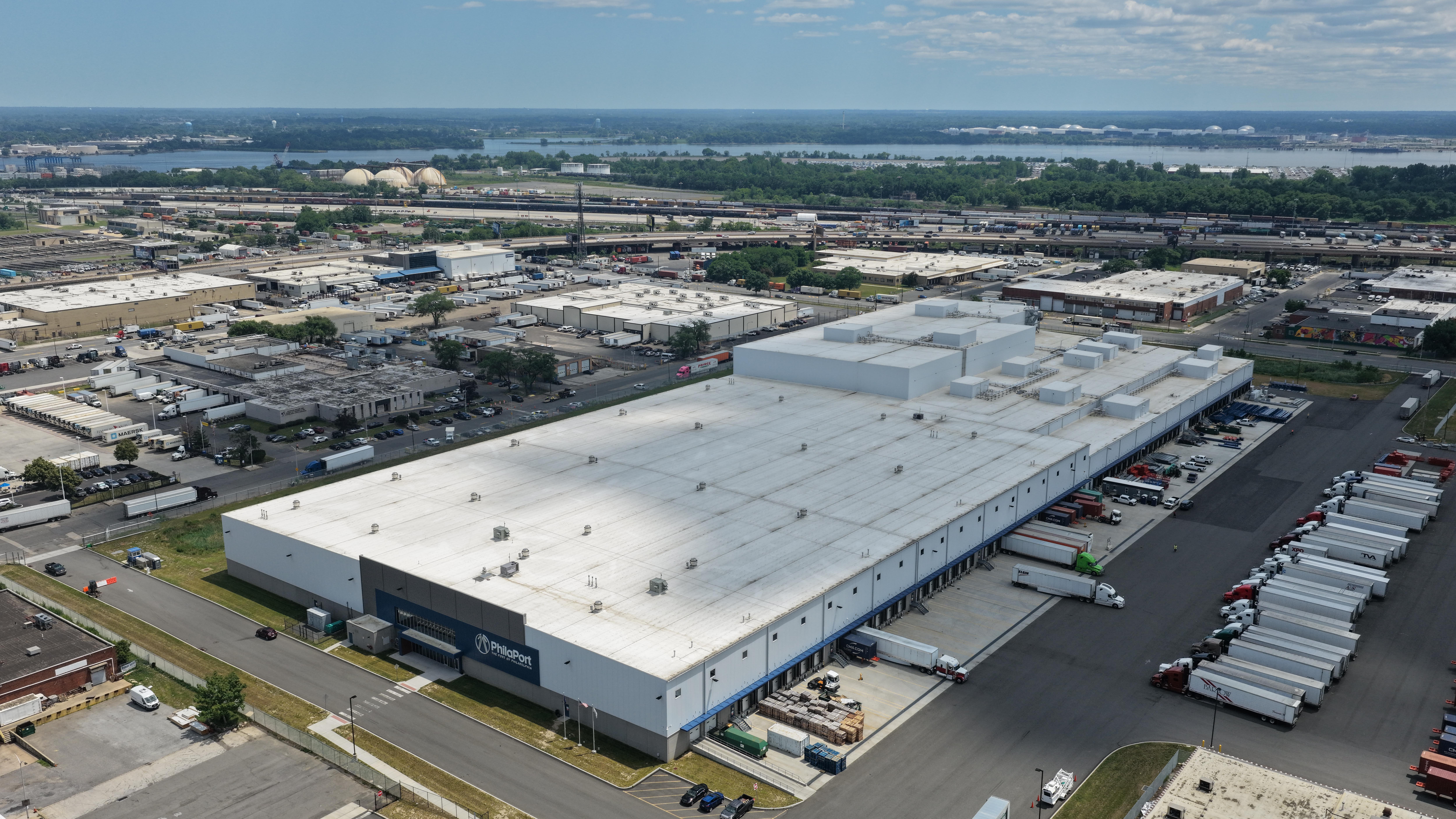
As part of a port development plan, the Philadelphia Regional Port Authority (PhilaPort) — the Pennsylvania state agency that owns the city’s seaport facilities and leases them to private tenants — has built a new taxpayer-funded, Holt-operated warehouse a mile from the Packer Avenue terminal.
Gloucester City-based Holt says it has a deal to staff the new facility with workers represented byTeamsters Local 929. Holt has longshore work available for the members of International Longshoremen’s Association Local 1291, the company says, but it has been unable to reach an agreement with the union. A contract extension expired in June.
The ILA counters that such an arrangement would strip Winfield and 30 other warehouse workers of their seniority — sacrificing wages and benefits they’ve accrued over the years.
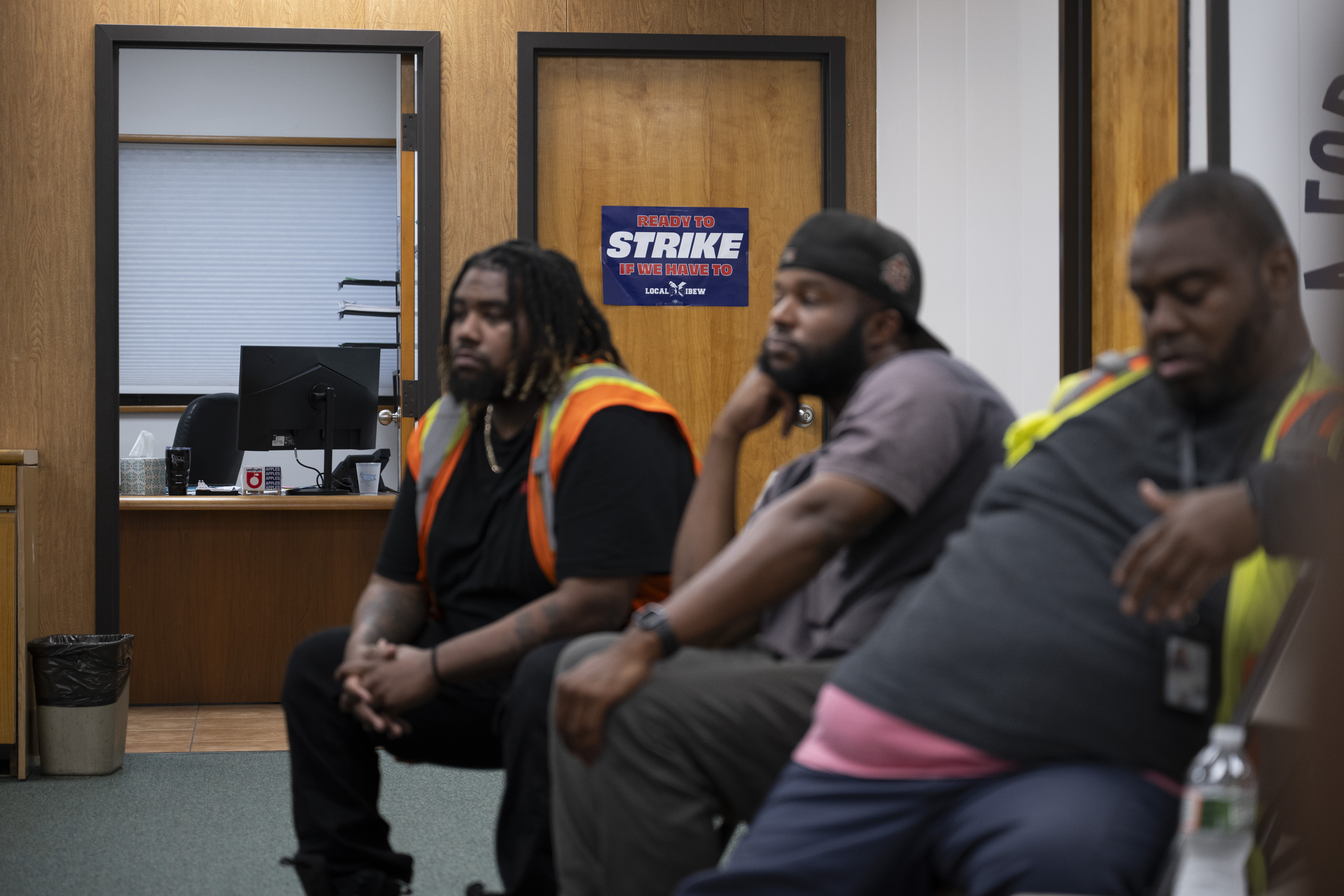
He and the other ILA members who attended Monday’s union meeting in Port Richmond voted unanimously to authorize a potential strike “if and when necessary,” a development that would require approval from their parent organization.
International Longshoremen’s Association Local 1291 members attend a union meeting.Joe Lamberti / For The Inquirer
“Been there so long. That’s really all I know, man,” said Winfield, 57. “Raised my family with that job, put my son through college, man. I’m still paying the student loan on that. … I just want to be able to take care of my family.”
Holt said in a statement that the workers are all “productive and hardworking ILA members.”
“To be clear, there is more than enough terminal and stevedoring work for these men at Packer, and we remain interested in bringing them on if the ILA agrees,” the company said.
Regardless of the outcome, the episode has laid bare growing pains at the Port of Philadelphia, which has seen hundreds of millions of dollars of public and private investment over the past decade — as well as disputes over competition and labor. That includes $85 million in state funds that were allocated to the new 165,500-square-foot warehouse, according to PhilaPort. Holt invested $81 million in the building.
Boise Butler, president of ILA Local 1291, said he wants Holt to be a healthy employer. “But don’t screw them,” he said, motioning to his members. “Don’t screw us. OK? Because it’s not necessary.”
Port development
Philly’s port is relatively small compared to the biggest U.S. container ports, but it’s seen steady growth in recent years and is a major gateway for refrigerated cargo, especially fresh fruit.
Container volumes have more than doubled since 2016, from about 400,000 units that year to almost 900,000 in 2025.
During that time, the U.S. Army Corps of Engineers completed the three-decade-long deepening of the Delaware River from 40 to 45 feet, which allowed the port to accommodate bigger ships.
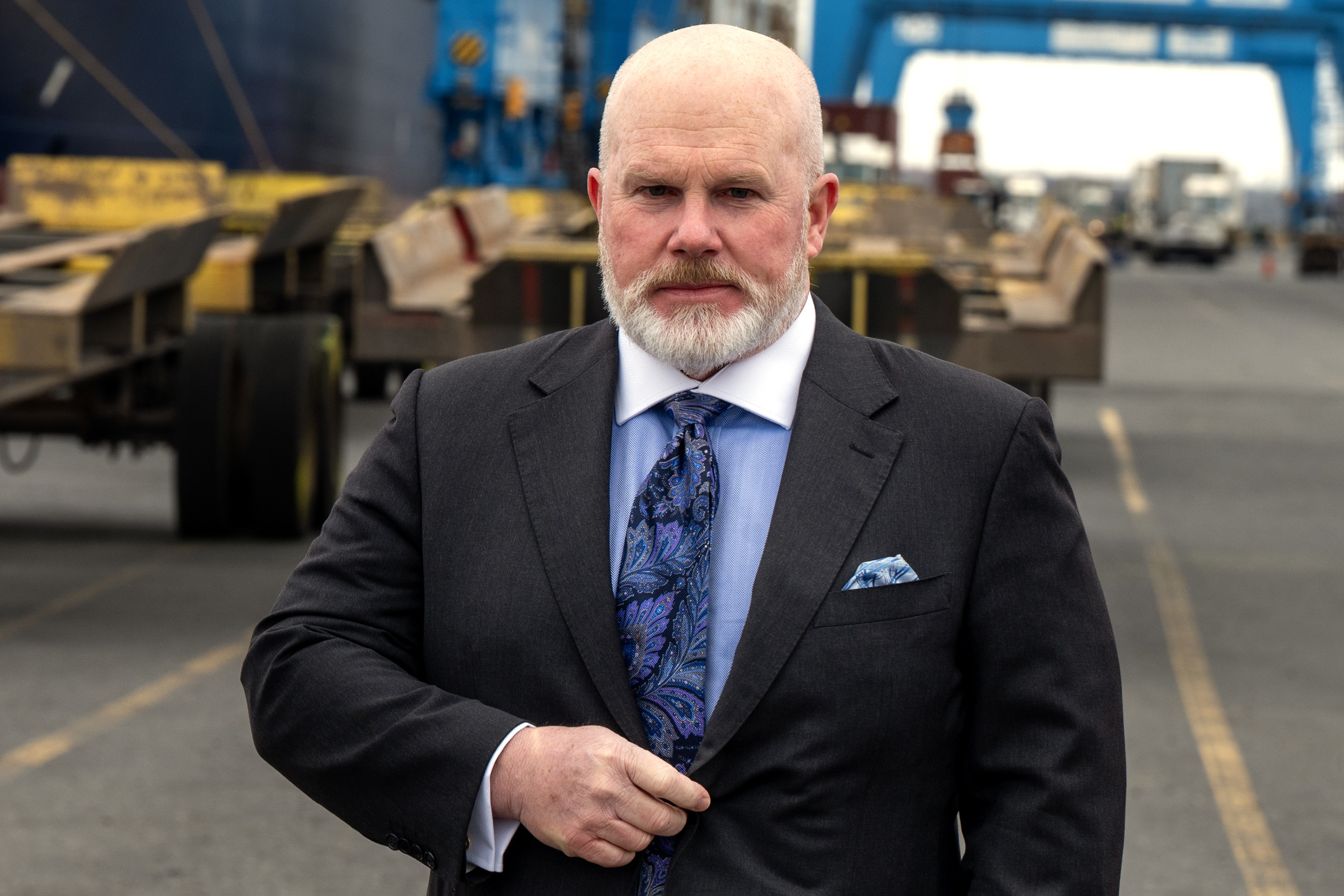
Leo Holt, president of Holt Logistics Corp., at the the Packer Avenue Marine Terminal in South Philadelphia in April 2025.Tom Gralish / Staff Photographer
And Democratic Gov. Tom Wolf’s administration invested more than $500 million in Philadelphia’s port expansion. That included more than $120 million for a distribution center near Packer Avenue featuring two warehouses totaling 365,000 square feet.
The distribution center “is an important step to improve port facilities and bring more traffic to the port,” Wolf said when construction began on the first warehouse in 2021. Leo Holt, president of family-owned Holt Logistics, said at the time that warehouse space “puts Philadelphia more fully into the last-mile business.”
The PhilaPort Distribution Center in South Philadelphia.Courtesy Holt Logistics Corp.
Teamsters and longshoremen at odds
The warehouses were built at the site of the old Food Distribution Center, a wholesale market that opened in the late 1950s and employed Teamsters for decades.
To Rocky Bryan Jr., that history is important. “We’ve been on that location there since the ’50s,” said Bryan, president of Teamsters Local 929, which represents about 3,000 members in three states.
Rocky Bryan Jr., president of the Teamsters Local 929, pictured in 2022.Tom Gralish / Staff Photographer
The first so-called dry warehouse opened three years ago, and there’s no conflict over that facility. About 15 Teamsters work there, Bryan said. The disagreement revolves around the second, refrigerated warehouse, with both the Teamsters and the longshoremen’s union making claims to the territory.
“To us, it’s all one warehouse. It’s our jurisdiction,” Bryan said, adding that a collective bargaining agreement is already in place. “It’s traditional Teamster work, which is truck driving and warehousing.”
As it happens, the ILA warehouse workers used to belong to the Teamsters but voted to join the longshoremen’s union in 2009, according to the ILA’s Butler.
Butler points to another piece of history. When the Food Distribution Center closed and a new Philadelphia Wholesale Produce Market opened on Essington Avenue near the airport in 2011, the same Teamsters who worked at the old facility continued to work at the new one, he says.
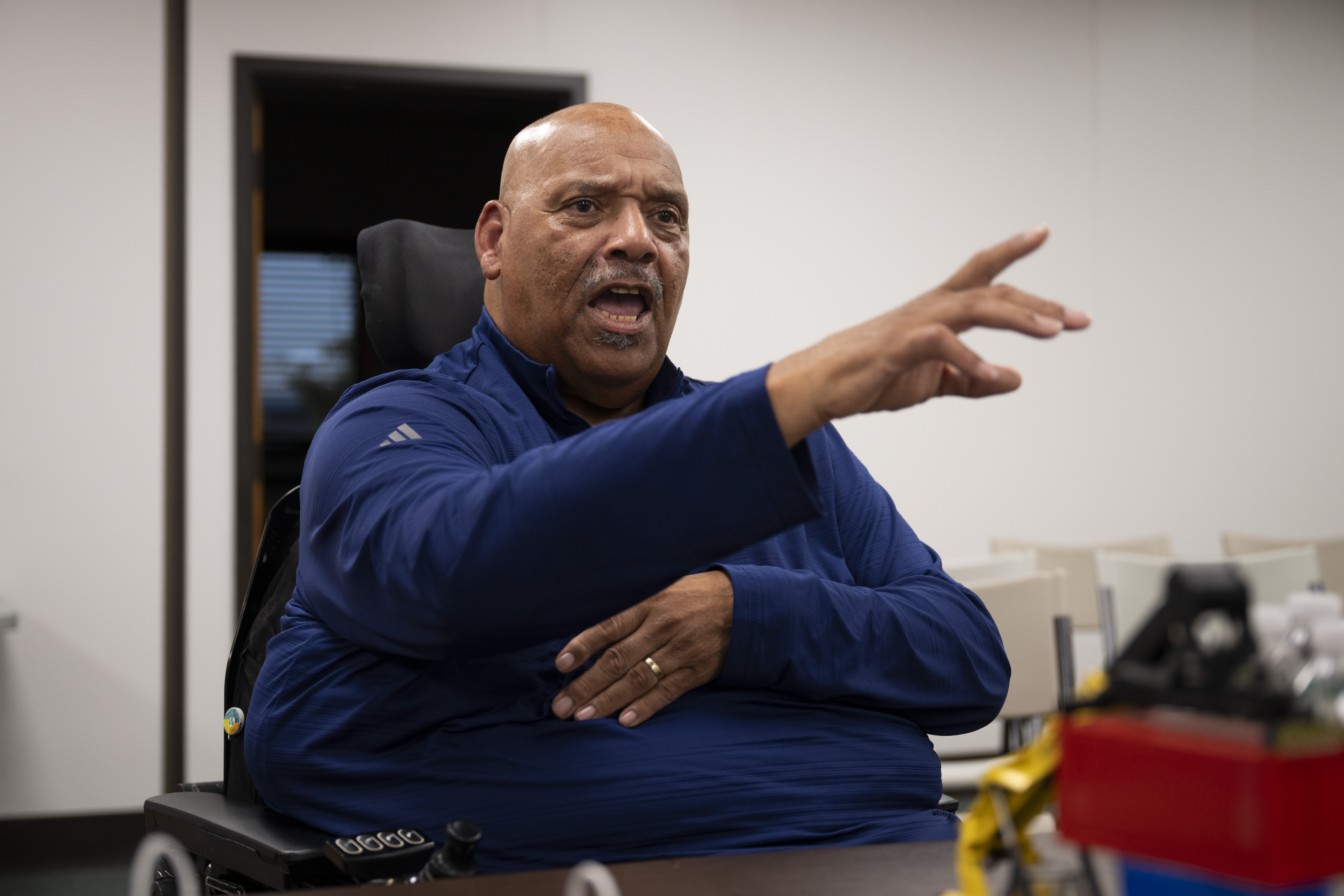
ILA Local 1291 President Boise Butler speaks to his members in Philadelphia.Joe Lamberti / For The Inquirer
The same principle should apply today, Butler says: Some of his members have been working at the Packer Avenue refrigerated warehouse since the late 1990s, and they should be able to “follow their work.”
Butler added, “I knew the Holts was gonna try to turn this into a union against union. I’m not fighting with Rocky.”
Butler — who serves alongside Bryan on PhilaPort’s board — has sought to elevate the dispute to political leaders, writing in an April memo to PhilaPort management and Democratic Gov. Josh Shapiro’s staff that Holt has “refused to commit to hiring” the ILA members.
“In effect, that will mean that taxpayer money was used to subsidize Holt Logistics’ desire to expand its refrigerated warehouse cargo operation, all while ending the careers of 31 warehouse workers in the process,” Butler wrote.
Representatives for PhilaPort and Shapiro’s office declined to comment.
Gov. Josh Shapiro meets with officials of the Teamsters Local 929 as he visits the Packer Avenue Marine Terminal in South Philadelphia in April 2025. Tom Gralish / Staff Photographer
Holt maintains that traditional longshore work is available to the workers. Butler said it’s “not impossible to do that” but added that they would lose their seniority.
That’s because the warehouse workers belong to a separate bargaining unit from the 500 longshoremen in Local 1291 who work the docks at Packer Avenue and other Delaware River ports.
In the final year of the union’s recently expired contract, warehouse workers with at least three years on the job were paid a minimum wage of $30.59 an hour, plus a $4.25 hourly annuity contribution for retirement. It also included provisions for health insurance, overtime pay, and vacation.
“A lot of us put over 20 years here, and a lot of us is at the age where we don’t want to start over,” said Lonnie Boyd, 50, an assistant shop steward who’s worked at the Packer Avenue warehouse since 1998. “We can’t afford to start over.”
I didn’t have Peeping Tom drones on my bingo card for 2026.
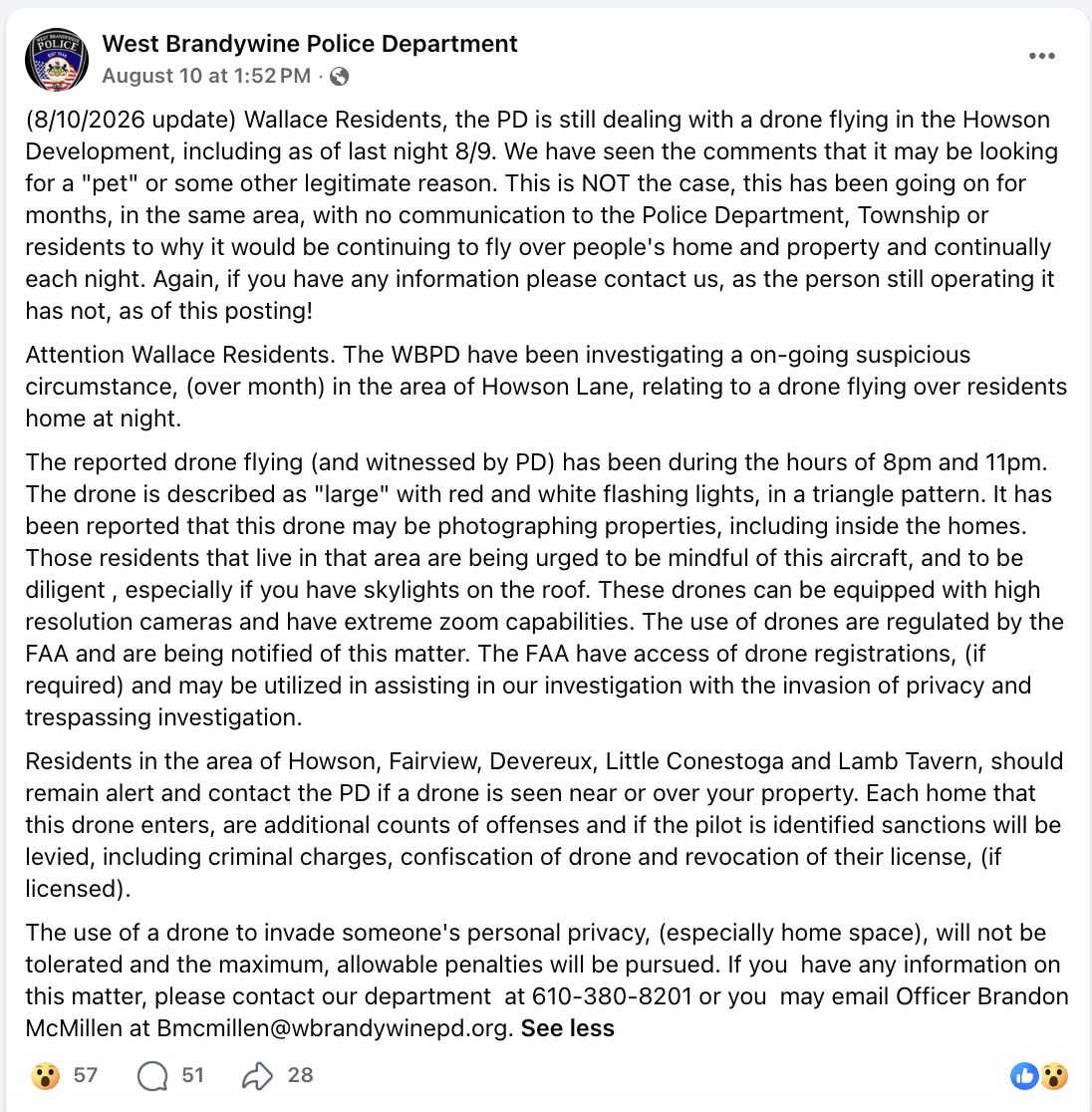
But then, on July 14, the West Brandywine Police Department let residents of Wallace Township in Chester County know, via Facebook, that for a month or so, they’d been investigating (and had witnessed) a drone flying over homes along several roads in my neighborhood at night, between 8 and 11 p.m.
“It has been reported that this drone may be photographing properties, including inside the homes,” stated the police department’s Facebook page. “Those residents that live in that area are being urged to be mindful of this aircraft, and to be diligent, especially if you have skylights on the roof. These drones can be equipped with high resolution cameras and have extreme zoom capabilities.”
Huh. Creepy.
Since we don’t have young children whose images, captured without our consent, might find their way onto the more sinister reaches of the web, and since our house isn’t full of luxury goods to be cased, I didn’t worry much.
Maybe if the drone operator chanced to peep through our windows, he’d take pity seeing the proliferation of dust bunnies and proactively book us a deep-cleaning service appointment?
But the West Brandywine Police Department’s Aug. 10 update upped the ante: “We have seen the comments that [the drone] may be looking for a ‘pet’ or some other legitimate reason. This is NOT the case.”
Screen capture of the West Brandywine Police Department’s Facebook post on Aug. 10 updating residents of Wallace Township on the continued drone sightings.Screen capture
It is particularly disconcerting because Pennsylvania regulations stipulate that for nighttime flying the drones “need to remain within line-of-sight of the remote pilot on the ground.” Even if you aren’t unnerved at the idea of someone deploying a little electromechanical spy to look into your windows at night (when the lights inside make people and things clearly visible in a way they wouldn’t be during the day), the idea that the person doing so is on your property — or close enough to keep the drone in sight — should be.
I can easily imagine folks who already feel vulnerable — the elderly, women living alone, or people who have experienced domestic partner abuse or who have filed for protection orders — being terrified by that prospect.
The thing is — despite the West Brandywine Police Department’s gratifyingly proactive approach to residents’ privacy concerns — it is the Federal Aviation Administration that’s in charge. The state reports that some 11,000 people have an FAA remote pilot rating, and if this peeping drone is flown by a registered pilot, there may be little anyone can do.
Responses to West Brandywine PD’s Facebook posts about this have been predictably mixed in this libertarian-leaning corner of the county. Outrage and worry about surveillance and invasion of privacy, of course, but also lots of drone-flying enthusiasts who chafe at any talk of curtailing their ability to pilot their unmanned craft wherever and whenever — property owners be damned.
Also, since there are a lot of hunters in this neck of the woods, there are a good number of comments about shooting the drone down if it is sighted. I hasten to add that — as tempting as it might be to shoot the flying snoop right between its blinking red lights — drones are considered aircraft, and it is a federal felony to damage or disable them — punishable with a fine of $250,000 and up to 20 years imprisonment.
If you think none of this should matter to you because, hey, you don’t live in Wallace Township and no drone has been haunting your nights, think again. Aerial surveillance by drones is widespread, and largely unregulated. According to the Electronic Privacy Information Center, there are “no clear rules protecting individual privacy against drone surveillance. Despite the fact that drone surveillance implicates significant First Amendment and Fourth Amendment interests and common law privacy rights, the law around conducting aerial surveillance very much remains in a gray area.”
Regardless of what happens at the federal level, I hope that what has been unfolding in Wallace Township prompts Pennsylvania legislators to reconsider Act 78’s limits on local regulation of unmanned aircraft in order to better protect residents from unwarranted and nuisance drone surveillance.
Meantime, the West Brandywine Police Department wants residents to contact them if they see the drone on their property.
“Each home that this drone enters, are additional counts of offenses and if the pilot is identified sanctions will be levied, including criminal charges, confiscation of drone and revocation of their license, (if licensed),” the police department wrote in its latest Facebook post. “The use of a drone to invade someone’s personal privacy, (especially home space), will not be tolerated and the maximum, allowable penalties will be pursued.”
And maybe, just maybe, the fines accrued cumulatively will be enough to make drone operators think twice before unleashing their propeller-driven ghouls to hang around our windows in the middle of the night.
For the first time since 1996, a new leader will be taking the helm of Mural Arts Philadelphia.
Emily Mello, a longtime arts educator and curator, will assume the role of the arts organization’s executive director on Sept. 1.
She succeeds Mural Arts founder Jane Golden, who has been a part of the organization since its inception in 1984, when it was known as the Philadelphia Anti-Graffiti Network. Golden announced her decision to step down as executive director in August 2025.
Mello’s appointment follows a national search led by the board of directors of Philadelphia Mural Arts Advocates, the nonprofit organization that raises funds for and supports Mural Arts Philadelphia.
Arts educator and curator Emily Mello, who has led arts institutions in New York, Chicago, and Miami, is Mural Arts’ new executive director.Courtesy of Ray Bailey
Board chair Hope Comisky said Mural Arts is “thrilled” to land Mello, adding that she boasts the blend of arts education, civic participation, and collaboration integral to the organization’s future.
“She’s worked with diverse groups and cultures. She’s had meaningful partnerships and understands the importance of artists and communities in the work that she does, and she has a collaborative work ethic,” Comisky said.
Mello brings more than two decades of arts leadership, with extensive experience in strategic planning, fundraising, community partnerships, and restorative justice. Most recently, she served as the Museum of Contemporary Art Chicago’s senior director of education, learning, and public programs.
In Philly, Mello said, she has found a city with a “strong arts community” and a level of civic pride she has not encountered in other places.
“I have worked in a lot of cities, and not every city has that amount of pride, and that’s a great place to be working from,” she said. “It tells me that people are really invested in what public space looks like, how it’s used, who has a stake in it, and who it’s reflecting. Those are all things that you see immediately upon entering Philly, and Mural Arts is such a huge part of that.”
Mural Arts is a nonprofit arts organization that transforms public spaces through community partnerships and artist collaborations. The organization has produced more than 4,300 public artworks across Philadelphia since its founding in 1984.
It was established as the Philadelphia Anti-Graffiti Network by Mayor Wilson Goode’s administration. At the time, Tim Spencer was the group’s executive director, and Golden was brought on to develop the program’s art component — addressing the city’s graffiti problem by working directly with young people drawn to it as a form of self-expression.
In 1996, with the support of then-Mayor Ed Rendell, the Anti-Graffiti Network became the Mural Arts Program, and Golden took on the role of executive director.
“I have loved every part of running Mural Arts, and there is a part of me that feels sad. And a part of me that feels excited for Mural Arts and its future,” Golden said. “I think [Mello] was a really strong candidate, and I have the confidence she will be able to lead Mural Arts in the years to come.”
Arts educator and curator Emily Mello, who has led arts institutions in New York, Chicago, and Miami, is Mural Arts’ new executive director.Courtesy of Anjali Pinto
Before proposing any new programs, Mello said, she plans to continue building on Mural Arts’ existing education and restorative justice programs, and other core initiatives focused on “using art as a tool for healing.”
“Those are things that have really resonated for me in the arts, and I recognize it in Philly,” she said. In this city, she says, there are “people who see art as an essential infrastructure for a city.”
The immediate task at hand, Mello said, is to connect people from different neighborhoods and sectors to ensure that art — and the stories they tell — remains a central part of life in Philadelphia. “I think that has been established in Philly, but it’s something that we can’t take for granted,” she said.
Mello, 47, was born and raised in Providence, R.I., and earned an undergraduate degree in art history from Mount Holyoke College. She has a graduate degree from the Harvard Graduate School of Education and a certificate from the Aspen Institute Seminar for Artist-Endowed Foundation Leaders.
She has also been the senior associate director of education at the New Museum of Contemporary Art in New York and deputy director for education and public programs at Pérez Art Museum Miami. Mello also worked with artist Simone Leigh as her director of foundations planning and special projects.
The mural “In Pride, In Power, In Memory” is located outside of Voyeur Nightclub in Philadelphia’s Gayborhood.Morgan Ritter
On Monday, Mello visited the 1,200-square-foot In Pride, In Power, In Memory mural that was unveiled on the exterior of Voyeur Nightclub at 1221 St. James St. on June 26.
The mural, created by artist Santiago Galeas, was a work in progress through Mello’s interview process and has taken on a special meaning for her.
“I love that it memorializes figures that are important to Philadelphia’s history, but also history more broadly,” she said. “To see it at that scale, and transforming the cityscape, is a powerful tool to teach people about those who came before them and fought for them.”
Golden will serve in an advisory role through the end of the year to assist with the transition.
Jane Golden, Mural Arts Philadelphia founder and executive director, speaks at the Bells Across PA event in celebration of America’s 250th Birthday in Philadelphia, Pa., on Friday, Jan. 16, 2026.Tyger Williams / Staff Photographer
“We obviously want to honor [Golden’s] legacy because she transformed Philadelphia, and she certainly inspired cities nationally, if not internationally,” said board chair Comisky.
“But we also want to look toward the future, and we think with the background [Mello] has, we’re going to be able to do just that.”
The Cheltenham school board said it would review safety procedures and assess the culture in all of its athletic programs as it pledged to rebuild community trust after an explosive grand jury report condemned the district’s response to the assaults of a football player last season in a high school locker room.
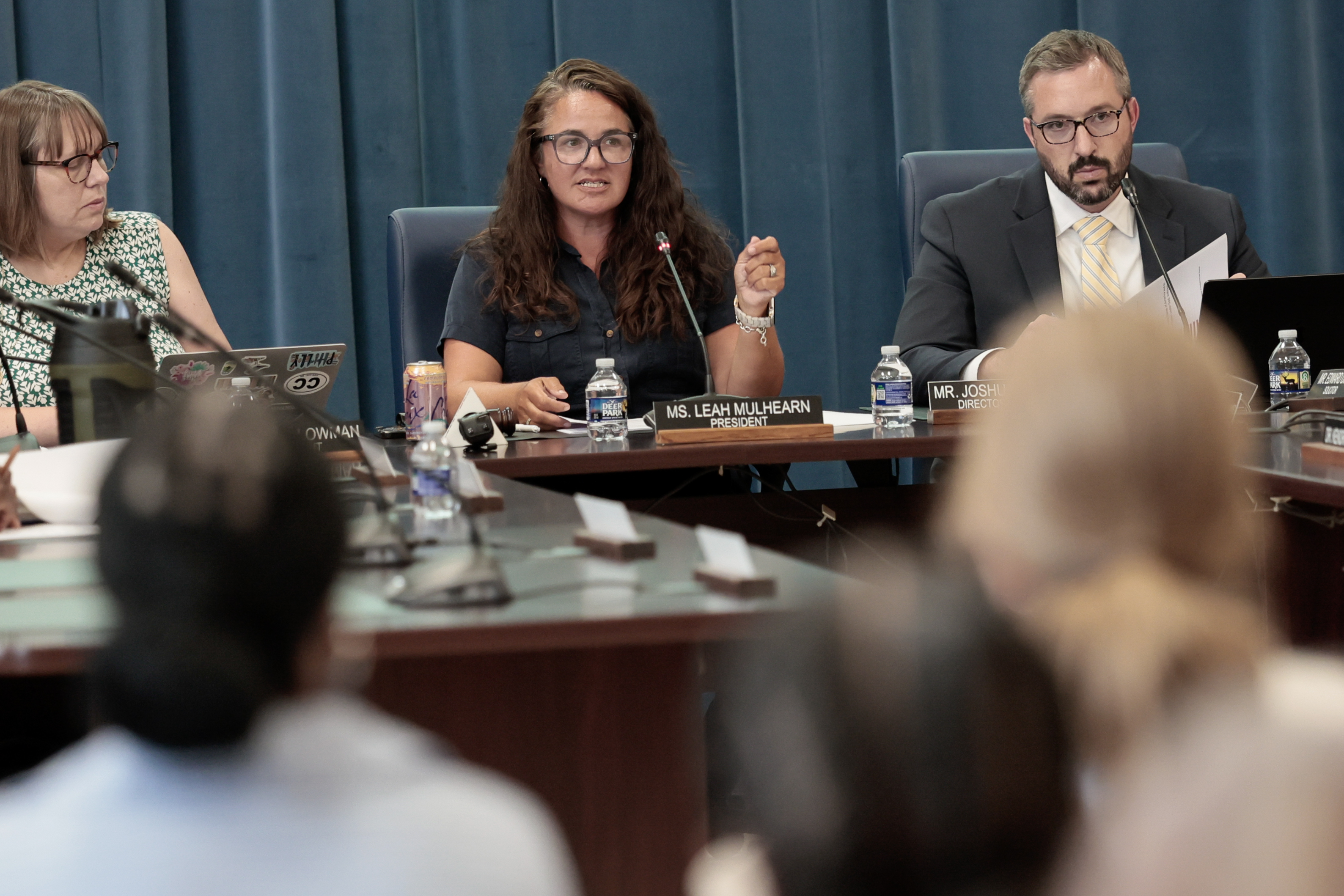
The attacks on the 15-year-old, which took place in August and September 2025, “arose in the context of a culture of intimidation and acceptance of violence,” board president Leah Mulhearn said Tuesday night at the board’s first meeting since criminal charges were announced against four coaches and six players.
Mulhearn, who also announced that veteran educator Chris McGinley would be tapped as interim superintendent, promised the board would move quickly to fix problems.
The district already canceled the 2026 football season in May. “Football will not return until we address this, no matter how long it takes,” Mulhearn said.
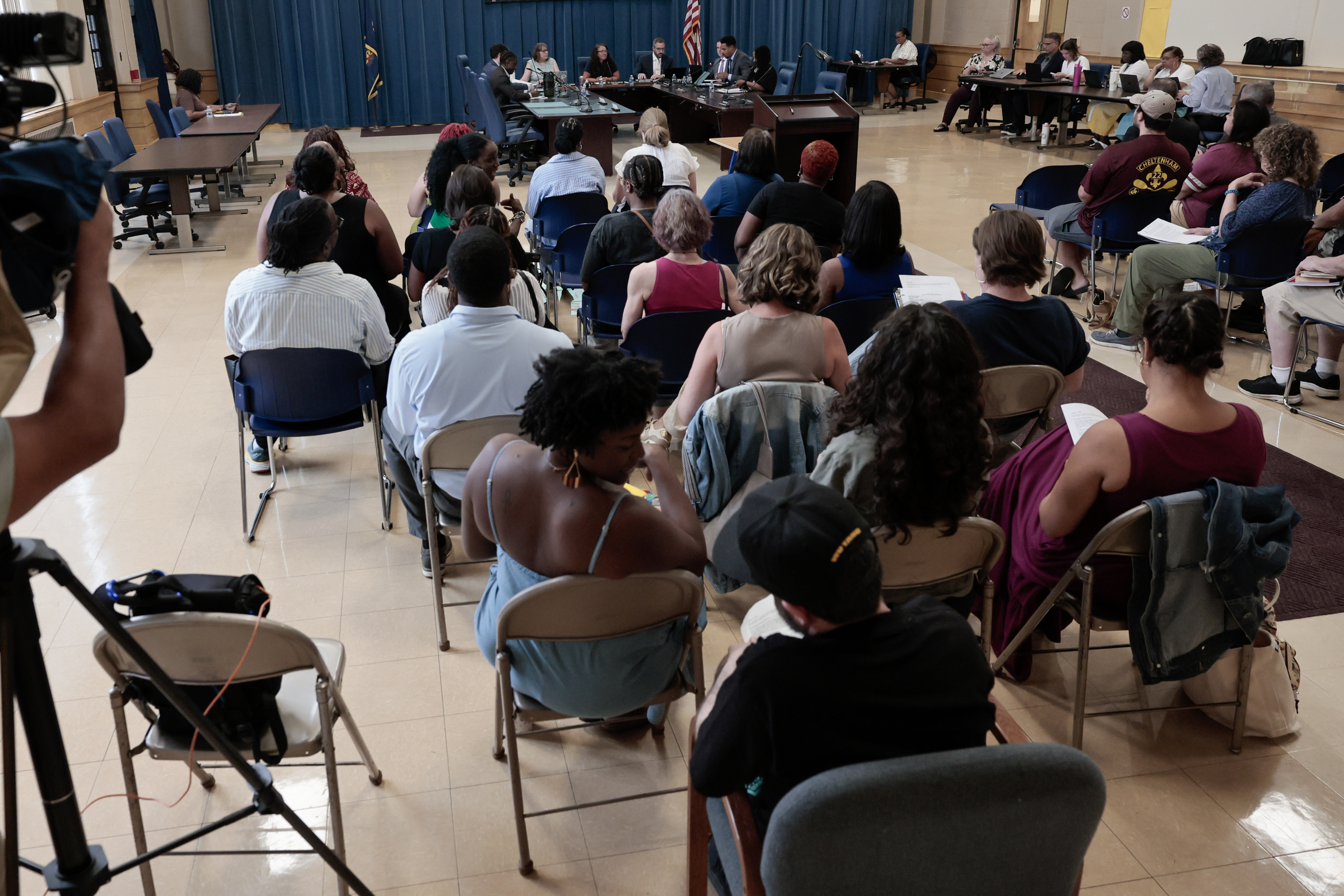
Parents, who lined up behind a microphone in the district’s administration building awaiting their turn to speak, expressed skepticism and demanded more from the board after a grand jury report accused the district of endangering students through a failed response to the assaults, one of which was captured on video.
In emotional comments, some parents said their children had been assaulted in the schools, while others questioned how they could believe the board, when they had warned against hiring a coach who has since been charged with conspiracy and endangering the welfare of a child.
“We entrusted our children to this district,” said Chowan Cowans, who withdrew her son, a rising senior and former Cheltenham football player, because “I don’t feel safe with him being there anymore.”
Cowans accused the district of a lack of transparency, which “has to mean something when the truth is uncomfortable,” she said.
PTO president Stephanie Curry (center) waits in line to speak during the Cheltenham School Board meeting in Elkins Park on Tuesday, August 11, 2026. The school board was meeting for the first time since criminal charges against four football coaches and six players were announced, and since Brian Scriven resigned as superintendent. .Elizabeth Robertson / Staff Photographer
Employees at the high school appeared to minimize the Sept. 3 assault after it was reported to them by the 15-year-old victim’s mother, according to the grand jury report. They also took the head coach, Terence Tolbert, at his word that he had not instructed the player not to tell his parents what happened, and they included the coach in their investigation — which failed to uncover that there were two assaults, the report said.
It also noted that employees were also confused about their mandatory reporting requirements.
On Tuesday, Mulhearn said that while the board “may differ with the grand jury with respect to some of its findings about how the district and board responded, the hard truth is that we must acknowledge that mistakes were made.”
Mulhearn said the board would “move with deliberate speed to address these issues.” She said the board would enlist an outside attorney, Leigh Dalton — who was hired by the Central Bucks School District last year to investigate special-education abuse allegations — to review the district’s policies and procedures and make recommendations within 60 days.
She did not comment on Superintendent Brian Scriven’s resignation last week. Some parents questioned whether and when the board’s position on Scriven had shifted, after the board praised the superintendent’s leadership in May.
A district spokesperson did not respond to a question this week about whether Scriven, who received a new five-year contract in December, would receive any payout following his resignation.
Nor did the board indicate whether it was considering taking action against any employees at the high school. One parent, for instance, asked whether Mark Hoff, the former vice principal at Cheltenham High School, would still become the vice principal at Wyncote Elementary, in light of the grand jury report faulting high school employees.
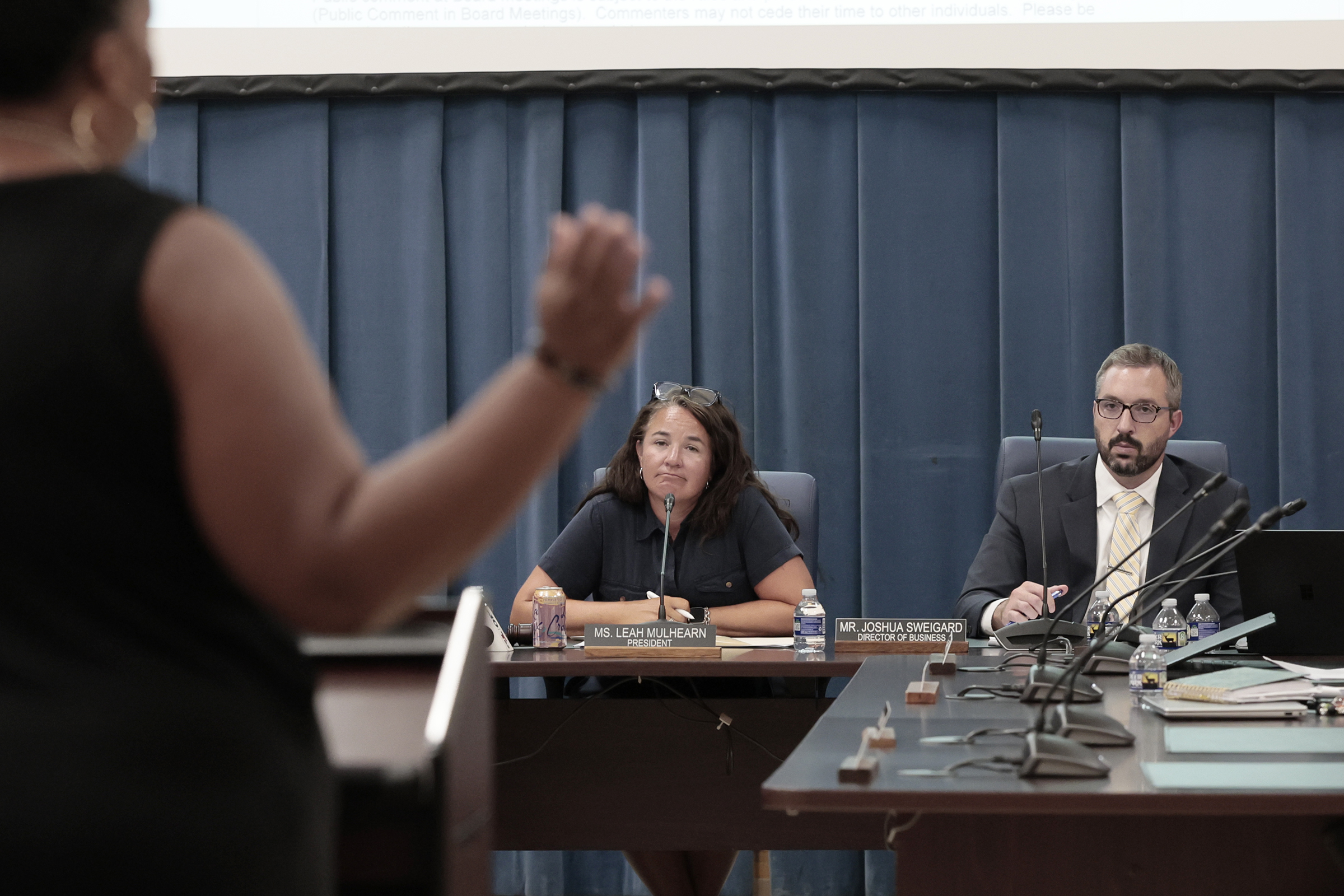
Taryn Knox (left) speaks to School Board President Leah Mulhearn and Director of Business Joshua Sweigard during the Cheltenham School Board meeting in Elkins Park on Tuesday, August 11, 2026. The school board was meeting for the first time since criminal charges against four football coaches and six players were announced, and since Brian Scriven resigned as superintendent. .Elizabeth Robertson / Staff Photographer
The board, which appointed director of business services Joshua Sweigard acting superintendent on Tuesday, will hold a special meeting next week to appoint McGinley as interim superintendent, Mulhearn said. McGinley previously led both the Cheltenham and Lower Merion districts and more recently served on the Philadelphia School Reform Commission and Philadelphia school board. His most recent position was as the faculty program coordinator of the Educational Leadership and Policy program at Temple University.
Parents’ pleas
Parents urged the board to commit to more steps. In a joint statement, the United Parents Group, the Special Education Alliance of Cheltenham, and the Cheltenham African American Alliance called for numerous actions, including a community town hall ahead of the first day of school and an assembly on the first day “to enforce a zero-tolerance policy regarding sexual harassment, bullying and hazing.” They also called for safety data to be a part of every school board meeting.
“We are demanding a fundamental shift in how our school district operates,” Aubria Nance, reading from the groups’ joint statement, told the board.
“Every time I hear a commitment to our students’ safety, I want to see the proof,” said Erin Fadako, a parent at the school.
The Inquirer reported last week that some football parents had urged the district not to hire Tolbert, saying he had allowed bullying while previously serving as head coach in Abington, where he left after one season.
“Everyone from the administration on down that has failed these students, you all have approved them to be hired here,” said Taryn Knox, who was among the football parents who had asked the district not to hire Tolbert.
After a year of negative news coverage, Knox said, “we’re now about to go into the next school year, and the news is still here.”
The Cheltenham school board meeting Tuesday, Aug. 11, 2026, in Elkins Park.Elizabeth Robertson / Staff Photographer
As they voiced their frustration, parents pleaded with the board to make real changes.
“Stop being risk averse and do what you need to do to make it safe for our children,” said Stephanie Curry, president of the high school’s parent teacher organization. “Our kids are the ones that are suffering.”
A South Philadelphia babysitter, originally from Argentina, was released from ICE detention Monday after being arrested at Philadelphia International Airport last month.
Iliana Lick’s arrest made national headlines as the Trump administration steps up efforts to increase immigration enforcement at American airports.
Lick, 30, had been in Philadelphia since September 2024. She had a valid work authorization and a pending asylum application, but had overstayed her visa, according to the Department of Homeland Security. She was arrested as she headed to Kansas City to watch Argentina play in the World Cup, transported by Immigration and Customs Enforcement to Louisiana, Texas, and New Mexico instead.
“After nearly a month in custody, countless phone calls, legal proceedings, and several transfers across different states, this is a moment we have been praying and hoping for,” her boyfriend, Steven Melchiorre, 35, wrote in an update to supporters on Facebook and a GoFundMe page that has raised more than $18,000 for legal fees.
Though Lick’s release is a victory, the fight to stay in the country is far from over.
As a condition of her release on $10,000 bond, Lick had to surrender her passport and has to wear an ankle monitor.
Immigration advocates keeping track of those being arrested at the Philadelphia airport have said at least 10 people have been detained since mid-July. Of those, Lick is only the second to be released from custody.
Immigration advocate Vivian Chang, executive director of Asian Americans United, said the release of people arrested by ICE, whether at airports or during immigration check-ins, can be a crapshoot.
“You need like a CNN story and so many news articles, so much fundraising, all of that,” Chang said. “The vast majority of people can’t access that. They don’t get coverage, and that’s what the Trump administration is counting on.”
The Inquirer wrote about Lick’s case, and her story was most recently featured on CNN.
For its part, the Department of Homeland Security has said it is making sure undocumented immigrants are flying only to self-deport, offering them a $2,600 payment and a free flight home as an alternative to detention.
A New York Times report found instances of immigration arrests in at least 15 airports, with many of the cases getting follow-ups in local media markets.
Britni Zahodnick, who with her husband, Zane Schultz, has employed Lick as a babysitter for their two young children, ages 4 and 1, for more than a year, said she is grateful for the media attention.
When Zahodnick first learned of the arrest, she said, she was not seeing people talking about the issue on social media platforms. That changed in recent weeks.
In Philadelphia, people have rallied behind Lick, she said.
Donations have helped her to retain counsel, post bond, and pay fortransportation back to her South Philly home.
Zahodnick hopes attention to cases like Lick’s highlights how immigration enforcement is affecting people who have deep roots within their communities.
“A lot of the campaigning on this increased enforcement of immigration was really around criminals, and it just hasn’t panned out that way,” she said.
Gov. Josh Shapiro made a declaration in the early days of his administration: Pennsylvania is open for business.
The move would ultimately include promises to slash bureaucratic red tape, cut permit wait times, and offer a new direct line to Shapiro’s office for major corporations hoping to set up shop in Pennsylvania.
Pennsylvania would “move at the speed of business” and “get stuff done,” the new mottos used by his administration, he said. He’s campaigning for reelection in November on the same catchphrases, and boasting major successes like the 12-day repair of I-95 in 2023 that traditionally would have taken months to reopen as an example of how he can think outside the box to solve problems.
What’s more: He sees delivering for residents — showing them government can actually solve problems — as the future of the nationalDemocratic Party, while it searches for an effective message and messenger heading into the 2028 presidential primary, which he is widely expected to enter.
It was with this same spirit last summer that Shapiro announced the largest single private sector investment in Pennsylvania history: Amazon committed $20 billion in Pennsylvania that included two data center campuses in Luzerne and Bucks Counties. Pennsylvania scored the project because of its promise to fast-track permitting and use tax breaks for the massive developments.
“Pennsylvania’s gonna be better off. I think America’s gonna be better off, because we’re going to win the battle of AI supremacy and it’s going to be done right here in the commonwealth of Pennsylvania,” Shapiro said in an interview on CNBC’s Squawk Box on the day he announced the deal.
Gov. Josh Shapiro announces a $20 billion investment by Amazon in Pennsylvania data centers in Salem Township and Falls Township on June 9, 2025.Commonwealth Media Services
But in a year’s time, the politics — and public opinion on both sides of the aisle — have dramatically shifted on data center development. Shapiro’s early welcome of data centers has created an opening for criticism from his gubernatorial opponent and members of his own party.
Yet efforts to cut red tape have proven to be slow and overblown: Only six data centers are actually under construction in Pennsylvania since the announcement, and 10 have received at least one state-level permit approval, according to Shapiro’s office. Still, Shapiro’s popularity is being evaluated by some voters and anti-data center activists on a perception that he moved too quickly and sacrificed the state’s safety in favor of Big Tech.
“I am all about legislators and decision makers getting s— done. This version of it is reckless and it’s irresponsible and it’s not actually serving our people,” said Carrie Santoro, the executive director of progressive advocacy groupPennsylvania Stands Up who has been holding town hall meetings in communities around the state on data centers.
“Governor Shapiro intends to use all the tools available to him to stop the dozens of speculative data center projects that do not meet community needs and Pennsylvania should expect to hear more from him on that in the coming weeks,” said Shapiro’s press secretary, Rosie Lapowsky.
Now Shapiro, who otherwise maintains vast popularity ratings in the state, faces a vulnerability on one of voters’ top priorities as he heads into November, and a particularly sensitive concern among Democrats as he potentially vies for the party’s nomination in two years.
Many states, including Pennsylvania, had already begun welcoming the major projects, and some hyperscale developers plan to spend billions of dollars to build them. Pennsylvania’s General Assembly first approved a sales tax exemption for data center developments in 2021, when Shapiro’s predecessor, Democratic Gov. Tom Wolf, was still in office.
Shapiro, for his part, initially embraced data centers as an economic opportunity for Pennsylvania, bringing union jobs for construction workers to build out the physical infrastructure for the computers running AI software. He also wanted to position Pennsylvania to inherit the most benefit from providing space for AI to operate, leading not only other states but also other countries in the race to advance new technology. He and U.S. Sen. Dave McCormick (R., Pa.) appeared together as early embracers of the technology and the massive buildings needed to power it, speaking together during McCormick’s first AI summit in Pittsburgh last summer.
Sen. Dave McCormick shakes hands with Gov. Josh Shapiro at a panel discussing state investment and infrastructure at the Pennsylvania Energy and Innovation Summit at Carnegie Mellon University in Pittsburgh on July 15, 2025.Kaiden J. Yu / Staff Photographer
But as communities began to push back against the rapid proliferation of data center proposals, in part to protect their water and energy resources, Shapiro adjusted.
Shapiro, like many elected officials, has changed his positions and rhetoric on the unpopular developments. He announced his Governor’s Responsible Infrastructure Standards (GRID) as a way to incentivize developers to follow transparency and environmental requirements in order to receive tax breaks. And when the General Assembly failed to approve his GRID standards or any substantial data center restrictions, Shapiro said he’d act on his own, though it’s still unclear what that will entail.
“You want to build a data center there? You’ve got to bring your own power; you’ve got to pay for your own power. You’ve got to be transparent with the local community — tell them who the hyperscaler is, tell them what’s going to go on there. You’ve got to have a local benefits agreement to help that community. You’ve got to protect the water sources that are used to cool off those facilities,” he said in a June interview with GZERO.
The Democratic governor has been lauded nationally for challenging PJM Interconnection, which is the electric grid operator for Pennsylvania and 12 other states over its efforts to raise prices on ratepayers. He capped the price Pennsylvania consumers could pay through 2029, as residents fear rate hikes due to the data center boom.
But Shapiro’s plan on data centers is too little, too late, Santoro said.
“I saw the GRID proposal as him moving on this issue, and the thing that I am concerned about is he didn’t move enough to keep up with how much voters have moved on this issue,” she said.
Some of those voters would agree. A Quinnipiac University poll of Pennsylvania voters, conducted in early June, found just 24% of those surveyed — and 40% of Democrats — approved of “the way Gov. Josh Shapiro is handling data centers in Pennsylvania.” It’s a stark contrast to Shapiro’s overall approval numbers, in which he’s maintained above 50% approvals — record-high favorability ratings for a first-term Pennsylvania governor.
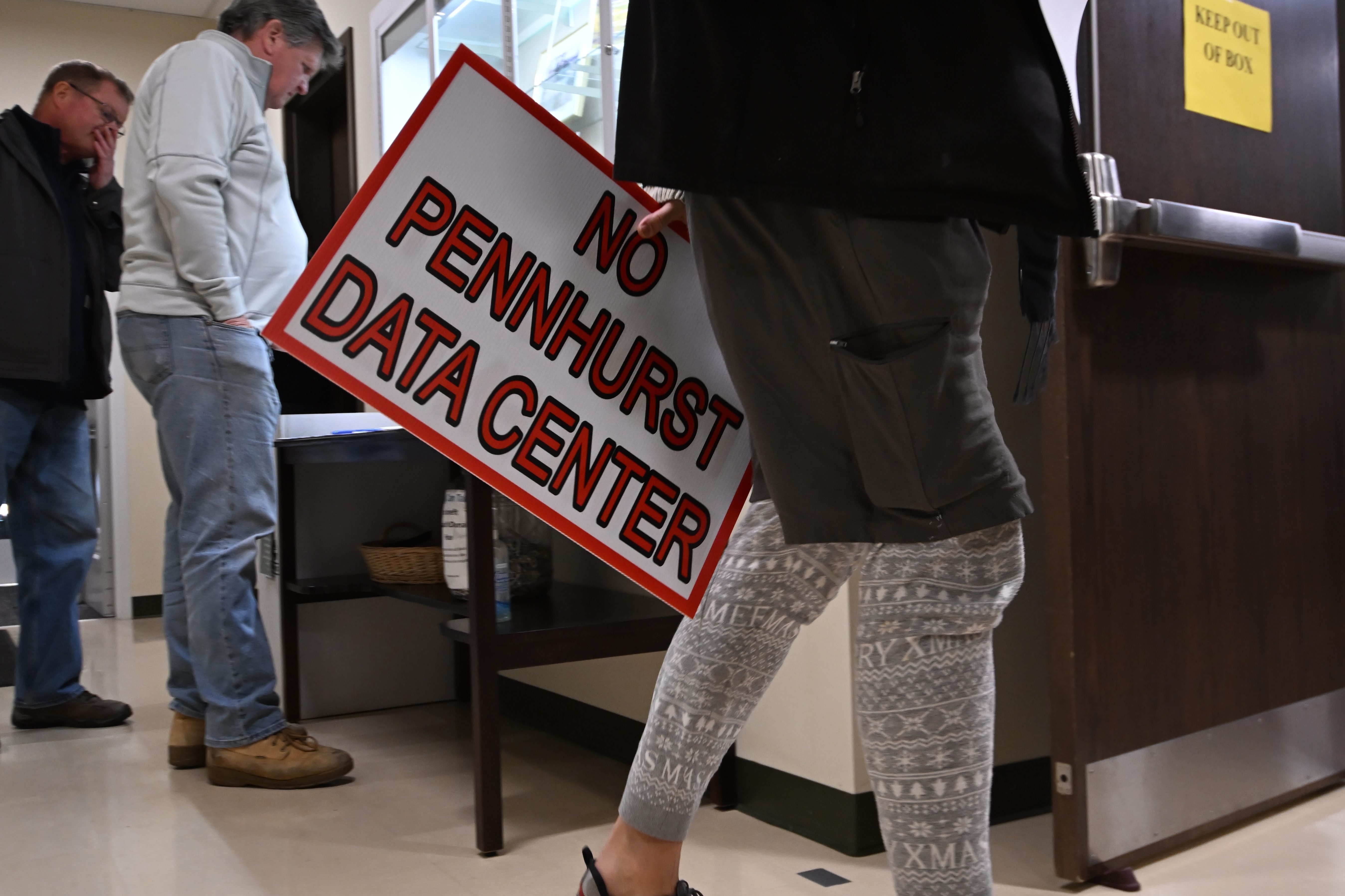
People sign in and head into an East Vincent Township supervisors meeting where an agenda item involved a data center proposal at the former Pennhurst state hospital grounds on Dec. 17, 2025, in Spring City, Pa. Marc Levy
Joanna Tenney, 36, of East Vincent in Chester County, held a sign at a June rally in the state Capitol that read: “Shapiro: Amazon’s bootlicker.” A registered Democrat, she voted for him in 2022, and believes he should be held accountable for supporting data center development in Pennsylvania that led to the fast-tracking of a now-stalled 125-acre data center project near where she lives.
She’s so fed up with Shapiro’s approach to data centers that she said will be writing in the name of her state senator, Sen. Katie Muth (D., Chester), who has been on the front lines of advocating for many state environmental issues, for governor on her November ballot. Tenney said she and a few other anti-data center advocates plan to run a write-in campaign for Muth.
“We’ve elected somebody that we thought was going to make the right choices by us, and we don’t really see that happening,” Tenney said.
Muth, who took office in 2018, said she would not be supporting Shapiro or “any elected official who puts the interests of Big Tech ahead of the health, safety, and future of Pennsylvania communities.”
If Shapiro changes his stance on data centers, she would support him, Muth said. She is the prime sponsor of a bipartisan bill to place a three-year moratorium on hyperscale data center development.
“Get right on the issue, Right your wrongs. If you can’t be on the side of science and people, my support is MIA,” she added.
Emily VanFleet, 26, lives in Archbald in Northeastern Pennsylvania, where six data center projects are underway comprising more than 50 buildings that, when completed, will cover 14% of the town. VanFleet, who is an unaffiliated voter, said she also supported Shapiro in 2022. But because of his public support for speeding up data center development in Pennsylvania, she is “certainly not going to vote for him this upcoming election,” she said. She isn’t sure she’s going to vote at all.
“I want Shapiro to stop being a coward,” VanFleet said in June. “I have emailed him, I have called him, I have reached out to him so many times. I have not heard back, not once. I see his videos all over social media that he has an open-door policy, but I have yet to see it.”
(In May, Shapiro’s administration announced that one of the unpopular Archbald developments, Project Gravity, was removed from a fast-track permitting program for failing to properly engage with the community.)
But negative attitudes toward Shapiro’s position on data centers may be limited statewide and his position is unlikely to dramatically knock down his high popularity or reelection odds: The June Quinnipiac poll found 56% of those surveyed approve of the way he is handling his job as governor overall, and recent polling shows Shapiro ahead 53% to 40% against his Republican challenger, state Treasurer Stacy Garrity.
The data center pitfall
Shapiro’s political opponents — both immediate and prospective — are also seizing on the issue.
Garrity, of Athens in Northeastern Pennsylvania, has also led a statewide listening tour on the topic. In June, she convened one of those sessions in Hatfield with a group of commissioners, zoning planners and emergency responders to talk about how they have been impacted by data centers. She blasted Shapiro for his role in attracting Amazon and said his proposed new requirements amount to a “flip flop.”
“Josh Shapiro has failed on this topic. He was the biggest cheerleader for data center development in Pennsylvania, until he wasn’t,” Garrity said at the June 24 meeting.
Pennsylvania Treasurer Stacy Garrity participates in the podcast “Ruthless” during an event hosted by Americans for Prosperity, Concerned Veterans for America, and the Libre Initiative at the National Constitution Center in Philadelphia on Jan. 29. Elizabeth Robertson / Staff Photographer
Garrity has her own mixed record on data centers.
At the time of the Amazon announcement, Garrity called the investment “great news” that would bring “historic investment” and “create thousands of jobs.” And her current position remains unclear. She has said she opposes a statewide moratorium but wants “a pause” on development instead.
Like Republicans running in districts that supported Trump in 2024 but oppose data centers, she appears to be attempting to find a pro-business and pro-regulation path.
“We want to make sure data centers are an addition to the grid, not a contraction. If there’s infrastructure that needs to be added to the grid, rate payers shouldn’t be paying for it,” she said. “I’m not opposed to data centers, but we have to do them the right way, and we haven’t done it. It’s because of a lack of leadership from the government.”
Garrity’s “long record of supporting completely unregulated data center development makes it clear that she just can’t be trusted,” said Manuel Bonder, a spokesperson for Shapiro’s campaign.
Local government leaders said at Garrity’s campaign roundtable in June that there has been lack of guidance around issues, especially around power demand, water use, infrastructure, environmental impacts, and community compatibility.
Kathie Doyle, a Republican on the Richland Township Board of Supervisors, said confusion around data centers have “set off a firestorm” in her community. Earlier this year, warnings of a supposed proposal for a data center in the Bucks County township circulated on social media, but turned out to be a “business park” with two buildings.
“Our residents don’t understand that we just cannot say no,” she said. Municipalities in Pennsylvania cannot outright ban data center development.
Santoro said Shapiro’s inconsistency is a liability that could sway some voters away from casting their ballot for him.
“Certainly he is giving her an ‘in’ by staying on the wrong side of this,” she said.
And it’s not just Republicans seizing on Shapiro’s position. The early reputation Shapiro earned as a champion of data centers may become a point of attack among other Democratic contenders for the presidency in 2028, too. In a veiled jab at Shapiro in June, Illinois Gov. JB Pritzker, knocked Pennsylvania on a businesspodcast for allowing Constellation Energy to restart Three Mile Island nuclear plant just to power Microsoft’s data centers.
“My guess is that’s going to be a reasonably unpopular thing to have done,” Pritzker said, without noting Shapiro by name on the Prof G Markets podcast.
Vulnerability for down-ballot Democrats
With a $50 million campaign war chest and high approval ratings, Shapiro is widely favored to win reelection this year. But his record on data centers could prove a liability for those he’s hoping to pull along, some advocates, like Santoro, say.
Shapiro has been staking much of his national political clout on his ability to flip four House districts in Pennsylvania for Democratic control of the U.S. House, drawing voters to the polls with his name at the top of the ticket. He’s also aiming to flip Pennsylvania’s Senate into Democratic control for the first time since 1993, giving him a Democratic trifecta in Harrisburg, as the state’s split legislature has blocked many of Democrats’ priorities from becoming law.
Santoro predicted that could be in jeopardy “if he does not change course.”
“Shapiro’s leadership on data centers will be the thing that costs us the first Democratic trifecta in 31 years, and I think that while he will likely win reelection with this wildly unpopular position on data centers, other elected officials and candidates will not,” she said.
Other Democratic candidates aware of data centers’ deep unpopularity are differentiating themselves on the issue, despite remaining otherwise aligned with Shapiro. Scranton Mayor Paige Cognetti, who is running in Pennsylvania’s 8th Congressional District, released a new ad last month putting data center developers on notice.
“Big Tech needs to pay their own way, not hide behind [nondisclosure agreements]. No tax breaks. Don’t raise our electric bills. Don’t poison our water. And hire local union labor,” she said, in the ad spot. “You can’t meet that? Then get out.”
Cognetti’s stance isn’t vastly different from Shapiro’s — both want to end blanket tax breaks — but her rhetoric is much stronger, and she’s putting the issue at the forefront of her campaign.
Democrats insist Republicans, including those running at the state level, don’t have the moral high ground on data centers after failing to pass through several measures that would have enacted stricter controls for their approval.
Sam Silverman, a former congressional aide and founder of Silverman Strategy Group, a strategic communications firm focused on technology and politics, said Shapiro’s approach to data centers — proposing a plan rather than enacting a moratorium — presents a risk that could either pay off and become the model for other states, or fail to fully address all future concerns and is unpopular.
“Shapiro is going out in front by proposing a bargain now. If the standards protect ratepayers, produce visible benefits, and hold bad actors accountable, Pennsylvania could have a model others can follow,” he said. “But because he is putting forward the deal now, he will be judged on whether it delivers.”
Taking a risk involves trust, though. Shapiro can afford to make a big swing at one of the hottest issues in politics because voters put so much faith in him, Silverman said.
“Most politicians do not have the amount of trust and political capital to take a risk, either,” Silverman said.
Whether the governor is triumphant will come down to what standards go into effect and whether bad actors are held accountable, he said, “and whether Pennsylvanians believe those standards are working.”
And if the buzz around the Sixers wasn’t big enough already with LeBron James and Jaylen Brown making their debuts, the matchup against the defending champion Knicks at Madison Square Garden certainly adds some allure.
KNICKS BANNER RAISING NIGHT AT MSG. 🏆 LEBRON AND JAYLEN BROWN'S SIXERS DEBUTS. 🍿
The Knicks raise their first championship banner in 53 years before Jalen Brunson leads New York into its title defense against the new-look 76ers on Opening Night!
After being swept by New York in the Eastern Conference semifinals, the Sixers watch the Knicks raise their first championship banner in 53 years.
And tickets are set to break NBA records, with third-party sites showing get-in prices for nearly $2,000. If that number stands, the game would be the most expensive NBA home opener ever.
The get-in price for the Sixers vs. Knicks season opener at MSG is nearly $2,000. 😳
This would be the most expensive NBA home opener EVER. 🤯
Here’s what social media is saying about the matchup, ticket prices, James and Brown’s Philly debuts, and more …
The hottest ticket in town
There are several reasons this opener is a hot ticket. The combination of it being championship ring night for the Knicks, James and Brown’s first game as Sixers, and a rematch between an already bitter rivalry are driving prices up.
However, tickets haven’t yet gone on sale from the teams’ primary box offices. Prices being shared online are from resellers and secondary markets.
Still, many fans are outraged and worried about what this means for tickets for the rest of the season.
Eagles tickets are gonna be cheaper than sixers tickets smh
Even the team’s home opener at Xfinity Mobile Arena against James’ first team, the Cleveland Cavaliers, on Oct. 22, has high prices due to increased demand.
THE LEBRON EFFECT
$68: Cheapest ticket to the 76ers home opener last season.
Price increase was expected obviously but what I’m worried about is that even a random Tuesday night game vs the Hornets or Nets might set you back $500 for decent lower level seats. That’s like one to two hundred in years past https://t.co/wYCb6188g5
On July 1, it seemed like the trade that delivered Brown would be the Sixers’ marquee event of the offseason. That was until James signed with the Sixers a few weeks later.
So naturally, their first game in a Sixers jersey will cause a stir, as fans finally get to see Mike Gansey’s offseason moves step onto the court.
And again, the matchup only adds to the excitement of it all, as the Sixers seek revenge in New York with a new — and what’s expected to be an improved — team.
While NBA fans will have to wait a little longer to find out when Brown will face his former team in the regular season, the Sixers will see the Boston Celtics in preseason games on Oct. 10 and 16. As for James, there is a Christmas Day game to look forward to against the Lakers. But not only will James be facing old teammates, he’ll also be facing his son.
🚨 LeBron and Bronny James are set to make more history with the first father-son matchup on Christmas Day in NBA history
But he wasn’t the only star that’s been mentioning the Sixers lately. During her stop in Philly, Hilary Duff compared her tour route to James’ career, with stops in Florida and Los Angeles before heading to Philly.
“We started in Florida, went to LA, we’ve ended up here… I’m starting to feel like LeBron”
While Hart shared his reaction on X, fellow New York Knick and Villanova teammate Jalen Brunson spoke on the third-hour of the Today Show.
When host Craig Melvin called the Sixers “the team to beat in the East,” Brunson didn’t try to dispute it.
“I mean, rightfully so,” Brunson said. “They have a lot of firepower. But we’re going to focus on what we’ve got to do, and we’ll see what happens.”
Jalen Brunson from the NY Knicks isn't arguing with anyone calling the 76ers the team to beat
Host: "There have been some of the talking heads out there on sports channels who said, 'Well, this is it.' The 76ers, they got LeBron, they got Jaylen Brown. They've become the team to… pic.twitter.com/jUiTJMn8Ui
When Melvin asked Brunson’s thoughts on the opening night matchup, Brunson said he thinks the game will be “fireworks for sure.”
“They’re going to be electric, they’re going to be definitely a team to keep your eye on,” Brunson said. “They reloaded this year, so it’s going to be a tough test, but we’ll be ready.”
Jalen Brunson is excited for opening night against the Philadelphia 76ers. We got 2 months to wait.
People throughout the Philadelphia region, hampered by cuts to federal food aid and soaring prices, are “facing a dangerous double whammy causing a skyrocketing hunger crisis,” said Joel Berg, a national hunger fighter, speaking in Northeast Philadelphia on Tuesday.
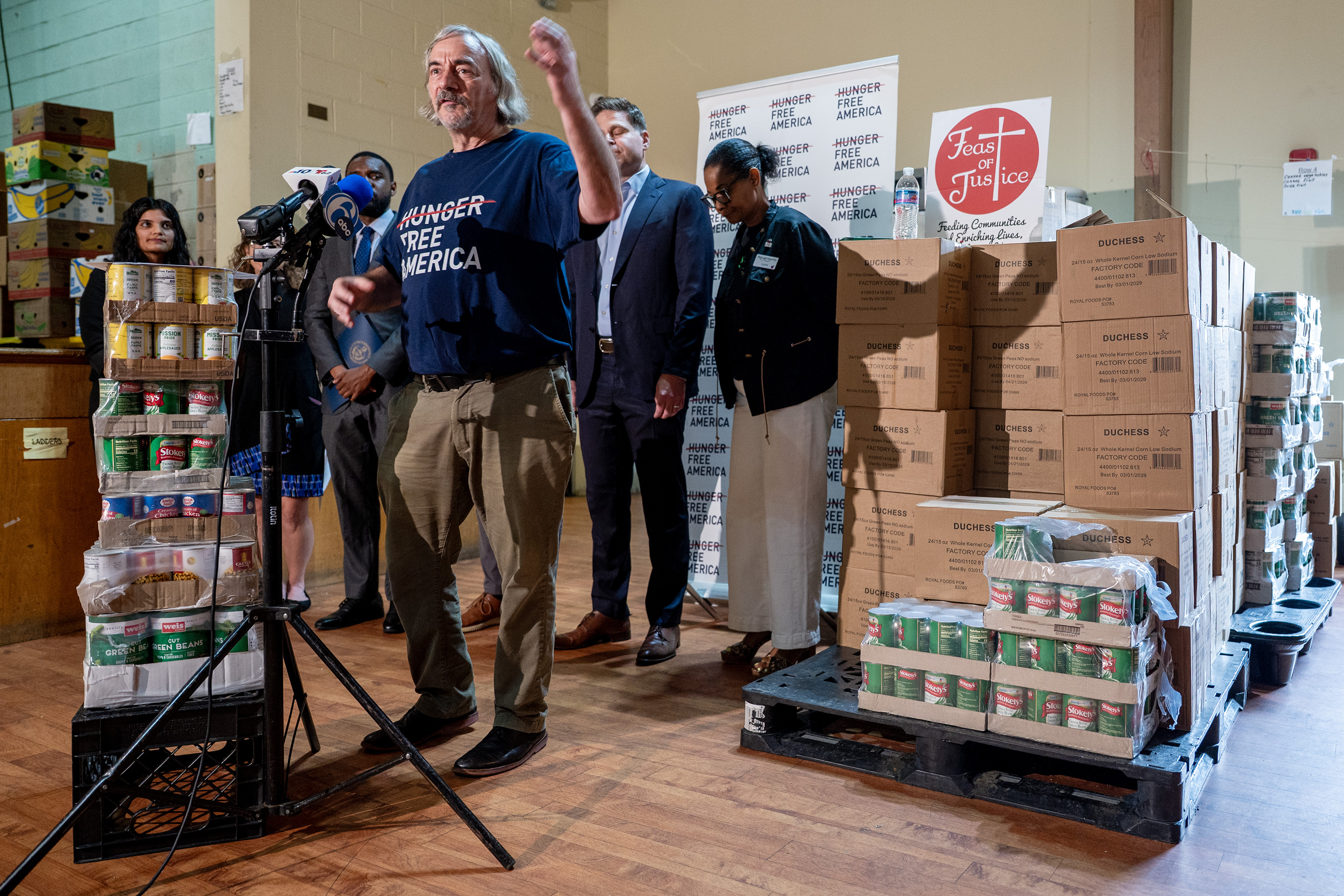
Berg, CEO of the New York-based nonprofit Hunger Free America, was visiting Feast of Justice, one of the largest food pantries in the city with “probably the most diverse food pantry clientele in the nation,” he said. That is proof, according to Berg, that food insecurity can affect anyone, from any background.
Feast of Justice, he added, “is the food affordability issue in the flesh.”
Especially critical of the One Big Beautiful Bill Act, signed into law by President Donald Trump on July 4, 2025, Berg noted that it included more than $1.1 trillion in cuts to Medicaid and the Supplemental Nutrition Assistance Program (SNAP).
Roughly 4 million Americans are expected to lose SNAP benefits in 2026 under the law. Many of them do not meet work or age requirements newly added to the anti-hunger program. The reductions in SNAP and Medicaid benefits helped pay for tax cuts ordered by Trump.
Alahallak Abdelmenim and his children Asil (left), 6, and Hasan (right), 8, load groceries into their shopping cart at the Feast of Justice Food Pantry Tuesday, Aug. 11, 2026.Tom Gralish / Staff Photographer
In Pennsylvania, around 144,000 SNAP recipients could see benefits cut this year — an estimated 45,000 in Philadelphia and 12,000 in its collar counties, according to Pennsylvania Department of Human Services estimates. In New Jersey, around 50,000 individuals could lose SNAP benefits, New Jersey Department of Human Services figures show.
It’s not “rocket science,” said Berg, who used a pallet of canned beans and apple sauce as a lectern as he addressed a small crowd at the pantry. “When there’s a drought and you take away water, the drought’s going to get worse. When there’s a hunger crisis, and you take away food, the hunger crisis is going to get worse, especially after you throw in inflation,” he added.
In response, Trump spokesperson Anna Kelly said Tuesday that Trump is “strengthening” SNAP to sustain it into the future. Changes to SNAP “crack down on waste, fraud, and abuse,” she said. Kelly added that Trump is “uplifting every American’s financial situation by passing the largest tax cut in history — which every congressional Democrat opposed — and bringing historic numbers of jobs and investments into our country.”
Pastor Tricia Neale, executive director of Feast of Justice, said Tuesday that since the enactment of the One Big Beautiful Bill Act, an additional 1,850 families in Northeast Philadelphia have turned to the pantry for help. Overall within the last five years, she said, the number of households the pantry supports has grown from 2,750 to 6,425, a more than 200% increase.
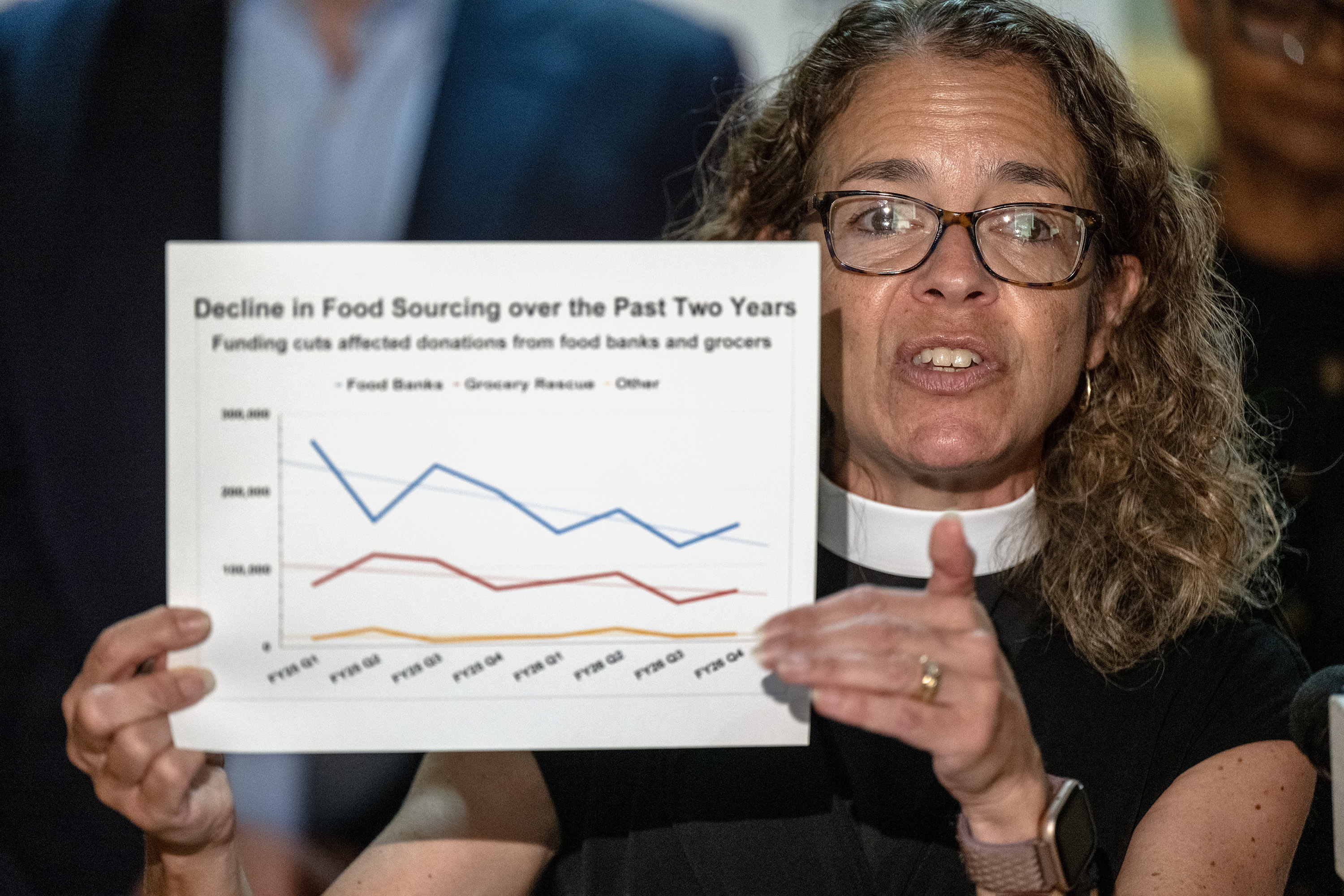
Pastor Tricia Neale, executive director at Feast of Justice, displays a chart showing the decline in food sourcing as she speaks at a press conference at the food pantry Tuesday, Aug. 11, 2026. Tom Gralish / Staff Photographer
The pantry has been forced to absorb a 35% decline in donated food it receives, in part because of cuts to federal and state food programs that have been so vital, she added.
Even with diminished supplies, Feast of Justice is an essential institution, according to Angie Bryant, 55, of Tacony, a client. Formerly a phlebotomist who can no longer work, Bryant said she recently lost her SNAP benefits because new age restrictions exclude her participation.
“In the body, hunger is hurtful,” she said. “Without this place, I don’t know how I could make it.”
Food banks such as Philabundance and Share Food Program do their best to provide Feast of Justice whatever food they can, Neale emphasized.
Volunteer Daniel Khan (center) restocks the shelves as clients load groceries into their shopping carts at the Feast of Justice Food Pantry Tuesday, Aug. 11, 2026. Tom Gralish / Staff Photographer
If SNAP is the safety net, “we’re the safety net of the safety net,” said Loree Jones Brown, CEO of Philabundance, who joined Berg and Neale at Feast of Justice on Tuesday. “But we can’t make up for the cuts.”
She added that “this is a crucial time for food banks, legislators, and community organizations to stand together for our neighbors and against hunger.”
That Feast of Justice does its best to beat back hunger is widely appreciated in the community, said client Anthony Morales, 27, of Mayfair. Laid off from a warehouse job, he said he is responsible for feeding his 7-year-old daughter and his partner, and he needs the pantry’s support.
“When you fall,” he said, “this place lifts you up. You have a lot of fear and anxiety without enough food. It can give you hope and confidence that tomorrow could be better.”