Tag: Weekend Reads

  • Police grapple with a lack of bodies in disturbing Olney investigation — and for families, a lack of closure

    Police grapple with a lack of bodies in disturbing Olney investigation — and for families, a lack of closure

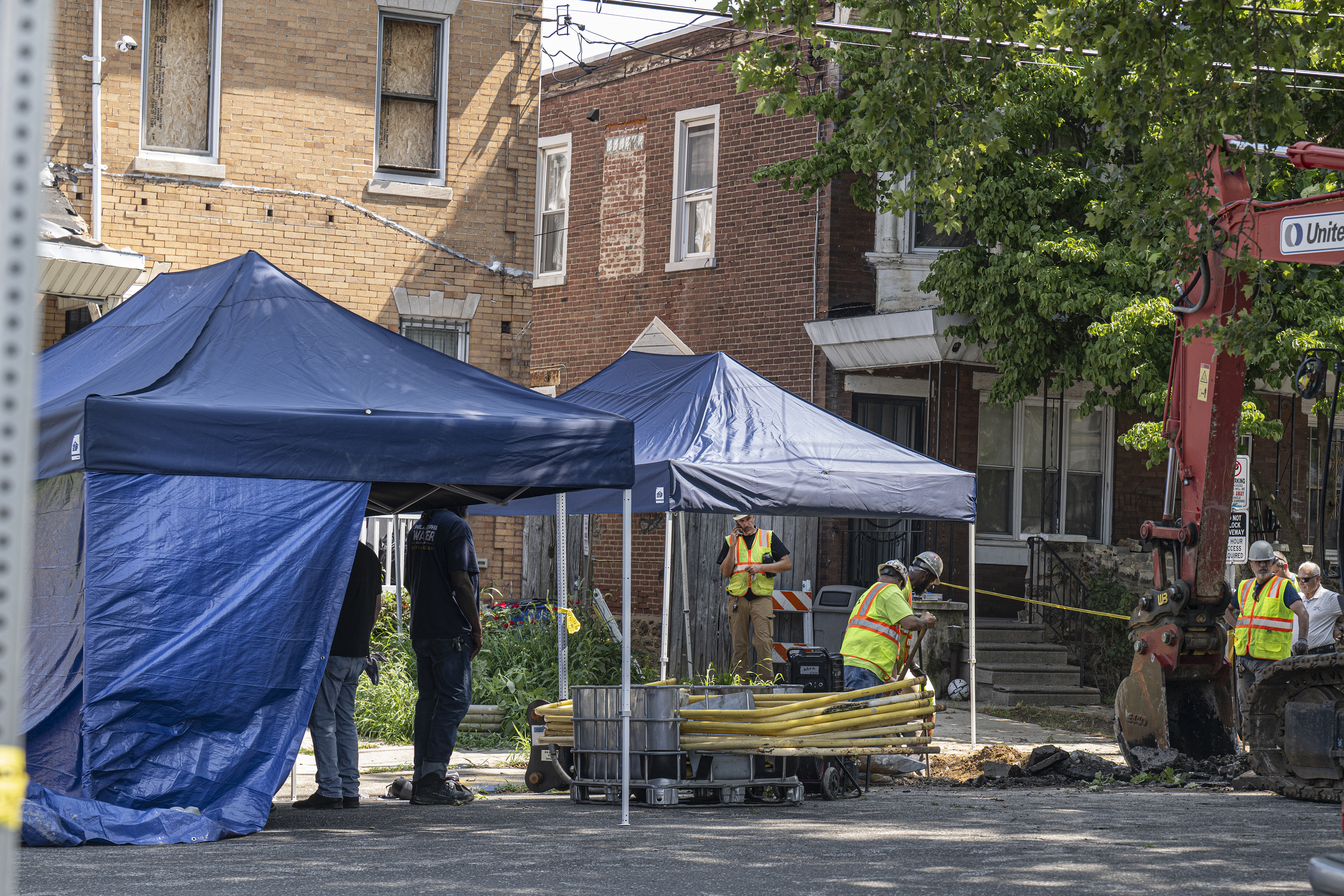
    Philadelphia police this week acknowledged that the sprawling missing persons investigation in Olney has evolved into something even more complex — a death investigation without any dead bodies.

    Adding to the challenge is that there are now at least four missing women linked to a crumbling house on West Chew Avenue, where for decades, Raymond “R.C.” Horsch had lured drug-addicted women to shoot pornographic photos and movies depicting graphic violence.

    On Wednesday, Police Inspector Raymond Evers said a hard drive recovered from the family home of Raymond and his son Eugene Albert Horsch contained “images and video of what appeared to be two deceased females” taken inside — and that police believed the women had really died there, even though they have found no human remains.

    “Usually when we have a homicide investigation, we have a body, we have body parts,” Evers said. “This time we do not.”

    Police said they have not yet determined when Gabrielle Amarando and Maribel “Bella” Fresses died. Without a body, the medical examiner, too, cannot determine a cause or manner of death, and officials did not share publicly, or with the women’s families, the extent of their injuries.

    Law enforcement sources said the images showed women with ashen skin, posed in ways that would be nearly impossible for someone who was still alive. Authorities are still working to identify dozens more people featured in the materials to determine where they are today — and if they’re still alive, said the sources, who spoke on condition of anonymity to discuss an ongoing probe.

    The images are further complicated by the fact that Raymond Horsch spent decades using women struggling with addiction as models in apparent snuff films and pornographic photos that featured bondage, sexual violence, and death. Some appeared to be staged or digitally altered.

    Michael Yoder, a retired FBI agent who has advised on over 45 no-body homicide cases, said he had never seen a case of this nature, as the typical such case involves a missing spouse or relative.

    “This is a no-body homicide and a potential serial homicide case,” Yoder said. “The fact that you also have these videos of simulated deaths or assaults, I’ve never seen that in a no-body homicide case.”

    Gabrielle Amarando (left), missing since 2012, and Maribel Fresses, 27, reported missing in 2018. Police believe they were killed inside the Olney home.Obtained by The Inquirer

    Detectives have so far reviewed around 5% of hundreds of thousands of photos, videos, and written materials recovered in the home. Yet despite the trove of digital files, police say they have found not a trace of human remains or DNA from any missing women.

    Police say they have evidence that some works likely went beyond make-believe.

    The two women police said died at the house were last seen about a decade ago.

    Evers said Wednesday that “if the images and the video are real and not altered in any way,” the women are dead. That leaves police facing the unusual prospect of seeking formal death declarations for both women in the city’s Orphans’ Court without a body, which adjudicates the rights of persons unable to handle their own affairs.

    Police were first led to the home after Eugene Horsch, 44, was arrested during a June 19 car stop that uncovered illegal weapons and the phony ID in the name of another woman, Blair Tonzelli, who was reported missing in 2023 and last seen at the Olney home. A fourth missing woman, Amy McHale, Raymond’s ex-wife, was also last seen at this house in June 2016.

    Inside the crumbling twin, investigators found chemical vats, dozens of computers and hard drives, and a cryptic handwritten note that referenced harming people and alluded to serial killer Ted Bundy.

    Raymond Horsch died last year. Eugene has not been accused of any violent crimes. He was incarcerated at the time of at least one disappearance. An attorney for Horsch has declined comment.

    After years of silence from their daughters, the Fresses and Amarando families said they were devastated to learn from police that the women are dead. But their relatives still don’t have all the answers they seek.

    “I hate to say it, but I don’t have an actual body to say, ‘OK, this is my daughter,’” said Patricia Fresses, Maribel’s mom. “I need to see it.”

    Maribel Fresses, 27, reported missing in 2018. Police believe she was killed inside the Olney home.Courtesy of Melissa Fresses

    A rise of no-body homicides

    Bodiless murder cases have become more common in recent decades, thanks to advances in forensic technology that have enabled prosecutors to bring charges in cases with limited physical evidence.

    Some past cases locally have ended in successful convictions.

    In 1997, the FBI arrested former Delaware prosecutor Thomas J. Capano, who was a suspect in the 1996 disappearance of congressional aide Anne Marie Fahey in Philadelphia.

    To this day, Fahey’s remains have never been found. However, the pair were known to be having an affair, and they were last seen together dining in Center City. Letters written by Capano pointed to an increasingly controlling romantic relationship, and a search of his car and home later revealed traces of Fahey’s blood.

    The former prosecutor was later arrested and convicted in 1999 of murder.

    But that outcome is not always certain.

    In Chester County, in 2025, Malvern resident Allen Gould was charged with homicide following the 2017 disappearance of his wife, Anna Maciejewska, who has also never been found. Prosecutors alleged that Gould demonstrated little concern about this vanishing, reporting it to law enforcement only under pressure from family and friends.

    Yet without a body or murder weapon, Gould’s lawyers have argued the prosecution is built on circumstantial evidence.

    That case is expected to proceed to trial later this year.

    A former U.S. Attorney told The Inquirer in 2013 that, nationwide, 88% of the 400 no-body homicide cases that had gone to trial ended in convictions. Yet this figure only accounts for the cases that are actually brought before a court.

    In the Capano matter, investigators were able to charge the former prosecutor because of additional forensic evidence, and the suspect’s own inconsistent testimony about their final moments together.

    But investigators in the Horsch case face three steep challenges: There are no bodies, no other human remains, and one potential suspect — Raymond Horsch — died last year from a lung condition at the age of 82.

    Yoder, the retired FBI profiler, said a no-body homicide prosecution would require evidence that clearly shows someone else was responsible for the deaths, and said additional forensic details like metadata taken from the photographs could establish a compelling timeline. Raymond’s graphic fantasies, he reasoned, would be irrelevant to the prosecution of another suspect.

    “If you say he videoed women in fake death or fake assaults on video, it’ll throw a jury through a loop,” he said. “You’re getting the point of, if they don’t believe something, they won’t believe everything.”

    Gabrielle Amarando as a child. Gabrielle was missing since 2012 and police believe she was likely killed in the house on Chew Avenue in Olney.Courtesy of Karen Amarando Riley

    No bodies, no closure

    Regardless of the possibilities for justice in court, death declarations also generally mark the end of any hope that an individual or their remains will ever be found or properly interred.

    In a 1980s article on the Orphans’ Court, a judge told The Inquirer they handled about a half dozen bodiless death declarations annually, but could not recall any in which a missing person was later found.

    “Most of them just disappear,” the judge said.

    Last year, Gabrielle’s mom, Karen Amarando Riley, talked to a psychic in a desperate attempt to get answers about her missing daughter.

    Riley said the psychic described Gabrielle’s descent into addiction, and that she couldn’t see Gabrielle alive past the age of 27, which would have been in 2017.

    The mother was shaken.

    “She nailed everything … the time she started doing drugs and what drugs she did and everything in her life,” she said. “The last image she could get was Gabrielle standing in front of a brick building in a city.”

    “I just wanted closure,” she said. “And she couldn’t give it to me either.”

    Gabrielle Amarando with her mother, Karen Amarando Riley. Gabrielle was missing since 2012 and police believe she was likely killed in the house on Chew Avenue in Olney.Courtesy of Karen Amarando Riley

    The families of the Fresses and Amarandos — and potentially others seeking loved ones who vanished in Kensington — now face the possibility of closure without the recovery of a body or, possibly, a homicide conviction.

    Riley, of Ocala, Fla., last heard from her daughter Gabrielle when she called from a Philadelphia prison on Christmas Day in 2012.

    “I thought maybe she overdosed because she would have been in touch with somebody, if not me, somebody,” Riley said.

    She is tormented by the thought that her child was reduced from the beautiful aspiring model she once knew, falling into addiction and, police say, ultimately being lured into the home on Chew Avenue.

    “It tears me up. I don’t know what he did to her before he killed her,” she said. “I always wanted closure, but I didn’t want this.”


  • Federal investigators subpoenaed records about Philly lobbyist William Dunbar, who was key to Mayor Parker’s campaign, sources say

    Federal investigators subpoenaed records about Philly lobbyist William Dunbar, who was key to Mayor Parker’s campaign, sources say

    Federal investigators last summer issued subpoenas for documents and financial records related to William F. Dunbar Sr., a Philadelphia lobbyist who was a close confidant of Mayor Cherelle L. Parker during her 2023 campaign, according to three people with direct knowledge of the probe.

    Dunbar, who has extensive political ties, was a key member of Parker’s informal “kitchen cabinet” of unpaid advisers during her 2023 run, and he ran her campaign, People for Parker, for most of 2024, the mayor’s first year in office. He has also raised money for U.S. Sen. Cory Booker of New Jersey and members of Philadelphia City Council, and he co-chaired Gov. Josh Shapiro’s 2023 inaugural committee.

    The sources, who spoke on the condition of anonymity to discuss a sensitive legal matter, said federal investigators in the summer of 2025 issued subpoenas to multiple associates of Dunbar’s, compelling them to produce records related to his business and political dealings. One source described the investigation as “fairly broad.”

    None of the sources said they were aware of an investigation centered on Parker.

    Dunbar, 42, declined to comment Thursday.

    A spokesperson for the U.S. Attorney’s Office in Philadelphia declined to comment. No charges have been filed in relation to the probe.

    A Parker campaign spokesperson declined to comment on her behalf.

    Records show that Parker’s campaign increased its spending on legal services in 2025, around the time that the sources said the subpoenas were issued. The Inquirer reported this week that the campaign has paid its law firm, Dilworth Paxson, about $108,000 since the start of 2025, according to campaign finance reports. It paid the firm less than $15,000 during the 2023 election year and about $19,000 in 2024. People for Parker did not respond to a request for comment on what was driving the increased legal bills.

    During the 2023 election, the campaign was led by campaign manager Sinceré Harris and senior adviser Aren Platt. Dunbar and several other informal advisers, however, were part of Parker’s inner circle, helping with strategy and fundraising.

    In 2024, Dunbar officially joined the campaign for the first time after Platt and Harris became chief deputy mayors in Parker’s administration. Both have since resigned from city government. Platt later returned to the campaign to serve as executive director of People for Parker.

    Dunbar has never been personally paid by People for Parker, according to campaign finance records. The campaign made rent payments to his firm, Dunbar Public Affairs & Associates, totaling $22,850 from March 2024 to November 2024.

    Parker’s campaign parted ways with Dunbar in late July 2024. Dunbar at the time said it was the mayor’s decision to take the campaign in a different direction.

    “I’m very much still an informal senior adviser but because of a different set of priorities, the mayor has decided to manage her politics herself,” Dunbar told The Inquirer at the time. “My business has continued to grow as we work to support our clients.”

    Parker added: “Will has been a valued friend to me, and let me just say that life is good right now [for Dunbar] and business is good and it’s growing.”

    Dunbar, an Overbrook Park native who got his start in politics working for former U.S. Rep. Chaka Fattah (D., Philadelphia), has developed an extensive political network through fundraising and advising campaigns. He worked in government affairs for Comcast before expanding his lobbying portfolio after Parker’s victory in the 2023 election.

    Dunbar in recent years registered as a city government lobbyist on behalf of several clients, including Comcast, the Philadelphia School District, the Chamber of Commerce for Greater Philadelphia, Jackmont Hospitality, and several other companies, according to public disclosures. Dunbar’s lobbying registration had been listed as “expired” in city records Friday, but was changed to “submitted” after the initial publication of this story.

    Dunbar worked with the school district as a subcontractor for a Harrisburg lobbying firm, DT Firm.

    “In June, the DT Firm informed the District [that] Mr. Dunbar was no longer a subcontractor with the firm,” district spokesperson Naima DeBrest said in a statement.

    DeBrest did not respond to a question about whether the district received a subpoena. The DT Firm declined to comment.

    Comcast and the chamber also declined to comment.

    Jackmont, which operates concessions at Philadelphia International Airport and also runs two TGI Friday’s locations in Philadelphia, did not respond to a request for comment.

    Staff writer Ryan W. Briggs contributed to this article.

  • Chris DiJulia’s funeral celebrated an indomitable spirit … and Philadelphia’s amazing basketball family

    Chris DiJulia’s funeral celebrated an indomitable spirit … and Philadelphia’s amazing basketball family

    Chris DiJulia never played a minute and he never coached a game, but at 11 a.m. Wednesday, he was the king of Philadelphia basketball.

    More than 600 people crowded into St. Denis Catholic Church in Haverford for an 80-minute celebration of 56 years of life well-lived. DiJulia, a fixture at St. Joe’s basketball games, had cerebral palsy, and so spent his life in a wheelchair, and died July 27 of natural causes related to his condition. A few people have ever lived a fuller life; the DiJulias prayed Chris would live to be 5, much less 56.

    As was the case for so many of the Phillies games Chris attended, it was standing room only for his memorial service Wednesday; more than 100 folks leaning against the walls and watching from the knave. They came from Chicago, Atlanta, Buffalo. It was streamed online, and it got views from as far away as Alaska. There were more college basketball coaches at the funeral than there were at LeBron and Kobe’s high school games.

    The event was more than a home-going for a man of unequaled strength and unmatched faith. It was a testament to the close-knit family of Philly college hoops.

    There is nothing like it, not anywhere in the world. It is a club, a cult, and, as the kids say now, a vibe. It goes beyond just the Big Five, beyond just the City Six (hello, Drexel), beyond men’s basketball. It is D-I and D-II and D-III and junior college. It is all of it.

    It took his daddy’s breath away.

    “Chris was unique,” said Don DiJulia, the retired athletic director at St. Joseph’s University. “But having all this happen, to even think there would be 600 people at 11 o’clock on a Wednesday … couldn’t even think that.”

    Legendary Temple coach John Chaney would have been there too, but he predeceased Chris by five years. How can you be sure? Because Chaney famously once said that Chris was the only person from St. Joe’s that Chaney liked.

    St. Denis was the site on Wednesday, and Wednesday will be remembered as a quintessential Philly hoops moment, even though there were no refs and no clock.

    More than anything, Philly basketball is its sites and its moments. It is the Palestra, the best place to shoot on God’s green earth, and Lynn Greer leading Temple back from 16 down to beat St. Joe’s in double OT there in 2002.

    It also is the DAK at Drexel and Gola/Glaser at La Salle, and it has been the smoky Philadelphia Civic Center, where I covered La Salle’s men years ago, and, of course, St. Joe’s Alumni Fieldhouse/Hagan Arena, where the DiJulias watched their Hawks play and soar and crash. All of these places can be deafening and intimidating and, by city requirement, always over-warm.

    On Wednesday, it was a gray stone Catholic church. For once, Chris was the star.

    DiJulia was the son of retired St. Joseph’s University athletic director Don DiJulia, and, despite his disability, for more than five decades Chris was everywhere basketball was played, loud and critical and present. Family and friends overfilled the pews, crammed shoulder-to-shoulder with giants from the media and, more than anything else, with Big Five royalty.

    You’ve probably been to funerals where there wasn’t a dry eye in the place, but most of the tears shed at St. Denis were tears of laughter and of joy. Chris was known best for his wry wit. In their eulogies, Chris’ siblings and parents proved again and again that wit is genetic.

    Chris loved the local pro teams and he was nuts about golf, so more than half the assemblage, to honor his fandom, wore jerseys instead of mourning clothes. The best: A shamrock-green Tug McGraw No. 45 and a pinstriped Richie Ashburn No. 1. Chris suffered and celebrated the maddening Phillies, and he so adored baseball that the service began with the national anthem and included a seventh-inning stretch complete with God Bless America.

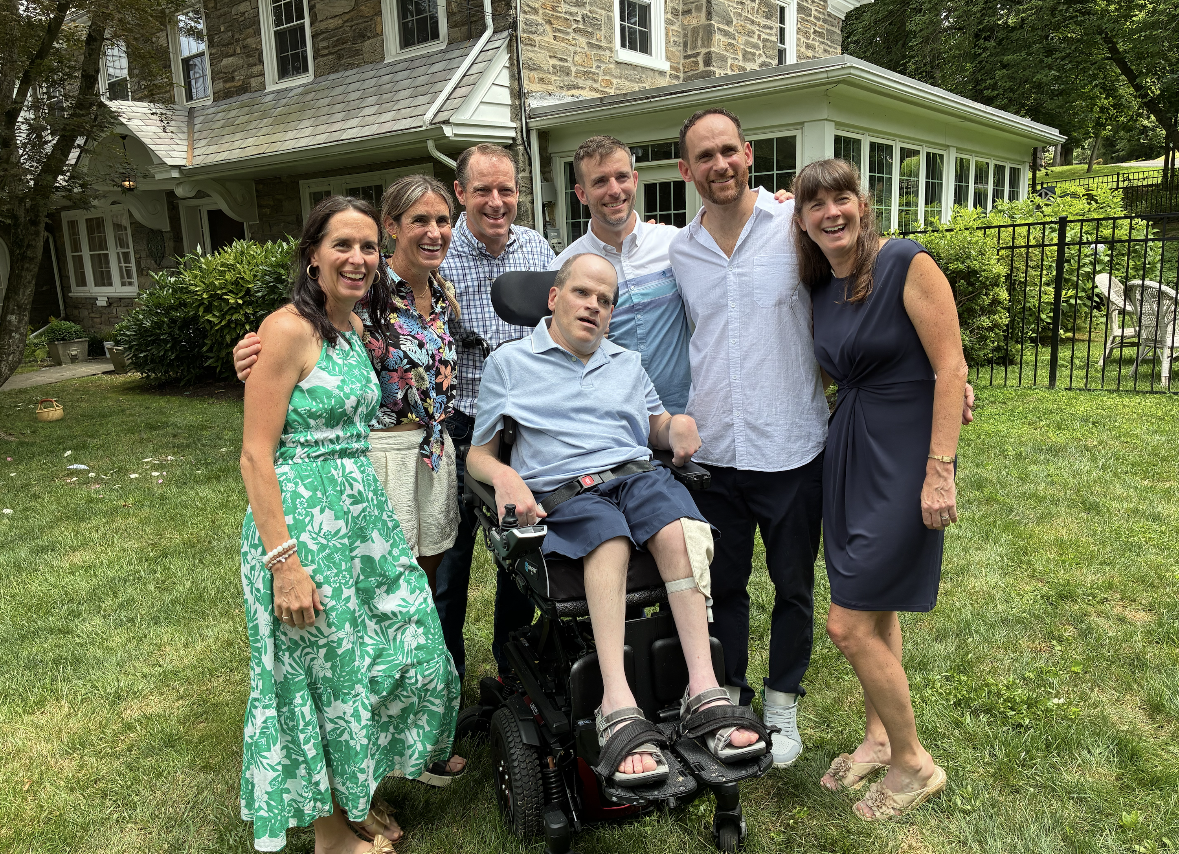
    Chris DiJulia, with his parents and siblings.provided by Kath DiJulia Cloran

    It was in his blood

    But as much as Chris loved the pros he was of college hoops, especially Philly college hoops. It was in his blood. Don played basketball (and baseball) at St. Joe’s, and he coached college basketball before he directed college programs.

    Don played for Jack Ramsey’s 26-1 team in 1965. He is a charter member of the Philadelphia basketball aristocracy. Chris is a legacy member.

    Membership can be earned.

    The first sporting event I attended after I arrived in Philly in February 1995 was a 30-point Penn men’s win over Brown at the Palestra, but that didn’t earn membership. It takes decades as a fan, years as a media member.

    I fast-tracked.

    I married in.

    My wife, Dr. Shelly Bowers Hayes, scored more than 1,100 points as Penn’s point guard until 1995. We met playing pickup on the Palestra floor that March, started dating a year later, and we’ve coached our kids the last six years (mostly, she coaches).

    I’ve done this job for 31 years. I’ve belonged to lots of clubs and organizations and associations. There’s no community like the community of Philly college hoops. Proved again for 80 minutes of joy, and a little pain, at St. Denis on Wednesday.

    This year Philly has hosted the NFL playoffs, the men’s NCAA Tournament, the NBA playoffs, the NHL playoffs, the Unrivaled women’s 3-on-3 league, the PGA Championship, the FIFA World Cup, and the Major League Baseball All-Star Game.

    Wednesday’s sellout was the most deserving of them all.

  • A Main Line psychiatrist who had sex with a patient poses no threat to other patients, judge rules

    A Main Line psychiatrist who had sex with a patient poses no threat to other patients, judge rules

    A Main Line psychiatrist who lost her medical license after a state investigation found she had a yearslong sexual relationship with a young patient while prescribing him highly addictive psychotropic drugs may continue practicing while she appeals the revocation, a state judge ruled.

    In ruling in favor of Amy Mazza MacIntyre on Thursday, the judge agreed that she posed no threat to patients, who would likely suffer if their care was disrupted or if they had to find a new provider amid what Commonwealth Court Judge Stella Tsai acknowledged as a “shortage” of specialized child and adolescent psychiatrists in the Philadelphia region.

    Tsai also found that MacIntyre would be “irreparably harmed” if forced to close her Bryn Mawr practice because hundreds of current patients likely wouldn’t return, even if she later won her appeal to keep her license.

    MacIntyre’s “actions leading to the instant revocation, although spread over several years, were focused on a single individual,” Tsai wrote in her opinion. “In that time, she has treated thousands of patients without reported incident, and there is a purported shortage of psychiatrists with [MacIntyre’s] subspecialty.”

    MacIntyre, who specializes in treating young patients with complex psychiatric diagnoses, began seeing a then-17-year-old cancer survivor in 2004 when he was a senior at Lower Merion High School. She first had sex with him in 2011, when he was 24, and prescribed him powerful psychiatric drugs through mid-2017, according to an investigation by the Pennsylvania State Board of Medicine. The board found that the drugs, including Xanax and Adderall, were given to him without proper medical evaluations.

    The board revoked her medical license in May, finding she had engaged in sexual misconduct and inappropriate prescribing in violation of state medical licensing laws. She then appealed the decision to Commonwealth Court, where the case is pending. Last month, she asked Judge Tsai to temporarily lift the revocation so she can continue seeing patients while she fights the board’s disciplinary action.

    “We are extremely pleased by the judge’s decision and believe it to be appropriate,” MacIntyre’s lawyer, Gary Samms, wrote in a text message to an Inquirer reporter Friday. Samms declined to comment further, citing the appeal. He has advised MacIntyre not to talk to The Inquirer. MacIntyre, 52, did not respond to an email sent Thursday.

    Matt Heckel, a spokesperson for the Department of State, which oversees state licensing boards, said the judge merely granted MacIntyre’s request to continue seeing patients but did not address the larger question of whether her license should be revoked. The state is fighting her appeal, arguing that “no sanction short of a revocation would adequately protect the public.”

    The patient at the center of the case, Justin Kopicki, who is now 39 and in law school in Oregon, said the judge’s ruling was “extremely problematic,” opening up a “really dangerous can of worms.”

    “It says to other psychiatrists and practitioners that it is OK to violate the laws of their license and to take advantage of their patients,” Kopicki said in an interview on Thursday evening. “The court is basically saying that the public interest is not at risk here. Quite frankly, it’s an egregious position to take.”

    Kopicki, who gave The Inquirer permission to use his name, said it’s “a very large slap in the face against what I went through.”

    “It was not an isolated incident,” he said. “It was something that went on for six, seven years continuously.”

    Mixing sex and medications

    Kopicki was diagnosed with leukemia at age 4. He received chemotherapy treatments at Children’s Hospital of Philadelphia until age 7, when the cancer went into remission.

    In high school, he grew depressed and anxious. He isolated himself from peers. His mother worried his mental health problems stemmed from his childhood battle with cancer. She contacted CHOP, which referred him to MacIntyre, then 31.

    During his first appointment in 2004, MacIntyre diagnosed Kopicki with anxiety and agoraphobia. She suspected he also suffered from obsessive-compulsive disorder. She put him on medication.

    According to the board’s investigation, MacIntyre “became focused on [Kopicki’s] sexual activity” during treatment sessions in 2010. During a session in early 2011, she told him she “wanted to climb on top of him” and did so, kissing him, the board’s revocation order says.

    Soon after, they had sex for the first time at Kopicki’s father’s house. Although MacIntyre stopped charging him for sessions, she formally treated him through June 2013, writing patient notes in his medical record. From 2013 to 2017, she continued having sex with him while prescribing a revolving mix of up to 12 medications to him, without proper evaluations, according to the board’s order.

    The board’s investigation — based partly on emails, texts, and voicemail messages that MacIntyre sent Kopicki — revealed that she gave him a $5,000 saxophone and a Cartier watch, hired him to work in her office, proposed marriage to him, told him she miscarried his baby, sent him naked selfies, and took him on trips, including to Turks and Caicos and Walt Disney World.

    The board also found that MacIntyre prescribed medications to Kopicki’s mother and father, although they were not her patients.

    In an interview with The Inquirer last month, Kopicki said MacIntyre had “groomed” and manipulated him while prescribing “really large quantities” of stimulants and benzodiazepines, including “Xanax and Klonopin mixed together.” She would withhold his medication refills if he refused to go away with her or tried to end the relationship, he said.

    Kopicki cut off all contact with her in 2017, shortly after MacIntyre showed up at his father’s house, yelling and demanding to speak with Kopicki. His father called 911, the board found.

    Kopicki first complained to the state medical board in 2017. He also filed a medical malpractice lawsuit against her in Montgomery County Court. His lawyers did not want him to cooperate with state investigators while the case was pending, and the state dismissed his complaint.

    MacIntyre settled the case with Kopicki in 2020 for an undisclosed amount, and he again complained to the board in 2021. The board launched an investigation, interviewing Kopicki and reviewing “thousands of text messages” between the two.

    ‘One of the worst’ cases

    During the disciplinary proceedings, MacIntyre admitted to sexual misconduct, immoral and unprofessional conduct involving a patient, failure to maintain complete medical records, and fraudulent, reckless, or negligent practice. She had disputed claims that she engaged in improper prescribing, but the board found her culpable.

    In her appeal, MacIntyre is seeking a lighter discipline, such as probation. While not excusing her behavior, MacIntyre provided explanations to the board. She testified at a state hearing last year that she had been afraid of Kopicki and that he forced her to have sex. She said she tried to get a protection-from-abuse order against him, but didn’t qualify for one because they weren’t married or living together.

    The board rejected her arguments, citing a lack of evidence, finding her testimony not credible, and pointing to her “shifting explanations.”

    MacIntyre also cited “personal stressors” in her life at the time of the misconduct, including the birth of a child and her mother’s dementia.

    Samms argued that she has learned from her mistakes: She underwent an extensive evaluation with a psychologist who found her fit to practice, and she also went to therapy to address her behavior with Kopicki. Additionally, MacIntyre has limited her interactions with patients to mostly medication management, and has not violated any regulations for the last decade, Samms said.

    Samms told Judge Tsai during oral arguments last month that MacIntyre has treated about 15,000 patients without any incident since at least 2017, when contact with Kopicki ended.

    “While she acknowledged wrongdoing, it was an isolated patient due to isolated circumstances,” Samms said during the July 30 hearing. “There’s never been any other issues regarding her licensing or her practice.”

    Dana Archer, the lawyer representing the State Board of Medicine, argued that the reason so much time had lapsed between her misconduct and the board’s sanction is because “she did everything that she could to hide it.”

    “Just because you’re successful in hiding your inappropriate conduct doesn’t mean you should be rewarded and receive a lesser sanction because you were successful in keeping it a secret,” Archer told Tsai.

    Archer said MacIntyre took advantage of a vulnerable patient, who was “basically a child” when she began treating him. Her conduct was one of the board’s “worst” cases, she said.

    “It was one of the worst things that a psychiatrist can do to a patient,” Archer said.

  • Kensington High School students will be relocated after asbestos ‘concern’ during HVAC project

    Kensington High School students will be relocated after asbestos ‘concern’ during HVAC project

    Kensington High School students and staff are being relocated to the vacant Austin Meehan school building through the end of the calendar year, after an asbestos “concern” arose during an HVAC project, Philadelphia school district officials said.

    While workers were installing a new heating and cooling system, “an asbestos inspector identified a concern about the demolition of the old system,” Oz Hill, the district’s deputy superintendent of operations, said in a letter to the high school community Thursday — a little more than a week before the new school year begins Aug. 24.

    Hill said the district “immediately stopped the project and has been working cooperatively with the city’s Air Management Services and the Philadelphia Federation of Teachers while the building is thoroughly cleaned and air quality tests are conducted to show the space meets standards to be reopened.”

    Arthur Steinberg, president of the PFT, said he was told that “a contractor broke into some space … disturbed some asbestos, and tracked it all over the building.”

    “That essentially contaminated the entire building, by them moving around after the asbestos material was disturbed,” Steinberg said in an interview Friday.

    Steinberg said the relocation to Austin Meehan, a vacant middle school in Northeast Philadelphia, would mean “turmoil.”

    Austin Meehan, which closed in 2022, is more than seven miles away from Kensington High School.

    In the message, Hill said the district had considered closer options, but they “did not meet the space or accessibility needs for Kensington’s more than 400 students and 90 staff.” He said “details about the schedule, transportation, and all logistics will be forthcoming.”

    A district spokesperson did not immediately respond to a request for comment Friday.

    Steinberg said the relocation “creates logistical nightmares for everybody,” with new commutes for staff and families.

    “But it’s better than trying to make them occupy a building that’s contaminated with damaged asbestos,” Steinberg said. He said the PFT will be on site as Kensington staff report to Austin Meehan Monday to hear and address concerns.

    The PFT also has an occupational hygienist at Kensington High School supervising the district’s work, to ensure the asbestos is properly cleaned up and tested, Steinberg said.

    The union “will ensure that building is suitable for occupancy, or our members will not go back in,” he said.

    Asbestos has been a recurring issue in the Philadelphia School District’s aging buildings. In recent years, some schools have temporarily closed after the discovery of damaged asbestos.

    Hill said the district “will also work to address other Kensington building needs, including maintenance repairs and the continued proactive removal of asbestos materials where we can minimize future risk of damage.”

    “When Kensington students and staff return to the building in January, they will be welcomed back to a healthy, more comfortable space for learning,” Hill said.

  • Cheltenham is starting a new school year just weeks after locker-room assault charges. Parents and kids are nervous.

    Cheltenham is starting a new school year just weeks after locker-room assault charges. Parents and kids are nervous.

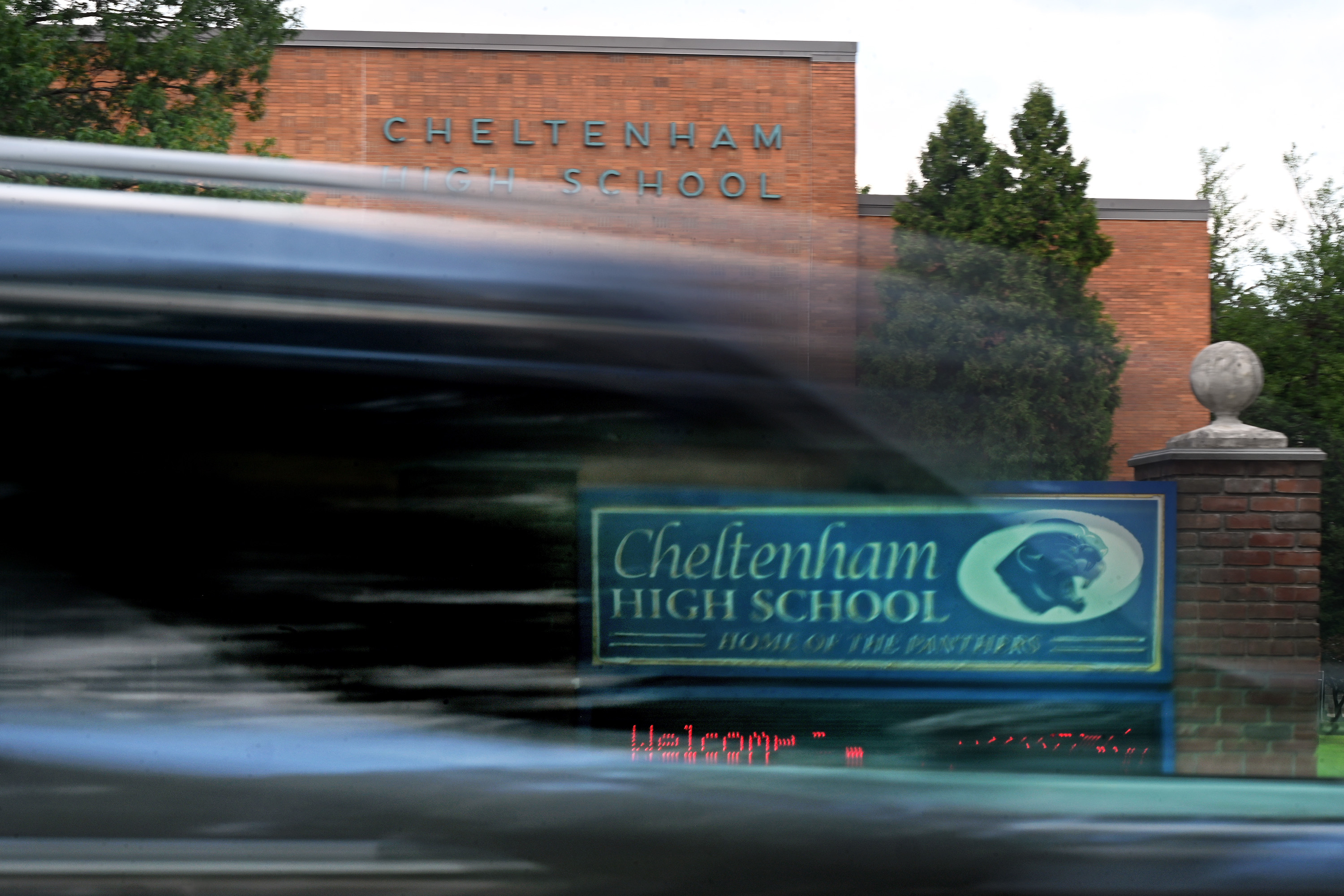
    Some Cheltenham families are anxious about the new school year that begins Aug. 31, because it feels like the last year, marked by uncertainty and pain for many, hasn’t ended.

    After a 15-year-old football player was allegedly assaulted twice in the locker room last August and September, the community hung in limbo for months, with no punishments for anyone involved while district and county investigations rolled out.

    Now, Cheltenham is heading into what would have been a fresh start just as a flurry of conclusions finally arrived: criminal charges for four coaches and six players, a grand jury report finding the district mishandled the assaults, and the superintendent’s resignation.

    Five of those charged are set to appear at a preliminary hearing on Aug. 27.

    “We are coming to school in the next three weeks. What is the plan for the morale of all the kids that have been affected?” Francis Brown, the parent of a senior, asked at a school board meeting this week. “Should the seniors expect to come and sit on the lawn for Senior Sunrise and see news cameras in their face?”

    Some families are afraid to say they’re from Cheltenham, residents said at Tuesday’s board meeting, which was the first public forum for the school community since the charges were brought.

    “Half our parents don’t want to wear anything that says Cheltenham on it, because they’re embarrassed,” Shelley Gaither, the president of Cheltenham Elementary’s parent-teacher association, said at the board meeting. “Because they get asked questions, they get looked down upon.”

    And the interim superintendent Chris McGinley, whose selection was announced at the meeting, will lead an administration that many families say has repeatedly failed to address safety concerns across grade levels.

    This year’s staff may include three people referred to the Montgomery County grand jury report as Employee #1, #2, and #3, one of whom texted about dissuading the victim’s mother from visiting the school. Texts also downplayed the assault allegations, according to the grand jury report.

    The district has not answered questions about the status of the three employees.

    Officials emailed parents on Aug. 13 that Vice Principal Mark Hoff — to whom the victim’s mother said she first reported the assault allegations — will be staying at the high school, instead of moving to Wyncote Elementary as planned, for continuity during a turbulent time.

    The school board said Tuesday an outside attorney will be reviewing all safety policies and the board will review all sports programs in the district in the coming weeks.

    The district has also enlisted the Bucks County Intermediate Unit to audit the human resources department, and Cheltenham is checking that all staff have current child abuse and criminal history clearances after the grand jury report found five of the coaches weren’t up to date last year.

    But families are still worried what the school climate will be like in September.

    “I asked [my kids] how they felt about going to school, and they’re nervous,” a member of the high school’s parent-teacher association said at the Tuesday meeting. “Not just for safety concerns, but for the environment of the school … My oldest said ‘I’m worried the teachers will be upset.’”

    A coalition of parent groups presented a list of joint demands at the meeting that includes a town hall on school safety, first-day assemblies on sexual assault, hazing, and bullying by age group, and a community-wide survey assessing district leadership.

    And the Saturday before schools starts, the Cheltenham African American Alliance plans to hold a “Together We Can Change Their Tomorrow” march at 8 a.m. from the administration building to the high school, president Ikysha Dearry announced Tuesday.

    “We have to take back our power as people,” Dearry said. “We have kids who will be coming through these doors in the next two or three weeks.”

    Staff writer Maddie Hanna contributed to this article.

    This suburban content is produced with support from the Leslie Miller and Richard Worley Foundation and The Lenfest Institute for Journalism. Editorial content is created independently of the project donors. Gifts to support The Inquirer’s high-impact journalism can be made at inquirer.com/donate. A list of Lenfest Institute donors can be found at lenfestinstitute.org/supporters.

  • Data centers are good business but bad politics. Josh Shapiro tries to thread the needle. | Shackamaxon

    In this week’s Shackamaxon, the race for City Council kicks off, SEPTA police officers step in front of the cameras, and a Big Tech reckoning comes for the Ambitious Abingtonian.

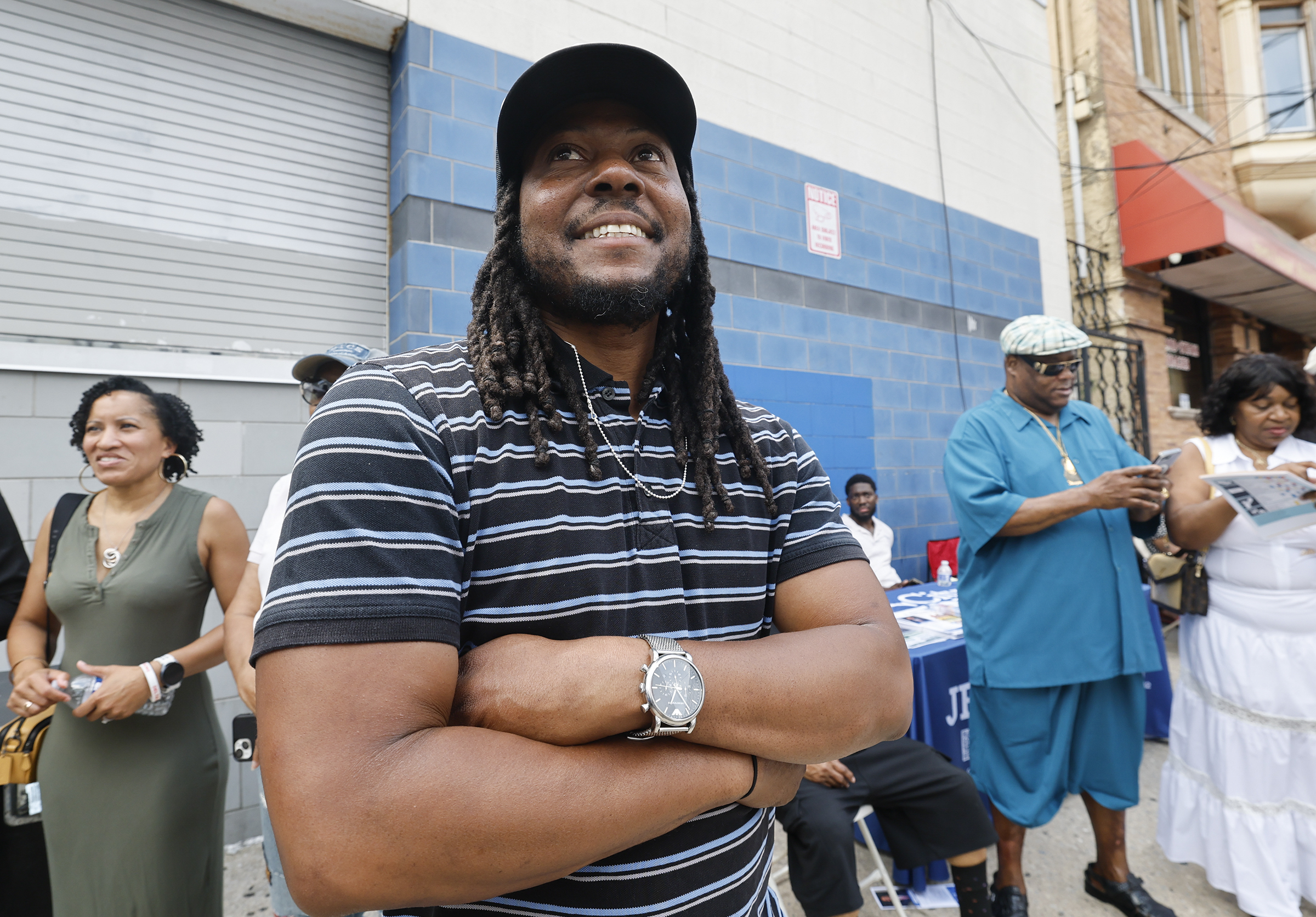
    Councilmember Jeffery “Jay” Young Jr. during the Barber’s Hall community legacy celebration on Aug. 1.Yong Kim / Staff Photographer

    Contrarian challenge

    In political circles, the legislative lineage of Philadelphia’s 5th Council District is one of the city’s most esteemed and iconic. The first person to represent the residents of the 5th in City Council was Raymond Pace Alexander, the civil rights leader who was later appointed as the first African American judge on the Court of Common Pleas. The seat has also been held by Cecil B. Moore, Ethel Allen, and John Street. Few other districts can boast such an impressive list of luminaries.

    Today, its occupant is someone very different, Council’s quarrelsome contrarian, Jeffery “Jay” Young Jr.

    Of course, there’s nothing wrong with “good trouble” or sticking out from the crowd. Moore himself was famously pugnacious, with the former Marine once quoted as saying that “The imported Gandhi philosophy of nonviolence that still exists in the South will not be accepted in Philadelphia, where we believe in self-help and self-defense.” Allen was also a maverick, styling herself as a “B.F.R. — a Black, female Republican, an entity as rare as a Black elephant and just as smart.”

    Moore and Allen, however, were quarrelsome on behalf of the people they represented, and contrarians at a time when Black Philadelphians were mostly excluded from the halls of power.

    Moore successfully desegregated Girard College, paving the way for Young himself to attend decades later.

    Allen broke barriers, too, becoming the first Black woman to hold a seat on City Council, and served the community directly as a physician.

    Young, however, starts fights that help nobody. Worse, no one seems to understand why he’s fighting in the first place.

    From delaying repairs at the Cecil B. Moore Library to blocking popular housing proposals, Young’s actions frequently bring him in conflict, rather than concert, with the community he was elected to represent.

    It is unsurprising, then, to see that he’s already attracted a declared challenger for his seat, months before election season kicks off in earnest.

    Jalon Alexander has a big advantage over the opponents Young (almost) faced in the past: He’s managed to successfully get onto the ballot before, during the 2023 City Council at-large election.

    While he brings his own ideas to the table, Alexander is also clearly running in opposition to Young’s choices. The cybersecurity attorney grew up in Strawberry Mansion, and still lives there, but is running a campaign built to find support across the district’s geographic and political spectrum.

    Kellan White, at this point a potential candidate, presents another strong alternative. White managed Rebecca Rhynhart’s 2023 mayoral campaign, which was successful across much of the 5th District. He has a deep knowledge of city politics and policy, and a Rolodex of contacts that any political journalist would be jealous of. Unlike Young, both Alexander and White are willing to answer the phone to talk to reporters, community leaders, and their constituents.

    At this point, even if a dozen candidates run against him and split the opposition vote, Young may still face an uphill battle.

    When I’ve criticized other Council members, I always get calls or emails from constituents who defend their choices. In nearly three years writing about Young, not a single person has offered a defense.

    A SEPTA Route 38 bus at 15th and Market Streets in May.Alejandro A. Alvarez / Staff Photographer

    Spotlight on SEPTA

    A few readers have asked me about film crews they’ve seen following SEPTA police around stations and transit vehicles recently. Media Relations Director Andrew Busch confirmed that the A&E Network is filming a docuseries, which will be broadcast next year.

    Personally, I’m looking forward to watching it. SEPTA’s roughly 250-strong police force is charged with patrolling more than 285 train and trolley stations, and nearly 3,000 vehicles. They are also in the midst of substantial declines in serious crime, which occurred alongside a crackdown on fare evasion and a surge in enforcement for quality-of-life issues. That’s a story worth showing.

    Less worthwhile would be a series focused on Kensington and the city’s drug epidemic. That’s a real part of SEPTA’s policing duties, but is often exploitative when told by outsiders.

    Gov. Josh Shapiro announces a $20 billion investment by Amazon in Pennsylvania data centers in Salem and Falls Townships in 2025.Commonwealth Media Services

    Data-driven

    Ever since the creation of the first computer, there have been concerns about its role in the future. It doesn’t help matters that many tech CEOs, like OpenAI’s Sam Altman, regularly express a kind of contemptuous attitude toward humanity and human needs. At one point, Altman said that artificial intelligence would “lead to the end of the world.” How inspiring!

    This has put public officials in a tough position over their support of data centers.

    For generations, states and cities have competed to attract investment. But these days, cash is flowing into an industry opposed by 74% of voters. Seeing an opportunity, challengers from across the political spectrum are using data centers in their political attack ads, while incumbents are scrambling to explain themselves.

    This isn’t run-of-the-mill NIMBYism, either. According to one report, only 8% of data center opponents live near one.

    Gov. Josh Shapiro, the Ambitious Abingtonian, exemplifies this conundrum. He was an early advocate for embracing data centers, but with polls tightening for his reelection efforts, he’s been forced to adapt.

    Of course, there’s a certain opportunism to state Treasurer Stacy Garrity’s embrace of the techlash.

    Her own party has been quite supportive of data centers. President Donald Trump has called them “tremendous.” Pennsylvania state Senate Majority Leader Joe Pittman has long advocated for the centers, which represent a particular opportunity for his own community, which has, in his words, “a long and storied history when it comes to the production of electricity.” U.S. Sen. Dave McCormick, the highest-ranking Republican in Pennsylvania, is married to Meta executive Dina Powell McCormick. Meta is one of the four companies investing a total of $1.5 trillion in new data centers.

    Pennsylvania Senate Republicans declined to pursue Shapiro’s proposed “GRID” initiative, which would have required the centers to produce their own electricity, conform to environmental standards, and make community benefits agreements in exchange for permitting assistance.

    Many of the current pitchfork-wielding politicos may themselves be forced to pivot when in office. Voters may hate data centers, but they also hate tax increases and service cuts.

    Loudoun County, Va., which is known as data center alley, has averted both. Local authorities have cut property tax rates by nearly 30% over the last decade, and the centers pay roughly half of the county’s property tax revenue. Given the increasing share of Pennsylvania’s budget that is paid through the extractive gambling industry, the need to invest more in schools and transportation, and the continuing structural deficit, it is no surprise politicians initially saw the AI boom as an opportunity.

    Now, state leaders will have to pick their poison.

    If they pursue data centers, they’ll face voter backlash. If they continue to embrace gambling, they’ll contribute to the impoverishment of their own constituents. If they stop investing in education or allow transit agencies to fail, they’ll weaken the commonwealth’s economy going forward. If they raise taxes, they’ll take the blame for that, too.

    While the data center surge may seem sudden to many, it is also a response to demand. Both businesses and individuals are increasingly using AI in daily life.

    Ironically, many social media posts about data centers include AI-generated text and images. It is a bit like if the Women’s Christian Temperance Union had fundraised with a booze cruise.

  • A sculpture by a ‘Monuments Man’ is dedicated at 30th Street Station on this week in Philly history

    A sculpture by a ‘Monuments Man’ is dedicated at 30th Street Station on this week in Philly history

    Not all Philadelphians who answered President Franklin D. Roosevelt’s call to action were soldiers and civilians.

    Even the artists went to war.

    Like renown sculptor — and local legend — Walker Kirtland Hancock, these educated Americans charged into the bomb-pocked battlefields of World War II to also confront unprecedented evil.

    Their task? Saving priceless pieces of art.

    Hancock was part of the “Monuments Men,” an outfit of about 345 men and women who were sent overseas to try to pry Europe’s cultural treasures from the grip of the Gestapo.

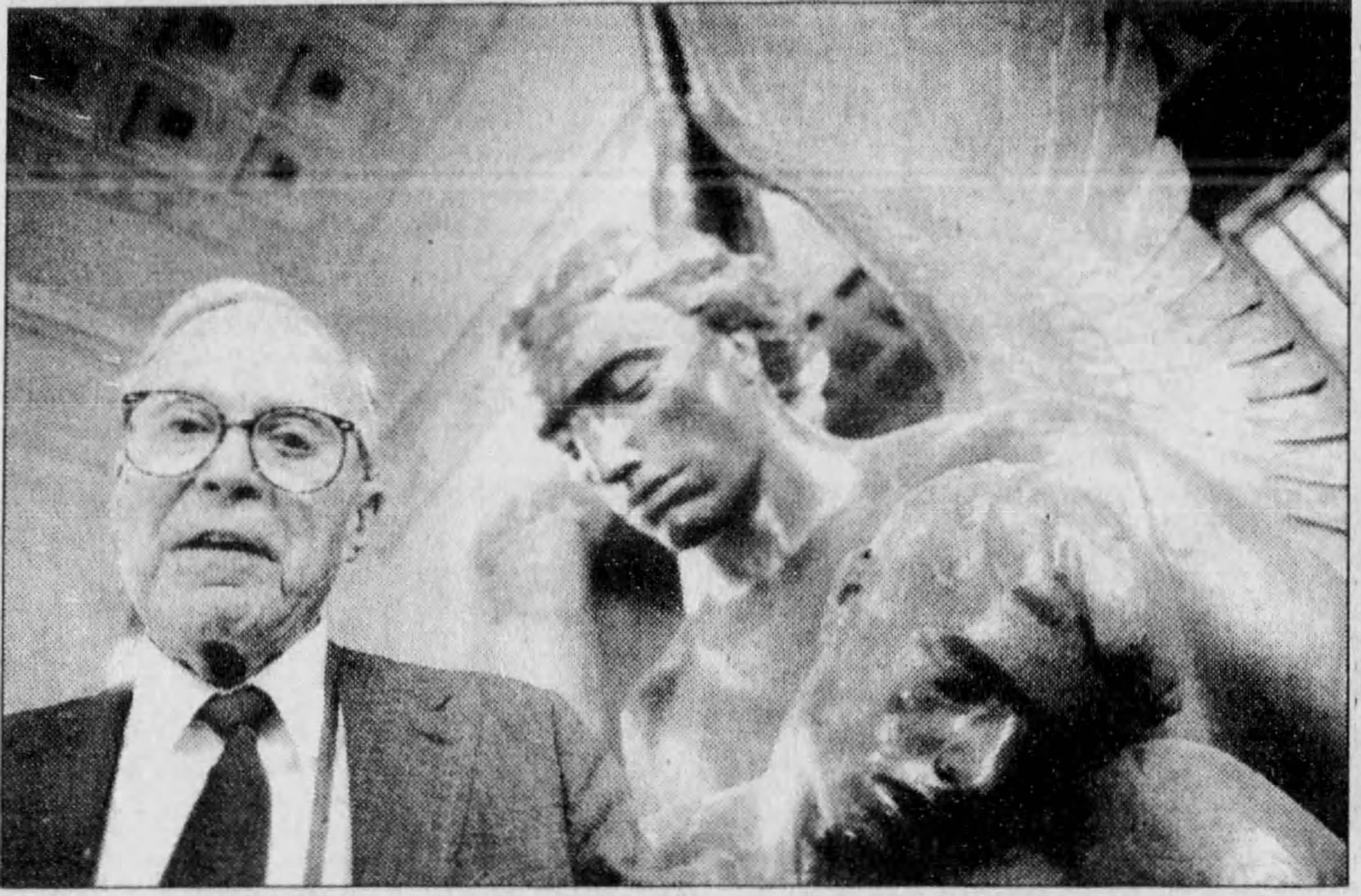
    “I was really prepared,” Hancock told the Daily News in 1991. “I knew where I was going and what I was looking for.”

    A group of “Monuments Men” retrieving stolen art in Germany in 1945. National Archives

    Hancock, who would become one of the United States’ most distinguished sculptors, attended the Pennsylvania Academy of the Fine Arts and taught there from 1929 to 1967.

    He enlisted in the Army in his mid-40s and was trained as a medic, but later transferred to the Army’s Monuments, Fine Arts, and Archives outfit.

    The unit’s monumental task: reclaim art the Germans had stolen and then hidden throughout the countryside in caves, on trains, in castles, and in hospitals.

    But it was in a salt mine in Bernterode, Germany where Hancock struck gold.

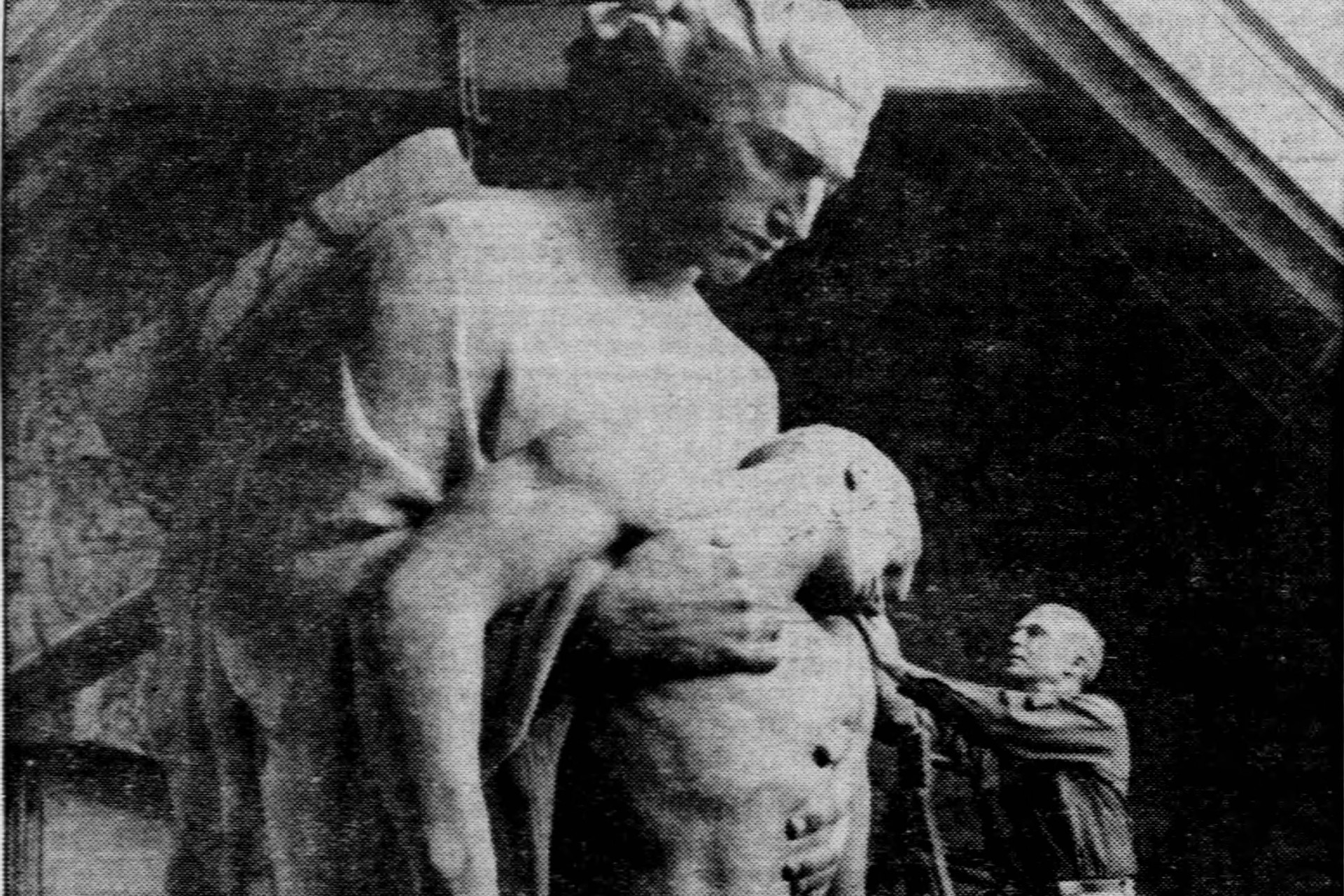
    Walker K. Hancock, considered the dean of American figurative sculpture, taught at the Pennsylvania Academy of Fine Arts.Inquirer Archives

    The first painting he rescued was a work by Jean-Antoine Watteau, Embarkation for Cythera, what he described as “one of the greatest paintings” the artist ever completed.

    “The surprise was so enormous to see a very famous old friend like that standing on the ground without any frame on it,” he told the Daily News.

    The mine was also filled with other treasures: the great seal of Prussia; an emperor’s scepter; the art collection of Frederick the Great, which was considered to be the best collection of French paintings in the world; and palatial libraries.

    The group’s efforts to reclaim precious pieces of human achievement were documented in a 2009 best-selling book. In 2014, their tale was given the “based on a true story” treatment and made into a star-studded motion picture dubbed The Monuments Men, featuring names like George Clooney, Matt Damon, Bill Murray, and John Goodman.

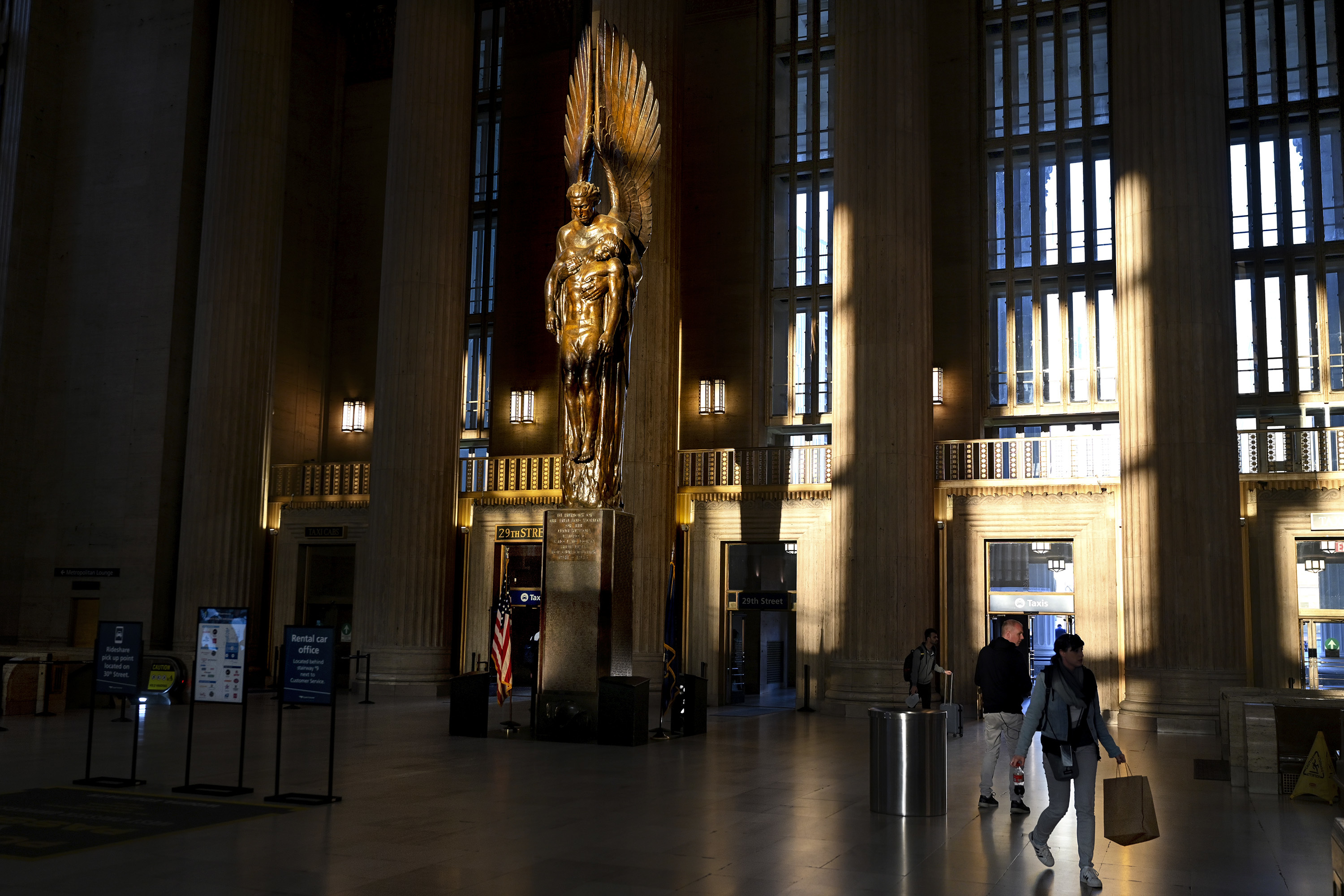
    Today, Hancock’s public works can be found all over the country, and locally, his most notable work sits at the east end of 30th Street Station.

    The Pennsylvania Railroad War Memorial (1950, installed 1952) by Walker Kirtland Hancock (1901 – 1998) in the lobby of 30th Street Station.Tom Gralish / Staff Photographer

    The 39-foot-tall, 10½-ton Statue to War Dead depicts an angel holding a dying soldier. It commemorates in bronze the 1,307 employees of the Pennsylvania Railroad who died during World War II. Gen. Omar N. Bradley was on hand to help dedicate the artwork on Aug. 10, 1952.

    Hancock died in 1998 at age 97 but his sculpture remains the station’s monumental centerpiece.

  • What does a black hole sound like? A Villanova scientist’s answer was turned into music.

    What does a black hole sound like? A Villanova scientist’s answer was turned into music.

    Villanova astrophysicist Becka Phillipson wondered what a black hole might sound like.

    She found an answer by translating X-ray data from a black hole system into musical notes.

    The first time she listened to the audio, the cacophony reminded her of someone pressing every key on an organ at once.

    After roughly 30 seconds of this “chaos,” she heard a “coherent, beautiful major chord” ring out.

    Her research formed the backdrop for a 13-minute musical composition performed on Saturday at the Chestnut Hill Skyspace, a venue and art installation. The black hole-inspired piece was one of three in an immersive concert, called “This Silent Music,” centered on collective listening.

    The concert intended to create a space where people could sit with and work through discomfort, especially at a time when many feel overwhelmed and disconnected, said cocreator Liz Lang.

    “I personally feel like I want to scream every time I open the news,” she said.

    Liz Lang minutes before performing during a rehearsal of “At the End of It All,” a 13-minute musical composition that incorporates sounds created by sonifying black holes.Jose F. Moreno / Staff Photographer

    Massachusetts-based composer LJ White used black holes as a metaphor for this theme. He paired Phillipson’s sounds with singing, a marimba, and suspended cymbals.

    To him, the chaos of the cosmic phenomenon reflected how marginalized groups can feel powerless and frustrated in society.

    The title of his piece, “At the End of it All,” comes from the poem of the same name by Nicole M. Young-Martin, which is “about not being able to predict or control anything, but trying to be your best person regardless,” White said.

    Sonifying a black hole

    Coming from a family of professional musicians and singers, Phillipson felt like the odd one out in choosing a career in science.

    She gravitated to researching black holes — areas of space where gravity is so strong, even light cannot escape.

    She thought sonifying black holes could make for an interesting outreach activity for students, while also helping scientists uncover novel information about black holes.

    When scientists sonify a black hole, they are not literally recording sound. Most of space is empty and “deathly silent,” Phillipson said.

    Instead, they are interpreting the interactions around the black hole.

    Using telescopes pointed at the night sky, scientists can collect information in the form of images. Those visual cues, such as brightness, can then be translated into sound. For example, Phillipson decided that, if something brightened, that would translate to a higher-pitched sound.

    The environment around a black hole gets brighter and dimmer over time as material interacts with it — akin to a campfire brightening after being fed a log.

    “I’m a translator between the light and the sound,” she said.

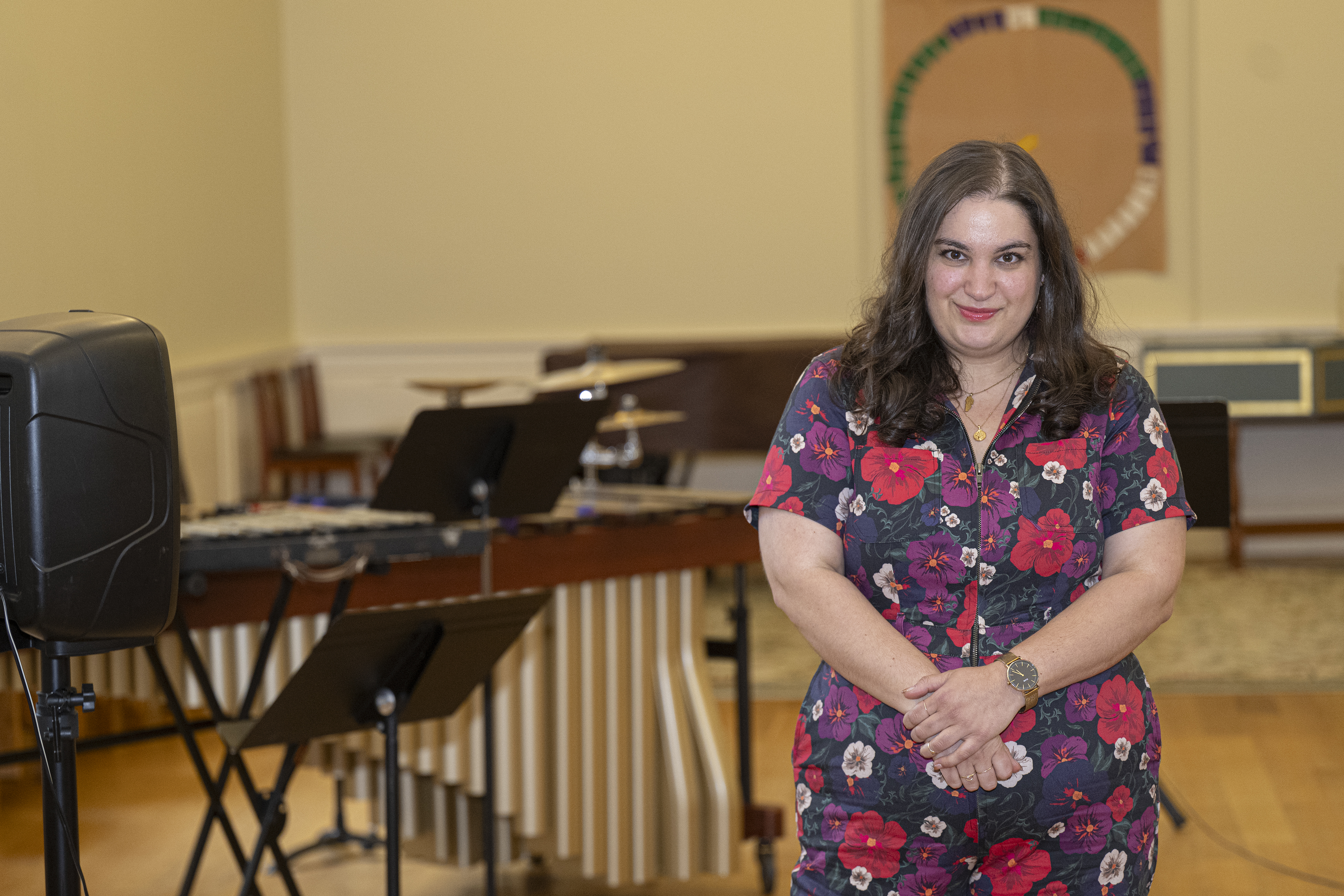
    Scientist Becka Phillipson lis photographed before a music rehearsal named “At the End of It All,” a 13-minute musical composition that incorporates sounds created by sonifying black holes, at the Presbyterian Church of Chestnut Hill in Philadelphia on Friday, Aug. 7, 2026. The piece also includes narration about black holes by Phillipson.Jose F. Moreno / Staff Photographer

    A metaphor

    White produced and mixed Phillipson’s black hole sounds — piecing them together into a collage that served as the background of his 13-minute composition.

    The audio had a “sort of circular sound” and “a lot of swooping,” he said, emulating the spin of a black hole. There was a sense of “things moving around you in a somewhat chaotic way,” he added.

    In this, he saw a metaphor for the experiences of marginalized groups who may feel frustrated and helpless.

    The piece featured parts where the singers scream with wild, unbridled vocals, as if reacting to catastrophe. Other sounds are associated with mourning.

    “Things are happening that they can’t predict or control,” he said. “I want [the piece] to be cathartic in some way.”

    It’s also meant to inspire.

    Beneath the chaos of a black hole lies untapped energy that can suck objects inside if one gets close enough, White said.

    A black hole behaves like an “infinitely deep funnel,” Phillipson said in narration included in the performance. Throw an object in, and it won’t come back out.

    Black holes are also invisible — only detected by their interactions with other things.

    “It’s not an energy source that is well understood or can be taken control of,” White said.

    The same concept of invisibility could extend to groups of people who aren’t in power right now, White said. For example, he identifies with the transgender community, which he says frequently gets talked about in relation to mainstream society, but often remains misunderstood.

    He hopes the piece helps people appreciate the power they have.

    “There’s all this latent energy that we have that we could harness,” White said. “We’re not helpless.”

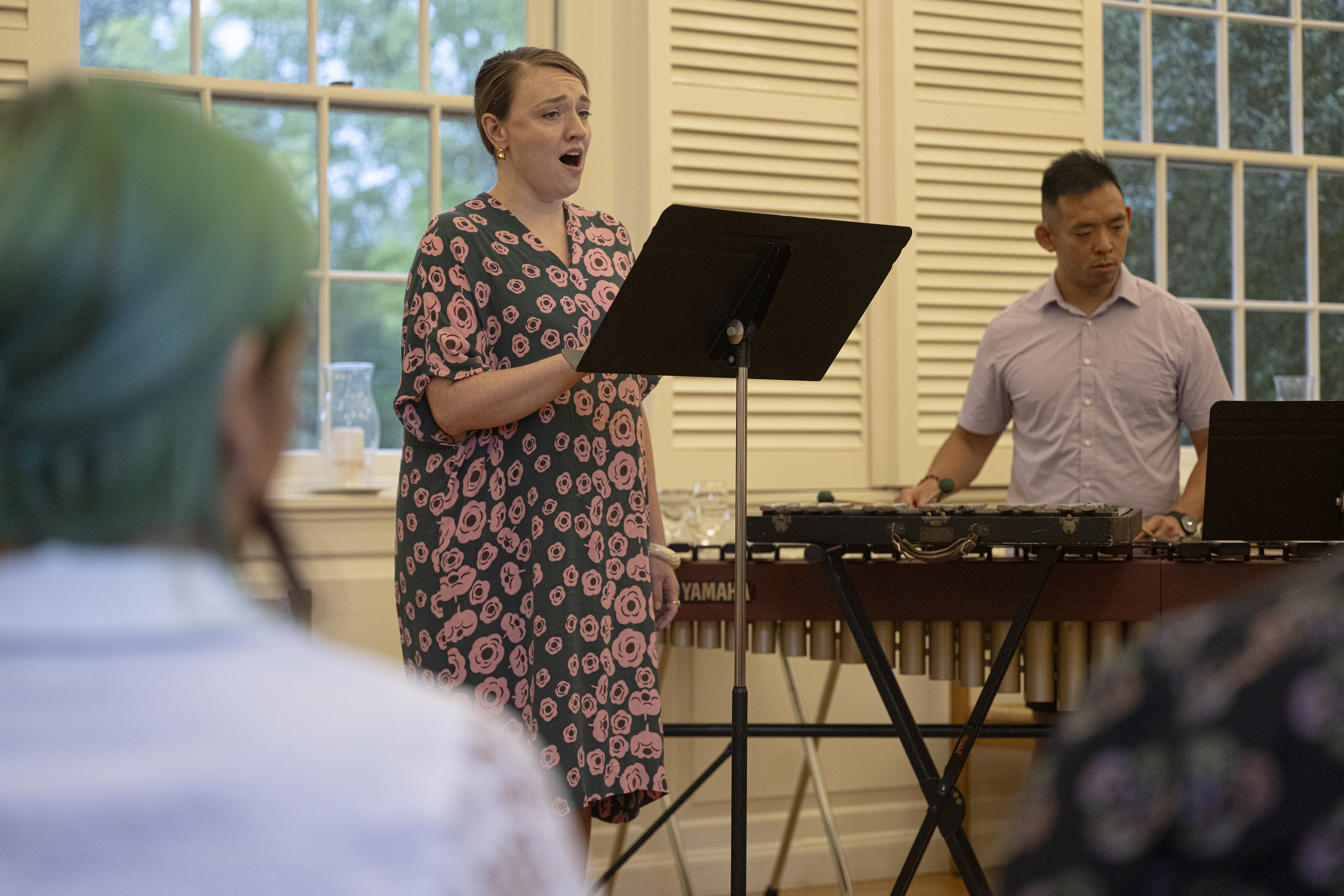
    Producer and Soprano Katy Avery rehearses “At the End of It All” at the Presbyterian Church of Chestnut Hill in Philadelphia. The actual concert took place in the Chestnut Hill Skyspace.Jose F. Moreno / Staff Photographer

    Lang hopes to expand beyond last weekend’s sold-out concert to perform in other Skyspace locations around the world. Light artist James Turrell has designed 100 Skyspaces globally, all featuring a room with an aperture in the roof, facing the sky.

    Cocreator Katy Avery was moved by the audience’s reactions at the Philadelphia concert. People found themselves growling along and wanting to vocalize with the performers, embodying the kind of communal atmosphere she had hoped for.

    The person sitting next to Phillipson told her he felt like he had to hold his breath the whole time. It was a “feeling like you have a strong emotion and you don’t know what to do with it,” Phillipson said.

    She compared her own emotional experience to riding Space Mountain at Disneyland. At first it’s dark around the roller coaster, with eerie, ethereal, sci-fi sounds — much like the soundscape created with her black hole sounds. Unable to see the tracks, the rider feels as if they are going into darkness.

    At some point in the piece, the singers came in with somber voices suggesting grief and mourning, with screams reminiscent of metal music.

    Those tumultuous sounds gave way to an ending note of hope and power.

    The two pieces that followed in the concert were more calming and contemplative.

    The black hole composition “was like the precursor to meditation,” she said. “First you have to cry before you can calm down.”

  • The hazing at Cheltenham follows a pattern seen at other schools. The district missed its chance to stop it.

    The hazing at Cheltenham follows a pattern seen at other schools. The district missed its chance to stop it.

    The connection was obvious for anyone who cared to see it.

    One parent after another stepped to a lectern at a Cheltenham school board meeting Tuesday night, each of them bemoaning the district’s handling of either the recent hazing scandal within the high school’s football program or a string of student-on-student assaults at Cheltenham Elementary. The alleged hazing led to criminal charges against four coaches and six players and was brutal: teammates holding down a 15-year-old sophomore so they could step on him with football spikes and poke at his buttocks with a broomstick. The alleged assaults at the elementary school, involving children in kindergarten and second grade, involved conduct and comments that were sexual in nature.

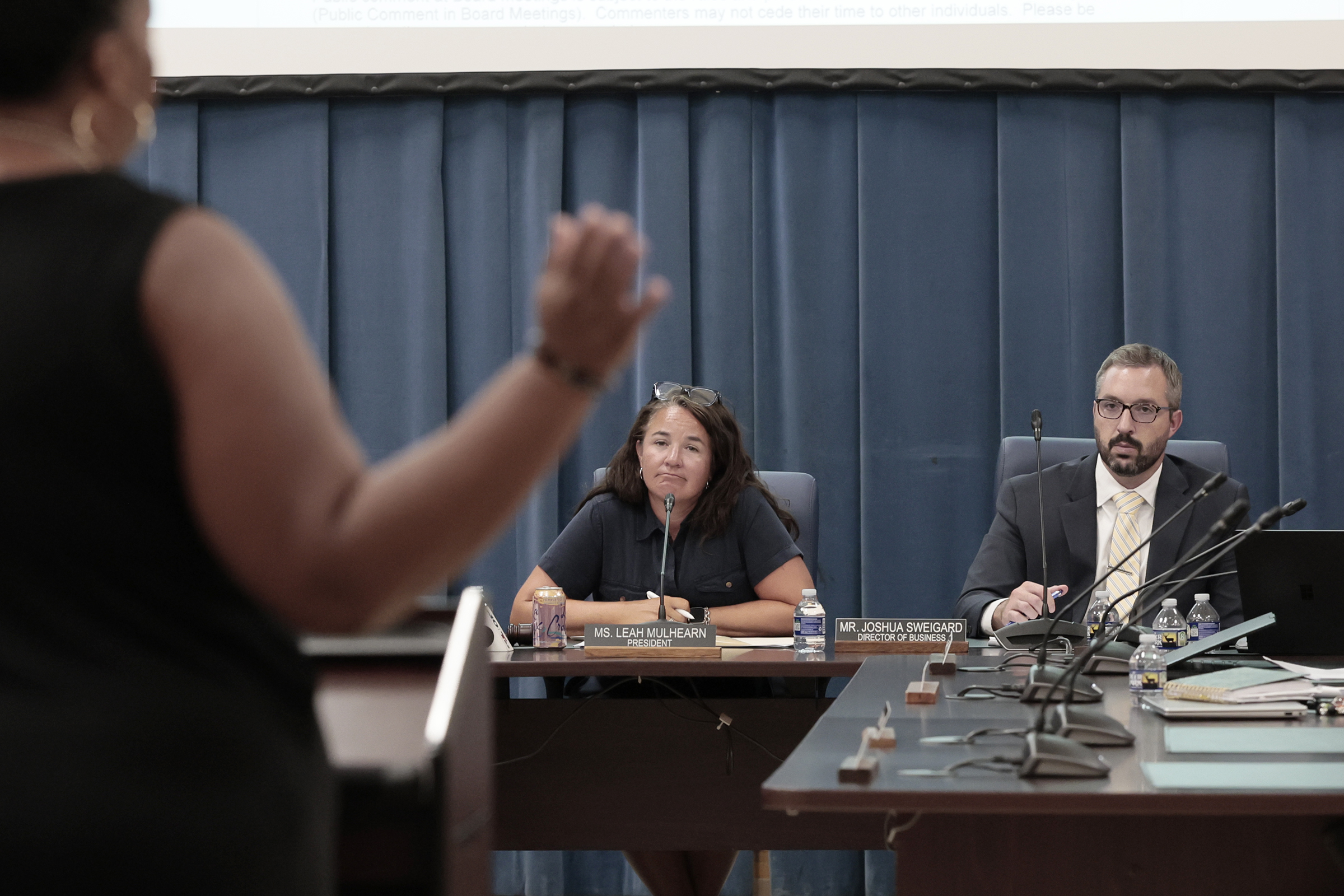
    Leah Mulhearn, the board’s president, announced that the district would review its safety policies and that “football will not return until we address this,” only to duck behind the protective shield of the passive voice — “Mistakes were made” — when it came time to assign responsibility for the dual disasters. The anger among the meeting’s attendees was palpable and universal, and it was justified. These are not two crises on distinct, parallel tracks. They are linked, and there is no separating them.

    It was impossible, after listening to some of those parents describe the abuse accusations at Cheltenham Elementary, not to think, What kind of school leaders ignore these incidents? The kind likely to ignore a parent who reports a violent attack in the football locker room. The Cheltenham school district has a culture problem, and that problem isn’t new. Does that assertion seem outlandish? It isn’t. In youth and high school athletics, certain patterns, even the worst kind, tend to repeat and perpetuate themselves.

    “It seems some sort of disconnect,” the author Hank Nuwer, who for decades has been tracking hazing-related incidents and deaths, once told me. “You have to look at it from the outsider position and the insider position. The outsider sees it as sadistic. The people on the inside have the disconnect, particularly if they’ve gone through it themselves. ‘This needs to be done because it has been done to me. So we’re doing it to someone else.’”

    Go to 2002, to Central Catholic High School in Pittsburgh, where two football players were charged with sexual assault after allegedly holding down a 15-year-old teammate and slapping him in the face with their genitals.

    Go to West Chester’s Arrowhead Day Camp in 1966. The Roman Catholic High School football team was there for training camp. In a hazing prank, three players carried sophomore Lamonte Jenkins to a swimming pool sometime after the pool’s 8:30 p.m. closure, threw him in, then scurried back to their bunks. Jenkins drowned.

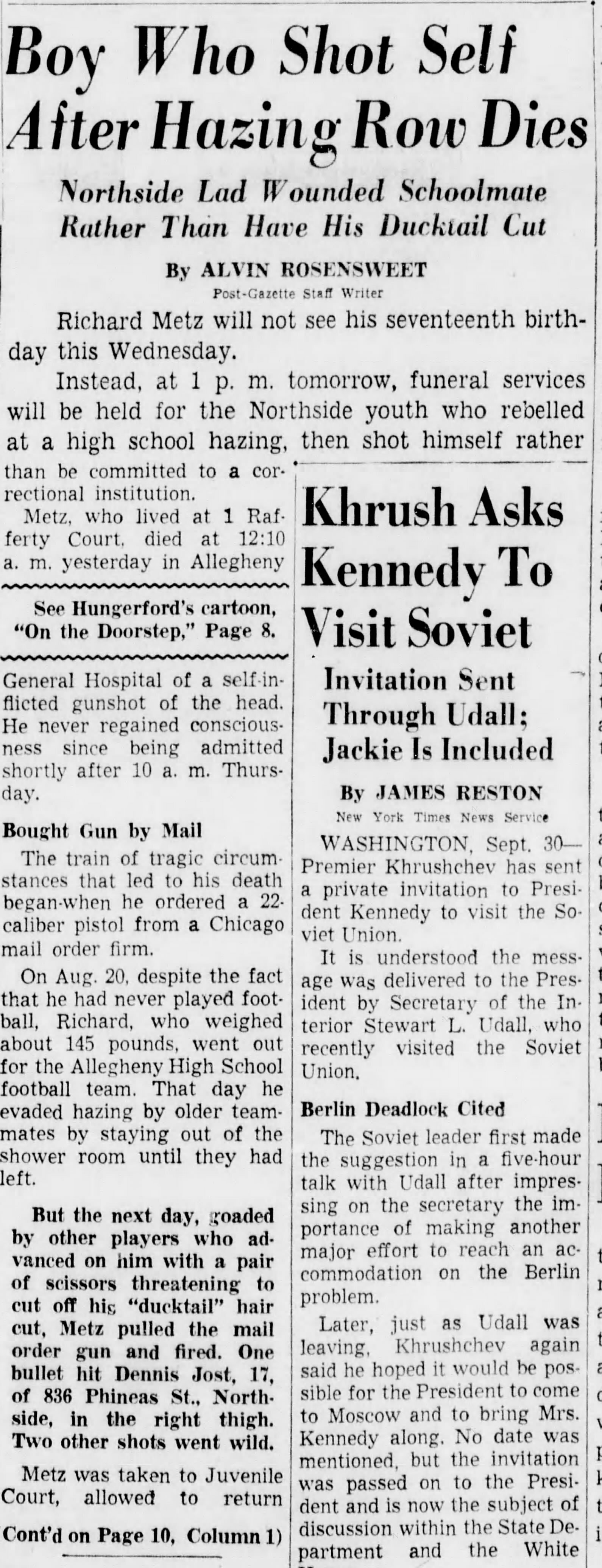
    Go back to Pittsburgh, in 1962, when Richard Metz, 16, tried out for the Allegheny High School football team and, after the first day of practice, stayed out of the locker room showers to avoid being hazed. The next day, when two players wielded a pair of scissors and threatened to cut his hair, Metz pulled out a .22-caliber pistol that he had ordered in the mail and fired three shots at the players, hitting one of them in the right thigh. Six weeks later, Metz shot himself.

    In 1962, Richard Metz shot a gun at two football players who attempted to haze him at Allegheny High School.Newspapers.com

    A “psychiatrist’s report showed that Richard had an inability to meet a crisis,” the Pittsburgh Post-Gazette’s Alvin Rosensweet wrote on Oct. 1, 1962, the day after Metz’s death. “He felt he was only defending himself when his teammates goaded him into shooting.”

    A young, troubled man who brings a gun to school … and turns it on other students … then dies by suicide. It doesn’t sound like something from the distant past. It sounds like the sort of atrocity too common in our time.

    Yes, these episodes are anecdotal. They’re also predictable without proper oversight from the adults who are supposed to be in charge, without awareness and understanding of the conditions that can create them. One would think the omnipresence of smartphones and social media and the possibility that such abhorrent acts would be captured on camera and blasted out to the world would serve as deterrents to hazing. They don’t, and the additional, necessary guardrails didn’t exist at Cheltenham and don’t in too many other locker rooms. Incidents like these seem rare, but there’s no telling how often they actually occur.

    “How likely,” Nuwer said, “are students to report this?”

    They’re not likely at all. The victims are often too humiliated to reveal the abuse, and you can be sure that the perpetrators won’t be quick to confess. Somehow those lasting lessons weren’t delivered to enough Cheltenham football coaches and players, and based on the abuse parents described Tuesday night, those responsible for the district’s youngest students need to learn them, too.

    There will be a review of the district from an outside attorney, and the high school football season has already been canceled, just as last season’s was. These are half-measures, and too late at that. Curtailing such cruelty comes down to stopping it before it starts, to cultivating an environment where everyone understands that there will be consequences for those who don’t meet the baseline for basic human decency.

    It takes elected leaders who actually lead. It takes educators and administrators who wield wisdom and compassion and discipline in the proper proportions. It takes parents and students with the willingness to speak up, and it takes parents who have the strength, the humility, and the self-awareness to recognize that their children might be causing the chaos — and who take the steps to stop it. It takes a lot of elements that right now seem in short supply in the Cheltenham school district.

    This column has been updated to reflect the outcome of one accusation of hazing.