A majority of Pennsylvania voters oppose data center development in the United States, according to a new poll, as the issue has quickly become a flash point in the state’s gubernatorial race and other midterm elections.
Six in 10 likely Pennsylvania voters do not want the U.S. to construct data centers to house artificial intelligence, according to a poll conducted from Aug. 17 to 21 by The Inquirer, the New York Times, and Siena University. The poll, which surveyed 760 likely voters in Pennsylvania, found that Democratic and independent voters oppose data centers at higher rates, while just over half of Republicans support their construction.
(function(){function e(){window.addEventListener(`message`,function(e){if(e.data[`datawrapper-height`]!==void 0){var t=document.querySelectorAll(`iframe`);for(var n in e.data[`datawrapper-height`])for(var r=0,i;i=t[r];r++)if(i.contentWindow===e.source){var a=e.data[`datawrapper-height`][n]+`px`;i.style.height=a}}})}e()})();
The United States is in an international race to lead advancements in AI, with $2.3 trillion in data center projects underway or in the planning stages across the country. Pennsylvania, with more than 100 proposed projects, is among the hot spots targeted by developers for its key location near top U.S. metropolitan areas, vast rural space for building, and significant energy resources.
Gov. Josh Shapiro originally welcomed data center developments to the state, and last year championed a $20 billion investment from Amazon to build at least twodata center campuses in Bucks and Luzerne Counties. He also offered developers fast-track permitting in an attempt to establish Pennsylvania as a leader in AI development.
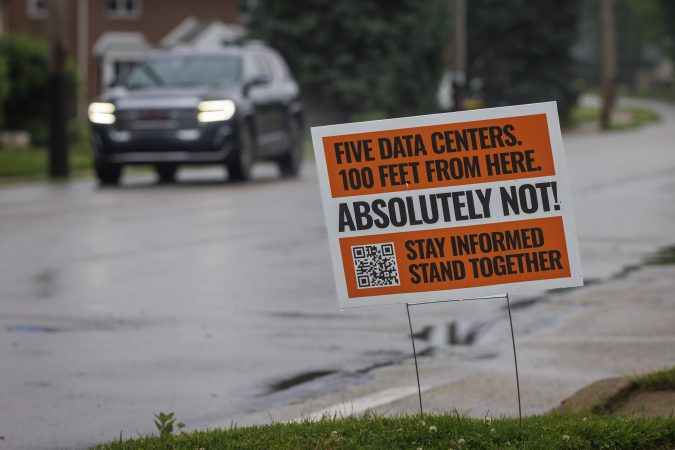
But in a year’s time, public animosity toward data centers has grownin Pennsylvania and beyond, as residents say they fear the facilities will drive up electricity costs, overuse water supplies, depreciate home values, and disrupt their daily lives. Last week, Shapiro, a Democrat running for reelection in November and a 2028 presidential prospect, announced plans to restrict data center development in the state.
Shapiro said his position on data centers evolved as he listened to more constituents who live in areas like Archbald, a small northeastern Pennsylvania town with six data center campuses under construction, and pointed to a developer in Montgomery County who he said is “bullying” residents to push projects through amid public opposition.
(function(){function e(){window.addEventListener(`message`,function(e){if(e.data[`datawrapper-height`]!==void 0){var t=document.querySelectorAll(`iframe`);for(var n in e.data[`datawrapper-height`])for(var r=0,i;i=t[r];r++)if(i.contentWindow===e.source){var a=e.data[`datawrapper-height`][n]+`px`;i.style.height=a}}})}e()})();
Pennsylvania’s youngest voters were most likely to reject data centers, according to the poll: 83% of likely voters ages 18 to 29 opposed their development, as did 71% of voters ages 30 to 44. Opposition, while above 50% for all age groups, decreased among older voters.
Kelly Harrington, 29, of Conshohocken, who participated in the poll, said she has been attending Plymouth Township Council meetings to oppose a controversial proposal for a 2 million-square-foot data center project there.
“Some of my concerns about that specific data center are selfish in the sense that I think my home value is going to go down, I think it’s going to be loud and obstructive, I think it’s going to pollute the air that I want to breathe every day,” Harrington said. “But in a wider sense, I’m also concerned about the environmental impacts of data centers.”
Front and center in the Pa. governor’s race and beyond
Data centers have become a key issue in the Pennsylvania gubernatorial election, where Shapiro hopes to ride his high popularity to reelection and usher in Democratic gains in down-ballot races for the statehouse and Congress.
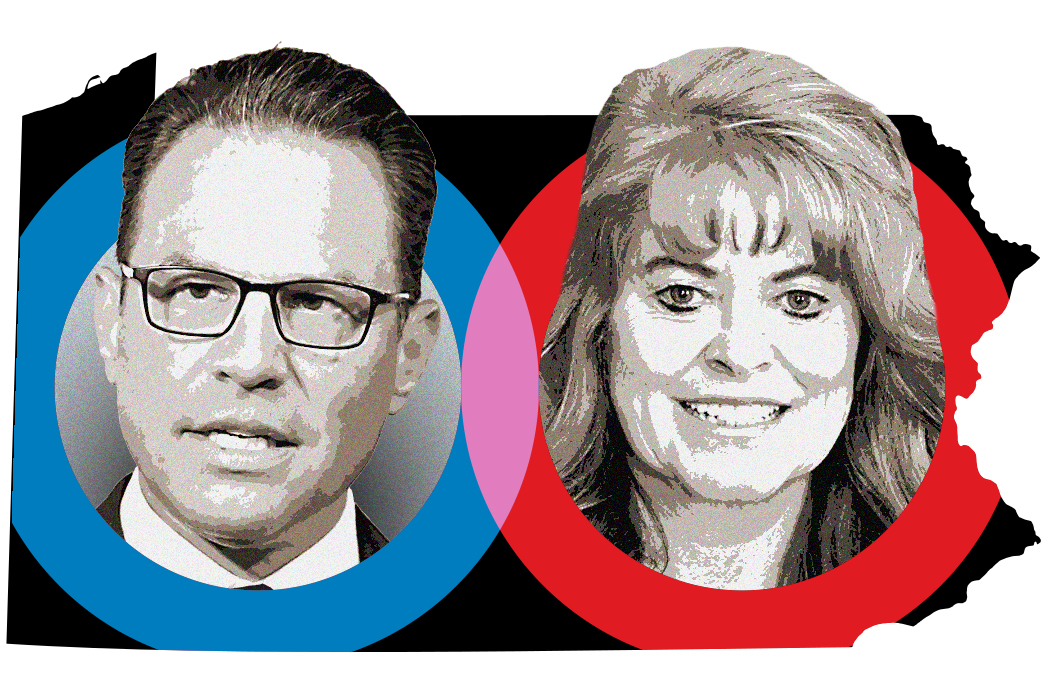
Both Shapiro and his Republican opponent, State Treasurer Stacy Garrity, have released ads criticizing the other’s past support for data center development.
Democratic and Republican politicians across the country have reversed course on data centers in recent months as the projects have grown increasingly unpopular.
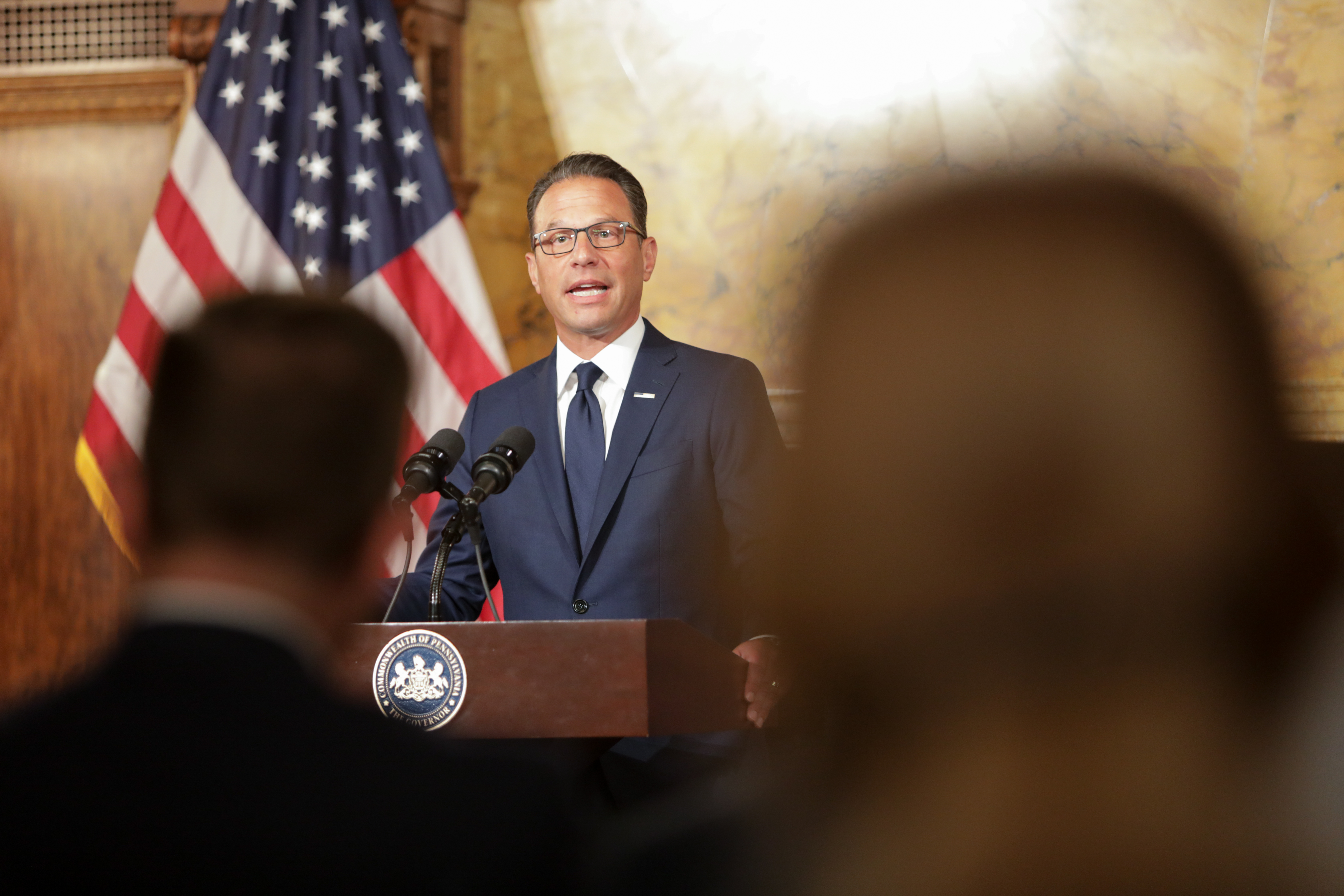
Gov. Josh Shapiro answers questions after signing an executive order restricting data centers in Pennsylvania during a ceremony in the Capitol in Harrisburg, Pa., Tuesday August 18, 2026.Kalim A. Bhatti / For The Inquirer
Prior to Shapiro’s announcement last week touting the “strictest guardrails in the nation” for data center development, his support for the projects appeared to be one of the major tests of his popularity. A Quinnipiac University poll published in July found that while 56% of voters approved of Shapiro overall, only 24% approved of how he was handling data center development in Pennsylvania.
Andsome Pennsylvanians who had voted for Shapiro in 2022 said his support for the developments had caused them to contemplate sitting out the November election or writing in a different candidate for governor.
For some voters, like Montiese McKenzie, Shapiro’s change in position has been enough.
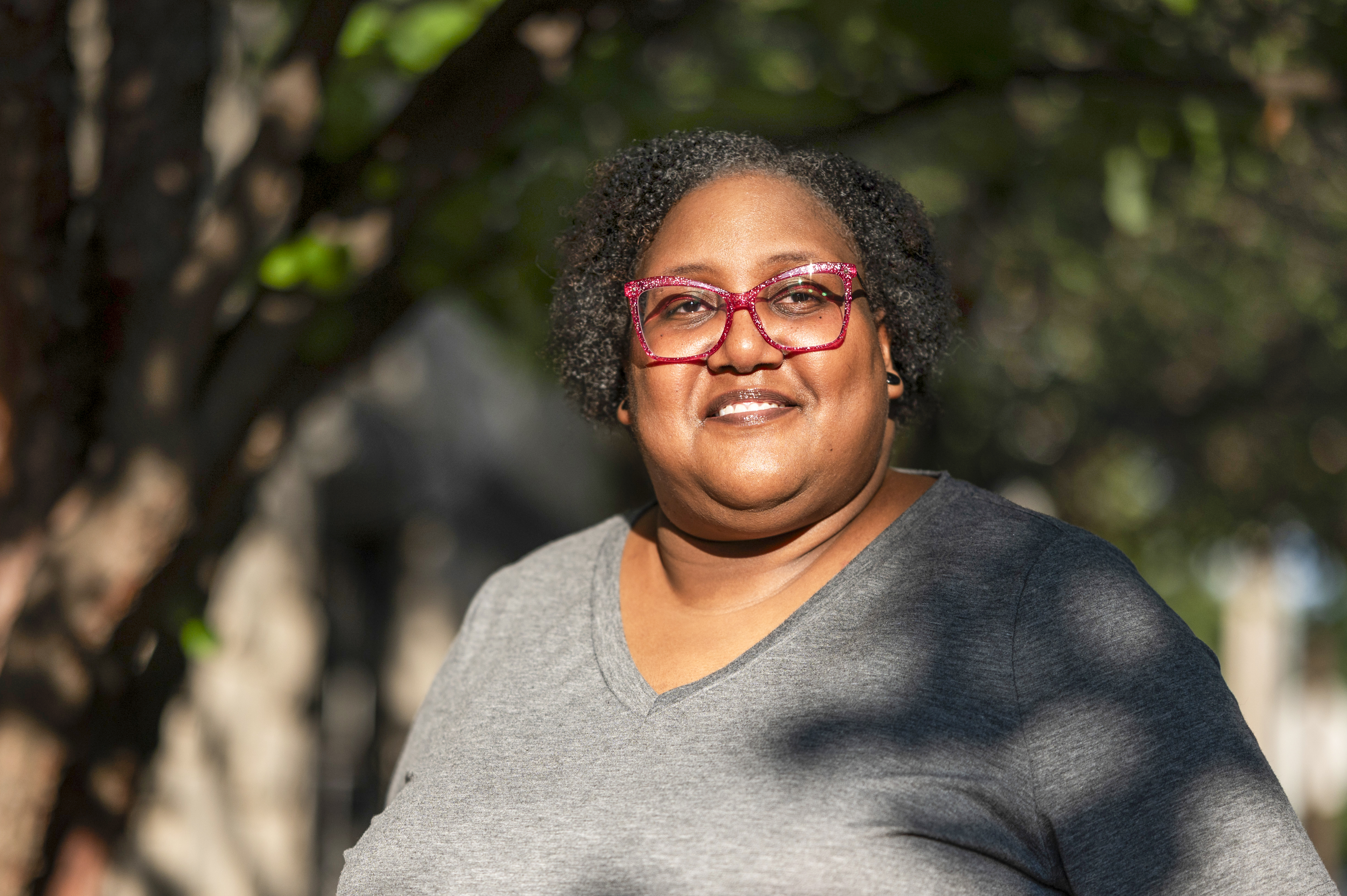
“I’m very proud of Gov. Shapiro for being anti-data center,” said McKenzie, 48, of West Philadelphia. The Democratic voter said she fears that poor communities will face disproportionateconsequences of the construction of AI data centers.
“What happens will be very important for how I see him as a future leader,” McKenzie said.
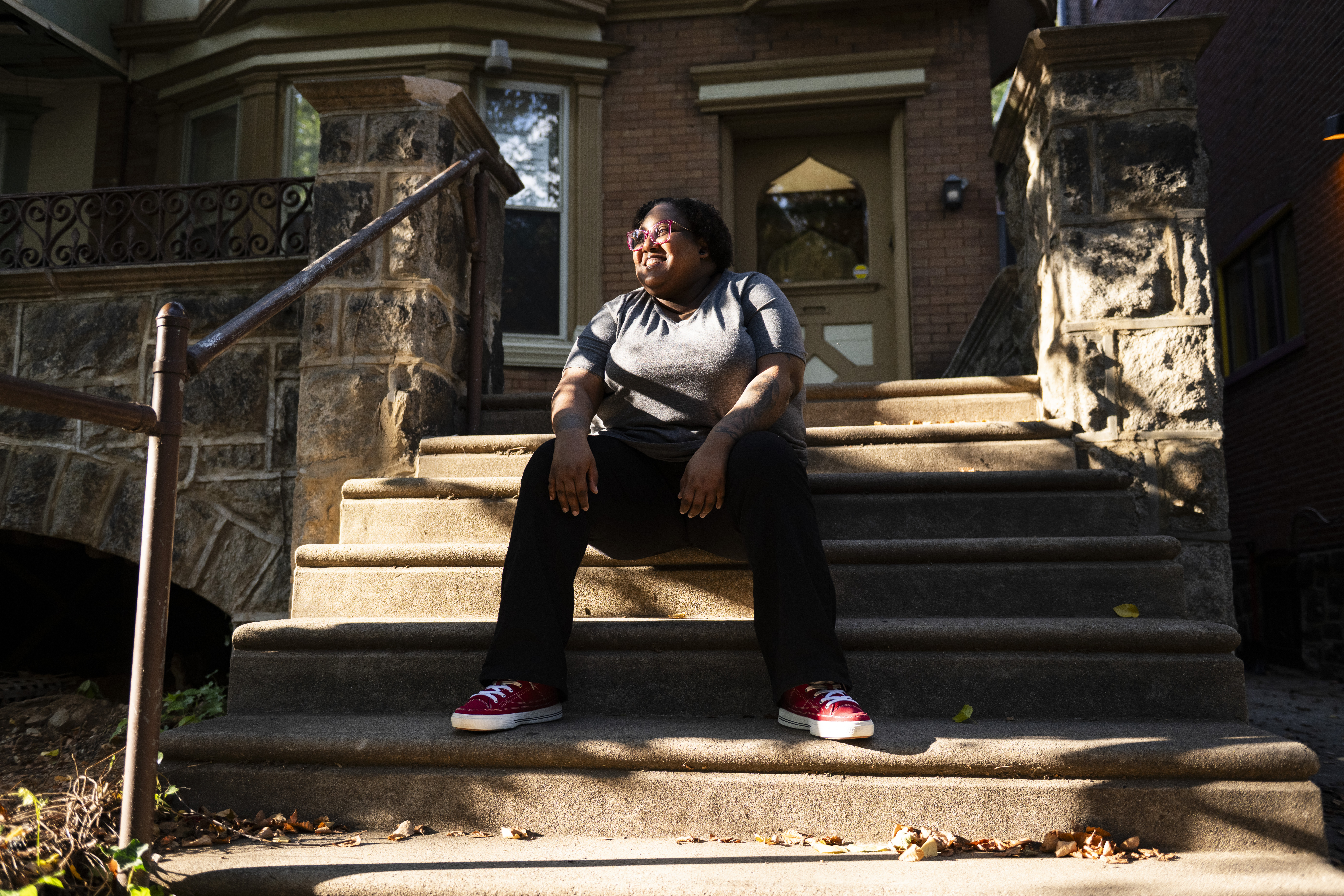
Montiese McKenzie, 48, poses for a portrait near her home in West Philadelphia on Monday, Aug. 24, 2026.Allie Ippolito / For The Inquirer
Still, Shapiro’s recent change in position has not wooed all Pennsylvania voters.
Maryann Klaus, 82, a Democrat in Upper Bucks County, supported Shapiro in 2022. But, she said, his initial embrace of data centers in the region without consulting the community was “just not good governance.” Despite Shapiro’s recent moves to restrict data center development, Klaus said, she is still reconsidering her vote for his reelection this fall.
The executive order Shapiro signed last week is a “a start,” Klaus said. “But, unfortunately, when you open the door, too many things occur and then you can’t walk them back.”
Others, like Steven Keenan of Ridley Township, say they want more data center development in the state.
Keenan, 60, a Republican who is supporting Garrity in November, said he wants Pennsylvania to lead on data centers.
“I’m not afraid of advancement in technology,” Keenan said. “I think we need all that [development]. We’re in a race with other countries that we want to dominate.”
Keenan said Shapiro’s change in position reaffirmed his support for Garrity. The shift in stance, he said, showed Shapiro was reacting to public opinion instead of doing what is right for the state. (Garrity, too, has moved away from her public support for data centers. She has called for the state to temporarily pause all data center development.)
“He goes where the wind blows,” Keenan added.
Staff writer Fallon Roth contributed to this article.
Two years ago, every child in the kindergarten class at Eleanor Emlen Elementary in Mount Airy had vaccine protection against measles.
A year later, the school’s kindergarten immunization rate had dropped to just 80%, putting students and the surrounding community at risk of an outbreak of the highly contagious disease.
Emlen is among more than two dozen Philadelphia-area schools that saw double-digit declines in kindergarten immunization rates last school year — in many cases because parents are increasingly refusing vaccines.
The affected schools span a diverse range of communities, from city neighborhoods like Mount Airy to the outlying suburbs. In Chester County, for example, a small private school in Downingtown saw its vaccination rates plunge by 20%.
Even as countywide immunization levels remain relatively high, some 40% of kindergarten classrooms across the region became vulnerable to an outbreak during the 2025-26 school year, up from 33% the year prior, an Inquirer analysis of newly released state data found.
(function(){function e(){window.addEventListener(`message`,function(e){if(e.data[`datawrapper-height`]!==void 0){var t=document.querySelectorAll(`iframe`);for(var n in e.data[`datawrapper-height`])for(var r=0,i;i=t[r];r++)if(i.contentWindow===e.source){var a=e.data[`datawrapper-height`][n]+`px`;i.style.height=a}}})}e()})();
That means that at least 249 schools had vaccination rates below 95%, the level at which scientists say a population must be vaccinated to prevent the spread of measles, one of the most contagious diseases.
Of these, 98 Philadelphia-area schools reported measles vaccination rates below 90%, presenting an even greater risk to students.
A sharp increase in parents opting out of vaccination for religious or philosophical reasons continued to drive down vaccination rates; exemptions in this category rose by 15% in the latest two years for which data are available.
(function(){function e(){window.addEventListener(`message`,function(e){if(e.data[`datawrapper-height`]!==void 0){var t=document.querySelectorAll(`iframe`);for(var n in e.data[`datawrapper-height`])for(var r=0,i;i=t[r];r++)if(i.contentWindow===e.source){var a=e.data[`datawrapper-height`][n]+`px`;i.style.height=a}}})}e()})();
Pennsylvania is among a handful of states that allows parents to opt out of vaccine requirements for philosophical or religious reasons, often by simply signing a form.
The health department published more granular, school-level vaccination data this summer for the first time, after reporting by The Inquirer and the Pittsburgh Post Gazette made this information public for the prior school year, exposing pockets of vulnerability within counties with overall high vaccination.
The new data show the growing public health threat to the region from Pennsylvania’s growing measles outbreak, in which two people in Lancaster County have died, state officials reported Tuesday. They were the state’s first measles-related deaths in three decades.
(function(){function e(){window.addEventListener(`message`,function(e){if(e.data[`datawrapper-height`]!==void 0){var t=document.querySelectorAll(`iframe`);for(var n in e.data[`datawrapper-height`])for(var r=0,i;i=t[r];r++)if(i.contentWindow===e.source){var a=e.data[`datawrapper-height`][n]+`px`;i.style.height=a}}})}e()})();
So far, nearly 400 cases have been diagnosed, with nearly half in Lancaster County. The rapidly spreading outbreak is edging closer to densely populated Philadelphia. Chester County, just west of the city, has reported the second-highest number of cases in the state.
At a news conference on the measles deaths Tuesday, Gov. Josh Shapiro stressed his concern about the rise in Pennsylvania parents opting out of vaccinations over the last 10 years.
“It has dramatically reduced community immunity in different areas of our Commonwealth,” he said. “Today, we see the consequences of a lack of immunization.”
The new school-level data on vaccines, he said, allow “everyone to see their school’s vaccination coverage and make informed decisions.” Lawmakers have also said they hope that having more access to data about their children’s schools will make families more aware of risks within their communities and encourage them to vaccinate their children.
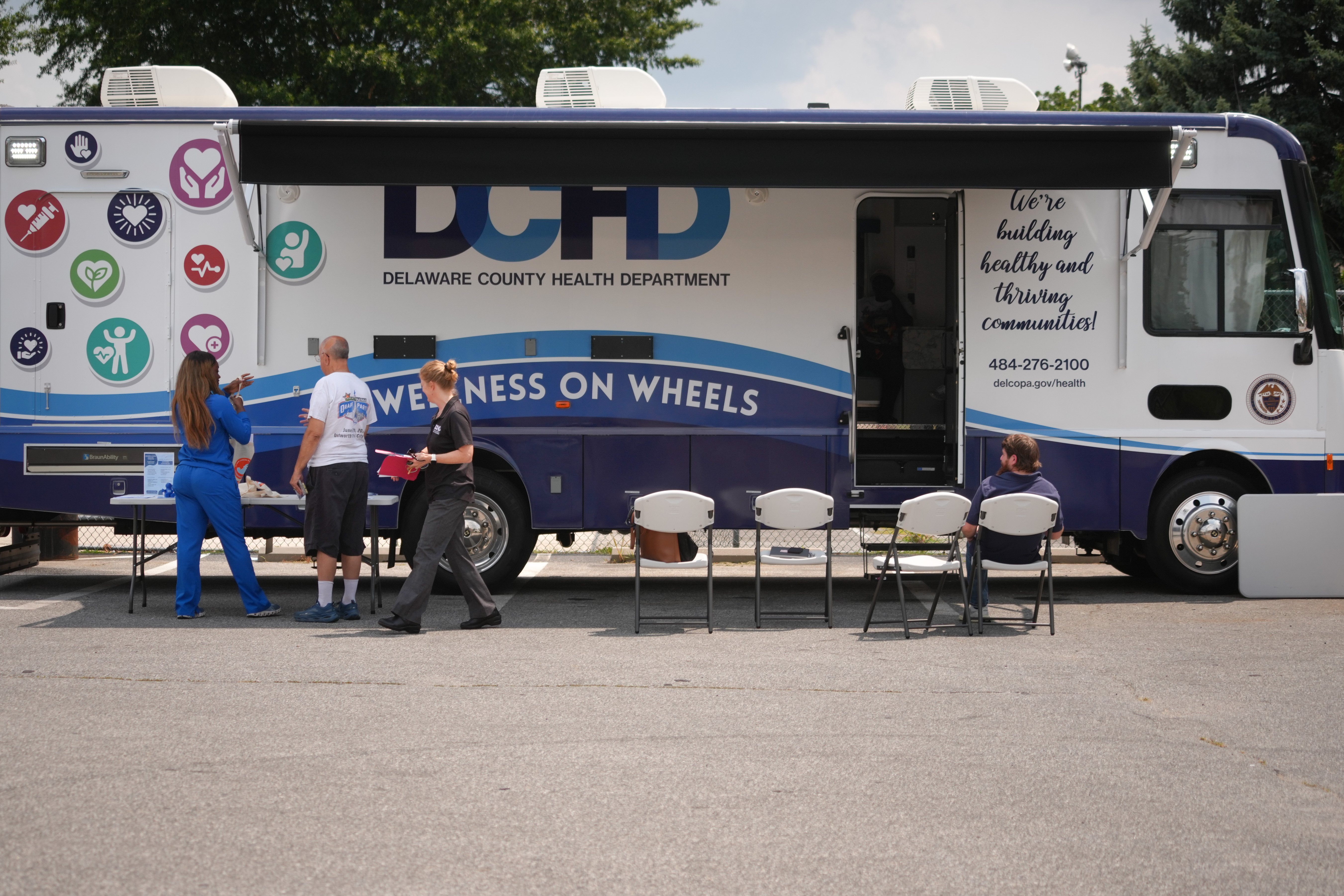
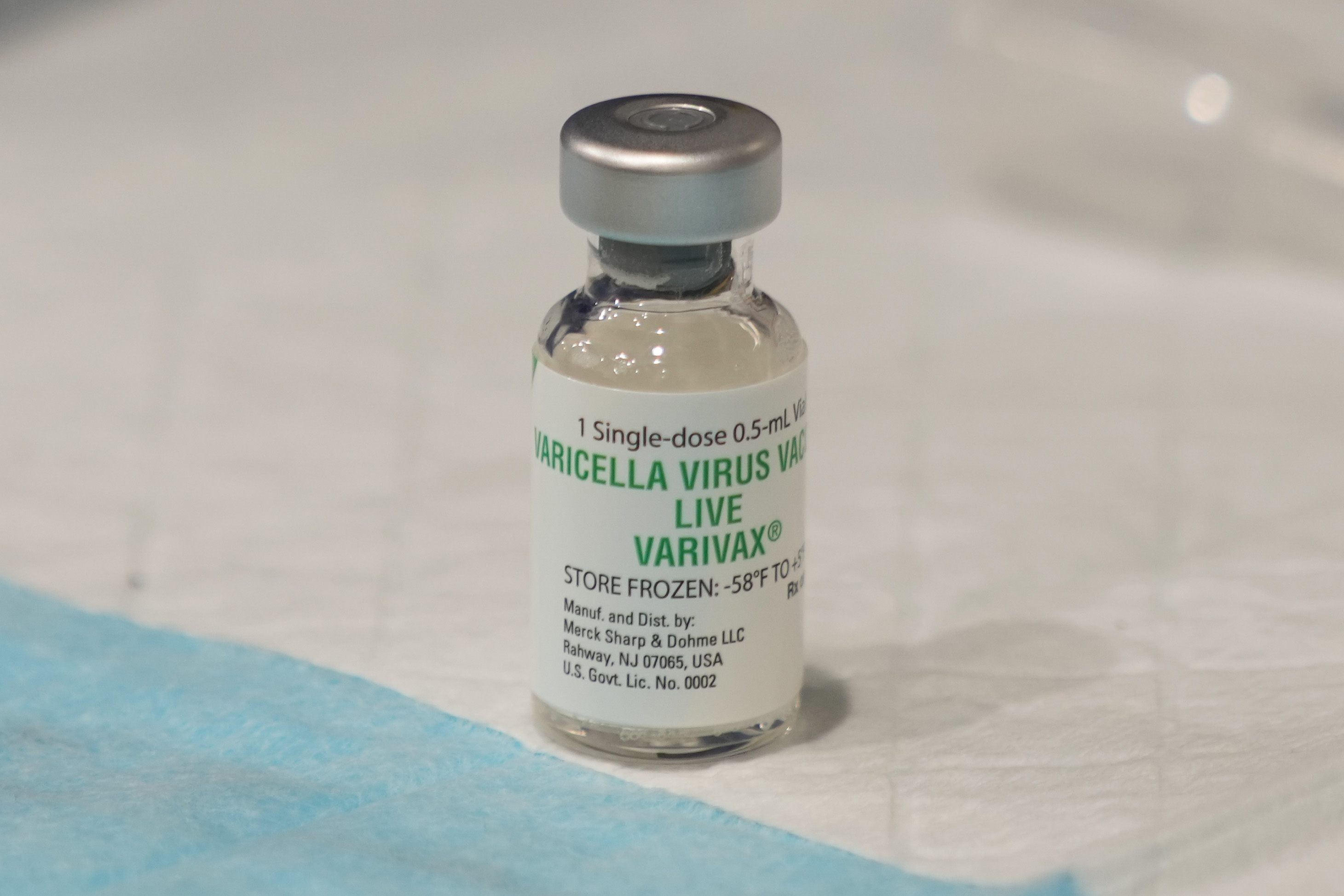
Amid rising measles case counts and declining immunization rates, Delaware County’s health department launched an immunization campaign over the summer to encourage families to vaccinate.Jessica Griffin / Staff Photographer
Emlen, which saw one of the steepest drops in protection, was one of 40 schools in the five-county region that reported 100% measles vaccination rates two years ago, only to drop below the 95% herd immunity threshold last year.
Philadelphia school officials say the changes at Emlen likely reflect increasing hesitancy among parents to immunize their children against measles, mumps, and rubella (MMR) and other diseases. State records show that most unvaccinated kindergarteners at Emlen have philosophical or religious exemptions.
Some fluctuations in kindergarten vaccination rates are typical from year to year, but the rise of anti-vaccine rhetoric in federal leadership appears to be exacerbating fears around vaccination, said Kendra McDow, a pediatrician who serves as the Philadelphia school district’s medical director.
“What we’re seeing is reflective of what I believe are local and national trends,” McDow said. “Families are confused, and they want to do right by their children.”
In the latest federal vaccine maneuver — opposed by the medical establishment, prominent Democrats, and Republican Sen. Bill Cassidy, a physician — President Donald Trump signed an executive order this month asking states to “consider updating” laws to require fewer vaccinations for schoolchildren without any medical justification. He also advocated for splitting the MMR vaccine into three separate shots — even though no separate measles, mumps, or rubella vaccines are licensed in the United States.
The order came after a chaotic year in which Health and Human Services Secretary Robert F. Kennedy fired federal vaccination advisers and pushed to upend the federal vaccine schedule. Kennedy, a longtime anti-vaccine activist, has promoted false concerns that vaccinations can lead to autism.
Families are faced with a barrage of misinformation about vaccines. Jessica Griffin / Staff Photographer
With Pennsylvania now experiencing its largest measles outbreak in three decades, Kevin Ressler, a healthcare nonprofit leader in suburban Philadelphia who was raised in Lancaster County, worries that declining vaccine rates reflect increasing political polarization.
“You don’t have to be a scientist to recognize that’s a problem,” said Ressler, the CEO of Alliance for Health Equity, a Coatesville nonprofit that works to improve access to health services. “A lot of this is rooted in whether we are able to hold trusted relationships.”
Philly-area counties all at risk
Philadelphia and its suburban counties overall remain well protected against measles, state officials say. The declines seen in the latest school year amount to less than 1% of all kindergarteners in each of the five counties in the area, an improvement from the drops that followed the COVID-19 pandemic.
But even small drops can be significant given the contagiousness of measles, which can linger in the air for hours and infect nine in 10 unvaccinated people who come into contact with it.
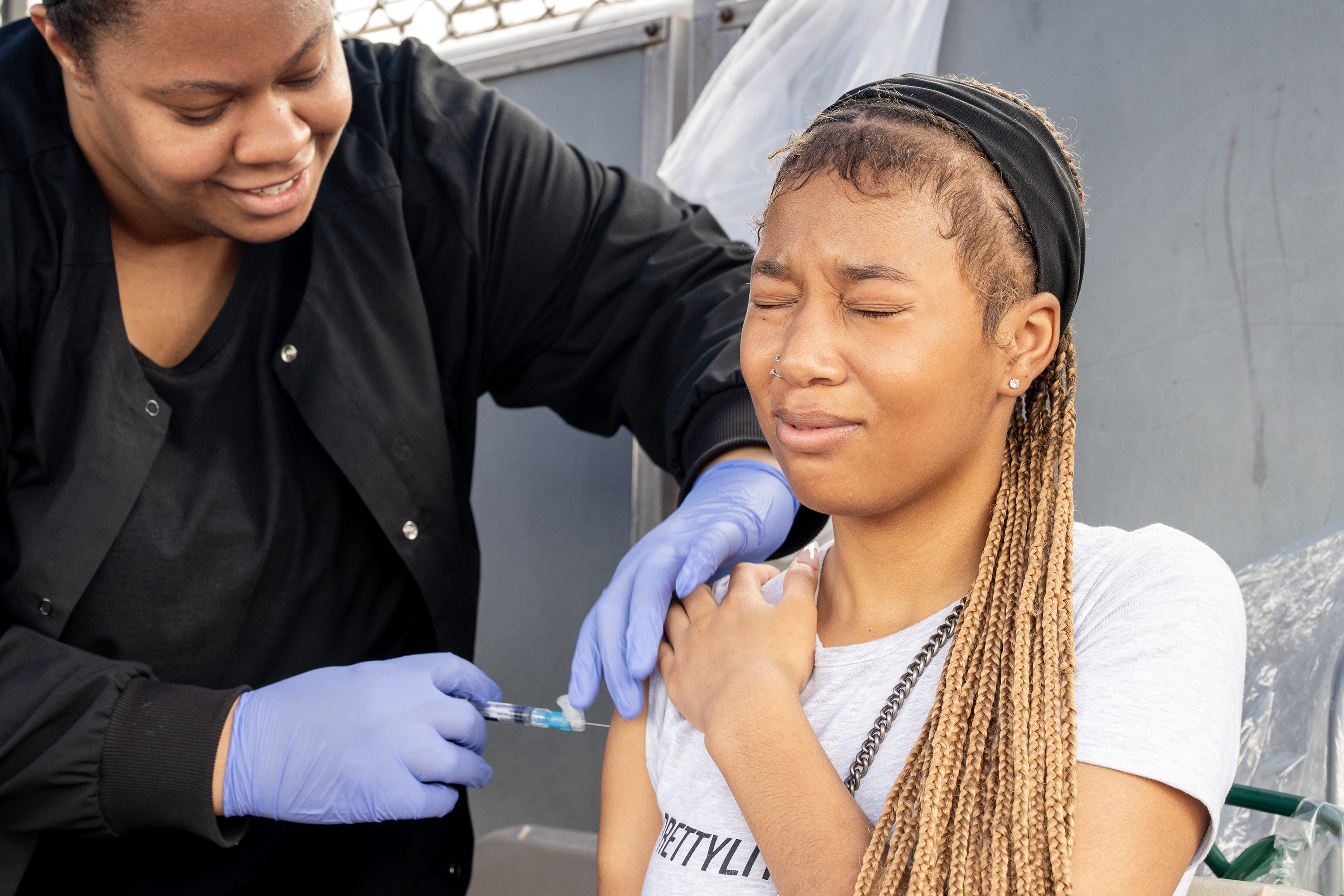
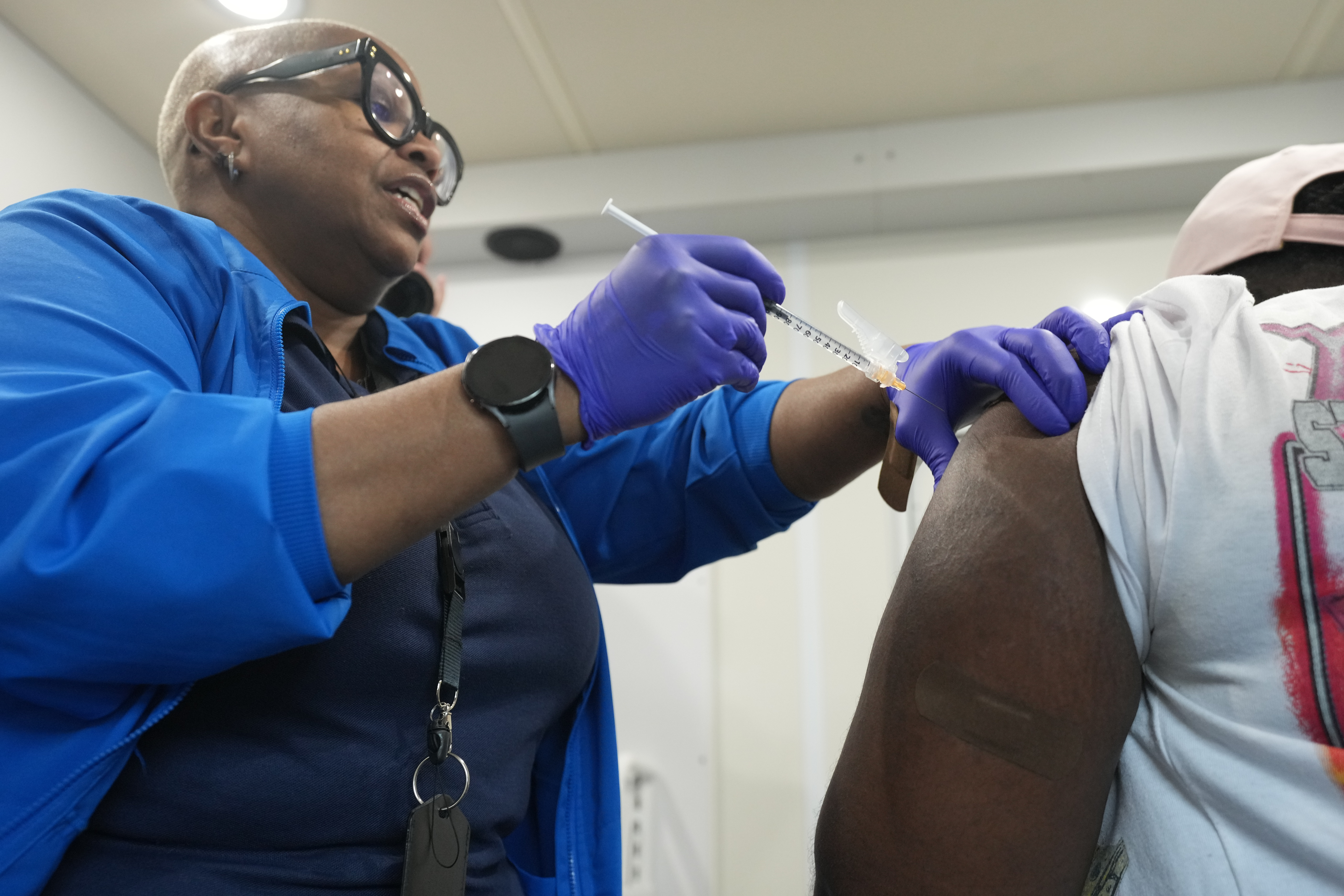
Mia Williams, a registered nurse, vaccinates a client at Delaware County’s mobile clinic in Upper Darby in July. Jessica Griffin / Staff Photographer
“The risk has definitely gone up because of lower vaccination numbers,” said Rene Najera, the director of public health at the College of Physicians of Philadelphia.
Najera says slipping vaccination rates especially endanger vulnerable students and community members beyond the schools, like pregnant women, cancer patients, or babies too young to be vaccinated. Parents of high-risk children should speak with their pediatricians about the risks of attending a school with lower vaccination rates, he said.
Last year marked the first time in more than 10 years that no Philadelphia-area county had reported measles vaccination rates above herd immunity.
Bucks County had the lowest MMR vaccination rate for kindergartners, at 93.7%, down by more than a half a percentage point from the year before.
Montgomery County, the only county in the Philadelphia region with kindergarten vaccination rates at herd immunity two years ago, slipped just below the threshold in 2025, to 94.8% vaccinated.
About 94% of Delaware County and Philadelphia kindergarteners were vaccinated last school year.
In Chester County, the only Philadelphia-area county to report cases in the current outbreak, vaccination rates for kindergartners have held steady at 94.5% for the last two school years. Some schools in the county reported steep drops in MMR coverage ahead of the current outbreak, which has seen 40 cases confirmed since June.
At Windsor Christian Academy in Downingtown, only one in four kindergarteners were vaccinated last year at a school that exceeded the herd immunity threshold the year prior. About 14% of the class had religious exemptions for vaccination. School officials did not return a request for comment.
Caln Elementary School in Thorndale saw measles vaccination rates drop from 100% to 74% in a year. Officials at the school declined to comment. (Caln closed at the end of last school year, and most of its students are transferring to the newly built Doe Run Elementary this year.)
Jeanne Franklin, Chester County’s health director, said she is “moderately” concerned about the current measles outbreak, given that many of the county’s most populous public schools still have high vaccination rates.
The school-level data improve the county’s ability to identify schools with lower vaccination rates.
Chester County health officials talk to school nurses, principals, and other administrators before the start of every school year to remind them of what to do if they identify a case of measles.
Under county policy, a single measles case in a school will mean all unvaccinated students and staff must stay home for 21 days.
This year, conversations that are usually hypothetical have taken on more urgency.
The health department has urged schools to take stock of who within their school is unvaccinated and develop a plan for how they will teach unvaccinated students who are sent home and staff classrooms of absent teachers.
“You don’t own getting them vaccinated,” Franklin said she tells administrators. “But you have to think through these things.”
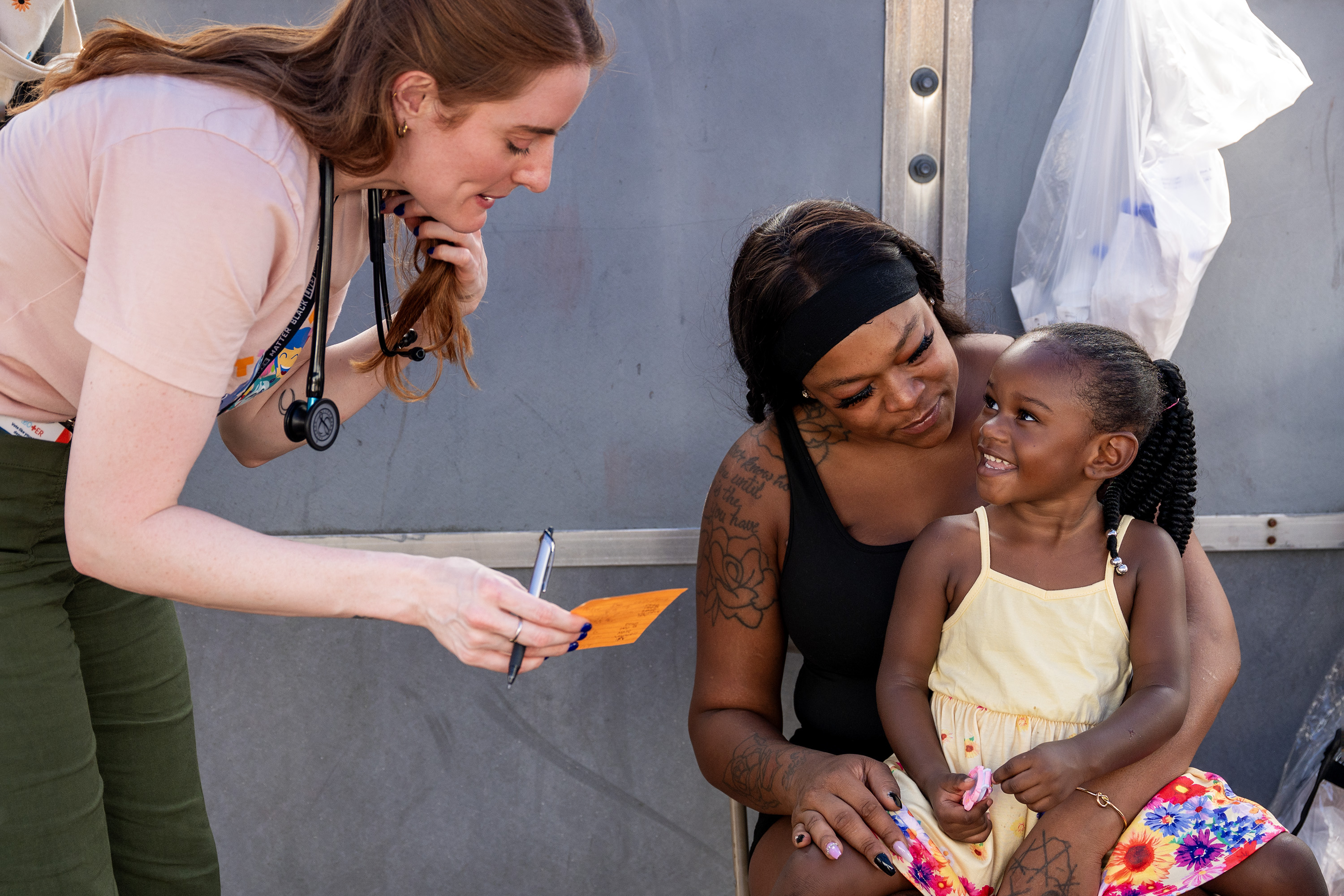
Sisters A’zuri, 3, and A’Sara, 6, wait while their mother, Shania’ Jason, checks in at a vaccination clinic during the School District of Philadelphia’s sixth annual Back-To-School Bus Tour stop this month at Marcus Foster Memorial Stadium. Tom Gralish / Staff Photographer
Philly schools on alert
As the school district’s lead health officer, McDow worries about the threat of measles so close by, but believes concerted efforts in the city have kept vaccination rates “as high as they can be in this current climate.”
She’s also monitoring Philadelphia schools where the state data show declining vaccination coverage. (The publicly available school-level data does not include classes with fewer than 20 students, for privacy reasons, or schools that did not report to the state. About 90% of schools statewide reported data in 2025.)
In some cases, what looks like a decline can be explained by delays in data reporting due to administrative issues or staff absences. School vaccination records are reported to the state during the month of December.
For example, Mantua’s Morton McMichael School reported a 50% drop in MMR vaccination coverage, initially going from nearly nine in 10 kindergarteners vaccinated to just over a third.
But by the end of the 2025-2026 school year, records show 93% of McMichael kindergarteners were fully vaccinated against measles, district officials said, though the state data does not show the improvement.
McDow worries about drops at other schools, from Mount Airy’s Emlen Elementary to North Philadelphia’s James Logan Elementary’s 18.5% decrease in vaccination rates, which are likely related to parents increasingly refusing vaccines.
Pediatrician Amanda Bernard (left) talks with Shania’ Jason and her daughter A’zuri, 3, at a vaccination clinic hosted by the Philadelphia School District this month at Marcus Foster Memorial Stadium.Tom Gralish / Staff Photographer
The school district hosts vaccination clinics over the summer and during the school year, working with the city health department to target families with unvaccinated children and schools with low vaccination rates.
The district also works to ensure vaccination clinics are accessible to working parents, organizing some on weekends or evenings.
“We need to be talking to families and answering questions in transparent ways,” McDow said. “But we also need to be providing the opportunities for vaccination.”
Some families line up for immunizations
On a recent sweltering August afternoon, families lined up at a tent pitched on the football field at Marcus Foster Memorial Stadium in Olney, part of a back-to-school fair sponsored by the Philadelphia School District.
“IMMUNIZATIONS,” read a flag waving in the breeze. Business was brisk all day.
Some families who visited the tent were recent immigrants, getting caught up on vaccinations before their children started at their new schools.
“We’re vaccinated, my husband and I, because our parents vaccinated us. And I’ll do the same for my children,” said Betty Bachene, who moved to Philadelphia from Paris this summer. Speaking in French, she said she’s never been afraid of vaccinating her children, but does fear the diseases vaccines prevent.
Anaiya Burnham, a nurse, said she’d opted against getting COVID or flu shots for her two children, one of whom is entering kindergarten this year. But vaccinating them against measles was never a question.
“I would really be curious to know why anyone would opt out of the MMR, given the research,” she said.
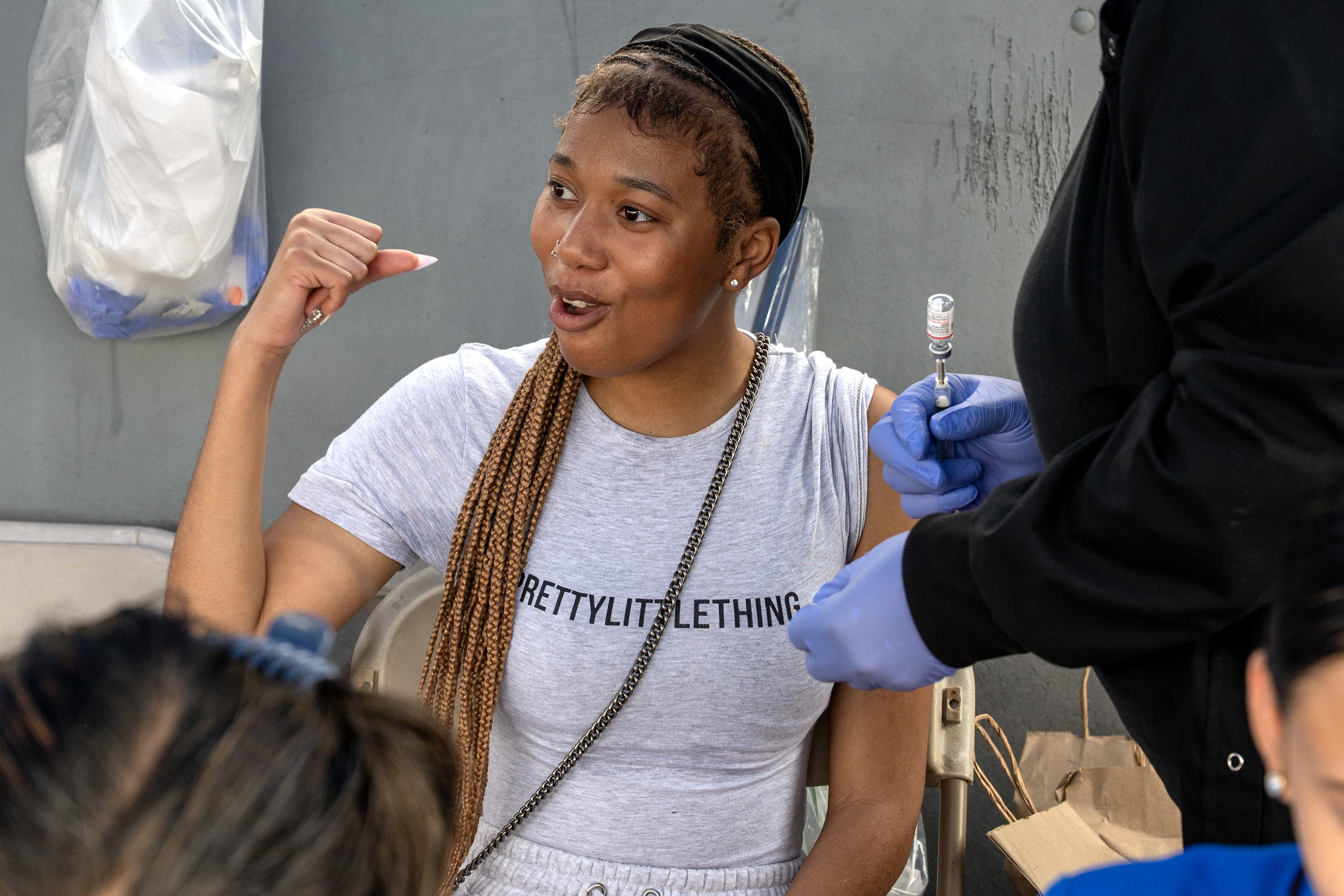
Cianey Brown, 16, reacts and turns to her family after getting an immunization at a Philadelphia school district vaccination clinic this month at Marcus Foster Memorial Stadium. Tom Gralish / Staff Photographer
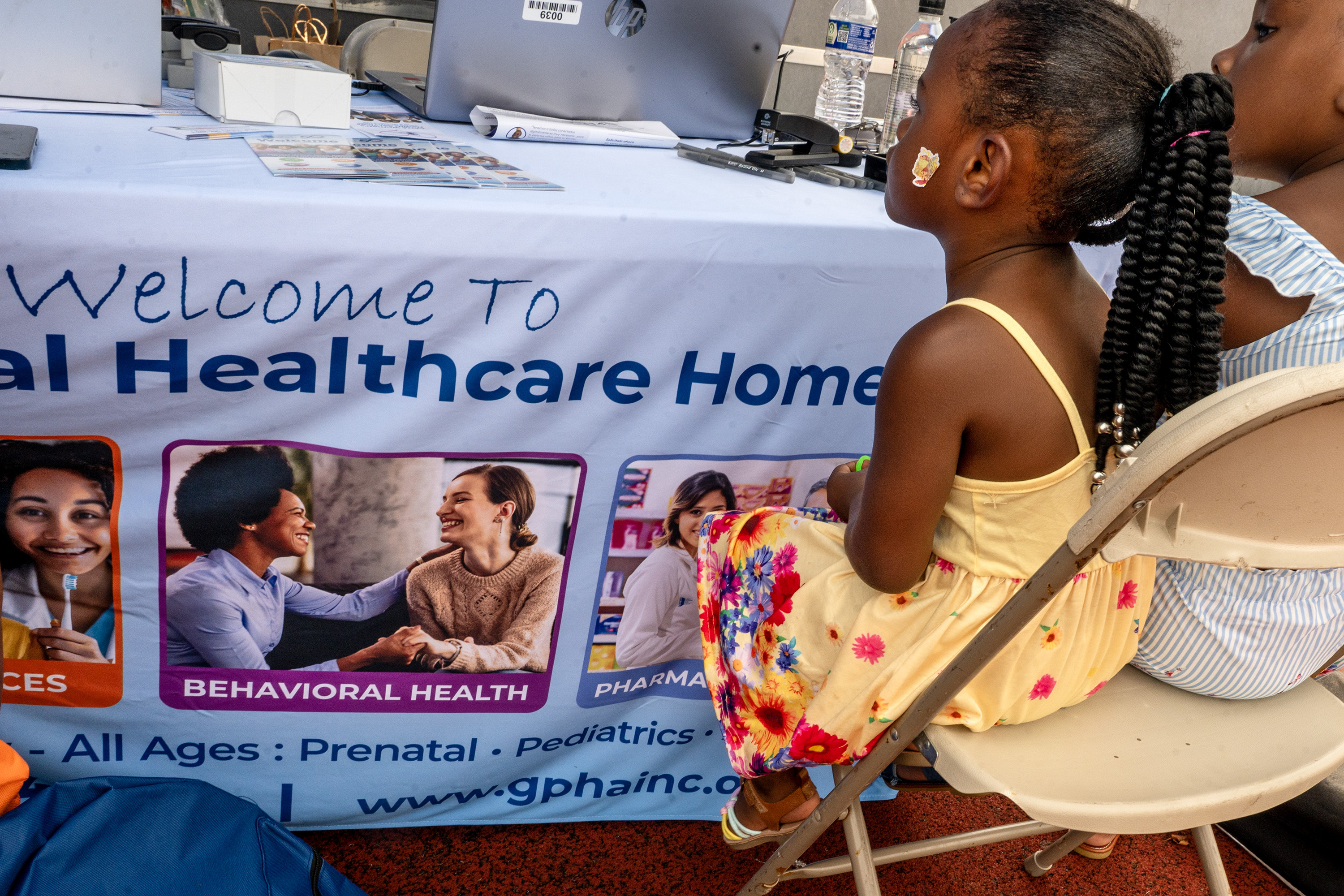
Philadelphia parents face a number of different barriers that keep them from vaccinating children — and not all of them are related to vaccine hesitancy, said Amanda Bernard, a pediatrician with Greater Philadelphia Health Action, the clinic offering vaccinations at the event.
Some lack transportation to get to a health center outside their neighborhood, or don’t speak English well enough to navigate the healthcare system, she noted.
“I think that these sorts of events are really a way that we could combat that,” said Bernard, who has heightened her advocacy around vaccination as Pennsylvania’s measles outbreak has spread.
“There’s almost a desperation in my education. I sometimes feel like I’m almost begging [families] to get it.”
Editor’s note: This story has been updated to correct the name of James Logan Elementary in Philadelphia.
(function(){function e(){window.addEventListener(`message`,function(e){if(e.data[`datawrapper-height`]!==void 0){var t=document.querySelectorAll(`iframe`);for(var n in e.data[`datawrapper-height`])for(var r=0,i;i=t[r];r++)if(i.contentWindow===e.source){var a=e.data[`datawrapper-height`][n]+`px`;i.style.height=a}}})}e()})();
A 1970s baby, I saw my mother (and all of the mother figures in my life) rocking big hair, glossy lips, sequins, and acrylic nails into the early 1990s.
As did the celebrities who have been a part of my pop-culture consciousness as long as I’ve been alive.
Women like Gladys Knight, Carol Burnett, Betty White, Patti LaBelle, and yes, Dolly Parton. These formidable women taught me my ABCs on Sesame Street, how to count on Electric Company, and random trivia on Password. These aunties in my head were just like my aunties, teaching me, guiding me, laughing with me, smiling with me, leaving powdery perfume trails of Jean Naté and White Shoulders in their wake.
That’s why a video of Parton and LaBelle circulating on social media Tuesday afternoon made me pause and shed a tear.
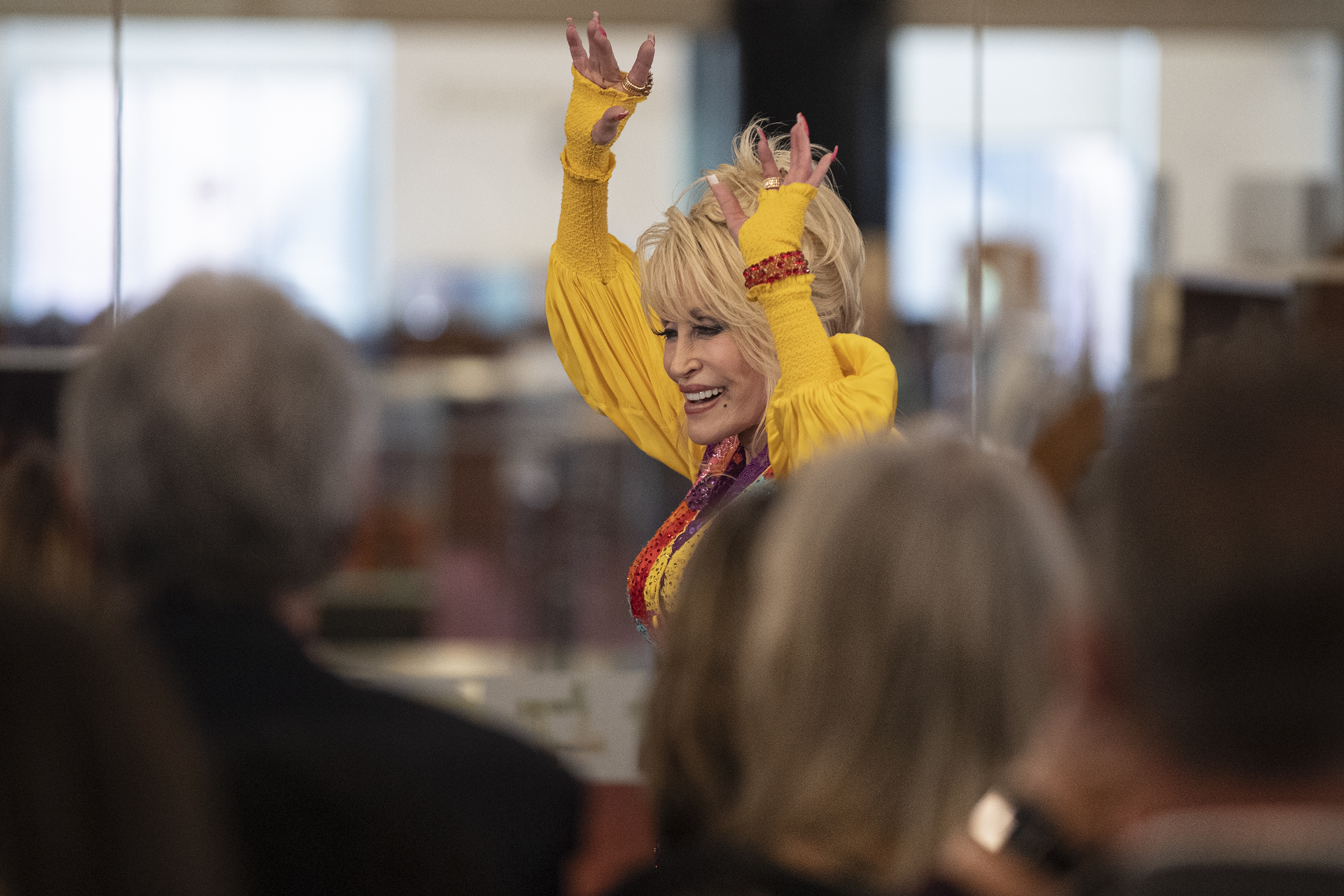
In the hours after Parton’s nephew Bryan Seaver announced on Instagram the beloved, buxom country music singer had died, a 46-second clip emerged from Parton’s 1987 short-lived ABC variety show,Dolly.
Itis pure, unadulterated ’80s joy.
LaBelle in her crimped “On My Own” hair — the ‘do she debuted when she released the chart-topping hit with Doobie Brother Michael McDonald — is sitting across from Parton, whose trademark curly blond hair is piled high in a massive bouffant.
The divas are dressed in elaborate black gowns drenched in sparkles. Parton’s features a sweetheart neckline and poofy shoulders ending in a lace sleeve that would give Madonna’s wardrobe a run for its money.
The two look like they could be attending a prom, or a tacky wedding. (A Parton classic: ”It costs a lot of money to look this cheap.“) Wherever they are going, we know the vibe is going to be ’80s extravagant.
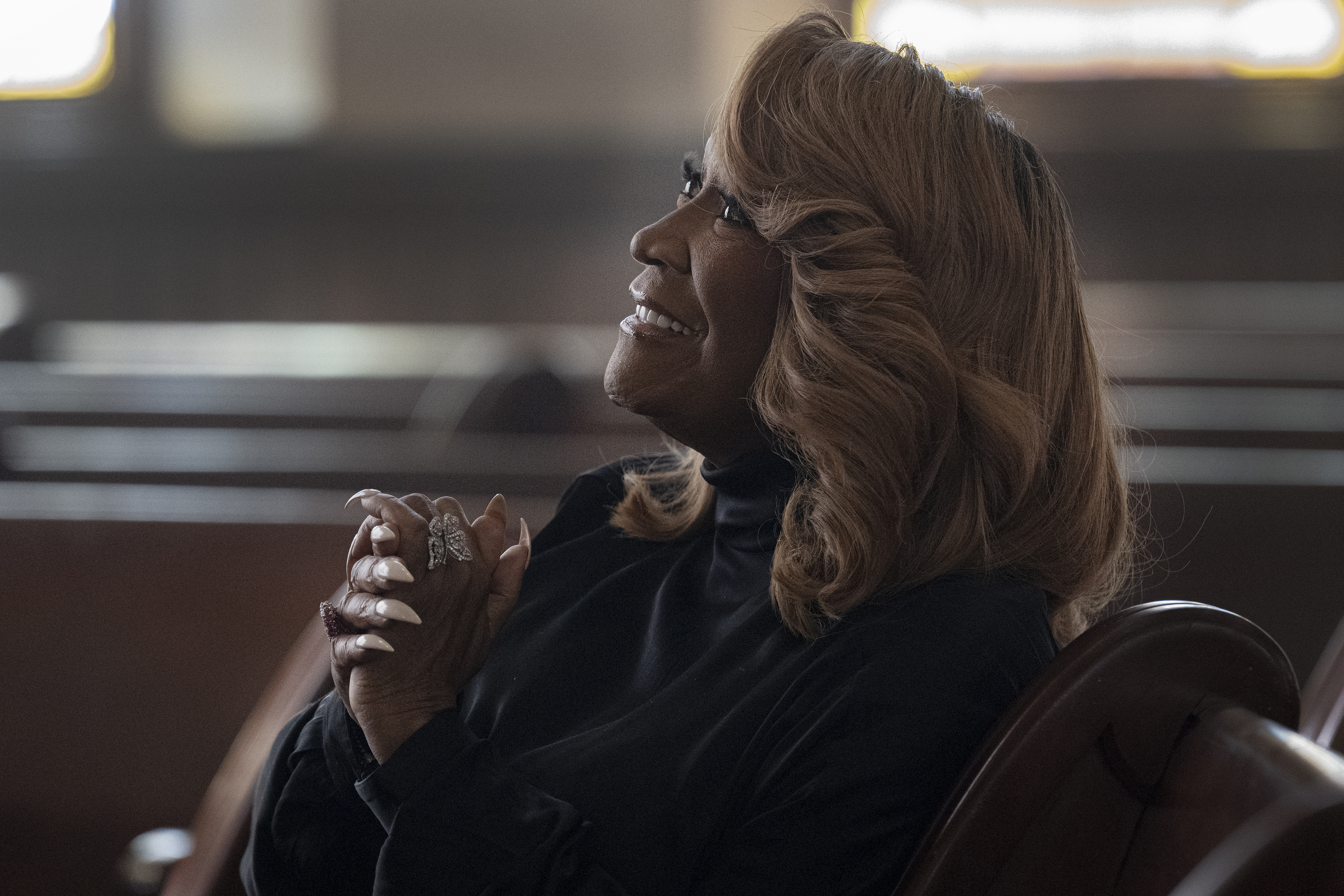
Singer Patti LaBelle is photographed at Mother Bethel AME Church in Philadelphia, Thursday, Jan. 22, 2026, during a shooting campaign for Visit Philadelphia’s Indivisible initiative, part of an effort to celebrate the city’s communities of color during the nation’s 250th anniversary. LaBelle is starring in the campaign’s Black History Month promotion.Jose F. Moreno / Staff Photographer
Parton, in her sweet melodic lilt, asks LaBelle if she would join her in using her acrylic nails as an instrument. The two women look like they are filing their nails as they strike up a rhythm.
Parton, who was born in a log cabin in Tennessee, and LaBelle, a Southwest Philadelphian whose dad was born in Macon, Ga. and moved to the city during the Great Migration, bond over acrylic nails and sing the chorus of the countriest of country songs, “Short’nin’ Bread.”
“Momma’s little baby loves short’nin’, short’nin’ / Momma’s little baby loves short’nin’ bread.”
Nails clicking. Powerful voices crooning. Parton and LaBelle sing the hook of the folk song written by James Whitcomb in 1900 in perfect harmony, their voices blending so beautifully that it’s easy to forget historians’ assertions that Whitcomb “borrowed” the song from Black sharecroppers. Allegedly, he retooled and performed it in a minstrel show.
The video speaks to Parton and LaBelle’s easy friendship and sisterhood.
“I’m deeply saddened by the loss of my dear friend who was loved by all,” LaBelle said in a statement Tuesday. “Dolly’s artistry, brilliance, and extraordinary life inspired so many people including me. Her light will forever shine!”
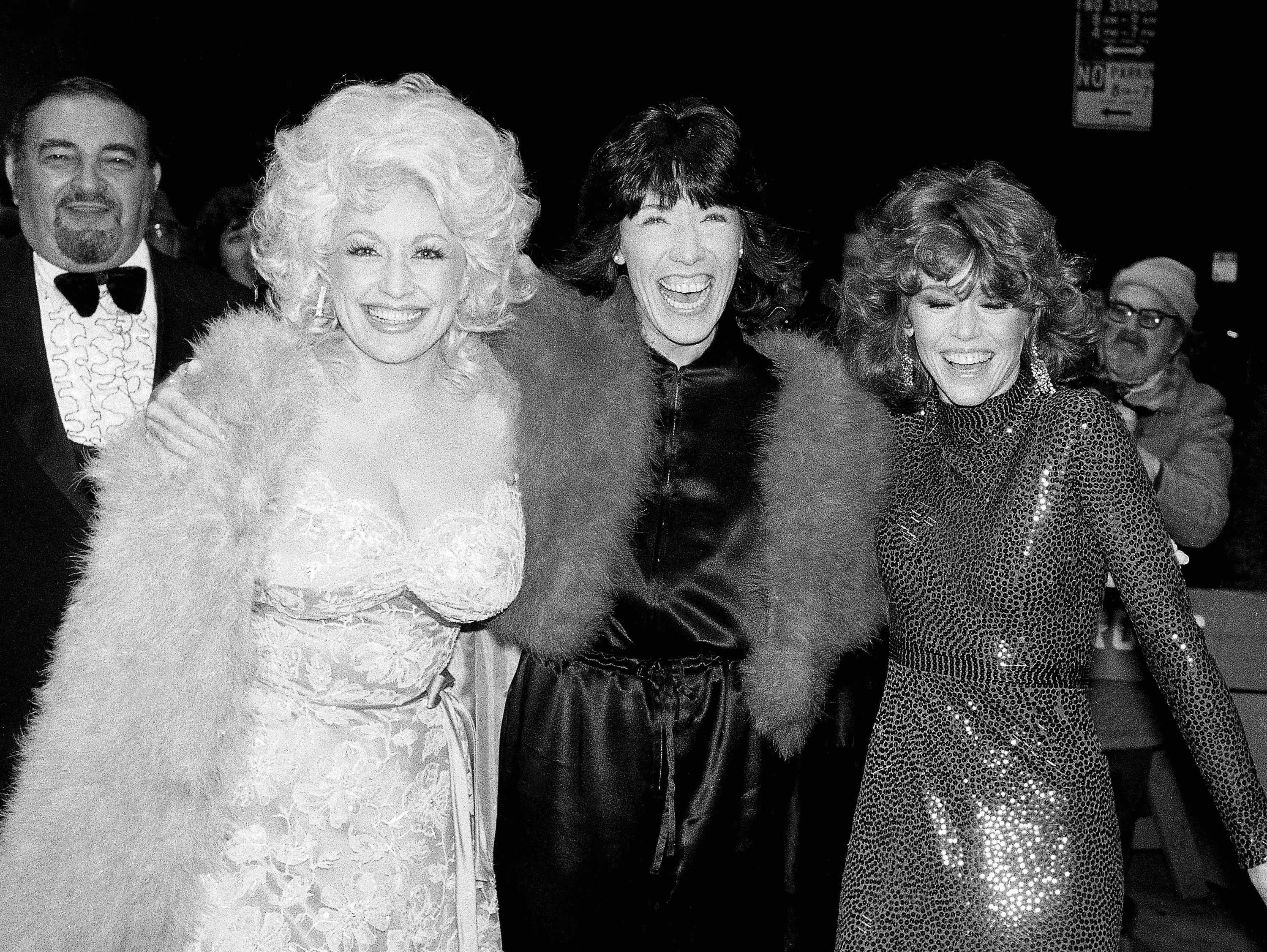
Dolly Parton (left), Lily Tomlin (center), and Jane Fonda arrive for the premiere of their film “9 To 5” in New York on Dec. 14, 1980. (AP Photo/Richard Drew, File)Richard Drew
When this performance was recorded almost 40 years ago, LaBelle and Parton had already been celebrities the better part of two decades. Both were already in their 40s. They’d reached auntie status.
My grandmother used to sing the chorus of “Short’nin’ Bread” while she dealt cards or when she rocked my sister and me in her wooden chair. Parton has been a part of my life in much the same way. Teaching me what it meant to work 9 to 5, performing on musical specials and childhood shows with other aunties and friends like Linda Ronstadt, Emmylou Harris, Loretta Lynn, and the queen of Philadelphia aunties, Patti LaBelle.
Parton was my country music auntie. She was America’s country music auntie.
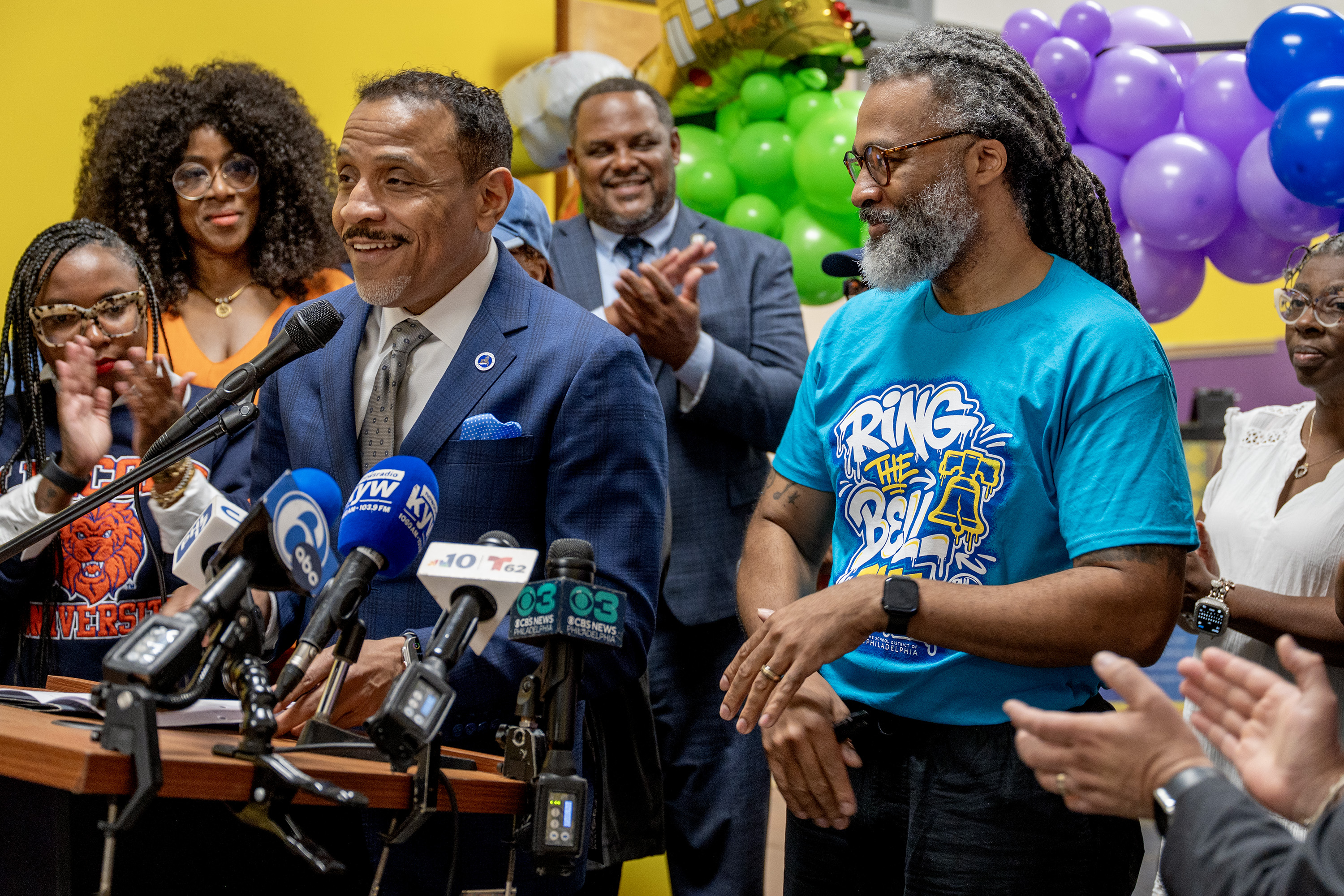
Philadelphia Superintendent Tony B. Watlington Sr. zigzagged the city Monday, visiting seven schools across the city to start the 2026-27 year.
The late-summer weather was perfect, sunny but not sweltering — an important factor in a school system laden with old buildings, where extreme heat sometimes means about a quarter of the district’s 113,000-plus students cannot learn in person or at all,
Watlington is hoping that the back-to-school weather was an omen.
“The way we start is going to be the way that we roll, and the way we finished last year,” the superintendent said. “We started off really well.”
Superintendent Tony B. Watlington Sr. (left) and district board president Reginald L. Streater (right) hold a press conference at McClure Elementary Monday, Aug. 24, 2026 on the first day of school in the Philadelphia School District. Behind them in center is Carlton Williams, just a week into his job as the City’s Philadelphia’s Managing Director (he started Aug. 17)Tom Gralish / Staff Photographer
“We want people to stop and digest that for a moment,” Watlington said. “Because people will say, ‘Well, are the scores still too low?’ I’d say absolutely, yes, we’ve got a lot of work to do and it’s not acceptable that two out of three kids don’t read or perform on grade level in math, but we’re getting better faster than the 25 largest school districts, and that’s our goal to be the fastest-improving, so we’re well on our way,” Watlington said.
“We believe it’s important for us to work with parents as equal partners because they are our children’s first teachers, and when we support our parents and families, our kids just do better in school,” he said.
The Parent and Community Ambassador Program will provide small stipends to “key community members and parents who just have a level of influence and cachet that no teacher, principal, counselor, police officer, or superintendent has in communities,” Watlington said. “If we can figure out how to connect with some of these key community folks, it will do nothing but help us to improve student attendance in schools where there may be some tensions or poor communication between families and school staff.”
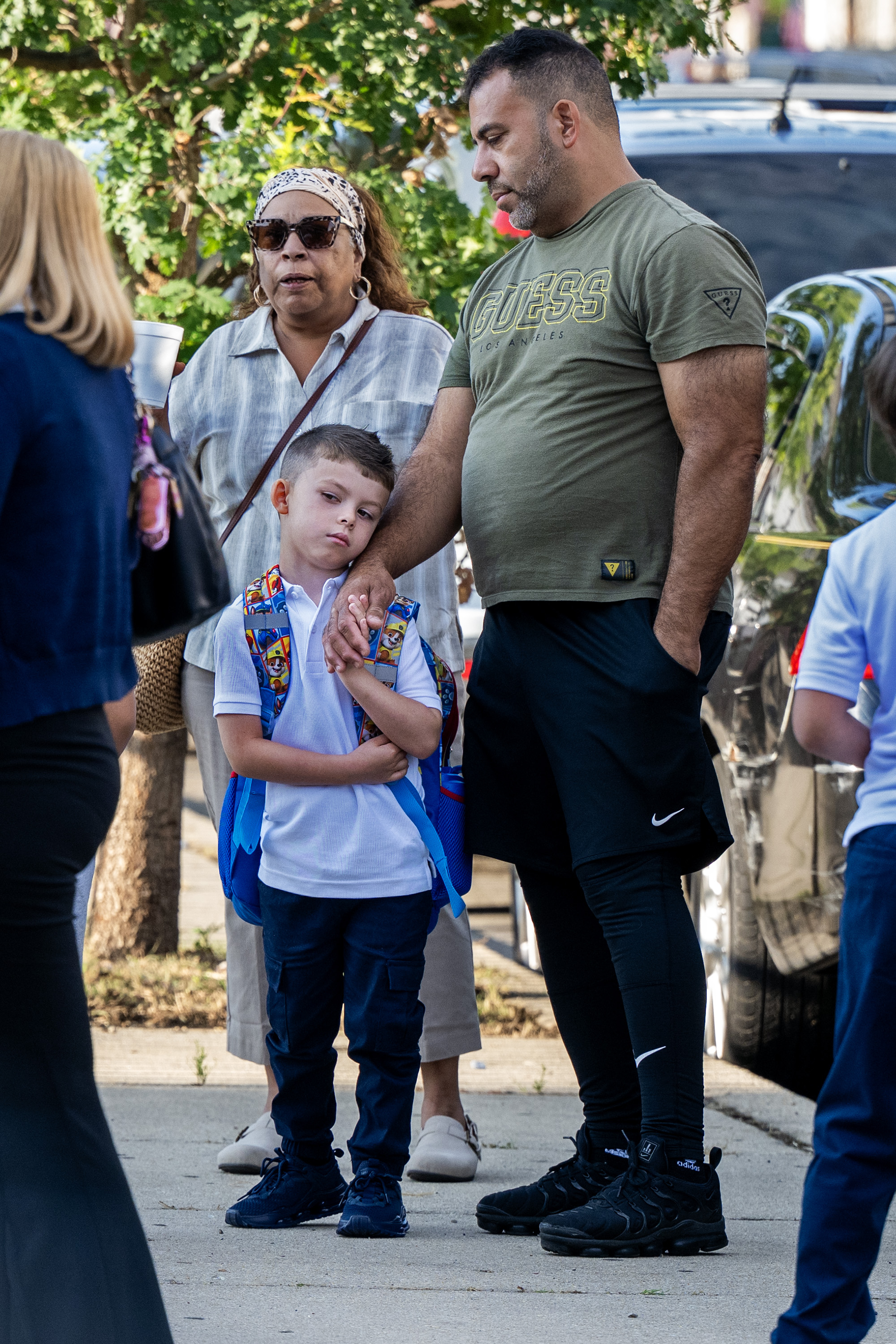
Johnny Beauchamp (right) waits with his son Johnny (5, not a Jr.) as they arrive early at McClure Elementary Monday, Aug. 24, 2026 on the first day of school in the Philadelphia School District. Young Johnny is going into kindergarten and Beauchamp, a single father, took two days off from his work as a truck driver to make sure he could be there on “the start of the rest of his life.”Tom Gralish / Staff Photographer
The aim, the superintendent said, is to address issues like homework completion, or family cooperation with key school initiatives.
“We think that’s a pioneering effort,” Watlington said. “Families first in 2026-2027.”
The program will begin as a pilot in a limited number of schools. Watlington did not provide details about how much ambassadors will be paid or how many schools will participate initially. He said details will be released soon.
About those PSSA and Keystone scores
There has been significant speculation around the release of state test scores. Pennsylvania released preliminary data to districts in the late spring, as it typically does, but Philadelphia has shared only limited student PSSA scores with select staff. Most Philly principals and teachers have not seen the scores, though other districts and schools have not withheld the data.
Wuimarlyn Sanchez, (left) , 7, is greeted by a classmate outside McClure Elementary Monday, Aug. 24, 2026, starting as second graders on the first day of school in the Philadelphia School District.Tom Gralish / Staff Photographer
The Pennsylvania Department of Education notified districts last week that statewide results, typically available to districts in late August or early September, would be delayed, though the release of the data to parents and the public does not typically happen until the fall.
Philadelphia officials then suggested the state holdup was the reason for their own delay.
Watlington said Tuesday that “we’re just going to wait for the official, verified data to come to us. We’re not trying to hide anything, but we need to get the verified data.”
The superintendent suggested, however, that both statewide glitches in the administration of the test on the first day of PSSAs and the shift to online administration of exams, which research links to decline in student scores, will show an effect when the scores are finally made public.
“My hunch is that, at the end of the day, online testing will have had some impact, but I don’t want to speculate on that across the Commonwealth of Pennsylvania,” Watlington said. “When the state verifies the data, we’ll release it immediately.”
Some students were unable to access tests for up to 40 minutes on the first day PSSAs were administered.
“All things being equal, I personally would like to be able to do over every single first-day test,” Watlington said. “That’s not really financially or time practical, but in an ideal world that would be my, my superintendent’s wish.”
School selection’s still up in the air
The district’s much-watched school selection process will open this year on Sept. 8 and close on Oct. 30. Watlington said its details are still being worked out, given the state score wrinkle.
Pencils and crayons in the first grade classroom of teacher Lauren Cucinotta at Fanny Jackson Coppin Elementary are ready to write and color Tuesday, Aug. 18, 2026, as she prepares for the start of the School District of Philadelphia school year on Aug. 24.Tom Gralish / Staff Photographer
Students who wish to gain admission to the system’s 37 criteria-based schools typically submit PSSA scores for consideration. Last week, district officials said they would not use PSSAs for school selection.
Watlington said Tuesday that his team was “currently reviewing a number of options about how to handle the fact that we won’t have 2025-26 data in time for our school selection process. So we’re reviewing all of our options. I believe there was a thinking initially that we’d have students who have access to some special test — the Terra Nova, etc. We’ve not finalized a decision there yet, so we don’t want to get ahead of our skis just yet.”
District size, and winning back kids to Philadelphia schools
When Watlington talks about Philadelphia being one of the 10 largest school systems in the U.S., he is counting children enrolled in both traditional district schools and charters — all of which are supported by taxpayer dollars.
Counted together, last year, the district had 113,735 students, and charters enrolled 64,469.
The district’s enrollment grew for the first time in a decade in 2024-25, inching up by a little fewer than 2,000 students. It then lost 794 students last year, which Watlington attributes to a SEPTA strike at the beginning of the school year that caused a pronounced drop in student attendance and, he believes, caused some families to disenroll children from district schools.
“It’s too soon to know exactly where our numbers will shake out, but my expectation and hope would be that we maintain the similar enrollment to last year,” Watlington said. “I expect this school district to grow over time, though.”
Why? Watlington touted Masterman’s recent ranking by U.S. News & World Report as the nation’s No. 3 public high school in the country and the district’s academic gains.
“We just need to tell that story,” Watlington said, “and go out and market ourselves to parents.”
Carlos Rogers was devastated when the iconic Philadelphia Cycling Classic hosted its final race in 2016.
“It was like a schism across my body,” Rogers said. “As a fan, it was a big gash. It was a feeling of loss, as a passionate cyclist and as a fan.”
For years, he and others both in and outside the Philly cycling community lamented the loss of the race. But while attending the Maryland Cycling Classic in 2022, Rogers decided he’d “had enough of people missing it.”
Rogers, a salon owner in Old City, had helped organize smaller bike races before, but never anything on the scale of the 14.4-mile course through Philadelphia. Virtually everyone he talked to in the community, from local government leaders and civic organizations to those formerly involved with the Philly Cycling Classic, was interested in bringing the race back.
The hard part, of course, was finding the money.
“I was throwing spaghetti on the wall and seeing what would stick with any kind of corporate sponsors,” Rogers said.
“Someone’s got to step up,” said Carlos Rogers, co-owner of the Philadelphia Cycling Classic. Monica Herndon / Staff Photographer
One of his connections referred him to entrepreneur Eric Robbins, who lived in Manayunk in the late 1990s and remembered how great an event the race used to be for the neighborhood.
Rogers’ enthusiasm and determination made it a “no-brainer” to partner with him on bringing back the race. Robbins looped in former Mayor Michael Nutter, who used to represent the Manayunk and Roxborough neighborhoods in City Council. But from there, it still took about a year and a half to secure the funding.
“There were a tremendous amount of no’s,” Robbins said. “For us, the vision of 2026, of bringing it back after a 10-year hiatus, it made perfect sense. It’s the greatest year to bring it back, but also the most difficult one.”
Because of the large number of sports events in the area this summer, from the World Cup to the PGA Championship to the Major League Baseball All-Star Game, sponsorship dollars were extremely competitive. As the lead organizers, they knew why bringing the race back was important, but with so many events happening, they struggled to find sponsors who understood their mission.
“We’re reintroducing an historic event to a whole new crowd of people and bringing along the folks who knew it because they longed for it,” Nutter said.
Former Mayor Michael Nutter is one of the co-owners of the Philadelphia Cycling Classic.Monica Herndon / Staff Photographer
Rogers was reluctant to publicize his efforts to bring back the race until they’d actually secured the funding.
“I knew how easy it would be to fail, and then how everybody could point the finger and be like, here’s another clown trying to do something. … I had no resumé of success at this level, where people would invest in me.”
But he ultimately decided to go to the press late into the process, as a last-ditch effort to get the race up in 2026. His hope was that maybe a CEO or local business leader would see it and be moved to support.
That didn’t happen, but it did put a bit of “wind in his sails” as more people learned about the efforts and tried to push it along. Ultimately, through a mutual connection, he met with Bob Flexon, CEO of the UGI Corporation, who happened to be an avid cyclist himself, and got AmeriGas on board as the title sponsor in September 2025.
Carlos Rogers (from left), Brian O’Reilly, Eric Robbins and Former Mayor Michael Nutter toast with the new Philadelphia Classic Lager from Mainstay brewery during an event at Craft Hall on Thursday, Aug. 6, 2026 in Philadelphia.Monica Herndon / Staff Photographer
Since then, it’s been a mad dash to rebuild the teams that made past iterations of the race so successful. Former race director Robin Morton and G4 Productions are leading the production, and numerous city employees who managed logistics for the race 10 years ago are still in place.
“[Raffaele Casale], he’s worked security barricade staging for 31 years of the race, and he’s on our crew this year,” Rogers said. “He could put barricades around the course blindfolded. He knows every turn, every corner, every pothole. He’s a secret weapon.”
Rogers, Robbins, and Nutter coined the race “the People’s Race.” Spectating the men’s and women’s races, which will be held Sunday, is completely free, everywhere from Kelly Drive to the iconic Manayunk Wall. They hope it will be a big community celebration, like the Philadelphia Marathon, and what the race once was.
“This race is by Philadelphians, for Philadelphians,” Rogers said. “We haven’t brought in any outside components. We put the band back together.”
Two-thirds of Pennsylvania Democrats who are likely to vote this year believe U.S. Sen. John Fetterman supports President Donald Trump too frequently, while about half say the Democratic senator has been too supportive of Israel, according to an Inquirer/New York Times/SienaUniversity poll published Tuesday.
Democratic voters’ sharply divided views on Fetterman — with 69% having an unfavorable opinion of him in general — are the latest signs hecould face an uphill battle if he seeks reelection as a Democrat in 2028.
Fetterman has not said whether he will run for a second term.
But as he weighs his options — which include leaving the Democratic Party because of what he considers its anti-Israel sentiment — the senator’s occasional support of Trump’s agenda has contributed to his declining favorability among voters who helped elect him in the first place, the new survey indicates.
“I’m so disappointed in him, I can’t even see straight,” said Joseph Jaskula, a retired salesman from Lewisburg, Union County, who participated in the poll of 760 likely voters conducted by Siena University on behalf of The Inquirer and the New York Times from Aug. 17 to 21.
(function() { var l = function() { new pym.Parent( ‘nyt-fetterman__graphic’, ‘https://media.inquirer.com/storage/inquirer/ai2html/nyt-fetterman/index.html’); }; if(typeof(pym) === ‘undefined’) { var h = document.getElementsByTagName(‘head’)[0], s = document.createElement(‘script’); s.type = ‘text/javascript’; s.src = ‘https://pym.nprapps.org/pym.v1.min.js’; s.onload = l; h.appendChild(s); } else { l(); } })();
Jaskula, a Democratwho said he voted for Fetterman in 2022, said he is particularly upset about the senator’s votes for several of Trump’s nominees and for the war in Iran.
“He voted with the Republicans on that,” Jaskula, 72, said of the war powers resolutions that aimed to rein in Trump. “And he’s had some other ones where we wonder if he’s a Republican or a Democrat.”
Fetterman’s standing among Pennsylvania voters overall remains split, according to the poll.
He is viewed favorably by 49% and unfavorably by 43% of all likely voters in the state. That was nearly the same result as the last time the Inquirer/New York Times/Siena poll asked about Fetterman’s favorability, in May 2024.
But the difference between now and then — when Fetterman was campaigning against Trump’s election and only two years removed from his own sweeping victory in the Pennsylvania Democratic primary — is who is supporting him.
Pennsylvania’s U.S. Senators John Fetterman (left) and Dave McCormick appear together at June event in Philly to promote the savings accounts for kids that were part of President Donald Trump’s One Big Beautiful Bill Act.Tom Gralish / Staff Photographer
Fetterman outperforms McCormick with GOP voters
In almost the exact opposite breakdown compared with about two years ago, just one in five likely Democratic voters reported having a favorable view of Fetterman, while four out of five likely Republican voters said they have a favorable view.
(function(){function e(){window.addEventListener(`message`,function(e){if(e.data[`datawrapper-height`]!==void 0){var t=document.querySelectorAll(`iframe`);for(var n in e.data[`datawrapper-height`])for(var r=0,i;i=t[r];r++)if(i.contentWindow===e.source){var a=e.data[`datawrapper-height`][n]+`px`;i.style.height=a}}})}e()})();
Don Levy, director of the Siena Research Institute, called the Democratic senator’s numbers “shocking.”
“If you didn’t know any difference, you would immediately assume that Fetterman and McCormick are both Republicans, and that Fetterman is an extremely popular Republican senator amongst Republicans,” Levy said. “I can’t think of another case exactly like this.”
GOP leaders, who are fighting to retain control of the Senate this fall, have said they would welcome the Pennsylvania Democrat into their fold.
And Fetterman has raised the prospect of leaving the party, possibly becoming an independent, if Democrats oppose Israel as an “official” part of their platform. He has staunchly supported the country in the wake of the Oct. 7, 2023, attack by Hamas, and as Democrats have become increasingly critical of Israel’s counterattack.
(function(){function e(){window.addEventListener(`message`,function(e){if(e.data[`datawrapper-height`]!==void 0){var t=document.querySelectorAll(`iframe`);for(var n in e.data[`datawrapper-height`])for(var r=0,i;i=t[r];r++)if(i.contentWindow===e.source){var a=e.data[`datawrapper-height`][n]+`px`;i.style.height=a}}})}e()})();
Fetterman has opposed fellow Democrats’ efforts to end the United States’ assistance to Israel’s offensive measures. He has also become the most vocal Democratic supporter of both countries’ attacks against Iran, an issue that also remains deeply unpopular among Pennsylvania voters.
“He’s a voice in the party, standing up for what’s right,” said Nicholas Morabito, a 32-year-old warehouse worker in Butler who participated in the poll.
A registered Republican, Morabito said he would consider voting for Fetterman in 2028, regardless of which party label accompanies his name on the ballot.
“I don’t think there’s very much difference between the two of us. Just the difference in party,” Morabito said.
Fetterman has acknowledged the shift in support. He wrote in his 2025 memoir that he was “completely at peace” with the idea that his support of Israel might cost him his Senate seat. And in interviews, he has repeatedly said that, as a swing-state senator, he should work with and not demonize the other party.
A plurality of likely voters — 47% — say Fetterman is “about right” when it comes to supporting or opposing Trump, according to the poll. About 38% said he supports Trump too much, 6% said he opposes Trump too much, and 9% did not answer.
(function(){function e(){window.addEventListener(`message`,function(e){if(e.data[`datawrapper-height`]!==void 0){var t=document.querySelectorAll(`iframe`);for(var n in e.data[`datawrapper-height`])for(var r=0,i;i=t[r];r++)if(i.contentWindow===e.source){var a=e.data[`datawrapper-height`][n]+`px`;i.style.height=a}}})}e()})();
But Democratic voters have indicated a strong desire for their elected officials to push back against Trump, and Fetterman’s declining support among them appears to be due in part to that shift during Trump’s second term. About 67% of likely Democratic voters said Fetterman supports the president too much, while 20% said he gets it “about right.”
“Fetterman has been such an interesting, unique personality now since he broke onto the scene,” Levy said. “Given the state of play right now, Democrats are just angry that he was elected. Democrats are supposed to act like Democrats, and this shows that their perception of him is that he is not.”
More than half of likely voters in Pennsylvania’s forthcoming midterm elections disapprove of President Donald Trump’s job performance, and he is drastically underwater among the state’s electorate on key issues — some of which helped him win a second term in 2024.
Trump, who won the crucial swing state by nearly two percentage points in November 2024, now has an approval rating of 39% and a disapproval rating of 58% among Pennsylvania’s likely voters, according to an Inquirer/New York Times/SienaUniversity poll published Tuesday.
The poll, which was conducted from Aug. 17 to 21 among 760 likely Pennsylvania voters, raises questions about how voters’ perception of the president will affect November’s midterms, when many Pennsylvanians will cast their ballots in four critical swing district races that could determine which party controls the U.S. House.
(function() { var l = function() { new pym.Parent( ‘nyt-trump2__graphic’, ‘https://media.inquirer.com/storage/inquirer/ai2html/nyt-trump2/index.html’); }; if(typeof(pym) === ‘undefined’) { var h = document.getElementsByTagName(‘head’)[0], s = document.createElement(‘script’); s.type = ‘text/javascript’; s.src = ‘https://pym.nprapps.org/pym.v1.min.js’; s.onload = l; h.appendChild(s); } else { l(); } })();
Even among his Pennsylvania supporters who were surveyed, Trump faces some of his lowest approval ratings regarding his handling of the war in Iran and cost-of-living issues, according to the poll, counteracting campaign promises that proved successful in 2024: ending foreign wars and helping people pay their bills.
Once again,the economy will likely be at the front of voters’ minds heading into November — 22% of Pennsylvanians polled said it is their top issue in the governor’s race — and it could also serve as an indicator for the outcome of House races where Republicans will be on the defensive.
“Certainly it’s got to be a drag on their fortunes,” said Don Levy, director of the Siena Research Institute.
(function(){function e(){window.addEventListener(`message`,function(e){if(e.data[`datawrapper-height`]!==void 0){var t=document.querySelectorAll(`iframe`);for(var n in e.data[`datawrapper-height`])for(var r=0,i;i=t[r];r++)if(i.contentWindow===e.source){var a=e.data[`datawrapper-height`][n]+`px`;i.style.height=a}}})}e()})();</script
Trump losing ground on issues that propelled him to White House
The new polling on Trump’s management of top concerns facing the United States — particularly the economy and the cost of living — shows how the issues that helped propel him to the White House in 2024 are now souring his approval among Pennsylvanians, including some who previously voted for him.
Among likely voters in the Keystone State, 39% approve and 61% disapprove of Trump’s handling of the economy. On his handling of the cost of living, 33% said they approve and 66% disapprove.
The data come as voters continue to grapple with rising costs, including unusually high gas prices, and grocery prices that have been increasing for nearly six years. Trump’s tariffs, one of the defining policies of his first year back in office, also raised prices for consumers and businesses.
Now, a quarter of Pennsylvanians who voted for the president in 2024 say they disapprove of how he is handling of the cost of living.
Michael Patterson, 60, of Bucks County, is one of them.
Though Patterson said Trump’s term has been“great” overall, he was expecting more from the president on the economy and costs.
“The prices are still too high, interest rates are still too high,” Patterson said. “We still haven’t seen anything from that promise yet.”
(function(){function e(){window.addEventListener(`message`,function(e){if(e.data[`datawrapper-height`]!==void 0){var t=document.querySelectorAll(`iframe`);for(var n in e.data[`datawrapper-height`])for(var r=0,i;i=t[r];r++)if(i.contentWindow===e.source){var a=e.data[`datawrapper-height`][n]+`px`;i.style.height=a}}})}e()})();
Trump’s messaging on the economy in 2024 was part of why he won Pennsylvania with more votes than any other statewide GOP candidate in history. Pennsylvania voters cited Trump’s promises to bring costs down as a top reason that they voted for him and overlooked Democrats’ warnings about what his election could mean for democracy.
Trump is also hurting on other issues that helped boost him to the presidency, including his promise to end wars. Thirty-two percent of likely voters in Pennsylvania approve of Trump’s handling of the war in Iran and 66% disapprove — including 30% of Trump voters.
Kay Skripac, who voted for Trump in 2024, said thatthough she supports the president on almost every other issue, “I just don’t think that we should have invaded or bombed Iran. I was very surprised, because I didn’t vote for that.”
The 72-year-oldindependent votersaid, despite thinking Trump has done strong work on the economy (she says her retirement portfolio doubled from 2016 to 2026), she is feeling the war’s impact at the gas pump.
“I want everything to just be normal and stay the same, because everything was fine,” said Skripac, who lives in Crawford County. “We weren’t involved in any wars. You didn’t have to worry about any friends or loved ones potentially getting killed. I don’t like that at all.”
Trump’s handling of the Israeli-Palestinian conflict also received low marks from voters, with 62% disapproval, compared with 36% approval.
Republican Sandra Faust, 40, approves of Trump’s handling of that conflict. But her support does not extend to the war in Iran, which Trump launched in coordination with Israel.
Faust, who voted for Trump two years ago, said she strongly disapproves of the war due to rising gas prices and believes it conflicts with the president’s promise to end wars. The Pittsburgh resident, who has a family member in military training to become a jet refueler, said she wishes the conflict in Iran would end.
“Them dragging it on is not only harming us, locally with gas and, you know, pricing and stuff like that, but it’s putting our military in harm’s way, and I’m not happy about that,” she said.
Faust added that she opposes the war because of her belief in the “America First” ideology. That perspective also makes her supportive of Trump’s immigration agenda, she said.
The president is lagging in Pennsylvanians’ support of his immigration policies — which have included mass deportations and enhanced border security — but the disapproval is not as stark. Among likely voters, 44% approve of his handling of immigration and 55% disapprove.
“We are not responsible for taking care of the world’s problems,” Faust said.
What does Trump’s approval rating mean for November in Pa.?
So what does this mean for the midterms?
Time will tell.
But 51% of Pennsylvania’s likely voters who were polled indicated they would be more likely to vote for a Democrat in their congressional district, and 44% said they would support a Republican. More than half, 53%, say they would want to see a flip of control in the House, putting Democrats in charge, while 44% say they would want to see the GOP maintain control.
The polling for the GOP in November is not as bleak as Trump’s numbers, butitshows where voters’ heads are a little more than two months away from the midterms, when Pennsylvanians will weigh in on four competitive swing district congressional races.
(function(){function e(){window.addEventListener(`message`,function(e){if(e.data[`datawrapper-height`]!==void 0){var t=document.querySelectorAll(`iframe`);for(var n in e.data[`datawrapper-height`])for(var r=0,i;i=t[r];r++)if(i.contentWindow===e.source){var a=e.data[`datawrapper-height`][n]+`px`;i.style.height=a}}})}e()})();
Both parties are targeting GOP-held seats in Bucks County’s 1st Congressional District, the Lehigh Valley’s 7th Congressional District, the Scranton area’s 8th Congressional District, and the Harrisburg area’s 10th Congressional District.
Democrats are hoping that a message focused on affordability and tying opponents to Trump will usher in wins this fall. For instance, Democrat Bob Harvie in the heated 1st Congressional District race published a new campaign platform recently that focuses mainly on addressing economic issues.
“The task of Republicans running in various congressional districts, or for the governor of the state, is going to be to somehow separate themselves from the perception that Pennsylvanians have about the job that the head of their party is doing on the economy,” said Levy, the Siena polling director.
But for Democrats, connecting Harvie’s opponent, longtime Republican U.S. Rep. Brian Fitzpatrick, to Trump could be a harder sell. The Bucks County lawmaker consistently outperforms his party and has survived one blue wave after another.
The poll’s findings signal that both parties may also have to think about their branding to the public — 50% of respondents said the Democratic Party is too far to the left and 47% said Republican Party is too far to the right.
Republicans will also have to consider Trump’s unpopularity, especially with women.Sixty-two percent of female likely voters in Pennsylvania disapprove of Trump’s policies, while 34% approve. The president is also strugglingwith men — a key base for him in 2024: 51% of men disapprove of Trump’s policies, compared with 46% who approve.
(function(){function e(){window.addEventListener(`message`,function(e){if(e.data[`datawrapper-height`]!==void 0){var t=document.querySelectorAll(`iframe`);for(var n in e.data[`datawrapper-height`])for(var r=0,i;i=t[r];r++)if(i.contentWindow===e.source){var a=e.data[`datawrapper-height`][n]+`px`;i.style.height=a}}})}e()})();
Democrat Vincent Russo, 78, of Lackawanna County, where Republican U.S. Rep. Rob Bresnahan faces a challenge from Democrat Paige Cognetti in the 8th District, said he will be voting straight blue on his ballot in November and thinks opposition to Trump’s policies will motivate his party to get out to the polls.
“I think the people are starting to see he does nothing but lie,” Russo said.
Staff writers Michelle Baruchman and Gillian McGoldrick contributed to this article.
With a little more than two months until Election Day, Democratic Gov. Josh Shapiro has a double-digit lead over his Republican challenger, Stacy Garrity, among likely Pennsylvania voters in the race to lead the critical swing state — an election that could also serve as an audition for the 2028 presidential primary.
Shapiro holds a 16-percentage-point lead over Garrity, the state treasurer, according to a new poll of 760 likely voters conducted from Aug. 17 through 21 by The Inquirer, the New York Times, and Siena University.
The numbers could foreshadow another commanding victory for Shapiro, as he hopes his popularity trickles into other down-ballot races, including four congressional districts that national Democrats think they can flip. Shapiro is also trying to flip the state Senate for the first time in 30 years and deliver a Democratic trifecta in the statehouse.
(function() { var l = function() { new pym.Parent( ‘nyt-shapiro2__graphic’, ‘https://media.inquirer.com/storage/inquirer/ai2html/nyt-shapiro2/index.html’); }; if(typeof(pym) === ‘undefined’) { var h = document.getElementsByTagName(‘head’)[0], s = document.createElement(‘script’); s.type = ‘text/javascript’; s.src = ‘https://pym.nprapps.org/pym.v1.min.js’; s.onload = l; h.appendChild(s); } else { l(); } })();
A majority of Pennsylvania voters — 60% — have a favorable opinion of the governor, compared with Garrity, who is viewed favorably by just 37% in the state.
Shapiro’s popularity also eclipses that of President Donald Trump, according to the poll. Sixty percent of likely Pennsylvania voters approve of the job Shapiro is doing as governor, while 39% approve of Trump, who won the state two years ago.
Lora Peluso, 63, a Democrat and retired catering director from Pittsburgh, said Shapiro has been a shield in Pennsylvania against some of Trump’s most harmful policies affecting low-income and older people.
“I think [Shapiro] is trustworthy,” said Peluso, who participated in the poll. “His policies are things that actually benefit people, the average working person, seniors.”
Garrity still unknown by some Republicans
Pennsylvania Republicans this year had hoped to avoid another walloping by Shapiro, who has won three times statewide, with fears that a weak gubernatorial candidate could negatively affect the rest of the Republican ticket. So the state GOP took the unprecedented move of endorsing Garrity in September 2025 — approximately 14 months before the election — to try to raise her profile.
Despite securing Trump’s endorsement, Garrity has struggled to raise money, attract support from national Republicans, or compete with Shapiro’s $13 million in ad buys so far this cycle. Her campaign has spent $679,000 on ad buys thus far, according to media-tracking firm AdImpact, as it seeks to introduce the candidate to voters.
Now, with 70 days until the election, a quarter of likely Republican voters still did not know Garrity or know enough about her to form an opinion of her, according to the poll.
Meanwhile, Shapiro maintains favorable opinions among 27% of Trump’s 2024 supporters, and 35% of registered Republicans approve of the job he is doing as governor, the poll found.
(function(){function e(){window.addEventListener(`message`,function(e){if(e.data[`datawrapper-height`]!==void 0){var t=document.querySelectorAll(`iframe`);for(var n in e.data[`datawrapper-height`])for(var r=0,i;i=t[r];r++)if(i.contentWindow===e.source){var a=e.data[`datawrapper-height`][n]+`px`;i.style.height=a}}})}e()})();
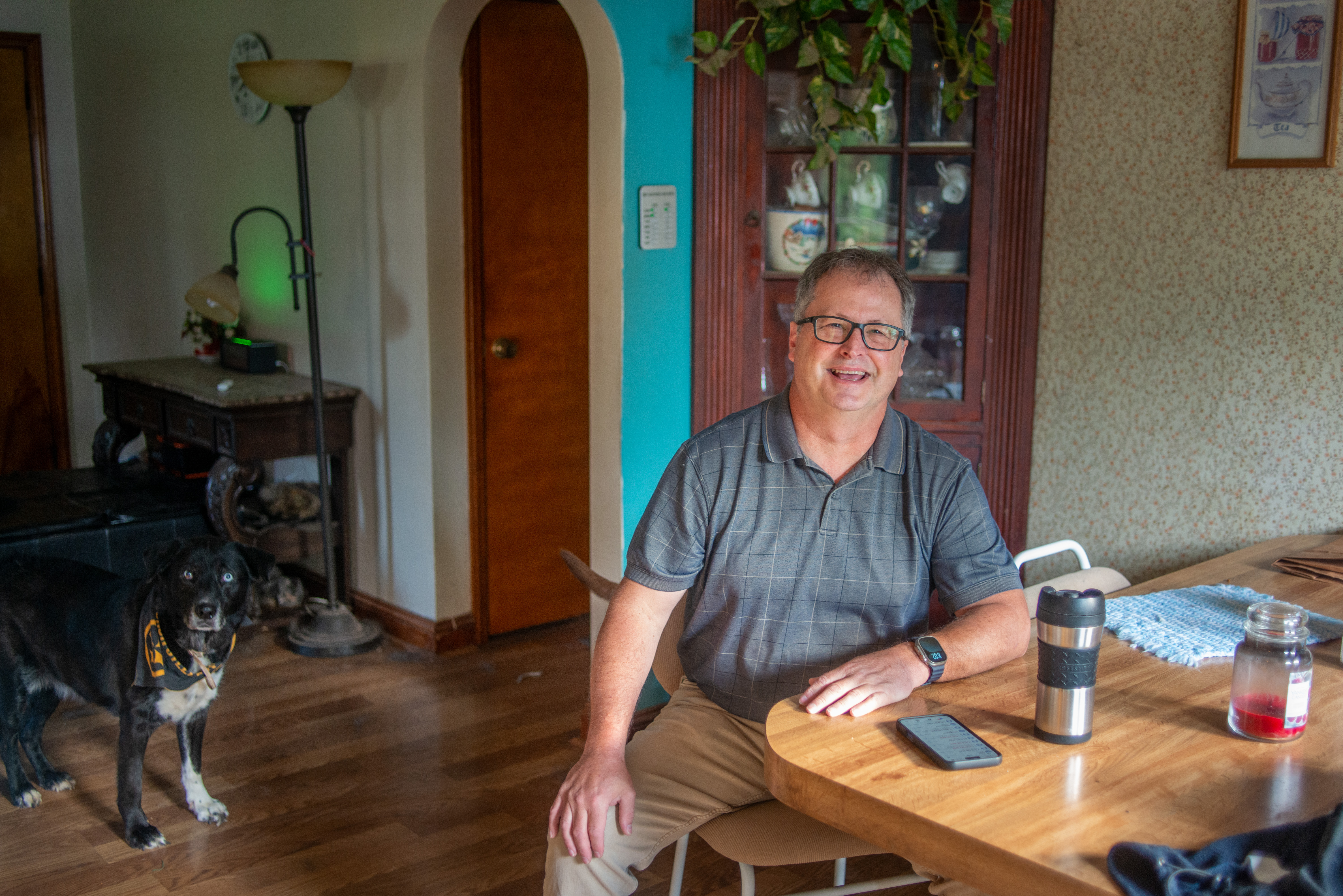
Michael Patterson, a Republican from Trumbauersville, Bucks County, who supported Trump in 2024, said he plans to support Shapiro in November because he likes the job the governor is doing and because he does not know much about Garrity besides what he has seen on social media.
“Honestly, I don’t know much about her,” Patterson, 60, said. “I guess I don’t see advertisements on the TV. Other than Facebook, I really don’t see her. The stuff I see on Facebook is just typical partisan stuff.”
Shapiro, on the other hand, appears more moderate and independentfrom his party in Patterson’s eyes.
“He’s kinda doing his own thing. I have a lot of respect for that. He’s not playing partisan games,”Patterson said, contrasting Shapiro with Democrats in California and New York.
Michael Patterson, a Bucks County Republican voter pictured in his Trumbauersville home, plans to vote for Democratic Gov. Josh Shapiro over Republican nominee Stacy Garrity. William Thomas Cain / For The Inquirer
This attitude shows up among other Republicans, too, said Don Levy, the director of the Siena Research Institute.
“Shapiro is seen as sufficiently middle of the road,” Levy said. “He’s got 35% of Republicans approving of the job that he’s doing as governor. That’s a really impressive number in today’s world.”
Other Republicans like Steven Keenan, 70, of Ridley Township, are all in for Garrity, citing her military experience and support for Trump.
“[Shapiro’s] a big phony. He’s a politician,” Keenan said. “She is, too, but she’s been through the wars. I think she’s earned her place. I think we should give a woman a chance.”
A majority of Pennsylvania voters trust Shapiro over Garrity to handle top issues facing the state, including the economy, cost-of-living increases, the Trump administration, immigration, and doing what is best for ordinary Pennsylvanians.
Tina Hoffert, 68, of Lenhartsville, Berks County, said she has not heard much about Garrity, but plans to vote for her in November because she is unsatisfied with Shapiro’s leadership.
“He’s forever bashing Trump,” Hoffert, a Republican, said. “I’m sorry, I don’t care whether you like him or not, he’s our president. You work with him. You don’t fight him. And if there’s things you don’t like that he’s doing, then you go in there and you have discussions.”
Shapiro’s presidential prospects
If Shapiro is reelected in a landslide victory this November, it becomes even more likely that he jumps into the 2028 presidential race as the governor of a key swing state with19electoral votes.
Among those surveyed who said they plan to vote in the Democratic primary in two years, 86% said they would be likely to support him — though the poll did not compare him with other potential primary candidates.
Other prospective candidates include former Vice President Kamala Harris, Govs. Gavin Newsom of California and JB Pritzker of Illinois, U.S. Sens. Mark Kelly of Arizona and Jon Ossoff of Georgia, and U.S. Rep. Alexandria Ocasio-Cortez of New York.
(function(){function e(){window.addEventListener(`message`,function(e){if(e.data[`datawrapper-height`]!==void 0){var t=document.querySelectorAll(`iframe`);for(var n in e.data[`datawrapper-height`])for(var r=0,i;i=t[r];r++)if(i.contentWindow===e.source){var a=e.data[`datawrapper-height`][n]+`px`;i.style.height=a}}})}e()})();
Shapiro has brushed off questions about his ambitions and told a reporter Saturday, in response to whether he would commit to serving a four-year term in office, that “the only thing that I’m focused on — and the only thing anybody should be focused on — is winning in November and being a check on this president’s chaos, cruelty, and corruption.”
Most voters in the poll — 58% — said that if Shapiro decidesto run for president, doing so either would not distract from his role as governor or would not keep him from being effective at governing.
“I mean, it would be a distraction, of course, but I think he’s a professional and a hard worker, and he would figure it out. It seems like he hires good people, too,” said Peter Hewitt, 62, of Devon, a Democrat who supports Shapiro’s reelection bid.
(function() { var l = function() { new pym.Parent( ‘nyt-trump2__graphic’, ‘https://media.inquirer.com/storage/inquirer/ai2html/nyt-trump2/index.html’); }; if(typeof(pym) === ‘undefined’) { var h = document.getElementsByTagName(‘head’)[0], s = document.createElement(‘script’); s.type = ‘text/javascript’; s.src = ‘https://pym.nprapps.org/pym.v1.min.js’; s.onload = l; h.appendChild(s); } else { l(); } })();
Shapiro’s potential candidacy has largely centered on his electability, especially his ability to win the top office in the nation’s premier swing state. He has pitched himself as a Democratic governor more interested in working with Republicans to make meaningful improvements to the state than in picking partisan fights, and voters agree: 58% of respondents said he is neither too far to the left nor to the right.
“He’s done a good job of just being more of a moderate, middle-of-the-road Democrat,” said Andrew Perez, a 58-year-old self-described independent voter in Pittsburgh. He said he appreciated Shapiro’s focus on improving roads and highways and not “just blindly disagreeing” with Trump.
“I think we need a strong presidential candidate who will try to unite the country instead of just keeping it being divisive, so I think that I’d be pretty likely to vote for him [for president],”said Perez, a physician.
Montiese McKenzie, 46, of West Philadelphia, said she is supporting Shapiro for a second term, but is not quite yet sold on a presidential run. She said she has not seen him rise to the level of “fighter” she thinks the Democratic Party needs, and believes as of now, she would be more likely to support someone else in the Democratic primary.
“You see people like Jon Ossoff and JB Pritzker, and they’re not putting up with it. They don’t make it pretty anymore,” McKenzie said. “If I saw some of that in Shapiro, I might be more likely to support him as a presidential candidate. Until then, I’m not sure he has the gumption.”
Shapiro has signed on to dozens of lawsuits against Trump’s administration on a host of issues, from tariffs to gender-affirming care.
But to win the party’s nomination, Shapiro would have to defeat more progressive candidates and make the case for his more centrist approach.
Montiese McKenzie, 48, poses for a portrait near her home in West Philadelphia on Monday, Aug. 24, 2026. McKenzie is a supporter of Gov. Josh Shapiro’s reelection, but is hesitant to back his potential presidential run in 2028.Allie Ippolito / For The Inquirer
Nearly half, 47%, of respondents said he has been just “about right on support of Israel,” with 14% saying he has been too supportive and 19% saying he has been not supportive enough.
Should Shapiro launch a presidential campaign, Hewitt wants to see him “come out on the right side.”
Hewitt, who emphasized his support for Jewish people in his community, said he considers the Israeli government’s actions toward Palestinian people in Gaza to be genocidal. More than 73,000 Palestinian people have been killed in Gaza since the war began nearly three years ago, and multiple international institutions have said Israel’s actions violate human rights.
“I don’t think it’s really that big of a deal for governors per se. He’s not going to vote on national policy as the governor of Pennsylvania,” Hewitt said. But he added: “He does have a voice, and if he’s thinking about a next step beyond Pennsylvania, then he will have to come out in regard to that issue.”
When Richard Sperry’s right shoulder began to ache, the pharmaceutical executive thought he was overdoing it at the gym.
“I was doing CrossFit at the time,” Sperry said. “I thought it was from doing things that I shouldn’t be doing in my mid-40s.”
Then, almost overnight, the entire right side of his body was weak. He could not pick up a coffee mug, grasp a pen, or shave his face with his right hand. His wife had to help him button his dress shirts each morning.
An orthopedic doctor sent him to a Philadelphia neurologist in late 2019. After a battery of tests, the neurologist diagnosed Sperry, then 45, with amyotrophic lateral sclerosis (ALS), or Lou Gehrig’s disease, a fatal nervous system disorder. The neurologist said he would die within three to five years. He went for another opinion, and a second neurologist concurred.
In early 2020, Sperry traveled to the Mayo Clinic in Minnesota for a third opinion.
“‘I’m gonna cut to the chase — I don’t think you have ALS,’” Sperry recounted the Mayo doctor saying, as his sister erupted in tears.
Sperry actually had a rare autoimmune disease called multifocal motor neuropathy, or MMN. The doctor prescribed intravenous immunoglobulin therapy, a treatment made from the blood plasma of healthy donors. Immunoglobulin is an antibody found in plasma, the straw-colored liquid in blood.
Once back home in Princeton, Sperry got infusions for five straight days, sitting about four hours each time. A few days after treatment ended, Sperry awoke and discovered he could move his right hand for the first time in more than a year, he said.
“My wife and I were in bed bawling,” Sperry said. “It was like a wonder drug.”
Demand for plasma is growing as the global population ages, more people like Sperry are being diagnosed with chronic diseases, and new medical treatments that require plasma are discovered, research shows.
The value of a liter of plasma rose from about $181 in March to $192 in June, likely because of increased demand, according to Georgetown University professor Peter Jaworski, who studies the global economics and ethics of the plasma industry.
No cure existsfor all three conditions, butsymptoms are alleviated with regular infusions of plasma-based therapies.
“It is life-changing for patients with rare and chronic diseases,” said Anita Brikman, president and chief executive of the Plasma Protein Therapeutics Association, a trade organization that represents donation centers in North America and Europe.
Doctors are not exactly sure how it works on patients like Sperry, said Sami Khella, a Penn Medicine neurologist and clinical neurology professor at the University of Pennsylvania Perelman School of Medicine.
But if Sperry does not get his medicine on time, he will “develop weakness almost right away,” said Khella, who sees Sperry as a patient.
Sperry’s condition causes his immune system to attack his nerves. The immunoglobulin in plasma quells the attack, Khella explained.
Every four weeks, Sperry receives 35 grams of immunoglobulin through infusions over two days. It takes hundreds of donors to make 35 grams, Khella said.
Sperry, who is back doing CrossFit, said it feels “scary” to be dependent on plasma donations. When he sees people going in and out of donation centers, he said, he is enormously grateful.
“It’s not like the drug manufacturer can just build another plant and make more pills,” Sperry said.
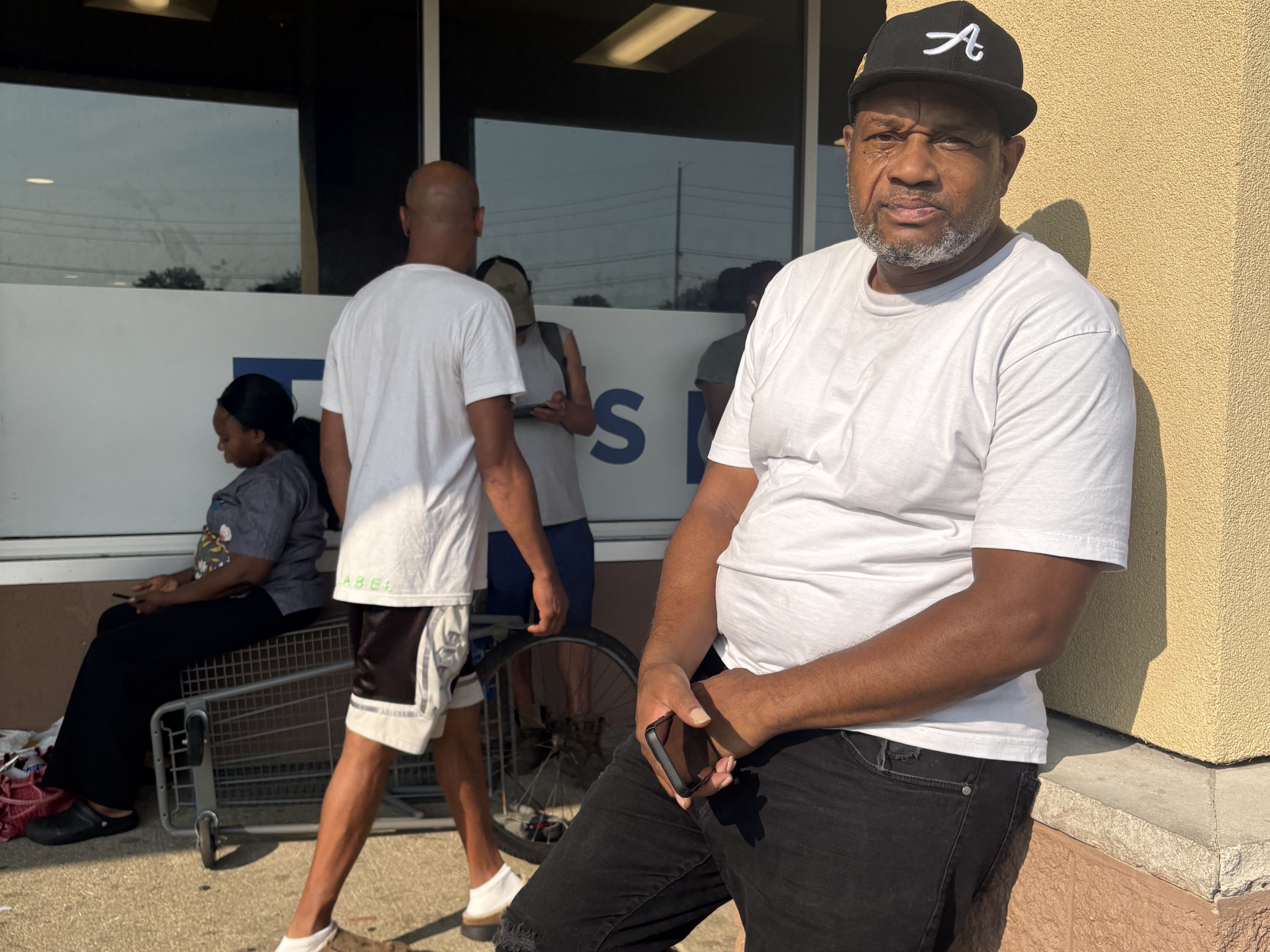
Maleka Evans waited outside Octapharma Plasma in South Jersey at 8:30 on a recent sweltering morning, sweat beading on her face. A dozen other prospective donors had arrived before her, and the line was still growing a half hour before doors opened.
One woman sat on an overturned shopping cart pilfered from the nearby Walmart. Another brought her own folding chair. A man held a bicycle tire, removed to protect his bike from being stolen once he was inside and hooked up to a machine that extracts antibody-rich blood plasma needed for medical treatments.
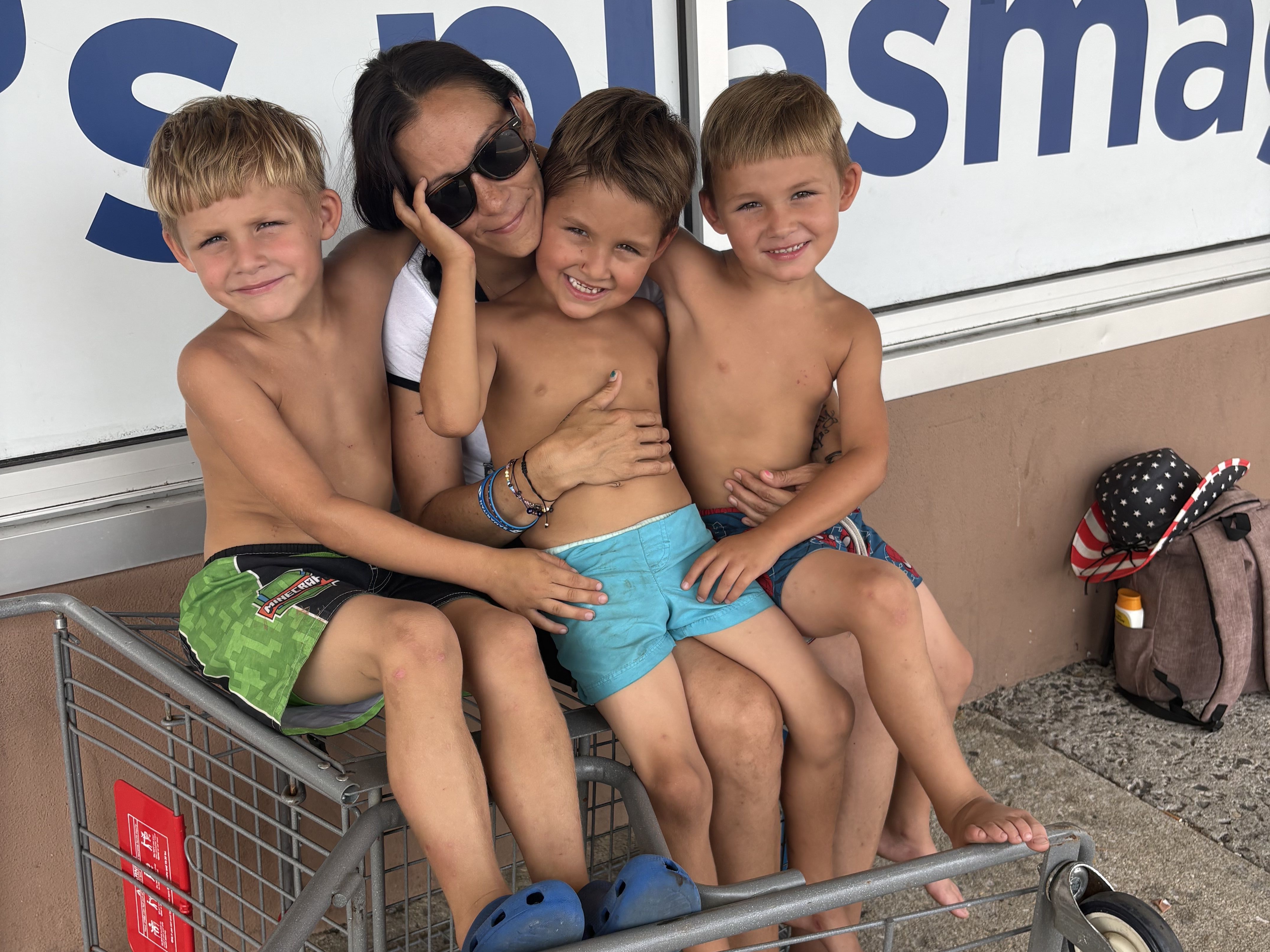
Every Monday and Friday for the last three years, Evans has trekked to the Audubon strip mall for what she considers her second job. She takes a 45-minute bus ride from her Willingboro home to Camden, then walks another 45 minutes to the donation site with a slogan posted in its window: “When it pays to give hope. That’s plasmagic.”
The 37-year-old single mom has noticed the lines growing in the last year, as others are seeing at donation sites elsewhere in the Philadelphia region and across the nation. The for-profit business is booming as more and more Americans, both poor and middle class, struggle to straddle the gap between stagnant wages and increased living costs.
Evans relies on the $50 that she typically earns for each plasma donation — loaded onto a prepaid debit card — to help with bills that she cannot cover with her $18-per-hour job packing boxes at a warehouse.
“Prices for everything — food, rent, transportation, electricity — are just getting higher and higher,” Evans said. “You have to work two jobs to make ends meet, and you’re still living paycheck to paycheck.”
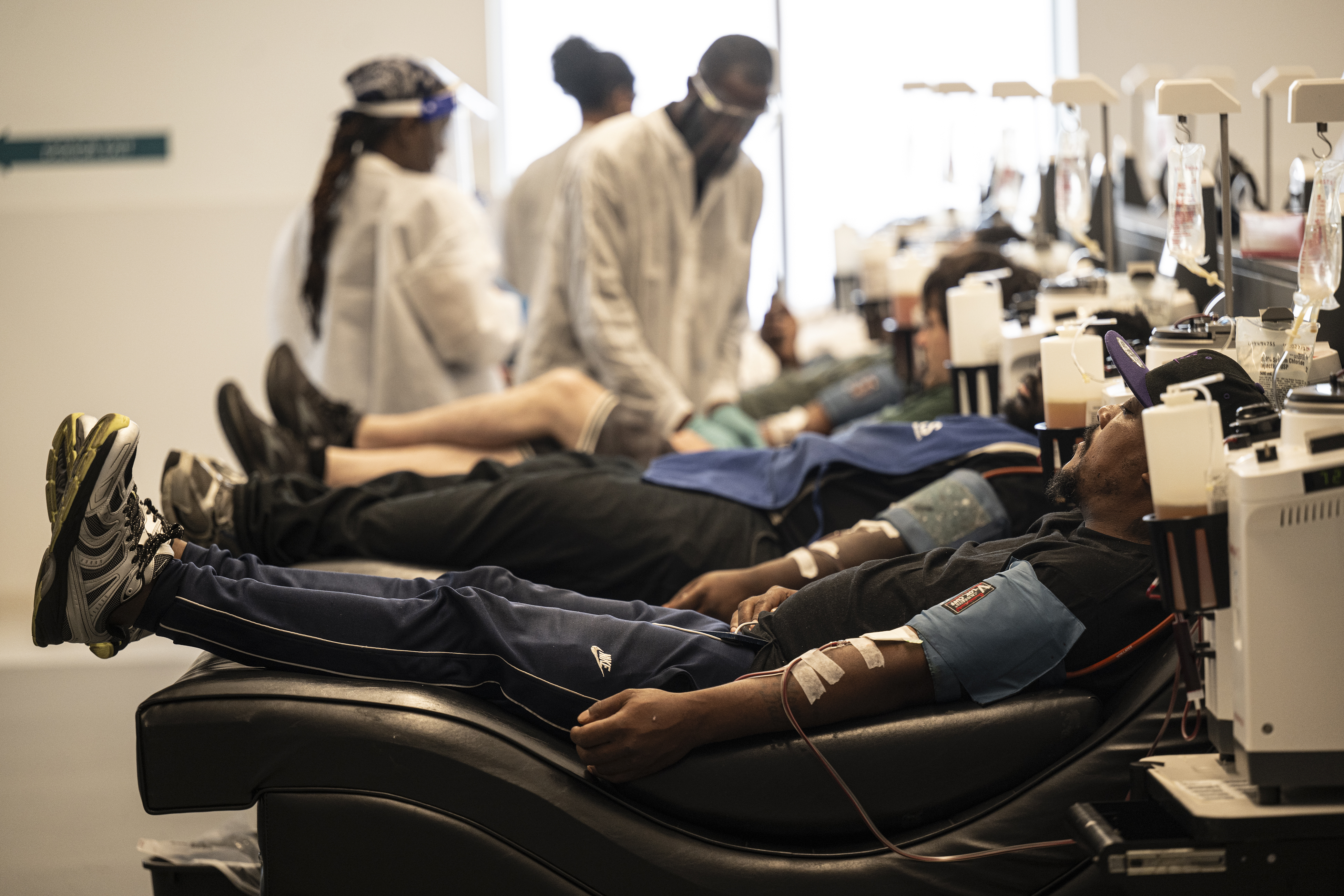
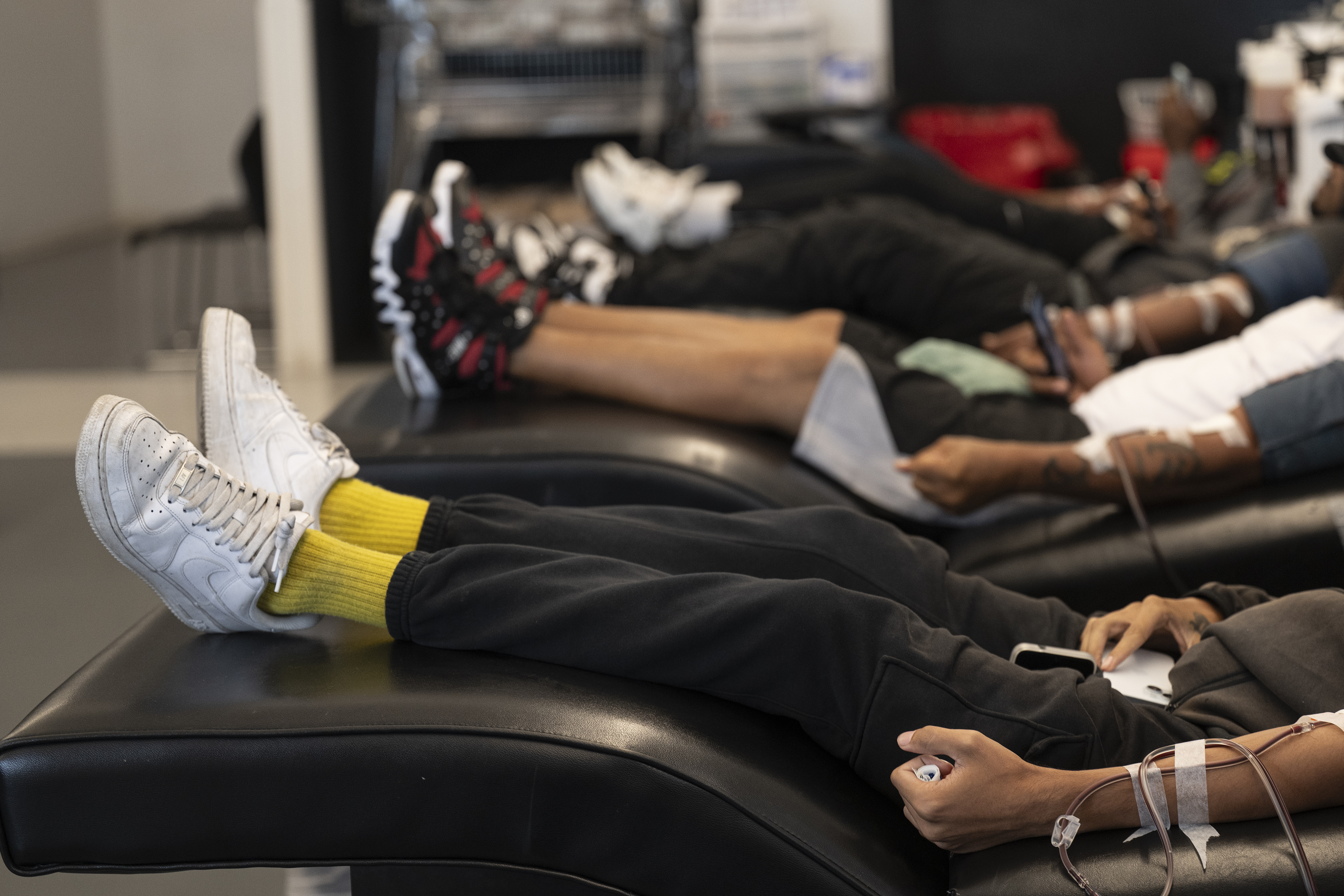
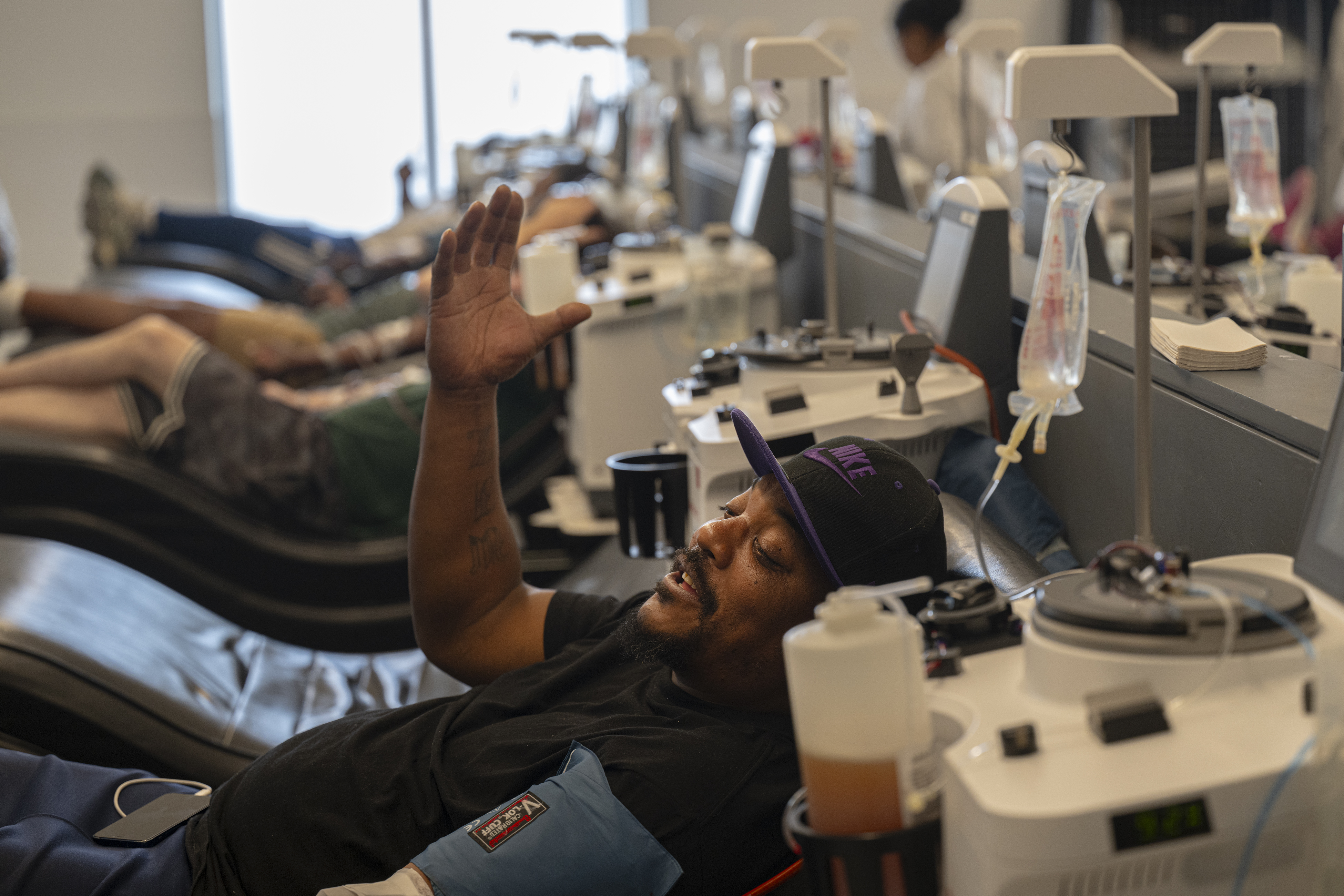
An increasing number of people in the Philadelphia region are selling their blood plasma for money. Here, local donors sit in recliners with needles in their arms at B Positive Plasma in Montgomery County.Jose F. Moreno / Staff Photographer
The U.S is one of about a dozen countries where it is legal to pay donors for plasma. It is among only three countries where people are allowed to donate two times over seven days, though not on back-to-back days, per U.S. Food and Drug Administration regulations.
Nearly 70% of the world’s plasma comes from donors in America, fueling a multibillion-dollar global industry. Plasma, a straw-colored liquid in blood, contains antibodies and other proteins used for treating a wide range of patients with immunodeficiencies, neurological conditions, kidney disease, and bleeding disorders.
Last year, U.S. donors produced 62.5 million liters of plasma — the highest volume ever collected and an 8% increase from the previous year. That trajectory has continued into this year, according to Georgetown University professor Peter Jaworski.
“When the price of most staples goes up, so does the amount of plasma donations,” Jaworski said. “If I fell on hard times, the very first thing I would do is become a regular plasma donor.”
Donating plasma is widely considered low-risk, with millions of people doing it each year without reported health problems. However, the long-term health effects of donating twice weekly for years have not been well-studied. Safety concerns raised by the deaths of two people in Canada who had recently donated at for-profit clinics run by the healthcare company Grifols haveprompted an investigation there.
In the U.S., an FDA investigation into 34 deaths of people who had donated plasma between 2016 and 2020 did not find a link between donations and fatalities.
Some donors experience lightheadedness, fatigue, bruising, bleeding, or dehydration. Drinking water and eating foods high in iron and protein can help alleviate those side effects, according to U.S. health guidance.
Security guard Danny Morales of North Philadelphia said he feels “tired” after donating. But that has not deterred him from heading to CSL Plasma in the city’s Olney neighborhood twice a week, as soon as he finishes his overnight shift at 6 a.m.
Morales can earn $520 a month donating plasma, which helps to offset rising expenses that have the 35-year-old father feeling ever more drained: The cost to fill up his Honda Civic’s gas tank jumped from $30 to $80 in the last year; a package of ground beef increased by $8; and even the brand of mac and cheese that his 8-year-old daughter and 2-year-old son enjoy costs about $1 more, he said.
“It’s just getting worse and worse,” said Morales, whose plasma donations supplement his $18 hourly security job wage. “Stuff is just getting so expensive. Groceries are ridiculous.”
CSL opens at 6 a.m., but a line starts to form around 4:30 a.m. In late July, it snaked past the building, wrapping around the corner. The sight caught the attention of nearby Olney resident Tony Reed.
“There’s always a line there, especially toward the end of the month and definitely on Monday mornings,” Reed said. “People are broke.”
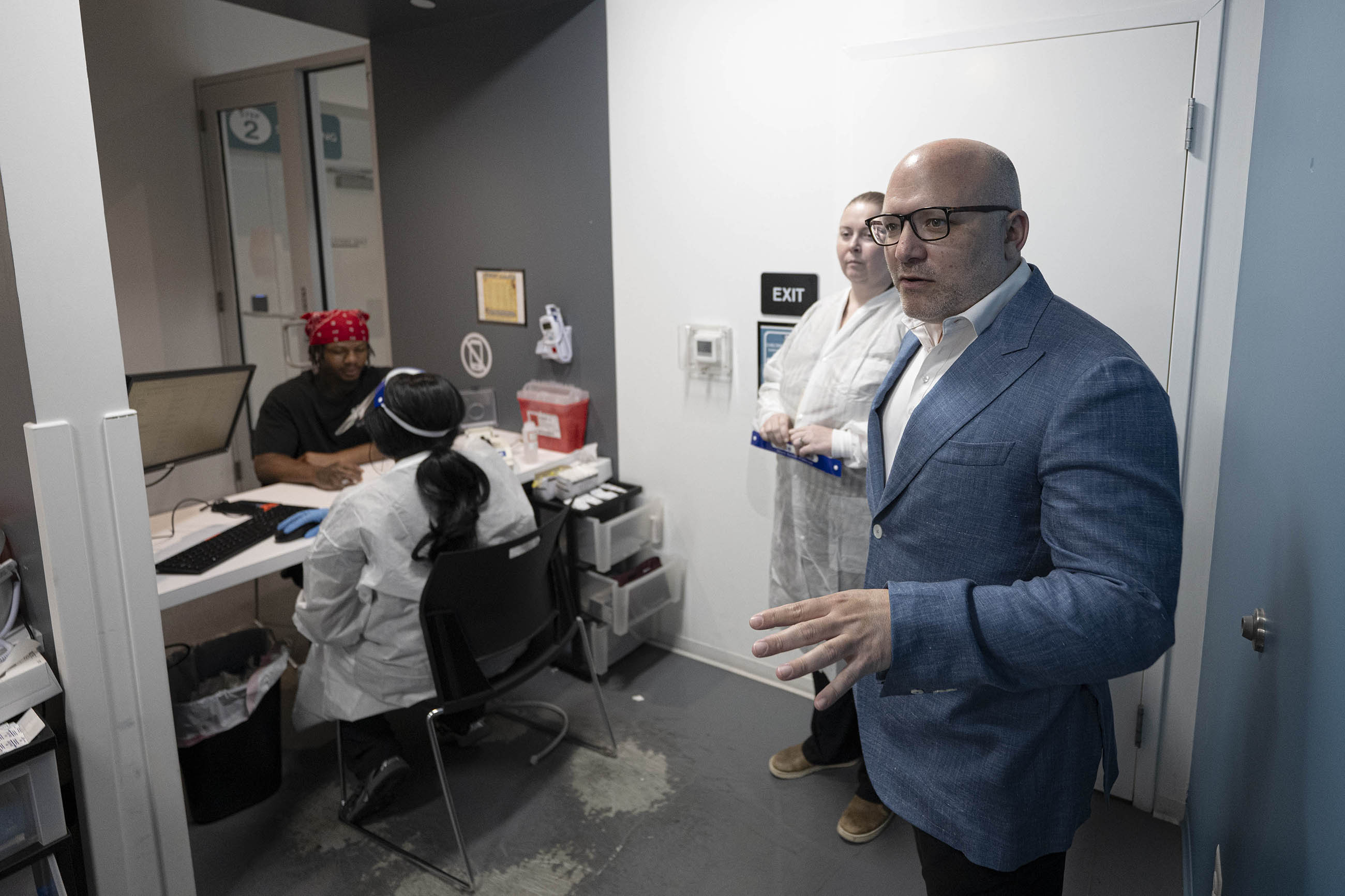
Ben Ruder, CEO and founder of B Positive Plasma, and Pearl Dixon, an assistant manager and phlebotomist, explain the donor intake process. Each donor fills out an extensive health questionnaire, undergoes a medical exam, and gets a finger prick to test their blood for iron and protein levels. Jose F. Moreno / Staff Photographer
Inside the booming industry
On a recent Wednesday afternoon at B Positive Plasma in Montgomery County, a steady stream of donors checked in at kiosks in the lobby.
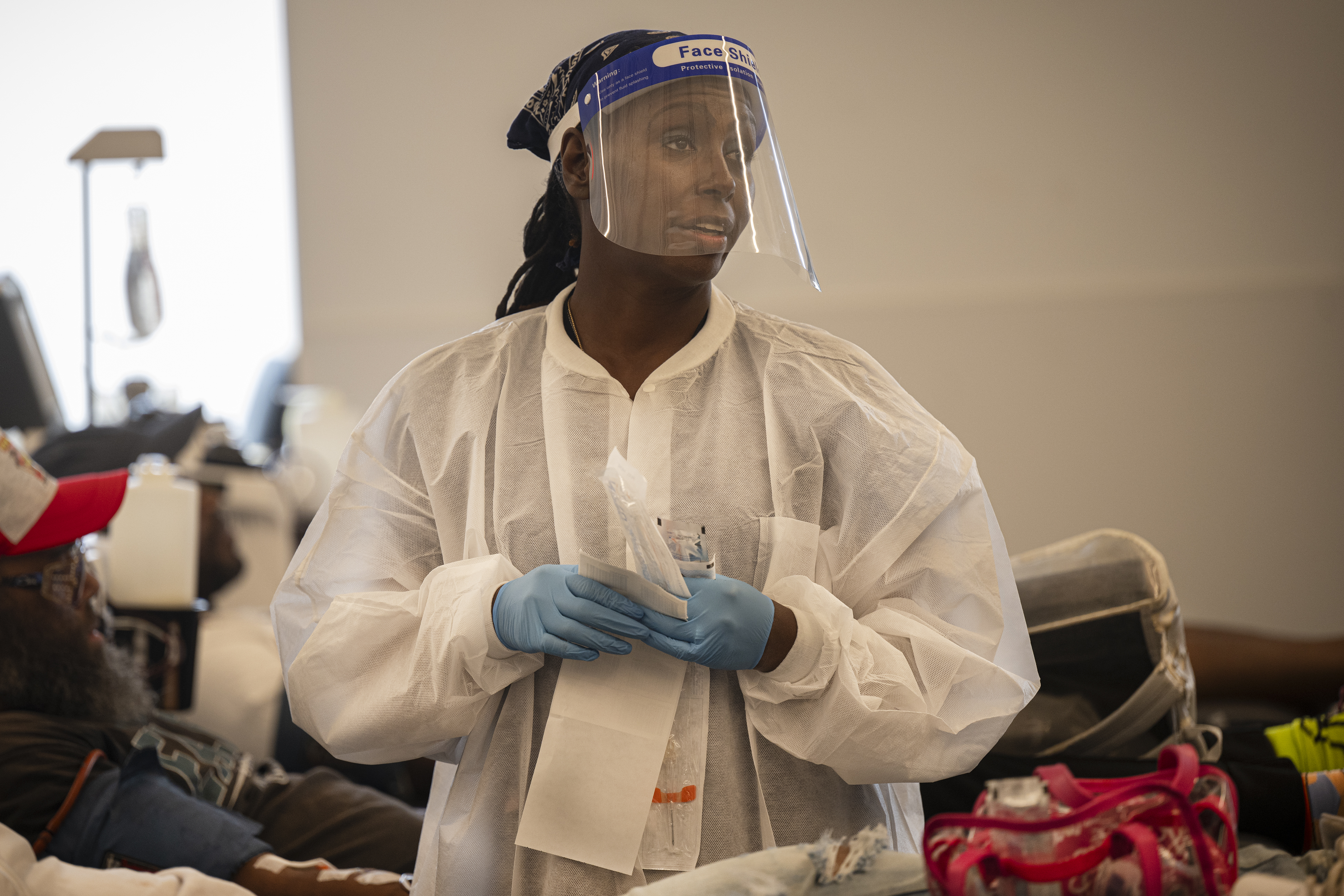
After filling out an extensive health history questionnaire, each new donor undergoes an on-site medical exam by a licensed practical nurse. Repeat donors must get annual exams. At each visit, a medical tech checks their vitals, including blood pressure, pulse, and temperature, and performs a finger prick to test their blood for protein and iron levels. Donors must weigh at least 110 pounds.
“We make sure they’re healthy and well,” said Ben Ruder, founder and CEO of B Positive Plasma, noting that the plasma itself is tested for HIV and hepatitis B and C before being sold.
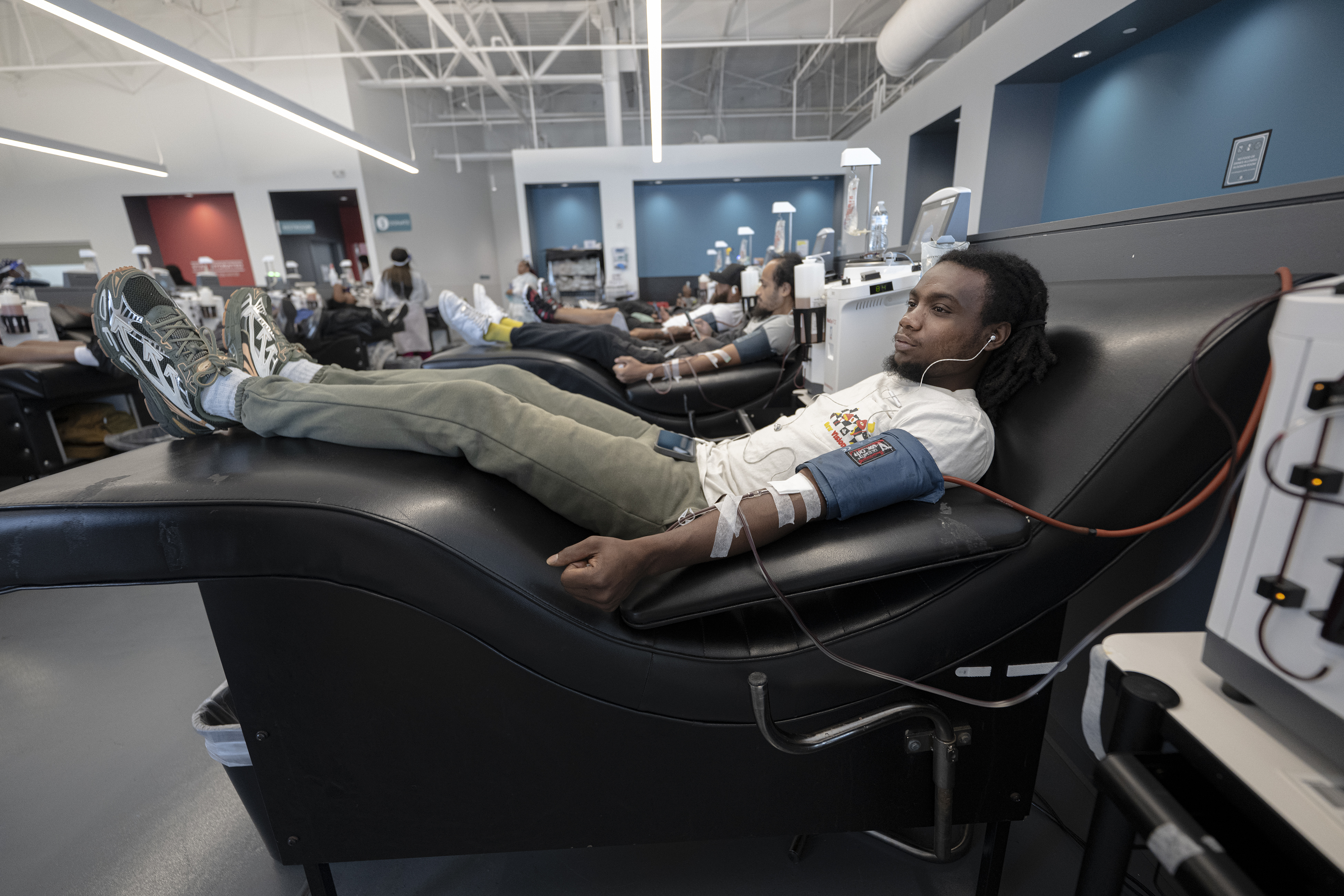
Next, plasma donors are hooked up to a machine that draws out blood, spins off the plasma, and then returns the red blood cells back to the donor, a process that typically takes 45 minutes to an hour.
At 2 p.m., 18 of the 24 cushioned recliners at the Wyncote location on Cheltenham Avenue were occupied by donors, each with a needle in one arm. They included a Philadelphia police officer who had donated more than two dozen times since May 2025; a casino cleaner who earns $120 a week donating to support his young daughter; and a home health aide who donates twice a week to help cover his $750 monthly apartment rent.
Jason Johnson, 29, of East Mount Airy, has donated plasma 68 times at B Positive Plasma in the past two years. He makes an extra $120 a week donating twice weekly. The money helps supplement the $17.80 an hour he earns as a cleaner at Live! Casino & Hotel Philadelphia. “In the beginning, I was doing it for the extra money, but once I learned that I’m helping people out in their life, it made me want to come back even more,” Johnson said. Jose F. Moreno / Staff Photographer
Plasma donation differs from whole blood donation, a faster process that relies on unpaid volunteers who can donate only once every 56 days in the U.S.
B Positive Plasma is on track to see a record year, with 180,000 donations, peaking this holiday season, when people need extra money for gifts. Last year, the company saw 150,000 donations at about 1 liter per person.
Ruder, 42, who lives in Center City, opened his first plasma donation center in Cherry Hill in 2012 and rapidly expanded to 12 locations in New Jersey, Pennsylvania, and Delaware. He plans to open two more sites in Maryland next year and another in Allentown later this year.
B Positive Plasma, like other plasma companies, structures payments to incentivize twice-weekly donors. For instance, donors whose weight and physical health yield the maximum amount of plasma — 1,001 to 1,200 milliliters — will receive $45 for the first visit and another $90 if they return that same week. Plus, the company offered a $50 bonus for anyone who donated eight times in August.
Donyele Wilkins, 48, a phlebotomist and medical assistant, works in the donation room at the B Positive Plasma in Montgomery County. She suffers from lupus, a chronic autoimmune disease for which she receives plasma-derived infusions to control her symptoms.Jose F. Moreno / Staff Photographer
Phlebotomist Donyele Wilkins works 12-hour shifts, four days a week, at B Positive Plasma.
For Wilkins, the paycheck is not the only benefit of working there.
The 48-year-old Northeast Philadelphia resident suffers from lupus, an autoimmune disease in which the body’s immune system attacks its own tissues and organs. Wilkins said she relies on plasma-derived medication, infused through an IV every four to five months, to help control symptoms like inflammation and joint pain.
Knowing how plasma is processed makes her feel “safe,” she said. She also likes getting to know “the regulars” who donate.
“It makes me feel like I know exactly where it’s coming from, and I know the people who are doing it,” Wilkins said. “A lot of them really need the money, so they’re helping me, on top of me helping them.”
‘Blood money’
Paying donors for plasma has sparked ethical debate, with some accusing the industry of exploiting poor people.
In her 2023 book, Blood Money: The Story of Life, Death, and Profit Inside America’s Blood Industry, Kathleen McLaughlin, a Montana-based journalist, found that donors in many U.S. regions are disproportionately Black and brown people.
McLaughlin, who has a rare autoimmune disease treated withmonthly plasma-derived infusions, said today’s rise in donations is “a symptom of our broken economic system.”
While the FDA regulates health safety at plasma centers, the pay rate is set by the companies, McLaughlin found. She thinks donors should be paid more and the amount should be standardized.
“Right now, it’s a capitalist free-market system, where the pricing isn’t transparent,” McLaughlin said. “The profit margins are crazy for these plasma companies, and it’s gamified to make you donate twice a week, every week, in perpetuity.”
Jaworski, the Georgetown University professor, said donors are compensated fairly. A donor whosits for an hour and a half makes “significantly more than” New Jersey’s $15.92 minimum hourly wage and Pennsylvania’s $7.25. Plus, he stressed, donors save “hundreds of thousands of lives.”
Wallace Smith, 45, of Upper Darby, prides himself on making an honest living. He earns $15 an hour as a home health aide. He makes an extra $130 a week selling his blood plasma. The money helps cover cigarettes, rent, and his phone bill. Jose F. Moreno / Staff Photographer
Recently published research suggests that communities can benefit when a new plasma center opens, because fewer young people take out high-interest payday loans and area crime drops, mostly driven by decreases in property and drug-related offenses.
“It helps you from having to do something wrong,” plasma donor Wallace Smith said.
When Smith was in his late 20s, he got arrested for selling drugs. Now 45, he is still struggling to find a job that pays a living wage, he said.
Smith, of Upper Darby, works three days a week, earning $15 an hour, as a home health aide. He earns $130 a week donating plasma, which helps pay for cigarettes, his phone bill, and rent, he said.
Like many donors, Smith said he likes the win-win of earning extra cash and helping patients who depend on plasma.
“They say there’s a job’s out here for everybody, but when you become a person who made mistakes in life, then they look at your background, so there’s only certain jobs you can do,” Smith said as his blood flowed into a spaghetti-thin clear tube at B Positive Plasma.
“With that being said, you don’t go back to your old ways,” he said. “You find better resources like this.”
On a hot August morning, donors line up outside Octapharma Plasma in South Jersey to sell their blood plasma for money. They arrive before the doors open at 9 a.m. to beat the wait. Donor Carl Davis, 56, of Camden, donates every Saturday and Monday, earning $70 each time. The extra money helps supplement his $900 monthly Social Security Income disability check. “I get SSI disability, but it’s not enough at all to pay my bills and buy food,” Davis said.Wendy Ruderman
Beach boardwalk fun
At Octapharma Plasma in South Jersey, the wait time can be as long as three hours, donors said. When a sewer pump broke and bathrooms stopped working earlier this year, the company trucked in a row of porta-potties to accommodate donors and staff.
On a recent August morning, Brittany Barr, 36, and her three sons — 5-year-old twins and a 6-year-old — waited outside Octapharma as her husband donated. The family had walked roughly two miles from their Gloucester City home.
When Barr learned her friend had kidney failure and needed plasma infusions, she wanted to help. Barr was unable to donate plasma because she is anemic, so her husband agreed to do it.
In the month since Barr’s husband started donating, the family has earned more than $500. It has helped with groceries and their phone bills to supplement her husband’s income as a shipping manager.
“With only one income, money is tight these days,” Barr said. “Everything is messed up.”
The boys, clad in their bathing suits, climbed up on Barr as she sat on a tipped-over shopping cart. They were headed next to Atlantic City for a beach day.
“This week, the money is going toward fun. They’re going to play arcades and have ice cream or whatever their little hearts desire,” Barr said. “Next week, it’s going to school supplies.”
Brittany Barr, 36, seated with her boys (from left) Cooper, Cannon, and Colton, waits outside for her husband to finish donating plasma at Octapharma Plasma in Audubon, N.J. The family from Gloucester City was next headed down the Shore, where they planned to spend the extra money earned from donating plasma on arcade games and ice cream.Wendy Ruderman / Staff