A community theater is caught in the crosshairs of West Pikeland Township’s hope to sell the municipal building it calls home — just about a year after the performing arts company completed nearly half a million dollars’ worth of renovations there.
The West Pikeland Board of Supervisors voted 3-2 on Monday to put the building, at 1645 Art School Rd. in Chester Springs, up for bid. Board members cast their votes before a packed house had an opportunity to speak in support of SALT Performing Arts, the hub that has been based at the township building for 12 years.The group shares the space with township administrative offices.
But after roughly an hour of public comment decrying the decision, board member Bryan Maher sought to require that the buyer honor the license agreement as a condition of the bid — something the township originally was going to make optional.The board could not make that change at Monday’s meeting, after already voting to put the building up for bid, but may reconvene Thursday to discuss adding such a condition. Officials said the date and time will be published online.
“That is the best we can do according to the regulations, the lovely second-class township code that we all have to abide by,” the township manager, Joan Blatcher, told attendees Monday.
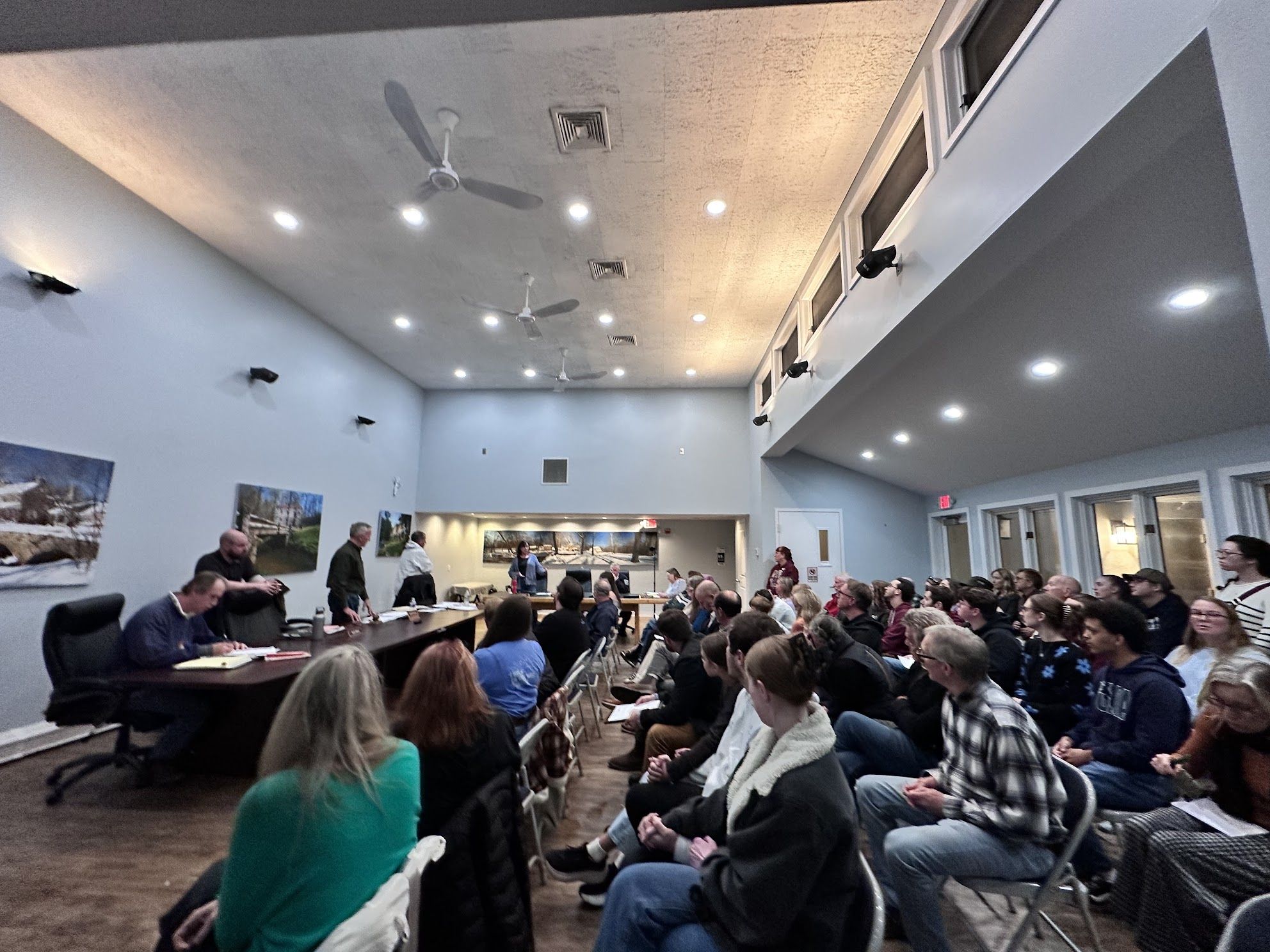
On Monday, Oct. 19, community members arrived to speak in support of SALT Performing Arts retaining their home at the West Pikeland Township municipal building after contributing around $400,000 to its renovation. Township officials voted to put the property up for public bid Monday, but after impassioned comments, plan to reconvene to consider adding protections.Courtesy of SALT
Lauren McComas, SALT’s president and artistic director, said Tuesday that the group was feeling hopeful.
“But it’s still unfolding and nothing is certain,” she added.
The proposed sale comes just more than a year after SALT put together about $400,000 to pay for necessary safety improvements and renovations in the space, striking an agreement with the township to foot the bill if the organization could license the space for 10 years at a fixed cost.
The township wants to sell the property for at least $2 million to offset the cost of purchasing a new facility to house its police force, which the community pushed to save several years ago when the municipality considered disbanding it and using the state police instead.
“We knew we were rolling the dice in raising almost half a million dollars and investing it into a property that we did not own, but we trusted the township and this good-faith deal we made with each other,” McComas said.
Speaking to attendees at the meeting, captured in footage on a resident’s unofficial YouTube channel, Maher said the sale of the building was necessary to ensure the township could renovate the new building at 1001 Kimberton Rd. and get the police force accredited. But he did not want to lose SALT in the process, calling on the theater and Historic Yellow Springs, a community organization and the building’s previous owner, to work something out.
“It’s not just about how much money can we squeeze out of this building so we can build new extra bits and bobs over at the new one,” he said. “That’s not my priority here. My priority here is that the community is built through the purchase of the new building and the reinforcement of what’s here — that’s SALT. That’s not this building.”
His comments drew a standing ovation.
The township purchased the property in 2005 from Historic Yellow Springs, an organization dedicated to the history and preservation of the village.
There are two buildings on the property; West Pikeland’s police are in the smaller single-story building, while the township administrative offices, a meeting room, and SALT share the larger building, Blatcher said.
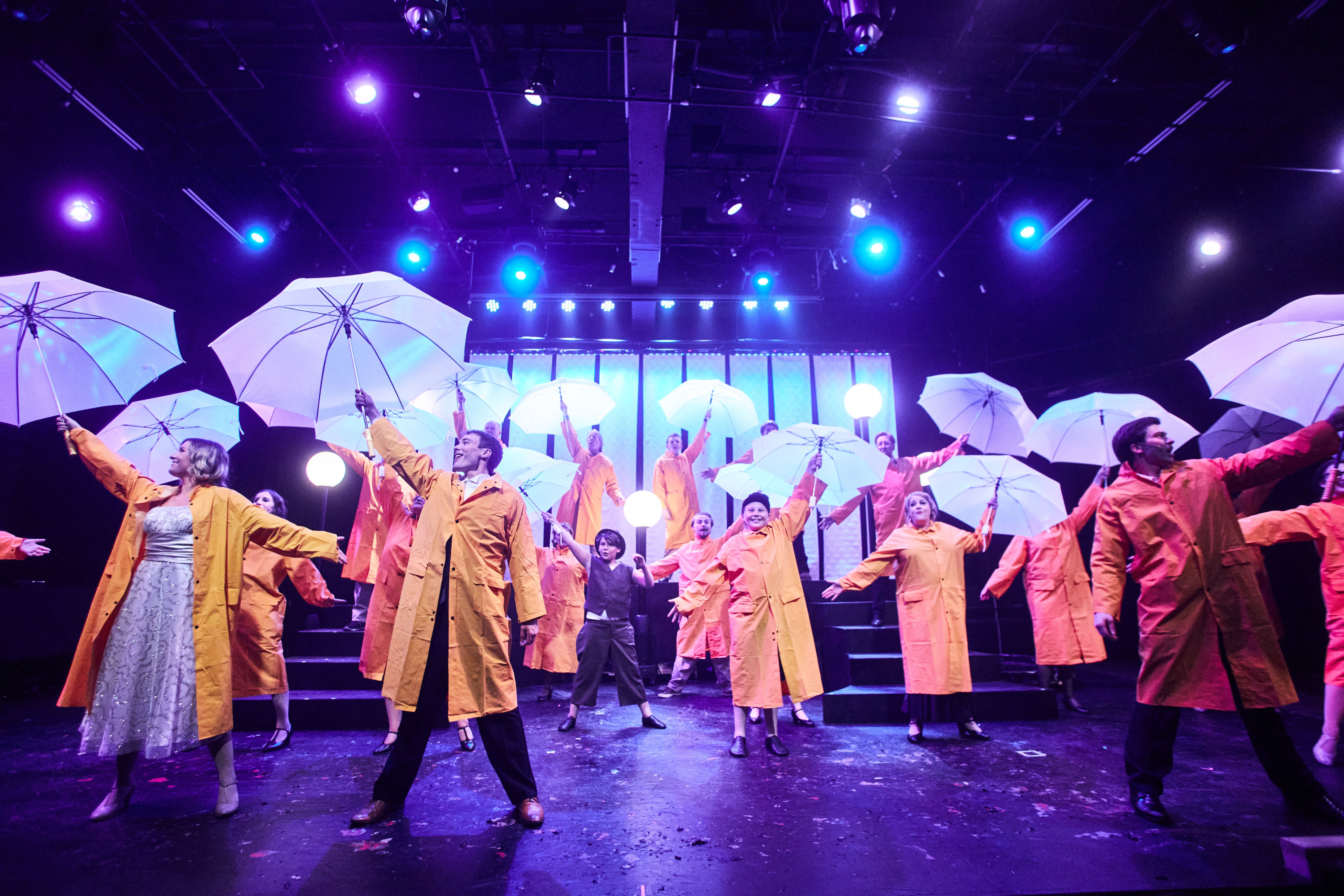
SALT started its theater company in the space in 2014, McComas said.
In the more than a decade since, it has produced 90 main-stage productions, and had more than 14,000 children perform on stage through educational arts programs, she said. SALT has community partnerships with Acting Antics, an all-abilities theater group; the Chester County Food Bank; the Domestic Violence Center of Chester County; and the VFW, busing unhoused veterans to the facility for private shows during the holidays and providing them with hot meals and necessities.
In 2023, township officials told SALT leaders that a brick wall and skylight were becoming a liability and needed to be replaced. SALT offered to raise money for the renovations, along with other improvements to the space, in exchange for a 10-year license agreement at a fixed rent. The township agreed, McComas said.
SALT fundraised for two years and completed the project in September 2025, McComas said.
Earlier this year, the township approached SALT about its intention to sell the building. While officials gave SALT right of first refusal for the purchase, as specified in the agreement, it was too steep a cost after pouring so much into the renovations, McComas said. The theater also took out a $200,000 construction loan as part of the $400,000 effort, guaranteed by McComas herself, to complete the work, reassured by the 10-year commitment.
They entered the agreement in May 2023, and it became effective Jan. 1, 2024, Blatcher said.
“This is our home and this is our hub. And if they did not honor our license agreement and kicked us out, SALT would be done,” McComas said. “All that we just built for the last 12 years with sweat and tears and blood and passion would just be done.”
Blatcher said the township had not planned to sell the building when it entered the agreement. But because the building is a part of the Historic Yellow Springs Village and on the historic register, she said, “there are limitations to how that can be done” to accommodate a larger police squad and meet the requirements of accreditation.
Ahead of a possible reconsideration later this week, Blatcher said, the licensing agreement with SALT is included in the bid packet for potential purchasers. Bidders are instructed to advise the township if they would assume the terms, or prefer the township terminate it “as permitted in the current agreement with 30 days notice.”
“I am not aware of a single person on the staff or Supervisors of the Township who want SALT to have to relocate,” Blatcher wrote in an email. “The township has done what it can to provide SALT with as much time as it could to get funding or enter into a partnership or agreement with HYS to retain the building. The supervisors have obligations to the residents of the township that go beyond fostering the exceptional community built by SALT.”
McComas said leaders tried to limit how many people came out Monday to speak on SALT’s behalf, but the evening saw impassioned pleas from staff members, donors, community partners, and more.
“We’re not asking for anything for free. We’re not even asking you to invest in the arts,” said Rob Merow, vice president and technical director of SALT. “We’re simply asking you to not double dip on the recent investment that SALT’s donors made and afford us the privilege of maintaining excellence in arts and kindness within West Pikeland Township.”
Valerie Dixon said she started as a ticket-buyer before she became involved as a choreographer for the performing arts center. She condemned the township’s decision to sell the property without honoring the license.
“That little bait-and-switch felt like a huge slap in the face,” she said. “Not just to me, as a donor and a ticket-buyer and a staff member of this organization and an educator to thousands of kids who come in through our doors here, but also as a community resident. Slap in the face.”
McComas’ 15-year-old daughter, Eloise, choked up as she spoke to the board.
“SALT is my second home. I grew up here. My brothers grew up here,” she said. “I just really hope that you will choose to not just do what is legal, but also do what is morally right.”
This suburban content is produced with support from the Leslie Miller and Richard Worley Foundation and The Lenfest Institute for Journalism. Editorial content is created independently of the project donors. Gifts to support The Inquirer’s high-impact journalism can be made at inquirer.com/donate. A list of Lenfest Institute donors can be found at lenfestinstitute.org/supporters.
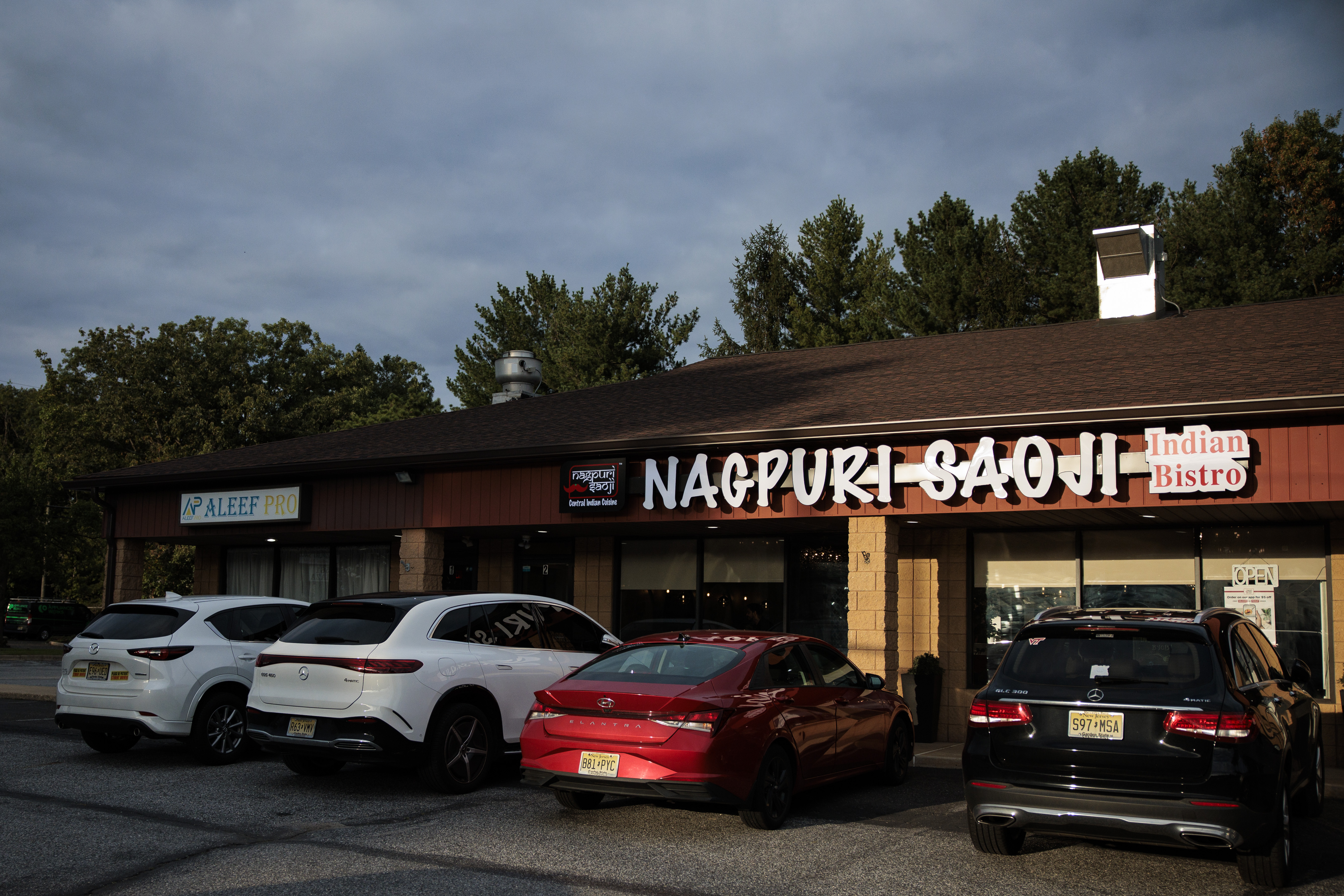
For seekers of hauntingly complex sauces,there is one dish — the famously fiery Saoji curry simmered with goat — that is worth the drive to the Voorhees strip mall where Nagpuri Saoji serves up a rare taste of Central Indian cuisine.
But the sensation that lingered most in my imagination after my first visit to the restaurant was actually a memory of touch: the tactile pleasure of holding the pebbled surface of a warm sabudana fritter encrusted with tapioca pearls, then cracking the fryer-crisped baubles open to reveal steamy white centers of mashed potatoes laced with ginger, cilantro, and chilies. With a creamy pink chutney enriched with peanuts on the side, it was one of the most comforting starters I’ve nibbled this year.
The Sabudana Wada at Nagpuri Saoji on Sept. 30 in Voorhees Township, N.J.Monica Herndon / Staff Photographer
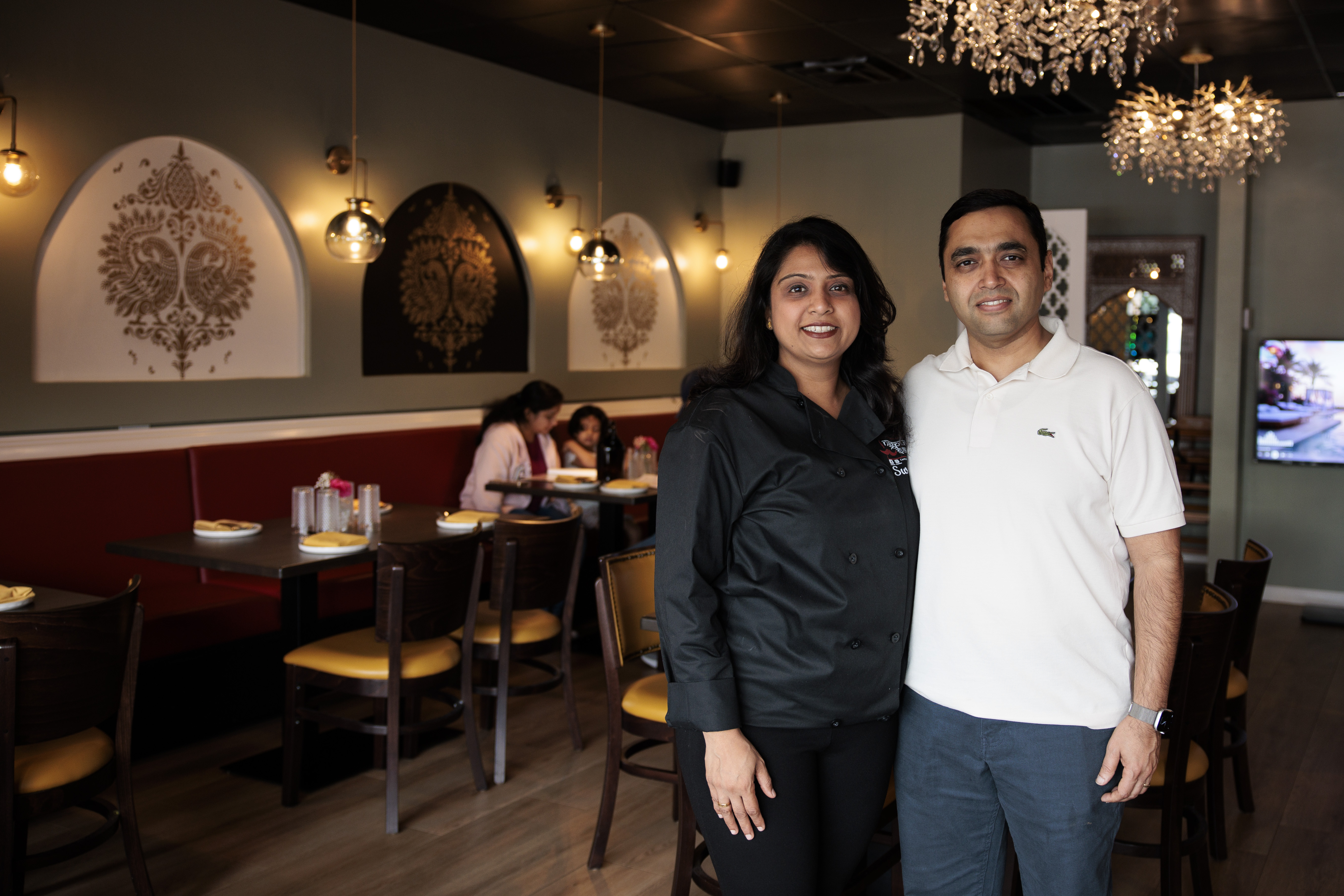
For Swapna Sagdeo, the chef who co-owns this restaurant with husband Neeraj Sagdeo, the sabudanas offer a vivid portal to her childhood in Nagpur, India, where the fritters are a much-anticipated treat for children to snack on while adults fasted for religious holidays.
“Everybody [where I come from] has a childhood memory associated with it,” she said. “That is what we want to do here, to bring out that nostalgia.”
What distinguishes Sagdeo’s mission from so many other Indian restaurants in our area is her focus on the flavors of Central India. It’s a region that’s virtually unknown to many Americans who’ve long enjoyed the creamy curries and tandoor-roasted meats of Northern India and, especially over the last two decades, come to embrace the crispy dosas, coconut-kissed stews, and tamarind-tanged dishes of Southern India.
“Indian food in the U.S. is often represented through cuisines associated with cities and regions that have already established strong identities internationally, like Mumbai, Delhi, Kolkata, and Hyderabad,” she said. “There’s so much culinary diversity beyond these places, and I think people from other regions want their food, culture, and identity to be recognized in their own right.”
Owners Swapna and Neeraj Sagdeo at Nagpuri Saoji on Sept. 30 in Voorhees Township, N.J.Monica Herndon / Staff Photographer
Nagpur, the 13th largest city in India, is part of the state of Maharashtra and sits smack in the middle of the country — “like Kansas City,” Sagdeo said. Its culinary traditions are distinct, characterized by gravies spiced with earthy dried chilies; rustic flatbreads such as bakhri, made from grains like millet; and gram flour from dried chickpeas, which gets mashed with onions and spices into the traditional farmer’s lunch of zunka, which Nagpuri Saoji also serves.
Gram flour also factors into crispy pastry tubes called Nagpuri kothimbir vadi, which get stuffed with well-spiced fistfuls of chopped cilantro. It’s an appetizer so rarely seen locally that one of Nagpuri’s customers made a point of stopping by our table on her way out to enthusiastically insist I try it. I bit into a freshly crisped order — it was like a hearty spring roll packed entirely with herbs — and was thrilled I followed her advice.
Nagpuri kothimbir vadi are crispy gram flour pastries stuffed with well-spiced fistfuls of tamarind-tanged cilantro at Nagpuri Saoji.Craig LaBan / Staff
The namesake Saoji curry here is undoubtedly this restaurant’s primary draw. The Saoji style of cooking originated from the Halba Koshti community of weavers who migrated in the late 19th century from neighboring state Madhya Pradesh to work in the textile mills of Nagpur, where their fiery cooking, a local staple for millworkers, became widely popular.
The Sagdeo family’s rendition is an exercise in intricacy and balance, a blend of 27 different toasted spices, including multiple kinds of cumin and cardamom, poppy seeds, mace, star anise, cinnamon, fennel, bay leaves, a lichen known as blackstone flower, and two varieties of incendiary Bhiwapuri dried chilies. They’re all simmered into a fragrantly earthy chocolate-brown brew that is so famous for its tongue-scorching spice that I’ll admit to a little disappointment when Nagpuri’s standard rendition did not instantly set my lips ablaze.
The Saoji goat curry at Nagpuri Saoji.Monica Herndon / Staff PhotographerSpices used in Saoji goat curry.Monica Herndon / Staff Photographer
“The one that we do is the mildest level we can go to,” concedes Sagdeo. “I prefer a ‘level zero’ myself, but we can go five levels up to ‘Nagpuri taste’ and that is what people eat back home.”
I’ll cautiously request one or two notches higher on my next visit. But what most impressed me was not so much its burn potential as how this curry made an effective canvas to amplify the natural flavors of whatever protein simmers inside it, like a prism. The chicken version of Saoji was noticeably lighter in body and flavor while the goat’s handle-like bones and tender meat infuse the sauce with a rustic, deeply magnetic savor.
Chef Swapna Sagdeo cooks Saoji goat curry at Nagpuri Saoji.Monica Herndon / Staff Photographer
The Sagdeos, who moved to South Jersey in 2011 to work in IT, initially launched their venture with weekend specials for subscribers out of a commissary kitchen in Atco in 2016 before landing in their current Voorhees restaurant space in late 2020. They opened a larger sibling restaurant by the same name with a bar in bustling Iselin, in North Jersey, in 2023. After closing their Voorhees location for yearlong renovations and an expansion, they reopened this BYOB earlier this year with 80 seats.
The restaurant was fairly quiet during most of my visits, except during a special-event weekend buffet when both sides of the dining room were bursting with families. Regular Friday night karaoke sessions, when the crowd favors boisterous Bollywood tunes on the open mic, are also lively.
For maximum audience appeal, their menu also includes solid renditions of familiar dishes from other parts of India, including samosas (albeit spiced to their regional style with whole coriander seeds), chili-garlic chicken momo dumplings, creamy dal makhani, and tender lamb chops spiced with vivid red kashmiri chilies that arrive at the table in full sizzle on a cast-iron skillet.
The lamb chops (center) and other assorted dishes at Nagpuri Saoji.Monica Herndon / Staff PhotographerKrishna (center) and Vijal (right) Tailor, from West Berlin, work on a reel for their @Vicky_And_Krishna account at Nagpuri Saoji on Wednesday, Sept. 30, 2026 in Voorhees Township, NJ.Monica Herndon / Staff Photographer
You can skip the chicken tandoori quesadillas, a fusion dish created for the restaurant’s younger customers that isn’t worth it (unless you order it pressed between Indian chapati rather than the default flour tortillas). There are so many other more interesting dishes to consider instead, including a creamy methi curry flavored with fenugreek and filled with meaty, tender cashews.
Sagdeo’s family also has roots in the Southern coastal state of Goa, and I enjoyed several dishes typical of that region, including a pair of silver pomfret fish imported from India that were pan-fried whole in a zesty semolina crust. A vibrant green sauce called cafreal made from cilantro, mint, and chilies was fantastic with cubes of paneer cheese.
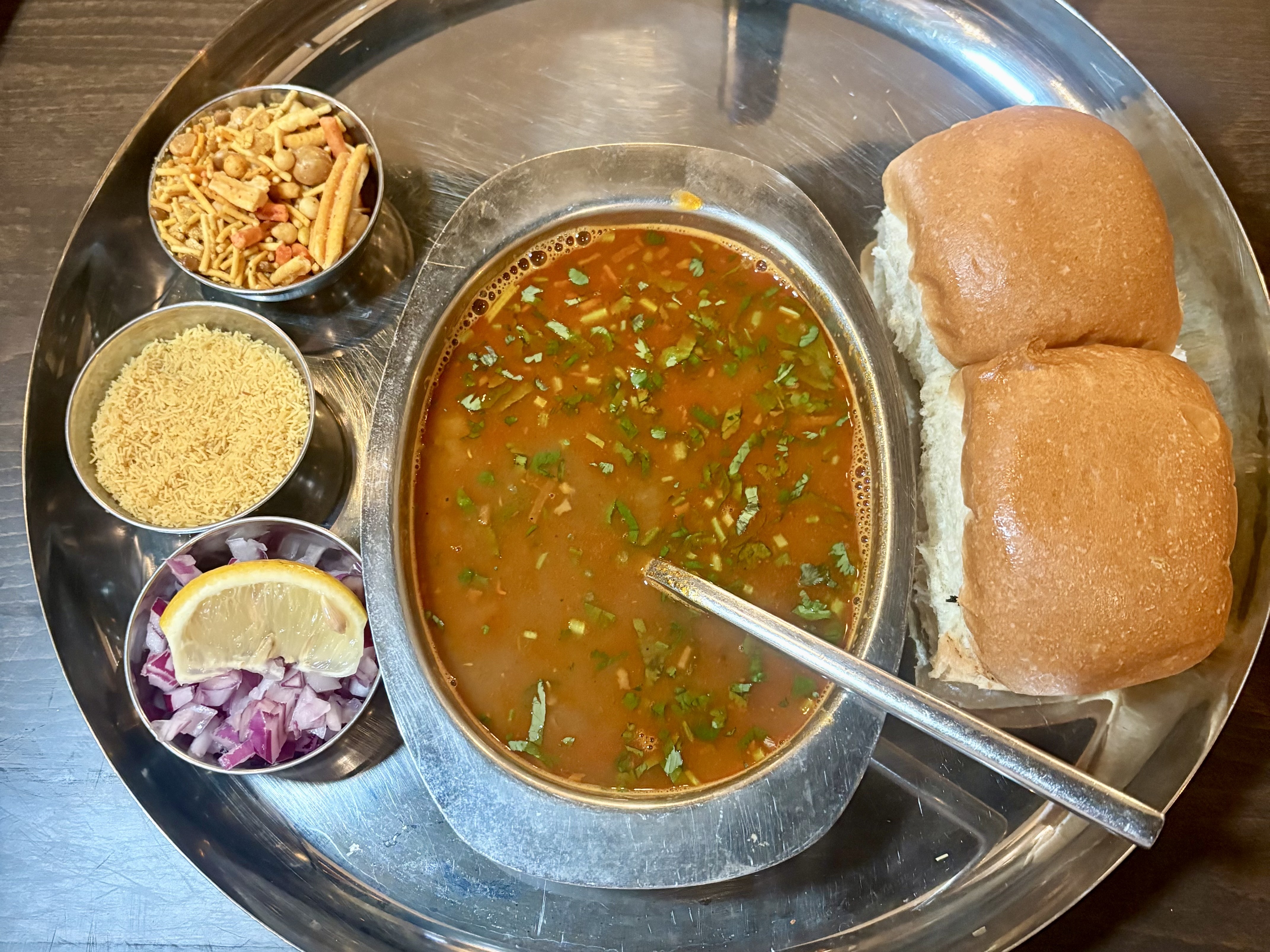
Misal pav is a brothy Maharashtrian curry at Nagpuri Saoji steeped with three kinds of bean sprouts that comes with side dishes of crunchy farsan snacks, chopped red onions, filament thin strands of a snappy chickpea pastry called shev, and pillowy soft pav dinner rolls on the side for dipping.Craig LaBan / StaffA creamy methi curry flavored fenugreeks is brimming with tender whole cashews at Saoji Nagpuri in Voorhees.Craig LaBan / Staff
There were also several other Central Indian curries we enjoyed, including a deep red chili-based kolhapuri that we savored with vegetables. A creamy Malwani coconut curry from the Konkan coast of Maharashtra is tanged with the sour kokum fruit and is perfect with either chicken or fish. Patodi rassa, a Maharashtrian fritter made with chickpea flour, offered a satisfying vegetarian alternative to bask in that rich Saoji curry.
Misal pav was another Maharashtrian specialty I couldn’t get enough of, a brothy, well-spiced bowl of tomatoey curry steeped with bay leaves, coriander, and three kinds of sprouted beans. Once you mix in the side dishes — crunchy farsan snacks, chopped red onions, and filament-thin strands of snappy chickpea pastry called sev — the broth thickened enough that it worked like a dip for the pillowy soft pav dinner rolls on the side.
With such boldly flavored dishes, sweets are an essential finale to the meal, and Nagpuri Saoji delivers them with the dramatic fanfare of dry-ice smoke, whether it’s a classic gulab jamun dusted with crushed pistachios, housemade mango kulfi ice cream, or, my favorite, cardamom-flavored shrikhand (hung yogurt) turned golden with saffron, which can also be served with puffed poori bhaji flatbreads on the side.
“It’s a dessert typically made for holidays, but nostalgic for people living here,” said Sagdeo. “Because it reminds you of family.”
The Shrikhand at Nagpuri Saoji on Wednesday, Sept. 30, 2026 in Voorhees Township, NJ.Monica Herndon / Staff Photographer
Nagpuri Saoji
1227 Haddonfield-Berlin Rd. Unit 3, Voorhees Township, N.J. 08043; 856-805-0339;nagpurisaojiusa.com
Lunch 11 a.m. to 3 p.m. Wednesday through Monday; dinner 5 to 10 p.m. Wednesday through Monday. Closed Tuesdays.
Entrees, $14-$27.
BYOB.
Wheelchair accessible.
About 60% of menu can be made gluten-free, including all curries. All meats are halal.
Twelve billion — the number of political ad views in the Philadelphia metropolitan area this year alone. That’s according to AdImpact, a service that monitors political advertisements on both traditional broadcast and streaming services on smart TVs.
To reach that many eyeballs requires spending a lot of money. In the Philadelphia area alone, Democratic candidates have spent $32 million this year to air their ads. Republicans have been a little more frugal, spending just $20 million.
“Money isn’t decisive, but it helps,” explained J.J. Balaban, an admaker for multiple Democratic candidates for Congress. “You have to raise enough to be competitive. If a [candidate] is being outspent 10-1, it’s probably not going to work out.”
The most expensive local race is Pennsylvania’s 7th Congressional District, a closely contested swing seat in the Lehigh Valley, representing over a quarter of total spend on political ads in the Philadelphia area. Incumbent U.S. Rep Ryan Mackenzie is behind in the polls to Democrat Bob Brooks, despite Mackenzie outspending Brooks 2-1.
These are just a few ads representing the Pennsylvania governor’s race as Gov. Josh Shapiro campaigns for reelection and Republican Stacy Garrity campaigns to unseat him. Their campaigns spent the second most for a single race: a combined $8.6 million.
And the breakdown of that spend is staggeringly lopsided. Shapiro’s $8.5 million outlay on airing ads far eclipses Garrity’s $76,000. Garrity has stated “the cavalry will be coming” but with weeks left before Election Day, there is no sign of a rebound.
$1.2 million was spent on airing this Shapiro ad that has seen an estimated 443 million times – the most viewed ad in this race.
On the other hand, Garrity has broadcast only four ads seen by a combined 4.9 million viewers. They are all attack ads on Shapiro’s platform, including this ad about data centers.
A recent Pew Research survey found that a majority of Americans oppose data centers and political campaigns have rushed to reflect that. According to AdImpact, 79 ads shown in the Philadelphia area have data centers as a prominent theme. Most ads that mention data centers are for Democratic campaigns, making up 60 of the 79.
This is most relevant in districts that cover Montgomery and Chester Counties, where according to Data Center Tracker, 13 data centers have been proposed or built. For example, they dominate the debate in the 24th Pa. State Senate district – where 15 of 18 unique ads mention data centers.
more midterm ads after this ad
This ad for Chris Thomas, the Democratic challenger, states that Thomas will “make darn sure these data centers stop raising our utility bills.”
Thomas’ rival and incumbent, State Sen. Tracy Pennycuick aired her own ad about data centers. This 15-second ad – the most seen in the Philadelphia area – focuses on Thomas' relationship with developers who have built data centers while donating to his campaign.
However, data centers are just one of many concerns addressed in ads this year. The most common issues are taxation, data centers, Donald Trump, and healthcare, according to AdImpact’s analysis.
Democrats are running more ads than Republicans that mention artificial intelligence, trade, and education.
While Republicans are running more ads that mention social security, crime, and corruption than Democrats.
more midterm ads after this ad
Even if a campaign ad focuses on an issue voters care about, it might still fall flat. To stick the landing, tone matters just as much, if not more.
“Voters aren’t issue calculators. They don’t sum up ‘I agree with this candidate on 60% of the issues.’ That’s not how human beings make decisions,” argues Balaban. “It’s very driven by emotion and TV is intrinsically an emotional medium. Sometimes my party [Democrats] make the mistake of making ads aimed for the head more than the heart.”
The science agrees. Our emotions impact what we remember, according to Michael Platt, a professor of neuroscience and marketing at the University of Pennsylania, and being a memorable candidate matters on Election Day.
“You have to make [voters] feel something,” said Platt. “Social status, fear, and threat are really good emotions to make [advertisements] memorable and sticky with the viewer.”
An Inquirer analysis of transcripts illustrates these tropes. When ads talk directly to the viewer, for example, they can tap into fear. “You” was mentioned 295 times while “your” was said 185 times.
Belonging and shared values were also a common theme in campaign ads, suggested by use of “our” (438), “us,” (253) and “we” (126).
“There’s an unfortunate feature/bug of our brains to feel a sense of togetherness, and we need to have an out group,” Platt said. “This potentially engages oxytocin signaling in the brain, which is a peptide for group bonding. This would create a stronger connection with that candidate.”
That’s why attack ads are likely here to stay. “Normal human beings will say they don’t like attack ads, but they also remember them,” Balaban said.
Whether these ads are resonating with viewers will ultimately be decided on Nov. 3 in the voting booth. According to Balaban, the real measure of a successful ad campaign is “does the candidate win or not?”
Methodology
The starting dataset of political ads comes from AdImpact’s AdMo+ dashboard. We exported data from the dashboard for ads shown in the Philadelphia media market only. That list was then further refined by:
Filtering for ads aired between Jan. 1, 2026 and Oct. 14, 2026.
Removing ads for 2025 races that were accidentally shown in 2026
Removed ads for races outside of Pa. and N.J. that were inadvertently shown in the Philadelphia area
Removed any ads that AdImpact deemed as political in nature but weren’t attached to a single race or campaign
We used AdImpact’s tagging of the issues in our analysis. We grouped ads by tags, and removed issues with less than 10 unique ads and less than $1 million spend.
Analysis of word count uses AdImpact’s transcriptions. Filler words – such as “to”, “and”, “the”, and “for” – were filtered out.
Staff Contributors
Design, Development, Data, and Reporting: Sam Morris
Editing: Charmaine Runes and Ariella Cohen
Copy Editing: Brian Leighton
Subscribe to The Philadelphia Inquirer
Our reporting is directly supported by reader subscriptions. If you want more journalism like this story, please subscribe today
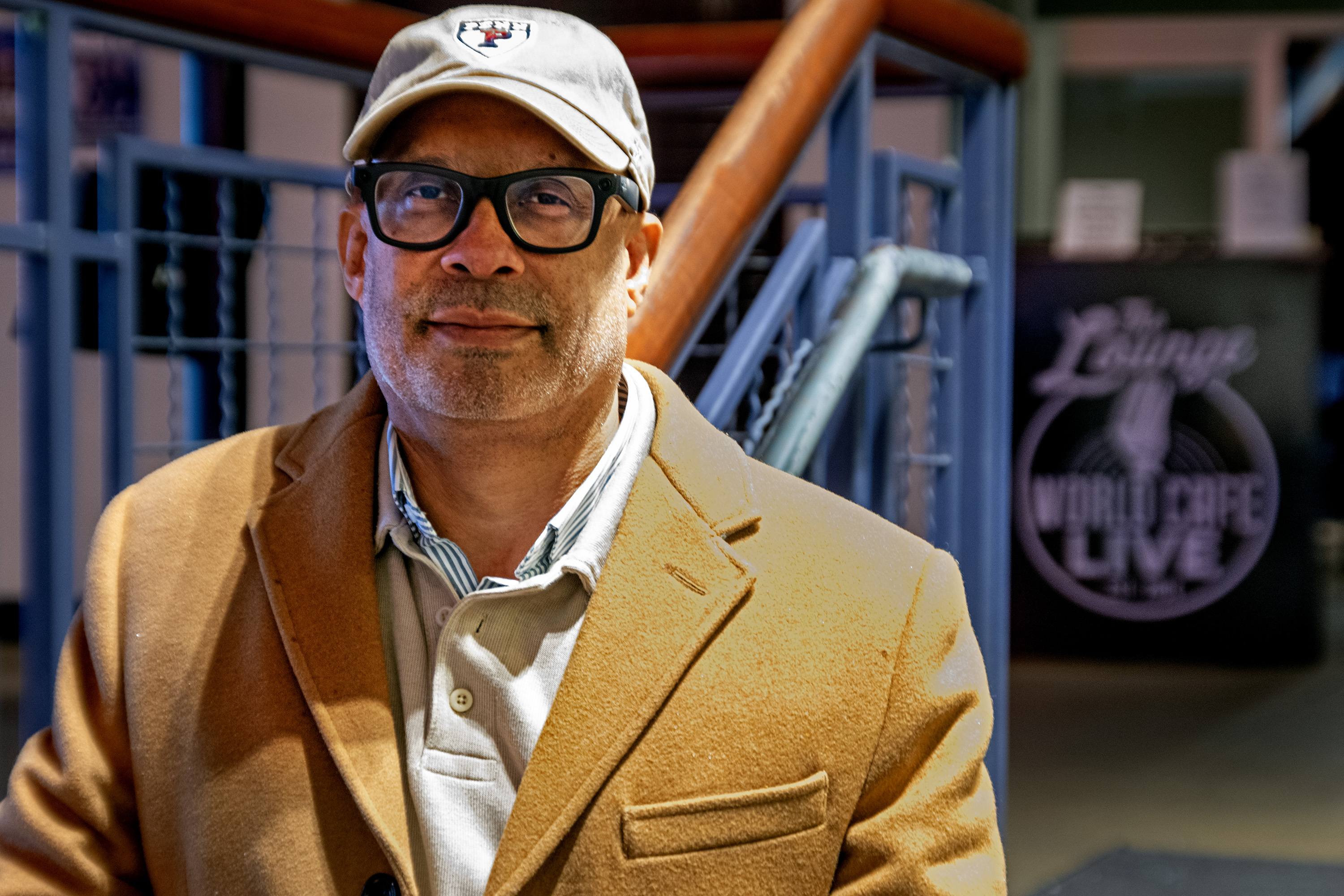
J. Sean Diaz, the CEO of World Stage, the music venue formerly known as World Cafe Live, confirmed Tuesday that the University City music venue will close on Halloween, in a statement sent to concertgoers and the Philadelphia music community.
News of the imminent closing of the venue, which was founded by Hal Real in 2004, was shared with staffers at a meeting in the venue’s Music Hall on Monday and first reported by The Inquirer.
“On behalf of the organization operating the venue formerly known as World Café Live, and pursuant to a recent court approved agreement with the University of Pennsylvania, we are making the difficult decision to wind down our operations,” Diaz wrote in the statement.
The agreement Diaz is referring to is a lease dispute between Penn and World Stage, a nonprofit organization that’s legally known as LiveConnections.org and Real Entertainment-Philadelphia, LLC. It was settled in United States Bankruptcy Court for the Eastern District of Pennsylvania.
Lady Alma is scheduled to play the Lounge at World Stage on Halloween, its final night in business. Karim Muhammad
That agreement dissolved the two parties’ previous lease and granted a temporary lease for the venue to keep operating through October.
But “we were unable to come to terms on a new agreement and lease with the University,” Diaz said, “so our last event will be a closing party on Saturday, Oct. 31, 2026. We will work with our ticketing partner to issue refunds for events scheduled after 10/31 and will work toward relocating shows and private events that must be canceled.”
This July, after a tumultuous year for the venue that included a lapsed liquor license and a police raid that resulted in three employees spending a night in jail, Diaz became chair of the board of LiveConnections.org, the venue’s parent nonprofit, after Callahan stepped down.
Diaz cited multiple factors that led to the demise of the venue, which changed its name to World Stage in March.
“It has proven near impossible to sustain an independent small to mid-sized live performance venue without institutional and philanthropic support,” Diaz said.
“This reality is further complicated by the market dominance and saturation of larger ticketing and live entertainment conglomerates,” he said of indie venues struggle to survive against oversize entities such as Ticketmaster and concert promotion companies like Live Nation and AEG.
“In the end, the economics and liabilities associated with leasing a costly venue, while also facing significant legacy debt, has proven unsustainable.”
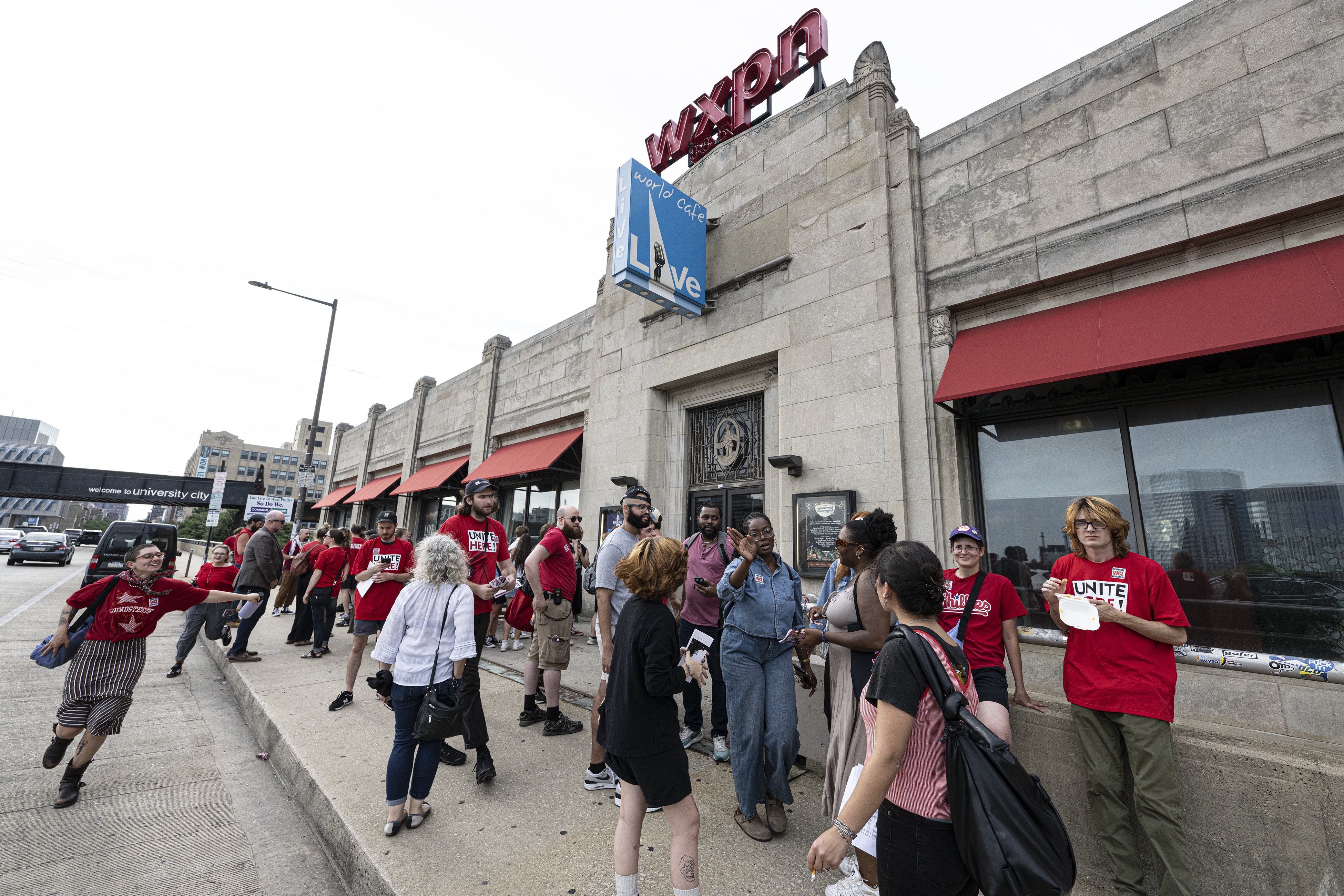
Workers outside before a Town Hall meeting at World Cafe Live on Thursday, July, 2025. The venue, now known as World Stage, will close on Halloween. Jose F. Moreno / Staff Photographer
Diaz cited the struggles of venue across the U.S. that “must be supported and supplemented in new and creative ways; if not, venues will continue to fail, artists will have fewer stages to perform on, and ultimately the community and culture will suffer the loss.”
World Stage has two events scheduled on its last night in business. Sway Philly, billed as “Philly’s biggest queer monthly party, curating spaces for LGBTQ ppl of color,” has a “Nightmare on Sway Street” soiree in the downstairs Music Hall and “I Remember House: A Music Anthology featuring Lady Alma & Sean Jodi Diaz” is in the upstairs Lounge.
After World Stage closes, the facility will remain in use for events presented by Penn radio station WXPN-FM (88.5), including its popular Friday Free at Noon series.
National Democrats are targeting Asian American and Pacific Islander voters as they try to flip a Bucks County congressional seat next month in one of the mostly closely watched contests in the country.
Makhija criticizes five-term incumbent Republican U.S. Rep. Brian Fitzpatrick on affordability issues and for being “not the same guy anymore” before urging voters to cast their ballots for Bucks County Commissioner Bob Harvie, the Democratic nominee.
“In Bucks and Montgomery Counties, we deserve someone in Congress who actually represents us,” Makhija says inthe digital ad, which is backed by a six-figure buy in the 1st Congressional District, which includes all of Bucks County and a sliver of Montgomery County.
The district includes a large population of Asian American and Pacific Islander residents in communities such as Bensalem and Hatfield, who could play a key role in determining the outcome of November’s elections.
“Oftentimes, Asian American voters are invisible to the political parties, but when you start paying attention, you realize that in close races like this, we can decide the margin, and in many cases, do decide the margin,” Makhija said in an interview Tuesday.
Bucks County is home to over 30,000 Asian Americans, including more than 18,000 of whom are U.S. citizens of age to vote, Makhija said in a news release. (Census data show Asian Americans make up nearly 7% of the county’s population and nearly 14% of Bensalem’s).
This past weekend, South Asian leaders such as Makhija and Democratic State Reps. Arvind Venkat and Tarik Khan knocked on doors in Bensalem for Harvie and Democrats Eileen Hartnett Albillar in the 6th state Senate District and Bryan Allen in the 18th state House district.
He said that Harvie has “been doing a great job showing up and listening,” but it’s also up to officials within these communities to be reliable messengers.
For his part, in his close to 10 years in Congress, Fitzpatrick has built relationships with Asian American and Pacific Islander voters by regularly celebrating Diwali in the community and cosponsoring legislation, including a bipartisan bill to increase language access in clinical settings.
AAPI voters favored Democrats over Republicans on the economy 41% to 21% as of September, while they were nearly evenly split between the two parties on the issue in March of 2025.
A similar shift took on place on immigration, which AAPI voter favor Democrats on 43% to 24%.
Shane Seiber came home from two tours in Iraq wanting one thing: to be a Philadelphia police officer.
Then a letter from the police academy arrived, turning him down.
He crumpled it up and threw it in the trash. But his wife, Lisa, fished it out. She submitted a new application on his behalf. This time, he was accepted.
Seiber was soon working his dream job.
Philadelphia Police Commissioner Kevin Bethel told that story Tuesday at funeral services for Seiber, 40, who joined the force in 2016 and served until Oct. 10, when he was killed in the line of duty.
Hundreds of uniformed officers, including scores from agencies across the state, filled the Cathedral Basilica of SS. Peter and Paul in Center City to mourn Seiber, whom Bethel described as “a man who loved his family, who served this country and this city, who walked into a room and made it better simply by being there.”
Seiber was shot three times on a front porch in West Philadelphia during what police have described as an attack that also left his partner, Officer Hector Rodriguez III, seriously wounded. Seiber “fought for his life for hours,” Bethel said, before succumbing to his injuries at Penn Presbyterian Medical Center.
Rodriguez, who was shot 12 times, was among the officers who gathered inside the cathedral to honor his partner, mourning alongside Seiber’s family, his friends, and officials from all levels of government.
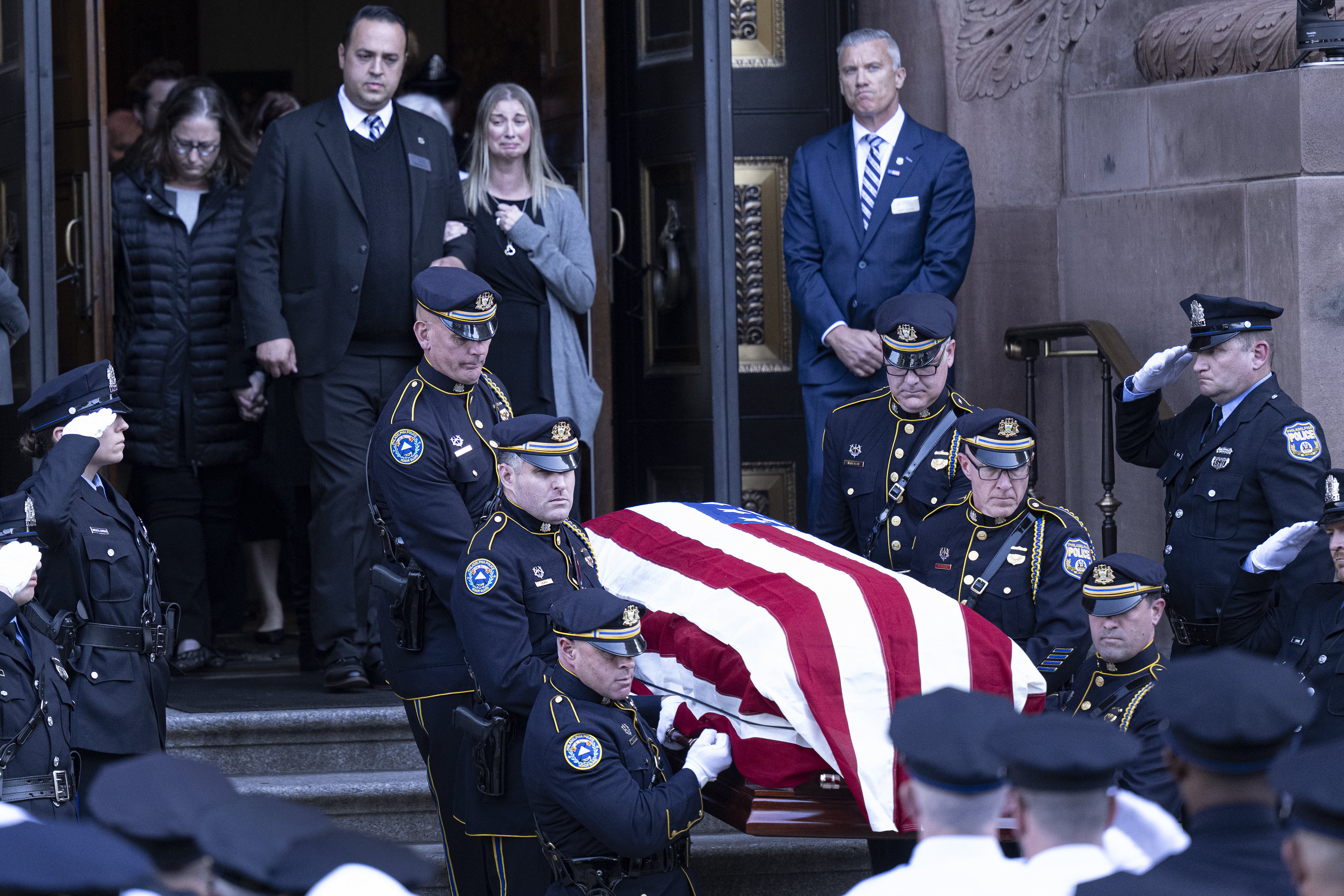
Philadelphia police officers embrace at the funeral services for fallen Officer Shane Seiber at the Cathedral Basilica of SS. Peter and Paul in Philadelphia on Tuesday, Oct. 20, 2026.Jose F. Moreno / Staff Photographer
Speaking during a remembrance service that preceded a funeral liturgy, Gov. Josh Shapiro praised Seiber as a selfless team player with an unforgettable, omnipresent smile.
“His life left a real impact, and his spirit will be felt long after this ceremony ends,” Shapiro said.
Born in Trenton, Seiber grew up in Levittown and Langhorne and later moved to Northeast Philadelphia, according to his obituary.
He enlisted in the U.S. Air Force in 2006 and served with the 436th Security Forces at Dover Air Force Base in Delaware, completing two tours in Iraq. Then, in 2016, Seiber joined the Philadelphia Police Department. He graduated from its police academy the next year with a promise to “do my best to make y’all proud” — a vow he posted publicly on his Facebook page.
Seiber worked in the 22nd and 19th Police Districts. And though he died an officer, Bethel announced on Tuesday that Seiber had been posthumously promoted to sergeant. His family would receive the department’s Medal of Honor and a Purple Heart, Bethel said.
Away from the job, Seiber was a beloved husband and father known affectionately as “Colgate” for his near-constant grin, speakers recalled.
Seiber was married to his wife, Lisa, for 11 years. The couple lived in Bensalem with their 7-year-old son and 3-year-old daughter.
“I know that they’re going to survive,” said Seiber’s uncle, Dan Farris. “I know they’re going to do well. Their father’s going to be looking over them from above.”
Mayor Cherelle L. Parker described Seiber as a father who “melted like marshmallows” any time his children wanted anything. She also announced a new annual city internship that will be created in Seiber’s name and will be shaped by his family.
Bethel also addressed Seiber’s two children. “I want [them] to grow up knowing their father was a hero,” he said, “not simply because of how he died, but because of how he chose to live.”
New Jersey state troopers salute during the funeral procession for fallen Officer Shane Seiber outside the Cathedral Basilica of SS. Peter and Paul in Philadelphia on Tuesday, Oct. 20, 2026.Jose F. Moreno / Staff Photographer
And he shared a photo of Seiber that, Bethel said, he will never forget: It captured Seiber holding both the crumpled rejection letter and his acceptance into Philadelphia’s police academy. “His arms are stretched wide, and he’s smiling from ear to ear,” Bethel described.
“Think about what that photograph represents,” he continued. “In one hand, disappointment. But in the other hand, a dream fulfilled.
“Standing behind that moment was a wife who refused to let her husband give up,” Bethel said. “Lisa believed Shane had something important to offer this world. And, Lisa, you were right.”
The Rev. Gerald Dennis Gill delivered the eulogy, urging attendees to find solace in Seiber’s death through prayer and Scripture.
Gill said Seiber had died a violent and tragic death — a sobering reality but one that had been countered by the beauty and elegance of the words shared by the officer’s loved ones that afternoon. And at times, Gill’s remarks touched on the strange power of the divine.
The evening before the Oct. 10 shooting, Gill said, he was spending time with a group of police officers when a thought occurred to him: The lives of those men and women were fragile, he remembered thinking, particularly when answering the call of duty.
The next day, he said, a police captain called to inform him of Seiber’s death.
Police began exiting the cathedral at 1:30 p.m. as choir singers continued their song. They gathered on South 18th Street, where hundreds of law enforcement officers had waited patiently throughout the service. They stood shoulder to shoulder, some carrying the flag of the nation or the state, others with rifles at their hip. Under a golden October sun, they gazed solemnly at the long, gray hearse that would carry Seiber’s body to its final resting place.
Seiber’s casket was carried out as a band played, bagpipes blaring and snare drums rattling in unison.
The officers stood at attention, their hands raised in salute, while the final police radio call for Seiber played on the loudspeakers: “No response from 1925, Officer Shane Seiber, badge number 7258.”
Seiber’s burial will be private.
Seiber was the fourth Philadelphia police officer to die in the line of duty in the last three years. He was shot shortly before 1 a.m. on the front porch of a home on the 100 block of North 52nd Street, where he and his partner, Rodriguez, had responded to a report of a person with a gun.
Philadelphia Police Officer Ponucey stands in formation with hundreds of other officers for the funeral service of fallen Officer Shane Seiber, 40, at the Cathedral Basilica of SS. Peter and Paul in Philadelphia on Tuesday, Oct. 20, 2026.Jose F. Moreno / Staff Photographer
Suddenly Last Summer — the Tennessee Williams play lauded for its dark poetic writing but marginalized by grisly subject matter — is reentering the mainstream as an opera, but one that could never be typical.
Composed by Courtney Bryan and adapted by director Daniel Fish, the Opera Philadelphia production arrives Oct. 22, 23, and 25 at the Forrest Theatre with a tale of entitled predatory sex that’s hushed-up in ways both retrogressive and prescient.
It comes from a time when abuse wasn’t discussed under any circumstances but peers into an era that refuses to ignore it.
“Who would believe her, Doctor?” exclaims the rich, dignified, aging Violet Venable, disputing an eyewitness account of her socialite son Sebastian being killed by a mob of boys he had abused while on vacation in Spain.
It’s 1958, and Mrs. Venable dismisses such talk as “babble.”
Not a plot spoiler but a fasten-your-seat-belts advisory: Suddenly Last Summer is about silencing the truth through a proposed lobotomy — plus furthering gay stereotypes as abusers — all amid the veneer of New Orleans gentility. Characters are dressed for 5 p.m. cocktails, masking power dynamics to come.
Playwright Williams (1911-1983) had a taste for the gothic, but was deeply troubled by his own sister’s lobotomy and faced all the trauma that came with living as a homosexual celebrity in the 1950s.
But, how to frame this in 2026?
“In the time Tennessee Williams was writing this, you were not allowed to show anything remotely positive about being gay onstage. You could get arrested. They would padlock the theater,” said Anthony Roth Costanzo, president and general director of Opera Philadelphia. “I think he was trying to write a piece about being silenced.”
Very tough stuff — though successfully premiered at Bard (College) Summerscape 2026.
Is the Philadelphia crew troubled by living with a scenario that, by the way, also includes cannibalism?
“Not yet,” reports conductor Nathan Koci. “It’s a different flavor of shock … definitely an opera and a play simultaneously. The music doesn’t start with a grand overture.”
And, musically, the characters emerge gradually.
Composer Courtney BryanTaylor Hunter
As adapted by Fish and Gideon Lester, the piece is a hybrid. The instrumental score is nearly pervasive and has an insinuating presence with underscoring that tells much about characters, whether or not they’re singing. The orderly, intractable Mrs. Venable is surrounded by a tone row that hails from a strict compositional system, fashioned to her controlling temperament, according to composer Bryan.
Catherine — Sebastian’s cousin, who witnesses his death — has vocal lines not without high notes, but the music doesn’t aim for operatic hysteria or the kind of high-pitch Oscar-baiting portrayals by Katharine Hepburn and Elizabeth Taylor in the 1959 Suddenly Last Summer film.
Catherine (played by Mikaela Bennett) is given a truth serum — likely to be sodium Pentothal — with a tranquilizing, trancelike effect on her already fragile psyche; she has already survived a a date rape.
“While some characters talk themselves in circles, only one character [Catherine] is able to sing her truth,” explained Costanzo in his program note. Musically, the drug renders her words less-than-intelligible at first. Later they become elongated, but eventually have a laserlike focus.
“I didn’t have a template for this. And that’s why it opened up things creatively,” said the New Orleans-born Bryan, now in her mid-40s, having received a MacArthur Fellowship and been the resident composer at Opera Philadelphia 2022-2024.
“Each character has so many complexities … I could almost hear the music right away,” she said.
Bryan came to Suddenly Last Summer with a backlog of improvised vocal line to draw on, but for greater authenticity, retreated to familiar ground that, in her case, was Gulfport, Miss. She needed to be near water. Having grown up with the expressivity of gospel music, she took to improvising more vocal lines, choosing what suited the dramatic temperature of any given scene.
She also re-experienced her native New Orleans through the lens of Williams, who wrote poetically about the climate’s languid rainy afternoons in houses built for the heat.
Over multiple workshops, Bryan collaborated directly with soprano Bennett (no stranger to complex roles in musical theater and modern opera) by creating chord progressions over which Bennett spoke and sang the Williams text, drawing on that to write the finished version. Bennett was well-primed by director Fish to keep her acting style authentic, cautioning her not to frame or even portray the character in any traditional ways, but to exist in it, moment by moment.
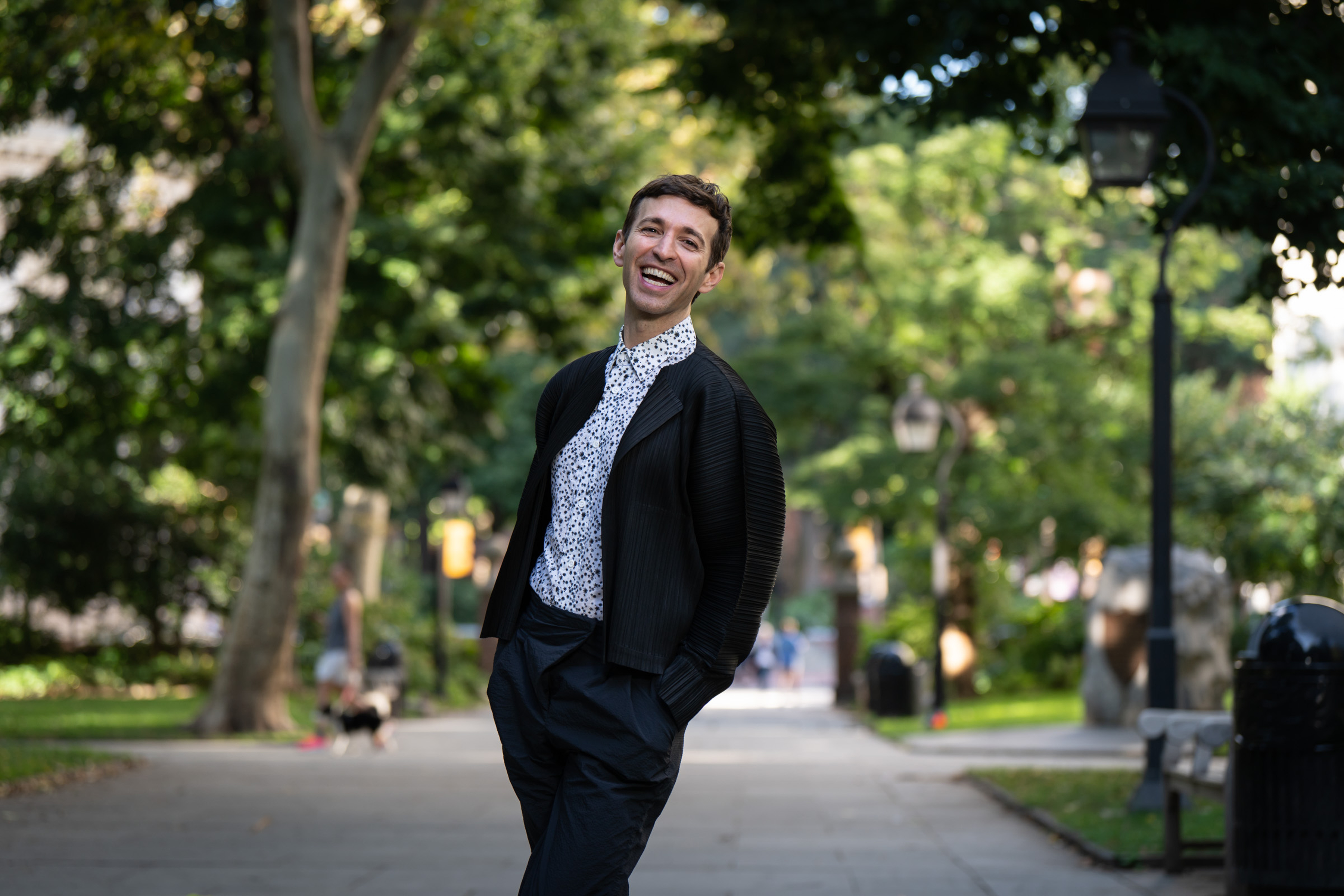
Anthony Roth Costanzo, Opera Philadelphia’s general director and president, at Washington Square Park, in Philadelphia, August 20, 2024Jessica Griffin / Staff Photographer
“Give them permission to take away what they want,” said Bennett. “My job as Catherine is to relay the information … I’m just a messenger, singing the text in a way that’s honest and truthful and not biased. Never tell the audience what to think or feel.”
At one point in the play, Catherine recalls, “Cousin Sebastian said he was famished for blonds, he was fed up with the dark ones and was famished for blonds … that’s how he talked about people, as if they were — items on a menu.”
The idea is to let the words speak for themselves. And they do.
Two phantoms haunt the play and this operatic production. One is another actress named Taylor — Laurette Taylor — who starred in Williams’ first hit play The Glass Menagerie, and brought a more low-key, naturalistic kind of acting to the character of Amanda, in what became one of Broadway’s legendary performances.
The other is “Black Jack” Bouvier, the well-known Wall Street socialite, dapper-on-the-outside, troubled by numerous vices on the inside — not necessarily a model for Williams’ Sebastian, but what some commentators have recognized as a possible point of reference.
Near the end, he was too drunk to participate in the 1953 wedding of his daughter Jacqueline to John F. Kennedy. In the spirit of Mrs. Veneble, he was hauled off in an ambulance to save face and died the year Williams wrote Suddenly Last Summer.
Williams eventually created a piece that seems to gain its power from unanswered questions. Did Catherine’s truth serum reveal the truth? (Some of the Opera Philadelphia crew members wonder about that). How could Mrs. Venable and Catherine have such radically different views of Sebastian? Is it denial? Delusion?
Might these questions be a Rorschach test for our times?
“Suddenly Last Summer” plays 7 p.m. Oct. 22, 8 p.m. Oct. 23, and 2 p.m. Oct. 25 at the Forrest Theater. Tickets: $11-$250. Information: 215-732-8400 or www.operaphila.org.
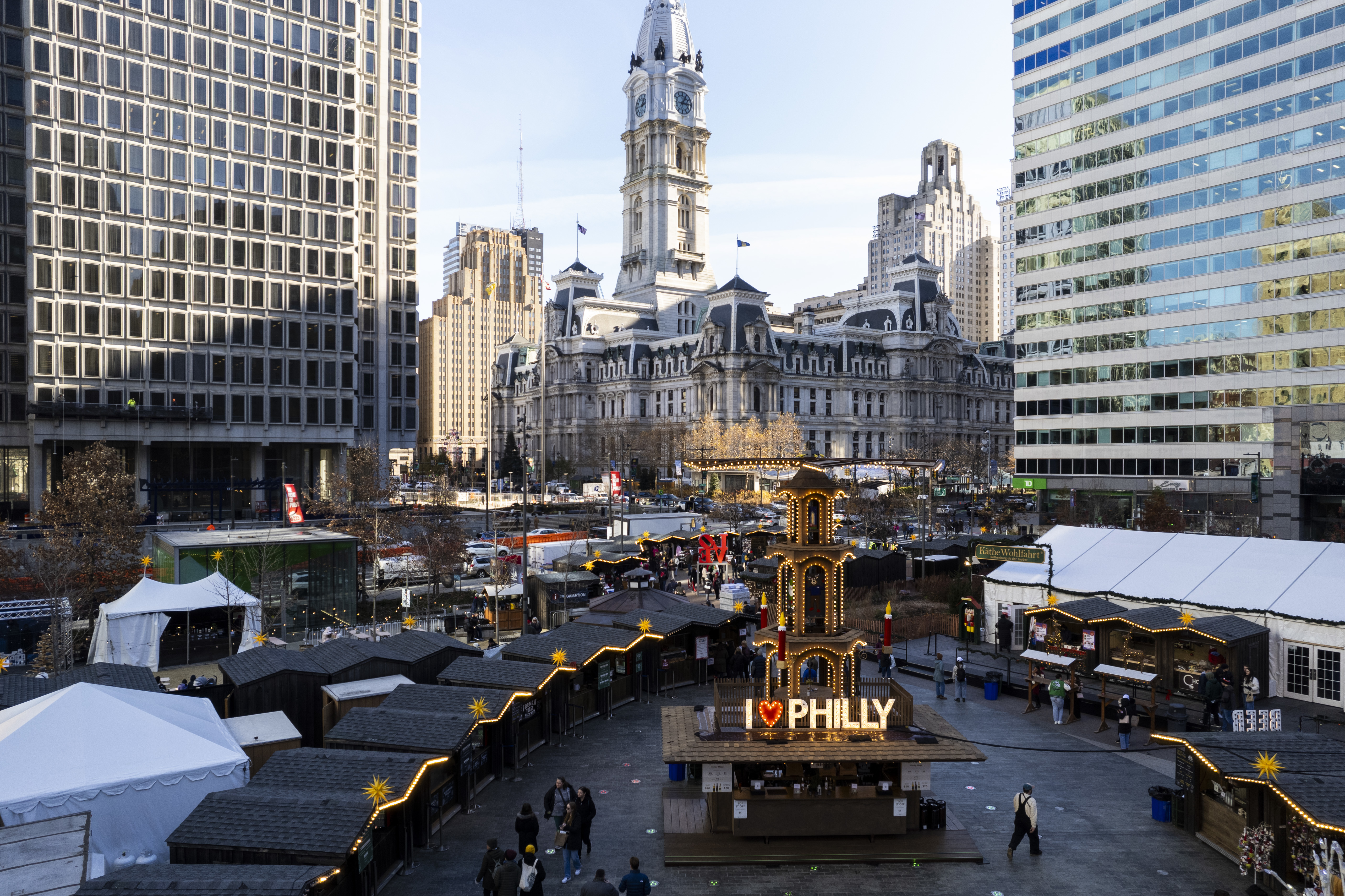
Christmas Village, the authentic German-style holiday market with more than 120 vendors spanning across LOVE Park, City Hall, and Dilworth Plaza, runs from Nov. 26 to Dec. 27 this year, providing two additional shopping days after Christmas Day.
German American Marketing, the market’s organizer, announced Tuesday that Center City’s holiday market will bring back the 30-foot German Christmas pyramid, illuminated by 3,000 sparkling lights, the 65-foot Ferris wheel, and the historic double-tier carousel.
Christmas Village has grown into one of the region’s largest holiday attractions, drawing in nearly a million visitors to peruse the wares of artisans, makers, and chefs.
But this year, shoppers won’t be able to walk into the majority of vendor booths as German American Marketing is converting them into “countertop configurations” in an attempt to comply with the Americans with Disabilities Act. Previously, the market’s solution of movable ramps at booths was not adequate, according to German American Marketing CEO Thomas Bauer.
Christmas Village features a 30-foot “Christmas Pyramid” at LOVE Park on Dec. 3, 2025. Monica Herndon / Staff Photographer
Instead, only a select few vendors will have enterable booths with a permanent ramp, but most will be walk-up kiosks — a move criticized by some vendors and local disability advocates.
“Christmas Village has always been about bringing people together to experience the magic and traditions of the holiday season,” Bauer said. “Every year, we look forward to welcoming back longtime visitors, introducing new guests to the traditions that have made Christmas Village a Philadelphia holiday favorite, and creating new ways to celebrate together.”
Christmas Village features a new 30 foot ‘Christmas Pyramid’ at LOVE Park on Wednesday, Dec. 3, 2025 in Philadelphia. Christmas Village is open until December 24.Monica Herndon / Staff Photographer
When is Christmas Village?
Christmas Village will officially open for daily shopping on Thanksgiving Day, Nov. 26, but the market will briefly open on Nov. 21 and Nov. 22 for a preview.
The market runs Nov. 26 to Dec. 27, from Sunday to Thursday, noon to 8 p.m., and Fridays and Saturdays, from noon to 9 p.m.
On Thanksgiving Day, the market is open 9 a.m. to 5 p.m., on Christmas Eve from noon to 5 p.m., and is closed on Christmas Day.
Where is Christmas Village?
Christmas Village booths are situated across LOVE Park, City Hall, and Dilworth Plaza near JFK Plaza at 1500 Arch St.
The carousel on the North Broad Street side of City Hall, where an illuminated carousel sits during Center City’s annual Christmas Village celebrations.Courtesy of Christina Kalff)
What to know about Christmas Village this year
Besides adding two more shopping days compared to years past to ensure locals and tourists continue the holiday spirit, a new limited-edition heart-shaped mug will be on offer for this year’s market.
New eats at the market include a Chesapeake crab loaded baked potato, a new mac-and-cheese booth, and a soft-serve churro ice cream split. A new “Snowflake Cocktail Bar” will debut next to the LOVE statue.
Important dates
Preview weekend on Nov. 21 and Nov. 22 for early shopping.
Christkind Arrival and pyramid lighting on Sunday, Nov. 29.
German American Weekend on Dec. 5 and Dec. 6 with German dancers and the Beerstein Holding and Bratwurst Eating challenges.
Christmas Village family weekend on Dec. 12 and Dec. 13.
Vendors have not been announced yet, but German American Marketing plans to release a vendor list and more information in mid-November.
When Upper Darby Police received notice that a car thief out of Maryland was making his way through the township in June, they responded immediately. A high-speed chase ensued, but the department quickly broke it off, fearful of the risk it presented.
They didn’t want the driver to harm himself or bystanders, Upper Darby Police Superintendent Tim Bernhardt said.
Minutes later, officers caught up to David Graham, with the stolen Nissan Maxima, on a side street where he had attempted to blend in as the car’s owner, doing repairs on the vehicle.
Graham’s arrest on receiving stolen property, fleeing police, and related charges was calm and straightforward, and the case is pending trial, Bernhardt said. That resolution came because his officers were able to keep an eye on Graham, tracking his movements from 400 feet above.
Upper Darby is the latest police department in the Philadelphia region to adopt drone technology, using it to supplement their patrol and surveillance capabilities. Bernhardt and other local officials tout the new technology as a way of de-escalating arrests.
Video: Upper Darby police use drone to apprehend an alleged car thief
“That police officer in a marked car with lights and sirens going, the adrenaline is going, we no longer need that,” Bernhardt said. “And on the opposite end of that, the suspect, they don’t hear or see the police coming, and we take them into custody without that fight, without that resistance, without that fleeing.”
But experts say the adoption of drones by police, often done with little community input, has raised concerns about the potential for departments to overstep privacy boundaries in the name of civil service.
Bernhardt is adamant that his officers have no interest in spying on people.
“We’re not surveilling people that shouldn’t be surveilled,” he said. “We’re using this as a another tool in our tool belt, and it’s allowing us to apply our resources better.”
Upper Darby Police Lt. Kristine McAleer demonstrates how the department’s drones operate.Aidan T. Gallo / Staff Photographer
On the other side of Philadelphia, Bensalem Township police have applied drones in a novel way: using them as virtual first responders to certain crimes, including reports of retail theft from big-box stores that are easy targets for thieves.
Director of Public Safety William McVey said since the department started using drones in 2024 to track alleged thieves, following them as they attempt to escape, retail theft has decreased by 29%.
And the closure rate of retail cases has jumped to 75% in that same period — three out of every four reported thefts end in an arrest, he said.
McVey cited one recent case, when a thief who stole from a Target in the township fled on foot, was tracked via drone and was arrested nearby, even after changing his clothes in an attempt to hide from police.
McVey said the drones are part of the department’s Bensalem Secure Theft Reduction Taskforce, which also includes an information-sharing system that connects retailers commonly hit by thieves directly with his officers, allowing them to respond faster when the thefts occur.
“If it was your store, if it was your business, you would want us doing it,” McVey said, responding to criticism he sometimes hears about focusing on something as seemingly minor as retail theft.
Bensalem Director of Public Safety William McVey (left) and Lt. Keith Christie (right) observe as drone operator police Sgt. Matt Malcolm (seated) flys a drone over the township. McVey said drones have helped his department respond faster to 911 calls, with a particular impact on reports of retail theft.Tom Gralish / Staff Photographer
“And what most people don’t realize is the people on this list are committing other crimes as well,” he said. “They’re not just going and stealing one time and done, usually they escalate as they go along their criminal ways.“
Other municipalities in the region are taking notice. In September, Lower Merion Police Department leaders asked the township for $375,000 to fund a “first responder” drone program that would automatically dispatch a drone to the scene of certain 911 calls, including burglaries and missing-persons reports. Council members were split in their reactions, with some voicing concern over increasing surveillance. No decision has been made.
Andrew Guthrie Ferguson, a scholar of police tactics and author of Your Data Will Be Used Against You: Policing in the Age of Self-Surveillance, said the debate about drones is happening throughout the country as the technology becomes cheaper and easier to use.
“I think it feels both practical and dystopian at the same time,” he said. “On one hand you can understand why chiefs want this, but on the other hand, the idea that someone steals some toothpaste and is followed by a drone just feels like a different police world than we’re used to living in.”
Ferguson said too often departments implement new technology policies without input from community leaders, and only begin putting limits on the technology when residents, or officials, learn about them after the fact.
“We sort of defer either to a company selling it or a chief adopting it and not having kind of the democratic back and forth about ‘OK, we’re trading up some privacy and autonomy and security for police’s ability to find a person in the stolen car,’” he said. “Are we OK with that?”
(function() { var l = function() { new pym.Parent( ‘drone-explainer__graphic’, ‘https://media.inquirer.com/storage/inquirer/ai2html/drone-explainer/index.html’); }; if(typeof(pym) === ‘undefined’) { var h = document.getElementsByTagName(‘head’)[0], s = document.createElement(‘script’); s.type = ‘text/javascript’; s.src = ‘https://pym.nprapps.org/pym.v1.min.js’; s.onload = l; h.appendChild(s); } else { l(); } })();
In Philadelphia, those concerns have only recently been addressed by City Council, two years after the city’s police department began using drones to respond to emergency calls in a handful of districts.
Philadelphia Police have a fleet of 21 drones that have been deployed more than 8,000 times since they were put online in 2024, an Inquirer investigation found earlier this year. Unlike other large cities, like Boston and Los Angeles, there is no independent oversight of police drones in Philadelphia.
The department has said drone footage was the primary source of evidence in at least 15 arrests, but declined to divulge any information about those cases, including even the names of the arrested individuals.
City Councilmember Rue Landau has expressed concerns about the lack of transparency, and has said she wants Council and independent experts to have more input in how the devices are used.
In response to The Inquirer’s reporting, and pressure from Landau and other council members, the police department agreed in April to compile an annual report on its drone usage.
Across the city line, in Bensalem, McVey welcomes that level of scrutiny for his drone operators.
“It’s about getting eyes to an area where a cop can’t get immediately. We’re not using it to go fly over people’s houses,” he said. “And if anyone ever suspected that, they should reach out to the police department, because everything we do is categorized and documented.”
Staff writer David Gambacorta contributed to this article.
We popped in ‘NBA 2K27’ and simulated the Sixers season 76 times. The results probably aren’t what Philly fans want to see, so we asked some experts for clarity.
Chris Rukan / Staff Illustration / Images by NBA 2K27
More than a decade after the Sixers first embarked on a quixotic, often-disappointing rebuilding process, the franchise is set to begin tonight one of the most anticipated seasons in modern Philadelphia sports history.
A roster that habitually failed to advance beyond the second round of the NBA playoffs has been remade to include LeBron James — whose dizzying resume features four NBA titles and more points scored than any player in league history — and 2024 NBA Finals MVP Jaylen Brown. Those additions to a homegrown core of center and former MVP Joel Embiid, and guards Tyrese Maxey and VJ Edgecombe catapulted the Sixers nearly overnight into a potential juggernaut.
Yet Philadelphians know that preseason dreams can sometimes curdle into nightmares. The 2011 Phillies, led by four of baseball’s best starting pitchers, seemed destined for a parade down Broad Street but didn’t even reach the World Series. The Eagles, buoyed that same year by an influx of high-profile free agents, were hailed as a “dream team” and then missed the playoffs entirely.
story continues after advertisement
Such lingering scars compelled The Inquirer to search for some reassurance. Rather than asking so-called basketball experts how the Sixers might fare in the upcoming 2026-27 season, we instead turned to a potentially more authoritative source: NBA 2K27.
A video game, yeah, but one that has entranced a generation of NBA players and executives with realistic graphics and intricate player evaluation metrics. Last fall, Yahoo! Sports used the game to simulate the 2025-26 NBA season, and it correctly predicted that the New York Knicks would win it all over the San Antonio Spurs.
We wanted to know how many simulations it would take before the Sixers won a championship. Probably not too many, we assumed. After all, the Sixers are the only franchise in 2K to feature four players — James, Brown, Embiid, and Maxey — whose overall rating in the video game is 90 or higher. No other team has more than two such players.
The first simulation showed that the team would win … 33 of 82 games. They didn’t even make the playoffs.
A second simulation yielded another 33-win season. A third attempt resulted in a 31-51 record.
The Sixers finally made the playoffs after they went 40-42 in a sixth simulation, which was good enough for seventh place in the Eastern Conference and a first-round playoff matchup against the Orlando Magic.
The Magic promptly swept the series.
story continues after advertisement
Last month, on Sixers media day, James noted that he "didn't leave my family to lose in the second round." In the simulated NBA universe, even reaching the second round was, so far, a challenge.
The simulations would continue until morale improved, or until James toted a championship trophy over the city from the comfort of a Fanatics private helicopter. But we turned to some experts to get insight into whether these poor results were a harbinger for a disappointing season in the real world.
An elegant solution
Kirk Goldsberry knows better than most how NBA executives perceive the NBA 2K franchise, which was first released on the Sega Dreamcast in 1999. Sixers star Allen Iverson was on the game’s cover that year and would grace four additional covers of the game.
Beginning in 2016, Goldsberry spent three years as the Spurs’ vice president of strategic research, and he was a longtime head analyst for Team USA. He also wrote the 2019 New York Times bestseller, Sprawlball: A Visual Tour of the New Era of the NBA and is an NBA analyst with The Ringer.
More on the Sixers
Meet the Sixers: Season outlook and key questions for each player
Let’s learn more about the new-look Sixers, including a question that will face each player in 2026.
He said he doubts that front office executives would lose any sleep over a third party simulation of their team’s season. But Goldsberry acknowledged that games like NBA 2K and EA Sports’ Madden NFL have influenced how he and other current and former league officials conceptualize player evaluations.
“How [2K] is able to present and summarize player scores and team scores is really elegant,” Goldsberry said. “Models can get really complicated on the team side. But reducing model output to zero to 100 scores is something that players and coaches can digest, and video games were ahead of the curve in communicating these all-in-one metrics to a diverse audience.”
NBA 2K’s use of motion capture technology, too, has ensured that its depictions of athletes’ movements and physical abilities are astoundingly lifelike.
story continues after advertisement
Goldsberry, now the executive director of the Business of Sports Institute at the University of Texas, noted that even star players care about how the video game rates their skills. Former Sixer Ben Simmons is among longtime NBA players who have played the game extensively, while rookie Labaron Philon Jr. spent four hours in September battling fans as part of an NBA 2K27 promotion outside Geno’s Steaks.
Philon has a 71 overall rating, with his highest skill score an 82 for playmaking.
“Most people don’t feel like it’s fair, but I feel like it’s fair,” he has told The Inquirer of his rating. “Just because you’re a rookie. You’ve got to climb your way up. I think it should be like that.”
The 2K developers adjust ratings throughout the season, depending on how well or how poorly somebody is playing, and perhaps Philon will earn the kind of 2K respect that made Edgecombe’s overall rating jump from 76 at the start of last season to 83 this year.
But future projections couldn’t help our simulation exercise.
On the ninth iteration, the Sixers again won only 40 games and were swept in the first round, this time against the New York Knicks.
On and on, the simulations kept producing awful results with shockingly few playoff appearances.
It wasn’t until the 47th season that the Sixers’ even finished above .500, and not by much: a 43-39 record that was good enough for sixth place in the Eastern Conference and a playoff date with the Magic. The Magic won in six games.
story continues after advertisement
Maybe it’s a glitch
Although looking for clues to a season in a video game seems ridiculous, it’s possible that The Inquirer’s simulation results reflect some uncertainty over whether the new and old roster pieces can blend together harmoniously into a championship contender.
Neil Paine, who worked as an analytics consultant for the Atlanta Hawks from 2013 to 2015, said that it wouldn’t be surprising to see a team of superstars underperform during the regular season, then find their collective footing in the playoffs.
During the 2010-11 NBA season, James’ first in Miami, the Heat got off to a middling 9-8 start, leading to speculation that the team might fire its head coach. But the Heat advanced to the Finals at the end of that season, then won championships in the following two years.
More on the Sixers
Looking for Sixers tickets and get value for money? These are the games to target.
If you’re new to the bandwagon or a veteran of the Process era who hasn’t secured seats, we’re here to help.
“Sometimes there’s diminishing returns when it first gets put together,” Paine said. “There’s only one ball. It’s a cliche, but it’s true.”
Paine said he has been playing NBA 2K since it was first made available on Dreamcast. Though he praises the evolution of its graphics, he said 2K’s assessment tools don’t quite mirror how NBA teams discuss and evaluate players.
“We had projections about what roles a player might be able to grow into, but we’d never say, ‘He’s a 90 overall, we should trade for him,’” he said. “A lot of what we did as an analytics team was looking at the most effective combinations for the team. We’d notice patterns — the team is better when we play these three guys — and filter that to the coaching staff in terms they’d find natural.”
Subscribe to The Philadelphia Inquirer
Our reporting is directly supported by reader subscriptions. If you want more stories like this, please subscribe today.
Video game metrics might have figured into at least one professional sports transaction, though. In 2024, The Athletic reported that New York Jets owner Woody Johnson declined to trade for Denver Broncos wide receiver Jerry Jeudy because he felt that Jeudy’s rating in Madden was too low, a reflection, perhaps, of how far sports video games had come from the early days of Madden — when the game included a 16-bit ambulance that drove over players on the field — and arcade games like NBA Jam, which included coding that ensured the Chicago Bulls would miss last-minute shots in close games against the Detroit Pistons.
And other news outlets have also turned to 2K27 to gauge how the NBA season might unfold. Sports Illustrated and Yahoo! Sports also simulated the 2026-27 season, and while the focus of their stories was on the entire league, each noted that the Sixers surprisingly underperformed expectations.
By the numbers
Over the course of our 76 simulations, Joel Embiid and LeBron James each averaged around 68 games played per season, and played in all 82 games 11 times and 13 times, respectively. That included 31 simulations in which both players appeared in more than 65 games together.
Still, the Sixers …
only made the playoffs 11 times.
finished last (15th) in the East 12 times.
finished in 14th most often (13 times).
had an average record of 32-50. Their most common record was 34-48 (nine times).
posted a top record of 43-39.
posted a low record of 19-63.
But the game’s cultural cachet and attention to detail don’t mean that it’s fully clairvoyant.
Injuries can abruptly change the trajectory of a season or a short postseason series. Goldsberry recalled the 2019 NBA Finals, when the Golden State Warriors lost stars Kevin Durant and Klay Thompson to significant injuries — and then lost the series to the Toronto Raptors — and Indiana Pacers star Tyrese Haliburton suffering a torn Achilles tendon during Game 7 of the 2025 NBA Finals, which the Pacers lost to the Oklahoma City Thunder.
“The NBA is a war of attrition, unfortunately, and I don’t know how accurately these games capture that effect,” Goldsberry said. “If you have injuries on, would it take out one of your star players?”
Unfortunately, the Inquirer’s simulations found that even in seasons when the starting five remained healthy, the results were still terrible. For example: in sim 56, all the starters played 67 games or more, including 79 by Embiid. But the team still finished 29-53, last place in the Eastern Conference.
More on the Sixers
LeBron James chose the Sixers in his ‘final decision.’ Now he’s bringing a championship ‘blueprint’ to Philly.
Since James’ official arrival at the Sixers’ facility in late September, coach Nick Nurse has called him an “example-setter” and collaborator with coaches and teammates.
Earlier this year, Paine, who is now an independent sports analyst, published an article on Substack that explored the gradual winnowing of sports video game titles, and included an analysis of full season simulations that EA Sports has conducted with Madden NFL since 2003. The game correctly predicted the eventual Super Bowl champion in 59% of the simulations.
“If every game is a coin flip, you could get to that accuracy in a 25-year span,” he said. “I don’t want to disparage it, but it’s more of an entertainment product.”
He cautioned against taking simulation results too seriously.
“2K is at its best when simulating a 41-41, middle-of-the-road team,” Paine said. “Asking it to step outside that comfort zone might be a struggle, and that might be one of the better explanations for your results. Maybe it’s a glitch.”
The Inquirer continued on anyway. Sixty simulations. Seventy.
Maybe fate would smile on this project, we reasoned, for sim 76.
It was one of 12 times that they finished last in the East, which is one simulation more than they made it to the playoffs. James never had to worry about losing in the second round — the Sixers never won a playoff series.
Meanwhile, their rivals in the East fared much better. The Knicks won 14 championships and the Detroit Pistons 12.
Even the Magic managed to win six titles.
You know what? Forget it. We’ll do it live. Tip off is tonight at 7 at Madison Square Garden.
So who did all the winning?
Here’s a look at what teams were the best throughout our 76 simulations, which resulted in eight different NBA champions — none named the Sixers.