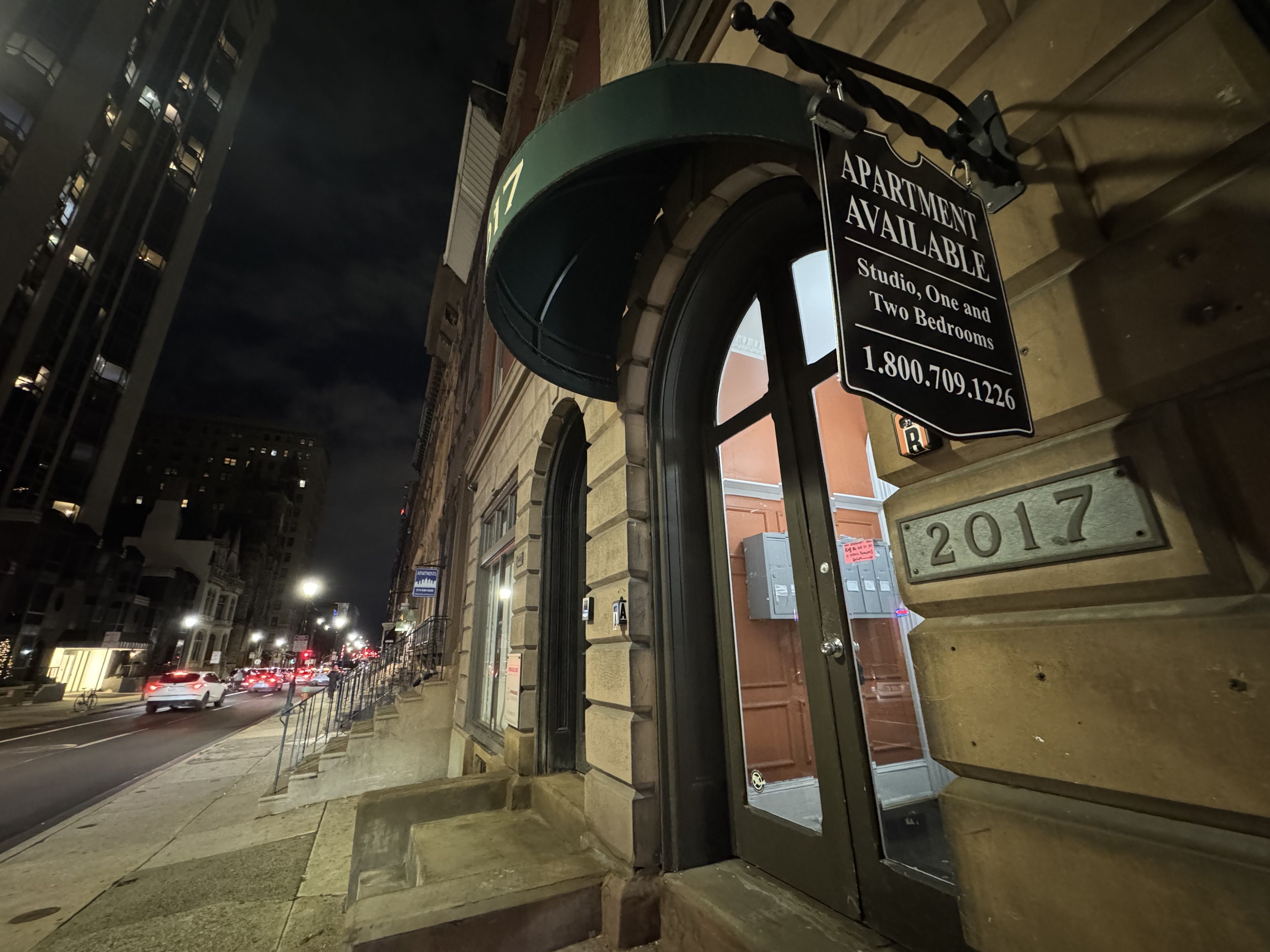
If you’re looking for a place to rent a spacious new apartment, Philly ain’t it.
Apartments across the country got slightly bigger last year, but in Philadelphia, they’reshrinking.
Apartments inPhilly are already relatively small. Of the country’s top 100 cities with the largest apartment supply, Philadelphia ranked 88th in apartment size, according to an analysis by the nationwide apartment search website RentCafe. The report was based on apartments in buildings with 50 or more units.
New Philly apartments, which RentCafedefined as those built between 2016 and 2025, spanan average of 747 square feet — 163 fewer square feet than the national average.
But in Philadelphia, the average new apartmentshrank by 104 square feet compared toapartments built during the previous decade — basicallythe loss of a home office, according to RentCafe.
Philadelphia’s position as a desirable rental market and demographic trends help explain the shrinking, according to Veronica Grecu, research analyst at RentCafe.
“In high-demand markets, developers often prioritize studios and one-bedrooms because they can deliver more apartments per building and meet the needs of a growing number of single-person and smaller households,” Grecu said in a statement. “… the upside is more availability in markets where inventory has historically been tight.”
Apartments currently under construction in Philadelphia average 627 square feet, according to RentCafe.
The platform found that Philadelphia’s new three-bedroom apartments actually grew in size — by 93 square feet — as studios and one- and two-bedroom apartments shrank. But not many developers are building three-bedroom units. They made up 3% of the city’s supply of new apartments, according to RentCafe.
(function(){function e(){window.addEventListener(`message`,function(e){if(e.data[`datawrapper-height`]!==void 0){var t=document.querySelectorAll(`iframe`);for(var n in e.data[`datawrapper-height`])for(var r=0,i;i=t[r];r++)if(i.contentWindow===e.source){var a=e.data[`datawrapper-height`][n]+`px`;i.style.height=a}}})}e()})();
How Philly compares to other cities
Cities in the Northeast and West dominate RentCafe’s list of places with the smallest new apartments.
Pittsburgh was one of the top 10 cities where new apartments shrank the most in the last decade. The average size decreased by 142 square feet. But the average new apartment was 804 square feet, still larger than the average in Philadelphia.
Seattle has the smallest new apartments. Those built in the last decade average 645 square feet, asmore studios and one-bedroom apartments have been built.
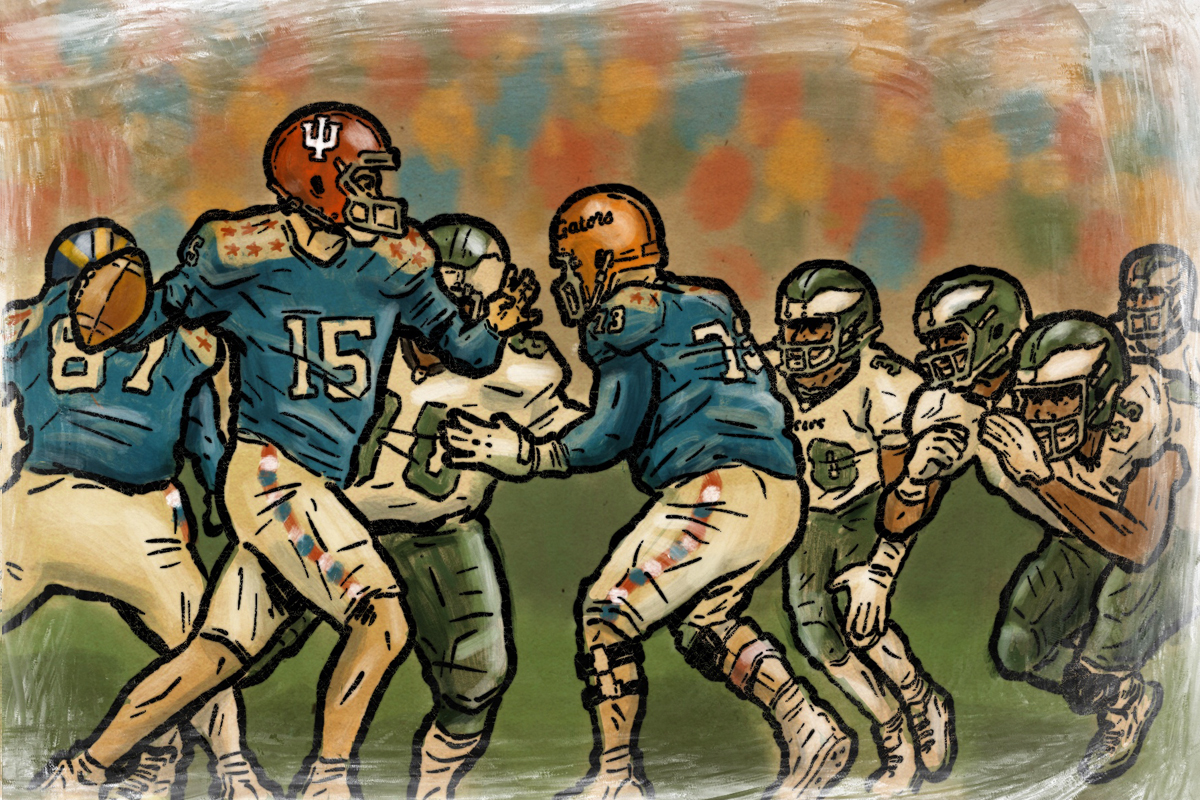
Imagine this: A college football player lauded as one of the best in the country gets roped into a collective of other top college players just as good for an All-Star team.
Except these players won’t prove their mettle against other college athletes; they’ll prepare to face the reigning Super Bowl champions.
The annual All-Star game, also formerly known as the Chicago Tribune All-Star Charity Game, featured not just the full preseason roster of an NFL team that won the league championship but also played many of its starters. The Eagles played in the event in 1949, 1950, and 1961, and actually lost the 1950 game.
It was an event that offered an honest proving ground for college players to see if they could handle the rigors of playing in the NFL against the league’s top team.
Imagine being a college player and trying to stop Hall of Fame receiver Tommy McDonald, who scored three touchdowns for the Eagles in the 1961 game.
What about the Steel Curtain of the Pittsburgh Steelers, against the likes of guys like Ernie Holmes and “Mean” Joe Greene? It happened in 1975 and again in 1976, the last year of the event.
But as NFL players got bigger, faster, and stronger, the annual preseason spectacle lost its allure. Once considered an even playing field with college’s best lining up against the cream of the NFL crop, the game began turning into a contest of men against boys.
Fast-forward to today’s college game and NFL, you’ll see that the parity in size, strength, and speed between top college products and NFL players is debatable.
Thanks to advances in sports science, training methodologies, and more recently, players simply being allowed to play longer college seasons, the idea reviving an annual game between college’s best and Super Bowl champions is at least a conversation starter, right?
One argument for the water cooler talk would be the NCAA’s recent “5 in 5 rule,” which will allow Division I athletes up to five years of eligibility as long as their first academic year begins no later than their 19th birthday.
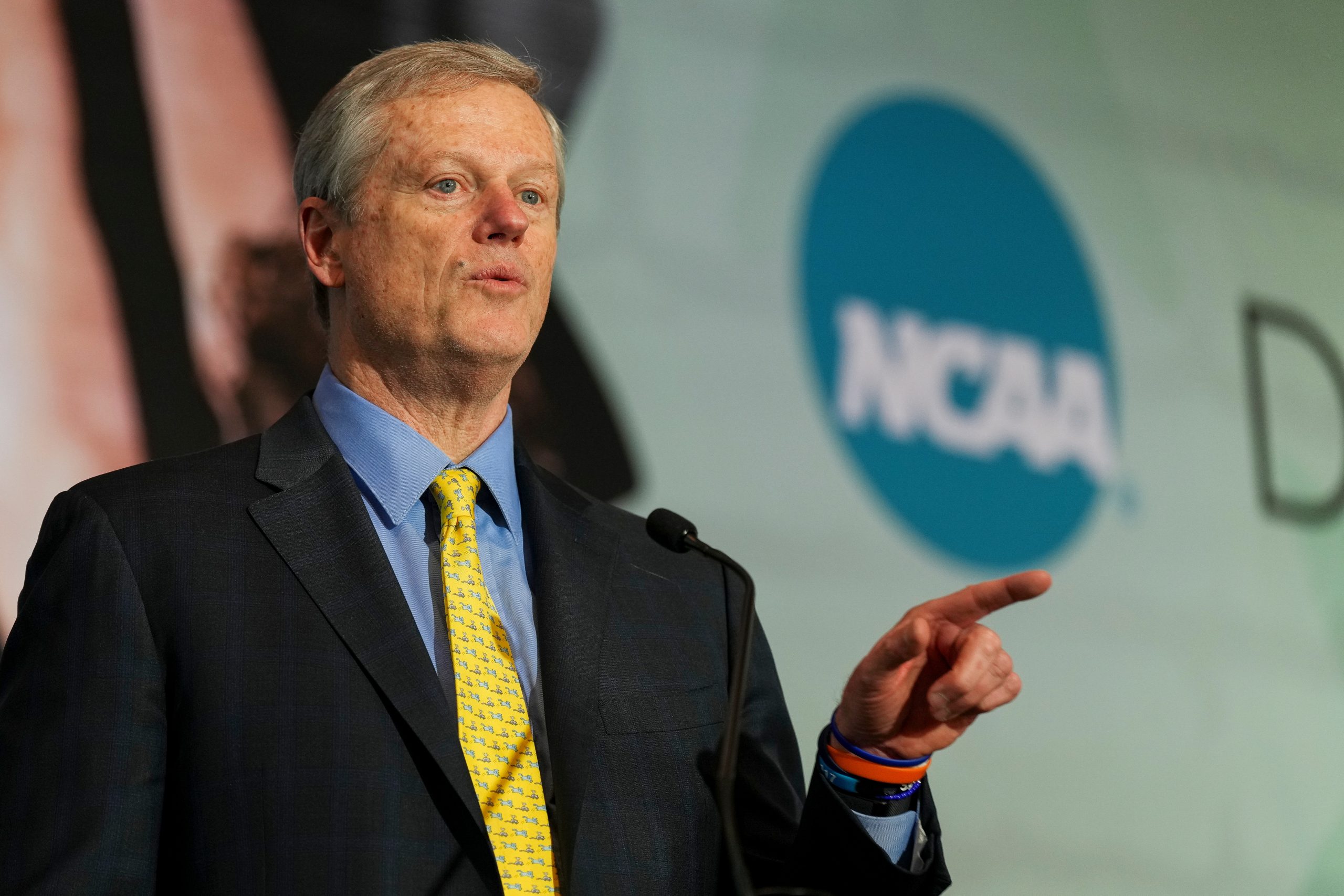
NCAA President Charlie Baker granted athletes five years of eligibility if they enroll in college no later than the academic year after their 19th birthday.George Walker IV
This rule would guarantee that top college athletes could play through their 24th birthday, which already felt like the norm due to the extra COVID-19 year. Earlier this month, a trickle effect began to occur within many college conferences as NFL players who recently signed pro contracts weighed the option to return and play a fifth season of college ball.
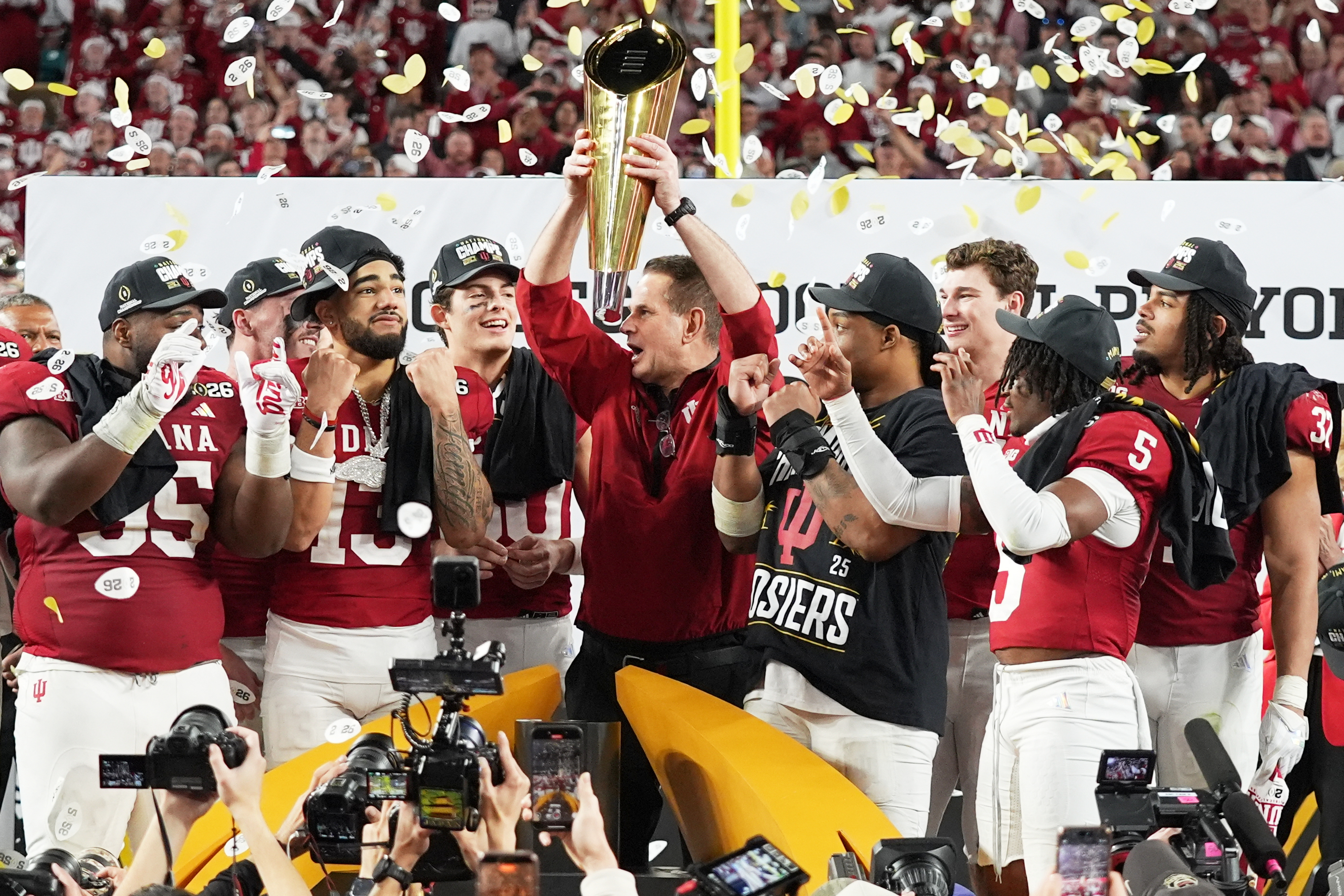
Also, the age gap between a college team and today’s NFL franchise isn’t too wide. Take just last season and look at the Indiana team that ran the table en route to a national championship. Average age? It was 23.1, and 18 of those players cracked the 53-man rosters of NFL teams this season, according to 247 Sports.
The average age of the Seattle Seahawks roster that won Super Bowl LX? Just 26.1.
While there’s precedent for a pro-am like the Chicago Charities College Game to make a return or even have a similar offshoot sprout up, a number of college coaches believe it will never happen — and it has nothing to do with a more level playing field when it comes to athletic abilities.
Indiana won the national championship with a team that had an average age of 23 when it defeated Miami in last season’s game. Lynne Sladky
“I think the college kids would be very enthusiastic. I think the NFL guys would be like, ‘Why are we doing this?’” said Temple coach K.C. Keeler, who remembers the old Chicago Charities College All-Star Game well, but contends it has no place in today’s football. “Nowadays, [NFL teams] aren’t even playing their starters in the first preseason game, right? And now you’re talking about a whole game against a bunch of [college] guys who want to prove themselves.
“But this isn’t about athleticism, it’s about money. One injury can change the trajectory of a player’s career in both pro and college ball. I think just looking at the logistics of pro football, you’d be hard-pressed to find anyone that would be willing to match up these days and risk it all against college kids who have that ‘I’ll show you’ mentality.”
Temple head coach K.C. Keeler says there’s too much at risk for players in college and the NFL to consider reintroducing a spectacle like the old Chicago Charities College All-Star Game. Isaiah Vazquez / For The Inquirer
A similar thought process came from Villanova coach Mark Ferrante, who also took a larger look at the state of both college football and the country during the heyday of the annual exhibition.
“My gut tells me that it would be much harder for a college all-star team to beat an NFL Super Bowl champion,” said Ferrante. “And the reason I say that is, even though the college teams are keeping older guys and all the extra years of eligibility that really came through [because of the pandemic], that’s kind of going to get erased [as those eligibility years phase out].
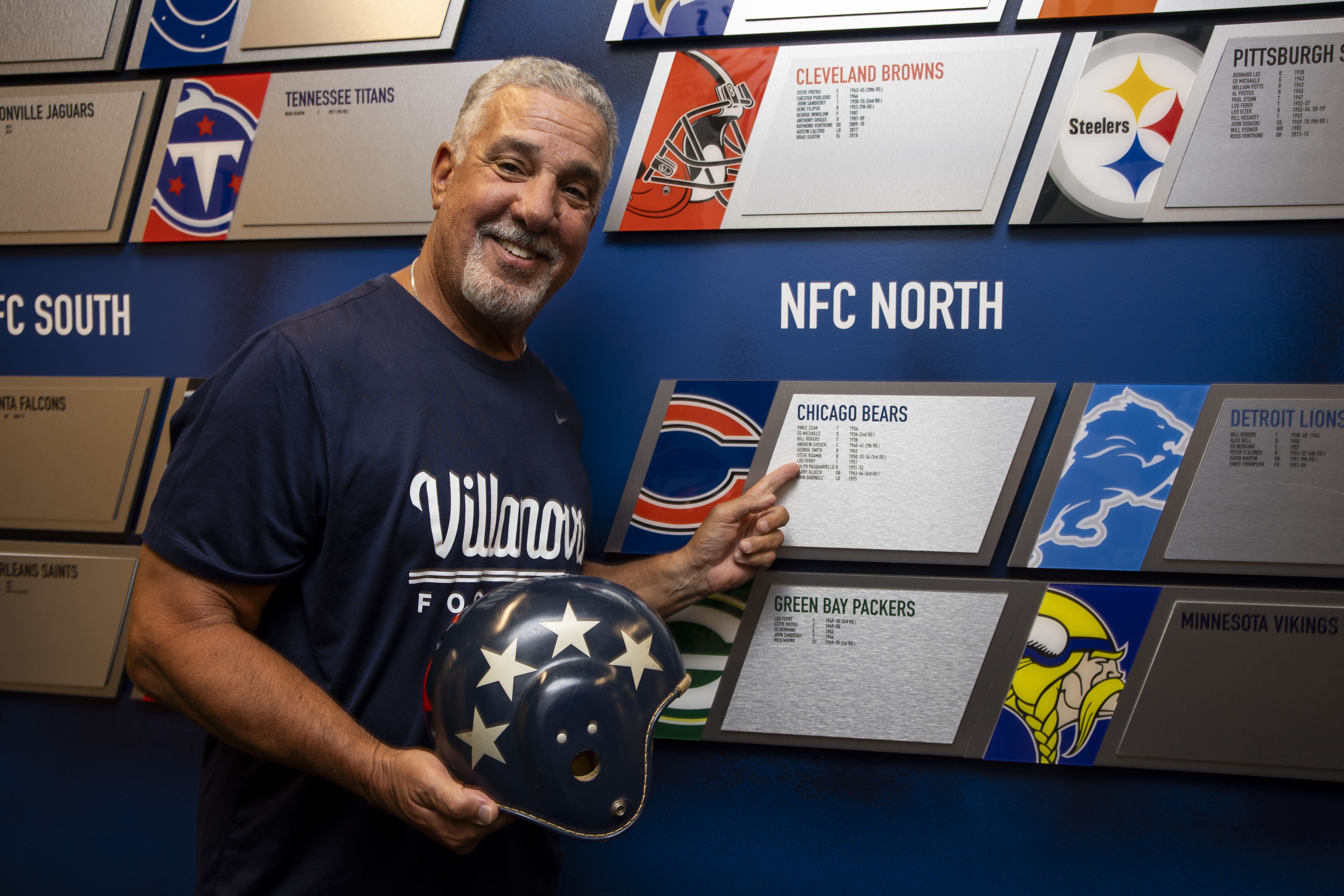
Villanova head football coach Mark Ferrante posed for a portrait with an all-star helmet worn by former fullback Ralph Pasquariello, who played in the 1950 Chicago Charities game, with the team that defeated the Eagles.Monica Herndon / Staff Photographer
“Also, I’d like to see the age rosters of those 1940s and 1950s teams. Because, I bet you a lot of those college guys might’ve actually been the same age or even a bit older than the pro guys they were playing against back then because of [World War II].”
To Ferrante’s point, it’s also harder for a college kid today to crack an NFL roster. There are a little more than 18,500 Division I players competing for 250-plus spots in the NFL draft.
“It’s still under 2% of college guys that make it to that level,” Ferrante said. “And we’re talking about the best of the best, not that it wasn’t the best back then, but it’s just different and dare I say harder to get to the NFL now than it was then.”
But the proving ground for college players in the Chicago Charities All-Star Game was apparent back then, with the Eagles feeling the brunt of it. In 1950, the Eagles lost to a collective of college players, one that featured former Villanova standout Ralph Pasquariello.
A star fullback for the Wildcats, Pasquariello was coming off an MVP performance a year earlier in the 1949 North-South Shrine Game where he scored the game-winning touchdown.
Pasquariello was drafted later that year in the first round (ninth overall) by the Los Angeles Rams. The Eagles’ loss was one of just nine times a college team defeated an NFL champion.
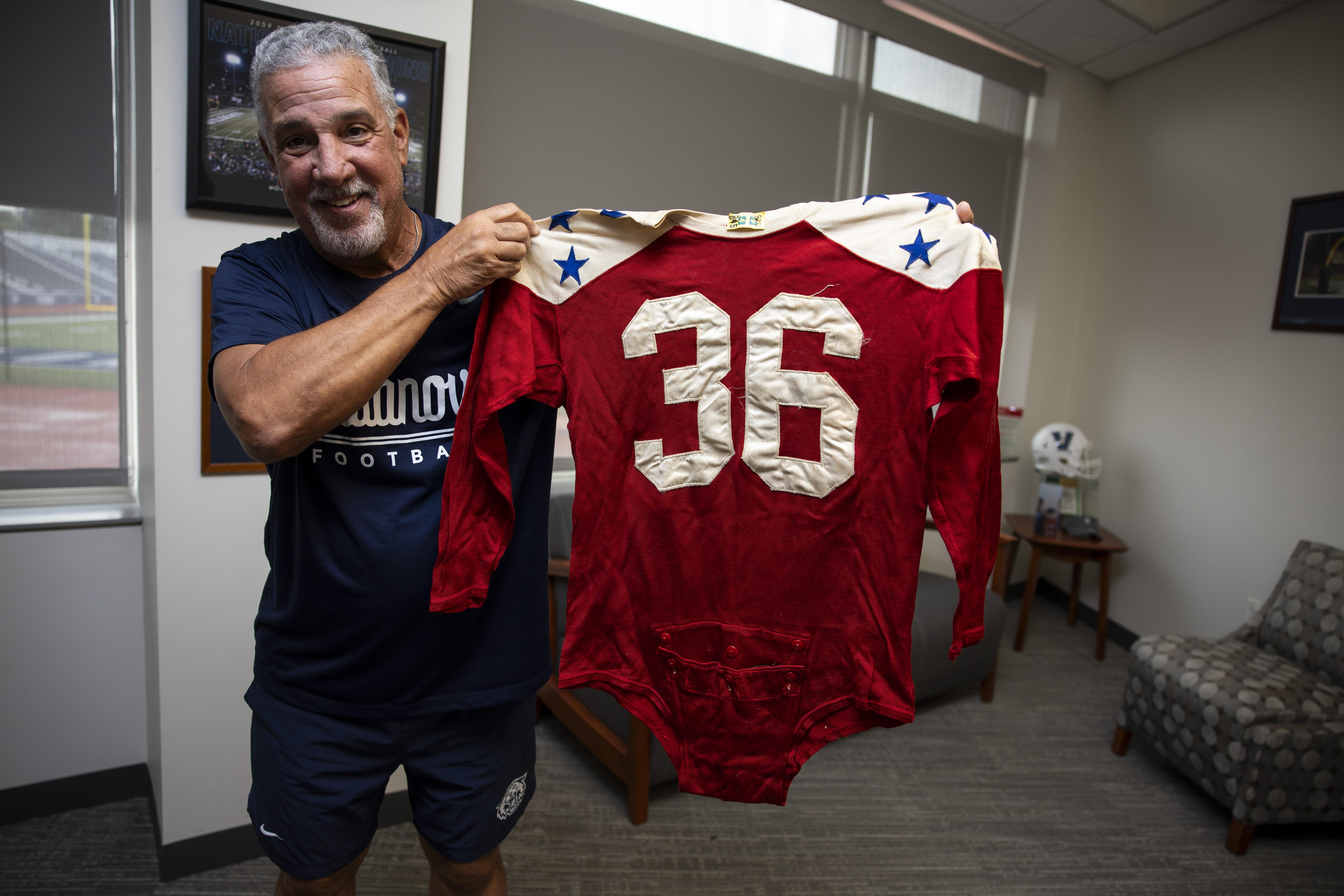
Mark Ferrante holds up an all-star jersey worn by former Villanova fullback Ralph Pasquariello, who played on the 1950 college team that defeated the Eagles in the Chicago Charities College All-Star Game. Monica Herndon / Staff Photographer
But the notion that a college group would beat an NFL champion today — even with a closer-to-equal playing field than we’ve seen between college and professional football in recent years — would be tough to imagine. Between lucrative name, image, and likeness deals in college and blockbuster sponsorship deals in the NFL, both coaches say there’s too much money to be made.
“Listen, it would be something really cool to see all these young players who are going to be 22- or 23-year-old seniors go up against NFL stars, but I just don’t think it’s viable,” Keeler said. “Everyone has a time frame now to make as much money as they can. Also, they’re getting rid of more and more [contests like these].
“I mean, look, they just got rid of the Pro Bowl. Why? The impossibility of suggesting that you can play at three-quarters speed and not get hurt when you’re tackling guys to the ground. That’s just not how this game works anymore.”
Chris Christie has been a two-time Republican presidential candidate, the governor of New Jersey, and a U.S. attorney. But history might show that he generated the most enduring national impact in a different role, as the godfather of legalized sports betting.
In 2012, when he was still New Jersey’s governor, Christie signed a bill that would allow customers to wager on professional and collegiate sports at 12 casinos and four racetracks.
He correctly predicted that the bill — which directly challenged a longstanding federal law that restricted legal sports betting to just a handful of states — would lead to him being sued by powerful opponents, and that over the long haul, his efforts would succeed.
But in a recent interview with The Inquirer, Christie said that even he did not imagine that sports gambling would evolve from a location-based attraction to phone apps that are readily accessible and open for business around the clock. Americans spent a record $165 billion on sports wagers in 2025, amid growing concern from health experts and lawmakers that mobile gambling is driving a health epidemic.
Nor did Christie — who now works as a strategic adviser to the American Gaming Association — envision the rise of prediction markets, some of which have been accused in lawsuits across the U.S. of running illegal sports betting operations. Christie, however, said he is unsurprised that two prediction market companies count Donald Trump Jr. among their advisers.
Christie’s sports gambling crusade began just two months after New Jersey voters approved a referendum in November 2011 to legalize sports betting in the state.
Casino industry lobbyists had long championed the type of bill that he signed, predicting that sports betting would be a double win for the state, attracting new customers to struggling casinos and generating revenue to benefit elderly and disabled residents.
But a federal law, the Professional and Amateur Sports Protection Act, had since 1992 restricted legal sports betting to Delaware, Montana, Nevada, and Oregon. Christie wasn’t deterred.
“Am I expecting there may be legal action taken against us to try to prevent it? Yes,” he told reporters in 2012. “But I have every confidence we’re going to be successful.”
Then the National Collegiate Athletic Association — along with Major League Baseball, the NFL, the NBA, and the NHL — sued Christie for violating the federal law, igniting a legal saga that would wind for years through district and circuit courts before reaching the U.S. Supreme Court in 2017.
Christie argued that PASPA had been a constitutional overreach that violated the Tenth Amendment’s “anti-commandeering” doctrine.
“We lost the first six times [in lower courts],” Christie said. “I had the sense that maybe I was wrong.”
In 2018, the Supreme Court voted to overturn PASPA, giving states the freedom to enact their own sports betting laws.
This interview with Christie, 63, has been edited and condensed for clarity.
Why was legalizing sports betting in 2012 a priority for you?
I was trying to differentiate Atlantic City, and give the casinos something new and different to offer, and to help preserve the horse racing business. I saw it at the time as an offensive and defensive measure. That was the motivation.
The leaders of professional sports leagues were critical of your efforts, and deeply opposed to legalizing sports gambling. What did you think of their position?
I thought that their opposition was both wrongheaded and hypocritical, and I told them so. [Then-NBA commissioner] David Stern was probably the most vehement against it, but [NFL Commissioner] Roger Goodell was a driving force, too. I told them, ‘[Sports betting] is happening anyway. You’d rather have people bet with illegal bookies — either mob-related, or offshore — than companies who are in the business and regulated by the state?’ It made no sense.
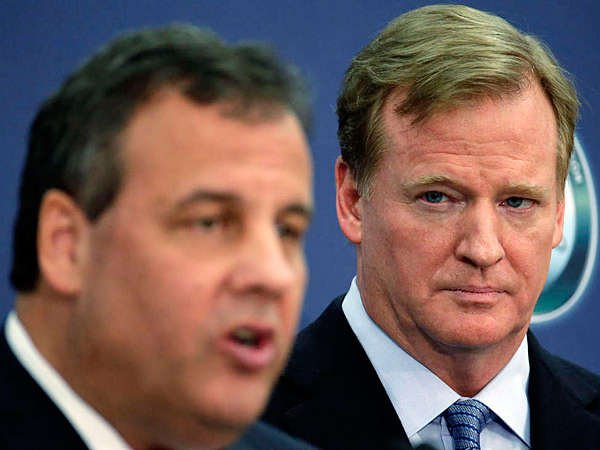
Along with his peers in other professional sports, NFL Commissioner Roger Goodell (right) was opposed in 2012 to an expansion of legalized sports betting.
Were you surprised to see those leagues later enter into lucrative partnerships with sportsbook companies?
I wasn’t surprised at all. The leagues have shown an extraordinary ability to chase a dollar. I’m still waiting for the statue that they’re going to build of me, or the thank-you note. [Legalizing sports betting] has helped their TV contracts as well. People who weren’t even necessarily interested in sports before are now extraordinarily interested because they have a little bit of a wager on it. It’s kind of amazing.
In the years since the Supreme Court overturned PASPA, NBA and MLB players have been arrested for conspiring with gamblers. An NFL executive was recently suspended for sharing inside information about the team’s draft plans.
It’s inevitable that was going to happen. But I think because there is such a great deal of transparency, the leagues can act quickly. That makes it much more different from when gambling was illegal, and you still had some athletes or people associated with sports interacting with [bettors]. The regulation brings about transparency, and transparency makes it easier to police.
Sports betting has evolved into a 24/7 mobile enterprise. Do you consider it to be a different product than what it was in 2012?
Completely. I don’t think I could ever have anticipated that it would be in everybody’s pocket. That’s a little bit disturbing to me, to tell you the truth, the proliferation of it. And obviously prediction markets have been very disturbing to me, particularly because they market to teenagers, which is strictly prohibited for the legal gaming companies.
Prediction markets have also faced backlash for allowing people to wager on U.S. military operations and the deaths of foreign leaders.
I think the whole thing is absurd, and not good for the public.
President Trump’s son, Donald Trump Jr., was reportedly given $300,000 worth of Kalshi shares in 2025, after becoming an adviser to the company. MARSHALL SCHEUTTLE
President Trump’s son, President Donald Trump Jr., is an adviser to Kalshi and has shares of the company, and his venture capital firm has invested in Polymarket. Those companies are regulated by the federal Commodity Futures Trading Commission. Does that seem like a conflict to you?
I think common sense gives you the answer to that. If it’s a money-making enterprise for the Trump family, then the odds are it’s going to face light regulatory action.
It’s betting. It’s not an investment. It’s not a commodity. The Supreme Court has ruled that states have the right to regulate sports betting. I think that it’s going to go to the Supreme Court, and I’m confident [the prediction markets] will lose.
We’ve interviewed addiction experts who say that sports gambling addiction is now a health epidemic, similar to tobacco and opioid abuse.
I always thought that a big portion of this [revenue] has to go toward addiction treatment, and I think that’s got to continue.
Elected officials in Pennsylvania, New Jersey and other states are exploring new regulations for sportsbook operators, like curtailing or eliminating in-game microbets or VIP programs. Are those kinds of reforms needed?
As long as [sports betting] is a venture that creates tax revenue, then the states are always going to be examining this issue. They’re partners. They can’t claim no responsibility. I don’t know how it’ll manifest, or where it’ll land. … I think all regulation should be rooted in evidence-based research. So if there are changes that we see that could help make [gambling] safer, they should be considered.
The Inquirer will continue to report on issues related to the growth of gambling addiction — among teens and adults — across Pennsylvania. If you or someone you know wants to speak with a reporter, please contact David Gambacorta or William Bender at dgambacorta@inquirer.com and wbender@inquirer.com
U.S. Sen. John Fetterman said Monday he agreed with President Donald Trump’s call to “Let Data Reign” after the president made a lengthy post criticizing the widespread backlash to data centers.
“There’s nothing more damaging to a Democrat than agreeing with Trump AND data centers — but what’s right is right,” said Fetterman, who has repeatedly angered members of his own party by backing Trump’s agenda.
“We must win the war for AI supremacy over China. They foment the ‘anti’ argument through misinformation,” Fetterman said on X.
The issue has increasingly taken center stage ahead of the midterm election, including in Pennsylvania. Fetterman, who does not face reelection until 2028, blamed China for fueling the public outcry against data center development in the U.S. as the two nations compete in the AI industry.
Fetterman has remained supportive of development even as voter sentiment has turned sharply against the industry. Six in 10 likely Pennsylvania voters said they opposed the construction of data centers to support artificial intelligence in a poll released last week by The Inquirer, New York Times, and Siena University.
Trump made similar arguments on his Truth Social platform earlier in the day, saying that China “could not be happier” with the political movement against data centers.
“The only reason that communities throughout the U.S.A. should not want Data Centers is if they want to end up being backwards and poor. If they want to be successful and rich, with far lower taxes and jobs all over the place, let Data Reign,” Trump said.
That Fetterman backed the president on data centers may not have come as a surprise to voters who’ve been following the senator’s moves.
Two-thirds of Pennsylvania Democrats who are likely to vote this year believe Fetterman supports Trump too frequently, according to last week’s poll.
Overall, 69% of Democratic voters have an unfavorable opinion of him, which could be trouble if he seeks reelection as a Democrat in 2028.
And Democrats were also the voters most likely to oppose data centers — with 77% opposing their construction in the Pennsylvania poll.
Fetterman’s post in support of data centers comes as the state’s other top Democrat, Gov. Josh Shapiro, has been backing away from his previous support.
Shapiro issued an executive order two weeks ago enacting a host of restrictions for new projects. And the governor has traded attack ads with his Republican opponent Stacy Garrity over who has been more supportive of the industry.
Fetterman, on the other hand, said in a post last week that China would benefit from an overreaction by U.S. politicians.
“I reject the political pandering and hyperbole over data centers or AI doomsdaying,” he said.
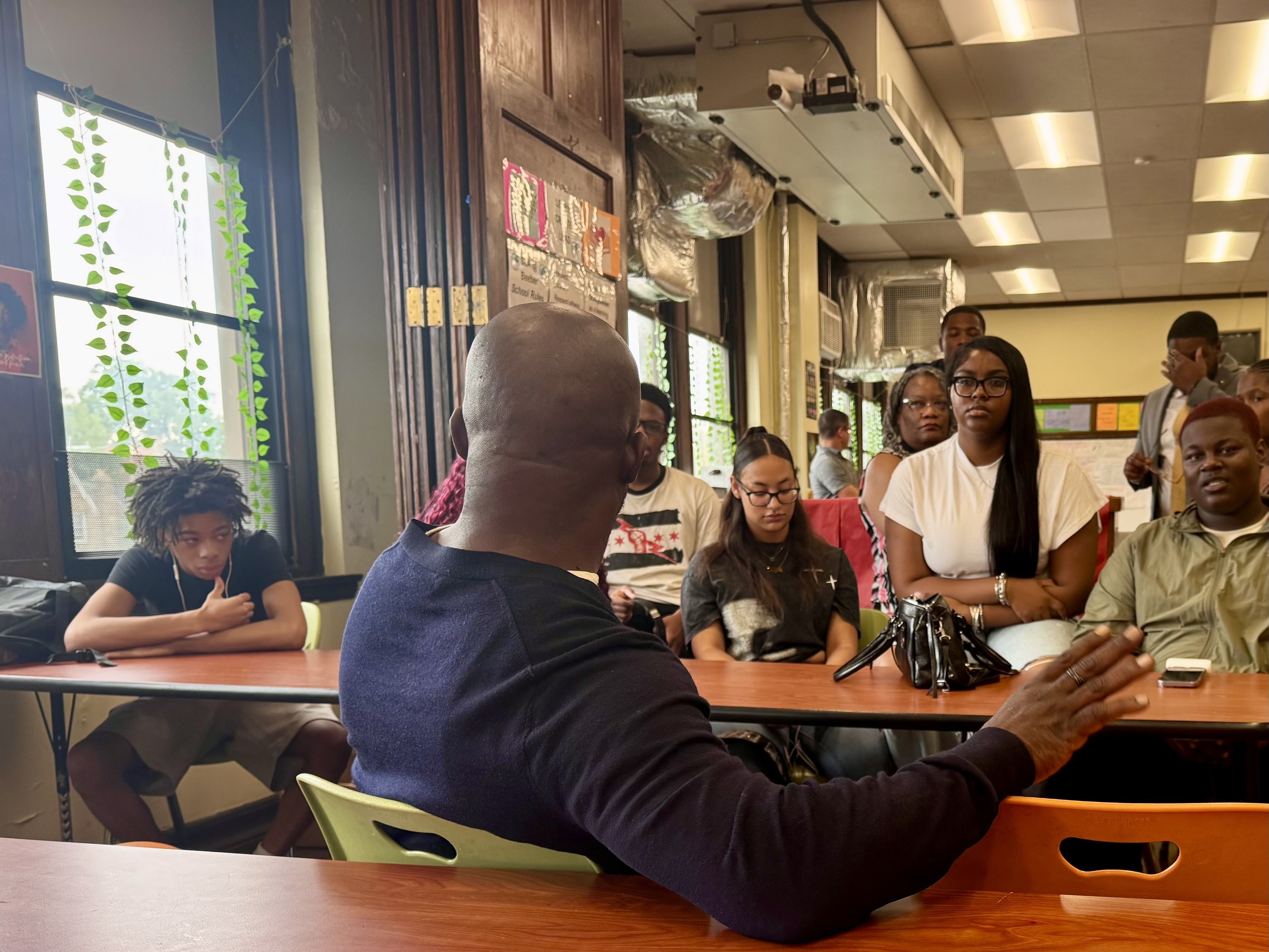
Chris Johnson, principal of Science Leadership Academy at Beeber, looked at the students in front of him — 10th and 11th graders at Parkway West, a school that’s closing in June.
“What’s coming up for you?” Johnson asked them.
“Division,” one student said plainly.
SLA Beeber won’t be doing that, Johnson said. On the first day of school last week, Johnson told his students if they were going tohave issuesaccepting the Parkway West kids coming next year, they could leave.
“We don’t do stepbrothers, stepsisters. We do family. Ain’t no division. We’re family,” said Johnson.
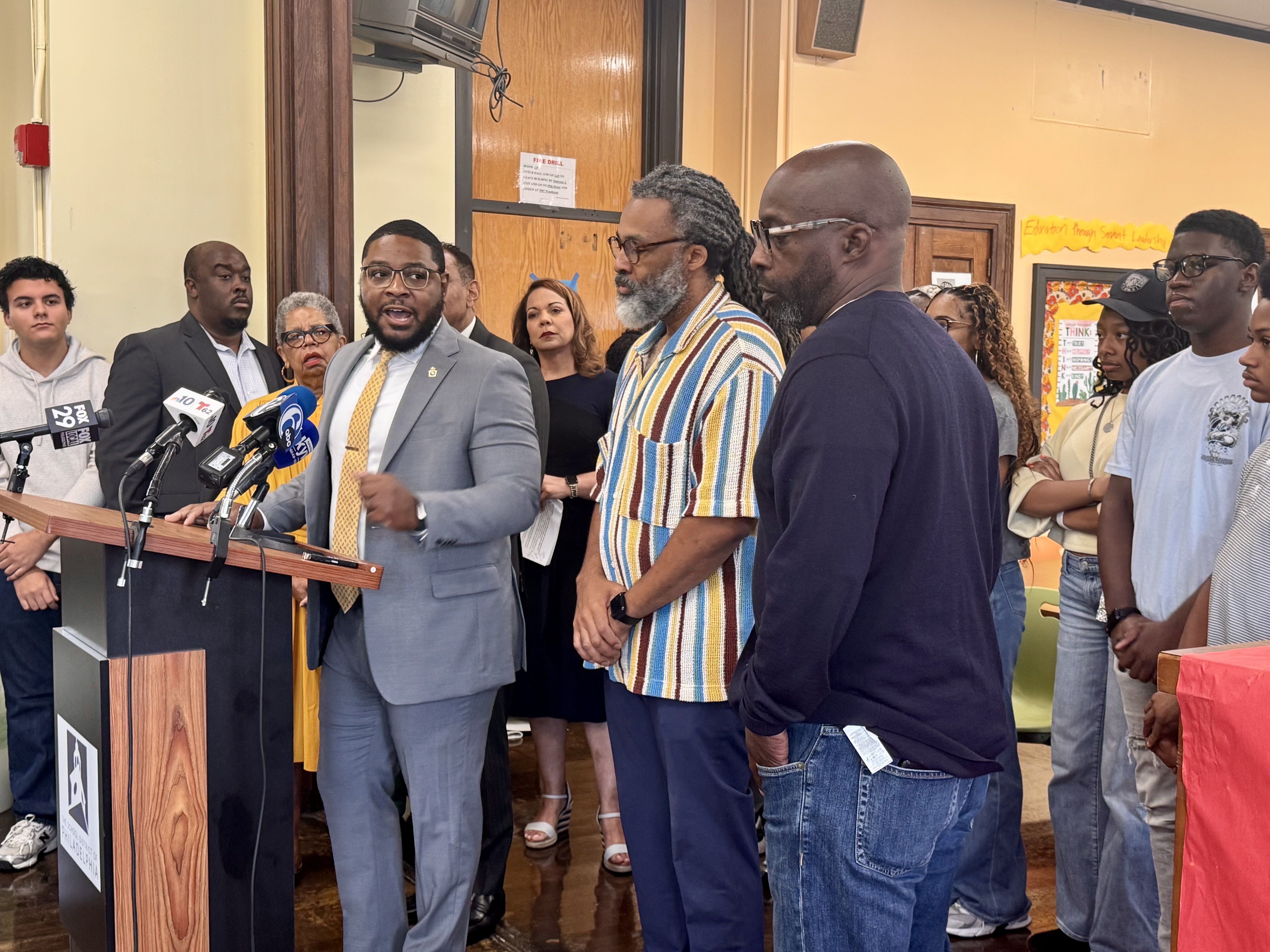
The conversation came as Philadelphia School District officials toured SLA Beeber to tout a new process for managing school closings.
Applications opened Monday for transition teams that will affect how changes will happen at 50 schools that will be closed or beginning phaseouts at the end of the 2026-27 school year, and those receiving students from those schools in 2027-28.
Ten Parkway West students traveled to SLA Beeber Monday to get a preview: tours of the school, a sit-down with Johnson, shaking hands with Superintendent Tony B. Watlington Sr., school board members, and others.
“We’ve got to do some things differently in Philadelphia to address the fact that we have a 65% occupancy rate across the district, which means 35% of our seats in our buildings in the district-operated schools are empty,” Watlington said at a news conference in a third-floor classroom.
“We understand that for some communities this is very hard, but we want to make sure that we are hearing them and we’re providing as much support as we can,” Warthen-Canty said. “The red carpet, white-glove treatment Dr. Watlington talked about, that’s what we want to make sure our principals, our staff, our students, and our families have.”
Each transition committee will have about 20 members. Applications, available through the district’s website, will be open through Sept. 18. Those who are selected to sit on committees will be notified by Oct. 1, with work expected to begin the week of Oct. 12.
‘There’s a lot of uncertainty’
When Parkway West first showed up on the list of possible school closings, principal William Brown and Johnson of SLA Beeber began meeting regularly, they said.
William Brown (center, speaking at podium), principal of Parkway West, speaks at a news conference at SLA Beeber. Brown’s school is closing at the end of the school year, and its students will be sent to SLA Beeber.Kristen A. Graham / Staff
“I’d be lying if I said this was an easy time for the Parkway West community,” Brown said Monday. “There’s a lot of uncertainty out there for the people involved.”
SLA Beeber enrolled 533 students in grades 5 through 12 last year; Parkway West had 151 students in grades 9 through 12.
While Parkway West students will have the opportunity to go to SLA Beeber, most staff will be force transferred to other schools, without a chance to follow their students. Still, Brown said, the focus is on children.
“These are our young people, we really have to make sure they’re OK,” said Brown, who said the SLA Beeber and Parkway West communities “are united” around that goal.
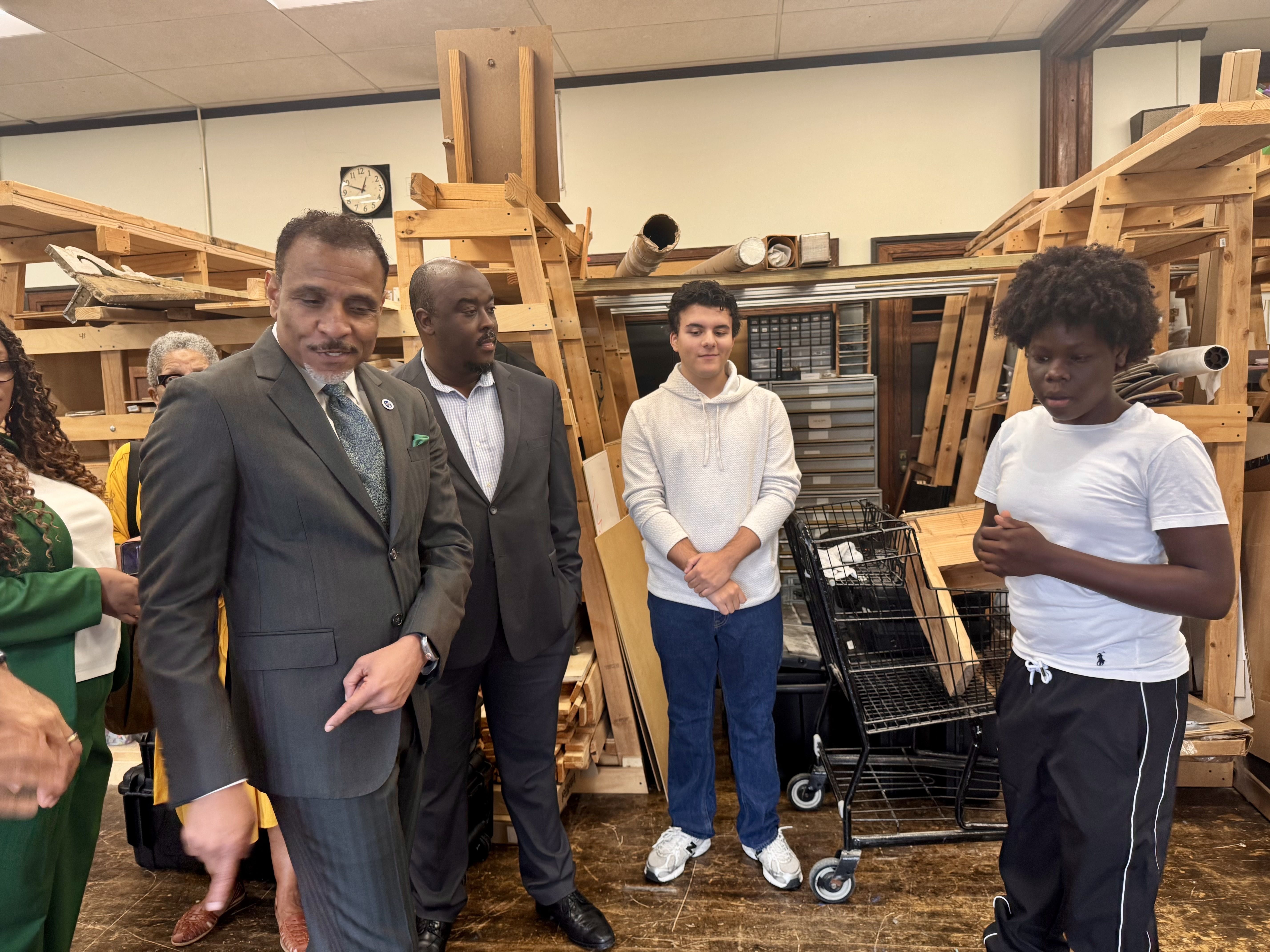
Later, SLA Beeber students Mohamed Ali, 15, and Sebastian Delgado-Colón, 16, showed Watlington, board president Reginald Streater, board member Whitney Jones, and others around their school. Other SLA Beeber classmates took Parkway West students on a tour.
What do you think of the coming changes, the dignitaries asked Ali and Delgado-Colón.
“I can’t imagine what they’re feeling, going into a completely new environment,” said Delgado-Colón.
At first, Ali said, he thought about what the change would mean for SLA Beeber students.
“Our teachers are very one-on-one with us. Is this going to change that? But we’re going to make the best of it,” said Ali.
“We were looking at it in more of a tense way — now we’re looking at it as a net positive,” said Delgado-Colón.
“It can build on community,” Ali added.
Philadelphia Superintendent Tony B. Watlington Sr., school board member Whitney Jones, and Science Leadership Academy at Beeber students Sebastian Delgado-Colon and Mohamed Ali look at SLA Beeber’s engineering lab. Delgado-Colon and Ali gave Philadelphia School District officials a tour of the school, which will receive students from Parkway West after Parkway West closes at the end of the school year.Kristen A. Graham / Staff
District officials have stressed that closing schools will enhance resources citywide.
The cooperation between Parkway West and SLA Beeber, Watlington said, is a hopeful one.
“It shows that we can make tough decisions and we can do it in a way that all of us absolutely can become winners and not losers,” the superintendent said. “Our gain doesn’t have to necessarily come at anybody’s expense.”
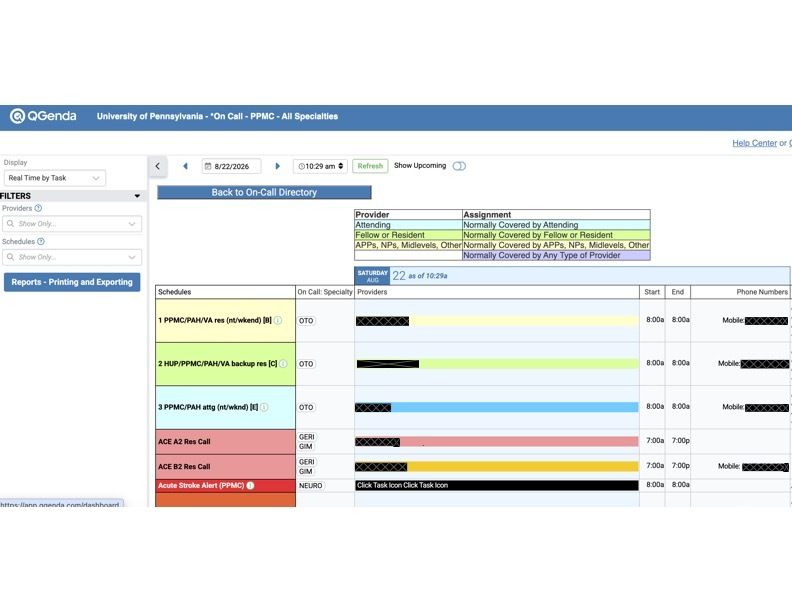
Philadelphia-area health systems have been moving swiftly to pull offline web links that publicly revealed the daily work schedules and cell phone numbers of healthcare workers, information that hospitals traditionally do not make available online.
The information for thousands of medical workers at Penn Medicine, Children’s Hospital of Philadelphia, ChristianaCare, and dozens of hospitals nationwide was published online through a popular scheduling service, QGenda.
Experts said the online availability of internal information raises serious security and privacy concerns at a time when healthcare workers increasingly face the threat of workplace violence and doxing.
The Philly-area health systems took down the schedules in late August after The Inquirer alerted them that the information was publicly available. Penn and CHOP did not respond to questions about whetherthey were aware the link was accessible without a log in.
A spokesperson for ChristianaCare said the system “recently became aware” the pages were public, and “immediately” worked with the QGenda to “eliminate the vulnerability.”
“We are not aware of any impact to caregivers, clinicians, patient care, or operations,” Christiana’s statement said. “Protecting the privacy and security of our caregivers, clinicians, patients, and information systems remains a top priority.”
Other Philadelphia-area systems did not appear have publicly available links.
The web pages managed byQGenda, an Atlanta-based workforce management software company, exposed months of schedules of physicians, nurse practitioners, social workers, and other hospital employees.
The links don’t appear on Google searches, but anyone with access to basic AI chatbots could pull up live schedules showing the hours and assigned hospital service for on-call doctors andother providers.
“That’s very concerning,” said Lane Kantor, a fourth-year medicine-pediatrics resident at Penn and CHOP, explaining that healthcare providers’ work “sometimes comes with patients who can harass and threaten us.”
Kantor, a leader at Penn’s resident union, said the public information of providers who work with undocumented immigrants or in the areas of gender-affirming or abortion care was especially concerning.
QGenda is used by more than 4,500 organizations, according to the company’s website, including many hospitals that use the software as a one-stop source of information about providers who are on-call and available for consult at any given moment.
It is not clear how the schedules became public, how long the information was available online, to what extent hospital administrators knewthe information was not safeguarded with a log in requirement, or whether anyone — let alone someone wishing to inflict harm — accessed the information.
QGenda did not respond to multiple requests for comment.
The Hearst-owned company offers “QuickLinks” to allow “any staff member without a QGenda account” to easily access the schedule, according to the company’s website. The site also notes that “on-call schedules may contain sensitive information” and that there is risk of “unauthorized access or data breaches” without proper safeguards.
The platform also enableshealthcare systems to restrict access,“so that only devices on your practice’s secure network can access schedule data on the public-facing landing page,” the company’s site says.
Health systems in the Philadelphia area and across the country have taken steps in recent years to minimize doctors’ publicly available information in response to the growing politicization ofmany health services, especially those involvingdiversity, equity and inclusion, abortion, and gender-affirming care.
CHOP, for example, removed provider names from the webpage of its gender and sexual development program in 2022 as the clinic received threats because it provides gender-affirming care for teens. But information on clinic’s providers was available through the now-removed public schedule.
Security experts say releasingpublic work times and locations alongside cell numbers leaves providers vulnerable to being targeted by dissatisfied patients, or individuals who disapprove of the type of medicine a doctor practices.
“This is really alarming,” said Will Owen, a spokesperson for Surveillance Technology Oversight Project, a New York-based privacy nonprofit. “Hospitals must scrutinize the platforms they work with in their data collection to minimize information that can be weaponized.”
Live hospital schedules exposed
After receiving a confidential tip that three East Coast health systems had public QGenda web pages, The Inquirer identified public landing pages for nearly 50 health systems or hospitals nationwide, including Veterans Affairs hospitals, using OpenAI’s Codex.
For some, like Penn and CHOP, the landing pages for the entire system were public. For other hospitals, schedules for only one department or service surfaced.
Some of the United States’ largest and most prestigious institutions had public QGenda links, including Johns Hopkins Medicine and the University of California-San Francisco.
The Inquirer attempted to reach out to each hospital or system for which it found schedules before publication. At least 10,including Hopkins and UCSF, have removed the public link completely or added a password requirement.
A spokesperson for Cedars-Sinai Medical Center in Los Angeles said it was “unaware” that its anesthesia department’s schedule was public. The schedule has since been removed.
The call schedule for the Children’s Hospital of Philadelphia, and dozens of hospitals nationwide, was available online through a public QGenda link. CHOP updated the web page’s permissions to require a login after being alerted by The Inquirer.Screenshot
CHOP informed hospital staff last week about security updates made to QGenda “out of an abundance of caution.”
“We are taking a precautionary step to update access to the QGenda platform used to display CHOP on-call schedules,” CHOP said in an email to staff obtained by The Inquirer.
QGenda’s platform does not contain patient information, and CHOP “continually assess our systems, processes, and technologies with an eye toward privacy, security, and operational needs,” a CHOP spokesperson said in a statement.
Penn said it uses QGenda to support communication among care teams.
“We continually monitor the risk environment surrounding online information and, as it continues to evolve, we are adding controls that both preserve appropriate protection and provide reliable access for those who need the information to coordinate patient care,” Penn said in a statement.
Gennadiy Ryklin, a hospitalist at ChristianaCare, was surprised to learn a colleague had done a work-hour analysis for ChristianaCare’s attending union using an AI model.
“I asked him, ‘well, how’d you do that without having Claude get access to our private schedules?’ And, well, it’s not private, there’s a public link here,” Ryklin said.
Privacy and data security are principles are drilled into physicians through policies, procedures, and training courses, Ryklin said.
“We understand that patient information in the wrong hands can cause a lot of harm,” the doctor said. “Where’s that same concern for us?”
A June shooting that killed one IT intern and left another injured in ChristianaCare’s Wilmington Hospital underscored for Ryklin the threat of violence within health systems. Law enforcement charged a third intern in connection to the incident.
He reached out to hospital administrators and last week the hospital began removing the public web pages.
Employee privacy exists in a legal gray area, with protections often dependent on institutional policies, said Matthew Bodie, a law professor at the University of Minnesota.
Publicly sharing schedules and cell numbers does “feel invasive,” Bodie said, “especially if employees didn’t know about it.”
The combination of cell numbers and work schedules could be used to cause harm, whether by patients, politically motivated individuals, or stalkers, said Sharona Hoffman, a co-director of the Law-Medicine Center at Case Western Reserve University.
The lack of any sweeping federal employee privacy requirements makes the online availability of the information, “not surprising though very disturbing,” the professor said.
The U.S. Supreme Court this summer overturned limits on how much money political parties can spend in coordination with their chosen candidates — the latest in a series of decisions by the conservative majority that have unleashed a flood of money into national politics.
How that will play out in Philadelphia remains to be seen. But local elections lawyers said last week it could boost the power of the city’s political parties to influence the outcome of elections.
“It will be disruptive to city elections,” Adam Bonin, a Philadelphia-based Democratic elections attorney, said of the case, National Republican Senatorial Committee v. Federal Election Commission. “It will give parties more power, and it will give incumbents more power.”
The Philadelphia Board of Ethics, which enforces the city’s campaign finance rules, plans to consider the potential impacts of the Supreme Court’s 6-3 ruling this fall, said board chair Ellen Mattleman Kaplan. That would ensure any changes would take effect before next year’s municipal elections, when Mayor Cherelle L. Parker and all 17 Council members are up for reelection.
In deep-blue Philadelphia, where most local elections are effectively decided by Democratic primaries, two key questions will determine the case’s impact: Does the ruling apply to local elections, and does it apply to primaries?
Both are legally thorny issues that could require lengthy court battles to sort out. But if the answer to both questions ends up being yes, the NRSC ruling has the potential to give significant advantages to candidates who are endorsed by the Democratic City Committee.
For instance, in crowded Democratic primaries for mayor or City Council, the party-endorsed candidates would be the only ones who could effectively circumvent the city’s limits on the size of political donations — currently $3,700 per year for individual donors — by directing deep-pocketed supporters to give additional money to the party, which is not subject to those limits.
The party could then work directly with its endorsed candidates on how to spend that money, including decisions on the messaging and timing of TV ads or door-knocking efforts.
To be clear, experts said, there are many uncertainties about how, and even if, the ruling would apply to Philadelphia municipal elections, where political money is more tightly regulated than in state and federal races.In the immediate future, the ethics board could take the position that the ruling applies only to federal races, not the city races it regulates.
“We haven’t come to any conclusions yet,” said J. Shane Creamer Jr., the ethics board’s executive director. “We’ve got to keep in mind that the federal law in that case is a little different than Philadelphia’s laws, including different rules designed to prevent circumvention of contribution limits.”
Additionally, the Supreme Court opinion did not specify whether its ruling applies to local elections, a question that could be addressed by subsequent federal court cases. The NRSC case before the justices centered on limits on coordination between parties and candidates in federal law that apply only to general elections.
But Philadelphia elections lawyer Kevin Greenberg said the underlying philosophy in the decision — that limiting political parties’ coordination with their candidates constituted a violation of the constitutional right to free speech — would likely extend to primary elections.
“There is nothing about the Supreme Court’s logic that inherently applies only to general elections,” said Greenberg, who has done legal work for the Pennsylvania Democratic Party. “What any judge and any lawyer thinking about how to implement this … would and should do is apply the Supreme Court’s opinion to what the next set of facts are, and under the Philadelphia law, this will be problematic for the existing [campaign finance] statue.”
The ruling directly applies to general elections for U.S. House and Senate races, meaning that federal party committees can now coordinate with — and spend freely on behalf of — candidates running for Philly congressional seats and Pennsylvania’s U.S. Senate seats.
But the two outstanding questions, about local elections and primaries, would likely have to be sorted out in court because the city is unlikely to voluntarily change its system, said Matthew Haverstick, a Philadelphia elections lawyer who often works with Republican clients. Such a case would require a candidate or, more likely, a political party suing the city, he said.
“Given the way the Philly ethics board and the city regulates elections, they’re not going to do anything unless they’re told to do it by a court,” Haverstick said. “Whether this decision has a direct impact on the Philadelphia rule is unclear. … You could argue that political parties can coordinate in primaries — there are good arguments that it could — but it would have to be considered in court.”
Haverstick is representing 2023 mayoral candidate Jeff Brown in a lawsuit against the ethics board. During that campaign, the ethics board alleged that a super PAC backing Brown coordinated with him in violation of campaign finance rules. A judge later threw out the case.
With Haverstick as their attorney, Brown and the PAC have since sued the ethics board, alleging in part that it unfairly targeted him during the campaign. The Commonwealth Court in March ruled against Brown and the PAC. They have appealed the decision to the Pennsylvania Supreme Court, where it is pending.
A potential opportunity for Philly’s Democratic establishment
The local Democratic establishment’s influence in recent years has been waning as insurgent candidates backed by progressive groups have notched key victories, oftentimes with the backing of deep-pocketed outside spending groups supported by organized labor.
Depending on how it is applied, the court’s decision could create an opportunity for the Democratic City Committee to reassert itself by giving its preferred candidates, who are typically more centrist or conservative Democrats, access to a major financial advantage over their rivals.
The Democratic City Committee did not respond to a request for comment.
Currently, candidates for city offices are subject to strict limits on the size of donations they can collect: $3,700 per year for individual donors, and $14,800 for organizations. Outside groups known as super PACs can raise money in unlimited amounts — but they are prohibited from coordinating with campaigns over fundraising, strategy, and spending.
If applied to city elections, the ruling could create an exception to those rules for one type of outside group — political parties — allowing them to raise money in unlimited amounts and spend as much as they want while working hand in glove with their endorsed candidates. And in a primary election, where there is only one party involved, that could give the establishment-backed candidate a major advantage.
Chairman of the Democratic City Committee, former U.S. Rep. Bob Brady, at Mother Bethel AME Church Nov. 2, 2025.Tom Gralish / Staff Photographer
But there is reason to doubt that scenario will become the norm in high-profile Philadelphia elections. In addition to legal questions about the NRSC case’s applicability, there are political obstacles that could prevent candidates from taking advantage of the court’s ruling.
To be endorsed by the city committee, candidates must receive the support of a majority of the 69 Democratic ward leaders, who often fail to reach that level of consensus in crowded races. And even if a candidate wins the endorsement, there is no guarantee they would have the donor network to be able to take full advantage of coordinating fundraising with the party.
Lastly, the party may differ with a candidate’s campaign on strategy decisions, or it could decline to raise money beyond the limits applicable to other candidates to avoid the appearance of tipping the scales.
Bonin said he opposes the current Supreme Court’s campaign finance rulings, such as the 2010 Citizens United decision that helped usher in the dominance of super PACs. But in light of those rulings, he said, the NRSC decision may be a positive development.
“If we’re going to live in a world where super PACs exist, we are better off strengthening political parties, which are more accountable,” he said.
A new twist in Council election races for the GOP and Working Families Party?
There is another arena in which the decision could have a major impact in Philadelphia: the general election races for the two seats on City Council that are reserved for independent or minority-party candidates.
Republicans held those seats for about 70 years until Councilmembers Kendra Brooks and Nicolas O’Rourke of the progressive Working Families Party won them in the two most recent city election cycles, a major factor in Council’s recent shift to the left.
At left is Kendra Brooks speaking with colleague Nicholas O’Rourke during caucus session. Philadelphia City Council gathered today for the budget address from Mayor Cherelle L. Parker in chambers, Thursday, March 12, 2026. .Alejandro A. Alvarez / Staff Photographer
The Philly GOP has seen anemic fundraising levels and dismal results in recent years. If applied to local primaries, the NRSC ruling could potentially help the party gain traction with the help of just a handful of major donors — especially given that it is less clear the Working Families Party, without a primary election, would be able to take advantage of the change.
If the NRSC ruling is applied to city elections, the Philly GOP would undoubtedly be able to coordinate with its nominees in those Council races. Vince Fenerty, who chairs the Republican City Committee, said he is seeking legal advice on that question.
“We’re hopeful that there could be a chance for us to help our City Council candidates next year and everyone else who runs [as a Republican],” he said.
It is unclear whether the ruling would benefit the smaller Working Families Party, which under Pennsylvania law is not a major political party. (Pennsylvania’s Commonwealth Court is currently deciding an unrelated case on the Green Party that could affect the legal standing of groups like the Working Families Party.)
At left is attorney Matt Wolfe and Vince Fenerty, chair of the Philadelphia Republican Party attended the hearing for Working Families Party candidates. Hearing in courtroom 443 Philadelphia City Hall for Working Families Party candidates on Friday, August 11, 2023.Alejandro A. Alvarez / Staff Photographer
In a statement, Working Families Party spokesperson Nick Gavio lamented the direction of the U.S. Supreme Court’s recent rulings on campaign finance law.
“Anyone who has knocked a door in Philadelphia knows that regular voters are not pushing to give billionaires and the ultra-rich more power to influence our elections,” he said. “WFP has no interest in overturning existing campaign finance regulations that act as guardrails against political and corporate insiders buying elections. We will of course continue to follow all campaign finance rules that are on the books.”
A new quandary for the ethics board
In stark contract to the increasingly unregulated world of federal elections, Philadelphia has some of the tightest campaign finance restrictions in the country, and the ethics board has aggressively enforced the city’s rules.
Critics, including Greenberg, believe the board has already overextended itself by sticking to Philly’s rules as the Supreme Court increasingly takes a wrecking ball to federal campaign finance law. And for Greenberg, the NRSC case is the latest decision that shows Philly is overdue for a full redo that “addresses these issues in light of the [Supreme Court’s] clear direction.”
“City Council needs to write appropriate rules, and the board of ethics needs to rescind almost all of its existing regulations and readopt them in law,” he said.
It is unlikely the ethics board would lead the charge in demolishing the campaign finance system it helped to create — one that has been widely credited with limiting the influence of corporate interests and super-wealthy individuals since it was implemented in 2005.
In an interview, Creamer, the ethics board executive director, referenced differences between the federal law in question in the NRSC case and Philly’s system — an indication the board could determine the decision has no bearing on local elections.
“We don’t have a similar structure to our law. So it may impact our law somehow; it may not,” Creamer said. “We’re still analyzing it.”
There are several important differences the board could point to. In federal law, for instance, there are limits on how much individuals can give to political parties, but in Philadelphia there are none.
In addition, the majority opinion in the NRSC decision, which was authored by Justice Brett M. Kavanaugh, discusses at length how rules around “earmarked” donations — in which donors give money to political parties and direct them to spend it on specific candidates — provide a “prophylaxis” against corruption that could result from eliminating limits on coordination with political parties. Philly does not have an earmarking process.
If the ethics board stands pat, candidates or political parties seeking to take advantage of the NRSC ruling could challenge the board’s regulations in court. Politicians in heavily Democratic cities like Philadelphia, however, face strong disincentives from taking that step, which would allow them to be painted as supportive of moneyed interests playing a greater role in local politics.
Bonin, who has been less critical of the ethics board’s approach to campaign finance than Greenberg, said resistance to the NRSC case would be difficult.
“Whether they like it or not, they have to allow it,” Bonin said, referring to coordination between candidates and parties.
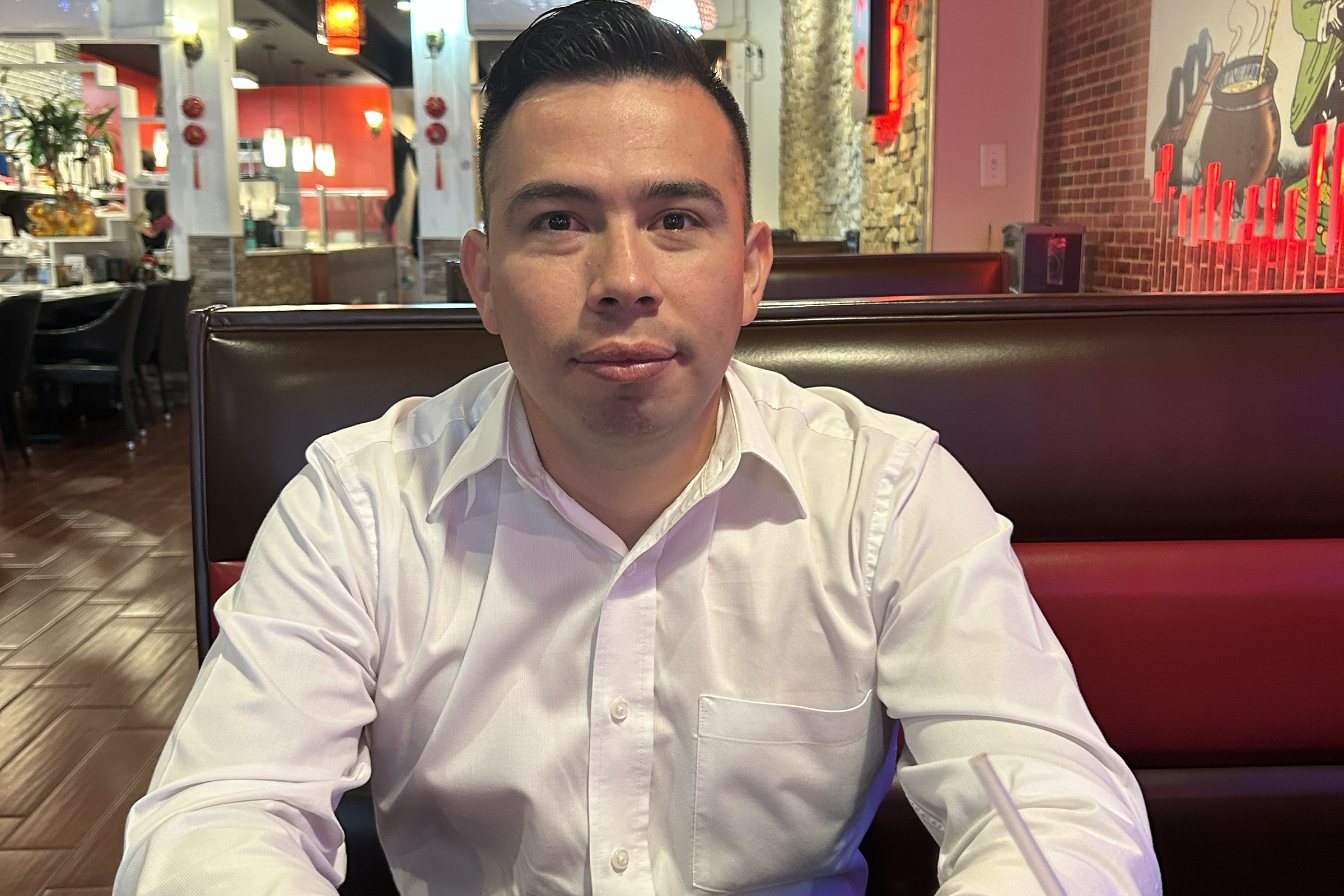
Jhon Perez Romero carries a driver’s license, Social Security card, and an employment permit, working as a Spark Driver for Walmart in York, Pa.
He also carries the fear of being tortured or killed if he should be deported to his Venezuelan homeland, where he’s been accused as a “traitor” by the government he once served as an intelligence officer.
Perez Romero, who was interviewed and released by U.S. immigration officials when he crossed the border in 2023, was arrested by ICE in Philadelphia on June 30, when he appeared for what he thought would be a routine check-in. He joined a growing number of immigrants taken into custody even while they pursue asylum, a long-established legal process that can grant permission to live in the United States to people who could be harmed at home.
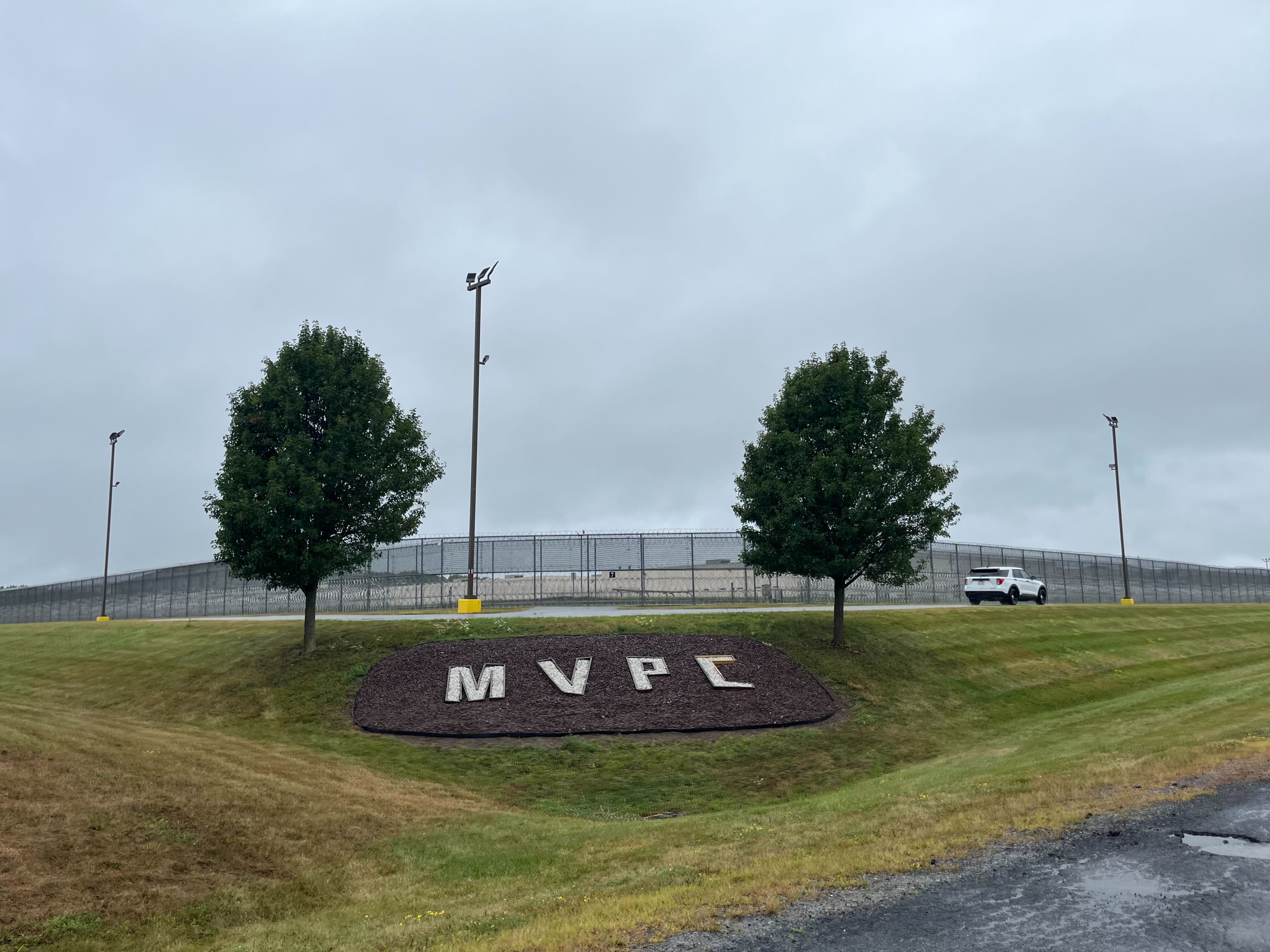
Perez Romero, 39, is being held at the Moshannon Valley Processing Center, the 1,876-bed ICE facility in Philipsburg, Pa., his future uncertain, his wife and step daughter in anguish.
“I thought the U.S. represented a place where people who are escaping political or religious persecution can come here and find safety,” said his wife, Sandra Quinones, an American citizen and high school teacher. “Especially if you’re law-abiding and contribute to society. That’s where my heart is broken.”
The Trump administration’s aggressive approach departs from previous administrations, where asylum seekers with no criminal record were mostly allowed to remain free while they pursued their claims. Now applicants have been detained in communities across the United States, including Pennsylvania and South Jersey.
Last week news broke that the administration intends to revoke the business and tourism visas of up to 200,000 people who are seeking asylum, putting them at risk of arrest and detention. That comes on top of procedural changes that have made it harder for people to prove they should be allowed to stay.
A spokesperson for the Department of Homeland Security said Perez Romero was released at the border by the Biden administration, not by officials under President Donald Trump.
“He will remain in ICE custody pending removal proceedings and will receive due process,” the spokesperson said in a statement. “A pending application does NOT confer legal status in the United States.”
The agency said that on Jan. 20 Perez Romero was charged with “harassing communication,” an offense that usually involves phone calls or text messages sent to upset someone.
DHS provided no other information. Dauphin County court records show that Perez Romero pleaded guilty in magisterial district court in March, but do not include details of what occurred. A court worker said Friday she could provide no additional information.
“Criminal illegal aliens are not welcome in the U.S.,” Homeland Security said. “We will find you, we will arrest you, and we will deport you.”
Jhon Perez Romero, originally of Venezuela, came to the United States seeking asylum in late 2023, afraid he could be harmed or killed by government agents in his homeland. Now Perez Romero, 39, is being held at the Moshannon Valley Processing Center, the ICE detention facility in Philipsburg, Pa., as the Trump administration detains more people who are seeking safety in the United States.Courtesy of family
Generally, the government cannot deport someone while their asylum claim is being decided — claimants must be given what’s called a merits hearing, where they can present evidence, before any final removal action.
The government does have the power to hold asylum seekers in detention for certain reasons, including if it believes the person might flee or is a danger to the public.
Immigration lawyers argue that there’s no gain for the government in detaining asylum seekers, since their names, addresses, and identifying information are already known to authorities, who require regular, in-person check-ins.
“The Trump administration is targeting people to subject them to detention, knowing they won’t be able to fight their way out of the system, so they’ll give up and leave,” said lawyer Lilah Thompson, who leads the immigration unit at the Defender Association of Philadelphia. “They’re wearing people down.”
For immigrants, freedom while pursuing asylum means everything, enabling them to work and earn money to hire an attorney, and to more easily gather evidence and documents for their cases.
Prolonged detention leads some to drop their legal cases and accept voluntary departure. Leaving voluntarily avoids the automatic 10-year ban on returning that can accompany a formal deportation.
“It’s very tough, for people who are facing these choices,” said immigration lawyer Robert Barchiesi II, who represents Perez Romero.
Thompson is helping defend a Chester County newlywed who has so far spent two months in detention after being arrested at a late-June check-in.
Nelson Contreras-Gelves, 35, originally from Venezuela, has followed government directions and broken no rules, Thompson said, noting that he recently married a U.S. citizen.
People seeking asylum must show not only that they could be harmed in their homeland, but also that the danger springs from at least one of five specific causes — their religion, race, nationality, political beliefs, or membership in a particular social group.
Moshannon Valley Processing Center, in Clearfield County, Pa., is the largest immigrant detention facility in the Northeastern United States.Max Marin / The Philadelphia Inquirer
People granted asylum can apply for lawful permanent residency and eventually for U.S. citizenship.
Perez Romero’s life has taken him from a position in Venezuela’s notorious national intelligence agency, to a flight across countries in fear of his life, to love and marriage to a U.S. citizen and a caring role as stepfather to her 17-year-old daughter.
From roughly 2011 to 2019, according to his asylum application, Perez Romero was an agent at the Servicio Bolivariano de Inteligencia Nacional, known as SEBIN. It was created in 2010 by then-President Hugo Chávez, officially aimed at protecting the nation but accused by human-rights groups of arresting and torturing political opponents, journalists, and activists.
Perez Romero said he quit the agency after receiving instructions — the specifics were not described in his asylum application — that he refused to obey. His resignation came less than three months after a failed military uprising against authoritarian President Nicolás Maduro triggered a purge of the intelligence services, targeting those suspected of disloyalty.
Perez Romero was told to report to government officials — and that he was accused of treason.
“Which is erroneous,” he wrote in his asylum application, “since I have not committed any crime.”
In March 2020, facing an arrest warrant, Perez Romero fled to Colombia, keenly aware of “what happens to political prisoners in Venezuela, things like imprisonment for life or murder.”
Two years later, after Gustavo Petro was elected as that nation’s president, he said, he began receiving threats from Venezuelan agents that he would be seized and forced home.
Perez Romero headed north. On New Year’s Eve 2023, he reached the U.S. border at Eagle Pass, Texas, where he was interviewed and released by immigration agents.
The next year he met Quinones at La Iglesia de Dios Voz de Alerta Church in York, and they wed in 2025.
She described him in an interview as an outstanding husband and father, working long hours to provide for their family. He’s deeply invested in their church, she said, and before his detention was developing a resource package to help missionaries serving in remote and dangerous areas.
Last month, he tried and failed in federal court to win his freedom from Moshannon.
U.S. District Court Judge Joseph Leeson ordered the government to hold a bond hearing, but Immigration Judge Tamar Wilson ruled that Perez Romero did not show he was not a flight risk or a danger to the community.
He may say he’s innocent of treason, the judge wrote, but “the court cannot simply take his word for it.”
Quinones says the family hasn’t lost hope. Their GoFundMe has raised $8,000 of its $9,000 goal, all of it going for legal fees and related expenses. They await the hearing to present evidence to support Perez Romero’s case for asylum.
Quinones said her husband relies on his Christian faith to stay strong. She’s trying to stay optimistic as well, she said, but so much is uncertain and in flux. Her husband could end up having to accept voluntary departure to a third country, like Colombia.
She’s prepared to retire early and join him, if necessary, and has begun exploring job possibilities there.
“I can’t be apart from my husband,” she said. “I can’t picture my life without him.”
Staff writer Dylan Purcell contributed to this article.
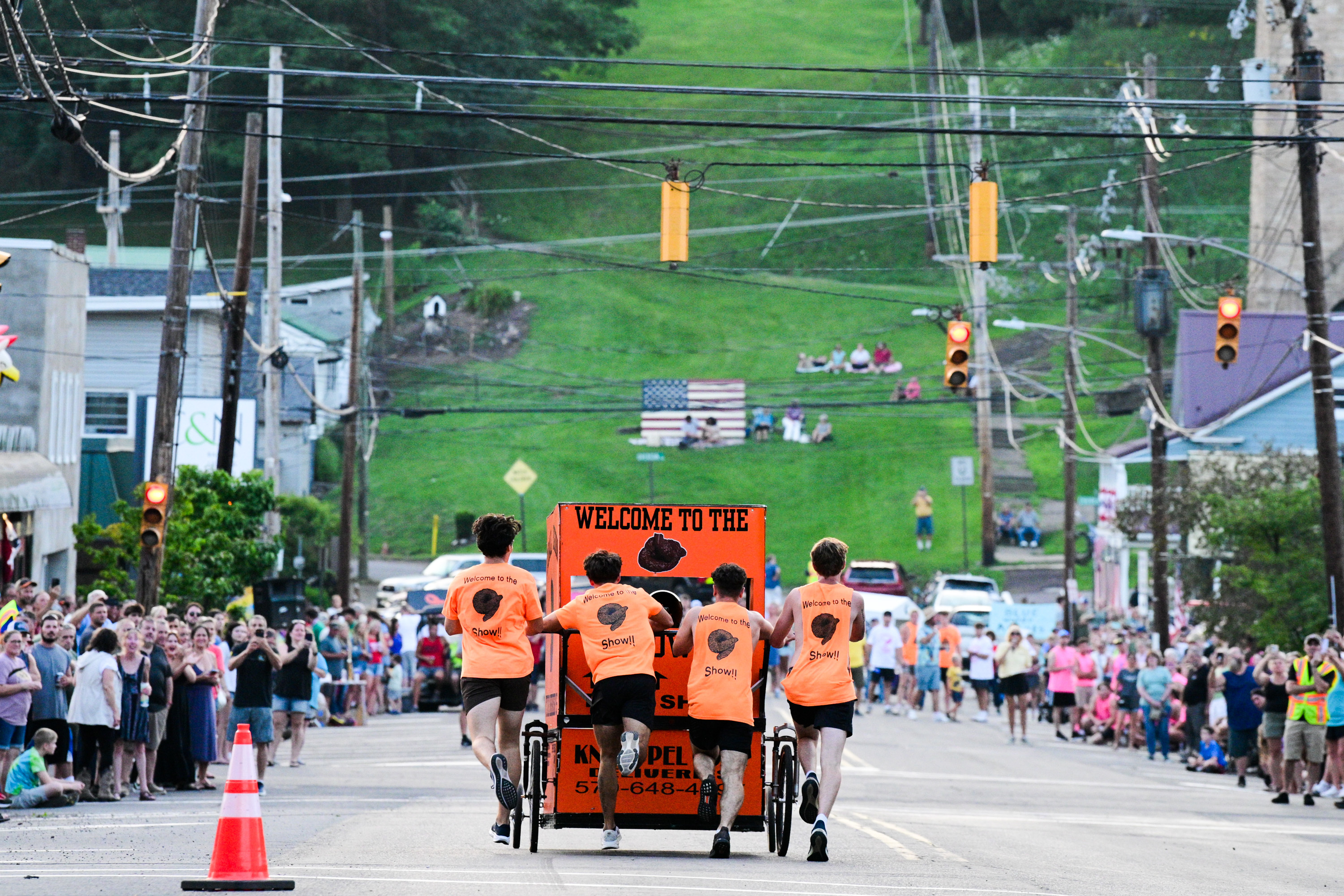
DUSHORE, Pa. — The competitors were wiped, but they gathered at the starting line in this sleepy Sullivan County town for one last push on their custom-built toilets.
“All right, this is it, folks,” emcee Gretchen Little announced. “Reputations are made. Legends are created. It’s all here, the drama, the triumph, the heartbreak. There’s nothing like the Dushore Outhouse Races.”
A half-dozen or so teams began the Dushore Founder’s Day 26th Annual Outhouse Races earlier on this Saturday night in early August. One by one, they dropped, teams like the Blue Water Angels, Perfect Dump, and Royal Flush.
The Coal Region Turd Herder’s team races down the hill on Main Street in Dushore, Pa.RALPH WILSON/For the Inquirer
Little let the crowd decide the best-looking outhouse before the final race. One of them was Steiny’s Heineys. Another team had a Dunkin’ Donuts theme with some unprintable potty humor.
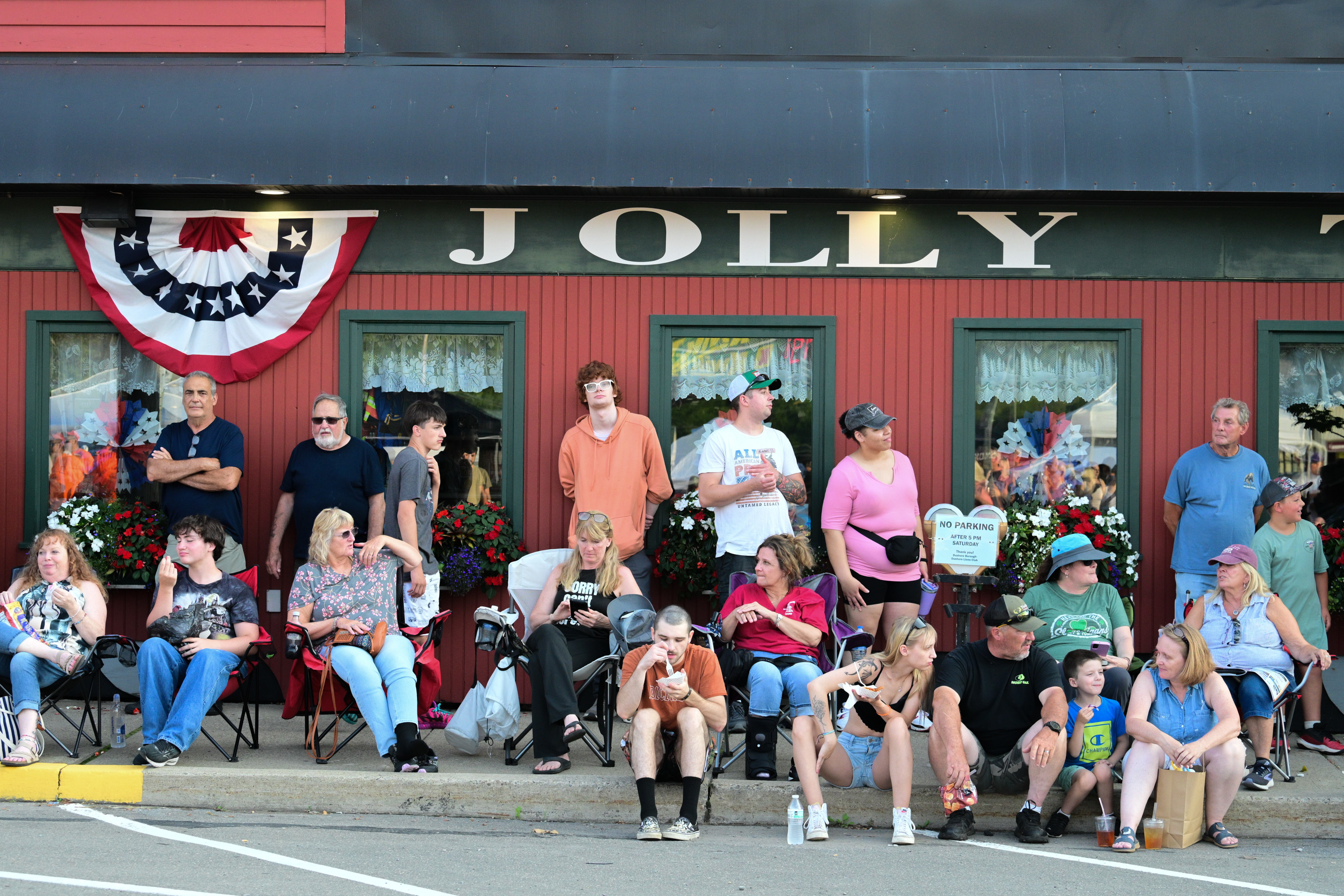
The crowd itself was an anomaly in Dushore, easily four times bigger than its year-round population of about 450. Sullivan County, about 160 miles northwest of Philadelphia, is one of Pennsylvania’s most rural counties, and its population has been rapidly decreasing and aging for decades.
“You come to this town tomorrow, you might not see a soul,” said Darryl Kashner, of Coal Township.
The Lyons Club driver reacts as the team’s outhouse crosses the finish line in Dushore, Pa.RALPH WILSON/For the Inquirer
Dushore’s Founder’s Day also included a 5k and a keg-rolling competition, but the crowds swelled on Main Street for the outhouses. Vendors included local wineries, coffee shops, and a Sullivan County artisanal broom maker that’s been in business for 100 years. Despite the crowd, many attendees said the turnout was smaller than usual.
“It used to be much bigger,” said Greg DelBuono.
The Steiny’s Heinys team races down the hill in Dushore, Pa., as part of the 2026 Founder’s Day festivities.RALPH WILSON/For the Inquirer
Dushore’s outhouse races are essentially bobsledding on the street. The outhouse must have a real toilet seat, and most sit on simple aluminum frames with wheels.
“Remember … this must look like an outhouse … be creative,” the rule book states.
The Corkscrew Crew team races down the hill during the 2026 Dushore Founder’s Day festivities.RALPH WILSON/For the Inquirer
The pilot sits on the throne, steering, while pushers line up outside. In Dushore, the best pushers were young and brawny, often sleeveless or shirtless. They came off the starting gun fast, racing uphill on Main Street. They passed through Sullivan County’s lone traffic light, swept around a memorial, and pushed back hard in the opposite direction, their legs burning.
“It’s a young man’s game,” said Kyle Nolte, 39, of Forksville. “I did this about 25 years ago, but I hung it up.”
The Coal Region Turd Herders were underdogs from the anthracite area south of Dushore, but they’d advanced to the finals by recruiting some real athletes — one of them was named “Speedy” — to do the pushing. Their outhouse was painted safety orange and featured a brown piece of, well you know, wearing sunglasses.
Locals and visitors line Main Street to watch the 25th Annual Outhouse Races at the Dushore Founder’s Day.RALPH WILSON/For the Inquirer
Like many people, Kashner discovered the races after he bought a hunting cabin in the area. Now, he pilots the Turd Herders’ outhouse.
“We bought the camp, came down, and decided to build one,” Kashner said. “I’ve never seen anything like it.”
Team Nutz, the local boys from Sullivan County, were perennial favorites at the races and faced off with the Turd Herders in the finals. The winners would come away with a trophy and a few hundred dollars, but the bragging rights were more important.
The Dushore Lyons Club team race up the hill on Main Street during outhouse races at the Dushore Founder’s Day.RALPH WILSON/For the Inquirer
When they rounded the memorial, the teams were neck and neck. The crowd was roaring. Cowbells were clanging.
“This is close,” Little said. “This is real close.”
Team Nutz, the locals, crossed first and dedicated their win to team founder Larry Kiess, who died at 36 in 2011.
“We trained for this. We came down here this week and trained for this, and every dollar we win goes to a scholarship in Larry’s name at Sullivan County High School,” said team organizer Jeff Neary. “This is our 26th year racing outhouses.”
Team Nutz celebrate their victory.RALPH WILSON/For the Inquirer
K.C. Keeler is a family man who has built his coaching foundation on the lessons and influence of those he played and coached under.
He has, what some would say, an old-school approach when it comes to running a football program: Juniors and seniors deserve the opportunity to play, academics and community service are just as important, and building a locker room starts with relationships.
As the winningest active head coach across all divisions of college football, Keeler’s philosophy has certainly worked. The second-year Temple coach surpassed 275 career wins (currently at 276) last season and is turning around a program that before last season finished 3-9 for four consecutive years.
In 2025, Temple posted a 5-7 record — one game short of reaching a bowl game, which it hasn’t made since 2019 — and had one-point losses to Navy and Army.
So, where does the program go from here? Well, for the first time in a long time, this program has a real sense of cohesion.
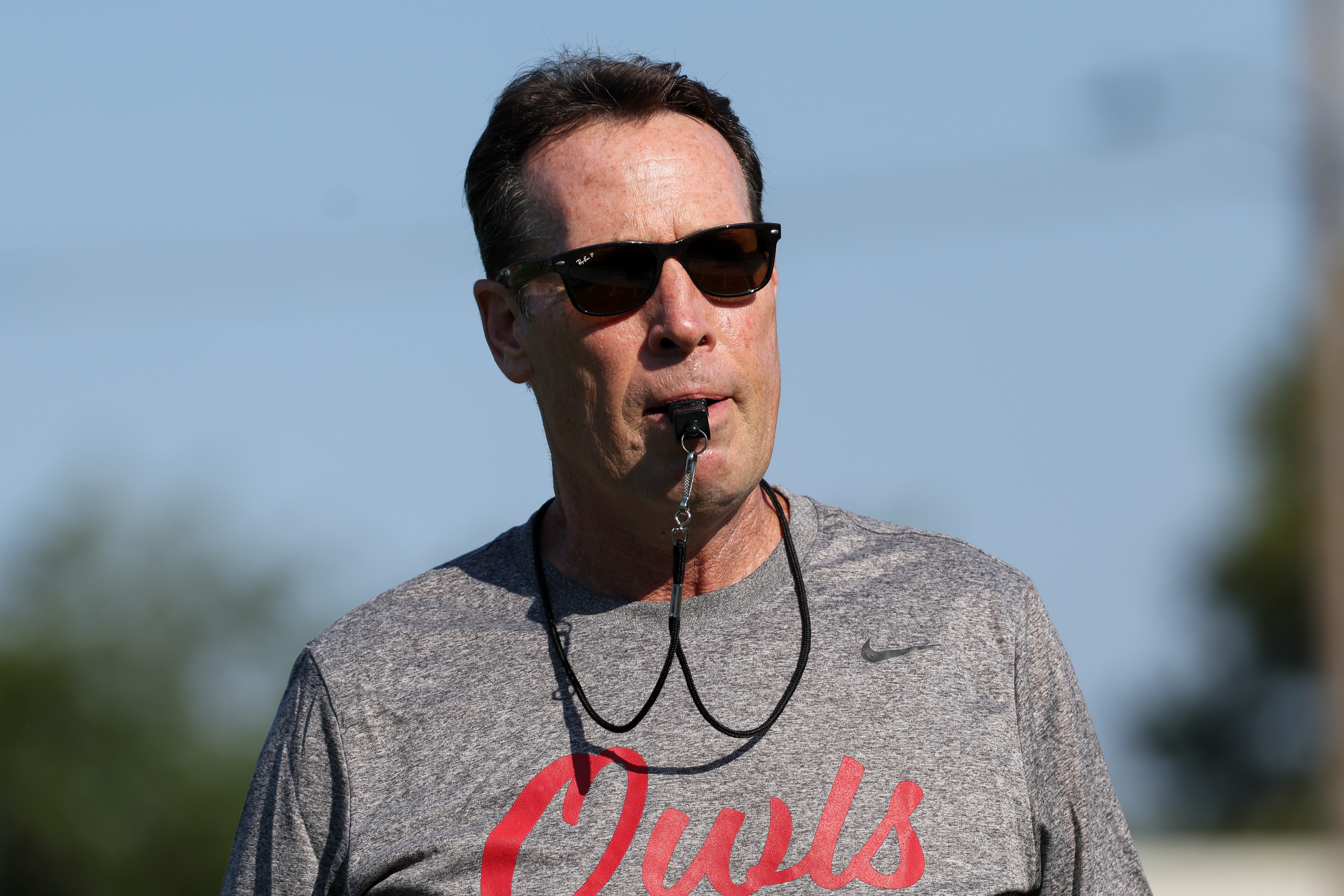
Before Temple’s season opener on Saturday against Rhode Island (2 p.m., ESPN+), Keeler sat down with The Inquirer, where he expressed his commitment to the Owls. He purchased a home in Wilmington, becoming the first Temple coach since Bruce Arians in the mid-1980s to do so. Keeler, who turned 67 in July (and is the third-oldest active FBS coach), wants to finish his college football coaching career on North Broad. But first, his focus is bringing back greatness to Temple.
K.C. Keeler enters his second year as Temple’s head coach. In his first season, the longtime college football coach led the Owls to within one win of bowl eligibility.Isaiah Vazquez / For The Inquirer
Q: [Throughout] your coaching career [at] Rowan, Delaware, and Sam Houston State, you’ve established a track record of building winning programs. How have you shifted or changed as a coach to stay competitive?
A: One of the things that I’ve always done a really good job of is problem-solving. The other thing I’ve always done a really good job of is recognizing talent, not just on the field, but also coaches I’ve worked with. When I got to Rowan, and I got an opportunity at 34 years of age to be a head coach, I had some really good players I had recruited when I was an assistant there. … I learned from my former coach Tubby Raymond [at Delaware], a lot about building a culture, understanding that when you play for, at the time Rowan University, you play for the people who played before you, you play for the people you’re with in that locker room right now, you’re also playing for the people who are going to come after you. You try to develop this sense of belonging, so everywhere I’ve coached, I’ve always tried to emphasize this is a family. It’s its own unique family, but it’s a family, and this family ranges beyond just the guys in this locker room.
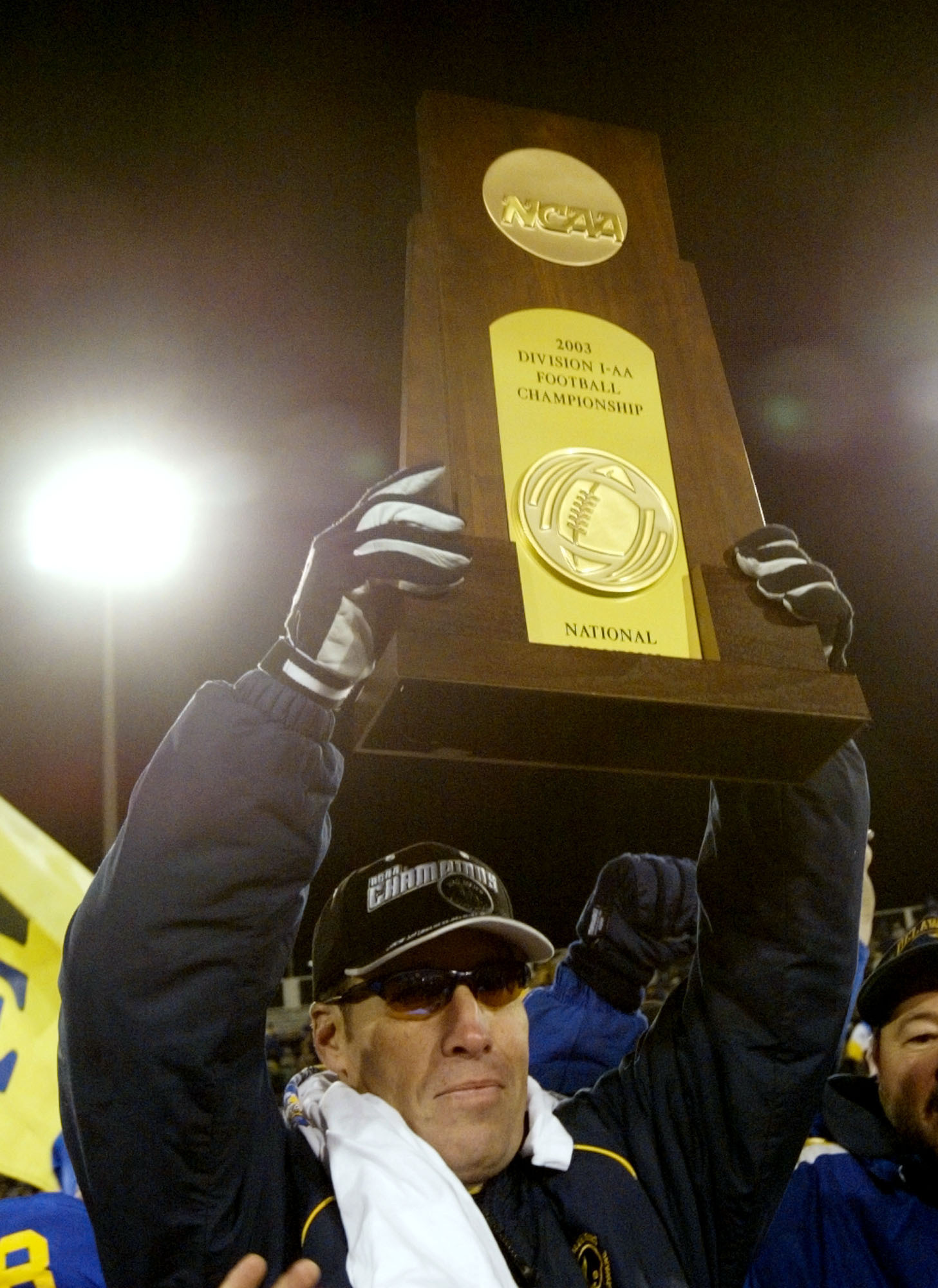
K.C. Keeler after Delaware defeated Colgate for the NCAA Division 1-AA Championship in 2003.AP Photo/Wade Payne
Q: You spent more than a decade at Delaware. How special was it to coach at the school you once played for?
A: Well, nowadays there’s no way that Delaware would hire a Division III coach, just with the headhunters and all the things that people go through now to figure out what coach they’re going to hire. But I was blessed that I had a president and an athletic director. The athletic director — Edgar Johnson, didn’t believe that. … For 11 years, when I pulled up to that stadium, in my office, I pinched myself. I probably had black-and-blue marks for 11 straight years. People always wondered who was going to follow Tubby. I mean, they have his name on the field. He had 300 wins, three national championships, and a guy that I respected in terms of creating that culture. I always say that his 300 wins or him inventing the Wing-T with Ted Kempski, those weren’t his greatest accomplishments. His greatest accomplishment was the culture that he developed.
Q: You’ve also dealt with adversity and losing seasons during your time at Delaware before you were let go in 2012. What was that departure like?
A: Me being fired had nothing to do with wins and losses. It was really more I had become a bit like Tubby did in that small state. Everyone knew what car I drove. Walking in a restaurant, my wife and children would go to the back for dinner, and I would have to stop at all the booths. There was a sense that maybe the administration, the people who were running the place at the time — they didn’t stay much longer after they fired me — they didn’t embrace the fact that I had developed a legacy there. It was hard. It was hard being fired, and I remember very vividly my daughter coming home after me being fired, and she said to my wife and I, ‘You guys are in your uniform, huh?’ Still had our pajamas on. … Then when we were out and we ran into an acquaintance on the street, and I went into my woes of being fired, and I said, ‘How are you doing?’ [They replied], ‘I’m battling cancer right now.’ My wife and I were like, let’s put this in perspective. We got fired from a job. We need to move on.
Q: What was your biggest lesson learned from Year 1 at Temple?
A: I told the guys when I first took over, I don’t want you to be realistic. [Temple] winning whatever it was, 13 games in five years, no one thinks we’re going to do much because we weren’t changing the roster much. It wasn’t like we came in, gutted the roster, brought new players in. We just felt there were so many upperclassmen that wanted to get their Temple degrees and that wasn’t the right thing to do. I still believe in education, and I believe that even though I wasn’t the coach that signed their scholarship papers when they came to Temple, I still represent Temple, I’m not going to cut you and try to get a player who’s that much better. So 5-7 was very disappointing, because we were so close to being a 7-5 team. But at the same time, I do know that there were some limitations because of how much we could change the roster. Those limitations actually led to us keeping all of our starters [this year].
Q: Your team was one of the few Group of Five schools to keep their starters from entering the portal. What does that say about what you’re building here?
A: We believe that our program is built on love and trust. I always explain that you can’t love somebody, you can’t trust somebody, until you know somebody. We work really hard at knowing each other. We’ll do the three H’s: Who’s your hero? What’s your hardship? What’s your history? We’ll do a trivia night where the guys are all mixed up with different positions and different players and coaches, and Clayton [Barnes, Temple’s general manager] leads it. It’s a lot of fun, and it’s a way to be together. … We work really hard in these four walls to develop relationships with our players. The great thing about us going into this year is that the whole strength staff is together, whole coaching staff stayed. … This building has a lot of cohesion.
Q: With the rising power of Name, Image, and Likeness, how have you managed the new landscape of college sports?
A: I wouldn’t have taken this job unless [Barnes] came with me. I know my skill set. I am a problem solver, but I’m not going to be the guy who’s going to be dealing with the agents. I’m not the guy who’s going to figure out the charts in terms of how much money we should allocate to each position and what starters are making at different positions. … That’s not my skill set. That’s [Barnes’] skill set.
I don’t call the offense anymore. I don’t run the defense anymore. I was an offensive coordinator, scored a ton of points — I got too many other things going on. … I’ve turned those things over; same thing with Clayton and the roster. Now we talk about it every day. It’s not like I’m not making final decisions, but I have enough trust.
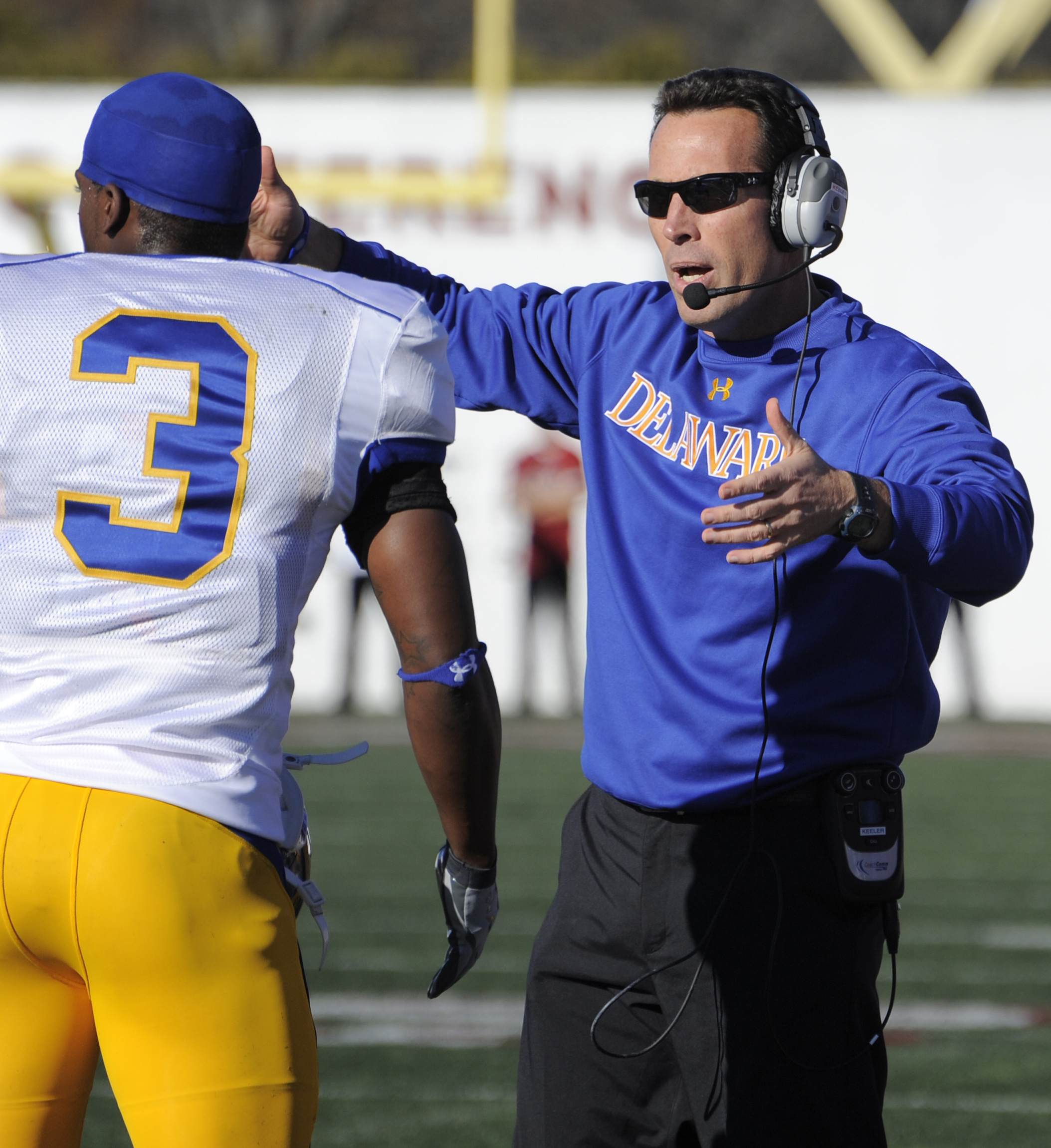
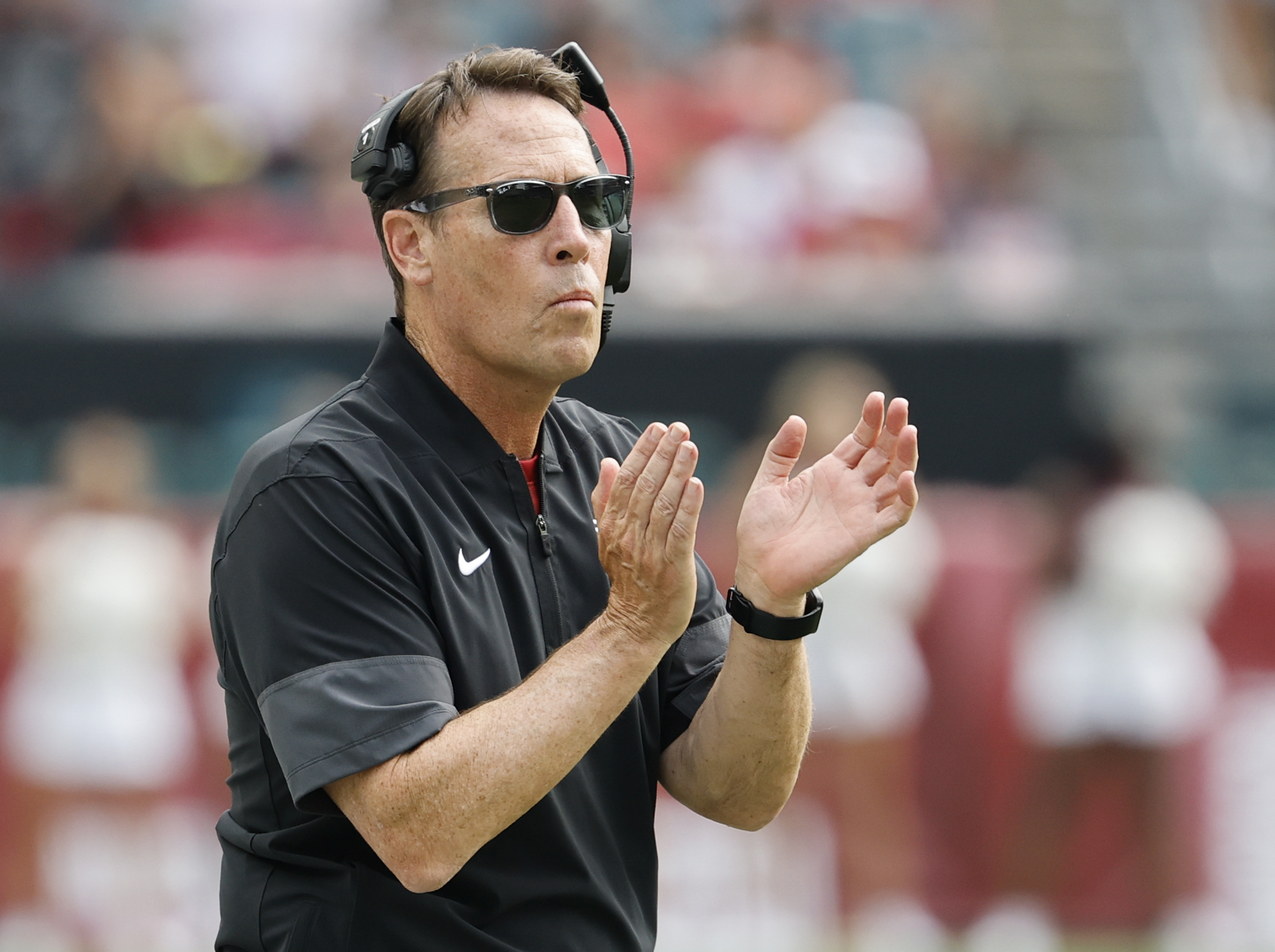
Q: Your sunglass look became a trademark at Delaware. What is the backstory about the sunglasses?
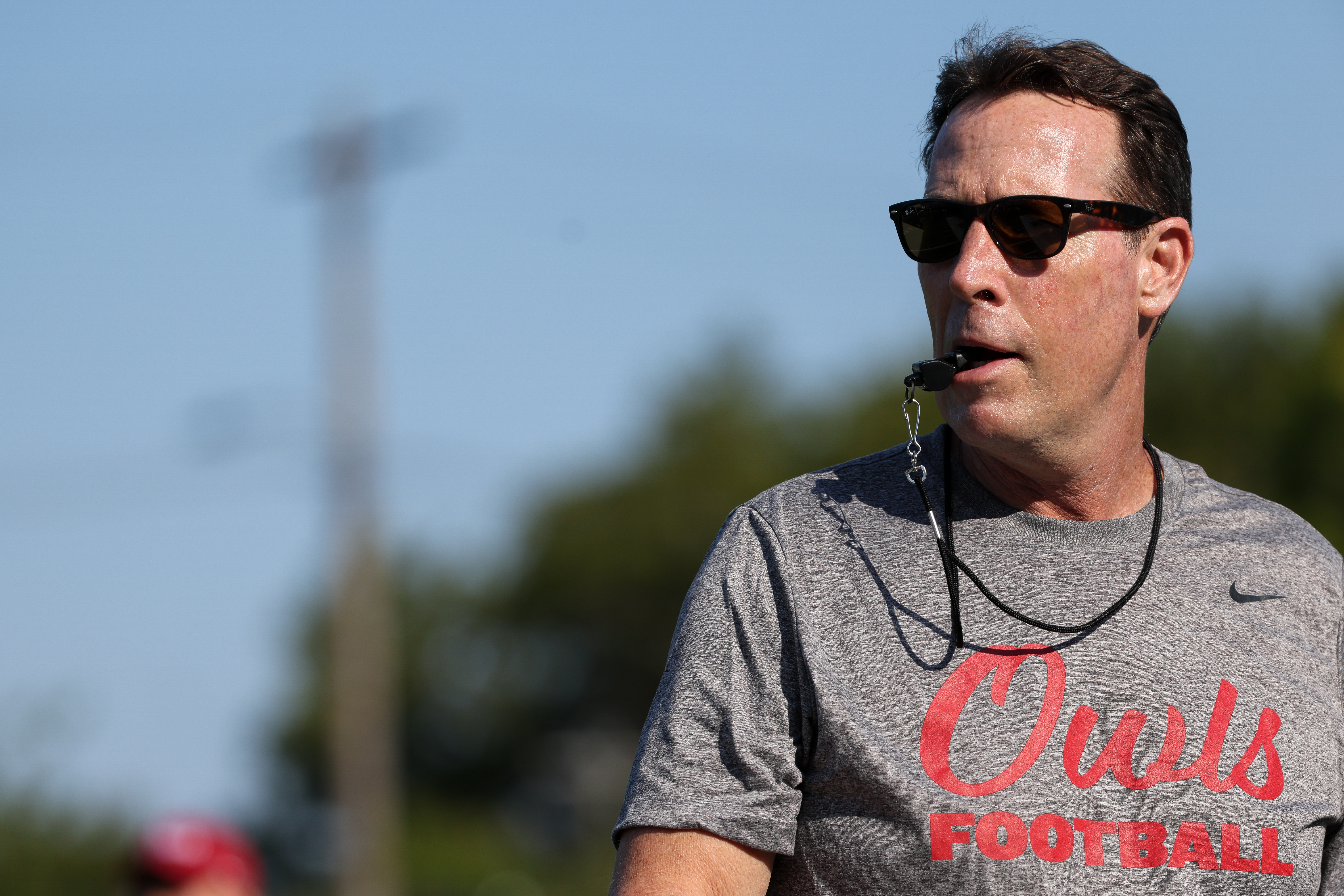
A: I have very sensitive eyes, so the lights really bother me — and I like sunglasses. I have six pairs of Ray-Bans in my backpack right now, so I like to change them up a little bit too. They have a bobblehead of me with my sunglasses on. I’ve been known to support the sunglasses. It’s a little bit of a trademark, but also the sensitive eyes go along with it.
K.C. Keeler spent 11 seasons as the head coach at Delaware.AP Photo/Nancy Palmieri
Q: As someone who grew up in Lehigh County and spent the bulk of your coaching career out East, what does it mean to come back after 11 years at Sam Houston State?
A: My wife’s a Penn grad, we met in the city. I was with the Eagles as a last cut [under] Dick Vermeil, and so we met in the city, fell in love in the city. … We have three grandchildren, and my wife and son-in-law are in Wilmington — this is home. I always tell the story that when the deal was finally done, we had just beaten Liberty Friday night to clinch a 9-3 season and a good bowl game. It was [my wife’s] birthday. I get the call from my agent that the deal’s done. I come back in and tell her, “Hey, listen, we are going back East,’ and she cried for an hour. I’m trying to explain to everybody in the restaurant, these are happy tears.
Q: There’s a lot of anticipation around this team. What would you say to fans about the direction of where this program is heading?
A: There’s been greatness here before. It’s not like I’m trying to reinvent anything. … One of my most vivid memories of any situation in my entire career was a locker room after we played Temple. We [Delaware] were the No. 1 team in the country in 1978 — don’t do the math — going to play Temple at the old Veterans Stadium, and they just embarrassed us. It was a different, physical brand of football that we weren’t used to, and they also just had this tremendous talent. Then the next year, that team I played on at Delaware, we won the national championship. We went 13-1. Our loss? To Temple. I have a pretty good perspective of where this place has been — and Temple can do it again. We had the No. 1 recruiting class in the conference. I don’t remember Temple doing that recently.
K.C. Keeler led the Owls to a 5-7 record in 2025.Yong Kim / Staff Photographer
Q: This year will mark 10 years since Temple last won an American championship. What stands at the forefront when you think about goals this season?
A: We want them to think about winning enough games to go to a bowl, winning a bowl, and maybe we can win enough [games] to get [to] that conference championship game. That’s kind of where I’m trying to set their sights. … If you’re realistic, don’t play for me. I want you to be unrealistic. I want you to dream dreams that are bigger than you possibly could imagine, because life is short. When I was at the FCS level in my first press conference at Delaware and Sam Houston, I talked about winning a national championship. … Our goal here at Temple is to be the best football program in the country. … I do believe we can become a team that can be playing in that conference championship game, and there’s a good chance that team plays in the big tournament.
The reality is that everyone knows we play Penn State the second week. I know it because that’s all I got asked when I was at media day. … But we got to worry about playing Rhode Island.