Early Saturday morning, I clambered out of bed and pulled on the required brown Spandex. With my hair slicked back into a ponytail, I hustled down to Friends Select School in Center City, a yoga mat slung over my shoulder. There, on the private school’s rooftop turf, awaited hundreds of my peers all clad in the variations of the same Jacklyn.fit-branded workout set, the allure of complimentary energy drinks and facials, and the promise of rapper Waka Flocka Flame.
This was Sweat & Sculpt, a mat Pilates class slash wellness bazaar slash concert. It’s the brainchild of influencer and Sea Isle City native Jacklyn Romano (aka Jacklyn.fit online), who bills the women’s workout-palooza as a “one-of-a-kind celebration of female empowerment, fitness, and community” and the “largest women’s event” in Philadelphia. That’s a difficult superlative to quantify, but organizers said there were more than 800 women in attendance.
“A lot of people are like, ‘Wait, is this real? Like 800 girls in matching workout sets and Waka Flocka?’” Romano told me. (Nearly everyone I told about this event had a similar reaction, with notably more expletives. One friend texted me, “I can’t even believe that’s a real sentence.”)
That singularity is what interested me — how someone could successfully marry a $120 “viral Pilates event” and the song “No Hands.” A TikTok commenter said it best: “Pilates & Waka is a diabolical combo.”
So I went, I worked out, I Waka’ed. And I didn’t expect to leave feeling so girly and giddy and genuinely moved by the body-positivity of the same man who wrote “Round of Applause.”
Influencer Jacklyn Romano leads Sweat & Sculpt at the Friends Select School on Saturday, Aug. 29, 2026, in Philadelphia.Tyger Williams / Staff Photographer
Sweat & Sculpt’s mantra
Six years ago, Romano’s brick-and-mortar fitness business was thwarted by COVID-19, so she pivoted to Zoom classes. Then, three years ago, she parlayed her online success (some 111,000 followers on Instagram and 20,600 on TikTok) into in-person activations — a burgeoning trend of social media stars taking their shtick on the road. This spring, for example, I wrote about another influencer, TikTok’s “Dense Bean Salad Girl,” who sold takeout containers of her signature salads at a pop-up near Rittenhouse Square.
A trainer for nearly a decade, Romano said she had always looked for an event like the one she ended up creating with Sweat & Sculpt: An inclusive space for women to get fit, make connections, and feel powerful. Despite the steep admission fee — which included the brown bra and your choice of leggings or capris, with an optional, additional $20 tank top — Saturday’s Sweat & Sculpt was the largest yet, according to Romano. (Full disclosure, I was comped my ticket and athletic garb because I was writing about the event.)
“Once [these women] leave here, they’re also shining from the inside out,” Romano said. At 8:45 a.m., she was already bubbly and energetic, bouncing from fan to fan and selfie to selfie. As we chatted briefly, her tooth gem caught the morning sun and her red-ink patchwork tattoos peeked out from her capris.
“They’re leaving with new friends, they’re leaving with a new form of confidence, they’re trying something new,” she said.
Cousins Dakota Hurwitz, Caitlyn McHugh, and Crystal McHugh have followed Romano for years. They’ve watched as her events grew fortyfold, from 20-person classes in Sea Isle to filling up soccer fields. Here, they said, they found community.
“It’s more than just a workout class,” Hurwitz, 26, of Bucks County, said.
Crystal McHugh, 31, of Northeast Philly, added: “It’s not just [about] confidence, it’s empowerment.”
Admittedly, before this event, I was not familiar with Romano. I recently deleted most social media apps from my phone, expressly because of the constant barrage of body checking, nutrition misinformation, ads for fat-loss miracle drugs, and commentary on what women should or shouldn’t look like. It started to feel like a nightmarish echo chamber of shame.
Romano’s brand, she said, defies that: The workout sets come in an expansive size range, from XS to 4X, and she encourages people to “worry about how you feel” but “not how you look.”
“I try to take a positive spin onto social media,” she said. “On our page, you get to see every different kind of person. No matter what size, what fitness level, what race, what religion — we all come together and we all want to empower each other.”
The workout
Sweat & Sculpt was promoted as low-impact, body-weight mat Pilates.
Don’t be fooled. That doesn’t mean easy.
I’m an ex-ballerina who’s been doing Pilates since age 11. I’m 27 now, so that’s more than 15 years of — albeit on again, off again — Pilates practice. At one point, I was taking as many as five mat classes a week; nowadays, my exercise routine consists of long walks, occasional reformer Pilates, and a weekly gym session with a personal trainer.
Yet by the second set of single-leg glute bridges, my hamstrings were burning. Then came a three-minute ab circuit. According to my Apple Watch, over 42 minutes, I burned 144 calories and my heart rate reached 167 beats per minute, more than double my resting rate.
As my arms and legs started to shake, I certainly felt that sense of camaraderie and support Romano talked about: her steady stream of affirmations — “Hang tight, ladies!” — blasting over the speakers; the smiles from the women around me; finding comfort knowing that I was not alone, that we all signed up to be breaking a sweat at 9 a.m.
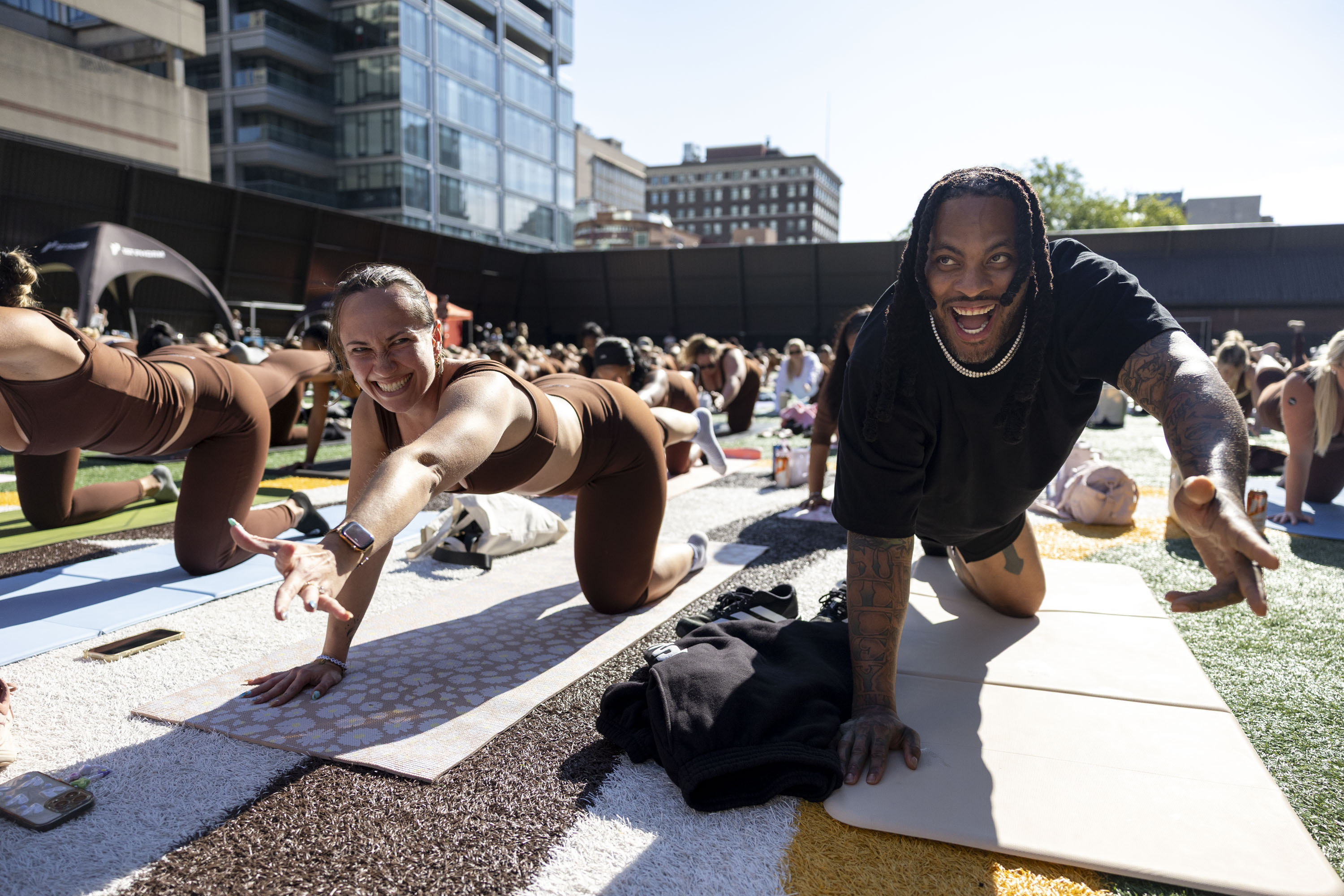
Eleven mats down from me, 6-foot-6 Waka Flocka Flame cried, “Call the paramedics!”
“Why not bring in someone who’s iconic to our generation of women and just make it fun?” Romano said. The chorus “Girl, the way you’re moving got me in a trance. …” once filled gymnasiums on prom night; hearing “‘Rain, rain, go away,’ that’s what all my haters say,” teleported me back to a college bar, my heeled booties sticking to a White Claw-laden floor.
Waka Flocka Flame performs some of his hit songs after the Sweat & Sculpt Pilates class at the Friends Select School on Saturday, Aug. 29, 2026, in Philadelphia.Tyger Williams / Staff Photographer
But before he performed his medley, Waka, whose given name is Juaquin Malphurs, took time to answer audience questions, offering reassurance to one new mom in the crowd:
“I need you not to be hard on yourself postpartum,” Malphurs, who is also a new dad, said. “The woman that you’re gonna be is not the woman you see today, and you’ll get there — don’t worry.”
“Give your body some time … then fight the fight.”
Afterward, I spoke to Tamika Ford, who was coincidentally also seven weeks postpartum.
She came Saturday morning worrying — “I’m going to be so out of shape,” she thought — and left feeling fun and light-hearted and buzzing with encouragement.
Philadelphia City Councilmember Jeffery Young Jr. intends to move forward with a limited, approximately $2 million renovation plan for the Cecil B. Moore Library in North Philadelphia, according to the city and library staff.
Young’s renovation plan for the building at 2320 Cecil B. Moore Ave. includes a new accessible elevator and restrooms, and improvements to the building’s HVAC, plumbing, fire-alarm system, lighting, and signage, according to city spokesperson Sharon Gallagher. Construction is expected to last roughly six months, she said.
The library building, first opened in 1962, will be closed during construction, and it is unclear whether the city and the Free Library of Philadelphia will operate a satellite branch for Cecil B. Moore during that time frame. The city is working with the Department of Parks and Recreation to temporarily relocate some of the library’s resources and programming to the nearby MLK Recreation Center at 2101 Cecil B. Moore Ave., Gallagher said.
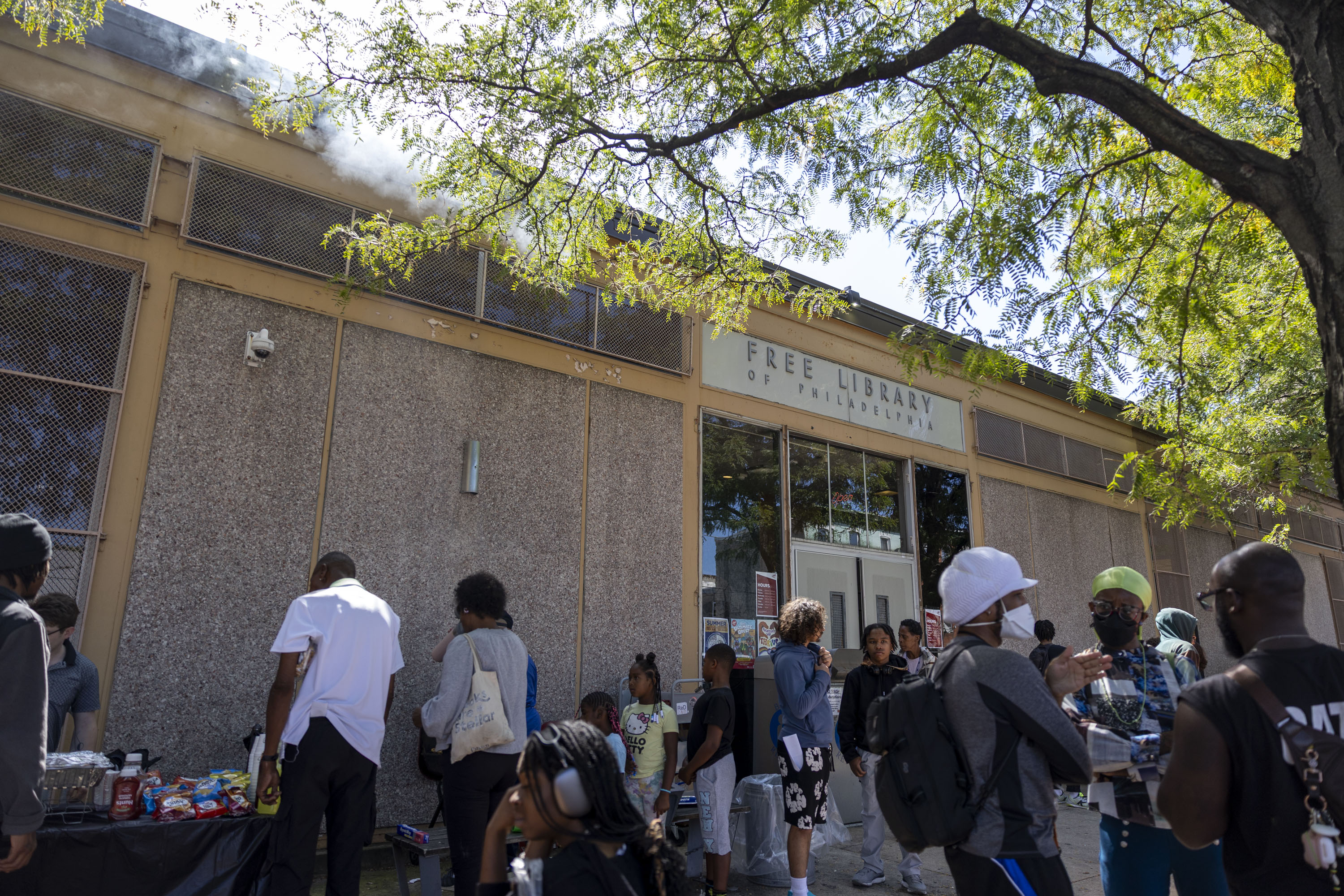
“These are important. They’re also very basic,” said Kate Goodman, a Cecil B. Moore Library worker, at a community meeting and cookout at the library on Saturday afternoon to discuss the renovations. Goodman is a union member of the American Federation of State, County and Municipal Employees District Council 47.
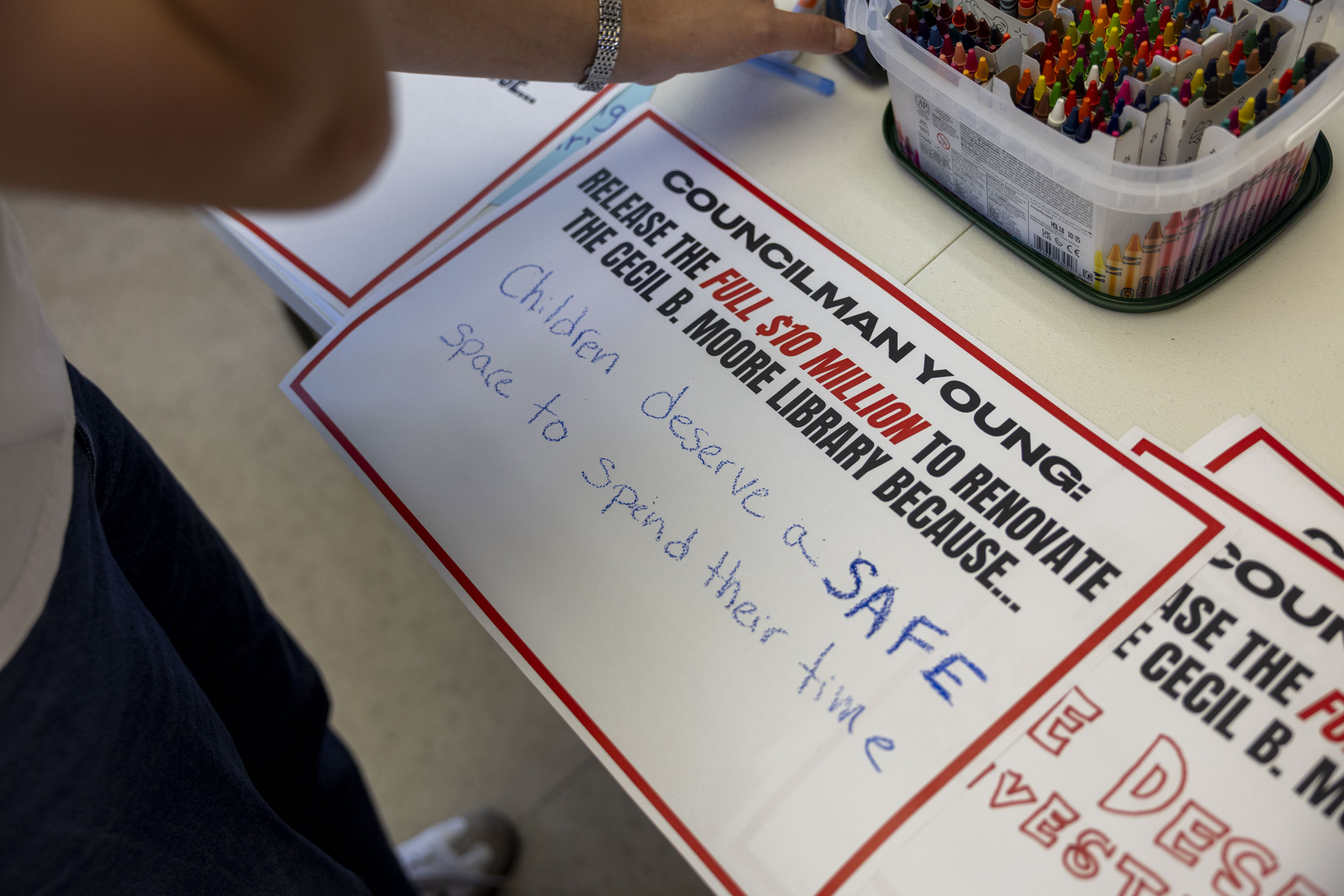
Tess Galen of Strawberry Mansion writes on a sign to bring awareness to the funding and renovations for the Cecil B. Moore Library on Saturday, Aug. 29, 2026, in Philadelphia.Tyger Williams / Staff Photographer
It is unclear when exactly construction will begin. Library staff were informed earlier this month by the city’s capital programs office that construction would begin in September, but Young’s spokesperson, Yumeno Young, said the project would be pushed back to allow for additional preparation and community engagement. He declined to give a precise timeline for construction to begin.
Halted renovation history
Young’s plan leaves about $8 million on the table, since roughly $10 million has been raised and allocated toward the renovation project over the last several years. A modest $1 million in renovations were originally scheduled to begin in October 2024 through the city’s Rebuild initiative, but community members and lawmakers fought to secure a total of roughly $5.3 million for the project.
Rebuild developed a comprehensive renovation plan for the library, which community members and staff still support. It includes much of Young’s limited plan, as well as a new teen space, a private study room, new flooring, exterior upgrades, additional computers, and more upgrades.
After Young came into office in 2024, replacing outgoing Council President Darrell L. Clarke, he secured an additional $5 million from the city’s 2025 capital budget and delayed the project. Young used the city’s longstanding custom of councilmanic prerogative, where Council members have near-unilateral control over which projects in their district go forward, to put his stamp on the plans.
Over the last few years, Young has pushed for several development proposals at the site and has resisted investing in the current space. Those alternative proposals have included demolishing the current building and constructing a new building with both a library and affordable housing on top, or moving the library to a new building at 19th Street and Cecil B. Moore Avenue and converting the existing building into another public space.
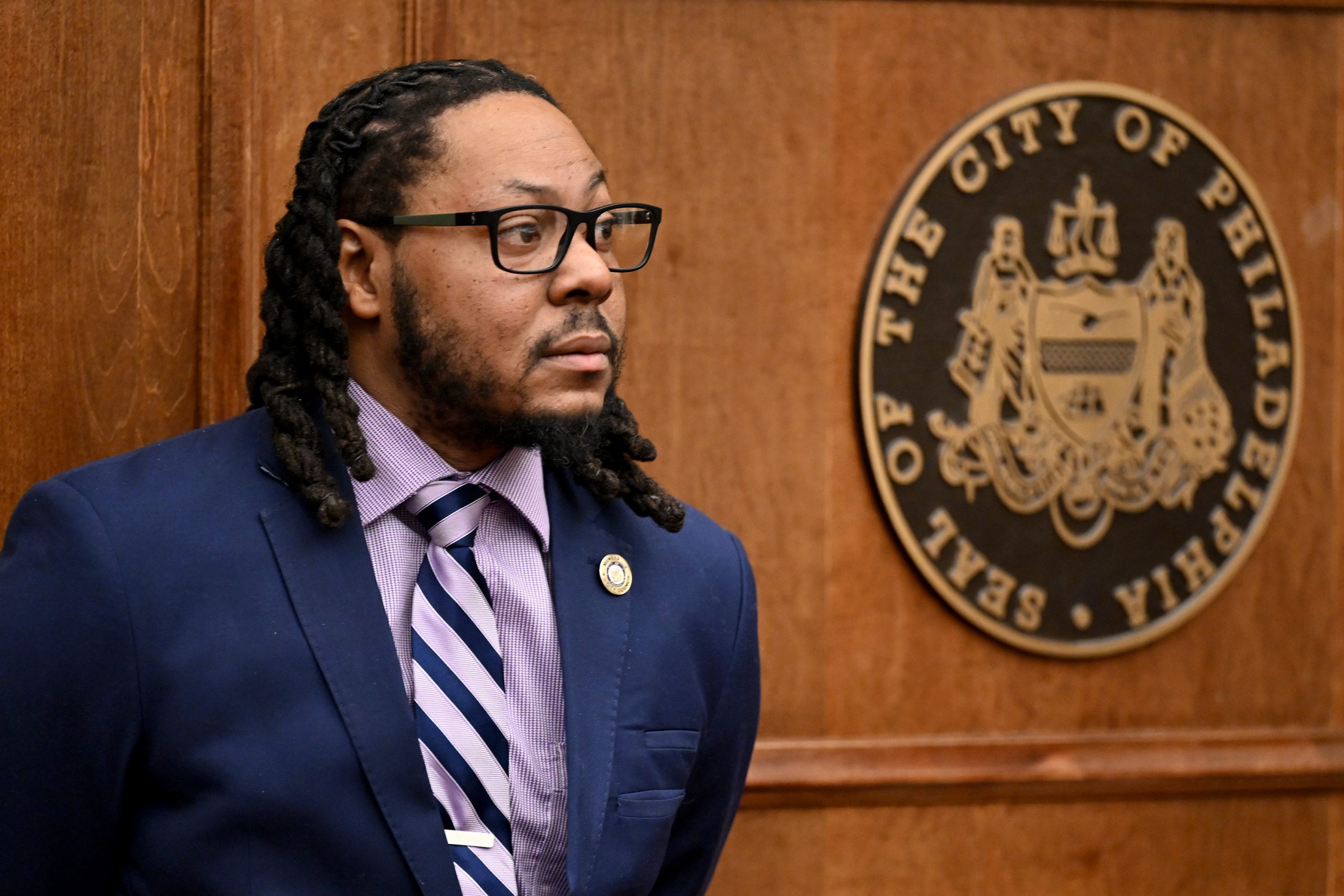
Councilmember Jeffery Young, Jr. in chambers as City Council meets Dec. 11, 2025.Tom Gralish / Staff Photographer
Young and the city declined to comment on what will happen with the other roughly $8 million that has previously been raised for the library renovation project, or why the Council member has opted for this plan despite significant community pushback. Young will host a community meeting sometime in September to provide more details on his plans, his spokesperson said.
Should construction begin soon, that timeline would set the library to reopen before May, when Young faces a likely contentious reelection. The Democratic primary is expected to feature several challengers for Young’s 5th District seat. He is considered the most vulnerable Council member. When Young first ran for office in 2023, he was unopposed in the primary election.
“Neither the Council member’s work on this project, nor our office’s efforts to advance it, are being driven by his reelection,” said Yumeno Young.
The library’s fate will play a significant role in the upcoming election for all candidates, not just Young. Joel Northam, a local resident and organizer with the Philadelphia Party for Socialism and Liberation, said he and other organizers will push the candidates to meet the community’s demands for a fully funded library renovation, or risk losing support.
“If you want that seat in District 5, you have to pledge to release the full $10 million to renovate,” he said.
The ‘soul’ of the community
At Saturday’s community meeting, library patrons spoke about how meaningful the library was to them, and how frustrated they were with how Young has presided over the renovation project. Goodman said the library has had a 70% increase in patrons since June 2025, despite the renovation delays.
Jayden Jackson, 18, loves to flip through comic books and manga at the library, especially ones about Sonic the Hedgehog. He started volunteering at the library a few months ago, because he also loves the community and atmosphere at the branch.
Volunteer Jayden Jackson, 18, of Sharswood, speaks at a community meeting about the importance of the Cecil B. Moore Library on Saturday.Tyger Williams / Staff Photographer
Jackson said the recent developments had provided a good opportunity to keep pushing for the library to receive all of the help it deserves, not just a limited renovation.
“It’s like a light in the middle of the neighborhood,” he said.
Karris Cantrell, 45, said Young’s handling of the library has been so frustrating it has made her want to cry sometimes. She wishes he understood “that he’s not God, that he just can’t do whatever the hell he wants” with the building, she said.
She and her three children have all been regular visitors over the years, and she said the place is as instrumental as a person’s daily coffee and as comforting as a child’s blanket. Cantrell believes the library deserves a full renovation immediately, so it can continue serving patrons in the neighborhood like her family.
“This library is not just a building and it’s not just books. It’s a soul,” she said.
Josh Greene is a rising left-wing social media star with his own podcast, nearly 800,000 followers, and access to politicians like Sen. Bernie Sanders of Vermont and Mayor Zohran Mamdani of New York.
He has used that platform to support dozens of progressive candidates in the midterm elections, ranging from low-profile, down-ballot contests to some of the nation’s marquee Democratic primaries. In camera-facing videos, Greene informs his followers of his preferences, calling some candidates “the most viable” and, in other cases, declaring that “this is the candidate for you.”
He does not always tell his viewers that he is being compensated for his support.
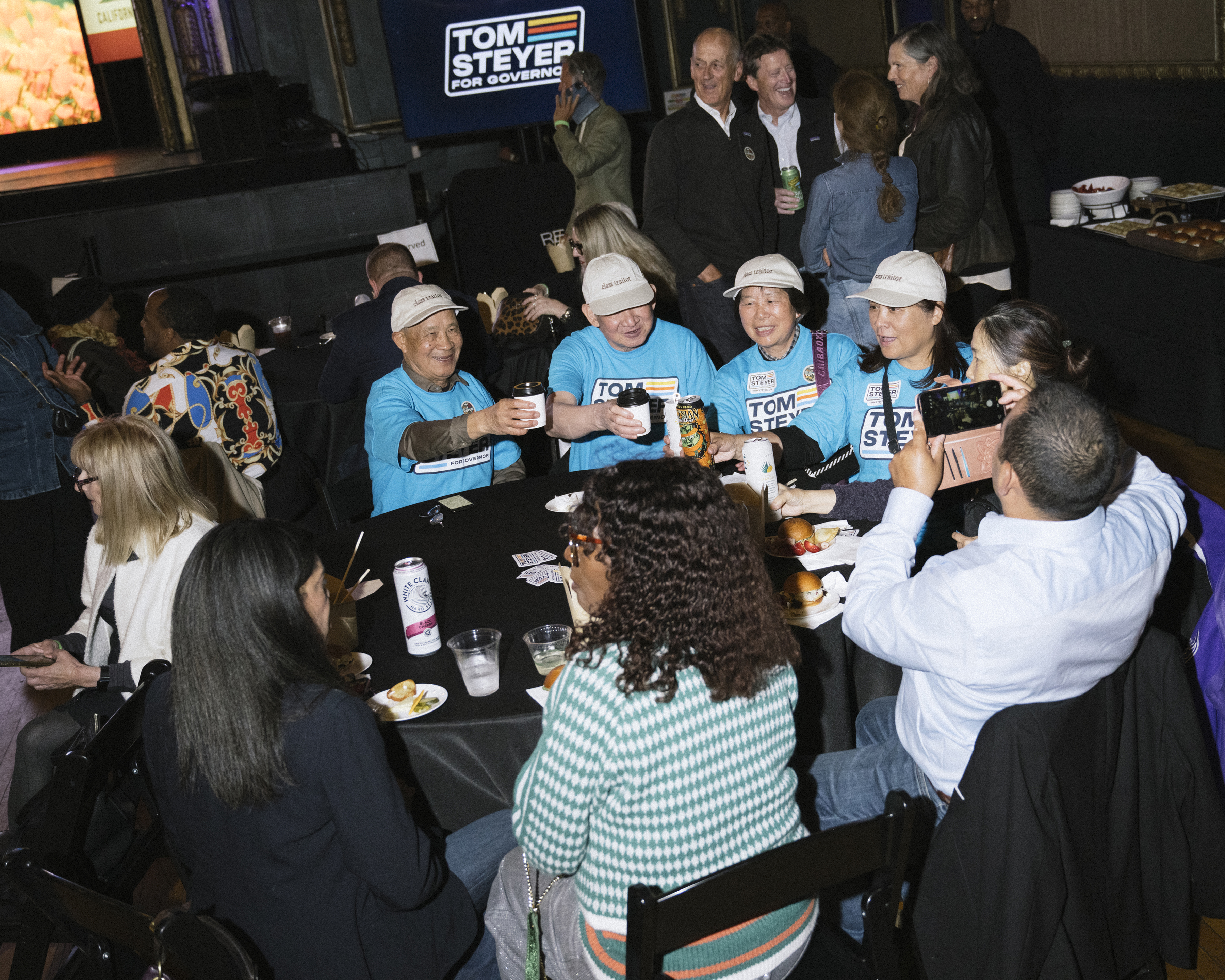
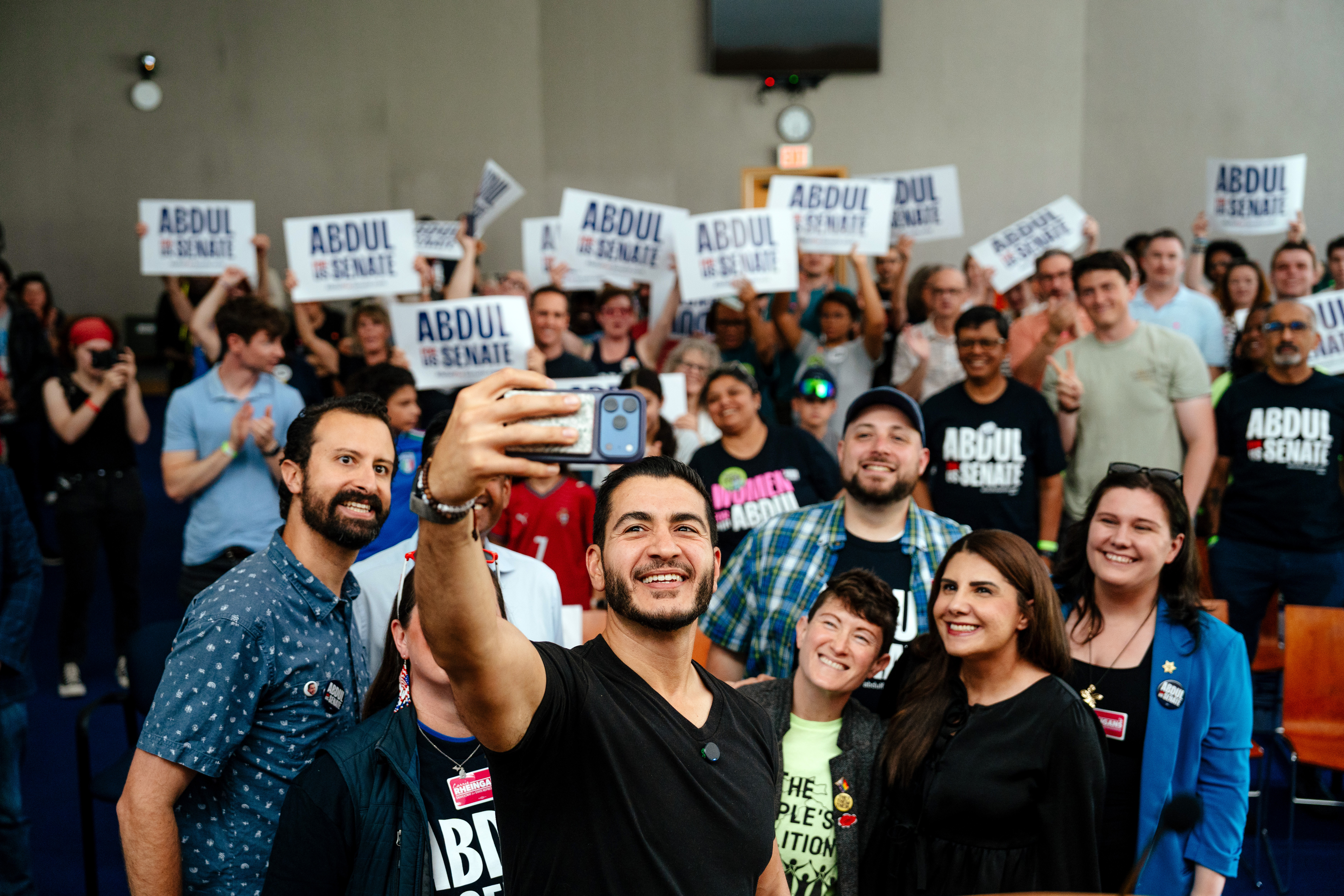
But records show that Greene, 26, has received money from at least seven politicians, or outside groups supporting them, in the current campaign cycle, including several congressional candidates in New York and a super political action committee linked to Abdul El-Sayed, the Senate nominee in Michigan. Tom Steyer, a former candidate for governor in California, paid him $21,500.
Abdul El-Sayed, the Democratic candidate for U.S. Senate in Michigan, who is trying to bring his party together after a divisive primary, at a June 28 campaign event in Ann Arbor, Mich.NICK HAGEN
Greene, who lives in Southern California and is best known by his handle @joshtheprogressive, is among a growing number of influencers who, at a moment when campaigns are increasingly willing to pay for online attention, appear willing to put their mouth where the money is.
As more people spend time scrolling on their phones, campaigns view these shows of support from influencers as a vital way to reach voters. They are also significantly less expensive than traditional advertising.
But unlike campaign mailers, billboards, and television spots, these messages fall into a legal gray area.
There are no federal regulations requiring disclosure of payments for political support on social media, and only a few states have such rules. That allows influencers, in most instances, to endorse candidates for a fee without ever disclosing those payments in their posts. Creators say some campaigns have even asked them to actively conceal the fact that they’re being compensated, making it impossible to know what’s genuine support — and what is pay-for-play.
In most cases, the only way a viewer would know an influencer is being paid would be to search a candidate’s campaign finance reports, as the New York Times did to discover the payments. Even then, such compensation is regularly obscured by funneling the payments through middlemen.
“It’s completely out of control,” said Suzanne Lambert, a progressive influencer and comedian with more than 1.3 million followers between TikTok and Instagram. She said that while she happily promotes candidates she likes, she has “never taken a cent” in exchange for an endorsement and worries that the practice distorts the democratic process. “People don’t know what’s real anymore,” she said.
Greene defended the idea of influencers getting paid for their work and noted that he accepts money only from candidates and campaigns that he would support anyway. “I turn down offers every single day because I’m not going to take money from anyplace if I don’t agree with it,” he said. (In the case of the Steyer campaign, Greene said he was initially critical but came to see him as the most viable candidate.)
Still, he suggested there was a need for straightforward and consistent rules on disclosure. “If anything, we do need more clear transparency laws so that creators like myself aren’t confused,” he said.
Coordinated networks
The phenomenon is bipartisan.
In June, Rep. Barry Moore of Alabama filed a complaint with the Federal Election Commission, alleging that at least eight social media accounts were being paid to attack his military record during the Republican primary. In April, a newspaper in Kentucky revealed what appeared to be a coordinated network of influencers boosting Nate Morris — at the time running in a Republican Senate primary — even though none acknowledged being paid for their efforts. Ken Paxton, the attorney general of Texas and the Republican nominee for Senate, benefited from a paid campaign on the social platform X when he was facing impeachment in the state several years ago.
But the question of paid influence has gained particular attention in recent months thanks to aggressive efforts by a handful of Democratic candidates to secure support from well-known influencers.
During California’s hard-fought primary this spring, Steyer’s campaign paid 17 influencers at least $5,000 apiece, including one, Carlos Eduardo Espina, who has over 14 million followers on TikTok and received a total of $400,000, campaign finance filings show.
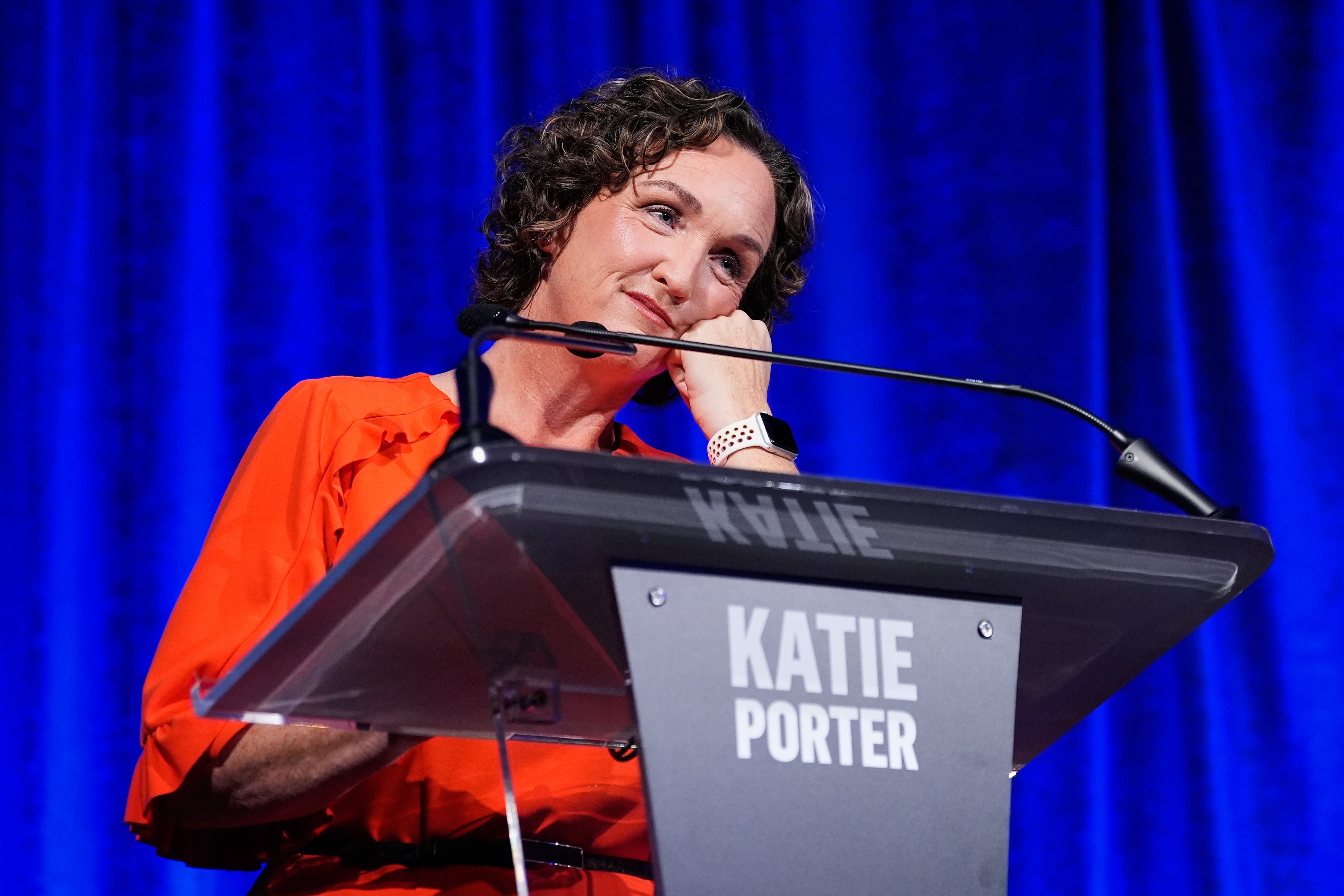
Katie Porter was one of several candidates to deploy paid influencers during the California gubernatorial primary in 2026.Godofredo A. Vásquez
Former Rep. Katie Porter, who also ran unsuccessfully for California governor, paid 12 influencers a total of $139,500. One of them, a lifestyle creator named Avery Cyrus with 9.5 million followers on TikTok, received $25,000 for what appeared to be a single post claiming “Katie Porter’s thing works.”
Cyrus’ post was deleted after the Times inquired about it. She did not respond to a request for comment made through the social media agency that represents her, UnderCurrent Media, but the firm’s CEO, Eric Bogard, said in an email that it “was not asked to oversee disclosure compliance, nor were we provided instructions concerning any required disclosures.”
Under California law, paid political posts on social media must be disclosed. A Times review found three posts supporting Porter on TikTok from influencers who were paid by her campaign that did not include any disclosures. In seven other instances, the disclosures could be found only after clicking through to a hidden section of TikTok for comments flagged “as potentially offensive or disturbing.”
Sander Jennings, an influencer based in Florida who was paid $22,000, said “the Porter campaign and I agreed to disclose the payment” in TikTok’s comments section in order to get around the site’s practice of removing paid political posts. He said he did not know why the disclosures ended up in the hidden section of the comments.
TikTok’s terms of service bar all paid political advertising, including “creators being compensated for making branded political content.” In an email, Porter said that “nothing was paid for and posted without review and coordination and compliance with all law.”
Other political efforts have employed a different strategy, contracting private firms that pay little-known content creators smaller sums to put out a large volume of posts. Those companies, known as user-generated content platforms, or UGCs, operate on the principle that carpet-bombing the internet with hundreds of nearly identical posts is more likely to generate viral content than paying one large influencer the same amount of money to make a single post.
This spring, a woman posted dozens of videos promoting Steyer in the California primary. Weeks later, she appeared in videos from a different account complaining about the cost of living “here in Michigan” and encouraging people to vote for Rep. Haley Stevens, El-Sayed’s primary opponent in the Senate race. Then she pivoted to a third account talking about affordability in Wisconsin.
Corporate records show that the woman, Paige Dunmeyer, actually lives in Kansas City, Mo., and is registered to work with a UGC company called SideShift. It’s not clear how much she was paid for her Michigan and Wisconsin videos, but she has earned more than $30,000 on SideShift for a variety of political and commercial campaigns, according to company records reviewed by the Times. Filings from Steyer’s campaign showed she received $1,320 for her efforts in that race. Dunmeyer did not respond to requests for comment.
A Times analysis found that at least 87 people registered to work with SideShift had made posts backing Steyer or Stevens, or participated in a third campaign to post video clips on TikTok supporting Rep. James Talarico, the Democratic Senate nominee from Texas. Most of the posts by those creators included no acknowledgment that money changed hands.
In a statement, SideShift said that it advised creators to follow applicable disclosure requirements, and called for more explicit laws governing how paid content is disclosed on social media.
“SideShift believes anyone can be a creator and that creators should get paid fairly for work they choose to do,” the company said.
In June, Kendall Boyle, a TikToker in Michigan with over 21,000 followers, was contacted by a social media marketing agency called Activate HQ offering her a paid opportunity to post videos about “how rising costs are affecting Michigan residents in real life.”
When she asked who was footing the bill, she was told it was Majority Forward, a dark money group linked to the Senate Majority PAC, a Democratic super PAC, email correspondence reviewed by the Times shows. Boyle said she was turned off by warnings in those emails from Activate HQ that “disclosure is not required and the paid partnership label will not be included in any posts” and also that Majority Forward “will not be mentioned” in her content.
“It was one of those things where something isn’t fitting right,” Boyle said.
In a statement, Majority Forward said the language in the email “explains disclosure requirements necessary under FEC rules, which were fully followed.”
Little regulation
Just four states have laws or regulations requiring influencers to disclose paid political messaging, but they apply only to state and local races, not federal contests. Although regulations for social media have been proposed multiple times to the FEC, it has never taken action. The Federal Trade Commission, which requires disclosure of paid commercial content on social media, makes an exception for political messaging.
Rep. Mark Takano (D., Calif.) introduced a bill in June that would require anyone paid by a candidate or political committee to clearly disclose that fact in the same way that traditional campaign materials are required to note such payments.
In an interview, Takano said he was inspired to draft the legislation after online sleuths revealed that numerous influencers had been making paid endorsements in the California governor’s race without proper disclosure, as required in that state.
“It’s unfair when an influencer is allowed to be silent or not transparent about money they’re taking from a candidate, making it seem like what they’re saying is authentic and not influenced by money,” he said.
Takano acknowledges that there are some potential loopholes in the bill. For instance: Campaigns often obscure payments to influencers by hiding them under layers of vendors and subvendors.
Porter, for example, hired Activate HQ for “influencer marketing services,” and it in turn paid 13 creators to bolster her campaign for governor. One of them, a political influencer in Los Angeles named Dash Dobrofsky, who also posted in support of Stevens in Michigan, received $15,500 from Porter’s campaign. Dobrofsky did not respond to a request for comment.
Steyer’s campaign, for its part, hired multiple digital strategy firms to manage social media, including one called Group Project, which hired a Los Angeles company, Gutsy Media, which paid Greene through UnderCurrent, which represents him.
Those payment chains are visible because California is one of a handful of states that require campaigns to report payments to subvendors. There is no such obligation for campaigns for federal office. “Every dollar spent by this campaign is publicly disclosed and available for anyone to see,” the Steyer campaign said in a statement.
‘Social media consulting’
State Rep. Chris Rabb at a July 28 event with U.S. Rep. Ro Khanna.Tom Gralish / Staff Photographer
Occasionally, campaigns or independent expenditure groups will reveal direct payments to influencers, such as the super PAC Freedom PA, which supported socialist candidate Chris Rabb’s successful bid to win a Pennsylvania House primary in May. It has disclosed payments to nearly 50 influencers for “social media consulting,” among them Greene, who received $750 and posted a video celebrating the candidate’s victory.
Other committees listing payments to Greene in federal filings employed less illuminating descriptions. Chuck Park, who unsuccessfully ran for Congress in New York’s Queens borough this year, listed a $300 disbursement to Greene as “staff salary.” Greene posted at least five videos promoting Park, none of which state that he had received payment.
Park, in an interview, said that Greene was in fact not employed by the campaign, but said that “our campaign absolutely leaned into new media” and that he spent time with Greene in Queens filming a series of videos.
Greene disclosed being paid on three of his posts about Steyer and told the Times that those videos were the only ones that he was specifically contracted by the Steyer campaign to produce. He said he didn’t receive compensation for prior posts about the candidate.
Greene has also supported Sen. Ed Markey (D., Mass.) in a competitive primary against Rep. Seth Moulton, and last month, he posted a video accusing Moulton of “posturing to be someone they really aren’t.” He posted a second video this month critiquing Moulton, this time for taking corporate political money.
Neither video includes disclosures, and FEC filings don’t show any payments to Greene related to Markey’s reelection bid. But a spokesperson for Commonwealth Together, a super PAC that is supporting Markey, said it had paid Greene $3,500 for “digital communications consulting” through his agency, UnderCurrent.
Greene, in a text message, acknowledged the payment to support Markey, saying he took it “because I believe he is by far the more progressive candidate in the race.”
The murkiness has left some in the political world uneasy. Last month Rynn Reed, the founder of Creator Congress, an organizing hub for influencers interested in politics, introduced a code of conduct for the group that would require creators to make clear when they’re paid, whether required by law or not.
“With no standards,” Reed said, “there’s going to be a race to the bottom.”
School is back in session, and a fresh high school football season is underway, so foot traffic has picked up on the sidewalk on Pechin Street that separates the locker room at Roxborough High School from its dusty, weathered, 87-year-old football stadium.
At least twice a day, down a short hill along that stretch of sidewalk to practice or a game and back up, players and coaches pass a well-tended bronze memorial for Nick Elizalde, the 14-year-old freshman who had only started playing football at Roxborough four years ago.
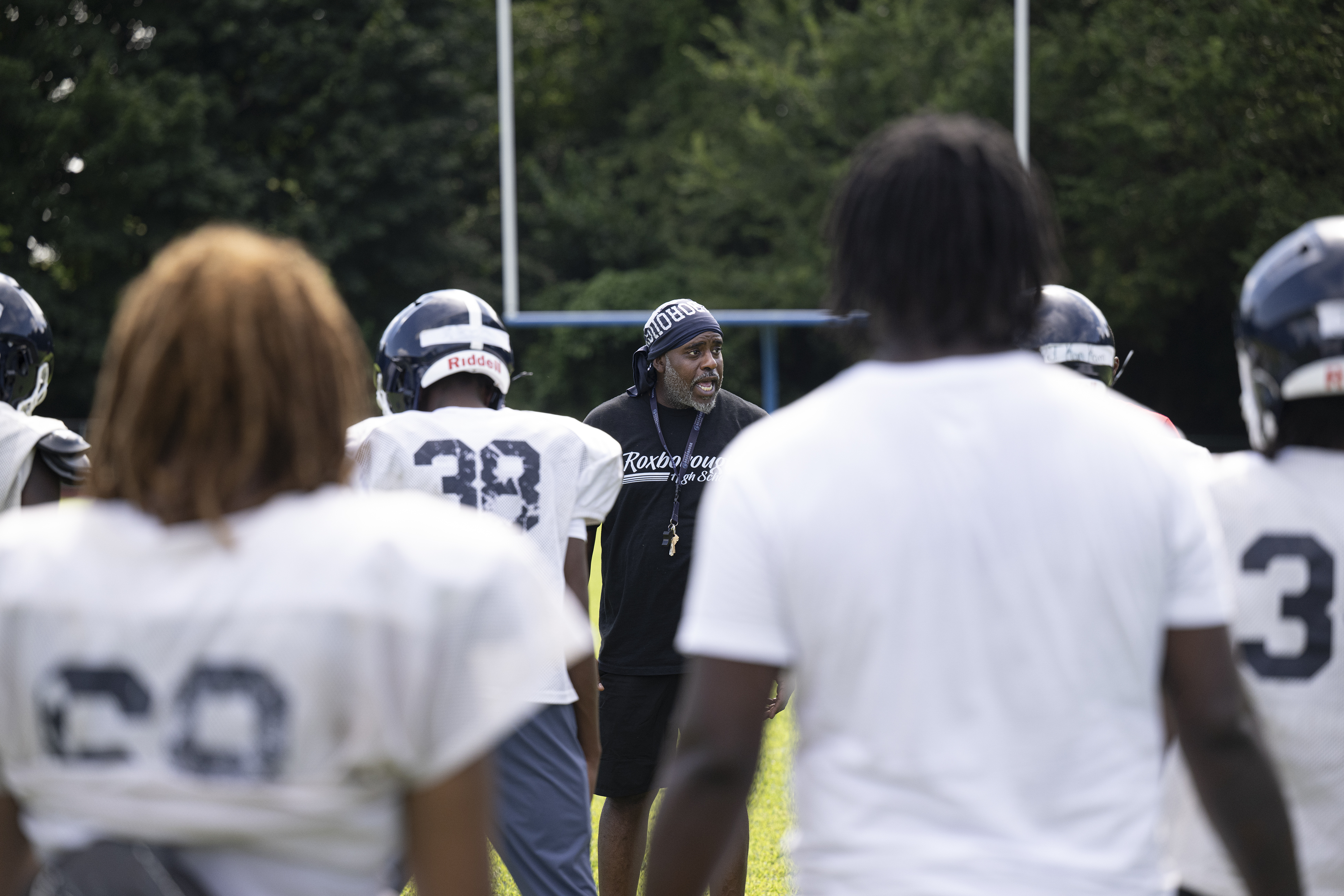
“Quiet kid, wasn’t very outspoken. But he was starting to open up and become more social,” Marc Skinner, the 47-year-old head football coach at Roxborough, told me before practice last week. “Then we ran into that tragedy.”
Yes. That tragedy. The memorial is roughly at the spot where Nick was gunned down when five shooters fired more than 60 bullets toward a group of football players following an afternoon scrimmage on Sept. 27, 2022. Skinner, then an assistant coach, was there.
But none of the 35 or so members of the current Roxborough football team were there because they all were in junior high school. Two captains, senior defensive end Zaid McDonald and senior quarterback Javon Jones, said they certainly know about Nick even though they never got a chance to meet him.
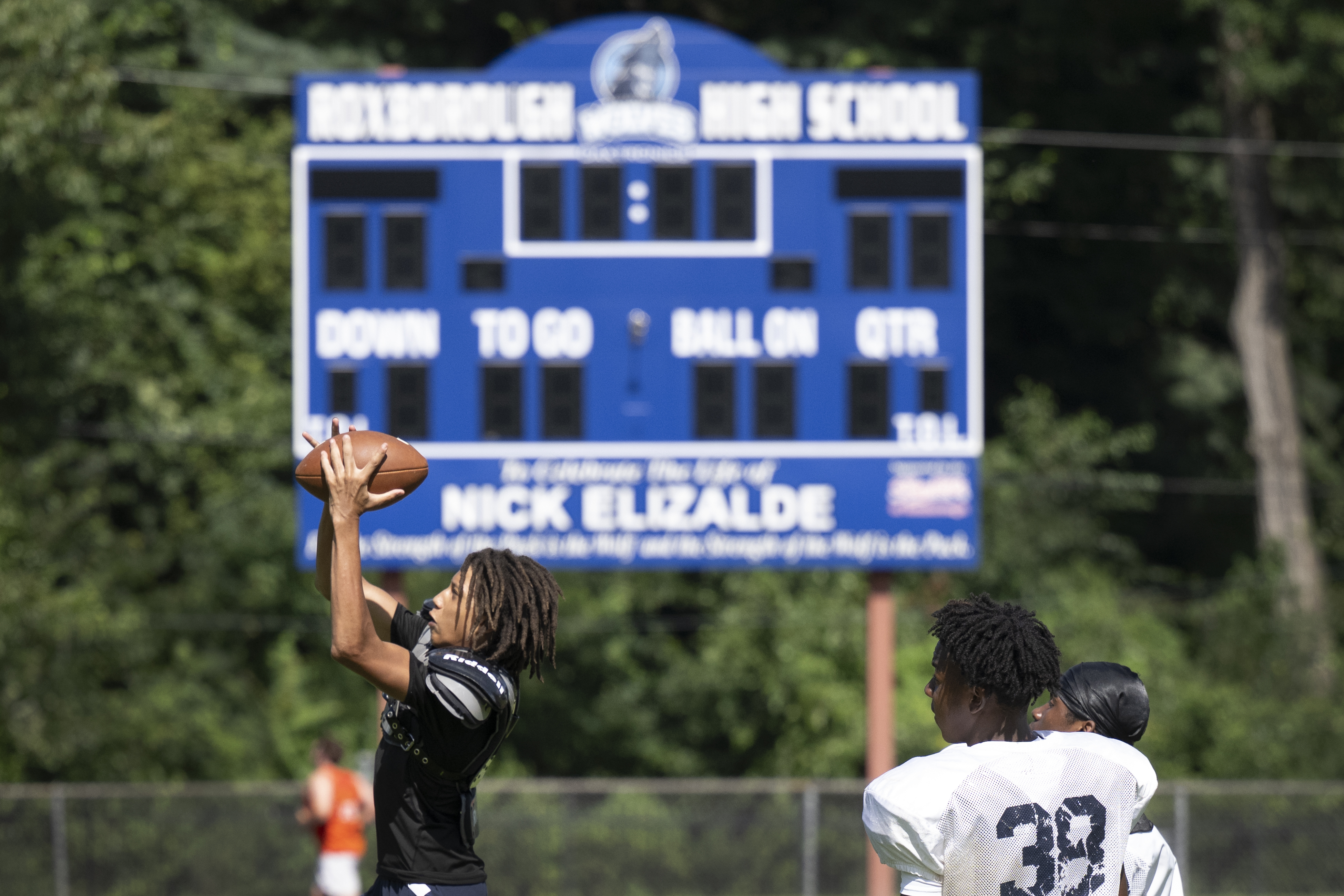
There is a new mural with a large “62” — Nick’s jersey number — at the back of the school, and a new scoreboard at the field celebrating Nick. Skinner said he was planning to put No. 62 stickers on the players’ navy-blue helmets before Friday’s season opener.
Roxborough High School football players gather for on-field drills during an after-school practice Aug. 21 at Nick Elizalde Stadium.Jose F. Moreno / Staff Photographer
But make no mistake: The Roxborough Wolves are excited about their chances this season. Last year’s team won four of its 11 games, and the first winning season in seven years feels within reach. As Jones said of the 2025 season, “I feel like we got better as the season went on.”
McDonald would add, smiling, “Playing for Roxborough — oh, you really got to work, because not everyone is on the same level.”
Of 571 high school football teams in Pennsylvania, Roxborough ranked 514th entering the season, according to the MaxPreps ratings website. But the Wolves, like the 570 other teams, will start each game this fall with a 0-0 score and a fighting chance.
And I, for one, hope to be at as many Roxborough games as I can. I live a 20-minute walk from the stadium, and as someone who both played and then wrote about high school football way back in the day, the competition is as spirited and ferocious here as anywhere. Really.
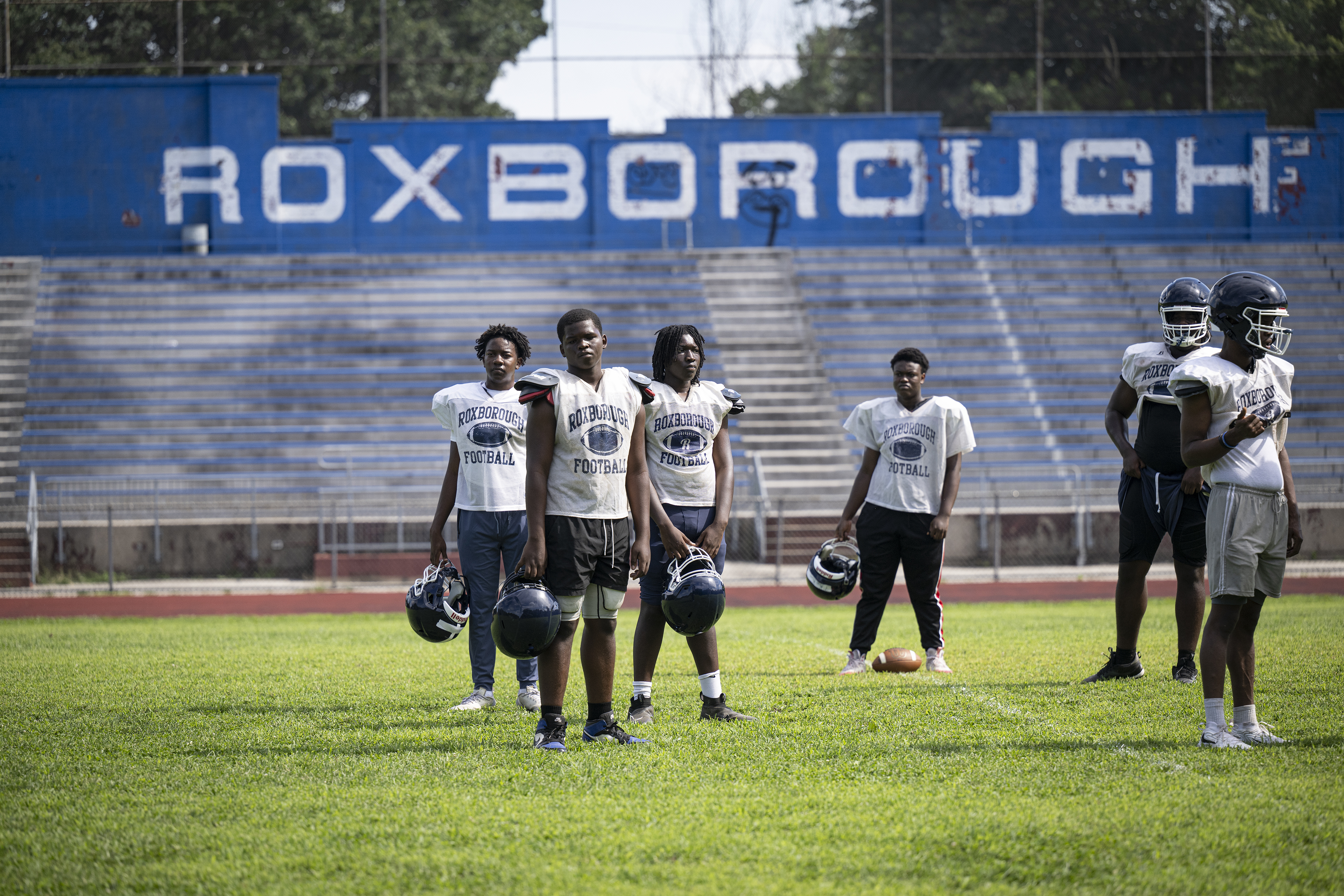
It is just that the backdrop is a little different. Games tend to be played Friday after school. Admission is free. Seats in the 2,100-seat grandstand, with a fence still separating Roxborough fans from visiting fans, are easy to find, because 100 people, tops, might show up. There is a dance team on occasion, but there are no lights, no refreshment stand, no press box, no programs, and no marching bands. The patchy grass gridiron is lined only every 10 yards.
Roxborough football coach Marc Skinner leads his team during practice on Aug. 21. Of the Wolves’ 4-7 record last year, one player said, “I feel like we got better as the season went on.”Jose F. Moreno / Staff Photographer
How some things have changed. The Academies at Roxborough High School, the full name of the stately, 102-year-old institution on Ridge Avenue in Northwest Philadelphia, has an enrollment of only about 600 students, less than one-third the school’s size in 1972.
The stadium, built for $300,000 by the Works Project Administration, opened on Oct. 7, 1939, for a 14-0 Roxborough victory over Olney. About 3,000 showed up, The Inquirer reported. It was Roxborough’s first game in the Philadelphia Public League.
The very next year, a full-out riot broke out after players from Roxborough tangled with players from Simon Gratz during a 33-0 Roxborough victory, with many fans joining in. Three Philly cops were needed to help the two flustered head coaches break up the melee.
Roxborough won Public League titles in 1957 and 1963, but it had become an also-ran in recent years. A Thanksgiving Day game against Roman Catholic ended in 2018 because Roxborough had not won since 1991, and lost each of the last 14 games by three touchdowns.
Skinner, who became the head coach in 2023, said turnout for football slipped during the pandemic and after the shooting, with a few potential opponents telling him they’d rather not play at Roxborough. The besieged 2022 team won its only game 11 days before the shooting.
Each of the 35 or so members of the current Roxborough football team was in junior high school when Nick Elizalde was fatally shot four years ago following a scrimmage at the school.Jose F. Moreno / Staff Photographer
“We have kids from different walks of life, and we’re bringing them together to do something they thought they could never do,” Skinner said.
A year after the shooting, the school changed its nickname from Indians to Wolves. The wolf was Nick Elizalde’s “spirit animal”: For the strength of the pack is the wolf, and the strength of the wolf is the pack, reads an inscription under his name on the new scoreboard.
Kristin Williams Smalley, the principal at Roxborough, told me two years ago that the school had been considering a new nickname, and she said: “The mascot was not necessarily named to honor him. It just happened that all of the stars aligned, and the wolf was selected.”
But the name change helped to reset, or refocus, the football program, Skinner said. Because of suspensions and academic ineligibility, Roxborough had only 17 players for a game last year against Olney. But the Wolves stuck together, played hard, and lost by only 22-7.
“Upon further reflection, the wolf is the perfect mascot to represent the Academies at Roxborough High School,” Williams Smalley said. “Wolves are complex, highly intelligent animals who are caring, playful, and above all devoted to family. That is who we are!”
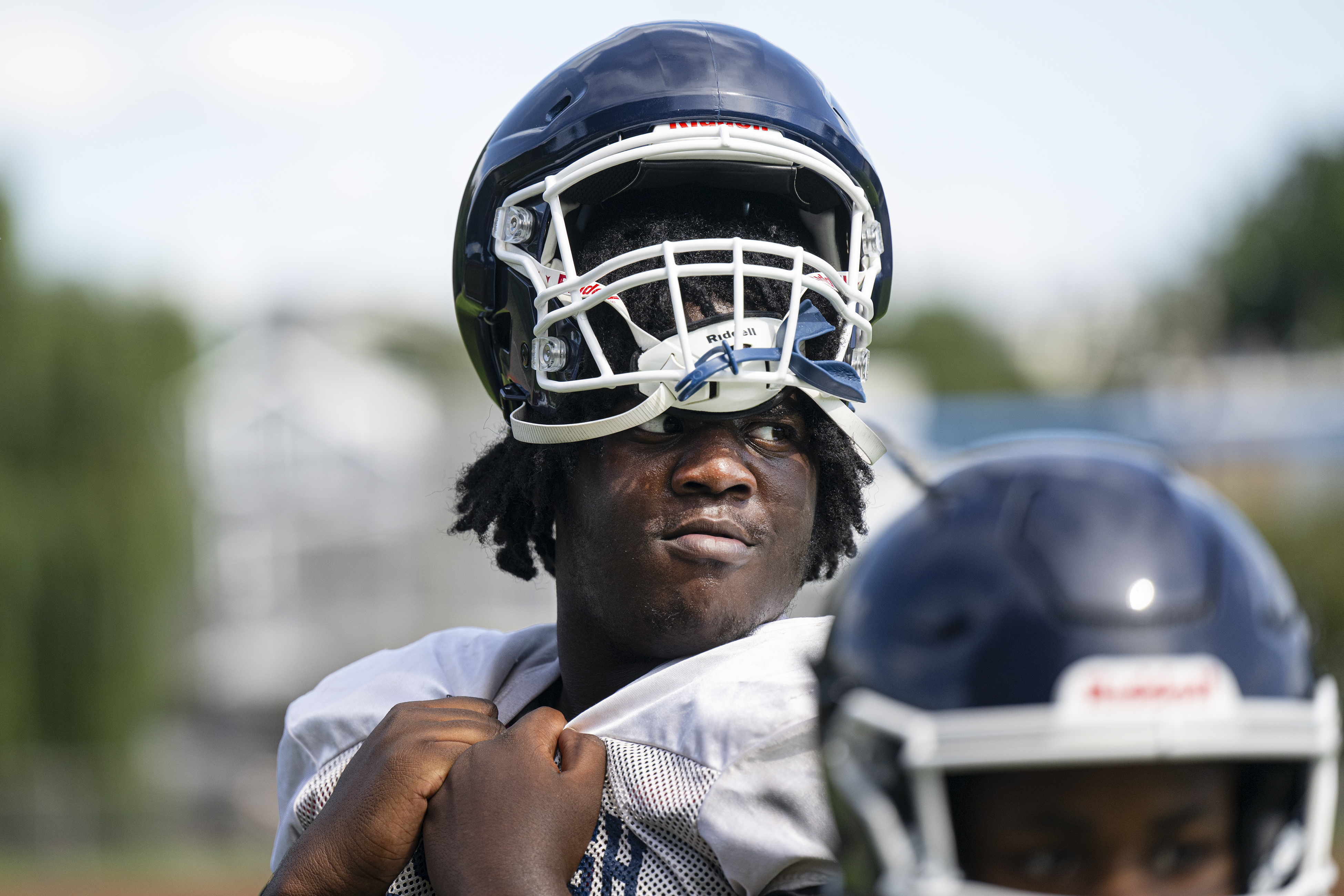
Roxborough football player Domenick Washington, a defensive tackle, looks on during practice on Aug. 21.Jose F. Moreno / Staff Photographer
He and his small staff will do the best with who shows up. These Wolves have worked hard, and together, during the offseason, he said, but there are still a few students each year who only decide to join the football team after school starts. Skinner brings them on. Nick was a student at Saul High School, but because it doesn’t have any athletic teams, he played for Roxborough.
The players on this team were too young to be around, but the coaches and many former players did know him, and could recall that awful afternoon in 2022. It needs to be remembered, but as Skinner says, “We just try not to dwell on it.”
So, click-clacking on their cleats, the players trudge up and down that hill on Pechin Street, past the site of the shooting. Four other teenagers were wounded on that awful day, and six people were arrested in connection with the shooting. The memorial to Nick serves as a reminder that the impact of gun violence is not so far away.
Nick Elizalde, 14, waiting for the bus before his first day of ninth grade at Walter B. Saul High School in August 2022. Because Saul doesn’t have its own athletic teams, Nick played for Roxborough. Meredith Elizalde
“We’re trying to keep our eyes open in the hope that our children are not involved in anything bad,” said Skinner, who is a member of the “climate staff” that keeps order at the school.
Students come from all over the city: Zaid McDonald is from Germantown, and Javon Jones is from North Philadelphia. Each would love to go on to play college football, but the opportunity would come at a small school if it did, and Jones said he would go to trade school if it did not.
But football is there for at least the next three months. A winning season and the playoffs are possible, just as they are for any of the state’s other 570 teams. And that is all any high schooler can ask for. Go see for yourself some Friday afternoon. Watch kids play football with joy.
Dave Caldwell lives in Manayunk and covered sports for The Inquirer from 1986 to 1995.
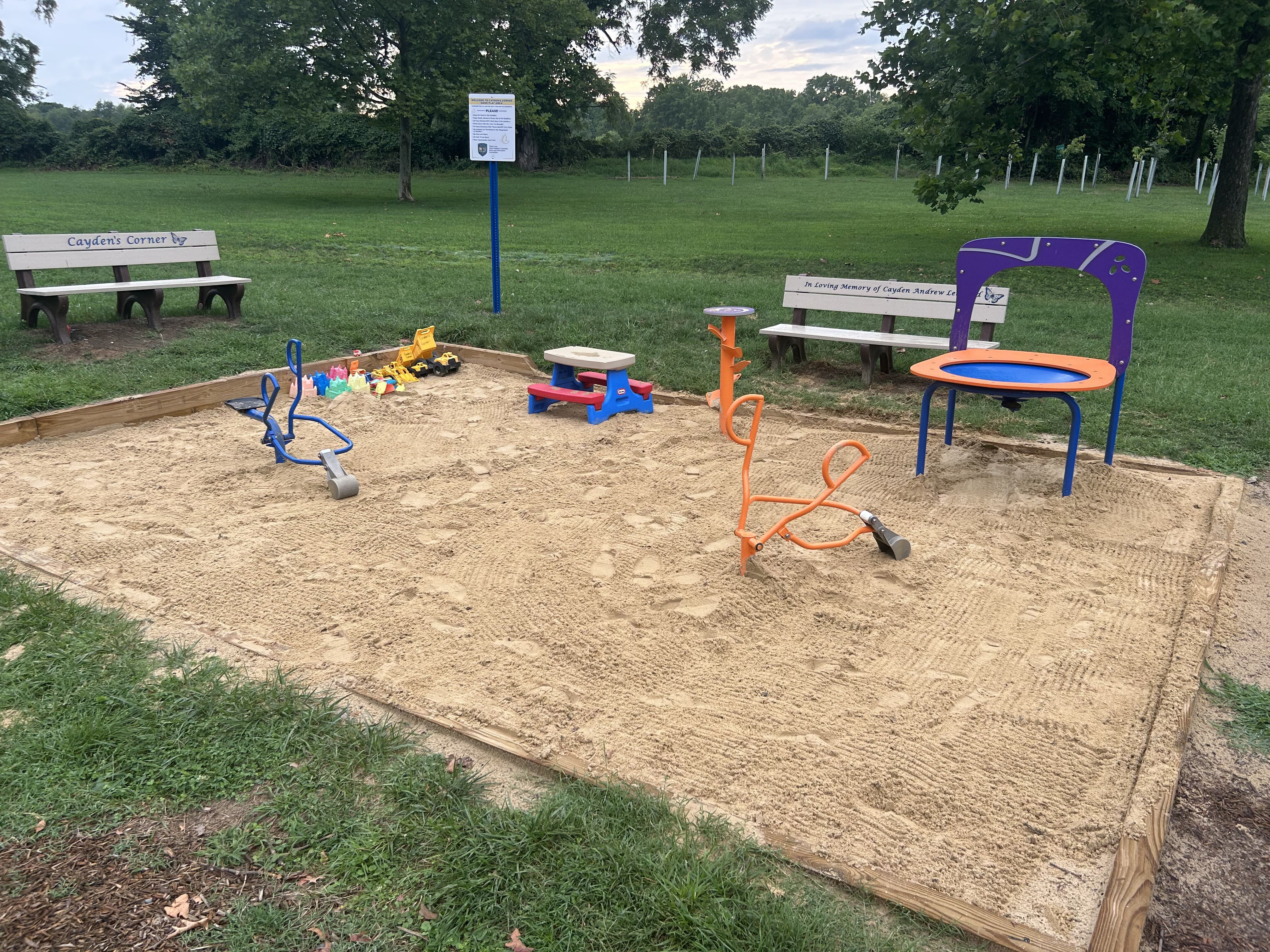
When Ryan Leithead’s son Cayden died at just 7 days old in 2022, he channeled his grief into making something. Alongside West Pikeland Township officials, Leithead worked for weeks, mostly in freezing rain, to build what became Cayden’s Corner, a sandpit play area at Pine Creek Park’s playground.
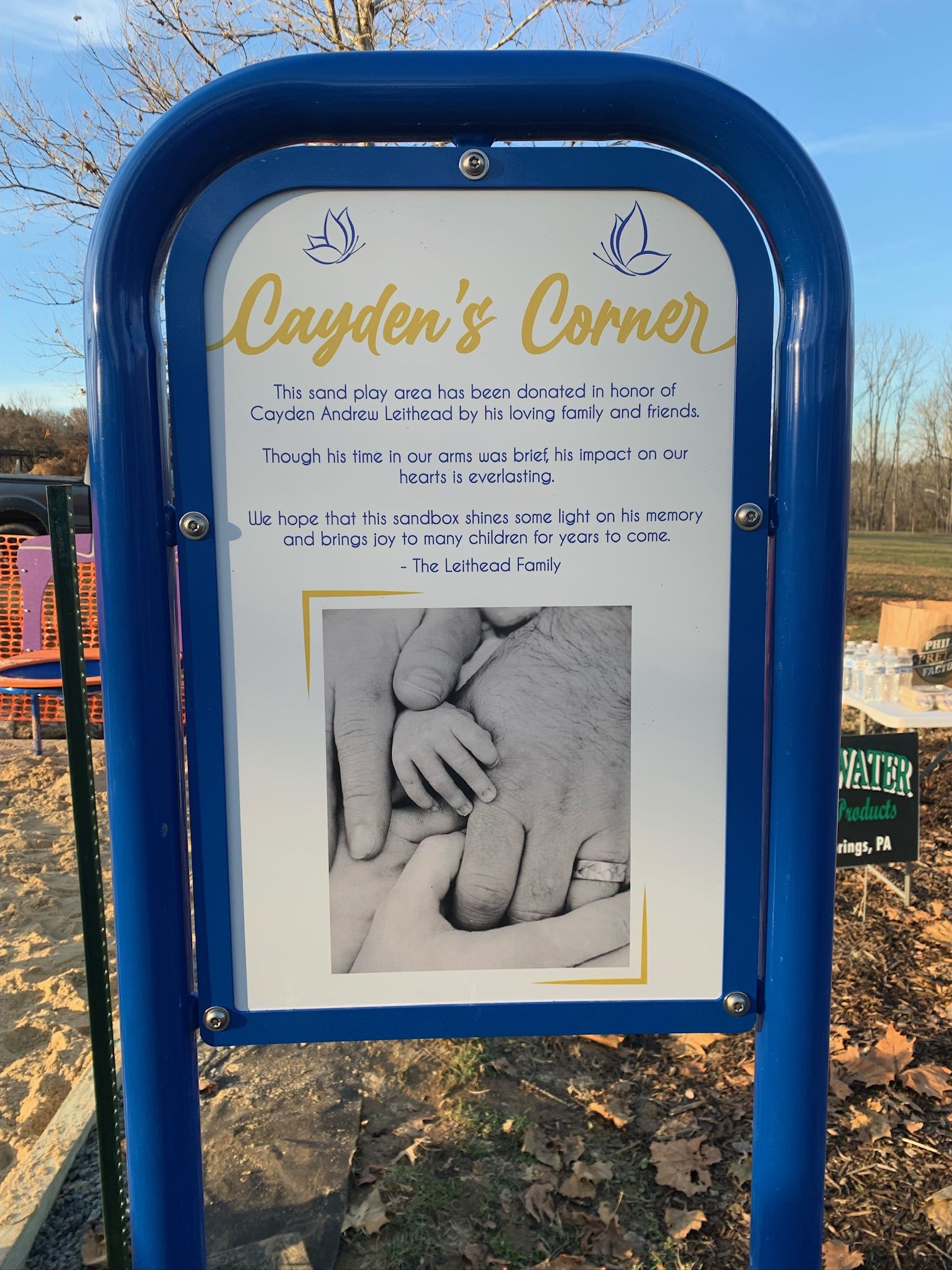
A dedication sign, with a photo of Cayden’s little hand encircled by his parents’, notes that the hope is “that this sandbox sheds some light on his memory and brings joy to many children for years to come.”
It offered a glimmer of light amid a tragic, unexpected loss. Leithead’s oldest son, 6, and daughter, 2, play there often. “It’s kind of like they’re playing with their brother because they’re there,” he said.
But now, just a few years later, Leithead, 37, worries the memorial will be swept up in proposed playground renovations, which are the subject of several grants and public fundraising efforts to update the decades-old equipment and make the site more accessible. Final plans haven’t been released yet, but officials say it could involve relocating the sandpit and replacing the memorial.
For Leithead, it feels like losing Cayden again.
“It was built by those who loved Cayden. It kind of goes into that term of ‘grief in action,’” he said. “I spent the first year after he died kind of focusing on this — right, wrong, or indifferent, that’s how I grieved. So it’s a memorial built by his father.”
The elected board of supervisors will vote on the proposal and plans “when they are available,” said Joan Blatcher, township manager. Completion of the full renovation is anticipated for mid-2027, she said.
“The intention behind Cayden’s Corner was to provide a memorial for Cayden Leithead. If the sandpit is relocated, it will continue to be called Cayden’s Corner,” she wrote in an email. “The benches and a dedication explaining the reason for the name have always been part of the plan for the new playground.”
After his son Cayden died at just seven days old in 2022, Ryan Leithead worked with West Pikeland Township to build a sandpit in honor of Cayden’s memory. Under proposed renovations of the playground, officials are considering relocating the sandpit and removing the existing dedication sign.Photo courtesy of Ryan Leithead
Leithead isn’t against renovating the playground. When he helped bring the sandbox to life, seeing the whole playground renovated was something he hoped for. His work with the project is also how Leithead became involved with the township’s parks and recreation committee. But he struggles with the idea of relocating or altering the memorial they built in the early days of that grief.
“The analogy my wife used was: Say you have a wedding ring that was a family heirloom for generations, and you lost it, and your husband turns around and says, ‘Well, I’ll just buy a new one, it’ll be bigger and better,’” he said. “It’s not the same, right? You lose the meaning behind that heirloom.”
At a meeting on Aug. 17, vice chair of the supervisors Noreen Vigilante said that the sandpit was within the “fall zone” of the swing set, according to a recording shared with The Inquirer. A preliminary design, which the township hasn’t released, would relocate the sandbox and make it bigger. A recording of the public meeting is not available online.
She also mentioned removing the existing sign dedicating the corner, saying that the playground designers felt it was “depressing.” Signage would still be there, later saying they could “negotiate” the sign, but not the sandpit’s placement.
In an email, Vigilante said that in early meetings “it was requested that the playground not be moved.” Leaving the sandpit where it is “severely limits the opportunities for a safe and accessible design.”
The sign, she said, is a “trigger for others who have also lost children or have family members who have lost children.”
“The sign is so large and centrally located that it cannot be avoided if it makes one uncomfortable. An alternative is to have a smaller sign with the same text by the tot lot/sand play area of the playground so that those who may also be grieving do not have to look at the sign when they are attempting to enjoy a playground with other children,” she wrote. “A playground should provide the opportunity for adult-child enjoyment.”
During the meeting last week, officials said they hadn’t heard of any complaints about the signwhen the Leitheads asked. Separately, Leithead said the purpose of the sign was “to honor Cayden’s life and to show how a community came together to support a grieving family.”
Other supervisors disagreed with the playground designers’ assessment.
“I don’t care what the playground people think,” supervisor Harold Hallman III said at the meeting. “It’s a park of West Pikeland playground. It’s a part of West Pikeland. It should stay there.”
An early supporter of the memorial plaque and sandpit, Vigilante wrote in an email that she continues “to support the sandpit and a memorial plaque in the playground.”
“However, I feel very strongly that in my role as a township supervisor, I have an obligation to represent all of the residents/children of the township and that all children of all abilities should have safe access to a playground,” she added in an email.
A Facebook page, Preserve Cayden’s Corner, has collected just shy of 100 members, asking fellow residents to push back on the proposed relocation.
The board will meet next on Tuesday, Sept. 8.
Blatcher, the township manager, said that officials have “had multiple conversations with the family” and said it will share the plans with the family when they’re available. Leithead said he hadn’t heard about the possible relocation officially from the township; he approached them at August’s meeting after hearing about the possibility through someone else.
Blatcher wrote that Vigilante championed the proposed renovation, helping secure a second grant for $230,000 and has been “instrumental” in raising more than $65,000 in private donations to cover what the grants don’t.
“The updating of the playground is for the benefit of all West Pikeland Township’s residents and will make the playground ADA accessible and allow more children to access the full play area, including the sandpit,” she said.
Leithead said he just wants the ability to weigh in on the design, saying it wouldn’t be hard to modify the existing sandpit to be ADA accessible, or to relocate the swing set to keep the sandbox out of the fall area.
“We would have never built this three years ago if they said there is even a 1% chance that, ‘Oh, when we redo the playground, we’re going to have to move it,’” he said.
This suburban content is produced with support from the Leslie Miller and Richard Worley Foundation and The Lenfest Institute for Journalism. Editorial content is created independently of the project donors. Gifts to support The Inquirer’s high-impact journalism can be made at inquirer.com/donate. A list of Lenfest Institute donors can be found at lenfestinstitute.org/supporters.
They’ve been called the “most important people in running an election” by Secretary of the Commonwealth Al Schmidt, yet even as interest in election security has skyrocketed after Donald Trump’s persistent false claims of voter fraud, their jobs seem to be hidden in plain sight.
Unlike the grifters and sycophants who help feed the president’s Big Lie and earn millions of social media followers, make frequent TV appearances, and are showered with adulation by the White House, the roughly 45,000 volunteers across Pennsylvania who are essential to ensuring elections happen fairly, smoothly, and efficiently are rarely recognized for the work they do.
No wonder poll workers are in short supply — in the commonwealth and across the nation. A Brookings Institution report said that about half of all election officials found it either very or somewhat difficult to find enough workers.
As someone who worked in elections before becoming a journalist, I’m hardly surprised. Running the polling booths is neither glamorous nor convenient. Voting starts promptly at 7 a.m. on Election Day and continues until 8 p.m. With prep and closing work, a shift can take up to 16 hours for some. In Philadelphia, doing your part to help preserve democracy can earn you up to $295. Elsewhere, compensation tends to be much less.
In Pennsylvania, the job comes with an additional wrinkle. Our poll workers are elected. Across roughly 1,700 divisions in the city of Philadelphia alone, neighbors are asked to choose a judge of elections and inspectors. The judge then appoints a clerk, and either the city commissioners or the election board finds a voting machine operator. If the judge fails to show, the first voters may be asked to hold a curbside election to pick a successor.
It is all somewhat delightfully antiquated even as it can contribute to Election Day delays.
Recently, Philadelphia’s election officials sought to stem the shortage of poll workers. City Commissioners Omar Sabir, Seth Bluestein, and Lisa Deeley joined Schmidt to honor some of the city’s poll workers — and ideally recruit others at a rally in the City Hall courtyard, complete with pizza, pretzels, and water ice.
Student poll worker India Nakai, 17, a Girard College senior, told the audience she was motivated to serve her community and see what happens behind the scenes, even though she isn’t old enough to vote herself yet. At the other end of the spectrum was another kind of senior, honoree Gwendolyn Clay, 74, who has been working the polls for 51 years.
Their dedication to public service and commitment to helping their neighbors reminded me of the people who signed up to help count ballots during 2020.
I was there at the Pennsylvania Convention Center, where — despite the pandemic and the threats of armed agitators who believed Trump’s false claims of fraud — scores of Philadelphians showed up every day to help tally the unprecedented flood of mail-in ballots.
Vote counters zealously followed the law, erring on the side of strict interpretation and removing ballots for even minor and inconsequential errors like a missing date or an absent secrecy envelope.
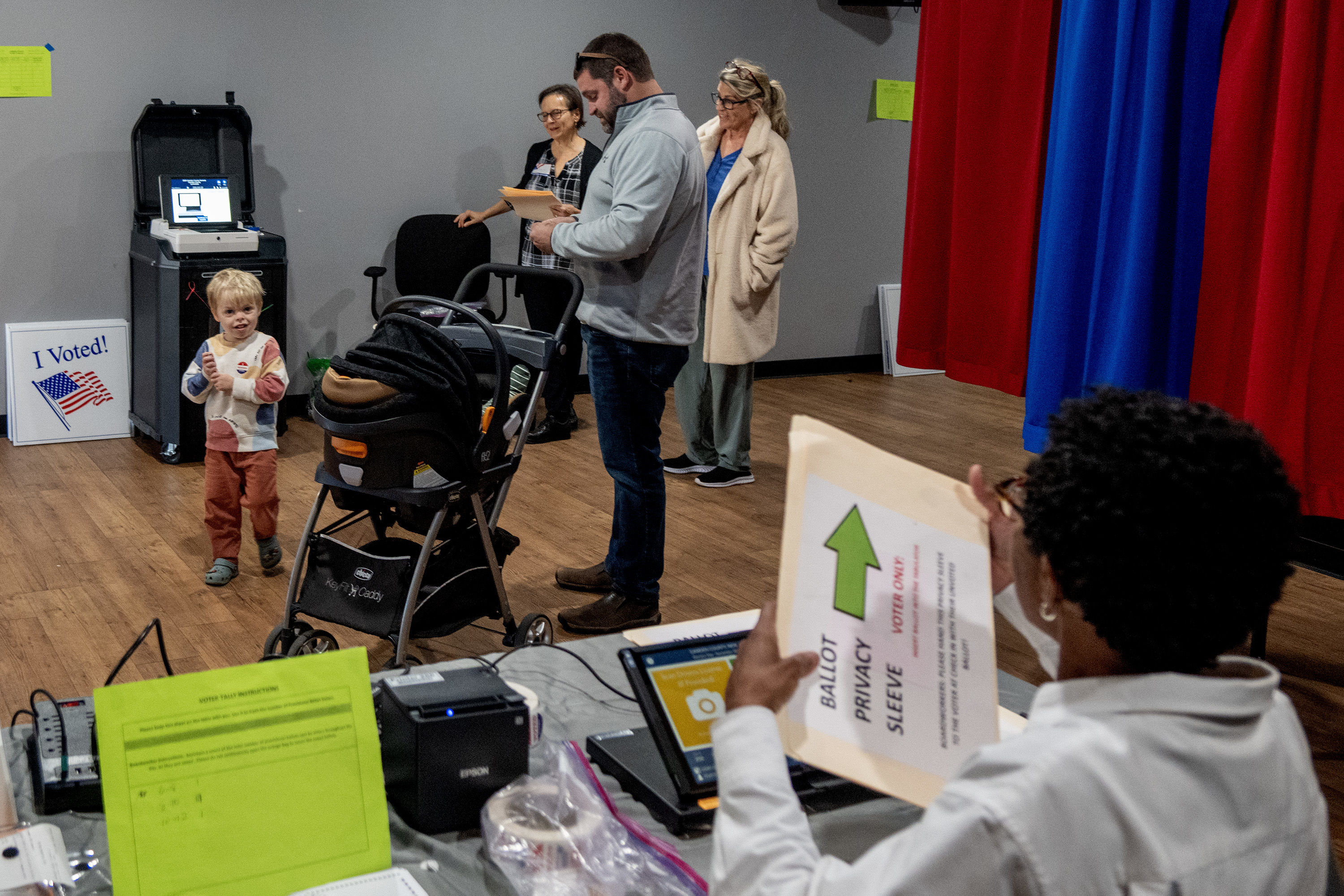
Poll worker Janice Masud-Paul (seated) speaks with 4-year-old Weston after his father, Bob Comfort, voted in the Erlton Fire House on Route 70 in Cherry Hill on Election Day last year.Tom Gralish / Staff Photographer
Elections, and democracy itself, depend on this kind of selfless dedication.
Unfortunately, people like Clay and Nakai, who are willing to do essential but usually thankless work, are becoming rarer. And it’s not just staffing the polls that has seen recruitment challenges.
Traditional, neighborhood-based churches have been supplanted by regional megachurches, with paid full-time staff replacing the volunteers and part-timers who once taught Sunday school and led worship.
Across society, genuine connection is being eroded. It has been replaced by communities of outrage.
The election-denying hordes are just one facet of this phenomenon. Instead of toiling away for hours in service of their fellow citizens, members of an outrage community must simply “like,” “reply,” or “repost” sentiments that align with their own half-baked suspicions. The actual factual record rarely matters, replaced by the wisdom of the algorithmic mob.
Communities of outrage now exist for nearly every major facet of life, and every national news story. They allow participants to live in a world reconstructed to fit their belief system, with all the inconvenient facts smoothed away.
School shootings like Sandy Hook are dismissed as false flags. Disappointing election results are attributed to fraud. People across the ideological spectrum increasingly believe antisemitic conspiracy theories, which blame every complex societal problem on Jewish people. Climate change is either denied or blamed solely on corporations, with no acknowledgment of who is buying all the gas, using artificial intelligence, or purchasing legions of plastic junk to fill our homes.
Collective action to fix societal woes becomes impossible when individuals can no longer agree on what’s happening in the first place. As the internet has become a haven for everyone’s petty grievances, a society built on online outrage is a miserable one. At the turn of the century, roughly 70% of Americans reported being satisfied with the direction of the country. Today, that number sits at 25%.
It is up to us as individuals to choose differently.
Outrage artists will continue to peddle lies as long as we are willing to click on them. Outrage communities will keep growing as long as real communities continue to shrink. Filling a vacant seat on an election board won’t fix this problem overnight, but it is a step in the right direction.
The more we strive to follow the example of service-minded people like Nakai and Clay, the closer we’ll be to creating a society we can be proud of.
Inside a cavernous warehouse just off I-295 in Cherry Hill, Larry Abrams spread his arms, gesturing to the sea of industrial-size cardboard boxes that surrounded him.
“We’re sitting on a rocket ship,” said Abrams, a third-generation teacher.
Abrams’ rocket ship is composed of books: thousands and thousands of them — picture books and out-of-date science textbooks, cookbooks and battered novels. He sees them as a way to change kids’ life trajectories.
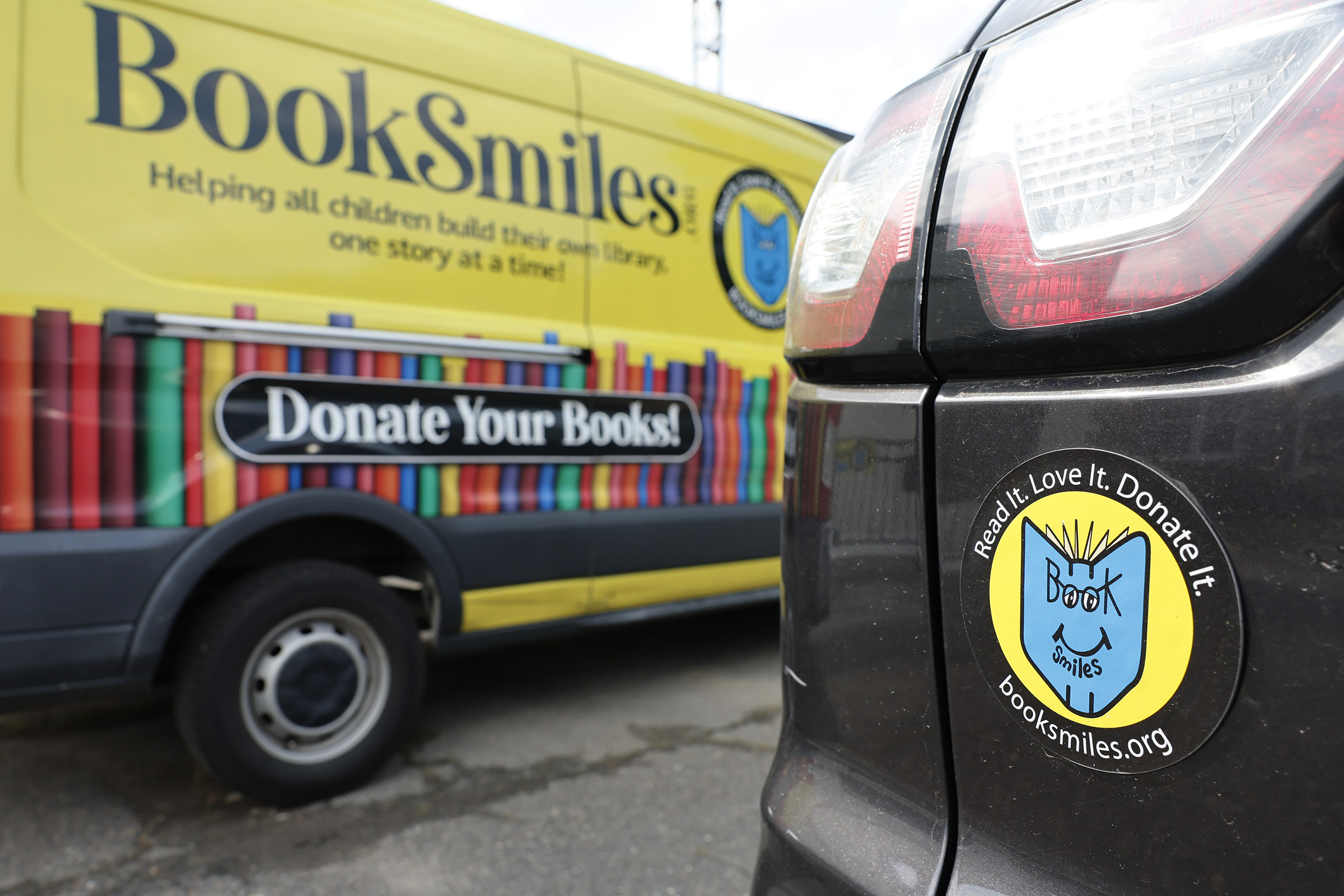
The BookSmiles van and a staffer’s car parked outside of BookSmiles new warehouse in Cherry Hill.Elizabeth Robertson / Staff Photographer
To date, BookSmiles, the nonprofit Abrams started out of his garage in 2017, has distributed five million books. It just outgrew its third location, expanding into a 14,000-square-foot space in Cherry Hill that is formally opening next week.
Book banks are not a new idea. But Abrams believes he’s got the secret sauce.
“We’re the only book bank in America that does this — we actively trade pallets of grown-up books for pallets of upcycled gently used children’s books,” Abrams said. “Never before has there been a low-cost way to get so many beautiful, upcycled books into the homes and hands of kids who need them the most.”
‘It’s simply about lack of book access’
Abrams served in the Navy — he was stationed on an aircraft carrier during the Persian Gulf War — and managed a copy shop. Then he settled into a career as an English teacher, working first in Moorestown, then in Lindenwold.
“I thought, ‘Why do most of the Lindenwold kids in my ninth-grade class read at a third- or fourth-grade reading level?’” Abrams said. “It’s simply about lack of book access. It’s not fair that some kids grow up with no access to books, and other kids have everything.”
Abrams thought long and hard about how to change that equation. What if he redistributed books from wealthy and middle-class communities to the places that didn’t have them?
BookSmiles founder Larry Abrams works in the loading dock area of BookSmiles’ new Cherry Hill warehouse on Friday, Aug. 28, 2026.Elizabeth Robertson / Staff Photographer
He put out a social media call for children’s books, and got thousands.
There is no market for reselling used children’s books online, Abrams found — you can’t sell them and make any kind of money. So the BookSmiles concept developed.
Now, people from all over New Jersey and Pennsylvania donate books — any kind of books, from old encyclopedias to nearly new novel series. The BookSmiles team (at first, just Abrams himself; now, it’s 11 people and a growing corps of volunteers) sorts through every single book.
The organization gets books in myriad ways: from folks dropping off what they salvage after cleaning out a bookshelf to donations of entire estates of books. BookSmiles accepts library discards and scrap paper, too.
Adult books, old textbooks, and kids’ books that are not in excellent condition are sold, not for cash, but for gently used children’s books that are distributed directly to teachers, daycares, and other nonprofits that get them in kids’ hands.
‘There’s a low-cost way to raise test scores’
BookSmiles grew so significantly that Abrams retired from teaching and now works full-time as executive director.
But his educator hat is always on. Research shows that access to books, and books in children’s homes, is a powerful determinant of kids’ educational outcomes and economic success.
“This comes from a place of me being a teacher, and seeing there’s a low-cost way to raise test scores,” said Abrams, dipping his hand into a cardboard box and fishing out an old dictionary that will end up being recycled for paper.
BookSmiles founder Larry Abrams among boxes of childrens books ready for young readers in BookSmiles new Cherry Hill warehouse on Friday, August 28, 2026.Elizabeth Robertson / Staff Photographer
The largest share of BookSmiles’ books moves out through its “Teacher Take” program. Teachers pay a nominal fee — BookSmiles asks for $35 annually — and can then take hundreds of books multiple times a year, either for classroom libraries or for distribution.
BookSmiles also sponsors “Fair Book Fairs,” where schools get enough books for every child to take home at least three volumes at no cost.
Schools that serve predominantly students from economically disadvantaged backgrounds are asked to kick in just $200 to get a Fair Book Fair. Others pay a little more.
In 2025, BookSmiles gave away half a million books to teachers and kids in Philadelphia schools. Another 500,000 went to New Jersey teachers and schools, and the remainder, about 250,000, were sent overseas.
With libraries often on the chopping block in low-wealth school systems — Philadelphia had fewer than five people working as full-time, certified school librarians last school year — classroom libraries are key, and teachers often need resources to build them.
“We can hook them up,” Abrams said. “I can’t give them school supplies, but I can give them books.”
Book joy
Abrams still gets struck by moments of “book joy” when he looks at the Teacher Take room, or the massive room of books waiting to be sorted or moved out.
“It’s almost like walking into Willy Wonka’s world, but it’s not candy, it’s books,” he said. “Sometimes, you can’t tell the difference between what Barnes & Noble is selling and what we’re giving away.”
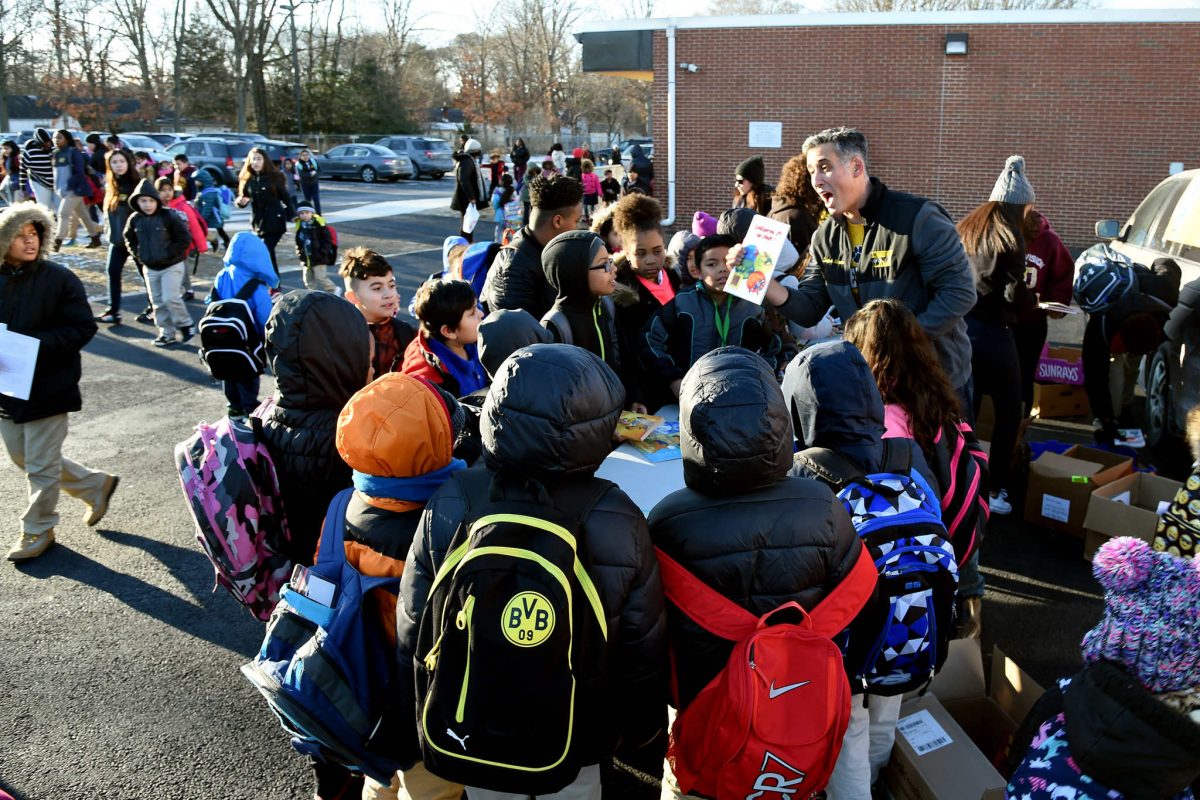
Larry Abrams shows BookSmiles books to Lindenwold Elementary School students in the nonprofit’s early days. This file photo is from 2018.TOM GRALISH / Staff Photographer
BookSmiles’ new space, across the street from the PATCO Woodcrest station, just off I-295, is a level up for the organization. It will allow BookSmiles to move from distributing 1.3 million books per year to five million books per year, and can accommodate more volunteers.
The music icon and humanitarian, who died Tuesday, was an inspiration for BookSmiles and a mentor to him, though he never met her.
Parton began her Imagination Library, a program that sends free books directly to children’s homes, as a tribute to her father, who never learned to read.
“I don’t know if I’ll ever get to 300 million books,” Abrams said. “But we know that if books are in the home, children will be more successful academically. We know that access to books changes equations.”
BookSmiles, 100 Melrose Ave., Cherry Hill, N.J., accepts book donations and volunteers. Its Teacher Take program resumes soon.
A University of Pennsylvania biotechspinout recently launched its first clinical trial of an experimental cancer treatment for hard-to-treat solid tumors.
Its approach builds upon groundbreaking work harnessing the body’s immune system to fight cancer.
Based in Philadelphia and San Francisco, the company, Dispatch Bio, launched a year ago with CAR-T pioneer and Penn researcher Carl June as a scientific co-founder and $216 million in funding from private investors.
The company aims to succeed where CAR-T, an immunotherapy that genetically modifies a patient’s immune cells to recognize and attack cancer, has struggled.
Although CAR-T has revolutionized the treatment of blood cancers, scientists have yet to replicate that success in solid tumors. By painting a target on tumors and revving up the immune system, Dispatch believes its platform could.
It dosed its first patient earlier this month.
“With one approach, we are addressing the two main challenges that we have faced over the last decade or so,” said Mauro Avanzi, the chief medical officer of Dispatch.
Success is not guaranteed.Most exploratory scientific efforts do not advance to the point where they are found safe and effective in humans. Even if the results are promising, it could take years before a potential new treatment becomes widely available.
Dispatch’s first clinical trial focuses on advanced gastrointestinal cancers, including cancers of the stomach, esophagus, and colon. The company also announced a clinical trial earlier this year in China that has not yet started dosing patients.
If the treatment turns out to be safe and effective, Dispatch hopes to expand to other solid tumor types with significant unmet need.
“As many patients as we can deliver that for, we will keep striving to do,” said Lex Johnson, Dispatch’s co-founder and chief platform officer.
‘A Trojan horse’
Solid cancers are notoriously difficult to treat with immunotherapy for two main reasons: they’re hard to target, and they’re good at suppressing the immune system.
To attack a cancer cell, you need to be able to find it. Sometimes cancer cells have more unique identifiable elements on the outside, but other times they don’t. Imagine trying to identify someone when all you know is that they’re wearing jeans.
Many of the proteins found on solid cancer cells are also present in healthy tissue, making them potentially risky targets.
Solid tumors are also good at building an environment around them that blocks and suppresses the immune system. Think of it like a protective shield.
“They prevent your immune system from recognizing and clearing aberrant cells,” Johnson said, referring to cancer cells.
Dispatch Bio’s signature treatment — called the Flare platform — is designed to overcome both of these challenges by tagging cancer cells with a unique target and boosting the immune system.
The strategy revolves around a virus that, when injected intravenously, will traverse the body in search of tumor cells. Once the virus finds its target, it’ll take up residence inside the cell and tag it with a target protein called “the Flare.”
“You can create that Flare protein to be something that is not present on healthy tissue throughout the body,” Johnson said.
In colon cancer, for example, they would use a protein that is not present on any healthy colon cell, to avoid toxicity.
At the same time, the Flare platform secretes chemical signals to re-engineer and reset the environment around the tumor. This enables the immune system to better attack the tumor.
“It is a Trojan horse,” Avanzi said, describing the virus.
When a tagged cancer cell is destroyed, it goes on to release thousands more viral particles carrying the Flare. That chain reaction helps spread the therapy’s effect across multiple sites.
In animal studies, the platform has been able to completely clear out tumors without off-target effects or toxicity.
But results in animals are often difficult to replicate in people, andthe ongoing clinical trial is the first time the platform is being used in humans.
The trial
Mauro Avanzi is the chief medical officer of Dispatch Bio.Courtesy of Dispatch Bio
If the virus successfully paints cancer cells with the target, CAR-T cells can then find and clear them. (CAR-T therapy uses what’s called a chimeric antigen receptor, a protein that recognizes a cell as cancer based on what’s on the outside of the cell.)
The first phase of the trial involves escalating the dose of the virus alongside a standard dose of an approved CAR-T therapy to figure out the ideal regimen.
Once Dispatch determines the safest dose of the virus, they’ll move into the dose expansion phase, where they test that dose in a bigger group of patients.
“We are really trying to optimize the virus,” Avanzi said.
There is no expected timeline yet for the trial.
Dispatch is actively enrolling patients at City of Hope in California and the University of Cincinnati, and is in the process of activating four or five additional sites. They plan to open a site in Philadelphia, too.
Suzanne Edinger has lived in Pelham, Ala., since 2002, but a few months ago she began to receive an onslaught of messages from Philadelphians hundreds of miles away.
Most were Manayunk residents. Edinger’s family members reached out. Former neighbors reached out. Old classmates and friends reached out, tagging Edinger in photos and videos on Facebook.
They all had the same question.
“‘Is O’Brien’s Water Hole gonna be back?’” Edinger said. “He would be tickled to death. We’d probably have to come up there for a month if he was still around.”
The “he” is Edinger’s late father, Bill O’Brien, longtime steward of 320 Lyceum Ave. When the Philadelphia Cycling Classic came to town in 1985, its route ran right past his brick twin house.
Bill O’Brien was beloved by friends, neighbors and annual revelers at the bike race.provided by Suzanne Edinger
While this might not seem notable for a 14.4-mile race, O’Brien’s stretch was unique. He and his wife, Evelyn, were located right in the middle of the notorious hill known as the Manayunk Wall, scaling 250 vertical feet.
It became a pivotal point of the competition, 800 yards that could make or break a cyclist. So, the maintenance man did what he’d do for any struggling stranger: He tried to help them out.
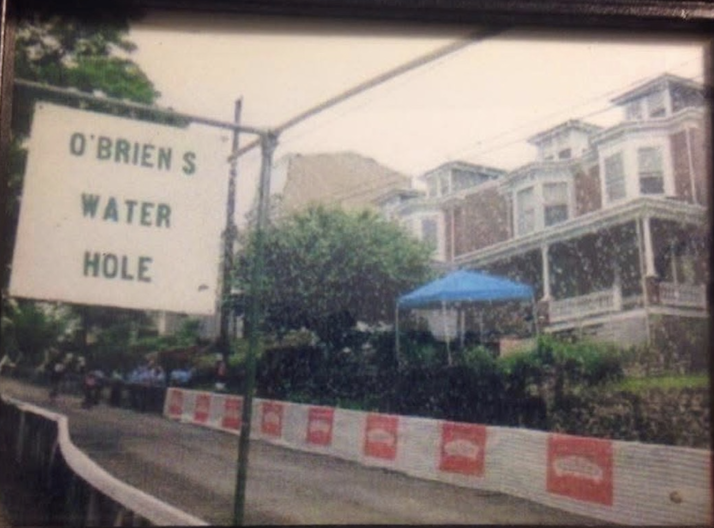
Throughout the first iteration of the Classic, O’Brien stood in his yard with a hose in one hand, a beer in the other, dousing bikers as they rode by. This setup didn’t last long; O’Brien realized it would impede his Budweiser consumption, and race organizers wanted an option for cyclists to avoid the stream.
Undeterred, the North Philadelphia native headed to his workshop in search of a solution. He quickly found one. By 1986, he’d connected a single shower head to his hose, lightly spraying water atop the riders.
By 1987, he’d added another shower head. The year after that, O’Brien moved his hose alongside his fence, so spectators wouldn’t trip over it.
A white wooden sign with kelly green font dangled from the pipe: “O’Brien’s Water Hole.”
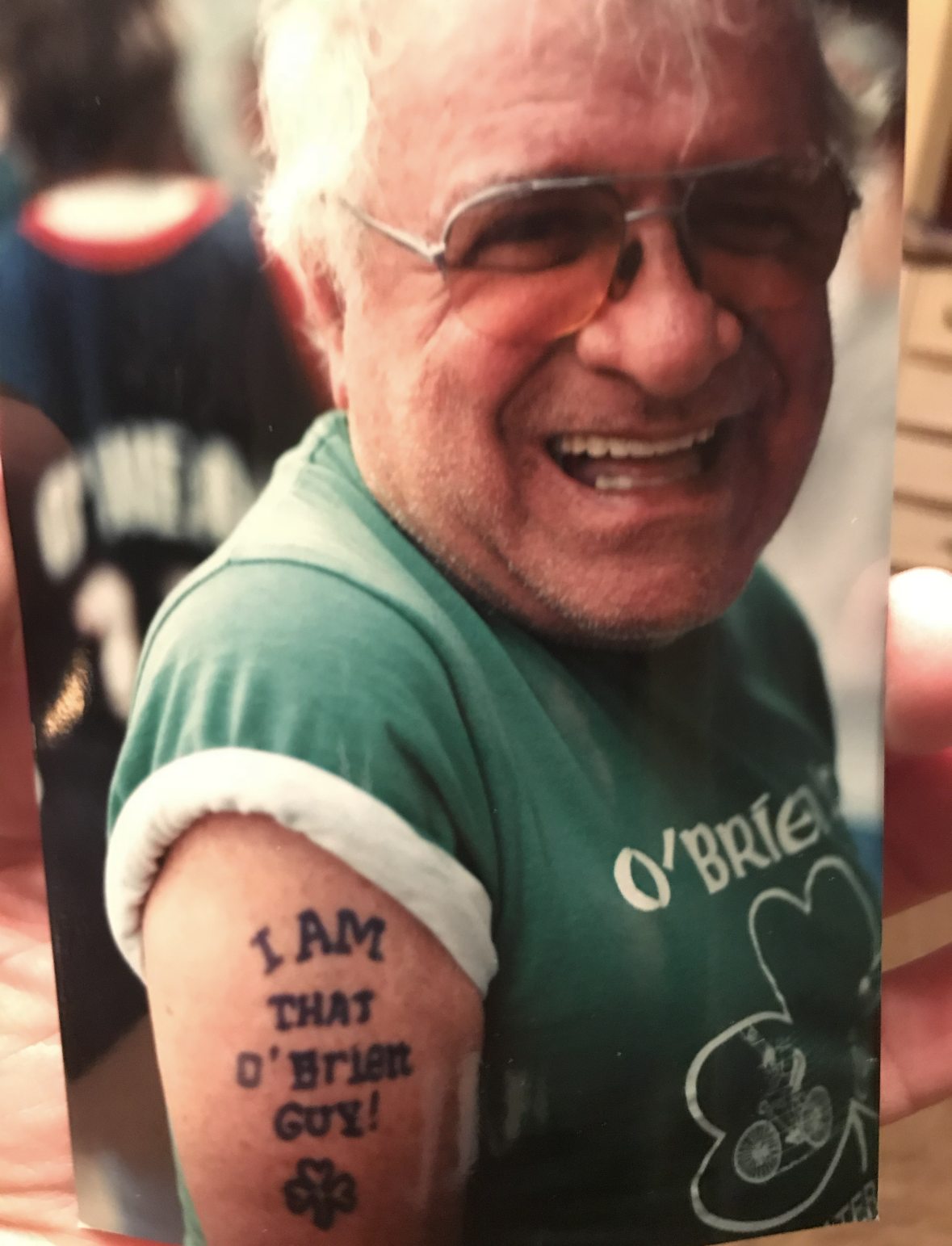
He built on this tradition over 23 years. Every version would be better than the last: a few more shower heads, “O’Brien’s Watering Hole” T-shirts, a Manayunk-themed banner, hung high above the street.
The O’Brien Water Hole became a key party spot for racegoers.provided by Suzanne Edinger
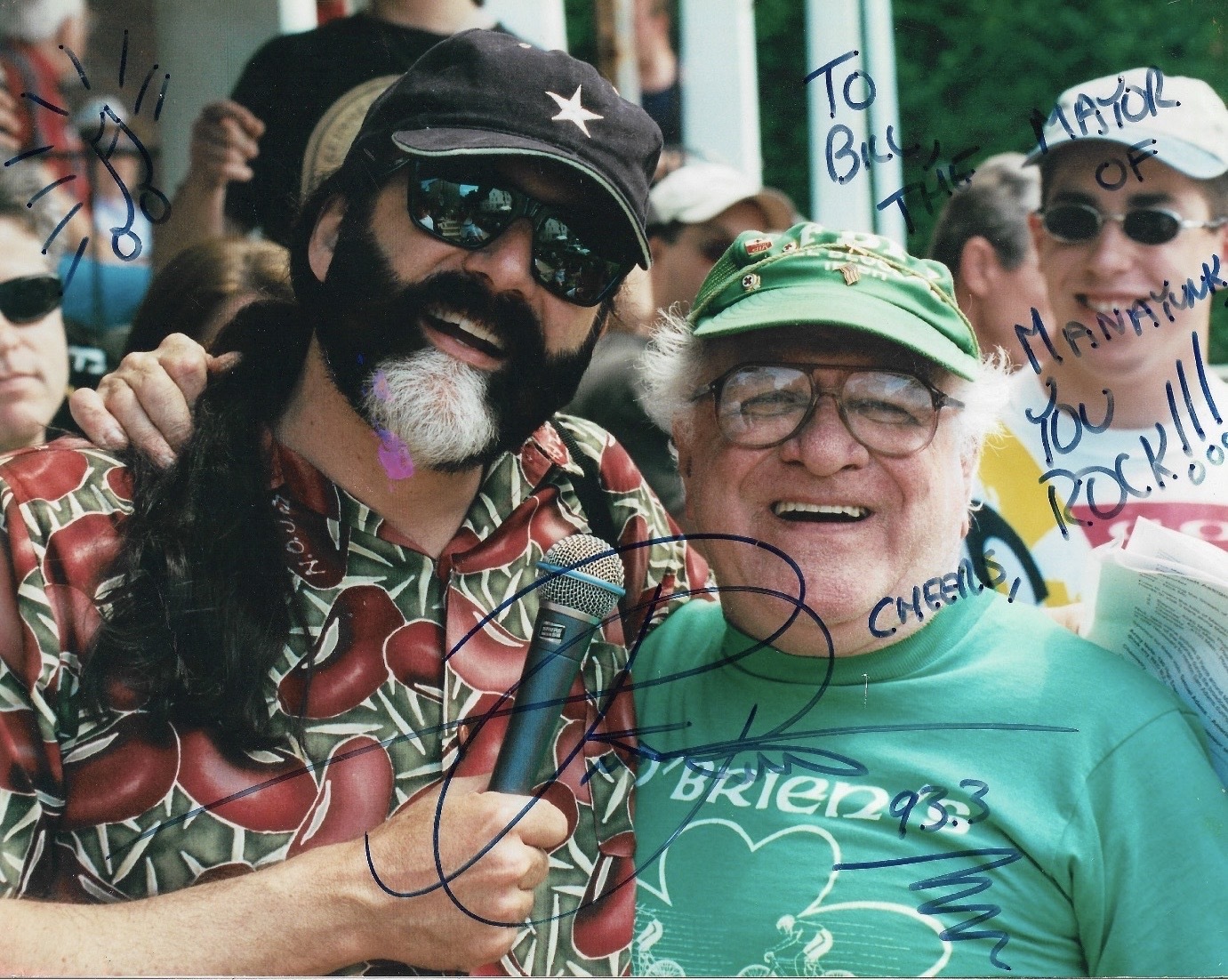
On race day, his house would be packed with people, some of whom O’Brien knew, and many he didn’t. But “The Mayor of Manayunk” was unfazed.
“Every year he ordered more kegs, and mom had more burgers, and she needed a bigger bowl of potato salad, and an extra bowl of beans,” Edinger said. “And he fed off of that. He just thought it was great. They saved [money] all year.
“‘I need to get plates.’ I’m like, ‘Mom, it’s February.’ ‘June will be here before you know it!’ So, it was always buying a little of this and that, when the budget permitted.”
The O’Briens moved to Alabama for work in 2008, and Bill died in 2019. But the lore of his Water Hole has endured.
And on Sunday, when the Philadelphia Cycling Classic returns for the first time in a decade, locals will remember the small Irishman with the big imagination.
“You couldn’t help but think of him when the race came up,” said O’Brien’s former next-door neighbor, Marty Costello. “Because it was his thing.”
The community’s handyman
O’Brien was raised with seven siblings on West Thompson Street, near the Church of the Gesú. Craftsmanship ran in his family; O’Brien’s father learned the trade from his father, who worked as a cabinet maker and carpenter in County Tipperary, Ireland.
The lessons Bill absorbed as a child served him for the rest of his life. After he and Evelyn moved to 320 Lyceum Ave. in 1961, the handyman refurbished pianos.
He then worked in carpentry, and then at a paper mill, before getting a job in maintenance for the Sisters of Mercy in Merion in the early 1970s. Evelyn was hired to operate the convent’s old-school switchboard a few years later.
The O’Briens stayed on with the Sisters of Mercy for three decades. Even amid a spiritual sanctuary, the couple showed the same fun-loving spirit they’d eventually bring to the Water Hole.
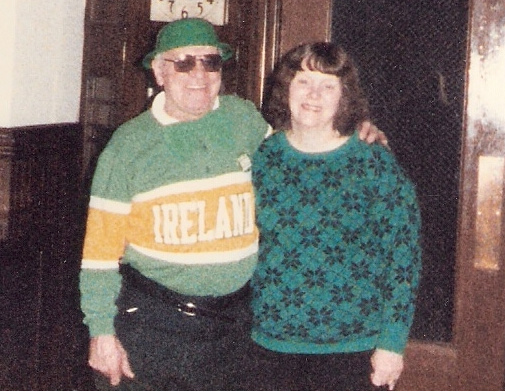
On St. Patrick’s Day, Bill would dress up as a leprechaun, with high white socks, a green sweater, and a little black pot of gold in hand. He and Evelyn would dole out chocolate coins to sick nuns receiving medical care on the property.
Bill and Evelyn were shocked to learn that word of The Water Hole had reached all the way to Ireland.provided by Suzanne Edinger
The sisters loved it.
“Those nuns were the first in line at both of their funerals,” Edinger said.
Bill wasn’t raised in Manayunk but embraced his neighborhood wholeheartedly. He ran the grade-school CYO at St. John the Baptist for over 20 years, taking local kids on annual ski trips to get them out of the city.
The Irishman could easily repair a leaking sink or a broken roof at his own house, but also made a point of helping neighbors with their needs, too. Before Marty Costello moved next door to the O’Briens, his grandmother, Concetta Pompizzi, lived in the same building.
In the 1980s, Bill fixed the railing on her front porch, a renovation so sturdy it lasted 35 years.
“Everybody loved Uncle Bill,” said O’Brien’s nephew, Patrick. “If he wasn’t your uncle, you still called him Uncle Bill.”
O’Brien’s handiwork and hospitality were well-known within Manayunk. But after the advent of the Water Hole, he became a much more prominent figure.
Longtime WMMR-FM host Pierre Robert, who died last year, was a frequent visitor to Bill O’Brien’s spot on the Manayunk Wall.provided by Suzanne Edinger
Every year, local reporters would flock to the brick twin house to interview him; Pierre Robert of WMMR was a regular visitor. This happened so often that friends began placing bets on how many TV appearances O’Brien would make in a given weekend.
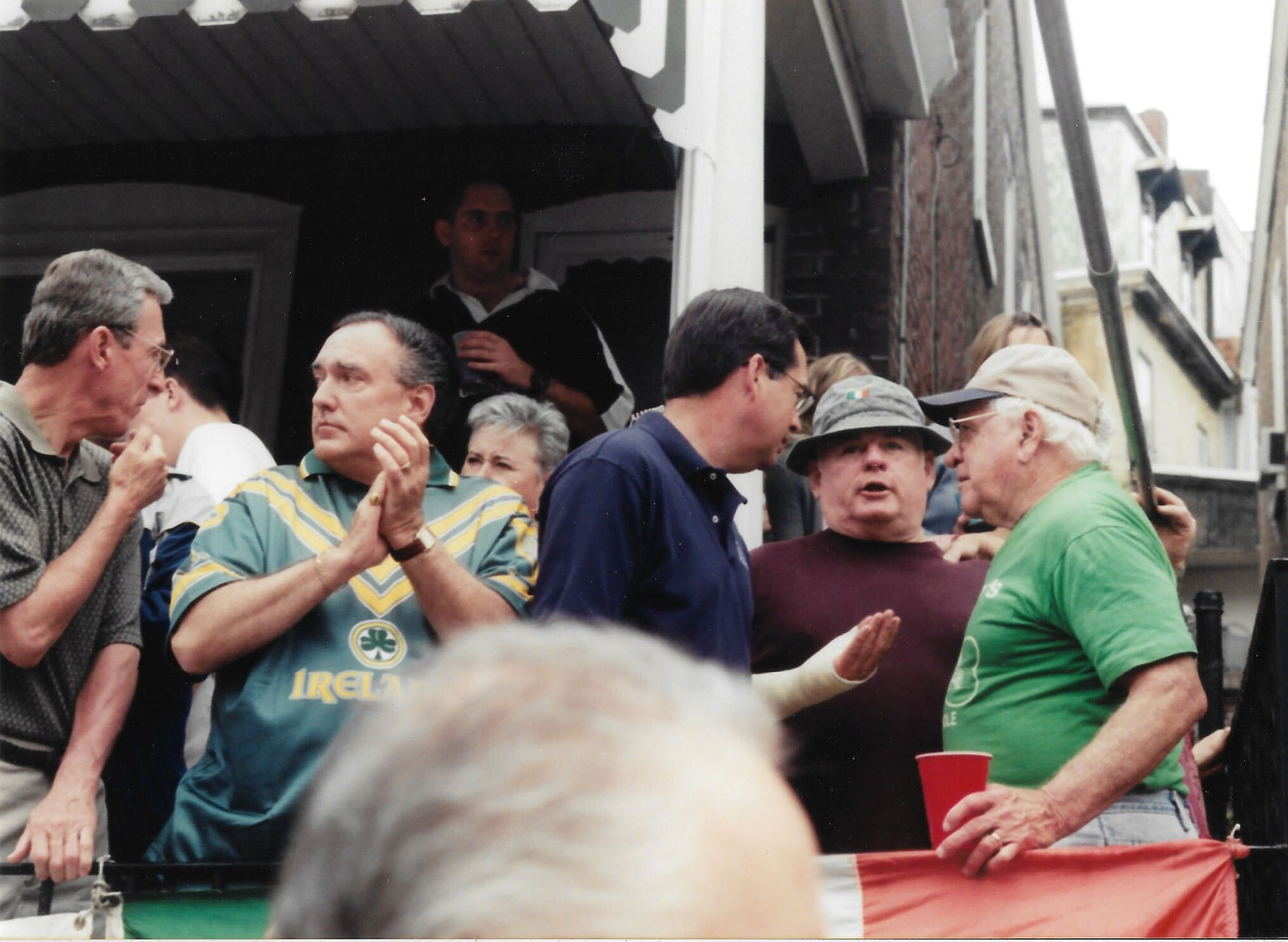
On a typical race day, the family would welcome hundreds of people to their home. One neighbor, Gerry Boyle, said he met tourists from as far as Italy, Austria, and Germany. Policemen regularly stopped for sodas and waters, race officials for food and refreshments.
Despite all the chaos, the event was a testament to a community’s love. O’Brien never worked alone. The night before the Classic, locals would drop off kegs of beer.
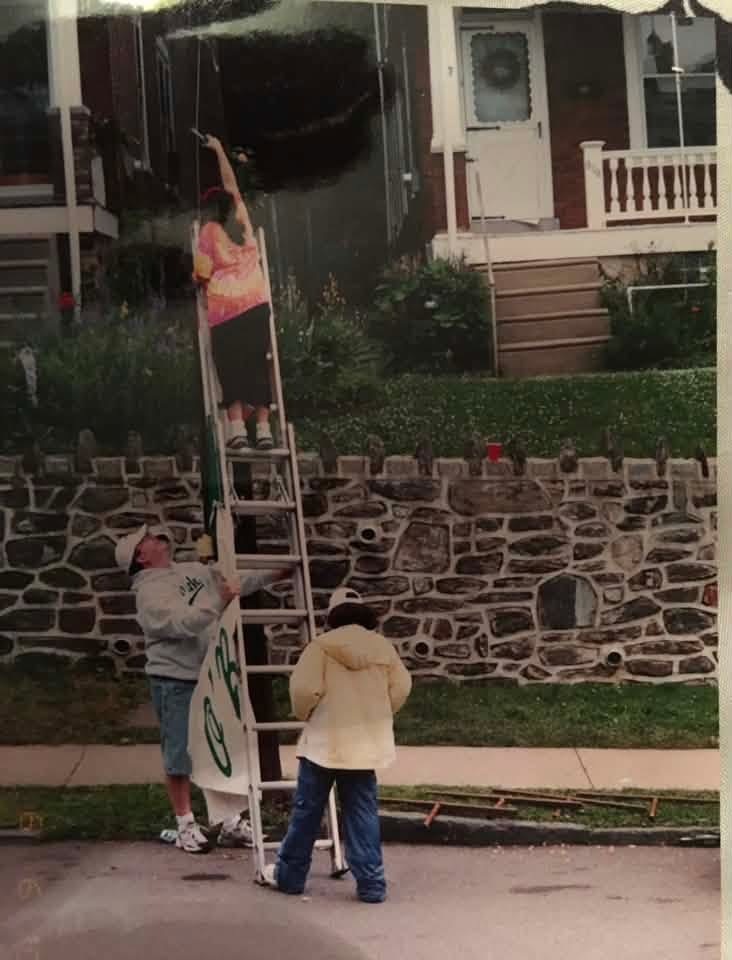
Dennis Kelly, a friend who lived a few blocks away, would bring doughnuts to make sure Bill had something to eat before he started drinking. Cousins would stand on ladders, hanging banners and flags across Lyceum Avenue.
The work that went into assembling the Water Hole went on even after Bill and Evelyn O’Brien had left Manayunk.provided by Suzanne Edinger
Boyle would arrive at 6 a.m. on race day to set up the shower pipes. Fitzpatrick Funeral Home would lend its nearby parking lot to O’Brien’s friends and family.
An artistically inclined nun at the Sisters of Mercy even designed an “O’Brien’s Water Hole” T-shirt, written in Celtic font.
One of Edinger’s cousins wore it on a trip to Ireland years later. A passerby recognized the name.
“They’re like, ‘Oh, we see that on TV,’” Edinger said. “‘We know O’Brien’s Water Hole.’ It was just crazy. And that was a story that [my dad] just thought … that was it. His name had reached the motherland.”
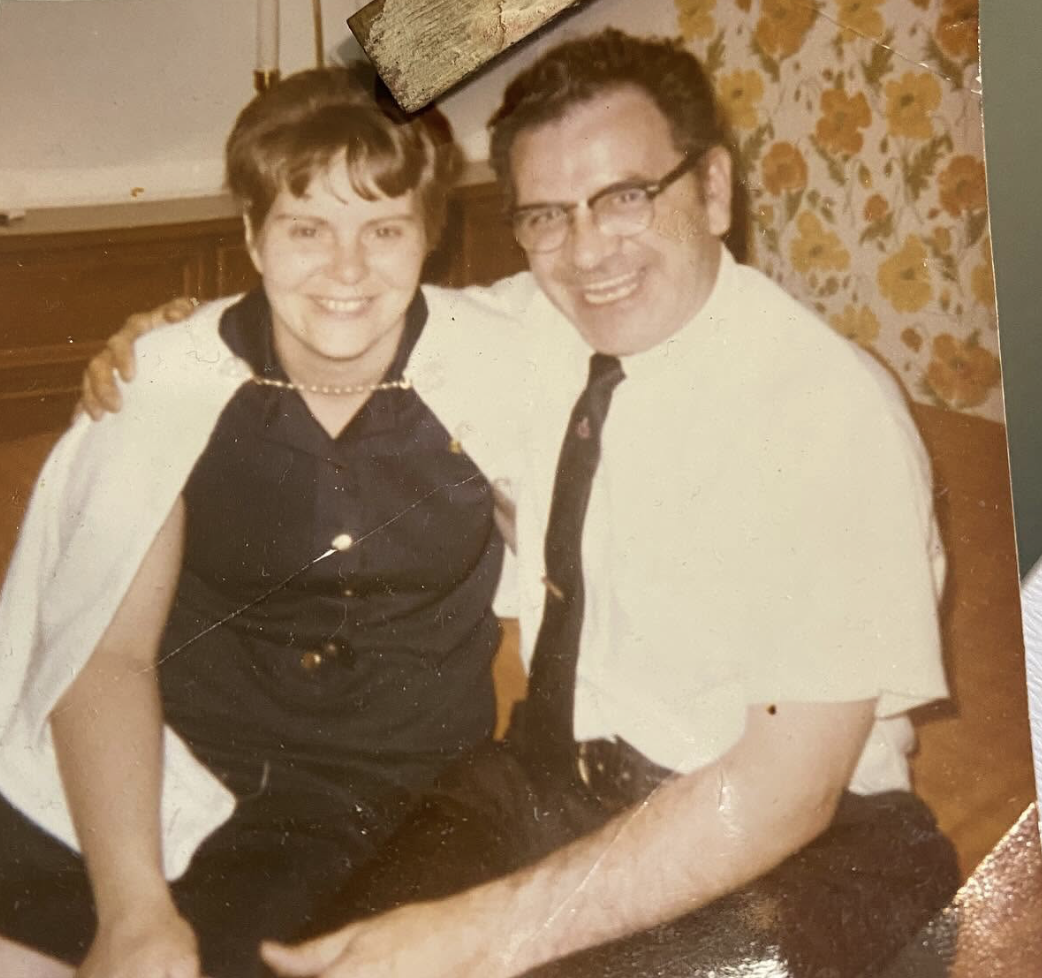
Bill O’Brien and his wife, Evelyn, around 1970.courtesy of Suzanne Edinger
Continuing the tradition
After the O’Briens moved out in 2008, two friends, Gary Brett and Dan White, bought the property. They did so with the intention of keeping the Water Hole alive, and the Irishman was more than happy to assist.
He left them with his four shower heads attached to a pipe and walked the men through his setup with the hose and the fence. Brett and White put their own spin on it, adding spray nozzles to create more of a mist than a shower.
Just like O’Brien, the friends would host a party on race day. But it wasn’t the same without the handyman, and locals would often ask for him.
“All the time,” Brett said. “Every year. I mean, every single year. Like it could’ve been five years after he moved out, and they’re like, ‘Is Bill here?’”
The two men continued this tradition until the race was canceled in 2017 due to a lack of funding. O’Brien died of a stroke two years later, while visiting family in Phoenixville. He was 85.
When his body was transported from the viewing at Fitzpatrick Funeral Home to Mass at St. John the Baptist, the driver took a special route. Instead of turning onto Manayunk Avenue, she chose to stay on Lyceum, trudging up the hill, and pausing right outside No. 320.
The cars behind the hearse did the same, bidding a final farewell to a house that was a home for so many. It’s unclear whether the current owners will create a Water Hole of their own on Sunday.
But even if they don’t, locals will be thinking of the man who always showered his neighbors with water and warmth.
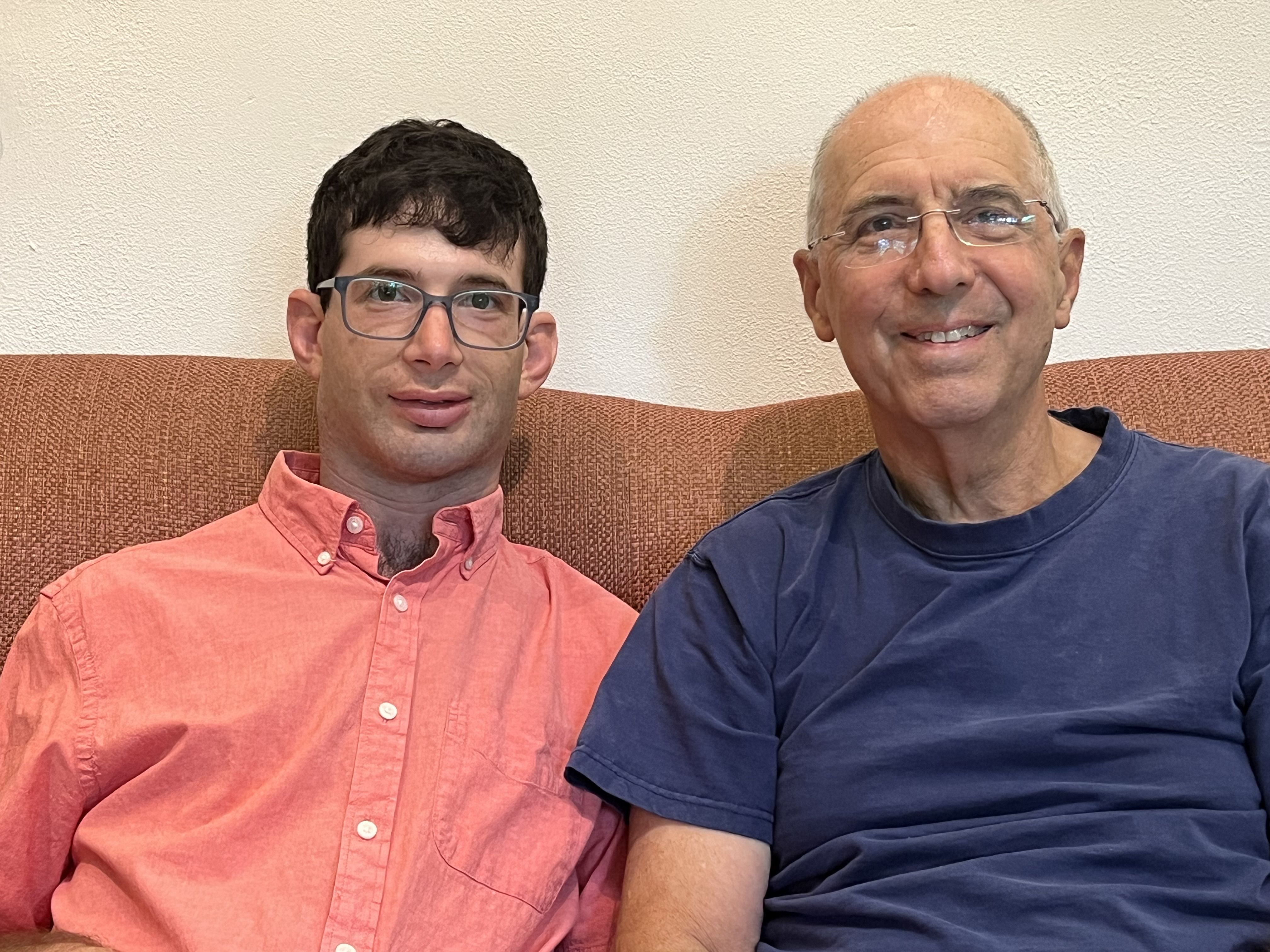
Ben Crimm slowly lifted his arm and began to point at different letters on a laminated alphabet board in front of him. The board is a means of communication for Crimm, who is a 34-year-old nonverbal autistic individual.
As Crimm continued to spell out his thoughts, his father, Allan, sat beside him and read his sentences aloud.
When Ben finished pointing, he put down his hand, and Allan read the sentence he had spelled out: Non-speaking does not mean we cannot think and learn.
“This organization has changed my life in so many ways,” Ben said. “Without the ability to communicate for the first 25 years of my life, I had no ability to tell anyone what I wanted to do. Now, I do. And I have a resolve to raise awareness about nonspeakers and our capabilities and our communication access needs. Without this, I would be trapped in silence.”
Alongside work with Spellers Empowering Education for Nonspeakers, a Philadelphia-based advocacy group founded in 2020, the Crimm family also is raising awareness through the Philadelphia Cycling Classic’s charity ride for the American Association of Cancer Research.
Ben and Allan will ride in Sunday’s charity ride to raise money and awareness for the AACR and I-ASC.
Both organizations are important to Ben. The I-ASC provides training and access for nonspeakers, and AACR is dedicated to preventing and curing cancer through research — a mission close to Ben’s heart after his uncle, Jon Shipp, died of lung cancer in 2006 at 49 years old.
The charity ride will feature a 14-mile loop along the course of the professional PCC race. As both Ben and Allan prepare for the event, Ben said he’ll be staying in the back of the pack.
“I’m not a fast cyclist,” Ben said. “[I’m looking forward to] good weather and being with so many wonderful folks.”
Proceeds will go to the AACR, the official charity partner of the charity ride. As of Friday afternoon, the total fundraising was over $145,000, all from small-dollar donations, according to the AACR.
“This is sort of a natural partnership where sports and healthcare come together,” said Steve Ryan, the president and chairman of the AACR Foundation. “So it’s really a natural fit for us, gives us exposure, gets people out, gets people to know what we do. It’s great for Philadelphia, great for us, great for everyone.”
Spelling to communicate
Ben was diagnosed with autism at 6 years old and struggled to communicate throughout everyday life. Without the ability to speak and engage in conversation, he felt “trapped” with no way to tell anyone what he was thinking or how he was feeling. Despite years of speech therapy and sign language lessons, he turned to spelling to communicate.
The Crimm family first found out about spelling to communicate through a family friend, who had a son who had a condition similar to Ben’s. They implemented the method in Ben’s daily routine in 2017. But they never expected it to work as well as it did.
“It was beyond our wildest dreams,” Allan said. “It has been so exciting to get to know [him], to get to know what is in that wonderful mind of [his], and to hear [his] sense of humor, [his] kindness, and [his] generosity. To know what’s inside of [him]. [He’s] such a fierce advocate for nonspeakers. [His] passion inspires everybody in the family, including me.”
Spelling to communicate has transformed Ben’s ability to express himself and has led him to use his newfound voice as a tool to raise awareness for nonspeakers struggling to communicate and experiencing any sense of powerlessness in a world where they may feel invisible.
SEEN has met monthly for six years and has a mission to educate others about nonspeakers, autism, and apraxia. The organization conducts eight to nine presentations a year to legislators, schools, parent groups, and national conferences.
“It has been so incredible to have so many close friends that I can talk to over our shared life experience,” Ben said. “I love educating families of nonspeakers and especially healthcare professionals.”
According to the Autism Science Foundation, around 26% of individuals with autism are nonverbal or minimally verbal, meaning they have difficulty with speech.
However, this does not mean that they’re intellectually disabled. They can still form thoughts and communicate in ways that don’t rely on the voice. Allan and Ben are hoping they can continue to educate others on the topic.
“We’ve come to learn as a family and being in relationships with so many other nonspeakers that the popular understanding of what nonspeaking autism is is not what people think,” Allan said. “It’s time for people to engage with nonspeakers and learn from nonspeakers that the lived experience really is because almost a third of all autistics are [nonspeaking]. And people have total misconceptions of what their capabilities are.”