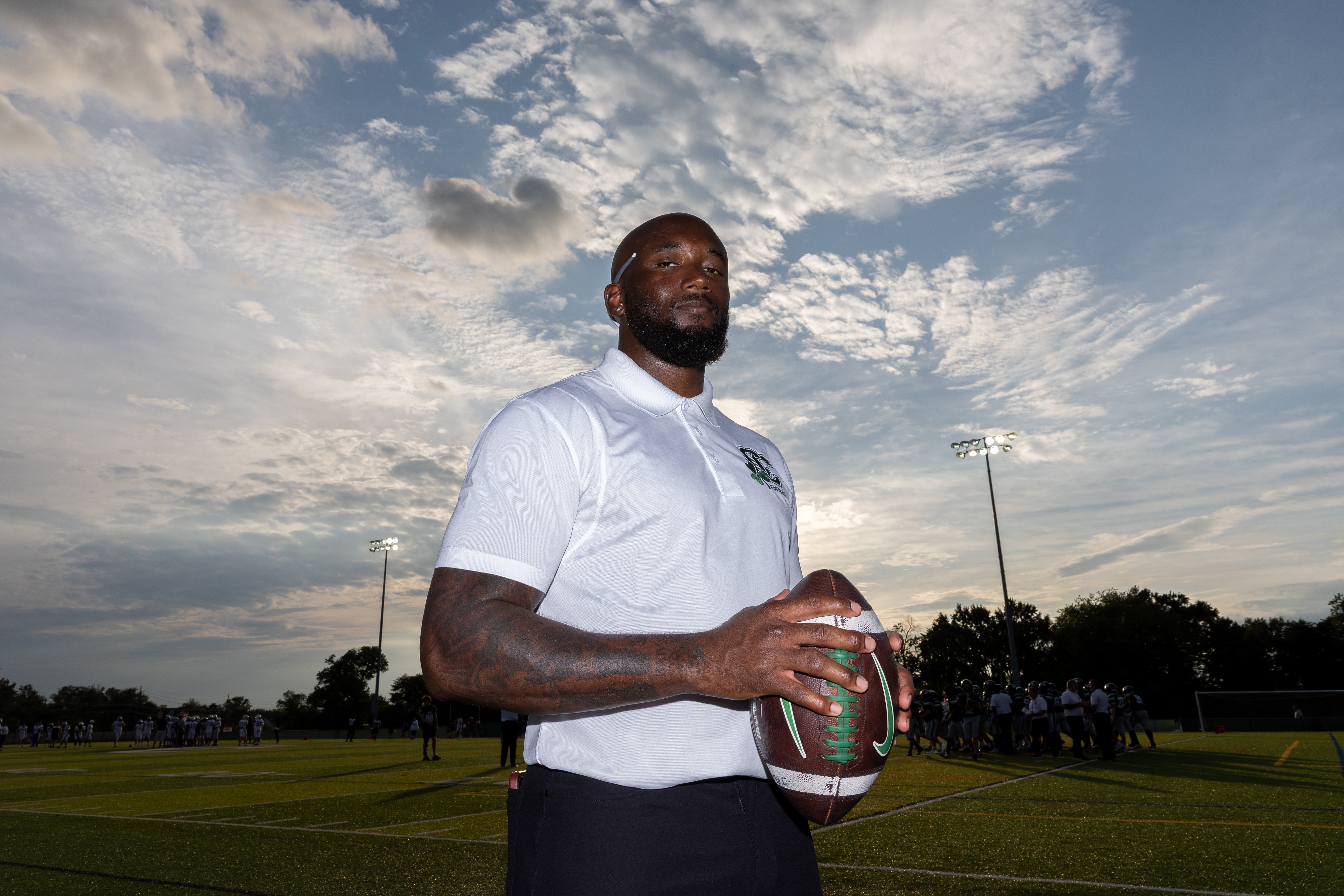
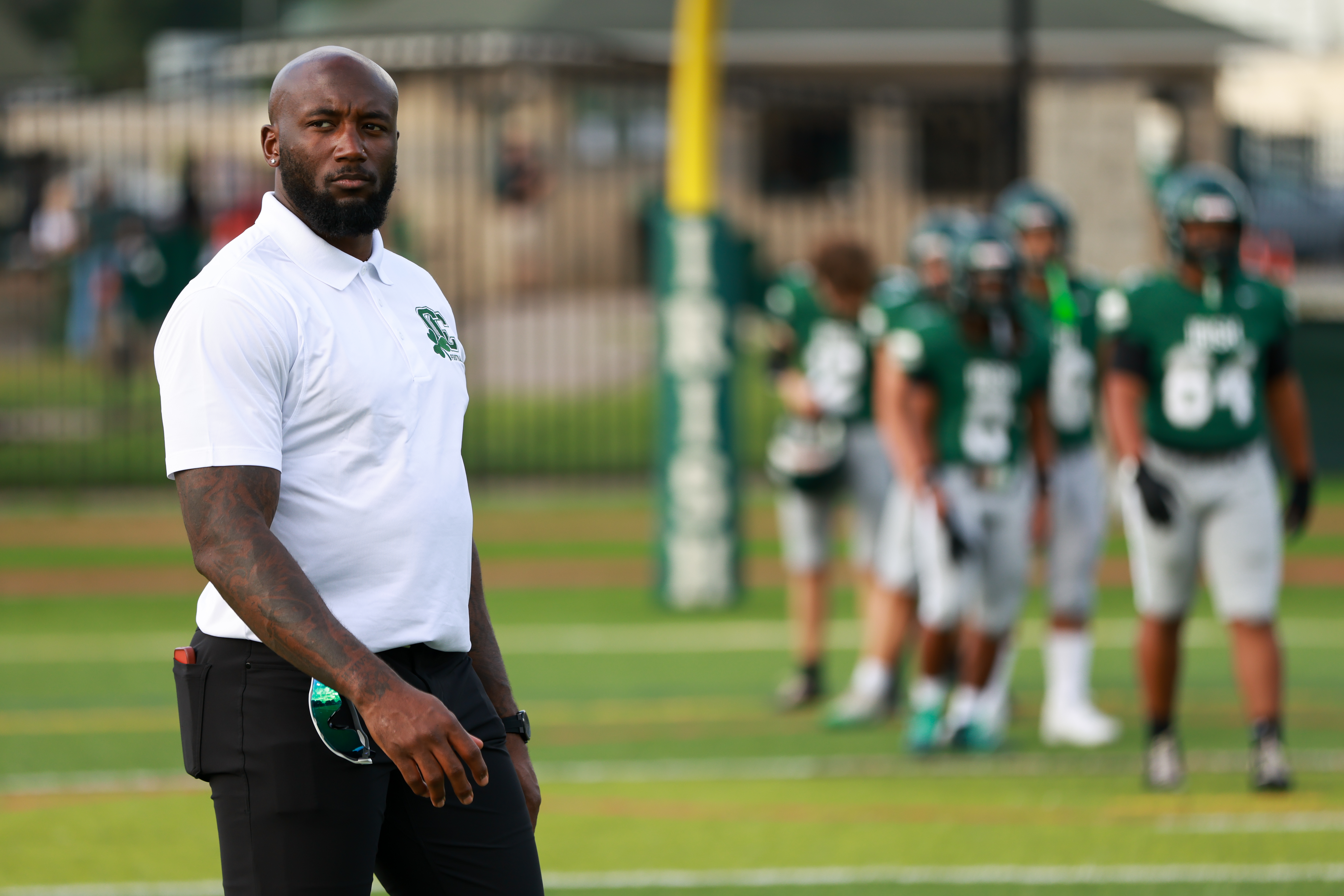
On Sept. 4, at 7 p.m., James Bradberry stood on the sidelines of Dulczak Family Field, beneath a twilight sky.
The scene around him was typical Friday night high school football: packed stands, cheerleaders waving pom-poms, a small pep band performing covers.
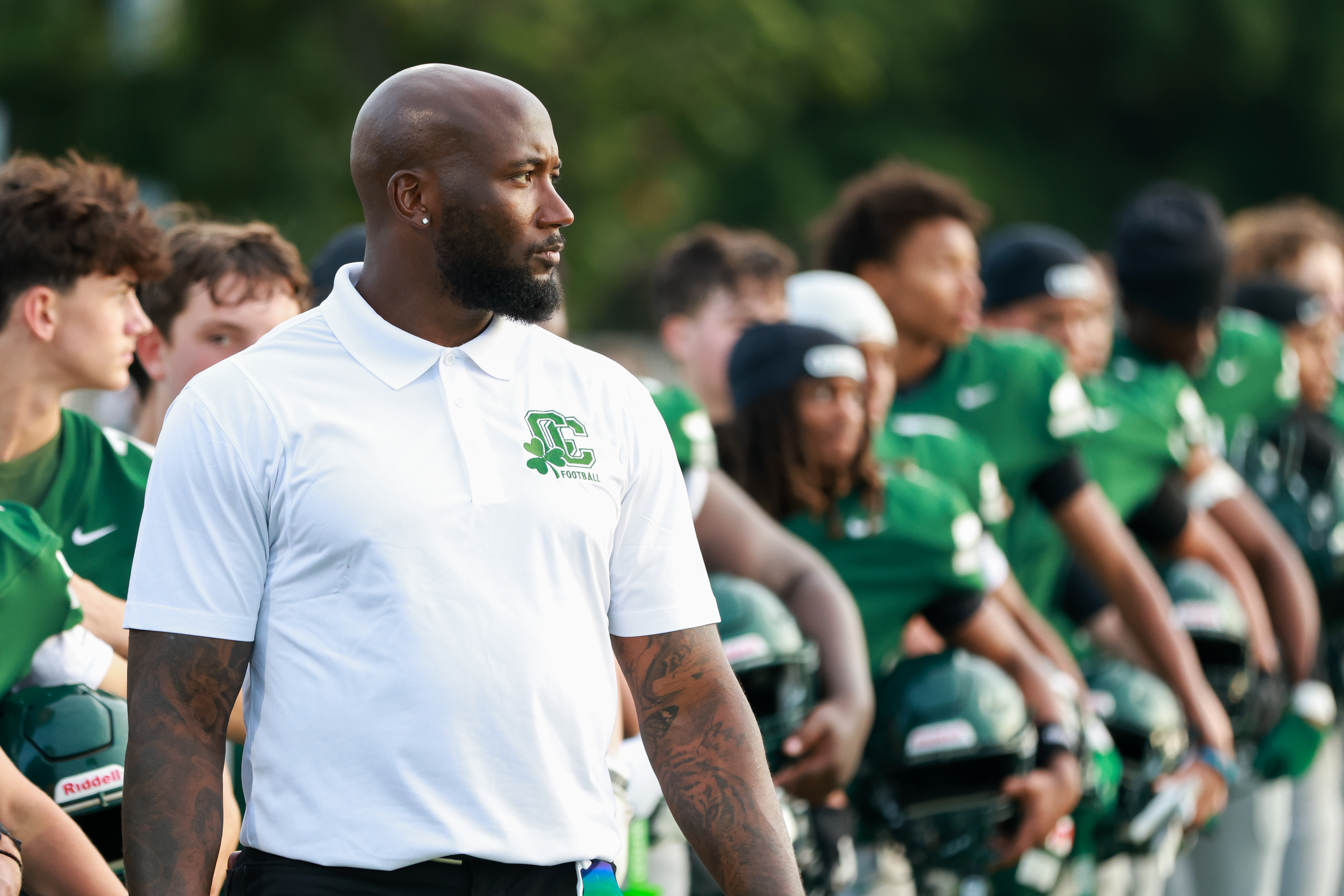
And to an uninformed spectator, it would look like nothing else. The home team lined up on the sidelines for the national anthem, in their Kelly green jerseys, with coaches in white polos and black slacks.
Bradberry was stationed at the very end, next to sophomore lineman Sam Torres. As the game began, he crouched to get a better look. He high-fived players as they jogged past, occasionally pulling them aside.
When one of his cornerbacks, Julian Vasquez-Soto, got dinged up toward the end of the second quarter, it was Bradberry who joined the trainers to check on him, picking his helmet off the ground, and extending a hand.
Any other coach would do the same, but of course, Bradberry is not any other coach. At least not at Camden Catholic High School. The former NFL cornerback spent eight years playing for the Panthers, Giants, and Eagles.
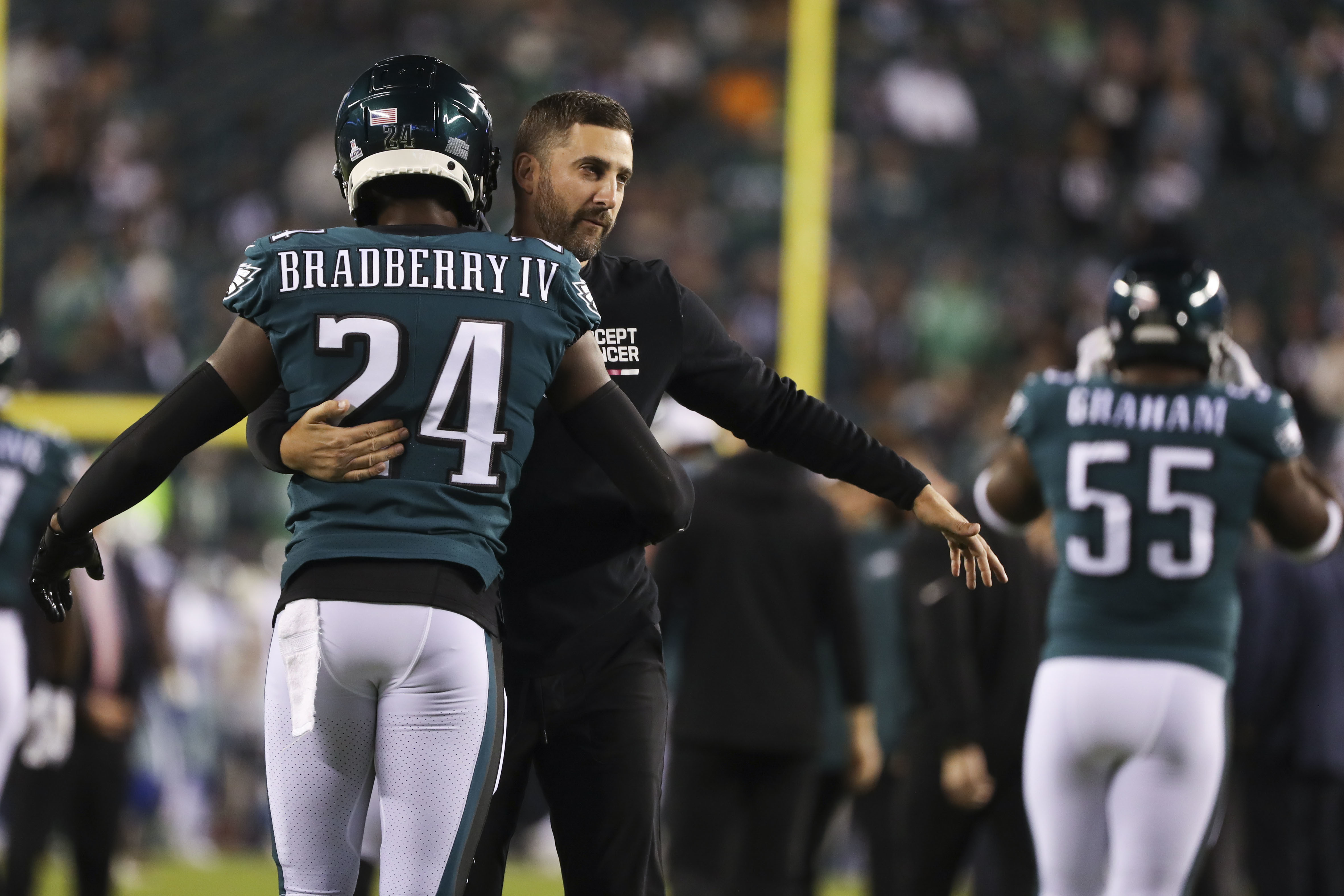
James Bradberry played in 33 games as a member of the Eagles in 2022-23 and helped the team win an NFC title. Heather Khalifa / Staff Photographer
During that stretch, he became adept at disrupting offenses, particularly in the air. Bradberry finished his career with 112 passes defended, good for 40th on the NFL all-time list, and 19 interceptions.
He helped Philly to a Super Bowl appearance in 2022 (despite committing a consequential late-game holding penalty against the Chiefs) and finally earned his ring in 2024.
The veteran was on injured reserve that season, but found other ways to contribute, mainly by mentoring two young defenders in Cooper DeJean and Quinyon Mitchell. His position coach at the time, current Cowboys defensive coordinator Christian Parker, told him he should consider coaching.
It was a suggestion Bradberry had heard before, but now, the timing was right. After the Eagles released him in June of 2025, he began to search for high school opportunities near Cherry Hill, where he lives with his family.
This past August, he found one, when a friend mentioned his son’s alma mater, Camden Catholic. “They’re always looking for good coaches,” he told Bradberry.
The former NFL cornerback called up athletic director Jim McHugh, a lifelong Eagles fan. It didn’t take McHugh long to discern that he was talking to a Pro Bowler.
“As soon as he told me he was from Alabama originally, I was like, ‘OK, this is the guy,’” McHugh said. “‘This is an Eagles All-Pro.’”
The athletic director connected Bradberry with head coach John Martino, who invited him to campus. The former Eagle has been at Camden Catholic five days a week ever since; reviewing film, lifting weights, and helping with walk-throughs.
Camden Catholic assistant coach James Bradberry looks on during the game against Riverside on Sept. 4. Isaiah Vazquez / For The Inquirer
He doesn’t miss a game or practice; McHugh said that if anything, Bradberry puts in more time than other coaches. The Super Bowl champion is easygoing by nature, which has helped him assimilate to his new home.
A month later, the Irish still can’t believe their luck.
“I didn’t expect it,” said senior running back Nymir Daily. “You don’t expect an NFL player to come to a 2-9 team … So to see him come here, it was motivation.
“It boosted our confidence that we could really be good. We could really go out here and perform.”
Lunch talk on the sidelines
Bradberry first met the players on Aug. 18. They were about to start a preseason workout, stretching out on the field, when they saw a 6-2, 210-pound man walking toward them.
Martino introduced the former Eagle, explaining that he’d be joining practice for the day. It wasn’t the most productive practice. The head coach joked that the high schoolers — and his staff — were “wide-eyed for two and a half hours.”
After it was done, Bradberry told Martino he’d mull his decision over. Less than 24 hours later, without any advance notice, he was back at Camden Catholic, ready to commit to the program full time.
For the first few weeks, Bradberry stayed in the background, quietly observing other coaches. But eventually, he started to speak up, especially when he noticed something off.
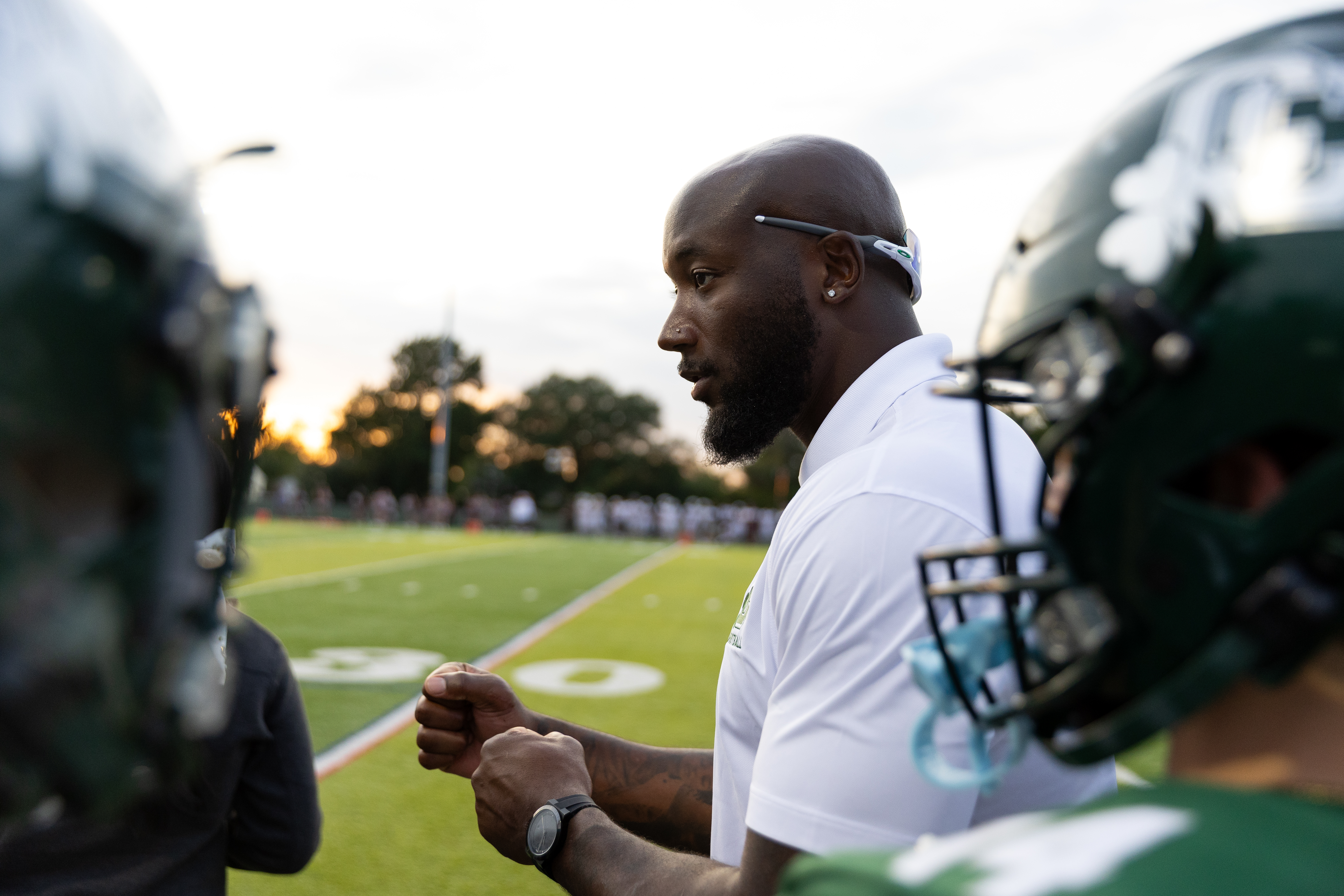
Camden Catholic assistant coach James Bradberry talks to the team on the sidelines during the game against Riverside on Sept. 4. Isaiah Vazquez / For The Inquirer
A few days before Camden Catholic’s home opener, Bradberry was going over his scout team defense. He was standing on the sideline and heard a riveting conversation between sophomore Chase Green and freshman Divine Jackson.
The former Eagle pulled them aside.
“They was talking about tater tots,” Bradberry recalled. “Actual tater tots. They was having a food conversation. You got to remind them to lock in and focus.”
Green and Jackson corroborated this.
“We were talking about school lunch,” Jackson said.
Another adjustment has been in how Bradberry communicates. For the last eight years, the former cornerback has been working in NFL facilities. Now, he’s surrounded by teenagers, many of whom only understand the basics of the sport.
Explaining the curl-flat concept in pass defense, for example, took a few tries. When Bradberry first raised it to his scout-team defense, he told them that it was important to not get “out-leveraged by a number two.”
James Bradberry (24) is working on how best to communicate his NFL knowledge to a less experienced group of high schoolers. Heather Khalifa / Staff Photographer
The former Eagle was met with blank stares.
He rephrased, telling the high schoolers that they couldn’t get beat to the flat.
“After I yelled at them a few times — ‘Get to the flat, get to the flat’ — they understood,” Bradberry said.
It is a daily reminder to meet players where they are — even if that level is far from what Bradberry is accustomed to. Football jargon aside, the high schoolers have learned a lot from their new coach: technique advice, footwork, positioning.
But they’ve also used this time to pepper “Coach JB” with questions, like who the toughest receiver he’s ever covered is and whether he’s played against certain guys.
And of course, as any young man would, to ask for fantasy football advice.
“I told them the Rams defense is gonna look good this year,” Bradberry said. “And you know, I’m always an Eagles guy. I’m still in South Jersey, so I’m always an Eagles guy.”
Camden Catholic’s Nymir Daily (2) is among the talented players James Bradberry has been mentoring on and off the field. Isaiah Vazquez / For The Inquirer
‘Like Christmas in July’
Daily plays both defensive back and running back. On Sept. 4, the star senior was omnipresent, accounting for all four of Camden Catholic’s touchdowns, while rushing a whopping total of 305 yards.
His aunt, Nona Daily, danced in the stands as she cheered for her nephew. His name boomed over the static-filled loudspeaker, again and again: “Nymir Daily, on the carry, results in an Irish … first down!”
But with three minutes and 54 seconds remaining in the second quarter, the celebration came to a halt. Daily had just notched yet another first down, and decided to celebrate by raising his arm, mimicking the referee’s signal.
Some officiating crews would let it go; this crew didn’t. Daily was charged with unsportsmanlike conduct. The team was given a 15-yard penalty.Bradberry, who was standing nearby, walked over to the senior.
They talked about keeping composure and the consequences of mistakes in critical moments. The running back returned from the half energized, scoring two more touchdowns to give his team a 26-20 win over Riverside High School.
“James was there to pick up the pieces,” Martino said.
Bradberry thinks Daily has a chance to play at the collegiate level, so he’s been keeping close tabs on him. But their relationship goes far beyond football. Daily said that the former Eagle has become a father figure.
James Bradberry has been trying to impart life lessons to Camden Catholic’s players, as well as football concepts. Isaiah Vazquez / For The Inquirer
In 2021, his mother died in a car accident. Ever since, Daily has been living with Nona in Pennsauken. The high schooler has coped with this loss by staying busy, mainly through sports.
In addition to football, he plays basketball, and runs track. Daily has become close with many of his coaches, particularly his previous head coach at Camden Catholic, Wayne Gilliam.
When Gilliam departed in January of 2025, for Haddon Heights High School, it left a void. But since then, Bradberry has helped fill that role. The former Eagle is not just a teacher on the field, but a confidant off it.
“James helps me with everything,” Daily said. “Everything you can think of. Say I’m having girl problems. He’ll come and talk to me about the girl, tell me what I should do or what I should say. I can [talk] to him about anything.
“I don’t have a perfect life at home,” he added. “Nobody does, but I really don’t have perfect life at home. So, he helps me with stuff.”
Bradberry doesn’t know what will happen next year. He might try to help coach a college team, as he works his way up the ladder.
But even if it’s just one season with Camden Catholic, his impact will last for years to come.
Particularly with the star running back, who has a bright, bright future ahead.
“I think James sees a lot of himself in Nymir, so they kind of gravitated to each other,” said Martino. “And James, to Nymir … I think it was like Christmas in July.”
Gov. Josh Shapiro on Thursday called on the federal government to enact new guardrails on artificial intelligence, days after a number of tech industry figures raised concerns about the danger posed by AI’s rapid development.
As he spoke in Pittsburgh, the Democratic governor was critical of both House Speaker Mike Johnson (R., La.) and President Donald Trump for refusing to erect such safety measures “whether out of willful ignorance or personal greed.”
And, he said, he does not believe that concern about this technology “is a hoax, as our president has called it.”
But as he urged more regulation of the industry, he also warned against adopting an overly pessimistic view of the technology.
“I am not a doomer. I don’t think it is inevitable that AI is going to take over the world, or that someone will misuse it to kill us all or to do harm,” Shapiro said.
Shapiro’s appearance at the AI Horizons PGH Summit, sponsored by Microsoft and the Bank of New York, helps position the governor as a leader on the issue among Democrats.
Last week, former President Barack Obama urged Democrats running for the White House to define the risks of AI, according to the Washington Post.
That advice — and Shapiro’s speech — followed warnings from AI executives last week that the technology is developing too quickly, and that it poses threats to human life.
“I won’t lie to you — there are real dangers,” said Anthropic CEO Dario Amodei, adding that the development of AI has accelerated much faster than he had expected.
Shapiro —who has consistently led his November opponent, Stacy Garrity, in polls — is widely expected to pursue a presidential run in 2028 after this fall’s reelection contest.
A growing concern among voters, AI is expected to continue being a significant issue for candidates, and Shapiro has shifted his stance in recent months to reflect questions about the technology.
In August, he issued an executive order that restricts data center development in the state, a noticeable shift from when he enthusiastically supported a $20 billion commitment from Amazon last year to build at least two data centers in Bucks and Luzerne Counties.
Shapiro now says future developments require local approval for projects to receive state permits, which in effect may block many developments from moving forward.
“The real folks I listen to are the people of Pennsylvania,” Shapiro told Politico before Thursday’s speech.
In contrast to the growing voices calling for AI guardrails, President Donald Trump on Monday wrote on social media that the only guardrail the industry needed it already had: “a STRONG AND SMART (High IQ!) PRESIDENT.”
Shapiro, in his speech, said he is calling on the federal government to establish “strict rules of the road” regarding AI, and then to enforce those rules.
“I’ve called on the federal government to step up and regulate the AI industry, just like they do for nearly every other industry,”he said.
Industry leaders should not exclusively guide the regulatory process, Shapiro said. The government should also work with leading researchers.
What is vital, Shapiro said, is establishing rules that require independent third-party oversight of “frontier” — most advanced — models, increasing transparency into the development of these models, and prioritizing safety.
Protections might mean placing some limits on technology sharing and slowing down frontier AI development until we can be sure that these systems are safe, Shapiro said.
Acknowledging that building a regulatory network from the ground up is hard work, Shapiro took a jab at Congress, and Johnson in particular, when he said “too many in Congress are content to do absolutely nothing.”
Shapiro noted that the speaker adjourned the House until after the election just days after companies issued “apocalyptic” warnings about the real dangers of AI.
“He has abdicated his responsibility to lead at a time when we cannot afford weakness and retreat,” Shapiro said of Johnson.
The United States should work with other nations on an international consensus on how to use AI, but that is hard to do when Trump has “isolated” us from the world, Shapiro said.
When Trump meets with Chinese President Xi Jinping next week, Shapiro said, he hopes Trump will “leave bluster and the showmanship at the door” and engage productively with him.
As for the home front, Shapiro said, “I’ll be leading the conversation here in Pennsylvania for safe and responsible use of AI.”
Jonathan Halloran-Koren said he watched with horror as Philadelphia police brass described the graphic details of his cousin Nicole Fusaro’s killing during a Wednesday news conference.
Deputy Police Commissioner Frank Vanore said investigators recovered videos that show Raymond “R.C.” Horsch giving her drugs and money, then handcuffing her to a bed. Horsch, naked and holding a camera, with another mounted in the corner of the room, then used pliers to put a zip tie around the woman’s neck until she fell unconscious, Vanore said.
None of this, Halloran-Koren said, had been shared when he and his mother had met with homicide detectives about her case just four hours earlier. All they were told, he said, was that Horsch had filmed himself strangling her.
“I didn’t need to know that. The public didn’t need to know that,” Halloran-Koren said of the details shared in the news conference. “I’ve seen some really graphic and horrible things in my life, but to turn around and hear how my cousin died in a press conference, all I could feel was deep sadness, sorrow, and rage.”
On Thursday, Halloran-Koren, a security consultant, sent a letter to Mayor Cherelle L. Parker and members of City Council, calling the action of city police officials “appalling.”
(Top from left) Gabrielle Amarando, Nicole Fusaro, Maribel Fresses, Amy McHale, and Blair Tonzelli. Nicole Fusaro, Gabrielle Amarando, and Maribel Fresses are presumed dead. Blair Tonzelli and Amy McHale are still missing, but were last seen at Horsch’s home.Obtained by The Inquirer
Sgt. Eric Gripp, a spokesperson for the police department, said detectives traveled to northern New Jersey to speak with the family members ahead of the news conference Wednesday, though he declined to discuss the details of a private conversation.
The department did not name Fusaro during the news conference, in deference to other relatives.
“Our deepest sympathy remains with every family whose loved one may be connected to this extraordinarily complex and deeply troubling investigation,” Gripp said, and police will “pursue every lead, work to locate the missing women, and provide verified information to their families as responsibly and compassionately as possible.”
Joe Grace, a spokesperson for the mayor’s office, referred questions to the police department.
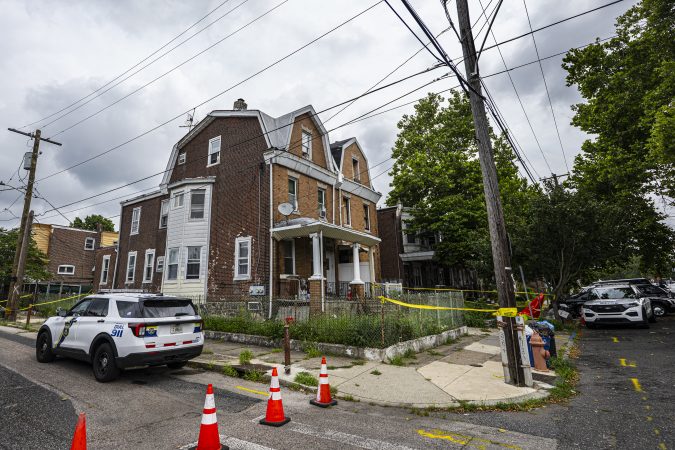
Fusaro’s case is part of a sprawling local and federal investigation into the drug, sex, and porn operation Horsch ran out of his home on West Chew Avenue in Olney. Police now say Horsch, who died last year at 82 from lung disease, is linked to seven dead or missing women.
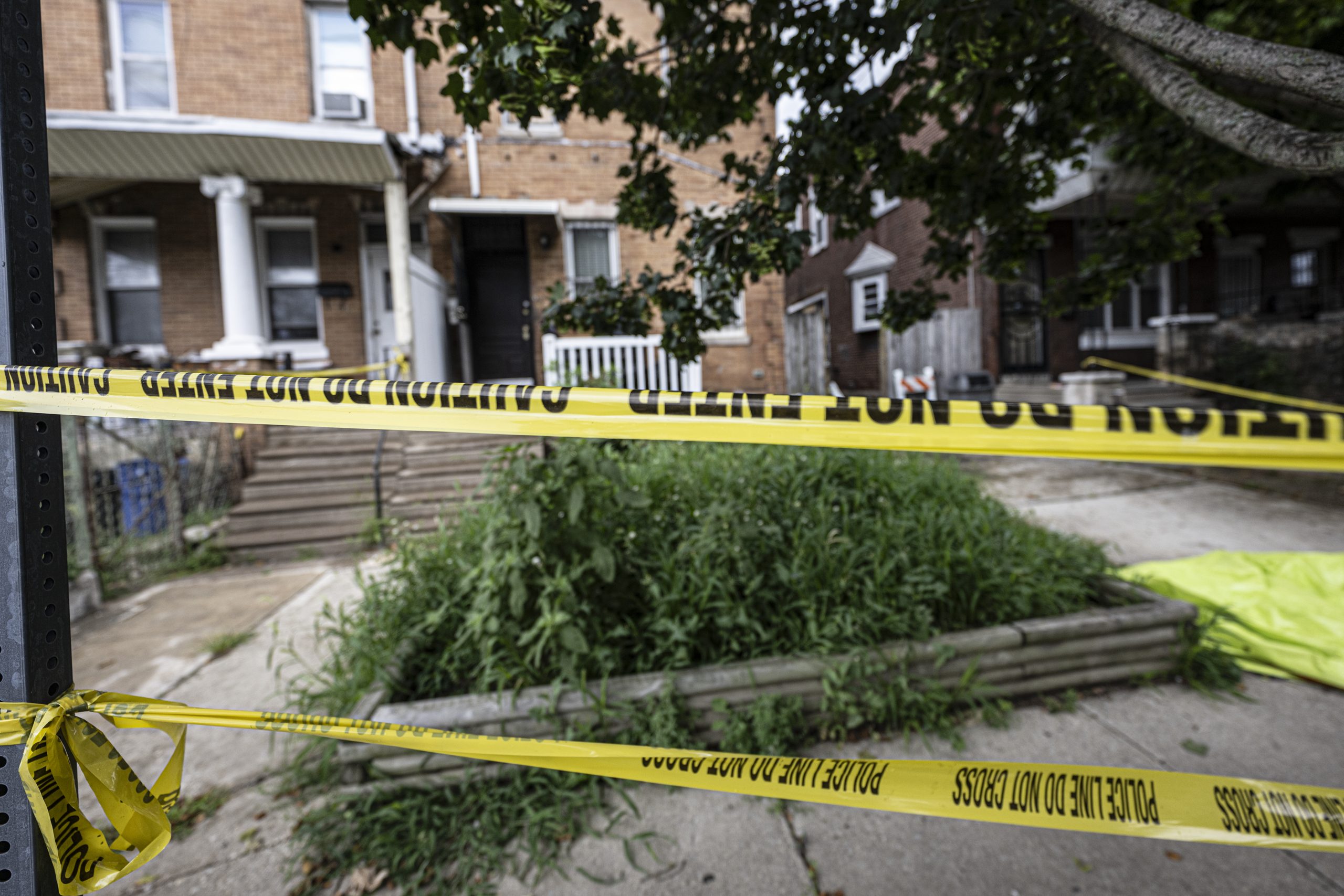
Police tape entrance of the home of Eugene Albert Horsch on West Chew Avenue in the Olney section of Philadelphia as investigators search for possible evidence Tuesday, July 21, 2026.Jose F. Moreno / Staff Photographer
While sifting through more than a million photos and videos recovered on Horsch’s hard drives, police said, investigators have recovered footage that appeared to show five women lifeless, including Fusaro, Maribel Fresses, and Gabrielle Amarando. There are also two unnamed women: a 25-year-old whose identity relatives asked to remain private, and a woman in her mid-20s investigators are still working to identify.
Two other women — Blair Tonzelli, reported missing in 2023, and Amy McHale, Horsch’s ex-wife, who disappeared in 2016 — were also reportedly last seen at the Olney home, which Horsch shared with his son, Eugene. The younger Horsch is in prison on federal charges stemming from his June 19 arrest after a car stop near Independence Hall. In the car, a federal park ranger found a fake ID with Tonzelli’s name, which launched the investigation.
Fusaro, 27, was last seen in Kensington on July 19, 2018. Her mother, Diane, spent years searching the streets for her only child before she died in January 2020. Fusaro’s father, Thomas, died in 2009.
Halloran-Koren had fallen out of touch with his family after years living overseas, but reconnected with them in 2020 and learned his cousin was missing, he said. He started working with friends of his aunt and cousin to try to find her.
In 2024, he said, he filed a report with the National Missing and Unidentified Persons System, and Fusaro’s information was later entered into the national database.
Nicole Fusaro was reported missing in 2018 when she was 27. Police believe she was killed by Raymond “R.C.” Horsch in his Chew Avenue home.Courtesy of Jonathan Hallo
In August, after police identified Fusaro as the woman Horsch appeared to have killed, detectives met with one of Fusaro’s paternal relatives to notify them of the discovery. The relative, who declined to speak with an Inquirer reporter, asked police not to publicly release her name.
Several weeks later, that relative told Halloran-Koren what police had told him: that they believed his cousin was dead. Halloran-Koren, a cousin on Fusaro’s mother’s side, then identified her publicly because he said he wanted her story to be known.
“Nicole deserved to have people fighting for her when she was missing. She deserves people fighting for her now,” he said. “I will make sure that happens.”
Halloran-Koren later contacted city police and requested additional information. Detectives scheduled a meeting with him and his mother on Sept. 16 to formally notify them of her likely death.
He learned more, he said, from watching his television several hours later.
In his letter to Parker and Council members on Thursday, Halloran-Koren said he understood the police department had “an obligation to provide information to the public and answer legitimate questions from the press.”
“But there is an enormous difference between legitimate public disclosure and providing a victim’s family with less information about their loved one’s death than is subsequently provided to the public only hours later,” he said.
He said he hopes to review the department’s handling of the case, and whether police violated any laws or internal policies in their communication with his family.
“Our family deserved better,” he wrote. “Nicole deserved better.”
A major study of PFAS-contaminated drinking water among people living near military bases in Bucks and Montgomery Counties shows associations with elevated cholesterol, increased blood pressure, and lower childhood development, according to preliminary findings.
PFAS, or per- and polyfluoroalkyl substances, are a family of compounds known as forever chemicals because they resist breaking down in the environment and in the human body.
A separate analysis showed cancer clusters in those communities, but more research is neededto determine whether there is a correlation between cancer rates and the water, the study’s investigators say.
Lead researchers from RTI International and Temple University presented the findings Wednesday at Hatboro-Horsham High School during an event hosted by the Buxmont Coalition for Safer Water.
The ongoing study,part of an effort by the federal Agency for Toxic Substances and Disease Registry and Centers for Disease Control and Prevention, examinedPFAS exposure in Pennsylvania and seven other states: California, Colorado, Massachusetts, Michigan, New Hampshire, New Jersey, and New York. It included 5,826 adults and 710 children ages 4 to 17.
Wednesday’s presentation focused on Pennsylvania, where researchers collected blood from residents in 11 townships in Bucks and Montgomery Counties who lived near military bases where firefighting foam contaminated local drinking water supplies for decades. About 180 people attendedthe meeting.
“We have waited a long time for these study results to be released,” said Joanne Stanton, of the Buxmont Coalition for Safer Water, a grassroots organization formed after the PFAS contamination was first identified. “For the past 12 years, our community has carried an unimaginable heavy burden.”
According to baseline testing, local participants had elevated concentrations of per- and polyfluoroalkyl substances (PFAS)in their blood. Levels of PFAS and associated compounds — PFOS, PFOA, PFHxS, and PFNA — exceeded national averages. Pennsylvania rankedsecond highest nationally among all study sites for PFOS and PFHxS.
“These higher levels [of PFAS] are consistent with decades of exposure to firefighting foam used at the military bases,” said Linda Brown, the Pennsylvania study’s director from RTI International, an independent research institute.
Impacts on blood pressure, immunity, cholesterol, IQ
Brown said 1,251 adults and 89 children from Pennsylvania gave blood for the study.
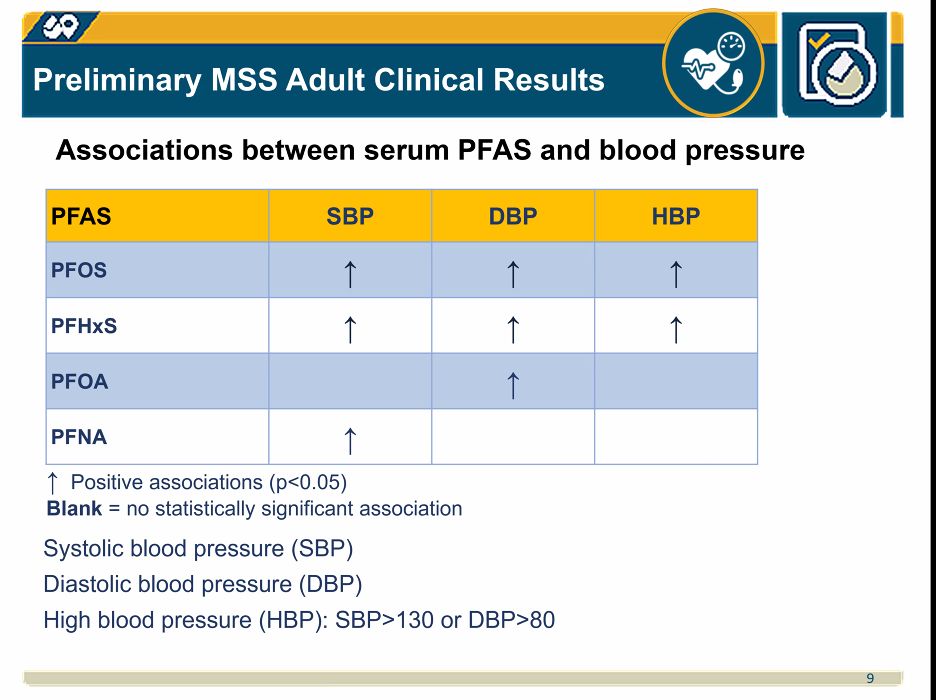
“Adults with higher PFAS levels in their blood tended to have higher blood pressure,” she said.
High blood pressure is a major risk factor for cardiovascular disease, she said.
Graphic shows an increase in blood pressure and various PFAS compounds.Preliminary results federal multi-site study of exposure to PFAS
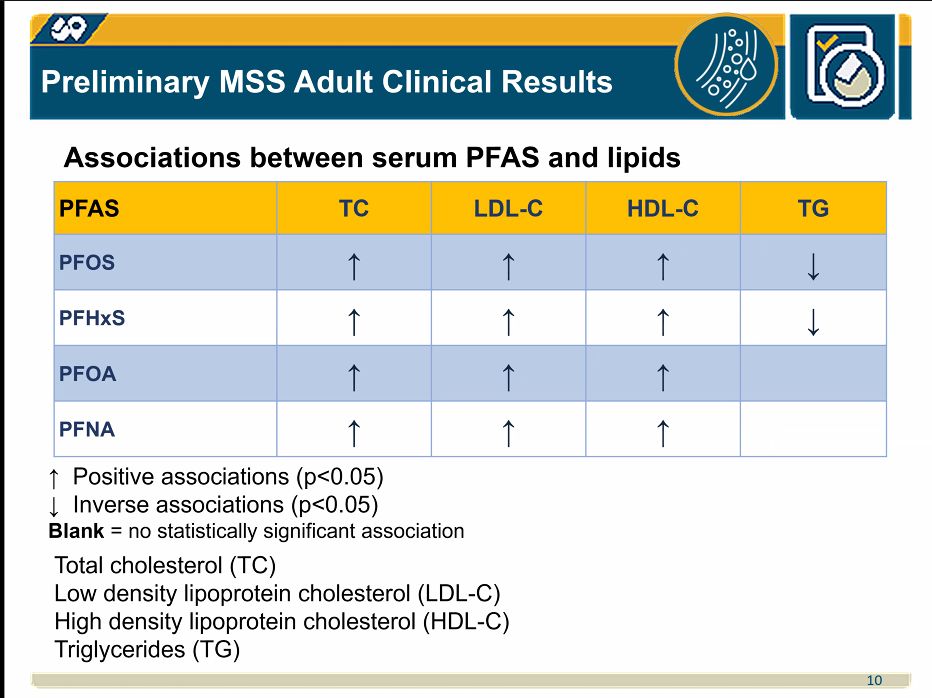
Brown also said elevated PFAS levels were associated with higher cholesterol, including LDL, the so-called bad cholesterol. All four PFAS compounds were associated with higher cholesterol in both adults and children.
She said, however, that preliminary results did not find a clear pattern linking PFOS levels with heart disease, diabetes, thyroid disease, or obesity.
Graphic shows an increase in cholesterol among adults and various PFAS compounds. Cholesterol in children also showed a rise.Preliminary results federal multi-site study of exposure to PFAS
Overall, children with higher PFAS levels had lower levels of certain antibodies that help the body fight infection, she said. The findings suggest PFAS may affect the immune responses, including the response to vaccines. But the findings do not tell researchers whether any individual child’s vaccines were less effective.
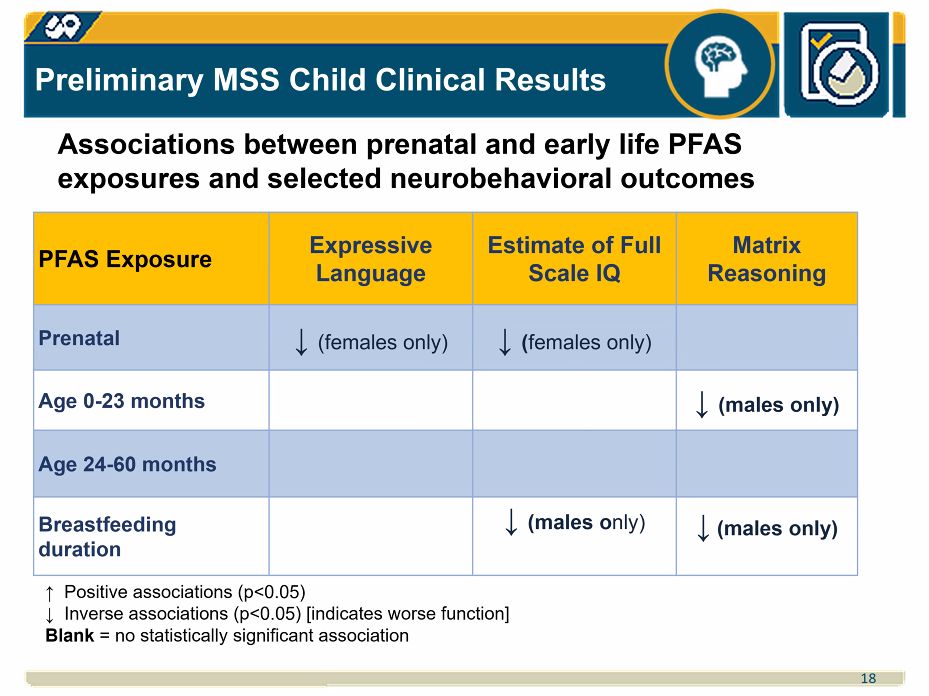
Higher levels of exposure to PFAS during pregnancy and early childhood also showed patterns of lower abilities of language, reasoning, and cognition. But she cautioned that the patterns cannot tell parents how PFAS may have affected their own child.
Chart shows an association between a decrease in language, IQ, and reasoning and PFAS exposure.Preliminary results federal multi-site study of exposure to PFAS
Cancer clusters
The study had too few cases of individual cancer types to complete a statistical analysis from the blood samples given. Cancer is not part of the original study.
To fill the gap, Temple researcher Resa Jones said, the group used a grant from Pennsylvania to separately look at overall cancer cases in 12 counties.
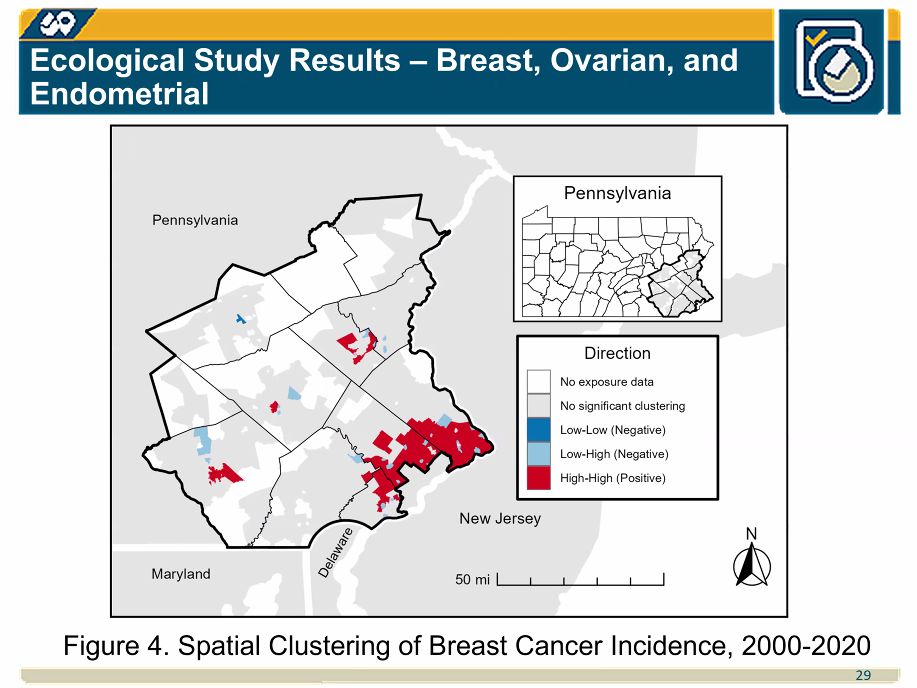
Chart shows clusters of breast, ovarian, and endometrial cancers in Montgomery and Bucks counties in Southeastern Pennsylvania.Preliminary results federal multi-site study of exposure to PFAS
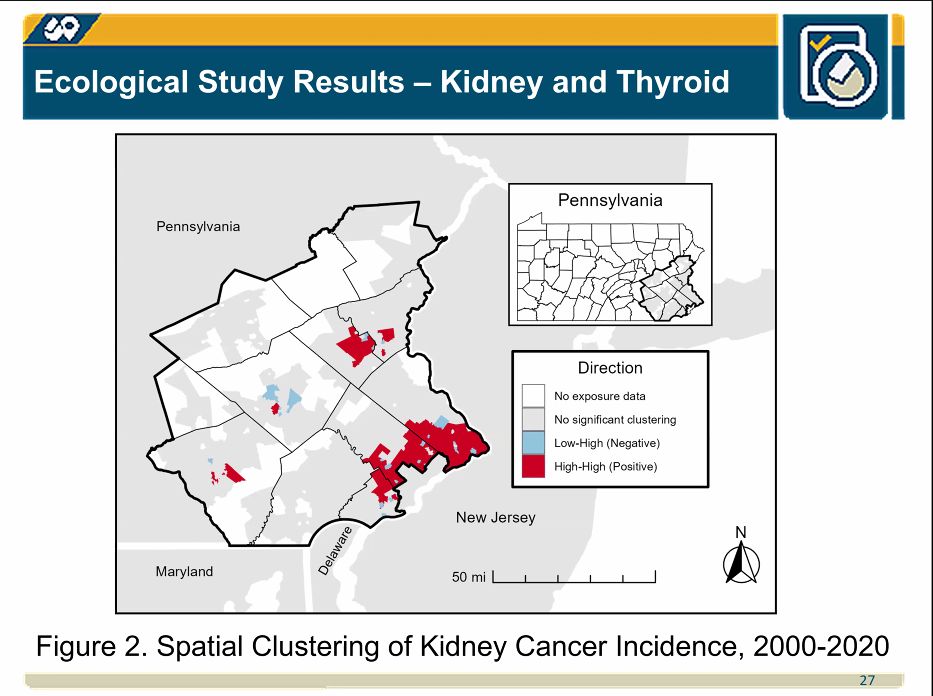
Jones said researchers pulled data from the state’s cancer registry to find the rate per 100,000 people. Mapping showed geographical clusters of elevated kidney, thyroid, breast, endometrial, and ovarian cancer incidence in Bucks and Montgomery Counties.
“We definitely have spatial clustering of the cancers,” Jones said of the two counties.
In municipalities with the highest totals of breast cancer, half had PFAS levels above minimum reporting levels for drinking water, Jones said.
But Jones stressed that more research is needed and that the results are preliminary.
Chart shows kidney cancer clusters in Montgomery and Bucks counties in Southeastern Pa.Preliminary results federal multi-site study of exposure to PFAS
Kidney function
In addition, Robin Taylor Wilson, another investigator from Temple, said longer exposure to PFAS was also associated with lower kidney filtration rates and chronic kidney disease.
The study highlighted heightened renal vulnerability among specific subpopulations, reporting that older residents, individuals with a history of blood transfusions or thyroid disorders, and cancer survivors faced significantly higher risks of chronic kidney disease.
Hope Grosse, of the Buxmont Coalition for Safer Water, said the release of preliminary results of the study gives future researchers a solid foundation for further study into PFAS.
“While these study results cannot undo the damage or bring back what we have lost, we hope that they are the beginning of the answers that we deserve,” Grosse said.
Sherry is the most misunderstood of all Spain’s fine wines, and those in the “fino” category are the most baffling of all for newcomers. These quirky fortified white wines are very strong, very dry, and taste decidedly strange to newcomers on first sip — as if someone had added a splash of some kind of natural cleanser to a dirty martini. There’s a good reason to look past the initial shock to the senses: Fino sherries partner so well with tapas and other salty snacks, they’re well worth acquiring a taste for.
Outside of Spain, sherry is typically seen as a sweet dessert wine that’s most often used in cooking — like port, but made from green grapes, not red. If Americans can picture sherry at all, the mental image is of an amber-colored sweet wine served in tiny glasses by British people in old movies. Within Spain, though, there has always been a preference for the younger, fresher, and paler sherries that fall in the fino category, some of which are labeled as “manzanilla.”
Fino sherries are made with the palomino grape in the Andalucia region that dominates the south of mainland Spain. Their unique flavor is acquired through long-aging under a veil of living yeasts known as flor. This yeast slowly converts the wine’s glycerin into aldehydes that give the wine a pungent scent of raw almonds, green olives, and bruised crab apples, amplified by a light fortification with grape brandy.
The wine should be served well-chilled and in small 2- or 3-ounce portions with the type of salty snacks Spain is famous for — cured jamon, oil-cured olives, and almonds or virtually any seafood that is salted, smoked, tinned, or fried. In this food context, fino wines like this one are a delight, tasting lighter and fruitier, like a palate-cleansing green-apple tonic.
Tio Pepe Fino SherryCourtesy of Gonzalez Byass]
Tio Pepe Fino Sherry
Andalucia, Spain; 15% ABV
PLCB Item #100057072 — on sale for $19.99 through Oct. 4 (regularly $21.99)
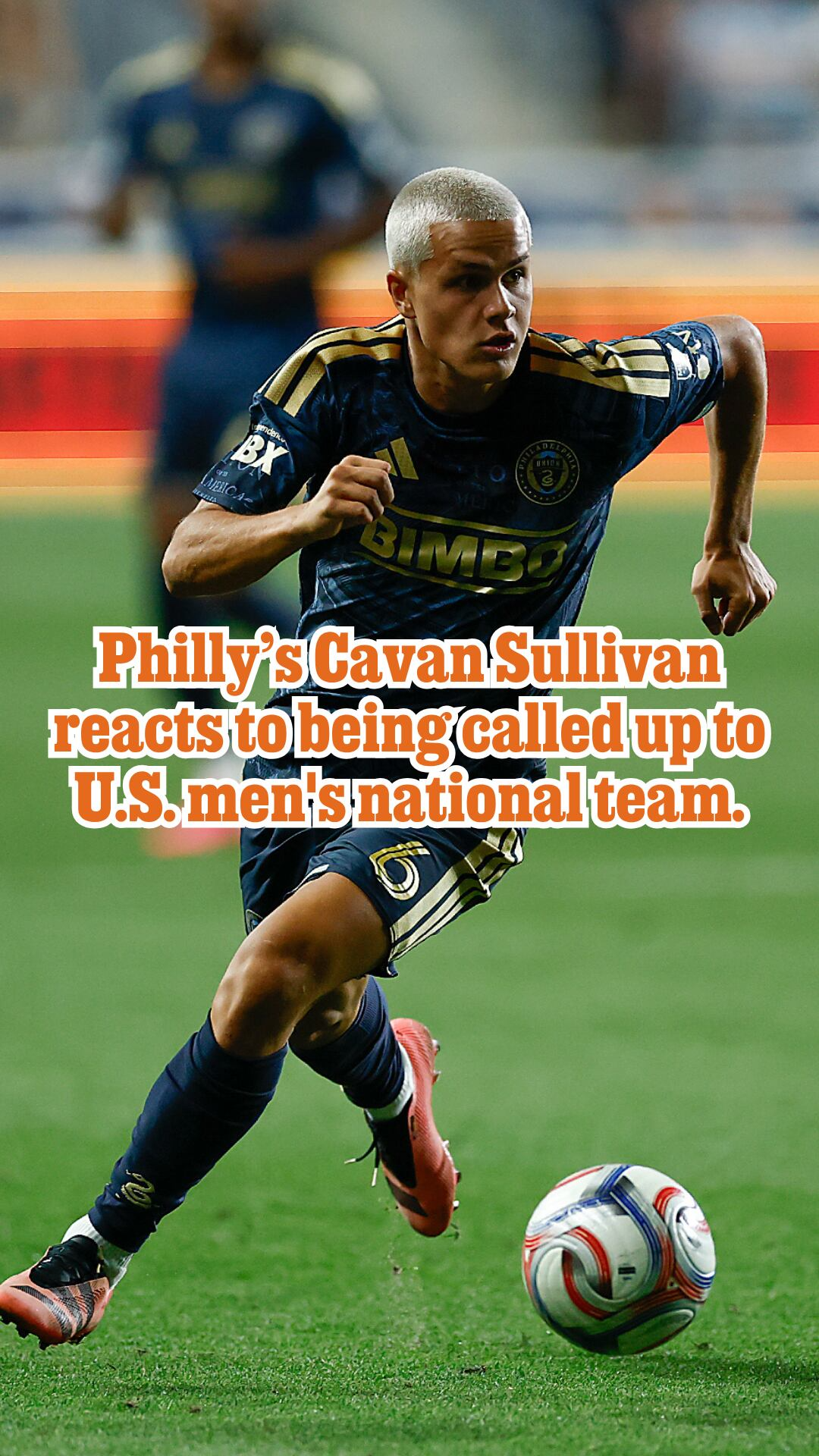
Union phenom Cavan Sullivan’s rapid rise in the soccer world reached a new milestone on Thursday, as the 16-year-old earned his first invitation to the senior U.S. men’s national team.
He is one of three Union players on the latest 28-man squad, along with defenders Neil Pierre and Frankie Westfield. They’re joined by three more with local roots: goalkeeper Matt Freese of Wayne, and centerbacks Auston Trusty of Media and George Campbell of Chester.
Video: Philly’s Cavan Sullivan reacts to being called up to U.S. men’s national team.
Since the Union resumed their season after the World Cup, Sullivan has scored six goals and added five assists in 12 appearances. They include highlight-reel moments that seized headlines across the globe: a dazzling trap and run for a goal at Red Bull New York on Aug. 29, and a backheeled finish in a 5-0 rout at San Diego FC on Sunday.
“I think he deserves all the praise that he’s getting,” U.S. manager Mauricio Pochettino said in a news conference Thursday morning. “Because he’s performing well, he’s playing well, he’s giving assists and scoring goals — and he’s 16.”
Attention isn’t just coming from within MLS. They’re watching on Europe’s big stage, too, since Sullivan is due to join English superpower Manchester City at the end of 2027.
The deal was agreed upon when he turned pro with his hometown club at 14 years old in 2024. While neither club can discuss it publicly because of British labor laws, everyone knows the clock is ticking.
Just before 2 a.m. in Manchester, and it might have woken some people over there up… pic.twitter.com/jI4u2a7pW5
Right now, Sullivan is enjoying the present, kept grounded by coaches, teammates, and family. Chief among them is his oldest brother, Quinn Sullivan, a stalwart of the Union in his own right who earned his senior national team debut last year.
“We need to have a clear idea how to — I don’t want to use the word ‘help,’ but just to be with him and try to provide the best platform for him to evolve,” Pochettino said of wanting to get to know Sullivan. “Every day, we need to be the people that go there to push, and to evolve, and to sometimes put limits, sometimes to encourage to keep going [and] doing what he’s doing. It’s a good challenge for us, and I think it’s exciting to have him.”
The plan to get Sullivan to begin his career in Chester, with the right mix of firmness and care, has worked perfectly so far. And it’s the latest endorsement of the Union’s youth academy, which has become a remarkable pipeline for U.S. national team talent.
Media’s Auston Trusty is one of the veterans on this U.S. squad.Jonathan Tannenawld
Pierre, Westfield also earn the call
Now a new era is arriving, and not just with Sullivan. He’s joined on this squad by two more of the Union’s leading youngsters: Pierre, an 18-year-old centerback, and Westfield, a 20-year-old outside back.
“You are happy for Philadelphia, no?” Pochettino said. “Plenty of players from Philadelphia.”
Both players are major candidates for the 2028 Olympic squad, which is a big part of why they were invited. The Olympics is an under-23 age-group event, and this window is one of the only chances for candidates to get senior national team experience before they go into their own training regimen.
Pierre was born in Lebanon, Pa., and his family moved to Blue Bell so his older brother, Nelson, could join the Union’s academy as a kid. In time, Neil made his own impression and now is the club’s top centerback prospect since McKenzie and Trusty.
Neil Pierre (right) has made his own rapid rise with the Union this summer.Elizabeth Robertson / Staff Photographer
He’s impossible to miss on the field, standing 6-foot-7. He’s scored four goals since joining the Union’s first team this summer. But he also has proven he has the defensive chops to mix it up with veterans and a terrific passing game.
“When you compare him with a 30-year-old, or 26- or 28-year-old centerback that maybe is playing in another country, or maybe in MLS, I don’t see the difference [just] because one has more experience than other,” Pochettino said. “Both can make a mistake; both can be good. That is why, [with] this type of potential, when players like this guy are playing in MLS, how we can contribute in their career, to evolve and be better and better, is this guy being with us.”
Westfield grew up at the other end of Northeast Philadelphia from the Sullivans, in Morrell Park. For a while, he might not have been the most famous athlete in his house, at least locally: his brother, Rocco, starred for the Father Judge boys’ basketball team that won the last two Catholic League championships.
Frankie made his pro debut the night before Rocco claimed the first of his titles. Now, he has made a name for himself.
Frankie Westfield has been impressive as the Union’s starting right back.Yong Kim / Staff Photographer
“I think that it’s normal that it’s a different process now to build the roster,” Pochettino said. “With the idea of not only to perform today, but also to help these young kids to become more mature, more experienced — and because the one of the biggest objectives of the [U.S. Soccer] Federation is the Olympic Games in two years. And I think giving the opportunity to be involved in this senior team is a thing that is going to pay and to be very helpful in two years for these kids.”
The Union trio is part of a fleet of fascinating youngsters on this latest U.S. squad. Others include wingers Mathis Albert of Germany’s Borussia Dortmund, Cole Campbell of Germany’s Elversberg, and Zavier Gozo of England’s Crystal Palace; forward Julian Hall and midfielder Adri Mehmeti of Red Bull New York; and goalkeeper Diego Kochen, who grew up at Spanish giant Barcelona and is now with Denmark’s Lyngby.
Eleven of the 26 players on the squad are newcomers, with 13 returnees from the World Cup. Among the latter are Freese, Trusty, and perennial locker room leaders Chris Richards and Tyler Adams.
The Americans will take the field starting Monday at the national training center in suburban Atlanta, then head off on a cross-country journey with four games: Peru on Sept. 26 in Orlando, Chile on Sept. 29 in St. Louis, then rivals Mexico on Oct. 3 in Glendale, Ariz., and Canada on Oct. 6 in St. Paul, Minn.
Mathis Albert of Germany’s Borussia Dortmund (right) is another of the intriguing young talents on this U.S. roster.Oliver Hardt
USMNT roster for autumn friendlies
Local products in bold
Goalkeepers (4): Chris Brady (Chicago Fire), Matt Freese (New York City FC), Diego Kochen (Lyngby, Denmark), Brian Schwake (Nashville SC)
Defenders (10): George Campbell (West Bromwich Albion, England), Sergiño Dest (PSV Eindhoven, Netherlands), Alex Freeman (Villarreal, Spain), Peyton Miller (New England Revolution), Neil Pierre (Union), Chris Richards (Crystal Palace, England), Antonee Robinson (Fulham, England), Miles Robinson (FC Cincinnati), Auston Trusty (Celtic, Scotland), Frankie Westfield (Union)
Midfielders (9): Tyler Adams (Bournemouth, England), Mathis Albert (Borussia Dortmund, Germany), Sebastian Berhalter (Middlesbrough, England), Zavier Gozo (Crystal Palace), Adri Mehmeti (Red Bull New York), Yunus Musah (AC Milan, Italy), Brooklyn Raines (New England Revolution), Gio Reyna (Strasbourg, France), Malik Tillman (Bayer Leverkusen, Germany)
Forwards (5): Cole Campbell (Elversberg, Germany); Justin Ellis (Orlando City), Julian Hall (Red Bull New York), Ricardo Pepi (PSV Eindhoven, Netherlands), Cavan Sullivan (Union)
"You are happy for Philadelphia, no? Plenty of players from Philadelphia."
Yes, it is an enjoyable part of my job as a professional cynic. But he can rest assured that lots of people around town are happy today:
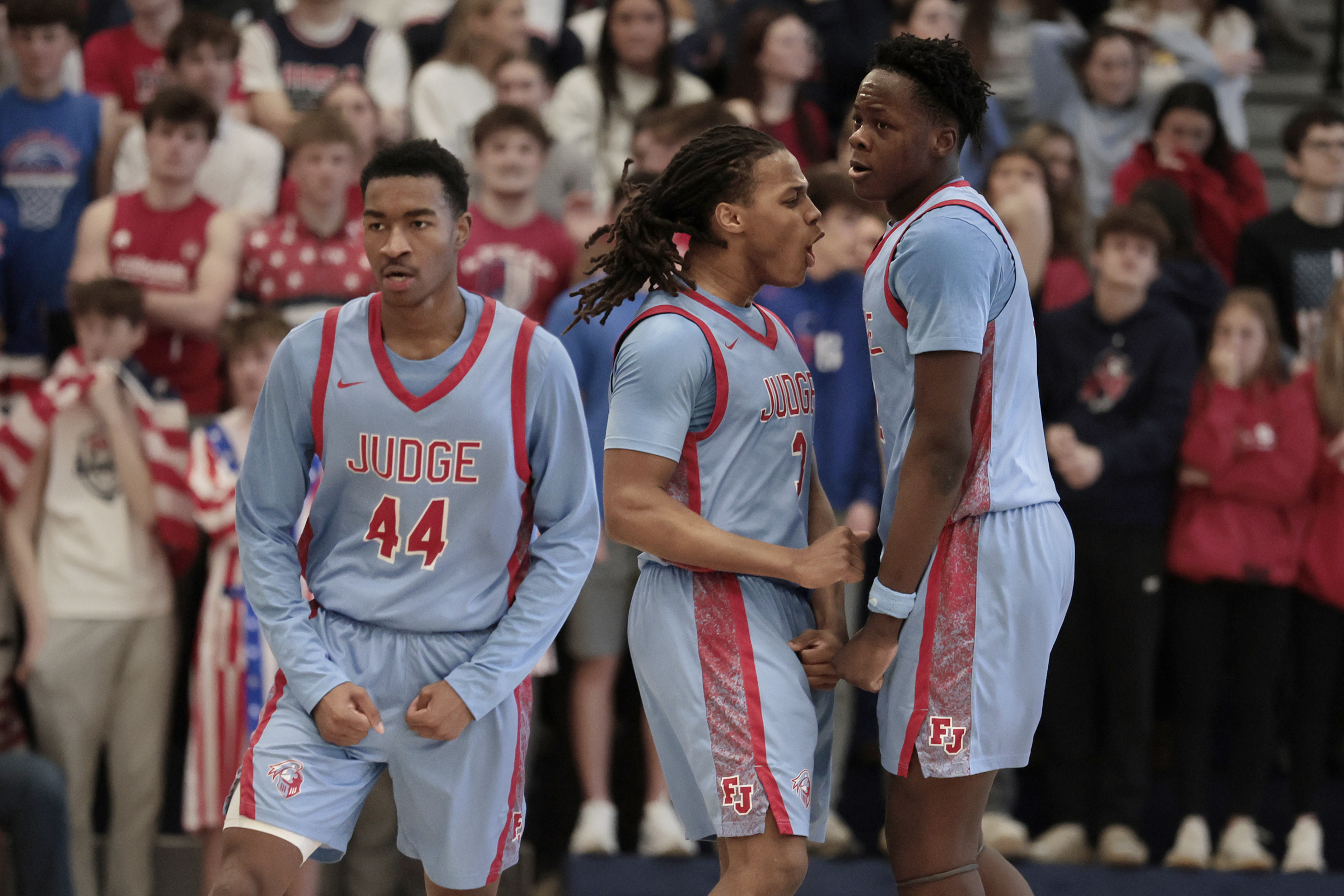
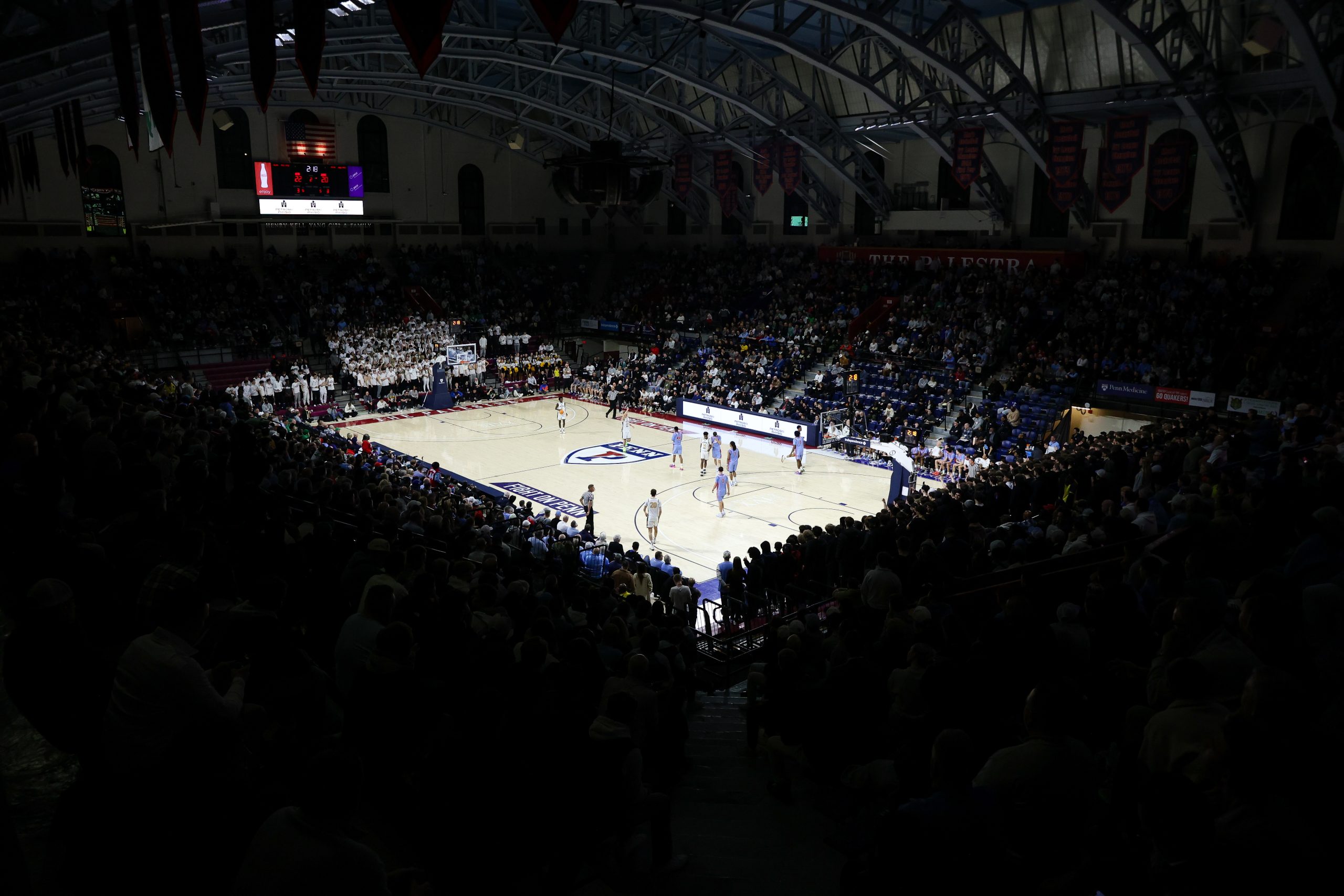
The sound inside the locker room was already overwhelming, Father Judge’s coaches and players shouting and singing after their 52-46 victory over Archbishop Wood in the Philadelphia Catholic League boys’ basketball semifinals last February. And every time someone opened the door to exit, the noise in the room rose, because a sold-out Palestra crowd was now roaring over the night’s second game: Neumann Goretti vs. Bonner-Prendergast.
Still, the kid who had been the primary cause of the celebration, the 6-foot-4 senior guard who had made the night his, was calm. Derrick Morton-Rivera had scored 27 points on an array of three-pointers and pull-up jumpers, leading the Crusaders back from an early 16-point deficit.
“Playing in front of 10,000 people every year, there’s nothing like it,” Morton-Rivera, now a freshman at Temple, said after the game. “I never knew about the PCL until my eighth-grade year. That’s when I learned.”
How did he end up at Judge?
The coaches “recruited me,” he said.
Father Judge graduate Derrick Morton-Rivera after he sank a three-point shot during the 2026 Catholic League boys’ championship.Elizabeth Robertson / Staff Photographer
With that one verb, recruited, Morton-Rivera touched the live wire that crackles among coaches, parents, administrators, and players throughout the high school sports scene in Pennsylvania. House Bill No. 41 — a measure that would allow the PIAA to create separate postseasons, one for public schools and one for private, parochial, and charter schools — passed the Pennsylvania State House of Representatives in April. And of all the factors that play into the longtime dispute over whether boundary and non-boundary schools should compete against each other for championships, none generates as much heat and controversy as recruiting.
“It’s two different worlds,” longtime Lower Merion boys’ basketball coach Gregg Downer said. “If you don’t put massive talent out in basketball or football or soccer or lacrosse, you’re going to get run over.”
Mark Ostaszewski with Archbishop Ryan athletic director Joe Zeglinski after the Raiders won the Catholic League Blue Division title in 2024.Courtesy of Archbishop Ryan
‘Philly is Philly’
Since the Catholic League joined the PIAA in 2008, just one of its coaches, Archbishop Ryan football coach Mark Ostaszewski, has been suspended for recruiting violations. At a January 2025 football camp, Ostaszewski asked a student from the Bensalem School District if he wanted to apply to Ryan. District 12, the association’s umbrella for the Philadelphia Catholic and Public leagues, banned Ostaszewski for a year; he has returned to his role this season.
Locally, recruiting accusations often put programs from District 12 at odds with those from District One, which comprises schools in Philadelphia’s suburbs. And that confirmed example is tame compared to the more intense efforts that coaches have allegedly made to coax athletes to their programs.
A former basketball standout who graduated recently from a District One public school and his father told The Inquirer on the condition of anonymity that, while the student was in eighth grade and throughout his high school career, representatives from three Catholic League programs pursued him. One head coach offered him free tuition, a stipend, and the use of an apartment near campus. The coach also had his team’s star player send several direct messages on Instagram to the player in an attempt to persuade him to attend the school.
Another program had an assistant coach and a parent take the player’s father out to lunch twice, telling him at both meals that he would not have to worry about paying any tuition for his son. The third program’s head coach told the father that, if his son helped the team win the Catholic League championship, a booster would provide a house for the player. Each of the three schools were located between 15 and 35 miles from the player’s home.
Gregg Downer has spent three decades as the Lower Merion boys’ basketball coach.CHARLES FOX / Staff Photographer
“They can twist this however they want,” Downer said. “These kids are targeted because they’re good at sports. I could list 50 examples of kids who have been recruited.”
Morton-Rivera’s path to Father Judge captures the murkiness of the entire issue. Jim Meredith, a 1992 Judge graduate who became its president in late July, noted in a recent interview that while in eighth grade, Morton-Rivera had visited the school and taken its entrance exam — and that he grew up and lived in Lawncrest, just a mile-and-a-half from Judge.
“I can say with full confidence that we’re following PIAA rules and regulations,” Meredith said. “We’re trying to put out an excellent product for our school and our students. Part of that is making sure we adhere to the guidelines that are prescribed to us.”
When asked how Morton-Rivera ended up choosing Judge, head coach Chris Roantree pointed out that Morton-Rivera’s background and family history made it natural for him to consider attending a school with a strong basketball program. D.J. Rivera, his father, finished his high school career in 2006 as Neumann Goretti’s all-time leading scorer before playing Division I ball at St. Joseph’s and Binghamton.
Father Judge coach Chris Roantree noted that Morton-Rivera’s background and family history made it natural for him to consider attending a school with a strong basketball program.Elizabeth Robertson / Staff Photographer
“Philadelphia basketball is a very small community,” Roantree said. “There are different relationships that everybody has. When somebody shows interest in us, we sell the school. When we bring guys in, we show them our career-pathway center. We show them our academic center. …
“Ultimately, ‘recruiting’ is a very broad thing. It’s going to be questioned because we’re a Catholic and private school. He’s within a mile or two of the school. To me, that’s no different from [a public-school coach] talking to someone from a Plymouth Whitemarsh middle school or an Abington middle school. He’s not a transfer. We didn’t aggressively go after him like that.”
Under Article VI, Section 11 of its bylaws, the PIAA forbids “recruiting [that] is materially motivated in some way by an athletic purpose. Recruiting for athletic purposes is directly contrary to fundamental interests of PIAA and its member schools, and any school engaged in such conduct should do so with the expectation that it will be treated harshly upon proof of such conduct.”
Liz Potash retired earlier this summer after 13 years as Central Bucks East’s girls’ basketball coach.Courtesy of Diane BarryShe said, “If I wanted to recruit, I wouldn’t be a public-school coach.” Courtesy of Diane Barry
As clear as that excerpt might seem, determining whether a student’s decision to attend a particular school was “materially motivated” by athletics requires hard and fast evidence, such as text or direct messages between a coach and the athlete, said Sean Kelly, District One’s vice chairman.
If a principal or athletic director files a formal complaint charging an opposing program with violating PIAA bylaws, the association’s corresponding district committee will hold a hearing on the matter.
“Sometimes I’ll get a call from a coach or an AD or somebody who’s associated with one of the schools who says, ‘Hey, this is what we’re hearing. We’re hearing Student A is going to go to this school,’” Kelly said. “I just ask them, ‘What evidence do you have? Are you saying they’re just transferring, or are you saying they’re being recruited?’ We take some time to make sure we pump the brakes because people get very sensitive and very emotional.”
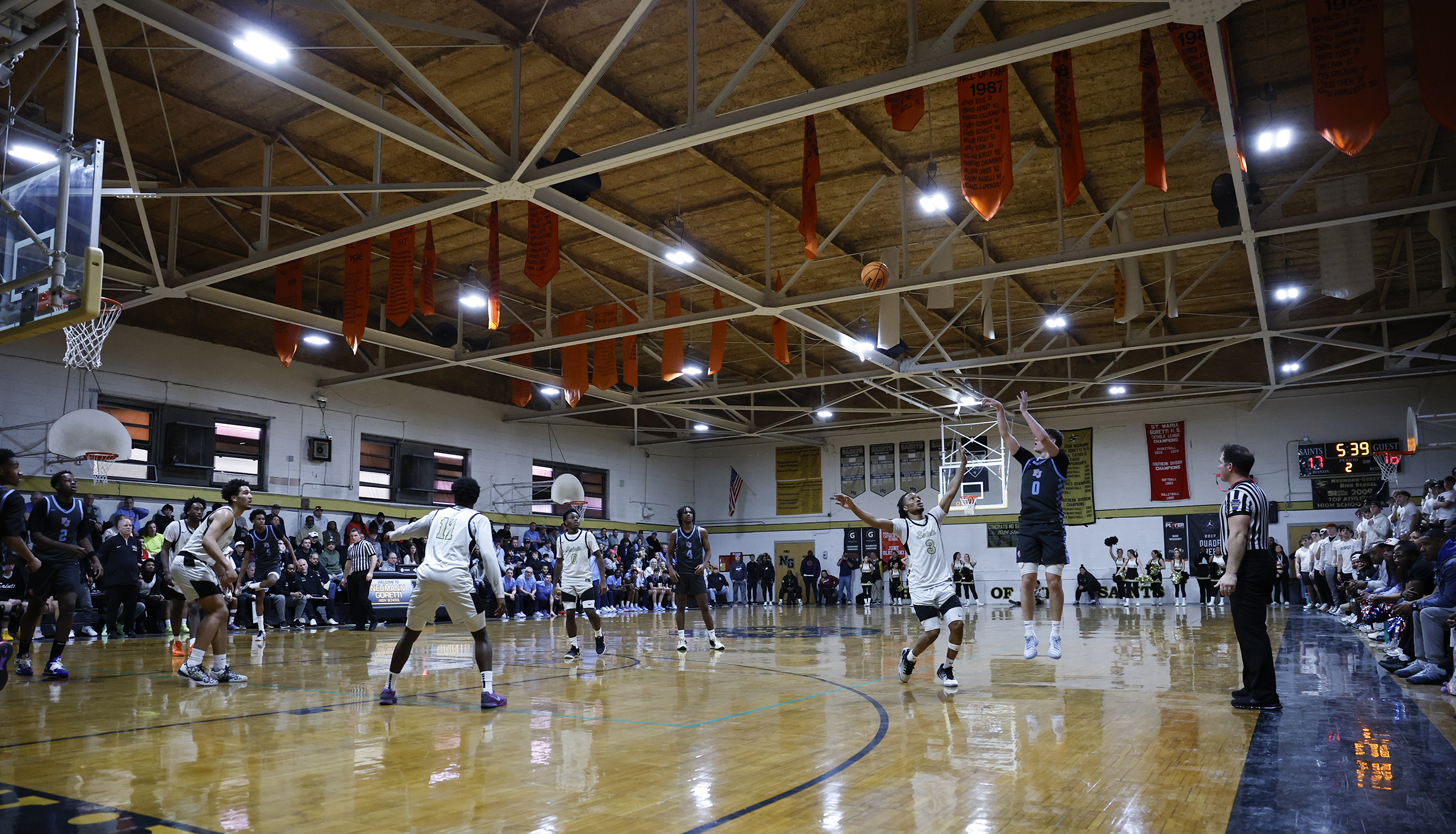
Neumann Goretti and Father Judge boys’ basketball play in South Philadelphia on Feb. 1, 2026.Yong Kim / Staff Photographer
Article VI, Section 11 applies to both boundary and non-boundary schools, but suburban public school coaches bemoan what they see as an inherent imbalance in the system: To play a varsity sport at a public high school, a student must live in that school district. But private, parochial, and charter schools, such as those in the School District of Philadelphia and the Archdiocese of Philadelphia, can draw their students from anywhere. Too many of those institutions, several District One coaches said, bend the rules to do it.
“It’s just not fair,” said Joe Dempsey, who has been the boys’ basketball coach at Spring-Ford High School in Royersford since 2021. “They have the ability to go and get players, to which I say: Let them do that. If they want to go play in that sandbox, let them go.”
Dempsey had previously coached at La Salle College High School for 27 years, including 14 as the program’s head coach. At CYO games, he would see a promising seventh or eighth grader, he said, then approach the player’s parents without talking to the player.
Joe Dempsey previously coached at La Salle College High School for 27 years.
“La Salle made it very clear: Don’t step over the line. Don’t get us in trouble,” Dempsey said. “Once a couple of schools took the gloves off, the pressure came. The pressure was on me at La Salle. I went to the administration: ‘Are you looking around the Catholic League? I can’t just sit on my hands and wait on some wonderful 6-foot-7 kid who can pay a lot of tuition and go to school with all boys and get bused here. It ain’t going to happen by accident.’”
That archdiocesan schools compete for students within District 12’s open-enrollment landscape only complicates matters further. Consider one example: Bonner-Prendie, nestled in Drexel Hill in Delaware County, won the 2024 PIAA Class 4A football championship. Of the top six zip codes from which the school drew students that year, five were within Delco, and the other was just nearby — the Overbook section of Philadelphia — according to Steve Clement, the chief administrative officer of the archdiocese’s Office of Catholic Education.
How many of its football players did Bonner-Prendie recruit, if any? How many did it have to recruit, given the school’s proximity to West Philadelphia? And if a school such as Bonner-Prendie draws students from the city or St. Joseph’s Prep draws them from Camden — less than five miles away — how different is that from the dynamic at a public school in an especially large district?
“The reality,” Clement said, “is that these schools are still serving the areas they were intended to serve.”
Similarly, parents can and do contact the School District of Philadelphia to ask what high schools would best fit their children’s skills and interests: maybe sports, maybe drama, maybe career and technical education. Starr Davenport, the district’s director of finance for athletics, said she frequently fields phone calls from parents of rising ninth graders who ask her about the quality and array of athletic programs at a particular school, and she is happy to answer their questions.
“It’s not a recruitment strategy,” Davenport said. “It’s just transparency. When they want to know, it means they’re trying to find their school home. That selection process seems equitable because we’re not putting it out there, ‘Go to this school if you like football.’ But if a parent or student-athlete inquires, we are definitely transparent in terms of the full gamut of what is offered at a school.”
As for making competition across the state and the Delaware Valley more equitable — that is, giving boundary schools a better chance of beating non-boundary schools — it doesn’t matter much whether gifted athletes who already live within the city’s borders attend public or non-public schools. As long as it stays in Philadelphia, that talent will reveal itself in the results one way or another.
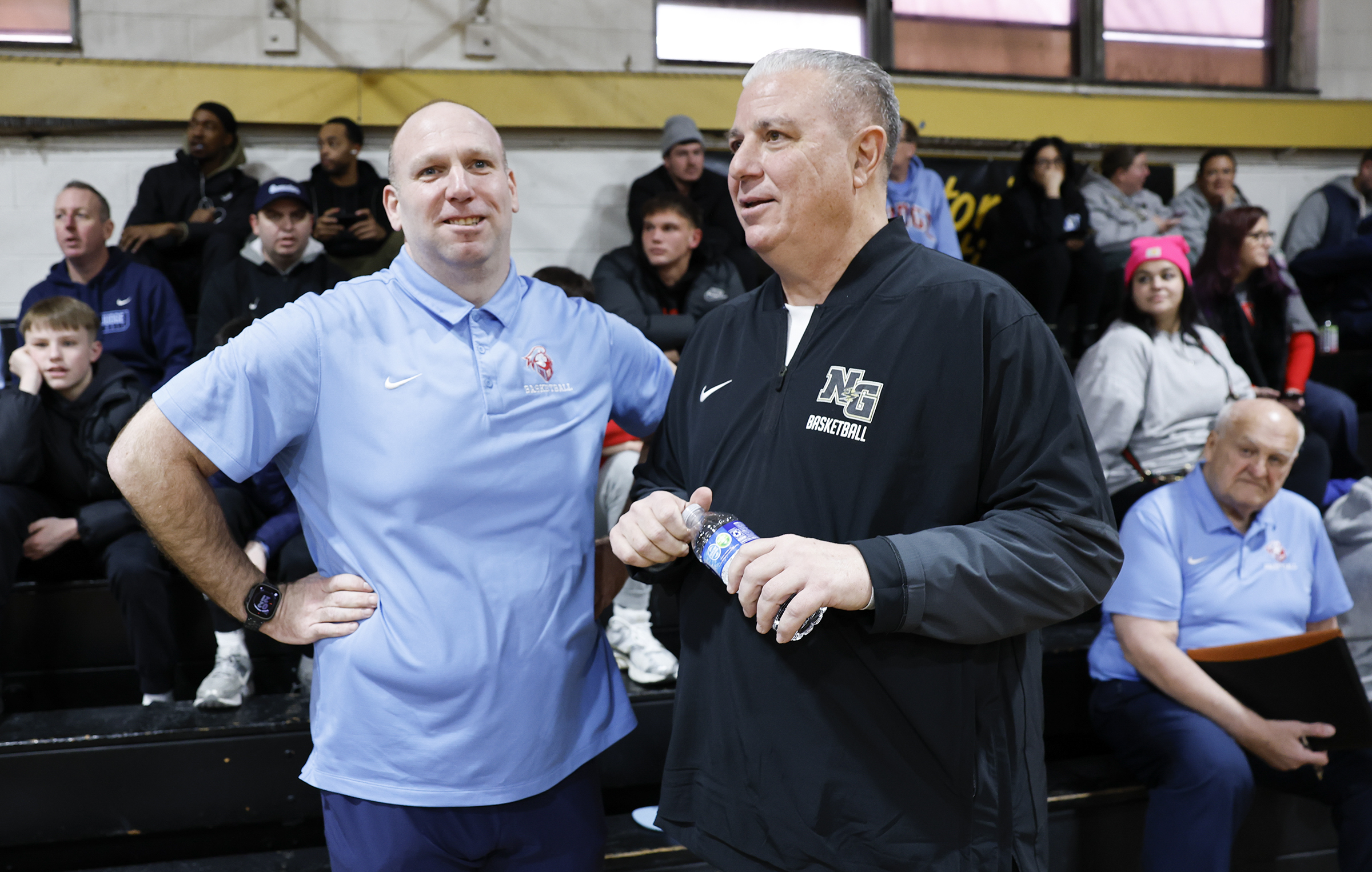
Neumann Goretti head coach Carl Arrigale (right) meets with Father Judge head coach Chris Roantree before the two teams played each other in February 2026.Yong Kim / Staff Photographer
“Here’s the thing: Philly is Philly,” Roantree said. “So if you want all the Philly kids to go to public schools, they’re still going to dominate. There are six, seven, eight, 10 good teams in the Catholic League. If they’re in the playoffs, they’re going to make some noise” in the state tournaments.
The primary complaint among suburban public school coaches and administrators, of course, is that non-boundary schools don’t limit themselves to drawing talent from the city or the neighborhoods that surround them. To some public-school coaches, the notion of recruiting is an alien concept, one they wouldn’t consider if for no other reason than they or the athletes’ families would have to make the necessary arrangements for the athletes to live within district boundaries — say, finding a long-lost aunt whose house was within walking distance of a school bus stop.
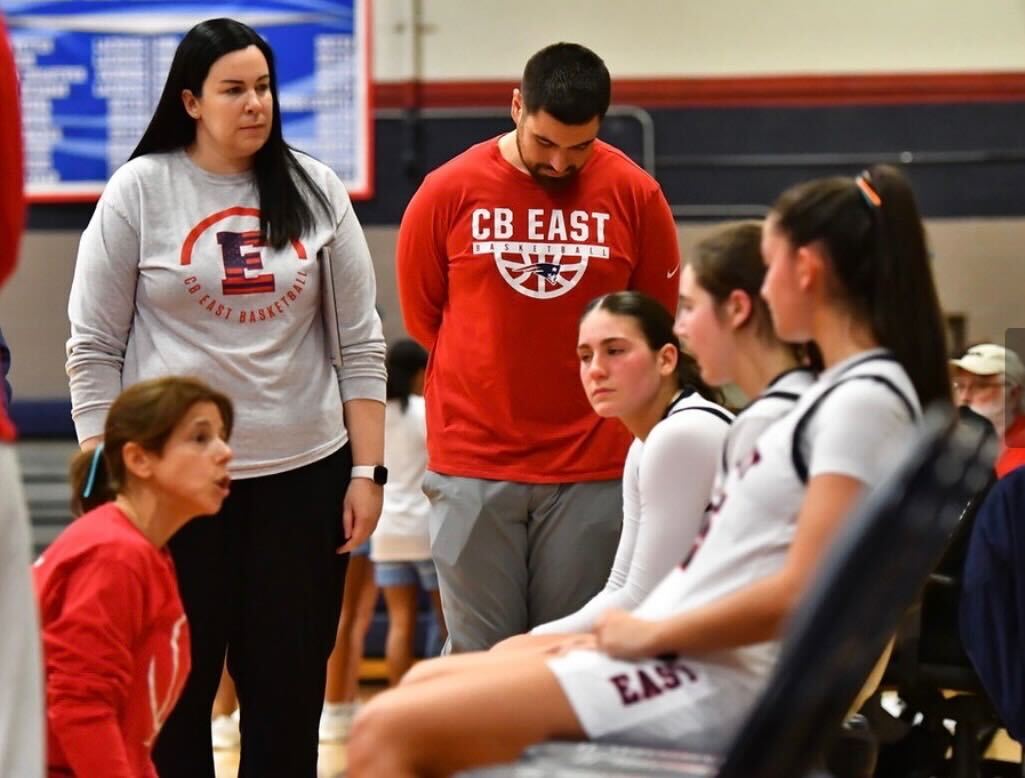
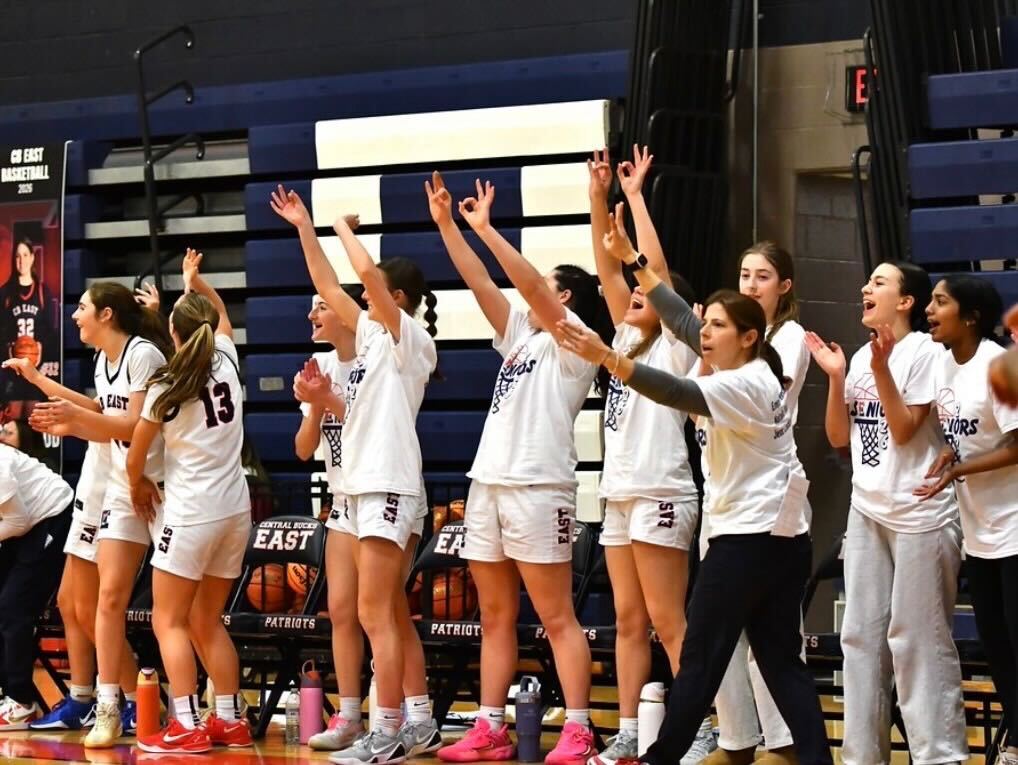
Liz Potash, who retired earlier this summer after 13 years as Central Bucks East’s girls’ basketball coach, said she never sought out players to refill her program’s talent pool. “If I wanted to recruit, I wouldn’t be a public-school coach,” she said. “I’m not going to beg an eighth grader to come to East.”
But another coach might.
“Everyone’s doing it,” said Daniel DiBerardinis, who spent 11 years as a Catholic League athletic director — six at Roman Catholic, five at St. Joe’s Prep — before becoming Penn Charter’s AD last year. “Public schools are recruiting. They recruit. People move to different zip codes all the time.
“I’m not going to put any school on blast, but I know intimate situations — I know families who got an address to be a part of a district. I’m not going to say any schools, but I do know it happens. The rules are super-gray, and people are always going to find workarounds.”
Father Judge takes on Archbishop Wood during in the Catholic League boys’ basketball semifinal at the Palestra on Feb. 18, 2026.Isaiah Vazquez / For The Inquirer
Technicalities
Football, boys’ basketball, girls’ basketball: It’s within the worlds of those three sports that the debates and bickering around recruiting are the loudest and have the most relevance. Rep. Scott Conklin, a Democrat who introduced House Bill No. 41 and represents the 77th district, in State College, all but admitted that the bill was aimed at stopping private, parochial, and charter schools from recruiting — and from continuing to move into the next frontier: wielding sponsor dollars or name, image, and likeness deals to entice athletes.
“Technically, yes, public schools could cheat,” he said in a phone interview. “But we know how difficult that is. I’m 67 years old, and I can win the high-jump competition — technically. But we all know it’s never going to happen.”
In that Palestra locker room back in February, Roantree snickered at the mere mention of the subject. “Everybody says it’s an unfair advantage,” he said. “What I say is, every kid’s got a dream of playing Division I, and there are a lot of coaches in our league who can make that happen. We don’t have to recruit as much as kids want to come and play for us.”
Four days later, behind a team-high 14 points from Morton-Rivera, Father Judge beat Goretti to win its second straight PCL championship. The Crusaders advanced to the semifinals of the PIAA Class 6A tournament, where they lost to a city rival, Imhotep Charter, which then lost in the championship game to Harrisburg’s Central Dauphin.
A renovation project to a beloved library should be easy win for a local politician. But plans to rehab the Cecil B. Moore Library have been anything but a win for Councilmember Jeffery Young Jr.
Young and representatives from the Philadelphia Capital Program Office and the Free Library of Philadelphia gave further details on the $2 million in renovations planned for the North Philly library at a community meeting Tuesday. An additional $8 million previously raised and allocated for the project will remain unused for now.
Construction is expected to begin in October on what city officials are calling phase one of a larger project. The initial phasewill include a new accessible building entrance, restrooms, and elevator; HVAC replacement; a new fire-alarm system and water heater; and safety improvements to building exits, they said.
The building at 2320 Cecil B. Moore Ave. will be closed during construction, which is expected to last about six months. During the closure, some limited programming will be available at the nearby MLK Recreation Center at 2101 Cecil B. Moore Ave., according to the Free Library’s neighborhood library services division chief, Joel Nichols.
Other library programming at MLK or elsewhere is under consideration, he said, but it remains unclear whether Cecil B. Moore will have a dedicated satellite branch.
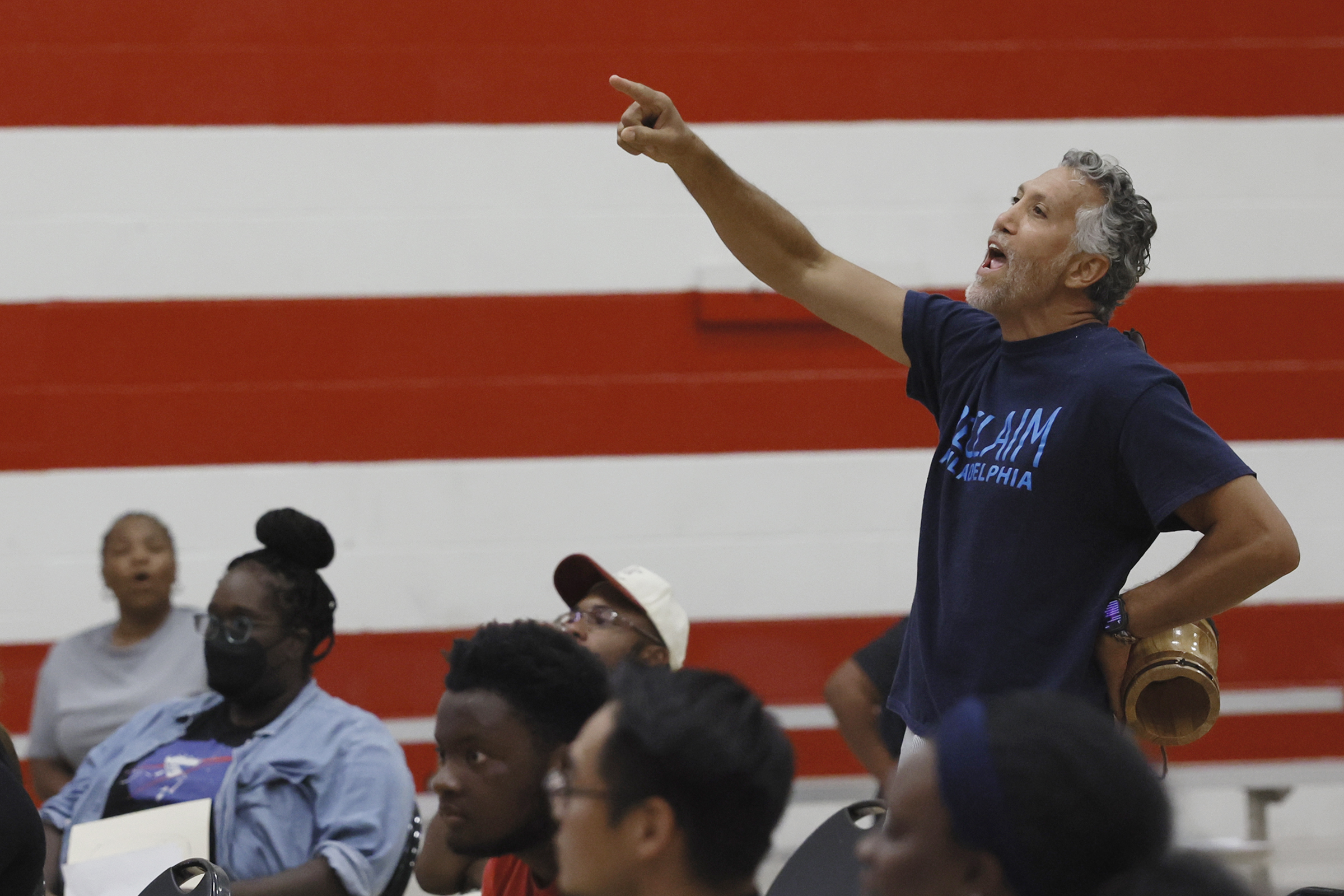
The plan did not go over well with the roughly 100 community members who came for Tuesday’s meeting at MLK Recreation Center. They and other supporters of the library have long been frustrated by how Young has wielded his power of councilmanic prerogative to delay the project for years while pursuing alternative ideas for the site, and has resisted spending the full $10 million that has been raised.
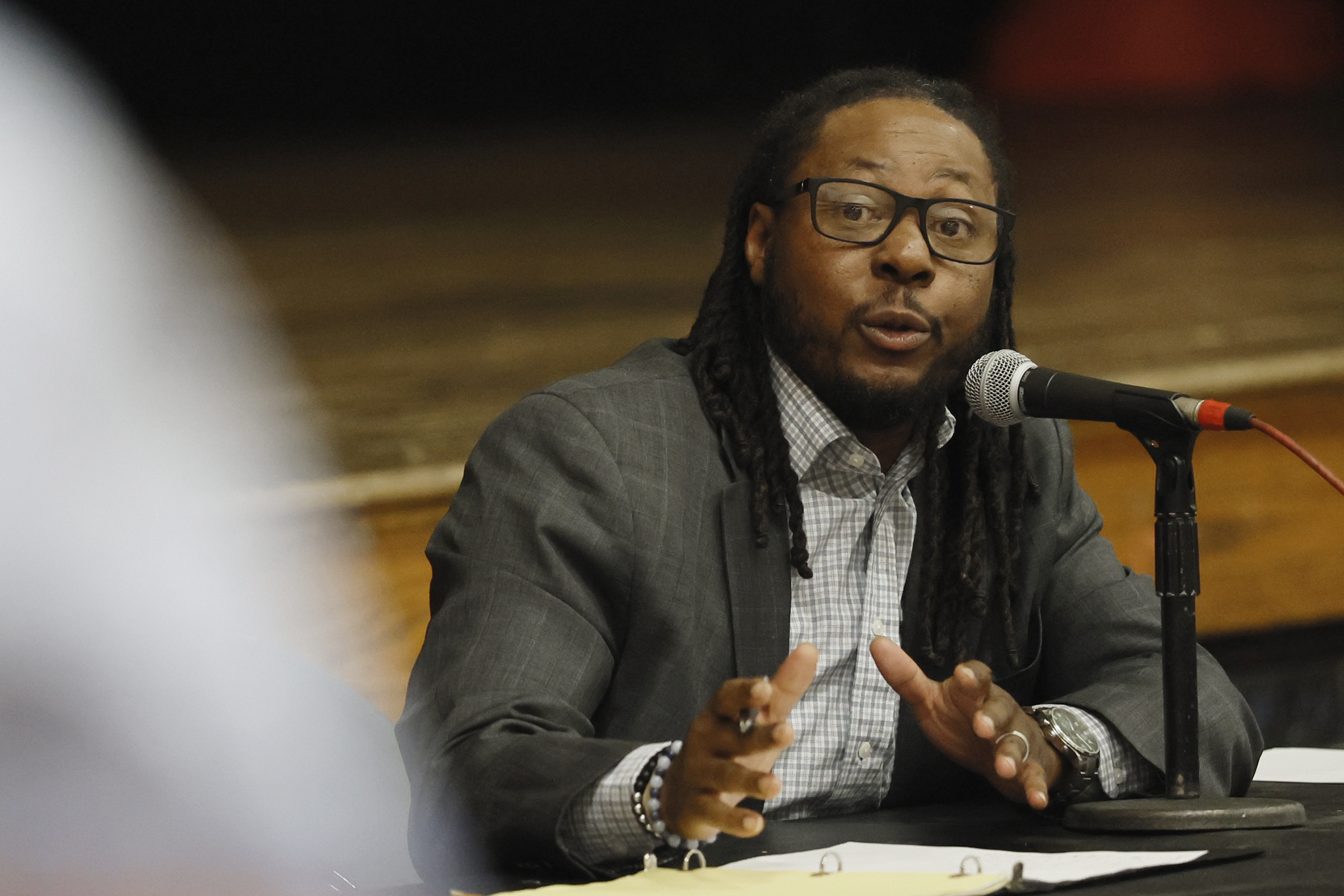
Councilman Jeffery Young Jr. responds to a question from a member of the public during a community meeting, hosted by the councilman and capital projects, at the MLK Recreation Center in Philadelphia on Tuesday, September 15, 2026. The meeting centered on the councilmember’s plans for renovating the Cecil B. Moore library.Elizabeth Robertson / Staff Photographer
Young’s responses to their questions did not ease that frustration, as he and capital program office representatives could not provide details about future project phases, citing the need for more community feedback. Throughout the event, residents chanted at Young to release the full funds and yelled back and shook musical instruments while he gave answers. Some held up signs referencing his forthcoming reelection campaign, which spelled out “one term.”
“At what point have you received enough community engagement that you can listen to the community?” asked Allyce Estremera, a Brewerytown resident.
Lack of community input
In a presentation, officials highlighted the library’saging infrastructure and the urgent need for the foundational and safety improvements in their plan. The Cecil B. Moore Library, which opened in 1962, still has its original restrooms and an HVAC system from 1994, they said. The building has been “plagued by deferred maintenance,” said the library system’s deputy director of property management, Ty Dupass.
In his opening remarks, Young acknowledged the role the library has played in the community for generations, and said the renovations would “bring this building back to life.”
Community members have not voiced opposition to renovations included in the first phase. However, residents have been asking Young and the city to proceed with a more comprehensive $5.3 million renovation plan put forth through the city’s Rebuild initiative, which was slated to begin construction in 2024 and could have been completed by now had it begun on schedule. The Rebuild plan would have included the phase one renovations, as well as a dedicated teen space, new flooring, additional computers, exterior upgrades, and more.
Catherine Martin, a AFSCME DC47 Local 2186 member and library worker holds her “Where’s the $8 million” sign during a community meeting, hosted by Councilman Jeffery Young Jr and capital projects, at the MLK Recreation Center in Philadelphia on Tuesday, September 15, 2026. The meeting centered on the councilmember’s plans for renovating the Cecil B. Moore library.Elizabeth Robertson / Staff Photographer
But once Young replaced outgoing Council President Darrell L. Clarke in 2024, he secured an additional $5 million from the city’s capital budget and paused the project. At various points, Young has offered larger development proposals for the library, including a new building or a hybrid space that includes a library and affordable housing. While the housing proposal has been dropped, Young said Tuesday the current library footprint was too small to accommodate the 21st-century features the community deserves.
Young’s spokesperson, Yumeno Young, and Philadelphia Capital Program Office representatives said the remaining $8 million raised for the project remains committed to the library in its current location.
“Leadership is built on trust. And where is the trust? Because they’re not earning it,” said Emily Dumas, 38, who said she does not trust the $8 million would actually go to the current library building.
Nikol Ligon, 56, said she believed Young and the city ought to release the full funding for a wider renovation, and does not like that the Council member seems to have first and last say on a project that means so much to the community.
And Neferteri Raynor, 24, signed up this summer for a community advisory group Young’s office organized to gather feedback, but the group has held no meetings so far.
“We would love to have a level of certainty and transparency,” she said.
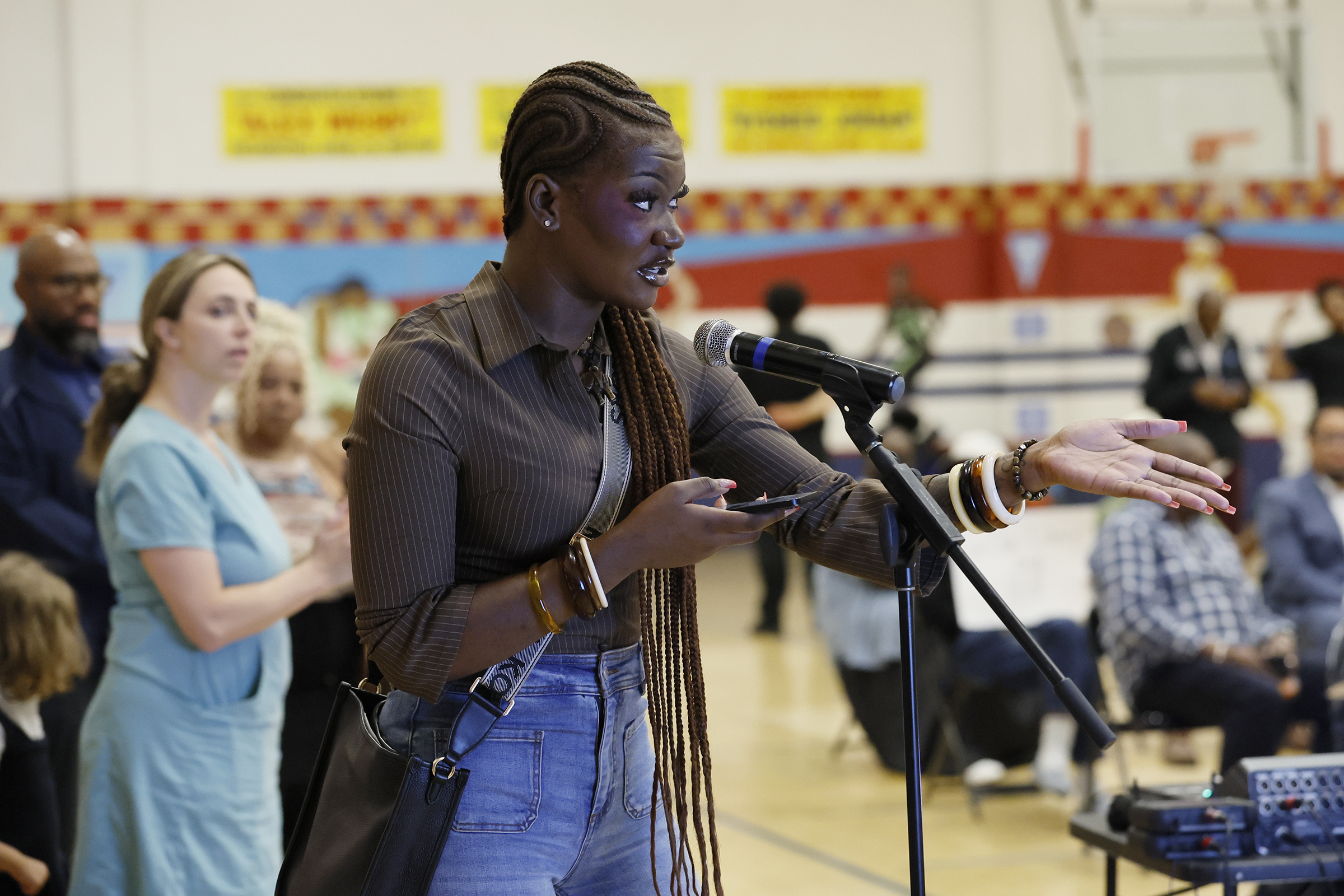
Neferteri Raynor asks questions during a community meeting, hosted by Councilman Jeffery Young Jr and capital projects, at the MLK Recreation Center in Philadelphia on Tuesday, September 15, 2026. The meeting centered on the councilmember’s plans for renovating the Cecil B. Moore library.Elizabeth Robertson / Staff Photographer
Election preview
Yumeno Young said an assessment may be conducted to determine what additional amenities and renovations could be constructed in the future, given the library’s current footprint, but it is unclear if or when that would happen.
The convoluted planning and decision-making confused State Sen. Sharif Street (D., Philadelphia), who spoke at the meeting in support of the residents.
“I don’t understand any of the process that was said today. … We need to come back with a better plan,” he said.
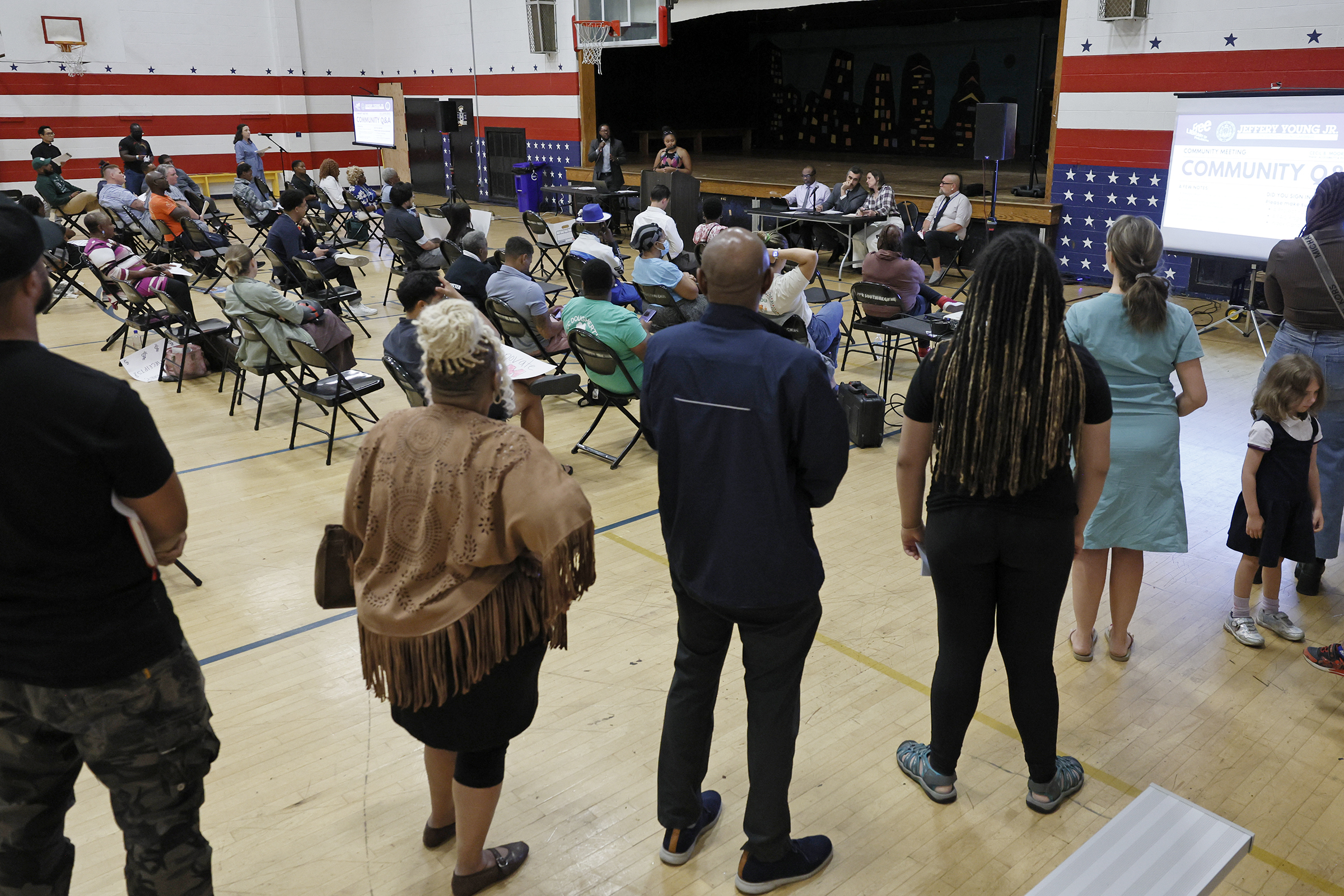
Members of the public line up for a chance to speak at the community meeting, hosted by Councilman Jeffery Young Jr and capital projects, at the MLK Recreation Center in Philadelphia on Tuesday, September 15, 2026. The meeting centered on the councilmember’s plans for renovating the Cecil B. Moore library.Elizabeth Robertson / Staff Photographer
Young largely deferred questions to his spokesperson or the capital program office representatives, and said “we are working on this as a team” when residents implored him to speak more.
Andcommunity members said they were often left more confused by his answers. Siobhan Neitzel, the Brewerytown Sharswood Neighborhood Coalition colead of youth and education, said it felt as if Young was passing accountability onto others.
Some residents brought up the timing of the initial renovations, which are scheduled to be completed shortly before Young, considered the most vulnerable Council member, is on the primary ballot for reelection in May. The residents swore to use the library saga against Young.
While library staff have said they were told by capital program staff the renovation timing was related to Young’s reelection, Young denied there was any connection.
At points during the meeting, Young appeared to get frustrated. He said his goal is to find the best uses for taxpayer money.
“Your voices will be included in the process. … I’m not going to do anything just to do it,” Young said.
The case of Eugene Albert Horsch has captured national attention after he was arrested at what seemed like a routine traffic stop near Independence Mall.
And for weeks, it has only gotten stranger.
story continues after advertisement
Police say they believe that at least three women were killed in Horsch's Olney home — a dilapidated, mysterious property at the center of the investigation. Horsch, 44, remains in federal custody on illegal gun possession and related charges, and has not been charged with any violent crimes.
For weeks, federal and local authorities have been searching his house on the 400 block of West Chew Avenue, turning up mountains of bizarre evidence. At least two other women connected to Horsch and his late father, Raymond "R.C." Horsch, were last heard from at the property.
Unknown chemicals, falsified law enforcement credentials, urns, and disturbing writings have been uncovered in the home since searches began two months ago. Answers into what exactly was going on there, however, remain elusive as the investigation continues.
Horsch's initial arrest in the case came after what started as a routine traffic stop near Independence Mall. A U.S. park ranger saw Horsch's black BMW stopped on Sixth Street in a restricted area, and approached the vehicle to speak with the driver.
The ranger, police said, heard a woman in the vehicle say, "You're going to hurt me." She then produced an ID identifying herself as Blair Tonzelli, a 38-year-old woman who was reported missing in February 2023 — an alias the passenger said she used because of open warrants for her arrest, sources told The Inquirer.
Police searched Horsch's vehicle, and recovered two firearms with obliterated serial numbers, along with cocaine, fentanyl, and marijuana, according to an affidavit. Police, sources said, also found a fake U.S. Drug Enforcement badge with Horsch's photo on it next to the name "Eugene Frederick Steiner," as well as switchblade knives, a cattle prod, and a collapsible baton.
Horsch was arrested and charged with illegal gun possession and drug crimes, and was held on $500,000 bail at Curran-Fromhold Correctional Facility. Federal drug enforcement officers, with assistance from Philadelphia police, began searching his Olney home that day.
Eugene Albert Horsch, 44, of Philadelphia.Courtesy of Philadelphia police
story continues after advertisement
June 26
Searching the Chew Avenue house
After a week of searching, investigators had uncovered a trove of bizarre items. Among them, Inspector Raymond Evers later said, were a home lab in the basement, a marijuana grow operation valued at about $280,000, and a number of containers filled with an unknown oily substance.
Investigators also found an illegal gun, a fake FBI badge with Horsch's photo, five urns containing what police believe are cremated human remains, bottles of liquid investigators could not immediately identify, and a 55-gallon drum with water lines leading to a hole in the ground, according to an affidavit. Additionally, the search revealed bank cards in Tonzelli's name, and an unsigned handwritten document that referenced serial killer Ted Bundy, among other items.
“We just don’t know what he’s doing, if he’s producing something, if he’s making something, if he’s irrigating something," said Deputy Police Commissioner Frank Vanore at the time. "We don’t know."
As the search continued, suspicions were renewed about Horsch's late father, Raymond Horsch, who died last year. The elder Horsch's ex-wife, Amy McHale, was reported missing in 2016, and, like Tonzelli, was last heard from at the Chew Avenue house. Police, however, said that it was too early to say whether any of the evidence recovered would reveal anything related to Tonzelli or McHale.
“This is much ado about nothing,” said Horsch’s attorney, Jerome Brown, of the missing persons investigation at the time. "They're barking up the wrong tree."
Investigators search the home of Eugene Albert Horsch on West Chew Avenue in Olney on June 26.Gabriel Coffey / Staff
June 30
Horsch held in federal custody
Horsch was arraigned on a federal firearms charge in connection with his June 19 arrest. Previously, city prosecutors charged him in the case, but with the federal charge, Horsch would be unable to post bail and would remain detained until trial.
During an appearance in federal court, Horsch spoke little beyond responses to routine legal questions.
“We believe Mr Horsch is innocent," Brown, Horsch's attorney, said in July.
July 22
Excavation at Horsch's home
In the month that federal and local authorities had been examining Horsch's house, investigators used a number of tools, including canine teams from the New Jersey State Police. But by late July, the focus turned to what was beneath the property.
Authorities announced they would unearth a pipe under the house, and examine it for "any evidence that may be present," said Philadelphia police spokesperson Sgt. Eric Gripp. That pipe, Evers later said, was a sewer line.
On the day of the excavation, investigators began digging early, tearing through a small, overgrown garden, as well as the sidewalk and street in front of the property. In the late morning, investigators, with assistance from the Philadelphia Water Department, pulled a piece of pipe from the ground and took it to be examined.
Workers and police investigators excavate a pipe at the home of Eugene Albert Horsch on West Chew Avenue on July 22.Jose F. Moreno / Staff Photographer
Days later, Evers said, more than 20 containers of an unknown substance found in the house were delivered to a lab in Chicago for testing and analysis.
Early August
Two new victims identified
During the search of Horsch's home, investigators discovered about 50 hard drives and other electronic devices, and sent them to the Regional Computer Forensic Lab. In total, those devices contained more than 60,000 images, 70,000 videos, and 10,000 pages of writings and drawings.
In early August, during the search of a hard drive, investigators found what Evers described as images and video of "what appeared to be two deceased females." Those women have been identified as Maribel Fresses, who was 27 when she went missing in February 2018, and Gabrielle Amarando, who was 22 when she went missing in September 2012.
Neither woman had previously been linked to the case, but police believe they were killed inside the Horschs’ Olney home. Investigators, however, had not recovered human remains in the home, Evers said. Police are trying to determine when the women died. They have stopped short of blaming either Horsch.
Evers added that after reviewing the photos and video, the Philadelphia Office of the Medical Examiner said that "if the images and the video are real and not altered in any way," the women were dead.
Gabrielle Amarando, (left) missing since 2012 and Maribel Fresses, 27, reported missing in 2018. Police believe they were killed inside the Olney home.Obtained by The Inquirer
Horsch had been in federal custody for more than a month at this time following his arrest in June. Neither Horsch nor his attorney appeared in court during the hearing where Assistant District Attorney Alyssa Amoroso withdrew the charges.
Hours before a news conference announcing the new developments, authorities contacted the women's families, Evers said. The "graphic and dark" depictions of what appeared to be their dead bodies, he added, seemed to confirm their deaths.
Ricardo Fresses, 61, said that deep down, he knew his daughter Maribel Fresses was dead.
“She called me every day. Absolutely every day she called me, and one day she stopped calling me,” he said. “And as the years went by I knew she was gone.“
Lora Timmons, Amarando’s stepmother, said she was devastated by the news.
”I always hoped I’d see her again," she said. “I didn’t want to think the worst.”
Because their bodies had not been found, the medical examiner's office cannot declare the two women dead. Authorities expect a "protracted" investigation, Evers said, and any declaration of their deaths would likely have to go through Orphans' Court.
In total, Evers said, authorities had served more than 95 search warrants on the property to discover an "astonishing" amount of evidence. Investigators, he added, had only reviewed about 5% of the digital materials, and it was not yet clear when the women died.
“Eugene lived there. He lived there for a long time. His dad lived there for a long time,” Evers said.
Inspector Raymond Evers speaks during an Aug. 12 news conference.Jessica Griffin / Staff Photographer
Aug. 28
Fifth missing woman linked to Olney house
As investigators continued to review digital evidence from the home on Chew Avenue, they found what they believed was video footage showing Raymond "R.C." Horsch killing a woman on camera, law enforcement sources said.
The footage, which police found on a hard drive inside Horsch's house in Olney, appeared to show the older Horsch strangling the woman at his home. Police did not disclose the woman's identity, but notified a relative, the sources said.
Investigators had not recovered the woman's body, and it was unclear when the footage was taken. But with the video's discovery, the woman became the fifth known missing person tied to the Chew Avenue property.
Sources told The Inquirer that police expected the number of missing women connected to the home to grow as the investigation continued.
An unidentified woman in what appears to be Raymond "R.C." Horsch's home on Chew Avenue in Olney. The image is among several photographs in his book "Eroto: To The Prurient Interest,” Volumes I & II.Obtained by The Inquirer
Sept. 11
Latest victim publicly identified
Family members identified the fifth missing woman tied to the Chew Avenue house as Nicole Amanda Fusaro, who had been missing since July 2018.
Fusaro was 27 when she went missing, and was last seen in Kensington. She was raised in Northeast Philadelphia, and attended George Washington High School, according to her Facebook page. A family member told The Inquirer that Fusaro's parents both struggled with addiction, and that she began using drugs in her late teens before drifting to Kensington.
Investigators previously recovered a video on a hard drive taken from Horsch’s home while in search of clues for other missing persons linked to the property. Law enforcement sources said they believed the video shows the older Horsch strangling Fusaro to death.
“Hopefully more attention will be made to missing persons so this doesn’t happen again,” said Jonathan Halloran-Koren, Fuscaro's cousin.
Nicole Fusaro was reported missing in 2018 when she was 27. Police believe she was killed by Raymond "R.C." Horsch in his Chew Avenue home.Courtesy of Jonathan Hallo
Sept. 16
Seven dead or missing women linked to Olney house
The number of dead or missing people linked to Horsch's Olney home increased to seven after investigators recovered images that appeared to show two more women dead inside the property, Deputy Police Commissioner Frank Vanore said.
Among the images, Vanore added, were photos that showed a 25-year-old woman unconscious inside the home with injuries on her body. Vanore declined to identify the woman at her family's request.
Additional images showed another woman who appeared to be dead inside the property, and investigators have not yet identified her. She appeared to be in her mid-20s, Vanore said.
In total, investigators identified 58 people in digital evidence collected from the home, Vanore said. Of those, 16 were located and interviewed by police, and 25 others were located but not yet interviewed.
FBI Philadelphia Special Agent in Charge Wayne Jacobs (center) looks to Deputy Police Commissioner Frank Vanore (left) during a press conference.Elizabeth Robertson / Staff Photographer
Staff Contributors
Reporting: Nick Vadala, Max Marin, Ellie Rushing, Barbara Laker, and Ryan W. Briggs
Editing: Molly Eichel, Dan Rubin
Copy Editing: Brian Leighton
(()=>{var Q=(e,t)=>()=>(t||e((t={exports:{}}).exports,t),t.exports);var A=Q(r=>{var X={0:”Jan.”,1:”Feb.”,2:”March”,3:”April”,4:”May”,5:”June”,6:”July”,7:”Aug.”,8:”Sept.”,9:”Oct.”,10:”Nov.”,11:”Dec.”};function L(e){return e===void 0&&(e=new Date),X[e.getMonth()]}var ee={0:”Jan”,1:”Feb”,2:”Mar”,3:”Apr”,4:”May”,5:”Jun”,6:”Jul”,7:”Aug”,8:”Sep”,9:”Oct”,10:”Nov”,11:”Dec”};function b(e){return e===void 0&&(e=new Date),ee[e.getMonth()]}function s(e){return e==null}function T(e){return typeof e==”number”&&isFinite(e)}function f(e){return T(e)&&Math.floor(e)===e}var te=[“one”,”two”,”three”,”four”,”five”,”six”,”seven”,”eight”,”nine”],ne=[“million”,”billion”,”trillion”,”quadrillion”,”quintillion”,”sextillion”,”septillion”,”octillion”,”nonillion”,”decillion”],S=[“th”,”st”,”nd”,”rd”,”th”,”th”,”th”,”th”,”th”,”th”],oe=[11,12,13];function M(e){if(s(e))return””;var t=+e;return f(t)?oe.indexOf(t%100)>-1?S[0]:S[t%10]:””}var ie=[“first”,”second”,”third”,”fourth”,”fifth”,”sixth”,”seventh”,”eighth”,”ninth”],re=new RegExp(/s+([^s]*)s*$/);r.apdate=function(e){return e===void 0&&(e=new Date),L(e)+” “+e.getDate()+”, “+e.getFullYear()},r.apdatetab=function(e){return e===void 0&&(e=new Date),b(e)+” “+e.getDate()+”, “+e.getFullYear()},r.apmonth=L,r.apmonthtab=b,r.apnumber=function(e){if(s(e))return””;var t=+e;return f(t)?t=10?e.toString():te[t-1]:e.toString()},r.aptime=function(e){e===void 0&&(e=new Date);var t,n,o=e.getHours(),i=e.getMinutes(),u=i===0;if(u){if(o===0)return”midnight”;if(o===12)return”noon”}return o0?o:12):(t=”p.m.”,n=o===12?o:o-12),u?n+” “+t:n+”:”+(i<10?"0"+i:i)+" "+t},r.capfirst=function(e){if(s(e))return"";var t=String(e);return""+t.charAt(0).toUpperCase()+t.slice(1)},r.intcomma=function(e){if(s(e))return"";var t,n=+e;return T(n)?((t=n.toString().split("."))[0]=t[0].replace(/B(?=(d{3})+(?!d))/g,","),t.join(".")):e.toString()},r.intword=function(e){if(s(e))return"";var t=+e;if(!f(t))return e.toString();var n=Math.abs(t);if(n<1e6)return e.toString();var o=Math.ceil(Math.log(n+1)/Math.LN10)-1,i=o-o%3,u=t/Math.pow(10,i);return(u=Math.round(10*u)/10)+" "+ne[Math.floor(i/3)-2]},r.ordinal=function(e,t){if(t===void 0&&(t=!1),s(e))return"";var n=+e;return f(n)?t&&n/Android|webOS|iPhone|iPad|iPod|BlackBerry|IEMobile|Opera Mini/i.test(navigator.userAgent);var g=(e,t=null,n=null)=>{n||(n=document.querySelector(“head”));let o=document.createElement(“script”);o.type=”text/javascript”,o.src=e,t&&(o.onload=t),n.appendChild(o)},q=()=>(window.PMNdataLayer?.[0]!==void 0&&window.PMNdataLayer[0])?.analytics?.user?.state===”Subscribed”,k=()=>{let t=(window.PMNdataLayer?.[0]!==void 0&&window.PMNdataLayer[0])?.analytics?.user?.state;return window.location.host.includes(“zzz-systest”)||window.location.host.includes(“pmn.arcpublishing.com”)||window.location.host.includes(“stage.fusion.inquirer.com”)||typeof t>”u”},j=()=>{let t=(window.PMNdataLayer?.[0]!==void 0&&window.PMNdataLayer[0])?.analytics?.user?.hasAdsFreeReading;return!!(t&&t==1)},v=()=>window.location.host.includes(“localhost”);var se=()=>{j()&&document.querySelectorAll(“.js-adbox”).forEach(t=>{t.classList.add(“is-hidden”)})},H={init:()=>{se()}};var a,y=!1,ae=()=>{a=document.querySelector(“.js-appendix”)},C=()=>{let e=document.querySelector(“.js-appendix-static-content”),t=e.querySelector(“.js-appendix-static-items”).getBoundingClientRect().height;e.classList.remove(“is-collapsed”),e.style.maxHeight=t+”px”},B=()=>{a.classList.contains(“js-appendix-sticky”)&&(a.getBoundingClientRect().top{y=document.querySelector(“.js-appendix-static-content”).getBoundingClientRect().bottom{y&&document.querySelector(“body”).classList.toggle(“is-open-appendix”)},ce=()=>{window.addEventListener(“scroll”,()=>{B(),D()}),window.addEventListener(“resize”,()=>{B(),D()}),document.querySelector(“.js-appendix”).addEventListener(“click”,()=>{P()}),document.querySelectorAll(“.js-appendix-expand-static”).forEach(e=>{e.addEventListener(“click”,()=>{C(),window.addEventListener(“resize”,()=>{C()})})}),document.querySelectorAll(“.js-appendix-link”).forEach(e=>{e.addEventListener(“click”,()=>{P()})})},N={init:()=>{ae(),ce()}};var m,le=(e,t)=>{m=m||window.PMNdataLayer,m?m.push({event:”misc_event”,eventAction:e,eventLabel:t}):window.location.hostname.includes(“localhost”)?console.log(“Analytics event:”,e,t,”(not actually being sent due to localhost)”):console.log(“Failed to push analytics event”,e,t)},I={event:(e,t)=>{le(e,t)}};var de=()=>{document.querySelectorAll(“.js-card-show-more”).forEach(e=>{e.addEventListener(“click”,()=>{ue(e)})})},ue=e=>{let t=e.closest(“.js-card”),n=t.querySelector(“.js-card-body”),i=n.querySelector(“.js-card-body-content”).getBoundingClientRect().height;t.classList.remove(“is-collapsed”),n.style.maxHeight=i+”px”,setTimeout(()=>{n.style.maxHeight=”none”},1e3),I.event(“expand_card”,`${t.dataset.id}`)},F={init:()=>{de()}};var c,$,pe=()=>{c=document.getElementById(“js-inno-toast”)},fe=e=>{if(!c)return;c.innerHTML=e,c.classList.add(“is-active”);let t=()=>{c.addEventListener(“transitionend”,me,{once:!0}),c.classList.remove(“is-active”)};clearTimeout($),$=setTimeout(t,5e3)},me=()=>{c.innerHTML=””},l={init:()=>{pe()},showToast:fe};var h,z=!1,he=async()=>new Promise(e=>{setTimeout(()=>{console.log(“simulating createShareLink for localhost”),e(“https://inquirer.com/interactives”),ge()},100)}),ge=()=>{let e=document.querySelector(“.js-gift-toast-receiver”);!e||!(e instanceof HTMLElement)||setTimeout(()=>{let t=e?.querySelector(“span”);t&&(t.innerHTML=”Gift link copied to clipboard“)},20)},ve=()=>{let e=window.services?.createShareLink;e&&(h=e),v()&&(h=he),h&&we()},ye=async e=>{let t=”text/plain”,n=async()=>{try{return await h(window.location.pathname)}catch{e.dataset.state=”error”,l.showToast(“Hmm, we couldn’t generate a gift link…”)}},o=new ClipboardItem({[t]:n()});await navigator.clipboard.write([o]).catch(i=>{console.log(i),l.showToast(“Couldn’t copy to clipboard, try again?”),e.dataset.state=”error”}),l.showToast(“Gift link copied to clipboard!”),e.dataset.state=”complete”},we=()=>{document.querySelectorAll(“.js-gift”).forEach(t=>{(q()||v()||k())&&t.classList.add(“is-available”)}),document.querySelectorAll(“.js-gift-button”).forEach(t=>{t instanceof HTMLButtonElement&&t.addEventListener(“click”,()=>{t.classList.contains(“disabled”)||(t.dataset.state=”loading”,z=!0,ye(t),setTimeout(()=>{t.dataset.state=”ready”},2e3))})});let e=document.querySelector(“.js-gift-toast-receiver”);!e||!(e instanceof HTMLElement)||xe(e)},xe=e=>{new MutationObserver(n=>{for(let o of n){let i=[…o.addedNodes].at(0);if(!(i instanceof HTMLElement))return;z&&l.showToast(i.outerHTML)}}).observe(e,{subtree:!0,childList:!0})},O={init:()=>{ve()}};var Le=()=>{window.addEventListener(“message”,e=>{if(e.data[“datawrapper-height”]){let t=e.data[“datawrapper-height”];for(let n in t)document.querySelector(`#datawrapper-chart-${n}`).setAttribute(“height”,t[n])}})},be=()=>{document.querySelectorAll(“.js-datawrapper-graphic”).forEach(e=>{g(`https://datawrapper.dwcdn.net/${e.dataset.id}/embed.js`,null,e)})},Se=()=>{window.addEventListener(“message”,e=>{let t=e.data;document.querySelectorAll(`iframe[src*=”${t.id}”]`).forEach(o=>{o.style.height=`${t.height}px`})},!1)},Me=()=>{document.querySelectorAll(“.js-pym-graphic”).forEach(e=>{if(typeof window{new window.pym.Parent(e.id,e.dataset.iframe)};typeof window.pym>”u”?g(“https://pym.nprapps.org/pym.v1.min.js”,t):t()}})},R={init:()=>{Le(),be(),Me(),Se()}};var p,Te=()=>{document.querySelectorAll(“.js-hover”).forEach(e=>{e.addEventListener(“click”,()=>{J(e)}),e.addEventListener(“mouseenter”,()=>{J(e)}),e.addEventListener(“mouseout”,()=>{V(e)})}),window.addEventListener(“scroll”,()=>{p!==null&&Ae()})},Ae=()=>{(p>window.scrollY+100||p{V(e)})},J=e=>{e.classList.add(“is-visible”),p=window.scrollY},V=e=>{e.classList.remove(“is-visible”),p=null},G={init:()=>{Te()}};var Ee=()=>{},W={init:()=>{Ee()}};var d,w,x=!0,qe=()=>{d=document.querySelectorAll(“.js-video-autoplay”)},ke=()=>{window.addEventListener(“resize”,()=>{Y()}),window.addEventListener(“scroll”,()=>{Y()}),d.forEach(e=>{e.addEventListener(“volumechange”,t=>{e.muted!==x&&!E()&&(x=e.muted,je())})})},Y=()=>{let e;d.forEach((t,n)=>{let o=t.getBoundingClientRect(),i=o.height/2;o.y-i&&(e=t)}),e!==w&&(w=e,d.forEach(t=>{t.pause()}),e?e.play():w=null)},je=()=>{d.forEach(e=>{e.muted=x})},_={init:()=>{qe(),d&&ke()}};var U={init:()=>{H.init?.(),N.init?.(),F.init?.(),O.init?.(),R.init?.(),G.init?.(),W.init?.(),_.init?.(),l.init?.()}};var He=()=>{},Z={init:()=>{He()}};var Ce=document.querySelector(“.js-inno”),K=()=>{U.init(),Z.init()};Ce?K():new MutationObserver((t,n)=>{if(document.querySelector(“.js-inno”)){n.disconnect(),K();return}}).observe(document,{attributes:!0,childList:!0,subtree:!0});})();
It learned after the academy announced its museum was closing thatthe building is “alone among the historic cultural institutions on the Parkway” as not designated historic by the city, said Paul Steinke, executive director of the Preservation Alliance.
The museum is scheduled to close at the end of the month, and the academy plans to eventually relocate its collections and sell its building. The property’s zoning allows for low-rise, low-density residential buildings, such as townhouses or small apartment buildings. According to city records, the property’s assessed value is more than $28.7 million.
According to the Philadelphia Historical Commission, the academy considered pursuing historic designation for the building in the late 1980s but ultimately did not. On Wednesday, a spokesperson for the commission said it does not have a nomination from anyone in hand.
City Councilmember Jeffery Young Jr., whose 5th District includes the academy, said his office is looking into possible zoning changes to “protect and preserve that Parkway district,” including the academy’s building.
“We want to be able to utilize every tool we have available if necessary” to “preserve that public good in that area,” Young said.
Why hasn’t the building been designated historic yet?
“It wasn’t thought to be threatened, for one,” Steinke said. Designation happens only when someone takes the initiative to submit a nomination to the city, he noted, and that is commonly spurred by threats of redevelopment.
He pointed to another iconic Philadelphia spot that most people assumed was historically protected until a developer made plans to redevelop it: Jewelers Row, the oldest diamond district in the country.
In late 2019, Toll Bros. demolished several buildings on the 700 block of Sansom Street to build a 24-story housing tower that did not materialize. Developer Pearl Properties, which later took over the site, started making visible progress on its own housing tower this summer following years of delays.
For the academy’s building, Steinke said, the Preservation Alliance is looking into what it would take to do the necessary research, write and submit a nomination, and take it through the city’s historic designation process, which includes review by historical commission staff and public consideration by the commission and its committee on historic designation.
“We think it clearly qualifies for local designation,” Steinke said.
In the early 1900s, the academy building’s facade was redesigned in the Georgian style by the well-known Philadelphia firm Wilson Brothers & Co. Defining features of this architectural style include heavy use of red brick, symmetrical facades, centered entrances, and simple decorative elements, according to Steinke.
The academy said financial pressures and low attendance drove its decision to close the museum after nearly two centuries.
But Steinke said he hopes the outpouring of love and support people have been showing the museum since the closure was announced can help keep it where it is. When he visited on Sunday, he said, he “was heartened by the crowds of people, the families enjoying it.”
“It would be a real loss to lose that museum at the start of the museum mile,” Steinke said, referring to the section of the Parkway that hosts institutions such as the Rodin Museum, Calder Gardens, and the Philadelphia Museum of Art.
On Thursday, Councilmembers Young and Nina Ahmad plan to introduce a resolution that calls for Council hearings on the museum’s closure. They are also planning a rally to protest the closure at City Hall that morning.
People came out to support and rally outside the Academy of Natural Sciences of Drexel University on the Benjamin Franklin Parkway on Sept. 8.Tyger Williams / Staff Photographer