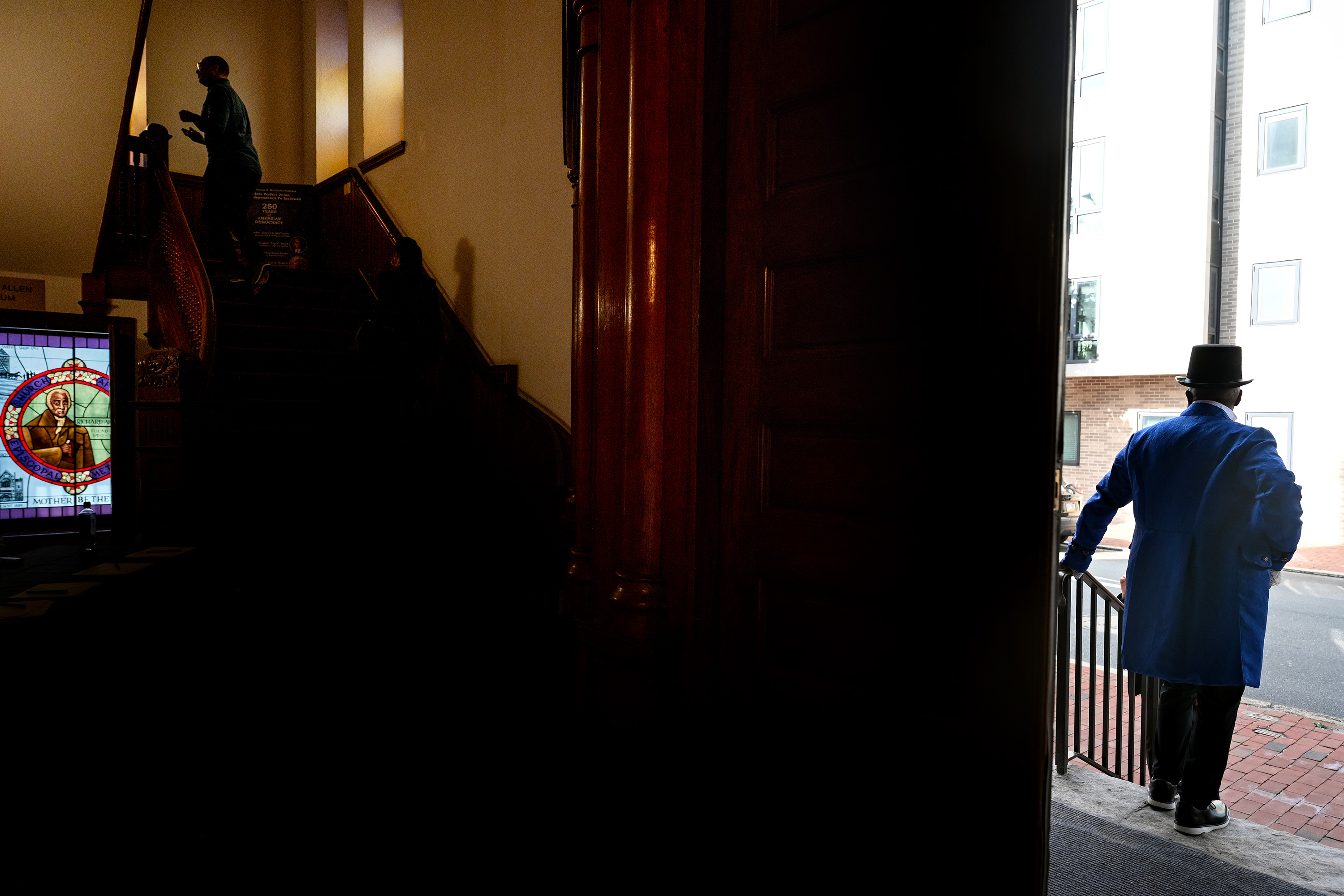
I was standing next to a big sign before the start of an event this week. It had a photo of the host and the large words “America 250.” More than one person arriving wondered out loud, “Why the 250?” Or, “Isn’t that passed?”
They weren’t asking me. I was just there, inside looking out the front door, waiting for re-enactor Chris Lewis to step into a favorable position so I could make the photo above.
The registration table was farther inside, so nobody was there to say something like, “Just because July 4 is behind us doesn’t meant we can’t continue the celebration of what was accomplished in 1776. Or we could think about what we want the next 250 years to look like.”
House Speaker Joanna McClinton hosts an America 250 Conversation at Mother Bethel AME Church Thursday Sept. 10, 2026.Tom Gralish / Staff Photographer
I did my own share of looking both back and forward while covering another anniversary this week. Those of us old enough to remember knew even on that day that nothing about our future would never be the same again.
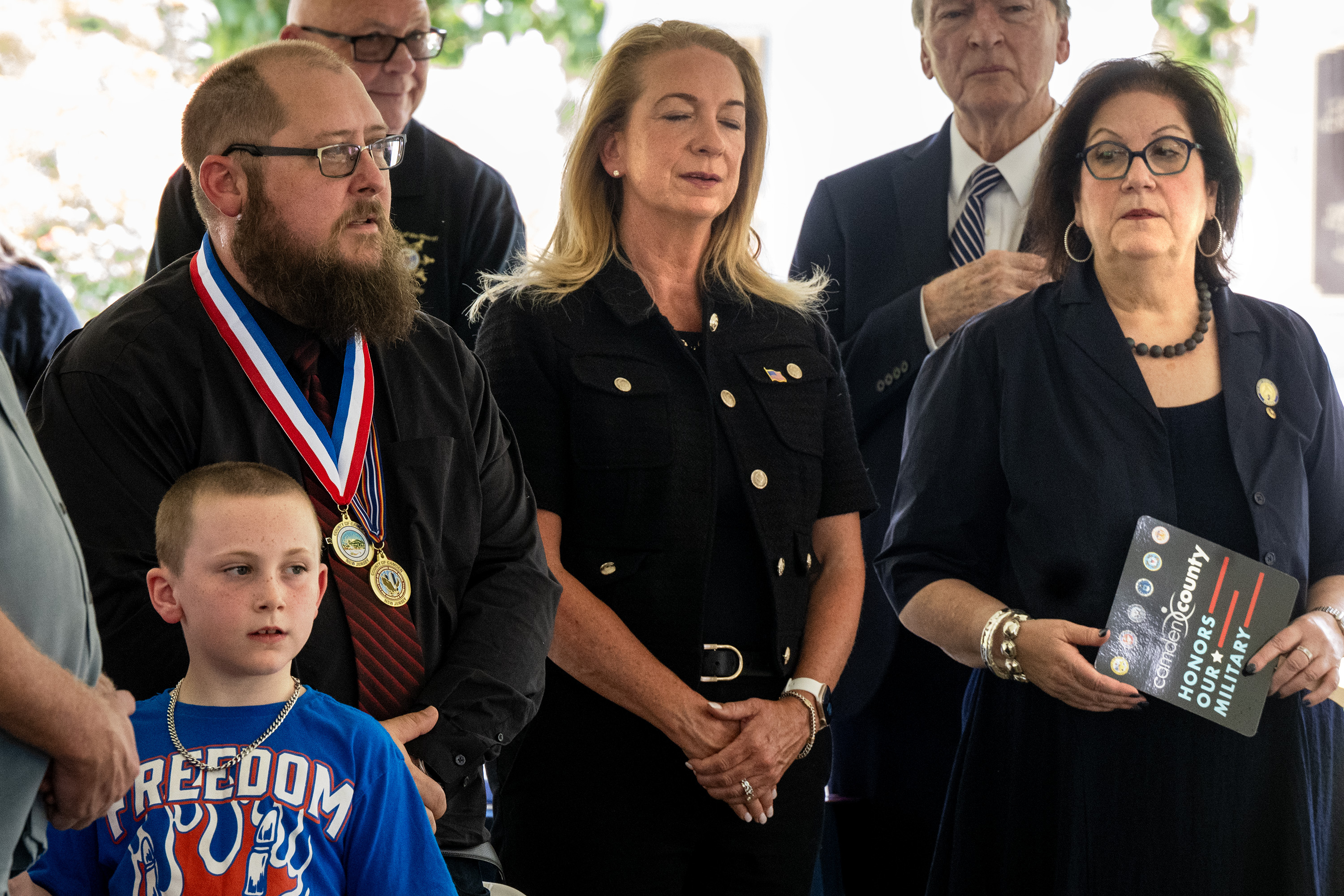
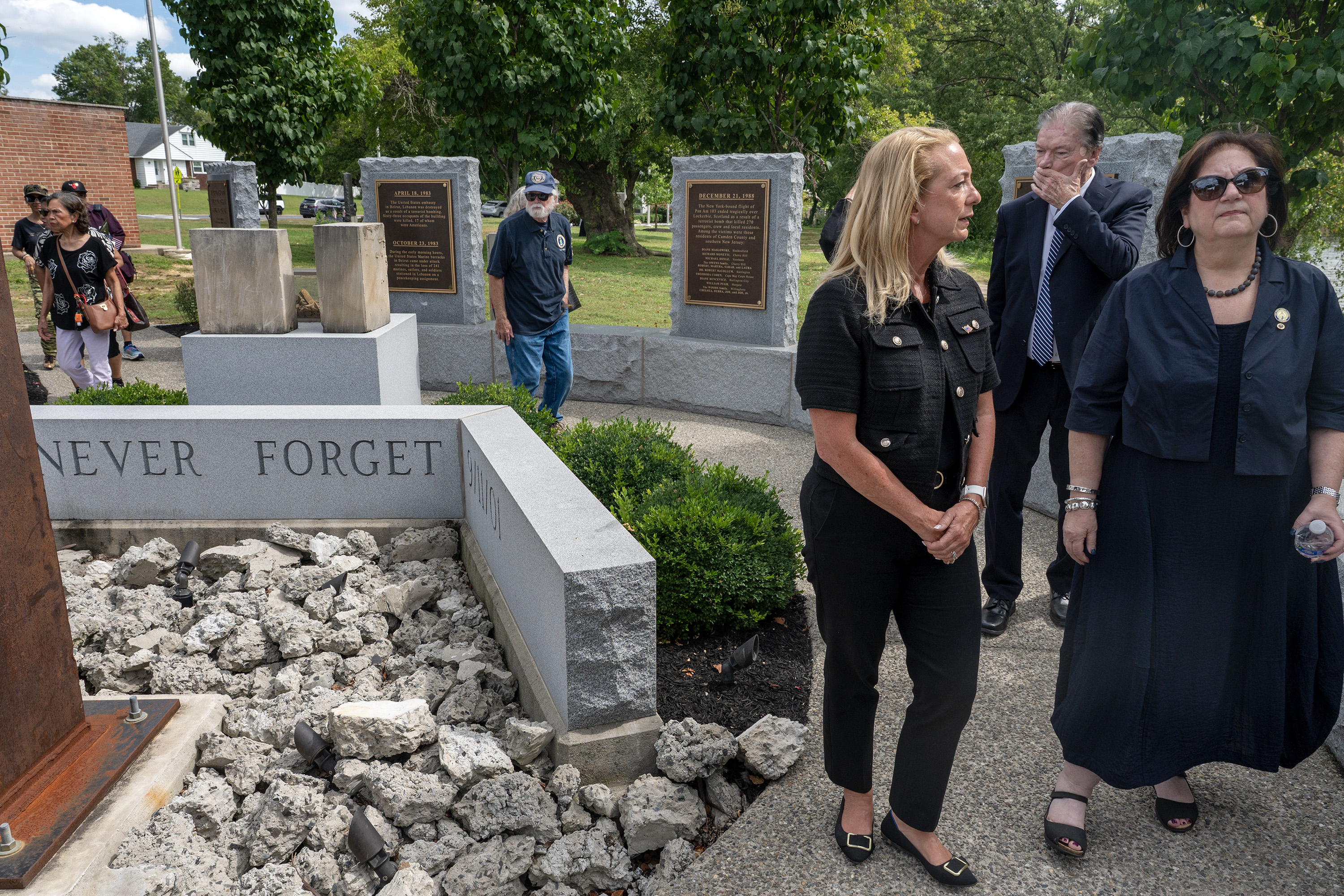
Names and photos of County residents who died on 9/11 and in the War on Terror following the September 11 attacks are posted during a medal ceremony at the Victims of Terrorism Monument in Cooper River Park in Pennsauken on Thursday, Sept. 10, 2026. Tom Gralish / Staff PhotographerOne of the medal recipients, U.S. Army veteran Michael R. Newberg of Chesilhurst and his son, Connor, 8, stand with elected officials during the ceremony.Tom Gralish / Staff PhotographerA Marine Corps League honor guard with the PFC Daniel Giordano detachment 200 in Somerdale fires a rifle salute.Tom Gralish / Staff PhotographerCamden County Commissioner Jennifer Cooley Fleisher (left) and State Assemblywoman Melinda Kane (right) visit the Victims of Terrorism Monument following the medal ceremony. Kane is a Gold Star Mother whose 22 year-old son, Marine Lance Corporal Jeremy Kane was killed in 2010 in Afghanistan. He was deeply affected and felt “compelled” to enlist, joining the Marines on Sept. 11, 2006—exactly five years after the terrorist attacks. Tom Gralish / Staff PhotographerAlice Hastings of Gloucester Township visits the Victims of Terrorism Monument. She was there with her husband Tom Hastings, who was among the local veterans honored for their bravery, sacrifice, and service. Hastings served in the U.S. Air Force, including with the dignified transfer of remains at Dover Air Force Base, Del. Tom Gralish / Staff Photographer
After 9/11 the flag became a symbol of shared feelings, giving people a way to express emotions that words could not.
Sports reporter Matt Breen — a Northeast Philly native and Temple grad — writes the kind of stories I like to read, full of history and nostalgia, trivia, and tidbits. And plenty of “Only in Philadelphia” characters. Like Flag Man.
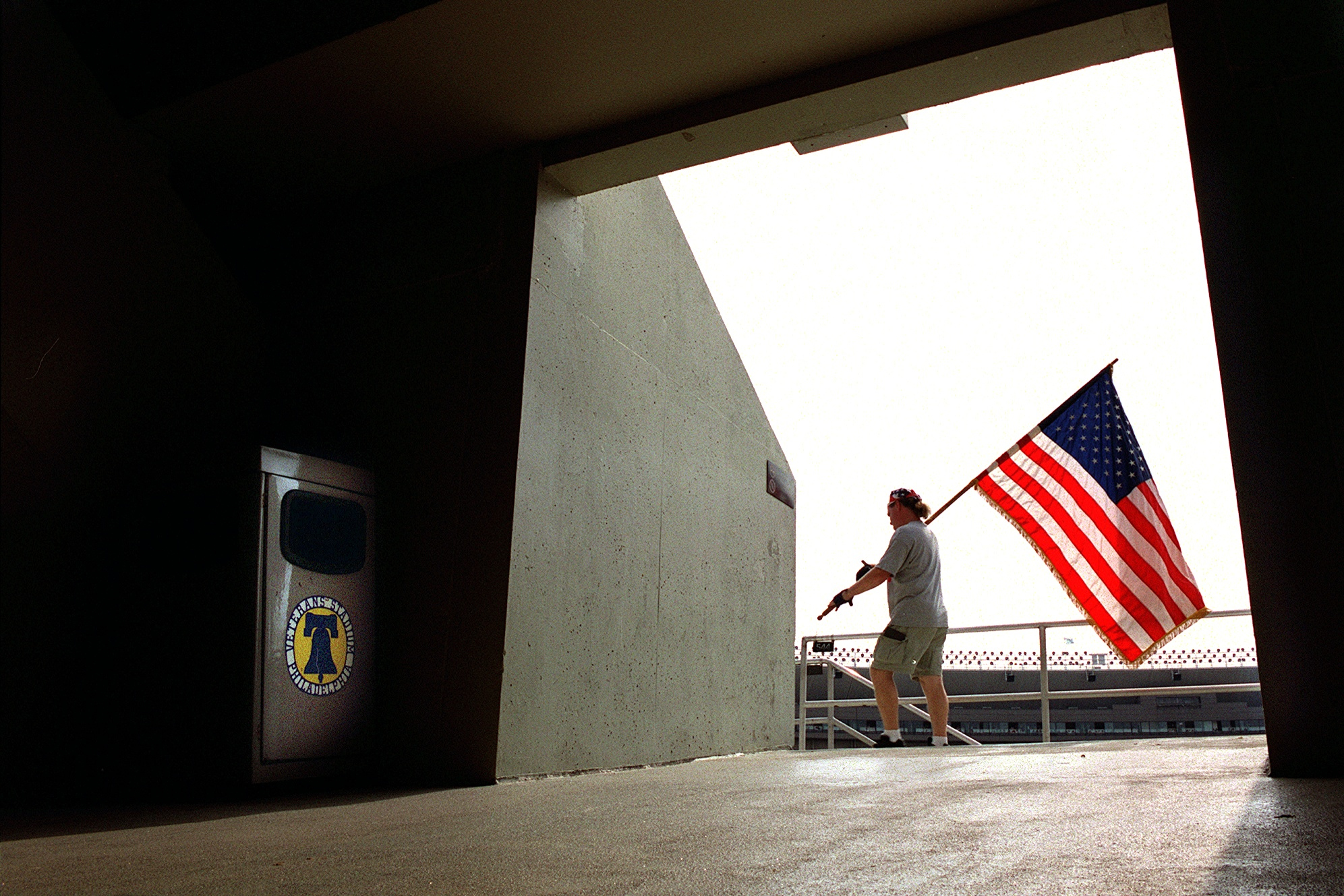
Jim Minacci at Veterans Stadium, September, 2001.Tom Gralish / Staff Photographer
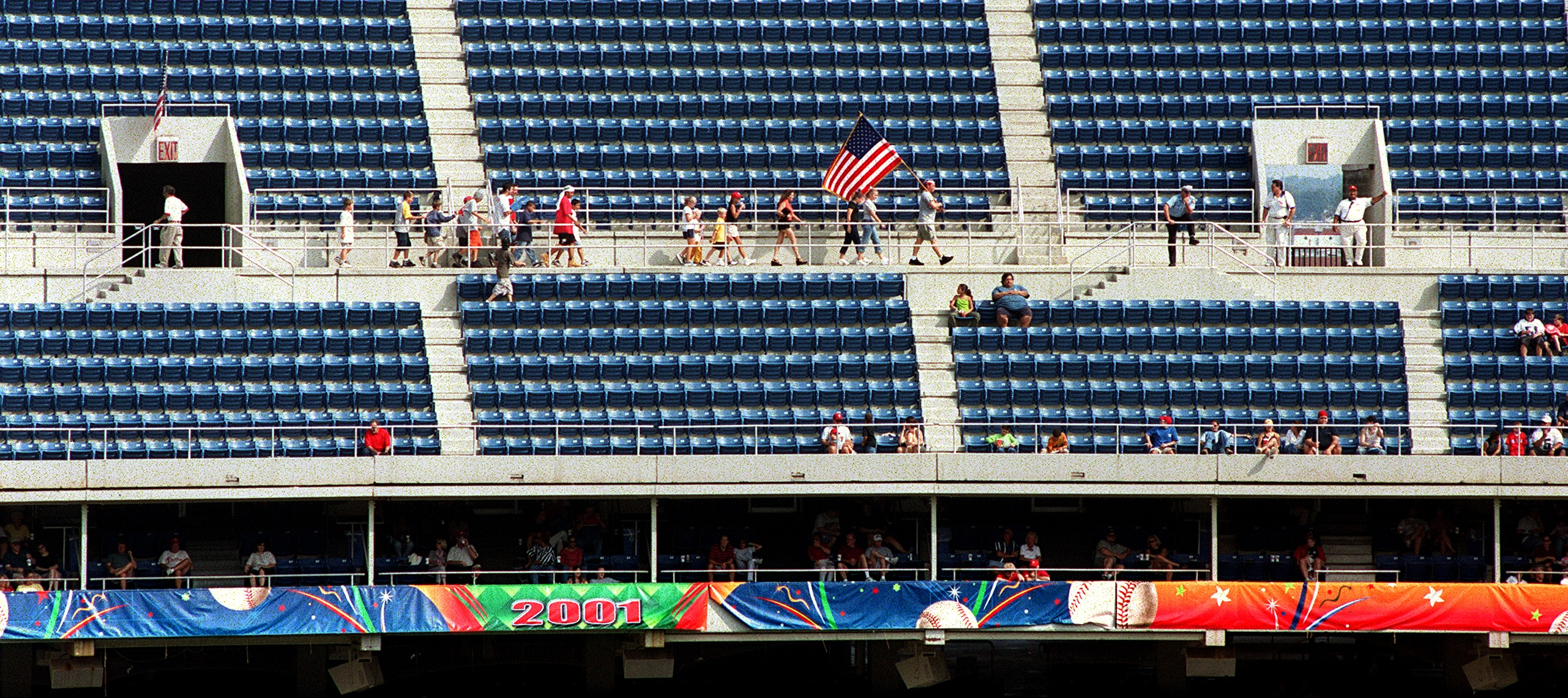
I photographed Jim Minacci twenty-five years ago when the Phillies were back at Veterans Stadium after the season was paused following 9/11.
He and his son walked around all the concourses carrying a large American flag — trailed like the Piped Piper by a line of kids. They did it at every home game for the rest of that season as he became a symbol of patriotism.
Minacci still attends Phillies games and he still has the flag (but it’s too big to be allowed into Citizens Bank Park).
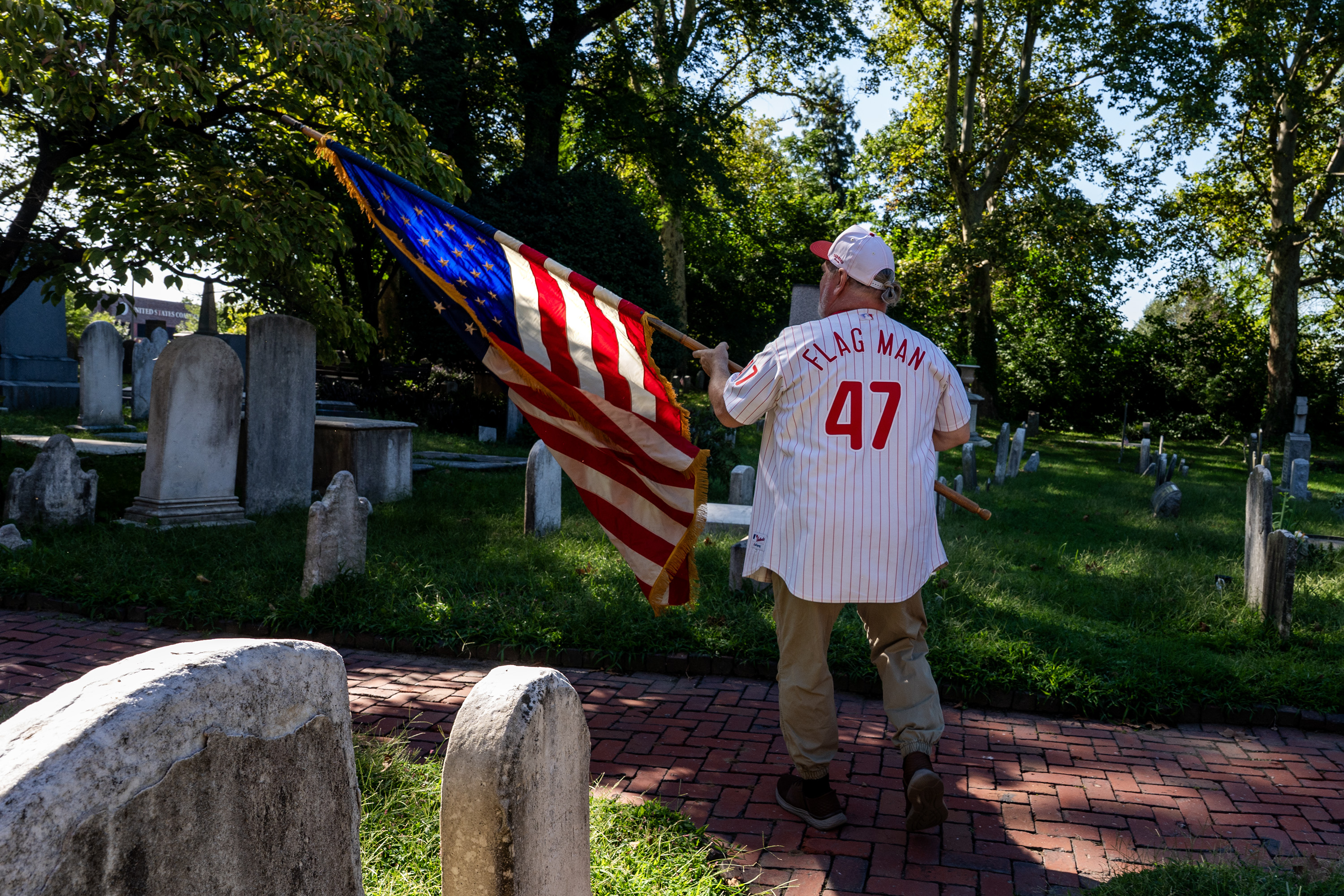
Jim Minacci at Gloria Dei Old Swedes Episcopal Church Tuesday, Sept. 8, 2026.Tom Gralish / Staff Photographer
Surprisingly, while there have been stories about the Minaccis — and the dozens of music events they host all yearlong to raise money for the historic church — it looks like Matt is the first one to write about Flag Man since 2001.
Looking ahead, it would be great if Americans could reclaim that feeling today, reclaim the sense of community that emerged from the tragedy (without something else terrible having to happen).
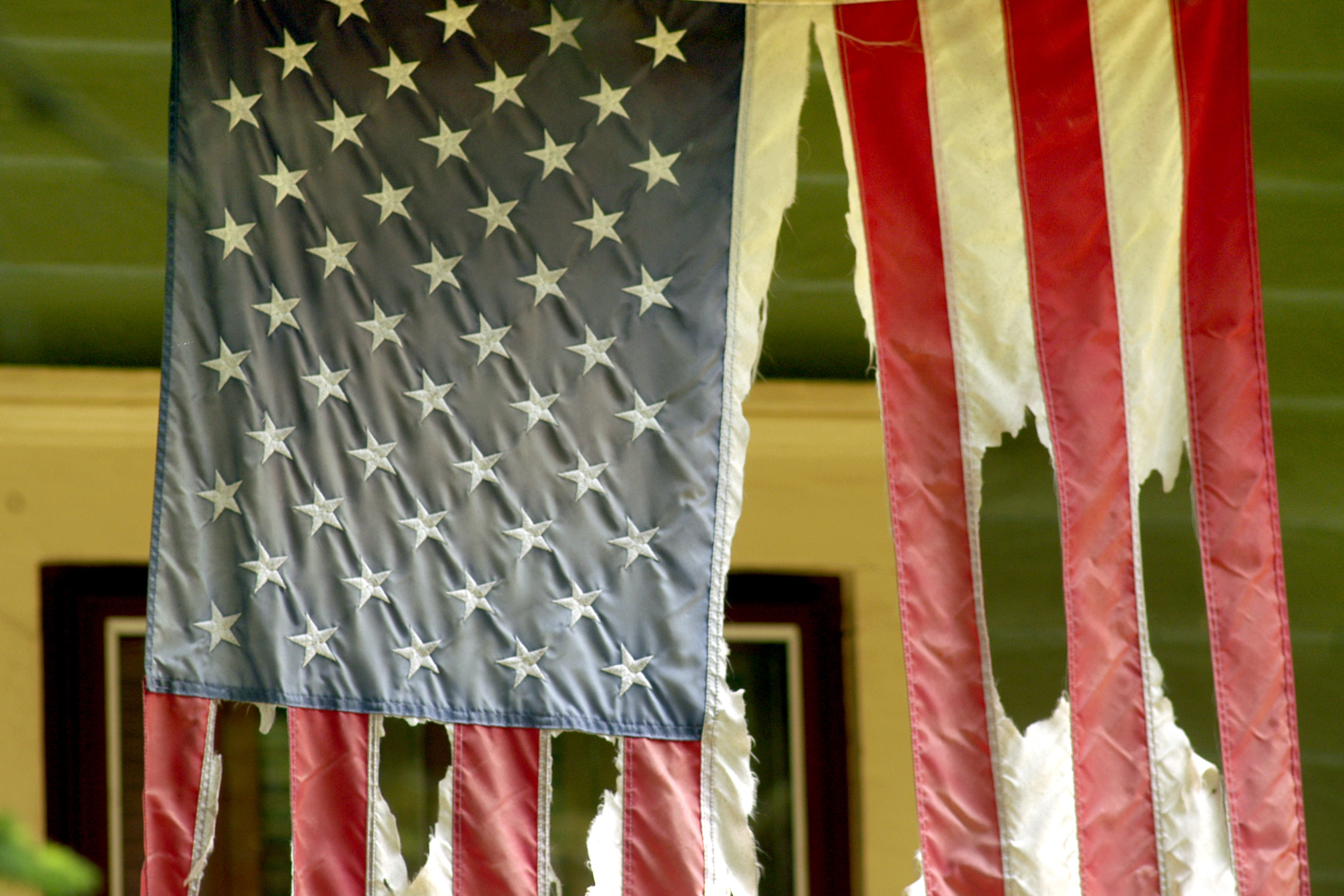
A flag at a South Jersey home on Flag Day, June 14, 2005, tattered, torn and tarnished by time over the years after 9-11, when well-intentioned home-owners bought flags to display in the heat of patriotism. Tom Gralish / Staff Photographer
Since 1998 a black-and-white photo has appeared every Monday in staff photographer Tom Gralish’s “Scene Through the Lens” photo column in the print editions of The Inquirer’s local news section. Here are the most recent, in color:
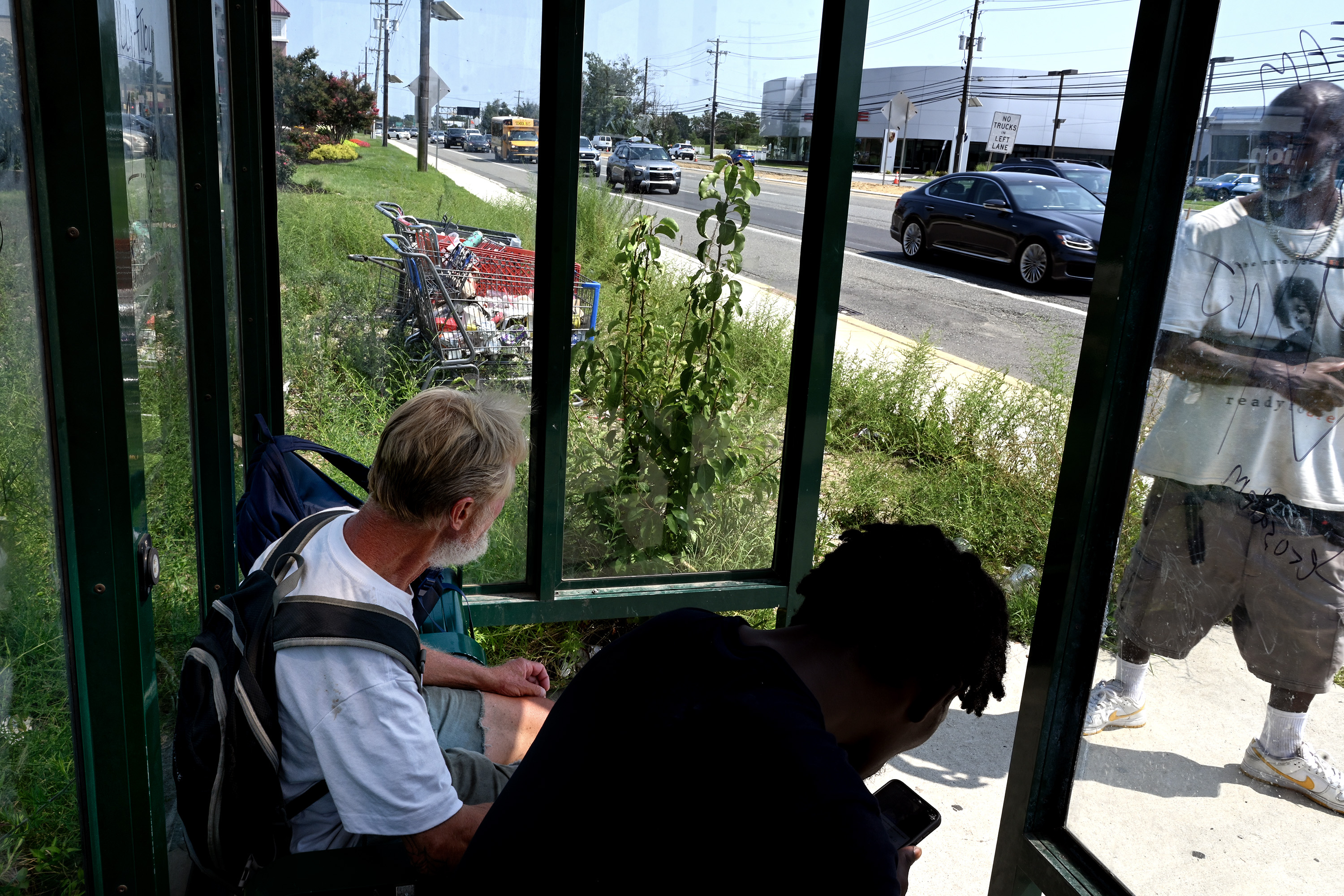
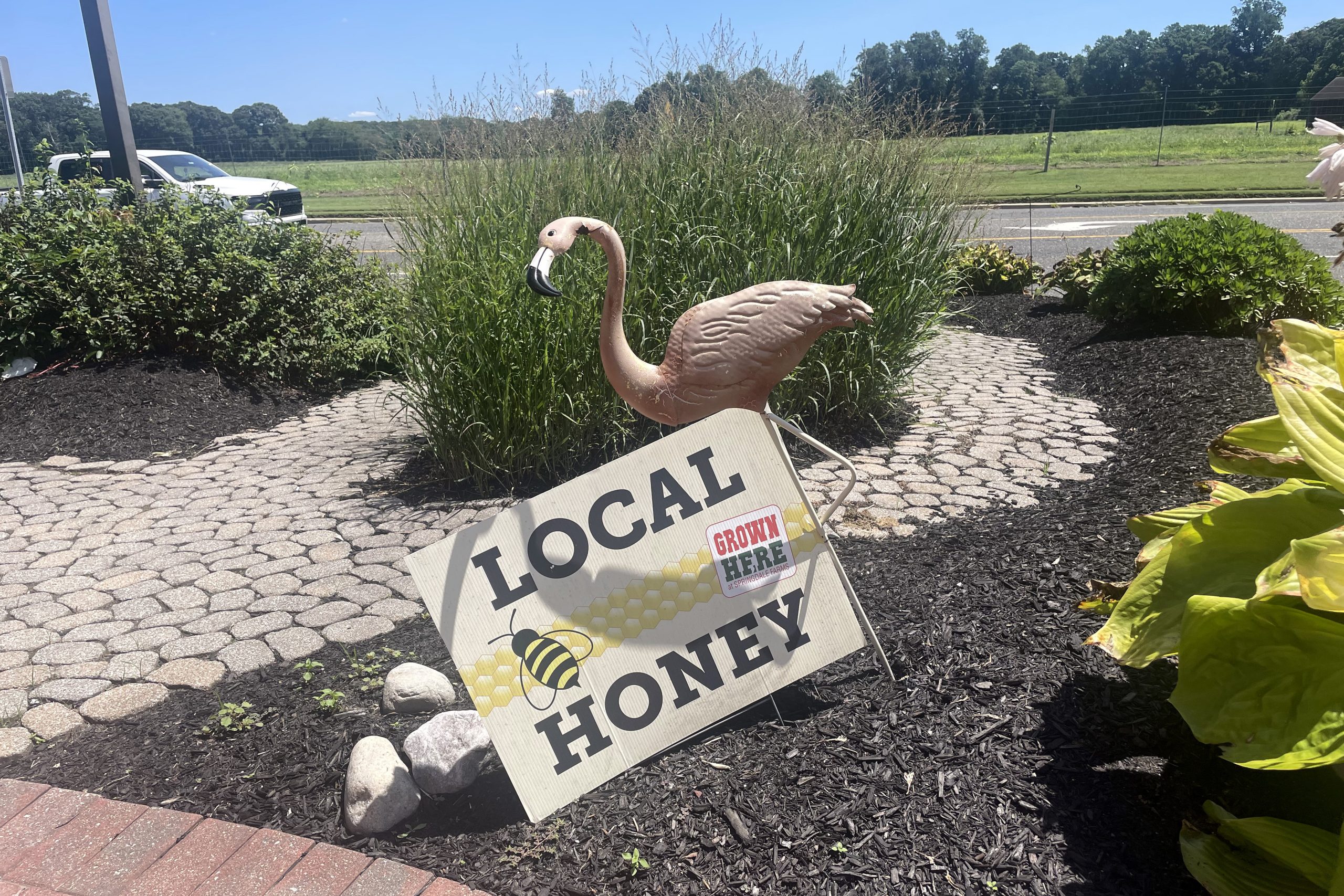
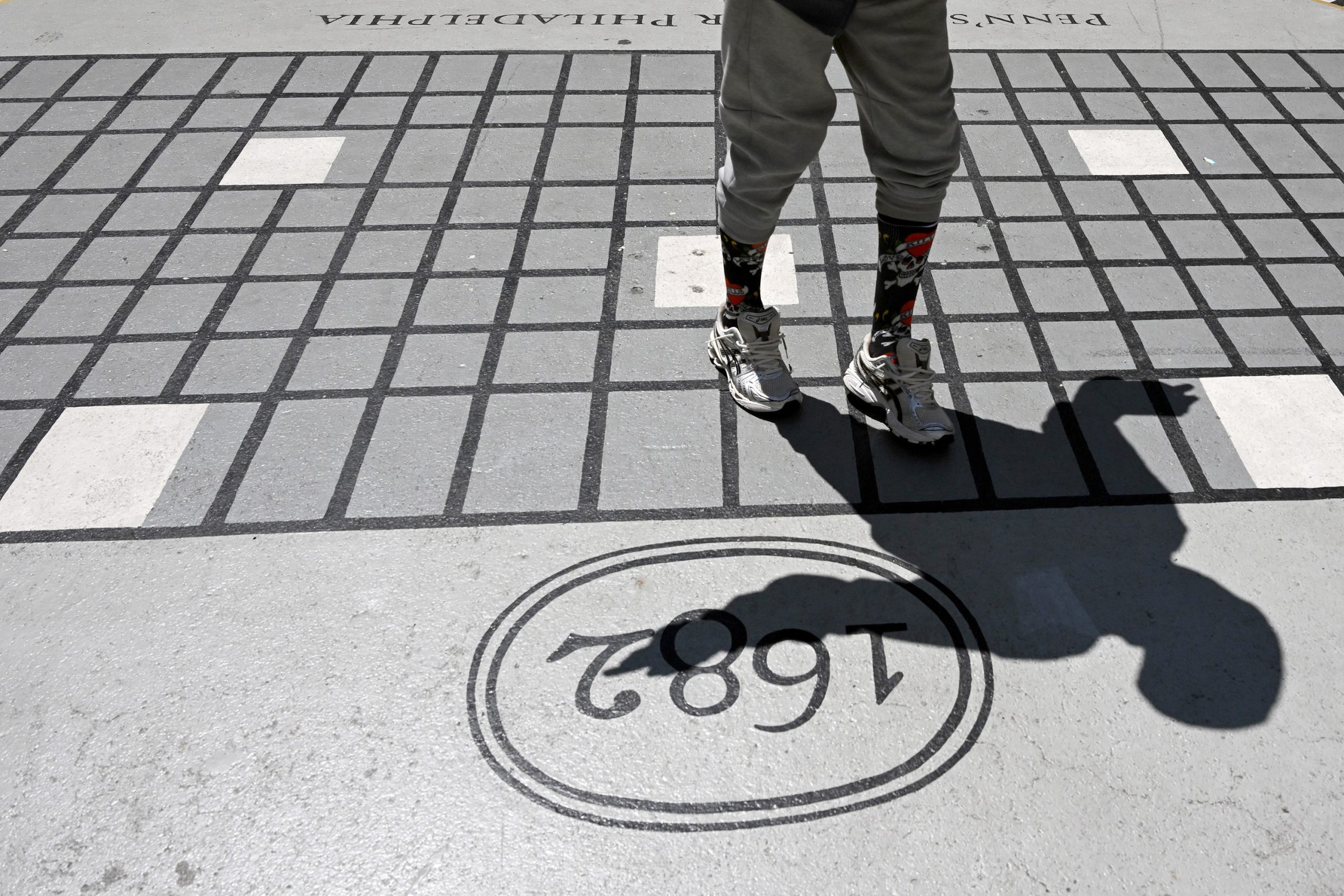
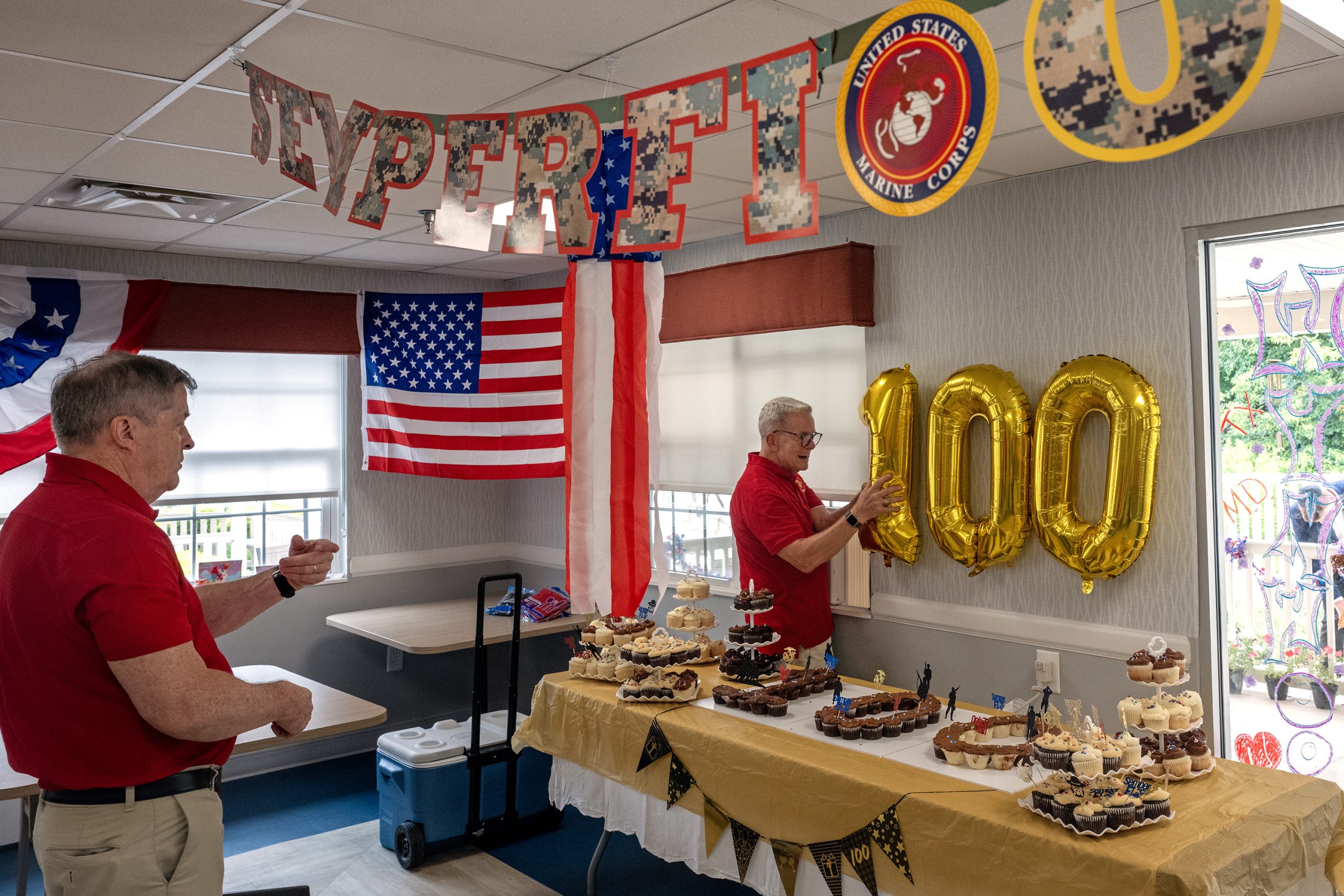
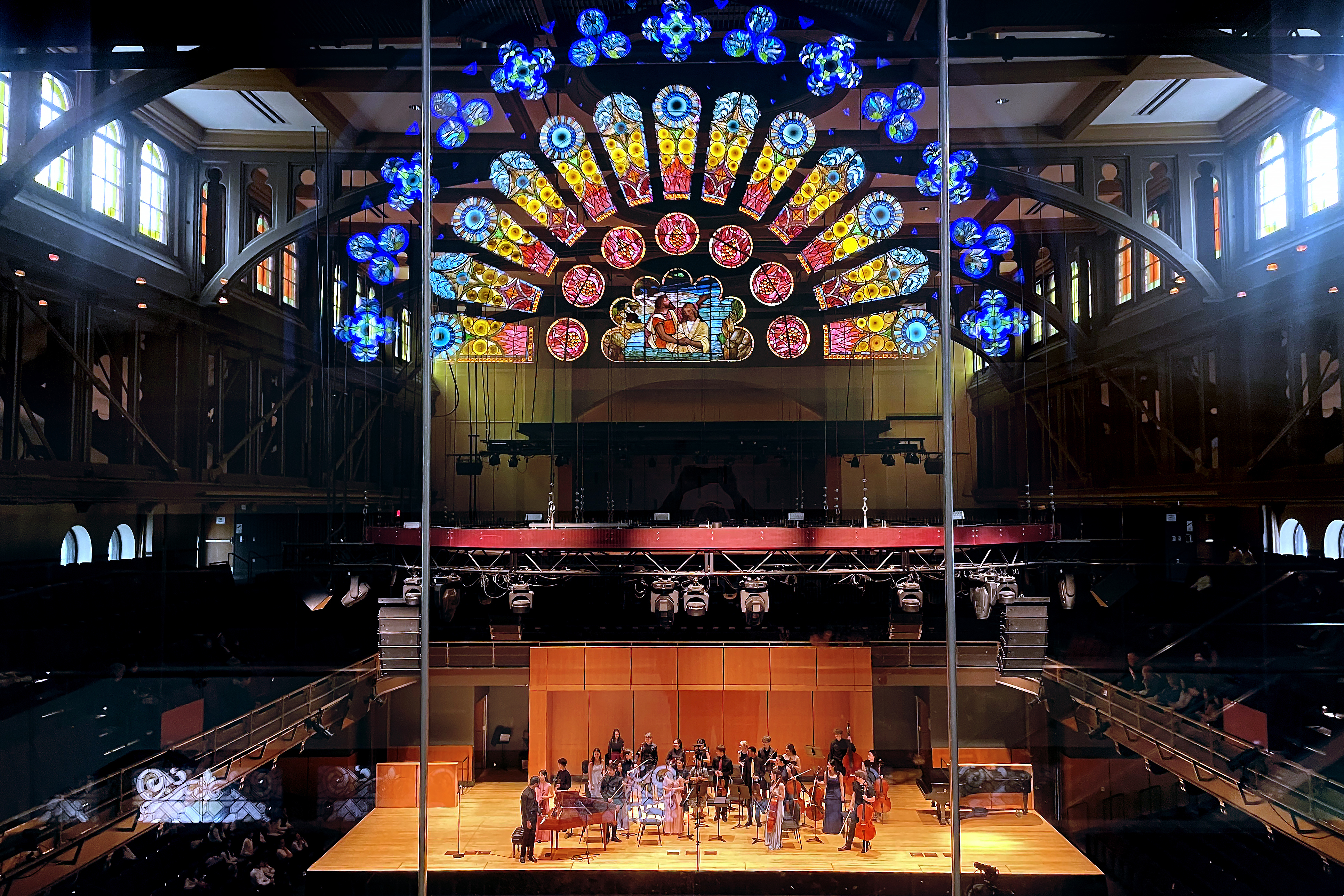
September 7, 2026: Joe Ackler of Skippack shops for a race T-shirt during a lull between laps in the Philadelphia Cycling Classic on Aug. 30. He is wearing a shirt he bought in 2003 when he attended the Tour de France. Tom Gralish / Staff PhotographerAugust 31, 2026: Robin P. Cooper (upper right) watches as Superintendent Tony B. Watlington Sr. (far left) gathers school and city officials for a group photo outside the district bus, stopped at McClure Elementary on the first day of school in Philadelphia. The bus was on its annual back-to-school celebration visit to schools throughout Philadelphia. Cooper later left the bus to join in the photo. Tom Gralish / Staff PhotographerAugust 24, 2026: Pencils were sharpened in the first-grade classroom of teacher Lauren Cucinotta at Fanny Jackson Coppin Elementary as she prepared for the start of the new school year for the Philadelphia School District on Monday.Tom Gralish / Staff PhotographerAugust 17, 2026: Wayne Peters (left) and Bobby White (right) wait for the #406 bus to Camden, on Rt. 70 in Cherry Hill, near the entrance to stores at the Garden State Pavilion shopping center and NJ Transit’s Cherry Hill station. Peters says it “Gotta be the worst bus stop in the state,” with White adding, “You’d think something in Cherry Hill would be better. How hard would it be to put a trash can here?” Before their bus arrives, Peters, trying to be positive about the shelter, reminds him “They fixed a broken window once.”Tom Gralish / Staff PhotographerAugust 10, 2026: Cheltenham High School in Wyncote, on the day the Montgomery County district attorney announced charges in connection with two assaults in the school’s football locker room. A photo of the static signs was made more visually interesting by using a slow camera shutter speed to blur the passing cars. Tom Gralish / Staff PhotographerAugust 3, 2026: Sign for locally “grown” honey outside the market at Springdale Farms, the only working farm left in Cherry Hill. Before WWII, when it was still known as Delaware Township, there were 82 farms in operation feeding South Jersey markets and supplying the massive fresh vegetable and crop demands of the Campbell’s Soup Company in Camden. Tom Gralish / Staff PhotographerJuly 27, 2026: Lyn-el “The Torch” Wright pauses on the City Hall Courtyard’s rendering of William Penn’s Philadelphia city grid plan. Penn designed the 1,200-acre “Greene Countrie Towne” between the Delaware and Schuylkill rivers with wide, crisscrossing streets to prevent the overcrowding and fires he had witnessed in London. Tom Gralish / Staff PhotographerJuly 20, 2026: Pat Dailey (left) and Ken Hopper with the Tun Legacy Foundation prepare a room at the Wynwood Rehabilitation & Healthcare Center in Cinnaminson, N.J., for a surprise 100th birthday party for WWII U.S. Marine Corps veteran Stephen Anderson. Dailey founded the nonprofit that supports veteran causes, Masonic charities, and educational scholarships. The organization is also rebuilding and reestablishing an authentic reproduction of the original Tun Tavern building in Philadelphia. The Tun, constructed in 1693, was the first documented lodge in North America and the birthplace of the U.S. Marine Corps in 1775.Tom Gralish / Staff PhotographerJuly 13, 2026: The Independence Visitor Center offers free birthday cake to the public on the Fourth of July, in the form of a massive American flag made of 5,000 cupcakes frosted red, white and blue.Tom Gralish / Staff PhotographerJuly 6, 2026: National Park Police Deputy Chief Rebekah Spedaliere shows off her own bald eagle tattoo while posing for a photo with bald eagle “Indy” and handler Amanda Sweeney with the Auburn University Raptor Center, during ceremonies over the July Fourth weekend. Indy came to Auburn, in Alabama, in 2018 after suffering a wing injury as a young bird and imprinted on humans during rehabilitation, so she couldn’t be released back into the wild. Now, she serves as an ambassador bird, teaching people about raptors, conservation, and the ecosystems that sustain them. Not her first rodeo in Philly, she made her first appearance at the Linc for an Eagles’ game in 2023. Tom Gralish / Staff PhotographerJune 29, 2026: Shecky Perlman as Ben Franklin is inside the Free Quaker Meeting House on Independence Mall as he and other historical reenactors receive their diplomas after weeks of intensive, immersive training for the 21st season of Historic Philadelphia’s Once Upon a Nation program — where costumed actors perform first-person interpretations of real 18th-century Philadelphians in the Historic District and at Valley Forge National Historical Park.Tom Gralish / Staff PhotographerJune 22, 2026: A downed utility pole serves as a quiet place to eat, away from the crowd at the Odunde Festival, billed as the largest African street market in North America.” Tom Gralish / Staff PhotographerJune 15, 2026: Bob Myers, president of Harris Blitzer Sports & Entertainment, owner/operator of the 76ers and the NHL’s New Jersey Devils, as well as a future Philadelphia WNBA team, talks to reporters after Mike Gansey made his first appearance as Sixers president of basketball operations at the Penn Medicine Philadelphia 76ers Training Complex in Camden. Tom Gralish / Staff PhotographerJune 8, 2026: Obet Montalvo, a digital strategist with Radicle Digital, finds a quiet nook at the Convention Center on Thursday June 4, 2026, while attending Netroots Nation, the country’s largest annual gathering for progressive political activists, and organizers. The fan fest is an outgrowth of the blog Daily Kos, and brings together thousands of grassroots organizers to participate in training sessions, panel discussions, and keynote addresses.Tom Gralish / Staff PhotographerJune 1, 2026: The signature half-rose stained glass window of the 1891 Grace Baptist Church is reflected in a glass wall inside the Temple Performing Arts Center, as a spring concert by Temple University Music Prep’s Center for Gifted Young Musicians gets underway below. A school started at the church so working men unable to afford traditional college could attend at night eventually became Temple University, and the congregation relocated to the suburbs. Over the years the building deteriorated and in 1986 university trustees voted to demolish it. Public outcry and help from the Preservation Alliance of Greater Philadelphia convinced Temple’s leaders to preserve the building, and a few years and $30 million later the old church was reborn in 2010 as a 1200-seat, multipurpose state-of-the-art event center. Tom Gralish / Staff Photographer
Somewhere in Philadelphia, thousands of people are about to experience something they never thought possible: getting money back from the PPA.
The Parking Authority voided 23,195 speeding tickets and is refunding $1.25 million in fines after discovering that a required speed-camera warning sign was missing from a stretch of North Broad Street. A construction crew had knocked it down, and somehow it took about three months to get a new one up.
To be clear, the drivers were still speeding. The PPA would very much like everyone to know that. But state law requires a sign warning drivers about the camera, so the tickets had to go.
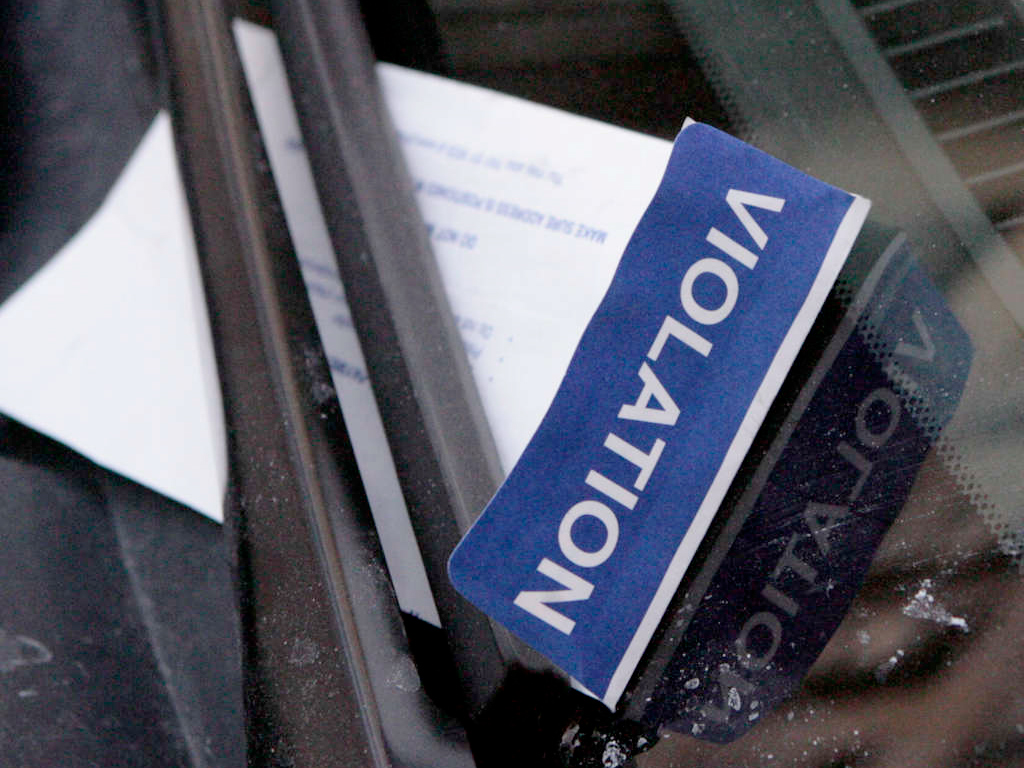
There is something deeply satisfying about this. Philly drivers have spent generations feeding parking meters, sprinting back to expired spots and discovering orange envelopes tucked under windshield wipers. The PPA is usually where your money goes, never where it comes from.
So check the mail, 12,214 lucky speeders. Somewhere out there is a refund from the Philadelphia Parking Authority.
And really you should frame the check, this may never happen again.
Video: SEPTA bus passengers direct bus driver to drive through wet concrete
How did it get there? Two passengers hopped off the bus, moved the street-closure barricades themselves, and then helped direct the driver around the construction. Shockingly, that did not go well.
It gets even better when you learn that the pothole-turned-sinkhole had been there for 14 months, long enough that it had started swallowing traffic cones. The city finally showed up to fix it, poured the concrete, and blocked off the street at 7:21 p.m. The 47 bus drove into it at 7:23.
Fourteen months waiting for a repair, and it took two minutes to ruin it.
And to once again make this story even better, it happened outside a century-old Italian bakery, the bus was covered in Top Dog Law ads, and when city workers returned the next morning to fix the fix, Joey Termini brought them cannolis.
An updated rendering of the new Flyers arena released Thursday appears to show more women fans following backlash this week against the original rendering.Courtesy of the Flyers
The first renderings dropped this week, and there’s plenty to like: a facade inspired by the old Spectrum, a huge outdoor plaza, food and drink pavilions, and a giant screen outside.
But the coolest part might be seeing three teams attached to it. When the doors open in 2030, the Sixers and Flyers will be joined by Philly’s still-unnamed WNBA team, which will begin play that same year.
Four years away suddenly feels a little more real. Now, we just need a name for the team (and, eventually, the building).
Eagle Saquon Barkley runs the sidelines during an open Eagles practice at Lincoln Financial Field in Philadelphia on Tuesday, August 25, 2026.Elizabeth Robertson / Staff Photographer
His forecast has Jalen Hurts doing the macarena on the first play of the season, Vic Fangio throwing up on a Dollywood roller coaster, Aaron Rodgers blaming a loss on Anthony Fauci and the illuminati, and Brandon Graham once again considering coming out of retirement. Somehow, amid all of this, the Eagles finish 12-5 and win the NFC East for a third straight year.
And you know what? Wouldn’t that be great? Twelve wins, another division title, football at Christmas, and several months spent planning Sundays around the Birds again. After an offseason of roster moves, coordinator questions, and endless predictions about what this team might be, we finally get to watch actual football.
And if we get to keep the 12-5 season, Hurts doing the macarena would just be the cherry on top.
The baked potate loaded with lump crab au gratin and a caviar “blackout” at Mr. Edison in the Bellevue costs $88.Kiki Aranita / Staff /
An $88 potato?!: F
There are certain things an $88 potato should be able to do. Like maybe change your life or fix your credit. At minimum, make you briefly forget you just spent $88 on it.
The baked potato at Mr. Edison in the Bellevue starts at an already pricey $48, stuffed with nearly half a pound of crab au gratin. Add a “blackout” of caviar and suddenly you’re sitting in front of an $88 spud.
And according to Inquirer food writer Kiki Aranita, it wasn’t good.
An $88 potato should be so delicious that you spend the next week becoming an annoying person who tells everyone, “OK, but you have to try the potato.” Instead, Aranita described hers as “all mush” and pointed out that better baked potatoes can be found a few blocks away for a fraction of the price.
Caviar or no caviar, at the end of the night, it is still a potato.
Temple’s $55 million gift disappears: F
Less than a year ago, Temple was celebrating the largest donation in university history: $55 million from alumnus Christopher Barnett. This week, the school announced it was terminating the gift, removing Barnett’s name from its College of Public Health and other programs, and accepting his resignation from the board of trustees.
The reason is quite a turn. Barnett’s company, ABA Centers of America, is under federal criminal investigation over allegations including money laundering and wire fraud. Investigators allege the autism-services provider improperly billed insurers, including for treatment while clients were napping or watching television. Barnett has not been charged and “strenuously denies” the allegations.
There is a small piece of good news buried in this mess, though. Temple hadn’t gotten any of the $55 million yet, which makes it a lot easier to give the money back.
The buyer: Joanna Jaeger, 32, general manager at Bart’s Bagels.
The house: A 894-square-foot rowhouse with two bedrooms and 1½ baths built in 1920 in Lower Moyamensing.
The price: Listed for $236,900; purchased for $233,000.
The agent: Martha Lutz, OCF Realty.
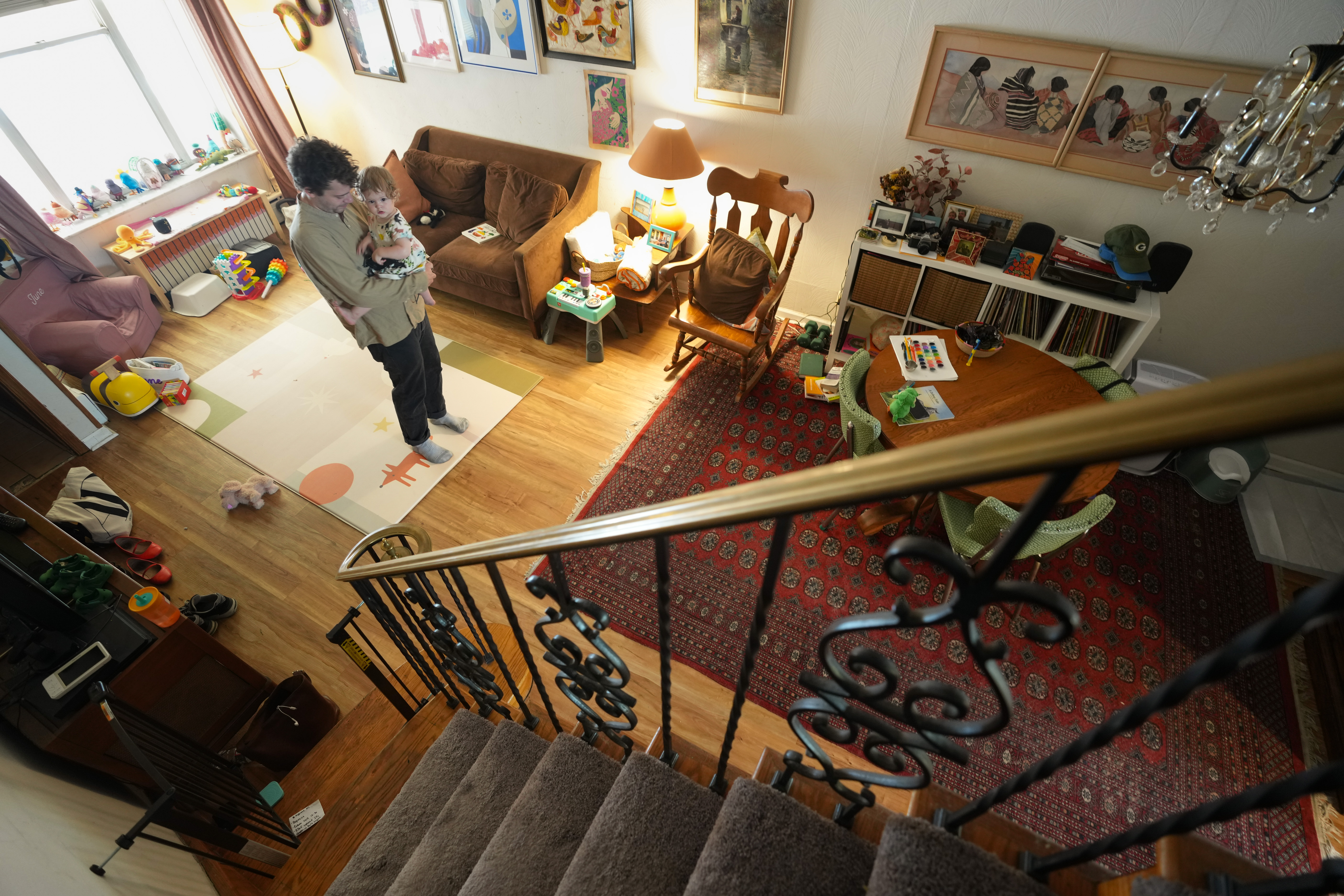
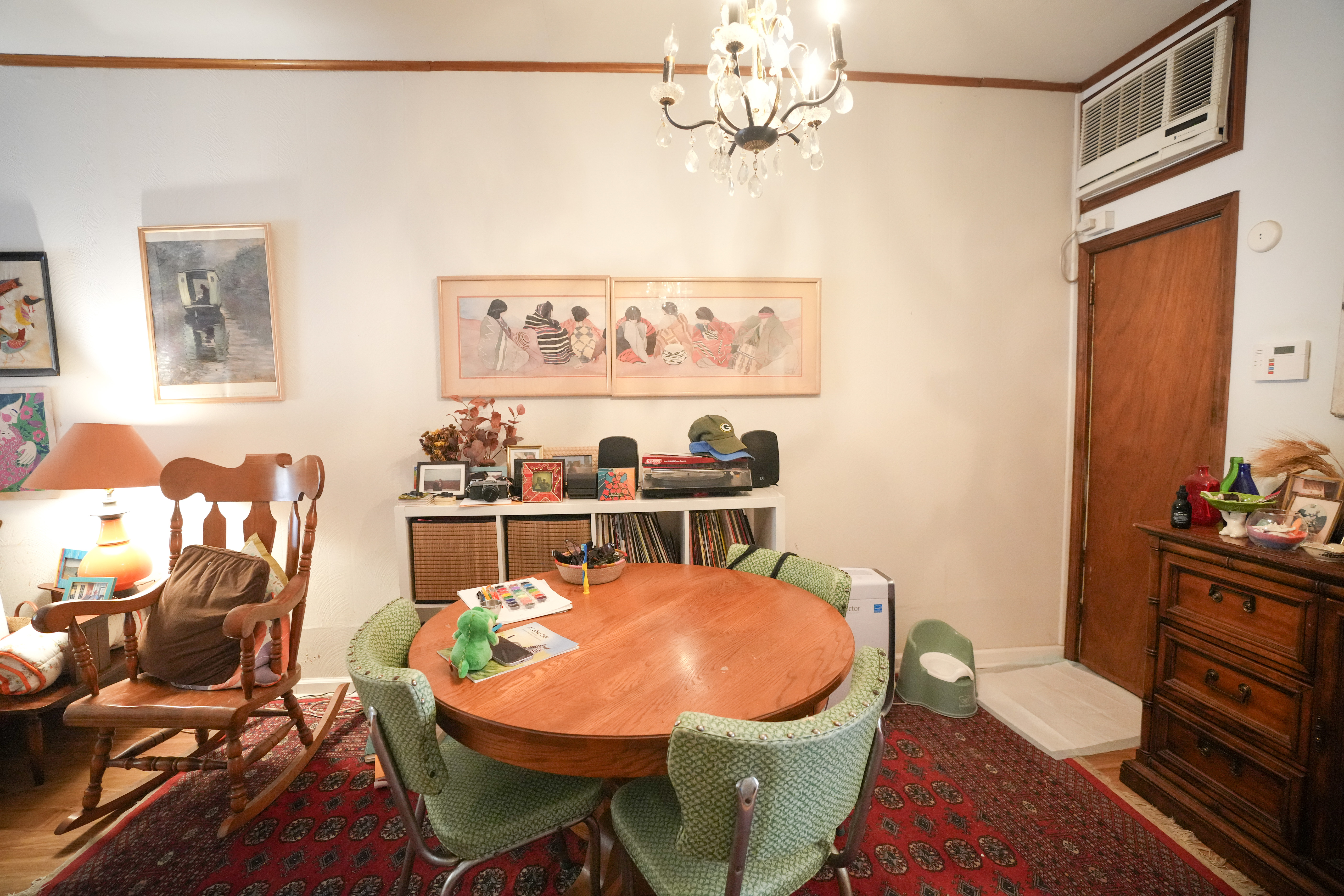
Adrian Schraufnagel and June on the first floor. Jessica Griffin / Staff Photographer
The ask: Joanna Jaegerand her boyfriend, Adrian Schraufnagel,were tired of their one-bedroom in West Philly and fed up with renting in general. When their landlord announced a $200 rent increase in 2022, they notified him they would be moving out in 90 days.
The clock was ticking to find a new home.
They wanted a move-in ready place that wouldn’t immediately require expensive repairs. And after renting in West Philly for six years, they were eager to move across the river, to be closer to restaurants and morepublic transit. They also wanted to live within walking distance of a dog park.
With a ceiling of $250,000, they hoped to find something closer to $230,000.
Joanna Jaeger’s mother paid for the floors to be redone. Jessica Griffin / Staff Photographer
The search: Jaeger enlisted a friend and coworker to be her real estate agent. They visited a series of newly renovated houses because Jaeger thought they would require the fewest repairs after move-in. She put in an offer on one but didn’t get it. She was becoming increasingly panicked.
“I was like, ‘Oh my god, we’re running out of time!’” Jaeger recalled.
Then, in April she saw an intriguing house on Zillow. It was a “granny special,” she said, featuring wall-to-wall purple shag carpeting and an upstairs bathroom paneled in dark wood with a ’70s floral motif around the sink. When she visited, there was a framed portrait of Frank Sinatra on the basement wall.
Jaeger immediately loved the ’70s floral motif around the bathroom sink and the pale blue sink and tub. Jessica Griffin / Staff Photographer
“It felt so cozy,” Jaeger said. “You could tell whoever lived there took a lot of pride in the house.”
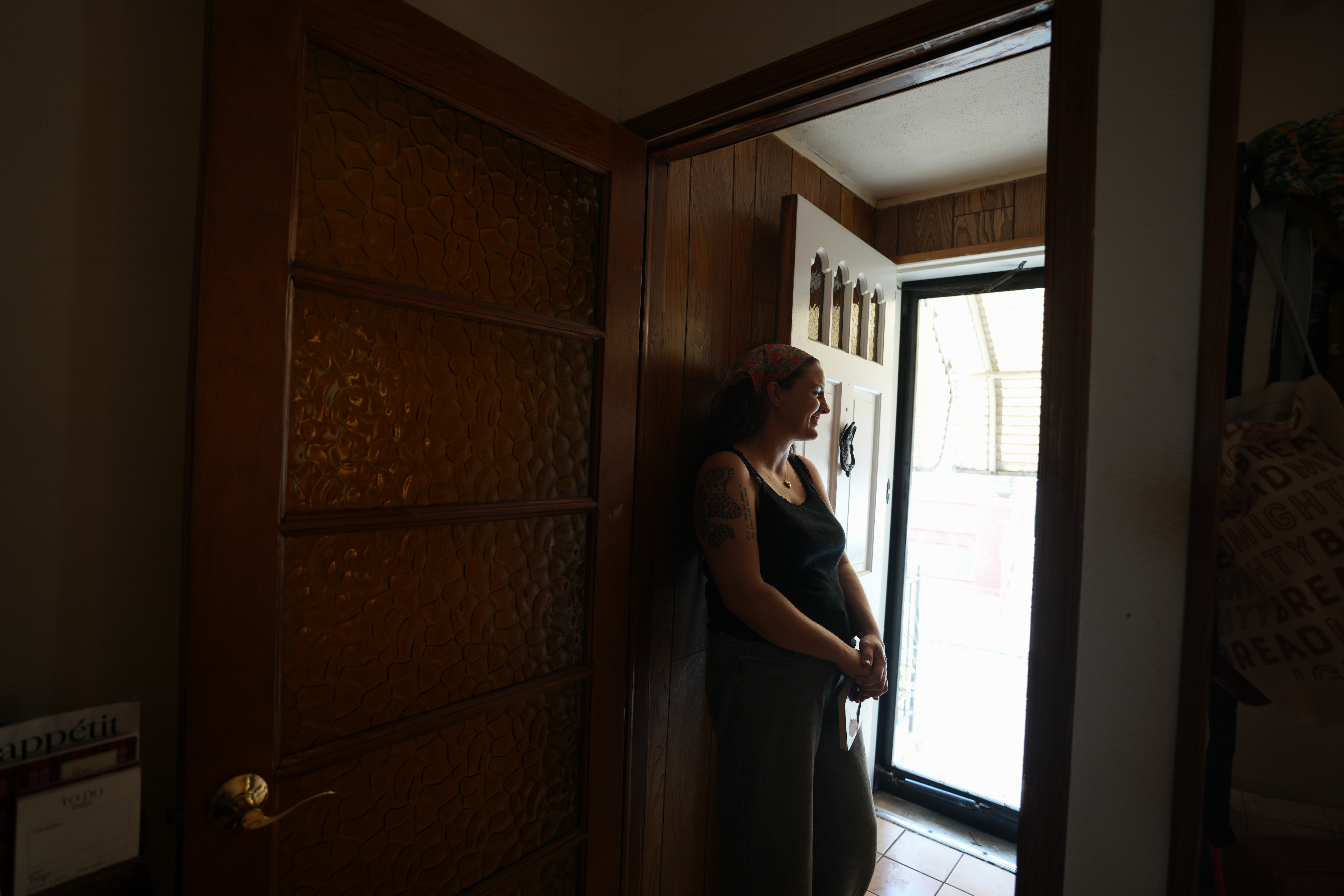
Though she had been looking at recently flipped houses, she especially liked the old-school South Philly features, including the awning out front and the amber-colored textured glass in the vestibule.
The house was walking distance to MarconiPlaza and close to the bus and the Broad Street Line.
Joanna Jaeger immediately loved the textured amber glass in the vestibule of the South Philly house. Jessica Griffin / Staff Photographer
The deal: Jaeger told Schraufnagel that because of their tight deadline, he wouldn’t get to see the house in person before she put in an offer. He trusted her.
“He usually follows the vision that I propose,” she said.
She put in an offer for $233,000, an amount slightly under asking that her agent still deemed “respectful.” The sellers accepted the next day.
Whoever lived there took a lot of pride in the house, Joanna Jaeger thought when she visited the home. Jessica Griffin / Staff Photographer
An inspection found the house in good condition. The main issues were an electrical system with cloth insulation — a feature in many older homes that would make an electrical panel upgrade more expensive — and basement tiles likely made from asbestos. They were already painted over by the previous owners.
“We’ve never tested it because we don’t really want to know,” Jaeger said.
Adrian Schraufnagel and Joanna Jaeger ripped up the purple shag carpeting on the floors themselves. Jessica Griffin / Staff Photographer
The money: A friend advised Jaeger not to buy a house with a boyfriend, and Schraufnagel’s credit score would have negatively impacted their interest rate.
So Jaeger decided to buy the house herself. She qualified for a first-time homebuyer loan for $11,650through Pennsylvania Housing Finance Agency and was able to negotiate a $2,500 seller assist after the inspection. The closing costs on the house were $13,364.
Though she had saved up $15,000 to put toward the house, she ended up withdrawing only $9,214 from her savings for a $10,000 down payment.
Schraufnagel contributes to the monthly payments, though the deed is in Jaeger’s name. With a 5.625% interest rate, the couple’s monthly payments are $1,274, plus $121 per month for mortgage insurance.
Joanna Jaeger said buying her South Philly home made her feel grounded enough to have a child. Jessica Griffin / Staff Photographer
The move: Jaegerclosed on the home in early June 2022, and she and Schraufnagel moved in the day before their West Philly lease ended.
They rented a U-Haul for large items and packed smaller ones into Jaeger’s Prius. A new neighbor saw them unloading boxes and offered to help, a sign of the close-knit community they were joining.
“They are still very fabulous neighbors,” Jaeger said.
When Jaeger’s parents visited for the first time, her dad suggested replacing the dated bathroom. “This bathroom is why we bought the house!” she told him.
The bathroom is paneled in dark wood, one of the old-school features Joanna Jaeger loved about the house. Jessica Griffin / Staff Photographer
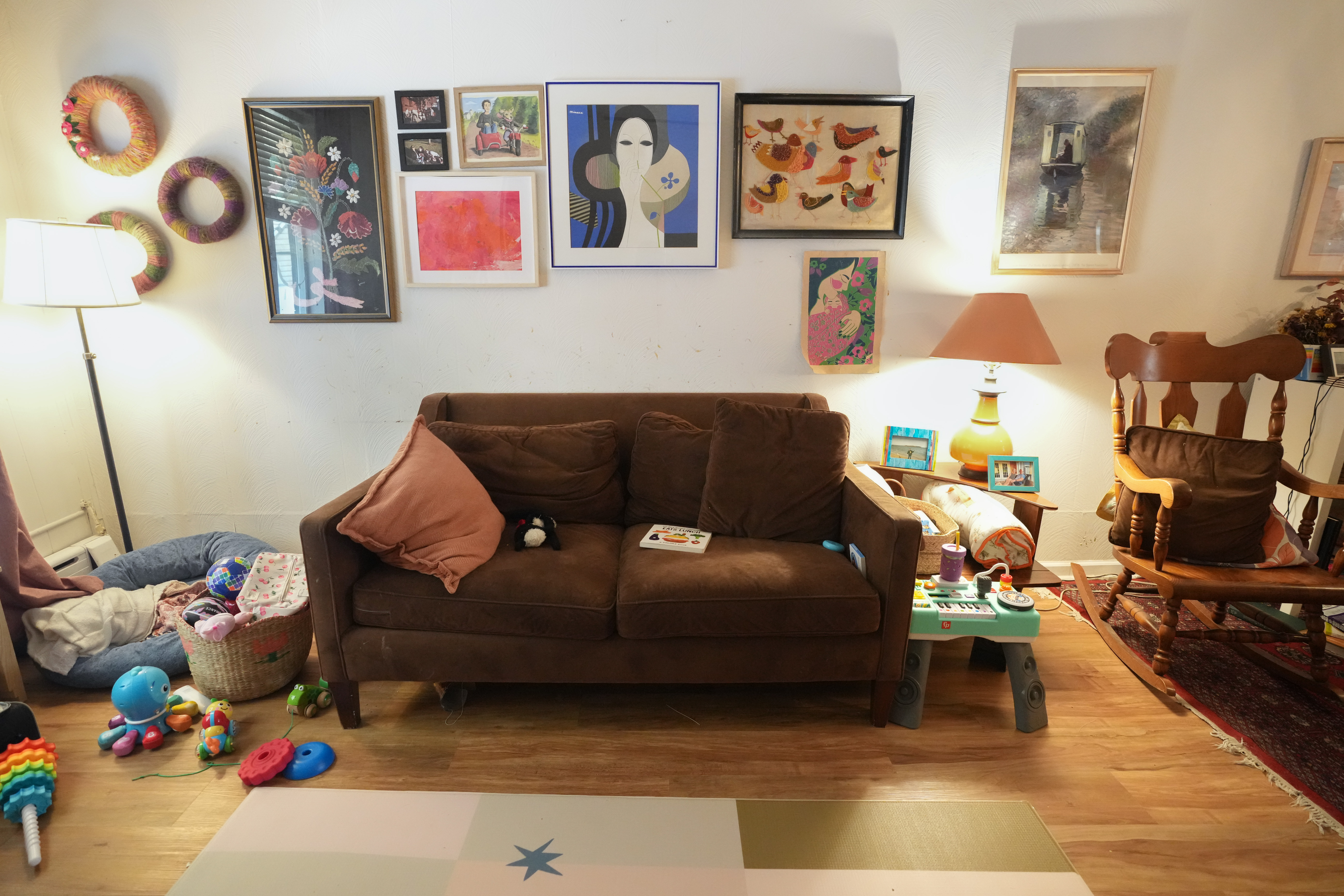
Life after close: Jaeger and Schraufnagel ripped up the purple carpets from the first floor, the bedrooms, and the hallways themselves, and Jaeger’s mother contributed $10,000 to install new vinyl plank floors. But the work wasn’t done by the time they moved in, so they had to camp out in a corner of the living room for two days.
The house has already been a site of major life changes. Jaeger and Schraufnagel married in 2023 and welcomed their first child, June, last year.
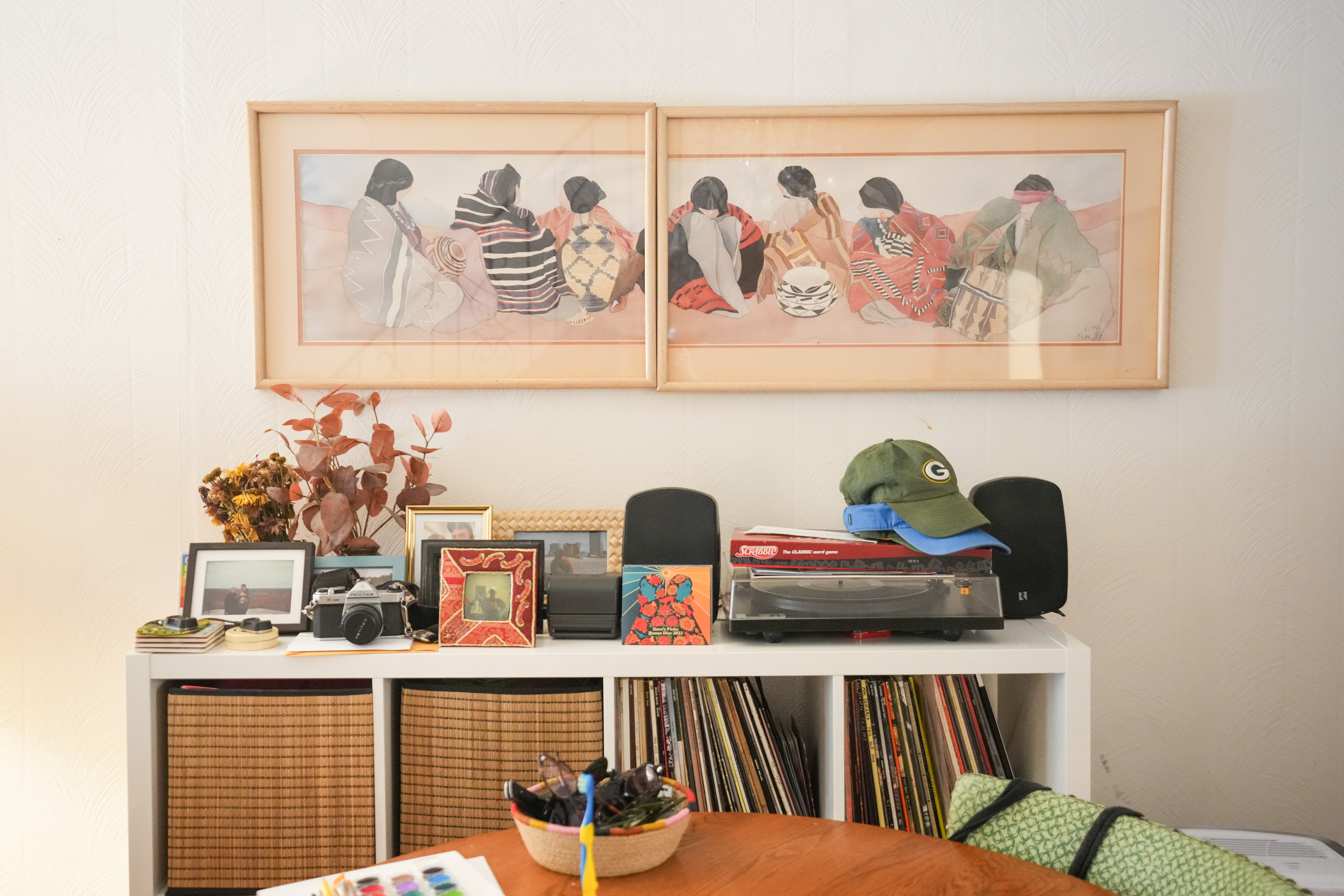
A set of June’s paints. Jessica Griffin / Staff Photographer
“If we hadn’t bought our house, we probably would have decided not to have a kid,” Jaeger said. “Moving into our house gave me a big sense of grounded-ness.”
The house still has its quirks: The bedrooms are connected by a closet, so if both closets are open, there’s a passageway between them. And sometimes Jaeger and Schraufnagel will come across something like mismatched molding that was clearly done by an amateur in a DIY spirit.
Even so, they don’t plan to move any time soon.
“We’re gonna own this house forever,” Jaeger said, “and probably live in this house forever.”
Did you recently buy a home in the Philadelphia area or South Jersey? Share the story of how you did it. Email Inquirer real estate reporters at properties@inquirer.com.
Connor Barwin has a tattoo of the Detroit skyline sketched on his right arm, but in nearly every other way, he’s a Philly diehard. (Some fans have wondered online whether it’s actually the Philadelphia skyline — it’s not.)
The former linebacker moved here in 2013 to play for the Eagles and “fell in love with Philly pretty quickly,” he said.
During his first season, Barwin, 39, launched the Make the World Better Foundation to fund revitalizations of city parks and playgrounds. He lived in Center City and rode SEPTA to practice.
Even when he left to play for the Rams in Los Angeles in 2017 and the Giants in New York in 2018, he maintained his civic devotion, reminding Pennsylvanians from afar to register to vote. In 2018, he moved back for good, settling in Fishtown with his wife, his now 8-year-old son and his 5-year-old daughter. He reads The Inquirer in print every Sunday.
His foundation hosts a yearly benefit concert and has transformed the Vare Recreation Center in Grays Ferry and Waterloo Playground in Kensington, among others.
Barwin now works for the Eagles as head of football development and strategy. On his perfect day, he orders the same breakfast he’s eaten roughly 199 times before, (quietly) roots for his kids from the sideline of their soccer games, and spends several happy hours at the Linc.
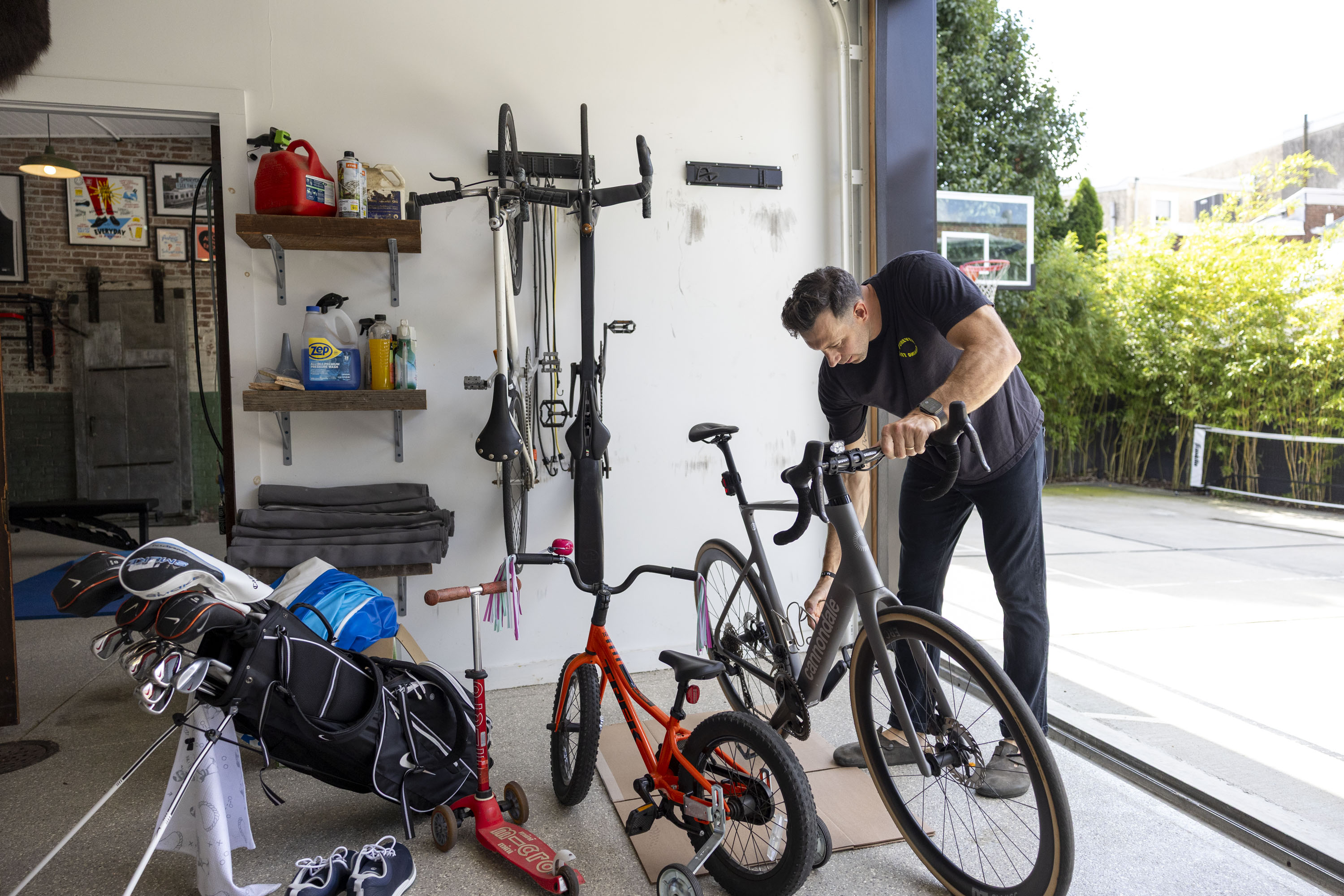
A perfect day for Connor Barwin involves biking to breakfast with his wife and two children. Tyger Williams / Staff Photographer
7 a.m.
I’m sleeping in, and waking up around 7 — on my own and not with my kids jumping in my bed. I have quiet time with my wife. I still get the physical paper delivered on Sundays, and if I can get 30 minutes to read it before my kids wake up, that’s the start of a perfect day.
8 a.m.
All of us get on our bikes and ride over to Cafe La Maude. I don’t know how I discovered it, but I’ve been going there for about 12 years. I get the open-faced burrito. I’ve probably been there 200 times, and I’ve ordered the open-faced burrito 199 times. I hear they have a lot of other great things on their menu, but I don’t waver.
9:30 a.m.
We bike home. It’s about a mile, and when you’re with two young kids, you have to take your time. Cycling is the perfect thing because it gets me outside, it gets me with my family, and we’re all getting some exercise.
11 a.m.
We go watch my kids play soccer in a local club. You just can’t forget the chairs because there’s usually not seating. On my perfect day, I’m sitting and watching both of them from the same vantage point.
I try to let them have that space and for their coach to do the coaching, and I just try to observe. There’s three things that are most important: to have fun, be a good teammate, and play hard. And if kids are doing that, they’re getting what they should be getting out of sports.
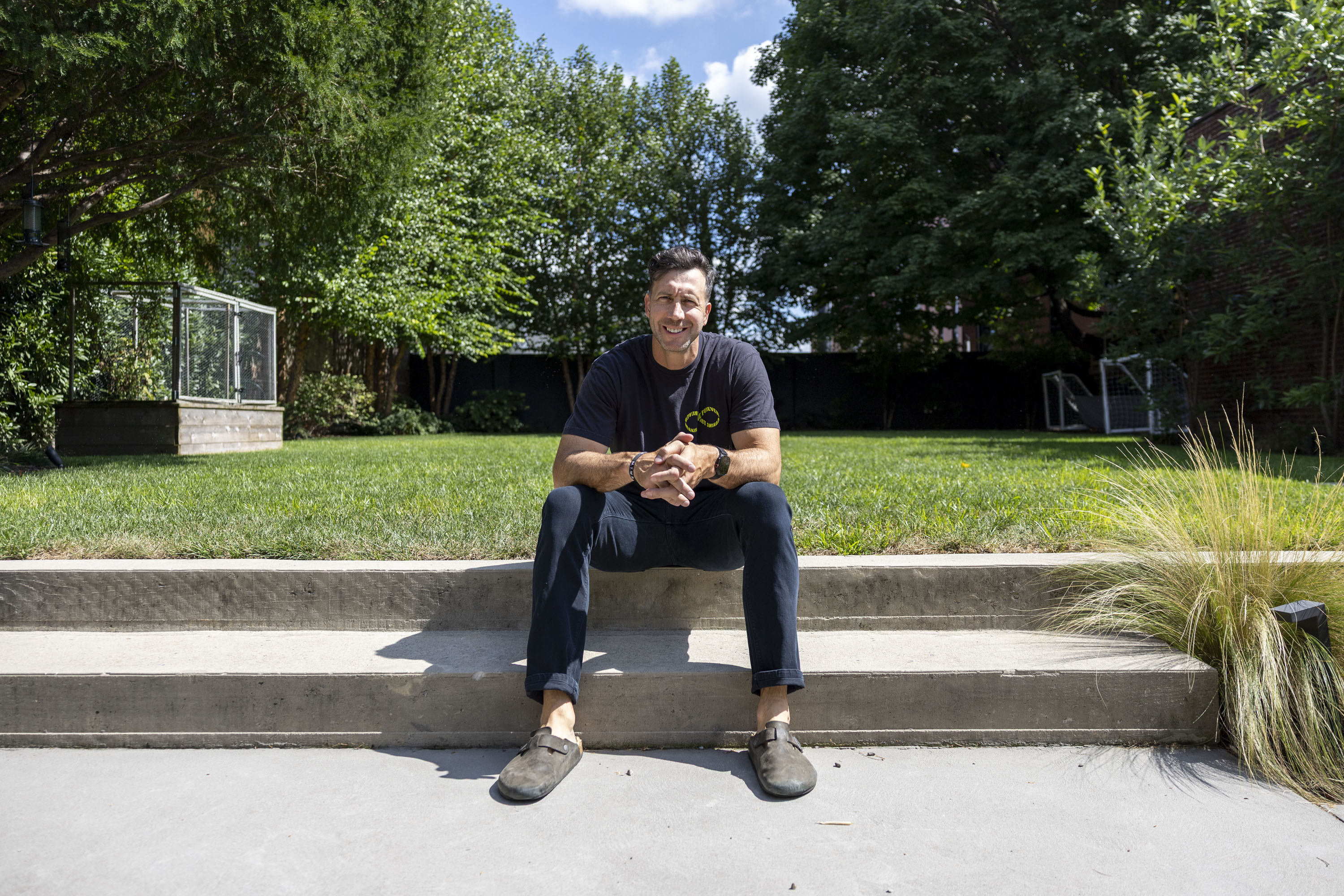
Connor Barwin sits for a portrait in his backyard, where his kids like to play soccer. Tyger Williams / Staff Photographer
12:30 p.m.
Around the block from where we live is a great little corner store, D&C Deli. We’ll walk down and get hoagies from there. I get the Italian, my wife gets the turkey. My kids get turkey and cheese or tuna. It’s one of the great parts about living in the city.
1 p.m.
I drop off the family. I get dressed and get whatever I need. Then I’m heading down to the Eagles stadium to be there three-plus hours before the 4:25 game.
1:30 p.m.
I run the stadium stairs, taking in the stadium before it fills up. It’s a tradition that I like to do since I stopped playing.
I love seeing and talking to the people who work in the stadium. I have some fun conversations with them about what they think about the game. They play a big role in the game day experience, so I enjoy that. And then I have my responsibilities before a game.
4:25 p.m.
I’m locked into my role. There’s a focus and intensity to it. I often get asked, do I miss not being a player anymore? I would say I don’t really miss it because I enjoy still being a part of it, and the intensity and competition that comes with it.
7:30 p.m.
The Eagles win. After the game, I hang out with my family and other families in the stadium for an hour or so to let traffic die down. Maybe on a perfect day it’s not a close game, so people leave early and there’s less traffic.
8:30 p.m.
When I played, I always got Santucci’s pizza after home games. Now I go back and forth between Santucci’s and Pizzeria Beddia. If I’m ordering Santucci’s, it’s a mushroom pizza. If I’m at Beddia, we’re usually getting the corn pie. My wife’s favorite is the pizza with greens. And we get the plain as well.
10 p.m.
We put the kids to bed, and then my wife and I have a Lambrusco.
The conversation has been edited for clarity and brevity.
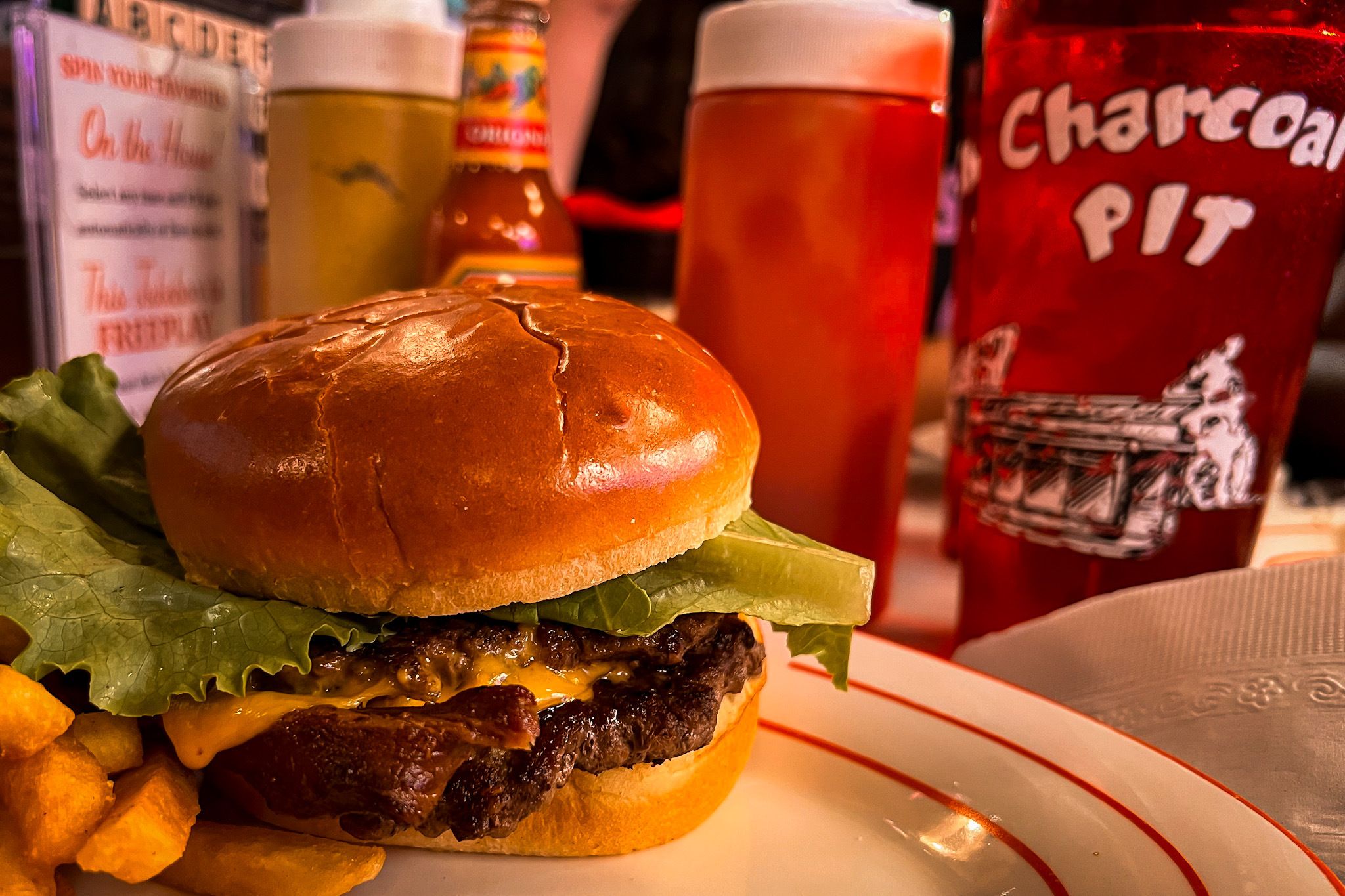
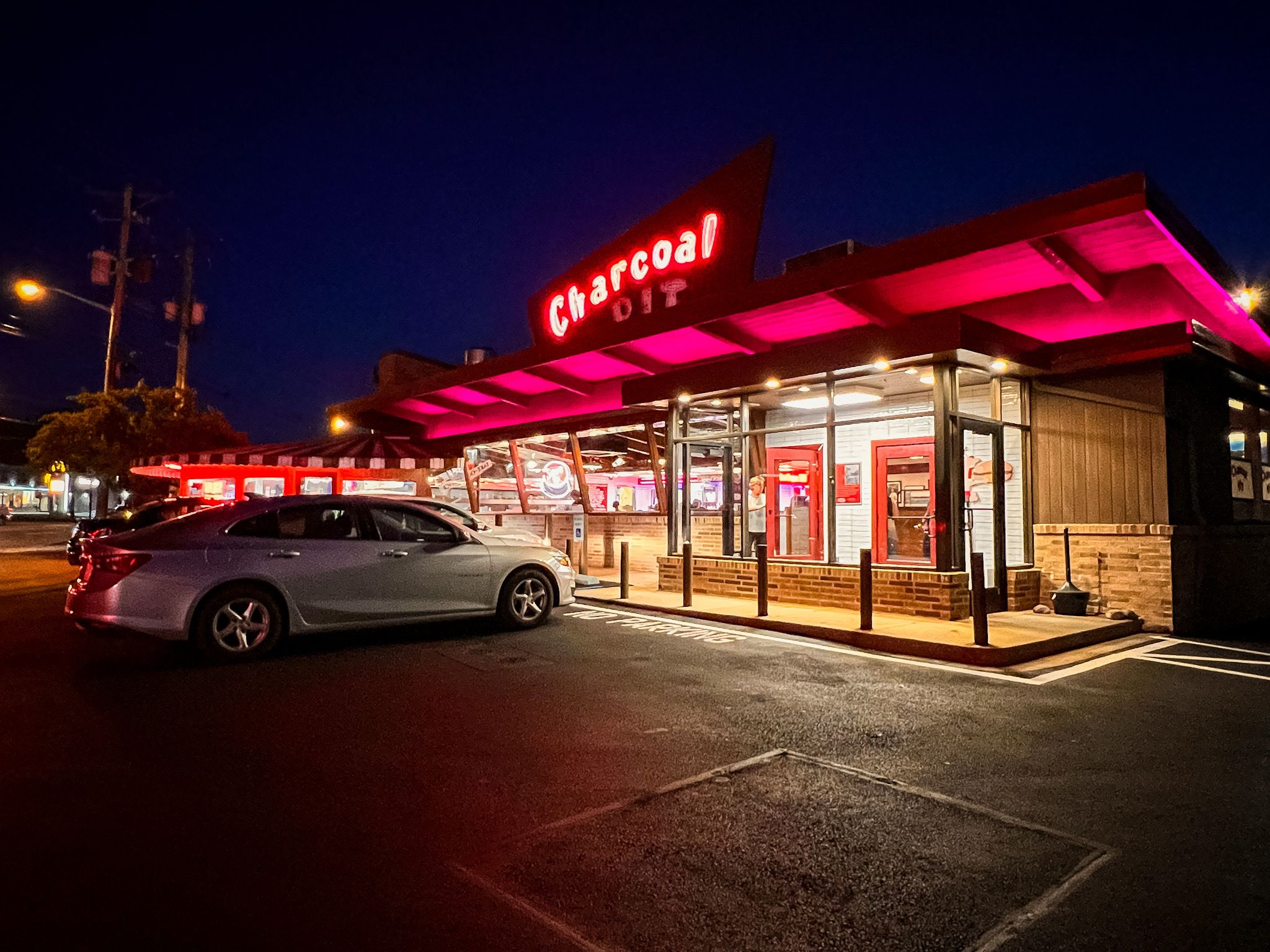
The Charcoal Pit has been serving burgers on Concord Pike in Wilmington since the Happy Days of the Eisenhower administration, when a 4-ounce hamburger was considered a meal rather than an appetizer. (Funny how, in the GLP-1 era, that portion suddenly seems just about perfect.)
This is honest food. The signature flame-broiled burger, ordered medium at my recent stop, arrived precisely that way — juicy and properly pink inside, speared by a charming retro toothpick helpfully confirming “medium.” The fries were similarly old-school: unevenly golden, crisp at the edges but softer through the middle.
Charcoal Pit, 2600 Concord Pike, Wilmington, on Sept. 6, 2026.Michael Klein / Staff
Everybody heads to the Pit’s soda fountain, where we all skipped the idea of the 20-scoop “kitchen sink” sundae in favor of a more manageable three dips: Pistachio and peanut butter swirl are two winners.
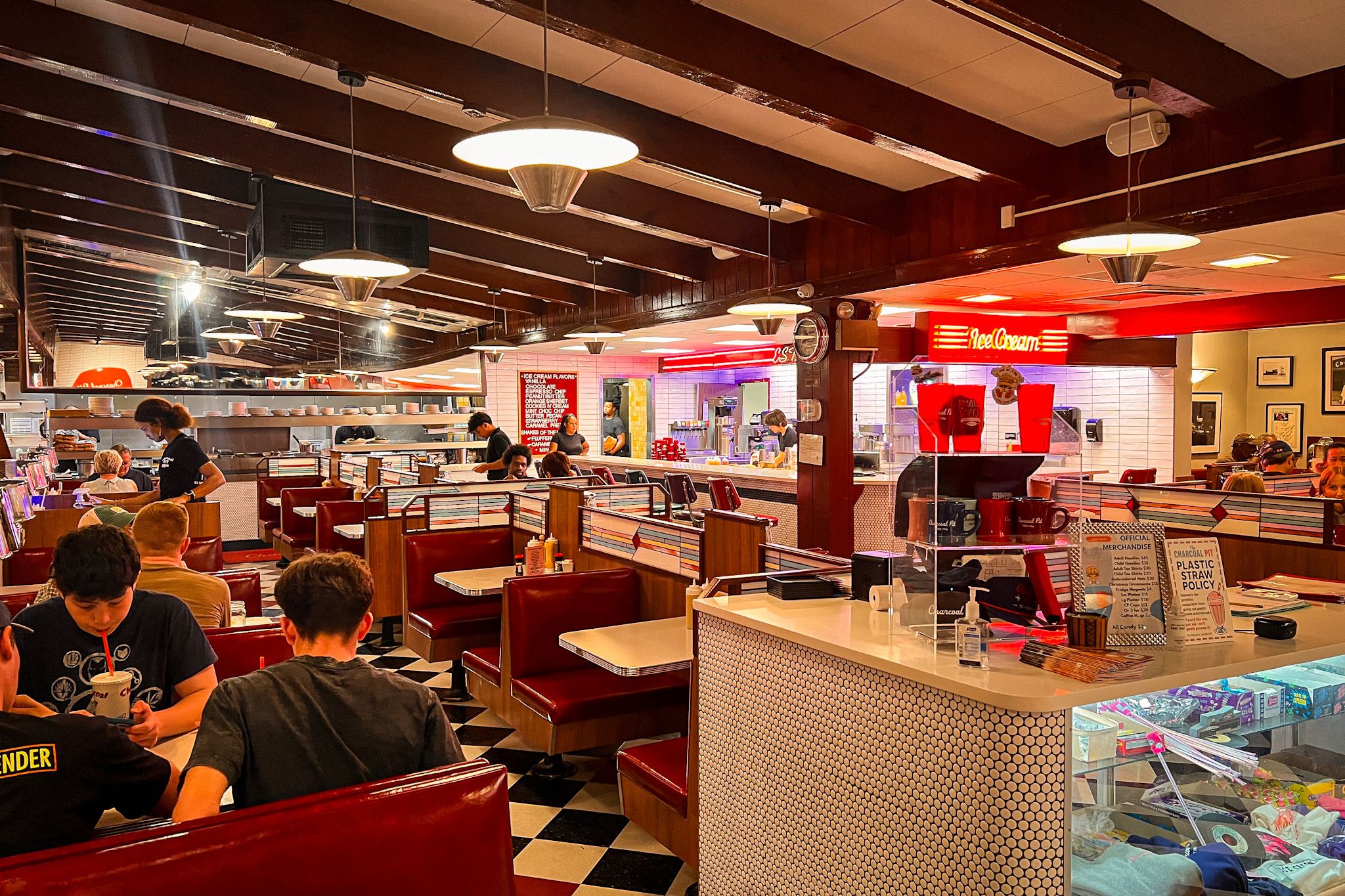
Burgers, shakes, and sundaes never go out of style, and neither does this dining room. The Charcoal Pit looks less like a re-creation of a 1956 diner than one that never got the memo the 1950s ended.
Despite renovations, enough survives that the nostalgia feels accumulated rather than contrived: red vinyl booths, a black-and-white checkerboard floor, saucer-shaped pendant lights, and mirrors multiplying the chrome stools and booths.
Charcoal Pit, 2600 Concord Pike, Wilmington.Michael Klein / Staff
One bit of history is more consequential. An oft-retold story holds that around 1960 or 1961, Joe Biden and several Archmere Academy football teammates walked out after the restaurant refused indoor service to their Black teammate, Frank Hutchins. Teammate Michael Fay later recalled Biden leading the walkout. As an adult, Biden frequented the Pit, stopping particularly for its butter pecan ice cream.
And one practical tip survives from a more innocent part of the past: Always put the kids on the inside of the booth, so they can reach the free-play jukebox and flip through the 1950s hits.
On Regional Rail, I often sit in the aisle of a three-seater, knowing the car will fill up at rush hour. When it does, I stand up so another passenger can take the middle seat, then return to my aisle seat. My friend says that’s awkward on a busy car, and I should just slide over. Who’s right?
Beatrice Forman, Food & Dining reporter
I feel like sliding over is one of those things that’s baked into the social contract of riding public transit, TBH.
If it’s a busy car, it’s your moral duty to slide over and free up the aisle seat. Sitting at the end of the row is a defensive posture that makes it seem like you don’t want someone next to you.
Abigail Covington, Life & Culture reporter
The right thing to do is slide over.
Beatrice Forman
I think it’s weird because it treats the middle seat kind of like a punishment? And most Regional Rail rides aren’t long enough to the point that it matters. One of my favorite facts about Regional Rail is that none of the trains have bathrooms because the trips aren’t that long.
Abigail Covington
I would absolutely do what the writer does. Everybody knows the middle seat is terrible. The window is better because you don’t have people on either side of you. The aisle is better because it makes it easier and faster to get off the train. The only reason to sit in the middle is if there is nowhere else to sit. If the aisle was open when you got to it, you hold onto that seat for dear life. It’s basically like riding first class for free.
Beatrice Forman
I don’t know that taking the middle seat makes it that much slower to get off the train. It’s like when people stand as soon as the airplane lands! It doesn’t help you move any quicker. The real prime real estate is getting a seat close enough to a door. First class does still have middle seats, after all.
I always slide over because of the golden rule. I would hate to be relegated to the middle seat for the rest of my life just because my stop is closer to the end of the line.
Abigail Covington
Yeah, Bea, you’re correct. The right, polite thing to do is slide over. If you’re getting up to let someone else in, you’re causing commotion in the aisle, forcing others to move, or shoving them closer together. Trains work best when everybody on them works together to create a seamless, efficient experience. Like stepping off the train at a stop if you’re standing by the door. By not scooting over, you’re being a bottleneck.
Beatrice Forman
And no one likes a bottleneck.
Abigail Covington
Exactly. And I say that with love, as a fellow aisle seat-addicted bottleneck.
Beatrice Forman
You know, at least they’re not one of those people that take their shoes off on the train. Those people deserve the middle seat for life.
When he was told of the bomb threat, Brian Maguire was where he was supposed to be and doing what he was supposed to do: on the grounds of the USTA Billie Jean King National Tennis Center in Queens, just 100 feet from the complex’s security command center, watching, noting, sizing up.
It was Monday, Sept. 2, 2024, the U.S. Open in full swing, clouds dimming the early afternoon sun. Inside Louis Armstrong Stadium, a surprise was brewing. Jasmine Paolini, the No. 5 seed in the women’s singles tournament, was losing her quarterfinal match to an unseeded opponent, Karolina Muchova. Maguire, the USTA’s director of security, wouldn’t learn the full significance of the match’s outcome until later.
Brian Maguire was the U.S. Open’s security director the day of the bomb threat.Courtesy of Brian Maguire
He answered a call from one of his staff members. At 12:12 p.m. — less than seven minutes before Muchova polished off Paolini, 6-3, 6-3 — someone had sent a direct message to the USTA’s Twitter/X account:
“I’m inside Louis Armstrong with a bomb that will go off at 1 pm est”
Louis Armstrong Stadium has a seating capacity of 14,000, and Maguire estimated that, among spectators, staff, and athletes, there were at least an additional 4,000 people on the 46.5-acre campus. All of them had been screened or searched — metal detectors, explosive-detection K-9 teams — so he was confident that the threat was empty. Still, for a man in his position, there was no such thing as being too careful, and if, somehow, there actually was a bomb out there somewhere …
He called his bosses at the USTA to inform them of the threat, then walked back to the command center. Once he arrived, he glanced at a computer screen to see the message for himself, and he conferred with his staff and with on-hand representatives from both the New York Police Department and the Federal Bureau of Investigation.
Built like a solid barrel, Maguire had been an NYPD detective for 27 years, 15 of them on the department’s joint-terrorism task force. Madison Square Garden, Yankee Stadium, Citi Field, the Barclays Center, the United Nations General Assembly, countless Midtown parades, even several previous U.S. Opens: Before the USTA hired him in June 2024, he had worked every major event at every major venue in New York. This kind of situation was not new to him, and he brought an investigator’s calm and logic to bear in evaluating and handling it.
“The Open is a great event,” he said. “Not a lot of bad things happen here, so this was like a one-off when we had this threat. I also knew that bomb threats, since online gambling has become a thing, have just skyrocketed.”
Maguire requested that the FBI open a guardian — that is, begin gathering evidence for a federal case — against the person who had made the threat. The NYPD’s bomb squad and the FBI’s special-agent technicians, accompanied by bomb-sniffing dogs, canvassed the campus. Within 20 minutes, the officers and agents were radioing back from their search to tell Maguire, We’re clear. Louis Armstrong Stadium was never evacuated.
“The likelihood of a device getting on our campus is pretty slim,” Maguire said. “But I’m still taking resources away from other places. We have to take every threat as if it’s real. I know in my mind, ‘Is there going to be a device? Probably not.’ But I still have to go through the motions.
“He’s not thinking that far ahead, this poor sap.”
Arthur Ashe Stadium, the main court at the Billie Jean King National Tennis Center, home to the U.S. Open. Charly Triballeau / AFP via Getty Images
A young man’s future on the line
Aidan Getchius trudged into a courtroom with his lawyer and his mother. Twenty-one years old, with small features and a few dark whiskers drooping around his pursed mouth, wearing a black plaid shirt, he gave the impression of a student who always took a seat near the back of the classroom, to try to go unnoticed. If he was anxious, he did not show it. His nerves already had done their work. Flecks of his dark hair had gone gray.
He was there, inside the Edward N. Cahn Federal Building in Allentown on a rainy morning in May, because he had admitted to doing a stupid and reckless thing. He had used a gambling app to place a $100 wager on the Muchova-Paolini match, betting on Paolini to win. But as Muchova won point after point on her first serve and it became clear that Paolini would lose, Getchius panicked. He wanted to keep his money, and the only way to do it, he thought, was to disrupt or stop the match. From 160 miles away, from the Lancaster County house where he lived with his mother, Trisha Sullivan, he had thumb-typed and sent the bomb threat.
Authorities had an easy time tracing the message back to Getchius and his Twitter/X account. He was charged with conveying false information and hoaxes, a count to which he had pleaded guilty in November 2025. Now he was in court for his sentencing hearing, facing up to five years in prison and a $250,000 fine.
He took a seat at the defendant’s table, its mahogany top gleaming. Sullivan, in a black blazer and a librarian’s glasses, slid into a row just behind him. The lawyers whispered and fiddled with their folders and papers. There was no other sound in the courtroom.
In less than an hour, U.S. District Judge John M. Gallagher would determine Getchius’ punishment and, in turn, his future, but that revelation was just one angle in a story with several worth accenting and examining. The case of Aidan Getchius had come in contact with so many disturbing trends and developments in the relationship between sports and American society that Gallagher’s decision would be the least compelling aspect of it.
The Billie Jean King National Tennis Center hosts the U.S. Open ever year, with tens of thousands attending every day of the event.Angela Weiss / AFP via Getty Images
‘He doesn’t talk at all’
Getchius had a factor — one rare set of circumstances for someone charged with a federal crime — working in his favor. Neither the attorney defending him nor the attorney prosecuting him believed or argued that he deserved jail time.
He was 19 when he sent the direct message to the USTA, and Jeremy Isard, the federal public defender representing him, framed Getchius as a good kid from a decent home who, while not a dangerous loner or incel, had temporarily lost any sense of social norms and boundaries.
“This is the only time that Mr. Getchius has done such a thing,” Isard said in court. “We live in a world where even the momentary frustration of a teenager can have real-world consequences. That is the reality that all of us are living in for the first time.”
Someone with Getchius’ background and upbringing, though, might feel more removed from those consequences than the average teen who stares at a screen all day. From the east, a car ride out to Strasburg, a town of fewer than 3,200 residents, will likely take someone past the Railroad Museum of Pennsylvania. There isn’t a big-brand supermarket or retailer to be found. And as drivers zoom past eggshell white barns and endless acres of verdant cornfields, they have to mind the shoulder of the road for any Amish and Mennonite farmers and children, dressed plainly, who might be walking, riding modest bicycles, or coaxing horses to keep on clip-clopping as the animals tug them along in wooden buggies.
Throughout middle school, Getchius was bullied “on a near-daily basis,” Isard wrote in a sentencing memorandum. So Sullivan, who raised him by herself and works full time at an insurance company, enrolled him in Pennsylvania Leadership Charter School, an online high school headquartered in West Chester. His four years there “overlapped almost perfectly with the COVID-19 pandemic,” Isard wrote, and allowed him to “focus on academics while saving him what had developed into not insignificant social anxiety.” Multiple messages to the school’s communications office, seeking a comment on or insight into Getchius’ tenure there, went unreturned.
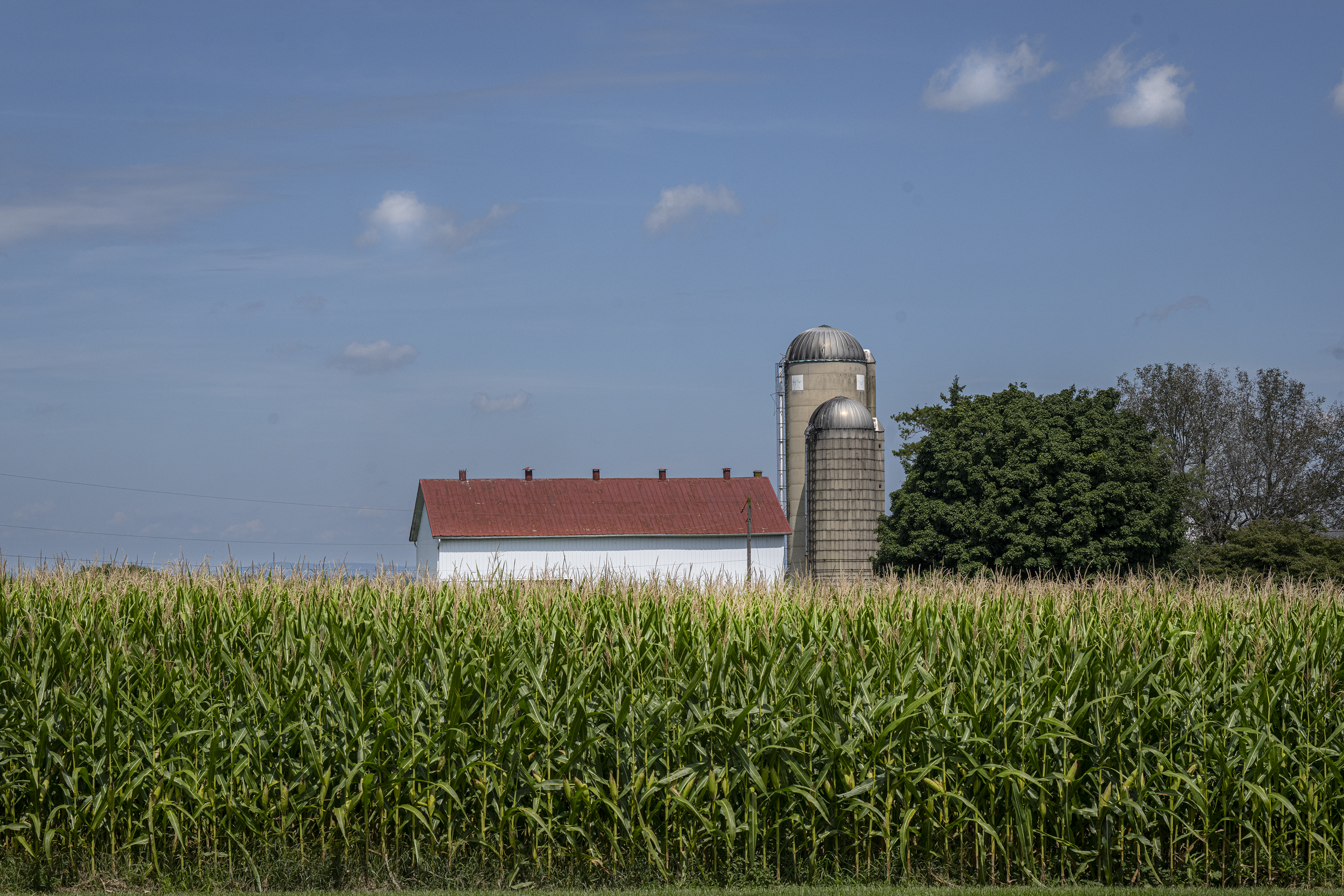
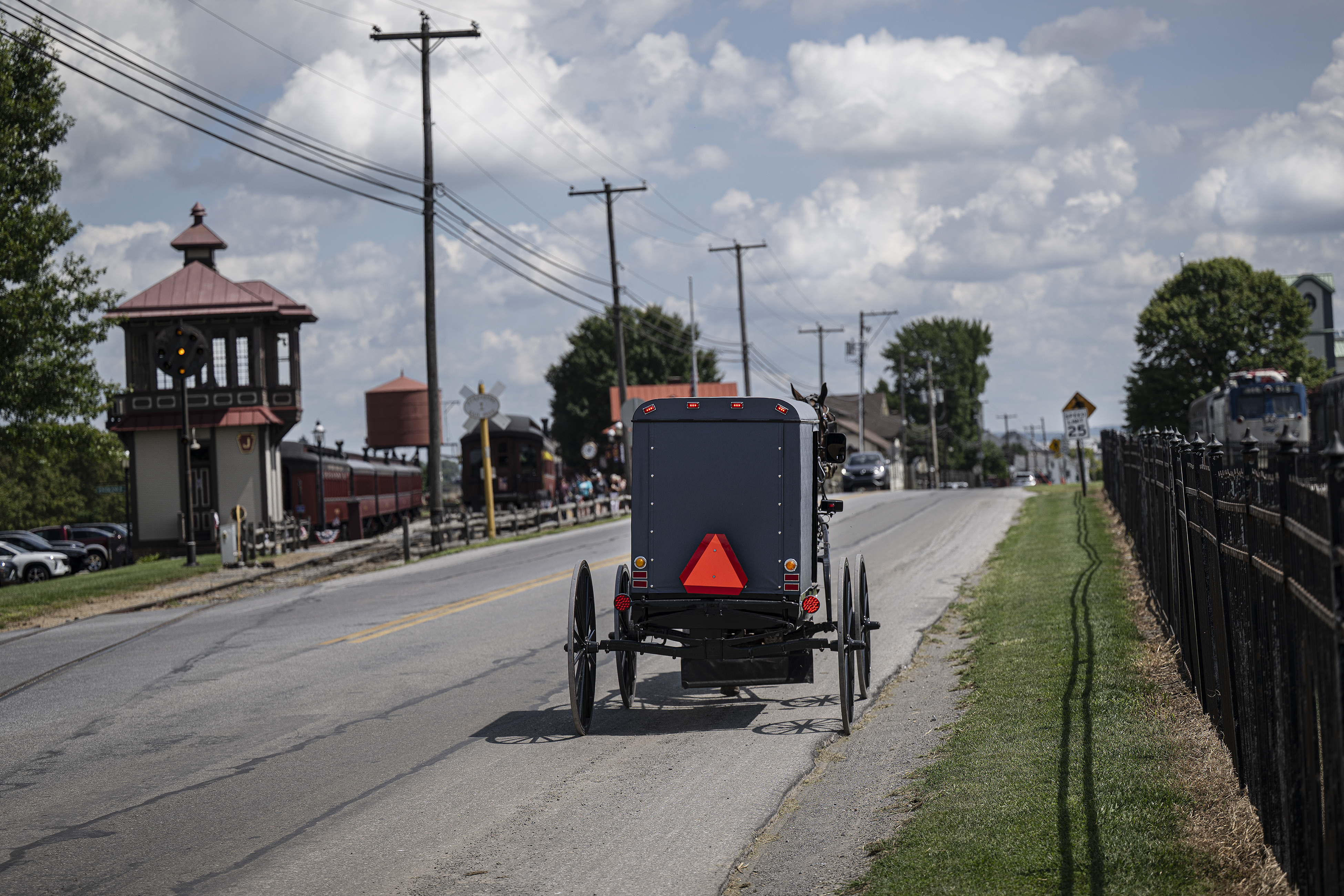
A farmhouse in Strasburg, Pa., and silo stand in front of a cornfield, a few miles from the home of a Lancaster County man who pleaded guilty to a bomb hoax targeting the 2024 U.S. Open tennis tournament.Jose F. Moreno / Staff PhotographerAn Amish buggy travels in Strasburg, Pa., a few miles away from the home of a Lancaster County man who pleaded guilty to a bomb hoax targeting the 2024 U.S. Open tennis tournament.Jose F. Moreno / Staff Photographer
“There are reasons related to Mr. Getchius and his own vulnerabilities,” Isard said in court, “that the sting of losing a bet hits harder for this gentleman than it would for many of the rest of us. … This was someone who [was] living an isolated and digital life.”
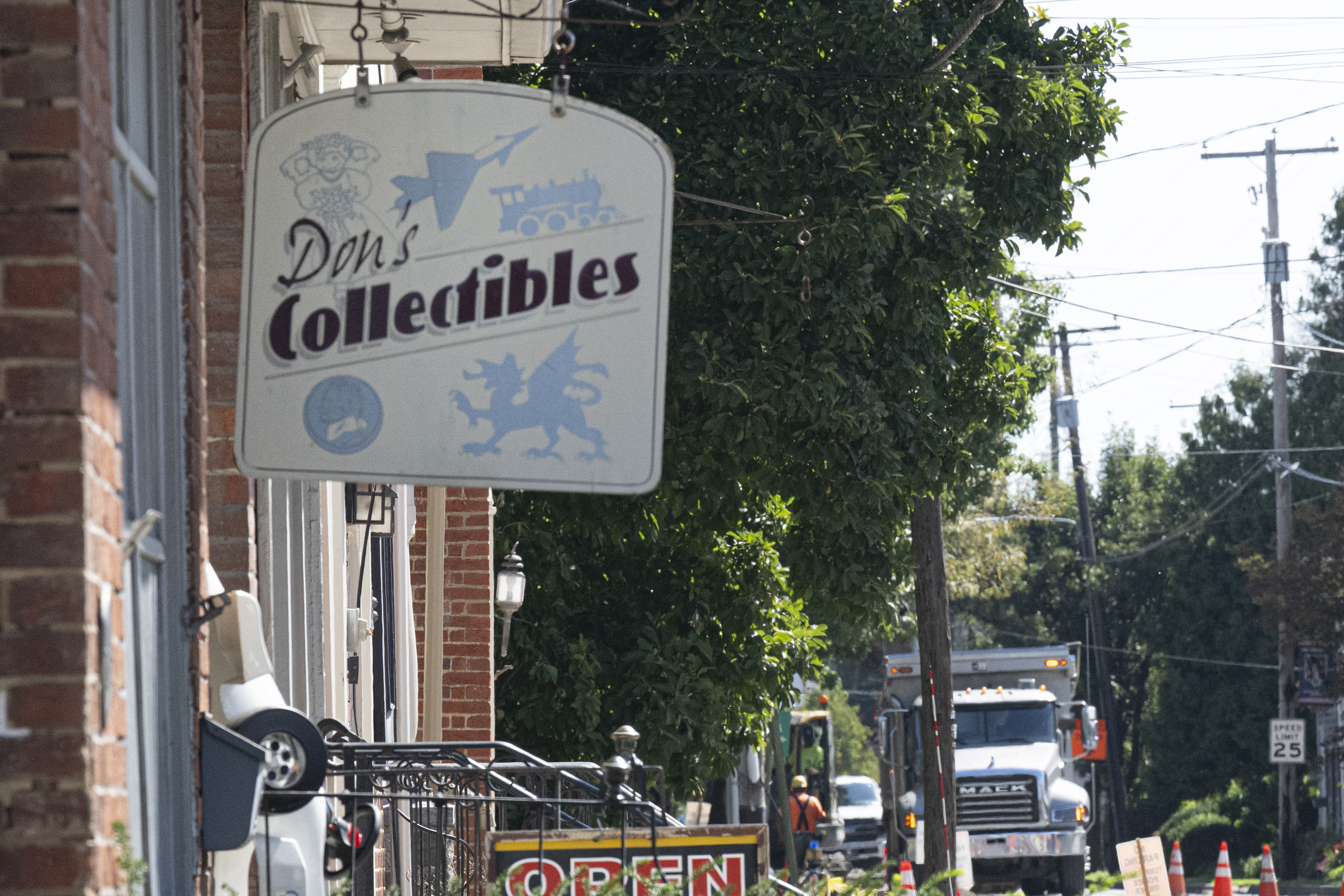
After graduating, Getchius took a job at Don’s Collectibles, a sports and pop-culture memorabilia store owned by his grandfather, Don Dorwart. The store is a fixture in Strasburg, open at its location on Main Street since 1984. For the two years he worked there, Getchius waited on customers and wrote and designed listings for items that Dorwart sold on eBay.
“He’s very quiet,” Dorwart said one morning at the store last month. “He doesn’t talk at all.”
Among the sports cards and trinkets and classic toys that he sells, Dorwart had recently ordered 300 pounds of foreign coins to offer to his customers. Several bags of them were stacked near his cash register, as if the store were a bank vault. Hundreds of coins from Brazil, Canada, and Italy rested in a wide, shallow cardboard box on the front counter. Dorwart was asked about sports gambling, and he was quiet as he considered how and why his grandson had come to place bets and to write and send that threatening message.
“It’s all this,” he said as he ran his left hand through the coins in the box. “He’s not that kind of kid.”
The match at the center of the bomb threat: Karolina Muchova (left) and Jasmine Paolini in a fourth-round singles match in the 2024 U.S. Open at Louis Armstrong Stadium.Sarah Stier / Getty Images
The hold on him
The implication of Dorwart’s gesture — that Getchius and others like him had given in to the addictive allure of legalized sports betting, the rush it delivered, and especially the winnings it promised — would have resonated with Josh Davison, the assistant U.S. Attorney prosecuting the case.
Davison agreed that Getchius didn’t need to be sentenced to federal prison for the bomb threat. Getchius knew he had screwed up, had owned up to his awful mistake, and hadn’t denied it or dodged it or fought the charges; he had pleaded guilty as fast as he could. But there were two aspects of the crime, Davison asserted at the hearing, that Gallagher ought to consider when imposing the sentence. Distilled, they were danger and fear.
Getchius began betting in 2022, when he was 18, after getting back in touch with a few friends from middle school. They formed a group text chain, and Getchius, according to court documents, found comfort in the rekindled friendships and the daily, sometimes minute-by-minute routine of betting. His user name on his Twitter/X account was “GetchiSoto” — a combination of his last name and that of one of his favorite baseball players, star outfielder Juan Soto — and he used that name or a derivative of it on several other accounts, some of which were vessels for his betting: Instagram, Facebook, Reddit, Kik, PlayStation, Xbox, and TikTok.
His mother didn’t know he was gambling. And even after his arrest and plea, even after attending at least 10 sessions of counseling, Getchius continued to bet small sums of money on sports.
Located in Strasburg, Pa., Don’s Collectibles, owned by the grandfather of a Lancaster County man who pleaded guilty to a bomb hoax targeting the 2024 U.S. Open tennis tournament.Jose F. Moreno / Staff Photographer
“It’s certainly legal to place those bets,” Davison said during the hearing. “It’s just disappointing that someone with a pending sentence, who is still facing the threat of incarceration, is placing those bets. That tells the government, ‘Wow, that’s a strong hold.’ That confirms to the government that bringing this case was entirely the right thing.”
The group chat became a forum for banter among the boys and for hyperbolic reactions to lost bets. “As Mr. Getchius understands it,” Isard wrote, “this is how the rough script for his threat to the U.S. Open entered his mind.” He did not pause to consider what might happen if he shared that script.
A train car on the Strasburg Rail Road.Jose F. Moreno / Staff Photographer
The scope of the problem
When it comes to the potential damage of his actions, Getchius was no different from others who have tried to intimidate or menace athletes or have engaged in “swatting” — falsely reporting an emergency with the intent of victimizing an individual or institution. The goal is the same. The chaos and upheaval are the point.
In August 2025, for example, a report of an active shooter at Villanova University caused “panic and terror,” the Rev. Peter M. Donohue, the school’s president, said in a statement. The report was false, and in April federal prosecutors charged a juvenile suspect who was allegedly part of an online group claiming responsibility for similar calls to several colleges and universities.
“This hearing would look a lot different,” Davison said, “if we had Villanova students here.”
Two months before the Villanova hoax, during a Grand Slam Track meet at Penn’s Franklin Field, a bettor who identified himself on Twitter/X as “@mr100kaday” screamed at sprinter Gabby Thomas as she stood at the starting line for one of her races, calling her “Trash Spice.” After Thomas — a three-time Olympic gold medalist — lost her events, the man followed her around the track, insulting her, before posting screenshots of betting slips that showed he had won money by wagering against her.
“I made Gabby lose by heckling her,” he wrote on Twitter/X. “And it made my parlay win.”
This grown man followed me around the track as I took pictures and signed autographs for fans (mostly children) shouting personal insults- anybody who enables him online is gross https://t.co/f9a6vPkX0v
The accumulation of such incidents can create a boy-who-cried-wolf effect that numbs people to a harsh truth: It takes just one of these threats to be genuine, just one bona fide villain who follows through, for an atrocity to occur. And the ubiquity and casual acceptance of betting don’t help.
Matthew Wein, an expert in cybersecurity and a former policy adviser at the Department of Homeland Security, keeps a database of incidents in which athletes have been harassed or threatened. A quarter of those incidents, he said in a phone interview, have been connected to gambling, and his database doesn’t paint a full picture of the problem, given how many threats go unreported.
Wein recommended that sports leagues and franchises start sharing information on problematic or malevolent bettors. The Phillies, for instance, were playing at Citizens Bank Park, less than six miles south of Franklin Field, on the same day that the anonymous gambler hounded Thomas.
“If you’re the Phillies’ owners, wouldn’t you like to know if this man had a ticket to your game?” Wein said. “I’ve described it as a pre-9/11 mindset. In the aftermath of the 9/11 commission hearings, we said that one of the big problems was that people weren’t working well enough together to make the puzzle pieces fit.
“A lot of it comes back to, are teams and leagues and sportsbooks and players unions and social-media platforms and other stakeholders willing to invest in sports-integrity measures? When sports gambling is marketed to young men, some who have mental-health issues, it’s a potent mixture that can really create an on ramp to criminal activity and violence.”
Neither Getchius nor Sullivan responded to requests for an interview, so certain questions about why he did what he did remain unanswered. How much money had he lost? How far in the hole was he? Why did a modest hundred-dollar bet inspire such a dumb and desperate reaction? And why was he betting on tennis?
In today’s gambling culture, there’s no sport or competition too obscure, no over/under or opening tap or coin toss too insignificant, that a wager can’t and won’t be placed on it. Yet even by that standard, the women’s singles bracket of the U.S. Open seemed a strange and random event for a bet from a young man from Amish country. Getchius was not a fan of the sport. He didn’t follow it. Why the Paolini-Muchova match? Why that tournament?
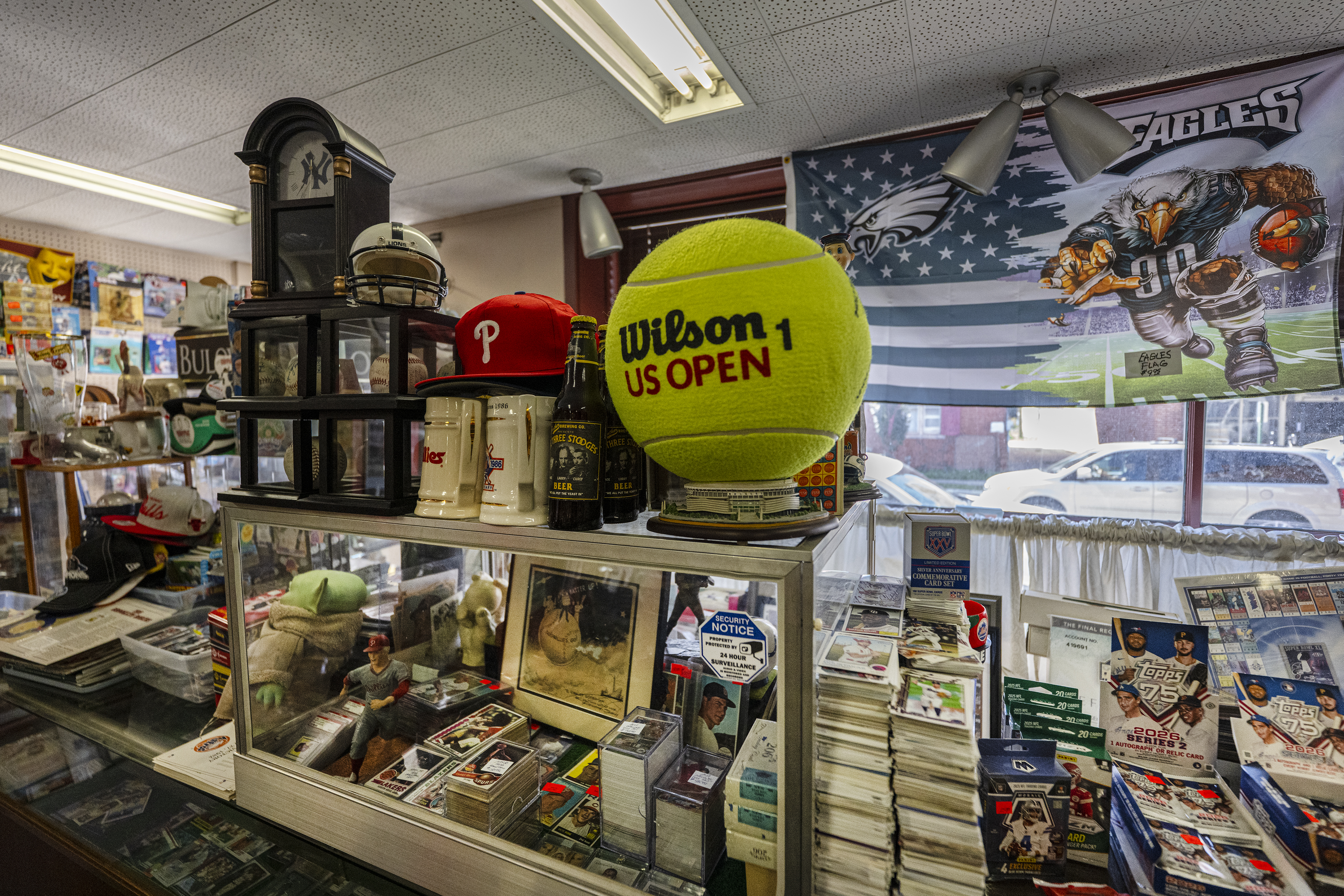
A clue might come from one of his favorite and most familiar places. Near the front window of his grandfather’s collectibles shop, atop a large glass case displaying stacks of baseball cards and a Richie Ashburn figurine, rested the largest item in the store. There was no telling how long it had been there. It was a jumbo lime green Wilson tennis ball. Across the ball, in red lettering, were the words “US OPEN.”
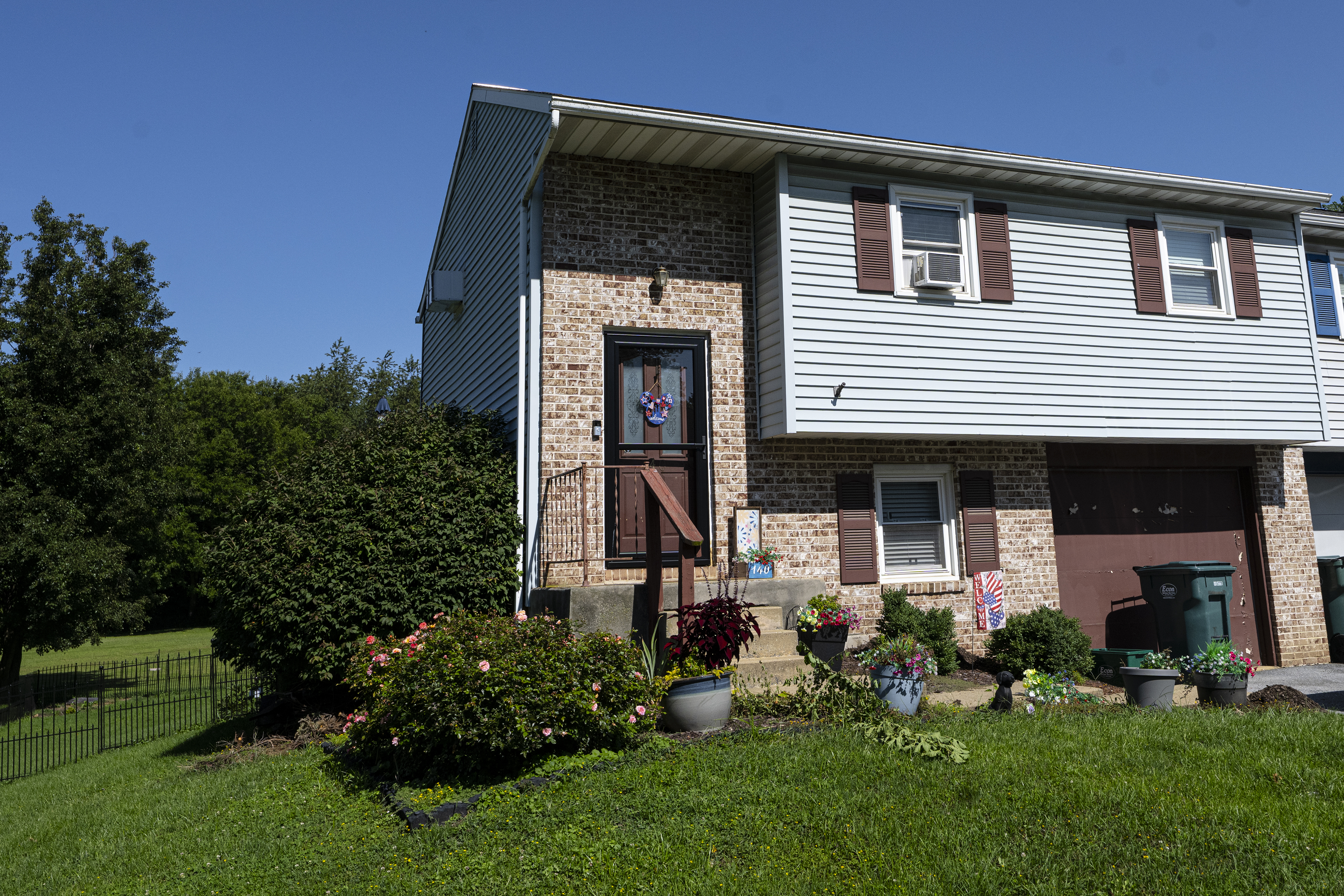
The home, near Strasburg, Pa., of a Lancaster County man who pleaded guilty to a bomb hoax targeting the 2024 U.S. Open tennis tournament.Jose F. Moreno / Staff Photographer
The life and threats to come
As Gallagher prepared to hand down Getchius’ sentence, he told him, “You have the right to be heard, to say anything you want to me or nothing at all.”
Getchius remained seated at the defendant’s table and spoke in a low monotone.
“I apologize for my actions,” he said. “I understand the severity, and I take full responsibility. I’ve learned a lot over the past two years, and I can promise that nothing like this will ever happen again.”
He showed no reaction when Gallagher imposed the sentence: three years’ probation; a $1,000 fine; and the imposition of certain conditions — that Getchius had to attend Gamblers Anonymous or another treatment program and that he was forbidden from engaging in any gambling activity of any kind. Getchius nodded to Isard, consenting to the terms. His mother kept her hands folded on her lap.
“Instead of losing a bet, you lost a lot more,” Gallagher said. “None of this is to excuse what you did, Mr. Getchius, but I do have to consider who you are. … You have a full and lawful and productive life ahead of you. You have people who care about you. You have everything you need. We all want you to put this bad decision behind you and go on living that happy and productive life.”
The 2026 U.S. Open is underway. It has been less than two weeks since the first day of Aidan Getchius’ sophomore year at Millersville University. He carried a 3.24 GPA in his first semester there, makes deliveries for DoorDash to earn some money, and is for now a useful cautionary tale. What he said in court is probably true: He won’t do anything like this again. But if we aren’t careful, someone else will. Someone else will do something worse. And someone will die.
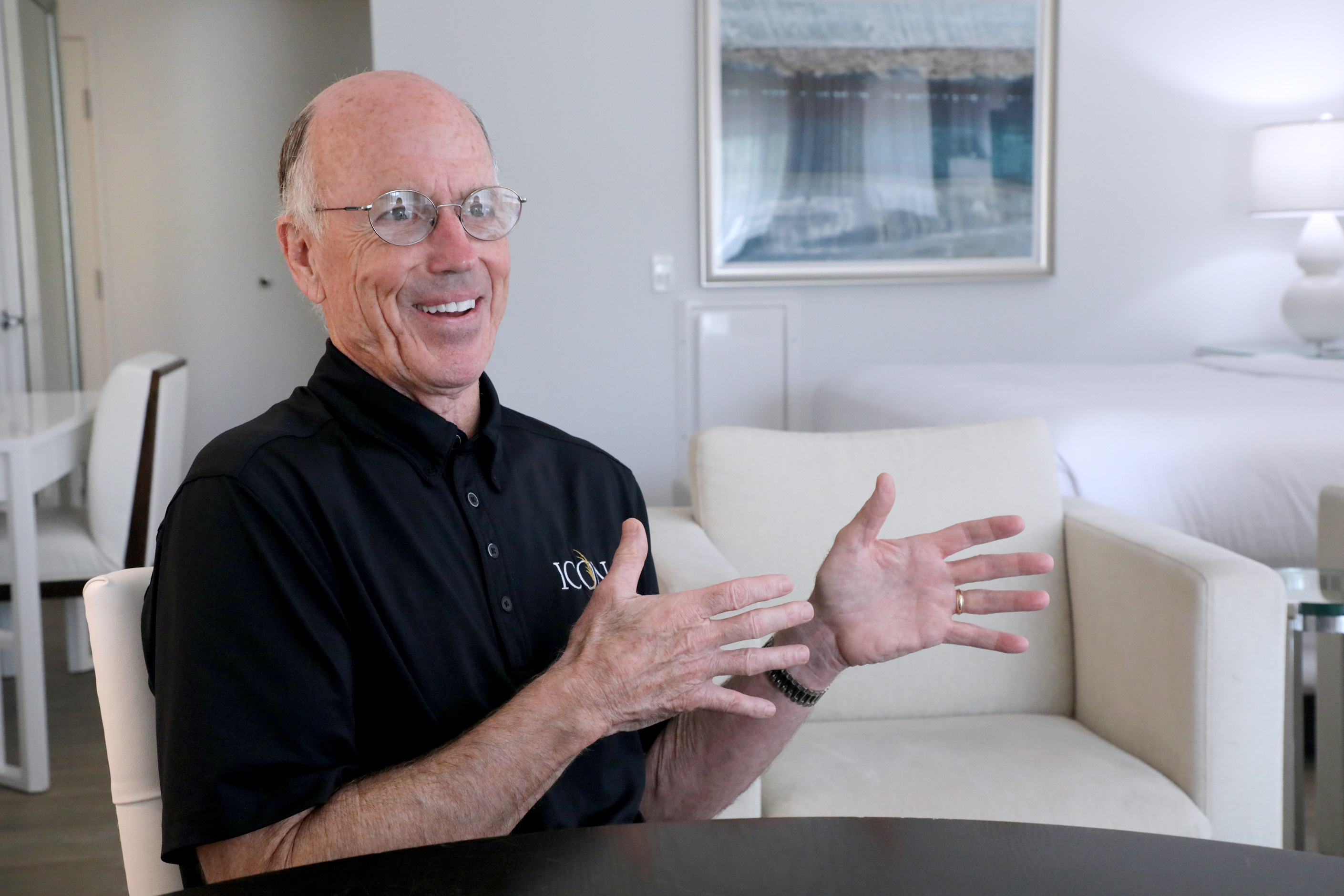
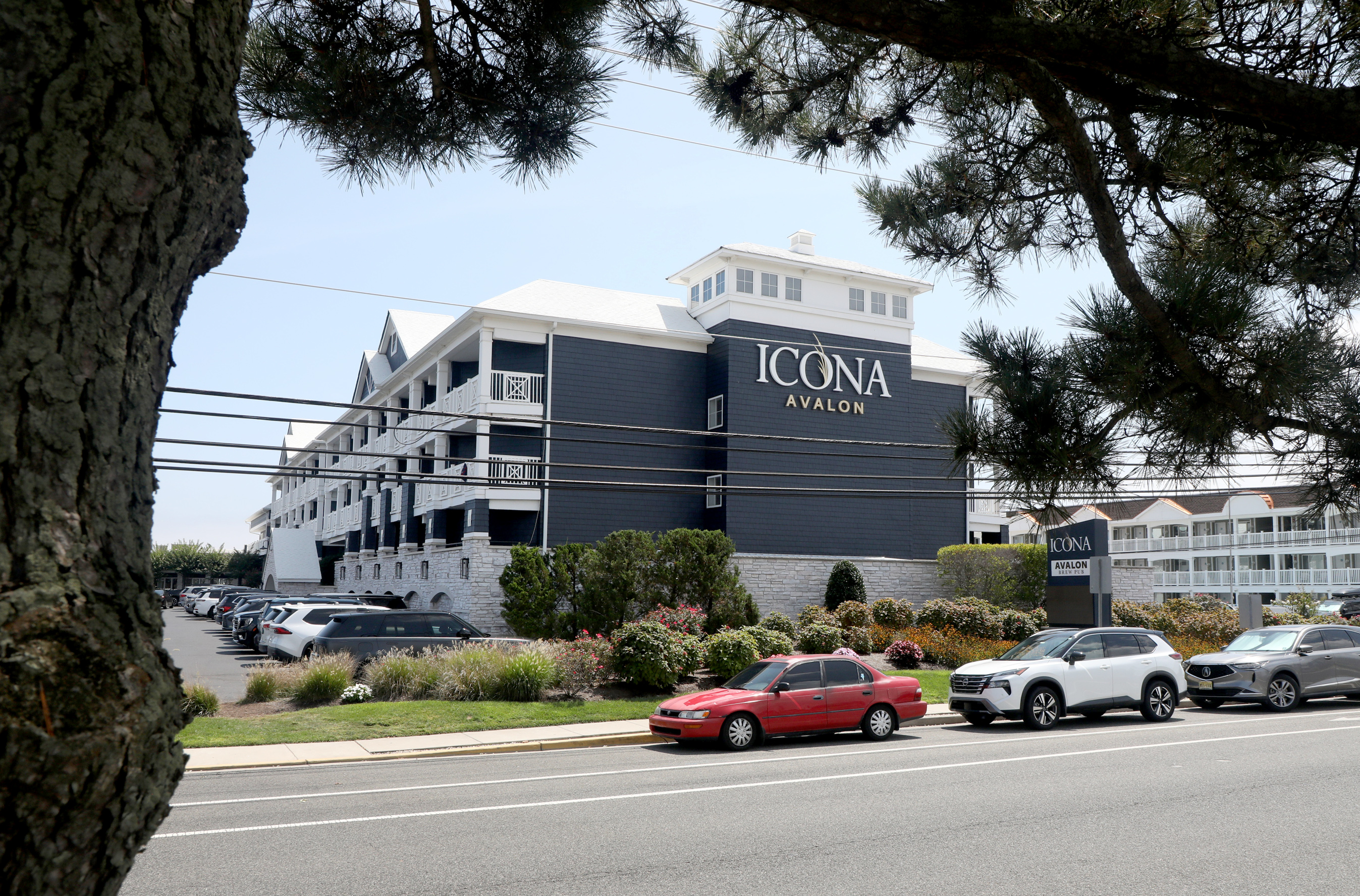
Icona Resorts founder Eustace Mita says he didn’t set out to change the Jersey Shore.
Sitting in a corner room at the Icona Avalon, the largest of Mita’s seven luxury hotels, the 72-year-old said it was the Shore, his lifelong “happy place,” that transformed him.
As Mita looked out onto the dunes, he recalled his baptism at St. Paul Catholic Church in Stone Harbor and his summer job as a teenage busboy and server at the Princeton Bar & Grill in Avalon.
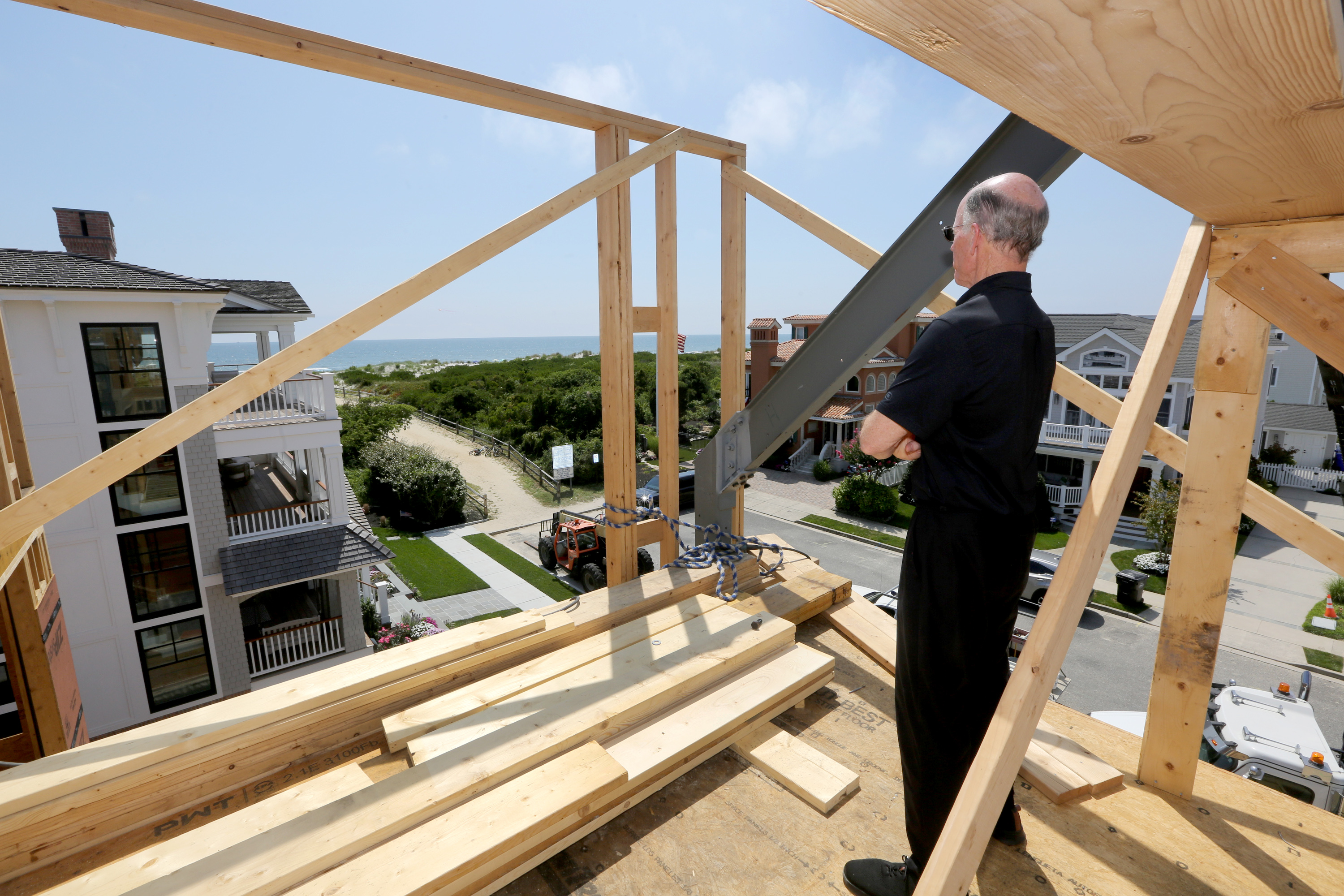
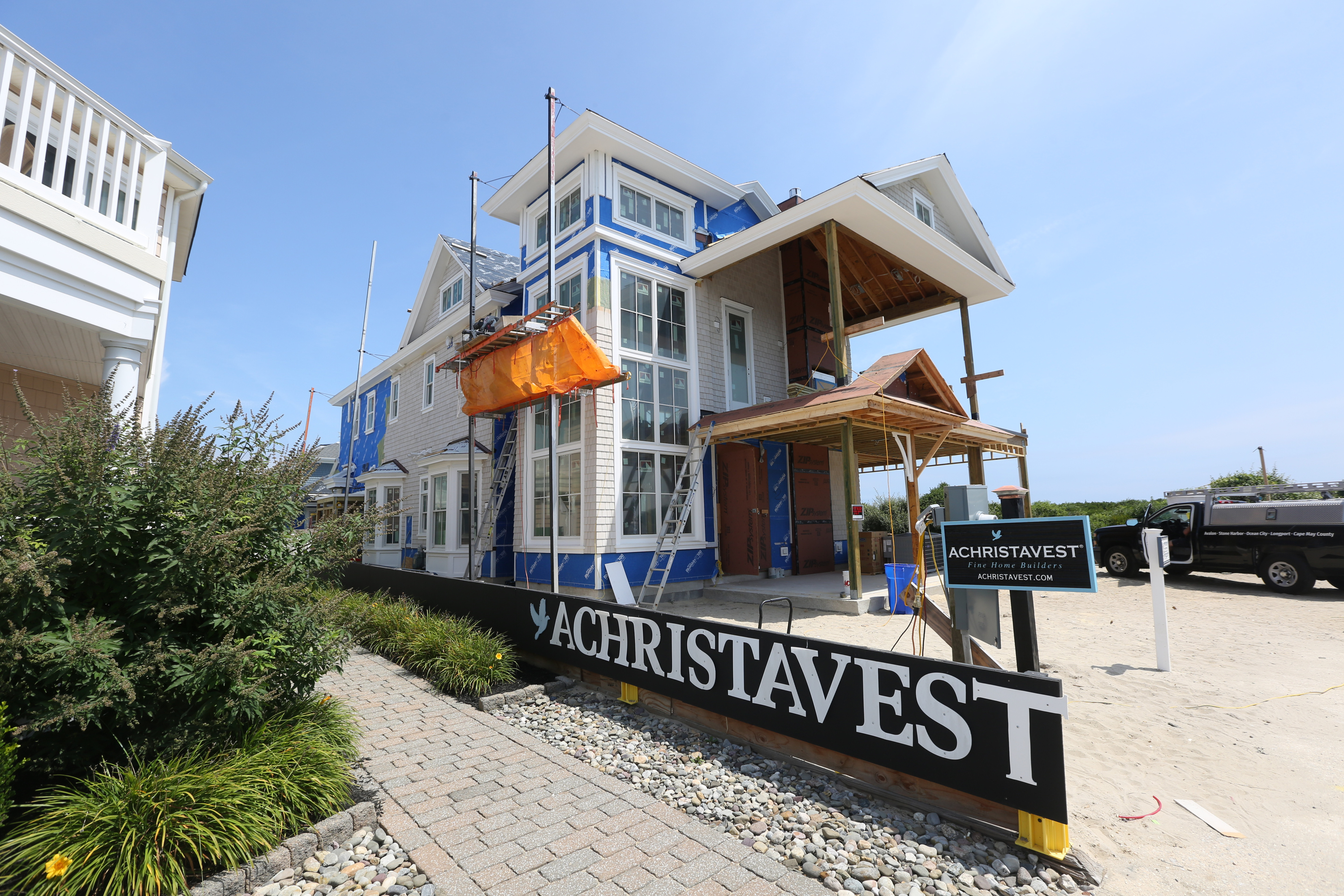
Decades later, Mita leads both Icona Resorts and Achristavest homebuilders, which constructs multimillion-dollar waterfront homes — including a controversial 18,000-square-foot mansion that would be the largest in Avalon. Built on spec, it will likely sell for several tens of millions.
His for-profit companies are all about luxury. At the same time, they are imbued with Mita’s faith: The names, Icona and Achristavest, were inspired by spiritual experiences and words, and he displays 18-inch statues of the Blessed Mother in the hotel lobbies.
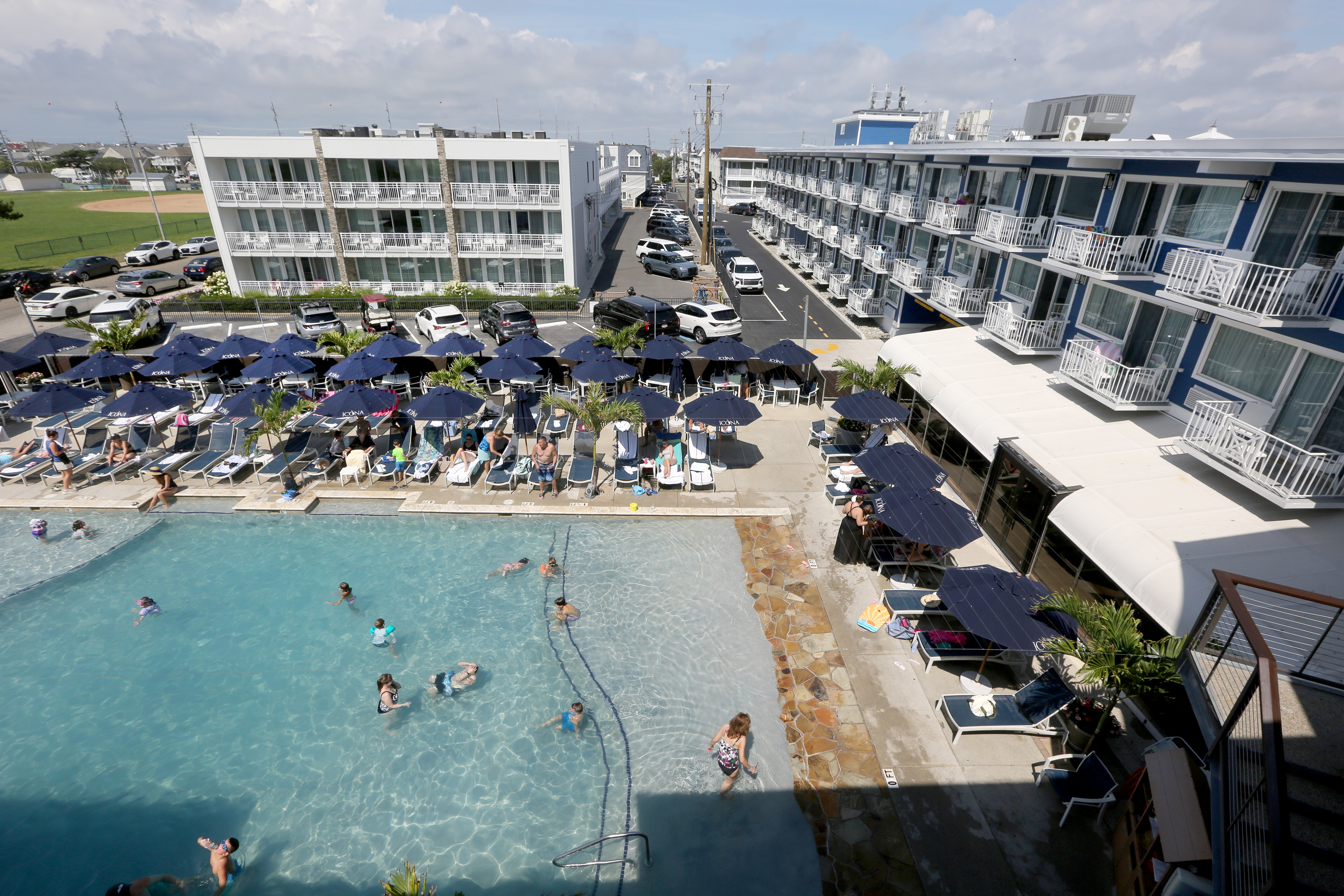
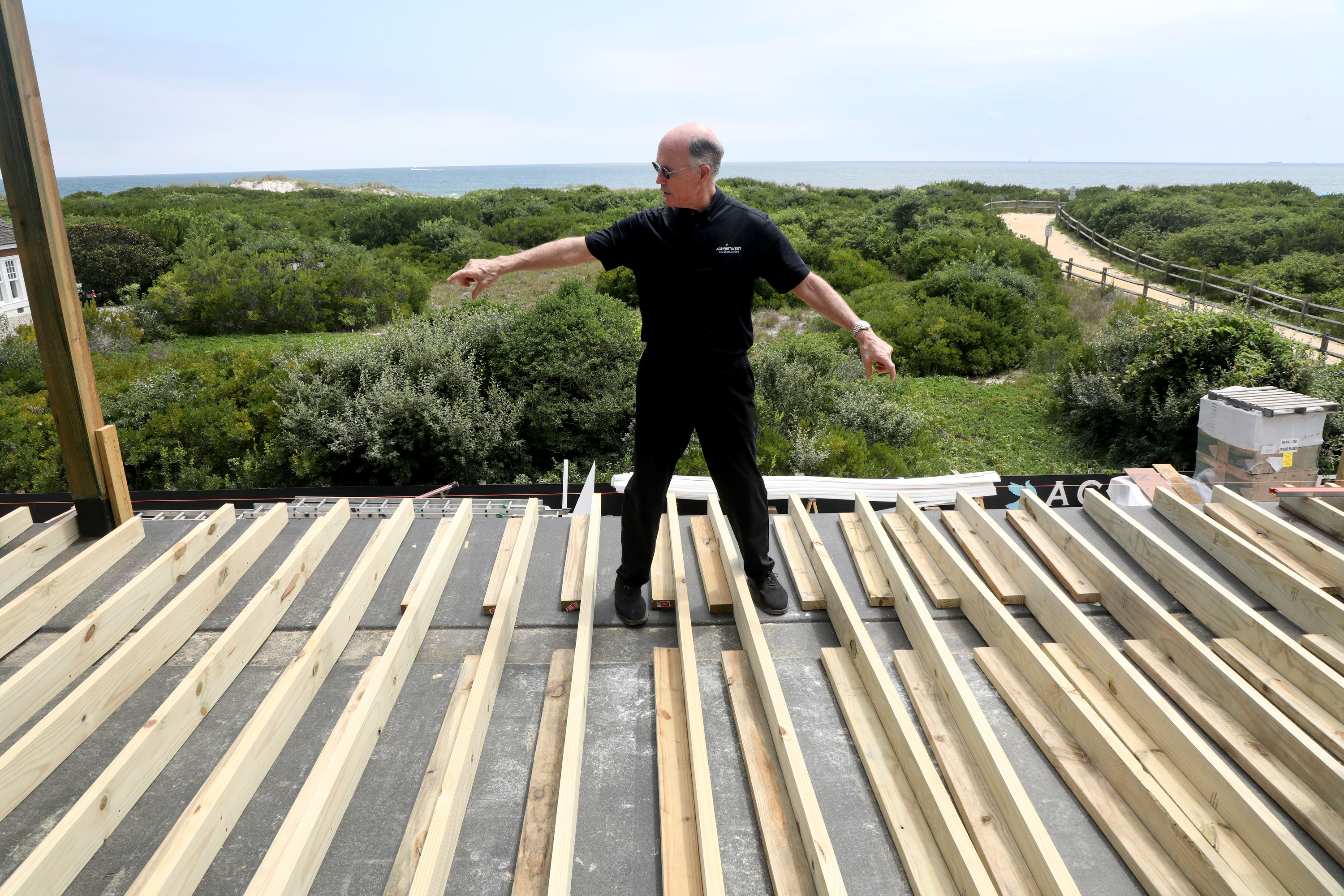
On a recent August day,he greeted employees by name and chatted with guests as he walked through Icona Avalon and neighboring Icona Windrift. Later, he visited under-construction homes, rattling off details about each project and staring in awe at the ocean views, as if seeing them for the first time.
Eustace Mita takes in the view from an under-construction Achristavest home on 77th Street in Avalon.Vernon Ogrodnek / For The Inquirer
“Do what you love and the money will come,” Mita said, referencing a lesson he learned from his grandfather, Eustace Wolfington, who owned Avalon’s first beachfront hotel, the Puritan, later renamed the Whitebrier. “That has been so true in my life.”
Mita declined to share how much his companies, which are privately held,are worth, or how much he’s invested in the Shore, saying only that it’s “hundreds and hundreds of millions of dollars” — and counting.
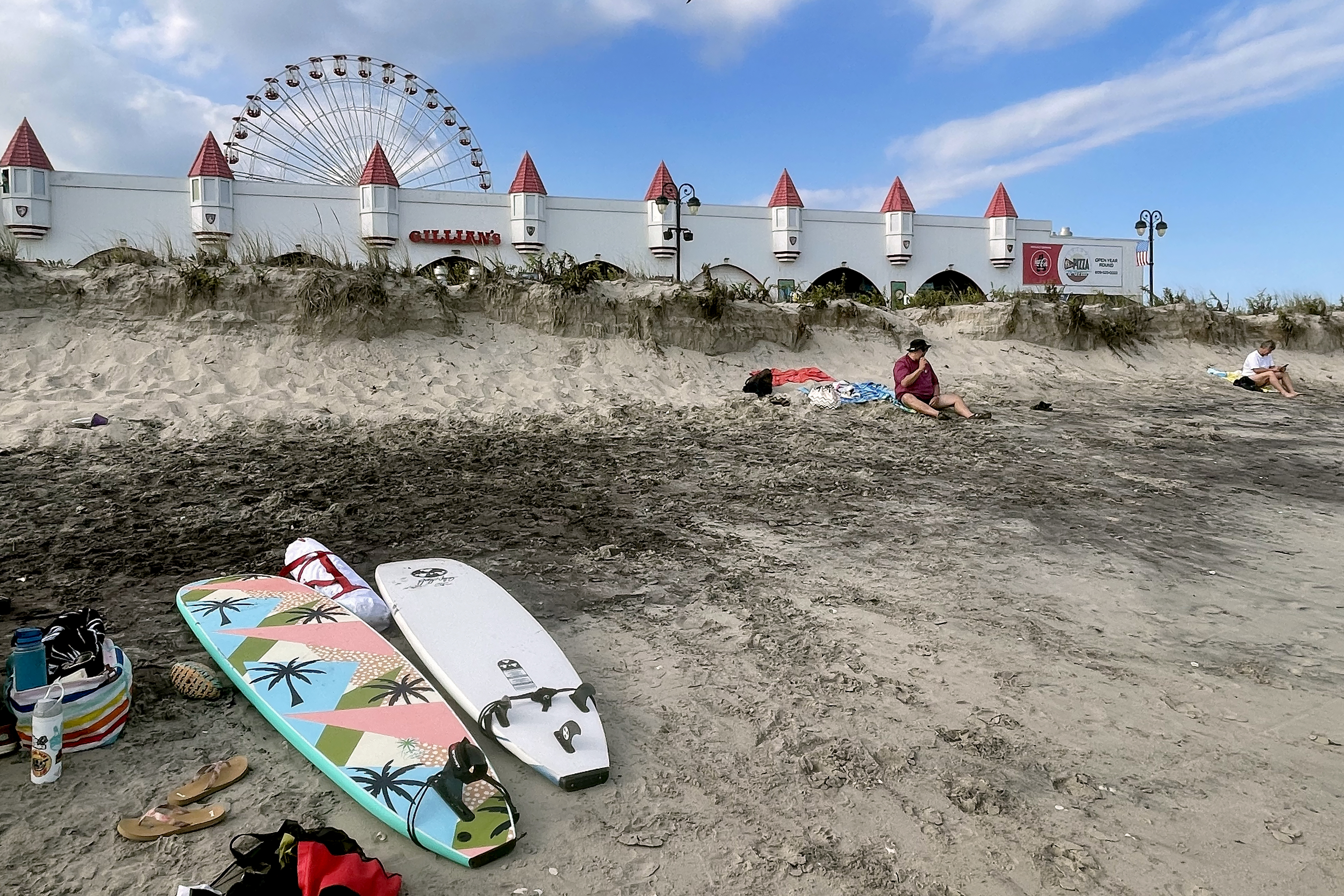
The now-closed Gillian’s Wonderland Pier rose above the dunes at Sixth Street and the Boardwalk in Ocean City during its final weekend in September 2024.Tom Gralish / Staff Photographer
For five years since he boughtthe now-shuttered Gillian’s Wonderland Pier, Mita says he has faced roadblocks and pushback, most recently from community groups who sued Ocean City and its council asking to void the site’s “in need of rehabilitation” designation. The designation allowed council to start talks with Mita about his plans to redevelop the former amusement park.
In a statement announcing the lawsuit, Jack Gutenkunst of Plaza Place Civic Association, one of the neighborhood-group plaintiffs, called the designation “deeply flawed” and said it “seeks to improperly strip away important planning protections that residents have long relied upon.”
“We have [millions] worth of real estate right here that would be degraded by this hotel, and our way of life would be degraded,” said Marie Crawford, who lives behind the pier.
Mita said the project, which has been downsized from the original proposal, would be an asset to Ocean City. The town calls itself “America’s Greatest Family Resort,” he added, but has not opened a new hotel in more than 50 years. He noted that several business owners on the boardwalk and elsewhere have spoken in favor of the project.
“We’re on the pathway now to being able to build Icona Ocean City, but we’ll see,” Mita said. “I don’t take anything for granted.”
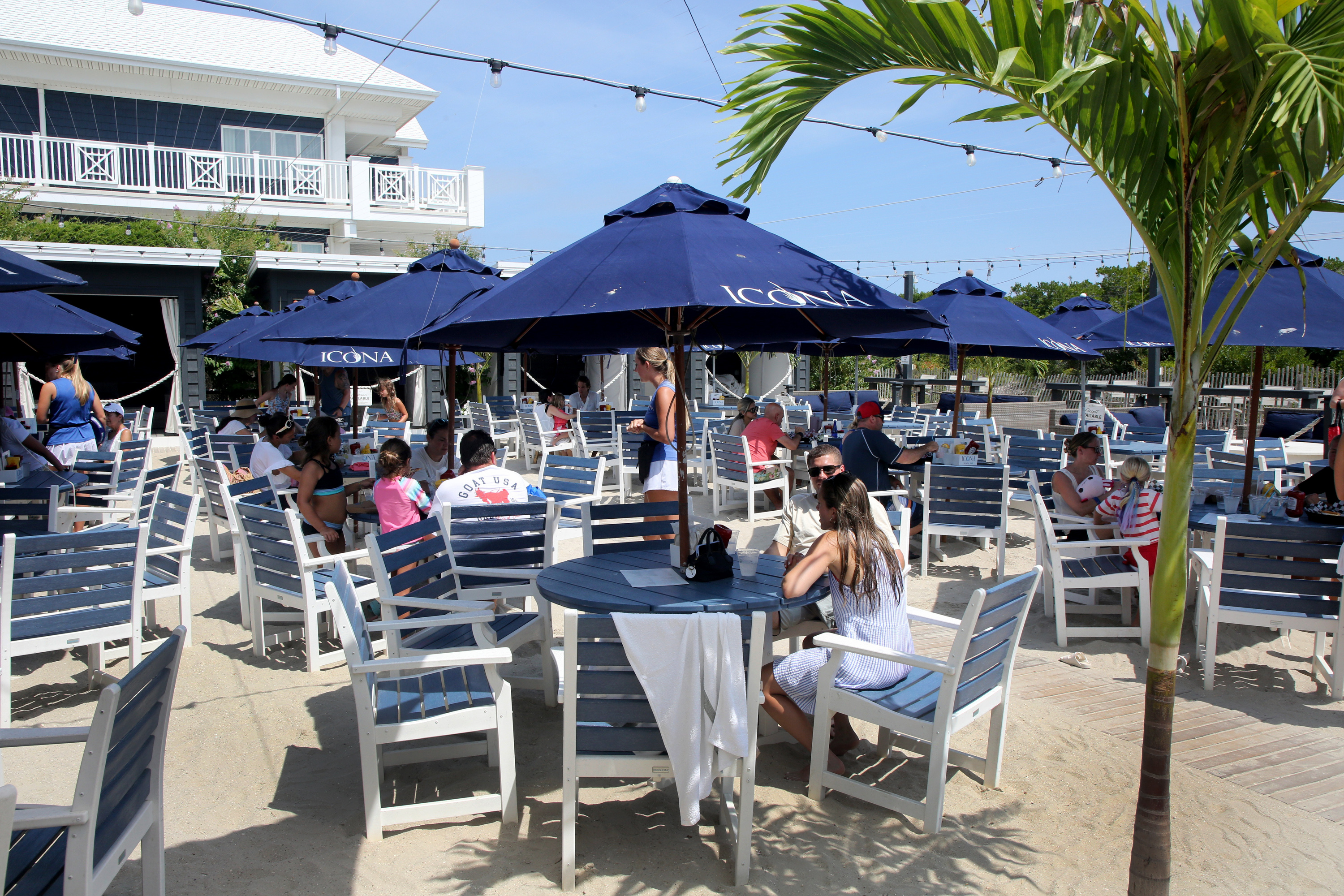
Guests eat lunch at Icona Avalon’s Beach Bar on a weekday in August.Vernon Ogrodnek / For The Inquirer
He has his sights on two other potential hotel properties, one in Cape May County, though he wasn’t ready to share details.
Despite many offers, Mita has no interest in selling Icona Resorts. He has told his five grown children that they could do so someday — as long as they don’t sell the prime beachfront real estate where his hotels sit.
For now, his answer to the near-constant acquisition proposals is polite but firm: “Thank you, we’re not interested.”
But, he added with a laugh, “we’ll sell you a house.”
An Achristavest home is under construction on 116th Street in Stone Harbor.Vernon Ogrodnek / For The Inquirer
Mixing faith and luxury down the Shore
In a conference room off the Icona Avalon ballroom, dozens of hotel employees — many of them international workers on J-1 visas — sit facing a projection screen and white board where the company’s guiding principles are about to be reinforced.
Wearing a black Icona polo, black pants, and an unwavering smile, Mita slips into the morning meeting with little fanfare.
A manager kicks off a regular exercise: Stand, introduce yourself, and greet coworkers on either side of you by name. Seated in the back, Mita is among the last to participate, standing ramrod straight and speaking with a joyful lilt.
Randel Davis, general manager of Icona Avalon, leads an employee meeting.Vernon Ogrodnek / For The Inquirer
Whenever possible, managers remind the employees, they should call guests by their names, too.
“The sweetest sound to a person’s ears is the sound of their own name,” Mita said, referencing How to Win Friends and Influence People by Dale Carnegie, one of many books that influenced Mita’s leadership style. The most instrumental, he said, was Greatest Salesman in the World by Christian writer Og Mandino.
Eustace Mita talks about his business and life philosophy in a guest room at Icona Avalon.Vernon Ogrodnek / For The Inquirer
When Mita first placed Blessed Mother statues in his hotels, he said, some suggested it could be “a little too religious.” But he stood by it, saying the Blessed Mother is the matriarch of all people, not just Catholics.
“If you don’t like Mom,” he said, “you don’t have to stay with us.”
More often, Mita said guests compliment the statues. He sees some passersby bless themselves and say a silent prayer.
“We don’t apologize for that,” he said of the iconography. “But we honor all faiths.”
A statue of the Blessed Mother overlooks the pool at Icona Windrift.Vernon Ogrodnek / For The Inquirer
How Icona Resorts were built
In his pursuit of hotels, Mita was particularly motivated by scroll three of Mandino’s work: “I will persist until I succeed.”
After graduating from Archbishop John Carroll High School in 1973and studying for three years at Drexel University, Mita worked in the auto industry. In the 1980s, he founded Mita Leasing, then ran Half-a-Car, a lease-training company, with his uncle, Eustace Wolfington II.
Mita said he “backed into” the hotel industry around the time of the 2008 financial crisis, during which he lost about three-quarters of his net worth.
Back then, Mita’s Achristavest real estate company was knocking down small Shore hotels and building condo complexes, including the Grand at Diamond Beach, which sits between Wildwood Crest and Cape May.
Achristavest acquired the Grand’s neighbor, the Pier 6600 hotel, for $12 million in 2006, Mita said. Then, “Armageddon hit” with the recession.
Home construction at an Archistavest home in Stone Harbor in AugustVernon Ogrodnek / For The Inquirer
“Our homebuilding business didn’t slow down; it literally stopped,” Mita said. When you’re building second homes, “everybody wants one, but they don’t need one.”
While demand for Shore homes remained low, Mita said he found that families were flocking to the hotel for short beach vacations at lower prices. So he went all in on resorts.
The Pier 6600 became Icona Diamond Beach in 2012. Mita has spent $30 million renovating it, he said, including the addition of a third-floor ballroom for its thriving wedding business.
Eustace Mita bought Icona Avalon from the former owners of the Golden Inn in 2015. Vernon Ogrodnek / For The Inquirer
Then, after 16 years of knocking on the door at the Golden Inn in Avalon, Mita acquired the iconic beachfront property for $25 million, which in 2015 was the largest hotel transaction in Cape May County history, he said.
Mita renamed it Icona Avalon. He said he has spent $35 million to remodel it.
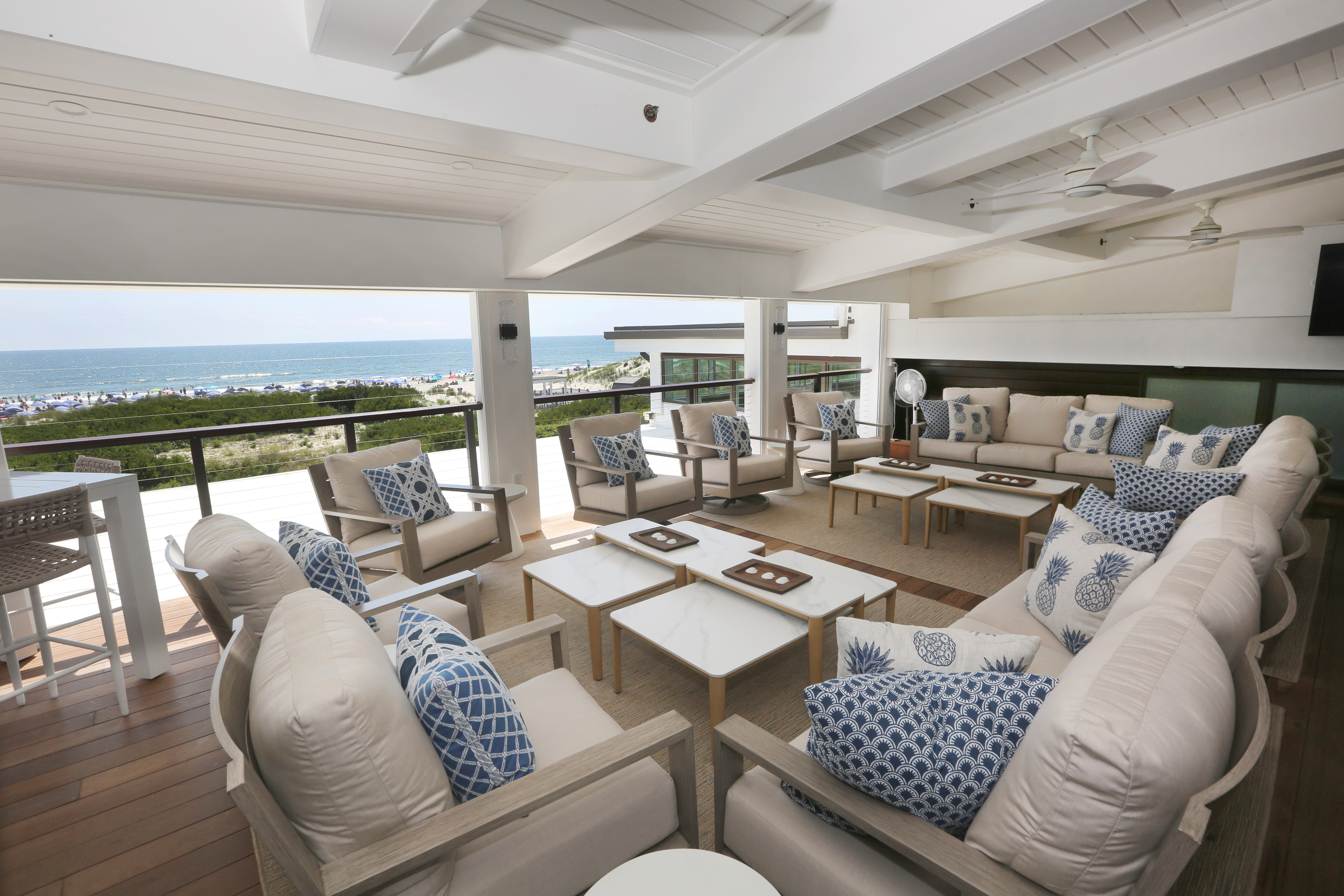
A few years later, he purchased the Windrift hotel next door for more than $30 million and spent $27 million on renovations there, which include the new Avalon Prime steakhouse and a private third-floor “sky lounge.”
The Icona Windrift in Avalon, which Eustace Mita has spent $27 million renovating since he purchased it five years agoVernon Ogrodnek / For The Inquirer
Icona Yacht & Beach Club members, who pay a $7,000 initiation fee plus $5,000 a year, can access the sky lounge, the Icona yacht, private beach service, and shuttle service.
They number about 25 now, Mita said, and he plans to cap membership at around 200 people.
It’s a similar setup as the Union League. The historic club, headquartered on South Broad Street, recently bought Avalon’s iconic Whitebrier for $23 million and last summer made it members-only. The move sparked debate over whether the Shore town was becoming too exclusive for even its wealthy homeowners.
The members-only Sky Bar at Icona Windrift in Avalon sits on the highest point on Seven Mile Beach, according to Eustace Mita.Vernon Ogrodnek / For The Inquirer
The Jersey Shore experience, elevated
While middle-class families have increasingly been priced out of the Shore, Mita said he doesn’t believe his hotels are contributing to the trend.
“We don’t cater to the wealthy,” Mita said, adding that Icona has opened two “select-service” hotels — Mahalo Diamond Beach and Mahalo Cape May — which have fewer amenities and sometimes lower prices.
Rooms there are about $200 a night on shoulder-season weekdays but can cost $500 to $700 on a summer weekend.
At Icona’s full-service resorts in Avalon and Diamond Beach, and its boutique hotel in Cape May, rooms start around $700 a night on peak summer weekends.
A corner guest room at the Icona Avalon.Vernon Ogrodnek / For The Inquirer
Outside South Jersey, Icona’s Grand Victorian boutique hotel in Spring Lake, Monmouth County, has slightly lower rates.
Icona is not the first brand to bring luxe hotel accommodations to Seven Mile Island, which contains Avalon and Stone Harbor.
The Reeds at Shelter Haven, a year-round resort in downtown Stone Harbor, opened a couple years before Icona Avalon. Rooms there start around $600 a night on midsummer weekends.
“It’s great to have healthy competition, right?” the Reeds’ general manager Carmen Russo said. “We always look at them and see what they’re doing, just as they look at us and see what we’re doing.”
Eustace Mita rattles off details about the construction of this Achristavest home on 116th Street in Stone Harbor.Vernon Ogrodnek / For The Inquirer
As for Mita’s home-building business, Achristavest builds on the beach and bay from Cape May to Longport, with properties starting at $5 million. By comparison, the median listing price for all homes — not only waterfront ones — in Stone Harbor is just under $4.7 million.
Achristavest homes being built on spec in Avalon and Stone Harbor will likely sell for $15 million to $25 million.
“I tell my children rent in Delaware County and buy in Cape May County,” said Mita, who grew up in Bala Cynwyd and now has homes in Malvern and Ocean City.
What’s ahead for Icona and Achristavest
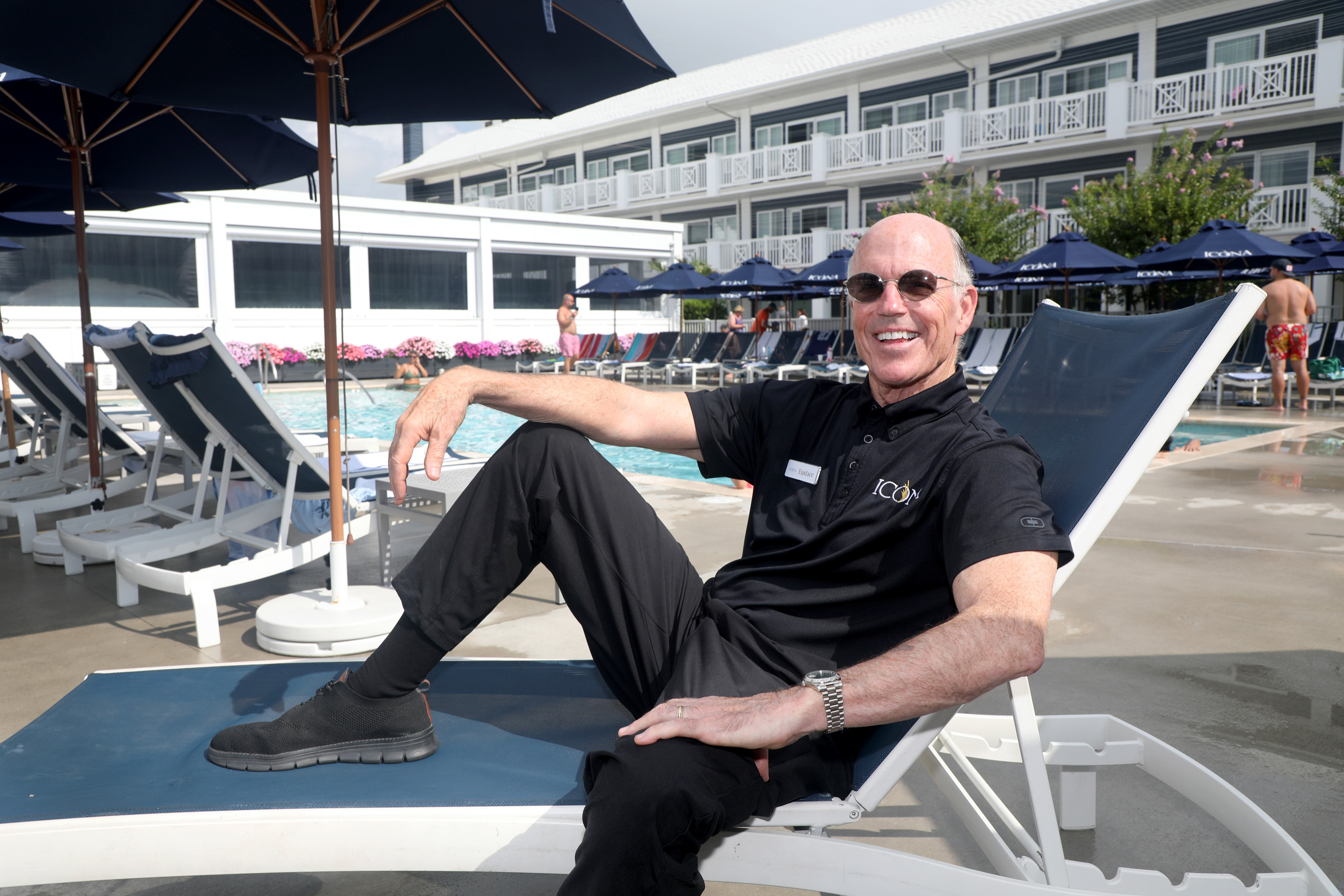
Eustace Mita, Icona’s chairman, poses by the pool at Icona Avalon.Vernon Ogrodnek / For The Inquirer
Mita speaks often of his legacy.
“I’ll be dead and gone, but imagine the next generation and then the next generation,” Mita said. “Everything we’ve built is built to last.”
And he said he hopes the lessons he instilled in employees are just as permanent.
One employee, Rob LaScala, worked at Mita Leasing and then went on to found LaScala Restaurant Group, which has dozens of locations across the region. In just a couple years working together, LaScala said, Mita left a mark.
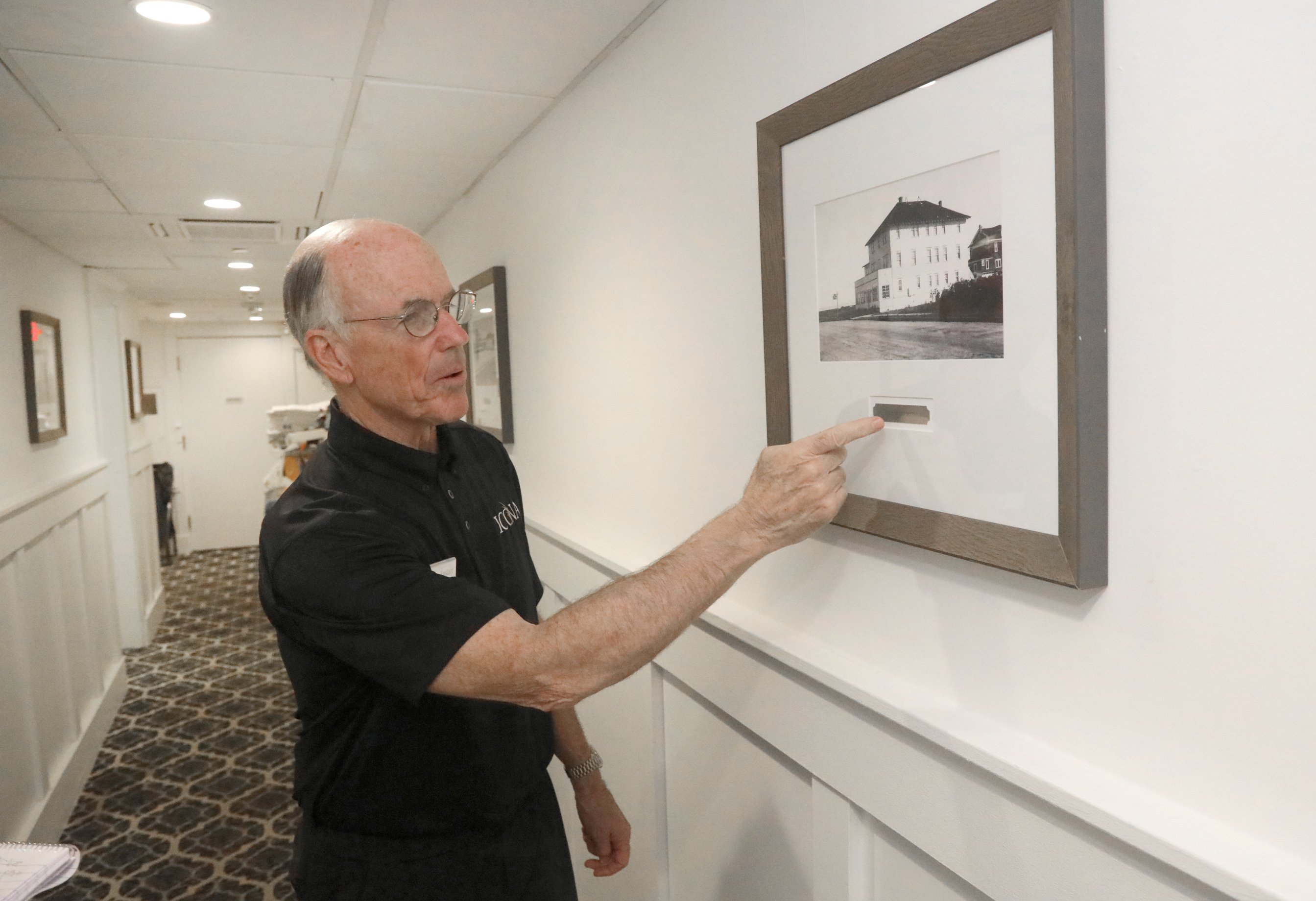
At his Icona Avalon hotel, Eustace Mita points to a black-and-white photo of the Puritan, Avalon’s first beachfront hotel that was founded by his grandfather, Eustace Wolfington.Vernon Ogrodnek / For The Inquirer
Mita is “just a make-you-feel-good type of person,” LaScala said. “I over the years have tried to emulate him” and create a company culture that transcends business.
Mita refers to his 1,100 employees as family but said he works to prioritize time with his actual family. He spends summer weekends with his wife, Susie, and some combination of their five children and 18 grandchildren. His oldest son, Euse, was recently named Icona’s president and CEO.
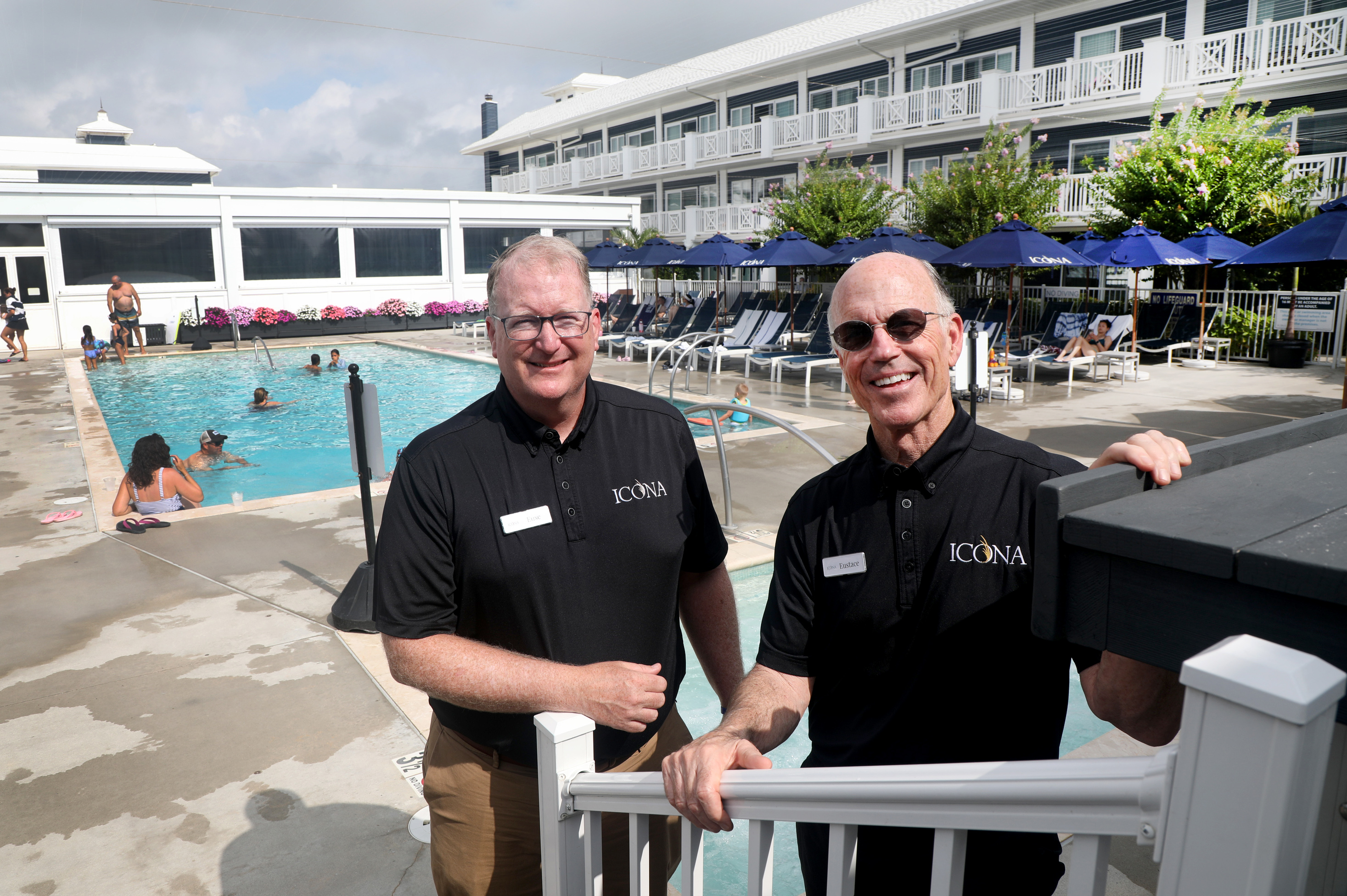
Eustace Mita (right), founder and chairman of Icona, with his son Euse, who was recently named president and CEO.Vernon Ogrodnek / For The Inquirer
But, of course, he said, work sometimes calls. On a recent weekend, with many summer staffers back at college, Mita helped clear tables at Icona Avalon while Euse was a fill-in valet.
Said Mita: “There’s no reason just because I’m a leader that I can’t bus tables, that I can’t sweep floors.”
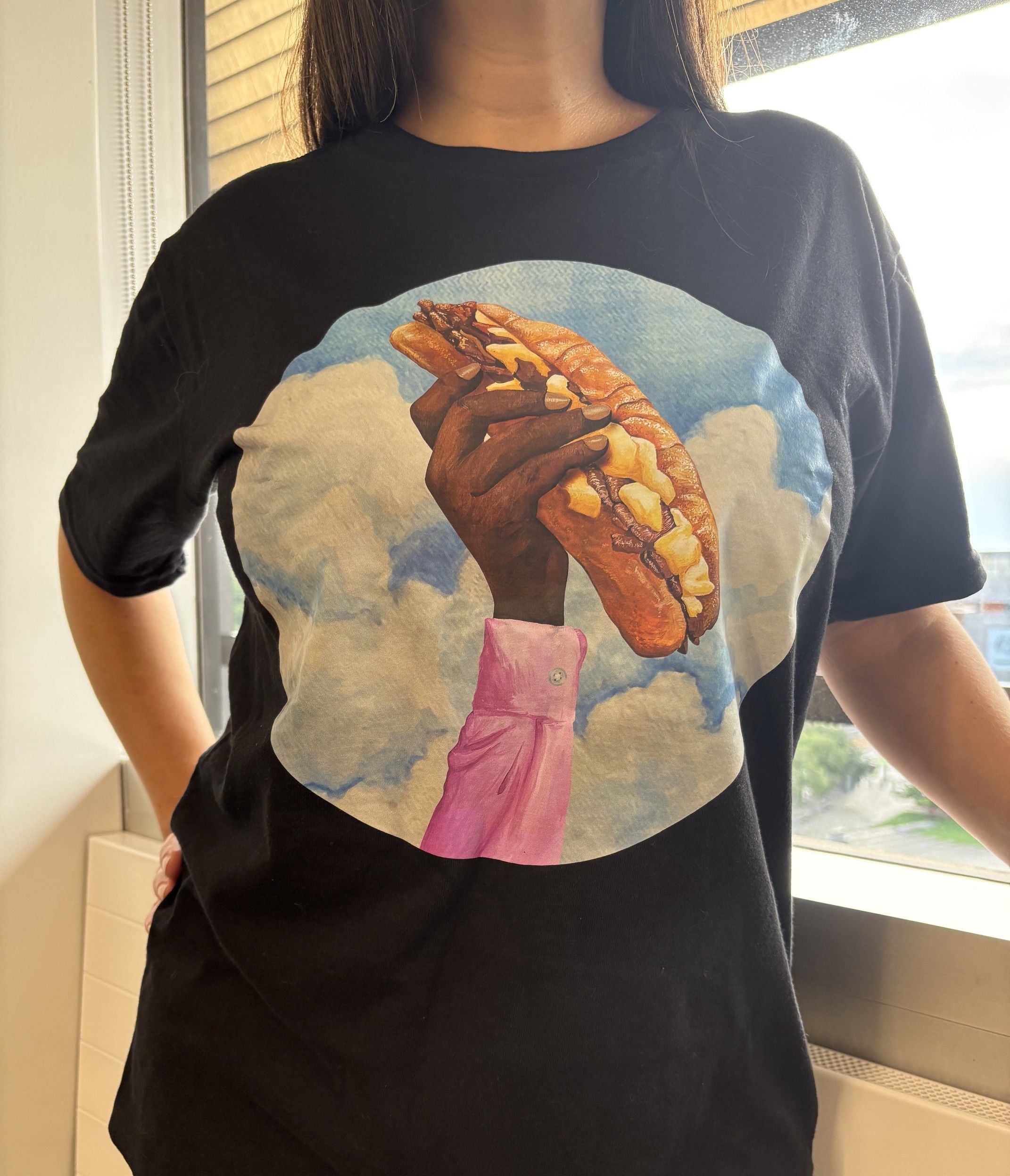
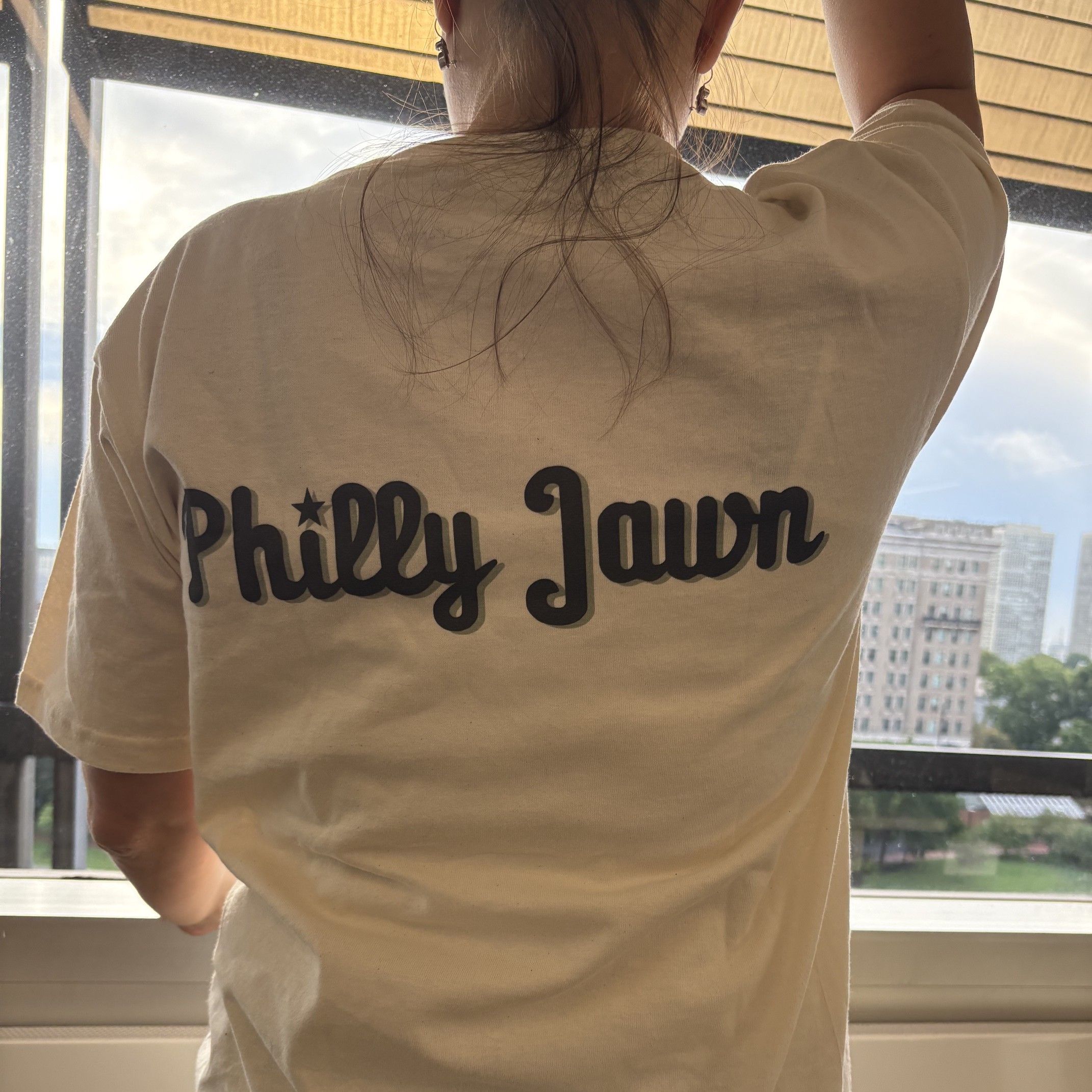
A manicured hand holding a cheesesteak, a hoagie, or an iron skillet filled with scrapple. Now imagine that on a hoodie or T-shirt. Add to that the beloved moniker “Philly Jawn” printed on the back in Philadelphia Phillies-style print and I’m hooked.
I may be a born and bred New Yorker, but after living here for 23 years, I’m a total Philly Jawn.
This latest sartorial homage to Philly food is a collaboration between interior designer Sheila Bridges and food writer, producer, and media entrepreneur Stephen Satterfield.
Sheila Bridges X COMOCO T-shirts featuring a Philly cheesesteak, are part of a limited-edition collaboration between interior designer Sheila Bridges and Stephen Satterfield, best known for the Netfix documentary on African American food, “High on the Hog.”Elizabeth Wellington
Earlier this year Bridges partnered with Walmart on a Philly-centric collection of tableware featuring her iconic Harlem Toille de Juoy print. Satterfield is best known for Netflix’s Peabody and NAACP award-winning series High on the Hog. Its first season featured Philadelphia food and Black catering families including Robert Bogle.
The Sheila Bridges X COMOCO T-shirts and hoodies are available in six foodie styles. In addition to the cheesesteak, hoagie, and scrapple designs are a soft pretzel, a rainbow water ice, and a hot dog.
Black tees feature hands raising hoagies, cheesesteaks, and hot dogs to a clear blue sky with fluffy white clouds. To me, it depicts the heavenly experience of biting into a yummy hoagie, cheesesteak, or hotdog.
“Because of the 250th, I was in this very Philly mindset,” said Bridges, Bill Clinton and author Tom Clancy’s interior decorator, who is calling Philly home these days.
The back of Sheila Bridges X COMOCO T-shirts inspired by iconic Philadelphia food. The shirts are part of a limited-edition collaboration between interior designer Sheila Bridges and Stephen Satterfield, best known for the Netfix documentary on African American food, “High on the Hog.”Elizabeth Wellington
“I love Philly food,” she said. “Every time I’m in town, I’m always looking for a soft pretzel with mustard or a cheesesteak.”
One of Bridges’ in-house artists nailed the illustrations. The shirts were produced by COMOCO Cotton, Satterfield’s apparel brand that uses cotton grown by Black-owned family farms in the South.
“I love how all of the cotton in our products is fully traceable from seed to garment,” Bridges said.
So do I.
Sheila Bridges X COMOCO Cotton’s limited-edition Philly-centric shirts are available online at SheilaBridges.com. Hoodies are $100. T-shirts are $85. Sizes: S, M, L, XL, and 2XL
— Elizabeth Wellington
A childhood anime favorite in 4K
Katsuhiro Otomo’s Akira (1988) is one of my favorite films ever. I watched a grainy pirated copy of it from an USB drive a friend lent me on my laptop screen and was spellbound by the hand-drawn animated frames. The film, based on the manga of the same name, is set in the dystopian faraway year of 2019 where Tokyo is in ruins following sudden destruction in 1988. It is plagued with protests, unemployment, corruption, and an overwhelming sense of decay and anger.
The action of the film unfolds when Shōtarō Kaneda’s bike gang, the Capsules, races against a rival gang in the midst of a rally that quickly escalates and becomes disruptive. In the middle of the action, Kaneda’s best friend Tetsuo Shima clashes with an otherworldly esper and gains supernatural powers, the same powers possessed by Akira who caused 1988’s wreckage. What follows is a tale of Shima developing superhuman strength and a destructive rage that consumes much of the city. The army and the police fail to manipulate Shima into submission.
It is a cyberpunk action film; so yes, there’s blood, death, several crashes, splintering glass, and never-ending dystopic vistas. The excellent score draws heavily from traditional Japanese and Indonesian styles and is composed by Shōji Yamashiro.
Imagine experiencing all of that on a grainy .mov file on a laptop screen. But you don’t have to! A new 4K and IMAX restoration, distributed by Crunchyroll and Sony Pictures Entertainment, has been released with English subtitles and English dub. Watching it felt like I was watching the film for the first time.
The glass shimmers, the blood glows redder, and everything looks grander on the big screen. It is an epic for our times, and for any era where too many people suffer under the reckless might of men drunk on their own power.
The 4K restoration of “Akira” is playing in theaters across the region, including AMC Broadstreet 7, AMC Cherry Hill 24, and AMC Voorhees 16.
— Bedatri D. Choudhury
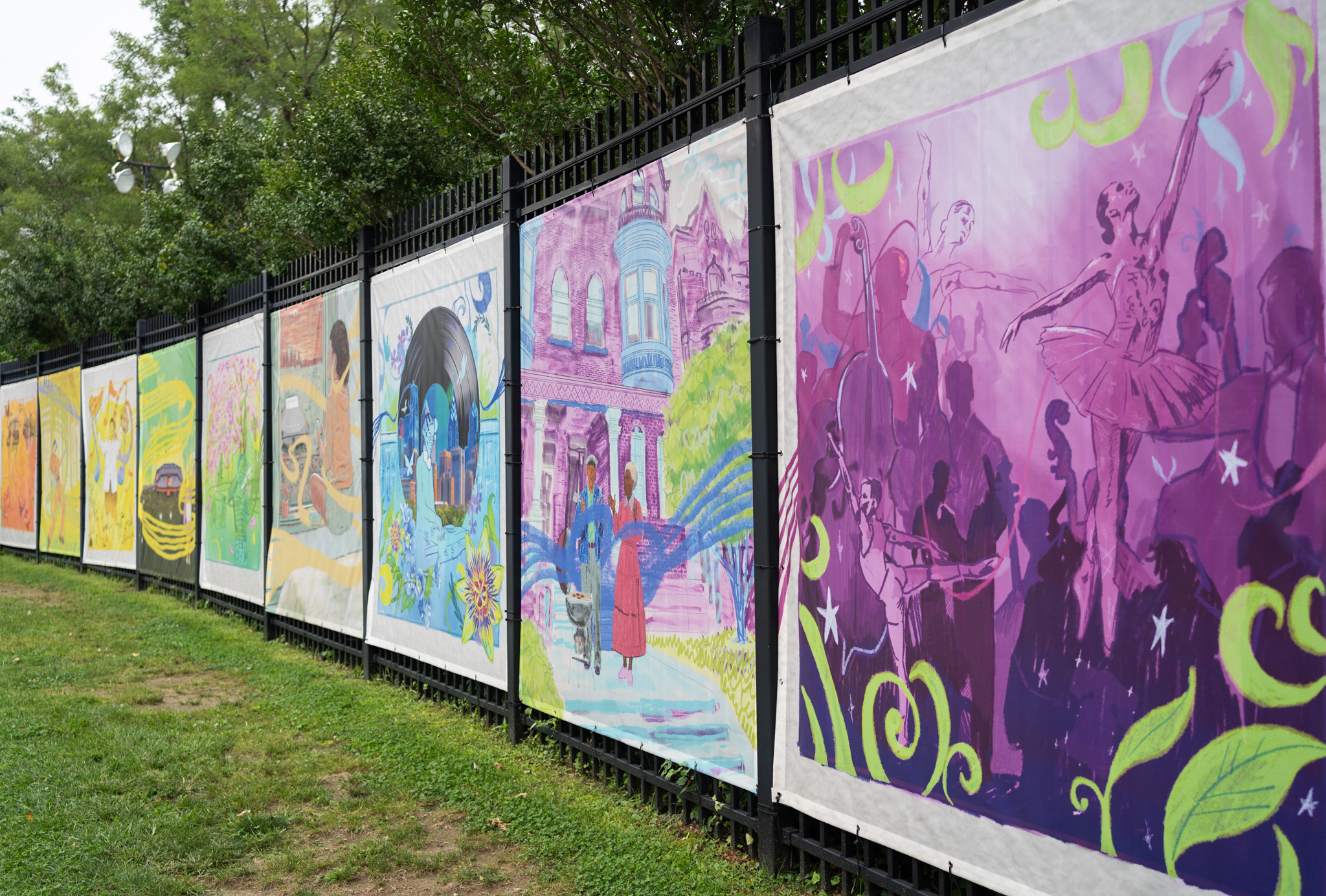
The new art installation, “Echoes Beyond the Stage,” was dedicated to the Highmark Mann Center for the Performing Arts on July 31, 2026.Courtesy of Earl
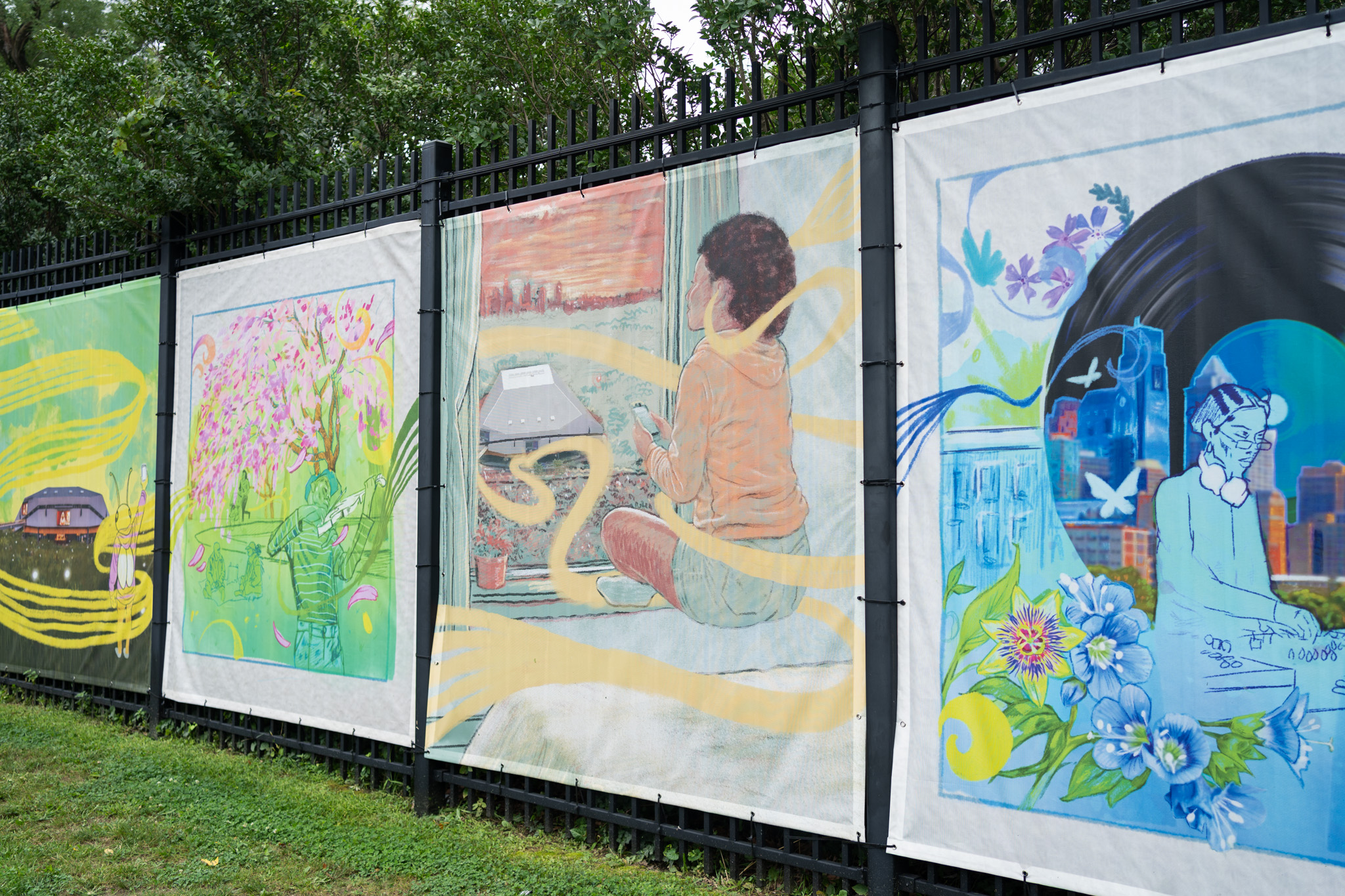
As visitors walk along the gravel-covered trail on Georges Hill Drive, they see a series of 10-foot-long panels that are a part of Echoes Beyond the Stage. The new installation was developed by artists Nile Livingston and De’von Downes to commemorate 50 years since the Mann moved to its current West Fairmount Park location.
Livingston and Downes collaborated with Streets Dept founder Conrad Benner and Mural Arts Philadelphia to create artwork that reflects the amphitheater’s history, while illuminating the people, historic blocks, and other institutions that surround its borders.
The new art installation, “Echoes Beyond the Stage,” was dedicated to the Highmark Mann Center for the Performing Arts on July 31, 2026.Courtesy of Earl
One mural references one of Aretha Franklin’s final performances at the Mann. Another highlights the century-old rowhouses that line the outside blocks, and others reflect the energy of past block parties, barbecues, and other activities brought to the community. Musical notes float from one panel to the next, showcasing the musical influences and memorable performances that have passed through time. Dancers, vocalists, DJs, and instrumentalists perform under purple, green, and amber-covered skies, while spectators watch from their amphitheater seats or windowsills.
While each panel differs in focus, they are bound by visual harmony. These works show Mann is not just a performance venue; it’s an essential part of the community and an integral piece of the city’s broader music history. And the best part? Visitors get a glimpse of it before stepping foot inside through the entrance gates.
The Highmark Mann Center for the Performing Arts is at 5201 Parkside Ave., Phila.
— Earl Hopkins
Turnstile’s ‘Never Enough’ reimagined by Will Yip, Alex G., and … Elton John?!
What do Alex G., Will Yip, and Elton John have in common?
The Havertown indie songwriter, Grammy-winning Philly producer and studio owner, and “Philadelphia Freedom” British rock legend all have a hand in Never Enough: Versions, the new album that reimagines Never Enough, the 2025 album by Baltimore pop hardcore band Turnstile.
Turnstile’s “Never Enough” won a best rock album Grammy for the band and Philadelphia engineer-producer Will Yip. Now it has been reimagined as “Never Enough: Versions,” with new takes on the songs by Elton John, Alex G., Hayley Williams, Branden Woody, Panda Bear, Slayyyter, and more.Trevor Roberts
Never Enough was already one of the most-acclaimed rock albums of the decade. At this year’s Grammys, the Brendan Yates-fronted band’s “Birds” won for best metal performance. And Turnstile and Yip, the owner of South Philly’s Memory Music Studios, who engineered the album and assisted Yates in producing it, won prestigious best rock album trophies.
Now, the 14-song album has been expanded with 22 new tracks, with the original songs remixed, rearranged, and reinterpreted by a dazzling array of artists.
Will Yip in Studio 5 in his newly constructed studio, Memory Music Studios, South Philadelphia, Tuesday, Jan. 13, 2026. He won a Grammy for his work engineering and assisting with production on Turnstile’s “Never Enough” which has now been expanded as “Never Enough: Versions.”Alejandro A. Alvarez / Staff Photographer
The most mind-blowing presence is John, who turns “Seein’ Stars” into a proper song, and whose fame exponential outreaches that of his fellow Turnstile fans.
Those fans include Paramore singer Hayley Williams, who interprets “Ceilings”; boygenius’ Julien Baker, who teams with Sudanese Canadian poet Mustafa on an absolutely gorgeous “Time Is Happening”; jazz trumpeter Brandon Woody, who turns in a lovely instrumental “Dreaming”; and breakout electro-pop star Slayyyter, who soars on a high-flying “Birds.”
Both Baltimore club party MC Rod Lee and New York synth-pop songwriter Porches take on the Never Enough title track. Alex G. — whose full name is Alex Giannascoli and is also in music news for his score to Jane Schoenbrun’s movie Teenage Sex and Death and Camp Miasma — delivers an atmospheric, cinematic spin on “Magic Man,” which is also interpreted by Panda Bear of Animal Collective.
All in all, it’s a thoroughly impressive project that makes Turnstile seem like they might possibly be the coolest band in the world.
“Never Enough: Versions” is available to stream and purchase on music stores and platforms.
Elysia Baskins and Christopher Johnson did not intend to raise a child together.
They instantly got along when they met on Bumble in 2022; they both loved anime and eating Japanese food. But after their first date, Baskins didn’t feel a romantic chemistry, so they became best friends instead.
In 2025, Baskins got pregnant with her partner and asked Johnson to be the godfather.
She and her partner planned to live together with the baby. They signed a new lease on her West Philadelphia apartment and he packed a U-Haul. But he died by suicide on the day he was set to move in.
Baskins was left reeling, four months pregnant with barely enough money to cover rent.
Johnson, who lived in Fishtown, kept showing up. He drove her to prenatal appointments and watched episodes of Better Call Saul with her. Sometimes he stayed the night in her guest room when she didn’t want to face it alone.
In January, he was the one who drove her to the Hospital of the University of Pennsylvania to give birth. In the months that followed, he visited every week. He folded laundry; he built the crib. He told Baskins the baby could call him “DD,” short for “Deity-ous Dad,” a joking play on “godfather.” He calls her “Baba.”
The baby’s father was Black, and to Johnson, who is also Black, it felt especially important that the baby grow up with another Black parent.
“I never thought about it in a casual way, or a lackadaisical way,” Johnson, 31, said. “I fully planned to be the next parent, the third.”
Christopher Johnson with Elysia Baskins’ daughter, Thursday, Sept. 3, 2026 in Philadelphia.Elizabeth Robertson / Staff Photographer
In July, Baskins, 33, and her daughter, who is 8 months, moved in to Johnson’s home in Fishtown.
Baskins now works from that home, as a text counselor for the 988 Suicide & Crisis Lifeline. Johnson works as an inventory coordinator at a Kensington hardware store and as a home health aide for his mother. Though they are not romantically involved, neither are dating other people right now. They are raising her daughter together.
“With him not being her biological father, I wouldn’t necessarily feel like I need to consult him on all the parenting decisions,” Baskins said. “But I would want to anyway. So it almost doesn’t matter.”
The following, as told to Zoe Greenberg in separate interviews, has been edited for length and clarity and combined.
On telling Johnson she was pregnant
Baskins: I was very nervous because things weren’t ideal, but I had been really wanting a baby for a long time. I knew he would potentially be worried about me. It was planned, but maybe not entirely well-thought-out.
Johnson: I was a bit apprehensive. I cannot make that choice for anyone else, obviously. But I thought circumstantially, they weren’t ready. In terms of mental health, finances. My apprehension was known before the pregnancy — there are no real secrets between us.
On asking Johnson to be the godfather
Baskins: As soon as I knew I was pregnant, I wanted him to be her godfather. I knew I was going to need to rely on a community of people to raise this child. It wasn’t going to just be me and my partner. If anything happened to both of us, he would literally step up and take care of her.
Johnson: They asked me together. I said yes, I’d love to. I knew I was going to be present.
On deciding to move in together
Baskins: It wasn’t something I jumped on. I really thought it over for weeks, maybe even months. I asked everyone in my support system, “Do you think I should do this?” I didn’t want to put a big strain on our friendship.
Johnson: We talked about it when she was pregnant. At least I threw it out there as a thought. But it was just too hard of a time to try to make that kind of decision.
On committing to each other
Baskins: I said, “If we move in together, I’m going to be here for at least five years probably before I can be fully independent. … I worry about when that time comes. She’s gonna be attached to you like you’re her parent.”
Johnson: I tried to be properly responsible and consider all the factors. For myself, my answer was: at worst, everything will be OK.
On sharing the parenting
Baskins: He does a little bit of everything. He’s fed her. He puts her to bed. He changes her. He takes her out. He gives her baths. I just do that stuff more.
I think of myself as the primary parent, but I also refer to him as a co-parent. I don’t have the exact same expectations as I might have had of my partner, but somewhere in the middle — not just a regular friendship either.
Johnson: I think of myself both as godfather and as Dad. I’m proud to be the person that’s here, day in and day out, in this paternal role. But in no way will I not also honor her true father. Her father was a great dude. We’ll be as close as parent and child can be, but we’ll have to navigate that as she gets older.
On dating other people
Baskins: I’m not really interested in dating, but a time could come when that might be different.
Johnson: I’d rather have stability and everything settled for a bit before I go back into dating. We’re two grown adults who aren’t partners, living with each other and co-parenting. If one of us wants to date and have someone that we’re dating over, there’s a lot to explain ahead of time.
On what the future might look like
Baskins: I would love to still be living in really close quarters. We have talked about what if we want to get a house around the same time? Could we get a house together?
Johnson: I think we’ll probably still be living together. Or living in such close vicinity it’s practically like we’re living together.
This story is part of a series about life partners across the Philadelphia area.
If you want to share your story about who you’re navigating life with, romantically or otherwise, write to lifepartners@inquirer.com. We won’t publish anything without speaking to you first.