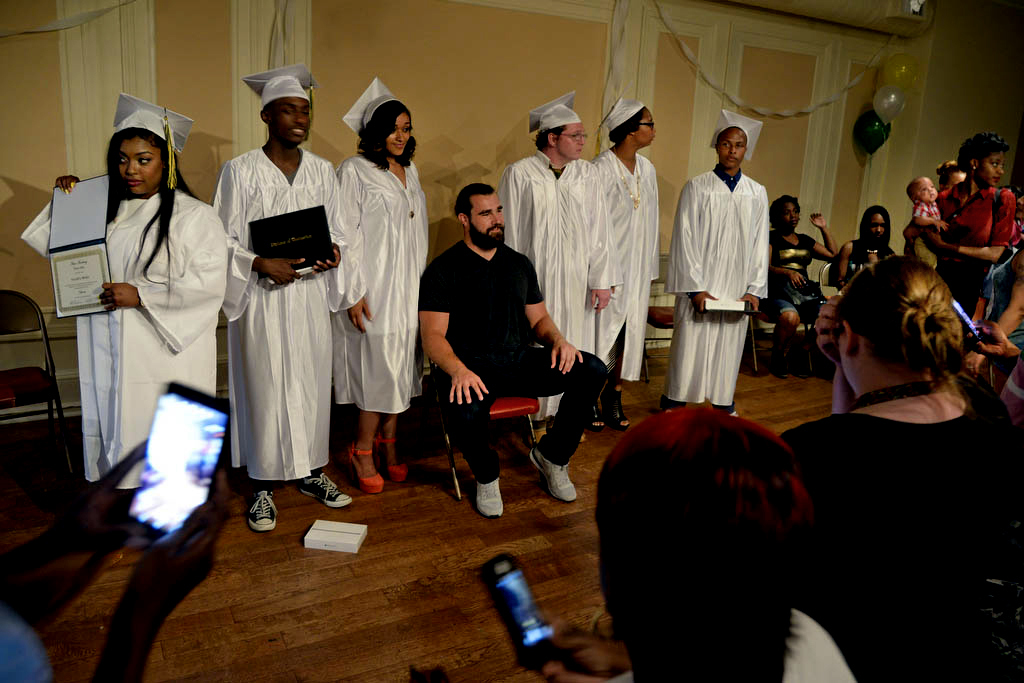
Long before Jason Kelce ripped off his pants to reveal his patriotic Speedo & bikini wax, or turned into “Fat Batman” on the sidelines. Even before he invaded WrestleMania 40 with teammate Lane Johnson in green-and-white luchador masks, I photographed him in 2015 at a commencement ceremony for just six high school graduates.
I didn’t know much about the Eagles center who was still two seasons away from his first first-team All-Pro honor, and well before his Mummer’s Super Bowl parade speech would make him a Philly folk hero and a viral celebrity.
I didn’t even know there would be a speaker, let alone a football player. The event was in a small room upstairs at the William Way Community Center, with kids from a charter school for students in foster care, community homes, or shelters.
It was not a media event; he wasn’t there for the cameras. I was the only other outsider, attending just because I was working on a story on one of the students.
She said Kelce was nice and very genuine. And he gave all the graduates iPads. “That was cool,” she recalled recently, “because none of us could afford one.”
But I was really impressed by what he said to the handful of young people and their families. He stayed around afterward and posed for photos, talked about his life — and theirs.
Since that night, I’ve seen him involved in other efforts supporting foster-care children and students, including “A Philly Special Christmas,” which has provided gifts to thousands of children in foster care.
I thought of Kelce this week when I covered two other Eagles giving back (and once again made it — with some off-the-field non-action — into The Inquirer’s weekly Big Picture look back at the week’s best sports photos).
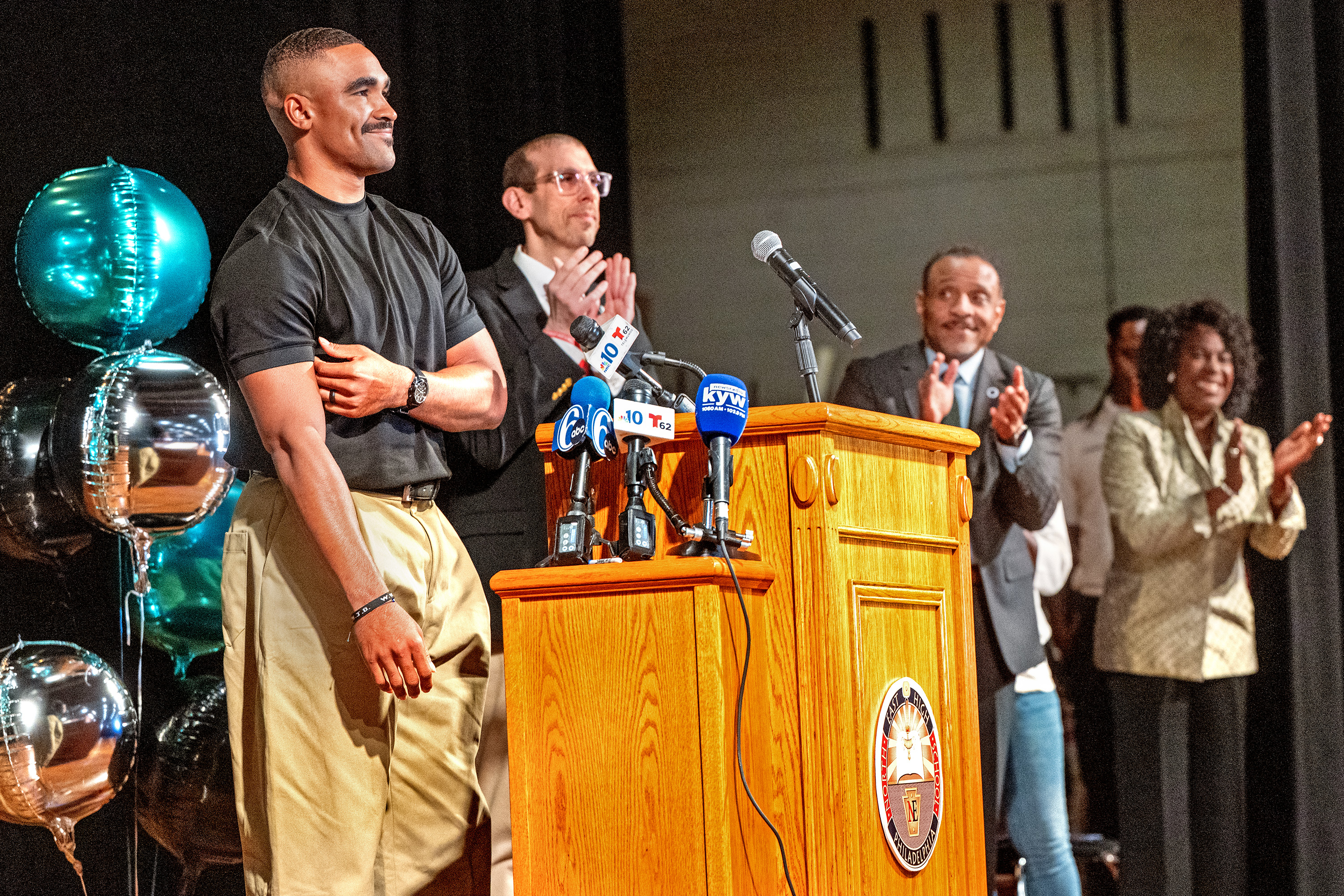
On Tuesday, quarterback Jalen Hurts donated $600,000 for air conditioning at Philadelphia’s largest high school. Asked why he was turning his attention to city schools, Hurts said he was influenced by his educator parents and the people who made a way for him. “It’s about service and showing up for those around you,” he said.
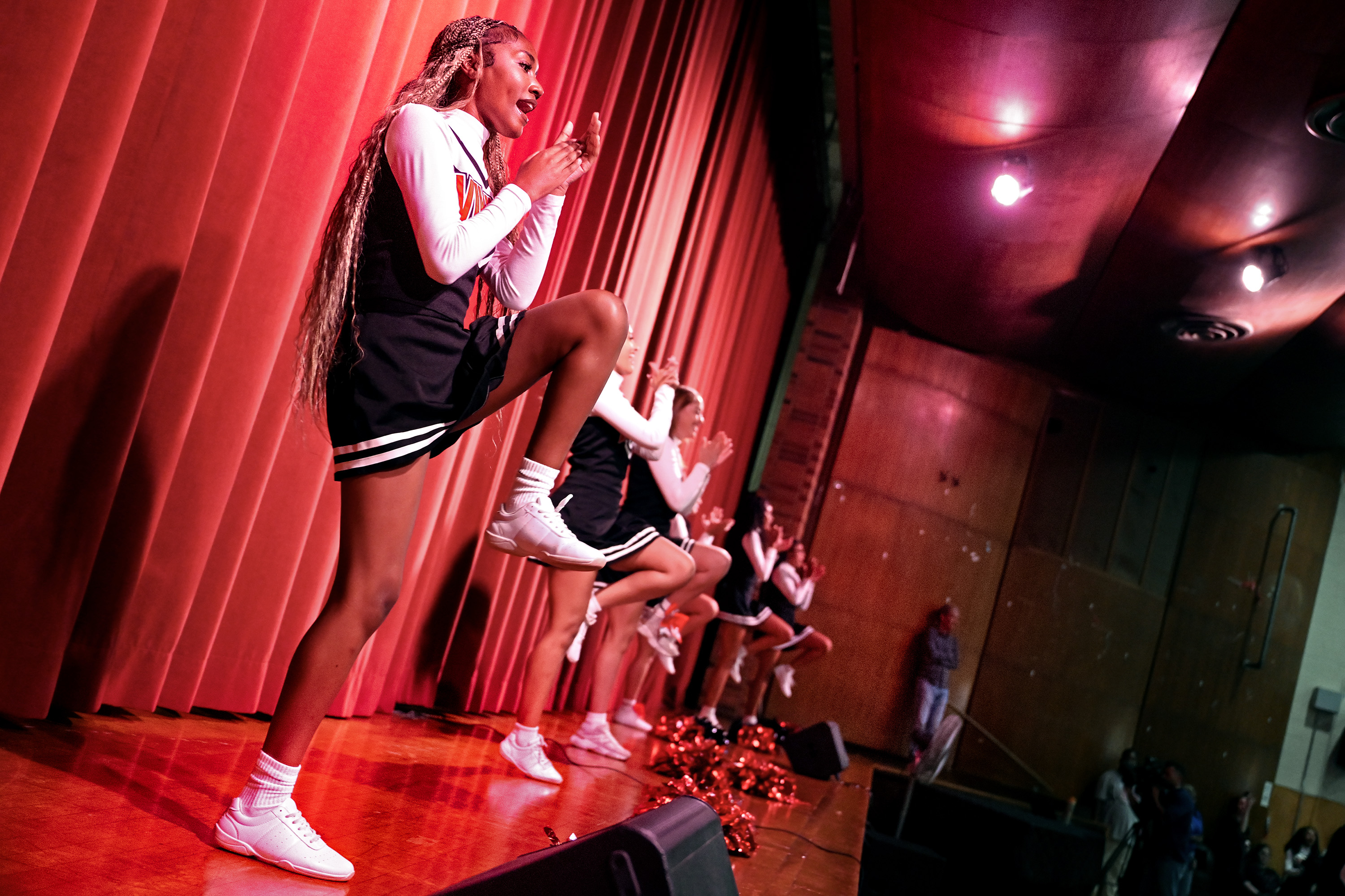
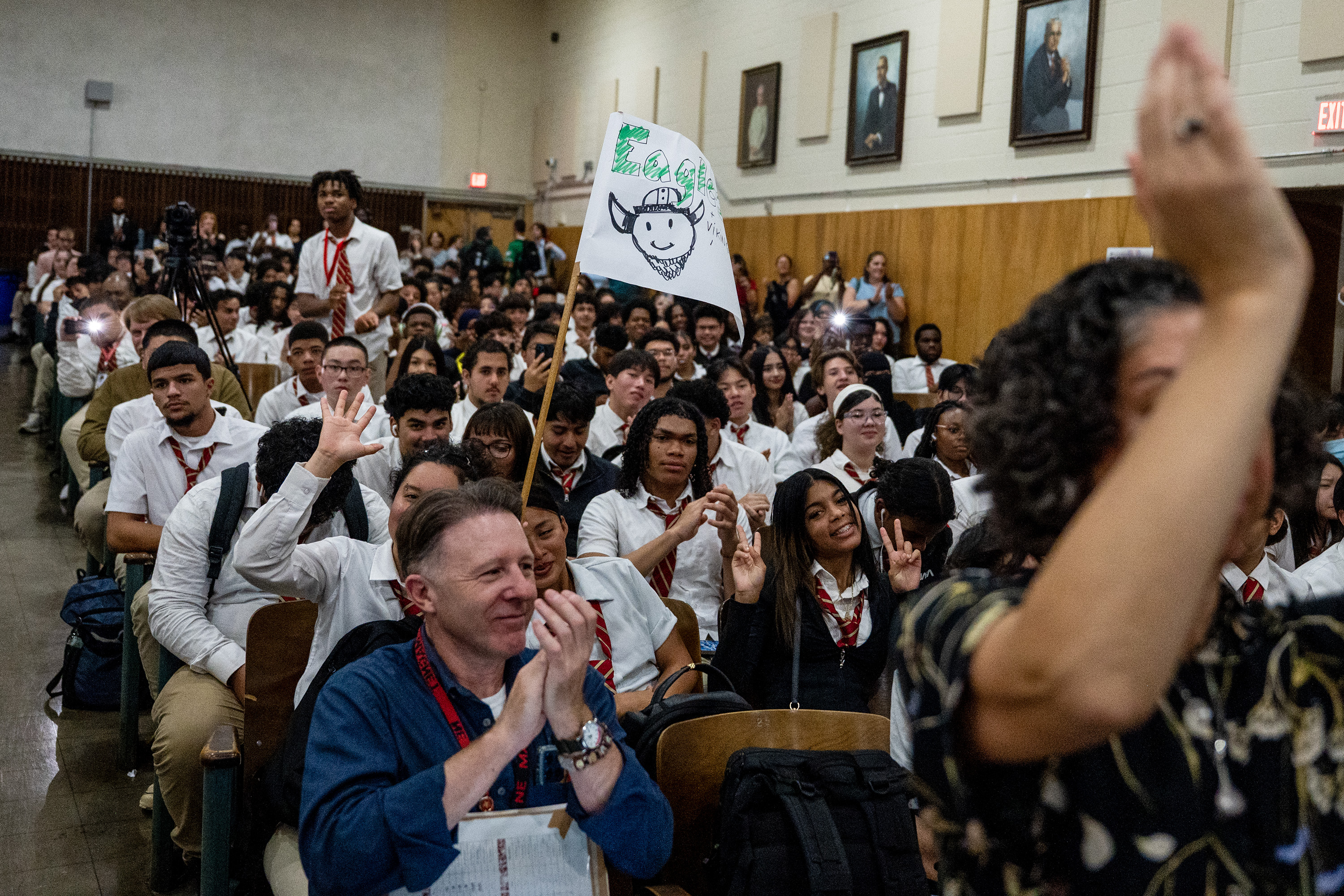
Northeast High School Viking cheerleaders warm up the (sweltering) auditorium.Tom Gralish / Staff PhotographerStudents and staff react as Hurts arrives.Tom Gralish / Staff Photographer
When I arrived at Northeast High School and was escorted with all the other news media to a corner in front of the sweltering auditorium (it really does need the AC!), I didn’t want to just wait around with everyone else until the program started. So I excused myself saying I needed to go back out to get something from my car.
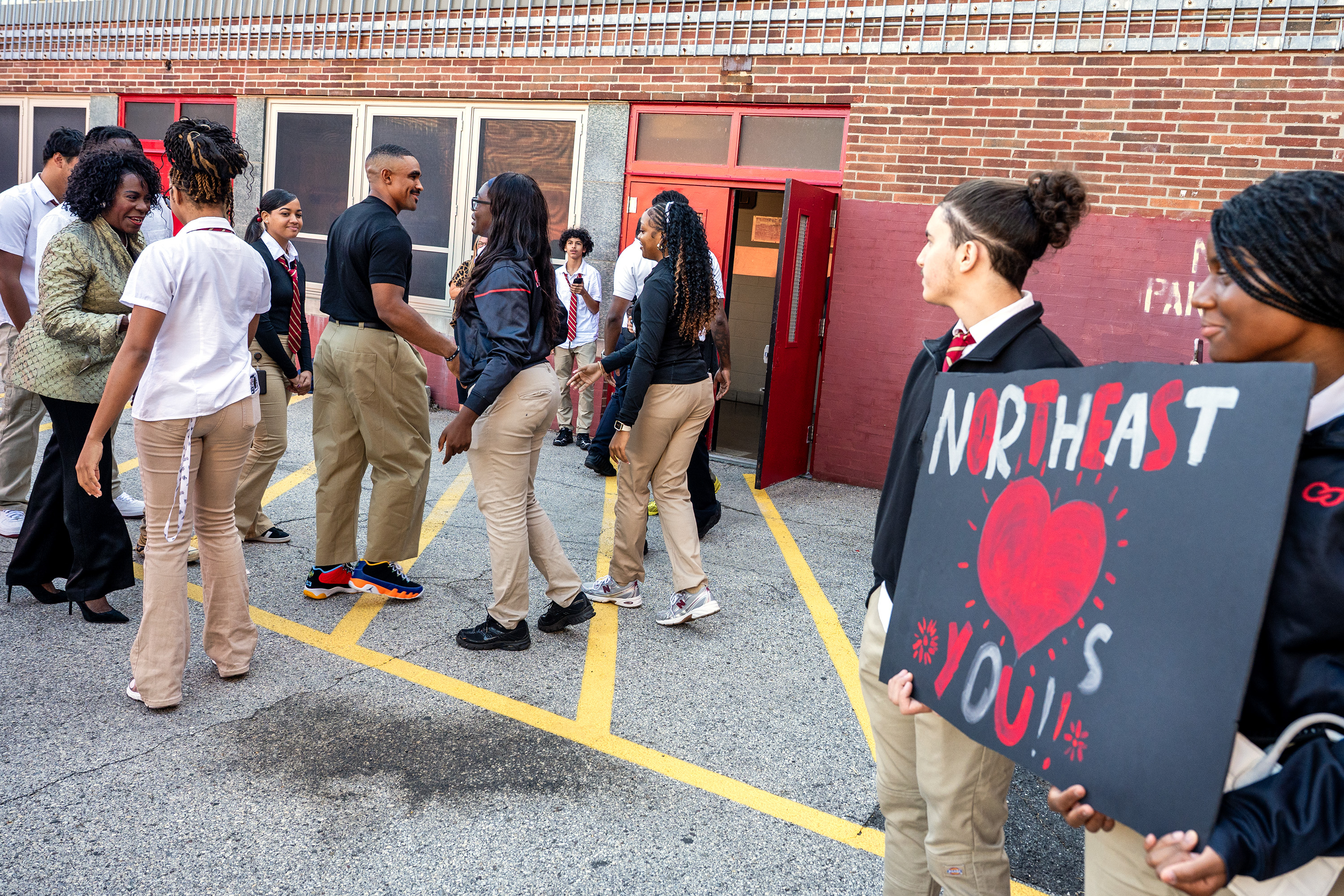
Outside, I talked to teachers working with the student greeters and police officers about the arrival of the football player and school district officials, when as luck would have it, a bunch of big black SUVs arrived.
Just like the night with Kelce, I was the only news media there, so I hung back, not wanting to get booted away. But I also knew I would be getting plenty of photos inside, so I didn’t need to be an obnoxious paparazzo. I positioned myself to focus more on the students when Hurts and the Mayor left their cars.
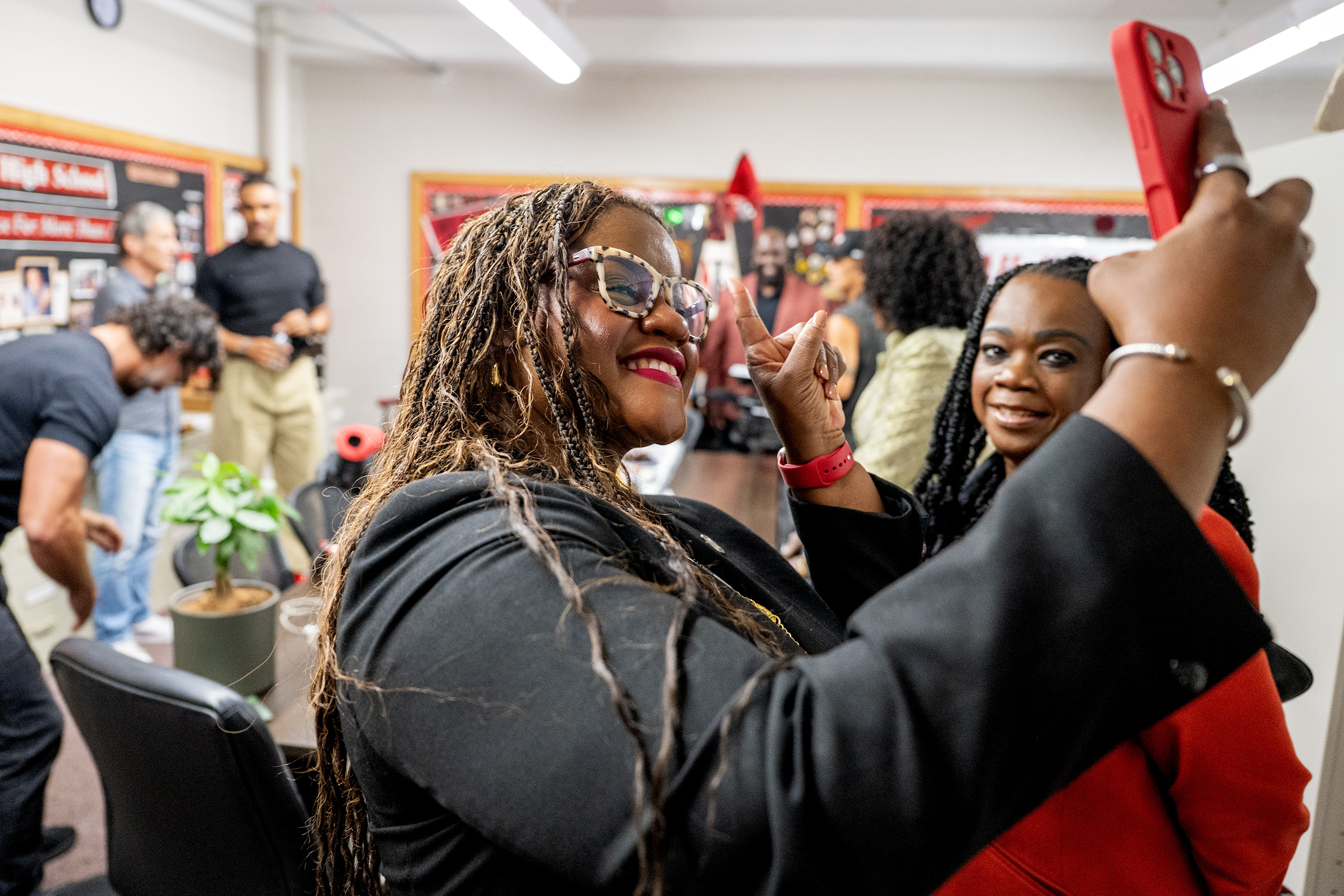
After following their entourages into a holding area conference room laid out with snacks, I left, but not before making a quick photo — a high-ranking member of the Mayor’s staff sneaking a selfie, just to show the universal appeal of a superstar, world-class athlete.
The Mayor’s chief of staff Tiffany W. Thurman takes a surreptitious selfie.Tom Gralish / Staff Photographer
The pep rally was energetic and visually exciting, but still wearing my covering-political-candidates hat and trying to get something different, I skipped Hurts’ post-event media availability and went to scout opportunities for a photo as he left. As you’d expect, for safety reasons there are multiple ways out from school auditoriums.
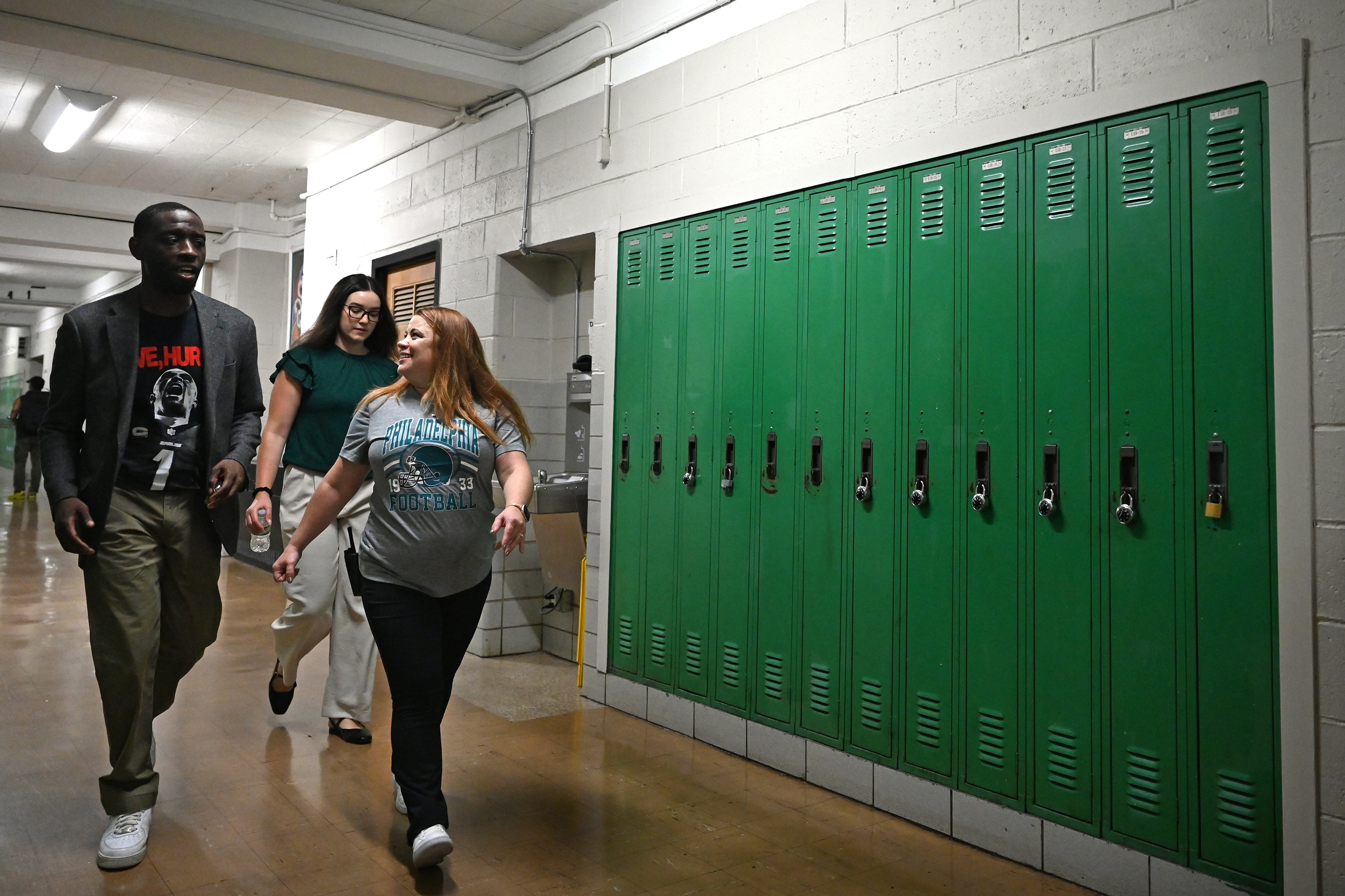
While the school safety officers cleared all the students from the hallway I was talking with them over the exit plan and found a good spot — across from some Eagles’ Midnight Green lockers.
City Councilmember Isaiah Thomas leaves Northeast High School Tuesday after attending a rally with Eagles quarterback Jalen Hurts.Tom Gralish / Staff Photographer
But, just like in football — and politics — you win some and you lose some. At the last second I heard an officer’s walkie-talkie squawking “they’re going out the back.”
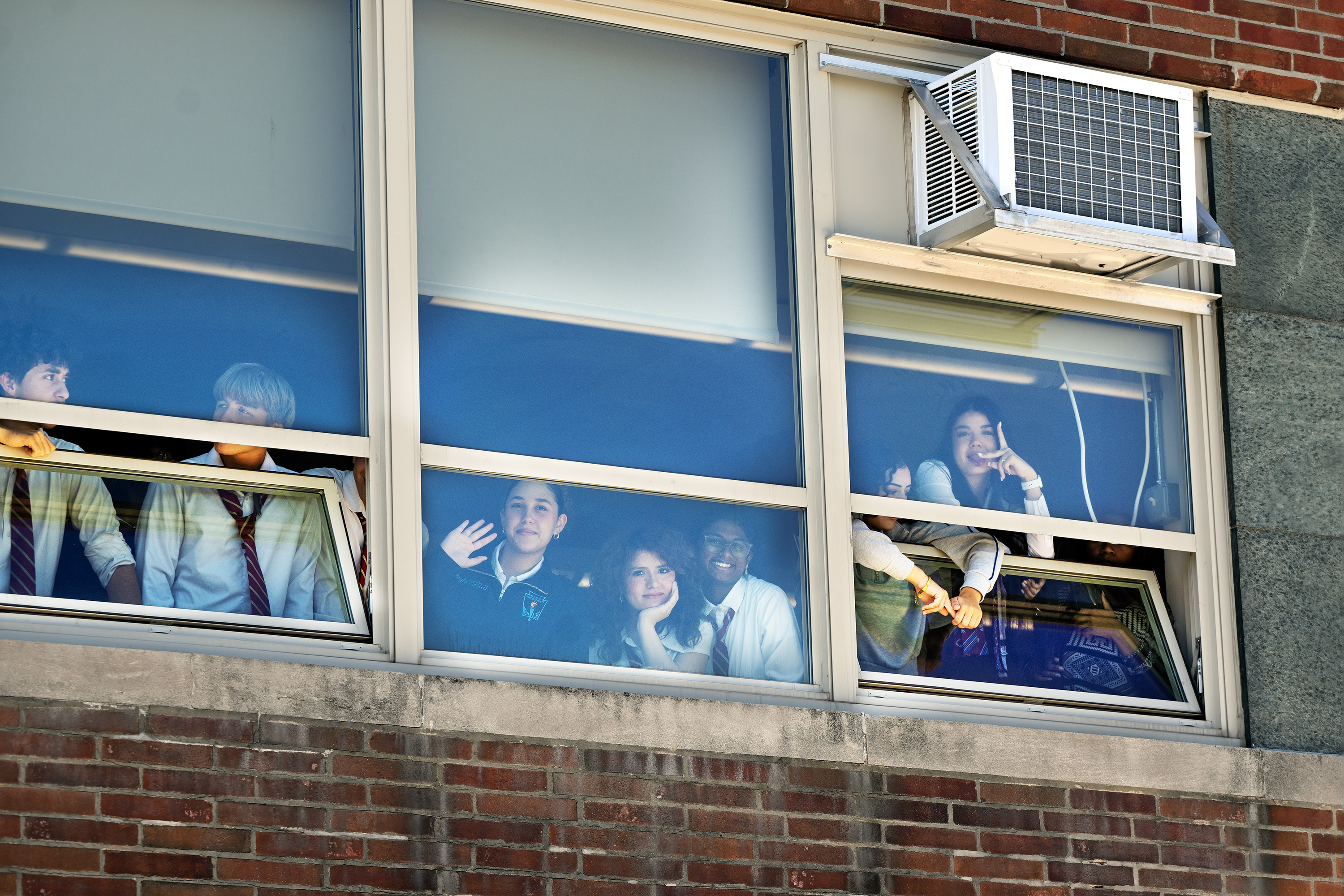
However, I did get to see them leave outside, and photograph students watching from their classroom — with a window AC unit — as the limos drove away.
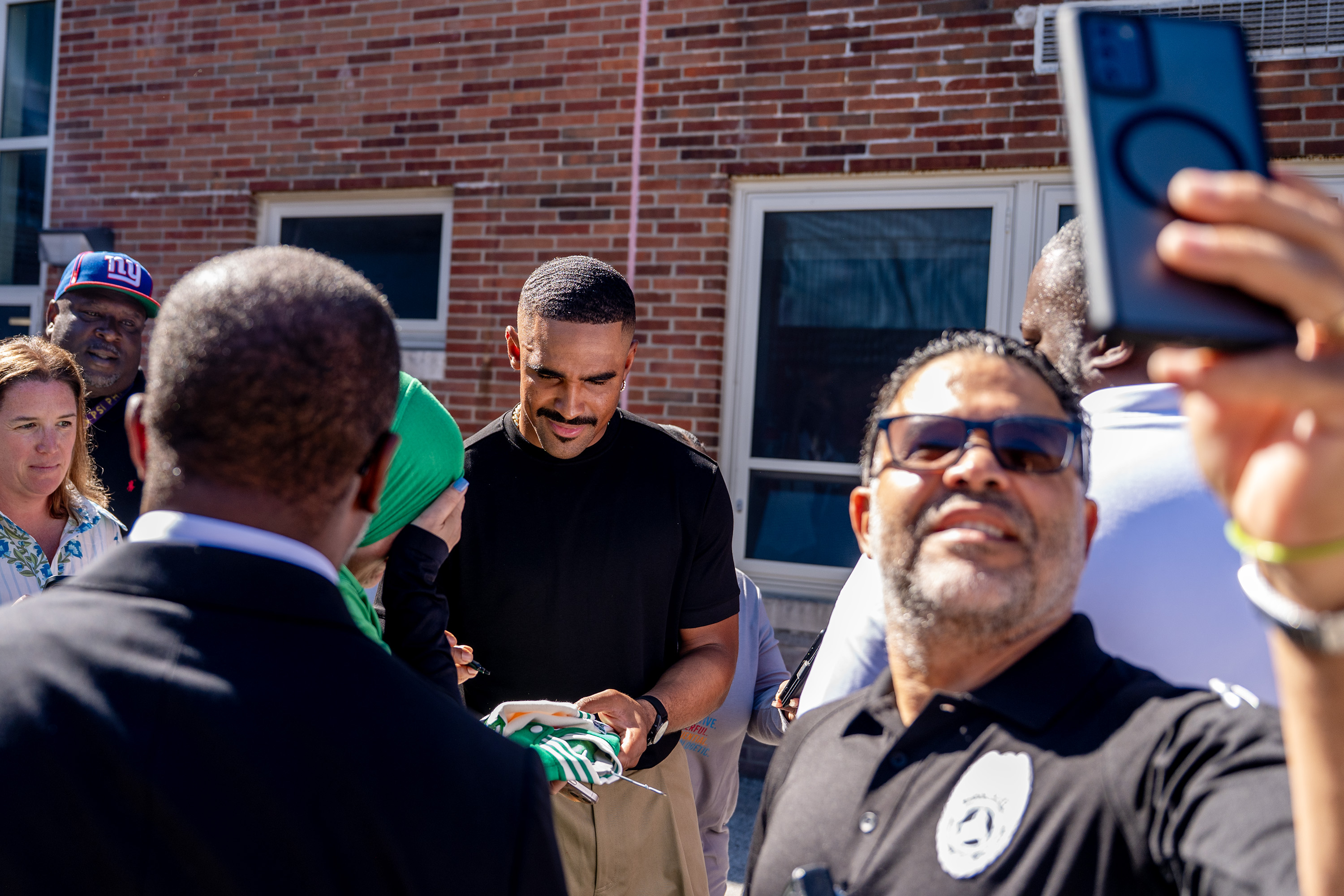
Hurts signs jerseys and meets with school staff as he leaves.Tom Gralish / Staff PhotographerStudents watch from their classroom – with a window AC unit – as Hurts drives away.Tom Gralish / Staff Photographer
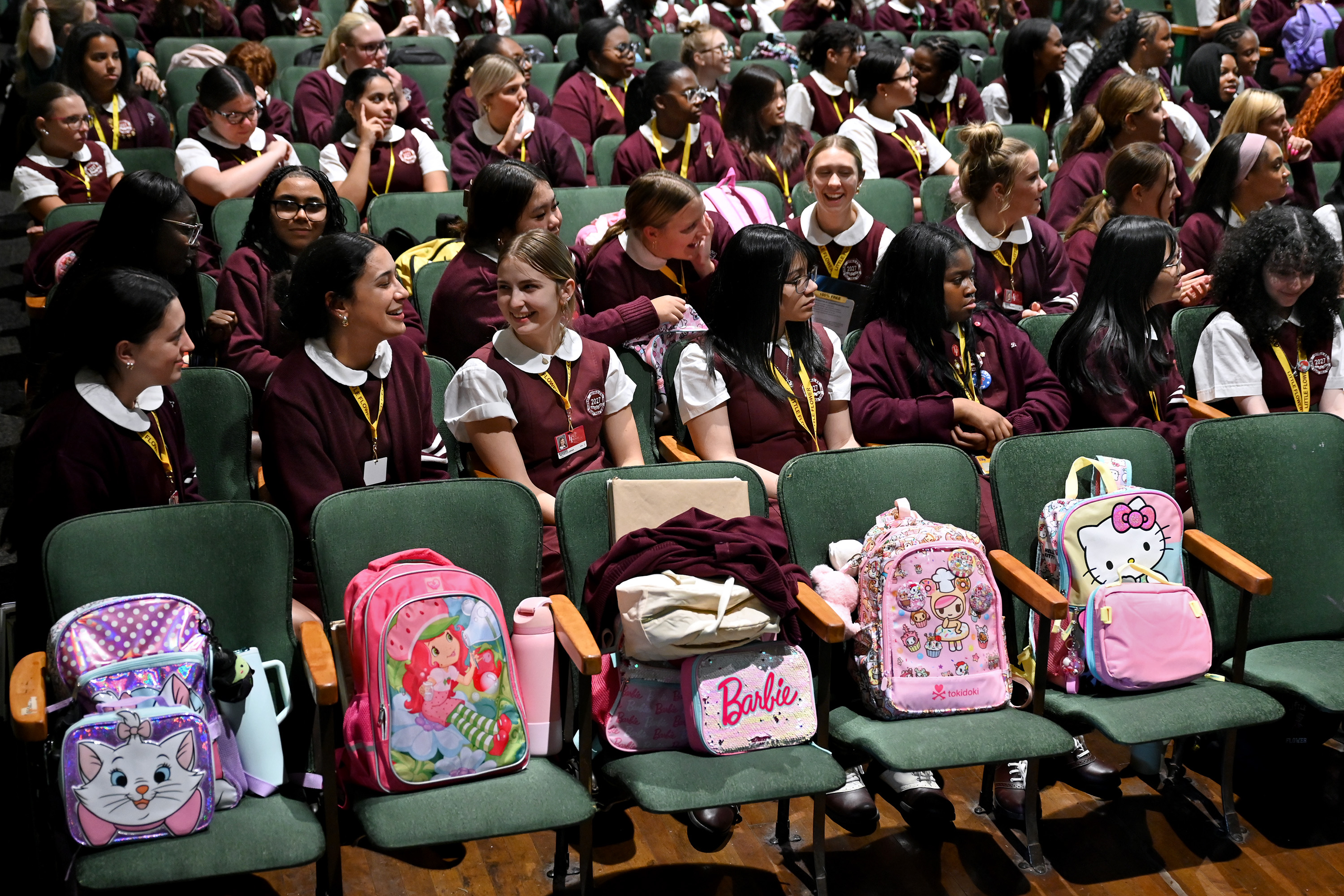
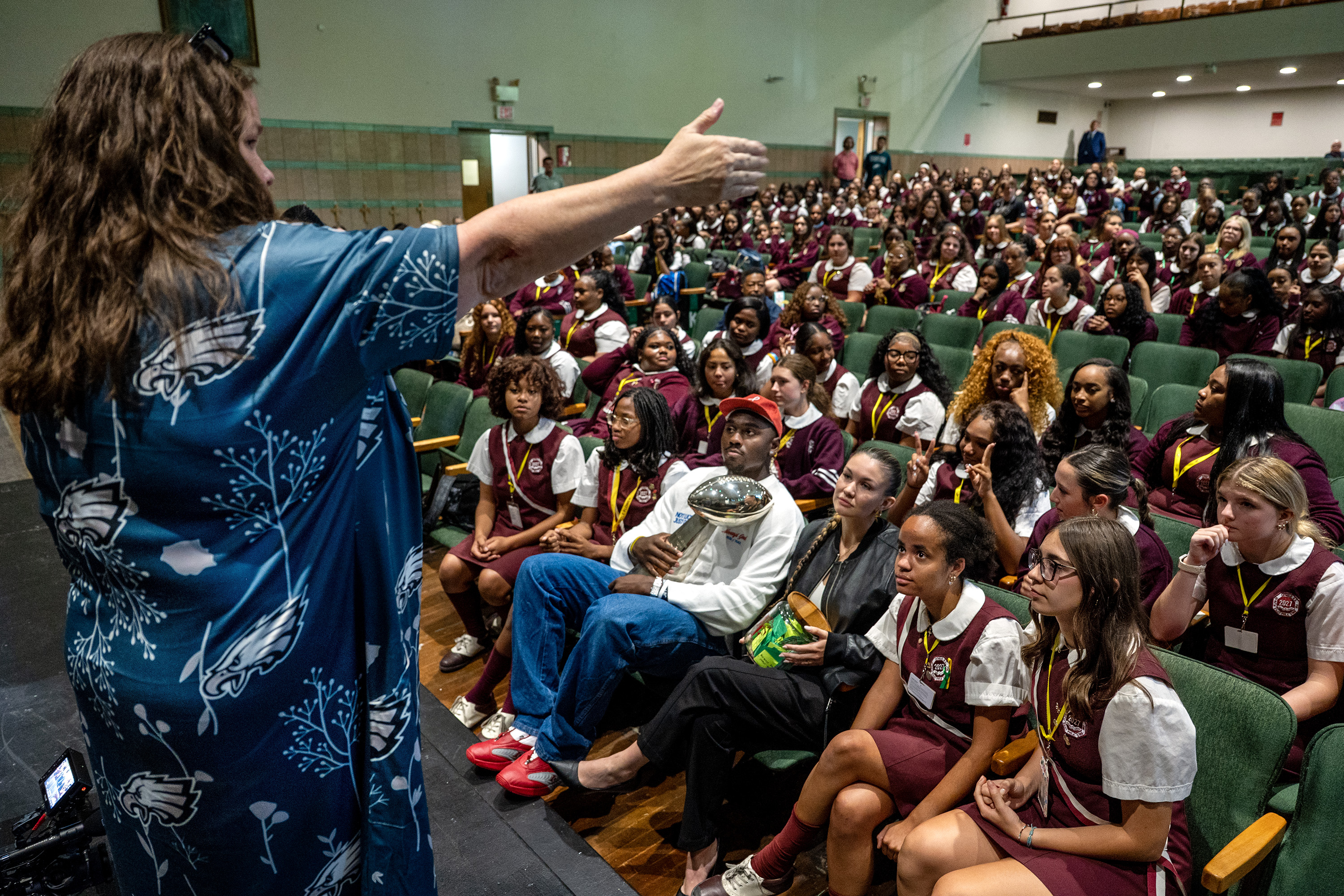
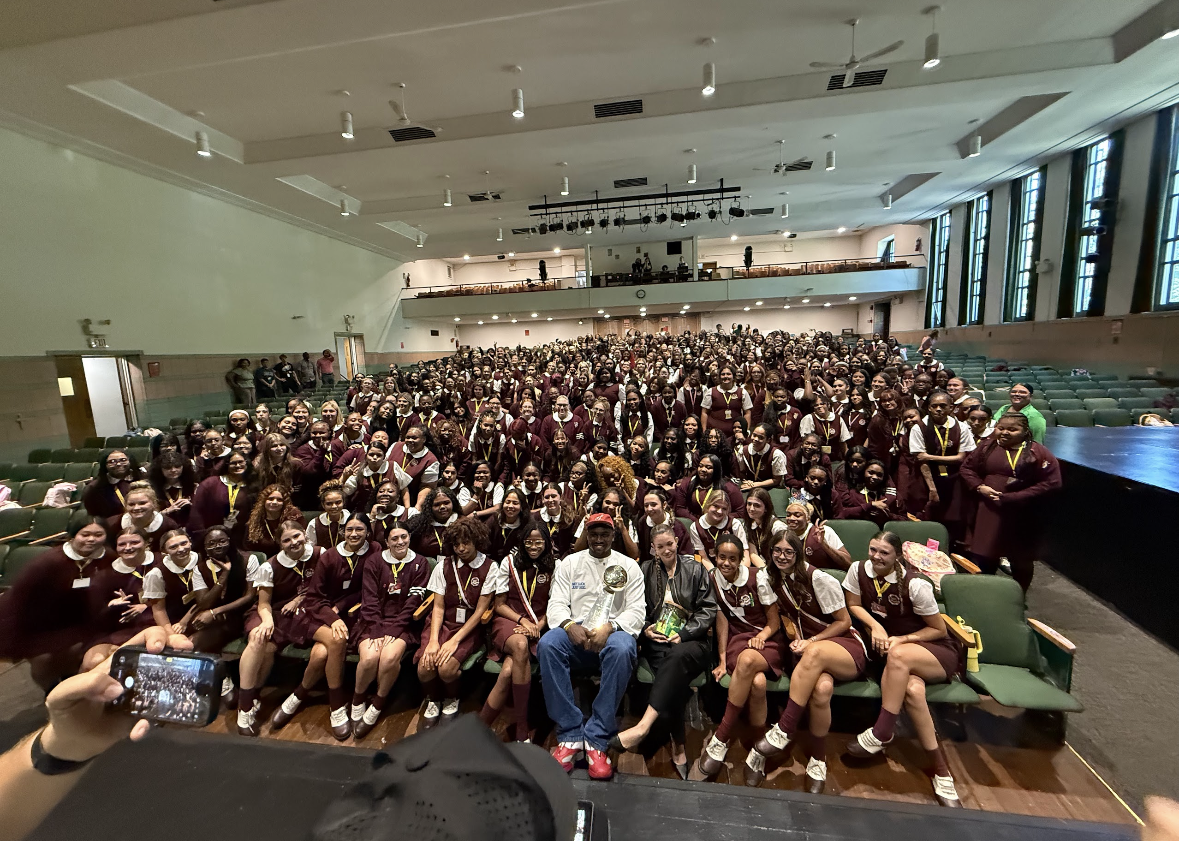
From there I went across town to Little Flower Catholic High School for Girls where Eagles linebacker Jalyx Hunt was at another assembly announcing that he was establishing four new scholarships.
Little Flower president Kristie Dugan positions the students for a group photo with Kristie Dugan positions the students for a group photo with Eagles linebacker Jalyx Hunt – and the Super Bowl Lombardi Trophy.Tom Gralish / Staff Photographer
He got to know the school when he was drafted by the Eagles and started a fundraiser for underfunded school sports programs. Little Flower’s basketball team was one of the first recipients. That was two years ago, and he has kept up that relationship with what he calls a “whole bunch of little sisters” in the hundreds of students there.
As Eagles beat reporter Olivia Reiner reported, he was heeding his teacher mother’s advice: “You don’t have to originate in a place to become a part of that place.“
The scholarships are each named after women in his life.
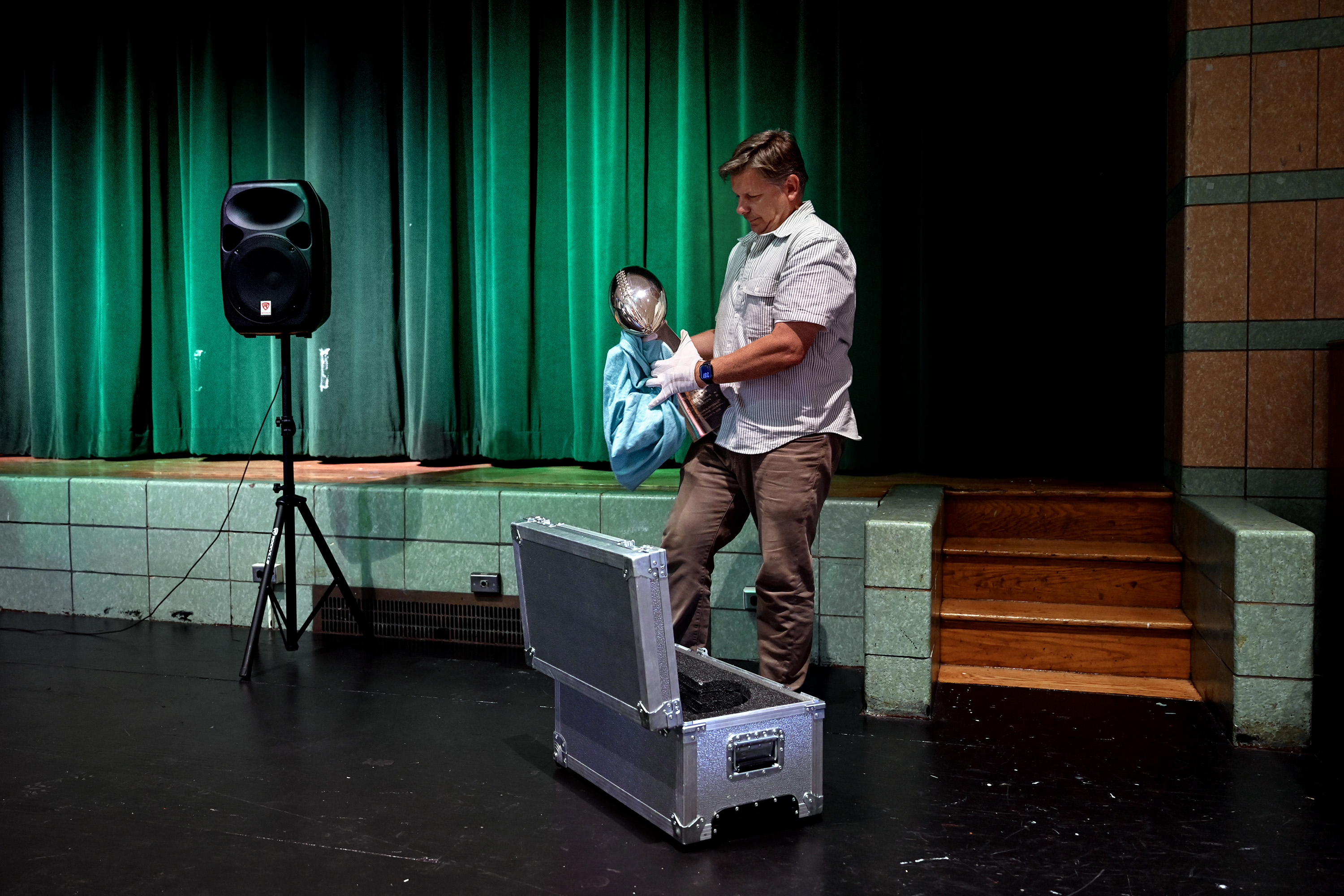
Christian Molnar, the Eagles’ director of team relationships, unpacks the Lombardi Trophy at Little Flower Catholic High School for Girls Tuesday, Sept. 15, 2026.Tom Gralish / Staff Photographer
Since 1998 a black-and-white photo has appeared every Monday in staff photographer Tom Gralish’s “Scene Through the Lens” photo column in the print editions of The Inquirer’s local news section. Here are the most recent, in color:
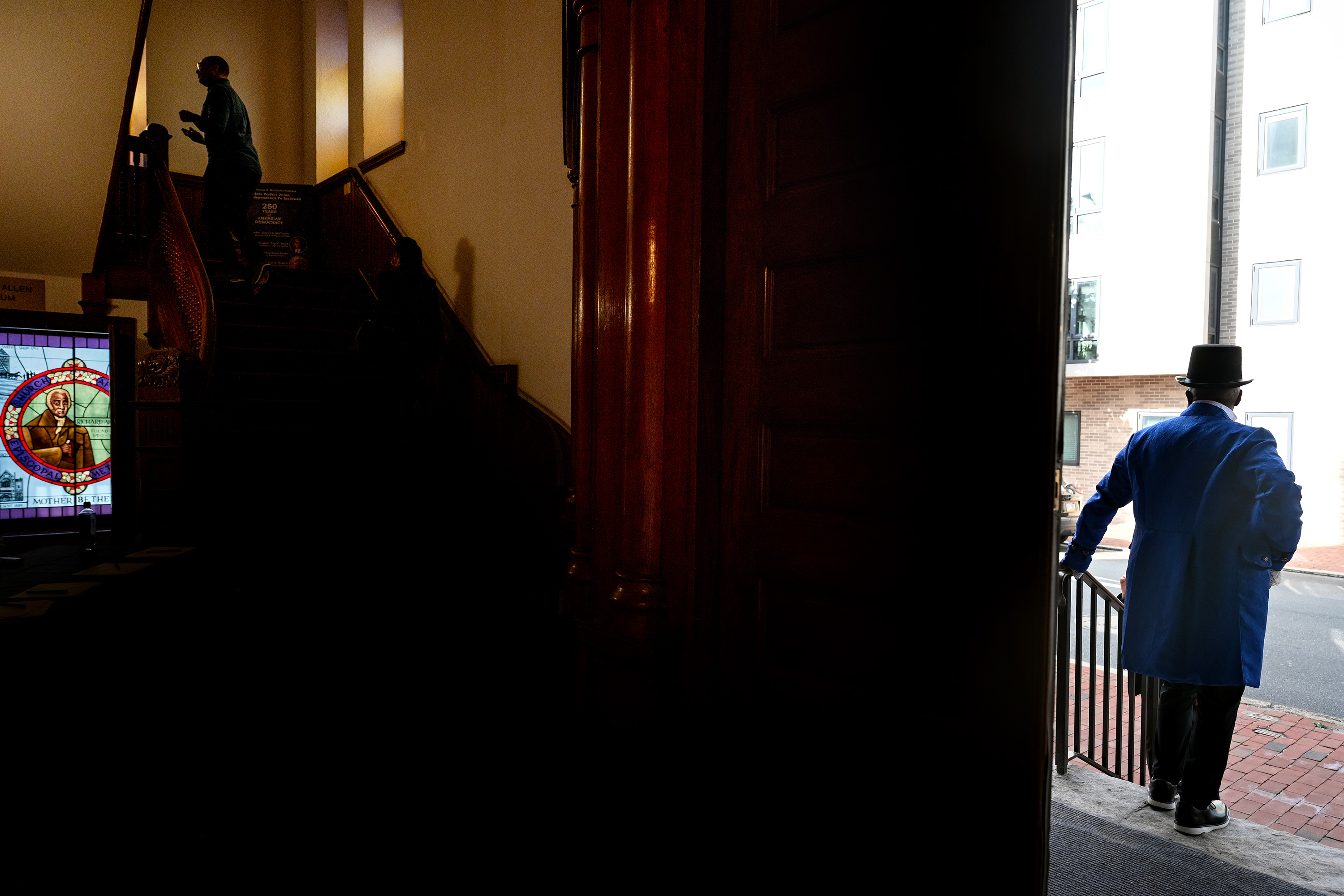
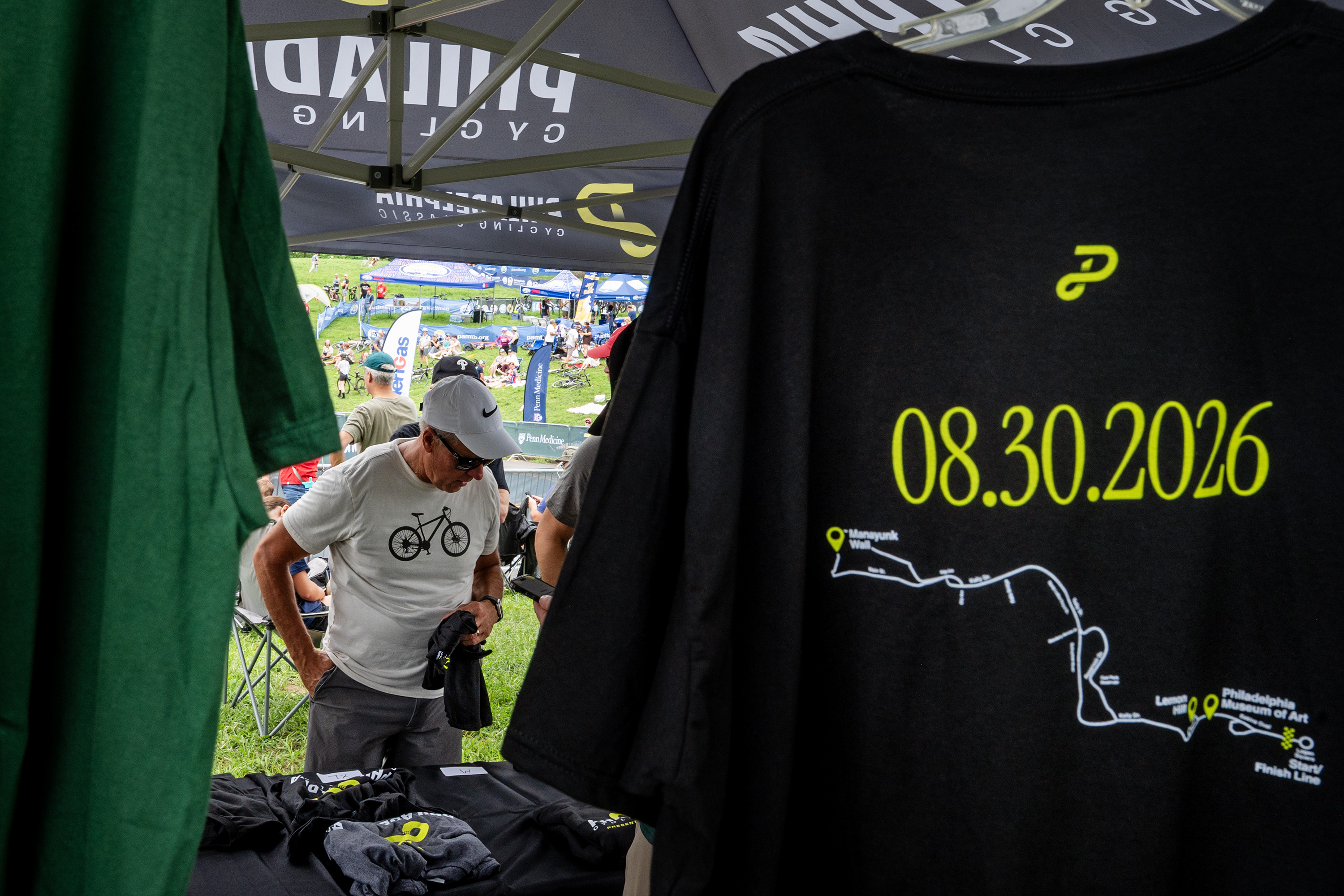
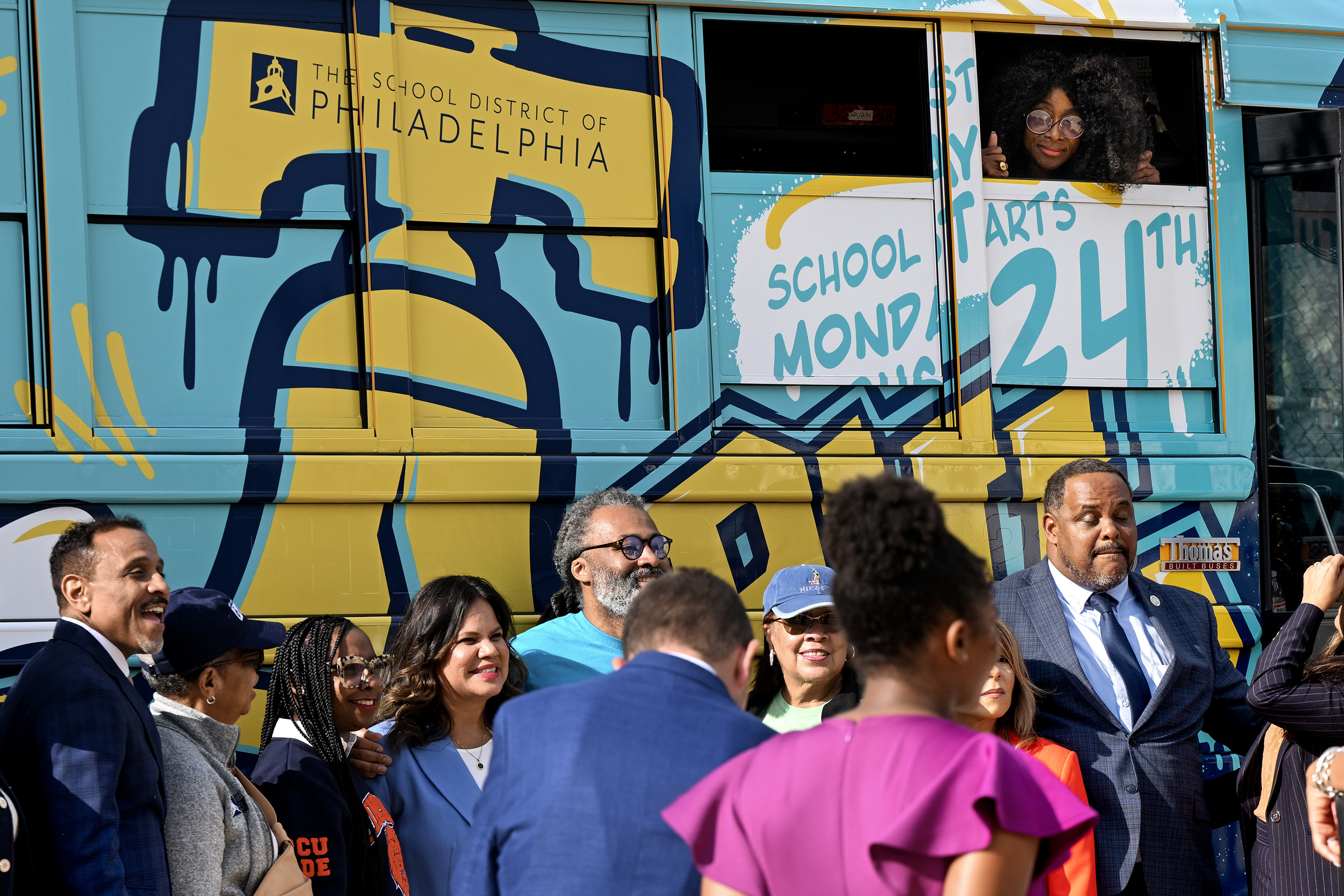
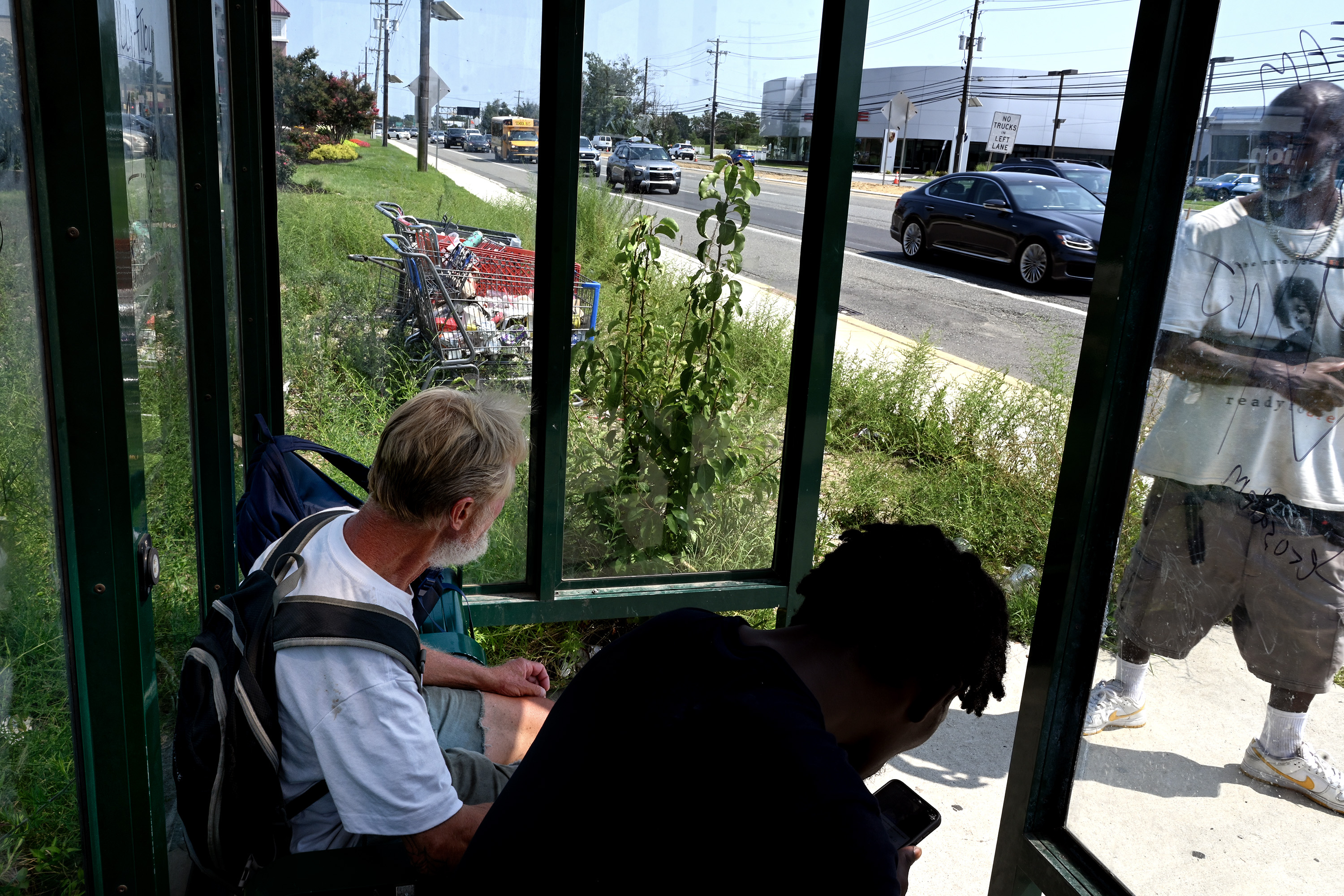
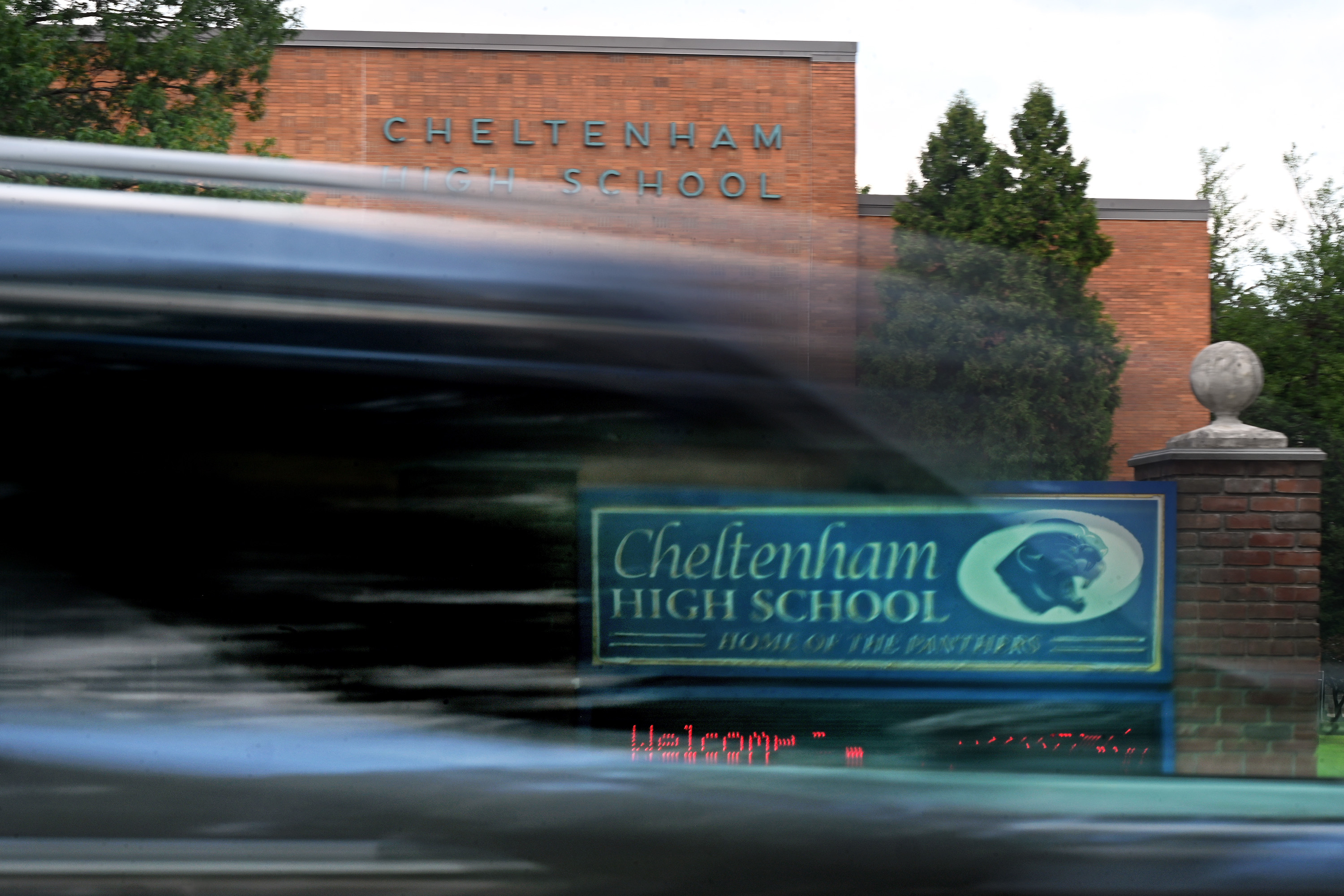
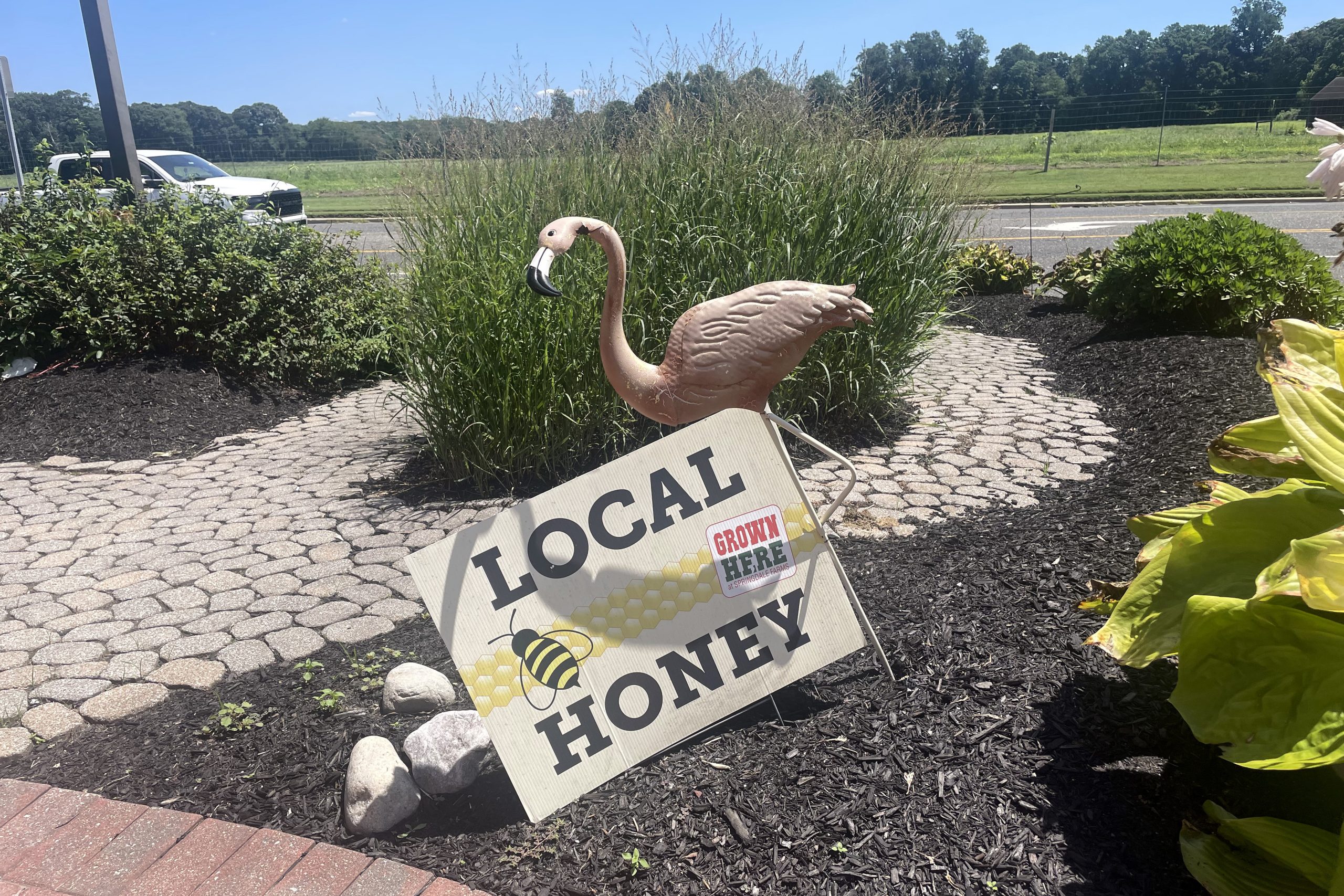
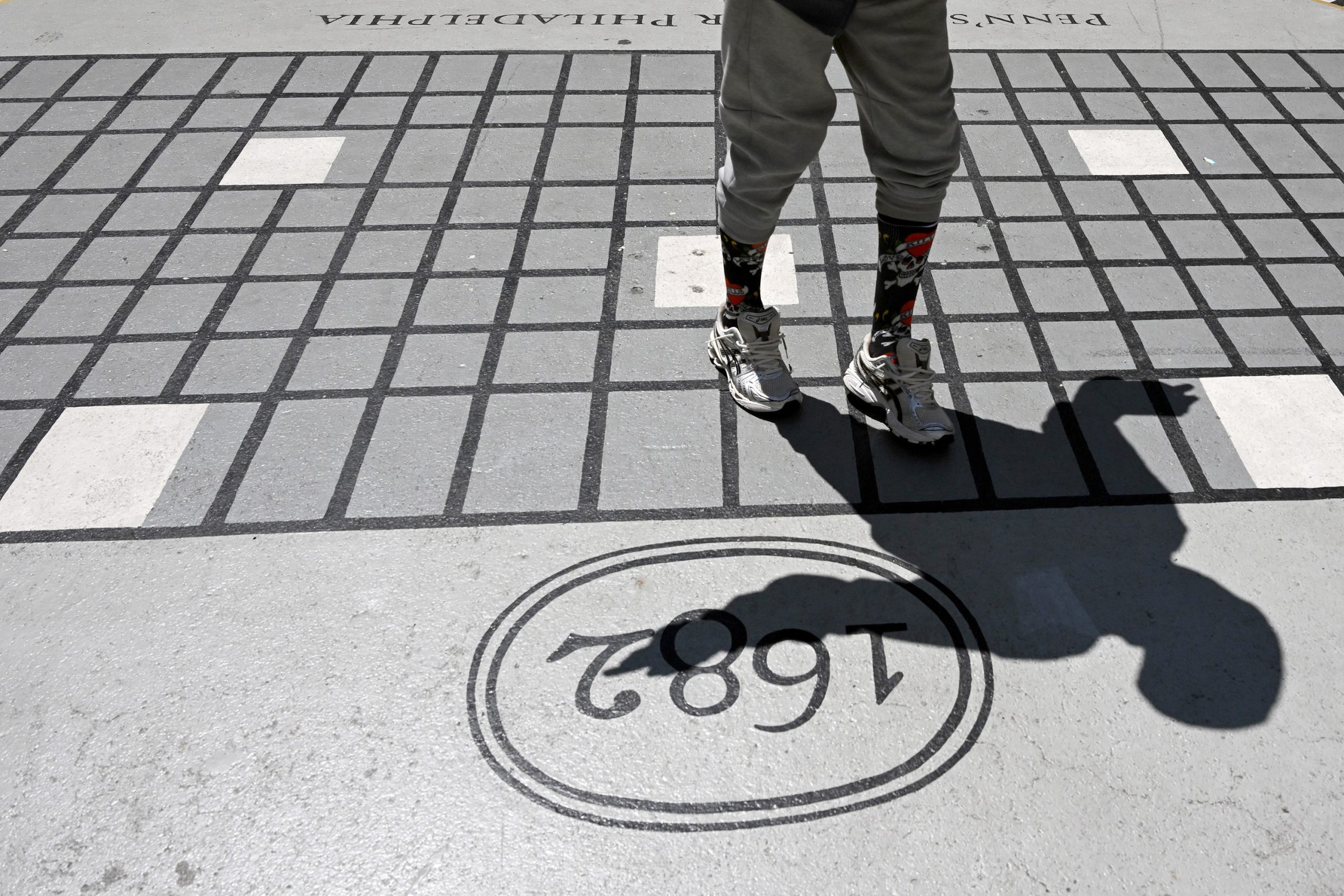
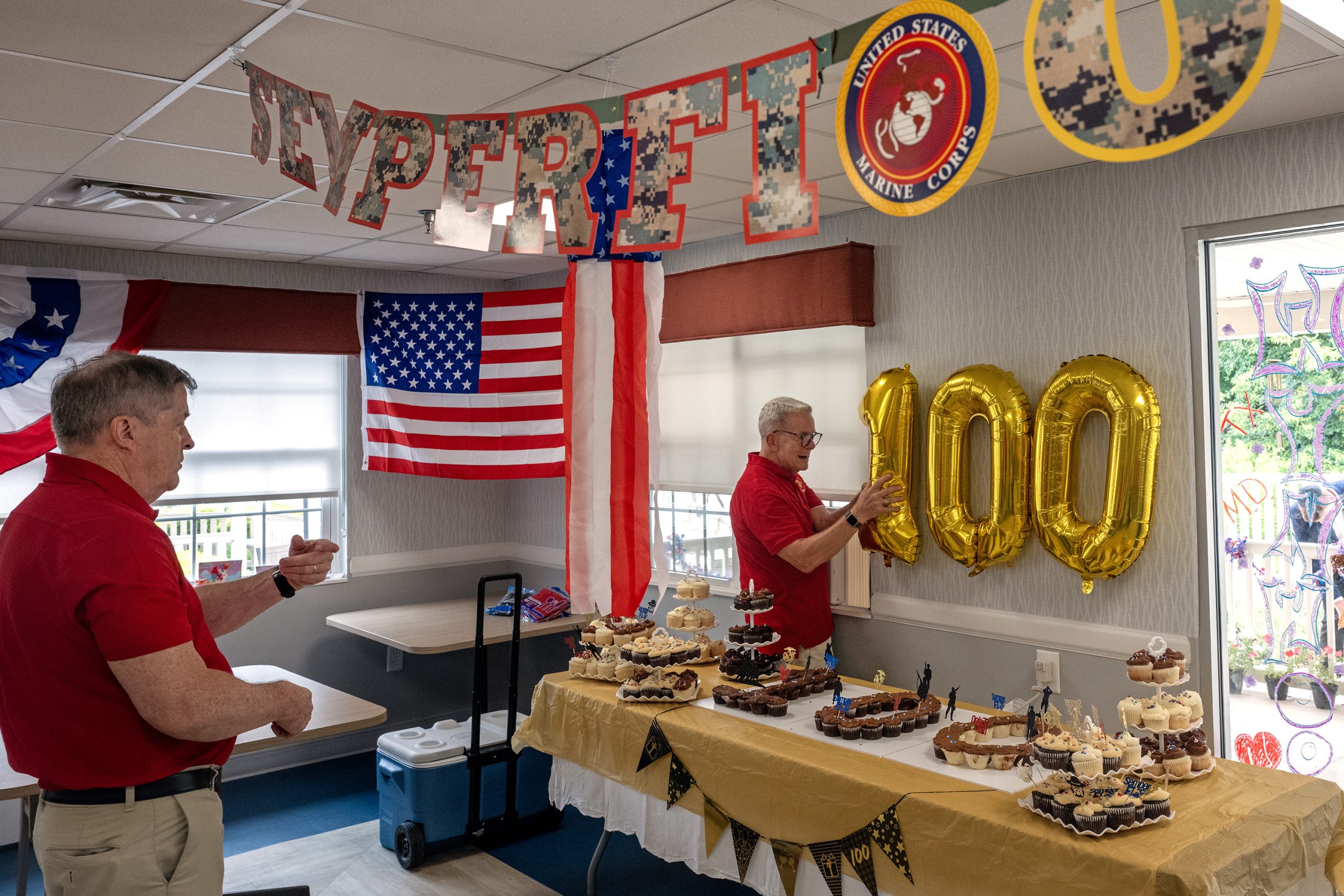
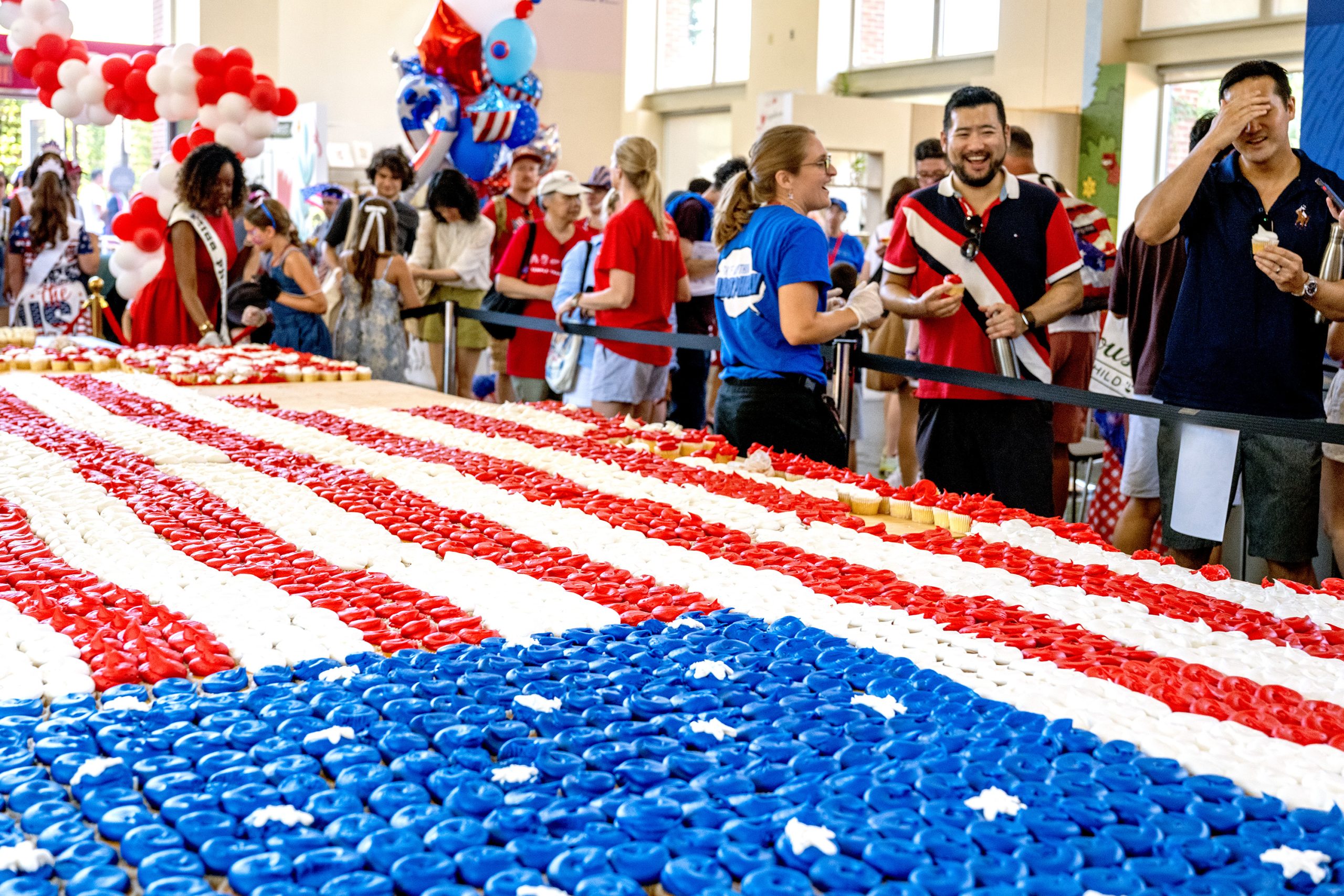
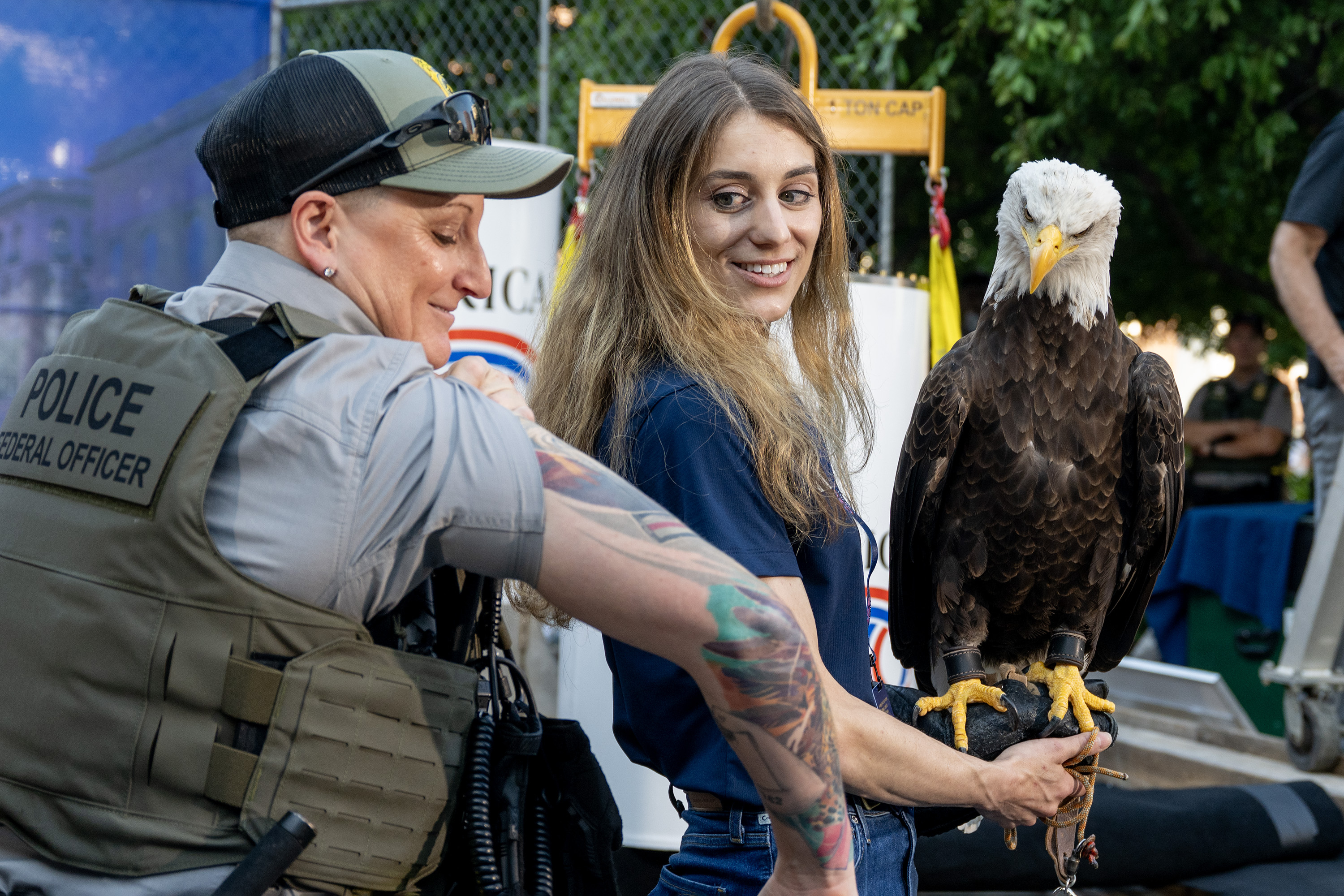
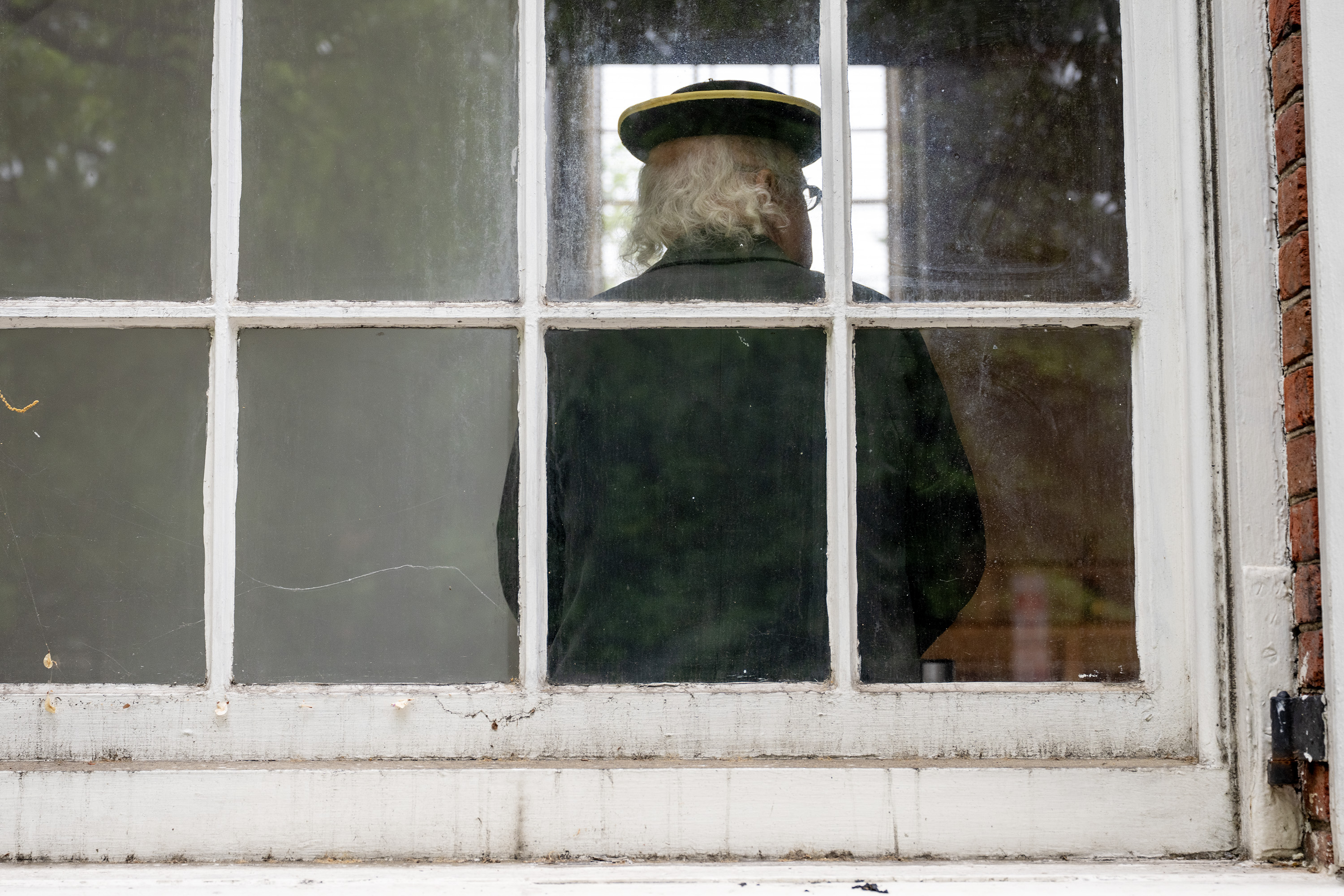
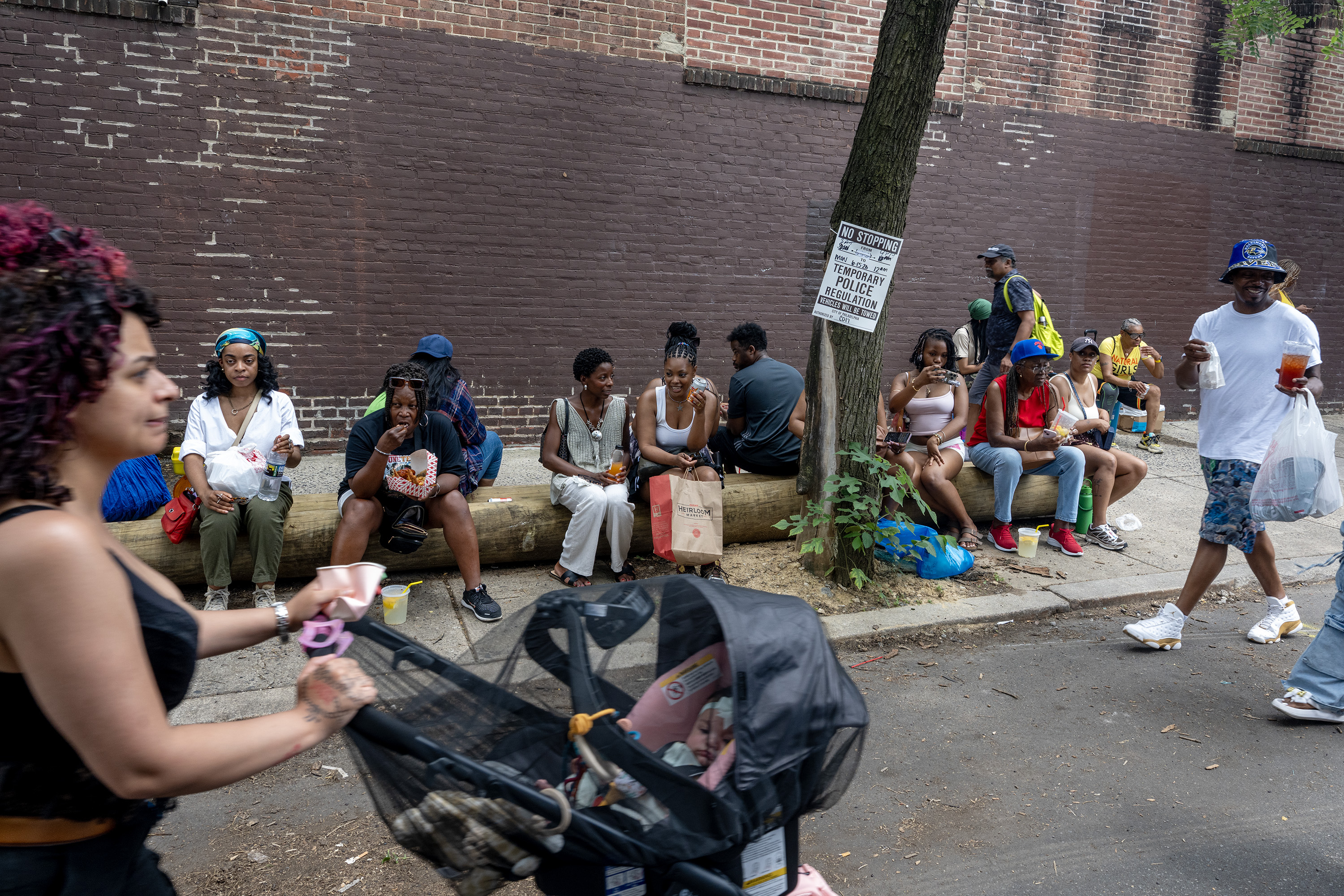
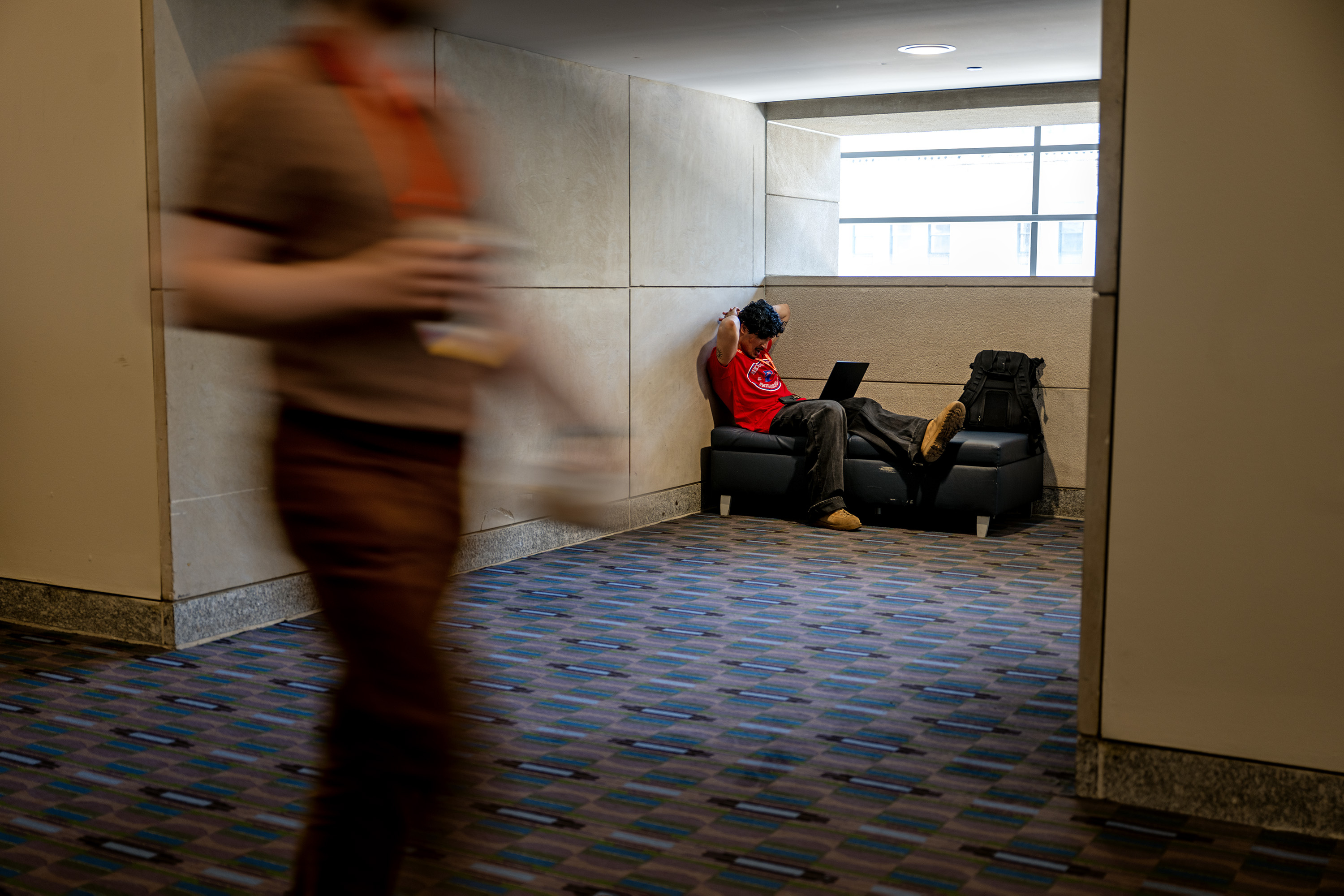
September 14, 2026: Chris Lewis (right), portraying James Forten, an abolitionist, activist, and sailmaker in colonial America, greets visitors outside Mother Bethel A.M.E. Church as they arrived for an America 250 Conversation hosted by Pennsylvania House Speaker Joanna McClinton on Sept. 10. The stainedglass window at left depicts Richard Allen, founder and first bishop of the African Methodist Episcopal Church in 1816, the first independent black religious denomination in the United States. Tom Gralish / Staff PhotographerSeptember 7, 2026: Joe Ackler of Skippack shops for a race T-shirt during a lull between laps in the Philadelphia Cycling Classic on Aug. 30. He is wearing a shirt he bought in 2003 when he attended the Tour de France. Tom Gralish / Staff PhotographerAugust 31, 2026: Robin P. Cooper (upper right) watches as Superintendent Tony B. Watlington Sr. (far left) gathers school and city officials for a group photo outside the district bus, stopped at McClure Elementary on the first day of school in Philadelphia. The bus was on its annual back-to-school celebration visit to schools throughout Philadelphia. Cooper later left the bus to join in the photo. Tom Gralish / Staff PhotographerAugust 24, 2026: Pencils were sharpened in the first-grade classroom of teacher Lauren Cucinotta at Fanny Jackson Coppin Elementary as she prepared for the start of the new school year for the Philadelphia School District on Monday.Tom Gralish / Staff PhotographerAugust 17, 2026: Wayne Peters (left) and Bobby White (right) wait for the #406 bus to Camden, on Rt. 70 in Cherry Hill, near the entrance to stores at the Garden State Pavilion shopping center and NJ Transit’s Cherry Hill station. Peters says it “Gotta be the worst bus stop in the state,” with White adding, “You’d think something in Cherry Hill would be better. How hard would it be to put a trash can here?” Before their bus arrives, Peters, trying to be positive about the shelter, reminds him “They fixed a broken window once.”Tom Gralish / Staff PhotographerAugust 10, 2026: Cheltenham High School in Wyncote, on the day the Montgomery County district attorney announced charges in connection with two assaults in the school’s football locker room. A photo of the static signs was made more visually interesting by using a slow camera shutter speed to blur the passing cars. Tom Gralish / Staff PhotographerAugust 3, 2026: Sign for locally “grown” honey outside the market at Springdale Farms, the only working farm left in Cherry Hill. Before WWII, when it was still known as Delaware Township, there were 82 farms in operation feeding South Jersey markets and supplying the massive fresh vegetable and crop demands of the Campbell’s Soup Company in Camden. Tom Gralish / Staff PhotographerJuly 27, 2026: Lyn-el “The Torch” Wright pauses on the City Hall Courtyard’s rendering of William Penn’s Philadelphia city grid plan. Penn designed the 1,200-acre “Greene Countrie Towne” between the Delaware and Schuylkill rivers with wide, crisscrossing streets to prevent the overcrowding and fires he had witnessed in London. Tom Gralish / Staff PhotographerJuly 20, 2026: Pat Dailey (left) and Ken Hopper with the Tun Legacy Foundation prepare a room at the Wynwood Rehabilitation & Healthcare Center in Cinnaminson, N.J., for a surprise 100th birthday party for WWII U.S. Marine Corps veteran Stephen Anderson. Dailey founded the nonprofit that supports veteran causes, Masonic charities, and educational scholarships. The organization is also rebuilding and reestablishing an authentic reproduction of the original Tun Tavern building in Philadelphia. The Tun, constructed in 1693, was the first documented lodge in North America and the birthplace of the U.S. Marine Corps in 1775.Tom Gralish / Staff PhotographerJuly 13, 2026: The Independence Visitor Center offers free birthday cake to the public on the Fourth of July, in the form of a massive American flag made of 5,000 cupcakes frosted red, white and blue.Tom Gralish / Staff PhotographerJuly 6, 2026: National Park Police Deputy Chief Rebekah Spedaliere shows off her own bald eagle tattoo while posing for a photo with bald eagle “Indy” and handler Amanda Sweeney with the Auburn University Raptor Center, during ceremonies over the July Fourth weekend. Indy came to Auburn, in Alabama, in 2018 after suffering a wing injury as a young bird and imprinted on humans during rehabilitation, so she couldn’t be released back into the wild. Now, she serves as an ambassador bird, teaching people about raptors, conservation, and the ecosystems that sustain them. Not her first rodeo in Philly, she made her first appearance at the Linc for an Eagles’ game in 2023. Tom Gralish / Staff PhotographerJune 29, 2026: Shecky Perlman as Ben Franklin is inside the Free Quaker Meeting House on Independence Mall as he and other historical reenactors receive their diplomas after weeks of intensive, immersive training for the 21st season of Historic Philadelphia’s Once Upon a Nation program — where costumed actors perform first-person interpretations of real 18th-century Philadelphians in the Historic District and at Valley Forge National Historical Park.Tom Gralish / Staff PhotographerJune 22, 2026: A downed utility pole serves as a quiet place to eat, away from the crowd at the Odunde Festival, billed as the largest African street market in North America.” Tom Gralish / Staff PhotographerJune 15, 2026: Bob Myers, president of Harris Blitzer Sports & Entertainment, owner/operator of the 76ers and the NHL’s New Jersey Devils, as well as a future Philadelphia WNBA team, talks to reporters after Mike Gansey made his first appearance as Sixers president of basketball operations at the Penn Medicine Philadelphia 76ers Training Complex in Camden. Tom Gralish / Staff PhotographerJune 8, 2026: Obet Montalvo, a digital strategist with Radicle Digital, finds a quiet nook at the Convention Center on Thursday June 4, 2026, while attending Netroots Nation, the country’s largest annual gathering for progressive political activists, and organizers. The fan fest is an outgrowth of the blog Daily Kos, and brings together thousands of grassroots organizers to participate in training sessions, panel discussions, and keynote addresses.Tom Gralish / Staff Photographer
It’s hard to lure downtown diners to Bucks County, and Roberto Carollo knows it.
Carollo’s wood-fired pizzeria inside Doylestown’s Main Street Marketplace, Spuntino, has a loyal, longstanding following, so much so that when the Washington Post analyzed 7.5 million nationwide Yelp reviews in 2023, it determined Spuntino to have the highest-rated Neapolitan pie in Pennsylvania.
“We’ve had a lot of love from the people that matter to us, but I still feel like the suburbs are a really tough place to get attention,” Carollo said. “We’ve been here 12 years, but even Doylestown residents are still finding out about us.”
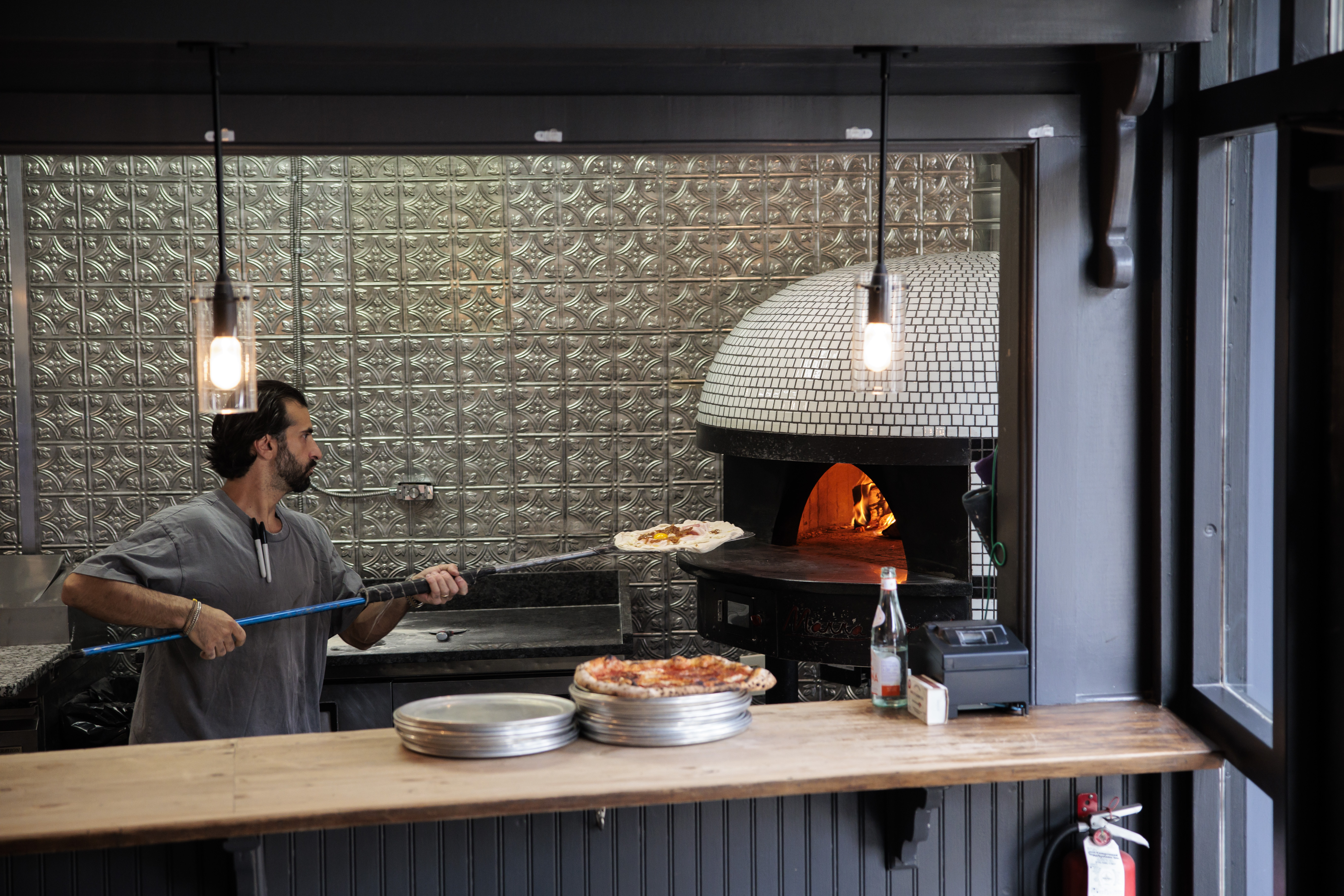
Roberto Carollo makes the Carbonara pizza at Spuntino on Monday, Aug. 31, 2026 in Doylestown, Pa.Monica Herndon / Staff Photographer
But Spuntino’s puffy, leopard-spotted pies are worth a trek from wherever you may be. Thin, chewy, and judiciously loaded, the pizzas are best eaten then and there, at one of the several tables Spuntino claims inside the market. (Takeout — and leftovers — are perfectly satisfying, too.)
Carollo opened Spuntino in Doylestown in 2014 with his brother Salvatore. (They also had a Northern Liberties location from 2015 to 2023. Carollo is now Spuntino’s sole owner.) The brothers are fourth-generation pizza makers, dating back to their Sicilian great-grandfather’s bakery days. They had grown up working in their father’s Philly-area neighborhood pizzerias — “your big 16-inch pies, hoagies, sandwiches,” Carollo said — but they hadn’t made Neapolitan pies before, and they had no experience with wood-fired ovens.
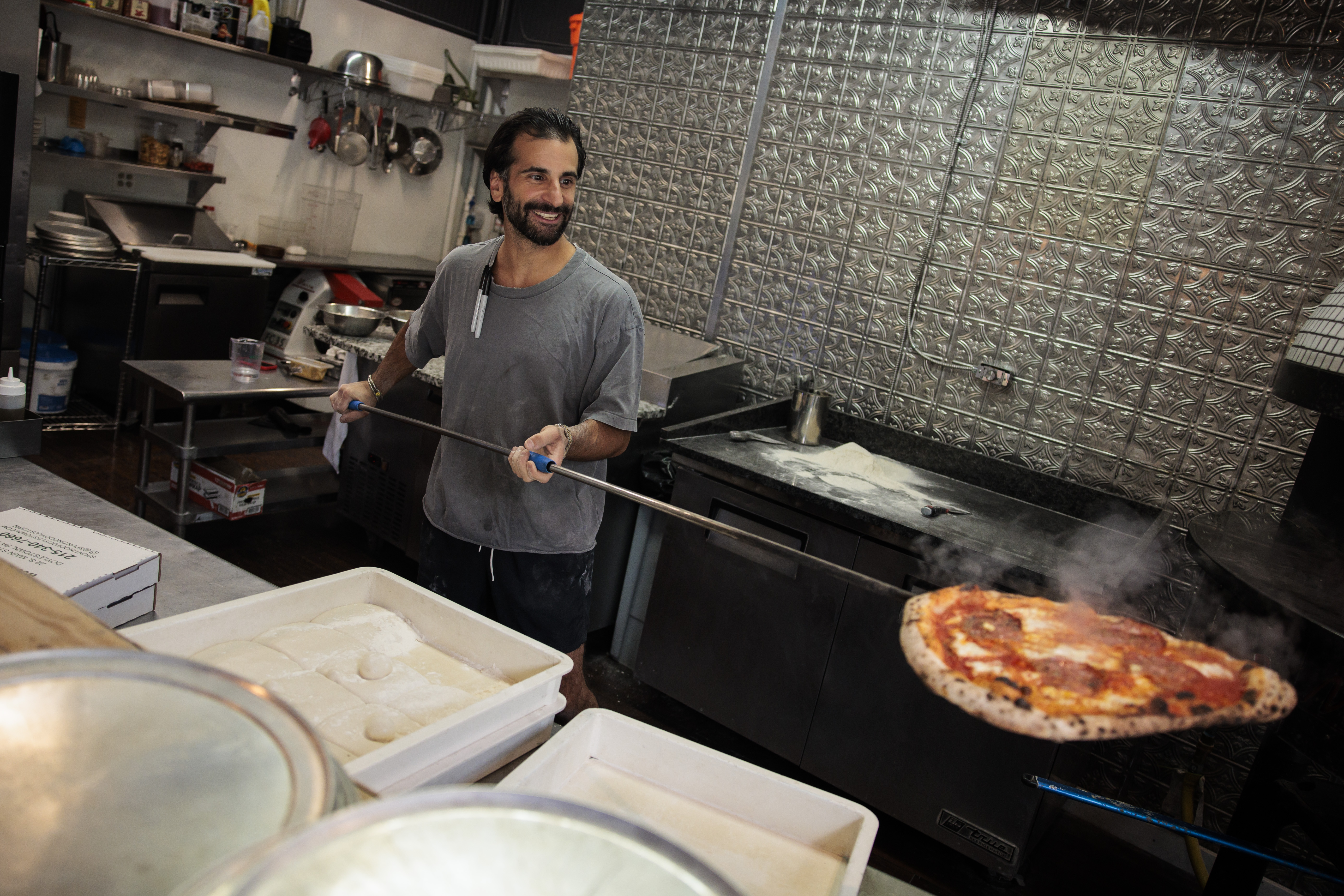
“We kind of just were going in on a prayer,” Carollo said. They had their work cut out for them with this exacting style of pizza. At Spuntino, a 250-gram ball of 48- to 72-hour fermented dough is stretched into a millimeters-thin 11-inch round, then covered with sauce, cheese, and toppings before being pitched into afiery 900-degree oven, where it cooks in about 90 seconds. The pizzaiolo needs to have an eagle eye. “Five or six seconds too long, and the pizza’s burned,” Carollo said.
Roberto Carollo pulls a Ronzio pizza from the oven at Spuntino on Monday, Aug. 31, 2026 in Doylestown, Pa.Monica Herndon / Staff Photographer
Evidently, his prayers were heard: Inquirer critic Craig LaBan named Spuntino among the suburbs’ best pizzas in 2017. Carollo said his chops have only gotten sharper since. “[The pizza] is so much better, and I think that’s natural, that’s normal. Anybody who has any profession — a major athlete — when they start at 18, they’re not as good, hopefully, as they are when they’re 25.”
It’s hard to choose among the 23-pie menu, but Carollo always recommends setting a baseline with a Regina, with milled San Marzano tomatoes, Lioni buffalo mozzarella, fresh basil, and salty pecorino Romano. My family scarfed one of those down, but our favorites were the Ronzio — with the same tomatoes and mozzarella, plus thin-sliced soppressata, shaved garlic, Sicilian oregano, mild Calabrian chilies, and a drizzle of honey — and the Carbonara, a white pie with pancetta, caramelized onions, fresh mozz, pecorino, and an egg yolk that’s finished with black pepper and olive oil.
The Carbonara and Ronzio pizzas at Spuntino on Monday, Aug. 31, 2026 in Doylestown, Pa.Monica Herndon / Staff Photographer
We’ll be back for what Carollo considers his most underrated pizza — the Tonno, a red pie with Sicilian tuna and red onion — plus another spin through his fellow vendors in the family-friendly Main Street Marketplace, including Hops/Scotch and the Department of Note stationary store and boutique. Carollo makes a very good point, and Spuntino is proof: “There are a lot of places out in the suburbs that are making such amazing pizza.”
Spuntino, 22 S. Main St., Doylestown, 215-340-7660, spuntinowoodfiredpizzeria.com
Lynsey Lehr grew up knowing that her beloved Aunt Donna survived a near-deadly hit-and-run as a teenager.
The details of the tragedy were part of the tight-knit family’s history.
Donna Eiser had just finished her freshman year at East Stroudsburg University and aimed to become a physical education teacher. Then one night in August 1974, she was hit by a car a few blocks from her Bensalem home. She spent the next six months in the hospital, relearning how to speak and move. The crash left her permanently disabled, unable to return to school or work, and in need of long-term care.
Lehr’s large family, most of whom lived nearby, rallied. Lehr and her two siblings grew up next door.
“We grew up knowing that there are people who need to be looked out for,” Lehr, 35, said. “She was always one of our pals.”
Her grandmother lived with Eiser and acted as her primary caregiver for the next 43 years, until the grandmother’s death in 2018.
Then the family needed to come up with a plan for Eiser’s future. The Bensalem house was left in a trust to Eiser, and the family wanted to sell it so she could profit from the sale, but Eiser could not live on her own or afford rent elsewhere.
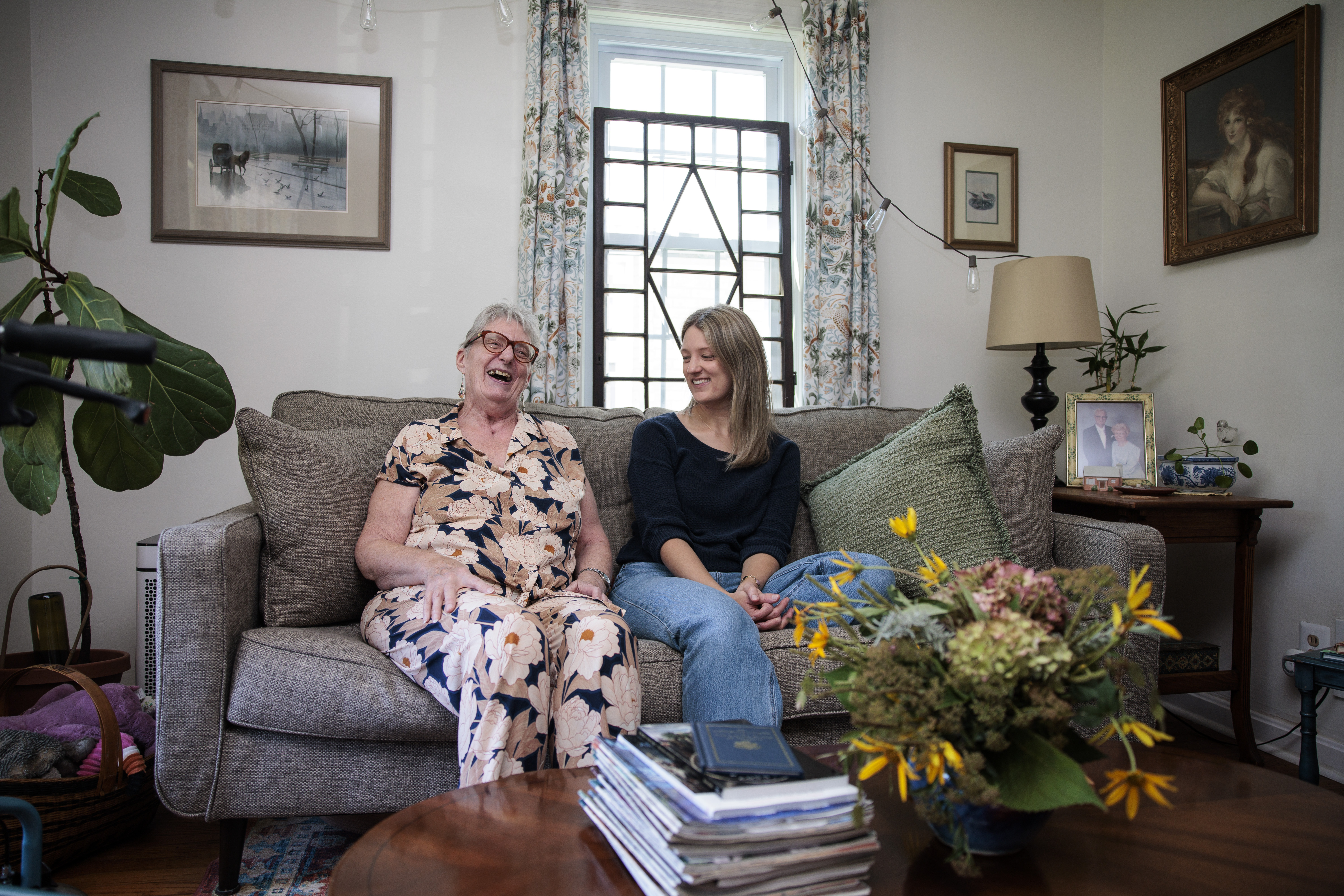
Lehr, a graphic designer at Dietz & Watson in Philadelphia who was still living with her family next door, decided to buy the house and move in with her 71-year-old aunt. She became the 24/7 on-call person; Lehr’s mother shares the rest of the caregiving with her.
These days, Lehr and Eiser can often be found at home together, sewing, playing Yahtzee, and listening to the Beatles.
“My life definitely looks different than some of the people around me,” Lehr said. “While it’s a responsibility, it’s a joy.”
The following, as told to Zoe Greenberg, has been edited for length and clarity.
On deciding to buy the house
Lehr: I couldn’t bear the thought of my aunt losing her mother and then losing her home. The emotional toll just would have been too much. Consistency and routine in her life are important. I was also ready to spread my wings a little bit, even though I was buying right next door.
Eiser: My mother passed away, my father passed away, and I’m disabled. I need someone to help me. So since Lynsey lives right next door, and I’m her godmother and her aunt, she decided to come over and live with me. That helps me out a whole lot.
On becoming a full-time caregiver at 30
Lehr: I didn’t consider not doing it, just because she was my priority. She still is. I don’t know that we’ll stay in the house forever, but I know she’ll be with me forever. She’ll be with one of us forever. At the time it felt like a big responsibility, but it didn’t feel like the alternative was an option I wanted to consider.
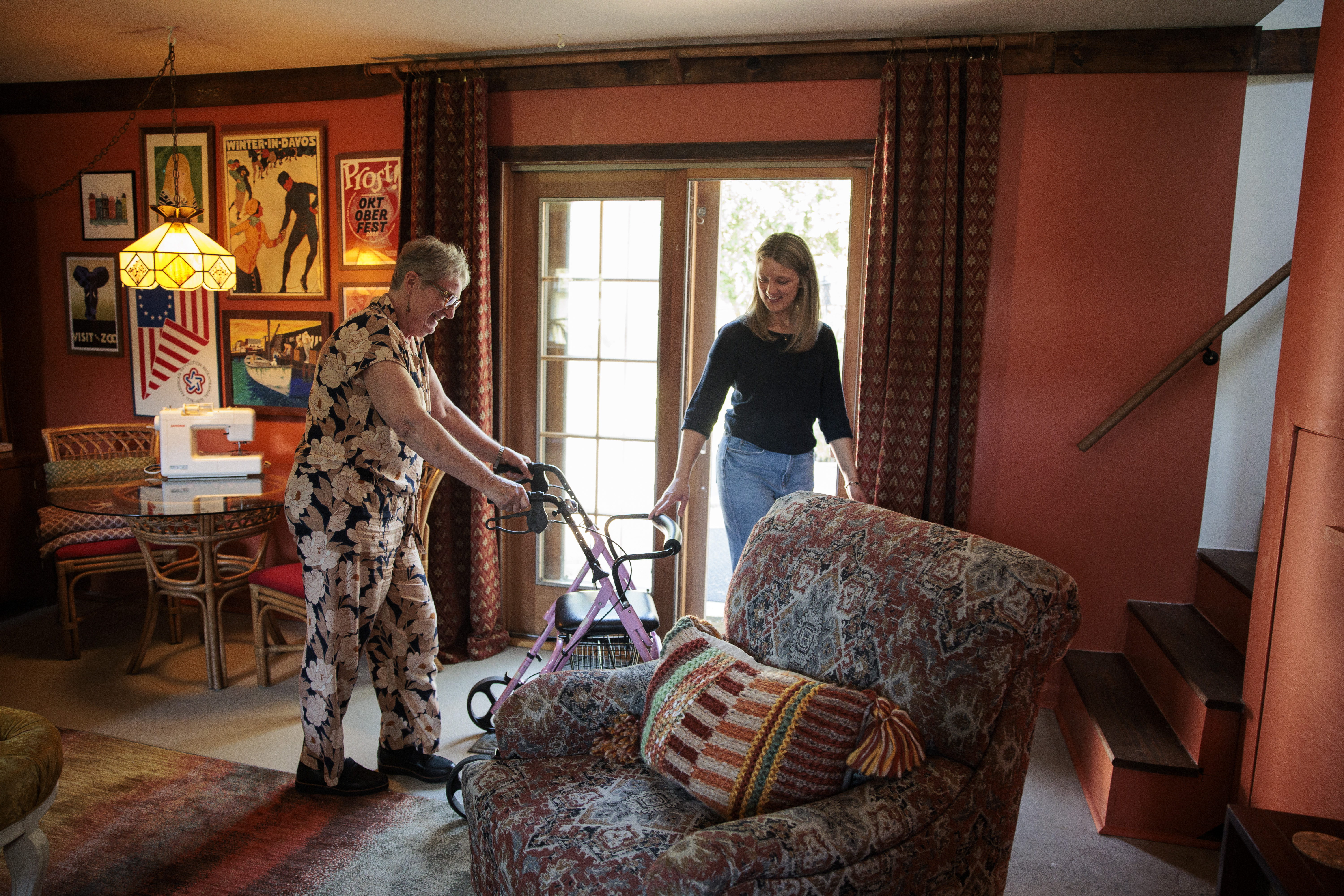
Donna Eiser was left permanently disabled by a hit-and-run when she was 19. Here she uses her mobility device in the home she shares with her niece. Monica Herndon / Staff Photographer
On being both niece and caregiver
Lehr: It’s a hard balance sometimes. I don’t want her to feel that I’m treating her like a child, because she’s not. But there are definitely times when I have to ask her to do the dishes or pick up laundry. I still find her playing a mother role to me, and she always did. As my godmother, she took it very seriously to be a spiritual guide and an emotional guide. I think ultimately we’re friends. I don’t know that there’s any kind of hierarchy.
On forgoing a romantic partner
Lehr: I am not in a romantic relationship, and a part of me feels like this may occupy a lot of my time that I would have normally dedicated to finding myself a romantic partnership. My pursuit of that is secondary to this.
Eiser: I always thought maybe I could, but I can’t handle that. It’d be nice to go out every now and then, but when you find someone who wants to be controlling or wants to have their own way, I say no.
On making it work financially
Lehr: I could not do any of this without my family support. I have an income and I pay my bills, and then my aunt fortunately gets help from Social Security, so she contributes a bit of that for her room and board. Because of her disability benefits, she’s not allowed to accumulate any kind of savings. We make it work.
On comparing her life to her peers
Lehr: I have a lot of friends who have young kids, and I think that the caregiving responsibility is similar. There’s a part of me that mourns living alone because I have friends who have their own apartments, or fewer responsibilities. In a way, that life does sound desirable.
It’s kind of a slow life, especially with her mobility issues. We have to consider what is within her comfort level and we do spend a lot of time at home. But we’re content with that.
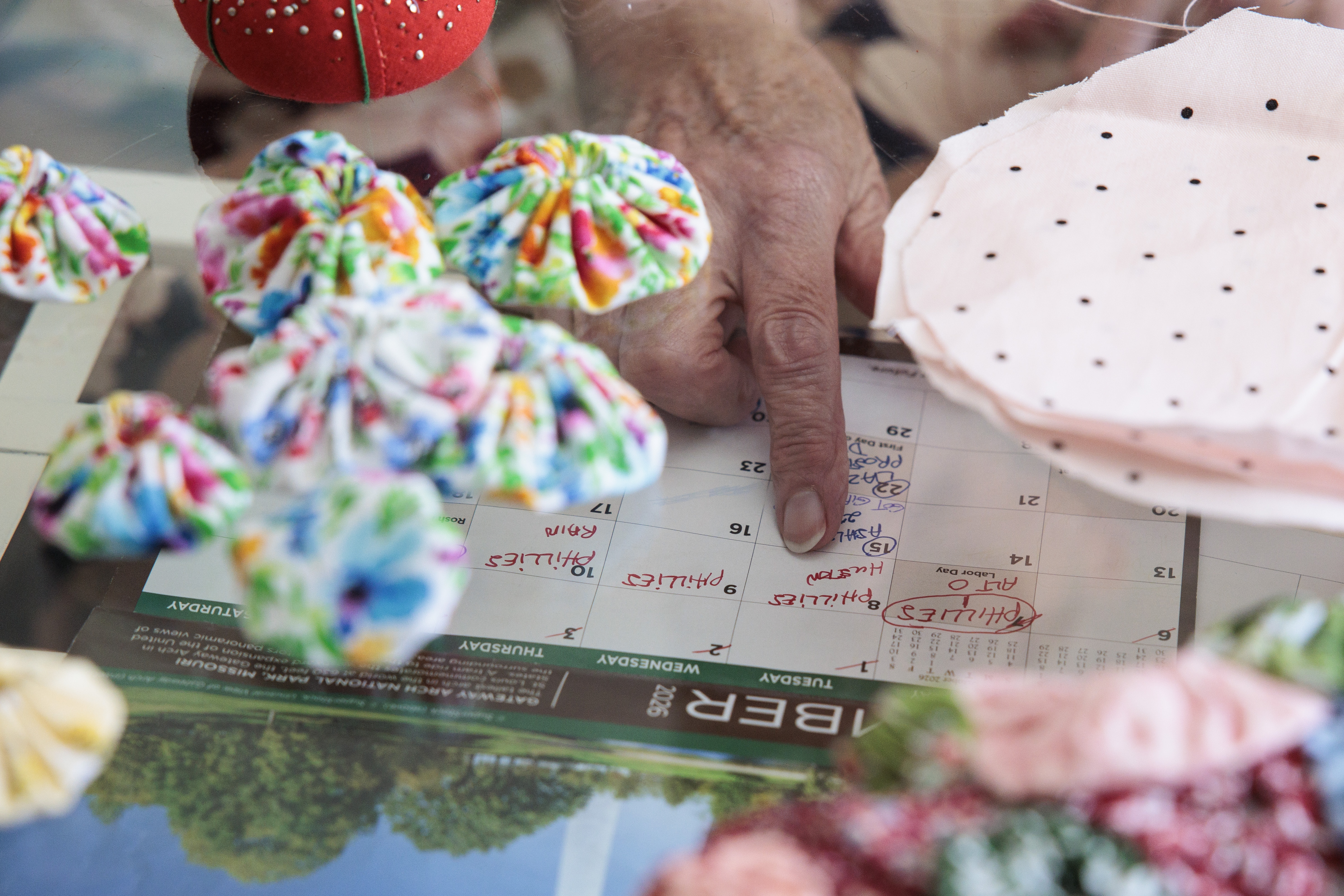
Donna Eiser points to the calendar that she uses to help her remember appointments and plans. She’s a major Phillies fan. Monica Herndon / Staff Photographer
On their 36-year age difference
Eiser: It’s OK to have a young roommate. Sometimes I think, “How come I can’t do what she’s doing?” The older you get, the harder it is.
Lehr: Honestly, I think Aunt Donna’s younger at heart than I am. She’s so creative, she’ll come up with these outlandish projects. Yesterday, she mentioned out of nowhere that she wanted to be a corn on the cob for Halloween. Now we’re planning logistically how that’s going to work.
This story is part of a series about life partners across the Philadelphia area.
If you want to share your story about who you’re navigating life with, romantically or otherwise, write to lifepartners@inquirer.com. We won’t publish anything without speaking to you first.
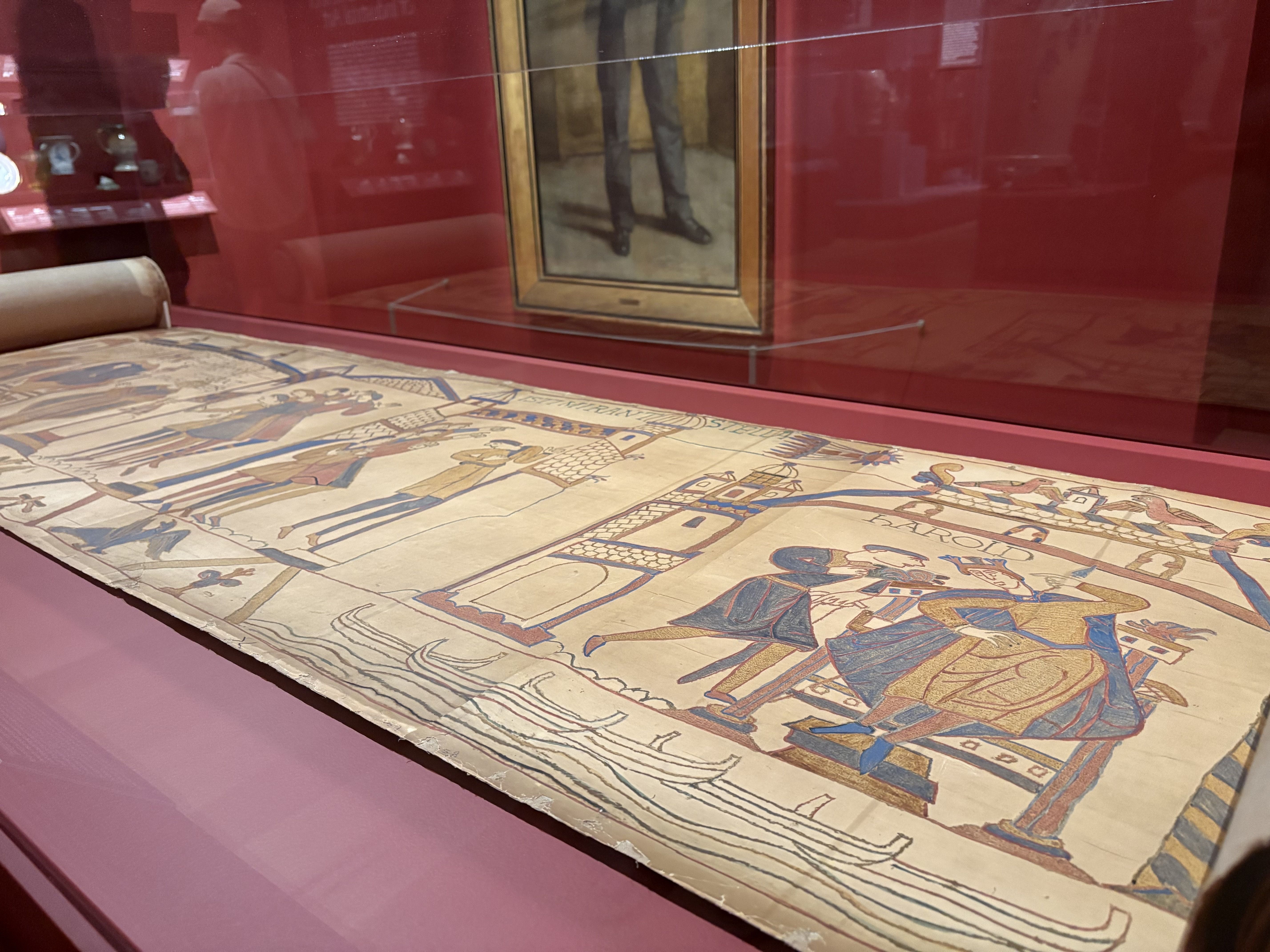
A copy of the Bayeux Tapestry dating from about 1873 is part of the Philadelphia Museum of Art’s collection and on display for the first time in decades.Peter Dobrin
A Bayeux Tapestry seen nearly after a century
“Bayeux mania” struck London last week. Throngs filed through the British Museum to see the Bayeux Tapestry, the famed 220-foot tapestry from the 1070s that returned to England from France for the first time in centuries.
Meanwhile, in Philadelphia, a Bayeux Tapestry has returned to public view for the first time in decades.
The piece is one of the stars of “Workshop of the World,” which opened at the Philadelphia Museum of Art in July and runs another few weeks. With 270 textiles, ceramics, pieces of furniture, works in stained glass, as well as paintings and prints, the exhibition takes a deep dive into the Arts and Crafts movement and industrial design in Philadelphia. The material is thoroughly Philadelphia, starting with the Centennial Exposition and following the city’s art schools, including the various iterations of the University of the Arts, and explores the idealistic craft communities of Bryn Athyn, New Hope, Rose Valley, and, in Delaware, Arden.
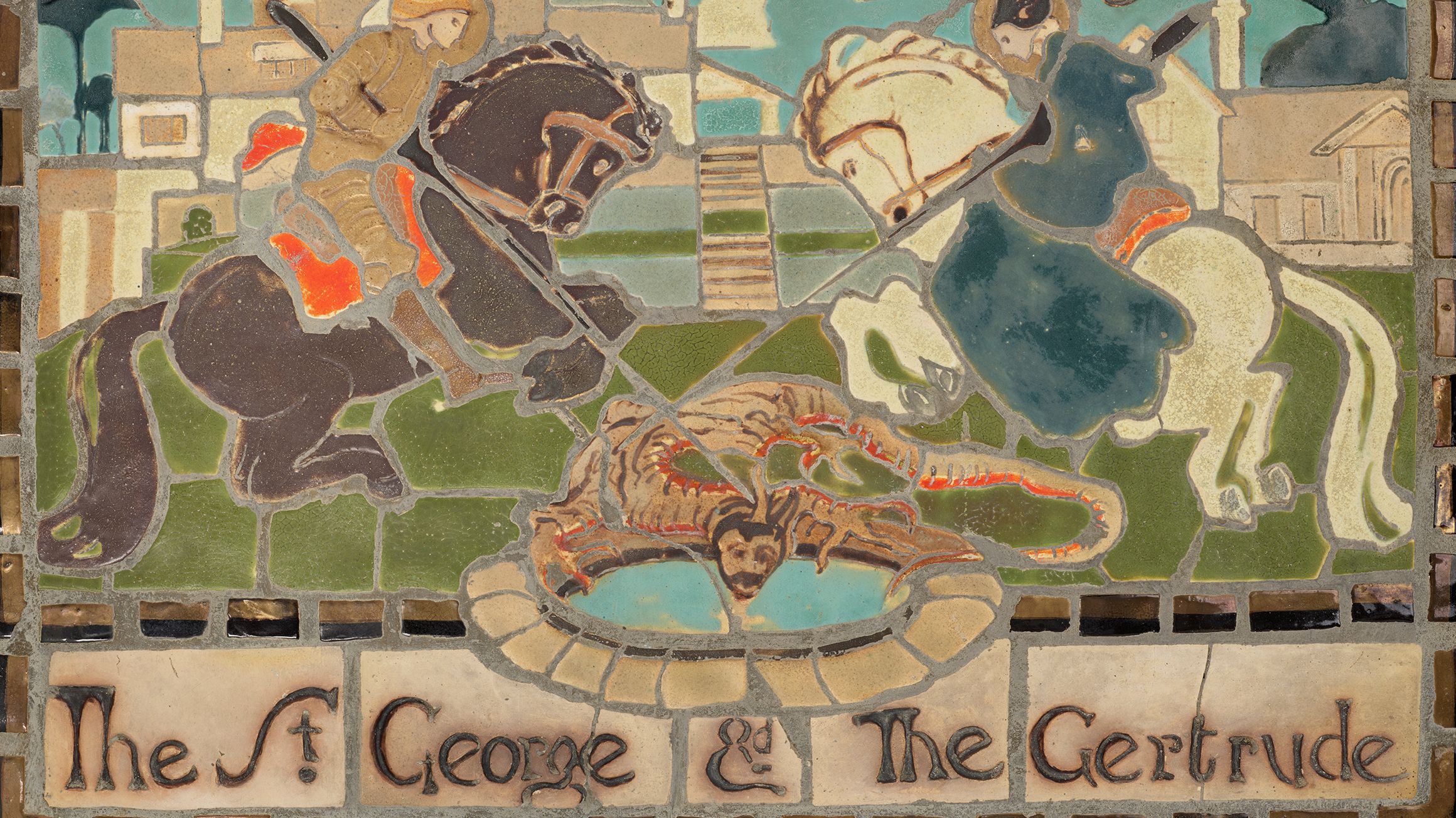
Designed by Violet Oakley, “The St. George and the Gertrude Mosaic” c. 1911-1913, in the Philadelphia Museum of Art’s “Workshop of the World” show.Philadelphia Museum of Art
It’s also a show that probably packs in more beauty for beauty’s sake than any other at the museum in recent years while spanning an incredibly diverse aesthetic. It’s not often you see Golden Age book illustrator Maxfield Parrish, contemporary stained glass artist Judith Schaechter, and fabric swatches from the 19th century pulled together in one place, much less threaded into a story this convincingly.
The Bayeux Tapestry on view is gorgeously rendered and quite old, but not a millennium old. It is, rather, a full-scale reproduction from about 1873 both mechanically produced — with photography — and handmade.
“It was a project overseen by the South Kensington Museum in London,” said PMA curator of American decorative arts David Barquist. “They sent a photographer to France and made hundreds of glass plate negatives to print this out [on paper, mounted on cloth], and it was hand-colored because, of course, they didn’t have color photography at that point.”
Six copies were made, one of which was acquired by the Art Museum in 1888. Rolling Stones drummer Charlie Watts owned another copy. It was bought by the Bayeux Museum from Watts’ estate in 2023.
You can see only a relatively short stretch of the Philadelphia Museum of Art’s facsimile. It’s been unfurled to the scene of King Harold’s coronation and a visit from Halley’s comet, which was seen as a bad omen.
Still, to see it at all is a rare treat. The museum displayed the piece when the museum was housed in Memorial Hall, but when the PMA moved into its current building, in 1928, the Bayeux reproduction was put into storage and wasn’t seen again until now, said Barquist — nearly a century later.
“By the time we moved here, Fiske Kimball was the director. This is not Fiske Kimball’s cup of tea,” said Barquist. “He was about modernism and Duchamp and all that stuff.”
Duchamp, by the way, promises to take the spotlight once again, with a major show opening at the museum Oct. 10. Call it “Duchamp mania.”
“Workshop of the World” continues at the Philadelphia Museum of Art through Oct. 11. philamuseum.org.
— Peter Dobrin
Philly Fashion Week pleats, tucks, seams seen up close
I’ve watched Kevin Parker and Kerry Scott build Philly Fashion Week for 21 years.
Each year, I’m more impressed with the way they’ve made the biannual four-day style event not just a runway extravaganza but also a teaching opportunity. Fashion is an industry and Parker and Scott are dedicated to helping Philadelphia designers not just be fabulous but sell their fabulosity.
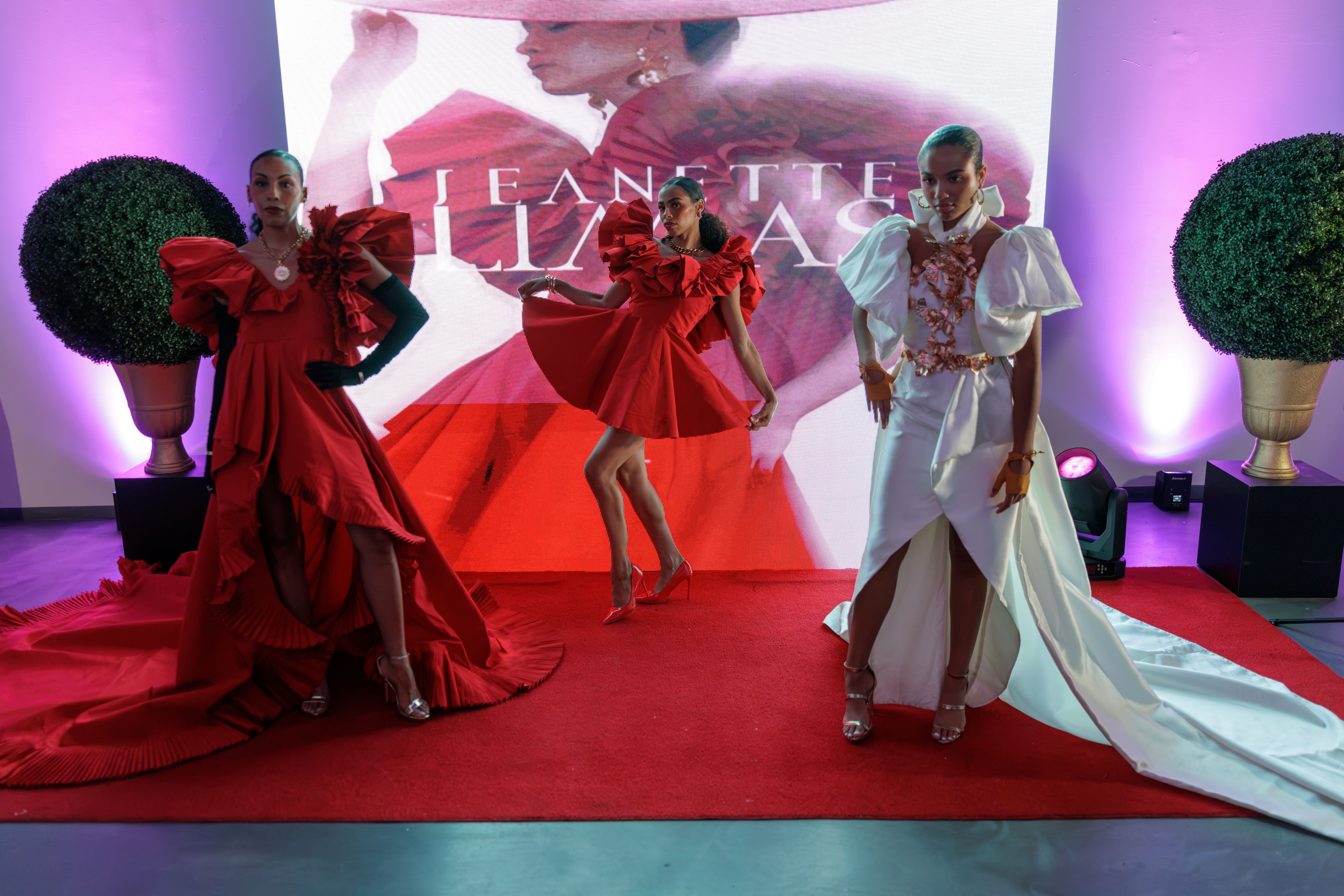
Philly-based special occasion designer Jeanette Limas’ dramatic gowns featured during Philly Fashion Week in Tuesday night’s Immersive Show. This is Philly Fashion Week’s 21st year.Ana Photography
Tuesday night’s Immersive Fashion Show, the kick-off event to this fall’s Philly Fashion Week “From the Runway to the Streets: Philadelphia is Fashion” was another example of that. The show featured collections from five designers whose models did more than walk a runway: They walked up to the audience, allowing onlookers to see each pleat, tuck, seam, and swish of a hemline close up.
“We wanted to give the audience a chance to see the clothes, admire them, take pics, talk to the models, interact with the designers,” said Parker. “It’s a different way for designers to see the clothes.”
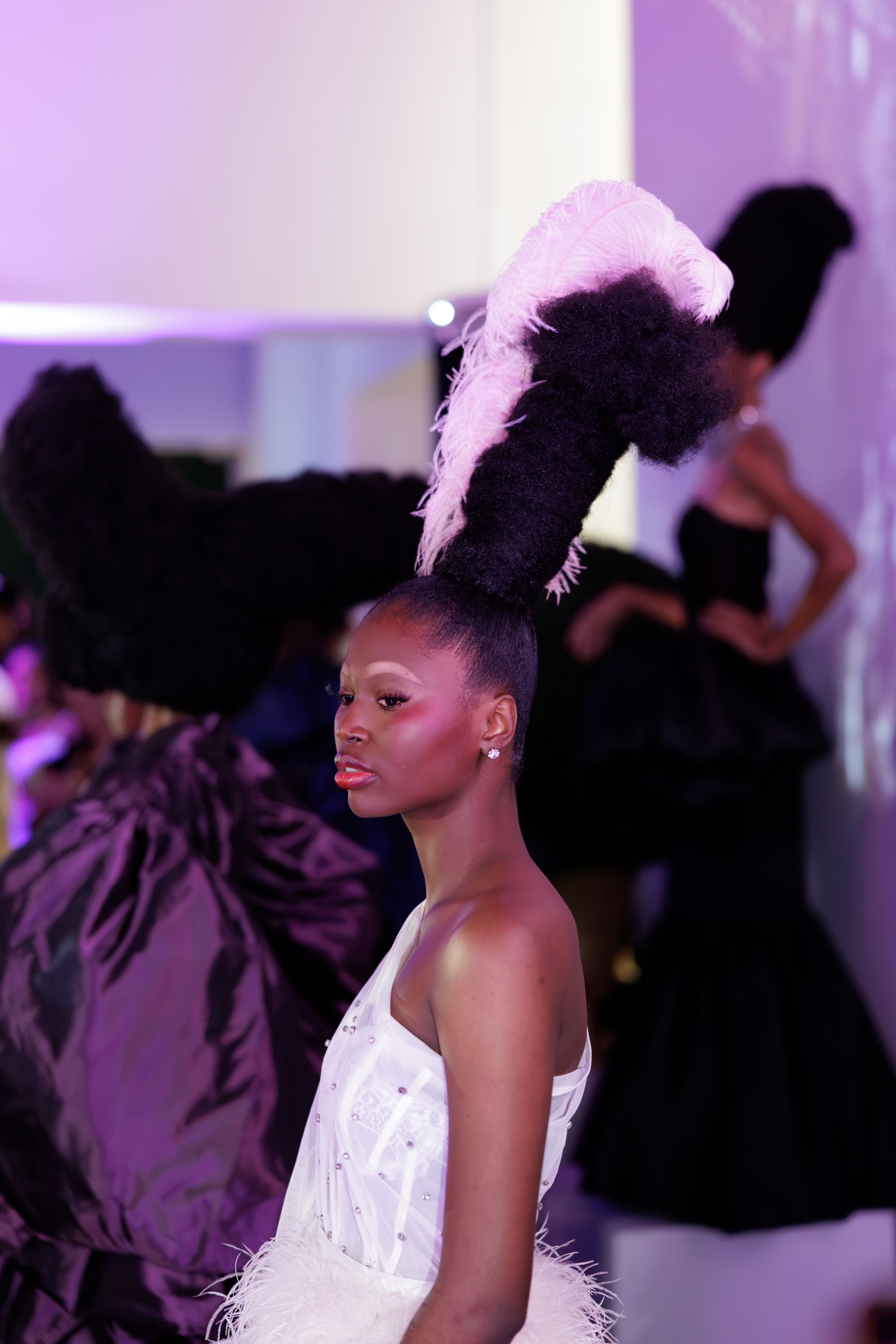
Among my favorites were Jeanette Limas’ romantic, yet no-nonsense silhouettes. I think there is a red gown appropriate for every occasion, and those with billowing sleeves, cinched waists, and ruffled hemlines give feminine energy with a powerful twist. Melani Von Alexandria’s hot girl looks were tailored and sharp in black and white. Sculpted hair designs by Kia Sterling took the gowns up an avant-garde notch.
Philly-based avant-garde designer Melani Von Alexandria’s designs were featured in Philly Fashion Week’s Immersive Fashion Show. Tuesday night’s production is part of Philly Fashion Week’s 21st year. This year’s theme is “From the Runway to the Streets.”Ana Photography
Philly Fashion Week culminates Saturday, Sept. 19. The Business of Fashion Panel will be Saturday from 5 p.m. to 6 p.m., featuring a fireside chat with celebrity stylist KJ Moody — whose clients include Beyoncé — followed by the Runway II show, with more than dozen looks by national and local designers. The show will be outside between Market and Filbert Streets on Ninth. Tickets are available here.
— Elizabeth Wellington
Greek tragedy meets an American tragedy at Philadelphia Fringe
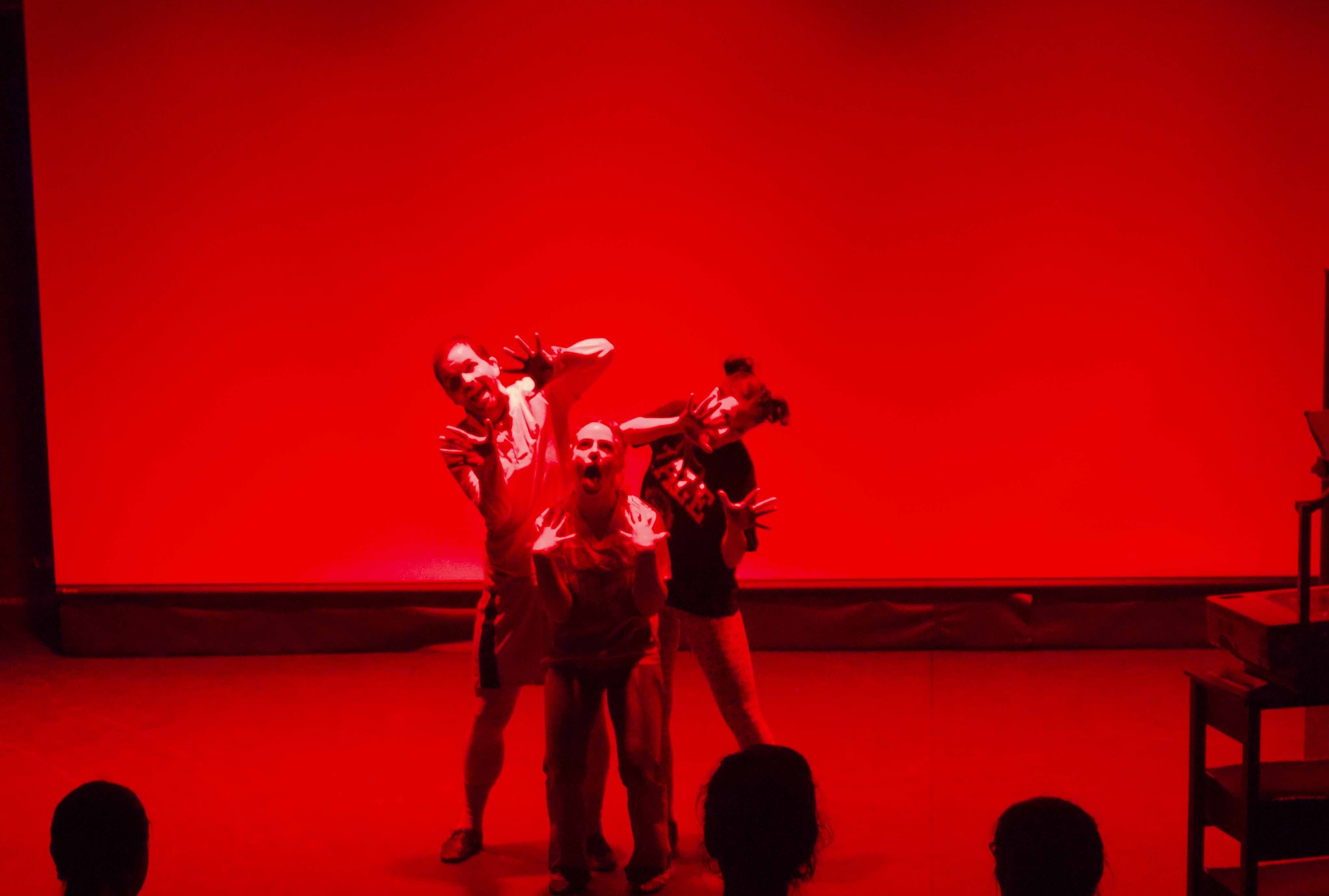
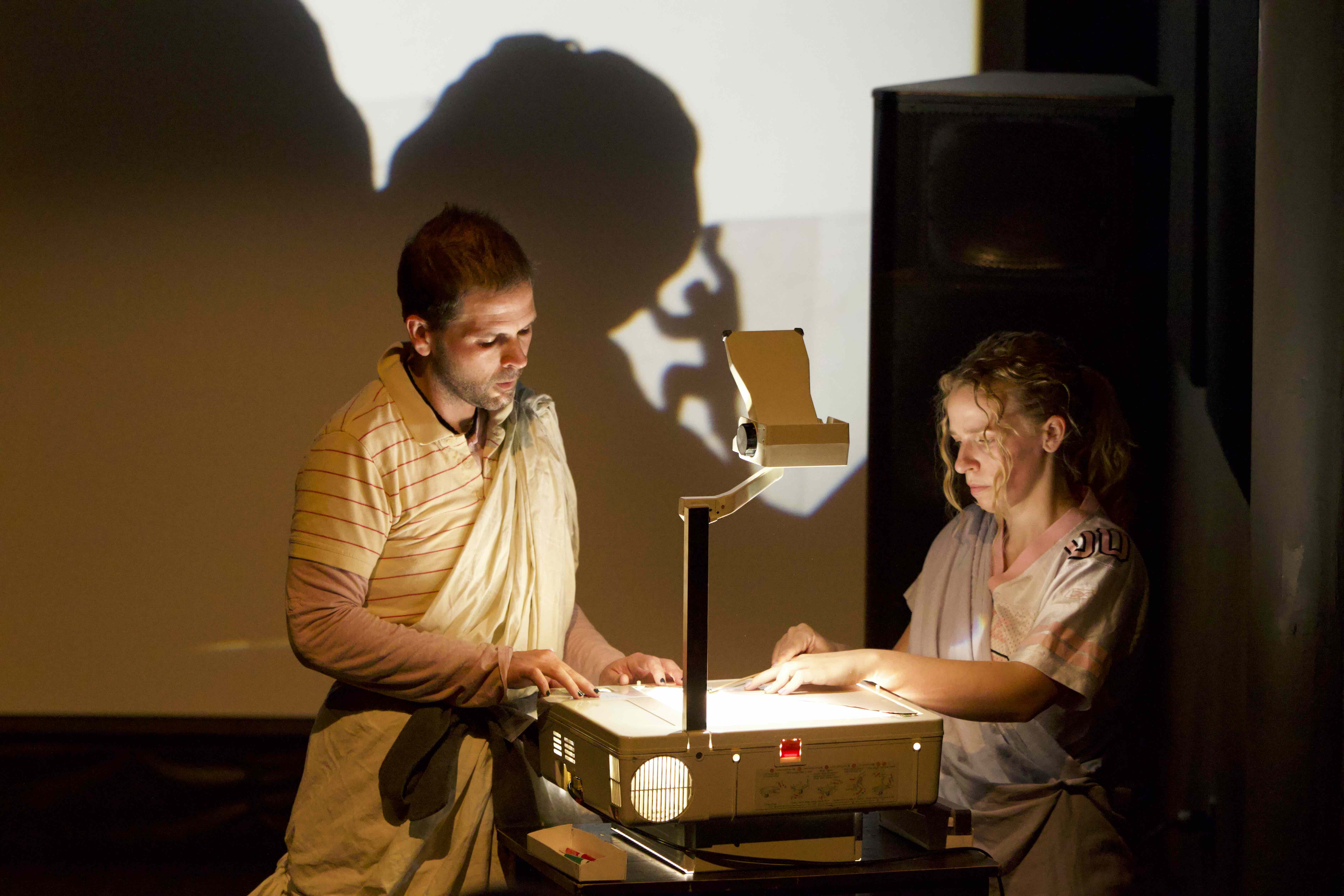
Remember when you got paired up with two other kids to present a history project in middle school? That is the premise of little ghost party’s 2026 Fringe production: three awkward middle schoolers having to put on a presentation about Greek playwrights. The three protagonists take turns hilariously recreating some of the best Greek tragedies, which unearths emotional moments for each.
A still from ghost party’s “Offstage Onstage: Everything You Didn’t See the Greeks Do,” playing Philadelphia Fringe through Sept. 28 at the Asian Arts Initiative Black Box. Sam Dellert
Many Greek tragedies are considered violent, and the brutality makes it difficult to adapt in modern times. However, little ghost party smartly sets this middle school presentation in the wake of a neighboring school shooting. The students use that grief, along with raised alertness and fear, which makes the violence in some of these tragedies seem more contemporary.
Great performances from the three creators of the piece and some nostalgic projection work makes for a wonderfully unique Philadelphia Fringe experience.
“Offstage Onstage: Everything You Didn’t See the Greeks Do” is running at the Asian Arts Initiative Black Box until Sept. 28.
— Frank Schierloh, For The Inquirer
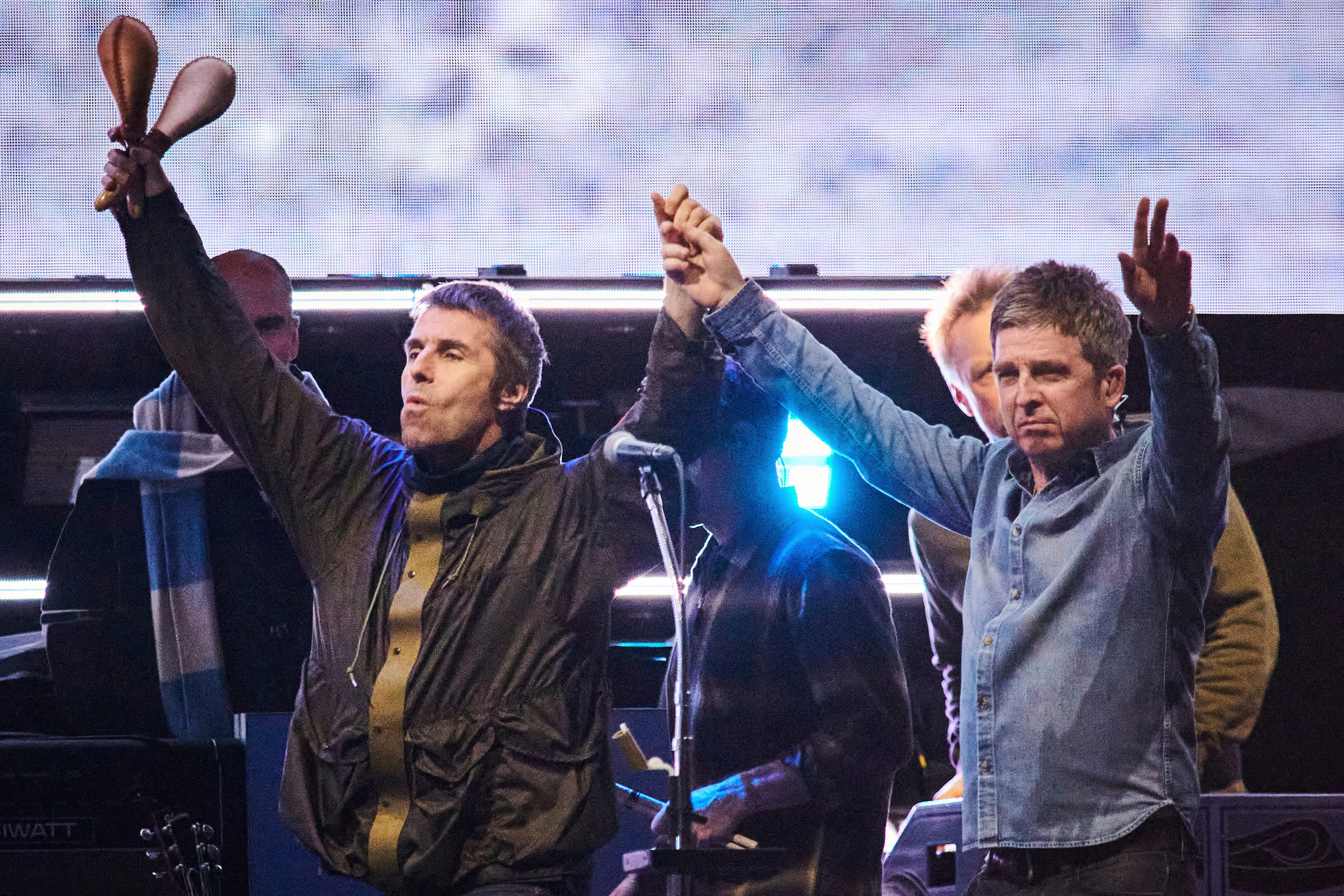
Liam Gallagher (left) and Noel Gallagher of Oasis during their reunion tour in Toronto, Aug. 24, 2025. “Oasis: Don’t Look Back in Anger,” the new documentary about the band’s 2025 reunion tour, is in Philly-area theaters. (Sammy Kogan / The Canadian Press via AP, File)Sammy Kogan
An Oasis documentary that’s much more than a band biography
Then in 2025, battling brothers Noel and Liam Gallagher finally made peace after more than 15 years of not speaking to each other. But when the biggest Brit-pop band in the world reunited, they didn’t come any closer to Philadelphia than MetLife Stadium in East Rutherford, N.J. That time, I didn’t make the trip up the Jersey Turnpike to see them.
And now that I’ve seen the new film, Oasis: Don’t Look Back in Anger, I’ve come to see the error of my ways.
The documentary, which is directed by Will Lovelace and Dylan Southern, is an excellent concert film that captures the majestic roar of the Mancunian band’s guitar-army wall of sound.
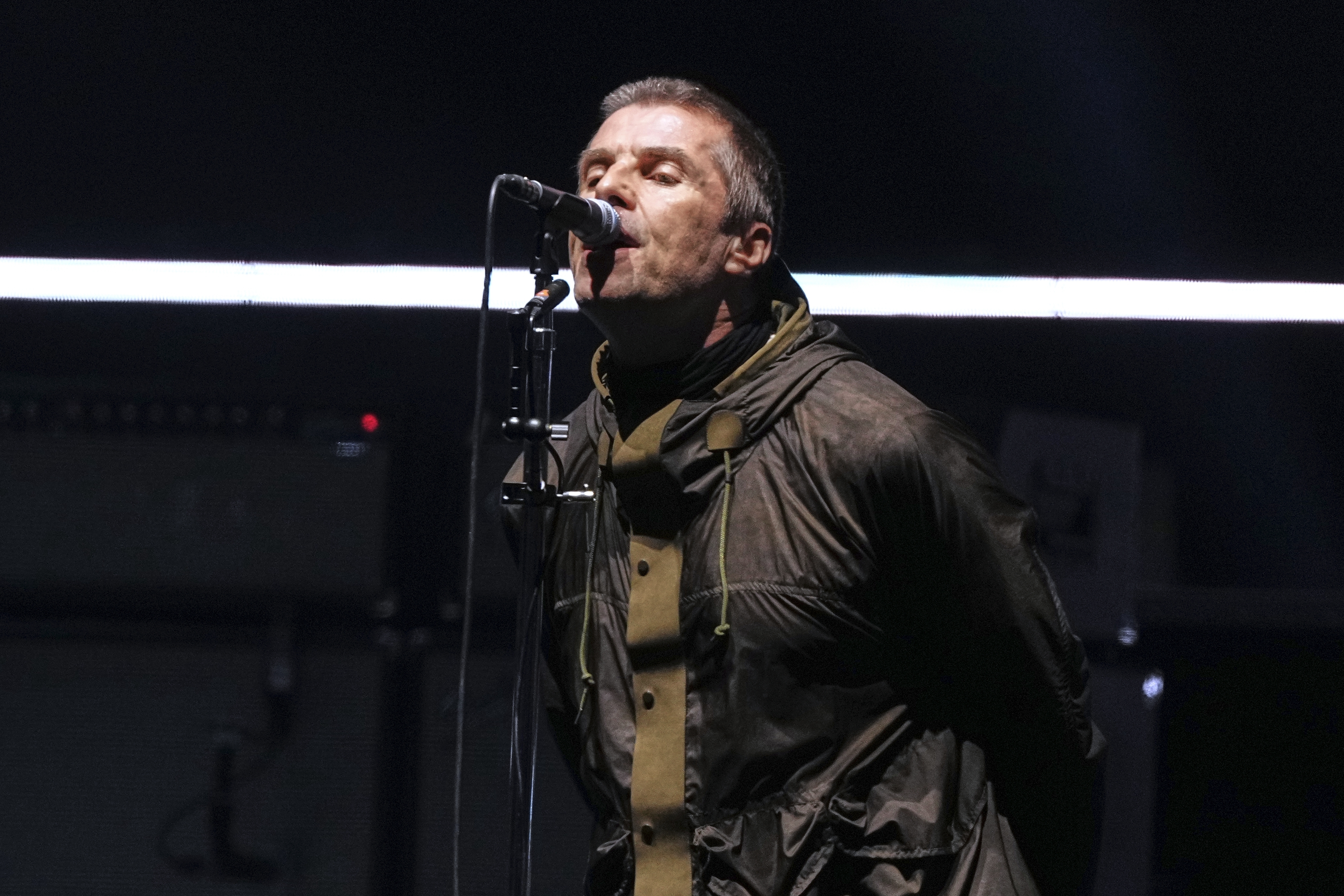
Liam Gallagher from the band Oasis performs during their reunion concert on July 4, 2025, in Cardiff. (Photo by Scott A Garfitt/Invision/AP)Scott A Garfitt
But as it follows the Gallaghers as they fill stadiums in the U.K., U.S., and around the world, with 50,000 and more at every tour stop, it also achieves something improbable.
Don’t Look Back in Anger, which credits Peaky Blinders’ creator Steven Knight as a writer, also tells a moving story about reconciliation.
That’s because it’s not just about the brothers, who were so completely estranged that their children had never met. It’s also about the fans to whom Oasis obviously means so much. And the kick is that so many of those ardent enthusiasts seen in the movie — particularly those in Asia and South America — are much, much younger than the band.
“Supersonic,” the first-ever Oasis single, from 1994, opened with the line “I need to be myself, I can’t be no one else.” The under 30 fans in the film who have taken that credo to heart and have waited most of their lives to finally see their favorite band live, include a Korean haenyeo, a “diving woman,” like the swimmer in the Japanese Breakfast song of that name.
There’s also a young Brazilian woman who finds her identity through an Oasis fan group and names her German shepherd after the band’s guitarist, Paul “Bonehead” Arthurs. And a Manchester priest fashions a compelling sermon about forgiveness around Oasis finally making peace. If the Gallagher brothers can put their acrimony aside and love one another, he reasons, perhaps there’s hope for us all.
Oasis: Don’t Look Back in Anger is playing at Philly-area theaters and expected to stream on Hulu and Disney+ later this year. The band has announced Oasis ’27 tour dates. Once again, Philadelphia is not on the itinerary, with the band doing 11 hometown dates in Manchester next June and the only U.S. shows are three each in Boston and Las Vegas in August. Anyone up for a road trip?
— Dan DeLuca
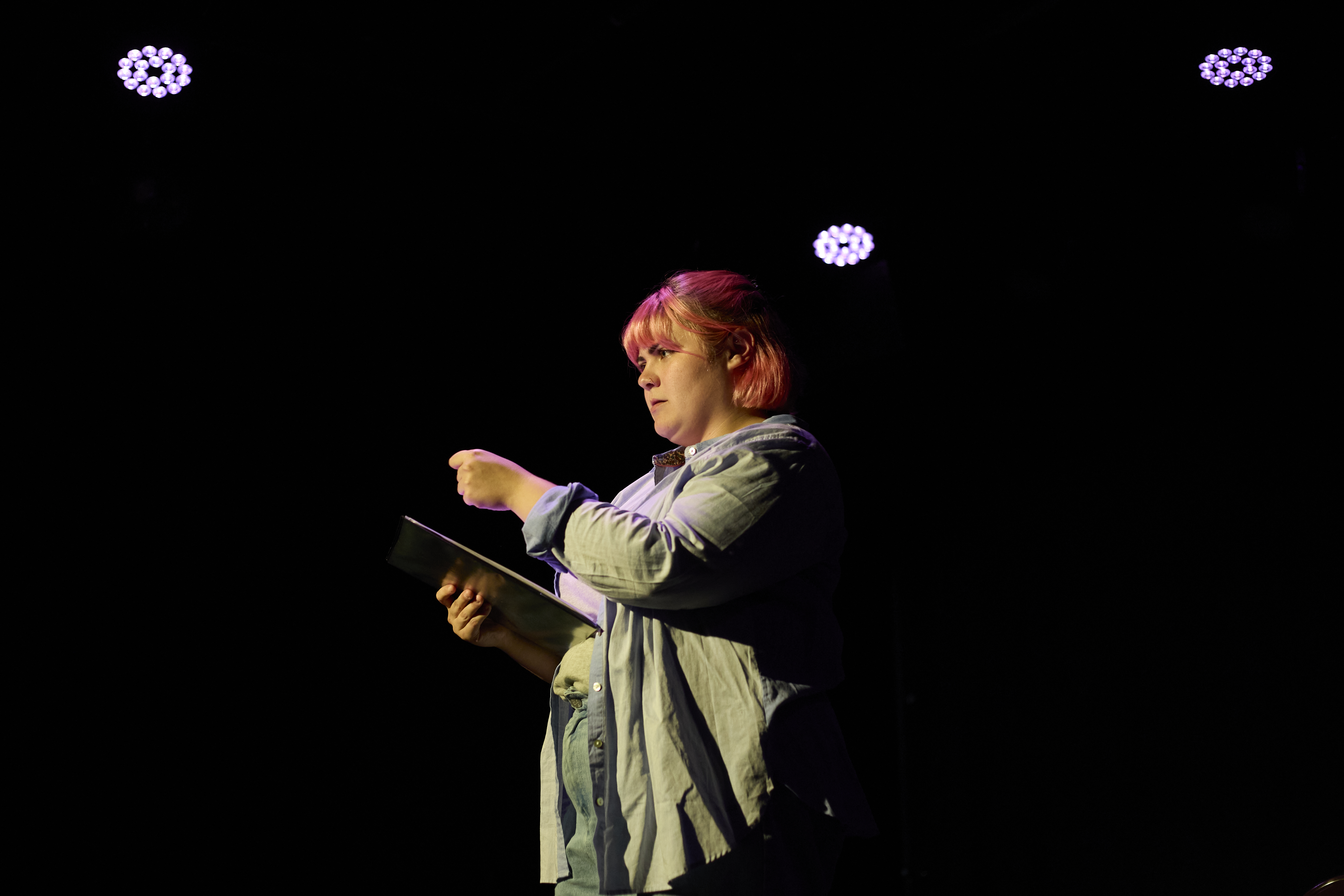
Philly playwright/comedian Liv Shoup in a reading of her play “Trauma Queen” at Plays and Players Theatre as part of the 2026 Philadelphia Fringe Festival.Courtesy of the Lemonade Stand
Trauma Queen holds court at Philly Fringe
What’s the worst thing that’s ever happened to you? Tell the Trauma Queen and she’ll make a hilarious joke out of it. Philadelphia playwright/comedian Liv Shoup presented a reading of her work in progress, Trauma Queen, to a packed house at Plays and Players’ Skinner Studio as part of the Fringe Festival’s Lemonade Stand hub. And, despite the dark subject matter, she had the audience snort-laughing almost the entire time.
Shoup’s titular queen brimmed with charisma in bright pink hair and compelling stage presence, despite the binder holding the script in front of her. She puts herself out there by trying stand-up at open mic nights, only to get kicked out for trying to tell rape jokes.
Her trauma, the sheepish stage manager tells her, isn’t funny, it just makes people uncomfortable (she excels in evoking both humor and discomfort in revealing, fascinating ways).
Then when she tries presenting in group therapy, she’s dinged for taking such a light tone about such serious topics. Doctor’s suggestion? Try stand-up. Instead of digging through her personal history, she turns it over to the audience (and the internet) to solicit their bad experiences so she can poke fun at them — and it leads to her surprise success.
The script was smart and biting, with Shoup delivering stream-of-consciousness rants with sharp barbs and excellent comedic timing. Her recovery journey provides pointed critiques of the perils of becoming an internet personality and the challenges of finding true friends who support and believe victims of sexual assault. It was refreshing, hysterical, and heartbreaking. I can’t wait to see where the play goes next.
The final performance of “Trauma Queen” is 1 p.m. Sept. 27, Plays and Players’ Skinner Studio, 1714 Delancey St., Philadelphia.
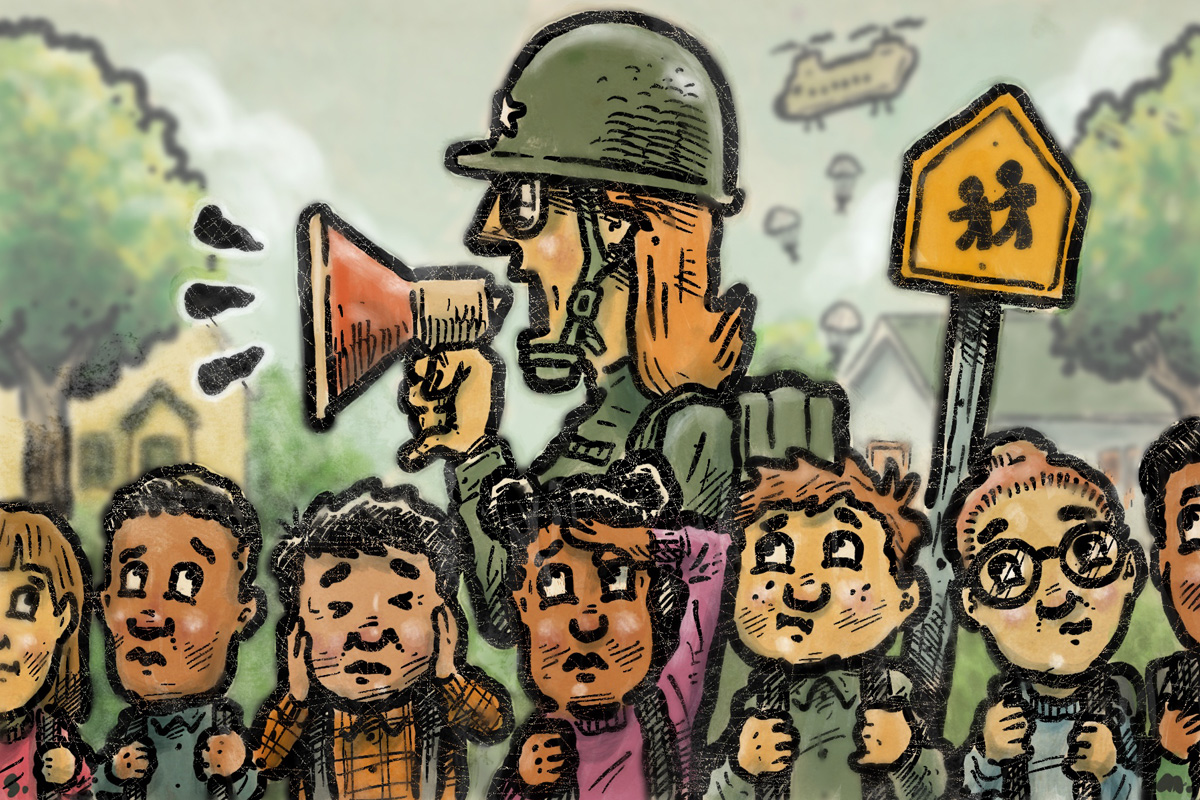
At school drop-off, a mother likes to hover around the kids and discipline all of them for every little thing. If there were any actual issues, we’d step in, of course, but if they’re bumping into each other on purpose and laughing, for example, she tells them things like “Stop doing that, it’s almost school time!” or “Francesca doesn’t like that!” (Not the kid’s real name.) Also it’s very clear that Francesca does in fact like it, so we just tell our kids it’s fine. The mom stands right over her daughter and says things like, “We don’t do that, right?” It’s very performative and very annoying.
Now I respect that she can parent her kid however she wants to, but forcefully talking to our kids is driving some of us nuts. I believe kids usually can and should work out issues amongst themselves (again, though, we haven’t actually seen an issue!). She’s not only a helicopter parent, she’s a military-helicopter parent hovering over her kid and attacking the rest. Do we just keep telling our kids it’s fine and maybe, in private, tell them to not listen to her or do we take her aside and tell her what’s what?
Zoe Greenberg, Life & Culture reporter
Francesca is caught between a rock and a hard place.
So, Mike, how would you approach this very annoying and very performative military-helicopter parent?
It seems to me that the obviously “right” thing to do is to take her aside and talk things out kindly and compassionately.
Mike Newall, Life & Culture reporter
Oh yes. I think we can cut the preliminary “see it from both sides” stuff on this one. Time to confront. And, Zoe, you’re right: the only question is how. Public humiliation? Or private intimidation?
Zoe Greenberg
You’re not entertaining the private, gentle-parenting conversation with the parent?
Mike Newall
No, I am. When I first started reading this question, I thought: “Classic kiss-up parent.” You see them often in the wild. The endlessly chatty and performative parent who hovers near the teacher every morning. Those parents can be handled with a quick joke or snarky comment. But this seems like something more. Something deeper. More ingrained. This demands a gently stern talking to.
You don’t parent other people’s kids. Unless the kid is in danger or a danger to someone else.
Zoe Greenberg
I don’t know that I would have the courage of my convictions to take this parent aside myself, although I would know in my heart it’s what should be done. But if I did, I would say something along the lines of, “Hey, I notice that you’re concerned about what’s happening between the kids and often telling them to stop. To me, it looks fine. I wonder if we can let the kids work it out amongst themselves unless there’s a major issue.”
What motivates a performative parent do you think?
Mike Newall
Insecurity is the main motivator.
Zoe Greenberg
Right. Insecurity! And I wonder if taking the parent aside would ramp the insecurity up. They become defensive. They say “Your kid is terribly behaved!” “Your child is coming for my precious Francesca!”
Mike Newall
That’s why I do think the parent needs a little compassion.
Here’s what I would do:
Linger. The insecure parent kissing up to the teacher, telling every kid what to do always lingers. So wait them out. Until every kid has entered and it’s just the helicopter mom, the teacher, and you. Then, with a smile: confront.
Zoe Greenberg
With a SMILE!!!
Newall goes in for the kill.
Mike Newall
Here’s a basic script you can follow: Hey, whoever. Just so you know my wife/husband and I have spent a lot of time carefully teaching our precious Johnny or Katie how to behave. We have somehow made it this far — to be a little snarky, add exactly how far — to the third grade of whatever elementary without your help. We appreciate the consideration but would feel much more comfortable if you would stop talking to our child like that.
Zoe Greenberg
It sounds like there are multiple parents and multiple kids involved here, but I feel a one-on-one is best. Otherwise it becomes a bit of a gang-up, fueling insecurity further.
Mike Newall
One-on-one is best. If the teacher is there as a witness though, that’s not a terrible thing. The parent will likely be stunned into quiet after your initial salvo. Fill that pause politely but firmly. Be an adult. But lay the line down.
If the teacher is cool, they’ll be silently cheering you on.
Zoe Greenberg
And then let the children figure it out! Let them create their utopian society together, where they work through conflict with patience and calm, from each according to her ability to each according to her need etc.
Mike Newall
Exactly, Zoe!
This is their turf. I used to marvel at the social intricacies my son was dealing with in pre-K. Every day, on the ride home, he’d rattle off from the back seat about who was whose best friend on any given day. Who was mean. Who was nice. Who was acting like the king of the seesaw. And he had to figure it all out on his own.
Not a bad day for Philly schools. Hurts got involved three years ago after seeing a TV report that Philly schools were closing because they were too hot. He has since helped bring down the number of school with out AC, but 52 schools still lack full air-conditioning. His response this week: “Let’s get it to zero.”
Eagles quarterback Jalen Hurts as he appears at a rally in the auditorium at Northeast High School Tuesday, Sept. 15, 2026 to give the school $600k for an air conditioning system. With him onstage in the auditorium Northeast principal Andrew Lukov, School Superintendent Tony B. Watlington, Sr. and Mayor Cherelle L. Parker.Tom Gralish / Staff Photographer
Hunt, meanwhile, has basically been adopted by Little Flower. What started with a fundraiser for its basketball team during his rookie year has turned into basketball-game visits, Little Flower sweatshirts on Eagles road trips, and hundreds of students he calls his “little sisters.”
Philadelphia asks a lot of its Eagles — win football games, mainly. Air-condition the schools and help pay kids’ tuitions weren’t technically on the list, but please, keep going.
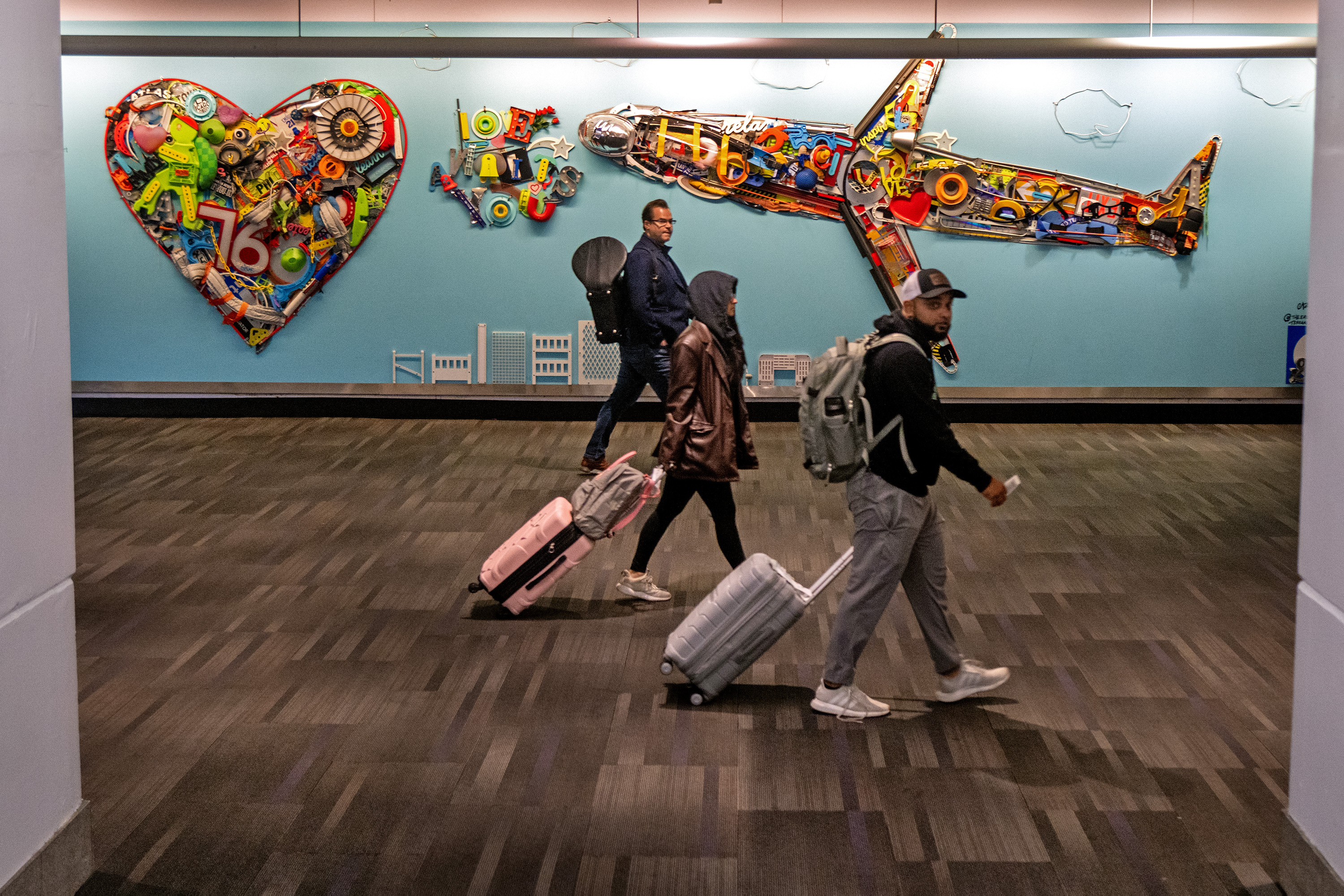
“Love Awaits You” artwork by Philadelphia artist Terrance Woolford in the Terminal B Baggage Claim at Philadelphia International Airport on Nov. 9, 2025. The artist is known for using recycled, trash-picked objects as a source of inspiration.Tom Gralish / Staff Photographer
The terminals are old. The waiting areas are cramped. There isn’t enough natural light. Even the people from J.D. Power basically said PHL needs a new building.
But last? Again? This is where Philadelphia must become defensive about an airport we complain about constantly ourselves.
PHL is easy to get around in without boarding some weird little airport train. And have these people eaten there lately? We’ve got Middle Child, Federal Donuts, Oyster House, and Elixr. The lounges are legitimately good, there’s local art everywhere, and you can find places for your dog to pee. Kiki Aranita made this entire case last year when PHL got snubbed from another airport ranking.
Yes, PHL needs work, and nearly $2 billion in upgrades are underway. But outsiders calling our airport the worst? Only we get to say that.
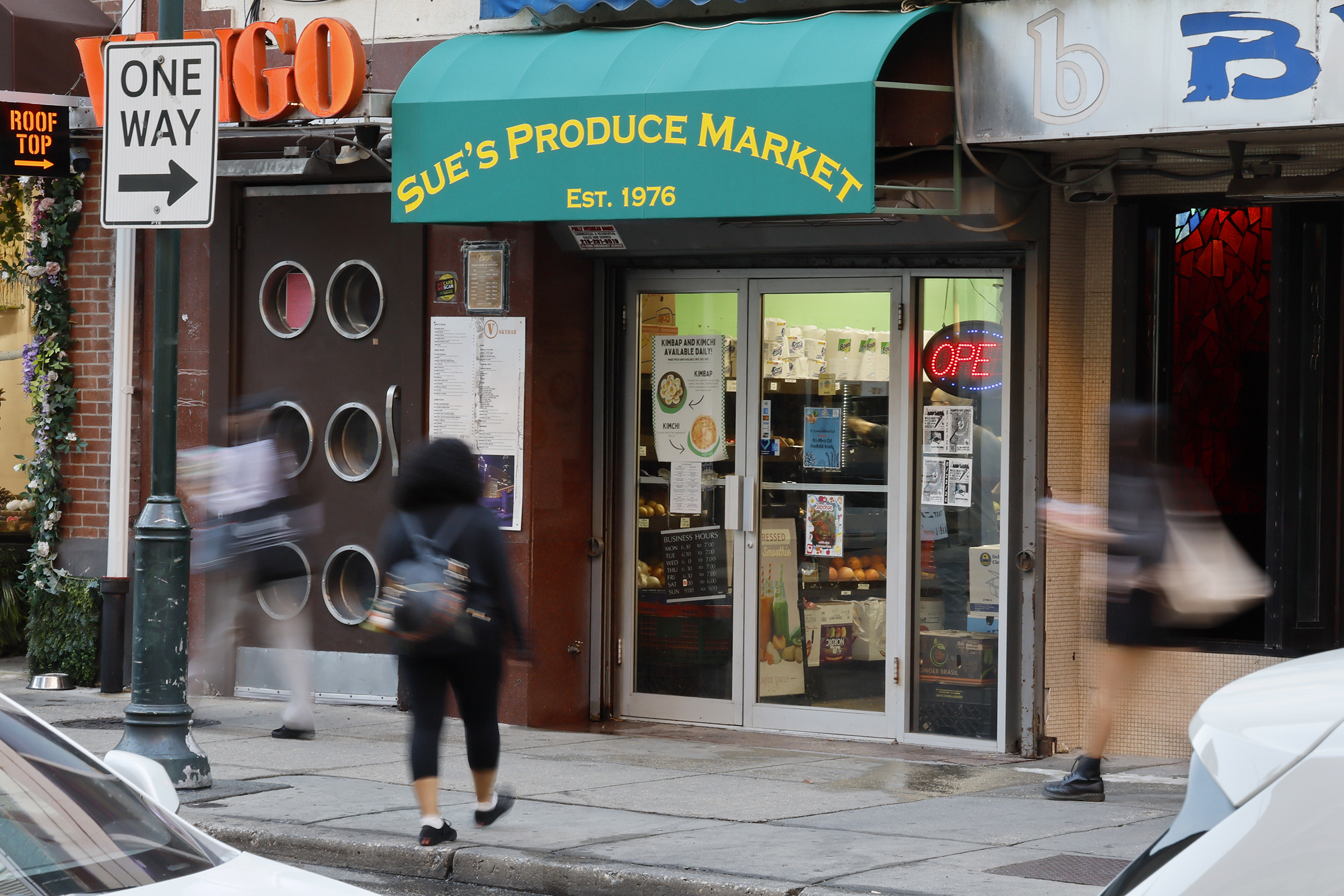
Sue’s Produce Market, 114 South 18th Street in Philadelphia on Wednesday, September 16, 2026.Elizabeth Robertson / Staff Photographer
Rittenhouse shows up for Sue’s: A
Philadelphia is very good at mourning the places we love after they close, but this time, Rittenhouse is trying something different: keeping one open.
Sue’s Produce Market has been part of the neighborhood in one form or another since 1976, when Sue Shin started selling fruit from a cart at 18th and Walnut. Now, after falling behind on rent, the family-owned market needs $40,000 to avoid eviction.
The neighborhood apparently heard that as a challenge. A GoFundMe has already raised more than $25,000, with hundreds of people chipping in. Rittenhouse Row is rallying businesses, and Her Place Supper Club is planning an entire Korean-inspired dinner next month, with the proceeds going to Sue’s.
It makes sense once you hear how this place operates. Tina Shin, 63, gets up at 2 a.m. to make the kimchi and kimbap before spending the day behind the register. People have been buying their fruit and groceries from this family for generations, and Rittenhouse clearly can’t imagine 18th Street without Sue’s.
Philadelphia Phillies pitcher Zack Wheeler throws during the first inning of the Philadelphia Phillies game agains the Houston Astros at Citizens Bank Park on Thursday, Sept. 10, 2026 in Philadelphia.Monica Herndon / Staff Photographer
Phillies, please start hitting: C
Here we go again. The Phillies are approaching October, the pitching is doing its part, and everyone in Philadelphia is once again staring at a very expensive lineup and asking: Are you guys going to hit or what?
The offense responded by drawing 13 walks, leaving 13 runners on base and scoring three runs. It was the most Phillies way imaginable to win 3-0.
Bryce Harper, Kyle Schwarber, Trea Turner, J.T. Realmuto, Alec Bohm, and Luis Arraez are making a combined $111.2 million this season. Nobody expects all six to be hot every night. But Phillies fans have watched some version of this movie for four straight Octobers: great pitching, enough chances, and a lineup that suddenly forgets how to score when the games matter most.
By the time you read this, maybe the bats have woken up (please!). Because the Phillies have the pitching to make another October run, it would just be nice if the guys holding the bats came along this time.
Philly’s 57-year-old typo: A
Philadelphia has a typo carved into a monument outside the Art Museum, and after 57 years, somebody is asking whether we should fix it, reported Billy Penn. Absolutely not.
The Eli Kirk Price Fountain, installed in 1969, honors the man whose “wisdom and dedication were responsible for the developement of the parkway and art museum.” Yes, developement.
The best part is that the Association for Public Art dug up a photo from the fountain’s 1969 unveiling showing men literally pointing at the mistake. The inscription approved two years earlier had “development” spelled correctly, but somewhere between paper and stone, an extra “e” slipped in.
Monument companies say fixing it would probably mean replacing the entire stone and it would be costly. So at this point, fixing the typo would be the mistake. Millions of people have walked past that fountain on their way to run up the Rocky Steps, and almost nobody noticed. Now it has a story.
The Lobster francese at the Bomb Bomb Bar in Philadelphia, Pa., on Thursday, Feb. 12, 2026. .Tyger Williams / Staff Photographer
Bomb Bomb gets a Best of: B-
Philadelphia has apparently reached the point where having only one of the best restaurants in America feels like a slight.
The New York Times released its annual best-restaurants list this week, and just one Philly spot made it: Bomb Bomb Bar, the nearly 90-year-old South Philly tavern that chef Joey Baldino took over and reopened last year.
Philly spent years demanding the rest of the country recognize how good our food scene is. Now we have Michelin stars, James Beard Awards, and enough national acclaim that one restaurant on the Times list suddenly feels stingy. We got two last year and three in 2023!
Bomb Bomb is a pretty great one, though. Baldino took a neighborhood bar that dates to 1936 — and was literally bombed twice in its early days — and made it better without scrubbing away what made people love it.
Congratulations to Bomb Bomb, and the rest of Philly will try to cope with the snub.
The city’s surviving legacy organizations are now working overtime to increase their visibility and bring in new audiences with community events and crowd-pleasing programs.
Nothing captures the public imagination quite like a new building, especially one with an address on Broad Street, the long, straight boulevard branded the Avenue of the Arts. After 19 years of trying, the Philadelphia Ballet will formally open its eye-catching new home just north of the Vine Street Expressway with a gala on Sept. 17.
In times like these, any new arts building in Philadelphia is cause for jubilation, whatever its flaws.
Although the Philadelphia Ballet Center for Dance is primarily a working building that provides the company with modern practice studios and support services, it also allows the ballet to operate its own public theater for the first time in its 63-year history. Shelly Power, the group’s CEO, rightly views the 150-seat space as a major opportunity for community-building outreach.
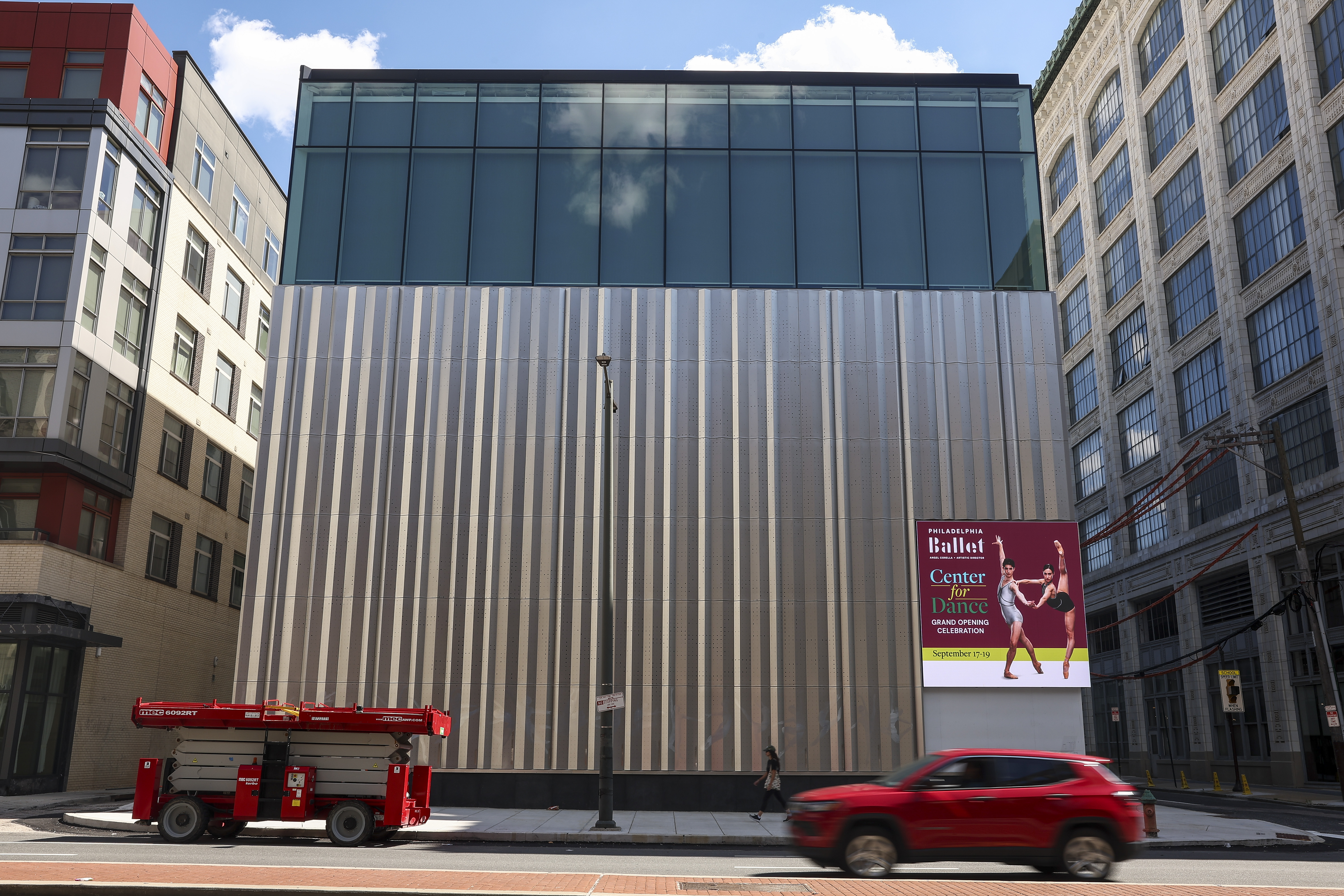
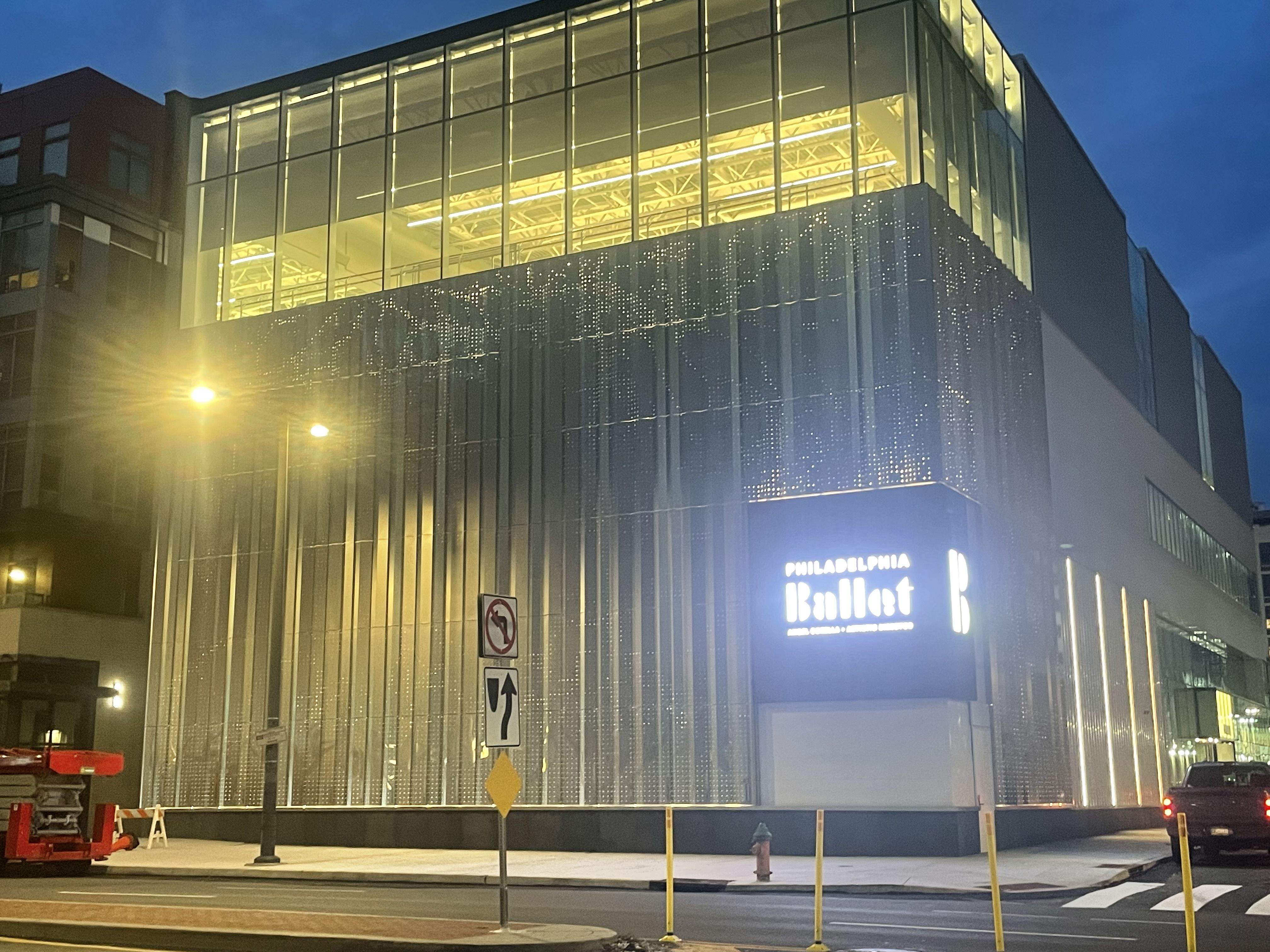
So, it’s frustrating to see the ballet repeat the architectural mistakes of an earlier generation of cultural venues. With its glass-enclosed rooftop studio and pleated metal facade, the building initially dazzles with shimmer and light, especially at night. But it quickly becomes clear that this is just another hermetic box that walls itself off and sabotages its own efforts to engage the public.
The absence of street-level windows on North Broad Street is particularly galling given the corridor’s spectacular revival over the last decade, including hundreds of apartments, the Met concert hall and the award-winning Honeysuckle restaurant.
With its glass-enclosed rooftop studio and pleated metal facade, the Philadelphia Ballet’s new Center for Dance initially dazzles us with shimmer and light, especially at night.Inga Saffron
Rising to new heights
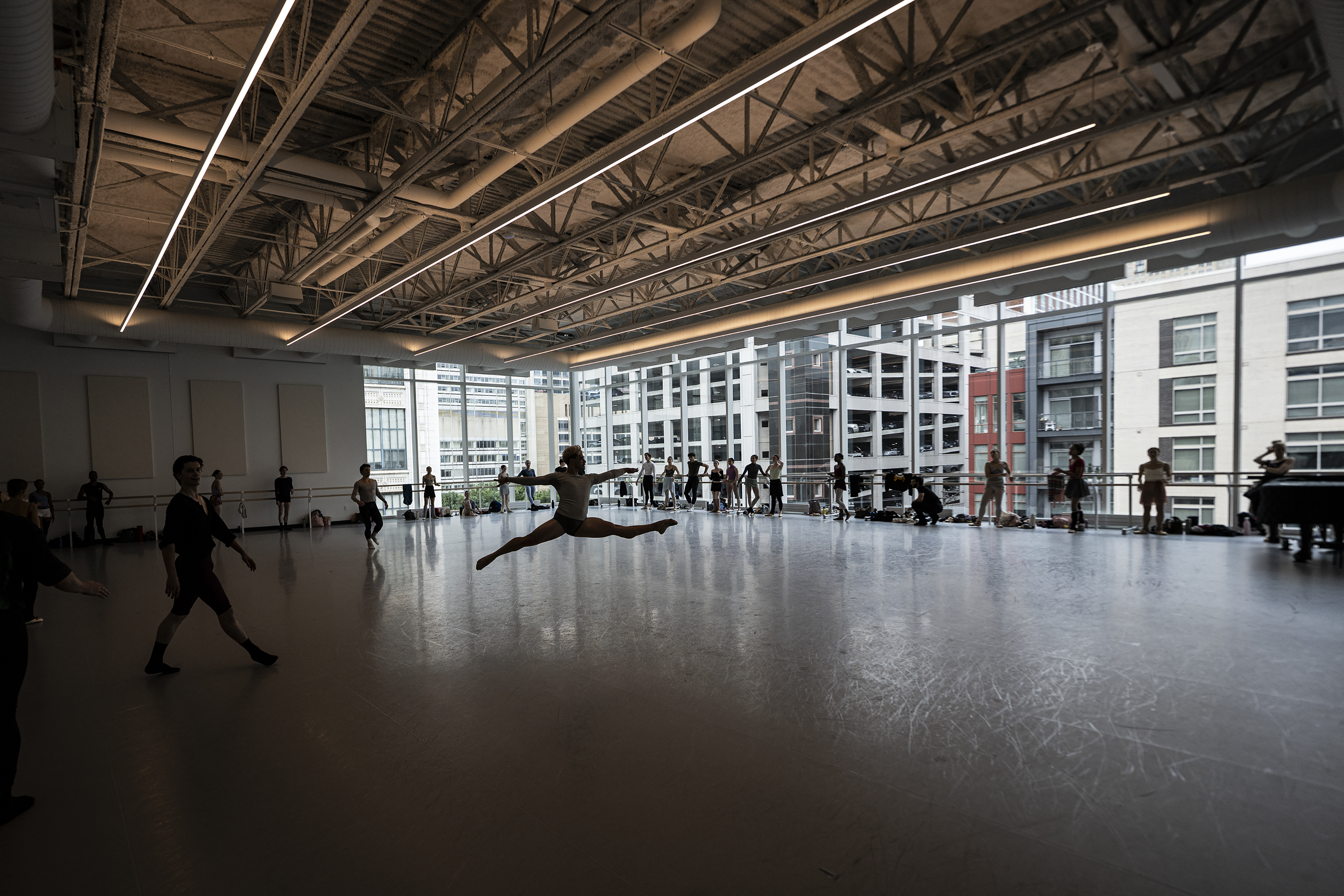
Designed by Varenhorst, a Philadelphia firm that toggles between high-end suburban homes and downtown apartments, the $45 million building is, in some ways, everything a big city ballet could want. The five-story structure does a great job at integrating the soaring, light-filled practice studios for elite dancers, with a dedicated classroom wing for the ballet’s school. Dancers are so energized by the scale of the new space, Power said, they can “jump higher.”
While the majestic Academy of Music will remain the ballet’s main performance space, the stripped-down, black box theater gives the company the opportunity to experiment with more intimately scaled works. And because the performance area is the same size as the Academy stage, the ballet can also do dress rehearsals there.
The new Philadelphia Ballet Center for Dance was built with four soaring practice studios, including this light-filled, double-height rooftop space overlooking North Broad Street.Jose F. Moreno / Staff Photographer
Having access to such an assortment of quality spaces promises to lift the ballet to new creative heights. Although the corps regularly ranks among America’s 10 best classical ballet companies, its dancers and school became itinerant after financial troubles forced the company to sell its old home at Broad and Washington in 1992. For many years, the school was housed in one location, dancers practiced in another, and administrators worked out of a third space. The lack of a stable home made it more challenging to woo top talent.
In 2007, the ballet purchased two small buildings at the corner of Wood Street with the goal of consolidating its operations under one roof. The Avenue of the Arts was just taking shape, and the location promised to give the northern stretch — always a bit of an afterthought — a marquee destination. As a longtime occupant of The Inquirer’s former North Broad Street home — the big white Tower of Truth (now the police headquarters) — I couldn’t wait to see human activity return to those sad blocks above Vine Street.
The design and the architects changed several times. The ballet, which, it is worth pointing out, received no city money for this important project, even lost its financing at one point. Architect Stephen Varenhorst, who signed on around 2016, deserves credit for sticking with the ballet through its many ups and downs.
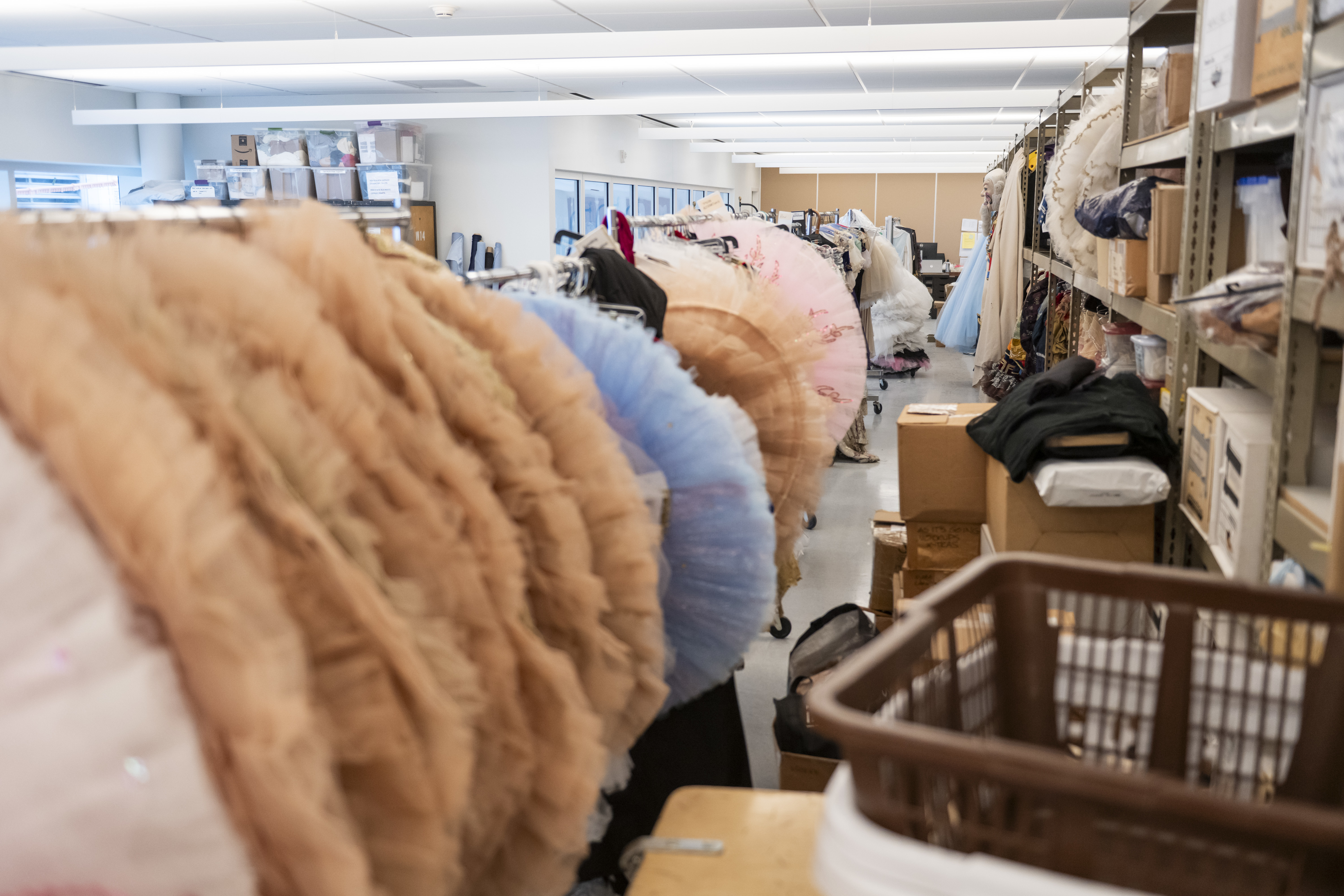
Maybe because the ballet was space-deprived for so long, his design was driven by a desire to make sure the company had the best of everything. Along with four large practice studios, the building is outfitted with a sprawling costume department, workshops for storing and dyeing dance shoes, a music room, and a generously equipped wellness spa.
Costumes line the wall in the wardrobe room in the Philadelphia Ballet’s new building on Broad Street.Allie Ippolito / For The Inquirer
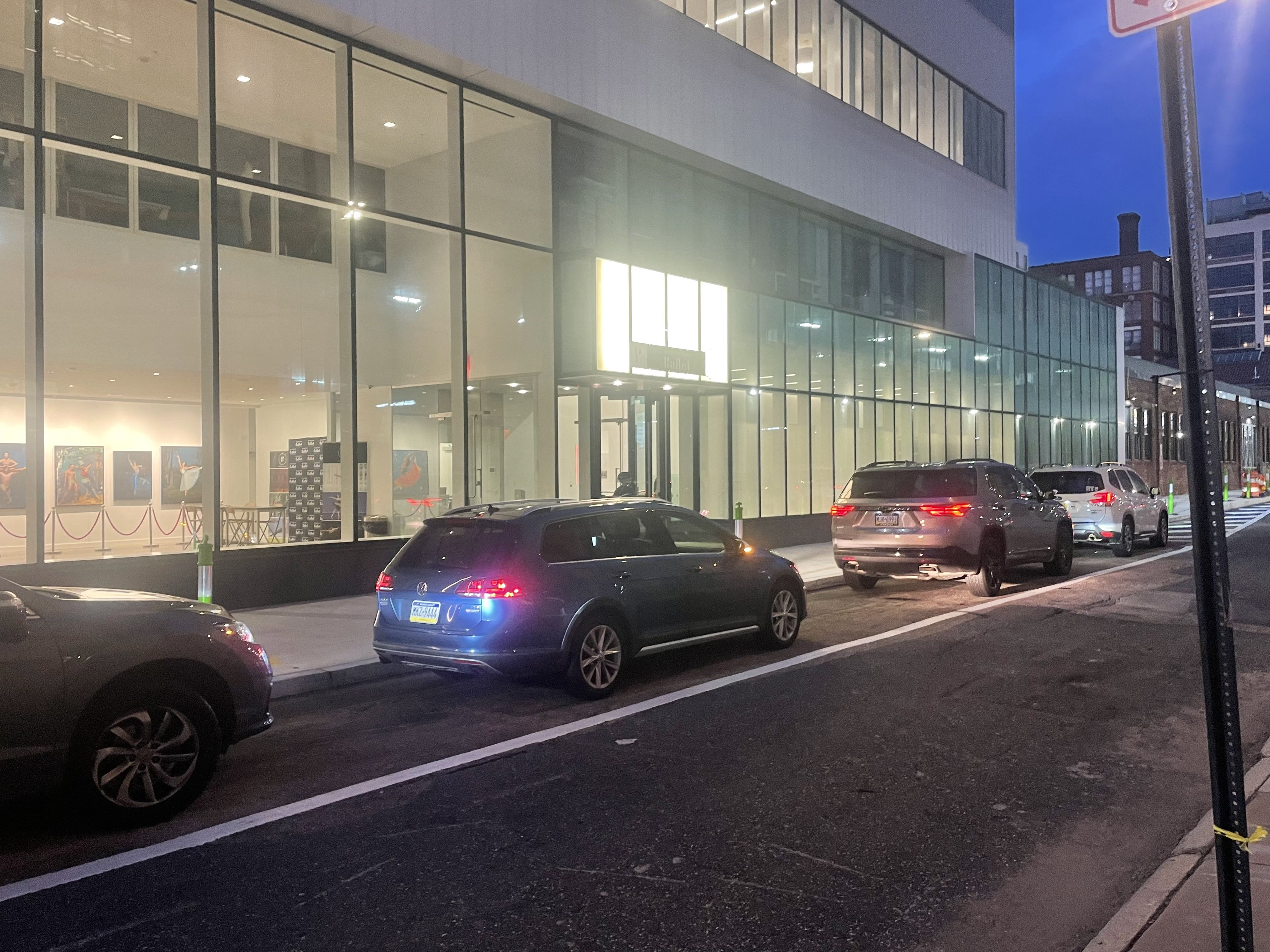
To pack all this onto the deep, narrow site, Varenhorst put the ballet’s front door on Wood Street. Architects often prefer to locate the main entrance on the long side of a building because it’s easier to organize the interior circulation.
That arrangement definitely makes things more convenient for dancers and visitors, since Wood Street now effectively serves as an automobile drop-off. But it badly shortchanges the pedestrian experience on North Broad Street.
A daunting facade
Early in the design process, the ballet decided it would install the black box theater at the Broad Street end of the building. As the name suggests, black box theaters have no windows. That meant the most important facade, the one facing the Avenue of the Arts, would be a blank wall.
By putting the main entrance to Philadelphia Ballet Center for Dance on Wood Street, instead of North Broad Street, the architects at Varenhorst were able to create an automobile drop-off, a convenience for parents dropping off their children at the ballet school.Inga Saffron
To enliven the solid, four-story expanse, Varenhorst has covered the surface with a crimped, stainless-steel screen. The treatment is meant to suggest a theater curtain. Unfortunately, it’s a closed one.
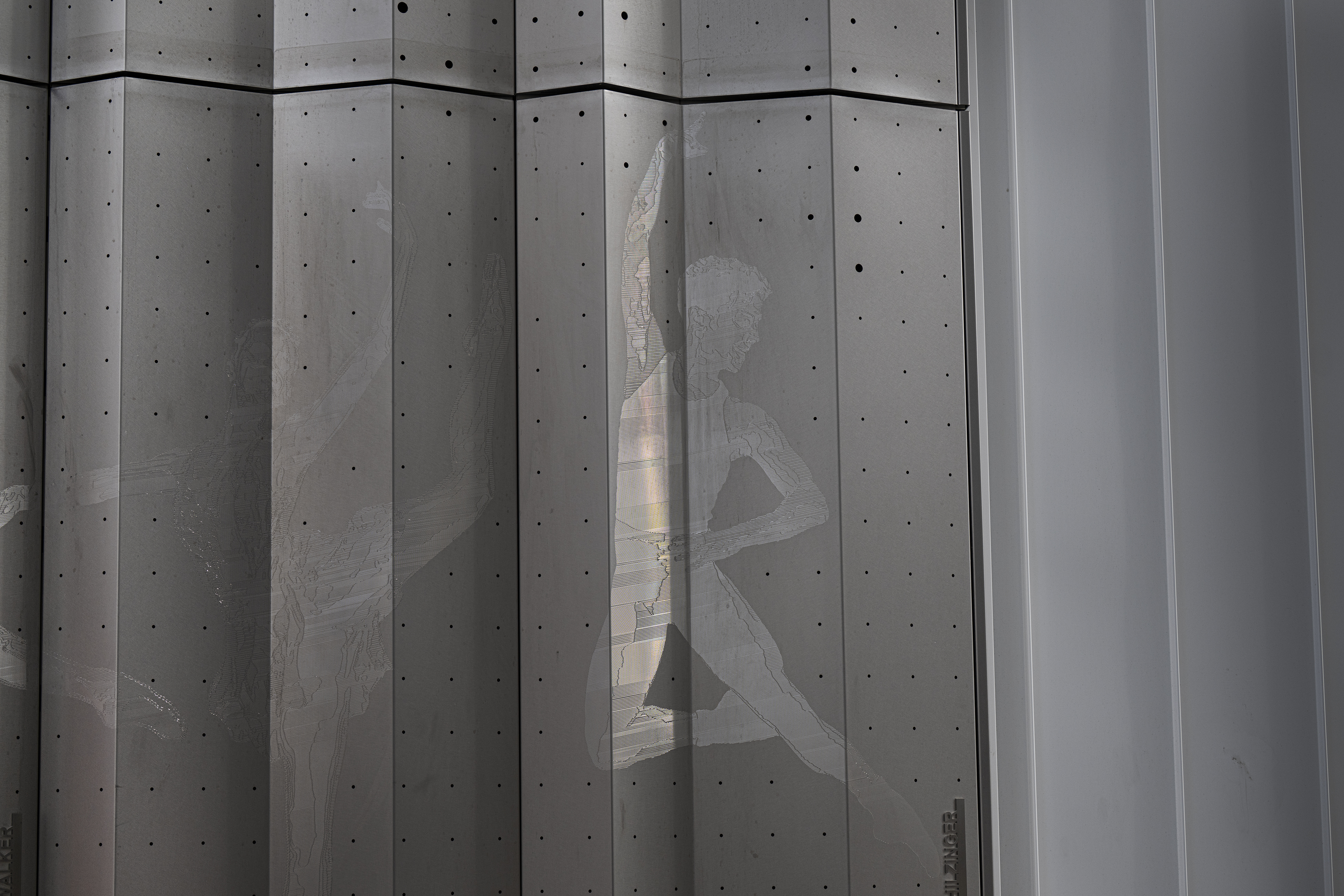
Varenhorst and the ballet have gone to great lengths to dress up the metal scrim. The stainless steel is good quality, manufactured by Zahner, the same firm that did Frank Gehry’s metalwork. The pleats are etched with ghostly figures of the corps’ dancers and perforated with pinholes that sparkle with fairy lights at night. If you crane your neck, you might be able to see dancers moving around the glass-walled studio on the top floor.
It’s about as good as a blank wall gets, but it’s still a daunting cliff.
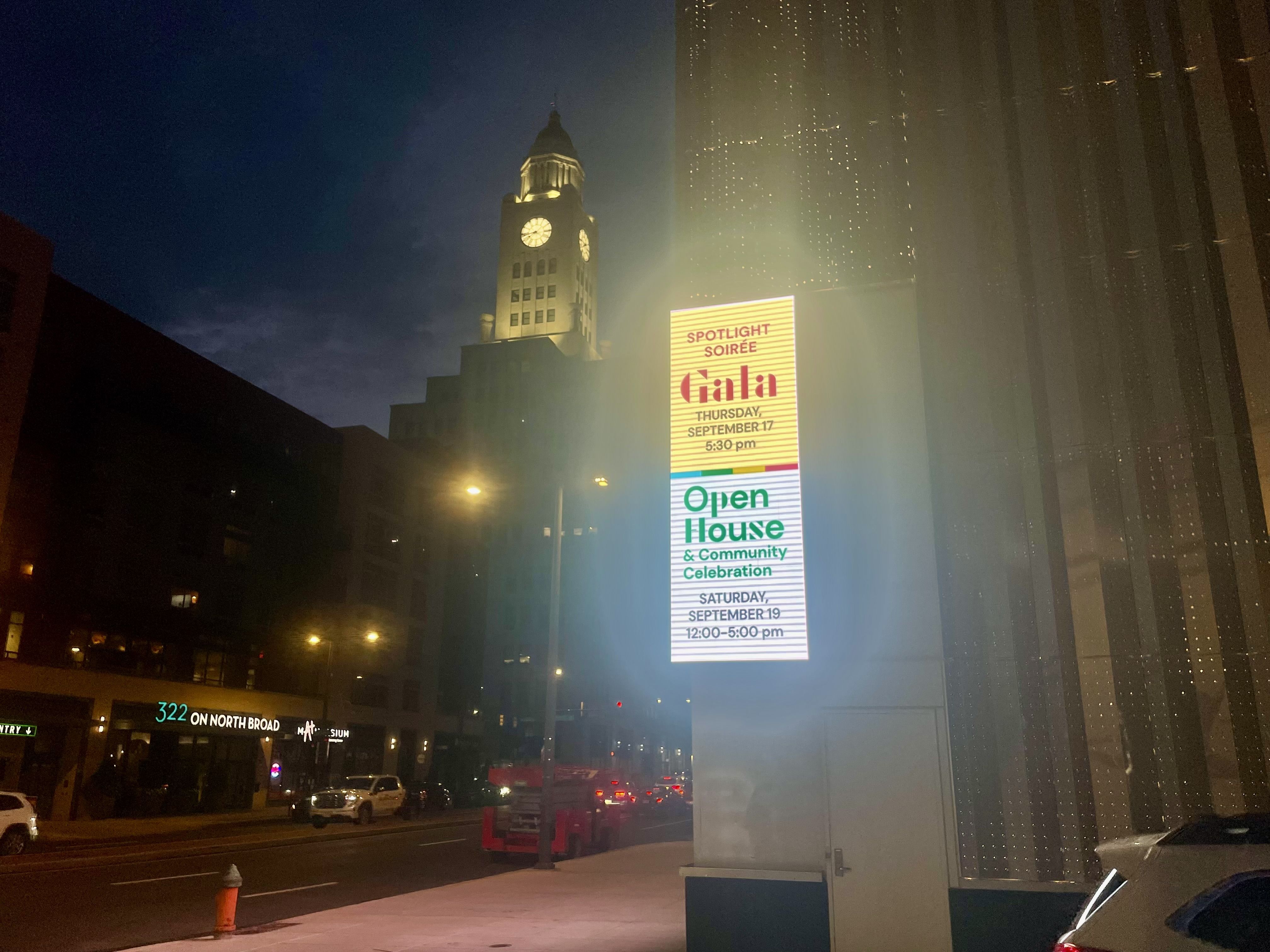
To activate the large expanse of metal, the ballet clamped a digital sign onto the corner. The dance company plans to use it to advertise upcoming shows and display videos of dancers. We could just as easily stare down at our phones to get the same content.
Ghostly images of dancers have been etched into the pleated, stainless steel facade of the new Philadelphia Ballet Center for Dance on North Broad Street.Jose F. Moreno / Staff Photographer
What’s most disappointing about the design is that the ballet is not the first venue on the Avenue of the Arts to treat Broad Street as an afterthought. Although the Kimmel Center can at least claim a Broad Street entrance, its heavy brick facade was similarly unfriendly, especially when no performances were taking place. Those solid walls were one reason the Kimmel floundered in its early years. It took a series of interventions — a cafe, restaurant, and, yes, a digital sign — to make the large building feel more alive.
Moved by the same reasoning, the Wilma Theater also retrofitted its building to create a ground-floor cafe on Broad Street.
Arts administrators always promise us lively sidewalks when they announce a new building, yet there seems to be something in Philadelphia’s architectural DNA that produces the opposite result.
Take the Weitzman National Museum of American Jewish History on Sixth Street. Although it faces Independence Mall, a symbol of democratic openness, that facade is sheathed in opaque glass. Its main entrance is around the corner on Market Street.
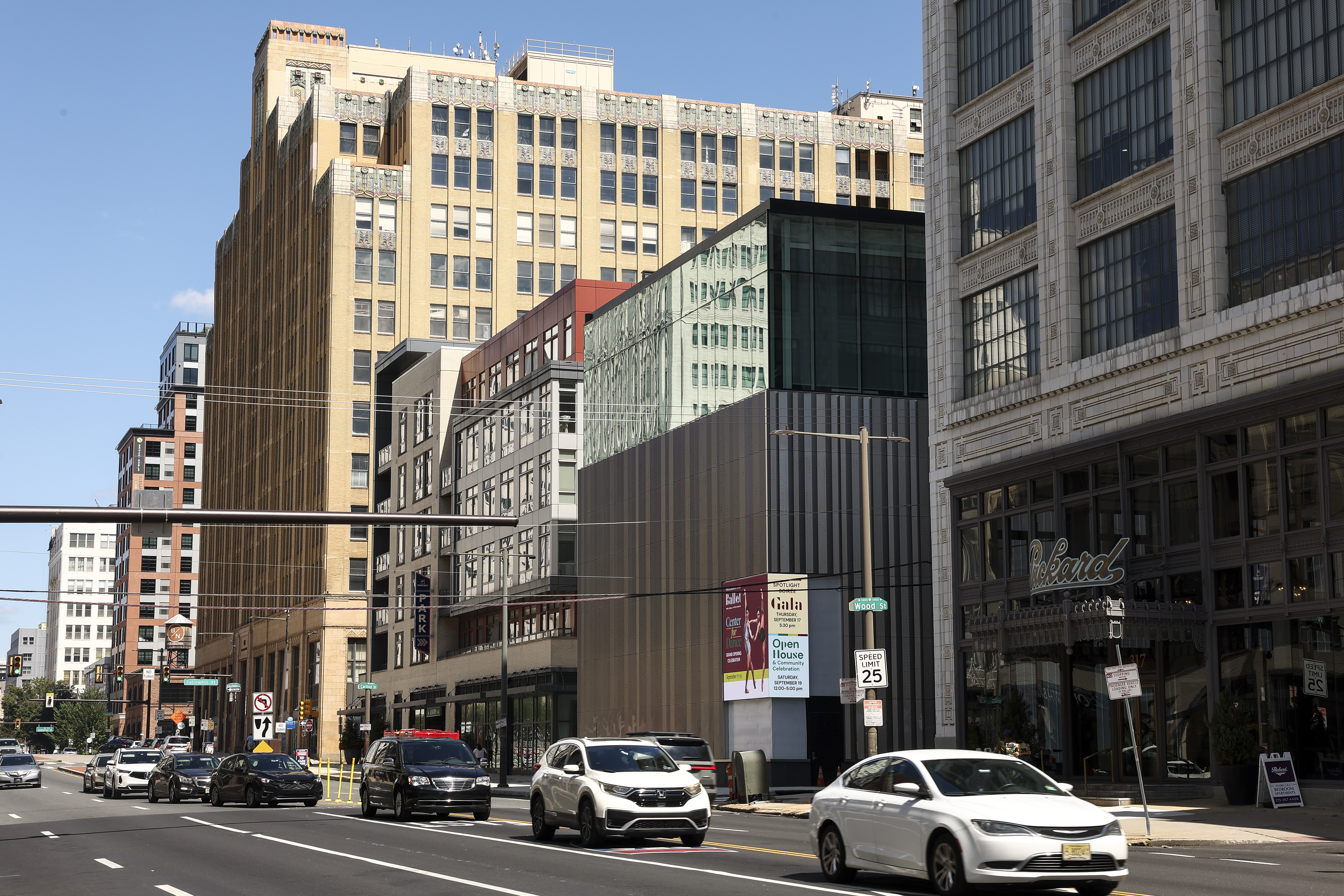
The new Philadelphia Ballet Center for Dance is bracketed (left) by the Hanover apartments, which opened in 2017, and the former Packard Motor Car building, which was converted to apartments in 1986.Monica Herndon / Staff Photographer
Ironically, the three buildings — the ballet, Kimmel, and Weitzman — all follow the same format: Each features a transparent glass structure at the top, far from the madding crowd.
Why couldn’t the ballet have reversed this arrangement and put its black box theater on the upper level? That way, a glass-fronted practice studio could have faced Broad Street. Even if Wood Street remained the main entrance, the transparency would have enlivened the ground floor and made the ballet a visible presence in the city. Instead, the blank wall reinforces the idea that ballet is an elite form of culture.
Power and Varenhorst told me they briefly considered, then rejected, the arrangement because the company’s dancers would have objected to being put on display during stressful rehearsals.
But who says that a ground-floor studio could be used only by the ballet’s professional dancers? The Alvin Ailey American Dance Theater in Manhattan, which opened a six-story practice facility and school in 2005, got around that problem by making its transparent ground-floor studio a space for public classes. Watching the dance students go through their moves there has become so popular, Alvin Ailey installed a bench outside.
To compensate for the solid facade on its new North Broad Street building, the Philadelphia Ballet Center for Dance installed a digital sign at the corner of Wood Street. The former Philadelphia Inquirer tower, now the police headquarters, can be seen across the street.Inga Saffron
Like other cultural leaders, Power is now focused on using the building to build a community of dedicated ballet supporters, much as Anthony Roth Costanzo has done at Opera Philadelphia. She wants to hold public events with dancers on Wood Street and is looking into making Carlton Street a pedestrian walkway.
“Our challenge is this: How do we activate the building?” she said.
Good question. Unfortunately, the ballet missed a big opportunity to show, as well as tell, what’s going on in the Center for Dance. In sacrificing public urbanism for its own private needs, the ballet does everyone a disservice.
Philadelphians reacted with outrage when Drexel University and the Academy of Natural Sciences announced the closing of its museum on the Ben Franklin Parkway earlier this month.
But the museum is only a part of what the academy does. And while most Philadelphians think of dinosaurs and dioramas,the main business of the academy — its “beating heart,” as one board member calls it — will continue, even if it has often escaped the notice of the general public.
Housed backstage beyond the museum walls is one of the world’s largest repositories of natural specimens: bird carcasses, fish, mollusks, minerals, and bones of various kinds — millions of them amassed over more than two centuries.
And now, amid reports that the academy’s building may be sold and the collection moved, all eyes are on the fate of this trove.
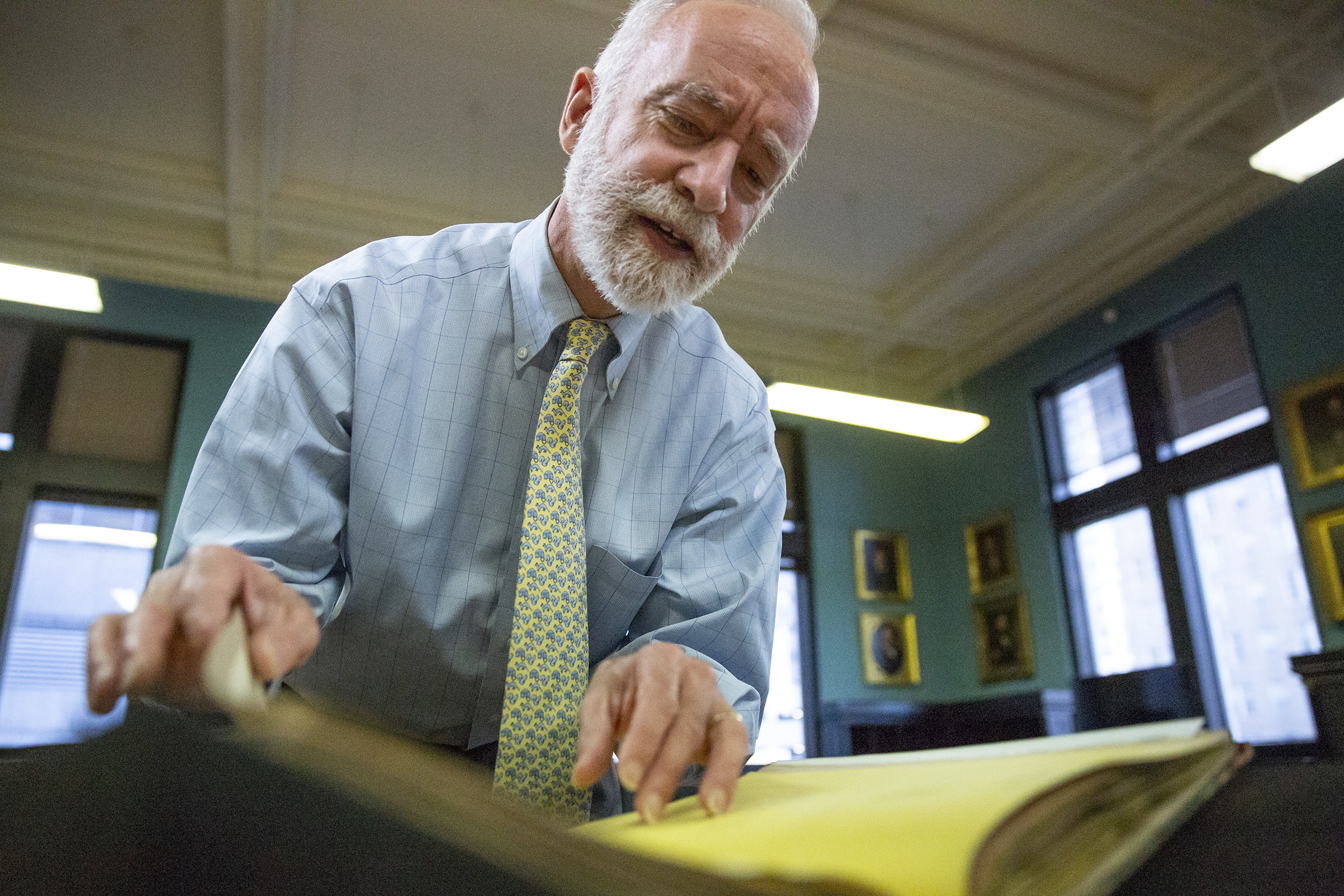
“It’s not just the scope of the collection that’s so important — 19 million specimens representing every aspect of the natural world,” says Robert McCracken Peck, curator of art and artifacts and senior fellow emeritus of the Academy of Natural Sciences of Drexel University. “The collections are not only important because of their associations with historical figures like Lewis and Clark and Thomas Jefferson.
“But these collections were made at specific times in history. We can never go back to collect more of these voucher specimens. They tell us how our world is changing.
“It is by definition irreplaceable.”
Microalgae too numerous to count
Among its peers, the academy’s group of species collections is one of the most significant in the world, and is perhaps unrivaled in certain areas of concentration and historical importance.
More than 220 plant specimens collected by Lewis and Clark on their landmark 1804-06 expedition between the Mississippi River and the Pacific Ocean are housed at the academy. Among the institution’s corresponding members over the years were Thomas Jefferson, John James Audubon, and Charles Darwin. The American Medical Association was founded here in 1847.
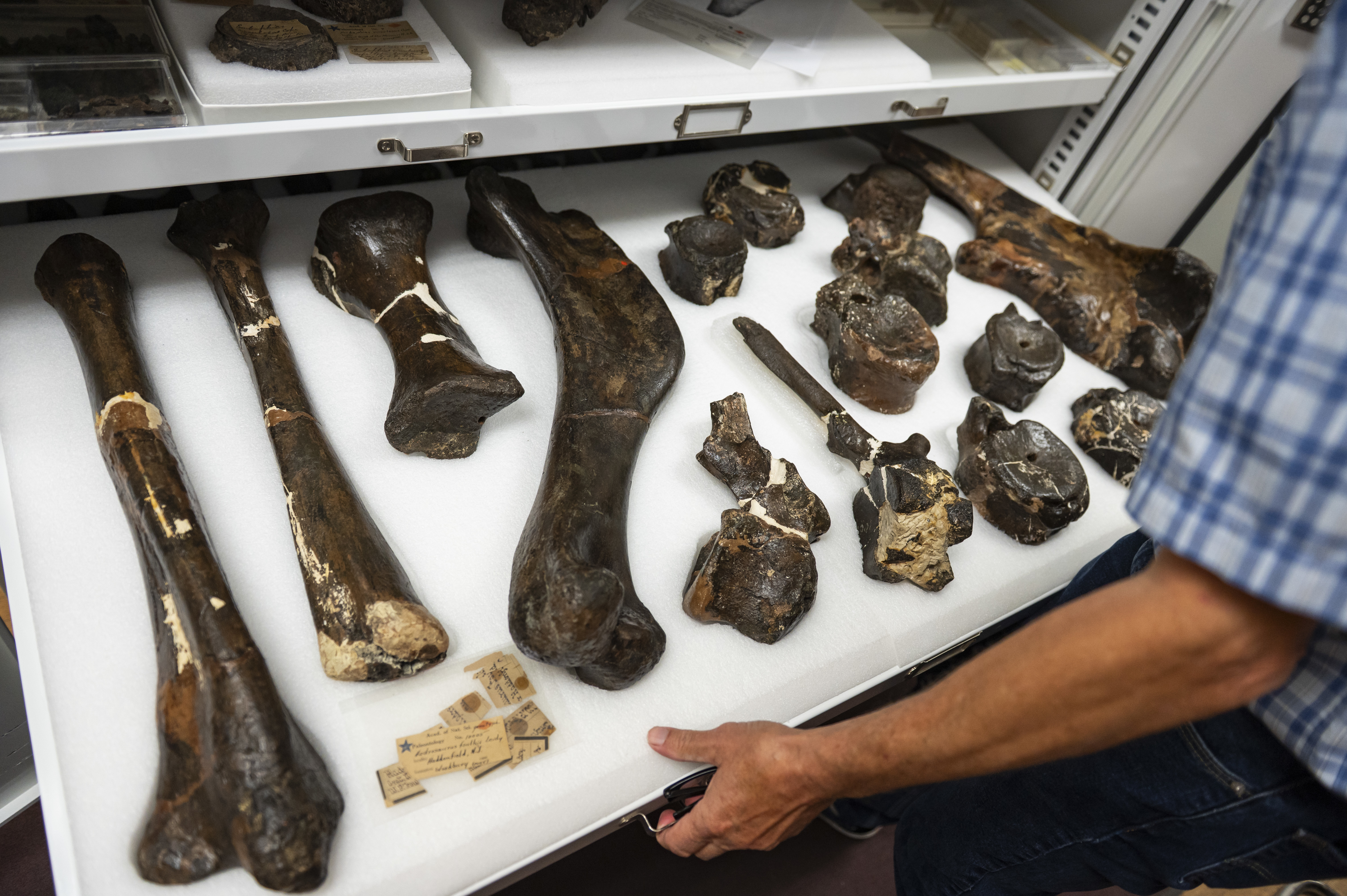
Ned Gilmore, collection manager for vertebrate paleontology, pulls out a drawer filled with bones from the Academy of Natural Sciences’ “Hadrosaurus foulkii.”Allie Ippolito / For The Inquirer
The plants and fungi collection holds 1.4 million specimens of algae, lichens, fungi, and slime molds and includes some of the oldest and most important plant collections in the Americas. The invertebrate paleontology collection is the oldest such collection in the United States.
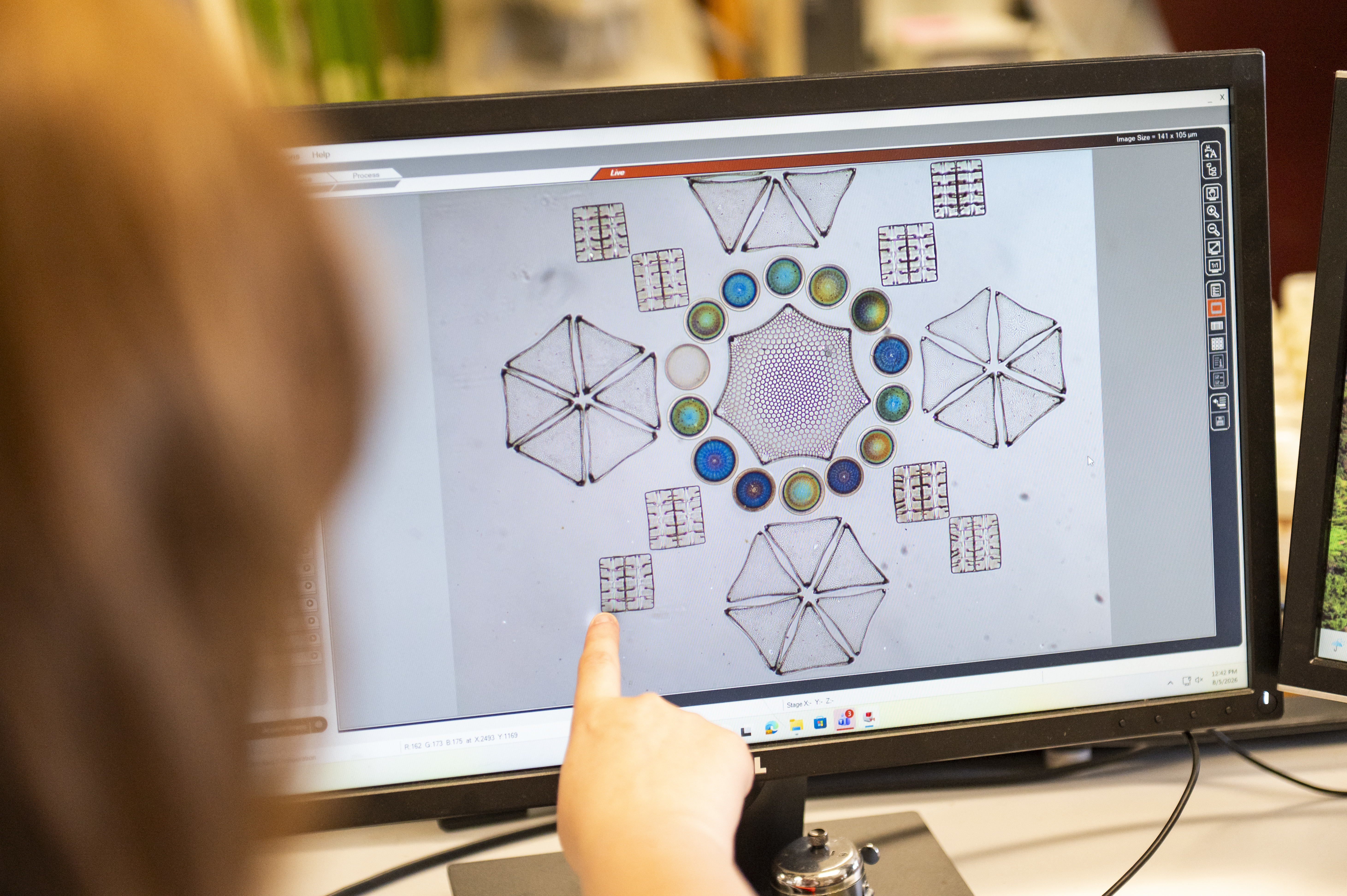
The number of diatoms in that collection is unknown, says Laura Aycock, manager of the academy’s hoard of the single-celled microalgae that are neither animals nor plants, though the academy has around 300,000 slides, with some slides containing upward of a hundred thousand diatoms.
“I’m not going to attempt to calculate that,” Aycock said.
Laura Aycock, collection manager of diatoms at the Academy of Natural Sciences. The diatoms serve as a time capsule.Allie Ippolito / For The Inquirer
The diatoms captured at the academy — which go back to the 19th century and come from around the world — serve as a time capsule.
“You can actually look at water quality and monitor how it’s changing and biodiversity of the diatoms looking at our slides,” says Aycock. “So people will reach out wanting to see, ‘Hey, can I see a snapshot of what this river looked like X many years ago?’”
The academy’s collections are a magnet internationally, says Ted Daeschler, professor emeritus, curator, and chair of vertebrate zoology at the academy.
“It’s a stopping point for people studying a wide variety of different things,” says Daeschler. “Every time I talk to any mollusk person in the world who’s done research, they’re like, ‘Oh yeah, I’ve been to the academy. I’ve done research there.’ Talk to anybody working on crickets and grasshoppers — ‘Oh yeah, I’ve been to the academy.’ People working on Devonian fish, they all came through at one point or another.”
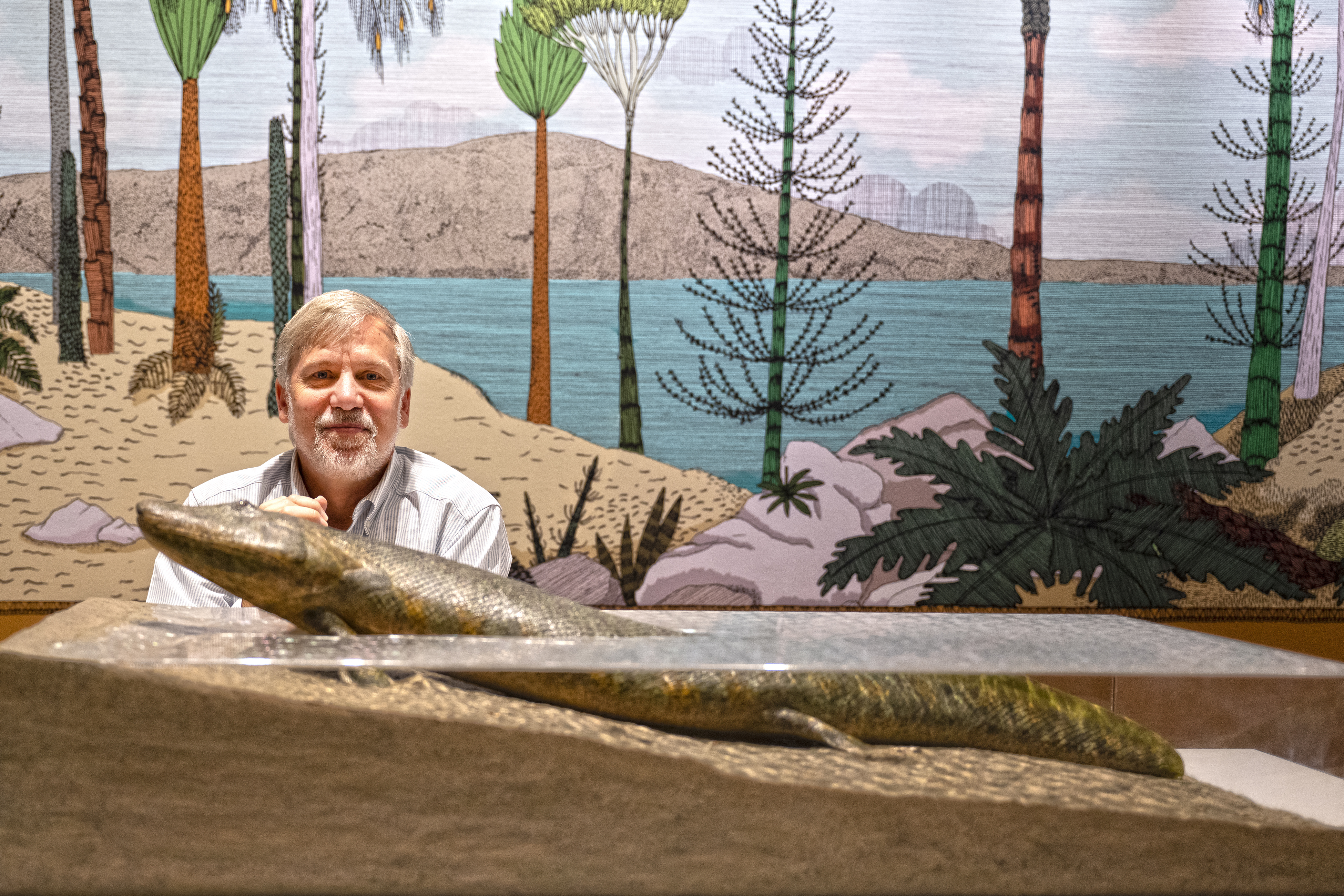
Ted Daeschler in 2023 with a model of “Tiktaalik roseae,” a 375-million-year-old beast whose discovery by Daeschler, Neil H. Shubin, and Farish A. Jenkins Jr. established a new link between fish and land creatures.Jose F. Moreno / Staff Photographer
The academy has seen some novelties over the years: an albacore tuna shipped to the institute from Ernest Hemingway in 1934, fingernail samples from now-retired U.S. Supreme Court Justice Stephen G. Breyer collected in 2010, and two red-eared sliders donated in 1977 by Sylvester Stallone as souvenirs from the original Rocky film.
Hemingway’s tuna remains. But Breyer’s fingernails were tested for stable isotopic composition of carbon and nitrogen to determine the justice’s diet and then discarded, and the turtles Cuff and Link are no longer with us, a spokesperson said.
A key to the ‘next pandemic’?
If some of the collections work and research going on at the academy seems esoteric, there’s no way of knowing what might become urgently relevant at some point.
“We all lived through a pandemic recently — pretty much hell on earth for most of us,” says Jason D. Weckstein, curator of the academy’s ornithology collection and professor at Drexel University College of Arts and Sciences.
“Understanding the ecological interactions that lead to those kinds of events is part of this kind of research. So why are some parasites specific to some hosts, whereas other ones can jump between hosts easily, and there are ecological characteristics that allow that?”
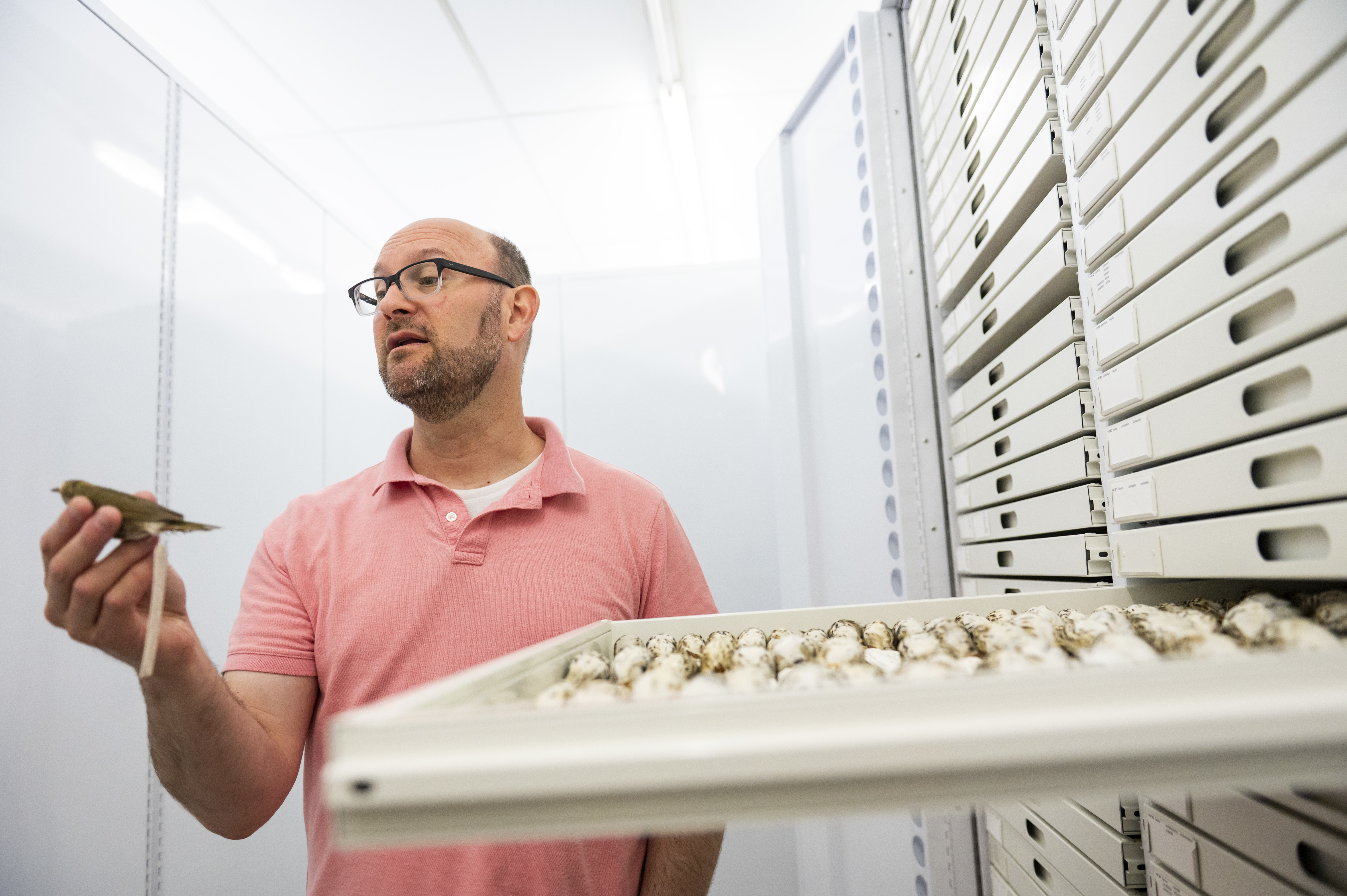
Jason Weckstein, curator of orninthology, holds a warbler at the Academy of Natural Sciences.Allie Ippolito / For The Inquirer
“You just never know when something’s going to happen in the world,” says Weckstein, “and then it turns out there’s something here. We have tissue samples from all over the world. It’s possible we could discover something in those samples that is important for understanding the next pandemic.”
That’s possible, in part, because in the future, specimens might be tested for characteristics whose existence is beyond our current base of knowledge.
Paul Callomon, the academy’s collection manager for malacology and general invertebrates, says that when the first snails entered the academy, “We had no idea what an isotope was. Nobody knew anything about that. But we had an unshakable faith that if we preserve and stabilize these things, as time goes on, they’ll become more important to more people. And so it’s turned out to be. And now of course, with climate change and with this enormous Anthropocene influence on the natural system, the number of ways in which our specimens are going to help tell that story is enormous.”
Each specimen functions as an irreplaceable snapshot in time. Organic materials in their environment are continually breaking down and becoming something else. But when a bird or fish is plucked from its environment, it becomes a permanent record — of itself, but also of the world as it existed at that particular moment.
Biological specimens are often called upon to help solve certain mysteries.
“There are examples in the world generally of new pharmaceutical products being developed from the study of mollusks and their venoms,” says Callomon, “or closer to the academy, we provided shells that were material evidence in the lawsuit against BP for the gulf [Deepwater] Horizon oil spill — historical specimens that proved there was oil in the gulf’s waters before any drilling started, but that it was of a very low level.”
There’s a bigger role now for the academy’s species collection to play, Callomon says.
“The real world is on fire. And the real natural world, the natural ecosystem that sustains all life on Earth, is undergoing enormous changes at the moment. And the only place that you can find material evidence for what it was like before that started, or what it was like at an earlier stage of that process, is natural history collections, and they are mostly housed in museums.”
Several hundred Academy of Natural Sciences supporters came out to protest the decision by Drexel University and the Academy to close the Academy’s museum, Sept. 8, 2026.Tyger Williams / Staff Photographer
‘Profound concern’
Curators and scientists say that as the academy has arrived at a vulnerable juncture, its collections and research are more critical than ever given the march of climate change, microplastics contamination, biodiversity loss, and other crises.
The scientific powerhouse’s own future is a question mark at the moment. Drexel is facing deficits and a challenging enrollment environment, and, in a cost-cutting move a decade and a half after a partial merger of Drexel and the academy, the two groups announced last week that the academy museum will end its nearly two-century run at the end of the month.
The aim now is to move the collection and sell the building, according to a source close to the situation who asked not to be identified. This raises questions about the fate of the academy’s historic building and the critical mass of the Parkway’s cultural attractions, as well as concerns for the future of the collection and the academy’s historically significant library and archive, whose holdings span five centuries.
“Profound concern” is how a group whose board includes the largest and most important natural history and science centers in the U.S. has expressed its apprehension over the future of the academy.
“As the oldest natural science research institution and museum in the United States, the academy is a globally important natural history collection and center for biodiversity research,” the Washington, D.C.-based Natural Science Collections Alliance wrote in an April statement after news of a potential schism between Drexel and the academy.
“Any administrative or structural changes at the Academy must prioritize the integrity of these collections. The destabilization of the institutional support or the specialist staff required to maintain these specimens for active use in research would represent an immense loss to the city of Philadelphia, the state of Pennsylvania, and the global scientific community.”
The NSCA’s concerns remain, said president Trina E. Roberts this week, and while “we’re glad to see that the importance of the collection has been acknowledged in public statements,” she said, the closing of the museum was an unwelcome surprise.
“Education, research and collections are all part of a truly functioning natural history museum. It would be wonderful if the academy can find a way to maintain all of those,” she said.
Academy leaders say they will work to find “new and financially sustainable opportunities for the public display of elements” of its collections, but have not specified any details.
In a statement last week, the two institutions affirmed their attention to the trove of specimens, library, and archive.
“The stewardship of the Academy’s collections and their use to advance scientific knowledge will be the focus of our work for the near future,” said a statement from Drexel president Antonio Merlo and academy board chair Suzanne Biemiller.
A Drexel spokesperson this week said there were no immediate plans to move the collection, and, regarding a potential sale of the building, “no decisions have been made regarding its future disposition.”
“The academy’s home will continue to house its collections, library, archives, and laboratories while Drexel and academy leadership consider potential pathways forward,” said Britt Faulstick.
Should relocation become part of a future plan, Faulstick said, “maintaining appropriate access to the collections for research [during a move] would be an important consideration in that process.”
Robert McCracken Peck, curator of art and artifacts and senior fellow emeritus of the Academy of Natural Sciences of Drexel University.HEATHER KHALIFA / Staff Photographer
‘A recipe for disaster’
Moving the collection would be expensive and time-consuming, says Peck, who, with Patricia Tyson Stroud, co-authored AGlorious Enterprise: The Academy of Natural Sciences of Philadelphia and the Making of American Science.
Peck says that in the 1970s, parts of the collection were moved into the former Reliance Standard Life Insurance Co. building on Pennsylvania Avenue now occupied by the Philadelphia Museum of Art, and then, a short time later, were moved back.
“I imagine it would take a couple of years,” he says of a potential move now of 19 million specimens, “because that’s how long it took to move our collections to and from the Art Museum area, and they didn’t even move them all.”
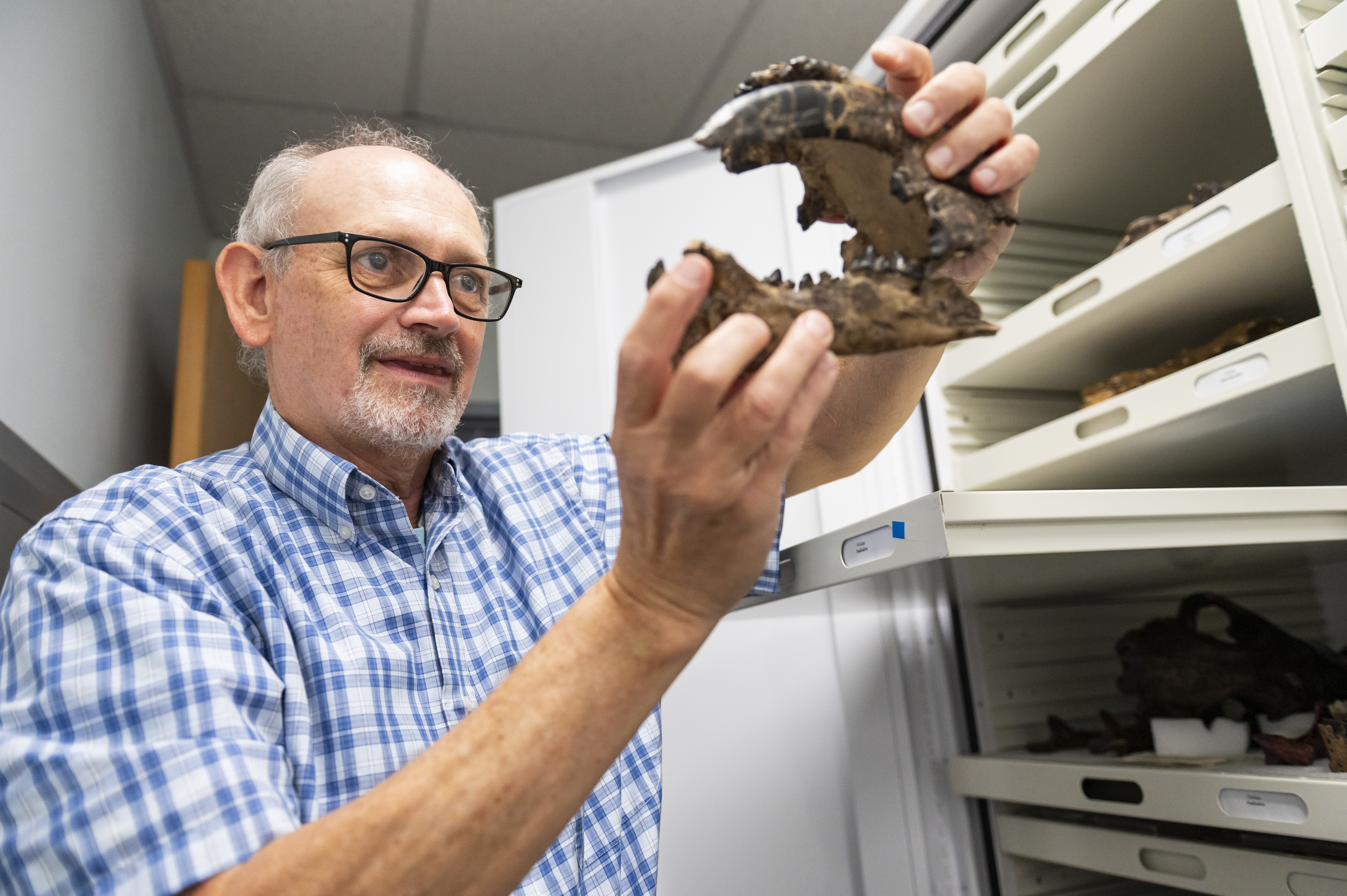
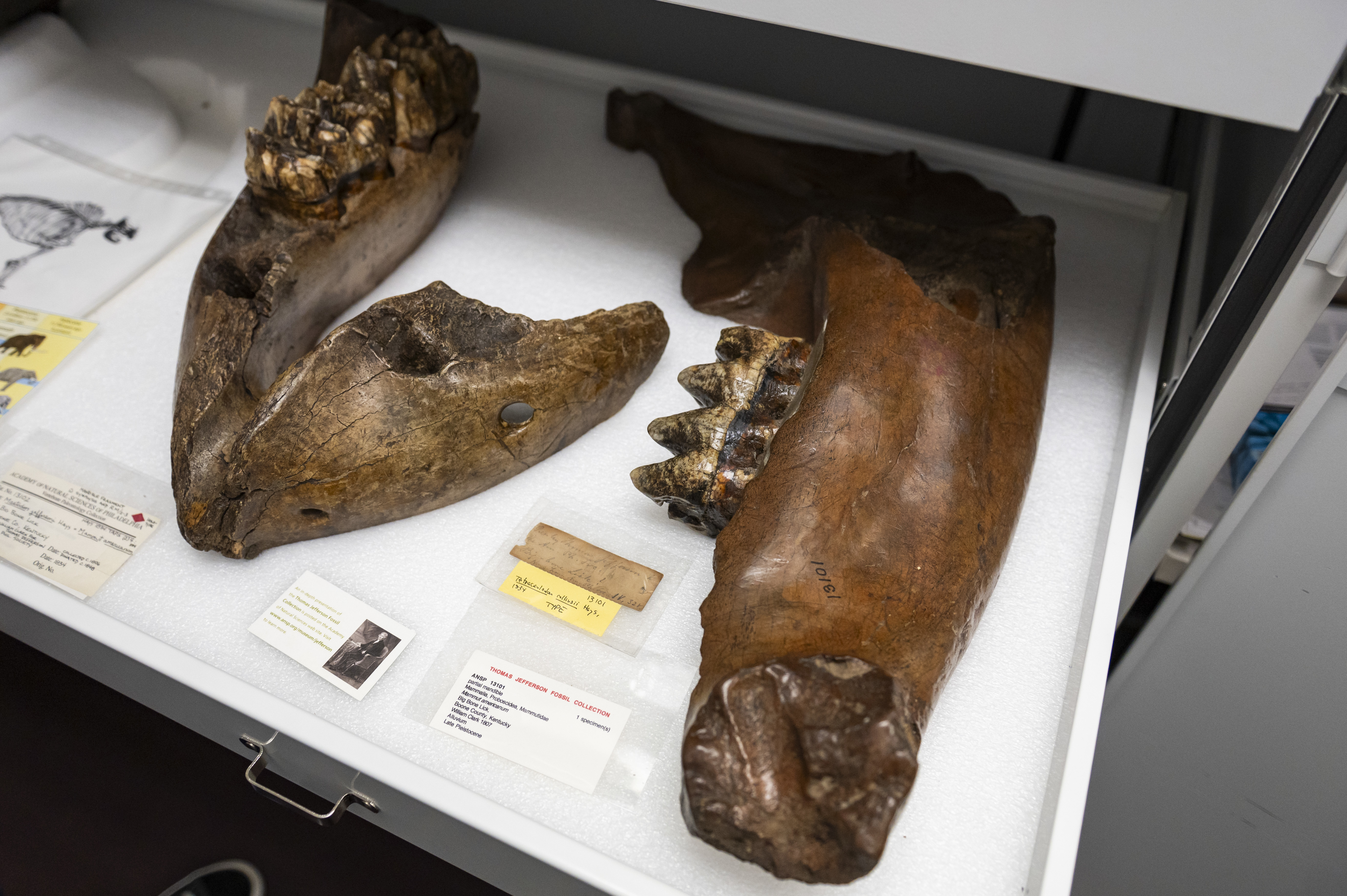
A partial mandible from an American mastodon from the Thomas Jefferson Fossil Collection at the Academy of Natural Sciences.Allie Ippolito / For The Inquirer
“It can be done, and it can be done in a professional and careful way that maintains the integrity of the collection, but you can’t do it in a hurried way,” says the NSCA’s Roberts. “That is a recipe for disaster for a collection of this size and importance. They need to plan for a year before they move any specimens out of the building.”
Collections like these require a specific kind of care, says Roberts, who is also associate vice president for collections at the Natural History Museums of Los Angeles County.
Specimens can degrade over time if not maintained properly, she said.
“We rely on good temperature and humidity control depending on what kind of specimen you have. A dinosaur bone that is basically stone is a lot less sensitive than a plant specimen that is a dried leaf. We’re also concerned about the curatorial and collections expertise that’s represented by the staff.”
Much of the academy’s collection is digitized, and a certain amount of information can be gleaned online, but for some purposes, the actual specimen must be available, which happens either by a visit to Philadelphia or a loan.
“DNA research is just exploding in natural history collections because it turns out that we have this resource we’ve been building for hundreds of years that can still be used for DNA,” says Roberts. “So a plant specimen, an insect specimen, a mammal specimen in a natural history collection from 100 years ago, you can get DNA out of that, and that’s an amazing resource. You absolutely cannot do that from a digitized record.”
It’s possible now, she says, “to look at actual gene expression patterns in different environments — for example, what genes are turned off or turned on in cold vs. hot conditions. That might be something important in an era of climate change if we want to understand how something like plant communities and animal communities are going to respond to that.”
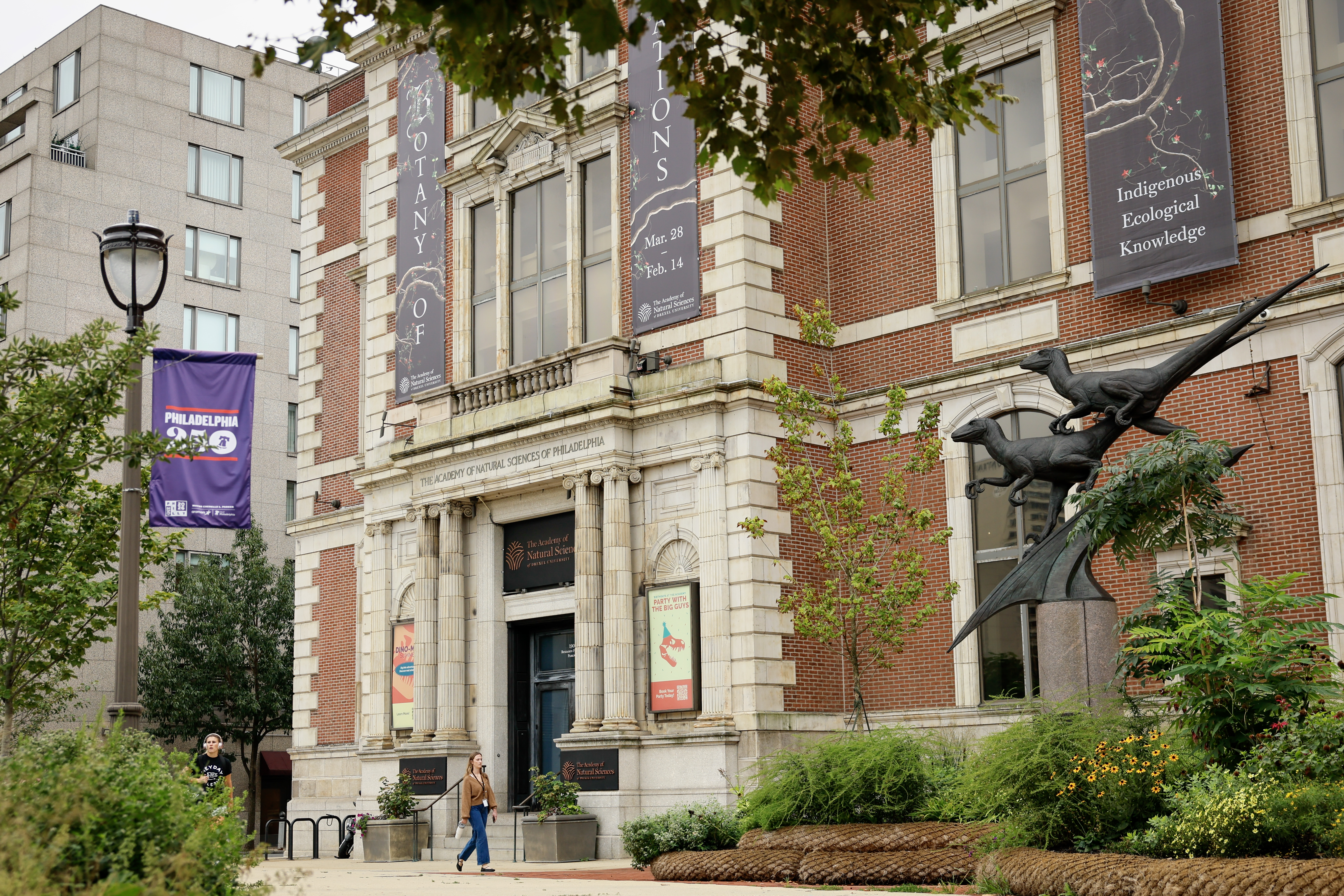
The Academy of Natural Sciences of Drexel University on the Ben Franklin Parkway.Elizabeth Robertson / Staff Photographer
‘It changed their minds completely’
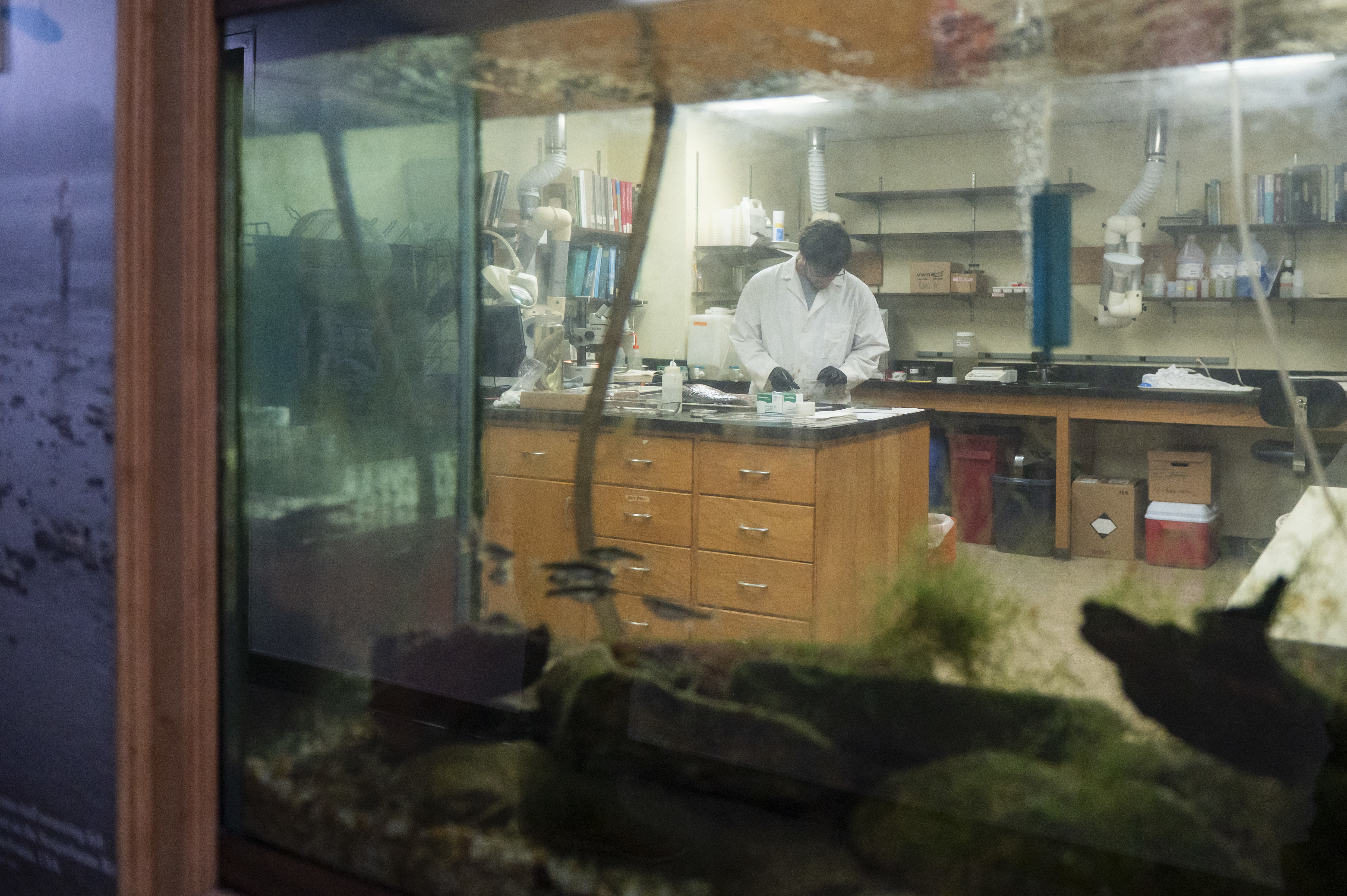
The academy-Drexel partnership, 15 years in, was much in evidence during a several hour visit in early August. In one room at the academy, a group of students was removing organs from birds, and in another, Drexel environmental sciences undergraduate Ean Geller-Nocella was examining a freshwater drum, an invasive species that’s recently turned up in local waters, to see what the fish has been eating.
“I’ve been cutting them open, taking out their stomachs and removing the stomach contents. All that is mussels — freshwater mussels,” he said, referring to a small cluster of crushed up shells.
Another invasive species is being looked at by the academy.
Ean Geller-Nocella, Drexel University co-op student, inspects the contents of the stomach of a freshwater drum in the fisheries department at the Academy of Natural Sciences.Allie Ippolito / For The Inquirer
“Ten years ago in Tinicum, snakeheads weren’t there and we got a picture of what the diet was for the resident fish,” said David Velinsky, senior scientist of the Patrick Center for Environmental Research and professor at Drexel University College of Arts and Sciences. “They’re now there, so we’re doing a study. We already have the samples collected, analyzing on the mass spectrometer how the food web changed, and this gives us an idea of what needs to be protected or not protected.”
Weckstein recently had a Drexel undergraduate student who sequenced the genomes of the parasitic lice living on vultures.
Having students working there “just adds a vibrancy to the place,” says Velinsky.
Says the malacology department’s Callomon:
“I think the role that I’m proudest of our collection’s playing is when Drexel undergrads come here on their co-op and we have successfully diverted careers in medicine, the law, and engineering in favor of working in our part of the world, in our part of science, because of the experience. They came and did a six-month co-op here and it changed their minds completely. It changed their minds because it moved their hearts, and your heart is what drives your mind. But they had no way of previously knowing.”
One persuading factor: at the academy, students have direct, hands-on contact with specimens in the collection.
“Other places use photographs,” says Peck. “Drexel students, thanks to the academy, get to work with real specimens, which dramatically enhances their interest in and understanding of the natural world.”
Just another reason, advocates say, that the academy’s treasures must be kept intact and accessible to all.
“My greatest concern is over keeping the collection together,” says Peck. “It needs to be cared for, for reasons that extend well beyond Philadelphia and the academy. These are collections we hold in trust for the world.”
Staff writer Susan Snyder contributed to this article.
Only 76 songs to encapsulate the history of the boundlessly rich and impossibly varied sound of Philadelphia?
That wasn’t nearly enough.
Earlier this year, in time for the approaching Philly 250 celebration of the nation’s Semiquincentennial, and with the help of my classical music colleague Peter Dobrin, I compiled a list of 76 songs made in the city — or about the city, or by people from the city or region — that are essentially Philadelphian.
I’m not complaining. It was fun and sent me on journeys of discovery to learn stuff I didn’t know about the bottomless depth of Philly soul, the city’s enthralling jazz history, or the range of indie rock that’s become a calling card this century.
But list-making is a difficult, fraught process, and I made lots of choices that I immediately had second thoughts about. Like cutting Grover Washington Jr. to make way for the Trammps, or leaving Sister Sledge or Jazmine Sullivan or personal favorites like Go To Blazes off the list. Or including the Soul Survivors’ “Expressway To Your Heart” but leaving “I-76” by G. Love & Special Sauce parked on the side of the road.
Were those stupid decisions? Possibly. So this list that follows — 25 more essential songs of Philadelphia — is a chance to make room for those shoulda-coulda selections and bring the total number up to a more reasonable 101. Which, quite frankly, will still be an inadequate number for any true Philly music lover.
Some ground rules: Artists who were included in the original 76 were ineligible this time. So while the initial list featured the O’Jays’ “Back Stabbers,” I ruled out another undeniably iconic O’Jays song, “For the Love of Money,” to make way for other artists.
And I didn’t consider holiday songs, which belong in a separate category. So apologies to the Philly Specials’ “Fairytale of Philadelphia” and Alan Mann’s “Christmas on the Block.”
Also, these songs are numbered in reverse, but I thought of them more as a playlist than a worst-to-first ranking. They’re all worthy additions to the original 76.
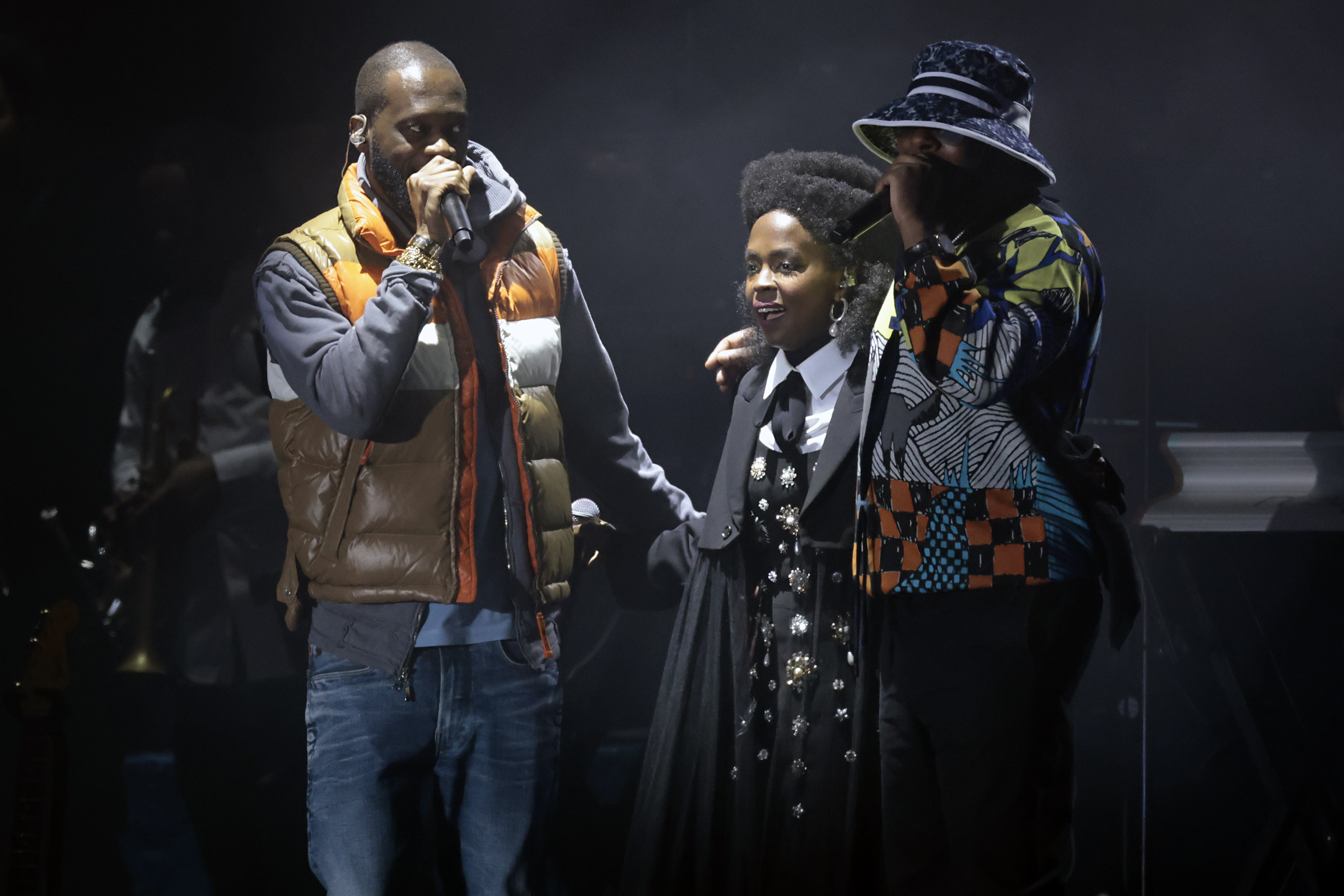
The Fugees reunite as Lauryn Hill (middle) is joined by Pras Michel (left) and Wyclef Jean during the Roots Picnic Philadelphia at the Mann in Fairmount Park on June 3, 2023.Elizabeth Robertson / Staff Photographer
25. The Fugees, “Ready or Not”
The Fugees are not a Philly band — they’re from Haiti and North Jersey. But the hip-hop trio of Lauryn Hill, Wyclef Jean, and Pras Michel recorded for Ruffhouse Records, the Conshohocken label founded by Chris Schwartz and Joe “The Butcher” Nicolo, which also released Hill’s 1998 album The Miseducation of Lauryn Hill, as well as albums by Cypress Hill, Kris Kross, and Ben Arnold. “Ready or Not,” from the Fugees’ 1996 album The Score, represents Ruffhouse because its chorus is based on a Philly soul classic, the Delfonics’ “Ready or Not Here I Come (Can’t Hide From Love),” written by William Hart and Thom Bell.
24. Mark Knopfler, “Sailing To Philadelphia”
“Sailing to Philadelphia” is a song about surveyors. Dire Straits leader Mark Knopfler was making his way through Thomas Pynchon’s 1997 novel Mason & Dixon, about Charles Mason and Jeremiah Dixon, the Englishmen who drew the boundary line that became recognized as the United States’ free states and slave states when he wrote what he once called a “two-minute take on a two-ton book.” (The lovely narrative ballad, which is a duet with James Taylor and the title cut of Knopfler’s 2000 album, is actually five and a half minutes long.)
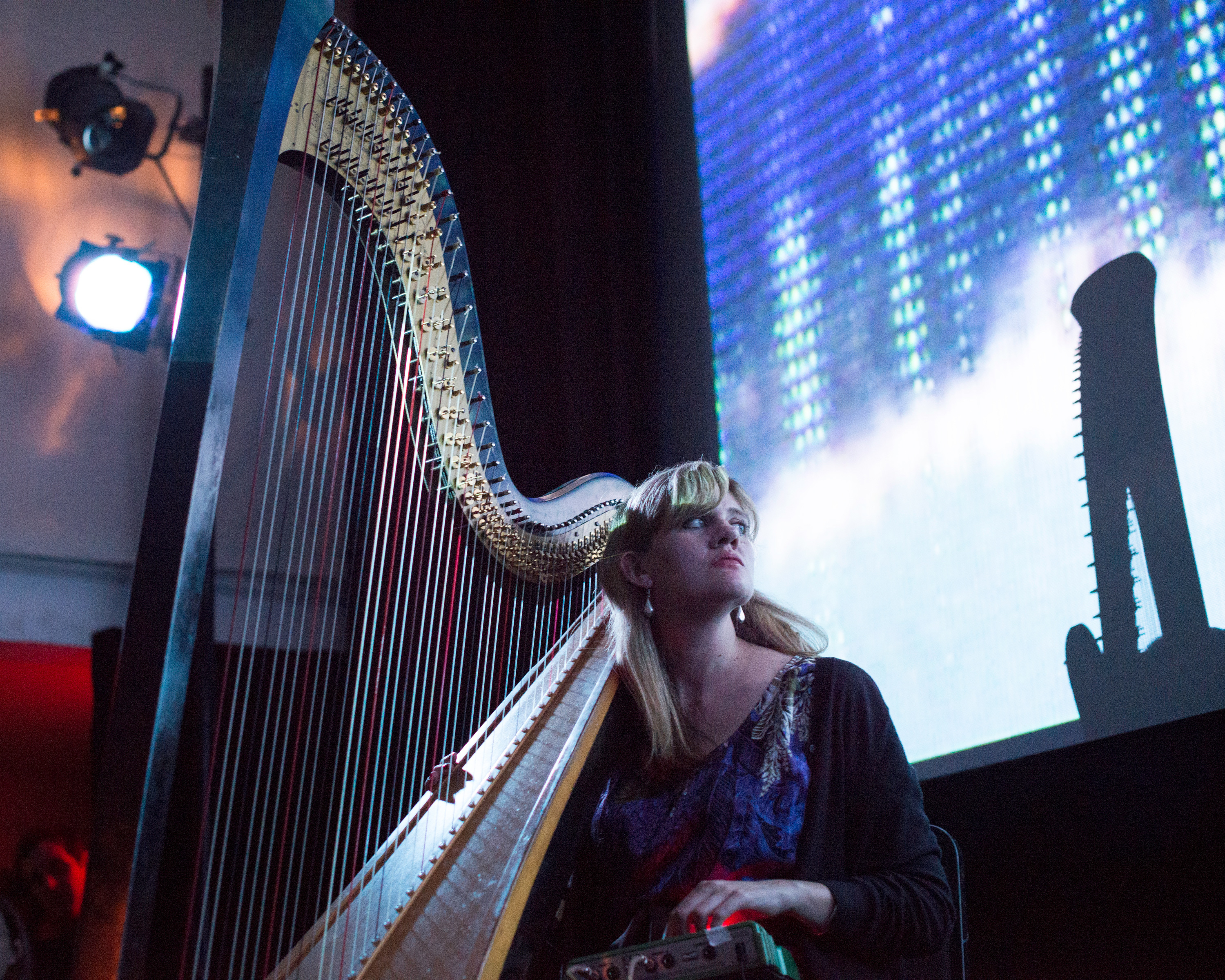
Indie rock harpist and “Wawa By the Ocean” composer Mary Lattimore. Scott Troyan
23. Mary Lattimore, “Wawa by the Ocean”
Philly’s favorite convenience store and the Jersey Shore, all in one song title? Indie rock harpist Mary Lattimore’s sparkling, transporting instrumental was inspired by a Wawa steps away from the beach on Long Beach Island.
22. The Wonder Years, “Came Out Swinging”
The lead track from the Lansdale-born band the Wonder Years’ 2011 album Suburbia I’ve Given You All and Now I’m Nothing reps Philadelphia’s central role in this century’s pop-punk and emo scene, which includes bands like Modern Baseball, Algernon Cadwallader, and Marietta.
Singer Dan “Soupy” Campbell is frank about struggling with his mental health on the song’s coda, repeated three times: “I came out swinging from a South Philly basement, caked in stale beer and sweat under half-lit fluorescents,” Campbell sings (and shouts). “And I spent the winter writing songs about getting better, well, if I’m being honest, I’m getting there.”
21. Clap Your Hands Say Yeah, “The Skin Of My Yellow Country Teeth”
To be honest, I didn’t like this song by the Philly band led by Alec Ounsworth when it came out in 2005. There’s the unappealing title, and I never understood the Talking Heads comparisons, other than a vocal similarity to David Byrne.
But with its driving, hypnotic rhythm, it’s aged well and is a great example of a Philly band at the center of a moment in music history. It’s a “blog-rock” success story from a time when the internet seemed like a wide-open, not malignant place. Bands like CYHSY could make their music available for free download on MP3 blogs and create a buzz that spread like wildfire, resulting in a career still going strong two decades later. Those were the days.
20. Go To Blazes, “New Morning Sun”
Hard-hitting Philly roots-rockers Go To Blazes made a series of bruising blues- and country-infused albums in the 1990s, each one marked by high-quality songwriting by singer Ted Warren and guitarist Tom Heyman that, in retrospect, was ahead of the Americana boom to come. This swaggering song from 1996’s Eric “Roscoe” Ambel-produced Waiting Around for the Crash faces the day after a restless night: “I can’t sleep, for the things I know I had done.”
19. Phyllis Hyman, “Old Friend”
Written by 2026 Rock & Roll Hall of Fame inductee Linda Creed — who died of cancer months before the song’s 1986 release — “Old Friend” is a melancholy ballad by the statuesque Philly soul singer on her first album for Philadelphia International Records. A modest hit, it became a sentimental fan favorite, particularly after Hyman’s death in 1995 at age 45.
18. Bill Haley & His Comets, “Rock Around The Clock”
With his kiss curl and clean-cut image, Bill Haley presented as more palatable to middle America than subversive 1950s sorts like Elvis Presley, Little Richard, and Chuck Berry. But that doesn’t mean Haley didn’t have a sizable pop-cultural impact. With 1954’s “Rock Around The Clock,” which was written by Max C. Freedman and James E. Myers, the singer and bandleader who transitioned from Western swing to rock and roll and grew up in Boothwyn in Delaware County, scored the first rock-and-roll song to top the pop charts in both the U.S. and the U.K.
The Three Degrees.Courtesy of the artist
17. The Three Degrees, “When Will I See You Again”
My first exposure to this Gamble and Huff composition with a lead vocal by Sheila Ferguson and support from Fayette Pinkney and Valerie Holiday came from an episode of the 1970s sitcom Sanford and Son in which the Philly soul vocal trio guest-starred as themselves. Another fun fact: In the ‘70s, the Three Degrees were the favorite group of the now-king, Charles III, and performed at his 30th birthday party at Buckingham Palace in 1978 when he was known only as Prince Charles.
16. Benny Golson and the Philadelphians, “I Remember Clifford”
Hard-bop saxophonist Golson — with a band that included his fellow Philly natives Percy Heath, Lee Morgan, Ray Bryant, and Philly Joe Jones — paid tribute to Delaware trumpeter Clifford Brown, who died in a car accident in Pennsylvania in 1956 at 25. The song has been covered by dozens of artists, including Ray Charles and Sonny Rollins.
15. Sylk 130, “The Reason”
Philly DJ, producer, and Blacktronika professor King Britt put his own 1990s house music spin on classic Philly soul with his Sylk 130 project. Jafar Barron’s haunting trumpet and Vicki Miles’ seductive vocal add a touch of class.
14. The Jacksons, “Enjoy Yourself”
Yes, Michael Jackson recorded in Philadelphia. In the years between the Motown era with the Jackson 5 and his partnership with Quincy Jones, Michael and his brothers recorded as the Jacksons at Sigma Sound Studios on both 1976’s The Jacksons and 1977’s Goin’ Places. On the former, the songs were written by Kenny Gamble and Leon Huff. The upbeat “Enjoy Yourself” was the biggest hit from the Jacksons’ Philly years, and the one song from the era that points forward to the unstoppable alchemy that Michael and Jones would find starting with Off the Wall in 1979.
13. Jimmy Smith, “Walk on the Wild Side”
Norristown native Jimmy Smith revolutionized the Hammond B-3 organ as an instrument central to jazz and was the leading light of the long lineage of Philly organists that includes Shirley Scott, Charles Earland, Jimmy McGriff, Trudy Pitts, and Papa John DeFrancesco and Joey DeFrancesco.
“Walk on the Wild Side” is not the Lou Reed song. It’s an instrumental version of the Brook Benton song from a 1962 film noir. Later that year, Smith — whose music would later be sampled by hip-hop artists including the Beastie Boys, Nas, and Gang Starr — scored an unlikely hit from his album Bashin’: The Unpredictable Jimmy Smith.
12. Dee Dee Sharp, “Mashed Potato Time”
A 1962 dance-craze song by Kal Mann and Bernie Lowe that borrowed from the Marvelettes’ “Please Mr. Postman.” The Orlons sang backup vocals on the No. 1 hit from the American Bandstand era, when Philadelphia was the center of the pop music industry until Dick Clark moved the show to California in 1963.
Nina Simone performing at the Harlem Cultural Festival in 1969, featured in the documentary “Summer of Soul.” / AP
But her failure to gain acceptance spurred reinvention: She adopted the stage name Nina Simone while playing piano and singing at the Midtown Bar & Grill in Atlantic City. A great career as an artist and civil rights activist followed. There are many songs to choose from — “Sinnerman,” “Feeling Good”— but I’m going with her most urgent and arresting, written in part as a response to the murder of Medgar Evers in 1963.
10. G. Love & Special Sauce, “I-76”
It might not be the best advice, but it does rhyme: “If you want to get downtown real quick, the only way to go is I-76.” Garrett Dutton’s ode to the Schuylkill Expressway from the hip-hop bluesman’s 1997 album Yeah, It’s That Easy includes shout-outs to Sixers players and the mascot from the 1983 championship year: “Big Shot, and Mo Cheeks and Moses Malone / Julius Erving called Philly his home.”
The Philadelphia rock band the A’s in the late 1970s. Left to right: Terry Bortman, Rocco Notte, Rick DiFonzo, Richard Bush, and Mikey Snyder. Courtesy of the A's
9. The A’s, “After Last Night”
A ripping power-pop masterwork that showcases the magnetism of Richard Bush, the lead singer of the A’s, the New Wave-era band that energized the Philly club scene before breaking up in 1982. One of two killer A’s singles written by Bush — who performs locally with his band the Peace Creeps — and songwriting partner Rocco Notte, along with “A Woman’s Got the Power.”
8. Laura Nyro, “Gonna Take A Miracle”
“Gonna Take A Miracle” is a case study in how Kenny Gamble, Leon Huff, Thom Bell, and Sigma Sound Studios founder Joe Tarsia turned Philadelphia into a music mecca in the early 1970s.
Nyro was a New York songwriter three albums into her career when she came to Sigma Sound in 1971 to record an album of cover songs with Labelle — the trio of Patti LaBelle, Nona Hendryx, and Sarah Dash, who would explode in popularity with “Lady Marmalade” three years later.
The Gonna Take a Miracle album was produced by Gamble and Huff, and featured the MFSB Sigma house band, with horn and string arrangements by Bell and Bobby Martin. And the title cut, originally a hit for the Royalettes in 1965, is cowritten by Teddy Randazzo, one of Bell’s musical heroes.
7. John Legend and the Roots, “Wake Up Everybody”
For their 2010 collaborative album Wake Up!, mostly made up of covers of socially conscious R&B songs, Penn grad Legend and the Philly hip-hop band picked a winner. Sure, Legend isn’t equal to Teddy Pendergrass, who sang the original version of the John Whitehead-, Gene McFadden- and Victor Carstarphen-penned title cut from Harold Melvin & the Blue Notes’ 1975 album. But then, who is?
6. The Tymes, “So Much In Love”
Swoony street corner harmony from 1963, written by Tymes singers George Williams and Roy Straigis with producer Billy Jackson, who voices the spoken intro. A hit on the Cameo-Parkway label in pre-Beatles doo-wop era, it was later a hit for R&B vocal group All-4-One in 1993.
In 1983, Robert Hazard filmed a music video for his song “Change Reaction” at what was then J.C. Dobbs.File Photograph
5. Robert Hazard & the Heroes, “Escalator Of Life”
Along with the Hooters and Tommy Conwell & the Young Rumblers — whose “I’m Not Your Man” is a near miss on this list — Robert Hazard was one of the most-likely-to-succeed faces of Philadelphia rock in the 1980s. The son of a Philadelphia Opera Company tenor wrote and recorded “Girls Just Want To Have Fun” in 1979, four years before Cyndi Lauper turned it into a megahit. Hazard was in heavy rotation on FM stations WMMR and WYSP with this echoey electro-pop hit and “Change Reaction,” from his self-titled 1982 EP.
4. Grover Washington Jr., “East River Drive”
“Just The Two of Us,” Washington’s 1980 team-up with Bill Withers, was the much bigger hit. Will Smith repurposed it for a different song of the same name on 1997’s Big Willie Style. And “Mister Magic,” the nine-minute jazz-R&B jam that’s the title cut from his 1975 album is another Grover contender. But I’m going to go geographical on this smooth-jazz mood piece from the Philly saxophonist, who cruised down what is now Kelly Drive on his 1981 album Come Morning.
Kathy Sledge from Sister Sledge performs with the Roots at the July Fourth concert on the Benjamin Franklin Parkway.Yong Kim / Staff Photographer
3. Sister Sledge, “We Are Family”
“You couldn’t find room for Sister Sledge’s ‘We Are Family’ on a list of 76 songs?” was a refrain I heard in various forms. In excluding it I might have given too much weight to the fact that “We Are Family” became closely associated with Pittsburgh after the Pirates used it as their theme song on the way to winning the World Series in 1979.
In any case, “We Are Family” endures, well beyond its origins as a 1979 disco hit that was the first song penned by Nile Rodgers and Bernard Edwards outside of their own band, Chic. Kathy Sledge delivered a stirring version of it with the Roots at the One Philly concert on the Ben Franklin Parkway, and just the other night, I heard it at a Phillies game.
2. Maze, “Before I Let Go”
Frankie Beverly grew up in Germantown and didn’t hit his stride as a purveyor of smooth, sensual soul music until moving to San Francisco in the 1970s. Over time, songs like “Joy and Pain” and “Before I Let Go” sung by Eagles quarterback Jalen Hurts’ favorite musician became essential to Black culture, as “the soundtrack of cookouts and summer music fests … and that kind of bliss that is sweet and peaceful,” as novelist S.A. Cosby put it when Beverly died in 2024. Beyoncé covered “Before I Let Go” at Coachella in 2018, and Questlove has called the song “the happiest breakup song ever” and “the national anthem.”
1. Jazmine Sullivan, “Pick Up Your Feelings”
The standout track from Sullivan’s 2021 tour de force Heaux Tales is full of soaring, swooping vocal runs and staccato syncopations. Along with other hits like “Bust Your Windows,” it demonstrates why Sullivan is the premier contemporary embodiment of the grand Philly soul tradition of great vocalists like Patti LaBelle, Teddy Pendergrass, and Russell Thompkins Jr.
Rubber Band Gun’s ‘Bloodwork’: More musical gems from Historic New Jersey
Kevin Basko has a suggestion: Music might make everything better.
“If you don’t know what to do because you’ve never been this sad before,” Basko sings. “You don’t feel those problems when you’re singing the songs you love.”
That lyric about music’s comforting and healing power is from “Songs You Love,” the closing track on Bloodwork, the winning new album by Rubber Band Gun, Basko’s primary vehicle for the many, many songs he loves to write.
It’s been a good year for Historic New Jersey, the label that — somewhat confusingly — is based in South Philadelphia and whose emergence is one of the most heartening indie rock stories of 2026.
Basko and his Historic NJ pals Emily Moales, who records as Star Moales, and sibling act Sam and Louise Sullivan have been producing a steady stream of retro-leaning but wholly in-the-moment high-level songcraft for a few years now.
Emily Moles (center), known as Star Moles, passes a guitar to longtime collaborator Kevin Basko inside the Historic NJ studio in South Philadelphia on Friday, July 10, 2026.Aidan T. Gallo / Staff Photographer
Since the spring, the national and international music press has caught wind of what makes Historic NJ special, praising the warmth and camaraderie that comes through on Star Moales’ Highway to Hell and the Sullivans’ Love & Devotion.
Now, it’s Basko’s turn. Rubber Band Gun’s Bloodwork, like all of the other Historic NJ projects, was recorded and produced at Basko’s home studio in South Philly, with Moales and the Sullivans contributing musically and vocally.
The newest of the dozens of streamable releases on Rubber Band Gun’s Bandcamp page showcases Basko’s canny, inviting songwriting. Tunes like “Love Me Dawg” and “Money on My Mind” consistently offer subtle surprises and are never merely clever, even when Basko is punning on Rihanna and Rage Against the Machine lyrics while singing about feeling out of place in America in “Zombie in the Country.”
— Dan DeLuca
Julia Baccellieri as Joice Heth in “Strange Root, or the Murder of P.T. Barnum by Joice Heth.” Elizabeth Wellington
A Fringe Festival performance gives agency to enslaved member of P.T. Barnum’s 19th-century circus troupe
In 1835, showman, businessman, and politician P.T. Barnum bought an elderly enslaved woman, Joice Heth, from a Kentucky enslaver, added her to his circus, and falsely claimed she was George Washington’s 161-year-old nursemaid.
His advertisements described her as weighing 46 pounds and being blind and toothless — supposed evidence of her extreme age.
To reinforce the trope of the frail, subservient, illiterate Black person, Barnum insisted she use a poor, Southern dialect to regale the audience with stories about her relationship to Washington.
Heth died in 1836 at 80 and Barnum even exploited her in death, charging circusgoers 25 cents to see her dead body, an experience he marketed as a public autopsy.
Baccellieri doesn’t portray Heth as a weak woman beaten down by her circumstances. Instead, they use dance trapeze, aerial apparatus, Chinese pole, and hula hoops to give Heth power, agency, and beauty.
The music is contemporary and soulful, weaving in Nina Simone’s jazz with Kendrick Lamar’s bars. Baccellieri dons a clown mask during the performance. They affix it as the audience listens to Maya Angelou read Paul Laurence Dunbar’s 1896 poem “We Wear the Mask,” which speaks to Black Americans’ dual consciousness.
Alston’s portrayal of Barnum as a buffoon gives voice to the stupidity of racism, speaking truth to power: Racists who refuse to see the evil in their actions will cause their own demise.
Strange Root is short — it runs under 45 minutes — but it’s powerful.
“Tejedora (Weaver)” from Puebla, Mexico, artist Ivette Chaires is on view at Philadelphia’s Magic Gardens as part of her solo show, “Living Through Death,” through Nov. 8.Rosa Cartagena
Skeletal spectacles
South Street’s Magic Gardens are often packed with tourists and fans walking through the outdoor mosaic labyrinth of mirrors, glass bottles, clay sculptures, and ceramic tiles lovingly built by South Philly legend Isaiah Zagar. Inside, though, the building hosts rotating exhibits from other artists; currently on view is “Living Through Death” from Puebla artist Ivette Chaires, who spent time working in Philadelphia as part of the Julia Zagar Residency for Women Artists.
Using papier-mâché, Chaires crafted 36 skeletal figures in the Mexican tradition of cartonería, often seen during Día de los Muertos celebrations. Her skeletons are strikingly animated, decked out in funky modern clothing and thick-rimmed glasses or posing cheekily. There’s a Frida Kahlo figure and an Edgar Allan Poe — and a football fan with an Eagles cap. Several works depict the Zagars, like one with Isaiah and Julia wearing colorful mosaic outfits. The show debuted five months after Zagar died, making it a powerful tribute to his legacy.
Each delightfully spooky sculpture contains incredible layers. Tejedora (Weaver) features a bony woman bending over a loom attached to a tree trunk on one end and wrapped around her waist on the other. The details are so carefully crafted, from her twisted belt to her intricately woven gold earrings. Nearby stands a sweet little chicken with a living head and a dead underbelly. It was a fascinating, fully-formed scene that accomplished Chaires’ goal — for the viewer to feel deeply connected to the dead.
“Living Through Death: Works by Ivette Chaires” is on view through Nov. 8 at Philadelphia’s Magic Gardens, 1020 South St., Philadelphia, 215-733-0390 or phillymagicgardens.org.