At noon on a bright June Tuesday, the scene at Skinny Joey’s Cheesesteaks & Pizza on the Wildwood boardwalk felt more like a South Philly block party than a soft opening.
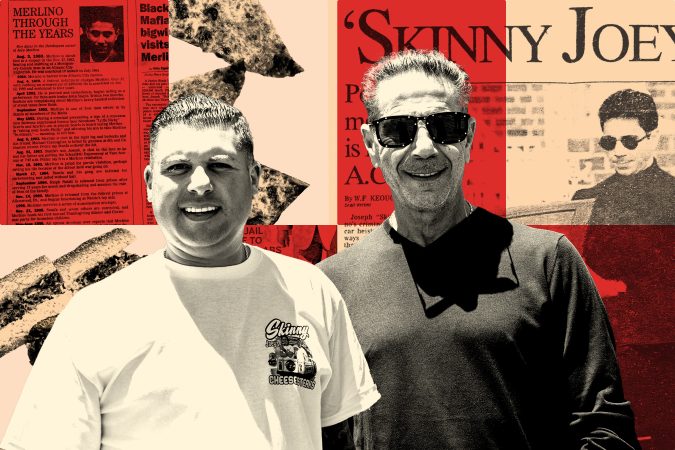
Joseph “Skinny Joey” Merlino worked the crowd at his new shop — hugging, shaking hands, posing for photos — moving easily among his friends and admirers. At 64, five years removed from the criminal justice system, the onetime alleged head of Philadelphia’s underworld is enjoying a second act that few could have predicted: cheesesteak entrepreneur, podcaster, and social-media personality.
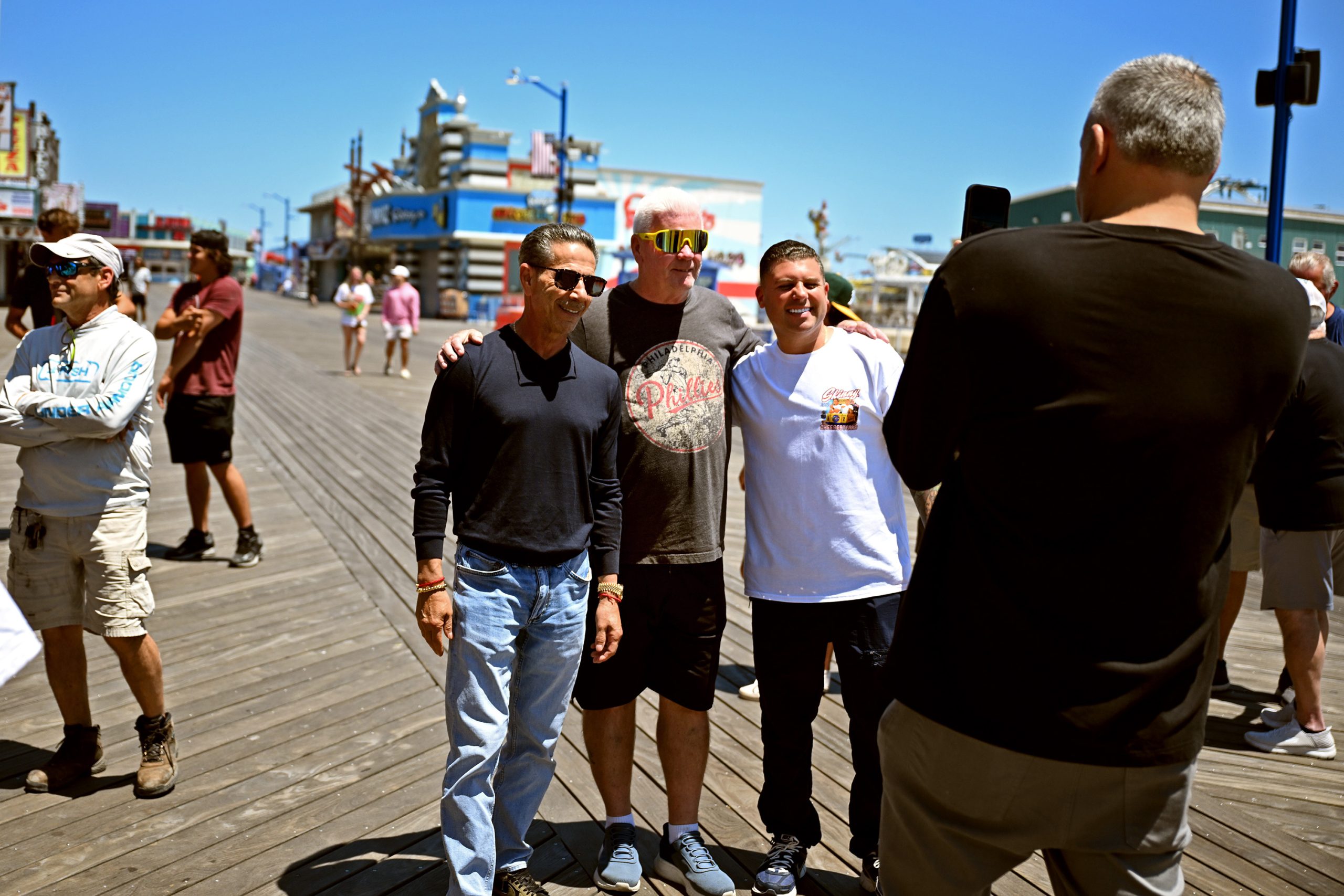
Joseph “Skinny Joey” Merlino (left) and Joe “Lil Snuff” Perri Jr. (right) posing with a customer outside the Skinny Joey’s Cheesesteaks & Pizza shop in Wildwood.Tom Gralish / Staff Photographer
Orbiting him with a phone and a grin was Joe “Lil Snuff” Perri Jr. — 30 years his junior — Skinny Joey’s collaborator and the man who helped set him up with a new career. While customers lined up out front for steaks, slices, photos, $35 hats, and $25 T-shirts, Perri was shooting clips for social media.
Their partnership has transformed Merlino from a flashy, polarizing tabloid fixture into a flashy, polarizing Instagram-age brand. Merlino provides the mythology, while Perri supplies the algorithm.
Symbiotically, they are building an unlikely enterprise. Merlino gives Perri access, credibility, and a bigger stage. Perri gives Merlino comic relief, social-media fluency, and a way to be seen as entrepreneurial rather than simply infamous as a reputed former mob boss.
“Without me, there’s no him,” Perri said. “Without him, there’s no me. It’s just a good mix.”
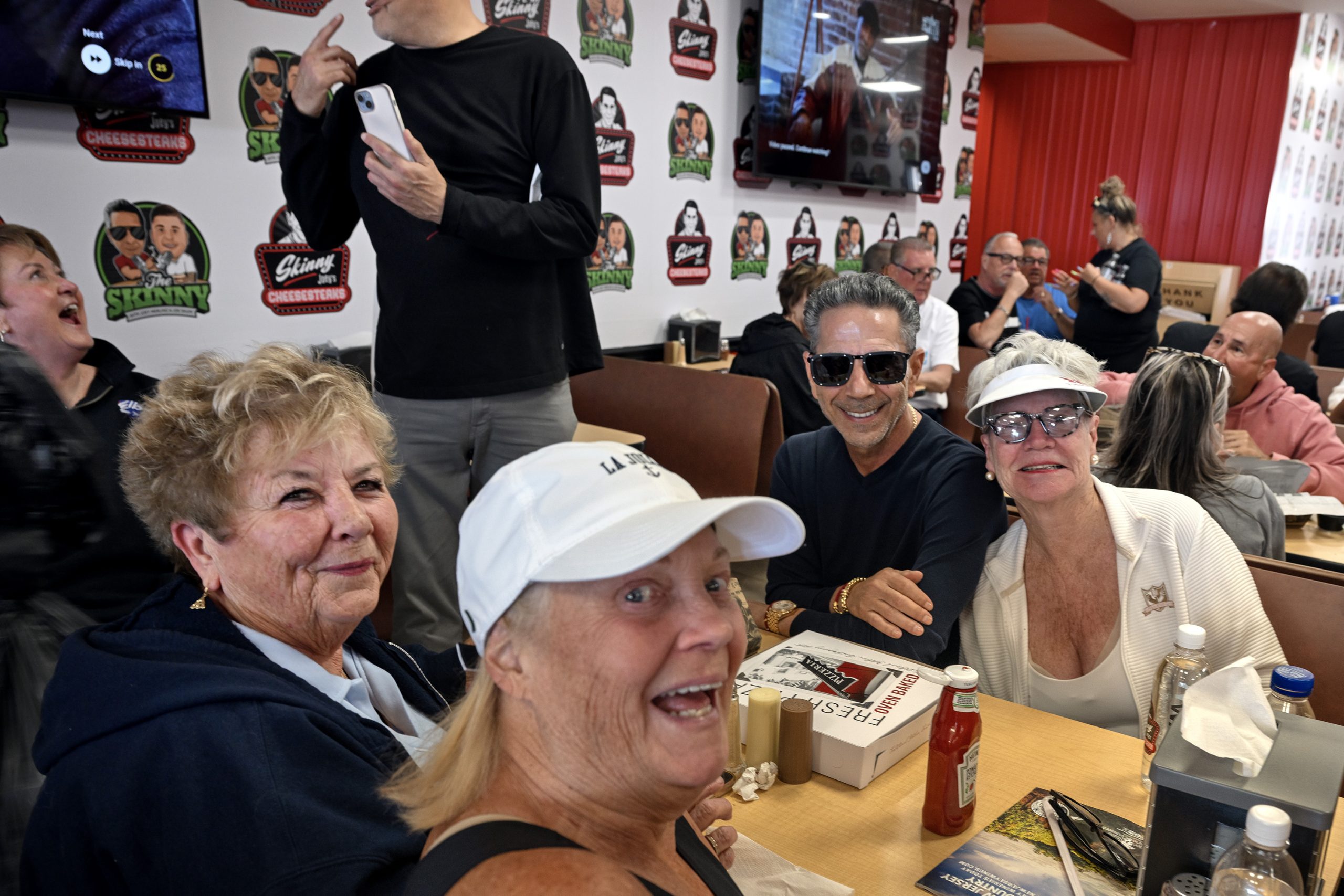
Joseph “Skinny Joey” Merlino joining customers at Skinny Joey’s in Wildwood during its soft opening on June 2. They call themselves “the Schuylkill Girls” (from left): Julie Shelton, Cindy McCullough, and Terry Landy, all of whom now live in Wildwood.Tom Gralish / Staff Photographer
A ‘mob media’ moment
George Anastasia, who covered organized crime for more than 30 years at The Inquirer and now teaches an organized-crime course at Rowan University, said Merlino’s new career fits a broader moment in mob media.
Former wiseguys, associates, historians, and fans now gather in a true-crime subculture known online as “MobTube,” where the lore is packaged into YouTube shows, Patreon feeds, podcasts, clips, and merch.
Merlino has lived the story that fuels the genre. One of Philadelphia’s most recognizable organized-crime figures, Merlino was convicted in 1990 for his role in a $352,000 armored truck robbery in 1987.
In 2001, he and six co-defendants were tried on federal racketeering charges, including three counts of murder and two of attempted murder. Merlino was acquitted on those counts, but served about 12 years on other charges, including gambling and extortion. A supervised-release violation briefly returned him to prison in 2014, and a second major racketeering case ended in 2018 with a guilty plea to a single illegal-gambling charge after a mistrial. In a separate trial in 2004, he was acquitted of the 1996 killing of Joseph Sodano, an underling in North Jersey. Merlino completed federal supervision in 2021, but he’s been banned from New Jersey casinos since 1988 and from Pennsylvania casinos since a 2016 incident at the former SugarHouse Casino.
And Merlino has made it no secret that he is different from many of the former figures who populate the MobTube genre. Unlike Sammy “The Bull” Gravano, John Alito, and Jimmy Calandra, Merlino never cooperated with prosecutors.
“He saw guys who cooperated come back and become media sensations,” Anastasia said. “And I think he got [annoyed] that these are all guys who, in his view, violated the code, and now they’re making money on that old life. He did his time as a stand-up guy. ‘So [to heck with that] — I’m going to make money, too.’ And he created this brand.”
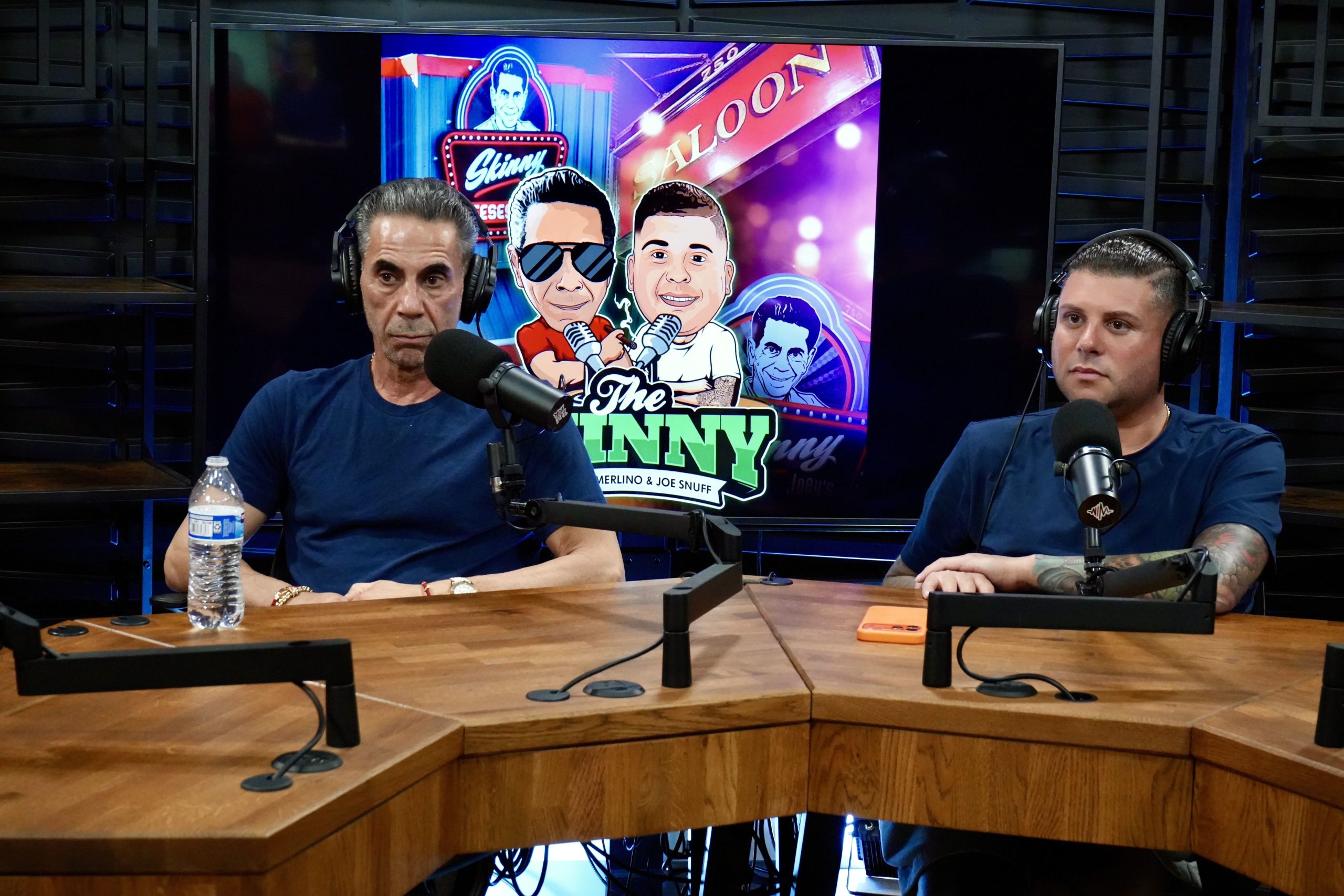
Joseph “Skinny Joey” Merlino (left) and Joe Perri Jr. on the set of “The Skinny” podcast.Courtesy of Joe Perri Jr.
Perri helped make that legible to a younger audience.
“Lil Snuff is part sycophant and part guide,” Anastasia said. “He’s the one who, in a lot of ways, sets the flow. Joey is going to be Joey, but somebody has to keep bringing him back to the point.”
The rise of Lil Snuff
Before he was Merlino’s co-host, Perri was Lil Snuff.
The nickname came from his father: As a 10-year-old, Joe Sr. turned around when a cousin was calling for a dog named Snuffy. Boom. He was Snuff. When his son was born at Methodist Hospital in 1992, Snuff became Big Snuff.
As a teenager, Lil Snuffbussedtables at Stogie Joe’s, the Saloon, and Fitzwater Cafe. At 18, he joined the stagehands union. At 21, he got a job at Mall Chevrolet in Cherry Hill. The older salesmen had relationships and repeat customers. Perri’s mentor told him that he needed a lane.
It was 2013, and social media was beginning to reshape promotion. Perri started making his own brassy, unscripted commercials. “Selling Chevys for less” became his tagline.
He also made videos about gambling and food, his two passions. He was not famous, but he was visible in the South Philly-to-South Jersey social media corridor where restaurants, sports, betting, family, and neighborhood identity blur into one feed.
At the same time, Perri said, he was abusing pills. In 2014, at 22, his parents found him a rehab center in South Florida. To make sure he got there safely, they called a family friend whose Italian restaurant in Boca Raton had recently opened:
Joey Merlino.
“My father grew up with his grandfather,” Merlino said, explaining the bond. “I grew up with his father. I’ve known him since he was born.”
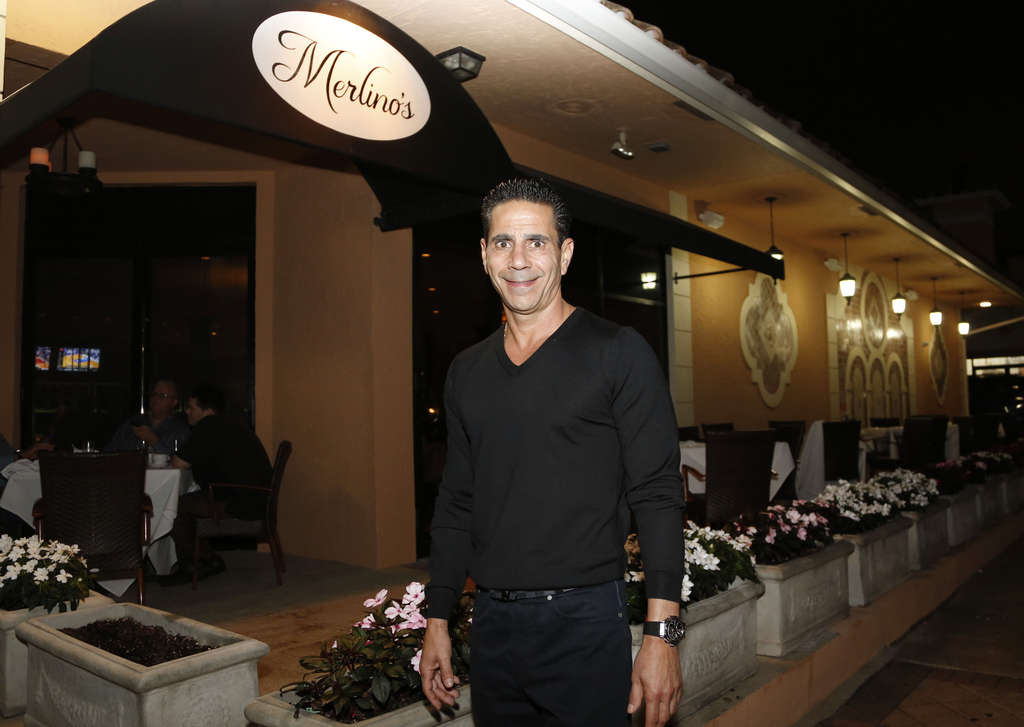
Joseph “Skinny Joey” Merlino in 2014 at the Boca Raton restaurant bearing his name.Terry Renna / For The Inquirer
Perri said it took several attempts before recovery stuck. He has been sober since Sept. 11, 2016. “I’m big with recovery,” he said. “That’s the main thing in my life. I put sobriety first and then everything after that.”
Merlino’s — where Merlino was maitre d’ because his legal situation then precluded ownership — closed in 2016, just before the feds arrested Merlino at his home in Boca in the lead-up to his second racketeering case. “If I didn’t have this trouble, it would still be open,” Merlino said earlier this month.
After Merlino attained freedom in July 2021, producers called with movie, television, and book deals. Merlino turned them all down. “Nothing seemed right,” Merlino said. Someone brought up the idea of a podcast.
“I didn’t even know what that was,” Merlino said.
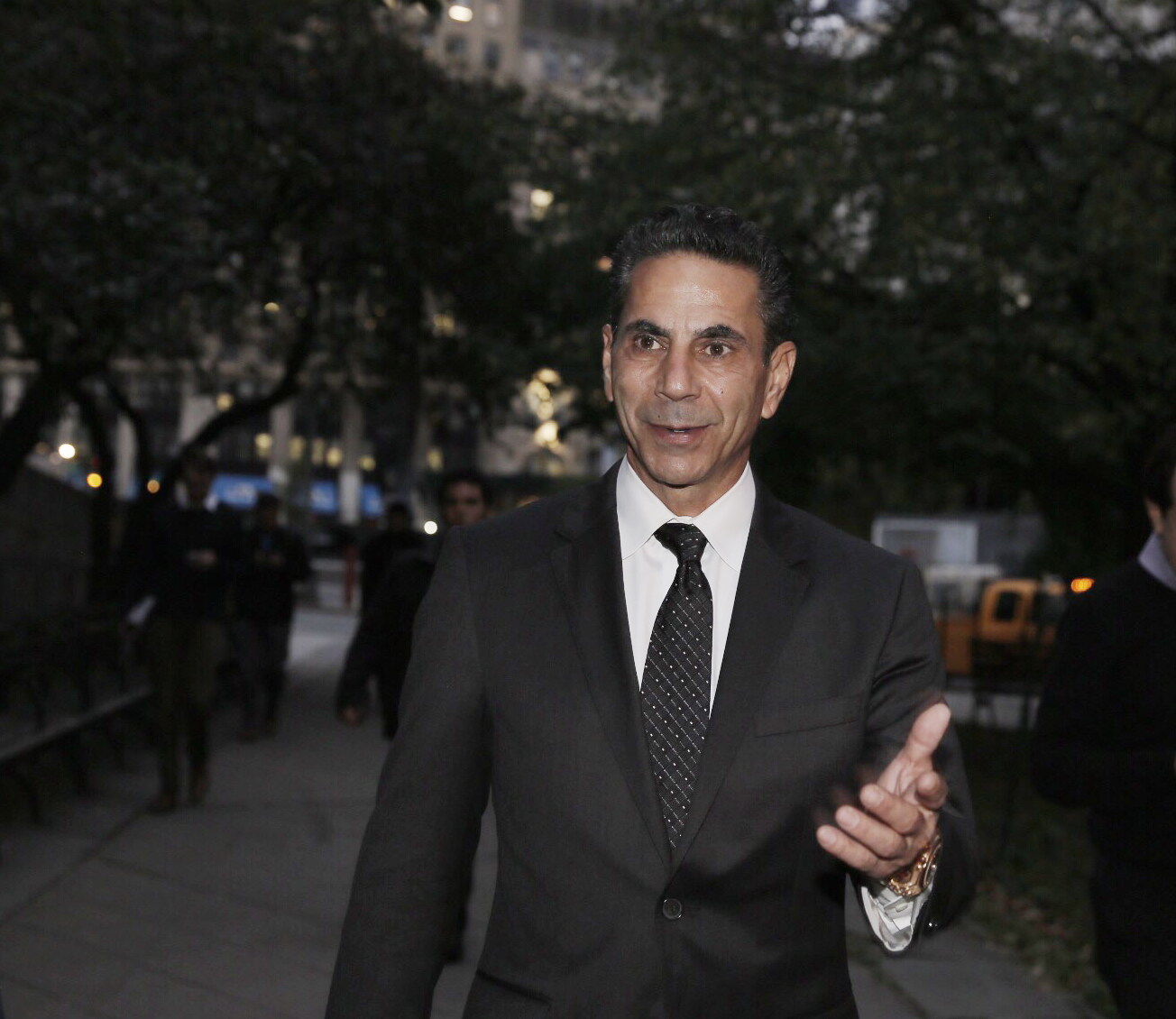
Joseph “Skinny Joey” Merlino leaving the federal courthouse in Manhattan after being sentenced on Oct. 17, 2018.Elizabeth Robertson / Staff Photographer
His friend Raymond “Wags” Wagner explained the concept and suggested a loose format built around food and sports betting. Actor Kevin Connolly of Entourage fame, who was involved early as a producer, told Merlino that he needed a co-host.
“They said, ‘Who would you want?’” Perri said. “They were sending him people, and he was like, ‘I’m not doing nothing with these people.’”
Then Ray Wags suggested Perri.
“Joey was like, ‘100 percent. Get him on the phone,’” Perri said. “Kevin Connolly said, ‘Send me your videos.’ I sent him my videos, and he said, ‘You’re the guy.’ The rest was history.”
The world of ‘MobTube’
Merlino and Perri launched the video podcast in 2023. Viewers are not just watching Merlino talk about the old life. They see him bust Perri’s chops about eating too much and mock his parlays. They get gambling tips, watch them interview athletes and celebrities — all part of a South Philly generational comedy.
Perri describes it in family terms. “My dad’s my dad, but he’s also my best friend, too,” Perri said. “We gamble together. We go out together. We have fun together. So they see me and Joey as that, and they can’t figure out how we mix so good.”
“He’s good,” Merlino said. “I’m old, he’s young. He talks good, he’s funny. He’s a pain in the balls, but it’s a good fit.”
They began The Skinny podcast on YouTube, but now focus more on Patreon, where the content is unfiltered. And better monetized. Perri says TheSkinny has 1,600 Patreon subscribers paying $15.95 a month. He said their social-media pages combined average 30 million views a month.
Perri’s wife, Danielle, handles bookings and schedules. “I produce,” Perri said. “I cut the clips. I do everything. It’s me and Joey. Two-man show.”
A wider audience
When they started, Perri was still selling cars at Mall Chevrolet. But the now-shuttered dealership got tired of people showing up hoping to see Merlino instead of test-driving a Suburban.
Perri quit. The show grew.Merlino’s reinvention has coincided with a broader shift in the gambling world. Legal sportsbooks, now ubiquitous on television and online, have largely supplanted the corner bookmaker, turning an activity once associated with organized crime into a mainstream consumer business. Guests span sports, hip-hop, gambling, and entertainment, including Wallo267, Fat Joe, Ric Flair, and Bernard Hopkins.
Each booking widened his audience, and Merlino was being absorbed into a broader celebrity ecosystem.
Last October, Netflix released Mob War: Philadelphia vs. The Mafia, a docuseries revisiting the violent 1990s power struggle between John Stanfa and Merlino’s younger faction. It steered even more viewers to Merlino and Perri’s world.
‘Skinny Joey,’ wit’
Then came the cheesesteaks.
One night, Perri, Merlino, and friends were playing poker. Merlino wanted cheesesteaks. Perri said he’d make them.
“He’s like, ‘You can’t make cheesesteaks,’” Perri said. “I said, ‘Are you nuts? I’ve been making them my whole life.’”
Perri cooked some. “He was like, ‘This is the best f— cheesesteak ever,’” Perri said. “He said, ‘Let’s open up a cheesesteak place.’ I said, ‘All right. Call it Skinny Joey’s Cheesesteaks.’ And that was it.”
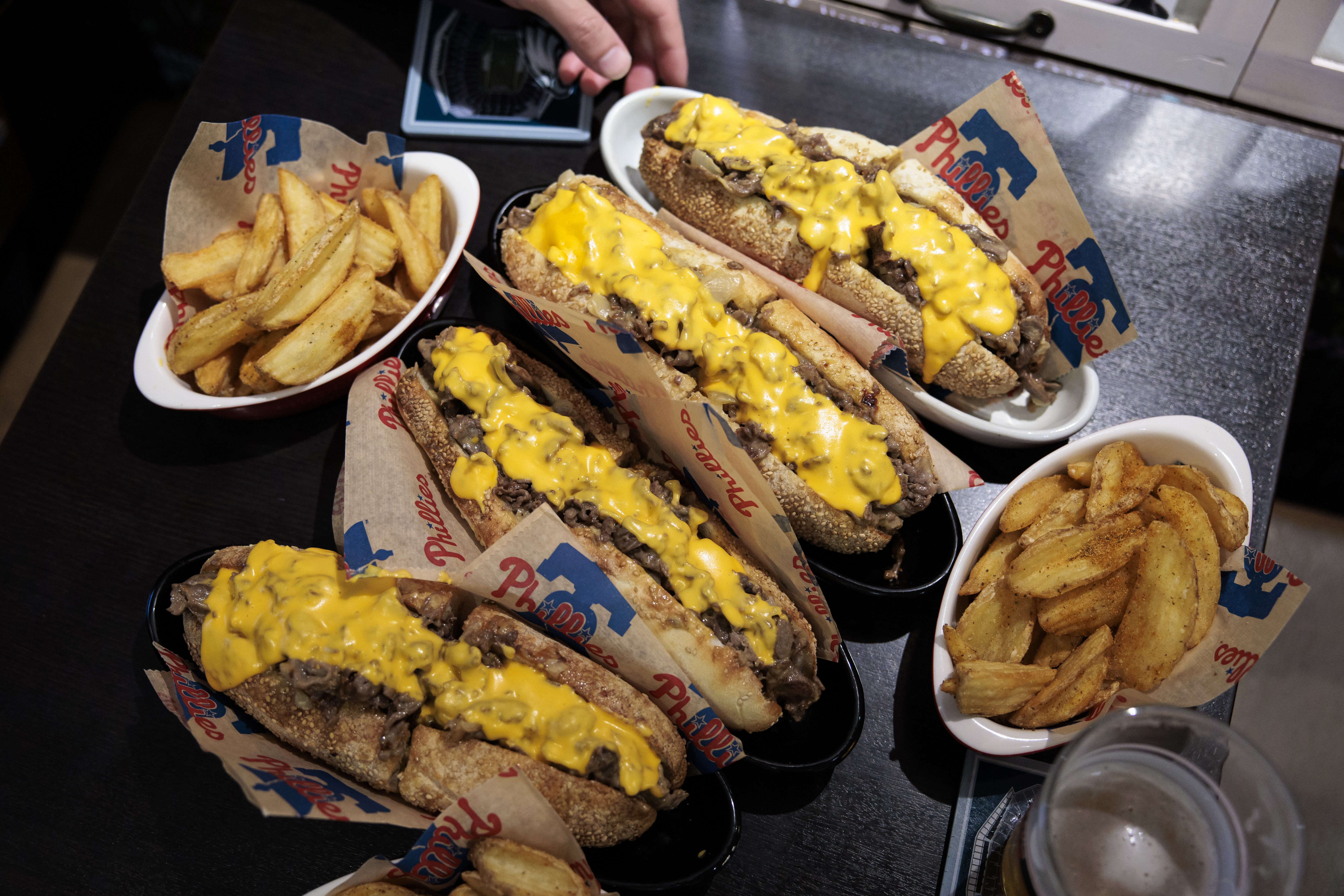
The first shop opened in March 2025 at 3020 S. Broad St., near the sports complex. From the start, Skinny Joey’s was more than a sandwich shop. It was a set. The shop leaned into Merlino’s notoriety; the sandwiches are wrapped in a collage of newspaper articles about his past.
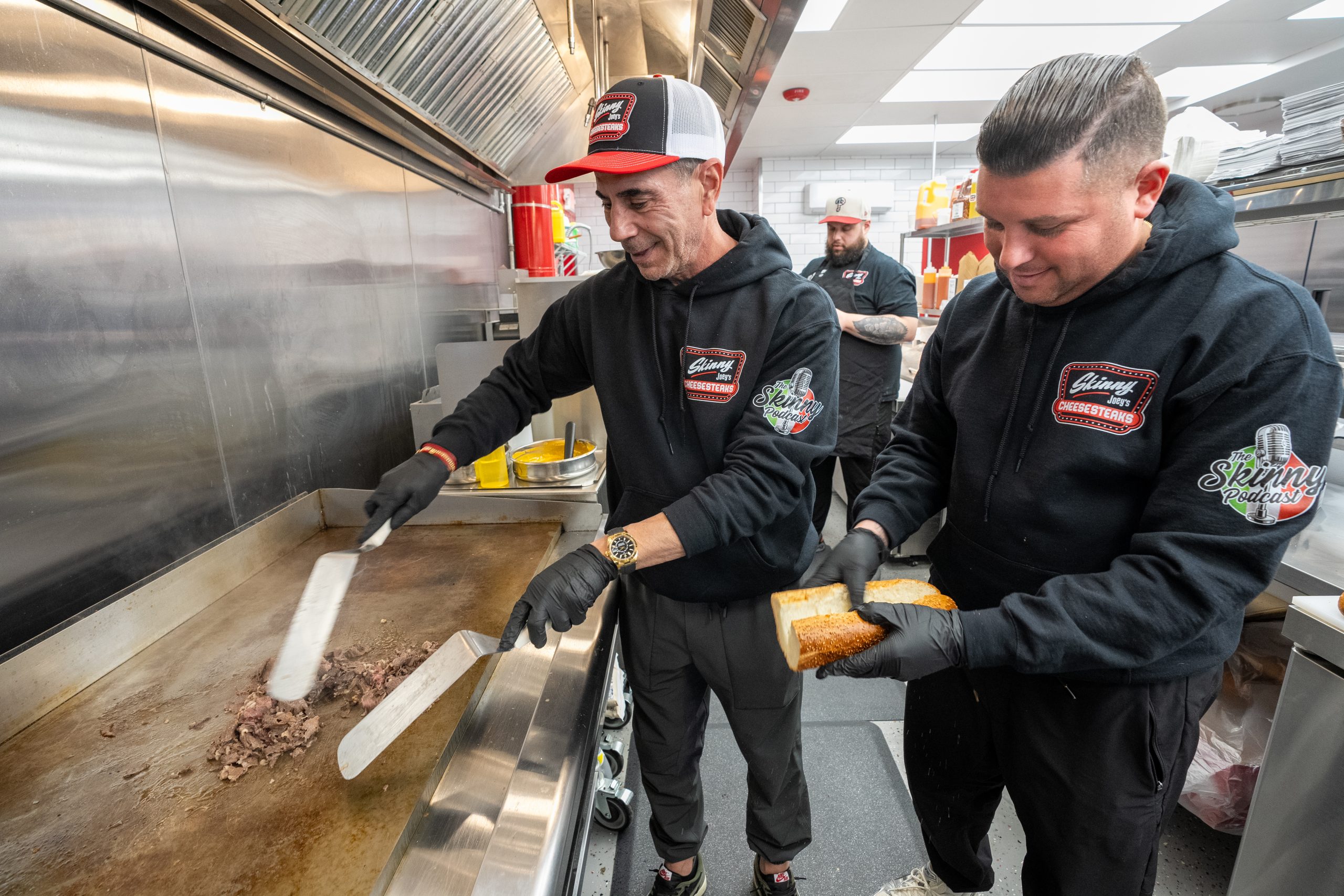
Joseph “Skinny Joey” Merlino (left) working the grill beside Joe “Lil Snuff” Perri Jr. at the Skinny Joey’s Cheesesteaks in Philadelphia at its opening in March 2025.Jessica Griffin / Staff Photographer
Celebrities showed up: Jason Kelce, Landon Dickerson, Mack Wilson. A customer eating a cheesesteak was good content. A recognizable person eating one on camera was better.
The restaurant also became a magnet for the kind of drama that fuels digital engagement: online beef. Podcaster Gene Borrello, a former Bonnano crime family associate and Merlino antagonist, weighed in last year on an apparent feud between Skinny Joey’s camp and Frank Olivieri of Pat’s King of Steaks. Merlino and Perri had taken issue with a video posted by Olivieri — whose great-uncle invented the steak sandwich — in which he chided shops that chop the meat on the grill. Like most online food feuds, this seems to have subsided.
Then came the deal for Wildwood, where Skinny Joey’s replaced Joe’s Pizzeria, which had been on the boardwalk at Magnolia Avenue for 15 years. There, Skinny Joey’s added pizza and stromboli, which are not sold at the South Philadelphia location.
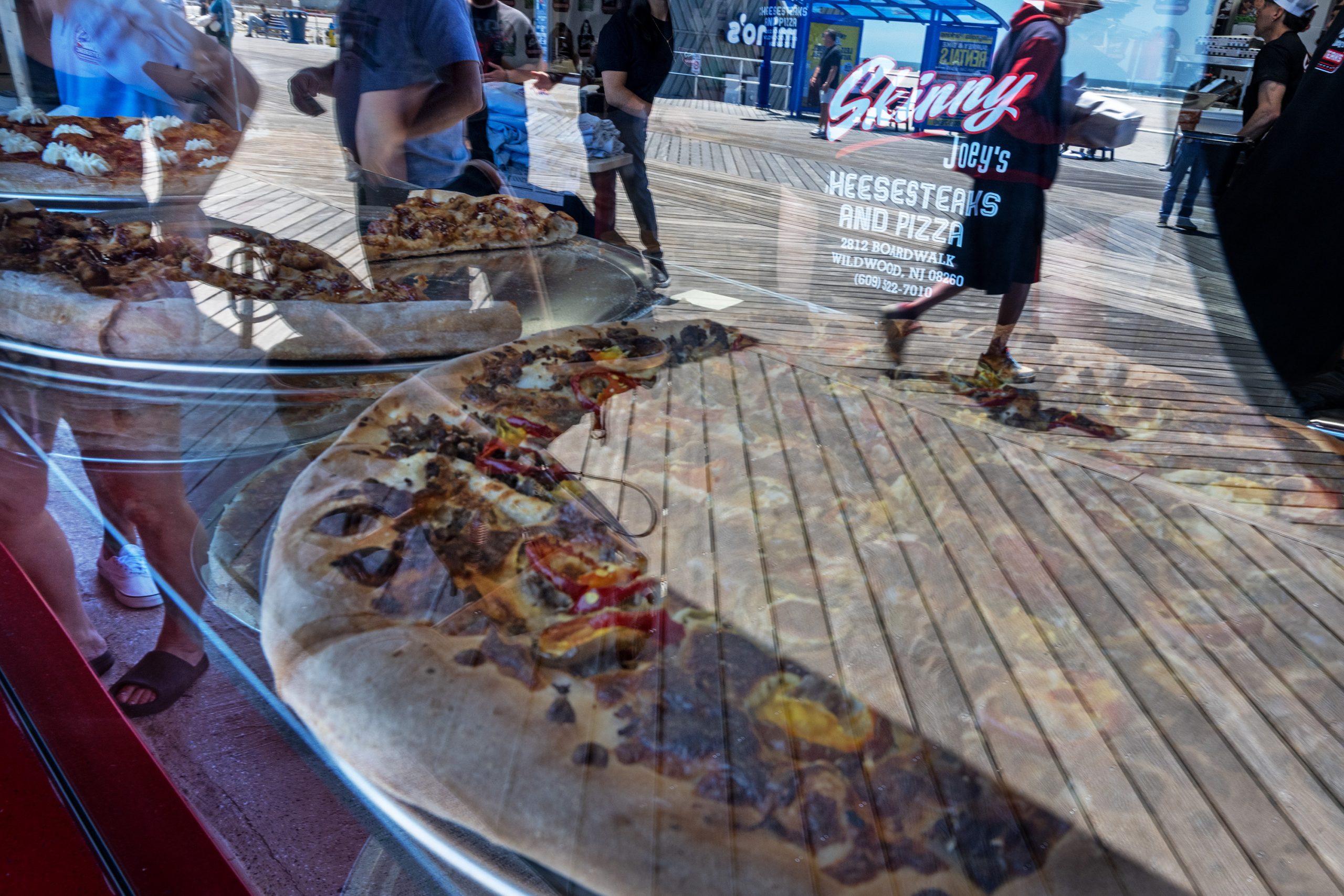
Reflections in the pizza display case on the boardwalk at Skinny Joey’s Cheesesteaks & Pizza in Wildwood.Tom Gralish / Staff Photographer
The pizza recipe comes from Vito’s on Haddonfield Berlin Road in Cherry Hill, and the stromboli from Pizza Shack at 15th and Oregon in South Philadelphia, both owned by Skinny Joey’s business partners Stephen Casasanto and John Fioravanti, whom Merlino also described as longtime friends.
More locations are planned. Perri said a Boothwyn shop is expected around Sept. 1, and several others are in the pipeline.
Bypassing the gatekeepers
Merlino is an extreme case of a recent phenomenon. People with complicated histories — criminal, scandalous, controversial, or simply overexposed — no longer need traditional gatekeepers to reintroduce themselves. They can speak directly to followers and monetize the attention.
Perri is not a journalist, of course, or a publicist, exactly. He is not merely a manager, producer, or sidekick. He is something in between — a new kind of local media operator.
He knows the scene, and how to make content feel unscripted even when the business behind it is deliberate. He is close enough to Merlino to bust his chops and deferential enough to preserve the hierarchy. He can translate Merlino to younger audiences without making him seem managed.
Perri softens Merlino without sanding him down. Merlino still curses, rants, and mocks rivals. Anyone they disagree with is a “bedbug.”
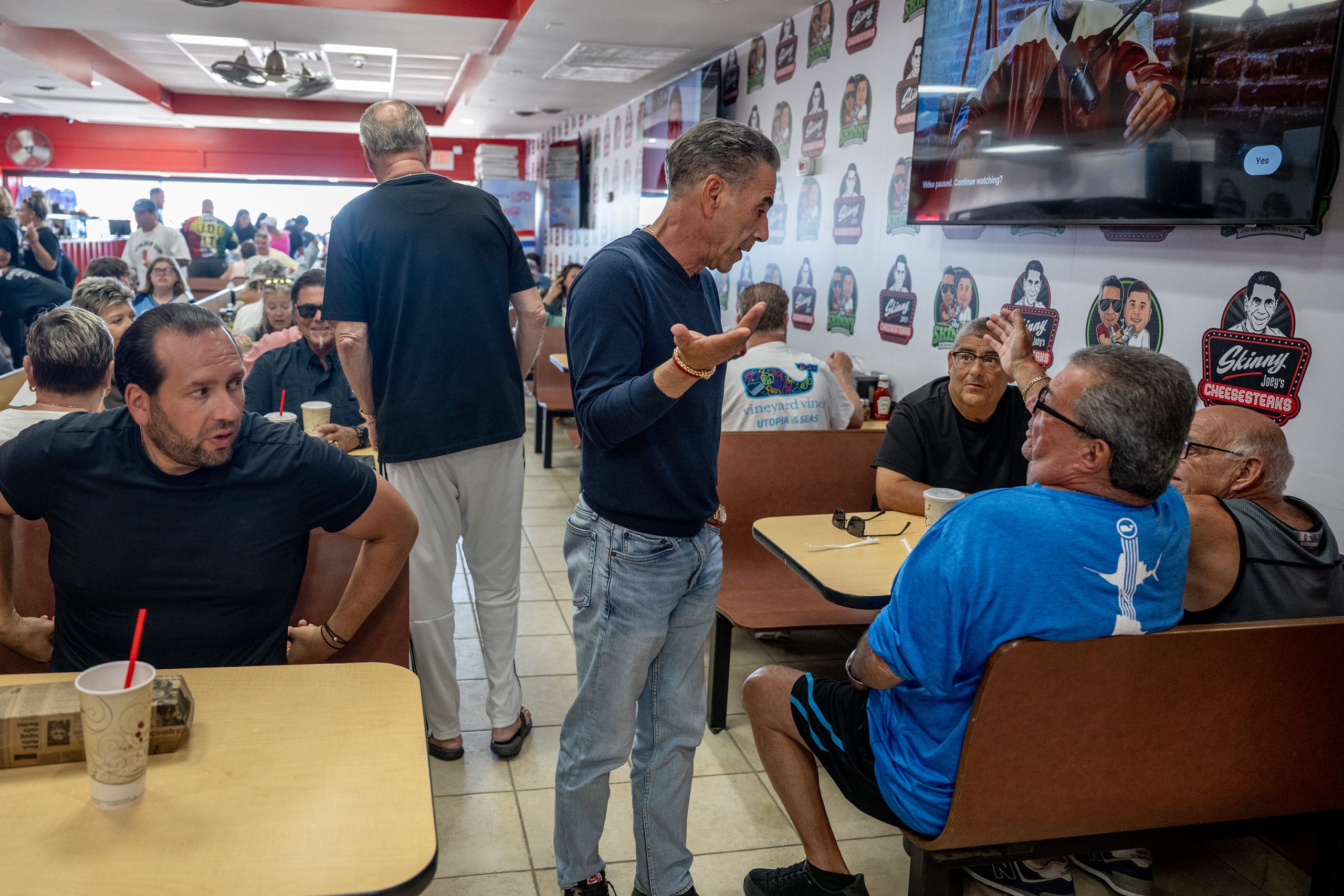
Joseph “Skinny Joey” Merlino greets a table of customers at Skinny Joey’s Cheesesteaks & Pizza in Wildwood.Tom Gralish / Staff Photographer
“At the end of the day, Joey isn’t going to change who he is for anybody,” Perri said. “If he can’t talk the way he wants to talk, what’s the point?”
That is part of the appeal and part of the discomfort. The audience knows Merlino’s history. They may see him as funny, defiant, loyal, misunderstood, or simply entertaining.
“There’s a segment of the American population that has always been fascinated with the outlaw: Billy the Kid, Jesse James, Don Corleone, Al Capone,” Anastasia said. “What the internet has provided is: Here are these guys in their own words. Are they being genuine? I don’t know. You can say that about any personality. But here’s a look at them without any filter.”
The filter used to be people like Anastasia.
“I was, in a lot of ways, the middleman between the people who were interested in this and the guys who were doing it,” he said. “And people who are interested in this don’t need the middleman anymore. They just go online and listen to whoever they want to listen to.”
There has always been a Church of Bruce. Now it has its own building.
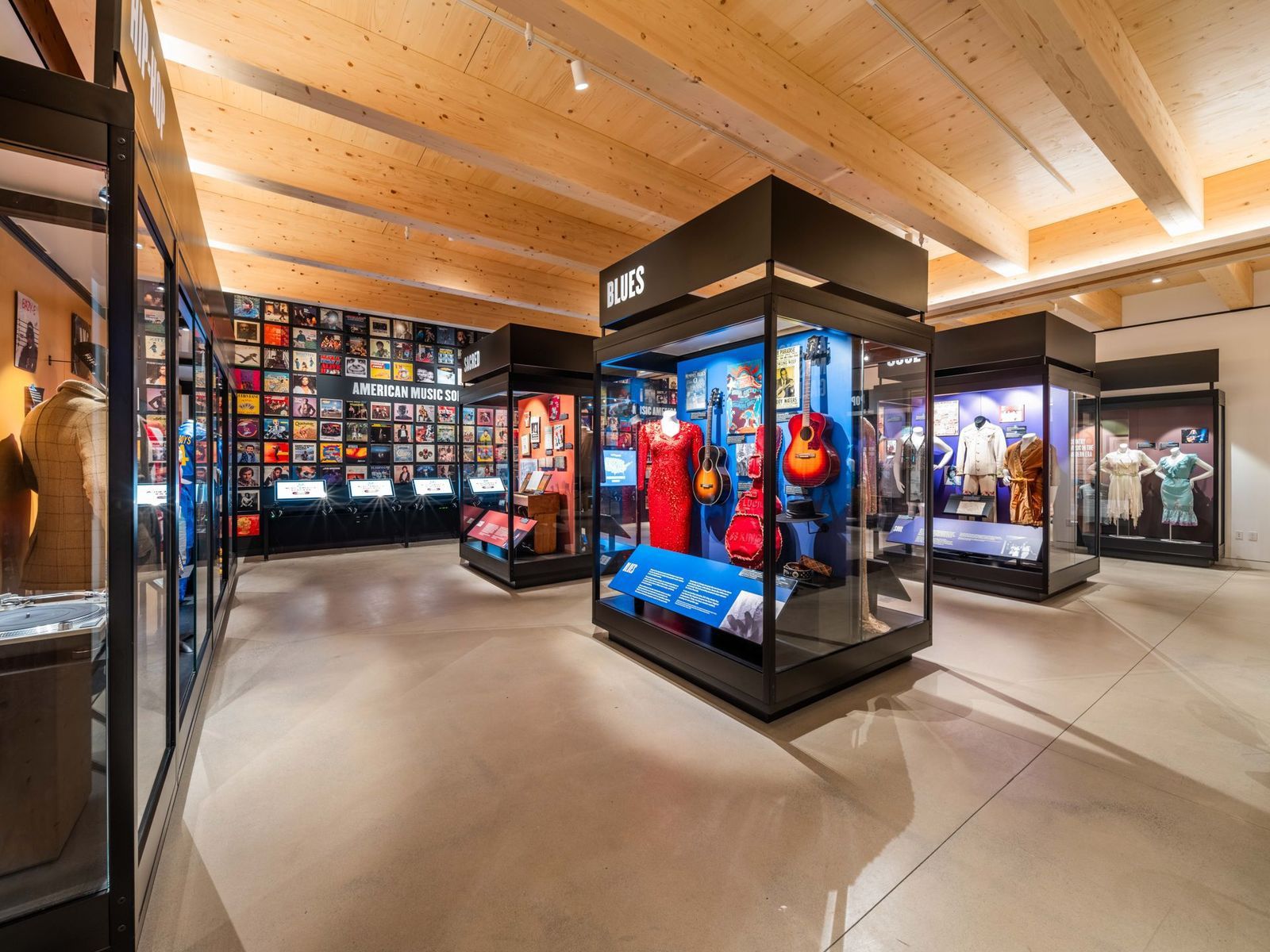
Officially called the Bruce Springsteen Center for American Music, it’s located on the Monmouth University campus, four miles north of Springsteen’s old Asbury Park stomping grounds. As the name suggests, the center — part museum, part archive, part concert venue — is seeking to broaden the conversation by situating the Jersey rocker along a continuum, one that starts with Indigenous drumming rituals and stretches into the hip-hop era.
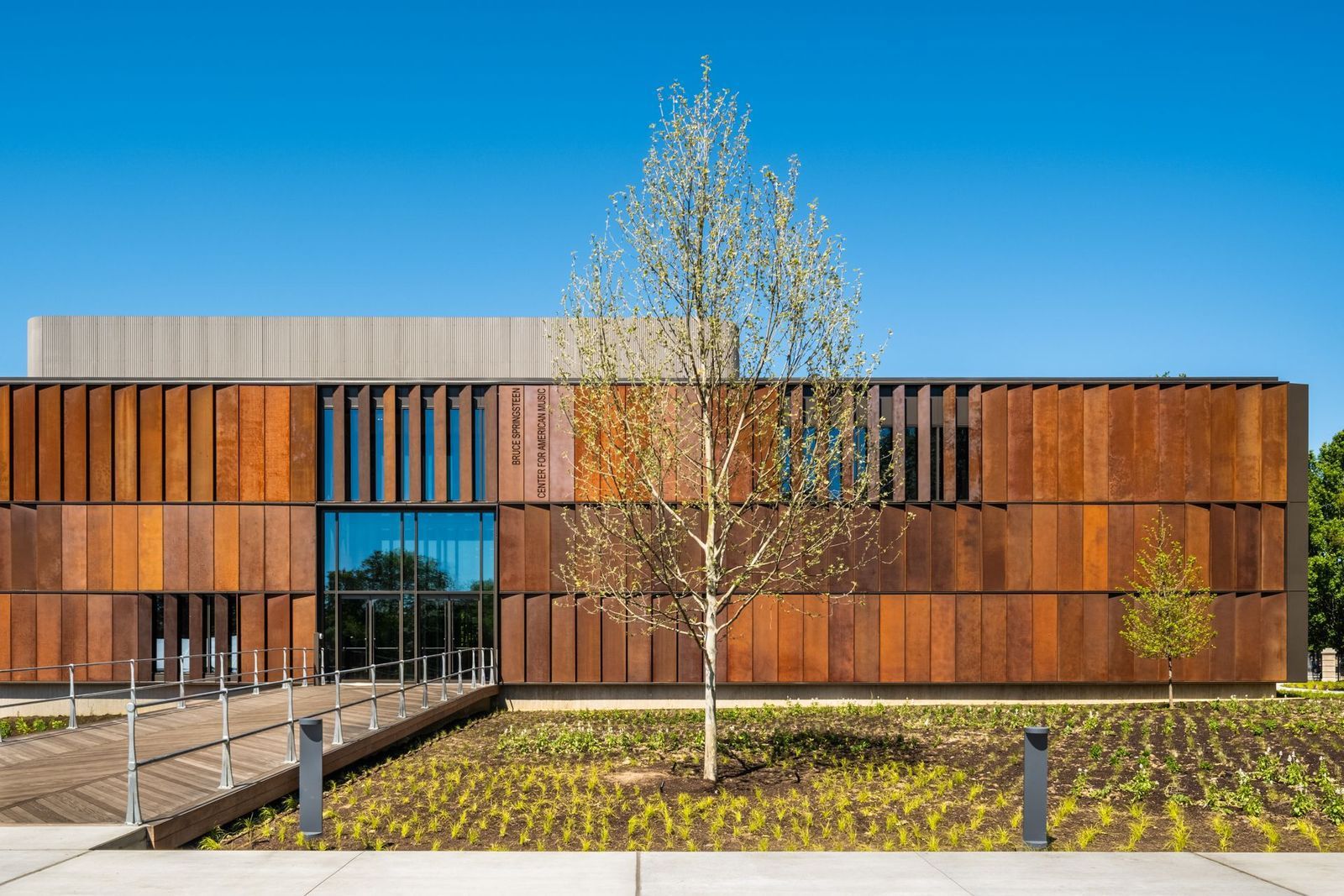
And yet, as you stride up the center’s boardwalk-style entrance ramp, past the memory tree that commemorates the one from Springsteen’s childhood home, and come face-to-face with the building’s rust-hardened steel walls, there’s little doubt that you are really entering Bruce’s house.
Springsteen has been such a cultural presence in American life over the last half century that it is hard to imagine it otherwise. Every detail of the building designed by New York’s CookFox Architects is keyed to some piece of his well-known biography. The joy in the architecture, particularly for the legions of Springsteen superfans, will come from decoding the references.
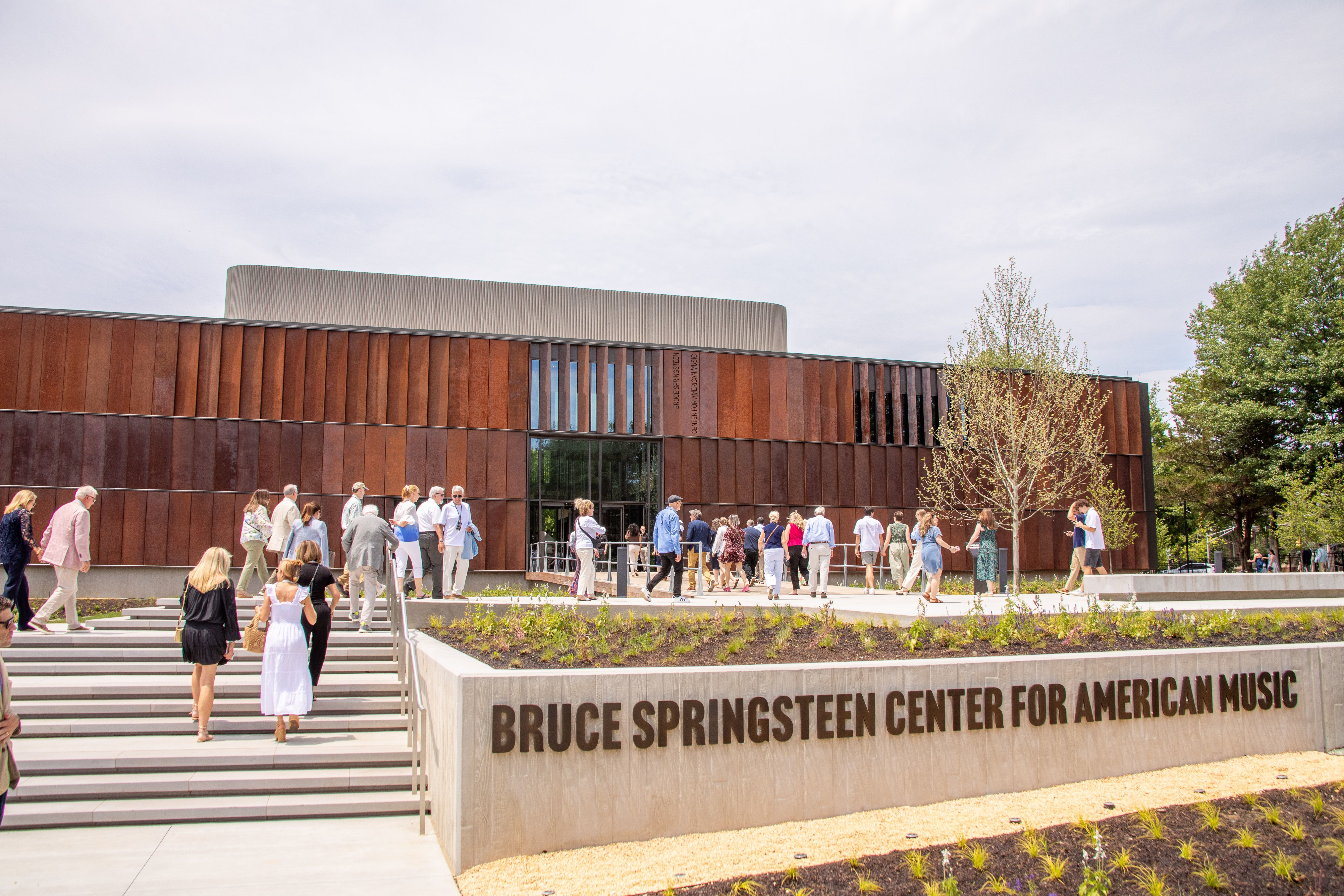
Guests gathered June 7 for the opening of the new Bruce Springsteen Center for American Music on the campus of Monmouth University in Long Branch, N.J.Monmouth University
There is the site itself, on the shady university campus where Springsteen played one of his first big concerts in 1969, at a time when most of his gigs were confined to dive bars. The simple rectangular building is put together with the same devotion to craft you find in Springsteen’s lyrics, and it’s similarly infused with grit.
On the facade, vertical slats of weathering steel angle in search of sun and shade. Their calloused red surface evokes the aging factories that stood on the edge of Springsteen’s hometown of Freehold, and that form a recurring motif on “Born in the U.S.A.,” an early and prescient elegy for America’s dying manufacturing towns and diminished working class.
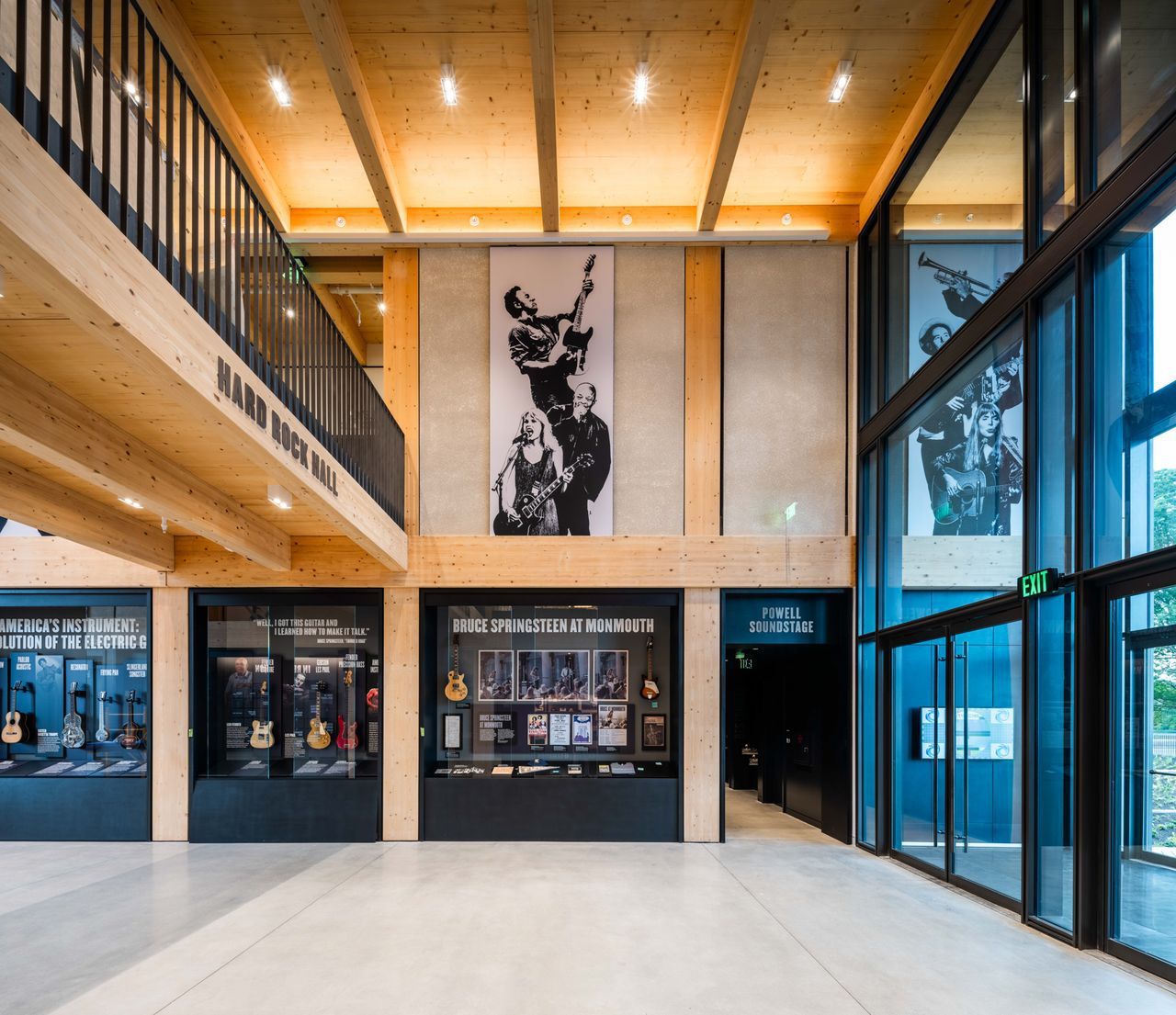
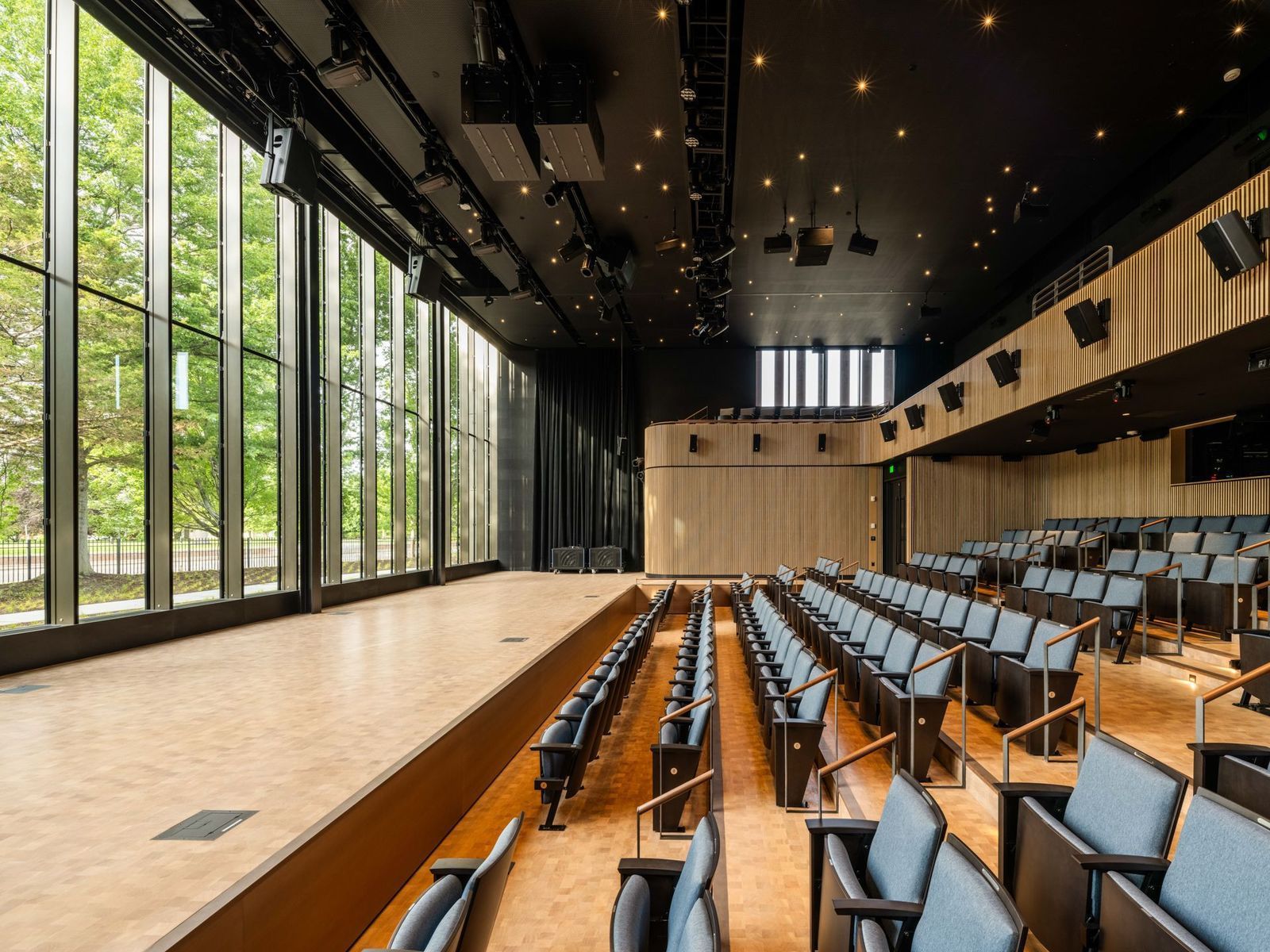
That industrial theme is reinforced once you step inside. Muscular columns and beams, made from environmentally friendly engineered wood, structure the interior. There are wood slats on the ceilings and chunky blocks on the theater floor. They are the same hardy, end grain cut that factories once used to support heavy machinery.
Why fans will come
While Springsteen’s work tends toward darkness, the new center, which opens Saturday, emphasizes the light, both in its design and in the content of the exhibits.
Most visitors probably won’t be making the pilgrimage to Long Branch for the architecture, good as it is. They’ll come for the same reason they have attended so many concerts over the years, standing for the Boss’ relentless, three-hour jams and chanting the lyrics by heart. His stories of yearning and defiance have become the soundtrack for their lives. The $50 million center promises to serve as a giant scrapbook for those memories.
The project’s origins go back to 2011, when a donor gave Monmouth University a collection of Springsteen memorabilia, mostly posters and magazine clippings. At the time, it seemed likely that Springsteen’s much larger personal archive would end up at the Rock & Roll Hall of Fame in Cleveland.
The university nevertheless continued to expand its holdings, and in 2016, several people connected with the collection decided to make a play for Springsteen’s personal archive. A delegation was sent to meet with the musician and make the case that the material belonged in New Jersey, not Ohio.
Springsteen’s longtime manager and friend, Jon Landau, “loved the idea,” recalled Eileen Chapman, the center’s director. Springsteen agreed to donate his archive to the university — gratis — and the university agreed to erect a suitable place to house it.
The Boss did make one stipulation: He didn’t want the exhibits to focus on him exclusively, said Robert Santelli, a Grammy-award winning music historian and Monmouth alum who is now the center’s executive director. Once again, the university agreed, and the center’s scope was expanded.
”The Bob Dylan archives are about Bob Dylan. The Woody Guthrie Center is about Woody. We felt the best way to tell Bruce’s story was to make him a chapter in an ongoing story of American music,” said Santelli, who has helped start several music museums, including the Grammy Museum in Los Angeles.
Everything went smoothly at first. CookFox Architects, who are known for their commitment to both green and healthy design, won the design competition for the center in 2018. Then the pandemic hit and fundraising slowed.
First exhibit: Protest songs
Although it has taken eight years to get to this point, there is a certain poetic alignment in the timing of the opening, as America celebrates its 250th anniversary. The center’s first special exhibit will be devoted to protest songs.
Richard A. Cook, the CookFox partner who oversaw the design, considers himself a casual fan. But he said he was deeply moved by the passages in Springsteen’s autobiography about his father, who struggled with bipolar disorder, as Cook’s father did. As an architect, he has embraced biophilic design, which uses sunlight and nature to shape soothing interiors.
Entering the building from the boardwalk, visitors will be immersed in a calming, double-height hall flooded with natural light and smelling of wood. From there, they are directed to an intimate, 240-seat auditorium — where more light pours in from a floor-to-ceiling glass wall behind the stage — for an introductory film by Thom Zimny.
The theater is easily the most expressive space in the building. It is rare to see such large windows in a performance venue, which are typically hermetic boxes that overwhelm the street with blank walls. By offering views of the planted meadowland that encircle the center, Cook sets the mood for the entire visitor experience. Just before a film or concert starts, a curtain and screen will drop down, completely covering the wall.
Sound quality was a priority, and the theater is outfitted with the latest technology and acoustical materials. Unlike most stages, this one has no steps, which means performers who use wheelchairs can roll directly onto the platform. Even in this space, Springsteen’s presence is conveyed through the use of denim upholstery on the seats.
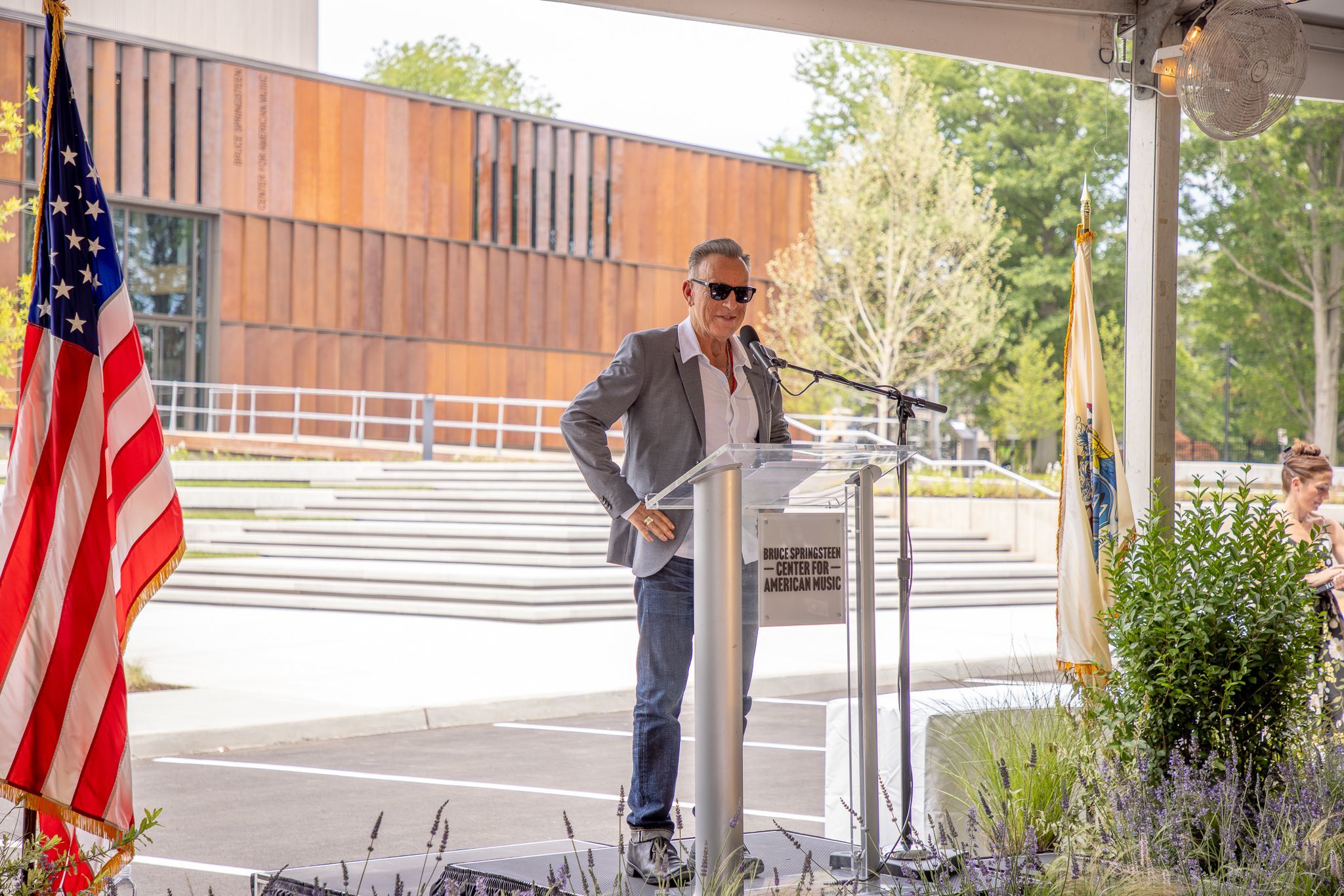
As Springsteen himself remarked at the June 7 dedication, “The building really feels like me, feels like where I came from.”
Springsteen’s archive, open to all
The rest of the building is divided neatly in half: A permanent exhibit on American music and a special exhibition gallery occupy the ground floor. Upstairs, it’s all Springsteen. Those second-floor exhibits include several interactive displays, including a room of instruments where visitors can don headphones and hear tips for replicating Springsteen’s music.
But the heart of the center is the archive. While many museums limit access to scholars, this one is open to everyone. Springsteen was known to labor for months on some songs, and Chapman says she wants to use the archival material to bring his artistic process to life.
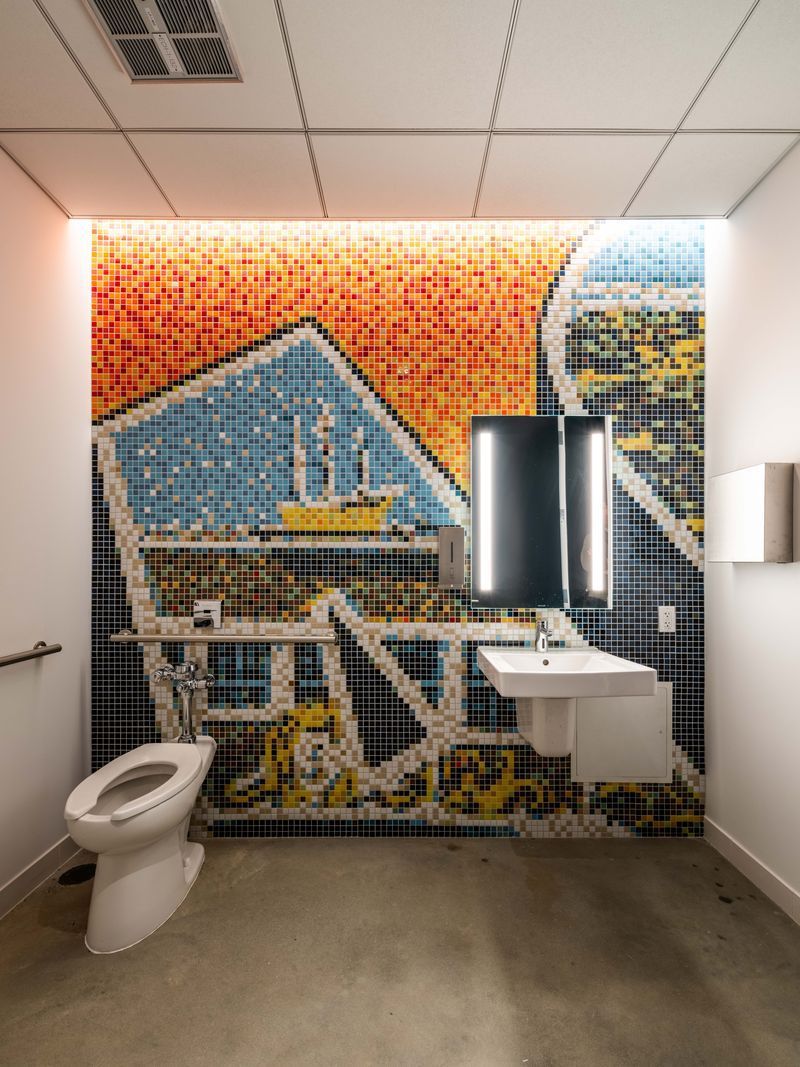
Probably the most literal reference to Springsteen’s work can be found in the restrooms. The architects converted the cover of Greetings From Asbury Park, N.J. into bathroom tile, then cut it into sections and installed a piece in each restroom. It’s a nice idea, but I suspect only hardcore fans will be able to recognize the source of the scaled-up, pixilated image. A room filled with iconic photographs of Springsteen, donated by Philadelphia lawyer Robert J. Mongeluzzi, also feels a bit padded.
Outside, the center, which received a Gold certification from the U.S. Green Building Council, is surrounded by a sustainable and biodiverse meadow by LaGuardia Design Group. A small concert venue has been tucked in amid the flowers.
Plenty of museums around the world are devoted to individual visual artists (i.e., Calder Gardens) and important historic figures, but exhibits focused on popular musicians seem to be growing by the day, perhaps in response to the increasing sophistication of audio and interactive technology. Along with museums covering specific musical genres, shrines are devoted to the work of Dylan, Guthrie, Johnny Cash, Louis Armstrong, and, of course, Elvis. The Springsteen Center won’t be the last.
Although Monmouth University is a 90-minute drive from Center City, the center is close to several Springsteen-specific sites, including the Long Branch house on West End Court where he wrote “Born to Run,” as well as several Asbury Park venues.
The Jersey Shore has been an incubator for musical talent for nearly a century, from Count Basie — the “Kid from Red Bank” — to Jon Bon Jovi, yet that legacy has never gotten its due. While Springsteen’s name is the one etched onto this building, the project is really a validation of New Jersey’s enormous contribution to the history of American music.
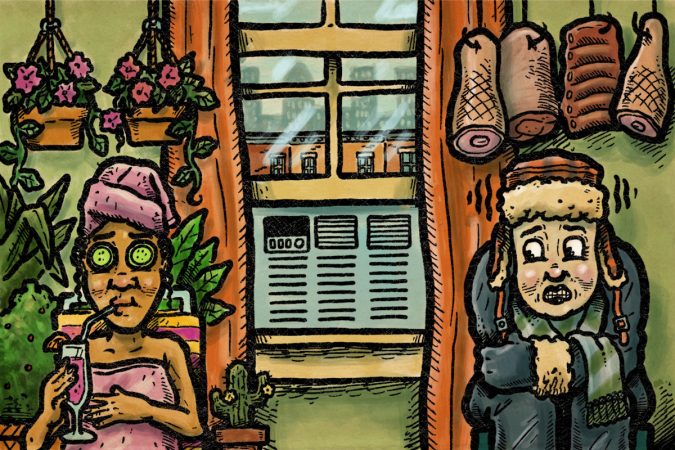
Hi we decided to write this together so you have both sides fairly represented. We recently moved in together and it’s going great (young, gay, in love!), but we only have AC in the bedroom. One of us prefers the room wayyyy hotter than the other at night (80 degrees vs. 70 degrees). One of us argues that at 70 degrees, the other person can just wear sweatpants. The other one argues that at 80 degrees it’s not that hot, it saves money, and the other person can focus the fan on themselves. What do we do?
Earl Hopkins, Arts & Entertainment Reporter
As someone who naturally runs hot, especially during the summer months, anything above 76 degrees is an absolute no go. I never understood why some people like to bake under their covers, but our bodies all operate differently.
I think an easy compromise is to place the AC somewhere in the middle. Maybe around 75? That seems reasonable to me.
Stephanie Farr, Features Columnist
First, I love that they wrote this together. It shows they communicate well and are willing to face problems openly and honestly, which is a great foundation for any relationship.
Second, it’s often said that one of the things couples argue about most is money, but I’m of the firm belief ambient room temperature ranks pretty high up on that list, too. It’s something you may not even think about until you move in with someone and realize they are the Human Torch or Mr. Freeze.
In my house, I am Mr. Freeze, so I’m fully siding with the partner who has the totally reasonable request to keep the AC at 70. 80 is way too hot. Heck, thanks to the Human Torch I live with I’ve discovered even 75 is too hot at night for me to sleep with a blanket on — and I need a blanket to sleep.
What’s your opinion on putting on more clothes vs. using a fan?
Earl Hopkins
I think it’s way easier to add a layer of clothes than it is to have the sound of a fan buzzing in your ear all night. It’s OK when there’s a heatwave and broken AC. But beyond that, I recommend throwing on a pair of sweats, a long sleeve shirt, or a beanie.
Also, I’m no electrician or HVAC specialist, but are you really saving that much money? I don’t know. Stephanie, how do you feel about cuddling as an alternative to 80-degree temps? I think there’s a cheat code there.
Stephanie Farr
Oh I love the cuddling idea! It promotes intimacy and is a good argument against keeping it warm in the room. Nobody wants to cuddle someone when they’re all hot and sweaty.
And I’m with you on more clothes vs. fan. You can always put more clothes on when you’re cold or pile up the blankets (and cuddle!), but when it’s getting so hot in there you’ve already taken off all your clothes and you’re still sweating, what then? Are you supposed to sleep with ice packs because a fan alone will not cut it?
Do you think that only having one room with AC — aside from the whole house — should factor into the decision?
Earl Hopkins
I think so! If there’s only one room your partner can truly get cozy in, give them free rein. It’s like giving your loved one the last slice of pizza or chocolate cake. Of course you want it, but it’s a lovely gesture that doesn’t require much sacrifice. A little chill at night won’t hurt!
Stephanie Farr
Agreed! The AC room should be considered a human refrigerator in this home — an arctic oasis where the one who’s Mr. Freeze can escape and find solace. The Human Torch partner already has all the other rooms nice and toasty, so they can go to sleep in one of them if they don’t like the cold.
I wonder if the partner who wants it 80 degrees at night may not be from the U.S. In that case, this makes a bit more sense. We’re very spoiled here. I remember a great column last year by Adrian Schulz, a journalist from Berlin who did a fellowship with us at The Inquirer last summer. He expressed shock, confusion, and mild horror at our AC habits here, writing: “Am I in a restaurant or in the Siberian Tundra? Am I at an airport gate or in a cryogenic chamber? Am I on the Broad Street Line or the Polar Express?” Meanwhile, when I went to Germany in September 2024, I was shocked, confused, and mildly horrified by the lack of AC everywhere amid sweltering heat.
It’s what you’re used to, I guess, but living with a partner means getting used to new things. I think Earl has the best idea — a compromise at 75 — to start out (then slowly inch the temp down from there by dangling the possibility of more cuddles).
For Jane Golden, founder and executive director of Mural Arts Philadelphia, city life is like a large quilt.
The fabric of Philadelphia, she said, is pieced together by the people and communities that make up the region, and public art is the thread that best illuminates its beauty.
Every time Golden steps outside her home in Spring Garden, she’s reminded of its impact and grandeur. “I pay attention to all the stories our city has to tell, and the way art can help us see each other differently,” she said.
Jane Golden, Mural Arts Philadelphia, speaks at the Bells Across PA event in celebration of America’s 250th Birthday in Philadelphia, Pa., on Friday, Jan. 16, 2026.Tyger Williams / Staff Photographer
Next month, Golden will be moving into less familiar terrain.
After 30 years building Mural Arts into an international arts organization, the Fairmount resident is stepping down as executive director. The search for her successor is already underway.
For now, Golden is focused on rolling out Mural Arts’ Semiquincentennial plans, and is still carving out time to hunt for new walls in need of a makeover.
“I can’t help myself,” she joked.
In a perfect Philly day, Golden visits iconic murals, grabs dinner in Chinatown, and checks out new exhibitions sprawled throughout the city.
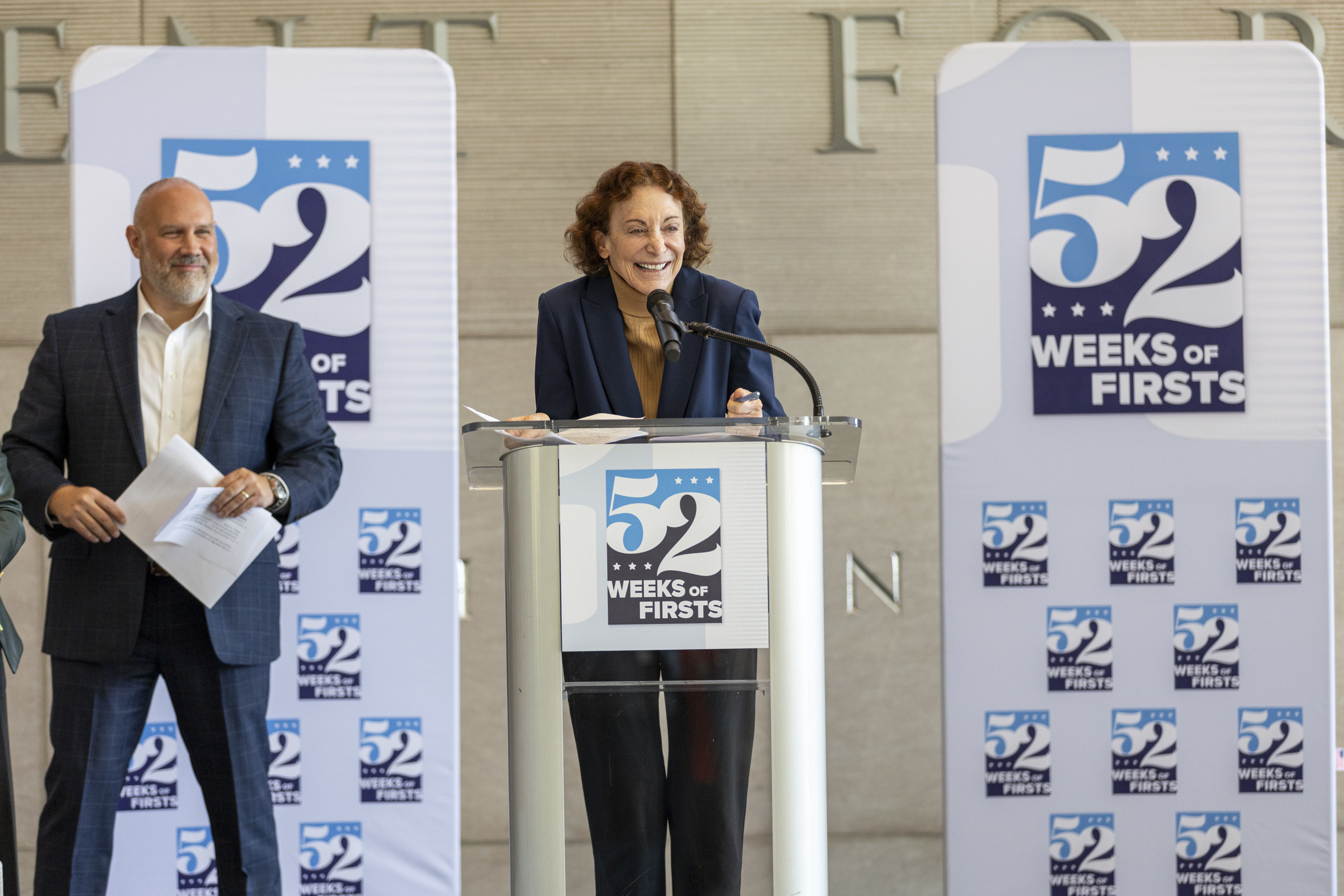
Jane Golden, Executive Director for Mural Arts Philadelphia, speaks at the announcement for the 52 Weeks of Firsts at the National Constitution Center in Philadelphia, on Thursday, Oct. 23, 2025.Tyger Williams / Staff Photographer
6 a.m.
I’m always an early riser, so I wake up at 5 a.m. and walk my dog, Cleo.
Sometimes I sleep until 7 a.m., but that’s a luxury. My cat Bella is one of the reasons I get up so early. She will take her paw, and go up and down on the blinds in my bedroom to get me up, or purr really loudly by my head. That’s better than an alarm.
8 a.m.
I walk from my place to the Philadelphia Museum of Art. I like to push myself, so I walk up the Rocky Steps and around the museum because I think it’s really pretty. Then I come back down by the Rodin Museum, and then we go to Twisted Grounds for coffee and a pastry because I have a sweet tooth.
If me and my husband Tony are really feeling energetic, we walk up to Lemon Hill.
10 a.m.
Tony and I go to Bartram’s Garden and walk around. I go to where FloatLab is at 56th Street, and if anybody is standing around, I tell them it’s there. And if we are energized, we will kayak. I’m always a little bit like the caboose, but he’s a good kayaker.
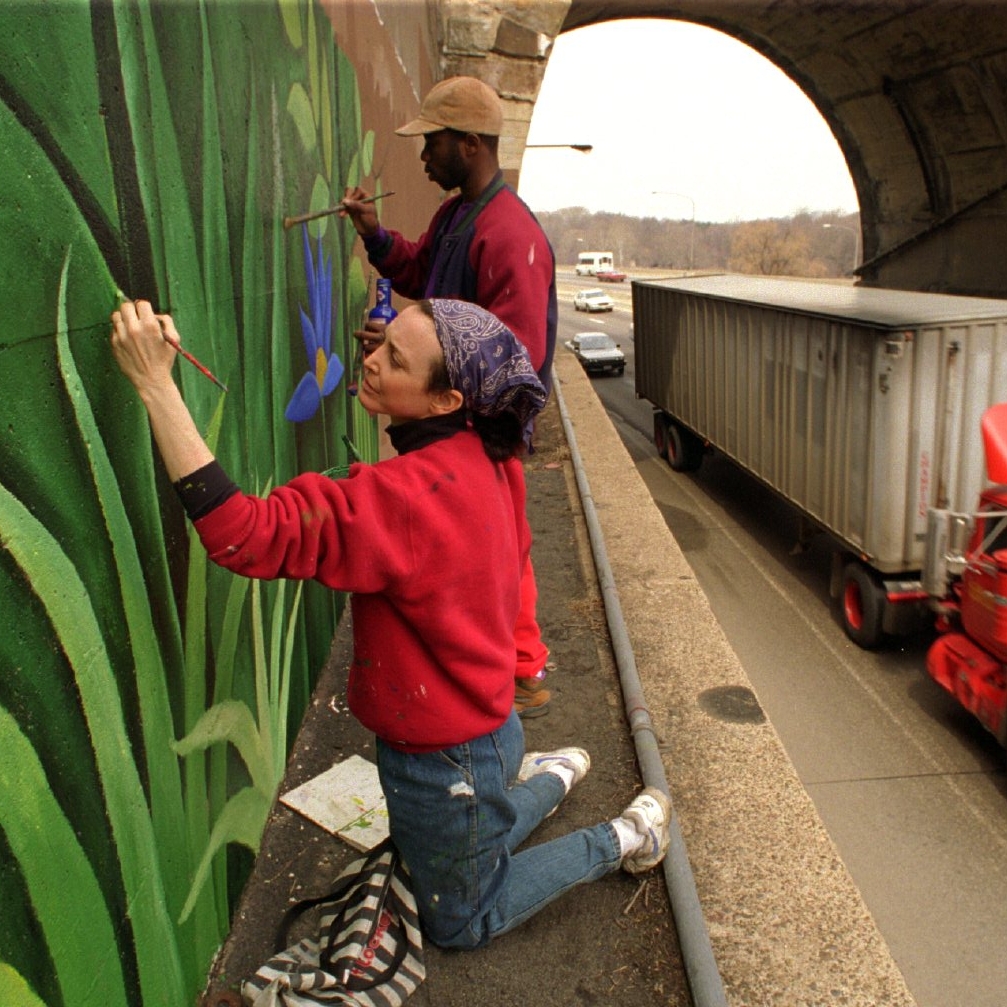
Jane Golden, artistic director of the Anti-Graffiti Network, works on a four-story mural with the help of Haisonn Shadding high above the Schuylkill Expressway near the zoo exit. Photo from March 25, 1994Andrea Mihalik
Noon
For lunch, I go to Frieda in Old City. I like Frieda because there are artists’ events there, and there’s always really interesting art on display. It’s good food, but also a delightful environment.
1:30 p.m.
Then I walk through Old City because wherever I am, I always like to check out great walls, murals, or murals in process.
At around 3 p.m., I’m going to Fishtown. There’s a new mural I have to see by Miriam Singer on the side of Mural City Cellars. They are great partners of Mural Arts. Then I’m going to walk over to 25 Oxford St. to see the new Matthew Henning mural because that’s fantastic. It’s joyful and captures the spirit of Fishtown.
Then I go to Cake Life Bake Shop. It has delicious sweets, and then I’m going to look at the mural there that’s a tribute to the trans community called We Are Universal by Kah Yangni.
3:30 p.m.
Next, I’m going back to PMA to see Paul Farber’s “Rising Up: Rocky and the Making of Monuments” exhibition. I will zip through it because I’ve seen it a few times, but I want to see it a few more times before it goes away.
Then I’ll go to the painting created by the artists at the State Correctional Institution – Phoenix. There used to be a three-story mural of Bernard Hopkins at SCI Graterford. But after SCI Graterford closed, we weren’t able to recreate it at SCI Phoenix because it’s a very different prison. So, we had the men recreate it, and now it’s on display at PMA with all their names listed, which is great. I look at that and get really inspired.
4 p.m.
I walk down the Parkway, and walk around the Swann Memorial Fountain. It’s just lovely. Then, I’ll slow up to look at the wall of the Sheraton, where we’re going to have a mural there soon. It’s a good wall.
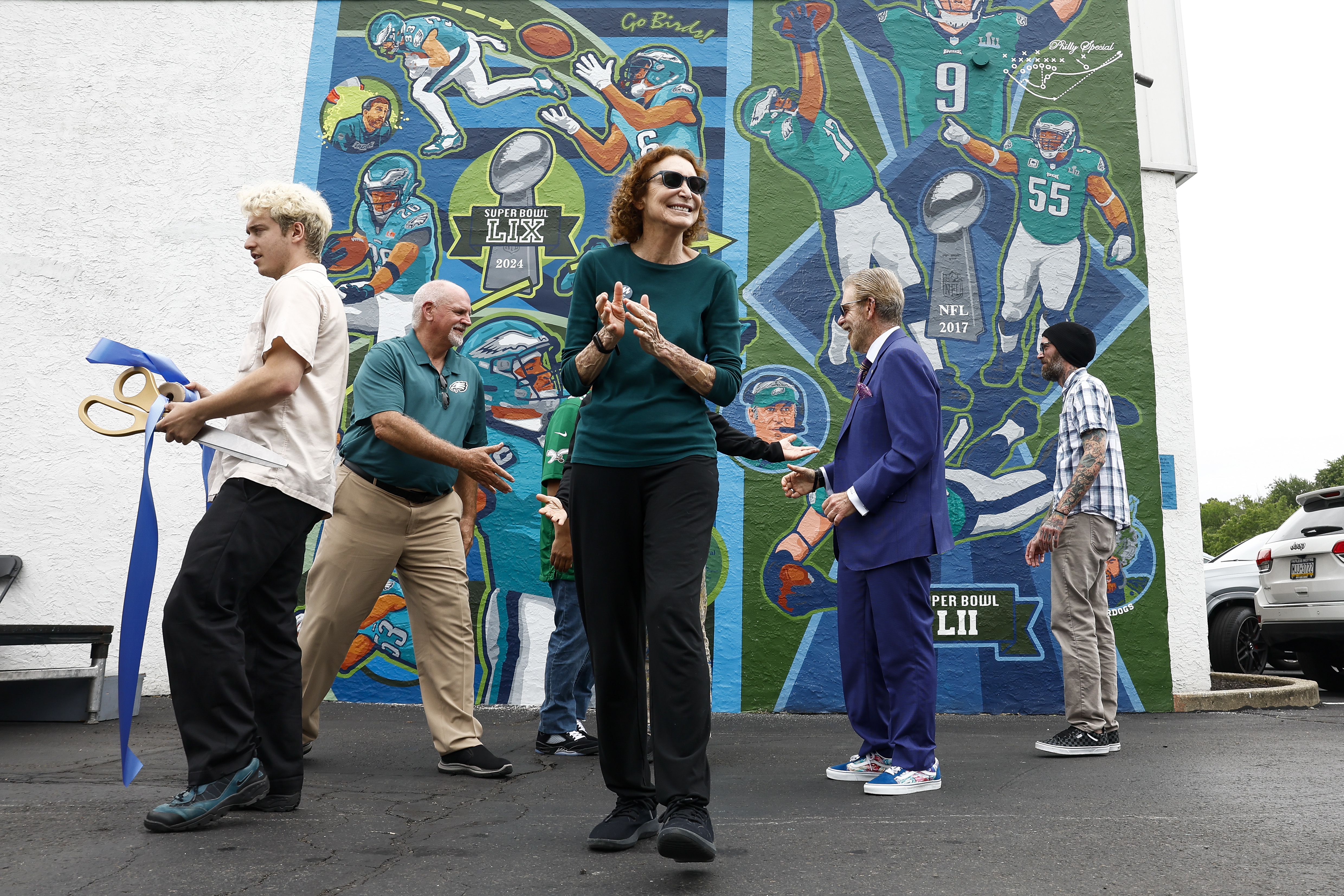
Jane Golden, founder and executive director of Mural Arts Philadelphia, takes the stage during the dedication of the Super Bowl LIX mural at Spike’s Trophies on Tuesday, June 17, 2025 in Philadelphia. The mural is an addition to the existing City of Champions mural series by David McShane.Monica Herndon / Staff Photographer
I always cheer people on who give work and opportunity to artists, and she commissioned like 100 artists to do work at [Ministry of Awe]. I just love the fact that I’ve seen her career grow and thrive, and now she’s running an institution.
8:30 p.m.
Oh, and because I still like sweets, I’m going over to Franklin Fountain for ice cream.
9 p.m.
At around 9 p.m., I’ll go home to watch British mystery movies and series like Karen Pirie and Broadchurch with my husband.
The conversation has been edited for clarity and brevity.
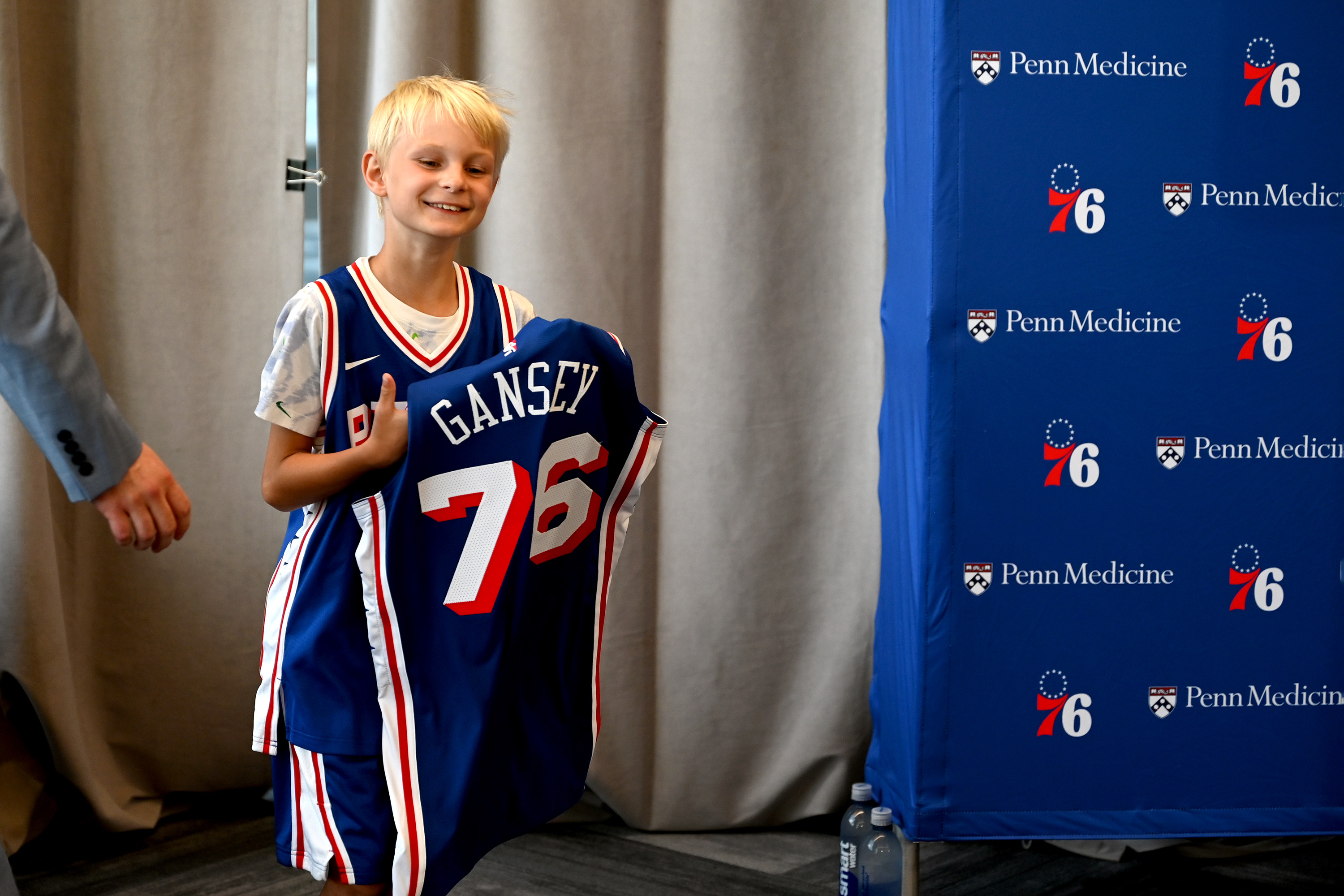
I won’t be photographing any of the FIFA World Cup games here, but I did make The Inquirer’s sports photos Big Picture gallery for the second week in a row.
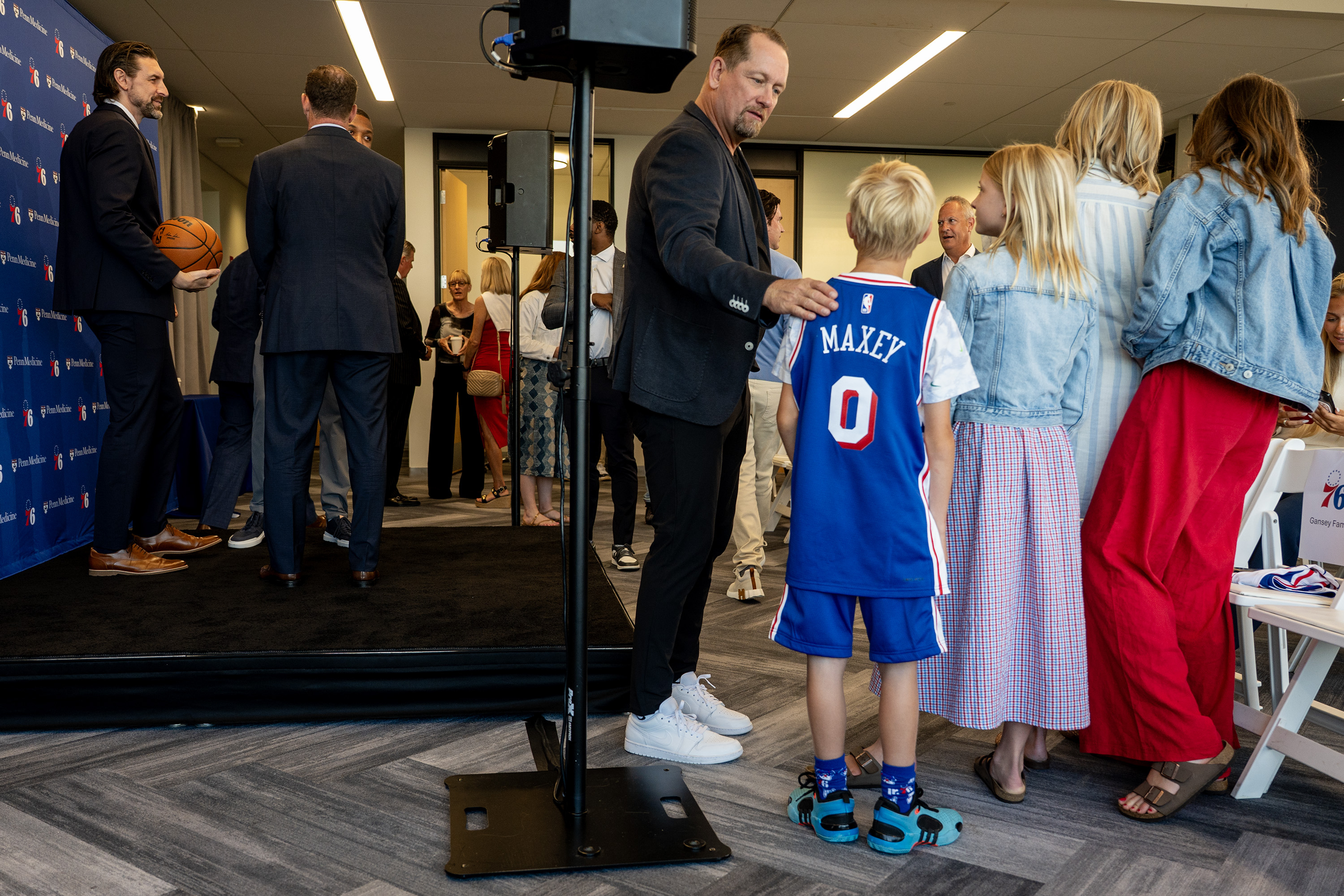
And again, my inclusion is not a traditional action photo. It’s from a press conference and the subject — Sixers new president of basketball operations Mike Gansey — isn’t even the focus of the image.
Sixers head coach Nick Nurse talks to Griffin Gansey, 8. wearing a Tyrese Maxey jersey after his father Mike Gansey (rear, far left) finished up his first press conference as the Sixers new president of basketball operations. Nurse was greeting Amy Gansey, and their other three children after the event.Tom Gralish / Staff Photographer
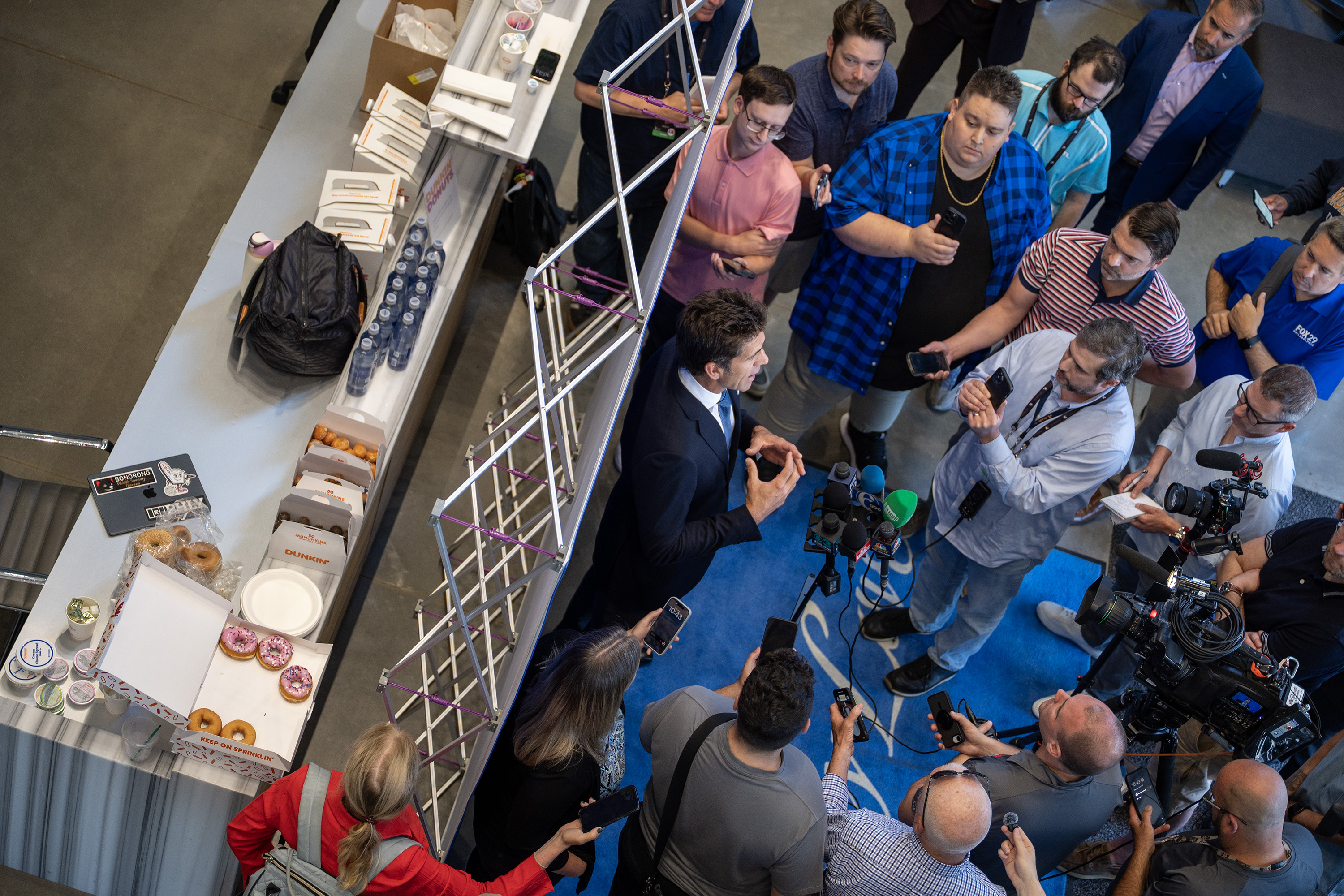
I also photographed him posing with team executives, holding a basketball, then a Sixers jersey, followed by his comments and Q & A with reporters, but I was more interested in the periphery, and stayed around after it was over — and most of the media left for more comments downstairs by the other executives (the featured image at the top).
Later in the week in Center City, I passed a youngster in full graduation cap and gown. I often play the role of street photographer so I walked behind them for a block.
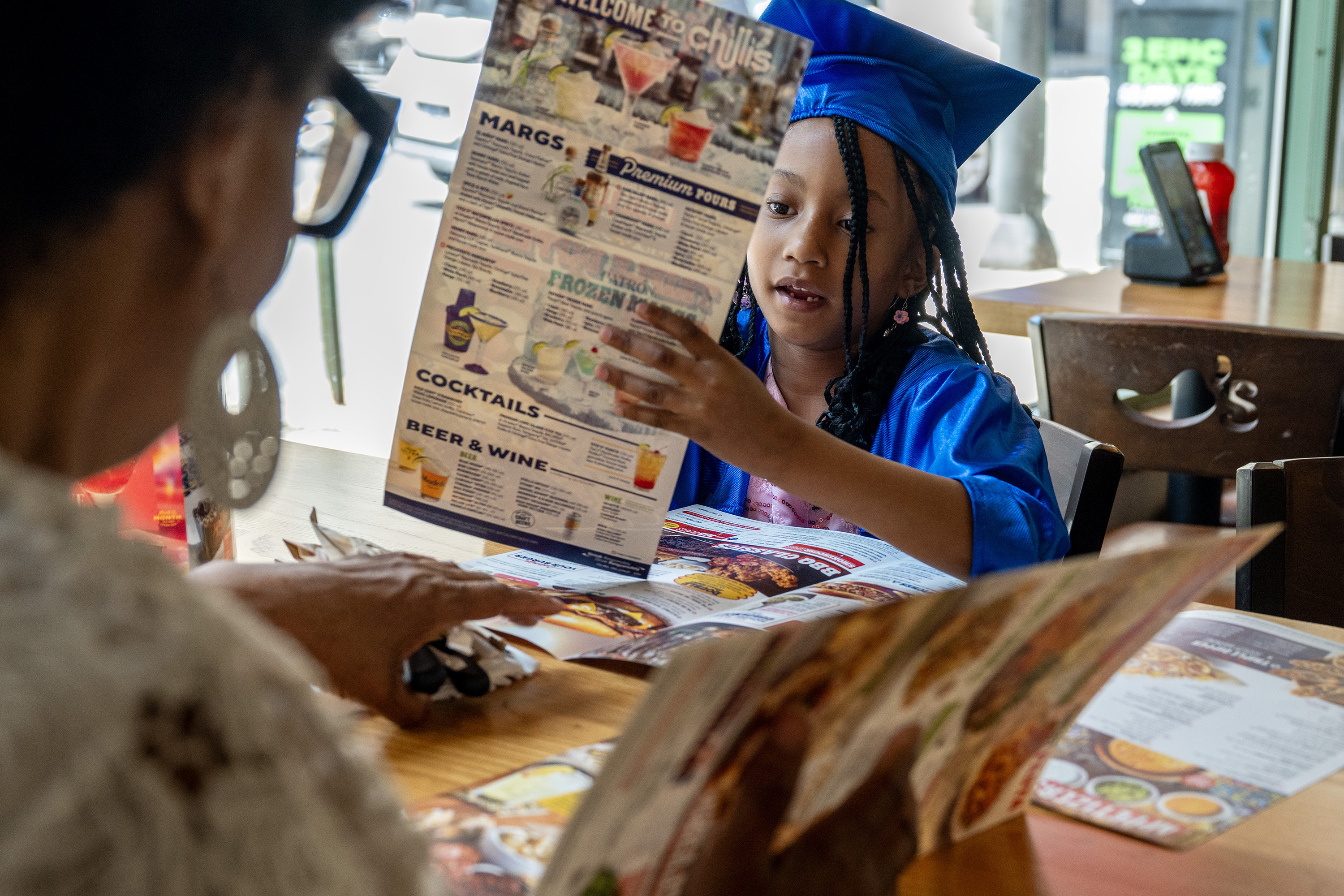
The photographer is reflected in front window of the restaurant as he arrives with Lynnette Lucas and her granddaughter.Tom Gralish / Staff Photographer
If I were not a curious journalist I would’ve moved on, but I said hello and introduced myself as we walked together. Lynnette Lucas was taking her granddaughter Faith Green, 6, for a special lunch after her kindergarten graduation at Mastery Charter School. Lucas takes all her grandchildren to the Chili’s near the Convention Center for celebratory meals where the staff treats them well, especially server Tevin Jones. Faith was headed to a party with the rest of her family, with cake and ice cream later in the day. I switched from street photographer back to visual journalist and headed to my next assignment.
There are different definitions for street photography, but I always like what William Eggleston said: “Often people ask what I’m photographing, which is a hard question to answer. And the best what I’ve come up with is I just say: life today.”
Which brings me to my good friend and Inquirer photo colleague Alejandro A. Alvarez. Starting today Philadelphia will wake up differently. For decades, before the coffee shops unlocked their doors and the metal roll-up shutters were opened on newsstands Alex was already there. A street photographer who chases the morning light, Alex retired from the newspaper yesterday, almost exactly 38 years — Monday, June 13, 1988 — after he first stepped into a newsroom as a full-time newspaper staff photographer, at the Wilkes-Barre Times Leader.
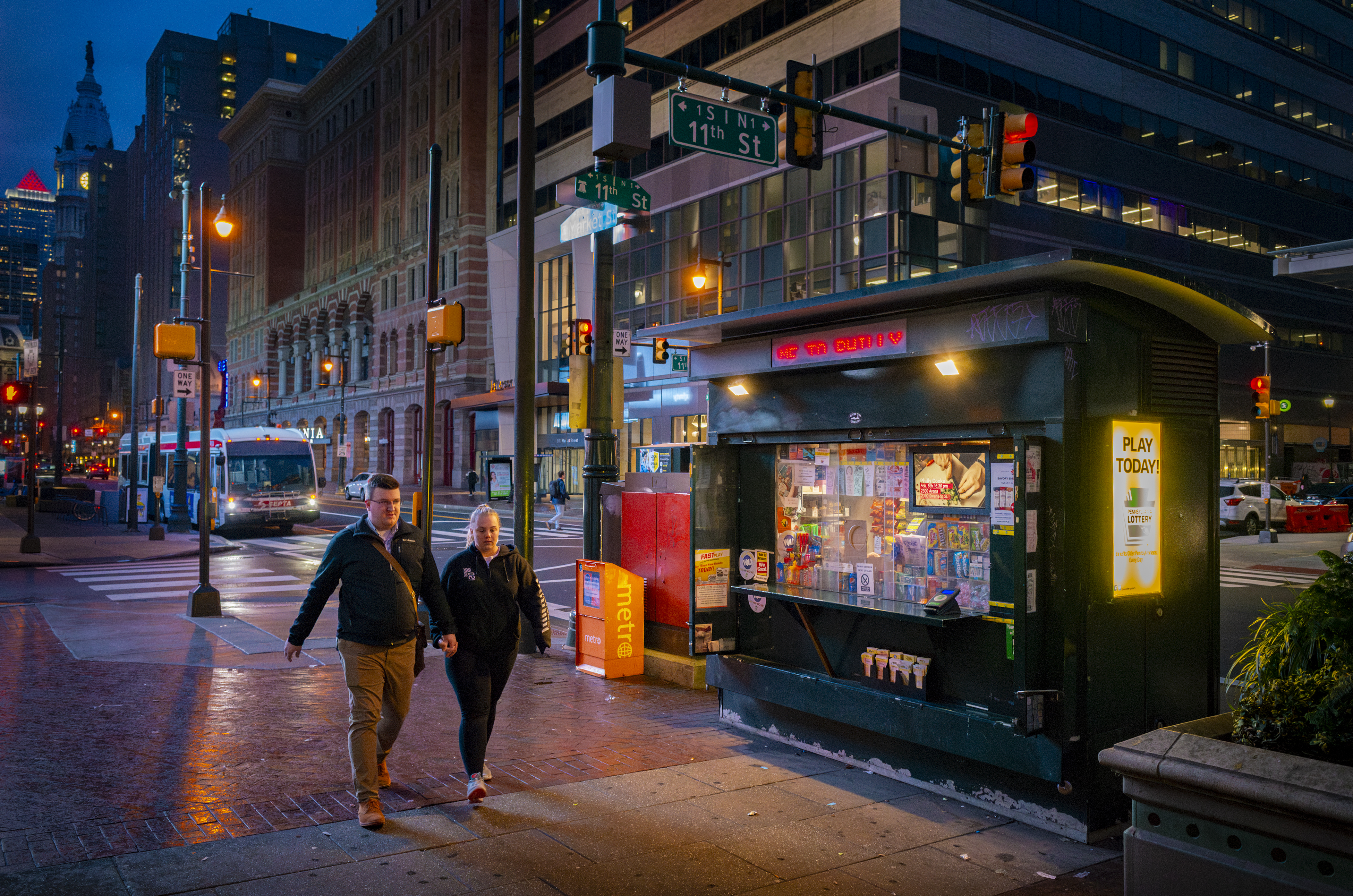
Jan. 10, 2019, 6:50 a.m. Along Market East at 11th Street.Alejandro A. Alvarez / Staff Photographer
That is not to say he won’t still be there with his camera, waiting for the sun to rise and bathe the sidewalks and neighborhoods with the day’s first warm light. He describes himself as a “professional wanderer about town, documenting the people and places I see.”
And I will probably see a lot more of him now as he will have more time for the street photography he most enjoys.
Readers — and his editors — will miss his breaking news coverage, as he will no longer be checking the news websites, apps, and tips from sources before heading out pre-dawn to visually report on the aftermath of overnight shootings, fires, or accidents. He usually filed his news photos before the reporters even turned on their computers.
June 21, 2022, 5:54 a.m. Firefighters in the 900 block of Race Street moments before extinguishing a flare up.ALEJANDRO A. ALVAREZ / Staff Photographer
The way he sees the city however, will endure and readers will still see his work, whenever Inquirer.com or the Inquirer or Daily News needs a photo to illustrate a story about SEPTA, or pedestrians and city workers, bikers and joggers and dog walkers — in all kinds of weather, they will tap into the admirable archive of his images in our digital library.
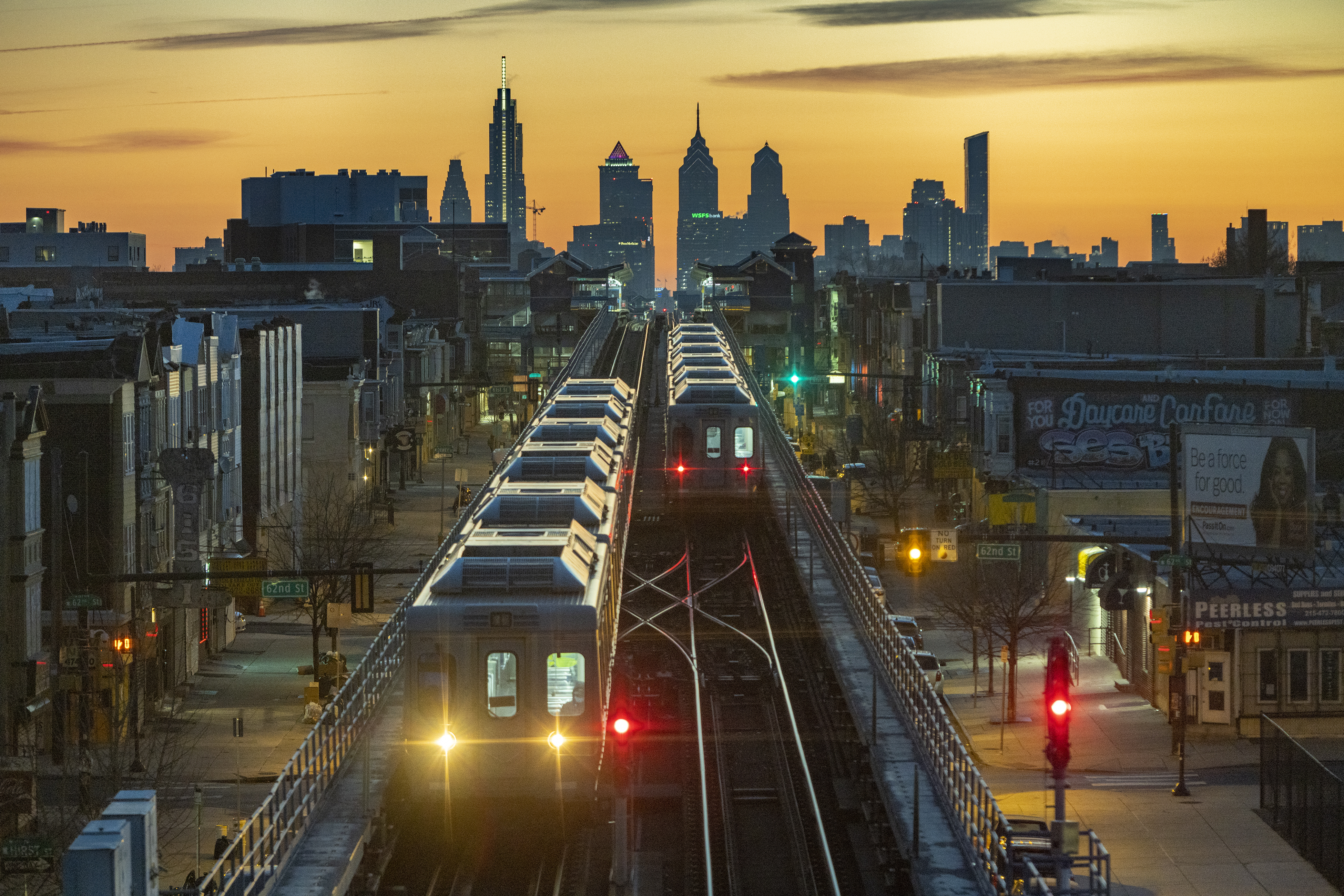
Dec. 21, 2022, 6:55 a.m. Market-Frankford SEPTA trains come and go from the 63rd Street station.Alejandro A. Alvarez / Staff Photographer
At The Inquirer, Alex photographed protests and elections; changes in the seasons and weather; parades, celebrations and memorial; kings and criminals. Yet his most memorable images came from those seemingly unremarkable mornings.
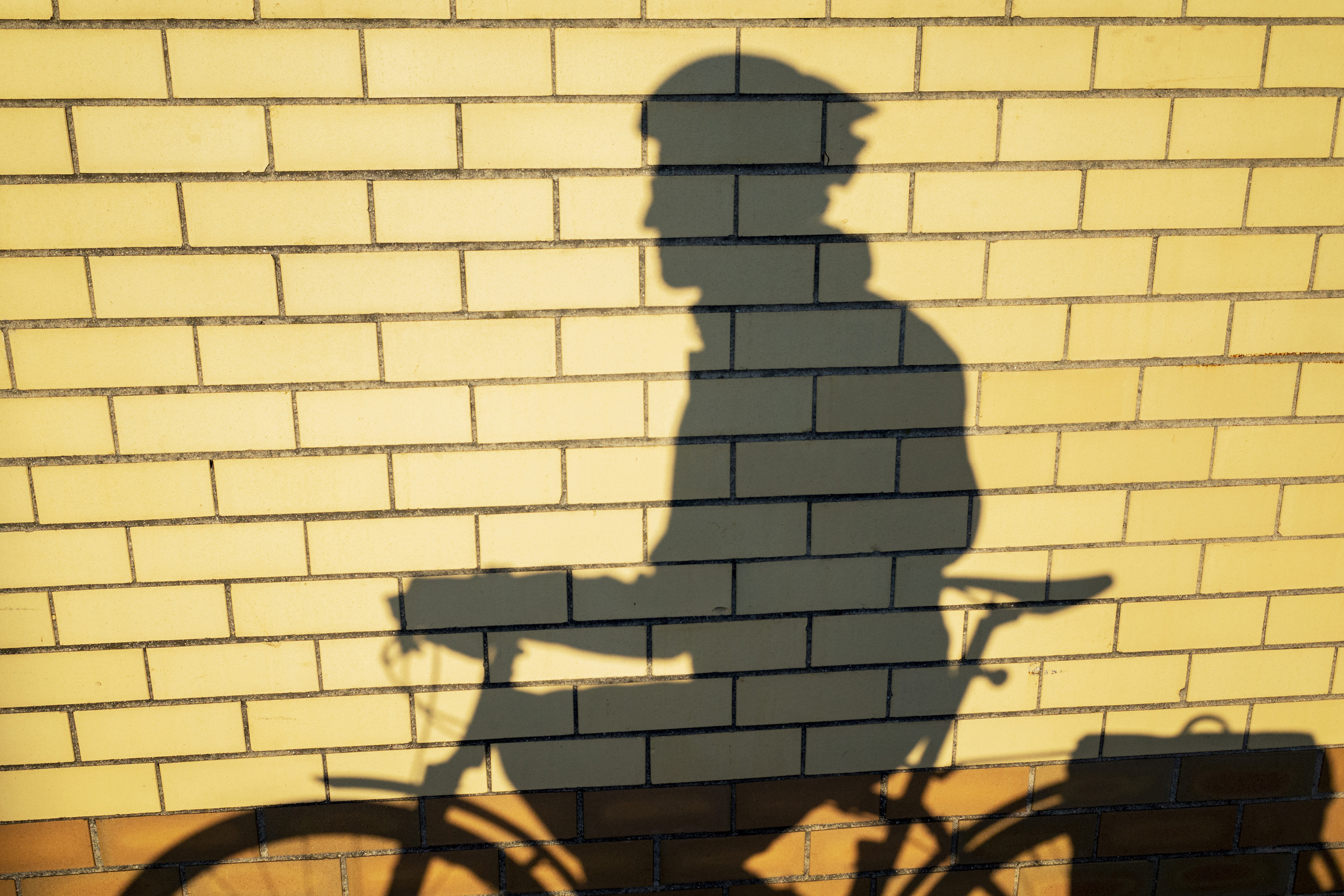
April 2, 2020, 7:30 a.m. The shadow of the photographer on a wall at N. 6th and Callowhill Streets as he chases morning light.Alejandro A. Alvarez / Staff Photographer
Since 1998 a black-and-white photo has appeared every Monday in staff photographer Tom Gralish’s “Scene Through the Lens” photo column in the print editions of The Inquirer’s local news section. Here are the most recent, in color:
Still. Tina Fey is from Upper Darby. Taylor Swift is from Reading. At some point, Pennsylvania has to ask whether we’re comfortable with this arrangement.
We’re not saying they have to root for the Sixers. The Sixers haven’t always made that easy.
We’re just saying there are certain things that hit differently when they come from your own people. And watching two Pennsylvania icons cheer on the Knicks in the NBA Finals is one of them.
And somehow the marketing may be even better than the product. “It tastes like the oil from a real cheesesteak wrapper!” was highlighted as a testimonial, which is an astonishing sentence to see in the wild. Because that’s not a flavor profile most companies would voluntarily advertise.
The reaction online was divided. Half the internet was horrified, and the other half was brainstorming recipes involving Sarcone’s bread, pizza, omelets, pasta, and popcorn.
Somewhere between “that’s disgusting” and “OK, I’d try it” lies the city’s entire food identity.
The best part, though, is that the olive oil helps support Mama-Tee Community Fridge, which stocks community refrigerators across Philadelphia with prepared meals. And, let’s be honest, nobody can convincingly argue they aren’t at least a little curious.
A Wawa bag full of Tastykakes made it to the Vatican: A
According to the National Constitution Center, the pope, a Villanova graduate, gave a “big belly laugh” when he saw the Tastykakes.
And the story contains one of the most Philadelphia sentences ever printed: “Where else would this happen that you meet up with the archbishop toting Tastykakes in a Wawa bag?” Iconic.
The delegation was there for a serious purpose ahead of next month’s Liberty Medal ceremony. But it’s hard not to appreciate that somewhere inside the Apostolic Palace sat a Wawa bag and a box of Tastykakes.
Amy Poehler arrives at the Oscars on Sunday, March 2, 2025, at the Dolby Theatre in Los Angeles. (Photo by Richard Shotwell/Invision/AP)Richard Shotwell
Amy Poehler got cursed out at PHL. Tina Fey had the perfect response: A
Tina Fey’s response? “Welcome to Philly.” No outrage, no apology, and no attempt to explain the behavior.
Just a simple acknowledgment that, yes, this sort of thing occasionally happens here. Philadelphia is one of the few places where somebody might yell at you in an airport and another person will later explain that this is actually part of the culture.
Philly cheesesteaks at Nihonbashi Philly on Sunday, Nov. 9, 2025, in Tokyo, Japan.Monica Herndon / Staff Photographer
An American cheese shortage in Japan is now a Philadelphia emergency: A-
There are international crises, and then there are international crises.
Philadelphia, of course, was ready to give solutions. Offers to smuggle in Cooper Sharp. Debates over Whiz vs. provolone. Strong opinions about what constitutes an authentic cheesesteak from 6,700 miles away.
The whole thing feels oddly moving. A couple in Tokyo became so obsessed with Philadelphia that they built a restaurant around cheesesteaks, pretzels, Tastykakes, and Eagles fandom. Now Philadelphians are responding as if a neighborhood institution is facing hard times. You stand up for us, we’ll stand up for you.
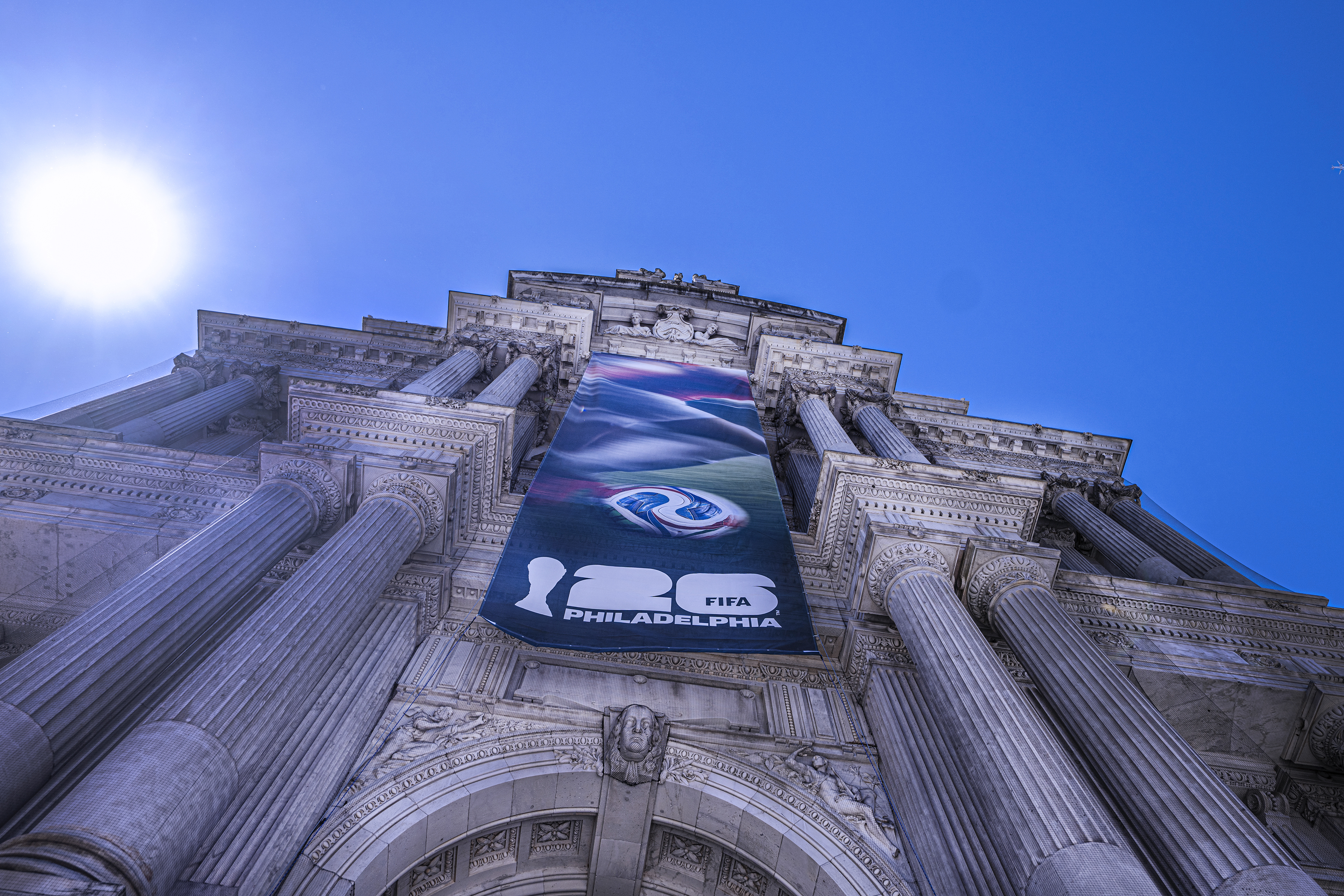
A large FIFA World Cup banner hangs from an entrance of Philadelphia City Hall as the city prepares to host matches during the FIFA World Cup, Wednesday, June 3, 2026, in Philadelphia.Jose F. Moreno / Staff Photographer
The World Cup hotel boom hasn’t exactly arrived: C+
For years, the World Cup was sold as a tourism bonanza that would fill hotel rooms, pack Airbnbs, and send visitors flooding into host cities.
Days before kickoff, plenty of hotel rooms remain available. Some Airbnb hosts who expected a month-long gold rush are still waiting for bookings. One South Philly host told The Inquirer she expected to be full all month and has gotten just a few nights reserved.
That’s not exactly soccer Coachella.
To be fair, this doesn’t mean the World Cup won’t be successful. Tens of thousands of fans are still coming, and hotels expect a solid summer between FIFA, the Semiquincentennial, and the MLB All-Star Game.
They’re just apparently not paying $900 a night for an Airbnb in South Philly.
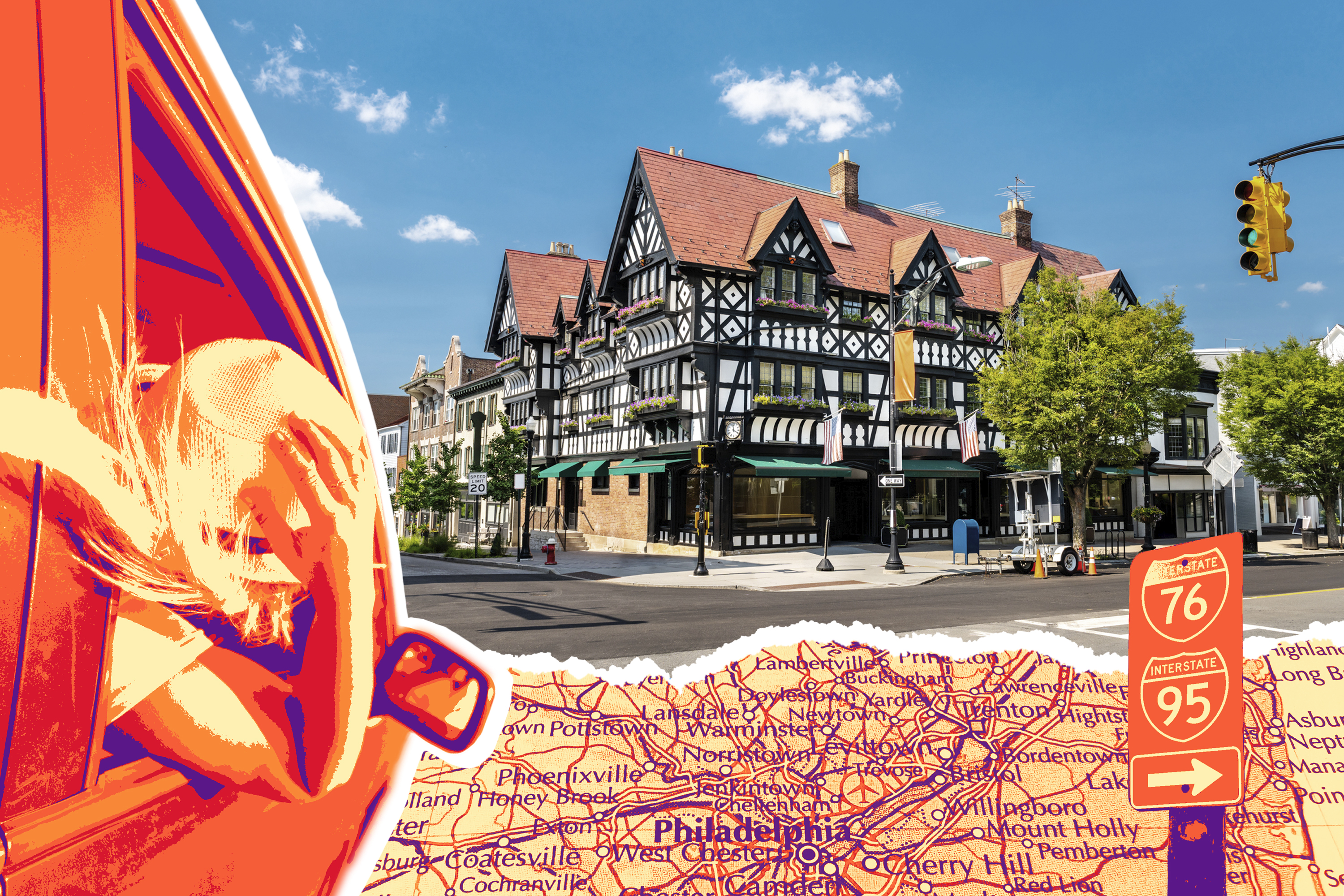
A college campus in Central New Jersey might not sound like the ideal getaway, but Princeton has a Ph.D. in historic charm, boutique shops, eateries, and museums. As a lifelong New Jerseyan, I keep forgetting how much I love it there.
Even the Wawa is a work of art.
“Princeton is just a beautiful little town and, in my opinion, there are only a few places like it in all of New Jersey,” said John Lambert, owner of the iconic Princeton Record Exchange.
Strolling through Princeton University’s ivy-covered campus, as Albert Einstein used to, is almost worth the trip alone, particularly if you go on a bustling fall weekend. The campus is teeming with sculptures, massive churches, and historic school buildings. The town is only 50 miles northeast of Philadelphia and is even accessible by Amtrak at 30th Street Station.
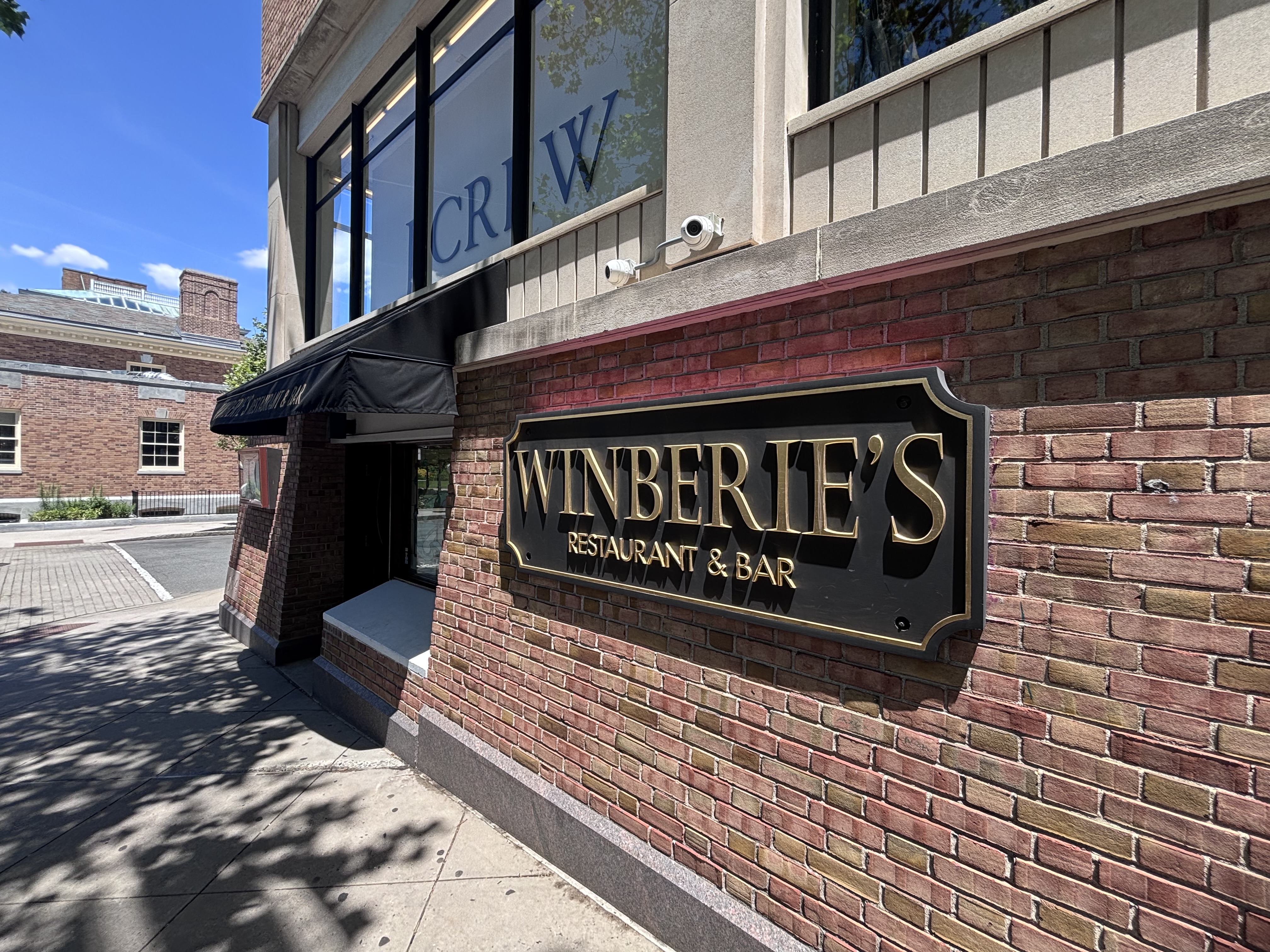
Winberie’s is a Princeton staple.Jason Nark
Fuel
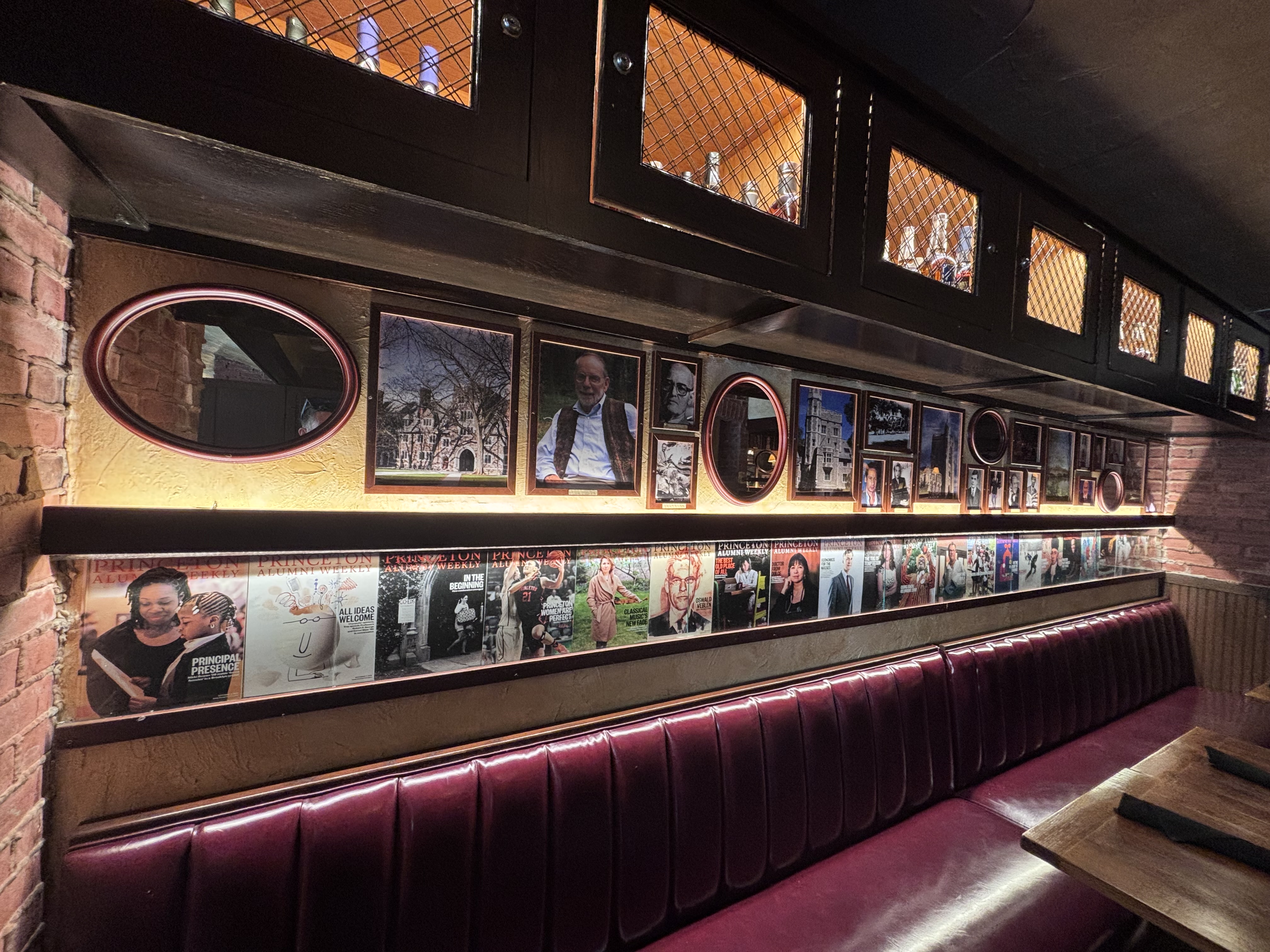
I’m a sucker for a downstairs pub, and I’ve been to Winberie’s Restaurant & Bar a handful of times. It’s dark and bedecked in stained glass and brick, and images of Princeton icons, like author John McPhee and basketball legend Bill Bradley, line the walls.
It’s not the only bar in town, but Winberie’s seems like the ideal place to grab a craft beer or wine before or after a Tiger football or basketball game. It sits right on Palmer Square in the middle of town.
Princeton legends like John McPhee line the walls at Winberie’s.Jason Nark
Winberie’s has full entrees, including pan-roasted, crispy skin salmon, and braised, beef short ribs, but I also get one of their burgers. On a recent weekday in June, I ordered the smash burger on rye bread with mustard.
Afterward, while walking off the meal around Palmer Square, I made a note to try Teresa’s Pizza & Wine Bar next time. Princeton’s Triumph Brewing is an elevated brewing experience with duck, lamb, and oysters on the menu. It was named a 2025 Diners’ Choice by OpenTable.
📍 Winberie’s Restaurant & Bar, 1 Palmer Square E., Princeton, N.J. 08542
📍Teresa’s Pizza & Wine Bar, 23 Palmer Square E., Princeton, N.J. 08542
📍Triumph Brewing Company, 20 Palmer Sq. E, Princeton, N.J. 08542
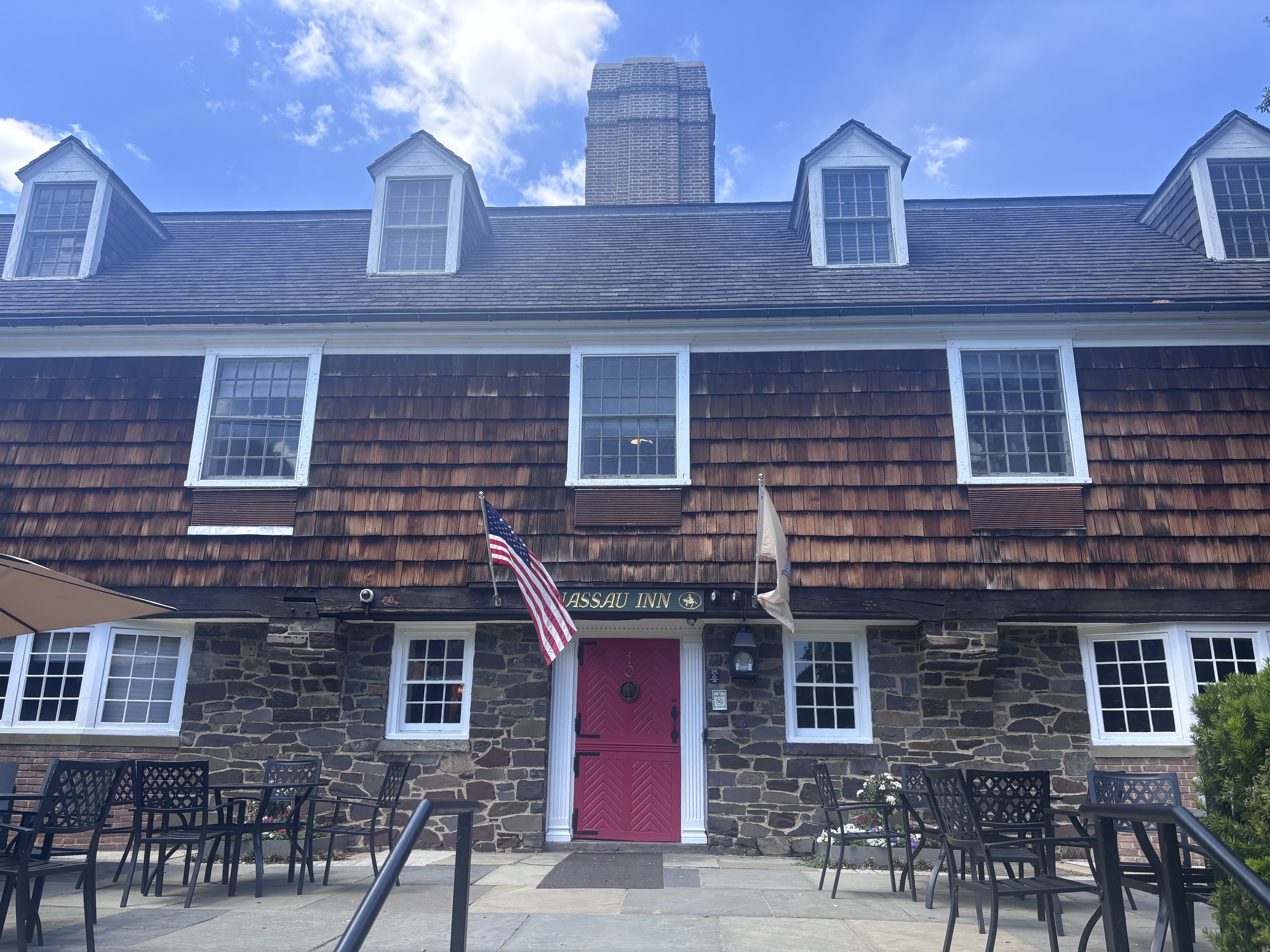
The Nassau Inn has been in operation in Princeton since 1775.Jason Nark
Stay
Princeton can be an easy day trip for anyone in Philadelphia. That’s a great option too, because overnights can be expensive, particularly when school is in session, and there are large events on campus.
The Nassau Inn, on Palmer Square, is Princeton’s most iconic hotel, and it offers summer getaway deals starting at $175 a night. Rooms jump to $325 a night come mid-September. The Nassau, established in 1775, offers 16 craft beers, plus breakfast, lunch, and dinner at its Yankee Doodle Tap Room.
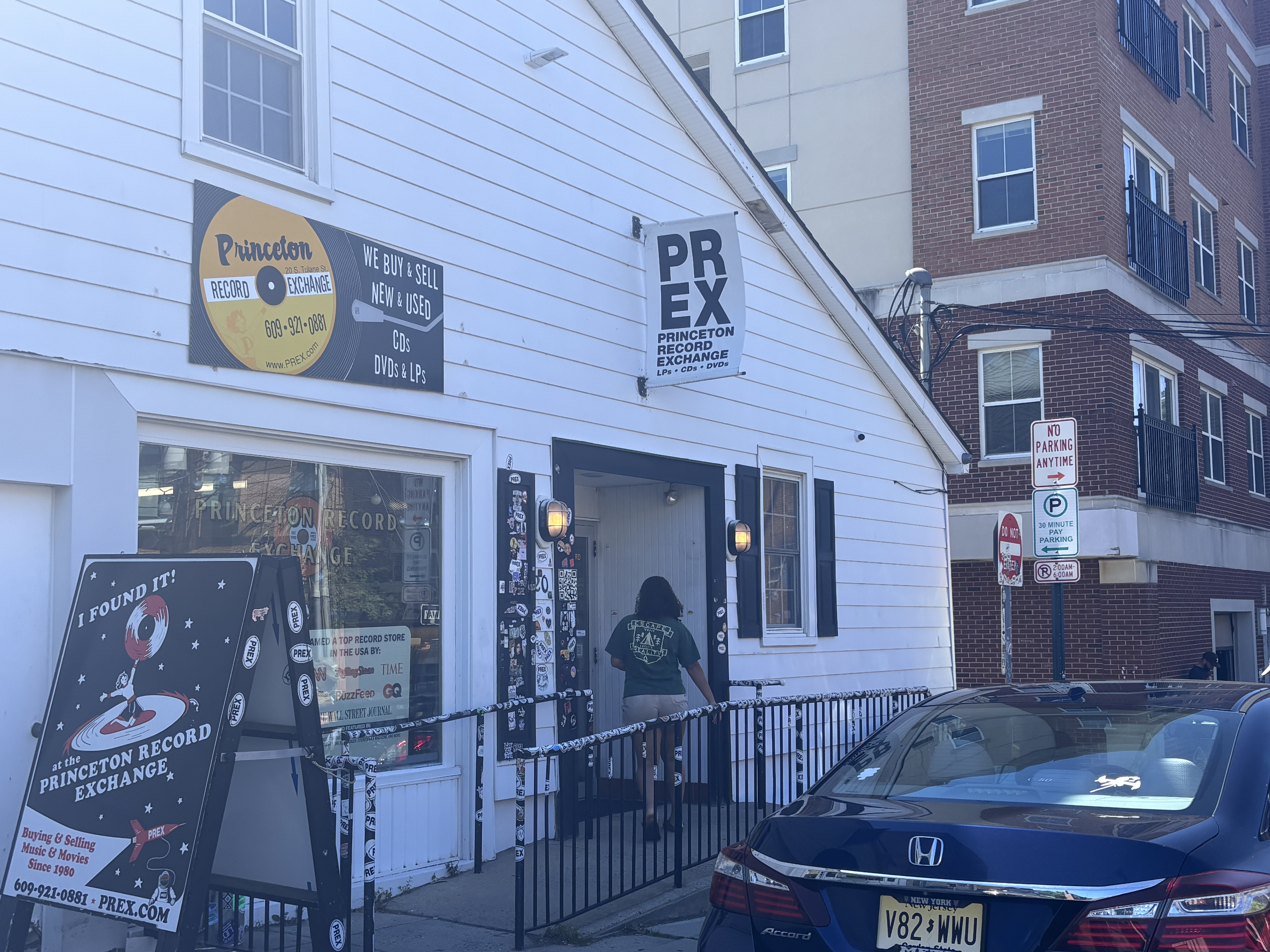
The Princeton Record Exchange is considered one of the country’s best places to get vinyl.Jason Nark
Shop
There are almost too many options to choose from, but the Princeton Record Exchange, or PREX, is a must-see. As the sign in the window attests, it’s one of the nation’s, even the world’s, best record stores with over 100,000 albums, cassettes, and CDs spread out over 4,500 square feet.
James Murphy, of LCD Soundsystem, said PREX “saved his life.”
Owner Jon Lambert said he has visitors from all over the world, and he’s found the average customer spends over an hour in the store. Sometimes they’re simply browsing and reminiscing, and Lambert said that’s just fine.
“We want you to feel comfortable here, to have a tactile, sensorial experience,” he said. “We know you’ll probably be back.”
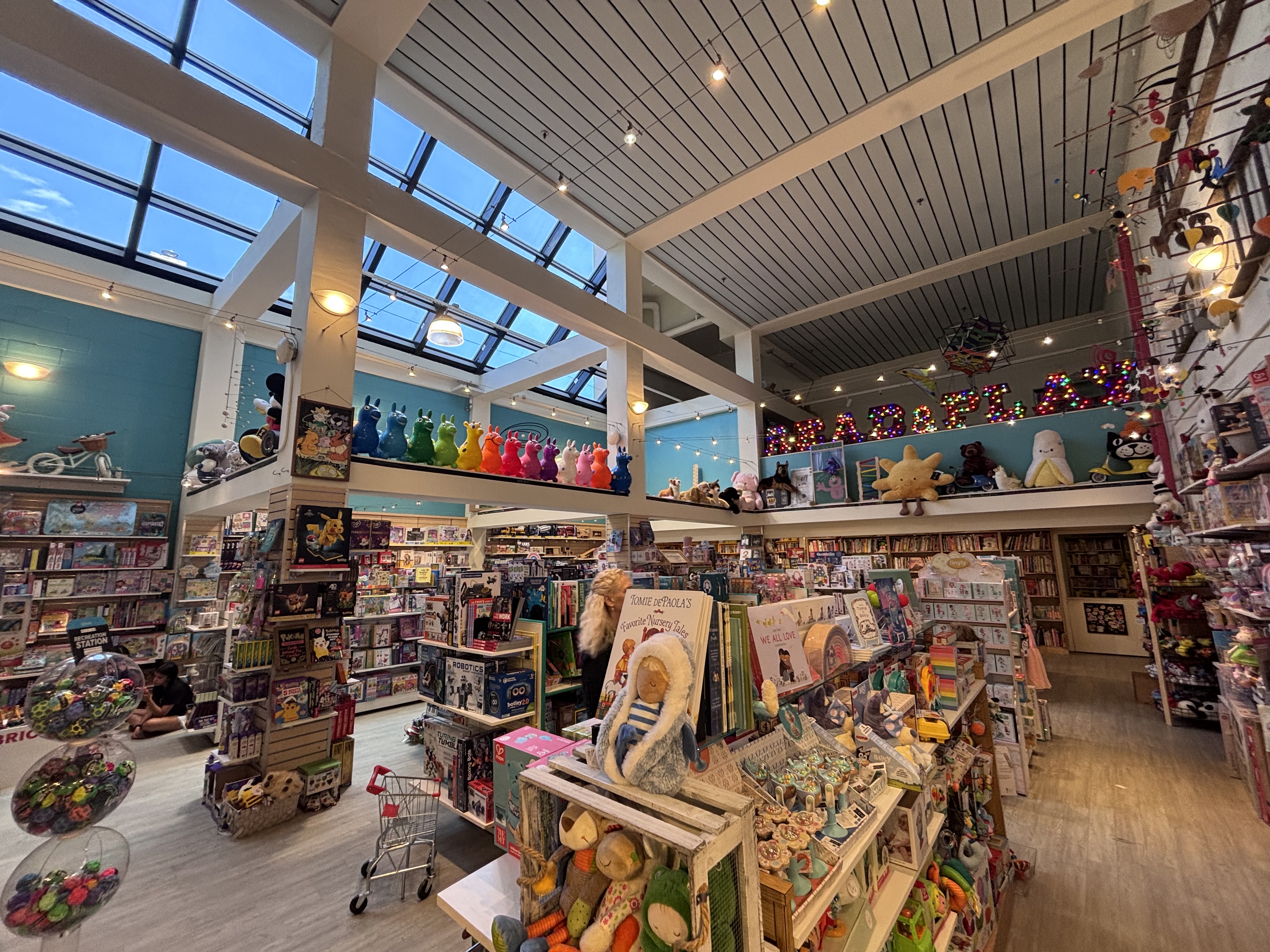
Toys from floor to ceiling at jaZams in Princeton.Jason Nark
Other must-sees are jaZams, arguably the greatest toy story ever (I managed to spend just $14) and Labyrinth Books, which specializes in rare and academic titles.
📍 Princeton Record Exchange, 20 S. Tulane St., Princeton, N.J. 08542
📍 jaZams, 25 Palmer Square E., Princeton, N.J. 08542
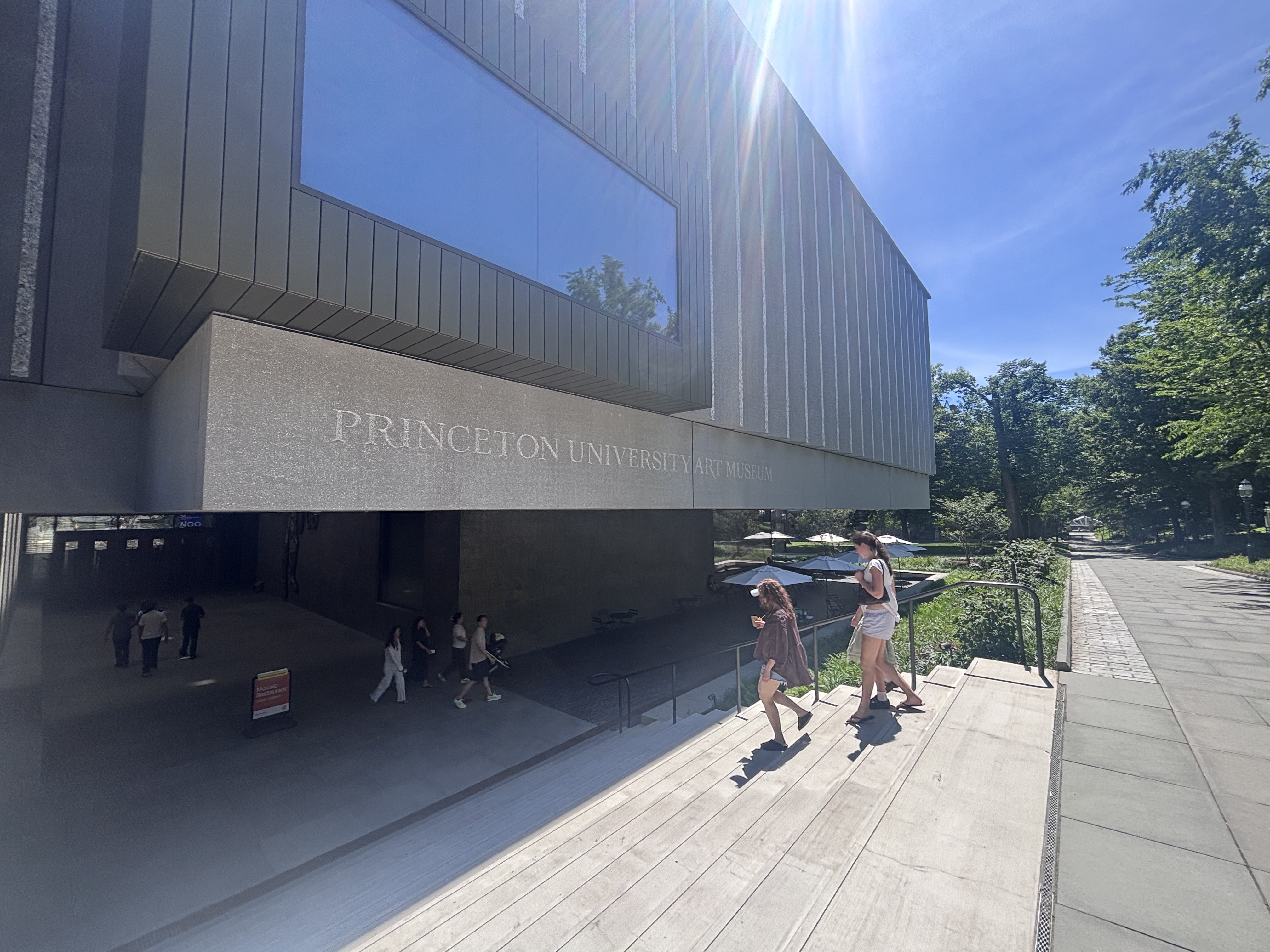
The Princeton University Art Museum is free to the public.Jason Nark
See
The Princeton University Art Museum was the biggest surprise of my visit, a vast, modern building full of pieces, large and small, that touch on, well, everything. My daughter, just 4 years old, was captivated.
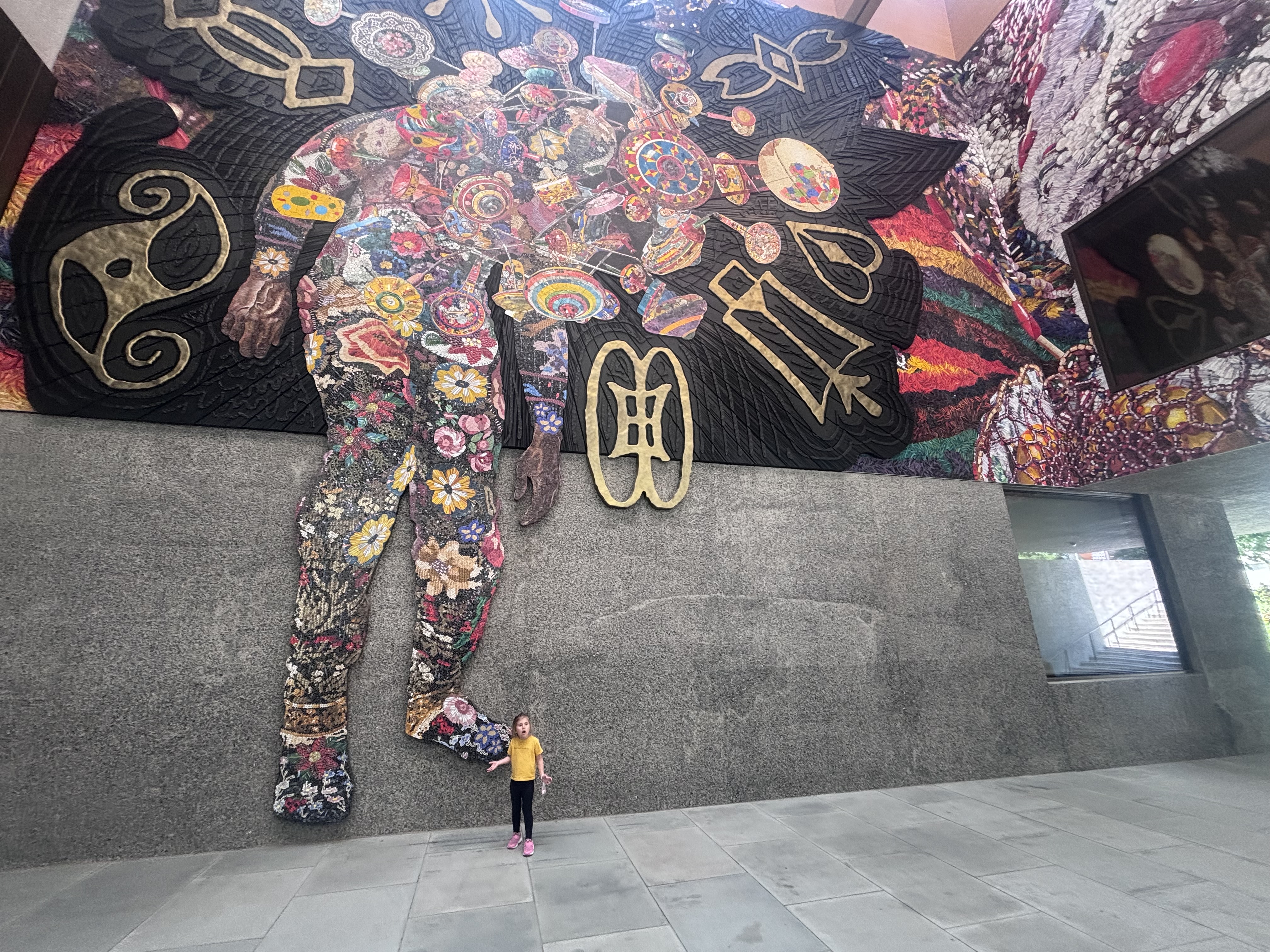
There’s a Warhol, Monet, some German expressionism, gold-ground paintings from the 1400s, and massive, modern pieces by sculptor Nick Cave.
In honor of America’s 250th celebration, the museum has an exhibit titled “What Is an American?” running through November.
Even better: It’s free.
📍 45 Elm Dr., Princeton, N.J. 08544
The author’s daughter stands by a Nick Cave piece at The Princeton University Art Museum.Jason Nark
Sweets
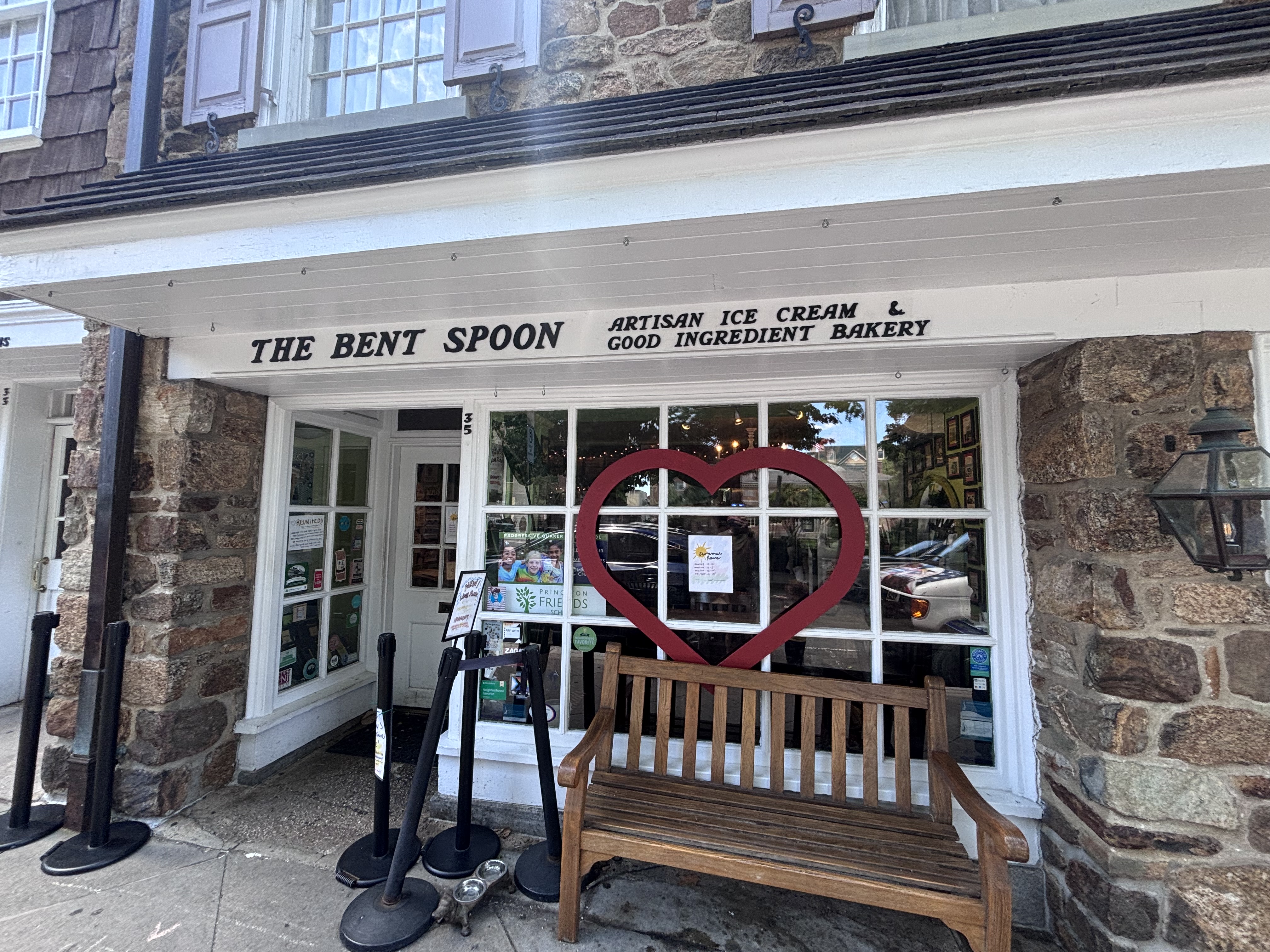
The Bent Spoon, an artisan ice cream shop on Palmer Square, has crafted hundreds of flavors since it opened in 2004. The small shop, which is open year-round, redefines “farm to spoon,” which means you have to grab flavors like blueberry and strawberry when they’re available.
“We really try to celebrate the seasons, for real,” said co-owner Gabrielle Carbone. “We get our strawberries from South Jersey, and they’re only available until the strawberries run out.”
The Bent Spoon has been making artisanal ice cream on Palmer Square since 2004.Jason Nark
I ordered vanilla bean — sourced from Madagascar. My daughter had a vegan vanilla with organic rainbow sprinkles. We swapped.
Carbone says blueberry ice cream and blueberry-lemonade sorbet will be in around July, but not for long. Princeton is bustling come winter, too, she said.
“We’re known for our hot chocolate,” she said.
📍 35 Palmer Square W., Princeton, N.J. 08542
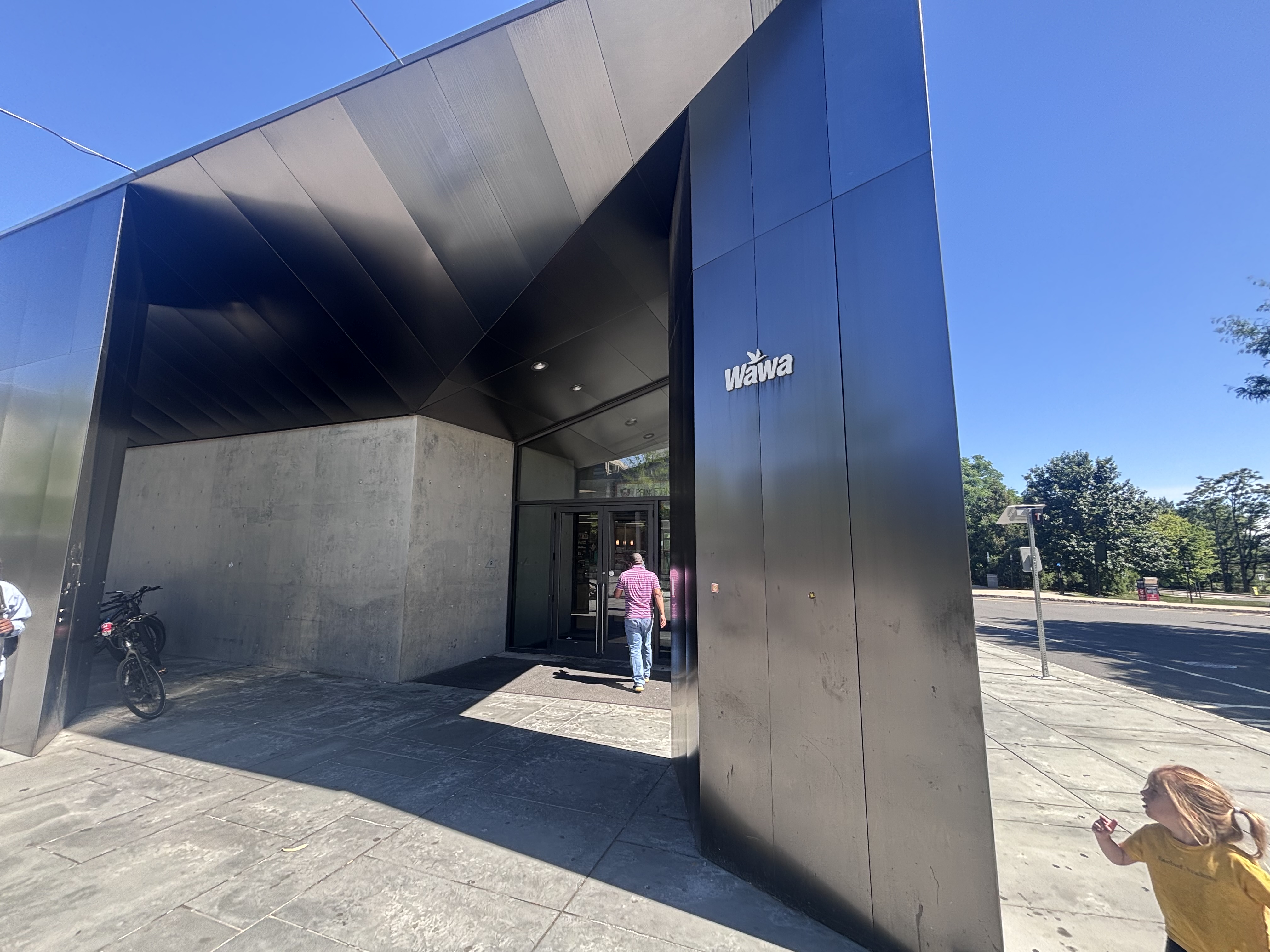
The Princeton Wawa was designed by architect Rick Joy.Jason Nark
Wawa
You know Wawas. You’ve seen hundreds of them and, for the most part, they all look the same.
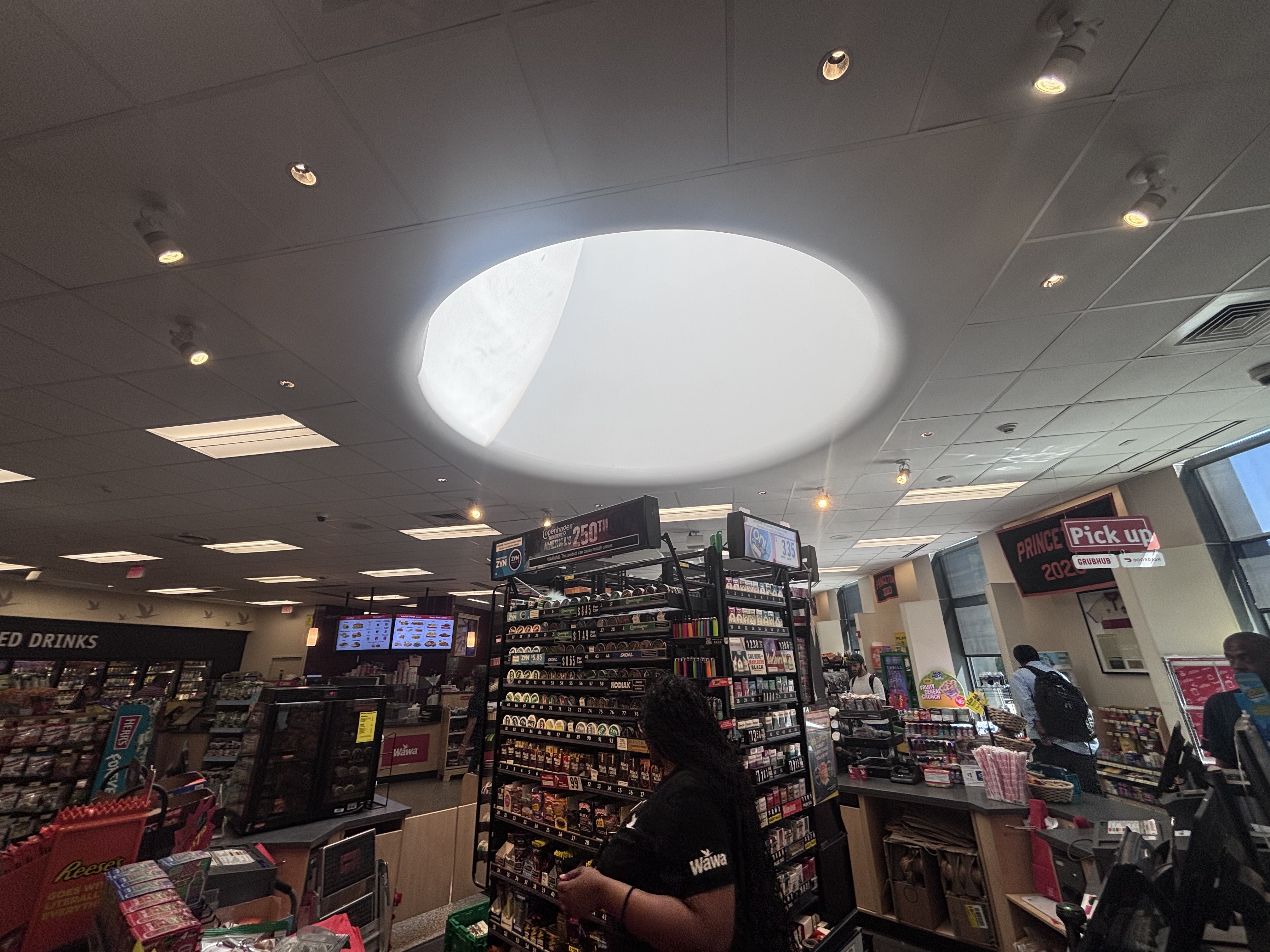
The Wawa at the Princeton Station train stop was designed by architect Rick Joy, though, and features exterior walls with sharp angles and columns made of blackened steel panels. Inside, above the cash register, is a large skylight.
The Wawa even has a green roof, along with the ubiquitous shorties and hot coffee.
📍 152 Alexander St., Princeton, N.J. 08540
The cash register at the Princeton Wawa is bathed in sunlight.Jason Nark
The buyers: Charlotte Burns, 33, veterinary anesthesiologist; Noah Johnson, 37, battery scientist
The house: a 1,850-square-foot townhome in Fairmount with four bedrooms and three bathrooms built in 1876
The price: listed for $975,000; purchased for $975,000
The agent: Sela Fallt, KW Empower
The ask: When Charlotte Burns and Noah Johnson moved back to Philadelphia in July 2024, they already knew they wanted to buy a house. They had spent the previous decade renting while they went to college and graduate school, and years of lease renewals and rent hikes had worn them down. Now that they both had steady jobs, they wanted a payment that stayed put and a home to call their own.
They started looking casually that fall. Johnson wanted a big kitchen with lots of counter space. Burns wanted enough outdoor space for a garden and a house with character. “I love the old Colonial homes,” she said. “I’ve wanted one since I was 12.” They wanted to stay in Fairmount if they could.
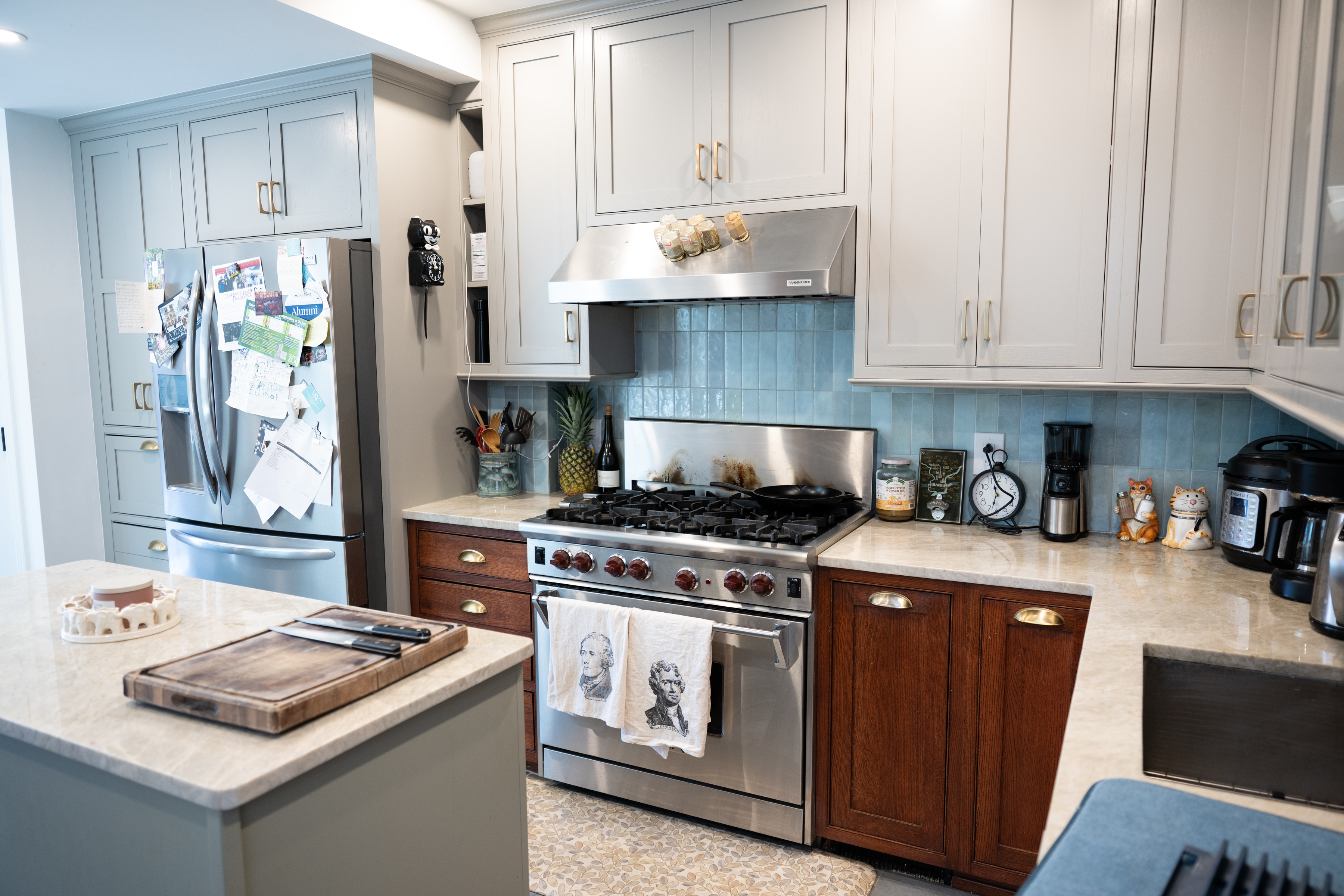
A large kitchen with counter space was a must-have. Erin Blewett / For The Inquirer
The search: The couple’s search was unusually brief. They had only started casually browsing listings online when Johnson bumped into their next-door neighbor, who happened to be a real estate agent. She asked him what they were hunting for. “My husband thankfully knows me quite well, so he told her what I like,” Burns said. A week later, the agent knocked on their door. “I think I found your house,” she told them.
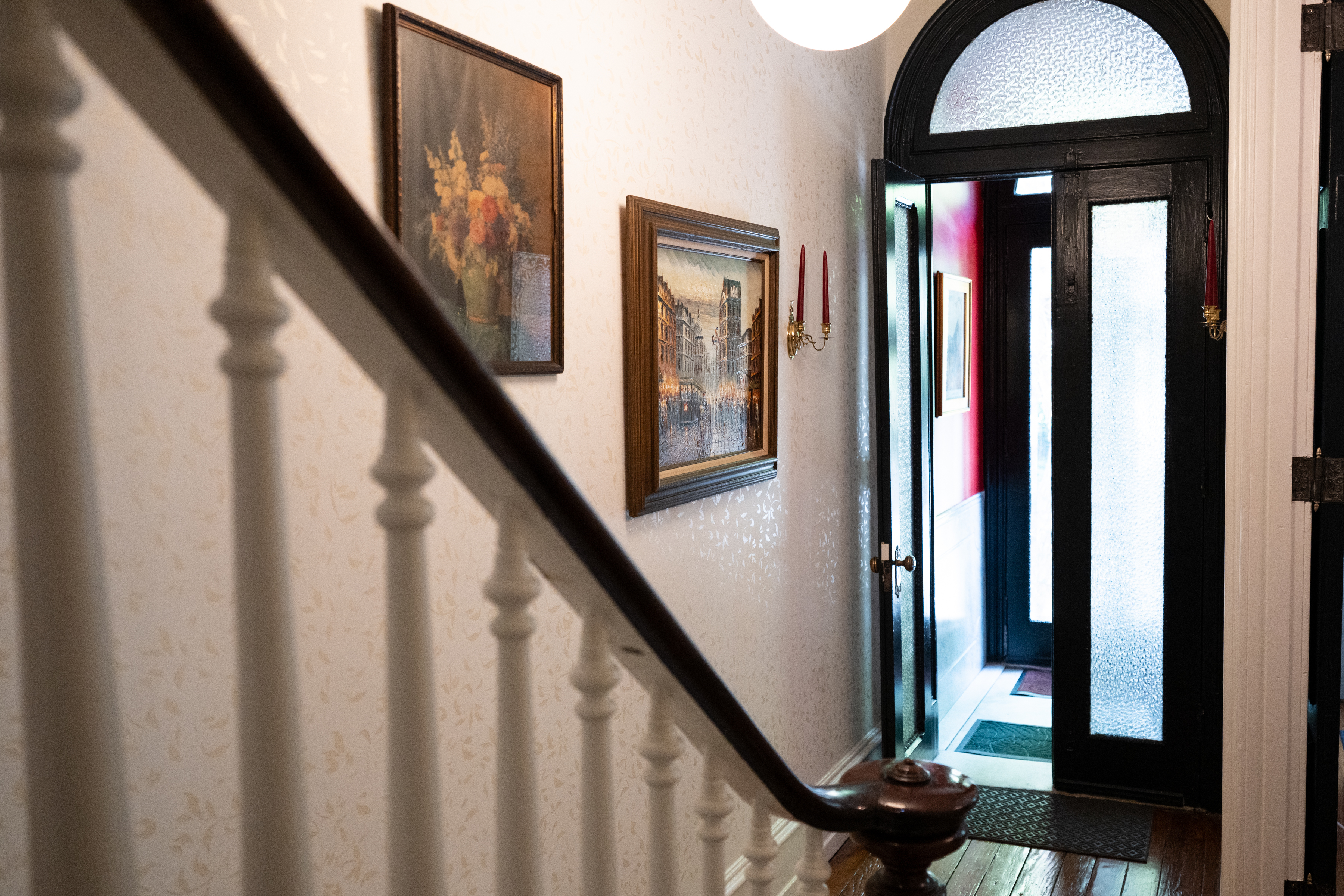
The appeal: The house looked like the old Colonial home Burns had wanted since she was a kid. It still had several of its original details, such as the crown molding, shutters, doorknobs, hinges, marble steps, and 150-year-old wood floors. The previous owners had updated the house, Burns said, but didn’t gut it or turn it into “some modern monstrosity.”
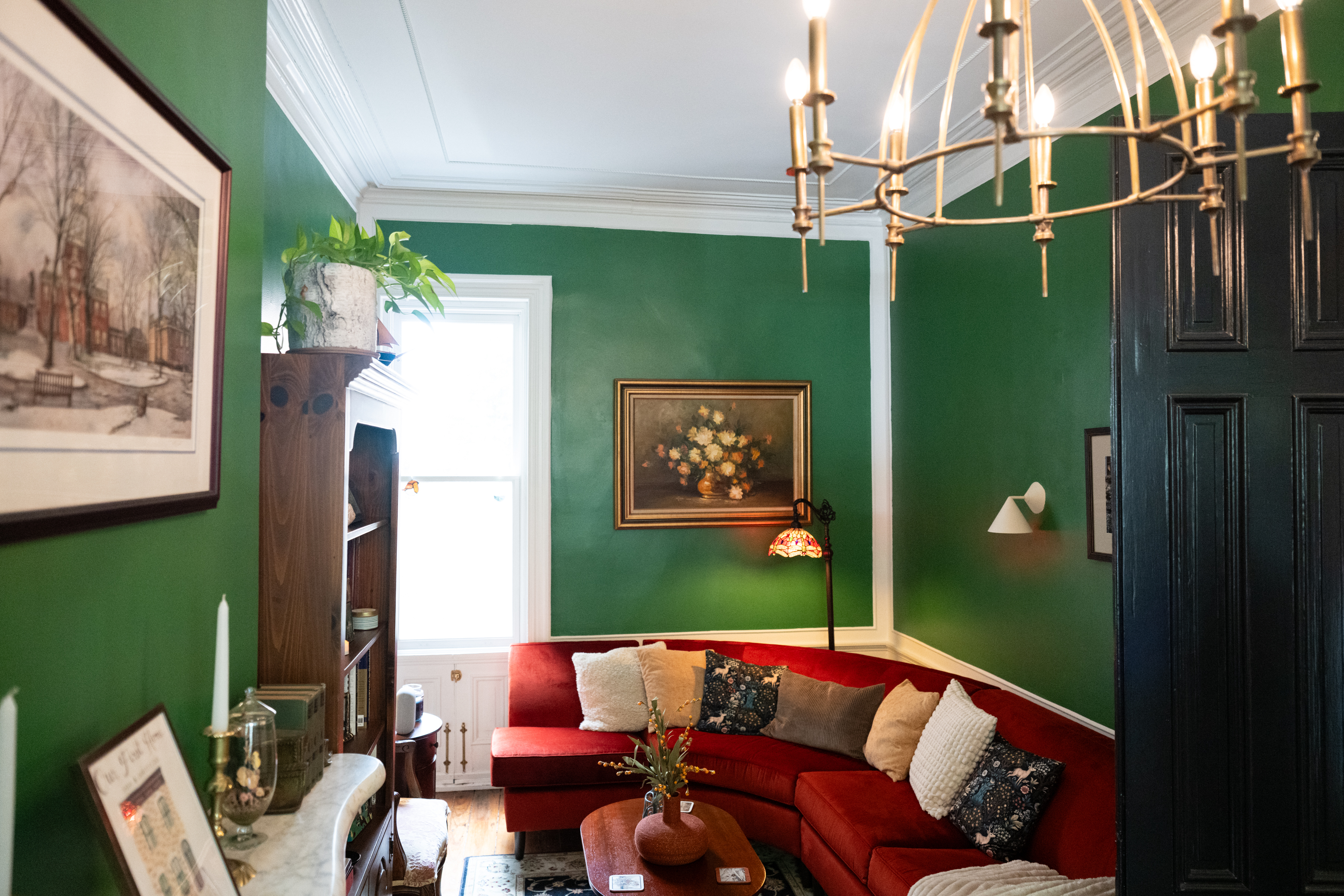
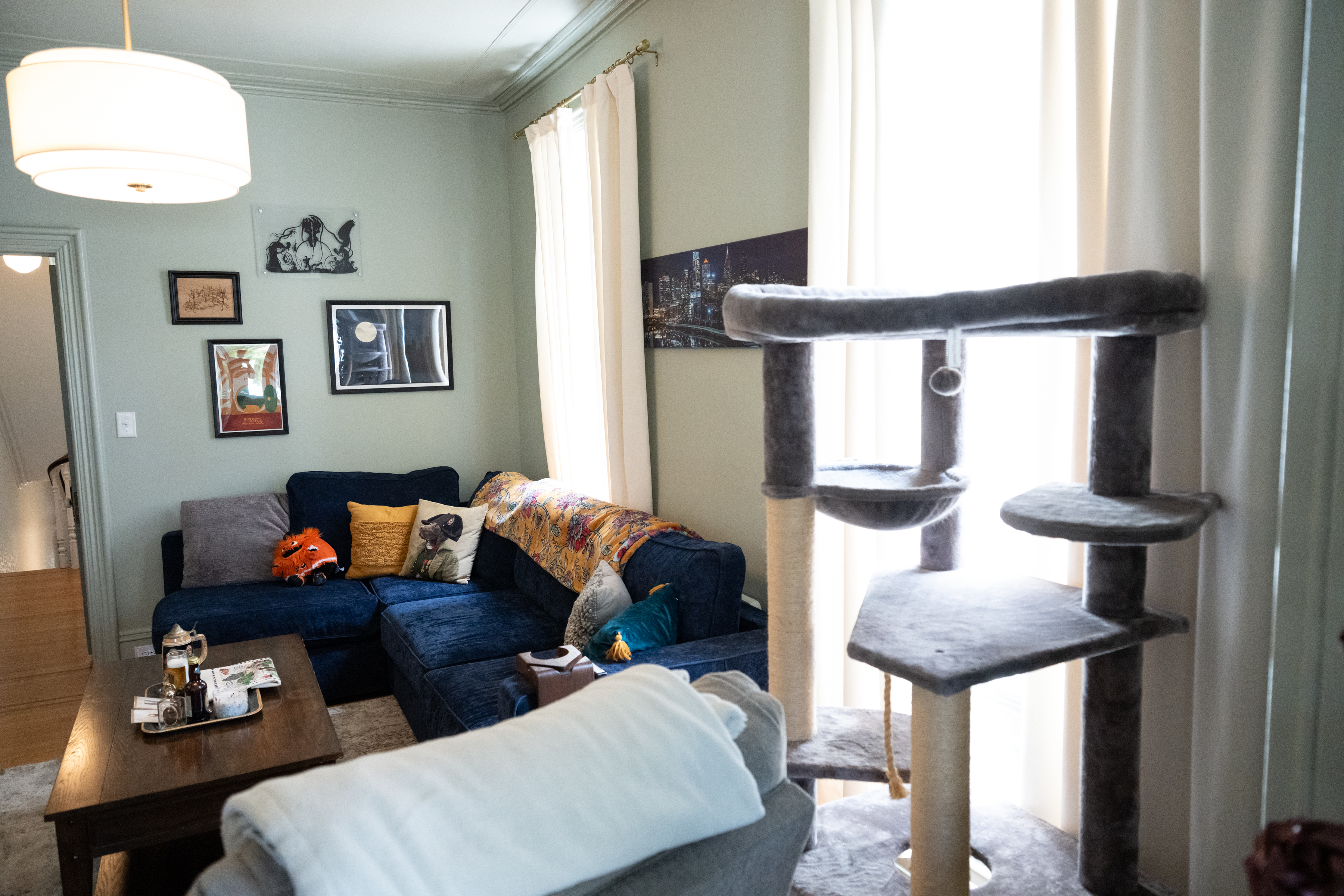
A large red couch is the centerpiece of the first-floor living area in Charlotte Burns and Noah Johnson’s home. Erin Blewett / For The Inquirer
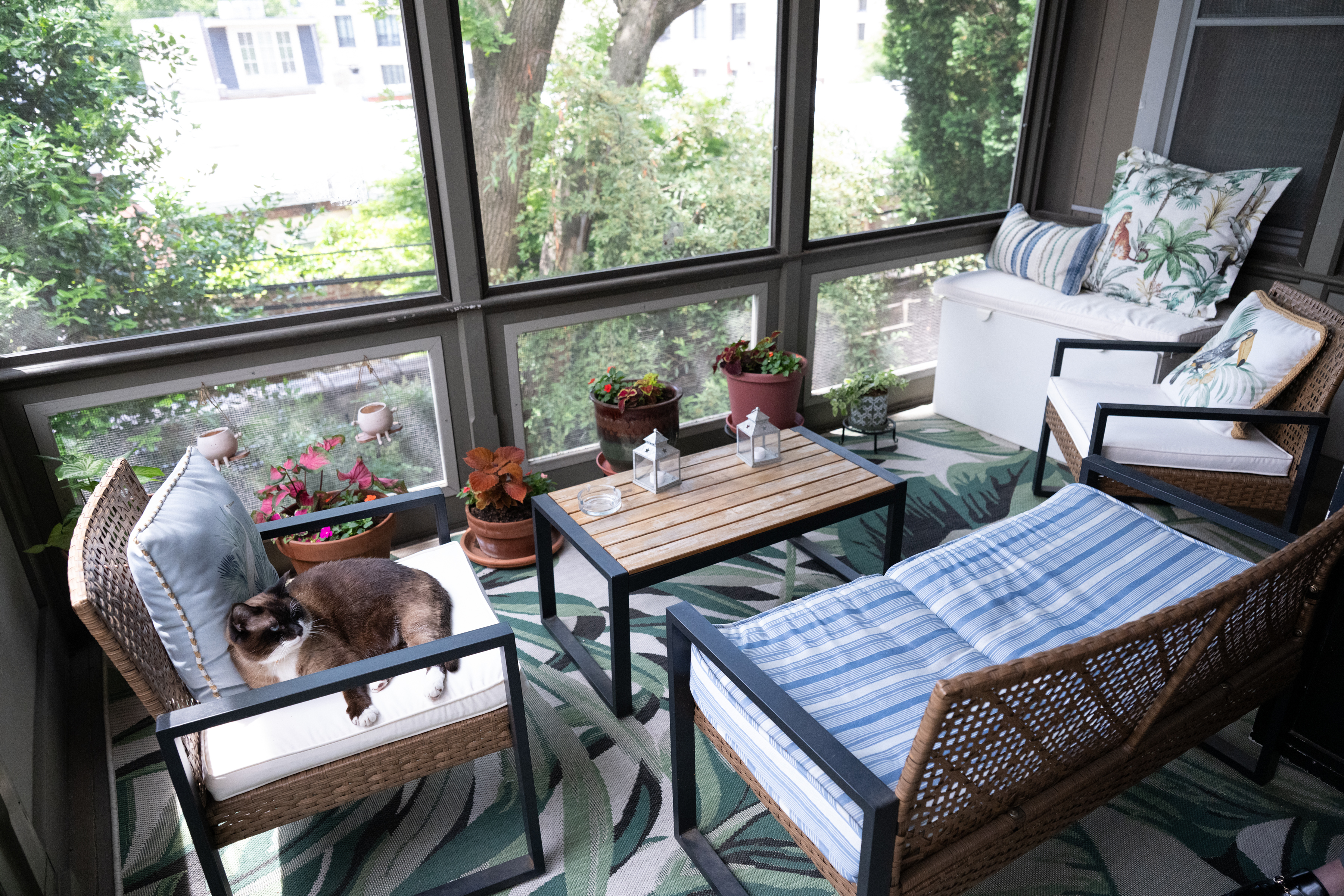
The house also had the big kitchen Johnson wanted and space for a garden for Burns. Then there was the screened-in porch on the second floor. “I feel like that’s a rare find,” Burns said. Her other favorite feature is the third floor, which “felt like your own private suite,” she said.
The deal: The house was listed for $975,000. The couple offered the full asking price and felt good about not going over. “I really was not in the market for haggling or fighting over a house,” Burns said. “We weren’t that desperate.” There was one other offer, but it was lower, so the seller accepted theirs.
Homeowner Charlotte Burns appreciated that the home’s prior owners kept historical details like moldings intact. Erin Blewett / For The Inquirer
The inspection came back mostly clean. Some porch wood and window linings needed work, but the biggest issue was the HVAC system, which was more than 20 years old. Burns and Johnson negotiated a $7,500 seller’s credit for it and later replaced the HVAC and heat pump for about $8,500.
The money: Burns and Johnson bought the $975,000 house with no money down through a professional loan, a mortgage product for borrowers with high future earning potential but not necessarily years of savings. “It’s a very good option if you’re a medical professional,” Burns said. She didn’t know the loan applied to veterinarians until a colleague told her.
The screened-in porch on the second floor was a selling point. Erin Blewett / For The Inquirer
Unlike other low- or zero-down payment loans, a professional mortgage doesn’t require private mortgage insurance, and Burns said her student loan debt was not held against her in the same way it might have been with a conventional mortgage.
The couple actually had $100,000 in savings, most of it from Johnson, who had been working for several years after graduate school. But they decided not to put that money toward the house. They wanted to keep it as an emergency fund instead. “I feel like you should always have at least six months of emergency savings at all times,” Burns said.
Since moving in, the couple has done a lot of painting. Erin Blewett / For The Inquirer
Their mortgage payment was originally $7,200 a month. Recently, they paid a one-time fee of $1,200 to lower their interest rate from 7% to 6.5%, which brought their monthly payment down by about $400.
They plan to refinance if rates drop enough in the next few years.
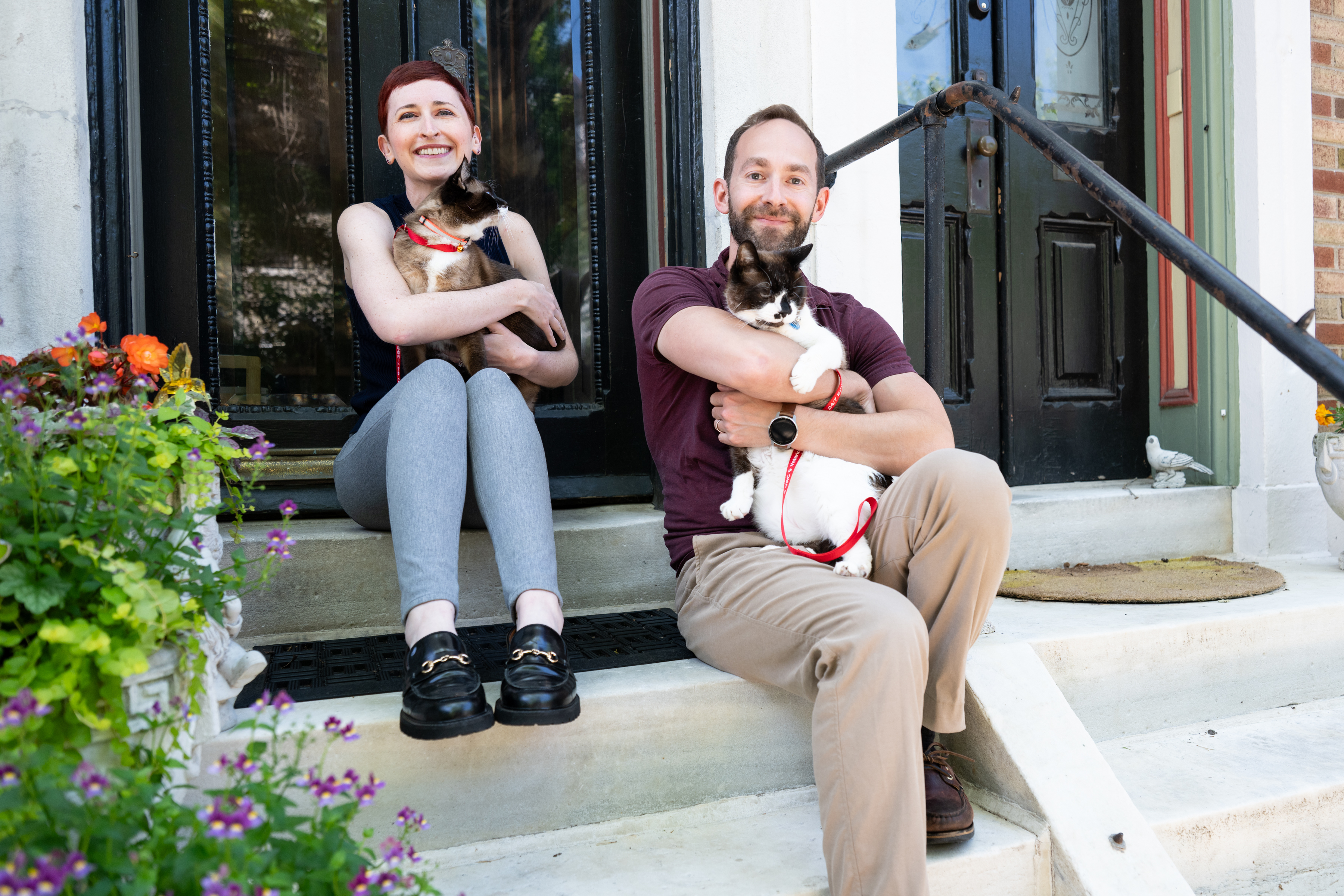
The couple turned one second-floor room into a living room, including space for their cats to lounge. Erin Blewett / For The Inquirer
The move: The couple closed Feb. 3 and started packing a week or two later. When they signed their lease, they had told their landlord that they might buy soon. She let them leave without issue and found new tenants within a week.
The move itself was a mess. They’d booked it for the day after the Super Bowl parade, and Fairmount was still buried in cars — including in front of their old house, where the no-parking signs Burns had ordered from the city were ignored. So Burns called the Philadelphia Parking Authority and had the cars ticketed and towed. Then, at the new house, the truck blocked the Route 48 bus, so Burns called SEPTA, and they rerouted it.
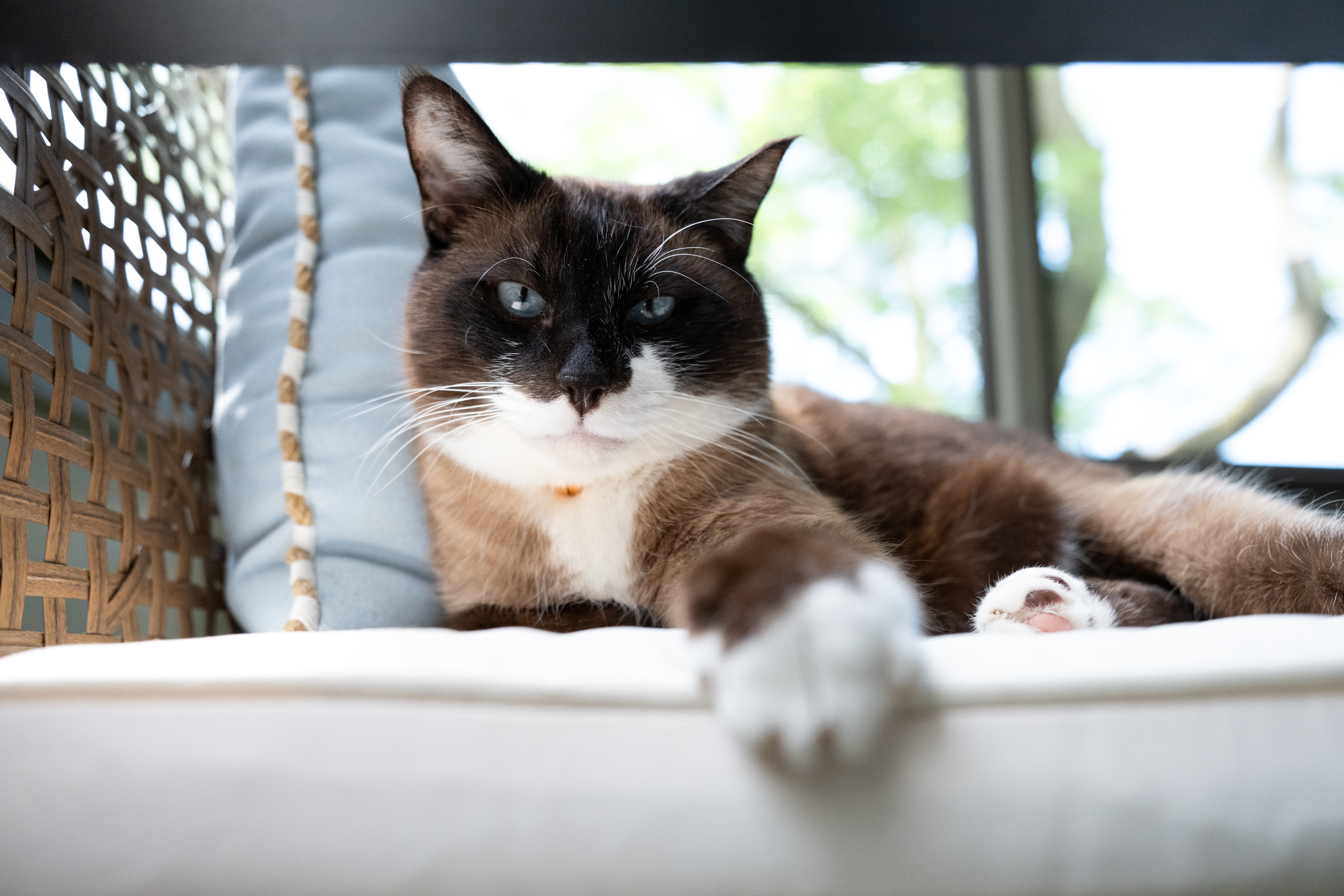
Mao is enjoying his new home in Fairmount. Erin Blewett / For The Inquirer
Life after close: Since moving in, the couple has been busy making the house their own. Burns has painted, wallpapered, gardened, and gotten “really into stencils,” she said. She painted the green living room herself and added an ivy stencil along the stairs.
Some days, she still can’t believe how easily everything came together. “It’s really crazy,” she said. “But you gotta let the universe do what it wants to do.”
Did you recently buy a home in the Philadelphia area or South Jersey? Share the story of how you did it. Email Inquirer real estate reporters at properties@inquirer.com.
My dream of ringing the Liberty Bell has (sort of) been achieved.
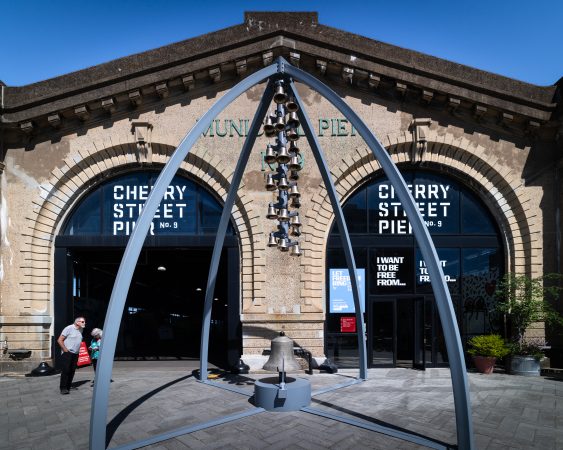
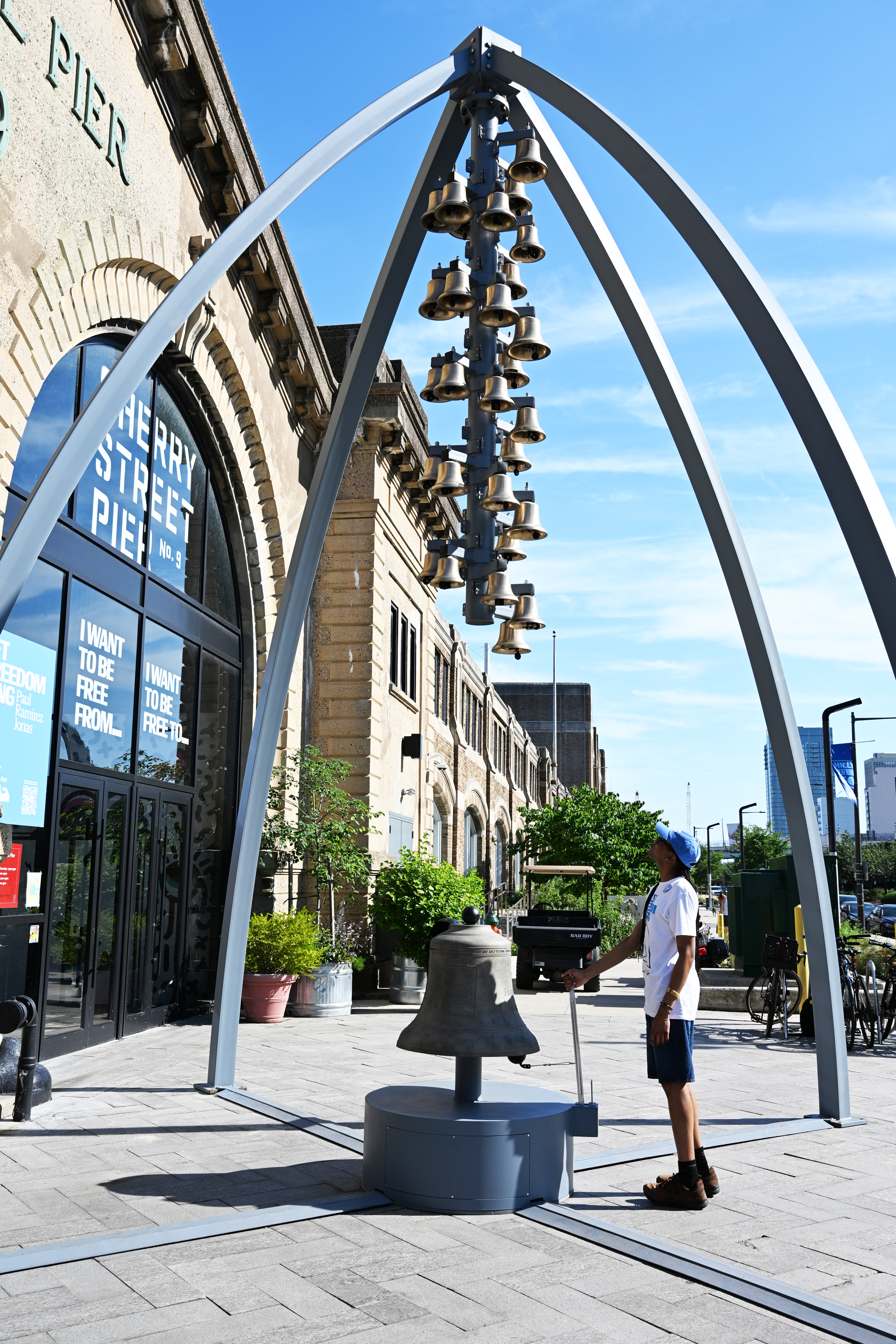
Just in time for America’s 250th anniversary, a 600-pound Liberty Bell look-alike has popped up on Cherry Street Pier. The exhibit titled “Let Freedom Ring” by artist Paul Ramírez Jonas features a lever in front of the bell that allows passersby to ring it, resounding a bright gong sound.
That’s not all; a spiral of 32 smaller bells hang overhead. Together, in tings and gongs, they play “My Country ‘Tis of Thee” every 15 minutes on the hour but the very last note is left out. This final note is meant to be rung from the bigger bell using the lever by onlookers, allowing them to be a part of the exhibit.
The display allows participants to ring the bell and finish the rendition of “My Country ‘Tis of Thee.”Julia Perciasepe
The most moving part for me were the inscriptions on the big bell itself. Engraved on either side of the bell, one says “I want to be free from …” and the other “I want to be free to …” These simple open-ended statements invite Philadelphians to question what freedom means to them in today’s American society.
It got me thinking about this country, where freedom is meant to be a founding principle. How much freedom do we really have, especially across diverse identities?
Let Freedom Ring runs through Sept. 27 at Cherry Street Pier, 121 N. Christopher Columbus Blvd. associationforpublicart.org
— Morgan Ritter
Philly anti-folk hero Adam Brodsky’s new album is “American Epitaph.”S. Elfie
The return of a Philly anti-folk hero
“I believe what Woody sang: ‘All you fascists bound to lose,’” Adam Brodsky sings on American Epitaph, his first album in over two decades. “But he didn’t give a time, and man that’s sure something we could use.”
Recorded at Retro City Studios in Philadelphia with producer Matt Muir, American Epitaph is a protest album divided into stripped-down tracks with Brodsky on guitar and Butch Ross on organ, and a full band presentation with backing by guitarist Jesse Lundy, drummer Alec Meltzer, and Chris Bixler on bass.
Songs like “Achy Breaky America” and “New World Order” are unapologetically confrontational in their politics, aiming to inspire a fighting spirit. A need to speak to the moment led Brodsky to return to recording and performing after a long layoff.
“Though long thought to be retired or eaten by a bear,” Brodsky writes in the liner notes, “truth is, Adam has been pried off the couch by the disappointing reemergence of fascism.”
And while Brodsky is the first to admit that his songs might not have the power to effect political change, on American Epitaph he aims to keep standing firmly in resistance to injustice and keeping faith in himself. “Singin’ songs and marching may not change my country,” he sings. “But I still do it every day, so my country don’t change me.”
— Dan DeLuca
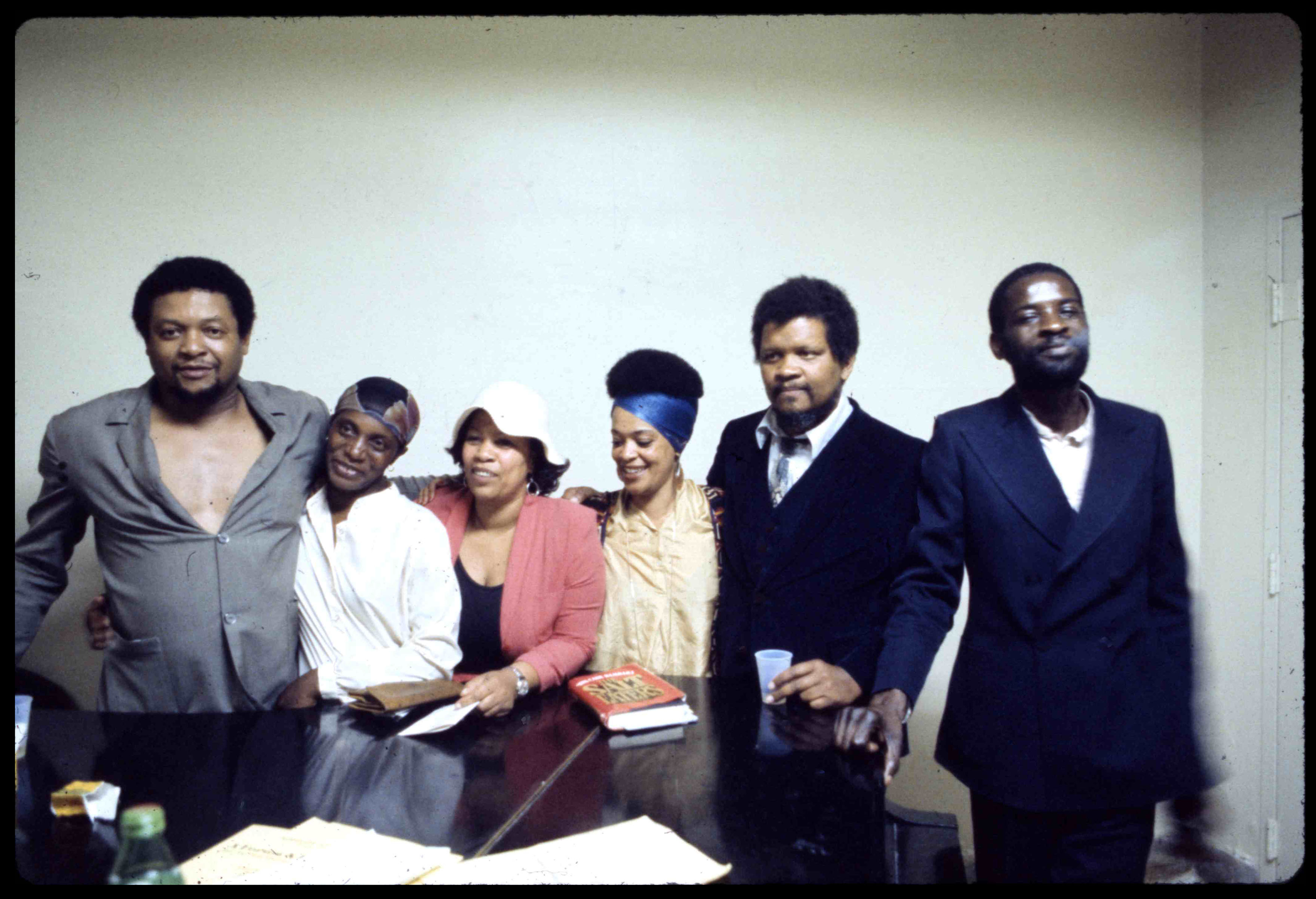
Portrait of, from left, American poet Quincy Troupe, literary executor and writer Gloria Karefa-Smart (sister of author James Baldwin), authors Toni Morrison and Toni Cade Bambara (1939 – 1995), poet Ishmael Reed, and Nigerian critic and journalist Chinweizu Ibekwe at an unspecified event, 1972.Anthony Barboza / Getty Images
A Philly legend on film
Toni Cade Bambara was a legend. But more importantly, she was a Philly legend.
Born and raised in Harlem, having studied theater in Florence and Paris, she taught in Atlanta before moving to the city in 1986. The Black Woman, an anthology she edited, published in 1970. That collection of writing is largely credited for introducing readers to the likes of Alice Walker, Audre Lorde, and Nikki Giovanni. Bambara was a filmmaker, academic, and activist but she was also a world builder; she built worlds with her ideas and then invited people to partake and wander in them. Wander and wonder.
After reading her 1980 novel Salt Eaters in college, I wrote out her words “All cocoons are temporary and disappear” on a piece of paper that I stuck above my writing desk.
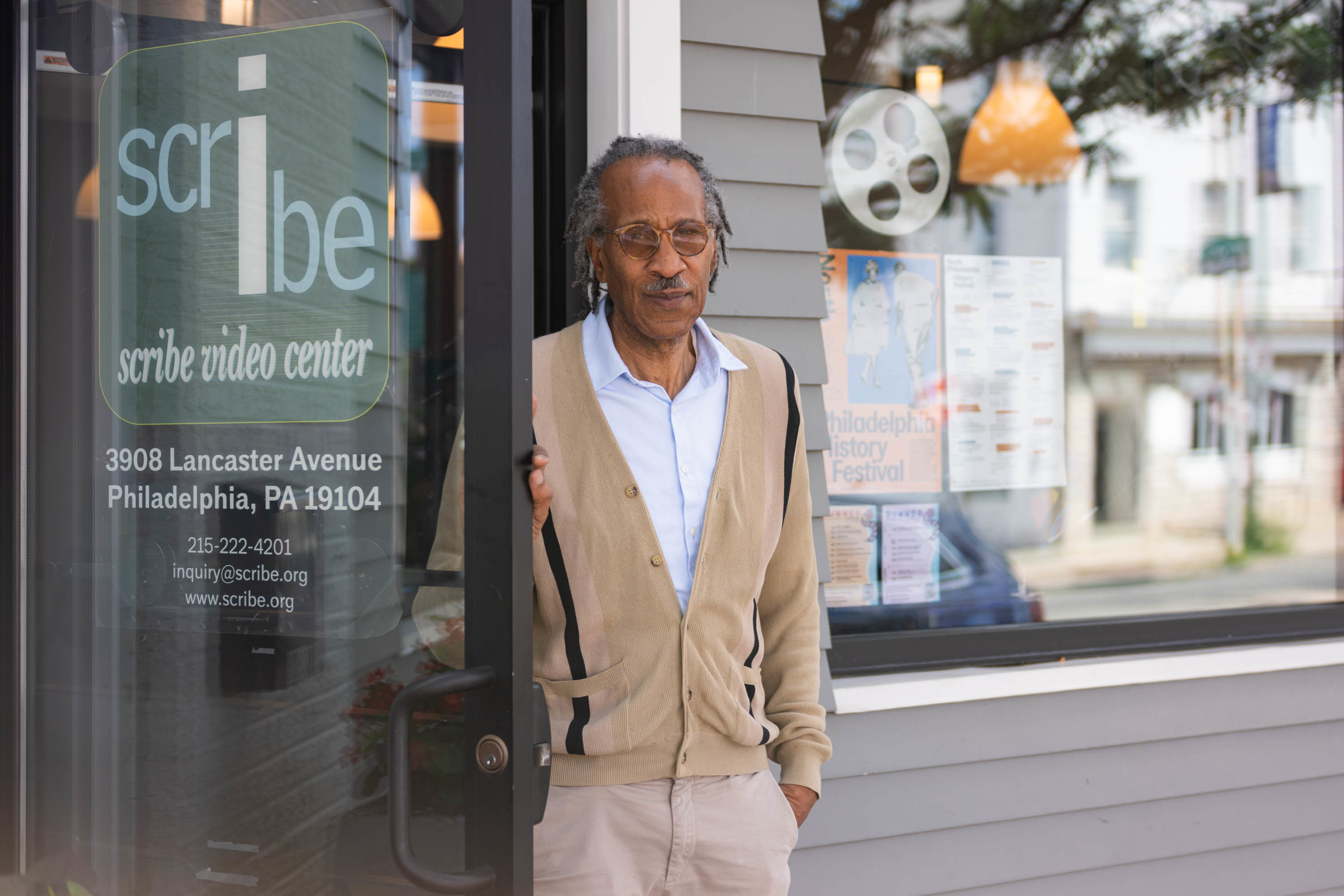
In Philadelphia, Bambara made friends with another Philly legend: Louis Massiah, the founder of West Philly’s Scribe Video Center. Together, Massiah and Bambara made the 1986 documentary, The Bombing of Osage Avenue, about the MOVE bombing, and then 1996’s W.E.B. Du Bois: A Biography in Four Voices.
Documentary filmmaker and principal organizer of the North Philadelphia History Festival Louis Massiah poses for a portrait at Scribe Video Center in West Philadelphia on Wednesday, July 23, 2025.Kaiden J. Yu / Staff Photographer
Thirty years after Bambara’s death in 1995, Massiah’s film TCB — The Toni Cade Bambara School of Organizingpremiered at the BlackStar Festival. The documentary is structured like a syllabus and is a lesson in organizing, creating, and living from Bambara herself. It chronicles her life, tells us what she can still teach us today, and brings together the galaxy of legends she called friends: Toni Morrison, Nikki Finney, Sonia Sánchez.
TCB plays as part of cinéSPEAK’s Under the Stars Film Festival on June 19 under the open night sky in Clark Park, not too far from Scribe, where Bambara and Massiah together wrote stories that continue to teach us about the many fault lines running through our world and lives.
“TCB — The Toni Cade Bambara School of Organizing” plays June 19, 9 p.m., at Clark Park, 4300-4398 Baltimore Ave., cinespeak.eventive.org
— Bedatri D. Choudhury
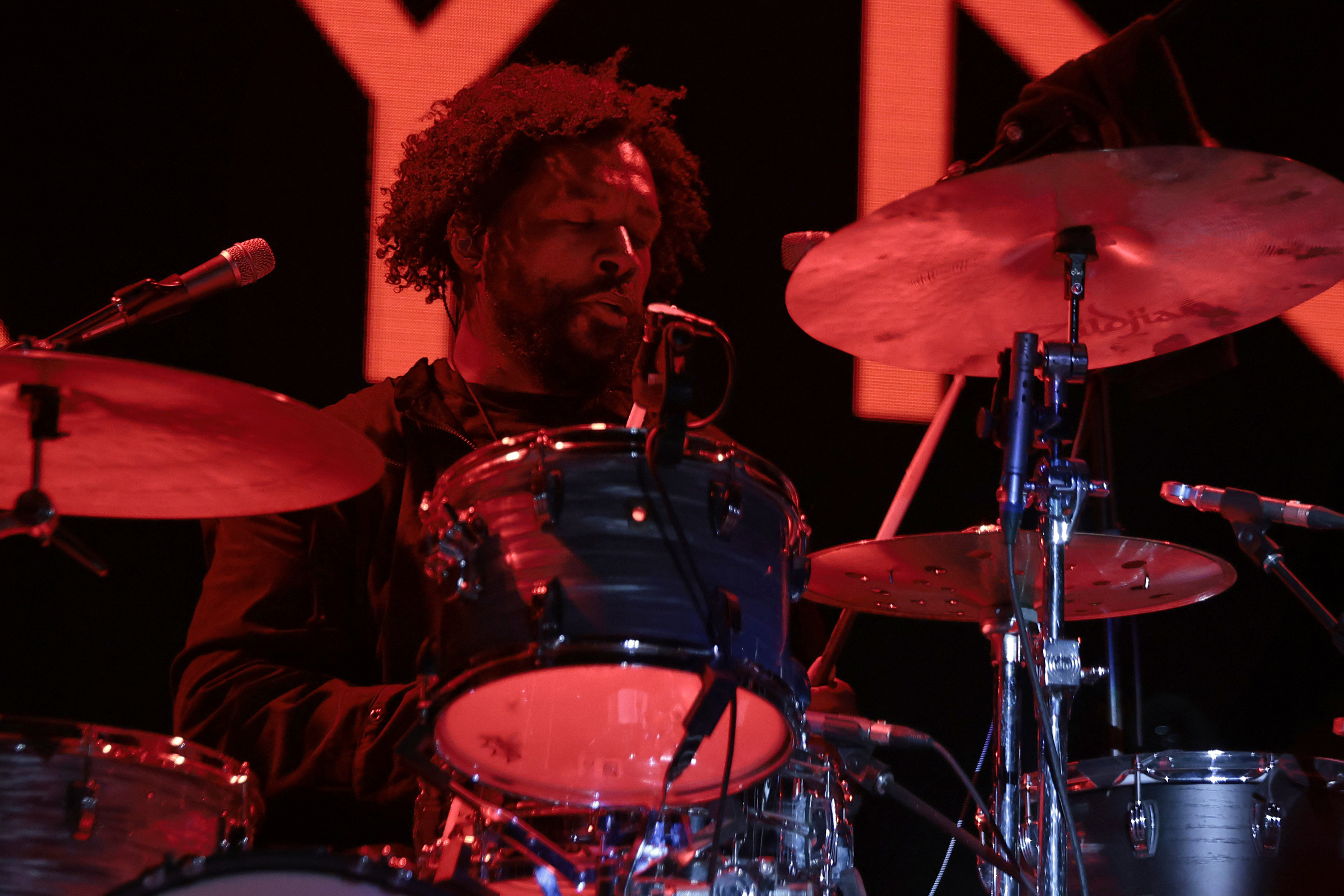
Ahmir “Questlove” Thompson plays the drums during The Roots Picnic at the Mann in Fairmount Park on Sunday, June 2, 2024.Elizabeth Robertson / Staff Photographer
Questlove gives Earth, Wind & Fire its flowers
I learned how to do the two-step to Earth, Wind & Fire’s hits like “September,” “Groove Tonight,” and “Shining Star.” In Afro-puffs and bell-bottoms trimmed in 1970s rickrack, my dance moves were clumsy. In my family’s white tiled kitchen, I practiced as the familiar voices of lead singers Philip Bailey and Maurice White crooned from my mom’s AM radio. Earth, Wind & Fire was like McDonald’s French fries and Sesame Street. I loved them.
So when Ahmir “Questlove” Thompson’s trippy documentary on the R&B group that I fondly call “the elements” aired on HBO recently, I tuned in.
I was pleased with what I saw. The two-hour Earth, Wind & Fire (To Be Celestial vs That’s the Weight of the World) was more than a nostalgic look back; it was an insightful look at the life of founder Maurice White. White was anything but transparent to the world, except when he was making music. That is where he put his emotion. That is why the band’s music spoke to us.
White meditated. He had faith and mantras. He poured what he learned into the making of iconic tunes.
Through interviews with living bandmates, Thompson, who directed the film, gives us a peek into White’s childhood. We see White fall, get up, and fall again, and spend way too much money on the group’s spacey costumes. White was fearless and Earth, Wind & Fire, iconic. And my feet moved — and still do — with syncopated joy.
“Earth, Wind & Fire (To Be Celestial vs That’s the Weight of the World)” is streaming on HBO.
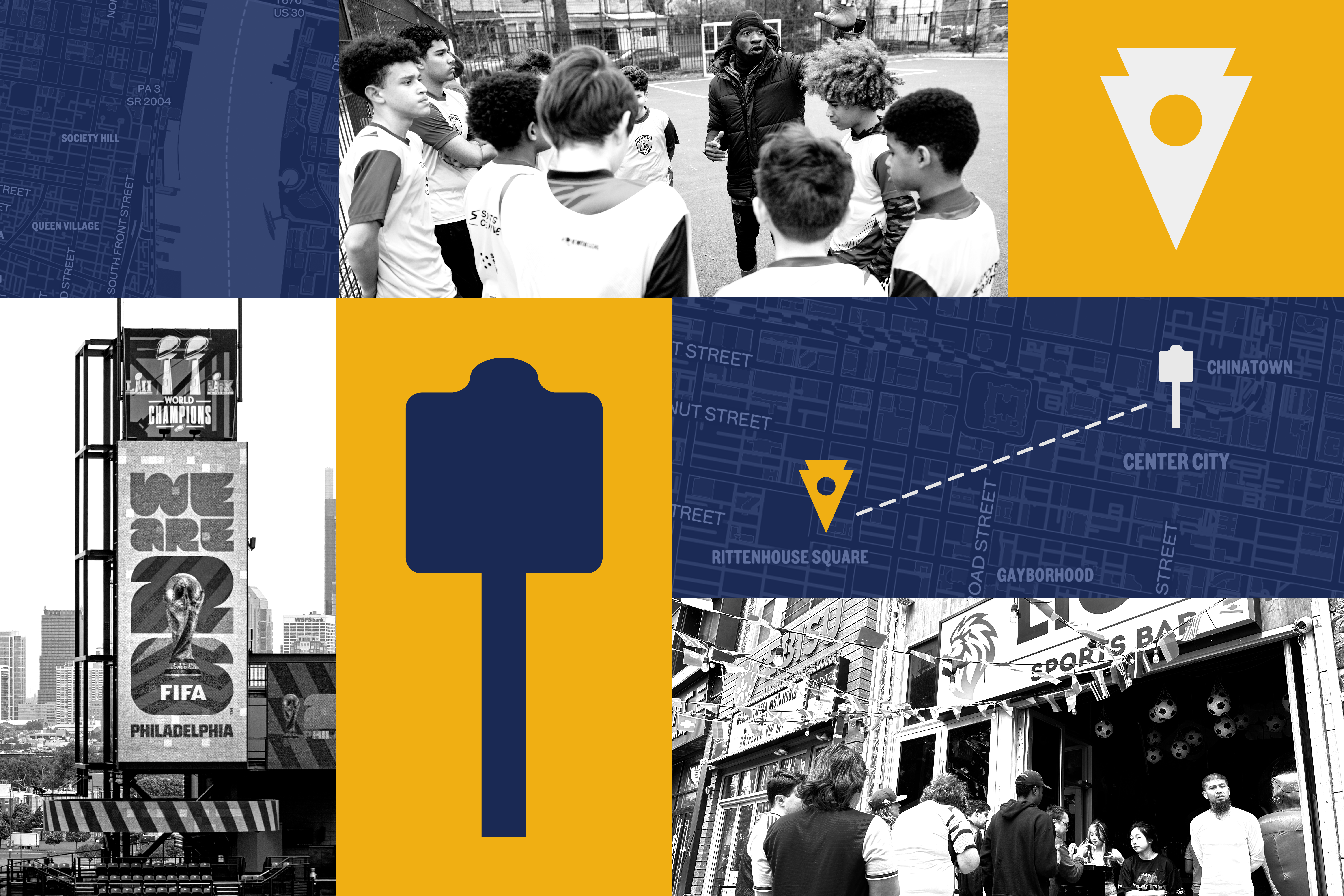
The World Cup begins tomorrow in Philadelphia! We’ll show you a World Cup-themed photo taken in the Philly-area, you drop a pin where you think it was taken. Closer to the location results in a better score. Good luck!
Round #37
Question 1
Where is this sign?
Loading…
ClickTap on map to guess the location in the photo
ClickTap again to change your guess and hit submit when you're happy
You will be scored at the end. The closer to the location the better the score
Jose F. Moreno / Staff Photographer
Pretty good/Not bad/Way off! Your guess was from the location.Spot on! Your guess was exactly at the location. Here's also where a random selection of Inquirer readers guessed.
FIFA signage adorning Philadelphia Stadium, more commonly known as Lincoln Financial Field, home of the Philadelphia Eagles. The Linc will officially be referred to as Philadelphia Stadium during the duration of the FIFA World Cup.
Quiz continues after ad
Question 2
Where are these kids being coached?
Loading…
Allie Ippolito / Freelance
Pretty good/Not bad/Way off! Your guess was from the location.Spot on! Your guess was exactly at the location. Here's also where a random selection of Inquirer readers guessed.
These kids are being coached in soccer during the first Love Street League program at Hissey Playground in Kensington, a community league that celebrates soccer and the upcoming World Cup.
Quiz continues after ad
Question 3
Where is this sports bar?
Loading…
Tassanee Vejpongsa / Associated Press
Pretty good/Not bad/Way off! Your guess was from the location.Spot on! Your guess was exactly at the location. Here's also where a random selection of Inquirer readers guessed.
Fans arrive to watch a match at the Lion Sports Bar, in Chinatown. Inside, matches are played across the soccer-centric bar’s 35 screens.
Your Score
ARank
🏆 Amazing work. The trophy is yours!
BRank
🥅 Good stuff. Scored a goal and a solid win.
CRank
⚽ C is a passing grade, but the tournament went on without you.
DRank
🟨 D isn’t great. That’s a yellow card, one more foul and you’re out.
FRank
🟥 We don’t want to say you failed, but that’s a red card, you’ve been eliminated!
You beat % of other Inquirer readers.
We’ll be back next Saturday for another round of Citywide Quest.