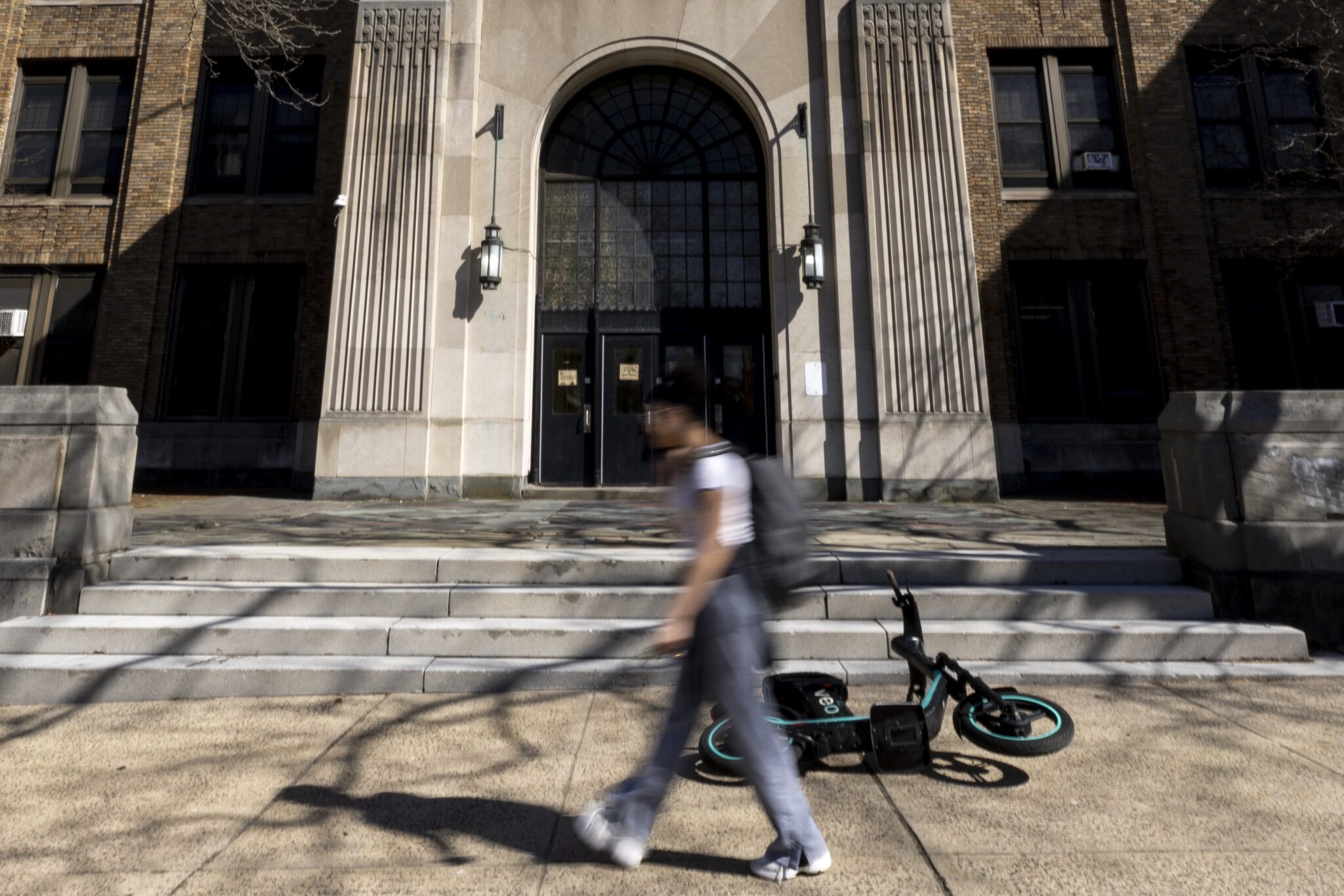
A conservative law firm is calling on New Jersey officials to repeal state guidance on parental notification when students question or attempt to change their gender at school.
The Liberty Justice Center, a Texas-based nonprofit that has waged such battles for free around the country, warned New Jersey Attorney General Jen Davenport in a letter Tuesday that keeping the guidance, known as Policy 5756, in place will lead to “federal investigations or lawsuits for the violation of federal civil rights.”
The center also sent letters to attorneys general in New York, Illinois, and Washington, where similar policies are in place. The effort comes a week after the Trump administration threatened two school districts in Maryland and Michigan with sanctions, including pulling their federal funding, if they don’t repeal their policies.
“By withholding information from parents regarding their children, these school districts are violating federal law, not to mention basic morality,” Timothy Snowball, a senior attorney at the center, said in a statement. “Parents have the fundamental right to direct their children’s upbringing, and these attorneys general must comply with federal law or face possible legal action.”
New Jersey’s policy, which the state Department of Education issued in 2018, prohibits the disclosure of a student’s gender identity without their consent unless “a specific and compelling need” obligates school officials to alert parents, such as health and safety concerns or a bias incident.
Several school districts and parents have challenged the policy in court, arguing it interferes with parents’ constitutional right to raise their children as they want. The state’s attorneys have countered that students have a constitutional right to privacy, disclosure risks harm to students whose parents aren’t supportive, and the policy is voluntary guidance districts don’t have to follow. Judges so far have let it stand.
It’s unclear how many of the state’s 600 districts have adopted the state guidance. The group Defending Education, which opposes such policies, estimates 130 districts have done so, but local advocates suspect that’s an undercount, as school boards typically act on state guidance.
Snowball said the U.S. Supreme Court’s March order in a California case known as Mirabelli v. Bonta should spur states with similar policies to reexamine and revoke them.
California’s law requires schools to support a child’s social transitioning and bars alerting parents without the child’s consent. After it was challenged, a trial court issued an injunction that blocked enforcement of the law, an appeals court stayed that injunction, and a split Supreme Court vacated the stay and returned the case to circuit court, saying parents claiming religious exemptions likely will prevail.
The Liberty Justice Center filed a brief supporting parents in the California case.
“The constitutional questions have now been squarely presented, and the legal issues are no longer theoretical. Your office should reevaluate the state’s current position to ensure that New Jersey’s policies and enforcement actions comply with parents’ federally protected rights before further litigation compels that result,” Snowball wrote to Davenport.
Spokespeople for Davenport and the New Jersey Department of Education did not respond to requests for comment.
But Robert Kim, executive director of the Education Law Center, said Davenport and the other attorneys general shouldn’t change course because of the California decision, which was not a final ruling on the case’s merits but instead just a preliminary order issued in response to an emergency application — meaning there were no oral arguments, briefs filed, or extended opinion written.
“It is a very limited window into this emerging area of law,” Kim said.
The Liberty Justice Center’s letter-writing campaign adds “fuel to the fire that’s stemming from this pattern of disturbing behavior by the Trump administration, this fixation to aggressively target a small portion of the student population, the transgender community, for disfavored treatment by the federal government,” Kim said.
Michael Gottesman, founder of the New Jersey Public Education Coalition, also doesn’t think the California decision should sway policymakers here, noting that California’s policy is mandatory while New Jersey’s is voluntary.
The policy’s critics also ignore that the state’s Law Against Discrimination protects people from being forcibly outed, Gottesman added.
“The policy basically sets up a process which recognizes the fact that parents have rights, but students do too,” Gottesman said. “There’s a whole line of cases in the Supreme Court on parents’ rights, but there’s also a whole line of cases in the Supreme Court about students’ privacy rights.”
Opponents have mischaracterized the policy, which balances parental notification with student privacy, said Dillon Reisman, a staff attorney with the American Civil Liberties Union of New Jersey.
“Our state’s policies have never required schools to lie to parents when a parent asks about their student’s gender identity. The policy already recognizes that health and safety concerns or harassment, intimidation, and bullying laws might require schools to affirmatively notify parents of a student’s gender identity if it’s relevant,” Reisman said. “Those are two things that already meet the U.S. Supreme Court standard from Mirabelli v. Bonta.”
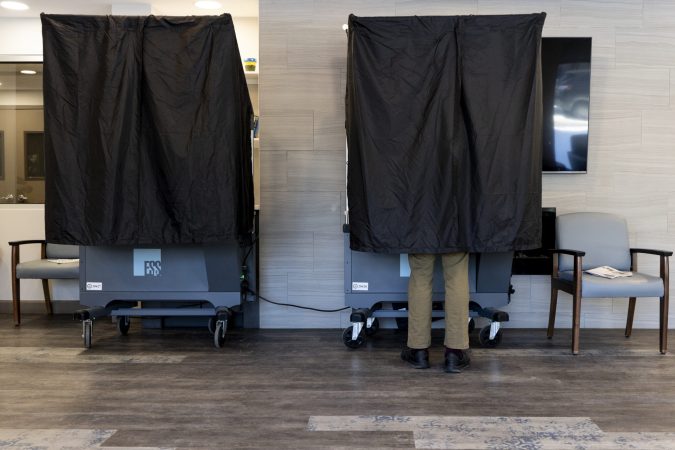
Republican lawmakers say they’re hopeful the governor’s new comments expressing support for voter ID legislation could push long-stalled bills toward hearings when the Legislature returns to Trenton in the fall.
“I absolutely think this should be one of the top priorities when we come back into session,” said Sen. Michael Testa (R., Cumberland). “There absolutely needs to be a discussion, and the people of New Jersey deserve that discussion to be had.”
Gov. Mikie Sherrill, a Democrat, said last week during an appearance on News 12 that she would support a voter ID law in New Jersey if legislation reached her desk.
“Certainly if that was the law passed here, I would support that,” she said, responding to a viewer’s question. “I don’t have a problem with voter ID.”
Sherrill’s comments come on the heels of her revealing that thousands of noncitizens were registered to vote via the state Motor Vehicle Commission, and fewer than 400 of them cast ballots. The revelation led to a new round of voter fraud complaints from Republicans in New Jersey and nationwide, while the Trump administration demanded information about the voters in question. Sherrill declined to share that data and has said the state is conducting an independent investigation.
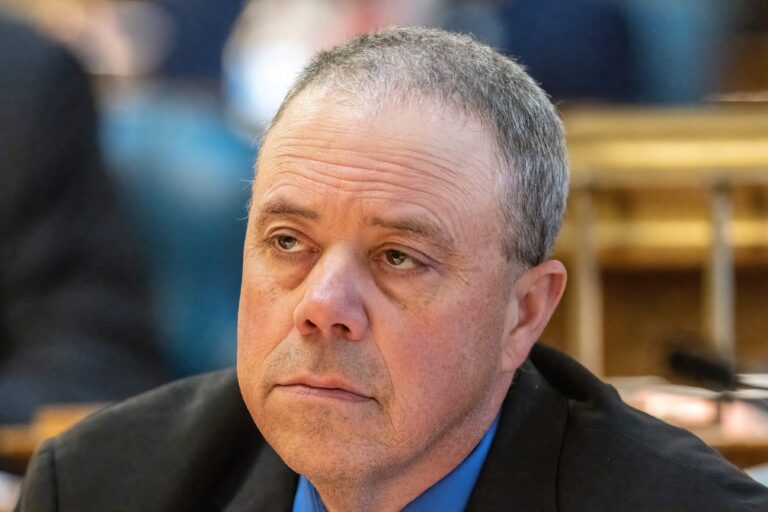
Sen. Parker Space.Hal Brown/ New Jersey Monitor
Sen. Parker Space (R., Sussex) is a sponsor of a bill that would require voters to show identification to cast ballots, including a driver’s license, a Real ID, or a passport, among others, and those without them would have to show utility bills in their name, a mortgage or rental statement, or two pieces of mail from a government agency or utility company. Any voter who does not show these would be subject to a challenge.
Space said he was encouraged by the governor’s remarks that his bill — which has been introduced three times since 2022 but has never advanced to a committee hearing — could finally be posted for a vote.
“Hopefully she stands by her word and we can get the Legislature on board,” he said.
He noted that the issue hasn’t historically been a priority for Democratic legislative leadership, which decides which bills advance.
Assemblyman Gerry Scharfenberger (R., Monmouth) has sponsored the bill in the lower chamber since 2022. He said he proposed legislation with more options for voters besides showing just photo identification because he thought it would get some support from Democratic lawmakers, though he concedes that has not worked so far.
The new voter registration issue, Scharfenberger said, shows the “walls are closing in, as far as the Democrats being able to avoid this issue.”
“There’s no way they can avoid addressing this. If I could be a little bit of a forecaster here, I think the more information they find out about the motor vehicle issue, the more those numbers are going to grow,” he said. “It’s become too much with the public psyche, and I think we’re going to have to address it with solid legislation, and not just token tweaks here or there.”
Testa said he was “pretty shocked” to hear Sherrill’s comments on supporting voter ID, but “pleasantly surprised.”
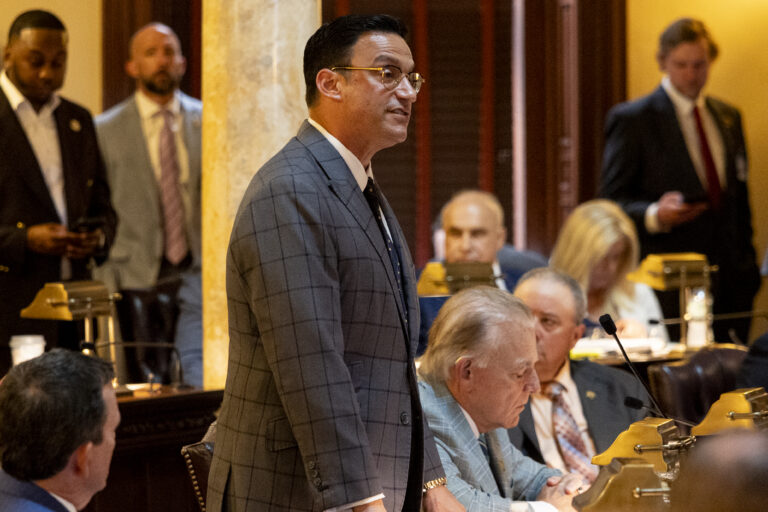
He’s the co-sponsor of a voter ID bill that would require a voter to show one of four forms of photo ID: a driver’s license, a Real ID, an identification-only card issued by the Motor Vehicle Commission, or a U.S. passport. He said it’s easier to train ballot workers on how to validate just these forms of ID.
Sen. Michael Testa Jr.Anne-Marie Caruso/New Jersey Monitor
“We’ve done everything in this state to be able to allow individuals to vote by mail, to expand the time period for vote by mail, to give people more locations to go vote — and I don’t necessarily have a major problem with any of these modalities for people to vote — but if you’re going to vote on Election Day, you should have a photo ID,” he said.
A spokesman for Senate President Nicholas Scutari (D., Union) did not respond to a request for comment. A spokesperson for Assembly Speaker Craig Coughlin (D., Middlesex) declined to comment.
Thirty-six states have laws requiring voters to show some form of ID at the polls, and eight of those strictly require photo ID.
But voting rights groups say there are decades of studies showing certain communities are less likely to have access to photo ID. Liza Weisberg, supervising attorney of the American Civil Liberties Union of New Jersey, said people who are homeless, young voters, and communities of color are the “most likely to face disenfranchisement.”
She called Sherrill’s comments on voter ID a “moment of concern.” Seven advocacy groups — including the ACLU, New Jersey Institute for Social Justice, and the League of Women Voters — sent Sherrill a letter Friday urging her to reject voter ID legislation outright.
They noted that state law already requires people to provide a driver’s license number or their Social Security number to register to vote.
Weisberg said the recent voter registration news doesn’t justify implementing voter ID, noting the newly registered voters in question represent a “small fraction” of the state’s voters, with an even smaller group actually casting a ballot. Sherrill initially said about 6,600 people who identified themselves as noncitizens at the Motor Vehicle Commission were added to the voter rolls, and later said about 2,000 of them may indeed be citizens. The state has 6.7 million registered voters.
“I really hope that there is not an effort to continue using this event to justify voter suppression efforts that really don’t have anything to do with it,” Weisberg said.
Republicans dismissed arguments that voter ID laws disproportionately burden low-income, elderly, minority, and young voters. They noted multiple reasons people need to show photo ID, like renting a car or applying for food stamps.
Testa called the disenfranchisement argument “very, very pompous,” saying it suggests that voters could be “ill-equipped or too stupid” to obtain a photo ID. Scharfenberger called it “the most racist position I’ve ever heard,” and Space said those arguments “pander to the far left and liberal media.”
The first two days of Eagles training camp practice in South Philadelphia are in the books. The Philadelphia Inquirer’s Jeff McLane and Olivia Reiner check in with key observations and highlight emerging early storylines to kick off unCovering the Birds’ coverage of the 2026 season.
00:00 How Jalen Hurts and the Eagles offense has looked under new coordinator Sean Mannion
15:10 Why the Eagles felt Jalen Carter was worthy of a new contract, and whether he’s worth it
31:21 New segment alert! Jeff’s mailbag!
unCovering the Birds is a production of The Philadelphia Inquirer and KYW Newsradio Original Podcasts. Look for new episodes throughout the season.
We’re always looking for mailbag questions! Hit Jeff up on his socials, or drop a question in the comments. Jeff could answer it in a future episode!
Thousands of homeowners in Philadelphia are not enrolled in city programs like the homestead exemption and the Longtime Owner Occupants Program (LOOP) established to help ease the burden of rising real estate taxes.
“I surround myself with good people, but not everyone is aware of these [tax relief] programs,” said Edgar Ponce, 26, who recently purchased his home in Kensington, one of the neighborhoods where property assessments rose the most.
story continues after advertisement
The Philadelphia Office of Property Assessment conducts reassessments of property values every other year. From 2025 to 2027, properties citywide rose 3%, with certain neighborhoods seeing increases upward of 15%.
Four areas in Philly that saw the largest percentage increases in median assessments were Kensington,Mantua, Grays Ferry, andKingsessing. Each neighborhood borders more gentrified neighborhoods, likeFishtown,University City, andPoint Breeze. While tax revenue helps fund city services like the school district, parks, and the police department, shelling out a few hundred dollars more each year can be costly for some families. Several city-run relief programs, however, can help eligible homeowners save hundreds or thousands of dollars.
“Every time I apply to some type of program, there is always a catch,” said Ponce, who has yet to apply for the homestead exemption. The city could do more to inform people and build trust, he said.
While Philadelphia does conduct outreach, including canvassing, mailers, texts, TV and radio ads, and community events, those efforts do not reach everyone. If you, like Ponce, both own and reside in your home in Philadelphia and want to know what tax relief programs are available to you, The Inquirer is here to help.
We created a tool based on city property data to figure out what tax relief programs Philadelphia homeowners are eligible for. Complete the survey below to see what assistance you can apply for and how much you would save on your real estate taxes.
story continues after advertisement
What is your home address?
Philadelphia primary residential addresses only
Have you lived there for more than 10 years?
Do you live in this property as your primary residence?
Do you meet any of these descriptions?
1. You are aged 65 years or older
2. You are living with a spouse who is aged 65 years or older
3. You are aged 50 years or older, and a widow of someone who reached the age of 65 before passing away
What’s your annual salary? Or if married, what's your combined annual salary?
If anyone else lives in the house, what’s their combined annual salaries?
What is your family size?
Nope! It appears you’re maximizing your savings.
Yes! You may be missing out.
Maybe! You might be able to save more.
To apply for any program, you’ll need your OPA account number. Your number for location is parcel_number.
It appears you’re enrolled in the homestead exemption already, according to July 2026 data, and would not be eligible for other programs this year. In 2027, the homestead exemption will save you: homestead_savings. You should not have to reapply to get the savings unless your property deed was transferred or a co-owner was added.
It appears you are not eligible for any tax relief program right now. However, you may want to check on the Philadelphia Property Search website to see if your property is eligible for any other exemption.
It appears you’re enrolled in the homestead exemption already, according to July 2026 data. In 2027, homestead will save you: homestead_savings. You don’t have to reapply unless changes were made to the deed. Besides the homestead exemption, you may have other choices.
Here’s what you are eligible for:
Homestead
You could save
homestead_savings
It appears you are eligible for the homestead exemption. The program reduces the taxable portion of your property assessment. Starting in 2025, the property’s assessed value is reduced by $100,000.
You may be eligible for the Longtime Owner Occupants Program (LOOP), if you are not already enrolled, because your home’s assessment went up significantly — either 50% from 2026, 75% from 2022, or both. LOOP locks in your property tax at the lower of the two property values.
Keep in mind you cannot enroll in both LOOP and the homestead exemption. If you would like to switch from LOOP to homestead, you’ll need to request your removal at the same time you apply. If you plan to stay in your home for many years, you may consider LOOP over the homestead exemption to prevent future tax hikes, even if you’re required to pay more in the short term.
You might be eligible for this program if you fit the requirements:
Senior Citizen Real Estate Tax Freeze
You could save
???
You may be eligible for the Senior Citizen Real Estate Tax Freeze if you are not already enrolled. The program locks in your property taxes at this year’s amount, preventing future tax hikes, even if your property value or the tax rate increases.
If you met the age, income, and residency requirements at any point between 2018 and 2024, your application gets backdated to the earliest year you first qualified.
Keep in mind, you can be enrolled in both the Senior Citizen Real Estate Tax Freeze and the homestead exemption. Eligible applicant(s) must have a total income of:
It appears you may be eligible for the Low-Income Real Estate Tax Freeze if you are not already enrolled. Under this program, the amount of property tax you pay each year will not increase, even if your property assessment or the tax rate changes.
Keep in mind, you can be enrolled in both the Low-Income Real Estate Tax Freeze and the homestead exemption. Eligible applicant(s) must have a total income of:
In September, the city released a new combined application for its real estate tax assistance programs, where homeowners can fill out one form to see what programs they are eligible for, and submit the applications online directly through the Philadelphia Tax Center, said Kaelyn Anderson with the Philadelphia Department of Revenue.
Despite these efforts, the outreach hasn’t reached everyone, including Ponce of Kensington. “Truthfully I have never received anything in the mail about these programs,” he said.
Methodology
The Inquirer acquired property assessment data for single-family homes in 2022 through 2027 from the City of Philadelphia Office of Property Assessment. The data include the assessed value of properties each year and homestead exemption enrollment in 2027.
The eligibility for the homestead exemption, the senior citizen tax freeze, and the low-Income tax freeze is based on information provided by homeowners in our survey.
To estimate potential savings for homestead, we subtracted the $100,000 exemption from each property’s 2027 assessed value (or the full assessed value if it was below $100,000), then compared the resulting tax bill with what homeowners would pay with no exemption at all. The difference is the amount the homestead exemption program would save homeowners if enrolled.
We used the assessed home value each year to calculate the percentage change in the last year and the last five years to determine eligibility for the LOOP program. The thresholds are 50% from last year or 75% from 2022. Depending on which threshold a property met, its taxable value was capped at either 1.5 times the previous year’s assessed value or 1.75 times the lowest assessed value over the preceding five years.
LOOP savings were calculated by comparing the tax bill under that capped value with the ordinary taxes that the homeowner would have to pay in 2027 if not part of the program. The difference is the amount the LOOP program could save homeowners if they were enrolled.
The Inquirer’s methodology for calculating tax program savings has been reviewed by the city.
Staff Contributors
Design: Yaelle Tang, Jasen Lo and Lizzie Mulvey
Development: Yaelle Tang, Jasen Lo and Levi Jiang
Data: Lizzie Mulvey and Yaelle Tang
Reporting: Lizzie Mulvey and Yaelle Tang
Editing: Stephen Stirling and Sam Morris
Illustration: Thomas Pullin
QA: Lyn Tran, Sandy Vo and Sarah Pham
Social Editing: Esra Erol
Copy Editing: Addam Schwartz
Subscribe to The Philadelphia Inquirer
Our reporting is directly supported by reader subscriptions. If you want more journalism like this story, please subscribe today
A man incarcerated in a New Jersey prison has sued the state in a bid to block corrections officials from forcing prisoners to surrender personal electronic tablets they purchased to message loved ones, listen to music, and access other digital content.
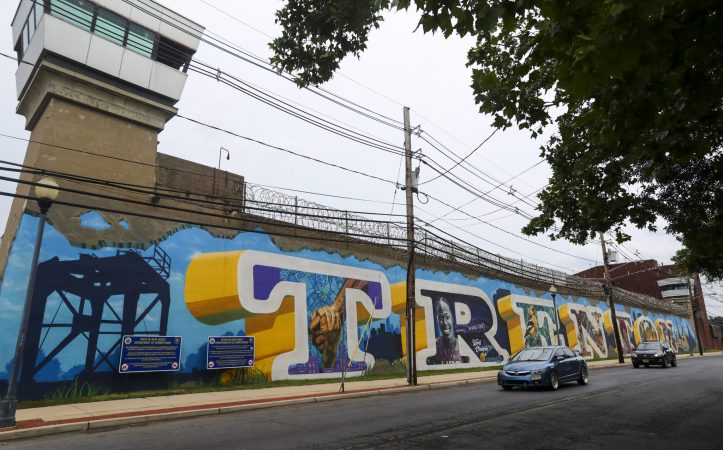
Alonzo Hill, who has been incarcerated at New Jersey State Prison in Trenton since 1990, filed a civil rights complaint last week asking a federal judge to allow inmates to keep the handheld devices and their content — or require the state to reimburse people what they paid for them.
The dispute comes as the state Department of Corrections switches to a new provider, ViaPath Technologies, to meet the communications needs of the 13,000 people in state custody.
JPay had supplied such services since 2014, with people purchasing tablets and paying one-time fees for content they downloaded for use in their cells and recreation areas. The ViaPath tablets, in contrast, are considered loaners that are provided for free but require users to continuously pay for content in a subscription model. ViaPath users in New Jersey prisons also face high restitution fees for damaging tablets and new limits on tablet use outside of cells.
Inmates bought the JPay tablets and content with the understanding they were “owned property without limitations,” Hill wrote. Yet corrections officials are requiring people to turn them in for disposal or send them home, gave incarcerated people no opportunity to chime in on the changes, and ignored his inquiries and grievances over it, he added.
That’s a violation of the 14th Amendment, which says that no state shall deprive people of property without due process of law, he charged. Hill is director of his prison’s Inmate Legal Association, a nonprofit in which jailhouse lawyers help other incarcerated people with their court filings and disciplinary matters.
“Many inmates utilize these tablets and content (at no additional cost) multiple times each day to relieve stress and anxieties of prison life,” Hill wrote. “State inmates were led to believe that if they didn’t violate JPay’s terms or NJDOC’s rules regarding the e-tablets, the chargers and content, that they could purchase and retain both throughout their sentences.”
He also objected to the “exponential cost increases” he suspects users will face under ViaPath, noting that many inmates make less than $2 a day for prison jobs — and some make nothing, such as those held in disciplinary units.
Corrections officials also have failed to guarantee that family photos downloaded and digital content purchased through JPay will transfer to the new ViaPath tablets, he added. They told people in custody that JPay tablets not sent home or surrendered for disposal will be considered contraband subject to confiscation, with their owners facing discipline, Hill said.
Chris Greeder, a Department of Corrections spokesman, declined to comment on the lawsuit.
But he said in an email that the department, JPay, and ViaPath have “reached an agreement allowing digital assets, including music, emails, photos, and related attachments, to be transferred to the new platform.”
Eight of the state’s nine adult prisons have transitioned to ViaPath since March, with 9,500 people now using the new tablets, Greeder added. New Jersey State Prison’s switch is scheduled for the week of Aug. 10, he said. The department’s contract with JPay was set to expire this Friday, so officials negotiated a 90-day extension so people incarcerated in Trenton can continue using JPay services, he added.
Officials switched vendors because ViaPath offers “a modern communications system” at a lower cost than JPay, Greeder said.
Phone calls, money transfers, electronic messages, and video visits through ViaPath were cheaper than similar services through JPay, according to contracts and price sheets the New Jersey Monitor reviewed in May. It was tough to compare prices for music, movies, games, and such content, though, because those are pay-as-you-go services under ViaPath and outright purchases under JPay.
The Department of Corrections is “committed to providing incarcerated individuals with safe, secure, reliable communication services” that allow them to communicate with family and loved ones, Greeder said in an email.
Critics, though, have accused ViaPath of predatory pricing because of its pricing structure, service fees, and other practices, with people incarcerated in Nevada prisons boycotting use of ViaPath tablets earlier this year. The Virginia-based company also has racked up more than 600 complaints in the past three years with the Better Business Bureau and averages one star (out of five) in 87 reviews on its website, with many people complaining about costs and customer service. (JPay fared only marginally better on the watchdog site, with 368 complaints over the same time period and 27 reviews averaging 1.2 stars.)
Ronald Allen, who’s also incarcerated in Trenton, filed a statement supporting Hill’s lawsuit, voicing an additional concern. He said people make inquiries and file grievances through their JPay tablets, which connect to kiosks in each prison where people download content and communicate both inside and outside the prison via a restricted, surveilled intranet. He has stored all the inquiries and grievances he’s made in the past decade on his JPay tablet, he wrote.
“Without the kiosks, no accurate, reliable records of inquiries or grievances will exist,” Allen wrote.
Greeder said officials are working with the vendors to acquire historical records of inquiries and grievances.
Hill accuses state officials of deliberate indifference and is seeking a court order that would allow inmates to keep their JPay tablets, require the state to transfer all JPay content to the new ViaPath tablets, or reimburse people for content officials can’t or won’t transfer over. People in New Jersey prisons have spent between $1.5 million and $3.2 million each year over the past decade on JPay services, according to data the New Jersey Monitor obtained from the Department of Corrections last spring.
Hill also is asking the judge to appoint an attorney to represent him in court and award damages of $7,500 per defendant.
The lawsuit names as defendants ViaPath Technologies, Gov. Mikie Sherrill, Corrections Commissioner Victoria Kuhn, and New Jersey State Prison administrators Jeffrey Crothers and Douglas Stark.
Spokespeople for Sherrill and ViaPath did not respond to requests for comment.
A pending FCC broadcast license review now targets eight ABC television stations owned and operated by the Walt Disney Co. — among them WPVI Philadelphia, known to most viewers as 6abc. It has been said that “all politics is local.” Here in Philadelphia, this truism has applied with growing frequency to clear and present threats to the First Amendment — recently in our public parks and monuments, and now on our airwaves.
In 1934, years before the advent of commercial broadcast television, the Federal Communications Commission was established by an act of Congress to help govern the burgeoning American radio industry.
Among its roles, the FCC now regulates the granting of broadcast licenses, controlling which television stations can or cannot access a finite spectrum of public airwaves. Both by law and by long-standing precedent, broadcast license review is typically an independent, pro forma exercise. Before the current administration — under 14 previous presidents, seven Democrats and seven Republicans — the television licensing process had been largely nonpartisan, and operated in the public interest.
In fact, the need for broadcasters using public airwaves to operate broadly in the public interest is the very definition by which the FCC is meant to grant television station licenses. The FCC is required to renew a broadcast license if it finds that “the station has served the public interest, convenience, and necessity.” Philadelphia’s 6abc and its 55-year-old Action News programming embody this principle.
Unfortunately, under President Donald Trump, the FCC has become — unabashedly — a partisan attack dog rather than the guardian of the public interest.
On May 29, the FCC launched the first stage of a potential challenge to the licenses of ABC-owned and operated stations around the country, including 6abc, Philadelphia’s leading local news broadcaster and a strong pillar of our community. The FCC ordered eight ABC stations — in New York, Los Angeles, Chicago, Houston, San Francisco, Raleigh-Durham, N.C., and Fresno, Calif., as well as Philadelphia — to submit renewal applications years before their original renewal dates, which range from 2028 to 2031.
This is just one of many fronts in a long-running battle between the Trump administration and a broad array of independent media that has cost the American news industry time, money, and, too often, operating independence at a moment of extraordinary need for a free press. The challenge to ABC broadcast licenses has its most recent origins in the political harassment of late-night talk show host Jimmy Kimmel and the daytime program The View, each periodically critical of the president and other government officials on both sides of the aisle.
FCC Chairman Brendan Carr is the administration’s front man in the ABC case. Carr, you may recall, tried to intimidate ABC, its affiliate stations, and Kimmel some months ago, referring, like a mob boss, to “doing it the easy way or the hard way.” This license renewal harassment, which will cost Disney shareholders millions in legal fees, is presumably the “hard way.”
By law, the government’s filing allows public comment for either renewal or denial of ABC’s licenses. You can make your views known, quickly and easily, here: FCC Submit an Express Comment. Responses to the request for comments are due by Wednesday.
We in Philadelphia know that 6abc is an especially inappropriate target for accusations of not operating in the public interest. The station is a longtime ratings leader for news programming serving a geographically broad and politically diverse footprint. It has, for decades, produced consumer interest, investigative news, and community-oriented programming that speaks truth to power of all stripes.
At the Lenfest Institute for Journalism, of which I am chief executive, we have worked with 6abc on nonpartisan election coverage (Every Voice, Every Vote) and on fundraising for Philadelphia-area residents in need (Philly Gives). Executives at 6abc have always offered their help, their production skills, and their unrivaled broadcast audience for free — in the public interest.
This month, we celebrated America’s national freedom and independence, born here in Philadelphia. Let it not be a summer in which Philadelphia’s leading local television broadcaster is, with impunity, threatened with the loss of its right to broadcast freely and independently.
Jim Friedlich is CEO and executive director of the Lenfest Institute for Journalism, the nonprofit, noncontrolling owner of The Inquirer. @jimfriedlich
The nation’s death rate may have fallen to a historic low last year as many of the killers of young people such as drug overdoses, gun homicides and traffic accidents continued receding in 2025, according to new federal statistics.
States have not shared equally in the success, though, according to a Stateline analysis of provisional data by state. And the low ebb may reflect the effects of past health care expansion efforts that are threatened by today’s Trump administration moves to curtail Medicaid expansion and cut funding for rural hospitals.
Some states in the Northeast have seen death rates drop by the most between 2015 and 2025 — led by New Jersey (down 8.3%), Rhode Island (down 8%), New York (down 7.9%), Massachusetts (down 7.4%) and the District of Columbia (down 7.0%). Some experts credit states’ attention to health care, traffic issues and gun violence.
New Jersey has taken the lead in decreases because of a long-term commitment to expanding health care to people with low incomes, said Stephen Crystal, director of Rutgers University’s Center for Health Services Research.
Even before Medicaid expansion under the federal Affordable Care Act, New Jersey and Massachusetts, among other states, were pooling funds with hospitals to cover more low-income residents, Crystal said.
“New Jersey has been doing this for a long time, and you’re seeing the effects in the lower mortality rates for the big killers,” he said.
The state stands out for having less than half the national rate of firearm deaths, both suicide and homicide, as well as deaths from heart and kidney diseases caused by high blood pressure. The rate of traffic accident deaths is also well below the national rate.
There’s also a more confrontational attitude toward speeding and less tolerance for guns in the Northeast, he said.
“Here’s something that annoys a lot of New Jerseyans. The state troopers have the cojones to pull you over if you’re doing 90 on the turnpike. This is not the case in Wyoming,” Crystal said. “Also if you go out West where gun possession is very high, then the firearm suicide deaths become enormous.”
Nationally most of the decrease between 2024 and 2025 came from young age groups. The things most likely to kill them dropped after spiking during the early pandemic, including drug overdoses, traffic accidents, gun violence and suicide, according to an analysis of death counts by Mary Pat Campbell, an actuary and life insurance analyst in New York state.
Northeastern states have an advantage in tackling those problems based on wealth, she said.
“There has been an increasing separation of mortality outcomes by socioeconomic status,” Campbell said, noting that traffic accidents are rarer in places like New Jersey partly because so many people commute on public transportation.
“For New Jersey, a lot of it really is that there are a bunch of high-income people who have lower-than-average mortality, just like people on Long Island and the rich parts of Westchester [in New York state],” she added.
Some states have not improved since 2015 in the provisional statistics analyzed by Stateline, which may change as the federal Centers for Disease Control and Prevention makes new age adjustments at the state level.
New Mexico had an age-adjusted death rate 9% higher last year than 10 years ago, as drug overdose deaths continue to plague the state at more than twice the national rate.
In June, New Mexico Democratic Gov. Michelle Lujan Grisham called for restitution from the federal government over allegations that U.S. Drug Enforcement Administration officials knowingly let fentanyl shipments into the state during multiple presidential administrations. In one case, a whistleblower alleged, agents stood by while 1.8 million fentanyl pills were trafficked in hopes of catching higher-ranking dealers and suppliers down the line.
New Mexico also struggles with higher death rates from alcoholic liver disease and gun homicide. Neighboring Arizona, where the death rate is 5% higher than 10 years ago, also stands out for a high overdose death rate and a high gun suicide rate.
Iowa and Oklahoma death rates are also up 5% from 2015. Iowa stands out for a higher-than-national rate of fall-related deaths, typical of an aging rural population with little day-to-day supervision. Oklahoma has a similarly high rate of fall-related deaths, as well as almost four times the national rate of deaths from high blood pressure and hardening of the arteries — both problems that can be controlled with medication.
Iowa “recognizes fall-related deaths as a significant public health concern,” wrote a spokesperson for the state Department of Health and Human Services, Danielle Sample, in an e-mail statement. Those falls are associated with older age groups and possibly rural access to health care and preventive services, she said.
The state has a falls prevention program that stresses exercise to maintain mobility and monitoring excessive medication that could cause dizziness, poor vision and unsafe home conditions.
Almost two-thirds of the national death rate improvement for 2024 to 2025 came from people between the ages of 15 to 44, Campbell told Stateline.
Improvements were especially large for young people 25 to 34, a group including younger Millennials and older Gen Z, a demographic hard hit by homicides and drug overdose deaths early in the pandemic, Campbell told Stateline. The rate for accidents, a category that includes drug overdoses, gun accidents and traffic accidents, dropped 6% in one year, and the homicide rate dropped 14%, she said.
It’s hard to be sure how much death rates really changed between 2024 and 2025 because the methodology changed, Crystal noted, accusing the CDC of “grabbing for a good news headline” by reporting the apparently historic decrease prominently in a blog item.
For 2025, the CDC used different methods to calculate rates, including more adjustments to 2020 census data used as a basis for age adjustment, noting in the report that the results could change and “should be interpreted with caution.”
Asked about the issue, the CDC said in a statement to Stateline that “as this is a provisional report, we did not go in depth about the change in population denominators” and that it is “planning a brief report that will show the impact” of the changes on death rates and birth rate in new statistics.
In any case, the Trump administration likely can’t claim credit for current decreases in death rates, which would reflect policy changes from years ago that slowly take effect, Crystal said.
“This is not the time to see the effect of what Trump is doing now. It’s going to take five years,” Crystal said.
One killer of young people has not dropped: The rate of gun suicide has increased 14% since 2015, according to the Stateline analysis. Suicide has affected Gen Z young people more than previous generations.
Over the past 10 years, rates for Black and Hispanic people have increased while rates for other groups have gone down, according to the Stateline analysis.
“As a country we are improving. We should celebrate that. But many segments of the population are left behind,” said Ali Mokdad, a professor of health metrics sciences at the University of Washington.
Mokdad credited some medical advances for decreases in heart disease that came in spite of increased obesity.
“That decline in cardiovascular disease was due to better controlled blood pressure,” Mokdad said. “Blood pressure medication, when it came out, was very expensive. Now blood pressure medication is so cheap you can get a three-month supply for less than the price of a cup of coffee.”
The French company under fire after Gov. Mikie Sherrill blamed it for allowing non-citizens to register to vote holds three multimillion-dollar contracts with the state of New Jersey.
Besides the contract with the state Motor Vehicle Commission that is at the center of the voter registration debacle, the company, Idemia, also holds contracts to handle fingerprinting for the New Jersey State Police and a third one to provide fingerprinting, background searches, and other services for various state agencies, state records show.
State taxpayers have paid the company about $61.1 million so far total, the records show.
A spokesman for Gov. Mikie Sherrill, who said last week that her administration is moving to terminate Idemia’s contract with the motor vehicle agency, declined to say whether the other two contracts are in jeopardy. Idemia, which has denied responsibility for registering non-citizens, did not respond to a request for comment.
Assemblywoman Dawn Fantasia (R-Sussex), who is among the Republicans who has called for a bipartisan legislative committee to investigate the voter registration matter, said it doesn’t make sense for the Sherrill administration to target only Idemia’s contract with the Motor Vehicle Commission.
“If Idemia really was the problem here and lost the state’s confidence, why would we be concerned with that and not actual background checks?” she said.
Sherrill last week announced that about 6,600 non-citizens had been added to the state voter rolls for a year starting in June 2023 because of what she called a software glitch on Idemia’s part. She said non-citizens who were prompted at the agency to say whether they were citizens would respond no, but the software identified them as citizens anyway. About 400 of them cast ballots, she said.
Sherrill said Thursday that the motor vehicle commissioner had moved to end Idemia’s work with the agency because the company “was at the heart” of the agency’s failures.
“The commissioner was already in the process of removing them for their incompetence,” Sherrill said.
Idemia’s contract to assist with enhanced driver’s licenses was issued in January 2010 and ends in January 2027. It has been paid $35.7 million so far, records show.
It also holds a contract with the State Police related to an electronic fingerprinting system, a contract that started in January 2019, runs through January 2027, and has cost the state roughly $3.8 million so far, the records show.
Another contract that began in May 2019 and expires in May 2027 allows Idemia to provide electronic fingerprinting for background checks and other “noncriminal justice purposes” for agencies across state government. New Jersey has spent about $21.6 million on that contract to date, the records show.
Fantasia thinks moving to sever Idemia’s contract now would be a mistake. She said she does not believe Sherrill’s story that the 6,600 non-citizens were registered because of a software error.
“Without an investigation, I think we’re setting ourselves up for a serious lawsuit,” Fantasia said. “If the flag we’re carrying is we’re getting rid of them because of this software glitch, that has yet to be proven. That’s an assertion by the governor. The vendor denies it. So to me, that’s hardly irrefutable evidence.”
The company is also a contractor with the federal government. Rep. Josh Gottheimer, a Democrat, last week requested a government-wide audit of every federal contract involving Idemia, suggesting there could be a deeper problem as the company “sits at the center of the federal government’s identity, screening, and border infrastructure.” He pointed to contracts for TSA PreCheck, U.S. Customs and Border Protection’s biometric entry-exit system, and identity operations at the U.S. Department of Defense, including contracts with driver’s license systems in 36 states.
“A ‘small’ software issue like what happened in New Jersey could, right now, be allowing improperly vetted individuals to enter our airports and board our airplanes,” Gottheimer told federal budget officials last week.
Sherrill has blamed the administration of her predecessor, Phil Murphy (D), in addition to Idemia because the problem started when he was governor. Sherrill took office in January.
Murphy spokesman Mahen Gunaratna said Friday that Murphy was unaware of this issue before Sherrill brought it to light this week.
The registration matter has drawn national attention, including criticism from President Donald Trump. The Trump administration is suing New Jersey over the state’s refusal to hand over unredacted voter roll information. U.S. Homeland Security Secretary Markwayne Mullin has alleged that more than 35,000 noncitizens are registered to vote in New Jersey.
LeBron James is bringing his talents to the City of Brotherly Love after signing with the Sixers on a two-year, $8 million contract, making Philly the King’s new home — kind of.
On Monday, ESPN’s Brian Windhorst said the 22-time NBA All-Star could potentially live part time in New York.
“This whole thing is outrageous, and I don’t say that critically, I say that just from a fascinating situation,” Windhorst said on ESPN’s Get Up. “This a one-off moment in the history of the league. We’ve never seen a player ever say the following things, ‘I don’t care about money, I don’t care about my family.’
“He doesn’t even that much apparently care about the city because he doesn’t seem like he’s going to be living in Philadelphia full time, it seems like he’s going to live at least part time in New York. So, this is a — I don’t even know how to frame it because it’s really truly unbelievable.”
Brian Windhorst says the whole thing about LeBron James joining the Sixers is outrageous:
“This a one-off moment in the history of the league we’ve never seen a player ever say the following things, I don’t care about money, I don’t care about my family. He doesn’t even that… pic.twitter.com/5NVElFavQP
ESPN’s Shams Charania first mentioned James making the commute to Philadelphia from New York via helicopter on The Pat McAfee show on Friday after James’ decision.
“The last step for him was just making sure his family was on board,” Shams said. “Savannah, his wife, lives in L.A. with his young daughter, Zhuri. Bronny also plays right now with the Lakers in L.A. Bryce, his youngest son, is in Arizona.
“So, he’s going all the way to the other side of the coast. And we’ll see, will he live in Philly, will he live in Jersey, will he live in New York, will he take a chopper back and forth? We don’t know those answers yet. But, we do know he’s going to the East Coast now and that’s a big lifestyle change for LeBron James at this age of his career. And he made it very clear that it wasn’t going to be about money. And at the end of the day, it’s not.”
James wouldn’t be the first Sixers player to make the commute from New York. His former coach J.J. Redick made the commute from his family’s home in Brooklyn to Philly during his time with the Sixers (2017-19).
And NBA Hall of Famer Wilt Chamberlain primarily lived in New York during the season while regularly traveling back and forth to play with Philly while owning a night club in Harlem — giving James and Chamberlain, both four-time MVPs, even more in common.
In his book, Wilt: Just like any other 7-foot black millionaire who lives next door, Chamberlain mentioned how the media resented him for living in New York.
“I had missed one practice that week — just one — because I had the flu, and the press had played it up big,” Chamberlain wrote. “They had always resented my living in New York, first with the Warriors and now with the 76ers; they thought it was an insult to Philadelphia (which, I guess, it was — a richly deserved insult), and when the sportswriters had asked Dolph [Schayes] where I was that day I was sick, he had mishandled the situation, as usual.
“I had called and told him I was sick, but he just shrugged at the reporters, and said, ‘Who knows?’ The press had a field day with that —another example of the double standard I’d always been subjected to. Bill Russell missed more practices than I ever dreamed of missing, but no one ever criticized him for it; Tom Gola had lived in New York before I even joined the Warriors, but no one ever accused him of insulting Philadelphia.”
The decision to live in New York has already ruffled some feathers for James.
“This guy is so disgusted by the city of Philadelphia that he’s commuting in from Manhattan,” said Barstool Sports’ Dave Portnoy. “To quote Dick Vitale ‘Are you serious?’ … This is the biggest spit in the face to any city I’ve ever seen. … This is a dark day for Philadelphia and I’m outraged.”
Dave Portnoy after finding out that LeBron is planning on living in New York while he plays for the Sixers:
But New York’s Governor Kathy Hochul is all for it, posting “LePied-a-Terre” on social media, referencing the term pied-à-terre, which is a part-time second home in the city.
— Governor Hochul Press Office (@NYGovPress) July 27, 2026
Although James could potentially be living in the city of the New York Knicks, the team that bounced the Sixers out of the playoffs, Sixers fans should at least be happy he didn’t choose to live in this house.
ESPN went through another round of layoffs Tuesday, this time stemming from its purchase of the NFL Network.
The cuts targeted both on-air talent and behind-the-scenes employees, according to sources not authorized to speak publicly. The layoffs are part of wider cutbacks at Disney previewed in April by CEO Josh D’Amaro and a consolidation of employees at ESPN and the NFL Network.
In a note to staff Tuesday morning, ESPN chair Jimmy Pitaro said the company was forced to “make some difficult decisions about job impacts” stemming from the merger, and that the moves were intended to “best position us for the future.” Employees were being notified Tuesday, Pitaro said.
“While most of the job impacts are tied to the acquisition, we will also notify colleagues in other parts of the company today that their positions have been impacted,” Pitaro added.
ESPN declined to comment.
Longtime ESPN announcer Karl Ravech is among those reportedly being let go. Brett Davis, Brett Davis-Imagn I
Ravech had been with ESPN since 1993, covering baseball for more than three decades in a variety of roles, including as the voice of Sunday Night Baseball for four seasons. He had been slated to call the Little League World Series for ESPN next month.
NFL Network insider Tom Pelissero was also reportedly among the cuts. He’s been with the network since 2017 and is one of the network’s top insiders, along with Ian Rapoport and Philly native Mike Garafolo.
Rapoport signed a multiyear contract with ESPN in April.
ESPN also parted ways with former Carolina Panthers quarterback and NFL MVP Cam Newton, as first reported by Outkick’s Bobby Burack. Newton has been a frequent guest on First Take with Stephen A. Smith during the NFL season.
Longtime NFL Network analyst Charles Davis, best known for calling NFL games on Fox and CBS, was also let go, according to The Athletic. This fall he’ll replace Gary Danielson as CBS’s lead college football analyst on Big Ten games alongside Brad Nessler.
Other ESPN staffers reportedly let go were veteran SportsCenter anchor David Lloyd, sports injury analyst Stephania Bell, and ex-NFL linebacker Bart Scott, who cohosted an ESPN radio show in New York City with one-time 94.1 WIP host Chris Carlin.
Boxing and MMA reporter Andreas Hale and staff writer Dan Hajducky both announced their own layoffs on social media.
“I’ve been here before. Change is constant, but the outcomes are uncertain,” Hale wrote.
Ryan Clark pulled from live show
Ryan Clark was pulled off NFL Live Monday and informed he was being let go. Jay Biggerstaff, Jay Biggerstaff
Layoffs arrived early for Ryan Clark, the former NFL defender turned TV analyst who has been a star at ESPN for the past decade.
As first reported by The Athletic, Clark was taken off the air midway through NFL Live on Monday and informed he was being let go after reporters began inquiring about his status with the network.
In an Instagram post Tuesday morning, Clark described the incident as “madness.”
“My peace is with God, and my humility comes from within,” Clark wrote. “I’ll continue to build myself so the world can never strip me of what’s real.”
Clark joined ESPN in 2015 and has been a prominent personality across the network’s NFL programming and daytime shows, including Monday Night Countdown with former Eagles star Jason Kelce.
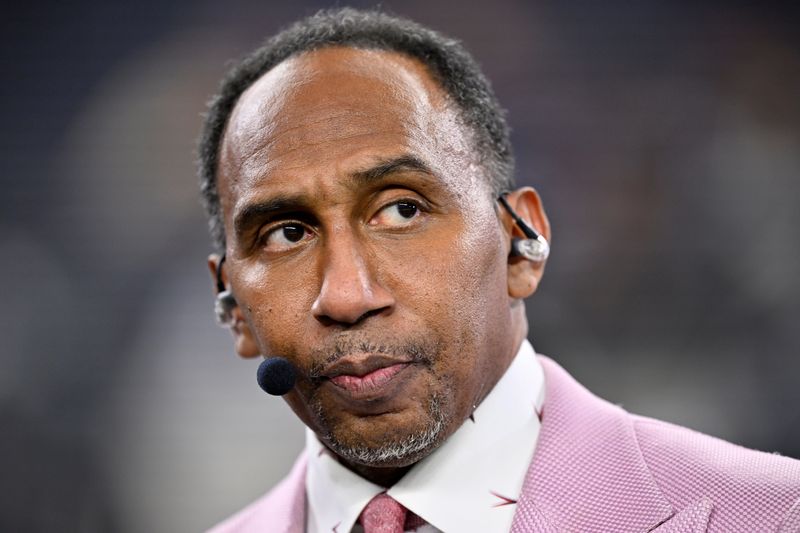
Longtime ESPN host Stephen A. Smith was particular upset by Ryan Clark’s ouster. Jerome Miron/Imagn
Longtime ESPN personality and First Take host Stephen A. Smith called it a “rough day” at the network.
While several regulars from his show were among the cuts, the one-time Inquirer columnist and reporter was particularly irked by Clark’s ouster. Smith described him as “arguably the best NFL analyst in America.”
“The bosses know I’m not happy about this decision. I’ve made that very, very clear,” Smith said Tuesday afternoon on his SiriusXM show Straight Shooter, adding later in the show, “Was I asked what I thought, what my feeling were? Yes, I was. And of course I said we have to keep him.”
Smith also spent time outlining all the cutbacks ESPN has gone through dating back to May 2013. A lot of familiar names were forced out the door in the past decade-plus, including Jeff Van Gundy, Jayson Stark, Todd McShay, Zach Lowe, and Ed Werder.
“This ain’t the days when ESPN could just hire and hire and hire some more without ever having to let go or lay off anybody,” Smith said. “Those days are long gone.”
ESPN purchased NFL Network and NFL Media in February in a deal valued between $2.5 billion and $3 billion. As part of the deal, all NFL Network staffers and personalities became ESPN employees, and the league took a 10% stake in the network.
NFL Network isn’t going anywhere, and will still have original programming, including Good Morning Football, and will broadcast a handful of NFL games.
It’s the second round of layoffs at ESPN in recent months. In the spring, about 30 behind-the-scenes staffers were let go as part of companywide layoffs that reportedly impacted around 1,000 employees.