Pennsylvania State Trooper Michael E. Pahira Jr., 44, would still be alive if Michael Bon had not come here from Haiti. That is what the Trump administration wants people to focus on.
It was devastating enough that the veteran of nearly two decades with the state police was fatally struck on July 1 by a tractor-trailer the authorities say was driven by Bon.
But the administration, which since last year has consistently targeted immigrants with both bullets and blame, didn’t stop there.
Playing out the string on the White House’s misguided way of thinking would lead us to believe that this calamity would not have occurred if the law didn’t allow Bon to work while his immigration application made its way through the system.
Or if the Massachusetts Registry of Motor Vehicles had taken away Bon’s commercial driver’s license once his application for Temporary Protected Status was denied.
Or if the situation in Haiti, one of the poorest nations in the world thanks to colonialism and rampant exploitation by Spain, France, and the U.S., had not forced Bon and his family to look for a better life elsewhere.
If you want, you can even throw in the logistics industry, or our consumer culture that sees commercial trucks travel roughly more than 300 billion miles every year, resulting in 5,832 fatal crashes in 2022, according to the latest numbers from the U.S. Department of Transportation.
The question becomes: At which point in this list do we stop when assigning blame?
For the U.S. Department of Homeland Security, you send out a news release that stops at, “This illegal alien was granted a commercial driver’s license by the sanctuary state of Massachusetts.”
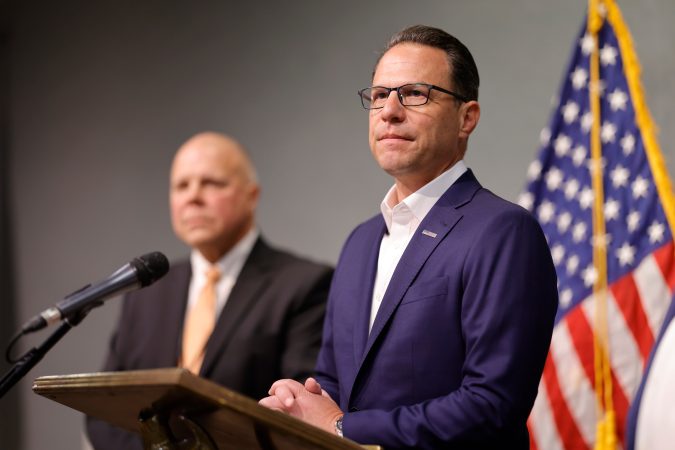
This thought exercise is hardly meant to diminish the passing of Pahira, who was, by all accounts, as Gov. Josh Shapiro noted, “one of our very finest.”
On the contrary: Pahira’s life and work would seem to deserve a richer memorial than being turned into one more talking point on the political right for how immigrants are dangerous. How the stand-up guy who had, as Fox News accurately described, “moved home to care for mom with cancer” must also play political pawn to the first half of that headline: “Illegal immigrant truck driver charged in death of trooper.”
No one disputes that Bon, 33, was in the country without authorization at the time of the incident, but that fact has nothing to do with the crash that killed Pahira.
Bon had applied for immigration relief and was denied, so by the time he applied for renewal of his Massachusetts commercial driver’s license, the Systematic Alien Verification for Entitlements, or SAVE, system should have flagged him as ineligible — but it didn’t, according to officials with the Massachusetts Department of Transportation. (That this same federal database is the one the Trump administration wants to use to check if people can vote is another problem for another time.)
Do immigrants commit crime? Of course, they are human beings who can make bad decisions. That they are less likely to do so than the U.S.-born is statistically proven.
It’s also cold comfort to victims when it does happen. However, our lives often progress in unpredictable — and, yes, painful — ways.
Whether you believe in a higher power or an indifferent universe, fate or random chance, Bon and Pahira fatally crossed paths along a stretch of Interstate 81 in Schuylkill County regardless of immigration status.
There is nothing wrong with calling for tighter commercial driver’s license laws — as a bipartisan group of Pennsylvania legislators in the U.S. House did last week — or implementing additional safety measures for those driving a fully loaded 40-ton vehicle. It is even fair to ask for restrictions on people who may only be in the country temporarily.
But fearmongering and casting all immigrants as threats is reckless.
Bon is being held on a $700,000 bond. Among other charges, he is accused of homicide by vehicle. He will be held accountable, evidence will be presented, and hopefully justice will be served. Whatever consequences come his way, he will face them as an individual.
Using Pahira’s death to further demonize immigrants debases a brave trooper’s memory — and is an insult to everyone else’s intelligence.
How the United States’ first “White House” became a flash point in the 21st century
Judge Cynthia M. Rufe pauses under in the entrance to the reconstructed "ghost" structure with partial walls and windows officially titled, “Freedom and Slavery in the Making of a New Nation” as she visits the open-air President’s House installation in Independence National Historical Park on Feb. 2.Tom Gralish / Staff Photographer
The United States’ first “White House” was lost to history more than once. But after it was rediscovered by an amateur historian in 2002, there was an effort to ensure that this time the site would be remembered.
In the years since, the President’s House has been a source of controversy at every stage of its development. The site at the doorstep of the Liberty Bell serves as a painful reminder to the flaws of the nation’s Founding Fathers, and George Washington’s own culpability in slavery.
story continues after advertisement
President Donald Trump’s administration in January abruptly dismantled the exhibit memorializing the nine people Washington kept in bondage at his Philadelphia home, deeming its displays to “inappropriately disparage Americans living or past.”
A monthslong court battle ensued leading to the partial restoration of the site, pause of the work, and the involvement of multiple courts — all taking place leading up to the nation’s Semiquincentennial, and culminating in the installation of a new exhibit under the cast of darkness less than two weeks after the 250th celebration.
Robert Morris, a financier whose company participated in the slave trade, offered the site to Washington as the nation’s first executive mansion. The first president moved to the house in 1790 and resided there until the end of his time in office in 1797.
After Washington, John Adams lived at the house until Washington, D.C., became the nation’s capital in 1800.
1804 to 1951
The site demolished, twice
The house was used for commercial purposes, including a hotel, until it was largely demolished in 1832.
The President’s House location in Independence National Historical Park.
The entire block on Sixth and Market Streets was razed in 1951 to create Independence Mall, demolishing portions of the walls that remained intact and burying the foundation of the President’s House underground. The location of the house was forgotten to history.
2002
Discovering the site, protest immediately starts
Independent historian Ed Lawler uncovered the true location of the residence — adjacent to the new Liberty Bell Center. Other historians and The Inquirer’s reporting at the time highlighted the history of slavery at the site. Protests, led by the Avenging the Ancestors Coalition, immediately began encouraging the National Park Service, under then-President George W. Bush, to memorialize the nine people Washington enslaved at his Philadelphia home. The government was, at first, strongly hesitant to do so.
story continues after advertisement
2007 to 2010
Excavation and construction
Guests and dignitaries gather in Independence National Historical Park at the President’s House Site before the start of a ceremonial ground-breaking on March 21, 2007.Tom Gralish / Staff Photographer
On Dec. 15, 2010, the President’s House officially opened. Former Philadelphia Mayor Michael Nutter, under whom the project was finished, highlighted the importance of the site and its role in highlighting the contradictory experiences of liberty and slavery during the founding of the United States. After the ceremony, the site became Independence National Historical Park’s responsibility.
Municipal Judge Charles Hayden, Michael Coard, Independence National Historic Park Superintendent Cynthia MacLeod, and Mayor Michael Nutter at the dedication of the President's House.Clem Murray / Staff Photographer
2015
Philadelphia hands the site to Park Service
The President’s House was in a state of disrepair, marked by intermittently blank and soundless video screens, leaking glass, and fogged up windows. The city, which owned the exhibit, transferred the site to the hands of the National Park Service, as Philadelphia and the federal government agreed during the site’s development.
.
March 2025
Trump signs executive order
Trump signed the “restoring truth and sanity to American politics” executive order that instructed the Department of Interior to flag displays in national parks and historical sites that “inappropriately disparage Americans past or living” ahead of the country’s 250th celebration.
July 2025
Park Service flags President’s House
More than a dozen exhibits throughout Independence National Historical Park — all referencing slavery — were flagged for a Trump administration content review. The President’s House had the most exhibits flagged, though some panels were thought to be spared from the content review. Local stakeholders began ramping up advocacy efforts aimed at protecting the President’s House.
September 2025
Plans for changes
Reports emerged that the Trump administration intended to alter the President’s House. The Department of Interior said at the time that “Interpretive materials that focus solely on challenging aspects of U.S. history, without acknowledging broader context or national progress, may unintentionally provide an incomplete understanding rather than enrich it.”
Jan. 22, 2026
NPS dismantles exhibit; Philadelphia sues
After months of scrutinization and anxiety over the fate of the President’s House, the Trump administration dismantled the entire exhibit. Workers took wrenches and crowbars to the site and loaded the removed panels into the back of a white pickup truck, leaving behind swaths of faded brick.
Workers remove displays from the President’s House Site in Independence National Historical Park.Tom Gralish / Staff Photographer
Shortly after the removal, the City of Philadelphia filed a lawsuit against the Interior Department, the National Park Service, and its leaders. Advocacy efforts continued and Independence Park employees were given talking points on how to address visitors’ questions about the President’s House.
Jan. 31, 2026
Trump and Philly clash in court
Attorneys for Mayor Cherelle L. Parker’s administration argued in federal court in Philadelphia that the removal of the exhibit was unlawful. The city found a receptive audience in U.S. District Judge Cynthia M. Rufe, who called the Justice Department’s argument that the federal government can unilaterally change history “dangerous” and “horrifying to listen to.”
Feb. 16, 2026
Injunction
Rufe ordered the Trump administration to immediately restore the exhibit. In a blistering opinion, published on Presidents Day, which celebrates George Washington’s birthday, the George W**.** Bush-appointed judge compared the actions of the Trump administration to the Ministry of Truth from George Orwell’s novel warning of authoritarianism, 1984.
“Each person who visits the President’s House and does not learn of the realities of founding-era slavery receives a false account of this country’s history.”
U.S. District Judge Cynthia M. Rufe
Feb. 20, 2026
Restoration starts, and quickly stops
Rufe, who ordered the restoration of the site “forthwith,” gave the federal government a hard deadline to restore the site after no work to reinstall the exhibit had taken place. National Park Service staff returned some panels to the walls, but as the deadline neared the federal government appealed and won an administrative stay that paused the restoration. The site’s wall remained half bare for months.
Workers reinstall the displays at the President’s House in Independence National Historical Park.Tom Gralish / Staff Photographer
April 2026
Proposed new exhibit
The National Park Service published 11 digital renderings of new panels proposed at the President’s House. The new exhibit would provide a broad timeline of U.S. history that included slavery, but would be less focused on George Washington’s role and frame the Founding Father’s enslavement of nine individuals at his Philadelphia home during the first presidency in a more sympathetic light. Only two of the 11 newly proposed panels at the time referenced those enslaved at the site, drawing criticism from historians.
Panel for Ona Judge at the President’s House in Independence National Historical Park.Tom Gralish / Staff Photographer
Born into slavery in Mount Vernon, Washington’s Virginia estate, Judge was kept in bondage as Martha Washington’s personal assistant and seamstress. She escaped from the President’s House on May 21, 1796, and made her way to New Hampshire with the help of Philadelphia’s free Black community. Despite Washington’s growing support of emancipation in private communications throughout his life, the first commander-in-chief made multiple attempts to recapture Judge. She was never caught and outlived her enslavers.
June 2, 2026
Trump and Philly clash in court, again
A three-judge panel of the U.S. Court of Appeals for the Third Circuit heard arguments on the Justice Department’s appeal. The judges pushed the city’s attorney to point to language in the cooperative agreement that said Philadelphia maintained rights over the site after the transfer of ownership to the federal government. But the city came short and was left pointing to statements by National Park Service officials that emphasized the collaborative effort to develop the site.
The Justice Department attorney representing the Trump administration told the judges that if the city wanted to maintain control over the exhibit, it “should have bargained for that.”
The half-bare walls of the President's House.Tom Gralish / Staff Photographer
June 18, 2026
Third Circuit sides with Trump
The Third Circuit delivered a blow to the city, ruling that Philadelphia had no rights over the site or its displays. The unanimous decision, signed by judges appointed by George W. Bush, Barack Obama, and Donald Trump, also dismissed all but one claim from the city’s initial lawsuit. The judges further found the Trump administration’s proposed panels “acknowledge the evil of slavery, including its injustices and hypocrisies, and, by telling the story of the nine slaves that Washington kept in the President’s House, remind us of their essential humanity.” The site was in limbo as the order out of Boston conflicted with the Third Circuit ruling.
“The duty to ‘maintain’ is better understood as a general management obligation that accompanies ownership, not a promise that the exhibits will forever remain in place regardless of the owner’s wishes.”
U.S. Park Police Officer Patrick O’Hanlon reads the new panels alongside visitors at the site of the President’s House in Philadelphia.Aidan T. Gallo / Staff Photographer
Pennsylvania and New Jersey are among the 27 states seeing recalls of shredded lettuce products sourced to Taylor Farms, the produce company at the center of a food safety investigation into an outbreak of “explosive” diarrhea caused by the parasite Cyclospora cayetanensis.
Federal officials announced over the weekend that a sample of lettuce taken from a Taylor Farms shipment at the U.S.’s southern border with Mexico tested positive for Cyclospora.
The test involved lettuce that wasn’t affected by the California-based produce company’s recall.
The results turned out to be a false positive. As of Sunday, federal officials said, they had not found a positive test for Cyclospora in a produce sample.
Officials notified the public because it was “actionable public health information,” acting Deputy Commissioner for Food Donald Prater said in a press call Monday.
Thousands of people have been sickened in a cyclosporiasis outbreak, with cases reported across Indiana, Kentucky, Michigan, Ohio, and West Virginia.
Investigators at the Centers for Disease Control and Prevention found more than 1,600 people in those states became ill after they ate iceberg lettuce from Taco Bell, which sourced lettuce from Taylor Farms.
Taylor Farms did not immediately return a request for comment.
Cases in Pa. and N.J.
Cases of cyclosporiasis have been reported in 34 states, including Pennsylvania, though case counts here were low as of last week, affecting 28 people since the beginning of the year, including 14 in Southeastern Pennsylvania.
New Jersey health officials said the state had recorded 46 cases between May 1 and July 16. Cases typically rise in the late spring and summer months, and this year’s are in line with a typical year’s case count.
It’s unclear whether anyone in Pennsylvania or New Jersey was sickened after eating Taylor Farms products. The CDC said it was also investigating outbreaks and other cases that are not connected to the Michigan outbreak.
They should wash items and surfaces that might have touched the lettuce with hot, soapy water, and avoid recalled lettuce at Taco Bell or other restaurants. Customers should ask restaurants about the source of their lettuce before ordering it.
Cyclosporiasis is caused by a single-celled parasite that spreads through fecal material. It can infect a person’s gut after they consume food or water contaminated by feces. Common symptoms include watery diarrhea, a loss of appetite, cramping, nausea, and fatigue.
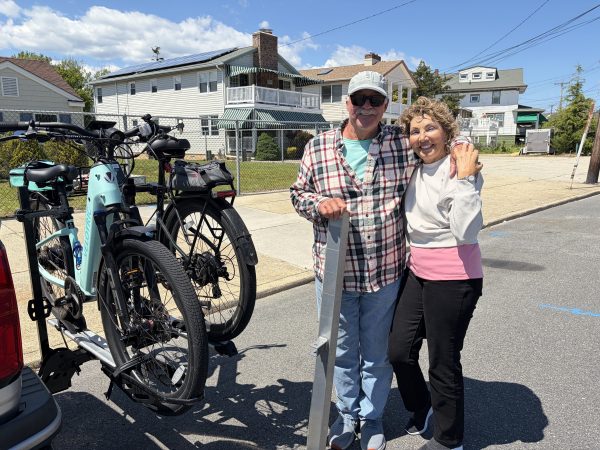
New Jersey’s overhauled e-bike rules are now in effect, meaning thousands of riders across the state must be licensed, registered, and in some cases insured for the first time.
Under a law signed by then-Gov. Phil Murphy before he left office in January, e-bikes fall into two groups: low-speed electric or pedal-assist bikes that top out at 20 miles per hour, and faster, throttle-powered bikes that can reach up to 28 miles per hour.
The lower-speed bikes must now be registered with the state Motor Vehicle Commission. Riders of the higher-speed bikes must register them and obtain liability insurance to ride them.
Riders of both types must be at least 15 years old, hold a valid driver’s license or a special e-bike license issued by the Motor Vehicle Commission, and wear a helmet regardless of age. Riders can face fines of up to $50 per violation.
As of July 15, the commission had issued more than 4,100 e-bike registrations and 250 e-bike permits, agency spokesman William Connolly said.
“MVC is working hard to service as many riders as quickly and efficiently as possible,” Connolly said.
Out-of-staters who bring their e-bikes across state lines will have to register their bikes in New Jersey and get licenses if they don’t have a regular driver’s license.
The push for tighter regulations followed a string of fatal e-bike crashes around the state. Murphy’s office cited “numerous dangerous crashes” when he signed the bill, while bill sponsor state Senate President Nick Scutari (D-Union) has argued that e-bikes have gotten faster and more powerful and that younger, inexperienced riders are using them.
Thousands of New Jersey employers will have to provide protected family leave beginning this past Friday under an expansion of the state’s family leave law signed by then-Gov. Phil Murphy shortly before he left office in January.
The change expands the number of companies that must comply with the New Jersey Family Leave Act and decreases the amount of time it takes for an employee to become eligible for the law’s job protections.
The law gives workers who take family leave the right to return to their same job, or one with the same pay, benefits, seniority, and other terms of employment, upon their return. State officials estimate another 400,000 will gain protections as a result of the changes that take effect Friday.
“No one should have to choose between caring for themselves or a loved one and keeping their job,” acting Labor Commissioner Kevin D. Jarvis said in a statement. “These changes strengthen one of New Jersey’s most important worker protections by ensuring more people can take the time they need with the confidence that their job will be there when they return.”
The law provides 12 weeks of unpaid, job-protected leave over a two-year period for workers bonding with a new child, responding to a health emergency, or caring for a seriously ill family member. It does not cover an employee’s own illness, which falls under a separate program.
The law previously captured businesses with at least 30 employees. Under the changes taking effect Friday, companies with 15 or more workers companywide must provide family leave.
The change also loosens rules on who qualifies. Previously, workers needed to be on the job for a full year and have worked at least 1,000 hours. Under the new rules, workers are eligible once they have worked for three months and 250 hours. Officials said this change will protect more part-time employees and recent hires.
Although the leave is unpaid, some employees can be eligible for partial wages via state Family Leave Insurance, which guarantees up to 85% of their weekly pay, to a cap of $1,119 in 2026.
The July 17 change is the first of three scheduled steps to expand the law. The employee threshold drops to 10 or more workers July 17, 2027, and to five or more workers July 17, 2028.
Business groups had opposed the change, warning that expanding family leave eligibility could make New Jersey small businesses less competitive.
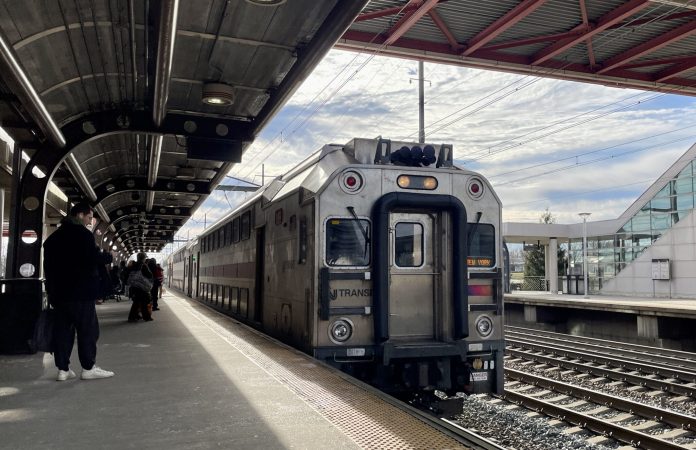
NJ Transit’s board approved $3.5 billion in spending for the fiscal year that began July 1, the largest operating budget in the agency’s history.
The new budget represents an 11% increase over the one approved last year and comes after 12 months of fiscal headwinds that saw the collections from the agency’s dedicated revenue source tumble and its spending on labor and benefits surge beyond expectations.
“This governor is the only governor in recent memory who has given us an 11% increase in budget. I don’t know when the last time that happened,” said NJ Transit CEO Kris Kolluri. “That is how you begin to put the pieces together for this agency to make sure we do it.”
The agency’s fiscal 2027 budget maintains the patchwork of funding sources that have paid for buses, trains, and light rail cars across the state for years.
State subsidies, whether through a direct appropriation from New Jersey’s general fund or via collections from a special corporate business fee statutorily dedicated to NJ Transit, are expected to account for a majority of the agency’s revenue in the current fiscal year.
Combined, NJ Transit expects to receive nearly $1.07 billion from New Jersey’s coffers, including a $302.2 million direct subsidy and $765.6 million in revenue from the corporate transit fee, a 2.5% non-marginal corporate business tax surcharge on businesses with more than $1 million in income.
The direct subsidy is significantly higher than the $43.9 million subsidy approved as part of last year’s budget, but that subsidy grew to $230.6 million as a slump in corporate tax collections drove down revenue from the corporate transit fee. That fee is set to expire, by law, at the start of 2029.
Fare revenue, traditionally the largest single source of funding for NJ Transit, is expected to remain level with last year’s projections at $980 million. Collections from fares undershot their revenue target by about $48 million last fiscal year.
Since an initial 15% fare hike following a board vote in 2024, NJ Transit’s fares have automatically increased by 3% each year, rises officials have said are needed to fund the agency as it seeks to boost reliability after years of disinvestment.
Transit advocate Adam Reich noted on Thursday that state statute required 10 public hearings — and no more than one in a given county — before raising fares.
“If Gov. Sherrill’s going to insist that she’s transit obsessed, certainly taking the most rider-friendly view of the statute is absolutely critical,” Reich said. “It doesn’t mean New Jersey Transit can’t raise fares every year. It doesn’t mean they can’t necessarily follow a 3% plan, but it just means that riders at least be heard before we do that.”
The board’s vote approving both the one-time 15% increase and the 3% annual hikes followed numerous public meetings. The agency has argued that it does not need an annual vote to raise fares as a result.
Reich said they might be able to raise them further if they asked riders.
“Maybe we’d rather pay a little more but see service improvements or at least service stability instead of service cuts, as we did on May 31,” he said
An annual diversion from New Jersey’s clean energy fund will remain level at $140.1 million, while a yearly transfer from the New Jersey Turnpike Authority under an agreement struck under former Gov. Phil Murphy will send the agency $485 million, up from $470 million last year.
NJ Transit paid nearly $103 million more for labor than it expected last year, and its spending on fringe benefits came in $70.5 million above budget. The agency faces a range of cost increases that outpace the rate of inflation.
“The costs are real,” said Kolluri, who also heads the Turnpike Authority. “I know people don’t want to understand or care because they are frustrated sometimes when their train is canceled. I understand it, but the fact that the labor contracts cost $55 million more than they did last year is a fact.”
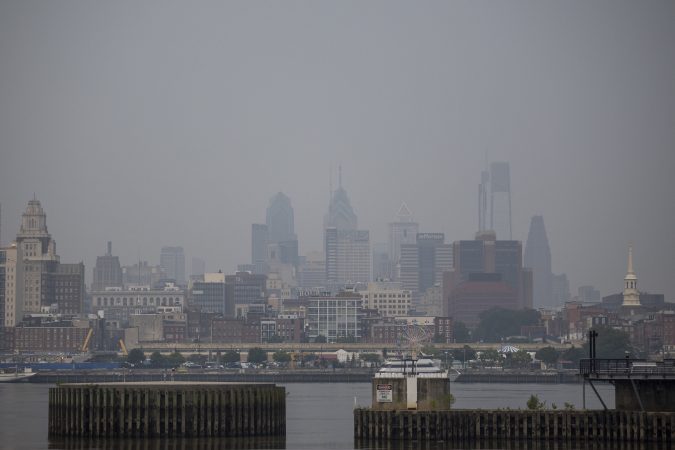
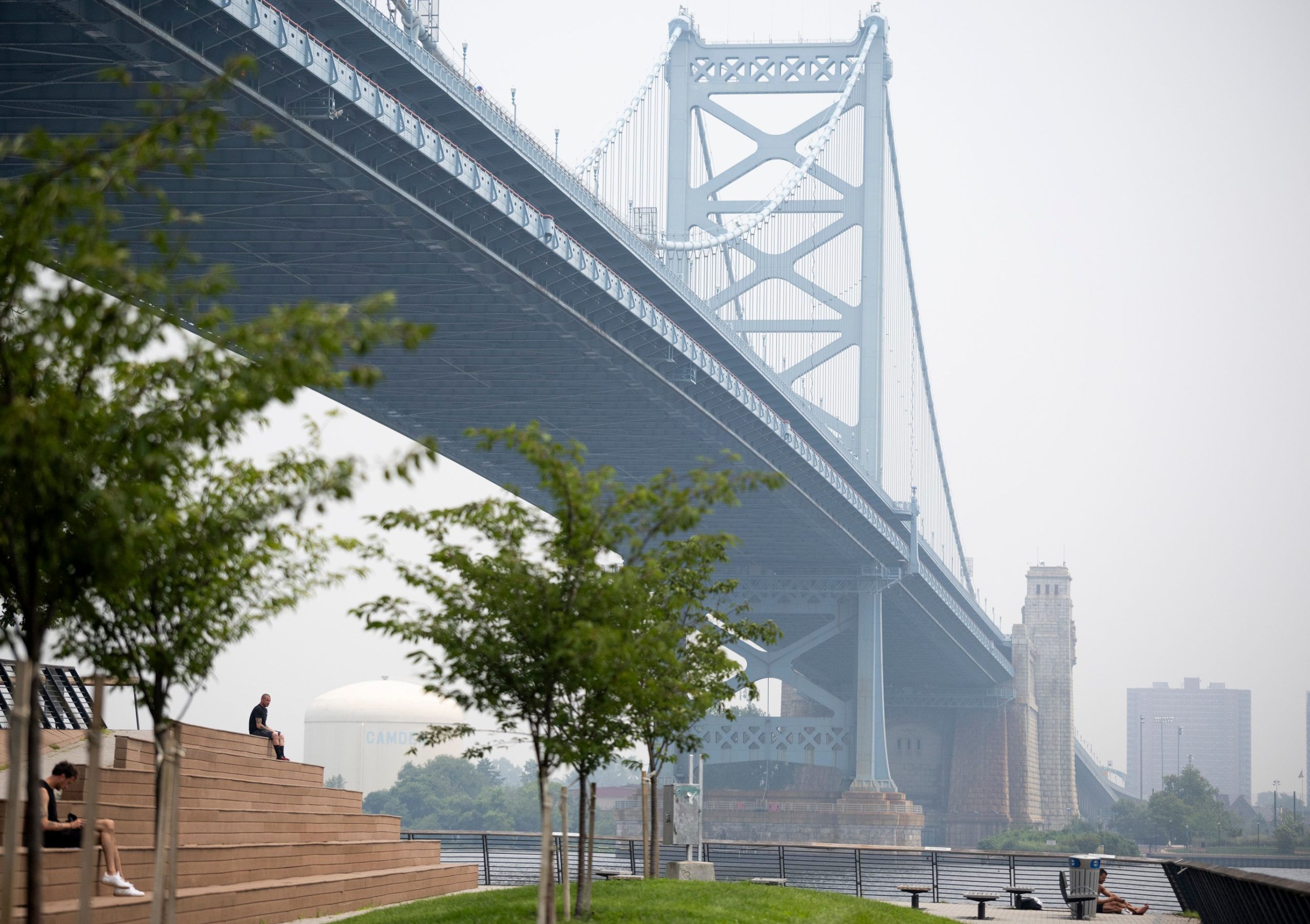
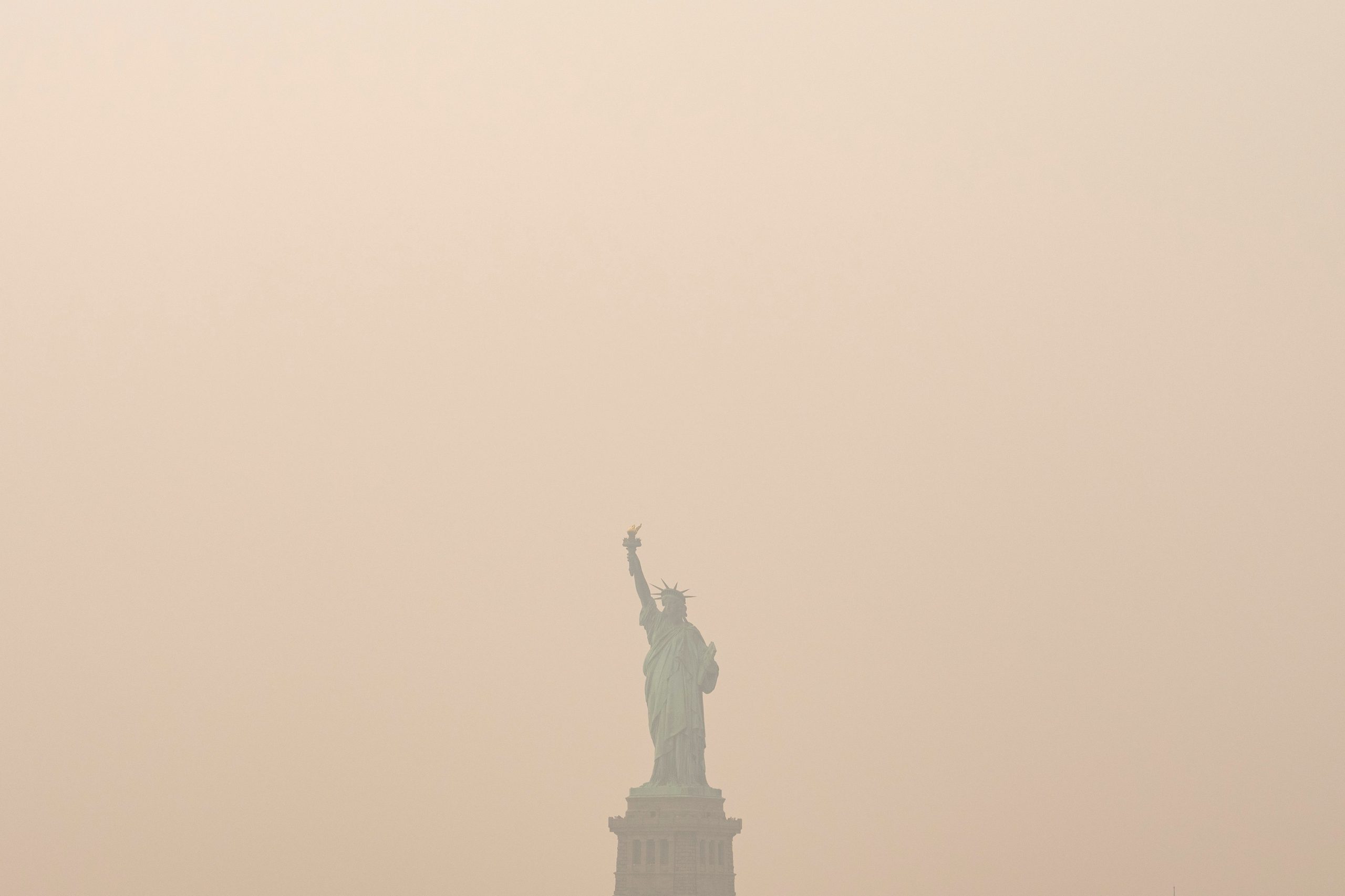
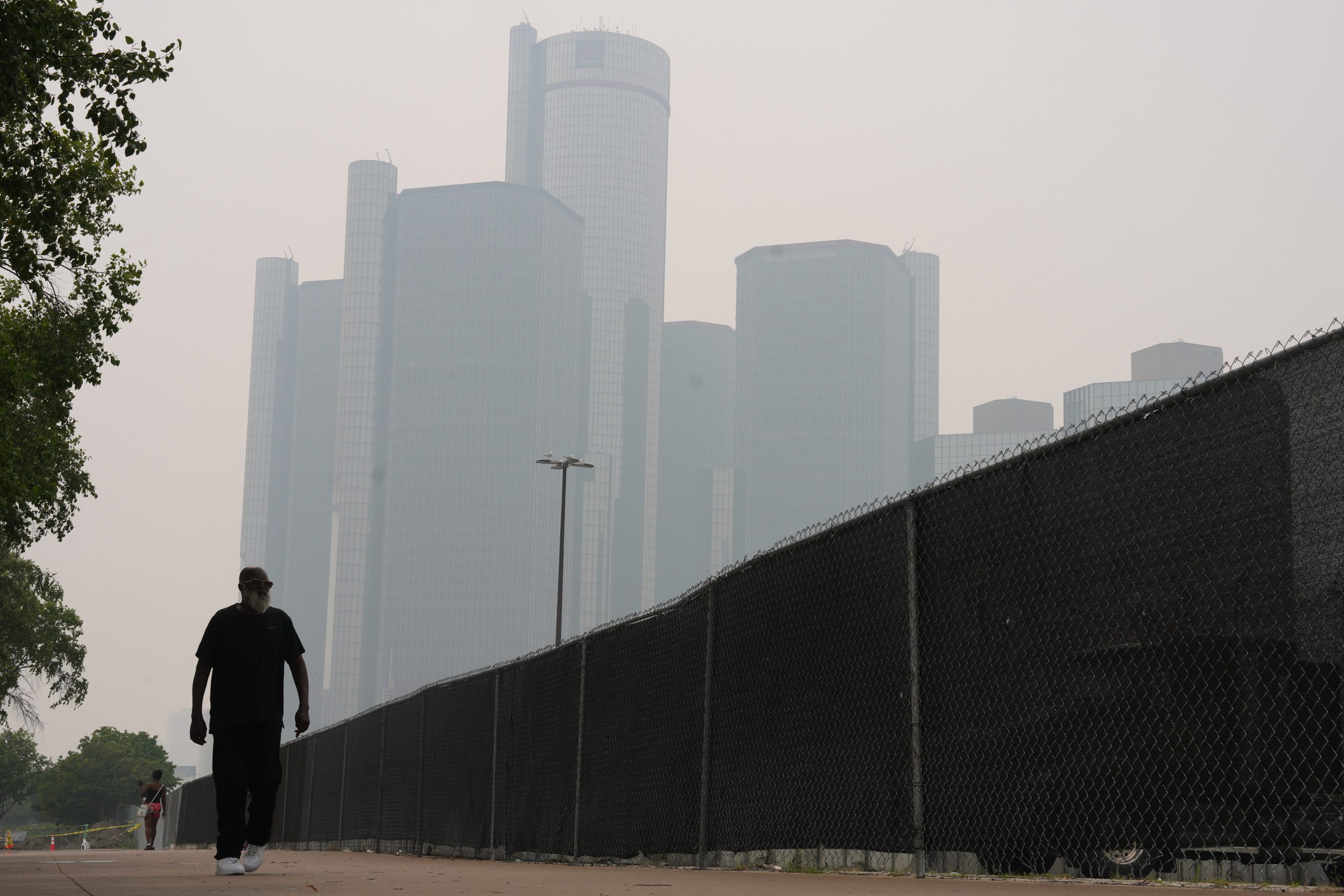
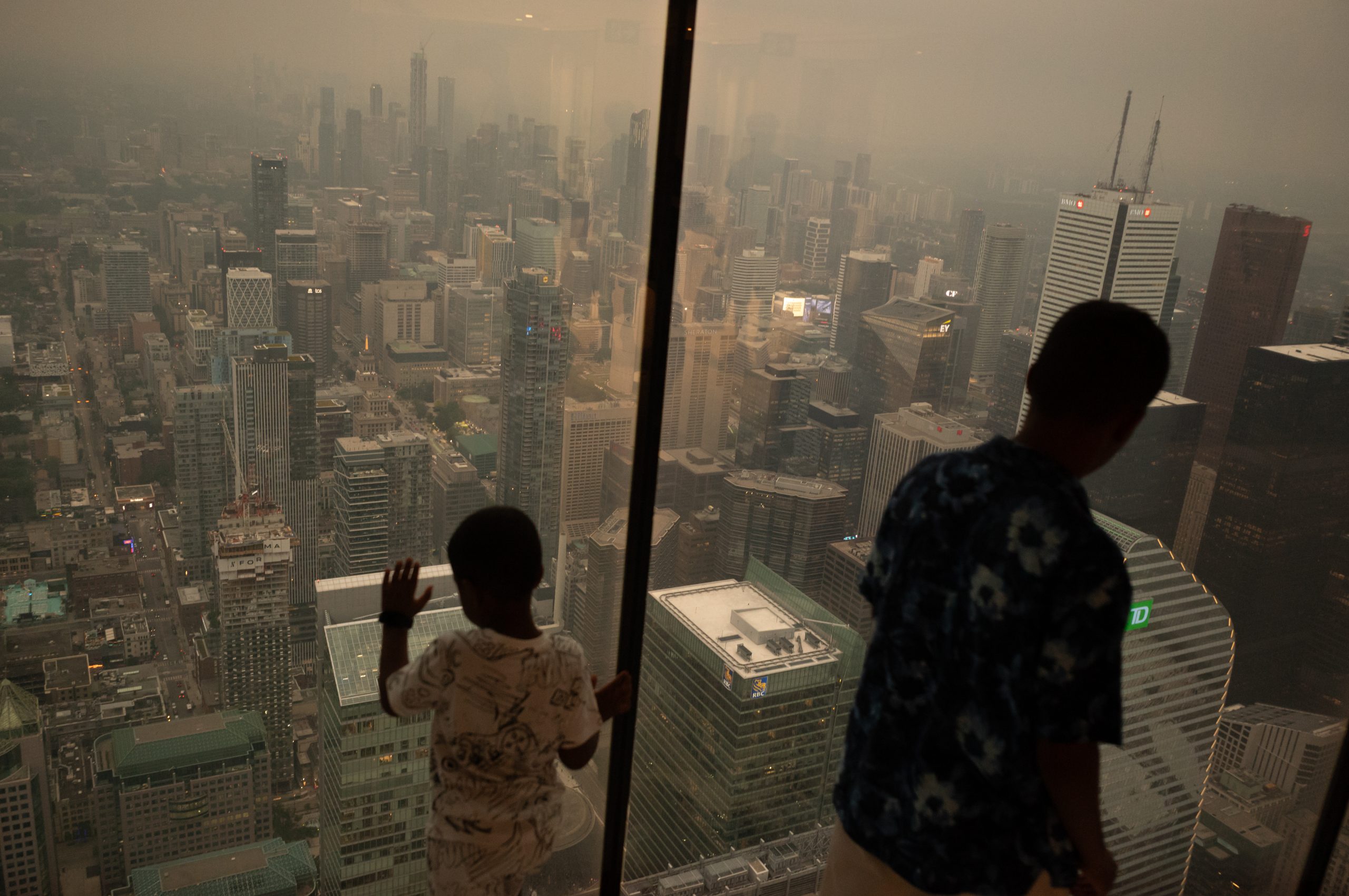
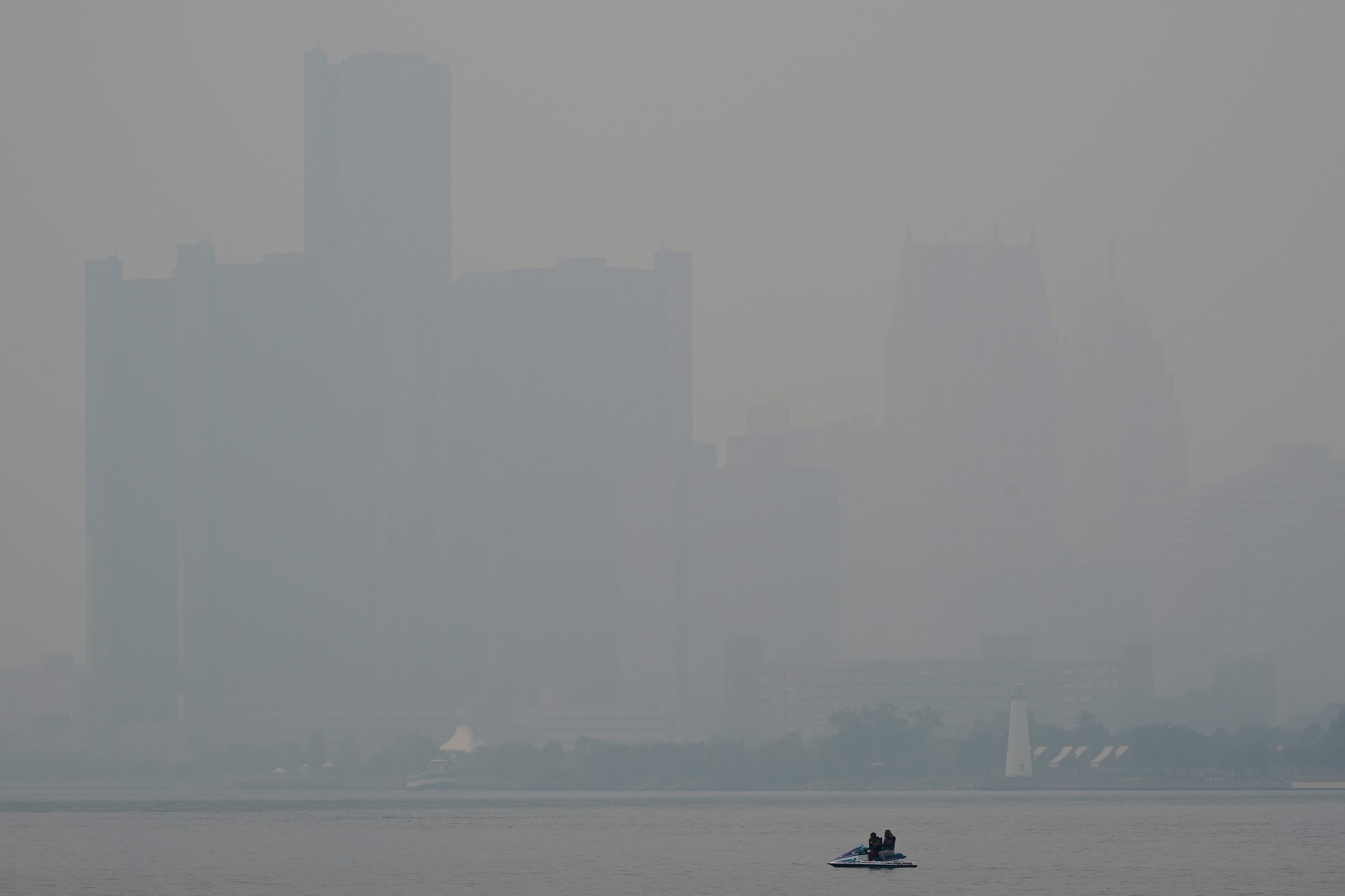
Smoke from Canadian wildfires continues to blanket the region, casting a haze across the sky and posing a risk for people with respiratory issues.
With massive fires burning across Western Ontario, forecasters said wind patterns shifted this week to allow the smoke from those fires to enter the Northeastern and Mid-Atlantic United States.
The city raised the air quality alert level from code red to code purple — meaning the air is “very unhealthy” and can cause health issues for all people.
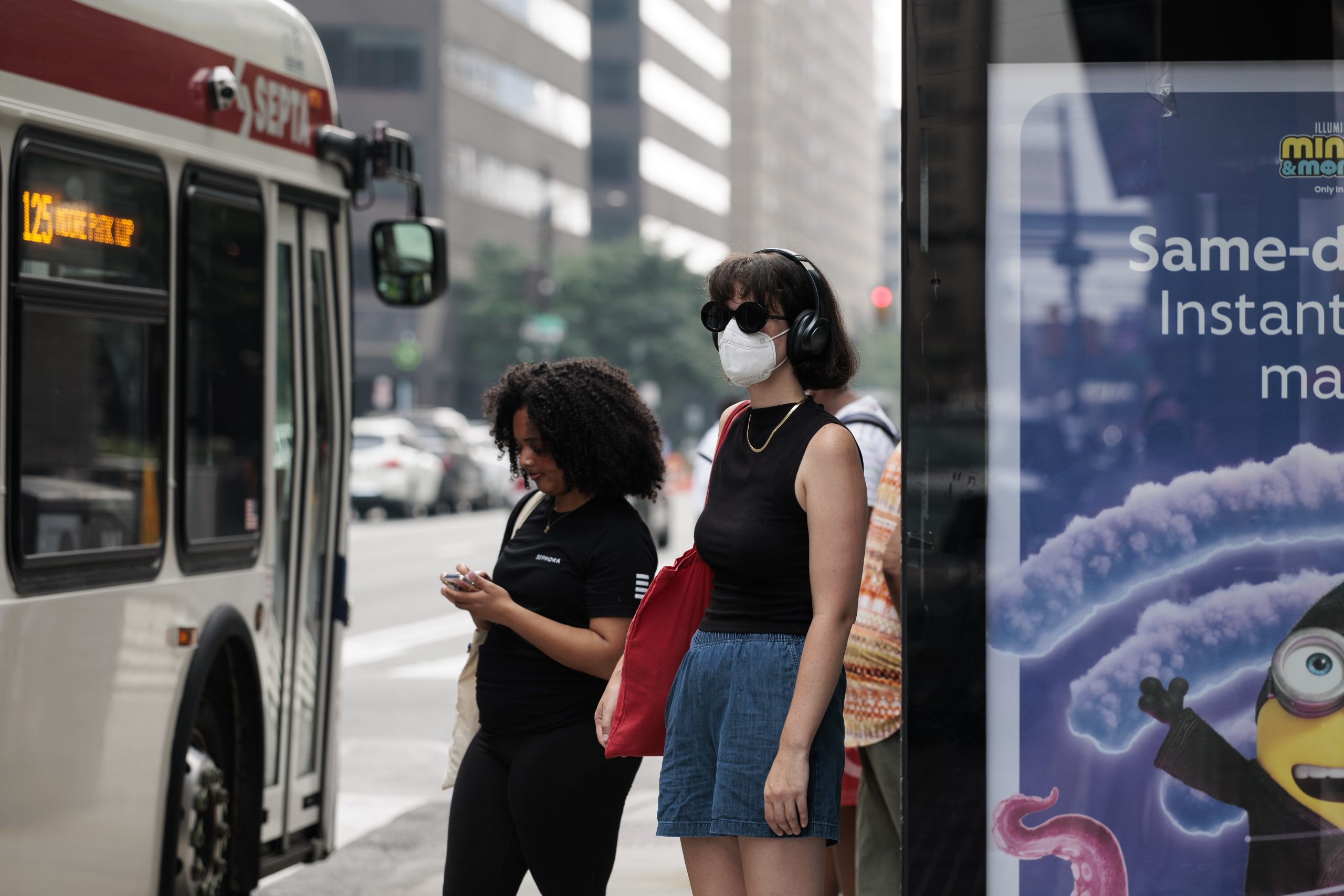
Friday morning, at least six of the city’s air quality sensors were registering above 200 in the amount of fine particulate matter and nitrogen dioxide in the air, a metric called the air quality index. The city website tracking air data warned people to stay inside, keep windows and doors closed, and run air purifiers if possible. Those who must venture outside should wear N95 or KN95 masks.
(function () {window.addEventListener(‘message’, function (e) { var message = e.data; var els = document.querySelectorAll(‘iframe[src*=”‘ + message.id + ‘”]’); els.forEach(function(el) { el.style.height = message.height + ‘px’; }); }, false); })();
An AQI between 150 and 200 is still considered unhealthy to breathe with prolonged exposure, according to the EPA. Children, older people, and those with respiratory issues could be particularly susceptible to health issues. In air quality alerts issued by the National Weather Service, forecasters recommended avoiding prolonged outdoor exposure, particularly activities like exercise.
By Friday a prior heat advisory had been lifted, with temperatures expected to near 90. Air quality tends to worsen in dense, urban environments during hot weather.
Forecasters urged residents across the eastern United States, particularly those with respiratory issues, to monitor alerts from local officials and be mindful of conditions where they live or work.
(function () {window.addEventListener(‘message’, function (e) { var message = e.data; var els = document.querySelectorAll(‘iframe[src*=”‘ + message.id + ‘”]’); els.forEach(function(el) { el.style.height = message.height + ‘px’; }); }, false); })();
If you’re not able to zoom in on the above map, click here for another version.
The wildfire smoke in Philly is forecast to last into the weekend — and be followed by storms
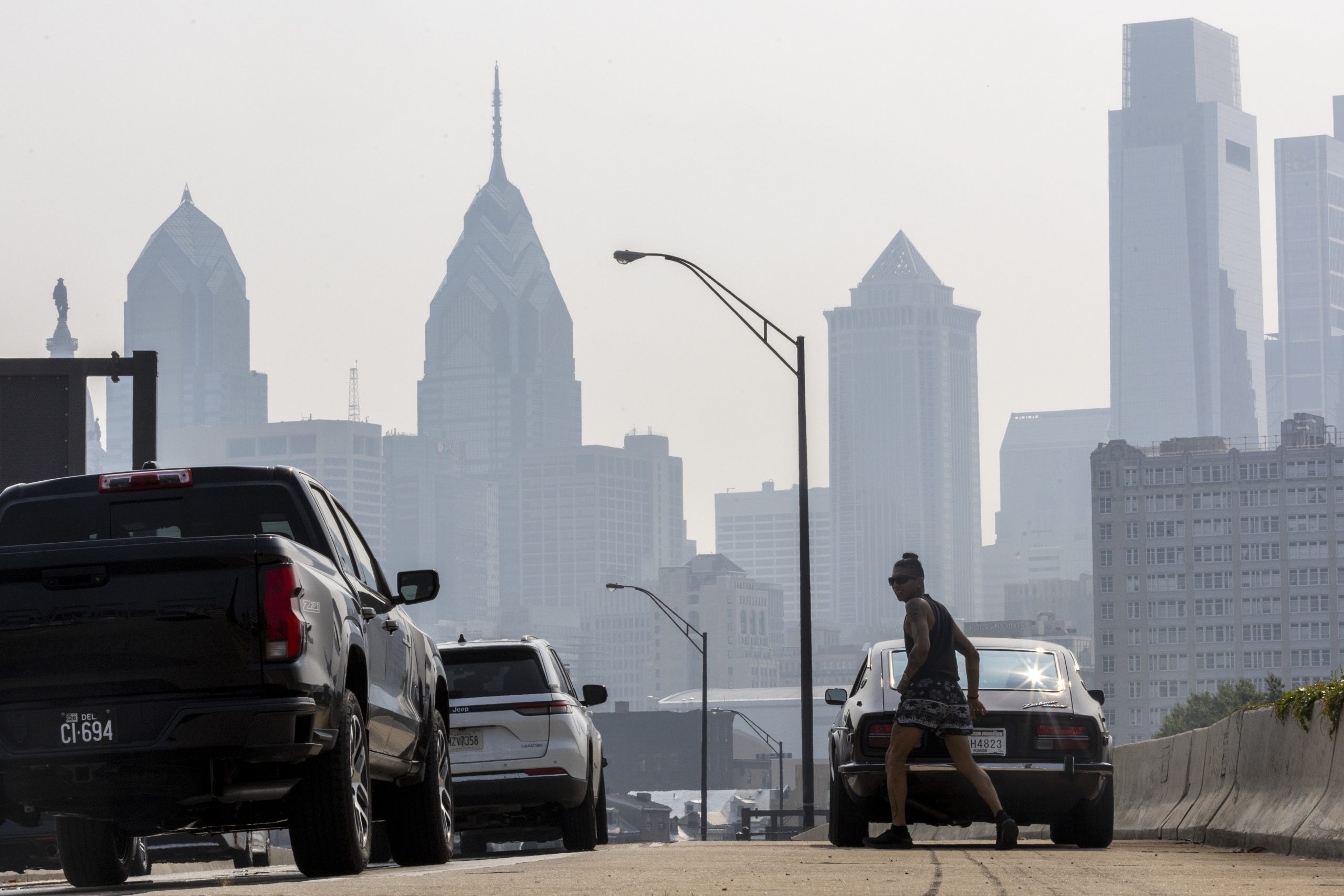
A man gets back into his car from the side of the highway as hazy skies cover the city skyline caused by wildfires in Canada on Friday, July 17, 2026, in Philadelphia.Aidan T. Gallo / Staff Photographer
Impacts from Canadian wildfire smoke increased throughout the Philadelphia region Friday, degrading air quality enough to prompt a code purple alert, and force the closure or suspension of some city amenities and services.
It was the latest bad weather event in Philadelphia’s run of tough luck in July, which has so far resulted in record-setting heat and destructive storms that have marred back-to-back weekends. Smoky conditions arrived Thursday, and were bad enough Friday to prompt the closure of city pools and spraygrounds, and temporarily stop trash pickup.
“Our worsening air quality is a dangerous development,” Palak Raval-Nelson, commissioner of the city Department of Public Health, said in a statement. “I strongly encourage all residents to take action to protect themselves by staying indoors, unless they need to be outdoors.”
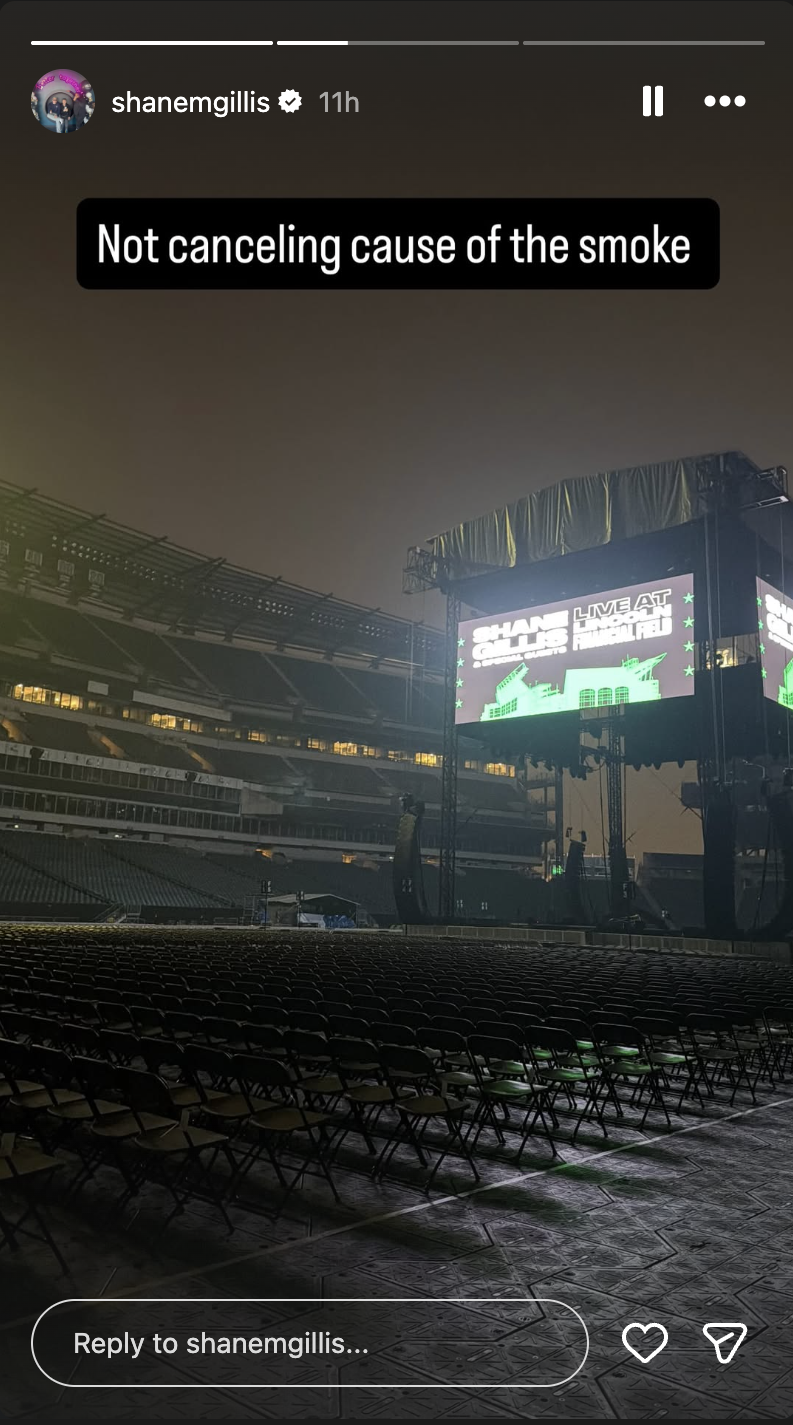
Likewise, the Philadelphia Zoo remained closed Friday, saying in a statement that its animals were being “closely monitored.” The city, however, stopped short of recommending the cancelation of outdoor events, and large productions like comedian Shane Gillis’ performance at Lincoln Financial Field and a Death Cab for Cutie performance at the Highmark Mann Center for the Performing Arts were still set to go on as of late afternoon.
Officials said that venue owners had been advised of the conditions, and were able to make their own decisions as to whether those events would happen.
Trash collection in the city was expected to cautiously resume Saturday, officials said. Resumption of services was contingent upon improvement in air quality conditions, which vacillated between code purple and the comparatively less severe code red Friday.
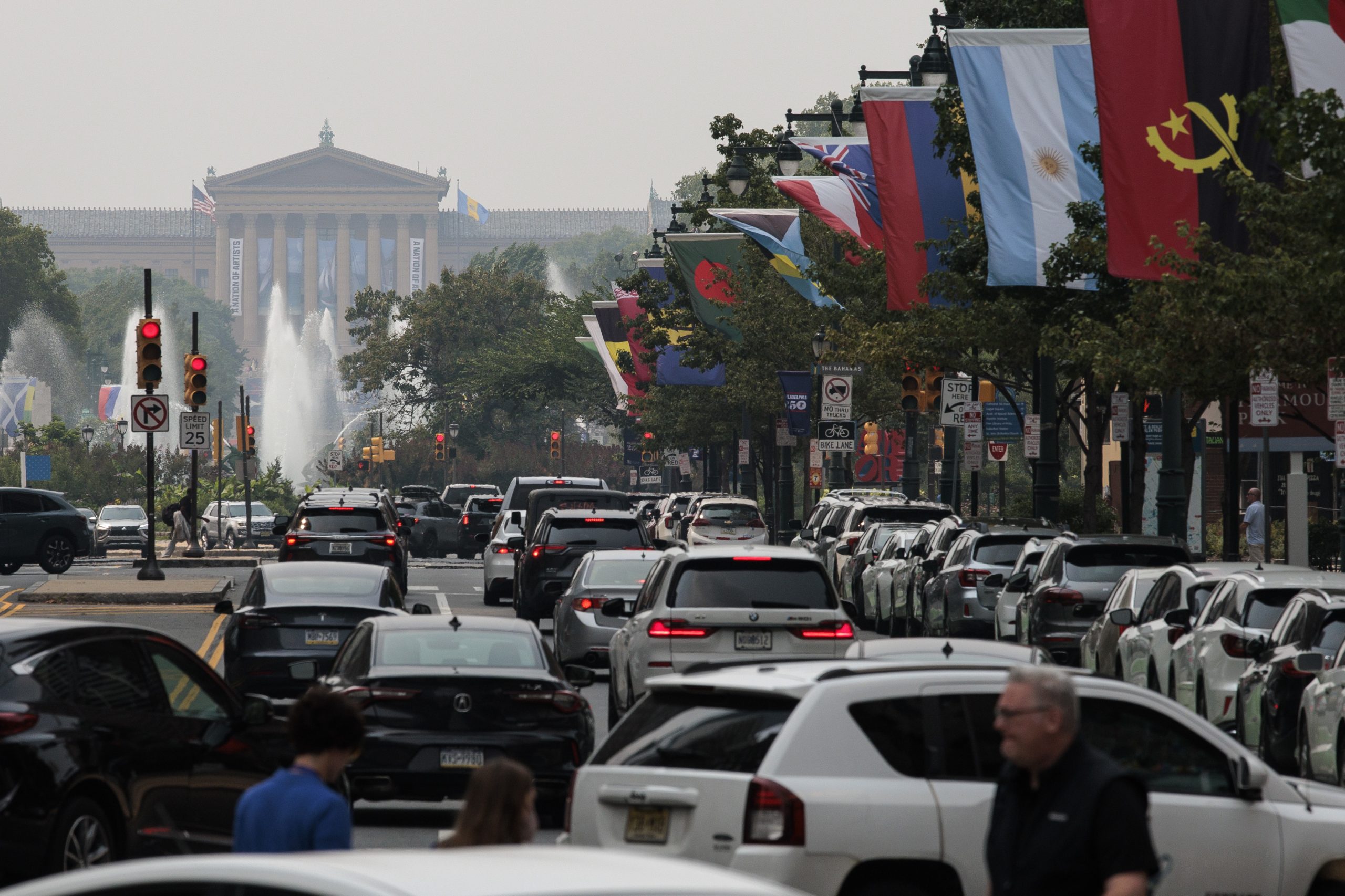
A man adjusts his mask before crossing the Benjamin Franklin Parkway on Friday, July 17, 2026, in Philadelphia.Aidan T. Gallo / Staff Photographer
The Pennsylvania Department of Environmental Protection early Friday evening said air quality continues to improve throughout the state and storms on Saturday will help.
The agency issued a Code Orange air quality alert for Saturday in Philadelphia, Bucks, Chester, Delaware, and Montgomery Counties. The rest of the state is expected to remain in the Code Yellow, or moderate range.
This is an improvement from the Code Red and Code Purple conditions that resulted Friday from the wildfire smoke from Canada.
Rain and thunderstorms on Saturday are expected to help, but improvements will be slower in Southeastern Pennsylvania because the rain will arrive later, the agency said.
During Code Orange alerts, people should avoid long or intense outdoor activities, the agency said. Sensitive groups, including children, elderly residents, and those with respiratory illnesses should avoid all outdoor activities.
The agency storngly advised people to check airnow.gov for current air quality conditions in their area, as conditions may change throughout the day.
Saturday evening gospel concert at Dell Music Center postponed due to air quality
The “Praise Under the Stars” gospel concert at the Dell Music Center scheduled for Saturday evening has been postponed, the center said Friday.
A new concert date would be announced soon, the center said.
“Due to the hazardous air quality conditions affecting our region as a result of the ongoing Canadian wildfires, Praise Under the Stars, scheduled for Saturday, July 18, 2026, at 7:00 PM at the Dell Music Center, has been postponed out of an abundance of caution,” the center said on its website.
“The safety and well-being of our guests, artists, vendors, and staff remain our highest priority. While we are disappointed to postpone this special event, we believe it is the responsible decision given the current environmental conditions,” the center said.
“A new concert date will be announced as soon as possible. All previously purchased tickets will be honored for the rescheduled event,” the center said.
“We sincerely appreciate your understanding, patience, and continued support of the Dell Music Center. Please stay safe, and we look forward to welcoming you back soon,” the center said.
Flights were delayed into Philadelphia due to low visibility
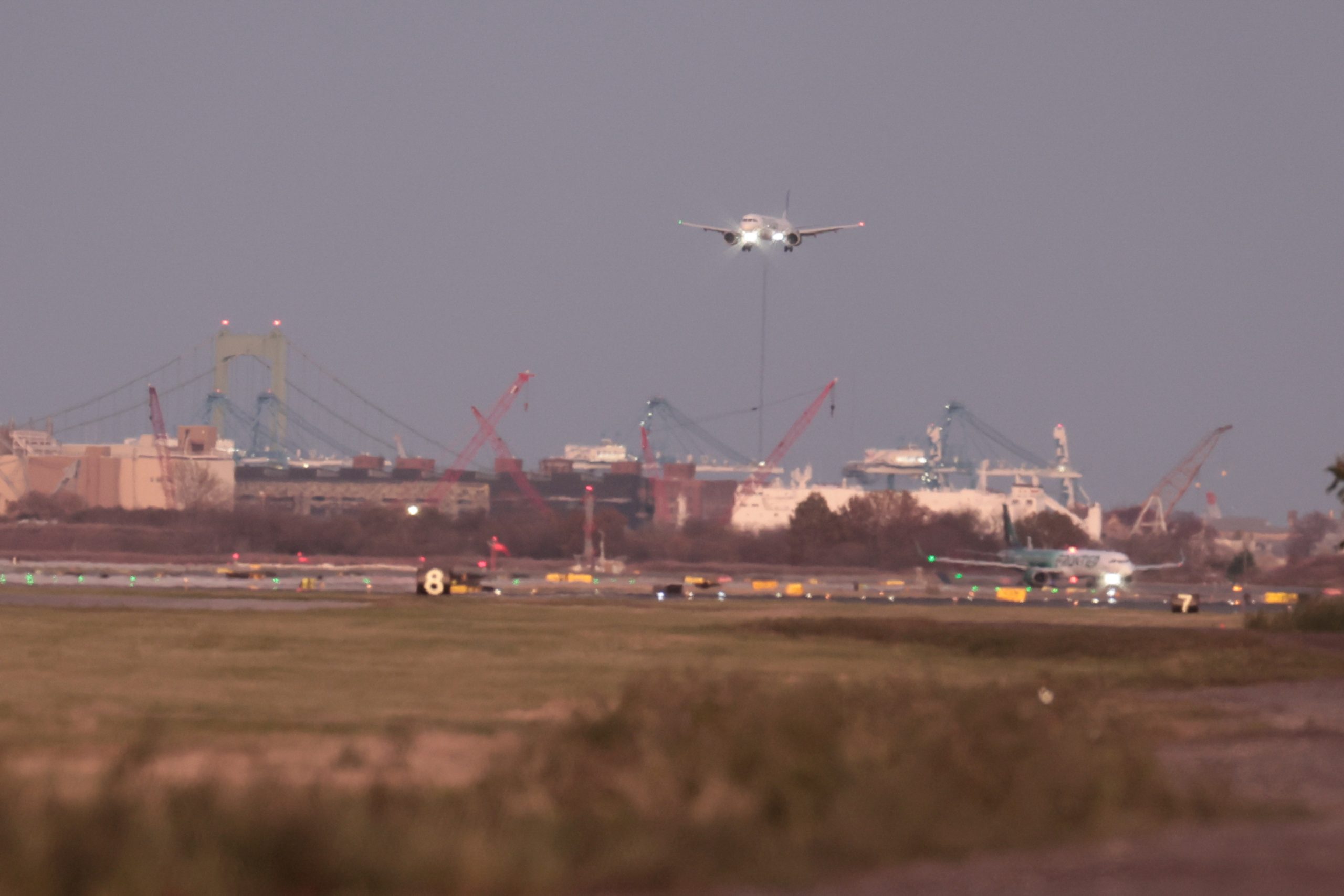
Air traffic at the Philadelphia International Airport is seen here in November 2025.Elizabeth Robertson / Staff Photographer
The Federal Aviation Administration issued a ground delay on flights headed into Philadelphia International Airport Friday afternoon due to low visibility caused by wildfire smoke.
According to FlightAware, 170 flights have been delayed heading into PHL Friday. Currently, the average delay for flights into Philly is 67 minutes, while the longest top out more than two hours.
Departing Philly, there have been 72 delays due to poor visibility.
Travelers are encouraged to check with their airlines for the latest flight information, as the impact of Canadian wildfires is expected to linger across the Philadelphia region Saturday.
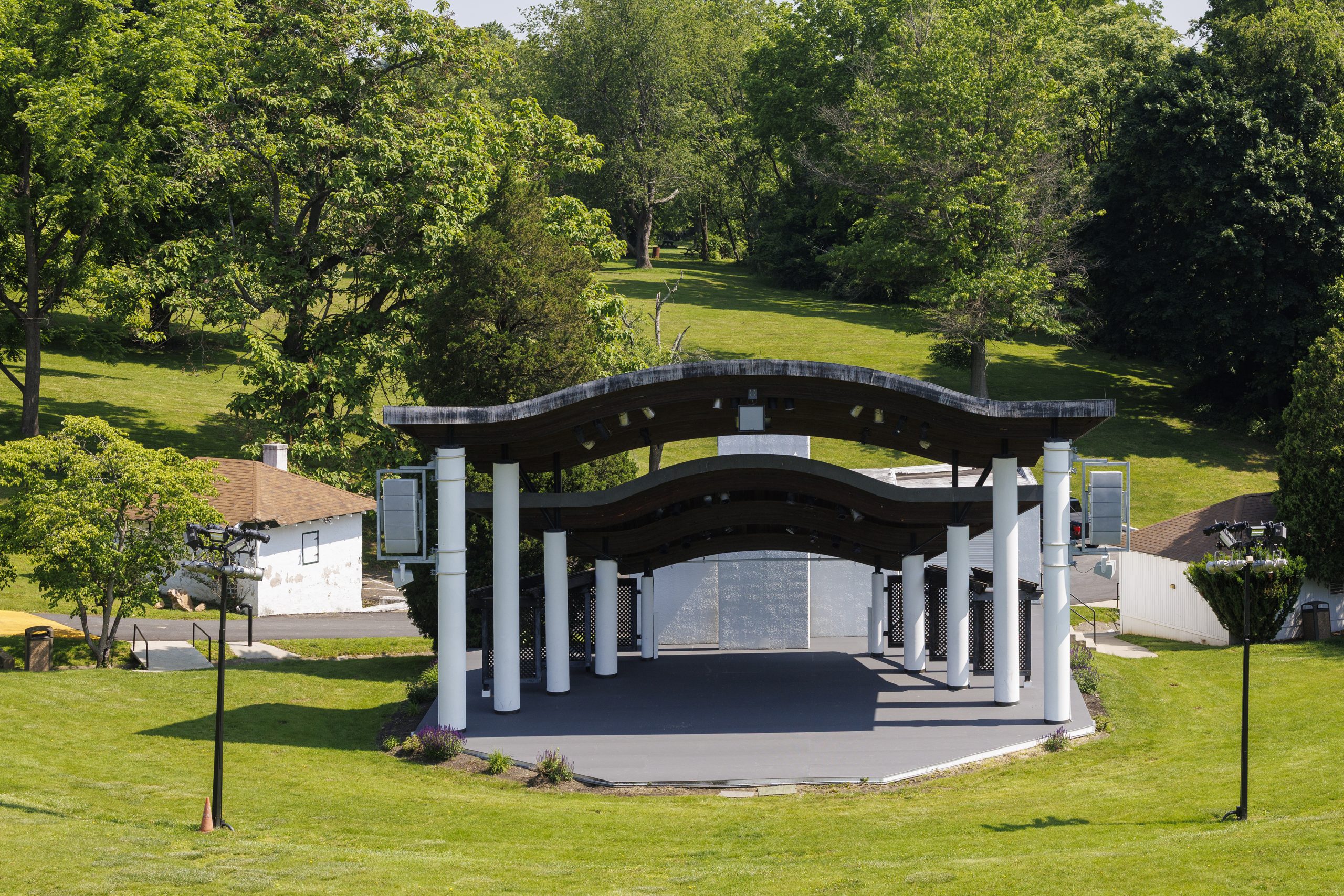
The amphitheater at Rose Tree Park in Media, Pa.Alejandro A. Alvarez / Staff Photographer
Delaware County is canceling two events in Media due to unhealthy air quality conditions — Friday night’s Summer Concert Series at Rose Tree Park and Saturday’s Upper Darby Summer Stage Shooting Stars performance.
“While we understand Delco looks forward to these award-winning performances, we will always continue to put our resident’s health and safety first,” officials said in a statement.
Philly reduced its air quality alert and plans to resume trash collection as well as reopen city pools
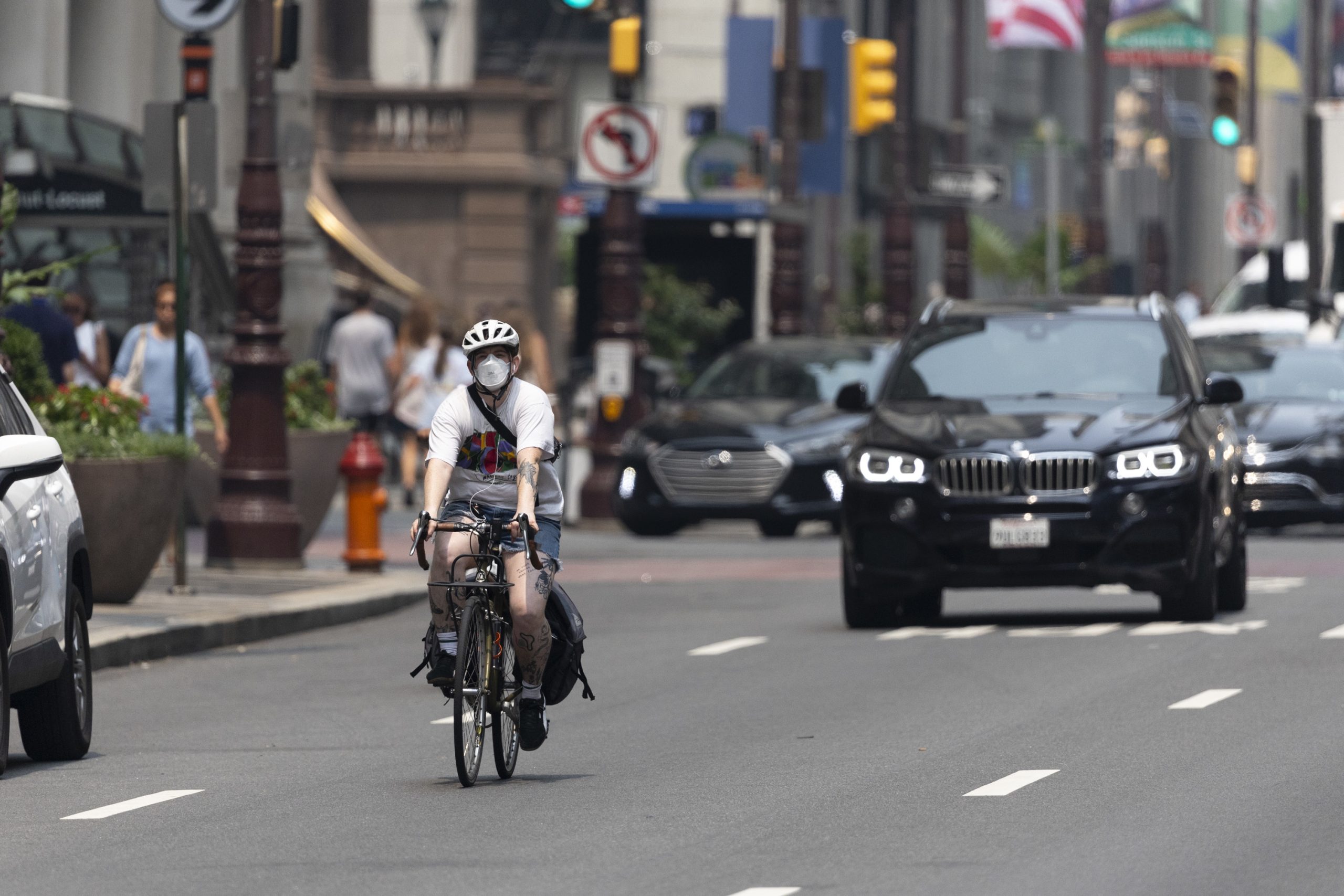
A biker wearing a mask along South Broad Street due to the poor air quality.Tyger Williams / Staff Photographer
Philadelphia officials said city sanitation services would cautiously resume Saturday, when smoky conditions brought to the area by Canadian wildfires are expected to improve.
City pools, which were closed Friday amid code purple air quality, were also expected to reopen, pending the air conditions the weekend brings, officials said at a Friday afternoon news conference.
“We will make judgment decisions as to when we will resume collections in terms of a start time tomorrow,” said Carlton Williams, director of the Philadelphia Office of Clean and Green Initiatives. “But we do plan on working all day Saturday and Sunday to ensure that last week’s trash and recycling is collected in time for our services to be on a regular schedule starting Monday.”
Palak Raval-Nelson, the commissioner of the city’s Department of Public Health, said air conditions had at least temporarily improved by Friday afternoon, moving from the more serious code purple to the less severe code red.
(function () {window.addEventListener(‘message’, function (e) { var message = e.data; var els = document.querySelectorAll(‘iframe[src*=”‘ + message.id + ‘”]’); els.forEach(function(el) { el.style.height = message.height + ‘px’; }); }, false); })();
Despite that change, air conditions remained unhealthy, and officials advised that residents remain inside if possible, and limit their exposure outside to no more than 90 minutes at a time.
Air conditions, Raval-Nelson added, could also change again back to code purple, and officials were monitoring the situation.
Pools, said city Parks and Recreation Commissioner Susan Slawson, would reopen Saturday if air conditions were code red or below. If air conditions creeped back into code purple territory, they would remain closed, Slawson said.
Officials said that venue owners had been advised of the conditions, and were able to make their own decisions as to whether those events would continue to go on.
“We provide them with the information, and they make their decisions,” said city Managing Director Adam Thiel.
Storms could clear wildfire smoke Saturday, but flooding is possible
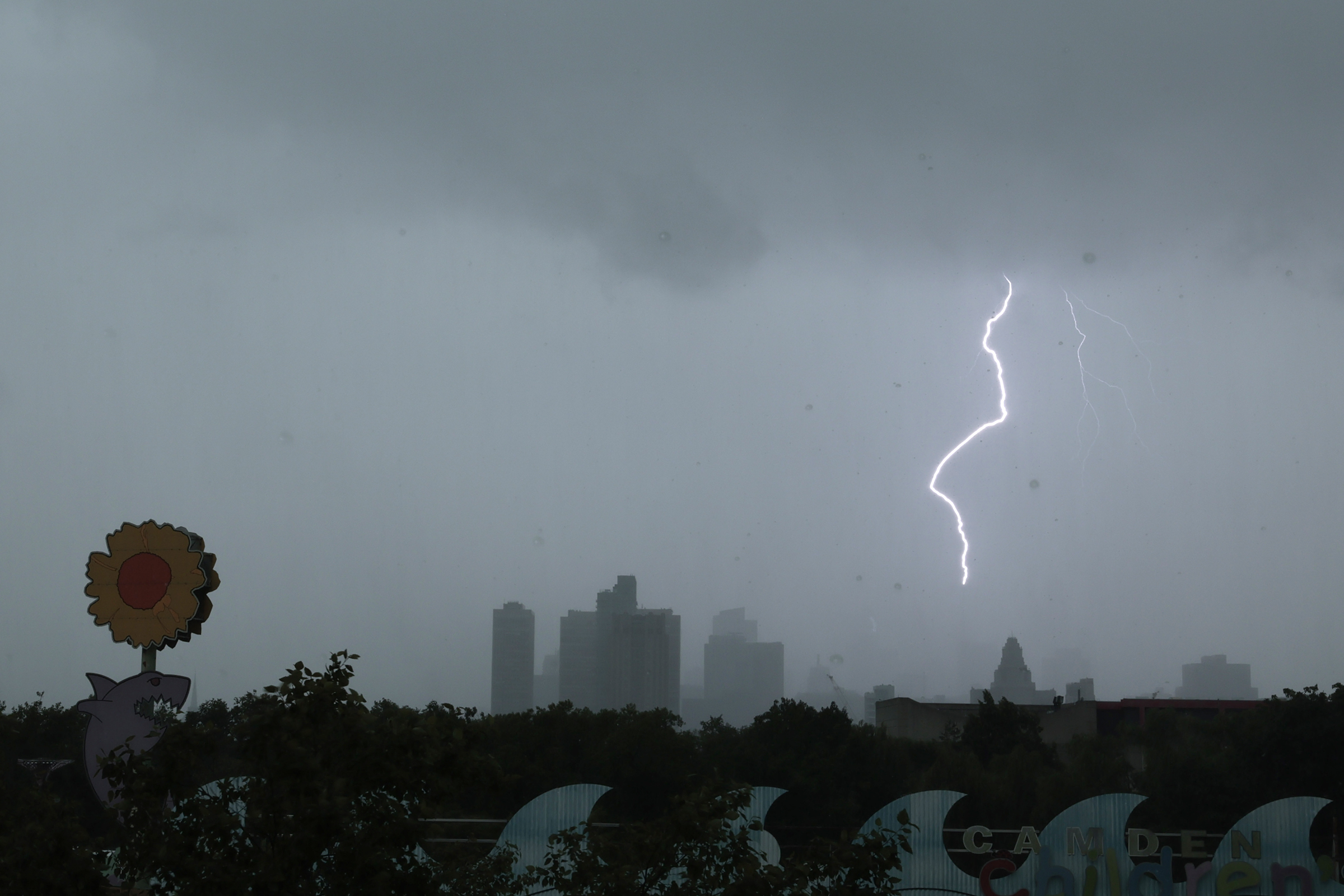
Lightning over Center City Philadelphia is seen from above the Camden Childrens Garden last week..Elizabeth Robertson / Staff Photographer
The city is warning people to prepare for potential flooding Saturday as heavy rainfall is expected to douse the region.
The forecasted Saturday storms likely will clear the wildfire smoke that has hung over the city since Thursday, the National Weather Service said. However, these “multiple rounds of storms” may cause flooding.
The flood watch is in effect from 10 a.m. Saturday through 2 a.m. Sunday, the city’s office of emergency management said. Storms may produce rainfall of two or three inches per hour.
“Be prepared to take action in the event that flooding develops,” the city said. It directed people to a website offering tips and resources.
Berks, Carbon, Delaware, Chester, Montgomery, Lehigh, Bucks, Monroe, and Northampton Counties also are all at risk. So are portions of northern Delaware and parts of New Jersey, including Camden and Gloucester Counties.
“Excessive runoff may result in flooding of rivers, creeks, streams, and other low-lying and flood-prone locations,” the city said. “Creeks and streams may rise out of their banks. Flooding may occur in poor drainage and urban areas.”
Flooding may not be the only problem. Friday morning, the National Weather Service said high winds and a potential tornado could also hit the area Saturday. On Saturday, high winds from four “microburst” storms downed nearly 300 trees in Philadelphia and left tens of thousands of residents without electricity. Philadelphia remains under a disaster emergency declaration as it recovers from those storms.
Bebe Rexha’s FIFA Fan Festival performance appears to still be on
FIFA Fan Festival is going on as scheduled, despite air quality issues.Jose F. Moreno / Staff Photographer
As FIFA Fan Festival at Philly’s Lemon Hill winds down in its last week of activity, Friday’s Bebe Rexha performance is still a go.
The dance pop artist’s free performance at Fan Fest is scheduled to begin at 7 p.m. with gates opening at 5 p.m.
So far, organizers haven’t announced any schedule changes. On Thursday, DEADMAU5’s free performance also went on as scheduled despite the air quality concerns.
The grounds are also scheduled to be open this weekend for the World Cup’s closing matches.
A Death Cab For Cutie and Japanese Breakfast concert at the Mann Center Friday is still on
Death Cab For Cutie play the Highmark Mann on Friday, with Japanese Breakfast opening.Ryan Russell
Friday’s Death Cab for Cutie headlining show at the TD Pavilion at Highmark Mann was expected to proceed as scheduled.
That’s according to officials at the Highmark Mann Center for the Performing Arts. Neither Death Cab for Cutie nor Japanese Breakfast, who is opening, have commented so far.
Anticipation is high for the show, featuring Japanese Breakfast, whose front woman Michelle Zauner has Philly ties. Friday’s show would mark Zauner’s first Philly performance since announcing her pregnancy at her band’s Governors Ball show.
On social media channels, fans have started game-planning: discussing wearing N95 masks to the show as a precaution as questions about the air quality linger.
And while the show must go on (for now at least) at the Highmark Mann and Shane Gillis at the Linc, smaller shows, like a Friday night concert and movie night, are being canceled.
According to a statement, the Chicago 9’s performance at Lindenwold Park and Movies with Metro at Von Nieda Park in Camden are off, citing the air quality.
“Not canceling cause of the smoke,” the Mechanicsburg, Pa., native and Eagles die-hard fan posted on his Instagram story, with a sneak peek at the outdoor stage.
Shane Gillis says his comedy show at Lincoln Financial Field Friday night won’t be canceled.Shane Gillis / Instagram
Gillis is expected to perform his edgy, often controversial comedy to a near-capacity crowd. Unnamed special guests are also billed to make appearances.
Gillis cut his teeth in the Philly comedy scene after graduating from West Chester University. He landed a gig at Saturday Night Live butwas fired from the show for having made homophobic and racist jokes on a podcast.
As smoke from Canadian wildfires continues to impact air quality across the region, New Jersey is handing out masks to commuters forced to be outdoors.
“I’ve directed NJ TRANSIT and the New Jersey Turnpike Authority to make select quantities of masks available to commuters and at rest areas along the Turnpike and Parkway. The Port Authority will also be distributing masks,” Gov. Mikie Sherrill said in a statement shared on social media.
Air quality across New Jersey was in the “unhealthy” range as of 10 a.m. Friday morning, with South Jersey faring worse than the northern part of the state.
A station in East Greenwich Township, Gloucester County, reported an air quality index of 191, while Atlantic City was 173, both in the unhealthy range.
During Phillies game, smoke-filled skies were ‘not ideal’ for players
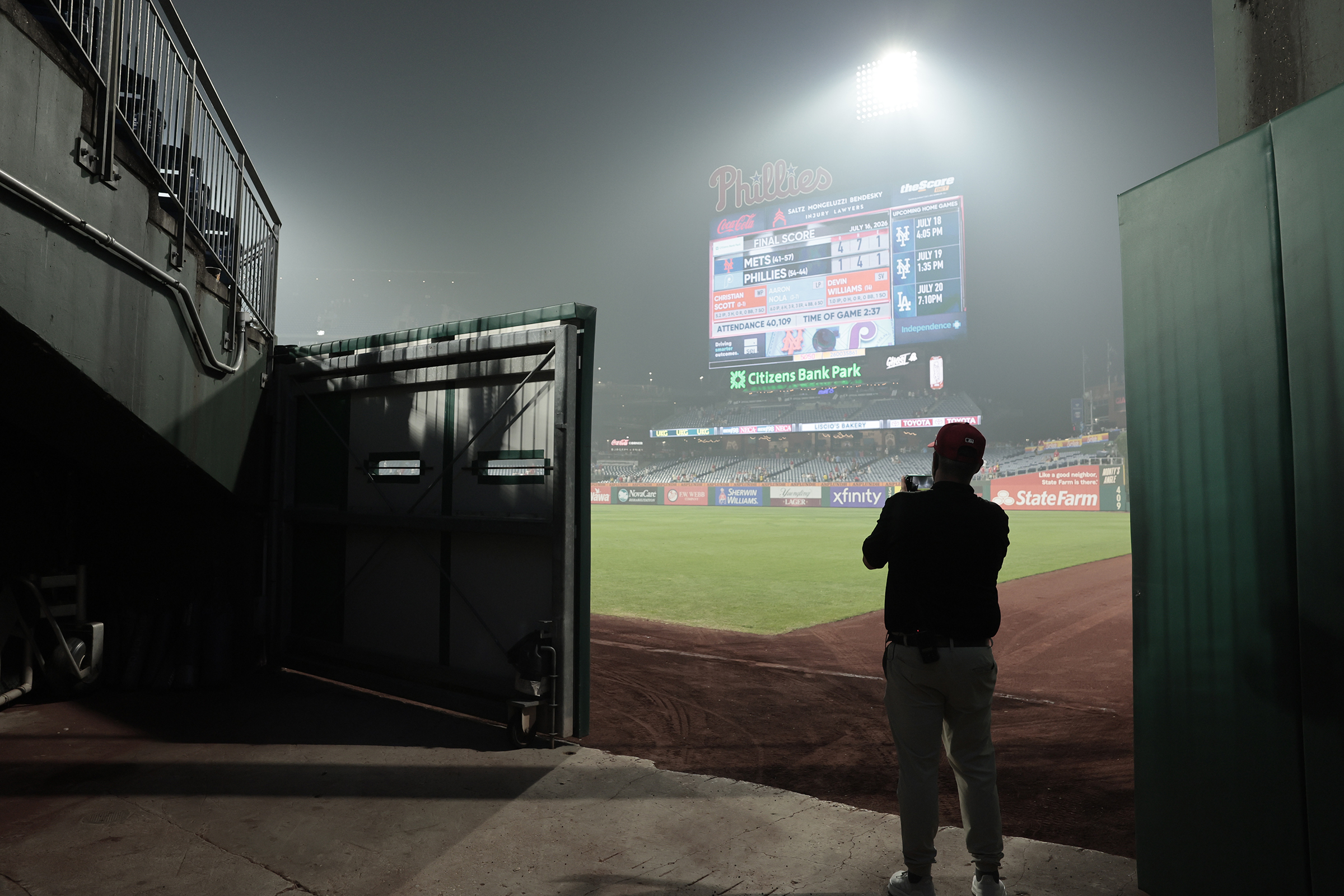
Smoke-filled air lingers over Citizens Bank Park Thursday night. Elizabeth Robertson / Staff Photographer
The Phillies aren’t scheduled to play again until late Saturday afternoon, but Thursday’s game was moved up an hour early because air quality was expected to worsen after sunset.
The forecast proved correct. When the game started, the air quality index was at 157, according to airnow.gov, categorized as “unhealthy.” It rose to 166 by 8 p.m., with the Center City skyline no longer visible from South Philly. By 9 p.m., it was 192.
“It’s not ideal,” Phillies pitcher Aaron Nola said. “But it is what it is. Can’t really do anything about it. It’s one of those days where it was smoky. But I mean, it’s an outdoor stadium. You’ve got to get the game in and play through different conditions.”
Brandon Marsh said home-plate umpire Dan Iassogna, also the crew chief, repeatedly asked players throughout the game if they didn’t feel well or if the conditions were disruptive in the game.
“Yeah, multiple times they were checking with us, asking us players — which was cool to see — if we were good to go, and obviously we were all ready to go,“ Marsh said. ”That was good by them. I wasn’t expecting that, but that was good.”
The Phillies and Mets also altered their pregame routines. Neither team took batting practice on the field and spent “as little time as possible on the field,” interim manager Don Mattingly said.
“Just doing what you absolutely feel like you have to do after being gone for three days,” he added. “Not trying to absorb a bunch of energy when you’re getting heated.”
Current look at air quality in Philly and across the area
(function () {window.addEventListener(‘message’, function (e) { var message = e.data; var els = document.querySelectorAll(‘iframe[src*=”‘ + message.id + ‘”]’); els.forEach(function(el) { el.style.height = message.height + ‘px’; }); }, false); })();
// Timestamp 07/17/26 9:13am
Smoke likely to stay until Saturday afternoon, National Weather Service says
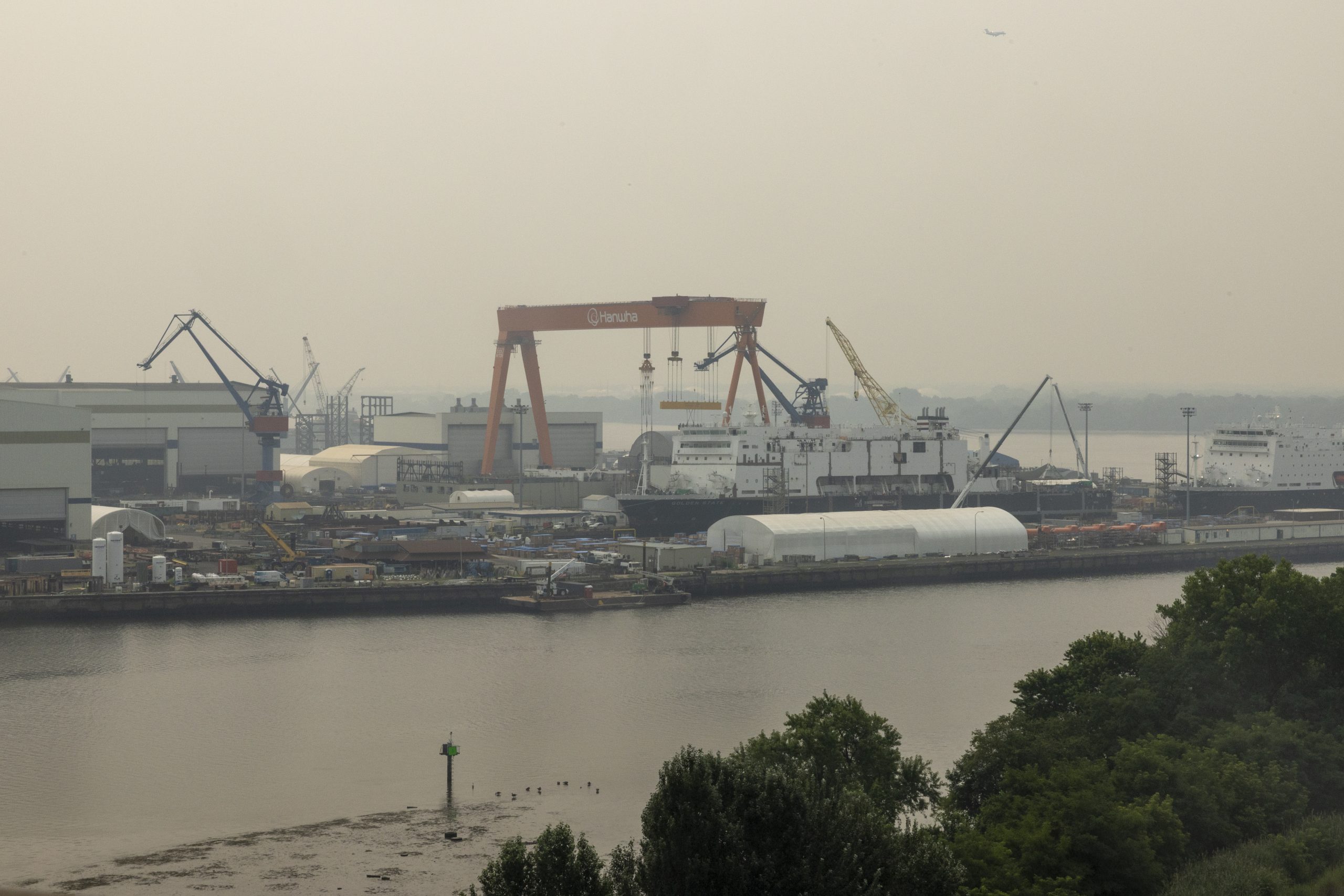
Hazy skies over the Navy Yard in Philadelphia Thursday.Aidan T. Gallo / Staff Photographer
Shifting winds may give Philly a break from the smoke today, but the air quality is likely to remain poor until at least Saturday afternoon, the National Weather Service said Friday.
Wildfires continue to burn in Western Ontario, and northwest winds are blanketing the region with particulate-filled air that gives the sky its hazy appearance, said meteorologist Joe DeSilva.
“As winds shift more northerly today, that’ll push the majority of the smoke south of our area briefly. A resurgence of the smoke is expected tonight as winds shift again,” DeSilva said.
The smoke is forecast out over the next 48 hours, and it’s difficult to predict what happens beyond that timeline, DeSilva said.
However, a storm system expected Saturday should clear the smoke out, he said.
That system will bring its own hazards. DeSilva predicted “multiple rounds” of showers and thunderstorms Saturday, bringing the potential for flash flooding. In addition, “damaging winds” are likely, with the potential for a tornado.
“It definitely looks like damaging winds will be the primary hazard type,” he said.
‘Hazardous’ air quality recorded in Chester as smoke lingers across the region
Air quality across the Philadelphia was poor Friday morning due to wildfire smoke from Canada, with most of the area in the “very unhealthy” zone.
The city of Chester was among the worse, hitting an air quality index of 312 at 7 a.m. Friday. A reading over 300 is considered “hazardous,” with air quality so poor it could be dangerous to everyone.
By 9 a.m., the number dipped down a bit to 279, solidly in the “very unhealthy” category.
An air quality station in Philadelphia The Inquirer is tracking peaked at 291 Thursday night, but had dropped to 250 by Friday morning.
Philly pools are closed and trash pickup suspended as residents are encouraged to stay indoors
The Philadelphia Museum of Art is behind a smoky haze Thursday.Monica Herndon / Staff Photographer
Philadelphia pools and spraygrounds will be closed Friday and trash pickup is suspended due to “very unhealthy” air quality caused by Canadian wildfires.
“Our worsening air quality is a dangerous development,” Palak Raval-Nelson, the commissioner of the city’s Department of Public Health, said in a statement. “I strongly encourage all residents to take action to protect themselves by staying indoors, unless they need to be outdoors.”
As of 7 a.m., Philadelphia’s air quality index was 267, solidly in the middle of the “very unhealthy” range, which means the the general public is at risk for serious heath effects.
Especially at risk are residents with heart or lung conditions, who should take “extra special care” outdoors, Raval-Nelson said. Children, older adults, pregnant women, and people with weakened immune systems are also at higher risk.
Raval-Nelson said residents should avoid going outdoors unless necessary, and those that do leave should wear an N95 or KN95 mask.
“This situation is dangerous, and if we all take care and look out for each other we will get through this,” Raval-Nelson said at a news conference Thursday night.
People experiencing symptoms including trouble breathing, heart palpitations, nausea, or dizziness are encouraged to seek immediate medical attention.
Despite the warning, most city services will operate normally. The city is not recommending outdoor events be canceled, and employees working outdoors are being encouraged to take frequent breaks and mask up.
A ‘code purple’ air quality alert is in place across Pennsylvania
John Burns Jr., of Grays Ferry, Philadelphia, Pa., sits out at Cherry Street Pier with the wildfire smoke from Canada Thursday.Tyger Williams / Staff Photographer
The smoke, which is expected to blanket the region at least through Friday, originated from fires burning in Western Ontario, said Sarah Johnson, a meteorologist at the National Weather Service’s Mount Holly office.
The Pennsylvania Department of Environmental Protection has declared a Code Purple Air Quality Alert for Friday. Code purple signifies very unhealthy air, meaning people should avoid long or intense outdoor activities, and sensitive groups should avoid all outdoor activities. The department suggested not using gas-powered lawn and garden equipment, and avoiding the burning of leaves or trash.
The smoke was swept in by winds that mixed to keep it closer to the ground.
“It’s just a factor of the winds at all levels kind of working together,” Johnson explained.
It is difficult to pinpoint when the air quality might return to normal, she said. Those forecasts come from state environmental protection departments and are usually no more than 48 hours out.
Rain forecast for Saturday could help suppress the smoke, Johnson said, but it’s too early to be sure.
What to know about the wildfire smoke in Philly and its health impacts
Penn State graduate student Ray Boone waits for the bus with a face mask because of the air quality Thursday.Monica Herndon / Staff Photographer
As Canada grapples with hundreds of active wildfires, the rest of North America is feeling the impacts with air quality alerts.
In Philadelphia and elsewhere, the air quality score is considered very unhealthy, particularly for the most sensitive people.
Whether you are planning to go out or stay home, here’s what three experts had to say about staying healthy and what precautions are needed:
What makes this smoke so toxic?
Exposure to this particular fire smoke is a serious matter due to “photochemical aging,” said Eric Balaban, a pulmonary and critical care fellow at Temple University.
As smoke travels, it interacts with oxygen, heat, and sunlight, creating a toxic profile that helps generate high levels of ground-level ozone and highly irritating aerosols, Balaban said.
Ground-level ozone is a pollutant that forms when nitrogen oxides and volatile organics emitted by vehicles, power plants, and industry react in sunlight, especially during hot days such as Thursday.
The pollutants aren’t the only problem.
The fine particulate matter within the smoke is small enough to cross from the lungs directly into the bloodstream, Balaban said, increasing the risk of heart attacks and strokes, in addition to causing acute chest tightness, shortness of breath, and dizziness in otherwise healthy people.
This map shows air quality in the Northeastern U.S.
(function () {window.addEventListener(‘message’, function (e) { var message = e.data; var els = document.querySelectorAll(‘iframe[src*=”‘ + message.id + ‘”]’); els.forEach(function(el) { el.style.height = message.height + ‘px’; }); }, false); })();
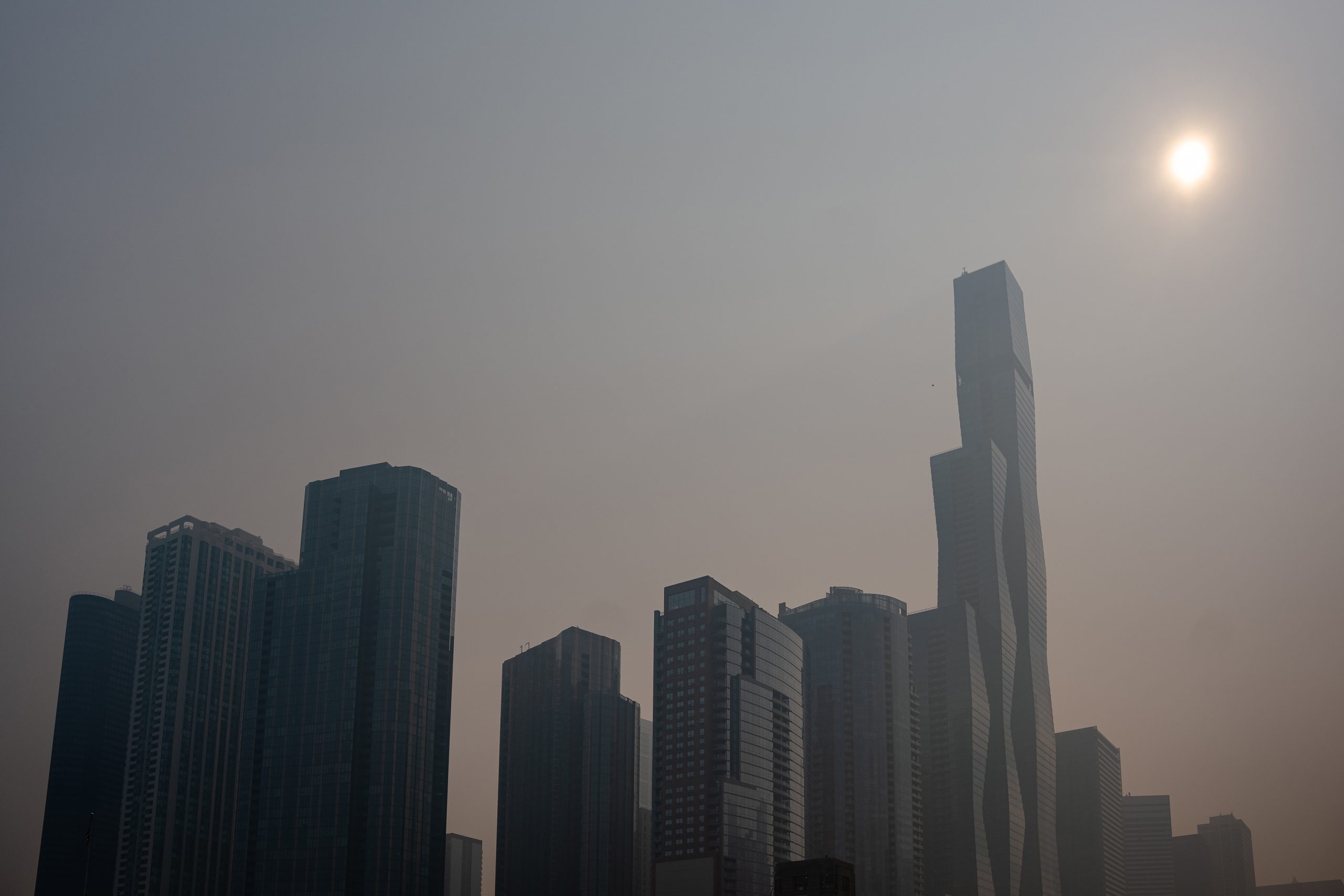
The sun peeks through a blanket of smoke over the Chicago skyline Thursday.JAMIE KELTER DAVISThe Statue of Liberty, seen from the Staten Island Ferry as smoke from wildfires blankets the sky.Yuki IwamuraA man walks along the Detroit River during poor air quality due to smoke from Canadian wildfires.Paul SancyaChildren look out at downtown Toronto from the observation deck of the CN Tower.IAN WILLMSA watercraft sits in the Detroit River near the skyline during poor air quality due to smoke from Canadian wildfires.Paul Sancya
Canadian wildfire photos: How things look elsewhere
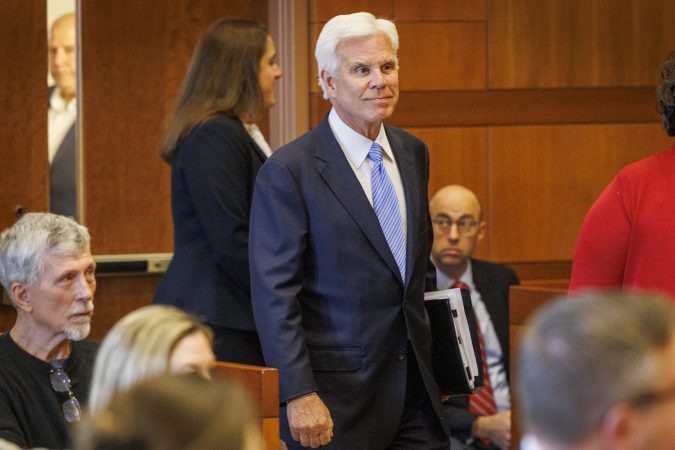
An Inquirer staffer’s interview notes came into the possession of the New Jersey Attorney General’s Office during an investigation that led to the high-profile, and recently abandoned, racketeering indictment against South Jersey power broker George E. Norcross III.
News organizations typically treat unpublished reporting material as confidential and often fight government demands for it in court.
Inquirer editor and senior vice president Gabriel Escobar on Wednesday confirmed that state investigators had obtained interview notes typed in 2019 by Nancy Phillips, who currently edits the Justice and Injustice Team. The Inquirer “did not turn over notes to state prosecutors” and was never subpoenaed by authorities for them, Escobar wrote in a note to the newsroom.
“We do not definitively know how the notes ended up with the state, but we do know it was not from us,” Escobar said in response to questions from an Inquirer reporter.
A person with firsthand knowledge of how the notes came into the possession of the authorities said Phillips had shared the notes with someone outside The Inquirer.
“Nancy Phillips shared the notes with a third party. It was not for the purpose of sharing the notes with authorities. It was for her own edification,” said the source, who is not an Inquirer employee and requested anonymity due to ongoing litigation threats related to the case. “The state did not receive the notes from Nancy Phillips directly.”
A second source with direct knowledge of the evidence discovery file related to the Norcross investigation said the interview notes were included in an electronic file titled “Stier Documents.”
Edwin Stier, a former state and federal prosecutor in New Jersey, has been quoted previously in The Inquirer, including as part of its coverage of Norcross. He is mentioned elsewhere in the discovery file, said the source, who spoke on the condition of anonymity because he was not permitted to publicly discuss the discovery material.
Stier declined to comment on why his name appears in the evidentiary documents.
Phillips declined to comment, saying she was “not comfortable talking about the process of newsgathering.”
Gabriel Escobar became The Inquirer’s top editor in 2020.JESSICA GRIFFIN / Staff Photographer
Escobar — who joined The Inquirer in 2007 as metropolitan editor and was appointed its top editor in 2020 — declined to respond to questions about whether Phillips shared the notes with anyone outside the newsroom, including Stier. Escobar did not respond to a request for a phone interview and instead answered questions in writing.
‘False and outrageous’
BigTrial, a blog authored by former Inquirer reporter Ralph Cipriano, first reported on Wednesday that the 10-page typed interview notes were in the state’s hands. Norcross’ legal team obtained the notes from the state through evidence discovery, and Norcross is considering a lawsuit against the state for malicious prosecution, BigTrial reported.
The notes do not indicate the name of the author but appeared to summarize August 2019 meetings between a journalist and longtime Cherry Hill mayor Susan Bass Levin, who shared information critical of Norcross, according to the BigTrial report. Bass Levin is the former president and CEO of Cooper University Health System’s Cooper Foundation, where Norcross serves as a board member.
“I have never seen the notes,” Bass Levin said. She declined to comment further.
An Inquirer reporter was not able to obtain a copy of the notes. Escobar said he did not have a copy of them.
Cipriano’s report claims that there are “only a couple possible explanations” for how prosecutors obtained the notes: The Inquirer supplied the notes in response to a subpoena; or Phillips was “voluntarily helping the investigators trying to pin a racketeering indictment on Norcross and associates.”
Cipriano included no evidence to support either claim.
In his email to the newsroom, Escobar wrote that Cipriano’s theories amounted to “unfounded and irresponsible speculation.”
“Speculation that Nancy Phillips, who has a long and distinguished track record as a reporter and editor, was working with state prosecutors is both false and outrageous,” Escobar wrote. “When we learned that state investigators had the notes, we conducted an inquiry and determined that the material was not provided to them by The Inquirer.”
He declined to give further details.
(Escobar recused himself from involvement in this story, as did the reporters and editors who led The Inquirer’s coverage in 2019 of the investigation into Norcross.)
Asked whether Phillips or any other staffer had faced discipline after the internal inquiry, Escobar wrote: “We do not comment on personnel matters.”
Norcross spokesperson Dan Fee said Norcross’ legal team was not aware of how the state obtained the notes.
The New Jersey Attorney General’s Office declined to comment.
The Norcross investigation
New Jersey state prosecutors, led by then-Attorney General Matthew Platkin, in 2024 indicted Norcross and five others in a racketeering case centered on alleged corruption in economic development tax breaks for projects connected to Norcross in Camden.
Beginning in 2019, Inquirer reporters Andrew Seidman and Catherine Dunn wrote a series of articles on the tax break deals and the investigation into Norcross.
Norcross spokesperson Fee said Seidman told him at the time that Phillips was not involved in the coverage. Phillips had a longtime romantic relationship with the late New Jersey billionaire Lewis Katz, who clashed with Norcross when both were co-owners of The Inquirer in the early 2010s.
The combination of the notes and subsequent stories in The Inquirer indicate that Phillips had not just met with Bass Levin but also passed her notes to the reporters covering the story, showing that Phillips did play a role in coverage of Norcross, Fee said.
Fee said Wednesday that Escobar’s statement “confirms the two most important things in the BigTrial story: Nancy Phillips’ notes ended up in the hands of prosecutors and that despite her bias against George Norcross being clear and known, Phillips was part of the reporting on stories involving him.”
He called on Inquirer leadership to conduct a “public investigation” and questioned whether “there will be some effort to cover everything up.”
Cipriano’s report quoted brief portions of the notes, including that Bass Levin suggested requesting certain public records, and that an Inquirer reporter later requested those records.
Escobar’s note to the newsroom Wednesday said that Phillips “was not directly involved in the [Norcross] coverage but served as a conduit for information only she could access.”
“Nancy has established a network of sources in her long career, and the information she has been able to gather has aided our journalism across many fronts,” Escobar wrote. “In 2019, she was approached by a source who was offering unique insights on a significant and running story. Nancy conducted an interview, typed up the notes, and then shared them with two Inquirer reporters who were working on the story.”
Inquirer staffer Nancy Phillips walks alongside H.F. “Gerry” Lenfest, the newspaper’s late owner. ALEJANDRO A. ALVAREZ / Staff Photographer
Cipriano, Norcross, and Phillips each have complicated Inquirer tenures.
Cipriano, who was fired from The Inquirer in 1998, sued his editor for libel following a dispute over his coverage of the Archdiocese of Philadelphia. The suit was settled in 2001 with both sides declining to disclose the terms of the agreement, according to a New York Times report. Cipriano frequently criticizes The Inquirer’s coverage and its reporters and editors on his blog.
Norcross was a co-owner of The Inquirer from 2012 to 2014, a tumultuous period in which he battled with Katz over control of the company.
And Phillips, who scored legendary scoops as a crime reporter and now edits the Justice and Injustice Team, was involved in a relationship with Katz during his public fight with Norcross.
Katz and cable mogul-turned-philanthropistH.F. “Gerry” Lenfest ultimately prevailed in the dispute over who would own The Inquirer. Katz died in a 2014 plane crash, just days after he and Lenfest bested Norcross in an auction organized to settle the ownership matter. (The Inquirer since 2016 has been owned by the Lenfest Institute for Journalism, a nonprofit endowed by its namesake before he died in 2018.)
Camden coverage
Escobar, who did not become The Inquirer’s top editor until a year after Phillips’ meeting with Bass Levin, said that he “did not have firsthand knowledge” of any arrangement barring Phillips from involvement in Norcross coverage.
“But I could see a situation where a judgment call was made that placed priority on gathering information in a limited way,” Escobar said.
He added in a separate response: “Gathering information from all quarters on a story always yields better and more complete journalism and, as the [newsroom] note says, this particular source was in a position to know and would only provide it to Nancy.”
At the time of the 2019 interview, Phillips was a deputy regional editor overseeing reporters covering the Pennsylvania and New Jersey suburbs. In that role, Phillips would not normally be involved with stories concerning the Norcross investigation, which was handled by reporters from the politics and business desks.
In a statement, Seidman noted that Norcross and the Camden tax breaks became a matter of public debate in the spring of 2019 and that he and Dunn began their reporting in May of that year — three months before Phillips met with Bass Levin.
“Our reporting was based on interviews, emails, bank documents, property records, appraisals, and other government documents,” Seidman said. “I stand by it 100%.”
Dunn, who left The Inquirer in 2022 and has been a reporter at Barron’s for about four years, declined to comment.
Fee said he repeatedly disputed Seidman’s and Dunn’s coverage of Norcross, including an October 2019 article Cipriano highlighted regarding a land deal in Camden.
The Inquirer publishes corrections when it discovers that its reporting contained factually inaccurate information. No corrections were made to the 2019 article.
Former Inquirer editor John P. Martin, who was the lead editor on that story, said he and the reporters “talked at length with Mr. Norcross’ spokesman and several lawyers representing him.”
“At no point, to my recollection, did Nancy Phillips offer input, advice, editing help, ask questions, or even engage in small chat about that story or any involving Mr. Norcross,” said Martin, who is now with Bloomberg.
Escobar concluded his note to the newsroom by saying the episode offered “an important lesson.”
“The information we gather in the course of reporting should always be safeguarded,” he said. “And no matter how well established a source-reporter relationship is, each interaction should establish clear parameters for the use of the information.”
Asked for clarity on how those comments related to prosecutors obtaining Phillips’ notes, Escobar wrote: “The notes ended up with the state so something went awry. That part of the message is intended as a general reminder and not specific to the circumstances.”
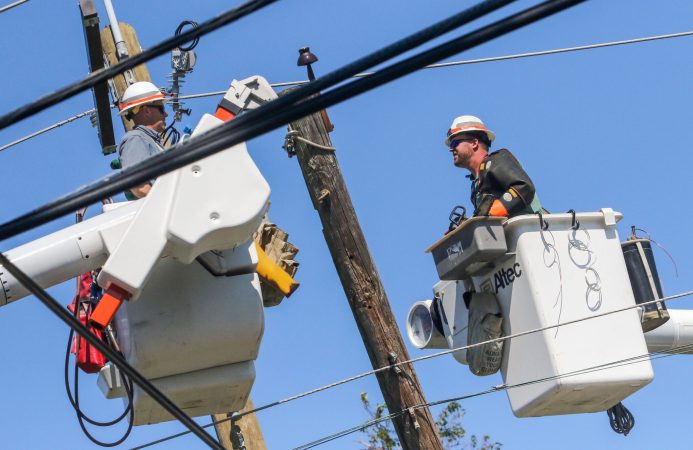
The state’s energy regulators will examine utilities’ handling of recent outages that left thousands of New Jerseyans without power amid heat waves that pushed temperatures above 100 degrees in parts of the state, sometimes for days.
Regulatory staff will examine utilities’ preparedness before and after the early-July storms that prompted the outages, their communication with customers, and their ability to quickly restore power, Board of Public Utilities President Ben Hertz-Shargel said at the agency’s Wednesday meeting.
“We expect utilities to be prepared, communicate effectively, and restore service safely and as quickly as possible. When they fall short, the board will hold them accountable,” Hertz-Shargel said.
The Garden State saw severe and sudden thunderstorms during the Fourth of July weekend that the New Jersey Utilities Association, a trade group, said knocked out power for roughly 850,000 customers, mostly in areas serviced by PSE&G and Jersey Central Power & Light.
Restoration work was largely complete by July 10, when fewer than 1,000 remained without power, the association said, but by then some lawmakers had already started to raise alarms about days-long outages during sweltering heat.
At the time, Assemblyman Greg McGuckin (R., Ocean), whose legislative district falls within JCP&L’s central service area, said regular, extended summer outages had become the utility’s business model. On Wednesday, he said a review was long overdue.
“It’s unacceptable that every summer we continue to end up like a third-world country every time there’s a storm,” McGuckin said. “It’s inexcusable to me that power stations are not adequately protected from a lightning storm when lightning storms are a common occurrence in the summer at the Jersey Shore.”
The New Jersey Utilities Association, which represents JCP&L, PSE&G, and the state’s other electric distribution companies, said the storms were some of the most severe New Jersey had seen in recent years. Heavy rain and winds that approached the force of a hurricane downed trees and wires, prompting the outages.
“These storms were a multi-day, multi-utility crisis that required massive mobilization, but the state’s electric distribution companies’ restoration teams, along with local, county and state emergency personnel, worked around the clock to restore power to over 800,000 customers in just six days,” said Richard Henning, the association’s president and CEO.
He said the industry looks forward to collaborating with the state to boost resilience and improve storm response.
Chris Hoenig, a spokesperson for JCP&L, acknowledged the power outages were disruptive, particularly given that week’s extreme heat, but said the company had marshalled about 5,700 workers to assess damage, fix power lines, and remove downed trees, among other things.
“Four consecutive days of severe thunderstorms, damaging winds and flooding rains caused widespread damage across JCP&L’s service territory, with impacts comparable to those experienced during a hurricane,” Hoenig said. “Throughout the restoration effort, our crews remained focused on a single objective: restoring service safely and as quickly as possible to every affected customer.”
Asked to comment, Darwin Pham, a spokesman for Gov. Mikie Sherrill, said, “The Sherrill Administration will continue holding utility companies accountable to ensure they are providing reliable power, including making appropriate improvements to their energy infrastructure and outage response if gaps are identified.”
The board on Wednesday also vote to advance an order to show cause that could levy $44.1 million in fines against JCP&L for failing to meet reliability benchmarks in 2022, 2023, and 2024. Commissioner Christine Guhl-Sadovy, the board’s immediate past president, will preside over that case.
“I think that this action really shows, without predetermining any outcome, that we are taking very seriously the utility performance, particularly around these reliability issues and that, when warranted, we are willing to impose penalties,” she said.
The board also voted to open procurement for new nuclear power plants.
The vote follows a bill Gov. Mikie Sherrill signed earlier this week that calls for the state to stand up about 1,100 megawatts of new nuclear power to meet rising electricity demand spurred mostly by artificial intelligence data centers.
The governor has championed nuclear power as a method of meeting the state’s energy needs in the long term, though the measure has faced criticism because of the long timelines and high costs associated with nuclear plants and because it calls for those plants to be subsidized by other generators who would pass those expenses on to ratepayers.
“The project is super important, but we just have to be mindful,” Commissioner Joseph Coviello said. “It’s going to be extremely expensive at the start, and it’s only going to get more expensive, so we just have to be mindful of how we spend the ratepayers’ money.”