Tag: Donald Trump

  • Affordability takes center stage as Shapiro and Garrity craft their economic pitch for Pennsylvania voters

    Affordability takes center stage as Shapiro and Garrity craft their economic pitch for Pennsylvania voters

    Ben Hummer would like to own a house one day in Pittsburgh. He dreams of a two-bedroom, one-bathroom town house where he can live near his job.

    But for now, Hummer, 29, rents his 500-square-foot, one-bedroom apartment, and his monthly rate since he moved in has continued to increase by $50 each year, making the goal seem further out of reach.

    “Anything that could increase the supply and affordability of housing in the Pittsburgh area would be massive,” said Hummer, who works in human resources.

    Like most voters in Pennsylvania, according to a recent poll from The Philadelphia Inquirer, the New York Times, and Siena University, the economy and cost-of-living concerns are the most important issues deciding Hummer’s vote in the 2026 governor’s race between incumbent Democratic Gov. Josh Shapiro and his Republican challenger, state Treasurer Stacy Garrity.

    And as Election Day draws nearer, both campaigns are focusing their messaging on these kitchen table issues.

    (function() { var l = function() { new pym.Parent( ‘nyt-afford__graphic’, ‘https://media.inquirer.com/storage/inquirer/ai2html/nyt-afford/index.html’); }; if(typeof(pym) === ‘undefined’) { var h = document.getElementsByTagName(‘head’)[0], s = document.createElement(‘script’); s.type = ‘text/javascript’; s.src = ‘https://pym.nprapps.org/pym.v1.min.js’; s.onload = l; h.appendChild(s); } else { l(); } })();

    Two years ago, it was the cost of eggs, gas, and groceries that were top priorities among the electorate in Pennsylvania and elsewhere. Voters’ trust in President Donald Trump’s ability to bring down high prices propelled him back to the White House, sending Democrats scrambling to hone an affordability pitch that could land in time for the high-stakes 2026 midterm elections. But in that same time, prices have continued to climb; gas prices have topped $4 per gallon; and tariffs instituted by Trump — who called affordability “a hoax” at a Pennsylvania rally last year — have driven up the cost of every day life. Now both parties are latching on to a focus on affordability.

    As he mounts a reelection campaign, Shapiro — who holds a commanding lead in polls — is highlighting his accomplishments during his first term that his campaign says has given Pennsylvanians more money back through tax cuts and wage increases for childcare workers.

    Meanwhile, Garrity has recently shared her own plan, called “Turnaround PA,” to make living more affordable with an outline of how she’d lower prescription drug costs, reduce property taxes, and aim to cut energy bills to get there. But she’s also closely aligned with Trump, who has endorsed her in the race and has dismal markings from voters on two of their top priorities: the economy and cost of living.

    (function(){function e(){window.addEventListener(`message`,function(e){if(e.data[`datawrapper-height`]!==void 0){var t=document.querySelectorAll(`iframe`);for(var n in e.data[`datawrapper-height`])for(var r=0,i;i=t[r];r++)if(i.contentWindow===e.source){var a=e.data[`datawrapper-height`][n]+`px`;i.style.height=a}}})}e()})();

    That puts her in a difficult spot to challenge Shapiro, said Mark Zandi, the chief economist at Moody’s Analytics.

    There’s no easy answer for Republicans to win on economic issues in the midterms, but Zandi said his best advice is to focus on what is in the governor’s control and draft ideas that mitigate the fallout from Trump’s policies.

    Hummer, a Democrat who plans to vote for Shapiro this fall, said he trusts the governor to handle the economy and cost of living issues better. More than half of likely Pennsylvania voters in the Inquirer/New York Times/Siena poll agree.

    Fifty-five percent said Shapiro would do a better job of handling the state’s economy, and 56% said they think Josh Shapiro would do a better job of handling cost-of-living issues.

    “I’m well aware he’s limited in his options to do things, but I would say he’s kept a steady hand on the wheel of the Pennsylvania economy — to the extent that he can,” he said.

    Garrity pitches affordability as Republicans seek to overcome Trump’s ratings

    Among other proposals, Garrity has pitched a “first-time homebuyer assistance initiative,” which could help house seekers like Hummer and would provide qualified buyers 3% mortgage interest rate support from the state.

    She also has proposed cutting taxes by seeking a constitutional amendment that exempts Pennsylvania seniors from paying school property taxes and gives voters the final say over whether to increase property taxes. Her plan would also “reprioritize state spending for property tax relief.”
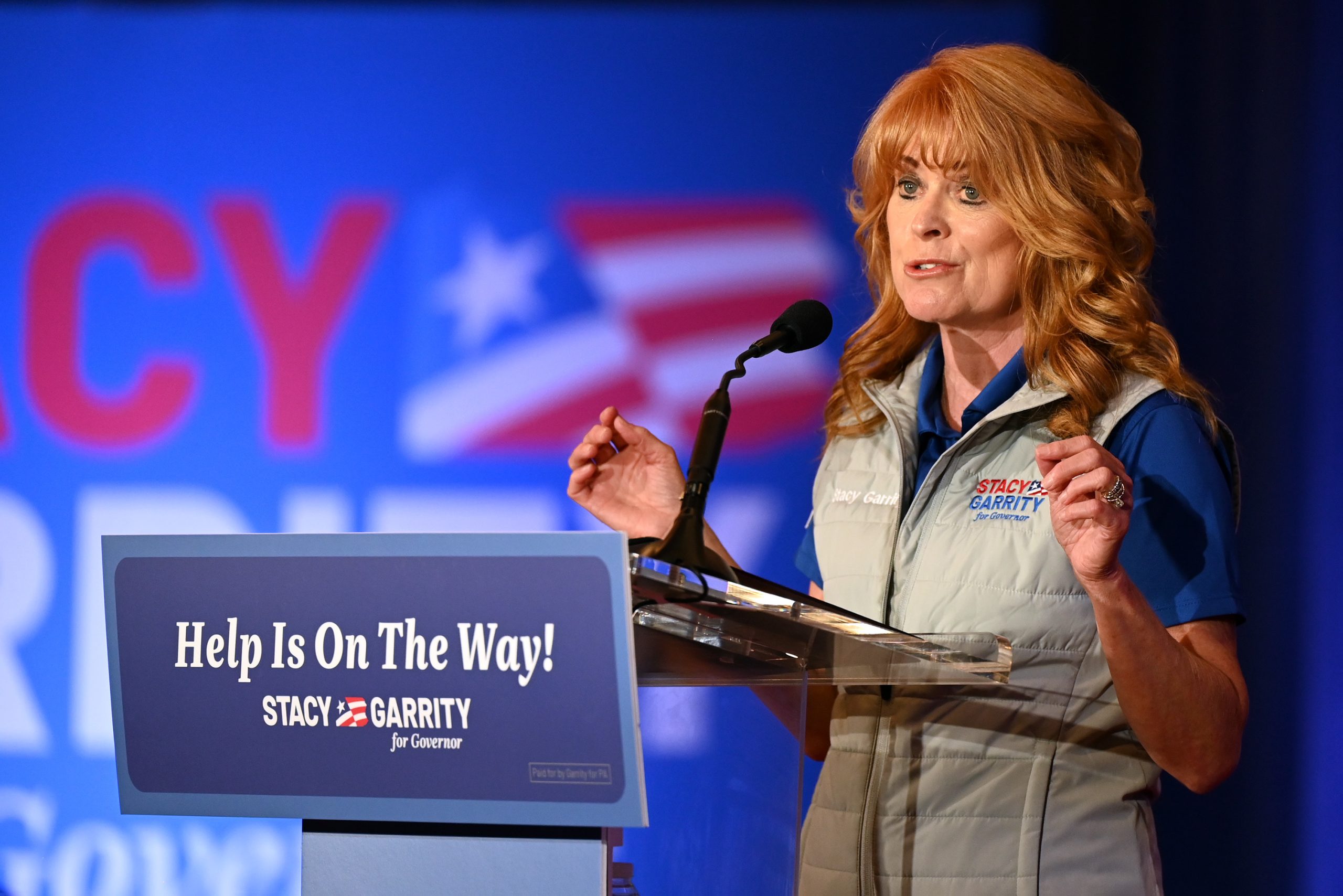
    State Treasurer and Republican candidate for governor Stacy Garrity holds a rally in Bucks County on Sept. 25, 2025, at the Newtown Sports & Events Center.Tom Gralish / Staff Photographer

    But there’s no free money, Zandi said. “If you’re giving tax cuts over here,” he said, “you’ve got to figure out how to pay for it … and that means you’re cutting spending.”

    Garrity’s plan also would address rural healthcare, and she would “aggressively pursue available federal funding to strengthen rural healthcare.”

    But there’s little money left in the pot after Trump cut government spending in last year’s federal budget. His One Big, Beautiful Bill Act directed a reduction in Medicaid spending by $1 trillion over 10 years, starting after the midterm elections, and rural hospitals and nursing homes are more dependent on federal funds. Additional dollars would likely need to come from Harrisburg.

    For Pennsylvanians like Caitlyn Needham, 28, the consequences of an unexpected medical bill on top of a limited income meant she went without substantial meals for weeks.

    “I have a rabbit, and she had a medical emergency [in November],” she said. “So for two months, the only thing I could afford to eat while paying off those bills was peanut butter and jelly sandwiches for breakfast, lunch, and dinner.”

    Needham, a cake decorator in Pittsburgh, said she’s always been frugal and saved a little bit of money from each paycheck, but increasing expenses are pushing her budget to the limit. She said she plans to vote for Shapiro this November.

    “Pennsylvanians need a relief valve before things get worse,” she said. “So many people are one bad week away from not being able to keep their housing, or losing their medical coverage, or losing their job because their car broke down and they can’t afford to get service. It’s like everyone is just one accident away from not being able to live.”

    (function(){function e(){window.addEventListener(`message`,function(e){if(e.data[`datawrapper-height`]!==void 0){var t=document.querySelectorAll(`iframe`);for(var n in e.data[`datawrapper-height`])for(var r=0,i;i=t[r];r++)if(i.contentWindow===e.source){var a=e.data[`datawrapper-height`][n]+`px`;i.style.height=a}}})}e()})();

    Garrity has remained politically loyal to Trump, even as his popularity has sunk among Pennsylvania voters. She has endorsed Trump’s tariffs and supported the war in Iran. That support has remained even as gas prices in July spiked to more than $4 per gallon, up more than $1 since the beginning of the year — and a point Shapiro has repeatedly emphasized.

    “If you’re trying to infer I’m out of line with the president, I don’t think I am,” she said last month during a news conference she held on data centers.

    In a statement, she blasted Shapiro’s handling of the economy, saying he has put a tax burden on families and tied businesses up with unnecessary regulations.

    “Josh Shapiro’s Pennsylvania is simply unaffordable for the commonwealth’s hardworking families,” Garrity said. “He allowed utility and energy costs to skyrocket due to his unwillingness to expand generation capacity and instituting policies that benefit our neighboring states instead of us.”

    Shapiro emphasizes his record is separate from national picture

    Shapiro, the incumbent, is leaning on his record on economic policy.

    According to his campaign, his administration created more than 25,000 jobs during his first term and brought in $41 billion in private-sector investment.

    “Governor Shapiro is fighting for all Pennsylvanians — and he has a track record of creating jobs and economic opportunity, putting money back in Pennsylvanians’ pockets, and standing up to Washington’s reckless, cost-raising policies,” said Samantha Reposa, a spokesperson for the campaign. Garrity, she said, “fully supports the failed economic policies that are raising costs and hurting working families across the commonwealth.”
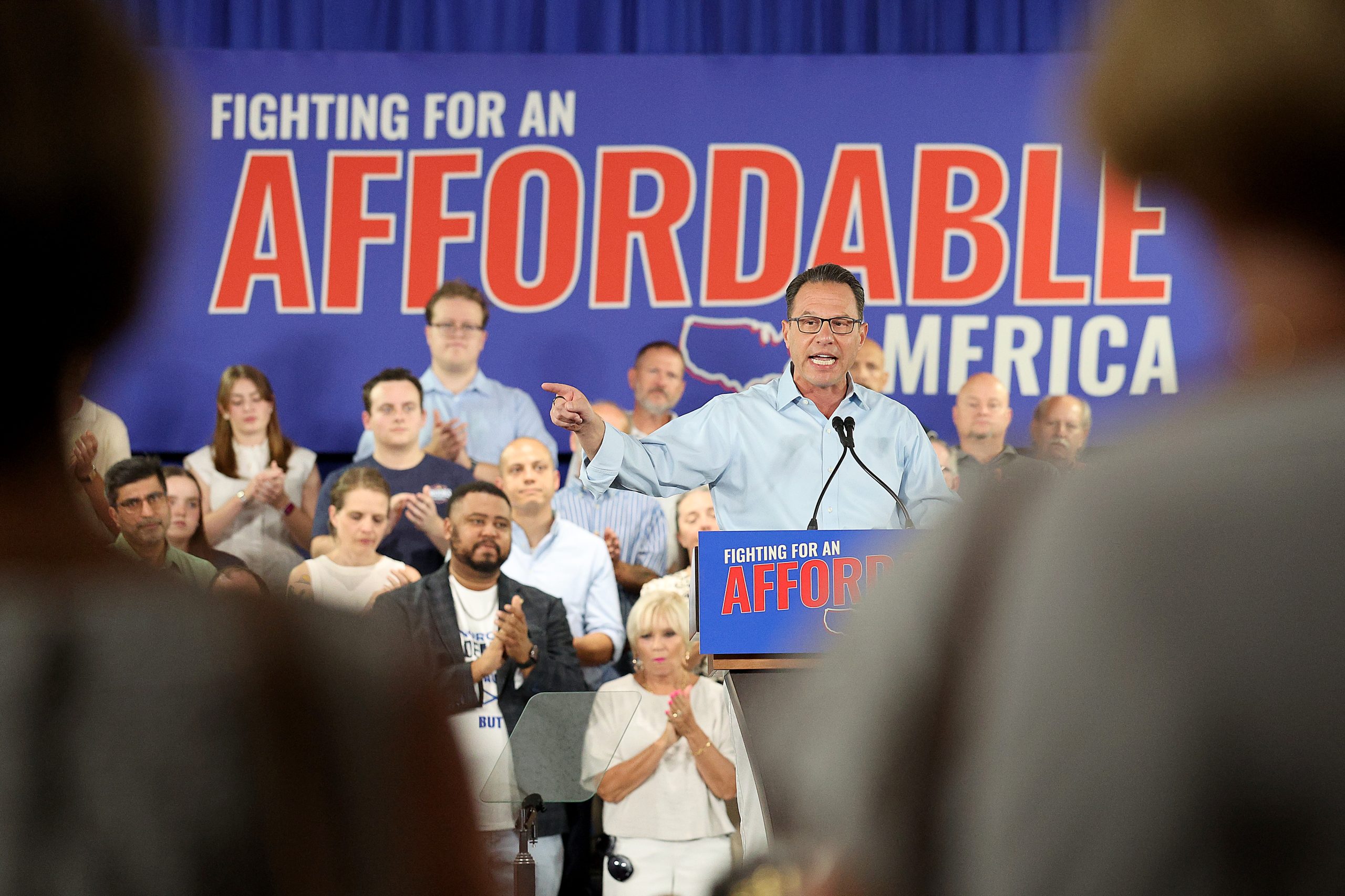
    Gov. Josh Shapiro addresses the audience during a July 26 rally for congressional candidate Bob Brooks at the United Steelworkers Union Hall in Bethlehem.David Maialetti / Staff Photographer

    His campaign released a Spanish-language digital ad focused on benefits of the Working Pennsylvanians Tax Credit and the Property Tax/Rent Rebate Program, which is targeted toward seniors and people with disabilities.

    “If you’re working, you get to keep more of your money. Up to $800 more, more money in your pocket. And right now, every little bit helps,” a woman in the commercial said in Spanish.

    Ultimately, Zandi said, “it’s very difficult for lawmakers at any level of government to change the picture on affordability, at least any time quickly,” because those issues are due to broader national and international forces.

    There’s also no one-size-fits-all approach for a governor to tackle the costs of education, housing, energy, childcare, elder care, healthcare, and groceries.

    “Each issue that makes up the affordability crisis requires its own set of solutions and efforts, so it feels like a laundry list of policy steps, and it is,” he said. “But that actually is probably the only way to make a difference.”

    For many Pennsylvanians, paychecks feel like simply treading water: By the time all expenses are covered, there’s little money left to save and build toward the future.

    “It just seems that money doesn’t go as far as it used to,” said Thomas Schank, 49, of Scranton. “I’ve gotten raises at work over the last two years, but everything else went up also, so really, no net gain.”

  • Johnny Doc is a free man after President Donald Trump cut his six-year prison term short

    Johnny Doc is a free man after President Donald Trump cut his six-year prison term short

    Johnny Doc is free.

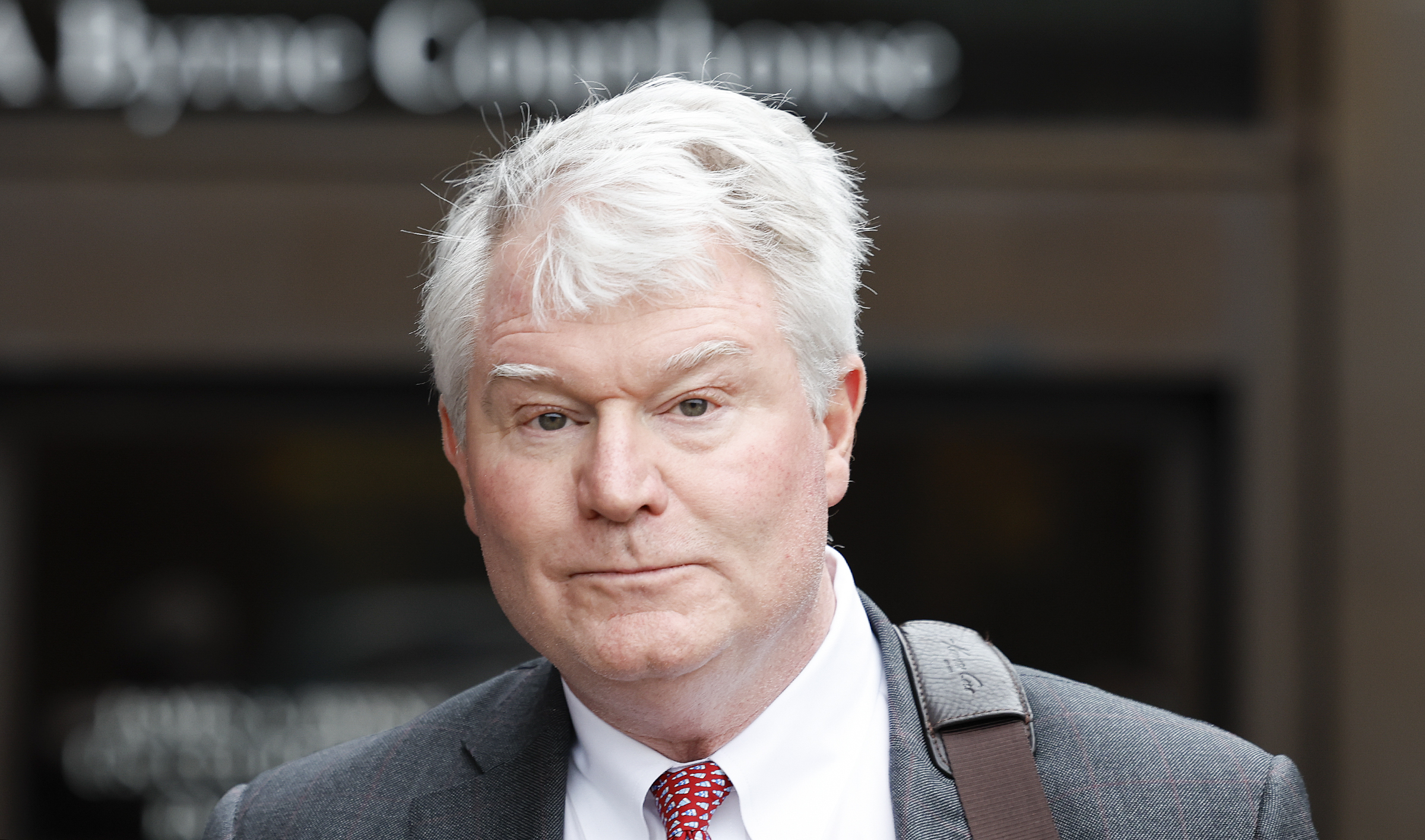
    Convicted former Philadelphia labor leader John Dougherty was released Friday afternoon from a federal penitentiary in Lewisburg, his lawyer said, capping a surprise outcome that was the result of President Donald Trump’s decision to commute the remainder of Dougherty’s six-year prison term.

    Dougherty’s lawyer, George Bochetto, said he was released around 3 p.m. Attempts to reach Dougherty for comment Friday were unsuccessful.

    Dougherty — widely known as Johnny Doc — had served less than two years of that sentence, which came after he was convicted in two high-profile trials: The first in which he was found guilty of bribing former Philadelphia City Councilmember Bobby Henon, the second over his participation in an embezzlement scheme that cost his union nearly $600,000.

    For much of the past year, Dougherty had been petitioning U.S. District Judge Jeffrey L. Schmehl to release him on house arrest so he could provide care for his gravely ill wife. But Schmehl had repeatedly denied those efforts.

    Trump’s decision to commute Dougherty’s sentence instead will result in a more sweeping form of relief: His conviction will remain intact, but he will not be subject to any monitoring or house arrest, and he will no longer have to pay about $1.6 million in restitution to the union he was convicted of defrauding.

    Bochetto called Trump’s decision “a magnificent gesture of compassion.” And he said it came after he’d been in regular communication with White House staff members about the dire and longstanding health challenges faced by Dougherty’s wife, Cecilia.

    A White House official said Friday that those circumstances figured into Trump’s decision — particularly because Dougherty’s father-in-law, who had been serving as the primary caretaker, died last year.

    Bochetto said there was “absolutely no reason” to keep Dougherty behind bars while his wife’s health was continuing to decline.

    Dougherty, while testifying before Schmehl earlier this year, said he had done everything he could from prison to lift his wife’s spirits — mailing her letters, routinely calling her, and even singing to her over the phone.

    But he said he was desperate to get home and help her manage a set of challenges that have left her paralyzed and largely nonverbal. He said his adult daughters and private aides were struggling to provide the type of intensive, round-the-clock care she requires.

    “I just want to take care of Celia,” he said.

    The U.S. Attorney’s Office had opposed Dougherty’s efforts to be released. A spokesperson said the office had no comment on Trump’s decision to set Dougherty free.

    Beyond caring for his wife, it was not immediately clear Friday what Dougherty’s future might hold — or whether he’d use his newfound freedom to try to return to the political stage.

    Before he was prosecuted, Dougherty was a bona fide power broker while running Local 98 of the International Brotherhood of Electrical Workers, which he turned into the biggest independent source of campaign money in Pennsylvania. That funding helped elect mayors, City Council members, and members of Congress. It also helped bolster the judicial candidacy of Dougherty’s brother, Kevin Dougherty, who won a seat on the Pennsylvania Supreme Court in 2015.

    Even if John Dougherty did want to seek a return to the spotlight, it would have to come from a different perch.

    Not only is Local 98 under new leadership, Dougherty’s convictions on counts of bribery and embezzlement make him ineligible to hold an elected union office for 13 years under U.S. Department of Labor laws.

    Labor leader Ryan Boyer, who replaced Dougherty as chair of the Philadelphia Building and Construction Trades Council, said he nonetheless expected Dougherty to end up back in the mix in some fashion.

    “If I know John the way I know John,” he said, “he’s not going to sit on his hands.”

    Staff writers Sean Collins Walsh and Maggie Prosser contributed to this article.

  • The CDC’s latest measles update still doesn’t include Pennsylvania-reported deaths

    The CDC’s latest measles update still doesn’t include Pennsylvania-reported deaths

    The Centers for Disease Control and Prevention’s latest update Friday on the toll of measles outbreaks nationally continued to omit two measles-related deaths reported last week in Pennsylvania, extending an unusual standoff between federal and state health authorities.

    The agency instead placed an asterisk in a column where, if reported, the Pennsylvania deaths would be recorded as the first in the nation this year. A note below stated that ”available information does not establish whether measles caused or contributed to the deaths or whether the individuals died from other causes while infected with measles.”

    The omission marked a clear departure from the agency’s normal operating procedure, as President Donald Trump’s administration and Democratic Gov. Josh Shapiro continue to clash over how the deaths were characterized.

    States report to the CDC cases and deaths for dozens of infectious diseases, such as hepatitis, influenza, and measles. The CDC has long compiled the data into reports that help epidemiologists monitor outbreaks and risk, and can inform lawmakers’ efforts to improve public health policy.

    In a rare break from that norm, Health and Human Services Secretary Robert F. Kennedy Jr. asked the CDC’s newly appointed director, Erica Schwartz, to omit the Pennsylvania deaths, according to Reuters.

    The move escalated a spat between Kennedy, a longtime anti-vaccine activist, and Shapiro, which began when the governor announced the deaths last Tuesday at a news conference in Lancaster County.

    Shapiro accused Kennedy of spreading vaccine misinformation that has contributed to declining measles vaccination rates, and Kennedy suggested that Shapiro’s office had fabricated the deaths to win political points.

    Public health experts warned that the ongoing political controversy sows doubt in what was designed as an unimpeachable health resource — national disease surveillance — and detracts from the ultimate public health goal of limiting the spread of illness.

    “Every data point is a broken family, a mother crying, a future that’s lost. Instead of grieving that and making sure it never happens again, you’re debating the mechanism of death,” said Brian C. Castrucci, an epidemiologist and president and CEO of de Beaumont Foundation, a community health philanthropy outside Washington, D.C.

    Pennsylvania measles-related deaths

    The Pennsylvania Department of Health reported the two deaths to the CDC the morning of Aug. 25, and professional staff at the CDC “did not express any concern regarding the information,” Neil Ruhland, a department spokesperson, said in an email.

    He described the communication that followed as an extension of the department’s ongoing communications around the state’s outbreak:

    The next day, the state health department discussed the details of each case with CDC professional staff. The CDC requested records containing identifiable information, which the health department did not share, consistent with its past practices.

    Shapiro has cited state privacy laws, and the need to protect the privacy of the families involved to ensure community trust, with limiting his ability to release more information.

    Instead, the health department asked the CDC for a case report form to provide de-identified information. The health department says it has not yet received that form.

    Pennsylvania health officials have a measles outbreak response meeting with the CDC every other week, and most recently met on Tuesday.

    “CDC professional staff have repeatedly made it clear that it has been supportive of DOH’s measles outbreak response,” Ruhland said.

    The CDC’s website says the agency plans to update its measles death count once it has completed its review of Pennsylvania’s cases. But officials have not said what additional information they need from Pennsylvania or when they expect to complete their review.

    The agency did not respond to a request for comment in time for publication.

    Joshua Sharfstein, a physician who served as Maryland’s Health Secretary from 2011 to 2014, said he has never heard of the CDC omitting disease surveillance data reported by states.

    “I wouldn’t say it’s off the table for the CDC to want more information,” but the way the agency went about it in Pennsylvania’s case is unusual, said Sharfstein, who also served as Baltimore’s health commissioner and currently works as a health policy professor at Johns Hopkins University.

    He said he would expect the agency to report Pennsylvania’s data, while alerting officials they are looking for more information. “It’s supposed to be a collaborative relationship,” Sharfstein said.

    Pennsylvania officials initially provided no additional information to the public about the two people who had died, other than they were unvaccinated Lancaster County residents.

    The state’s decision to call the deaths measles-associated came after the state health department’s “epidemiology team thoroughly investigated and verified both individuals tested positive for measles,” Pennsylvania Health Secretary Debra Bogen said in a statement.

    Pennsylvania defines a measles-associated death as deaths of people where evidence of measles is present, even when the disease may not be assessed by the coroner as the immediate cause of death.

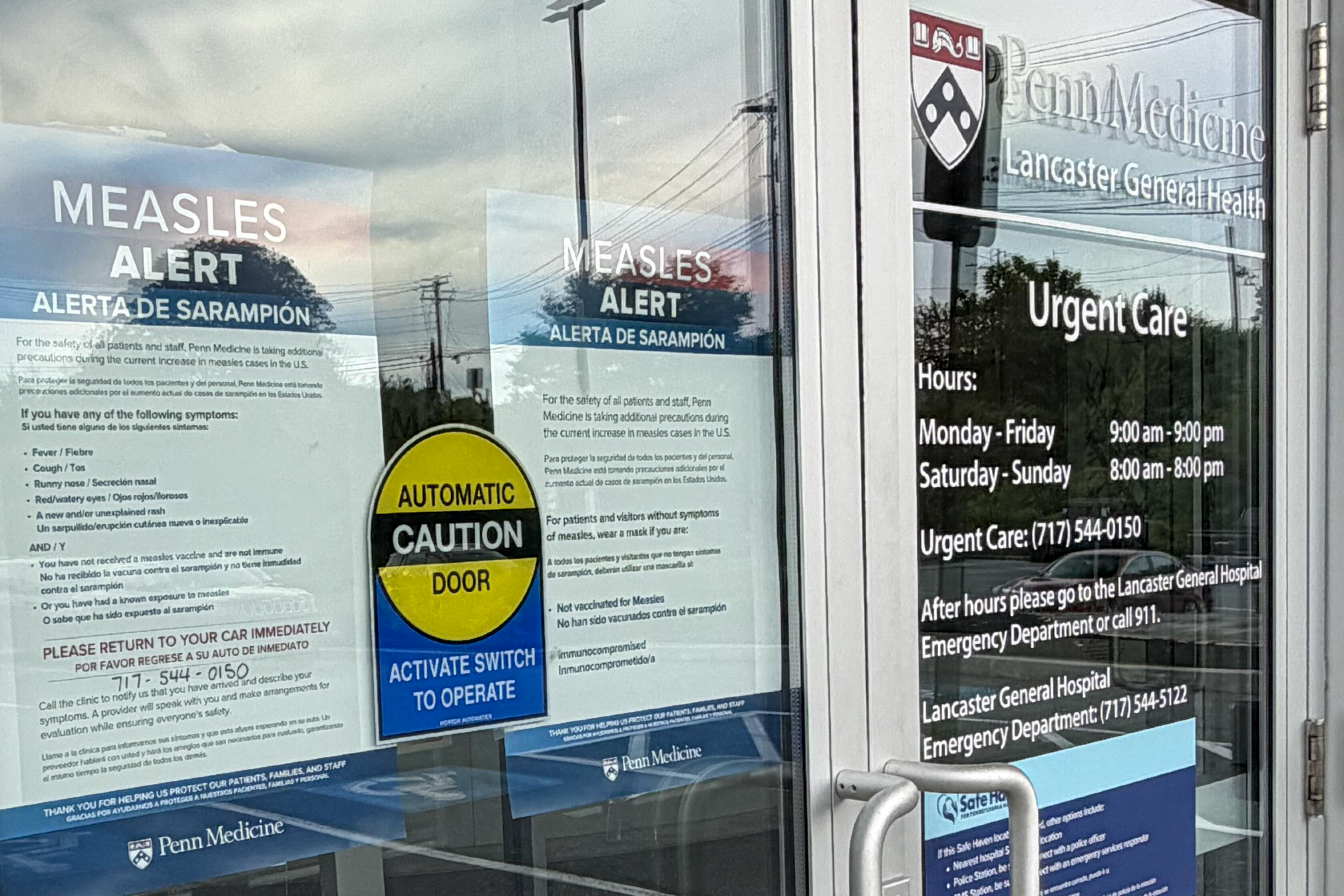
    An alert about measles is posted in the window of a medical clinic in Lancaster.Gillian McGoldrick / Staff

    Lancaster County’s coroner, Stephen Diamantoni, added confusion last week when he contradicted the state’s account.

    Diamantoni, a physician and elected Republican, said his office was investigating one death involving a newborn and said postmortem testing showed the infant had a measles infection acquired before birth. But he said he did not believe measles contributed to the child’s death.

    The child died shortly after birth of a lacerated spleen with trauma to the torso, Diamantoni said. He did not know what caused the lacerated spleen or trauma.

    He later said measles was noted on the infant’s death certificate as a significant condition “contributing to death but not resulting in the underlying cause,” because the baby tested positive for measles.

    On Friday, he said a 6-week-old Amish infant who was being treated for a deadly genetic disorder had died of measles in mid-August. He said he did not know if the case was the second measles-related death Pennsylvania reported, saying that he reported the death to the CDC on Friday.

    Pennsylvania’s health department said it was aware of the information the coroner reported Friday and had “no new measles-associated deaths to report at this time.”

    Shapiro reshared a news article about the death on X. In his post, he blamed Kennedy for creating “a firestorm of conspiracy theories that denied these families’ pain, invaded their privacy, and undermined public health.”

    “It’s long past time for RFK to stop playing games with people’s lives, report these deaths accurately on the CDC dashboard, and heed the guidance of actual medical experts so people get accurate information to discuss with their trusted healthcare providers and can best protect themselves and their children against this deadly disease,” he wrote.

    Kennedy fired back, highlighting the Lancaster coroner’s disclosures, in another X post later on Friday: “The facts emerging now demonstrate why CDC waited for the evidence rather than allowing political grandstanding to dictate its reporting.”

    Politicizing public health

    Fixating on whether a patient died “because of” or “with” measles inevitably politicizes the issue and does not benefit people’s health, Jake Scott, a clinical associate professor of infectious diseases at Stanford University, wrote in an opinion piece published online by the Center for Infectious Disease Research and Policy at the University of Minnesota.

    Measles usually kills through the complications it causes, such as pneumonia, encephalitis, secondary bacterial infections, and pregnancy complications, he wrote.

    “A death tally that can be altered by officials whom it embarrasses will not be trusted by anyone, including the officials who edited it,” Scott wrote.

    Diamantoni, Lancaster’s coroner, told The Inquirer earlier this week he did not want “to be dragged into a political fray.”

    “Our role in our office is not political in any way. We’re focused on determining the cause and manner of death, and using objective and scientific methods to do that,” he said. “We’ve worked hard to be sure that the information we’re providing is based on objective things.”

    More than a week into the controversy, lawmakers continue to take political jabs.

    “I am disgusted the Trump administration is putting Pennsylvania families at risk by spreading dangerous misinformation and politicizing these tragic deaths,” U.S. Rep. Brendan Boyle (D., Phila.) said in a statement.

    Pennsylvania’s highest-ranking federal lawmakers — U.S. Sens. John Fetterman, a Democrat, and Dave McCormick, a Republican — did not respond to a request for comment Thursday about the state’s standoff with the CDC. McCormick voted to approve Schwartz as the new CDC director; Fetterman voted against.

    U.S. Rep. Brian Fitzpatrick (R., Bucks), the only federal GOP lawmaker in the Philadelphia region, also did not respond to a request for comment. Neither did U.S. Rep. Lloyd Smucker, the Republican who represents Lancaster County and who blasted Shapiro last week for not providing more information about the measles-associated deaths.

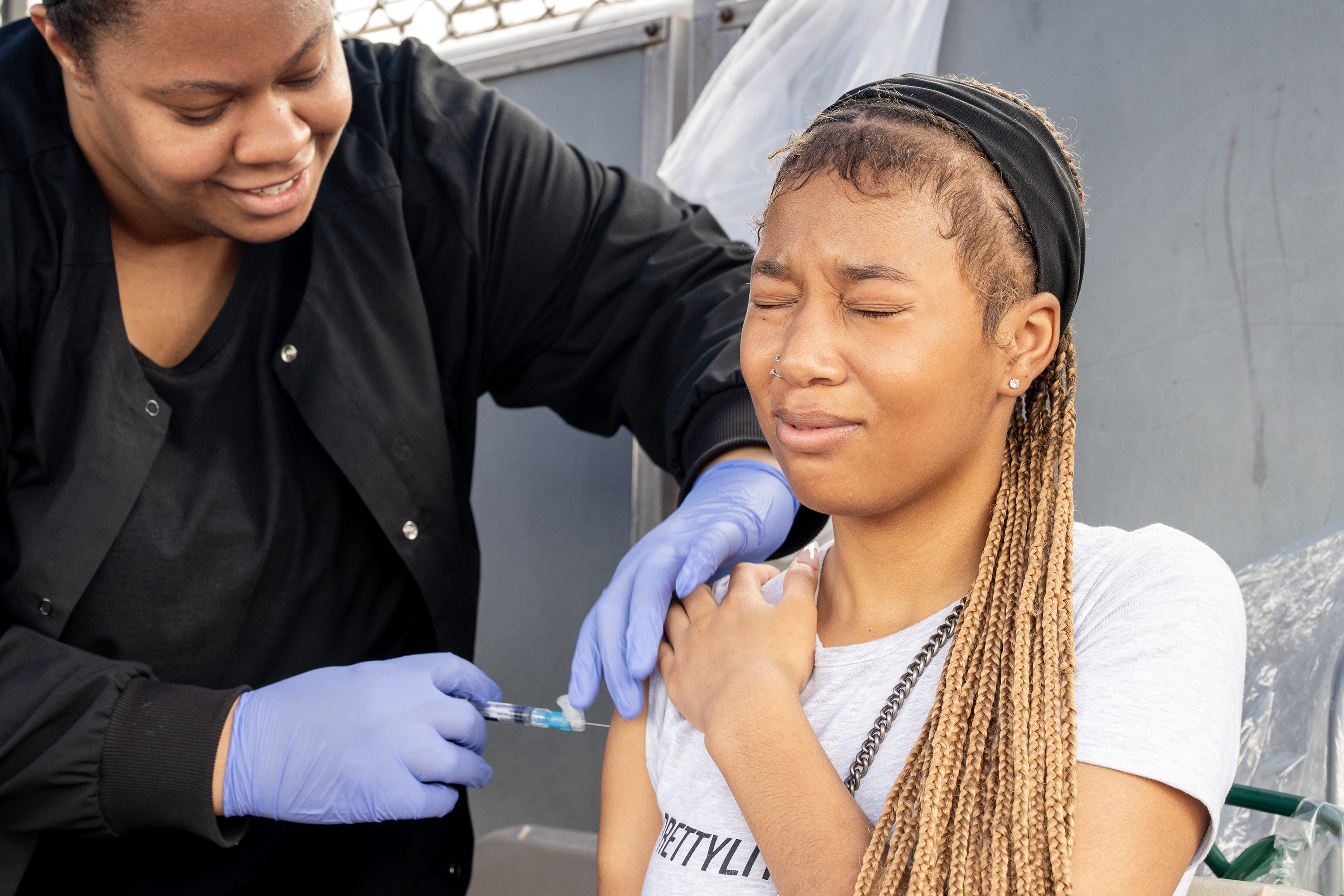
    Cianey Brown, 16, receives an immunization last month during the School District of Philadelphia’s sixth annual Back-To-School Bus Tour stop at Marcus Foster Memorial Stadium. Tom Gralish / Staff Photographer

    Measles outbreak continues

    Public health leaders, doctors, and epidemiologists say that finding a path forward has become an increasingly partisan issue at a time of rising vaccine hesitancy.

    Medical experts will be tasked with trying to rebuild trust in health authorities in order to contain a rapidly spreading outbreak.

    “How can any American citizen begin to make decisions about their health right now, in the milieu of misinformation and falsehoods we’ve created?” said Castrucci, de Beaumont’s CEO. “We have to get back to a point where at least the data can be trustworthy.

    As of Friday, there have been 577 measles cases in Pennsylvania, including 115 reported within the last week, according to the state health department’s online measles dashboard.

    Only South Carolina has reported more measles cases than Pennsylvania so far this year, according to the CDC’s measles webpage. There have been 3,134 cases nationally this year, the agency reported in its latest update Friday.

    Pennsylvania’s measles-associated deaths remain an asterisk.

    Inquirer staff writers Sam Janesch and Aubrey Whelan contributed to this article.

  • A 6-week-old Amish baby died from measles in Pennsylvania, local coroner confirms, as feud between Shapiro and RFK Jr. continues over the deaths

    A 6-week-old Amish baby died from measles in Pennsylvania, local coroner confirms, as feud between Shapiro and RFK Jr. continues over the deaths

    A six-week-old Amish infant from Lancaster County died from measles last month after receiving the care of a community clinic for a deadly genetic disorder, Lancaster County Coroner Stephen Diamantoni said Friday.

    The disclosure comes amid an escalating clash between Pennsylvania Democratic Gov. Josh Shapiro and President Donald Trump’s administration over whether two deaths reported by the state last week should be attributed to the ongoing measles outbreak in Pennsylvania.

    The six-week-old infant died from measles at home and had been in the care of the Clinic for Special Children, a Lancaster County-based treatment and research center focused on diseases found in Old Order Amish and Mennonite communities, LancasterOnline first reported.

    The baby had been getting treated for a deadly genetic disorder, Amish lethal microcephaly, prior to the child’s death from measles, Diamantoni confirmed.

    The baby had been receiving palliative care and was not expected to live much longer than six months due to the genetic condition that occurs in one in every 500 newborns within Pennsylvania’s Amish community, Diamantoni said.

    The announcement follows a nearly two-week-long public feud between Shapiro and U.S. Health and Human Services Secretary Robert F. Kennedy Jr. over whether to classify the Pennsylvania deaths as measles-related. Their standoff has led to the Centers for Disease Control and Prevention taking the unusual step of withholding the deaths from its measles tracker, reportedly under pressure from Kennedy.

    Shapiro, a first-term Democrat seeking reelection in November, initially provided little detail about two measles-related deaths when he announced them last Tuesday in a news conference, saying only the state’s first deaths from the highly contagious disease since 1991 involved residents of the county who were unvaccinated.

    Diamantoni, an elected Republican who is also a physician, subsequently said his office was investigating the death of a newborn who had measles, but did not believe measles contributed to the child’s death. He said the newborn died of a lacerated spleen, and postmortem testing showed a measles infection acquired before birth. He later said “measles” was included on the newborn’s death certificate under a section that lists “significant conditions contributing to death but not resulting in the underlying cause.”

    The deceased baby’s family, who are also Amish, told The Atlantic they believed a severe case of measles during pregnancy contributed to their newborn’s death.

    The discrepancies between Diamantoni’s statements and the state’s created an opening for anti-vaccine activists, including Kennedy, to publicly question whether the deaths could be attributed to the measles. Kennedy accused Shapiro of fearmongering about the disease — suggesting his office may have even fabricating the deaths.

    But the six-week-old infant reported Friday was confirmed to have died from the measles, Diamantoni said, after his office investigated the child’s death that previously was not reported to his office.

    The Clinic for Special Children did not know it was necessary to report the death to the Lancaster County coroner’s office, Diamantoni said.

    Diamantoni said he reported the six-week-old baby’s death to the CDC on Friday, but had not reported it to the state Department of Health.

    He said he did not know whether the six-week-old was the second measles-associated death reported by Pennsylvania last week.

    The Pennsylvania Department of Health said it was aware of the information shared by Diamantoni, noting the state had no new measles-related deaths to report Friday.

    The state has said the Pennsylvania health department’s epidemiology team’s thoroughly investigated and determined the two announced deaths were measles-related.

    The state defines a measles-associated death as deaths of people where evidence of measles is present, even when the disease may not be assessed by the coroner as the immediate cause of death.

    The Shapiro administration has said state privacy laws have limited their ability to release more personal information about the two measles-related.

    Shapiro reshared Friday a local news article about the six-week-old baby’s death and criticized Kennedy in an X post for choosing “to sow doubt, play politics, direct the CDC not to acknowledge these deaths, and even accuse me of fabricating these tragedies.”

    “That led to a firestorm of conspiracy theories that denied these families’ pain, invaded their privacy, and undermined public health,” Shapiro added.

    Kennedy highlighted the Lancaster coroner’s new disclosure in another X post later on Friday, noting “the facts emerging now demonstrate why CDC waited for the evidence rather than allowing political grandstanding to dictate its reporting.”

    A rare death

    As of Friday, there have been 577 measles cases in Pennsylvania, including 115 reported within the last week, according to the health department’s online measles dashboard.

    Measles deaths are rare. About three in 1,000 children who contract measles will die. While many infections are mild, measles can also cause severe complications, especially in young children, including pneumonia and brain swelling.

    Babies with Amish lethal microcephaly frequently die from respiratory infections due to the genetic condition leading the baby to develop with a severely small head and underdeveloped brain, Diamantoni said.

    But infants with the genetic condition usually do not die from the measles because the disease had been largely eradicated in the United States until recent years due to widespread vaccination, he said.

    “Usually there are not a lot of cases of measles, until recently,” Diamantoni added.

    Staff writer Sarah Gantz contributed reporting.

  • Key Pennsylvania races to watch in the midterm elections this November

    Key Pennsylvania races to watch in the midterm elections this November

    In the country’s premier battleground state, Pennsylvania Democrats believe they’re in striking distance of a tidal-wave victories that would dramatically shift the balance of power in both Washington and Harrisburg.

    For the first time in decades, the party could take full control of the legislature. That would give Democratic Gov. Josh Shapiro — seeking reelection with a wide polling gap on his Republican challenger Stacy Garrity — significantly more power to shape the direction of the state as he potentially pursues a White House bid in 2028.

    Democrats also see a chance to flip four congressional seats and take control of the U.S. House. Republicans, meanwhile, are prioritizing defending the Pennsylvania seats with their House majority on the line as President Donald Trump, who won the state just two years ago, sinks in popularity.

    The path for power in Washington in the high-stakes midterms runs through Pennsylvania and its results will be closely watched as both parties prepare for a presidential race in two years when the state promises to play a pivotal role.

    Voters across Pennsylvania will head to the polls in November to cast their ballots for races that will decide the balance of power in the state and nation.

    Here are the races to watch and how to vote.

    Shapiro’s November could dictate his 2028

    Shapiro, widely viewed as a likely contender for the 2028 presidency, has big ambitions this fall when he’ll stand for reelection against Garrity, the state’s treasurer.

    More than just securing his own reelection, Shapiro hopes to run up the margin and carry downballot Democrats across the finish line.

    Another double-digits win and a string of coattail victories would be a show of strength about his ability to perform in a key swing state that his party lost in the last presidential election. In a presidential primary, Shapiro could use that result to make an argument that he’s a strong general election candidate who can boost the Democratic brand.

    Two months out from the election, all signs point to a Shapiro win. He holds a historically large campaign war chest and a commanding 55-39% lead in the race against Garrity, according to a recent Philadelphia Inquirer/New York Times/Siena University poll.

    Garrity, who has been endorsed by Trump, broke the record in 2024 for the most number of votes received by a candidate running for state-level office in Pennsylvania. But support from the national GOP establishment has been limited, and as she faces off against a formidable incumbent, the question is: Can she overcome her stark cash disadvantage and low name recognition to become the state’s first female governor?

    Will Republicans hold on in competitive congressional seats?

    There are four U.S. House districts in the eastern portion of Pennsylvania, targeted by both parties as must wins. In each, the Republican incumbents are seeking to fend off highly financed challengers amid deep frustration among voters with the leader of their party that could translate into a wave of Democratic victories down ballot.

    1st Congressional District: Five-term Republican U.S. Rep. Brian Fitzpatrick faces a challenge from Bucks County Commissioner Bob Harvie in the district, which covers all of Bucks County and a portion of Montgomery. Fitzpatrick, a moderate who has survived previous blue waves, has maintained a fundraising advantage on Harvie unlike the other swing-district incumbents.

    7th Congressional District: Freshman Republican U.S. Rep. Ryan Mackenzie narrowly flipped the Lehigh Valley district two years ago and is widely seen as one of most vulnerable incumbents in Congress. He’s facing a challenge Democrat Bob Brooks, a retired firefighter and union leader whose blue-collar campaign has attracted support across the party’s ideological spectrum with endorsements from Shapiro and U.S. Sen. Bernie Sanders.

    8th Congressional District: Freshman Republican U.S. Rep. Rob Bresnahan ousted a six-term incumbent in this district centered in former President Joe Biden’s hometown of Scranton two years ago. But as he faces a tough challenge from Scranton Mayor Paige Cognetti, Bresnahan has faced scrutiny over his stock trades and his vote to cut Medicaid — to pay for Trump’s tax cuts — despite a promise to protect the program.

    10th Congressional District: Republican U.S. Rep. Scott Perry, a close ally of Trump, faces a November rematch against Democrat Janelle Stelson, a former TV anchor, in the Harrisburg area district. Stelson has consistently outraised Perry after narrowly losing in 2024.

    In addition to these four races both national parties have targeted, Shapiro has argued that the 9th Congressional District, where Democrat Rachel Wallace is taking on incumbent GOP U.S. Rep. Dan Meuser, is flippable — despite the strong GOP lean in the district, which stretches from Berks County to the New York state border. The district is home to two warehouses that ICE was planning to convert into detention centers before abandoning the plan after a backlash from residents.

    Will Democrats flip the Pennsylvania Senate?

    In Harrisburg, Democrats hold an extremely narrow majority in the state House, but the Pennsylvania state Senate has been under Republican control for more than 30 years.

    This year, Shapiro wants to flip the chamber and win a trifecta to push forward his key priorities, such as codifying abortion access, raising the state’s minimum wage, and increasing funding for transit.

    Republicans currently hold 27 of the chamber’s 50 seats. Democrats, who currently hold 23 seats, need to win at least two additional seats and the governor’s office to win control of the chamber with the lieutenant governor as a tiebreaking vote.

    The seats, drawn advantageously for Republicans, have been stubbornly resistant to political change for decades.

    But this year a blue wave could usher in Democratic pickups in Philadelphia suburbs and the Lehigh Valley.

    Races to watch include:

    • Bucks County’s 6th District, where Republican incumbent State Sen. Frank Farry faces a challenge from Democrat Eileen Hartnett Albillar.
    • Montgomery County’s 24th District, where incumbent Republican State Sen. Tracy Pennycuick is up for reelection against Democrat Chris Thomas.
    • Bucks and Lehigh County’s 16th District, which will see a rematch race between incumbent Republican State Sen. Jarrett Coleman and Democrat Mark Pinsley, the Lehigh County controller.

    What are the important dates to know?

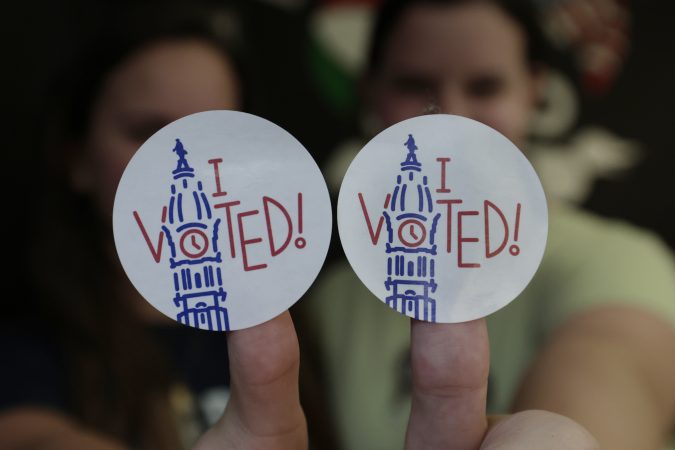
    Election Day is Nov. 3.

    The deadline to register to vote is Oct. 19. You must be at least 18 years old, a resident of Pennsylvania and a citizen of the United States to vote. You can register online, by mail, at your county elections office, or at one of several other government buildings.

    You can check your voter registration on the Department of State’s website.

    Pennsylvanians can vote by mail with no excuse required. To apply, fill out an application by mail, online, or in-person and send it into your county election office. Applications must be received by Oct. 27 at 5 p.m. and the completed mail ballot must be received — not just postmarked — by 8 p.m. on Election Day.

    An application and mail ballot can be completed in one visit at an election office, essentially functioning as early voting.

    Staff writer Fallon Roth contributed to this article.

  • Johnny Doc’s prison sentence was commuted by President Donald Trump, his lawyer says

    Johnny Doc’s prison sentence was commuted by President Donald Trump, his lawyer says

    Convicted former Philadelphia labor leader John Dougherty will have his six-year prison term cut short after President Donald Trump agreed to sign a commutation ending the rest of Dougherty’s sentence, according to Dougherty’s lawyer.

    George Bochetto said in an interview Thursday night he’s hopeful that Dougherty, the former city power broker known as Johnny Doc, could be freed from a federal penitentiary in Lewisburg as soon as Friday.

    Bochetto called Trump’s decision “a magnificent gesture of compassion.” He said Trump had signed the commutation Thursday afternoon.

    Records on the Office of Pardon Attorney’s website did not yet reflect a commutation approval as of Thursday night. And the White House press office did not immediately respond to a request for comment.

    Outgoing Pardon Attorney Ed Martin shared a news story about Dougherty’s impending release on social media and added: “Mercy granted by the Mercy President, Donald J. Trump.”

    Trump had denied Dougherty’s bid for a commutation earlier this year, according to that agency’s website. It was not immediately clear why circumstances changed this week.

    For months, Dougherty had been petitioning U.S. District Judge Jeffrey L. Schmehl to be released on house arrest to provide care for his gravely ill wife. But Schmehl had repeatedly denied those efforts, saying in part that Dougherty had failed to demonstrate he was the only person who could serve as an adequate caretaker.

    Prosecutors had opposed Dougherty’s request for similar reasons, and said the two years he spent behind bars of his six-year sentence was not enough time to merit release. A spokesperson for the U.S. Attorney’s Office did not immediately respond to a request for comment Thursday night.

    A commutation will keep Dougherty’s conviction intact, but allow him to return home to his wife, Cecilia, who Bochetto said was in “a desperate situation.” Bochetto said the act of clemency would also relieve Dougherty of having to pay about $1.6 million in restitution, and that Dougherty would not be subject to any monitoring or house arrest, saying Dougherty, upon release, would be “a free man.”

    Presidents have broad authority to issue pardons and commutations in federal cases, and Trump has shown a willingness to grant them to political allies during his second term in office. But Bochetto said Trump, a Republican, was being particularly gracious in this instance by commuting the sentence of Dougherty, a longtime Democratic stalwart.

    “Our criminal justice system needs to have some compassion,” Bochetto said. “There’s absolutely no reason to keep John Dougherty housed in a country club environment facility in Lewisburg when his wife so desperately needs him.”

    Bochetto said he’d been in regular communication with White House staff members in seeking to free Dougherty, and that his arguments focused on the same issues he used in the bid to receive compassionate release from Schmehl: That Dougherty’s wife, who has long suffered from a debilitating brain injury, has seen her condition worsen significantly since her husband was imprisoned, and that he is the only person equipped to provide the care she needs.

    Dougherty’s prosecution was one of the more significant local criminal cases in recent memory. For years, Dougherty had served as the head of his politically powerful union, Local 98 of the International Brotherhood of Electrical Workers. And from that perch, he was a certified political kingmaker — an organized labor leader with connections in City Hall and Harrisburg, and a man with the ability to raise funds or impart influence on a variety of issues across the state.

    But in 2024, he was sentenced to six years in prison after being convicted in separate trials — the first in 2021, after a jury found that he had spent years bribing former Philadelphia City Councilmember Bobby Henon, the second in December 2023 over nearly $600,000 he and others embezzled from the union.

    Earlier this year, while testifying before Schmehl, Dougherty revealed just how far away he was in prison from his life as a political power player: He told the judge that nearly all of his time now revolved around his wife, including sending her dozens of letters, using all of his allotted monthly phone minutes to call her, and singing her lullabies over the phone.

    Ryan Boyer, who replaced Dougherty as chair of the Philadelphia Building and Construction Trades Council, said he was happy for Dougherty.

    “I don’t think that John should have been arrested for what he did,” Boyer said in an interview Thursday night. “It’s correcting an injustice, and he’ll be welcomed home by a lot of people in the Philadelphia building trades, as well as Philadelphia in general.”

    Boyer said he expects Dougherty will be prohibited under the terms of his release from jumping back into labor and politics right away.

    “With him having a commutation, I think there will be some prohibitions with him getting back involved with labor,” Boyer said.

    But, he added, he doesn’t expect Dougherty to stay away forever.

    “John has a sharp mind,” Boyer said. “If I know John the way I know John, he’s not going to sit on his hands.”

    City Councilmember Jimmy Harrity said in an interview Thursday night he was happy Dougherty would be able to return home to take care of his wife.

    “I’m just happy that he’s going to be able to take care of Celia. I’m just happy for his family,” Harrity said. “I never want to see anybody go to jail, but the bottom line is everybody must pay their dues back. He got in trouble, he went to jail, he did some time.”

    As for whether Dougherty’s release would have an influence on Philly politics going forward, Harrity declined to say.

    “Oh, I don’t even want to speculate on that,” he said. “I have no idea.”

    While some labor leaders cheered the news of Dougherty’s release, one was notably less enthusiastic: Mark Lynch Jr., who succeeded Dougherty as business manager of the International Brotherhood of Electrical Workers Local 98.

    “We don’t spend our time focused on that,” Lynch said in a statement Thursday night, referring to Dougherty’s commutation. “Our focus is on the future of IBEW Local 98 and delivering results for our members.”

    While Lynch often appears at news conferences and Local 98 is still politically influential, he has taken a more under-the-radar approach than his predecessor.

    “Today, our members are working at essentially full employment,” Lynch said in his statement. “We have secured better health, dental and vision benefits while lowering costs to our members. We have negotiated some of the strongest wage increases in the country.”

    Another change: Lynch has lowered the amount that electricians pay into the union’s political committee. Dougherty, on the other hand, was able to build Local 98 into a political powerhouse in no small part by convincing his members to increase their contributions.

    “We are proud of the direction of the organization, and we intend to keep moving forward,” Lynch said.

  • Living in an exhausted, morally distressed nation

    Living in an exhausted, morally distressed nation

    This is not us.

    This is not the America we thought we were. As nurses, we’re sensitive to negative shifts in compassion and empathy. Almost two years of multiple, relentless attacks on America’s core values have left us morally distressed.

    It is not like us to set a weekly quota of arresting 2,000 of our law-abiding neighbors seeking asylum in the United States. It’s not like us to propose spending $20 million in taxpayer dollars on a device that will allow immigration agents to deliver painful electric shocks to any human being. It’s not like us to put those without criminal records in jails and provide them with less than adequate medical care that has now resulted in the deaths of at least 50 innocent human beings.

    Values out of whack

    As a nation, our actions are out of alignment with our values.

    We are overwhelmed by the constant barrage of toxic messages and distressful events that shape our sense of who we are as a society and negatively affect our physical and mental health. We have seen, and some have personally experienced, the horrific public health impact of the resurgence of preventable diseases and deaths from measles, a disease that had been eradicated from the U.S.

    As nurses, we have seen how words are used to evoke false beliefs. We have never seen a “vat” of solution injected into any person — let alone an infant, as President Donald Trump recently claimed about the childhood vaccination regimen. We have witnessed the fear and confusion of parents related to the mixed messages coming from non-pediatricians about the value of childhood vaccinations. Why change the vaccination schedule without evidence?

    We see reductions and disinvestments in essential research funding that will hurt Americans waiting for scientific breakthroughs. Discouraging the next generation of investigators threatens our standing as a global leader in research innovation.

    President Donald Trump and his former press secretary Karoline Leavitt at the White House earlier this year. Both have brought a new level of coarseness and personal denigration to official public discourse.Tom Brenner

    We experience ourselves the rising costs of life’s necessities, such as food, housing, and healthcare. And we endure public coarseness and disgraceful conduct among those elected to represent us, increasingly characterized by contempt and by labeling those with whom they disagree as “radicals,” “socialists,” “fascists,” or worse.

    These developments are not mutually exclusive, and they represent a troubling sign for a country where trust in the values of public institutions and in government leaders and workers is being eroded by outright lies and a lack of mutual respect. In 2025, only 17% of Americans trusted the government to do “what is right.”

    Moral distress occurs when one’s values are constrained because of institutional, social, political, or other barriers.

    The concept is often applied to healthcare workers, such as nurses. For example, moral distress has been widely documented when nurses are unable to deliver a treatment they know is best because of restraints imposed by the healthcare system in which they work.

    Repeated experiences of moral distress often lead to a sense of disillusionment, disengagement, moral outrage, burnout, and apathy. When this moral distress and resulting harm is experienced by a broad swath of the general population, we call this civic moral distress.

    So what can we do?

    We know respectful dialogue instead of derision advances collaborative agendas and builds solid coalitions. We know public health is key to the prevention of disease. We know respect for the dignity of our fellow humans has nothing to do with their age, race, gender, political ideology, or immigration status. We know a lack of basic healthcare leads to emergency room visits and higher costs. We know the average citizen is not being heard by those who represent them to address the broader societal and moral problems at home and feels powerless to change any of it.

    Don’t be disillusioned

    There are no easy antidotes to civic moral distress. Experts coalesce around key principles, grounded in a foundation of trust, that could move us from a morally distressed nation to one characterized by moral strength and integrity.

    For everyone: Be kind, be truthful, perform one random act of kindness every day, care for your neighbors. For newspapers: Publish one issue a week that focuses on local community issues. For all government officials: Don’t break everything just because you can; stay in your lane and do not make healthcare recommendations out of your area of expertise.

    For all Americans: Do not be disillusioned.

    Advancing this agenda will require significant moral courage. Failing to do so will further erode our society, our humanity. And although civic moral distress is our current reality, it need not be our future.

    Connie M. Ulrich is a registered nurse and professor of nursing and of medical ethics and health policy at the University of Pennsylvania School of Nursing. She is a Hastings Center Fellow. Mary D. Naylor is a registered nurse and professor of gerontology and nursing at Penn’s School of Nursing. Martha A.Q. Curley is a registered nurse and professor of pediatric nursing at Penn’s School of Nursing.

  • EPA proposal could leave the public in the dark on data center plans

    EPA proposal could leave the public in the dark on data center plans

    WASHINGTON — A plan by the Environmental Protection Agency could make it harder for the public to learn about and comment on proposed AI data centers that have sparked backlash in communities across the United States and transformed the midterm election landscape.

    The EPA proposal would eliminate a federal requirement that states notify the public and seek comment before issuing air pollution permits for data centers and other industrial facilities. States could still offer opportunities for public comment, but the EPA would no longer mandate them as a condition for states to grant permits.

    Critics say the move could thwart local residents from learning about proposed data centers or making their voices heard before projects are approved and construction begins. The move comes during a widespread backlash as tech giants build hundreds of massive server warehouses to fuel artificial intelligence and cloud computing.

    “By eliminating the long-standing federal requirement for public notice, this proposal continues efforts by the Trump administration to turn its back on the fundamental EPA principle of transparency,” said Mike Koerber, a former deputy director of EPA’s air quality office.

    If made final, the plan could create “an unlevel playing field where citizens in one state are kept completely in the dark about new data centers and heavy industrial emissions in their backyards, while neighboring states maintain oversight,” he said.

    Under the EPA plan, states with weak or no requirements for public comment could speed permits for data centers, power plants and other pollution sources without consulting the public or even informing communities where the facilities are located, Koerber and other critics said.

    Communities deserve a chance to weigh in, advocates say

    “Data centers and other industrial sources should not be able to get their air pollution permits in secret,” said Keri Powell, senior attorney for the Southern Environmental Law Center, an advocacy organization that leads a coalition of nearly 200 environmental, health and community groups that filed comments with the EPA opposing the plan. “Communities deserve a chance to weigh in” before potentially harmful projects are approved.

    An EPA spokesperson called that a false narrative.

    “In our proposal we are saying that states get to pick how they want their permitting process to go for minor sources” of air pollution, spokesperson Carolyn Holran said.

    The EPA proposal does not specifically identify data centers, she said, noting that the plan also would apply to laundromats, car repair shops and even landfills and steel mills that are considered “minor” pollution sources under the federal Clean Air Act.

    The proposal does not demand that states make particular changes to their programs, nor does it alter federal emission standards or weaken environmental protections, Holran said. “Rather, the proposal simply aligns the national program with the Clean Air Act language to ensure that states are in the lead regarding their programs.”

    EPA Administrator Lee Zeldin, who has made U.S. leadership in AI a top agency priority, said in a statement that the plan is aimed at “cutting unnecessary and burdensome red tape, unleashing American energy and advancing cooperative federalism” with states. The EPA is expected to make the rule final next year.

    President Donald Trump continues to stick up for data centers, even as politicians from both parties criticize them and many communities try to block them. Trump said on social media this week that U.S. communities that don’t have data centers will “end up being backwards and poor.”

    Trump says data centers are crucial in the AI race against China

    Trump has acknowledged that data centers need “a little public relations help” and has pushed tech companies to generate their own electricity to shield consumers from higher utility bills. The Republican president calls data centers critical to winning the AI race against China.

    Environmental groups and other critics say the EPA proposal ignores the reality that many states, particularly in the South and Midwest, don’t require public notice or hearings beyond those set by federal agencies. The federal plan would leave many communities in the dark before data centers show up in their backyards, they said.

    “It’s beyond cruel for Trump’s EPA to silence front-line communities who bear the brunt of unhealthy air,” said Brandon Jones-Cobb, a senior attorney at the Center for Biological Diversity, another environmental group.

    The EPA “has already turned its back on science, cut enforcement against industrial polluters and eliminated life-saving air pollution measures,” he said. “Now it wants to shut the public out of decisions to build or expand facilities that expose communities to dangerous air pollution, including data centers.”

    Powell, whose organization focuses on six Southern states from Virginia to Alabama, said many states “only do what is required by federal law” when it comes to public notice of land-use projects and other environmental concerns.

    “We rely on a minimum federal requirement to ensure we have environmental protections and a voice,’’ she said in an interview, calling regulation of data centers a crucial issue in a region where the energy-hungry behemoths are proliferating. Virginia and Georgia are both among states with the highest concentration of current and proposed data centers.

    Americans worry data centers could cause pollution, job losses

    Besides powering AI and cloud computing, data centers are often sources of nitrogen oxide, which helps form ozone, as well as carbon monoxide and other air pollutants. Local communities also have expressed concerns about excessive water use and noise from data centers. Many Americans worry that AI could increase economic disparities and cause widespread job losses.

    Data center advocates stress that local taxes paid by the centers can help fund public schools, reducing the financial burden on homeowners.

    Jane Williams, executive director of California Communities Against Toxics, said even if data centers ultimately are approved, “every community should be able to participate robustly in governmental decisions that can pollute our air.’’

    Rolling back the EPA rule “pulls a dark cloud, filled with soot and toxic chemicals, over communities’ right to know what polluting facilities are planned in their community,” she said.

  • A federal judge has blocked Trump’s second try to restrict birthright citizenship

    A federal judge has blocked Trump’s second try to restrict birthright citizenship

    A federal judge in Maryland temporarily blocked much of President Donald Trump’s latest effort to withhold citizenship from babies born in the United States to noncitizen parents, ruling that the Supreme Court had already settled questions reopened by an executive order Trump signed in August.

    While the decision was limited to children born after Feb. 19, 2025, including those born in the future, Judge Deborah L. Boardman wrote that the order would likely affect babies the Supreme Court had already defined as citizens. The ruling delivered a sharp rejection of the president’s renewed efforts to restrict birthright citizenship, after the Supreme Court ruled 6-3 in July that a previous, more sweeping, executive order from 2025 was unconstitutional.

    “No presidential executive order can undo what the Supreme Court has done,” she wrote.

    Boardman’s order took a dim view of the Trump administration’s reasoning, which she characterized as a thinly veiled attempt to get around the Supreme Court’s decision. She wrote that the president and others named in the lawsuit “completely misread” the majority’s opinion and embraced a “distorted interpretation” of its conclusions.

    In a 35-page opinion, she described the latest order as only the most recent attempt to curtail birthright citizenship by any means that could survive legal scrutiny.

    “Since his second term in office began on January 20, 2025, the president has tried, through executive order, to upend our country’s longstanding tradition of birthright citizenship and eliminate, for large swaths of Americans, the right to citizenship by birth, a right enshrined in the Citizenship Clause of the Fourteenth Amendment,” she wrote.

    Boardman described a number of ways that children covered by the lawsuit could have their citizenship rescinded, including if the Trump administration moved to label their parents members of terrorist groups or “alien enemies” under arbitrary legal determinations. She cited a pattern in which the administration has accused Venezuelan nationals of being affiliated with the criminal organization Tren de Aragua, often without evidence, in deportation proceedings.

    While she stressed that it was too soon to find that the order itself was unconstitutional, she wrote that it already appeared clear that it was unconstitutional as applied to the class of babies defined when immigration groups initially sued last year to block Trump’s first order.

    The order this year had included other measures to create novel categories of babies that could be disqualified from citizenship, including those born to parents engaged in so-called “birth tourism,” through which mothers deliberately traveled to the United States to give birth.

    It was unclear how the Trump administration planned to tag those it suspected of traveling to the United States to have their children. But Boardman noted that the executive order was broad, describing anyone who engaged in a “commercial transaction” — such as purchasing a plane ticket — as traveling to access birthright citizenship.

    The Supreme Court’s decision upholding birthright citizenship “is the law of the land,” Boardman wrote. “The President must follow it.”

    This article originally appeared in The New York Times.

  • Pennsylvania measles deaths are the cost of poor public health leadership | Editorial

    Pennsylvania measles deaths are the cost of poor public health leadership | Editorial

    The two recent measles-related deaths in Lancaster County, including that of a newborn, were the first in Pennsylvania in 35 years. Sadly, as vaccination rates decline across the commonwealth and the country, they will likely not be the last.

    The deaths occurred amid a major measles outbreak in Lancaster that has sickened nearly 400 people. Nationwide, the number of cases grew to a 35-year high.

    In normal times (a.k.a. before Donald Trump), federal and state government officials would work together to contain the outbreak, protect the public, and use the incident to urge residents to get vaccinated.

    But under Trump, all issues are political. Someone must lose so he can win. Rather than lead and unite, the president and his minions divide and misinform.

    Gov. Josh Shapiro did what any responsible public official would do. He traveled to Lancaster General Health’s Women and Babies Hospital to express empathy, support the local community, and urge the public to get vaccinated.

    “We hope, and we pray, that those deaths will be the last,” Shapiro said. He underscored, “This illness and death from measles is completely preventable.”

    Initially, state officials did not provide details about the two people who died in order to protect their privacy.

    Lancaster County Coroner Stephen Diamantoni, a Republican elected official who is also a physician, said the newborn tested positive for measles, but died from a ruptured spleen. State health officials clarified that they define a “measles-associated death” as one in which measles was present, even if it is not the immediate cause of death.

    That provided an opening for others to stir the misinformation sphere.

    Robert F. Kennedy Jr., the dangerously unqualified head of the U.S. Department of Health and Human Services, rushed right in, claiming on social media that Shapiro’s administration may have “fabricated” the deaths, and wrongly commenting in an interview on C-SPAN that “they cannot find any measles deaths in Lancaster County.”

    To be sure, Pennsylvania health officials should have been more forthcoming in sharing information about the patients’ ages, causes of deaths, and reasons for being unvaccinated.

    The lack of details “created fertile ground for conspiracy theories to thrive,” said Paul Offit, a physician at Children’s Hospital of Philadelphia who heads the hospital’s Vaccine Education Center.

    Offit explained that measles can cause an enlarged spleen to become fragile, which can lead to rupture. He added that he learned from state health officials that the patients who died in Pennsylvania would have lived if they were not infected with measles.

    Bottom line: Measles played a role in the deaths.

    It is frustrating and sad that so much energy is needed to convince the public that vaccines work. Vaccines are tested, proven, and settled science. The most effective way to stop the spread of measles is to get vaccinated.

    Indeed, measles was declared eradicated from the United States in 2000. Thanks to vaccines, other viruses such as mumps, rubella, and chickenpox were either eliminated or reduced by as much as 99%.

    But measles has made a comeback in recent years as vaccination rates have declined. Pennsylvania is among the states with the most cases, and public health officials fear more outbreaks.

    The drop in vaccination rates is due in large part to the spread of misinformation across social media in recent years. That misinformation has been amplified by Trump, the king of conspiracy theories, witch hunts, and any other form of quackery that gets attention and plays to a crowd’s worst fears.

    In a cynical political deal to win over so-called Make America Healthy Again voters, Trump appointed Kennedy, who is not a doctor, to oversee HHS.

    Beyond his famous family name, Kennedy is best known for spreading misinformation about vaccines and promoting debunked claims about autism. He was a leading vaccine skeptic — and attention seeker — during the pandemic.

    From his powerful perch, Kennedy has upended vaccine policy. As a result of his anti-science agenda, the country is getting sicker.

    The sooner America’s leaders return to promoting evidence-based science and public health, the safer and healthier we will be.