Tag: Donald Trump

  • Josh Shapiro and Stacy Garrity will debate for Pennsylvania governor next month

    Josh Shapiro and Stacy Garrity will debate for Pennsylvania governor next month

    Democratic Gov. Josh Shapiro and Republican Treasurer Stacy Garrity, both candidates running to be Pennsylvania’s next governor, have agreed to face off next month in the first and only scheduled televised debate between them.

    The debate — scheduled for 8 p.m. on Oct. 7 and hosted by ABC 27 — will be held in Harrisburg and will air live on several stations owned by Nexstar across Pennsylvania, including WPHL-TV in Philadelphia.

    Both campaigns said they look forward to meeting face to face to discuss issues important to voters.

    “Game on,” said Matthew Beynon, a spokesperson for Garrity.

    Manuel Bonder, communications director for Shapiro’s campaign, said “we look forward to continuing to make the choice in this election clear.”

    Shapiro, who was elected governor in 2022 after serving as the state’s attorney general, holds a sizable lead against Garrity, according to a Philadelphia Inquirer/New York Times/Siena University poll conducted last month.

    As the November election approaches, Shapiro — who is a rumored contender for president in 2028 — has focused on translating his popularity to downballot Democratic candidates in four, nationally watched congressional districts and those running for seats in the Pennsylvania state Senate, which has been under Republican control for more than 30 years.

    Garrity, meanwhile, has struggled to gain traction among voters and to compete with Shapiro’s massive campaign funds. A quarter of likely Republican voters did not know who she was or know enough about her to form an opinion of her, The Inquirer/New York Times/Siena poll found.

    Next month’s debate could present Garrity with a fresh chance to introduce herself to voters statewide and make her case on why Shapiro should not be reelected.

    October’s debate is the only one scheduled between the candidates, though Garrity’s campaign have proposed several more. In 2022, Shapiro and his Republican challenger, State Sen. Doug Mastriano, did not debate after the two could not agree to terms.

    Topics likely to surface during the debate include data centers, the measles outbreak, and President Donald Trump.

    Both candidates have released television ads criticizing the other’s past support for data center development, which has grown increasingly unpopular in Pennsylvania and beyond. Garrity has denounced Shapiro for his shifting positions on data centers, though she has a mixed record herself. Last month he signed an executive order dramatically restricting their development, touting them as the strictest guardrails in the nation. Garrity has called for a pause in data center development.

    Garrity has also blasted Shapiro for his handling of the rollout of public health information in announcing two measles-associated deaths in Pennsylvania, saying he has stepped in front of verified facts. Shapiro has been critical of the Trump administration, saying the nation’s health secretary was responsible for the influx of measles cases by stoking misinformation.

    Trump has endorsed Garrity in the governor’s race, and Shapiro has repeatedly sought to tie her to some of his unpopular policies, highlighting her support for his tariffs on imported goods and unpopular war in Iran.

    ABC 27 anchor and reporter Dennis Owens will moderate the debate, which will also be available to view on streaming platforms.

  • You can now buy Philly-minted Trump coins with a golden hue

    You can now buy Philly-minted Trump coins with a golden hue

    Gold-hued $1 coins featuring the face of President Donald Trump are now available for purchase online and at the U.S. Mint gift shop on Independence Mall in Old City.

    But it’ll cost you more than a buck.

    Neither Philly’s Mint nor the website has single coins for sale, so early buyers can get no fewer than 25 coins in a roll for $61. A bag of 100 coins for $154.50 is also available. Households are limited to two orders until Thursday at 2 p.m. when the cap will lift.

    The commemorative coins, printed in Philadelphia to mark the 250th anniversary of the signing of the Declaration of Independence, may be used as legal tender.

    Early buyers may also find unique coins with their purchases: 250,000 Trump coins with a special-issue “July 4” mark, minted on Independence Day, have been randomly hidden in some rolls and bags, Willy Wonka-style.

    First announced in July by U.S. Treasury Secretary Scott Bessent, the coins bear Trump’s face on one side with the words Liberty, In God We Trust, and 1776 ~ 2026. The other side features the presidential seal, with “250″ inscribed on the eagle’s shield.

    The coins faced hurdles in production with critics arguing that they violate U.S. code that says “only the portrait of a deceased individual may appear on United States currency.” In response, Bessent cited historical precedent: In 1926, the U.S. minted a commemorative half-dollar featuring living President Calvin Coolidge.

    Although the coins are gold-colored, they are composed mostly of nonprecious metals, including copper, zinc, manganese, and nickel. No actual gold is used in the coins.

    In November, the mint stopped producing pennies due to rising costs. According to the mint, it cost up to 3.69 cents to create one penny.

    Philadelphia is home to the nation’s oldest mint, built in 1792. Visitors can tour the facility on weekdays. It is the world’s largest coin-making factory, according to the Guinness Book of World Records.

  • 6abc lands a Philly native to lead ‘Action News’ after predecessor’s abrupt exit

    6abc lands a Philly native to lead ‘Action News’ after predecessor’s abrupt exit

    After more than five months, 6abc finally has a news director.

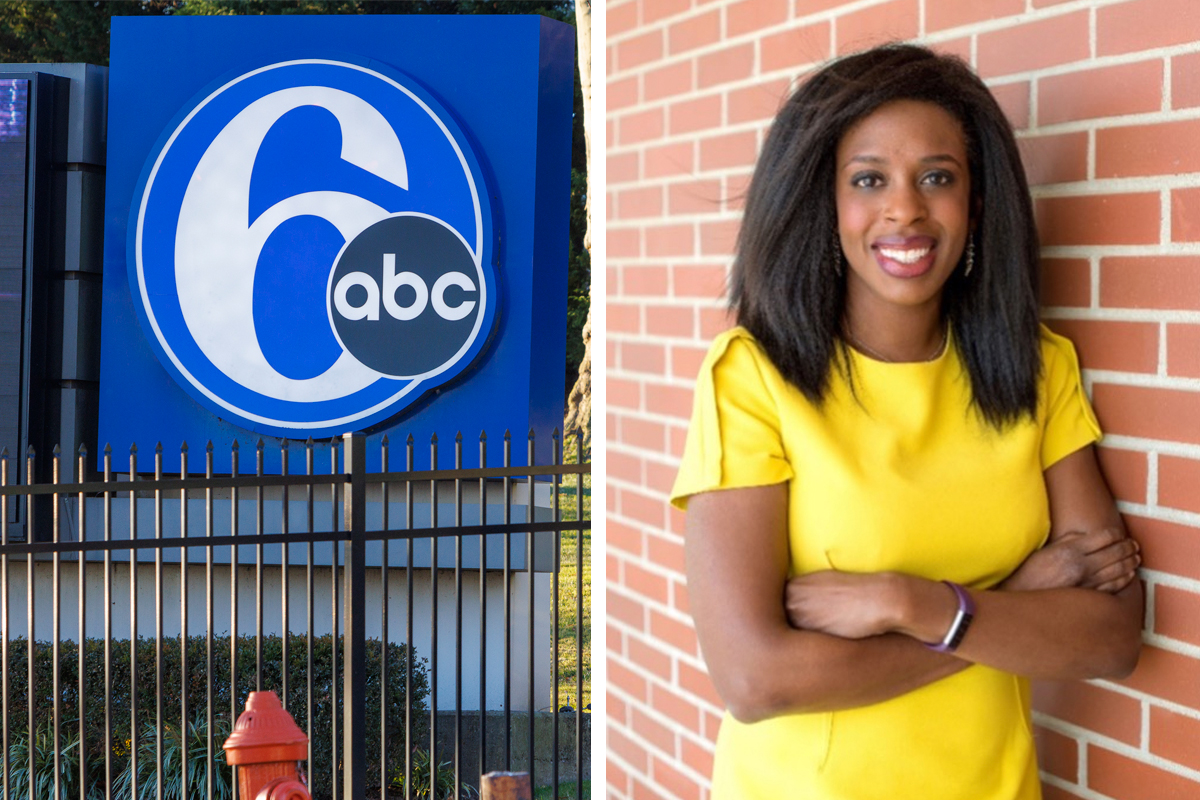
    The station announced Nneka Nwosu, a Philadelphia native serving as the vice president of marketing and local programming at sister-station WLS in Chicago, would take over running the Action News newsroom.

    6abc president John Morris announced the move to staff in an email Tuesday, noting that Nwosu is such a big Eagles fan “their 2018 Super Bowl win may have actually sent her into labor with one of her sons.”

    “Running the news department at the station I grew up watching is surreal!” Nwosu wrote on LinkedIn, adding she was “thrilled to be coming home.”

    Nwosu spent the past four years in Chicago, previously serving as one of the station’s assistant news directors. Prior to that, she spent eight years at Boston ABC affiliate WCVB.

    At 6abc, Nwosu is inheriting the city’s most-watched newscast dating back more than 40 years. Her first day in the newsroom will be Oct. 5, and among her first tasks will be overseeing a new chief meteorologist following the retirement of Cecily Tynan, who delivered her final forecast Monday after more than three decades at the station.

    Nwosu is filling the spot vacated by the sudden departure of Tom Davis, who abruptly left in March after more than two decades.

    In a note to staff, Chad Matthews, the president of ABC’s eight owned and operated TV stations, wrote Davis “made the decision to leave 6abc” and thanked him “for his years of service to the station.”

    Davis could not be reached for comment. He spent 15 years as news director, maintaining the station’s place as the region’s most-watched newscast. He also served as an assistant news director for seven years before that.

    In a separate move, Morris also announced Mike Amato had been promoted to the vice president of technology. The Drexel grad has been with the station since 2015, and prior to that he spent nine years at NBC Sports Philadelphia.

    6abc still threatened by Trump administration

    Nwosu and 6abc also face the threat of being taken off the air by President Donald Trump’s administration.

    ABC’s parent company, Disney, is locked in a legal fight as the Federal Communications Commission considers whether to take away the broadcast licenses for the company’s eight owned-and-operated stations in the wake of a Jimmy Kimmel joke involving first lady Melania Trump.

    The FCC contends the unusual early review of the licenses stems from an earlier investigation into diversity, equity, and inclusion initiatives at Disney, citing “the agency’s prohibition on unlawful discrimination.”

    It’s unclear if and when the government will take action. The FCC’s final deadline for public comments was Aug. 5, and respondents were overwhelmingly supportive of 6abc and the network’s other local stations.

    Trump also recently called on the FCC to punish NBC and Philly native Kristen Welker, the moderator of Meet the Press, over a TV segment in which she said the president had “mixed results” backing candidates this election cycle.

    The FCC is also investigating NBC and its parent company, Comcast, over the company’s DEI policies and how it handles its owned and operated affiliates, including NBC10.

    Anna Gomez, the only remaining FCC commissioner appointed by a Democrat, wrote “the FCC has no authority to punish journalists this administration doesn’t like.”

  • Trump’s oil deal with Venezuela is an imperialistic pipe dream | Editorial

    Trump’s oil deal with Venezuela is an imperialistic pipe dream | Editorial

    As a businessman, Donald Trump often cut corners, broke promises, and made bad deals. Now that he has the power of the U.S. government at his disposal, the submission of Republicans in Congress, and a pliant U.S. Supreme Court, the only difference is the scale of the abuse, corruption, and foolishness he brings to his ventures.

    Late Friday, the president announced on Truth Social that he had reached an agreement with Venezuela to secure more than 65 billion barrels of oil. “This Historic Transaction MORE THAN DOUBLES American Oil Reserves, greatly increases our Oil Supply, and will substantially lower Gas Prices for all Americans, long into the future,” he wrote.

    The deal, such as it is, is, in fact, very significant, as total proven U.S. reserves are about 81 billion barrels. But the rest of Trump’s claims, and the agreement itself, should be buried under caveats.

    Trump noted that this comes “at no expense to the American taxpayer.” This is true unless you count the roughly $5 billion the U.S. has spent on military operations around Venezuela since August of 2025, including extrajudicial killings at sea and the illegal invasion that ended with the kidnapping of President Nicolás Maduro and his wife on Jan. 3.

    There is also the incalculable reputational cost as the United States’ revived imperialistic push into Latin America mirrors the president’s transactional nature and authoritarian bent.

    The deal was reached with the unelected Venezuelan President Delcy Rodríguez, who took office after Maduro was taken. Never mind that she was part of the same repressive socialist regime that is accused of rampant corruption and human rights abuses; she has proved a lot more willing to work with the Trump administration than her predecessor.

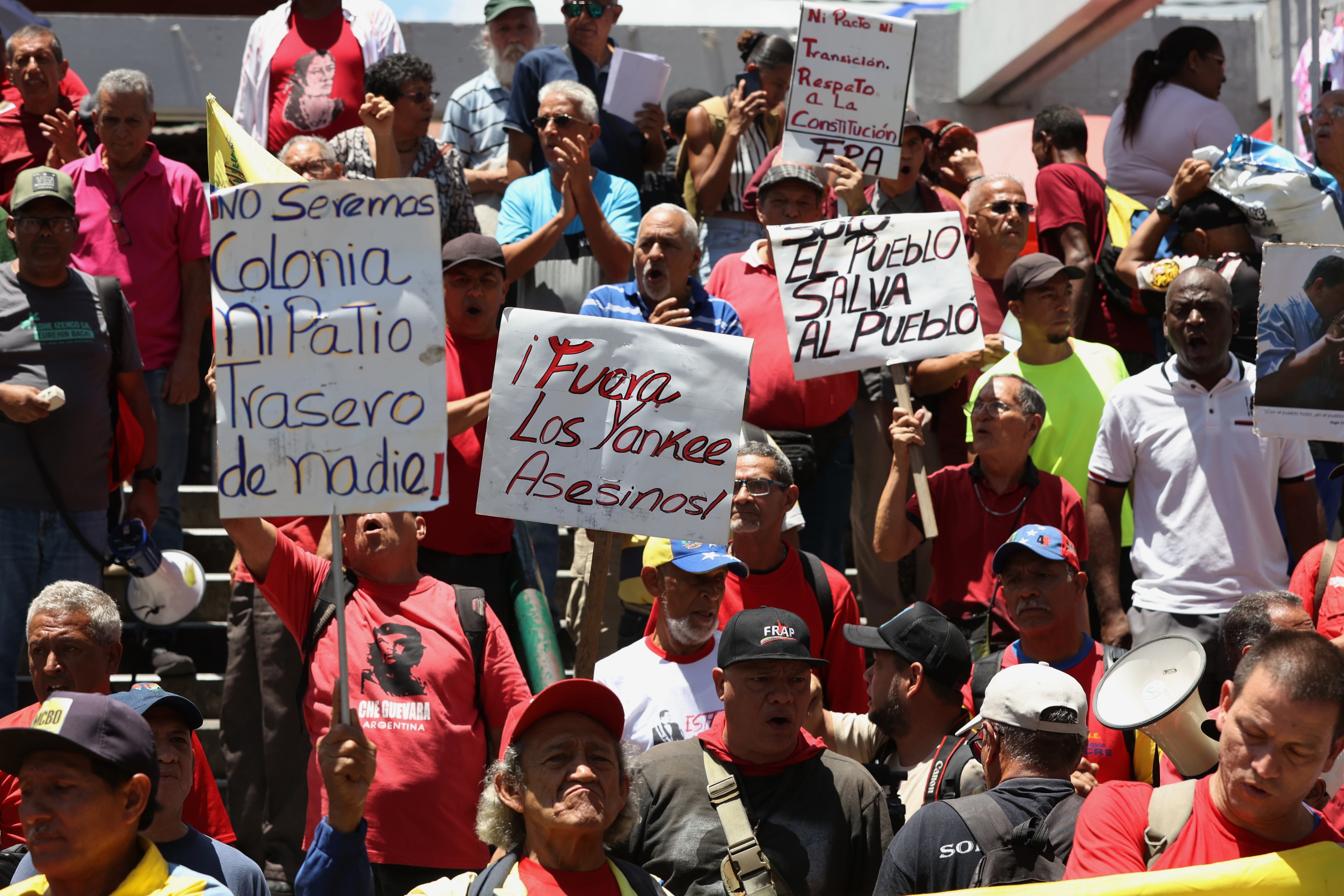
    Venezuelans protest against President Donald Trump’s deal giving the United States a stake in Venezuela’s oil reserves in Caracas, Saturday.Pedro Mattey

    Reports out of Venezuela find some people are hopeful U.S. investment will benefit the nation, yet under a government rife with cronyism, only a select few will likely reap any reward. Although details are still scarce, the agreement already sees the U.S. partner with a private company run by Alejandro Betancourt, an ally of Rodríguez, who has been under investigation by prosecutors in Zurich.

    Trump’s assertion that gas prices will drop thanks to this deal is delusional, at least any time soon, as it would take years for this Venezuelan oil to have any impact on costs at the pump.

    And that’s if the deal comes to fruition at all. The risks, at home and abroad, are significant.

    The agreement would reportedly give Betancourt’s company access to 17 oil fields that are said to contain 65 billion barrels of oil. Development would cost billions of dollars and could take more than a decade. The Pentagon would finance the plan, but the legality of its participation is in question — as well as how the deal was crafted in the first place — meaning court challenges may be inevitable.

    There are also political realities to contend with.

    With Maduro gone and Trump threatening use of force, the Venezuelan government changed its position on working with the U.S. overnight. That could change just as quickly once Trump leaves office and if the new occupant of the White House has different priorities or if the current government of Venezuela is replaced and decides to honor the country’s 1999 constitution, which states that oil reserves belong to the nation and cannot be sold.

    The high investment cost and political volatility are why U.S. oil companies have been reticent to enter Venezuela, even under pressure from Trump. According to the Wall Street Journal, Exxon and other energy interests are in talks to expand operations there, which is the prerogative of any private company that is willing to roll the dice on long-term investment, but should be far from the purview of the U.S. government and its taxpayers.

    Trump’s half-baked oil agreement in Venezuela tramples that country’s sovereignty, benefits corrupt interests, and will likely fail to deliver for the American people. The art of the deal strikes again.

  • Former N.J. Gov. Chris Christie discusses his legacy as the godfather of legal sports betting, prediction markets, and the Trumps

    Former N.J. Gov. Chris Christie discusses his legacy as the godfather of legal sports betting, prediction markets, and the Trumps

    Chris Christie has been a two-time Republican presidential candidate, the governor of New Jersey, and a U.S. attorney. But history might show that he generated the most enduring national impact in a different role, as the godfather of legalized sports betting.

    In 2012, when he was still New Jersey’s governor, Christie signed a bill that would allow customers to wager on professional and collegiate sports at 12 casinos and four racetracks.

    He correctly predicted that the bill — which directly challenged a longstanding federal law that restricted legal sports betting to just a handful of states — would lead to him being sued by powerful opponents, and that over the long haul, his efforts would succeed.

    But in a recent interview with The Inquirer, Christie said that even he did not imagine that sports gambling would evolve from a location-based attraction to phone apps that are readily accessible and open for business around the clock. Americans spent a record $165 billion on sports wagers in 2025, amid growing concern from health experts and lawmakers that mobile gambling is driving a health epidemic.

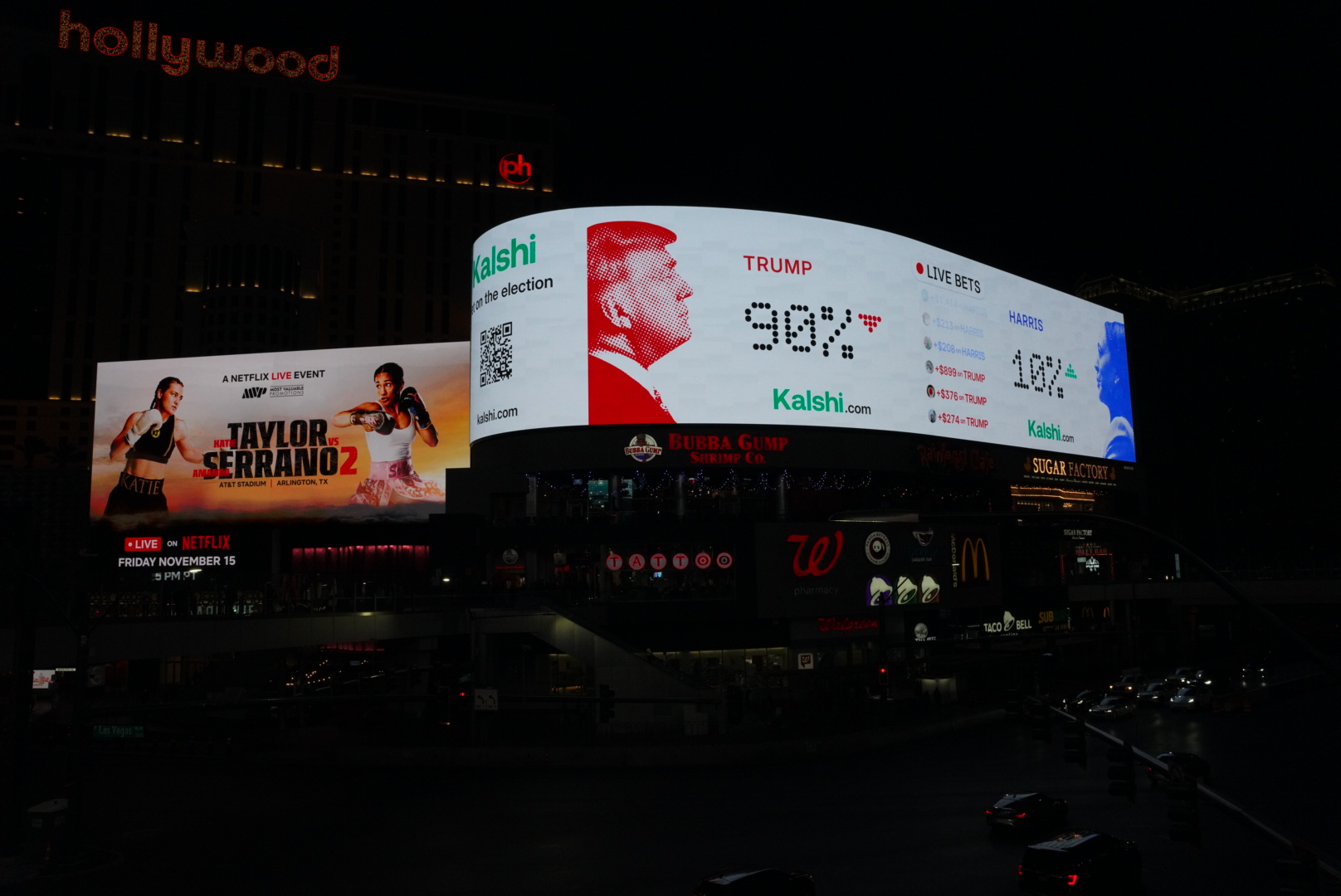
    Nor did Christie — who now works as a strategic adviser to the American Gaming Association — envision the rise of prediction markets, some of which have been accused in lawsuits across the U.S. of running illegal sports betting operations. Christie, however, said he is unsurprised that two prediction market companies count Donald Trump Jr. among their advisers.

    Christie’s sports gambling crusade began just two months after New Jersey voters approved a referendum in November 2011 to legalize sports betting in the state.

    Casino industry lobbyists had long championed the type of bill that he signed, predicting that sports betting would be a double win for the state, attracting new customers to struggling casinos and generating revenue to benefit elderly and disabled residents.

    But a federal law, the Professional and Amateur Sports Protection Act, had since 1992 restricted legal sports betting to Delaware, Montana, Nevada, and Oregon. Christie wasn’t deterred.

    “Am I expecting there may be legal action taken against us to try to prevent it? Yes,” he told reporters in 2012. “But I have every confidence we’re going to be successful.”

    Then the National Collegiate Athletic Association — along with Major League Baseball, the NFL, the NBA, and the NHL — sued Christie for violating the federal law, igniting a legal saga that would wind for years through district and circuit courts before reaching the U.S. Supreme Court in 2017.

    Christie argued that PASPA had been a constitutional overreach that violated the Tenth Amendment’s “anti-commandeering” doctrine.

    “We lost the first six times [in lower courts],” Christie said. “I had the sense that maybe I was wrong.”

    In 2018, the Supreme Court voted to overturn PASPA, giving states the freedom to enact their own sports betting laws.

    This interview with Christie, 63, has been edited and condensed for clarity.

    Why was legalizing sports betting in 2012 a priority for you?

    I was trying to differentiate Atlantic City, and give the casinos something new and different to offer, and to help preserve the horse racing business. I saw it at the time as an offensive and defensive measure. That was the motivation.

    The leaders of professional sports leagues were critical of your efforts, and deeply opposed to legalizing sports gambling. What did you think of their position?

    I thought that their opposition was both wrongheaded and hypocritical, and I told them so. [Then-NBA commissioner] David Stern was probably the most vehement against it, but [NFL Commissioner] Roger Goodell was a driving force, too. I told them, ‘[Sports betting] is happening anyway. You’d rather have people bet with illegal bookies — either mob-related, or offshore — than companies who are in the business and regulated by the state?’ It made no sense.

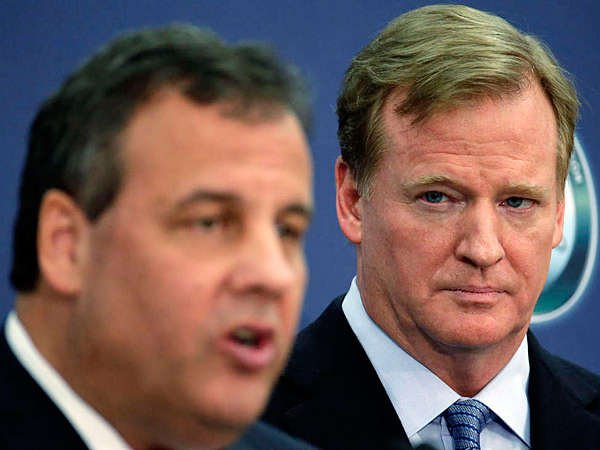
    Along with his peers in other professional sports, NFL Commissioner Roger Goodell (right) was opposed in 2012 to an expansion of legalized sports betting.
    Were you surprised to see those leagues later enter into lucrative partnerships with sportsbook companies?

    I wasn’t surprised at all. The leagues have shown an extraordinary ability to chase a dollar. I’m still waiting for the statue that they’re going to build of me, or the thank-you note. [Legalizing sports betting] has helped their TV contracts as well. People who weren’t even necessarily interested in sports before are now extraordinarily interested because they have a little bit of a wager on it. It’s kind of amazing.

    In the years since the Supreme Court overturned PASPA, NBA and MLB players have been arrested for conspiring with gamblers. An NFL executive was recently suspended for sharing inside information about the team’s draft plans.

    It’s inevitable that was going to happen. But I think because there is such a great deal of transparency, the leagues can act quickly. That makes it much more different from when gambling was illegal, and you still had some athletes or people associated with sports interacting with [bettors]. The regulation brings about transparency, and transparency makes it easier to police.

    Sports betting has evolved into a 24/7 mobile enterprise. Do you consider it to be a different product than what it was in 2012?

    Completely. I don’t think I could ever have anticipated that it would be in everybody’s pocket. That’s a little bit disturbing to me, to tell you the truth, the proliferation of it. And obviously prediction markets have been very disturbing to me, particularly because they market to teenagers, which is strictly prohibited for the legal gaming companies.

    Prediction markets have also faced backlash for allowing people to wager on U.S. military operations and the deaths of foreign leaders.

    I think the whole thing is absurd, and not good for the public.

    President Trump’s son, Donald Trump Jr., was reportedly given $300,000 worth of Kalshi shares in 2025, after becoming an adviser to the company. MARSHALL SCHEUTTLE
    President Trump’s son, President Donald Trump Jr., is an adviser to Kalshi and has shares of the company, and his venture capital firm has invested in Polymarket. Those companies are regulated by the federal Commodity Futures Trading Commission. Does that seem like a conflict to you?

    I think common sense gives you the answer to that. If it’s a money-making enterprise for the Trump family, then the odds are it’s going to face light regulatory action.

    Some state attorneys general have sued Kalshi. They allege that the company is running an unlicensed, illegal sports betting operation. Kalshi insists it is a commodity exchange. Will this end up being decided by the Supreme Court?

    It’s betting. It’s not an investment. It’s not a commodity. The Supreme Court has ruled that states have the right to regulate sports betting. I think that it’s going to go to the Supreme Court, and I’m confident [the prediction markets] will lose.

    We’ve interviewed addiction experts who say that sports gambling addiction is now a health epidemic, similar to tobacco and opioid abuse.

    I always thought that a big portion of this [revenue] has to go toward addiction treatment, and I think that’s got to continue.

    Elected officials in Pennsylvania, New Jersey and other states are exploring new regulations for sportsbook operators, like curtailing or eliminating in-game microbets or VIP programs. Are those kinds of reforms needed?

    As long as [sports betting] is a venture that creates tax revenue, then the states are always going to be examining this issue. They’re partners. They can’t claim no responsibility. I don’t know how it’ll manifest, or where it’ll land. … I think all regulation should be rooted in evidence-based research. So if there are changes that we see that could help make [gambling] safer, they should be considered.

    The Inquirer will continue to report on issues related to the growth of gambling addiction — among teens and adults — across Pennsylvania. If you or someone you know wants to speak with a reporter, please contact David Gambacorta or William Bender at dgambacorta@inquirer.com and wbender@inquirer.com

  • The CDC left two measles-associated Pa. deaths out of its latest count after RFK Jr. sparred with Gov. Shapiro

    The CDC left two measles-associated Pa. deaths out of its latest count after RFK Jr. sparred with Gov. Shapiro

    Two measles-associated deaths in Pennsylvania last week were omitted from the Centers for Disease Control and Prevention’s latest measles outbreak update, continuing an increasingly political clash over the nature of the deaths announced by the state last week.

    The two deaths reported by Pennsylvania — the first in the country this year — were not included because ”available information does not establish whether measles caused or contributed to the deaths or whether the individuals died from other causes while infected with measles,” the agency says in an update posted to the CDC’s website Sunday.

    President Donald Trump’s head of the Department of Health and Human Services, Robert F. Kennedy Jr., has disputed what Democratic Gov. Josh Shapiro and state health officials have disclosed about the deaths.

    Kennedy, a longtime anti-vaccine activist, wrote on X that the deaths may have been “fabricated” by the Shapiro administration, which has confirmed the deaths announced last Tuesday were “measles-associated.”

    Pennsylvania “thoroughly reviews” all reported measles cases to ensure they meet CDC definitions and has provided “all required epidemiological data” on the measles-associated deaths to the CDC, state health department spokesperson Neil Ruhland said in a statement.

    The state health department said it has death and medical records associated with the cases and the department’s investigation of them. The state does not disclose death certificates but does provide “de-identified” information to the CDC.

    “DOH values its long-standing collaborative relationship with professional staff at the CDC and will continue to work with federal partners moving forward to address the ongoing measles outbreak,” Ruhland said.

    The department declined to comment on “information the CDC may have obtained from third parties.” Kennedy said last week on social media the state was not providing requested information to the CDC.

    “CDC has a responsibility to ensure its reporting accurately and transparently reflects what is known and what remains unconfirmed,” HHS press secretary Grace Davis Jamison said in a statement Monday, adding that Pennsylvania’s two announced measles-associated deaths “have not been confirmed based on the information currently available to CDC.”

    Shapiro’s administration did not respond to a request for comment. He told reporters on Friday that “getting into a back-and-forth with people online who are spewing irresponsible conspiracy theories” does not “serve the public interest.”

    Measles cases in Pennsylvania

    The CDC publishes weekly updates tallying measles cases and deaths by state, tracking the spread of a highly contagious disease that was once considered eradicated in the United States due to widespread vaccination.

    (function(){function e(){window.addEventListener(`message`,function(e){if(e.data[`datawrapper-height`]!==void 0){var t=document.querySelectorAll(`iframe`);for(var n in e.data[`datawrapper-height`])for(var r=0,i;i=t[r];r++)if(i.contentWindow===e.source){var a=e.data[`datawrapper-height`][n]+`px`;i.style.height=a}}})}e()})();

    As of Thursday, 2,887 confirmed measles cases were reported by 47 states, with another 16 cases reported among international visitors, according to the CDC’s latest update.

    As of Monday, Pennsylvania had reported 497 measles cases in 2026, with 87 hospitalizations, amid the state’s largest outbreak in three decades. Officials said they had recorded 100 new cases in just a week, and half of Pennsylvania’s counties have now reported at least one measles case this year.

    About a third of the cases were diagnosed in children under 18. All were in unvaccinated residents. The disease is so contagious that it can infect nine in 10 unvaccinated people.

    (function(){function e(){window.addEventListener(`message`,function(e){if(e.data[`datawrapper-height`]!==void 0){var t=document.querySelectorAll(`iframe`);for(var n in e.data[`datawrapper-height`])for(var r=0,i;i=t[r];r++)if(i.contentWindow===e.source){var a=e.data[`datawrapper-height`][n]+`px`;i.style.height=a}}})}e()})();

    Pennsylvania health officials have said they define “measles-associated deaths” as deaths of people where evidence of measles is present, even when the highly contagious disease may not be assessed by the coroner as the immediate cause of death.

    The state has not provided any additional information on the deaths beyond confirming both people were unvaccinated residents of Lancaster County, and one patient was a newborn.

    Measles deaths are rare. Although most patients recover after mild illness, the virus can cause pneumonia and brain swelling and kills about one to three patients in 1,000.

    Controversy around communications

    Public health experts have said that, by not disclosing information like the victims’ ages, reasons for being unvaccinated, and causes of death, state officials created an information vacuum in which conspiracy theories could spread.

    Officials said that state law prevents them from revealing more details about the deaths.

    “There’s been a complete politicization of this event,” said Paul Offit, a Children’s Hospital of Philadelphia physician who heads the hospital’s Vaccine Education Center.

    A longtime Kennedy critic, Offit said the state should have released more information on the deaths to prevent a “void” for conspiracy theorists to fill.

    He’s also concerned that debate over the deaths will obscure efforts to address the growing outbreak centered in Lancaster County, which has some of the lowest kindergarten vaccination rates in the state.

    “It’s August. This is only going to get worse. What can we do to prevent more children suffering and being hospitalized?” he said. “That’s really the question, and that’s not the question we’re asking.”

    Democratic state lawmakers who are also medical professionals came to Shapiro’s defense on Monday, saying that the governor was right to announce the deaths and that it wasn’t surprising to see the ensuing public debate.

    “Our governor had a responsibility to speak out. We’re glad that he did,” said State Sen. Maria Collett, a Montgomery County Democrat and registered nurse.

    State Rep. Arvind Venkat, an Allegheny County Democrat and an emergency physician, said an immediate determination of death can be imprecise and require further evaluation. He urged the public to not “get distracted by this debate about the immediate versus underlying cause of death” when there is no doubt that the infant contracted measles in utero.

    “I’ve had to fill out death certificates,” Venkat said. “It’s not a simple thing, and I’m not surprised that there is this controversy. But I think we’re losing the forest for the trees.”

    State Rep. Bridget Kosierowski, a Lackawanna County Democrat and nurse, said advocating for vaccination to stop the spread of measles was personal.

    On Monday morning, she was receiving treatment for breast cancer and considering the outsized impact measles would have on her and other patients if they weren’t vaccinated.

    “It is really dangerous, and the outcomes can be catastrophic for people that are fighting cancer right now,” Kosierowski said.

    What’s known about the measles death

    Lancaster County’s coroner has said he handled one of the deaths, a newborn who died shortly after birth.

    The coroner, Stephen Diamantoni, has said the child had a measles infection acquired before birth and died from a ruptured spleen, citing trauma to the torso. Diamantoni, a Republican elected official, said he was still investigating and that he does not believe measles was the cause of death. Measles can cause the spleen to become fragile, heightening the risk of rupture, Offit has noted, saying the coroner’s statements were also adding to the public confusion.

    Diamantoni told The Inquirer last week that he had spoken with the CDC about his conclusions on the child’s death. He did not respond to an additional request for comment on the child’s death certificate on Monday.

    Measles was listed on the baby’s death certificate, he told the Pittsburgh Tribune-Review, in a section of the certificate that reports other “conditions contributing to death but not resulting in the underlying cause.” Measles was included on the death certificate “to offer a broader view of the general health of the child,” he told the Pittsburgh paper.

    The CDC’s latest measles update features an asterisk in lieu of a number for measles deaths in 2026, explaining that the agency is reviewing “additional information regarding the circumstances and causes of death.”

    The agency updated the dashboard multiple times this weekend, and at one point had included the two deaths, the Washington Post reported.

    “The information currently posted reflects the best available information and our commitment to transparency and telling the American people the truth — a foundational principle of the Trump Administration,” said Jamison, the HHS press secretary.

    Lancaster Online reported late on Monday that Diamantoni said his office is investigating another death of a person infected with measles.

    He would not provide details on the circumstances of the person’s death and said he was investigating “if measles has played any role.”

    State health officials would not confirm whether the case Diamantoni is investigating is the second-measles associated death announced last week, Lancaster Online reported, adding that Diamantoni said his office “did not get information about the death from the state.”

    A Lancaster family grieves

    An Amish family in Lancaster County detailed in an article published Sunday in The Atlantic how their son had died shortly after birth earlier this month, after his mother was infected with measles.

    The child had died on the same day as the newborn whose death was investigated by Diamantoni, who would not confirm the baby’s identity to The Atlantic.

    The family has 13 surviving children, all of whom recently contracted measles. Only the father, identified by a pseudonym in The Atlantic, had been vaccinated against measles. Both parents said they did not have “strong feelings against vaccination.”

    They had not known that their child’s death was potentially at the center of a national controversy and did not know who Shapiro or Kennedy were, they said.

    They also hadn’t spoken to the coroner about the cause of their child’s death, but assumed that his mother’s illness had contributed. A midwife had told them measles was likely a factor in the boy’s death, they said in the report.

    Still grieving the loss of their child, they said his death was “part of God’s plan,” the magazine reported.

    The father confirmed to an Inquirer reporter that he had spoken to the Atlantic but declined to comment further.

    Inquirer staff writers Sam Janesch and Michelle Baruchman contributed to this article. Editor’s note: This story has been updated with additional comment and developments.

  • John Fetterman backs Donald Trump on data centers, blames China for ‘misinformation’ on AI

    U.S. Sen. John Fetterman said Monday he agreed with President Donald Trump’s call to “Let Data Reign” after the president made a lengthy post criticizing the widespread backlash to data centers.

    “There’s nothing more damaging to a Democrat than agreeing with Trump AND data centers — but what’s right is right,” said Fetterman, who has repeatedly angered members of his own party by backing Trump’s agenda.

    “We must win the war for AI supremacy over China. They foment the ‘anti’ argument through misinformation,” Fetterman said on X.

    The issue has increasingly taken center stage ahead of the midterm election, including in Pennsylvania. Fetterman, who does not face reelection until 2028, blamed China for fueling the public outcry against data center development in the U.S. as the two nations compete in the AI industry.

    Fetterman has remained supportive of development even as voter sentiment has turned sharply against the industry. Six in 10 likely Pennsylvania voters said they opposed the construction of data centers to support artificial intelligence in a poll released last week by The Inquirer, New York Times, and Siena University.

    Trump made similar arguments on his Truth Social platform earlier in the day, saying that China “could not be happier” with the political movement against data centers.

    “The only reason that communities throughout the U.S.A. should not want Data Centers is if they want to end up being backwards and poor. If they want to be successful and rich, with far lower taxes and jobs all over the place, let Data Reign,” Trump said.

    That Fetterman backed the president on data centers may not have come as a surprise to voters who’ve been following the senator’s moves.

    Two-thirds of Pennsylvania Democrats who are likely to vote this year believe Fetterman supports Trump too frequently, according to last week’s poll.

    Overall, 69% of Democratic voters have an unfavorable opinion of him, which could be trouble if he seeks reelection as a Democrat in 2028.

    And Democrats were also the voters most likely to oppose data centers — with 77% opposing their construction in the Pennsylvania poll.

    Fetterman’s post in support of data centers comes as the state’s other top Democrat, Gov. Josh Shapiro, has been backing away from his previous support.

    Shapiro issued an executive order two weeks ago enacting a host of restrictions for new projects. And the governor has traded attack ads with his Republican opponent Stacy Garrity over who has been more supportive of the industry.

    Fetterman, on the other hand, said in a post last week that China would benefit from an overreaction by U.S. politicians.

    “I reject the political pandering and hyperbole over data centers or AI doomsdaying,” he said.

  • A man seeking asylum was detained during a routine ICE appointment in Philly. He fears being tortured or killed if deported.

    A man seeking asylum was detained during a routine ICE appointment in Philly. He fears being tortured or killed if deported.

    Jhon Perez Romero carries a driver’s license, Social Security card, and an employment permit, working as a Spark Driver for Walmart in York, Pa.

    He also carries the fear of being tortured or killed if he should be deported to his Venezuelan homeland, where he’s been accused as a “traitor” by the government he once served as an intelligence officer.

    Perez Romero, who was interviewed and released by U.S. immigration officials when he crossed the border in 2023, was arrested by ICE in Philadelphia on June 30, when he appeared for what he thought would be a routine check-in. He joined a growing number of immigrants taken into custody even while they pursue asylum, a long-established legal process that can grant permission to live in the United States to people who could be harmed at home.

    Perez Romero, 39, is being held at the Moshannon Valley Processing Center, the 1,876-bed ICE facility in Philipsburg, Pa., his future uncertain, his wife and step daughter in anguish.

    “I thought the U.S. represented a place where people who are escaping political or religious persecution can come here and find safety,” said his wife, Sandra Quinones, an American citizen and high school teacher. “Especially if you’re law-abiding and contribute to society. That’s where my heart is broken.”

    The Trump administration’s aggressive approach departs from previous administrations, where asylum seekers with no criminal record were mostly allowed to remain free while they pursued their claims. Now applicants have been detained in communities across the United States, including Pennsylvania and South Jersey.

    Last week news broke that the administration intends to revoke the business and tourism visas of up to 200,000 people who are seeking asylum, putting them at risk of arrest and detention. That comes on top of procedural changes that have made it harder for people to prove they should be allowed to stay.

    A spokesperson for the Department of Homeland Security said Perez Romero was released at the border by the Biden administration, not by officials under President Donald Trump.

    “He will remain in ICE custody pending removal proceedings and will receive due process,” the spokesperson said in a statement. “A pending application does NOT confer legal status in the United States.”

    The agency said that on Jan. 20 Perez Romero was charged with “harassing communication,” an offense that usually involves phone calls or text messages sent to upset someone.

    DHS provided no other information. Dauphin County court records show that Perez Romero pleaded guilty in magisterial district court in March, but do not include details of what occurred. A court worker said Friday she could provide no additional information.

    “Criminal illegal aliens are not welcome in the U.S.,” Homeland Security said. “We will find you, we will arrest you, and we will deport you.”

    Jhon Perez Romero, originally of Venezuela, came to the United States seeking asylum in late 2023, afraid he could be harmed or killed by government agents in his homeland. Now Perez Romero, 39, is being held at the Moshannon Valley Processing Center, the ICE detention facility in Philipsburg, Pa., as the Trump administration detains more people who are seeking safety in the United States.Courtesy of family

    Generally, the government cannot deport someone while their asylum claim is being decided — claimants must be given what’s called a merits hearing, where they can present evidence, before any final removal action.

    The government does have the power to hold asylum seekers in detention for certain reasons, including if it believes the person might flee or is a danger to the public.

    Immigration lawyers argue that there’s no gain for the government in detaining asylum seekers, since their names, addresses, and identifying information are already known to authorities, who require regular, in-person check-ins.

    “The Trump administration is targeting people to subject them to detention, knowing they won’t be able to fight their way out of the system, so they’ll give up and leave,” said lawyer Lilah Thompson, who leads the immigration unit at the Defender Association of Philadelphia. “They’re wearing people down.”

    For immigrants, freedom while pursuing asylum means everything, enabling them to work and earn money to hire an attorney, and to more easily gather evidence and documents for their cases.

    Asylum cases can take years to decide — more than 2.3 million people now await asylum hearings or decisions — and appeals can go on for additional months or longer.

    Prolonged detention leads some to drop their legal cases and accept voluntary departure. Leaving voluntarily avoids the automatic 10-year ban on returning that can accompany a formal deportation.

    “It’s very tough, for people who are facing these choices,” said immigration lawyer Robert Barchiesi II, who represents Perez Romero.

    Thompson is helping defend a Chester County newlywed who has so far spent two months in detention after being arrested at a late-June check-in.

    Nelson Contreras-Gelves, 35, originally from Venezuela, has followed government directions and broken no rules, Thompson said, noting that he recently married a U.S. citizen.

    People seeking asylum must show not only that they could be harmed in their homeland, but also that the danger springs from at least one of five specific causes — their religion, race, nationality, political beliefs, or membership in a particular social group.

    Moshannon Valley Processing Center, in Clearfield County, Pa., is the largest immigrant detention facility in the Northeastern United States.Max Marin / The Philadelphia Inquirer

    People granted asylum can apply for lawful permanent residency and eventually for U.S. citizenship.

    Perez Romero’s life has taken him from a position in Venezuela’s notorious national intelligence agency, to a flight across countries in fear of his life, to love and marriage to a U.S. citizen and a caring role as stepfather to her 17-year-old daughter.

    From roughly 2011 to 2019, according to his asylum application, Perez Romero was an agent at the Servicio Bolivariano de Inteligencia Nacional, known as SEBIN. It was created in 2010 by then-President Hugo Chávez, officially aimed at protecting the nation but accused by human-rights groups of arresting and torturing political opponents, journalists, and activists.

    Perez Romero said he quit the agency after receiving instructions — the specifics were not described in his asylum application — that he refused to obey. His resignation came less than three months after a failed military uprising against authoritarian President Nicolás Maduro triggered a purge of the intelligence services, targeting those suspected of disloyalty.

    Perez Romero was told to report to government officials — and that he was accused of treason.

    “Which is erroneous,” he wrote in his asylum application, “since I have not committed any crime.”

    In March 2020, facing an arrest warrant, Perez Romero fled to Colombia, keenly aware of “what happens to political prisoners in Venezuela, things like imprisonment for life or murder.”

    Two years later, after Gustavo Petro was elected as that nation’s president, he said, he began receiving threats from Venezuelan agents that he would be seized and forced home.

    Perez Romero headed north. On New Year’s Eve 2023, he reached the U.S. border at Eagle Pass, Texas, where he was interviewed and released by immigration agents.

    The next year he met Quinones at La Iglesia de Dios Voz de Alerta Church in York, and they wed in 2025.

    She described him in an interview as an outstanding husband and father, working long hours to provide for their family. He’s deeply invested in their church, she said, and before his detention was developing a resource package to help missionaries serving in remote and dangerous areas.

    Last month, he tried and failed in federal court to win his freedom from Moshannon.

    U.S. District Court Judge Joseph Leeson ordered the government to hold a bond hearing, but Immigration Judge Tamar Wilson ruled that Perez Romero did not show he was not a flight risk or a danger to the community.

    He may say he’s innocent of treason, the judge wrote, but “the court cannot simply take his word for it.”

    Quinones says the family hasn’t lost hope. Their GoFundMe has raised $8,000 of its $9,000 goal, all of it going for legal fees and related expenses. They await the hearing to present evidence to support Perez Romero’s case for asylum.

    Quinones said her husband relies on his Christian faith to stay strong. She’s trying to stay optimistic as well, she said, but so much is uncertain and in flux. Her husband could end up having to accept voluntary departure to a third country, like Colombia.

    She’s prepared to retire early and join him, if necessary, and has begun exploring job possibilities there.

    “I can’t be apart from my husband,” she said. “I can’t picture my life without him.”

    Staff writer Dylan Purcell contributed to this article.

  • The neurologist who led Penn Medicine’s diversity efforts and saw his title changed after Trump came to office has a new role

    The neurologist who led Penn Medicine’s diversity efforts and saw his title changed after Trump came to office has a new role

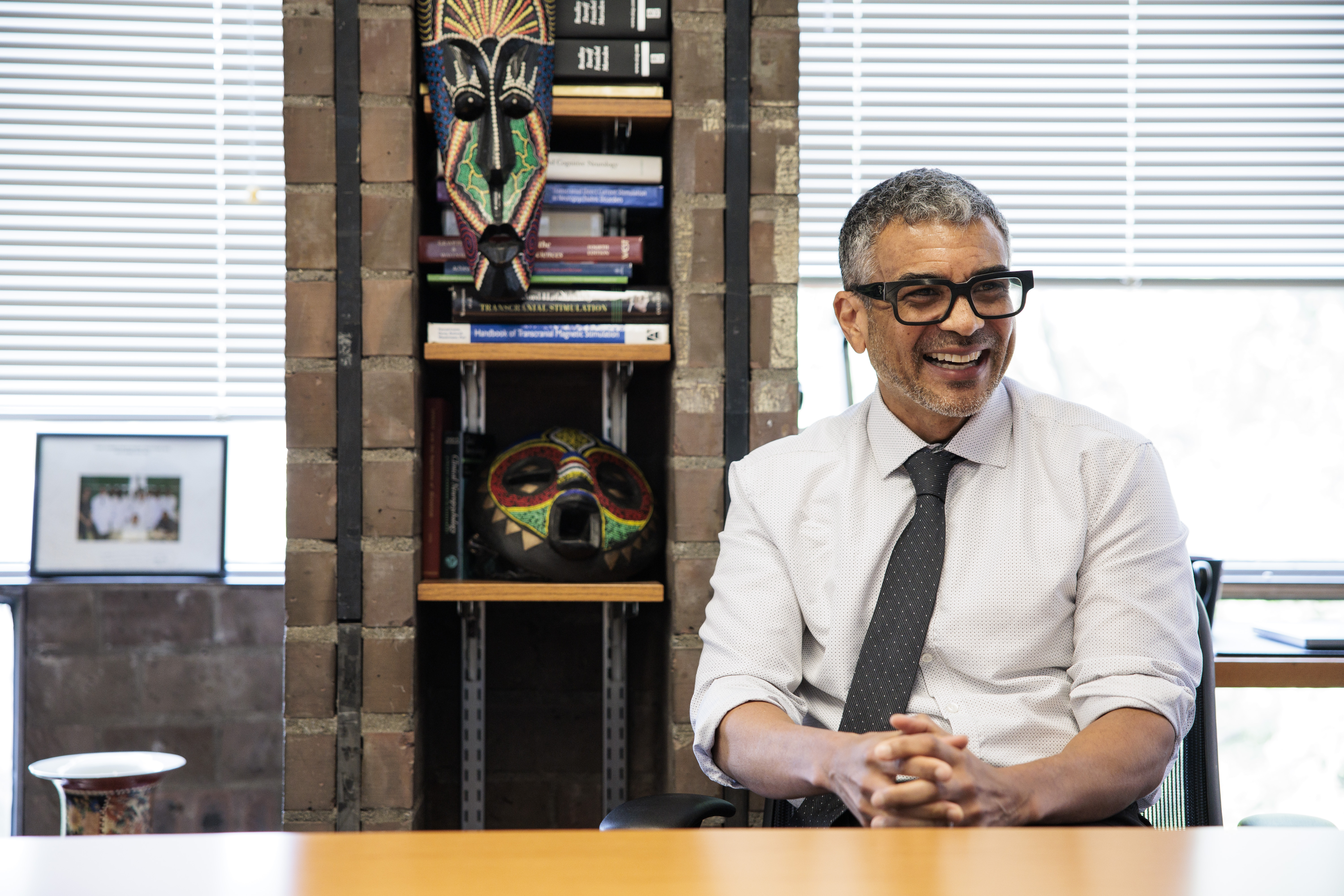
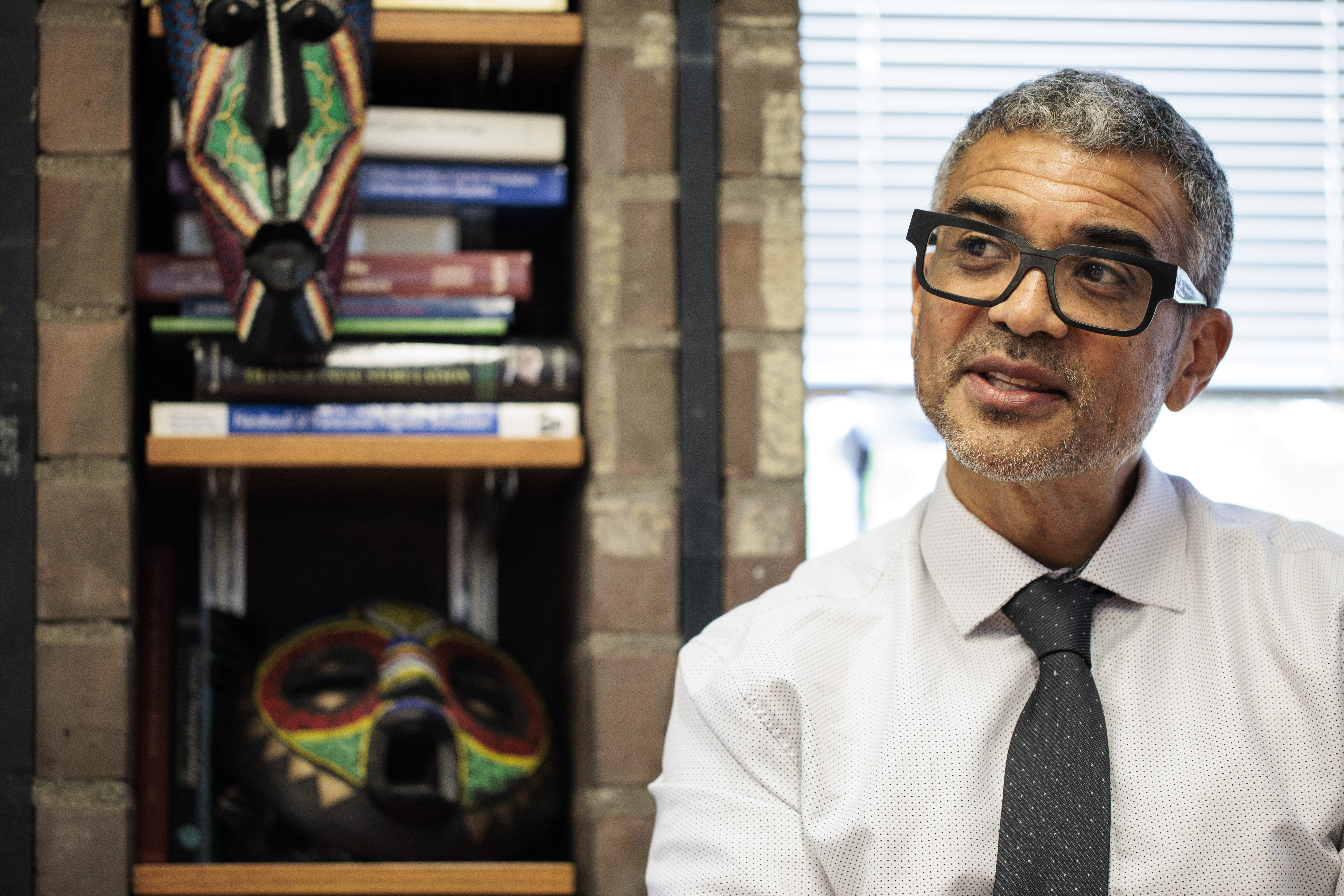
    Roy Hamilton’s varied racial, social, and religious identities helped him in his former role as a chief diversity leader at the University of Pennsylvania — and now they will help him in his new role as chair of Penn’s faculty senate.

    The behavioral neurologist at the Perelman School of Medicine is the son of a Japanese immigrant and an African American. He is married to a white woman who is Jewish, while he was raised as one of Jehovah’s Witnesses and now is a secular humanist. And one of the couple’s children is LGBTQ+; he is an ally. Add to that growing up in a lower middle-class family and learning to navigate an Ivy League education system, first as an undergraduate and then as a medical school student.

    That background has made it easier for him to understand a range of factors in his own life and how they affect his thinking, Hamilton said, and more readily understand where others are coming from and look for common ground.

    Those same skills, he said, will be just as valuable as he steps into a position leading Penn’s faculty senate, the representative body for the school’s approximate 3,000-member standing faculty in a system of shared governance.

    Hamilton said one of his primary goals will be to make the faculty senate representative of the collective views of a vastly diverse staff and foster conversation across those views.

    “It does call for a person who is interested in hearing and honoring a multiplicity of opinions and perspectives and then coming to some kind of collective consensus as to how to act in the face of that,” Hamilton, 53, said during an interview in his office this month.

    “Penn has acted judiciously in a difficult time,” when responding to Trump, said Roy Hamilton, faculty senate chair and a behavioral neurologist at Penn. “It’s trying to thread a needle. Time will tell whether that strategy ultimately pays off.” Monica Herndon / Staff Photographer

    The senate plays a key role on campus discussing issues of faculty concern, making policy recommendations, responding to regular reports of university administrators, and providing oversight on issues that include academic freedom and research policy. And Hamilton, who has spent 24 years at Penn, comes in as chair at a pivotal time. The school is searching for a new president to replace J. Larry Jameson, who will step down next summer, and continuing to operate under the scrutiny of the federal government, which has targeted elite universities. There are ongoing concerns about access to federal research funding, and the school this year plans to adopt new guidelines for open expression on campus that have drawn strong objections from faculty.

    “As Penn confronts the major questions of our time, the Faculty Senate’s contribution is not to provide a single set of answers, but to pursue a constructive process of thoughtful deliberation and principled engagement conducted in good faith,” he said in a message to faculty last week.

    Roy Hamilton collects masks and his office is filled with pieces he has received from his students and mentees over the years. Monica Herndon / Staff Photographer

    ‘Trying to thread a needle’

    Hamilton has been in the hot seat before. He was the medical school’s vice dean for inclusion, diversity, and equity when President Donald Trump’s administration last year cracked down on diversity initiatives in higher education and Penn scrubbed its websites of those programs. Hamilton’s own title was changed to special adviser to the dean.

    “It would be disingenuous to say that it was easy,” Hamilton said. “It was a huge change. It was a difficult change. It was a change that I wish the institution didn’t feel like it had to make.”

    But Hamilton — who for more than a decade held administrative roles centered on diversity and inclusion at Penn — said he understood that Penn felt it had to make changes, given its reliance on federal research funding. Hamilton pointed out that he gets National Institutes of Health funding for his work.

    “If you jeopardize some of the fundamentals of how the institution works and runs, you jeopardize lots of positions and roles, including the roles of persons like myself and the very diverse lab that I run,” he said. “So I understand the Sophie’s choice that the medical school was faced with. That doesn’t mean I have to be happy about it.”

    Roy Hamilton talks about his work as a behavioral neurologist.Monica Herndon / Staff Photographer

    Still, he said, some of the work continues.

    “We are the same people, and I believe that Penn’s values will endure,” he said.

    Penn at times has stood up to the Trump administration and at times negotiated. It ardently opposed the Equal Employment Opportunity Commission’s quest to get lists of Jewish people on campus for its investigation into antisemitism. The EEOC dropped its subpoena last month and said it would not take further measures to seek the information through other means.

    Last summer, the school entered into an agreement with the administration over the past participation of transgender athlete Lia Thomas on the women’s swim team. Penn met a number of the White House’s demands, including adhering to the Trump administration’s definitions of sex, female, male, women, and men only as they apply to athletics, and sending letters of apology to female athletes who felt aggrieved by Thomas’ position on their team during the 2021-22 season.

    “Penn has acted judiciously in a difficult time” when responding to Trump, Hamilton said. “It’s trying to thread a needle. Time will tell whether that strategy ultimately pays off.”

    “I was one of those guys, even as a small child, sort of door to door trying to talk to people about the Bible and what God had planned,” Roy Hamilton said, discussing his upbringing as one of Jehovah’s Witnesses. Monica Herndon / Staff Photographer

    Hamilton’s upbringing was instrumental to his interest in diversity.

    “Every step of the way has felt like I was … some kind of explorer finding some new territory,” he said. “I’ve historically been very interested in seeing to it that other people don’t have that level of alienness in the process.”

    Raised as one of Jehovah’s Witnesses, then on to Harvard

    Born in Long Beach, Calif., Hamilton grew up as one of Jehovah’s Witnesses. His late father worked in a brewery and his mother, who got her undergraduate degree in Japan, earned money as a seamstress, working from the family home. (She later returned to college, earned a master’s degree, and became a teacher.)

    Neither of his parents was raised in the Jehovah’s Witnesses faith, but his father had several family members who belonged. When his mother emigrated from Japan, she told his father she would like to go to church, and he took her to a Kingdom Hall, the worship place of Jehovah’s Witnesses.

    “By the time I was a small child, she was one of Jehovah’s Witnesses, and so that was the background in which I was raised,” Hamilton said. “I was one of those guys, even as a small child, sort of door-to-door trying to talk to people about the Bible and what God had planned.”

    But he and his family parted ways with the religion when it came time for Hamilton to go to college. Hamilton was in the gifted and talented program as a child, did well in school, and wanted to continue. At that time, the faith generally discouraged higher education, he said.

    He recalled congregation elders pulling him aside and questioning his intent to apply to college.

    “It had the same kind of vibe as if I had been caught smoking in the boys’ bathroom,” he said.

    Hamilton did not just go to college — he went to Harvard University. His father feared flying, so Hamilton took the train from California and arrived three days later in Massachusetts.

    The Ivy League experience was “a huge adjustment,” he said. One of his roommates hung out with a son of media mogul Rupert Murdoch, he recalled. A student down the hall was dating then-Vice President Al Gore’s daughter.

    He got his bachelor’s degree in psychology and graduated from Harvard’s medical school, where he said he felt a bit of “impostor syndrome.” He also got a master’s degree in health sciences technology from Massachusetts Institute of Technology.

    At Harvard, his interest in the brain grew and was amplified when he worked in the lab of cognitive neuroscientist Nancy Kanwisher, whose work led to the discovery of the region of the brain that processes facial recognition.

    “It’s the reason why we recognize incredibly subtle differences between faces,” he said.

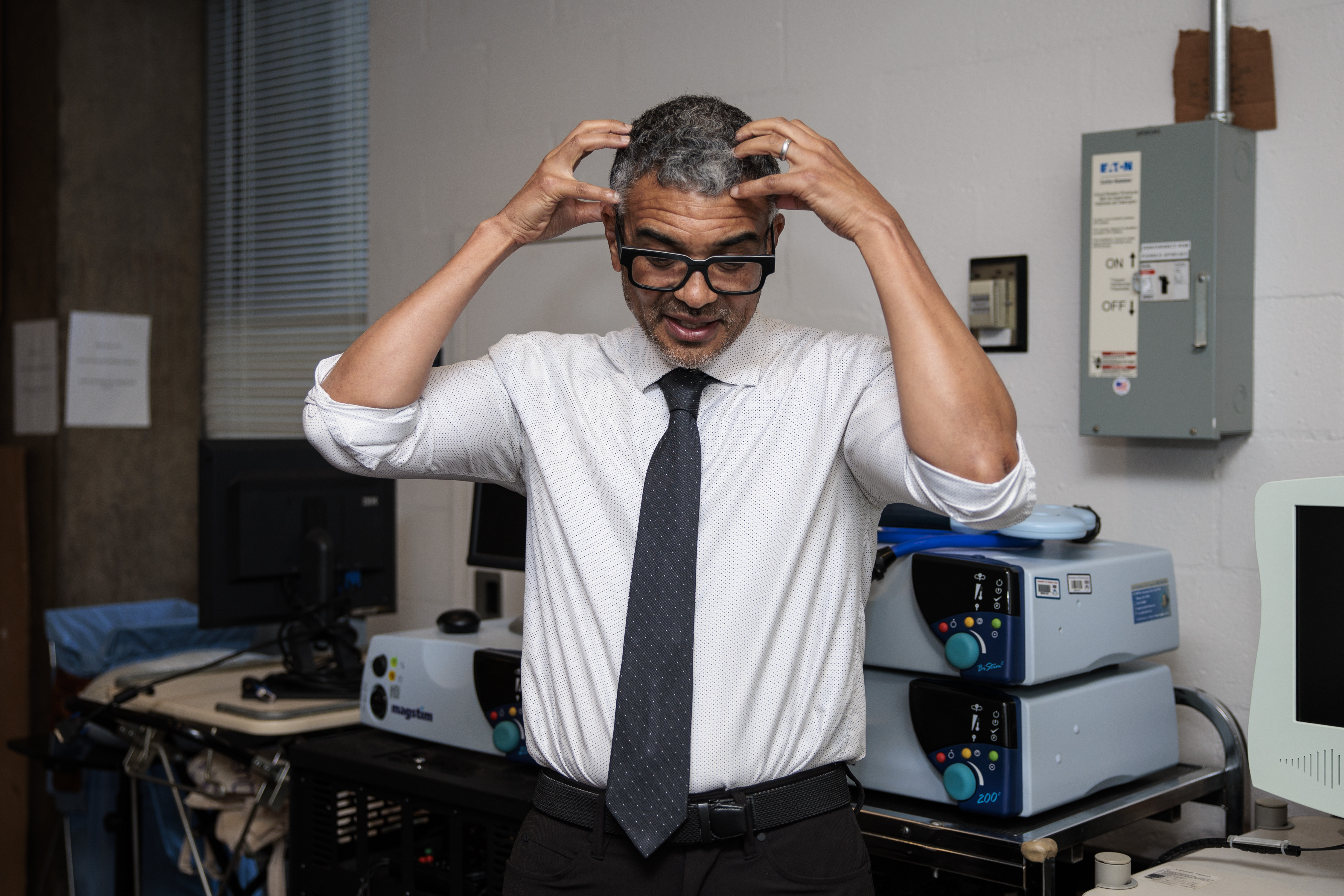
    Roy Hamilton discusses how transcranial magnetic stimulation (TMS) units are used in helping to study the brain and develop new treatments for patients with conditions like aphasia. When a TMS device is triggered, the box-shaped main unit discharges a large current through the attached coil. This creates a magnetic field that, when placed against the scalp, activates electrical signals in the brain.
    “You can basically force the brain to fire,” he said.

    Monica Herndon / Staff Photographer

    Another key moment came when neurologist Alvaro Pascual-Leone visited his medical school seminar and showed how magnets aimed at the head could temporarily affect behavior in the brain.

    “I was like, ‘That is the most amazing thing I’ve ever seen in my life,’” he said. “‘I’m going to do that for the rest of my life.’”

    Magnets and the brain

    After an internship at UCLA, in 2002 he came to Penn, where he now runs the Laboratory for Cognition and Neural Stimulation, as well as the Brain Stimulation, Translation, Innovation and Modulation Center. Putting it simply, he said: “I take magnets. I put them on people’s brains and I make them think different things.”

    He sees patients struggling with memory and cognition disorders, such as dementia and aphasia.

    “The central but not sole clinical focus of my research is in persons with language loss,” he said.

    He is married to Dawn Mechanic-Hamilton, a clinical neuropsychologist and associate professor in Penn’s department of neurology.

    Last year, Hamilton became chair elect of the senate, which functions under tri-chairs — chair-elect, current chair, and past chair — all one-year terms for a three-year commitment.

    The senate earlier this year was charged with naming faculty to serve on a committee outlining priorities for Penn’s next president. Among its priorities this year, the senate will focus on implications of artificial intelligence on teaching and learning, he said.

    “While Penn’s future remains full of promise, the road ahead may not always be easy,” he wrote to faculty. “Difficult moments, however, provide an opportunity to think carefully about the principles that give purpose to our work and ought to guide our decisions.”

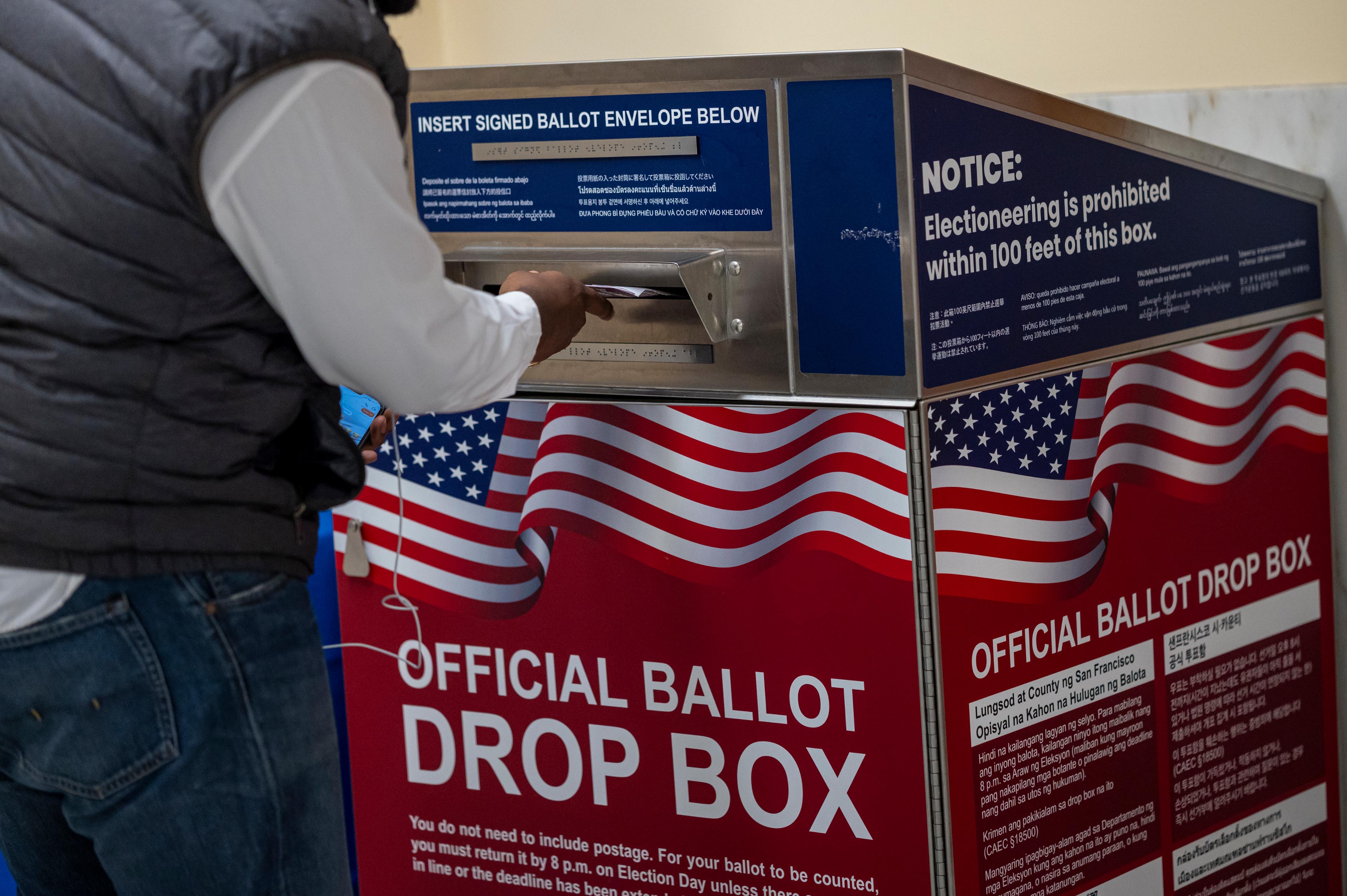
  • Trump’s putting his thumb on the mail-in ballot scale. The Supreme Court is letting him.

    Trump’s putting his thumb on the mail-in ballot scale. The Supreme Court is letting him.

    There are those who would argue that Donald Trump poses the greatest threat to American democracy we’ve ever seen from a sitting president. However, with its decision to allow Trump’s executive order on limiting the use of mail-in ballots to move forward, the U.S. Supreme Court has surpassed him.

    The Constitution clearly gives states, and not the president, the primary authority to administer elections. Congress has secondary authority, but only under emergency conditions. That means the president’s executive order, which directs various federal departments to impose rules on mail-in balloting if it is “feasible” and “lawful,” is more than a cynical attempt to save Republicans from losing congressional seats. His executive order is blatantly unconstitutional.

    Yet, in a ruling that seems bizarre on its face, the Supreme Court has decided, with a crucial midterm election just weeks away, that Trump’s executive order does not interfere with the states’ authority “‘to create and enforce a legal code’ for elections.”

    That’s nonsense. In my view, and in the opinion of 56 former judges who submitted an amicus brief to the Supreme Court, Trump’s order is all about interference. Changing rules just weeks before mail-in ballots are set to be sent to voters is an exercise in chaos. It is designed to hamper voting in blue states whose cities are filled with African American voters and others who tend to cast ballots for Democrats.

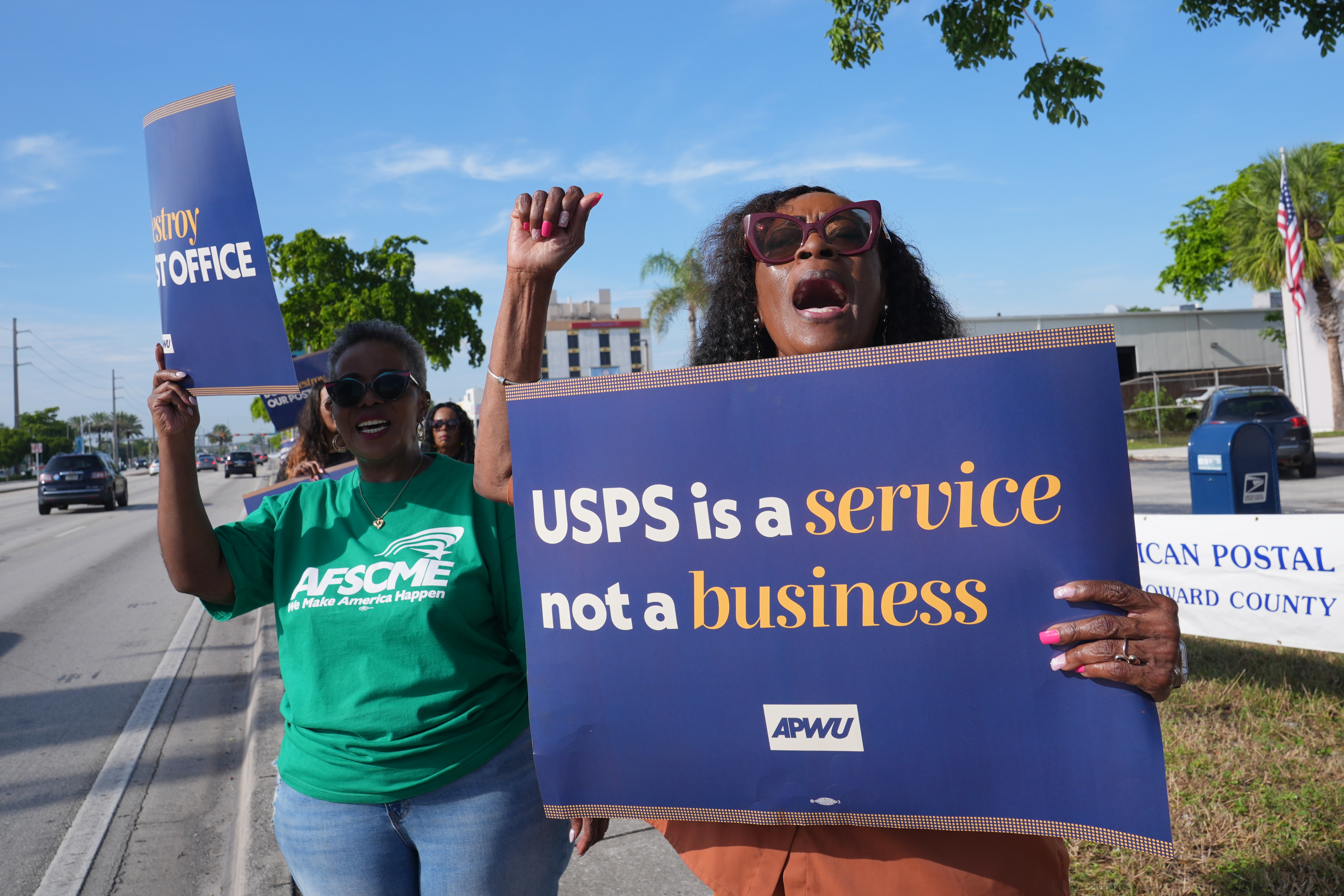
    Joy L. Jackson (right) and Ketha Otis demonstrate against proposed changes to the U.S. Postal Service and President Donald Trump’s executive order regarding mail-in ballots in Miami Gardens, Fla., last month.Marta Lavandier

    Voter suppression is the apparent goal, and the Supreme Court has played an outsized role in helping the Trump administration to get there. Even now, as the U.S. Department of Justice petitions U.S. District Judge Indira Talwani to reverse her nationwide injunction on Trump’s executive order, the Supreme Court looms in the background, ready to further erode democracy.

    Of course, the threat posed by the court is about more than just one ruling. It is about the justices’ pattern of acceding to the whims of a president who seems to view the Constitution as a suggestion, rather than the law.

    In 2024, the court shocked legal observers by ruling in Trump v. the United States that presidents have broad immunity from criminal prosecution for official actions they take while in office. And just a week ago, the court allowed construction of the president’s legally dubious $400 million ballroom to continue while lower court appeals play out, knowing the ballroom will likely be near completion by the time the courts catch up.

    Still, the Supreme Court, whose 6-3 conservative majority includes three justices Trump nominated to the bench, does not have the last word on his policies. In America, the people have the final say. That’s why this latest gambit to cripple mail-in voting is so dangerous, and it is why the Supreme Court must be held accountable.

    The people must sit in judgment of a president who starts a war that results in skyrocketing gas prices and American loss of life. The people must sit in judgment of a president who demolishes half of the White House without congressional approval. The people must sit in judgment of a president who wrecks the economy with illegal tariffs, and the people must sit in judgment of a president whose immigration crackdown costs American citizens their lives.

    Polling has already indicated that Trump, whose 33% approval rating represents his all-time low, could drag his party down in the upcoming midterm elections. But as a seasoned politician once told me, the only poll that matters is the one that takes place on Election Day. Trump understands this truth, and he is trying to put his thumb on the scales. That’s to be expected, but he should not have the Supreme Court’s help.

    At its best, America’s highest court should be apolitical, driven both by the letter and the spirit of the law. It should serve as a check on the worst instincts of politicians, and as a guardrail against tyranny. This court has failed on all those fronts, and has instead allowed itself to be driven and shaped by conservative ideology. It has fallen so far that it has seemingly been co-opted by those who would stop Americans from exercising their most basic freedom — the vote.