Tag: Donald Trump

  • In Pa. coal country, local police join with ICE to bring arrests, fear

    In Pa. coal country, local police join with ICE to bring arrests, fear

    SCHUYLKILL HAVEN, Pa. — Brett Sell had a bad feeling about coming to work on July 28. The painting contractor was part of a small work crew rehabbing a two-story commercial property in Orwigsburg — a borough of just over 3,000 people in the heart of east-central Pennsylvania’s coal country — and workers had seen what looked like an unmarked law enforcement vehicle circling the site the day before.

    “Yo, look up!” Sell said to his fellow painter, Orlando Rivera.

    Police cars from Orwigsburg and neighboring Schuylkill Haven, lights flashing, blocked off the street while agents from U.S. Immigration and Customs Enforcement in tactical vests swarmed the work site. Sell was stunned as he and four other workers were quickly handcuffed by ICE agents — even though Sell and Rivera are native-born U.S. citizens.

    Rivera, a biracial Puerto Rican who grew up in Bethlehem and now lives in another Schuylkill County borough, Tamaqua, said he was “embarrassed” as he stood in handcuffs while locals came out into the street to gawk. “I do a lot of work in that town,” he said, adding that “it made me feel like I was portrayed as a criminal.”

    And he’s convinced he was handcuffed — even after offering to show the agents his ID — because of his race. “I get that my skin tone is tan,” he said, “but with the Fourth Amendment, they can’t go off my skin color, you know?”

    Two workers were detained. One was later released, but the other — Catarino Hernandez Velasquez — a Mexican native who’s lived in Pottsville for at least 14 years, and a well-known contractor who poured concrete for the just-reopened 1928 Miners Hotel — was taken away and sent to ICE’s Moshannon Valley Detention Center in Central Pennsylvania, known for its overcrowding and complaints about lousy food and medical neglect. Kevin Medina, a leader of the local Latino community, bemoaned the arrest of a “very hardworking gentleman with a stable contracting business in the area … very busy.”

    Now, gone … in a matter of minutes.
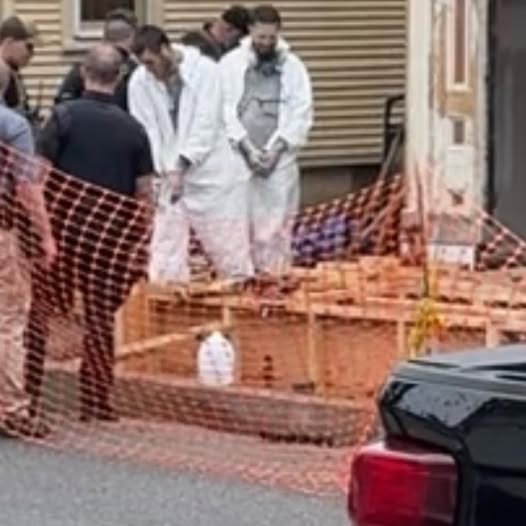
    Painting contractors Brett Sell (left, white painting outfit) and Orlando Rivera are handcuffed during an ICE raid on a job site in Orwigsburg, Pa., on July 28. The men — both native-born U.S. citizens — were released without charges.Facebook

    The Orwigsburg raid was a dramatic moment, yet such scenes are becoming increasingly common this summer in Schuylkill County, Pa., a constellation of rusty boroughs where coal was king in the 20th century, and Donald Trump got 71% of the vote in 2024.

    ‘In Schuylkill Haven, they can’t go there’

    Since the start of the year, ICE — flush with a whopping windfall of $170 billion shoveled by Congress to the U.S. Department of Homeland Security to amp up immigration raids and detention — has dangled pledges to many tiny police departments. In Schuylkill County, which locals call “the Skook,” more than $1.5 million has been distributed to law enforcement. The police chief and pols all but publicly salivated at the chance — under the controversial program known as 287(g) — to buy a desperately needed new cruiser or other cop tools in return for working with ICE to arrest and hold local immigrants for the feds.

    Some 14 law enforcement agencies — the most of any of Pennsylvania’s 67 counties — have inked 287(g) pacts with ICE, launching a new era of beat cops making immigration arrests that has roiled daily life in Schuylkill County. Practically overnight, cops were setting up truck inspections on a busy rural bypass or running checkpoints at places like the Freeze, a popular ice cream joint on the main drag, Route 61. Officers were pouncing on immigrants who showed up at the county courthouse in Pottsville, or assisting ICE on workplace raids like the one in Orwigsburg.

    Arrests leading to ICE detention and deportation cases skyrocketed across Schuylkill County — more than 100 since the start of the year, with most the result of ICE cooperation under 287(g) — leaving families torn apart while creating a climate of fear among what had been a rapidly growing Latino community in and around Pottsville. Suddenly, essential workers or their loved ones grew terrified that a busted taillight or failing to signal while shifting lanes could turn their world upside down.

    One borough with just over 5,000 residents — Schuylkill Haven — has seen at least 59 immigration arrests in about four months, a staggering number. The figures come from Chicago-based ICE watcher Andrew Thrasher, a law-firm staffer and data expert who regularly crunches federal statistics obtained by the Deportation Data Project through Freedom of Information Act (FOIA) requests.

    “People are afraid to go out,” Medina — who immigrated to Schuylkill County from Honduras, became a U.S. citizen and a notary and insurance agent, and formed a local Latino support group, Puentes de Apoyo — told me when we met in a Hispanic-owned Pottsville pizza joint. “I’ve got one contractor who told me they’ve got to change routes because now they know that in Schuylkill Haven, even they can’t go over there. And the stress, mentally, that I’m seeing in these families of, ‘What am I going to do if this happens?’”
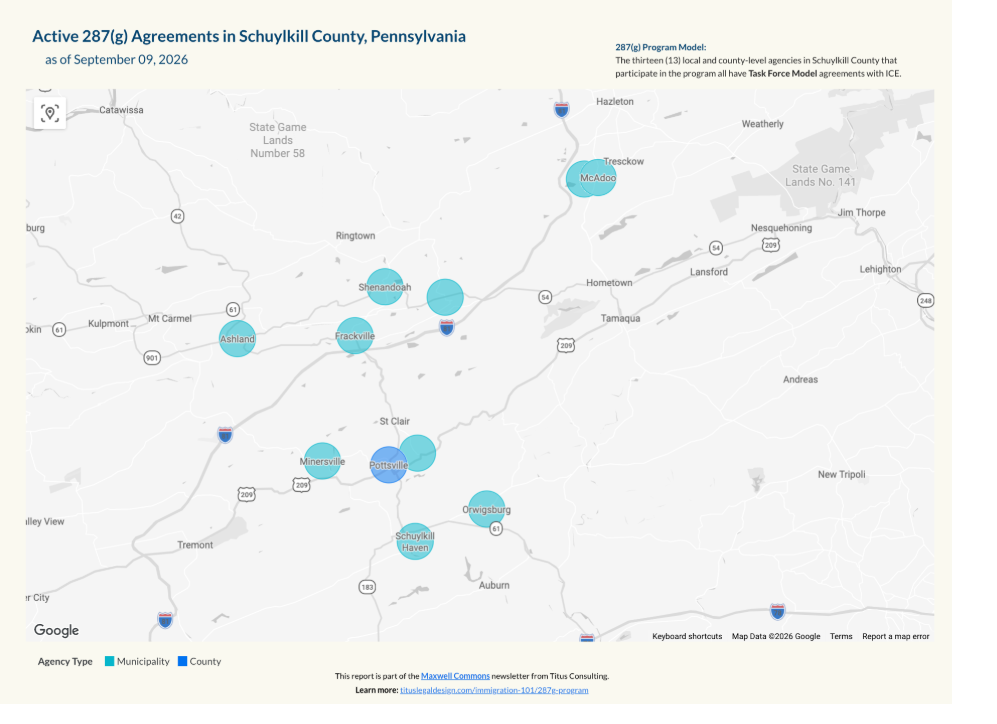
    A map, provided by immigration statistics expert Andrew Thrasher, showing 13 current Schuylkill County localities that have signed 287(g) cooperation agreements with ICE. A 14th, Mahanoy Township, is inactive.Andrew Thrasher

    The wave of arrests has put Schuylkill County — mostly rural, mostly conservative, and far removed from the glare of media or the kind of organized ICE resistance you see in big cities — on the cutting edge of an aggressive new strategy for mass deportation. This approach is bringing a xenophobic Donald Trump regime closer to fulfilling its once-unthinkable goal of removing one million immigrants from the United States every year.

    Trump Country embraces 287(g)

    The tag team of local cops and tactical-gear-wearing ICE agents is the biggest reason why federal immigration arrests spiked in July to a Trump-era high of 49,571, or about 1,600 every day. Statisticians who are tracking mass deportation said that 287(g) arrests — named for the section of a 1996 law that authorized the program — involving local police went from less than 3% of the total under Joe Biden to about 15% now, and will only climb higher as hundreds of new departments sign up.

    This year, about 58% of the people nabbed by cops and turned over to ICE under 287(g) have no criminal record or pending charges, a higher rate than the typical ICE arrestee. Thrasher found the number for Pennsylvania is even higher, about 70%.

    While not as numerous as in big and heavily conservative states like Texas and Florida, the Keystone State’s 1,216 arrests under the 287(g) program in the first seven months of 2026 rank the commonwealth fourth in the nation — on a Top 15 list made up of states almost exclusively south of the Mason-Dixon Line.

    Pennsylvania’s outlier status is punctuated by the fact that two large bordering states — New York and Maryland — have moved, with some bumps, to ban their police agencies from signing 287(g) agreements. Almost all of the Pennsylvania arrests came from smaller cities, exurbs, or rural areas — especially the south-central and northeastern regions of the state, and a smattering of western localities — that voted heavily for Trump and his anti-immigrant message.

    The small-town nature of this renewed push for mass deportation is a defining feature of the Trump regime strategy, and not a bug. The race among Schuylkill County’s police departments — many with just three or four cops, including the chief — to sign up for 287(g) and its pumped-up pile of cash came exactly as the two Minneapolis murders of U.S. citizens by immigration cops were fueling growing public outrage.

    As a brutal ICE winter ended, the Trump regime ousted Homeland Security Secretary Kristi Noem and the notorious field general Greg Bovino, and ended an era of loud, publicity-seeking operations with catchy names in large blue cities that stirred up local protesters who blew whistles and filmed every move by the masked, armed agents.
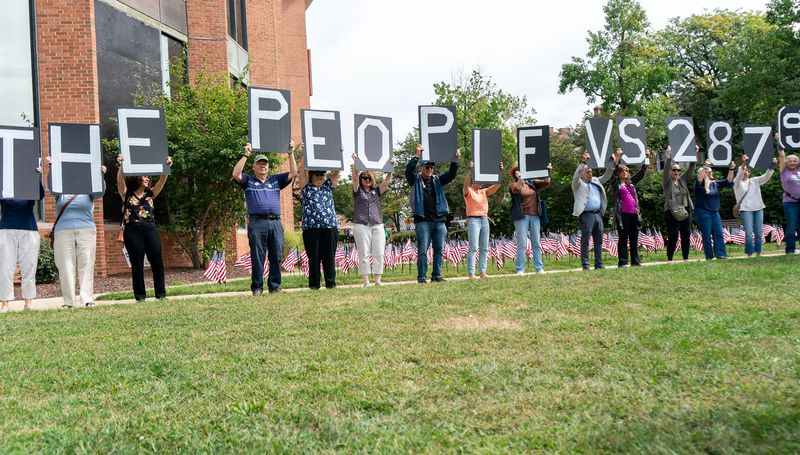
    Immigrants’ rights advocacy group members and their supporters hold up letters that read “The people vs 287(g)” during a rally last September in Doylestown against the Bucks County sheriff’s efforts to implement a 287(g) program.Daniella Heminghaus | Bucks Coun

    Under new DHS boss Markwayne Mullin, ICE and its allies are focused on what you might call small-batch immigration busts — in courthouses or on airport security lines, and thanks to 287(g), at local traffic stops or truck inspections. No one is blowing whistles, and few of these busts get caught on video. Yet, even here in blood-red Trump Country, some locals are troubled by the intense police focus on immigrants and what it’s doing to the moral fabric of their community.

    ‘Arrest them like the Gestapo’

    “No one’s telling you not to arrest people — I’m telling you not to hunt for them, to do stops on the side of the road and arrest them like the Gestapo,” a Democratic city council member in Pottsville, Andy Wollyung, told me after he tried and failed to stop the county seat from joining 287(g). He later fretted that immigration arrests “will drive a wedge in people, you know? These aren’t unknown people. These are our neighbors.”

    “When local police officers serve as a force multiplier for ICE, we know that people become more afraid to report crime,” Nayna Gupta, policy director at the American Immigration Council, told me. “They become less willing to cooperate with local law enforcement when it comes to investigations, including things like homicides. And there’s an overall mistrust of public institutions.”

    The irony is that today’s Schuylkill County was built on the backs of immigrants — initially a wave of Irish who dug the 19th-century coal mines and were also persecuted, including six members of the infamous Molly Maguires who were hanged in Pottsville in 1877. They were followed by Eastern Europeans who filled the local mining towns like Mahanoy City and Shenandoah.

    Those who stayed behind after the mines started closing in the 1950s and kept its hillside towns of striking Victorian architecture and utilitarian rowhouses alive got a booster shot in the 21st century with an unexpected new wave: Latinos. Many landed in Schuylkill County when seeking a place with cheaper housing and more job opportunities for hard workers than big cities like New York or Philadelphia.
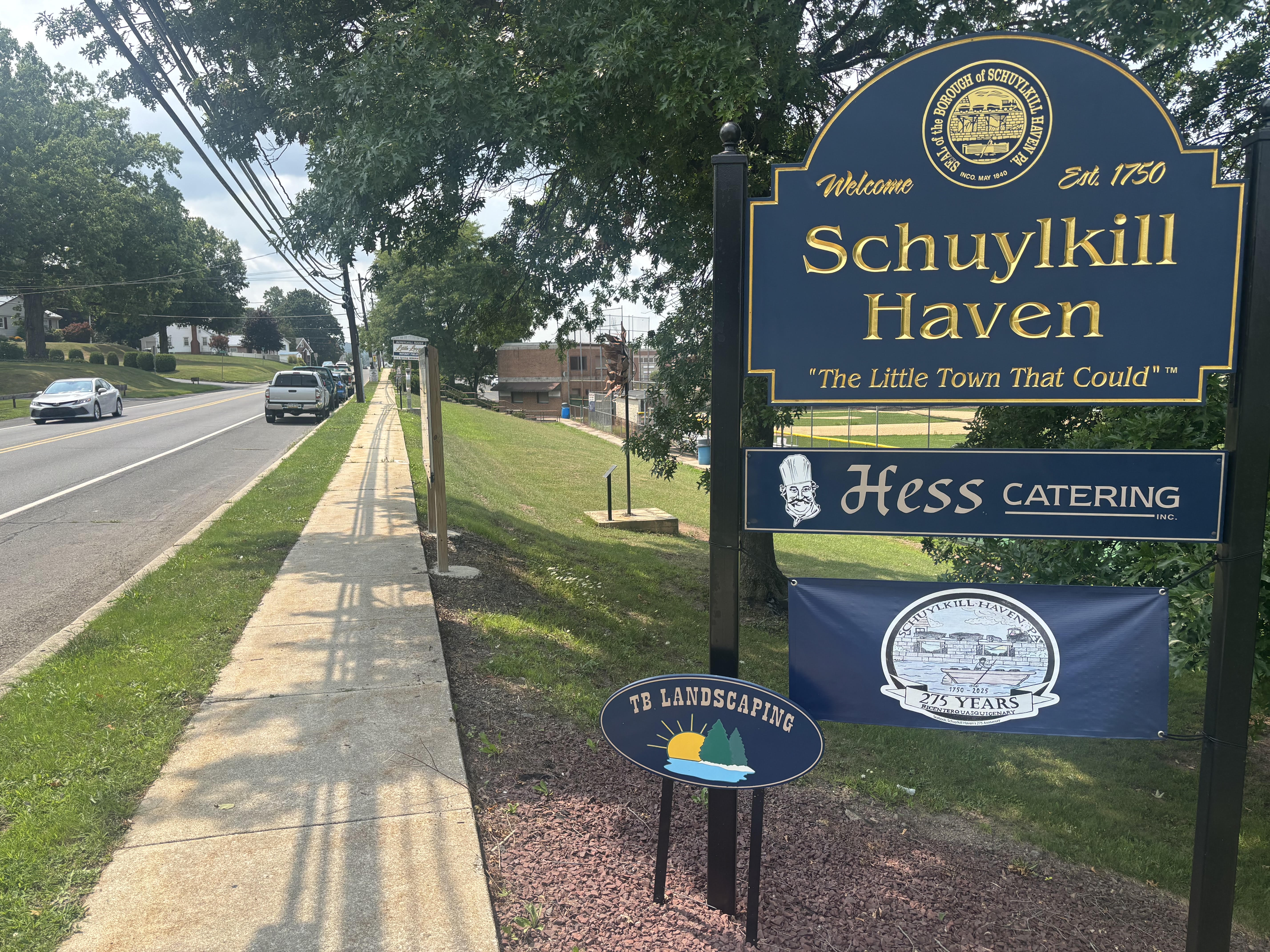
    Schuylkill Haven, with a population of just over 5,000, has arrested at least 59 people and turned them over on federal immigration charges since signing a so-called 287(g) agreement with U.S. Immigration and Customs Enforcement (ICE) this spring.Will Bunch

    Four years ago, Pastor Luis Rivera and his wife bought a historic local church building in Pottsville and rechristened it as Iglesia Cristiana El Kairos, under the umbrella of the Evangelical New Life Church, to serve a Latino community now growing by leaps and bounds.

    “You see a lot of traffic,” the pastor told me. “You see people remodeling more houses. And a lot of the stores are opening around here … It was really dead before, you know?” Today, it’s estimated that about 1,000 of Pottsville’s 14,000 residents are Latino.

    A ‘stable’ life is upended

    Six of the more recent arrivals were Venezuelan-born Carlos Moreno, his wife, Wendy Martínez, and their blended family of four teenagers. They’d been on the run from government persecution and armed conflict across South America when they came to America in 2023, and stayed in a cramped public shelter in New York City as the family sought asylum and obtained work permits.

    When they moved to a narrow rowhouse on a rugged patch of Norwegian Street on the steep hillside up from downtown Pottsville, the couple found jobs at the county’s large Amazon warehouse and even started a small cleaning business, even though Moreno, 37, is legally blind and has severe hearing problems.

    “For the first time in years, it felt like our lives were finally becoming stable,” Martínez would later write. “Then, in the fall of 2025, we learned that I was pregnant. It was an unexpected surprise, but a very welcome one.”
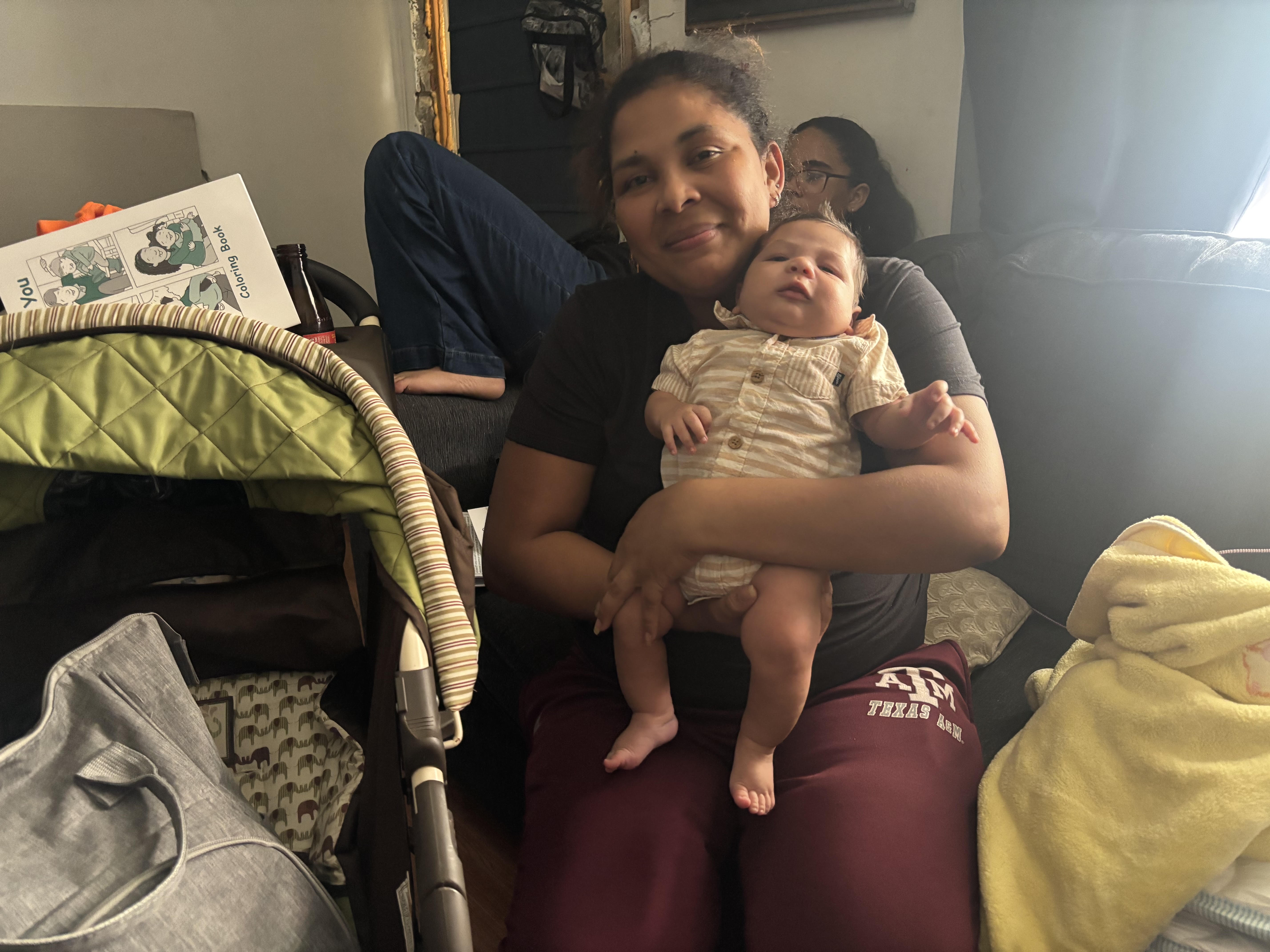
    Wendy Martínez, whose husband, Carlos Moreno, a Venezuelan refugee, has been detained by immigration authorities since May after losing a misdemeanor noise complaint at the Schuylkill County Courthouse. She is holding her baby Noah, who was roughly 6 weeks old.Will Bunch

    A bigger and less welcome surprise awaited. This spring, a neighbor called police to complain about noise — music from a small boom box — and Moreno received a summons. He decided to challenge it at the Schuylkill County Courthouse a few blocks away, and when he lost, he paid a fine, walked out of the courtroom — and right into ICE agents waiting to arrest him. He was sent to detention in the Cambria County Jail and stayed there as massive earthquakes halted deportations to Venezuela. He was locked up when his son, Noah, was born — on the Fourth of July.

    Martínez was alternately rocking and bouncing her then-6-week-old son when I joined Medina in visiting their cluttered, narrow rowhouse in August. The windows were covered with thick blankets that let in only a sliver of light, and Martínez was bookended on a sofa by her two daughters, on their phones, who rarely leave home.

    “They told him that he was a dangerous person,” Martínez said in Spanish, interpreted by Medina, as her baby babbled. “There hasn’t been any situation where he was against the law, or anything.” Struggling to pay her bills and support the five children, Martínez launched a GoFundMe page, but has only raised $2,695 of her $4,000 goal. Her husband was recently moved to ICE detention in Louisiana.
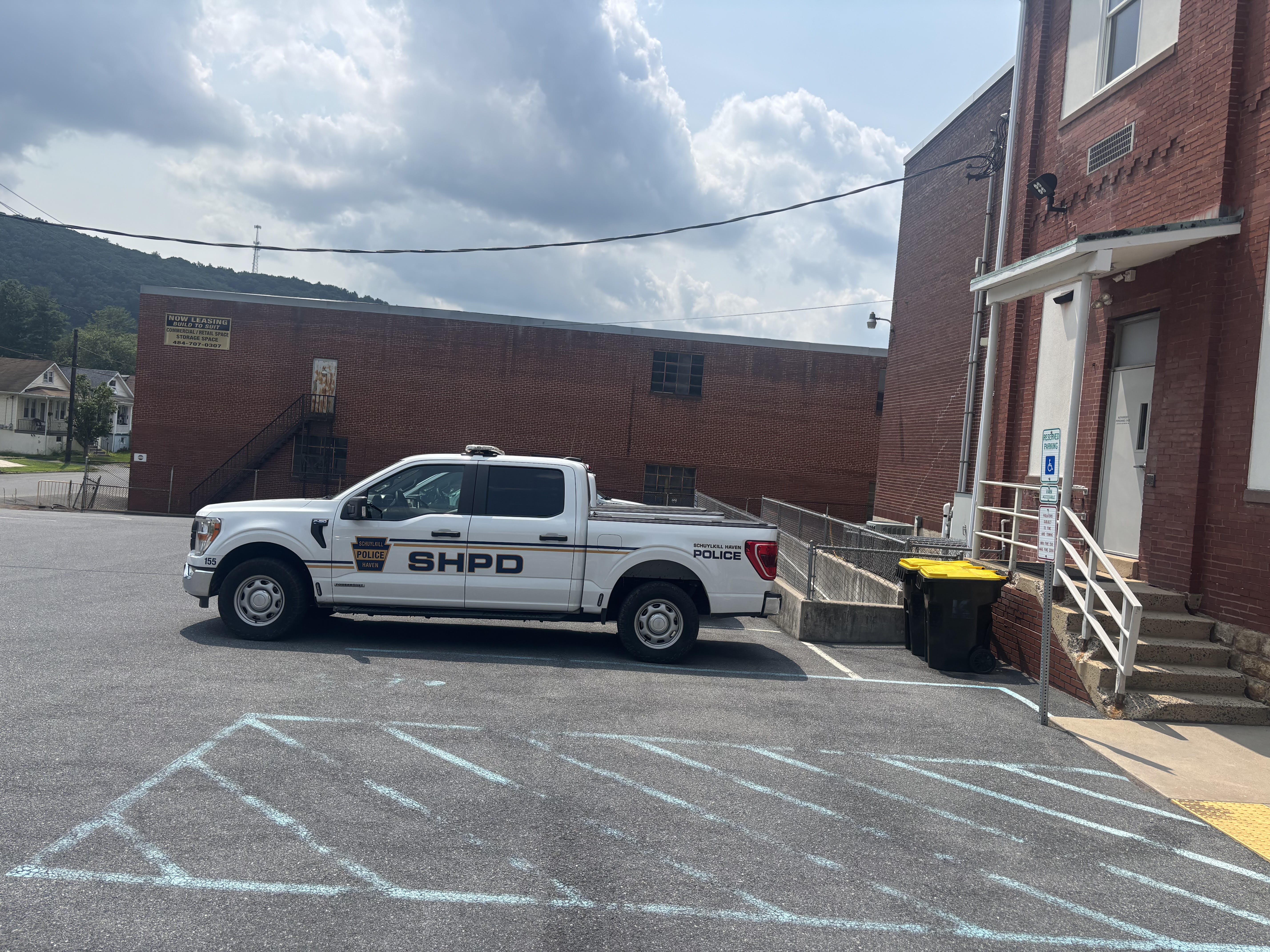
    In August, Schuylkill Haven officials said they’re expecting a federal check for $152,000 — money the police department wants to spend on buying the currently leased police headquarters, pictured here.Will Bunch

    Like most immigration arrests since 287(g) swept across Schuylkill County, there is an element of mystery about what exactly happened to Moreno. I twice called the Schuylkill County sheriff, Shawn Butler, to ask if his department — the first county agency to join 287(g), back in January — was involved, but he did not get back to me. Not once in a month of reporting did a police chief or municipal official return a call or email from this out-of-town columnist. Secrecy, and a lack of accountability, seems to be baked into the 287(g) program.

    ‘You don’t answer anything’

    “Any Right-to-Know requests, any FOIA requests, anything — you defer that right down to the Department of Homeland Security,” Jody Long, the then-police chief in Mahanoy Township, told the Pottsville City Council when it was voting on a 287(g) agreement in May. “You don’t answer anything with that. That’s right from their legal team.”

    In early September, I attended the bimonthly meeting of the Schuylkill Haven borough council hoping to ask Police Chief Jeffrey Walcott, Mayor John Williams, or other officials how and why their small borough just south of Pottsville had managed to make at least 59 immigration arrests since signing a 287(g) pact with ICE on April 5. I didn’t get very far.

    In a brief conversation, Walcott suggested, interestingly, that commenting on 287(g) might bring protesters to Schuylkill Haven. When I asked Williams about the program after the meeting, the police chief interrupted our conversation to say there should be “a unified response,” and then later told me any information would need to come from Homeland Security or a FOIA request.
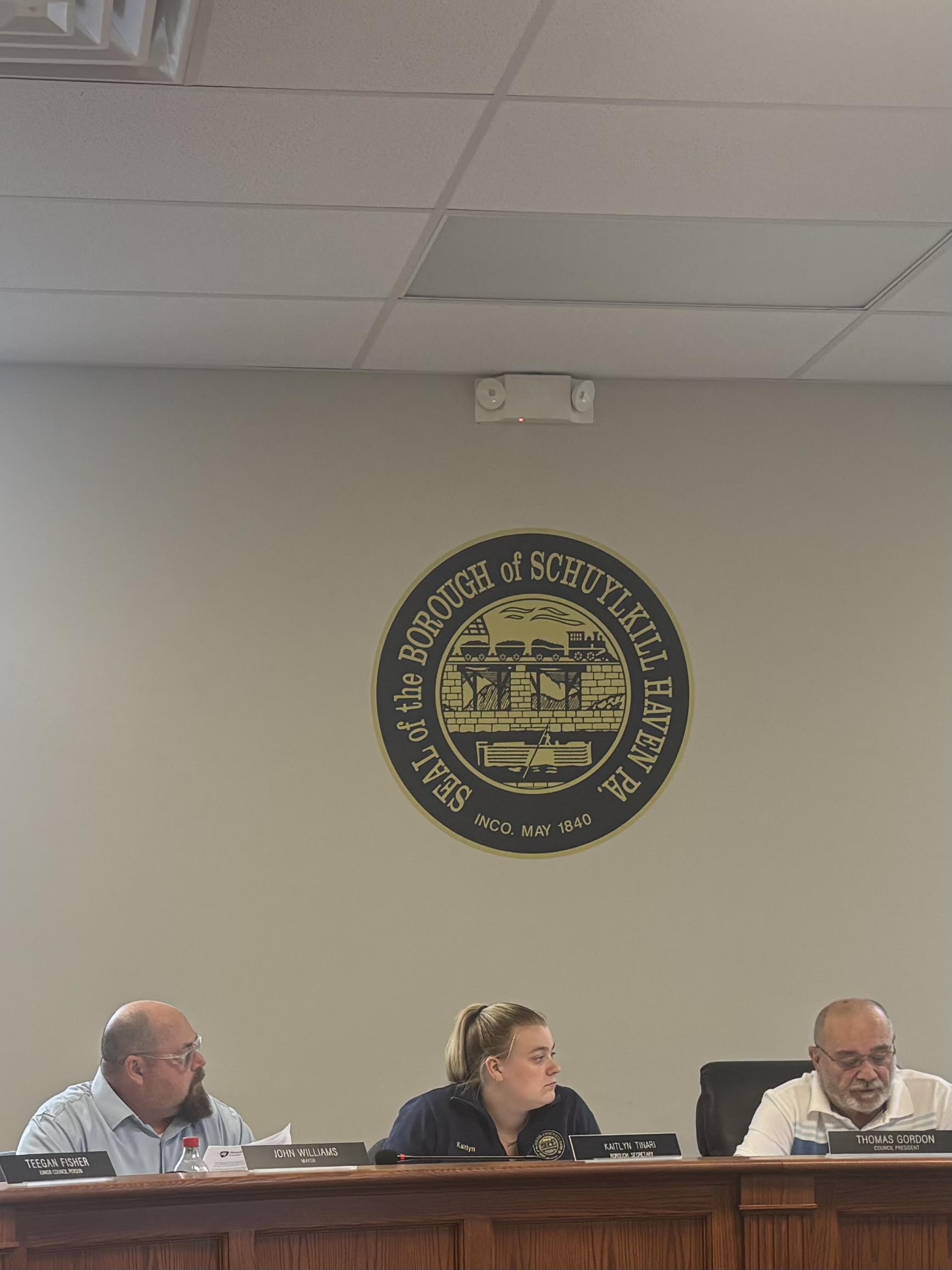
    Schuylkill Haven Mayor John Williams (left) at a borough council meeting on Sept. 2. Next to him are borough secretary Kaitlyn Tinari (center) and council president Thomas Gordon (right). Williams said Schuylkill Haven’s cooperation with federal immigration enforcement is going well, but declined to elaborate.Will Bunch

    Most of what citizens and the media in Schuylkill County know about the 287(g) programs comes from borough or township council meetings in which a police chief tells elected officials about all the sweeteners that cash-flush ICE added to the program when Congress and Trump enacted the so-called Big Beautiful Bill in 2025.

    Police departments or county sheriffs who join the most common 287(g) Task Force model get $100,000 for vehicles or other equipment and $7,500 for each officer who undergoes 40 hours of mostly online training, as well as additional dollars for their time on immigration matters — all contingent on making actual arrests. In August, Schuylkill Haven officials said they’re expecting a federal check for $152,000 — money the borough wants to spend on buying the currently leased police headquarters.

    The cash incentives have sparked a kind of deportation arms race across Pennsylvania, which has gone from just a few 287(g) programs at the start of the year to more than 130, with new ones coming online every day. Most of the council debates tread lightly on the question of liability for an officer who makes a bad arrest — a problem ICE is belatedly looking to fix with a proposal to insure each officer up to $500,000 — or the elevated risk that a traffic stop could lead to violence.

    Fighting in the Schuylkill

    That’s already happened. On May 20, a Schuylkill Haven cop stopped a car on Route 61 after he claimed the driver had illegally dark-tinted windows. ICE agents who were in the borough and arrived at the stop ran the license of 34-year-old Yensy Rafael Santana Alvarez of New York City and determined he had an immigration removal order.

    According to the Skook News, a court affidavit said the man handed over his car keys and stepped out of his car — then ran for it. Alvarez led the law officers on a wild foot chase across the Schuylkill and back, getting tased once, and allegedly pulling one officer underwater as another suffered minor injuries. He was eventually arrested, and felony charges were filed but then dropped.

    Some local critics also questioned whether minimally trained cops making immigration arrests is a good idea in a county where some departments have a history of police abuses. “In northern Schuylkill County, over the last 10 years, we’ve had horrendous police … acting very unprofessional in different departments,” John Hampton, a lawyer who has worked with Mahanoy Township, told me.

    In 2022, two then-police officers in the borough of Minersville were indicted on still-pending federal police brutality charges for allegedly severely beating a man during a traffic stop and falsifying police reports to cover it up. That didn’t prevent ICE from signing a 287(g) agreement with Minersville police in May.

    That same month, local activists pleaded with the Pottsville City Council during a meeting that lasted more than five hours not to join the 287(g) program, arguing that immigration arrests would make tourists and new businesses not want to come there. They thought they’d won in a 3-2 vote, only to have GOP council member Scott Price change his position and demand a revote that flipped the outcome, saying that, in the end, “I have to side with our police officers.”

    One of the few pro-287(g) advocates who spoke at that May hearing was Mahanoy Township’s Long, who said his department had been “the leader in the county” by making 10 immigration arrests, mainly at what he called a truck-safety inspection point. “ICE does not come in and tell you what to do,” Long insisted. “We tell them what to do.”

    He was joined by one of his officers, Anthony Maldonado, who cited his own heritage as a Puerto Rican to insist there is no racial profiling. “I have family members who are light-skinned, dark-skinned, everywhere in between, so I would take it very personally if we conducted ourself unprofessionally to that effect,” he said.

    ‘Because you look like a Mexican’

    The room in Pottsville did not hear from Moe Montalvo, a gutter contractor from nearby Tamaqua who, in mid-April, passed through the checkpoint on Burma Road operated by cops from Mahanoy Township and assisted by adjacent Ryan Township officers. He said he was part of a two-truck convoy, and the first one with two white occupants was waved through, while his was stopped to allow the officers to ask Montalvo, a 28-year-old U.S. citizen who is half Puerto Rican and half Egyptian, for his ID and grill him about his identity.

    Montalvo posted that day on Facebook that when he told an officer he was born in Montgomery County, the cop replied: “Are you sure? Because you look like a Mexican.” Montalvo also quoted the officer: “Why are you worried? The only thing you should be worried about is when I take my Taser out, because I’m going to aim right for your nose piercing.” I confirmed the incident with Montalvo, who told me that “it seems like there was no doubt that racial profiling was involved here.”

    Weeks later, the Mahanoy Township Police Department went dark, at least temporarily, after Long, Maldonado, and its other officer all quit in a disagreement with supervisors. One of the supervisors, Republican Tony Merchlinsky, confirmed to me the entire force had resigned after a dispute with supervisors over its refusal to wear body cameras. He said it was triggered by a civilian complaint over an arrest that did not involve immigration, although he added that “it may have involved racial profiling.”

    Maldonado took to Facebook to give his side of the story, saying that a different supervisor had told the township officers they were making too many arrests, and that, as quoted by Maldonado, he preferred “a [B]arney Fife department and have his police drive around and wave at people instead of making arrests.” Merchlinsky confirmed that Mahanoy Township — which recently hired a new, albeit part-time, police chief — has yet to see one dime from the feds of the more than $100,000 that was promised.

    The checkpoint drama and police tensions in Mahanoy Township demonstrate some of the many problems when beat cops are drafted to join Trump’s mass deportation crusade. Are police really making their towns safer when one part of the community is taking long traffic detours and covering up their windows in terror of any contact with cops? Is the economic gloom over Pennsylvania’s fading coal country really going to be lifted by clamping down on immigrants who’d been flocking there to pour concrete and rehab old buildings?

    Does a region whose very DNA is handed down by the immigrants who once came here to shovel anthracite now want to be known in the 21st century as a “show me your papers” police state?

    Few of these questions are being asked as one former coal burg after another races to embrace a Trumpian bargain with the 287(g) program. The latest is Mahanoy Township’s next-door neighbor, Ryan Township, which in June voted conditionally to join the ICE mass deportation program, citing as the biggest incentive its need to replace its run-down Ford Explorer, one of the oldest police cars in Schuylkill County.
  • Gov. Josh Shapiro and Utah Gov. Cox condemn political violence in joint appearance on eve of anniversary of Charlie Kirk’s killing

    Gov. Josh Shapiro and Utah Gov. Cox condemn political violence in joint appearance on eve of anniversary of Charlie Kirk’s killing

    One year ago, Utah Gov. Spencer Cox was on his way to deliver one of the most sobering speeches of his political career.

    The conservative activist Charlie Kirk had been assassinated at a university in the state, and the nation was teeming with emotion — grief, vengeance, and celebration all mixed together.

    Amid a flurry of messages of support from other leaders, Cox, a Republican, said he spoke to Pennsylvania’s Democratic Gov. Josh Shapiro, who had experienced political violence of his own, and offered advice on how Cox could comfort a jostled community.

    “I called him on the way to the press conference, and he told me to ditch my talking points and to speak from the heart,” Cox recalled on the eve of the anniversary of Kirk’s killing. “I’m grateful for that advice. I took it, and it was really important in that moment.”

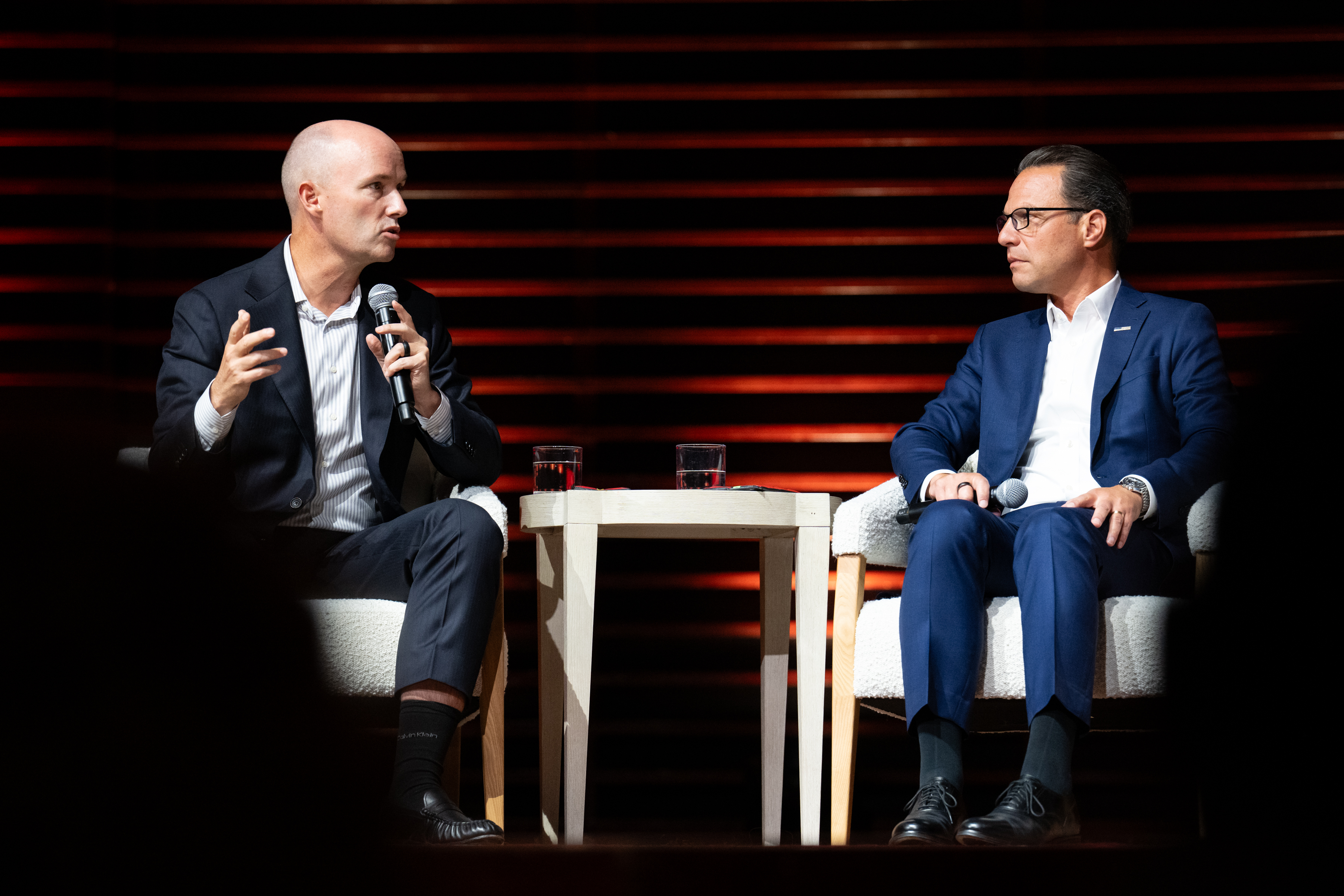
    Cox, whose new book on healing political divisions was released Tuesday, appeared on stage with Shapiro at the Kimmel Center for the Performing Arts in Philadelphia on Wednesday. The event marked a continuation of the relationship the two governors have built in part from the tragedy of politically motivated attacks.

    The event, moderated by New York Times journalist Lulu Garcia-Navarro, centered on how all members of society can hold respectful and productive conversations, even with people with whom they disagree. It comes less than two months before the midterm elections, as Democrats and Republicans wage heated campaigns for control of Congress and governors’ offices around the country, including in Pennsylvania.

    Shapiro, who along with his family narrowly escaped an arson attack on the governor’s mansion last year while they were staying there to celebrate Passover, said Americans should be “deeply concerned” about political violence and should not allow it to be rewarded or take deeper root in our nation.

    Since that April 2025 attack, threats have persisted, largely related to his Jewish faith, he said.

    “We’ve had six different people arrested in the last six or seven months for making terroristic threats against me and my wife, against our family, and oftentimes it’s rooted in an attack on me because of how I worship,” he said.

    Cody Balmer, the man who pleaded guilty to setting fire to the governor’s mansion, chose one of the holiest Jewish holidays to execute his plans and told a 911 dispatcher that night he would not take part in Shapiro’s “plans for what he wants to do to the Palestinian people.”

    The experience has left Shapiro conflicted.

    “I have a like a split-screen in my brain. I know that the incidents of political violence are rising. I know that the incidents of hate speech and hate crimes are rising, particularly against American Jews,” he said.

    Angrier rhetoric, he said, gets rewarded with online engagement and campaign donations.

    “Yet the other side of my brain gets to be governor in the greatest place, I think, in this nation, in the toughest swing state in the union, and as I go all across this commonwealth, I am met by good, decent people who offer prayers to my family, in ways that I don’t worship,” he said.

    After Kirk’s killing, Shapiro condemned all political violence and ordered flags to be flown at half-staff in his honor. He also called out “dark rhetoric” that rejoiced at Kirk’s death.

    “The talk of celebrating this man’s death, no matter how profound a disagreement over a policy should be, he left behind a wife and two children,” Shapiro said at the time. “No one should be celebrating that. No one. I think that kind of rhetoric is unhelpful on every level.”

    Shapiro, a possible 2028 presidential contender, has also talked about the assassination attempt against President Donald Trump in Pennsylvania during the 2024 campaign while pushing Trump to be more comprehensive when speaking out against political violence. On Thursday, he urged Cox to use his power within the GOP to call for unity.

    “I would say to my friend Governor Cox,” he said, “I hope he recognizes the power that he has from the perch that he occupies and the respect that you’ve earned across the country, and you use that power to help heal our politics and bring us closer together.”

    Cox, who has said Trump is “not interested in uniting the country” despite endorsing him in 2024, has ruled out a 2028 presidential run of his own but quipped Shapiro may be interested.

    “Somebody someday is going to run for president,” he said. “By the way, I just want to be clear, it may be somebody in this room. It’s not me.”

    The audience cheered for Shapiro, who smiled and said “Cox for president” into his microphone.

    Cox also praised Shapiro’s ability to “get stuff done” with a divided legislature, using the Pennsylvania governor’s signature slogan.

    “That’s going to be on a campaign ad,” Garcia-Navarro said.

  • Vulnerable Pa. Republican Rob Bresnahan delivers ‘Trump-a-palooza’ speech in Dallas amid tough race back home

    Vulnerable Pa. Republican Rob Bresnahan delivers ‘Trump-a-palooza’ speech in Dallas amid tough race back home

    DALLAS — In an arena littered with President Donald Trump’s image — from the photos that lined the concourse to the gift shops selling merch depicting the president as a cowboy — one of Pennsylvania’s most vulnerable Republican lawmakers this fall went all-in.

    U.S. Rep. Rob Bresnahan, running for reelection in a Scranton-based district that is one of the most competitive in the nation, addressed the Republican Party’s first-ever midterm convention during its opening night on Wednesday.

    His decision to attend “Trump-a-palooza” (as the RNC has described it) at all was notable. Some Republicans in tight races decided to stay away out of concerns of associating themselves with a president with low approval ratings. U.S. Rep. Brian Fitzpatrick (R., Bucks), for example, is not attending and has distanced himself from parts of Trump’s agenda.

    Bresnahan promoted Trump’s signature tax policy in a brief speech focused on supporting workers and their families.

    “Tax relief matters,” Bresnahan told hundreds of party loyalists at the American Airlines Arena in a speech that followed Ken Paxton, the controversial Trump-backed U.S. Senate candidate in Texas. “In Northeastern Pennsylvania, we work until the job is done. And those extra hours should mean more money in your pocket.”

    Democrats have used Bresnahan’s vote for the One Big Beautiful Bill Act, which included cuts to Medicaid and food assistance, as a wedge against Bresnahan and other vulnerable Republicans. But Bresnahan contended the income tax cuts and other policies in the legislation, like no tax on tips, are paying dividends for families.

    Two other Pennsylvania GOP lawmakers in similar situations, U.S. Reps. Ryan Mackenzie (R., Lehigh) and Scott Perry (R., York), are also attending the two-day convention, with Mackenzie slated to speak Thursday.

    Bresnahan spoke to a somewhat sparse crowd compared with Republican National Conventions during presidential election years, which served as a model for the novel midterm convention this year as the party looks to energize its base of voters while seeking to defend narrow majorities in the House and Senate.

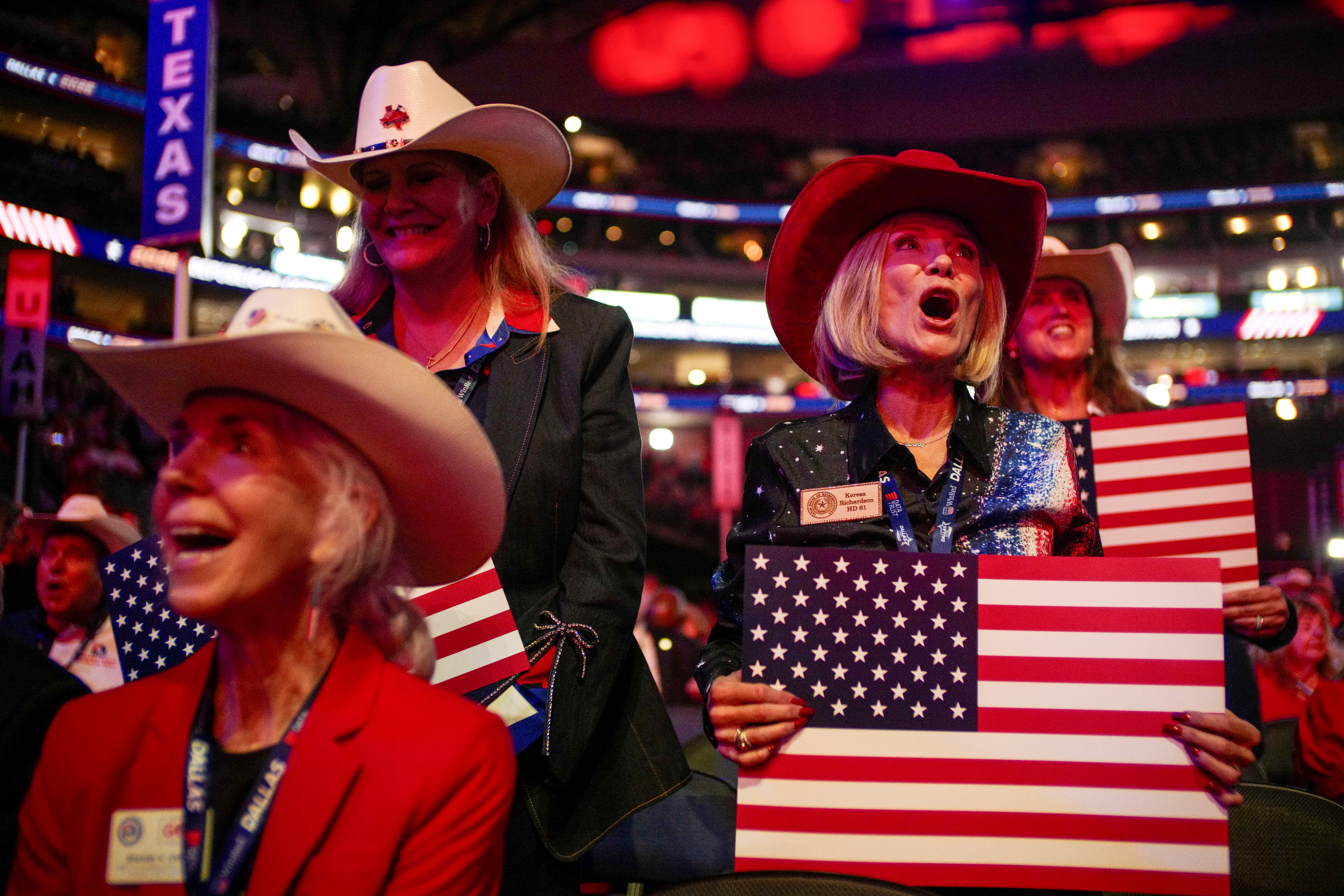
    Delegates, clustered by state on the convention floor, cheered and waved signs reading “Keep the majority” and “Republicans are fixing Democrats’ mess.” The stands in the roughly 19,000-person arena remained largely empty, at least for the first few hours before Trump’s speech.

    Merchandise shops were packed with Trump’s typical MAGA merchandise, copies of his son Eric Trump’s book, Under Siege, and new mugs and shirts showing Trump on a horse in cowboy gear. Red, white, blue, and — in an unmistakable nod toward the president — gold balloons waited in the rafters for the grand finale on Thursday.

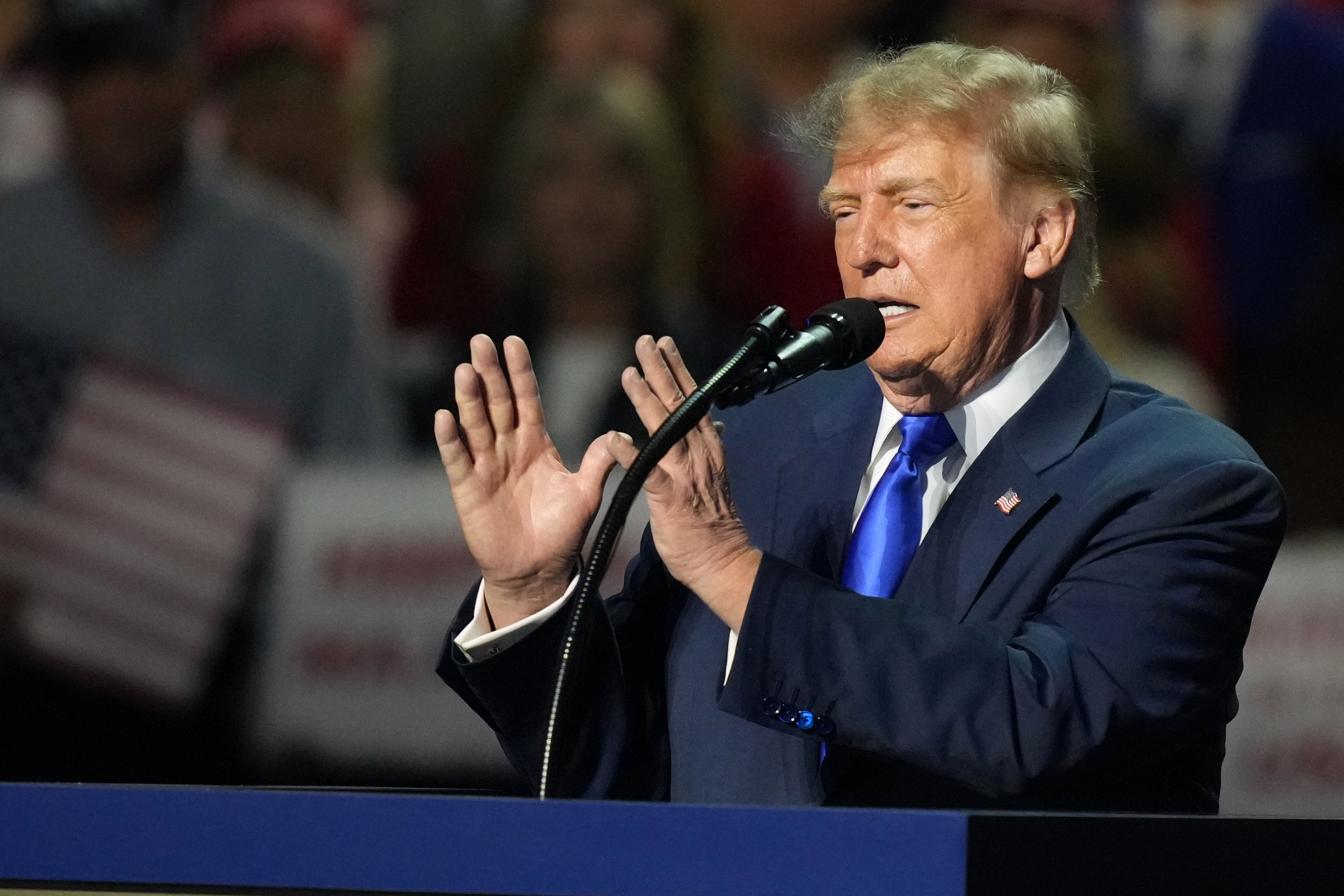
    “I’m asking you to pretend that I’m on the ballot. I’m on the ballot, just one more time,” Trump told the cheering crowd in prime time, noting there were about 35 “swing” races the party was prioritizing.

    President Donald Trump speaks at the Republican convention Wednesday, Sept. 9, 2026, in Dallas. (AP Photo/Alex Brandon)Alex Brandon

    About 1,500 miles away, in another town called Dallas, one of Bresnahan’s constituents hatched a plan to tune in.

    On the opening night of the annual Luzerne County Fair — in a booth yards from deep-fried Oreos, flying elephant kiddie rides, and life-size cardboard cutouts of Abraham Lincoln, Donald Trump, and Jesus — Dwayne McDavitt fiddled with his tablet to see if he could stream the convention.

    The symmetry of Dallas, Texas, and Dallas, Pa., was “too good to pass up,” said McDavitt, the head of a conservative group called Thunder and Liberty PAC and also the Pennsylvania chapter of Bikers For Trump.

    He said he supports Bresnahan, who lives in Luzerne County, over Scranton Mayor Paige Cognetti, the Democratic nominee.

    “He shares our values of faith, family, and freedom — meaning free and fair elections,” McDavitt said.

    Interviews with other voters in the district on Wednesday underscored the potentially risky nature of Bresnahan’s leaning into the Trump administration.

    Malcolm Mabry, 28, of Wilkes-Barre, said he had been victimized by a “Trump bait and switch” as a Republican who voted for the president two years ago. He picked Trump, believing that better policing of the Southern border was paramount.

    And while Trump has been using ICE to “grab up people,” as he said, Mabry said much of what else the president promised, like lowering prices and avoiding war, has not occurred.

    “Trump just said what he had to, to get into office,” said Mabry, who was unaware of the convention happening at the same time.

    A campaign about workers and affordability

    Bresnahan won his seat by less than 2 percentage points in 2024 to take down a six-term Democrat in the northeast corner of the state. Trump won the district by more than 8 percentage points.

    His Democratic challenger, Cognetti, has garnered high-profile supporters like Gov. Josh Shapiro, who is also up for election, and she has repeatedly targeted Bresnahan for trading stocks while in office despite his previous statements that he would not do so.

    Bresnahan, the former head of a family-run electrical contracting business, has made jobs and the workforce a top focus in his campaign and in his brief congressional career.

    On a few occasions, he has broken with House Republican leaders to support bills that would strengthen union protections for federal workers. He has said that he hopes his party changes tactics to support those kinds of bills.

    “We need the unions that have trained generations of some of the most skilled workers in American history,” Bresnahan said onstage Wednesday. “We have those workers in Northeastern Pennsylvania, and communities across this country are ready for the same opportunity.”

    Texas state Rep. Keresa Richardson (R), right, attends the GOP midterm convention. (Joel Angel Juárez/For The Washington Post)Joel Angel Juárez

    Bresnahan has racked up a series of union endorsements that are otherwise rare for Republicans. While major unions like the AFL-CIO and the Pennsylvania State Education Association have backed Cognetti, he has won support from organizations like the American Federation of Government Employees and the Teamsters — groups that, in a region with a long history of union issues, could make a difference in a close race.

    In his speech, Bresnahan talked generally about supporting workers and manufacturing in the U.S. He spoke about tax policies that put “more money in your pocket” and help “build communities where people can stay, raise a family, and build a life.”

    U.S. Sen. Dave McCormick (R., Pa.), in a speech that was introduced with an unusual video featuring U.S. Sen. John Fetterman (D., Pa.), also spoke about Trump’s push to improve economic indicators.

    They and other speakers did not address other affordability issues that Democrats have seized on and that polls show voters have top-of-mind heading into early voting.

    Trump has mocked the Democratic attacks on the issue as a hoax, including in a speech in Bresnahan’s district last year. But it is a message, and a reality, that has resonated with voters in Pennsylvania, according to polls and interviews.

    “I’m on a fixed income,” Bill Dudeck, 83, of Nanticoke in Luzerne County, said Wednesday. “But under Trump, gas, groceries, and utilities are skyrocketing.”

    Trump promised a lower cost of living, “but now all our money is out the window,” said Dudeck, a Democrat and former construction worker in Bresnahan’s district.

    Bresnahan, whose campaign said earlier this week that he was looking forward to bringing “NEPA to the national stage,” appeared onstage instead with a sheet metal worker and mother of seven from Baltimore.

    Cognetti’s campaign noted the pairing in a comment Wednesday that criticized Bresnahan, in part, for trading stocks in office.

    “That’s probably why he didn’t have a Pennsylvanian on stage with him tonight,” a Cognetti campaign spokesperson said in a statement. “His speech is just more empty words to try and distract from his broken promises.”

    Nora Pruitt, who joined Bresnahan, had previously been recognized by the White House as a beneficiary of Trump’s second term. Listed on the agenda as an “everyday American, factory worker, working mother and manufacturing success story,” Pruitt said “things have really improved for our family since President Trump returned to office.”

    “We are so grateful President Trump and Republicans in Congress like Congressman Bresnahan vote for families like ours,” she said.

  • Sen. John Fetterman appears in GOP convention video praising Trump on supporting steelworkers

    Sen. John Fetterman appears in GOP convention video praising Trump on supporting steelworkers

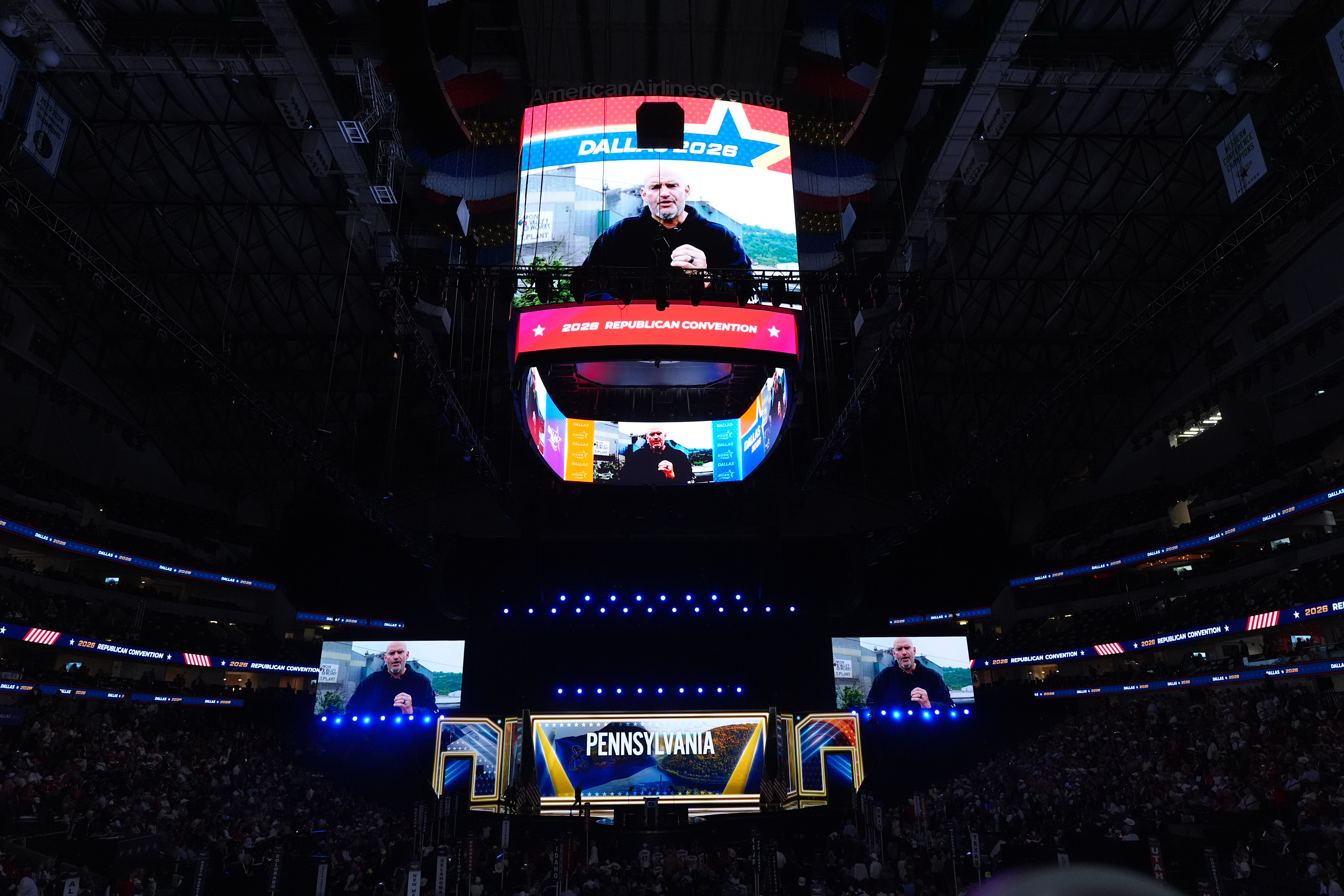
    DALLAS — In a remarkable move for a Democratic lawmaker, U.S. Sen. John Fetterman on Wednesday appeared in a video at the Republican midterm convention — an event specifically designed to boost GOP candidates this fall — in a way that praised President Donald Trump for his support of Pennsylvania steelworkers.

    The video was a clear escalation of a monthslong shift in which Fetterman has drifted from the Democratic Party. Though he has repeatedly rejected speculation that he would switch parties — and did so again after the video Wednesday — he has consistently criticized Democrats and praised Trump since the president took office.

    In the video — which introduced U.S. Sen. Dave McCormick (R., Pa.) as he took the stage — Fetterman said he and McCormick “will work with President Trump to fight and defend the steel way of life right here in the Steel Valley.”

    “I’m always going to stand with America. I’m always going to reject the extremes and socialism, and the anti-American way of life,” he said, repeating a common refrain in which he criticizes the leftist wing of the Democratic Party that has secured several high-profile wins this year.

    Fetterman, who was not physically in attendance at the American Airlines Arena in Dallas, was cheered and applauded after McCormick took the stage and said, “How great is John Fetterman, right?”

    In addition to McCormick, several vulnerable House GOP incumbents from Pennsylvania were at the convention. Fetterman’s video appearance came shortly after a speech from U.S. Rep. Rob Bresnahan (R., Luzerne), who represents one of the districts Pennsylvania Democrats are hoping to flip this year.

    U.S. Rep. Madeleine Dean (D., Montgomery), who traveled to Texas to protest the GOP convention, said she was “gravely disappointed” that Fetterman chose to participate in the GOP event rather putting his energy to electing Democrats in key Pennsylvania races — the latest in a growing list of transgressions.

    “I will tell you, from the ground, from suburban Philadelphia, my constituents are livid. Those who went out and knocked doors for him, they are absolutely livid,” she said the following day.

    Democratic Gov. Josh Shapiro, who has a frosty relationship with Fetterman, said Thursday at an event in Chester that he did not see the video before adding that he was “not going to get distracted” from his duties as governor and his reelection campaign.

    Democrats nationally are aiming to flip both the House and the Senate, which could put Fetterman in a powerful position as a swing vote if Democrats narrowly win control of his chamber.

    And while leaders in both parties have reportedly made appeals to him, Fetterman said in a statement after his video went out that he would not switch parties if the Senate changes hands.

    “I’m a lifelong Democrat who votes overwhelmingly with my party — and should the Senate flip in November, I will still be the 51st vote that I ran on,” he said, referencing his campaign promise in 2022 to be the Democratic vote that clinched the majority.

    On Thursday, a web page soliciting donations to Fetterman’s campaign committee included a link to the video and said Fetterman would “keep standing his ground, speaking his mind, and putting Pennsylvania first.”

    Fetterman has long been a supporter of the state’s steel industry as the former mayor of Braddock, the Pittsburgh suburb home to the Edgar Thomson Steel Works mill — which served as a backdrop to the video he shot for the convention.

    U.S. Steel has pledged to invest up to $2.5 billion into that mill and other Mon Valley Works plants around Pittsburgh since its sale to Japan-based Nippon Steel last year.

    The $15 billion sale had been held up for a year, opposed by both Republicans and Democrats concerned about a foreign takeover of the iconic company. Former President Joe Biden blocked the deal, and both Fetterman and McCormick criticized it before Trump took office.

    But in the early months of Trump’s term, McCormick was among those who privately lobbied the president to negotiate.

    Trump went on to secure a pledge that Nippon would have an American CEO, not lay off workers, and give the U.S. a so-called golden share in the company. Trump returned to Pennsylvania for his first rally in the state to celebrate the deal with steelworkers outside Pittsburgh.

    “Under Joe Biden, Democrats blocked critical investment in U.S. Steel, risking thousands of jobs,” McCormick said on stage Wednesday. “I promised Pittsburgh steelworkers I would fight for the steel way of life, and President Trump did, too. And with the president’s leadership, we delivered a deal protecting and creating over 100,000 American jobs.”

    Fetterman’s participation in the GOP conference — in the type of promotional video that is common at party conventions — is extremely rare.

    The Pennsylvania Democratic senator’s decision to record a video praising Trump ahead of the election may draw comparisons to Georgia Democratic Sen. Zell Miller’s fiery speech praising President George W. Bush — and denigrating Democratic nominee John Kerry — at the 2004 Republican National Convention.

    State Rep. Malcolm Kenyatta, a Philadelphia Democrat who ran against Fetterman in the 2022 Senate primary, drew a different historical comparison.

    “John is Benedict Arnold, but lazy. Could barely get off the couch in his million-dollar mansion to kiss Trump’s ring, he phoned it in like everything he does,” Kenyatta, a Democratic National Committee vice chair, said on X.

    U.S. Rep. Brendan Boyle, a Philadelphia Democrat, similarly blasted the senator’s video appearance at the rival party’s convention.

    “A year ago, I labeled John Fetterman ‘Trump’s favorite Democrat.’ Tonight, he yet again proves why,” Boyle said on X.

    And U.S. Rep. Chris Deluzio — a Western Pennsylvania Democrat who, like Boyle and Kenyatta, could be a candidate when Fetterman’s seat is up for election in 2028 — declared in a statement that Fetterman is “not going to be a Senator after 2028 — mark my words.”

    “If the failing Republican politicians want him, they can have him,” Deluzio said. “Like them, John Fetterman has failed the Pennsylvanians who elected him, who expected him to fight against White House corruption, health care cuts, and reckless war, not cheerlead it.”

    Fetterman has not yet said he will run for reelection and his dismal approval ratings among Democrats could make it difficult to win a primary — unless he switches parties. Among Republican voters, he was even more popular than McCormick in a poll last month from The Inquirer, the New York Times, and Siena University.

    Fetterman has developed a close association and friendship with McCormick since the Republican’s election in 2024. While Fetterman rarely makes public appearances in the state he represents, he has appeared at a few with McCormick.

    In a striking move, the bipartisan pair also set up a joint fundraising campaign committee this summer as Fetterman’s own fundraising lagged. This past week, McCormick came to Fetterman’s defense after the Wall Street Journal reported that the Democrat frequently avoided meeting with, and privately criticized, constituents and interest groups.

    “These stories are the latest example of outrageously disloyal staff and forces on the Left using anonymous leaks to cancel my friend John Fetterman,” McCormick wrote on social media. “They hate that he is an independent thinker who refuses to fall into line so they want to silence him.”

    In the convention video, Fetterman called McCormick a “great American, a great senator.”

    “Yes, he is in a different party, but I’m proud to count him as my great friend,” Fetterman said.

  • Trump disses 25th anniversary memorial for 9/11 while opening the door to more terrorism at home

    Trump disses 25th anniversary memorial for 9/11 while opening the door to more terrorism at home

    Who could have imagined, as we sat glued to the screen watching ash-covered victims frantically flee the falling World Trade Center towers, that the type of terrorism threatening us 25 years later would turn 9/11 on its head.

    On that terrible day, Americans stood united against the assault, political rhetoric cast aside in the horrific moment. New York Mayor Rudy Giuliani, later to become a MAGA mouthpiece, became “America’s mayor” as he projected a message of calm resolve in news conferences held amid the ruins.

    Nearly the entire world joined the United States in opposition to al-Qaeda, a multinational terrorist organization that murdered 3,000 men and women of many different nationalities in the twin towers attack. President George W. Bush, in perhaps his finest hour, reassured a shocked nation and built a multinational coalition to fight al-Qaeda.

    Our NATO allies immediately volunteered for a war in which many of their brave soldiers died — including Canadians and Danes, whose armies President Donald Trump so frequently now insults.

    That sense of unity, which impelled Americans to comfort strangers and inspired solidarity from allies and adversaries alike, has long since dissipated in the wake of forever wars and populist discontent. A divisive, America First president seems to delight in fomenting hatred between people of differing beliefs and ethnicities – and treating long-time allies like enemies.

    What the Trump administration is doing is opening the door to a new breed of lone wolf terrorists, inspired by the internet. Such radicalized individual acts have primarily been carried out by right-wing and jihadist attackers over the past years, according to detailed studies, although the low level of violent left-wing incidents has risen in 2025, in reaction to Trump policies.

    But the president and his team have worked hard to dismantle the very agencies and have fired the FBI agents and U.S. Department of Justice prosecutors that handle terrorism cases. Elite counterterrorism and counterintelligence units have been gutted by hundreds of firings and resignations. At the U.S. Department of Homeland Security alone, more than 1,300 counterterrorism specialists have been axed or reassigned to work on border enforcement and deportations, or to search for nonexistent voter fraud.

    What’s so stunning is that, just before the start of the current endless Iran war, with the White House still claiming Tehran is the leading sponsor of international terrorism, FBI Director Kash Patel specifically sacked about a dozen members of an elite Washington-based unit specializing in stemming threats from Iran within our country. Why? Because the agents had been involved in investigating Trump’s retention of classified documents at Mar-a-Lago after he ended his first term.

    When asked in March by the New York Times whether Americans needed to worry about possible terrorist reprisals by Iran inside the U.S., Trump retorted: “I guess. Some people will die.”

    Trump’s blindness is worse than the noncooperation between the FBI and the CIA in 2001 that led them to ignore clues to the monthslong presence of the 9/11 terrorists on U.S. soil. This is the willful blindness of our government to potential terror attacks by an Iranian regime that has every reason to strike in the near term.

    Add to that the president’s constant incitement of his followers against so-called leftist networks, declaring “antifa” to be a dangerous terror organization. Only problem: There is no such organization; antifa is a catch-all term for loose groups across the country who declare themselves to be anti-fascist.

    Compare that to the white supremacist massacre of 11 Jewish worshipers at the Tree of Life Synagogue in Pittsburgh during Trump’s first term, or the deadly truck attack by an Islamist on New Year’s Day 2025 in New Orleans. Yet Trump consistently, and determinedly defying statistics, declares domestic terrorism to be the work of the so-called left.

    Such incitement is a cover story for attacking political criticism from any front, and inspires potential right-wing terrorist attacks against Trump’s political opponents. Never forget that it was right-wing terrorists who called for the murder of Vice President Mike Pence when they attacked the U.S. Capitol, who murdered two Minnesota lawmakers, and who nearly killed Paul Pelosi, then-House Speaker Nancy Pelosi’s husband.

    Meantime, the president dispatches federal agents who could be thwarting real terrorism to instead threaten election officials and potentially midterm voters. Ditto for menacing noncriminal immigrants with violence and sometimes death.

    As for state-run terrorism, Trump’s self-declared friend, Vladimir Putin, has embarked on a campaign against NATO allies, including dropping drones near airports such as the one in Leipzig, Germany, recently.

    “We are the daily target of hybrid warfare,” said the German interior minister last month. The International Institute for Strategic Studies this summer tallied 144 drone incidents across 13 countries in less than two years, with Russia as the main culprit. And that doesn’t include the assassinations Moscow has conducted against former dissidents living in England and Germany and many arson and sabotage attacks across Europe.

    And while you may think you have read much about the deliberate Russian destruction of civilian markets, malls, schools, universities, and cathedrals in Ukraine, you are probably unaware of the worst.

    Just one example: In the city of Kherson, just across the river from Russian positions, Russian drone pilots play a game they call “human safari” and brag about it on their Telegram channels. It means getting a hapless vegetable seller in their sights, chasing him as he tries desperately to escape, and then finally killing him.

    This is not warfare. It is deliberate terror, Nazi-style, to try to demoralize Ukrainians into surrendering their sovereignty.

    And so, as we remember 9/11, as we repudiate the terrorist attackers, and recall the human error by U.S. officials that led to the deaths of 3,000 innocent souls, we should give serious thought to the Trump administration’s choices and rhetoric that open the door to more terrorist assaults.

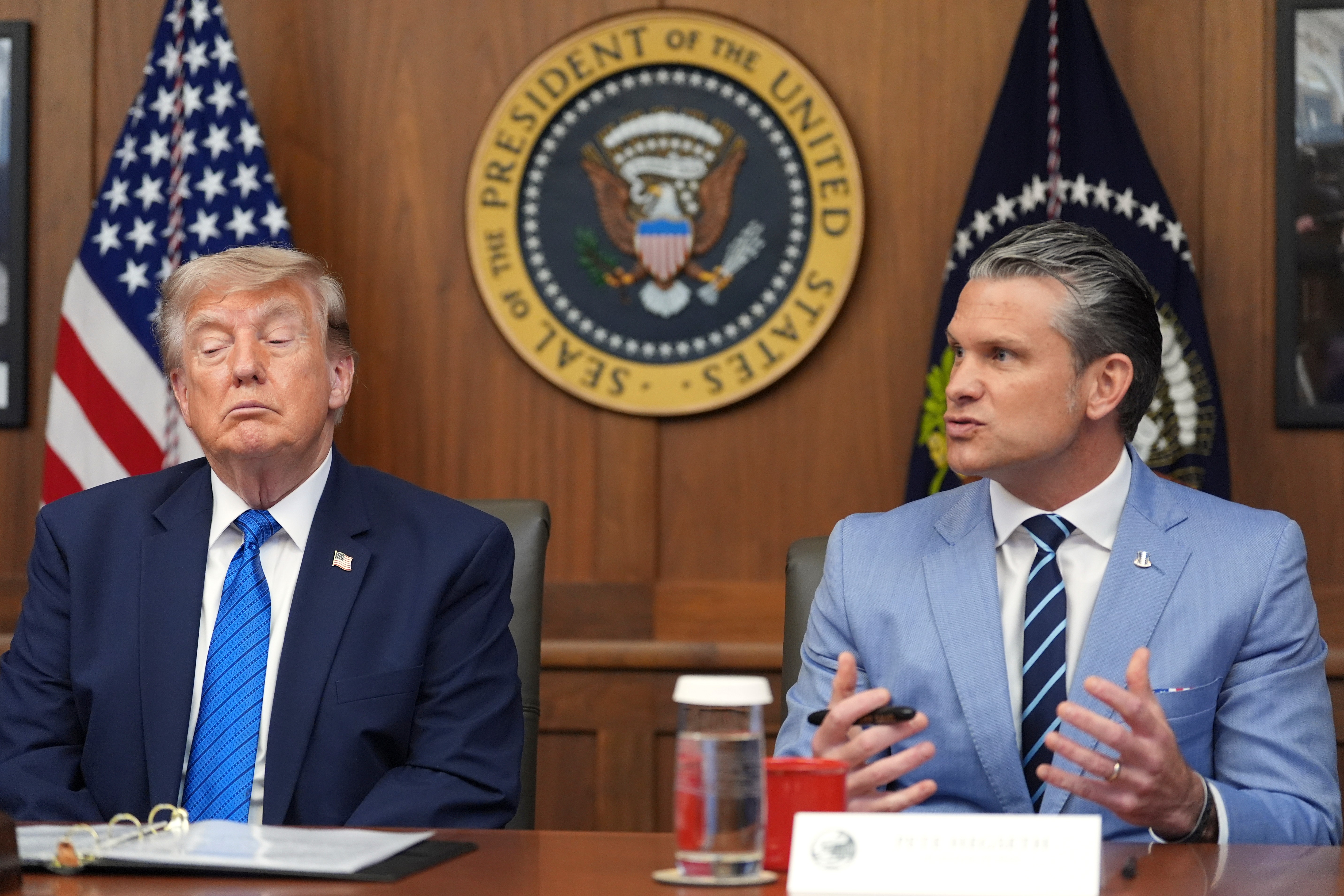
    Trump has refused to attend the 9/11 ceremonies in New York City, reportedly because he wouldn’t be allowed to make a speech. Instead, he will bloviate at the Pentagon alongside his “Secretary of War” Pete Hegseth, who is contributing to the president’s security blindness that exposes Americans to potential harm.

    Shame on them for endangering the country by refusing to learn the lessons of that terrible day.

  • Why don’t construction and factory workers want to build ships?

    Why don’t construction and factory workers want to build ships?

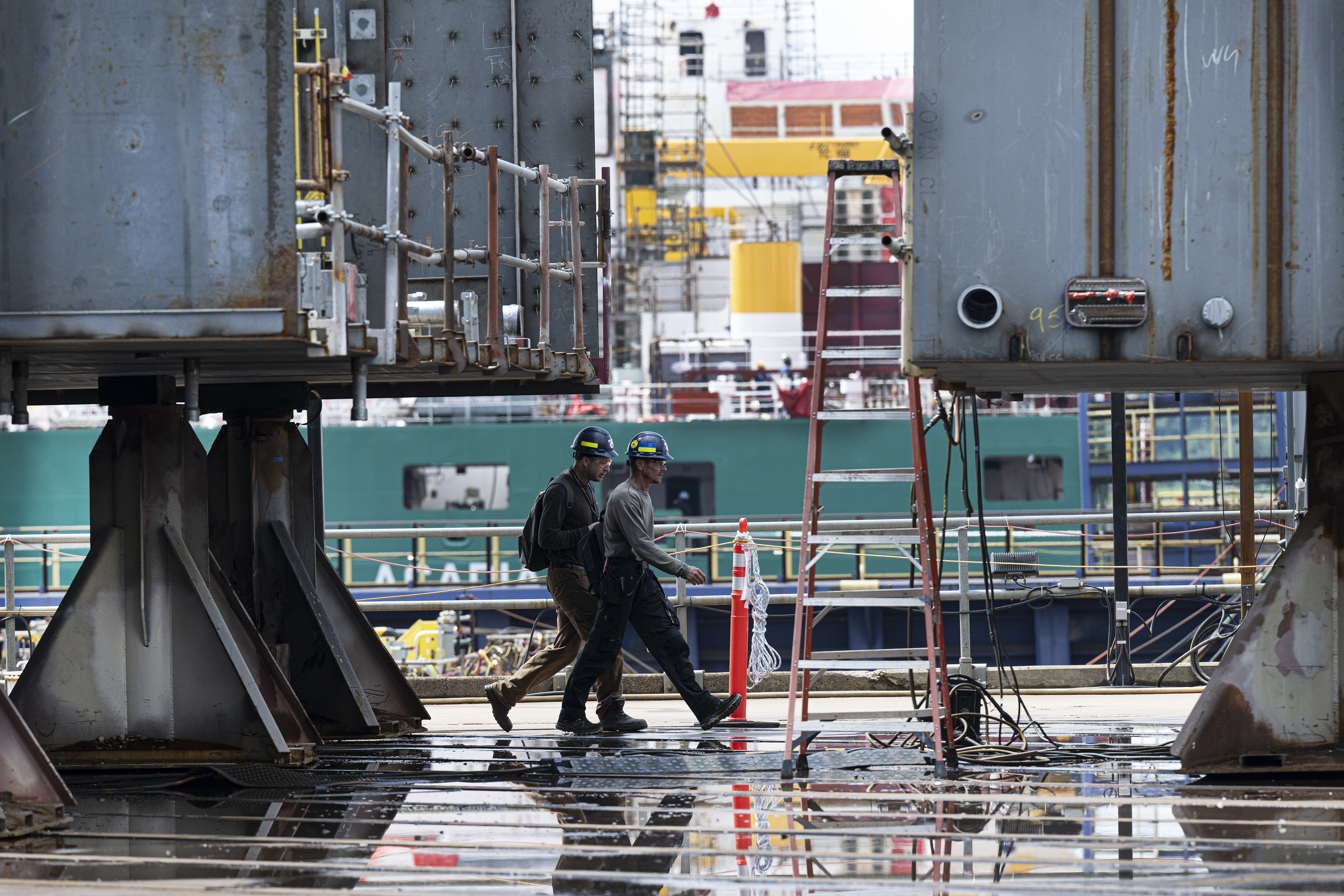
    The U.S. government is spending over a billion dollars to recruit hundreds of thousands of workers it estimates will be needed in Philadelphia and other shipbuilding centers to expand the Navy and compete with lower-cost Chinese yards, as President Donald Trump proposes. The campaign includes “Build Submarines” ads on social media and SEPTA bus shelters and grants to training programs.

    “You have to work the parents,” Michael Cadenazzi, assistant secretary of war for industrial base policy, told contractors assembled by Trump and U.S. Sen. Dave McCormick (R., Pa.) at the U.S. Army War College in Carlisle in July. “Mom and Dad need to understand their kid is succeeding,” even if they skip college for “AI-proof jobs” as “the wizards behind the warriors — shipfitters, welders, pipe fitters.”

    BuildSubmarines.com, a U.S. government-funded marketing effort, is trying to recruit workers for shipyards through public-transit and social-media ads. It also sponsors a Nascar team.U.S. Navy

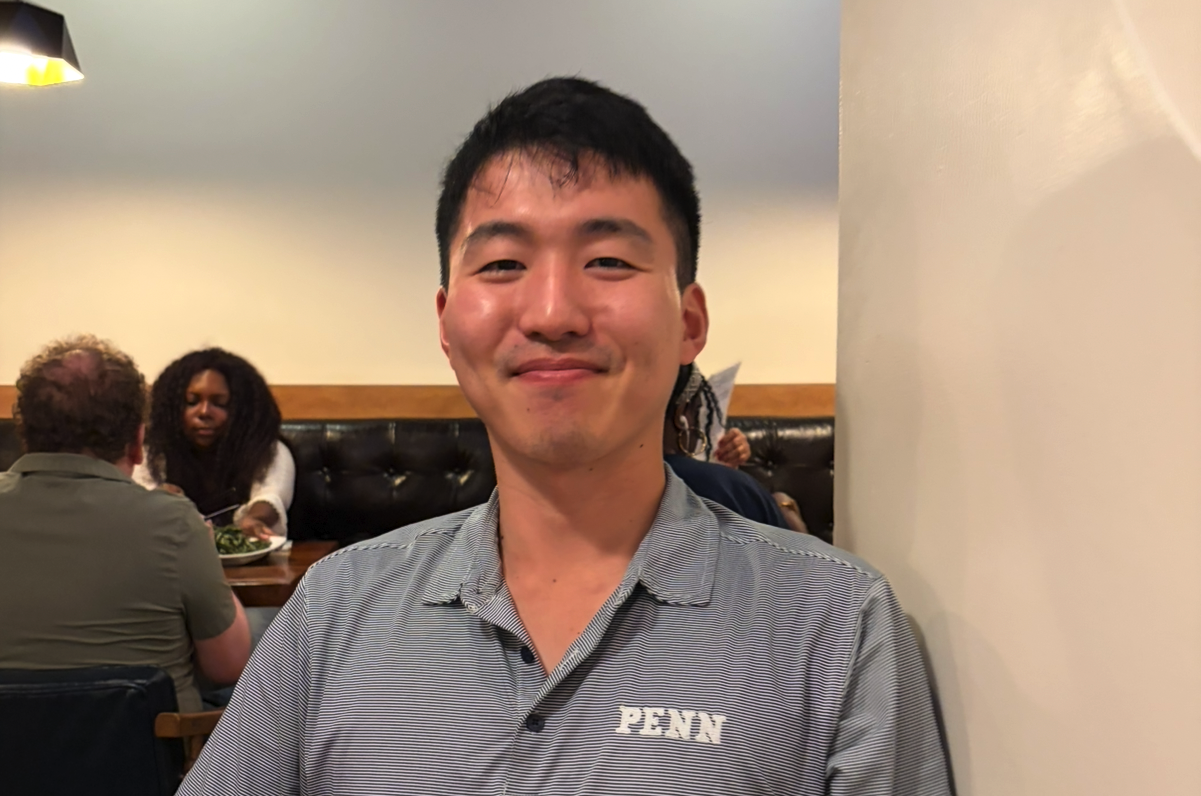
    If would-be college students prove a tough sell, there’s an even larger population of American workers who have what it takes to build ships but don’t want to, said Gary Kim, a Wharton School graduate student who has studied U.S., Chinese, Japanese, and Korean shipyards.

    In essays for the U.S. Naval Institute and a series of papers titled The Brutal Realities of Building Ships, Kim, formerly a junior officer with U.S. Navy construction units in Asia and a Detroit manufacturing manager, has detailed rough conditions and skilled-labor shortages and suggested what shipyards have to do to realistically fill those jobs.

    Kim is a scheduled speaker at the Philadelphia Navy Yard Symposium on Sept. 26. He agreed to an interview with The Inquirer on a recent visit to Philadelphia. Questions and answers have been edited for clarity and brevity.

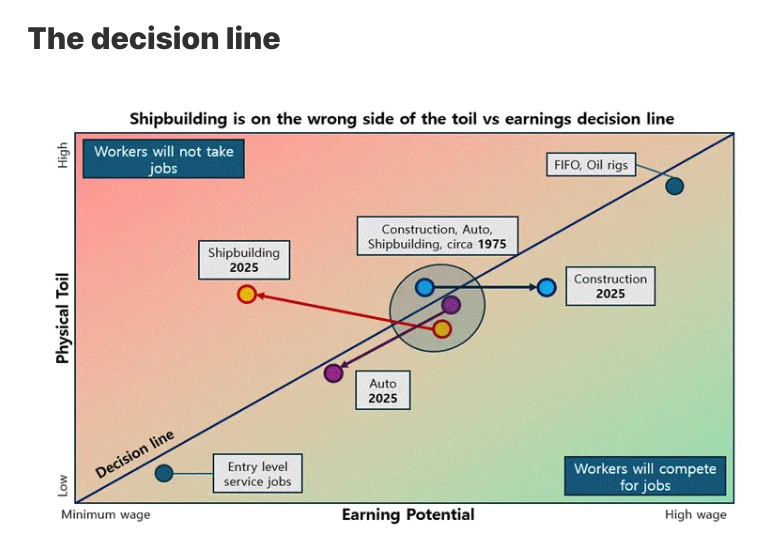
    You’ve written that shipbuilding is heavy construction work — more dangerous than putting up buildings, less comfortable than modern factories, but not better paid.

    Shipyards are great for everyone except the people who work there. The economic boom is paid for in blood.

    The question we should be answering isn’t ‘Why can’t we convince 150,000 more kids to build ships?’ but ‘Why are the 30 million Americans already in the industrial workforce — construction, manufacturing, transportation — refusing shipyard jobs?’

    Gary Kim in Philadelphia in August 2026. Kim is a Wharton School graduate student and naval reserve officer who has studied U.S., Chinese, Japanese, and Korean shipyards.Joseph N. DiStefano

    Shipyard work is an agglomeration of tasks done in the wider industrial economy: welding, plumbing, truck driving. Why does most of that workforce turn away from building ships? Because it’s dark work in dangerous corners. And it doesn’t pay much.

    Companies have invested a lot in improving factory conditions over the past 30 years. Manufacturing became gentler on your body.

    But it’s also less unionized than before. In the new factories, adjusting for inflation, the pay is less. Factory workers and warehouse workers accept repetitive labor in air-conditioned facilities, in exchange for lower pay.

    Construction is a rough trade, but it pays better. The economic rewards have increased. Not only there’s better pay, but it’s a way men and women can become entrepreneurial. Some become contractors. It’s just as hard as shipbuilding, but the payoff is better.

    In shipbuilding, the pay in real terms has declined, but the workplace is only transforming recently with advanced robotics. Sometimes shipyard apprenticeship programs that teach industrial skills see [their graduates] leave for other industrial jobs.

    Comparison of construction, shipbuilding, factory, energy, and entry-level service jobs, pay vs. relative danger, 1975-2025, from data compiled by Gary Kim and posted in his series “The Brutal Realities of Shipbuilding.”Gary Kim
    Could Philadelphia double the ship workforces, as Hanwha Philly Shipyard and Rhoads Industries say they hope to do in the next few years?

    Philly is going to struggle to recruit an industrial workforce. There is a rhyme and rhythm to an industrial city.

    You have industrial accidents. You have elevated rates of chronic conditions years afterward.

    Look at the reactions to the Canada wildfires. Detroit had the worst air quality in the world for a day, but nothing shut down. Everyone from the UAW director to the people in the city government knows the four or five closest auto plants each generate tens of millions of dollars in economic activity daily. Even if city health officials say it’s too much risk, nobody needs to be told what you are taking out of the city if you close.

    Industrial work brings prosperity and less economic inequalities, with [personal and environmental] costs. Manufacturing requires higher risk and having your citizens accept that risk. You have that in the Gulf [home to the U.S. oil industry] and in the Mississippi Valley [where the U.S. steel industry has moved], and in Michigan [auto plants].

    The economy here has been running on services and logistics for so long that I don’t think Philadelphia any longer has that intestinal fortitude to accept what shipyards really are.

    Do U.S. shippers really want more U.S. commercial ships at U.S. prices?

    If the Jones Act [requiring U.S. ships for cargoes between U.S. ports, suspended by Trump] is waived indefinitely, companies are not going to need more ships built here.

    And you need more orders. If a shipyard does not lay out several a ships a year, you can’t develop a career. You start laying a keel; you need a lot of welders. Then cutters. Then plumbers. Then there’s a surge of need for electricians. You can’t sustain that workforce unless you can stage crews across different jobs in the time it takes to build a ship.

    Rhoads in Philadelphia fabricates nuclear-submarine modules for General Dynamics. Can this region eventually build subs?

    Nuclear reactors, spaceships, and American submarines are the most stringent things to build in the world. If Philadelphia wants a more meaningful part of the submarine value chain, we need to build with spaceshiplike tolerances.

    The Navy is putting out the correct messaging that the industrial base needs a diversity of jobs. An amazingly large part of the maritime industrial base doesn’t come from port cities but from inland operations. The most critical part of submarines is the gearboxes, built in California.

    The government has ordered two missile and satellite tracking ships from Hanwha Philly Shipyard. Will Philadelphia-area defense contractors likely do the electronics?

    [The Lockheed Martin-run Navy electronics facility in Moorestown] is the technology center of that industry. But I think the biggest reason Philadelphia landed the tracking ships here was that the yard needed a win. And backlogs in other shipyards are now 10 years and more.

    Hanwha wants to buy Austal’s Alabama shipyards and submarine module works and its California ship repair facility. What does that leave for Philly Shipyard?

    Hanwha wants to be a globally competitive defense prime contractor. Buying Austal would make Hanwha a solid #3 shipyard operator in the U.S., plus their megayard in Korea.

    I expect the Austal yard would focus on smaller warships. Philly would focus on surface auxiliary vessels.

    Most yards lose more money the more ships they build. Hanwha thinks they can do better, and I seriously hope they are right.

    Editor’s note: This article wrongly identified the role of Philadelphia Gear in Navy ship construction. It has been updated.

  • With control of Congress on the line, Pa. Republicans head to Trump’s midterm convention in Dallas

    With control of Congress on the line, Pa. Republicans head to Trump’s midterm convention in Dallas

    Key figures in Pennsylvania Republican politics — including the state’s top elected federal GOP official and several lawmakers in the middle of heated reelection campaigns — will participate in their party’s first-of-its-kind midterm convention this week in Dallas.

    The gathering, spurred and heavily promoted by President Donald Trump, arrives as Republicans look to defend their control of Congress this fall amid difficult circumstances. Trump’s approval ratings, including on key issues such as the economy and the war in Iran, have sunk, including in Pennsylvania.

    And Democratic challengers, some of whom have outraised their Republican opponents, have waged aggressive campaigns.

    After Trump successfully won the White House and ushered in a wave of downballot Republican wins just two years ago, the convention — described as “Trump-a-palooza” by Republican National Committee chairman Joe Gruters — is aimed at energizing the base at a critical time.

    Pennsylvanians, representing a swing state that has been key to Trump’s success in the past, will play a role.

    U.S. Sen. Dave McCormick (R., Pa.) and a pair of House lawmakers in competitive districts — U.S. Reps. Ryan Mackenzie (R., Lehigh) and Rob Bresnahan (R., Luzerne) — are among the more than 100 scheduled speakers over two days, starting Wednesday.

    Their speaking slots were among the first to be announced. Underscoring the Keystone State’s role in keeping the House Republican majority, only the host state of Texas had more representatives on the initial list of elected officials scheduled to address the crowd.

    The Pennsylvania Republican Party, meanwhile, has orchestrated a “full slate” of 55 delegates and alternate delegates.

    “The Republican Party of Pennsylvania is excited and honored to be a part of the first ever RNC Midterm Convention in Dallas,” spokesperson James Markley said in a statement. “It will be a tremendous opportunity to hear from everyday Americans about how this administration has changed their lives for the better.”

    The state party had not provided the names of the delegates as of Tuesday, though the list is expected to include party activists and other elected officials. State party leaders had encouraged Pennsylvanians to attend the gathering.

    Democrats, who see the president’s lagging approval ratings as a key to their success in the midterms, were quick to blast Pennsylvania Republicans for attending. Their response includes plans to send a small group of House Democrats, including U.S. Rep. Madeleine Dean (D., Montgomery), to Dallas to push back against the GOP messaging.

    “While swing seat House Republicans try to hide from their record of raising costs on working families, gutting Medicaid to fund tax breaks for billionaire donors and supporting a reckless war of choice in Iran, House Democrats will be present to hold them accountable,” House Minority Leader Hakeem Jeffries, the New York Democrat in line to become House speaker if his party wins the majority, said in a statement.

    Fitzpatrick skips as other Pa. Republicans take center stage

    Four of Pennsylvania’s 10 Republican-held U.S. House seats are considered key battlegrounds as the GOP looks to maintain its four-seat advantage nationwide.

    Of those, only U.S. Rep. Brian Fitzpatrick (R., Bucks) has distanced himself from parts of Trump’s agenda and is not planning on attending the convention.

    Mackenzie and Bresnahan, on the other hand, will be among the featured speakers, and U.S. Rep. Scott Perry (R., York) will attend.

    Perry, a close Trump ally, has routinely won reelection in a Harrisburg-based district but is running this year against Democrat Janelle Stelson, a former local television anchor who nearly defeated him two years ago.

    Freshmen Mackenzie and Bresnahan were elected to Congress in 2024 after they each defeated incumbent Democrats by less than 2 percentage points. Local, state, and national Democrats have rallied behind their challengers — union leader and retired firefighter Bob Brooks in the Lehigh Valley, and Scranton Mayor Paige Cognetti in the district that covers the northeast corner of the state.

    Bresnahan campaign spokesperson Samantha Bullock said the lawmaker was “excited to bring NEPA to the national stage because these are the people driving his work in Washington.”

    Mackenzie, in a statement that referenced his work to bring federal funds to his district and support areas like local healthcare and tax relief, said he was “looking forward to talking to the people of the Lehigh Valley, the Poconos, and the entire nation about these accomplishments, and how we can build on them in the years ahead.”

    Brooks said Mackenzie was “flying to Dallas to kiss the ring of Donald Trump and his party bosses.”

    “This is exactly why people are fed up with a broken Washington that isn’t working for working people,” Brooks said in a statement.

    Mackenzie’s campaign has similarly criticized Brooks for campaigning with national Democrats — calling an event Brooks had with Jeffries in July a sign that “establishment backers” were trying to “bail him out.”

    The convention will feature six hours of programming each night.

    Topics that speakers will highlight include the elements of Trump’s signature One Big Beautiful Bill Act, which Republicans have rebranded as the Working Families Tax Cuts Act.

    Supporters have applauded the law’s extension of Trump’s 2017 tax cuts and its litany of other features, such as investment accounts for children. Democrats and other critics have pointed to the law’s cuts to Supplemental Nutrition Assistance Program (SNAP) and Medicaid spending, among other measures.

    The convention speakers will also touch on the president’s enhanced border control measures and his push for election changes such as universal voter ID, according to an outline of the agenda.

    A “candidate showcase” that will highlight “key candidates in target districts” and contrast them with their “extreme” opponents is set for Wednesday night. And an “opposition contrast” to “[deliver] the night’s sharpest partisan case against the extreme liberal Democrats” is slated for Thursday night, according to the agenda.

    Besides Trump, the members of his administration scheduled to speak include Vice President JD Vance, U.S. Attorney General Todd Blanche, Centers for Medicare and Medicaid Services Administrator Mehmet Oz, and Health and Human Services Secretary Robert F. Kennedy Jr., who has engaged in a war of words with Pennsylvania Gov. Josh Shapiro over the state’s measles outbreak.

    National Republicans have described the convention as a way to energize voters in a tough election year.

    Two years after winning Pennsylvania for the second time in 2024, Trump had an approval rating of 39% and a disapproval rating of 58% among likely voters in the state last month, according to an Inquirer/New York Times/Siena University poll.

    The poll found that 51% of likely voters said they were more likely to vote for a Democrat for Congress and 53% said they would want to see the House flip to Democratic control, though the poll did not ask about specific congressional races.

  • Islamophobia: A 9/11 legacy that refuses to die | Will Bunch Newsletter

    Islamophobia: A 9/11 legacy that refuses to die | Will Bunch Newsletter

    For anyone who noticed I was gone, I’m back. It was a weird two weeks of flex time — half vacation, including jaunts to a couple of Jersey Shore points (see below) and an OG family reunion in the Hudson Valley, and half working on my biggest investigative reporting project in several years. It’s coming very soon. Stay tuned.

    If someone forwarded you this email, sign up for free here.

    On the 25th anniversary of 9/11, anti-Islamic hate is getting worse

    Amina Barhumi (center), the advocacy and policy lead of the Muslim Civic Coalition, prays with members of the Council on American-Islamic Relations outside the Will County Courthouse in Joliet, Ill., where a jury found defendant Joseph Czuba guilty of murder and hate crime charges in February 2025.Nam Y. Huh

    Friday is the 25th anniversary of the Sept. 11, 2001, terror attacks that killed 2,977 Americans and their paranoid aftermath — enough years for that grim day to harden as history and to look back on things from that era, like orange-coded terror alerts, as increasingly hazy memories.

    The footprints of the World Trade Center’s twin towers are now a memorial attached to a well-attended museum. Osama bin Laden is dead, and the last U.S. combat troops finally left Afghanistan five years ago. But there is one thing that spiked immediately after the attack and never really went away.

    In fact, anti-Islamic hate is a bigger force in our politics than it ever was. Republicans, desperate to cling to power in an election when all the cards — including another “dumb war” in the Middle East and sky-high gas prices — are stacked against them, are frantically waving the bloody shirt of 9/11 and the Islamophobia it inspired.

    You can see it in Lower Manhattan, where the man who was New York City’s mayor in 2001, Rudy Giuliani, is now saying that the idea of the current mayor — Zohran Mamdani, the first Muslim American to hold the post, who was only 9 years old on the morning of the attack — attending the 9/11 memorial ceremony “offends me.” His comments were part of a bigger racist diatribe that somehow tied Mamdani to a Muslim plot aimed at “taking over certain parts of America and certain parts of Europe.”

    You can see it in Michigan, where a wave of anti-Muslim hate has surged after an Islamic doctor and public health expert, Abdul El-Sayed, won the Democratic primary for U.S. Senate. This includes events like “the Christian Crusader March” organized by the Donald Trump-pardoned Jan. 6, 2021, insurrectionist Jack Lang, which flooded the city council of majority-Muslim Dearborn with anti-Islam placards and even a Nazi flag.

    And you can read all about it when a sitting congressman like Tennessee’s Andy Ogles has no problem taking to the cesspool of Elon Musk-owned X last March to write that “Muslims don’t belong in American society.” The fact that the fanatically pro-Trump Ogles lost his GOP primary a couple of months later could have been a warning to his fellow Republicans to dial it back, but few seem to have gotten the memo as Sept. 11, 2026, arrives.

    To be clear, I don’t believe Islamophobia is the only permanent scar from the day the United States was attacked by four planes and their 19 hijackers who were followers of bin Laden’s Islamist brand of extremism. It’s been five years — although it feels like yesterday — since the 20th anniversary of the attacks, when I wrote that the fear and loathing of the 9/11 aftermath hadn’t evaporated but instead metastasized.

    I argued in September 2021 that the “conspiratorial mindset we embraced in the wake of 9/11 — would be turned against nations that had nothing to do with the attacks, against immigrants in general, against legitimate protest, and finally, inevitably, against one another.”

    I could write that exact same column today … so I won’t. The role the attack played in pointing America toward fascism hasn’t changed, but it is striking after five more years that while many overt symptoms of a 9/11 hangover have subsided over the years, the virus of Islamophobia has only grown more persistent.

    Prejudice toward Muslims existed, of course, yet it exploded after the attacks on the World Trade Center, the Pentagon, and the fourth jetliner that crashed in Shanksville, Pa., in ways both large and small.

    Large: On Sept. 15, 2001, a Dallas-area neo-Nazi killed a Pakistani immigrant working in a convenience store — the same day a Sikh native of India was also murdered at a Mesa, Ariz., gas station by a man who believed the victim was Muslim. Smaller but not insignificant: Islamic schoolchildren from coast to coast were bullied and slurred by classmates who called them “terrorists” or just “Osama.”

    At the highest levels of the U.S. government, there was schizophrenia. Many recall that the president, George W. Bush, visited the Islamic Center of Washington, D.C., to insist that U.S. Muslims “love America as much as I do,” had no connection to the foreign extremists, and that “Islam is peace.”

    Less well-remembered is the federal operation that targeted thousands of Muslims and South Asians — especially men under the age of 45 — in the weeks immediately after the attacks. They were detained, interrogated, fingerprinted, or subjected to deportation proceedings.

    In a new piece, the “war on terror” historian Spencer Ackerman chronicled how agents went through a Brooklyn neighborhood known as Little Pakistan, dropping cards under doors with instructions such as: “This is the FBI. This is the INS. This is the NYPD. We need to talk. I have questions. Call me. ASAP.” It’s believed that thousands found the post 9/11-climate so hostile that they left Little Pakistan … and the United States.

    Islamophobia has managed to both persist and change over the last quarter century. Certainly one can’t imagine Trump going to a mosque and acknowledging that Islam is a peaceful religion; the man who entered national politics by calling for — and partially enacting — a “Muslim ban” just last month labeled Democratic candidates in the midterms as “jihadists.” Today, the fish stinks from the head, and those middle-school punks who called their classmates “terrorists” are all grown up and running for office in November.

    To some extent, it’s one step up and one step back for American Muslims. The stunning success of Mamdani, who’s more popular than ever after eight months in City Hall, and the rise of El-Sayed and other mostly progressive young Muslim American politicians is a next chapter of immigrant success that seems to have rattled the ancient U.S. hierarchies around race and religion.

    But mostly it feels like Republicans — seeing that the crowd doesn’t want to hear the new stuff like the Iran war or data centers — have reverted to playing the hits, like railing against “men in women’s sports” in a desperate bid to get an unearned encore.

    That’s pathetic yet predictable, but one thing I find appalling is that a news media that ought to know better keeps going along with this malarkey. That includes grilling every Democrat who appears on TV about what they think about a Turkish American Twitch streamer named Hasan Piker, even as most voters have never heard of Piker while some subjects of these inquisitions have never met him.

    Last week, CBS News — purchased by a pro-Trump billionaire who put the over-her-head conservative opinion writer Bari Weiss in charge — ran one of the most irresponsible pieces of journalism I’ve ever read, implying there was something sinister about El-Sayed’s anodyne early 2020 social media comments that America should take the coronavirus seriously because it had killed (at that time) as many people as died on 9/11. One CBS staffer told the website Status that the dubious hit piece on El-Sayed was “shameful,” adding, “The racism is overt.”

    The staffer was being kind.

    Someday — hopefully in my lifetime — there’ll be a U.S. president who won’t only call Islam a religion of peace, but will also stop dropping bombs on Muslim countries. Until then, demagogues are going to demagogue, but the media needs to be calling out the racists, not empowering them. If we keep giving in to our worst instincts, then — as folks used to say 25 years ago — the terrorists will have won.

    Yo, do this!

    • One reason my two-week hiatus passed so quickly was that I immersed myself (and thus finished too quickly, perhaps) in this month’s riveting audiobook, Housewives of the Underground: The Untold Story of the Women Who Made the JFK Assassination Our Most Enduring Mystery by the Atlantic writer Kaitlyn Tiffany. The book tells the story of how the majority of Americans came to doubt the Warren Commission’s official story of John F. Kennedy’s 1963 murder in Dallas through the persistence of very average citizens — including the three middle- or nearing-middle-age women of the 1960s at the center of Tiffany’s compelling narrative. This is not “another Kennedy assassination book,” but rather a robust and much-needed tale about regular folks successfully challenging their government to do better that resonates in the Trump era.
    • I did somehow find time to make the short drive (90 minutes from Center City Philadelphia) to Long Branch, N.J., for a Bruce Springsteen pilgrimage centered on a visit to the new and impressive Bruce Springsteen Center for American Music. It was just our luck that our tickets were for the day after the Jersey rock icon stunned fans with a surprise visit there (and also popped on stage that night at Asbury Park’s Stone Pony). But the collection of artifacts — amplified by a film and listening booths, and illuminating not only Springsteen’s 60-year career, but the artists from soul, country, and early rock ‘n’ roll who inspired a legend — is well worth the trip. Augment the day, as we did, with a trip to Asbury Park’s revived boardwalk and a drive-by of Bruce’s childhood homes in nearby Freehold. Bonus: Springsteen’s remarkable “Land of Hope and Dreams” show that wrapped up his 2026 tour at Philadelphia’s Xfinity Mobile Center in May was recorded for a full-length film that begins streaming Wednesday!

    Ask me anything

    Question: Given the current outbreak of measles in Pennsylvania and the start of the school year, how long will it be until the first case of polio is diagnosed? — @mcsween66.bsky.social via Bluesky

    Answer: Hopefully a long time, or never, although polio has not been completely eradicated and there was a case earlier this year in Rockland County, N.Y. (here’s a good explainer of how that happened and what it means). Experts are right to be worried if low U.S. vaccination rates persist. But right now I’m more worried about something else that your question hints at: a stunning lack of information about the measles outbreak in Lancaster County, which seems to have caused two deaths, and which I know much more about from reading an article in the Atlantic than from our public health officials. At the core of this seems to be the politics of a Democratic governor in Josh Shapiro and a Trump-y GOP, including the elected county coroner in Lancaster County as well as in Washington. Public health is way too important to get tangled up in political spin.

    What you’re saying about …

    My question from late August about transgender politics in the November election drew a spirited response from readers, most of whom agree with me that Democrats should openly embrace transgender rights and not either run away or equivocate on the issue. The most passionate response came from Zoë Sparks, a transgender woman, who wrote it would be best for Dems if they “stood up boldly, made it an issue of civil rights, pointed out that history, statistics, science, and medicine are all on our side and MAGA has only fake history, fake statistics, pseudoscience, and quack medicine in their favor …” But Arlene Stach argued that it’s commonsense politics to support keeping transgender athletes who were born with male biology out of women’s sports. She wrote, “If the Democrats think this will win for them, they are mistaken!”

    📮 This week’s question: The passage of Labor Day means it will be Election Day in what will feel like the blink of an eye. Democrats seem all but certain to gain at least the handful of seats needed to retake the House, but the Senate is up for grabs. Do you think Dems will win at least 51 Senate seats, and why? What are the key races? Please email me your answer and put the exact phrase “a Democratic Senate” in the subject line.

    Backstory on the mysterious masked men of Dover

    Police officers form a line to block protesters near Eastney Beach, in Portsmouth, England, on Sunday.PA

    The myth that nothing ever happens on Labor Day weekend was punctured repeatedly in 2026, including the gruesome Miami crash of a cargo jetliner that killed five people on the ground and an armed man lunging at Ohio Democratic gubernatorial candidate Amy Acton at a campaign event. But the weekend’s most puzzling and arguably most alarming news was barely covered on American television: the sudden appearance in two British port cities — Dover and Portsmouth — of hundreds of black-clad, right-wing male protesters, their heads covered in balaclavas, there to cause chaos and protest the arrival of migrant boats.

    The mysterious men — eventually tied to a self-proclaimed Christian group called the Patriot Platform, led by a former associate of the anti-Islamic, far-right political activist Tommy Robinson — attempted to block lifeboats carrying migrants from landing, and also tried to blockade their buses once on shore, while snarling local traffic as Dover’s famed white cliffs loomed in the background. The protests were a dramatic public illustration of the rising tide of right-wing reaction — much of it xenophobic rage over refugees — that has increasingly roiled politics in the United Kingdom, posing a threat to the milquetoast, inept Labour government.

    But, in the spirit of the U.K.’s most famous fictional detective Sherlock Holmes, the real mystery along the British seacoast was the dog that did not bark. Although police did eventually restore order in the two port cities, the authorities were painfully slow to respond to such a large-scale civil disturbance, and few or no arrests were made. That’s in stark contrast to the frequent images over the last year of grandmothers and other peaceful, placard-carrying protesters getting dragged away by British bobbies when protesting for a free Palestine.

    The reaction from the government of new Labour Prime Minister Andy Burnham was equally languid. A Burnham spokesperson, pressed by a reporter for a political response, would only call the shocking protests “an operational matter for the police to set out their response to the protests on the ground. So I will leave them to respond to that.” Winston Churchill, who (despite his many flaws) famously promised to fight fascists “on the beaches,” must have been spinning in his grave.

    Speaking of Nazis, the protests and the sudden police embrace of pacifism coincided with a regional victory in a battered former industrial corner of eastern Germany for the extreme right AfD (Alternative for Germany) Party, the unholy heirs to Adolf Hitler’s legacy. This weekend’s echoes of Western Europe’s failed appeasement of the Nazis in the late 1930s are almost as troubling as the thuggish extremism itself. The coddling needs to end, or else we are condemned to repeat the absolute worst of our past.

    What I wrote on this date in 2016

    The protests in South Dakota, led by its Indigenous people, against the Dakota Access oil pipeline that erupted in the late summer of 2016 were a peak moment of 2010s political activism, and a lost cause (the pipeline opened the following year, after Donald Trump became president) that was totally worth fighting for. On this date 10 years ago, I was crusading — also unsuccessfully — for the Pennsylvania State Employees’ Retirement System (PSERS) to drop its roughly $192 million investment in the pipeline owner. I wrote, “Pennsylvania doesn’t have a great track record of environmental leadership — but there’s no reason why that history can’t be altered.”

    Check out the rest: “Money trumps morals when Pa. invests your tax dollars.”

    Recommended Inquirer reading

    • I’ve mentioned it before in this space, but no one has done more to keep the tradition of the great American sports columnist alive than The Inquirer’s Mike Sielski. Last week he published a remarkable — and remarkably timely — deep dive into the case of a then-19-year-old from Pennsylvania Amish country whose addiction to online sports gambling and social isolation led him to make a bomb threat against the U.S. Open tennis tournament. The case was hardly an isolated incident, but the hallmark of an alarming trend: the growing number of threats not just against major sporting events but individual athletes, as more and more people — especially vulnerable young men like the one Sielski chronicles here — get addicted to the ubiquitous, heavily advertised betting sites. The piece is a reminder that great storytelling doesn’t need to be a dying art — but also that in-depth journalism requires time and your support. You provide that — and get some great reads in return — when you subscribe to The Inquirer.

    By submitting your written, visual, and/or audio contributions, you agree to The Inquirer’s Terms of Use, including the grant of rights in Section 10.

  • Why Democrats’ priorities shifted from abortion to affordability in Bucks County’s key midterm races

    Why Democrats’ priorities shifted from abortion to affordability in Bucks County’s key midterm races

    In what might have been unheard of just two years ago, the Democrat in Bucks County’s key congressional race does not mention abortion or reproductive rights by name on his campaign website.

    Instead, Bob Harvie, the county commissioner challenging U.S. Rep. Brian Fitzpatrick (R., Bucks) in the crucial 1st Congressional District race, largely highlights affordability issues, like tax cuts for the middle class and raising the minimum wage, on his list of 12 priorities.

    It’s not that Harvie is suddenly against abortion — he has been vocal about his support for reproductive rights — but it exemplifies a broader shift in how Democrats are fine-tuning their message for must-win races in the county this fall.

    Once a top-line issue for Democratic candidates in Bucks — one of the swingiest counties in Pennsylvania — discussion of abortion and reproductive rights has faded into the background in local political campaigns in favor of issues related to the economy and the cost of living.

    “People [are] feeling that right now they’re living in an America that’s not fair for them,” Harvie said.

    The issue has also been so far been absent from Fitzpatrick’s campaign and his website. The Republican currently holds a moderate view on abortion, though he has previously voted for restrictions.

    For Harvie, discussions surrounding access to affordable healthcare — which is his No. 1 listed campaign priority — includes abortion. All of these issues reflect a broader struggle, he argued.

    “They’re losing their rights, they’re losing their power over their own futures, they’re losing the American dream, all of that is combined,” Harvie said.

    It’s a noticeable shift from Fitzpatrick’s last challenger Ashley Ehasz’s strategy in 2022 and 2024 when abortion and reproductive rights served as the focal point in both of her campaigns, which followed the backlash to the U.S. Supreme Court’s decision to strike down Roe v. Wade in 2022.

    She lost to Fitzpatrick in both elections, the second time by a wider margin than the first.

    “Folks are pretty pragmatic when it comes to the politics here, and if something isn’t working, we’re not going to just keep doing it over and over again,” said Kierstyn Zolfo, co-leader of the progressive group Indivisible Bucks County, which supported Ehasz and is now backing Harvie.

    Pennsylvania voters’ overwhelming disapproval of President Donald Trump and his handling of economic-related issues, as highlighted in a recent Inquirer/New York Times/Siena University poll, offers Democrats an opportunity as they target key state Senate seats in addition to the congressional contest.

    “The point is to move the needle with the voters,” Zolfo said.

    Kierstyn Zolfo, from Indivisible Bucks County, holds a sign that reads “Bob + Diane = Leadership for All of Bucks,” during a rally outside of the Middletown Township Police Department and Administrative Offices in Langhorne on Oct. 5, 2023. Harvie was running for county commissioner.Monica Herndon / Staff Photographer

    How abortion became a ‘dormant’ issue in the midterms

    The League of Women Voters of Pennsylvania has thousands of volunteers and members talking to voters across the state ahead of the midterm elections.

    And leaders of the nonpartisan organization are hearing very little about reproductive rights. Instead, they’re getting feedback on crucial cost-of-living issues and concerns about democracy.

    Abortion has become a “dormant” issue, said Amy Widestrom, executive director of the League of Women Voters of Pennsylvania.

    “Nobody’s coming to us saying I need talking points on reproductive health in Pennsylvania,” Widestrom said.

    The shift reflects a national trend, with ads related to abortion drastically receding amid Democrats’ focus on bread-and-butter issues, NOTUS reported.

    The midterms are mainly about serving as a “referendum” on Trump’s economic agenda and foreign policy, said State Sen. Steve Santarsiero, chair of the Bucks County Democrats, though reproductive rights “must always be a central plank” of the party and its candidates, noting that majority of the country support a woman’s right to choose.

    “Affordability is really the key issue, so you would expect candidates to talk about that, and then you know they’re obviously going to talk about other issues as well, and abortion rights would be one of those,” said Santarsiero, who is also up for reelection this year.

    In The Inquirer/New York Times/Siena poll, Pennsylvania’s likely voters in November’s gubernatorial election between Shapiro and Republican challenger Stacy Garrity indicated that the economy and the cost of living were the two most important issues.

    Abortion was ranked fourth.

    Democrat Eileen Hartnett Albillar, a social worker and the county’s clerk of courts who is running to unseat state Sen. Frank Farry in the 6th state Senate district, said she doesn’t see abortion and the economy as “competing issues,” though conversations with voters have primarily focused on making ends meet. People, she said, will engage in discussion over protecting abortion rights and related topics if she raises the issue.

    “They want to protect reproductive freedom,” Hartnett Albillar said. “But you know, the cost of living is just so incredibly crushing for so many people. Just because they’re quiet about it, doesn’t mean it’s not important.”

    Reproductive rights took center stage in the 2022 election after several GOP-led states enacted restrictions on abortion following the Supreme Court’s decision to overturn Roe v. Wade.

    In Pennsylvania, the issue helped motivate voters to turn out for Democrats Josh Shapiro and John Fetterman in the contests for governor and Senate. But as the procedure remains protected in the state under Shapiro, the topic has faded from focus.

    Lehigh County Controller Mark Pinsley, a Democrat who is challenging GOP State Sen. Jarrett Coleman in the 16th district straddling Bucks and Lehigh Counties, still believes reproductive rights can motivate voters. But while he thinks his party doesn’t talk about abortion enough, he acknowledged the dynamic is different now than it was then.

    “I think you could win on that issue by itself,” Pinsley said. “I don’t think that’s true in the moment.”

    Brianna Twofoot, vice president of organizing, elections and campaigns at Planned Parenthood Votes, said abortion and reproductive rights still matter to voters even if it’s not taking center stage this year.

    “We’re not asking for anyone to make abortion or reproductive healthcare the number one issue, but we do think that voters want to hear about it,” Twofoot said. “And we do think that elected officials should be standing publicly on the issue.”

    But any discussion of abortion will come amid what’s shaping up to be an apparent rebrand of the topic, folded into conversations about access to basic needs.

    Signe Espinoza, executive director at Planned Parenthood Pennsylvania Advocates, said it’s key to look at reproductive rights through the lens of affordability, especially if health centers are defunded or closed.

    “If Planned Parenthood doors close, where are you going to get your healthcare?” said Espinoza, whose organization is planning some days-of-action in Bucks. “It’s going to become more expensive. Everything’s going up.”

    Bucks County Commissioner Bob Harvie hosts a veterans roundtable in May at Middletown Township Building in Langhorne.William Thomas Cain / For The Inquirer

    How is the issue playing out in Harvie vs. Fitzpatrick?

    Past elections in the Bucks County swing district have shown the abortion argument does not work against Fitzpatrick, who has been known to survive blue wave after blue wave.

    Harvie, a twice-elected county commissioner backed by groups like Reproductive Freedom For All and Planned Parenthood Action Fund, said voters in the district already know where he and Fitzpatrick stand on abortion. The Democrat criticized Fitzpatrick and the Republican Party for supporting “pretty extreme restrictions on abortion.”

    “I think that’s the reason why you’re not hearing it very much because everybody knows the positions and knows who’s on what side,” Harvie said.

    Heather Roberts, a spokesperson for Fitzpatrick, said the Bucks County Republican has long supported “full reproductive freedom” for the first five to six months of pregnancy, as is outlined by Pennsylvania law.

    “We also note that the Congressman’s position is the position held by the overwhelming majority of PA-1 residents,” Roberts said.

    His campaign also noted Fitzpatrick’s backing of legislation in recent years that aimed to protect the right to cross state lines for an abortion as well as bills that protect access to contraception and in vitro fertilization and support of pregnant workers and women’s rights.

    Rep. Brian Fitzpatrick (R., Pa.) speaks to reporters on June 3 on Capitol Hill after the House passed an Iran war powers resolution.Haiyun Jiang

    But he has also voted for abortion restrictions, including a 20-week abortion ban in 2017 and twice against the Women’s Health Protection Act, which would have codified protections to access abortion into law.

    The issue is absent from Fitzpatrick’s campaign website, which does not reference abortion in sections about healthcare or empowering women.

    Widestrom, the executive director of Pennsylvania’s League of Women Voters, said Fitzpatrick has found a way to “neutralize” issues related to his position on abortion by continuing to win races where his opponents wage such arguments and refraining from touting a “hardcore pro-life” agenda.

    “By not staking a claim, by not talking about it, it loses saliency in voters’ minds,” Widestrom said.

  • In a deeply divided nation, remembering a time of unity | Editorial

    In a deeply divided nation, remembering a time of unity | Editorial

    It is as important to remember what happened after the Sept. 11, 2001, terrorist attacks as it is to recall the nearly 3,000 lives lost, dozens of buildings mangled or destroyed, and the millions of prayers said in response to what many believed could never happen to the most powerful nation in the world.

    In the immediate aftermath 25 years ago, this country became unified across income, religious, and racial lines in a manner it had not shown since imperial Japan’s despicable aerial attack on Pearl Harbor in 1941. But in both instances, there was shameful xenophobic backlash. The Japanese suffered internment. The anti-Muslim rhetoric and actions continue to this day.

    Just as undeniable was that unity after the attacks — including President George W. Bush’s words that “Islam is peace” — helped blunt prejudice.

    Black people, white people, Christians, Jews, Muslims, Republicans, Democrats, the rich, the poor, citizens and new arrivals — they all saw themselves as Americans on 9/11. We found common ground in using the nightmare that had just occurred as the impetus toward a greater sense of community.

    That spirit of togetherness was a reminder of just how important the word united is in calling our country the United States of America. The 9/11 attacks made it easier to see why we as a nation must not let our differences be exploited by calculating entities looking for ways to weaken our resolve.

    A quarter century later, the U.S. is much different in that respect.

    Mercedes Arias stands by the name of her father, Joseph Amatuccio, on the south pool during the 9/11 memorial ceremony on Sept. 11, 2024.Yuki Iwamura

    Our current leadership prefers sowing seeds of division instead of reaching past political, economic, religious, social, and ethnic distinctions to help Americans of every station and persuasion work together for our common good.

    Instead of trying to unify, this nation’s current leaders decided it was more important to wage war with Iran and argue with our allies. Iran may one day develop a nuclear weapon, they said. Dismissing that Russia and China already have that capability and, unlike militarily feeble Iran, have delivery systems to reach our shores.

    Washington also decided to overthrow Venezuela’s despotic president to seemingly gain control of its oil reserves, and has made threats against Cuba and Greenland. It’s hard to believe the same Donald Trump who is now so eager to use military force once promised that if reelected, “we will have no more wars, no more disruptions, and we will have prosperity and peace for all.”

    Are we supposed to forget the president said that? Is he playing games with the American public? Is he distracting our attention by waging wars that lack clear goals, abruptly destroying historic settings like the White House Rose Garden, and putting unqualified people in charge of public health, public safety, and national security?

    So much is going on that too little attention has been paid to all the money changing hands amid the clamor.

    President Donald Trump attends a cabinet meeting at the White House in May.Jacquelyn Martin

    Trump’s personal wealth has increased by a staggering $2 billion since he took office, much of it in cryptocurrency holdings. Investors in these schemes have lost about $3 billion as the currencies’ value continues to decrease, but many see their losses as the price to get the president’s ear.

    As Trump continues to be Trump — more engaged with building monuments to himself and posting aggrandizing AI slop on social media — everyday Americans struggle to make ends meet because of his policies. Although the cost of his mindless tariffs and needless war goes beyond the high prices people are paying at the pump and the checkout line, it is emblematic of the president’s complete abandonment of the American people.

    While Trump counts bitcoins, our healthcare system continues to undergo dramatic changes that have allowed insurance companies to acquire hospitals, doctors’ offices, pharmacies, and otherwise take control of this nation’s medical institutions.

    The president’s draconian immigration policies haven’t really solved the problem. There will always be people seeking a better life who will do anything, legal or illegal, to cross the border or stay past their visas’ expiration. That’s because despite its faults — and Trump’s best efforts — the United States remains the land of opportunity, even if dwindling.

    Thirteen United States flags representing the 13 original colonies are seen at Liberty State Park with 1 World Trade Center (bottom left) and the Statue of Liberty (bottom right) in the background, in Jersey City, N.J.Julio Cortez

    America’s problem isn’t immigrants, most of whom have no criminal intent; it’s the lack of an effective system to better manage border crossings and adjudicate the cases of people who may have lived here illegally for years but otherwise committed no crimes.

    Effective immigration reform almost occurred 20 years ago, when the so-called Gang of Eight senators, including now-Secretary of State Marco Rubio, supported a bipartisan bill written primarily by Republican John McCain and Democrat Edward Kennedy that would create a 10-year registered provisional immigrant status for eligible illegal residents who paid fines and back taxes to eventually obtain permanent legal residency.

    This country also needs innovative equal opportunity ideas to replace the diversity, equity, and inclusion programs now considered reverse discrimination by federal judges. But instead of addressing that issue, the president and his enablers choose to demonize trans people, crack down on speech they disagree with, and abandon civil rights enforcement — all while embracing economic and tax policies that favor the rich.

    None of these issues will be resolved with leaders who seem to thrive with our nation as divided as it is now.

    It shouldn’t take another 9/11 to bring us closer as Americans. But as we seek a greater sense of community, let’s remember that day and what Todd Beamer was heard saying after he and fellow passengers aboard the hijacked United Airlines Flight 93 realized they had no alternative but to forget their differences and act: “Are you ready? OK, let’s roll.”

    It’s time for us to fight together for each other, too.