Northern Liberties has had a humming bar scene for decades, long anchored by Ortlieb’s and Standard Tap. Splashy newcomers come (and go) on occasion, thanks to the Piazza and other developments along Second Street, and there are standout restaurants like Pietramala, Pera, and Apricot Stone. But by comparison, NoLib’s food and drink landscape has been dwarfed by that of Fishtown and Kensington, where buzzy openings happen on the regular.
This week, however, Northern Liberties scores one of the most anticipated new bars of the year. Field Day, from James Beard Award-winning bartender Danny Childs and his wife, Katie, opens today.
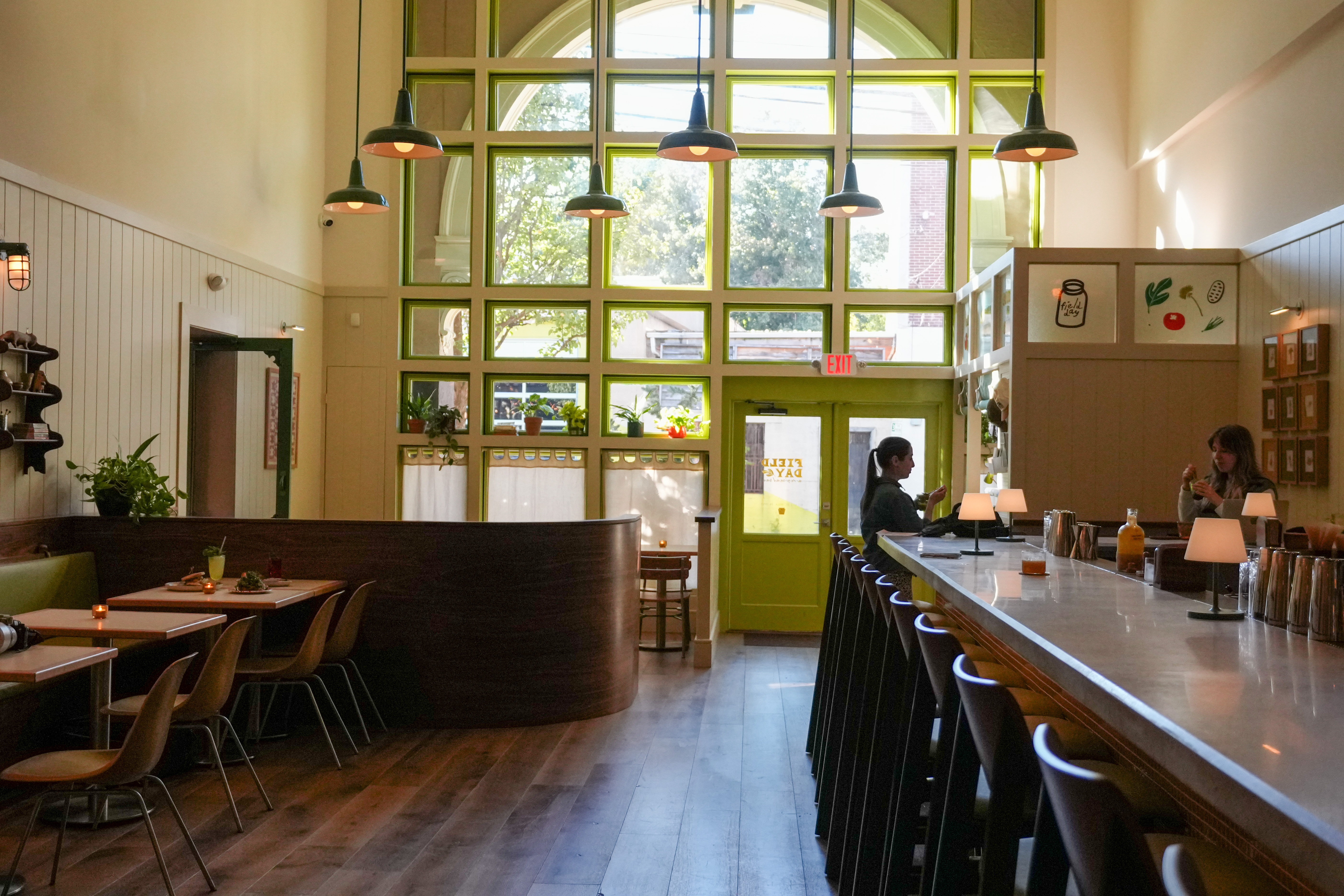
Field Day, at 923 N. Second St., is a love letter to our region. Its food and drink menus highlight ingredients and culinary traditions from as far west as Appalachia and Lancaster County, as far east as the farmlands of South Jersey and the Shore, and as far south as the Chesapeake Bay. Early food hits from the bar’s soft open include tomato pie and seasonal Roman-style “field pie,” Lebanon bologna sandwiches on sourdough English muffins, a roast pork “Philly dip” with long hots and broccoli rabe, skillet chocolate chip cookies, and fluffy seasonal water ice (currently Concord grape).
The bar is a showcase for Slow Drinks, shorthand for Childs’ farm- and field-to-bar beverage approach, documented in his award-winning book by the same name. He first developed it at Cherry Hill’s Farm & Fisherman Tavern, where he worked for nine years, and he’s since applied it as a consultant at bars like Almanac and La Jefa, where Slow Drinks-style cocktails — heavily influenced by local, seasonal ingredients and ancient fermentation practices — are interpreted through Japanese and Mexican lenses, respectively.
The Liquid Gold is a tribute to bees. Local beeswax-washed gin gives the cocktail a smooth mouthfeel, as do bitters infused with propolis, which bees use to seal their hives. Raw honey from Kara Jo Bee Farm sweetens the Old Fashioned riff.Jessica Griffin / Staff Photographer
At Field Day, Philly and its surrounds get the Slow Drinks treatment. That means a cream-clarified cream soda cocktail that gets its vanilla notes from shagbark hickory bark harvested in Tewksbury, N.J.; an umami martini enriched with brown butter, sweet Jersey corn-made miso, and lacto-fermented beech mushrooms from Kennett Square; and an orange crush flavored with house ginger beer and wild persimmons from Childs’ own backyard.
The list goes on. There are 36 cocktails in the bar’s keystone-stamped, leather-clad “Field Guide” menu (designed by Haridelle’s Kylie Silvestri) that’s divided by highballs, martinis, shaken, stirred, dessert drinks, and nightcaps. The guide details the ingredients and backstory behind each drink, with a legend to indicate its sourcing and processes. In that sense, Field Day is a textbook destination cocktail bar, but that’s not the owners’ goal.
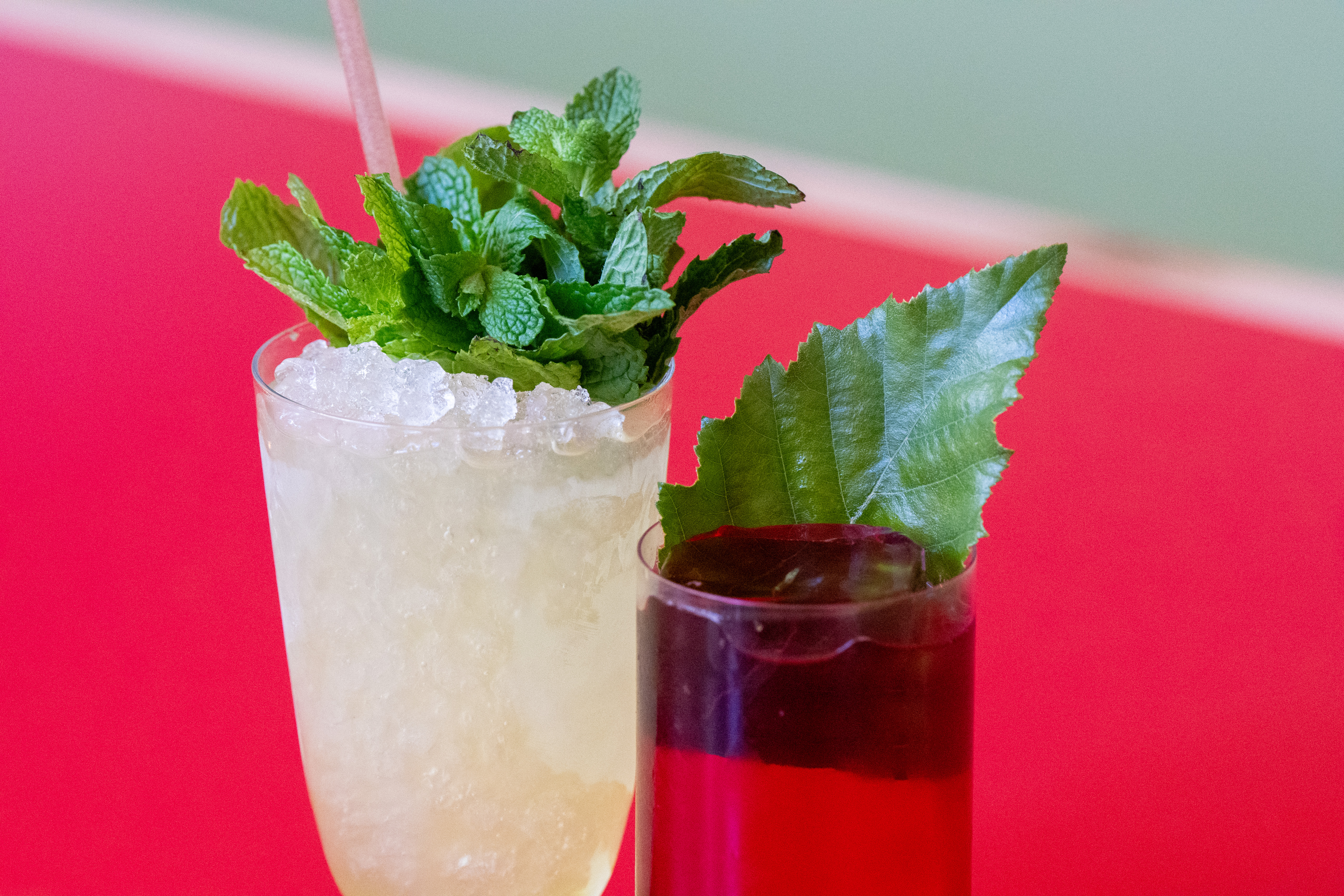
Field Day’s Jenny Lind Tokyo Tea (left) combines vodka, gin, rum, a Jenny Lind melon liqueur, and cucumber shrub. The Birch & Bourbon highball (right) mixes Baby Jane bourbon with house birch beer, made with Pennsylvania-harvested birch bark and homegrown hibiscus (to make it red). Jessica Griffin / Staff Photographer
“We want anybody to walk in here and feel welcome, and that it’s not like they’re going to school, that they’re just at a great bar,” Childs said. “And if they want to learn more, they can.”
For the locals
The Childses, who live in Pennsauken with their two young kids, want Field Day to be for the neighborhood, too. To that end, they have a streamlined “$15 Holler” cocktail list — nine drinks, no notes — targeted to locals dropping in for a casual drink and a bite. There’s a robust lineup of nonalcoholic drinks, including housemade sodas, kombucha, and lemonade, plus coffee, tea, wine, a Tonewood-brewed house lager, and Guinness. There’s also a kids’ menu, complete with a botanical-themed coloring page and crayons.
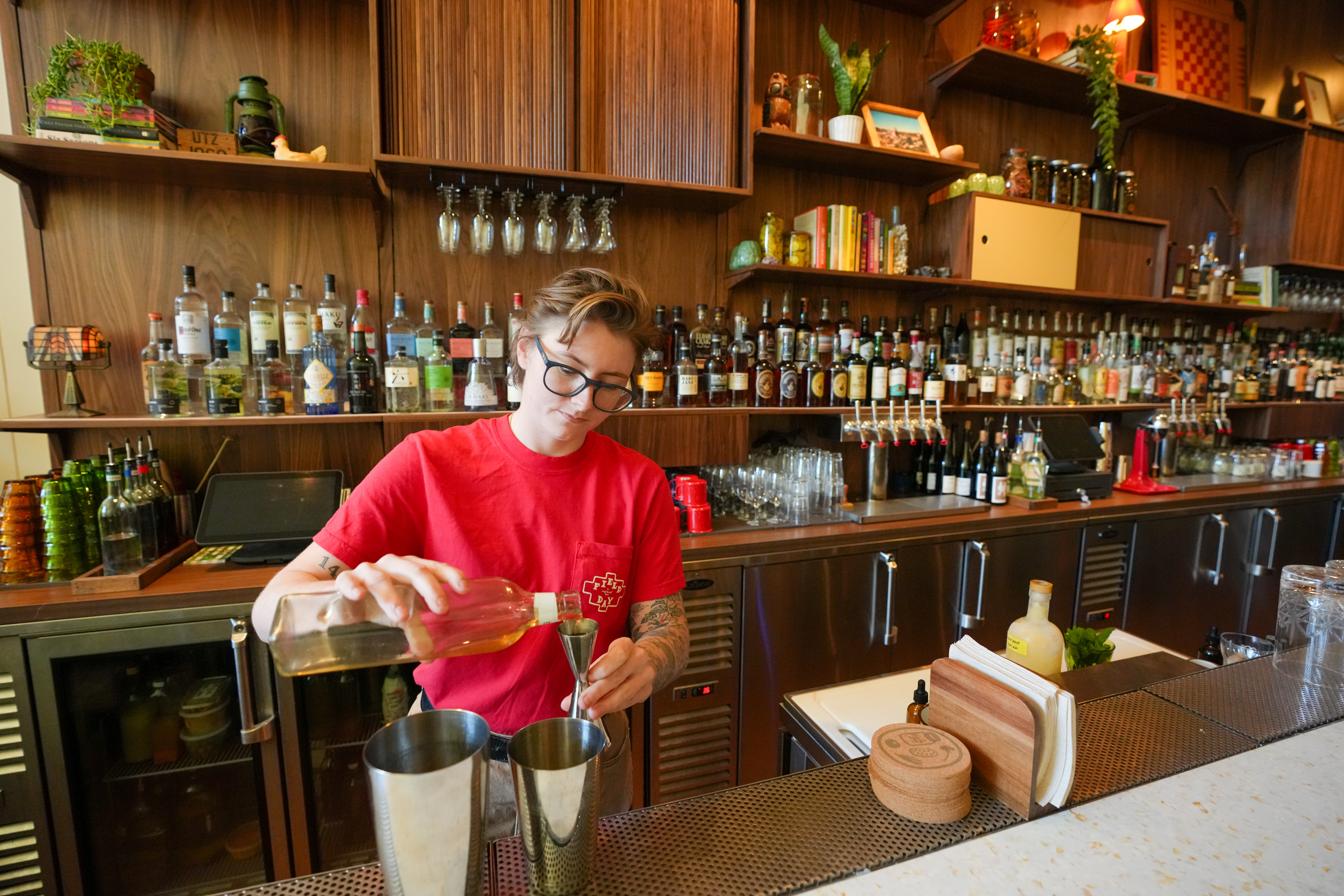
Erin Dassler, who moved from Chicago to head up Field Day’s bar staff, makes cocktails at the bar.Jessica Griffin / Staff Photographer
The family-friendliness is also borne out in the personal touches that suffuse the bar’s design, overseen by Katie Childs and Betsu Studio’s Laura Weiszer. The walnut shelves above the bar are lined with souvenirs from their travels as well as family heirlooms, including both of their great-grandfathers’ bottle cappers (Danny’s brewed sassafras root beer, Katie’s dandelion wine). Portraits of the couple are framed inside the bar’s host stand, drawn by Italian illustrator Gianluca Cannizzo, whom Childs met on a Slow Drinks work trip. There’s another Cannizzo illustration in the bathroom, depicting the military tent the couple lived in for nine months on a Marlton Christmas tree farm, at the beginning of their Slow Drinks journey.
All the little things are an effort to transform this former auxiliary space for Cescaphe Ballroom into a homey, welcoming spot that’s trying to telegraph comfort above all else. Roughly half the seats in the space, including all 20 bar seats, are earmarked for walk-ins.
All-star staff
With a 50-seat dining room and 25 employees, Field Day is arguably just as much restaurant as bar. The kitchen is led by James Beard-nominated chef Melissa McGrath of Sweet Amalia fame, who’s bringing to bear her considerable South Jersey seafood expertise with steamed clams, smoked fish dip, and a fish fry. McGrath is backed by sous chef and preservation pro April McGreger, whose pickle plate is already a must-try.
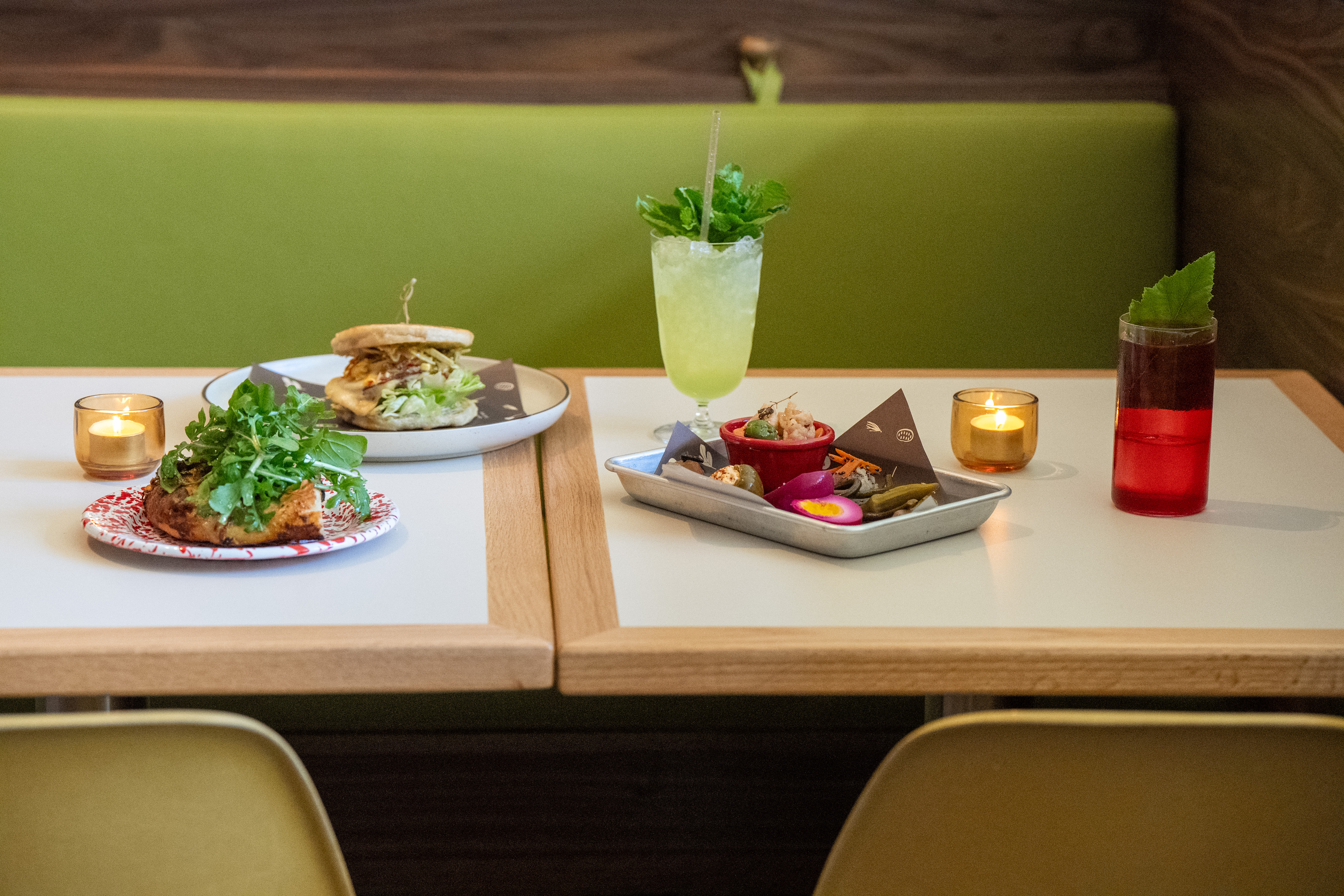
Food at Field Day, (from left): the field pie, the Lebanon bologna sandwich, and the pickle plate. Jessica Griffin / Staff Photographer
Splitting time between the kitchen, bar, and Field Day’s upstairs R&D lab is Jamaar Julal, who spearheads various fermentation projects, including miso made from stale tomato pie and several cheongs (fermented syrups) made from foraged fruits.
McGrath, McGreger, and Julal are part of a deep bench of talent that also includes floor lead Jonathan Doherty, who’s worked with Childs since his Farm & Fisherman days, and bar lead Erin Dassler, a Chicago transplant who was previously at legendary tiki bar Three Dots and a Dash and Kitty’s Cosmopolitan Club.
Childs is thrilled to have assembled a team of this caliber. “These are people that I love and respect and look up to in a lot of ways,” he said. “To see them all coming here, working for Katie and I — we go home at the end of the day every day and we’re like, ‘Oh my goodness.’”
Field Day, 923 N. Second St., 215-703-9458, fielddayphilly.com. Hours: 4 p.m. to midnight Wednesday through Saturday, 4 p.m. to 8 p.m. Sunday. Reservations available on Resy.
New Jersey public schools are weighing policies on how generative AI is making its way into classrooms and whether students and teachers should be allowed to use the technology.
Some require schools to get parental consent at the beginning of the school year for students to use AI for assignments, while others like Cherry Hill considered but backed away from a proposal that would have let parents opt out for their children.
Schools across the country are tackling policies to address the rapidly changing technology. Rather than an outright ban, many districts are deciding how and when AI may be used, at what age, and what tools should be permitted.
“Everybody is wrestling with this challenge,” said Sarah Schneider Kavanagh, an associate professor in the Graduate School of Education at the University of Pennsylvania. “This is an enormous paradigm shift for education.”
Haddonfield teaches AI to all students — but bans use for elementary schoolers
In Camden County, Haddonfield adopted a sweeping AI policy in August that established three tiers of AI use based on grade level. It bans AI in elementary schools, while allowing supervised access for middle school and high school students.
This is the first AI policy for Haddonfield, which enrolls about 2,700 students, said Gino Priolo, an assistant superintendent. Initially, the district only had a provision in its academic integrity guidelines that required students to cite AI as a source when using it.
Priolo said surveys found that students and teachers were already using AI on at least nine platforms. Policymakers spent months developing guidelines that focused on education, safeguards, and limiting students to using approved platforms, he said.
“We needed a policy that protected privacy and provided guidance about safe and appropriate use,” Priolo said in an interview. “We’d be putting our heads in the sand if we simply tried to avoid AI.”
The policy bans younger students from using AI to ensure that they learn foundational and critical learning skills, he said. All students will get AI literacy education, beginning in first grade, he said.
“We want students to understand what AI is even before they are permitted to use it,” Priolo said.
Beginning in sixth grade, students can use a Google AI platform,where teachers are able to closely monitortheir interactions in real time with Gemini Notebook, the district’s only approved generative AI platform.
Considered a closed system, the platform generates responses based on documents loaded by the user, Priolo said. Students cannot access the internet, and chatbots like ChatGPT are blocked by district software, he said.
For example, a student could upload handwritten chemistry class notes into AI to develop flash cards as a test study aide, Priolo said.
Haddonfield has also adopted generative AI policies for teachers. High school teachers must get teacher permission prior to using AI for an assignment.
Meanwhile, some of the country’s largest districts are also enacting AI bans.
The Los Angeles public school system imposed a moratorium restricting most AI use at all grade levels for this school year. The district said it would determine how the technology would be incorporated in the future.
“I see it as a positive step, though not necessarily the best solution,” said Subodha Kumar, a professor of statistics, operations, and data science at Temple University’s Fox School of Business. “Bans may not stop students from using it and we do not have conclusive evidence that they produce better outcomes. It may take years to determine the best approach.”
Across South Jersey, some other districts are also taking unique approaches to teaching kids about AI. Deptford, for example, has added an AI course for high school students.
Cherry Hill considered allowing families to opt out of AI use
Cherry Hill considered a provision that would have allowed parents to opt their children out of using AI in school. There was some backlash that it would create inequity for so-called “analog” students prohibited from the technology.
District officials believe the opt-out option was not needed because Cherry Hill selected School AI as its generative AI program, a closed system that allows teachers to monitor students’ interactions, said Superintendent Kwame Morton. The board approved the revised policy on Oct. 13.
“It has been a deliberate process. We’ve tried to roll it out slowly and responsibly,” Morton said. “What we want more than anything is for our students to be safe and understand how to responsibly use the tools.”
The policy has guidelines for when AI is appropriate by grade level, said Allison Staffin, director of curriculum and instruction. Using a scale of 0 to 4, teachers must inform students in writing when generative AI is acceptable for an assignment. It ranges from 0 where no AI use is allowed, to 4, where AI can be used to draft content.
Staffin said there is no AI allowed for pre-K and kindergarten. By second grade, it may be used for an entire class, but closely monitored, she said.
Fourth and fifth grade is when most students will begin more fully using AI with specific instructions from a teacher, but not to generate original work, Staffin said.
“The teacher determines which tool they use and what prompts or answers they can generate,” Staffin said.
Cherry Hill parent Carolina Bevad said she was disappointed in the policy and called it “half-baked.” The mother of two district students believes elementary schoolers should be excluded from using AI.
“It’s a slap in the face to all students and parents,” Bevad said. She wants more guardrails to address privacy concerns.
Kavanaugh, from Penn,said parents have legitimate concerns, and researchers have unanswered questions about the impact of generative AI on learning. Opting out, however, can become complicated for students and teachers.
“The technology is changing so quickly that none of us really knows what we’re opting into or opting out of,” Kavanaugh said. “Education has to decide what are we unwilling to give up about what human beings can do on their own.”
Glassboro Superintendent Alfred Lewis is a big proponent of students and teachers using AI — ethically. The districted adopted MagicSchool as its generative AI platform, he said.
Lewis said the district’s policy doesn’t restrict AI use by grade level, but it has mostly been used in middle and high school.
“We’re not even seeking to use it at the elementary level,” Lewis said. “Quite frankly, there’s just so much that needs to be taught and taught directly by teachers that it’s not even a natural fit for us.”
In some classes, students are using AI to score their assignments before submitting to the teacher, Lewis said. Teachers are also using AI to develop instructional materials and look for patterns to improve learning, he said.
Lewis believes AI can be used to enhance learning, but cannot replace a quality teacher in the classroom.
Assemblywoman Heather Simmons (D., Gloucester) recently introduced “The Educators Before AI Act,” which would prohibit the state’s nearly 600 public schools from replacing teachers with AI. Lewis supports the bill.
The bill, if adopted, would require a human presence in the classroom, Simmons said. There has been no indication thus far that any teacher has lost a job due to the technology, but she said safeguards are needed.
“There’s an art to teaching and a science to teaching,” Lewis said. “AI might be able to replace some of the science, but it will never replace the art.”
A Camden man was charged with first-degree murder in connection with an August drive-by shooting that killed a 25-year-old man, Camden County authorities said Tuesday.
Nicholas Stiegler, 21, allegedly shot George Rivera around 5:50 p.m. on Aug. 21 on the first block of West Hodges Avenue in Lawnside from inside a red Jeep Compass that was traveling on West Hodges, authorities said.
Rivera, who lived in Lawnside, was taken by private vehicle to Cooper University Hospital, where he was pronounced dead at 11:27 p.m. that day, authorities said.
Surveillance video obtained by detectives showed the Jeep traveling from Camden to the area of the shooting and then back to Camden, authorities said.
Stiegler also was charged Oct. 15 with second-degree unlawful possession of a weapon and second-degree possession of a weapon for an unlawful purpose, Camden County Prosecutor Grace C. MacAulay said.
The next day, he was arrested by members of the U.S. Marshals Service New York/New Jersey Regional Fugitive Task Force-Camden Division, MacAulay said.
Stiegler was being held at the Camden County Correctional Facility awaiting a detention hearing scheduled for Friday, MacAulay said.
Who says you need to leave your house to have a great meal in Philadelphia?
For the past two years, more than a dozen Inquirer reporters have fanned out across the city and suburbs to bring you The 76 most essential Philly restaurants — a job that typically requires donning real pants to eat out over and over and over again. Sure, most restaurants on the list have stellar service and dining rooms you’ll want to linger in. But a few stand out when it comes to another category: excellent takeout and delivery.
These 18 spots from the latest edition of the 76 do takeout and delivery right: Their turnaround is quick and the meals are satisfying and substantial enough to count on leftovers. — Beatrice Forman
The medium mixed grill and sides at Al-Baik Shawarma Grill on Monday, Sept. 1, 2025 in Philadelphia.Monica Herndon / Staff Photographer
Al-Baik Shawarma
This Palestinian restaurant in Northeast Philly is known for two things: crisp-yet-fluffy falafel and mashawi mixed grill platters, which come with chicken and beef kebabs, kofta, scratch-made hummus, and pliable laffa bread for DIY sandwiches. Both translate to takeout very nicely. All of Al-Baik’s platters are packed in sectioned containers so there’s no mess in transit, too. You can place pickup orders via Al-Baik’s own online platform, which means no pesky delivery service upcharges.
A spread of dishes including pastelillos at Amy’s Pastelillos, in the Fishtown section of Philadelphia, Pa. on Tuesday, Feb. 27, 2024. After a series of successful pop-ups, Amaryllis Rivera Nassar is opening a brick and mortar shop.Monica Herndon / Staff Photographer
Amy’s Pastelillos
Amaryllis Rivera-Nassar’s hot pink Fishtown storefront packs a lot of Puerto Rican culture into a few hundred square feet. There are sazón and adobo spice kits for sale, a shelf of cookbooks, and a kitchen that churns out 2,000 pastelillos each week. Rivera-Nassar’s versions of the crispy Puerto Rican turnovers are always stuffed with savory fillings like tangy guava barbecue pork or classic yuca with pigeon peas. Available only for takeout, the pastelillos are never overly greasy or heavy, leaving room to try the menu’s underrated hits: golden brown tostones and Rivera-Nassar’s rotating soup specials. Amy’s Pastelillos is available to order on GrubHub and Uber Eats, but we recommend walking up to order for the peak pastelillo experience.
At this Bella Vista institution, the menu is short and sweet — just five bánh mi iterations, all served on Sarcone’s rolls slicked with a top-secret homemade mayo. Yes, there’s the classic bánh mi ga stuffed with tender roast chicken, pickled carrots, daikon, jalapeño, cilantro, and thick shreds of cucumber. But there’s also the chả lụa — which swaps chicken for Vietnam’s slightly sweetversion of pork roll — and the deluxe: a combo of pork roll, slow-cooked pork cheek, and ham with all the fixings. Each, Kiki Aranita wrote, “is one of the best ways I know to spend $10.” Owned by the Lam family since 1989, this cozy counterservice spot feels frozen in time, save for the GrubHub couriers who stream in and out. Our suggestion: Take your bánh mi around the corner to one of the benches in Palumbo Park for a pleasant solo lunch date.
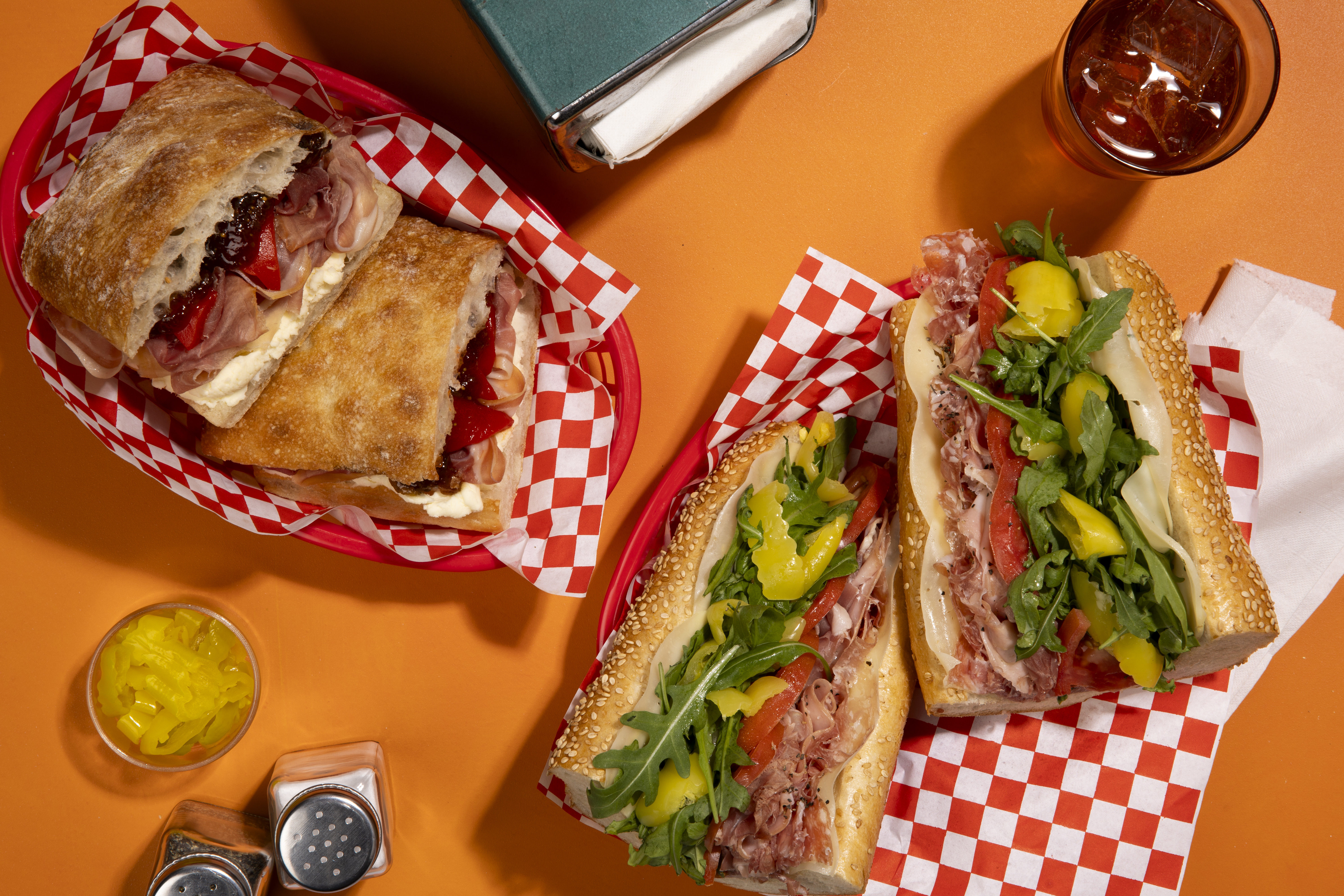
The Fig and Pig and Hoagie from Castellino’s photographed in the Philadelphia Inquirer studio on Tuesday, Jan. 28, 2025 in Philadelphia.Monica Herndon / Staff Photographer
Castellino’s Italian Market
Cara Jo Castellino and Matthew Barrow’s Fishtown deli is not the place to go if you want a quick Italian hoagie. They’re “high practitioners of mindful hoagie art,” Inquirer critic Craig LaBan wrote, so you may need to wait a spell. Finesse, after all, takes time. Every cold cut is sliced to order and carefully layered on a Liscio’s roll. Even olive oil drizzles must be done in perfect vertical lines to avoid a soggy hinge. The shop’s bestsellers include the Fig Pig (sweet fig jam and mascarpone with prosciutto and roasted red peppers) and the Adronos (hot capicola and soppressata with Asiago and spicy cherry peppers), but it’s hard to go wrong on the 14-sandwich menu. You can order online for pickup or local delivery, or swing by to browse its selection of artisan sweets, beverages, and pantry items while you wait.
You do not need to cross a bridge to try legit Trenton-style pizza. You just need to go to South Philly’s Cartesian Brewery on a Wednesday, Friday, or Sunday. That’s when CJ Volk’s and Dara Silvestro’s pizzeria turns out these thin-crusted pies with cheese on the bottom and sauce on top. The menu is tight, but it’s easy to add intrigue with CJ&D’s handful of extra toppings: pepperoni, sausage, ricotta, hot honey, and (most intriguingly) mustard. Plan to be patient. There’s no option to call ahead, so you must order at the counter, and wait times can creep toward an hour on busy nights. Luckily, you can kick back with a beer — and a giant salted chocolate chip cookie — to pass the time.
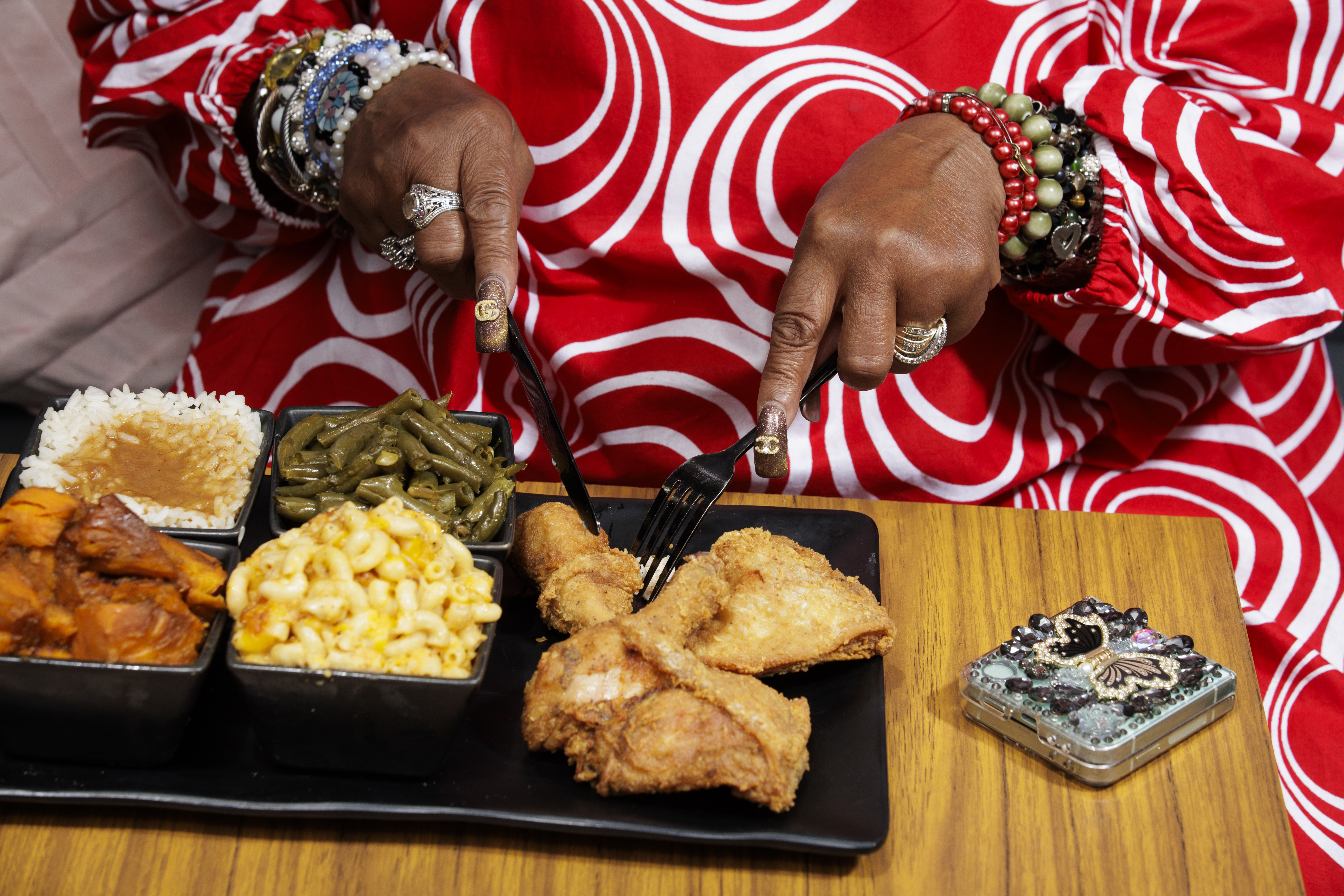
Corinne Bradley-Powers posed for a portrait at her restaurant, Corinne’s Place, on Wednesday, Sept. 10, 2025 in Camden, NJ.Monica Herndon / Staff Photographer
Corinne’s Place
The James Beard Foundation dubbed Corrine’s Place an American classic for good reason: This Camden institution has been serving hefty soul food platters since 1989, when owner Corinne Bradley-Powers opened the joint after working as a youth counselor. The restaurant’s charming dining room notwithstanding, Corinne’s is primarily a takeout joint, with a hot table displaying fresh sides of baked mac’n’cheese, collard greens, candied yams, and cornbread. The must-haves: Bradley-Power’s ultrathin catfish cutlets, fall-off-the-bone ribs, and textbook fried chicken. Corinne’s works with all the major delivery apps, but these platters are best enjoyed hot, so we recommend ordering in person.
Collard Greens, Awaze Spicy Berbere fried chicken and Alicha Lemon Turmeric fried chicken at Doro Bet in Philadelphia on Thursday, Aug. 15, 2024. Food Styling by Emilie FosnochtMonica Herndon / Staff Photographer
Doro Bet
Ethiopian fried chicken is a West Philly special dreamed up by sisters Mebruka Kane and Hayat Ali, who opened Doro Bet in 2022 as a follow-up to their Baltimore Avenue coffee shop, Alif Brew. Doro Bet’s berbere- and turmeric-spiced chicken wings, which rank among the best in Philly, are its calling card, earning it a spot on the New York Times’ guide to eating in Philly. Marinated in buttermilk and coated with teff flour, the chicken is surprisingly light and very snackable — and gluten-free and halal, to boot. There’s something particularly satisfying about picnicking in Clark Park with this chicken. Save room for their tiramisu, too.
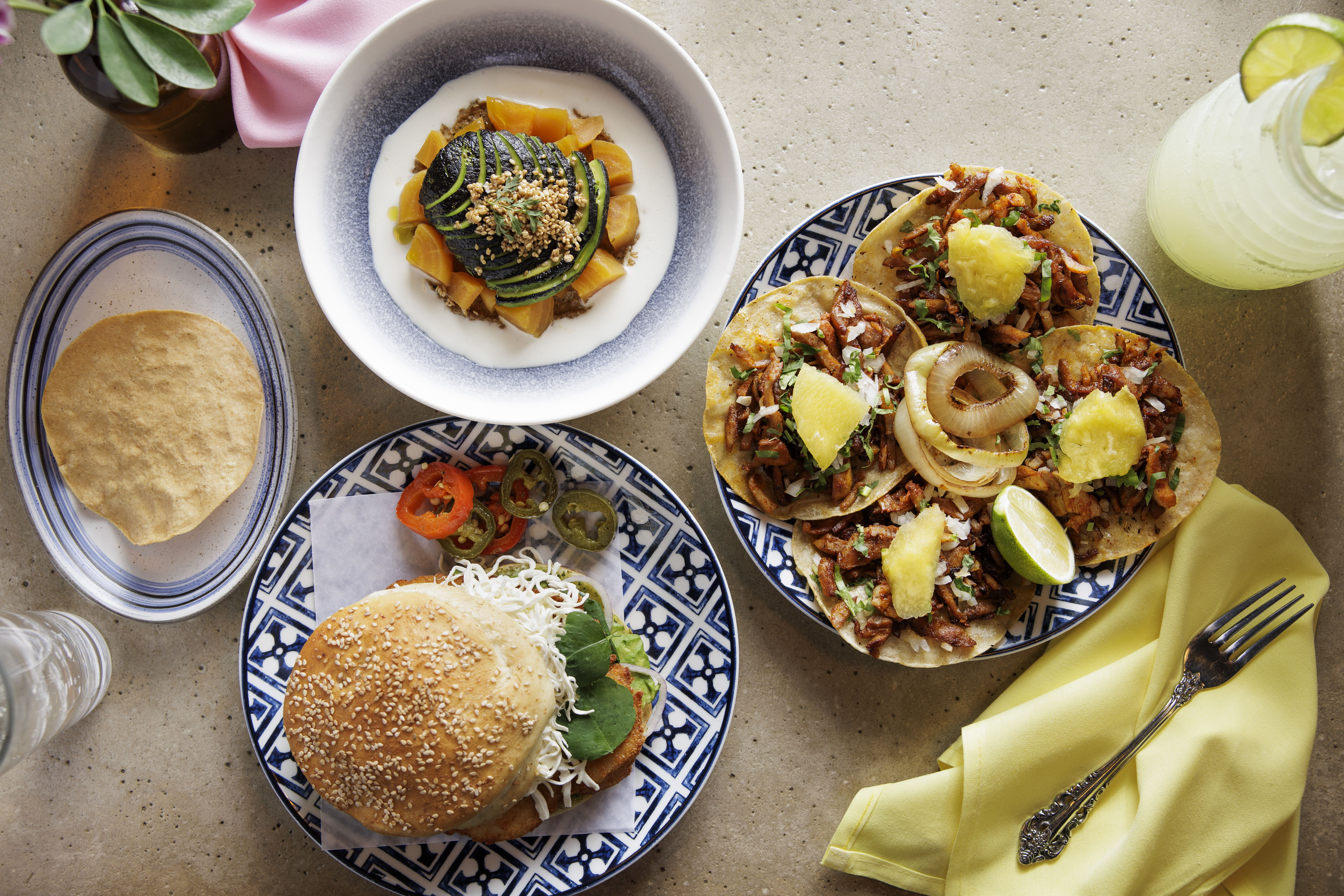
Cemita clasica, remolacha (marinated golden beets), and al pastor tacos at El Chingón in Philadelphia. Food Styling by Emilie Fosnocht.Monica Herndon / Staff Photographer
El Chingón
With outdoor seating only, the Fishtown branch of Carlos Aparacio’s Michelin-recognized Mexican BYOB (at 1431 Frankford Ave.) is especially prime for takeout. His Puebla-style cemitas make for an exciting lunch or dinner: Baked on fresh sesame-speckled rolls, these cemitas come piled with house-made chorizo, chicken Milanese, or pork marinated in bright sugarcane vinegar along with additions such as citrusy pápalo aioli, sweet guajillo peppers, and tangy Oaxacan cheese. The original South Philly location also offers its full menu — from albondigas and crab tostadas to tacos and cemitas — for takeout.
1524 S. 10th St., 267-239-2131; 1431 Frankford Ave., 267-807-1436; elchingonphilly.com
Plantain cups with shrimp and fried chicken wings, glazed with mango flavored Rhum Barbancourt at Gou Saturday, Oct. 11, 2025, in Philadelphia.Jasmine Goldband / Staff
Gou
Behind this unassuming storefront in Olney is a treasure trove of Haitian favorites: frittay street food platters, zel poul (aka fried chicken wings) glazed with mango-infused Rhum Barbancourt, and whole fried snapper with a pepper red sauce, plus fried plantain cups stuffed with spicy pikliz slaw and stewed oxtail or conch. The brainchild of Yves Atoulon and husband-wife duo Imma and Emmanuel Laguerre, Gou is both comforting and nostalgic, with a reputation for to-go portions that are just as (if not more) generous than what you get in the restaurant. Order from Gou directly for pickup, or find them on the major delivery apps. Fair warning: Favorites like rasta pasta or griot sell out often.
The debate over the best cheesesteak in Philly will wage on forever, but Craig LaBan’s go-to has remained the same for years: John’s Roast Pork, the Snyder Avenue stand that has turned out some of Philly’s best sandwiches for three generations. A blue-collar breakfast-and-lunch stop since 1930, John’s didn’t gain citywide renown until 2001, when a group of Lower Merion High students declared the cheesesteaks emerging from John Bucci Jr.’s griddle to be the area’s finest as part of their senior project — with LaBan as their mentor. You would be missing out if you only got a cheesesteak, though. John’s full menu — the titular roast pork along with roast beef, meatballs with red gravy, fried meatballs, and breakfast sandwiches — is well worth diving into. Just make sure you get there before they run out of bread. — Jenn Ladd
14 E. Snyder Ave., 215-463-1951, johnsroastpork.com
Johnny’s Pizza
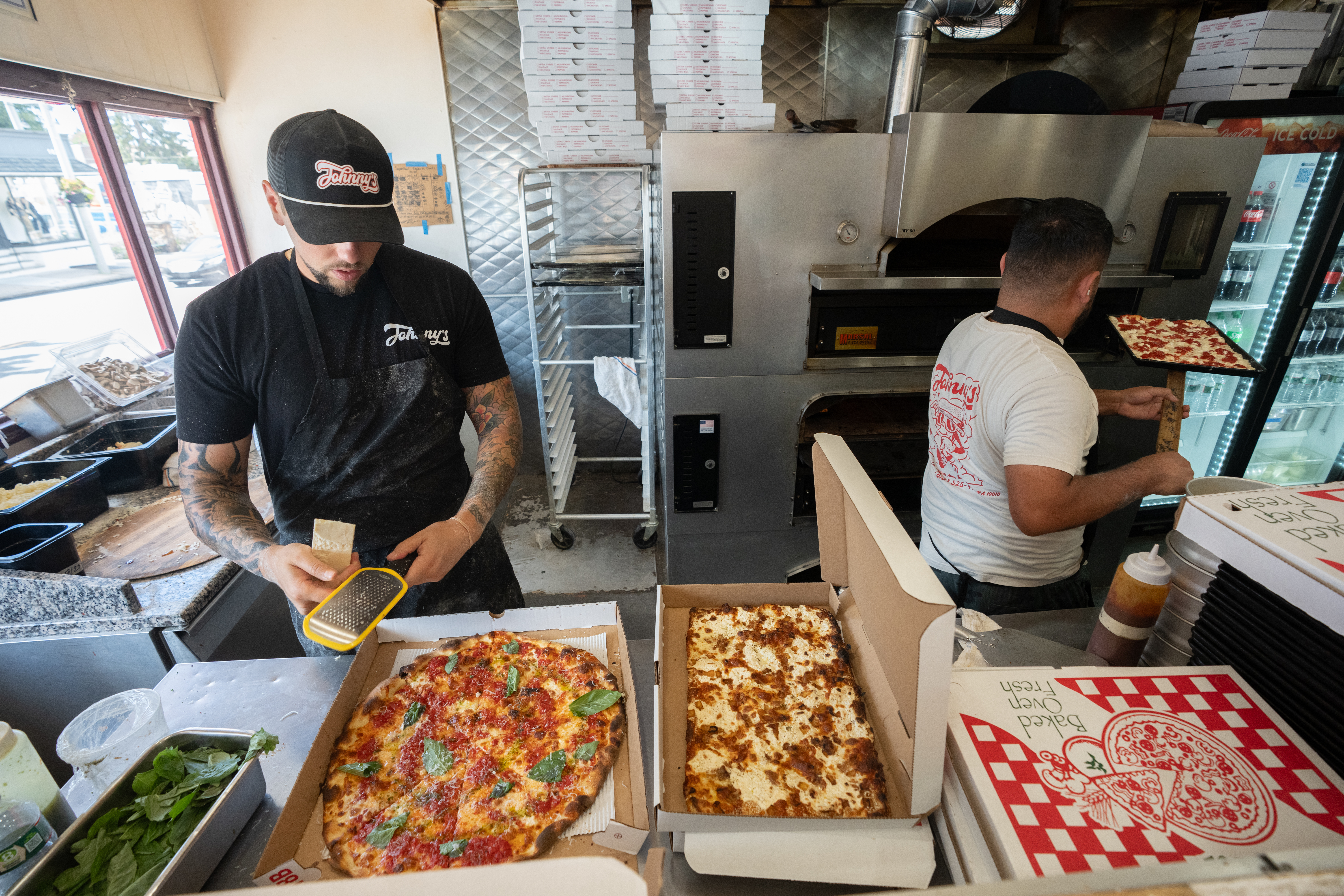
The pizza and cheesesteaks at these sister shops on Lancaster Avenue are some of the best in the Philly area overall. Pizzaiolo John Bisceglie is a “rare double threat,” according to Craig LaBan: He can assemble a 20-inch cheesesteak with the right ribeye-to-Cooper Sharp ratioand man a pizza oven full of pies — thin and thick, rectangular and round — with equal finesse. Since Bisceglie trained in Brooklyn, his pies are more New York than classically Detroit-style or Sicilian, with a thinner crust that’s prone to develop delightful air bubbles. The grandma pie is stunning with its cup-and-char pepperoni, as is the white pie with fresh mozzarella, ricotta, and caramelized onion on a sesame seed crust. Johnny’s turns off online ordering when there’s a high volume of orders, so we recommend heading over in person to be safe.
1025 W. Lancaster Ave., Bryn Mawr, 610-525-4811; 369 W. Lancaster Ave., Wayne, 610-915-0200; johnnyspizzabrynmawr.com
Haleem from Karachi Kafe on Thursday, Aug. 28, 2025 in Voorhees Township, NJ.Joe Lamberti / For The Inquirer
Karachi Kafe
Located in a nondescript South Jersey strip mall with a Wawa and a water ice shop, this Pakistani restaurant space is so over the top, you really should dine in, at least once. Ornate gold bride-and-groom thrones preside over a dining room fitted with upholstered benches, an autograph wall, and even a swing. But Anny Khan’s menu is a terrific fit for takeout as well: Comforting mutton karahi curry and beef shank nihari stew hold their heat well, as do riffs on Pakistani fast-food guilty pleasures such as the Zinger Burger, a spicy chicken sandwich popularized by KFC. You can order from Karachi Kafe on DoorDash or GrubHub, or walk in.
2999 E. Evesham Rd., Unit 12, Voorhees, N.J., 833-544-5233, karachikafe.com
M Kee
Since its 2011 opening, M Kee has been a mainstay among the Chinatown lunchtime crowd, known as much for its succulent Cantonese barbecue as the lines that snake along Race Street on weekday afternoons. Despite the onslaught of takeout orders, M Kee still manages to package its roast duck and roast pork dishes — served on rice platters or with pan-fried noodles and congee — with care. “No item is ever too oily,” writes Kiki Aranita. “The roast pork is blisteringly crisp, and the egg noodles are excellent — al dente, swimming in clear, delicate but deeply savory broth.” Their duck congee may also be the best she’s ever had, packed with the meatiest chunks and shreds of fresh ginger.
1002 Race St., 215-238-8883
Mighty Bread Company
This James Beard Award-winning bakery in South Philly is heavy-hitter when it comes to all things bread: crusty sourdough loaves, breakfast biscuit sandwiches smothered in bacon jam, and an Italian hoagie that piles gabagool, prosciutto, and salami high on a soft-yet-sturdy sesame-studded ciabatta. This doesn’t even scratch the surface of the decadent sweets that come from owner Chris DiPazza’s kitchen, ranging from gigantic chocolate chip cookies to twice-baked croissants and strawberry-pistachio danishes. Pretty much everything is built for takeout, and that’s especially true at Mighty Bread’s Rittenhouse location, which is grab-and-go only.
1211 Gerritt St., 215-607-3205; 1644 Pine St., 215-607-3202; mightybreadco.com
Octopus Cart
Konstadinos “Gus” Christis’ metallic cart — which is stationed on the southeast corner of 20th and Market Streets most weekdays — serves one thing and one thing only: a $20 hodgepodge platter of blackened chicken (grilled on legit charcoal) and falafel with spaghetti, arugula, and seasonal fruits and vegetables. Weird, but it works. A Center City institution for 36 years, Octopus Cart is a one-man show, so you may end up waiting up to an hour. Don’t dare ask for modifications — or cutlery. Christis will provide neither. Not that his regulars mind. “His food is medicinal,” one regular told Craig LaBan in 2024. “I ate his food and it changed my life.”
8 S. 20th St.
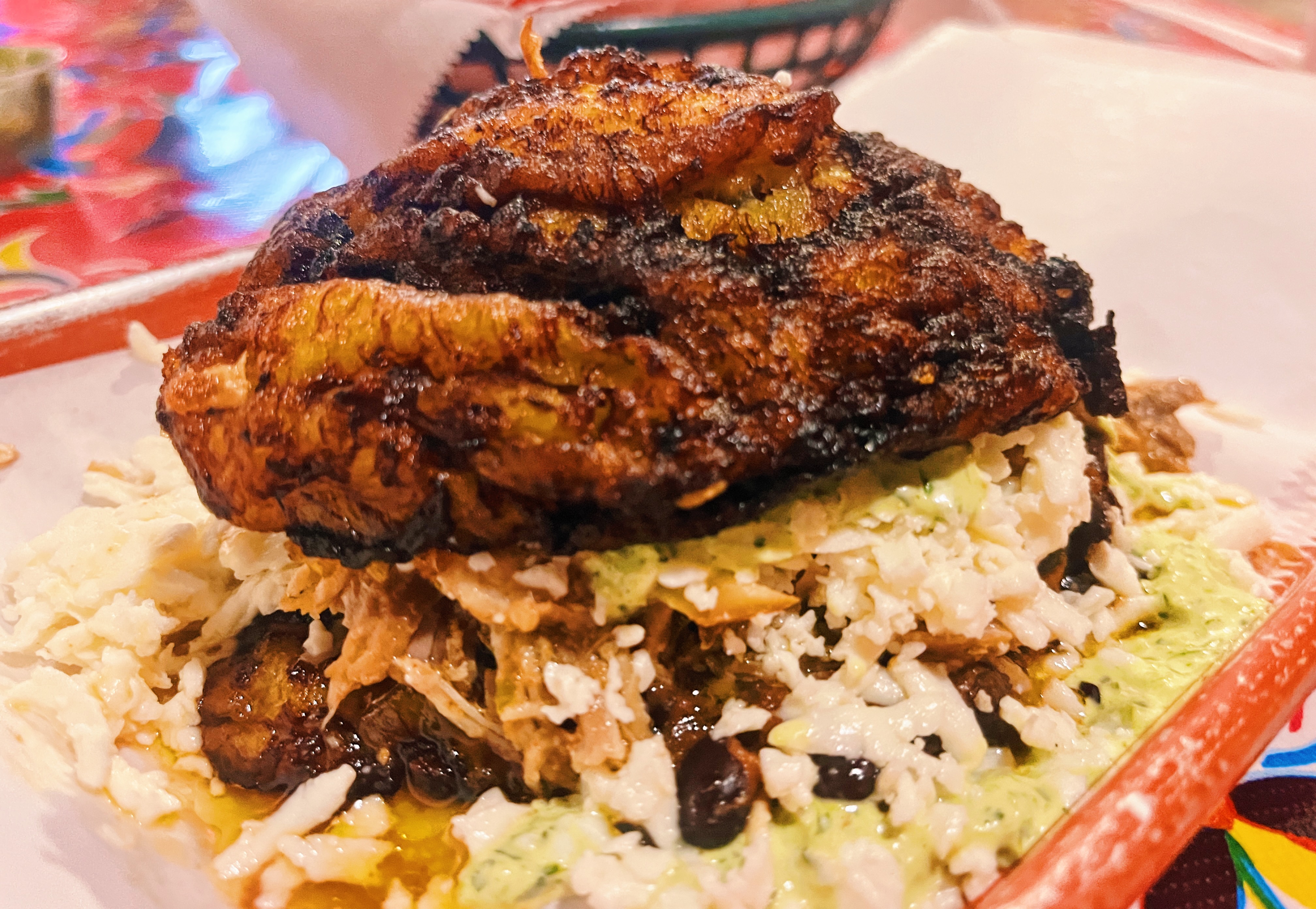
The patacón pintón at Puyero Venezuelan Flavors, which has locations on South Street and in University City.Beatrice Forman / Staff
Puyero Venezuelan Flavor
There’s something special about unwrapping Puyero’s pabellón — a gigantic arepa stuffed with tender pork, a heap of black beans, sweet caramelized plantains, and queso blanco — while knowing you can immediately follow it up with a much-needed nap. This fast-casual spot with locations in University City and Society Hill specializes in Venezuelan street food: authentic arepas stuffed with meat, sweet corn cachapas filled with nata (a sweeter version of sour cream), and tequenos, which is basically a buttery version of a mozzarella stick. Puyero is available on all major delivery apps, but you can also place pickup and delivery orders directly on their website.
524 S. Fourth St., 267-928-4584; 3248 Sansom St., 445-345-3778; puyeroflavor.com
Reading Terminal Market
Let’s be real: Sometimes eating inside Reading Terminal Market can be overstimulating. That’s why we like using it as a takeout smorgasbord, picking up a little of all that you crave, to eat at home (or your desk). The Terminal has so much under one roof. You can get the best, say, roast pork sandwich, matzo ball soup, and cookies without spending a fortune. It’s very much a choose-your-own-adventure experience, but for the uninitiated, we recommend the khachapuri (a cheese boat!) from the Georgian stall Saami Somi, salmon curry from Little Thai Market, or a glorious and gluten-free corn dog from Fox & Sons Fair Foods.
This Indonesian food cart parked at 1600 Market St. in Center City is a lunchtime favorite that’s best known for its rendang hoagie, which packs the spicy beef stew into a long roll with daikon, cilantro, and pickled carrots. Much like Sego’s fried chicken, it’s perfect cold-weather comfort food. You can order ahead by calling 267-559-1656, which we recommend — the hits tend to sell out early.
It started with mysterious hoofprints left in the South Jersey snow, and somehow ended with a painted kangaroo displayed for all to see at Ninth and Arch Streets in Philadelphia.
In between, mass hysteria ensued. Hundreds of area newspaper reports detailed purported sightings of the beast — some unholy amalgamation of a horse, a collie, and a crane, with the ability to breathe fire and fly to boot. It was hungry, too, taking to fields and rooftops to stalk chickens and family pets in the quest to sate its appetite.
Schools and factories temporarily closed as terror over the creature gripped the region. Armed farmers followed the beast’s tracks for miles, only to find the prints inexplicably had disappeared. And the legend of the Jersey Devil grew, its origins tracing back to the 18th century, when a woman known as Mother Leeds cursed her 13th child to become a demon that would haunt the region for eternity.
This was the Jersey Devil panic of January 1909, one of the Philadelphia area’s great local hoaxes. But at the time, it was considered a threat. And, thanks in no small part to newspapers like The Inquirer playing into the gag, the Jersey Devil legend went viral enough to persist today.
Article from Jan 21, 1909 The Philadelphia Inquirer (Philadelphia, Pennsylvania) <!— –>
Sightings begin
The Jersey Devil panic began on Jan. 16, 1909, when reports surfaced of odd footprints in South Jersey. The Inquirer began covering the apparent rash of run-ins with the beast days later, claiming that seemingly all of Gloucester County and parts of Camden County had seen the tracks.
Nearly all of the tracks were reportedly found coming or going from chicken yards or areas near garbage cans. Farmers set out hundreds of steel traps where the markings were spotted, and men armed with shotguns stood watch and waited for the creature to make an appearance.
Several people even claimed they saw the beast itself. Most notable was Nelson Evans, a Gloucester City man who said he and his wife spotted it at about 2:30 a.m. on Jan. 17. Evans called it a kind of bird that stood about 3½ feet tall with a similarly sized wingspan, as well as the head of a collie with a horse’s face, the neck of a crane, wings, and four legs like a kangaroo.
Article from Jan 20, 1909 The Philadelphia Inquirer (Philadelphia, Pennsylvania) <!— –>
Even the Philadelphia Zoo allegedly got in on the act, with some reports indicating it offered a $10,000 reward for the creature’s capture — roughly $368,000 in today’s money. Inquirer coverage from the time makes no mention of such a sum, and reference to the reward does not appear in the minutes of any board of directors meeting from 1909, zoo spokesperson Maria Bryant said in late September. It remains unclear where that bit of trivia comes from, or if it ever happened.
“Potentially discovering a new creature would be of great interest to all the scientists at the zoo in 1909, and as the closest zoological institution that could do this research, it would make sense to ask for the public’s help to support its mission,” Bryant said.
Article from Jan 26, 1909 The Philadelphia Inquirer (Philadelphia, Pennsylvania) <!— –>
Jersey Devil on display
At one point, The Inquirer reported that the creature was a cross between a kangaroo and a mammoth bat, one of only two in the entire country (the location of the second beast, it appears, may be a secret lost to time). The animal, reports alleged, had been imported here from Europe by a local animal trainer, who said it had escaped from his home. It also apparently happened to be a vampire.
On Jan. 23, the creature’s capture came quietly after a group of men reportedly took it into custody with a net in Fairmount Park, Inquirer reports indicate. The animal, reportedly a kangaroo-bat hybrid referred to as a “kangowing,” was found to be docile enough to hand-feed.
With the cryptid secured, it went on to be displayed for the paying public at the Ninth and Arch Dime Museum, where it was alternately referred to as the Leeds Devil, the “Australian Vampire Devil,” and the “Australian Vampire-Dragon.”
Article from Jan 22, 1909 The Philadelphia Inquirer (Philadelphia, Pennsylvania) <!— –>
There, it was reportedly kept “securely chained in a massive steel cage” and attracted thousands of visitors during its exhibition, which lasted for weeks. In captivity, the creature could be seen “fuming and fretting, tugging and pulling at the chains” that bound him, and giving museum attendees a glimpse at the unknown.
But inexplicably, having a paranormal creature available for all to see was not enough to keep the museum running, and it was gone by 1911, reports from the time indicate. And with so many people having seen the Jersey Devil up close, the story quickly fell apart, revealing itself as a hoax — though The Inquirer would not report on the details of the scam until about two decades later.
Article from Jan 23, 1909 The Philadelphia Inquirer (Philadelphia, Pennsylvania) <!— –>
The hoax revealed
In 1929, The Inquirer reported that the Jersey Devil panic had largely been engineered by Norman Jeffries, a “Philadelphia publicity man” of the era who served as the press agent for the Dime Museum. Jeffries, whose name also appears as Jefferies in newspaper clips, had, it turned out, cooked up a scheme to bring visitors into his employer’s establishment.
Inspired by the panic that the hoofprints in South Jersey had sparked, Jeffries somehow obtained a kangaroo, to which he “added touches” to make it appear more fearsome. Those included the addition of paraffin and copper sheet wings, exaggerated whiskers made from horse hair, and — the pièce de résistance — a series of green stripes painted along the entire length of the animal’s body.
The hoax was so successful that it took top billing in Jeffries’ obituary in The Inquirer following his death in 1933. He had, The Inquirer reported, “used all the arts of a press agent to build up belief in the legend.”
The Inquirer, meanwhile, had denounced the Jersey Devil legend years before, despite having played into the myth when the 1909 panic was at its peak. In the mid-1920s, The Inquirer wrote that the creature was nothing more than an “imaginary animal” whose legend was used to “keep children close to home” at night.
“The Jersey Devil never existed,” The Inquirer wrote in 1929. “It couldn’t have existed. And yet — it had a whole state worried.”
After a denial and a lawsuit, plans for a super Wawa were approved by the Voorhees planning board Wednesday to build on Route 73 northbound near the intersection of Cooper Road.
The Wawa, which will straddle the Voorhees-Berlin town line, received approval from Berlin Township in August. The store will have two driveways — one on Route 73 and the other on Cooper Road.
Voorhees residents, worried about Cooper Road traffic backups, protested the Wawa plans at the planning board in September 2025, and permission was not granted.
Developer NIKI-J&J Voorhees Cooper Partners LLC sued after the rejection, and the parties reached a settlement in state Superior Court in August that requires NIKI-J&J to make improvements on Cooper Road to address the traffic concerns.
Under the plan, a 5,915-square-foot Wawa store with 12 gasoline-fueling stations will be built on 4.95 acres.
70and73.com is a hyperlocal news site focused on South Jersey, including the communities of Cherry Hill, Evesham, Mount Laurel, Voorhees, Medford, Medford Lakes, and Moorestown.
Hundreds of elementary and middle school students in Camden will get a major boost in the classroom this year thanks to a $1.25 million grant for the city’s K-8 schools.
The Supporting All Learners grant from the Camden Education Fund will be split between five schools: Promise Charter Middle School, Dr. Henry H. Davis Family School, KIPP Hatch Academy, LEAP Academy University Charter School, and Mastery Cramer Hill.
Camden Education Fund CEO Giana Campbell spoke at an event announcing the second round of the Supporting All Learners grant program in Camden on Thursday.Courtesy of the Camden Education Fund
The schools have “compelling, actionable plans that create targeted learning opportunities to accelerate growth for students below grade level, including multilingual learners (MLL) and students with disabilities,” the nonprofit said in a press release.
This is the second round of the grant program designed to help local schools better serve their entire student body.
The organization previously awarded $1.1 million in grants to five of the city’s public high schools to support English language learners and students with disabilities for the 2024-25 and 2025-26 school years.
Camden’s Promise Middle School was one of five elementary and middle schools awarded $1.25 million in grants from the Camden Education Fund.Courtesy of the Camden Education Fund
“The first Supporting All Learners cohort showed us what is possible when educators have the resources, expertise and support to respond intentionally to what students need,” Camden Education Fund CEO Giana Campbell said in a statement.
“With this next investment, we’re taking those lessons upstream — helping elementary and middle schools identify needs and intervene earlier, while building their long-term capacity to serve diverse learners well,” Campbell said. “Our goal is a Camden education system where a child’s disability, language or learning needs never determine the limits of what is possible for them.”
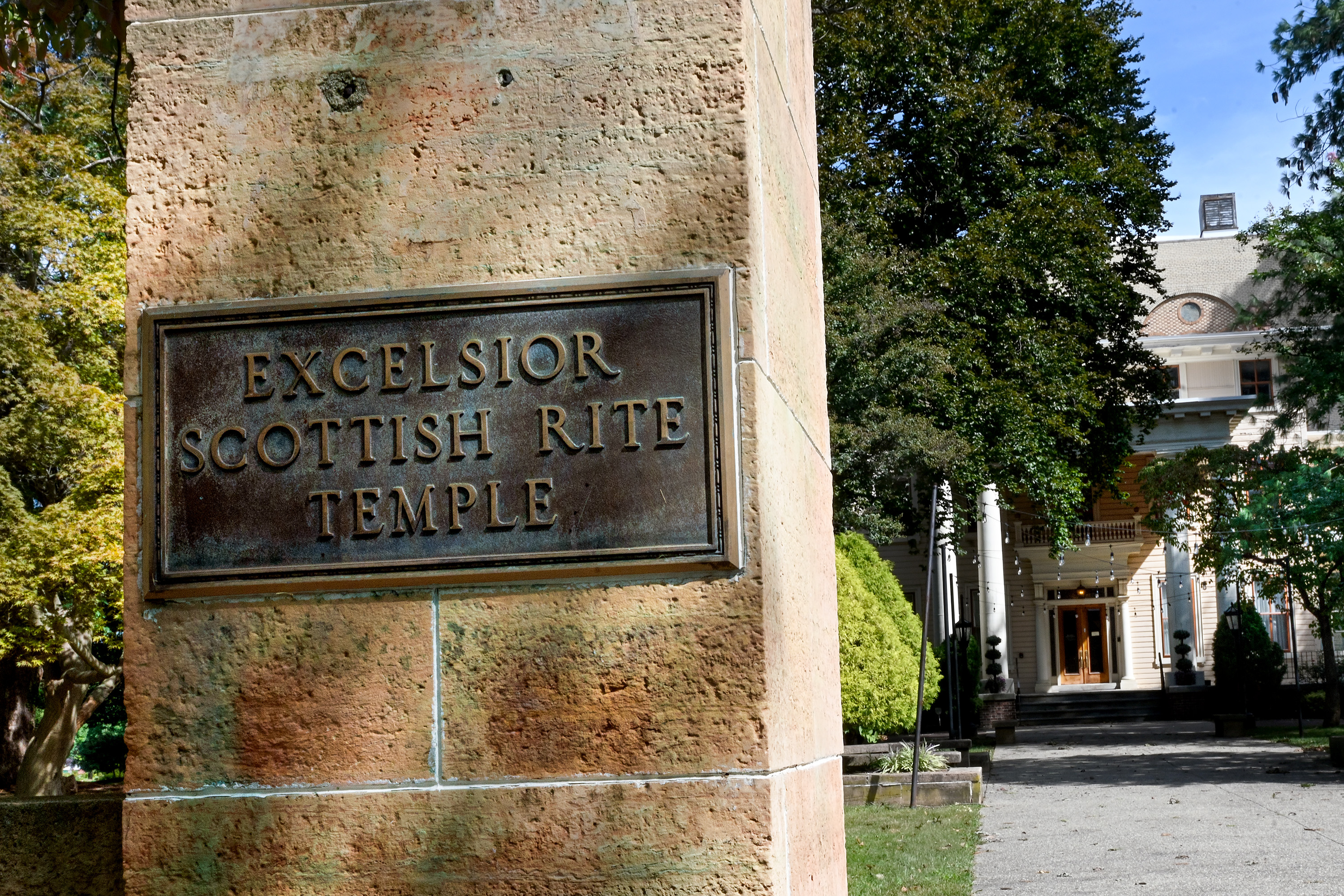
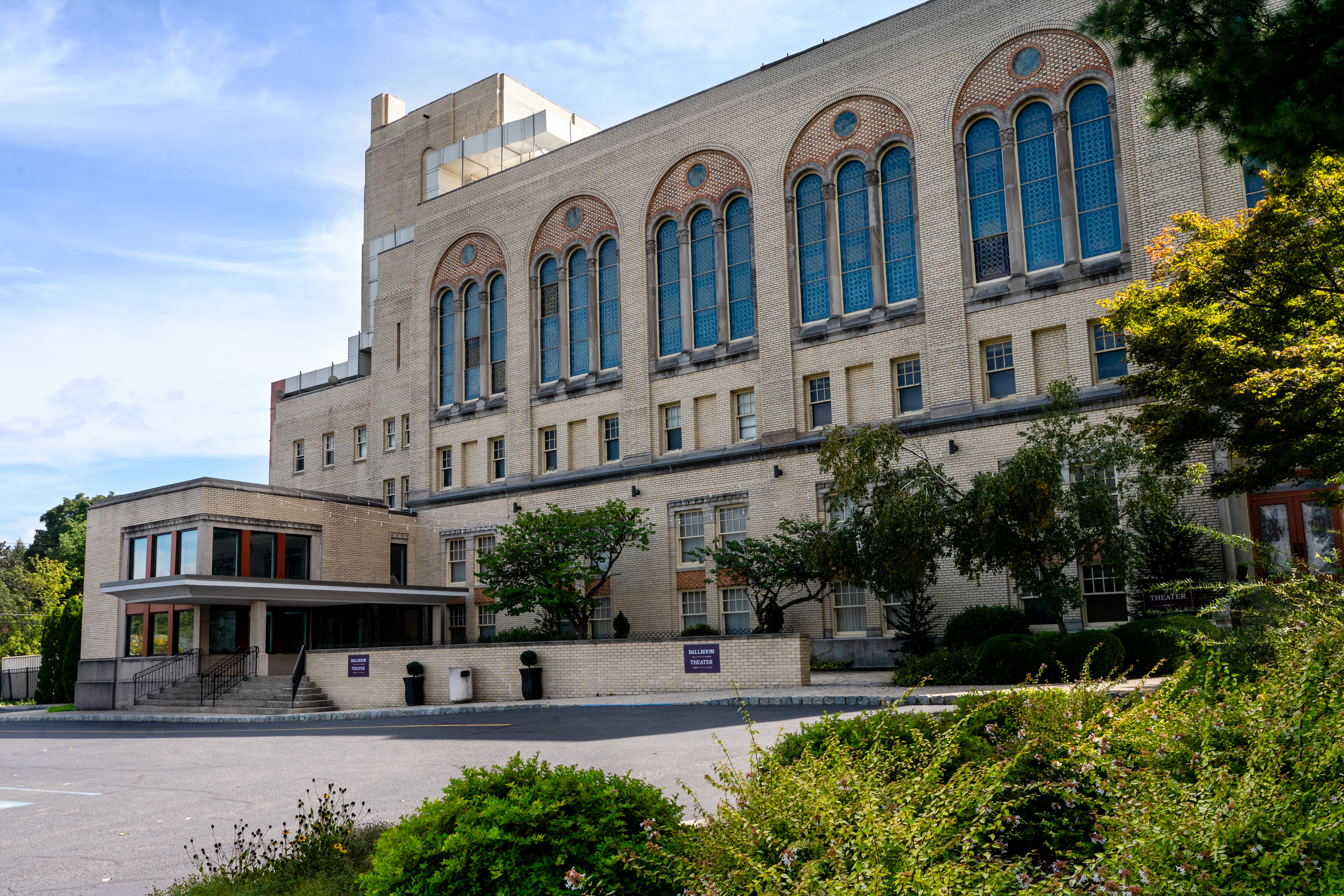
The Scottish Rite Theater, which hosts everything from rock bands to school district events to weddings, is one of the largest in South Jersey, seating up to 1,050 people.
Now, the county could decide by the end of the year whether to take responsibility of the theater to relieve Collingswood of the financial toll, Louis Cappelli Jr., director of the Camden County Board of Commissioners, told The Inquirer in a recent interview. It is a goal that has been years in the making, Collingswood Commissioner Jim Maley has said at recent meetings.
That takeover would likely result in the dissolution of the current nonprofit running the theater, Cappelli said, but he is not sure yet who would run the Scottish Rite and what would happen to its current employees.
“We’re still performing our due diligence on the Scottish Rite,” Cappelli told The Inquirer. “We’re having the building inspected to make sure there’s no land mines in there that would surprise us.”
The county is also completing an internal financial evaluation to determine whether an agreement with the borough would be feasible, Cappelli said.
Collingswood Borough has rented the property housing the theater for $1 annually from the Scottish Rite Freemasons for more than two decades. Borough officials and lawyers created a nonprofit, the Collingswood Foundation for the Arts, in 1999 to run the property.
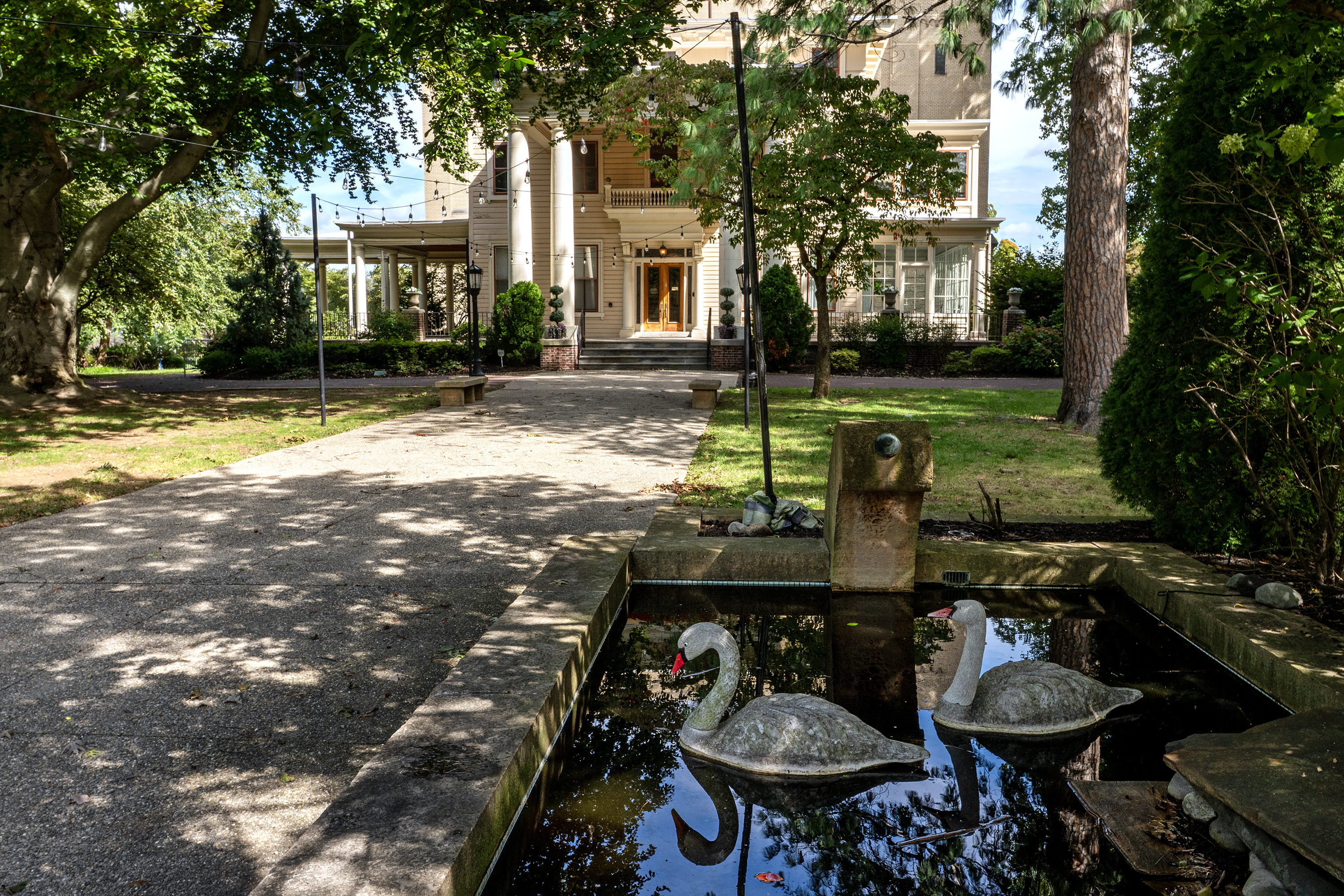
The Scottish Rite property in Collingswood. The historic theater inside is currently managed by the Collingswood Foundation for the Arts, a nonprofit created by borough officials decades ago, but that could change under a potential new agreement with Camden County.Tom Gralish / Staff Photographer
The borough has kept the theater running by lending hundreds of thousands in annual operating expenses to the Collingswood Foundation for the Arts. At the end of each year, the foundation typically repays the borough with money made through ticket sales and weddings, Maley, who helped create the nonprofit two decades ago when he was Collingswood’s mayor, said in August.
But Collingswood officials say a post-pandemic slump, declining sales, and shifting wedding trends have left the nonprofit with no means of repaying the borough.
Many residents have expressed anger that they are paying to keep the Scottish Rite afloat.
“I can understand why they don’t want to bail out a building they don’t feel truly belongs to them,” Collingswood Mayor Daniela Solano-Ward said. “It’s not available in the way that the Senior Community Center is, like other public buildings, which is why stepping away … is really attractive to me.”
A new arrangement
It is unclear exactly what a new agreement to keep the Scottish Rite going would look like. Officials say a draft does not exist yet, but Cappelli said the borough would have to assign Camden County its lease with the Scottish Rite Freemasons, which currently extends through 2092.
Camden County’s commissioners sponsor concerts at the theater frequently, and Cappelli said those events would continue to be “a no-brainer for us.” Solano-Ward said she would agree to the transition only if Collingswood residents can still use the space for community events or fundraisers.
Amy Henderson Riley, who serves on Collingswood’s board of commissioners with Solano-Ward and Maley, said she is not against working with the county, but she wants to ensure that Collingswood gets something in return, especially when the borough’s school district has suffered from budget cuts in recent years.
“Can the borough have a dollar per ticket or 50 cents per ticket? We’re looking for money everywhere,” Henderson Riley said. “How do we create an arrangement that benefits the town?”
The theater and its adjoining ballroom have left the borough paying its bills in recent years, which prompted Collingswood officials to find a way to get the financial burden out of their hands.Tom Gralish / Staff Photographer
If the county is assigned the current lease, Cappelli said, the Collingswood Foundation for the Arts would no longer run the Scottish Rite Theater or its adjoining ballroom. Instead, a new nonprofit, about which he offered no details, would take its place.
The Collingswood Foundation for the Arts has at least one full-time employee, executive director Paula Lara, along with part-time bartenders, caterers, sales personnel, sound and lighting crews, and more. Cappelli said that the county has made no decision on whether Lara and her staff would stay at the Scottish Rite under a new agreement but that staffing changes are “part of what we are currently exploring.”
Lara did not return requests for comment.
The foundation, a longtime fixture in Collingswood, has been the subject of controversy in recent months over its nonprofit status. For the last five years, the foundation has not filed its tax documents, and it has lost its federal tax-exempt status. Maley has said that the pause on filing was a mistake, and that officials had since filed those documents. The IRS had not reinstated the foundation’s exemption as of Wednesday.
The nonprofit holds the Scottish Rite’s special concessionaire permit, a $2,000 annual license allowing the venue to serve alcohol in a historically dry town (though that status could change in November when Collingswood voters decide whether to lift the borough’s liquor license ban). Maley said at a borough meeting in October thatthe money made from alcohol sales helps keep the Scottish Rite running.
“The foundation of the arts could go away tomorrow. Happy to make it go away, happy to not have you all here yelling about it,” Maley said at the meeting. “But the reason why it can’t go away is because it’s what holds the concessionaires.”
The Scottish Rite property is currently used for Collingswood concerts, school district events, and fundraisers, and borough officials want to keep it that way.Tom Gralish / Staff Photographer
‘It’s complicated’
At the borough’s recent meetings, residents have called into question whether the Scottish Rite should have received taxpayer dollars at all, because the Collingswood Foundation for the Arts is a private corporation with independent employees.
Henderson Riley said she has been trying all summer to understand the decades-long relationship between the foundation and the borough by working with special counsel. On Oct. 5, after 10 weeks without answers, Henderson Riley proposed a resolution to appoint new lawyers to speed up the process. Her fellow commissioners did not vote to pass it.
Without a clear understanding of the foundation, Henderson Riley said, she does not feel comfortable making votes or decisions on the Scottish Rite, especially ones that give the nonprofit money. The commissioner said she previously voted to transfer money to the foundation without being told the money could not be paid back.
“These are actions I took. If I had understood they wouldn’t be paid back, I wouldn’t have voted that way,” Henderson Riley said. “Taxes are going up. Everybody is worried about affordability, and Collingswood is just giving away money.”
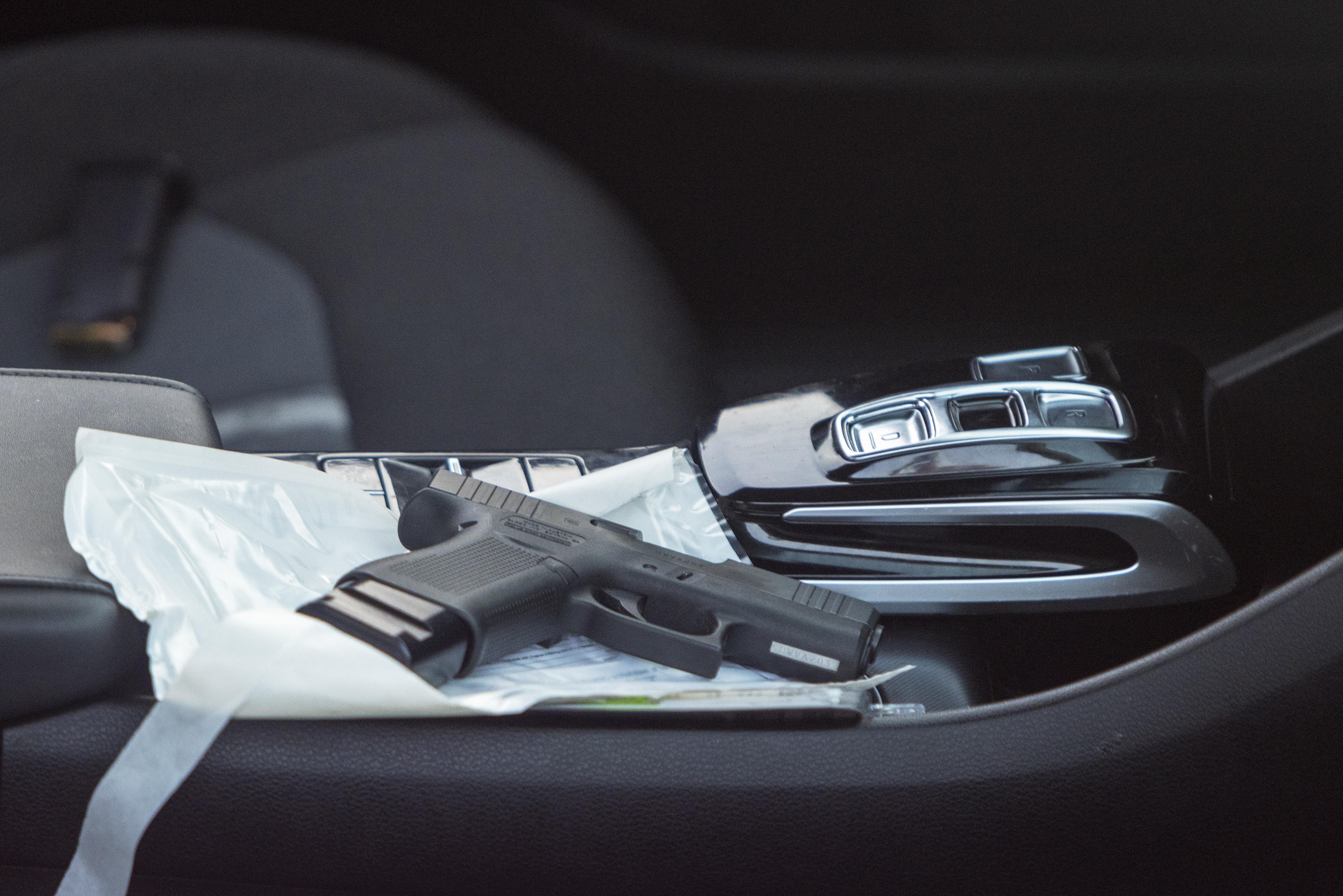
The Department of Justice is investigating Pennsauken Township to determine whether firearm permitting delays within the police department have infringed on residents’ Second Amendment right to bear arms.
“It is a violation of the Second Amendment for government officials to delay issuing permits to purchase or carry firearms,” the federal department said in a news release announcing the investigation Wednesday.
The statement referenced a 2022 Supreme Court ruling that determined that “a state’s permitting process is put toward ‘abusive ends’ when ‘lengthy wait times in processing license applications or exorbitant fees deny ordinary citizens their right to public carry.’”
“Here, it is alleged that Pennsauken, through the Pennsauken Township Police Department, uses just such ‘abusive ends’ to improperly limit Second Amendment rights,” the department said.
Both the Department of Justice and Pennsauken Township declined to comment Wednesday afternoon, citing the ongoing investigation.
In New Jersey, all firearm applications are handled by the applicant’s local police department.
The process requires that anyone seeking a firearm permit fill out a digital application, provide a photograph, and name two character references who have known the applicant for two years and do not reside in the same household.
Within 90 days of submitting an application, the applicant must pay the necessary fees and get fingerprinted to initiate a background check.
The entire firearm permitting process typically takes between four to six weeks, if no issues arise during the interview, according to the township.
This is not the first time Pennsauken has faced questions about its firearm permitting process.
In 2024, the Coalition of New Jersey Firearm Owners, Gun Owners of America, and the Gun Owners Foundation joined Pennsauken resident Christian Benton in a federal lawsuit against the state’s Attorney General and Pennsauken Township Police Chief Phil Olivo.
The lawsuit alleges that New Jersey’s “lengthy and arduous” permitting process and the state law limiting handgun purchases to one per month amounts to a violation of the Second Amendment, according to the filing.
Last year, a judge dismissed the claims related to processing delays after saying in a hearing that there was a “lack of constitutional injury.”
“Mr. Benton, as well as the other individuals who information has been provided for, have all sought and received firearms permits,” according to the ruling from U.S. District Court Judge Karen Williams. “They are all, as this Court can glean from what is before it, currently exercising their Second Amendment right to keep and bear arms.”
The lawsuit, now limited to just the challenge against the state’s one-gun-per-month law, is still working its way through the courts.
Few things have boosted the blood pressure of drivers over the last four years as much as the reconstruction of nine miles of Route 70 in Cherry Hill.
Traffic that crawled, barricades that needed dodging, mystery driveways that required careful navigation, and now that brown scar of dirt down the middle of the state highway. Complaints filled social media.
Leaders from the state, Camden County, and Cherry Hill are scheduled to gather at Barclay Farms Shopping Center on Friday to announce that it will be complete by this winter.
And “perennial native plants that truly represent the Garden State” will be planted to beautify the median, Camden County Commissioner Director Louis Cappelli Jr. said in a statement.
A rendering of plantings near the Garden State Park complex.Courtesy Camden County
Purple, pink, red and yellow perennial flowers and bulbs, and shrubs and grasses, will grow in the median. They will be road salt tolerant, according to the New Jersey Department of Transportation.
Black-eyed Susan, aster, daylilies, gaillardia, and allium will color the drive down the busy road. Inkberry, eastern red cedar, and switchgrass will help fill the gaps.
They will be planted in wildflower soil and framed by rubber or aggregate surfacing, according to the plans by Environmental Resolutions, Inc. of Mount Laurel.
Eight-foot-wide signs will read “Welcome to Cherry Hill” (and “Now Leaving Cherry Hill”) and brick columns will stand on each side, according to the plans.
The goal of the county-state project for median landscaping is to “create a new sense of place for motorists and pedestrians,” the county said in its announcement.
70and73.com is a hyperlocal news site focused on South Jersey, including the communities of Cherry Hill, Evesham, Mount Laurel, Voorhees, Medford, Medford Lakes, and Moorestown.





 –>
 –>
 –>
 –>
 –>