Tag: Camden County

  • Oaklyn Borough closes hockey rink and basketball court over safety concerns

    Oaklyn Borough closes hockey rink and basketball court over safety concerns

    After decades as a popular hang-out for generations of Oaklyn kids, the aging hockey rink and adjacent basketball court at Oaklyn-Lions Park have both closed because of safety concerns.

    Oaklyn Borough officials announced the closures at the Sept. 8 council meeting following an annual safety inspection that recommended the areas be closed because of concerns about the surface, boards, and fencing. The courts closed the following day and it’s unclear how long the repairs could take and how much they’ll cost.

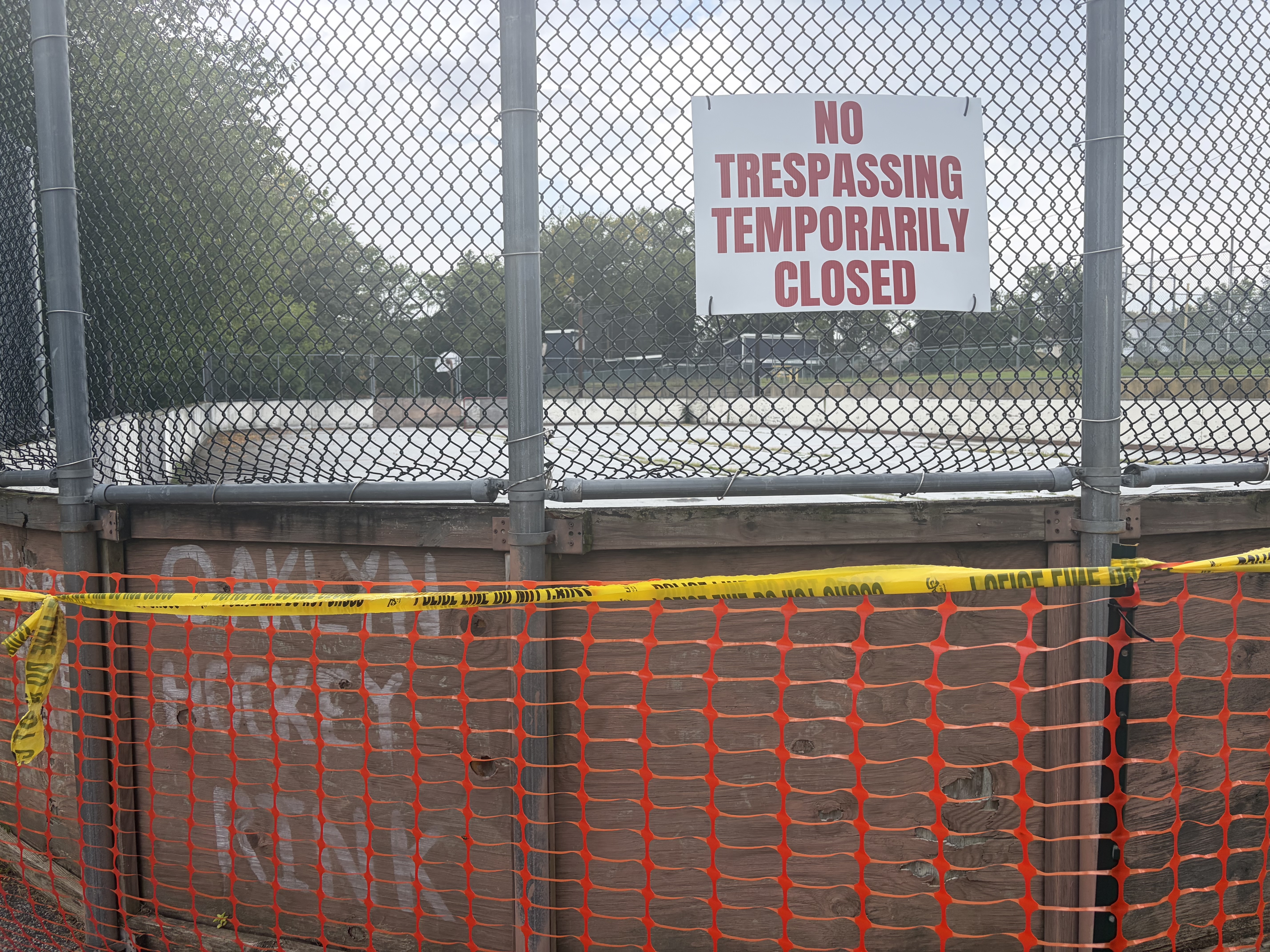
    Currently cordoned off by temporary fencing and caution tape, the wooden boards around the rink have come apart in various spots as weeds have sprouted through cracks on the surface.
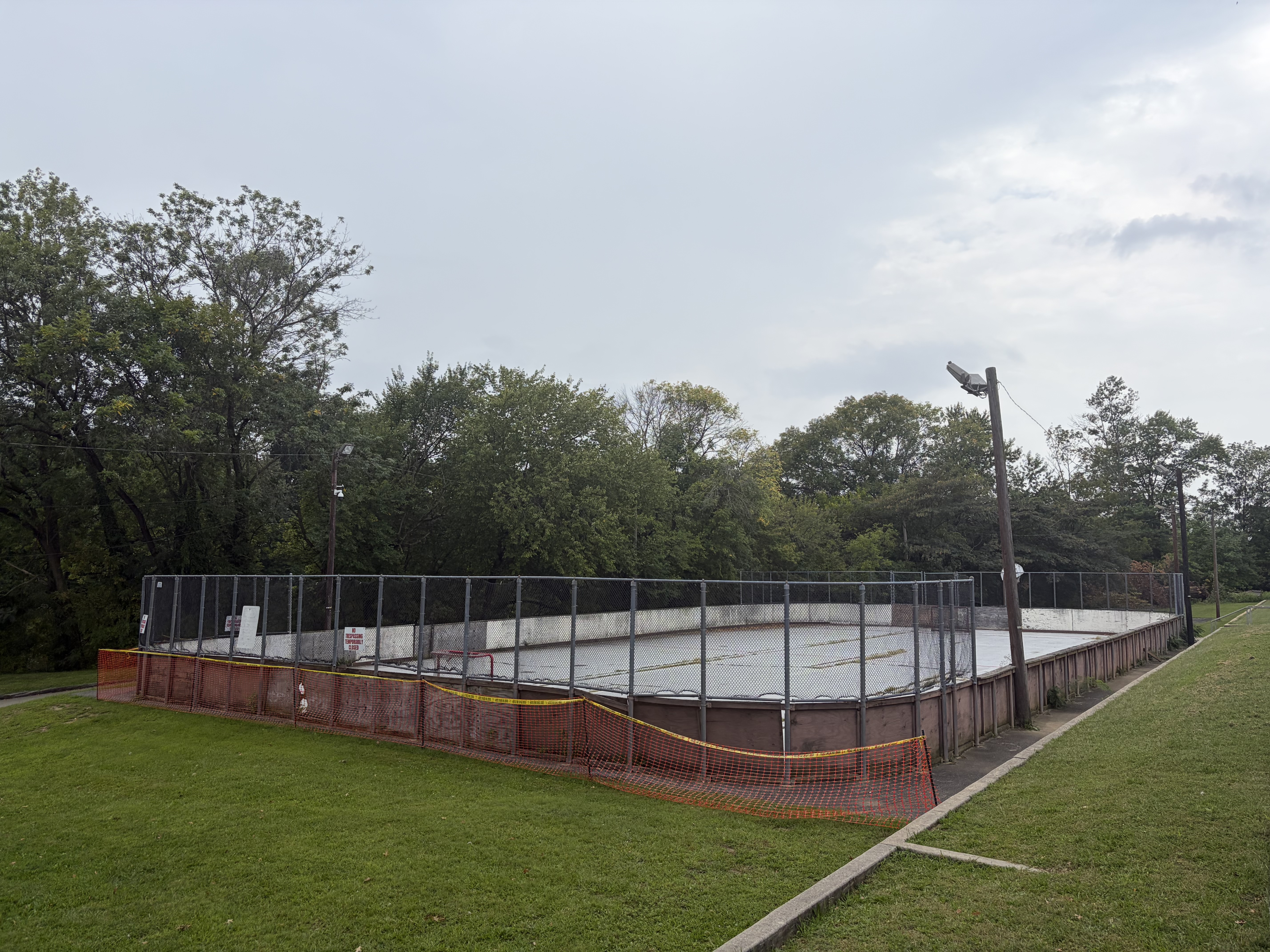
    The outdoor hockey rink at Oaklyn-Lions Park could be seen cordoned off on Sept. 17 after being closed due to safety concerns.Lacey Latch

    Right behind one of the hockey nets, two holes in the boards and gaps in the upper protective fencing — all large enough for street hockey balls and pucks to soar through — directly face a neighboring playground.

    On the basketball court, only one backboard remains standing — albeit crookedly.

    But in spite of the current state of things, the area was still being used up until the sudden closure last week, said lifelong Oaklyn resident Alex Lewis, 36.

    Like many other Oaklyn kids, Lewis grew up playing soccer at the hockey rink that for years was informally used for both sports.

    “We had this really vibrant soccer-loving community,” Lewis said.

    “It was so much the thing to do for our group that if we had a three-day weekend for school, we’d be down there all three nights playing soccer until we basically couldn’t walk anymore,” he said. “It was incredible.”

    Eventually, the long-standing shared use of the space was paused in 2006 when an ordinance was passed banning all non-hockey equipment within the rink, Lewis said.

    The ordinance has remained in place since then and precipitated a noticeable drop in the rink’s usage, Lewis said.

    “There was still a vibrant hockey-playing community, as there should be, which is awesome,” Lewis said. “But the overall use of the court declined and the quality of the court and the upkeep of the court itself declined over that same amount of time.”

    That steady decline has been clear to Lewis and others who spent years playing at the park.
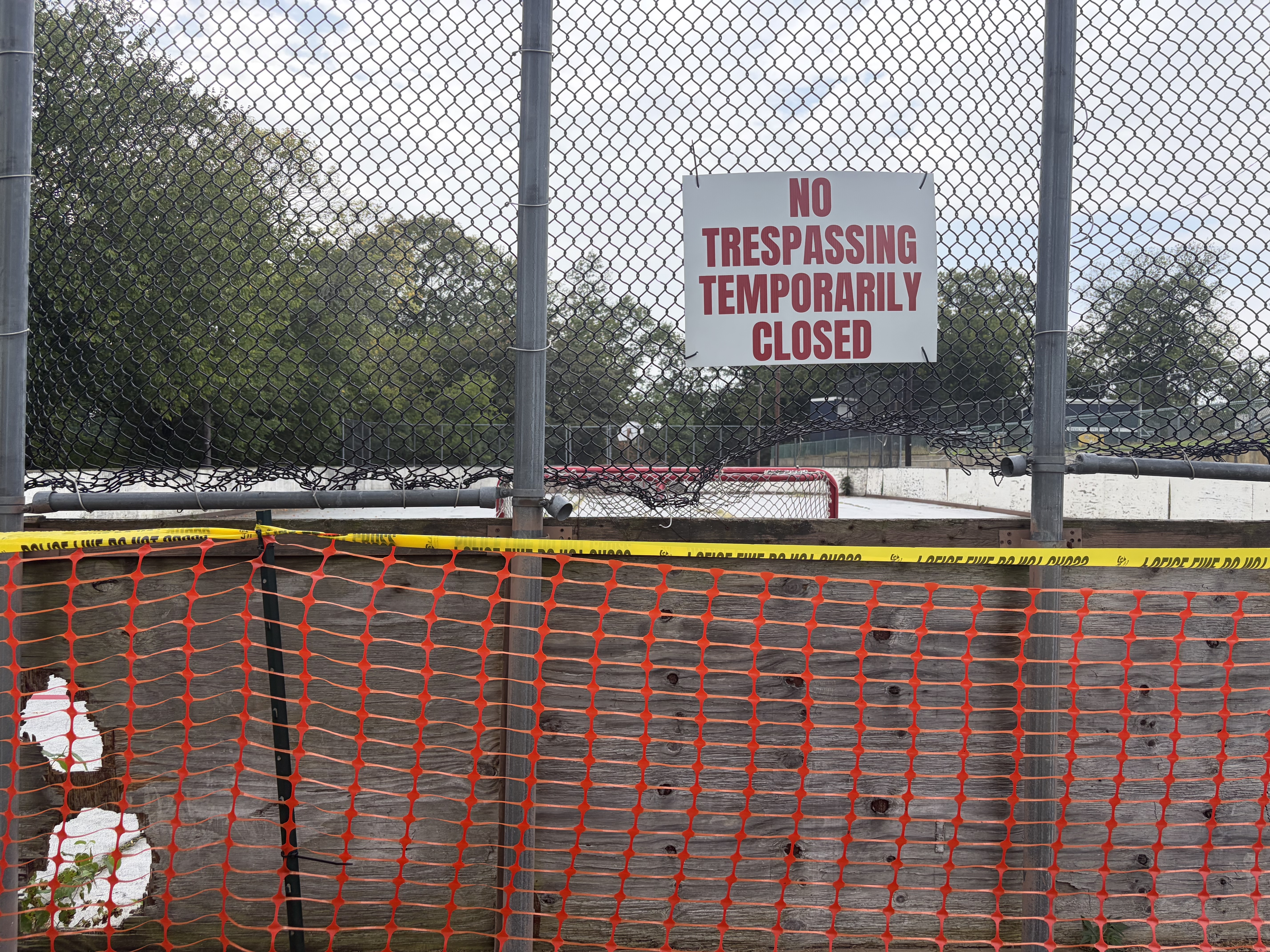
    Large holes in the boards and gaps in the protective fencing can be see at the outdoor hockey rink at Oaklyn-Lions Park on Sept. 17.Lacey Latch

    Another lifelong Oaklyn resident Billy Gamba, 29, was one of the many hockey players who spent countless hours at the rink learning the fundamentals of the sport.

    Almost every night growing up, Gamba and his friends would descend on the rink, he said, honing their skills and eventually passing them on to the players coming up behind them through impromptu clinics.

    “We would just meet down there and we pick teams and just play for all hours of the day and throughout the night,” Gamba said.

    The rink wasn’t only a draw for Oaklyners either, he said, attracting players from other communities, including Audubon, Collingswood, and Haddon Township.

    In spite of its heavy use over the years, Gamba said he doesn’t remember any major repairs taking place at the rink in his lifetime, save for a quick patch-job when he was about 10 years old.

    “I used to play down there like four or five nights a week and it just got worse and worse over time,” he said.

    “Over the years I stopped playing because I don’t want to get hurt down here,” Gamba said. “I’ve seen guys get seriously hurt down there, whether their stick gets caught in the boards and they jab themselves in the stomach or their wheels or skates catch that deep crack and they fall.”

    Just like Lewis, Gamba, and countless other residents, Oaklyn Mayor Greg Brandley has memories as a kid on the courts.

    “Growing up in Oaklyn, I played on those courts my whole life as a little kid so it’s very sad to see this happen right now,” Brandley said of the closures.

    “It’s something for the kids that we have to get reopened again,” he said.

    But repairs won’t be as simple as just pouring a new layer of concrete, Brandley said.
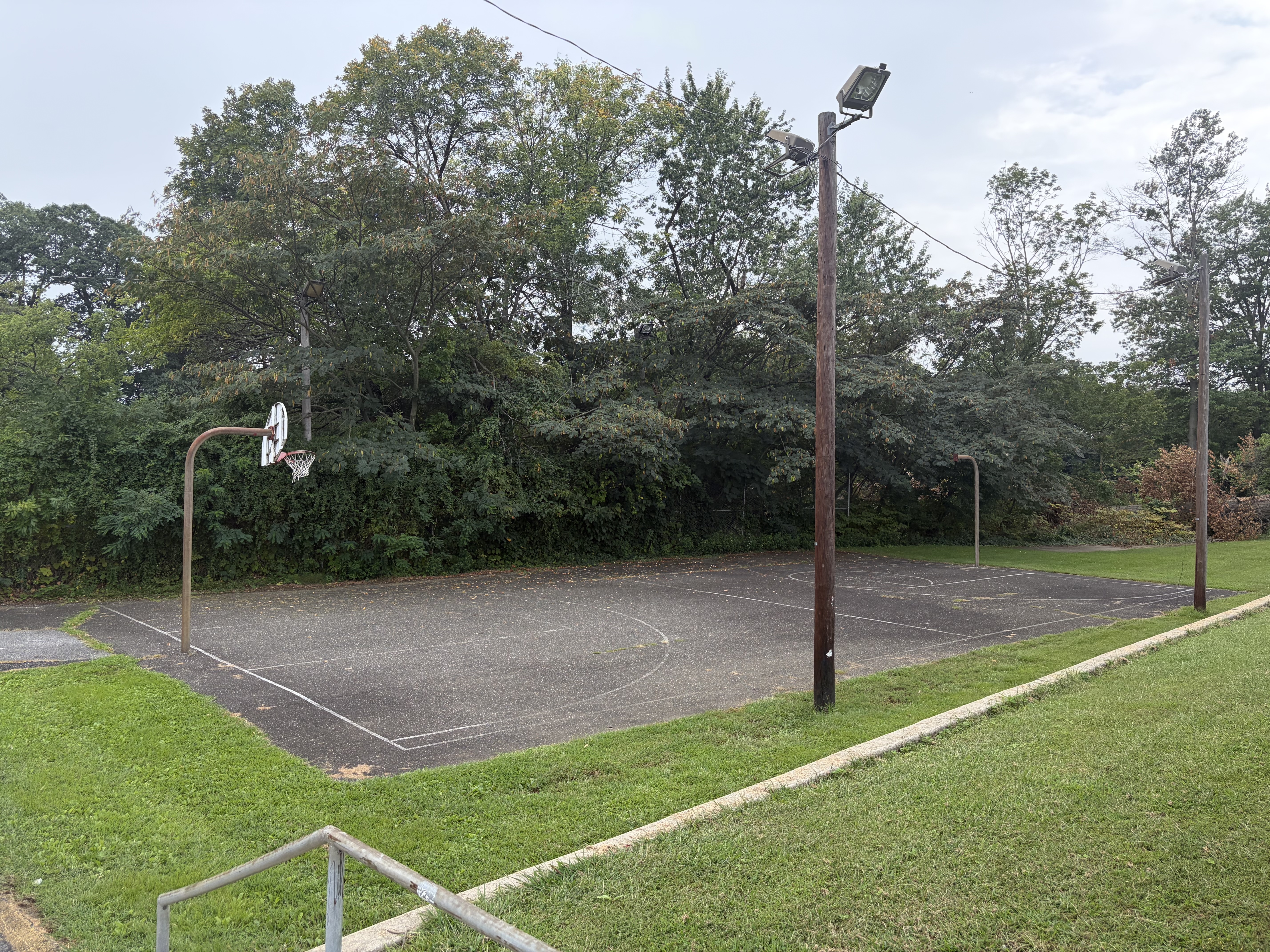
    Only one backboard remains standing on the basketball court at Oaklyn-Lions Park, pictured here on Sept. 17.Lacey Latch

    Because the rink has a special surface, he said, the borough will have to consult with engineers on the necessary work and the estimated cost. After that, the discussion will then shift to how to find money for the project in the budget, he said.

    As a result, it’s still much too early to put a realistic timeline or price tag on the project, he said.

    With that said, Lewis has already gotten a jump on the process.

    Last fall, Lewis and the semipro soccer club he founded, Oaklyn United FC, organized a tournament at the courts to help fundraise for the needed repairs.

    While the money raised was “just a drop in the bucket” toward the tens of thousands of dollars that will likely be needed for the repairs, Lewis said, it was about trying to give back to “this public resource that in many ways was kind of the birthplace of OUFC.”

    And while he’s disappointed that the courts deteriorated to the point of closing, he’s eager to help fix it up and make it even better.

    With soccer gaining popularity in the U.S., Lewis noted that it could be the perfect time to formalize the shared-use of the court for both hockey and soccer, which is as simple as painting a few extra lines, he said.

    “We’re talking about restoring a public asset that if it doesn’t get restored, it’s just kind of sitting there in this blighted state in what is otherwise kind of the center of the universe for our town,” Lewis said.

  • Cherry Hill will get rid of its 10 Flock cameras at the end of the year

    Cherry Hill will get rid of its 10 Flock cameras at the end of the year

    As public pushback against the use of automated license plate readers continues to grow nationwide, Cherry Hill announced this week that it will not be renewing its contract with controversial company Flock.

    The township’s contract with the company expires on Dec. 31, Cherry Hill Mayor Dave Fleisher announced at the Sept. 14 township council meeting.

    “The Cherry Hill Police Department continues to evaluate its use of technology,” Fleisher’s chief of staff, Brian Bauerle, said in an email Friday. “In conjunction with that evaluation, Cherry Hill Township was also aware of ongoing nationwide conversations concerning the Flock network.”

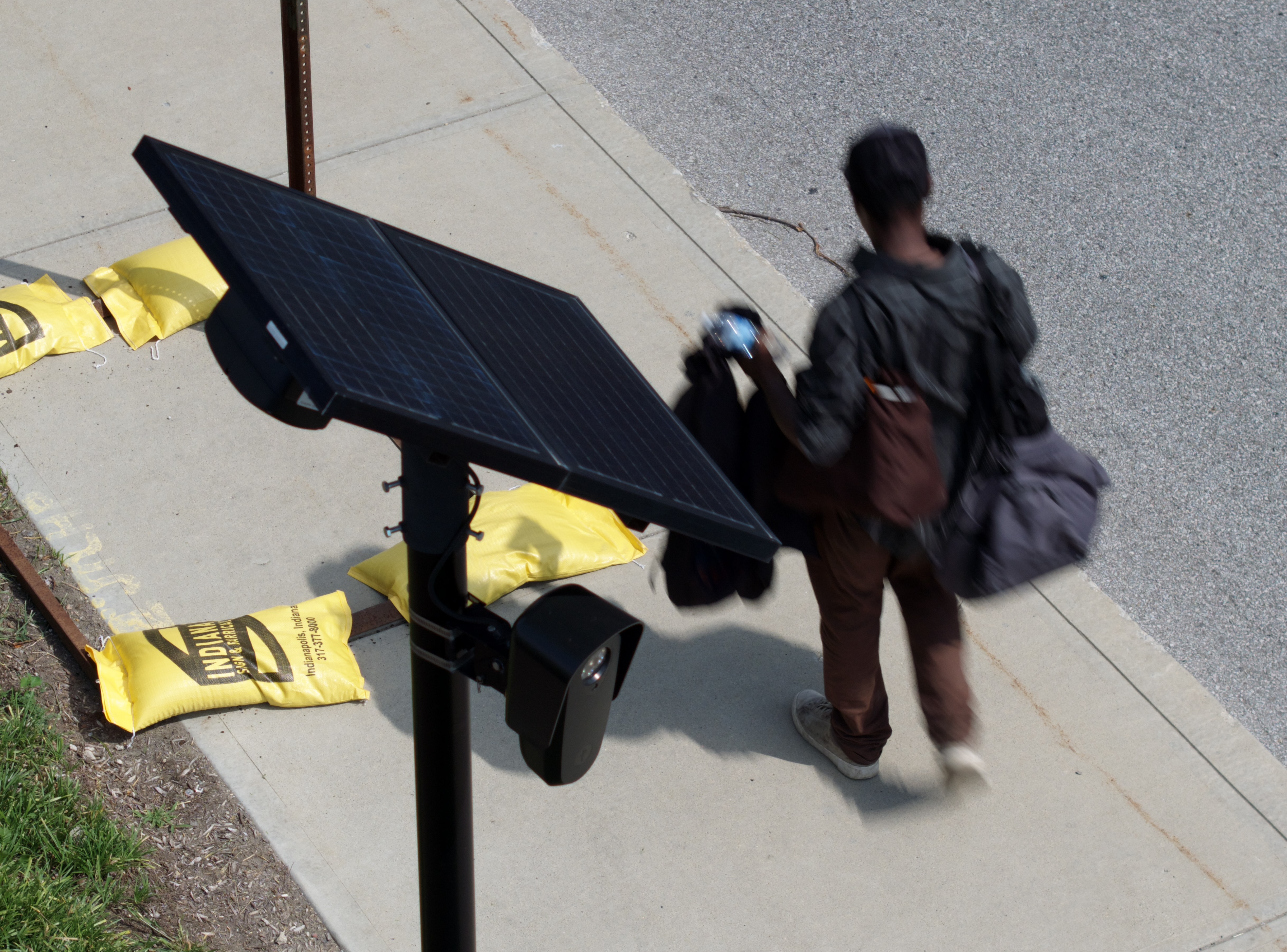
    Flock cameras capture the license plates and identifying features of passing vehicles, including bumper stickers and dents, in addition to the make, model, body type, and color. That information is then compiled into a searchable database that can be accessed by law enforcement and private owners of the cameras.

    In 2022, Cherry Hill entered into a two-year, 10-camera pilot program with Flock, Bauerle said.

    Once the contract expires, the cameras, which were installed at the end of 2024, “will become inactive immediately with the hardware to be removed by the vendor,” he said.

    As the township prepares for the cameras to come down, the Cherry Hill Police Department is now looking into other options for similar technology that can be used in town.

    “The police department is in the final stages of evaluating Axon automated license plate readers,” the same company that provides the department’s body-worn and dash cameras, Bauerle said. Axon’s dash cameras can serve as mobile automated license plate readers while the police car is in operation, he said.

    “These cameras do not connect to the Flock network,” Bauerle noted. “The Department uses automated license plate recognition technology only for authorized law-enforcement and public-safety purposes and in accordance with both New Jersey law and New Jersey Attorney General directives.”

    The department has not yet moved beyond the “evaluation phase” of the Axon cameras, but if it does, Bauerle said, the decision will be subject to various approvals by the township.

    Cherry Hill’s decision to sever ties with Flock comes as people across the country increasingly push back against the technology. Critics argue that the cameras amount to mass surveillance and unconstitutionally track the movements of citizens.

    Earlier this month, rural Shamong Township in neighboring Burlington County introduced an ordinance that would ban the cameras within the township for one year.

    “Flock cameras basically create a surveillance system for people who have done nothing wrong,” Shamong Mayor Michael Di Croce said at the time.

    “We should not create a permanent or searchable record of where law-abiding residents drive merely because they happen to pass a government camera or, in the case of Flock, private-entity cameras,” Di Croce said.

  • Mike Bowe, popular longtime radio disc jockey, has died at 76

    Mike Bowe, popular longtime radio disc jockey, has died at 76

    Mike Bowe, 76, of Audubon, Camden County, longtime local disc jockey and popular radio show host at WMGK, WPEN, WHAT and other stations, Army veteran, devoted Phillies fan, and proud son of Gloucester City, died Monday, Sept. 14, of complications from cancer at his home.

    Mr. Bowe enjoyed music and socializing as a teen at Gloucester Catholic High School, and was skilled at chatting with people about their favorite songs and other interests. So he was a natural fit later as a radio show host and disc jockey for more than 40 years in studios and at remote appearances, dance parties, charitable fundraisers, and other events.

    “I like to think I communicate with people,” he told the Courier-Post in 1987. “I think I can relate the same way to somebody whether he’s on Ninth Street in South Philly or at a bank in Center City.”

    Fellow DJ Chris McCoy said. “He had something intangible. He made you feel like he knew you, and you knew him.”

    Using what his fans and colleagues described as a “calming and smooth voice” and “velvet intonations,” Mr. Bowe hosted music shows at WMGK from 1977 through the early 2000s, at KISS 100 in the 1990s, and at WPEN and WHAT between 2000 and 2011. Colleagues called him “loyal, dedicated, witty” in online tributes, and praised his “down to earth and friendly style.”

    They credited him with making WMGK’s Saturday Night ’70s show a hit in the mid-1990s. “He was the very foundation of that success,” McCoy said.

    Listeners called him “truly a master of this craft,” “one of the best ever,” and “a memorable radio legend.” He worked after 2011 at other local stations and iRadioPhilly.com.

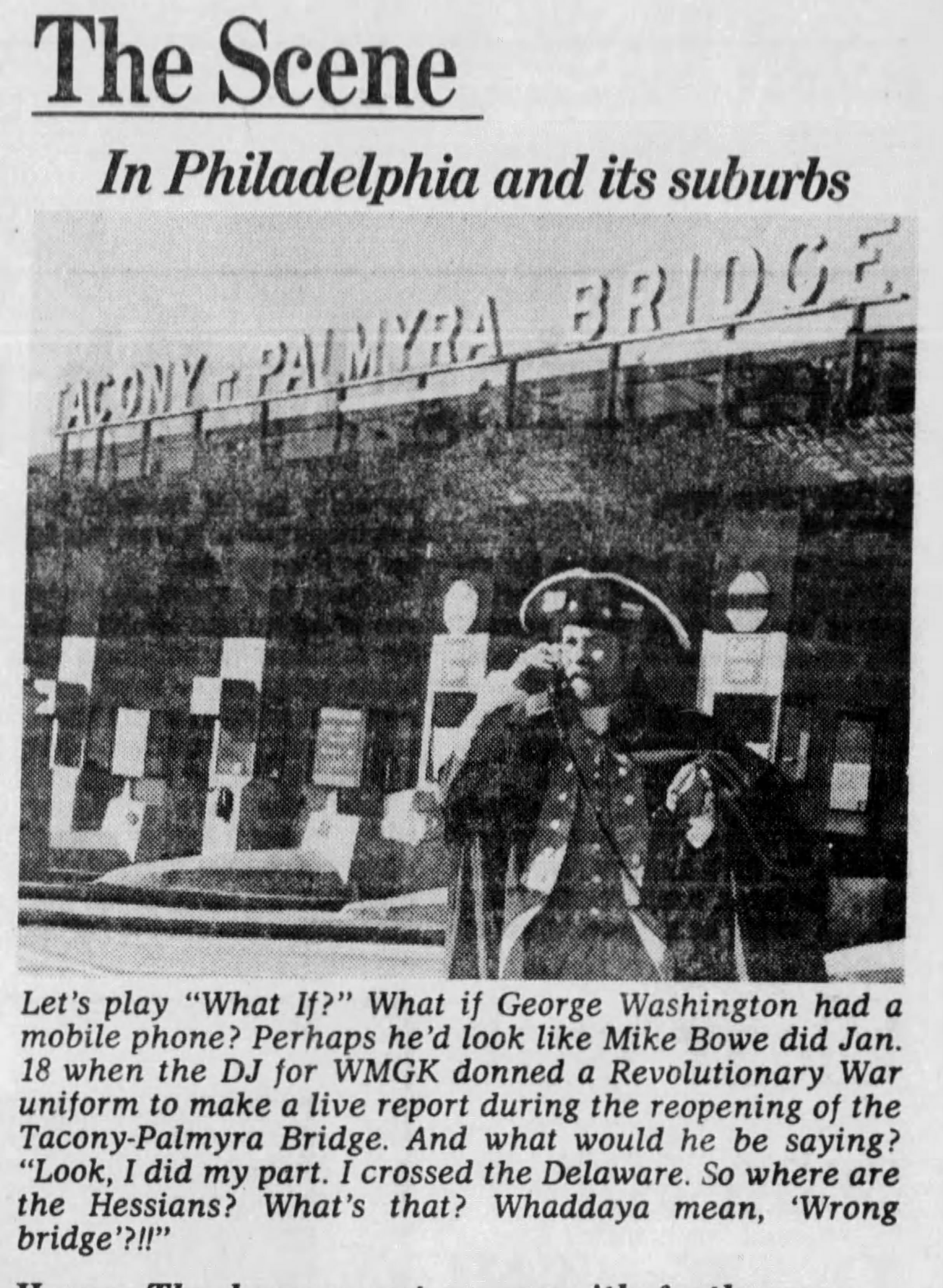
    He teamed up with other popular DJs on morning, afternoon, and evening shifts, interviewed performers, took phone calls from listeners, and broadcast from Phillies games and charitable benefits. In 1989, he dressed up as George Washington to cross the Delaware River when the Tacony-Palmyra Bridge was finally reopened after repairs.

    He liked to air remotely from his favorite clubs and pubs, and ride shuttle buses with listeners to concerts. He also worked DJ dance party gigs at nightclubs, holiday parades, and private events in Philadelphia and South Jersey.

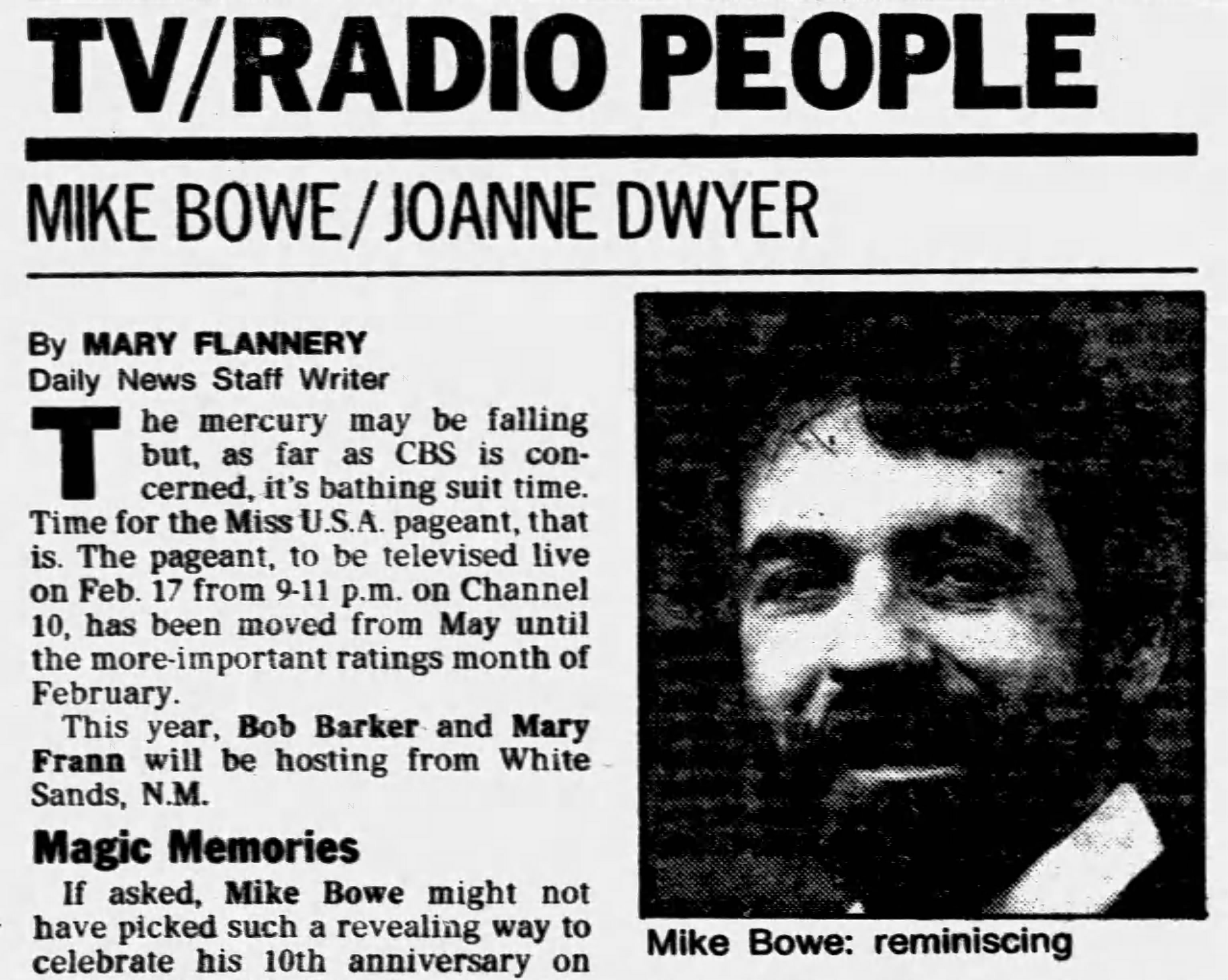
    Mr. Bowe appeared often in The Inquirer and Daily News, including in 1987 (above) and 1989 (below.)Newspapers.com

    His favorite song was “Ain’t No Woman (Like The One I’ve Got)” by his favorite group, the Four Tops. “He knew Philadelphia from A to Z,” McCoy said. “He brought a smile to your face.”

    Mr. Bowe served three years in the Army, 11 months and 11 days in Vietnam in 1968-69, and earned several medals and service stars, and an achievement badge. Fellow DJ Sue Serio said online that she enjoyed annual Veterans Day lunches with Mr. Bowe, “a treasured tradition that we never took for granted.”

    One day, a former WMGK colleague said online, Mr. Bowe took him to Mr. Bowe’s favorite three local landmarks: the Melrose Diner in South Philadelphia, Mel’s Italian restaurant in Bala Cynwyd, and the pool table at the VFW in Gloucester City.

    “Mike was a gift to Gloucester City and to the Delaware Valley professionally and as a man,” longtime friend Patrick Healey said. Longtime friend F. Emmett Fitzpatrick III said: “He prized honesty of character above all else.”

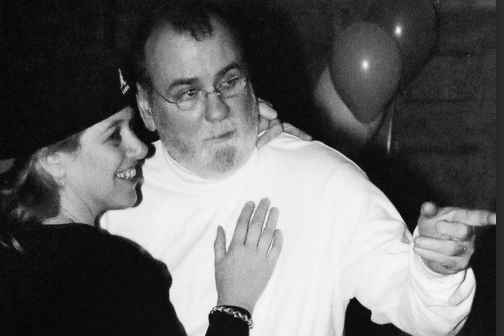
    Mr. Bowe, right above, was an avid Phillies fan. Below, he worked morning, afternoon, and evening shifts in the studio.F. Emmett Fitzpatrick III

    Mr. Bowe’s niece, Debra Ann Leblang, said: “He lived the ultimate American dream.”

    Michael Joseph Bowe was born Nov. 4, 1949, in Gloucester City. He graduated from Gloucester Catholic in 1967, studied broadcasting in Minnesota, and worked his way through the radio ranks in South Jersey and Philadelphia.

    He married Debbie Durso in 1985, and they lived in Audubon. Where one of them went, family and friends all said, the other followed.

    “They were partners, companions, and best friends,” his family said in a tribute. His wife died in June.

    Mr. Bowe and his wife, Debbie, married in 1985. Where one of them went, family and friends all said, the other followed. F. Emmett Fitzpatrick III

    Off the air, Mr. Bowe played softball and enjoyed visits to Atlantic City and Brigantine. He was a Sunday morning usher at St. Mary’s Catholic Church and belonged to the Townsend C. Young VFW post.

    He used to take dates to Jim’s Pizzeria in Gloucester City, and he told The Inquirer in 1994 that he enjoyed the place’s acerbic camaraderie. “Gloucester’s always been like that,” he said. “People love it. It’s a sarcastic, get-under-your-skin kind of thing. You don’t even get to order your own food.”

    His family said: “He was funny, quick-witted, sentimental, outspoken, and unforgettable. He carried his South Jersey roots with him wherever life took him.”

    In addition to his niece, Mr. Bowe is survived by a sister, a brother, and other relatives. Two brothers died earlier.

    Visitation with the family is to be from 8:45 to 9:45 a.m. Tuesday, Sept. 22, at the McCann-Healey Funeral Home, 851 Monmouth St., Gloucester City, N.J. 08030. Funeral services are to be at 11 a.m. at Brigadier General William C. Doyle Veterans Memorial Cemetery, 350 Province Line Rd., Wrightstown, N.J. 08562.

    Donations in his name may be made to the Wounded Warriors Project, Box 758516, Topeka, Kan. 66675; and St. Mary’s Roman Catholic Church, 426 Monmouth St., Gloucester City, N.J. 08030.

    Off the air, Mr. Bowe played softball and enjoyed visits to Atlantic City and Brigantine.F. Emmett Fitzpatrick III
  • A South Jersey resident evicted from a council meeting will get a $15,000 settlement from the borough

    A South Jersey resident evicted from a council meeting will get a $15,000 settlement from the borough

    Lindenwold will pay $15,000 to a resident who was removed from a council meeting for recording on his phone, settling a lawsuit over the Camden County borough’s video policy.

    The lawsuit pushed the seven-person council to rescind its policy last month, which limited public meetings to one camera, required attendees to give 30 minutes’ notice before they record, and demanded that residents provide a copy of the recording to Lindenwold officials within two days.

    The lawsuit follows years of calls by residents for the borough to record its own meetings and upload them to its website.

    Alfonso Penna, 24, filed the complaint on July 22 against Lindenwold, its mayor, the police chief, and the police officer who escorted Penna out of a June council meeting. He alleged the borough had infringed upon his constitutional right to freedom of expression, his right to record, and the state’s Open Public Meetings Act. Penna, who has lived in Lindenwold all his life, said it took only a few days for Lindenwold to reach out seeking to settle the dispute.

    “The residents ended up having to foot the bill of just some incompetence,” said Penna, who started attending all of Lindenwold’s public meetings between service calls in his job as a pool repairman two years ago. “That’s what it came down to.”

    Officers escorted Penna out of the June 10 council meeting after Richard Roach, Lindenwold’s longtime mayor, told Penna to leave as he recorded a resident speaking during the public comment period, according to the complaint and a recording of the June meeting.

    Roach cited the borough’s one-camera video policy. Trevor Shaw, founder of local community advocacy group Love Lindenwold, has recorded nearly every council meeting since 2018, and he was already recording that night.

    In Shaw’s recording, Penna can be heard arguing for his right to record under the Open Public Meetings Act before agreeing to leave after repeated pushback from Roach.

    Then, the complaint alleges, at another council meeting in July, Roach again demanded that Penna turn off his camera and asked an officer to escort Penna out. Police Chief Michael McCarthy allegedly told Penna that the meeting would not continue until Penna stopped recording.

    But this time, the complaint says, Penna did not leave. Rather than remove him, council members temporarily ended the public session to speak in private. They returned less than 10 minutes later to resume the meeting, and Penna kept recording.

    Alfonso Penna, 24, sued Lindenwold in July over the Camden County borough’s video recording policy.Alfonso Penna

    Lawyers for Penna and Lindenwold filed to dismiss the lawsuit Tuesday, after the borough voted unanimously on Sept. 9 to pay thousands of dollars for Penna’s legal fees. The agreement, provided to The Inquirer by Penna, requires that any future recording policies in Lindenwold follow “constitutional limitations” and be enacted by an ordinance, so residents can comment on the rules.

    The video policy that was revoked had been enacted by resolution in January at a council meeting, in a single vote approving 65 resolutions at once.

    Roach and his fellow council members have not commented on the rescinded policy or their decision to settle at recent meetings. Roach, the borough administrator, and several council members did not return requests for comment.

    Raymond Morrissey, who has served on Lindenwold’s council for four years, said he was not aware of any plans for council to create a new recording policy. But the old one will cost residents via the $15,000 payout.

    “That impacts all us taxpayers in town because one way or another, it’s an extra expense,” Morrissey said. “Whether it was budgeted or not, it was an extra expense.”

    ‘A petty power play’

    Until it was rescinded in August, Lindenwold’s policy limiting meetings to one camera had been approved by council every January for years. Morrissey said the policy is one of “a gazillion and one resolutions” passed with a single vote during the annual reorganization meeting.

    Shaw, a Lindenwold resident since 1998, said the policy has affected him for the last eight years, as he has recorded and posted meetings online.

    While Roach has never approached him over the one-camera rule, Shaw said, the mayor has demanded copies of his footage before he posts it to YouTube and criticized him for not giving proper notice.

    “To me, it’s always seemed like a petty power play just to exert some perceived level of control or power over the people who choose to attend the meetings,” Shaw said.

    It’s unclear exactly how long the policy has limited meetings to one camera, but its language is not very modern. The policy requires people recording to “advise the Council or Borough Clerk of the tape’s permanent location” and “make fair payment for the electricity used while operating the video recording device.”

    The now-rescinded policy says the one-camera rule was created to “prevent disruption of council meetings” and could be enforced at the discretion of borough officials.

    But Penna’s lawsuit claimed that his cell phone, “silent” and “self-contained,” posed no risk of distraction.

    “This was clearly written for a time before smartphones,” Penna said.

    At the June meeting, Shaw said, multiple people had taken their phones out to record during the induction of new borough police officers, about a half hour before Penna was removed from the room. Love Lindenwold’s recording shows at least one other person recording on a cell phone, without reproach.

    Penna’s complaint attributed that difference to local politics: Penna ran for Lindenwold Council during the June Democratic primary, just days before he was kicked out of the meeting.

    Penna lost that election to two incumbent council members.

    A vacuum of information

    Without the policy, residents can now record Lindenwold meetings regardless of whether Love Lindenwold or Penna is there to record, and no ordinances have been introduced to change that.

    But Shaw and Penna both said Lindenwold’s next step should be to start recording and posting its own meetings so the public doesn’t have to. Shaw, who has previously approached borough officials to offer his recordings for Lindenwold’s website, said council has not been receptive to those pitches.

    “There’s an enormous vacuum of information in this town,” Shaw said.

    Penna agrees. He said attending public meetings could bring more attention to issues important to him and other residents, such as public transit and installing benches at local bus stops, especially as nearby municipalities record and post their own meetings without issue.

    “It’s 2026,” Penna said. “I’ll keep holding Lindenwold accountable. There’s a lot of apathy in town. We need more people who want to show up and care because our town is worth caring about.”

  • Aide pleads guilty to spraying bleach into face of patient at Cherry Hill nursing home

    Aide pleads guilty to spraying bleach into face of patient at Cherry Hill nursing home

    A Camden woman working as a certified nurse’s aide admitted to spraying bleach into the face and eyes of a paralyzed elderly patient at a Cherry Hill nursing home, New Jersey Attorney General Jennifer Davenport said Thursday.

    Simone Goldsboro, 37, pleaded guilty before Superior Court Judge Kurt E. Kramer in Camden to third-degree aggravated assault and fourth-degree assault upon an institutionalized elderly person.

    State prosecutors will recommend that Goldsboro be sentenced to 364 days in jail in Camden County, Davenport said.

    Goldsboro, who will permanently forfeit her license to be a certified nurse’s aide, is scheduled to be sentenced Oct. 30.

    Erin Yerke, an assistant deputy defender representing Goldsboro, could not be reached for comment Thursday.

    In 2023, prosecutors said, Goldsboro worked as a certified nurse’s aide at the Avista Healthcare Nursing Home in Cherry Hill.

    On Aug. 17, 2023, Goldsboro was taking care of a patient who was more than 60 years old and was paralyzed on one side of her body from a stroke, prosecutors said.

    “Goldsboro admitted she used more force than necessary while undressing D.S. so she could clean her and then left the room to retrieve a spray bottle containing bleach from the custodian’s cart,” the attorney general’s office said.

    Goldsboro then intentionally sprayed bleach into the patient’s face and eyes, the attorney general’s office said.

    “We have to trust the people who care for our loved ones at residential facilities,” Davenport said in a statement. “This defendant exploited that trust and physically assaulting a paralyzed patient in her care. We will not tolerate the abuse of elderly and vulnerable individuals, especially by those entrusted with their care.”

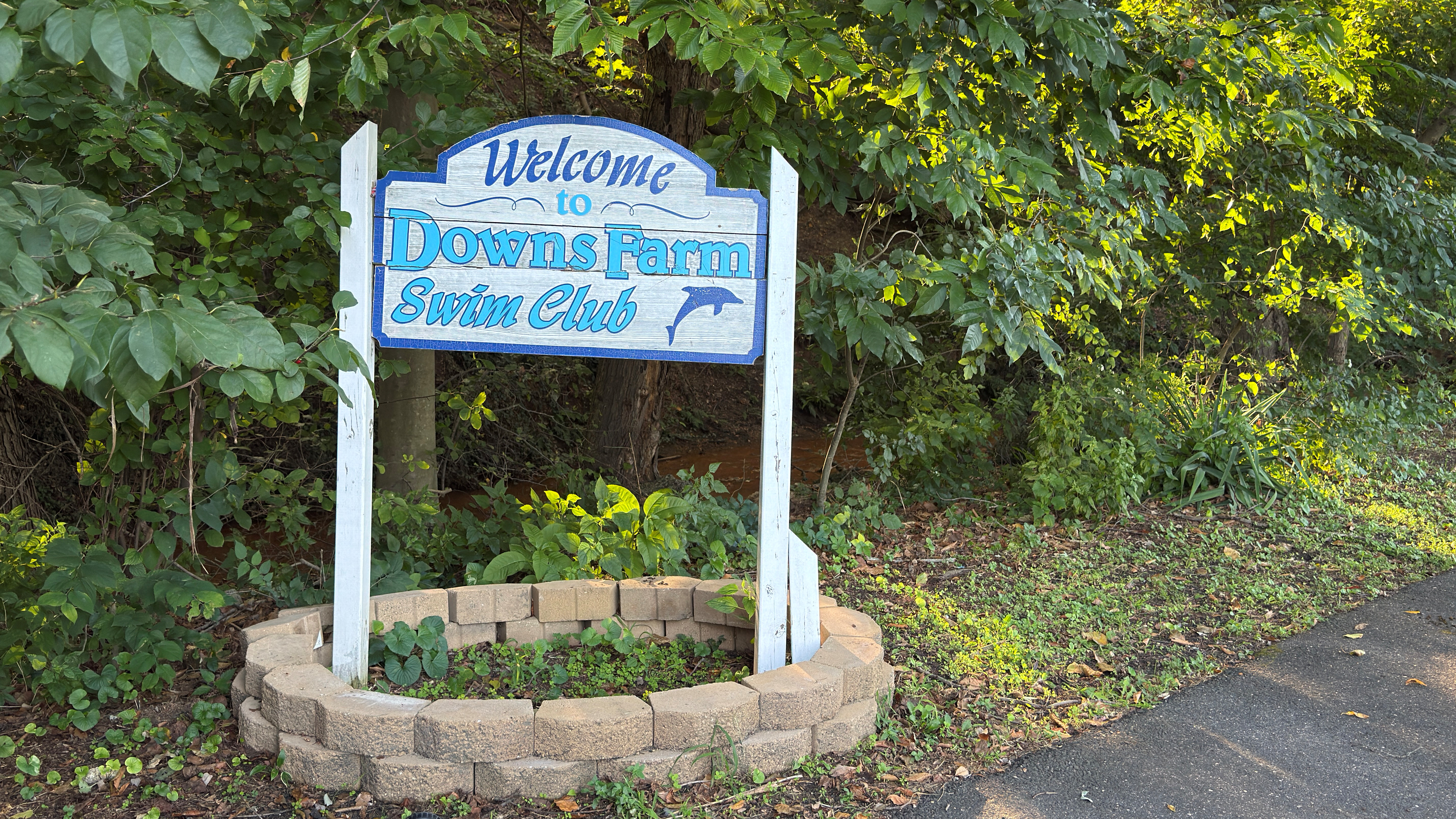
  • Cherry Hill is taking over a pedestrian bridge at Downs Farm Swim Club and preserving the club as open space

    Cherry Hill is taking over a pedestrian bridge at Downs Farm Swim Club and preserving the club as open space

    A Cherry Hill Township deal with the Downs Farm Swim Club to replace and take over maintenance of a closed pedestrian bridge will also preserve the club as open space should it ever close.

    The strategically placed bridge crosses a stream and connects the Downs Farm neighborhood to Haddonfield-Berlin Road over swim club property.

    “The entire neighborhood uses it for pedestrian access,” Mayor David Fleisher said in an interview.

    Fleisher said the club no longer could afford to maintain the bridge, so part of the club’s acreage will be conveyed for no charge to the township, which will make the bridge a municipal property.

    But the twist to the arrangement calls for a deed restriction on the club that will prevent it from ever being developed.

    A dozen private swim clubs are scattered across Cherry Hill. Many were built by housing developers in the township’s heavy growth years of the 1950s and 1960s.

    Swim club cultures grew as whole neighborhoods crowded them on weekends and sent their children there to learn to swim and later compete on swim teams. But some clubs, which require a membership fee, are not as popular as in the past and have faced financial challenges.

    Fleisher said the township was able to learn from experience when the financially failing Kingston Estates Swim Club closed in 2020 after more than 60 years and was taken over by a bank.

    The property was zoned institutional and could have been developed in the middle of the residential neighborhood, Fleisher said. However, Cherry Hill was able to intervene and purchase the property for a park and open space.

    Fleisher said the Downs Farm open-space restriction was modeled with the Kingston experience in mind.

    The swim club is pleased with the arrangement, he said, and a bridge replacement is expected by next summer.

    70and73.com is a hyperlocal news site focused on South Jersey, including the communities of Cherry Hill, Evesham, Mount Laurel, Voorhees, Medford, Medford Lakes, and Moorestown.

  • Holtec delays IPO, citing energy demand uncertainty amid U.S. data center backlash

    Holtec delays IPO, citing energy demand uncertainty amid U.S. data center backlash

    Camden-based Holtec Nuclear says it will postpone its plans to raise more than $750 million in an initial public stock offering (IPO).

    “Market conditions” sparked the delay in what Wall Street had expected to be one of the largest companies to go public this fall, Holtec spokesperson Patrick O’Brien said.

    In particular, founder and CEO Krishna P. Singh has blamed the uncertainty in demand for power by U.S. data centers.

    “Our business, rightly or wrongly, is ​viewed as connected to [data centers],” Singh told the Financial Times of London. “We provide nuclear power. So that was, of course, a big factor in market sentiment against nuclear.”

    Plans for giant data centers to power artificial intelligence applications, credited with reigniting demand for new U.S. nuclear electric plants, have become an issue in the fall U.S. election campaigns. Political leaders including Pennsylvania Gov. Josh Shapiro and his Republican opponent, state Treasurer Stacy Garrity, have diluted and even reversed previous support for data center projects amid a wave of strong local opposition.

    Nuclear power stocks that soared on expected data center demand have slipped. For example, shares of Constellation Energy — the Baltimore company that is speeding work to reopen a nuclear power plant at Three Mile Island near Harrisburg — have fallen from a high of over $400 last fall to the mid-$260s in recent trading.

    The VanEck Uranium and Nuclear ETF, an index-based investment fund whose largest holding is Constellation and also includes uranium suppliers such as Cameco and Denison Mines, peaked at over $160 in January but has lately traded below $110.

    Holtec said it plans to release a formal statement on the IPO delay later Thursday.

    The company employs around 4,150 people, including employees at its Advanced Manufacturing Division and headquarters in Camden, plus manufacturing units in Pittsburgh and Orrville, Ohio.

    Holtec is best known for decommissioning and removing spent uranium fuel from aging nuclear power plants, which were mostly developed in the 1970s and 1980s.

    Holtec is one of several U.S. companies that has developed smaller, modular reactors (SMRs). It says these can replace larger power plants and be swapped out for maintenance without turning off power production. It is working install the first two SMRs at the Palisades nuclear plant site in Michigan, which Holtec decommissioned, purchased, and is now working to restart. Other products Holtec has been developing include the “Green Boiler” liquid battery for storing solar energy.

    The company had enlisted J.P. Morgan, Guggenheim Securities, Goldman Sachs & Co., Citigroup, and Bank of America’s securities arm to lead its IPO share sales effort. Morgan Stanley and Commerce Secretary Howard Lutnick’s Cantor Fitzgerald also participated.

  • Clementon voters reject $13.5 million bond referendum; $76M Cinnaminson proposal too close to call

    Clementon voters reject $13.5 million bond referendum; $76M Cinnaminson proposal too close to call

    Voters in Clementon this week overwhelmingly rejected a $13.5 million school bond question that would have raised property taxes, while a $76 million referendum in Cinnaminson was too close to call.

    If approved, the Clementon bond would have been used to build an early childhood center for preschoolers. The measure, according to officials, would have added about $243 annually to the tax bill for a home assessed at the borough average of $115,178.

    Meanwhile, the outcome of Tuesday’s special election in Cinnaminson — the largest bond referendum in the district’s history — was too close to call, Burlington County election officials said.

    Preliminary results indicate the school bond issue appears to be heading for defeat, officials said. There were 1,632 votes against the proposal and 1,610 in favor, with mail ballots and provisional ballots still being verified and counted, elections officials said. A final count is expected at the end of the month.

    The Cinnaminson proposal, which included two questions, would add about $560 annually on a home assessed at the township average of $236,538, according to officials. The funds would be used for improvement projects, classroom additions, HVAC upgrades, new water fountains, and renovated bathrooms.

    The first question had to pass for voters to consider a second question. However, the second question was defeated, 1,808-1,491.

    Cinnaminson Township Public Schools Superintendent Stephen Cappello has said the district would regroup and figure out next steps if voters rejected the bond questions. Taxpayers are still paying down a 2014 referendum that added about $238 annually to local property taxes.

    “The election numbers and the voter response will ultimately drive whether the Board seeks a future referendum,” Cappello said in a statement.

    Tuesday was one of five times during the year that school boards may ask voters to approve a bond issue or special question. They are typically used to pay for projects districts cannot readily fund through their annual general operating budgets.

    The next special election is Nov. 3.

  • A Lindenwold elementary school has moved to remote learning after a fire damaged the building

    A Lindenwold elementary school has moved to remote learning after a fire damaged the building

    Students at a Lindenwold elementary school will learn remotely through Monday after a fire Tuesday night damaged the building.

    Lindenwold School 4, located at 900 E. Gibbsboro Rd., was closed Wednesday due to a fire on the building’s roof, which the Lindenwold Fire Department found to be accidental. At the time, the school’s evening facilities staff and a construction crew were on site, but no injuries were reported, officials said.

    The school’s telephone and public address systems were disabled after the fire, and officials are still working to make sure the communication systems work and the building is safe and smoke-free, the district said in a statement Wednesday.

    As the district assesses the damage, students will return to learning Thursday online, and remote learning will continue at least until Monday. Students will have to attend school on Oct. 12, previously an in-service day, as a makeup day, and the school’s open house will be rescheduled.

    Parents and guardians can go to School 4’s bus loop on Thursday, either between 10 a.m. and 4 p.m. or from 6 to 7 p.m., to pick up their children’s Chromebooks and other materials.

    Families with School 4 students can also pick up five days’ worth of food on Monday from 10 a.m. to 1 p.m. to make up for the loss of in-person meals.

  • A murder-suicide in Pennsauken involved a brother and sister, police say

    A murder-suicide in Pennsauken involved a brother and sister, police say

    A brother and sister died Wednesday in what investigators are calling a murder-suicide at a Pennsauken home, according to the Camden County Prosecutor’s Office.

    Janet Camacho, 59, was found on the front steps of the home at 4400 Bethel Avenue with a gunshot wound around 9 a.m., after police responded to reports of a shooting. Police were also told, investigators said, that a male suspect armed with a handgun was at the residence.

    Camacho was taken to Cooper University Hospital, where she was pronounced dead.

    About 10:37 a.m., police found Camacho’s brother, Daniel Lopez, 60, dead inside the house with a self-inflicted gunshot wound.

    Both siblings were Pennsauken residents, but investigators did not say whether either lived at the home where the shooting occurred.

    The investigation is ongoing.