Category: Washington Post

  • McConnell faces growing questions about absence nearly six weeks after fall

    McConnell faces growing questions about absence nearly six weeks after fall

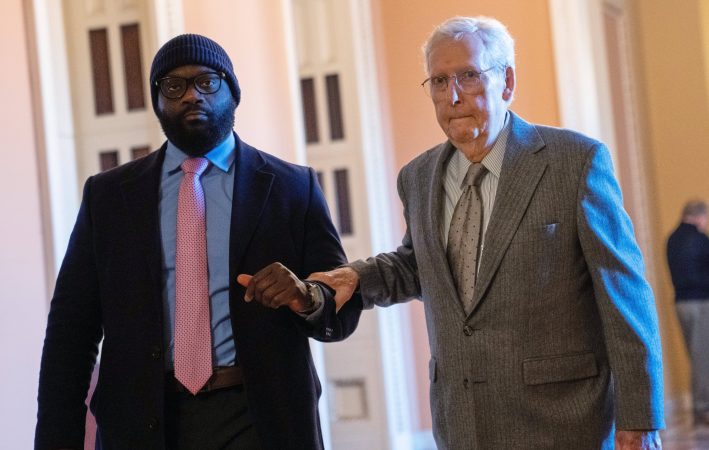
    Sen. Mitch McConnell (R., Ky.) is facing growing calls to be more transparent about his health nearly six weeks after he was hospitalized.

    McConnell, 84, has been absent from the Senate since he said he suffered a fall June 14. His office shared a photo of McConnell holding the Washington Post on July 12, and McConnell said in a statement that he had left the hospital and moved to a rehabilitation center — but he did not say when he planned to return, offering only that he would not “be able to return to the Senate floor to vote quite yet.”

    Those scant details have not quieted rampant rumors and online speculation about McConnell’s condition.

    Kentucky Gov. Andy Beshear (D) said last week that he had heard nothing from McConnell since he was hospitalized, despite sending a letter seeking an update on his condition. He urged McConnell to call into a news station for a few minutes or put out a short video to reassure his constituents.

    “When you’ve been in a hospital for a month and you’ve missed all the votes … you owe your boss, like anybody else out there who works, an explanation of what’s been going on and when you’ll get back,” Beshear said.

    Scott Jennings, a longtime McConnell ally who worked on some of his reelection campaigns, urged McConnell on Thursday to “routinely update his constituents on how he’s doing” and be transparent about the work he’s doing while recovering. He said he expected McConnell to share an update on how he’s doing in the coming days.

    “Truthfully, I think a little transparency on the front end here would have saved him a whole lot of grief,” Jennings told CNN’s The Arena with Kasie Hunt. “But that didn’t happen and they are where they are now.”

    David Popp, a McConnell spokesperson, said McConnell has continued to work during his absence.

    “The Senator continues to meet with staff regarding Senate and Kentucky business, including discussions on defense appropriations, foreign policy, the farm bill, constituent services, and constituent federal grant requests,” Popp said in a statement to the Washington Post. “As the Senator continues to improve in rehab, we will be sure to keep you updated.”

    McConnell said July 12 that he did not break any bones when he fell and did not suffer a heart attack, a stroke, a hemorrhage, or a concussion, but he has said little else about what happened to him.

    Popp referred to McConnell’s earlier statement when asked when McConnell might return to the Senate or whether he planned to attend Tuesday’s funeral for Sen. Lindsey Graham (R., S.C.), his longtime colleague, at Washington National Cathedral.

    McConnell said in his statement that “folks of my generation often hesitate to share the vulnerability that comes with growing older.”

    “Even in the public eye, I feel that same instinct — I can’t help it,” he said.

    McConnell spent 18 years as the Republican leader in the Senate before stepping down early last year. He remained in the chamber to serve the final two years of his term, which ends in January.

    Rep. Andy Barr (Ky.) won the Republican primary to succeed McConnell in May and is heavily favored to win his seat in November. The Senate is scheduled to be in session for only 10 more weeks during McConnell’s term as senators head home to campaign ahead of the midterm elections.

    McConnell’s absence has narrowed Republicans’ edge in the Senate, giving them an effective 52-47 majority as long as he is absent.

    Senate Majority Leader John Thune (R., S.D.) and Sen. John Barrasso (Wyo.), the No. 2 Senate Republican, said earlier this month that they had spoken with McConnell, but some other Republican senators have raised questions about McConnell’s absence.

    Earlier this month, Sen. Ron Johnson (R., Wis.) cast doubt on the legitimacy of the photo that McConnell shared of himself — only to dismiss his comments later, saying he was just repeating a rumor he had heard. (The Post reviewed the photo’s metadata and found it appeared it was taken July.)

    “It’s not fun watching anybody age,” Johnson told reporters. “We’re all hoping Mitch recovers fully and comes back. I haven’t talked to him, so I have no knowledge.”

    Last week, Sen. Josh Hawley (R., Mo.) wished McConnell a speedy recovery but also suggested he should disclose more about his condition.

    “At a certain point you do have an obligation to your constituents and the country to tell them what’s going on,” Hawley told Fox News, saying he felt “totally in the dark” about McConnell’s status.

    McConnell is hardly the first senator to be away for an extended stretch at a time while ailing or in recovery.

    Sen. John Fetterman (D., Pa.) was absent for two months in 2023 while seeking treatment for depression. Sen. Dianne Feinstein (D., Calif.) missed votes for nearly three months that year while battling shingles and faced calls to resign. She returned to the Senate but died months later.

    Sen. John McCain (R., Ariz.) did not vote during his final eight months in office before he died in 2018. And Sen. Mark Kirk (R., Ill.) did not vote for nearly a year after suffering a stroke in 2012. He released videos of himself relearning how to walk before returning to the Senate and served out the rest of his term.

    Lester Munson, Kirk’s chief of staff at the time, said Kirk was able to keep working even though he was not in the Capitol voting.

    Kirk worked with Sen. Bob Menendez (D., N.J.), for instance, on an amendment to a defense policy bill to tough sanctions on Iran. Senators in both parties — includes Sens. Dick Durbin (D., Ill.), Jon Tester (D., Mont.) and Joe Manchin III (D., W.Va.) and McConnell — stepped up to help Kirk’s office carry on, Munson said.

    “I think people kind of just assume — not really correctly — that if the senator’s in the hospital or something like that, that they can’t do their job,” Munson said. “That’s not entirely true. There’s obviously some things they can’t do … but a lot of other things continue to be carried on.”

    Kirk did not have to contend with social media speculation about his health and other online pressures in the same way that McConnell has, Munson said.

    The prediction market Polymarket, for instance, allows users to bet on whether McConnell will vote in the Senate by July 31. (The odds stood at 11% Friday evening.)

    McConnell is also much better-known than Kirk or other senators who have had extended absences from the chamber. His decades of service should earn him some grace while he recovers, Munson said.

    “As far as I’m concerned, this guy has given so much to the Senate over time and therefore so much to America, God bless him,” Munson said. “He’s got all the latitude in the world to deal with this problem.”
  • Democrats pick new Senate candidate in Maine in aftermath of Platner debacle

    Democrats pick new Senate candidate in Maine in aftermath of Platner debacle

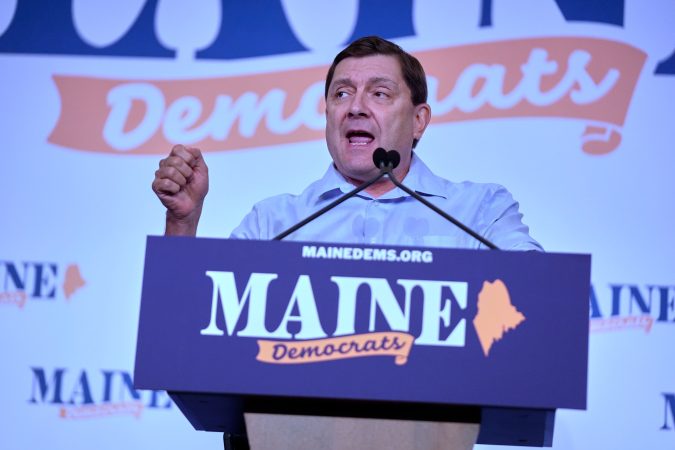
    BANGOR, Maine — The Maine Democratic Party formally selected Troy Jackson as its new Senate nominee on Saturday, ending three tumultuous weeks that nearly derailed the party’s quest to unseat veteran Republican Sen. Susan Collins.

    With just 101 days remaining until the November election, Democrats must now unify a party riven by the spectacular collapse of Graham Platner’s campaign following a sexual assault allegation and refocus attention on the long-indomitable Collins, whose defeat is key to long-shot Democratic hopes of retaking control of the U.S. Senate.

    Accepting the nomination from a convention center in downtown Bangor with a 31-foot-tall statue of Paul Bunyan outside, Jackson repeatedly framed the election not as a partisan fight but an opportunity for the working class to stand up to a creature of Washington who had grown more loyal to her corporate benefactors than her constituents.

    “This movement is not from the left. It’s not from the right,” he said, as supporters waved “Retire Susan” signs in the crowd. “It’s from the bottom — and we are growing.”

    Jackson is a 58-year-old logger and former leader of the Maine Senate who aligned with Platner and Sen. Bernie Sanders (I., Vt.) during an unsuccessful run for governor this year.

    He won the nomination by commandeering the progressive movement that had propelled Platner. Jackson’s supporters swept the delegate selection process for a hastily organized convention to choose Platner’s replacement, compelling most of Jackson’s rivals to drop out ahead of the meeting Saturday in Bangor.

    Jackson’s challenge is to forge a broad coalition that can win in November, including the independent and crossover Democratic voters who have helped Collins hold on for five terms in an increasingly blue state.

    Jackson has his own vulnerabilities — including a long history of opposing abortion rights and a temper that undercut his legislative leadership in Augusta — that could hurt his appeal with women voters who have been critical to Collins’s victories. He has also been reluctant to align with the national Democratic Party, which could provide critical resources in a marquee race.

    Ahead of the convention, Democratic-leaning voters in Bangor remained wary of Jackson but highly motivated to beat Collins.

    “Progressives and Democrats are often put in this position where we have to vote for whoever is put up against the greater evil,” Molly Wunderli, a 36-year-old graphic designer, said Friday as she left the library downtown.

    An unenrolled voter who considers herself to the left of the Democratic Party, Wunderli expressed frustration that Platner was not properly vetted and about the rushed process to choose his replacement, which put the decision in the hands of just 600 people. But given the stakes, she said there was no question she would vote for Jackson in November.

    “I hope he’s as advertised,” Wunderli said. “I’m always worried now about the other shoe dropping.”

    The campaign has been clouded since the beginning by a bitter ideological battle among Democrats. While the national party establishment recruited Maine Gov. Janet Mills to run, the progressive base in Maine rallied around Platner, a combat veteran and oyster farmer whose populist outsider platform electrified liberal voters.

    Mills’ candidacy fizzled before the June primary, even as Platner was beset by an escalating series of scandals that he largely attributed to poor mental health following his military service: old social media posts dismissive of sexual assault, a tattoo resembling a Nazi symbol, sexually explicit text messages he sent to other women after he married, and allegations by ex-girlfriends who described volatile relationships with him. Efforts by national Democrats to push Platner aside only infuriated his supporters, and he won the nomination handily last month.

    Then came an accusation of sexual assault from a woman Platner used to date, which he has denied. Under pressure from allies and threats from national Democrats to withhold financial support, Platner withdrew on July 10, setting off a scramble to find a new Democratic candidate.

    That was demoralizing for progressive Democrats like Percy Williams, a 29-year-old middle school English teacher from Bangor. She was excited not only by Platner’s policies but also a persona that she believed carried a wide appeal in Maine.

    “Some of my family members are Republicans, and they liked him because he talks like them,” Williams said.

    While she had hoped Secretary of State Shenna Bellows, another unsuccessful gubernatorial candidate this year, would replace Platner, Williams said she came around on Jackson because “he’s the best that has a shot at actually winning.”

    The Platner scandals still cast a pall over the race — and Collins will inevitably try to tie Jackson to the man with whom he shared such close political ties.

    A Republican super PAC released its first ad on Saturday, highlighting Jackson’s temper and history of clashing with female colleagues. “Troy Jackson is like Graham Platner, but worse,” the narrator warns.

    Jackson never mentioned Platner during the convention, but he did nod to the concerns about his anger. He was introduced by a former state legislator he once fought with, who praised his passion. Jackson told reporters later that “I do wear my heart on my sleeve,” but he always apologized to “anyone that I may have argued with that I might have went too far.”

    But even Democratic voters unenthusiastic about Jackson are furious at Collins. A common criticism is that Collins, who presents herself as a moderate who will stand up to President Donald Trump, only breaks with him on votes that she knows Republicans will win anyway.

    “She’s had multiple opportunities to be a Margaret Chase Smith and stand up for what’s right,” said Frank Bragg, an 85-year-old retired physician, referencing the former Maine senator who delivered a famous floor speech in 1950 denouncing McCarthyism. “And she’s just gone along with Trump.”

    Bragg pointed to Collins’ support of the Save America Act, a Trump priority that would require photo identification to vote and roll back most mail voting, despite Maine overwhelmingly rejecting a similar ballot measure in November.

    A Republican-turned-Democrat who once supported Collins in her early elections, Bragg said he appreciated what the senator had done for Maine, “but it’s also about standing up for the country.” He will vote for Jackson in November, though Bragg considers him “sort of another machine politician. It’s a bit of the same old, same old.”

    With his nomination essentially sewn up before the convention, Jackson has already begun consolidating Democratic support in Maine and shifting his message to attacking Collins.

    He secured endorsements from most of his opponents for the Senate nomination ahead of Saturday, as well as from Hannah Pingree, who defeated Jackson in the gubernatorial primary in June. Social media accounts for his campaign are pumping out posts slamming Collins for her closeness to the Trump administration and for confirming to the Supreme Court Brett M. Kavanaugh, who provided a decisive vote to overturn the constitutional right to abortion.

    But an ongoing rift with national Democrats could complicate the campaign. Despite his extensive history in elected office, Jackson is, like Platner, running as a disrupter — emphasizing his roots in conservative northern Maine while favoring progressive policies to rein in corporate power, expand healthcare access, and dismantle U.S. Immigration and Customs Enforcement, the controversial federal agency involved in a fatal shooting in Biddeford this month.

    Jackson told the New York Times this week that, if elected, he would not support Sen. Chuck Schumer (N.Y.) continuing as Democratic leader of the Senate. He also expressed doubt about accepting help from Schumer, who has thus far declined to endorse Jackson, in the general election.

    That could be an enormous handicap for Jackson, who is not a prolific fundraiser. Conservative groups have already lined up tens of millions of dollars to defend Collins.

    Elizabeth Hannigan, a 33-year-old data analyst from the Bangor area, recalled seeing a Collins ad nearly every commercial break during the World Cup, touting all of the money she’s brought home to Maine. Hannigan said she worries whether Jackson will have enough time to mount a victorious campaign.

    She wants Jackson to “get the national party behind him, not just the Sanders wing.” Hannigan, who considers herself to the center of the Democratic Party, said it would provide a signal of trust; she does not want to elect another Sen. John Fetterman (D., Pa.), a onetime progressive champion who has increasingly broken with his party since he arrived in Washington in 2023.

    “I want someone who will vote with the general Democratic agenda,” Hannigan said.

  • Trump’s insult-laden speech to press dinner draws mostly stunned silence

    Trump’s insult-laden speech to press dinner draws mostly stunned silence

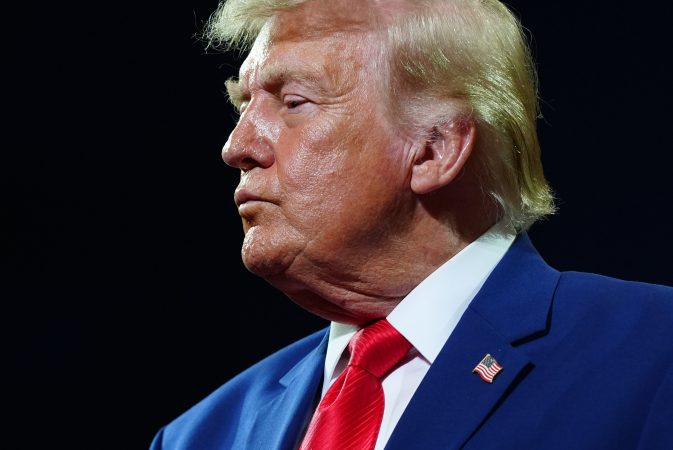
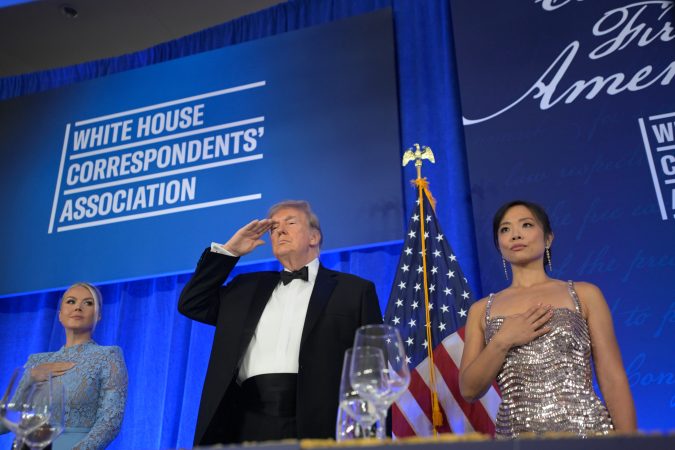
    President Donald Trump attacked a slew of journalists and some of his favorite political foils at a slimmed-down redo of the White House correspondents’ dinner on Friday, comparing one female reporter to a transgender social media star, mocking politicians’ physical appearances, and bringing his audience to mostly stunned silence for more than an hour before pulling out a red Trump 2028 cap and declaring he was running for another term.

    Three months after a gunman exchanged fire with authorities outside the first correspondents’ dinner, throwing the event into chaos, Trump addressed reporters even as he embraced an aggressive stance that favors targeting journalists to root out leakers in his administration.

    Trump veered on and off his prepared script for the evening, at one point calling it a “fricking stupid speech.”

    The fraught event put the president on the dais with reporters who have covered him aggressively. Trump rarely speaks to audiences that aren’t packed with his supporters, leading to an unusual dynamic in a ballroom of reporters who are professionally bound to maintain poker faces.

    Some of his first jokes drew laughs, including one that acknowledged the interrupted first run of the meal.

    “I hope that everyone finally got to enjoy their entire, very delicious beef tenderloin, very special beef. And I want you all to know that Bobby Kennedy, who’s right here, personally ran over the cow with his car,” he said.

    But the tone quickly shifted to a far more caustic attack on his favorite foils, including some of the reporters in the room. The bitterness was sharper even than some of his political rallies, where attacks on his enemies are leavened with boasts of his accomplishments. On Friday, he had little to sell, and a lot to complain about.

    He said that he had once mixed up CNN reporter Kaitlan Collins, whom he said “never smiles,” with a transgender social media personality, Dylan Mulvaney, after he called the 34-year-old cable news star a “young, attractive woman.”

    He said he planned to host twice-weekly fights at the White House.

    “We will have sloppy Chris Christie, one of the sloppiest human beings, fighting,” Trump said to silence. “I could mention the governor of Chicago, but I’m going to mention instead Jerry Nadler. Oh my God! They’re fighting for a big piece of cheesecake, big fat piece of cheesecake.”

    Then he told a joke about Sen. Adam Schiff (D., Calif.).

    “I hate some people,” he said to groans. “He’s a liar, and I called him watermelon head because he has the largest head I’ve ever seen with the smallest neck, pencil neck. How does that make a fat, ugly head on a little pencil neck?”

    Commerce Secretary Howard Lutnick laughed at that one, putting his hand on his forehead.

    “This night is all about the First Amendment. Tonight was a full display,” CBS chief White House correspondent Weijia Jiang said after Trump finished talking. As the outgoing president of the White House Correspondents’ Association, Jiang led the event. She complimented Collins and a Wall Street Journal reporter whom Trump also attacked during his speech.

    The speech took place as the administration has stepped up its legal pursuit of journalists who report on subjects that the White House views as national security threats, with Trump saying Friday that he believed journalists were legitimate targets for investigation.

    A federal judge offered a withering takedown a day earlier of the Justice Department’s effort to subpoena New York Times journalists over their reporting about security concerns around a new, Qatari-gifted Boeing 747 the president has been using as Air Force One. Trump was unrepentant.

    “We’re not after journalists. We’re after leakers. We’re after people that are cowards, people that are unpatriotic, people that are treasonous in many cases,” Trump said in the Oval Office a few hours before the correspondents dinner. “And the way you find them is through the journalists. When the journalists probably know they shouldn’t write, they shouldn’t be giving information out like that.”

    He said that even though the Justice Department withdrew the subpoenas on Thursday, “we have a long way to go with that case,” suggesting that the New York Times reporters’ legal peril was not over.

    Trump had offered mixed messages about his plans for a dinner that traditionally has involved presidents giving lighthearted speeches that poke fun at themselves and at the people who cover them.

    In the event, he offered a mix of barbs directed at the press and his political opponents, with a few toward his own administration.

    “We’ll do a little ripping, if you don’t mind,” he said, saying that “this place is the really largest group of Trump derangement syndrome people ever put together at one time.”

    He said that the speech he had originally planned to deliver, “I’m telling you, I had something. I was going to go after you.”

    Media critics have long questioned the White House correspondents’ dinner, which was first held in 1921, saying that it is an overly cozy moment of socializing between the president and reporters who cover the White House. Trump skipped the event during his first term.

    Trump acknowledged that Friday’s speech was his first to the annual dinner. And he joked that he didn’t plan to do it again, unless the event was renamed the “Trump White House Correspondents’ Dinner” — a line he delivered with a chuckle, before later saying that he planned to come next year.

    Trump came to the dinner once before, as the guest of the Washington Post during the Obama administration. President Barack Obama mocked Trump that year over his questioning of Obama’s citizenship. Many analysts have credited that moment with sparking Trump’s decision to run for president, but Trump said Friday that wasn’t true, and that he had enjoyed the moment because of all the attention.

    Before the president took the stage, he was confronted with reporters whom he has attacked and who have won awards for aggressive coverage of his administration.

    He greeted one of the lead Associated Press reporters who was kicked out of the White House press pool because the outlet refused to relabel the Gulf of Mexico to Trump’s preferred “Gulf of America.”

    He shook the hands of a team of Wall Street Journal reporters who won an award for their coverage of his connections to convicted sex offender Jeffrey Epstein. He shrugged his shoulders and smiled as CNN anchor Wolf Blitzer recounted how he had sued the Journal for $20 billion and how one reporter was forced to relocate her family because of threats against them.

    Then he greeted Tyler Pager, a New York Times reporter who was served with a subpoena this month for his coverage of security issues around Air Force One.

    The Society of Professional Journalists called this week for the White House Correspondents’ Association to use the dinner to condemn the Trump administration’s attacks on journalists.

    “We believe it is hypocritical to celebrate the First Amendment in front of the man who relentlessly attacks it,” the group said in an open letter.

    Trump never delivered the speech he planned for the April 25 dinner at the Washington Hilton before it was interrupted by a gunman who attempted to storm the basement ballroom where the dinner was being held. Cole Tomas Allen, 31, has been charged with attempting to assassinate the president, and an FBI special agent said in an affidavit that Allen had set an email to be sent to friends and family with “targets, prioritized from highest-ranking to lowest.”

    Trump acknowledged the risks around the event, saying, “It was not easy finding shoes to go on with your bulletproof vest, which many people didn’t want to wear, because they’d rather die than look 20 pounds heavier. … They put one on me. I said: ‘Are you sure? I’m not wearing this.’”

    Security was high at the event, which was held at the Waldorf Astoria in downtown Washington. Trump’s family company operated that venue as the Trump International Hotel during the president’s first term, then sold their lease on the property in 2022 for $375 million.

    The guest list had shrunk to fewer than 700, a stripped-down affair with attendees including mostly just the journalists who cover the president, rather than the more than 2,500 — including government officials, political operatives, and mostly B-list celebrities — who attended in April.

    But many of the original tensions remained.

    In the hours following the April shooting, Trump was unusually conciliatory toward reporters, making an appearance in the White House briefing room still dressed in his tuxedo as he took questions from many of the reporters who had been at the dinner earlier in the evening.

    But that tone dissipated by the next day, when he called CBS News anchor Norah O’Donnell “a disgrace” after she read excerpts from the alleged gunman’s manifesto to him.

    Since then, his administration has returned to attacks on the press.

    Trump last week called for stripping broadcast licenses from networks that didn’t air his primetime speech about election integrity. And the Justice Department this month issued the subpoenas to New York Times journalists who had reported on security concerns surrounding the luxury Boeing 747 that the Qatari government gifted for use as Air Force One, seeking their phone records in pursuit of leaks.

    One element of the dinner was consistent with April: Entertainer and magician Oz Pearlman was once again on the program, a selection that sidesteps the politics of humor. This time he guessed correctly that acting attorney general Todd Blanche had $85 in his pocket.

  • Trump orders warning signs near Smithsonian, escalating fight over history

    Trump orders warning signs near Smithsonian, escalating fight over history

    President Donald Trump on Friday ordered the installation of signs outside the Smithsonian’s National Museum of American History that warn people that the museum does not accurately reflect American history while pointing them to material that does — a dramatic escalation in his campaign to wrest control of how the nation’s story is told.

    The executive order, signed at the end of a week of contentious congressional hearings on the museum, directs Interior Secretary Doug Burgum to erect temporary signage along the National Park Service-controlled sidewalks and walkways the public uses to reach the museum. The signs would inform visitors of the White House’s criticisms, tell them the museum’s exhibits “should be renovated,” and direct them elsewhere “to locations and resources for accurate information regarding America’s history.”

    The move marks a new front in a 16-month pressure campaign against the Smithsonian Institution that has included museum content reviews, funding threats, and a successful effort to push out a museum director. Now the White House is moving to plant a competing government narrative on the ground outside one of the country’s most visited museums — an approach historians say has no precedent.

    Trump grounded the order in the White House Domestic Policy Council’s July 4 report, “Saving America’s Story,” which he said “demonstrates that the Smithsonian leadership does not present American history as a shared national inheritance to be taught and celebrated, but instead views American history as a ‘prime tool’ to advance ideas of social justice and the radical transformation of our society.”

    A companion White House statement went further, accusing the Smithsonian and its history museum of veering “toward extreme political activism, rooted in Marxism, to divide, dispirit, and discourage Americans.” It said that “in the last decade, Americans have witnessed a concerted effort to rewrite American history and force our Nation to adopt a factually baseless ideology aimed at discrediting American heroes and diminishing American achievement.”

    Trump also accused the museum of failing to appropriately honor the 56 signers of the Declaration of Independence during the country’s 250th anniversary year, and directed Burgum to install temporary exhibits or signage on Park Service land that “corrects inaccurate information presented in the Museum.”

    The Smithsonian declined to comment. Its leaders have said the White House’s report mischaracterizes the museum, and that they are committed to accuracy and nonpartisan scholarship.

    The order drew swift condemnation from Democrats who oversee the institution. Rep. Melanie Stansbury (D., N.M.), ranking member of the House Administration Committee, called it “one of the dumbest and most bizarre Executive Orders we have ever read.”

    “This EO is a clear political overreach, driven by an ideological agenda to rewrite American history,” Stansbury wrote on X. “Our Smithsonian institutions do not belong to the President, but to the American people and so does our nation’s history.”

    Sarah Weicksel, executive director of the American Historical Association, said the plan to station government material outside the museum was “an absolute affront to the professionals who work in that building” and likened the signage to issuing a trigger warning to visitors before they encounter exhibits such as the Star-Spangled Banner.

    “There’s no precedent for this,” Weicksel said. She noted that the Smithsonian has weathered exhibit controversies before — most famously over its presentation of the Enola Gay and the bombing of Japan — but said the executive branch had never before sought “to present a completely alternative narrative” to the one told inside the national museum.

    The report and order rested on “a very narrow and very circumscribed definition of patriotism,” Weicksel added, one at odds with the founding generation the administration invokes. The nation’s founders, she said, understood that “one’s love of nation is tied to recognizing where it has gone wrong, where it can do better.”

    Her deepest worry, she said, was that the campaign would erode public trust in an institution that teachers and researchers have relied on for more than 150 years.

    “The White House is essentially telling the American public not to trust the Smithsonian Institution,” she said.

    Conservatives who have long pressed for change at the Smithsonian welcomed the order, though some hoped it would go further. Mike Gonzalez, a senior fellow at the Heritage Foundation who testified at both congressional hearings this week, said the provisions he valued most were those naming administration officials, including Domestic Policy Council chief Vince Haley, and directing them to use “any and all available authorities” to force corrections.

    “If they can use this EO to clean house and get rid of the leadership, then that would be great,” Gonzalez said, adding that he thought installing the signs “is a clever thing.”

    When asked if he had consulted with the White House on the report or the executive order, Gonzalez said any such conversations would be “private.”

    The order is the latest chapter in a fight that has escalated steadily since Trump’s March 2025 executive order demanding “improper ideology” be removed from the Smithsonian. Since then, the White House has launched reviews of the content of several Smithsonian museums, criticized specific exhibits and wall texts, and threatened to withhold funds already approved to the institution if it fell short.

    As a public-private institution, the sprawling museum and research complex is historically independent, with a federal budget appropriated by Congress. But those funds are disbursed by the White House’s budget office, and the administration has said all spending must align with the president’s orders.

    The White House report’s footnotes signal the pressure will continue, promising a “future update” on the Smithsonian’s approach to diversity, equity, and inclusion.

  • ICE officer linked to Maine shooting was deemed not credible in court last year

    ICE officer linked to Maine shooting was deemed not credible in court last year

    The U.S. immigration officer allegedly involved in the fatal shooting of an immigrant in Maine told a judge in October that he was struggling to earn money because he had health issues and his driver’s license had been revoked.

    Maine District Court Judge Amy Dieterich declared a month later that David Brouillette’s claims were not credible, denying his request to terminate his child support payments to a former wife. Instead, she concluded, Brouillette was “voluntarily underemployed.”

    State records show that Brouillette’s license was not revoked at the time of his court testimony, an official who represents Maine’s Bureau of Motor Vehicles told the Washington Post. Brouillette separately indicated in a divorce settlement that he was employed by a local police department in 2019, but that agency said it has no record of him working there.

    Brouillette’s credibility could come under scrutiny as authorities investigate the July 13 shooting death of Johan Sebastián Durán Guerrero during an immigration enforcement action in Biddeford, Maine.

    The Department of Homeland Security has not identified Brouillette as the officer who shot Durán. But his former wife Ashley Brouillette and others have said Brouillette told them he was responsible for the shooting and fired his weapon in self-defense. Multiple people have identified Brouillette from footage capturing the immediate aftermath of the shooting.

    Ashley Brouillette has said her ex-husband told her that ICE hired him in November, around the time of the judge’s ruling and as the federal agency was rushing to put thousands of new officers on the streets. He said he would start in a couple of months, she said. Former Department of Homeland Security officials have publicly questioned whether those new hires were properly vetted.

    One former official told the Post that any record of a judge questioning David Brouillette’s credibility would add to questions about his fitness to serve and could cast a negative light on whatever he tells his superiors about the encounter with Durán.

    “Obviously if a judge had found that he had made false statements to the court, that would have a significant detrimental impact on his testimony as to what happened in the shooting,” said John Roth, who served as DHS inspector general from 2014 to 2017 and was a longtime federal prosecutor. “I think it’s a big deal.”

    Brouillette did not respond to calls or emails for this story. Blair Jones, his attorney at the child support court hearings in October, also did not respond to calls or messages.

    DHS did not respond to questions from the Post about Brouillette’s past statements, when he was hired by ICE, and how he was vetted. An agency spokesperson said ICE officers are targeting criminals and are under constant threat.

    “Publicizing their identities puts their lives and the lives of their families at serious risk,” the agency said in a statement.

    Durán, a 25-year-old asylum seeker from Colombia who had a work permit issued by the Trump administration, was shot shortly after leaving for work. An ICE spokesperson said officers were surveilling an address associated with an individual who has a final order of removal when they saw Durán leave and attempted to stop his vehicle.

    The agency said that the officer fired, “fearing for public safety,” after the driver tried to flee.

    A spokesperson for Sen. Angus King (I., Maine) has said that DHS initially told him that Durán was the target of an enforcement operation but later reversed and said he was not. Immigration court records show Durán did not have a final removal order and was scheduled for an initial hearing in May.

    Jonathan Ramirez, a friend of Duran’s who answered the door at his apartment the day after the shooting, said that he owns the white Kia that Durán was driving. Ramirez, who is also Colombian, said he does not have a final order of removal and did not think he was the person ICE was seeking. Ramirez said he has a Social Security number and a valid work permit and had paid his taxes.

    “The car is in my name,” he said. “I’m someone who follows the rules of this country.”

    State investigators have interviewed Durán’s partner, Karolina, who arrived at the scene with their 3-year-old daughter shortly after hearing gunfire, said Ben Gideon, who is representing the Durán family as they weigh legal action against the government.

    Gideon said he has not heard from the FBI or the DHS Office of Inspector General, which typically investigate officer-involved shootings. The FBI declined to comment; the OIG said in a statement that its policy is not to confirm or respond to questions on investigations.

    State court records show that Brouillette has been embroiled in contentious divorce and child support proceedings over the past two decades and that he and his two former wives have accused one another of abusive and neglectful behavior in civil court.

    The court hearing in October was part of an effort by Brouillette to modify his child support and custody arrangement for his daughter with his second wife, Lucinda Brouillette. After two days of testimony in October, the judge denied David Brouillette’s request.

    In a Nov. 17 written order, Dieterich said Brouillette had testified that he recently embarked on a new career as a real estate agent but his earning capacity was impacted because “his driver’s license had recently been revoked due to his failure to pay child support.” She said she found his claim to be not credible but did not say why.

    Maine’s Bureau of Motor Vehicles told the Post this week that the state has no record of any recent license revocation. Brouillette’s license was suspended in 2008 for a few weeks after he failed to provide proof of insurance following an accident, the agency said.

    “We have no record of any suspension or revocation for failure to pay child support,” said Jana Spaulding, spokesperson for the Secretary of State’s office, which oversees the bureau.

    In 2019, Brouillette signed a divorce settlement that said he had a job at the police department in Hallowell, a city of 2,500 on Maine’s Kennebec River. Hallowell Police Chief Zachary Kindelan said Brouillette has never worked at the police department.

    “I do know that he had applied a couple times, but as far as I know he was never hired,” Kindelan said. “He’s a name I had never even heard before. Maine is obviously a smaller state but … I’ve never even heard of this guy until the news recently.”

    Brouillette graduated from a Maine high school in 2007, served in the Maine National Guard until 2010, and then became an active-duty soldier in the Army, according to resumés and job applications he filed with the state for various law enforcement positions. The documents were obtained in response to a public records request.

    In an application he filed in 2015, he wrote that he had deployed to Afghanistan and served as a military interrogator. He said embedded with infantry patrols to recruit informants and interrogated Taliban insurgents in jail and “on the battlefield.” The Army sent him to Hawaii in 2014 to manage intelligence analysts, and he retired for unspecified medical reasons the following year.

    State records show Brouillette was employed as an officer in several different agencies, often for short periods of time. Those positions included roles at the Maine Department of Corrections, the state Department of Health and Human Services, and the U.S. Department of Veterans Affairs.

    The Durán family’s attorney said Brouillette’s candor and character will be paramount to the investigations into the recent shooting.

    No body-camera footage appears to have captured the moment that the shots were fired. And no bystander or surveillance video has emerged thus far showing when Durán was shot. That will make witness testimony — including Brouillette’s own account — key in determining what happened.

    “It’s critically important,” Gideon said. “If there’s no direct video evidence produced of the very moment of the shooting, there’s going to be questions about the credibility of the accounts given.”

  • Knives are out for Vance in the GOP. His allies say it’s a coordinated ‘op.’

    Knives are out for Vance in the GOP. His allies say it’s a coordinated ‘op.’

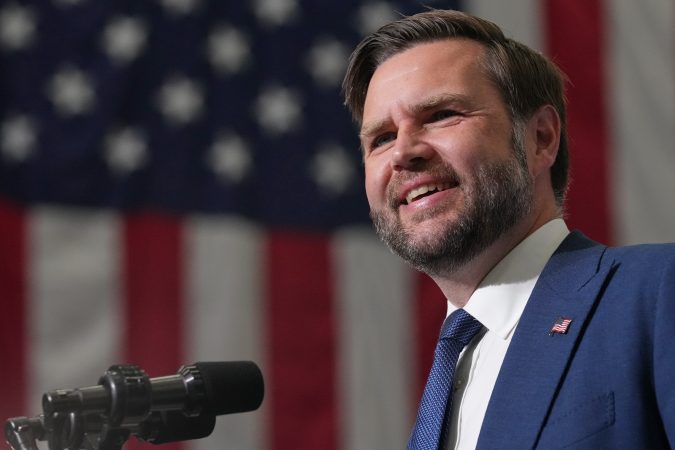
    As JD Vance prepares to make a decision about his 2028 plans, the vice president is facing a barrage of online attacks from within his party, criticism his allies say appears to be part of a coordinated attempt to poison the well for him politically.

    His detractors have adopted the “Never Vance” slogan and flooded social media, especially over the past week, with attacks including claims that Vance is “unfit” to be vice president due to his efforts to negotiate a peace deal with Iran. They have asserted, without evidence, that Vance is making policy decisions not supported by President Donald Trump. They have likened him to former President Barack Obama and Sen. Bernie Sanders (I., Vt.).

    The sustained public hostility from Vance’s own side of the aisle is unlike that faced by other vice presidents in decades, both in intensity and in the early timing — two years before the party will choose its next presidential nominee. The unusual nature is a product of the central role that social media plays in today’s political discourse, as well as the high stakes as Republicans prepare to select a new standard-bearer after Trump, Vance allies and critics say.

    Vance’s political team remains dismissive of the social media onslaught and its impact on Republican voters, believing that many of the attacks are not organic, a close ally of the vice president told the Washington Post — a sentiment echoed by two other people with knowledge of Vance’s strategy. The ally and other advisers spoke on the condition of anonymity to discuss internal deliberations.

    Vance’s allies are keenly aware of and monitoring the online attacks, but his team says the criticism sends a signal to the conservative base that establishment Republicans and opponents they label as neoconservatives hate Vance. That, they say, could ultimately strengthen his standing in a GOP primary.

    “Loud Washington establishment voices form an online cacophony,” said Steve Cortes, a conservative commentator supportive of Vance, “but they do not remotely represent the consensus views of Republican voters.”

    Vance, whose brand of politics is populist and skeptical of foreign wars, has remained the front-runner in 2028 Republican primary polling. Secretary of State Marco Rubio, the favorite of many more traditional, business-minded Republicans, has gained ground in recent months, however, although Rubio has insisted he will support Vance if he runs.

    The knives have long been out for Vance within the GOP, since before Trump selected him as his running mate. At the time, hawkish donors and conservative media personalities lobbied for Trump to reject Vance in favor of Rubio or Doug Burgum, now secretary of the interior.

    Polling of Republican voters shows Vance’s favorability within the party as roughly on par with Trump’s.

    Intense criticism from some Republicans, largely over Vance’s foreign policy views, has ebbed and flowed since the start of the second Trump term. The criticism reached a first peak in the fall as neoconservatives and pro-Israel activists portrayed Vance as antisemitic for sympathizing with figures who expressed skepticism over the U.S. relationship with Israel. More recently, attacks ticked up again after Vance sat for a nearly three-hour interview July 15 on Joe Rogan’s widely watched podcast.

    During the show, Vance described himself as a “reasonable moderate” in the debate over the U.S.-Israel relationship. He also cited a recent Time report about an online pro-Israel influence operation run by a former Trump campaign official, through which Vance said he was being attacked “in dishonest ways” by paid influencers.

    “You know, my response to that is, ‘Well, go to hell,’” Vance told Rogan. “I’m going to do what I have to do for the American people. I represent Americans first, and that’s the way that I’ve tried to do this job.”

    Pro-Israel conservatives erupted. A Washington Post analysis of conservative influencers’ posts on X found that criticism of Vance spiked immediately after his appearance on Rogan’s podcast.

    Critical posts poured in from prominent commentators including Ben Shapiro, Marc Thiessen, and Batya Ungar-Sargon, as well as online right-wing influencers and little-known X users whose anti-Vance posts quickly gained traction. Some of the users who pledged to oppose Vance and support Rubio in 2028 had profiles that strongly suggested they aren’t American voters and are based in other countries.

    It was “obvious to anyone with an IQ above 70″ that the barrage of attacks has been “totally inauthentic and probably coordinated to a certain extent,” the close Vance ally said.

    The upsurge in online criticism “hasn’t been reflected in any data correlating with Vance’s image among GOP voters, which currently tracks President Trump’s image to a T,” the person said. “If it were organic, authentic, or effective,” Vance’s favorability rating with Republican voters would have cratered over the past nine months, since the intense online criticism first peaked, the person said. “And that just hasn’t happened.”

    A spokesperson for the vice president said Vance’s only focus is “fighting for the president’s agenda and delivering wins for the American people,” and that he is not concerned with social media.

    Vance allies have pushed back publicly against some of the attacks, at times calling attention to common language used among those posting insults.

    Jon Schweppe, a Vance supporter and senior adviser at the American Principles Project, who worked for Trump’s Federal Trade Commission until earlier this year, posted a chart on X last week that showed the vice president’s favorability among Republicans had remained steady despite an “anti-Vance op.” His post quickly received dozens of replies from accounts that didn’t follow him — all attacking Vance. Schweppe described the response as curious, since his post had not been shared by any high-follower accounts.

    “Primary season — I guess it’s beginning before the midterms this year,” Schweppe said, adding that Vance’s detractors are “trying to create a divide and separate him from the president.”

    “There’s going to be folks within the party structure, within the influencer structure, who are going to try to knock him down a few pegs in hope that a challenger can emerge to beat him, and that’s just what we’re seeing,” Schweppe said. “But it’s absolutely organized.”

    The intense focus on the vice president is unusual. Trump’s first vice president, Mike Pence, didn’t face intense backlash from Republicans until the final weeks of his term, as the president and his supporters blamed Pence for failing to act to overturn the 2020 election results. Before that, Pence had been widely liked by Republicans, with few prominent conservatives raising their heads to harshly criticize him.

    For a significant stretch of her vice presidency, Kamala Harris faced a version of the succession anxiety now surrounding Vance. Democratic donors, strategists, and commentators questioned whether her low favorability ratings, uneven political performance and widely reported management problems left her prepared to become president — an especially consequential concern given President Joe Biden’s age.

    But there are significant differences: Vance is confronting a public, ideological revolt from prominent figures within the conservative coalition. The criticism of Harris, by contrast, generally was framed around competence and electability with jabs at what critics considered misstatements and gaffes. Few major Democratic figures publicly demanded that Biden remove her.

    Marc Short, who served as chief of staff to Pence in the White House, acknowledged that the attacks against Vance are far more intense than what Pence endured for nearly four years in office — at least until Trump turned against him at the end of his term.

    Pence, however, was adamant throughout that term not to show any distance between himself and Trump, even to staff or other cabinet officials, Short said. Vance has at times signaled a different perspective regarding the war with Iran, he noted.

    Trump has confirmed that Vance is “philosophically a little bit different” than him on Iran, and “maybe less enthusiastic about going” to war, although Vance has publicly expressed support for Trump’s decisions.

    “I think that there’s been a difference in the way that the current team has made clear their policy differences,” Short said. “So I think that does create more scrutiny when you do that.”

  • This mini pig has a big job

    This mini pig has a big job

    In the Beaux-Arts grandeur of Union Station’s main hall, beneath the gold-leafed ceiling, towering columns, and 46 Roman centurion statues, there is a pig.

    She is very small (5.2 pounds) and very young (7 months).

    Her name is Synergy.

    Her footsteps click-clack as she toddles on the marble floor, and she can’t walk more than a few yards before someone stops her to take a photo. Today, she’s on the job.

    About 100,000 people pass through Union Station in Washington, D.C., daily — tourists hoisting duffel bags, or locals bustling to their offices. Train stations also tend to attract a disproportionate share of unhoused people, who come for amenities that are hard to access when you’re without a physical home: air-conditioning, heat, Wi-Fi, bathrooms, restaurants, and, occasionally, generous strangers.

    Union Station is also the headquarters of the h3 Project, a crisis intervention and anti-human-trafficking group, founded in 2020. Ami M. Angell started the project, which stands for home, health, and happiness.

    Synergy is her pig. Angell is her real last name.

    “It is a little pig! I’ve always wanted one!” shouts Logan McGraw, Angell’s client, from across the plaza.

    He makes toward Angell with his wife, Evone. As they scratch behind her ears, Synergy rubs her back against the foot pedal of Evone’s wheelchair.

    “Can I take her home with me?” she asks.

    In the last year, Angell has matched 93 individuals with housing, administered 217 doses of the overdose reversal drug Narcan, and ordered 537 documents, including legal identification. But the year also brought challenges, including decreased funding, directives from a Trump task force to sweep homeless encampments. and the long-standing notion that homelessness outreach organizations attract more unhoused people.

    Angell has long partnered with Amtrak police, who know to call her team if they witness someone experiencing a crisis. She says the influx of federal law enforcement officers at Union Station, most of whom are unfamiliar with her work, has led to heightened interactions between armed guards and her clients, often at their worst moments.

    But Angell’s clients have also adapted. Several have told her that instead of posting up somewhere semi-permanently, they break down their tent every morning and wait to pitch it until late at night.

    “Our folks are so resilient,” she says.

    Difficult moments require creative solutions. Synergy, for example.

    ‘Moving forward because of Synergy’

    Angell isn’t a smoker, but she always keeps a pack in her bag. She can’t count how many times she’s offered a cigarette to someone in a crisis, often mental-health- or substance-induced. It buys her the time and calming distraction she needs to de-escalate and provide case management.

    “We have to think outside the box, because every individual is unique,” she says. “What works for one individual may not work for another person. It’s figuring out the way in, and if you can get that door open a little, then you can get it open a lot larger.”

    So when a friend of a friend told her about Juliana pigs — a hypoallergenic, friendly breed colloquially known as mini pigs — she started thinking about her clients.

    “A lot of the folks that we work with, they’ve never seen a pig, let alone touched one,” she says. “With pigs, it doesn’t matter your age, your race, your gender; they love you equally.”

    She found a breeder in Michigan and waited for a litter to be born in late December. Synergy moved into her home in March.

    Every day that Angell goes to work, Synergy tags along. In the h3 Project office donated by Union Station, she’s hidden now under a mountain of blankets. The vast space is crowded with shelves and bins of donations — tees and sneakers organized by size, toothbrushes and deodorant stashed in boxes. And in the center is Synergy’s pen, with a litter box and a bowl of apple juice.

    “Synergy!” Angell calls.

    Up pops a little pink head with blue-gray eyes and a perpetual smile. Her flat nose is damp, and her skin is wrinkled and covered in wiry hair, a miniature Benjamin Button.

    “Want a treat?” Angell asks.

    Synergy presses her snout to a green button atop the carpet, which chimes out “Yes yes yes yes yes.”

    “Do you want it right now?”

    “Yes, baby!” says Synergy via a button. Angell obliges with a treat.

    At her young age, Synergy already knows how to pass a tunnel-and-ring agility course and play a toy piano. She’s learning how to skateboard. Like many toddlers, she is still learning how to like vegetables.

    Angell says she’s already helping people.

    One woman in her late 60s, whom Angell has known for seven years, has continually refused case management. “She’s not rude or anything,” Angell says. “She just wasn’t ready.”

    When she saw Synergy, her face erupted into a smile, and she shook her head. It was the icebreaker Angell needed.

    “Now she wants to work with me,” she says. “As long as the pig is right there, she will answer my questions, she will do the work with me. She’s moving forward because of Synergy.”

    ‘That’s my pig!’

    The pig is, notably, not called Babe or Wilbur. Angell instead chose a name that spoke to what she hoped her pig would be. We are where we are, Angell says, because of our positive and negative experiences.

    “There is a synergy to it all,” she says. “I just wanted her to ground folks and remind them that there’s always more to life and more to be than what is right now. For my homeless, they aren’t defined by who they are now. This is just one piece of their life. They deserve to be somewhere better.”

    And it seems like Synergy knows it, too. Because now, as Angell and her pig take the elevator down to Union Station’s west porch to work with clients, her stringlike tail is wagging.

    “That’s my pig!” says Randall Baldree, with whom Angell has worked for several years.

    “Well, you’ve definitely kissed her more than anyone,” Angell responds.

    Baldree describes himself as “one of the originals of h3.” He’s among Synergy’s biggest fans.

    “She helps me when I’m down, helps me when I am depressed and when I can’t get through life,” he says. “I have somebody to depend on.”

    According to Angell, pets are a lifeline for some unhoused people — they can help prevent substance use or motivate people to seek stability. A man most people know by the name Cheez It (legally Joshua Bunker) has been working with h3 for eight months but is just meeting Synergy today. He didn’t bring his pit bull, Dot Dot, but thinks they would get along.

    “I’ve always had dogs, and a bird, and a turtle,” he says. “They say what humans can’t say. They see what humans can’t see.”

    Working, please do not disturb

    When they see Synergy tip-tapping through Union Station, people tend to react as if they’ve seen a celebrity — phone cameras whip out, hands cover open mouths, gasps of delighted shock erupt.

    With her nails painted red and her pink cheetah print harness, she does look like a diva.

    As she’s working with clients, Angell tends to brush off other conversations with a business card that links to information about h3 and Synergy’s Instagram. She trades Synergy’s leash sash from one that reads “I Am Working, Please Do Not Disturb” to one that reads “Wellness Ambassador for the Homeless.”

    The questions come immediately.

    “Can I get a picture?” asks one traveler.

    “How old is she?” questions another.

    “Will you be able to carry her forever?”

    “It’s diet and genetics,” Angell answers, over and over again. “One parent is 12 inches tall, one is 13 inches tall. She will get bigger.”

    But to Angell, the best questions are the ones that give her an opportunity to talk about the h3 Project.

    “Are you a vet?” says Wendy Lesko, who was shopping in the station.

    Angell responds that she worked in international law. “I came here for human trafficking, but in D.C., homelessness is closely intertwined.”

    Synergy isn’t just a way in for unhoused people — she’s also a conversation starter with the public at large. And for the people who work with h3, she can be the difference between accepting help and going it alone.

    “Hey little piggy!” calls one of Angell’s clients, Dannitta Jenkins.

    Her voice echoes under the stone awning. “She’s such a cutie pie!”

    “I can’t believe you haven’t met Synergy,” Angell responds as Jenkins hustles over.

    Jenkins goes in for a hug. Synergy, cradled snugly in Angell’s arms, aims a lick at Jenkins’s bag of cinnamon sugar pretzels.

    “I’m so glad you’re in your house now,” Angell whispers. “It’s been a long time.”

  • U.S. intelligence agency quietly cut about 200 jobs since June 1

    U.S. intelligence agency quietly cut about 200 jobs since June 1

    The Office of the Director of National Intelligence has shrunk more than is publicly known in recent weeks, losing about 200 personnel to firings and reassignments since June 1, according to data the Trump administration shared with Congress this week.

    The cuts are the latest to hit ODNI, which was created to oversee and coordinate all U.S. spy agencies but has been targeted by President Donald Trump and many Republicans in Congress. They, and some former U.S. intelligence officials, say it has expanded far beyond what lawmakers intended when it was created two decades ago. The ODNI had about 2,000 employees at the start of Trump’s second term. It is now little more than half that size, according to congressional aides.

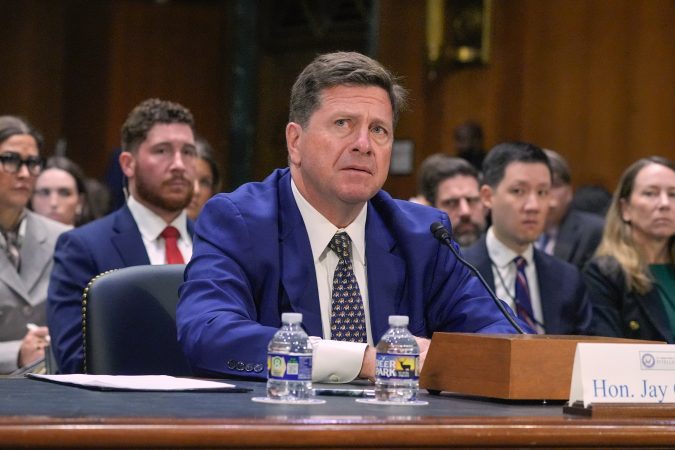
    The staffing reductions mean that Trump’s nominee for intelligence czar, Jay Clayton, if confirmed by the Senate as expected, while inherit a shrunken organization that has experienced steady upheaval over the last 18 months.

    The president in early June tapped federal mortgage regulator Bill Pulte, a political ally with no prior national security experience, to be acting director of national intelligence. Trump said at the time that he wanted Pulte to “start the process” of eliminating some workers.

    Trump has often maintained a hostile posture toward professional intelligence personnel and their agencies, claiming they tried to undermine him in his first term, particularly with the compiling of reports on Russia’s interference in the 2016 presidential election to aid his campaign. The president has dismissed intelligence analysis on a range of issues, from North Korea’s nuclear policy to Iran’s likely reaction to the attacks the U.S. and Israel launched in February.

    Neither Pulte nor the White House has publicly detailed what cuts they have made recently at ODNI, which houses the National Counterterrorism Center and was established to fix U.S. intelligence agencies’ failure to share threat information prior to the September 2001 terrorist attacks.

    The latest personnel cuts were confirmed by a congressional staff member and another person familiar with the matter. They spoke on the condition of anonymity to discuss nonpublic information.

    ODNI did not respond to requests for comment.

    The cuts include some firings, as well as a larger number of intelligence officers who were ordered back to their home agencies, the person familiar with the matter said. Much of ODNI’s workforce consists of personnel detailed from the CIA and other intelligence organizations.

    The counterterrorism center has not been affected significantly, officials have said. But there has been a whole-scale hollowing out of the National Intelligence Council, a prestigious analytic body that conducts intelligence community-wide assessments on key topics such as COVID-19’s origins and foreign interference in U.S. elections.

    The Washington Post previously reported that about 20 intelligence council personnel have been removed or have chosen to leave, including senior officers who oversaw the production of analysis on Russia, China, and Europe. The top official who oversaw the council was placed on administrative leave.

    Neither Clayton nor the Trump administration has articulated a vision of what ODNI should look like or focus on “other than it should be smaller,” said Julia Curlee, who served as a director for intelligence programs in Trump’s White House until last year and recently resigned from the CIA after 20 years as an analyst. “It seems like DNI was just a fat target to punish the ‘deep state.’”

    “Morale is pretty terrible, as you would imagine,” Curlee said.

    It is unclear how many of the 200 personnel were let go under Pulte, who became acting director of national intelligence on June 19, and how many were let go under his predecessor, Tulsi Gabbard, who left the administration after her husband became ill.

    The Trump administration and its allies in Congress have not publicly acknowledged the extent to which ODNI has been shrunk.

    “U.S. National Intelligence is operating more efficiently and effectively than ever before, and today, we started a third round of reducing redundant, or noncritical, personnel,” Pulte posted on X on July 10, without revealing details.

    Senate Intelligence Committee Chairman Tom Cotton (R., Ark.) said shortly after Pulte took over that the acting DNI had told him that “a small handful of front-office personnel” were leaving. “Around 45 or 50 career officers” were returning to their home agencies, Cotton said. Cotton’s office did not respond to requests for comment.

    The precise size of the workforce at ODNI and other U.S. intelligence agencies is classified. By the time Gabbard departed in mid-June, the workforce had shrunk from about 2,000 in January 2025 to about 1,300.

    Clayton was mauled in his Senate Intelligence Committee confirmation hearing by Democrats who decried what they said was his failure to unequivocally state that Joe Biden won the 2020 presidential election, which Trump denies. The Republican-led committee approved his nomination Tuesday on a 9-8 vote, and a full Senate vote is expected next week.

  • House votes to limit Trump on Iran; Senate fails to advance similar measure

    House votes to limit Trump on Iran; Senate fails to advance similar measure

    The House passed a measure to halt the war in Iran on Thursday, as Democrats mounted a last-minute bid to constrain the escalating conflict before lawmakers left Washington for a monthlong recess.

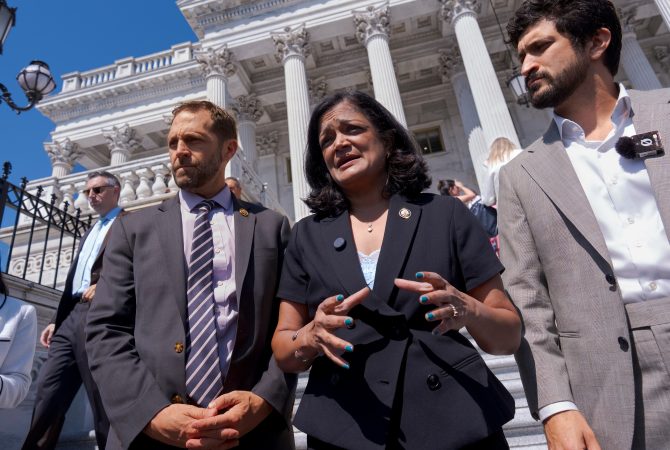
    The effort led by Rep. Pramila Jayapal (D., Wash.) passed by a vote of 214-208. Four Republicans — Reps. Brian Fitzpatrick of Pennsylvania, Thomas Massie of Kentucky, Warren Davidson of Ohio, and Tom Barrett of Michigan — joined Democrats in supporting the measure.

    The Senate blocked consideration of a similar resolution hours later on a 49-47 procedural vote.

    Sen. Susan Collins of Maine was the lone Republican to join Democrats in supporting the measure. Sen. John Fetterman (D., Pa.) voted against it.

    The votes marked the first test of Republican support for the conflict since President Donald Trump resumed strikes against Iran this month. U.S. Central Command, which oversees military operations in the Middle East, announced it had conducted its 12th consecutive day of airstrikes as Trump pledges to retaliate for the deaths of several American service members killed by Iranian attacks in the last week.

    By returning to the war, Trump has forced some vulnerable Republicans into a tenuous political position ahead of the November midterm elections. Iran has closed the Strait of Hormuz — spiking global food and energy markets — and the Houthis, its proxy force in Yemen, have threatened to halt Saudi Arabian oil transiting the Red Sea.

    A Washington Post-Ipsos poll earlier this month found that nearly 70% of respondents thought that the war was not “worth fighting.” Eighteen U.S. service members have died during the conflict, with nearly 430 injured.

    Earlier this week, Defense Secretary Pete Hegseth told lawmakers the war will cost about $37.5 billion by the end of September. Congress is debating how to proceed with a $73 billion package to restock the Pentagon’s inventory of precision weapons and cover other costs incurred by the conflict.

    “When you’re digging yourself a hole, the first thing you should do is stop digging — and that’s what this resolution seeks to do,” Sen. Chris Van Hollen (D., Md.), who introduced the resolution, said on the Senate floor before the vote. “Let us stop pretending that Congress has no role to play while American service members remain in harm’s way.”

    Sen. Tim Sheehy (R., Mont.), a Navy SEAL veteran who served in Afghanistan and Iraq, countered that passing the resolution would send the wrong message to the U.S. troops fighting the war.

    “Think about the people who are deployed right now standing on that wall with a loaded weapon who have volunteered to defend our country and our way of life,” Sheehy said on the Senate floor. “Because they are there defending us in a just war.”

    The Trump administration’s return to military strikes in Iran has also divided some Democrats over how best to respond.

    The successful vote in the House and the failed one in the Senate came after both chambers approved a separate resolution last month meant to halt the war. Trump has argued the measure lacks the power of law, infuriating Democrats who say the war is being conducted unlawfully without lawmakers’ consent.

    The White House has pressured Republicans to oppose such resolutions. Trump complained when he met with Republicans senators last month that the passage of one of the resolutions was undermining his negotiations with the Iranian government.

    Sen. Bill Cassidy (R., La.) supported the resolution that passed last month but opposed a subsequent one after being briefed by the White House. He voted against Thursday’s resolution.

    Two other Republicans who have voted for similar resolutions in the past, Sens. Lisa Murkowski of Alaska) and Rand Paul of Kentucky), did not vote. Sens. Mitch McConnell (R., Ky.) and Katie Boyd Britt (R., Ala.) also missed the vote.

    Rep. Gregory Meeks (D., N.Y.), the top Democrat on the House Foreign Affairs Committee, said Thursday that he will introduce a resolution to sue the Trump administration over its refusal to abide by their efforts to rein in the war.

    Trump “should be coming directly to Congress” to explain why he has continued his war effort in Iran, Meeks said. “Since he’s not, then we should be suing the administration to say ‘You must come to Congress at this point.’”

    Sen. Tim Kaine (D., Va.), the architect of Democrats’ strategy to force war powers votes, said he did not think the failed procedural vote in the Senate undercut the successful passage of the war powers resolution last month.

    “The substantive vote has been taken,” Kaine said after Thursday’s vote. “Both houses have said, Mr. President, you either have to withdraw troops or” seek authorization from Congress to continue the war.

    Still, Kaine said he was turning his attention to pushing back against the war through the appropriations process, through which Congress could exert leverage over the war by refusing to fund it. The House passed a resolution Wednesday taking the first step toward sending $73 billion to the Pentagon and U.S. intelligence agencies, largely to cover the cost of the conflict, but the measure faces an uncertain future in the Senate.

    Senate Majority Leader John Thune (R., S.D.) said the Senate would not take it up immediately as bipartisan negotiations over government funding play out — an approach that some Senate Republicans say is a mistake. The Senate could use the measure to fund the government later if those negotiations collapse.

    After the House vote, Rep. Jason Crow (D., Colo.), a co-sponsor of Jayapal’s resolution, said Democrats would continue to force votes on similar resolutions and predicted that more House Republicans would support them after hearing from frustrated constituents while the chamber is on recess over the next four weeks.

    “They’re going to get crushed,” Crow told reporters after the vote. “When we come back in September, I bet we have more people joining with us saying, ‘All right, let’s wrap this up.’”

    Senate Minority Leader Chuck Schumer (D., N.Y.) signaled that Senate Democrats would also continue to force votes on similar resolutions.

    “We will keep forcing votes until Senate Republicans stop playing dumb and summon up the courage to do what is right,” Schumer said on the Senate floor.

  • Saudi nuclear deal in doubt as Trump adds new condition regarding Israel

    Saudi nuclear deal in doubt as Trump adds new condition regarding Israel

    Saudi Arabia would need to normalize relations with Israel to receive the U.S. nuclear technology it has long sought, President Donald Trump said Thursday, adding a new and potentially deal-ending stipulation to an agreement signed just a day earlier.

    The nuclear deal — which was fiercely opposed by Israel and others concerned about nuclear proliferation — is “totally subject” to Saudi Arabia joining the Abraham Accords, Trump said in a social media post, referring to the effort from his first term to normalize relations between Israel and Muslim-majority countries from which it had long been estranged. The Saudis have thus far refused to join the accord.

    It was the latest whiplash-inducing policy shift from the White House, which had faced-down considerable political opposition to push forward with the Saudi deal. The Biden administration also discussed a nuclear deal with Saudi Arabia, but tied any agreement to opening diplomatic relations with Israel, a move that has the potential to reshape dynamics in the Middle East, but which remains distant.

    If the Saudis “don’t join the Abraham Accords, the deal is off,” White House press secretary Karoline Leavitt said a few hours after Trump’s post, responding to questions from reporters.

    Asked why that condition had not been included in the deal when it was announced Wednesday, Leavitt said that Trump is “always the final dealmaker.”

    It wasn’t immediately clear how the Trump administration would modify a legal agreement that it has already signed with the Saudi government. Asked for details, the White House pointed to Leavitt’s comments.

    The deal to allow the Saudis to build nuclear power plants using U.S. technology, creating a pathway to a Saudi nuclear enrichment program, has set off debate in Congress. Many lawmakers fear that allowing more countries to develop enrichment programs could eventually lead to more possessing nuclear weapons.

    Israel hotly opposes Saudi Arabia’s developing a nuclear enrichment program, fearful it could lead to a regional arms race. Israeli leaders welcomed Trump’s new conditions.

    The Saudis have long sought to build nuclear power plants on their territory — and Crown Prince Mohammed bin Salman, the de facto ruler of the country, has declared that they would work to develop nuclear weapons if Iran develops its own.

    The Biden administration also explored a nuclear deal with Saudi Arabia, but it ultimately floundered because normalizing relations with Israel was the main condition the U.S. placed on the agreement. The deal the Trump administration signed Wednesday would have imposed no such requirement.

    Trump’s new condition on Thursday would attach a major string to the deal. Saudi leaders were nearing a normalization agreement with Israel in 2023, just before the Hamas attack on Israel on Oct. 7 of that year. Since then, however, talks have been paused. Saudi leaders now say they would want guarantees of an eventual Palestinian state, and Saudi public opinion has soured toward Israel because of its handling of the war in Gaza. Any nuclear deal tied to Saudi-Israel diplomatic breakthroughs has seemed remote.

    “The Civil Nuclear Deal (There will be no enrichment of material!) being made between the United States Department of Energy and Saudi Arabia, which pertains only to non-military use such as the ones that Iran and UAE (and others) already have, will be approved,” Trump wrote on Truth Social on Thursday. “But is totally subject to Saudi Arabia joining the very respected and successful Abraham Accords.”

    The Abraham Accords, signed in 2020, normalized diplomatic and economic ties between Israel and Bahrain and the United Arab Emirates. Morocco later joined. Saudi Arabia is a heavyweight of the Middle East. Boosting ties to Israel would be a major shift in a region long beset by religious tensions.

    The president’s assertion that there would be no nuclear enrichment as part of the deal appears to contradict how people familiar with the deal have described it. Most of the deal’s details remain private.

    The president will need to submit the agreement to Congress, starting a 90-day clock for approval. That move could take place as early as today.

    It is unlikely Congress will be able to stop the deal, even if there is substantial opposition. The president could veto their disapproval, and opponents are unlikely to have the votes to override him.

    But Trump’s new condition could stymie the deal even before it gets off the ground.

    Trump had not spoken to Mohammed in the hours since the social media announcement, Leavitt said. Nor did he speak to Israeli Prime Minister Benjamin Netanyahu, she said.

    It was just the latest example of the president’s on-again, off-again approach to policymaking. Last week, Trump said that the United States would impose a 20% toll on shipping through the Strait of Hormuz, despite months in which his own administration said that doing so would be a violation of international law.

    A day later, and following widespread condemnation, he abandoned the idea, saying he would make investment deals with Persian Gulf countries instead.

    The agreement that Energy Secretary Chris Wright and his Saudi counterpart signed Wednesday lays out conditions for nuclear energy cooperation and includes stipulations aimed at preventing the spread of nuclear weapons.

    But unlike other recent deals with countries that do not already have a domestic enrichment program, this one would not impose the same strict conditions aimed at preventing them from moving in that direction.

    The initial announcement of the deal on Wednesday drew condemnation in Israel, where leaders fear a Saudi nuclear program could spur a regional arms race. Israelis worry that Turkey and others could also seek nuclear enrichment programs, ultimately leading to far more countries in the region that have a pathway to a nuclear weapon.

    Israel has an undeclared nuclear weapons program, in addition to civilian nuclear power capability.

    “Saudi Arabia’s joining of the Abraham Accords would be an historic leap forward for peace in the Middle East,” Netanyahu said Thursday in a statement.

    The Trump administration has offered little information about the agreement’s contents. Three people familiar with the details said that it is designed with safeguards to keep the Saudis from enriching nuclear fuel to weapons-grade level.

    But they said it exempts the Saudis from aggressive international inspections required in nuclear reactor deals with other countries, including the United Arab Emirates. Instead, sensitive inspections would be executed by American teams under terms spelled out in the agreement, which was initially worked out when the crown prince visited Washington in November.

    The people spoke on the condition of anonymity because they were not authorized to discuss the agreement publicly.

    “These agreements reflect our two nations’ shared commitment to strengthening U.S.-Saudi commercial relations, delivering prosperity at home and security to our allies abroad,” Energy Secretary Chris Wright said in a Wednesday statement.

    Trump had to sign a separate national security waiver to allow the deal to move forward, since it does not include conventional international inspections, according to the people familiar with the deal.

    Under the Saudi deal, the two countries agree to study for two years whether enrichment on Saudi soil is feasible and necessary.

    Proponents say the deal with the Saudis gives the U.S. an opportunity to control the expansion of the enrichment network on its own terms and limit the risk of nuclear proliferation. The deal requires that any enrichment on Saudi soil would be controlled by U.S. companies using technology that is not shared with the Saudis, in an effort to limit the possibility that Saudi Arabia could use the program to develop a nuclear weapon.

    Nonproliferation experts have long warned against such a deal, saying that safeguards are unlikely to hold for the long term.