Category: Washington Post

  • Ms. Rachel goes to Washington, carrying letters from children in ICE custody

    Ms. Rachel goes to Washington, carrying letters from children in ICE custody

    WASHINGTON — Rachel Griffin Accurso — Ms. Rachel, to her millions of followers — made her first visit to Capitol Hill on Tuesday afternoon, wearing a bubblegum-pink linen suit and wheeling a black suitcase filled with stapled packets of handwritten letters and drawings. They were the words and artwork of children, all of whom have been — or remain — in the custody of U.S. Immigration and Customs Enforcement at the nation’s only family immigration detention center.

    “I cry a lot,” read one letter from a 7-year-old boy held at the Dilley Immigration Processing Center in South Texas. “I want to get out of here.” Among the illustrations were portraits of crying faces, families standing together behind bars and a red house that a 9-year-old child longed to return to. Accurso clutched one packet in her hand, ready to offer it to the first lawmaker she encountered.

    She had come with a plan: Over a brief two-day visit to Washington, she wanted to deliver the letters and drawings to members of Congress and tell them about the children she’d met. Her goal was to urge every official she spoke with — Democrats and Republicans alike — to end family detention and reunite the children and parents who had been separated by ICE enforcement.

    Sen. Andy Kim (D., N.J.) holds the letter of a child detained at the Dilley Immigration Processing Center in southern Texas. Maxine Wallace

    It was a new foray into the political realm for the early-childhood educator, who became the reigning star of children’s media with her wildly popular educational videos on YouTube and Netflix. Through her adult-facing social media platforms, Accurso has also emerged as a powerful advocate for vulnerable young people around the world, making headlines — and sometimes drawing backlash — for speaking out on behalf of children in Gaza, Sudan, and other humanitarian crisis zones.

    Now her efforts include children closer to home. Over the past few months, Accurso has become an increasingly prominent voice in the debate over family immigration detention and the mounting concerns about conditions at the Dilley detention center. She has spoken directly to 10 families there via video calls, she said, and has publicly shared clips from several of those conversations with her 5 million Instagram followers. Accurso helped launch a petition to close the Dilley facility that has more than 324,000 signatures, including dozens of celebrities (Ben Stiller, Ayo Edebiri, Cynthia Nixon, and John Legend are among the many signatories). She also shared an open letter addressed to CoreCivic, the private prison contractor that has operated Dilley since its Obama-era construction in 2014: “What we have to agree on is not harming children,” she wrote.

    When Accurso arrived on Capitol Hill along with her husband, Aron Accurso, they were welcomed by Sen. Andy Kim (D., N.J.). He offered them a brief tour through the Capitol, noting that the Senate had voted just days before to approve $70 billion in funding for President Donald Trump’s immigration enforcement agencies. “When you’re talking about this,” he said, nodding to the packet in Accurso’s hand, “what’s funding this? That’s what’s happening in this building.” As they spoke, the House was preparing to vote on the same funding package.
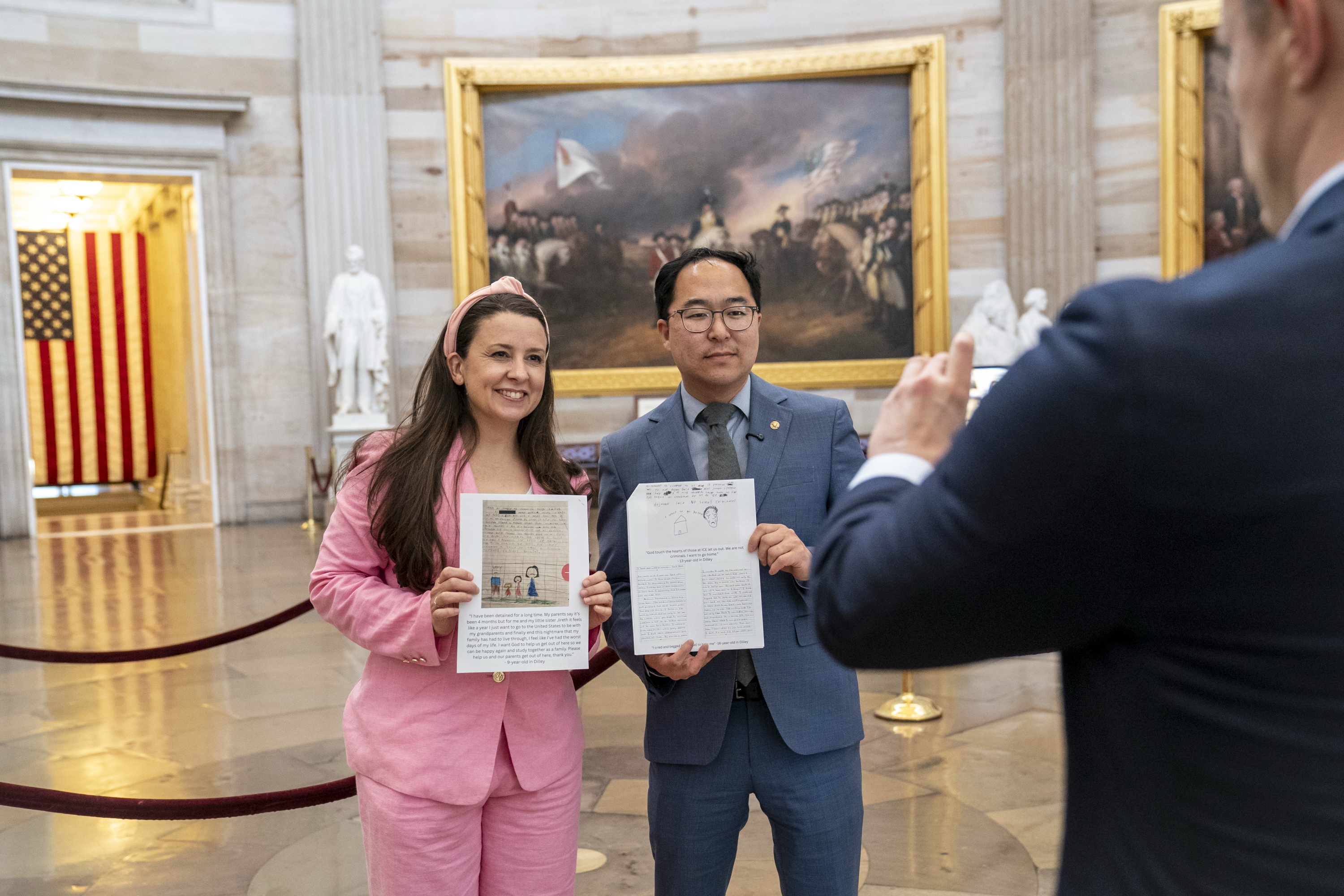
    Accurso and Kim in the Capitol Rotunda on Tuesday.Maxine Wallace

    Accurso and Kim posed for photos and filmed a brief video together in the Capitol Rotunda, then parted ways before she headed to the Hart Senate Office Building.

    She was stopped repeatedly by enthusiastic interns and staff members who asked for selfies to show their own children, or their nieces and nephews. “What’s their name?” Accurso always asked, before deftly switching the phone setting to record a personalized video for each child: Hi, Ava! Hi, Maeve! Hi, Hugh!

    Then she would steer the conversation toward the names of other children — some she had spoken with personally, and others whose circumstances were recounted to her by lawyers, advocates and journalists working with families at the Dilley facility. There was Amalia, an 18-month-old who suffered a near-fatal health crisis while in ICE custody at Dilley; Deiver, a 9-year-old who missed his friends at school and wanted to participate in the state spelling bee; Guri, a 12-year-old who has been detained with his family since February and has experienced chronic blood in his stool for months.

    Accurso poses for a group photo with some staff from the office of Sen. Jeff Merkley (D., Ore.) on Tuesday. Maxine Wallace

    Accurso was greeted with joyful shouts of recognition in the office of Sen. Jeff Merkley (D., Ore.). She left a packet with the staff of Sen. John Cornyn (R., Texas) and noted that they seemed friendly. She walked into the office of Sen. Lisa Murkowski (R., Alaska) with a cheerful, lilting “Hi, friends!” and the staff member’s subsequent gasp — “Oh my gosh!” — was audible down the hall.

    “Well, I hope this works,” Accurso said, as the clock ticked to a quarter past 6 and it became clear that most of the offices were now closed. She had visited 10.

    So she headed for the exit and learned the news as she was leaving: Minutes before, the House had narrowly passed the $70 billion funding package — including $38 billion for ICE enforcement and $26 billion for the Border Patrol. The vote paved the way for the agencies to build a detention system and pursue what Trump had pledged would be the largest mass-deportation operation in the country’s history.
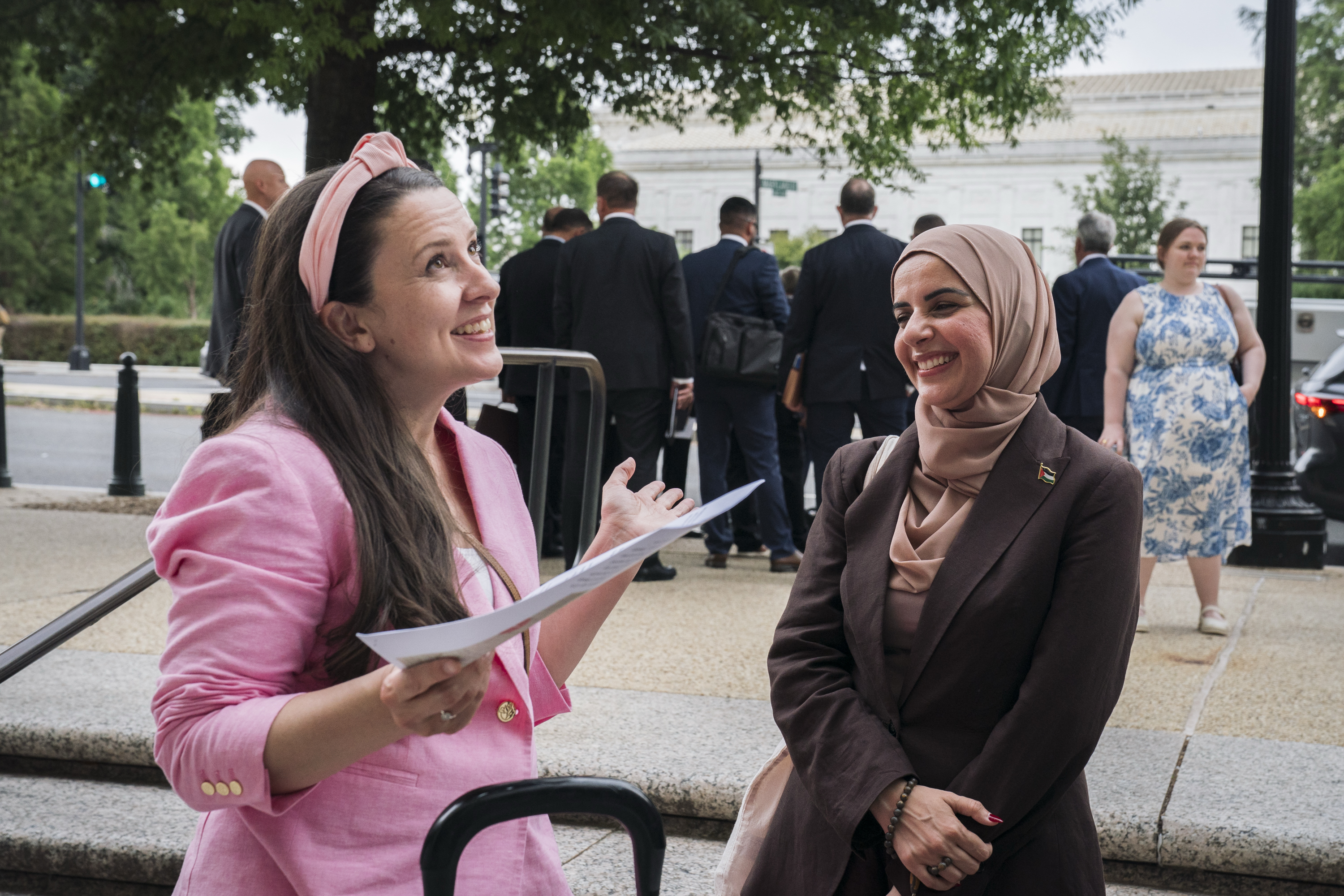
    Accurso on Tuesday outside the Hart Senate Office Building with Leqaa Kordia, a Palestinian woman detained for a year amid a Trump administration crackdown on protesters last spring.Maxine Wallace

    The day before she took the train to Washington from her home in New York, Accurso visited children and families at a hospitality tent set up by volunteers outside Delaney Hall, an immigration detention center in New Jersey where demonstrators and law enforcement have clashed in recent weeks.

    Accurso delivered toys and art supplies to the tent and, with the families there, sang a song written by the Peace Poets along with children detained at Dilley: “I’ll sing from here and you sing from there, together we’ll sing down the walls everywhere.”

    She spoke with a 13-year-old girl who described what it felt like to have only brief visits with her father, a truck driver who has lived in the United States for 20 years and supports his wife and three children, the youngest of whom has complex special needs.

    “We went to go and visit my dad, and it was really sad,” the teen told Accurso, who wiped away tears as she listened. “He looked like a prisoner. But I knew in my heart that he shouldn’t be in there.”

    Earlier this year, as she read more about the children being swept up in ICE enforcement operations, Accurso said, she began contacting legal experts, advocates, and journalists on the ground in Texas who detailed alarming conditions at the facility and helped connect her to families detained together there.

    Those parents described children who were deteriorating physically and mentally; several kids said the water in the facility made them feel ill. Autistic children were suffering in particular, Accurso said; one nonverbal 5-year-old named Gael had not had a bowel movement in nine days and had begun hitting himself in distress. Families told her that their children couldn’t sleep because the lights were on all night.

    She felt haunted by those conversations, Accurso said later, in an interview with the Washington Post: “I kept thinking, ‘How is this happening?’”

    Several children and teens who were included on Accurso’s social media platforms were subsequently released from detainment, including Gael; Deiver, the 9-year-old who begged to go to the state spelling bee; and Olivia Mabiala Andre, a 19-year-old asylum seeker and nursing student. Accurso posted about her gratitude and relief in those moments, but she said she is acutely aware of how many children remain behind, including those who don’t feel safe speaking publicly about what’s happening to their families.

    As of early June, about 320 people were at the Dilley center, including nearly 90 children, according to Faisal Al-Juburi, co-CEO of the Texas-based nonprofit Refugee and Immigrant Center for Education and Legal Services (RAICES). In the past year, he said, RAICES has documented roughly 1,500 medical concerns from families held at Dilley.

    Accurso has highlighted concerns voiced by medical experts: In April, responding to mounting reports of dangerous conditions for children at the Dilley center — including unsafe water, the spread of measles, delayed medical care and declining mental health — the American Academy of Pediatrics requested urgent access to the facility, reiterating that “no time in detention is appropriate for a child.”

    A spokesperson for CoreCivic said in an emailed statement that its facilities are safe, and noted that while some lighting is on during overnight hours, “lighting over sleeping areas is turned off during sleeping hours.”

    The spokesperson referred to a statement by Kristen Dauss, the company’s vice president and chief medical officer: “The children and their families at DIPC receive care that is clinically rigorous, federally overseen and delivered with dignity.” Dauss added that children receive clean water from the same regularly tested municipal source that supplies local drinking water, appropriate nutrition and hygiene supplies.

    Dauss echoed those points in a recent response to Accurso’s letter to CoreCivic. In a separate emailed statement, a spokesperson for the Department of Homeland Security echoed that families at Dilley are provided appropriate living conditions and medical care.

    When Accurso talks to people about the firsthand accounts she has heard, “they’re shocked,” she said. “Why don’t people know? But I also feel like I didn’t know the extent of what was happening, either. We have to get the information out.”

    This underscores the value of Accurso’s work and platform, said Elora Mukherjee, an attorney who represents numerous families detained at Dilley and serves as director of the Immigrants’ Rights Clinic at Columbia Law School. With her vast audience, Accurso represents a different way to inform people, beyond the reach of mainstream media: “Overwhelmingly, the American public still does not realize that, as a nation, we are imprisoning babies, toddlers and children who have done nothing wrong,” she said. “Sustained attention on cruelty against children is critically important.”

    Al-Juburi noted that although the country’s current immigration policy represents “generations-long, systemic issues that need to be addressed, fundamentally, by our legislative branch,” there is a meaningful impact when prominent people raise their voices.

    Culture often shifts before the law does, he said: “We will not see policy change until the public demands it. And that is what gives me hope when people like Ms. Rachel turn their spotlight onto a cause like this.”

    The sun was falling through mottled clouds as Accurso left the Hart Building and wheeled her suitcase down Constitution Avenue toward the Capitol. She wanted to record a video there for the children detained at Dilley and the ones waiting in the tent outside Delaney Hall. She would tell them that she’d brought their letters and their artwork to the place where decisions about their future were made. “I have your words right here,” she would say into her phone camera, holding the stapled packet close to her chest. “I’m always going to stand with you.”

    But when she arrived at the building, she first took a moment to sit quietly on the empty steps. The House’s vote, and its ramifications, were at the forefront of her mind. She felt a heavy sense of sorrow and defeat, she said.

    She adjusted her knotted pink headband and looked up toward the towering dome, bathed in the softening light of dusk. She thought about how young people often stop her — more than a dozen had done so just in the past few hours — to thank her and urge her to keep going. The next day, she would come back and meet with more elected officials in the House. She would make sure that all 535 packets of letters and drawings were delivered to every member of Congress. She would keep telling the stories of the children she’d met.

    “I’ll never stop trying, for them,” she said. “I can’t say, ‘I’m just one person, so I’m not going to make a difference.’ What if everyone said that?”


  • Iran war is the worst hit to the global economy since COVID, World Bank says

    Iran war is the worst hit to the global economy since COVID, World Bank says

    The global economy — tested by years of war, pandemic, and trade tension — is beginning to fray, as fallout from the U.S.-led war on Iran dents prospects for growth, the World Bank said in a new forecast.

    World output this year is expected to grow at an annual rate of just 2.5%, down from 2.9% in each of the past two years, and the slowest pace since the onset of the COVID pandemic in 2020, the bank’s top economists said.

    Soaring costs for oil, gas, fertilizers, and industrial chemicals caused by the prolonged near closure of the Strait of Hormuz, which the bank calls “the biggest supply shock in 50 years,” is straining developing and advanced economies alike.

    “The global economy is not falling off of a cliff, but it has downshifted sharply, and many developing economies are entering this shock with thinner buffers and fewer shock absorbers,” said Ayhan Kose, the World Bank’s deputy chief economist.

    The new forecast is gloomier than the bank’s January outlook, which saw the global economy largely weathering an era of trade uncertainty arising from President Donald Trump’s tariffs.

    Bank specialists cut their January forecasts for two-thirds of the world’s nations, with Turkey, Bangladesh, and South Africa suffering notable downward revisions.

    Nations adjoining the Persian Gulf war zone are expected to be hit hardest: Kuwait, Iraq, and Qatar will see “near zero” growth in 2026, Kose said. The United Arab Emirates is projected to grow at a 2.4% rate this year, less than half the pace the bank expected before the war.

    The 2020s appear almost certain to become a “lost decade” for dozens of developing nations that have made no progress closing the income gap with the advanced economies, the bank’s Global Economic Prospects report said.

    The United States — fueled by mammoth investments in artificial intelligence — remains a relative bright spot, expected to grow at a 2.2% annual rate, up slightly from last year’s pace, and much faster than Europe and Japan. U.S. investments in AI-related infrastructure exceed such spending by all other nations combined, the bank said.

    China is set to grow at a 4.2% rate, down from 5% last year and 0.2 percentage points below the bank’s January outlook.

    The war-related shock is occurring against a downbeat long-run backdrop. Global growth has softened steadily since the early 21st century, sapped by the impact of aging populations, declining private investment, trade tensions, and rising public debt, said Indermit Gill, the bank’s chief economist.

    “The world economy is a lot less resilient today,” Gill said.

    The bank’s new forecast assumes that Middle East energy and commodities trade will return to normal by the end of July and that Brent crude, the global benchmark, will average $94 per barrel this year.

    But with the U.S. and Iran continuing to trade blows, despite a nominal ceasefire, bank officials noted the risk of further economic erosion.

    If the war continues beyond July, oil prices will average $115 a barrel for the year, driving global growth to an anemic 2.1% rate, the bank said.

    An energy shock that drives down stock and bond prices would take an even larger toll on the global economy. Growth in that case would struggle to reach a 1.3% rate.

    Public debt burdens are another worry. With annual budgets already deep in the red, the U.S. and other major nations would have limited ability to increase public spending in response to an economic crisis, as they did during the pandemic and the 2008 financial crisis, the bank warned.

    For now, the global lending body is making available at least $50 billion in financing to buttress social programs in developing nations hurt by the slowdown. If the crisis persists, the bank said, it is prepared to roughly double that figure over a 15-month period.

    “Our job is to help countries steady the ship, keep reforms moving, and emerge stronger on the other side,” said Ajay Banga, the bank’s president.

  • Trump sees 22 medical specialists, appearing to set new bar for presidents

    For George H.W. Bush’s first medical checkup as president in 1989, he was seen by five specialists, the White House said at the time. His son George W. Bush was seen by 12 in his first presidential checkup, White House officials said a dozen years later.

    President Donald Trump appears to have set a new bar: 22 medical specialists assessed him as part of his latest checkup, according to a medical report recently released by the White House.

    That figure is nearly double the number of specialists who assessed Trump for his past medical checkups as president, according to a review of publicly available statements by Trump’s doctors.

    The figure also represents the most medical specialists to assess a president for a single visit, based on a review of public statements and records, prompting questions from outside physicians who said they were already skeptical of the White House’s disclosures around the nearly 80-year-old Trump’s health.

    “It is an extraordinary number,” said Jonathan Reiner, a longtime cardiologist for former vice president Dick Cheney. “What specialties do they represent? Why so many?”

    White House officials said that the number was commensurate with the need to perform a “complete and preventive evaluation” of the president. Sean Barbabella, the president’s physician, said the assessment found that Trump was in “excellent health.”

    “The involvement of multiple specialists reflects a comprehensive, multidisciplinary evaluation consistent with best practices for executive-level medical care,” the White House said in a statement.

    A White House official said that physicians affiliated with Harvard University, Duke University and other prominent institutions helped perform the evaluation. The official also said that some generalist physicians were included in the administration’s count of 22 specialists.

    “We have nothing to hide,” the official said.

    The White House has often declined to answer specific questions about Trump’s medical assessments, such as what prompted the president to undergo a second physical exam at Walter Reed National Military Medical Center last year. Presidents usually make one annual trip unless they have an urgent condition. Nearly three months after the visit, and after initially telling reporters that he had undergone an MRI exam, Trump and the White House clarified that the president had received a CT scan as part of his assessment.

    Trump’s medical reports also no longer include a common hair-loss prevention drug that his physicians said he routinely used during his first term in office. White House officials have declined to comment on Trump’s past use of the drug, finasteride, and whether he had stopped taking it.

    The scrutiny of Trump’s health comes amid broader questions about the fitness of the current president and his predecessor, Joe Biden, to serve as commander in chief. Biden, who was 82 when he left office, and Trump, who turns 80 on June 14, are the two oldest men to serve as president.

    Karine Jean-Pierre, who served as Biden’s press secretary, said at a February 2024 press briefing that a team of “20 doctors” participated in Biden’s medical evaluation at Walter Reed that year.

    Past administrations have often elected not to disclose the specific number of specialists who consult on the president’s medical evaluations, which are traditionally performed at Walter Reed.

    Presidents are not required to disclose their health records, although lawmakers in both parties have called for more checks on chief executives, such as creating an independent commission that could assess the president’s health.

    But publicly available records and statements indicate that the number of specialists reviewing presidential health appears to have ballooned.

    The five specialists involved in President George H.W. Bush’s checkup in May 1989 included an ophthalmologist, a urologist, a dermatologist and two allergists — White House officials said at the time. The 65-year-old Bush then saw eight specialists the following year, including a radiologist, cardiologist, and rheumatologist, the White House said.

    His son, President George W. Bush, saw 12 specialists for his 2001 checkup, White House officials said then.

    As questions swirled about Trump’s fitness during his first year in office, Ronny Jackson, who served as Trump’s physician during his first term and is now a Republican member of Congress from Texas, arranged 13 specialists to see the president, he wrote in his memoir.

    “I didn’t do this physical by myself; I was assisted by an entire committee of top-of-the-line specialty doctors at Walter Reed, including ones who specialized in dermatology, orthopedics, gastroenterology, ophthalmology, urology, pulmonary medicine, otolaryngology, and cardiology,” Jackson wrote in his book, Holding the Line.

    “The cardiologist did his heart exam. The pulmonologist did his lung exam and pulmonary function testing, the dermatologist did his skin exam, and so on.”

    Trump saw 11 specialists for his 2019 checkup and 14 specialists for his checkup last year, according to past medical reports released by the White House.

  • Love coffee? Have the last cup at this time for a better night’s sleep. | Expert opinion

    Love coffee? Have the last cup at this time for a better night’s sleep. | Expert opinion

    How long does caffeine stay in my system? If I drink an afternoon cup or two, will it mess with my sleep?

    Java lovers, you may be in for a brewed awakening.

    A 2023 randomized trial published in the New England Journal of Medicine found that people who drank one or more cups of coffee each day lost on average 36 minutes of sleep compared with those who didn’t over a two-week period.

    There’s a catch though: People who were assigned to drinking coffee were also more active, taking an average of 1,000 more steps — the equivalent of walking about half a mile — per day than those randomized to the no-coffee group. The researchers speculated that perhaps the boost in activity is part of why coffee has consistently been shown to have many health benefits, including maybe even for longevity.

    That trade-off between energy and sleep is something many of us coffee drinkers know intimately. Miscalculate, and you can end up “tired and wired”— a miserable state of mind I was in too often during medical training, living cup to cup.

    Here’s the good news: You don’t need to quit. But you may need to move up your last cup to much earlier in the day than you think. Rather than the vague advice we’ve all heard to avoid coffee “close to bedtime,” researchers now have a more specific number. A 2023 meta-analysis of 24 studies on the effect of a standard cup of coffee (about 100 milligrams of caffeine) found that for the best night’s sleep, you need to finish drinking coffee at least nine hours or so before you sleep.

    So if you’re in bed by 10 p.m., your last cup should be by 1 p.m.

    Oof.

    My guess is that’s earlier than a lot of us have been operating. (I’m looking especially at you, my four-cups-and-counting-per-day friends). Otherwise, the study found, coffee could reduce total sleep time by 45 minutes and increase how long it takes to fall asleep — or the sleep onset latency — by around nine minutes. (And for context, sleep onset latency of less than 30 minutes is the goal.)

    Why some people can drink coffee in the evening

    Avoiding coffee nine hours before bedtime is a solid, general guideline, but as with anything in medicine, each of us responds a bit differently. Older studies looking at the half-life of caffeine in our systems found that it varies from two to 10 hours, depending on the individual.

    Some of the variation is written in your DNA. Scientists have identified several genes involved in how quickly we metabolize caffeine and how caffeine activates our brain’s reward system. The CYP1A2 gene controls how quickly your liver processes caffeine, while the ADORA2A gene encodes an adenosine receptor in the brain, which regulates how sensitive you are to coffee’s stimulating effects. Variants in the ADORA2A gene are associated with why some people feel anxious after coffee (*raises hand*) — and why some people experience more insomnia than others after the same cup.

    So that friend who’s sipping their after-dinner espresso at 9 p.m. and still sleeps beautifully? Thank (or envy) their genes.

    You may assume that regular coffee drinking could build a tolerance, eventually overcoming the sleep effects. However, the data supporting this in humans is surprisingly scarce — despite being popularly believed.

    How much coffee is too much coffee?

    The U.S. Food and Drug Administration advises adults to consume no more than 400 milligrams of caffeine per day, and not all cups are created equal. For instance, a medium iced latte from Dunkin’ has about 166 milligrams of caffeine and a grande Nitro Cold Brew from Starbucks has about 280 milligrams of caffeine. A typical Keurig pod contains 75 to 150 milligrams per eight-ounce cup.

    A randomized controlled trial in adult men found that, on average, a 100-milligram dose of caffeine consumed four hours before bedtime had little impact on sleep whereas a 400-milligram dose consumed 12 hours before bedtime had an impact. So if you crave an afternoon cup, switch to a less potent option to minimize the chances you’ll get the receipts at bedtime.

    What I want my patients to know

    Coffee is one of those wonderful rarities that science keeps finding reasons to love. Because it’s such a regular part of our daily lives, making some tweaks to how and when we drink it can have an outsize impact on our health in the long term. It may not just be sleep that benefits from morning coffee drinking: In one study, people who restricted their coffee drinking to the morning hours seemed to have a mortality benefit compared with those who drank throughout the day. A disrupted circadian rhythm, which plays an important role in inflammation and your immune system, is thought to be at least one possible contributor.

    Trisha Pasricha is a physician and journalist who writes the Washington Post’s Ask a Doctor column. She is an instructor in medicine at Harvard Medical School and author of “You’ve Been Pooping All Wrong.”

  • A new wave of anti-immigrant violence hits U.K. as riots convulse Belfast

    BELFAST — Masked men set houses, vehicles, and a city bus ablaze in Belfast on Tuesday night, torching neighborhoods across the city after a graphic video of an alleged knife attack by a Sudanese asylum seeker went viral, igniting the latest anti-immigration violence to convulse the United Kingdom.

    Ignoring pleas for calm from politicians and clergy, rioters rampaged through heavily immigrant neighborhoods in Belfast, the capital of Northern Ireland, in some cases going door-to-door and causing some families to flee under police protection.

    Men in balaclavas and hoods shouted “foreigners out,” witnesses said. One family with children had to be escorted from a burning house, according to the BBC, and a family of Ukrainian refugees fled through their back door as the front door burned.

    Attackers set cars alight in an eastern Belfast neighborhood, stopping in one case after a neighbor told them the vehicle was owned by “locals.” A member of Parliament from the Belfast area described the actions as a “race-based pogrom.”

    The riots spread from Belfast to towns across Northern Ireland and reached into Scotland and England by nightfall. A heavy police presence remained Wednesday morning as officials braced for unrest to continue. Officials said some 200 backup officers from other parts of the U.K. were due to arrive Thursday.

    The Rev. Brian Anderson of the East Belfast Methodist Mission, who was at the scene overnight, said that many of the rioters were “young men out of control” but that the attacks seemed to be directed by a smaller number of older men.

    Anderson’s congregation of native-born and immigrant parishioners was terrified, he said Wednesday morning amid the burned-out cars and broken glass along Lendrick Street. Many parents kept their children home from school, he said.

    Anderson condemned the violence but said underlying social tensions must be addressed.

    “I do believe this community does want to welcome immigrants, but they also want to have their housing issues and their employment issues dealt with,” he said.

    The transit agency suspended services in parts of Belfast, after rioters pushed burning trash bins into a public bus. The Police Service of Northern Ireland said it received 13 reports of criminal damage and at least five of arson, some of which were treated as hate crimes.

    The unrest was the most serious to grip the United Kingdom in nearly a year and placed fresh strain on a government already battered by a running national argument over race, immigration, and police conduct that has been building since last summer.

    The immediate trigger this time was a knife attack late Monday in north Belfast, in which a man in his 40s suffered significant injuries to his eyes and slash wounds to his face and back. Bystanders, including one man wielding a hurling stick, intervened to stop the attack and were credited with saving the victim’s life.

    Word spread rapidly on social media that the attacker was a foreign-born asylum seeker.

    The suspect, a Sudanese national, was charged Tuesday with attempted murder.

    During an appearance at Belfast Magistrates’ Court by video link Wednesday, he was identified as Hadi Alodid, 30, and was denied bail.

    The victim’s family put out a statement Wednesday condemning the riots. “We want to make it absolutely clear that overnight unrest is not welcome, and peaceful protest is the only way forward,” the statement said. “We have many migrants who make a deeply valuable contribution to our country, including in our healthcare system and hospitality sector and we depend on them to make our country work. We do not want this terrible tragedy to be used to divide people or fuel hostility.”

    Northern Ireland’s chief constable, Jon Boutcher, confirmed Tuesday that the suspect was living in the United Kingdom on a five-year visa granted in September 2023. Boutcher said the man was believed to have traveled to Paris from Sudan and then to Dublin before claiming asylum in Belfast.

    “There is no trace of this suspect on any of our national security databases, and he was not known to the Police Service of Northern Ireland,” Boutcher said. Police said the attack was not being treated as terrorism.

    Though Ireland and France are both members of the European Union, Ireland is not part of Europe’s visa-free travel zone. It was not clear how he had traveled between the two nations.

    The Republic of Ireland and the United Kingdom are part of a common travel union, and movement between them is unregulated. Anti-immigration activists have accused Ireland of being an easy entry point for asylum seekers and other migrants into Britain.

    Jim Allister, a member of Parliament from the Traditional Unionist Voice party said he believed unfettered access had made Northern Ireland “an open house” and blamed Prime Minister Keir Starmer’s Labour Party for not doing more to stem migration.

    “We have a man probably fighting for his life because he is a victim of the open borders that this government has permitted,” Allister said in a BBC interview.

    Tensions over immigration long predate Starmer’s government, which took office in 2024 after 14 years of Conservative Party rule.

    Video of the attack spread on social media Tuesday, and some right-wing leaders called for mass protests.

    The English anti-immigrant activist Tommy Robinson called the knife attack “yet another invader attack on our people.”

    Elon Musk, the South Africa-born American billionaire, reposted Robinson’s call for nationwide protests on X, writing: “Only by protesting REPEATEDLY and LOUDLY will there be any change!!”

    The leaders of Northern Ireland’s five main political parties issued a joint statement condemning the stabbing and urging calm, saying that “there is no place in our society for this kind of brutality.”

    First Minister Michelle O’Neill wrote on social media that groups of masked men burning families out of their homes amounted to “nothing less than disgusting cowardice.” O’Neill said there were “dangerous attempts to exploit” the attack to target innocent people simply trying to live, work and raise their families in Belfast.

    Starmer called the knife attack “horrific” and “sickening.” His office said “it is time for calm,” and urged that police be given “time and space to investigate appropriately.” Starmer and other senior politicians urged the public not to share the graphic video circulating online or to spread disinformation.

    The Belfast riots, with some of the unrest concentrated in traditionally unionist parts of the city, are the latest upheaval in a prolonged crisis over race and immigration in Britain. Last June, Northern Ireland endured two weeks of anti-immigration rioting triggered by an alleged sexual assault in the town of Ballymena, which drove much of the town’s Roma population to flee.

    More recently, violent protests erupted in May after Vickrum Digwa, 23, a Sikh man was convicted of murdering Henry Nowak, 18, university student stabbed in Southampton in December 2025.

    Police body-camera footage showed Nowak, who had been handcuffed, pleading with responding officers who did not recognize that he was seriously injured, saying: “I can’t breathe” and “I’ve been stabbed.” An officer told him: “I don’t think you have, mate.”

    Nowak died at the scene. Critics said officers treated Digwa, who claimed Nowak had attacked him “racially,” with more deference than the victim. The footage fueled claims that British police were institutionally biased against white Britons, claims that prosecutors and ministers have rejected.

  • Trump officials lay out aggressive timeline to build triumphal arch

    Trump officials lay out aggressive timeline to build triumphal arch

    Federal officials are laying more groundwork to begin construction on President Donald Trump’s planned 250-foot-tall triumphal arch, sharing additional documents that detail the project’s scope and an aggressive timetable for potentially completing work before Trump’s term ends.

    According to National Park Service documents posted this month, the administration envisions 20 hours per day of construction on the arch, year-round, in hopes of completing the project within two to three years. Construction experts said that timeline — which would involve two 10-hour daily shifts — is unusually aggressive for a nonemergency project.

    The arch also would be built with concrete clad in granite, unlike the nearby Lincoln Memorial and other monuments that were constructed with natural stone like marble and limestone — another way to expedite its construction, experts said.

    “He’s obviously in a hurry to try to get this all done before he leaves office,” said Matthew Bell, a University of Maryland architecture professor, commenting on the timeline and materials. “Most of the major monuments in D.C. are stone.”

    The Park Service said the project would require large cranes, including one that may be 320 feet tall and another that could be as high as 300 feet. The planned site for the arch is on a flight path to nearby Reagan National Airport, where planes can sometimes fly at around 500 feet of altitude, raising concerns about safety.

    The Federal Aviation Administration has said it is reviewing whether the arch’s planned height would present risks to airplanes transiting the area, concluding in a preliminary report last week that the arch would need red blinking lights to alert planes at night. An FAA spokesperson said Tuesday that the agency was still conducting a full study on the project.

    FAA, Transportation, and Interior Department spokespeople did not respond to questions about whether the additional height of the cranes would pose further risk.

    The White House declined to comment on the Park Service documents. Officials said they planned to begin construction as soon as all approvals are received.

    “The Triumphal Arch in Memorial Circle is going to be one of the most iconic landmarks not only in Washington, D.C., but throughout the world,” Davis Ingle, a White House spokesman, said in a statement.

    Trump has insisted that the 250-foot-tall arch be built to mark America’s 250th anniversary, and two federal panels led by Trump allies have rushed the project through reviews. The arch would be erected at Memorial Circle, a traffic roundabout near Arlington National Cemetery that is tucked inside Washington’s boundaries, and it would represent the president’s most significant change to Washington’s skyline.

    The administration is not planning to seek authorization for the project from Congress, drawing rebukes from Democrats who say the president continues to flout long-established laws and norms. Trump has also demolished the White House East Wing to clear space for his planned ballroom, decided unilaterally to renovate the Lincoln Memorial’s Reflecting Pool, and undertaken other construction projects without going through the usual legally required reviews or seeking approval from Congress.

    “Running through all these incidents is an inexplicable disregard for legal process,” Sen. Richard Blumenthal (D., Conn.), the top Democrat on the Senate’s permanent subcommittee for investigations, wrote in a letter Tuesday to Park Service leaders.

    Blumenthal asked for the Park Service to explain and justify its use of urgent procedures, including no-bid contracts, to complete Trump’s projects; to share its internal records on the arch, the Reflecting Pool, and other work driven by the president; and to provide a full list of projects underway or under consideration on Park Service land in the D.C. area. The letter was shared with the Washington Post.

    Some construction and design firms have declined to work on the arch, worried that they could not meet the administration’s aggressive timeline and wary of the risks of participating in the controversial project, according to two people who spoke on the condition of anonymity to describe internal deliberations around the project.

    Fifty-two percent of Americans are against the planned arch, compared with 21% who favor it, according to a Washington Post-ABC-Ipsos poll conducted in April.

    The project is also the subject of a lawsuit brought by several military veterans who say the towering structure would alter their visiting experience to nearby Arlington National Cemetery. Lawyers for Public Citizen, a watchdog group that is representing the military veterans, have urged a federal judge to halt the project.

    “With every passing day, Defendants’ arch moves closer to construction,” Public Citizen lawyers argued in a filing to U.S. District Judge Tanya Sue Chutkan last week.

    Trump administration lawyers have argued that the project should not be halted because it has not officially begun. Administration officials have also said they will provide at least 14 days’ notice before beginning construction of the arch.

    The Park Service last week opened a 10-day comment period for the public to weigh in on the arch project. The comment period, which the agency and administration officials have not publicized on their communications channels, according to a Post review, is a legally required step before beginning construction.

    The Park Service has acknowledged the potentially adverse effects of the arch on Arlington National Cemetery and other nearby monuments — “all of which derive significance in part from their planned visual, commemorative, and spatial relationships across the Potomac River and through the monumental core,” one report concluded.

    The Interior Department last month awarded a contract to Otak Inc., a Portland, Oregon-based architectural firm, to perform compliance-related work related to the arch project. Otak declined to answer questions about the contract and its involvement in the project, referring comment to the Trump administration.

    The project has already received approval from the Commission of Fine Arts, which reviews designs for major federal projects. A second panel, the National Capital Planning Commission, is expected to approve the project as soon as next month.

    Will Scharf, the Trump-appointed chairman of the National Capital Planning Commission, also said last week he believed a federal law limiting the height of construction in Washington should not apply to the arch. The law restricts most construction in Washington to a maximum height of 130 feet.

    Meanwhile, Trump officials have declined to include a half-dozen historic preservation and advocacy groups, such as the National Trust for Historic Preservation and the Cultural Landscape Foundation, in a federally required process to consider the arch’s potential effects on historic properties. All of the excluded organizations, which have historically offered input on past federal projects, have sued the Trump administration over the president’s planned ballroom, his Reflecting Pool and other initiatives.

    “Each of these organizations brings subject area expertise that could be helpful,” Charles Birnbaum, the president of the Cultural Landscape Foundation, wrote in a letter Monday to the Park Service, asking to participate in the process. The letter was shared with the Post.

  • Nancy Mace’s thrashing in South Carolina governor’s race caps a rough downfall

    Nancy Mace’s thrashing in South Carolina governor’s race caps a rough downfall

    Rep. Nancy Mace’s trouncing in Tuesday’s South Carolina gubernatorial primary dealt a blunt defeat to a once rising GOP star, a politician who had basked in national attention during her dramatic political transformation.

    Mace had real political talent and promise, but her downfall and isolation followed years of brazen political opportunism, a hunger for media attention at any cost, rejecting advisers’ counsel and turning on many allies, more than a dozen former aides, colleagues and supporters in both South Carolina and Washington said in interviews.

    She finished fifth in the contest, according to unofficial returns, solidly losing even her own home county and district.

    Mace arrived in Congress after flipping a Charleston-area district in 2020 and built a reputation as a moderate who appealed to swing voters. She voted to codify same-sex marriage rights, called herself “pro transgender rights” and urged her party to “meet in the middle” with Democrats on abortion. By last year, Mace had begun repeatedly mocking transgender people as “trannies” and disparaged gay relationships on social media. In recent days, Mace suggested a Republican opponent in the governor’s race came from “a slum in India.”

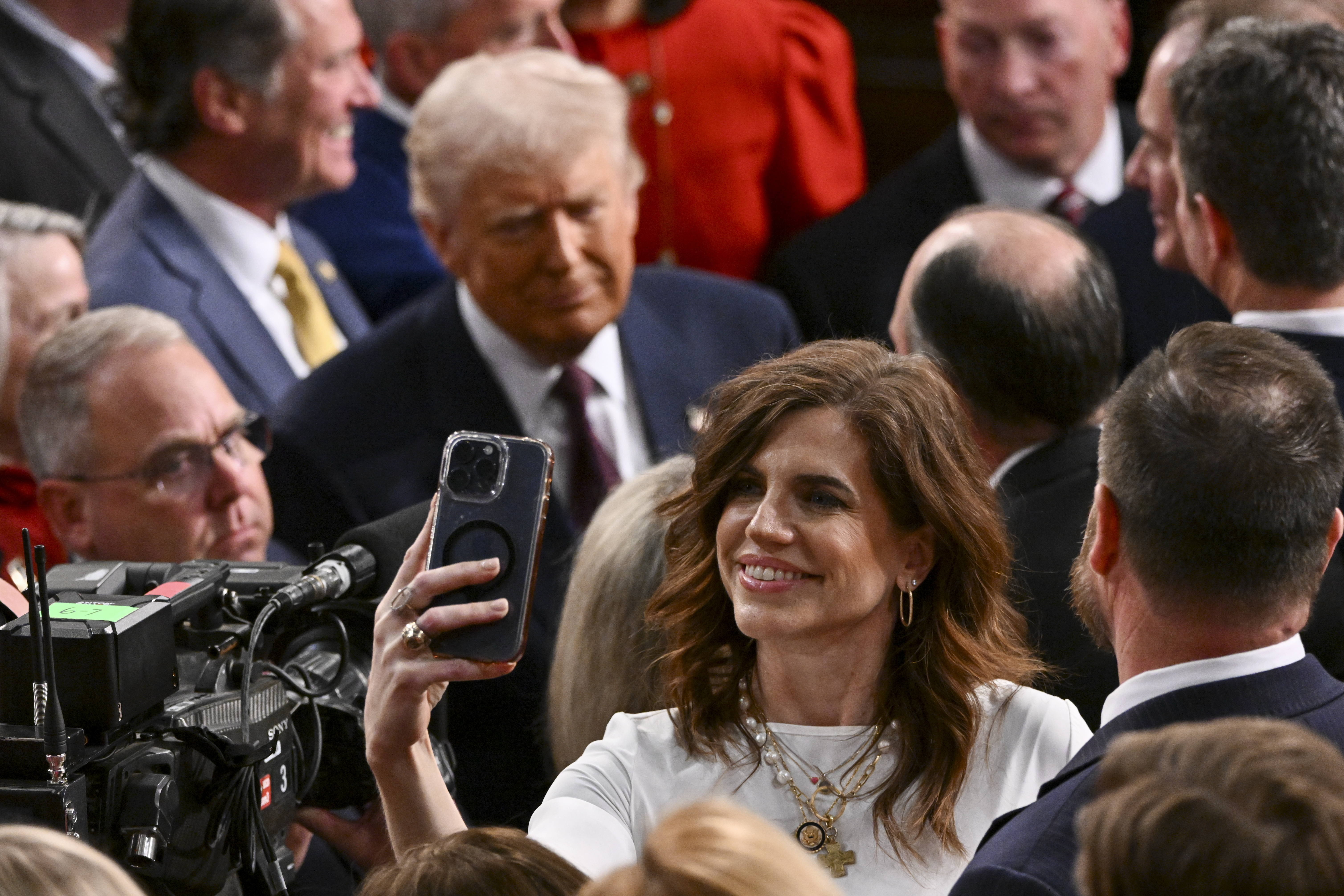
    Rep. Nancy Mace (R., S.C.) takes a selfie as President Donald Trump leaves the chamber after addressing a joint session of Congress on March 4, 2025. Ricky Carioti

    Her relationship with President Donald Trump was similarly mercurial. She distanced herself from him soon after taking office, survived his attempt to oust her in 2022, rebranded herself as a MAGA warrior, defied Trump on the Epstein files and sought his endorsement in the governor’s race, only to watch him back a rival. No high-profile Republican endorsed her campaign.

    The spectacle of Mace’s transformation often unfolded on the cameras she gravitated toward in television interviews, selfie videos posted on social media and dramatic exchanges in committee hearings. Her public appearances grew increasingly combative and bizarre.

    “The only thing I hope is she gets the help she needs,” former Republican House speaker Kevin McCarthy told the Washington Post, saying he watched as her “political and personal life unraveled” in recent years.

    Mace, whom McCarthy had helped to unseat Democrat Joe Cunningham in 2020, cast an unexpected vote for his ouster as speaker in 2023, joining right-wing hard-liners and Democrats as she abruptly turned on him. She later walked around the Capitol wearing a large scarlet “A” on her shirt, because she said she had been “demonized” for that vote.

    “I helped her win. But I just watched her change along the way,” said McCarthy, who supported an unsuccessful primary challenge to Mace in 2024. “Some people warned when she was an early candidate, ‘Watch out, she’s not all there.’ I didn’t.”

    Former staff said Mace embraced stories about her being a “caucus of one” on a “lonely political island.”

    Mace and her campaign did not return requests for comment. She previously accused her former staff of mismanaging money and spying on her, and has dismissed criticism that she is overly focused on getting attention.

    “I will always be grateful for the people of South Carolina who trusted me, fought with me, and refused to look the other way,” Mace posted on social media after her loss Tuesday evening. “This isn’t the end of the fight. It’s just the end of this chapter.”

    Public outbursts

    Mace raised eyebrows in Washington year after year for drawing attention to herself, such as wearing an arm sling after accusing a foster care activist of “trans violence” during a handshake — having him arrested on assault charges only for prosecutors to drop the case. Her behavior in the months preceding her gubernatorial run became even more confounding to those observing it.

    In the throes of her split from her ex-fiancé, Mace in February 2025 spoke on the House floor for nearly an hour, accusing him and three other men of rape and other sex crimes, which the men denied. During a congressional hearing on surveillance months later, she showed a “naked silhouette” photo of herself, saying it was taken without her consent.

    In April 2025, Mace posted a video she took at a makeup store where she repeatedly cursed out a constituent who asked when she planned to host her next town hall.

    A week and a half later, Mace confronted her nephew John Mace McGrath as he sat next to local elected officials during Vice President JD Vance‘s visit to a steel plant in Huger, S.C. She stood over him and pointed her finger in his face as she upbraided him for accepting an endorsement in a local party chairman race from state Attorney General Alan Wilson, whom she had also criticized during her lengthy House floor speech and would later run against her for governor.

    “You f— up taking Alan’s endorsement, and you’re going to pay for that someday,” Mace said to the 26-year-old, according to two people who witnessed the May 1, 2025, scene, which has not previously been reported. The people spoke on the condition of anonymity, saying they did not want to attract any additional wrath from Mace.

    After conceding Tuesday, Mace endorsed Wilson in the gubernatorial runoff, despite repeatedly accusing him in the last year of being a “pedophile protector.”

    The highest-profile eruption took place in October, when officials at Charleston airport reported that Mace had berated airport staff and police after a misunderstanding about her security escort preferences. A police report of the encounter described an expletive-laced tirade where she called airport police “f— incompetent.”

    Mace is seen speaking with an officer during the confrontation at the Charleston International Airport.

    Dozens of local elected officials in her district signed a letter condemning her behavior, and the state’s Republican senators, Tim Scott and Lindsey Graham, criticized her actions. Mace refused to apologize, threatening to sue the airport for defamation and claiming the incident report had been “fabricated.”

    “People can say she’s crazy, but they’re still talking about her,” said Austin McCubbin, Mace’s former political adviser who resigned in December after disagreements about campaign decisions and compensation. “It’s kind of one of those things where just so long as you spell my name correctly, that’s all that matters.”

    Shifting political persona

    Days after the former state lawmaker entered Congress, Mace criticized Trump in the aftermath of the Jan. 6, 2021, attack on the Capitol, saying she did not believe he had a future in the Republican Party.

    As the insurrection unfolded, Mace told aides she wanted to go out and get punched by rioters “so she could get on TV,” Natalie Johnson, her communications director at the time, told the Post. But Mace months later decided to pare back criticisms of Trump after a poll she commissioned showed they were unpopular in her district, Johnson said.

    “I don’t know of anybody who puts their finger in the wind and tries to see which way it’s blowing more than Nancy Mace,” said Justin Evans, a longtime GOP political operative in the state who supported her state House run and now works for Pam Evette, the Trump-endorsed candidate who placed first in Tuesday’s gubernatorial primary. “She was a good-looking, talented communicator, had the social media following, had all the ingredients that a successful candidate should have. It’s just her moral compass was completely missing.”

    Mace walks with a dog through Statuary Hall near the House chamber on July 5. Tom Brenner

    Soon after entering office, Mace had shown herself to be a powerful force in politics who told a compelling backstory. A rape survivor at 16 and high school dropout who once worked as a Waffle House waitress, she became the first woman to graduate from The Citadel.

    CJ Westfall, chairman of the Dorchester County Republican Party who worked on Mace’s 2022 general election campaign, described her as inspiring and hardworking. He credited her win that year to Republicans believing she was an “independent voice,” despite Trump’s opposition.

    Since then, Westfall said her penchant for drama became clear and described her as a “crybully” who liked to provoke controversy and then “play the victim” when someone pushed back.

    After her defeat, Mace said she challenged the powerful even if it cost her politically.

    “Every vote I cast, every hearing I called, every fight I picked — it was always for you,” she wrote in a social media post. “I’ve seen what happens when good people stay quiet. And I’ve seen what happens when they don’t. I would choose the latter every single time.”

    Strained alliances in Congress

    Soon after Mace’s vote to oust McCarthy in fall 2023, Rep. Don Bacon (R., Neb.) greeted several of Mace’s congressional staff eating lunch at the Rayburn cafeteria and asked who they worked for.

    “I used to really like her,” Bacon replied. “Not anymore. We can’t work with her.”

    He told the Post he got along with her during her early time in the House, but her vote to push the speaker out “was a tough pill for many of us to swallow.”

    At times, Mace allied with liberal Democrats including Reps. Ro Khanna of California and Jamie Raskin of Maryland.

    “She would interact with Democrats in a way very few Republicans do, because she has sided with victims of sexual violence and sexual harassment,” Raskin said. “A lot of the people on the GOP side want to quickly brush those subjects under the rug, and Nancy, in her more freethinking, uninhibited moments, is willing to side with Democrats.”

    Mace and Khanna, who had founded a joint caucus focusing on affordable child care, largely stopped their joint appearances after Mace fixated on transgender people. Mace introduced a resolution to ban transgender women from using women’s restrooms in the Capitol, in response to the 2024 election of Rep. Sarah McBride (D., Del.) as the first openly transgender member.

    Mace, however, signed on to a successful petition last year by Khanna and Rep. Thomas Massie (R., Ky.) to release federal investigation files related to convicted sex offender Jeffrey Epstein.

    She said she wanted justice for Epstein’s victims, even though Trump initially opposed the release of the files. But Mace’s decision surprised her own dwindling team of aides because she was bent on getting the president’s endorsement for her gubernatorial run.

    Wooing Trump

    A few days before Mace announced her run for governor in August 2025, she tried calling Trump to give him a heads-up. She left a voicemail for the president, who later texted her with well wishes, according to a person familiar with their communication who spoke on the condition of anonymity to discuss private conversations. But Mace panicked when Trump also passed along two polls that showed her struggling in a hypothetical race. Mace commissioned her own poll days later that showed her leading the field and with the highest name recognition.

    Mace sent the poll to the president, who then posted it to Truth Social that month without comment — which political operatives said lent credibility to her nascent campaign.

    In the final days of the race, Mace repeatedly said her support for releasing the Epstein files was the reason Trump did not endorse her. The president did not publicly criticize her for supporting the effort.

    Mace’s congressional office frequently shed staff, some of whom she forced out, while others resigned citing difficult work conditions. At one point, in a three-month span after her McCarthy vote, her entire nine-member staff had turned over.

    Mace during a staff meeting at her congressional office on April 25, 2023.Ricky Carioti

    Mace also struggled to maintain political allies. She spoke of her love for former governor Nikki Haley, who backed Mace in the difficult 2022 reelection primary. But Mace went silent the next year when Haley sought her endorsement in her 2024 presidential run, and proceeded to blast Haley while campaigning for Trump.

    “I don’t think Nancy Mace has ever seen a bridge in her life that she hasn’t burned down,” said Will Hampson, one of her former communications directors.

    Hampson said his former boss was self aware that she was on an island. But he’s not sure if she recognizes she put herself there.

    “She was her own best weapon,” he said, “and own worst enemy.”

  • The mysterious fight that partially blinded America’s ‘most strenuous’ president

    The mysterious fight that partially blinded America’s ‘most strenuous’ president

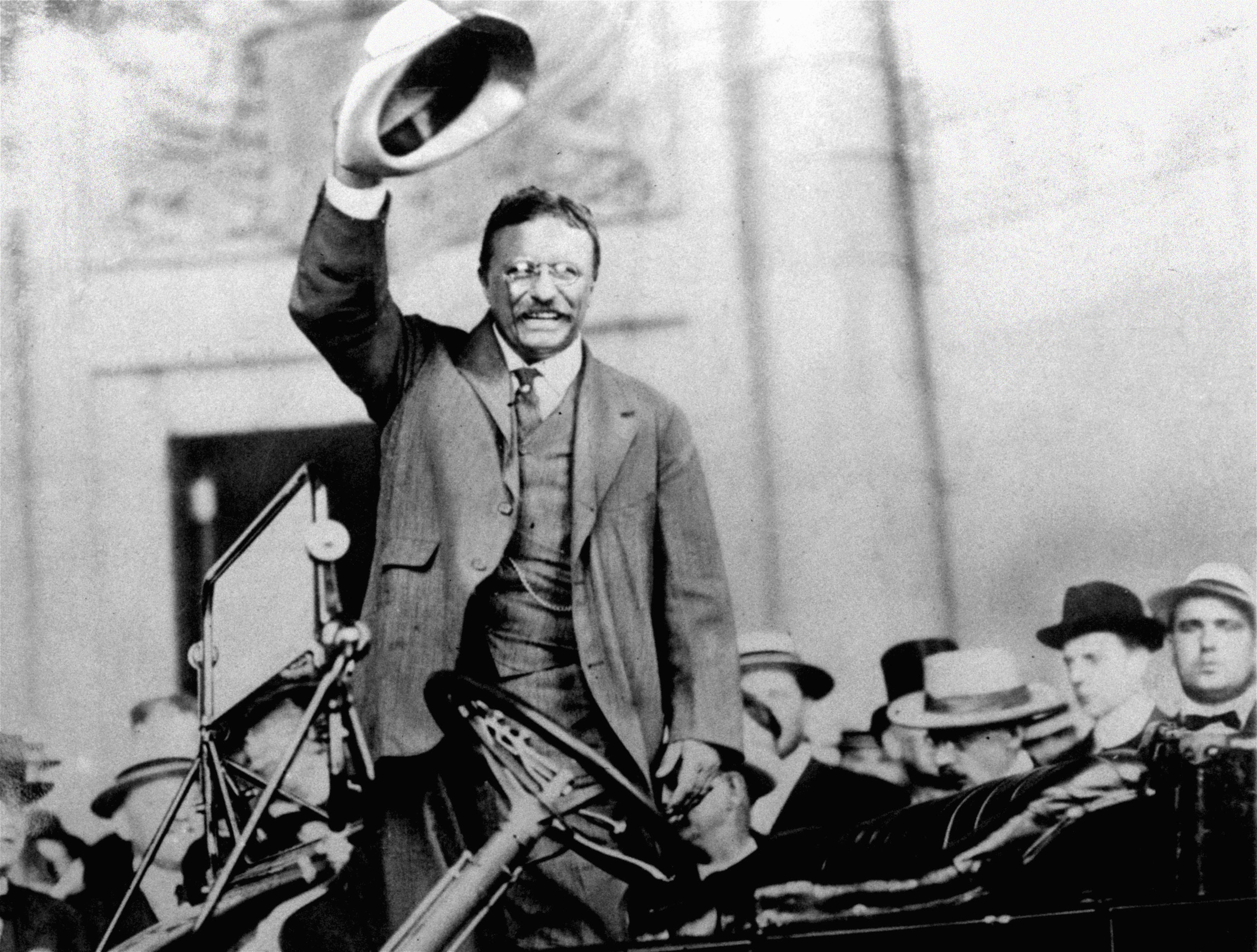
    For most of Theodore Roosevelt’s presidency, he kept a secret. He was partially blind in his left eye.

    It was only when he was out of office that he revealed the injury and how it came about: During a boxing match. In the White House.

    Today, the White House plans to host UFC Freedom 250, as part of the celebrations honoring the semiquincentennial anniversary of American independence. Fourteen fighters will pound each other in seven separate bouts in a 5,000-seat arena that has been erected on the South Lawn.

    Democratic lawmakers have widely criticized the planned event. A new lawsuit filed last weekend by the anti-corruption group Public Integrity Project on behalf of two plaintiffs is attempting to stop the event, claiming the plan is “deeply corrupt” and enriches President Donald Trump’s allies.

    It will not be the first time the White House has served as a fighting arena. Last time, it was set against the backdrop of a presidency also marked by controversy over razing sections of the executive mansion.

    During his roughly 7½ years in office, Roosevelt frequently invited aides, friends, and even professional athletes to the executive mansion to engage in all manner of sportsmanlike battery and barbarity. He was also frequently injured during these sporting matches.

    But the damage to his left eye is believed to have occurred while boxing one of his military aides.

    According to a 96-year-old letter sent from renowned ophthalmologist William H. Wilmer to Roosevelt’s biographer, Henry F. Pringle, Roosevelt was seen by Wilmer for the eye injury on Dec. 12, 1904. A transcript of Wilmer’s original letter, found in a Harvard University archive, details the approximate timing and extent of Roosevelt’s injury.

    “At that time the President gave a history of having noticed for a while a dimness before the left eye after wrestling, and the further history that about two weeks ago, he was struck in the left eye while boxing,” the letter reads. “Since that time, he had noticed black spots before the eye. At first it seemed rather central and blurred the vision, but, now, it seems to have moved about two inches to the left … Examination at the time showed a few spots of hemorrhage in the retina of the left eye and some floating opacities in the vitreous.”

    Roosevelt was told to take a break from “his very vigorous exercises” or else he might completely lose vision in the eye, according to the letter. The president protested, however, because he had already scheduled a jiu-jitsu match for 8 a.m., boxing at noon, a sport called “singlestick” involving wooden swords after that, then a long walk or horse ride in the afternoon. The doctor ultimately prevailed, and Roosevelt took his rest.

    While Wilmer claims that the hemorrhage in Roosevelt’s eye healed, he later developed a cataract “reducing vision in the left eye to perception of light” — perhaps a result of the injury, Wilmer wrote.

    Only a handful of people learned about Roosevelt’s medical condition at the time. The truth did not become public knowledge until October of 1917, after Roosevelt quietly checked himself in at a health camp in Stamford, Conn.

    By that point it had been over eight years since the end of his presidency, but it wasn’t long before reporters discovered him. “The colonel is what is technically described as a ‘patient,’” reported the Springfield Daily News. “There is absolutely nothing the matter with him, except the extent of his girth.” In more polite terms, Roosevelt was there to lose some weight.

    During his two terms as commander in chief, Roosevelt had dazzled the country with his relentless exercise regime. But at 58, after years of political setbacks, America’s “most strenuous citizen” — as he was playfully called in the press — was feeling depleted and bloated.

    Historian Michael Cullinane, co-director of the Theodore Roosevelt Center, said that Roosevelt was stuck at home on the political sidelines during World War I. “He’s writing ferociously for journals and magazines about the war, and he’s very sedentary,” Cullinane said. “And so, what he realizes is that, if he doesn’t look after himself, he’s liable to have a heart attack or some weight-related illness.”

    The health camp offered a rapid weight-loss program. And by the end, Roosevelt had lost 14 pounds, slimming down to 215. He gathered a group of reporters to witness the results. It was there, reminiscing about the glory years of his exercise routine, that he revealed the bombshell.

    “The last boxing I did was in Washington. I boxed with my aides most of the time, but one day a young captain of artillery came along and broke some blood vessels in my left eye. I have never been able to see out of it since, although I don’t believe many people knew it.”

    When pressed for more details by reporters, Roosevelt refused. “There is to be nothing more to say about the matter,” he said.

    The mystery captivated newspapers. “Who hit the Colonel in the eye?” asked the Philadelphia Inquirer. There was no shortage of suspects. Roosevelt made it a regular habit of boxing with all sorts of White House visitors during his presidency.

    “Every day, he built into his routine, some amount of exercise. And the people who exercise with him wound up being the ones who then had access to power,” Cullinane said.

    Reporters scrambled to discover the identity of “the young captain of artillery” who had delivered the fateful blow. Within days they had uncovered their suspect: Col. Dan T. Moore, a cousin of the first lady Edith Roosevelt.

    “I was one of the military aides at the White House in 1904 and 1905,” Moore confessed to the Evening Star. “The colonel and I boxed four or five times a week, I guess.”

    Roosevelt’s injury had been such a secret, it had even been kept from Moore.

    “I never knew the colonel had lost the sight of one eye in a glove bout until I read that interview the other day,” Moore told the Evening Star. “And I certainly do hate to think I was responsible for it.”

    Cullinane said it was kept secret to protect Roosevelt’s modesty. “I mean, health issues, it’s no different now as then,” he said.

    Roosevelt didn’t seem to have any hard feelings, which Cullinane credits to his sportsmanship. But this also wasn’t a fluke. Roosevelt was constantly getting himself injured as president. According to newspapers, he had almost had the same eye poked out the year prior, in fact, while fencing at the White House.

    The rapier of his sparing partner, Gen. Leonard Wood, thrust through Roosevelt’s mask, narrowly missing his eye and leaving a serious bruise on his forehead. Then, just a week later, Roosevelt’s right wrist was severely injured in a singlestick match, again against Wood. “Such a collection of scars as that borne by President Roosevelt was never owned by an American Chief Executive before. He is the ‘most wounded’ President of the United States,” the Boston Post declared.

    One mystery surrounding the injury to Roosevelt’s eye is pinpointing where the match occurred on the White House grounds. While newspaper accounts refer to a “gymnasium,” the White House Historical Association, which tracks these sorts of things, has no record of such a designated facility existing in 1904.

    The White House underwent a massive renovation during Roosevelt’s tenure. After a century of different presidents and first ladies redecorating random rooms, the Roosevelts decided the whole house needed an overhaul.

    “The decor was like a mix of like a Gilded Age, Victorian hotel, and steamboat gothic,” said Matthew Costello, chief education officer at the White House Historical Association. “When you see the photographs post-1902 renovation, I would argue, you see a White House that is much more recognizable to us today.”

    Both the West Wing and East Wing were built during Roosevelt’s renovation, and many of the mansion’s iconic spaces were transformed. Not everyone was happy, though.

    Among the most unpopular parts in the renovation plan: tearing down the enormous 45-year-old greenhouses on the west side of the mansion to make room for the new West Wing and turning the East Room into a state dining room, which would also function as a “handsome ballroom,” according to the Marion Star.

    “Criticism of all these alterations are frequent and various,” wrote the Chattanooga News. “Many shake their heads, as though something were ‘rotten in the state,’ and mournfully talk of the desecration of the old mansion where Jefferson, Madison … and all the other noble executive chiefs were wont to keep ward over the nation’s destinies as they sat in stately communion.”

    But Roosevelt’s “desecration” of the White House didn’t stop there. The venerated Cabinet Room, where for decades former presidents like Ulysses S. Grant had consulted with their top advisers, was rumored to have been converted into Roosevelt’s “department of physical culture.”

    After the renovations were complete, Roosevelt was leading a group of guests on a tour of the second floor, taking pains to point out everything he had kept intact, when they arrived at the old Cabinet Room. “When the door was opened, ‘Presto change!’” the St. Louis Globe-Democrat reported: “All the guests rubbed their eyes. Before them were floor mats, shields, boxing gloves, wire masks, fencing gloves, padded vests, swords and foils, single sticks and other athletic paraphernalia.”

    An unnamed White House official dismissed the rumor in the Times Herald. “It all depends on what you think is necessary to make up a gymnasium,” the official said. “If you require trapezes, and parallel bars, and flying rings, and all sorts of apparatus for exercising the muscles you would never be satisfied with the old Cabinet room for that purpose; for those things are not there. But if the President wants to singlestick there, I suppose he can find room enough, just as in any other of the rooms in the house.”

    He might have injured his eye in that room — or not. According to historical accounts, it would appear Roosevelt was fighting all over the White House. There are stories of him wrestling and fencing in the basement, practicing jiu-jitsu in the library and boxing in the attic. The whole house served as his gymnasium.

    Last month, the White House began erecting the UFC “octagon” fighting arena on the South Lawn.

    Every president makes the White House their own to some extent. While the White House has long been a sacred symbol of American democracy, it is also a private home, and the history of the mansion is filled with these personal touches from past presidents, some more controversial than others, Costello said.

    “There’s been tree houses, jungle gyms, swing sets, victory gardens, tennis courts, basketball courts, swimming pools, putting greens, Hoover ball — that was a big popular game during Herbert Hoover’s presidency,” he said. “But to the best of my knowledge, no octagons.”

  • 3 ways GLP-1 drugs could be getting better

    3 ways GLP-1 drugs could be getting better

    The enormous popularity of new weight-loss drugs often eclipses the downsides: the burden of weekly injections, rough gastrointestinal side effects, muscle and bone loss.

    That is shaping a race among drug manufacturers vying to roll out better options.

    Eli Lilly, which makes Zepbound and Mounjaro, and Novo Nordisk, which makes Ozempic and Wegovy, have the vast market for branded drugs to themselves and are steadily reaping billions of dollars. But pharmaceutical giants Pfizer, Roche, Boehringer Ingelheim, and Amgen are among competitors planning to bring improved drugs to the market.

    Simply touting an eye-popping weight-loss number, such as Zepbound’s 21% body-weight reduction, won’t be enough, drug company executives and researchers said. It’s not just how much weight you lose but how you get there. Companies recently touted their progress on the next generation of drugs at the American Diabetes Association conference.

    The goal is to make it more likely people will stay on the drugs and avoid an obesity rebound.

    “Lowering the weight alone is the beginning. Quality of weight loss is important,” said James List, Pfizer’s chief internal medicine officer.

    Reducing shots

    Pfizer is testing a monthly injection GLP-1 drug to improve a patient’s experience by reducing the number of shots someone needs per year from the current 52 weekly (with existing drugs) to as few as 13 (which includes a ramp-up dose). That will eliminate a barrier for patients who find it unpleasant to regularly jab themselves in the abdomen, thigh, or arm.

    Pfizer plans to test its GLP-1 drug in more than 20 trials during 2026, including combining it with amylin, a natural hormone, in a bid to boost its weight-loss effects and reduce side effects. Although it would be entering the marketplace late, the company sees plenty of room to develop weight-loss products that are distinct from the current crop.

    “The differentiation has to be clinically meaningful, and it has to fill a gap, and we think there are tons of gaps right now,” List said.

    Amgen is testing a GLP-1 drug in combination with a monoclonal antibody that it says could reduce injections to four to six times a year.

    “Weight loss is incredibly important, but on top of that is living long-term with this disease and finding easy ways for patients to maintain their weight,” said Susan Sweeney, Amgen’s executive vice president for obesity.

    GLP-1s have revolutionized obesity care in just a few years. First rolled out to treat diabetes, they mimic a natural gut hormone that makes a person feel full, reducing appetite. They also are showing benefits for cardiovascular health, inflammatory diseases, and even cancer.

    But getting people to stay on the drugs has been difficult. About 50% of people who start a GLP-1 stop taking it within a year, putting themselves at risk of regaining their weight. That relates in part to cost, because many insurers still don’t cover the drugs. But poor adherence also is associated with the inconvenience of shots, as well as serious side effects such as nausea, diarrhea, and constipation.

    Novo Nordisk and Eli Lilly have already introduced daily tablets to make dosing easier.

    Sidelining side effects

    To reduce side effects, companies are tinkering with dosing strategies, starting with a smaller dose to reduce the impact of a sudden change to gut chemistry and then increasing it over time as a patient’s body adapts.

    But an even better option for reducing side effects may be emerging in the form of amylin, another natural hormone that is produced in the pancreas.

    Genentech, which is part of Roche, is among multiple companies ― including Eli Lilly and Novo Nordisk ― developing amylin weight-loss drugs as part of the effort to reduce gastrointestinal side effects. This year, Genentech expects to begin human trials testing it in a combination injection with its GLP-1.

    The amylin does not slow down stomach-emptying like GLP-1, which in turn reduces nausea symptoms, said Manu Chakravarthy, a senior vice president at Roche-Genentech. Avoiding that stomach slowdown may ease other gastrointestinal side effects, as well, he said.

    “It gives you a feeling of satiation ― satisfaction with your meal. It doesn’t give you an aversion to eating your meal,” he said. “It’s a subtle but very important difference.”

    Eli Lilly and Novo Nordisk, working to protect their dominance, are both working on amylin drugs. Novo Nordisk applied in December for Food and Drug Administration approval of a GLP-1 drug that combines it with amylin.

    Saving muscle

    Protecting muscle while targeting fat more precisely is another key priority.

    That will be especially important after Medicare, government health insurance for the elderly and disabled, starts covering the drugs in July. Loss of muscle naturally accelerates in people over 60.

    Boehringer Ingelheim released phase 3 clinical trial results last week that showed patients on its experimental GLP-1 drug — which combines it with glucagon, a naturally occurring hormone that regulates blood sugar — lost an average of 16.6% of their body weight over the 72-week trial period.

    Of the weight lost, 10.8% was lean mass, including muscle. That would indicate better preservation of lean mass than current offerings, which have been shown to cause losses in the range of 25 to 40%. The result indicated that “weight loss was primarily driven by reductions in fat mass,” the company said. At the highest dose, however, 20% of patients stopped taking the drug due to side effects.

    Neerja Balachander, Boehringer Ingelheim’s vice president of U.S. clinical development, said a key finding was that 34% of the weight loss was “visceral” fat, which is in the abdomen and can damage organs. Additionally, liver fat was reduced to normal levels in 6 out of 10 patients who had metabolic fatty liver disease.

    These are the types of findings that patients and doctors will need to sift through as the next wave of drugs is approved in coming years.

    “We continue to believe this is going to be a big tent,” Balachander said.

  • As war reshaped the World Cup, Iran’s team found an unlikely home in Mexico

    As war reshaped the World Cup, Iran’s team found an unlikely home in Mexico

    TIJUANA, Mexico — The three SUVs pulled into the gas station parking lot, one after the other, Iranian flags taped onto the hoods and fluttering from the windows.

    It was barely 4 a.m. The city’s nightclubs were closing, and the streets were dark. But this caravan had hatched a plan to stake out a national soccer team they never imagined they would see in person, and especially not here. So 4 a.m. at the gas station it was.

    Like so many in Tijuana, the Iranian national soccer team was never supposed to end up here. They originally had planned to spend the month across the border, in Tucson, preparing to play their World Cup matches in Los Angeles and Seattle.

    But for the first time in World Cup history, a host country is at war with one of the tournament’s contenders. FIFA, global soccer’s governing body, with tensions high and uncertainty about whether the team would even be allowed into the U.S., sought an alternative.

    Co-host Mexico agreed to house them, with President Claudia Sheinbaum telling reporters that FIFA had asked for help because the “United States does not want the Iranian team staying overnight in the country.” Organizers opted for Tijuana, a border city close enough to the U.S. matches, with a stadium where the team could practice and a local government eager to welcome them.

    The fans meet outside a convenience store at 4 a.m. in Tijuana. Stuart Palley

    Now Sadegh Galavi and his relatives were piled into these SUVs, hoping to welcome their national team to the city that adopted his family. They knew what the world thinks of Tijuana, the dangerous, gritty border city from the movies, a hub for drug smugglers, and a cheap destination for Americans seeking parties and sex.

    But they knew Tijuana as something different: a transient, multicultural city that embraces migrants and misfits, offering creole schools for Haitian children whose families are stranded there, and welcoming Sadegh and his wife four years ago when they knew no Spanish and not much more English.

    It was just the place for a global soccer tournament, they thought, an unlikely but ideal refuge for their home team.

    Sadegh and his friends spent the past two weeks working to convince the Iranian Embassy and team that Tijuana is safe. Now the team was minutes away from landing at Tijuana International Airport.

    He had slept barely an hour, anxiously tracking the team’s flight, worried he might miss his chance to greet them. The jerseys ordered on Amazon hadn’t arrived on time, but the Iranian Embassy sent replacements at the last minute. The ambassador asked Sadegh’s wife, Maryam Asidi, to take photos and videos of the fans at the airport, to show Iranians back home that Tijuana isn’t as dangerous as they might fear.

    “Hi brother, yes, please,” Sadegh said, answering his phone as he pulled into the airport. Military and police forces surrounded the airport’s entrances. The players must be landing soon, he thought.

    He pulled over, hopped out of the car and power-walked toward the flight arrivals, waving his small Iranian flag.

    Maryam and Sadegh Galavi pose at Tijuana International Airport on Sunday, while waiting for the arrival of the Iranian men’s soccer team. Stuart Palley

    A divisive team

    Known affectionately as Team Melli, Iran’s national team was near-universally loved in Iran for decades.

    “There was absolute mania around Team Melli,” said Arash Azizi, an Iranian author and historian who recalled celebrations breaking out in the streets in Iran after the team qualified for the 1998 World Cup. “It was one of the most trusted, beloved institutions in Iran across political differences,” he said.

    But after years of government mismanagement and repeated, brutal crackdowns on civilian protesters, many Iranians began to see even their national soccer team as an extension of the country’s leadership.

    During the 2022 World Cup, in Qatar, Iran was engulfed by nationwide “Women, Life, Freedom” protests, and its men’s national team faced criticism for not vocally supporting the protesters. The team stood silently during Iran’s national anthem, but some fans were unsatisfied. Social media videos showed Iranians honking horns and setting off fireworks after their team’s 1-0 loss to the United States, which they viewed as a symbolic defeat for the regime.

    Then, this March, the Iranian women’s team came under criticism from pro-government media outlets for standing silently during the national anthem, after reports that Iranian security forces had killed thousands of people in a violent January crackdown on protests.

    Australia granted six players and a staff member humanitarian visas, citing concerns they would be persecuted for failing to sing along. Eventually, five of the team members withdrew their claims and were welcomed back to Iran with an elaborate ceremony.

    Then came the war, which threw the men’s team’s season into chaos. Most play in domestic Iranian leagues whose games were suspended Feb. 28. A friendly, scheduled to be played in Arizona, was canceled. President Donald Trump, in a Truth Social post, said the Iranian team was “welcome” to play in the World Cup but advised them against it “for their own life and safety.”

    Just days before the team was scheduled to travel to Mexico, it still hadn’t received its U.S. visas. Earlier this month, the players learned their visas had been approved, but visa applications for 15 members of the team’s support staff had been rejected.

    In an interview with the Washington Post in Tijuana, Iran’s ambassador to Mexico said the 15 people included trainers, managers, a media director, a security leader and a delegate from the Foreign Ministry. He accused the United States of failing to follow FIFA rules.

    On Tuesday, Iran’s soccer federation said the ticket allocation for Iranian fans had been revoked, in an “unexpected move.” FIFA requires that participating federations be allocated 8% of ticket capacity, so fans can purchase entry to their team’s games.

    “From my perspective, politics needs to be separate from sports,” Abolfazl Pasandideh, the Iranian ambassador, said through his translator in Tijuana. “And if in this case they want to mix the two, it has to be the other way around. Politics must be at the service of sports.”

    But to some in Tijuana’s small Iranian community — the ambassador puts it at 20 or so, in a city of over 2 million people — politics are inherent to Iranian soccer.

    Iranian Pedram Maymand, a Tijuana resident, in the city’s center on Sunday.Stuart Palley

    “For the team to come here while the country is grieving … I don’t think that celebrating the football team right now is appropriate,” said Pedram Maymand, 31, who moved to Tijuana from Fresno, Calif., when his student visa expired after graduation about five years ago. “They’re representing the government that is killing our people.”

    If he could meet the players, he would want to send them a message, he said: “Have you any shame?”

    Sadegh understands the complex feelings. But to him, Team Melli is still a symbol of national pride, of a country he chose to leave but that remains a core part of who he is.

    People walk near the Tijuana Friendship Arch. Stuart Palley

    How Tijuana became home

    Sadegh’s family’s path to Tijuana, like the stories of many in this city, began with a romance across borders and cultures.

    About 50 years ago, Maryam said, her father visited San Diego as part of the Iranian military. He fell in love with a Mexican woman, who eventually gave birth to their son.

    Maryam grew up hearing about the half brother she had never met, who lived in the faraway city of Tijuana. But she didn’t believe the story until her half brother came to visit Iran for the first time when he was in his 20s, and she was 13.

    Many years later, after marrying Sadegh, Maryam decided to visit her brother’s city, not knowing anything about Tijuana’s reputation. Within two weeks, they had decided to stay.

    “Here, you never feel you are from another country,” Maryam said. “This country makes you feel good. … And as a woman, you are more free.”

    She shed her hijab, a head covering that is mandatory for women in Iran. Within weeks of leaving the Islamic republic, where drinking is banned, Sadegh tried mezcal for the first time. The music coursing through Tijuana’s streets on Friday and Saturday nights made Maryam feel alive.

    Maryam and Sedagh Galavi at their home in Tijuana. Stuart Palley

    They longed for their family and for home, but they soon began finding the other Iranians. One day Sadegh saw a car parked on the side of a road with vanity plates: “Tehran.” He left a note on the windshield with his phone number; the car‘s owner is now his friend and boss, at a car-restoration business in town.

    Sadegh and Maryam gave birth to a Mexican son, Sepehr, whose middle name, Mayahuel, was a reference to an Aztec god. “We want him to feel he’s from here,” Maryam said.

    When her mother died unexpectedly of a heart attack last year, Maryam fell into a deep depression and returned to Iran for a long visit with her 9-month-old son. The trip coincided with the U.S.-backed Israeli attacks on Iran, and she had to flee the country by land. As soon as she landed back in Mexico, she was moved by the strangers who offered to help carry her suitcase.

    She worried her grief would taint the city for her. Instead, Tijuana pulled her out of it. This was the place where she wanted to raise her son, she decided. The couple bought a house in Tijuana and began applying for Mexican citizenship.

    Then, with the World Cup on the horizon and the war raging, rumors started circulating: Their country’s team needed a home.

    People exit the Tijuana Cultural Center this week. Stuart Palley

    ‘I am in my country’

    Late last month, FIFA announced the team was heading to Tijuana.

    Sadegh could hardly believe it. When Iranian news outlets raised concerns about security, he began messaging the players directly on Instagram to tell them about the city he loves and assure them they would be safe. He knew he would never get a response but kept typing anyway.

    His boss and friend, Dara Makoipour, met with the Iranian ambassador and showed him around the city — to the stadium, to the restaurant known as the origin of the Caesar salad. Local tourism and Chamber of Commerce officials were eager to use this as a chance to change Tijuana’s reputation and put it on a global stage.

    Sadegh started a WhatsApp group with his small circle of Iranian and Iranian Mexican family and friends in Tijuana, and they came up with a plan to welcome them at the airport for their 1:30 a.m. arrival. When the flight was delayed to 5 a.m., some in the group pulled out.

    But his small family caravan had powered through, and now they were gathered in international arrivals, surrounded by heavily armed Mexican national guard troops, trying to scope out where they might be able to catch the team.

    They walked around a security roadblock to a group of reporters and a handful of other fans from across the San Diego area.

    Suddenly the team bus approached with a military escort. The small crowd cheered, raising their flags and chanting the name of one of the players. A team representative briefly rolled down the window and waved straight toward Sadegh.

    “Merci,” the Iranian representative said with a smile.

    The Iranian team’s bus departs a secure area of the Tijuana airport.Stuart Palley

    Sadegh, his heart racing, accidentally spoke to them in English, calling out, “welcome!” He had forgotten he could speak to them in Farsi.

    “Bienvenidos!” his Mexican relatives shouted.

    Reporters surrounded the couple to ask them how they felt. Maryam beamed.

    “I think now I am in my country,” she said.

    The team later circulated a photo, taken from the bus on their arrival that morning, of Sadegh waving his flag. He proudly shared it on Instagram, writing in English and Farsi that “the Iranian national team belongs to all Iranians,” regardless of their beliefs, religion or political stance.

    “Welcome to Tijuana,” he wrote.