Category: Washington Post

  • Americans are destroying license-plate cameras as surveillance backlash grows

    Americans are destroying license-plate cameras as surveillance backlash grows

    Adam Heimerman kept seeing the surveillance cameras on his way to work as a river guide in East Tennessee, and the sight rankled him.

    More than 130,000 of the automatic license-plate readers now dot the country, according to the crowdsourced tracker DeFlock.org. The artificial intelligence-assisted devices have been embraced by law enforcement as powerful investigative tools but widely denounced by the public over privacy concerns.

    For Heimerman, who’s 37 and running as an independent candidate for Congress, the cameras were one more sign that the United States was becoming a police state, he said in an interview. Then in July, the Blount County Sheriff’s Office alleges, Heimerman shot four of the cameras — including one near a church where worshipers sat inside.

    Heimerman declined to discuss specifics of his case, but he said he believes there’s widespread frustration over local governments that keep using the cameras despite community pushback. That has fueled a wave of recent vandalism across the country, he said.

    “When people act out in a manner that we’re witnessing, things have gotten bad and they no longer feel like they’re being heard,” Heimerman said. “People are tired of being told to sit down and be quiet and write a letter.”

    “How-to” videos have spread online that demonstrate how to disable the cameras from collecting footage using wire cutters and heavy gloves. People from an array of backgrounds — college students, computer engineers, a U.S. Air Force engineer — have been accused of vandalizing the devices.

    Cameras were recently damaged in communities around Detroit. In Winona, Minn., all eight of the city’s readers were cut down and stolen.

    Flock Safety, one of the largest players in technological surveillance, is often the target of the ire. The company operates cameras in more than 6,000 communities across the country that record 20 billion plate scans a month. Critics concerned about the information the devices collect and store say the cameras aren’t just tracking license plates, but people’s personal movements as they visit places like gun ranges, doctor’s offices, or marijuana purveyors.

    That criticism cuts “across partisan lines,” said Eleni Manis, the research director of the Surveillance Technology Oversight Project, a nonprofit that fights government surveillance.

    “As Americans we drive where we want and when we want,” Manis said. “Tracking ruins that for all of us. And that’s partly why this has gotten under everyone’s skin.”

    Flock, which did not return requests for comment, has defended its product and said that it has been used to solve countless crimes, including helping to uncover the identity of the mass shooter at Brown University last year.

    But misuse is rampant, a Washington Post report this month found. Authorities have charged or accused at least 50 law-enforcement officers of using license-plate readers for unauthorized purposes, including to stalk their exes. U.S. Immigration and Customs Enforcement officers have also accessed Flock’s nationwide database through local partners to conduct immigration searches.

    Last week, the company announced it was enacting major changes to prevent abuse by law enforcement, including requiring officers to label searches with criminal case numbers and reducing the amount of days data is stored from 30 to seven.

    Community backlash against the cameras has been fierce, with 100 jurisdictions around the country pausing or canceling contracts in recent months, according to data compiled by DeFlock.org.

    Despite that, some have turned to vigilantism — spray painting the devices red, ramming their pole mounts with pickup trucks, and slapping on stickers to block the camera lenses.

    Online videos even suggest the tools one might need to rip down cameras or disrupt their feeds with green laser pointers.

    A number of prominent influencers have applauded the vandalism, including right-wing pundit Tucker Carlson.

    Rick Wilson, the co-founder of the anti-Trump Lincoln Project political action committee, recently described in detail on a podcast the kind of “cheap green laser pointer” that can easily be purchased online to interfere with devices.

    “There are a lot of tools for citizens to express their discomfort of these things that are knowable and available,” Wilson said in an interview. “I’m not suggesting that people break the law. I’m suggesting that you are not helpless against a surveillance state that does not have your best interests in mind.”

    Carlson has portrayed the vandals as grassroots heroes fighting back against government overreach.

    “It’s not drug-addicted kids,” Carlson said on his podcast recently. “It’s sober, decent patriot Americans who believe the promises of their country. Flock was not part of the country they signed up for. No one asked their permission to steal their images and to spy on their conversations. They don’t think that makes them safer. They understand that it’s to strip them of their most basic humanity.”

    Last month, when a 20-year-old from West Virginia was arrested and charged with defacing Flock cameras, a host of Facebook commenters rushed to his defense, offering fake alibis.

    “He was saving my neighbors dog from a fire all day couldn’t be him,” one Facebook user wrote.

    “That man is innocent,” wrote another. “I saw him serving at a soup kitchen at the time of the incident.”

    In that case and others, images of the alleged vandals were captured on the very cameras they sought to deface, a fact law enforcement has been quick to point out.

    In a February news release announcing destruction of property charges against a 24-year-old in Michigan, the Waterford Police department noted, “Ironically, Detectives discovered one of the [cameras] had captured an image of the vehicle and license plate driven by the suspect at the time the cameras were damaged.”

    “[No] one is entitled to maliciously destroy property of another, including that of the Waterford Police Department,” the statement said.

    Heimerman, the congressional candidate and lifelong East Tennessee resident, said he’s running to represent the state’s 2nd District because he is worried that the needs of ordinary citizens are getting lost amid rampant corporate greed. His Republican opponent, Rep. Tim Burchett, earlier this month introduced legislation to ban federal money from being spent on the cameras.

    Heimerman, who vaguely recalls voting for Barack Obama, said he has written his own name in for president on the ballot for decades. A GoFundMe organized for his legal defense has raised over $13,000.

    Heimerman says he’s grateful for the attention his case has received, hoping it means that people are “waking up” to the need to pay attention to what local government is doing, not just those at the federal level.

    “It kind of brings a highlight to how much a boiling point we are at,” he said. “People are fed up.”

  • Russians pull billions from banks, fearing Kremlin will seize deposits for war

    Russians pull billions from banks, fearing Kremlin will seize deposits for war

    Russians are pulling billions from the country’s banking system ― a record cash outflow amid intensifying Ukrainian drone attacks and rising fear that the Kremlin could start seizing deposits to finance its war.

    Nearly $3.4 billion (286.4 billion rubles) was withdrawn in the first two weeks of August, on top of the $7.3 billion withdrawn in July and more than $4.5 billion in June, according to Russian Central Bank data.

    Total withdrawals this year could nearly double the amount taken out in the first year of Russia’s full-scale invasion of Ukraine, according to Taras Skvortsov, a senior executive at Sberbank, Russia’s biggest retail financial institution.

    The withdrawals are causing liquidity problems, according to Skvortsov and a former senior Russian finance official, overstretching a financial sector already strained by increasing levels of bad debts following a government-directed lending boom to ramp up military output.

    “Drones are flying. Things are burning down. Nervousness is growing. And people’s everyday wisdom may be kicking in that they need to have cash under their pillow and not somewhere in banks where it may never be returned,” said the former finance official, who like others spoke on the condition of anonymity to discuss sensitive issues.

    “For some banks this really is a problem,” the former official said. “They didn’t expect this, and they invested all the cash elsewhere, and yet people are coming and taking out half a trillion rubles a month.”

    Alexandra Prokopenko, a former adviser to the Russian Central Bank, said the withdrawals reflected deepening fear among the Russian public.

    “It means people have no trust in the Russian banking system or in the Russian financial system,” Prokopenko said. “This is all a consequence of the fear that the government will do something with the banking system, that it could nationalize deposits.”

    She said she believed that such a nationalization was unlikely but added, “I would not exclude that the authorities could impose limits on withdrawals.”

    The total siphoned out this year already exceeds the $24.7 billion (2 trillion rubles) removed in the first year following the February 2022 invasion.

    In the first two weeks of the invasion, $23 billion fled the system, and banks appeared to be imperiled by depositors and businesses lining up to empty their accounts, until the government stemmed the drain by imposing tough capital controls and sharply raising interest rates.

    Now, big businesses are also seeking to move money out of the reach of Russian regulators as anxiety grows over potential asset seizures. That is further exacerbating the problems, the former official said.

    In all, more than $9.4 billion was transferred out of Russia in the second quarter of 2026, according to Central Bank data.

    “Each month there is a big outflow,” Skvortsov told RBK Radio, a Russian radio station. “If the trend continues things are not going to get better.”

    The withdrawals have already undermined the Russian government’s efforts to raise money to finance the war through issuing state bonds.

    The Finance Ministry last month was forced to cancel planned bond issues, even though it has become ever more dependent on them as a means of filling a yawning budget deficit as spending on the military continues to grow while the economy stalls.

    Skvortsov told RBK Radio that the banks’ liquidity problems mean many cannot spare cash to buy government bonds.

    “If there is an ominous sign of imperial overreach, this is clearly one of them,” said Craig Kennedy, a former vice chairperson in investment banking at Bank of America Merrill Lynch who is now a scholar at Harvard University’s Davis Center for Russian and Eurasian Studies.

    “Great powers don’t have repeated treasury bond failures in the middle of a war,” Kennedy said.

    As a result of government orders to ramp up lending to the defense sector, Russian banks “appear to have so much exposure to nonviable borrowers that they’re not certain how it’s going to get restructured, when it’s going to get restructured, and how much of that they are going to have to eat,” Kennedy added.

    In a sign of how sensitive the strain on Russia’s finances is becoming for the Kremlin, the chief economist at VEB, one of the country’s biggest state banks, Andrei Klepach, was fired from his post this weekend after commenting that Russia could not win a war of attrition against Ukraine while Kyiv is supported by the West.

    “We won’t win the competition in this war of attrition,” Klepach said in a presentation he made in May, which was circulated in the media last week. “We’re under the illusion that everything [in Ukraine] will collapse. It hasn’t, and it won’t. Meanwhile, the costs we bear are mounting.”

    Ever since Ukraine began expanding its drone campaign against Russian oil facilities this spring, taking out more than 30% of the country’s refining capacity and causing the worst fuel crisis since the fall of the Soviet Union, anxiety has intensified.

    In June, the Russian Central Bank was forced to limit an expected interest rate cut because of fears that fuel price hikes could spur inflation. Panic spiraled through the bond market, driving interest rates up to 17% for the government’s 10-year bonds and forcing the Finance Ministry to postpone further issues.

    With the budget deficit for January to July already at 6.46 trillion rubles ($76.1 billion) — far exceeding the 3.8 trillion rubles forecast for the entire year — fears are mounting that the Kremlin could seize big businesses’ revenue to finance the war.

    “If the government needs cash, Putin will just do a grab for assets. He doesn’t care,” said an associate of one Russian billionaire. “And that’s where I think it’s heading.”

    In addition, “there is the feeling that political power is becoming not quite as stable, and this is such a period when it is better not to be present,” the former finance official said.

    Already several businesses owned by Russian billionaires have been targeted by the government in a nationalization drive that last year alone saw $51.5 billion in assets seized for the state, according to Russian prosecutors.

    In June, the Russian state seized $7.6 billion (550 billion rubles) of assets linked to Vadim Moshkovich, who founded Rosagro, one of Russia’s biggest agricultural holdings, after the billionaire was detained and charged with large-scale fraud.

    It was the biggest asset seizure in Russia since the start of the full-scale invasion. Others who have lost assets to the state include Dmitry Kamenschik, who previously owned Domodedovo airport in Moscow; and Konstantin Strukov, who controlled one of the country’s biggest gold mines.

    Some economists argue that the Kremlin’s drive to direct bank lending into cranking up military output is strangling the civilian economy, especially because high interest rates and inflation leave banks and companies with few funds left for investment in nonmilitary sectors.

    The Russian economy ground to a halt in the first half of 2026, with gross domestic product growth falling to 0.3%, compared with 1.2% in the first half of 2025.

    For now, however, the Trump administration’s war with Iran has pushed oil prices back up and given the Kremlin a partial reprieve from its budget squeeze.

    Russian state oil and gas revenue increased by 60% in July compared with the same month the previous year, as global oil prices rose, but it is still down 11% between January and July compared with the same period last year.

    Ukraine’s attacks on Russian oil refineries as well as on the sprawling network of warehouses belonging to Wildberries, Russia’s largest online retailer, are also hitting Russian billionaires’ bottom line.

    “It’s costing these guys money,” said the associate of the Russian billionaire, referring to Russia’s richest individuals. “They have to put their hands in their pocket. They’re not used to having all these problems.”

    Ukraine has hit more than 20 Wildberries warehouses since it began targeting the company’s facilities on July 18, in an onslaught that some economists estimate has destroyed more than $6 billion in goods and caused more than $3 billion in damages to Wildberries infrastructure.

    “It’s not a place you want to be doing business,” the billionaire’s associate added. “If you can pull money out, you do it.”

    One Moscow business executive said, “Everyone who can is trying to move money out of the country, but it’s getting more and more difficult to do so.”

    A key channel for removing money from Russia, amid increasing government restrictions on large cash transfers abroad, involves opening brokerage accounts in neighboring Kazakhstan, Kyrgyzstan, and Armenia, according to the Moscow business executive and the former finance official.

    “From there this money can be invested across the world,” the former finance official said.

    As concerns grow over the war’s mounting financial toll, several senior officials have staged rare public interventions in recent weeks.

    German Gref, the head of Sberbank, broke ranks at the end of June by publicly saying everyone wanted the war to end as soon as possible.

    Then early in August, the powerful Moscow mayor, Sergei Sobyanin, spoke out against calls by hard-line members of parliament to further focus the economy on the war.

    “If there’s no economy of peaceful life itself, there will be no taxes, no income for the population, the political situation will be completely different, and then we won’t achieve success in the war either,” Sobyanin told Tass, a state news agency. “And to kill life, to kill the civilian economy, is to kill the country itself.”

  • Pentagon weighing smaller U.S. military presence in Gulf once Iran war ends

    Pentagon weighing smaller U.S. military presence in Gulf once Iran war ends

    The Pentagon is evaluating its military footprint in the Middle East in an early sign of the Iran war’s potential to transform the U.S. presence in the region, according to eight people, including officials and others familiar with the matter.

    One of the key areas the Defense Department is assessing is whether to pull back troops from the Persian Gulf, where America’s large overseas military bases have been battered by months of Iranian strikes, two people familiar with the ongoing analysis said.

    The damage to these facilities has prompted a once-in-a-generation chance for the Pentagon to reconsider its presence in the region. The Defense Department has already signaled that it might not rebuild its bases as they were before the conflict.

    The evaluation is being led by the Pentagon’s policy office, though a senior Pentagon official, who like others spoke on the condition of anonymity to discuss the sensitive analysis, said that the Joint Staff and U.S. Central Command were also studying the issue.

    Defense Secretary Pete Hegseth had not yet ordered a formal review of U.S. posture in the region, the official said. Instead, the official cast the analysis as “prudent planning” that could eventually inform how the administration addresses whether to rebuild the bases damaged during the war.

    “Decisions are going to have to be made on some of this stuff,” the official said.

    U.S. Central Command, which runs U.S. military operations in the Middle East, normally stations about 40,000 troops across almost 20 sites in a 1,500-mile arc from Jordan to Oman.

    Since early this year, the military has surged warships, fighters, air defense assets and other scarce military equipment to the region to defend U.S. forces and carry out more than 13,000 strikes against Iran.

    America’s largest and most permanent bases in the Middle East are in the Persian Gulf, where Bahrain hosts the headquarters of the U.S. Fifth Fleet and where other states, such as Kuwait, house Army and Air Force assets.

    Allies in the Gulf have for decades depended on U.S. forces for their defense. Any regional drawdown could leave states unable to defend themselves against Iranian attacks. Investing in domestic capabilities or partnering with other powers to offset the shortfall could take months to years.

    People familiar with the Pentagon’s analysis said the issue is likely to intensify a debate between camps within the administration that support military interventions and others that have argued the Pentagon should curtail some of its security commitments to refocus on defending the U.S. homeland or deterring more powerful adversaries, like China.

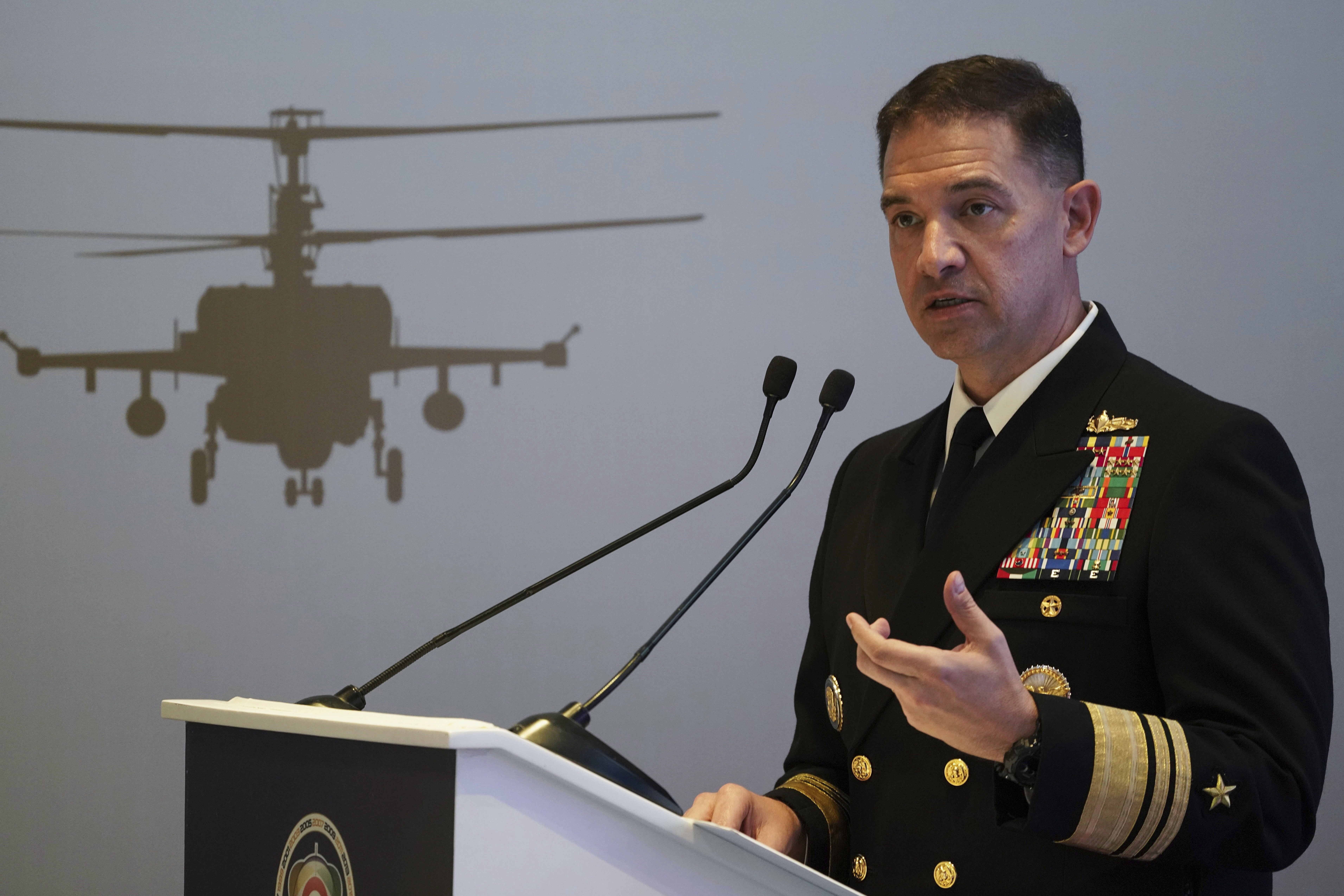
    The discussions have also involved Adm. Bradley Cooper, the head of U.S. Central Command, who supports deliberations about potentially moving U.S. troops west from the Persian Gulf, said a U.S. official.

    A spokesperson for U.S. Central Command declined to comment.

    Before the start of the war in February, U.S. Central Command evacuated many of its bases, judging them too vulnerable to Iranian missile and drone attacks to maintain normal staffing levels. Some of the shifts away from the major Gulf facilities might last after the war, a person familiar with the posture adjustments said.

    “Iran thinks we are in the traditional places,” the person said, declining to specify the changes so as not to put U.S. service members at risk. “And we are not.”

    Six U.S. service members were killed in a March strike on Port Shuaiba, a military facility in Kuwait, and more than 200 U.S. facilities have been damaged or destroyed during the conflict, the Washington Post reported in May.

    While defending its personnel in the region, the U.S. military has also expended more than 1,000 sophisticated air-defense interceptors, draining the Pentagon’s stockpile of Patriot and Terminal High Altitude Area Defense missiles, the Post reported in March.

    “The war really did highlight the vulnerability … of U.S. forces in the region,” said Michael Ratney, a former diplomat who served as the U.S. ambassador to Saudi Arabia and the deputy chief of mission in Qatar.

    Moving troops and equipment further west to Jordan, Israel, or the Red Sea coast of Saudi Arabia could help alleviate some of the pressure, he argued, while noting the added distance wasn’t a “perfect solution to this problem.”

    Iran has already demonstrated it can strike faraway targets in Jordan and Israel. Last month an Iranian attack on Jordan killed four U.S. service members.

    Tehran’s retaliatory attacks against bases in the Persian Gulf plunged the region into crisis and are stoking frustration among core U.S. allies there, who feel they were not properly consulted by the Trump administration before starting the war.

    Allison Minor, who served during the first Trump administration as the director for Arabian Peninsula affairs on the National Security Council, said the Gulf countries could maintain elements of their security partnership with the U.S. — such as arms sales and intelligence sharing — while hosting a smaller troop presence.

    “But you need to be discussing all of those comprehensively and not just the question of the sheer number of troops,” she said.

    The Pentagon has publicly estimated that the war’s cost will reach about $37.5 billion by the end of September, but that price tag does not account for the money it will take to rebuild bases in the region.

    Jules Hurst III, the Defense Department’s comptroller, told the Senate in May that the reconstruction costs were being left out because the administration has not yet decided how it wants to rebuild from the damage.

    In April, the center-right American Enterprise Institute estimated it would cost $5 billion to repair the U.S. bases that have been targeted.

    Multiple people familiar with the Pentagon’s analysis cautioned that any permanent changes to U.S. posture were still distant and would require the approval of senior administration officials.

    In June, President Donald Trump signed a preliminary peace deal with Tehran and signaled that the war was coming to a close. The agreement later collapsed, and the two sides have sporadically exchanged strikes in the months since.

    A recent policy proposal from Defense Priorities, a think tank that advocates for military restraint, calls for closing U.S. bases in close striking range of Iran’s missiles and drones, such as Kuwait. The proposal also calls for moving forces dispersed in the United Arab Emirates, Jordan, and Bahrain to more secure facilities such as the Prince Sultan Air Base near Riyadh.

    More hawkish voices in Washington have sought to influence the Pentagon’s planning by proposing the movement of U.S. troops in the region to Israel. A report by the pro-Israel group Jewish Institute for National Security of America in March called for more U.S. military assets to be moved to Israel’s Ovda Airbase.

    This winter, in the run-up to Operation Epic Fury, Washington sent F-22 Raptor fighter jets to the base in a sign of deepening U.S.-Israel military relations.

    There is disagreement within the Trump administration over that recommendation given concerns that an expanded U.S. presence there could pose a counterintelligence vulnerability amid the Pentagon’s growing concern about Israeli espionage.

    Also, the office of Undersecretary of Defense for Policy Elbridge Colby has launched a public review of America’s military presence in NATO, after the Trump administration announced it was pulling thousands of troops out of Germany and Poland. The study is set to conclude in December.

  • The U.S. national debt is set to hit $40 trillion this week

    The U.S. national debt is set to hit $40 trillion this week

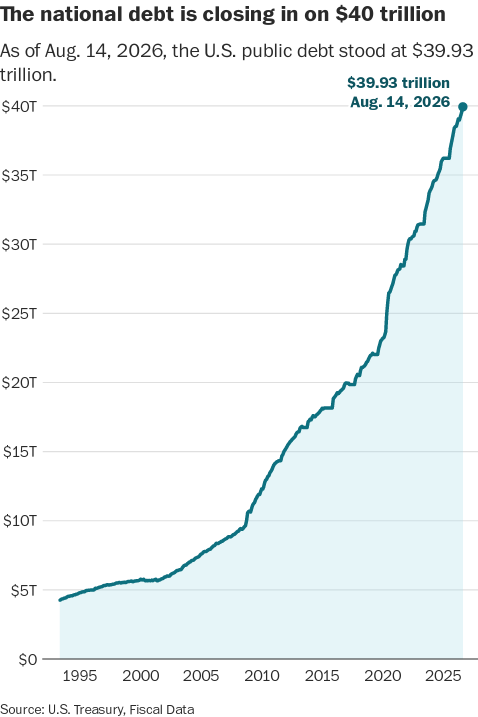
    The U.S. national debt is likely to surpass $40 trillion this week, months earlier than forecasters previously expected, in part because of billions of dollars in lost revenue from President Donald Trump’s invalidated tariffs.

    The lost revenue has forced the U.S. Treasury Department to borrow more rapidly to cover the nation’s bills: Six months ago, the nonpartisan Congressional Budget Office projected that total borrowing would top out at $39.4 trillion this fiscal year. But on Monday, Treasury reported that the debt stood at $39.9 trillion and counting.

    The faster accumulation of debt means the next deadline for raising the legal limit on borrowing is also likely to arrive ahead of schedule. Just last year, Congress set the debt limit at $41.1 trillion. Budget analysts now say borrowing could hit that threshold by early next year, forcing lawmakers either to suspend it or raise it again to avoid the risk of an economy-shaking default.

    Trump is already focused on the debt limit, which has repeatedly plunged Washington into a dangerous game of legislative chicken. Late last month, the president urged the Senate to address “the ever looming Debt Ceiling disaster” before leaving town for its August recess.

    Senate leaders did not comply, but Majority Leader John Thune (R-South Dakota) told reporters at the time that “we’ll have to be dealing with it.” He added: “$40 trillion in debt — seems to me that should get our attention.”

    For the past quarter-century, the national debt has grown under both parties, through the tax cuts of the George W. Bush era, the wars in Iraq and Afghanistan, the Great Recession, the 2017 Trump tax cuts and the nearly $2 trillion Biden administration initiative to prop up the economy during the coronavirus pandemic. Trump pledged during his first campaign in 2016 to eliminate the debt within eight years; instead, it has doubled since he first took office.

    This year, the gap between spending and revenue was already expected to approach $2 trillion, the CBO reported in February. Days later, the U.S. Supreme Court struck down Trump’s “Liberation Day” tariffs, cutting federal revenue by an estimated $250 billion. The Treasury has also increased borrowing lately to build up its cash reserves.

    Military spending tied to the conflict with Iran could add more to the debt in the months ahead, according to the Bipartisan Policy Center, a nonpartisan Washington think tank that tracks federal spending.

    “Our current fiscal trajectory is plainly unsustainable, and that’s the best-case scenario,” BPC president and CEO Margaret Spellings said in a statement. “AI disruption, a recession, global war, or any number of other events could quickly push us over the edge from a challenge into a full-blown crisis. Even in the rosiest scenarios, we’re speeding toward a cliff and refusing to turn the wheel.”

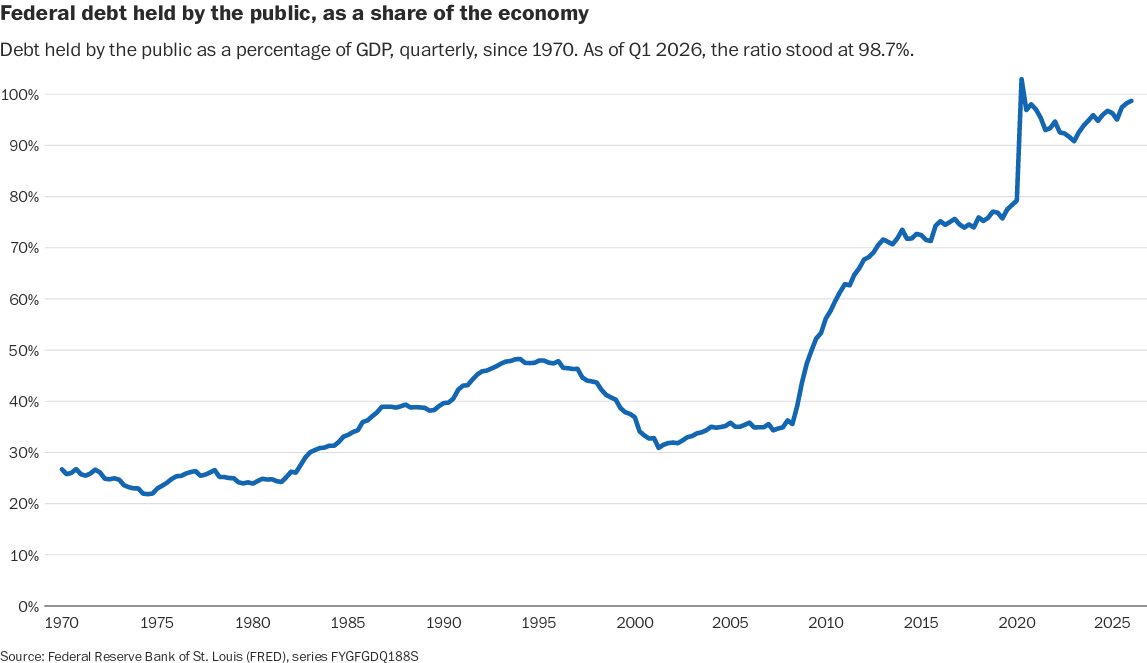
    In an email, White House spokesman Kush Desai said that “the Trump administration remains focused on slashing waste, fraud, and abuse across the federal government while accelerating economic growth, policies that will get America’s debt-to-GDP ratio trending in the right direction.”

    So far, Washington lawmakers have raised or suspended the debt limit every time it has been reached, but often after dramatic, deadline-pushing partisan battles. Even these near misses have rattled markets and carried a price: Standard & Poor’s, Fitch and Moody’s have each downgraded the credit rating of U.S. government debt since 2011, moves tied at least partly to debt ceiling brinkmanship.

    Congress last raised the debt limit in quieter fashion, adding $5 trillion to the debt ceiling as part of the One Big Beautiful Bill Act, the Republicans’ marquee tax and spending law. Measures to raise the debt ceiling often include spending cuts aimed at reducing the annual budget deficit. But the One Big Beautiful Bill Act, which Trump signed in July 2025, did the opposite: That law added $4.7 trillion to projected deficits over the next decade, according to CBO estimates.

    According to preliminary projections by the BPC, Washington is on track to next hit the debt limit between late winter and midsummer 2027. Based on the latest borrowing figures, the center’s estimate is “trending toward the earlier end” of that range, Shai Akabas, the center’s vice president of economic policy, said in a statement.

    Hitting the debt ceiling would not by itself trigger a default. Once the borrowing limit is reached, Treasury can pay bills by drawing on its cash reserves and using stopgap accounting maneuvers known as “extraordinary measures,” which typically buy another six to nine months, according to the BPC. Only after that runs out does the government reach what’s known as the X-date, when the Treasury risks running out of cash and defaulting on its obligations.

    If Republicans lose one or both chambers of Congress in the Nov. 3 midterm elections, they could attempt to raise the debt limit in the lame-duck period during November and December — before the new Congress is seated in January. Otherwise, they could be forced to make policy concessions to Democrats that Republicans — and the White House — would prefer not to make.

    But raising the debt ceiling could prove challenging even under total GOP control. Especially in the House, where the GOP holds a slim majority, party leaders would be forced to win over their fiscal hawks, who have previously revolted when a debt ceiling increase was not accompanied by an agreement to cut spending.

    “You have to raise the debt limit just the same way that you have to pay your credit card bill,” said Marc Goldwein, senior policy director for the Committee for a Responsible Federal Budget, a nonpartisan group focused on deficit reduction. It reflects spending choices you’ve already made, he said. “But if you keep getting credit card bills that are more than you can afford, it’s probably a good time to reassess how much you’re spending, or to get a second job, right?”

    As with many credit cards, interest is itself becoming a bigger part of the problem. Last week, the U.S. government sold 30-year bonds at 5.216 percent, the highest rate in a quarter-century, Bloomberg News reported. Treasury rates ripple into mortgage rates, corporate debt and other borrowing.

    Annual interest payments on the debt are projected to top $1 trillion this year, according to CBO — about the size of the Pentagon budget. They now consume about 19 percent of federal revenue, according to the Peter G. Peterson Foundation, a nonpartisan group that tracks the debt and advocates for fiscal discipline, and are projected to climb to 26 percent by 2036.

    “Interest costs are paying for your past, not paying for your future,” said Peterson Foundation chief executive Michael Peterson, and unfairly burden future generations.

    “It’s immoral to, year after year, trillion after trillion, just keep borrowing the money, not paying your bills for immediate consumption and deferring not only the principal balance but the interest costs onto our kids and grandkids,” he said.

    Peterson pointed to Social Security as a preview of what happens when Washington puts off big problems: Unless Congress acts, the program’s trust fund is projected to become insolvent in 2032, triggering an automatic 22 percent cut in benefits.

    “Can a democracy that’s run by all of us collectively make tough decisions to sacrifice in the short term for long-term benefit?” Peterson said. “The political system hasn’t risen to this challenge in recent decades.”

    Theodoric Meyer and Jarrell Dillard contributed to this report.

  • White House attacks CNN reporter after Trump clash, and targets her children

    White House attacks CNN reporter after Trump clash, and targets her children

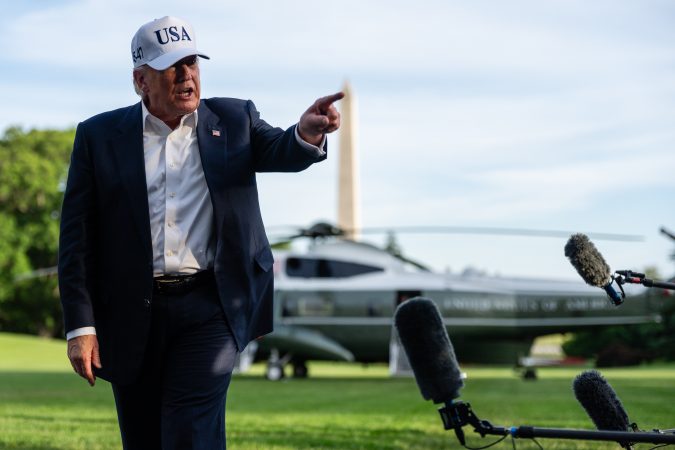
    The White House on Monday leveled a sharply personal attack against CNN reporter Kristen Holmes after she asked President Donald Trump a pointed question during a news conference, crossing a barrier rarely breached by politicians to invoke her children.

    “Jon Ossoff said you’d rather travel with your aide Natalie Harp and build the ballroom than do your job as president,” Holmes said. “What is your response?”

    Trump answered Holmes’ question with an insult to Sen. Jon Ossoff (D., Ga.), whom he called a “Pee-wee Herman look-alike,” referring to the Paul Reubens character.

    Then the White House’s “rapid response” account on X took up the altercation, posting a video clip of the exchange and assailing Holmes as a “disgraceful, humiliating embarrassment to her alleged profession.”

    In a follow-up tweet, the account dipped into a more personal line of attack: “Someday, your children will come across your disgusting and inhumane question,” the White House wrote. “They will be sickened and embarrassed to have a parent be so callous and vindictive. It’s quite troubling.”

    The White House did not respond to a request for comment about its social media posts.

    Trump’s personal attacks on journalists have been a defining feature of his combative approach to the press. Though he has criticized reporters throughout his political career, his critiques of women journalists, particularly those representing CNN, have grown more heated in recent months. And the administration has increasingly used official White House social media accounts to escalate what might once have been spur-of-the-moment exchanges.

    Most recently, at the rescheduled White House Correspondents’ Association dinner in July, Trump said that CNN anchor and chief White House correspondent Kaitlan Collins should “just smile” — a misogynistic trope — and likened her appearance to that of Dylan Mulvaney, a transgender activist villainized in conservative circles.

    He followed up by posting an edited image imposing Collins’ likeness on an image of Mulvaney, which was later shared by an official White House account.

    Trump’s critique of Holmes, a senior White House correspondent, continued during the news conference.

    At another point, the president shushed her: “Quiet. Quiet. Quiet. You’re very disrespectful in front of this young man, OK? Don’t you find her disrespectful? He understands. Quiet. Who are you with?”

    “I’m with CNN,” Holmes replied.

    “Fake news. You’re fake news. You’re loud. You’re a loud, boisterous person. You’re fake news,” Trump said. “Be quiet, be quiet, be quiet. You’re a fake reporter, and you report fake news.”

    CNN, in a statement, defended Holmes, calling her “one of the most respected and accomplished journalists covering the White House” and said it rejects the attacks “in the strongest possible terms.”

    “This afternoon, she did her job and asked the President of the United States a tough, relevant, and newsworthy question on behalf of the American people,” a CNN spokesperson wrote in a statement. “Public officials are free to challenge reporting they disagree with, but personal attacks on journalists for asking questions are beneath the office and inconsistent with the principles of a free press.”

    Holmes’ colleagues on CNN’s White House team rushed to her defense. “What a horrible to thing to say. Kristen is an incredible reporter, person and, above all, mother,” White House correspondent Alayna Treene wrote on X. “I don’t understand such a reaction to a journalist asking the president for his response to something a Democratic senator has leveled against him.”

    “Kristen is an excellent reporter who asked a good question, to which the president gave a fulsome answer,” Betsy Klein, a senior White House reporter, wrote. “You know what’s disgusting and inhumane? Bringing her perfect children into this.”

  • Kindergarten vaccine exemptions jump to another record high

    Kindergarten vaccine exemptions jump to another record high

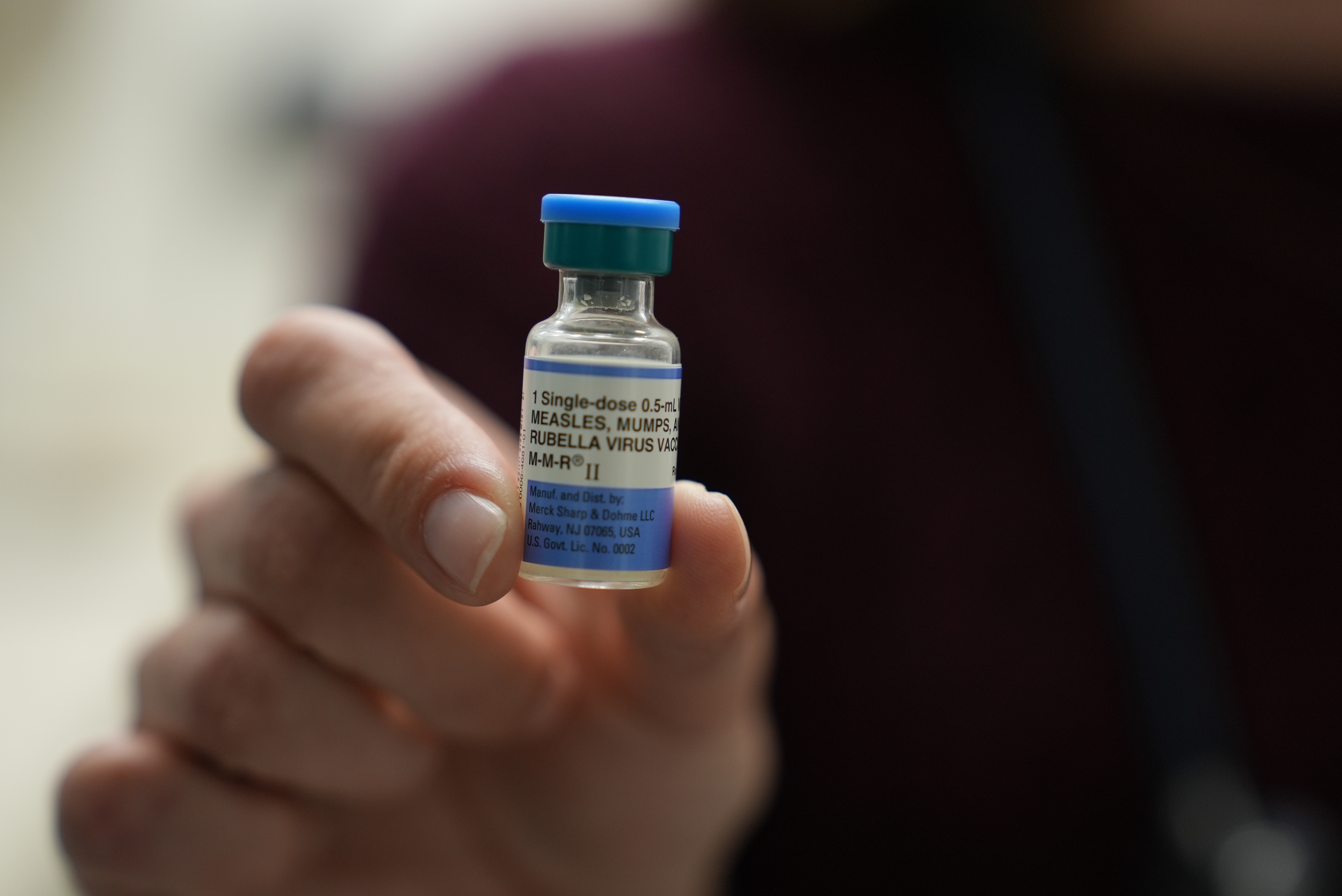
    The share of U.S. kindergartners with exemptions from school vaccine requirements for the 2025-2026 school year rose to another record high, according to federal data posted Monday. The sharp increase from 3.6% to 4.2% seeking exemptions — about 155,000 students — extends a yearslong erosion of childhood immunization rates as the country battles its worst measles resurgence in 35 years.

    As exemptions increased, U.S. kindergarten vaccination rates fell slightly for all reported vaccines from the year before. Coverage for the major vaccines required for kindergarten — MMR (measles, mumps, and rubella); DTaP (diphtheria, tetanus, and acellular pertussis); poliovirus vaccine (polio); and varicella (chickenpox) — decreased in more than half of states for the second year in a row, the CDC said.

    The latest numbers from the Centers for Disease Control and Prevention arrive as President Donald Trump and Health Secretary Robert F. Kennedy Jr. seek sweeping changes to the childhood immunization schedule.

    Trump last week directed federal health officials to move toward giving the measles, mumps, and rubella vaccines separately rather than in the combined MMR shot and to space out childhood vaccinations over more medical visits. The combined shot has been a cornerstone of measles prevention for decades, and separate measles, mumps, and rubella vaccines are not currently available in the United States.

    The proposal defies guidance from major medical groups and is directly at odds with CDC’s own scientific guidance.

    “No published scientific evidence shows any benefit in separating the combination MMR vaccine into three individual shots,” the agency says on its MMR vaccine safety page as of Monday. Elsewhere on CDC’s website, the agency says combination vaccines reduce the number of injections children receive while providing the same protection and may help more children get recommended vaccinations on time.

    The new CDC data released this week shows a continuing decline in childhood vaccination rates and rise in exemption rates, and what’s at stake as the administration seeks to remake federal vaccine policy.

    The biggest factor in the increasing exemption rate came from families seeking nonmedical exemptions, the data shows. Exemptions increased across a broader expanse of the country last year, rising in 41 states and the District of Columbia, compared with 36 states and the District the previous year. Twenty-four states now report exemption rates exceeding 5%.

    In terms of vaccine coverage, the data shows that 92.4% of kindergartners had received the required two doses of the MMR vaccine during the 2025-2026 school year, down slightly from 92.5% the previous year. Before the coronavirus pandemic, the rate was 95%, the level at which it is generally considered unlikely that a single infection will trigger a disease cluster or outbreak. The number of kindergartners attending school without documentation of completing the MMR vaccine series was about 280,000 during the 2025-2026 school year.

    Coverage for other required childhood vaccines also declined, dropping to 92% for DTaP, from 92.1% the previous year, and to 92.4% for polio, from 92.5% the previous year.

    “Measles and other infectious diseases don’t stop at the classroom door,” said James Campbell, chairperson of the American Academy of Pediatrics committee on infectious diseases and a professor of pediatrics at the University of Maryland. “That’s why school entry requirements matter: They protect and keep entire communities safe, and experience shows that when parents receive clear, trustworthy information from health professionals, they’re far more likely to choose vaccination.”

    On Friday, CDC reported 2,566 confirmed measles cases so far this year, 101 more than the previous week’s tally and already exceeding the 2,289 cases recorded during all of 2025. Ninety-three percent of the cases were in people who were unvaccinated or whose vaccination status was unknown.

    CDC made no mention of the record increase in exemptions in a statement accompanying Monday’s data, and stopped short of directly encouraging parents to vaccinate their children. Instead, CDC said that it “continues to encourage parents to discuss vaccination options with their doctors.”

    If parents are worried about what shots their children need for school, they should keep in mind that states, not the federal government, generally set vaccination requirements for school attendance, public health experts say. As of Aug. 11, 30 states had announced that they are no longer relying solely on federal guidelines for their own childhood vaccine recommendations, according to KFF, a health policy organization. Many state health departments have said they will rely on external expert groups such as the American Academy of Pediatrics instead.

    Decades of research involving millions of children have established the safety and effectiveness of the MMR vaccine. Two doses of the vaccine are about 97% effective in preventing measles, which can result in serious complications, including pneumonia, swelling of the brain, and, in rare cases, death from respiratory and neurological complications, according to CDC. Extensive research has found no link between MMR vaccination and autism.

    The White House has said its proposed changes to the immunization schedule, which also call for reducing the number of universally recommended vaccines, are designed to align the United States with its peer nations. But peer nations like Denmark, Australia, and Canada give MMR immunizations in a combination vaccine. Britain this year began replacing the MMR shot with a four-in-one vaccine that also protects against chicken pox.

    Sen. Bill Cassidy (R., La.) blasted Trump’s overhaul of the childhood vaccine schedule Sunday, saying it will raise costs for patients and make vaccines less accessible. Trump has defended the move as sparing children from the combination MMR vaccine, which he said was “sort of like a nuclear weapon.”

    “Now instead of your child getting two shots, she has to get six shots,” Cassidy said Sunday on ABC’s This Week. “Instead of … you missing work to take your child to the doctor two times, you’re doing it six times. And instead of the insurance company paying for two visits, it’s now paying for six visits.”

    The collision between the White House’s vaccine agenda and the scientific guidance of the agency charged with carrying it out also presents an immediate test for Erica Schwartz, who began work as CDC director last week.

    During Schwartz’s confirmation process, senators repeatedly pressed her on whether she would defend scientific evidence if Kennedy or other administration officials sought changes unsupported by it. Cassidy ultimately supported her nomination after initially expressing concerns, saying after additional conversations that he was confident Schwartz “knows what she is doing and will stand against those who do not.”

    Even though CDC is responsible for federal vaccine policy following recommendations from its independent vaccine advisory committee, scientists at the agency said they did not know that the executive order was coming, and officials are unsure of what it means for the agency.

    The White House is calling for Kennedy’s Department of Health and Human Services Task Force on Safer Childhood Vaccines to craft proposed changes within 90 days. The long-defunct panel was revived last year after a push from anti-vaccine activists. That task force makes recommendations that aim to improve vaccine safety, not to determine the optimal vaccine schedule, public health law experts have said.

  • 60 days after signing Iran deal, Trump stuck in quagmire as peace talks stall

    60 days after signing Iran deal, Trump stuck in quagmire as peace talks stall

    Sixty days ago, seated beside French President Emmanuel Macron at a lavish dinner at the Palace of Versailles, President Donald Trump signed a memorandum of understanding with Iran and declared the beginning of the end of the U.S. conflict with Tehran.

    The “historic breakthrough” would lead to the reopening of the Strait of Hormuz and ensure Iran never obtained a nuclear weapon, the White House declared. Trump advisers said the deal would demonstrate that the president could end, rather than prolong, the kind of “endless wars” in the Middle East he had spent years denouncing.

    The agreement set aside two months for talks to turn the interim truce into something more ambitious: a broader settlement of the decades-long standoff over Iran’s nuclear program.

    That window has now closed.

    The war has not ended. The Strait of Hormuz remains largely shut. Detailed negotiations over Iran’s nuclear program never began.

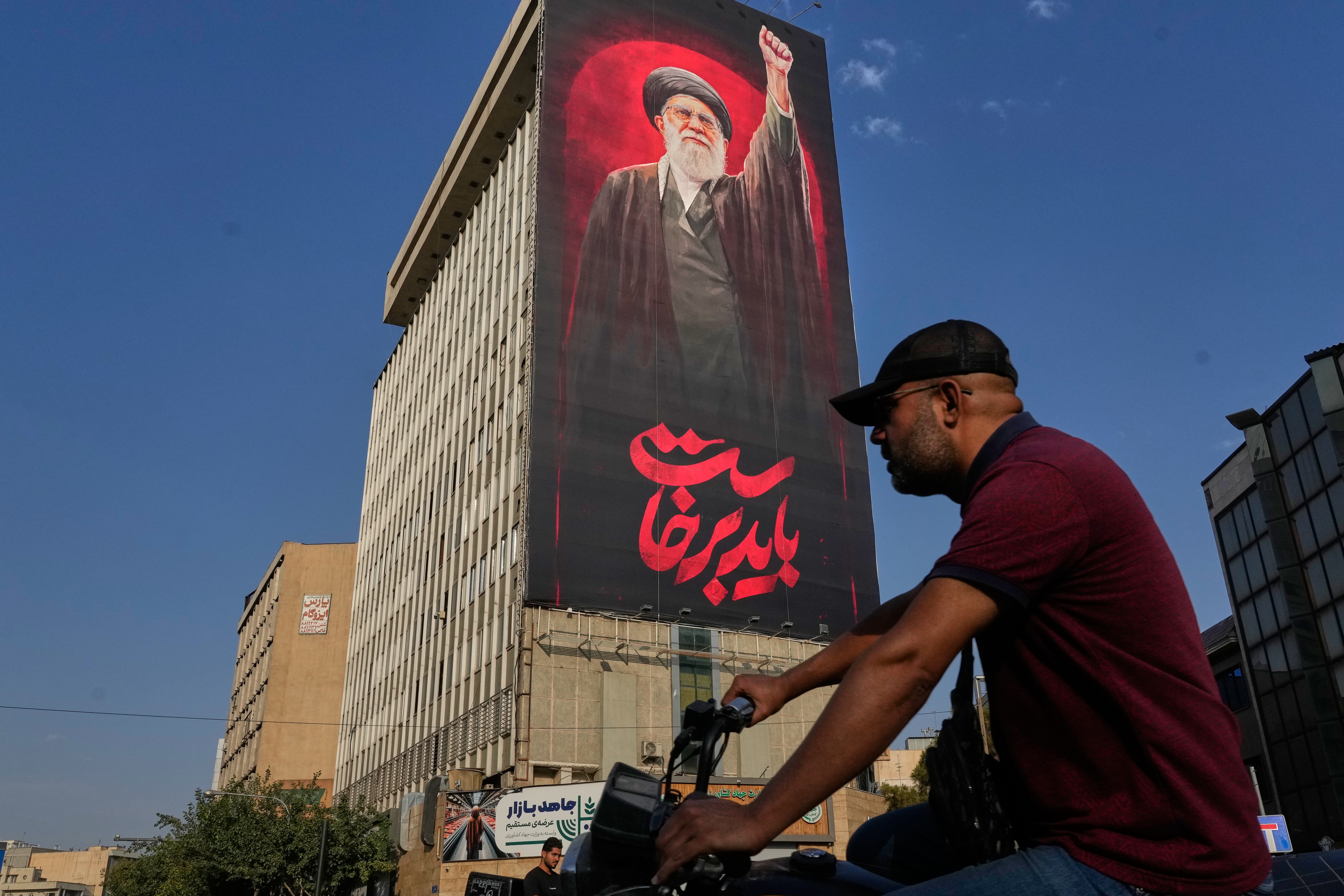
    The United States has resumed its blockade of Iranian ports. Tehran is demanding concessions that the Trump administration has rejected. And the administration has now publicly disowned several of the key points in the ill-fated memorandum, including development of a plan “with at least $300 billion for the reconstruction and development” of Iran, a waiver of sanctions to allow Iran to sell oil, and a “dialogue” between Iran and Oman over how to run the Strait of Hormuz.

    Trump on Monday went so far as to threaten to bomb Oman over its talks with Iran on management of the strait, through which 20% of the world’s oil used to pass.

    If Oman “gets in the way,” Trump said in a Fox News interview, the U.S. would “bomb the s— out of them.” He demanded that Iran raise “the white flag of surrender” while insisting that neither the approaching midterm elections nor the passage of time was putting pressure on him to reach a deal.

    “I have no time schedule,” Trump said. “I’m not in a hurry. … Midterms have nothing to do with my thinking.”

    Six months after he launched attacks on Iran in coordination with Israel and 78 days before elections that will determine whether his party retains control of Congress, Trump confronts the kind of open-ended conflict he claimed he was uniquely equipped to avoid: one with no obvious military resolution, no diplomatic breakthrough in sight, and mounting economic and political costs at home.

    Continuing the standoff risks leaving him presiding over a war that undercuts one of the central premises of his political identity.

    The war has helped to erode voters’ trust in Trump and may have larger consequences in the midterms, said Lee Miringoff, director of the Marist University Institute for Public Opinion.

    “For a lot of voters, the war in Iran is linked with the economy. When the strait closed, the price of gas went up,” Miringoff said. “The problem for President Trump and the Republicans is that a lot of what he was elected on seems to not be being fulfilled. So there’s a sense of no rationale for why we went in, and no clear sense of how it’s going, and no indication of how we’re going to get out, which is the opposite of what makes for good politics.”

    The White House did not immediately respond to questions about the memorandum’s expiration or the impact it will have on the president’s political goals.

    Trump’s overall standing has deteriorated as the war has dragged on. Strikingly, surveys show an erosion of support among Republicans, whose intense loyalty has been the foundation of Trump’s political power.

    An Economist-YouGov poll released last week found Trump’s approval among Republicans at 79%, a second-term low and 15 points below its level shortly after he returned to office. The share of Republicans who strongly approve of his performance has fallen even more sharply, from 68% to 48%.

    A Washington Post-Ipsos poll last month found a new low of 15% of Americans “approve strongly” of Trump’s job performance. The finding marked the first time the Post-Ipsos poll found that significantly more than half of Trump approvers support him only “somewhat,” rather than strongly.

    The declines cannot be attributed to the Iran war alone. Voters have also expressed frustration about inflation, gasoline prices, and other aspects of Trump’s presidency. But those issues have increasingly become intertwined: The war and the continued disruption of oil shipments have helped make Trump’s foreign-policy predicament an economic and political problem at home.

    Trump has continued to insist that an end to the stalemate is in the offing. On Monday, he told Fox News that the U.S. was engaged in back-channel talks with Iran’s Islamic Revolutionary Guard Corps.

    An IRGC spokesperson quickly denied the claim. Brig. Gen. Hossein Mohebbi told Iran’s semiofficial Tasnim News Agency that there were no talks between Revolutionary Guard officials and the Americans, dismissing Trump’s assertion as a product of “defeat and desperation in the war.”

    Alan Eyre, a former diplomat who served on the U.S. negotiating team that secured the 2015 Iran nuclear deal, said the war has transitioned from a military operation into an economic pressure campaign that the U.S. hopes can force Iran to capitulate. But any economic pain will be felt primarily by the Iranian people, he said, rather than forcing change from the increasingly hard-line regime.

    “The U.S. has no good options,” said Eyre, who is a distinguished diplomatic fellow at the Middle East Institute. “This war has broken a complex system. And it is not getting back to the way it was before Feb. 28.”

  • Trump aims to rebuild defenses against bioweapons as AI fears rise

    Trump aims to rebuild defenses against bioweapons as AI fears rise

    The White House is working to strengthen safeguards against biological attacks after staffing cuts early in the second Trump administration depleted expertise in a field where officials increasingly fear artificial intelligence could make it easier to create deadly pathogens.

    By the end of President Joe Biden’s term, the White House had built a team of as many as 30 people focused on biological security, according to three former government officials who worked on the issue — two for Biden and Trump, and one just for Biden — and spoke on the condition of anonymity to avoid professional retaliation.

    This specialized staff was charged with coordinating the web of federal agencies that deal with biohazards and provided scientific guidance to top officials.

    That team rapidly dwindled after Trump returned to office amid cuts and reorganizations, said the three former officials, as well as a fourth former official, who also worked for both administrations. At times, nobody at the White House was dedicated solely to biosecurity, according to three of the former officials.

    The losses have come as the administration has delayed replacing key Biden-era directives. It revoked a 2023 executive order on AI calling for stronger biological safeguards and cast doubt on a policy issued the following year designed to require companies to screen buyers seeking genetic components that could be used to create biological agents — widely seen by experts as a basic pillar of the nation’s defenses.

    Trump directed officials to produce a revised version by August 2025. More than a year later, it has yet to appear, even as AI companies say their most advanced models are gaining increasingly sophisticated biological capabilities alongside the hacking skills that have alarmed officials this year.

    “They have kneecapped themselves in their ability to create any policy that would have staying power,” said one of the former experts, who recently worked directly on outbreak response policy. “That’s the risk, they’re not playing the long game. The whole purpose of having the technocrats there is to advise political leaders on the nuanced tradeoffs of taking one path or another.”

    In the absence of a large team, the White House has relied on a small revolving cast of employees. They have included a junior fellow without a security clearance; a part-timer from the research organization Rand; a pair of CIA staffers with little expertise in the field; and an Air Force doctor who had been a consultant to the White House medical office, according to the three experts.

    A White House official said the administration was working to strengthen the Biden-era policy, calling it inadequate and technically limited despite the staff devoted to developing it, and did not address questions about the staffing changes.

    “The Administration’s commitment to addressing AI and biological safety risks is clear and ongoing,” the official said in an email. “The White House has been developing policy for over a year, including in our AI Action Plan last summer.”

    The Trump administration has acknowledged the biological security risks AI poses while touting the potential for the technology to help keep the nation safe. Trump told foreign leaders gathered at the United Nations last year that he wanted to prevent biological weapons disasters and said AI was a tool to help.

    At the Pentagon, a former health official who led Operation Warp Speed — the effort during the first Trump administration to rapidly produce a vaccine for the coronavirus — is involved in efforts to use AI to speed the development of new defenses against future pandemics and to deter biowarfare. Part of the work involves analyzing billions of tweaks to antibodies to assess how to respond to new forms of the coronavirus.

    But that work is taking place in a government that analysts and the former experts say has been drained of expertise amid broader cuts to federal public health and science funding.

    The White House removed all the staff from the Office of Pandemic Preparedness and Response Policy, an organization created to lead the nation’s response to the kind of major outbreak that the most dangerous kind of bioweapon could trigger. The office was resurrected as Ebola spread in Africa this spring.

    A National Security Council unit dedicated to health security was also shut, two of the former experts said, and parts of the Office of the Director of National Intelligence and Department of Homeland Security responsible for biological threats were broken up as part of broader reorganizations.

    A scientist who worked on biotechnology and national security issues in both the first Trump and Biden administrations said the federal government is not taking a leading role in coordinating a response to the risks posed by the rapidly evolving technology.

    “Every time an administration changes over there’s a lot of continuity that just gets disrupted,” said the scientist, who spoke on the condition of anonymity because they were not authorized by their employer to speak publicly. In the transition from Biden to Trump, they said, “when it comes to biosecurity, that happened in a very disruptive way.”

    There has never been one federal agency responsible for biosecurity, a sprawling field that encompasses efforts to secure research labs, aspects of public health work, and international diplomacy, and which is increasingly focused on the role of AI. But an analysis of Trump’s most recent budget request by the Council on Strategic Risks, a Washington-based security-policy think tank, concluded that the administration’s rhetoric on biosecurity was not matched by its funding proposals. In a separate analysis, the group found that spending across multiple government departments peaked in 2024, before declining slightly in Trump’s first year — with the administration proposing further cuts.

    “General programmatic cuts and agency-specific reorganizations have restricted and eliminated key programs, clouding budgetary transparency and weakening US deterrence efforts,” the council wrote in a blog post.

    When Trump returned to office last year, his team was focused on eliminating barriers to the development of AI technology. That approach began to shift this spring when a new generation of models proved to be capable of hacking into computer networks, leading administration officials to embrace the kind of government oversight of yet-to-be released tools that they had once spurned.

    There are now signs that officials are taking additional interest in the potential dangers. That has included a recent string of briefings on biological risks between OpenAI, the White House, and half a dozen government agencies, according to a person familiar with the meetings, who spoke on the condition of anonymity to describe their private nature. Politico reported this month that the White House was launching a new initiative involving its cybersecurity office and a top official at the Department of Health and Human Services.

    Leaders in the AI industry have long said that their tools being used to enable a biological attack ranks among their top fears.

    “I’m getting very frustrated,” said David Relman, a professor of medicine at Stanford University who worked on pandemic response in the Biden White House.

    The newest AI models, such as Anthropic’s Mythos and OpenAI’s GPT 5.6, have continued to get better at high-level biological research. But just as the models’ ability to write computer code has made them good at hacking, their biological capabilities have stoked fears that they could be used to help build a new bioweapon, set off a new pandemic, or aid even a relative amateur in carrying out a biological attack. This month, the journal Science published the results of a successful effort to use AI to engineer new viruses. They were designed to infect bacteria rather than humans, but the outcome was a clear sign of what is becoming possible.

    As early as last summer, researchers at OpenAI determined that they were close to reaching “high” levels of capability in biology, which the company defines as capabilities that “significantly increase existing risk vectors for severe harm.” The company briefed the Trump administration and hosted more than 50 government experts for a summit at its San Francisco headquarters last July to discuss how its systems could be used for biological defense. (The Washington Post has a content partnership with OpenAI.)

    The company said it has continued to work with the administration, aiming to provide officials with access to a special version of GPT for biological defense that it calls Rosalind.

    “The Administration has increasingly prioritized this important issue as AI capabilities have expanded, and we welcome their partnership,” an OpenAI spokesperson said in an email.

    Despite the growing concern, scientists remain divided on how serious the risks are, how soon they might materialize, and how the nation should prepare. Large language models that power chatbots could be helping terrorists to do tricky lab work, and specialized biological design tools could aid in the creation of new kinds of deadly pathogens not readily recognized by current methods of surveillance.

    In October, researchers at Microsoft detailed how they had patched gaps in detection systems after using AI to engineer digital versions of thousands of toxins that were not caught by the existing safety net.

    A report by Rand concluded that attackers have a significant advantage over defenders when it comes to biological incidents. Someone carrying out an attack could make multiple efforts, while authorities need to be able to tackle every threat because even one “could result in catastrophic consequences.”

    Leading American AI firms have sought to lock down their models, blocking them from answering questions about risky biological research and providing more capable systems only to trusted partners. But AI guardrails are imperfect and OpenAI said in July that its testing of leading Chinese models, which are made freely available, indicates that they do not have the same kinds of protections built in.

    “I think we have a massive collective-action problem in front of us,” said Relman, the Stanford professor.

    AI systems have gone on runaway hacking sprees in recent months but, for now, experts say the barrier between the digital world and the biological one presents a major hurdle — and an important line of defense. Yet that could begin to change as companies seek to automate laboratories.

    “The ultimate fears are a ways out,” said Crystal Grant, a researcher at the Council on Strategic Risks. “We have a lead time before they’re here to prepare ourselves.”

    Because the same abilities can allow AI to be used for dangerous and helpful biological research, many scientists also fear their work becoming too tightly regulated.

    The Trump administration recently released a new policy on what it calls dangerous gain of function research. It’s a long-standing approach involving tinkering with pathogens in order to better understand how to defend against them. But it has become increasingly controversial in the wake of the coronavirus pandemic. The Trump administration has embraced the theory that the virus escaped from a Chinese lab that was undergoing gain of function work. Some scientists say the new policy is vague and could impede legitimate research.

    In the private sector, researchers complained that biological guardrails Anthropic put on its most powerful model were too strict. The company loosened the restrictions this month.

    Paul Friedrichs, a retired Air Force general, said the need to get the balance of safety and progress right underscored the need for strong leadership and expertise in the federal government.

    Friedrichs, who ended his government career leading the White House pandemic office under Biden, said the cuts in the Trump administration have “unquestionably” left the nation less well prepared and at risk of squandering an incredible opportunity.

    “We’re on the cusp of curing some of the banes of humanity,” Friedrichs said.

  • Inside the gentle, careful work of restoring famous paintings of Lincoln

    Inside the gentle, careful work of restoring famous paintings of Lincoln

    Heather Smith stood before the tattered portrait of Abraham Lincoln, holding a fine-tipped sable brush and a small plastic palette smeared with dabs of conservation paint.

    Wearing special magnifying glasses, she peered at the edge of the unframed portrait where paint was missing and pieces of old canvas remained.

    Lincoln, shown in the portrait resting his chin on his right hand, seemed to be watching.

    “He’s been through a war of his own,” she said of the painting of the nation’s Civil War president. “It’s terrifying to think about.”

    The 6-foot-2-inch portrait of a contemplative Lincoln sitting in a chair was painted in 1887. Time has weathered it and pocked it with flaws: Its original canvas was removed, probably with a scalpel. The surface of the painting was abraded, perhaps with an iron. And spots dotted the portrait where the paint was gone.

    But the Baltimore art conservator, working for the Smithsonian’s National Portrait Gallery, which owns the painting, has now embarked on a months-long effort to restore the majestic portrait to its original look.

    The effort is part of the portrait gallery’s project to assess 110 of its presidential portraits and repair those in need. The work has been funded, in part, by a grant from Bank of America.

    Smith is the owner of Maryland Art Conservation, which is based in a former Baptist church in northern Baltimore.

    She has already worked on the gallery’s 1785 portrait of George Washington by English artist Robert Edge Pine. And she is scheduled to work on gallery portraits of presidents Theodore Roosevelt, Benjamin Harrison, Woodrow Wilson, and Dwight D. Eisenhower.

    She is also working on another Lincoln — known as the penny portrait, which resembles the image of Lincoln on the coin.

    But the large portrait of Lincoln seated is, perhaps, the most dramatic and well-known of the group. He is shown wearing a dark suit, white shirt and bow tie. He is leaning forward, his left hand gripping the arm of the chair, as if listening.

    The painting is too big to fit on an easel, Smith said, so it leans against a wall, flanked by two large windows. It was last on view at the portrait gallery in 2022.

    It is one of four similar Lincoln portraits painted by the prolific American artist George Peter Alexander Healy, said Mindy Farmer, a portrait gallery historian.

    “This has been an iconic work since it was created,” she said.

    Another version, painted in 1869 and once owned by Lincoln’s son, Robert, is in the White House, according to the White House Historical Association.

    The portraits are based on The Peacemakers, a painting Healy did in 1868 depicting Lincoln meeting with Lt. Gen. Ulysses S. Grant, Maj. Gen. William T. Sherman, and Rear Adm. David D. Porter near the end of the Civil War, according to the association’s website.

    The gallery’s 1887 portrait was commissioned by Lincoln’s longtime friend and political ally Elihu B. Washburne, who wanted it for his home, art historian Alba Campo Rosillo wrote in Smithsonian Magazine in 2021.

    Healy painted the portrait in the winter of 1887 in his studio in Paris, where he was living, Rosillo wrote.

    Washburne died in Chicago later that year, and the painting passed to his brother, William, who died in 1912.

    It was purchased in 1934 by the A. W. Mellon Educational and Charitable Trust. It was given to the National Gallery of Art in 1942 and transferred to the planned portrait gallery in Washington in 1965, according to the gallery. The gallery opened in 1968 with the Lincoln portrait on display.

    In the early 1940s, during conservation at a now-defunct gallery in New York, the painting underwent what Smith said was a radical treatment procedure.

    “I’ve never encountered this before,” she said in an interview in her conservation lab. “They put [it] face down, removed the canvas from the back of the paint layers, which is extremely unusual.”

    “They would have protected the front with something called a facing, which is paper glued to the front of the painting to keep everything intact, and then worked on the back,” she said.

    The old canvas was probably scraped away little by little, except for a small ridge along the edges of the painting, she said. “I would not be surprised if that is how some of the painting’s numerous tears and holes were inflicted.”

    The old canvas was replaced with a new backing, Smith said. The portrait also shows evidence of “abrasion,” where the paint has been worn down. What probably happened was that a prior conservator, assumably in the 1940s, used an iron to try to fix cracks in the paint surface, she said.

    “When they ironed them, they didn’t put anything protective between the iron and the painting,” she said. “And I’m guessing they just wore down the paint.”

    The painting’s last major conservation was in 1966, Smith said, and the portrait was in poor shape when she got it earlier this year.

    She has since removed dirt and old varnish and reattached bits of paint that were loose.

    She plans to soon begin comprehensive inpainting — adding paint to places where it’s missing. In her lab, she keeps books, paint brushes, picture frames, lighting equipment, jars of pigment, and a bed for her dog, Charity.

    Across the room from the large Lincoln portrait, his penny portrait rests on a table. The work on it requires using bits of cotton on the end of a bamboo skewer to clean off dirt and soot.

    The 1864 portrait, by the Boston artist William Willard, may have hung above someone’s fireplace, she said. The painting was given to the gallery in 1976 by Mr. and Mrs. David A. Morse, the gallery’s website says. It was last exhibited in 2009.

    Smith, a native of Westminster, Md., has been an art conservator for more than 20 years, taking over the business in the small wood-shingled church when her employer retired.

    She said she feels a sense of responsibility adding paint to damaged works of historic art.

    “Early in my career … I would have conversations with the artist — ‘I’m sorry this happened to your painting,’” she said. “Over time, you treat enough paintings, you’re more looking at it as the materials, you kind of break it down in your head to the raw materials.”

    She said that there is a sense of gravity to the work, a realization that the person restoring the art is part of its history.

    “Obviously, you want to do no harm but make it look as good as possible,” she said. “Eventually, you won’t see any damages any more and will focus on what we’re here to see.”

  • Frustration with Trump grows among U.S.’s Persian Gulf allies, officials say

    Frustration with Trump grows among U.S.’s Persian Gulf allies, officials say

    Frustration with Washington is growing in the Persian Gulf region, where U.S. allies are increasingly concerned that President Donald Trump is unable to manage the diplomacy necessary to secure peace with Iran, Arab and Western officials say.

    Trump in recent weeks has repeatedly issued threats against Iran, only to withdraw them, citing progress in talks. After months of conflict, and continuing missile and drone strikes by Iran and its proxies, three officials and a former U.S. diplomat told the Washington Post, the governments of Saudi Arabia, the United Arab Emirates, Qatar, Kuwait, and Bahrain are now united in their aggravation with the administration. Some have begun to debate the utility of continuing to host large U.S. military installations on their territory.

    “Trump started this war,” one Gulf official said, “and we are paying the price.” Like others in this article, he spoke on the condition of anonymity to discuss the sensitive subject. Anger with the United States, the official said, was at its highest point since the U.S. and Israel attacked Iran in February.

    The Gulf states continue to rely on Washington as a close security partner and major arms supplier, and Qatar and Bahrain host large U.S. bases. But the frustration is leading some states to consider new arrangements. These dynamics are unlikely in the near term to significantly reorder the region, analysts say, but some countries have begun to explore their options.

    A mutual defense agreement signed by Saudi Arabia, Turkey, and Pakistan last week was “a signal to the U.S.,” a senior European official said.

    The pact shows the three powerful Sunni Muslim states “are trying to diversify their security and defense partnerships,” said the official, who is in regular contact with Gulf leaders. “In their mind, the U.S. is not enough.”

    A White House official said Trump “has extraordinary relationships with all of our Gulf partners.”

    “The United States has been in regular contact with all of our regional allies since before Operation Epic Fury,” said the official, speaking on the condition of anonymity under rules set by the White House. “Iran is more isolated than ever before as a result of its terrorist actions.”

    Representatives of the Saudi, Emirati, Qatari, Kuwaiti, and Bahraini governments did not respond to requests for comment.

    “There has been frustration from the get-go,” said Firas Maksad, director for the Middle East and North Africa practice at the Eurasia Group. U.S. allies in the Persian Gulf, he said, feel they were “unnecessarily entangled” in a war that Trump is now struggling to resolve.

    Maksad, who has extensive contacts within Gulf leadership, said Trump’s Iran policy is often described in the region as “erratic” and “unpredictable.”

    Anna Jacobs, a fellow with the Arab Gulf States Institute in Washington, said there has been “diminished trust” of the U.S. since the start of the war. U.S. allies think the country’s “conduct in the region is making them less safe, not more safe,” she said.

    One Western diplomat in the region said these changes don’t amount to a significant shift in sentiment toward the United States. Even before the war with Iran, he said, U.S. forces in the region were not “enthusiastically” welcomed. “It was more something that was a necessary evil,” the diplomat said. “Now, the necessity of it is being put in question.”

    Saudi Arabia has come under particular pressure in recent weeks. In addition to attacks from Iran and Iran-backed groups in Iraq, the kingdom has been targeted by Iranian-aligned Houthis in Yemen.

    Houthi forces have repeatedly struck Saudi energy infrastructure and are attempting to shut down the Bab al-Mandab strait at the mouth of the Red Sea. Since Iran closed the Strait of Hormuz in the early days of the war, Saudi Arabia has depended on its Red Sea ports to export its oil.

    Attitudes toward the war among Gulf leaders have shifted. Oman has opposed the conflict from the outset, but Saudi Arabia, the UAE, and Bahrain have at times backed it.

    Emirati forces have conducted “numerous” strikes on Iranian territory in recent months, according to the Western diplomat, and Saudi forces have struck back at Iranian-backed groups attacking from Iraq.

    “At the beginning of the war, they were — I don’t want to say supportive — but honestly, they were not totally against the war,” the senior European official said. The thinking in Abu Dhabi and Riyadh, he said, was that a quick, definitive victory could prove beneficial.

    That began to shift in the lead-up to the first round of talks between Iran and the United States in April, the official said, when it became clear that not only would the Iranian regime not fall, but it would not reopen the Strait of Hormuz.

    In the months since, Trump’s inconsistency has alarmed the Gulf, said Bader Al-Saif, an assistant professor of history at Kuwait University.

    “Even before all this back and forth with Trump, there was no clear strategy,” said Al-Saif, a fellow of the Arab Gulf States Institute in Washington. He cited the Memorandum of Understanding between the United States and Iran in June.

    “The MOU was a joke,” he said. The agreement didn’t address the Gulf states’ top concerns, including Iran’s ballistic missile arsenal or Tehran’s support for proxy forces.

    “Those terms were not terms of our liking,” Al-Saif said, “and that’s why it died out sooner than later.”

    Trump, the White House official said, “has always been clear that his preference is diplomacy.

    “Unfortunately, Iran chose the path of violence by killing American troops, committing international acts of terrorism, and lashing out at its neighbors in the region — and the Commander-in-Chief ensured that they reaped the consequences of those decisions.”

    The Gulf states lack an immediately viable alternative to their decades-long security partnerships with the United States. As the conflict continues, the Gulf official said, their only choice is to double down on their alliances with Washington.

    “Whatever we do,” he said, “we cannot say no to the United States.”

    Douglas Silliman, a U.S. ambassador to Kuwait and Iraq under President Barack Obama and Trump, said he heard frustration with Washington on a recent visit to the region. But in recent weeks, he said, he is also hearing growing anger at Tehran for its continued attacks on infrastructure and refusal to reopen the Strait of Hormuz.

    Silliman, now the president of the Arab Gulf States Institute, described the feeling in the region as “kind of this odd contradiction of being mad at the United States for starting the war and being dependent upon the United States” for equipment, munitions, and intelligence.

    If the conflict continues, the economic pressure on the Gulf will grow. Even during peacetime, the region quiets over the summer, tourism slows, and residents hole up indoors to escape 100-degree days.

    But in autumn, temperatures fall and activity resumes. This year, the conferences, summits, festivals, and Formula One races that pack the calendar from October through December are all in limbo.

    Saudi Arabia’s 10th annual Future Investment Initiative Institute in late October, the “Davos in the Desert,” could be an early test of whether senior officials and top CEOs are willing to visit the region, the Western diplomat said.

    “They may tweak the theme” to acknowledge continued insecurity in the region, he said. “To postpone would send the wrong message.”

    Iran continues to launch drones and missiles against Kuwait, but in the capital, much of life has returned to normal, Al-Saif said. “We have been through worse,” he said, referring to the 1990 invasion by Iraq that triggered the Persian Gulf War. “We handled the occupation. We can handle this.”

    The security lockdown from the war’s earlier stage has been largely lifted. Businesses are open, traffic has returned to city streets, and Al-Saif has resumed teaching in person. But the conflict, he said, must not continue much longer.

    “A quick end is obviously something we want,” he said. “The Gulf War was much more straightforward than today.”