Category: New York Times

  • Gulf Arab states explore new options as U.S. bases fail to deter Iran

    Gulf Arab states explore new options as U.S. bases fail to deter Iran

    RIYADH, Saudi Arabia — Gulf Arab countries have long relied for their security on the U.S. military bases that they host.

    But after six months of war, the repeated pummeling of those countries by Iranian missiles and drones has made the limitations of U.S. security guarantees abundantly clear.

    Iran and its allies have nearly destroyed some of the U.S. bases, set luxury hotels ablaze, and, most recently, knocked offline one of the most critical pieces of energy infrastructure in the world, an oil pipeline that stretches across Saudi Arabia.

    Their backs against a wall, Gulf Arab officials are now trying to cobble together different ways to avoid attacks by Iran and its allies, including direct diplomacy with the Islamic Republic.

    Even that option faces challenges. On Sunday night, a meeting that was scheduled for Monday between Iran and the Gulf Arab states was abruptly postponed. The delay came after Saudi Arabia and Iran reached an impasse in discussions about the Strait of Hormuz — a crucial route for Gulf energy exporters — according to a senior Gulf official, who spoke on the condition of anonymity to discuss sensitive diplomacy.

    Analysts say the region’s leaders have no choice but to seek different security options after the U.S.-Israeli war with Iran exposed the vulnerabilities of the Gulf Arab countries and emboldened the Islamic Republic.

    “We’re stuck in this position of trying to build something new while maintaining some of the old,” said Bader Al-Saif, an assistant professor of history at Kuwait University. “We need to snap out of this external protector syndrome.”

    The island nation of Bahrain, for example, has been host to a major U.S. naval base for decades in the hopes of protecting itself from Iran. But as in other Gulf countries, the base became a target instead.

    The base was nearly destroyed in February, on the first day of Iran’s retaliatory attacks against the assault launched by the United States and Israel. Most of the sailors stationed there were evacuated to Florida, leaving a skeleton crew, according to a U.S. military official, who spoke on the condition of anonymity to discuss operational matters.

    Some sailors in Bahrain were evacuated so rapidly that the U.S. Navy is still trying to reunite them with their belongings, Adm. Daryl Caudle, chief of naval operations, said at a recent town hall meeting. It is unclear when they will return, he said.

    For the United States and its allies in the Middle East, the war has incurred steep costs. Iran’s effective closure of the Strait of Hormuz represents a major strategic failure and an economic setback for Gulf energy exporters. The inability of U.S. forces to fend off attacks by Iran is another strategic failure, which could have significant consequences for those countries and for the United States’ projection of power.

    Yet Bahrain and the other Gulf countries, including Saudi Arabia, the United Arab Emirates, and Kuwait, have no clear, single alternative to the United States as the guarantor of their security.

    Their militaries are smaller and weaker than Iran’s, despite spending hundreds of billions of dollars on advanced weaponry in recent decades, including American F-15 fighter jets and Patriot missile defense systems.

    China and Russia have not stepped in to defend the Gulf countries, despite close ties with many of them.

    Many Gulf officials are calling for greater regional self-sufficiency in defense. But efforts to bolster regional security — like a new defense pact among Saudi Arabia, Pakistan, and Turkey — are unproven. It remains unclear whether any of these countries will be willing and able to come to each other’s aid.

    The most realistic option for Gulf countries is to build defense partnerships that will “supplement, rather than replace, the U.S. security umbrella,” said Yasmine Farouk, Gulf and Arabian Peninsula project director at the International Crisis Group.

    Gulf analysts and officials say that without U.S. assistance and American weaponry, such as air defenses, the damage to the Gulf states would have been far worse. Dozens of people were killed in the Iranian attacks, instead of hundreds or thousands. Flights carrying tourists and businesspeople were canceled and delayed but have started to resume.

    Still, Iran’s campaign wreaked havoc on the energy-rich economies of the Gulf countries, cracking their images as safe havens in a volatile region.

    The war proved that the Gulf’s advanced defense systems are not “leak proof,” and that Iran can “impose major costs” on the countries by using large numbers of relatively cheap drones, said Kristian Alexander, a senior fellow at the Rabdan Security & Defence Institute, a government-linked research institution in the UAE.

    Facing fierce counterattacks from Iran, the United States “prioritized protecting its personnel and defending Israel,” Alexander added. “These priorities did not always coincide with the Gulf’s needs to protect airports, ports, desalination plants.”

    The short supply of U.S. missile interceptors globally also posed a challenge for the Gulf Arab states in the early weeks of the war, and they have tried to fill the gap by turning to Ukraine and other European countries. But even enhanced air defenses against relatively inexpensive Iranian drones cannot provide complete protection.

    Anna Kelly, a White House spokesperson, said President Donald Trump is “in constant communication” with regional partners and that the United States “maintains stronger bonds with these countries than ever before.”

    She dismissed the idea that U.S. military protection for the Gulf countries has been insufficient, saying that analysts who assert that “are not privy to sensitive diplomatic conversations and have no idea what they are talking about.”

    This article originally appeared in The New York Times.
  • Democrats gain edge as Trump drags down GOP, new poll finds

    Democrats gain edge as Trump drags down GOP, new poll finds

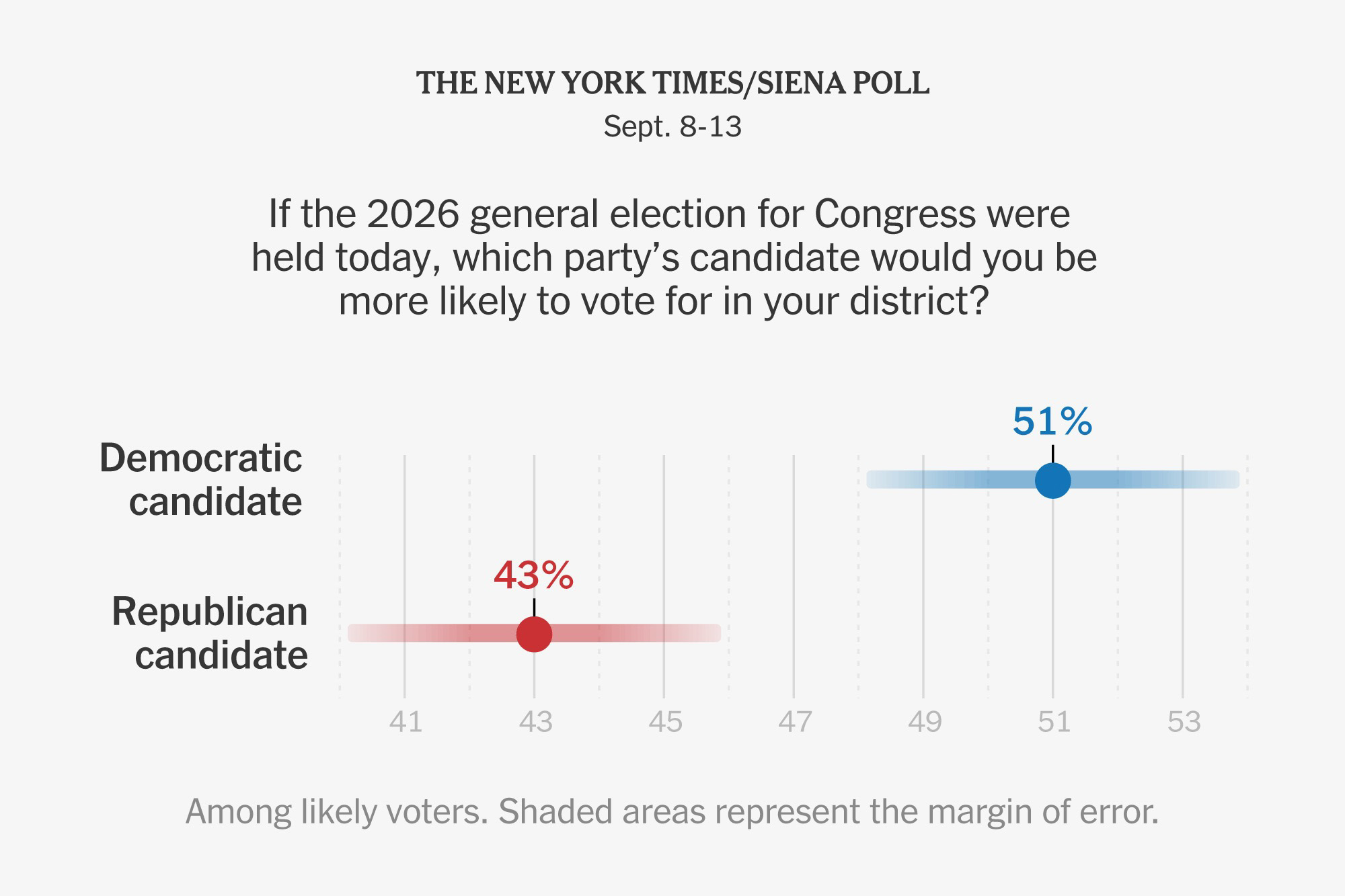
    With fewer than 50 days until the midterms, Democrats have developed a clear advantage over Republicans as the president has lost the public’s trust on the economy, according to a new national poll from the New York Times and Siena University.

    President Donald Trump’s lingering unpopularity and intense frustration over his management of cost-of-living issues, in particular, have deepened Republican vulnerabilities as Democrats push to win control of both the House and Senate.

    Likely voters favored Democratic candidates over Republicans by close to 9 percentage points in their congressional district — a metric that is closely watched by both parties as a leading indicator of political momentum.

    Trump’s approval rating continued to languish at 38% among likely voters, essentially unchanged from the lows it sank to after he went to war with Iran. A majority of voters disapproved of Trump’s handling of every major issue included in the poll: the economy, immigration, tariffs, the war, and, especially, the cost of living.

    And voters said they trusted Democrats more than Republicans on not just healthcare and foreign wars but also on the two issues that powered Trump’s 2024 victory: immigration and the economy.

    The political conditions found by the poll suggest the makings of a potential Democratic wave in November. But that outcome is far from assured. Thanks in part to gerrymandering, relatively few House seats are truly competitive, and in the run-up to the midterms, Republicans drew new House maps in several states favorable to their candidates. And even a nearly 9-point advantage would not guarantee flipping some of the Senate seats Democrats are counting on in 2026 — Texas, Ohio, Alaska, Iowa — which Trump won by double digits in 2024.

    Still, independent voters have especially soured on Trump. Just 10% of them said the economy was better today than a year ago and only 27% approve of Trump’s job performance overall. And in the fight for Congress, 57% of independent voters said they planned to vote for a Democrat compared with only 34% for a Republican.

    The cost of living is dragging down Republicans more than any other issue, as even some Republican voters lose faith in Trump’s economy. Only 28% of voters said they approved of how Trump has managed matters related to affordability.

    Even Trump’s most loyal and durable demographic base — white voters without college degrees — disapproved of the president’s handling of the cost of living by a wide 21-percentage point margin.

    And opposition to Trump is intensifying. The survey was the first Times/Siena poll in his second term to find a majority of voters, 52%, saying that they “strongly” disapproved of him.

    The war in Iran, which has driven gas prices above $4 a gallon, is also weighing down the president. More than three-quarters of independent voters said they disapproved of his handling of the conflict, and so did nearly a quarter of Trump’s own 2024 voters.

    Yet the survey found that the GOP’s vulnerabilities extend beyond Trump.

    Voters see Republicans broadly as more extreme, more elitist, and more corrupt than Democrats, according to the poll. And while voters continue to have doubts about both parties, they aligned more with the Democratic Party on both cultural and economic matters than the Republican Party in the survey.

    One glimmer of good news for Republicans is that the political situation has not deteriorated further since the spring. Yes, Trump is unpopular. But he is not more so than he was five months ago. The Democratic Party is viewed as too far left. And Republicans are generally outpolling Trump — including on how they would handle particular issues.

    Still, by an 11-point margin, voters said they would prefer for Democrats to control Congress after the November election.

    “All I know is right now, the Republicans are in power and I’m not really seeing the change I wanted to see,” said Elizabeth Gloden, 21, an independent college student in Arizona who voted for Trump in 2024 but is planning to vote Democratic this year. “I’m Gen Z. I am in the area where we want to move out of our parents’ houses, but we can’t because everything costs a million dollars,” she added. “I think it’d be a good idea to just see the other side what they can do.”

    There were indications that the Democrats were winning back groups they had lost ground with in the 2024 presidential race. The current Democratic strength in the battle for Congress was being driven heavily in the poll by younger voters (those under 30 favored Democrats by 35 percentage points), Hispanic voters (43 points) and independent voters (23 points) — all groups the party had seen sagging support from two years ago.

    Trump’s approval rating among voters under 30 stands at an abysmal 18%.

    The economy ranked as the top issue for voters. Only 14% of voters said the economy was better than it was a year ago — down from 31% who said so in January.

    The erosion among Republicans is especially stark. While 72% of Republicans said in January that the economy was better than it had been the prior year, only 29% of Republicans said so now.

    Trump has tried to wave off those concerns. “This has been the most successful two years financially and every other way in the history of the presidency,” Trump claimed in his address last week at a convention in Dallas.

    Voters are not buying it.

    “I actually feel really gaslit because I’m constantly hearing from Republicans, from conservatives just in the media in general, that ‘don’t believe your lying eyes, everything’s great, wages have increased,’ all of these different things,” said Meghan Demetrios, 40, an independent voter in South Carolina.

    “I feel like I’m super poor in America,” she continued. “I got a new career job about nine months ago, and I was so proud of myself and so excited. And I thought everything was going to get a little bit better. And I turn around, and I find that every single bill I have has gone up.”

    She plans to vote Democratic this year.

    All told, 71% of voters disapprove of how Trump is handling the cost of living while 28% approve — a net disapproval of 43 percentage points, which is 13 points worse than it was January.

    Economic hardship appears to be especially hampering the GOP among lower-wage earners.

    Those earning less than $50,000 were more than twice as likely to say they would vote for a Democratic congressional candidate this fall rather than a Republican, 63% to 31%.

    That would represent a dramatic shift from 2024, when Trump narrowly carried that group, according to exit polling.

    More than half of voters said they worry more about Republicans in Congress allowing Trump to go too far, while 39% said that they worry about Democrats trying to move the country too far to the left.

    Adding to the party’s problems, Republicans face an enthusiasm gap: 61% of Democrats said they were almost certain to vote, compared with 56% of Republicans.

    One of the Democratic Party’s potential vulnerabilities is being seen as outside the mainstream. The share of voters who see Democrats as too far left has grown to 50%, up from 47% earlier this year. (But likely voters were more likely to describe the Republican Party as “extreme” than the Democratic Party.)

    And a 51% majority of voters had an unfavorable view of socialism — one reason Trump’s convention in Dallas repeatedly used that label.

    “The Democrats have always done a horrible job of supporting their own cause because they can’t get out of their own way,” said Thomas Lappin, 48, a Democrat who lives in Austin, Texas, and who wished his party would move strategically to the center. “I feel like they’re just doing this again and every time they get their act together, they just somehow screw it up again.”

    About a tenth of all voters, including Democrats, Republicans, and independents, say they disagree with both parties when it comes to economic issues. This year, Democrats seem to be winning them over, at least for now.

    James Witherington, 41, left the Army after two decades last year and is now a real estate investor in Colorado Springs. He called his voter registration — he’s a Republican — a “loaded question” these days, considering his frustrations with Trump, whom he called “an egomaniac.”

    “This is an unnecessary war,” he said. “Do I hate Iran? Yes. Should we destroy them? Yes. But now is not the time.”

    But Witherington said he is still planning to vote for his local Republican congressman, Jeff Crank, whom he knew by name. “He emails me about veterans problems,” he said.

    “The extreme left has gone too far,” he said. “The extreme right is like the high school jock bully. But most people are in the middle. Most people are just walking down the hall.”

    This article originally appeared in the New York Times.

  • FBI Director Kash Patel suggests agents may be sent to the polls

    FBI Director Kash Patel suggests agents may be sent to the polls

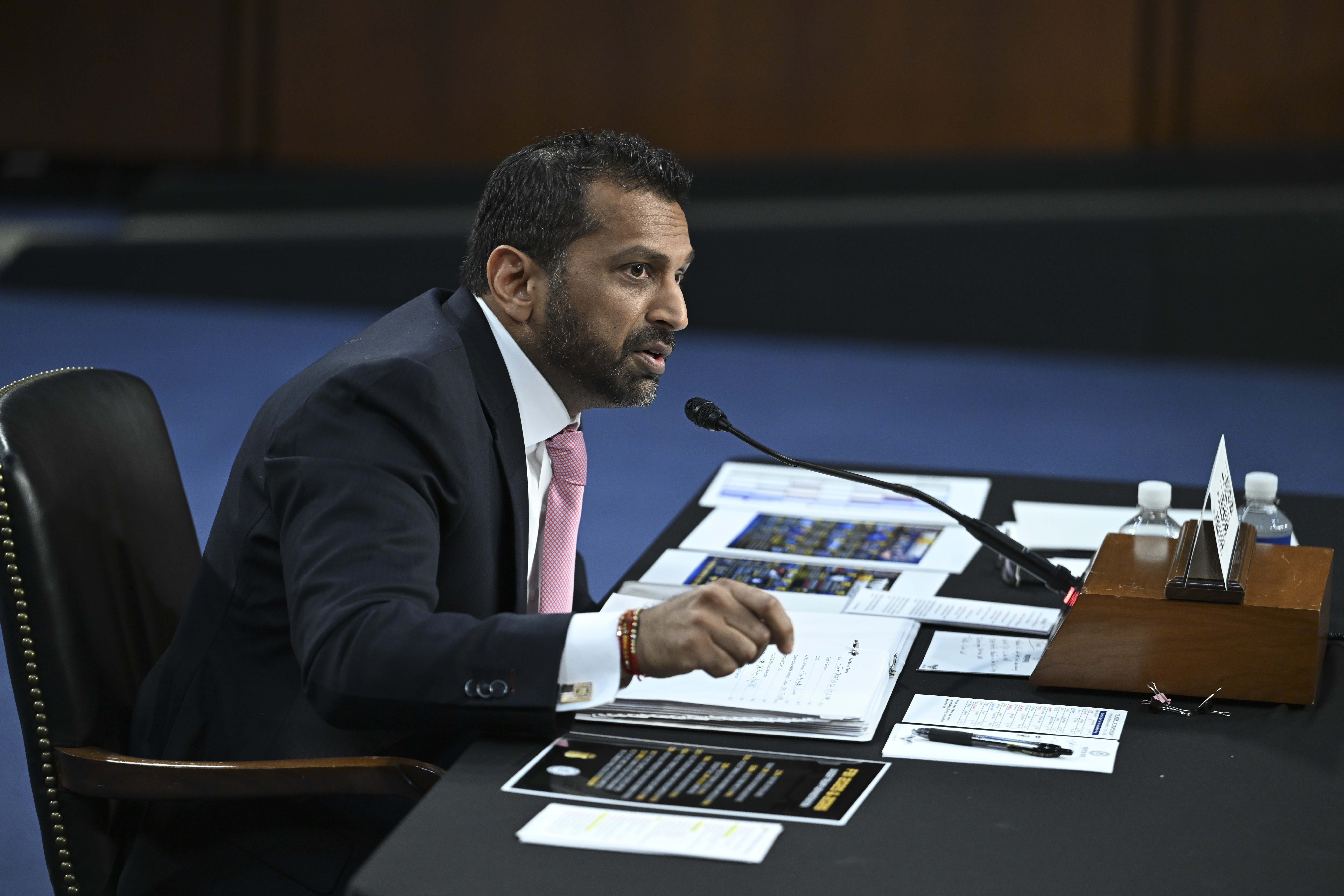
    WASHINGTON — FBI Director Kash Patel suggested Tuesday that he was open to sending federal agents to polling places, raising alarms from Democrats that the Trump administration would act aggressively to assert greater control over the coming elections.

    The remarks, made during testimony before the Senate Judiciary Committee, stood at odds with earlier comments indicating that he did not intend to send federal agents to polling places around the country. However, when Sen. Peter Welch (D., Vt.) pressed the issue, Patel seemed to reverse course.

    “I thought you weren’t going to be sending people to the polls,” Welch said.

    “When did you hear that? Just another lie,” Patel declared, raising his voice.

    Welch revisited the issue. “So you are sending FBI agents to the polls?”

    “We have election crisis coordinators manned at all 56 field offices,” Patel replied, appearing to refer to what are known as election crime coordinators. “Election integrity is of paramount importance. This FBI will not shy away from that effort.”

    Under the law, armed federal officers or military personnel are barred from being deployed “at any place where a general or special election is held.” The chair of the Joint Chiefs of Staff said in a letter to a Democratic senator last month that there were “no plans” for the armed forces to deploy troops to polling stations for the midterm elections.

    As President Donald Trump has ramped up his efforts to cast doubt on the integrity of the vote in an election his party might lose, Democrats have sought assurances from Trump administration officials that they will follow the law, which carries a potential five-year prison sentence for any violations.

    The president regularly declares the 2020 election he lost was “rigged,” and has said the only way Democrats can win control of Congress this year is by cheating. The claims have fueled broader concerns that loyalists within the administration may wage a pressure campaign against state officials to produce election results favorable to Trump’s party.

    When he was first asked about the issue at the hearing, Patel vowed to “follow the law.”

    “If there’s a reason to go there because there’s been a violation, we will, otherwise we won’t,” he added, noting that “we’re going to house our agents and intel analysts in our field offices.”

    Historically, the Justice Department used workers at its public integrity unit to consult with prosecutors and agents around the country on sensitive investigative issues around elections. But the Trump administration dismantled that unit last year, leaving it unclear who in the department and the FBI would handle such critical decisions in the final days of the election cycle.

    Welch expressed alarm at Patel’s responses, saying they suggested he could harness the power of the federal government to try to affect election outcomes.

    “This is about whether the United States citizens — Republicans, Democrats, independents — are the deciders of this election or there is election interference led by the FBI and the Trump administration,” Welch said.

    The senator prodded further. “Do you pledge that you will not in any way interfere in the will of the American people when they go to the polls in November?”

    Patel sidestepped the issue, saying instead: “I pledge unequivocally that I will not participate in your charade of lies.”

    An angry argument ensued, with the pair exchanging attacks. The senator denounced the FBI director as a “panderer” to Trump, and Patel suggested Welch’s personal finances were suspicious.

    “Let’s knock it off,” said Sen. John Cornyn (R., Texas) as he tried to lower the temperature in the hearing room.

    It did not work.

    “Everybody sees you for the complete and total fraud you are,” Patel said angrily to Welch.

    The Vermont senator then challenged Patel over his travel, in which he often combines work with recreational activities. During a trip to Italy, Patel spent time at the Olympics in Milan, during which he was filmed chugging a beer with the men’s hockey team after they won gold.

    “I go where I want to go, after delivering the most prolific crime reduction in U.S. history,” Patel said. “What you’ll never understand is the players who are my friends invited me to the locker room.”

    Patel was also pressed on whether counterintelligence agents had opened an investigation into how a wealthy Russian oligarch paid for part of the wedding celebrations for Trump’s son Donald Trump Jr.

    “It may involve some intelligence degradation, and I would like to know what steps you are taking to investigate,” said Sen. Richard Blumenthal (D., Conn.).

    He added, “I think there’s a potential for compromise in intelligence and also the possibility of improper influence.”

    Patel was noncommittal.

    “We will look at whatever information comes our way,” he said.

    In one of the stranger exchanges, Patel repeatedly fielded questions about bestiality, part of a recent change in FBI policy that loosened hiring standards, including by no longer automatically disqualifying job candidates who have participated in sexual activity with animals. The change, he said, was made out of consideration for people who may have been forced, either as children or sex-trafficking victims, to participate in such conduct.

    “We did not want to punish victims of bestiality, victims who were trafficked,” Patel said. While he did not elaborate, there have been cases in which children or others were forced to engage in sex with animals.

    Previously, the director said, the FBI had automatically disqualified anyone who had engaged in such conduct, no matter the circumstances. Lawmakers seemed flummoxed by the explanation.

    “Either side of what, the bestiality?” Sen. John Kennedy (R., La.) asked. “So you disqualified the animal?”

    Patel replied, laughing: “We have great K-9s, but we’re not going to disqualify them.”

    At other points, the hearing veered into sniping.

    Sen. Cory Booker (D., N.J.) said Patel had acted “like a thug” in using law enforcement agents to subpoena reporters.

    “We are not targeting reporters at any point in time,” Patel replied.

    “We don’t have an FBI director, we have a lackey here, and frankly not even a good lackey, he’s an incompetent lackey,” Booker said. “This is a mockery and a sham.”

    As the two men argued, Sen. Chuck Grassley (R., Iowa) sought to end the exchange.

    “Are you done now? Are you ready to shut up?” Grassley growled at Booker.

    This article originally appeared in the New York Times.

  • Yemen’s Houthi militants are learning to arm themselves with AI

    Yemen’s Houthi militants are learning to arm themselves with AI

    The popular image of Yemen’s Houthi rebels is of men on the backs of pickup trucks, firing AK-47s into the desert air.

    Yet the group has launched long-range missile strikes at Israel, more than 1,000 miles away. The Houthis prey on ship traffic in the Red Sea with naval drones. And evidence points to their growing ambition to use artificial intelligence and other means to produce more advanced weaponry themselves, making them less reliant on their sponsors in Iran.

    Although they are backed by Iran, for months the Houthis remained on the sidelines of this year’s fighting in the region. That ended in July, when they declared a maritime blockade on Saudi Arabia. Since then, they have marched south, seizing the historic port city of Mokha last week while capturing islands near the narrow strait known as the Bab el-Mandeb, tightening the group’s grip on the choke point at the southern end of the Red Sea.

    “They use every opportunity to build their capability, to test their capability, such that they are now the most lethal nonstate actor in the entire Middle East,” said Timothy A. Lenderking, the former U.S. special envoy for Yemen, speaking at a Middle East Institute forum Friday.

    A report by Anthropic last week on the misuse of AI said that “a cell of threat actors based in northern Yemen,” where the Houthis have their stronghold, used Claude for “a sustained effort to develop guided weapons.” Despite Anthropic’s safeguards, the company said, the cell proceeded as far as the test firing of a guided rocket.

    The Houthis still rely on their Iranian sponsors for the most sophisticated components in their drones and ballistic missiles, but as the Anthropic report suggested, in recent years they have become much more advanced at building their own weapons systems.

    This has given the Houthis greater flexibility to maintain their fight against their Yemeni and Saudi adversaries, attack shipping traffic in the Red Sea, and threaten Israeli and U.S. targets even with the U.S. Navy enforcing a monthslong blockade of the Strait of Hormuz.

    Laboratory of war

    The Houthis and their Iranian advisers were already experimenting with uncrewed surface vessels a decade ago. The militant group used a remote-controlled boat loaded with explosives to attack a Saudi frigate all the way back in 2017, killing two people in the process.

    After the Houthis captured Yemen’s capital, Sanaa, in 2014, Saudi Arabia led a military coalition propping up the country’s government and fighting back against the militants. A ceasefire was declared in 2022, but experts say the group has used the intervening years to dramatically advance its capabilities.

    The truce gave the Houthis time “to regroup, retrain, refit, restock,” Lenderking said.

    “The volume of goods being brought into Yemen to make weapons increased exponentially and the number of routes being used increased exponentially after the truce was announced in Yemen in 2022,” said Peter Salisbury, an adjunct professor at Columbia University’s School of International and Public Affairs, who has studied Houthi weapons manufacturing closely.

    At first, Yemen was a laboratory for Iran’s pursuit of warfare. Increasingly, it is the factory, too. Salisbury said that larger parts like missile chassis are fabricated in Houthi-controlled territory rather than sent from Iran.

    “Iran and Hezbollah have invested heavily in continuing to up-skill the Houthis in the manufacture and use of weapons,” Salisbury said. “Increasingly they’ve been able to indigenize the production of a lot of things like one-way attack drones.”

    According to Farzin Nadimi, a senior fellow with the Washington Institute for Near East Policy, the Iranian defense industry has dedicated design bureaus and factories for weapons systems specifically for proxy forces like the Houthis that are “simple to assemble, simple to move, simple to prepare for launch, and simple to use.”

    Resilient supply chains

    The Iranians encouraged the Houthis to develop additional supply chains for components from places like China, whose factories supply many of the drone parts used around the world.

    “There’s a lot the Houthis don’t need anymore, and the reason they don’t need it anymore is because they’ve been able to use the global black market supply chain to get most of the things they need,” said Kevin Donegan, a former commander of the U.S. 5th Fleet, whose area of responsibility included the Persian Gulf and the Red Sea, and who built the first intelligence fusion cell to study Iranian support for the Houthis.

    “They do need key components still, especially for the missiles to make them effective,” Donegan said. “They have the ratlines that still can bring those components because they’re not the big pieces.”

    Those might include guidance systems, rocket engines, and wing tips and fins that require a higher degree of precision engineering, Salisbury said.

    While the U.S. Navy’s blockade focuses on large container ships and tankers, smaller components can be smuggled on medium-size vessels like the traditional dhows plowing the region’s waters. Shipments can be sent directly to Houthi-controlled areas of Yemen, transshipped via the Horn of Africa or even transferred ship to ship in the waters off the coast of Somalia. Salisbury calls it a “giant game of three card monte.”

    Increased self-sufficiency is not necessarily the same thing as complete independence from their sponsors in Iran’s Revolutionary Guard. “I think they pretty much still need a lot of help from the IRGC,” Nadimi said. He said that he believed there were “significant numbers” of Revolutionary Guard officers involved in the planning and execution of the current phase of the fighting in Yemen.

    The need for Iranian advisers and the more advanced components may explain how the renewed fighting in Yemen started this summer in the first place.

    A Houthi delegation traveled to Tehran, Iran, in July for the funeral of Iran’s supreme leader, Ayatollah Ali Khamenei. After, they boarded a flight home operated by Iran’s Mahan Air, which is under sanctions imposed by the U.S. government, back to Sanaa.

    The Saudis and the Yemeni government believe that the aircraft carried Iranian military personnel and weaponry. When airstrikes prevented the plane from landing at Sanaa International Airport, the flight diverted and managed to land elsewhere in Houthi-controlled territory.

    The Houthis then launched retaliatory attacks on Abha International Airport, in the southern part of Saudi Arabia. It was the first Houthi attack on Saudi Arabia since 2022, and began a new and unpredictable phase of fighting, with an adversary that spent years planning and advancing its tactics and technology.

    If the Anthropic report is accurate, the group that was using Claude in northern Yemen tried to develop a multistage ballistic missile with a range of more than 1,200 miles and a hypersonic glide vehicle. The would-be weapons designers were careful to avoid the company’s safeguards, hiding the true purpose of the guidance systems they were designing from the very system helping them design it.

    Anthropic said there was no evidence that they were successful in “fielding an operational device.” The users queried Claude Code about why their field test had failed. “Nevertheless, we have evidence that the actors had already built an offline simulation tool kit that does not rely on Claude,” the report said.

    Recent history suggests they will keep working to improve their capabilities.

    “Keep in mind that the Houthis are always on the move,” said Lenderking, the former U.S. envoy. “They’re extremely entrepreneurial.”

    This article originally appeared in the New York Times.

  • U.S. has deployed weapons in space, Air Force secretary says

    U.S. has deployed weapons in space, Air Force secretary says

    The United States has stationed weapons in Earth’s orbit, Air Force Secretary Troy E. Meink said Monday, the first such public acknowledgment by a Pentagon official after years of preparations to counter potential deployments by Russia and China.

    “We are increasing readiness against existing threats, and the United States has on-orbit space control weapons capable of defending the Joint Force against hostile adversary action,” he said at a convention in Maryland, according to a news release published on the Air Force’s website.

    Meink did not provide details about the type of weapons or say when they had been deployed. He made his remarks in a keynote speech at the Air, Space, and Cyber Conference in National Harbor, Md., an annual forum hosted by the Air and Space Forces Association, a nonprofit organization for members of both services.

    The Space Force did not immediately respond to a request for comment late Monday.

    The Pentagon has long feared that China and Russia are making advances in space operations that could threaten U.S. ground forces as well as U.S. satellites.

    Guo Jiakun, a spokesperson for China’s Foreign Ministry, said Tuesday in response to a question about Meink’s comments that China opposed an “outer space arms race.”

    “We urge the U.S. side to stop expanding its military force and preparing for war in outer space,” he said in a regular news briefing.

    In 2024, the New York Times reported that U.S. intelligence agencies had raised concerns that Russia could be planning to put a nuclear weapon in space, a threat that could disrupt satellite networks that are vital to everything from communications to military operations.

    Shortly after President Donald Trump returned to the White House last year, he signed an executive order to expand U.S. air defenses, including the development and deployment of “space-based interceptors.” The project, named the Golden Dome, would be designed to guard against weapons such as hypersonic missiles, which Russia has deployed in Ukraine.

    In May, Trump said that Gen. Michael Guetlein, vice chief of space operations at the Space Force, would oversee the project.

    The United States, Russia, and China began testing weapons capable of destroying satellites decades ago, but the United States has since disavowed such arms because they leave destructive debris fields in orbit.

    In recent years, the Air Force started developing “low-debris-causing weapons” capable of disrupting or disabling enemy satellites, Frank Kendall, who served as Air Force secretary under President Joe Biden, told the Times in a 2024 interview.

    Gen. Chance Saltzman, who served as the Space Force’s chief of space operations during the Biden and second Trump administrations until his retirement last month, told a Senate committee in 2023 that the new space weapons systems would be fully operational by 2026.

    Neither Kendall nor Saltzman specified how the systems would work. Other former Pentagon officials have said they likely would include lasers, high-powered microwave systems, or even U.S. satellites that can grab or move enemy satellites.

    Kendall said in 2024 that it was prudent to recognize that space “is a place that can be used for military advantage.”

    “The threat is there,” he said at the time. “It’s a domain we have to be competitive in.”

    This article originally appeared in the New York Times.

  • Trump’s effort to assert control over elections continues, despite court loss

    Trump’s effort to assert control over elections continues, despite court loss

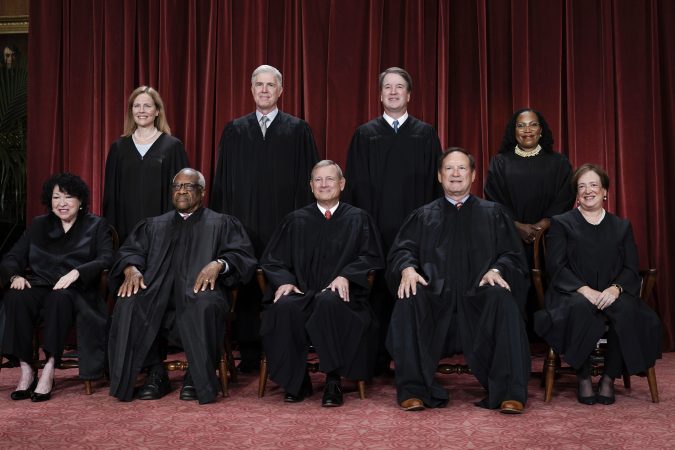
    WASHINGTON — The Supreme Court dealt President Donald Trump a major blow Monday when it blocked his executive order to restrict mail ballots. But Trump’s battle to assert control over the election process is far from finished.

    The stymied attempt to have the U.S. Postal Service screen mail ballots was just one piece of a broader effort involving the full power of the federal government to take more control of state-run elections.

    Just days before the Supreme Court blocked Trump’s mail ballot order, the Justice Department sent threatening letters to at least 30 top election officials across the country, escalating a fight to gain access to private voter data and election records.

    Federal agents are scouring voter rolls managed by states for noncitizens, despite a lack of evidence of widespread fraud. Trump’s Homeland Security secretary recently pushed for an investigation into whether a commonly used voting machine can be trusted, casting doubt on digital voting systems.

    “This is far from over,” said Benjamin Hovland, who was ousted from the independent, bipartisan Election Assistance Commission by the Trump administration this year.

    Hovland acknowledged that the Supreme Court’s decision mitigated “real-world impact” on voters and election workers, particularly since voters in some states have already begun to mail in their ballots. But he said Trump’s actions were alarming.

    “What you’re seeing is using the apparatus of government, using federal agencies, using taxpayer dollars, to push that narrative that only undermines confidence in our democracy and ultimately hurts voters and election officials,” Hovland said.

    Trump argues that he is trying to secure the integrity of the vote, but his claims of widespread fraud in the election system have been investigated and debunked repeatedly, and critics say his actions needlessly sow doubt about the outcome of the vote.

    The White House did not immediately respond to requests for comment.

    There are stark differences between now and Trump’s first term, when his attempts to undermine the election results in 2020 ran into stiff pushback not only from the courts but also from his own government officials. In his second term, Trump has surrounded himself with loyalists willing to turn his obsession over the country’s election systems into a blitz of federal actions. He has also installed election deniers in key posts.

    The Supreme Court’s decision Monday did, however, add to a string of mounting losses for Trump, who said this year that he wanted to “take over” and nationalize elections. Even before the Supreme Court decision, two lower court judges ruled that Trump’s changes to mail-in balloting were most likely illegal and should not be imposed so close to the November elections.

    Trump administration lawyers had urged the Supreme Court to step in and clear the way for its plan to use the Postal Service to screen ballot envelopes after they are submitted by state elections officials. The new rules would require states to submit lists of voters approved to receive mail ballots. The Postal Service would then deliver mail ballots only to the voters on the lists.

    In addition to the loss Monday, Trump’s other attempts to pressure states over the election process have faced legal setbacks.

    The Justice Department has sued 30 states for unredacted voter lists, which include personal information such as driver’s license numbers and partial Social Security numbers.

    They have lost 23 of those cases. Decisions are pending in the rest.

    The federal actions, as well as the various court decisions, have caused alarm among local election officials and voters, according to election experts.

    This month, the chief election officials in seven Republican-controlled states filed a brief to the Supreme Court, arguing that with less than two months until Election Day, it was too close to the midterms to make any major changes to the election process.

    Some states including North Carolina, Delaware, and Alabama had already mailed out their ballots, even before the Supreme Court issued a final decision.

    “Attempting to implement the rule now will almost certainly lead to mistakes, delays, and confusion for both voters and election officials,” the brief stated.

    But it was not just the pending Postal Service rule that has caused confusion and upended coordination among local election officials and the federal government.

    The administration has also asked the Supreme Court to intervene to allow it to move forward with an effort to build citizenship lists by merging data from various agencies, including the Department of Homeland Security and the Social Security Administration. A lower court has so far blocked the use of that tool, which administration officials argue is needed to verify citizenship for voting, among other purposes.

    In July, Markwayne Mullin, the Homeland Security secretary, threatened election officials in a speech and said they could face prison time if they did not comply with the Trump administration’s efforts to change election policies. Officials in the Justice Department have also explored whether they could bring criminal charges against state or local election officials if the administration determined they had not sufficiently safeguarded their computer systems.

    The Federal Emergency Management Agency, which sits under the Homeland Security Department, is demanding that states change the way they conduct elections or risk losing tens of millions in federal terrorism-prevention funds.

    Kimball W. Brace, the president of Election Data Services, an organization that works with local governments on election preparedness, said he did not expect the Supreme Court decision to stop Trump’s broader effort to pursue his election grievances.

    “I don’t anticipate people on the Republican side not wanting to continue and push their side of the story as much as possible,” Brace said.

    Distrust of the election process among voters is growing as the November elections approach. A survey from the Associated Press and the NORC Center for Public Affairs Research and USAFacts showed that only 34% of U.S. adults trust government certifications of election results “a great deal” or “quite a bit,” down from 40% in 2024.

    Trump has also gutted the government’s election security infrastructure. Experts warn that his cuts to agencies tasked with coordinating election security with state governments could reduce visibility into foreign influence campaigns and cyberattacks.

    Brace said all the executive actions have fueled pressure on local election officials.

    “They don’t want to deal with this crazy pressure that various interests and various individuals have pushed on the election administration,” he said.

    This article originally appeared in the New York Times.

  • Gavin Newsom says he won’t run in 2028 if Kamala Harris does

    Gavin Newsom says he won’t run in 2028 if Kamala Harris does

    WASHINGTON — Gov. Gavin Newsom of California, who is widely expected to run for president in 2028, said in an interview published Monday by CNN that he would forgo a campaign if former Vice President Kamala Harris decided to run herself.

    “I wouldn’t run if she ran,” Newsom said during an interview recorded during a fly-fishing outing in Montana with Jake Tapper, the CNN anchor, adding: “I wouldn’t waste everyone’s time. Who needs that?”

    Newsom’s statement, volunteered as he and Tapper cast their lines at a scenic river, seemed to fly in the face of the presidential ambitions the governor has telegraphed since even before Harris lost the 2024 election.

    The surprising pledge, if taken at face value, might appear to constrain Newsom’s ambitions if Harris does in fact run again. He would be forced to either keep his word and not pursue an office he has openly coveted, or go back on his word and run against a fellow California Democrat with whom he has a long and complicated relationship.

    It is also possible that Newsom could announce a presidential campaign before Harris does, which could give him some wiggle room to argue that he had not broken any promises. Newsom might also believe that Harris will not run.

    A spokesperson for Newsom said he could not immediately offer more clarity on what the governor had meant.

    “They’ve been friends long enough that they wouldn’t play cat-and-mouse games on something this important,” said the spokesperson, Bob Salladay.

    The 2028 presidential primary race is expected to officially start as soon as late this year, after the midterm elections, and potential contenders including Newsom and Harris have made moves to maintain their national political profiles.

    This year, Newsom has made two trips to South Carolina, the first state on the Democratic Party’s presidential nominating calendar. Shortly after President Donald Trump took office for a second time, Newsom started a podcast in which he has interviewed guests from across the political spectrum, including Charlie Kirk before his assassination, Hunter Biden, and a series of Democratic governors.

    When Tapper laid out the case for why Harris, who has also expressed her interest in running for president again, might not be the best option because she has already been nominated and lost, Newsom agreed.

    “That would be the case you’d make, a pretty good one, actually, that’s objectively true,” he said. “But I know what that means. I know her base of supporters, I know her friends.” Referring to the overlap in their circles as “pure crossover,” he added, “I wouldn’t do that.”

    This article originally appeared in the New York Times.

  • In fits and starts, the Supreme Court stands up to Trump

    In fits and starts, the Supreme Court stands up to Trump

    WASHINGTON — The Supreme Court has not been eager to tangle with President Donald Trump. For much of his second term, the court seemed to have settled on a strategy of deference, ducking, and delay.

    But sometimes the court put its foot down. It did so Monday night in rejecting Trump’s plan to make it harder to vote by mail by having the Postal Service screen mail ballots and determine which ones it would deliver.

    Election administrators of both parties were mystified and alarmed by the plan, which they said would result in the disenfranchisement of millions of voters. Just three weeks ago, the court’s conservative majority deferred a decision on the matter, saying it was not yet ripe.

    That punt, the court’s unsigned ruling said, did not mean it would approve the plan in the end. “On that score,” the majority wrote, “time will tell.”

    That time arrived Monday, and the message was clear. The majority blocked the plan, saying it was most likely unlawful.

    “There aren’t five votes for abject chaos,” said Justin Levitt, a law professor at Loyola Marymount University in Los Angeles.

    Trump, for his part, reacted to the decision with fury, lashing out at his three appointees, none of whom noted a dissent.

    “This Supreme Court is bullied and cajoled by the Radical Left into making decisions that have set America back at least a hundred years,” he wrote Tuesday morning on social media. “These are not the people I interviewed to serve on the United States Supreme Court, they are merely a shell of their original selves.”

    The decision on mail ballots is part of a pattern. The Trump administration met with overwhelming success in some 30 emergency applications to the Supreme Court since the president’s second term began, on what critics call its shadow docket. Those decisions were nominally provisional, but they often delivered lasting victories to the president.

    In rushed proceedings that mostly yielded decisions with scant or no reasoning, the court divided along partisan lines much more often than in cases on the court’s so-called merits docket, which require full briefing, oral arguments, and in-person deliberations.

    The theme of those emergency rulings was deference to presidential power.

    But the tide started to turn in December, when the court refused to allow the deployment of the National Guard in Illinois over the objection of local officials.

    The rebukes continued in the term that ended in June.

    The court rejected the centerpiece of Trump’s beloved tariffs program, leading to refunds of many billions of dollars in illegal levies. It also thwarted Trump’s attempt to fire a Fed governor and disagreed with his interpretation of a law that he said barred counting some ballots received after Election Day.

    After a preliminary ruling last year limiting the power of lower courts to order relief in a case that arose in the context of birthright citizenship — at the time perceived as a major victory for Trump — the court this summer returned to address the citizenship question directly. This time, it dealt Trump a stinging loss, ruling that his executive order seeking to curtail automatic citizenship for babies born in the United States violated the Constitution.

    The majority opinion about mail-in balloting Monday was just three sentences long, but it went further than it might have. Instead of ruling merely that the administration’s plan had been rolled out too close to the November election, a conclusion that might have suggested Trump might still win in the end, the majority signaled that the government was likely to lose on the merits.

    That move was at odds with one of Chief Justice John Roberts’ judicial touchstones. “If it is not necessary to decide more to dispose of a case,” he wrote in 2022, “then it is necessary not to decide more.”

    All the court had to do to block the postal regulation was to say it would cause more harm than good in the current election cycle, Josh Blackman, a law professor at South Texas College of Law Houston, wrote in a blog post Monday night.

    “But the chief justice didn’t want this case to come back, so he reached the merits,” Blackman wrote. “If there is no need to decide more, the court should not decide more. Except when Trump is involved.”

    That approach may be a response to the fire hose of executive orders, programs, initiatives, dodges, and feints from the Trump administration that have threatened to overwhelm and outpace the courts. However significant Trump’s losses in the Supreme Court may have been, he remains hard to constrain by a judicial system used to moving at a stately pace.

    The vote count in Monday’s ruling was not disclosed, but only Justice Samuel Alito, appointed by President George W. Bush, and Justice Clarence Thomas, appointed by President George H.W. Bush, publicly dissented.

    Those two justices are the most reliable votes for Trump’s agenda, while the court’s three Democratic appointees seldom vote for the president. That leaves the three Trump appointees and the chief justice, who was appointed by George W. Bush, at the court’s center.

    If the court is to check Trump in the typical case, then, at least one of his appointees must vote against him. And that has now happened in a series of major clashes.

    “This is not a MAGA court,” Donald B. Verrilli Jr., who served as solicitor general in the Obama administration, said at a briefing for reporters Tuesday at Georgetown University Law Center.

    The practical consequences of the court’s ruling are a mixed bag, election administrators said.

    “The feeling of relief here is palpable,” Marybeth Kuznik, the director of elections in Fayette County, Pa., said on an email forum for election law specialists. Still, she added, “with all the hullabaloo in the media, voters have become alarmed and many are afraid their mail-in votes may not be counted no matter what the ruling may be.”

    There was another election-related ruling last week, about an attempt to redraw Missouri’s voting map to give Republicans an advantage in the midterm elections. It also took two trips to the Supreme Court to resolve. Over the administration’s objections and without public dissent, the court rejected the map.

    Yet another election-related application from the administration is pending at the court. It asks the justices to allow the use of a government database that includes Social Security information to help verify whether potential voters are citizens. It is another example of the administration’s everything-all-at-once approach.

    Still, the combination of the Missouri ruling and the one Monday on the postal regulations sent a message for the coming election, Levitt said.

    “The court is effectively done with actors making sizable last-minute changes,” he said. “The rules are now what they are, and the election is going to be — as it should be — up to the voters.”

    This article originally appeared in the New York Times.

  • Prosecutors will not seek death penalty for Nick Reiner

    Prosecutors will not seek death penalty for Nick Reiner

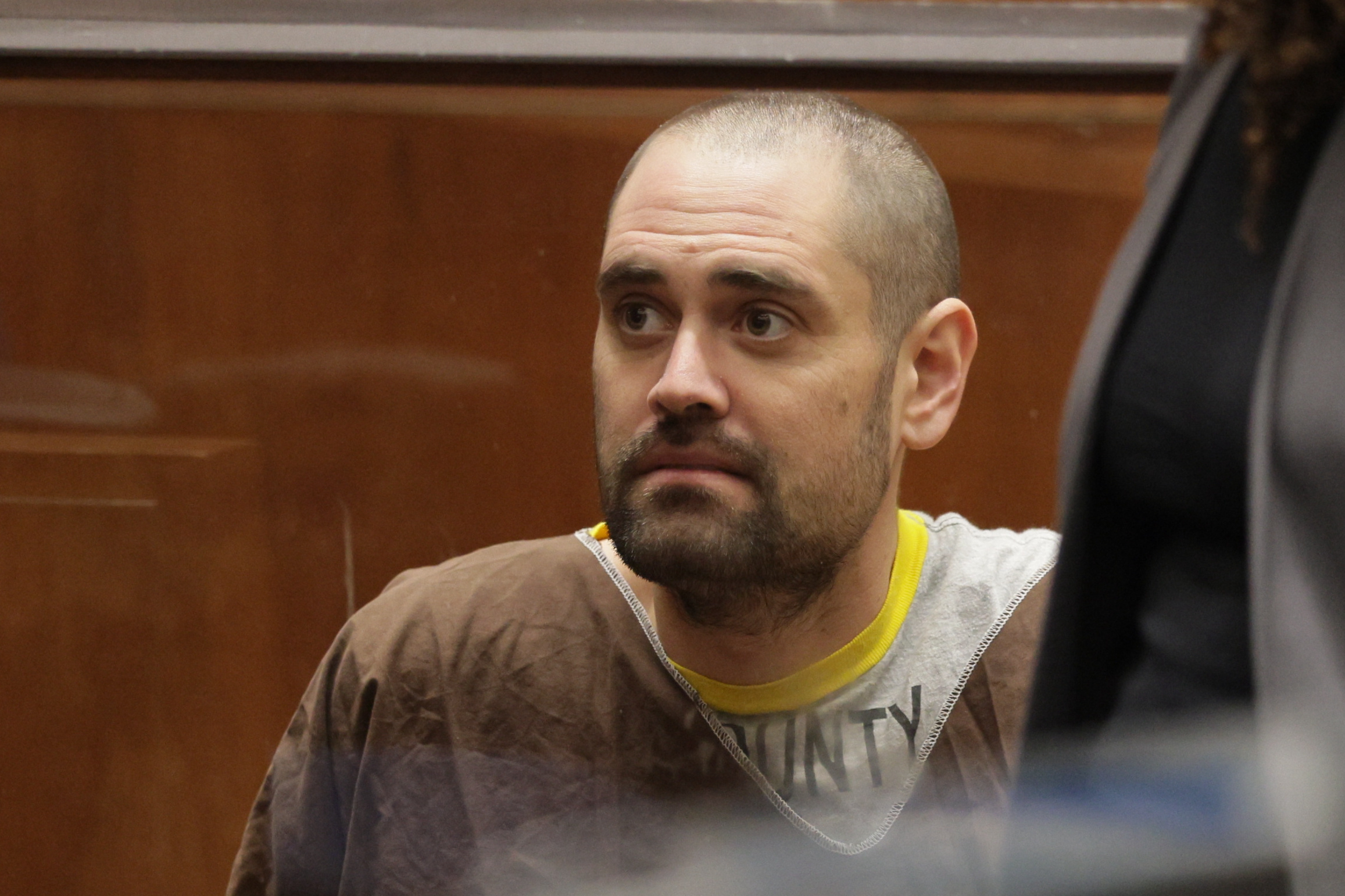
    LOS ANGELES — The Los Angeles County district attorney said Tuesday that his office would not seek the death penalty in the double murder case against Nick Reiner, who is accused of killing his parents, Hollywood director Rob Reiner and Michele Singer Reiner.

    Nathan J. Hochman, the district attorney, said in a news conference before a hearing in the case that the decision was made after “a rigorous review, where we look at the aggravating factors as well as the mitigating factors.”

    Hochman said the district attorney’s office had spoken with the victims’ family, prosecutors, and law enforcement.

    “We did speak with Nick Reiner’s siblings,” he said, referring to Jake and Romy Reiner. “They made their views very clear. We took their views into consideration in ultimately deciding not to seek the death penalty.”

    If Reiner, 33, is convicted, he would face a maximum sentence of life in prison without the possibility of parole. No trial date has been set.

    Rob Reiner and Michele Singer Reiner were found dead inside their home in the Brentwood neighborhood of Los Angeles in December. A grand jury indicted Nick Reiner on two counts of first-degree murder, to which he has pleaded not guilty.

    Reiner has been charged with murder under special circumstances — including the fact that there were multiple killings — which meant prosecutors could seek the death penalty. Other special circumstances included in the indictment were the allegations that he committed the murders “by means of lying in wait” and with a dangerous and deadly weapon, a knife.

    A public defender representing Reiner did not immediately respond to a request for comment.

    Reiner has been trying to gain access to a $1.6 million family trust fund so he can hire a private lawyer, but he has faced opposition from a financial steward who cited California’s “slayer statute.” The statute blocks people from inheriting money from someone they “feloniously and intentionally” kill.

    Reiner has a history of serious mental illness and drug addiction. He has been diagnosed at different times with schizophrenia and schizoaffective disorder, according to people familiar with the situation, and was placed into a yearlong mental health conservatorship in 2020. One of those people told the New York Times that Reiner had been struggling in the weeks before his arrest with a change in his medication.

    Few details have been shared publicly about what the authorities believe led to the killings and what Reiner’s motive could have been. A judge has issued a protective order, barring prosecutors or defense lawyers from releasing any discovery materials.

    Jake and Romy Reiner were both listed on the witness list for grand jury proceedings in July. In an interview with ABC that was broadcast last month, Jake Reiner recalled the discovery of his parents’ killings on Dec. 14, 2025, when his sister called him in distress.

    “Romy told me our dad was dead,” he said in the interview, “and then she said, ‘I can’t find mom.’”

    He declined to say whether he was surprised when he learned that his brother was considered the prime suspect.

    “I’ll never understand,” he said. “I don’t care how it’s explained to me, I don’t care what facts come out. I will never understand why this happened.”

    This article originally appeared in the New York Times.

  • Bob Mackie, designer who bedazzled Carol Burnett and Cher, dies at 87

    Bob Mackie, designer who bedazzled Carol Burnett and Cher, dies at 87

    Bob Mackie, the exuberant costume and fashion designer whose glittering, beaded, sequined, rhinestoned, feathered, and often winged creations bedecked, bedazzled and elevated performers like Carol Burnett, Diana Ross, Tina Turner, Bernadette Peters, Bette Midler, Mitzi Gaynor, Liza Minnelli, Elton John, RuPaul, and, most memorably and enduringly, Cher — as well as an 11.5-inch model named Barbie — died Monday in Palm Springs, Calif. He was 87.

    The death, at a hospital, was confirmed by Joe McFate, Mackie’s longtime design director.

    “He dressed every spangly woman in show business,” said Frank DeCaro, author of Unmistakably Mackie: The Fashion and Fantasy of Bob Mackie (1999). “You can mention some of the greatest names in fashion, and the average person won’t be able to conjure up, for example, a Giorgio Armani suit. But if you say to an American of a certain age, ‘What is a Bob Mackie?,’ they know exactly what you’re talking about.”

    Mr. Mackie got his start in Hollywood, dropping out of college to sketch for costume designers Jean Louis and Edith Head, but it was television that made his name. When Carol Burnett put together her variety show in 1967, she picked Mr. Mackie to design the costumes. At the time, he was in his late 20s — though he looked about 12, Burnett often said. Over the show’s 11 seasons, he created an average of 60 costumes a week for Burnett, Harvey Korman, Vicki Lawrence, Tim Conway, and Lyle Waggoner, as well as the show’s guest stars and supporting performers.

    The skits, of course, were comedic gold, and Burnett said that she frequently found her characters through Mr. Mackie’s designs. For Mrs. Wiggins — the dim and indifferent secretary whom “the IQ fairy never visited,” in Burnett’s words — he assembled a frosty blond wig, a pushup bra, and a tight black skirt that wasn’t quite tight enough for Burnett’s lanky frame. “Stick your behind back into it,” he instructed her, and the character’s mincing walk was born.

    The show was known for its zany movie parodies, and when it took on a scene from Gone With the Wind (renamed Went With the Wind) in which the main character, fallen on hard times, has a dress made out of her curtains, Mr. Mackie asked the prop department for a curtain rod so he could fashion his own version for Burnett as “Starlet O’Hara.” It was such an instant, irresistible sight gag that Burnett made sure to warn Korman, playing “Ratt Butler,” beforehand so he wouldn’t lose his composure onstage.

    “That gown is gorgeous,” Ratt exclaimed in the skit.

    “Thank you,” Starlet replied. “I saw it in the window, and I just couldn’t resist it.”

    Mr. Mackie’s curtain dress is now in the permanent collection of the Smithsonian National Museum of American History in Washington.

    Television variety shows were the closest thing to movie musicals, as Mr. Mackie liked to say, particularly in the 1970s; they were nightly extravaganzas that delivered high-wattage stars and over-the-top, glamorous fashion to America’s living rooms.

    Sonny Bono and Cher had veered from their folk roots and were playing Las Vegas when CBS hired them to do a weekly show. Mr. Mackie had seen photos of them, and as he told Vogue, which put together an oral history of the designer in 2019, “They were kind of like New Age cave people. There they were in their fur vests and funny pants and belts and just a whole look that nobody had had up until that time.”

    The producers, he added, didn’t know what to do with Cher, but Mr. Mackie did. (He noted that she was built just like Burnett, a perfect size 6 with no cleavage: a human clothes hanger.) Their collaboration, first on The Sonny and Cher Comedy Hour, which ran from 1971 to 1974, delighted television audiences and confounded the network’s censors, as Mr. Mackie bared more and more of Cher’s extraordinary physique in ever more outlandish getups.

    Mr. Mackie recalled a censor complaining of one outfit that revealed the undersides of Cher’s breasts. (The industry term was “underboob.”)

    “Well, if we stand her on her head,” he retorted, “it will just be cleavage.”

    Later, Cher became the first person allowed to show her belly button on television.

    “People can watch a show and see people stealing hubcaps, and then they can go out and steal hubcaps,” she told TV Guide, “but I don’t think my show will provoke anybody into stealing a belly button.”

    Reviewing Cher, her postdivorce variety show that ran for 11 months in 1975-76, Newsweek declared that the performer “played second banana to the show’s real star — a cool, hip, certifiably freaky costume designer named Bob Mackie. Television hasn’t shown so much glitter and flash since NBC did a special on Liberace’s closet.”

    As DeCaro observed, “He brought glamour to a sequin-starved America.”

    In the process, Mr. Mackie’s name became a gay touchstone. “For gay kids sitting at home like me or RuPaul, looking for a way out of our drab surroundings, Bob Mackie was the portal,” DeCaro said. “He made women look like drag queens, but in the best possible sense. He was a window into a glamorous, funny, inclusive glitter world. For me, the ultimate Mackie moment was when the first Cher special ended in a sea of white balloons, and it’s Bette Midler, Elton John, Flip Wilson, and Cher, all dripping with mirror tiles and looking like glamorous disco balls come to life.”

    And yet Mr. Mackie — preternaturally boyish, always soberly dressed in his uniform of button-down shirts and khaki pants, like he had stepped out of a Ralph Lauren ad — looked as if he would be allergic to sequins.

    Robert Gordon Mackie was born in Monterey Park, Calif., a bit east of downtown Los Angeles, on March 24, 1939. That was the year, he liked to say, that Gone With the Wind, The Women, and The Wizard of Oz came out.

    His father, Charles Robert Mackie, who worked at Bank of America, and his mother, Mildred Agnes (Smith) Mackie, a homemaker, divorced when he was young, and he was raised by his paternal grandmother, Bessie Ida Mackie, in Alhambra, Calif. Her house, he recalled, was on a busy highway with not much neighborhood, and he was often alone and lonely. He drew to entertain himself.

    “I was a weird kid,” he told Vogue in 1990. “But I was always pretty good with crayons.”

    His mother and his older sister would visit on weekends and take Bob to the movies — Technicolor musicals, mostly, that entranced him. “It didn’t look like that at my house, and I wanted to be part of that,” he said. He remembered being dazzled by the dance numbers in An American in Paris. When the credits rolled at the end, he discovered that costume design was a job.

    Mr. Mackie attended Pasadena City College and then the Chouinard Art Institute, now part of the California Institute of the Arts, before dropping out to work on movies, first with Fred Thompson, then Louis and Head. (Mr. Mackie sketched the skintight gown that Louis made for Marilyn Monroe when she sang “Happy Birthday” to President John F. Kennedy in 1962.)

    In 1963, he was hired by Ray Aghayan, an Iraqi-born designer who was working on Judy Garland’s television variety show. The two became business and romantic partners, sharing the first Emmy ever awarded for costume design, in 1967, for their work on Alice Through the Looking Glass, an eye-popping confection of a television movie.

    The pair received Oscar nominations for Lady Sings the Blues, the 1972 biopic of Billie Holiday starring Ross, and for Funny Lady, the 1975 sequel to Funny Girl. Mr. Mackie was nominated on his own for Pennies From Heaven, the 1981 film musical starring Steve Martin and Peters.

    He won an Emmy in 1999 for Cher’s costumes in Cher: Live in Concert From Los Angeles and again in 2003, for Cher: The Farewell Tour.

    A brief marriage to Marianne Nicholson, an actor whose stage name is Lulu Porter, ended in divorce in the early 1960s. Their son, Robert Gordon Mackie Jr., who was known as Robin and worked as a makeup artist, died of AIDS in 1993. Aghayan died in 2011. Mr. Mackie’s survivors include a granddaughter and two great-granddaughters.

    In the early 1980s, Mr. Mackie began designing ready-to-wear. A decade later, he created a line of clothing and home furnishings for QVC, the shopping channel. While critics enjoyed the high camp factor of his cinema-siren clothes and the theatricality of his fashion shows, he was often derided for being not an authentic fashion designer, although his clothes were meticulously made, like couture garments.

    “Subjecting Mr. Mackie to serious fashion criticism is a little like asking Ada Louise Huxtable to meditate on Malibu Barbie’s dream house,” Ginia Bellafante of the New York Times wrote, reviewing his 2002 fashion show.

    Yet Mr. Mackie was proud to design for that diminutive doll, which he began doing in 1982, creating outfits as exotic and outrageous as those he made for his human muse, Cher. Goddess of the Sun Barbie, out in 1995, has 11,000 sequins on her hand-sewn gown.

    “They called him Barnum Bob, the Raja of Rhinestones and the Sequined Sheik,” McFate said. “They thought of him as a Hollywood guy. It was hard for him to get a footing on Seventh Avenue.”

    In 2001, the Council of Fashion Designers of America gave Mr. Mackie an award for “fashion exuberance.” In 2019, he earned the organization’s lifetime achievement award. That same year, he won a Tony for the costumes in the Broadway musical The Cher Show, a dizzying, giddy paean to the performer and her style.

    As he told Vogue, “For a long time, everyone just thought all I knew how to do were Cher’s dresses, you know, with her tummy out and showing half her whatever.”

    He added, “I always just sort of pray in my life somebody will give me a nice 19th-century movie or a good 1930s Depression film.”

    This article originally appeared in the New York Times.