Q: I let my dog sleep in bed with me, but some of my friends say it’s unhygienic and possibly bad for my sleep. Is it?
A: When Shelby Harris, a sleep psychologist in New York City, starts working with patients who are having trouble sleeping, she always asks if they have pets. “The first thing they say to me is: ‘I have a dog. You’re going to tell me not to sleep with the dog,’” she said.
That’s not necessarily the case, Harris said. Some people experience great joy from sleeping with their pets, and not everyone suffers from sleep disruptions. But if the pet is the source of the problem, Harris said, that’s good for everyone to know.
In an online survey of about 2,000 U.S. adults published in 2022, nearly half said that they slept in the same bed as their pet. If you’re one of them but are not sure whether you ought to be, here are some things to consider.
Pets can sometimes transmit disease.
Pets can expose us to a variety of bugs and germs, like ticks, fleas, parasites, and bacteria, said Josh Daniels, a veterinarian and microbiologist at Colorado State University’s veterinary school. Having them in the bed only increases your exposure, he said. And in some cases, they can make us sick.
In 1991, for instance, an 81-year-old woman was hospitalized in Finland with a fever and signs of a bacterial skin infection in her leg. Scientists reported that she had an ulcer between her toes, and was infected with a type of bacteria commonly found in the mouths of dogs and cats. She regularly slept with her cat, who had a habit of licking her feet and toes. Another case, published in 2000, described a 69-year-old man who had slept with his dog before and after hip surgeries and developed an infection around the surgical site. The bacterium was a type found in the mouths of cats and dogs and transmitted through bites and scratches. There have also been reports of dog owners who caught plague, which can be transmitted by fleas, after sleeping with their pets.
Such cases are rare, however. And unless you’re susceptible to infection or have a weakened immune system, the risk of actually getting sick from sleeping with a pet is generally low, said Bruno Chomel, a professor emeritus at the University of California, Davis, Weill School of Veterinary Medicine.
Ticks and fleas are the most common bugs people are exposed to when sharing a bed with a pet, Daniels said, so be sure to use flea and tick prevention methods as recommended by a veterinarian. Ticks can transmit Lyme disease and other serious illnesses.
Routine deworming will also kill common and potentially dangerous intestinal parasites, such as roundworm.
If your pet recently came from a shelter, or is a puppy or kitten, watch out for skin problems like ringworm, which spreads easily through touch, said Daniels (who sleeps with his dog).
When deciding whether to sleep with a pet, Chomel said, it comes down to your appetite for the risk of getting sick — it’s small, he said, but real.
Your sleep may suffer (though you may not notice).
There isn’t much research on how sharing a bed with a pet affects sleep, said Brittany Lancaster, an assistant professor of clinical psychology at Mississippi State University. But a few limited studies suggest that sleeping with a pet can make sleep worse, she said.
In a study published in 2017, for instance, 40 dog owners (mostly women) wore activity monitors while sleeping for seven nights. The researchers found that when the dog was on the bed, the participants slept less efficiently than when the dog was in the room but not on the bed.
Some evidence suggests that people may not know they’re being disturbed. In a 2020 study of 12 women who slept with their dogs, researchers saw that the dogs disrupted their owners’ sleep, but the participants rarely reported those disruptions afterward. Scientists have also found that some people perceive their pets as being beneficial to their sleep.
Douglas Wallace, a sleep physician and clinical neurology professor at the University of Miami Miller School of Medicine, has noticed this in his own research and in his clinic.
He theorized that the emotional support of sleeping with a pet might somehow outweigh any negative effects the pet has on sleep quality.
Pets offer wellness benefits that may improve sleep, Wallace said. Owners who walk their dogs every morning get regular exercise and may have to wake up at the same time every day, both of which promote good sleep.
If you think sharing a bed with a pet is interfering with your sleep, Harris recommended taking the animal out of bed for a few nights and seeing if you notice a difference. If you don’t, “I’m fine with it being there,” she said.
Lancaster, on the other hand, prefers a more conservative approach: “I do not sleep with my cats, if that tells you anything,” she said.
Federal prosecutors on Tuesday unsealed conspiracy, assault, and other charges against 15 people accused of violently impeding immigration enforcement officers in Minneapolis during an immigration crackdown this year.
Daniel N. Rosen, the top federal prosecutor in Minnesota, said the defendants were members of two Minneapolis-based antifa groups, a far-left movement. Twelve of the defendants were arrested Tuesday, Rosen said, one was already in custody for other charges, and two remained at large. Antifa, named for its anti-fascist political alignment, is not an organization with a leader but a diffuse protest culture of activists who want to stop the far right.
The defendants were charged with conspiracy to impede or injure a federal officer; solicitation to commit a crime of violence; interstate stalking; assault on a federal officer; and destruction of government property.
“Today’s charges and arrests reflect a broad federal effort to address organized lawless behavior, which seeks to disrupt the execution of federal law, endanger law enforcement, and importantly endanger the very communities that these defendants falsely claim to be protecting,” Rosen said during a news briefing Tuesday.
It was unclear whether the defendants had legal representation and whether they had entered pleas.
The 94-page conspiracy indictment was filed at a particularly fraught moment for Minnesota federal prosecutors, who have had trouble sustaining many criminal cases they have filed against Immigration and Customs Enforcement protesters since the Trump administration’s crackdown in the state began late last year. Defense lawyers say that about half the 36 cases charging individual defendants with assaulting or interfering with federal agents assigned to the crackdown have been dismissed. Judges have questioned the evidence underlying the accusations.
At the news conference Tuesday, reporters confronted Rosen with the struggles that his office has faced in prosecuting officer assault cases, and he sought to defend the new indictment. “You watch how this case plays out; you watch how the evidence plays out,” he said.
The Trump administration, through executive actions, has prioritized bringing criminal cases against anyone associated with antifa, especially those who have protested his aggressive immigration crackdown. Democrats have said that the administration was attempting to silence dissent.
BASTROP, Texas — Many of the tech bros who swing by Found Fine Art in Bastrop, Texas, are smitten with Schoolgirl Witchblade, a bronze statuette of a manga-style character with pigtails, a barely there bodice and a clawed hand ready for a supernatural brawl (price: $3,200).
The preference seems on-brand. These bros work for SpaceX, the reusable rocket and internet satellite megacorporation led by Elon Musk, who created a sexy, pigtailed, manga-style digital girlfriend for premium users of his Grok chatbot.
“They ask a lot about these,” said Alexandria Lagos, a gallery sales associate, pointing to Schoolgirl and similar works. “Though I haven’t seen anyone buy one.”
That could change. On June 12, SpaceX raised $75 billion in the largest initial public offering in history. The company employs 1,600 people near Bastrop, which means that a sizable chunk of the town’s 14,000 residents just got rich or at least richer. On Thursday, the gallery’s owner, Jamie Howard, wore a look of subdued delight, as if she were waiting for a piñata to get whacked and the candy to drop on the floor.
“I definitely have clients who plan to celebrate by investing in various things,” she said with a smile. “Once they cash out their shares, there is going to be some delightful fallout around here.”
The bounty has been five years in the making. Musk started buying land in Bastrop and Travis counties, near Austin, in 2021, using about a dozen different private companies to snap up more than 1,000 acres. His tunneling enterprise, the Boring Co., opened here first, and Starlink, part of SpaceX, opened an operational plant two years later. The companies — plus social platform X and a fledging residential community — form a compound on about 600 acres located 10 miles northwest of downtown Bastrop, known to locals as “Elon Land.”
Soon after the stock market closed on June 12, Elon Land was briefly a scene of pure jubilation. Ten SpaceX employees, dressed in jeans and black T-shirts with YOLO printed on them in large letters, gathered to celebrate at the Boring Bodega, a warehouse-sized convenience store, bar, and hair salon next to the Boring Co. and across the street from SpaceX.
They were bubbling about their windfall. A woman announced she was ready to buy a Jeep she’d been eyeing for years. A man discussed plans to borrow against the money he now had in shares that would be locked up for a period.
The party moved outside to a grassy lawn, where everyone grabbed bottles of sparkling wine, shook them up, and doused each other, hooting like they’d just won the Super Bowl. They would drive off and head to Austin for more toasts that night.
The revelers declined to talk to me, explaining that they were not allowed to speak to the media.
The scene would have been unfathomable six years ago, when the area’s most significant employers included a rendering plant for pet food and companies that dug up and sold dirt.
Not that Bastrop was a backwater, pre-Musk. Founded in 1832, when Texas was still part of Mexico, it has a charming downtown of late 1800s-era brick buildings, one of which is an opera house. Around the corner, there’s the Bastrop County Museum and Visitor Center, where you can hear a highly sanitized biography of the Baron de Bastrop, the man for whom the city is named. More than a few residents described him as a “bit of a con man.” He wasn’t a baron, for starters, and he fled the Netherlands after he was accused of embezzling tax funds.
Musk has said he was drawn to Texas because of its business-friendly approach to regulation. He built his SpaceX headquarters and main production and rocket-testing site, Starbase, as a newly incorporated corporate town near Brownsville on the U.S.-Mexico border. But Bastrop, just 30 miles southeast of Austin and not far from the city’s international airport, became a hub for orbital hardware manufacturing. The more Musk built, the more people poured in. Today, the “Population 7,000” sign on the way into town is badly in need of an update.
The center of gravity is the 1.1 million-square-foot SpaceX plant, which on a recent sweltering afternoon seemed to shimmer ominously in the heat. White and black, a few city blocks wide and tapered at both ends, it looks like an extraterrestrial vessel about to disgorge aliens whose intentions are unclear.
Few people have ever laid eyes on the Willy Wonka of this vast factory. Musk is a figure of legend, like a yeti. One woman said she had a friend who years ago spotted him in a local H-E-B, a Texas supermarket chain. Lagos, the gallery employee, used to work for X and said she once saw him at a distance.
His impact, by contrast, is palpable. Beyond the dense little downtown, Bastrop — it’s pronounced “bass-drop” — is rolling pine forests and rural farmland mixed with sprawling subdivisions. Judah Ross, a real estate agent, drove me around, pointing out new retail and restaurants, including chains such as Chuy’s and Texas Roadhouse, as well as homes that doubled in value “almost overnight” when Musk turned up. A few hit the $1 million mark for the first time. There was also a boom in a high-end development called the Colony, where sales of $600,000 homes are now pretty common. Del Webb, a developer of communities for people over 55, opened a location in Bastrop this year.
“A lot of, like, older couples moving out here,” Ross said. “Oftentimes their kids or grandkids are coming here to work for SpaceX, and so the parents want to follow along to be nearby.”
Much of this growth can be attributed to non-Musk factors, including low interest rates circa 2021 as well as COVID-19 and the rise of remote work. Bastrop had the advantage of proximity to the red-hot Austin market. Other Texas towns near major cities — Fulshear, for example, which is not far from Houston — have grown just as fast or faster.
What sets Bastrop apart is its demographic mix. As several women here approvingly noted, there are now a lot more single men in their 30s at area bars and restaurants. (Another woman said the city was desperately in need of interior designers.) Less happily, there’s traffic. Trips that once took 20 minutes now take 40 minutes if you dare to hit the road near rush hour.
For longtime Bastrop residents, the Musk Effect has been greeted with a combination of tentative appreciation and nothing-to-do-about-it shrugs. John Kirkland is a Bastrop City Council member and also mayor pro tem — the “back up mayor,” as he put it. Over lunch, he noted that the state of Texas provided few tools to constrain or block Musk. Elon Land is in Bastrop County but outside Bastrop’s city limits. An agreement about how to handle wastewater is the only deal that the city has with the entire Musk complex.
“None of us wants growth, but we can’t stop it,” Kirkland said. “As long as he isn’t breaking the law, he is allowed to build.”
At the Copper Shot Distillery, a handful of longtime Bastropians who regularly meet up on Thursday nights said they grasped the benefits of Musk’s corporate presence, but they had some complaints.
In 2024, the Boring Co. was fined a mere $11,876 for environmental violations in its Bastrop-area site. That hardly amounts to a tap on the shoulder, let alone a slap on the wrist, and locals were furious. Cheryl Green, one of the Thursday-night gatherers, wondered why the planet’s first trillionaire wouldn’t pony up a few bucks for something in the city.
“How about a YMCA?” she said, plaintively. “But I don’t think he’s known for that kind of thing.”
Musk has far grander construction in mind. Last week he announced plans for an 11 million-square-foot factory to build data centers that would operate in space. More quietly, an array of developers have been devising plans of their own. Joshua Bingaman, a real estate broker, said that last week he fielded a handful of calls from developers seeking parcels for sale near downtown. Ready or not, he predicted that Bastrop would eventually get a men’s fashion boutique, a spot for coffee connoisseurs, and a high-end cocktail bar. And that’s just the beginning.
“I don’t think people here have any idea of what’s coming,” Bingaman said. “There’s going to be a tidal wave.”
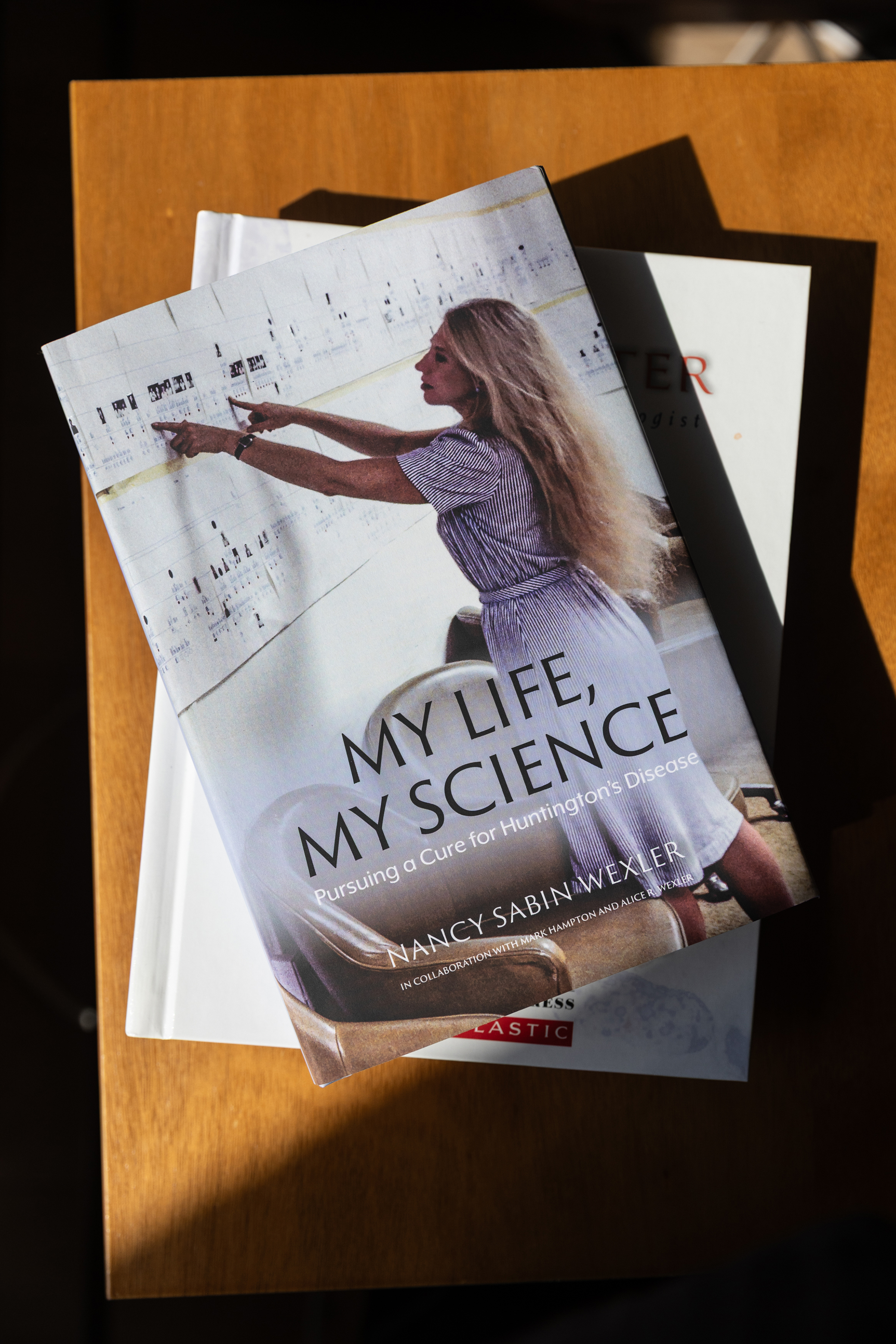
On my second visit with Nancy Wexler at her Manhattan apartment, she had a gift for me. It was a copy of her newly published memoir, My Life, My Science: Pursuing a Cure for Huntington’s Disease.
It had been signed with a stamp of her signature — she isn’t able to sign it herself. Nor could she rise from her brown faux-leather recliner to greet me — she can’t get up unassisted. Speaking requires effort. She can manage at most a few badly slurred words or phrases or, with great difficulty, a short sentence.
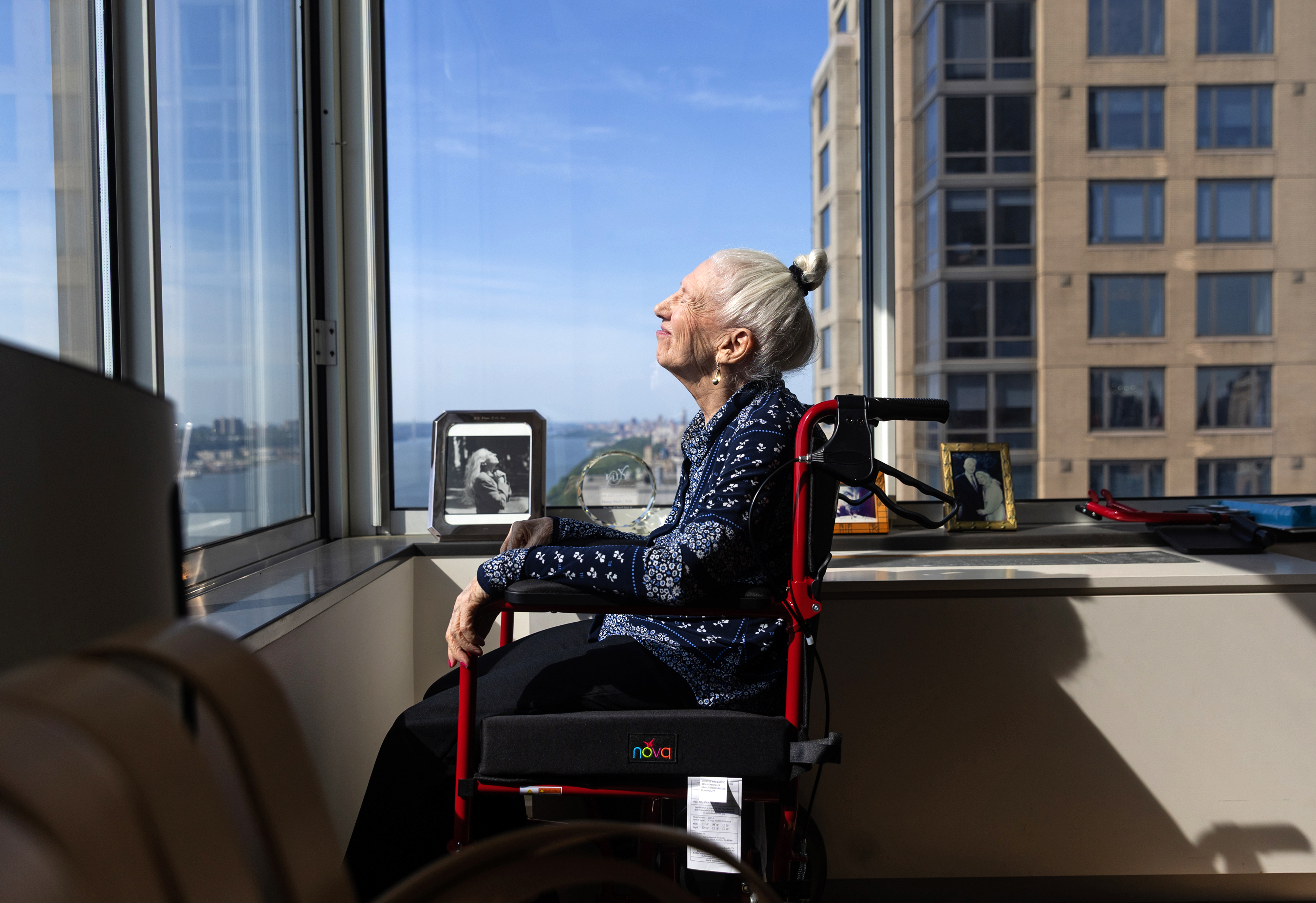
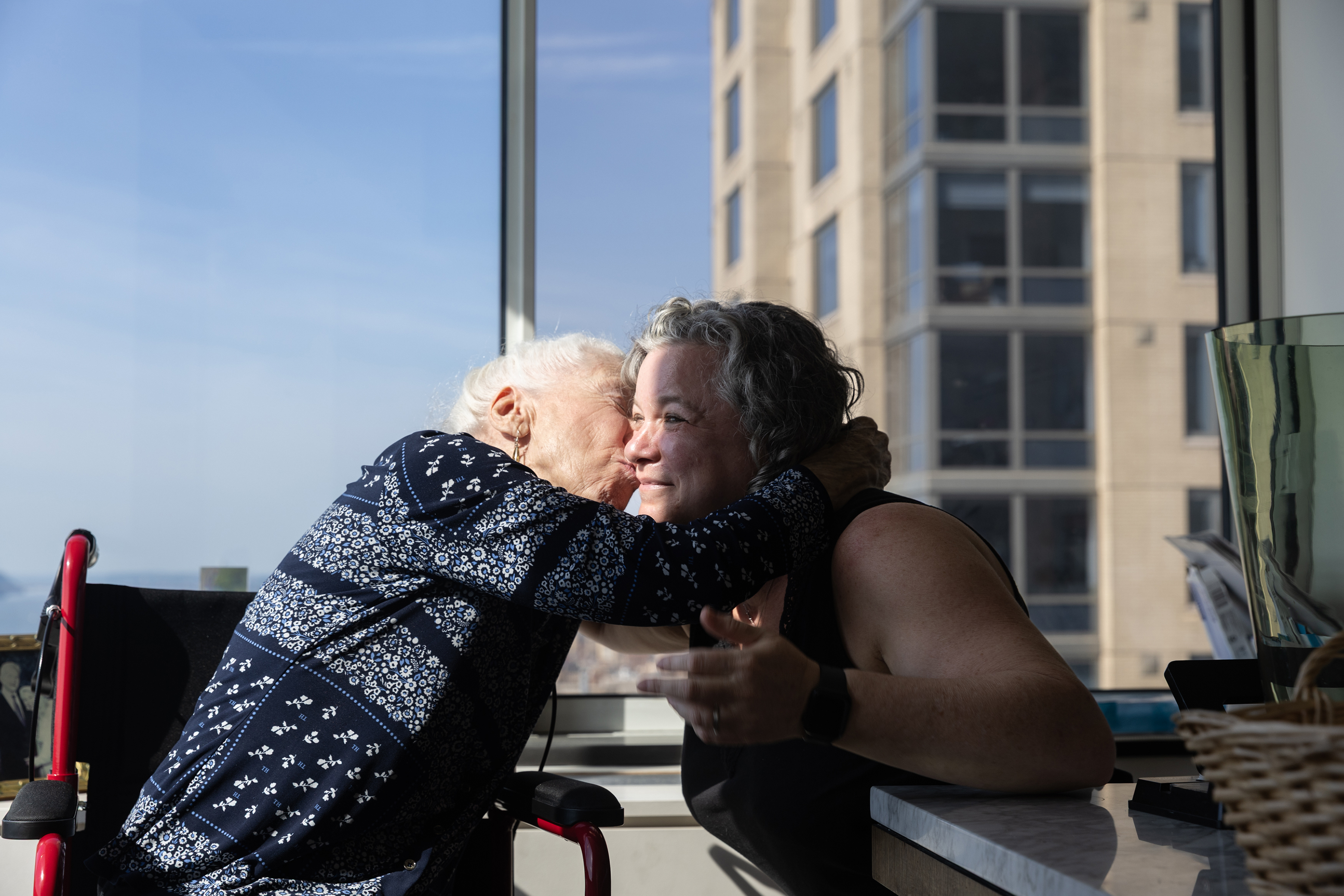
On that bright windy afternoon, Nancy and her sister, Alice Wexler, sat side by side in recliners, their backs to windows that offered a stunning view of the Hudson River far below. Alice lives in California, but she visits Nancy every other month.
At age 80, Nancy Wexler has Huntington’s disease, a dreaded brain disease that destroys a person’s ability to control movements. There is no treatment. There is no cure.
The disease is inherited: Nancy’s grandfather, three uncles, and mother had it. Alice, however, does not: If a parent has Huntington’s, each child has a 50% chance of getting it. Their mother attempted suicide, a path that others with the disease have chosen, but ultimately died from Huntington’s.
Nancy is not just any Huntington’s disease patient. For decades, she led a research effort in a remote area of Venezuela that found the gene responsible for Huntington’s. That work yielded a blood test that enable at-risk people to find out if they are destined to get the disease. In honor of this work, Nancy has garnered numerous accolades and prizes, including a Lasker award, among the most prestigious in science. She devoted her life to understanding what it’s like to be at risk for Huntington’s disease, what it’s like to have it.
What she did not know, though, was that she would get it herself. After helping lead the crucial research that allowed those at risk to find out if they would contract this terrible disease, Nancy chose not to be tested.
Now that the disease has progressed long past the point where she can keep contributing to the fight against Huntington’s, it is natural to wonder: How would her life and research have been different had she made the other choice? If your fate is sealed, is it better or worse to know?
Nancy Wexler can no longer sign her own name or get up unassisted.Jackie Molloy
Huntington’s disease was first described in a paper published in 1872 by an American doctor, George Huntington. It affects an estimated 41,000 people in the United States. Symptoms start slowly, with clumsiness or a stumbling walk; patients are often thought to be drunk as they stagger down a street. As years go by, patients become plagued by constant involuntary movements.
Huntington described the misery in unsparing detail: “If the patient attempt to protrude the tongue it is accomplished with a great deal of difficulty and uncertainty,” he wrote. “The hands are kept rolling — first the palms upward, and then the backs. The shoulders are shrugged, and the feet and legs kept in perpetual motion; the toes are turned in, and then everted; one foot is thrown across the other, and then suddenly withdrawn, and, in short, every conceivable attitude and expression is assumed, and so varied and irregular are the motions gone through with, that a complete description of them would be impossible.”
Patients and family members, Huntington added, spoke of the disease “with a kind of horror.”
Nancy’s acquaintance with that horror began in 1968. After graduating from Radcliffe College, she was in Europe on Fulbright fellowship when she was called home to learn her mother had the disease.
She had grown up in luxury in Pacific Palisades, Calif. — her father, Milton Wexler, was a psychoanalyst to Hollywood stars. Her mother, Leonore, had a master’s degree in zoology from Columbia University and a teaching certificate, but did not work. She did, however, have a secret that she kept from her children and even from her husband: Leonore’s father had Huntington’s disease.
Leonore didn’t mention it even when her three brothers — Nancy’s uncles — started exhibiting the telltale signs: clumsiness, a stumbling walk, sudden jerky movements.
Nancy Wexler’s memoir, “My Life, My Science” on a table in her apartment.Jackie Molloy
When his wife’s slide into the disease could no longer be denied, Milton called both sisters home and sat them down in his bedroom. The 50-50 chance now hung over both of them, too. He gave them some advice they never forgot: Don’t waste your life.
Alice decided to ignore Huntington’s and her own risk. “I didn’t want to have anything to do with it,” she told me. She became a historian.
Nancy had a different reaction. She would make Huntington’s the focus of her life, getting a Ph.D. in clinical psychology from the University of Michigan. Her thesis subject: the experiences of people with Huntington’s, and of those at risk for getting it. She thought of that choice as a way of coping with her situation. She wrote that it was a version of something the American Psychiatric Association called implosion theory — “a technique used in behavior therapy where the client is flooded with experiences believed to be relevant to the client’s fear.”
“I could talk about Huntington’s without seeming selfish and whiny,” she explained. “I could talk about how people felt in the context of helping them.”
Nancy’s father started a chapter of the Committee to Combat Huntington’s Disease, or CCHD, which later became the Huntington’s Disease Foundation. Its express goal was to find the Huntington’s disease gene and search for a cure. Nancy started a chapter in Michigan and also worked with her father in California.
Her first job, at age 29, was at the New School for Social Research in New York where she continued her studies of Huntington’s sufferers and those at risk. But she never told her academic colleagues about her own risk. Her work, she later wrote, “taught me how a genetic condition such as HD can shape the ways people see and react to you.”
She added: “I also learned the high emotional costs of keeping it hidden.”
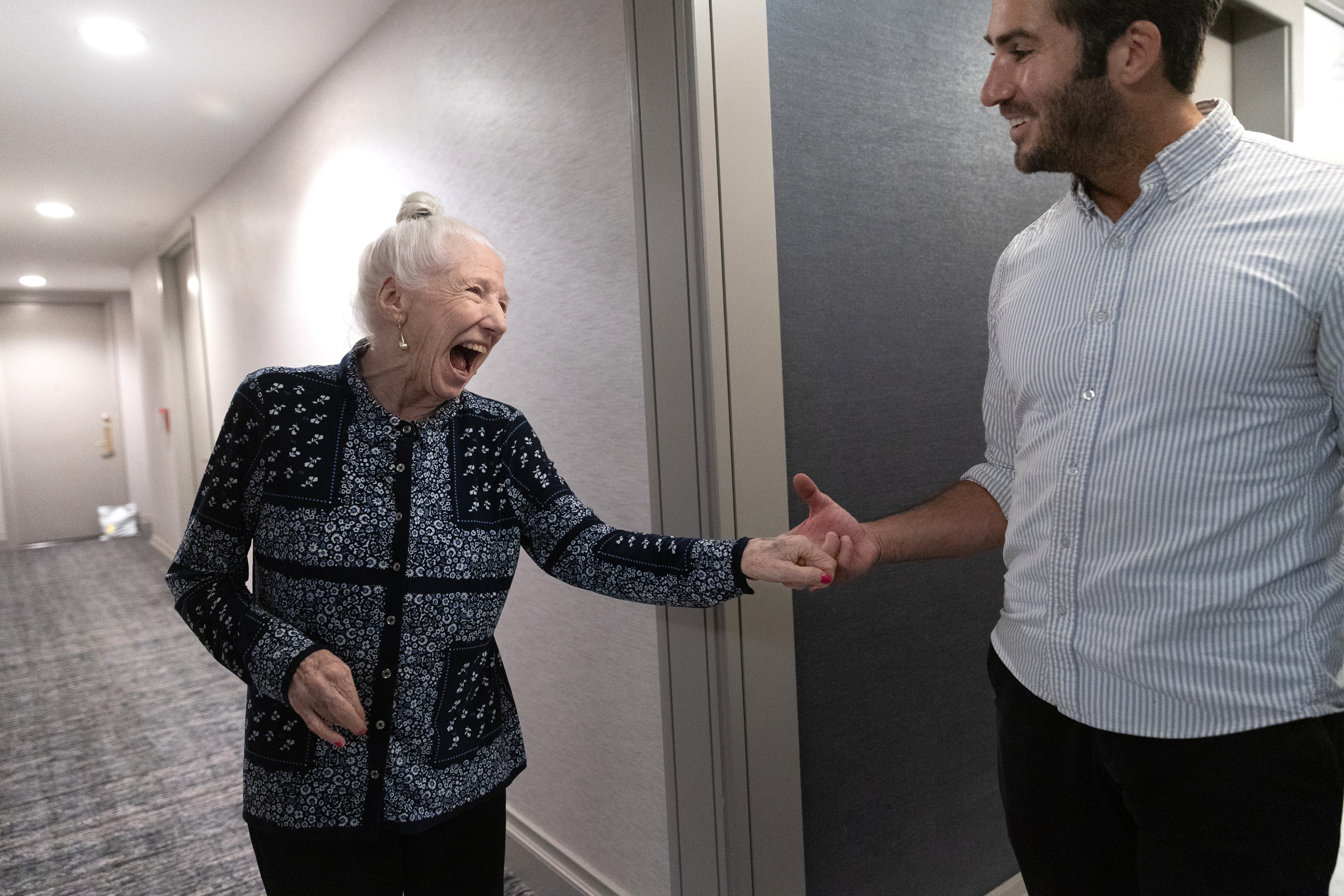
Nancy Wexler works with her physical therapist, Sean Conroy, who visits three times a week.Jackie Molloy
On frequent trips to California, Nancy was also helping her father lead the Huntington Disease Foundation. The group’s gatherings couldn’t be further from the staid scientific meetings that are the main staple of academic life. There were no traditional talks, no slides. Instead, Nancy and her father invited creative scientists — who may or may not have ever thought about Huntington’s before — to brainstorm about ways to find the gene, scrawling their ideas on a whiteboard. The meetings always included a Huntington’s patient, or the family member of a patient, so the scientists could understand what was a stake.
Back in New York, as part of her social science work, Nancy held hearings with Huntington’s disease families and people who worked with them, including social workers, neurologists, insurance representatives, police, teachers, nurses and other public officials.
What she heard was all too familiar. She had, she wrote, experienced almost everything the families had told her: “the stigma and silence surrounding Huntington’s; the ignorance of most doctors about the disease, including about the hereditary pattern; the denial on the part of family members who knew about the disease but refused to discuss it; the fear and anxiety suffered by those at risk waiting for years to see if symptoms would emerge; the anxiety that should a predictive test be developed, it could reveal future onset but do nothing to forestall or prevent it; the divisions within families over how to respond to the illness; the sense of belonging to a tainted lineage; the shame and embarrassment about relatives with the symptoms; the tremendous financial burden of care; and the sense that there was nowhere to go for help.”
As part of her research, Nancy asked people who had Huntington’s in their families whether they would have a test for the gene if one were developed. Two-thirds said yes.
Nancy thought she’d want to be tested too.
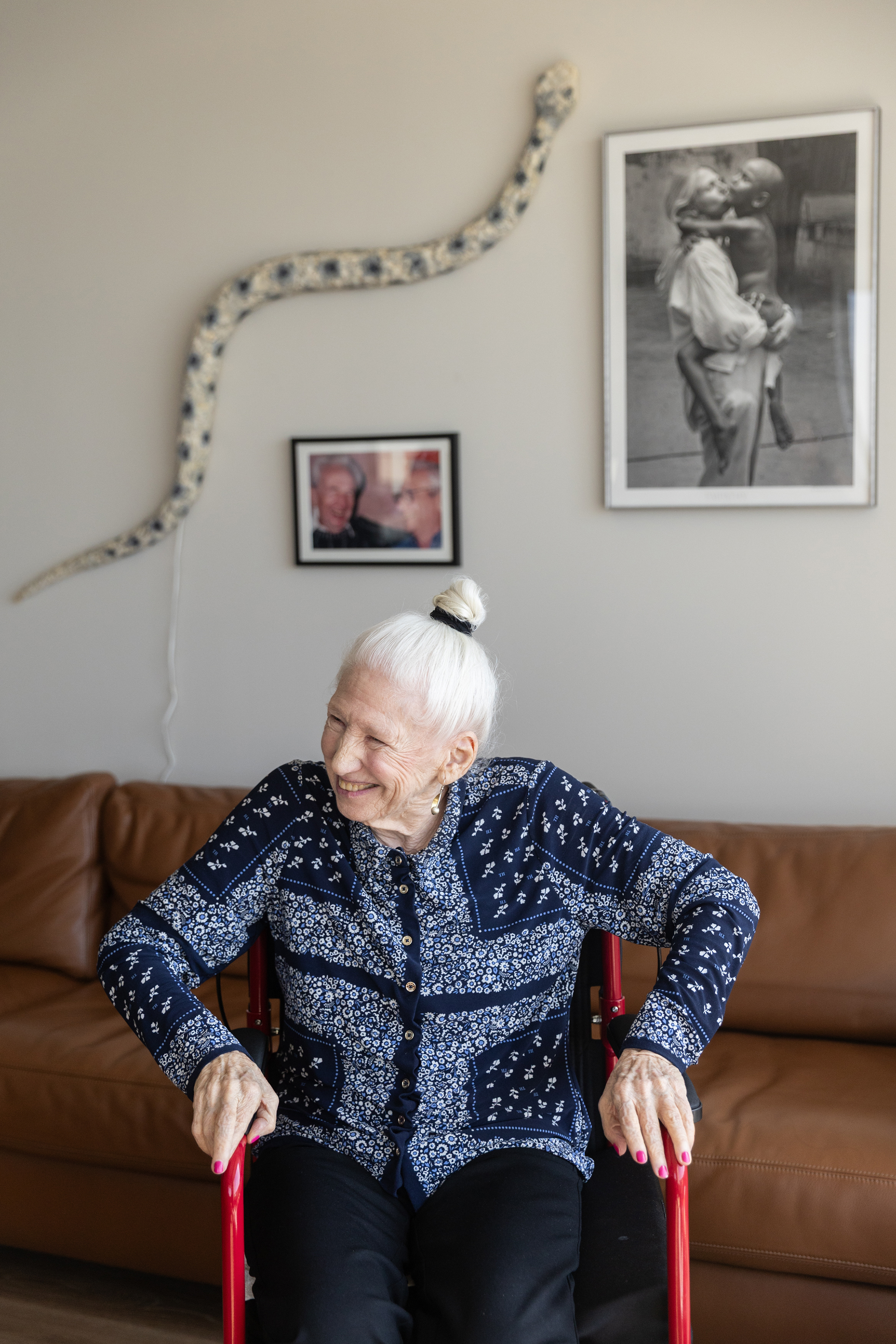
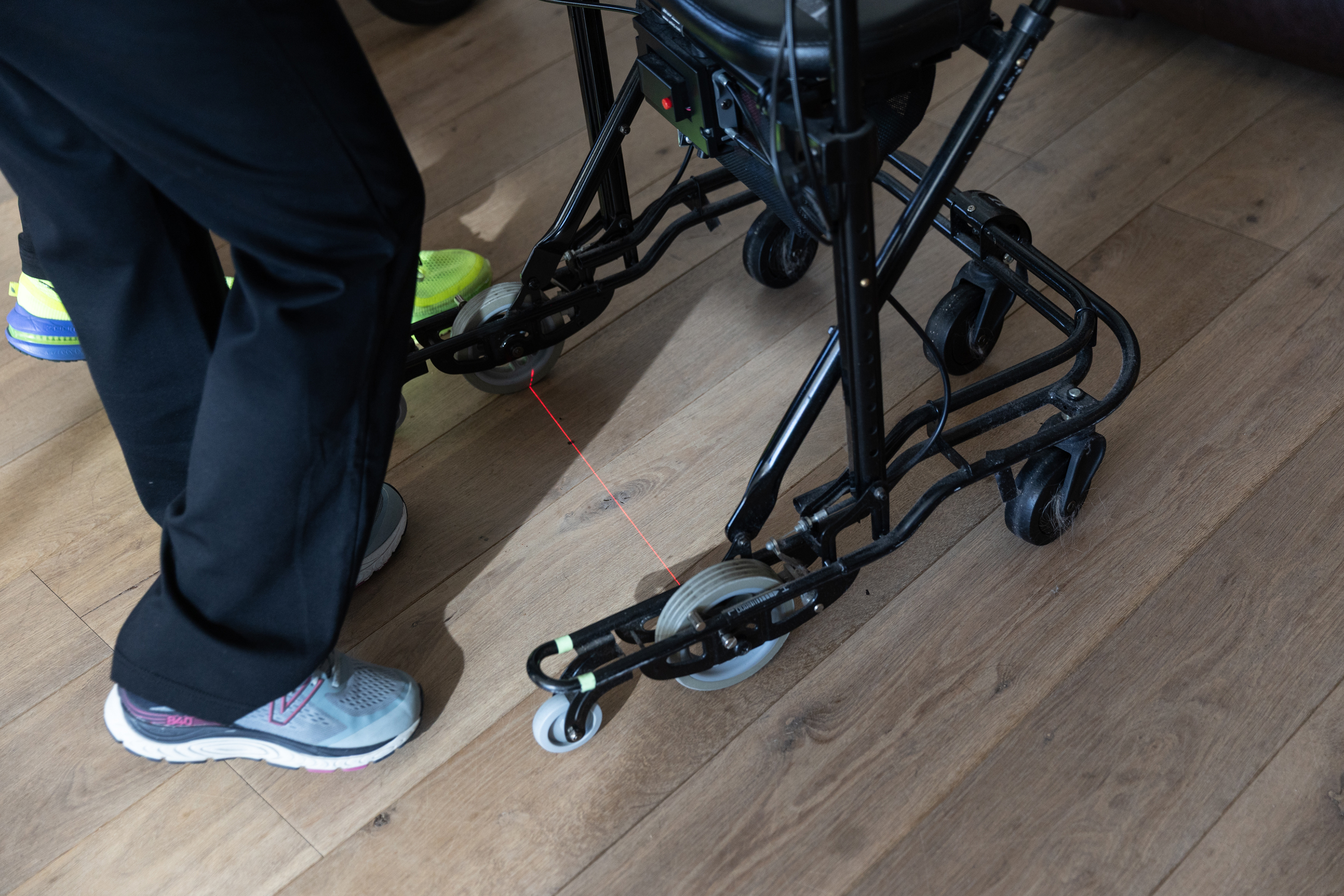
Nancy Wexler’s walker has visual laser cues, multiple wheels, and weights to keep steady. Jackie Molloy
The search for the gene began in earnest in 1980, focusing on three communities around Lake Maracaibo, Venezuela, that had the greatest prevalence of Huntington’s disease in the world. The researchers traced the disease there to one woman, Maria Conception, who lived in the area early in the 19th century. Maria apparently had Huntington’s disease, and passed it on to generations of descendants who called it El Mal.
Huntington’s was so feared that the residents of those communities had been isolated and ostracized. They ended up intermarrying, increasing the likelihood that the gene would be passed on.
Nancy led the research team, returning to Venezuela regularly for 22 years and collecting more than 4,000 blood samples from Venezuelans. She cared deeply for them, and even helped establish a nursing home for Huntington’s patients.
Three years after the gene search in Venezuela began, that question — would you want to be tested? — was no longer hypothetical. The researchers found a marker, like a flag on DNA, that was present only when someone had the Huntington’s gene. It wasn’t the actual gene — that would come later — but it could be used to tell people if they had the gene.
The decision to be tested, though, turned out to be a more difficult one than it might seem. Is it better to know you are doomed, or to hope you are not?
In Nancy’s doctoral thesis, she had cautioned that when a test became available, many who thought they’d want it would change their minds. She hadn’t realized that she would be one of them.
Huntington’s is one of just a handful of diseases — others include early onset Alzheimer’s, as well as some prion diseases — in which a positive genetic test takes away all hope of escaping your fate. With other genetic diseases, a test can only signal a likelihood, not a certainty, that a person will get the disease. In both cases, people often opt not to be tested. In colon cancer, for example, a recent national study found that only 3.7% of those with a mutation that increases risk actually had the genetic test.
The phenomenon of avoidance is so common that IVF clinics offer a special test to couples at risk for a hereditary disease: examining each embryo for the disease gene and implanting only those that don’t have it, without informing the prospective parents about the result.
In her book, Nancy explains that she had been too cavalier about the idea of testing before there was actually a test.
“I realized I hadn’t thought through all the ramifications, both psychological and social, of what a positive test might mean in my life,” Nancy wrote, adding: “I wasn’t sure I could live with the foreknowledge that one day the dreaded symptoms would emerge. I preferred to meet the devil when he was on my doorstep.”
Alice had a similar reason for declining the test. “How would I live with a positive test result?” she asked herself. “I thought the idea of ambiguity, uncertainty, was kind of appealing. I thought I could live with that.”
And, she told me, “once you have that knowledge you can’t take it back.”
In 1996, after Nancy’s research effort helped find the gene, Alice began noticing little abnormal movements in her sister.
Nancy was just 51, two years younger than her mother had been when a police officer saw her weaving as she walked down a street and accused her of being drunk.
But Nancy denied anything was wrong. She had an active life; she felt fine. She met her partner, Herbert Pardes, a psychiatrist and executive vice-chair of New York-Presbyterian Hospital, late but had a happy relationship. (He died in 2024.)
Yet friends and colleagues started asking Nancy if she had Huntington’s, watching her closely. She was furious and upset. How dare they try to diagnose her? They weren’t her doctors.
Nonetheless, Nancy was startled to see herself in videos making sudden jerky movements. She hadn’t realized she was doing that.
She worried about impulsive behavior — telling Alice that she couldn’t seem to stop buying things she couldn’t afford. (Impulsivity is a hallmark of Huntington’s.)
By 2015 she had lost a lot of weight, as is typical in Huntington’s, because of the constant involuntary movement. And she was unsteady when she walked.
Finally, in 2019, there was a clinical trial of an experimental Huntington’s drug. Nancy wanted to participate — but she would have to have a Huntington’s diagnosis to do so.
She asked a neurologist, Linda Lewis, to tell her the truth. Did she have Huntington’s?
“Yes, Nancy, you do,” Lewis said.
She was too old for the trial, but the researchers were willing to make an exception for her. Before she could start taking the drug, the trial was halted: It was making people worse.
There remains no treatment for Huntington’s disease.
Nancy Wexler has a video chat with her sister, Alice, who does not have Huntington’s.Jackie Molloy
Now, in retrospect,I asked Nancy and Alice, would it have been better to have had had the test?
The answer, for each, is a resounding no. Neither lives a life of regret.
As Alice sees it, testing does not resolve the big questions. “While the test was marketed as a choice between certainty and uncertainty, for me it always seemed more a choice between one form of uncertainty — will I get Huntington’s? And another — when will I get Huntington’s?” she said.
After all that uncertainty, Alice escaped the family disease. I asked whether she felt survivor’s guilt. “More than guilt, I feel the injustice of it,” she replied. “How unfair it is that she has Huntington’s and I don’t. Just cruel arbitrary luck of the draw.”
The only reason she might have wanted to be tested, Alice said, was so that, if she did not have the gene, she could have biological children. She had not wanted to take a chance on passing the gene on to another generation. But she was in her mid-40s when a test was available — too late for her.
Nancy’s answer was briefer, but succinct: “The predictive test would not have helped. It would have been too threatening,” she said, struggling to get the words out.
Nancy, too, longed for children. She tried the in vitro fertilization method that allowed her to avoid knowing if any embryos were affected. But she did not succeed in having a baby.
Now, being cared for by full-time assistants, confined to her apartment, unable to feed or bathe herself, robbed of her charismatic personality by her struggles to speak, I asked what life is like for her.
A cruise ship passenger who was exposed to hantavirus in early May is still being held at a quarantine facility in Nebraska, against her wishes and against the recommendation of a medical review from the Centers for Disease Control and Prevention.
On Monday, Health Secretary Robert F. Kennedy Jr., a staunch proponent of medical freedom, signed an order to continue quarantining Angela Perryman, 47, even though others who had been held at the facility have, since May 31, been allowed to return to their homes if they wished to do so.
In a telephone interview with the New York Times, Perryman, who has tested negative for the virus and says she has not had any symptoms, expressed anger and frustration. She said she learned of Kennedy’s decision when a copy of his order was slipped under the door to her room.
After a hearing to dispute her quarantine order, Michael Bell, the CDC’s quarantine medical reviewer, recommended Thursday that Perryman be allowed to return home for the remainder of her 42-day quarantine, with remote symptom monitoring once daily and access to 24-hour help “in the event she develops symptoms.”
“In my professional judgment, this less restrictive alternative is adequate to protect public health,” Bell wrote in the review.
“This is the final proof that there is no check and balance on a basically indefinite detention under the public health law,” Perryman said.
The Department of Health and Human Services declined to comment.
Perryman is one of 18 passengers who were on a cruise ship that became the center of a hantavirus outbreak that killed three people, sickened several others, and unnerved people around the world. They were flown back to the United States on May 11 and quarantined at the National Quarantine Unit in Omaha, Neb.
The passengers were initially set to return to their own states, but were then ordered to remain in Omaha at least until May 31. Perryman publicly challenged the order.
“I think this is obvious malice and retaliation,” she said Monday.
Some passengers were allowed to quarantine at home until June 22, or 42 days, provided local health officials committed to having a law enforcement or community health worker monitor them. Perryman is one of 10 passengers still in Omaha, she said, but the only one being held against her will.
Perryman lives in Florida part of the time and wished to quarantine there. But Florida refused to comply with the administration’s requirements, according to Steven Hyman, Perryman’s lawyer.
But now, the order by Kennedy to keep Perryman in Omaha “flies in the face of the findings of the medical reviewer,” Hyman said.
At the Omaha facility, officials take Perryman’s temperature twice a day and provide her with food on request. She can also request access to a rooftop for about an hour each day, under the watch of armed guards.
“They’re polite and they’re not using physical violence against me, but otherwise it’s a prison,” she said.
Two helicopters collided Sunday in Rio de Janeiro, killing all six people on board, authorities in Brazil said.
Among those believed to have died in the collision is American musician Oliver Tree, whose name was on the flight manifest, according to the Associated Press as well as a police official with knowledge of the matter who spoke on the condition of anonymity because the investigation is still open.
In a statement, the Military Fire Department of the State of Rio de Janeiro said it responded to a call around 9 a.m. Sunday for a collision involving two aircraft in the southwest zone of Rio.
According to the agency, the helicopters collided in midair and crashed into the parking lot of a car dealership where electric vehicles were parked, setting off a fire involving at least 20 cars.
The agency did not identify the victims of the crash, and it was not immediately clear what caused the collision.
Tree, 32, had performed in Argentina this month as part of his world tour, the AP reported.
On Saturday, Tree posted a video to his Instagram account in which he appeared to be playing soccer in Brazil.
Tree, a musician from Santa Cruz, Calif., was recognized for his distinctive bowl cut and retro fashion along with his contributions to electronic music.
He is best known for his songs “Life Goes On,” “Miss You,” and “Alien Boy.” He has more than 11 million monthly listeners on Spotify.
Representatives for Tree did not immediately respond to requests for comment.
The Trump administration has requested an expedited appeal of a federal court ruling that blocked a series of decisions on vaccines made by Health Secretary Robert F. Kennedy Jr., including rescinding routine recommendations for immunizations against a half-dozen childhood diseases.
Kennedy announced in a social media post Friday that the administration had filed the motion to expedite appeal so that federal vaccine advisers could meet to decide whether to recommend shots before the fall flu season.
The move is the latest development in a lawsuit brought by six medical organizations, including the American Academy of Pediatrics. The suit contended that Kennedy and his appointees to the Centers for Disease Control and Prevention had made “arbitrary and capricious” changes to the childhood vaccine schedule.
It also argued that the panelists Kennedy appointed to the Advisory Committee for Immunization Practices, a panel of outside experts, did not have the qualifications to recommend vaccinations and that their decisions endangered the health of Americans.
The ruling, delivered March 16 by a federal judge in Massachusetts, temporarily blocked Kennedy’s policies while the trial continued. It froze all decisions made by the panelists Kennedy had appointed and prevented the committee from meeting as scheduled.
Friday’s announcement is the latest sign that the administration is seeking to revive the committee. Last month, President Donald Trump issued an executive order urging the CDC and the committee to align their recommendations for childhood vaccinations with those of peer countries. Separately, Kennedy’s office reestablished the committee’s charter.
“The 2026-2027 respiratory virus season (i.e., RSV, influenza, COVID) begins in the fall, and while the ACIP cannot act, no newly licensed or reformulated vaccine for those conditions can be added to the immunization schedule,” the administration argued in its motion, filed in U.S. District Court for the District of Massachusetts.
Richard Hughes, a lawyer for the medical organizations, said in a statement that the administration’s motion was a “misleading attempt to shift blame for what Secretary Kennedy broke.”
“We will oppose his motion to expedite appeal because we refuse to pave the way for his further destruction,” Hughes said.
Vaccine recommendations have historically been made by ACIP members after careful review of the benefits and potential risks, in a process that can take months or years. Last June, Kennedy fired all 17 previous members of the committee and named new ones, many of whom shared his skepticism of vaccines.
Over three meetings, the new panelists rescinded several recommendations for childhood shots, including the immunization of all newborns against hepatitis B, a highly infectious virus that can severely damage the liver.
Then, in January, bypassing the committee entirely, the acting head of the Centers for Disease Control and Prevention, appointed by Kennedy, announced a new schedule for childhood vaccines, which cut the number of diseases against which children are routinely immunized to 11 from 17.
In his decision, Judge Brian Murphy, of the U.S. District Court for the District of Massachusetts, noted that vaccine recommendations had historically followed “a method scientific in nature and codified into law through procedural requirements.”
But, he added, “unfortunately, the government has disregarded those methods and thereby undermined the integrity of its actions.”
Only six of the panelists Kennedy appointed “appear to have any meaningful experience in vaccines — the very focus of ACIP,” the judge said.
Immediately after the ruling, the Trump administration indicated it would appeal. On April 23, the Justice Department instead asked the court to halt the case while an appeal was pending, arguing that continuing the case “wastes scarce taxpayer resources” and that compiling administrative records required by the court “would divert agency employees from other important responsibilities in furtherance of the public health.” Then, on April 29, the administration filed its intent to appeal.
The court’s request for extensive records may indeed be what spurred the administration to appeal, said Dorit Reiss, an expert on vaccine policy and law at the University of California College of the Law, San Francisco.
“One reason for asking for a halt and filing the appeal may be that they did not want to give the information, or the trial was going poorly, and they wanted to put that on hold,” she said.
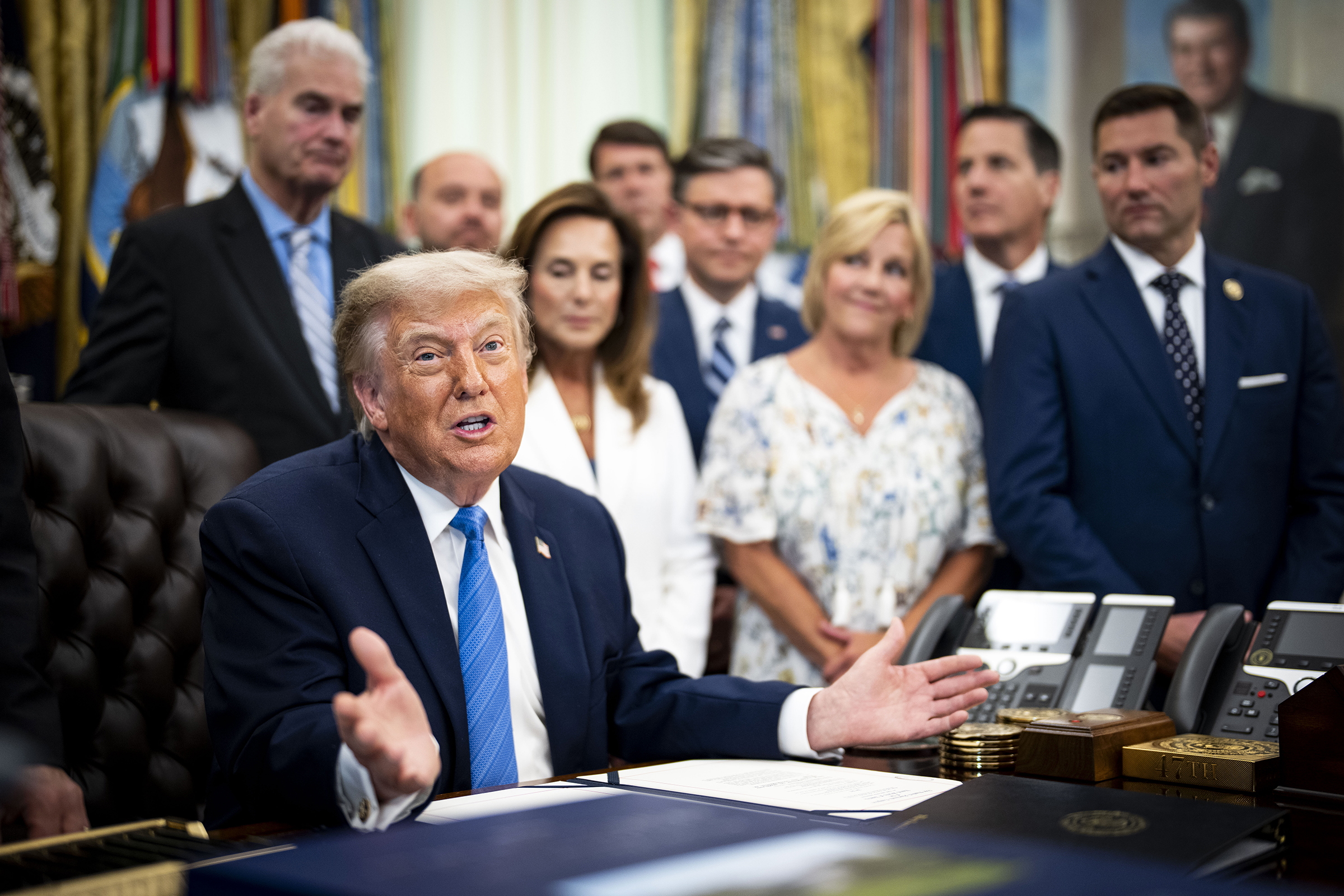
Almost immediately after striking a deal with Iran, President Donald Trump appeared eager to take a victory lap.
He trumpeted that the agreement would open the Strait of Hormuz, a vital waterway for the world’s energy supplies whose stalled ship traffic has rattled the global economy. He told the New York Times that his efforts had saved Israel from nuclear extinction and made the Middle East safer. It all gave him a key win as he traveled to France for the Group of 7 summit, where he is meeting with European leaders who have criticized his approach to the war.
Despite Trump’s grandiose claims, the agreement has not yet achieved the core goals he laid out three months ago for launching the U.S.-Israeli war against Iran.
Back then, Trump said the United States intended to “annihilate” Iran’s military capabilities, abolish its nuclear ambitions, topple its theocratic leadership, and liberate its people, whom he encouraged to take over their government when the fighting had stopped. Just one week after the strikes started, he said Iran’s only path to a deal was an “unconditional surrender.”
Trump publicly declared victory Sunday mainly based on solving a problem of his own making, in miscalculating Iran’s ability to choke off the Strait of Hormuz. Trump asserted on Truth Social that he had authorized the toll-free opening of the crucial waterway, which would essentially restore the prewar status quo, and celebrated that the global energy markets would rebound.
“Ships of the World, start your engines,” he wrote. “Let the oil flow!”
The latest framework, which has not yet been publicly released and is expected to be signed in Geneva on Friday, is a capstone to three months in which Trump has delivered a dizzying array of mixed messages.
He said that Iran’s nuclear program had been “obliterated” in U.S. strikes last year, yet said that the war was necessary to stop the Iranians from obtaining a nuclear weapon.
Trump said that Iran’s nuclear program posed a threat not only to allies, but also to U.S. troops overseas and to everyday Americans. He was clear that the war’s conclusion would rest on one stipulation: “It has always been the policy of the United States, in particular, my administration, that this terrorist regime can never have a nuclear weapon,” he said. “I’ll say it again. They can never have a nuclear weapon.”
Even Saturday, when he announced that a deal would be signed the next day, he claimed that Iran’s leaders “no longer want a nuclear weapon, nor will they have one, either through purchase, development, or any other form of procurement.”
But the deal leaves that issue unresolved for at least another 60 days, when both sides are expected to negotiate on nuclear issues.
Trump did not cast the deal as a solution to the nuclear threat. Instead he focused on the Middle East and his legacy.
“This Great Deal will bring Peace and Security to the whole Region,” he wrote in a social media post. “Many presidents have tried to make Peace with Iran, and all have failed before me.”
Trump has also sent conflicting messages over how far he would go to secure a nuclear agreement with Iran. He has gone from threatening to wipe out the country’s civilization to saying he was in no hurry to remove its remaining stockpiles of enriched uranium.
At the start of the war, Trump initially claimed the United States would accomplish its goals in “four to five weeks.” He repeatedly compared the war in Iran to his quick military operation in Venezuela, in which the top leader was removed but much of the rest of the government remained in place, willing to work with the United States.
This war instead dragged on for months, killing thousands of Iranian civilians and 13 U.S. service members. Rather than bowing to the United States, Iran’s new leadership has been emboldened, consistently withstanding military and diplomatic pressure to persist in its goal of advancing a nuclear program.
In negotiations with Trump’s son-in-law, Jared Kushner, and special envoy, Steve Witkoff, the Iranians have held firm on not giving up the right to enrich uranium.
“As for the nuclear issues, there really is no agreement,” Daniel B. Shapiro, a former U.S. ambassador to Israel, said in a statement on social platform X. “Iran knows how to drag out those negotiations, and try to pocket concessions along the way.”
He added that the United States now appeared to be paying to reopen the Strait of Hormuz by potentially lifting sanctions imposed against Iran. The Trump administration has said Iran would receive no relief from sanctions or release of its frozen financial assets until it delivered on its commitments.
The framework does provide a path toward potential peace and economic relief. And Monday, both world leaders and global markets expressed optimism.
Chancellor Friedrich Merz of Germany, who previously said that the United States had “no strategy” and was being “humiliated” by Iran in the war, congratulated both sides on the diplomatic breakthrough, calling it a potential step toward “a reinvigorated global economy and a more secure Middle East.”
But it was a cautious optimism given all the uncertainties. Crucially, Iran’s nuclear capability will need to be hashed out over the next two months of negotiations, raising questions over whether a lasting peace will materialize.
Plenty of spoilers could arise along the way. Notably Israel, a partner in the war but not in the framework for peace, has been less than enthusiastic about the deal. Trump himself said in the Times interview that he was prepared to restart military attacks against Tehran if Iran failed to reach a final nuclear accord with the United States.
Some of Trump’s allies appeared concerned over the unfinished aspects of the negotiations. Sen. Lindsey Graham (R., S.C.), who has long supported military action against Iran, said he was “somewhat concerned that Iran’s view of the agreement seems different than what the American negotiating team is claiming.”
“I will be watching closely the ensuing negotiations regarding Iran’s nuclear program and other matters,” Graham said. He added that Vice President JD Vance, whom he described as the “architect of the deal,” should ensure that the final deal is presented to Congress.
In an interview with CNBC on Monday, Vance said the framework gave the administration “leverage,” though there remained “details to figure out,” including on enriched uranium.
As negotiations progressed over the weekend, Trump posted a lengthy criticism on social media of the previous deal struck with Iran by President Barack Obama, asserting that the one he was working on would be better.
Shapiro, who is also a fellow at the Atlantic Council research institute, said on social media that Trump seemed focused on comparing his deal favorably with the Obama deal, but the United States was far from being able to come to such a conclusion.
“It is possible that no deal will ever be reached,” Shapiro said, “and very likely that if one is reached, it will be worse than what we could have achieved through diplomacy before the war.”
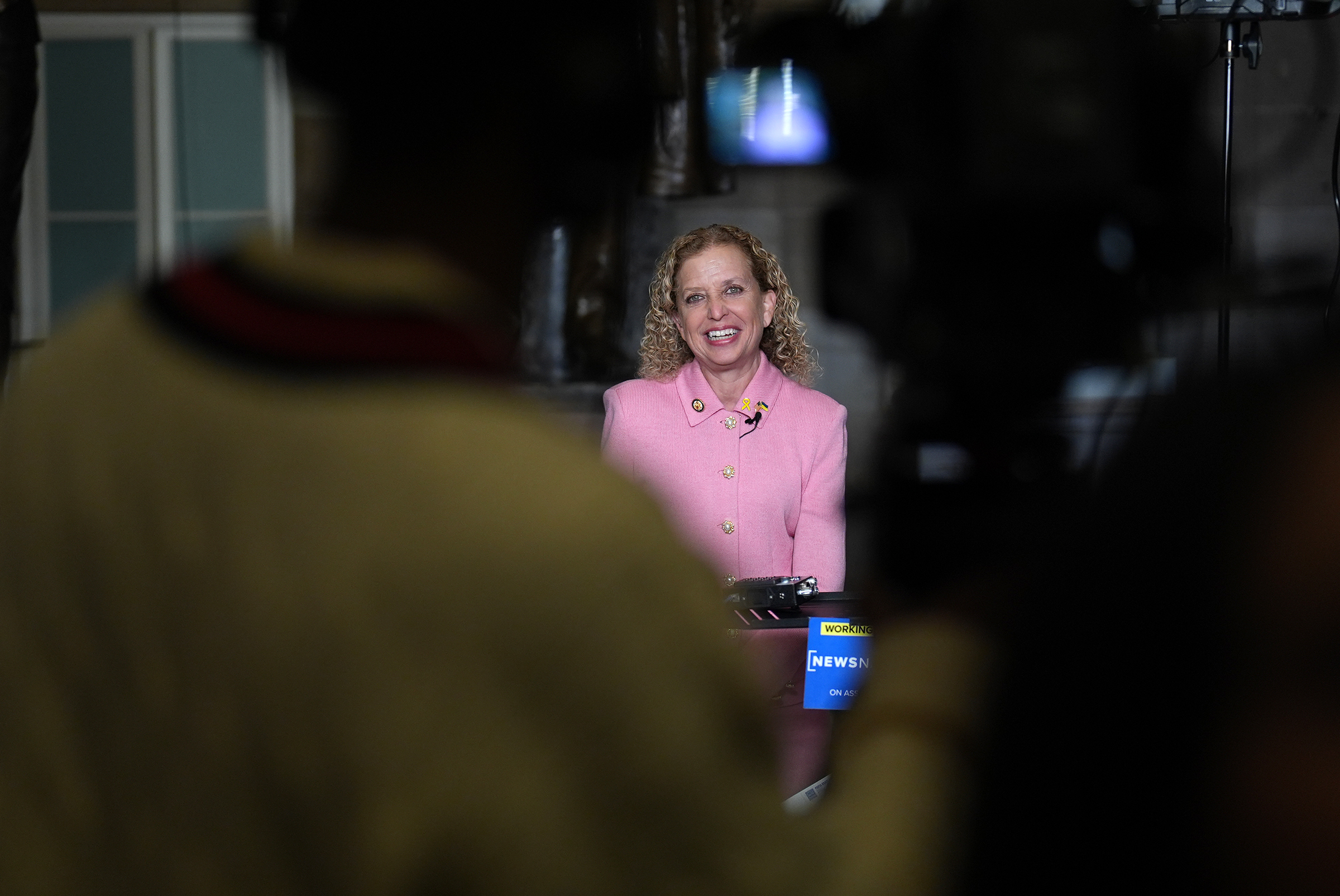
MIAMI — Four Black Democrats running for Congress in the same South Florida district met last week for a highly unusual discussion. Should three of them drop out and rally around a consensus Black candidate in the Democratic primary against Rep. Debbie Wasserman Schultz?
Wasserman Schultz, who is white, had announced a few weeks earlier that she would run in the safely Democratic 20th Congressional District in Broward County, after Republican state lawmakers redrew Florida’s congressional map and eliminated her seat.
But the 20th District is historically Black and has elected a Black representative for decades. The Black Democrats running felt affronted by Wasserman Schultz’s decision to enter the race, especially with a spate of Republican gerrymanders across the South this spring almost certain to reduce Black representation in the House.
The race to redistrict before the midterm elections has forced Democratic candidates in Republican-led states to make rushed decisions about where to run based on cold electoral math, as the number of winnable districts has shrunk. In Florida — a state that sends 28 representatives to Congress, and where 43% of voters cast ballots in 2024 for Kamala Harris — the Republican-drawn map cut the number of Democratic-leaning seats from eight to four.
Nowhere in the state has Democrats’ dilemma been more evident than in South Florida. Before Friday’s candidate-qualifying deadline, Wasserman Schultz’s announcement turned Democrat against Democrat.
The 20th District includes most of Broward County’s African American and Caribbean American communities. So the four Black Democrats huddled last Monday, thinking that, if they consolidated behind one of them, he or she might have a chance of defeating Wasserman Schultz, an 11-term incumbent and a former chair of the Democratic National Committee who has far out-raised them all.
In the end, though, they could not agree on who among them should remain in the race.
“Everybody thinks that they can be the one who will win,” said Dale V.C. Holness, a former Broward County mayor.
Holness and three others — Luther Campbell, known as Uncle Luke, from the hip-hop group 2 Live Crew; Elijah Manley, a teacher and political activist; and former Rep. Sheila Cherfilus-McCormick — all qualified to run. They remained in the race knowing that they would likely split the Black vote, improving Wasserman Schultz’s odds of winning.
Under the new map, only one majority-Black district will remain in Florida: the 24th, which is based in Miami-Dade County and safely Democratic. The incumbent, Rep. Frederica Wilson, announced her retirement last month.
The 20th District, with its plurality of Black voters, can still elect a Black representative, the Florida Legislative Black Caucus noted in a statement last month that called Wasserman Schultz’s decision “disheartening.”
“This district was established to remedy decades of racial exclusion and to ensure that Black communities have the opportunity to elect leaders who truly reflect their experiences and needs,” the statement said.
The discomfort has stretched to Washington. When asked this month about the landscape in the 20th District, Rep. Hakeem Jeffries (D., N.Y.), the minority leader, who typically endorses incumbents, said he had not “made a decision” in the race.
“Everybody has a right to run where they see fit,” he said, praising Wasserman Schultz’s “strong record of accomplishment.” He added, however, that the country was experiencing “an unprecedented Jim Crow-like assault on Black political representation.”
The Supreme Court issued a decision in April weakening a key provision of the landmark 1965 Voting Rights Act, finding that Louisiana lawmakers had unconstitutionally relied on race when they created a majority-Black district. The decision set off a rush to redraw maps in Southern states.
Last week, the House Democratic Caucus, led by Jeffries, appointed Wasserman Schultz to the House Foreign Affairs Committee. In a statement, Wasserman Schultz thanked her colleagues for “this vote of confidence.” She has blamed President Donald Trump, Gov. Ron DeSantis, and their fellow Republicans in the Florida Legislature for eliminating four Democratic-leaning districts. Two are in Broward County — hers and that of Rep. Jared Moskowitz — while two more are in the Tampa and Orlando areas.
Voting and civil rights groups have challenged the map in court, saying it violates a state ban on partisan gerrymandering. A judge declined to temporarily block the map from taking effect, so it will stand for this year’s elections.
“I’m just as angry” as other Democrats, Wasserman Schultz said in an interview last month. “DeSantis and Trump have intentionally dismantled Broward County’s power.”
She added that, over her 34-year political career, she had represented nine of the 14 cities in the district.
“I know the people, and the people know me,” she said. “It was critical that we not start over with a beginner and ensure that someone like me with the seniority and clout represents this community.”
Moskowitz is running in the new 25th District, along coastal Miami-Dade, Broward, and Palm Beach counties. It leans Republican but is considered competitive. He lamented the gerrymandering “race to the bottom” that he said will lead to more partisanship and gridlock.
“If you think Congress is dysfunctional now, just wait for us to prove you wrong,” he said.
The other two Democrats whose districts were eliminated, Rep. Kathy Castor of Tampa and Rep. Darren Soto of Orlando, are also running, but in seats that Trump won by 10 percentage points and nearly 18 points in 2024.
Castor, who is in her 10th term, said she was undeterred, in part because of her expectation of an anti-Trump wave this year. She pointed to some of the president’s seemingly tone-deaf statements, such as “I love the inflation,” which he said last week in the Oval Office.
“I see a big change election for the GOP in power in Congress,” she said.
With Democrats having to defend three formerly safe seats, it seems less likely that they will have many resources to try to flip other seats that they had hoped to keep competitive. Florida Republicans have outpaced Democrats in voter registration and fundraising for years.
“Democrats are running on empty in Florida,” Maureen O’Toole, a spokesperson for the National Republican Congressional Committee, said in a statement.
Holness, Manley, and Cherfilus-McCormick said that Wasserman Schultz should have run in the new, Republican-leaning 22nd District, which includes her home. She might have given the GOP a real race there, they said.
“The fact that she’s abandoning her district and coming into our district, it doesn’t give people any faith that she will stand and she will fight,” Cherfilus-McCormick said.
Cherfilus-McCormick resigned from office in April before a House panel was scheduled to consider expelling her. She has been indicted on criminal charges of embezzling $5 million in federal disaster aid and using it for her campaign. She has denied the accusation and pleaded not guilty.
Manley said Wasserman Schultz represents the establishment at a time when Democratic voters are frustrated with the status quo.
“To have somebody running here and try to divide and conquer the district is going to hurt the party in irreparable ways,” he said. “People may stay home in November. People may leave the party.”
PARIS — The last time the leaders of the world’s richest countries gathered in Évian-les-Bains, France, in June 2003, the United States had just invaded Iraq over the strident objections of France and Germany. President George W. Bush got chilly handshakes, but he and the other leaders worked to maintain the veneer of like-minded countries uniting to confront the perils of an unruly world.
Twenty-three years later, as leaders gather in the same town amid another American war in the Middle East, the veneer has been stripped away.
When President Donald Trump arrives Monday afternoon in Évian, an Alpine spa town on the southern shore of Lake Geneva, he will be greeted by European leaders who no longer view the United States as a partner on key issues such as climate change and security. In some cases, they view the United States as a threat, after Trump’s destabilizing attacks on Iran that have roiled the world economy, his deepening disdain for NATO, and his threats to take over Greenland.
“From the beginning of Trump’s second term, up until Greenland, the rule of thumb for America’s allies was, ‘Let’s bite our tongue and be nice to Trump,’” said Charles A. Kupchan, a professor of international relations at Georgetown University. “Greenland and Iran are a double whammy, where allies now say, ‘We’ll work with Trump where possible, but we have to say no when necessary.’”
However rancorous the split over the Iraq War in 2003, Kupchan said that it did not fracture the foundations of NATO or of other multilateral institutions like the Group of 7. “That’s not where we are now,” he said, adding, “There isn’t a consensus within the G7 about what to do.”
That does not mean the leaders will not seek to find some common ground. Wars are rumbling on in Ukraine and Iran. Global energy supplies are being disrupted by Iran’s closure of the Strait of Hormuz. Worries about how artificial intelligence will upend the labor force are prompting calls for government regulation.
But the split does mean that France’s goals for the meeting are necessarily less ambitious than at previous such gatherings. For the host, President Emmanuel Macron, the biggest challenge will be personal: persuading Trump not to bail out early, as he has from previous G7 summits.
Macron made progress on that score by inviting Trump to dine with him at Versailles, the opulent palace of France’s kings, on Wednesday, after the meeting ends. The dinner will celebrate the 250th anniversary of American independence, which, French officials noted, was enshrined in a treaty signed at Versailles in 1783. Macron had pushed back the start of the G7 to accommodate Trump, so he could attend an evening of cage fights at the White House on Sunday, his 80th birthday.
Jeremy Shapiro, a director at the European Council on Foreign Relations, a research group with offices in Berlin and London, said, “The recipe for this summit, as with every summit involving Trump, is not to have a blowup, and to suggest that everything is OK, which none of them believe anymore.”
Trump’s mercurial style has long made these meetings unpredictable. He cut short his attendance at two G7 gatherings hosted by Canada, in 2018 and 2025. But Shapiro said the rupture between the United States and its allies had become more profound after the start of the Iran war, which Trump began without consulting Europe’s leaders, and especially after his threats to take over Greenland.
On the security issue that most concerns Europe’s leaders, Ukraine, Trump shows little interest in reengaging in a peace negotiation. On Iran, the issue that has most preoccupied Trump, the G7 leaders have refused to join the war effort, drawing bitter rebukes from the American president.
Part of the problem for Europe’s leaders is that Trump’s vitriol toward Europe has made it harder to support the United States. The president has become so unpopular with Europeans that even onetime political allies, like Prime Minister Giorgia Meloni of Italy, are distancing themselves from him.
“Trump has made everything so toxic,” Shapiro said. “The leaders in Europe are saying, ‘It is so hard to help the U.S. because he has been so nasty to them.’”
Yet the leaders of the G7 diverge on how far to pull away from the United States, differences that reflect history and geography. Germany and Japan are situated closer to threatening neighbors — Russia and China — than is Canada. Analysts said that allowed the Canadian prime minister, Mark Carney, to speak more freely than his German and Japanese counterparts about a definitive split from Washington.
France has historically charted a more independent course toward the United States than Britain has. Macron began calling for Europe to pursue “strategic autonomy” in Trump’s first term. Until recently, Britain’s prime minister, Keir Starmer, had emphasized the need to stay in sync with Washington on key security issues.
But that is changing, too. London refused to allow American warplanes to use British air bases for offensive operations in Iran, though it does let U.S. planes take off for what it describes as “defensive” ones. Some Britons were inflamed when Vice President JD Vance waded into domestic issues, like the stabbing of Henry Nowak, an 18-year-old college student, which he blamed on the “politics of self-hatred and the mass invasion of migrants.”
“Trump is practicing foreign politics, not foreign policy,” said Ben Judah, who advised David Lammy when he was Britain’s foreign secretary and is now a visiting fellow at Chatham House, a London think tank. “On a political level, it is very clear that the United Kingdom has an America problem.”
Macron has scheduled topical lunches and dinners for the leaders and invited guests, including President Volodymyr Zelensky of Ukraine and President Abdel Fattah el-Sissi of Egypt. But French officials cannot predict what role Trump will play.
The French also want to focus on economic imbalances between China and the West. Trump, who has just returned from a meeting with President Xi Jinping in Beijing, would be well placed to lead a discussion on that issue. But French officials said they were not certain what to make of Trump’s China policy.
According to Shapiro, “What they’d like to do is to get the U.S. in a room and hash out some issues.” Instead, he added, half in jest, “Six of them will excuse themselves and go to the bathroom.”
Then, he said, “They’ll have those conversations.”