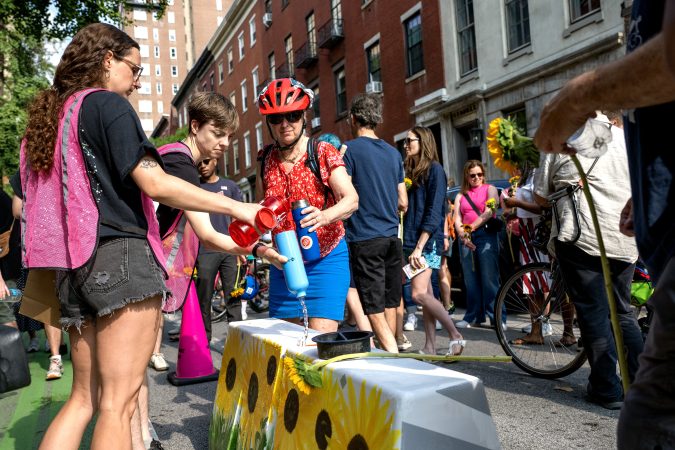
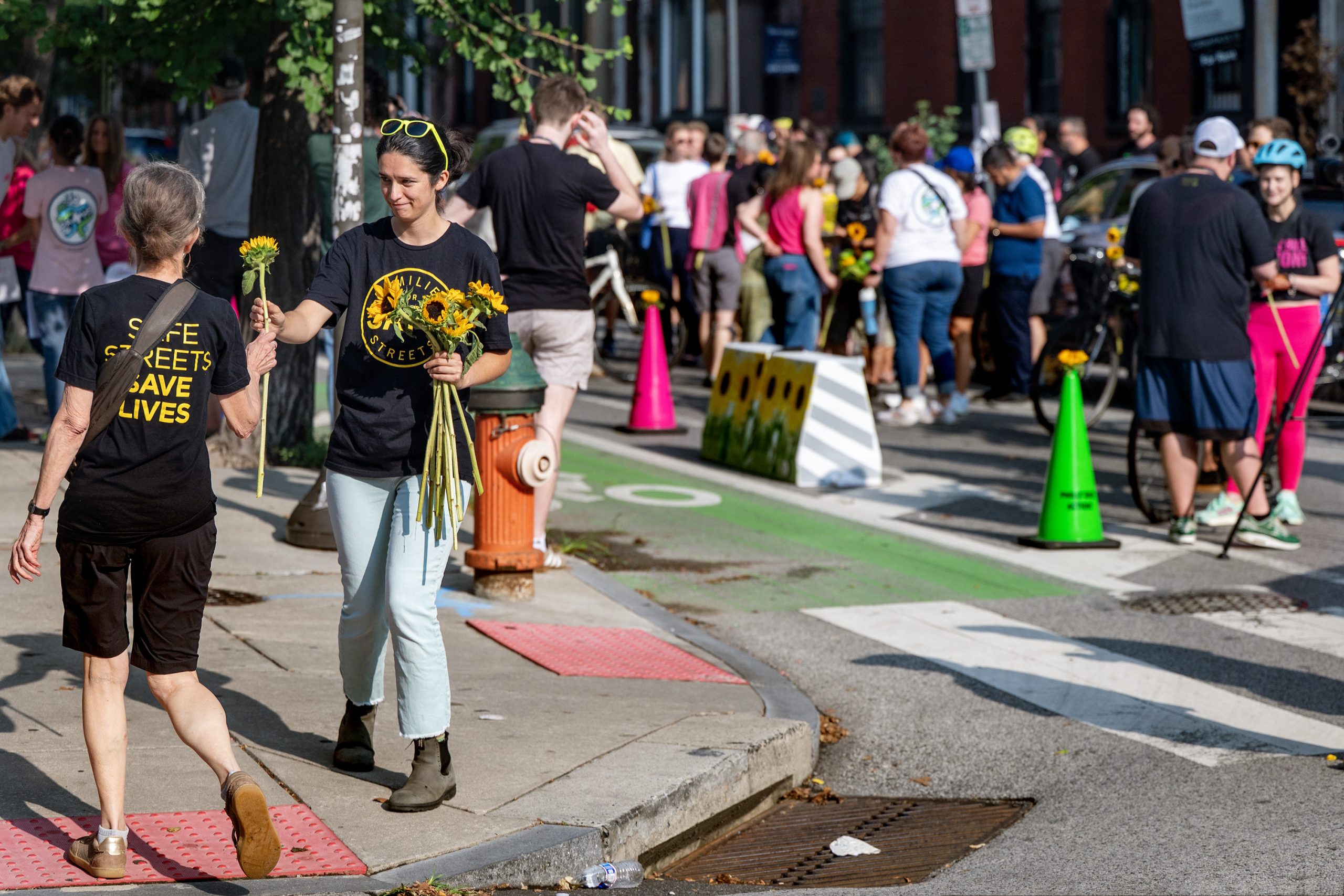
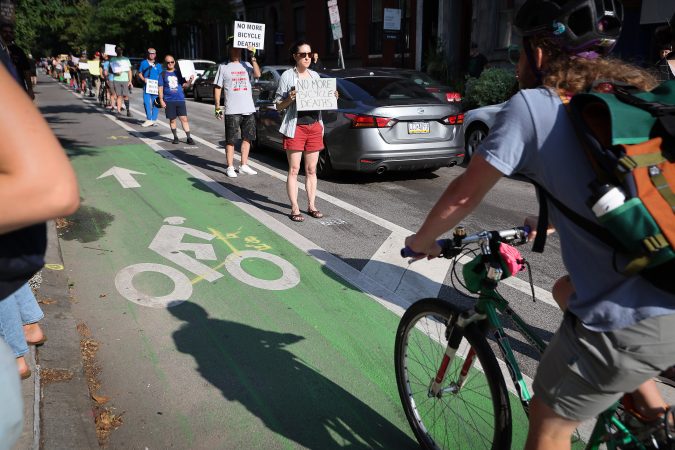
A four-foot plastic traffic barrier was placed in the bike lanes on 18th and Spruce Streets on Sunday. Painted white and adorned with 12 sunflowers, the small protective barrier would not only protect cyclists from cars, but represent the people killed by drivers since the death of Barbara Friedes, a pediatric doctor who, in 2024, was killed where the painted barrier was placed while riding her bike home from work.
But just hours after hundreds of people, including City Council President Kenyatta Johnson, helped install the barrier during a memorial for Friedes, it was removed, said Jessie Amadio, an organizer for Philly Bike Action, which organized the memorial.
The swift removal led the group to suspect city crews may have removed it, sparking an outcry from supporters who contacted city departments and Mayor Cherelle L. Parker.
“It takes years to protect a bike lane but hours to remove bike lane protection?” Philly Bike Action wrote on Instagram. “Drained and removed on a Sunday like it was the most pressing business in the entire City today.”
The city has said it was not aware of any removal efforts on its part.
Later Sunday, Philly Bike Action members found the memorial barrier tucked behind a dumpster in the alleyway behind Temple Beth Zion-Beth Israel, mere feet away from where it was placed. The city contends crews would have taken it to a sanitation facility or other waste removal site.
Hanna Kahler hands out sunflowers as family, friends, and Philly Bike action members arrive at Barbara’s Angel Bike at 18th and Spruce for a memorial Sunday. Barbara Friedes, a 30-year-old Children’s Hospital of Philadelphia doctor, was killed on her bike on the spot by a drunk driver in July 2024.Tom Gralish / Staff Photographer
The city’sManaging Director’s Office said it was unaware of any city employee taking part in the memorial barrier’s removal.
“We just need more time to ask every single person who might have been out there, but everybody who has been asked at this point who worked in that area on Sunday did not remove them,” a spokesperson said.
The office has been investigating since Sundayafternoon, checking with the Philadelphia Police Department, the Fire Department, the Streets Department, and the Department of Sanitation as to whether one of their crews removed it. The spokesperson said that no city department issued an order for employees to remove the barrier.
The Police Departmentreported back that it did not have nearby surveillance footage showing the area where the barrier was placed to identify who may have removed it. Police canvassed the area Monday to gather additional information and doorbell surveillance footage, a spokesperson said.
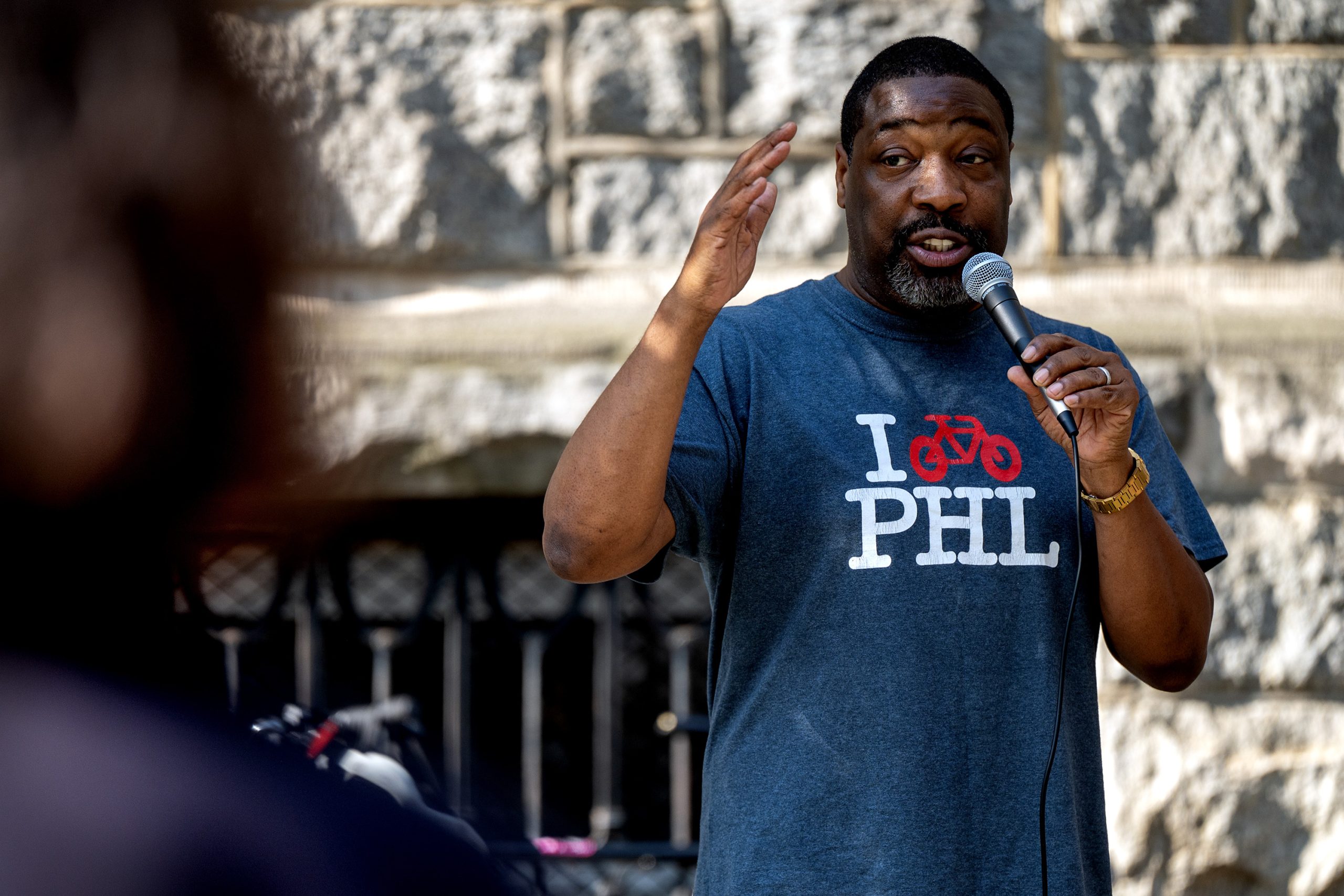
City Council President Kenyatta Johnson speaks as friends, family, and Philly Bike Action members gather at the angel bike for Barbara Friedes at 18th and Spruce for a memorial Sunday. Friedes, a 30-year-old Children’s Hospital of Philadelphia doctor, was killed on her bike at the intersection by a drunk driver in July 2024. Johnson pledged he would remain committed to finding ways to protect cyclists in Philadelphia.Tom Gralish / Staff Photographer
In Philadelphia, the majority of people killed in vehicle crashes are pedestrians and cyclists, according to recent PennDot data. While overall crashes have declined since 2020, the number of drivers crashing into non-motorists has stayed the same or increased.
Following the deaths of Friedes and other cyclists and pedestrians, the city pledged $4.8 million to install permanent concrete bike lane barriers along Spruce and Pine Streets in Center City. Part of this plan was to convert parking spaces along these streets into loading zones intended to give vehicles a place to briefly stop instead of in bike lanes. However, the neighborhood group Friends of Pine and Spruce sued on the grounds that the city had no legal authority to remove parking spaces to create “neighborhood loading zones.”
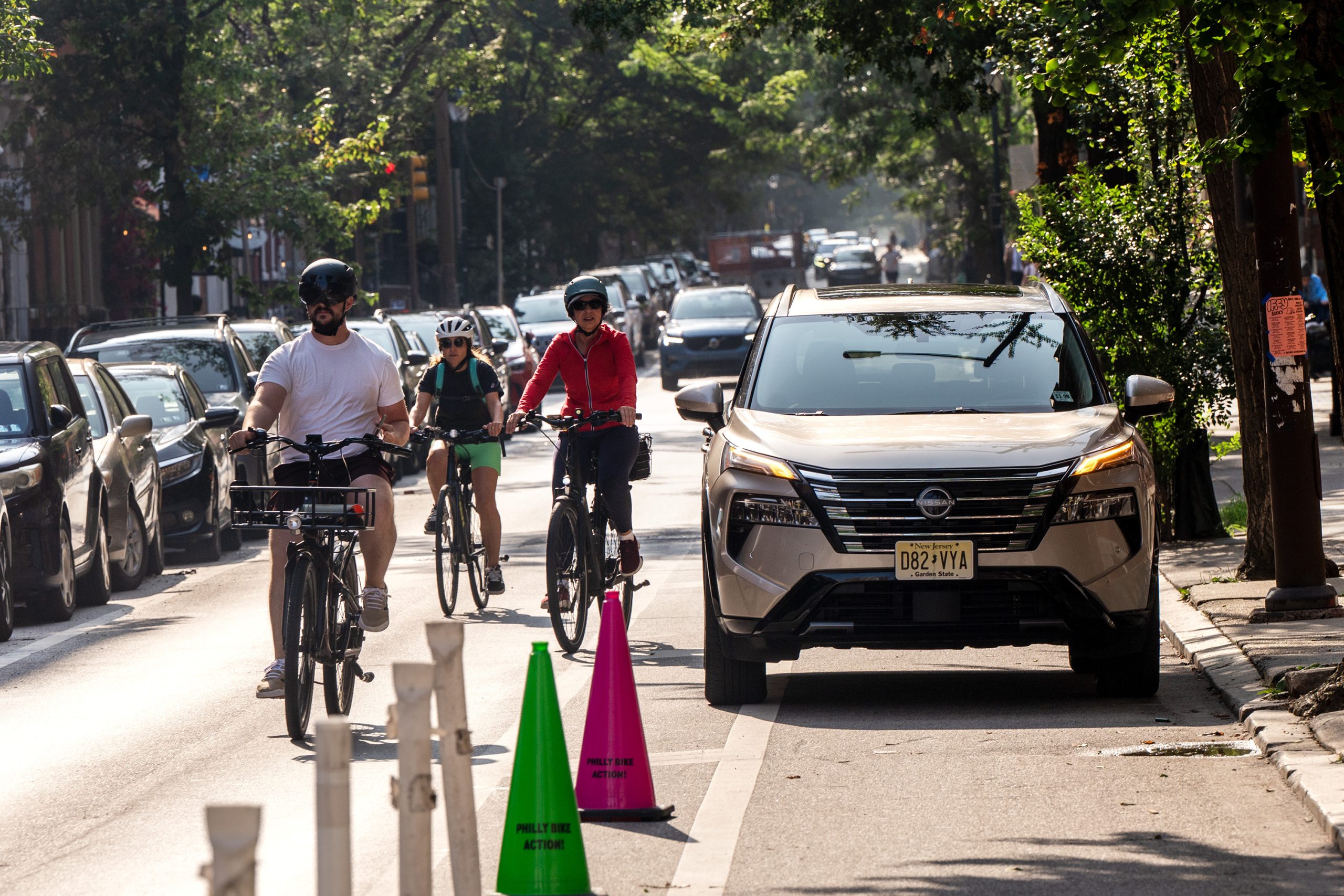
A car is parked in the bicycle lane in the 1700 Block of Spruce Street on Sunday even as family, friends, and Philly Bike Action members gather at Barbara Friedes’ Angel Bike at 18th and Spruce for a memorial. Friedes, a 30-year-old Children’s Hospital of Philadelphia doctor, was killed on her bike at the intersection by a drunk driver in July 2024.Tom Gralish / Staff Photographer
The city has since delayed the Spruce and Pine Streets safety project due to a 2025court injunction. Common Pleas Judge Damaris L. Garcia recently denied the city’s motion to dissolve the injunction, and the project remains on pause.
While Philly Bike Action recognizes the need for the city to wait on legal proceedings, the group believes the judge’s order should still allow the construction of barriers as the injunction targets “ongoing construction” and efforts associated with proposed “neighborhood loading zones, or related restrictions on Pine and Spruce Streets.” However, the addition of “related restrictions” introduced ambiguity and has kept the city’s plans stalled.
“We can’t wait another two to five years,” Amadio said. “The barrier is not much bigger than the curbs on the end of the road and will prevent cars from merging into the bike lane and hurting people.”
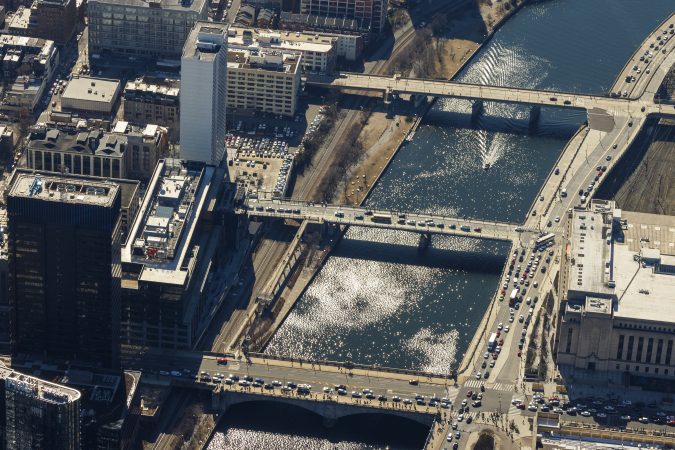
Drivers should expect backups and delays near Amtrak’s 30th Street Station as the Pennsylvania Department of Transportation carries out roadwork nearby in the coming month.
Starting Monday and through Thursday, PennDot will close I-76 West traffic between the 30th Street and I-676 interchanges from 9 p.m. to 5 a.m.
Drivers are advised to take the 30th Street exit on I-76 West and use Schuylkill Avenue to access I-676 East or return to I-76 West.
Between July 20 and Aug. 20, the middle lane on Market Street between 30th Street and Schuylkill Avenue will also be closed. Drivers will be able to use two lanes of traffic in either direction on that stretch during the closure.
The work being carried out in the next month will prepare for the demolition and reconstruction of the Market Street bridge above the Schuylkill River, which is expected to begin in late August. Detours will be announced closer to that date.
The construction work is part of PennDot’s $148.9 million project for bridge rehabilitation in the area, which includes improvements to the Walnut Street bridge over the Schuylkill.
Construction began in March 2025 and is expected to end in April 2029. The majority of the project is federally funded, with the remaining 20% coming from the state.
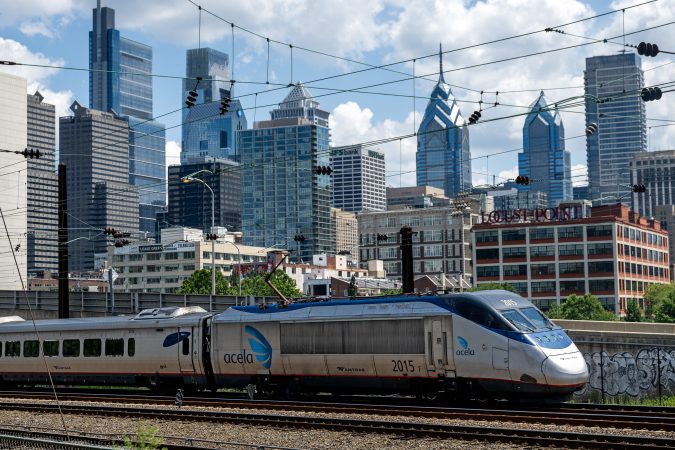
Amtrak and the Schuylkill River Passenger Rail Authority agreed Wednesday to work together to revive passenger train service between Philadelphia and Reading after an absence of 45 years.
Federal Railroad Administration officials designated the route as one of 60 intercity rail corridors to be developed in part with start-up funds from the 2021 bipartisan infrastructure law.
Intermediate stops are planned for Pottstown and Phoenixville.
The agreement is a step forward, committing Amtrak to complete formal ridership forecasts and revenue estimates and to determine likely costs to operate and maintain the route.
“We’ll rocket through Step 2,” said Thomas Frawley, executive director of the Schuylkill River Passenger Rail Authority, because of Amtrak’s commitment to the project. “We’re excited and optimistic.”
Amtrak will handle the next stage of work, estimated at $4.8 million. Federal officials have approved the budget, but the money needs to be obligated before the bipartisan infrastructure bill expires Sept. 30, Frawley said.
Congress is discussing reauthorization of a new surface transportation law, and future funding of the rail corridor program is uncertain despite bipartisan support.
After the business plan in Step 2, the Philadelphia-Reading line would require preliminary engineering, final design and engineering, and some construction.
Ever since rail service along the route ended in 1981, people have been trying to figure out a way to bring back the trains.
Other proposals fell by the wayside, including the state’s 1990s Schuylkill Valley Metro plan to build an electric-powered commuter service on the route. It was estimated at $2 billion. In 2003, Gov. Ed Rendell canceled the effort amid funding concerns.
By contrast, the SRPRA plan is projected to cost about $100 million.
Backers say the SRPRA plan has advantages that could pay off. For one, the partnership with Amtrak and the national passenger railroad’s interest in running the line.
“We look forward to the opportunity to reconnect communities like Reading to the Northeast Corridor and beyond, to support their economic and community development,” Nicole Bucich, Amtrak’s vice president of planning and state partnerships, said in a statement.
Another: Norfolk Southern owns and hauls freight on existing rails with diesel locomotives — no need for a massive project to build tracks or a system of overhead wires to power passenger trains.
“They’re running trains today on the railroad, and it’s in very good condition,” Frawley said. “We’re not talking about a greenfield project.”
The Northeast Corridor itself is an advantage, too, Frawley said, giving more people access to Philadelphia’s 30th Street Station to Boston, New York, Washington, and points between.
“It can have a powerful synergistic effect” on the regional economy, he said.
The Philadelphia region is under an extreme heat warning Wednesday, leading transit agencies to slow down trains to ensure safe travel amid a high of 98 degrees.
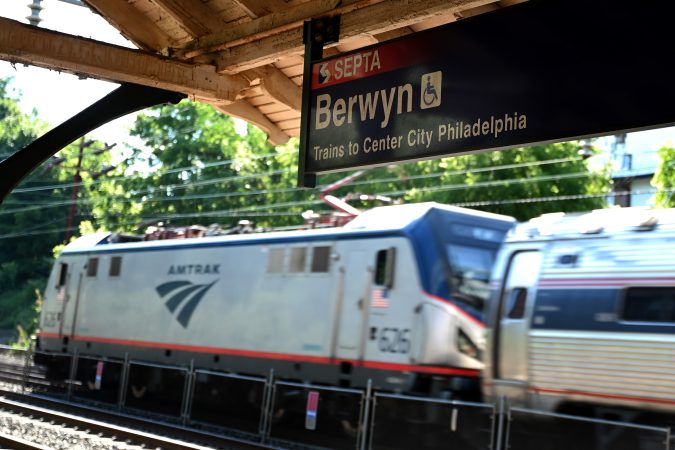
Amtrak and SEPTA were slowing trains down by 5 to 10 mph, and Amtrak was canceling some Acela and Northeast Regional train trips due to the heat, officials said.
Amtrak plans to reduce train speeds through Friday, in addition to canceling at least a dozen trains each day Wednesday and Thursday.
“While these measures are intended to maintain safe and reliable operations, customers traveling during these hours should continue to monitor their train status for the latest updates,” an Amtrak spokesperson said.
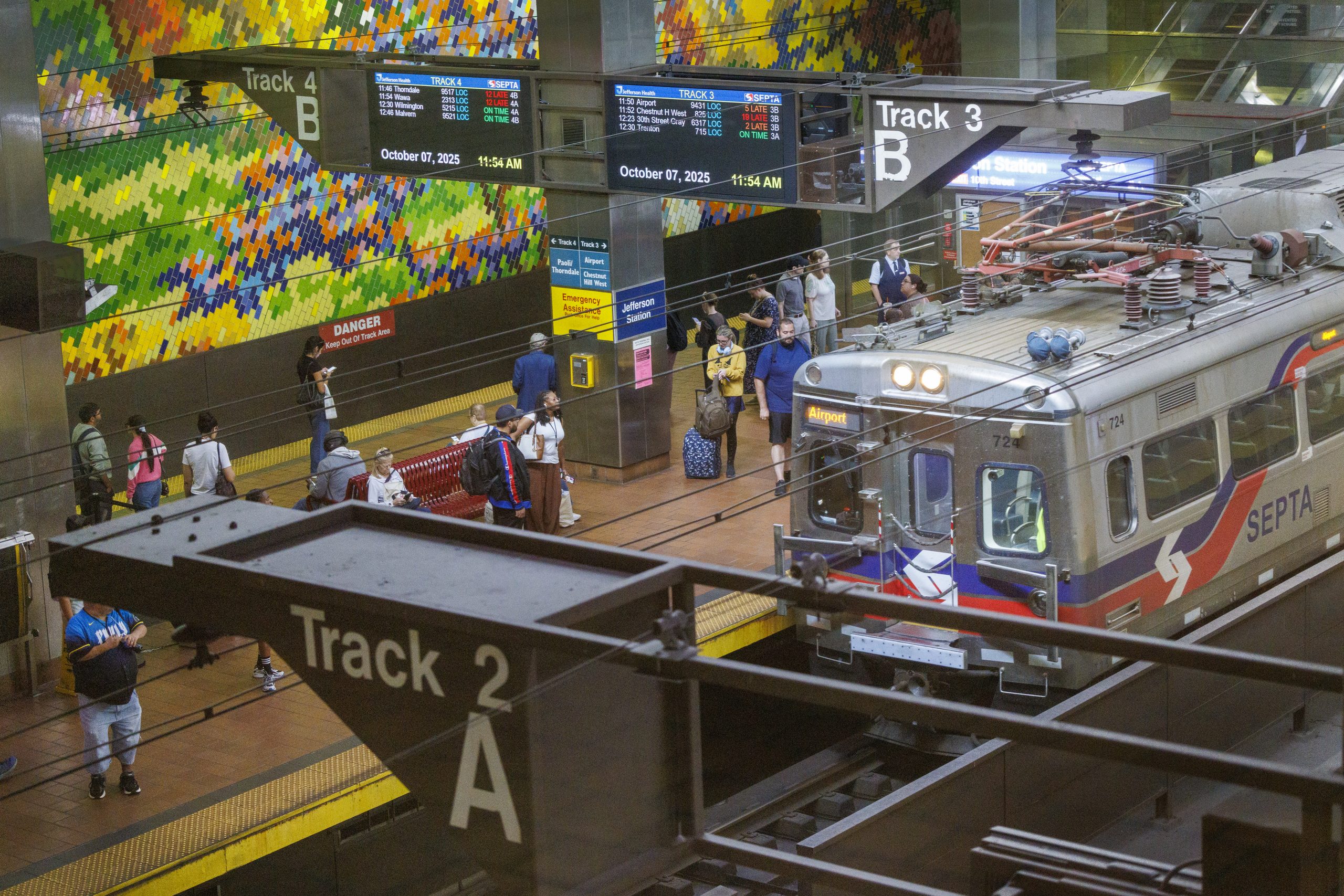
Regional rail train heading to Philadelphia Airport stopping at Jefferson Station. SEPTA Regional rail riders at Jefferson Station, Philadelphia, Tuesday, October 7, 2025.Alejandro A. Alvarez / Staff Photographer
SEPTA has not canceled trips, but it was operating trains at a slower speed, which could lead to delays of up to 15 minutes on Regional Rail and trolleys, SEPTA spokesperson Andrew Busch said. Subway lines were also running slower but were less affected since they are not exposed to direct sunlight as often as other services.
“Bringing speeds 5 to 10 mph slower from their top speed is not always very noticeable to customers, but it can cause some minor delays,” Busch said. “Extreme heat like this makes the tracks more susceptible to damage, and by slowing down the speeds you can help prevent that.”
In extreme heat, rails can begin to warp and eventually crack, creating dangerous circumstances. The wires that hang overhead to power the trains also begin to “sag” in extreme heat, Busch said. The heat also affects electrical equipment like signals and switches, similar to how many across the region can experience power outages in extreme heat.
When temperatures reach 88 degrees, all of these potential safety hazards intensify, Busch said. That is the threshold for when transit agencies begin monitoring their rail systems to see if adjustments are needed.
These safety measures are expected into Thursday and Friday as temperatures are expected to reach 96 and 92 degrees, respectively, according to the National Weather Service. Philadelphia has hit the 100-degree mark three times in 2026, just two shy of the record number for most 100-degree days, according to the weather service.
While the city has not declared a heat emergency, the Philadelphia Office of Homeless Services declared a “code red,” meaning additional outreach was being done to connect those in need to services.
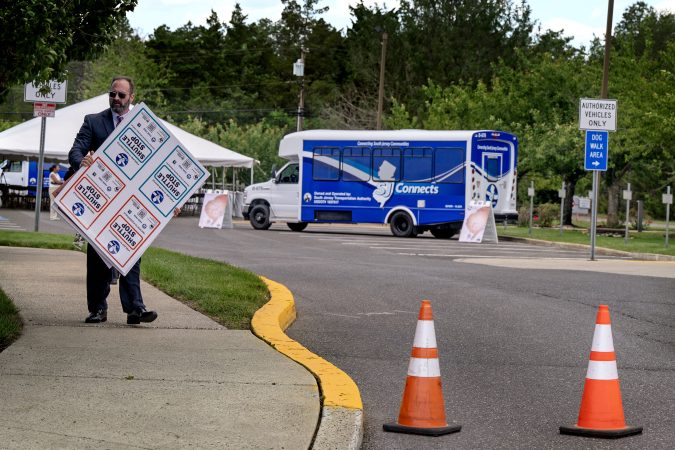
Burlington County was left behind when a new free shuttle bus for South Jersey launched in June. That is going to change in September.
The South Jersey Transportation Authority (SJTA) announced June 1 that a free shuttle bus program called South Jersey Connects was launching that day with routes in all seven southern counties: Atlantic, Camden, Cape May, Cumberland, Gloucester, Salem — and Burlington.
But as the other routes launched, the promised Burlington County route never began. On the authority’s website, it is still marked as “coming soon.”
That is because until recently, the transportation authority was not actually authorized to operate in Burlington County. The county considered operating its own route for the program but ultimately agreed to have the authority run it instead.
But that required legislation.
South Jersey lawmakers had proposed bringing Burlington County into the authority back in the 2022-23 legislative session, but it was not until the South Jersey Connects program was about to launch this year that legislators had the wherewithal to actually hit the gas pedal in Trenton.
“We worked in partnership with our county commissioner, then the administration of Burlington County, and just realized we just couldn’t pull that off,” Sen. Troy Singleton, a Burlington County Democrat, said in an interview. “And speaking with the administration, they were like, look, we feel more comfortable running this through the SJTA, and we already had this legislative vehicle, so that’s when it took on a greater sense of urgency.”
The bill to bring Burlington County into the SJTA passed the Assembly in mid-May and was approved by the Senate just a few days before the June 1 announcement. But Gov. Mikie Sherrill did not sign it into law until the night of the budget deadline — a month after the program had been announced.
“The timing just didn’t work out,” Singleton said.
The Burlington route is expected to start in September, said Dominic D’Amico, director of transportation services at the SJTA, but a start date has not been announced.
The new shuttle’s path has been finalized but has not been shared publicly. D’Amico said in an interview that, like the other routes that launched June 1, it will connect with NJ Transit’s existing infrastructure and the region’s “eds and meds.”
Burlington County Commissioner Felicia Hopson said the new shuttle will enhance the NJ Transit River Line and help residents access jobs, appointments, stores, and schools.
“Stretching 820 square-miles, Burlington County is New Jersey’s largest county, making transportation essential but also challenging for residents without motor-vehicles,” she said in a statement.
The idea of South Jersey Connects emerged from the Chamber of Commerce Southern New Jersey’s advocacy after former Gov. Phil Murphy implemented the 2.5% Corporate Transit Fee on businesses to fund NJ Transit in 2024.
The project was granted $5 million for an 18-24 month pilot, and the future beyond that is uncertain. The South Jersey chamber unsuccessfully requested more money for the effort in this year’s budget, and proponents of the project are hoping to show that it is worth the investment during next year’s budget negotiations.
The summer launch so far has been a little slow, which is to be expected, according to D’Amico.
The authority has seen about 600 one-way trips in the first month of the program, he said, a number he expects to go up as people learn about the routes and as school starts in the fall. He wants to see the service hit at least 5,000 one-way trips each month.
“It takes some time to spread the word, for the marketing campaign to reach the social media platforms, getting brochures delivered to each facility — all those types of things factor into what is a normal slow start,” he said.
“It could be worse, it could be better,” he said.
Why wasn’t Burlington County part of the SJTA before?
Sherrill said in a statement that Burlington County deserves to be part of the authority as “a vital part of the region.”
The reason Burlington County has not been included in SJTA is not because anyone was denying the county is part of South Jersey. Rather, the agency was set up to replace an entity that oversaw the Atlantic City Expressway, which does not go into Burlington, said David Zappariello, the authority’s director of communications.
Along with adding Burlington County to the authority’s coverage zone, the new law allows Sherrill to appoint another member to its board. Members of the board represent the region as a whole, not their home county, Zappariello said, and there is already a Burlington County resident sitting on the board.
Assembly member Alex Sauickie, an Ocean County Republican who also represents part of Burlington County, voted against the bipartisan legislation because it did not also add Ocean County to the authority.
“I just don’t like it when you’re picking winners and losers for political reasons,” he said.
Assembly member Andrea Katz, a Burlington County Democrat, said none of the South Jersey Connects routes will touch her district, where she has concerns about transit deserts. But she is hopeful about public transit expanding in the region and the county getting a seat at the transit table.
“Burlington County now being included means that we’re going to get to have that voice,” she said. “We’re going to get to not be the one stuck in the middle there. We’re going to start to get our own access to public transportation.”
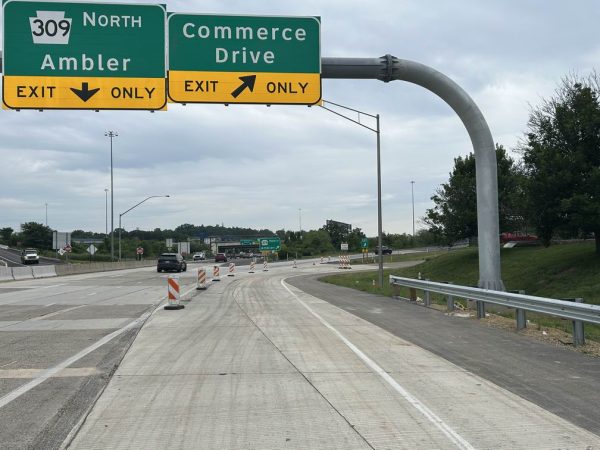
The ribbon was snipped Tuesday, and the first car, a green Audi S5 convertible, rolled down the new “zip ramp” providing direct access from the Pennsylvania Turnpike’s Fort Washington interchange to a 536-acre office park redevelopment in Upper Dublin.
“This is a milestone day for Upper Dublin,” said Kurt Ferguson, executive director of the township’s municipal authority, which for 10 years has managed the ongoing transformation of the underused office buildings of the former Fort Washington Industrial Park into the multiuse Greater Fort Washington District.
The authority has invested about $45 million in infrastructure to support the revitalization project, about 70% from state and county transportation and development grants, Ferguson said. That includes the 2,100-foot ramp, designed and built for about $3 million.
A Lifetime Fitness complex, new retail outlets, and TruMark Credit Union headquarters have been built in the district.
Three former office properties have been converted to apartment buildings, with a fourth turned into a storage facility, Ferguson said. Upper Dublin moved the township library to Virginia Drive in the district, which includes a segment of the Cross County Trail operated by Montgomery County.
The new ramp was made possible by the turnpike’s move to open-road tolling, in which motorists pay tolls by E-ZPass or by plate while passing under gantries. Toll booths are being torn down, leaving more room at interchanges for direct-connect projects like the zip ramp.
“Open-road tolling enables us to be a better neighbor,” turnpike CEO Mark Compton said. “In terms of today’s transportation dollars, this project is not large money … [but] it opens up economic opportunity for this community.”
The Pennsylvania Turnpike Commission is designing a roundabout off the Mahoning Valley Interchange (Exit 74) on the Northeast Extension and plans a park-and-ride lot there.
It is also looking to develop truck parking at the Gateway interchange (Exit 2),near the Ohio state line in Western Pennsylvania, spokesperson Marissa Orbanek said.
It was the first weekend of summer break. Abigail Gillon, an honor student, had just finished sixth grade. She was free.
“My last text to her was at 2:14” on June 14 last year, said Abby’s mom, Lori Kralle.
An hour later, Kralle received a call from an emergency room nurse about her 12-year-old daughter.
Abby had been riding an electric scooter with her best friend, Isabelle, in Aston Township. The girls were sharing the scooter when they drove off the curb and fell into the street. They were struck by an oncoming car at 2:22 p.m. Emergency responders found them holding each other in fetal position, Kralle said. Abigail died two days later. Her friend was severely injured.
“It didn’t just tear away and take away Abigail’s life, it took apart everybody’s life, her friends and family,” Kralle said.
Lori Kralle with her daughter, Abby Gillon.Lori Kralle
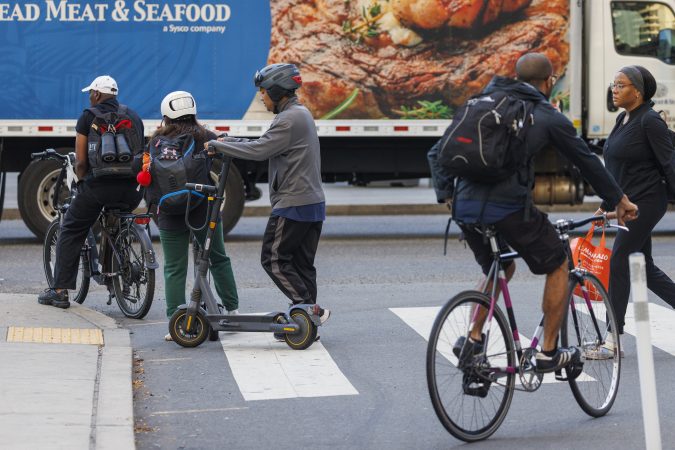
Last year, more traffic crashes causing injury and death in Philadelphia involved electric bikes and scooters than manual ones, according to Pennsylvania Department of Transportation data. The finding highlights a new reality in which e-bikes and e-scooters present a major safety problem, the state confirmed.
The high numbers of injuries and deaths point to the need for legal clarity, statewide safety regulations, and new infrastructure to protect users of e-bikes, e-scooters, and bicycle riders from cars and trucks, traffic safety advocates contend.
(function(){function e(){window.addEventListener(`message`,function(e){if(e.data[`datawrapper-height`]!==void 0){var t=document.querySelectorAll(`iframe`);for(var n in e.data[`datawrapper-height`])for(var r=0,i;i=t[r];r++)if(i.contentWindow===e.source){var a=e.data[`datawrapper-height`][n]+`px`;i.style.height=a}}})}e()})();
“There’s a lot of technology out there and there is no real enforcement and regulation,” said Nicole Brunet, president of PA Safe Roads PAC. “It’s causing devices to be on the road that are unsafe.”
In 2025, e-bikes and e-scooters were involved in 197 crashes on city streets, excluding interstates — a 40% increase over 2024. Four riders were killed and 193 were injured in those collisions, PennDot figures show.
Meanwhile, 193 reported crashes involved standard bikes, more numerous in the city than their electric cousins, as well as traditional foot-propelled scooters, the state figures indicate.
E-bikes and scooters are poorly defined in Pennsylvania law. The ambiguity makes it hard for governments to identify problems; PennDot did not analyze separate crash data for the electric devices until 2024, for instance, due in part to uneven reporting.
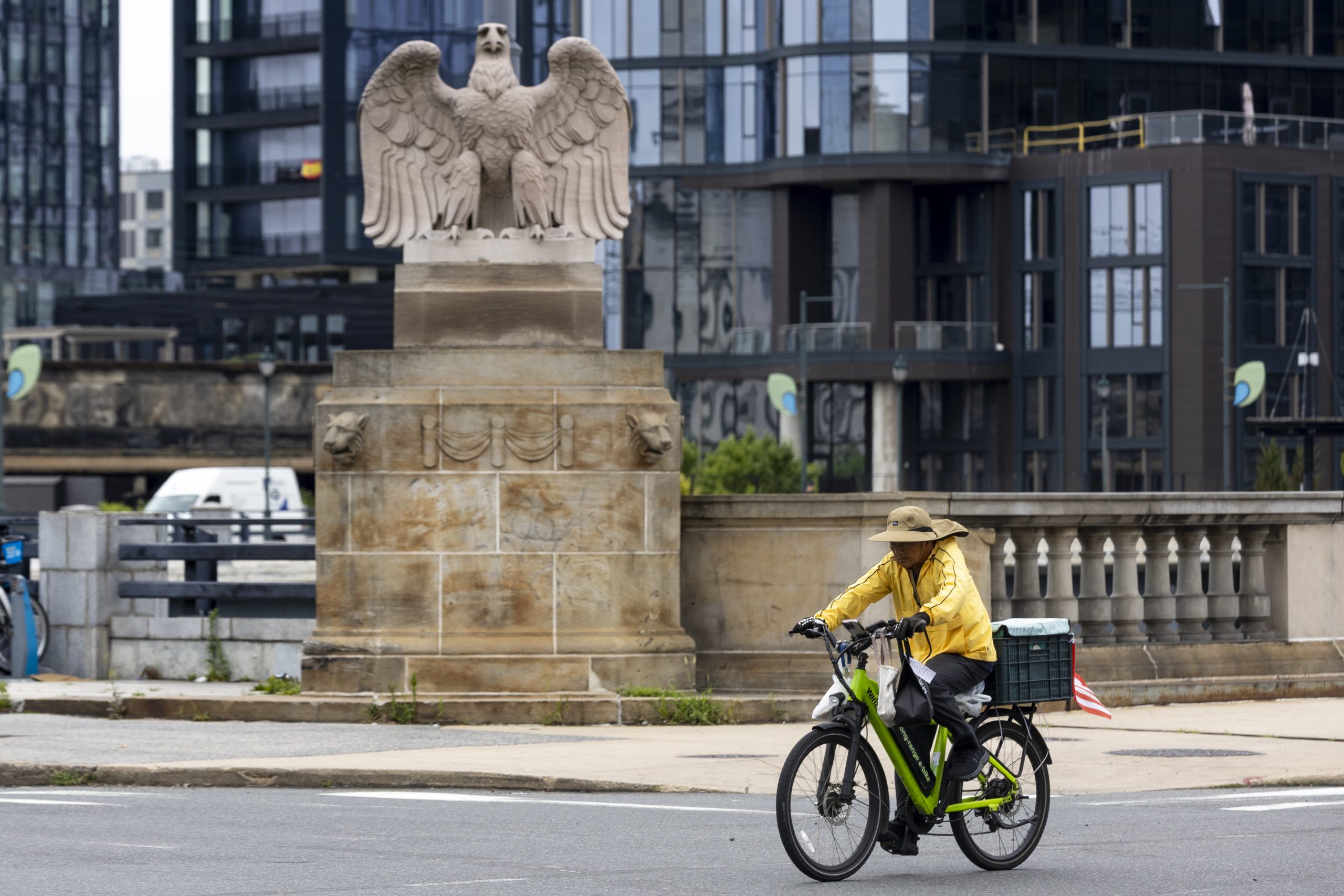
A delivery driver riding an e-bike drives past an intersection on Walnut Street in West Philadelphia on Tuesday, July 7, 2026.Aidan T. Gallo / Staff Photographer
State law authorizes the use of low-speed electric bikes — those that weigh less than 100 pounds, have engines that generate no more than 750 watts, and travel below 20 mph — on public roadways. E-scooters are not street legal in Pennsylvania.
This narrow definition, however, does notdifferentiate among the many new types of electric bikes or e-scooters for sale, which can reach speeds of 60 mph or even 100 mph.
(function() { var l = function() { new pym.Parent( ‘crash-types3__graphic’, ‘https://media.inquirer.com/storage/inquirer/ai2html/crash-types3/index.html’); }; if(typeof(pym) === ‘undefined’) { var h = document.getElementsByTagName(‘head’)[0], s = document.createElement(‘script’); s.type = ‘text/javascript’; s.src = ‘https://pym.nprapps.org/pym.v1.min.js’; s.onload = l; h.appendChild(s); } else { l(); } })();
Two states, two speeds
Governmental response has been uneven, with neighboring states moving in opposite directions and local jurisdictions sometimes banning e-bikes and e-scooters or enacting bespoke rules.
“What we’re seeing right now is sort of a wild, wild west,” said State Sen. Tim Kearney, a Delaware County Democrat.
Kearney wrote and introduced “Abby’s Law” — SB 1008 — in September last year.
The bill says no person under 16 could operate a privately owned “low-speed electric scooter” on public roads; a helmet would be required until age 18. The bill would set a uniform 20 mph speed limit and prohibit tandem riding on e-scooters.
Local police would issue summonses for those and other traffic violations by riders. Municipalities could increase penalties for second and third violations, as long as the fine is no more than $250.
(function() { var l = function() { new pym.Parent( ‘crash-types3__graphic’, ‘https://media.inquirer.com/storage/inquirer/ai2html/crash-types3/index.html’); }; if(typeof(pym) === ‘undefined’) { var h = document.getElementsByTagName(‘head’)[0], s = document.createElement(‘script’); s.type = ‘text/javascript’; s.src = ‘https://pym.nprapps.org/pym.v1.min.js’; s.onload = l; h.appendChild(s); } else { l(); } })();
In New Jersey, former Gov. Phil Murphy, a Democrat, signed the most restrictive electric cycling law in the nation on his last day in officeearlier this year. The law, which takes effect later this month,requires all e-bike users to obtain a license and register their devices with the New Jersey Motor Vehicle Commission, even if they do not go over 20 mph.
Models that can travel between 21 and 28 mph or have a throttle are classified as “motorized bicycles” and must also have liability insurance. The lower-powered e-bikes provide “pedal assist,” which cuts off at 20 mph.
Enforcement could be tricky, especiallyat the Shore. The MVC says out-of-state visitors can ride legally, but language in the law appears to grant the exemption just to people who have registered devices in their home states. That is not an option in Pennsylvania.
The MVC is now taking reservations for appointments; officials have acknowledged the deadline might need to be extended.
E-scooters with a top speed of 19 mph are legal.
In Pennsylvania, more than a year after Abby Gillon’s death, Kearney’s bill has not had a public hearing or a vote in the Senate.
“We need to get people to acknowledge what’s actually happening on the road, and then stop sticking our heads in the sand about the various bureaucratic reasons not to move forward with it,” Kearney said.
Wide use, thin information
Government officials face challenges identifying and classifying the many varieties of electricbikes and scooters — also known as micromobility vehicles — transportation activists and state officials said. That makes information, including about crashes, hard to come by.
PennDot, for instance, began counting electric bikes and scooters separately from pedal cycles, unmotorized scooters, and pedestrians for its annual tally of crashes only in 2024.
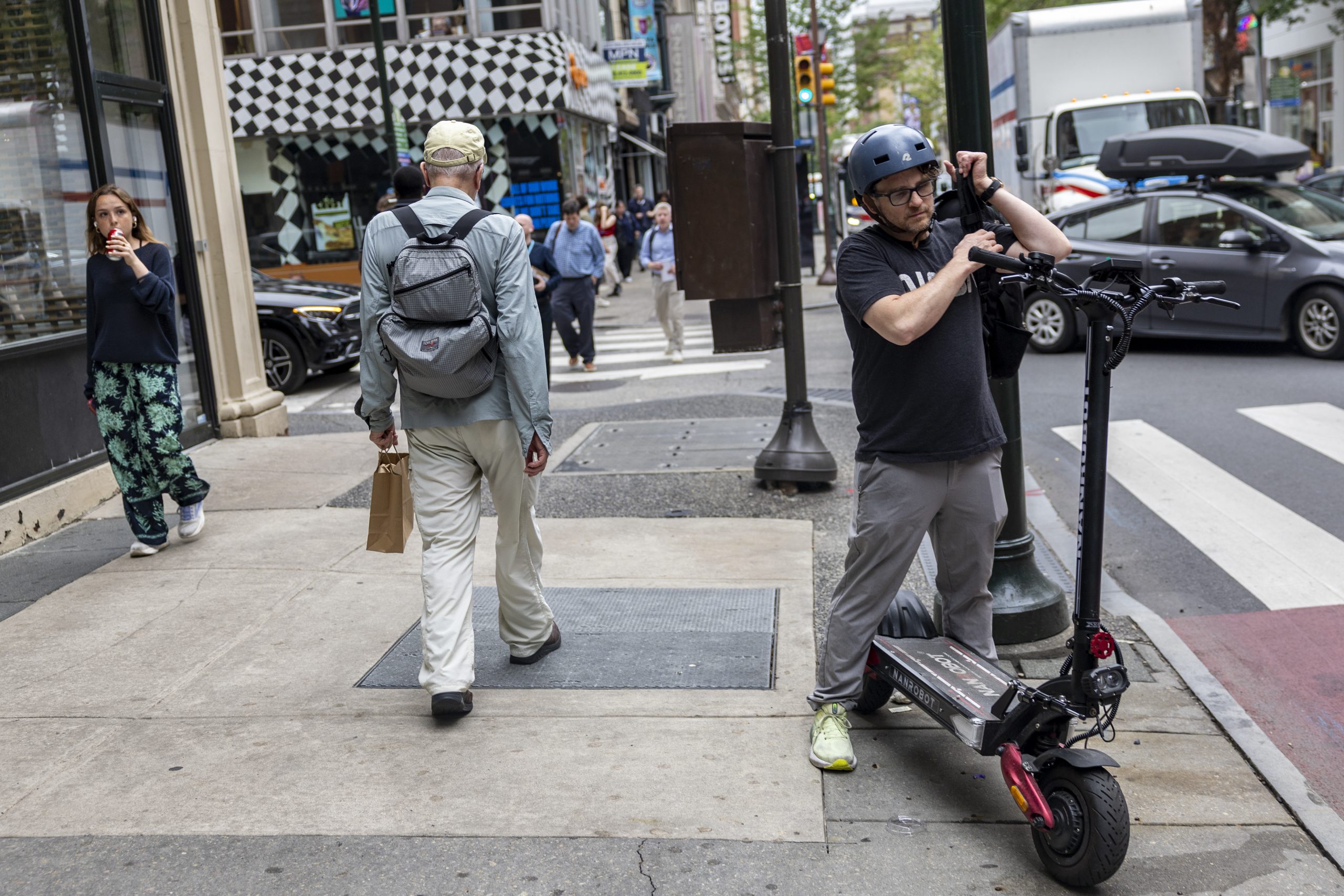
A man gets ready to leave on his electric shooter in Center City.Aidan T. Gallo / Staff Photographer
After a vehicular crash, law enforcement is required to report to PennDot details of crashes that involve injuries, fatalities, or significant damage to vehicles.
Regarding the data prior to 2024, Robert A. Ranieri, crash-analysis manager at PennDot, said via email: “I don’t find that fully reliable since we didn’t look at all the narratives and the police may not have reported them properly at the time.”
While his office works to verify the data, “not all reports are touched by my staff,” Ranieri said.
Similarly, the crash data on electric bikes likely include vehicles known as e-motos, which look like pedal bikes but go faster than 20 mph, said John Boyle, research director at the Bicycle Coalition of Greater Philadelphia.
In general, e-motos being lumped in with e-bikes is causing a lot of issues as communities and states try to regulate the higher-speed micromobility devices, Brunet said.
E-scooter law is ‘basically ignored’
The recently released PennDot data include at least 92 crashes in Philly involving e-scooters, which are technically illegal to ride on public streets in Pennsylvania.
Last year, there were four reported fatalities involving e-scooters, though they made up only 14% of micromobility devices, according to the Bicycle Coalition’s 2025 bike count data.
Standard bikes, in comparison, resulted in the same number, a total of four deaths, last year.
“Some of the e-scooters have a top speed of 60 mph, which is crazy fast,” Boyle said, but “the law is basically ignored.”
There is a gray market of electric scooters and bikes available for purchase, transportation experts told The Inquirer.
“You can purchase electric bikes or scooters for $800 on Amazon and they have 1,000 to 2,000 watts,” Boyle said.
The bikes are sometimes marketed as “Class 2,” meaning their motor tops out at 20 mph, but with a few basic adjustments can easily go faster, Boyle said.
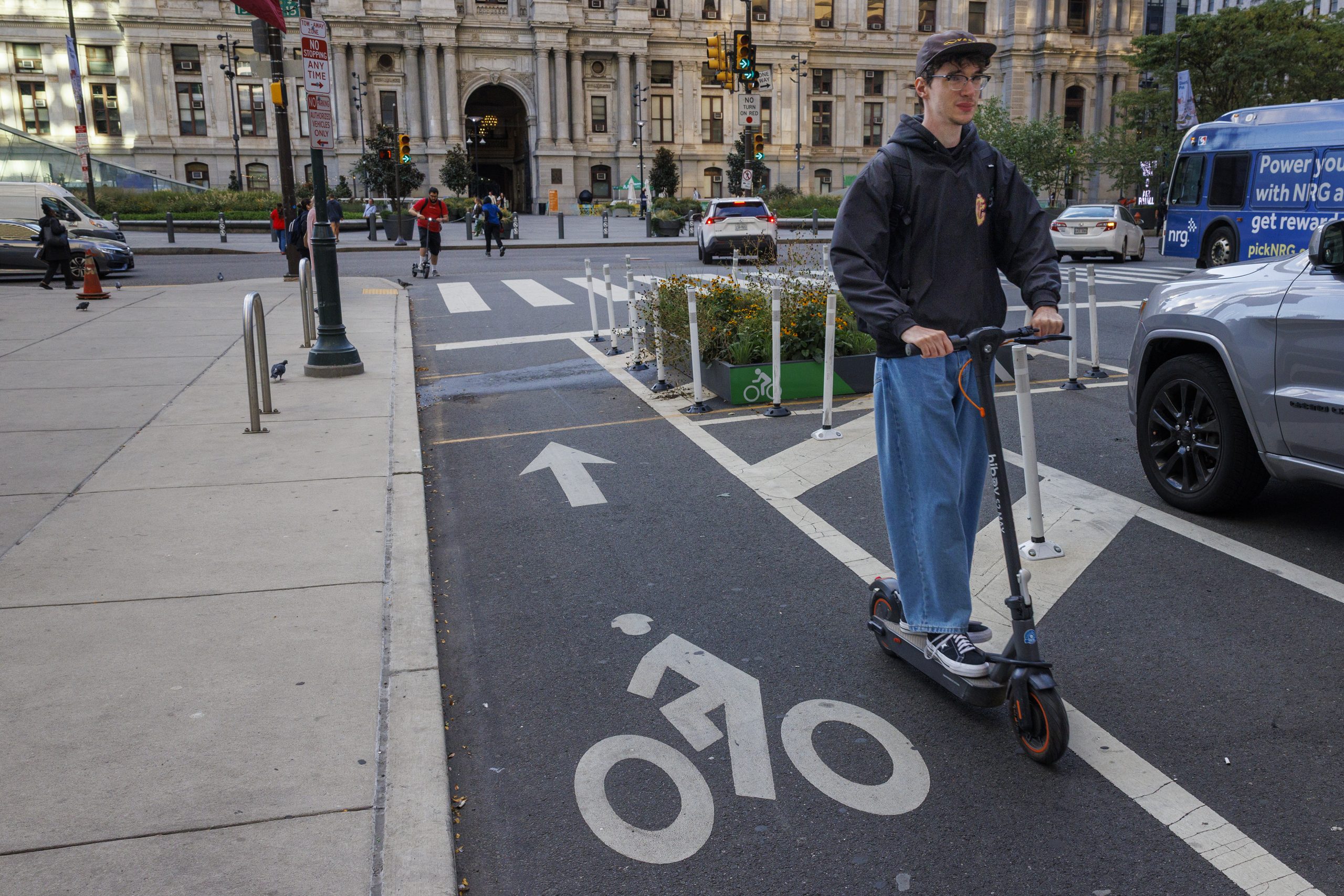
A man rides an electric scooter down a bike lane near Drexel University’s campus.Aidan T. Gallo / Staff Photographer
Motorcycles, unlike e-motos, have quality standards and regulations. When it comes to selling a motorcycle in Pennsylvania, dealerships are required to handle legal requirements, title transfers, and state registrations.
Reiningin the manufacturers and dealers of electric bikes, motos, and scooters is an important step, Boyle said, but the state first needs to better define in the law what electric bikes and scooters are.
Brunet, president of PA Safe Roads PAC, said her organization supports the Safe System approach to transportation safety, which involves education, enforcement, and infrastructure.
“Philly just needs to keep building better bike infrastructure. … There is definitely a lot to do to make roads safer so that the people choosing these devices get home safe,” Brunet said.
Several bills to regulate e-scooters have been proposed in the state legislature, but none have been passed.
Special legislation gave Pittsburgh the right to test a shared e-scooter rental program in partnership with Spin, a private company, from 2021 to 2023, when the trial expired.
Kinkead called it a success, noting her north Pittsburgh district has steep hills and limited transit links.
“What I saw … was not college kids goofing around, it was people who were trying to get around the North Side with grocery bags,” Kinkead said at a recent public hearing on the bill.
The city had 230,000 unique e-scooter users during the test, said Ryan Seiferet, who managed the program for the Pittsburgh Department of Mobility and Infrastructure.
A survey of about 1,000 participants showed 44% of e-scooter riders used them to get to work and one-third to travel between transit stops and home. Regular users tended to have low incomes.
While rules are needed in the state, especially for privately owned scooters, “We want to make sure we aren’t penalizing or disincentivizing a valuable micromobility travel option” for people, said Jessie Amadio, an organizer for Philly Bike Action.
The electric scooter program was relatively safe, with one reported injury per 17,000 rides, according to a DOMI report.
Electric scooters going against directed traffic flow at Market Street at 15th in Center City.Alejandro A. Alvarez / Staff Photographer
News site Next Pittsburgh found, however, that a handful of the injuries were serious and, in some cases, life-threatening. Spin planned to deploy scooters with larger tires for stability, the site reported.
Kinkead said shared e-scooters can be tightly controlled in agreements between a city and an e-scooter firm; in Pittsburgh, the scooters could not exceed 15 mph, enforced by software. E-scooters stopped working if the rider strayed into a town that did not allow them.
Philadelphia, however, is opting out. Mayor Cherelle L. Parker’s administration asked that the city not be included in the shared e-scooter bill, said State Rep. Ed Neilson, a Democrat who represents a Northeast district and chairs the House Transportation Committee.
“Because of the historic nature of the city and the millions of people that come every year, we just don’t want to block or impede that,” Neilson told colleagues in the hearing.
Most agree that the state needs to take some sort of legislative action soon.
“Getting as far as we have gotten [with Abby’s Law] on the Senate’s desk and to still not have anything signed or put into order is very frustrating,” Lori Kralle said.
“What does it take? For another mother to get that phone call?” she added. “I don’t wish that on anybody.”
A Philadelphia judge has blocked the city from resuming work to upgrade protections for the bike lanes along Pine and Spruce Streets in Center City, the latest turn in a high-profile legal battle.
In an order dated July 6, Common Pleas Judge Damaris L. Garcia denied the city’s motion to dissolve an August 2025 injunction that had stopped the Streets Department from making certain changes.
“This is a very significant ruling in this case,” said George Bochetto, the lawyer for FOP.
The Streets Department intended the zones to give residents, delivery trucks, and contractors places to stop without parking in the bike lanes.
A ban on stopping in bike lanes was enacted in 2024 after a physician, Barbara Friedes, was killed by a drunk driver while cycling on Spruce Street. The crash helped galvanize support for a a parking ban in the bike lanes, and a planned upgrade, including with curb-styleconcrete barriers between traffic and the bike lanes.
“It’s a disappointment,” Jessie Amadio, an organizer with Philly Bike Action, said of the latest ruling. “There has been a tremendous amount of grassroots support, keeping the civic pressure on for two years.”
City Council passed an ordinance last year empowering the Streets Department to make any parking changes it deemed necessary. That cleared up any ambiguity, city lawyers argued in a hearing last month.
The judge’s decision dealt a blow to the loading zones, but did not address the bigger question of whether the city has the right to improve bike-lane protections.
FOPS amended its lawsuit to include a new complaint that the ordinance violated Sunshine Law requirements that lawmakers conduct business in the open. In addition, it alleges that Council violated the separation of powers in the city charter by delegating lawmaking to the executive branch.
That challengeis pending and set for trial next year.
“I’ll also say this: There are a lot more dangerous things happening in those bike lanes, with e-bikes and e-scooters,” Bochetto said. He said a girl on an e-scooter crashed into a light pole near his house, captured by security cameras.
Garcia did not write an opinion explaining the order.
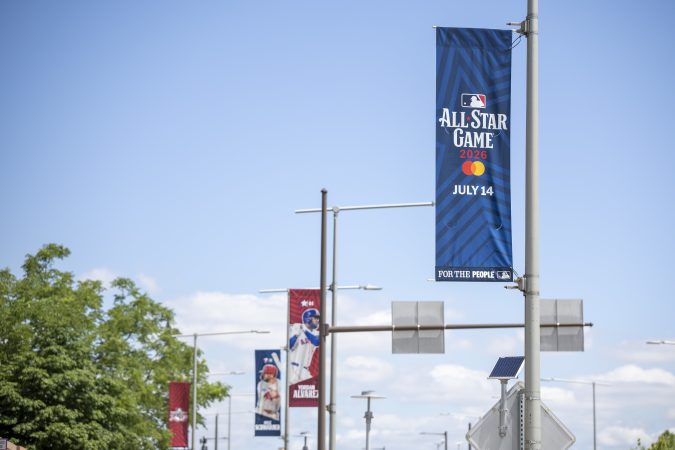
Philadelphia’s packed summer slate continues with MLB All-Star Week, a five-day run of baseball events in South Philly and Center City that caps off with All-Star Game at Citizens Bank Park next week.
And in addition to crowds of baseball fans, the occasion is also slated to bring a number of road closures and parking restrictions over the next few days.
Officially, it all kicks off Friday at Citizens Bank Park with the HBCU Swingman Classic, a game that features 50 players from Division 1 historically Black colleges and universities. Events will run throughout the weekend and Monday ahead of the main event Tuesday.
Here is what you need to know:
Planned road closures
Road closures kick off Friday afternoon in the area of Sixth and Market Streets for the Budweiser Clydesdales Hitch Parade. That event will close Sixth Street between Market and Chestnut Streets from 3 p.m. to 6 p.m., and additional rolling closures are expected to be implemented along the parade route between Sixth and Seventh Streets, and Walnut and Market Streets.
Sunday brings a nighttime drone show that will see road closures on and around Eakins Oval from 9 p.m. to 10 p.m. Those closures will affect:
All lanes of Eakins Oval
Kelly Drive from Eakins Oval to Fairmount Avenue
Anne d’Harnoncourt Drive
The I-76 eastbound off-ramp at Spring Garden Street
On Monday, Independence Mall will see road closures starting at 5 a.m. to accommodate building out the MLB Red Carpet Show. Set to be in place through midnight, those closures will impact:
Fifth Street between Market and Chestnut Streets
Ludlow Street between Fourth and Fifth Streets
Randstead Street between Fourth and Fifth Streets
Independence Mall will remain tied up Tuesday for the MLB Red Carpet show itself, with closures again in place from 5 a.m. to midnight. Those closures will affect:
Fifth and Sixth Streets from Arch to Walnut Streets
Market and Chestnut Streets from Fourth to Seventh Streets
Ranstead and Sansom Streets from Sixth Street to Seventh Streets
Philadelphia police, the city said, may institute additional closures in the interest of public safety.
Parking restrictions
All roads affected by closures will also be temporary no-parking zones, the city said. If vehicles are parked in those locations during the times they are closed, the vehicles will be moved.
Drivers who may have had their cars moved should contact the police district of the area where their vehicle was parked, the city said.
Other closures
The Autopark parking garage at Independence Mall, located near Sixth and Arch Streets, will be closed starting at 11:59 p.m. Monday, the city said. Its Fifth Street exit will stay open for vehicles to leave and move, and all vehicles must be moved by 5 a.m. Tuesday.
Additionally, the Philadelphia Independence Visitor Center will be closed to the public starting at noon on Tuesday, the city said.
Public transportation
To accommodate fans heading to Citizens Bank Park, SEPTA will run six additional express trains on the Broad Street Line, also known as the B Line, to NRG Station before and after the Home Run Derby and All-Star Game Monday and Tuesday.
Free rides on the line from NRG Station will also be available at select times during those events. Free rides begin after the second round of the Home Run Derby on Monday, and after the sixth inning of the All-Star Game Tuesday, the city said.
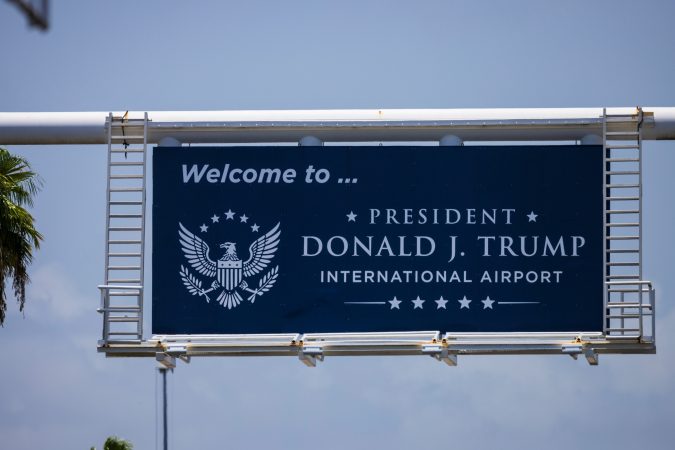
Palm Beach International Airport in Florida is now President Donald J. Trump International Airport.
The name change became official Thursday morning, the Federal Aviation Administration announced. Eric Trump, Trump’s son and the executive vice president of the Trump Organization, shared a video on social media in which an air traffic controller is heard announcing the name change to the pilots of the president’s private Boeing 757 as it approached the airport for a landing just after 5 a.m.
“As a son, and someone who flies out of this airport nearly every day, I will forever be proud to see the initials ‘DJT’ on my boarding pass,” Eric Trump wrote in a separate post.
The airport’s three-letter code will not change to DJT from PBI until Aug. 18, according to airport officials.
Travelers will see the airport’s previous branding and new signage during a transition period that will last several weeks, airport officials said. The rollout of the new name would not disrupt airport operations, they said.
“We’re working behind the scenes to update our physical signage, terminal spaces, and digital channels to our new name: President Donald J. Trump International Airport,” the airport said on social media.
The airport sits a few miles from Mar-a-Lago, Trump’s private club and residence in Palm Beach, which has served as a hub for his political operations.
Florida Gov. Ron DeSantis, a Republican, signed a bill in March clearing the path for the airport to be renamed. Democratic state lawmakers opposed the measure, which the Legislature approved in February, arguing that it would cost about $5 million to update signs, maps and other airport materials to reflect the name change.
The New York Times reported in February that Trump’s family business had filed trademark applications for potential airport names with the U.S. Patent and Trademark Office. The applications staked a claim to three names: President Donald J. Trump International Airport, Donald J. Trump International Airport and the airport code DJT.
The applications also sought the right to use the name in connection with a variety of airport-themed merchandise, including luggage, animal carriers and “shoes for protection of airline passengers’ feet during airport security screening.”
Renaming the airport for Trump attaches his name to a gateway that is used by millions of visitors each year.
Trump has a long history of putting his name on the things he has built, owns or promotes, a list that includes Trump Tower and his golf resorts and hotels. As president, he has reached beyond his private businesses. For nearly six months starting in December, Trump’s name was added to facade of the John F. Kennedy Center for the Performing Arts in Washington until a judge ordered its removal in May. His signature is expected to appear on U.S. dollars later this year.