Category: Politics

  • A group of Haverford alumni is pushing the college to remove Howard Lutnick’s name from library

    A group of Haverford alumni is pushing the college to remove Howard Lutnick’s name from library

    Haverford College students have publicly advocated for the school to consider removing U.S. Commerce Secretary and mega donor Howard Lutnick’s name from the library.

    Behind the scenes, an older group has been pushing, too.

    About a dozen vocal Haverford alumni have come out in strident disagreement with president Wendy Raymond’s decision in April not to take steps toward considering the removal of Lutnick’s name.

    Several in the group have called for Raymond’s resignation, while at least one said he had withheld his donation. Some were critical of Lutnick even before Department of Justice documents released earlier this year showed he had contact with sex offender Jeffrey Epstein as recently as 2018, long after Epstein pleaded guilty to obtaining a minor for prostitution and soliciting a prostitute.
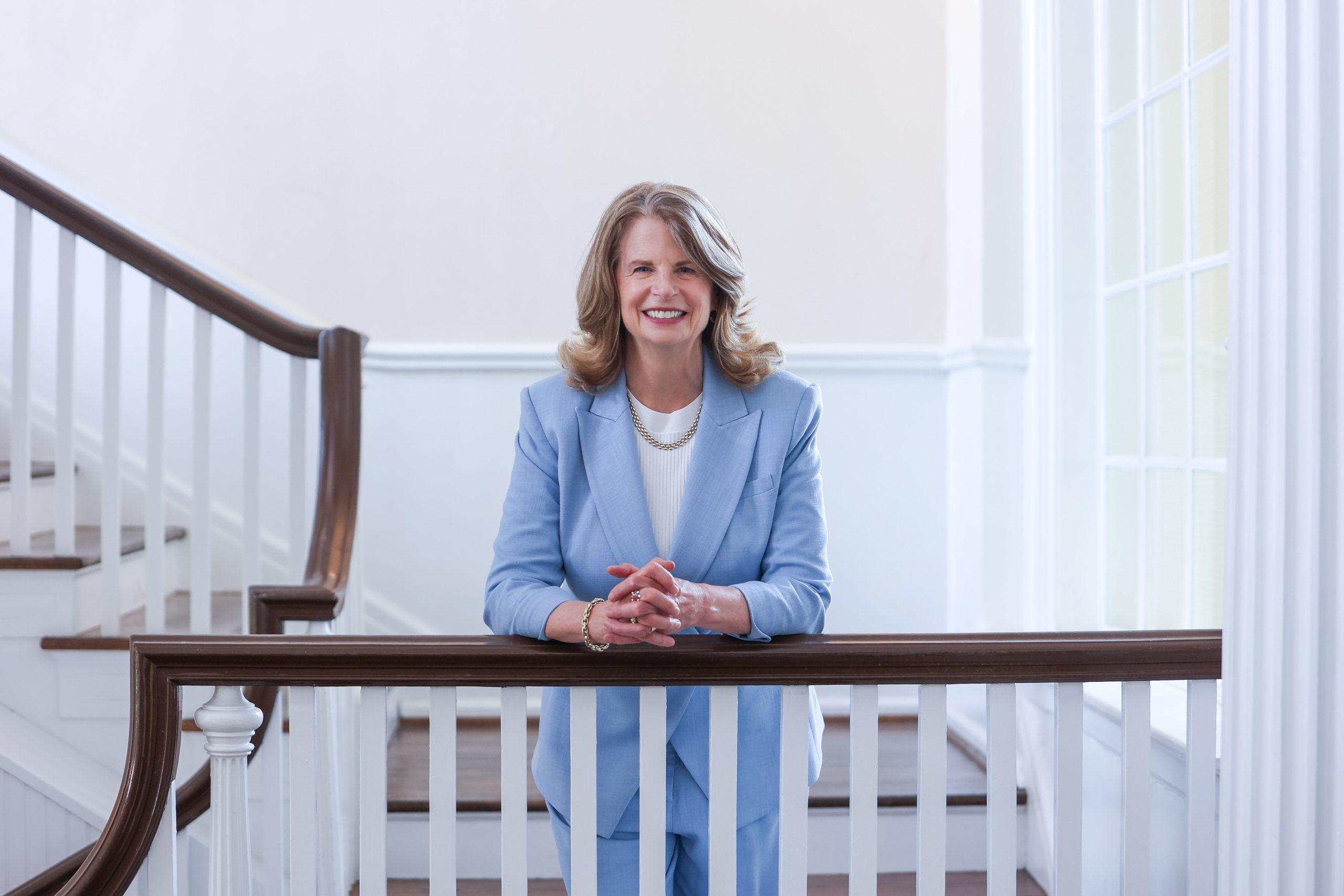
    Haverford College president Wendy Raymond has led the college for seven years and previously announced she would step down next June.Courtesy of Haverford College

    But Raymond stood by and explained her decision during a Zoom call last week with former board members, and the current board chair said Lutnick himself feels that he is being targeted in a witch hunt, according to accounts of the meeting.

    Among the concerned alumni is Norm Pearlstine, a 1963 graduate who served on Haverford’s board of managers from 1986 to 1989 and is a former editor of the Wall Street Journal, Forbes Magazine, the Los Angeles Times, and Time Inc. and former chief content officer at Bloomberg.

    “I am appalled,” Pearlstine wrote to Raymond on May 3, days after she announced she would not initiate a committee to consider removing Lutnick’s name from the library. “You should resign immediately so Haverford‘s board can replace you with a leader who puts principle ahead of principal.”

    Another alumnus wrote that he would not advise his grandchildren to attend Haverford.

    “I cannot imagine that my granddaughters or grandsons would want to enter the Lutnick library or the Lutnick cafe or for that matter, any other building on campus with his name on it,” wrote Joseph Schulze, a 1963 graduate and retired Michigan school superintendent who grew up in the Philadelphia area.

    Adi Ignatius, a 1981 graduate and journalist who is editor at large of the Harvard Business Review, said he donated to Haverford every year until 2025, when he withheld his money because of the Lutnick matter.
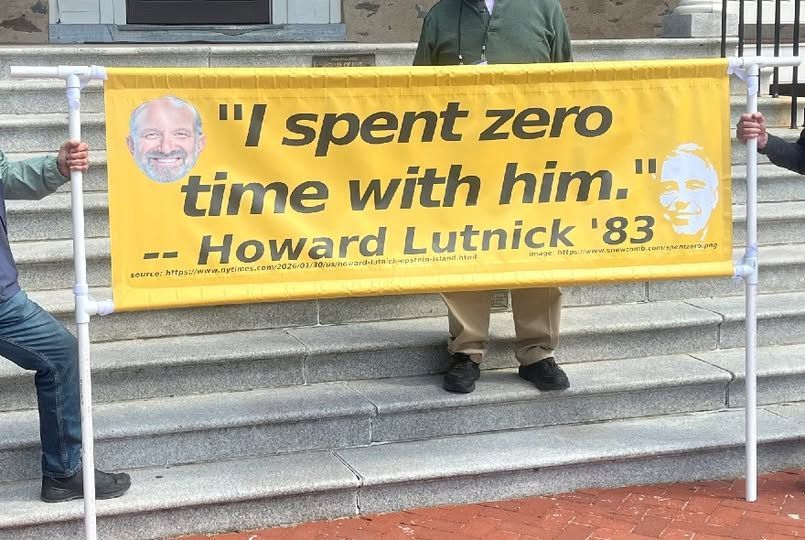
    Haverford College alumni from 1971 hold a banner on campus about Howard Lutnick during alumni weekend.Courtesy of Chuck Durante

    Haverford in a statement said many community members who oppose removing Lutnick’s name have also written to the college or told Raymond they are against the creation of a review committee that was requested through a student resolution this spring.

    “President Raymond felt it was in the best interest of the college to reject the resolution because she did not believe this matter met the threshold necessary to constitute a committee given the college’s established standards and the information available to us at that moment,” the statement said.

    But, the college said, “the matter is not closed.” Haverford is continuing to monitor “publicly available information” and “community sentiment” on the issue and Raymond or her successor could choose to initiate a committee, the college said.

    Haverford not ready to make an ‘indictment’

    Raymond, in the June 11 Zoom call with former board members, said she regarded creating a committee close to an “indictment” and did not think the threshold had been met, according to an email account of the meeting by Pearlstine obtained by The Inquirer. Some concerns about Lutnick are political, she said, and she is not willing to consider politics in her decision-making about a renaming committee, according to accounts of the meeting.

    Students and alumni have pointed out that Lutnick had previously said he had not been in a room with Epstein, whom he found “disgusting,” since 2005, yet he testified to Congress earlier this year that he had visited Epstein’s private island with his family in 2012 and exchanged emails with him in 2018.

    But Raymond, who has led the college for seven years and previously announced she would step down next June, said in Tuesday’s meeting that she did not think Lutnick’s lying about when he last had contact with Epstein was enough of a trigger.

    Some alumni, supporting Raymond’s decision, have noted there is no evidence Lutnick participated in Epstein’s crimes or improprieties.

    “I understand that students might feel strongly in support of wanting to change the name, but I don’t believe there’s a basis to do so,” said Robert Swift, a Philadelphia lawyer and former board member who was on the call Tuesday. “I have serious differences with Howard politically, but that’s not relevant either.”

    Swift, 79, a 1968 Haverford graduate who served on the board for 12 years, said Lutnick, a former chair of the college’s board of managers, was generous and served the board well.

    “His heart was in the right place,” Swift said.

    Some were calling for Lutnick’s removal even before the Epstein connection because they did not like his politics, said one alumnus who asked not to be named because of the sensitivity of the matter.

    “I don’t think it’s fair to remove someone’s name from a building simply because you don’t like their politics,” the alumnus said.

    George Parker, a 1960 alumnus and a professor of finance at Stanford’s Graduate School of Business, said Haverford should rely on its Quaker roots, which requires governing by consensus.

    “We do not have consensus,” Parker, a Quaker originally from the Philadelphia area, said of the Lutnick matter, “and where we do not have consensus, I do not think we should take action.”

    Lutnick’s relationship with Haverford

    Haverford has been in contact with Lutnick. Michael B. Kim, chair of Haverford’s board of managers and a private equity firm leader in Korea, said during the Zoom call that Lutnick communicated he is especially hurt that his alma mater is taking part in what he feels is a witch hunt, according to meeting accounts.

    Michael B. Kim, chair of Haverford College’s board of managers.Courtesy of Haverford College

    The board agrees with Raymond’s decision, he said.

    Lutnick’s relationship with the highly selective, small liberal arts college on the Main Line goes back decades. He lost his mother to cancer when he was in high school and then his father one week into his freshman year. Haverford’s president at the time waived his costs and he graduated in 1983 with an economics degree.

    Former chairman of financial firm Cantor Fitzgerald, he served on Haverford’s board for 21 years, the last three as chair, until 2015. His name was put on the library after a then-record $25 million donation he and his wife made in 2014. Lutnick has given the school $65 million and is one of its biggest donors.

    His Epstein ties gained scrutiny earlier this year. A Commerce Department spokesperson told the Associated Press that Lutnick had had “limited interactions” with Epstein, with his wife in attendance, and had not been accused of “wrongdoing.”

    A request to the Commerce Department’s press office to speak with Lutnick got no response.

    Under Haverford’s gift policy, the school can rename a building if “the continued use of the name may be deemed detrimental to the college, or if circumstances change regarding the reason for the naming.”

    Schulze, the former school superintendent, said he thinks that threshold has been met and a full discussion is needed.

    “Somebody else should take over if [Raymond’s] not ready to do that,” he said.

    Rob Riordan, a 1964 graduate and Trenton native who lives in Cambridge, Mass., said he was upset Raymond did not honor a request from an overwhelming majority of students at a plenary meeting who requested a committee be formed

    “To me, that felt like a violation,” said Riordan, 84, an educator who helped start charter schools in the San Diego area.

    Several alumni pointed out that nearby Bryn Mawr and Swarthmore Colleges have removed names of controversial figures from buildings in recent years.

    Pearlstine, who was on the Tuesday call, first wrote to Raymond and Kim in July 2025, urging that Lutnick’s name be removed. His concerns are not political, he said, but rather about behavior that conflicts with Haverford’s values.

    “Howard Lutnick is a powerful Trump administration cabinet officer who proudly helps the most lawless President in our country’s history implement policies that trample upon human rights, due process, rule of law, and respect for the independence and integrity of institutions of higher learning,” he wrote.

    It was not always that way. Ignatius, 67, who lives in Stonington, Conn., said he recalled interviewing Lutnick on stage at Haverford in 2015 and the good will in the audience toward him. Lutnick, who lost his brother and many of his company’s employees in 9/11, talked about the aftermath and how the company helped care for victims.

    “His trajectory since then has been similar to Rudy Giuliani’s,” Ignatius wrote to Raymond and Kim last August. “He has squandered the goodwill he built up after 9/11 and become a partisan troll, espousing values that are inconsistent with — and offensive to — the ideals that Haverford stands for.”
  • Delaney Hall brought Mikie Sherrill’s ‘first real test.’ South Jersey progressives who campaigned for her say she failed.

    Delaney Hall brought Mikie Sherrill’s ‘first real test.’ South Jersey progressives who campaigned for her say she failed.

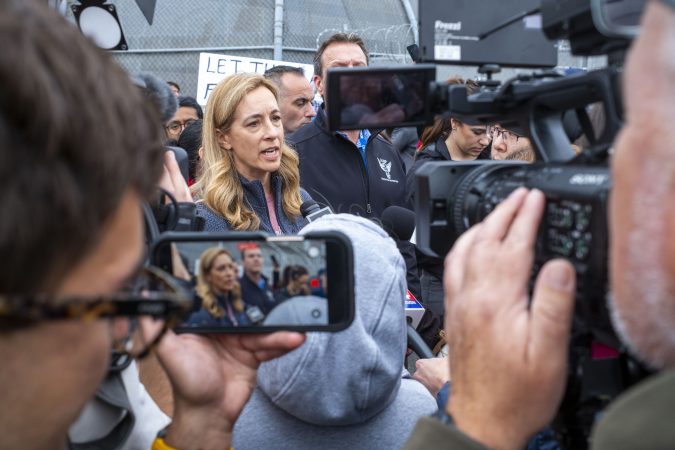
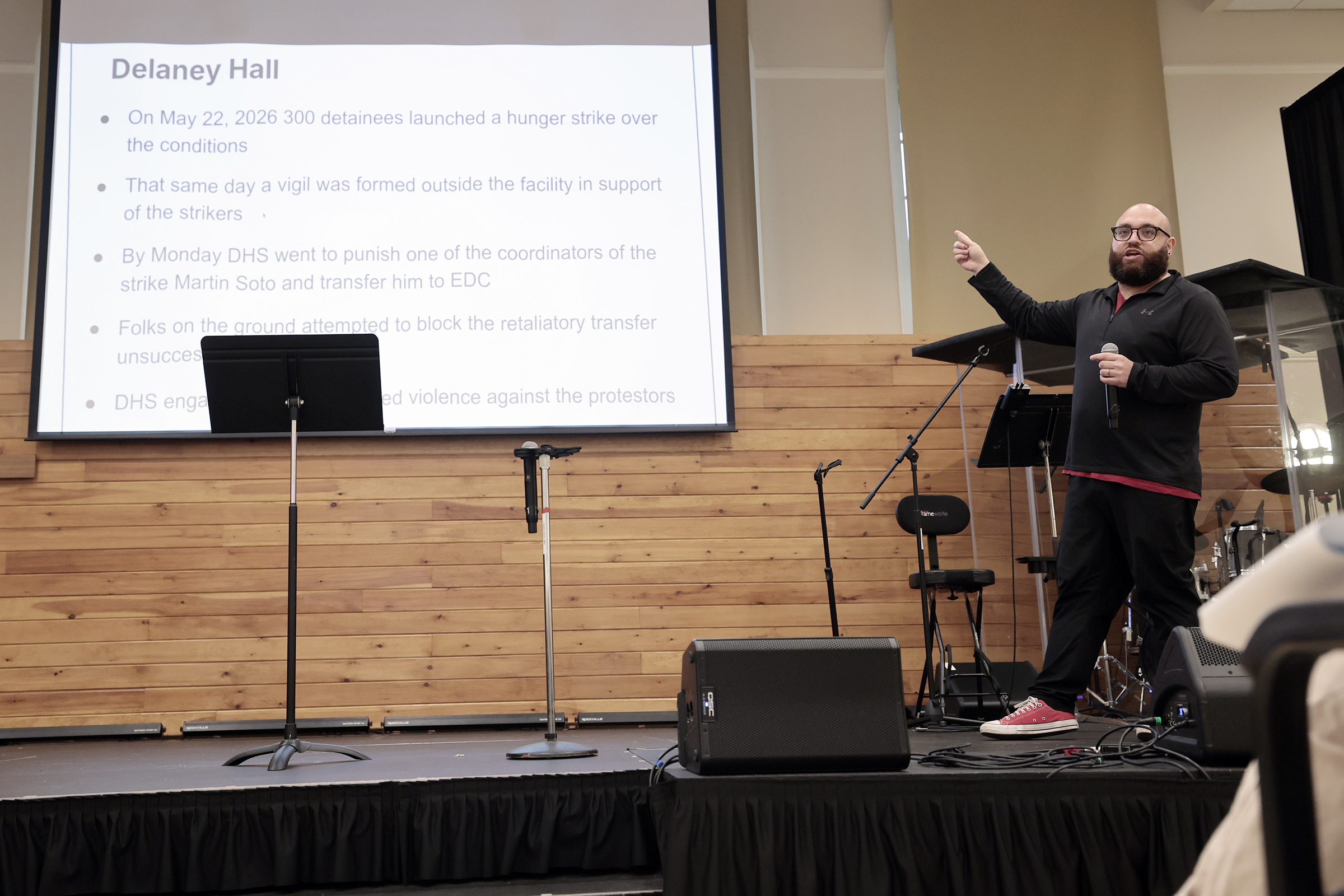
    Josue Barreiro stood in front of a crowd of 200 people seated inside a church last week in Haddonfield. He was there to speak about his experience as one of 61 protesters arrested in one night outside Delaney Hall after Gov. Mikie Sherrill had sent over state police.

    He told the crowd, gathered for a meeting of the South Jersey progressive group Cooper River Indivisible, that the governor made it seem like she was sending state troopers to protect demonstrators from federal immigration officers. Instead, he said, they brutalized protesters on horseback in riot gear. He showed a video of state police knocking him to the ground.

    “All accounts say the state police were considerably more violent than the federal government was,” Barreiro, a Bridgeton resident and activist with Los Tequios, told receptive audience members who made sounds of disgust.

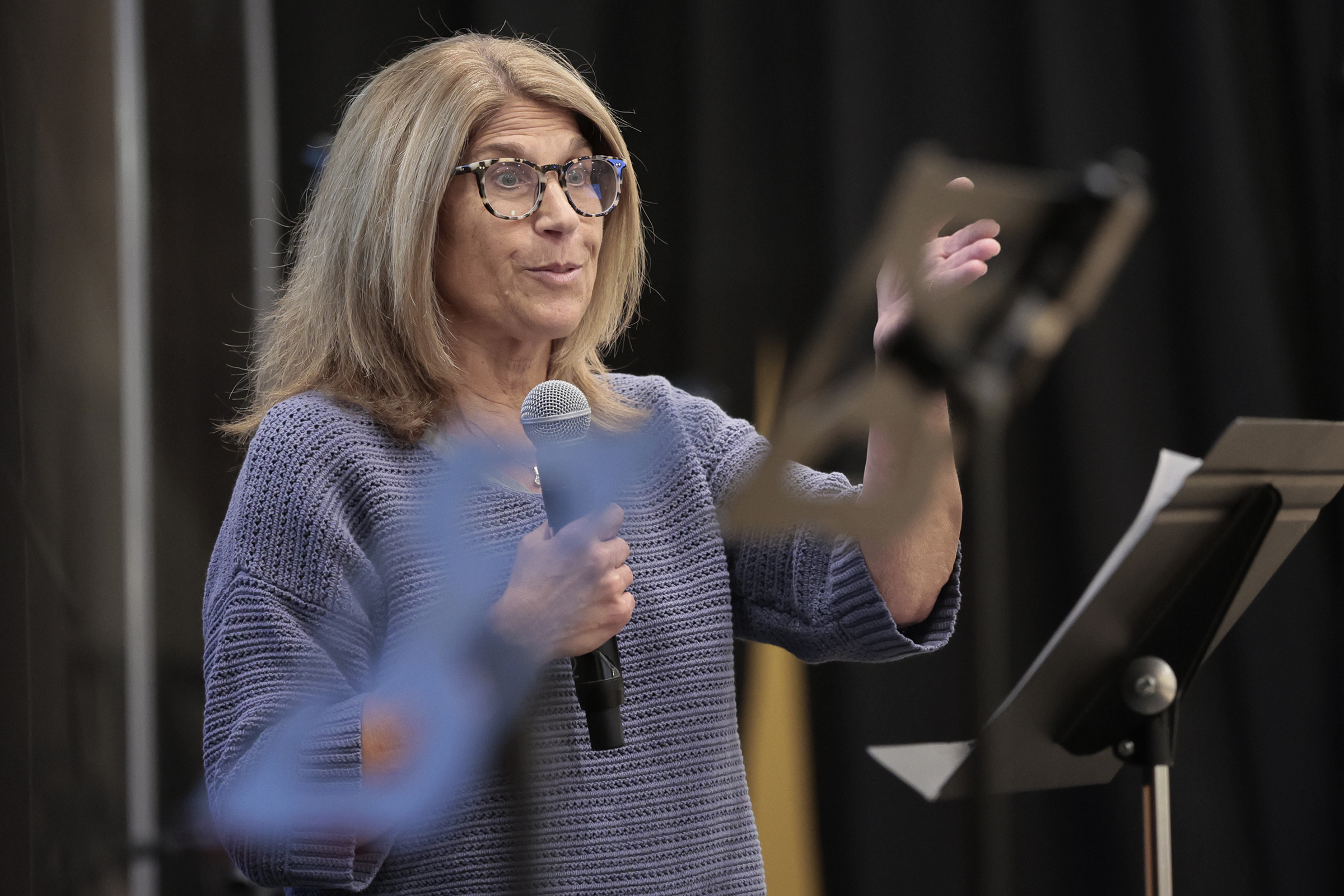
    Josue Barreiro speaks about the protests outside Delaney Hall during the Cooper River Indivisible general meeting at the Haddonfield United Methodist Church on June 9.Elizabeth Robertson / Staff Photographer

    Sherrill, a former member of Congress whose double-digit victory last year was seen as a rebuke of President Donald Trump, has been in her most high-profile political bind yet as she juggles her opposition to the ICE detention center while facing widespread criticism for her handling of protests outside it.

    The first-term governor campaigned as a fighter against Trump and Immigration and Customs Enforcement. She highlighted her experience as a Navy helicopter pilot and said she was trained “that in a crisis, you run toward the fight.” But to South Jersey progressives who worked hard to campaign for her, Sherrill’s decision to respond to tensions between protesters and ICE with a designated protest zone policed by state officers represented a betrayal. The governor called the decision “absolutely necessary to protect public safety and avoid escalation from ICE.” But the state police’s show of force, video of which replayed across national news and social media channels for days, “kind of resembled what ICE was doing in the first place,” said Newark Mayor Ras Baraka, one of Sherrill’s primary opponents, who was arrested outside the facility last year.

    “This was not the kind and quality of leadership we were voting for, or hoping to see,” said Michele Messer, 52, a leader of Cooper River Indivisible, one of the groups that campaigned for Sherrill.

    A rising star in the Democratic Party, Sherrill overperformed in November in parts of South Jersey that had been viewed as fertile ground for her Republican opponent. She flipped back three counties that went red in 2024.

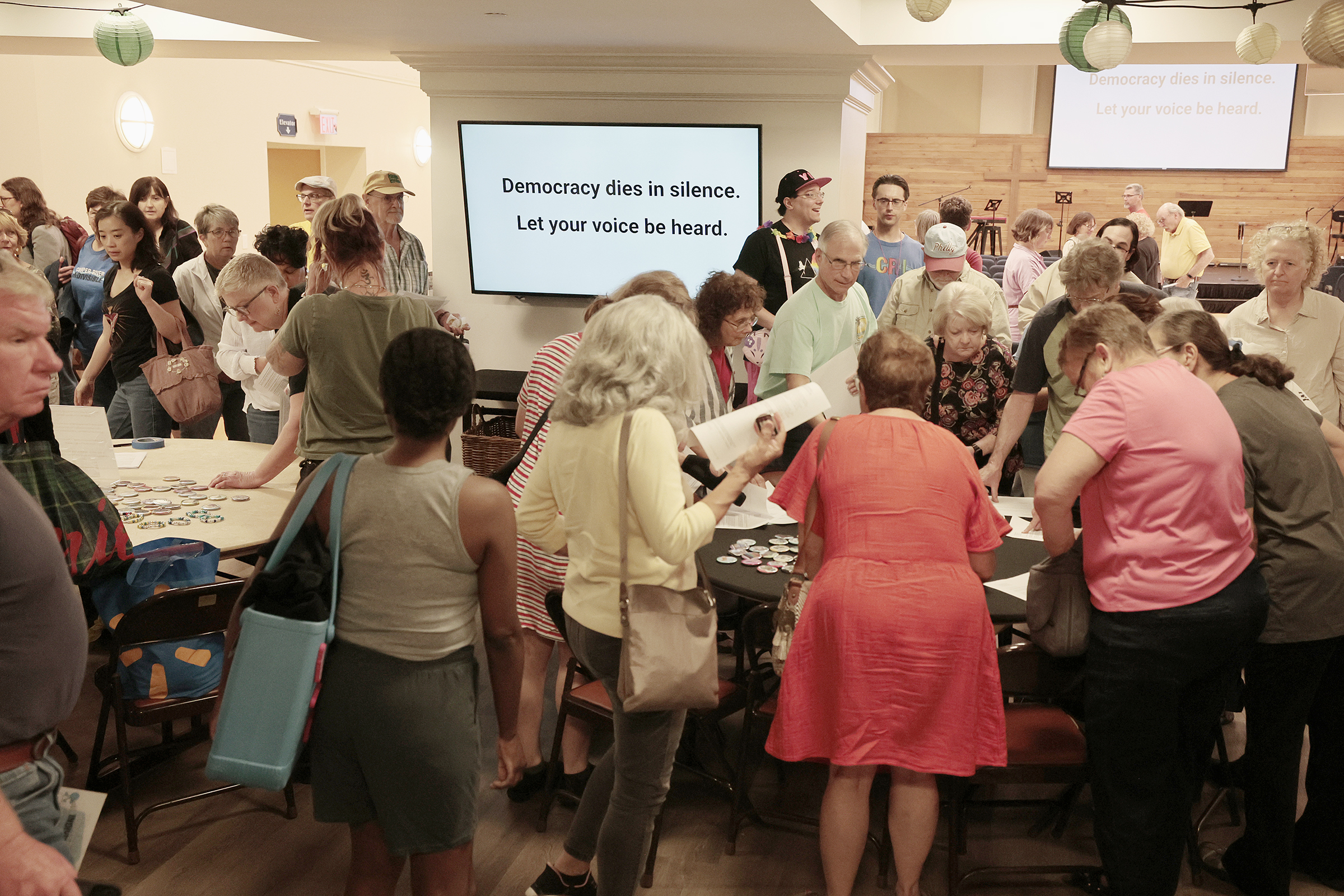
    People sign up to volunteer after the Cooper River Indivisible general meeting at the Haddonfield United Methodist Church.Elizabeth Robertson / Staff Photographer

    Sherrill said she was trying to “lower the temperature” to prevent Newark from becoming another Minneapolis when she announced her plans to send state troopers to Delaney Hall. She later disagreed with a comparison between state police and federal immigration officers in Minneapolis during a tense interview on WNYC’s Ask Governor Sherrill, noting that state police didn’t kill anyone.

    “I don’t think they have the same concern for human life in many cases that I do, and that our police forces in New Jersey share,” she said.

    Activists said she should have known that sending in police and corralling people into a free speech zone can escalate already fraught demonstrations.

    “I mean, there’s precedent, there’s history. We’ve all read about how these things go, and yet that was the choice she made,” said Messer, a Haddon Township resident who has protested at Delaney Hall.

    Patricia Campos-Medina, a former campaign adviser to Sherrill, said the governor’s handling of Delaney Hall — and how she manages “the fallout of her decisions” — has been an early test of her leadership.

    “It’s her first real test [of] how she manages the duties of being the highest public safety officer of the state leading New Jersey, and then still protecting the immigrant community who lives here,” said Campos-Medina, an ally of the governor who works with the labor movement.

    Sherrill has built her national profile on fighting the Trump administration, and those who have become the most frustrated with her share that mission. How she navigates this moment could determine whether she can keep that base focused on fighting the president, instead of her.

    Mounted New Jersey State Police troopers move toward protesters outside the Delaney Hall detention center on May 29 during a protest against the transfer of detainees and federal immigration policies.AP Photo/Andres Kudacki

    ‘I’m not proud to have voted for her’

    Sherrill has called for the closure of Delaney Hall and her administration announced multiple measures to support the fight against the detention center since the late May backlash against her began.

    Activists from across the state rallied in Trenton on June 1 and delivered a letter to Sherrill calling on her to “honor our First Amendment rights, cease police brutality and to enable the closure of Delaney Hall.”

    “As the grassroots who campaigned for you, we also expect ongoing communication with your administration to navigate this perilous time in New Jersey,” the letter continued, signed by about 40 organizations statewide, including Cooper River Indivisible and several other South Jersey groups.

    The next day, New Jersey Attorney General Jennifer Davenport, Sherrill’s appointee, filed a lawsuit against GEO Group — the private company that runs Delaney Hall — to give the state health department full access to the facility over reports of “inhumane and unsanitary conditions.”

    Two days later, Sherrill and the state legislature announced an infusion of $20 million to assist with immigration defense and launched a rapid legal defense effort amid concerns about due process.

    Marie Henselder-Kimmel, 65, a Cherry Hill resident who leads the South Jersey group NJ Voters Want More Say, said the reports of bad conditions in the facility are not new, so she doesn’t understand why the administration did not take legal action months earlier.

    “I foresee that we’re going to have to keep pressuring to get them to keep doing those more bold things,” she said.

    Henselder-Kimmel said she feels “torn” about Sherrill’s decision to send state police because she agrees ICE would have escalated otherwise. But she said it seemed like Sherrill may have sent the police in without understanding what they were going to do.

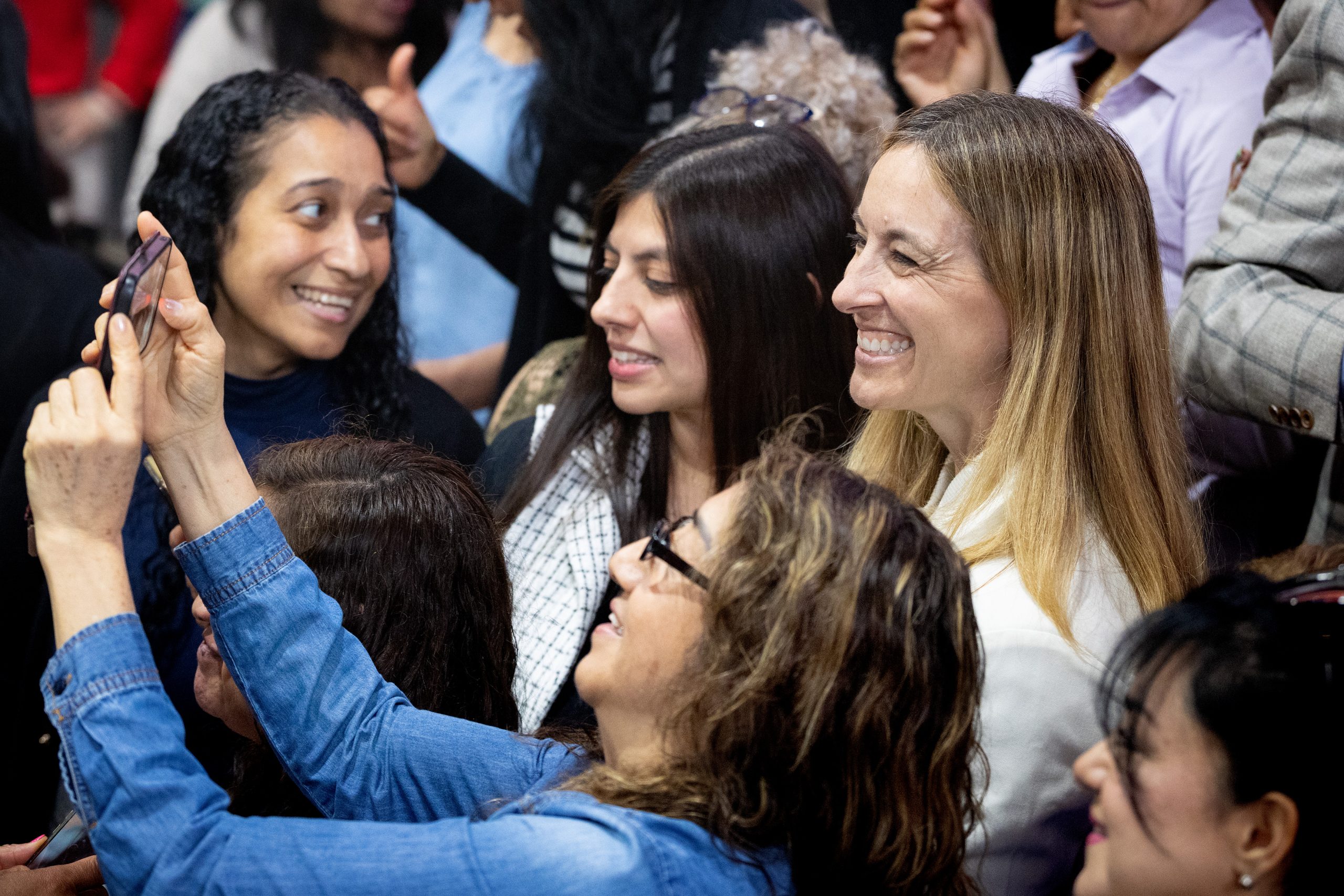
    Marie Henselder-Kimmel (left) and Michele Messer (right) talk with Vikki Toomer (back to camera) after the Cooper River Indivisible general meeting at the Haddonfield United Methodist Church.Elizabeth Robertson / Staff Photographer

    Cristian Moreno-Rodriguez, who works as the executive director of El Pueblo Unido of Atlantic City, an organization that supports Latino immigrants, said Sherrill’s handling of the protests has fully broken the trust with his community.

    Sherrill’s campaign made a particular effort to target Latino voters. She did particularly well in New Jersey’s largest Hispanic-majority cities, which moved an average of 18 points toward the Democrat after rightward shifts in 2024.

    “We’re not going to forgive her for what she’s done,” said Moreno-Rodriguez, who worked for One Giant Leap, a super PAC that supported Sherrill and raised about $9 million by the end of 2025.

    Sherrill was not Moreno-Rodriguez’s first choice in the primary, but she was a better choice for his community than Republican Jack Ciattarelli, he said. Still, he said he was expecting better from the Democrat.

    “I don’t regret voting for Mikie Sherrill because she was better than Jack Ciattarelli, but I’m not proud to have voted for her,” he said.

    Gov. Mikie Sherrill poses for a selfie at a Latinos for Mikie event at the Rancho Mateo restaurant in Elizabeth, N.J., last May.Aristide Economopoulos

    Pushing back against ICE has been one of Sherrill’s priorities during her first months as governor. She banned them from staging on state property without a judicial warrant, signed the state’s sanctuary policy into law, and created a portal for people to submit videos of ICE for investigation. She also signed a law banning ICE agents and other law enforcement officers from wearing masks, but it is being fought in the courts.

    Her administration is also fighting a proposed detention center in Roxbury in court and said it will fight any other proposed centers.

    Activists have been demanding Sherrill meet with detainees, but she says she has not been allowed in except for one “closely controlled and limited tour” on June 8, in which she was not allowed to speak with those being held there.

    Several members of Congress, who are authorized to conduct oversight visits, have visited the detention center, including Sen. Andy Kim, a South Jersey Democrat who made headlines for getting pepper-sprayed while trying to de-escalate tensions between federal immigration officers and protesters. Kim faced criticism from some activists for what they viewed as trying to negotiate with ICE, but others have praised him for being on the ground in a way they have not seen from Sherrill.

    Sen. Andy Kim stands between federal agents and demonstrators in an attempt to prevent a clash outside the Delaney Hall migrant detention center in Newark on May 25.DAKOTA SANTIAGO

    Sherrill and activists alike have said that the demonstrators have been largely peaceful. But U.S. Rep. Jeff Van Drew, a Cape May County Republican, accused the protests of being “more like anarchy” and called on Sherrill to bring state police back.

    State Sen. Michael Testa, a Cumberland County Republican, praised Sherrill’s “decision to cooperate with federal authorities” and “restore order” by bringing state police in, and added fuel to the fire by thanking her for “supporting President Trump and the brave men and women of ICE.”

    ‘The buck stops with her’

    Activists have expressed frustration that the narrative has strayed from the conditions inside Delaney Hall to the fight outside it — a point Sherrill has echoed.

    But after state police clashed with protesters, Sherrill focused her criticism on what she described as “aggressive and dangerous” disruptors and defended the officers.

    Her remarks further infuriated activists who accused her of echoing the state police’s narrative, which they say does not align with what they experienced on the ground or saw online.

    When a radio caller confronted Sherrill on WNYC over state police brutalizing nonviolent protesters, the governor said “if there were incidents like that, the attorney general will be looking into that.”

    Vikki Toomer, a Cooper River Indivisible leader who has protested outside Delaney Hall, said that listening to Sherrill’s news conferences have given her “that same visceral reaction” she gets from listening to Trump.

    Vikki Toomer speaks during the Cooper River Indivisible general meeting at the Haddonfield United Methodist Church.Elizabeth Robertson / Staff Photographer

    “I don’t know if they were feeding her lies, or that’s the narrative she was trying to spin … all I know is what she was saying was not true, and she was not taking the time to listen,” Toomer said.

    Toomer said she believes the governor knows her plan did not go well but also “has not come out publicly and said, ‘Oops, I made a mistake.’”

    When asked on the radio whether she believes her administration has suffered a loss of trust, Sherrill said sending state police “was really not done focusing on politics, and I certainly hope not.”

    “This was focused on making a really hard decision in a situation that nobody wanted,” she said.

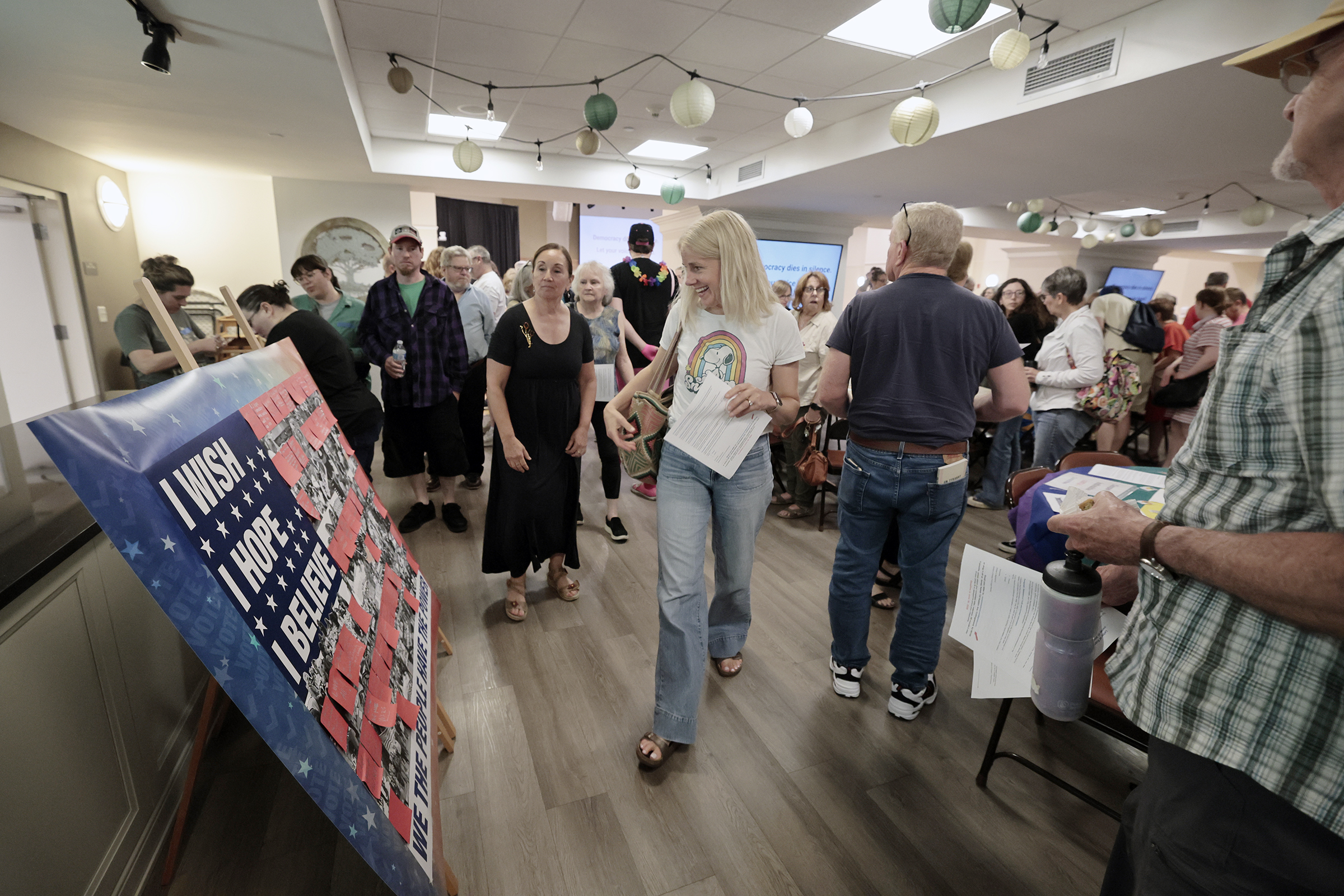
    Folks leave messages on a collage (left) during and after the Cooper River Indivisible general meeting at the Haddonfield United Methodist Church on June 9. The poster will be part of an exhibit at Perkins Center for the Arts.Elizabeth Robertson / Staff Photographer

    Linda Greenwood, 74, a Voorhees resident who belongs to Cooper River Indivisible and campaigned for Sherrill, believes the governor has good intentions but does not think she has been unfairly blamed.

    “She’s the governor,” Greenwood said. “The buck stops with her. She brought the state police in. She has to take responsibility for what happened there, and I think she will.”

    Lawrence Garrity, 29, was the lead volunteer for long shifts at Sherrill’s Cumberland County campaign office between overnight shifts at Wawa last year. The Rowan student said he feels “salty” he worked so hard to elect her and it feels like she is not on their side.

    “It doesn’t feel like she’s not on our side either. It’s like she’s sitting in the middle … people are genuinely in danger, and you’re trying to, like, half-ass fight it,” he said.

    Garrity said he had to go to urgent care after state police unleashed tear gas and pepper balls on protesters.

    “Somebody said they’re gonna make T-shirts that said ‘I voted for Mikie Sherrill and all I got was tear-gassed,’” he said.

  • How redistricting pitted Wasserman Schultz against Black Democrats in Florida

    How redistricting pitted Wasserman Schultz against Black Democrats in Florida

    MIAMI — Four Black Democrats running for Congress in the same South Florida district met last week for a highly unusual discussion. Should three of them drop out and rally around a consensus Black candidate in the Democratic primary against Rep. Debbie Wasserman Schultz?

    Wasserman Schultz, who is white, had announced a few weeks earlier that she would run in the safely Democratic 20th Congressional District in Broward County, after Republican state lawmakers redrew Florida’s congressional map and eliminated her seat.

    But the 20th District is historically Black and has elected a Black representative for decades. The Black Democrats running felt affronted by Wasserman Schultz’s decision to enter the race, especially with a spate of Republican gerrymanders across the South this spring almost certain to reduce Black representation in the House.

    The race to redistrict before the midterm elections has forced Democratic candidates in Republican-led states to make rushed decisions about where to run based on cold electoral math, as the number of winnable districts has shrunk. In Florida — a state that sends 28 representatives to Congress, and where 43% of voters cast ballots in 2024 for Kamala Harris — the Republican-drawn map cut the number of Democratic-leaning seats from eight to four.

    Nowhere in the state has Democrats’ dilemma been more evident than in South Florida. Before Friday’s candidate-qualifying deadline, Wasserman Schultz’s announcement turned Democrat against Democrat.

    The 20th District includes most of Broward County’s African American and Caribbean American communities. So the four Black Democrats huddled last Monday, thinking that, if they consolidated behind one of them, he or she might have a chance of defeating Wasserman Schultz, an 11-term incumbent and a former chair of the Democratic National Committee who has far out-raised them all.

    In the end, though, they could not agree on who among them should remain in the race.

    “Everybody thinks that they can be the one who will win,” said Dale V.C. Holness, a former Broward County mayor.

    Holness and three others — Luther Campbell, known as Uncle Luke, from the hip-hop group 2 Live Crew; Elijah Manley, a teacher and political activist; and former Rep. Sheila Cherfilus-McCormick — all qualified to run. They remained in the race knowing that they would likely split the Black vote, improving Wasserman Schultz’s odds of winning.

    Under the new map, only one majority-Black district will remain in Florida: the 24th, which is based in Miami-Dade County and safely Democratic. The incumbent, Rep. Frederica Wilson, announced her retirement last month.

    The 20th District, with its plurality of Black voters, can still elect a Black representative, the Florida Legislative Black Caucus noted in a statement last month that called Wasserman Schultz’s decision “disheartening.”

    “This district was established to remedy decades of racial exclusion and to ensure that Black communities have the opportunity to elect leaders who truly reflect their experiences and needs,” the statement said.

    The discomfort has stretched to Washington. When asked this month about the landscape in the 20th District, Rep. Hakeem Jeffries (D., N.Y.), the minority leader, who typically endorses incumbents, said he had not “made a decision” in the race.

    “Everybody has a right to run where they see fit,” he said, praising Wasserman Schultz’s “strong record of accomplishment.” He added, however, that the country was experiencing “an unprecedented Jim Crow-like assault on Black political representation.”

    The Supreme Court issued a decision in April weakening a key provision of the landmark 1965 Voting Rights Act, finding that Louisiana lawmakers had unconstitutionally relied on race when they created a majority-Black district. The decision set off a rush to redraw maps in Southern states.

    Last week, the House Democratic Caucus, led by Jeffries, appointed Wasserman Schultz to the House Foreign Affairs Committee. In a statement, Wasserman Schultz thanked her colleagues for “this vote of confidence.” She has blamed President Donald Trump, Gov. Ron DeSantis, and their fellow Republicans in the Florida Legislature for eliminating four Democratic-leaning districts. Two are in Broward County — hers and that of Rep. Jared Moskowitz — while two more are in the Tampa and Orlando areas.

    Voting and civil rights groups have challenged the map in court, saying it violates a state ban on partisan gerrymandering. A judge declined to temporarily block the map from taking effect, so it will stand for this year’s elections.

    “I’m just as angry” as other Democrats, Wasserman Schultz said in an interview last month. “DeSantis and Trump have intentionally dismantled Broward County’s power.”

    She added that, over her 34-year political career, she had represented nine of the 14 cities in the district.

    “I know the people, and the people know me,” she said. “It was critical that we not start over with a beginner and ensure that someone like me with the seniority and clout represents this community.”

    Moskowitz is running in the new 25th District, along coastal Miami-Dade, Broward, and Palm Beach counties. It leans Republican but is considered competitive. He lamented the gerrymandering “race to the bottom” that he said will lead to more partisanship and gridlock.

    “If you think Congress is dysfunctional now, just wait for us to prove you wrong,” he said.

    The other two Democrats whose districts were eliminated, Rep. Kathy Castor of Tampa and Rep. Darren Soto of Orlando, are also running, but in seats that Trump won by 10 percentage points and nearly 18 points in 2024.

    Castor, who is in her 10th term, said she was undeterred, in part because of her expectation of an anti-Trump wave this year. She pointed to some of the president’s seemingly tone-deaf statements, such as “I love the inflation,” which he said last week in the Oval Office.

    “I see a big change election for the GOP in power in Congress,” she said.

    With Democrats having to defend three formerly safe seats, it seems less likely that they will have many resources to try to flip other seats that they had hoped to keep competitive. Florida Republicans have outpaced Democrats in voter registration and fundraising for years.

    “Democrats are running on empty in Florida,” Maureen O’Toole, a spokesperson for the National Republican Congressional Committee, said in a statement.

    Holness, Manley, and Cherfilus-McCormick said that Wasserman Schultz should have run in the new, Republican-leaning 22nd District, which includes her home. She might have given the GOP a real race there, they said.

    “The fact that she’s abandoning her district and coming into our district, it doesn’t give people any faith that she will stand and she will fight,” Cherfilus-McCormick said.

    Cherfilus-McCormick resigned from office in April before a House panel was scheduled to consider expelling her. She has been indicted on criminal charges of embezzling $5 million in federal disaster aid and using it for her campaign. She has denied the accusation and pleaded not guilty.

    Manley said Wasserman Schultz represents the establishment at a time when Democratic voters are frustrated with the status quo.

    “To have somebody running here and try to divide and conquer the district is going to hurt the party in irreparable ways,” he said. “People may stay home in November. People may leave the party.”

    This article originally appeared in the New York Times.

  • Trump endorses Mike Collins in Georgia Senate runoff

    President Donald Trump endorsed Rep. Mike Collins (R., Ga.) early Sunday ahead of Tuesday’s runoff in Georgia’s GOP Senate primary, wading into a race that could determine control of the chamber this fall.

    “Mike is strongly supported by the most Highly Respected MAGA Patriots in Georgia and beyond,” Trump wrote on his Truth Social platform, touting his alignment with Collins on a number of policies. “He is a WARRIOR and WINNER!“

    Collins, a second-term congressman and former trucking company executive, is facing Derek Dooley, a former football coach backed by Georgia Gov. Brian Kemp (R), in the closely watched race. Collins captured more than 40% of the vote in the GOP primary, powered by support from across the state, to Dooley’s 30%, fueled by Atlanta and its suburbs.

    The winner of the runoff will face Sen. Jon Ossoff (D., Ga.), a 39-year-old first-term senator who has amassed a large campaign war chest as he seeks reelection.

    Republicans are eying Georgia as perhaps their best opportunity to pick up a Senate seat this fall, while Democrats are mobilizing to defend Ossoff as they try to flip control of the chamber. The GOP holds 53 of the Senate’s 100 seats, but Democrats hope Trump’s poor polling and voters’ resistance to some Republican policies will boost their party.

    Trump’s involvement could help determine Tuesday’s runoff while injecting even more national significance into this fall’s general election. Ossoff has dismissed both Collins and Dooley as “Trump puppets.”

    Collins, who has led Dooley in fundraising, argues that his experience as a trucking executive helps him connect with voters. He is also the son of former representative Mac Collins (R., Ga.), who served a dozen years in the House of Representatives.

    Collins has faced criticism for his provocative social media posts, including some that promoted the conspiracy theory that President Joe Biden ordered the 2024 assassination attempt against then-candidate Trump in Butler, Pa.

    Dooley has also portrayed Collins as scandal-plagued because he faces an ethics investigation over allegations that his then-chief of staff misused taxpayer money to pay a friend. In January, the House Ethics Committee said it was reviewing a complaint detailing the alleged abuse of funds, which Collins’ office has denied.

    Kemp, the state’s popular governor, argues that Republicans should not nominate a controversial candidate, saying that approach has cost the party in the past. Herschel Walker, a former football star who faced Sen. Raphael Warnock (D., Ga.) in the 2022 Senate election, struggled to overcome scandals and lost that race by nearly three percentage points.

    Trump’s endorsement of Collins follows his intervention in other Senate races, including his decision last month to endorse Texas Attorney General Ken Paxton against incumbent Sen. John Cornyn. Some GOP leaders had urged Trump to either sit out the race or support Cornyn to avoid a divisive nominee and a costly general election fight.

    On Sunday, Trump criticized Dooley, a former state high school football star who received a law degree from the University of Georgia, where his father was the football coach for decades. Dooley has also served as the head coach at Louisiana Tech University and the University of Tennessee, and he has held other jobs at prominent college and pro football programs.

    “I don’t know Derek Dooley, and neither does anyone else,” Trump wrote.

  • Swiss voters reject right wing’s bid to cap population at 10 million, early results show

    GENEVA — Nearly 55% of voters in Switzerland on Sunday rejected an initiative championed by the top right-wing party to cap the rich Alpine country’s population at 10 million, early results showed.

    The populist Swiss People’s Party, which has the most seats in parliament, has stirred up and fostered anti-migration sentiment over the years, notably about an influx of workers from the neighboring European Union.

    Some have dubbed the proposal a “Swiss Brexit” because it could jeopardize Switzerland’s deep ties to the European Union, anchored by deals that foster economic growth, cultural ties, and cross-border travel, among other things. Switzerland is not one of the EU’s 27 member states, but it is all but surrounded by four of them

    Recent polling from the gfs.bern agency suggested that it could be a close contest.

    Preliminary results shared by the federal government showed that nearly 55% of voters rejected the proposal, with nationwide turnout almost 59%. Results were still pending from many of Switzerland’s 26 cantons.

    Party says Swiss way of life strained by growing population

    The number of people living in Switzerland has soared by nearly one-quarter over the last generation, and foreigners today make up nearly one-third of the population.

    Critics say the boom in migration has brought foreign labor and skills to sectors such as healthcare, finance, pharmaceuticals, and technology.

    The right-wing party put forward the “sustainability initiative” measure, saying Swiss infrastructure, housing, social programs, natural resources, and way of life have been strained by the spike in demographic growth.

    The federal government, Parliament and EconomieSuisse, a major business association, oppose the idea.

    In Geneva, Switzerland’s second-largest city and a hub of U.N. institutions and humanitarian groups, early results showed about two-thirds of voters in the region opposed the measure.

    Maria Lalu, a former diplomatic mission worker from the Philippines who arrived in Switzerland in the early 1980s, said she supported the proposal. “I have nothing against immigration. I also am a stranger,” she said after casting her vote, adding that she wants immigration to be more orderly.

    Schoolteacher Natascha Robert said she voted against the bid, expressing concern that approval could hurt Switzerland’s relationship with the EU. She also said Switzerland’s growing diversity is an asset.

    “I think people always have something to bring us,” she said outside a polling station in the central Paquis neighborhood, emphasizing that she was born in Switzerland to two Swiss parents. “Does that mean that we have more foreigners, I feel less Swiss? Really, not.”

    International migration is a controversial issue across Europe

    Swiss democracy gives voters a direct say in policymaking through referendums typically held four times a year. Most ballots are cast through the mail, and in-person voting ended at noon local time on Sunday.

    A “yes” vote would require the Swiss government to take action to cap the population by 2050.

    If the population reaches 9.5 million before then, the government would be forced to restrict asylum, family reunification, and residency permits, and may have to scrap Switzerland’s EU deal on the free movement of people.

    The Organization for Economic Cooperation and Development has reported that Switzerland had a foreign-born population of 32% as of 2024, behind only Luxembourg and Australia among the group’s 38 member countries.

    International migration has long been a sensitive issue in Europe, as nations grapple with an aging population and increasing anti-foreigner sentiment. While that sentiment in other European countries centers on migrants from the developing world, most foreigners in Switzerland are Europeans.

    Since Switzerland and the EU eased restrictions on citizens living and working across their borders in 2002, the Swiss population has grown by 23%, to 9.1 million as of the end of last year. Economic output has also increased, up 24% over the same period, government data show.

    Swiss voters have repeatedly tackled the immigration issue over the last half-century. Only one such referendum — “Against mass immigration” in 2014 — narrowly passed, after campaigners stoked fears about overpopulation and rising numbers of Muslims in the country.

    While many countries have limits on immigration, none has ever voted to limit its population, Swiss experts say.

  • FIFA Fan Festival will be a once-in-a-lifetime moment, at the expense of neighbors, local groups say

    FIFA Fan Festival will be a once-in-a-lifetime moment, at the expense of neighbors, local groups say

    Only a few days into the World Cup, residents of Brewerytown and Fairmount, trapped inside the blast zone of the fan festival in their backyards, are seeing their fears realized.

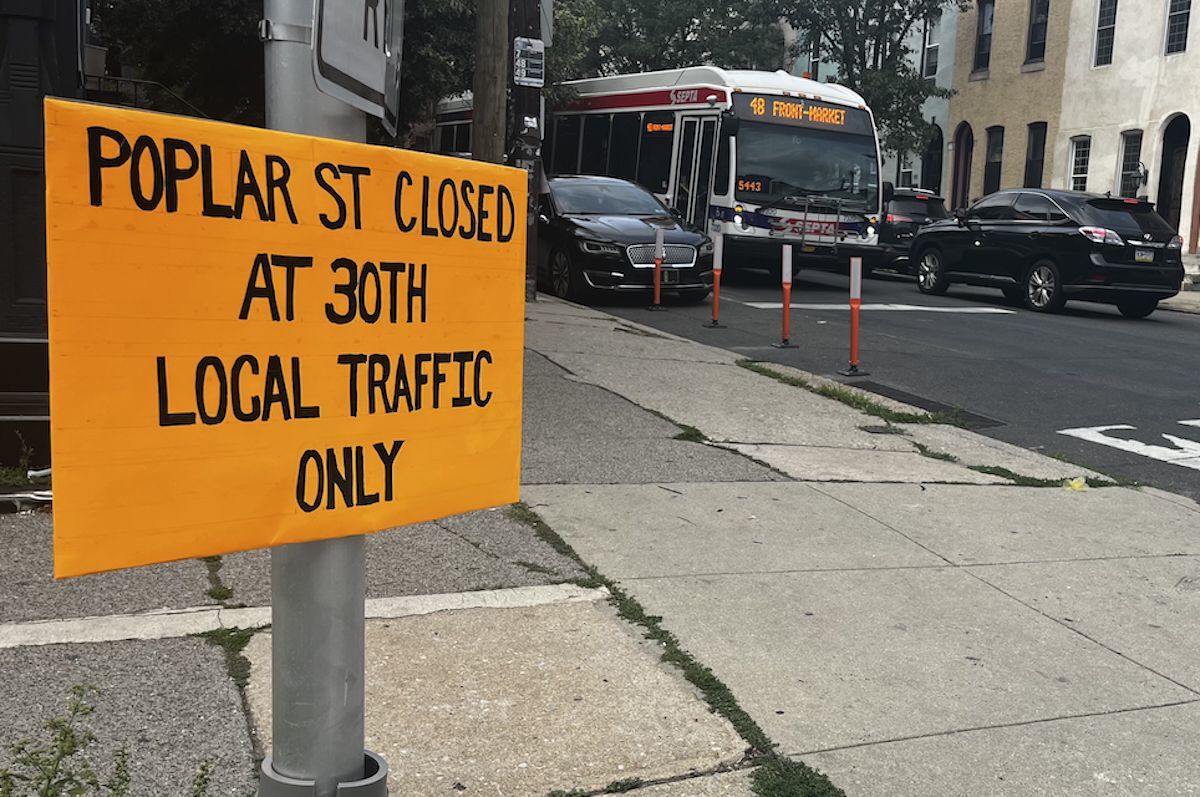
    Drivers are clogging up roads, rerouting, and sometimes speeding through neighborhood side streets due to road closures. Uber and Lyft services are offline for residents directly next to the festival during operating hours. Many residents are forced to navigate parking nightmares, turning everyday life into an exhausting headache.

    It’s all for the sake of the FIFA Fan Festival, a 39-day, million-square-foot party taking over Lemon Hill and inviting 15,000 daily visitors to its picturesque fields. While city officials and event organizers roll out the red carpet and spend millions on World Cup fans, residents who for years have been pleading for Lemon Hill improvements say the festival will use their neighborhood and park at their expense.

    “The sentiment right now is just the complete disrespect for the residents and that this is all being done for tourists,” said Nissa Eisenberg, Fairmount resident and co-organizer of the Lemon Hill Neighbors Association, the organization disseminating festival information and communicating with the city. “Everybody’s feeling pretty resentful, maybe cautiously optimistic, but also just not feeling respected as residents.”

    Soccer fans gather to watch Mexico play South Africa on a giant screen during the opening day of the FIFA Fan Festival at Lemon Hill on Thursday, June 11, 2026, in Philadelphia.Jose F. Moreno / Staff Photographer

    The FIFA Fan Festival opened its gates to thousands of fans Thursday as not only the cheapest way to experience the revelry of a World Cup game (admission is free, though it requires registration), but also the melting pot of Philly’s best food and shopping. It is also the only fan festival across the 11 U.S. host cities that is open daily for the entire 39-day tournament, culminating on July 19.

    If these changes weren’t tough to navigate already, city officials gave residents a little more than three weeks to prepare.

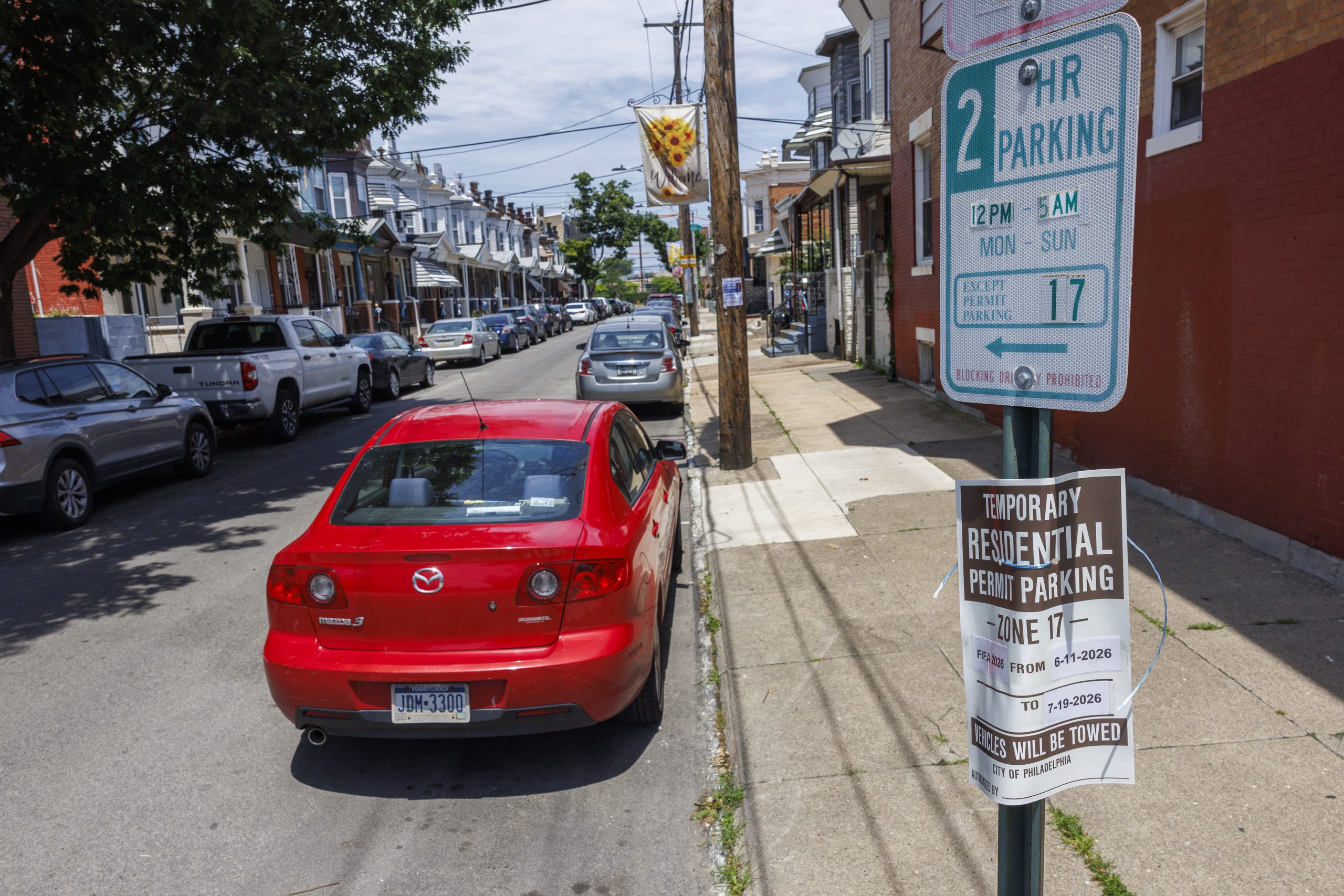
    Temporary Residential Permit Parking sign on pole along N. 30th Street and Oxford Street, Thursday, June 11, 2026. Philadelphia Parking Authority is in the area ticketing and enforcing during FIFA Fan Festival at Lemon Hill.Alejandro A. Alvarez / Staff Photographer

    “We’ve been talking with them for two years to engage neighbors with a plan, and they waited to communicate their plan until after people made their summer plans, after parents made driving schedules for their kids’ summer camps every week, and after people planned daily commutes,” Eisenberg said.

    Charlotte Burns, a Fairmount resident and veterinarian, fears for other residents who work in hospitals and are often on call for medical emergencies. “For months we’ve known this was going to happen, but there has been nothing from the city,” Burns said, referring to the fact that door-knocking, flyers, and posters did not begin in earnest until weeks before the tournament.

    (function() { var l = function() { new pym.Parent( ‘fifaroads2__graphic’, ‘https://media.inquirer.com/storage/inquirer/ai2html/fifaroads2/index.html’); }; if(typeof(pym) === ‘undefined’) { var h = document.getElementsByTagName(‘head’)[0], s = document.createElement(‘script’); s.type = ‘text/javascript’; s.src = ‘https://pym.nprapps.org/pym.v1.min.js’; s.onload = l; h.appendChild(s); } else { l(); } })();

    On May 18, the city unveiled its plan for how it would manage the festival for residents. Officials informed neighbors that thousands of them would need to swiftly apply for parking permits to allow them to park near their homes for two months, something many residents are still unclear on, said Shaun Cerborino of Lemon Hill Neighbors.

    Additionally, no rideshare services like Lyft and Uber will work at Lemon Hill and around six blocks of the surrounding residential areas during festival operating hours, sometimes spanning all day, in a practice called geofencing. Those without cars will have to walk blocks from their home to hail a ride, or use SEPTA, which is still operating in the neighborhood.

    City officials told residents last month that rideshare services will not be disabled for riders who require a wheelchair-accessible vehicle (WAV). However, after The Inquirer asked for clarification on how this exemption works in practice, the Philadelphia Office of Transportation and Infrastructure Systems (OTIS) found that a miscommunication between rideshare services occurred.

    The city was supposed to designate where WAVs can operate within the geofence, while the city was under the impression that rideshare services handled it.

    Philadelphia Parking Authority, Zone 17, a temporary no park zone except for residents with special permit during FIFA Fan Festival at Lemon Hill, Thursday, June 11, 2026.Alejandro A. Alvarez / Staff Photographer

    “Now that we have that clarity, we’re going to evaluate some changes to the perimeter that is enclosed in the geofence area. We’ll try to act as quickly as we can to adjust the geofence,” said OTIS Deputy Managing Director Mike Carroll.

    City officials said they could not specify what these geofence adjustments will look like until they have finished talks with Uber and Lyft. But what was initially promised, that WAVs will pick up and drop off disabled riders at their homes, might not be possible. Instead, there is a chance WAV-only drop-off zones will be created in that geofenced area.

    “That challenge is too difficult for us to work through for any resident who needs it,” Carroll said. “It’s too bad that there’s not a more general way to have these vehicles come in, but we can’t really haggle with [rideshare services] at this point. We’ll just try to make it work as best we can.”

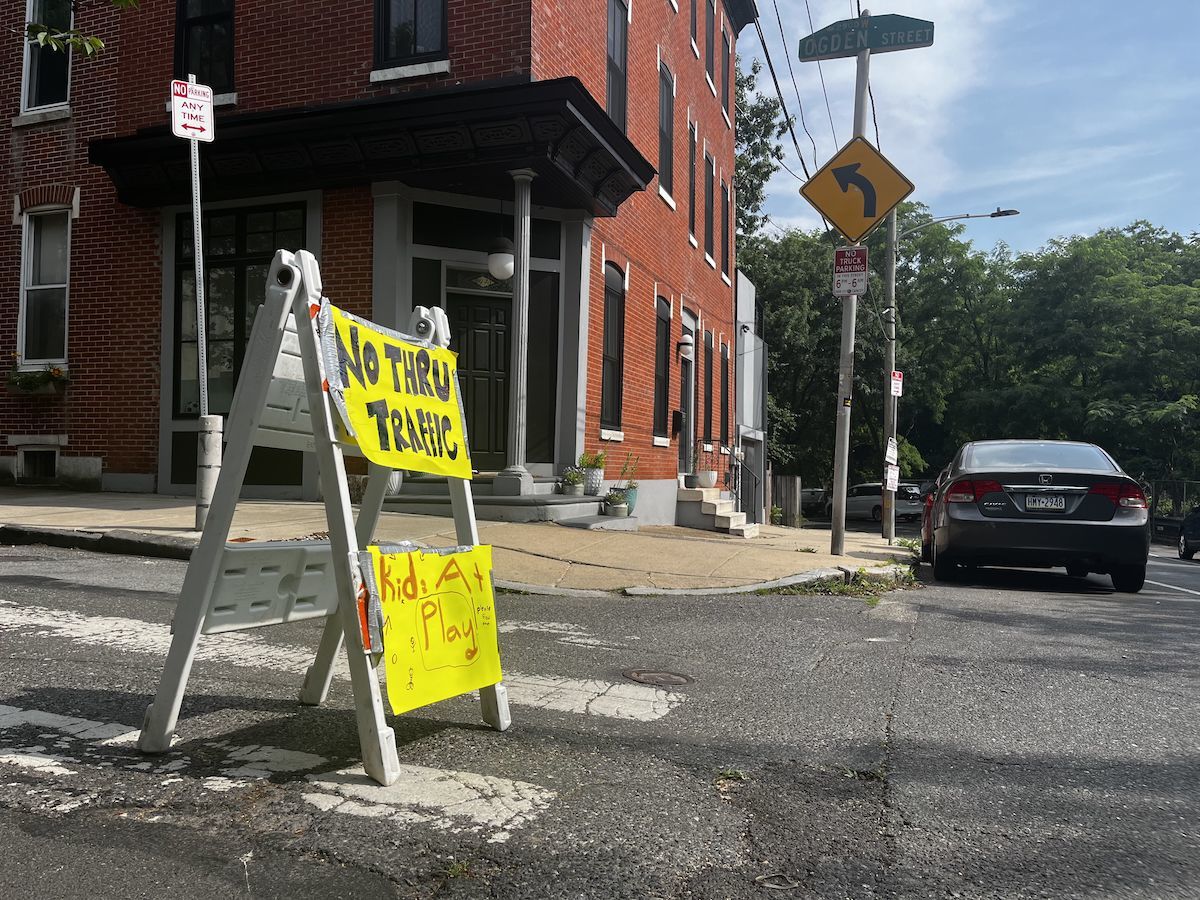
    A makeshift sign created by local neighbors, pictured on Wednesday, June 10, 2026, advises drivers not to use side streets for through traffic on Ogden Street, a narrow residential side street one block from the festival, which drivers have been racing down to avoid road closures and traffic.Henry Savage / Staff

    The work to calm neighborhood traffic

    Dustin Dove, president of the Fairmount Civic Association, points to the 2900 block of Ogden Street, a mere block from the festival, as a microcosm of the neighborhood’s concerns.

    Due to road closures on 30th and Poplar Streets, agitated drivers, stuck in traffic, are choosing to speed down narrow one-way Ogden Street to get around lines of cars, residents said. Neighbors have seen at least two incidents where a car rocketed down the street while young children were playing.

    Dove said residents have called every relevant city department and elected official who represents the area, including Councilmember Jeffery Young, requesting additional signage and traffic-control measures at 29th Street to dissuade drivers from using side streets.

    “We’re going to be welcoming a lot more people than usual, and we need Council members to come and look at this situation,” Dove said. “There are issues that need some sort of leadership at the top to get them fixed.”

    Dustin Dove, a Fairmount resident and president of the Fairmount Civic Association, poses for a photo near one of the busiest intersections near the FIFA Fan Festival in Lemon Hill, at Girard Avenue and Poplar Drive, on Wednesday, June 10, 2026. The FIFA Fan Festival is forcing the local neighborhood to navigate parking restrictions, road closures, and the sacrifice of their summer green space in exchange for the once-in-a-generation World Cup in their backyards.Henry Savage / Staff

    Young said he and his office have heard from residents who are “understandably frustrated” by traffic being redirected onto neighborhood streets and confusing or insufficient signage.

    “When these concerns were brought to our attention, we immediately notified the appropriate city departments and event organizers and have already seen some additional signage and traffic-control measures put in place. However, more work remains to be done,” Young said.

    A city spokesperson said police officers will be stationed at 30th and Poplar Streets throughout the duration of the festival and will make adjustments as needed. The city also committed to installing additional signage where appropriate, the spokesperson said.

    Still, as the first day of the World Cup rolled around, neighbors near Ogden Street reported heavy traffic on side streets, Fairmount resident Nicole Ross said, with many residents saying they received parking tickets despite having registered temporary permits. Ross said the Philadelphia Parking Authority later told residents who were ticketed that it was a system error and would be resolved.

    Crew members make final preparations, including work on a 60-foot-wide screen, for a FIFA Fan Fest at Lemon Hill in Philadelphia on Tuesday, June 10, 2026.Jose F. Moreno / Staff Photographer

    The legacy of Lemon Hill Park

    Besides the short-term, everyday nuisances of the FIFA Fan Festival, there are deeper-rooted issues about care and longevity of the park. Park stewards, like Cerborino and Eisenberg, are volunteer workers who care for and maintain much of Lemon Hill.

    Across the city’s parks, stewards understand that Philadelphia Parks and Recreation is unable to perform some needed upgrades due to staffing and budgetary constraints. That’s where stewards spend their free time and money to try to keep the city’s nationally ranked parks in an idyllic state. But that often comes with yearslong discussions about proper park funding and upgrades, as recently reported by The Inquirer, where stewards are again pleading with City Council for more funding as they are tired of operating off “love and duct tape.”

    When pitching the festival to the city and residents, Philadelphia Soccer 2026 said it would be leaving lasting legacy improvements to the park in exchange for residents giving up their summer green space.

    “We will see this through during organizational wind-down following the tournament,” a festival spokesperson said.

    Crew members make final preparations, including work on a 60-foot-wide screen, for a FIFA Fan Fest at Lemon Hill in Philadelphia on Tuesday, June 10, 2026.Jose F. Moreno / Staff Photographer

    Philadelphia Soccer 2026 is committing $4 million to install a new ADA-accessible sidewalk path, a new playground, and new lighting, as well as to rebuild the picnic pavilion, organizers said. Residents have begged the city for some of these improvements for years, Cerborino and Eisenberg said.

    “Residents deserve a clear understanding of what lasting benefits will remain after the crowds leave. I will continue advocating for transparency, accountability, and a concrete plan for legacy investments that benefit the Lemon Hill area and the city as a whole,” Young said.

    The city said it will work alongside Philadelphia Soccer 2026 to see these legacy commitments come to fruition, as well as have Philadelphia Parks and Recreation staff monitor the grasslands and trees to address any issues that appear during the festival, a spokesperson said.

    While stewards understand that park upkeep is not at the forefront of city budgetary concerns, it does hurt when it seems improvements to Lemon Hill Park will come only after an international or major sponsored event takes place there, Cerborino said.

    “Especially when the parks are primarily supported by public dollars, it doesn’t feel right for FIFA or Live Nation, or whatever company, to come in, have their way with our parks, make all the money on it — and the taxpayers foot part of that bill and get very little out of it,” Cerborino said. “The tradeoff is FIFA makes a few billion dollars, and we got a sidewalk.”

  • President’s House exhibits should be restored in time for July 4, another federal judge rules

    President’s House exhibits should be restored in time for July 4, another federal judge rules

    President Donald Trump’s administration must restore the remaining missing displays to the President’s House Site in time for July Fourth, a federal judge in Massachusetts ruled Friday evening.

    U.S. District Court Judge Angel Kelley’s decision, which came three weeks ahead of the United States’ roaring celebrations for its 250th birthday, temporarily blocks the National Park Service from removing or altering content at parks across the country and gives the agency 21 days to restore any exhibits that had been removed or changed.

    “Because Defendants deemed it important to strip the parks of these undeniable truths in anticipation of the 250th Anniversary of our great Nation, it is equally important that our shared history be honestly told and fully restored by the 250th Anniversary to properly honor the remarkable achievements of the United States,” wrote Kelley, a nominee of former President Joe Biden.

    The ruling comes as the City of Philadelphia and the federal government, including the Department of Interior and the National Park Service, are engaged in their own legal battle over the fate of the President’s House, a memorial dedicated to the nine people George Washington enslaved in Philadelphia during the founding of the U.S.

    Both parties are waiting for a ruling from the U.S. Court of Appeals for the Third Circuit on whether a February injunction ordering the administration to restore the site of America’s first executive mansion should take effect. Depending on how the Third Circuit rules — and when — the new ruling could add an extra level of complexity to the litigation.

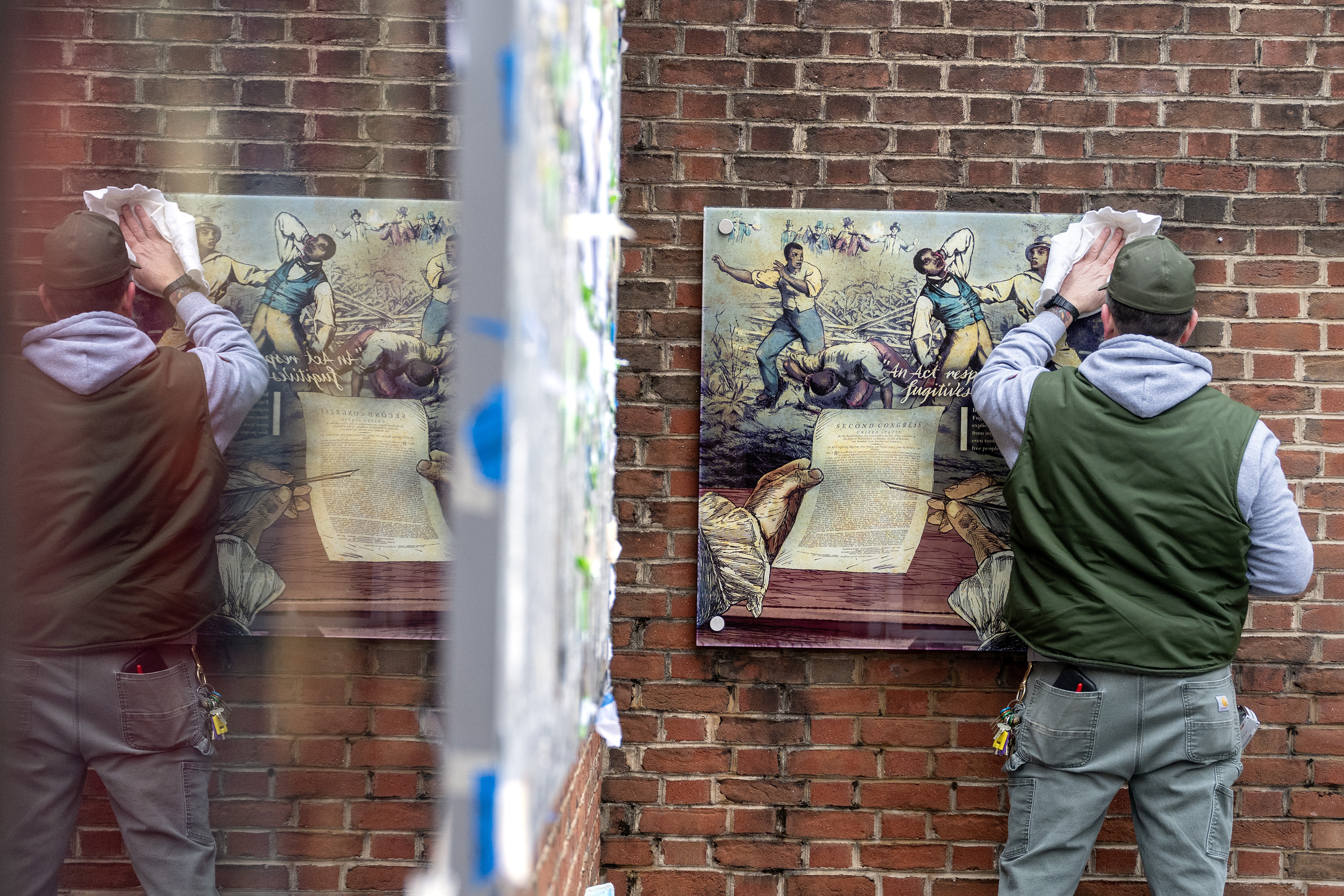
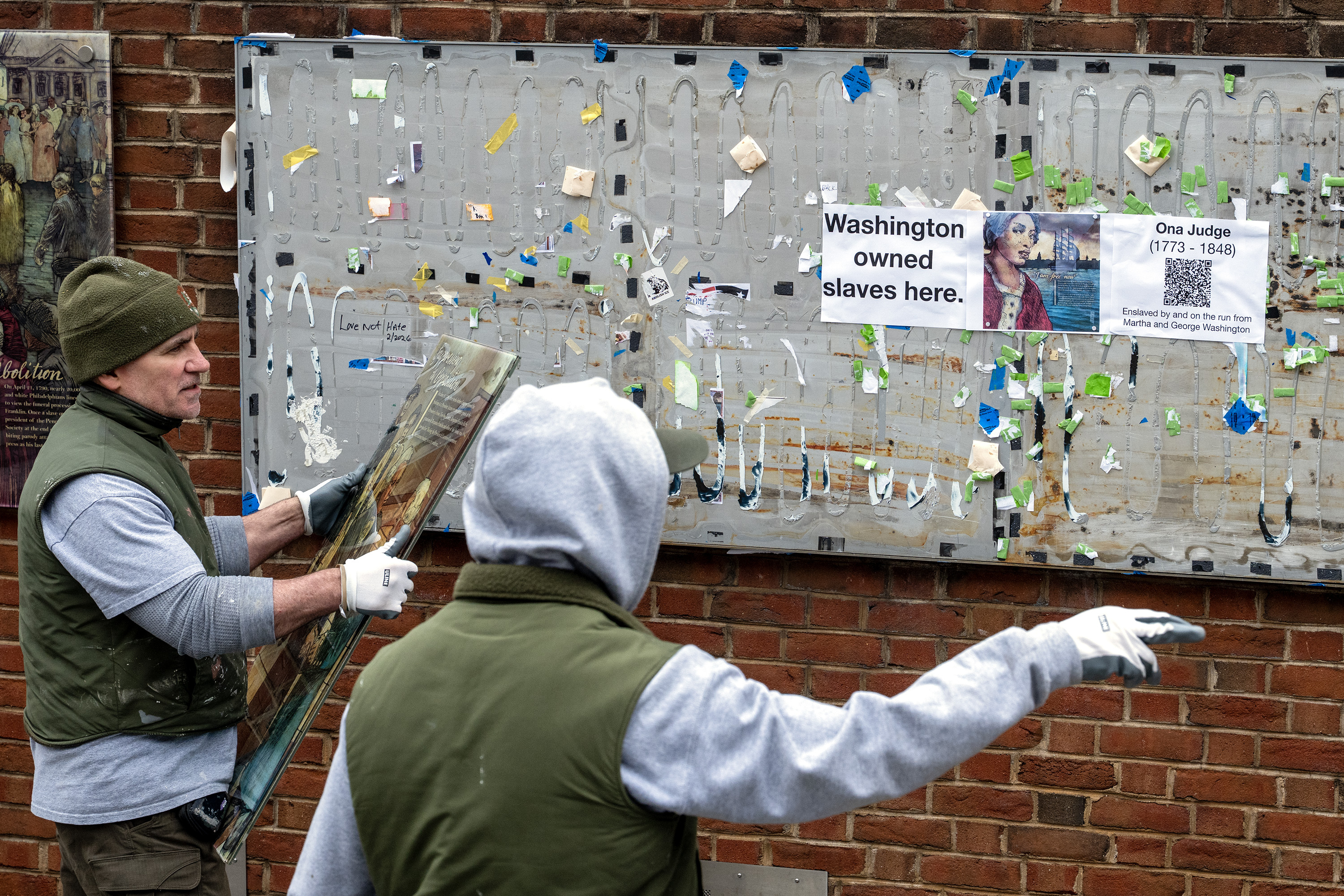
    Workers rehang panels at the President’s House in Independence National Historical Park on Feb. 19. Tom Gralish / Staff Photographer

    In a statement to The Inquirer Saturday, a spokesperson for the Interior Department called Kelley a “liberal activist judge” and said the government will be considering its appeal options “while we celebrate UFC Freedom 250 on the South Lawn of the White House this weekend in honor of our nation’s 250th,” referring to the controversial UFC fight that Trump is hosting at the White House on his birthday Sunday.

    The city did not immediately respond to a request for comment.

    Friday’s decision is the latest development in what has become both a bipartisan local and national effort to protect history at the President’s House and parks across the country. Directives from Trump and Interior Secretary Doug Burgum prompted the President’s House to be abruptly dismantled earlier this year.

    The federal government later proposed its own version of history for the Sixth and Market site, which the Trump administration said it’s ready to install should it get the legal green light.

    In a court hearing earlier this month, the administration said it would take roughly three weeks to restore the exhibits or install the new panels.

    The ruling out of Massachusetts came in a case that challenged the basis for the removals of exhibits more broadly. A coalition led by the National Parks Conservation Association argued in its lawsuit that Burgum’s 2025 order implementing Trump’s directive to ensure that no national parks’ exhibits “inappropriately disparage Americans past or living” was unlawful. The conservation groups asked Kelley to issue a stay on the order and reverse all removals that already took place.

    Plaques at other national parks were also impacted by the orders, including signage regarding climate change at Fort Sumter and the mistreatment of Native Americans at the Grand Canyon.

    “Under the guise of promoting American dignity, this Administration seeks to share a limited history by ordering the removal of all signs, displays, and interpretive exhibits at National Parks that do not align with its preferred narrative, thereby telling half-truths,” Kelley wrote.

    An electronic billboard from the Avenging the Ancestors Coalition is parked at the President’s House on Feb. 19, following a rally after the return of some of the slavery exhibits that the National Park Service removed in January.Tom Gralish / Staff Photographer

    Alan Spears, senior director for cultural resources for the National Parks Conservation Association, applauded the ruling in a statement. He said “it will help protect national parks from the administration’s unprecedented campaign to erase history and science at these one-of-a-kind places.”

    The deadline to restore any missing materials ahead of July Fourth is notable, especially in Philadelphia, where a deluge of tourists will visit for Semiquincentennial festivities. But, as it stands, visitors to Independence National Historical Park are seeing a half-finished version of history at the President’s House.

    In February, Philadelphia District Judge Cynthia M. Rufe ordered the park service to restore the dismantled exhibits at the site, but a few remain uninstalled after the Justice Department appealed the injunction and obtained an administrative stay on further restorations.

    Outside of the legal proceedings, President’s House stakeholders have continued to defend the site by holding rallies and engaging Philadelphians via social media. Last month, the site was designated endangered by the National Trust for Historic Preservation, awarding the Preservation Alliance for Greater Philadelphia a $25,000 grant to produce a mobile digital exhibit near the embattled site.

  • Fox News host fact-checks John Fetterman: ‘Senator, we haven’t confirmed that’

    Fox News host fact-checks John Fetterman: ‘Senator, we haven’t confirmed that’

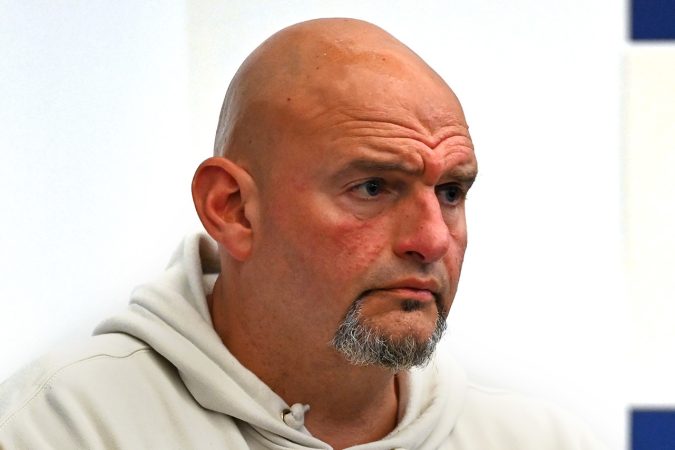
    Sen. John Fetterman (D., Pa.) was back on television Friday attacking a familiar target: controversial Maine Democratic Senate candidate Graham Platner. This time, he received some fact-checking pushback from a Fox News host.

    Despite sharing political parties, Fetterman has been an outspoken critic of Platner, who reportedly exchanged explicit text messages with other women during the early days of his marriage and is accused of volatile behavior by several ex-girlfriends. Platner has denied being physically threatening.

    The criticism followed earlier questions about a death’s-head tattoo that Platner had that was similar to a World War II SS symbol, and various comments he posted on Reddit.

    “He’s a bona fide dirtbag,” Fetterman told Philadelphia native Kristen Welker on NBC’s Meet the Press NOW Friday. “The Nazi tattoo, and the insane things that he said online. … What’s his resumé?”

    Democrat Graham Platner is taking on incumbent Republican Sen. Susan Collins in Maine. Sophie Park

    Fox News opinion hosts have been more than happy to welcome Fetterman in recent months, especially if it’s to criticize a fellow Democrat. He was just on the network last week bashing Platner, telling host Sean Hannity, “I’ll never carry water for that mess.”

    But on Friday night, during an appearing on The Ingraham Angle, host Laura Ingraham had to interrupt Fetterman after he accused Platner of sending sexually explicit pictures as recently as last year.

    “Senator, we haven’t confirmed that,” Ingraham said. “Fox has not confirmed that he sent these pictures.”

    The interruption caused Fetterman to fumble a bit before calling on Platner to “clear it up” by releasing all the messages he allegedly sent.

    Amy Gertner, Platner’s wife, admitted the two had worked through issues in their marriage and acknowledged seeking help from both marriage and personal counselors.

    “No marriage is perfect, and I don’t want a perfect marriage,” Gertner said in a video shared on social media last month. “I want my marriage, and I want to be married to Graham.”

    Platner recently took a shot at Fetterman on the campaign trail, criticizing the Pennsylvania senator’s work ethic during a town hall in Portland, Maine, last weekend.

    “I got a lot of criticisms about the way this government functions. But in order for us to make it functional, we’re going to have to do stuff,” Platner said, according to The Hill. “And you can’t just go down there and be John Fetterman and … just sort of be an a-hole.”

    “Oh, I’m devastated,” Fetterman joked on NBC. “I’ll take everything he says as a badge of honor.”

    Platner is taking on incumbent Sen. Susan Collins (R., Maine) this fall for a seat Democrats are targeting as part of their effort to take back control of the Senate. Republicans currently control the Senate 53-47, with two independents caucusing with Democrats. So Democrats would need to gain at least four seats in the 2026 midterm elections, and right now political analysts are focusing on six states: Maine, North Carolina, Texas, Ohio, Alaska, and Iowa.

    While Fetterman won’t be supporting Platner and has veered to the right to become a key backer of some of President Donald Trump’s priorities, don’t expect to see him campaigning for Collins.

    “I am a Democrat,” Fetterman told Ingraham on Fox News. “We have different views on things.”

  • Judge blocks national parks from removing ‘negative’ signs

    Judge blocks national parks from removing ‘negative’ signs

    WASHINGTON — A federal judge Friday temporarily blocked the National Park Service from removing or revising signs, films, and other materials at national parks across the country to comply with a directive from President Donald Trump.

    The ruling pauses enforcement of an executive order that called for removing or covering up materials at national parks that “inappropriately disparage Americans” or cast the United States “in a negative light.”

    The judge, Angel Kelley of U.S. District Court for the District of Massachusetts, also ordered the park service to restore within three weeks any exhibits that it had dismantled or altered.

    The ruling provides a temporary reprieve for the plaintiffs, a coalition of advocacy groups that sued over the executive order in February, while the litigation continues to unfold.

    To comply with the president’s directive, the park service has taken down plaques about slavery at the President’s House in Philadelphia, a sign about climate change at Fort Sumter in South Carolina, and a sign about Indigenous people at Acadia National Park in Maine.

    Another federal judge has already ordered the park service not to make further changes to the slavery exhibit at the President’s House Site at Independence National Historical Park, as she considers a separate lawsuit filed by Philadelphia.

    Kelley, who was nominated by President Joe Biden, sharply rebuked the Trump administration for taking down materials. “Not only does this undermine the integrity of the national parks; it sets a dangerous precedent of censorship and sanitization,” she wrote.

    Kelley began her 63-page ruling by listing examples of national parks that help educate visitors about difficult periods of American history, as well as contributions made by people of color, gay and transgender figures, women and other marginalized groups.

    “From the echoes of abolition in John Brown’s Fort in Harpers Ferry, to the genesis of the modern LGBTQ+ civil rights movement at the Stonewall National Monument, to the retreating ice of Glacier National Park in Alaska, the national parks preserve the multifaceted and multilayered history of our nation, including the good, the bad and the ugly,” she wrote.

    In the lawsuit, the plaintiffs argued that removing the materials was “arbitrary and capricious,” in violation of the Administrative Procedure Act. They also accused the park service of exceeding its legal authority.

    Katie Martin, a spokesperson for the Interior Department, the parent agency of the park service, suggested that the administration would appeal the ruling.

    “This ruling is from a liberal activist judge,” Martin said in an email. “The department will look at our appeal options while we celebrate U.F.C. Freedom 250 on the South Lawn of the White House this weekend in honor of our nation’s 250th with the greatest president in the history of our country — President Donald J. Trump.”

    Emily Thompson, the executive director of the Coalition to Protect America’s National Parks, one of the advocacy groups that brought the lawsuit, applauded the ruling.

    “National parks are not propaganda tools, nor should they be used for partisan purposes,” Thompson said in a statement. “They exist to preserve and interpret the full American story, not just the parts that make some politicians comfortable. This ruling is an important step to help ensure that remains the case.”

    In an email sent after the ruling, a copy of which was reviewed by The New York Times, a park service official directed regional supervisors to pause carrying out Trump’s directive “for the time being.”

    “Parks can continue to submit items for review, but implementation actions should pause pending further guidance,” the email said.

    This article originally appeared in The New York Times.

  • Pa. will pay for security upgrades to Gov. Josh Shapiro’s home but treasurer was right to initially deny $1 million payment for the bill, AG says

    Pa. will pay for security upgrades to Gov. Josh Shapiro’s home but treasurer was right to initially deny $1 million payment for the bill, AG says

    HARRISBURG — Pennsylvania Treasurer Stacy Garrity acted lawfully when she declined to pay more than $1 million in bills related to security upgrades made on Gov. Josh Shapiro’s personal home in Abington Township following an arson attack on his state mansion, the Pennsylvania Attorney General’s office announced Friday.

    In a memo detailing a settlement agreement between the state and the unpaid contractors who provided security upgrades to Shapiro’s private home, the attorney general’s office said that Pennsylvania would foot the $1 million bill “on a one-time basis,” noting the extraordinary circumstances and the threat on Shapiro’s life that led to the upgrades being requested.

    Current state law does not account for the increasingly dangerous position public officials face in today’s political climate, and the GOP-led state attorney general’s office encouraged the General Assembly to find a legislative solution for these issues going forward.

    However, Shapiro’s administration and Pennsylvania State Police failed to follow proper procurement processes and should have approached the legislature for approvals for the security upgrades, according to the memo authored by Executive Deputy Attorney General Eisenberg and Chief Deputy Attorney General Amy Elliott.

    “Going forward, we expect that such expenditures will result from specific legislative appropriation or new general laws,” they wrote in the memo. “We looked forward to working with the administration to accomplish these goals.”

    Shapiro’s personal home received more than $1 million in security updates, including a new security system and landscaping that Pennsylvania State Police determined was necessary after a man attempted to murder Shapiro by setting several firebombs inside the governor’s residence in Harrisburg while he and his family slept.

    Pennsylvania Gov. Josh Shapiro speaks during a news conference at the governor’s official residence about a suspected arson fire that forced him, his family and guests to flee in the middle of the night on the Jewish holiday of Passover, Sunday, April 13, 2025, in Harrisburg, Pa. (AP Photo/Marc Levy)Marc Levy

    Garrity, a Republican who is challenging Shapiro in November’s gubernatorial election, announced in April she could not pay the security upgrade bills, arguing that state law prohibits her from approving payment on work done on a privately owned property without legislative approval. The move was criticized by the incumbent Democratic governor’s office at the time, arguing it was a “shamefully political action.”

    In a statement Friday, a spokesperson for Shapiro said the governor appreciates the attorney general’s office acting “without political interference” to approve the settlement so the contractors can be paid.

    “As the Attorney General demonstrated, the safety of the governor and his family should never be weaponized for partisan gamesmanship, and our administration will continue to work with law enforcement and elected officials across the commonwealth to keep our leaders safe,” said Shapiro spokesperson Rosie Lapowsky.

    After Garrity declined to pay the bills, the state had two options to address the outstanding payments: a review and settlement by the attorney general’s office or legislative approval of the funds. Shapiro’s administration chose the review by the state AG’s office, which is led by Attorney General Dave Sunday, a Republican who supports Garrity’s bid for governor.

    Pennsylvania State Treasurer Stacy Garrity speaks to the audience after taking the oath of office for her second four-year term in the Forum Auditorium across the street from the Capitol, Jan. 21, 2025, in Harrisburg, Pa. (AP Photo/Marc Levy)Marc Levy

    The security upgrades on Shapiro’s personal home — plus $32 million in upgrades to the state-owned governor’s residence — were made under emergency contracts, which allow state agencies to quickly respond to emerging problems without waiting for legislative approval. However, Garrity argued — and the state attorney general’s office on Friday affirmed — that the emergency process does not allow the state to spend taxpayer funds on private property, such as Shapiro’s personal residence.

    “Current procurement law does not account for the increasing reality of threats to public officers and their families,” the AG’s office wrote in the settlement agreement. “Because the law does not allow for public funding of construction on private residences, the Treasurer had no legal option other than to deny payment.”

    In a statement Friday, Garrity said the settlement makes it clear “my sworn duty is to uphold the law, protect taxpayers, and only act with explicit legal authority.”

    Her office has not yet received a request to pay the contracts, she said. Once it does, she will “carefully review each one” and pay the outstanding bills.

    “Safety and security matter to everyone, but good intentions can never excuse ignoring the law,” Garrity added.

    Shapiro has faced scrutiny from some Republican lawmakers over his administration’s rapid and sweeping response following the arson, while Democratic lawmakers rallied around him to ensure his and his family’s safety. Republican legislators have said they believe Shapiro and his family should be safe, but should follow proper channels and regulations when spending taxpayer funds.

    A committee in the Republican-controlled state Senate in December took the unprecedented step to subpoena Shapiro over the security upgrades to his personal home, arguing that his administration had not been transparent in previous inquiries about how state taxpayer dollars were being used to upgrade security there.

    Shapiro’s personal property upgrades also resulted in a land dispute with one of his neighbors, who argued in federal court that Shapiro was violating their constitutional rights by using his power as governor to seize a portion of their property. Shapiro, in a separate suit filed in the Montgomery County Court of Common Pleas, argued that the disputed land had been his for years.

    Shapiro and his family split their time between the state-owned governor’s residence in Harrisburg and their Montgomery County home, where his two youngest children still attend school.

    This story was updated to note Sunday supports Garrity’s campaign for governor.