A scrap metal recycling facility in Camden that has been prone to fires is suing the city for suspending its operations after its 13th fire in six years.
The city of Camden this month suspended the EMR scrap metal recycling facility’s junkyard license after a late May two-alarm fire that officials said created smoke plumes that stretched to Gloucester Township. It was the latest in a string of several fires in recent years that have plagued the facility and local Camden residents.
In the complaint, filed Monday and first published by WHYY, the company argues that the city acted outside of its power and did not provide due process by issuing the suspension. The company’s legal team says the pause in operations has cost EMR $10 million in lost revenue and operational expenses, as well as irreparable harm in the “competitive, relationship-driven” industry.
The most recent fire occurred on May 29 at 3 a.m. and was under control about two hours later. It led to air quality alerts and broke out just days after the company installed a new fire suppression system.
The company says it had shut down its shredder to investigate the cause of the fire before the city sent a suspension notice on June 4 ordering it to cease its primary operations. The notice, signed by the city code enforcement officer, states that the suspension will be reassessed after 30 days.
The company said it asked the city on June 12 to continue operating on June 15 after implementing “preventative measures.”
Camden Mayor Victor Carstarphen said after that fire, “Enough is enough.”
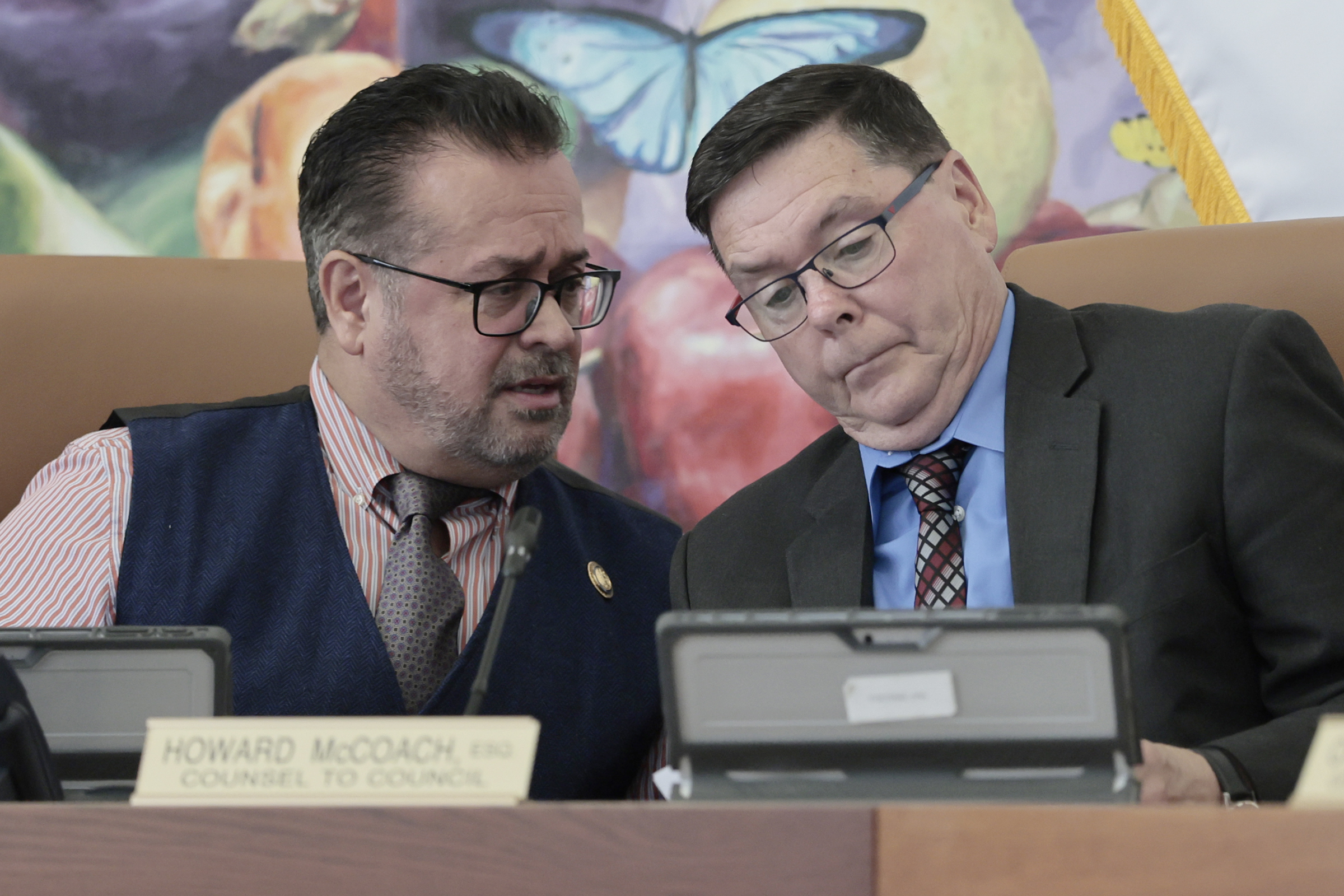
Camden City President Angel Fuentes (left) and counsel to council Howard McCoach discuss business during a Camden City Council meeting at Camden’s City Hall on Thursday, June 11, 2026.Elizabeth Robertson / Staff Photographer
The Camden City Council voted on a resolution Thursday calling on all regulatory agencies with jurisdiction over the facility, including on the county and national levels, to shut the facility down. The company has faced lawsuits over fires at the facility, including from the state attorney general’s office and local residents.
The resolution cites a joint statement signed by Carstarphen, County Commissioner Jeffrey Nash, State Sen. Nilsa-Cruz Perez, City Council President Angel Fuentes, and City Council Vice President Arthur Barclay, all Democrats:
“We will not stand idly by while residents are exposed to fires on a regular basis and have to bear the burdens of an operation that clearly cannot function in a safe manner,” it says in part. “We will no longer allow shelter in place alerts to go out because of another mishap in this scrap metal operation.”
At Thursday’s council meeting, Camden residents called for the facility to be permanently shut down — citing health concerns and other disruptions to their quality of life — and criticized the city for not doing more earlier.
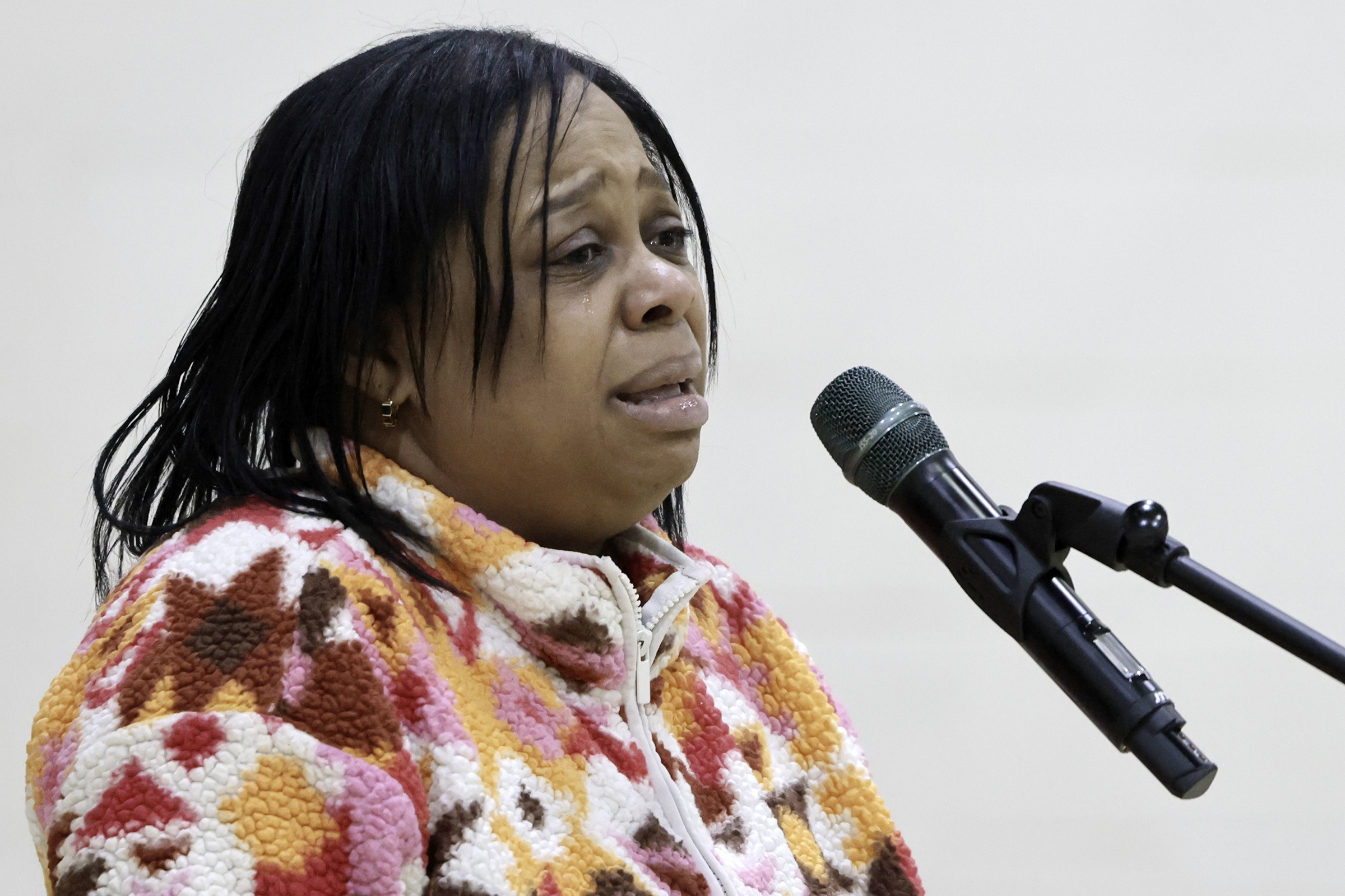
Aliyia Jones becomes emotional during a community meeting for residents, affected by the recent junkyard fire, at MJD Fieldhouse Gym on Broadway in Camden on Sunday, February 23, 2025. Jones was describing her attempt to alert all of her neighbors before fleeing the area with her disabled mother after the fire broke out.Elizabeth Robertson / Staff Photographer
“I just want to say, too little, too late,” said Aliyia Jones, who was among 100 Camden residents who fled their homes after a four-alarm fire at the facility in February 2025.
“No one wants to come here and say ‘finally,’ or ‘thank you,’ or ‘hurrah.’ … We can’t breathe,” she added.
EMR employs 500 people in Camden, including 179 Camden residents, according to the complaint, and if the shutdown continues, employees will face layoffs. EMR workers protested calls to close the facility earlier this month.
Ajeena Riggs, a project manager at the Center for Environmental Transformation, said that she is sympathetic to workers seeking to keep their jobs and that the city and their union should help them find new positions if they lose their employment.
“I don’t blame them for fighting for their jobs,” she said at Thursday’s meeting. “They’re fighting for their livelihood. But the only entity that’s to blame is the EMR.”
The company blames the fires on improperly disposed lithium-ion batteries, but officials said in their joint statement “that story line is old and irrelevant at this point.”
EMR implemented a fire suppression system and agreed to make other changes after entering a memorandum of understanding with the city last summer following the massive February 2025 blaze. Residents at the meeting criticized that agreement as lacking teeth.
Camden city spokesperson Vincent Basara declined to comment on the lawsuit.
For years, federal health officials have warned about the risks associated with a supplement derived from the leaves of kratom trees that adherents say can kill pain or boost energy. Sold in gas stations across America, kratom has been linked to liver toxicity, seizures and thousands of deaths.
Powerful figures close to President Donald Trump, including Homeland Security Secretary Markwayne Mullin, pushed to downplay those concerns.
Mullin, until recently a Republican senator from Oklahoma, played a key role in a sprawling influence campaign spearheaded by the kratom industry that courted Health Secretary Robert F. Kennedy Jr. and Vice President JD Vance, among others in the Trump administration, an investigation by The New York Times found.
Only when he was nominated by Trump in March to lead the Homeland Security Department did it become clear that Mullin had a financial connection to the supplement. In a disclosure statement, he listed an investment worth as much as $1 million in a kratom company, Botanic Tonics, that could benefit from the changes he has sought.
The company’s founder, Jerry W. Ross — who had been an energy executive in Mullin’s home state before pleading guilty to a financial crime — is a leading player in the influence campaign that was devised to benefit kratom at the expense of its rivals in the marketplace.
The kratom campaign underscores how corporations in the growing wellness industry can gain traction in Trump’s government by casting risky products as aligned with the administration’s Make America Healthy Again, or MAHA, agenda championed by Kennedy, who has sometimes prioritized unproven remedies over science.
In July, while still a senator, Mullin showed up at a Food and Drug Administration news conference and endorsed proposed federal restrictions on more powerful synthetic supplements that compete with kratom for shelf space. In explaining his position, Mullin pointed to a history of addiction in his family, though health experts say kratom products have also been shown to be addictive.
His disclosure form did not indicate when he acquired his stake in Botanic Tonics, but he has not filed paperwork to indicate that he has divested from it.
The Homeland Security Department did not answer questions about the investment. In a statement, the department said that Mullin “follows all ethics and conflict of interest standards and has not lobbied for any individual or company.”
Bottles of Feel Free, a kratom product produced by Botanic Tonics, displayed at a smoke shop in Oklahoma City, May 27, 2026. With support from Markwayne Mullin and Robert F. Kennedy Jr., the kratom industry is pursuing a potentially lucrative policy. (Nick Oxford/The New York Times)NICK OXFORD
The restrictions that Mullin supported on the synthetic products would have been a boon to Ross’ company and others in the kratom industry, which market their supplements as safer and more natural. The kratom companies used donations and lobbyists to push for the crackdown.
“It’s not pay to play. It’s pay to have conversations. It’s pay to have a chance at the table,” Ryan Niddel, CEO of Diversified Botanics, another kratom company involved in the effort, said in an interview with the Times. “And anybody that considers any of the lobbying work or any of the governmental work that goes on being different than that, I think has their head buried in the sand at this point.
“I mean, that is the world that we live in.”
The Times’ investigation — drawn from campaign finance data, lobbying disclosures, court filings, private correspondence and dozens of interviews — found the following:
Ross ramped up his donations to Kennedy’s defunct presidential campaign after Trump chose him to be health secretary. Ross privately boasted that he was “working on a plan for Bobby.”
The FDA in 2025 deleted links on its kratom webpage that detailed a then-pending legal case against Ross’ company, Botanic Tonics, after his allies pushed for the change.
Botanic Tonics had been sued by the federal government for illegally selling kratom products that were not proven safe, which the company disputed. But in December, the Justice Department suddenly moved to drop the case — which the company celebrated as a sign of the federal government’s receptiveness to kratom.
Kennedy, as health secretary, called the governor of Ohio to try to head off a state ban on kratom in the fall of 2025. Months later, Botanic Tonics donated $1 million to a political committee associated with Kennedy.
Ross, joined by influential lobbyist Ches McDowell, used donations to secure a private audience with Vance to lobby him about the benefits of kratom and to urge the ban on the synthetic products.
Kush Desai, a spokesperson for the White House, suggested the administration was not swayed by the influence campaign, even though Trump recently made comments about needing to address the matter.
“The only guiding factor behind the Trump administration’s healthcare policymaking is gold standard science,” he said in a statement. The administration, he added, was working “to get this critical matter correct and ensure the health and safety of Americans.”
The Health and Human Services Department and Kennedy did not respond to requests for comment, nor did Ross.
The administration’s receptiveness to kratom comes as Trump has also expressed a willingness to loosen rules covering other drugs backed by influence campaigns, including cannabis and psychedelics. The permissive posture stands in contrast to Trump’s baseless skepticism about highly regulated and widely used medications like Tylenol and vaccines.
“It’s looking like we have a coin-operated drug policy that basically responds to whoever will give money,” said Kevin Sabet, who worked on drug policy under Republican and Democratic presidents. “And it threatens public health and safety because it’s going around the scientific process in favor of donors and influencers.”
A rising scourge
Long used medicinally in Southeast Asia, the leaves of the kratom tree contain a compound called mitragynine that interacts with the brain’s opioid receptors in a manner said to produce mild pain relief and — depending on its preparation — either sedation or energy and focus.
Kratom started gaining popularity in the United States in the early 2010s as the opioid addiction epidemic raged. With doctors tightening access to powerful prescription painkillers such as OxyContin, users spread the word that kratom — initially sold as a bitter-tasting powder — could produce a similar effect.
Devotees promoted it as a way to kick opioid addiction or to replace alcohol. But as reports of negative effects started rolling in, the government tried to take action.
Under the Obama administration, the Drug Enforcement Administration described kratom as “a drug and chemical of concern,” and moved to greatly restrict access by classifying it as a Schedule I drug. Doing so would have defined it as having no medicinal value, making it illegal to sell.
The proposal was withdrawn weeks later amid backlash from the fledgling industry, kratom users and members of Congress.
Another proposal to restrict access during the first Trump administration was also pulled after lobbying by an industry trade group, over the objection of Scott Gottlieb, the FDA commissioner at the time.
Kratom took off, appearing on the shelves of convenience stores and vape shops as tablets, drinks and gummies. The products varied in strength, and the concentration of active ingredients on the labels was not always accurate. They could be purchased in many states without age verification.
From 2020 through 2024, kratom was found in the system of more than 5,200 people who died of drug overdoses, according to data from the Centers for Disease Control and Prevention based on death certificates and other official reports. Though kratom was often found in combination with other drugs, one study determined that those using kratom carried a sixfold increase in the risk of overdose death.
Wyatt Wheeler, 27, was pursuing a master’s degree in business at Texas Christian University. He died of an overdose in October 2022, six weeks after he started taking a kratom extract, according to his mother, Patti Wheeler.
An autopsy report issued by a county medical examiner in Fort Worth found that the cause of the overdose was the “combined toxic effects” of the active compound in kratom, along with a prescribed antidepressant and antihistamines.
Patti Wheeler has become an anti-kratom activist, producing a documentary about the drug’s harms and pushing for state and federal restrictions.
She says the industry has used its influence to thwart safeguards.
If the federal government had effectively banned kratom earlier, Wheeler said in an interview, many overdose deaths could have been avoided.
“My son would be alive,” she said.
Feel free
It was in this profitable but unregulated landscape that Ross set out to take the kratom industry mainstream.
It was a fresh start for Ross after his stint in federal prison.
Formerly a prominent energy executive in Oklahoma named Jerry D. Cash, he was an admitted heavy drinker who was charged on three occasions with driving under the influence from 2001 through 2008.
In 2010, he pleaded guilty to a federal charge related to concealing his diversion of $10 million from oil and gas companies he ran.
He was released from prison in the fall of 2013, after serving less than three years of a nine-year sentence. He was ordered to participate in substance abuse treatment and to abstain from intoxicants including alcohol, which he has said he previously used to cope with social anxiety.
Eventually, he said later on a podcast, he began to experiment with other “social lubricants” — both legal and illegal — in search of a healthier alternative. By the time he created Botanic Tonics in 2020 with a base of operations in the Tulsa area, he had changed his name. The company began selling a roughly shot-size beverage called Feel Free containing kratom and another supplement called kava.
Business boomed as Feel Free and competing products were embraced by skeptics of mainstream medicine who would become the core of the MAHA movement.
Feel Free came to be sold at more than 24,000 retailers. Through a company, Ross would eventually pay more than $30 million for an 11,000-square-foot home in Malibu, California, overlooking the Pacific Ocean.
Still, serious challenges loomed for the kratom business.
In late 2023 a more powerful synthetic product emerged, featuring elevated levels of a psychoactive compound that is also found in lower levels in natural kratom. It is called 7-OH, or 7-hydroxymitragynine.
Government and legal scrutiny of both kratom and 7-OH began mounting. While some states passed industry-endorsed laws regulating kratom, others enacted restrictions or even banned it and 7-OH entirely.
Users also began suing.
A class-action lawsuit filed in 2023 asserted that Botanic Tonics targeted recovering alcoholics with advertising casting Feel Free as a healthy, safe and sober alternative. The suit claimed that, to the contrary, the tonic had the “potential to be highly addictive.”
The lead plaintiff in the suit was a recovering alcoholic in California. He spent $3,000 a month on Feel Free, according to the suit. (They retail for about $10 a bottle.) It said he “could no longer function without Feel Free and suffered severe withdrawal symptoms when he attempted to stop,” eventually turning back to alcohol “in an effort to cope with the worsening symptoms of his Feel Free addiction.”
To settle the class action, Ross last year signed an agreement under which Botanic Tonics would pay $8.75 million and include warnings on Feel Free labels about how kratom “can become habit-forming and cause serious adverse health effects.”
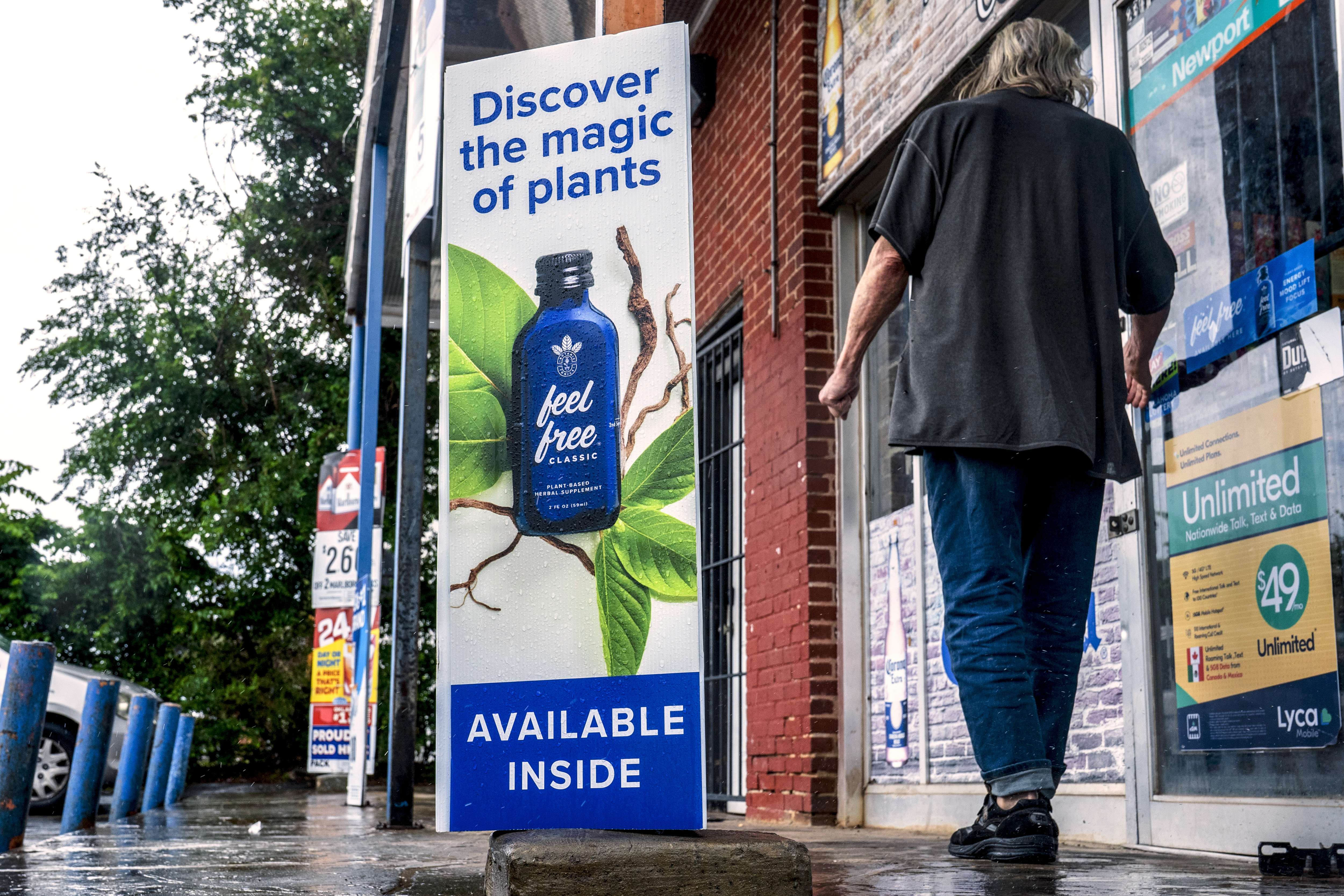
A sign advertising Feel Free, a kratom product produced by Botanic Tonics, outside a convenience store in Oklahoma City, May 27, 2026. With support from Markwayne Mullin and Robert F. Kennedy Jr., the kratom industry is pursuing a potentially lucrative policy. With support from Markwayne Mullin and Robert F. Kennedy Jr., the kratom industry is pursuing a potentially lucrative policy. (Nick Oxford/The New York Times)NICK OXFORD
The FDA would eventually receive more than 965 kratom-related reports of harm, including 264 resulting in death. The self-reported claims detailed instances of vomiting, paranoia and drug withdrawal.
In 2023, FDA inspectors visited Botanic Tonics’ warehouse in suburban Tulsa. They reported their findings to the Justice Department, which went to court to seize 250,000 bottles of Feel Free and other kratom supplements.
In court filings, prosecutors cited “serious safety concerns,” saying kratom had been linked to “addiction” and “liver toxicity.” They accused Botanic Tonics of engaging in illegal interstate trade of an unapproved substance.
On a podcast released in 2024, Ross indicated that he planned a campaign to differentiate between natural kratom and other versions.
“We’re going to be coming out of the chute asking for separate regulation for whole leaf kratom,” he said.
Calling a governor
Trump’s election — and his appointment of Kennedy as health secretary days later — created an ideal environment for such a campaign.
To others working on the issue, Ross highlighted his relationship with Kennedy, indicating that he was planning to enlist the incoming secretary in efforts to influence the administration, according to one associate.
In the weeks around the inauguration, Ross donated nearly $162,000 to Kennedy’s defunct presidential campaign, exceeding by many times his total federal political giving to that point.
Ross was not the only kratom entrepreneur jockeying for position.
A newly formed group called Botanicals for Better Health and Wellness, which is linked to a rival kratom supplement maker, retained the firm of Jeff Miller, a leading Trump fundraiser, to lobby the FDA, Congress and the White House. The new group donated $50,000 to the incoming president’s inaugural committee, for which Miller was finance chair.
Miller and the group did not respond to requests for comment.
Shortly after the inauguration, another rival firm, Diversified Botanics, which produces the popular kratom brand MIT45, hired a lobbyist who worked on Trump’s first presidential campaign and transition. The lobbyist helped arrange meetings with members of Congress and officials from the FDA and the health department for Diversified’s CEO, Niddel.
Niddel said he wanted to explain to government officials how his company’s products differed from those featuring 7-OH.
“We got to get in front of this,” Niddel said he recalled thinking. “It’s going to destroy the kratom industry, because an uninformed consumer or an uninformed legislator — it’s all being lumped in together.”
Vince Sanders, founder and president of CBD American Shaman, which helped popularize 7-OH, said the kratom industry is targeting businesses like his for financial reasons, not because of moral or safety concerns.
“We’ve devastated the industry,” Sanders said. “When 7-OH came in and people tried it, they learned very quickly that it was vastly superior. I mean, this is like going from a horse and buggy to an automobile.”
Sanders’ company received a letter from the FDA last year accusing it of illegally marketing 7-OH products. It recently agreed to halt sales in Missouri to settle a lawsuit brought by the state attorney general. The suit accused the company of peddling “deadly opioids,” though the company did not acknowledge liability.
Sanders believes that kratom lobbying has “demonized” his side of the industry.
Mullin used his connections in Trump’s orbit to help the other side.
Starting while he was in the Senate and continuing after he became homeland security secretary, Mullin urged officials in the health department to remove language from the FDA website warning of kratom’s harms, according to four people familiar with his efforts who were not authorized to discuss them.
For the kratom industry, the warnings on the FDA website were no small concern. Industry representatives said they feared state officials were taking their cues from the agency in deciding whether to pursue bans or other restrictions.
Records obtained by the Times show that the FDA was asked to remove from its kratom webpage links that took readers to enforcement actions against Ross’ kratom company and others.
By the end of 2025, the FDA had removed the links.
Other requested changes were not enacted, including one asking the agency to remove a warning “not to use kratom because of the risk of serious adverse events, including liver toxicity, seizures and substance use disorder.”
Emily Hilliard, a health department spokesperson, declined to comment on the website changes, but said the agency is “solely focused on serving the American people, not advancing industry interests.”
Mullin went public with his involvement in July.
In a notable move, he joined Kennedy and Dr. Marty Makary, then the FDA commissioner, at a news briefing to announce that the agency was moving to effectively end the legal sale of synthetic 7-OH products.
In a comment that was later highlighted by a group backed by Ross, Makary said at the briefing that “we’re not targeting the kratom leaf.”
Mullin added that companies selling 7-OH were exploiting a loophole in FDA regulations to cause harm to consumers.
“It’s legal, but it’s an addiction that’s ruining lives,” he said.
Kennedy referred to his own past struggles with addiction at the news briefing. Weeks later, he pushed Ohio to adopt a policy that would have protected the kratom industry.
Gov. Mike DeWine, a Republican, had announced a plan in August to designate all kratom products as illegal drugs. But Kennedy asked DeWine to crack down instead only on synthetic 7-OH — and not kratom leaf products. The health secretary had hoped to see states align with the federal effort, said Dan Tierney, a spokesperson for the governor.
DeWine soon dropped the push to ban kratom and moved forward with an emergency prohibition against 7-OH. After a review, though, his office said it was moving ahead with a broader kratom crackdown.
‘People are asking for it’
Having powerful people in Trump’s Cabinet vouching for kratom was not enough for Ross. He actively joined the effort to kneecap his competition.
His allies launched an opaque company to position natural kratom products as safer than synthetic alternatives.
They gave the company a name, Stop Gas Station Heroin, that made synthetics sound especially dangerous. The company hired the firm of the lobbyist McDowell, who had been introduced to Ross as a well-connected Trump insider.
McDowell, who is close to the president’s elder sons, also employs a nephew of Kennedy and the son of Trump’s 2024 campaign co-manager Chris LaCivita.
Stop Gas Station Heroin has paid McDowell’s firm, Checkmate Government Relations, at least $600,000, according to lobbying records.
McDowell’s firm has pushed for tougher enforcement against the rival synthetic products in meetings with congressional offices and Kennedy’s health department.
All the while, Botanic Tonics had been awaiting a ruling on its own battle with the federal government.
In December, a federal judge denied the company’s motion to dismiss the FDA lawsuit accusing it of unlawfully selling kratom.
Then, less than two weeks later, federal prosecutors moved to drop the case, as reported by The Kansas City Star. They told the judge that the seized supplements had expired and that the Trump administration had “determined it would not be a prudent use of government resources to sustain this action.”
In a statement praising the decision, the company said the dismissal “reflects a maturing regulatory landscape” in which federal agencies increasingly recognize the differences between natural kratom leaf and the synthetic products.
Justin A. Lollman, a lawyer for the company, told the Times in a statement that even during the lawsuit, the government “never sought to restrict Botanic Tonics’ continued manufacture and sale of Feel Free.” The company has sold more than 130 million servings of Feel Free, he added.
In February, after the dismissal, Ross donated a total of $443,000 to the Republican National Committee in connection with a fundraising dinner headlined by Vance in New York.
Before the dinner, Ross, accompanied by McDowell, secured a private meeting with Vance. Ross used the access to promote the benefits of natural kratom and urge the Trump administration, and particularly the DEA, to clamp down on 7-OH, according to two people briefed on the meeting who were not authorized to discuss it.
McDowell’s firm did not respond to a request for comment.
Over the next two months, Botanic Tonics donated $1 million to MAHA PAC, which is associated with Kennedy. The money from Botanic Tonics accounted for about 44% of all the funds raised by the political action committee between the beginning of last year and the end of April.
The PAC did not respond to a request for comment.
It is not clear whether the administration will approve the emergency ban of 7-OH that Ross and his allies have sought.
But during a briefing in the Oval Office about maternal healthcare last month, Trump made a stray comment indicating the issue had reached his desk, even as his administration was grappling with higher-profile priorities including a war with Iran.
“We’re looking very seriously at natural 7-OH and getting that approved,” Trump said.
The statement left even industry insiders divided on whether he was siding with natural kratom or synthetic 7-OH, or taking another position altogether.
Whatever his stance, Trump left the impression that he had heard from influential figures on the matter, adding that “we’re looking to see if we can do something there.
As the United States approaches its 250th birthday on July 4, a coalition of libertarian think tanks is pushing the Trump administration to mark the occasion by unveiling the first sites for “freedom cities.” These privately developed towns built on federal land would fulfill Trump’s campaign promise to charter 10 such cities. They’re intended, in his words, to “reopen the frontier, reignite the American imagination, and give hardworking families a new shot at the American dream.”
Groups such as the Frontier Foundation, the American Enterprise Institute and the Charter Cities Institute have run with what seemed like a far-fetched campaign promise. They have drafted proposals to hand public land to private developers for single-family homes and high-tech enclaves free from state and federal oversight. These groups have latched onto the idea of “freedom cities,” because the towns tap into a cluster of contemporary American anxieties about housing affordability, stagnant social mobility and global economic competition, especially with China.
Trump and his allies see these cities as an innovative solution to major American problems, but they’re hardly new. Freedom Cities continue a long history of Americans looking to their vast endowment of public land as a safety valve for social and economic pressures. This is a “supply-side” solution for perceived scarcity, whether of housing or freedom from regulatory red tape.
Yet, while tapping public land is a common move, the history of such undertakings — especially government-engineered colonies on public land in the early 20th century — suggests that the Freedom Cities face long odds of achieving their promise. Traditionally, the political will has faltered and such projects have collapsed long before the crises they’re designed to address abate.
The Homestead Act of 1862 remains the most famous of Congress’ many attempts to underwrite opportunity through grants of essentially free land. But striking the right balance between acreage and price — while preventing speculation and corruption — proved difficult. In the two centuries between 1789 and 1976, when the Federal Land and Policy Management Act effectively ended private sales of public land, Congress passed hundreds of land laws and amendments. Most historians today would agree that the results were mixed at best.
Government colonies emerged from a similar impulse to use public land to achieve social and economic goals at the state level. In the wake of World War I, legislators across the U.S. West began to fear for the future of the family farm. Modern farming required capital, technology and expertise that often exceeded the capacity of an ordinary individual. In the arid West, farming demanded mass irrigation, which only the government could afford to build. Meanwhile, farmland values grew exponentially, especially in California.
State legislators worried that without farm work, landless Americans would congregate in cities as they had in Europe and Russia, and that this might foment radical ideas about socialism, communism and anarchism. “A prosperous farmer on his land does not turn berserker or run amok,” promised a 1920 California state pamphlet.
The solution was utopia by statue. To keep small farmers in business, five states, beginning with California in 1917, passed Land Settlement Acts, empowering state officials to build planned farming colonies on state-owned land.
In California, the project fell to Elwood Mead, a civil engineer who oversaw the state’s acquisition of 6,239 acres in Durham, Butte County. The site seemed like a good bet. It was fertile, well-watered and close to a highway and rail connections. Mead invited Americans to apply for farm allotments while the state constructed irrigation and officials planned the layout of farm buildings, orchards and gardens. This was not private speculation but the expert-led engineering of a new community from scratch.
For a few years, it appeared to work. Even after costs ran more than double the state’s appropriation of $260,000, forcing residents to take out loans, they were able to keep up with their payments. With European agriculture still recovering from World War I, commodity prices remained high and state officials interpreted those windfalls as a sign of success. Mead reported that “considerably more than half the [Durham] settlers were tenant farmers, and they would still be renters if they had been compelled to buy under ordinary commercial conditions.” The Durham colony, Mead declared, guaranteed “independence, ambition, [and] self-respect” for its settlers.
Emboldened, in 1920 the California legislature authorized $1 million ($16.5 million in 2026 dollars) to purchase 8,400 acres for a second colony in Delhi, Merced County. Delhi’s sandy soil required far more preparation than Durham’s, meaning the state’s investment would pay off only after years of stable yields and favorable market conditions.
But state support didn’t last. Mead, it turned out, had cooked the books at Durham, misleading the legislature. Settlers quickly drained their personal savings to keep up with loan payments. After the nationwide agricultural depression in the early 1920s, both colonies’ finances collapsed. In 1923, Mead skipped town.
The next year, after spending $2.5 million over four years, the California legislature admitted defeat at Delhi. Following extensive litigation, it shuttered its experiment in engineering a utopian farming future. The settlers weren’t bad farmers. It’s just that they required state subsidies, stable global markets and honest accounting to succeed.
Perhaps ironically, to endure economic depression and environmental constraints, California’s utopian colonies needed more government, not less. But in the 1920s, the agricultural downturn and rising fiscal conservatism among voters and their officials, including Friend W. Richardson, elected governor in 1922, eroded the political will for state-directed rural planning.
OLD IMAGE — DO NOT USE — Made By History sponsors. FOR USE ON MADE BY HISTORY STORIES ONLY.Inquirer Staff
Yet, that cautionary tale didn’t deter the federal government from trying something even more ambitious a decade later. In 1935, Franklin D. Roosevelt launched one of his vaunted New Deal agencies: the Resettlement Administration, run by Columbia economist Rexford Tugwell. It proposed to build 100 “greenbelt towns” on the outskirts of major cities. The vision was utopian: modern, well-designed communities housing low- and middle-income families in garden settings, shielded from the squalor of unplanned urban growth. They would be cooperative, self-governing and superior to anything the private market had produced.
Three towns were built: Greenbelt, Md.; Greenhills, Ohio; and Greendale, Wis. They were architectural and planning achievements. Greenbelt, outside Washington, D.C., was admired for its curved streets designed to limit through traffic, communal green spaces and cooperative stores. Life magazine called it a model for the future.
There was a problem, however: the government invested roughly $16,000 per unit — about 10 times the cost of a private home at the time. In a country still climbing out of depression, that figure proved politically toxic.
The backlash was almost immediate. Real estate and homebuilders’ associations, alarmed by the prospect of federally subsidized communities competing with private development, mobilized against the program. They found allies in a new conservative coalition of Republicans and southern Democrats in Congress who began rolling back New Deal initiatives in 1937 and 1938. Critics branded the greenbelt towns “socialist colonies” and “Tugwelltowns,” after their architect. The label stuck because Tugwell had visited the Soviet Union in 1927 as part of a U.S. trade delegation and had praised state planning, making him an easy target.
The 1937 recession drained Roosevelt’s political capital, and in 1938, Congress defunded the program. Tugwell resigned. After World War II, the federal government sold the greenbelt towns to private developers and residents’ cooperatives, washing its hands of the experiment. They survive today as pleasant, somewhat quirky suburbs, fossils of a dream that the government could not sustain as a reality.
Today’s advocates of Freedom Cities present their proposal as a tech-enabled departure from the timid incrementalism of conventional planning. But what they propose is actually part of an American ritual: imagining public land as a blank slate somehow immune from contemporary economic, environmental and political challenges.
A century ago, state-sponsored colonies were going to make land affordable again and save the family farm. Ninety years ago, greenbelt towns hoped to prove that the U.S. government could outbuild the private market. And now, Freedom Cities purport to solve the housing crisis, outcompete China and restore the frontier spirit, all while remaining exempt from the federal management and environmental and labor regulations that, according to advocates, are the source of America’s problems, not hard-won protections against them. In the past, however, the crises that give rise to these so-called utopias — whether agricultural collapse or housing scarcity — outlasted the political will required to build the utopias meant to solve them. Freedom Cities depend on the same fragile arrangements: federal land transfers, regulatory exemptions and sustained political protection by the very government their boosters claim to escape. History suggests that arrangement won’t hold.
Tamara Venit-Shelton is Professor of History at Claremont McKenna College.
Made by History takes readers beyond the headlines with articles written and edited by professional historians. Opinions expressed do not necessarily reflect the views of The Inquirer.
Since 1986, Philadelphia has had six different mayors and five City Council presidents. But over those four decades, the city’s Democratic Party has known only one leader: Robert A. Brady.
And he’s not done yet.
Brady, 82, on Monday night won an 11th term as chair of the Democratic City Committee, continuing an astonishing run as the top official in the local party despite growing tensions between the local Democratic establishment and progressive insurgents.
Fresh off democratic socialist Chris Rabb’s victory in last month’s Democratic primary for an open Philly congressional seat, District Attorney Larry Krasner called on Brady to resign, and progressive activists hoped to shake up the local party they blame for Philly Democrats’ lackluster turnout in recent federal elections.
But following last week’s ward leader elections — in which left-leaning candidates notched at least five victories but came up well short of the numbers needed to seriously threaten Brady and his allies — the writing was on the wall.
No challenger stepped forward during Monday night’s leadership elections at the party’s headquarters, the Robert A. Brady Office Building on Spring Garden Street, and the incumbent won another four-year term.
“It‘s pretty nice to get it unanimous — nobody complains at all, no problems whatsoever, and that’s the way I like to have it,” Brady told reporters after his reelection, in which the ward leaders approved his slate of party officers in a unanimous voice vote.
He added that he believes the party’s factions can overcome their differences.
“They know that my heart’s in the right place,” Brady said of the party’s left-leaning critics. “I want to go in the right direction, and it might be the direction that they want to go.”
Mayor Cherelle L. Parker, who leads the 50th Ward, addressed party officials during the election meeting, telling them she is a “progressive with a capital P — because if you want to be a progressive, you got to make some progress.”
“People want results,” Parker said in an interview afterward. “They don’t want to see fighting. They don’t want to see finger-pointing. Let’s focus on an agenda and not try to eat our own.”
Also Monday, the party elected several new officers to serve alongside Brady and ordered reruns of three ward leader elections with contested outcomes.
Brady lives in Overbook, where he is the 34th Ward leader.
His mother was a committeeperson, and he worked as a union carpenter before his mentor, the late City Council President George X. Schwartz, got him a patronage job as a Council sergeant-at-arms. (Schwartz later went to jail after being convicted on corruption charges as part of the Abscam scandal in the 1980s.)
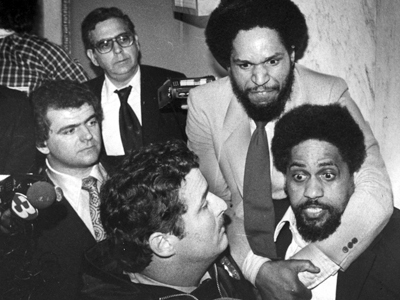
City Council Sergeant-at-Arms Bob Brady, left, looks on as Councilmember John F. Street, top, and State Rep. Milton Street, right, take part in a near-riot in Council chambers. (Daily News File Photo)
Brady was elected to Congress in a 1998 special election, and eventually chaired the House Administration Committee, which handles behind-the-scenes tasks such as assigning office space to lawmakers.
While in Congress, he ran unsuccessfully for mayor in 2007, losing to Michael A. Nutter, who ran on an anti-corruption campaign.
In 2017, news broke that Brady’s congressional campaign was the subject of a federal investigation over an alleged scheme in which a would-be challenger accepted $90,000 to withdraw from running against Brady in a 2012 primary.
Two of Brady’s aides served prison time, but Brady never admitted wrongdoing. He chose not to run for reelection the following cycle, in 2018.
A modern political ‘boss’
While Brady is often referred to as Philly’s “party boss,“ leading the Democratic City Committee is not the same job as it was in the heyday of big-city machine politics.
Thanks to civil service reforms in the 1950s, there are far fewer patronage jobs to hand out. And Brady’s time is more often spent attempting to maintain peace among the various political organizations around the city, rather than telling them what to do.
“It really isn’t all that easy, you know, keeping everybody together,” Brady said Monday night. “You got all kinds of factions, all kinds of egos, and I try to do the best I can to keep together, like we did tonight.”
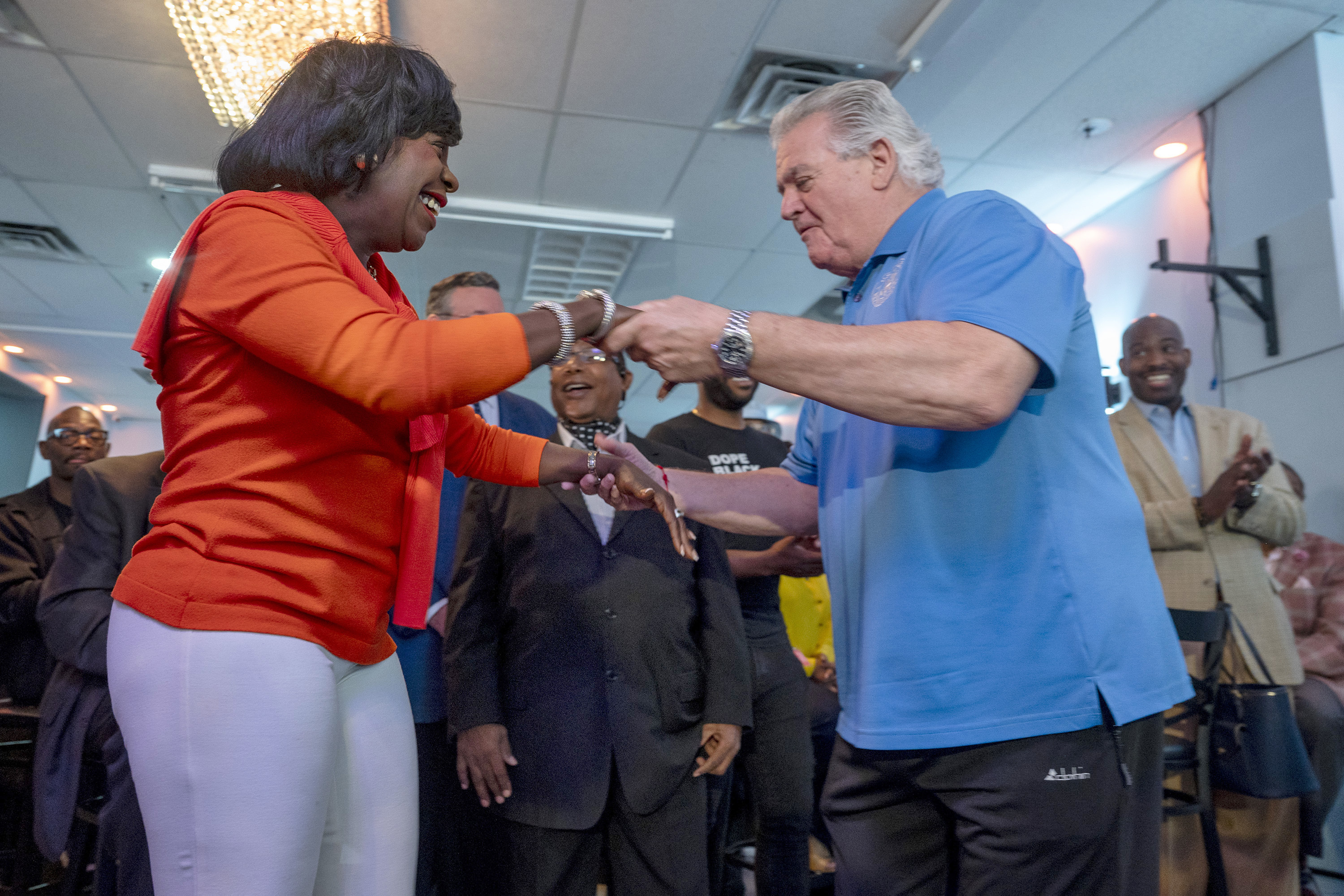
Bob Brady, right, chair of the Philadelphia Democratic City Committee, dances with Cherelle L. Parker at a “unity breakfast” following her victory in the 2023 Democratic mayoral primary. Tom Gralish / Staff Photographer
One area where today’s party does resemble the machine politics of old is local judicial elections. Party-endorsed candidates almost always win seats on the local Municipal Court and Common Pleas Court benches, and many of their staffs are in turn filled with people connected to the local party.
Brady and party leaders have no qualms about admitting what it takes to win their approval: doing favors and free legal work for the city committee, ward leaders, and their constituents.
Philly Democrats’ new No. 2
Although the Democratic City Committee does not have a new chair, ward leaders on Monday elected a new No. 2.
Former Councilmember Sharon Vaughn, who leads the 49th Ward, will be the new first chair of the party, replacing former Councilmember Jannie Blackwell, who did not run for reelection as 46th Ward leader.
Vaughn, who is also a secretary of the Pennsylvania Democratic Party, would temporarily become city committee chair if Brady were to step aside. Brady said Monday he would support her to one day hold the position on a permanent basis as well.
“She’s a great world leader, a former Council person, a hard worker,” Brady said. “What you see is what you get, straight shooter, and she’ll tell you just what it is. And she’s a loyal lady.”
Lauren Rinaldi, the 18th Ward leader who is seen as having relationships with both the progressive and establishment wings of the party, became the second vice chair. She replaces Bass, who has now lost out on her citywide party leadership post regardless of how Wednesday’s 22nd Ward election redo shakes out.
Rinaldi said Monday night she understands her election to leadership was partially an olive branch to the left wing of the party.
“I‘m sure that’s part of it, definitely,” Rinaldi said in an interview. “But I am seeing my role as an advocate — advocating for reform to strengthen the party and modernize the way we do some things and bring more people in instead of shut them out. Basically to rebuild trust with voters.”
The third vice chair remains 7th Ward leader Angel Cruz, and 63rd Ward leader Brian Eddis has replaced Bill Dolbow as fourth vice chair.
Former City Controller Jonathan Saidel will stay on as the party’s treasurer, with John Brady, who is not related to the chair, serving as assistant treasurer.
And 6th Ward leader Pete Wilson was retained as secretary, with 8th Ward leader Elaine Petrossian elected as assistant secretary.
Back-to-back-to-back reruns
The party on Monday ordered the results of three contested ward leader races voided. They will be rerun on Wednesday at the Brady building, with a committee of other ward leaders overseeing the results.
In all three instances, the ward elections were found to have violated the party’s procedures.
The redo for the 14th Ward, in which incumbent Arthur Green lost to Valerie Williams, will take place at 6 p.m.
City Councilmember Cindy Bass, left, speaks with a reporter about her contested 22nd Ward leader election. Aidan T. Gallo / Staff Photographer
That will be followed by a 7 p.m. rerun of the 17th Ward election, which was an open seat in which Tyrone Barge defeated Michelle Schley.
And finally, the 22nd Ward redo will take place at 8 p.m., with progressive challenger Octavius Price taking on Bass.
In all three races, the party will allow submission of “proxy votes” from committeepeople who cannot attend if they are accompanied by notarized affidavits.
Brady said the decision to redo the 22nd Ward vote was an easy one after he saw a video published by The Inquirer showing Bass, who chaired her own reelection meeting, shutting down requests for a roll-call vote that could have clarified the results.
“I don’t think anybody that saw that … was supportive of it,” Brady said. “One ward is one ward, and there’s 68 others, and we’re all going to fix that on Wednesday night.”
HARRISBURG — So-called skill games, the slot machine look-alikes that have proliferated by the tens of thousands around Pennsylvania bars and corner stores, are slot machine devices and should be regulated as such, the state’s highest court ruled Monday.
The Pennsylvania Supreme Court ruling clears the way for widespread taxation and regulation by the state, as well as limits on where the machines are available, as a majority of justices ruled that both gambling law and the criminal code apply to the machines.
The majority recognized that the ruling could cause a “potential disturbance” for “business owners and other good-faith participants in the industry,” so the ruling will take effect after a 120-day “safe harbor” period. And if lawmakers in Harrisburg disagree with the opinion, the General Assembly “remains free at any time to take whatever legislative action it may deem appropriate.”
Pennsylvania’s gambling industry is highly regulated and taxed. If state law is unchanged after the 120-day waiting period, the estimated 70,000 skill game machines available across the state would need to be regulated and confined to specific locations like casinos that have the proper licenses.
Chief Justice Debra Todd and Justice Daniel McCaffery, both Democrats, joined the opinion in full, while Republican Justices Sallie Updyke Mundy and Kevin Brobson concurred with most of the majority’s reasoning but wrote a short dissent.
“Because chance predominates both the player’s eligibility for winnings and the magnitude of those winnings, the [skill games] device is a gambling device,” Donohue wrote.
Justice Kevin Dougherty, a Philadelphia Democrat, sat out the long-awaited decision.
Skill game operators have evaded taxation and regulation for more than a decade, operating in a legal gray area after lower courts ruled that the machines require a level of skill not necessary to play games of chance like slot machines.
The most influential player in the skill games industry, Georgia-based operator Pace-O-Matic, has asked the state on multiple occasions to regulate and tax the machines — but at a rate much lower than slot machines, arguing that their technology helps small businesses with small margins stay afloat as prices rise.
In a statement, Pace-O-Matic said it was disappointed by Monday’s ruling, which it said would have “far-reaching consequences” on Pennsylvania’s small businesses and fraternal organizations.
“[Small businesses] are now potentially left facing an impossible choice: cease operating these games and lose an important source of revenue, or endure a legislative solution that could bring excessive regulation and crippling taxation, which will force them to cease operating these games and lose an important source of revenue,” a spokesperson for Pace-O-Matic added.
Gov. Josh Shapiro, a first-term Democrat, has proposed regulating and taxing skill games at 52% — the same rate currently levied on slot machines and most other games of chance. He estimated taxing and regulating the machines could bring in $765.9 million for the state in new revenue in its first year, as part of his $53.2 billion February budget pitch.
Lawmakers have been waiting for the state Supreme Court to rule whether the machines are legally slot machines or not, as the split legislature considers whether to and how much to tax them as a way to create a much-needed new revenue stream.
Top legislators and Shapiro have convened over the last few weeks in closed-door meetings to finalize a state budget deal ahead of a June 30 deadline. Now, with the decision in hand, Senate President Pro Tempore Kim Ward (R., Westmoreland) and Majority Leader Joe Pittman (R., Indiana) said in a statement they believe gaming reform is a “critical piece of resolving this year’s budget.”
In Philadelphia, City Council banned skill games in 2023 over concerns that they attract crime, but a lower court blocked enforcement of the ban while several cases worked their way to the state Supreme Court.
A Philadelphia jury ordered Pace-O-Matic to pay $15.3 million last year to the estate of Ashokkumar Patel, a Hazleton store clerk killed during a 2020 robbery. And a Philadelphia store clerk shot last year during an armed robbery of Philly Market in Frankford, Ahmedine Maham, sued Banilla Gaming, a North Carolina-based skills game manufacturer, for enticing his assailants.
At the end of the 120-day waiting period, the machines will be subject to regulations like slot machines and restricted to specific locations licensed to house slot machines — unless lawmakers decide to change the law.
Pace-O-Matic, in its statement Monday, urged lawmakers to approve bipartisan proposals backed by rural GOP members and Philadelphia Democrats that would charge a $500 fee per skill game machine and would not restrict the machines to licensed slot machine locations, such as casinos.
In a statement, Pennsylvania Attorney General Dave Sunday, a Republican, praised the Supreme Court’s decision as a “significant victory for consumers, taxpayers, and the rule of law.”
“The Supreme Court recognized what our office has argued from the beginning — these machines operate as gambling devices and cannot legally exist without the same oversight, regulation and accountability as other forms of legalized gaming in the commonwealth,“ Sunday added. ”Pennsylvanians deserve protections that ensure games are fair, transparent and operated within the bounds of the law.”
Federal agents have questioned friends and associates of Gov. Gavin Newsom of California and his wife, Newsom said Monday in a video in which he accused President Donald Trump of using the Justice Department to punish a political enemy.
The full scope of any investigation remains unclear. But Newsom’s aides say part of the federal investigation appears to focus on his wife, Jennifer Siebel Newsom. Former employees of the governor and people affiliated with his wife’s nonprofit groups are among those who have been questioned by agents, according to the governor’s office.
A person familiar with the matter confirmed that multiple federal investigations were underway related to the governor, including one looking at his wife’s finances. But the person disputed Newsom’s assertion that the investigations were politically motivated and said they had been initiated by federal law enforcement officials in California, not launched by officials in Washington. The person spoke on condition of anonymity because they were not authorized to discuss it publicly.
Newsom, a Democrat, described the investigation as a fishing expedition in which federal agents had started sifting through “years and years of random documents” and knocking on the doors of family friends and associates of the Newsoms to try to find evidence of an unspecified crime.
“Donald Trump isn’t just coming after me because of my mean tweets,” Newsom said in the video. “He’s coming after me because I am considering running for president.” He added, “To get me, he’s coming after my wife.”
Several people associated with the Newsoms have been contacted by federal agents in the past week, according to the governor’s office. Newsom’s aides believe the agents have also subpoenaed banking records but said they had seen no written evidence of that.
An FBI spokesperson and a Justice Department spokesperson declined to comment. A White House official referred all questions to the Justice Department.
Siebel Newsom, who calls herself California’s first partner, is a documentary filmmaker whose work focuses on the social impacts of sexism. She founded a nonprofit organization called the Representation Project that advocates for gender equity, in part by developing educational materials based on her documentaries.
Siebel Newsom also owns a film-production company called Girls Club Entertainment. It is listed as a contractor of the Representation Project on the nonprofit’s tax returns. Tax records show that the Representation Project makes annual payments to Girls Club Entertainment. In 2024, the nonprofit paid Girls Club Entertainment $161,250 for film production work.
Siebel Newsom is also a co-founder of the California Partners Project, a nonprofit that works to get more women onto corporate boards, address the gender pay gap, and make technology safer for children. Some of the donors that support the California Partners Project are groups with business before the state government.
For years, critics have raised the possibility of self-dealing, but no public evidence of wrongdoing by any of the entities tied to Siebel Newsom has surfaced, and it remains unclear what precise issues and actions investigators have been asking questions about.
Newsom has reported soliciting $4.3 million in donations to the California Partners Project since 2020, according to disclosures filed with the state’s ethics agency. That includes $1.8 million from a Native American tribe that has an agreement with the state to operate a casino in Sonoma County. In California, public officials must disclose donations to charities that are made at the official’s request.
Another nonprofit group with ties to Newsom is called the California Protocol Foundation. Its board includes some of Newsom’s top advisers during his time as governor and previously as the mayor of San Francisco. The foundation pays for initiatives that the governor says he does not want state taxpayers to cover, including his travel overseas for conferences and other meetings.
Newsom’s office said the investigation is a fresh attempt to smear him after the federal prosecution of his former chief of staff revealed no misconduct by the governor. The former chief of staff, Dana Williamson, pleaded guilty last month to three felonies in a corruption case.
One of the crimes Williamson pleaded guilty to was lying to the FBI about information she had access to while working in Newsom’s office. In her plea agreement, Williamson said she gave her former business partner confidential information about state litigation that involved one of their clients and then lied about it when questioned by the FBI.
The agreement does not name the client, but details in the indictment align with a sex-discrimination lawsuit that California regulators filed in 2021 against video game maker Activision Blizzard. The company had been a client of Williamson’s consulting business before she joined Newsom’s office. In 2022, Newsom fired the state lawyer leading the suit against Activision, prompting complaints that he was interfering.
When Williamson was indicted last year, her attorney said that federal agents first approached her during the Biden administration. She was working for Newsom at the time, and the agents asked her if she would cooperate in an investigation of the governor. She replied that she had no information to give them because she had never witnessed any criminal conduct by Newsom.
Earlier this year, Newsom’s office responded to questions from Trump’s Justice Department about his 2022 termination of the lawyer involved in the Activision lawsuit, according to a spokesperson for Newsom. Then the communication from federal officials ceased, the spokesperson said.
The latest inquiries into associates of Newsom and Siebel Newsom began around the time Trump said that he planned to nominate Todd Blanche as attorney general, according to the governor’s office.
Blanche had previously defended Trump in three of the four criminal cases he was facing.
Nominated to be the No. 2 official at the Justice Department at the beginning of Trump’s second term, Blanche — now the acting attorney general — has pursued prosecutions of Trump’s perceived enemies. He also signed an agreement granting the president and his companies immunity from audits of past tax returns to settle a $10 billion lawsuit the president brought against his own government earlier this year.
Newsom has been highly critical of Blanche’s nomination to the top Justice Department position, recently calling Blanche “the guy covering up the Epstein Files” and saying he “gave Trump and his family a lifetime pass to commit tax crimes.”
(END OPTIONAL TRIM.)
Newsom, in his video address, mentioned that Trump had called for his arrest last year, and he said he was proud to join the “hit list” of people standing up to the president. He accused Trump of “selling the presidency” for golf course approvals, cryptocurrencies and a private jet, and pledged to continue calling out what he saw as corruption from the White House.
“You can subpoena my records. You can investigate me. You can harass me,” Newsom said. “Put my name on every and any enemies list you have, but leave my wife and family out of your personal vendetta.”
SEATTLE — A group of Democratic senators and one Republican, as well as two Democratic House committees, sent letters Monday to the National Science Foundation asking it to reverse course on its plan to dismantle a sprawling ocean monitoring network, with House lawmakers going further and accusing the agency of acting illegally.
The Ocean Observatories Initiative is a network of more than 900 ocean sensors built at a cost of $386 million. Over the last decade it has tracked ocean circulation, marine ecosystems, climate change, and extreme weather, producing data freely available to the public and informing more than 500 scientific publications. The project was slated to run another 15 to 20 years.
The National Science Foundation had directed the removal of most of the system’s instruments from waters off Oregon, Washington, Alaska, North Carolina, and Greenland by 2027 — a decision scientists said came with no warning and no scientific review. The independent federal agency, which was established by Congress, described the move not as a cancellation but as a “descoping” aligned with a strategy to prioritize “evolving scientific priorities and emerging technologies.” The Trump administration’s proposed 2026 budget had included a 55% cut to the agency.
“Supreme stupidity”
“It just seems like this is supreme stupidity and a violation of the fundamental distribution of powers in our Constitution,” Democratic Sen. Jeff Merkley of Oregon told the Associated Press. “This program is authorized, it’s funded, and for the administration to shut it down without direction from Congress violates that vision in which the people’s representatives decide what’s done and funded, and the executive branch executes that vision.”
Merkley and Republican Sen. Lisa Murkowski of Alaska co-led the letter, which was also signed by Democratic Sens. Edward Markey and Elizabeth Warren of Massachusetts, Tammy Baldwin of Wisconsin, Patty Murray and Maria Cantwell of Washington, Sheldon Whitehouse of Rhode Island, Chris Van Hollen of Maryland, and Ron Wyden of Oregon. It urged the National Science Foundation, or NSF, to halt the dismantling of the Ocean Observatories Initiative and conduct a thorough review, including consultation with the marine science community, before any further action is taken.
“Eliminating most of this complex ocean monitoring system threatens the safety of our coastal communities while undermining our nation’s ability to monitor coastal environments, marine currents, and extreme weather events,” the senators wrote.
In a sharper rebuke, Democrats from the House Science, Space, and Technology Committee and the House Natural Resources Committee sent a joint letter demanding the agency “cease this expensive, destructive, and — crucially — illegal action at once.” The letter was led by Reps. Zoe Lofgren and Jared Huffman of California, the top Democrats on their respective committees, and was signed by 23 Democratic members from each panel.
In a June 3 statement, the NSF said its decision drew in part on a 2025 National Academies report on the future of ocean science. “NSF remains committed to ocean science and will continue working with the scientific community on high-priority research objectives,” it wrote.
Federal appropriations law requires the NSF to notify the House and Senate Appropriations Committees at least 30 days in advance of any planned decommissioning of agency-owned facilities or assets valued at more than $2.5 million. The House letter said no such notification had been transmitted.
Merkley said he learned of the dismantling through news reports.
“It was like the alarm bells just went off,” he said. “None of us knew about this, and there didn’t appear to have been any consultation or any scientific commission or stakeholders that were leading to this.”
Merkley said his office is still confirming whether formal notification was given, but he added: “If there was no notification, this would appear to be illegal.”
He and Murkowski planned to file legislation Monday that would prohibit the NSF from spending federal funds to decommission instruments until a thorough review has been completed.
Pulling buoy off Oregon coast
Scientists are scheduled to begin pulling the first buoy off the Oregon coast on Tuesday.
In their letter, the senators cited the approaching El Niño — a periodic Pacific warming that disrupts weather patterns and supercharges marine heat waves — as evidence the cuts are particularly ill timed.
“The loss of this deep-water observation system would threaten our ability to prepare for and monitor future El Niño events,” they wrote, warning coastal communities, fishermen, and emergency responders would be left without crucial information.
“Instead of paying for the valuable insights that can be gleaned from the 10-years-and-counting continuous monitoring, taxpayers are now paying for research vessels to span the ocean dredging up hundreds of pieces of instrumentation. This is pathetic,” the House letter states. “In a time of strained resources, the NSF is wasting time and money to destroy its own scientific infrastructure.”
The Philadelphia Democrat whose district includes Independence Hall accused President Donald Trump of trying to transform the 250th anniversary into a celebration of himself rather than the country.
Trump announced on Truth Social Monday that a Trump rally will now take place in Washington on July 4, absorbing the long-planned 250th anniversary fireworks celebration at the Lincoln Memorial, the Washington Post reported.
The move has prompted criticism, including from U.S. Rep. Brendan Boyle, whose district was the site where the Declaration of Independence was debated and signed.
“Our nation’s 250th anniversary should be an opportunity to bring us together as Americans,” Boyle wrote in a statement. “Any previous president — from either party — would make this event about our nation. But not Trump. He makes it about himself. Because he only cares about himself.”
Boyle is one of several Democratic lawmakers to criticize Trump’s expanding role in the celebrations.
“We are going to host the most spectacular TRUMP RALLY of them all, a ‘TRIBUTE TO AMERICA,’ Trump wrote on Truth Social, his social media platform. “This HUGE Celebration will honor our Country’s People, Spirit, Strength, Resolve, and Triumphs.”
Trump said in the post that the event will include air shows, patriotic music — from Trump’s own playlist — a fireworks show, and a keynote speech from him.
“To conclude the program, and commemorate this Historic Occasion, I will be launching, what will be, the LARGEST FIREWORKS SHOW IN HISTORY,” Trump wrote.
The rally is just the latest in a string of controversial choices by Trump ahead of the 250th. The president announced the rally a day after he hosted a controversial Freedom 250 UFC event at the White House for his 80th birthday.
Sen. Andy Kim (D., N.J.) criticized the decision to hold the UFC event at the White House, noting on X that Trump holds shares in the company and that UFC CEO Dana White donated $1 million to a pro-Trump super PAC.
“This isn’t a celebration of America 250,” Kim posted on Sunday. “This is corruption on full display on the White House lawn.”
The event drew further controversy when fighter Josh Hokit made offensive comments about former first lady Michelle Obama in his postfight interview.
The Trump administration says the events are a way to inspire and excite Americans, the Washington Post reported.
“Fight for freedom,” the Department of Homeland Security, headed by former MMA fighter Markwayne Mullin, posted on Facebook. “Fight for our way of life. Fight for America.”
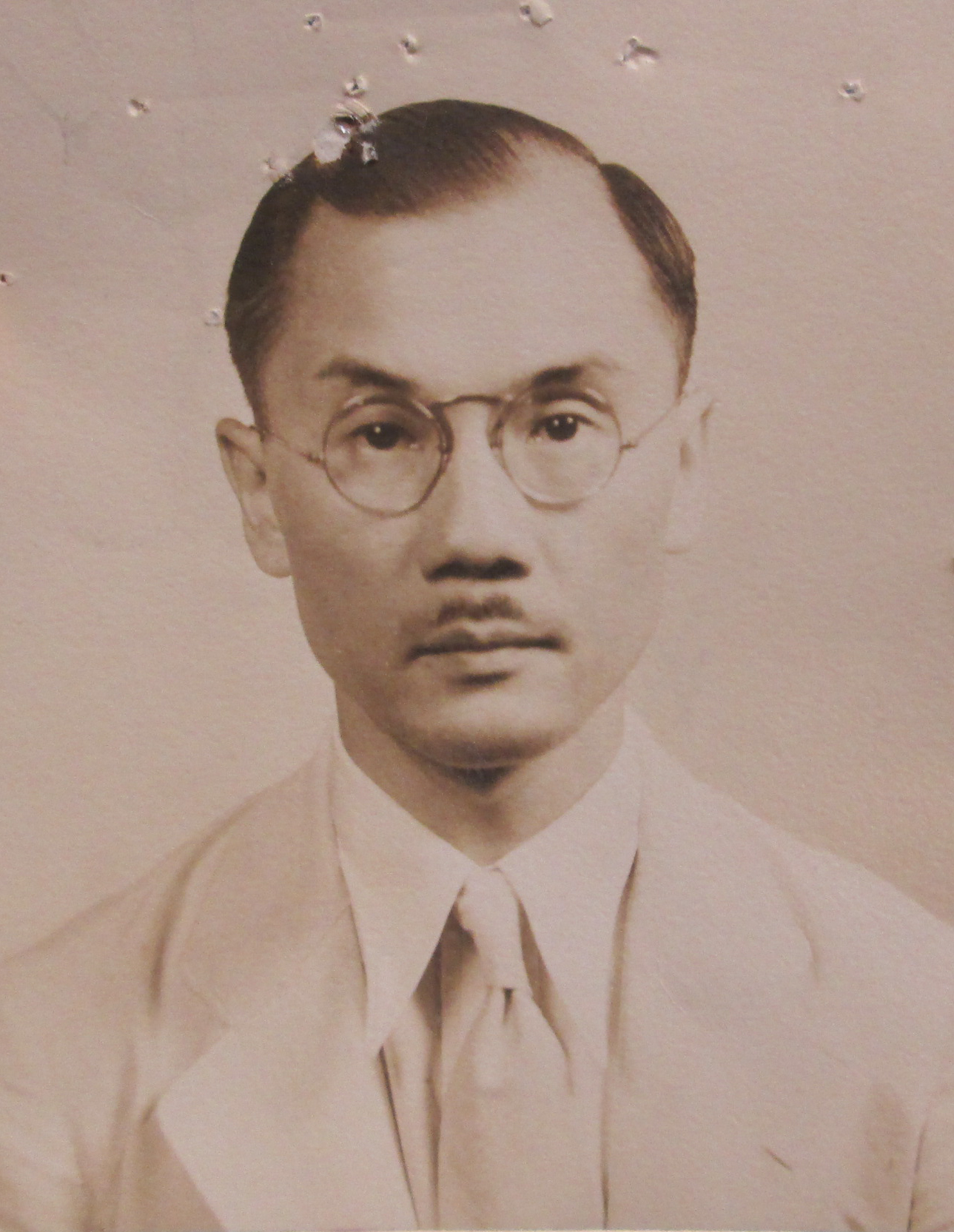
In 1950, Ernest Moy was trying desperately to return to the United States after spending the previous 20 years working in China. Since he had reentered the U.S. twice before, immigration officials already possessed thick files of evidence attesting to his U.S. citizenship, including his birth certificate from Philadelphia. This unquestionably established his status because of the Fourteenth Amendment’s birthright citizenship clause and an 1898 U.S. Supreme Court decision that had affirmed this: if you are born in the United States, you are a citizen.
But more than 50 years of settled law meant less to the Immigration Service than the fact that Moy was Chinese American. Because of his race, officials considered him both undesirable and unassimilable. When he finally did get permission to reenter the United States, it was only as a temporary immigrant who required further investigation. Moy bristled at such treatment but had learned to expect no better.
In 2026, as the Supreme Court considers Trump v. Barbara, many Americans have learned for the first time about the Supreme Court ruling that should have guaranteed Moy’s reentry: U.S. v. Wong Kim Ark. The aftermath of that case — and the story of Ernest Moy — show how the constitutional guarantee of birthright citizenship has on its own never been sufficient to protect the rights of many Americans. When those in power define citizenship as whiteness, they enable and encourage immigration officials to do the same.
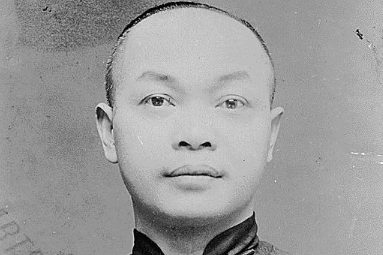
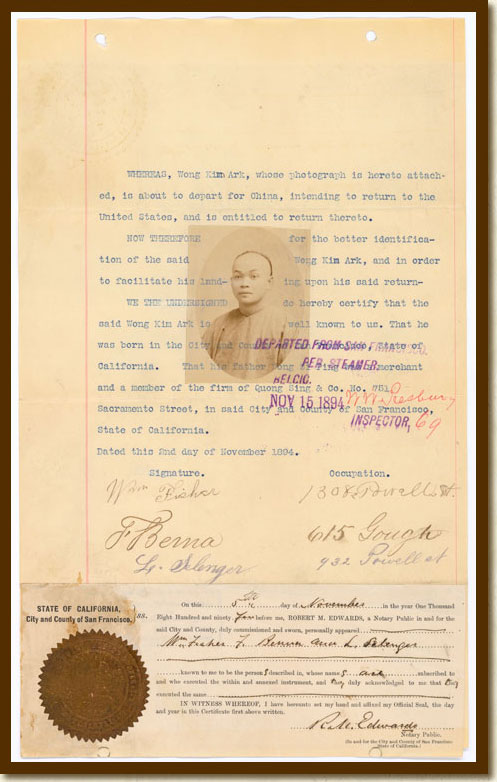
The landmark case began in 1895, when immigration officials barred Wong Kim Ark, a native of San Francisco, from reentering the United States after a trip to China. Authorities argued that because Wong’s parents were Chinese immigrants — a group barred from naturalizing because of their race — the birthright citizenship clause of the Fourteenth Amendment did not apply to their son. What did cover him, officials claimed, was the Chinese Exclusion Act. This 1882 law prohibited the entry of Chinese laborers, and because Wong was a cook, he fit into that category. As the government succinctly put it, “although he is native born, he is not entitled to come into the United States because he is a laborer and of the Mongolian race.” Wong responded by taking his case all the way to the Supreme Court, which in 1898 clearly and unambiguously affirmed his U.S. citizenship.
Wong Kim Ark, the son of Chinese parents in San Francisco, was determined by the Supreme Court to be a citizen by virtue of being born in the United StatesNational Archives
Yet in the years that followed, the Immigration Service found plenty of ways to thwart the spirit of the ruling, all while claiming to recognize birthright citizenship as settled law. Wong Kim Ark, now back home in El Paso, discovered this firsthand in 1901. Three years after the Supreme Court decided his case, authorities in Texas briefly detained him, charging him with violating the Chinese Exclusion Act for living and working in America, the land of his birth.
Hoping to head off reentry problems, other Chinese American citizens planning to travel abroad learned to gather substantial evidence of their birth in the United States and ask white acquaintances to vouch for them at local courts or Immigration Service offices. Those with enough money hired attorneys to help navigate the haphazard process more effectively, though one such lawyer warned his client that even the most thoroughly documented travelers often faced “considerable trouble” reentering. In such cases, attorneys needed to sue for writs of habeas corpus, just as Wong Kim Ark had done in 1895.
Wong Kim Ark, whose Supreme Court case determined that he was a citizen by virtue of being born in the United StatesNational Archives
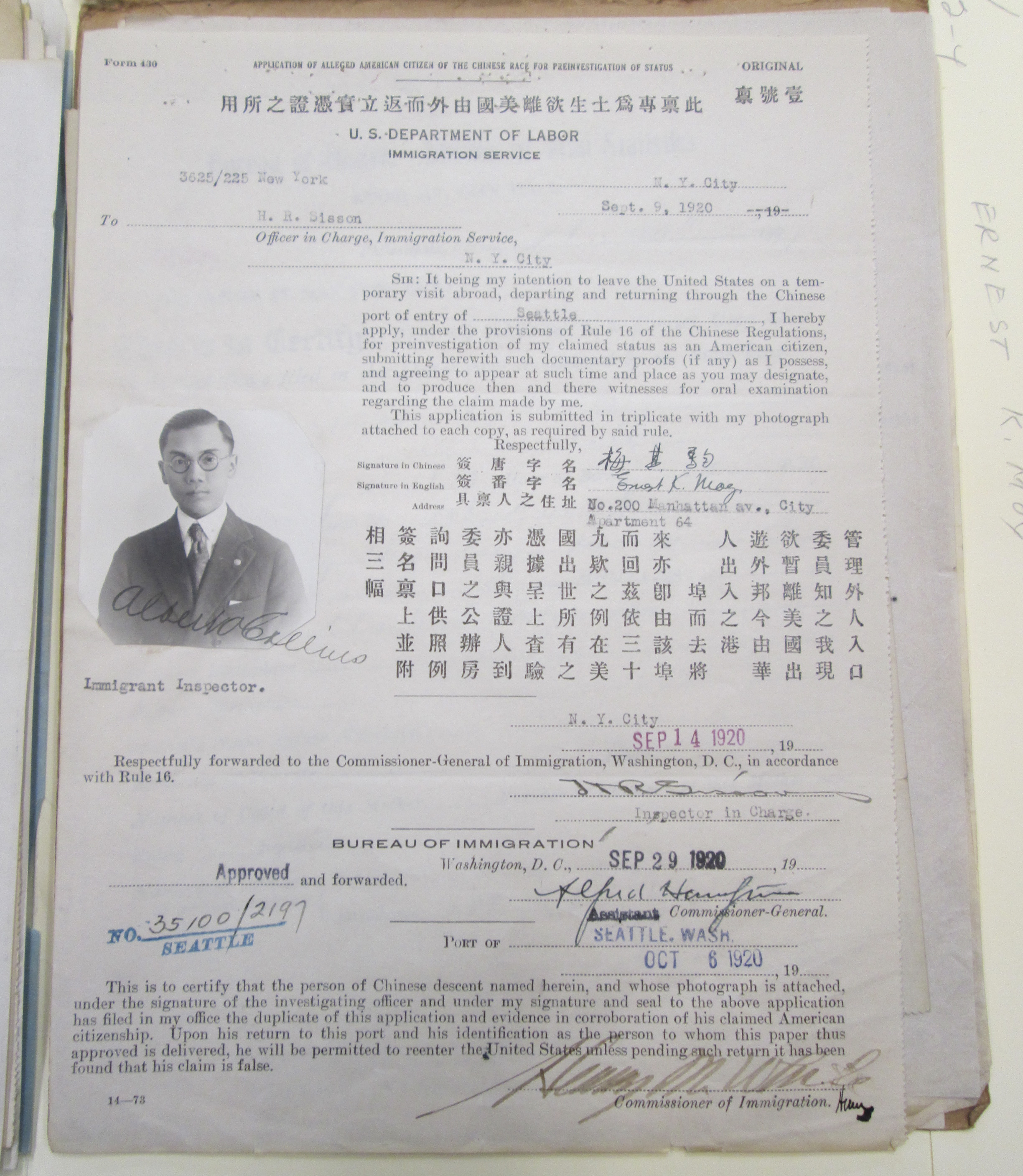
In 1909, U.S. officials rolled out a new procedure for Chinese American citizens, unsurprisingly modeled on the way the government vetted China-born temporary residents. The entire process reflected authorities’ continued hostility toward the very idea of Chinese American citizenship as a legitimate concept — and their eagerness to deny or at least constrain it in any way possible. Even the official name of the Immigration Service’s new form broadcast this attitude: “Application of Alleged American-Born Chinese for Preinvestigation of Status.”
Resentful of the word “alleged,” most Chinese American citizens chose to refer to the application by its official number: Form 430. No matter how they felt, those planning to travel abroad had little choice but to fill out the form and submit it together with copious additional documentation, including birth certificates, school records, photographs, selective service certificates, and the citizenship identity cards that only Chinese American citizens had to carry. By the 1920s, when passports became common for all U.S. citizens traveling abroad, Chinese Americans included those, too. But while a passport could guarantee reentry for other American citizen travelers, officials considered it inadequate evidence of citizenship for Chinese Americans who did not also carry an endorsed Form 430.
OLD IMAGE — DO NOT USE — Made By History sponsors. FOR USE ON MADE BY HISTORY STORIES ONLY.Inquirer Staff
In addition to gathering documents, Chinese American citizens also had to testify at the closest Immigration Service office, answering detailed questions about their lives and families to establish their birth in the United States. Many brought in friends, relatives, and community members to undergo similarly detailed interrogations on their behalf. Immigration Service agents tended to view the testimony of white acquaintances, including family doctors, teachers, and local Christian leaders, as particularly valuable.
Even after the Immigration Service “conceded” (in its words) an applicant’s birthright citizenship and endorsed the person’s Form 430, obstacles remained. For instance, returning travelers, including those with U.S. passports, had to sit for further interrogation when reentering the United States. And the Immigration Service required Chinese American citizens to undergo a new preinvestigation each time they left the U.S., even for brief trips to Canada or Mexico. In other words, officials “conceded” citizenship only temporarily, so U.S.-born Chinese Americans became “alleged” citizens before every new departure. No other group of U.S. citizen travelers endured such treatment in the pre-World War II years. While Congress finally repealed Chinese exclusion in 1943, official attitudes barely changed over the next decade, as Ernest Moy’s experience shows.
Ernest Moy first underwent pre-investigation in 1920, when he received this endorsed Form 430.National Archives at Seattle
By the 1910s, large numbers of Chinese Americans started to undergo preinvestigation, but not for the kinds of short trips Wong Kim Ark had taken. Many began to relocate to China, a struggling young republic that offered Western-educated people career opportunities unconstrained by American racial discrimination. Eventually, close to half the Chinese Americans born in the United States, including Ernest Moy, moved to China. Before departing, almost all these U.S. citizens underwent preinvestigation — Moy did so three times — to ensure that they could retain the right to return to the country of their birth, the United States.
Eventually, Wong Kim Ark returned to China, too. The citizenship rights that officials “conceded” to him came with restrictions that didn’t apply to other Americans, and at 61, he was both lonely and fed up. For years, Wong had supported his family from afar because Chinese exclusion laws prevented him from bringing his China-born wife to the United States. In 1931, he retired and joined her in the village where she had raised their sons. But unwilling to relinquish the rights for which he had fought 35 years earlier, Wong submitted to preinvestigation one last time before making that final trip.
The institutionalized harassment of Chinese Americans is just one example of the way the U.S. government for decades equated citizenship with whiteness — and nonwhiteness with alien status. President Donald Trump’s attempt to end birthright citizenship is rooted in this same idea, and the Supreme Court must and should reject the president’s deeply unconstitutional executive order. But as the lives of Wong Kim Ark, Ernest Moy, and so many of their peers show, such a ruling, though essential, will be incomplete without a larger challenge to the pernicious idea that whiteness and Americanness are the same.
Made by History takes readers beyond the headlines with articles written and edited by professional historians. Opinions expressed do not necessarily reflect the views of Inquirer editors.
Through much of Mayor Cherelle L. Parker’s first two years in office, most political insiders in Philadelphia assumed she would cruise to reelection.
After all, no mayor in the last eight decades in the deep-blue city has lost a bid for a second term. And Parker is backed by the city’s long-powerful Democratic establishment, contributing to the foregone conclusion that their allied mayor would win again.
Even some of Parker’s staunchest critics on the left admitted privately that they were resigned to her serving eight years in office.
Then last month, conventional wisdom started to crack.
State Rep. Chris Rabb — a democratic socialist and an anti-establishment firebrand — won a tightly contested battle for an open seat in Congress, prevailing over Parker’s endorsed candidate and even carrying the 50th Ward in Northwest Philadelphia, where Parker is ward leader.
Now some of the activists who lead the city’s largest left-leaning organizations think that race showed that Philadelphians are ready to pick a progressive over the Democratic establishment. And they are looking at next year’s mayor’s race again, asking the question: Is Parker vulnerable?
“We would love to have a progressive challenger in this race,” said Sergio Cea, political director of the progressive group Reclaim Philadelphia. “The establishment was really defeated on all fronts this election cycle.”
In a little more than 10 months, Parker, a centrist Democrat and the city’s first female mayor, will be up for reelection. She has not officially announced a campaign — doing so would trigger strict fundraising rules and limits — but all signs indicate she intends to run again, including an already huge campaign war chest.
Any challenger to Parker would be considered a significant underdog. The mayor has the power of incumbency, and can point to progress on her 2023 campaign promises to make the city safer and cleaner, not the least of which is a historically low homicide rate. Thousands of residents are getting their trash picked up twice a week, and polls consistently show that more Philadelphians say they think that the city is heading in the right direction now than when Parker took office.
She even seemed to recover politically after one of her lowest moments: the eight-day municipal worker strike last year that left so much garbage piling up that it became colloquially known as “the trash strike.” Parker, through her signature unyielding negotiating style, muscled her way to an agreement with the union.
Today, she is supported by most of the city’s elected officials and powerful organized labor groups. Ryan N. Boyer, the head of a coalition of deep-pocketed building trades unions, said recently that any challenger to Parker would face “annihilation.”
“This is Philadelphia, there are always people who want to run for mayor. But mayoral elections are decided on whether people think their city is moving in the right direction,” said Aren Platt, executive director of People for Parker, the mayor’s political campaign arm. “Mayor Parker has been underestimated her entire career, and she has a habit of proving people wrong.”
Mayor Cherelle L. Parker raises a finger with her call-and-response “One Philly, A United City” mantra ending her speech during a ceremonial meeting of the Pennsylvania Senate at the National Constitution Center across the mall from Independence Hall on May 5.Tom Gralish / Staff Photographer
However, some on the left see a coalescence of forces that could bolster their chances: national frustration with the Democratic establishment that has manifested in leftist wins, a widespread anti-incumbent sentiment, and liberal rage toward President Donald Trump, whom Parker has largely avoided maligning publicly.
“If you just have the right candidates that are able to speak to the dissatisfaction of Democratic voters in Philadelphia,” Cea said, “I do think [Parker] is in trouble.”
But the biggest question for Philadelphia progressives in the approaching mayoral race remains: Who could be their candidate?
The potential challengers
Jack Inacker, a Democratic strategist based in Philadelphia, said there are few, if any, challengers to Parker who could pull off a win in 2027.
“The progressive infrastructure now has built up in a way where, if you squint really hard, you can see a path to a progressive challenger,” Inacker said. “The problem is that [Parker] is one big mistake away from being beatable, but she’s not beatable yet. And people know that.”
Candidates have plenty of time to decide. Paperwork to get on the ballot likely would not be due until March.
Perhaps the most talked-about potential challenger so far isDistrict Attorney Larry Krasner, the city’s most prominent progressive. He has not ruled out a run for mayor, and he has recently publicly criticized Parker and some of her closest allies.
Last week, he invited media to walk along with him while he hand-delivered a letter to the mayor’s suite in City Hall to express dissatisfaction with his office’s budget. Parker called the move “stunting.”
Platt, in a thinly veiled shot at Krasner, said in a statement that “what we’ve seen recently is too many politicians focused on generating headlines rather than solving problems: manufacturing controversy, looking for someone else to blame, and confusing political theater with leadership.”
District Attorney Larry Krasner greets supporters during his election night party at the Pipeline Philly coworking space on May 20, 2025, in Philadelphia. Krasner defeated challenger Patrick Dugan both in the Democratic primary and in the general election.Monica Herndon / Staff Photographer
Krasner has won citywide election three times, twice winning reelection in landslide fashion. He is one of the nation’s most well-known progressive prosecutors and one of the city’s most polarizing figures. His base of support includes the city’s left, as well as a large swath of Black voters and elected officials.
But it was Parker’s political family — the vaunted Northwest Coalition of the some of the city’s most storied Black politicians — that was key to Krasner’s political ascent. Challenging Parker could be seen as a betrayal by some in the voter-rich northwest corner of the city, and his base there could fracture.
Krasner has also in the past struggled to keep up with his opponents in fundraising. Any challenger to Parker would likely need to bring in well over a million dollars, a sum of money that Krasner has never raised before.
Several other elected officials are seen as potential challengers to Parker, including several sitting members of City Council.
Councilmember Isaiah Thomas, who represents the city at-large, has long been rumored to have ambitions for higher office. He has been elected citywide twice, and recentlywas among the most vocal opponents of the Philadelphia School District’s controversial plan to close 17 schools.
And he has allies both on the left and in the city’s business community, the latter of which has been frustrated with a Parker administration policy shift that increased the tax burden on small businesses.
Councilmembers Isaiah Thomas (from left), Curtis Jones Jr., and Jamie Gauthier protest at an April school board meeting as the board prepared to vote on the facilities plan.Jessica Griffin / Staff Photographer
Thomas said last week that he is focused on his job in City Council.
“That job right now is hard enough, looking at the affordability crisis, the crisis around public education, and other issues that we’re facing,” he said.
There’s also two-term Councilmember Jamie Gauthier, who represents parts of West Philadelphia and has positioned herself as one of Council’s chief critics of the Parker administration. She said earlier this year that running for mayor “could be interesting one day,” but that she would not run if she did not see a clear path to victory.
She said in a statement that her focus is “finishing what we started on City Council, especially building affordable housing.”
Gauthier added: “But it’s clear Philadelphians are hungry for leaders who will put working families above big business.”
And there is Councilmember Kendra Brooks, the de facto leader of the city’s left-leaning coalition and a member of the progressive Working Families Party. Brooks, who represents the city at-large, has twice campaigned and won citywide.
A political adviser to Brooks said she is focused on her work in City Hall and running for reelection to Council, as well as “building Black progressive political power through the WFP.”
What do progressive gains mean for the 2027 mayor’s race?
Parker’s camp sees strength in her numbers.
In March, the mayor’s political arm commissioned a poll that found that 60% of respondents approve of the job Parker is doing as mayor, while 33% disapprove. Her approval rating was even higher among Black voters, older voters, and residents of Northwest Philadelphia — one of the highest-turnout areas of the city.
Mayor Cherelle L. Parker (right) hugs Rachel O’Neal, executive of the Friends Childcare Center, at the unveiling of a new playful learning hub at Sisters Cities Park on Thursday.Jessica Griffin / Staff Photographer
Cornell Belcher, one of the top Democratic pollsters in the nation, has conducted polling for Parker dating back to her mayoral campaign. He said that a key indicator of voter attitude toward an incumbent mayor is the number of residents who think the city is heading in the right direction.
The results this spring, he noted, were “dramatically different” from when Parker was first campaigning for the office. In April 2023, Belcher measured that 66% of Democratic primary voters in the city were dissatisfied with the direction of Philadelphia.
Today, he said, 62% are satisfied.
Still, other polls have shown potential warning signs for Parker.
In three polls that were conducted this spring in the 3rd Congressional District and obtained by The Inquirer, an average of 48% of Democratic primary voters said they had a favorable view of Parker and 41% had an unfavorable view. The polls, which measured voter attitudes in roughly half the city, were conducted by three different firms, and they were commissioned by different campaigns and organizations.
Approval and favorability ratings are not apples-to-apples. An approval rating is often considered a more reliable data point for an incumbent executive, because it measures attitudes about job performance, not reputation.
Belcher, who founded his polling firm 25 years ago and polled for former President Barack Obama, said he would not draw conclusions from polls of a congressional district that includes only half the city and was taken in a different election year. And he questioned other pollsters’ methodology in Philadelphia, a city that is tricky to survey.
“A city like Philadelphia, with all its different racial and ethnic groups, getting that right is hard,” Belcher said. “The more diverse an area is, the more work you have to put into getting it right.”
Chris Rabb greets supporters on election day. He is arriving to his polling place to vote, Grace Epiphany Episcopal Church, on May 19.Alejandro A. Alvarez / Staff Photographer
The results of last month’s congressional race energized progressives, in part because Rabb performed well in parts of the city that Parker carried when she won the crowded open Democratic mayoral primary in 2023. An Inquirer analysis found that more than a quarter of Rabb’s votes came from divisions that voted for Parker in 2023.
Rabb won his Democratic primary in a race that included three front-runners. But mayoral reelection battles in Philadelphia have historically been head-to-head, meaning the winner will look to reach 50% of the vote, a more challenging proposition for an ideological candidate.
“The mayor is organized, and her coalition across Philadelphia is strong,” Platt said. “They may not be active on Reddit, but they’re there, and they believe in what she’s doing because they can see the results in their neighborhoods.”