Category: Politics

  • Man charged with threatening staff and disrupting office of Bucks County state legislator

    Man charged with threatening staff and disrupting office of Bucks County state legislator

    A 65-year-old man who allegedly threatened the staff of a Republican state legislator from Bucks County and attempted to trash her district office remained jailed Thursday after a judge ordered that his criminal case should proceed to trial.

    Donald F. Ambrose, of Bensalem Township, was unable to post 10% of his $200,000 bail and was being held at the Bucks County Correctional Facility on one count of terroristic threats and two counts each of disorderly conduct and harassment.

    On June 9, Ambrose allegedly entered the district office of State Rep. Kathleen “K.C.” Tomlinson in Bensalem Township “aggressively shouting about an ongoing medical malpractice issue,” the Bucks County District Attorney’s Office said.

    Ambrose allegedly had been to Tomlinson’s office before several times, “making outlandish comments before leaving,” the district attorney’s office said.

    “On this occasion, Ambrose became aggressive, grabbing paperwork off the desk of one of the employees and then scattering the papers while continuing to scream and yell. Ambrose was told by staff that law enforcement was being called, and he allegedly pointed at a staff member and stated, ‘you’re dead,’ before exiting the building,” the district attorney’s office said, citing the criminal complaint.

    “Once outside, Ambrose retrieved a gasoline can from his vehicle and began walking around the perimeter of the office building, causing employees inside to fear he intended to set the building on fire,” the district attorney’s office said.

    On Friday, Tomlinson posted a statement on social media acknowledging the incident, saying she was in Harrisburg when Ambrose allegedly “began trying to destroy the [Bensalem Township] office and then proceeded to threaten the life of a member of my staff.”

    Tomlinson added: “We live in a very unsettling time, especially as public servants. Unfortunately, this is not the first time we have experienced a hostile encounter in just a few short months which is completely unacceptable.”

    <iframe src="https://www.facebook.com/plugins/post.php?href=https%3A%2F%2Fwww.facebook.com%2FRepTomlinson%2Fposts%2Fpfbid0Sa6YhvakLuq546vLpHhjKxHroBLjenzoWxexCeM4F7ZdacSM6ZJWErueGjbf9eL9l&show_text=true&width=500" width="500" height="250" style="border:none;overflow:hidden" scrolling="no" frameborder="0" allowfullscreen="true" allow="autoplay; clipboard-write; encrypted-media; picture-in-picture; web-share"></iframe>

    Bucks County District Attorney Joe Khan said in a statement Thursday: “Public servants should never have to fear for their safety simply for doing their jobs. My office takes these actions incredibly seriously, and we will continue to hold accountable anyone who uses fear or threats to disrupt our community and target those who serve the public.”

    Tomlinson, 37, was elected in 2020 and is the daughter of former State Sen. Robert M. “Tommy” Tomlinson.

  • One of Mayor Parker’s top licenses & inspections officials ‘is no longer with the City.’ Her office won’t say why.

    One of Mayor Parker’s top licenses & inspections officials ‘is no longer with the City.’ Her office won’t say why.

    After taking office in 2024, Mayor Cherelle L. Parker split the Department of Licenses & Inspections into two separate agencies.

    On Thursday afternoon, Parker’s administration unexpectedly announced that her appointee to lead one of those two agencies “is no longer with the City of Philadelphia effective Thursday.”

    Parker appointed Basil L. Merenda as the L&I commissioner for “Inspections, Safety, and Compliance” in February 2024, at the same moment she split the agency and named Bridget Collins-Greenwald commissioner for “Quality of Life.”

    The departure of top city officials are often announced well in advance of their last days. That was not the case for Merenda, and the city declined to explain the circumstances of his exit.

    “We do not comment on private personnel/HR matters,” Sharon Gallagher, a spokesperson for the managing director’s office, said in a statement. “We remain laser-focused on L&I ISC’s mission, workforce and the public they serve.”

    Perhaps the most high-profile moment of Merenda’s tenure came two months ago when he stood alongside Parker during a news conference at the site of a deadly collapse of a Children’s Hospital of Philadelphia garage that was being constructed in Grays Ferry.

    Parker noted at the time that the project had all necessary permits for construction and that inspections were up to date. Three ironworkers died in the collapse, which was caused by a precast concrete roof panel crashing onto the garage’s stairwell.

    Gallagher confirmed the administration will continue L&I’s bifurcated structure, which Parker established through an executive order in 2024.

    Merenda’s division was tasked with overseeing permitting and inspections for construction, building operation, and demolitions in the city.

    The city’s politically powerful building trades unions, which played a critical role in electing Parker in 2023, have a keen interest in who holds that job. And Merenda, who was the city’s director of labor under union-friendly former Mayor Jim Kenney, seemed to fit the bill as someone who could be a reliable ally.

    Ryan Boyer, who heads the Philadelphia Building & Construction Trades Council, said Thursday he found out about Merenda’s departure when the Parker administration publicly announced it and did not know why he was let go.

    Attempts to reach Merenda were unsuccessful.

    Ralph DiPietro, a deputy commissioner in L&I’s quality of life agency, will replace Merenda, according to the administration’s announcement.

    “Commissioner DiPietro’s vast experience with the Department, building and inspection background, and work on many recent initiatives will serve well for him to assume the restructured L&I Inspections, Safety, and Compliance Division,” Managing Director Adam K. Thiel said in a statement. “We thank him in advance for his service and leadership during this transition.” 

    Staff writer Anna Orso contributed to this article.

  • Trump administration can install its own slavery exhibits at President’s House, Third Circuit rules

    Trump administration can install its own slavery exhibits at President’s House, Third Circuit rules

    President Donald Trump’s administration can replace the slavery exhibits it removed in January from George Washington’s Philadelphia residence, a federal appeals court ruled Thursday.

    A three-judge panel of the U.S. Court of Appeals for the Third Circuit unanimously agreed to toss out an injunction issued by a Philadelphia district court judge in February that ordered the National Park Service to restore interpretive panels telling the history of the nine individuals who were enslaved by Washington at the President’s House Site.

    The city does not have a right to dictate the content of the panels, the court found.

    The judges further found that the federal government’s proposed replacement panels, which historians say whitewash Washington’s role in slavery, “are full of historical context.”

    The proposed panels “highlight the momentous events that took place in the President’s House and the other sites at Independence National Historical Park,” Judge Thomas M. Hardiman, a President George W. Bush appointee, wrote in the opinion. “They acknowledge the evil of slavery, including its injustices and hypocrisies, and, by telling the story of the nine slaves that Washington kept in the President’s House, remind us of their essential humanity.”

    Judges Luis F. Restrepo, appointed by President Barack Obama, and Peter J. Phipps, appointed by Trump, joined the opinion.

    It was not immediately clear what would happen next at the site. The federal government did not immediately outline its next steps, and there are conflicting court rulings over the Trump administration’s push to remove displays from national parks that “inappropriately disparage Americans past or living.”

    But the ruling does bring to a close a chapter in the President’s House litigation, the first courtroom clash between Trump and Mayor Cherelle L. Parker’s administration. Any further review of the injunction is at the discretion of the three judges, the full Third Circuit, or the Supreme Court and is not guaranteed.

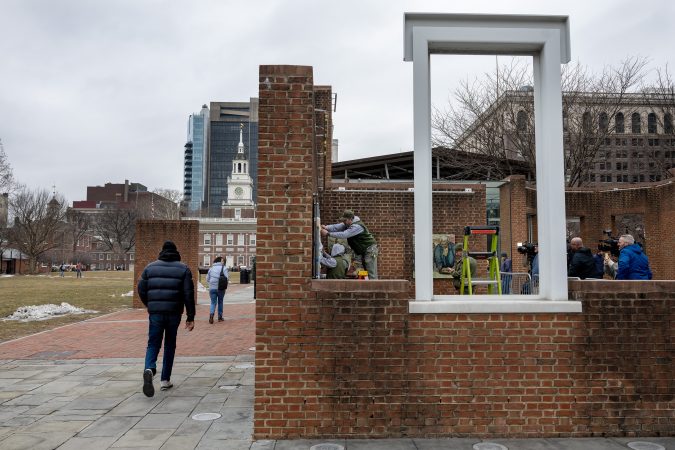
    Mijuel Johnson, a guide with The Black Journey: African-American Walking Tour of Philadelphia, leads District Court Judge Cynthia Rufe (right) as she visits the President’s House in Independence National Historical Park in February.Tom Gralish / Staff Photographer

    The city was unable to convince the Third Circuit panel it has joint decision-making power with the federal government over the entirety of Independence National Historical Park because of the local ownership of Independence Hall.

    Philadelphia has standing to argue in court that the federal government violated the contract signed when the city donated the President’s House to the National Park Service, Hardiman wrote. The agreement included a guarantee the federal agency would maintain the site.

    But the city had to prove it could win based on that argument to keep the injunction alive, and the judges disagreed.

    “The duty to ‘maintain’ is better understood as a general management obligation that accompanies ownership, not a promise that the exhibits will forever remain in place regardless of the owner’s wishes,” the opinion said.

    The city’s claim that the removal was “arbitrary and capricious” under the Administrative Procedure Act also did not find purchase. The federal law allows challenges only to “final” agency actions, but the newly proposed panels show the January removal was not the Trump administration’s “last word on the matter,” the opinion said.

    The ruling vacates U.S. District Judge Cynthia M. Rufe’s injunction from February that ordered the full restoration of the site to its state before exhibits were removed. The National Park Service restored some exhibits, but some metal interpretive panels could not be reinstalled because they required fixes.

    Avenging the Ancestors Coalition, one of the advocacy groups leading efforts to protect the President’s House, said in a statement that the group was disappointed by the decision but would persevere. The coalition was consulting its legal team to consider potential next steps.

    “This is definitely not the end of this fight, nor does it diminish the importance of ensuring that the full truth of our nation’s history is preserved and presented accurately,” the organization said.

    In a video statement Thursday, Parker said, “I will pursue every legal action possible in efforts to reverse this decision.”

    A spokesperson for the U.S. Department of the Interior simply said: “Trust in Trump.”

    Debate over history

    A worker cleans the glass on the panel for Oney Judge after re-hanging it at the President’s House in Independence National Historical Park in February.Tom Gralish / Staff Photographer

    The ruling is an inflection point in the tumultuous legal saga over whether the federal government has power to determine which version of U.S. history is displayed for public viewing — an issue even more salient ahead of the country’s 250th birthday on July Fourth.

    The Trump administration ordered the removal of the President’s House exhibits in January after almost a year of scrutiny of the site. Months later, the government offered its own vision for how those panels would be replaced, quietly uploading them to the National Park Service website in April.

    An Inquirer review of the panels found that the federal government had softened Washington’s role as an enslaver.

    For instance, one proposed panel argues the people who were enslaved at the President’s House “experienced a greater modicum of autonomy than elsewhere in the South such as to explore the city and sometimes even attend the theater, with Washington buying the tickets.”

    Historians argued the original panels were accurate, well-researched, and site-specific. The development of the site in the early 2000s was the product of collaboration across various disciplines including historians, artists, architects, and advocates.

    But Thursday’s ruling says the Trump administration’s proposed displays offer a nuanced view on Washington’s and John Adams’ roles in or opinions on slavery, adequately highlight the stories of the nine people enslaved at the President’s House, thoroughly acknowledge the horrors and brutality of slavery, and uplift key figures in Black history.

    “One panel … explains that Washington ‘often expressed discomfort with the institution and a desire to see it abolished,’ but, ‘as a Virginia plantation owner, his wealth and livelihood were deeply tied to it,’“ Hardiman wrote. ”Other panels provide an even broader overview of slavery and the struggle to extirpate it.”

    The ruling landed just less than three weeks before the 250th anniversary celebrations, and one day before Juneteenth. Attorneys for the federal government said the new panels had been manufactured and were ready to be installed.

    U.S. Rep. Brendan Boyle (D., Philadelphia), whose district includes Independence Park, said in a statement that Thursday’s ruling highlighted the urgency of passing his Protecting American History Act, which would shield historical displays at the park from government censorship.

    “Just a block away from where our nation was founded, Donald Trump is choosing the path of tyrants who rewrite history instead of learning from it,” Boyle said. “As we approach America’s 250th anniversary, we must tell the full truth of our nation’s history — the good and the bad.”

    Another legal case

    Last week, U.S. District Judge Angel Kelley in Massachusetts ordered the Trump administration to restore all exhibits it had removed as part of its “restoring truth and sanity to American history” push. Following the Third Circuit ruling, the appointee of President Joe Biden rejected a Justice Department request for a stay on the order, saying other circuits’ rulings were not binding on her.

    The administration has appealed to the U.S. Court of Appeals for the First Circuit.

    There is not a prescriptive way to resolve such conflicting rulings, which is why some legal scholars argue against so-called universal injunctions, in which one district judge’s ruling affects the entire country. The Supreme Court signaled its discomfort with those types of orders last year.

    Conflicting rulings have become more prevalent during Trump’s tenure, as his administration has issued drastic measures that take immediate effect, said Michael Foreman, a professor at Penn State Dickinson Law.

    Which order ends up prevailing will depend on whether the Massachusetts ruling is stayed, or if the issue escalates to the Supreme Court.

  • Sen. Andy Kim has ‘no confidence in any aspect’ of Trump’s deal to end war in Iran

    Sen. Andy Kim has ‘no confidence in any aspect’ of Trump’s deal to end war in Iran

    WASHINGTON — As lawmakers on Capitol Hill grapple with President Donald Trump’s deal to end the war in Iran, the New Jersey Democrat who spent years weighing national security issues in the Middle East described the agreement as a “mind-boggling” move that will have damaging reverberations across the globe.

    “It’s like setting your own house on fire, a good chunk of it burning. You put it out. And then you start clapping, celebrating yourself. That’s what Trump is like right now,” U.S. Sen. Andy Kim, the only career diplomat in the Senate, said of the memorandum Trump signed Wednesday night.

    Democrats representing the Philadelphia region on Thursday blasted the terms outlining the end of a conflict that many of them repeatedly described as a strategic failure from the start.

    Some prominent Republicans echoed those concerns — criticizing Trump’s removal of U.S. sanctions on Iran and his promise to help pull together a $300 billion fund to rebuild the country’s infrastructure after months of bombings — while Pennsylvania lawmakers who supported the war, like U.S. Sens. Dave McCormick (R., Pa.) and John Fetterman (D., Pa.), remained silent or defended Trump.

    “Reagan is rolling over in his grave,” U.S. Sen. Bill Cassidy, a Louisiana Republican, wrote on social media.

    Kim, who worked at the National Security Council under President Barack Obama and spent time as a civilian adviser in Afghanistan, said it was difficult to imagine what will happen next.

    He said the Trump administration had lost all forms of leverage by agreeing to end hostilities, reopen the Strait of Hormuz, and provide financial benefits to Iran without securing any new or firm commitments around the country’s nuclear program. Though the countries vowed to continue negotiating over the next 60 days, Kim said, Iran will already be in a “position of strength” with the financial relief and thus have little incentive to follow through on its pledge not to pursue a nuclear weapon, which was the primary justification for the war by Trump and his allies.

    “I have no confidence in any aspect of this,” Kim said in an interview.

    Kim said he feared not just prolonged issues between the U.S. and Iran — issues that look almost the same as before the war began — but “reverberations everywhere” as the administration signals how it would handle other foreign conflicts, like Russian President Vladimir Putin’s aggressions in Ukraine or Chinese President Xi Jinping’s moves toward Taiwan.

    “We’re just at such a weak point now. We’re still strong enough that we can muscle other countries, but they see through it now,” Kim said.

    Trump has continued to project strength, including with threats to resume attacks if Iran does not comply with the peace deal.

    “It’s a memorandum of understanding, and if I don’t like it, we’ll go ​back to shooting at them, dropping bombs on ⁠their head,” Trump said Wednesday.

    McCormick, who served in the Army during the Gulf War and has described the war in Iran as one of the most effective military campaigns in history, did not agree to an interview with The Inquirer on Thursday as other Republican senators like Cassidy and U.S. Sen. Ted Cruz of Texas raised concerns. In multiple television interviews, McCormick said he had “a number of questions” about the memorandum.

    “If it has the two things the president’s talked about, I think we’re in good shape,” McCormick said on Newsmax. “One thing is that there can be no path to a nuclear weapon or not giving up the enriched uranium. … That has to happen for this to be successful. And the second thing was the president’s words that you have to pay for performance. You can’t lift the sanctions or give them real economic relief on the sanctions until they take tangible steps toward eliminating that nuclear capability.”

    A spokesperson for U.S. Rep. Brian Fitzpatrick, a Bucks County Republican who has voted for more congressional oversight of the war but has not criticized its mission, referred to a statement from before the terms were announced this week. Fetterman, the only Senate Democrat who has fervently supported the war, did not respond to a request for comment.

    Democrats representing the Philadelphia area, meanwhile, were quick to call the deal a symbol of a conflict that was entirely a failure.

    “Now, after billions of taxpayer dollars spent and 13 American service members’ lives lost, we are no better off in Iran than we were before the war began,” said U.S. Rep. Chrissy Houlahan of Chester County, an Air Force veteran.

    U.S. Rep. Mary Gay Scanlon of Delaware County said she was hopeful that the agreement was a step toward peace while calling the conflict damaging to the U.S. economy and embarrassing on the global stage.

    “The war did not accomplish any of the administration’s alleged goals, and has instead only strengthened Iran’s strategic ambitions,” she said.

    In a post on social media, U.S. Rep. Brendan Boyle of Philadelphia called it “total humiliation.”

    Public surveys showed the war was never popular with the majority of Americans, and at least one new poll released this week showed Pennsylvania voters were continuing to sour on Trump’s handling of foreign policy.

    About 29% of voters in the state agreed with the president’s approach to foreign policy in the June poll released Thursday by Franklin and Marshall College in Lancaster. That figure was down from 37% prior to the war.

    “This was just really a lose-lose everywhere,” said Kim, who helped lead a roundtable on Capitol Hill this week to highlight the economic impact of the war, like increasing fuel and fertilizer costs due to the shipping decline. “We need to move on. But this is going to have such a negative impact on America for so long, and in so many different ways.”

    Staff writer Michelle Baruchman contributed to this article.

  • Janeese Lewis George wins the Democratic primary for mayor of Washington, DC

    WASHINGTON — Janeese Lewis George, who pledged to aggressively stand up to federal intervention into Washington, D.C.’s affairs, won Tuesday’s Democratic primary for mayor, setting up a potential showdown with the Trump administration over its moves to challenge the city’s limited autonomy.

    In an overwhelmingly Democratic city, Lewis George is likely to take the top spot in November’s general election, replacing moderate Muriel Bowser, who decided not to run again after three terms.

    Lewis George joins Robert White Jr., who won the Democratic primary for the district’s delegate to Congress, as the top local officials who likely will contend with the federal government’s intentions for the city. They each campaigned on a promise to take a harder line than their predecessors against the Trump administration’s moves on the district, including its deployment of the National Guard on an ongoing, open-ended mission meant to fight crime.

    “As mayor, I will work with anyone who makes D.C. safer,” Lewis George told a crowd of cheering supporters Tuesday night, “but I will also stand up to Trump.”

    Washington has limited autonomy and federal leaders retain significant control over local affairs, including approval of the budget and laws passed by the D.C. Council.

    President Donald Trump further encroached on that autonomy last year when he briefly federalized the city’s police force and deployed an ongoing law enforcement surge that included the National Guard. Trump’s efforts to downsize the federal government also roiled the capital region, costing thousands of people their jobs. He has also been reshaping the city by renovating storied landmarks and putting his name or image on buildings.

    Lewis George, a self-described democratic socialist and a member of the D.C. Council, has already come under fire from Trump, who last week threatened to place the city under federal control if she won.

    “Maybe we’d take back Washington, run it on the federal basis,” he said.

    Her main opponent, former D.C. Council member Kenyan McDuffie, conceded the race Thursday and said he had contacted Lewis George to congratulate her.

    “While the final certification process will continue, it is clear that the voters have chosen a different path,” he said in a statement. He wished Lewis George luck in the general election and called on his supporters to continue working.

    “The campaign may be over, but the work of building a safer, more affordable, more prosperous city continues,” he said.

    Lewis George, 38 and a third generation Washingtonian, has vowed to overrule an executive order by the city’s police chief permitting local law enforcement to cooperate with Immigration and Customs Enforcement agents. Lewis George argued the order “hurt the trust of our community.”

    Lewis George also vowed to use any levers available to her through the city’s home rule compact to resist what she called authoritarian infringements on the district’s local governance.

    “We have legal tools we can use to fight back,” she told the Associated Press in an interview before the vote. “And we know that when we have gone to court, we’ve won.”

    Bowser found herself walking a fine line between staying in Trump’s good graces and responding to the concerns of constituents, many of whom said she didn’t push back hard enough on Trump’s actions. Eleanor Holmes Norton, the 18-term, 89-year-old delegate to Congress, meanwhile faced mounting concern from critics who said she wasn’t forcefully pushing back on the Trump administration’s moves against the city.

    Lewis George has also made affordability a top priority, and her platform has included issues like rent support as well as ending below-minimum-wage pay for tipped employees and controlling high utility rates.

    Tuesday’s primary marked the first time in a generation that D.C. residents voted for a new mayor and delegate in the same election. It was also the city’s first election using ranked choice voting.

  • Delaney Hall’s current crisis builds on decades of N.J. immigration detention

    On May 22, detainees inside Delaney Hall in Newark, the largest immigrant detention center in the Northeast, operated by the private corporation GEO Group, announced a labor and hunger strike in response to months of abuse, unattended complaints over detention conditions, and unmet medical, legal, and personal needs. Detainees detailed these conditions in a series of public letters, as family and community members protested and advocated for freeing their loved ones.

    Their protests were met with violence. Some detainees were pepper sprayed, brutalized, and transferred, while masked ICE agents assaulted protesters outside of Delaney. New Jersey state police later arrived on horseback, tear gassing the crowds and sending community members to the hospital.

    Complaints had been ongoing since Delaney Hall was reopened as a detention facility in May 2025, but the origin of these abuses actually began four decades earlier ago in 1993, in Elizabeth, a small city less than 10 miles away, with the opening of New Jersey’s first privately run detention facility, the Elizabeth Detention Center (EDC).

    The history of EDC helps us understand that the battles over Delaney Hall are the outgrowth of detention privatization, its intersection with mass incarceration, and bipartisan political support for detention that has rarely faltered. It also demonstrates the consistency with which detained people have resisted their detention. Far from the southern border, New Jersey has long been a central node in the detention and deportation machine—and in the fight to end it.

    New Jersey was home to the Ellis Island Immigration Station, which opened in 1892. Before the Immigration Act of 1924, Ellis Island served mostly as a gateway and immigrant processing center, but from the 1930s and until its closure in 1954, it operated as a dedicated detention facility, leading a Supreme Court Justice to refer to it as an “island prison.”

    Detention became more central to U.S. immigration policy in the 1980s and 1990s. In 1980, for example, the United States detained thousands of Cuban refugees who came during the Mariel boatlift. Private corporations, which governments had begun to turn to for running their prisons, expanded into new markets of immigrant detention. Today, more than 90% of detention centers are run by for-profit corporations.

    The presumed “need” for expanding detention bed spaces surfaced after the first bombing of the World Trade Center in February 1993. The Immigration and Naturalization Service (INS), the predecessor to today’s immigration agencies, issued a request for proposals for a detention center, ideally located near the three major airports in the New York City area. Because the WTC plotters were foreign-born, politicians used national security as an excuse for wide-ranging changes to the immigration system.

    Esmor Correctional Services, a for-profit company which operated halfway houses and welfare hotels, submitted the winning bid to turn a warehouse in Elizabeth into a NYC-area detention center housing up to 300 detainees. Almost immediately after its opening in 1994, people detained there began complaining of inhumane treatment and conditions.

    By 1995, the awful conditions and frequent abuse became public knowledge when detainees organized a hunger strike described in numerous articles in the Bergen Record by journalist Elizabeth Llorente. As Hawa Jama, a Somalian asylum seeker and the lead plaintiff in a lawsuit against Esmor, described in a deposition, “I complained personally to every INS person, every Esmor official… I come to this country to save my life, to ask [for] asylum. And they put me in jail, hell. I can describe hell… Esmor was hell.”

    On June 18, 1995, the detainees staged a riot inside the facility. The media attention spurred by the hunger strike and the uprising caused INS to terminate its contract with Esmor. In its place, INS contracted Corrections Corporation of America (rebranded as CoreCivic in 2016), which has run it ever since.

    Detention space increased in 1996 when President Bill Clinton signed two laws affecting immigrants in the United States. The Illegal Immigration Reform and Immigrant Responsibility Act (IIRIRA) and Antiterrorism and Effective Death Penalty Act (AEDPA) delegalized lawful permanent residents who had committed certain crimes, widened what counted as an “aggravated felony,” and made more immigrants deportable and detainable, mandatorily, and indefinitely. This merged with the increasingly harsh penalties for drug crimes, which affected immigrants. The 1996 laws also targeted asylum-seekers as subject to potential removal, creating an artificial need for more detention space, and revoked the discretion of immigration authorities to release certain noncitizens from detention.

    In the 1990s and early 2000s, EDC was just one piece in the larger infrastructure of detention in New Jersey. Bergen, Essex and Hudson counties had also begun to hold immigration detainees in their jails against payment from the federal government. Delaney Hall, which first opened in 2000 as a halfway house for people with substance abuse issues convicted of low-level offenses, also began to hold immigrants for profit. As Essex County Executive Joseph D. Vincenzo said to the Star Ledger in 2008, “This is a home run for us. We have to find a way to bring in new revenue, and this is the way to do it.”

    ICE detention in New Jersey peaked in 2009, then declined until 2015, and increased again after President Donald Trump issued a January 2017 executive order that greatly expanded who would be detainable under the law. In New Jersey alone, ICE arrests more than doubled in 2017 as a direct consequence of the administration’s decision to prioritize the detention of migrants and asylum seekers with no criminal convictions. Because 2017 bail reform had reduced the number of people held in New Jersey’s jails awaiting trial, ICE detention became an even more attractive source of revenue for local county jails.

    Activists and advocates working across the New York/New Jersey border had been fighting against immigration detention since the 1990s. Coalition members organized protests, advocated with communities, and pressured public officials to end ICE detention in New Jersey. Fearing that detention would become a death sentence during the early months of Covid-19, detained people in every facility in the state went on a hunger strike, bringing renewed attention to the campaign of ending detention.

    Made By History sponsors. FOR USE ON MADE BY HISTORY STORIES ONLY.Inquirer Staff

    In 2021, the political tide turned as county and state democrats came out publicly against ICE detention. Within the course of a year, the county jails depopulated their ICE detainees and Governor Phil Murphy signed a law (AB 5207) that banned the creation or renewal of detention contracts with ICE.

    ICE detention was nearly eradicated in New Jersey. The EDC was the only facility still in operation. Under the new anti-detention law, when its contract came up for renewal, it, too, would close. Instead, CoreCivic sued New Jersey in a U.S. District Court, claiming the state law was unconstitutional. GEO Group soon filed suit as well. CoreCivic and GEO Group were joined by the Department of Justice under President Joe Biden, who saw New Jersey as essential to immigration enforcement.

    The District Court’s 2023 decision striking down New Jersey’s anti-detention law was appealed by the New Jersey Attorney General’s office before the U.S. Court of Appeals for the Third Circuit. The federal appeals court upheld the 2023 ruling and thereby created the possibility for Delaney Hall to reopen on May 1, 2025, and to become the largest immigrant detention facility in the Northeast today.

    The lawsuit shows a key tension that continues to play out. While immigration is managed by the federal government, the detention system that EDC and Delaney Hall are a part of, has been forged by bipartisan support at the county and state levels and motivated by economic interests. The overlapping “war on crime” and “war on drugs” caused mass incarceration and immigration detention to become intertwined. Trump has built on this foundation, not created an entirely new system.

    Understanding the current situation at Delaney Hall requires this historical context. More than 30 years ago, the EDC proved to federal and state leaders that privatized immigration detention could “work” in New Jersey, as long as the mistreatment and abuse of detained people could be kept out of the spotlight. But history also shows us that when detained community members resist through complaints, lawsuits, hunger strikes and, even, an uprising, their voices and experiences reveal the system’s underbelly and inspire systemic change. We hope that history will teach future generations that such efforts are worthwhile.

    Ulla Berg is a migration scholar at Rutgers University and co-editor of the book, Elizabeth Detention Center: A Social History of Immigration Detention in New Jersey and the United States (Rutgers University Press, 2026).

    Mary Rizzo is a historian at Rutgers University-Newark, and the co-author of a chapter in Elizabeth Detention Center.

    Made by History takes readers beyond the headlines with articles written and edited by professional historians. Opinions expressed do not necessarily reflect the views of The Inquirer.

  • New Pa. poll shows Shapiro leading handily against Garrity, trouncing Trump in popularity

    New Pa. poll shows Shapiro leading handily against Garrity, trouncing Trump in popularity

    Democratic Gov. Josh Shapiro has a commanding lead against his Republican rival Stacy Garrity in a head-to-head matchup, and he maintains steady job approval ratings five months ahead of the November election, according to a new poll of Pennsylvania voters from Franklin and Marshall College.

    Shapiro leads Garrity 50% to 28% in the 2026 governor’s race, a crushing advantage well outside of the survey’s margin of error of 5.1 percentage points. It is the first major poll released since both candidates officially secured their parties’ nominations in uncontested primaries last month.

    The survey, conducted June 8-14 by the Center for Opinion Research on behalf of Franklin and Marshall, involved 546 registered Pennsylvania voters. Roughly 42% were Democrats, about the same percentage were Republicans, and about 16% were independents.

    Shapiro won almost half of independents and just over a quarter of Republicans, who rated his performance as excellent or good.

    (function(){function e(){window.addEventListener(`message`,function(e){if(e.data[`datawrapper-height`]!==void 0){var t=document.querySelectorAll(`iframe`);for(var n in e.data[`datawrapper-height`])for(var r=0,i;i=t[r];r++)if(i.contentWindow===e.source){var a=e.data[`datawrapper-height`][n]+`px`;i.style.height=a}}})}e()})();

    About an equal proportion of all voters — 48% — said Shapiro is doing an excellent or good job as governor as those who said he is doing a fair or poor job.

    Shapiro’s approval comes as he continues building a national profile, likely with ambitions for higher office.

    He also boasts relative popularity despite voters’ deep concern with their personal finances and the state of the economy, the top issue among every partisan group.

    “The big concern that people face is economic, and even though that’s the problem that we see facing us, the blame goes outside of Pennsylvania,” said Berwood Yost, the director of the Center for Opinion Research. “People don’t see [Shapiro] as being responsible for the economic concerns that they have.”

    But people do blame President Donald Trump.

    Just 29% of voters said Trump is doing an excellent or good job, while 71% said he is doing a fair or poor job. It marked a 10-percentage-point drop from March, when his positive approval rating was 39%.

    While 63% of Republican voters gave Trump positive reviews in the new poll, that number was almost 80% in March.

    Just under half of respondents said they are “worse off” financially than one year ago, and 35% of voters said the economy, including unemployment, housing and real estate costs, and higher gas and utility prices, is the most important problem facing the state.

    “Pennsylvania should be doing so much better,” Garrity said in a previous interview with The Inquirer. “[Voters] know we’re falling behind. They know that we have a governor who’s more interested in Pennsylvania Avenue than helping Pennsylvania families. They’re very worried about utility prices because their electric bills are going up, up, up. Groceries are expensive.”

    But among those who mention economic problems, voters in the poll trust Democrats over Republicans, 42% to 24%, as the party that can best handle the issue.

    Shapiro’s campaign released a new TV and digital ad Tuesday focusing on his expansion of workforce opportunities, such as apprenticeships in trades like welding.

    “Governor Shapiro bet on workers like me. I’m proof that bet’s paying off,” said Ryan, a worker in Western Pennsylvania, in the ad.

    (function(){function e(){window.addEventListener(`message`,function(e){if(e.data[`datawrapper-height`]!==void 0){var t=document.querySelectorAll(`iframe`);for(var n in e.data[`datawrapper-height`])for(var r=0,i;i=t[r];r++)if(i.contentWindow===e.source){var a=e.data[`datawrapper-height`][n]+`px`;i.style.height=a}}})}e()})();

    Yost said Garrity is a “high-quality candidate” with a great resume that may keep down-ballot Republicans afloat, but she is competing against a popular incumbent in a year where Democrats are poised to win seats.

    “It’s rough to be a Republican at the moment,” he said. “You’re facing those headwinds, no matter what office you’re running.”

    On the economy, the issue voters care most about, a mere 17% of voters approve of how Trump’s administration is handling inflation.

    “The concerns about personal financial circumstances, the economy, and the cost of living — they’re paramount in people’s minds, and they’ve become more pronounced since March,“ Yost said. “That’s had an effect on the president’s job approval ratings in the state, which have declined pretty substantially.”

    In the last four gubernatorial races, the average margin of victory has been about 13 percentage points, Yost said, while presidential races tend to be much tighter — about 2.2 points.

    “What’s essential to understand is that these races happen in a different context than the presidential races. There are a lot of things different about them, and typically incumbent governors have a real advantage,” he said.

    State issues show more consensus

    Many of Shapiro’s budget priorities, such as restricting cell phones in schools and taxing skill games, have widespread public support.

    Almost nine out of 10 people support limiting access to cell phones in classrooms, which follows Shapiro’s urge for legislation to “get distractions out of the classroom and create a healthier environment in our schools.”

    And 71% of registered voters favor regulating and taxing so-called skill games, the slot machine look-alikes around Pennsylvania — an 11-percentage-point increase compared with previous F&M polling in 2024.

    The Pennsylvania Supreme Court ruled Monday the skill games are, in fact, slot machines and should be regulated as such, clearing the way for the state to place new rules on the devices. The decision was celebrated by Democrats who view the machines as “predatory.”

    Most voters, 70%, also support having an independent redistricting commission to draw state legislative districts, and 59% oppose mid-decade redistricting.

    Texas redrew its congressional maps last August at Trump’s urging, shifting five seats to lean more heavily Republican. California voters approved a constitutional amendment in November to permit the adoption of replacement maps that would favor Democrats. Other states have also voluntarily redrawn or created new maps following litigation.

    Shapiro said he also opposes mid-decade redistricting, telling reporters last August: “It’s not on the table here in Pennsylvania.”

    As parties compete for control of the U.S. House of Representatives this midterm election season, the poll found that voters prefer Democrats over Republicans by 12 points, 47% to 35%. Shapiro has personally backed several candidates and is hoping to use his influence to help Democrats win the majority this November.

  • Rowan is closing a health center for abused children because of Gov. Mikie Sherrill’s proposed budget

    Rowan is closing a health center for abused children because of Gov. Mikie Sherrill’s proposed budget

    Julie Harrison, a clinical psychologist in South Jersey who works with children who have experienced abuse, received a letter from Rowan University: Notice of Layoff.

    Her position as a teacher, researcher, and provider in Camden County would be eliminated “due to the loss of state appropriation funding,” the May 12 letter said. Harrison works for the Rowan-Virtua Child Abuse Research Education and Service Institute (CARES), which provides evaluation, treatment, and other services to children who have experienced abuse in South Jersey, and conducts research on the subject.

    The notice came after Gov. Mikie Sherrill proposed slashing the $1.85 million line item in her state budget plan for the program.

    CARES has offices in Stratford in Camden County and Vineland in Cumberland County. The Vineland location, which opened two years ago to provide better access to families in deeper South Jersey, is shutting down due to the anticipated cuts.

    “With Mikie Sherrill being in office, we had a lot of hope because she really was pretty loud about wanting to help kids, wanting to help families, wanting to really champion mental health services, and so we were pretty surprised about this budget,” Harrison said in an interview.

    The clinician is pregnant with twins and her job prospects are uncertain as the clock ticks until her final day at CARES. But she is mostly concerned about the impacts the funding cuts will have on children facing trauma in South Jersey, and the workers caring for them.

    The South Jersey program serves more than 1,500 children across more than 4,000 visits in both locations. Though just about 200 families use the more rural Vineland location, that is where these types of services can be the most critical, Harrison said.

    “It’s a pretty resource-dry community,” she said. “There’s not a ton of public transportation to get around. … The amount of services that are available to these families generally is much lower than other parts of New Jersey.”

    Harrison is one of about 20 people whose jobs are being impacted by the anticipated funding cuts across both office locations, according to union members. The majority of those are layoffs, and some employees had their hours dramatically reduced to the point they lost their healthcare benefits, according to union members.

    Ali A. Houshmand, president of Rowan University, said in a May 11 email that Sherrill’s proposed cuts forced the child abuse care center to pull back its services beginning July 1. He announced the closure of the Vineland office without saying it outright.

    “CARES will consolidate its work into our Stratford campus offices and will continue to fulfill its mission there: delivering high‑quality evaluations and treatment, supporting partner agencies across the region and educating the next generation of physicians and health professionals,” he said in the email.

    Joe Cardona, a Rowan University spokesperson, said the program also receives $3 million from other state agencies that will not be cut. He said the program’s goal is to offer the same services but reduce the quantity of care.

    “The exact outcome, of course, is to be determined,” he added.

    What is clear is that the closing of the Vineland center will have a domino effect on Stratford.

    “It’s creating an environment where people who are already doing multiple roles, performing multiple jobs, are going to be asked to do more,” Harrison said. “It’s just that horrible ‘do more with less.’”

    Harrison said she was just days away from submitting a grant application to start a food pantry out of the Vineland office when she heard the news. Her team did not submit the application after learning about the cuts and Vineland’s planned closure.

    CARES is one of four legislatively mandated diagnostic and treatment centers through the New Jersey Department of Children and Family, though it provides more expansive medical and mental healthcare than legally required. The center champions trauma-focused cognitive behavioral therapy, an internationally recognized model that was developed by the South Jersey program’s codirector.

    The program has tried to keep waiting lists for trauma care to under three weeks, but it has now grown to 10 to 12 weeks and the wait for care will probably get longer, Harrison said.

    “There is a high cost to what untreated trauma can look like for medical, mental health, all those services down the road if trauma isn’t treated early on,” she said.

    Dr. Ali A. Houshmand, president of Rowan University, speaks to students and staff at a fundraising event in September 2025. Erin Blewett / For The Inquirer

    ‘Tough choices’

    Sherrill championed improving mental health for young people on the campaign trail and in her budget proposal by allocating $33 million to expand mental health services for students with high needs in K-12 schools, $500,000 for a new social media research center focused on young people’s mental health, and $125,000 for the newly created New Jersey Office of Youth Online Mental Health Safety and Awareness.

    Her office did not respond to a request for comment on her proposal to decrease funding for CARES.

    In response to a request for comment for an earlier Inquirer story about Sherrill’s decision to cut all state funding for Rowan’s brand-new veterinary school, an administration official cited the governor’s “blanket cut to all legislative add-ons.” These items refer to funding allocations legislators secure for their district that are sometimes criticized as “pork” or “Christmas tree items.” They can range from improvements for a local park to community services, like CARES.

    Sherrill, in her budget address, spoke about making “tough choices” in order to have “the most fiscally responsible budget that our state has seen in years.”

    But the governor carved out line items for her own priority projects, like $250,000 toward a new statue of the Rev. Dr. Martin Luther King Jr. in Camden.

    The state budget is a negotiation between the governor and legislative leaders due June 30, so it is unclear how much funding these programs will get in the end. But Rowan has moved forward as if the money for CARES is not on the table.

    This is not the first time the program has been at risk as part of the budget dance.

    Former Gov. Phil Murphy proposed cuts to the program last year, citing “belt-tightening,” but legislators were able to get the money back in the budget.

    This year, Harrison said, people are not optimistic because CARES is one of so many programs Sherrill struck a pen through.

    Dio Tsitouras, the executive director of the American Association of University Professors Biomedical and Health Sciences union, said he hopes Sherrill allocates more money to CARES because more state revenue has been identified since her budget proposal. But state officials have still warned of financial uncertainty on the horizon.

    “The CARES program is invaluable to protecting our state’s most vulnerable children,” Tsitouras said.

  • Councilmember Cindy Bass will remain the Democratic ward leader in Mount Airy. But she agreed to share power with progressives.

    Councilmember Cindy Bass will remain the Democratic ward leader in Mount Airy. But she agreed to share power with progressives.

    After a week of heated conflict that left both sides looking worse for wear, the race to become the Democratic leader of Mount Airy’s 22nd Ward came down a tie.

    Philadelphia City Councilmember Cindy Bass and her progressive challenger, Octavius Price, each received 27 votes from their fellow committeepeople in the initial rounds of voting during Wednesday night’s redo of the race for ward leader, an influential party position in one of the most voter-rich neighborhoods of the city.

    A series of closed-door meetings followed, including a one-on-one meeting between Bass and Price.

    Ultimately, Price agreed to allow Bass to remain as ward leader as part of a power-sharing agreement in which he will become ward chair, the No. 2 position. They also agreed to elect a joint slate of officers to fill out the ward’s executive committee.

    “We both had supporters who weren’t here today, so we would have just kept tying, essentially,” said Price, a fiber optic engineer and a member of the Pennsylvania Air National Guard. “And because I’m committed to the ward, I decided to take a position that was not necessarily a ward leader, but still gives me the time and the capacity to work with my constituents.”

    Bass described the outcome as “a win.”

    “We’re looking forward to working with everybody,” Bass told reporters. “We’ve got some new members who have joined the ward, and we’ve got some other folks who will be the staples of the organization who can help keep it going.”

    The drama began on the evening of June 8, when Bass declared herself the victor of the ward leader race after a divided voice vote of committeepeople during a meeting at the Germantown Seventh-day Adventist Church. The Inquirer published a video of the meeting showing Bass refusing requests to hold a roll-call vote that could have clarified the results, prompting the Democratic City Committee to order a redo of the race.

    Both sides spent the ensuing week attempting to win over committeepeople for the rerun.

    On Wednesday morning, progressive activist Nate Holt visited committeeperson James Harrison at his home and offered him money while encouraging him to vote against Bass, videos of the encounter obtained by The Inquirer show.

    Octavius Price, a fiber optic engineer and member of the Pennsylvania Air National Guard, ran for 22nd Democratic Ward leader. (Photo courtesy of Octavius Price)Sean Walsh

    Price condemned Holt’s behavior and said he had “cut all ties with him” in a statement Wednesday evening before the vote.

    Holt has not responded to questions about why he offered money to Harrison, but said in a statement he did not court committeepeople at the direction of any ward leader candidate.

    As it happens, Harrison’s vote could have been decisive. But he did not attend Wednesday’s meeting.

    Additionally, one committeeperson who did show up abstained, declining to vote for either candidate.

    Another key vote came from former Councilmember Derek S. Green, a committeeperson in the ward who briefly considered running for ward leader and said he abstained during the initial vote last week, ultimately sided with Bass.

    Green said the incident with Holt and Harrison swayed his vote.

    “I learned about the video,” Green said, explaining his decision. “I’ve never seen that in the history of politics.”

    The redo election took place Wednesday night at party headquarters. The party’s organization committee, which is made up of other ward leaders and chaired by former Councilmember Sharon Vaughn, oversaw the election.

    Bass is often at odds with progressive activists in her Northwest Philadelphia-based 8th Council District. She narrowly won reelection in 2023 and likely faces another stiff challenge in next year’s Council race.

    Ward leaders and committeepeople, the front-line workers of the party, are charged with getting out the vote for party-endorsed candidates and fielding constituent services requests.

    Control of the voter-rich 22nd Ward could play a big role in next year’s Council race.

    The 22nd Ward was one of three elections the party ordered to be rerun Wednesday night. In both other races, the candidates who won the initial votes also prevailed in the redos.

    In North Philadelphia’s 14th Ward, Valerie Williams defeated the incumbent, Arthur Green, in a 10-8 vote.

    And in an open race for the Northwest Philadelphia-based 17th Ward, Tyrone Barge beat Melissa Schley, a former ward leader.

    Barge said that his race did not involve significant ideological differences. Instead, committeepeople supported him because he promised “hard work” and increasing efforts to drive turnout for Democrats.

    “We’re gonna do some exciting things in the ward,” Barge said in an interview. “It’s gonna be different.”

    The results put an end to a dramatic party election cycle that saw longtime Democratic City Committee chair Bob Brady reelected to an 11th term with a new roster of lieutenants led by Vaughn, the party’s new first chair.

    Brady said after Wednesday’s election that party leaders at one point considered deciding the race through a coin toss.

    “We didn’t know what to do with it. And then the two got together and made an agreement and made life a lot easier,” Brady said. “The best thing can happen is those two factions that they had all agreed on this … and the two are going to work together, and I told them I would come and work with them.”

  • Activist offered money to committeeperson and asked him to vote against Councilmember Cindy Bass in Northwest Philly ward, videos show

    Activist offered money to committeeperson and asked him to vote against Councilmember Cindy Bass in Northwest Philly ward, videos show

    A progressive activist on Wednesday offered money to a Democratic committeeperson while attempting to convince that person to vote against City Councilmember Cindy Bass in Wednesday night’s 22nd Ward leader election, videos obtained by The Inquirer show.

    The activist, Nate Holt, is a former 22nd Ward committeeperson working to support progressive candidate Octavius Price’s bid to unseat Bass from the party leadership post.

    The 22nd Ward leader election has already generated considerable controversy. Wednesday night’s vote will be a redo of the contested initial election, which was last Monday.

    The Inquirer last week published a separate video in which Bass declared herself the winner of the first election following a contested voice vote. That prompted the Democratic City Committee to order the vote being held at party quarters Wednesday night.

    Both sides have been working to win over committeepeople in advance of the rerun.

    In the new videos, Holt is standing on the porch of committeeperson James Harrison. Holt knocks, but Harrison doesn’t immediately come to the door. Holt then appears to shout to Harrison through a window.

    “James, this is Nate. Nate Holt, tall white boy. I got your money, man,” Holt says in the videos, which are filmed from a car parked on the street outside the home. “Yo, you know me.”

    Holt, who is not a committeeperson, at one point tells Harrison he’s “from the committee.”

    Harrison eventually comes to the door.

    “Yeah, so you know about this vote tonight? I have some money for you from the previous election,” Holt says in part. “We’re trying to get Cindy Bass out. … Were you going to attend tonight, or do you want to sign a form so that somebody else can vote for you?”

    It was not clear what previous election Holt was referencing.

    At one point, Harrison says, “Where the money at?”

    “Look, I’m going to give you 30 right now,” Holt responds in part.

    The audio then becomes difficult to discern as the person shooting the videos — a 12th Ward Democratic committeeperson supporting Bass named Earl Graham — gets out of the car and ends the recording.

    Graham confirmed he took the videos and said he went to Harrison’s house while also trying to win his support in Wednesday night’s election.

    “I saw somebody at his house banging on the door saying, ‘Hey, I got some money for you,’” Graham said. “I just pulled over and just recorded.”

    In a statement, Holt confirmed he “visited the house of a 22nd ward committeeperson” on Wednesday morning and encountered a Bass supporter.

    He emphasized that he acted alone and did not approach committeepeople at the direction of any candidate.

    Holt did not respond to questions about the money he referenced in the videos.

    Bass and other Democratic leaders respond

    Ward leaders and the committeepeople that elect them are the neighborhood-based front line soldiers of the Democratic Party, working to get out the vote for party-endorsed candidates and field constituent services requests.

    Bass was heavily criticized for her handling of the initial vote, in which she declared herself the victor after a contested voice vote and refused to honor requests for a roll-call vote that could have clarified the results.

    Now Bass is saying it is her opponents who are using underhanded tactics.

    “It’s very clear what the intent was of this transaction or attempted transaction, and I don’t even know what to say. I’m flabbergasted,” Bass said in an interview after viewing the videos Wednesday.

    She added that the videos have been shared with the district attorney’s office election integrity unit.

    Spokesperson Marisa Palmer said that, under the office’s policy, she could neither confirm nor deny the existence of an investigation.

    “The Philadelphia DAO takes seriously the democratic rights of the residents of Philadelphia and protects those rights even-handedly,” Palmer said.

    At his house Friday evening, Harrison on Friday evening declined to talk at length about the ordeal but said Holt did not give him any money.

    “He ain’t give me nothing,” Harrison said. “He came asking me to sign for somebody else. … Everybody wants me to do what they want.”

    Price on Wednesday said he was “saddened and outraged today when I learned of the video showing community member Nate Holt knocking on a [committeeperson’s] door, and offering him money in an attempt to get him to come to the door and participate in tonight’s election whether in person or by proxy.”

    “I did not, nor did anyone on my campaign, advise Nate Holt to offer any committee person money in exchange for their support,” Price said in a statement. “We had no knowledge of his plan to do so. Nate Holt is not a committee person and we have since cut all ties with him. ”

    Price also said his “resolve remains stronger than ever … to give voice to all those doing the work to build a stronger and more effective Democratic Party.”

    The election will take place at party headquarters on Spring Garden Street, but committeepeople can vote by proxy if they sign affidavits giving their support to one side.

    Democratic City Committee chair Brady said the committee had already planned to independently verify all proxies submitted at the meeting before the videos surfaced.

    “Any effort to improperly influence these elections, financially or otherwise, is an affront to our democracy and our values in the party,” Brady said in a statement.

    Holt’s history with Bass

    In a statement, Holt confirmed he “visited the house of a 22nd ward committeeperson” on Wednesday morning and encountered a Bass supporter.

    He emphasized that he is not a committeeperson and was not at the moment attempting to get Harrison to sign a proxy voting affidavit.

    “I did not coordinate this visit to the committeeperson with anyone else, neither other committeepeople, nor any candidates for ward offices,” Holt said. “I acted alone. I am not currently a committeeperson. I am not voting in any ward election, and I have not collected any proxy votes for any candidate, nor handled any proxy vote forms either physically or digitally.”

    But in the videos, Holt at one point explains proxy-voting to Harrison.

    “You don’t have to go. You can just sign the form, and somebody else can vote for you,” Holt tells Harrison. “I can get you that form.”

    Holt and Bass have history.

    Bass in 2024 had the party remove Holt and several others as 22nd Ward committeepeople for allegedly backing Working Families Party candidates for Council. Party bylaws prohibit committeepeople from backing non-Democrats.

    Holt has previously worked on a State House campaign for State Rep. Chris Rabb, a progressive who won last month’s high-profile race for Pennsylvania’s 3rd Congressional District race.

    Rabb said he was unaware of the incident Wednesday and declined to comment.