The Justice Department has convened a special grand jury in Washington, a rare legal body that officials say could pave the way for federal prosecutors in the nation’s capital to investigate some of its biggest and most controversial cases.
Unlike a typical grand jury, a special grand jury can release a potentially critical report about the subject of an investigation, even if prosecutors do not find enough evidence to bring the person to trial.
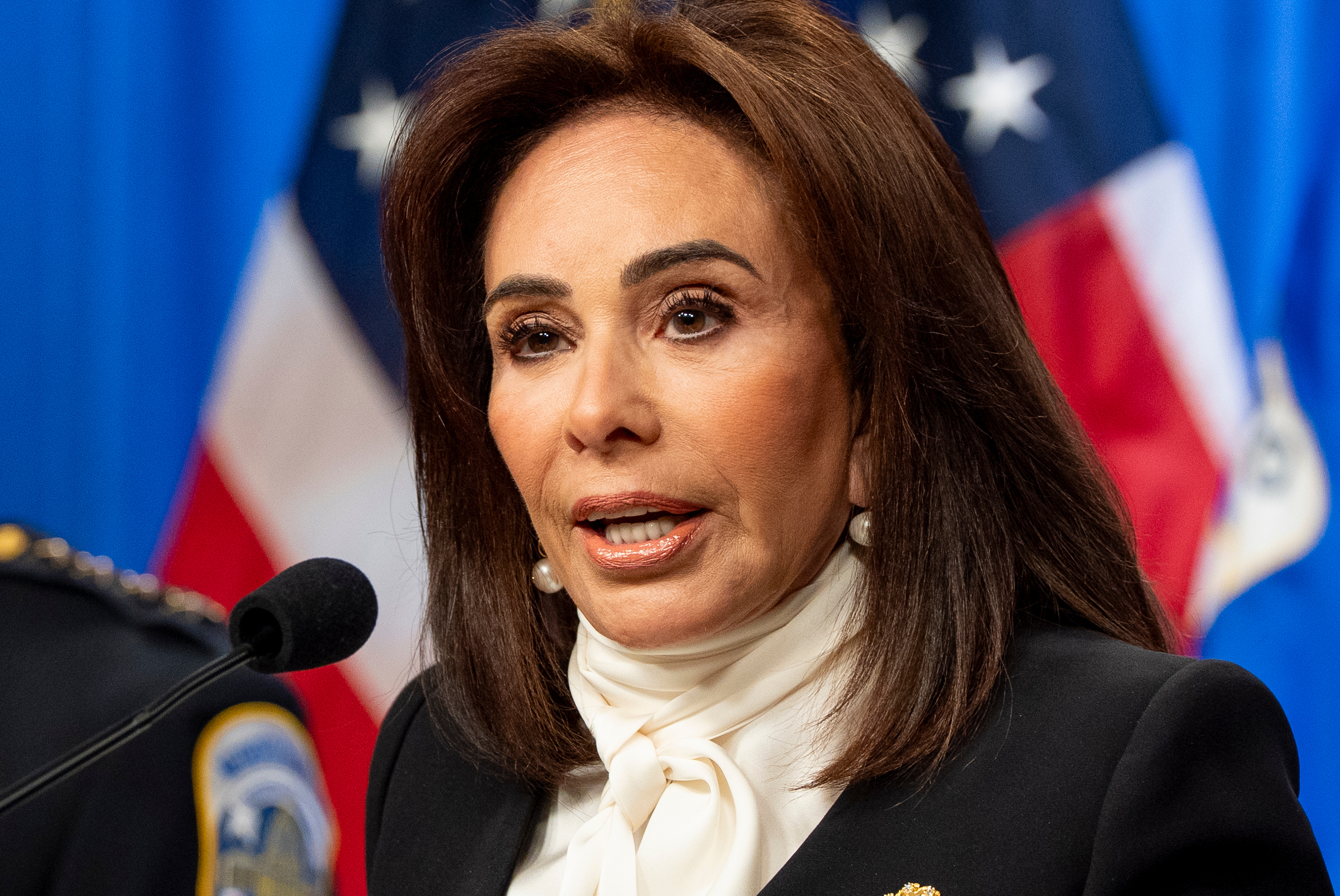
D.C.’s special grand jury is to be overseen by Steven Vandervelden, one of U.S. Attorney Jeanine Pirro’s top allies in her office, according to three government officials familiar with the matter, who spoke on the condition of anonymity to discuss a matter that has not been made public.
Pirro has relied on Vandervelden to investigate some of her office’s most controversial cases, including a probe into then-Federal Reserve Chair Jerome H. Powell and an inquiry into allegations that the D.C. police force purposely skewed its crime statistics.
It is unclear what the new special grand jury will be tasked with probing, but those interviewed said it is a notable move, especially given President Donald Trump’s interest in prosecuting his adversaries.
Special grand juries, on the rare occasions when they are convened, are typically used to pursue investigations of government officials or probe broad conspiracy cases and organized criminal activity. (A group of corruption cases that prosecutors deem to be linked could qualify as the latter.)
Steve Friedland, a law professor at Elon University, said strict procedures govern how special grand juries can be used — but that there is also flexibility.
“This could be very interesting,” Friedland said. “Each administration has its own approach to how it enforces the law and how it uses the tools available to it.”
The U.S. attorney’s office in D.C. declined to comment.
There is no known recent precedent for a special grand jury in Washington, legal experts said, although they said they could not entirely rule out that one has escaped public notice.
They are more common in larger jurisdictions home to more than 4 million people, including in New York and Texas, where federal guidelines says one must always be available, under the belief that organized crime is more common in larger areas.
On the state level, Georgia prosecutors convened a special grand jury to investigate alleged interference in the 2020 presidential election by Trump allies in the state. On the federal side, a special grand jury was empaneled in Houston more than 20 years ago to investigate Enron, a powerful energy company that was engulfed in a massive fraud scandal.
“They are very unusual,” said Niki Kuckes, a professor at Roger Williams University with expertise in the grand jury process. “Sometimes they can issue a report, which a regular grand jury can’t do.”
The convening of the special grand jury comes as Pirro and top Justice Department officials face pressure to deliver on cases that Trump wants prosecuted. Todd Blanche, Trump’s former personal lawyer, was recently confirmed as attorney general, solidifying his position atop the department.
Pirro’s record in moving against the administration’s perceived enemies has been mixed at best. Her office has failed to successfully prosecute a man accused of throwing a Subway sandwich at a federal agent; six Democratic lawmakers who released a video advising service members to reject illegal orders; and Powell, whom Trump accused of mishandling a renovation project.
Last week, the president suggested Pirro’s job was in jeopardy after she dismissed charges against a former Olympian who had been accused of vandalizing the Lincoln Memorial Reflecting Pool. The officials familiar with the convening of the special grand jury said that prosecutors submitted the paperwork for it before Pirro dropped the Reflecting Pool-related charges.
In general, grand jury proceedings are a secretive part of the legal process in which prosecutors present evidence and jurors vote on whether there is evidence to charge someone with a crime.
A special grand jury has several unique characteristics. The 23 members focus only on a single case — or a string of cases that prosecutors present as related — instead of juggling a variety of matters like most grand juries. And a special grand jury’s ability to issue a report at the end of an investigation sets it apart.
That report can name specific individuals even if prosecutors do not find enough evidence to bring the people to trial, as long as the report shows that there is a “preponderance of evidence” of wrongdoing. That is a significantly lower standard than the “guilt beyond a reasonable doubt” that is needed to convict someone.
Anyone named in a report has the opportunity to testify before the special grand jury and present witnesses for their defense. And according to Kuckes, a judge must sign off on the report before it is publicly released, ensuring the report meets the requirements for citing someone by name.
“It’s a very protective scheme. A majority of the grand jurors have to decide to issue the report,” Kuckes said. “And a special grand jury has to be set up to investigate some criminal wrongdoing. You can’t just have one to issue a report.”
In other ways, special grand juries resemble ordinary ones. To win an indictment, prosecutors must convince a simple majority of the jurors that there is “probable cause” to believe a crime was committed. Grand jury proceedings also take place in private, to protect the privacy of those who are interviewed but not implicated in a crime.
The law recognizes that special grand juries are only to be convened in unusual cases. In most jurisdictions, including D.C., they must be requested by the U.S. attorney general or their designee. Paperwork to establish them must go through the district’s chief judge; in Washington’s case, that is James E. Boasberg.
A special grand jury generally runs for 18 months, although it can wrap up its work sooner — or its tenure can be extended in six-month increments by a judge, with the total time not to exceed 36 months.
Pirro has regularly found herself caught between Trump, who has publicly demanded that his adversaries be prosecuted, and the liberal Democrats who live in Washington and populate its legal system. The flash point has often been grand juries, whose members in the Trump era have sometimes declined to indict people despite prosecutors urging them to do so, something that traditionally is very unusual.
Those people include the six Democratic lawmakers who appeared on the video about illegal orders, as well as several defendants whom Pirro tried to charge with felonies during last year’s federal law enforcement surge.
NEW YORK — President Donald Trump pivoted the nation’s attention back to vaccines this week with an executive order that aims to scale back the childhood immunization schedule and space out shots into separate visits.
After acting to overhaul the nation’s vaccine policy and guidance, the Trump administration had recently largely stepped back from additional changes to focus on less controversial subjects, raising questions over the political impetus behind and implications of the Republican president’s renewed focus on vaccines.
For well over a decade, Trump has expressed his view — against medical groups’ guidance — that childhood vaccines should be administered in smaller doses over a long period of time. The executive order sought to bear out that discredited theory.
While the move could endear Trump to some “Make America Healthy Again” voters who want more flexibility on immunizations, it’s also already attracting attacks designed to hurt Trump’s aligned candidates in November’s midterm elections.
Jayme Franklin, a 28-year-old conservative activist who appeared with the president to promote his executive order on Monday, said she thinks the action is “going to go a long way” for MAHA mom voters like herself.
But Shaughnessy Naughton, president of the left-leaning political action committee 314 Action, which aims to elect doctors to office, said she sees the order as “one more data point” in support of Democrats’ cause.
“Our organization and our candidates are certainly going to hammer that message home — that if you want healthcare that’s accessible and affordable, if you want medical advice that is science-based, we need to have accountability in Washington,” she said.
Trump has long called for shots spread out in separate visits
Trump’s doubt in the number and cadence of vaccines dates back at least to 2014, when he posted to social media the disproven claim that combination shots can cause autism and said if he were president he would spread them out.
While he’s since shown pride in his first-term Operation Warp Speed effort to disseminate COVID-19 vaccines quickly and praised certain other shots like the polio vaccine, he also has repeatedly called for reforming the childhood vaccine schedule. While his administration released an assessment comparing U.S. childhood vaccine schedules to peer nations’, several of his suggestions have come without any new scientific evidence.
“This is based on what I feel,” Trump said last September when he called for splitting the measles, mumps and rubella, or MMR, vaccine into three single-disease vaccines.
On Monday, he again pushed for separating the MMR shot into three, ordering the U.S. Department of Health and Human Services to work on developing that option for children, since it doesn’t currently exist in the United States. Public health experts have warned that spacing out shots could increase the risk of infection with a vaccine-preventable disease before a child returns for the next visit.
Most Americans don’t see reevaluating vaccine safety as a top issue
Trump’s views have aligned him with Health Secretary Robert F. Kennedy Jr., a longtime anti-vaccine activist before he entered politics.
The president credits Kennedy’s diverse coalition of MAHA followers — whose priorities range from regulating pesticides to ending vaccine mandates — with helping him win back the White House in 2024.
Even as the Trump administration has handed several wins to the MAHA coalition, including changing the federal dietary guidelines and loosening restrictions on peptides, some in the movement have grown impatient as their other priorities remain unfinished. It’s unclear whether Trump’s action to loosen vaccine recommendations, an issue some MAHA supporters are passionate about, will be enough to shore up those voters ahead of the midterms.
Franklin, who runs a conservative magazine, said she had talked with Trump about making vaccine recommendations more flexible at a MAHA roundtable earlier this year. She was pleased when the administration informed her that her requests were coming true.
“I think it just really shows he loves to hear from everyday Americans on how his policies and his administration affect the lives of people who are raising kids in this country,” she said.
But political strategists and Trump’s own pollster Tony Fabrizio have warned that efforts to shave down vaccine recommendations may not matter much to most voters this fall.
Polls show most Americans believe children should be vaccinated to attend school, though Republicans are less likely to see vaccines as important. And as rising prices on things like groceries, gas and healthcare tighten Americans’ budgets, many view the economy as a top issue they care about.
“Nothing in America matters more than affordability,” pollster Frank Luntz said. “And anytime the administration or Republicans goes off affordability, they’re not talking about what Americans really care about.”
Whit Ayres, a Republican pollster, said with most Americans viewing vaccines positively, Trump’s announcement “does not strike me as the most persuasive political message.”
Recent polling from the healthcare research nonprofit KFF suggests that even among MAHA supporters, only 10% rank reevaluating vaccine safety as their top priority for the federal government. Higher-ranking priorities included lowering health costs (42%) and restricting chemical additives in the food supply (21%).
Democrats are seizing on Trump’s message
Asked about the timing of the order with the midterms approaching, a White House official who insisted on anonymity to brief reporters said that the move was a longstanding presidential priority and that other health issues voters care about were still being addressed.
To that effect, on the day Trump signed the order, the Food and Drug Administration announced an effort to require more transparency from food manufacturers about new ingredients or additives in foods — something many in the MAHA movement had been calling for.
The administration has also touted its efforts to lower drug prices and crack down on federal health program fraud, which it argues will save taxpayers money.
Still, Democratic candidates, including doctors linked to Naughton’s group 314 Action, seized on Trump’s order in messages to voters this week.
Richard Pan, a physician running as a Democrat for the U.S. House in Northern California, reposted the American Medical Association’s condemnation of Trump’s vaccine falsehoods, among other fact checks. He told the Associated Press he thinks voters are deciding between electing people who choose not to hold the administration accountable and those who “stand for the science.”
Annie Andrews, a pediatrician and Democrat running for the U.S. Senate in South Carolina, pleaded with voters not to take health information from Trump in a video posted on Instagram in collaboration with the left-leaning Courier Newsroom.
“Do whatever you can to help elect scientists up and down the ballot in November, including sending me to the U.S. Senate,” she said to the camera. “I cannot think of a more urgent time for us to have a pediatrician in the room where these conversations are happening.”
The Trump administration plans to spend at least $900 million for construction projects on the White House grounds, a significantly larger price tag than has been previously reported and one that would be covered primarily by taxpayers, according to records reviewed by the Washington Post.
Instead of securing money directly from Congress, the records show, the administration has pieced together funding from other agencies and private donors and directed it to a little-known account that typically holds a few million dollars for routine maintenance of the executive mansion.
Confidential contracts and related planning documents indicate that the administration plans to use money in that account for White House “modernization projects” — the administration’s term for President Donald Trump’s planned overhaul of the property, at the center of which is a gilded East Wing ballroom.
Together, the records reveal in the greatest detail yet how the Trump administration has sidestepped Congress and shielded visibility into what would become the most expensive overhaul of the White House in more than 80 years.
A federal appeals court struck a blow to Trump’s plans on Friday, ruling that the administration needed congressional approval to continue building the East Wing ballroom. Trump vowed to appeal the ruling, which applied only to the ballroom, setting up a Supreme Court battle over the limits of his authority to remake the White House.
“Congress has exclusive authority to regulate the construction and demolition of White House structures,” Judges Patricia A. Millett and Bradley N. Garcia wrote in the accompanying opinion.
In the past, administrations planning major changes to the White House grounds have done so by submitting budget requests to Congress, receiving appropriations, and directing agencies to seek approvals and hire contractors, according to historians and budget records.
The Trump administration has not disclosed the total cost of all planned White House construction or shared details about the sources or original intended purposes of most of the money it has assembled. Trump has repeatedly said that the East Wing ballroom project would be covered by private donations.
The Post previously reported that the projected cost of the East Wing construction alone was $600 million, with half coming from taxpayers. The confidential contracting documents include the costs of upgrades to nearby Lafayette Square, construction of a helipad, a new visitor screening center, and other previously reported projects that would drive the total cost of work on the grounds to at least $927 million.
The contracts reviewed by the Post leave open the possibility that the work will not move forward as planned and that the money will not be spent. As of the end of June, administration officials had issued orders for over $100 million of work to be paid from the White House maintenance account, budget office records show.
The White House did not answer questions from the Post about the source of all the funding or the total cost of the planned work, but said the money is being spent in a “manner consistent with” Congress’ original intent.
“President Trump continues to implement long-overdue and necessary renovations to beautify the People’s House as we celebrate our great Nation’s 250th anniversary of independence,” White House spokesman Davis Ingle said in a statement. “Thanks to the Builder-in-Chief, the White House will be properly glorified and remain in excellent condition for generations to come.”
The contracts and money for the work are being routed through the Executive Residence, a White House office with fewer than 100 employees that maintains the president’s private home. The office is not subject to rules that require most federal agencies to disclose government records, rendering the contracts confidential.
The Executive Residence, which employs housekeepers, curators, calligraphers, and carpenters, has not previously managed major construction efforts, experts said. In recent years, Congress has appropriated $2.5 million annually to its maintenance account, known as “White House Repair and Restoration.”
Since Trump took office, the administration has directed $875 million to that account, public budget records show.
“That is incredibly unusual,” said Cerin Lindgrensavage, counsel for Protect Democracy, an advocacy group that is suing the Trump administration for allegedly withholding public information about federal spending.
To assemble funding in that account, the White House budget office authorized a series of transfers from the U.S. Secret Service and the White House Military Office totaling $500 million, planning and budget documents indicate, while an additional $305 million came from private donations. The documents reviewed by the Post show another $70 million directed to that account but do not identify the source.
Most of the $415 million in Secret Service funding was directed to the account in June after Trump allies on Capitol Hill were unable to pass legislation that would have allocated $400 million toward the East Wing and the visitor screening facility.
That Secret Service funding was appropriated by Congress in part to recruit and train Secret Service agents, the Post previously reported, raising concerns from members of both parties on Capitol Hill that the administration was improperly using funds.
After his confirmation hearing in June, Hal Duncan, Trump’s pick to be deputy budget officer, wrote in response to questions from Sen. Gary Peters (D., Mich.) that using the money for White House construction was consistent with the Secret Service’s mission because the project “includes security enhancements related to the East Wing Modernization Project, to include structural hardening.”
Ingle, the White House spokesman, told the Post that the ballroom itself would be paid for by $400 million in private donations and that it was appropriate for the Secret Service and the White House Military Office to be involved in providing security infrastructure on the campus.
“Recent events such as the foiled attack on the historic UFC Freedom 250 event at the White House proves exactly why the East Wing Modernization Project is severely needed for large scale events, which include drone proof structures and drone ports among other critical security enhancements,” Ingle said.
A Secret Service spokesman referred questions to the White House.
The Constitution reserves for Congress the power to decide how tax dollars should be spent. The White House budget office is permitted to move funds from one account to another, for purposes that are consistent with the original appropriation, but experts said the extent to which the Trump administration has relied on such transfers is unusual.
“If the executive can do anything they want with appropriated funds, then the executive can do anything they want, period,” said Joe Carlile, who served as an associate director of the Office of Management and Budget during the Biden administration and now runs a firm that analyzes federal appropriations data.
In scope, Trump’s plans rival those of Franklin D. Roosevelt, who oversaw the completion of the East Wing in 1942. Trump’s vision dwarfs all White House construction projects since, according to Ed Lengel, former chief historian for the White House Historical Association.
Roosevelt’s successor, Harry S. Truman, carried out what Lengel said was the most extensive overhaul of the private residence of the White House, where the president and his family live. At Truman’s request, Congress approved around $80 million in today’s dollars to refurbish and bolster the structure, which had fallen into disrepair, and established a six-person commission to oversee the work.
To fund the most recent major White House construction project, in 2009 the Obama administration requested $376 million over multiple years for electrical upgrades and structural repairs to the East and West wings. Congress appropriated money over the next several years to fund the work, and it was largely managed by the General Services Administration, which typically oversees government real estate projects.
The federal lawsuit now headed to the Supreme Court alleges that the Trump administration illegally circumvented Congress when it demolished the East Wing in December. In response, government lawyers argued that the president is permitted by law to spend funds on “the care, maintenance, repair, alteration, refurnishing, improvement” of the executive mansion.
The D.C. Circuit court disagreed, upholding a lower court’s decision.
“Whether or not a massive ballroom should be constructed is for Congress to decide and is not a matter for Executive self-help,” the judges wrote.
As President Donald Trump secretly left an Air Force One jet on a catering truck last month in response to a potential Iranian assassination threat in Turkey, he was accompanied by some of his most loyal and longest-serving aides but no cabinet officials.
Other passengers on the truck included Dan Scavino, the White House deputy chief of staff; Natalie Harp, the president’s executive assistant; and Walt Nauta, the director of Oval Office operations, according to a U.S. official familiar with the operation and corroborating material reviewed by the Washington Post. The official spoke on the condition of anonymity because he was not authorized to talk to the media.
A few lower-profile aides also were present, but the group did not include Secretary of State Marco Rubio or other officials at the highest level of the government, according to the official and the material. Together, those aboard the catering truck moved under concealment from the legacy Air Force One aircraft to a smaller Air Force C-32A before flying to Britain separately from the White House press corps and senior officials.
The account adds a new level of understanding to a July 8 operation that was first reported by the Post on Monday and has triggered calls from congressional Democrats for an immediate briefing. White House officials withheld the secret move from journalists traveling with the president that day and for more than a month afterward.
Among those on the smaller jet was Defense Secretary Pete Hegseth, who boarded the C-32A using external stairs in a manner that made him look like the senior-most official on the flight, the Post reported Monday.
Scavino, Harp, and Nauta were among an inner circle of supporters who worked for Trump at his Mar-a-Lago estate in Florida during the four years between his presidencies, after many other officials who served in the first Trump White House distanced themselves following his two impeachments and multiple criminal investigations.
Other senior administration officials, military personnel, Secret Service agents, and journalists remained on the legacy Air Force One plane, which had been deemed too risky for the president’s travel.
More than a month after the operation and two days after the Post first revealed the ruse involving the military aircraft, the White House has declined to say which administration officials remained on that jumbo jet, which the White House falsely claimed Trump used to leave Turkey.
In his first public comments about the operation, Trump said the decision for him to take an alternative flight was made by the Secret Service.
“It’s really just up to Secret Service. I just follow what they like to do,” Trump told reporters at Joint Base Andrews on Tuesday night. “They wanted me to go on a different flight, a different plane, equal safety. … I do what they say.”
It remains unclear whether all the top administration officials involved were aware they were flying on a different plane than the president or whether they, like the reporters assigned to be in the pool covering him, were kept in the dark.
When asked Tuesday why it was too dangerous for him to fly on the legacy Air Force One but not the press, Trump asserted that he still faced a greater threat than those on the other plane.
“The plane that I was on was at greater risk,” Trump said. “Because that would be the plane that I think that they would be more likely to go for.”
The White House did not provide the media with a list of passengers leaving Turkey — information that it commonly does share. Treasury Secretary Scott Bessent and Rubio were among the officials listed on the manifest on the way to Turkey, where they attended a NATO summit. Other officials on that flight included White House Deputy Chief of Staff Stephen Miller, Communications Director Steven Cheung, deputy national security adviser Michael Needham and staff secretary Will Scharf, who was promoted this week to White House counsel.
Scavino, Harp, and Nauta did not respond to requests for comment about accompanying Trump on the catering truck and the ensuing flight from Ankara to Britain.
Scavino has worked for Trump for more than a decade, managing his social media presence and running the White House Presidential Personnel Office. Harp, known as the “human printer,” constantly accompanies Trump with hard copies of emails, news articles, and social media posts. Nauta, a Navy veteran who served as a valet in the first Trump White House, was a key witness in the Justice Department’s probe of Trump’s handling of classified documents at Mar-a-Lago.
The journalists flying on the old Air Force One were unaware of the operation, though they asked Trump later in the day why staff directed them to keep their windows closed throughout the flight.
Trump responded that it was “because you’re probably on a dangerous flight because of the sleaze bags that we have to deal with.” Trump said that he has a “threat all the time” against his life and that he is “number one” on Iran’s “list.”
Democrats have raised concerns that the maneuver left the press and some White House staff unwittingly in harm’s way. They’ve called for the administration to brief Congress on the operation.
“There has to be a congressional briefing because it involves not just the safety of the president,” Sen. Richard Blumenthal (D., Conn.) said in an interview with CNN.
“I want to know what precautions were taken to make sure that all of the passengers on that Air Force One, which was judged too dangerous for the president to fly on, what precautions were taken to keep the staff and reporters on that plane safe.”
Trump told reporters Tuesday that he was not surprised by the Secret Service operation because he faces “a lot of threats that you don’t know about.”
“Any consequential president has a lot of threats,” he said. “Non-consequential presidents don’t get threatened. And I think that I may be the most consequential.”
Progressive Democrats notched another big victory in Tuesday’s Minnesota Senate primary. But a moderate Democrat narrowly won the high-profile governor’s race in Wisconsin, defying expectations of an easy win for the party’s surging democratic socialist wing.
President Donald Trump, meanwhile, suffered a defeat after the candidate he endorsed for Minnesota governor fell short in the Republican primary.
Here are five takeaways from Tuesday’s primaries:
Crowley upsets Hong in Wisconsin governor’s race
Milwaukee County executive David Crowley defeated Francesca Hong, a State Assembly member and democratic socialist, in the Democratic primary for governor after an unusually unpredictable — and unexpectedly close — primary.
Crowley initially dropped out last month, saying it was clear he could not win. Lt. Gov. Sara Rodriguez dropped out the following week, citing irregularities with her campaign’s financial reports. Then Crowley returned to the race with the endorsement of Wisconsin Gov. Tony Evers (D). After that, yet another Democrat — Mandela Barnes, a former lieutenant governor — dropped out, further scrambling the race. To add to the confusion, Barnes and Rodriguez remained on the ballot.
Hong was the latest democratic socialist to catch fire after several other democratic socialists defeated House Democrats in primaries earlier this year. She led in polling in the final weeks of the race but attracted criticism for calling years ago for the cancellation of Thanksgiving, which she described as a holiday “celebrating colonialism.” Evers warned that Hong probably could not defeat Rep. Tom Tiffany, who won the Republican nomination.
Progressives prevail in Minnesota
Another progressive, Lt. Gov. Peggy Flanagan, won the Democratic primary for an open Senate seat in Minnesota, defeating a more moderate rival, Rep. Angie Craig. Flanagan had the backing of Sens. Elizabeth Warren (D-Massachusetts) and Bernie Sanders (I-Vermont) and other progressives in Congress. She will face Michele Tafoya, a former sideline reporter for NBC’s “Sunday Night Football” who easily won the Republican nomination.
Republicans view Flanagan as vulnerable due to the welfare-fraud scandal that rocked the state while Flanagan was in office, and they have expressed enthusiasm that Tafoya could put the seat in play.
However, no Republican has won a Senate seat in Minnesota since 2002, and Republicans are more optimistic about flipping Democratic-held seats in Michigan, New Hampshire and Georgia than Minnesota. The Cook Political Report, which rates the race as “likely Democratic,” said it would maintain its rating regardless of which Democrat won the nomination.
Another progressive, Matt Little, won the Democratic primary to succeed Craig in the House. Little, a former state senator and Lakeville mayor, was endorsed by Rep. Greg Casar (D-Texas), the chairman of the Congressional Progressive Caucus, among others.
Another Democrat falls to a primary challenge
Luke Bronin, a 47-year-old former Hartford mayor, ousted Rep. John B. Larson, 78, from his House seat representing central Connecticut in the latest generational clash to convulse the Democratic Party.
Larson is not the only older House Democrat to lose a primary this year. Reps. Al Green (D-Texas), who is 78; Adriano Espaillat (D-New York), who is 71; Diana DeGette (D-Colorado), who is 69; and Shri Thanedar (D-Michigan), who is 71, all lost primaries to younger challengers. (Green lost his seat to another House Democrat, Rep. Christian Menefee, after redistricting reshaped their districts.)
Unlike some of those races, Larson’s primary did not feature a strong ideological divide. Instead, Bronin campaigned on “energy, urgency and change,” and urged Larson to “pass the torch,” though he did not explicitly criticize Larson as too old.
Larson, in turn, tried to cast himself as more progressive than Bronin and emphasized his experience representing the solidly Democratic district.
“It’s not about age, generational change,” Larson said at a recent rally alongside Connecticut Gov. Ned Lamont (D) and labor groups. “This campaign … is about who has the record of delivering in this community.”
Lamont, 72, who is running for a third term, also faced a younger primary challenger on Tuesday. He prevailed, easily defeating state Rep. Josh Elliott, 41.
Graham, Norman advance to runoff in South Carolina
Sen. Lindsey Graham (R-South Carolina) defeated a primary challenger in June, avoiding a runoff by winning a majority of the vote. But his sudden death last month forced South Carolina to hold a second Republican primary, pitting Graham’s sister, Sen. Darline Graham — whom Gov. Henry McMaster named to succeed him — against nine other Republicans.
Graham won 33 percent of the vote on Tuesday, leading her rivals. But she did not win a majority of the vote, forcing an Aug. 25 runoff. She will face Rep. Ralph Norman, who trailed Graham with 25 percent of the vote.
Trump endorsed Graham ahead of the primary, giving her an edge in the runoff — but it’s not clear whether it will be enough to defeat Norman.
Consider what happened in the Republican primary for South Carolina governor. Trump endorsed Lt. Gov. Pamela Evette, who made the June runoff along with Alan Wilson, the state attorney general. When it appeared that Evette might lose to Wilson ahead of the runoff, though, Trump also endorsed Wilson, allowing him to claim victory days later when Wilson won.
Trump could be more reluctant to back Norman, who endorsed former South Carolina governor Nikki Haley over Trump in 2024 in the presidential primary. It is also unclear whether Rep. Russell Fry — who finished third in the primary — will endorse Norman or Graham.
Asked Tuesday night whether he would campaign for Graham in South Carolina, Trump told reporters, “I think so.” He added that he also liked “the other people” in the race, without naming them.
“They’re all Trumpers,” he said.
Norman told The Washington Post last week that he wasn’t sure Trump would issue a dual endorsement again. “I think people see it for what it is,” Norman said. “Double endorsement, really, is problematic to me.”
But, he added, “I’d love to have it at any time.”
Lindell loses primary despite Trump’s endorsement
Trump endorsed Mike Lindell, the MyPillow chief executive who enthusiastically supported his efforts to overturn the 2020 election results, for governor of Minnesota.
But Trump’s endorsement wasn’t enough. Lisa Demuth, the state House speaker, defeated Lindell on Tuesday. She will face Sen. Amy Klobuchar, who easily won the Democratic nomination, in November.
Lindell’s loss was the latest blow to Trump’s endorsement record. The candidates he backed for governor in Georgia and Iowa also lost. So did Rep. Andy Ogles (R-Tennessee) and Amir Hassan, whom Trump backed for an open House seat in Michigan.
Other Trump picks prevailed on Tuesday.
Graham led in South Carolina. Tiffany won in Wisconsin. Michael Alfonso won the Republican primary for a House seat in northern Wisconsin that his father-in-law, Transportation Secretary Sean P. Duffy, once represented. And former congressman Jerry L. Carl and state Rep. Rhett Marques won primaries for House seats in Alabama that the state legislature redrew earlier this year following a Supreme Court ruling that weakened the Voting Rights Act.
Natalie Allison, Matthew Choi and Ben Binday contributed to this report.
Gov. Josh Shapiro made a declaration in the early days of his administration: Pennsylvania is open for business.
The move would ultimately include promises to slash bureaucratic red tape, cut permit wait times, and offer a new direct line to Shapiro’s office for major corporations hoping to set up shop in Pennsylvania.
Pennsylvania would “move at the speed of business” and “get stuff done,” the new mottos used by his administration, he said. He’s campaigning for reelection in November on the same catchphrases, and boasting major successes like the 12-day repair of I-95 in 2023 that traditionally would have taken months to reopen as an example of how he can think outside the box to solve problems.
What’s more: He sees delivering for residents — showing them government can actually solve problems — as the future of the nationalDemocratic Party, while it searches for an effective message and messenger heading into the 2028 presidential primary, which he is widely expected to enter.
It was with this same spirit last summer that Shapiro announced the largest single private sector investment in Pennsylvania history: Amazon committed $20 billion in Pennsylvania that included two data center campuses in Luzerne and Bucks Counties. Pennsylvania scored the project because of its promise to fast-track permitting and use tax breaks for the massive developments.
“Pennsylvania’s gonna be better off. I think America’s gonna be better off, because we’re going to win the battle of AI supremacy and it’s going to be done right here in the commonwealth of Pennsylvania,” Shapiro said in an interview on CNBC’s Squawk Box on the day he announced the deal.
Gov. Josh Shapiro announces a $20 billion investment by Amazon in Pennsylvania data centers in Salem Township and Falls Township on June 9, 2025.Commonwealth Media Services
But in a year’s time, the politics — and public opinion on both sides of the aisle — have dramatically shifted on data center development. Shapiro’s early welcome of data centers has created an opening for criticism from his gubernatorial opponent and members of his own party.
Yet efforts to cut red tape have proven to be slow and overblown: Only six data centers are actually under construction in Pennsylvania since the announcement, and 10 have received at least one state-level permit approval, according to Shapiro’s office. Still, Shapiro’s popularity is being evaluated by some voters and anti-data center activists on a perception that he moved too quickly and sacrificed the state’s safety in favor of Big Tech.
“I am all about legislators and decision makers getting s— done. This version of it is reckless and it’s irresponsible and it’s not actually serving our people,” said Carrie Santoro, the executive director of progressive advocacy groupPennsylvania Stands Up who has been holding town hall meetings in communities around the state on data centers.
“Governor Shapiro intends to use all the tools available to him to stop the dozens of speculative data center projects that do not meet community needs and Pennsylvania should expect to hear more from him on that in the coming weeks,” said Shapiro’s press secretary, Rosie Lapowsky.
Now Shapiro, who otherwise maintains vast popularity ratings in the state, faces a vulnerability on one of voters’ top priorities as he heads into November, and a particularly sensitive concern among Democrats as he potentially vies for the party’s nomination in two years.
Many states, including Pennsylvania, had already begun welcoming the major projects, and some hyperscale developers plan to spend billions of dollars to build them. Pennsylvania’s General Assembly first approved a sales tax exemption for data center developments in 2021, when Shapiro’s predecessor, Democratic Gov. Tom Wolf, was still in office.
Shapiro, for his part, initially embraced data centers as an economic opportunity for Pennsylvania, bringing union jobs for construction workers to build out the physical infrastructure for the computers running AI software. He also wanted to position Pennsylvania to inherit the most benefit from providing space for AI to operate, leading not only other states but also other countries in the race to advance new technology. He and U.S. Sen. Dave McCormick (R., Pa.) appeared together as early embracers of the technology and the massive buildings needed to power it, speaking together during McCormick’s first AI summit in Pittsburgh last summer.
Sen. Dave McCormick shakes hands with Gov. Josh Shapiro at a panel discussing state investment and infrastructure at the Pennsylvania Energy and Innovation Summit at Carnegie Mellon University in Pittsburgh on July 15, 2025.Kaiden J. Yu / Staff Photographer
But as communities began to push back against the rapid proliferation of data center proposals, in part to protect their water and energy resources, Shapiro adjusted.
Shapiro, like many elected officials, has changed his positions and rhetoric on the unpopular developments. He announced his Governor’s Responsible Infrastructure Standards (GRID) as a way to incentivize developers to follow transparency and environmental requirements in order to receive tax breaks. And when the General Assembly failed to approve his GRID standards or any substantial data center restrictions, Shapiro said he’d act on his own, though it’s still unclear what that will entail.
“You want to build a data center there? You’ve got to bring your own power; you’ve got to pay for your own power. You’ve got to be transparent with the local community — tell them who the hyperscaler is, tell them what’s going to go on there. You’ve got to have a local benefits agreement to help that community. You’ve got to protect the water sources that are used to cool off those facilities,” he said in a June interview with GZERO.
The Democratic governor has been lauded nationally for challenging PJM Interconnection, which is the electric grid operator for Pennsylvania and 12 other states over its efforts to raise prices on ratepayers. He capped the price Pennsylvania consumers could pay through 2029, as residents fear rate hikes due to the data center boom.
But Shapiro’s plan on data centers is too little, too late, Santoro said.
“I saw the GRID proposal as him moving on this issue, and the thing that I am concerned about is he didn’t move enough to keep up with how much voters have moved on this issue,” she said.
Some of those voters would agree. A Quinnipiac University poll of Pennsylvania voters, conducted in early June, found just 24% of those surveyed — and 40% of Democrats — approved of “the way Gov. Josh Shapiro is handling data centers in Pennsylvania.” It’s a stark contrast to Shapiro’s overall approval numbers, in which he’s maintained above 50% approvals — record-high favorability ratings for a first-term Pennsylvania governor.
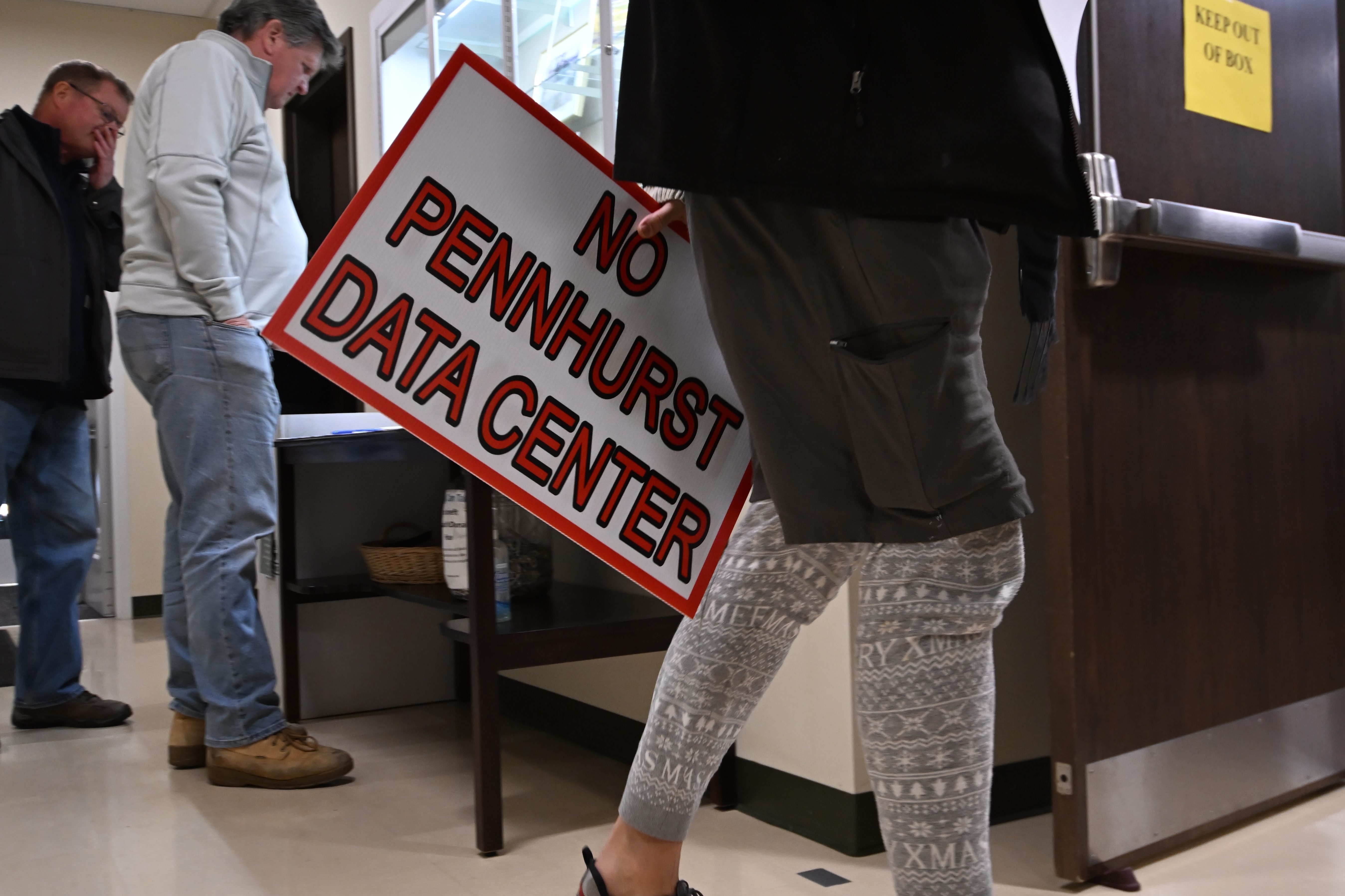
People sign in and head into an East Vincent Township supervisors meeting where an agenda item involved a data center proposal at the former Pennhurst state hospital grounds on Dec. 17, 2025, in Spring City, Pa. Marc Levy
Joanna Tenney, 36, of East Vincent in Chester County, held a sign at a June rally in the state Capitol that read: “Shapiro: Amazon’s bootlicker.” A registered Democrat, she voted for him in 2022, and believes he should be held accountable for supporting data center development in Pennsylvania that led to the fast-tracking of a now-stalled 125-acre data center project near where she lives.
She’s so fed up with Shapiro’s approach to data centers that she said will be writing in the name of her state senator, Sen. Katie Muth (D., Chester), who has been on the front lines of advocating for many state environmental issues, for governor on her November ballot. Tenney said she and a few other anti-data center advocates plan to run a write-in campaign for Muth.
“We’ve elected somebody that we thought was going to make the right choices by us, and we don’t really see that happening,” Tenney said.
Muth, who took office in 2018, said she would not be supporting Shapiro or “any elected official who puts the interests of Big Tech ahead of the health, safety, and future of Pennsylvania communities.”
If Shapiro changes his stance on data centers, she would support him, Muth said. She is the prime sponsor of a bipartisan bill to place a three-year moratorium on hyperscale data center development.
“Get right on the issue, Right your wrongs. If you can’t be on the side of science and people, my support is MIA,” she added.
Emily VanFleet, 26, lives in Archbald in Northeastern Pennsylvania, where six data center projects are underway comprising more than 50 buildings that, when completed, will cover 14% of the town. VanFleet, who is an unaffiliated voter, said she also supported Shapiro in 2022. But because of his public support for speeding up data center development in Pennsylvania, she is “certainly not going to vote for him this upcoming election,” she said. She isn’t sure she’s going to vote at all.
“I want Shapiro to stop being a coward,” VanFleet said in June. “I have emailed him, I have called him, I have reached out to him so many times. I have not heard back, not once. I see his videos all over social media that he has an open-door policy, but I have yet to see it.”
(In May, Shapiro’s administration announced that one of the unpopular Archbald developments, Project Gravity, was removed from a fast-track permitting program for failing to properly engage with the community.)
But negative attitudes toward Shapiro’s position on data centers may be limited statewide and his position is unlikely to dramatically knock down his high popularity or reelection odds: The June Quinnipiac poll found 56% of those surveyed approve of the way he is handling his job as governor overall, and recent polling shows Shapiro ahead 53% to 40% against his Republican challenger, state Treasurer Stacy Garrity.
The data center pitfall
Shapiro’s political opponents — both immediate and prospective — are also seizing on the issue.
Garrity, of Athens in Northeastern Pennsylvania, has also led a statewide listening tour on the topic. In June, she convened one of those sessions in Hatfield with a group of commissioners, zoning planners and emergency responders to talk about how they have been impacted by data centers. She blasted Shapiro for his role in attracting Amazon and said his proposed new requirements amount to a “flip flop.”
“Josh Shapiro has failed on this topic. He was the biggest cheerleader for data center development in Pennsylvania, until he wasn’t,” Garrity said at the June 24 meeting.
Pennsylvania Treasurer Stacy Garrity participates in the podcast “Ruthless” during an event hosted by Americans for Prosperity, Concerned Veterans for America, and the Libre Initiative at the National Constitution Center in Philadelphia on Jan. 29. Elizabeth Robertson / Staff Photographer
Garrity has her own mixed record on data centers.
At the time of the Amazon announcement, Garrity called the investment “great news” that would bring “historic investment” and “create thousands of jobs.” And her current position remains unclear. She has said she opposes a statewide moratorium but wants “a pause” on development instead.
Like Republicans running in districts that supported Trump in 2024 but oppose data centers, she appears to be attempting to find a pro-business and pro-regulation path.
“We want to make sure data centers are an addition to the grid, not a contraction. If there’s infrastructure that needs to be added to the grid, rate payers shouldn’t be paying for it,” she said. “I’m not opposed to data centers, but we have to do them the right way, and we haven’t done it. It’s because of a lack of leadership from the government.”
Garrity’s “long record of supporting completely unregulated data center development makes it clear that she just can’t be trusted,” said Manuel Bonder, a spokesperson for Shapiro’s campaign.
Local government leaders said at Garrity’s campaign roundtable in June that there has been lack of guidance around issues, especially around power demand, water use, infrastructure, environmental impacts, and community compatibility.
Kathie Doyle, a Republican on the Richland Township Board of Supervisors, said confusion around data centers have “set off a firestorm” in her community. Earlier this year, warnings of a supposed proposal for a data center in the Bucks County township circulated on social media, but turned out to be a “business park” with two buildings.
“Our residents don’t understand that we just cannot say no,” she said. Municipalities in Pennsylvania cannot outright ban data center development.
Santoro said Shapiro’s inconsistency is a liability that could sway some voters away from casting their ballot for him.
“Certainly he is giving her an ‘in’ by staying on the wrong side of this,” she said.
And it’s not just Republicans seizing on Shapiro’s position. The early reputation Shapiro earned as a champion of data centers may become a point of attack among other Democratic contenders for the presidency in 2028, too. In a veiled jab at Shapiro in June, Illinois Gov. JB Pritzker, knocked Pennsylvania on a businesspodcast for allowing Constellation Energy to restart Three Mile Island nuclear plant just to power Microsoft’s data centers.
“My guess is that’s going to be a reasonably unpopular thing to have done,” Pritzker said, without noting Shapiro by name on the Prof G Markets podcast.
Vulnerability for down-ballot Democrats
With a $50 million campaign war chest and high approval ratings, Shapiro is widely favored to win reelection this year. But his record on data centers could prove a liability for those he’s hoping to pull along, some advocates, like Santoro, say.
Shapiro has been staking much of his national political clout on his ability to flip four House districts in Pennsylvania for Democratic control of the U.S. House, drawing voters to the polls with his name at the top of the ticket. He’s also aiming to flip Pennsylvania’s Senate into Democratic control for the first time since 1993, giving him a Democratic trifecta in Harrisburg, as the state’s split legislature has blocked many of Democrats’ priorities from becoming law.
Santoro predicted that could be in jeopardy “if he does not change course.”
“Shapiro’s leadership on data centers will be the thing that costs us the first Democratic trifecta in 31 years, and I think that while he will likely win reelection with this wildly unpopular position on data centers, other elected officials and candidates will not,” she said.
Other Democratic candidates aware of data centers’ deep unpopularity are differentiating themselves on the issue, despite remaining otherwise aligned with Shapiro. Scranton Mayor Paige Cognetti, who is running in Pennsylvania’s 8th Congressional District, released a new ad last month putting data center developers on notice.
“Big Tech needs to pay their own way, not hide behind [nondisclosure agreements]. No tax breaks. Don’t raise our electric bills. Don’t poison our water. And hire local union labor,” she said, in the ad spot. “You can’t meet that? Then get out.”
Cognetti’s stance isn’t vastly different from Shapiro’s — both want to end blanket tax breaks — but her rhetoric is much stronger, and she’s putting the issue at the forefront of her campaign.
Democrats insist Republicans, including those running at the state level, don’t have the moral high ground on data centers after failing to pass through several measures that would have enacted stricter controls for their approval.
Sam Silverman, a former congressional aide and founder of Silverman Strategy Group, a strategic communications firm focused on technology and politics, said Shapiro’s approach to data centers — proposing a plan rather than enacting a moratorium — presents a risk that could either pay off and become the model for other states, or fail to fully address all future concerns and is unpopular.
“Shapiro is going out in front by proposing a bargain now. If the standards protect ratepayers, produce visible benefits, and hold bad actors accountable, Pennsylvania could have a model others can follow,” he said. “But because he is putting forward the deal now, he will be judged on whether it delivers.”
Taking a risk involves trust, though. Shapiro can afford to make a big swing at one of the hottest issues in politics because voters put so much faith in him, Silverman said.
“Most politicians do not have the amount of trust and political capital to take a risk, either,” Silverman said.
Whether the governor is triumphant will come down to what standards go into effect and whether bad actors are held accountable, he said, “and whether Pennsylvanians believe those standards are working.”
People throughout the Philadelphia region, hampered by cuts to federal food aid and soaring prices, are “facing a dangerous double whammy causing a skyrocketing hunger crisis,” said Joel Berg, a national hunger fighter, speaking in Northeast Philadelphia on Tuesday.
Berg, CEO of the New York-based nonprofit Hunger Free America, was visiting Feast of Justice, one of the largest food pantries in the city with “probably the most diverse food pantry clientele in the nation,” he said. That is proof, according to Berg, that food insecurity can affect anyone, from any background.
Feast of Justice, he added, “is the food affordability issue in the flesh.”
Especially critical of the One Big Beautiful Bill Act, signed into law by President Donald Trump on July 4, 2025, Berg noted that it included more than $1.1 trillion in cuts to Medicaid and the Supplemental Nutrition Assistance Program (SNAP).
Roughly 4 million Americans are expected to lose SNAP benefits in 2026 under the law. Many of them do not meet work or age requirements newly added to the anti-hunger program. The reductions in SNAP and Medicaid benefits helped pay for tax cuts ordered by Trump.
Alahallak Abdelmenim and his children Asil (left), 6, and Hasan (right), 8, load groceries into their shopping cart at the Feast of Justice Food Pantry Tuesday, Aug. 11, 2026.Tom Gralish / Staff Photographer
In Pennsylvania, around 144,000 SNAP recipients could see benefits cut this year — an estimated 45,000 in Philadelphia and 12,000 in its collar counties, according to Pennsylvania Department of Human Services estimates. In New Jersey, around 50,000 individuals could lose SNAP benefits, New Jersey Department of Human Services figures show.
It’s not “rocket science,” said Berg, who used a pallet of canned beans and apple sauce as a lectern as he addressed a small crowd at the pantry. “When there’s a drought and you take away water, the drought’s going to get worse. When there’s a hunger crisis, and you take away food, the hunger crisis is going to get worse, especially after you throw in inflation,” he added.
In response, Trump spokesperson Anna Kelly said Tuesday that Trump is “strengthening” SNAP to sustain it into the future. Changes to SNAP “crack down on waste, fraud, and abuse,” she said. Kelly added that Trump is “uplifting every American’s financial situation by passing the largest tax cut in history — which every congressional Democrat opposed — and bringing historic numbers of jobs and investments into our country.”
Pastor Tricia Neale, executive director of Feast of Justice, said Tuesday that since the enactment of the One Big Beautiful Bill Act, an additional 1,850 families in Northeast Philadelphia have turned to the pantry for help. Overall within the last five years, she said, the number of households the pantry supports has grown from 2,750 to 6,425, a more than 200% increase.
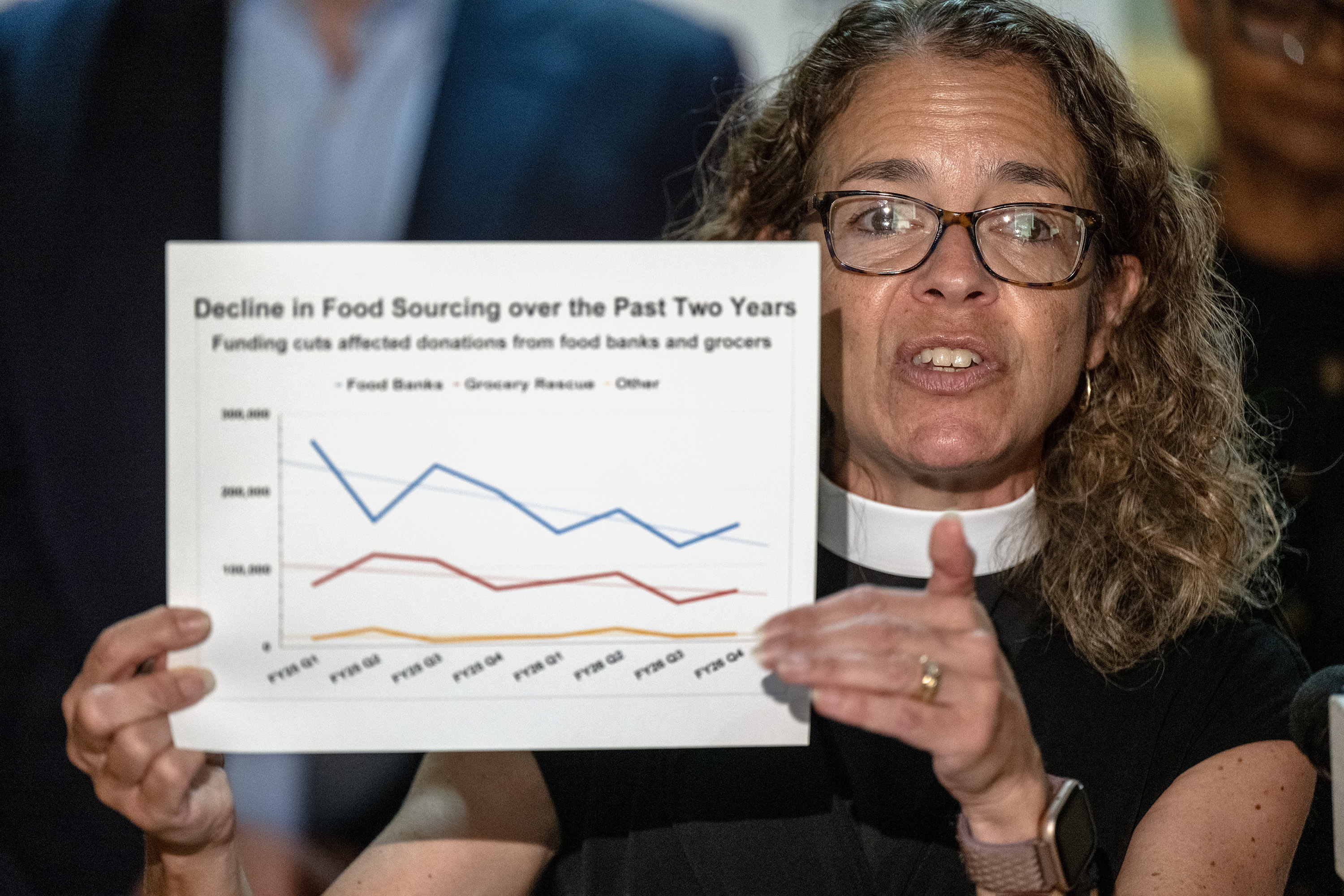
Pastor Tricia Neale, executive director at Feast of Justice, displays a chart showing the decline in food sourcing as she speaks at a press conference at the food pantry Tuesday, Aug. 11, 2026. Tom Gralish / Staff Photographer
The pantry has been forced to absorb a 35% decline in donated food it receives, in part because of cuts to federal and state food programs that have been so vital, she added.
Even with diminished supplies, Feast of Justice is an essential institution, according to Angie Bryant, 55, of Tacony, a client. Formerly a phlebotomist who can no longer work, Bryant said she recently lost her SNAP benefits because new age restrictions exclude her participation.
“In the body, hunger is hurtful,” she said. “Without this place, I don’t know how I could make it.”
Food banks such as Philabundance and Share Food Program do their best to provide Feast of Justice whatever food they can, Neale emphasized.
Volunteer Daniel Khan (center) restocks the shelves as clients load groceries into their shopping carts at the Feast of Justice Food Pantry Tuesday, Aug. 11, 2026. Tom Gralish / Staff Photographer
If SNAP is the safety net, “we’re the safety net of the safety net,” said Loree Jones Brown, CEO of Philabundance, who joined Berg and Neale at Feast of Justice on Tuesday. “But we can’t make up for the cuts.”
She added that “this is a crucial time for food banks, legislators, and community organizations to stand together for our neighbors and against hunger.”
That Feast of Justice does its best to beat back hunger is widely appreciated in the community, said client Anthony Morales, 27, of Mayfair. Laid off from a warehouse job, he said he is responsible for feeding his 7-year-old daughter and his partner, and he needs the pantry’s support.
“When you fall,” he said, “this place lifts you up. You have a lot of fear and anxiety without enough food. It can give you hope and confidence that tomorrow could be better.”
But the other main parties called it a stunt and refused to take part, leaving Farage running against an assortment of independents, jokers, and single-issue candidates led by Count Binface, a comic space alien with a trash can on his head. In that field, it’s Farage who looks like the mainstream politician.
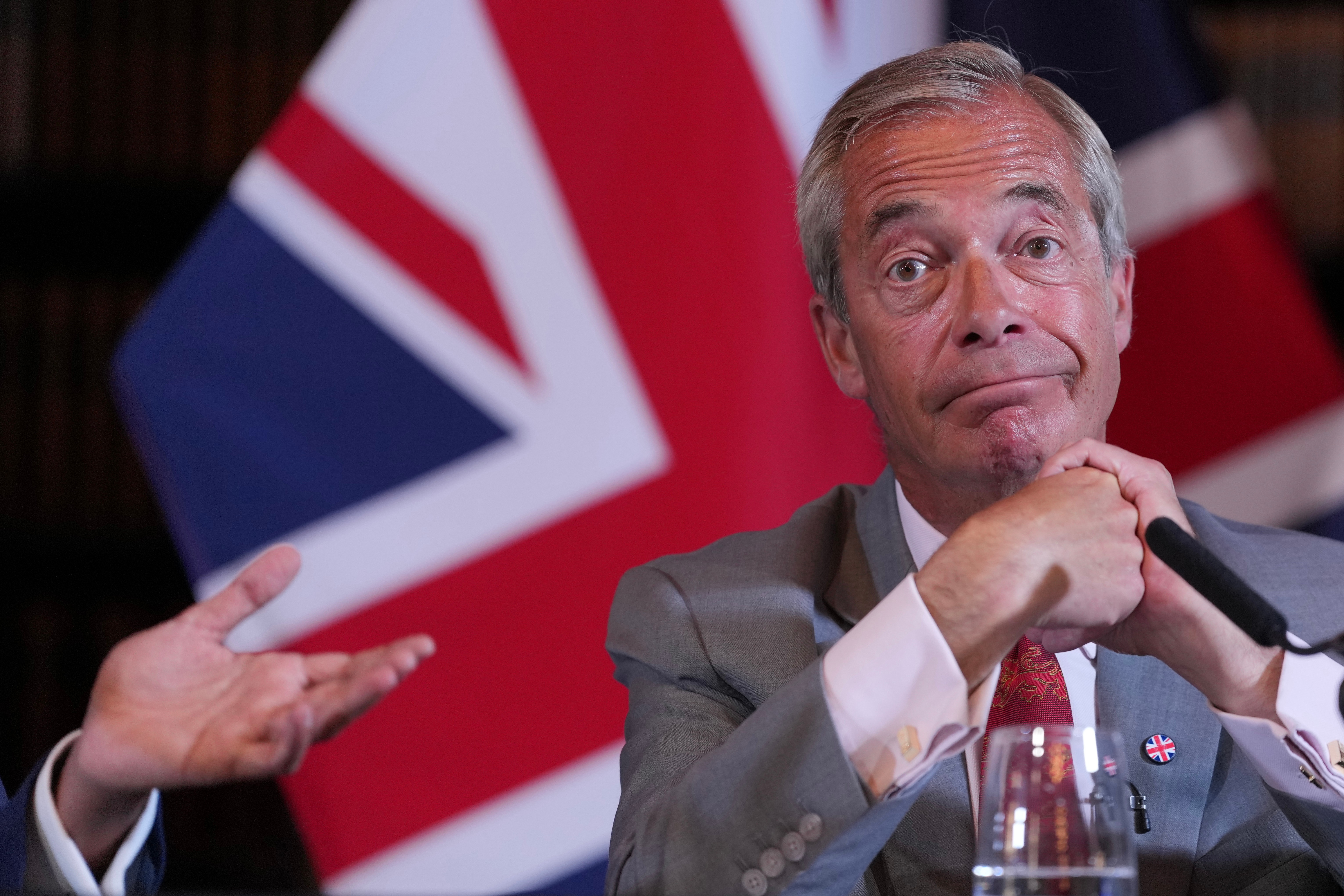
Simon Usherwood, professor of politics and international studies at the Open University, said Farage’s appeal is built on his image as a straight-talking individualist, “the kind of bloke you can have a pint with down the pub.”
“It’s that very charismatic aspect of Farage that is both his strength and his weakness,” Usherwood said. “He has fallen into a trap of thinking that he is somehow immune from the kind of scrutiny that would undo other politicians.”
Farage built his brand on Brexit and immigration
For two decades, the populist Farage has led small parties with an outsized impact on British policy.
His charisma — and, critics say, his distortions — were key to securing victory for the “leave” side in Britain’s 2016 European Union membership referendum. After Brexit, Farage switched his focus to migrants crossing the English Channel in small boats, a stream that he has called an invasion.
In 2024 he was elected to Parliament at his eighth attempt, representing the strongly Brexit-backing town of Clacton in eastern England.
Becoming a lawmaker brought unwelcome scrutiny of his finances. Parliament’s standards watchdog is investigating an undeclared donation of 5 million pounds ($6.7 million) to Farage in 2024 from Christopher Harborne, a Thailand-based cryptocurrency billionaire. Farage says he didn’t need to declare the money because it was a personal gift he used to fund his security and came before he was elected.
Newly elected lawmakers must declare gifts worth more than 300 pounds ($400) received in the previous year if they are related to political activities.
Farage is also facing an investigation into his financial relationship with George Cottrell, an aristocratic crypto-gambling entrepreneur who served eight months in a U.S. prison for fraud a decade ago after offering to launder money for undercover agents posing as drug traffickers.
Cottrell, 32, remains close to Farage and has reportedly given him money for security and staff. U.K. media report that Cottrell and his mother have been interviewed by police as part of a probe into donations to Reform UK, though they have not been arrested.
Farage is standing by the man he calls “Posh George,” saying Aug. 3: “I don’t ditch my allies.”
Farage faces off against Count Binface
The governing Labour Party and opposition Conservatives, Liberal Democrats, and Greens all declined to run in Clacton. But it is still a crowded field, with almost three dozen candidates, including representatives of Rejoin EU, the Everyone Is God Party, and the Monster Raving Loony Party.
By far the best known is Count Binface, a frequent comedy candidate whose platform includes the pledge “I will not accept 5-million-pound gifts from crypto billionaires (on Earth).” He says his main appeal is “I’m not Nigel Farage.”
Farage doesn’t find it funny. He and his party claim Binface, alter ego of comedian Jon Harvey, is just another representative of a hostile political establishment.
“The establishment is using every means available, fair and foul, to undermine Farage before the country gets a chance to elect him,” Gawain Towler, Farage’s former press officer and now a Reform UK board member, said in a blog post.
Farage won handily in Clacton in 2024, and most observers expect him to win again. If he does, the parliamentary investigation of his finances will resume. A finding of wrongdoing could lead to Farage being suspended from Parliament and trigger yet another special election for the seat.
Reform UK has just seven lawmakers — eight if Farage is included — but led nationwide opinion polls for more than a year. But the party has recently suffered setbacks, losing a string of special elections, including one in June that brought Prime Minister Andy Burnham to power.
After months of flagging popularity, Labour senses a “Burnham bounce.” Meanwhile, Conservative leader Kemi Badenoch has found her feet after a shaky start. And Restore Britain, a far-right party with just one lawmaker but a loud social media presence amplified by Elon Musk, is nibbling away at Reform’s support.
Farage, 62, has a history of walking away from parties he led. He stepped down from both the UK Independence Party and its successor, the Brexit Party, in the last decade.
He has earned more than 2 million pounds ($2.7 million) outside of Parliament in the past two years from speeches, promotional work, and television appearances, far more than he makes as a lawmaker. He might be tempted to quit politics again if he remains under sustained pressure.
Martin Farr, a contemporary historian at Newcastle University, said Farage will probably come out of the election strengthened, at least in the eyes of his supporters.
“To his supporters, this will be an example of how he’s fearless and he’s prepared to fight against, as he will put it, the tyranny of the majority, the tyranny of the establishment,” Farr said. “To his opponents, it suggests a thin-skinned demagogue who has reacted petulantly to scrutiny and has been embarrassed by the fact that no one else has taken his stand seriously.”
Half a year into fatherhood, Edwin Jeovanny López Cornejo found the sight of his daughter, Ashley, revitalizing after a long day at work.
It was 2014. López Cornejo, an immigrant from El Salvador, had been working at a packaging company in South Plainfield, N.J., for about seven years. He came to the United States in 2007, filed an asylum claim, and received employee authorization from the federal government after being deported the year prior, according to court documents.
As he would often do in the years that followed, he took to Facebook to express his gratitude to God and his love for his daughter.
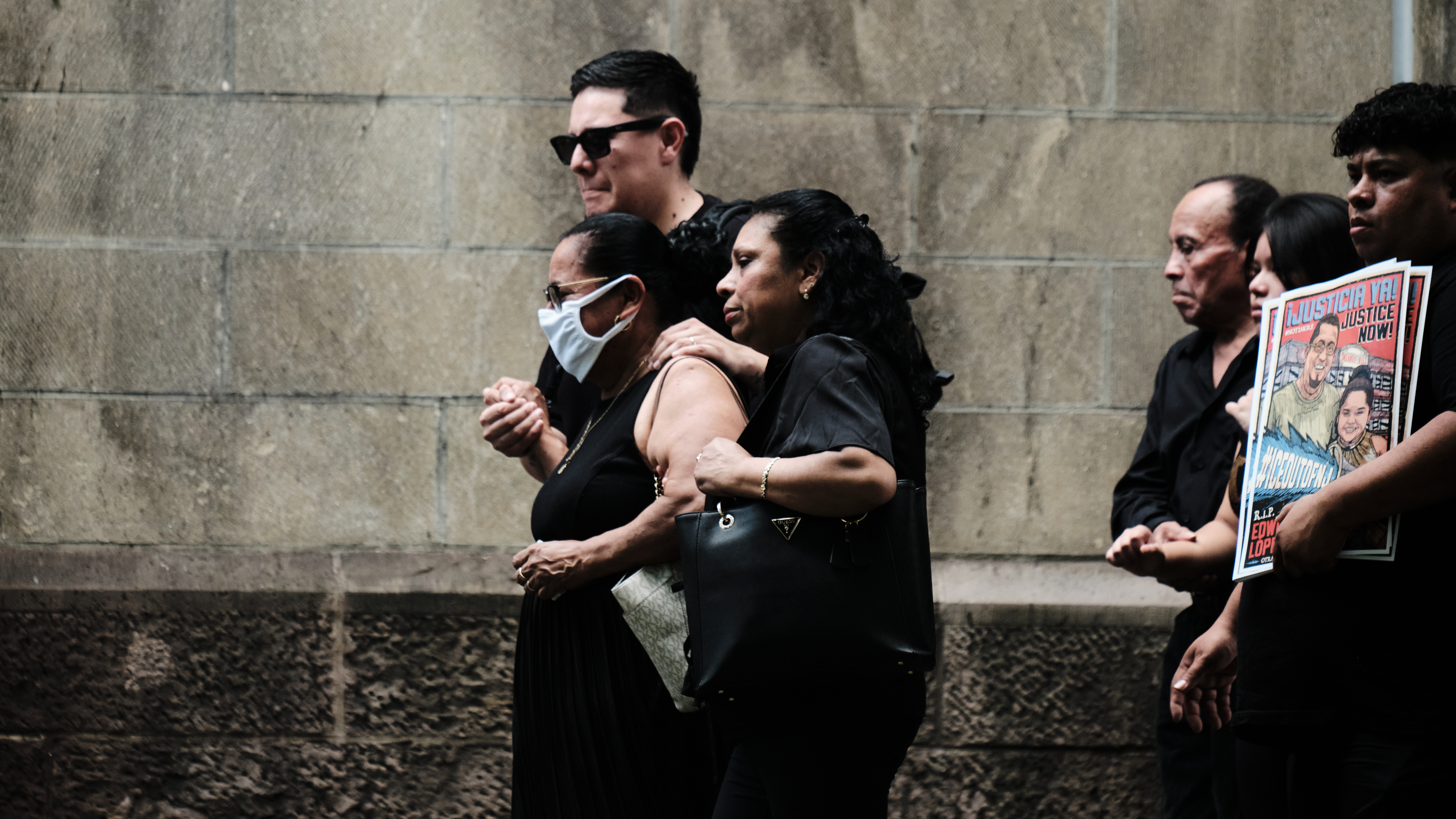
This past Friday, Ashley Lopéz, now 12, wore all black. She stood between her paternalgrandparents as they held each other and wept at her father’s wake at Crescent Avenue Presbyterian Church in Plainfield.
López Cornejo had died in ICE custody just under a week earlier at the age of 39 after experiencing what the federal agency called a medical emergency at Delaney Hall, an ICE detention center in Newark run by the private company GEO Group.
Ashley has barely been speaking. Or eating. And she does not want to be around people, María Cornejo, her paternal grandmother, told The Inquirer in an interview on Monday, speaking in Spanish.
Letters of support submitted to the court after his June arrest, remarks from his family, and more than a decade of public Facebook posts written in Spanish paint the picture of a father who deeply loved his daughter.
Twelve years ago, Lopéz Cornejo and his then-girlfriend were expecting twins, but the boy died in the fifth month of pregnancy, Cornejo said.
“She is the only child he had. You should have seen him when she was born. That man was the most joyful man with his daughter in his arms,” Cornejo said. “It was his first time being a father, and he wouldn’t even sleep so he could watch her sleep and make sure she was OK.”
López Cornejo was unable to see his daughter at Delaney Hall. He had been there for about six weeks.
Delaney Hall has been the site of high-profile political clashes representing the national conflict between Trump’s supporters and immigrant rights advocates. The detention center serves a critical role for the president’s mass deportation agenda, and complaints of poor and unsanitary conditions have sparked continuous protests, uproar from Democratic lawmakers, and a reported hunger strike inside, which the Trump administration denied happened.
In December, a 41-year-old Haitian national named Jean Wilson Brutus died one day after entering Delaney Hall, and U.S. Rep. Rob Menendez (D., N.J.) recently said another person died at the hospital after a potential seizure at the facility earlier this summer. Nationally,at least 23 fatalities in ICE custody have been reported this year as the rate has increased during Trump’s second term.
López Cornejo’s asylum claim was still pending — 19 years after he filed it — when ICE agents arrested him, according to a habeas corpus petition challenging his detention.
An undated photo of Edwin López Cornejo and his daughter, Ashley, in a pool.Courtesy family of Edwin López Cornejo
Around 9 a.m. June 18, López Cornejo headed out to pick up his car from a towing company, where it had been taken for being parked for too long, his mother recounted Monday. She urged him to take a taxi and avoid walking, given a heightened fear of running into ICE in the community.
She said goodbye, unaware it would be the last time she would hug her son.
Lopéz Cornejo ended up walking because roads were closed.
Masked agentsstopped him and asked for his ID. When he produced his Salvadorian identification, they put him in an unmarked vehicle with two other people who had already been detained, his lawyer Ingrid Echeverria recounted in the habeas corpus petition.
Cornejo said her son called her from inside Delaney Hall that evening. The first question he asked was about Ashley.
According to his family and court documents, he took medicine for diabetes, epilepsy, and high blood pressure. Interruption of his strict medication schedule carries the risk of breakthrough seizures and associated harm, according to the petition. That July 24 court document did not accuse ICE of denying him his medication but expressed concern over potential medical risks if he was transferred to another facility, as the agency at one point planned.
On. Aug. 1, Cornejo got a call from University Hospital in Newark. The person on the phone told her that her son’s heart was not beating by the timehe arrived, after he collapsed at Delaney Hall. ICE has not released an official cause of death, but U.S. Sen. Andy Kim (D., N.J.) said it was a heart attack and cardiac arrest. Days after his death, Kim and fellow New Jersey Democratic U.S. Sen. Cory Booker put forward legislation that would require the shuttering of Delaney Hall.
New Jersey Attorney General Jennifer Davenport said last week that her office was launching a civil rights investigation into Delaney Hall, citing reports of “alarming conditions” and recent deaths.
Sen. Andy Kim (D., N.J.) stands between federal agents and demonstrators in an attempt to prevent a clash outside the Delaney Hall migrant detention center in Newark, N.J., on May 25.DAKOTA SANTIAGO
In response to López Cornejo’s death, ICE put out a statement saying that everyone in ICE detention gets proper, around-the-clock medical care, and that López Cornejo “was seen by medical professionals.”
His family doesn’t buy it. They blame ICE for detaining him and accuse the agency of failing to provide him proper medical care. Danilo López, his brother, said at a news conference that his brother told him over the phone that he had to fill out a form to just get Tylenol at Delaney Hall and it could be days before he received it, a claim ICE did not directly address when asked.
“He lived a normal life and worked normally while taking his medicine and with a proper diet, working more than eight hours a day, and had no problem,” Cornejo said in the interview.
Just days after her father died, Ashley López said at a news conference: “On the same day, we were both dead. The only difference was his heart stopped beating. I am going to grow up without a father.”
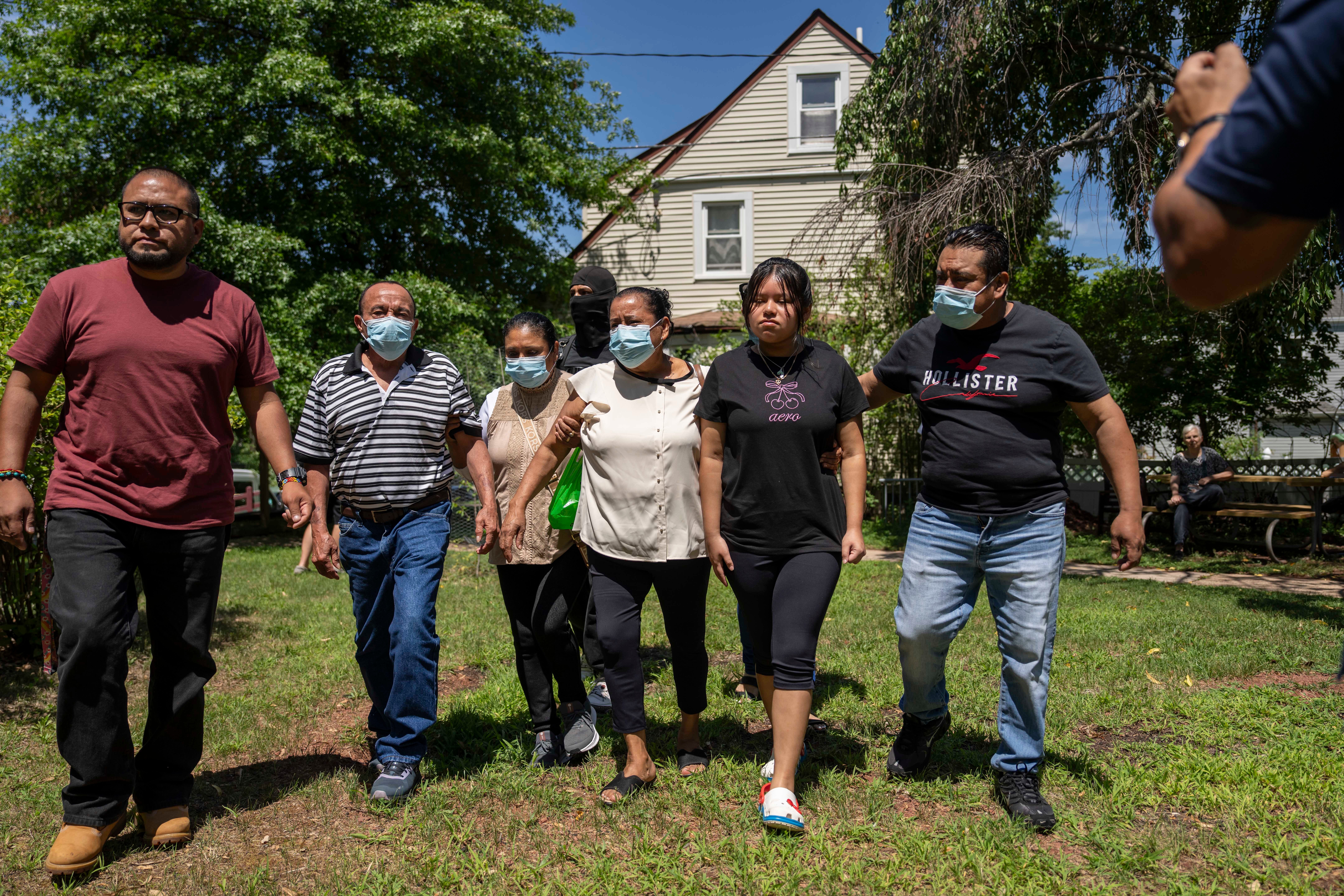
Family members of Edwin López Cornejo including (from left) his mother Maria Cornejo, daughter, Ashley, and his former wife, attend a news conference on Tuesday, Aug. 4, 2026, in Highland Park, N.J. Yuki Iwamura
‘The true love of my life’
On his daughter’s first birthday, López Cornejo wrote on Facebook that Ashley gave him “one more reason to live.”
“I want to tell you that when I learned you were going to be born it felt like it would be forever before I had you in my arms,” he wrote. “I will never forget the first day that I changed you and gave you a feeding bottle. Wow my girl, those moments I will never forget and now you are turning one. Wow how the time passes.”
An undated photo of Edwin López Cornejo with his daughter, Ashley.Courtesy family of Edwin López Cornejo
On her third birthday, he called her “the true love of my life,” and said she motivated him to be strong and keep moving forward.
“I would be willing to give my life for yours,” he wrote.
On his own birthday, he often thanked God for another year of life. And as a birthday wish, he asked for another year to see his daughter grow.
Ashley, a U.S. citizen, was born in New Jersey, according to the petition, which includes her birth certificate and public school records to support his lawyer’s argument that López Cornejo has community ties. The documents show she receiveda certificate of achievement for math at 9 years old “for demonstrating fluency of division” in less than six seconds. And shortly after she turned 10, she was crowned “Art Leader of the Week.”
Ashley lived with her dad half the week, but he picked her up from school every day, and she would run into his arms to greet him, Cornejo said. He took pride in her success in school.
“He would tell her, ‘I want you to be a doctor so you can cure me one day,’” she said.
Family members of Edwin López Cornejo arrive at an Aug. 4 news conference in Highland Park, N.J.AP Photo/Yuki Iwamura
A hard worker
López Cornejostarted working in construction just three weeks before his detention after the warehouse he worked at changed locations, his mother said.
Court documents show he worked at UpperClass Warehouse in South Plainfield from March 2021 until this May, and he previously worked multiple restaurant jobs in New Jersey. He paid taxes to the state of New Jersey and the federal government.
Jesse Fischbein, vice president of finance at Just Packaging, where López Cornejo worked from 2007 to 2015, said in a letter of support attached to the petition filed with the court last month that he “truly was a company-first employee, who didn’t believe that the workday was simply 7 AM to 3:30 PM.”
“He was punctual, always pitching in to help other employees when his tasks were completed, and always asked management if there was more to be done,” Fischbein wrote.
People detained inside Delaney Hall stand at windows in Newark, N.J., as demonstrators gather outside on May 28, 2026. The protests were fueled by reports of detainees staging a hunger strike over the conditions of their confinement.TODD HEISLER
ButFischbein said there was one thing López Cornejo would always be better at than his job: being a father.
“From what I know about him outside of work — he is a father, and that is the job he excels at more than any function he performs for my company,” Fischbein said.
A coworker-turned-friend, Juan Zavala, said in another letter of support that López Cornejo had “earned the respect of everyone around him” through kindness, compassion, respect, and honesty.
“He is a loving, responsible, and caring parent who is deeply involved with his daughter’s life and always puts her well-being first. It is very clear that his family means everything to him,” Zavala wrote.
One of the ways López Cornejo expressed himself to his loved ones was by sharing links to music on Facebook. He dedicated love songs to his daughter and others, he shared reflections during the pandemic with a Christian worship song, and he said the music video for “Pose”by Daddy Yankee — the singer known for the hit song “Gasolina” — inspired him to learn to dance reggaeton.
López Cornejo and Ashley dreamed about dancing together at her quinceañera, a celebration for her 15th birthday.
“He just wanted to dance the waltz with his little girl, and they so looked forward to that party,” Cornejo said, crying. “Now my little girl won’t have her dad.”
Family members walk to the church side entrance during the wake of Edwin López Cornejo, after his death in ICE custody in New Jersey on Aug. 7 in Plainfield N.J.Max Blease / For The Inquirer
‘Profoundly difficult consequences’
In the July 24 petition, his lawyer called on ICE to explain why he was detained, and consider either his immediate release or a hearing in front of an immigration judge.
His lawyer said that he was served with documents in English he could not read, and that hedid nothave a criminal record and always showed up for his court dates.
His friends and family described him in similar terms in letters of support submitted to the court last month.
Kelvin E. Urquilla Flores, who met López Corneja at Just Packaging nearly 20 years ago, described him as “a peace-loving, law-abiding individual” who is “an asset to this country and to his community.”
Edgar Fabián Guaman, who said he had known López Cornejo for almost two decades, said that his family friend did not present a risk to the community — but instead improves the well-being of those around him.
“I respectfully express that a possible separation of Mr. López Cornejo from his family unit would have profoundly difficult consequences for his daughter and his mother, who depend on his presence, support, and emotional stability,” Guaman wrote.
An undated photo of Edwin López Cornejo and his daughter, Ashley.Courtesy family of Edwin López Cornejo
Through his Facebook posts, López Cornejo shared a deep appreciation for his parents. In May 2016, he thanked God for giving him “an exemplary mother,”whom he also described as a “second mother” to his own daughter.
“Maybe I’m not the perfect son, but I try to behave at your level, mother,”he wrote. “I know you gave me the greatest gift, life, and I will never be able to repay you, mother.”
The last post that shows up on López Cornejo’s Facebook page was a message directed to God and his daughter on her 12th birthday last November.
Staff writer Abraham Gutman contributed to this article.
House Democrats are pushing the Trump administration to release records related to the felony prosecution of a former Olympian who had been accused of damaging the Lincoln Memorial Reflecting Pool, questioning whether prosecutors were misled in an attempt to conceal a “botched” renovation.
Democrats on the House Judiciary Committee made the move days after a judge granted federal prosecutors’ request to drop a felony charge against David Hearn, attributing the pool damage to faulty installation.
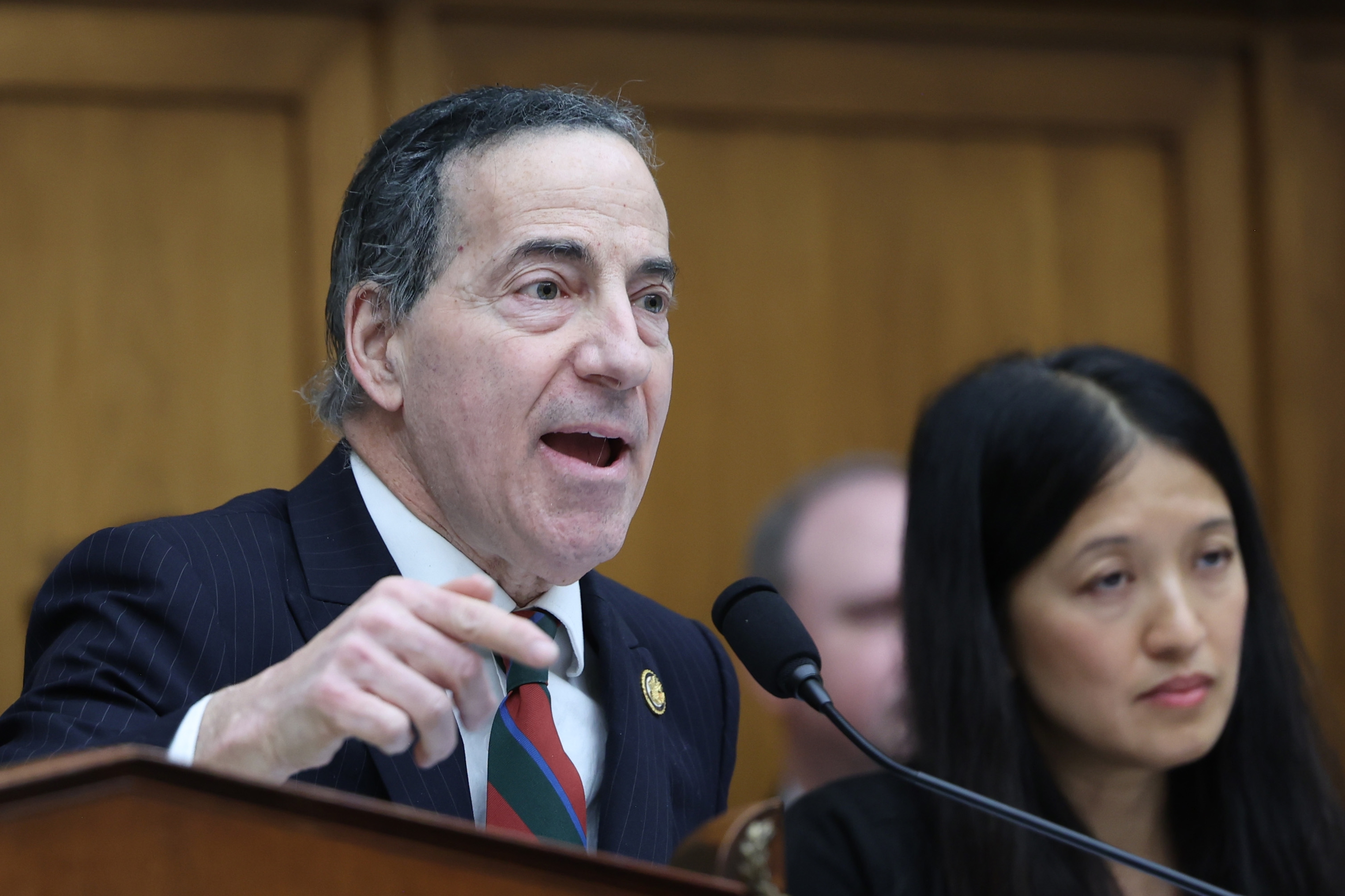
Rep. Jamie Raskin (D., Md.) sent a letter Tuesday to Interior Secretary Doug Burgum and U.S. Attorney Jeanine Pirro requesting the release of all documents related to the decision to prosecute Hearn and any communications between the agencies and the White House about the case.
The letter called on the departments to answer whether President Donald Trump exerted pressure to “retaliate against and scapegoat an American citizen.”
“How did this debacle happen?” wrote Raskin, the top Democrat on the Judiciary Committee. “The conclusion seems inescapable that at least one, if not both, of you have misled the American public about the evidence and used it to corrupt and weaponize our justice system against an innocent 67-year-old American citizen.”
Pirro’s office maintains it didn’t know about the widespread damage at the Reflecting Pool until after the indictment, accusing the Interior Department of withholding documents indicating the peeling was caused by flawed installation. But Hearn’s attorneys say there’s evidence that they knew of problems before indicting him.
Raskin is also seeking evidence presented to the grand jury, including transcripts of testimonies.
Asked for comment on the letter, the White House referred the Washington Post to Trump’s previous Truth Social posts alleging vandalism.
The Interior Department did not immediately respond to a request for comment.
“The Department of Justice follows the evidence when determining if crimes have been committed,” the federal agency said in a statement. “We always evaluate any case based on the facts and the law.”
Raskin’s letter comes after Hearn’s attorneys alleged that prosecutors may have misled jurors to secure an indictment against him. In a filing last week, the attorneys alleged that a key government witness testified that repairs would have been necessary regardless of Hearn’s actions but that prosecutors recalled the witness and “elicited” them to say that damage “attributable to Mr. Hearn” would be more than $1,000.
The attorneys are asking the judge to ensure federal prosecutors can’t charge Hearn again in the future.
Pirro, a longtime Trump ally, has faced intense public scrutiny over the decision to prosecute Hearn and others alleged to have damaged the pool and again after abruptly dropping the cases.
In the letter, Raskin points to Trump’s repeated comments about renovating the Reflecting Pool. Raskin also questioned the noncompetitive process in awarding a contract and referred to reporting from CNN that another company declined the July 4 deadline.
“President Trump’s ‘highly sophisticated’ and slapdash paint job didn’t even last 100 days, much less a century,” Raskin said.
Atlantic Industrial Coatings, the contractor, did not immediately respond to requests for comment.
A Post analysis of satellite imagery and photos and videos taken during the Reflecting Pool renovation found that the basin’s peeling was probably caused by application errors.
Despite reports of Reflecting Pool renovation failures before June 19, when Hearn touched a piece of the detached liner, Raskin said Trump and Burgum latched on to the claim that vandalism was to blame. Pirro followed with a felony charge against Hearn in July. He was initially charged with a misdemeanor count of destruction of government property.
The case collapsed the same month. Pirro’s office said in a court filing that the Interior Department did not provide sufficient information ahead of the indictment, including an email from an engineer on June 11 detailing the peeling of the liner.
“After DOJ’s filing, President Trump went off the deep end of the Reflecting Pool, you might say,” Raskin said in the letter.
Trump has blasted Pirro for dropping the vandalism charge against Hearn and three others and has continued to blame the former Olympian.
On Sunday, Trump again accused Hearn of “‘violently’ ripping and tugging at the Pool’s somewhat delicate coating” in a social media post. He conceded that there was “some contractor error” due to the rushed job but that it damaged only a small area.
Raskin poked jabs at Trump in the letter, referencing “local vandalism crimes,” including the East Wing demolition and the affixing of Trump’s name to the Kennedy Center. A judge later ordered the removal of the name.
The letter requests that the records in the pool case be shared by Aug. 25.
In a statement Tuesday, attorneys for Hearn said they “welcome any Congressional oversight that seeks the truth.”
“As we have stated from the beginning, the indictment of Davey Hearn was a clear miscarriage of justice and an egregious misuse of government power,” Norm Eisen, Mary Dohrmann, and Steve Levin said in the statement. “Our client and the American public deserve the truth, so it won’t happen again.”