Category: Politics

  • Chatbots are doing the work of Congress with little oversight

    Chatbots are doing the work of Congress with little oversight

    The amendment was one of hundreds filed this summer to an annual defense bill making its way through Congress. Along with her proposed change, Rep. Anna Paulina Luna’s office had sent a summary of what it would do.

    But the first line made no sense.

    “increasing example specific factors. Identical to H.R. 100 (118th Congress).11:25 AM????Claude responded:”

    One of Luna’s staffers had copied a chatbot’s answer — timestamp and all — and pasted it into the public record of the National Defense Authorization Act.

    As a screenshot of the garbled text circulated on social media, the Florida Republican was nonchalant.

    “Not a shocker,” she wrote. “Most staff use it.”

    Asked later about the incident, Luna went further. “A lot of staff will use ChatGPT, Claude, Grok. I personally like Grok better, but my staffer prefers Claude,” she told the Washington Post. “I’m not going to knock him for that. There’s nothing illegal about him doing a summary.”

    Across the Capitol, lawmakers and staffers are using artificial intelligence to write speeches and news releases, sort constituent mail, prepare questions for congressional hearings, and draft amendments.

    Even as politicians are debating how to govern AI for the rest of America, Congress has already settled how it will use the technology: quickly, broadly, and with little oversight.

    Both chambers have cleared members and staff to use chatbots — Copilot, ChatGPT, Gemini, and, in the House, Claude — for official work, with more under review. The House bought 6,000 Microsoft Copilot licenses last year and encouraged staff to use them.

    Having someone else put words in a lawmaker’s mouth is nothing new. For almost as long as Congress has existed, staffers have been ghostwriting speeches for their bosses. But a speechwriter can be summoned or fired. Chatbots are products built by the tech companies that lawmakers are in charge of regulating.

    Amid the rapid adoption of AI on the Hill, lawmakers face a key question: How much of their responsibilities are they willing to hand over?

    Interviews with more than two dozen lawmakers and staffers — some of whom spoke on the condition of anonymity to discuss internal operations — along with internal House and Senate policies obtained by the Post show that the institution has left that question largely unanswered. The few House and Senate rules that exist are poorly understood and seldom enforced. In practice, AI use is left up to the hundreds of individual congressional offices to settle for themselves. It’s not clear how many offices have internal written policies on AI.

    And no one the Post asked knew of any instance where a staffer was formally disciplined by the House or Senate for breaking its rules.

    Luna was right. There was nothing illegal about having AI edit, spell-check — or even write — legislative materials. It wasn’t against House rules, either.

    Her staffer’s only mistake was letting Claude sign its work for others to see.

    Congress’ newest staffer

    Sen. Tommy Tuberville has found a new way to pass the long drives across Alabama: talking to ChatGPT.

    He asks it about Medicare and Medicaid, and listens as the machine’s voice talks back.

    “It’s kind of like you can sit there and talk to an expert,” said the Alabama Republican. “You don’t know whether or not they’re 100% correct. But they put you on the right path.”

    Rep. Mike Flood (R., Neb.) said he consulted a chatbot while working on a bipartisan housing bill that passed this year, asking it where private equity was buying up single-family homes. Sen. Elizabeth Warren (D., Mass.), who has proposed stricter legislation on tech companies, uses ChatGPT to look up demographic information.

    One GOP staffer’s boss uses chatbots to generate the occasional cartoon of himself, she said with a laugh. Her explanation: “He’s a boomer.”

    But the real power users are the thousands of staffers who do most of Congress’s work.

    Earlier this year, Rep. Cleo Fields (D., La.) had a town hall coming up in Natchitoches, a city in his district that his press secretary didn’t know well.

    So that aide, Sydney Broome, asked Claude for a list of TV stations in town, its newspapers, and reporters’ names and contacts. Then, she started calling each one.

    At 22, Broome is the youngest full-time staffer and only press secretary for Fields. AI saves her three or four hours of work a week, she said. Her boss does not use it at all.

    ChatGPT first emerged when Broome was still in college. Her professors, unable to stop students from using AI, urged restraint and ran their assignments through AI detection. Students could use it for research, they warned, but never to write from scratch.

    Congress has no such checks. So Broome has imposed them herself.

    She’ll use Claude to find a reporter’s email, but not to write to them. She doesn’t use it to produce anything in her boss’s name. “That’s just kind of a bit of a gray area,” she said.

    Many staffers say they are aware of AI’s limitations. The tools occasionally invent nonexistent bills. Other times, the writing is formulaic and clunky. Still, chatbots help speed up their work.

    A GOP aide in another office said he uses Copilot to write appropriations amendments. The subcommittee he works for used AI to suggest witnesses for a hearing and to help generate the questions lawmakers should ask them.

    Another Republican aide has taken AI even further. He exported all his phone contacts and text messages — years of conversations — into a personal Claude account and told it to build a database of every reporter he has ever dealt with: what he pitched them, which ones they accepted, which exchanges went badly. The chatbot auto-updates itself with each new conversation.

    Recently, his boss wanted to do a TV interview about surveillance law. The aide asked Claude whether he had ever pitched a TV booker on that topic and how it went. It came back instantly with a contact.

    Claude also runs that staffer’s office’s communications budget — the taxpayer-funded mail and ads sent to constituents. “I don’t really have to touch the data in Excel much anymore,” he said.

    The aide said he’s not sure what exactly is permitted by congressional rules. “You’re still not supposed to put constituent data into AI,” he said. “There are weird things around where the rules are. I don’t know all of them.”

    When nobody’s looking

    In 2024, the House Administration Committee convened a private, bipartisan meeting with House officers and outside AI experts to talk through how far to let AI into the legislative process. About 150 chiefs of staff attended.

    Out of it came the first AI guidance for Capitol Hill.

    Internal House and Senate policies obtained by the Post and interviews with people familiar with them show how Congress has embraced the use of AI.

    Last summer, the House bought 6,000 Copilot licenses. The tool was a natural fit for a chamber that already ran on Microsoft and a more secure way to keep congressional work inside a single system, officials believed. Starting in January, offices could sign up for access.

    They came with a major guardrail built into the system: Copilot is designed to refuse political requests. Ask it to criticize a party, politician, or political group, and the machine declines.

    “I can’t create content that criticizes or condemns political parties, politicians, or political groups,” read one Copilot response shared by a staffer. “That includes writing tweets that attack Democrats, Republicans.”

    Roughly half the licenses are now in use, and House officials have extended the deal.

    The rules Congress wrote for itself are loose. Off limits under current House guidance: putting sensitive material such as constituent information into a chatbot, generating deepfakes, making personnel decisions, and finalizing legislation.

    A machine may help write a bill but may not be the last hand on it. It may draft a reply to a constituent but can’t be told who the constituent is.

    In theory, a staffer breaking those rules can be stripped of access to AI tools, suspended, fired, even fined and imprisoned.

    But no one could name a single case of that happening. People familiar with House operations said they’re not aware of any enforcement action by the chief administrative officer. A spokesperson for the CAO said the office can’t comment on potential enforcement actions. A spokesperson for the Senate sergeant-at-arms didn’t respond.

    Catching violations largely falls on staffers, who would have to report a colleague, or themselves.

    Most said in interviews that they don’t know the rules. A former senior Republican House staffer said that his office subscribed to both ChatGPT and Claude and that staff used them however they liked. He wasn’t sure what the rules were, or whether his team followed them. “We just had a free-for-all,” he said.

    The House and Senate encourage individual offices to implement their own written AI policies. If a House office wants Copilot, in theory, it must have a policy in place.

    One reason Congress has moved so quickly to adopt AI tools is to keep pace with the executive branch, said people familiar with internal House operations. The Trump administration has spent the past year and a half pushing AI into every corner of the government.

    “If we are not keeping pace with how the executive branch is functioning,” one person said, “then we’re not performing effective oversight.”

    AI for everything

    The new frontier has left some lawmakers pondering how to proceed.

    “We want to make sure we’re using AI, and AI isn’t using us,” said Rep. Jamie Raskin (Md.), a constitutional law professor and the top Democrat on the House Judiciary Committee.

    Sen. Elissa Slotkin (D., Mich.) recently worked with her staff on a new policy for her office. They can use AI to “enhance and streamline” work but not to generate “final products” — like floor speeches or public remarks. They have to take AI training. Nothing with personal information about constituents or the senator can be uploaded. And her office is holding unannounced “spot check” inspections.

    “We didn’t want to prohibit the use of the newest tools, but we also didn’t want absolute schlock showing up in my memos,” Slotkin said. “What I’m not willing to do is put my head in the sand and pretend that my young staff aren’t going to find new and interesting ways of doing this.”

    In recent months, one Democratic staffer said his office has been exploring something new: feeding AI his boss’ past statements so the tool can write in the lawmaker’s voice. He heard another office was pulling it off and wanted to try himself.

    In the same building, a GOP press secretary whose office has stricter AI limits said it’s unfair other offices get an advantage. “We could churn out so many op-eds if we were more comfortable with AI,” she said.

    Recently, she found her own press assistant using AI in violation of their office’s policy. “We had to have a very robust conversation about how not to use AI for things in [the boss’s] voice,” she said.

    A preview of what more rampant AI use could look like already exists in state legislatures — many of which have no rules or policies at all.

    Amber Hulse serves in the South Dakota state Senate, where money is tight and lawmakers have no full-time staff. Hulse, a Republican, uses AI for almost everything — policy research, constituent email, speeches, writing legislation.

    Lately, she said, the signs of AI’s effects are getting easier to spot.

    “It’s funny,” Hulse said, “how your ears will start to pick up on the floor someone who’s giving a speech that was very clearly written by AI.”


  • Rep. Max Miller’s ex-wife sues after sensitive image of child was publicly shared

    Rep. Max Miller’s ex-wife sues after sensitive image of child was publicly shared

    Rep. Max Miller’s ex-wife filed a federal civil rights lawsuit Wednesday against the Ohio Republican and his attorney, alleging that they “recklessly published” a nude image of Miller’s 2-year-old daughter online.

    The claim stems from a livestream Miller hosted this month to defend himself against charges of domestic violence by his ex-wife, Emily Moreno. In an attempt to support his assertion that Moreno made up the allegations, Miller released a trove of documents through a publicly accessible Dropbox account.

    In her lawsuit, Moreno says the folder included a picture of their daughter in which her genitalia was visible, and which remained available for anyone to download for 23 hours.

    Miller’s lawyer, Aaron Minc, apologized the following day in an email, included in the lawsuit, writing that he inadvertently published an unedited version of the image and deleted it as soon as he found out. He later disputed the characterization that genitals were visible.

    Moreno is seeking $150,000 in damages for each time the photo of her daughter was downloaded from the Dropbox account, which she says in the lawsuit was viewed hundreds of thousands of times.

    “This child is an entirely innocent victim who has become collateral damage to her father’s political ambition,” Moreno’s attorney, Subodh Chandra, said in a statement.

    Miller and Minc did not immediately respond to requests for comment.

    Following their divorce last year after three years of marriage, Moreno has alleged in court filings that Miller threw hot water on her from a pan of eggs he had just cooked, once held a gun to her head, and hurt their daughter, who suffered a fractured collarbone in February. Miller has dismissed the accusations, which are now being investigated by the House Ethics Committee, as fabrications during a messy custody battle.

    Some Republicans subsequently sought to pressure Miller, who represents a conservative House district stretching south from the Cleveland suburbs, to drop his bid for a third term. But Miller vowed to push ahead with his campaign, saying that he did not want his daughter to view him as “a quitter.”

    National Democrats are now taking greater interest in the race, sensing an opportunity to flip what would have been a safe Republican seat. The Democratic Congressional Campaign Committee, the political arm for House Democrats, announced Tuesday that it is adding Miller’s challenger, Brian Poindexter, to its priority Red to Blue program.

    The designation, which has been given to 30 other candidates seeking to flip GOP-held districts in November, opens up additional party resources, strategic guidance, and fundraising support for Poindexter, a union ironworker and city council member in a Cleveland suburb.

  • Senate Democrats request audit of Trump’s ballroom project

    Senate Democrats request audit of Trump’s ballroom project

    Minority Leader Chuck Schumer and other top Senate Democrats are requesting an audit of spending on the White House East Wing and ballroom, saying in a letter Wednesday that the Trump administration’s handling of the project raises “serious concerns about transparency, accountability, and stewardship of this national landmark.”

    The D.C. Circuit Court ruled Friday that Trump needed congressional approval to continue work on the ballroom, setting up a likely Supreme Court showdown.

    For months, President Donald Trump said the project would be fully funded by private donors; more recently, he has said that taxpayers will be paying for major security components of the East Wing. The White House maintains that the ballroom itself will be privately funded.

    On Wednesday, the Washington Post, citing confidential contracts and other documents, reported that the administration is now planning to spend at least $927 million on White House campus projects, including the East Wing, with most of the money coming from taxpayers. Over $500 million of that is coming from the Secret Service and the White House Military Office, records show.

    In their letter to the Government Accountability Office, an independent, nonpartisan agency that works for Congress, the eight senators took issue with the administration using public funds in ways that they say Congress did not approve.

    Led by Sen. Jeff Merkley of Oregon, the top Democrat on the Budget Committee, the lawmakers said the administration has not “provided any planning details or justifications that would allow for informed consideration of the White House’s plans that would be a prerequisite for authorization or appropriation of funds.”

    In a statement to the Post, White House spokesperson Davis Ingle said that the renovations are “long-overdue and necessary.”

    In response to questions from the Post for its report Wednesday, the White House did not give a tally of the total expected construction costs or funding sources but said all the public dollars were being spent in a “manner consistent with” Congress’ original intent.

    The Circuit Court decision halts East Wing construction but does not go into effect until 14 days from the Aug. 7 ruling, giving the administration time to appeal.

  • Sizing up the 2028 Democratic presidential contenders

    Sizing up the 2028 Democratic presidential contenders

    The Democratic field for president is still wide open and unsettled. The very early list includes former presidential candidates, governors, senators, House members and celebrities. While no one on this list has officially declared, some candidates have been more open than others about wanting to run.

    Ahead of November’s midterm elections, the field is starting to take shape as a major debate roils the party: Is the surging progressive movement helping or hurting Democrats’ chances to take back the White House in two years?

    Some Democrats argue it’s time to embrace bold, progressive policies to boost their party’s popularity among working-class voters. Others think centrists will stand out.

    “I think Democratic voters are going to get incredibly pragmatic when it comes to 2028,” said John Anzalone, who served as the chief pollster for President Joe Biden’s winning 2020 campaign.

    Here’s how the field is shaping up. (This is our fourth ranking so far. Our most recent ranking of potential Republican candidates is here.)

    The standouts

    Jon Ossoff, Wes Moore, Raphael Warnock and other newish names: The Democratic base seems hungry for new leaders right now. Ossoff, the 39-year-old Democratic senator from Georgia, is fitting that bill in a big way. He’s getting millions of views for his sharp social media posts and campaign speeches that mercilessly criticize President Donald Trump.

    “This is the cruelest and most arrogant group of people who have ever ascended to high office in modern American history,” Ossoff told supporters in July.

    He is running for reelection in Georgia, and his race will be one of the most competitive in the country.

    Other Democrats point to Ossoff’s fellow senator from Georgia, Raphael Warnock, as a potentially strong contender. (Warnock is not up for election in November.)

    “For the first time since Obama, there’d be a candidate that unites the progressive Democratic lane and Black voters,” Texas-based Democratic pollster Nancy Zdunkewicz said.

    Moore, the first-term Maryland governor and only sitting Black governor, is described by some Democrats as young and vibrant.

    “Ossoff is currently on fire,” Anzalone said, “and Moore is also the type of guy who could really catch fire.”

    Kamala Harris: This summer, Democrats recommended South Carolina vote first in the 2028 Democratic nominating process. That boosts Black voters’ representation in picking the nominee and Harris’s fortunes, given the former vice president and 2024 nominee is probably the candidate on this list with the most support among Black women. She’s been rallying voters for the midterm elections by touting her “controversial” plan to abolish the electoral college and add justices to the Supreme Court. “They are ruthless! We need to be ruthless too,” she said recently of Republicans. Some Democratic insiders don’t see her as a viable candidate, given she lost to Trump.

    Gavin Newsom: The other California Democrat on this list aside from Harris has used his position as governor of the largest Democratic-run state to consistently oppose Trump. This summer he announced he and his wife were under federal investigation. (The Post has reported prosecutors are looking into potential tax crimes related to a nonprofit Newsom’s wife is linked to.) Newsom framed it as a compliment: “He’s coming after me because I’m considering running for president,” Newsom said of Trump.

    Josh Shapiro: The popular Pennsylvania governor has had a relatively low-profile summer compared to other candidates on this list. He appeared in a music video. He has declined to take sides on the progressive-versus-centrist split in the party (at least for now). His breakout moment may be coming. He’s up for reelection in November and is trying to help Democrats take back control of the House by helping his party win four of the most competitive races in the nation, all in his state.

    Alexandria Ocasio-Cortez: Democratic socialists are having their own moment. After helping elect New York City’s mayor earlier this year, they and the broader progressive movement ousted longtime members of Congress in deep blue cities and won a hard-fought primary in Michigan. Ocasio-Cortez, a congresswoman from New York, was one of the first members of the Democratic Socialists of America to win federal office, and she’s an obvious pick for the broader progressive movement to get behind if she runs for president. She hasn’t ruled it out, though she could also run for Senate.

    Mark Kelly: The senator from Arizona has emerged as a forceful pushback against his party’s turn to the left. He’s also a candidate some Republicans say scare them: He’s a former astronaut (at a time when astronauts are cool again) and an astronomical fundraiser from a swing state.

    Pete Buttigieg: President Joe Biden’s transportation secretary is cited by Democrats as one of the party’s best messengers and another young candidate who can catch fire. Despite not currently holding office, he’s near the top of several polls of Democratic primary voters.

    The middle of the pack

    Any other number of governors: JB Pritzker, the billionaire governor of Illinois, has urged his party to focus more on economic issues than Trump: “You don’t win elections talking to the public about democracy,” he said.

    Kentucky’s Democratic governor Andy Beshear has been pitching himself as someone who can turn rural America against Trump. When Sen. Mitch McConnell (R-Kentucky) was hospitalized for weeks without many updates, Beshear demanded McConnell prove his “capacity to serve” or resign his seat.

    Jared Polis is on his final year as governor of Colorado. He’s a wealthy businessman who has received some credit for turning a reddish state more blue. He recently shocked his party by commuting the prison sentence of former election official Tina Peters, who was convicted on charges tied to Trump’s efforts to stay in power after losing the 2020 presidential election.

    No longer on our list is Gretchen Whitmer. This year marks her final term as governor of Michigan, and she’s repeatedly indicated she’s not interested in running.

    Any other number of U.S. senators: Sen. Cory Booker of New Jersey is a fiery presence in the Senate. Last year he broke the Senate record for the longest individual floor speech. This month, in a committee hearing he declared Republicans’ food stamp cuts as “effing ridiculous.”

    Sen. Elissa Slotkin of Michigan, one of the few women on this list, served combat tours as a CIA analyst and represents a swing state. She’s crisscrossing the Midwest to connect with voters. The centrist could play an interesting role in trying to help left-wing Democrat Abdul El-Sayed win the state’s other Senate seat in November.

    Sen. Chris Murphy of Connecticut has been a prominent Democratic voice on foreign policy for many years. Like many candidates on this list, he’s been critical of Israel’s violence in the Gaza Strip. He also made headlines recently saying he’d support a “bad deal” with Iran to end the war.

    “There’s only a couple of Democrats that are thinking of running for president that have won red states,” Sen. Ruben Gallego of Arizona said recently. “I’m one of them. There’s only a couple of Democrats that can speak to working-class America, especially Latino men. I’m one of them.”

    Rahm Emanuel: The former Chicago mayor was previously President Barack Obama’s chief of staff. Emanuel is leaning hard on policy. He outlined a proposal for Israeli-Arab peace while traveling to Israel last month. Back home, he’s proposed a national social media ban for children, a mandatory retirement age for federal politicians and judges, and bringing back accountability systems for teachers.

    Ro Khanna: The congressman from California has the eye of some progressives for being one of the first voices in the House to speak out against Israel’s military action in Gaza, for playing a leading role in bringing the Justice Department’s Jeffrey Epstein files to light, and for being willing to regularly go on Fox News.

    The dark horses

    A celebrity or other political figure: ESPN commentator Stephen A. Smith is considering a run as a centrist. United Auto Workers president Shawn Fain is popping up as a possibility among some on the left.

    Democrats I’ve talked to say to leave room for surprise candidates. “There may be someone running we’ve never thought of,” Anzalone said.

  • Democratic socialism has been rising in the U.S. for over 50 years

    Democratic socialism has been rising in the U.S. for over 50 years

    The Democratic primaries leading up to the midterm elections in November have so far been a high point for the American left. Building on the momentum produced by Mayor Zohran Mamdani’s election last year, three insurgent congressional candidates on the left won their primaries in New York City in June. Two of these candidates were endorsed by the local chapter of the Democratic Socialists of America (DSA), while the third ran with Mayor Mamdani’s strong support. Weeks later, a DSA-endorsed candidate defeated a longtime Democratic member of Congress in Colorado. And although the Democratic U.S. Senate nominee from Michigan, Abdul El-Sayed, did not seek DSA’s endorsement, he won on a platform similar to those of several DSA challengers — including the candidate who unseated the Democratic incumbent in the state’s 13th Congressional District on the same night.

    These advances for democratic socialists, along with numerous victories at the state and local level, have spooked establishment Democrats protective of their positions — as well as moderate-to-liberal commentators worried about the party’s chances in November. A new and alien force, they claim, has entered the Democratic Party, displacing its traditional constituencies and candidates.

    Except nothing could be further from the truth. DSA’s strategy is not new, and democratic socialists made inroads in the Democratic Party decades ago.

    There are many historical moments to which we can trace the origins of the present democratic socialist moment, but 1973 may be the most pertinent. That year, a new democratic socialist organization sought pragmatic ways to engage with electoral and party politics, racking up achievements that have been long overlooked.

    In the early 20th century, the Socialist Party of America, founded in 1901, ran its own candidates in U.S. elections, famously Eugene V. Debs in 1912 and 1920, and Norman Thomas between 1928 and 1948. But by the 1960s, members of the party disagreed about how to achieve a democratic form of socialism during the Cold War. In general, the American left was undergoing tumult and conflict, with the emergence of the New Left, associated with the student movements of the ‘60s. The Vietnam War and nationwide urban crises added more pressures, and Nixon’s defeat of George McGovern in 1972 brought the party to a breaking point.

    The 1972 election exposed fault lines within the Democratic Party and within the Social Democrats, USA (SDUSA), the successor organization of the Socialist Party. Most SDUSA members were militantly anti-communist and believed McGovern’s foreign policy agenda was tantamount to appeasement of global communism. Organized labor was also not enthused, and the AFL-CIO refused to endorse the Democratic nominee.

    In 1973, the public intellectual and social activist Michael Harrington broke with SDUSA and founded the Democratic Socialist Organizing Committee (DSOC), taking with him a number of prominent leftists as well as labor leaders who dissented from the AFL-CIO’s neutrality in 1972. Harrington had come up in the anti-communist Old Left and clashed with Tom Hayden at the famous 1962 Students for a Democratic Society convention in Port Huron, Mich. Figures associated with this Old Left like Harrington and Dissent editor Irving Howe (who joined DSOC) rejected the New Left’s tactics as well as what they saw as its most extreme elements, including supporting revolutionary movements in Cuba, China, and the Middle East that were not democratic.

    But while DSOC was to the right of this New Left, they were decidedly to the left of the Democratic establishment. They believed that neither the mainstream of the labor movement nor the liberals in the Democratic Party, both tainted by support for the Vietnam War, would be able to mobilize the broad center-left coalition necessary to expand economic opportunity in the 1970s as the long postwar boom entered into crisis.

    DSOC, in Harrington’s words, sought to be “the left-wing of the possible” in the Democratic Party, and pursued what he and socialist leader Bayard Rustin called “realignment.” (Rustin himself, however, did not join Harrington’s new group.) Building on alliances with allies in the labor movement, DSOC sought to shape the Democratic Party at a time when the liberal accomplishments of the 1960s were coming under threat. As Harrington’s biographer Maurice Isserman writes, “Michael and his comrades were doing for liberalism what it could not seem to do for itself, which was to set forth a coherent response to the conservative attack on the welfare state.” This took the form of, for example, the Democratic Agenda conferences that DSOC held in Washington. At these confabs, DSOC brought together activists, elected officials, and progressive labor leaders to apply pressure on Democrats on issues ranging from full employment to universal healthcare to affordable housing.

    DSOC participated in Democratic Party midterm conventions, electing delegates and working the room to influence the party platform. Both the party establishment and the “New Democrats,” an insurgent group of centrist, market-oriented Democrats elected in the wake of Watergate, opposed them. But DSOC found allies among traditional liberals like Sens. Ted Kennedy (D., Mass.) and Hubert Humphrey (D., Minn). They also gained allies in Congress who were willing to affiliate with the organization, including Reps. Ron Dellums (D., Calif.) and John Conyers Jr. (D., Mich.), leading members of the Congressional Black Caucus.

    The 1976 nomination of Jimmy Carter, a moderate Democrat from Georgia, was a disappointment to Harrington and DSOC. But it was during the Carter administration that its strategy began to bear some fruit.

    The economic crisis of the 1970s had hit poorer and minority communities especially hard, producing disproportionately high unemployment rates. In response, civil rights activists like Coretta Scott King promoted the Humphrey-Hawkins bill, named after sponsors Sen. Humphrey and Rep. Augustus Hawkins (D., Calif.), that committed the federal government to achieving full employment, with the creation of new public sector jobs as a last resort. The Carter administration was reluctant to get behind this effort, fearing that more spending would fuel inflation, and Harrington and DSOC played a key role in the coalition to pressure the president into supporting the measure. Although the bill was watered down by the time it reached Carter’s desk — the mandate it imposed on the administration lacked teeth — the campaign for a full employment bill demonstrated the promise of the realignment strategy.

    At the start of the Reagan administration, DSOC merged with the New American Movement, a post-New Left formation, to form DSA. This attempt to heal the wounds of the 1960s with those on the New Left who now accepted working within the Democratic Party, however, foundered on the shoals of the 1980s. Historical circumstances, particularly hyperinflation, meant that the Democratic Leadership Council, an organization of the “New Democrats,” ended up pushing the Democratic Party to the right on issues like support for public programs, taxation, and urban crime, rather than DSA moving the party to the left, as Harrington envisioned.

    Made By History sponsorsInquirer Staff

    It would take a new economic crisis, that of 2007, and its aftermaths to revive democratic socialism in mainstream politics, in the form of Bernie Sanders’ 2016 presidential campaign. Following Trump’s election, many volunteers for Sanders joined DSA in 2017, where they found both an organization and a strategy with which to continue their work. In 2018, DSA member Alexandria Ocasio-Cortez shocked the establishment by ousting the high-ranking incumbent Rep. Joe Crowley from his House seat in Queens. While some in the DSA membership do not favor working within the Democratic Party, the organization, through its local chapters, has continued the realignment strategy favored by Harrington and DSOC in the 1970s.

    The victories of democratic socialists in Democratic primaries echo the 1970s in an important respect. Then, as now, Democratic leaders in Congress struggled to respond to a right-wing movement intent on drastically reshaping American society in its image. With the Cold War now in distant memory, American democratic socialists have been much more successful in filling the leadership void and capturing the discontent of Democratic primary voters. But they are nevertheless building on the political and strategic foundations of those who came before them.

    Abe Silberstein is a doctoral student in the joint program in history and Hebrew and Judaic studies at New York University. He is researching socialism and Jewish politics during the Cold War. He is also a member of DSA in New York City.

    Made By History takes readers beyond the headlines with articles written and edited by professional historians. Opinions expressed do not necessarily reflect the views of The Inquirer.

  • Chatbots are doing the work of Congress with little oversight

    Chatbots are doing the work of Congress with little oversight

    The amendment was one of hundreds filed this summer to an annual defense bill making its way through Congress. Along with her proposed change, Rep. Anna Paulina Luna’s office had sent a summary of what it would do.

    But the first line made no sense.

    “increasing example specific factors. Identical to H.R. 100 (118th Congress).11:25 AM????Claude responded:”

    One of Luna’s staffers had copied a chatbot’s answer — time-stamp and all — and pasted it into the public record of the National Defense Authorization Act.

    As a screenshot of the garbled text circulated on social media, the Florida Republican was nonchalant.

    “Not a shocker,” she wrote. “Most staff use it.”

    Asked later about the incident, Luna went further. “A lot of staff will use ChatGPT, Claude, Grok. I personally like Grok better, but my staffer prefers Claude,” she told The Washington Post. “I’m not gonna knock him for that. There’s nothing illegal about him doing a summary.”

    Across the Capitol, lawmakers and staffers are using artificial intelligence to write speeches and news releases, sort constituent mail, prepare questions for congressional hearings and draft amendments.

    Even as politicians are debating how to govern AI for the rest of America, Congress has already settled how it will use the technology: quickly, broadly and with little oversight.

    Both chambers have cleared members and staff to use chatbots — Copilot, ChatGPT, Gemini and, in the House, Claude — for official work, with more under review. The House bought 6,000 Microsoft Copilot licenses last year and encouraged staff to use them.

    Having someone else put words in a lawmaker’s mouth is nothing new. For almost as long as Congress has existed, staffers have been ghostwriting speeches for their bosses. But a speechwriter can be summoned or fired. Chatbots are products built by the tech companies lawmakers are in charge of regulating.

    Amid the rapid adoption of AI on the Hill, lawmakers face a key question: How much of their responsibilities are they willing to hand over?

    Interviews with more than two dozen lawmakers and staffers — some of whom spoke on the condition of anonymity to discuss internal operations — along with internal House and Senate policies obtained by The Post, show that the institution has left that question largely unanswered. The few House and Senate rules that exist are poorly understood and seldom enforced. In practice, AI use is left up to the hundreds of individual congressional offices to settle for themselves. It’s not clear how many offices have internal written policies on AI.

    And no one The Post asked knew of any instance where a staffer was formally disciplined by the House or Senate for breaking its rules.

    Luna was right. There was nothing illegal about having AI edit, spell-check — or even write — legislative materials. It wasn’t against House rules, either.

    Her staffer’s only mistake was letting Claude sign its work for others to see.

    Congress’s newest staffer

    Sen. Tommy Tuberville has found a new way to pass the long drives across Alabama: talking to ChatGPT.

    He asks it about Medicare and Medicaid, and listens as the machine’s voice talks back.

    “It’s kind of like you can sit there and talk to an expert,” said the Alabama Republican. “You don’t know whether or not they’re 100 percent correct. But they put you on the right path.”

    Rep. Mike Flood (R-Nebraska) said he consulted a chatbot while working on a bipartisan housing bill that passed this year, asking it where private equity was buying up single-family homes. Sen. Elizabeth Warren (D-Massachusetts), who has proposed stricter legislation on tech companies, uses ChatGPT to look up demographic information.

    One GOP staffer’s boss uses chatbots to generate the occasional cartoon of himself, she said with a laugh. Her explanation: “He’s a boomer.”

    But the real power users are the thousands of staffers who do most of Congress’s work.

    Earlier this year, Rep. Cleo Fields (D-Louisiana) had a town hall coming up in Natchitoches, a city in his district that his press secretary didn’t know well.

    So that aide, Sydney Broome, asked Claude for a list of TV stations in town, its newspapers, and reporters’ names and contacts. Then, she started calling each one.

    At 22, Broome is the youngest full-time staffer and only press secretary for Fields. AI saves her three or four hours of work a week, she said. Her boss does not use it at all.

    ChatGPT first emerged when Broome was still in college. Her professors, unable to stop students from using AI, urged restraint and ran their assignments through AI detection. Students could use it for research, they warned, but never to write from scratch.

    Congress has no such checks. So Broome has imposed them herself.

    She’ll use Claude to find a reporter’s email, but not to write to them. She doesn’t use it to produce anything in her boss’s name. “That’s just kind of a bit of a gray area,” she said.

    Many staffers say they are aware of AI’s limitations. The tools occasionally invent nonexistent bills. Other times, the writing is formulaic and clunky. Still, chatbots help speed up their work.

    A GOP aide in another office said he uses Copilot to write appropriations amendments. The subcommittee he works for used AI to suggest witnesses for a hearing and to help generate the questions lawmakers should ask them.

    Another Republican aide has taken AI even further. He exported all his phone contacts and text messages — years of conversations — into a personal Claude account and told it to build a database of every reporter he has ever dealt with: what he pitched them, which ones they accepted, which exchanges went badly. The chatbot auto-updates itself with each new conversation.

    Recently, his boss wanted to do a TV interview about surveillance law. The aide asked Claude whether he had ever pitched a TV booker on that topic and how it went. It came back instantly with a contact.

    Claude also runs that staffer’s office’s communications budget — the taxpayer-funded mail and ads sent to constituents. “I don’t really have to touch the data in Excel much anymore,” he said.

    The aide said he’s not sure what exactly is permitted by congressional rules. “You’re still not supposed to put constituent data into AI,” he said. “There are weird things around where the rules are. I don’t know all of them.”

    When nobody’s looking

    In 2024, the House Administration Committee convened a private, bipartisan meeting with House officers and outside AI experts to talk through how far to let AI into the legislative process. About 150 chiefs of staff attended.

    Out of it came the first AI guidance for Capitol Hill.

    Internal House and Senate policies obtained by The Post and interviews with people familiar with them show how Congress has embraced the use of AI.

    Last summer, the House bought 6,000 Copilot licenses. The tool was a natural fit for a chamber that already ran on Microsoft and a more secure way to keep congressional work inside a single system, officials believed. Starting in January, offices could sign up for access.

    They came with a major guardrail built into the system: Copilot is designed to refuse political requests. Ask it to criticize a party, politician or political group, and the machine declines.

    “I can’t create content that criticizes or condemns political parties, politicians, or political groups,” read one Copilot response shared by a staffer. “That includes writing tweets that attack Democrats, Republicans.”

    Roughly half the licenses are now in use, and House officials have extended the deal.

    The rules Congress wrote for itself are loose. Off limits under current House guidance: putting sensitive material such as constituent information into a chatbot, generating deepfakes, making personnel decisions and finalizing legislation.

    A machine may help write a bill but may not be the last hand on it. It may draft a reply to a constituent but can’t be told who the constituent is.

    In theory, a staffer breaking those rules can be stripped of access to AI tools, suspended, fired, even fined and imprisoned.

    But no one could name a single case of that happening. People familiar with House operations said they’re not aware of any enforcement action by the chief administrative officer. A spokesperson for the CAO said the office can’t comment on potential enforcement actions. A spokesperson for the Senate sergeant at arms didn’t respond.

    Catching violations largely falls on staffers, who would have to report a colleague, or themselves.

    Most said in interviews that they don’t know the rules. A former senior Republican House staffer said that his office subscribed to both ChatGPT and Claude and that staff used them however they liked. He wasn’t sure what the rules were, or whether his team followed them. “We just had a free-for-all,” he said.

    The House and Senate encourage individual offices to implement their own written AI policies. If a House office wants Copilot, in theory, it must have a policy in place.

    One reason Congress has moved so quickly to adopt AI tools is to keep pace with the executive branch, said people familiar with internal House operations. The Trump administration has spent the past year and a half pushing AI into every corner of the government.

    “If we are not keeping pace with how the executive branch is functioning,” one person said, “then we’re not performing effective oversight.”

    AI for everything

    The new frontier has left some lawmakers pondering how to proceed.

    “We want to make sure we’re using AI, and AI isn’t using us,” said Rep. Jamie Raskin (Maryland), a constitutional law professor and the top Democrat on the House Judiciary Committee.

    Sen. Elissa Slotkin (D-Michigan) recently worked with her staff on a new policy for her office. They can use AI to “enhance and streamline” work but not to generate “final products” — like floor speeches or public remarks. They have to take AI training. Nothing with personal information about constituents or the senator can be uploaded. And her office is holding unannounced “spot check” inspections.

    “We didn’t want to prohibit the use of the newest tools, but we also didn’t want absolute schlock showing up in my memos,” Slotkin said. “What I’m not willing to do is put my head in the sand and pretend that my young staff aren’t going to find new and interesting ways of doing this.”

    In recent months, one Democratic staffer said his office has been exploring something new: feeding AI his boss’s past statements so the tool can write in the lawmaker’s voice. He heard another office was pulling it off and wanted to try himself.

    In the same building, a GOP press secretary whose office has stricter AI limits said it’s unfair other offices get an advantage. “We could churn out so many op-eds if we were more comfortable with AI,” she said.

    Recently, she found her own press assistant using AI in violation of their office’s policy. “We had to have a very robust conversation about how not to use AI for things in [the boss’s] voice,” she said.

    A preview of what more rampant AI use could look like already exists in state legislatures — many of which have no rules or policies at all.

    Amber Hulse serves in the South Dakota state Senate, where money is tight and lawmakers have no full-time staff. Hulse, a Republican, uses AI for almost everything — policy research, constituent email, speeches, writing legislation.

    Lately, she said, the signs of AI’s effects are getting easier to spot.

    “It’s funny,” Hulse said, “how your ears will start to pick up on the floor someone who’s giving a speech that was very clearly written by AI.”
  • White House press secretary Karoline Leavitt, youngest person to hold role, to leave at month’s end

    White House press secretary Karoline Leavitt, youngest person to hold role, to leave at month’s end

    WASHINGTON — White House press secretary Karoline Leavitt, the youngest person to hold the role, will leave at month’s end, President Donald Trump announced Wednesday.

    Leavitt, 28, just recently returned to the White House after taking a brief leave for the birth of her second child in May.

    Leavitt has been one of the most visible advocates of Trump’s “Make America Great Again” movement. The Republican president described her as one of his “most trusted aides” in a social media post announcing her departure.

    He said Leavitt “will be departing her role at the end of the month so she can spend more time with her beautiful young children and family, a decision I totally understand and respect! Karoline will now be one of my top outside advisors, and an influential voice within the Republican Party, as we work to defy History, and conclusively win the Midterm Elections.”

    Leavitt recently returned to work after taking leave following the birth of her second child, a daughter, in May. She also has a 2-year-old son.

    “The truth is since returning to the White House after the birth of my daughter, I have felt in my heart that I cannot be the best mom my two young children deserve while devoting the constant time, energy, and attention required of the White House Press Secretary — and that is why I have ultimately made the bittersweet decision to depart the White House and embark on a new chapter in my life,” Leavitt said in a social media post.

    Trump did not outline plans for who might replace her in the high-profile role.

    She worked as a spokesperson for MAGA Inc., a super PAC supporting Trump, before joining his 2024 campaign. In 2022, she ran for Congress in New Hampshire, winning a 10-way Republican primary before losing to incumbent Democratic Rep. Chris Pappas.

    During Trump’s first term in office, Leavitt worked as a press aide in the White House press office. She then became communications director for New York Republican Rep. Elise Stefanik.

    Leavitt briefed from the White House press room less frequently than some of her recent predecessors. Trump, who regularly engages with reporters during White House events and during his travels, primarily deployed Leavitt to Fox News and other conservative news outlets to trumpet his agenda and take shots at Democrats and the mainstream media.

    Trump’s first-term press secretaries were Sean Spicer and Sarah Huckabee Sanders, who were known for quarreling with reporters. Another, Stephanie Grisham, never held a briefing. Her successor, Kayleigh McEnany, often lectured the news media during her appearances in the press briefing room.

  • Forget left vs. center. Democratic voters are making clear they just want change

    Forget left vs. center. Democratic voters are making clear they just want change

    WASHINGTON — Democrats remain mixed over what ideological direction the party should take. But across a series of closely watched primaries, they are sending a clearer message about the party’s path forward: They want change.

    In marquee Senate primaries in Michigan and Minnesota, progressive candidates defeated two members of Congress with significant backing from party leaders. Wisconsin voters narrowly rejected a democratic socialist but still chose a 40-year-old county executive who is seeking to become the state’s first Black governor. And in Connecticut, voters ousted one of the longest-serving Democrats in Congress for a challenger who campaigned on generational change.

    The results so far this month deliver no clear ideological mandate. Instead, they add to mounting evidence from this year’s primaries of a Democratic appetite for turnover that is cutting across the party’s traditional divisions.

    “The through line between these races isn’t ideology. It’s impatience with this political system that feels disconnected from the urgency voters feel,” said Lis Smith, a national Democratic strategist. “The demand for change is much broader than the demand for socialism.”

    The immediate challenge for Democrats is whether they can harness the frustration fueling revolts against their own party and turn it against Republicans in November. Beyond that looms the 2028 presidential race, when a new generation of leaders will compete to shape a changing Democratic Party.

    “If leaders in our party don’t recognize that we need to make changes, then the changes are going to come from the ground up,” Luke Bronin, a former mayor who defeated 14-term Connecticut Rep. John Larson in Tuesday’s primary, said in his victory speech. “That’s a message our party needs to hear.”

    Progressives are ascendant, but Wisconsin shows their limits

    Progressive leaders touted Tuesday’s results as further proof that their message is working after victories in Minnesota and Michigan.

    “What we are seeing is that people are sick and tired of establishment politics and establishment policies,” Sen. Bernie Sanders told the Associated Press on Wednesday, pointing to a string of progressive victories around the country.

    In Wisconsin, Democratic socialist Francesca Hong had hoped to also ride the wave of recent progressive victories to the Democratic nomination for governor. Instead, she narrowly lost to Milwaukee County Executive David Crowley, a more moderate Democrat who had the backing of outgoing Gov. Tony Evers.

    Hong’s defeat also came after a number of her past comments resurfaced, including support for defunding the police and a call to cancel Thanksgiving, which she said was a joke. Unlike El-Sayed, Hong didn’t receive the backing of some of the nation’s most prominent progressive leaders, including Sanders and Rep. Alexandria Ocasio-Cortez.

    Sanders said Wednesday that he didn’t endorse Hong because his team lacks the resources to “get involved in every single race. Period. And that’s about it.” He nevertheless praised her “very strong grassroots campaign” for getting “a whole lot of people excited.”

    The result illustrates a tension for the party’s ascendant left flank. Candidates running on populist economic messages have found growing success with Democratic voters. But some positions associated with the progressive movement’s recent past remain vulnerabilities — particularly among voters worried about electability in November.

    “A lot of Democrats are traditionalists on things like culture issues. This is not about culture, it’s about economics. It’s about corruption,” said David Axelrod, who was an adviser to President Barack Obama. “The closer that candidates hew to those issues, the larger the base they’re going to be able to accumulate.”

    That tension was evident Tuesday for Sarah Atkins Hoggatt, 61, who said she agreed with Hong on some issues but worried that Hong’s deeply progressive politics and the democratic socialist label would make it harder for her to defeat Republican Tom Tiffany. She voted for Crowley.

    “I didn’t vote my heart,” Atkins Hoggatt said.

    Progressives scored a much clearer victory in Minnesota, where Lt. Gov. Peggy Flanagan resoundingly defeated centrist Rep. Angie Craig. Craig had the backing of House Democratic Leader Hakeem Jeffries and other prominent Democrats, while Flanagan was supported by Sanders and Sen. Elizabeth Warren.

    Flanagan, similar to El-Sayed in Michigan, highlighted her opponent’s support from wealthy donors while also attacking her vote for a Trump-backed immigration bill that became a liability after immigration agents shot and killed Renee Good and Alex Pretti in Minneapolis.

    As in Michigan, the winning progressive candidate was significantly outspent.

    “Super PACs spent over $80 million trying to defeat El-Sayed and Peggy Flanagan,” Sanders said. ”They lost both elections. I think what people are saying is, we’re sick and tired of billionaires and their super PACs buying elections.”

    Democrats are hungry for change

    Flanagan is 46 years old. Crowley is 40. And El-Sayed is 41. But nowhere was the demand for generational change more explicit Tuesday than in Connecticut.

    Bronin, 47, defeated the 78-year-old Larson — who was first elected to Congress in 1998. A central theme of Bronin’s campaign was the need for a new generation of leadership in Washington.

    Larson became the seventh Democratic House incumbent to lose a primary this year, many of them to younger challengers. The defeated incumbents and the Democrats replacing them span ideological lines, making the wave of losses difficult to explain simply as a shift to the left.

    The push for generational turnover has taken on greater urgency since Democrats’ defeats in 2024, when concerns about President Joe Biden’s age ultimately ended his reelection campaign and forced the party into an uncomfortable reckoning over a generation of leaders who had remained in power for decades.

    Bronin himself has connected his challenge to that experience. Earlier this year, he argued that Democrats needed “new members of Congress, new Democratic leaders who have the energy and courage and clarity of mission that this moment demands.”

    That sentiment was evident among voters in Larson’s district. Dan Schnaidt, a 73-year-old Democrat, said he appreciated Larson’s service but believed it was time to move on.

    “It’s time for new blood, for new ideas,” Schnaidt said.

    The generational divide extends to the electorate

    While Hong fell just short in Wisconsin, the strength of her insurgent campaign highlighted another force reshaping Democratic politics: younger voters.

    Cody Chandler, a 35-year-old software engineer, voted for Hong and called her “probably the most exciting candidate I’ve seen.” Unlike in elections past, Chandler said, he voted for the candidate he most wanted to win rather than the one he considered most electable.

    Jesse Heer, a 32-year-old Madison business owner, also backed Hong, citing her focus on affordability.

    That support showed up geographically. Hong won Madison, home to the University of Wisconsin’s flagship campus, by nearly 7 percentage points, though it wasn’t a big enough of a margin to help her win the nomination.

    A similar pattern helped propel El-Sayed to victory a week earlier in Michigan.

    El-Sayed won Washtenaw County, home to the University of Michigan, by nearly 25 percentage points and Ingham County, home to Michigan State University, by 23 points. He also won Grand Rapids, with its large population of younger, college-educated voters, by nearly 26 points.

    Jordan Snyder, a 20-year-old Michigan voter who supported El-Sayed, said she backed him because of his progressive positions and because she viewed him as someone she could trust, rather than “someone who I feel could be bought and sold.”

    “People are feeling like a lot of the people that they’ve trusted that have been in government haven’t really been living up to expectations,” Snyder said.

  • Montco joins thousands of others in suing social media giants over harms to teen mental health

    Montco joins thousands of others in suing social media giants over harms to teen mental health

    Montgomery County on Tuesday sued some of the nation’s largest social media companies in a Northern California federal court, joining nearly 3,000 actions from parents, school districts, cities, counties, and states that say the platforms are harming the mental health of children and teens.

    The social media giants have faced a flood of litigation in state and federal courts, part of a public reckoning over the negative impacts their products are accused of having on young people. The lawsuits allege that the companies have developed platforms that are addictive, especially to young people, and contribute to negative self-image and social isolation.

    Montgomery County is suing Meta, ByteDance, Snap, and Google on behalf of the county’s 148 schools and more than 180,000 minor students, the filing said. It accused the companies and their popular products — including Instagram, Facebook, Snapchat, and TikTok — of negligence and creating a public nuisance.

    “Too many young people are struggling with anxiety, depression, self-harm, and other serious mental health challenges,” Jamila Winder, chair of the Montgomery County commissioners, said in a news release Wednesday. “We believe social media companies must be held accountable for the role their products play in harming young people.”

    Montgomery County’s lawsuit is one of nearly 3,000 cases before a Northern District of California judge through a mechanism called multidistrict litigation. The process allows the federal court system to handle a large volume of similar complaints in one court, usually leading to a number of bellwether trials that help assess the value of a potential global settlement.

    The county’s suit is part of a larger partnership between its board of commissioners and its district attorney’s office “to proactively identify, investigate, and pursue cases against companies whose actions harm consumers or create illegal costs for taxpayers,” the news release said.

    The 2025 Pennsylvania Youth Survey found that 97% of youth respondents have a phone that can access the internet, 81% have a social media account, and 24% spend four or more hours on a school day on social media.

    Those habits are reflected nationwide. As many as 95% of American teens are on social media platforms, and a third report using them “almost constantly,” according to research cited in a 2023 advisory by the U.S. Surgeon General’s Office and highlighted by Montgomery County in its news release Wednesday.

    Teens who spend more than three hours a day on social media platforms have double the risk of depression and anxiety, and half of teens report that social media makes them feel worse about the way they look, according to the advisory.

    Spokespeople for TikTok and Snap did not immediately respond to requests for comment Wednesday.

    José Castañeda, a spokesperson for Google, said in a statement Wednesday that “the allegations in these complaints are simply not true.”

    “Providing young people with a safer, healthier experience has always been core to our work,” Castañeda said. “In collaboration with youth, mental health and parenting experts, we built services and policies to provide young people with age-appropriate experiences, and parents with robust controls.”

    A Meta spokesperson also objected to the allegations, saying the company is “confident the evidence will show our longstanding commitment to supporting young people.”

    “We’ve listened to parents, worked with experts and law enforcement, and conducted in-depth research to understand the issues that matter most. We’re proud of the progress we’ve made, and we’re always working to do better,” the spokesperson said.

    Jury selection began Wednesday in the first of the Northern California trials against the social media giants, part of a case against Meta brought in 2023 by 29 states, including Pennsylvania and New Jersey. The trial itself focuses on New Jersey and three other states.

    Meta said that damages in the case could reach $1.4 trillion, according to Reuters, which is not far from the $1.5 trillion market cap of the company that owns Facebook, Instagram, and WhatsApp.

    (In May, Meta settled for an undisclosed amount in a case brought by a rural Kentucky school district before jury selection took place. The case was slated to be the first bellwether trial in the centralized litigation.)

    In 2023, Bucks County also filed a lawsuit in the litigation concentrated in California federal court.

    The social media giants face legal challenges elsewhere, too.

    Also on Tuesday, Pennsylvania Attorney General Dave Sunday sued ByteDance, the company behind TikTok, in a Pittsburgh state court. That lawsuit accuses the company of creating an intentionally addictive platform and serving inappropriate content to teens as young as 13.

    The companies have argued in courts across the country that they are protected by federal laws that govern the internet, which were enacted before the advent of social media, complex algorithms, and personalized feeds.

    The social media platforms themselves cannot be held liable for the content other people post, the companies have argued in court. And, they said, social media addiction is not an established diagnosis and mental health harm cannot be directly linked to use of a platform, app, or website.

    But jurors in the first trials over social media’s harmful effects rejected most of the companies’ arguments. A New Mexico judge this month ordered Meta to pay nearly a billion dollars, combing a $567 million verdict and a $375 million civil penalty, after a jury found the company had committed 75,000 violations of the state’s Unfair Practices Act.

  • Rural Texas conservatives love free markets but not when it comes to data centers

    Rural Texas conservatives love free markets but not when it comes to data centers

    CENTERVILLE, Texas — Nikki Meador grew up here in East Texas. She’s a lifelong conservative and a three-time Trump voter unaccustomed to activism. That’s mostly because there’s never been much to protest in rural Leon County.

    That changed when the nurse practitioner heard data centers were coming.

    “We are the people who built this community, and we intend to pass it down to our children. We deserve protection, not to be sacrificed for outside investment. Industrialization is irreversible,” said Meador, 43.

    Meador, wearing a camo green T-shirt bearing the state’s unofficial motto, “Come and take it,” was among several dozen attending the county commissioners’ regular meeting on a recent Monday.

    “We’re asking you to consider the long-term cost to taxpayers, the environmental and safety risks, the permanent loss of what makes this place home,” she said.

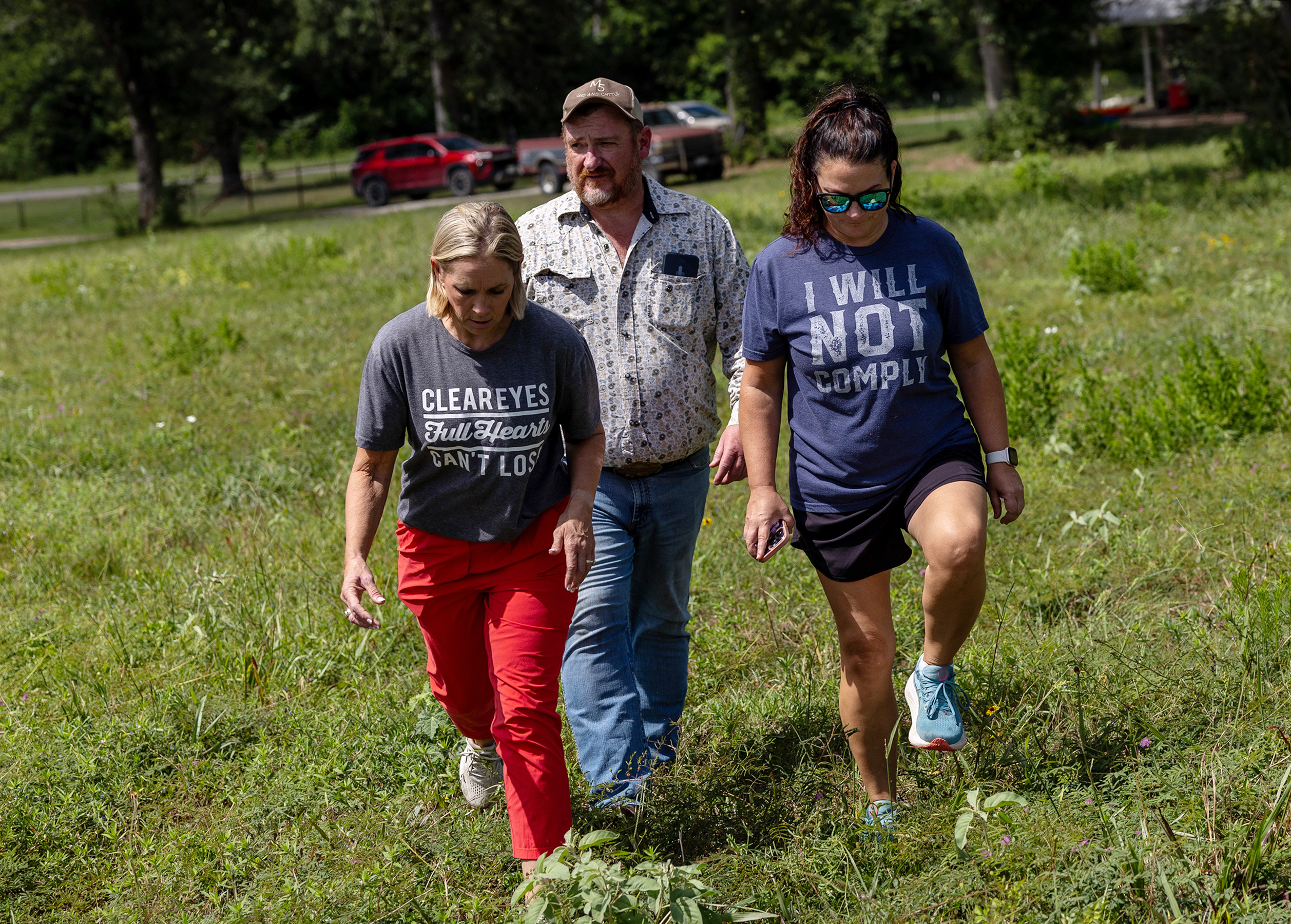
    Ann McCoslin (from left), her cousin Daniel McCoslin, and Nikki Meador walk on Meador’s Leon County property, which is next to the proposed site of a power plant expected to fuel a proposed data center. Antranik Tavitian

    Texas conservatives love free markets, the energy industry, development, and small government. But in scores of deep-red Texas communities such as Leon County, longtime Republican voters are setting aside those principles to battle an onslaught of data center projects that pro-business GOP leaders initially welcomed.

    Opposition to data centers has been notably bipartisan in communities across the country. But the fierce pushback from conservatives in Texas has required no help from liberal groups, and it has been felt everywhere from the state GOP’s new party platform to the campaigns of Lt. Gov. Dan Patrick and Gov. Greg Abbott, Republicans who now support varying degrees of increased data center regulation.

    At the GOP convention in June, the platform included a new plank that would require data centers to disclose and finance infrastructure needs without shifting costs to residents; prioritize the use of reclaimed water; and protect aquifers and the state’s electrical grid.

    Patrick, a staunch Trump ally, has made AI regulation a priority for the next legislative session in January.

    On the campaign trail, Abbott and other elected officials speak openly about restraining data centers. On Aug. 3, Abbott announced he is requiring audits of every data center seeking power from the Texas grid before they can connect. On Aug. 6 and 7, he announced that several data center companies had agreed to state audits.

    “I established clear guardrails to ensure data centers protect our electric grid, conserve our water, respect our neighborhoods and pay their own way,” Abbott said in a Monday post on X, noting OpenAI had agreed to comply with the new Texas standards. “They must not pass costs on to Texas families or interfere with their quality of life.”

    Still, Meador said Abbott has not done enough to stop data centers.

    “He’s just trying to scramble because he realizes he’s basically making rural Texas mad, and that’s where a lot of his votes come from,” she said, dismissing the governor’s audits as “very vague.”

    Meador said she won’t vote for Abbott and instead might vote for a Democrat for the first time — Gina Hinojosa, a state representative from Austin and South Texas — because “she’s against data centers in rural areas.”

    Donna Hull stakes an anti-data-center sign on her property, which is next to a proposed data center, in Leon County. Antranik Tavitian

    In Leon County, population 17,000, where 88% of voters like Meador chose Donald Trump last election, residents have been frustrated to learn how little their local GOP elected officials can do to stop the projects being proposed. Until now, the largest industries Leon County had were oil and gas, a steel plant, and chicken farms, which drew much less opposition.

    Last month, commissioners refused an application from Crusoe Technologies for tax breaks for its proposed 800-acre, $34 billion data center, citing an incomplete submission. But Crusoe can reapply or build without the tax breaks, and commissioners said they’ll be helpless to block the project because the county — unlike many cities — has only narrow zoning authority to regulate places like landfills, liquor stores, and adult video stores.

    Commissioners attempted to reassure residents that they, too, were troubled by the Crusoe project, which is expected to break ground within a year and cost the county $4 million to $5 million in added services.

    Commissioner Thomas Jefferson “T.J.” Foley noted that he is responsible for the volunteer fire department, lives within 600 feet of one of the proposed power plants expected to fuel the data center, and worries about how the county will cope with their increased demand for resources and services, especially if there’s a disaster at the massive sites.

    “Leon County and no rural county is prepared to handle this,” he said. “Until there is a catastrophe and one of these things blows up, there’s probably nothing we can say.”

    “That’s not very comforting,” a man shouted from the audience.

    Residents listen during a town hall meeting about data centers at the Jewett Civic Center in Leon County last month.Antranik Tavitian

    Leon County GOP Chair Carol Milder is emblematic of the shift among conservatives when it comes to opposition to data centers.

    The retired real estate appraiser’s father worked on an oil rig. Growing up in Houston, she saw the oil and gas industry build the middle class. But attending a panel on data centers at the state GOP convention in June in Houston awakened her to the differences between the industries.

    Panel experts, including her neighbor Michael Rice, 46, who used to work at an Austin data center, explained that unlike oil rigs and refineries, data centers bring few jobs — 40 proposed so far in Leon County — and even those are often staffed by workers from elsewhere. Milder and others at the commissioners’ meeting said they resented paying taxes only to see data centers initially get tax exemptions, effectively subsidized by residents the way manufacturing and solar industries have been.

    She told the commissioners: “We’re being held hostage for the money for them to build.”

    “We’re trying to be as prepared as we can,” said Commissioner Kyle Workman, a construction consultant. He said that unlike in Texas cities, the unincorporated community’s limited government — which many in the audience historically favored — left commissioners with few tools to block the data centers. “Leon County has kept government down over the years,” Workman said. “There’s limits to what we can do.”

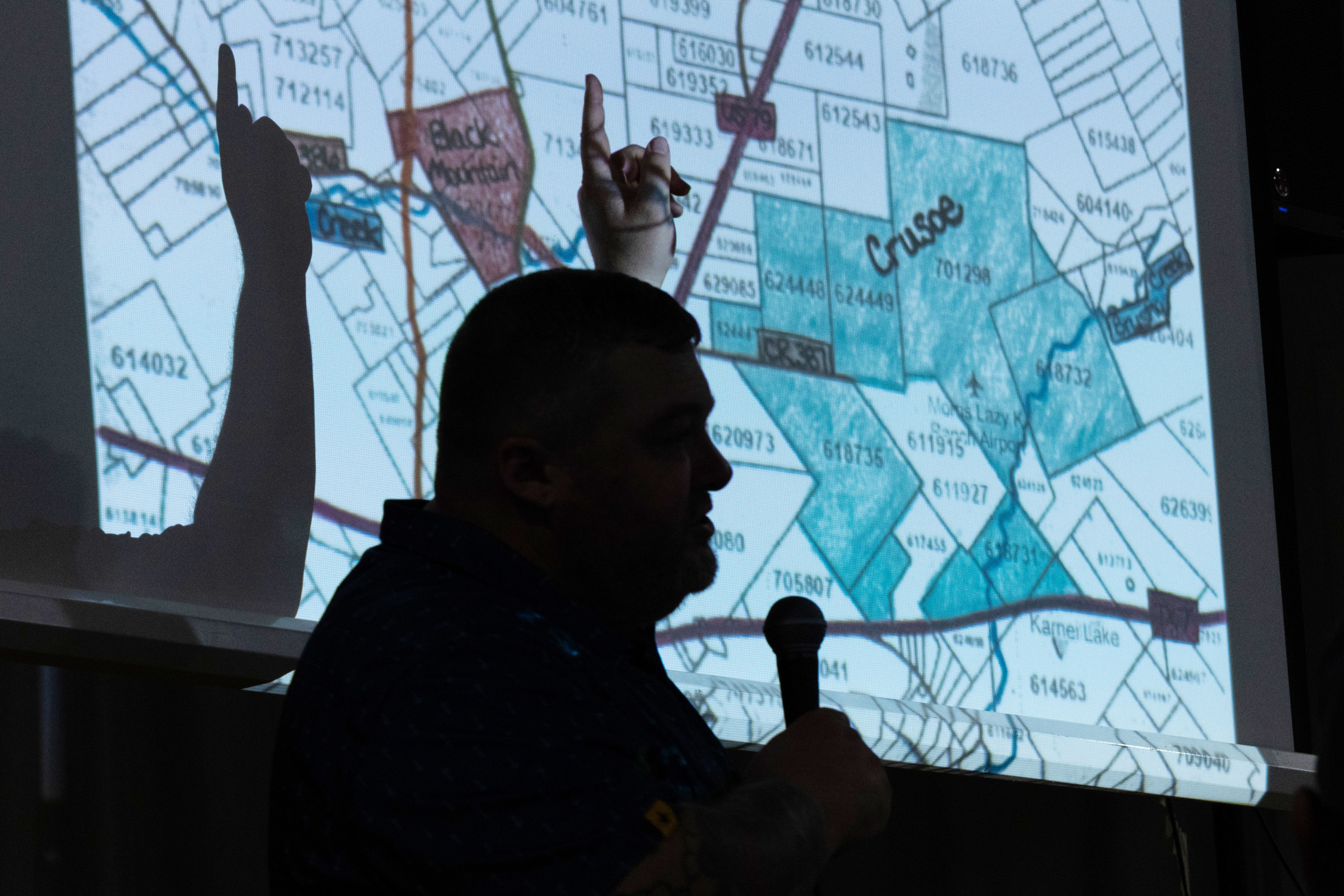
    Michael Rice points out proposed data center sites during the town hall meeting at the Jewett Civic Center last month.Antranik Tavitian

    Residents said they thought that was precisely why data center companies were targeting rural areas. Of the nearly 248 data center projects proposed statewide, nearly half are in unincorporated rural areas where zoning and other restrictions cannot be used to block them.

    And residents worried that any state legislation that might help defend against the projects would not pass until late next year — too late to block the data center proposed by Crusoe and others expected to follow. Belltown Power has proposed building a 900-acre data center in Leon County, and Black Mountain — another North Texas-based company — bought property and announced plans to build a massive power plant there.

    Milder said she alerted an adviser to the governor this year about growing local opposition in counties such as Leon. She reminded him that a majority of the state’s 254 counties are rural and that they are a key part of Abbott and the GOP’s conservative base.

    “Texas is red because of rural Texans, and we need to be listened to,” Milder told him. “You need to be concerned with what concerns us. And we’re being raped and pillaged.”

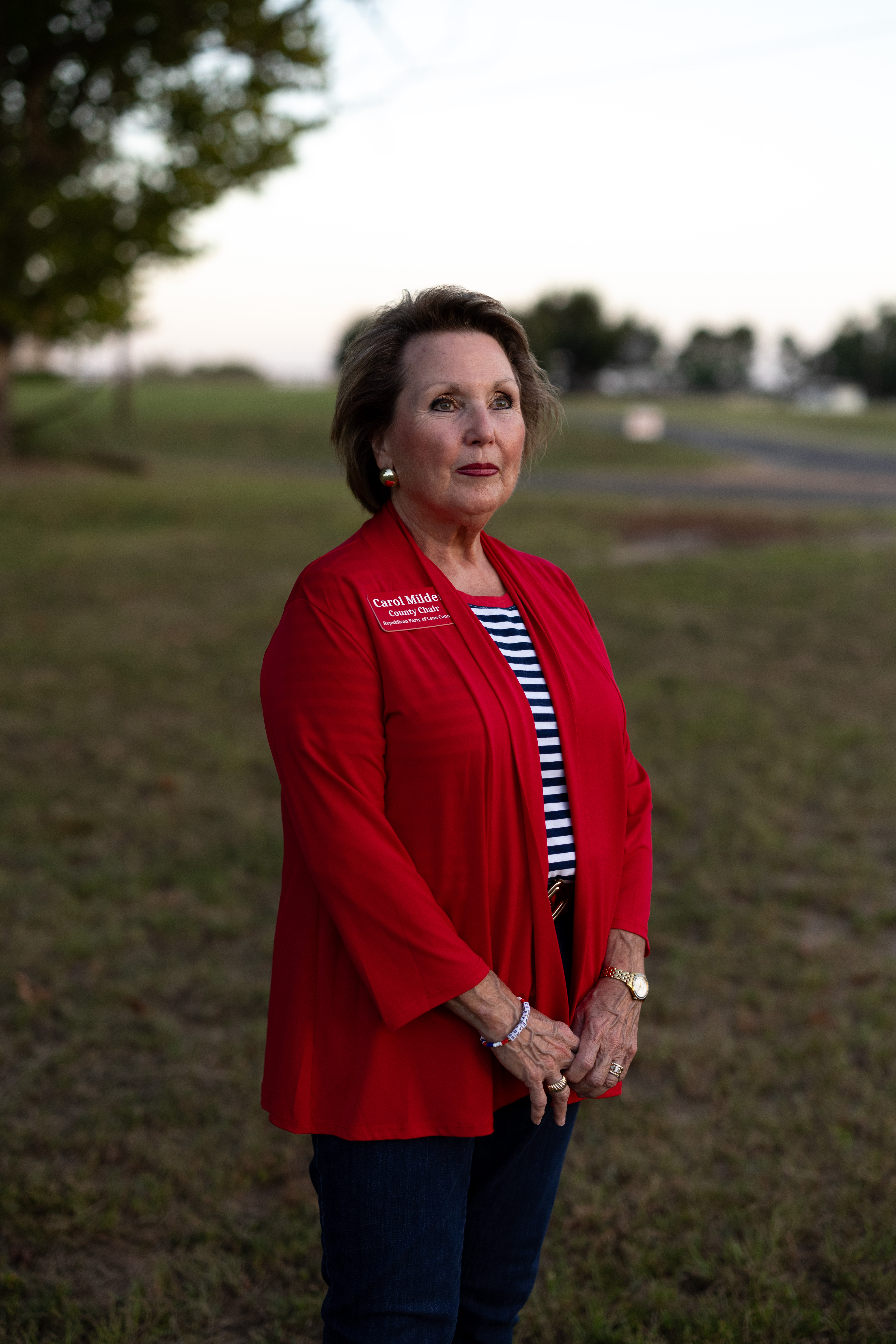
    Leon County GOP Chair Carol Milder. Antranik Tavitian

    Texas is poised to overtake Virginia as the nation’s top data center hub by 2030. A recent poll found 56% of Texans oppose data centers being built in their communities.

    “They love our farmland because it’s flat, it’s clear, there’s water and electricity there, and they can just come in and start building,” GOP Agriculture Commissioner Sid Miller said at an anti-data-center protest outside the state Capitol in Austin recently. The small crowd chanted, “Special session now!”

    After hailing Texas as “the epicenter of AI development” last fall, Abbott recently reversed course as he campaigns for reelection to a record fourth term, urging state lawmakers to repeal the centers’ sales tax exemptions and regulate where they can be built. Last month, he ordered the state Public Utility Commission and council managing the electrical grid that covers most of the state to enforce restrictions on data centers, including requiring them to “fully fund the costs of electric infrastructure.”

    “We must prohibit them from building AI data centers in rural Texas neighborhoods,” Abbott said at a campaign stop about 90 miles north of Centerville on June 30.

    By the end of July, the governor announced that the state had “begun sweeping changes to how data centers pay for the infrastructure needed to serve them, ensuring data centers do not shift those costs onto everyday Texans or place unnecessary strain on our state’s resources.”

    But Miller and Leon County conservatives said those stepped-up regulations are not enough. They want Abbott to call a special legislative session — as he has in recent years for conservative priorities such as school vouchers, congressional redistricting and property tax cuts — to pause data center development and increase regulations and oversight.

    A spokesman for the governor declined to comment about whether Abbott will call for a special session on data centers.

    “Governor Abbott has been clear that data centers cannot come before Texas families,” spokesman Andrew Mahaleris said in a statement, noting that the state regulators’ new requirements “protect Texans from higher costs and negative impacts on their communities.”

    Andrew Schmitt, a spokesman for Crusoe, said: “Crusoe is committed to protecting the natural resources and character of every community where we operate, while ensuring local families benefit from our economic investment for generations to come. We are working closely with local leaders as we evaluate development in Leon County to address community needs and deliver jobs for local workers along with significant new tax revenue for schools, public safety, and infrastructure.”

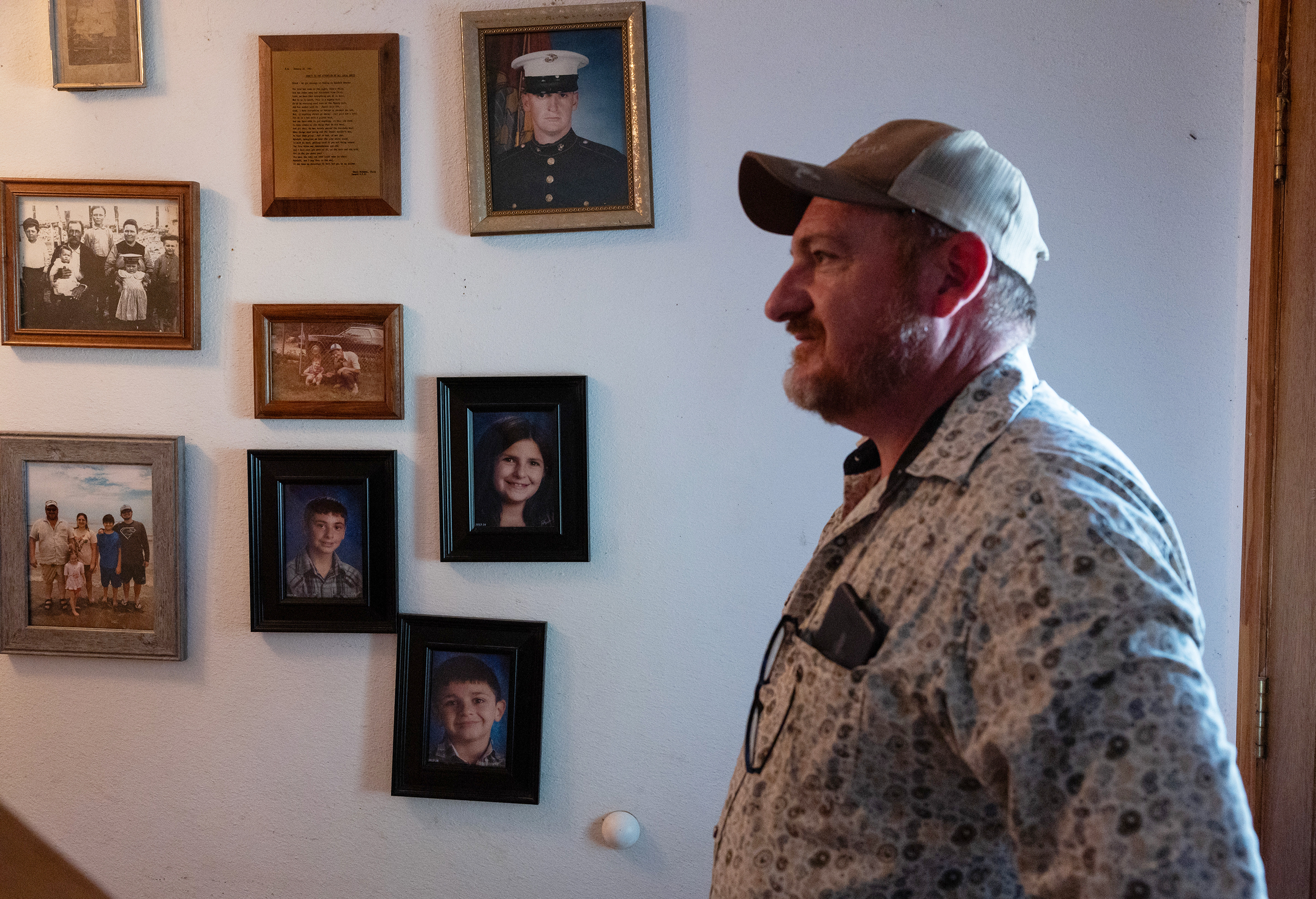
    Daniel McCoslin stands next to family photos dating back to when his ancestors settled Texas. Antranik Tavitian

    Daniel McCoslin, 48, is a retired railroad engineer who fought with the Marines in Iraq. He ranches land that’s been in his family since the 1800s and that abuts the proposed Belltown data center site. A relative’s ranch borders the Crusoe site. That’s why McCoslin — a libertarian who voted for Trump three times — organized a local anti-data-center group to educate neighbors.

    McCoslin dismissed Abbott’s recent data center regulations as “pandering.” In November he plans to vote for a Democrat for the first time in his life. Clayton Tucker, a rancher running for agriculture commissioner as the anti-data-center candidate, has called for a data center moratorium.

    When data center companies started offering neighbors up to $50,000 an acre — “life-changing money” — McCoslin recalls talk at the feed store turning to whether folks would take the millions. McCoslin was adamant he would not.

    “Family means a lot more than money,” he said.

    The evening after the commissioners’ meeting, McCoslin helped organize a town hall to update neighbors. The crowd that settled into folding chairs at a local community center included plenty of retirees, at least one of them in a MAGA hat. There were also workers, some in volunteer firefighter T-shirts, others in straw cowboy hats and boots with spurs.

    Mandy Williams holds onto her daughter Violet as she gets out of a hay harvester in Centerville. Antranik Tavitian

    Organizers used a projector to display maps of the proposed data centers and power plant, and fielded questions about potential environmental and economic effects: How many jobs will they bring, and for whom? Will they pollute the ground and water? Are they expected to decrease property values? Can they be stopped?

    Organizers displayed phone numbers and emails for Abbott and other state and local GOP lawmakers. They urged residents to contact the officials with data center concerns.

    “We’ll be calling,” said Mandy Williams, 46, as she left the meeting with her husband and towheaded 4-year-old daughter, Violet, in a “Cowgirl forever” T-shirt.

    The couple live on the eastern side of the county on a cattle ranch of more than 200 acres. Stephen Williams’s ancestors settled the land when Texas gained independence from Mexico in 1836, nine years before it became a state. Like many other Texans, owning land is part of his identity, a birthright he feels a duty to steward.

    “Hopefully we get enough pressure on him,” Stephen Williams, 46, said of the governor.

    When commissioners met Monday, they did not take action on the tax breaks and told residents that Crusoe had yet to reapply, Milder said.

    Back at his modest ranch house, McCoslin pointed to turn-of-the-century black-and-white portraits of his ancestors taken under the oaks just steps away.

    “At night, you can hear how quiet it is and see so many stars,” he said, describing his evening routine of settling outside to smoke a cigar and sip bourbon, his only soundtrack the crickets, frogs and occasional coyote. “We don’t want 24-hour industrial hum and lights destroying the sky. If I wanted that, I’d live in Houston.”