Category: Politics

  • Supreme Court is asked to settle Missouri dispute causing electoral chaos

    Supreme Court is asked to settle Missouri dispute causing electoral chaos

    A group seeking to block Missouri from using a new congressional map that favors Republicans in November’s midterm elections has asked the Supreme Court to intervene.

    The appeal is the latest twist in an extraordinary legal fight that has plunged the state into electoral confusion just as it was supposed to finalize ballots and shortly before it begins distributing mail-in versions to voters.

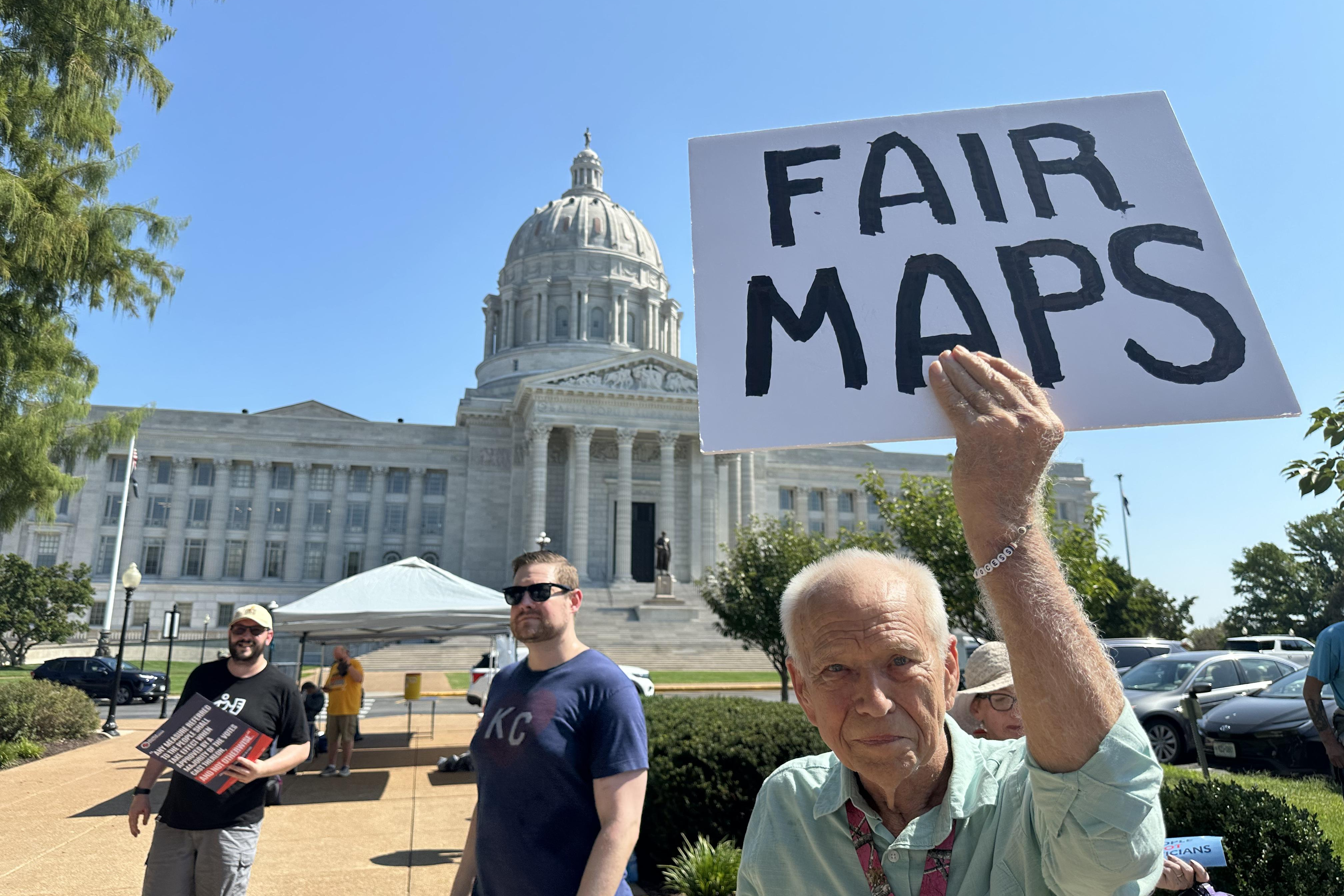
    People Not Politicians, an anti-gerrymandering group, asked the Supreme Court to review the case late Wednesday afternoon, just minutes after its appeal was rejected by a federal appeals court.

    In a brief ruling, a three-judge panel of the U.S. Court of Appeals for the 8th Circuit said they did not have jurisdiction, or the plaintiffs had not met the legal bar, to obtain an injunction against Missouri’s use of the new map.

    The legal uncertainty has left voters and election administrators unsure about what Missouri map will be in play less than two months before voters head to the polls on Nov. 3.

    Roy Temple, a longtime Democratic strategist in Missouri and former head of the state Democratic Party, said voters “can’t possibly understand who they’re going to be voting for.”

    “There is a great deal of chaos,” Temple said. “The sad part is that it’s almost entirely inflicted by people whose responsibility was to ensure the orderly conduct of elections.”

    The appeals court ruling came after a furious night of legal developments Tuesday, as Supreme Court Justice Brett M. Kavanaugh and a federal judge in Missouri issued conflicting rulings less than a half-hour apart about whether the state could use the new map.

    Republicans currently hold six of Missouri’s eight congressional seats, and the new map, adopted by the GOP-controlled state legislature, is designed to give the party a good shot at picking up an additional seat.

    Kavanaugh denied an appeal by Missouri Secretary of State Denny Hoskins to overturn a Missouri Supreme Court ruling last week blocking the new map, without giving his reasoning. The state high court had ordered Missouri to use a 2022 map that gives Democrats a better chance of keeping two seats.

    But soon after Kavanaugh denied the appeal, a federal judge, Stephen Clark, a Trump appointee in the St. Louis area, ordered Hoskins in a separate case to use the new, more GOP-friendly electoral map.

    Hoskins and the state’s Republican leadership quickly announced that they would abide by that ruling. But the anti-gerrymandering group, People Not Politicians, appealed Clark’s temporary restraining order to the U.S. Court of Appeals for the 8th Circuit.

    “If the TRO remains in effect, elections officials will effectively be in contempt of either the Missouri Supreme Court or the federal district court if they implement either HB 1 or the 2022 map, leaving ballots and voters in flux,” attorneys for People not Politicians wrote in the group’s filing.

    HB1 refers to the law that created the new map. It was adopted by the legislature last year at the behest of President Donald Trump, who has urged GOP-controlled states to draw maps more favorable to Republicans to help the party retain control of Congress in a difficult election year.

    The result has been a nationwide redistricting war in which at least 20 states have redrawn — or are in the process of redrawing — legislative maps to favor one party or the other.

    The Missouri Supreme Court also threatened to hold Hoskins, the state’s top election official, in contempt late Tuesday. The state’s high court ordered Hoskins to explain why he approved the new congressional map favoring the GOP despite its order blocking it. It was set hold a hearing on the issue on Thursday.

    People Not Politicians collected more than 300,000 signatures to force a statewide referendum on the new Missouri map in November’s election.

    Hoskins rejected the petitions, saying the state constitution did not permit referendums on congressional redistricting. People Not Politicians sued.

    A federal judge upheld Hoskins’s move, and the state held its August primaries for November’s contests using the GOP-friendly map. Afterward, the state Supreme Court issued its ruling blocking the use of the new map.

    Missouri Attorney General Catherine Hanaway, a Republican, said in a statement that this would leave state officials in an impossible position: holding a general election using different maps than were used in the primaries.

    “We maintain that changing the congressional map in between the primary and general elections is simply not feasible and profoundly unjust to Missouri voters,” Hanaway said.

    State Sen. Rick Brattin, the GOP nominee in the district redrawn to favor Republicans, said in a social media post that he was disappointed in the U.S. Supreme Court ruling. He is taking on Democratic Rep. Emanuel Cleaver.

    Brattin praised the temporary restraining order from the lower court that preserves the maps used in the primaries, saying it would ensure that “voters will not be disenfranchised by being forced to vote in a different district for November.”

    “The stakes are high for our nation in the upcoming election,” Brattin posted on X, “and I look forward to continuing to campaign across the 5th District, where I know many voters feel like it’s time to send eleven-term incumbent Emanuel Cleaver home.”

    Former U.S. senator Claire McCaskill, a Democrat, called Hoskins “lawless” and said he had intentionally waited to act until “he thought it was too late for anybody to do anything about it.”

    It was extraordinary that the conservative state Supreme Court ruled against him, McCaskill said, noting that five of its seven members were appointed by Republicans.

    “So it was really a very strong signal that they had gone too far, but according to the new Republican Party, the law is a mere nuisance that can be avoided if there is political gain to be made,” McCaskill said.

    Boone County court clerk Brianna L. Lennon said that she has been left “in a holding pattern” while the various courts and officials decide the shape of this fall’s elections.

    “I am hoping that they move quickly,” Lennon said, adding that her county and its 125,000 voters are “heavily impacted by which map we’re going to use.”

    About 40% of Boone County voters are directly affected, she said, both because the congressional district numbers change depending on which map is in effect and because the boundary shifts across the entire county.

    Because the situation has been fluid for much of the year, Boone County has preset its election systems with both maps, Lennon said. That process involves manually linking each street address to a particular precinct based on each of the competing maps, she said, so that every voter has double precinct assignments until the situation is resolved.

    “So the question is not, ‘Oh my gosh, what do we do?’ It’s just, ‘Tell us which map to use,’” she said.

    But the clock is ticking. Missouri uses paper ballots, and court clerks have been in regular contact with printing vendors to ensure there’s time to get them prepared. Ballots have to go to military and overseas voters by Sept. 18, Lennon said, and early absentee voting begins Sept. 22.

    In Boone County, the practice is to test voting equipment three to four weeks before Election Day, which means officials will need paper ballots by then. Election Day — Nov. 3 — is now seven weeks away.

    “So it will be a crunch, I think, to get the ballots printed,” Lennon said. “But it’s still doable at this time.”
  • Trump administration proposes changes to census that could exclude millions

    Trump administration proposes changes to census that could exclude millions

    Millions of residents could be excluded from the U.S. census, congressional representation could be reshaped, and federal funds could be reallocated across states under changes proposed by the Trump administration.

    In the proposal posted to the federal register Wednesday, the Census Bureau suggested adding a citizenship question to the decennial questionnaire, which President Donald Trump has wanted since his first term.

    The proposal argues that the census count should exclude any undocumented immigrants and noncitizens without permanent residency because they are “not true inhabitants, members of the body politic, or persons with a ‘usual residence’ in the United States due to their lack of a sufficient tie and allegiance to the United States.”

    Under the newly proposed rules, refugees and asylum seekers would be excluded from the population count.

    Trump administration officials also want to prohibit the Census Bureau from asking certain demographic questions, including about race, ethnicity or sexual orientation, claiming the survey “should be colorblind and should not be distorted in any way by questions about immaterial personal characteristics.”

    The census has collected data on race and ethnicity since 1790.

    Trump has for years pushed to alter how the American population is tallied every decade, including unsuccessful efforts to add a citizenship question to the 2020 Census. The Supreme Court ultimately froze that plan, saying Trump officials had provided a “contrived” reason for wanting such information.

    Trump later said the citizenship question was needed to affect the redistricting process, an argument the Justice Department did not use in its legal defense. Census results every 10 years determine how the House’s 435 seats are allocated among states.

    “Number one, you need it for Congress — you need it for Congress for districting,” Trump said in 2019. “You need it for appropriations — where are the funds going? How many people are there? Are they citizens? Are they not citizens? You need it for many reasons.”

    Last August, Trump announced he was directing the Department of Commerce to again overhaul the census, amid a nationwide redistricting battle.

    “People who are in our Country illegally WILL NOT BE COUNTED IN THE CENSUS,” he wrote on Truth Social then.

    The Trump administration’s latest proposal will almost certainly face legal challenges. The 14th Amendment of the U.S. Constitution mandates that representatives in Congress be apportioned to states based on “the whole number of persons in each state,” without specifying citizenship or immigration status.

    Currently, the U.S. census counts native-born U.S. citizens, naturalized U.S. citizens, non-citizen U.S. nationals, lawful permanent residents and temporary migrants, such as foreign students, refugees, asylum seekers and undocumented immigrants.

    New York Attorney General Letitia James, who led a lawsuit against Trump’s efforts to change the 2020 Census, said Wednesday the state is again exploring legal options to fight back against the administration’s proposed changes to the 2030 Census.

    “The Constitution is clear. Every person living in the United States, regardless of immigration status, must be counted in the census,” she wrote on X.

    Civil rights and public health groups have also warned against the removal of questions about race and ethnicity from the census, saying doing so would hamper officials’ ability to address health disparities, starting with how to appropriately allocate federal funding.

    “If you change what the census counts, then you change where the money can help most,” Vi D. Le and Melanie Klein of the Federation of American Scientists wrote last week.

    “Removing race and ethnicity data does not make health disparities go away,” they wrote. “It merely makes them harder to find, harder to measure, and harder to fix.”

  • Trump gave $45,000 cash gifts to Natalie Harp, two other close aides

    Trump gave $45,000 cash gifts to Natalie Harp, two other close aides

    President Donald Trump gave $45,000 cash gifts to his executive assistant Natalie Harp and two of his other young, loyal White House employees, according to financial disclosures released by the administration.

    On their disclosure forms, which were released publicly late last week, the three women described the payments as “Cash Gift for Holidays.” The gifts amount to about one-third of the $150,000 salaries they each earn from their White House positions, according to an annual report to Congress.

    Richard Painter, the former chief White House ethics lawyer for President George W. Bush and a critic of Trump, said the payments appear to violate a federal statute that prohibits the supplementation of federal employees’ salaries from outside sources.

    “He’s clearly trying to make it easier for them financially to work in government service at the White House,” Painter said. “You can’t do that.”

    A White House spokesperson denied that the payments violated any rules.

    “The President has a longstanding practice of giving Christmas gifts to people in his orbit, including at times employees and aides, both in government and in his time in the private sector,” White House spokesperson Davis Ingle said. “The gifts at issue here have nothing to do with any of these individuals’ official government duties, and therefore are entirely permissible under relevant legal and ethical standards.”

    The three recipients of Trump’s gifts did not immediately respond to requests for comment.

    Harp, a 35-year-old aide who rarely leaves Trump’s side, is known within the White House as the “human printer” because she carries a portable device to provide Trump with his preferred hard copies of news articles and social media posts.

    She has come under increased scrutiny since the Washington Post reported last month that she was one of a handful of close staffers who accompanied Trump on a catering truck that transported him under concealment as he secretly swapped planes to depart Turkey in response to a potential Iranian assassination threat.

    Days after the Post report, Sen. Jon Ossoff (D., Ga.) said at a campaign rally that Trump would rather “travel with Natalie on their apparently defenseless flying palace” — a reference to the airplane given to Trump by the Qatari royal family — as he accused the president of neglecting his duties. The remark sparked backlash from the White House and conservative media figures that intensified the spotlight on Harp.

    Trump also gave $45,000 to Margo Martin, a 31-year-old communications adviser who often gets closer to the president than his Secret Service detail to film his daily activities for social media, and Chamberlain Harris, a 26-year-old White House aide who serves as Trump’s executive assistant. Trump in February appointed Harris to the U.S. Commission of Fine Arts, which has oversight of his White House ballroom and other Washington-area construction projects.

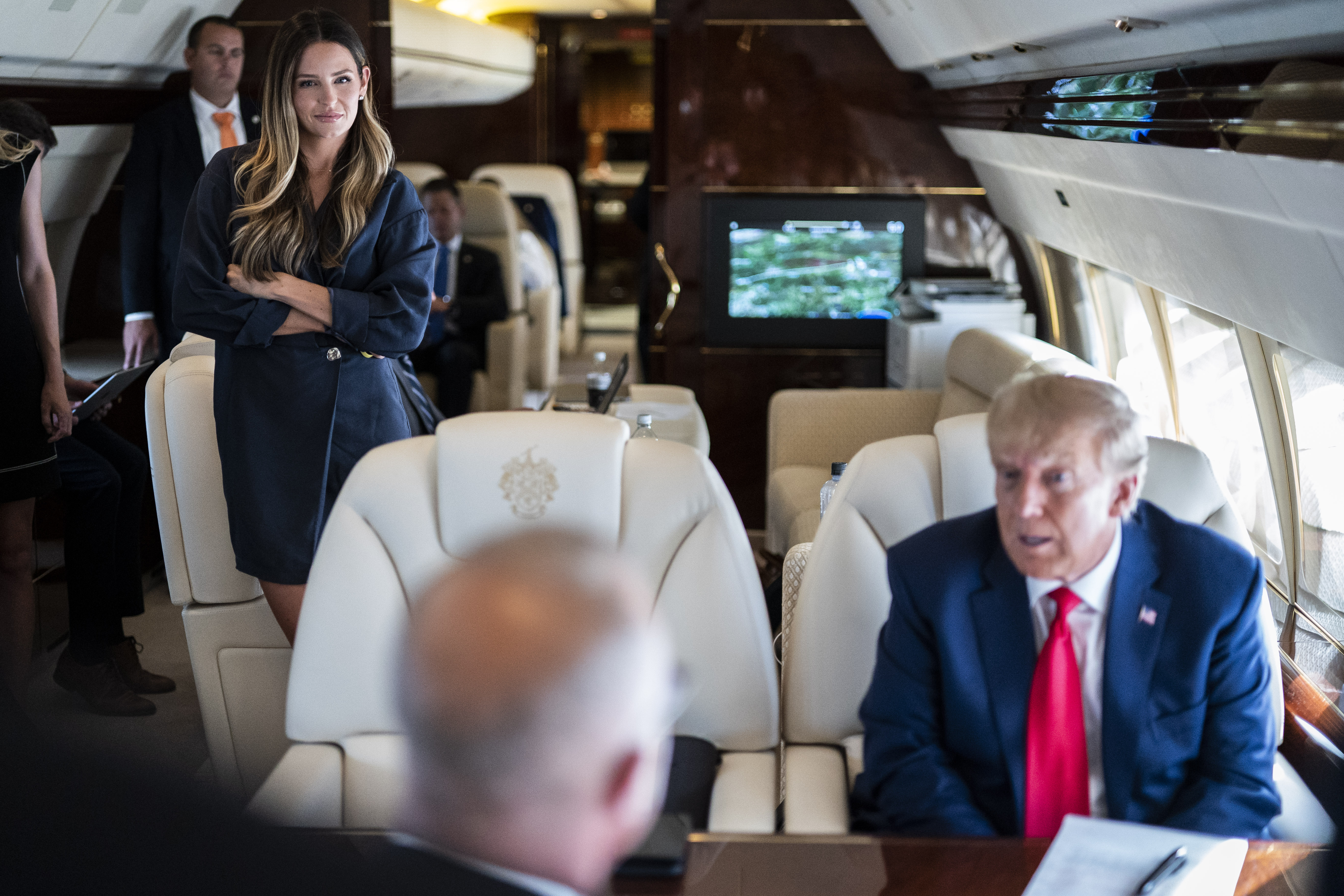
    Trump aide Margo Martin listens as the former president speaks to staff and reporters during a 2023 flight.Jabin Botsford

    Walt Nauta, the director of Oval Office operations, reported a $20,000 gift from the president. Nauta, who earns $175,000, also accompanied Trump on the catering truck in Turkey. He served as a valet in the first Trump White House and was a key witness and co-defendant in the Justice Department’s probe of Trump’s handling of classified documents at Mar-a-Lago. A judge dismissed the charges in 2024, ruling that special counsel Jack Smith, who had brought the case, was improperly appointed.

    There are no other public instances of U.S. presidents giving staff employed by the White House large cash payments. Government ethics experts said they were not aware of any other payments of this scale from a superior to a subordinate government worker.

    Traditionally, government ethics officials worry about situations in which a company that previously employed a federal official tries to provide additional money to make it easier for them to serve in government, Painter said.

    When employers give a holiday gift to a person who works in their house, that is considered part of their income, he added.

    “It’s not like tipping the doorman on Fifth Avenue,” he said. “These are U.S. government employees. If you want a job where you get tips, you shouldn’t be working for the U.S. government.”

    Under the law, both the person who pays the supplemental income and the person who receives it are liable. The Trump Justice Department might decline to enforce the law, but the statute of limitations is five years. Trump’s term ends in a little over two years.

    Federal employees are also subject to restrictions on what gifts they can give or receive to ensure government decisions remain impartial.

    Don Fox, the former acting director of the Office of Government Ethics (OGE) in the Obama administration, said it was not clear from the available facts that the payments violate the prohibition on supplementation. He said that would be the case if Trump made the gifts after one of the employees said they were leaving for the private sector because they couldn’t live on what they were making, and he gave them a supplement to level the disparity in salaries.

    There are rules that restrict employees from giving gifts to their superiors over concerns they could be abused to curry favor. But a large payment to a subordinate is “not a circumstance that OGE ever really envisioned,” Fox said. “This just doesn’t happen.”

    He said the most expensive gift he remembered receiving as a federal employee from a superior was a fruit basket around the holidays.

    Even in the absence of any violation, however, Fox said he still found the payments “troublesome” because they could leave the aides indebted to Trump.

    “I would feel somewhere between really uncomfortable and then beholden to the person who gave me such a large gift,” he said.

    Harp, Martin, Harris, and Nauta all have ties to Trump dating from his first term, and they were all among a small inner circle of aides who worked for Trump in Florida in between his presidencies. Harp, Martin, and Harris have limited work experience that isn’t tied to Trump.

    Harp gained national attention in 2019 for a LinkedIn post in which she credited a law Trump signed in 2018 expanding access to experimental treatments with saving her life following a Stage 2 bone cancer diagnosis. Medical experts have cast doubt on those claims. Harp spoke about the experience at the 2020 Republican National Convention. As an anchor with One America News, she frequently promoted Trump’s false claims that he won the 2020 election. She began working for Trump in 2022 after leaving the network.

    Martin began working for the Trump White House as a press assistant in 2019 and continued to work as a press secretary for Trump after the inauguration of President Joe Biden. Harris began her career at the White House and was known as the “receptionist of the United States” during Trump’s first term.

    Nauta is a Guam native who enlisted in the Navy in 2001. By 2021, he was promoted to the rank of senior chief culinary specialist, according to military records. Nauta was working in the White House at that time, and Trump promoted him to be his valet, according to court records. Valets are often known as “body men,” following politicians closely so that they can provide them with everything from snacks to schedules.

    They each reported that they had no income or employment assets from a spouse in their disclosures.

  • She was Mayor Parker’s director of youth engagement. Now, she’s planning to run against her former boss in 2027.

    She was Mayor Parker’s director of youth engagement. Now, she’s planning to run against her former boss in 2027.

    Shania Bennett was the director of youth engagement in Mayor Cherelle L. Parker’s administration until she resigned in May. The mayor, she said, once treated her as a protégé.

    Now, Bennett, 26, says she plans to run against Parker next year — the first candidate to publicly announce an intention to challenge the mayor’s reelection bid in next May’s Democratic primary.

    “Sometimes, you have to be willing to hold people you love accountable,” Bennett said in an interview Tuesday. “To be honest, I’m the change that I want to see. I think a lot of Philadelphians [are] waiting on it.”

    She released a video on social media Tuesday announcing her campaign with the slogan, “Leadership you can trust.”

    A Parker campaign spokesperson declined to comment.

    Bennett, who lives in her native South Philadelphia and graduated from Pennsylvania State University in 2020, said she resigned from Parker’s cabinet in May after realizing the administration would not give her office the budget or authority it needed to accomplish its mission.

    “My hands were tied. I couldn’t do anything on behalf of young people,” she said. “It was an opportunity for me to put all of my passion into something I really believed in, just to end up disappointed.”

    In July, she posted on social media that working for the administration was “the worst experience of [her] life” and that she had quit after “unprofessional harassment.”

    No Philadelphia mayor has lost reelection since the city’s Home Rule Charter was adopted in 1951, and Bennett has her work cut out for her if she wants to break that streak in her first run for office.

    Parker, 54, has spent 21 years in elected office, and her campaign had more than $1.4 million in the bank as of May 4, according to her most recent campaign finance report.

    Bennett said she has not yet put together a campaign team and is still ironing out her policy platform. She said she plans to conduct listening sessions so she can craft proposals that address Philadelphians’ needs.

    “Let me see the things you want me to talk about as a candidate,” she said. “I haven’t seen a candidate that really reflects the people’s choice in Philadelphia.”

    Bennett said she was alarmed by last weekend’s “teen takeovers,” when police officers arrested three people after confrontations erupted between large groups of teenagers who congregated near City Hall on consecutive nights.

    “It’s just young people acting out, and we have to get to the root cause,” Bennett said. “Is what we’re funding effective, and is it giving us the outcome that we want?”

    Parker, a moderate Democrat with strong support among the local party establishment, is seen by some as potentially vulnerable to a challenge from a progressive politician such as District Attorney Larry Krasner.

    Bennett said her platform will reflect the problems facing the city, not ideology.

    “Some of it might be progressive, but some of it might be: You have to put your foot down,” said Bennett, who founded the anti-violence nonprofit Reach4Peace as a teenager. “Philly has some unique challenges. It is not one party or one ideology that can fix them.”

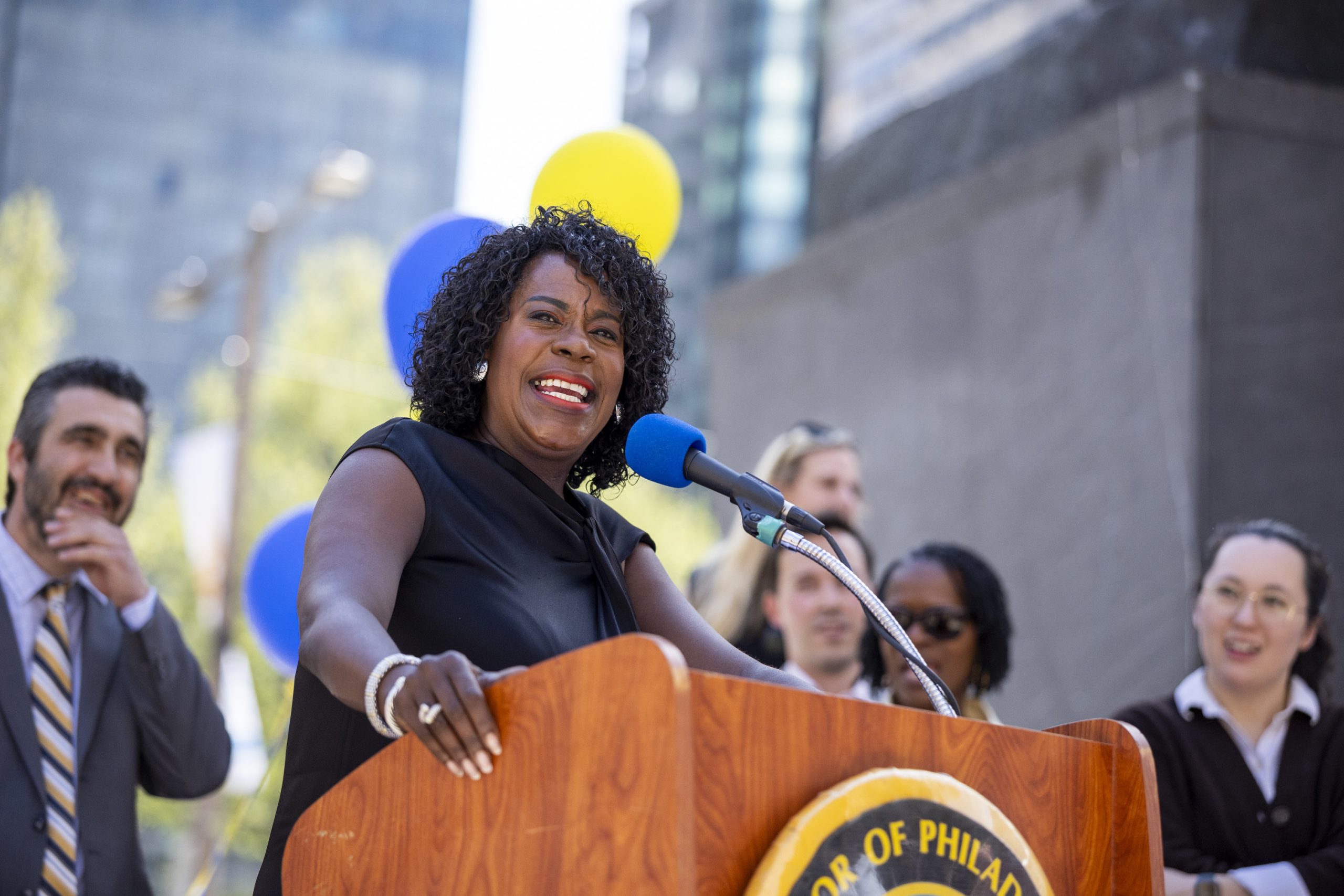
    Mayor Cherelle L. Parker, speaks at the ribbon cutting for the newly renovated skate plaza at the Municipal Services Building in Philadelphia, Pa., on Friday, April. 17, 2026.Tyger Williams / Staff Photographer

    Bennett said she understands that many powerful politicians and deep-pocketed groups like labor unions are unlikely to endorse her challenge to Parker. But she is holding a launch event on Sept. 26 and hopes to gain momentum from there.

    “It’s still extremely early, but I’m hoping to announce early to do the hard work of fundraising and listening sessions,” she said.

    Parker took Bennett under her wing during the 2023 mayor’s race.

    Bennett had previously worked for State Rep. Jordan Harris and State Sen. Nikil Saval, both Philadelphia Democrats, but had no previous ties to Parker before showing up at a campaign office offering to help, she said.

    Bennett stood out as a hardworking volunteer as she knocked on doors and organized neighborhood canvasses, and she caught Parker’s eye.

    “Every time I saw her, she was hard at work,” Parker said when she appointed Bennett to lead the Mayor’s Office of Youth Engagement in early 2024.

    After leaving the administration, Bennett briefly worked for the Pennsylvania Democratic Party as a regional organizing director before resigning to launch her mayoral bid.

    “When you leave somewhere with your integrity intact, it’s like, ‘OK, you can do something about it,’” Bennett said. “I was just like, ‘Know what? I’mma press play.’”

  • New grand jury subpoenas being sent in investigation targeting Trump-Russia probe, sources say

    New grand jury subpoenas being sent in investigation targeting Trump-Russia probe, sources say

    WASHINGTON — The Justice Department is demanding testimony before a Florida grand jury in an investigation aiming to establish an intelligence community conspiracy against President Donald Trump, according to multiple people familiar with the matter.

    New subpoenas being issued to former government officials represent an escalation in the yearlong investigation as the Justice Department pursues a loosely defined theory that members of the intelligence community who scrutinized Trump over the last decade, including over Russian interference in the 2016 election, conspired against him and violated his rights.

    Investigators in recent days contacted some defense lawyers for witnesses advising them of forthcoming grand jury subpoenas. It was not clear how many as of Tuesday had received a subpoena or were still waiting to receive one, and the identities of the witnesses receiving subpoenas were also not immediately clear. The people who confirmed the subpoenas spoke on condition of anonymity to discuss a secretive grand jury investigation.

    Investigation has focused on the Trump-Russia probe

    The contours of the conspiracy investigation aren’t fully known, but agents and prosecutors over the last several months have focused intensely on one of Trump’s chief grievances: the U.S. government response to Russian interference in 2016 and an intelligence community assessment that Moscow meddled on Trump’s behalf at the direction of Russian President Vladimir Putin.

    Trump, who spent much of his first term shadowed by an investigation into whether his campaign colluded with Russia to sway the outcome of the election, has for years lashed out at the intelligence community finding and cast it as a “deep state” conspiracy to undermine the legitimacy of his win.

    Investigators searching for potential crimes in connection with the intelligence community response have conducted numerous voluntary interviews, but the subpoenas prepared for witnesses in recent days represent an apparent effort to lock down sworn testimony before a grand jury.

    It remains unclear whether anyone will be charged or for what offense, though lawyers for former CIA Director John Brennan have said they have been informed that he is a target as investigators examine whether he falsely testified to Congress — something he and his attorneys have consistently denied. The Justice Department last spring subpoenaed witnesses before a Washington grand jury as part of an investigation into Brennan, but swiftly withdrew the subpoenas in favor of voluntary interviews.

    The investigation is being run out of Florida, with the Justice Department in April bringing back into government service a top prosecutor from the Reagan administration, Joe diGenova, to serve as a counselor to the attorney general and help lead a team of agents and prosecutors.

    DiGenova, who had previously asked then-Attorney General Pam Bondi to appoint him to the job and has openly and repeatedly claimed Trump was the victim of an intelligence community conspiracy, declined to comment Tuesday when reached by the Associated Press.

    In an indication of the wide-ranging nature of the investigation, the AP reported last month that diGenova’s team has sought interviews with law enforcement officials involved in the 2022 FBI search of Trump’s Mar-a-Lago property in Palm Beach, Fla. The search recovered a trove of classified documents that formed the basis of a since-abandoned Justice Department prosecution of Trump, who has long decried the FBI operation as an invasion of his privacy.

    Concerns from defense lawyers about a ‘favored’ judge

    Investigators have set up shop in Fort Pierce, Fla., the home court of U.S. District Judge Aileen Cannon, the Trump-appointed jurist who repeatedly appeared skeptical of the classified documents case against him and ultimately dismissed it after concluding that the prosecutor who filed the charges was illegally appointed.

    Lawyers for Brennan last year asked the chief judge of the federal court in Florida to prevent the investigation from being steered to Cannon, whom they described as a “favored” Trump judge. They have since sued the Trump administration, demanding a court order requiring prosecutors to preserve records from the investigation so that Brennan could challenge any eventual prosecution of him as vindictive and selective.

    Trump came to office in 2017 under scrutiny from the intelligence and law enforcement community about whether his successful campaign had conspired with Russia, which stole politically damaging Democratic emails and orchestrated their release through WikiLeaks as part of a wide-ranging interference scheme.

    A Justice Department special counsel, Robert Mueller, investigated but found insufficient evidence to prove a criminal conspiracy between Russia and the Trump campaign, though his team of investigators did find that Russia interfered in sweeping fashion in the election and that the campaign eagerly hoped to benefit from Moscow’s help.

    Subsequent investigations by an inspector general and Justice Department prosecutors identified numerous errors and omissions by agents who conducted the Russia probe but found no evidence of criminal wrongdoing by senior law enforcement officials nor proof of an anti-Trump conspiracy like what prosecutors are now hoping to prove.

    Deeply frustrated by those outcomes, Trump has amplified his demands for retribution, which his Justice Department has heeded. Last year, Bondi directed prosecutors to put evidence before a grand jury following the release of documents aimed at calling into question the legitimacy of the Trump-Russia inquiry.

  • With control of Congress on the line, Pa. Republicans head to Trump’s midterm convention in Dallas

    With control of Congress on the line, Pa. Republicans head to Trump’s midterm convention in Dallas

    Key figures in Pennsylvania Republican politics — including the state’s top elected federal GOP official and several lawmakers in the middle of heated reelection campaigns — will participate in their party’s first-of-its-kind midterm convention this week in Dallas.

    The gathering, spurred and heavily promoted by President Donald Trump, arrives as Republicans look to defend their control of Congress this fall amid difficult circumstances. Trump’s approval ratings, including on key issues such as the economy and the war in Iran, have sunk, including in Pennsylvania.

    And Democratic challengers, some of whom have outraised their Republican opponents, have waged aggressive campaigns.

    After Trump successfully won the White House and ushered in a wave of downballot Republican wins just two years ago, the convention — described as “Trump-a-palooza” by Republican National Committee chairman Joe Gruters — is aimed at energizing the base at a critical time.

    Pennsylvanians, representing a swing state that has been key to Trump’s success in the past, will play a role.

    U.S. Sen. Dave McCormick (R., Pa.) and a pair of House lawmakers in competitive districts — U.S. Reps. Ryan Mackenzie (R., Lehigh) and Rob Bresnahan (R., Luzerne) — are among the more than 100 scheduled speakers over two days, starting Wednesday.

    Their speaking slots were among the first to be announced. Underscoring the Keystone State’s role in keeping the House Republican majority, only the host state of Texas had more representatives on the initial list of elected officials scheduled to address the crowd.

    The Pennsylvania Republican Party, meanwhile, has orchestrated a “full slate” of 55 delegates and alternate delegates.

    “The Republican Party of Pennsylvania is excited and honored to be a part of the first ever RNC Midterm Convention in Dallas,” spokesperson James Markley said in a statement. “It will be a tremendous opportunity to hear from everyday Americans about how this administration has changed their lives for the better.”

    The state party had not provided the names of the delegates as of Tuesday, though the list is expected to include party activists and other elected officials. State party leaders had encouraged Pennsylvanians to attend the gathering.

    Democrats, who see the president’s lagging approval ratings as a key to their success in the midterms, were quick to blast Pennsylvania Republicans for attending. Their response includes plans to send a small group of House Democrats, including U.S. Rep. Madeleine Dean (D., Montgomery), to Dallas to push back against the GOP messaging.

    “While swing seat House Republicans try to hide from their record of raising costs on working families, gutting Medicaid to fund tax breaks for billionaire donors and supporting a reckless war of choice in Iran, House Democrats will be present to hold them accountable,” House Minority Leader Hakeem Jeffries, the New York Democrat in line to become House speaker if his party wins the majority, said in a statement.

    Fitzpatrick skips as other Pa. Republicans take center stage

    Four of Pennsylvania’s 10 Republican-held U.S. House seats are considered key battlegrounds as the GOP looks to maintain its four-seat advantage nationwide.

    Of those, only U.S. Rep. Brian Fitzpatrick (R., Bucks) has distanced himself from parts of Trump’s agenda and is not planning on attending the convention.

    Mackenzie and Bresnahan, on the other hand, will be among the featured speakers, and U.S. Rep. Scott Perry (R., York) will attend.

    Perry, a close Trump ally, has routinely won reelection in a Harrisburg-based district but is running this year against Democrat Janelle Stelson, a former local television anchor who nearly defeated him two years ago.

    Freshmen Mackenzie and Bresnahan were elected to Congress in 2024 after they each defeated incumbent Democrats by less than 2 percentage points. Local, state, and national Democrats have rallied behind their challengers — union leader and retired firefighter Bob Brooks in the Lehigh Valley, and Scranton Mayor Paige Cognetti in the district that covers the northeast corner of the state.

    Bresnahan campaign spokesperson Samantha Bullock said the lawmaker was “excited to bring NEPA to the national stage because these are the people driving his work in Washington.”

    Mackenzie, in a statement that referenced his work to bring federal funds to his district and support areas like local healthcare and tax relief, said he was “looking forward to talking to the people of the Lehigh Valley, the Poconos, and the entire nation about these accomplishments, and how we can build on them in the years ahead.”

    Brooks said Mackenzie was “flying to Dallas to kiss the ring of Donald Trump and his party bosses.”

    “This is exactly why people are fed up with a broken Washington that isn’t working for working people,” Brooks said in a statement.

    Mackenzie’s campaign has similarly criticized Brooks for campaigning with national Democrats — calling an event Brooks had with Jeffries in July a sign that “establishment backers” were trying to “bail him out.”

    The convention will feature six hours of programming each night.

    Topics that speakers will highlight include the elements of Trump’s signature One Big Beautiful Bill Act, which Republicans have rebranded as the Working Families Tax Cuts Act.

    Supporters have applauded the law’s extension of Trump’s 2017 tax cuts and its litany of other features, such as investment accounts for children. Democrats and other critics have pointed to the law’s cuts to Supplemental Nutrition Assistance Program (SNAP) and Medicaid spending, among other measures.

    The convention speakers will also touch on the president’s enhanced border control measures and his push for election changes such as universal voter ID, according to an outline of the agenda.

    A “candidate showcase” that will highlight “key candidates in target districts” and contrast them with their “extreme” opponents is set for Wednesday night. And an “opposition contrast” to “[deliver] the night’s sharpest partisan case against the extreme liberal Democrats” is slated for Thursday night, according to the agenda.

    Besides Trump, the members of his administration scheduled to speak include Vice President JD Vance, U.S. Attorney General Todd Blanche, Centers for Medicare and Medicaid Services Administrator Mehmet Oz, and Health and Human Services Secretary Robert F. Kennedy Jr., who has engaged in a war of words with Pennsylvania Gov. Josh Shapiro over the state’s measles outbreak.

    National Republicans have described the convention as a way to energize voters in a tough election year.

    Two years after winning Pennsylvania for the second time in 2024, Trump had an approval rating of 39% and a disapproval rating of 58% among likely voters in the state last month, according to an Inquirer/New York Times/Siena University poll.

    The poll found that 51% of likely voters said they were more likely to vote for a Democrat for Congress and 53% said they would want to see the House flip to Democratic control, though the poll did not ask about specific congressional races.

  • Philly developers are planning a $1.5M campaign to protect City Council from progressive challengers

    Philly developers are planning a $1.5M campaign to protect City Council from progressive challengers

    Philadelphia real estate developers see the writing on the wall.

    As progressives have toppled centrist Democrats in nationally watched races, some local development interests are wary that the same trend could reshape Philadelphia City Council this spring, when every member is up for reelection. They see a growing progressive faction as a threat to business.

    Enter the incumbent protection plan.

    Nearly a dozen local developers are already pouring hundreds of thousands of dollars into Philly For Growth, a group that in the past two Council election cycles spent millions on advertising campaigns to back business-friendly Democrats, according to a source familiar with the planning.

    Philly For Growth is an independent expenditure group, also known as a super PAC. It can raise and spend unlimited amounts of money to influence an election, but there are rules barring super PACs from most forms of coordination with the candidates they support.

    In 2023, the group was the biggest special interest group involved in that year’s Council races, and it provided a substantial boost to its chosen candidates by outspending individual campaigns.

    Ahead of the May primary election, Philly For Growth plans to spend $1.5 million to support pro-business Democrats, most of whom are sitting Council members, according to the source, who spoke on the condition of anonymity because they were not authorized to discuss the plans. The group will not fund negative advertising about Council’s four incumbent progressives, the source added.

    Councilmember Kendra Brooks, of the progressive Working Families Party, speaks during a rally outside of the School District of Philadelphia headquarters in May. At left is Councilmember Rue Landau and at right is Councilmember Jamie Gauthier. All three are members of Council’s progressive faction.Monica Herndon / Staff Photographer

    The idea is to keep progressives from growing their power on Council instead of spending money to knock off the leftists who are already there. There are currently four reliably progressive votes out of the total 17 on Council, but some members may be more likely to vote with that faction as Democratic voters nationally revolt against incumbents.

    That’s a different strategy than in 2023, when Philly For Growth backed a slate of five candidates — two incumbents and three challengers. Both incumbents won, but all three challengers lost.

    Philly For Growth has previously been affiliated with the Building Industry Association of Philadelphia, an advocacy group for development interests. Mo Rushdy, the BIA’s former president who leads the organization’s political activity, declined to comment.

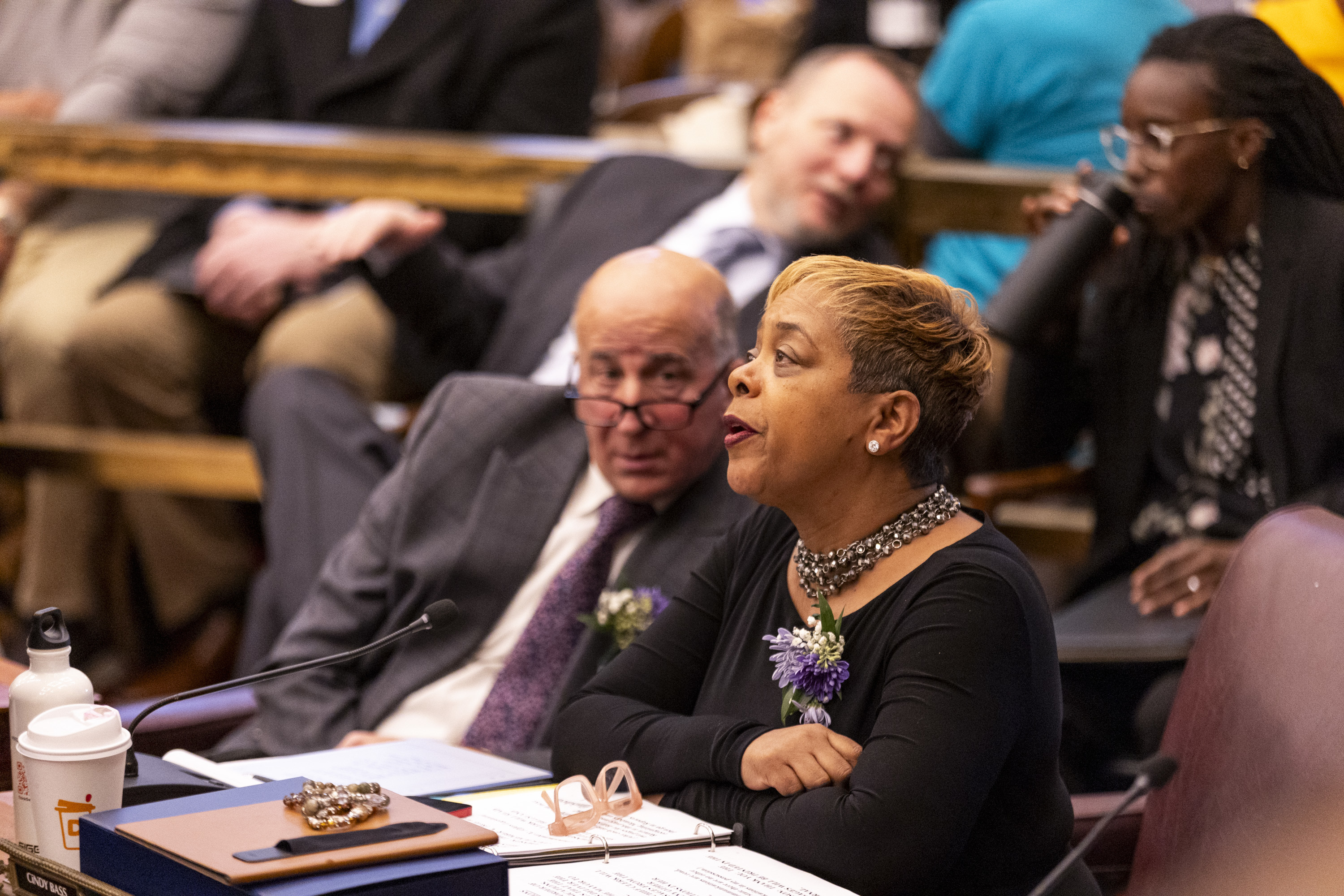
    The source said that Philly For Growth will fund advertising to support Council members Mark Squilla, whose 1st District includes parts of South Philly, Center City, and Fishtown; Cindy Bass, whose 8th District is based in North and Northwest Philadelphia; and Quetcy Lozada, whose 7th District includes much of North Philadelphia and Kensington.

    All three are seen as more centrist members and have said they intend to run for reelection. No challenger has officially launched a campaign against any of them, but candidates who are aligned with the city’s left-leaning political organizations are expected to emerge as the primary — still eight months away — draws nearer.

    The super PAC is making one exception when it comes to supporting incumbent district Council members, the source said. In the 5th District, currently represented by Councilmember Jeffrey Young Jr., the group will support a to-be-decided challenger.

    Councilmember Jeffery Young Jr. speaks to other members of Council during a 2025 session.Tom Gralish / Staff Photographer

    At least five people have said they are interested in running for the North Philly-based 5th District seat, and Young has drawn opposition from development interests for pushing proposals that would slow or halt some projects in his district.

    Young said in a statement that building “sensible, affordable housing” is one of his top priorities and that he has supported city programs like Turn the Key, which provides mortgage support to first-time homebuyers.

    “People are free to back those who share their values. These are my values,” Young said. “I am leaving it to the residents of the 5th to determine whose values best reflect them.”

    The super PAC will also fund advertising backing four incumbent members who represent the city at-large: Isaiah Thomas, Katherine Gilmore Richardson, Jim Harrity, and Nina Ahmad. That group doesn’t include progressive at-large Councilmember Rue Landau, but Philly For Growth doesn’t plan to oppose her, the source said.

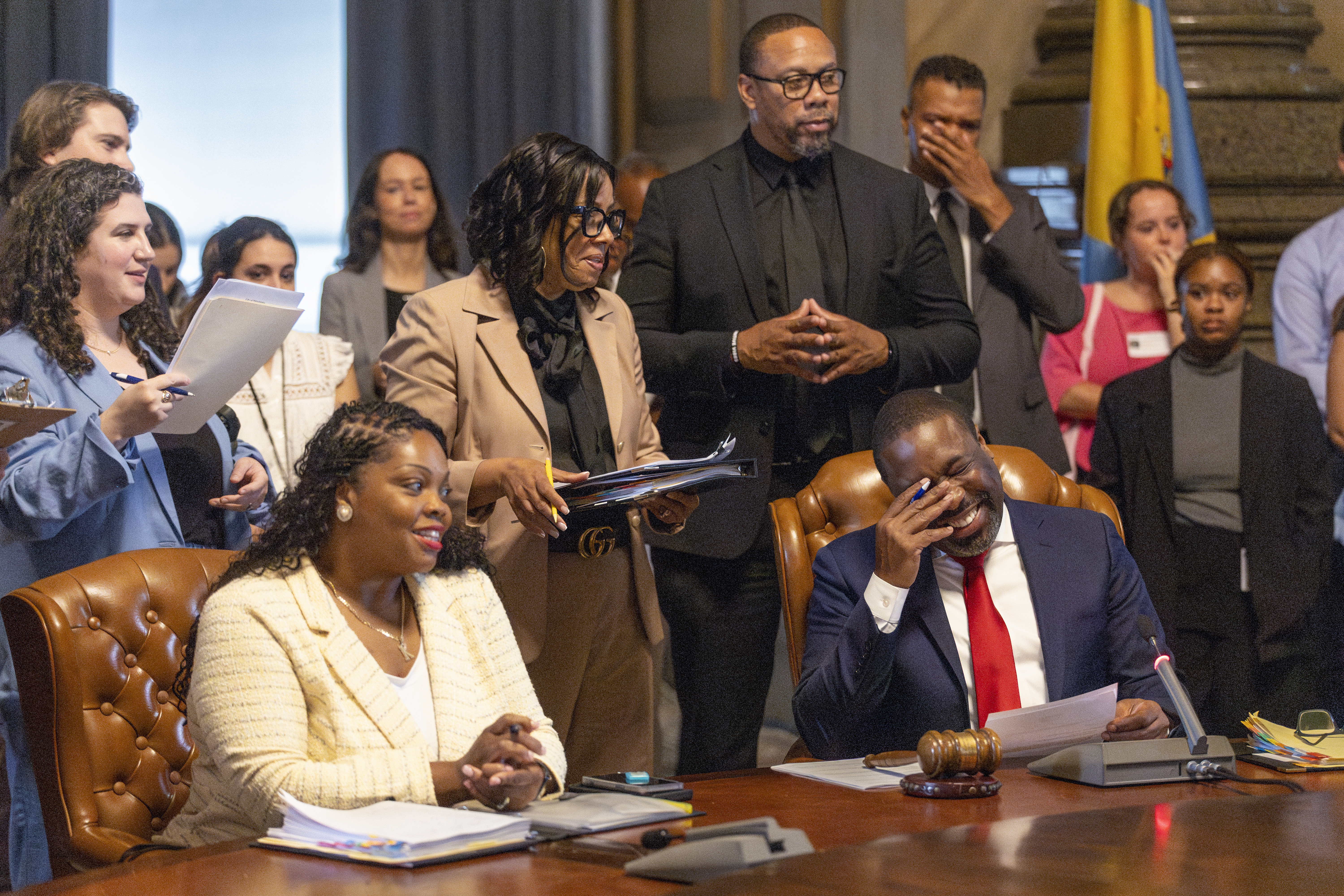
    Council President Kenyatta Johnson laughs inside the caucus inside City Hall on June 11.Aidan T. Gallo / Staff Photographer

    A spokesperson for Landau’s campaign arm said in a statement that the Council member “stands by her accomplishments for working people, small businesses and vulnerable communities in Philadelphia and looks forward to voters having the opportunity to make up their own minds next year.”

    It’s unclear just how competitive the at-large race will be, and candidates have until the spring to decide — nomination paperwork is typically due in March. Seven of Council’s members represent the entire city at-large, and two of those seats are effectively reserved for members of minority parties under the city’s Home Rule Charter.

    That has traditionally meant that five seats are held by Democrats, given the party’s massive voter registration advantage in the city. In recent years, Republicans and the progressive Working Families Party have battled for the remaining two seats during the fall general election, and the WFP currently holds both.

    Mayor Cherelle L. Parker, who is also up for reelection, and Council President Kenyatta Johnson, who insiders do not expect will see a serious challenger, will likely be on Philly For Growth’s slate, too, the source said.

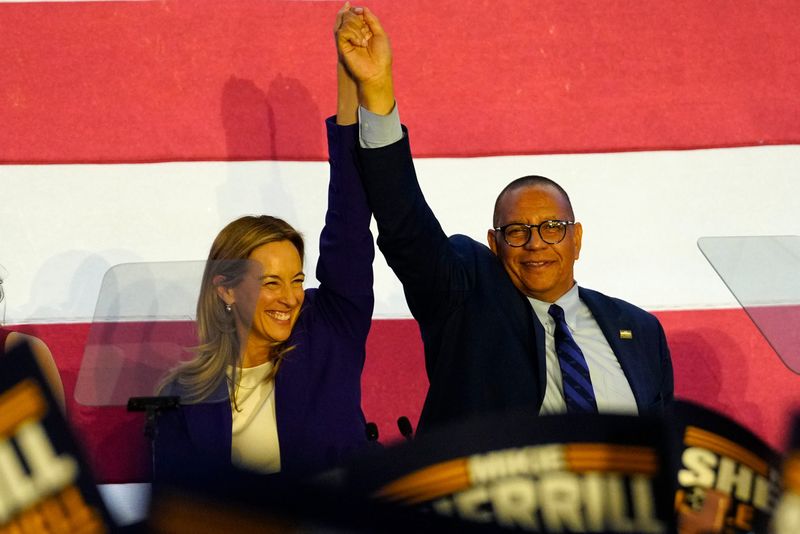
  • Gov. Mikie Sherrill breaks her silence on reported investigation into Lt. Gov. Dale Caldwell

    Gov. Mikie Sherrill breaks her silence on reported investigation into Lt. Gov. Dale Caldwell

    New Jersey Gov. Mikie Sherrill broke her silence Tuesday on a reported investigation into Lt. Gov. Dale Caldwell, but the governor offered little information on the matter and did not mention her No. 2 by name.

    “Public service is an honor. And I have spent a lifetime of service in the Navy, as a prosecutor, in Congress, and now as Governor,” Sherrill, a first-term Democrat, said in a statement Tuesday afternoon. “I know that jobs of public trust impact the lives of everyday people and I deeply respect the oaths and responsibilities of these positions.

    “Because of this respect, I demand that everyone in my administration hold themselves to the highest standards and put their obligations to public service first.”

    Her statement comes four days after the New Jersey Globe reported that Caldwell is under internal investigation for allegations of inappropriate behavior with women and possible ethics violations, including an offer of state jobs.

    Sean Higgins, a spokesperson for Sherrill, said Friday the administration could not “confirm or deny potential personnel matters.”

    New Jersey GOP chair Christine Giordano Hanlon this weekend criticized the administration’s framing of the situation as “an effort to shield the information from the public” and called on Caldwell to resign.

    “The governor and lieutenant governor should not be considered ‘personnel’ — they are the highest level elected officials in the state and must be held to the highest standard of accountability and transparency,” Hanlon said.

    Sherrill’s Tuesday statement did not mention any specific investigation or individuals.

    “I take my responsibility to treat any reports of inappropriate behavior or misconduct extremely seriously, and any credible report must be fully examined and addressed. If the evidence warrants, I will take appropriate action quickly,” Sherrill said.

    The investigation had already begun when Caldwell worked as acting governor while Sherrill was out of state last week, the New Jersey Globe reported. BINJE.com reported that the investigation has been underway for months.

    Christopher Porrino, who served as attorney general under former Republican Gov. Chris Christie, is conducting the investigation into Caldwell, the Globe reported.

    Sherrill noted in her statement that anyone with a complaint “will receive a fair and thorough review” and be safe from retaliation.

    “Let me be clear,” she said, “I do not back down from tough fights or tough conversations, and I will always put the interests of New Jerseyans first.”

    Assembly member Katie Brennan (D., Hudson) released a statement Tuesday calling the allegations serious.

    “Anyone who uses the power of public office to mistreat the people around them has no business holding it,” she said. “Governor Sherrill moved quickly here, and I’m glad she did, but survivors shouldn’t have to hope that the people in charge will do the right thing.”

    Brennan was a campaign volunteer for former Democratic Gov. Phil Murphy’s 2017 primary election campaign who said after Murphy took office that she had been sexually assaulted by a senior campaign adviser.

    Prosecutors declined to file criminal charges. But Brennan’s decision to publicize the alleged assault and the administration’s failure to investigate her claims led to changes in state law on how victims are treated by law enforcement. She said in her statement Tuesday that she will push for bills to protect sexual assault survivors.

    Caldwell has yet to publicly address the matter, and his office declined to comment Tuesday.

    Sherrill chose Caldwell to be her lieutenant governor after her primary win last summer. Caldwell, who was the first Black president of Centenary University, is a pastor in the United Methodist Church. He has experience working in state government, starting nonprofits, leading charter schools, and serving on the New Brunswick school board.

    Sherrill praised him as a “voice for the voiceless” who has followed in his parents’ footsteps when she announced him as her running mate last year. His mother was a teacher and his father, the Rev. Gilbert Caldwell, was a civil rights activist who protested alongside the Rev. Dr. Martin Luther King Jr.

    Staff writer Susan Livio contributed to this article.

  • The GOP was confident about keeping its Senate majority. Now the fight for control is wide open

    The GOP was confident about keeping its Senate majority. Now the fight for control is wide open

    WASHINGTON — Republicans appeared to have a firm grip on the Senate heading into the final two years of President Donald Trump’s term. But with less than two months until Election Day, control of the chamber is now up for grabs.

    Democrats have found themselves competing in states that once seemed beyond their reach as President Donald Trump’s slipping approval ratings and voters’ dissatisfaction with the economy create a difficult political environment for Republicans. But races Democrats once counted on winning have also become more complicated.

    It’s a battle that’s expected to exceed $3.4 billion in spending across all races during the midterm campaign. The implications are huge for Trump’s agenda and his ability to fill administration jobs and open court seats for the remainder of his term, as the Senate is empowered to confirm or block presidential nominees.

    Republicans say it’s unlikely for everything to break in Democrats’ favor, but they acknowledge they’re facing a difficult landscape. Senate Majority Leader John Thune told South Dakota’s KELOLAND News last week that he does “worry” about losing the chamber.

    “I’m a realist,” Thune said. ”I don’t ever try and sugarcoat things. I think it’s a competitive environment right now.”

    Democrats face a scrambled path to the majority

    Democrats need to net four seats to win the majority. The original path had been to hold Michigan, Georgia and New Hampshire while winning back Republican-held seats in Alaska, Maine, North Carolina and Ohio. But things have changed.

    “We now have multiple paths for the majority,” Senate Democratic Leader Chuck Schumer said last month. “We found new states — Iowa, Texas — which people a year ago weren’t even paying attention to.”

    Some of the states where Democrats were feeling most optimistic at the start of the election cycle, such as Michigan and Maine, have grown murkier.

    In Michigan, where there’s an open seat this fall, no GOP candidate has won a Senate race since 1994. But Democrats are struggling to unite behind nominee Abdul El-Sayed. The favorite of progressives narrowly defeated moderate U.S. Rep. Haley Stevens in the August primary, and feelings remain raw from a bruising contest that saw nearly $70 million spent against El-Sayed.

    Republicans believe Mike Rogers, who lost the 2024 Senate race by fewer than 20,000 votes, has an improved shot against El-Sayed. The Senate Leadership Fund — Senate Republicans’ spending PAC — added $6 million to its Michigan advertising investment after El-Sayed won, bringing their total spending to $51 million, the third-highest total.

    Democrats also saw a prime opportunity to finally defeat five-term Republican Sen. Susan Collins in Maine, where Democratic Vice President Kamala Harris won more votes than Trump in 2024.

    Progressive Graham Platner easily won the nomination in June, but he left the race the next month over a sexual assault allegation that he denies. Democratic delegates in late July chose Troy Jackson, a lesser-known former state legislative leader, to replace him.

    Jackson has been forced to play catch-up. Collins and aligned super PACs have spent almost $80 million so far, according to the ad-tracking firm AdImpact, while Jackson and Democratic-aligned groups have spent and reserved close to $45 million since he became the nominee.

    As one path narrowed for Democrats, others widened

    Democrats increasingly see a real possibility in Texas, a state that has been an elusive goal for decades, and other GOP-led states including Iowa, Alaska and Ohio.

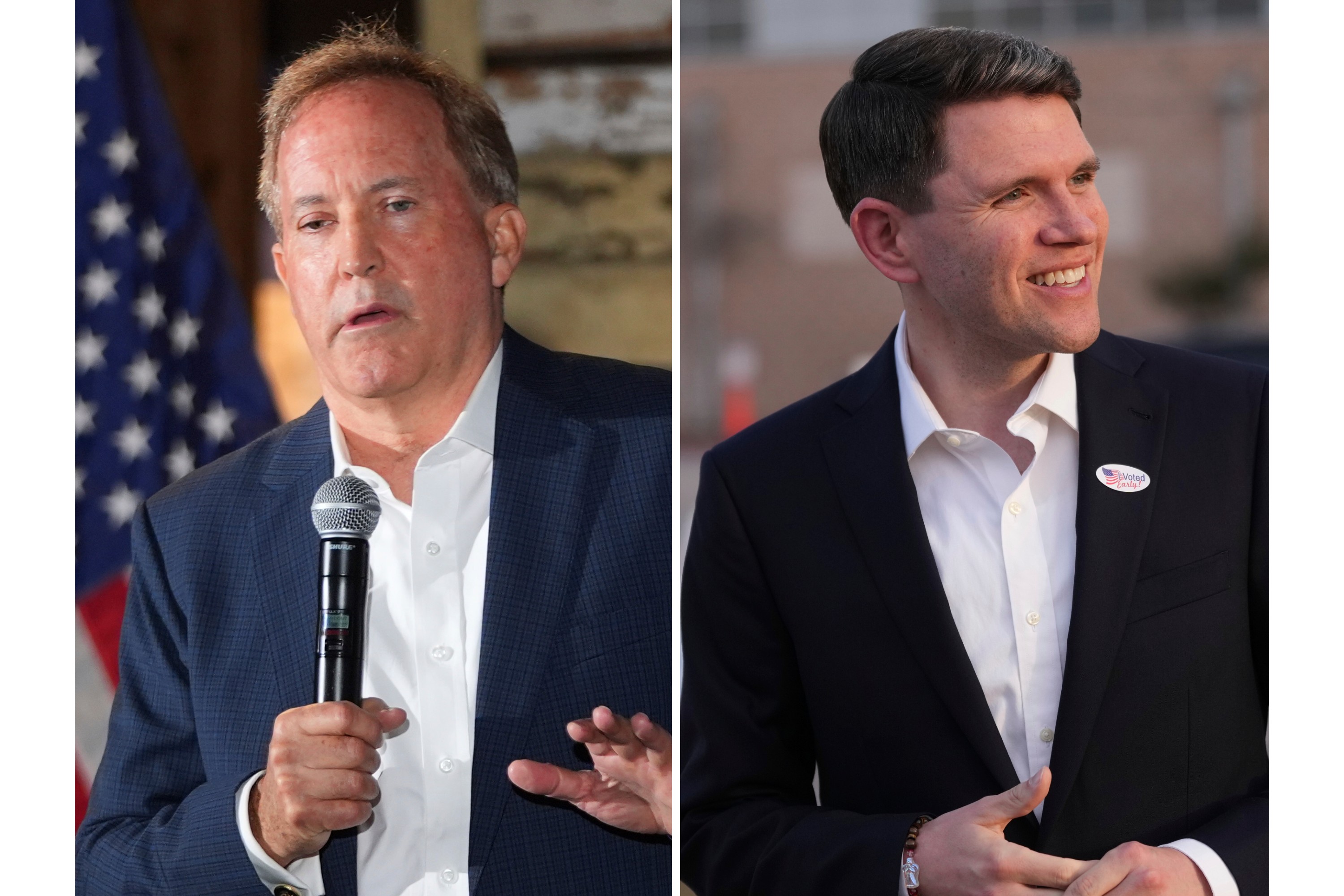
    In Texas, Democrat James Talarico faces state Attorney General Ken Paxton, who ousted four-term incumbent Republican Sen. John Cornyn to win the GOP nomination. Senate GOP leadership backed Cornyn, seeing him as the stronger general election candidate.

    Paxton has been shadowed for decades by legal and ethical questions, including indictments for securities fraud, though he was not convicted.

    Talarico and allied groups have spent nearly $30 million on advertising since the May runoff, compared to less than $3 million by pro-Paxton groups. The political fund associated with Trump last week spent $10 million on TV and digital ads to help Paxton — the first major general election investment by MAGA Inc. for the midterms. Senate GOP leaders had petitioned Trump’s political team to spend some of the more than $400 million it had last month to help Paxton.

    Democrats have also upped their spending in Alaska, Iowa, Ohio and North Carolina, all states currently held by Republicans. The GOP, meanwhile, is feeling more optimistic about New Hampshire as well as Michigan, while spending more to defend seats in Iowa and Alaska.

    The expanded map has upped the anticipated total spending this cycle. AdImpact in June projected $3.4 billion in advertising spending on Senate races, a significant increase from the $2.8 billion the ad spending firm projected in the fall of 2025.

    Why more states are in play than expected

    Democrats’ path has widened in part because of Trump’s slumping job approval, notably on handling the economy, which was at 32% according to an AP-NORC poll in July — down from 40% in March 2025, shortly after he took office.

    Trump’s trade policies and the war in Iran, with its corresponding inflated fuel costs, have added to the economic uncertainty for voters less than two months before Election Day.

    “Things still cost too much. And so we’ve got to work on that issue,” Republican Rep. Jim Jordan of Ohio told The Associated Press. “We understand that and we know that’s real.”

    Ohio Sen. Jon Husted heard the concern firsthand at a roundtable last month. Husted is looking to fend off a comeback from former Sen. Sherrod Brown in another key matchup for both parties.

    During the discussion on housing, one attendee told Husted that costs were “skyrocketing” in part because of uncertainty around tariffs.

    “Uncertainty is the killer to this economy,” said Dean Windham, a real estate developer who previously ran for office as a Republican.

    Some Republican Senate candidates have defended Trump’s policies while confronting concerns about their economic impact.

    In Michigan, where Trump’s tariffs on Canada have become a central issue, Rogers has backed the president’s approach while leaving room for disagreement.

    “President Trump is right to put America First — and tariffs are necessary, but are not a one-size-fits-all solution,” Rogers said in a recent statement.

    Republicans believe the math still favors them

    Even if Democrats hold every seat they currently control, they would need to flip at least two seats in states Trump carried by double digits in 2024 to win the majority.

    Republicans are betting that those underlying advantages will matter more as Election Day approaches — particularly as Trump and the party turn their attention toward mobilizing voters who helped return him to the White House.

    Trump told reporters last week that he will “be making a lot of stops” in the last 30 days before the election.

    This week, Republicans will hold a midterm convention in Texas, where Trump is set to speak and top Senate candidates including Rogers and Husted are expected to attend.

    But Republicans acknowledge they have work to do.

    “Politics is local,” Republican Sen. Mike Rounds of South Dakota said. He pointed to Trump’s decision to import beef, which he said made farmers and ranchers “feel just like the administration pulled the rug right off from underneath” them.

    “They’re hurt,” Rounds said. “They feel like they’ve been let down.”

  • Bob Brooks releases first TV ad of the general campaign

    Bob Brooks releases first TV ad of the general campaign

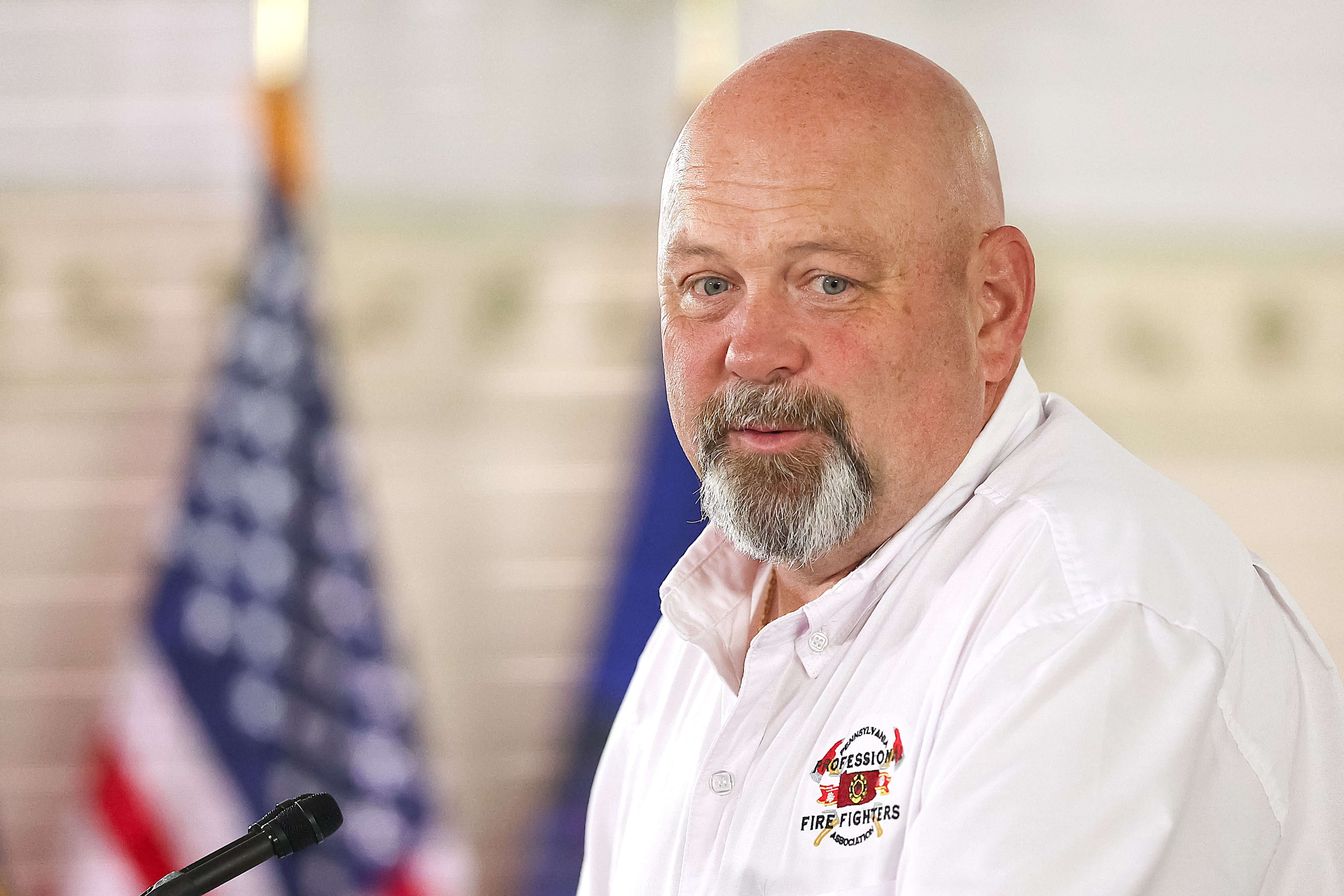
    Clad in fire safety gear, Lehigh Valley Democrat and retired firefighter Bob Brooks promised to “smoke out the billionaires and their lobbyists” in his first ad of the general election, released Tuesday.

    Brooks, a union leader who spent 20 years as a Bethlehem firefighter, blasted the “dumpster fire” in Washington that has led “working people get burned.”

    Brooks, a retired firefighter and union leader, is challenging Republican U.S. Rep. Ryan Mackenzie in the 7th Congressional District, one of the most competitive House seats in the nation. The race’s victor will help determine control of the narrowly-divided chamber.

    With a focus on economically populist ideas, such as raising the federal minimum wage, while avoiding culture war issues, Brooks has managed to attract support from across the party’s ideological spectrum including Gov. Josh Shapiro and U.S. Sen. Bernie Sanders.

    A screenshot from a new campaign ad for Bob Brooks, a Democrat running for a House seat in the 7th Congressional District, in which he is depicted extinguishing a dumpster fire.Courtesy of Bob Brooks campaign

    In July, Brooks also welcomed U.S. House Minority Leader Hakeem Jeffries to the district to support his campaign. Meanwhile, Brooks has campaigned on progressive ideas, promising to ban corporations from giving to political action committees that help finance candidates, as well as supporting Congressional term limits and bans on lawmakers trading stocks while in office.

    Mackenzie, the vulnerable freshman who won his seat by just one percentage point in 2024, has also received support from his party including U.S. House Speaker Mike Johnson in August and President Donald Trump in June. But during Trump’s visit to the district, he took nearly an hour during a rambling speech to even mention Mackenzie by name.

    Brooks’ ad borrowed a phrase from his GOP opponent, whose campaign in July referred to Brooks’ “dumpster fire candidacy.”

    “At every step of his career, Bob Brooks has put himself first, his politician buddies next, and his own workers last,” Mackenzie’s campaign manager Andres Weller said in a statement.

    Brooks’ campaign said it is planning to spend at least $1 million in September on the ad, running on broadcast television in the Philadelphia media market and on streaming platforms.

    That’s a significant expenditure for Brooks’ campaign, which raised a total of $2.3 million, according to financial disclosure reports from July.

    He’s behind Mackenzie, who has $4.5 million, in overall fundraising. But Brooks added roughly $1.2 million to his stockpile between April 30 and June 30 — after his first-place finish in the competitive Democratic primary, while Mackenzie only took in about $631,000.

    The next campaign finance deadline is in October.