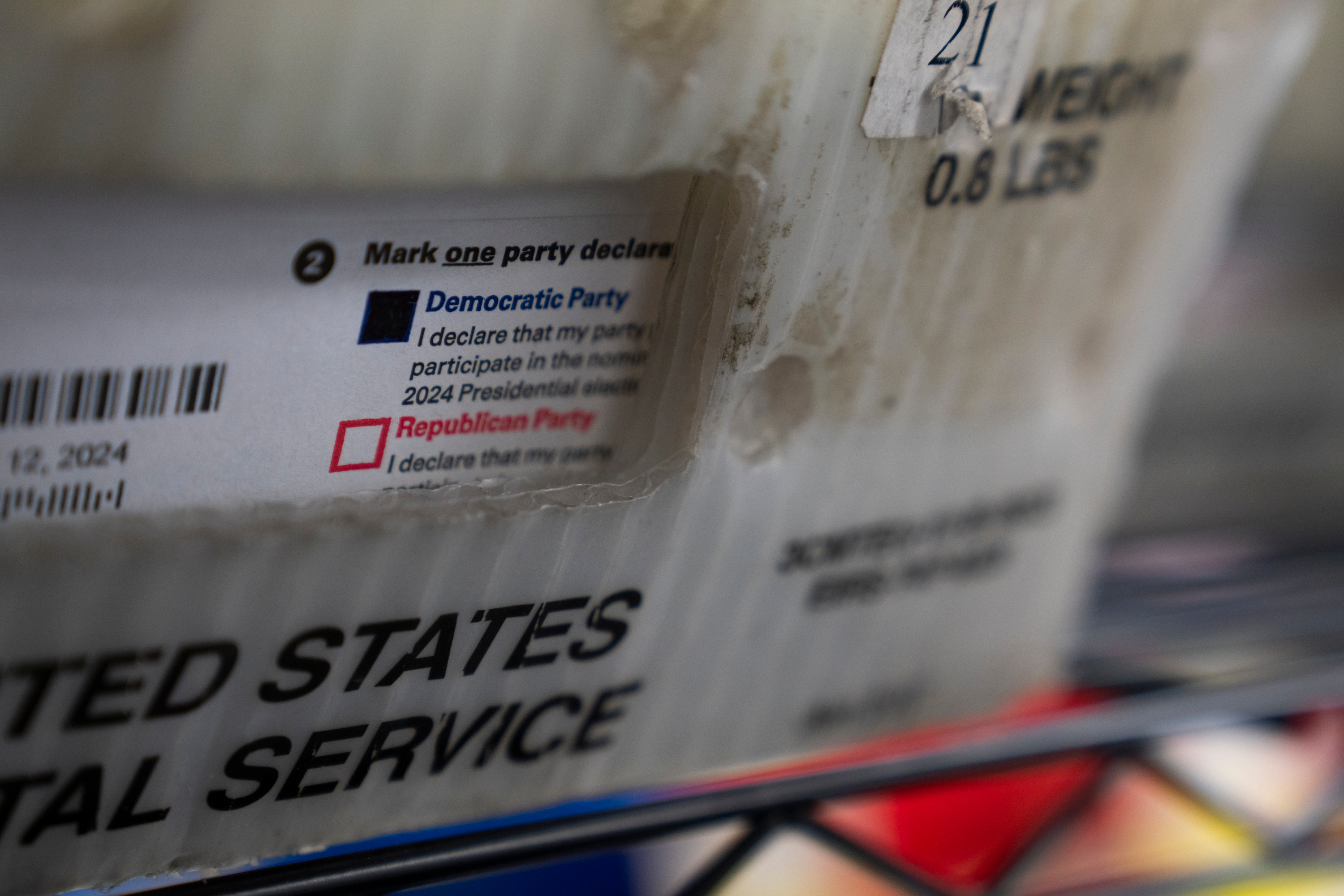
WASHINGTON — An appeals court on Thursday upheld a block on President Donald Trump’s executive order limiting mail voting, a decision that comes as the Supreme Court considers the same case and states have already started sending out ballots for the high-stakes midterm elections.
The three-judge panel refused to lift a preliminary injunction against the order issued last week by U.S. District Court Judge Indira Talwani. It prohibits the U.S. Postal Service from implementing Trump’s directive. The Postal Service has said it would not deliver ballots from states that did not pre-clear their envelope design with the federal government and submit a list of voters to an online portal, which has yet to be activated.
Election officials warn that it’s impossible to comply with those terms, especially with the first mail ballots already being sent out in Alabama, North Carolina, and Wisconsin.
The panel of three judges nominated by former President Joe Biden agreed with the plaintiffs that the president does not have the power to regulate states’ election policy.
“Appellants have not made a strong showing that the district court erred in determining that the Final Rule is likely unlawful,” they wrote, a reference to a rule published by the Postal Service to implement Trump’s order.
The panel wrote that the Trump administration had done little to dispel arguments by many election officials that the changes would bring “chaos and widespread disenfranchisement.”
“Indeed, appellants have not even seriously challenged this aspect of the district court’s ruling, much less demonstrated why it is clearly erroneous,” the order states.
The government also hasn’t shown evidence of past fraud to justify the restrictions, the judges said.
A request for comment from the White House was not immediately returned.
The panel’s decision comes even as the Supreme Court is already considering the same case, which is part of a frenzied legal rush as states are beginning to send out mail ballots for this fall’s midterm elections. Democrats and civil rights groups in a separate lawsuit in Washington, D.C., also are trying to halt the executive order.
The 1st Circuit also had upheld a previous hold Talwani placed on the executive order. But that ruling was lifted by the Supreme Court in a procedural decision that did not determine whether the plan was constitutional.
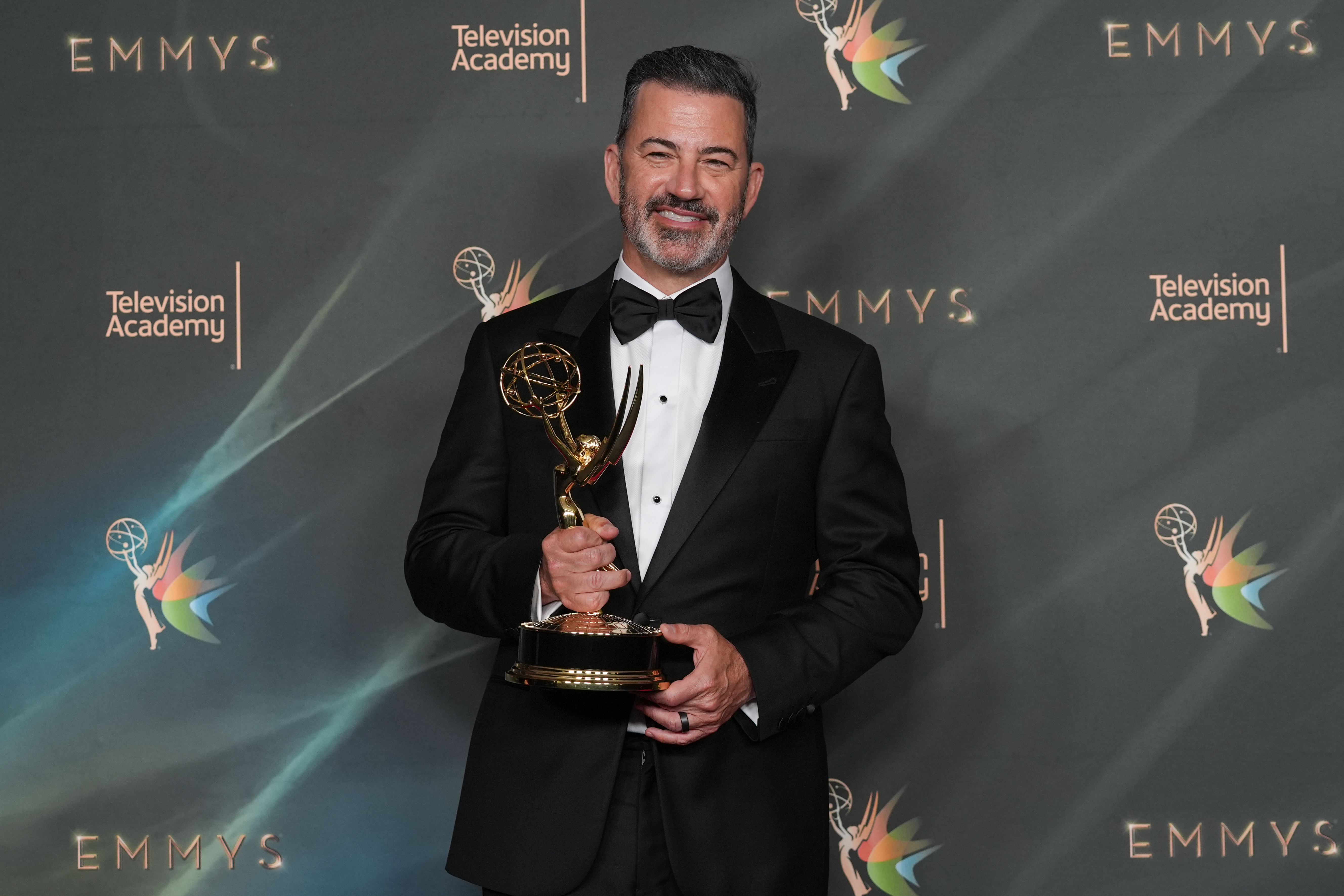
Late-night talk-show host Jimmy Kimmel said Wednesday that he would not broadcast an interview he conducted with Texas Democratic Senate candidate James Talarico because of pressure from the Trump administration.
Kimmel did not specify what that pressure was but said the Federal Communications Commission had “threatened” him, Jimmy Kimmel Live!, the ABC network, and ABC’s affiliate and local stations “based on simple traditional editorial decisions, guest bookings it would seem they don’t like.”
Kimmel also suggested the pressure was politically motivated. Polls show a close race between Talarico and his Republican opponent, Texas Attorney General Ken Paxton.
“They’re very nervous about the midterms, and rightly so. … They’re in danger of losing a Senate seat in Texas, of all places,” Kimmel said on his show Wednesday.
ABC has been in a monthslong feud with the FCC and its chair, Trump appointee Brendan Carr. Last year, the FCC successfully pressured ABC to briefly suspend Kimmel because of comments he made about the death of conservative activist Charlie Kirk.
In April, President Donald Trump and first lady Melania Trump again called on ABC to punish Kimmel for a joke he made about the first lady. Shortly afterward, the FCC formally ordered an early review of the eight broadcast licenses owned by Disney — which include ABC stations in major cities such as New York and Philadelphia — because of concerns about diversity policies.
Last month, ABC sued the FCC, alleging that the commission’s early review of its broadcast licenses is unconstitutional under the First Amendment.
Kimmel on Wednesday noted that he had interviewed several candidates for public office on his show in the past — including Trump himself when he was a presidential candidate in 2015 in 2016.
“And at that time, when he was the one sitting next to me, he seemed to have no problem with the idea of a talk-show host interviewing candidates. … But for some reason — and I can’t seem to figure out what that reason is — something has changed,” Kimmel quipped.
Representatives for the FCC did not immediately respond to a request for comment Wednesday. Representatives with Disney, ABC’s parent company, declined to comment.
FCC Commissioner Anna M. Gomez, the only Democrat on the commission, accused the Trump administration of waging a “campaign of censorship and control” and said the government agency does not have lawful authority to threaten broadcast licenses over guest bookings or editorial decisions.
“I urge broadcasters everywhere to keep resisting this pressure, and I hope courts will soon make clear that the FCC has no place dictating editorial choices or what viewers are allowed to see,” Gomez said in a statement Thursday.
Kimmel said he decided not to air his interview with Talarico during his broadcast in part so that ABC affiliates and local stations, especially those in Texas, would not “have to deal with this nonsense.” His interview with Talarico would instead be posted in its entirety on his YouTube channel on Thursday, he said.
“And thank goodness we have that, because in the America we live in right now, that is the best that we can do until November,” he said.
And the insurance company with the biggest piece of that business in Pennsylvania is making its voice heard in Harrisburg, Washington, and across the political landscape.
Newtown Square-based AmeriHealth Caritas, an affiliate of the Philadelphia-based healthcare giant IBX, contributed $500,000 total last year to national Democratic and Republican groups that work to elect governors and state legislators, more than double what it gave those entities in 2020.
As the GOP-led Congress passed legislation making deep cuts to Medicaid spending last year, AmeriHealth spent $1.7 million on federal lobbying, the most since at least 2008. And the company made charitable contributions aligned with causes promoted by political leaders in states where it does business — including a $5 million donation to food banks announced by North Carolina’s Democratic governor and 250 book bags for schoolchildren as a gift to the Democratic speaker of the Pennsylvania House.
It all adds up to a growing influence operation run by a company in a competitive industry that relies on government for revenue. Last year, AmeriHealth generated almost $16 billion from Pennsylvania contracts — more than half its total revenue.
Medicaid — a joint state-federal program that funds healthcare for low-income people, children, seniors, and individuals with disabilities — is also the single biggest cost driver in Pennsylvania’s budget. Almost three million Pennsylvanians, or more than one-fifth of the population, are covered by Medicaid.
AmeriHealth’s corporate political giving has drawn criticism from some Republican state lawmakers, who call it an inappropriate use of taxpayer dollars.
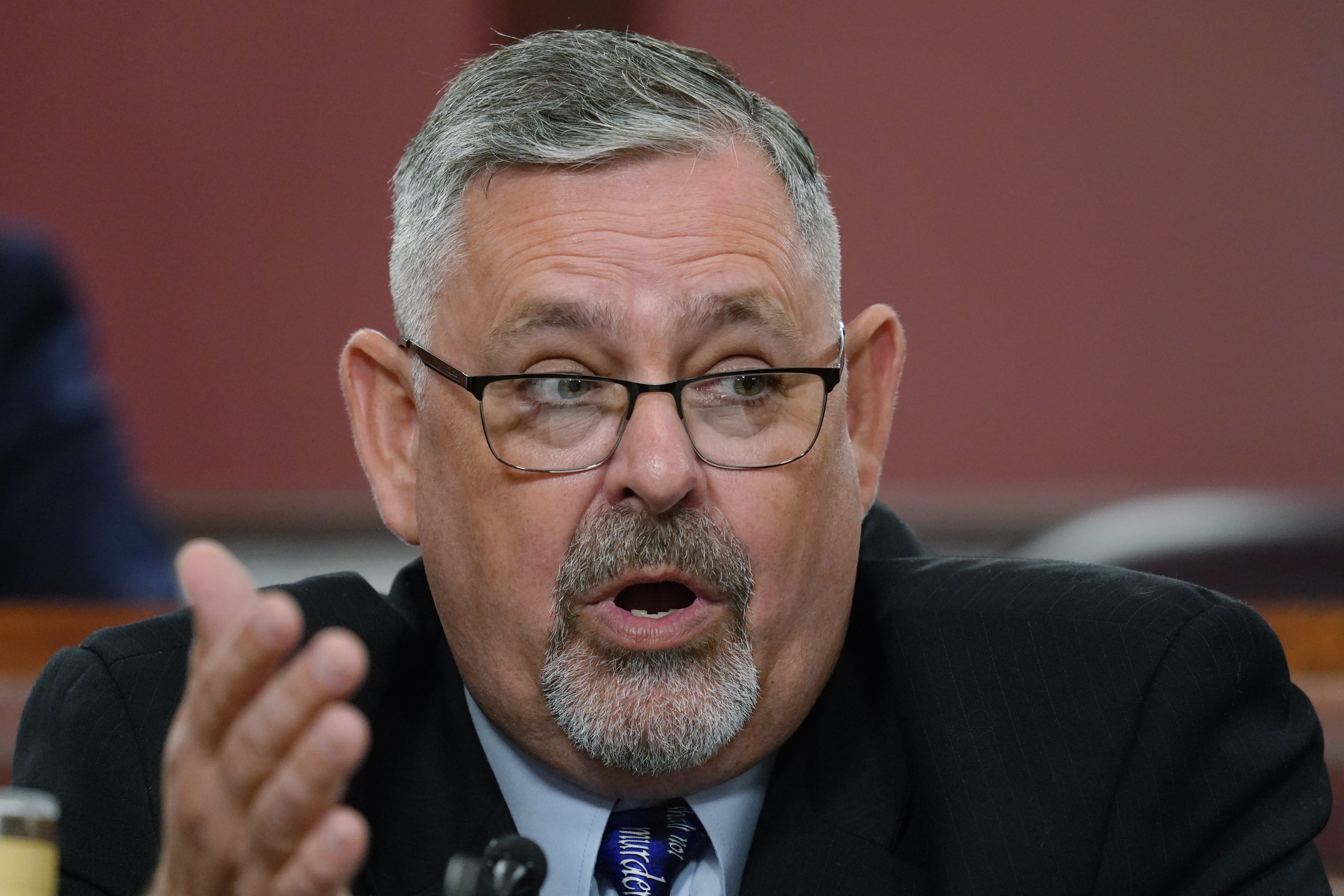
“That’s money that’s supposed to be going out to our hospitals, pharmacies, and disabled service providers,” said State Sen. Cris Dush (R., Jefferson).
State Sen. Cris Dush (R., Jefferson) in 2021.Matt Rourke / AP
AmeriHealth’s increased political activity has come during a volatile period for Medicaid. Enrollment surged during the COVID-19 pandemic as a federal emergency declaration meant people didn’t have to reapply for benefits, even if they no longer qualified. Once states resumed verifying eligibility, insurers including AmeriHealth saw membership decline — and those most likely to maintain coverage were sicker than average.
Now insurers are grappling with the biggest cuts to federal healthcare spending in history — $1 trillion over the next decade, mostly to Medicaid — in President Donald Trump’s big domestic policy legislation last summer. They are set to take effect next year.
Lee Drutman, a senior fellow at New America, a Washington, D.C.-based think tank, said AmeriHealth’s political activity is part of a “tried-and-true playbook” in corporate America.
“If you do business with the government or have contracts or regulatory interests, you want to make sure the people who are making the decisions have a nice warm feeling when they think about your company,” said Drutman, author of The Business of America is Lobbying. “The best way to give them that nice warm feeling is to contribute to their campaigns and their causes.”
AmeriHealth said in a statement that it reviews all political contributions to ensure compliance with applicable laws and regulations and that the company does not make contributions “from legal entities that have state or federal contracts.”
AmeriHealth did not say what revenue source it uses to fund its corporate political contributions and did not answer questions about whether it had any revenue streams that were not tied to tax dollars.
“Our participation in the public policy process focuses on healthcare issues affecting our members and the communities we serve,” AmeriHealth said, adding that it supports organizations across the political spectrum.
Donations to DGA and RGA
Like most states, Pennsylvania contracts with private insurers — also known as managed care organizations (MCOs) — to manage Medicaid beneficiaries’ benefits.
Federal law sets broad coverage requirements, but states have flexibility in determining which populations are eligible and which services to include.
And every year, they set monthly rates they pay insurers for Medicaid enrollees. Federal regulators review the rates.
“That all has a huge impact on the financial health, the success of the Medicaid managed care plan,” said Edwin Park, research professor at the McCourt School of Public Policy at Georgetown University.
It is not surprising, then, that insurers like AmeriHealth donate to political groups that elect governors and state legislators.
Among the groups that have benefited from AmeriHealth’s giving is the Democratic Governors Association, which in 2022 gave $7.2 million to then-Pennsylvania Attorney General Josh Shapiro’s successful gubernatorial campaign and which has given $750,000 to his reelection bid.
From 2021 through last year, AmeriHealth gave $250,000 to the DGA annually, up from $100,000 in 2020. It gave $250,000 to the Republican Governors Association in 2025, up from $100,000 each of the previous two years.
The donations put AmeriHealth in the top 10% of donors to each group in 2025, according to an Inquirer analysis of Internal Revenue Service data compiled by ProPublica.
(function(){function e(){window.addEventListener(`message`,function(e){if(e.data[`datawrapper-height`]!==void 0){var t=document.querySelectorAll(`iframe`);for(var n in e.data[`datawrapper-height`])for(var r=0,i;i=t[r];r++)if(i.contentWindow===e.source){var a=e.data[`datawrapper-height`][n]+`px`;i.style.height=a}}})}e()})();
The RGA has not invested in Pennsylvania’s gubernatorial election this year, in which Shapiro is favored against Republican state Treasurer Stacy Garrity.
Pennsylvania law prohibits corporations and labor unions from making direct contributions to state campaigns, though those groups can form political action committees. PACs can raise funds from their employees or members and use that money to donate to candidates. AmeriHealth started a Pennsylvania PAC in 2022.
However, corporations and unions can use their treasury funds — drawn directly from profits or member dues — to give unlimited amounts of money to groups such as the DGA and RGA. Those groups can donate to campaigns that may otherwise face restrictions on receiving corporate money, as in Pennsylvania.
In response to written questions, neither AmeriHealth nor Shapiro’s campaign would say whether the governor or his representatives had solicited contributions from the company on the DGA’s behalf.
AmeriHealth did not answer a question as to whether it had asked the DGA to designate some or all of its contributions to Shapiro’s race. Izzi Levy, a spokesperson for the DGA, said, “As a policy, DGA does not accept funds earmarked for any race or state.”
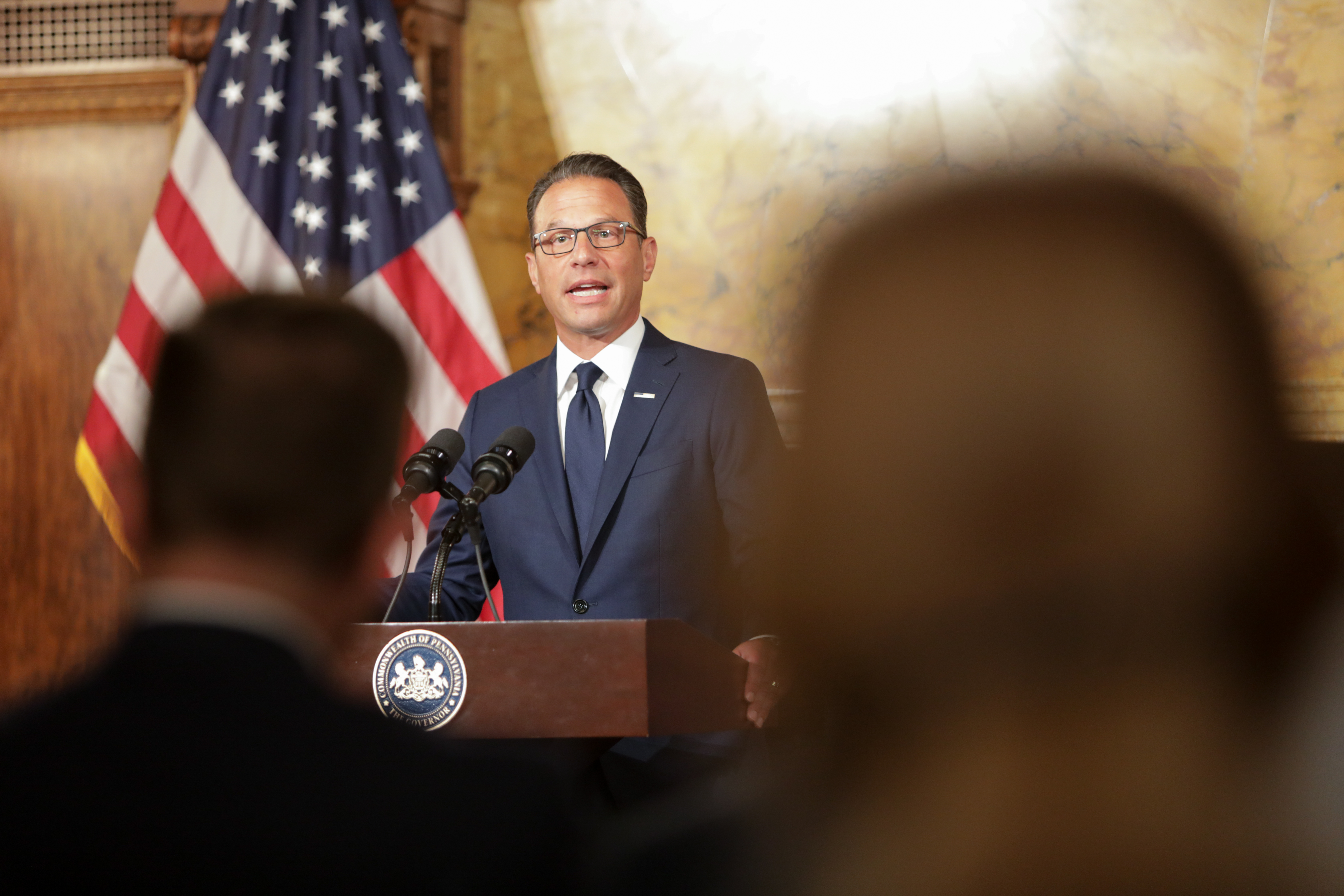
Gov. Josh Shapiro in August.Kalim A. Bhatti / For The Inquirer
“Corporations, labor unions, wealthy individuals want to have a powerful ally in a governor,” said Michael Beckel, an expert on money in politics at Washington, D.C.-based Issue One, a group that advocates for campaign finance restrictions.
“Being able to give through a group like the DGA or an RGA is a way to help secure your position as a friend and ally, who then in turn might be somebody that [governors] listen to on policy matters,” he said.
Many companies donate to these groups, but AmeriHealth’s corporate contributions have caught the attention of Pennsylvania lawmakers, including Senate President Pro Tempore Kim Ward (R., Westmoreland).
“The money should be used as appropriated for Medicaid because we are struggling with the increased funding needs for the program,” she said, adding that it doesn’t matter which party benefits from the donations.
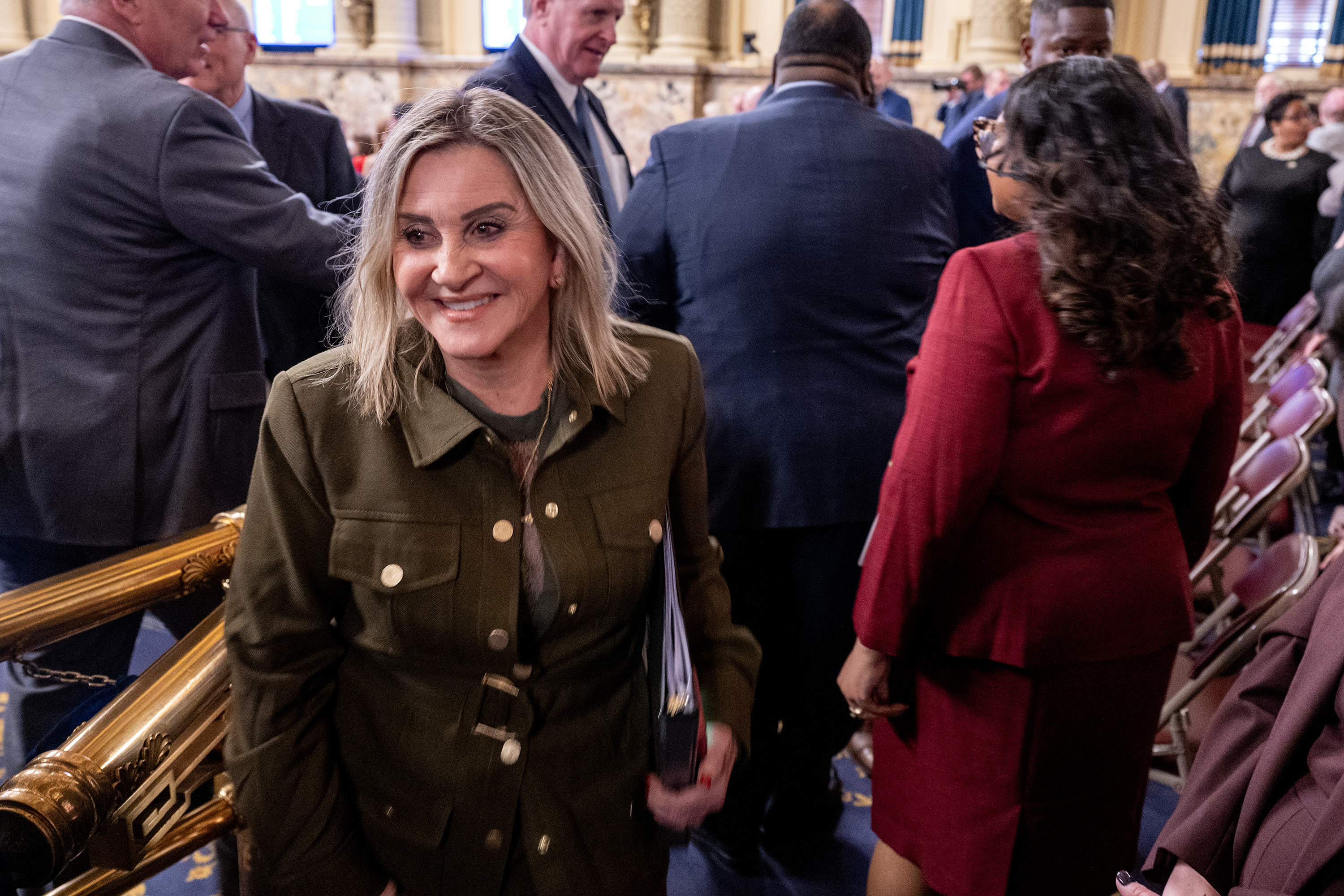
Pennsylvania Senate President Pro Tempore Kim Ward in Harrisburg in February.Tom Gralish / Staff Photographer
Ward said AmeriHealth has suggested that one of its contributions to the DGA “was comprised of the interest made off the principal of the Medicaid money.”
“To be clear, no matter if the political contribution is made up from the principal or the interest from Medicaid funds, it is all government money and shouldn’t be used for political purposes,” Ward said in a statement.
Under federal regulations, insurers are required to spend at least 85% of Medicaid funds on services for beneficiaries, leaving 15% for plan administration and profits. A spokesperson for the Pennsylvania Department of Human Services said AmeriHealth has complied with those rules.
AmeriHealth isn’t the only Medicaid insurer that donates to the DGA, RGA, Democratic Legislative Campaign Committee, and Republican State Leadership Committee — the latter two of which work to elect state legislators across the country.
The University of Pittsburgh Medical Center (UPMC), the No. 2 Medicaid insurer in Pennsylvania, has given three of the four groups a total of $330,000 since 2013, the year AmeriHealth significantly increased its giving. AmeriHealth gave $3.3 million over that period of time.
By contrast, St. Louis-based Centene Corp. has far outspent AmeriHealth, giving a total of nearly $18.8 million to the groups since 2013. Centene is the No. 3 Medicaid insurer in Pennsylvania and the largest in the country, operating in 30 states.
Neither UPMC nor Centene responded to requests for comment. Centene says on its website that its political activity is grounded in the company’s public policy positions “and the best interests of our business, our employees, and the members we serve, without regard to political party affiliation.”
From West Philly to 13 states
For-profit AmeriHealth is owned by nonprofits Independence Health Group and Blue Cross Blue Shield of Michigan.
Formerly known as AmeriHealth Mercy, the company started as a pilot program in the early 1980s at a West Philadelphia hospital. It now operates in 13 states and Washington, D.C., and employs almost 10,000 people.
AmeriHealth covered about 771,000 Pennsylvania residents enrolled for physical health — including for services such as medical visits, pregnancy and newborn care, and dental — and 176,000 for community services, including nursing homes, at the end of 2025. The company also manages benefits for behavioral health services.
In addition to its Medicaid business, AmeriHealth also offers Medicare Advantage plans for people eligible for both Medicare and Medicaid, as well as Affordable Care Act health insurance marketplace plans.
AmeriHealth had net income of $138 million last year after reporting a loss in 2024, though Independence Health — which includes insurer Independence Blue Cross — has continued to struggle financially.
Pennsylvania’s Medicaid program cost $49.3 billion in state and federal funds for the fiscal year that ended in July 2025, according to the Independent Fiscal Office. The state share of Medicaid expenditures, $14.4 billion, accounted for 31% of total general fund spending, among the highest ratios in the country, according to health research nonprofit KFF.
State spending on Medicaid was on track to increase 7.8% for the fiscal year that ended July 1, according to a June analysis by the IFO.
AmeriHealth’s $15.7 billion in revenue last year from contracts with the Pennsylvania Department of Human Services and county governments was up from $14.2 billion the prior year and $11.4 billion in 2021 — a 38% increase over the four year-period.
UPMC saw a 50% increase over that period, for $12.6 billion in revenue last year.
(function(){function e(){window.addEventListener(`message`,function(e){if(e.data[`datawrapper-height`]!==void 0){var t=document.querySelectorAll(`iframe`);for(var n in e.data[`datawrapper-height`])for(var r=0,i;i=t[r];r++)if(i.contentWindow===e.source){var a=e.data[`datawrapper-height`][n]+`px`;i.style.height=a}}})}e()})();
AmeriHealth has attributed its financial success last year — when it swung back to a profit a year after reporting losses in 2024 — in part to higher Medicaid rates as well as “work with state partners to support reliable access to high-quality care for the members we serve.”
Ali Fogarty, spokesperson for the Pennsylvania Department of Human Services, said rate increases are necessitated by costs that insurers incur administering the Medicaid program.
A big driver has been higher costs for GLP-1s, the drugs that manage Type 2 diabetes and obesity. Pennsylvania in 2023 started covering GLP-1s in Medicaid for weight loss only. Medicaid spending on the drugs in Pennsylvania increased from $223 million in 2022 to more than $1 billion last year, Fogarty said. The state stopped covering GLP-1s for weight loss this year.
“Realities like this can drive rate increases to ensure stability of our Medicaid program and solvency of MCOs that coordinate care, in addition to typical year-over-year increases in costs of care and operations,” she said.
AmeriHealth increased its lobbying, too
AmeriHealth spent $1.7 million on federal lobbying last year, up from $970,000 in 2024 and $400,000 in 2023, according to data compiled by OpenSecrets, a group that tracks money in politics.
The bill mentioned the most on the company’s lobbying reports in 2025 was H.R. 1, or the One Big Beautiful Bill Act. The sweeping domestic policy legislation — passed by the GOP-controlled Congress and signed into law by Trump — included $900 billion in cuts to federal Medicaid spending over the next decade.
(function(){function e(){window.addEventListener(`message`,function(e){if(e.data[`datawrapper-height`]!==void 0){var t=document.querySelectorAll(`iframe`);for(var n in e.data[`datawrapper-height`])for(var r=0,i;i=t[r];r++)if(i.contentWindow===e.source){var a=e.data[`datawrapper-height`][n]+`px`;i.style.height=a}}})}e()})();
The law reduces spending in part by imposing new work requirements on adults who are eligible for Medicaid under the Affordable Care Act, the 2010 law that sought to expand healthcare coverage. Pennsylvania expanded Medicaid in 2015.
Those requirements take effect Jan. 1. The new law also includes provisions requiring more frequent eligibility checks and cost-sharing requirements for enrollees in the so-called Medicaid expansion group.
The law’s Medicaid provisions are projected to increase the number of uninsured in 2034 by 7.5 million people, according to estimates from the Congressional Budget Office. About 300,000 Pennsylvanians could lose coverage due to the Medicaid restrictions, according to Shapiro’s administration.
Medicaid insurers opposed the cuts. After the House passed its initial version of H.R. 1 in May 2025, Medicaid Health Plans of America — a trade group that represents AmeriHealth and other insurers — cautioned Senate leaders against legislative provisions “that have been found to increase churn, set up additional barriers to receiving coverage, disincentivize essential care, hamstring states in financing the program, and that will likely cause disruption that radiates across the health care system.”
Republicans say the law will strengthen the integrity of programs like Medicaid and help ensure that able-bodied adults on public assistance are contributing to society. Democrats voted against the measure, accusing the GOP of cutting the safety net to finance tax cuts for the wealthy.
The One Big Beautiful Bill Act has big implications for state budgets. Starting in October, states including Pennsylvania will be restricted in their ability to finance Medicaid through taxes on healthcare providers such as hospitals, nursing homes, and insurers. States have traditionally used that financing mechanism to help draw federal matching funds.
Management consulting firm Oliver Wyman wrote that as states adjust their financing strategies, “plans may face more volatile rate-setting processes, delayed approvals, and growing tension between providers seeking to preserve revenue and payers managing constrained margins.”
As H.R. 1 is implemented, insurers like AmeriHealth are maintaining a strong presence in Washington. Records show AmeriHealth spent $1.5 million on federal lobbying through June — almost as much as it spent all of last year.
But as insurers seek to influence policymakers, they are facing increasing criticism from conservatives who say they have failed to improve patient outcomes, lower costs, or deter fraud. More broadly, Trump last year directed Health and Human Services Secretary Robert F. Kennedy Jr. to “take appropriate action to eliminate waste, fraud, and abuse in Medicaid.”
“Medicaid managed care creates strong incentives to maximize enrollment, as plans are generally paid a fixed amount for each enrollee,” Brian Blase, a former Trump White House official and president of the Paragon Health Institute, wrote in June. “Improper enrollment, duplicate enrollment, and phantom enrollment increase payments flowing to MCOs.”
The plans say they have taken action against fraud and abuse. The Medicaid Health Plans of America in a February report pointed to an inspector general report showing that insurers in recent years had steadily increased their fraud referrals to state law enforcement agencies.
Pennsylvania’s GOP-led Senate in July passed a resolution, largely along party lines, directing the Legislative Budget and Finance Committee (LBFC) to audit the state’s Medicaid program. The resolution calls for a review of the “standards used in Pennsylvania to evaluate Medicaid managed care program contracts.”
Democrats said they wanted to limit the scope of the audit, saying the state’s Medicaid program is already subject to federal reviews.
The resolution does not carry the force of law, but its lead sponsor, Dush, said he hopes the bipartisan LBFC — a committee that consists of 12 legislators from both chambers of the General Assembly — agrees to take up the cause.
Charitable giving
When the federal government shut down last fall amid a congressional spending impasse, the Trump administration paused the disbursement of food assistance, known as SNAP benefits, which help low-income families pay for groceries.
Within days of that announcement, North Carolina Gov. Josh Stein said the state would grant $10 million to local food banks — and that AmeriHealth Caritas and other private donors had also chipped in.
AmeriHealth, which had won a Medicaid contract with the state in 2019, gave $5 million, according to Stein’s announcement. “With the help of generous partners, North Carolina is taking action to keep families fed,” Stein, a Democrat, said in a news release at the time.
It’s an example of how AmeriHealth has made philanthropic gifts in line with causes promoted by political leaders in states where the company does business. Drutman, the lobbying expert, said supporting such causes can be seen as part of a company’s broader political strategy.
“As long as government is an important player in an industry, either as a regulator or purchaser of services, companies can have a strong interest in making sure that people in power have a positive opinion of the company,” he said. “Usually, the positive opinion of a company is not free.”
Stein’s office didn’t respond to a request for comment.
AmeriHealth told The Inquirer that the company and its foundation invest in community organizations “to improve access to care and address needs such as maternal health and food insecurity.”
“We invest in healthcare policy that is aligned with the needs of the nation’s most vulnerable populations,” the company said.
Another organization it partnered with was the Hope Florida Fund, a charity founded by Casey DeSantis, wife of Republican Gov. Ron DeSantis. The Governor’s Office announced in March 2023 that AmeriHealth had contributed $100,000 to reduce reliance on public assistance and make grants to local nonprofits.
The next month, the state started the bidding process for new Medicaid contracts. AmeriHealth ultimately lost its bid to remain in Florida, where it had operated since 2012. Gov. DeSantis’ office didn’t respond to a request for comment.
Sometimes AmeriHealth’s gifts are smaller.
Pennsylvania House Speaker Joanna McClinton, a Democrat who represents parts of West Philadelphia and Delaware County, reported on her 2025 financial disclosure form that AmeriHealth had donated 250 book bags at resource fairs in her district. She valued the gift at $2,500. A spokesperson for McClinton confirmed the gift but otherwise had no comment.
Other companies including insurers Highmark Wholecare and Independence Blue Cross gave similar gifts, according to the disclosure.
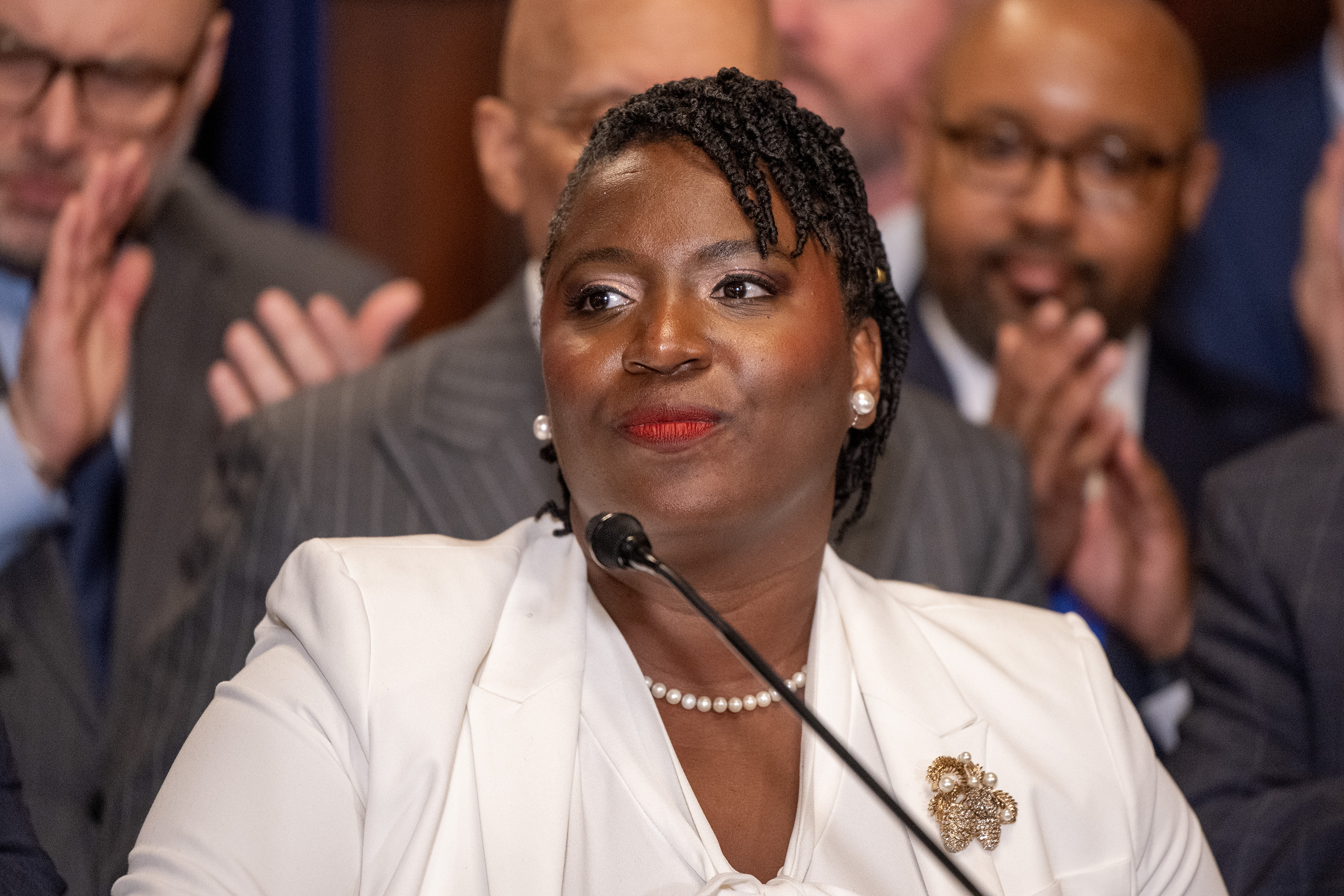
House Speaker Joanna McClinton during a Feb. 3 news conference at the Capitol in Harrisburg.Tom Gralish / Staff Photographer
AmeriHealth has won praise for some of its giving.
In May, Val Arkoosh, secretary of the Pennsylvania Department of Human Services, visited the Greater Philadelphia YMCA’s Willow Grove branch to highlight a maternal health initiative that provides a free membership and programming for expectant moms.
Arkoosh’s office said in a news release that the initiative “aligns perfectly” with the Shapiro administration’s “Healthy Moms, Vibrant Futures” strategic plan.
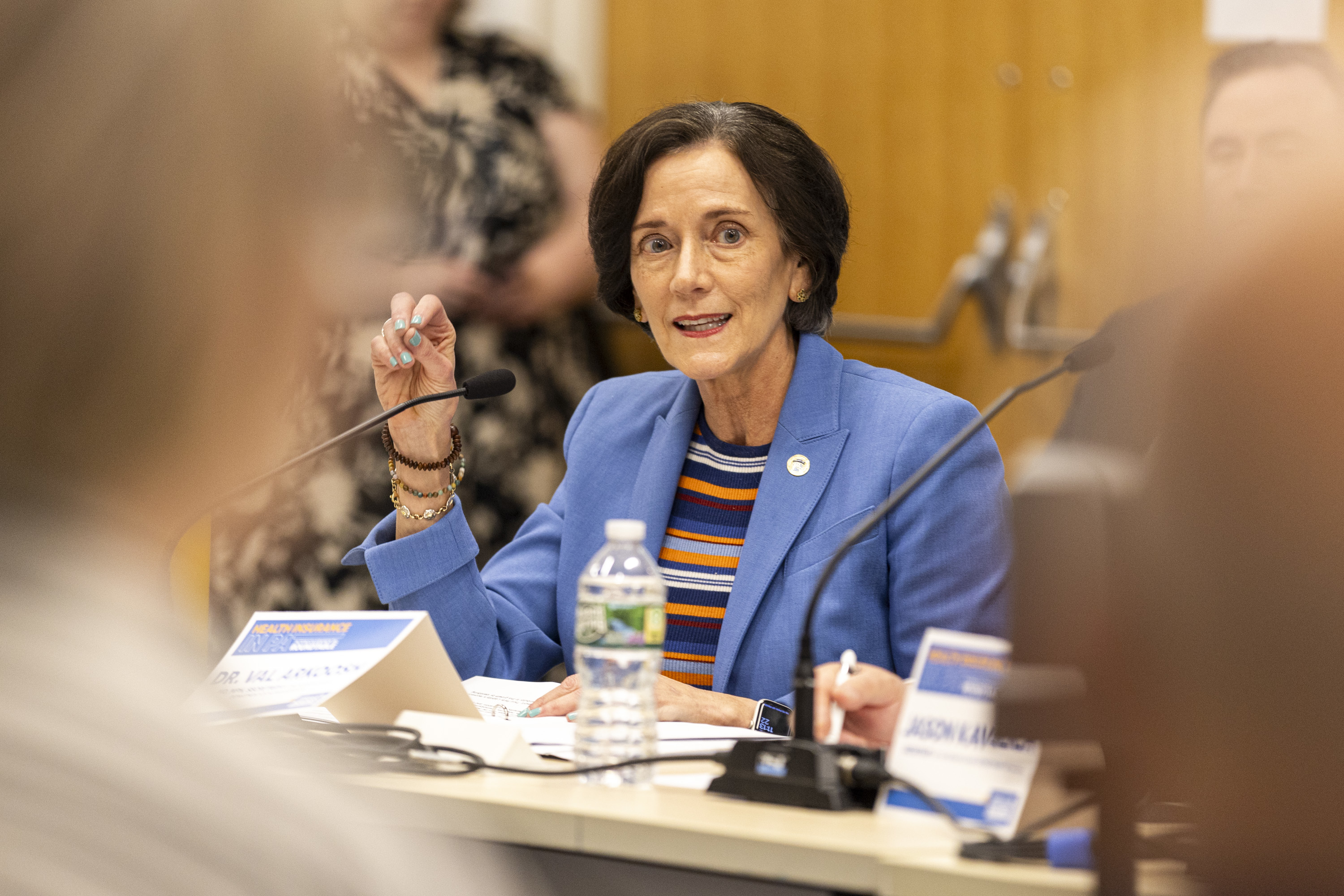
DHS Secretary Val Arkoosh in 2025.Tyger Williams / Staff Photographer
Fogarty, the DHS spokesperson, noted that the U.S. maternal mortality rate outpaces all other high-income countries and said Arkoosh, an obstetric anesthesiologist, is passionate about the issue. “We appreciate the many partners who work to address maternal mortality and are stepping up to support mothers and children in their community,” Fogarty said.
AmeriHealth’s foundation said in a news release that “providing children with healthy beginnings will help them avoid adverse experiences later in childhood.”
The release featured a photo of Arkoosh standing next to a YMCA executive and Steve Fera, an IBX executive and AmeriHealth Caritas Foundation board member.
President Donald Trump’s low approval ratings and widespread economic discontent, along with historical trends, point to a clear Democratic advantage come November and the midterm elections. But Republicans also see reasons for optimism, and it’s not just about gerrymandering.
Six factors working in Democrats’ favor:
Out-of-power parties typically pick up seats in the midterms
The Democrats’ most basic advantage is the fundamental pattern of midterm elections: The party that controls the White House usually loses seats.
In midterms from 1934 to 2018, the president’s party bled an average of 28 seats in the House and four in the Senate, according to the American Presidency Project at the University of California, Santa Barbara.
If Democrats added 28 House and four Senate seats this cycle, they would win majorities in both chambers. The House, in particular, is seen as a promising target for Democrats this cycle, in part because Republicans are clinging to a razor-thin advantage in that chamber.
Trump is deeply unpopular
Parties have occasionally defied the historical trend and won seats in the midterms on the strength of popular presidents.
But this year, Trump is widely expected to hurt Republicans’ chances. His approval rating, dampened by voter disenchantment with the war in Iran and stubbornly high inflation, has recently sunk to the lowest level of his second term. The New York Times polling average currently shows that 58% of Americans disapprove of the president’s job performance, while only 38% approve.
Voters are dissatisfied with his handling of immigration and the war with Iran. Trump is also losing ground with white working-class voters on the economy. And he is deeply unpopular with voters of color without college degrees.
House races in particular tend to follow the national mood closely, and analysts see Democrats as favorites to win the House.
The Iran war has driven up prices, and voters are focused on inflation
Polls consistently show that the economy and inflation are the top issues for voters. And voters say they are unhappy with the economy under Trump.
His war with Iran, now in its seventh month, has driven up the price of oil, fertilizer, healthcare and other goods and services, as well as mortgage rates. Gas costs more than $4 a gallon, and the AAA motor club reported that drivers over Labor Day weekend were facing “the highest gas prices ever for this time of year.”
By July, consumer prices were up 3.7% from a year earlier, according to the Federal Reserve’s preferred inflation gauge, far above the Fed’s target rate of 2%. The cost of diesel, which powers the farming economies of key midterm battlegrounds, hit a record high Friday.
Senate Minority Leader Chuck Schumer, D-N.Y., said his party’s candidates were competing in challenging territory by keeping their campaigns focused squarely on costs.
“Americans see what’s happened,” Schumer said in an interview. “They’re paying more, and getting less.”
Democratic candidates are outraising their rivals
In five of the six most closely watched Senate contests, Democrats had outraised Republicans through the first half of the year, according to campaign finance filings. In some races, such as those in Texas, Ohio and Alaska, the gap was vast.
Democrats’ fundraising advantage in two other states, North Carolina and Georgia, has helped to transform races once seen as toss-ups. Analysts with the Cook Political Report, a nonpartisan election forecaster, now say both races lean toward Democrats.
The large hauls suggest enthusiasm for individual Democratic candidates. But Republican groups still have a huge money advantage over Democratic ones.
Several Democrats have shown strength in states Trump carried
Two popular, moderate Democratic Senate candidates in the South, Sen. Jon Ossoff of Georgia and former Gov. Roy Cooper of North Carolina, appear to have maneuvered into particularly strong positions. Both have vast fundraising advantages and clear polling leads.
Democrats are also bullish about the chances of former Rep. Mary Peltola, a Democrat, to flip a Senate seat in Alaska. She is running on “fish, family and freedom.” Her Republican opponent, Sen. Dan Sullivan, must contend with two other Republicans on the ballot, including one with the same name.
Peltola, the lone Democrat on the ballot, led Sullivan by more than eight percentage points in a nonpartisan primary in August.
Democratic primaries have set turnout records
One clear reflection of Democratic energy going into the fall: the huge turnout the party has recorded in primary after primary. Some primaries, including ones in Michigan and Texas, set midterm records for the party.
Strong turnout in primaries is not necessarily predictive of a strong performance in the general election. But Republicans acknowledge that there has been a significant enthusiasm gap between the two parties this primary season and describe it as one of their starkest challenges heading into the fall.
Six factors working in Republicans’ favor:
Republicans won the gerrymandering war
In a burst of rare mid-decade redistricting, Republicans were able to give themselves a structural advantage in House races by redrawing maps to carve out more safe red seats.
Congressional maps are typically drawn just once a decade to reflect population shifts after the census. But after Trump urged lawmakers in Texas to draw new maps favoring Republicans, Democrats and Republicans across the country engaged in an intense, cross-country redistricting tug of war to try to shift the House map in their favor.
Aided by favorable rulings in state and federal courts, Republicans emerged with a national map that tilts in their favor and could help them counter a difficult political environment. Seven Republican-led states had redrawn their maps while only two Democratic-led states did so.
The new maps could position the Republican Party to net roughly five to 10 additional House seats. Still, despite that edge, the House battle is still seen as tilting toward Democrats because of the political climate.
The GOP is sitting on a mountain of cash
The main Republican groups have a large overall financial advantage — totaling hundreds of millions of dollars — over the main Democratic ones, and the Democratic National Committee is in debt.
Republican advertising spending has eclipsed Democrats’ ad spending in all the top six Senate races except for the contest in Texas, according to the ad-tracking firm AdImpact.
Trump’s super political action committee, MAGA Inc., which has raised hundreds of millions of dollars and had long resisted tapping its war chest to help the party in the midterms, recently made its first general-election investment, a $10 million ad buy in Texas.
Still, it is not yet clear how much the group will spend overall and which races it will target. Trump said Friday that he planned to spend “probably” $400 million to $500 million on the midterms, but that he also expected “to have money left over.”
The Democratic brand is weak
Trump may be deeply unpopular. Yet Democrats might eagerly trade their approval ratings for his.
One Quinnipiac poll in July pegged Trump’s approval rating at 32%, worse than usual for him. But it measured congressional Democrats’ approval rating even lower — at 23%.
Still, the same poll suggested that voters were eager for Democrats to win back Congress. It also indicated that Democratic voters were far more motivated than Republican voters to go to the polls. But Republicans have seized on a series of recent Democratic primary victories by left-wing candidates and democratic socialists to try to paint the party as out of step with many voters.
The Senate map tilts to Republicans’ advantage
Republicans hold 53 Senate seats. For Democrats to win back the chamber, they need to flip seats in four states while defending their own most vulnerable ones. Five of the six most competitive Senate races are in states Trump won in 2024. Four are in states he carried by double digits.
And even among three other relatively competitive Senate battlegrounds where Democrats are seen as having an advantage — Georgia, New Hampshire and North Carolina — two are states that Trump captured two years ago.
Democratic divisions could complicate their paths in two key states
In Maine, where Sen. Susan Collins has been seen as one of the most vulnerable Republican incumbents, the Democrats’ initial nominee, Graham Platner, was accused of rape in early July. Platner denied the allegation but eventually dropped out of the race, requiring his party to scramble to find a new nominee outside the usual primary process.
The candidate that the Maine Democratic Party settled on, Troy Jackson, had finished third this year in Maine’s primary for governor. Some Maine Democrats were dissatisfied by the rushed convention process and many are anxious about Jackson’s chances in a short campaign he had not planned for.
In Michigan, where Democrats hope to keep a seat that is being vacated by a retiring senator, Democrats are still trying to heal the wounds after a tense, expensive primary race that centered on disagreements about Israel. Some Jewish Democrats in Michigan have declined to immediately support the candidate who won the nomination, Abdul El-Sayed, a progressive who has been a forceful critic of the Israeli government.
The stock market is strong, and crime is down
Wall Street has been on a remarkable, three-year run of gains. There have been some signs that inflation is cooling, too. And the Labor Department reported that hiring was unexpectedly strong in August, with the unemployment rate steady at 4.1%.
Republicans can also point to positive trends on crime, an issue that has often swayed elections over the years. Today, violent crime rates are extremely low by historical standards.
“Republicans have a real chance at defying history in November because of our candidates, massive war chest, and enthusiasm behind President Trump’s agenda,” Joe Gruters, chair of the Republican National Committee, said in a statement.
Still, voters say that the economy is their No. 1 issue — and polls suggest that they don’t approve of how Trump is handling it.
First, at the start of his second term, President Donald Trump promised a DOGE dividend, a pledge to take the money that Elon Musk’s team would cut from the federal budget and send it to the American people.
Then Trump moved on to a “tariff refund,” a plan to use the money the government was collecting in import taxes to fund payments for the public.
Those ideas never panned out. Nevertheless, Trump is again talking up the possibility that the federal government will send Americans thousands of dollars in cash. At the Republican midterm convention in Dallas on Wednesday, the president pledged that every American adult would receive $5,000 if Republicans retain control of Congress in November.
Trump did not offer many details about the proposal, but there’s reason to think that Republicans in Congress, like they did with his two previous promises of quick cash, could shrug off the president’s suggestion.
That’s in no small part because the $5,000-per-American promise would be enormously expensive to fulfill, with a price tag over $1 trillion. Its actual cost, though, would depend on what, if any, eligibility requirements Congress would ultimately impose on the plan. Trump did not mention a proposal to finance the $5,000 payments, which beyond their fiscal cost could also prove inflationary.
The conceit of Trump’s other pitches was that the money to pay for them was already available, from Musk’s so-called Department of Government Efficiency or tariff revenue. On both of those fronts, though, the envisioned funding sources proved illusory: Musk’s team did not save the government much money, and the Supreme Court struck down many of Trump’s initial tariffs.
Republicans did succeed in providing Americans with substantial cash payments when they cut taxes last year. Under the design of the tax law, many Americans first experienced the policy change in the spring, when they received larger-than-usual tax refunds. Trump and Republicans have spent much of the year promoting those refunds, hoping that the larger lump-sum payments would be politically resonant before the midterms.
But even after Trump delivered those tax refunds, his approval poll ratings are still sagging.
Those tax cuts were also very expensive, though Republicans did cover some of the fiscal cost by reducing federal spending on healthcare and food assistance for poor Americans.
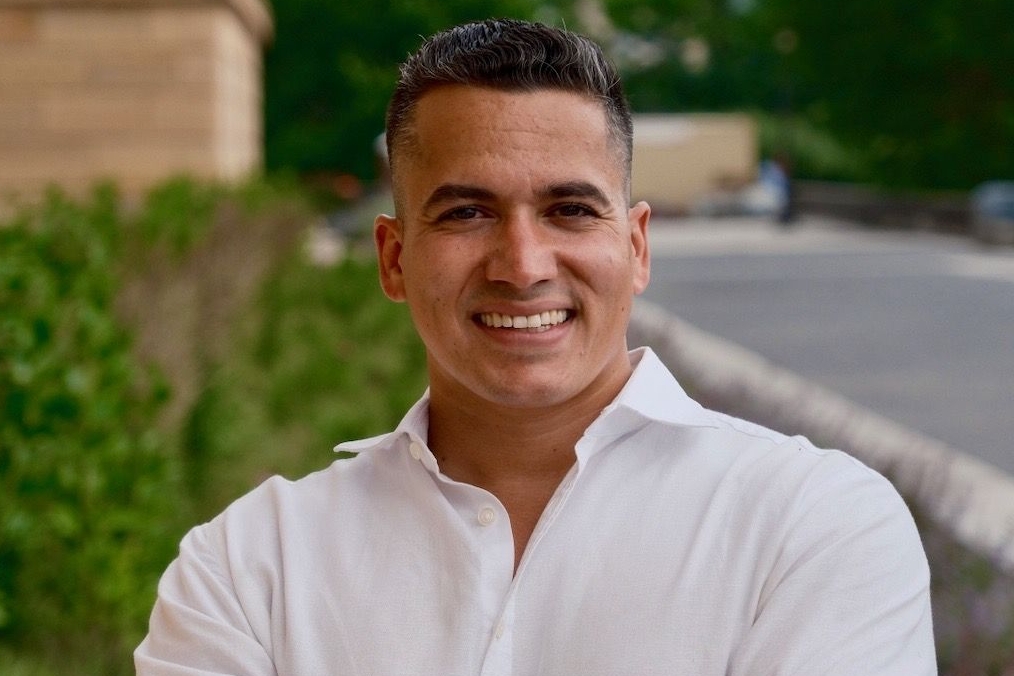
Dennis Mahoney has spent a decade in disaster relief, dispatching humanitarian aid in the wake of devastating hurricanes in the United States and Puerto Rico and poverty crises in 18 countries in Asia, Africa, and Latin America.
Now the 34-year-old independent candidate is using that same determination to engage in an uphill battle as he seeks to represent Philadelphia’s 3rd Congressional District this November.
Mahoney, from South Philadelphia, is the lone opponent running against State Rep. Chris Rabb, a democratic socialist from Northwest Philly who won the crowded Democratic primary in May to succeed retiring U.S. Rep. Dwight Evans.
“I think it’s going to be a hard fight and a hard run, but I feel so strongly that people in Philadelphia want something different,” Mahoney said of his independent campaign.
Mahoney will have his work cut out for him to persuade voters to back his grassroots candidacy.
The 3rd Congressional District is one of the most Democratic-leaning districts in the country, where Rabb won with almost 45% of the vote. Rabb saw national support from big-name progressives, including U.S. Rep. Alexandria Ocasio-Cortez (D., N.Y.), and used his victory to support other like-minded candidates throughout the United States.
And the last time Pennsylvania elected an independent to Congress was in 1920, when Milton W. Shreve of Erie won as an Independent Republican.
But Mahoney and his allies view his candidacy as an opportunity to present an alternative option after more than half of 3rd District voters in the May primary cast their ballots for Rabb’s opponents. Mahoney’s platform focuses on addressing poverty, expanding access to affordable housing, and investing in education.
Rabb’s campaign did not comment on Mahoney’s candidacy Wednesday.
The race comes amid shifting political dynamics in the United States in response to growing frustration with the two-party system.
On one hand, progressive candidates — many of whom, like Rabb, are part of the Democratic Socialists of America — have been gaining momentum in elections nationwide.
Earlier this year, meanwhile, a Gallup poll showed a record high of 45% of U.S. adults identified as independents in 2025.
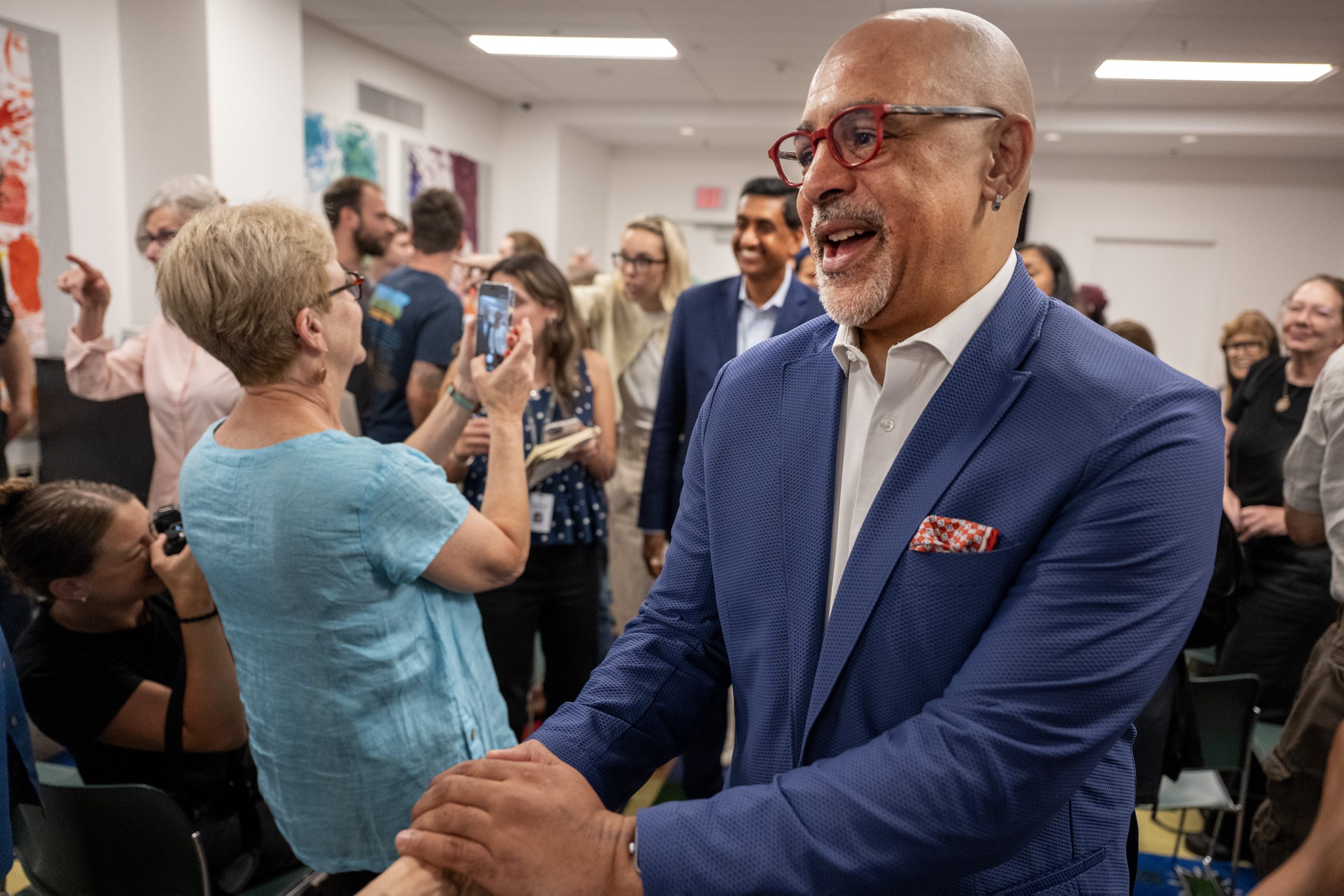
State Rep. Chris Rabb greets supporters after appearing with U.S. Rep. Ro Khanna (rear) Tuesday, July 28, 2026, on his “Made in PA: New Economic Patriotism Tour” at the City Institute Library on Rittenhouse Square.Tom Gralish / Staff Photographer
Mahoney said he has belonged to both political parties in the past, but did not find a home in either.
The first-time politicalcandidateworked in humanitarian aid through his former Washington, D.C., church, the Christiannonprofit Food for the Hungry, and now his own firm, AOI Solutions. He said the experience provides lessons for overcoming partisan division in Congress.
“Let’s build bridges and partnerships and bring results. And that’s the same work that I did in the disaster relief field, where we would land in a spot where a disaster happened, and we’d work with anyone we could to really make the place come back to whole,” Mahoney said.
‘Anti-MAGA’ and ‘anti-DSA’
It’s those middle-of-the-road qualities that made Mahoney an appealing candidate to Craig Snyder, a registered Republican who led an effort to support Vice President Kamala Harris’ presidential bid two years ago and is now leading the Philly-based Forward Party Victory Fund.
The super PAC plans to support Mahoney and other independent candidates across the country — including a pair of independent Senate candidates running in GOP-leaning states, Todd Achilles of Idaho and Brian Bengs of South Dakota — this fall via spending on digital ads and text messages. The PAC is also supporting U.S. Rep. Kevin Kiley, who switched from the GOP to run for reelection in California as an independent, and Kevin Block, an independent running for Rhode Island governor.
Snyder said the group is an independent offshoot of the Forward Party, founded in 2022 by former presidential candidate Andrew Yang and former New Jersey Gov. Christine Todd Whitman. He described the centrist candidates the PAC is backing as both “anti-MAGA” and “anti-DSA.”
He said a win in one of the group’s targeted races wouldbe “an earthquake in American politics.” But even if Mahoney is unsuccessful, Snyder said, it will be the start of elevating the independent movement in Philly politics.
“I think people don’t want to be told that they have to vote for somebody just because of the party label,” Snyder said. “I think that they want there to be alternatives, and so it’s our job to make that case.”
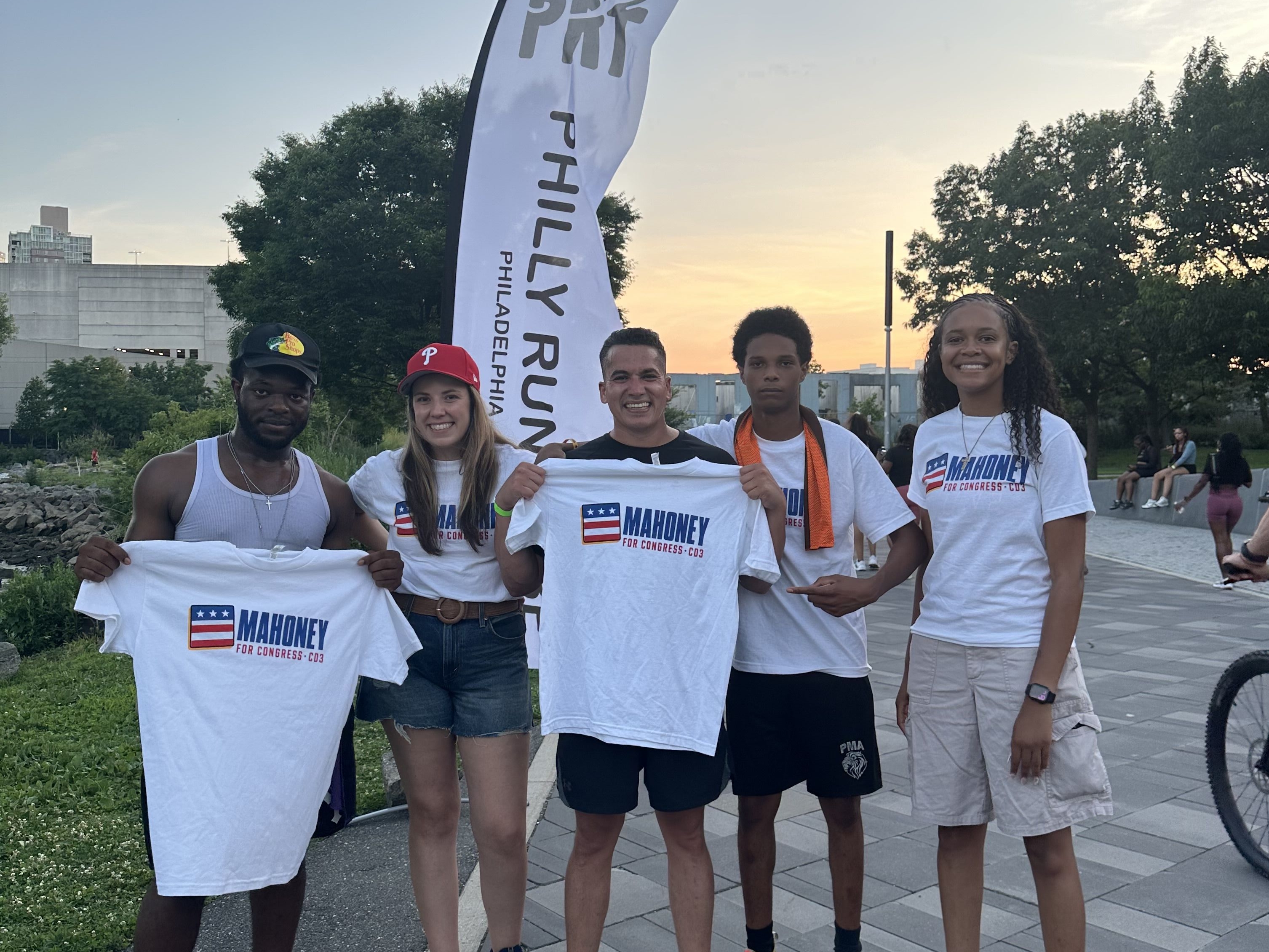
Dennis Mahoney (center) on the campaign trail as he prepares to run against State Rep. Chris Rabb in the general election in the 3rd Congressional District this November.Dennis Mahoney
Mahoney said, if elected, he would help form the first independent caucus in the U.S. House, contending he would become a coveted vote for both parties that would enable him to influence legislation and score committee assignments.
Butunder current House rules — which Kiley has proposed changing — Mahoney would not be able to hold a committee seat if he does not caucus with either party. Kiley, for instance, has continued caucusing with the GOP even after becoming an independent.
Mahoney pointed to the 19,000 signatures he received for his petition to join the ballot as a sign some voters are open to a choice in the deep-blue district.
He said he would like to debate Rabb.
“He talks a lot and engages a lot, and I think that that’s wonderful,” Mahoney said. “But I think at the end of the day, there’s people who are hurting in the district who need somebody who isn’t worried about being on, you know, MSNBC or TV, but who really is like, let’s just get into the community and drive results.”
Mahoney said he has been connecting with religious leaders, educational organizations, community groups, and youth organizers to hear feedback on what they want public service to look like in the 3rd District.
The independent will have scant resources to spread his name in just two months but said he is not concerned with raising big money for advertising. He had roughly $8,200 cash on hand in his most recent campaign finance report.
Rabb had a little more $21,000, but that was after the Democrat raised and spent more than $1.3 million for the primary campaign in which he out-raised his opponents.
Mahoney, meanwhile, has been trying to meet voters where they are — at running clubs and other fitness groups, for example.
“I think people find it refreshing to have somebody who wants to represent them out there running alongside them,” he said.
Democratic leaders in New Jersey learned Lt. Gov. Dale Caldwell was under investigation for alleged inappropriate behavior with women at the same time the public did — from a news report just before Labor Day weekend.
And still it took nearly a week before Democratic Gov. Mikie Sherrill finallytook questions from reporters Wednesday on what has reportedly been a monthslong investigation by an outside law firm.
But even then she refused to confirm an investigation into her lieutenant governor or even refer to him by name. It was unlikely to relieve the growing concerns of many in her party.
New Jersey Democratic Party leaders, frustrated by her decision to hide the matter from them, had privately urged Sherrill to share what she could ahead of Wednesday’s event, rather than let Republicans calling for Caldwell’s resignation dominate the headlines.
After this pressure, her team announced the governor would take questions from the media during a visit to a Woodbridge pizza shop Wednesday evening, her first public event since the news broke Friday.
But she offered no new details in her answers.
“I’m not going to confirm or deny whether there is an ongoing investigation, but what I can commit to people is that any complaints are taken very seriously and certainly anyone who has a complaint lodged against them, their rights are protected and they will have a full hearing,” Sherrill told more than 15 members of the media gathered outside Pino’s Pizzeria & Restaurant in Woodbridge.
She declined to answer when the complaint against Caldwell was filed or whether she had curtailed any of his responsibilities, including whether he would act on her behalf when she traveled out of state.
A Democratic operative who requested anonymity to speak freely about private conversations with legislators said Sherrill has put her allies in a tough position where they feel obligated to weigh in but do not know enough to make a public statement.
“Legislators are pissed off about this,” the operative said earlier Wednesday. “They feel left in the dark, and they feel like they’re put in a weird place.”
The operative said it feels as if Sherrill and Caldwell, who are both Trenton newcomers, have been on their own “island.”
Sherrill on Tuesday released her first comment on the matter, which did not acknowledge the existence of the investigation or name her lieutenant governor. In vague terms, she said she demands members of her administration “hold themselves to the highest standards and put their obligations to public service first.”
‘The sooner, the better’
New Jersey political operatives questioned why Sherrill did not address the investigation earlier, or by addressing it head-on with a news conference, as she did earlier in the summer when her administration discovered that thousands of noncitizens had been registered to vote during her predecessor’s administration.The governor has touted herself as prioritizing transparency and accountability.
“If I were the press secretary in that administration, I would have urged a Friday statement, the sooner the better,” said Micah Rasmussen, director of the Rebovich Institute for New Jersey Politics, who worked as former Gov. Jim McGreevey’s press secretary.
“By not doing that, you really do raise suspicions … whereas if you can tamp that down and say, ‘Here’s what we know, here’s what we’re waiting for, here’s what you’re going to know,’ that can put everything into perspective.”
Former State Sen. Loretta Weinberg, a Democrat from Bergen County, said Wednesday that she has faith in Sherrill’s nascent administration, but that it was time for the governor to personally address the investigation — the details of which have been leaked in media reports.
“I think that has been too long for what obviously began in May and has not yet come to fruition. What is taking so long?” said Weinberg, who served as Senate majority leader and made combating sexual harassment and violence a cornerstone of her long legislative career.
“When you have an unwillingness to talk, the rumor mill fills in the gaps. That’s not good for transparency,” she said.
Sherrill spokesperson Sean Higgins declined to comment on the criticism from other Democrats outside the pizza event Wednesday evening.
BINJE.com reported Wednesday that Caldwell denied allegations of misconduct toward women in a May 28 letter to Christina Fullam, the state’s chief ethics officer. He said it was “personally painful for someone to attempt to damage my reputation and slander my character with false and misleading accusations” and suggested race was involved.
“While I am troubled by this accusation, as the first single Black man to serve at this level in government, I suspect that there will be other false accusations or rumors in the future,” he wrote. “Unfortunately, in this current political environment, false accusations, especially against people of color, seem to be commonplace.”
Sherrill has garnered national attention for her decisive win last year and outspoken criticism of President DonaldTrump. She has also been supporting Democrats in other states ahead of this year’s midterms, making appearances for candidates in New Hampshire and Massachusetts, which has fueled speculation about national ambitions.
But the investigation into Caldwell and widespread media coverage could complicate her rise.
“This isn’t going away until [Sherrill and her team provide] answers,” said a Sherrill adviser, who was not authorized to speak about the matter and did so on condition of anonymity. “If they do not handle this now, it will metastasize and burst those bubbles of being on the national stage.”
Some party operatives have even begun mulling who might replace Caldwell, the adviser said.
Acting governor when Sherrill travels out of state
Caldwell served as acting governor while Sherrill was out of state on more than half a dozen days in July and August, with no opportunities for the media to ask him questions. His public schedule included appearances at a United Airlines event in Newark, a tennis event in Paterson, and a Puerto Rican Festival in Vineland.
But the role of acting governor is not just attending community events and photo ops. The position takes on all the responsibilities of governor, and choosing Caldwell as her running mate was a personal judgment call for Sherrill.
“It’s a big power to be governor — you have clemency powers,” noted one Democratic political insider who requested anonymity to speak freely, questioning why Caldwell was left to run the state while under investigation.
Assembly member Alex Sauickie, an Ocean County Republican, on Tuesday called on Sherrill to stop traveling out of state while Caldwell is the subject of investigation.
“This is no longer simply about the governor leaving New Jersey to campaign for politicians in other states or build her national political profile. This is now about who is actually in charge of our state when she leaves,” he said in a statement.
Some Democrats watching the controversy around Caldwell unfold have cited other issues that concern them with Sherrill’s administration, such as the New Jersey State Police’s aggressive response to protesters outside the Delaney Hall Immigration and Customs Enforcement facility in Newark, and major companies leaving the state, the Sherrill adviser said. They pointed to this episode as another example of Sherrill and her team operating without communication or input from other elected officials.
Only acouple ofDemocratic legislators have publicly commented on the news.
Assembly member Katie Brennan (D., Hudson), who accused a senior campaign adviser to former Democratic Gov. Phil Murphy of sexual assault in 2017, released a statement Tuesday calling the allegations serious. She used the opportunity to promote legislation that she said would “set clear standards” for how complaints are handled.
On Wednesday, State Sen. Britnee Timberlake (D., Essex) defended Sherrill’s handling of the investigation and criticized Republicans’ “selective outrage,” the New Jersey Globe reported.
Rasmussen noted that he has not seen anyone come to Caldwell’s defense in Trenton.
“Maybe he doesn’t have those people in Trenton. He was picked primarily because he was an outsider,” he said.
Another Democratic leader, who requested anonymity to speak freely and not alienate the administration, expressed disappointment that it took so long for Sherrill’s administration to acknowledge the investigation but said Caldwell deserves to have judgment wait until the investigation is complete.
“He’s played the role this administration has asked of him, advancing the governor’s agenda. He has been visible. I truly believe they have a good partnership. Everyone should have the presumption of innocence,” the leader said.
“But it’s fair to say all of us were pretty shocked when we saw the accounts. It is my hope the governor and the investigations will be completely transparent.”
One year ago, Utah Gov. Spencer Cox was on his way to deliver one of the most sobering speeches of his political career.
The conservative activist Charlie Kirk had been assassinated at a university in the state, and the nation was teeming with emotion — grief, vengeance, and celebration all mixed together.
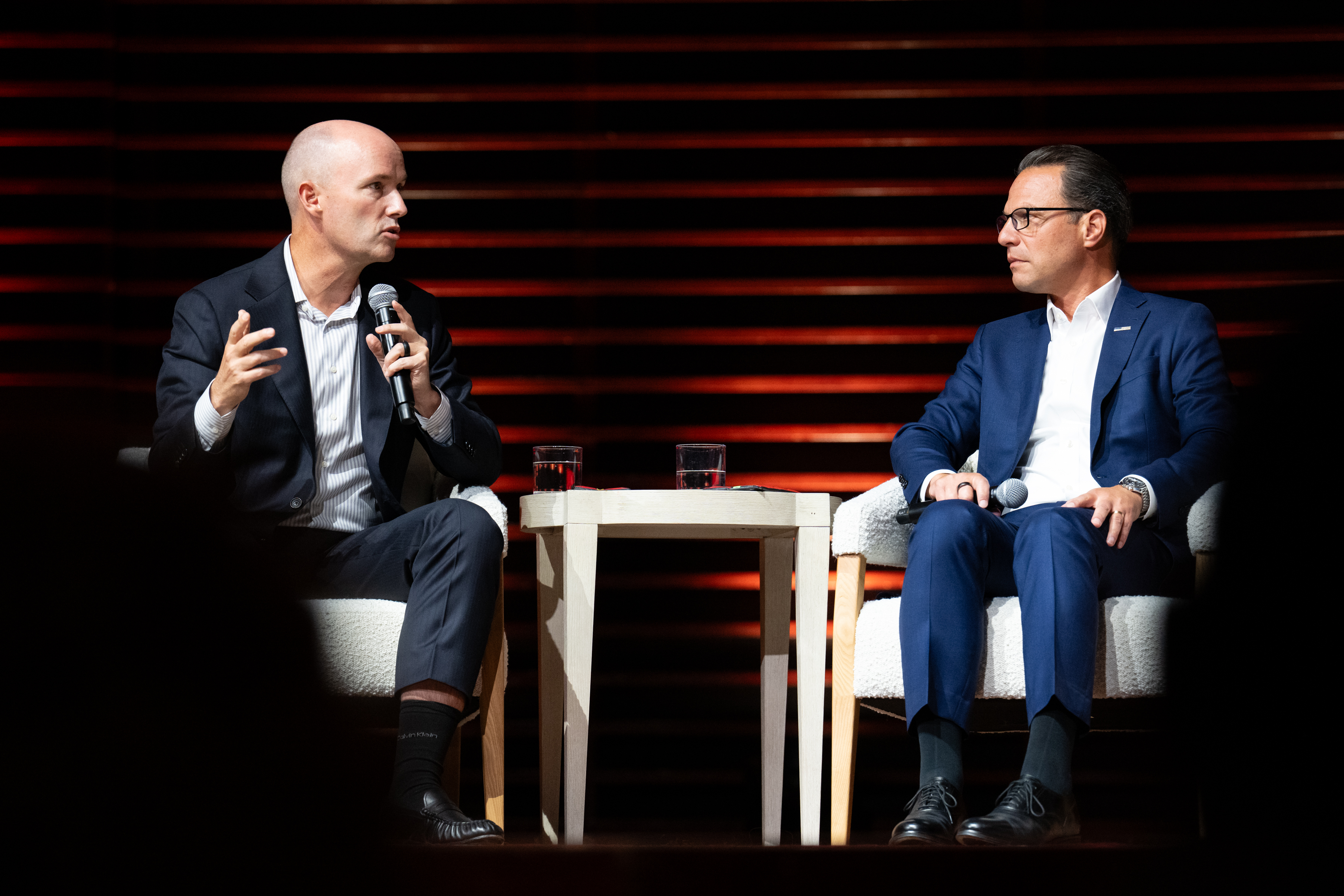
Amid a flurry of messages of support from other leaders, Cox, a Republican, said he spoke to Pennsylvania’s Democratic Gov. Josh Shapiro, who had experienced political violence of his own, and offered advice on how Cox could comfort a jostled community.
“I called him on the way to the press conference, and he told me to ditch my talking points and to speak from the heart,” Coxrecalled on the eve of the anniversary of Kirk’s killing. “I’m grateful for that advice. I took it, and it was really important in that moment.”
The event, moderated by New York Times journalist Lulu Garcia-Navarro, centered on how all members of society can hold respectful and productive conversations, even with people with whom they disagree. It comes less than two months before the midterm elections,as Democrats and Republicans wage heated campaigns for control of Congress and governors’ offices around the country, including in Pennsylvania.
Shapiro, who along with his family narrowly escaped an arson attack on the governor’s mansion last yearwhile they were staying there to celebrate Passover, said Americans should be “deeply concerned” about political violence and should not allow it to be rewarded or take deeper root in our nation.
Since that April 2025 attack, threats have persisted, largely related to his Jewish faith, he said.
“We’ve had six different people arrested in the last six or seven months for making terroristic threats against me and my wife, against our family, and oftentimes it’s rooted in an attack on me because of how I worship,” he said.
“I have a like a split-screen in my brain. I know that the incidents of political violence are rising. I know that the incidents of hate speech and hate crimes are rising, particularly against American Jews,” he said.
Angrier rhetoric, he said, gets rewarded with online engagement and campaign donations.
“Yet the other side of my brain gets to be governor in the greatest place, I think, in this nation, in the toughest swing state in the union, and as I go all across this commonwealth, I am met by good, decent people who offer prayers to my family, in ways that I don’t worship,” he said.
“The talk of celebrating this man’s death, no matter how profound a disagreement over a policy should be, he left behind a wife and two children,” Shapiro said at the time. “No one should be celebrating that. No one. I think that kind of rhetoric is unhelpful on every level.”
“I would say to my friend Governor Cox,” he said, “I hope he recognizes the power that he has from the perch that he occupies and the respect that you’ve earned across the country, and you use that power to help heal our politics and bring us closer together.”
Cox, who has said Trump is “not interested in uniting the country” despite endorsing him in 2024, has ruled out a 2028 presidential run of his own but quipped Shapiro may be interested.
“Somebody someday is going to run for president,” he said. “By the way, I just want to be clear, it may be somebody in this room. It’s not me.”
The audience cheered for Shapiro, who smiled and said “Cox for president” into his microphone.
Cox also praised Shapiro’s ability to “get stuff done” with a divided legislature, using the Pennsylvania governor’s signature slogan.
“That’s going to be on a campaign ad,” Garcia-Navarro said.
DALLAS — In an arena littered with President Donald Trump’s image — from the photos that lined the concourse to the gift shops selling merch depicting the president as a cowboy — one of Pennsylvania’s most vulnerable Republican lawmakers this fall went all-in.
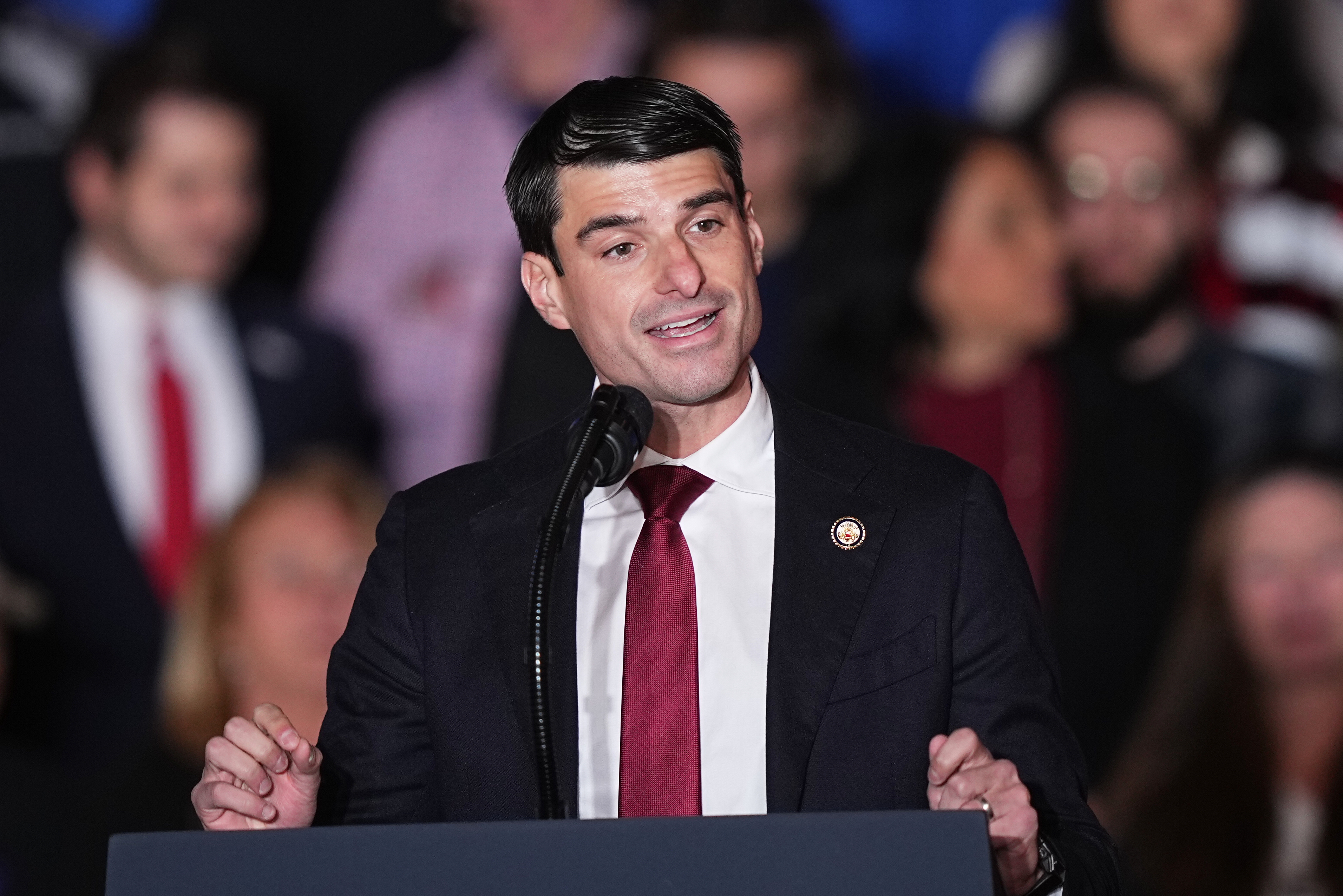
U.S. Rep. Rob Bresnahan, running for reelection in a Scranton-based district that is one of the most competitive in the nation, addressed the Republican Party’s first-ever midterm convention during its opening night on Wednesday.
His decision to attend “Trump-a-palooza” (as the RNC has described it) at all was notable. Some Republicans in tight races decided to stay away out of concerns of associating themselves with a president with low approval ratings. U.S. Rep. Brian Fitzpatrick (R., Bucks), for example, is not attending and has distanced himself from parts of Trump’s agenda.
Bresnahan promoted Trump’s signature tax policy in a brief speech focused on supporting workers and their families.
“Tax relief matters,” Bresnahan told hundreds of party loyalists at the American Airlines Arena in a speech that followed Ken Paxton, the controversial Trump-backed U.S. Senate candidate in Texas. “In Northeastern Pennsylvania, we work until the job is done. And those extra hours should mean more money in your pocket.”
Democrats have used Bresnahan’s vote for the One Big Beautiful Bill Act, which included cuts to Medicaid and food assistance, as a wedge against Bresnahan and other vulnerable Republicans. But Bresnahan contended the income tax cuts and other policies in the legislation, like no tax on tips, are paying dividends for families.
Two other Pennsylvania GOP lawmakers in similar situations, U.S. Reps. Ryan Mackenzie (R., Lehigh) and Scott Perry (R., York), are also attending the two-day convention, with Mackenzie slated to speak Thursday.
Bresnahan spoke to a somewhat sparse crowd compared with Republican National Conventions during presidential election years, which served as a model for the novel midterm convention this year as the party looks to energize its base of voters while seeking to defend narrow majorities in the House and Senate.
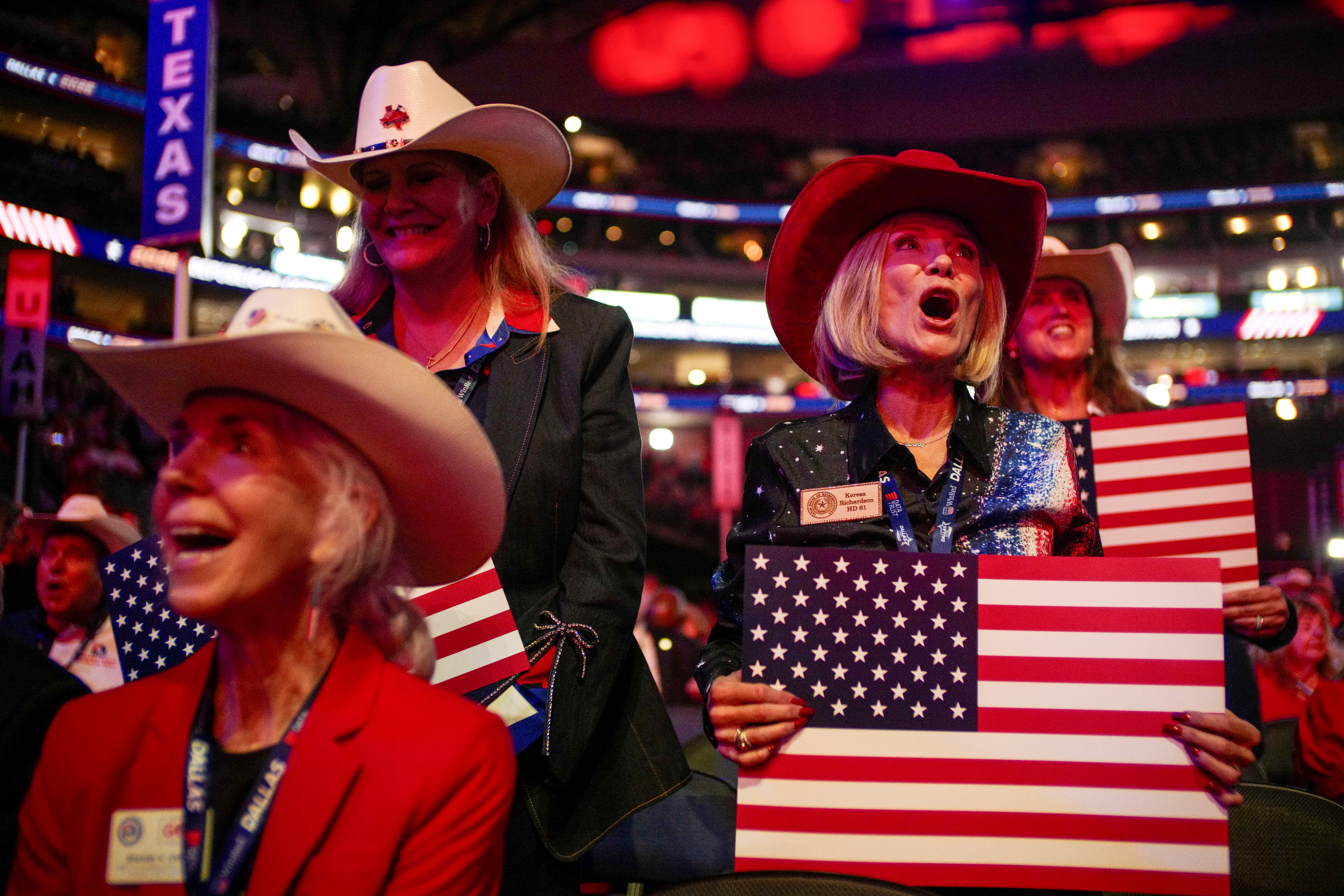
Delegates, clustered by state on the convention floor, cheered and waved signs reading “Keep the majority” and “Republicans are fixing Democrats’ mess.” The stands in the roughly 19,000-person arena remained largely empty, at least for the first few hours before Trump’s speech.
Merchandise shops were packed with Trump’s typical MAGA merchandise, copies of his son Eric Trump’s book, Under Siege, and new mugs and shirts showing Trump on a horse in cowboy gear. Red, white, blue, and — in an unmistakable nod toward the president — gold balloons waited in the rafters for the grand finale on Thursday.
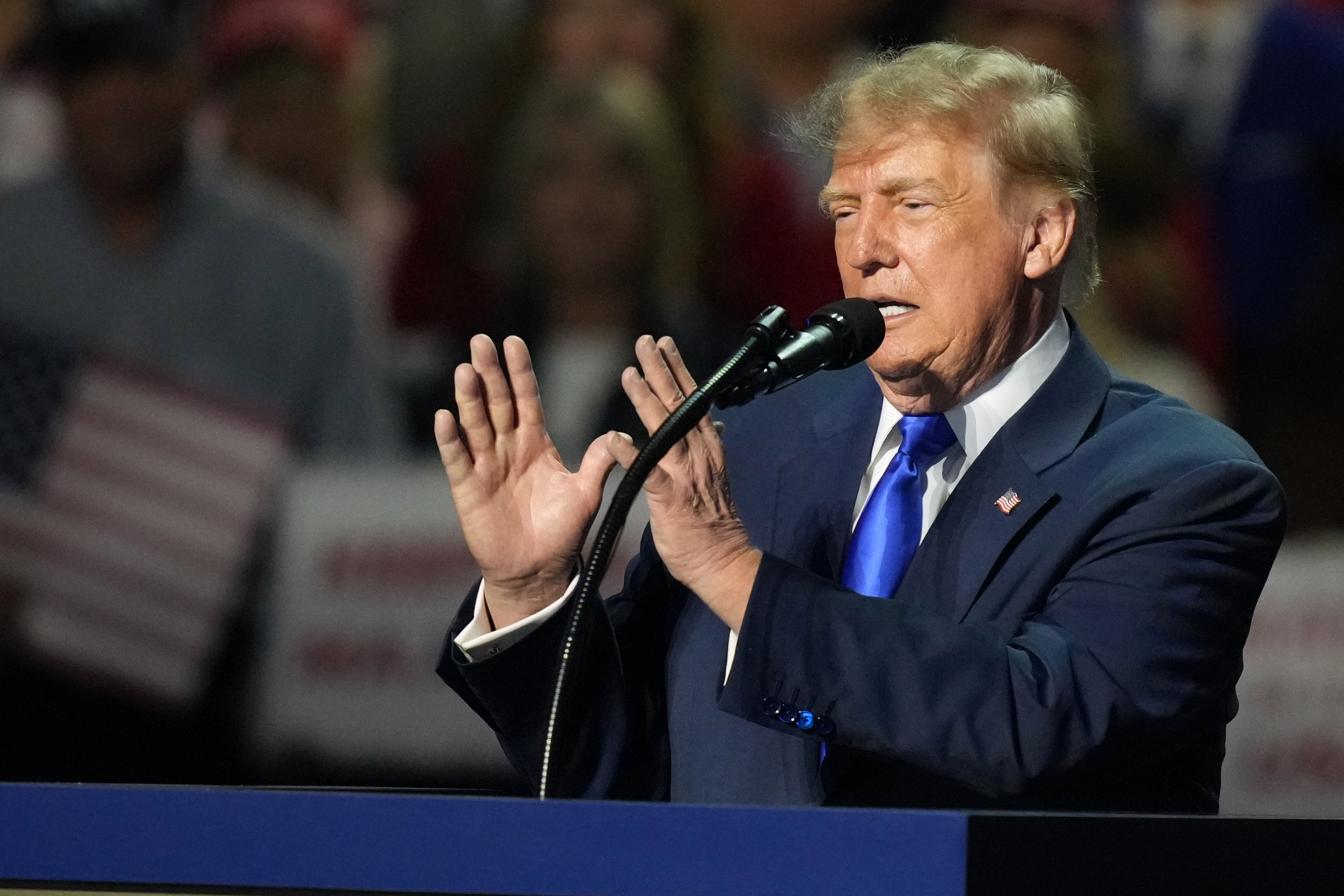
“I’m asking you to pretend that I’m on the ballot. I’m on the ballot, just one more time,” Trump told the cheering crowd in prime time, noting there were about 35 “swing” races the party was prioritizing.
President Donald Trump speaks at the Republican convention Wednesday, Sept. 9, 2026, in Dallas. (AP Photo/Alex Brandon)Alex Brandon
About 1,500 miles away, in another town called Dallas, one of Bresnahan’s constituents hatched a plan to tune in.
On the opening night of the annual Luzerne County Fair — in a booth yards from deep-fried Oreos, flying elephant kiddie rides, and life-size cardboard cutouts of Abraham Lincoln, Donald Trump, and Jesus — Dwayne McDavitt fiddled with his tablet to see if he could stream the convention.
The symmetry of Dallas, Texas, and Dallas, Pa., was “too good to pass up,” said McDavitt, the head of a conservative group called Thunder and Liberty PAC and also the Pennsylvania chapter of Bikers For Trump.
He said he supports Bresnahan, who lives in Luzerne County, over Scranton Mayor Paige Cognetti, the Democratic nominee.
“He shares our values of faith, family, and freedom — meaning free and fair elections,” McDavitt said.
Interviews with other voters in the district on Wednesday underscored the potentially risky nature of Bresnahan’s leaning into the Trump administration.
Malcolm Mabry, 28, of Wilkes-Barre, said he had been victimized by a “Trump bait and switch” as a Republican who voted for the president two years ago. He picked Trump, believing that better policing of the Southern border was paramount.
And while Trump has been using ICE to “grab up people,” as he said, Mabry said much of what else the president promised, like lowering prices and avoiding war, has not occurred.
“Trump just said what he had to, to get into office,” said Mabry, who was unaware of the convention happening at the same time.
A campaign about workers and affordability
Bresnahan won his seat by less than 2 percentage points in 2024 to take down a six-term Democrat in the northeast corner of the state. Trump won the district by more than 8 percentage points.
His Democratic challenger, Cognetti, has garnered high-profile supporters like Gov. Josh Shapiro, who is also up for election, and she has repeatedly targeted Bresnahan for trading stocks while in office despite his previous statements that he would not do so.
Bresnahan, the former head of a family-run electrical contracting business, has made jobs and the workforce a top focus in his campaign and in his brief congressional career.
On a few occasions, he has broken with House Republican leaders to support bills that would strengthen union protections for federal workers. He has said that he hopes his party changes tactics to support those kinds of bills.
“We need the unions that have trained generations of some of the most skilled workers in American history,” Bresnahan said onstage Wednesday. “We have those workers in Northeastern Pennsylvania, and communities across this country are ready for the same opportunity.”
Texas state Rep. Keresa Richardson (R), right, attends the GOP midterm convention. (Joel Angel Juárez/For The Washington Post)Joel Angel Juárez
Bresnahan has racked up a series of union endorsements that are otherwise rare for Republicans. While major unions like the AFL-CIO and the Pennsylvania State Education Association have backed Cognetti, he has won support from organizations like the American Federation of Government Employees and the Teamsters — groups that, in a region with a long history of union issues, could make a difference in a close race.
In his speech, Bresnahan talked generally about supporting workers and manufacturing in the U.S. He spoke about tax policies that put “more money in your pocket” and help “build communities where people can stay, raise a family, and build a life.”
They and other speakers did not address other affordability issues that Democrats have seized on and that polls show voters have top-of-mind heading into early voting.
Trump has mocked the Democratic attacks on the issue as a hoax, including in a speech in Bresnahan’s district last year. But it is a message, and a reality, that has resonated with voters in Pennsylvania, according to polls and interviews.
“I’m on a fixed income,” Bill Dudeck, 83, of Nanticoke in Luzerne County, said Wednesday. “But under Trump, gas, groceries, and utilities are skyrocketing.”
Trump promised a lower cost of living, “but now all our money is out the window,” said Dudeck, a Democrat and former construction worker in Bresnahan’s district.
Bresnahan, whose campaign said earlier this week that he was looking forward to bringing “NEPA to the national stage,” appeared onstage instead with a sheet metal worker and mother of seven from Baltimore.
Cognetti’s campaign noted the pairing in a comment Wednesday that criticized Bresnahan, in part, for trading stocks in office.
“That’s probably why he didn’t have a Pennsylvanian on stage with him tonight,” a Cognetti campaign spokesperson said in a statement. “His speech is just more empty words to try and distract from his broken promises.”
Nora Pruitt, who joined Bresnahan, had previously been recognized by the White House as a beneficiary of Trump’s second term. Listed on the agenda as an “everyday American, factory worker, working mother and manufacturing success story,” Pruitt said “things have really improved for our family since President Trump returned to office.”
“We are so grateful President Trump and Republicans in Congress like Congressman Bresnahan vote for families like ours,” she said.
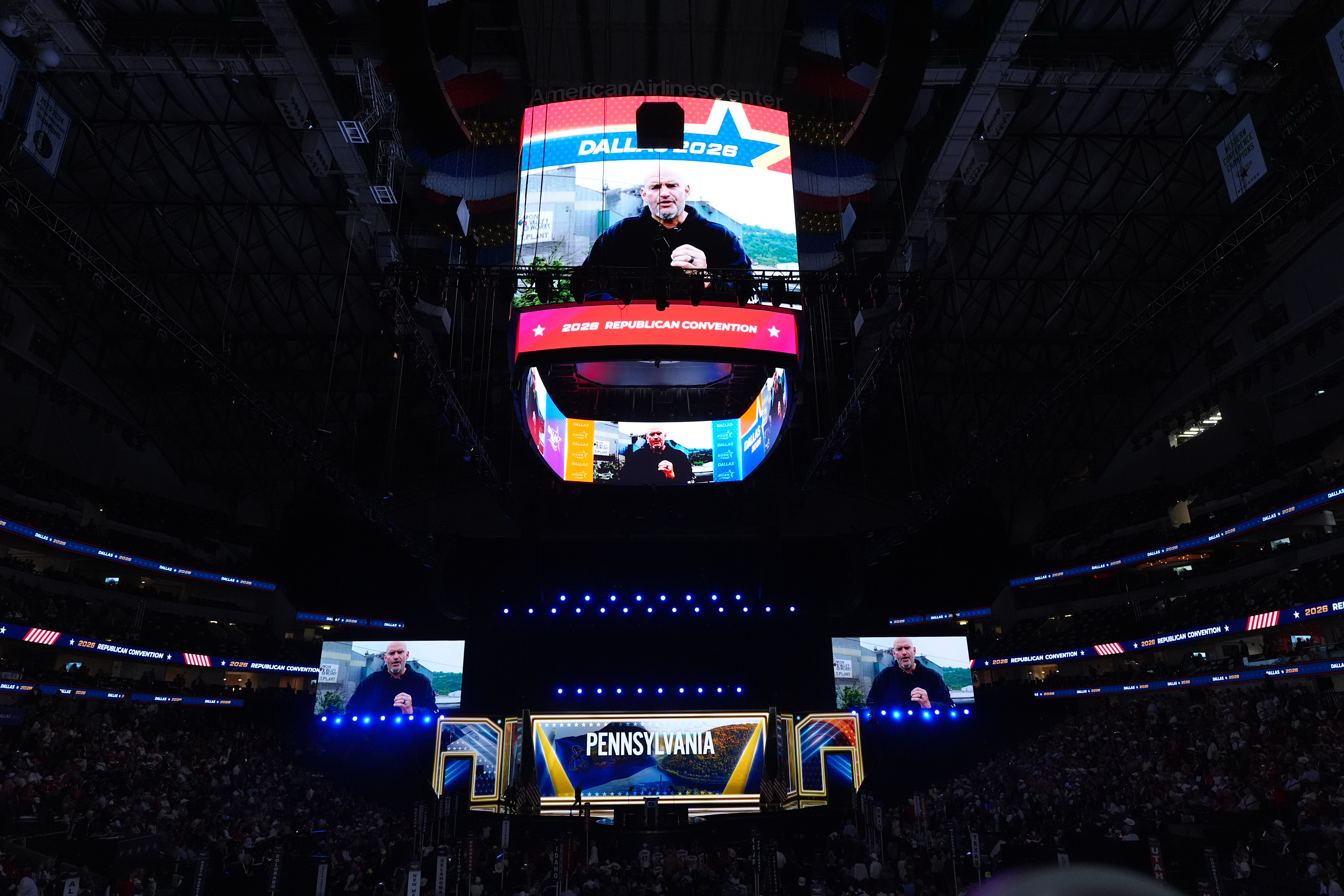
DALLAS — In a remarkable move for a Democratic lawmaker, U.S. Sen. John Fetterman on Wednesday appeared in a video at the Republican midterm convention — an event specifically designed to boost GOP candidates this fall — in a way that praised President Donald Trump for his support of Pennsylvania steelworkers.
The video was a clear escalation of a monthslong shift in which Fetterman has drifted from the Democratic Party. Though he has repeatedly rejected speculation that he would switch parties — and did so again after the video Wednesday — he has consistently criticized Democrats and praised Trump since the president took office.
In the video — which introduced U.S. Sen. Dave McCormick (R., Pa.) as he took the stage — Fetterman said he and McCormick “will work with President Trump to fight and defend the steel way of life right here in the Steel Valley.”
“I’m always going to stand with America. I’m always going to reject the extremes and socialism, and the anti-American way of life,” he said, repeating a common refrain in which he criticizes the leftist wing of the Democratic Party that has secured several high-profile wins this year.
Fetterman, who was not physically in attendance at the American Airlines Arena in Dallas, was cheered and applauded after McCormick took the stage and said, “How great is John Fetterman, right?”
In addition to McCormick, several vulnerable House GOP incumbents from Pennsylvania were at the convention. Fetterman’s video appearance came shortly after a speech from U.S. Rep. Rob Bresnahan (R., Luzerne), who represents one of the districts Pennsylvania Democrats are hoping to flip this year.
U.S. Rep. Madeleine Dean (D., Montgomery), who traveled to Texas to protest the GOP convention, said she was “gravely disappointed” that Fetterman chose to participate in the GOP event rather putting his energy to electing Democrats in key Pennsylvania races — the latest in a growing list of transgressions.
“I will tell you, from the ground, from suburban Philadelphia, my constituents are livid. Those who went out and knocked doors for him, they are absolutely livid,” she said the following day.
Democratic Gov. Josh Shapiro, who has a frosty relationship with Fetterman, said Thursday at an event in Chester that he did not see the video before adding that he was “not going to get distracted” from his duties as governor and his reelection campaign.
Democrats nationally are aiming to flip both the House and the Senate, which could put Fetterman in a powerful position as a swing vote if Democrats narrowly win control of his chamber.
And while leaders in both parties have reportedly made appeals to him, Fetterman said in a statement after his video went out that he would not switch parties if the Senate changes hands.
“I’m a lifelong Democrat who votes overwhelmingly with my party — and should the Senate flip in November, I will still be the 51st vote that I ran on,” he said, referencing his campaign promise in 2022 to be the Democratic vote that clinched the majority.
On Thursday, a web page soliciting donations to Fetterman’s campaign committee included a link to the video and said Fetterman would “keep standing his ground, speaking his mind, and putting Pennsylvania first.”
Fetterman has long been a supporter of the state’s steel industry as the former mayor of Braddock, the Pittsburgh suburb home to the Edgar Thomson Steel Works mill — which served as a backdrop to the video he shot for the convention.
U.S. Steel has pledged to invest up to $2.5 billion into that mill and other Mon Valley Works plants around Pittsburgh since its sale to Japan-based Nippon Steel last year.
The $15 billion sale had been held up for a year, opposed by both Republicans and Democrats concerned about a foreign takeover of the iconic company. Former President Joe Biden blocked the deal, and both Fetterman and McCormick criticized it before Trump took office.
Trump went on to secure a pledge that Nippon would have an American CEO, not lay off workers, and give the U.S. a so-called golden share in the company. Trump returned to Pennsylvania for his first rally in the state to celebrate the deal with steelworkers outside Pittsburgh.
“Under Joe Biden, Democrats blocked critical investment in U.S. Steel, risking thousands of jobs,” McCormick said on stage Wednesday. “I promised Pittsburgh steelworkers I would fight for the steel way of life, and President Trump did, too. And with the president’s leadership, we delivered a deal protecting and creating over 100,000 American jobs.”
Fetterman’s participation in the GOP conference — in the type of promotional video that is common at party conventions — is extremely rare.
The Pennsylvania Democratic senator’s decision to record a video praising Trump ahead of the election may draw comparisons to Georgia Democratic Sen. Zell Miller’s fiery speech praising President George W. Bush — and denigrating Democratic nominee John Kerry — at the 2004 Republican National Convention.
State Rep. Malcolm Kenyatta, a Philadelphia Democrat who ran against Fetterman in the 2022 Senate primary, drew a different historical comparison.
“John is Benedict Arnold, but lazy. Could barely get off the couch in his million-dollar mansion to kiss Trump’s ring, he phoned it in like everything he does,” Kenyatta, a Democratic National Committee vice chair, said on X.
U.S. Rep. Brendan Boyle, a Philadelphia Democrat, similarly blasted the senator’s video appearance at the rival party’s convention.
“A year ago, I labeled John Fetterman ‘Trump’s favorite Democrat.’ Tonight, he yet again proves why,” Boyle said on X.
And U.S. Rep. Chris Deluzio — a Western Pennsylvania Democrat who, like Boyle and Kenyatta, could be a candidate when Fetterman’s seat is up for election in 2028 — declared in a statement that Fetterman is “not going to be a Senator after 2028 — mark my words.”
“If the failing Republican politicians want him, they can have him,” Deluzio said. “Like them, John Fetterman has failed the Pennsylvanians who elected him, who expected him to fight against White House corruption, health care cuts, and reckless war, not cheerlead it.”
Fetterman has not yet said he will run for reelection and his dismal approval ratings among Democrats could make it difficult to win a primary — unless he switches parties. Among Republican voters, he was even more popular than McCormick in a poll last month from The Inquirer, the New York Times, and Siena University.
Fetterman has developed a close association and friendship with McCormick since the Republican’s election in 2024. While Fetterman rarely makes public appearances in the state he represents, he has appeared at a few with McCormick.
In a striking move, the bipartisan pair also set up a joint fundraising campaign committee this summer as Fetterman’s own fundraising lagged. This past week, McCormick came to Fetterman’s defense after the Wall Street Journal reported that the Democrat frequently avoided meeting with, and privately criticized, constituents and interest groups.
“These stories are the latest example of outrageously disloyal staff and forces on the Left using anonymous leaks to cancel my friend John Fetterman,” McCormick wrote on social media. “They hate that he is an independent thinker who refuses to fall into line so they want to silence him.”
In the convention video, Fetterman called McCormick a “great American, a great senator.”
“Yes, he is in a different party, but I’m proud to count him as my great friend,” Fetterman said.