Category: Politics

  • Trump slams Supreme Court for rejecting his push to restrict mail ballots

    Trump slams Supreme Court for rejecting his push to restrict mail ballots

    WASHINGTON — President Donald Trump on Tuesday went after the Supreme Court after it rejected his push to restrict mail-in voting in this year’s midterms, saying justices who opposed him were “not the people I interviewed.”

    His social media missive was just the latest in a long history of Trump assailing justices, particularly those he had nominated, who ruled against him on his administration’s most prominent initiatives. The president has been publicly furious with the Supreme Court over its decisions against restricting birthright citizenship and his ability to issue tariffs unilaterally.

    On mail-in voting, the Trump administration had made a last-minute push to have the U.S. Postal Service play a central role in deciding who would be able to receive a ballot. But state election officials argued there was not enough time to make the changes for the Nov. 3 midterm elections — and said their systems were already secure and accurate.

    The court ruled late Monday in an emergency order that the restrictions would most likely lose in court, at least for this year’s election.

    “The Court’s inability and unwillingness to do the right thing for our Country will go down, in a very negative way, in the annals of History,” Trump wrote in a lengthy social media post Tuesday. “This Supreme Court is bullied and cajoled by the Radical Left into making decisions that have set America back at least a hundred years.”

    Justices Sam Alito and Clarence Thomas publicly dissented from the order, and Trump on Tuesday called them “legends both.” Trump has nominated three of the justices on the Supreme Court — Neil Gorsuch, Amy Coney Barrett and Brett Kavanaugh.

    “These are not the people I interviewed to serve on the United States Supreme Court, they are merely a shell of their original selves,” Trump said. He asserted that the court “is costing the United States Trillions of Dollars with shockingly bad rulings that are of such magnitude that it won’t be easily possible for our Country to recover or heal.”

    The president has a lengthy track record of attacking judges, often very personally, who issue decisions that go against his wishes, and Trump has long viewed his legal appointments as owing loyalty to the person who nominated them to the bench.

    So as Barrett, Kavanaugh and Gorsuch ruled against Trump at varying points over the years, the president has not hesitated to go after them publicly, while praising them if they sided with him in a case.

    Yet this court, led by Chief Justice John Roberts, has ruled in favor of Trump on several of his priorities, most notably the 2024 decision from the court’s conservative majority that said former presidents are presumptively entitled to immunity for all official acts. That paved the way for Trump to run for reelection without threat of a criminal trial that year.

    Trump has opposed mail voting and falsely blamed it for his 2020 election loss. A report by the Brookings Institution published in 2025 found that mail voting fraud occurred in only about four cases out of every 10 million mail ballots cast.

    Roughly a third of voters use mail ballots, and mail voting has already begun in some states. The decision allows states to continue sending out mail ballots under the same processes they’ve used for years.

    On Tuesday, Trump also complained that the decision took too long to issue.

    “It is not easy for me to write this criticism of the United States Supreme Court – it will likely cost me dearly for years to come – but I feel it my obligation and duty, as President, to do so for the America we love!” Trump said.

  • ‘Culture wars’ can matter deeply

    ‘Culture wars’ can matter deeply

    Trans rights, trad wives, and a testosterone-fueled military: these hot-button topics generate intense emotions in online spaces and cable-news panels, driving the culture wars that energize MAGA warriors. Culture wars focused on gender issues have been especially heated during the Trump era, but they are not new. Indeed, gender-based culture wars have long been a feature of democratic systems, particularly during times of political upheaval.

    Consider the example of France in the 1790s. The French Revolution of 1789 led to a change of government from one ruled by an absolutist monarch to one where (some) men could vote for their governing bodies. With the introduction of a new electoral system in 1791, suffrage and regular elections became part of the system and ambitious politicians needed constituents to vote for them.

    Rapid political and social change, including the debate over who qualified as citizens with the right to vote, generated both movements for change and a sense of impending disorder. Urban workers and peasants demanded the vote, as did some women. Dissatisfaction with the government’s response led to increasing violence, including riots and the overthrow of the monarchy in August 1792. The constitution that came into effect in June 1793 — after the creation of the French First Republic and the execution of King Louis XVI — granted universal male suffrage, including for workers and peasants. But it refused the same political rights to women.

    Still, representative government brought legal changes that benefited women. In the fall of 1792, the National Convention legalized and made divorce quite easy, a change vehemently opposed by church authorities. In the years that followed, more women than men sued for divorce under the new laws, reflecting their desire for greater autonomy. At the same time, adjustments to inheritance laws made it possible for women to demand a fair share of their family’s material goods, in many cases interfering with previous settlements that had disproportionately favored sons over daughters.

    While many French men and women approved of these transformations as promoting greater fairness, those disadvantaged by the changes expressed their outrage at the disruption to longtime religious and economic practices anchored in traditional ideas about gender. Conservatives were especially unhappy about restrictions on the ability of husbands to discipline a wayward wife or of fathers to direct the family’s resources toward an eldest son. His diminished patriarchal authority had profound implications for familial relations.

    Uneasiness about these cultural shifts intensified as war broke out in 1792, followed by civil war within France itself, triggered by resistance to what many saw as unacceptable attacks on their way of life. Opposition to the revolutionary government was particularly strong in western France, where religious sentiment and an attachment to the king and traditional hierarchies fueled resistance to government “meddling.”

    The Terror — an effort by the radical Jacobin government, with the support of the newly empowered lower classes, to clamp down on dissent by executing anyone perceived as a threat to the unity of the nation — was an attempt to impose order. But it instead created panic and paranoia along with a sense that giving power to the lower classes and women gave rise to chaos. The closure of women’s political groups along with the execution of several prominent women, including political activist Olympe de Gouges and the former queen Marie Antoinette, in the fall of 1793 was a response to those fears. The Terror’s end, with the execution of Maximilien Robespierre and his closest collaborators in July 1794, led to the creation of a new regime that promised to restore order: the Directory, a conservative republican government established by a new constitution in 1795.

    But the culture wars continued, fueled by fights over gender and family issues. While the new constitution significantly curtailed the power of lower-class men — the franchise was restricted to wealthy male property owners — many legislators were still committed to the egalitarian goals of the revolution and thus unwilling to overturn all previous social legislation. However, the visibility and perceived political and cultural influence of women became a flash point as critics continued to debate changes to divorce and inheritance laws that benefited women. Politicians and journalists blamed divorce as a root cause of social disorder; a woman who could threaten to leave her husband undercut his masculine authority and disrupted families.

    Writer and cultural critic Louis-Sébastien Mercier offered a harsh critique of the divorce law in 1797, asserting that “Friends of law and order, sensible people recognize that it opened the door wide to licentiousness and moral depravity, already so widespread.” Politicians demanded divorce law reform on behalf of their voters, decrying its “disastrous and scandalous effect.” French newspapers printed polemical essays and letters to the editor on the topic and reported on legislative debates.

    Purported sexual misbehavior also generated concern. Between 1794 and 1799, legislators and social critics complained about the shamelessness and political meddling of elite women who wore revealing clothing and pursued the pleasures of life beyond the home. The argument was that the changes in inheritance laws gave them access to resources that financed their independent and luxurious lifestyles, attending balls and hosting salons. One politician decried the consequences of female independence, which, he believed, led inexorably to adultery, warning, “Establish the independence of the mother, and you will render all paternity uncertain.”

    Made By History sponsors. FOR USE ON MADE BY HISTORY STORIES ONLY.Inquirer Staff

    Eventually, Napoleon Bonaparte took advantage of France’s disorder and cultural anxieties to establish male authoritarian rule. Defenders of Napoleon and his November 1799 coup d’état pointed to the political and social chaos of the Directory, exacerbated by the corrupting influence of ostensibly licentious women on weak men who had shown themselves incapable of exercising control over their families and the government. Napoleon believed this as well. It was high time that strong, “manly” men — preferably those with military credentials — took control of the government and their families. The Napoleonic Code of 1804 made getting a divorce more onerous, at least for women, whose ability to initiate divorce proceedings was severely limited (divorce would be outlawed entirely in 1816), and it tightened husbands’ control over their wives and family resources.

    The lesson? Deriding the power and potential liberty that sexual freedom and divorce offered women became a way to critique a society that empowered a more diverse citizenry. But in reality, perceptions of “chaos” and proposed solutions creating “order” through “traditional” values was — and still is — about restoring power to older regimens and hierarchies. It can also be cruel, limiting choices and freedoms. Perceived disorder is a powerful force for constraint; the desire for fairness is a powerful force for change.

    Christine Adams, a former American Council for Learned Societies and Andrew W. Mellon Foundation fellow at the Newberry Library, is professor of history at St. Mary’s College of Maryland and author of “The Creation of the French Royal Mistress” with Tracy Adams.

    Made by History takes readers beyond the headlines with articles written and edited by professional historians. Opinions expressed do not necessarily reflect the views of The Inquirer.

  • Federal Reserve is expected to raise its benchmark rate, defying Trump’s demands

    Federal Reserve is expected to raise its benchmark rate, defying Trump’s demands

    WASHINGTON — The Federal Reserve is widely expected to lift its short-term interest rate Wednesday for the first time in three years to fight stubbornly high inflation, a move that would put the central bank at odds with President Donald Trump’s support for a cut.

    A quarter-point increase in the Fed’s rate, currently about 3.6%, isn’t guaranteed because Fed Chair Kevin Warsh doesn’t provide the signals about next moves that his predecessors did. Still, most analysts and economists expect a hike after a speech two weeks ago at the Fed’s annual conference in Jackson Hole, Wyoming, in which Warsh argued that the Fed had not yet achieved its goal of putting inflation in check.

    A rate increase would throw another sharp shift into a volatile period for the economy and financial markets. As recently as March, the Fed had forecast it would cut its rate once this year. But with the Iran war flaring up again and causing sharp increases in oil and gas prices, inflation is likely to remain higher than the Fed’s 2% target for even longer.

    “I don’t see any end to the war in Iran right now,” Kristin Forbes, an economist at MIT’s Sloan School, said. “Given what everyone has been through in the last few years of high inflation, consumers are more sensitive, companies are more sensitive, they raise prices faster … The risks are much more on more persistent inflation than it falling quickly.”

    Surging investment in AI data centers has also been accelerating inflation and contributing to higher longer-term interest rates, though now leading companies are discussing slowing the technology’s development.

    All eyes are on interest rates before the midterms

    The Fed’s potential rate hike comes just seven weeks before the midterm elections in which high prices and affordability have taken key roles. Trump has demanded that the Fed cut rates, a move that isn’t on the table, and on Sunday the president said, “the United States is so strong we should be paying the lowest interest rate in the world.”

    Trump repeatedly attacked Warsh’s predecessor, Jerome Powell, in harshly personal terms, upending decades of tradition in which presidents treated the Fed as independent.

    Kevin Hassett, Trump’s top economic adviser, said Sunday on CNN that Trump “100% respects the independence of Kevin Warsh.”

    Yet at the same time, Hassett suggested in a Fox News interview that the Fed shouldn’t hike so close to the midterms.

    “I’d be wary of a rate hike … I think if you want an independent Fed, then one thing the Fed does is it stays out of the way of elections,” Hassett said.

    Financial markets expect that Warsh and the central bank will brush off such warnings. Traders now see a 90% chance the Fed will hike Wednesday, according to futures prices. That figure jumped after Friday’s inflation report showed that prices remain stubbornly high and core inflation, which excludes volatile food and energy, picked up in August from the previous month.

    After that report, and Warsh’s tough talk on inflation late last month, most economists argue that Warsh will have to hike rates or risk undermining his credibility with financial markets. Longer-term interest rates, such as those on the 10-year and 30-year Treasury bonds, could spike if he doesn’t hike, as they did after a Fed meeting in late July when Warsh failed to convince markets he was willing to lift rates if needed.

    “At the end of the day the Chair’s repeated stern warnings on inflation intolerance risk institutional credibility absent some action to back it up,” Michael Feroli, an economist at JPMorgan Chase, wrote in a preview of the Fed’s meeting.

    A rate increase could raise other questions

    Some members of the Fed’s interest-rate setting committee still expect inflation, outside of food and energy, to fade over time and may not feel a rate hike is necessary.

    But Warsh has not made that argument. Instead, in his Jackson Hole remarks, he said recent inflation reports “do not tell me that underlying trends have improved,” adding that if such improvement wasn’t seen soon, “we have work to do.”

    Ironically, by boosting Fed credibility, a rate hike could hold down longer-term interest rates that consumers pay for things like mortgages and auto loans. Some of the recent spike in mortgage rates has likely reflected concerns among investors that the Fed wasn’t committed to fighting inflation. Investors typically demand higher yields to own bonds when inflation is elevated.

    Still, if the Fed does increase its rate Wednesday, then Warsh will face a new set of questions: How many hikes will the Fed implement? How effective will they be in reducing inflation when much of it stems from higher oil prices, something the Fed can’t control? What will they do if an AI slowdown threatens to slow the economy, which would typically get the central bank to cut rates?

    Matthew Luzzetti, chief U.S. economist at Deutsche Bank, said it is rare for the Fed to lift its key rate just once, which is likely to have little impact on the economy, and so multiple hikes are likely.

    But how the Fed characterizes possible rate increases on Wednesday could give clues to its next steps, he said. For example, if Warsh suggests the Fed is unwinding the three cuts it made in late 2025 — when it feared that unemployment was rising — that would suggest two more hikes would be needed.

    Alternatively, Warsh could portray a hike as an act of “risk management,” Luzzetti said, with the Fed expecting inflation to cool but hiking rates to essentially ensure it falls. That could point to possibly just two increases.

    Warsh has resisted providing such guidance so far. But Wall Street traders expect three hikes — in September, December, and March — according to futures prices.

  • Trump’s effort to assert control over elections continues, despite court loss

    Trump’s effort to assert control over elections continues, despite court loss

    WASHINGTON — The Supreme Court dealt President Donald Trump a major blow Monday when it blocked his executive order to restrict mail ballots. But Trump’s battle to assert control over the election process is far from finished.

    The stymied attempt to have the U.S. Postal Service screen mail ballots was just one piece of a broader effort involving the full power of the federal government to take more control of state-run elections.

    Just days before the Supreme Court blocked Trump’s mail ballot order, the Justice Department sent threatening letters to at least 30 top election officials across the country, escalating a fight to gain access to private voter data and election records.

    Federal agents are scouring voter rolls managed by states for noncitizens, despite a lack of evidence of widespread fraud. Trump’s homeland security secretary recently pushed for an investigation into whether a commonly used voting machine can be trusted, casting doubt on digital voting systems.

    “This is far from over,” said Benjamin Hovland, who was ousted from the independent, bipartisan Election Assistance Commission by the Trump administration this year.

    Hovland acknowledged that the Supreme Court’s decision mitigated “real-world impact” on voters and election workers, particularly since voters in some states have already begun to mail in their ballots. But he said Trump’s actions were alarming.

    “What you’re seeing is using the apparatus of government, using federal agencies, using taxpayer dollars, to push that narrative that only undermines confidence in our democracy and ultimately hurts voters and election officials,” Hovland said.

    Trump argues that he is trying to secure the integrity of the vote, but his claims of widespread fraud in the election system have been investigated and debunked repeatedly, and critics say his actions needlessly sow doubt about the outcome of the vote.

    The White House did not immediately respond to requests for comment.

    There are stark differences between now and Trump’s first term, when his attempts to undermine the election results in 2020 ran into stiff pushback not only from the courts but also from his own government officials. In his second term, Trump has surrounded himself with loyalists willing to turn his obsession over the country’s election systems into a blitz of federal actions. He has also installed election deniers in key posts.

    The Supreme Court’s decision Monday did, however, add to a string of mounting losses for Trump, who said this year that he wanted to “take over” and nationalize elections. Even before the Supreme Court decision, two lower court judges ruled that Trump’s changes to mail-in balloting were most likely illegal and should not be imposed so close to the November elections.

    Trump administration lawyers had urged the Supreme Court to step in and clear the way for its plan to use the Postal Service to screen ballot envelopes after they are submitted by state elections officials. The new rules would require states to submit lists of voters approved to receive mail ballots. The Postal Service would then deliver mail ballots only to the voters on the lists.

    In addition to the loss Monday, Trump’s other attempts to pressure states over the election process have faced legal setbacks.

    The Justice Department has sued 30 states for unredacted voter lists, which include personal information such as driver’s license numbers and partial Social Security numbers.

    They have lost 23 of those cases. Decisions are pending in the rest.

    The federal actions, as well as the various court decisions, have caused alarm among local election officials and voters, according to election experts.

    This month, the chief election officials in seven Republican-controlled states filed a brief to the Supreme Court, arguing that with less than two months until Election Day, it was too close to the midterms to make any major changes to the election process.

    Some states including North Carolina, Delaware and Alabama had already mailed out their ballots, even before the Supreme Court issued a final decision.

    “Attempting to implement the rule now will almost certainly lead to mistakes, delays and confusion for both voters and election officials,” the brief stated.

    But it was not just the pending Postal Service rule that has caused confusion and upended coordination among local election officials and the federal government.

    The administration has also asked the Supreme Court to intervene to allow it to move forward with an effort to build citizenship lists by merging data from various agencies, including the Department of Homeland Security and the Social Security Administration. A lower court has so far blocked the use of that tool, which administration officials argue is needed to verify citizenship for voting, among other purposes.

    In July, Markwayne Mullin, the homeland security secretary, threatened election officials in a speech and said they could face prison time if they did not comply with the Trump administration’s efforts to change election policies. Officials in the Justice Department officials have also explored whether they could bring criminal charges against state or local election officials if the administration determined they had not sufficiently safeguarded their computer systems.

    The Federal Emergency Management Agency, which sits under the Homeland Security Department, is demanding that states change the way they conduct elections or risk losing tens of millions in federal terrorism-prevention funds.

    Kimball W. Brace, the president of Election Data Services, an organization that works with local governments on election preparedness, said he did not expect the Supreme Court decision to stop Trump’s broader effort to pursue his election grievances.

    “I don’t anticipate people on the Republican side not wanting to continue and push their side of the story as much as possible,” Brace said.

    Distrust of the election process among voters is growing as the November elections approach. A survey from The Associated Press and the NORC Center for Public Affairs Research and USAFacts showed that only 34% of U.S. adults trust government certifications of election results “a great deal” or “quite a bit,” down from 40% in 2024.

    Trump has also gutted the government’s election security infrastructure. Experts warn that his cuts to agencies tasked with coordinating election security with state governments could reduce visibility into foreign influence campaigns and cyberattacks.

    Brace said all the executive actions have fueled pressure on local election officials.

    “They don’t want to deal with this crazy pressure that various interests and various individuals have pushed on the election administration,” he said.

    This article originally appeared in The New York Times.

  • Supreme Court rejects Trump mail ballot restrictions for now ahead of midterms

    Supreme Court rejects Trump mail ballot restrictions for now ahead of midterms

    WASHINGTON — The Supreme Court on Monday rejected President Donald Trump ‘s mail ballot restrictions for now, capping a flurry of last-minute legal action with voting in the midterm elections already underway.

    The decision allows states to continue sending out mail ballots under the same processes they’ve used for years.

    Justices Samuel Alito and Clarence Thomas dissented from the brief order. Justice Brett Kavanaugh agreed that the restrictions should not go into effect for the midterms but indicated he might rule in favor of the Trump administration later.

    The Trump administration had asked the court, once again at the center of a roiling political controversy, to clear the way for restrictions before the pivotal November contests for control of Congress. The case has major implications because nearly one-third of the country votes by mail.

    Election officials have said there was simply no way to carry out a complete overhaul in the weeks before the midterms. Indeed, Alabama, North Carolina and Wisconsin began sending mail ballots to voters over the past week while the new system was still not active.

    The Trump administration plan would require states to adopt a uniform envelope style and submit lists of eligible voters to an online portal. The Postal Service could refuse to deliver ballots to states that didn’t comply.

    A whistleblower report, though, said the postal system’s requirements could lead to millions of mail ballots never being sent, because the portal wasn’t properly built and a single bar code error could result in an entire batch of ballots being tossed out.

    Democratic state officials and voting rights groups challenged the restrictions in court, arguing that the president has no constitutional authority to set election rules that would “virtually eliminate mail voting on the eve of a major election.”

    Lower courts agreed and blocked Trump’s plan, including a preliminary injunction issued by a judge nominated by the president.

    But the Trump administration appealed to the Supreme Court, arguing that federal control of the Postal Service allows them to set rules for mail ballot handling and that compliance was possible.

    The federal government won an early procedural decision at the Supreme Court, but the justices pointedly did not decide the legality of the plan.

    Trump has long opposed mail voting and falsely blamed it for his 2020 election loss to Democrat Joe Biden, even though he often uses that method to cast his own ballot, including as recently as this year.

  • McConnell returns to the Senate for the first time since his June hospitalization

    McConnell returns to the Senate for the first time since his June hospitalization

    WASHINGTON — Republican Sen. Mitch McConnell of Kentucky returned to the Senate on Monday for the first time since June 14, when he was hospitalized after a fall in his home.

    McConnell’s three-month absence from the Senate generated a flood of criticism and online speculation, as the Kentucky senator initially remained quiet for weeks about his condition. The 84-year-old senator eventually disclosed that he had been “briefly unconscious” due to the fall and had also been treated for mild pneumonia in the hospital.

    “My recovery has been a long and often frustrating process, and the lingering effects of childhood polio haven’t made it any easier,” McConnell said in a statement Monday. “I’m still not quite back to 100%, but I’ve assured Leader Thune that, as I continue with physical therapy on the advice of my doctors, I will do my best to be present for tough votes when our Conference needs me.”

    The concerns over McConnell’s absence highlighted increasing public concern about the age of lawmakers and their capacity to carry out their duties. Speculation about his condition grew so intense at one point that Kentucky’s Democratic Gov. Andy Beshear took the extraordinary step of issuing a public letter asking McConnell to update the public in a “transparent manner.”

    McConnell’s absence was also felt over the summer as Republicans were unable to advance a farm bill out of committee. His return could give GOP leaders a needed vote as they try to advance legislation on cryptocurrency regulation and college sports.

    McConnell, who holds the distinction of being the longest-serving Senate leader, is in his final months of his four decades in office. He is retiring at the end of January after one of the most consequential careers in modern politics.

    Republicans have nominated U.S. Rep. Andy Barr to replace him, while Democrats have nominated former state lawmaker Charles Booker. McConnell said he is determined to finish out his term.

    A history of health problems

    McConnell had polio in his early childhood and has long acknowledged difficulty as an adult in walking and climbing stairs.

    The physician’s office in Congress in the July statement said McConnell has “experienced several falls through the year” due to his “post-polio condition.” The office said his physical therapy was aimed at reducing the risk of him falling again.

    “A comprehensive evaluation by a multidisciplinary team determined that he had no fractures, cardiac abnormalities, stroke, tumor, or hemorrhage,” the physician’s office said.

    McConnell was first elected to the Senate in 1984 and was the Republican leader from 2007 until last year, serving as both majority and minority leader during that period. He has remained active as a rank-and-file senator, showing up for work when the chamber is in session, often using a wheelchair to get around.

    But the senator’s physical condition has visibly declined in recent years.

    He was hospitalized with a concussion in March 2023 and missed several weeks of work after falling in a Washington hotel. He twice froze up during news conferences after he returned, staring vacantly ahead before colleagues and staff. A year later, he fell and sprained his wrist while walking out of a GOP luncheon.

  • Philadelphia faces calls for a data center moratorium amid spreading AI fear and talk of a slowdown

    Philadelphia faces calls for a data center moratorium amid spreading AI fear and talk of a slowdown

    The battle over data centers and the artificial intelligence they power has officially reached Philadelphia City Hall.

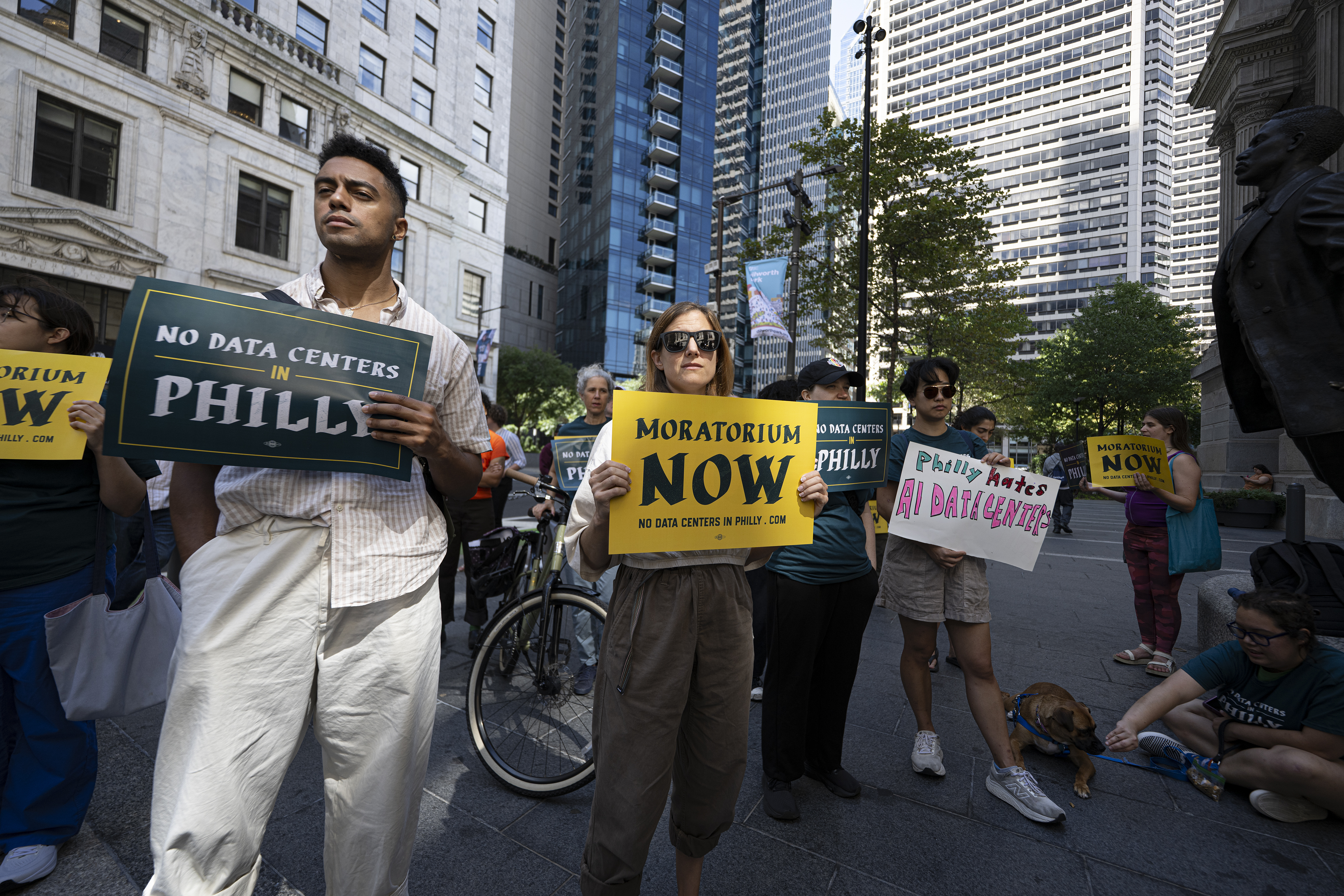
    A coalition of activist groups and environmental advocates gathered at City Hall Monday to call on local lawmakers to pass a moratorium on data center construction in the city, the opening salvo for the group’s public pressure campaign to oppose the projects that it says could hike energy rates and drive pollution.

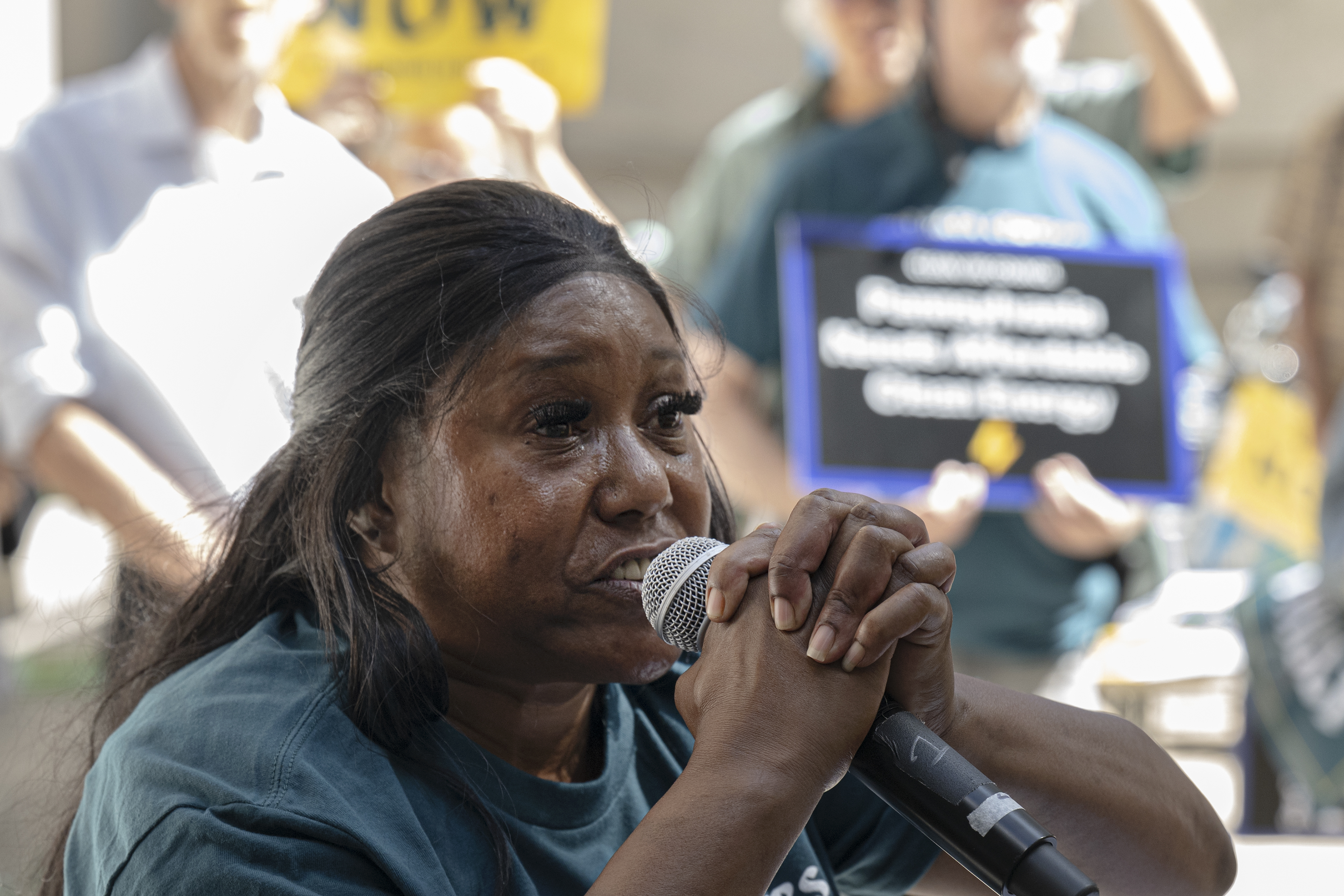
    “There’s way too much at stake to let data centers expand without guardrails,” said Sonya Sanders, board president of Philly Thrive, an advocacy group for racial, economic, and environmental justice.

    The coordinated push could put Mayor Cherelle L. Parker and members of City Council in a politically tricky spot as they gear up to run for reelection in the spring. Data centers have proven deeply controversial and have drawn bipartisan backlash, but some unions that see job-creating potential support their construction.

    There is no specific data center proposal currently under consideration by City Council, and no member has said that they will introduce a moratorium bill. A spokesperson for Council President Kenyatta Johnson said that Council members and Parker’s administration are in “discussions on the future of data centers in the city.”.

    Any data center legislation would have to run through Parker, a centrist Democrat who has not staked a position on the issue. She is allied with the unions that represent construction workers and has generally been pro-development. However, she positioned herself as an opponent of Big Tech earlier this year when she advocated for new taxes on companies like Uber and Airbnb.

    Parker said in a statement Monday that she would sign an executive order this week to “formalize” a task force she convened over the summer to explore potential standards for data center development, and she vowed that the city would put “rigorous guardrails in place.” She did not specify a timeline.

    Grays Ferry resident Sonya Sanders speaks during a rally at Philadelphia City Hall on Monday, calling on City Council to pass a citywide data center moratorium and kicking off the No Data Centers in Philly campaign.Jose F. Moreno / Staff Photographer

    The data center activists’ event in Philadelphia came as fear of AI’s rapid development and increasingly humanlike capabilities has spread substantially and as leaders of the nation’s largest AI developers over the weekend signaled support for a global slowdown.

    On Saturday, Anthropic chief executive Dario Amodei wrote that the technology is advancing more rapidly than leading companies can implement safeguards. Several of his top rivals, including Sam Altman of OpenAI and Elon Musk of SpaceX, endorsed his call for a slower pace of growth.

    Meanwhile, talks of regulation have gripped Washington, with lawmakers from both major parties drafting plans to rein in tech companies and add layers of oversight to AI development. Any proposal faces an uncertain future, as President Donald Trump has said the country should remove barriers to AI development and accelerate advancement in order to outpace China.

    On Monday morning, Trump posted on his Truth Social platform: “The only control or ‘guardrails’ that AI needs is a STRONG AND SMART (High IQ!) PRESIDENT, and the U.S.A. has that, in spades!”

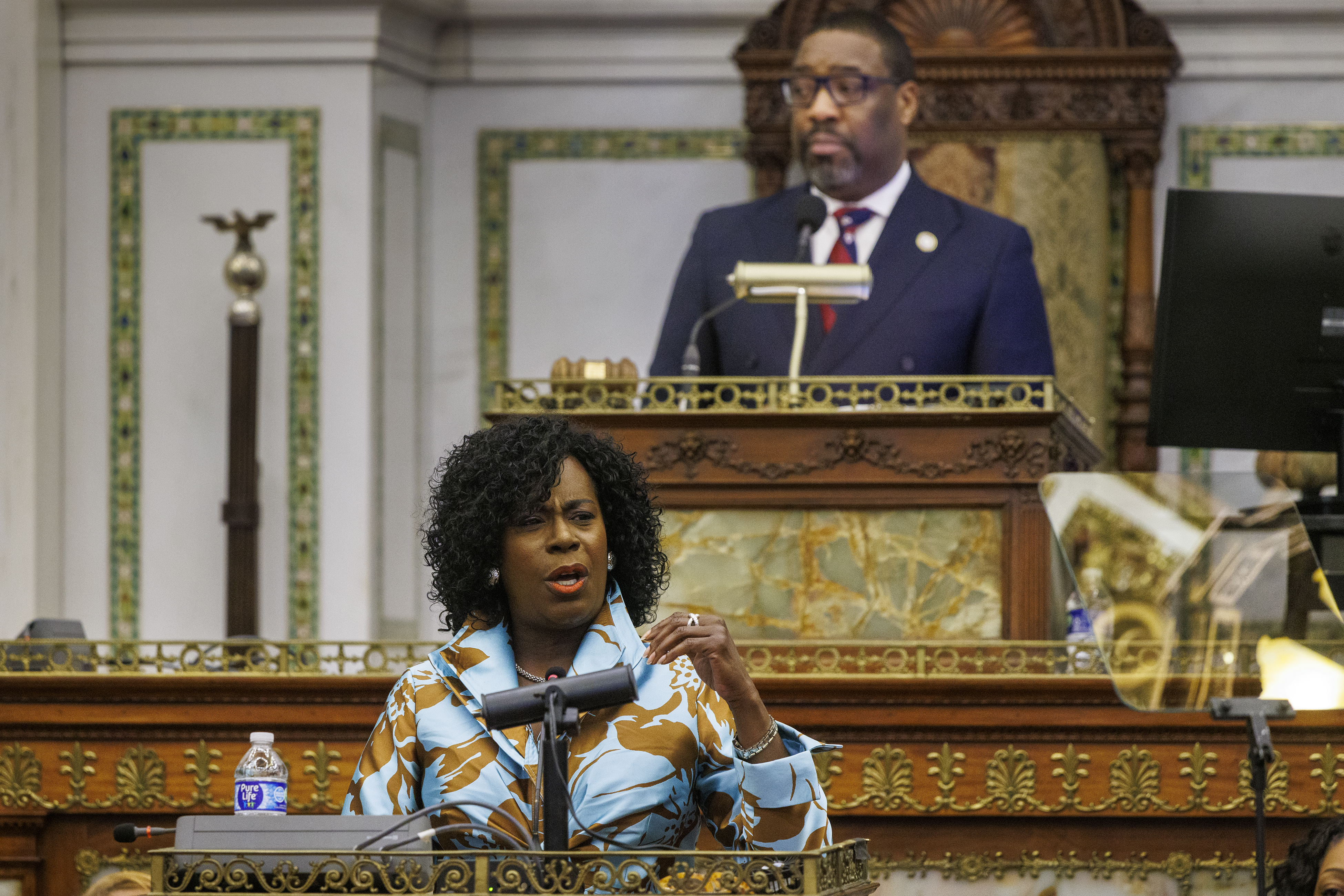
    Philadelphia Mayor Cherelle L. Parker start to make her budget presentation to City Council in Council Chambers on March 12. In the background is Council President Kenyatta Johnson.Alejandro A. Alvarez / Staff Photographer

    Inaction in Washington has left an opening for states and cities to regulate the construction of data centers, which produce the massive amount of computing power needed for artificial intelligence. They have become increasingly unpopular — a July poll found that 3 in 4 Pennsylvanians don’t want a data center in their backyard.

    Municipalities in Pennsylvania, including Philadelphia, now have more power than ever to slow or halt the development of data centers. Gov. Josh Shapiro, a Democrat who is considered a potential presidential contender and who had previously courted data center projects, last month signed an executive order requiring local approval for any project to receive a state permit.

    Philadelphia is already home to eight data centers that were constructed before the issue was widely controversial. The existing data centers are far smaller than the newer “hyperscale” projects that are meant to power AI and have faced opposition in communities across the country.

    In July, the city’s planning commission said there are only two locations in the city that could support an industrial-size data center: the former South Philly refinery site known as the Bellwether District and 2600 Grant Ave., a city-owned plot adjacent to the Northeast Philadelphia airport.

    Planning commission officials emphasized that they were not asked to consider a specific proposal to build a data center at either of those sites.

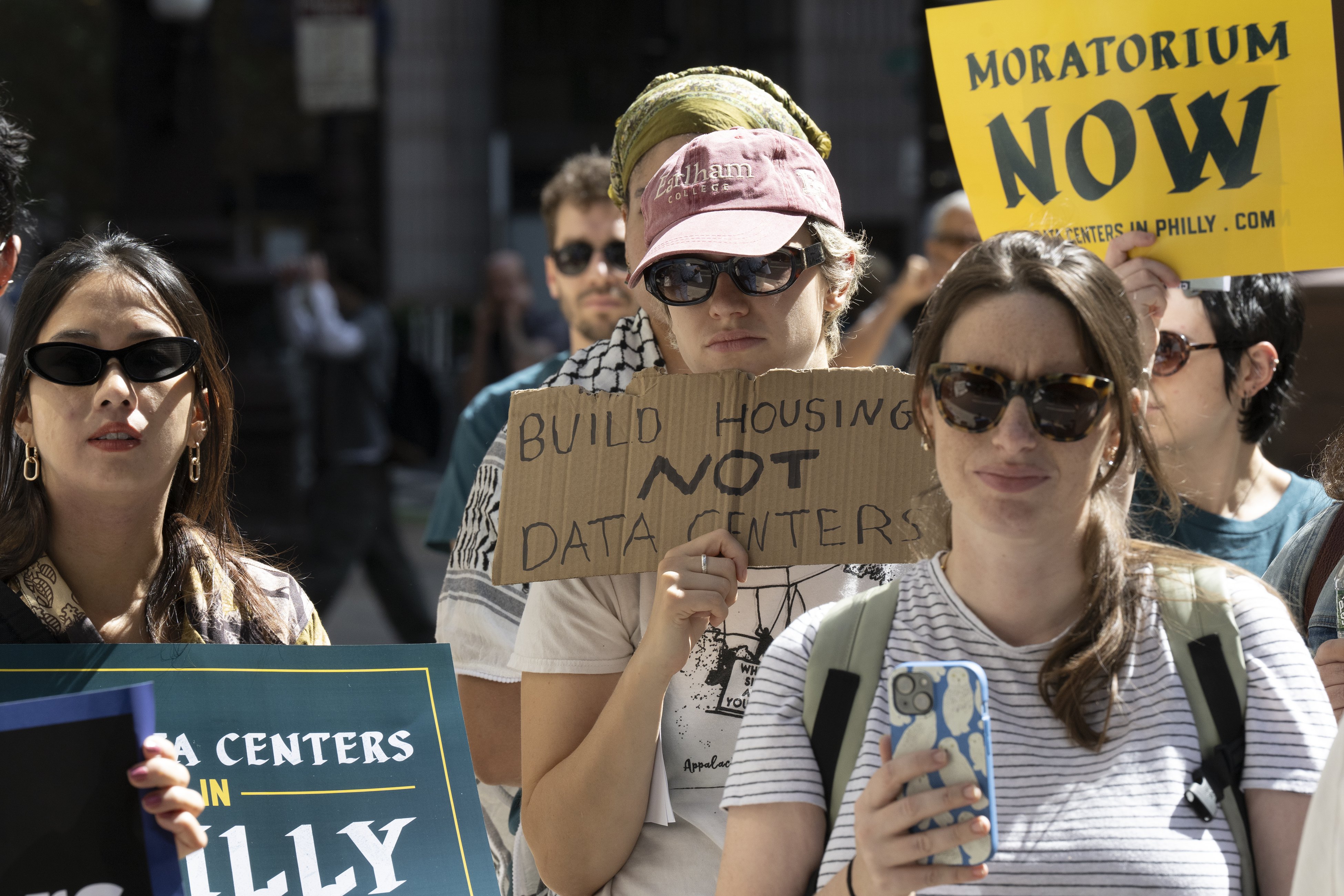
    People hold signs opposing data centers during a rally at Philadelphia City Hall on Monday, calling on City Council to pass a citywide data center moratorium and kicking off the No Data Centers in Philly campaign.Jose F. Moreno / Staff Photographer

    City Council has thus far not taken action on data centers, aside from passing a resolution authored by Councilmember Rue Landau earlier this year to hold hearings on the issue. A hearing has not yet been scheduled.

    Council, which is led by a supermajority of Democrats, will convene Thursday for the first meeting of the fall session. Members are unlikely to green-light a controversial data center project ahead of the primary election in May, when every Council seat will be on the ballot.

    But activists said Monday that city lawmakers must take proactive steps to ban data centers temporarily while they draft a regulatory framework and a system for considering public input on proposed projects.

    Shawmar Pitts, the managing co-director of Philly Thrive — which is rooted in the communities that surround the former South Philly oil refinery — said Council members are “on notice.”

    “Don’t put a moratorium in place, and your seat will be taken,” he warned.

    Senia Lopez, a Northeast Philly resident and an organizer with the advocacy group 215 People’s Alliance, said people in neighborhoods surrounding any future hyperscale data center would be saddled with higher utility costs and “increased threats to our health.”

    “City Council must chose whose interests it represents,” Lopez said. “It can side with Big Tech companies seeking to extract from our communities, or it can stand with the working people who have built and sustained them.”

  • Democrats and activist groups plan to push back if Trump tries to interfere in midterm elections

    Democrats and activist groups plan to push back if Trump tries to interfere in midterm elections

    Democratic state parties announced Monday that they are launching an operation for the midterm elections they’re calling the “New Battlefield Project,” intended to recruit 10,000 volunteers to guard polling places in case armed federal officers show up.

    Activists are planning mass protests if the Trump administration tries to interfere with voting or ballot counting. And legal scholars are distributing white papers advising judges what they should do if the government tries to seize ballots.

    The unprecedented efforts are in response to President Donald Trump’s equally unprecedented moves to interfere in this year’s midterm elections, which include attempts to impose proof-of-citizenship requirements to register to vote and directing the Postal Service to play a central role in deciding which voters should get a mail ballot.

    The anxious contingency planning as voting gets underway has become a marker for how fraught democracy has become in the country that once stood as an example to the world.

    “We have never prepared for an election sabotage event like we have now,” said Ezra Levin of the left-leaning group Indivisible.

    Trump has given Democrats plenty of reasons to organize

    Democrats say they have reason to plan for doomsday scenarios. During his first term, Trump refused to accept his 2020 loss to Democrat Joe Biden and attempted to overturn the vote, only to be defied by career officials and more establishment Republicans. Upon returning to power, Trump has stocked his administration with those who helped his 2020 efforts, has used the federal government to target his political enemies, and pardoned more than 1,000 people prosecuted for the Jan. 6, 2021, attack on the U.S. Capitol that was intended to halt the certification of Biden’s win.

    Incumbent presidents’ parties usually lose ground in the midterms, but Trump has pulled out the stops to try to keep that from happening this time. He’s demanded Republicans redraw maps to create more safe seats for themselves in the House of Representatives, held last week’s unusual midterm convention, and tried to change election rules even as states begin to send out ballots.

    The advice for judges asked to approve search warrants for ballots, for example, was inspired by the Trump administration’s seizure of 2020 ballots and other election records in Fulton County, Ga., which includes Atlanta, based on old, disproven conspiracy theories.

    Rick Hasen, a UCLA Law professor and director of the school’s Safeguarding Democracy Project who helped write the guidance on responding to voting machine seizures, noted that Trump has expressed regret that he didn’t take more aggressive action to overturn the 2020 results, such as ordering voting machines to be seized.

    “All these things take what was off the wall and put it on the wall,” Hasen said. He said that while it is important not to unduly scare voters about what might happen, it’s “hard to walk the line between alarmism and complacency.”

    Administration calls actions common sense

    Last year, Democrats worried that Trump might intervene in off-year elections in California, Virginia, and elsewhere, only to have voting go smoothly with no clashes with the federal government.

    “The only ‘fears’ Americans have about our elections are being fueled by extreme liberal Democrats who refuse to support commonsense legislation that ensures Americans, and Americans only, decide our elections and other basic election security measures like Voter ID,” White House spokesperson Lauren Bis said in a statement.

    Still, the stakes are far higher in the midterms, which will determine whether Republicans continue to control both houses of Congress. So far Trump has been unable to change voting procedures before the midterms.

    Courts halted Trump’s first attempt to reshape election rules via executive order last year. The president backed a bill in Congress to make even more sweeping changes but it’s stalled in the Senate because of opposition from Democrats and some Republicans.

    Then Trump tried to limit mail voting by executive order, but the courts again blocked it, saying the changes couldn’t happen before the midterms. That case is before the Supreme Court. Election officials warn that it would be impossible to implement Trump’s requirements in time for this election.

    Litigation about election rules has reached such a pitch that the National Bar Association last week announced an initiative to help voters of both parties understand last-minute election rule changes and to create a hotline for those who encounter trouble casting ballots.

    Concerns that polling places will become targets

    Every election, the two major parties mobilize massive operations of attorneys, staffers, and volunteers to monitor polling places and ballot counting. The Republican National Committee said it’s already recruited a record number of poll watchers.

    “The RNC has spent this entire cycle preparing not just to defy history in November, but to protect it,” spokesperson Ally Triolo said. “We’ve built the largest election integrity operation in Republican Party history because our mission is simple: Secure every legal vote and ensure Americans can trust the outcome of our elections.”

    Democrats also have expanded their operations, and the Association of State Democratic Committees is adding to that effort with its “battlefield” recruitment project. That also will include a network to share information about online threats and manipulation, said Jane Kleeb, the chairperson of the group and of the Nebraska Democratic Party.

    “If they’re saying they’re going to put armed people outside polling places, we should put friendly people outside polling locations to film them,” Kleeb said in an interview. “There’s a whole new battlefield we have now.”

    Kleeb was referring to widespread fears among Democrats that U.S. Immigration and Customs Enforcement officers will be deployed to the polls, something that multiple administration officials for months have denied will happen. There have been scattered instances of ICE officers at polling places over the past year, usually saying they’re in pursuit of or investigating a specific person. Homeland Security Secretary Markwayne Mullin said this month it’s possible that could happen again in November.

    In an indication of the distrust of the administration’s reassurances, civil rights groups and the city of Denver last week filed a lawsuit asking a federal judge to formally bar ICE from polling places. They cited a law dating to the Civil War era prohibiting armed federal agents at election sites.

    “This administration is basically using the rhetoric that undocumented citizens are voting and that they’re going to have DHS and ICE at the polls to try and intimidate and suppress the Latino vote,” said Juan Proaño, CEO of the League of United Latin American Citizens, one of the plaintiffs.

    Activists see Minneapolis protests as a midterms model

    A staple of the election buildup is a series of tabletop exercises in which each side runs hypothetical scenarios to practice its response. As part of that, Democrats and civil rights groups are rehearsing for the possible deployment of ICE agents or the National Guard to polling sites, although the Pentagon has said it has no plans to deploy troops to the polls.

    Levin, of Indivisible, said his group has run 17 different scenarios preparing for what could happen in November. But the first priority, he said, is to boost turnout.

    The No Kings network, which has spearheaded large anti-Trump protests over the president’s second term and includes Indivisible, is launching a campaign encouraging early voting that will peak with rallies Oct. 17.

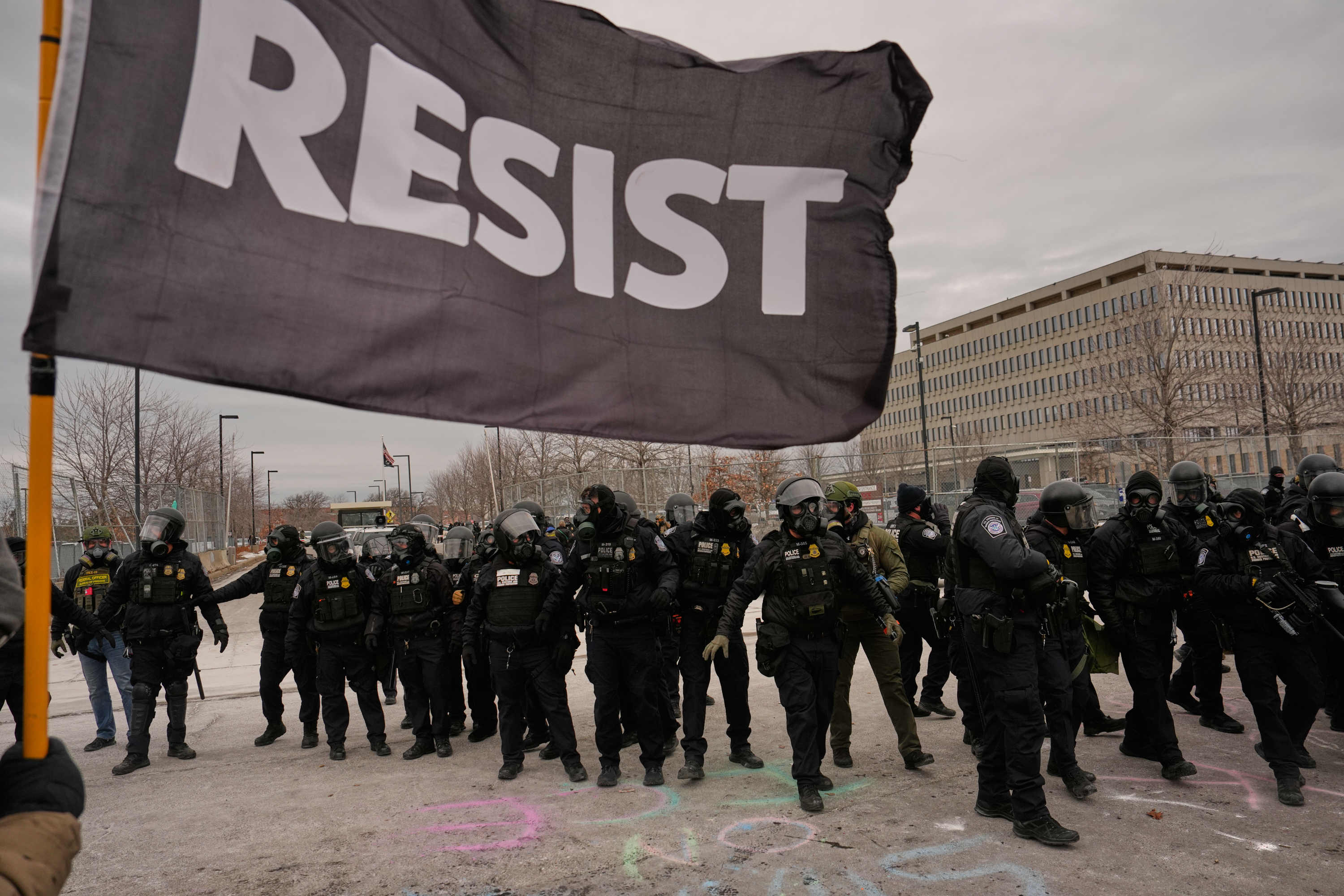
    Others are organizing among both left-wing and more traditional groups to push back if the administration is aggressive in November. Some look to the anti-ICE protests in Minneapolis as a possible model.

    Two activists were shot and killed by ICE agents during those January demonstrations, and the administration eventually backed off the aggressive crackdown the president had launched against the city.

    “We recognize there might be a similar moment in November, where Trump attempts to do that again, where everyday working people and students need to band together and say, ‘Actually, no, this is our country, you don’t get to decide who gets elected or who gets to take office,’” said Kidus Girma of the left-wing Sunrise Movement.
  • Another 250th anniversary? This one, honoring the Constitution, comes in 11 years and Brendan Boyle wants to get ready.

    Another 250th anniversary? This one, honoring the Constitution, comes in 11 years and Brendan Boyle wants to get ready.

    Philly just finished celebrating America’s 250th anniversary with crackling fireworks, an early morning concert and a string of patriotic events throughout the summer.

    But now that the confetti has been swept away and the World Cup traffic has finally subsided, you may be thinking it’s a good time to get your head out of the 18th century.

    If only it were that easy.

    In a mere 11 years, Philadelphia will be the center of yet another semiquincentennial celebration: the 250th anniversary of the U.S. Constitution.

    And because you live in the city where they invented America, you’re in store for another round of historic commemorations.

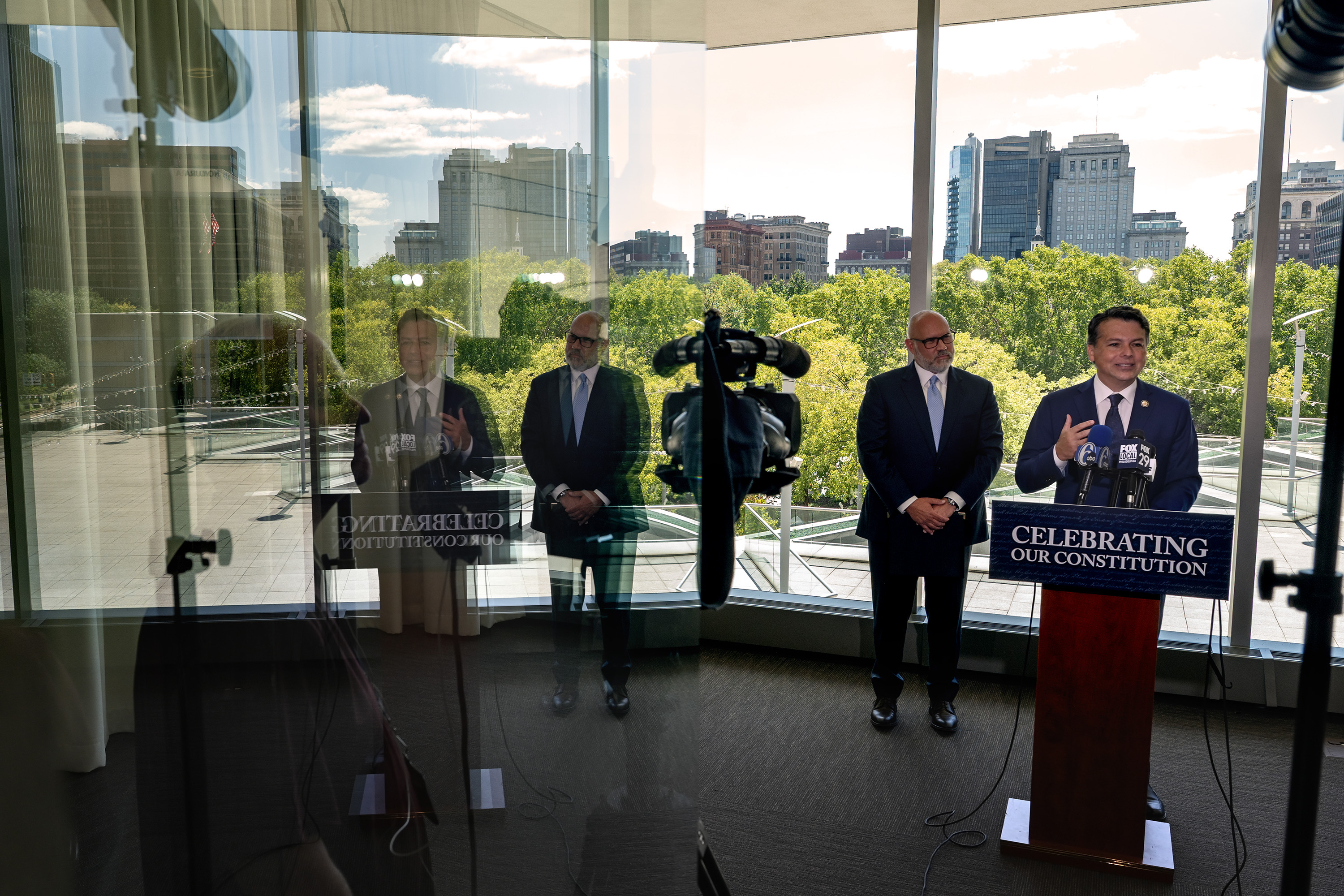
    To drive home the point, Democratic U.S. Rep. Brendan Boyle of Philadelphia announced Monday at the National Constitution Center that he’ll be introducing legislation to create a federal commission to plan the celebration of the original 4,543-word document (7,591 words if you count all 27 amendments) in the year 2037.

    Vince Stango (left) interim president and CEO of the NCC and and U.S. Congressman Brendan F. Boyle.Tom Gralish / Staff Photographer

    The Constitution was drafted during the Constitutional Convention in Philadelphia in 1787, and signed at Independence Hall on Sept. 17, 1787. It was ratified on June 21, 1788.

    “It’s a special moment,” Boyle said. “We can’t waste any time to be fully prepared to meet that moment.”

    As though sensing that people here might have a historical hangover, Boyle added gleefully, “I never met a Philadelphian who’s partied out!”

    Vince Stango, interim president and CEO of the National Constitution Center, said it’s never too early to start planning the party.

    “This gives us the opportunity to carry forward the momentum of 2026,” he said. What comes between now and 2037, Stango said, is a “civic decade” of speaking about and getting more knowledgeable of the document that set up America’s national government, and that protects citizens’ rights.

    “Here in Philadelphia,” he said, reminding us of our local duties, “we have a special responsibility” to honor the Constitution, a made-in-Philly product that the world has long envied and admired.

    Boyle added that “so many of the freedoms protected by the Constitution are very much a live issue today.” He added that the start of planning for 2037 “very much coincides with the national conversation we are having over a whole host of constitutional rights.”

    Though Boyle wasn’t specific, the nation has been arguing over many of the 281 executive orders President Donald Trump has issued since returning to office last year, demonstrating a reliance on Article II of the Constitution.

    As an example, in June, the U.S. Supreme Court struck down Trump’s executive order to end birthright citizenship, guaranteed under the 14th Amendment to the Constitution.

    Boyle reminded listeners that he’s been very much involved with 250th-style celebrations.

    Two days before the July Fourth celebration this year, more than 30 members of the 119th Congress attended an event at Independence Hall marking the passage of the declaration. Boyle, whose district includes the site, had long endeavored to gather his colleagues for the occasion.

    “Anniversaries are not just about honoring the dead, but educating the living.” Boyle said.

    And keep in mind Stango’s parting words Monday: We will all be celebrating the 250th anniversary of the Bill of Rights here in Philadelphia in 2041.

    Don’t forget to reserve your spot to see the fireworks then.

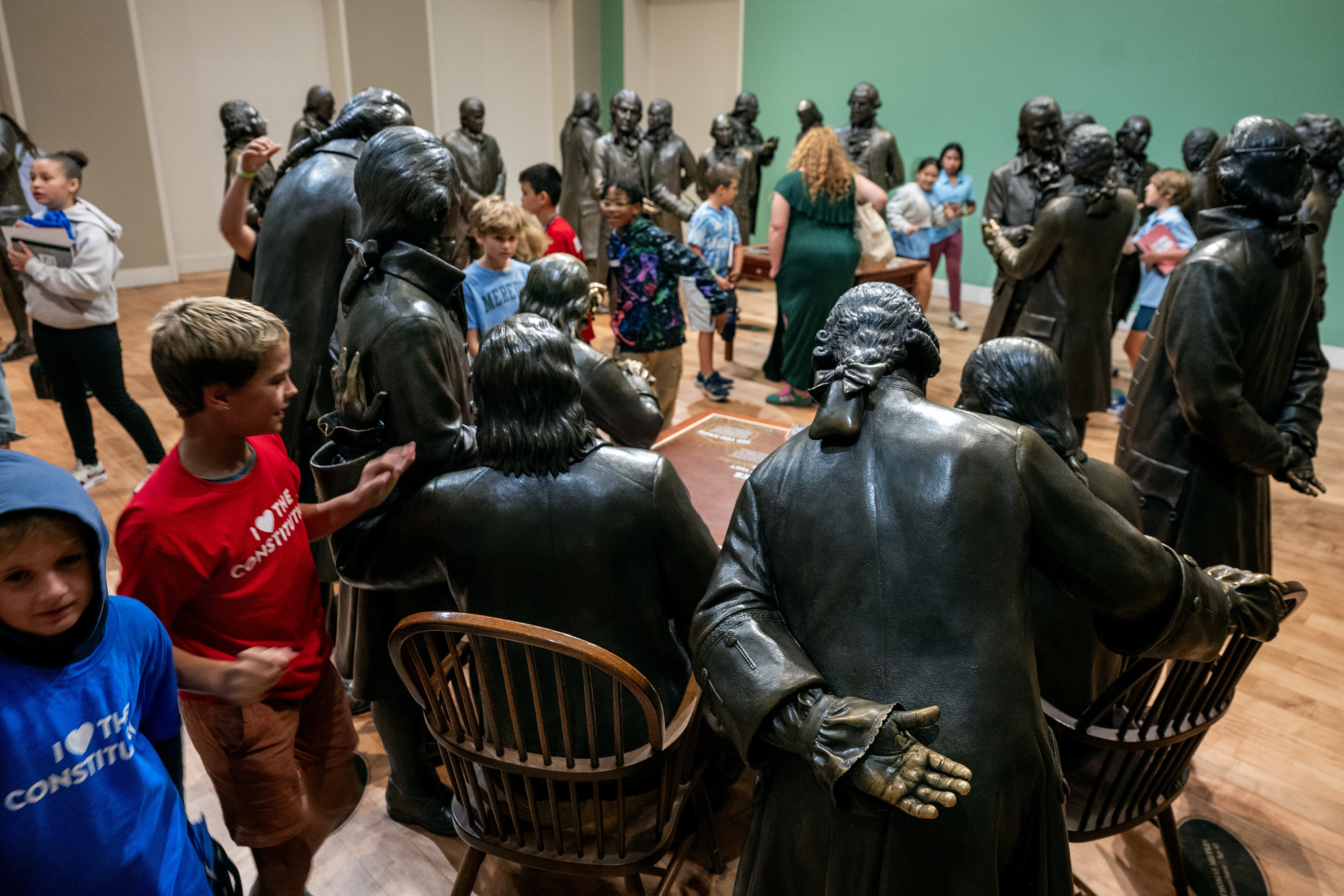
    Students from the William M. Meredith School in Queen Village mingle with 42 life-size, bronze statues of the framers of the U.S. Constitution at the National Constitution Center during a Sept. 17, 2025 visit, on the 238th anniversary of the document’s signing.Tom Gralish / Staff Photographer
  • Trump says he likes Flock license-plate cameras amid growing backlash

    Trump says he likes Flock license-plate cameras amid growing backlash

    President Donald Trump expressed his support for a fast-growing surveillance tool opposed by many Americans, saying he likes Flock cameras “because of law enforcement.”

    “I sort of like them because of that, because of law enforcement, but some people don’t,” Trump told reporters aboard Air Force One on Sunday in his first public comments endorsing the technology. “They think it’s an infringement. I like them.”

    Trump has previously sidestepped questions about his stance on the artificial intelligence-powered license-plate readers that have provoked broad privacy and surveillance concerns. Asked about them in the Oval Office last month, he said: “It’s being studied right now. We’ll have an answer … as to our views on it over the next couple of weeks.”

    Trump’s new comments on Flock came shortly after he rejected calls from top AI leaders to limit the pace of development of artificial intelligence models. “We’re leading China in AI, we’re the most sophisticated country in the world, and frankly I want to keep it that way,” he said on the sidelines of the Irish Open golf tournament. “Whoever wins AI, wins.”

    Atlanta-based Flock has a network of more than 120,000 cameras across the U.S. The cameras record 20 billion license plate scans every month, the company says, which have helped officers investigate 1 million crimes a year.

    The surveillance systems had broad support as recently as last year, but an August survey by YouGov of approximately 20,000 U.S. adults found that 46% said they oppose the technology being used in their communities, compared with 38% support.

    The same month, an investigation by the Washington Post found dozens of law enforcement officers have been charged with or accused of misusing the plate-reading technology. Soon after, Flock announced changes to its platform to prevent the camera network from being abused by police officers, including a requirement for every search to be labeled with a criminal case number.

    But the technology has increasingly become a topic of political debate ahead of the midterm elections, with candidates from both parties outlining their opposition to them.

    “Do you ever feel like you are in a cage, kind of stuck, being watched?” U.S. Senate candidate Abdul El-Sayed asked in a video posted last month. “Well, that is because you are,” the Michigan Democrat continued, before criticizing what he called the “mass proliferation of” Flock cameras across the country.

    Rep. Keith Self, a Republican running for reelection in Texas, mentioned the cameras in a social media post, saying: “Big Brother has NO place in the Lone Star State.”

    Florida Gov. Ron DeSantis (R) last month said the cameras are “out of control.”

    “I don’t want to have this become a surveillance state,” he added.