Category: Politics

  • Early voting begins in US midterm elections that could flip control of Congress

    Early voting begins in US midterm elections that could flip control of Congress

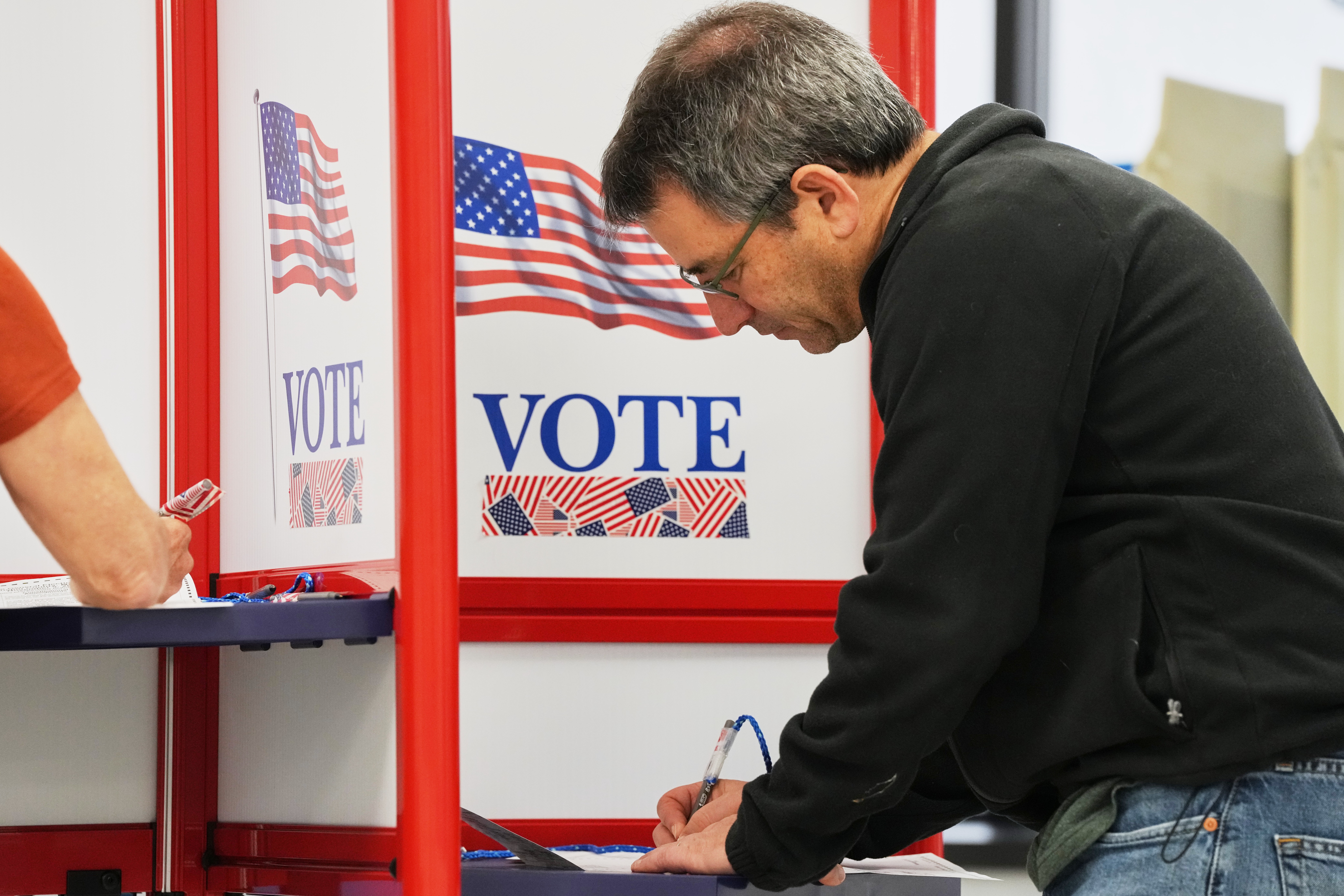
    HENRICO, Va. — In-person voting for this year’s midterm elections began Friday, ushering in the final six weeks for Americans to decide which party they trust to lead Congress through a cost-of-living crisis, a prolonged war in Iran, and other pressing issues.

    Election administrators say they are prepared and confident the vote will be accurate and secure. Nevertheless, President Donald Trump has continued efforts to denigrate certain voting methods and reshape how elections are run, through court challenges, a federal hunt for noncitizen voters, and a pressure campaign to force election officials to share sensitive voter data.

    Friday was the start of early voting in Virginia. Voters in a few other states, including Minnesota and South Dakota, can cast absentee ballots in person, typically at a local election office or voting center. More expansive early voting is scheduled to begin in those and other states in the coming weeks.

    At a voting location in Fairfax, Va,. 18-year-old college student Sanya Singhal was among the first to vote early in person Friday morning, arriving well before the site opened to get in line.

    “Why not just have a little fun in life, you know, try to be the first early voter?” she asked. “I really want to participate in my democracy.”

    At a voting location in suburban Richmond, a poll worker rang a bell as the building opened and about a dozen voters in line began to file in. Stephen Gura was excited to be the first.

    “This election is critical. We need to stop the Trump agenda,” said Gura, who added that he voted for U.S. Sen. Mark Warner, a Democrat, and Shannon Taylor, the Democratic nominee against Republican incumbent Rob Wittman in the 1st Congressional District.

    The Nov. 3 election includes votes for governor and state legislature in most states and will determine whether Republicans maintain control of the U.S. House and Senate. If Democrats retake Congress, it will alter the trajectory of the final two years of Trump’s term, most likely leading to investigations and other oversight efforts.

    Votes underway after redistricting, Trump’s bid to control elections

    At the suburban Richmond voting center, a steady stream of voters flowed in and out. William Curry, a 74-year-old retiree who described himself as a libertarian-leaning independent conservative, voted for Warner’s Republican challenger, Bert Mizusawa, and Wittman. Curry said he generally approves of the job Trump has done, apart from the war with Iran.

    “He’s in a mess he can’t get rid of,” Curry said of the conflict.

    On a rainy day in Sioux Falls, S.D., Bill Goehring, 67, said he voted early at the county office because he will be traveling later. He voted for a mix of Democrats and independents, and said Trump’s “dictatorial tendencies are bad for America.”

    John Thomas, a conservative retired police officer at the Sioux Falls office, said his biggest concerns were public safety and election integrity. He said he doesn’t want to see votes in federal elections from immigrants living in the country illegally. Such fraudulent voting has been found to be extremely rare.

    Trump’s immigration agenda is “spot on,” the 77-year-old said.

    “We wouldn’t be a country that much longer if it had stayed the same for another four years,” he said.

    The start of early voting comes at a time of deep angst and division among many Americans about issues including rising gas and grocery prices, the war in Iran, the looming risks of artificial intelligence, and Trump’s aggressive immigration enforcement campaign.

    It also follows an unprecedented spate of mid-decade redistricting for the House that began when Trump urged the Republican-controlled legislature in Texas to redraw its congressional map to help the party. California and other states followed.

    The changes affect millions of people: Research shows 1 in 10 Americans this fall is a resident of a different congressional district than in 2024.

    Those partisan efforts are expected to continue before the 2028 elections after a landmark ruling this year from the U.S. Supreme Court weakened the federal Voting Rights Act’s protections against racially discriminatory redistricting.

    As the start of early voting approached, Trump was focused on efforts to assert federal control over election administration, even as the Constitution bestows the power to run elections on the states and, in some cases, Congress. The nation’s highest court this week rejected Trump’s bid to restrict mail ballots, but several of his administration’s other efforts to influence the voting process and investigate state voter lists continue.

    Virginia’s Democratic attorney general warned Thursday that Trump’s administration may have violated the state’s laws after a whistleblower accused federal employees of misrepresenting themselves on voter lookup tools to hunt for noncitizen voters.

    Trump for years has raised the specter of widespread noncitizen voting in U.S. elections, and this year is no exception. But research continues to show noncitizen voting is exceptionally rare.

    David Becker, executive director and founder of the Center for Election Innovation and Research, said he wouldn’t be surprised if the Republican president continues “his disinformation campaign and his attack on election officials.” But he said he thinks “the process will hold as it has in past years.”

    At least a few Friday voters were motivated to vote early in part because of Trump’s actions.

    In Minneapolis, 47-year-old business processing engineer Dragan Colakovic said he didn’t want to wait until Election Day for fear of being stopped by immigration agents. He said Trump’s surge of agents to Minnesota in an immigration crackdown earlier this year terrified him. He is a naturalized U.S. citizen who moved from Bosnia in 1997 and saw the horrors of war in the former Yugoslavia.

    “This echoed what I saw in Bosnia,” he said of the heavily armed immigration agents who repeatedly swept through his neighborhood, which has many immigrants.

    “These were my neighbors, my friends,” being arrested, he said.

    Democratic voter Laura Bland, 63, in Virginia’s Henrico County said she cast a ballot early to send “a signal that we’re still here” despite Trump’s efforts to curtail mail voting.

    “Regardless of whether you vote for a Democrat, Republican, people are not going to be stopped or intimidated from participating in our elections,” Bland said, nearly moved to tears.

    Advocates suggest voters cast their ballots early

    Voting rights advocates have encouraged voters this year to cast mail ballots early, in part because of concerns about recent changes in U.S. Postal Service operations that could delay the application of postmarks to ballots.

    Voting early “gives voters options, eases lines on Election Day, and can even mean faster results,” said Hannah Fried, co-founder and CEO of the voting rights group All Voting Is Local.

    The top official at the U.S. Postal Service also encouraged voters who cast ballots by mail to get them in a week before they’re due.

    “Everything is solved if people vote early,” Postmaster General David Steiner said in an interview.

    In a news briefing Thursday, Minnesota Secretary of State Steve Simon urged people not to be swayed by stories they might have seen or read that cast doubt on election operations. They would be able to vote “just like they always have,” he said.

    “I just want to reaffirm that Minnesota’s elections are fundamentally free, fair, accurate, honest, and secure,” he said.
  • Blanche’s partisan activity before midterms dismantles another principle

    Blanche’s partisan activity before midterms dismantles another principle

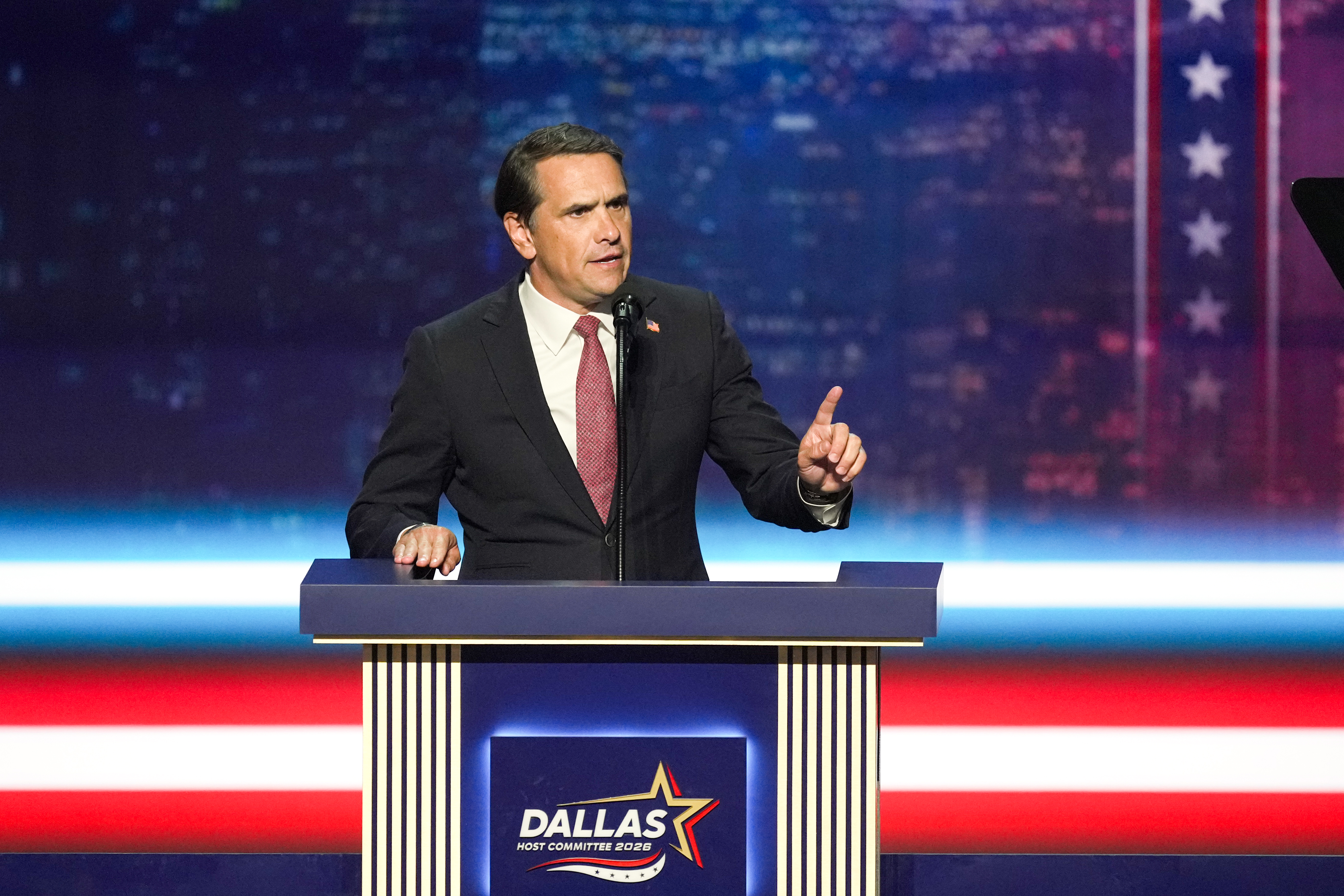
    WASHINGTON — Attorney General Todd Blanche has repeatedly participated in campaign events and spoken in partisan terms about the coming midterm elections since his confirmation last month, despite criticism that he violated a long-standing Justice Department principle of steering clear of electoral politics.

    This week, he waded again into those waters — twice.

    Since August, Blanche has come under fire for making campaign-tinged public appearances and comments. Last month, at a rally-style event on Long Island, N.Y., he praised Bruce Blakeman, the Republican candidate for governor of New York. Last week, Blanche delivered remarks at the Republican Party’s midterm convention.

    On Tuesday, he stood at the White House podium and disparaged Democratic lawmakers while invoking the coming election, dismissing their concerns about artificial intelligence as “nothing but an effort to influence the midterms.”

    And Wednesday, Blanche spoke at a campaign rally for Michael Whatley, the Republican Senate candidate in North Carolina. Echoing his convention speech, he portrayed crime rates, which continued a long-term downward trend to reach new lows in 2025, as “President Trump and Vice President Vance delivering on a promise.”

    Worries about the Justice Department abandoning its long-held commitment to appear apolitical in order to maintain institutional credibility may seem beside the point. Since January 2025, dozens of judges have viewed its representations with suspicion, eroding the traditional bonds of trust, known as the “presumption of regularity,” that the courts typically grant the department.

    The second Trump administration has also unabashedly destroyed the post-Watergate norm of Justice Department independence from the White House in investigative decisions. Early on, Blanche’s predecessor, Pam Bondi, declared, “We are so proud to work at the directive of Donald Trump.” Last September, after Trump publicly demanded that she charge several perceived adversaries, the department pushed through short-lived indictments of two of them.

    Still, Blanche is dismantling another post-Watergate principle: that Justice Department leaders stay away from partisan politicking.

    Joseph Tirrell, the Justice Department’s senior ethics official until the Trump administration dismissed him in July 2025, this week criticized Blanche’s participation in the Republican convention. He called the attorney general’s comments at the White House briefing “borderline” unethical, and his participation in the North Carolina rally “terrible.”

    “In my former role, I would have advised the attorney general not to go to the White House and not to make comments about members of Congress within 45 days of an election,” Tirrell said. Referring to a law restricting partisan political activity by government employees, he added, “I’d say, ‘That rally sounds like a Hatch Act violation to me, and I’d advise you not to do it.’ I would want to scare that person straight.”

    Stephen Gillers, a New York University law professor who specializes in legal ethics, said Blanche’s political statements and activities were protected by the First Amendment and did not violate professional conduct rule, even if they were ill-advised.

    “Any attempt to discipline him will fail,” Gillers said. “That’s unfortunate. He has the ability to do what he’s doing, and he’s chosen to do it.”

    The Justice Department did not respond to a request for comment.

    When the group Public Citizen filed a Hatch Act complaint about Blanche’s comments praising Blakeman, the Justice Department told Government Executive in a statement that it was “baseless” and “a politically motivated complaint designed to weaponize the Hatch Act against the attorney general for his support of law enforcement.”

    And in response to criticism last week by Democrats on the House Judiciary Committee over Blanche’s convention appearance, the department shot back on social media, “Todd Blanche’s appearance this evening in his personal capacity is legal (and has been approved by ethics).”

    Legal questions center on the Hatch Act, which is ambiguous and difficult to enforce when an administration does not want to strictly adhere to it. The law and related regulations allow some political appointees, while off duty, to attend partisan events, like fundraisers and campaign rallies. Some law enforcement officials are restricted from any partisan activity, but the attorney general is not listed among them, and it is disputed whether that part of the legal limits applies to them.

    Even for those who can engage in political activity in a personal capacity, the traditional test is not just whether such officials say they are doing so, but whether people would reasonably perceive them as acting in their government roles.

    Cynthia Shaw, who ran the Justice Department’s ethics office throughout Trump’s first term, said the notion that high-ranking officials could simply say they are acting in a personal capacity to get around that threshold was a misunderstanding.

    “The bigger the job you get, the less personal capacity you have, because when you speak, people are going to see you in your official capacity and representing the agency that you are head of,” she said.

    Federal law enforcement needs to not just be fair, she added, but to be seen as fair for the long-term good of the department and society.

    For that reason, the Justice Department had long held itself to a higher standard than the Hatch Act and its ambiguities. For decades, its ethics policies went beyond the statute in pushing officials to avoid events like political fundraisers and campaign rallies.

    In 2022, Attorney General Merrick Garland flatly banned political appointees from participating in partisan activities — even in their personal capacities, and even if their family members were the candidates.

    But in March of this year, Bondi rescinded that policy, freeing political appointees to attend such events in their personal capacities subject only to the lower standards of the Hatch Act.

    That weakening of ethics rules is one reason the department’s claim that Blanche’s appearance at the Republican Party convention was “approved by ethics” merits scrutiny. Another is that the administration has changed who makes ethics recommendations.

    After firing Tirrell, the administration left his position vacant for nearly a year before appointing Kristina Spencer, a former aide to Vice President JD Vance who had no prior department experience.

    The office of the deputy attorney general can also overrule the ethics office’s recommendations. For decades, the decision-maker was a career official, but the Trump administration moved that authority to political appointees.

    The principle that the Justice Department should strive to appear apolitical took root after Watergate. President Richard Nixon’s first attorney general, John Mitchell — who later went to prison for his role in the scandal — was so deeply partisan that he resigned to run Nixon’s 1972 reelection campaign.

    The attorney general immediately after established the modern norm of not acting as a political operative while in office: Edward Levi, a University of Chicago legal scholar.

    Maintaining a nonpartisan image has proved difficult, partly because of the department’s power and an increasingly polarized political atmosphere. Under both parties, one attorney general after another has been accused by political opponents of politicizing the Justice Department.

    In 2013, Attorney General Eric H. Holder Jr. called himself President Barack Obama’s “wingman,” clashing with the principle of Justice Department independence. Asked last week about Blanche’s speech at the Republican convention, Holder said, “It’s unprecedented, and it’s disgraceful. Attorneys general don’t talk about political things. He shouldn’t be there.”

    Holder, while serving as attorney general, never spoke at the Democratic convention or at campaign rallies. Nor did Republican attorneys general frequently accused by Democrats of politicizing the department, including Attorney General William Barr during Trump’s first term.

    Gillers said that shifting standards for the conduct of attorneys general would harm the rule of law, especially if Blanche’s successors followed his example.

    “This is new,” he said. “The changing image of what an attorney general should be seen to do, and how officials high in the Justice Department should behave, will not be good. We just don’t know yet how bad it will be.”

    This article originally appeared in the New York Times.

  • Trump refers to Black man from racially offensive 1988 campaign ad while stumping in North Carolina

    Trump refers to Black man from racially offensive 1988 campaign ad while stumping in North Carolina

    As President Donald Trump tries to convince voters that Democrats have let crime run amok, he’s digging into the country’s political past to cite one of the most controversial campaign advertisements — one that relied heavily on racist tropes.

    During a campaign stop Wednesday in Gastonia, N.C., to stump for Republican U.S. Senate candidate Michael Whatley, Trump resurrected a 1988 George H.W. Bush presidential campaign ad featuring Willie Horton, a Black man convicted of rape and assault after his release through a Massachusetts prison furlough program.

    A grainy black-and-white prison photo of Horton was used in the ad targeting then-Massachusetts Gov. Michael Dukakis, who was ahead of Bush in the polls. On Wednesday, Trump evoked the Horton ad in an effort to convince voters Democratic former Gov. Roy Cooper, Whatley’s opponent in the Senate race, is soft on crime.

    “Willie Horton was a bad guy, really bad guy,” Trump said, before comparing Dukakis’ release of Horton to the pretrial release of a Black man who faces a murder charge for last year’s killing of a white Ukrainian refugee in Charlotte, N.C.

    But Cooper was not the governor when the man was released or when he was later charged with killing the refugee.

    “Same thing as this, same as, same exact thing,” the president told the crowd in Gastonia.

    It’s the second time Trump has invoked Willie Horton while campaigning for his party. Last month during a speech in Las Vegas, Trump called the Charlotte killing a “Willie Horton — modern day” tragedy.

    “After the Willie Horton ad dropped, Bush established a lead in the polls and never looked back,” said Andra Gillespie, a political scientist at Emory University outside Atlanta. “They showed the picture, and you ascribed race onto it. It wasn’t sufficiently condemned as racism.”

    A spokesperson for the Republican National Committee, which organized the Gastonia campaign rally, defended Trump’s reference to Horton.

    “Roy Cooper emptied prisons and released thousands of violent monsters onto North Carolina streets,” RNC National Press Secretary Natalie Baldassarre said in a statement to the Associated Press. “The results had deadly consequences, and every Democrat who supports abolishing or defunding the police, paroling criminals, and implementing lax bail policies will have to answer for their dangerous records in November.”

    Trump paints North Carolina as a ‘dangerous state’

    Wednesday’s rally cited the Aug. 22, 2025, killing of white 23-year-old Iryna Zarutska on a commuter train in Charlotte.

    Decarlos Brown Jr., who is Black, faces murder and other charges in Zarutska’s stabbing, which was captured on video. Court records showed that at the time of the attack, Brown had 14 prior cases in Mecklenburg County, including serving five years for robbery with a dangerous weapon. Doctors had diagnosed him with schizophrenia.

    Republicans and other influential voices in Trump’s Make America Great Again movement claimed the attack showed how Democratic elected leaders in large cities across the U.S. failed to protect residents, while some conservative commentators suggested Democrats were ignoring an unfounded “black-on-white” crime problem.

    “He should have been locked up for many, many years,” Trump said Wednesday of Brown.

    “Nobody used to think of North Carolina as a dangerous state, criminally dangerous,” Trump added while blaming Cooper. “It was apple pie, right? Now, it’s one of the most violent, one of the worst in the whole nation.”

    According to 2024 FBI crime data, North Carolina ranked 19th for statewide violent-crime rates in a 50-state comparison.

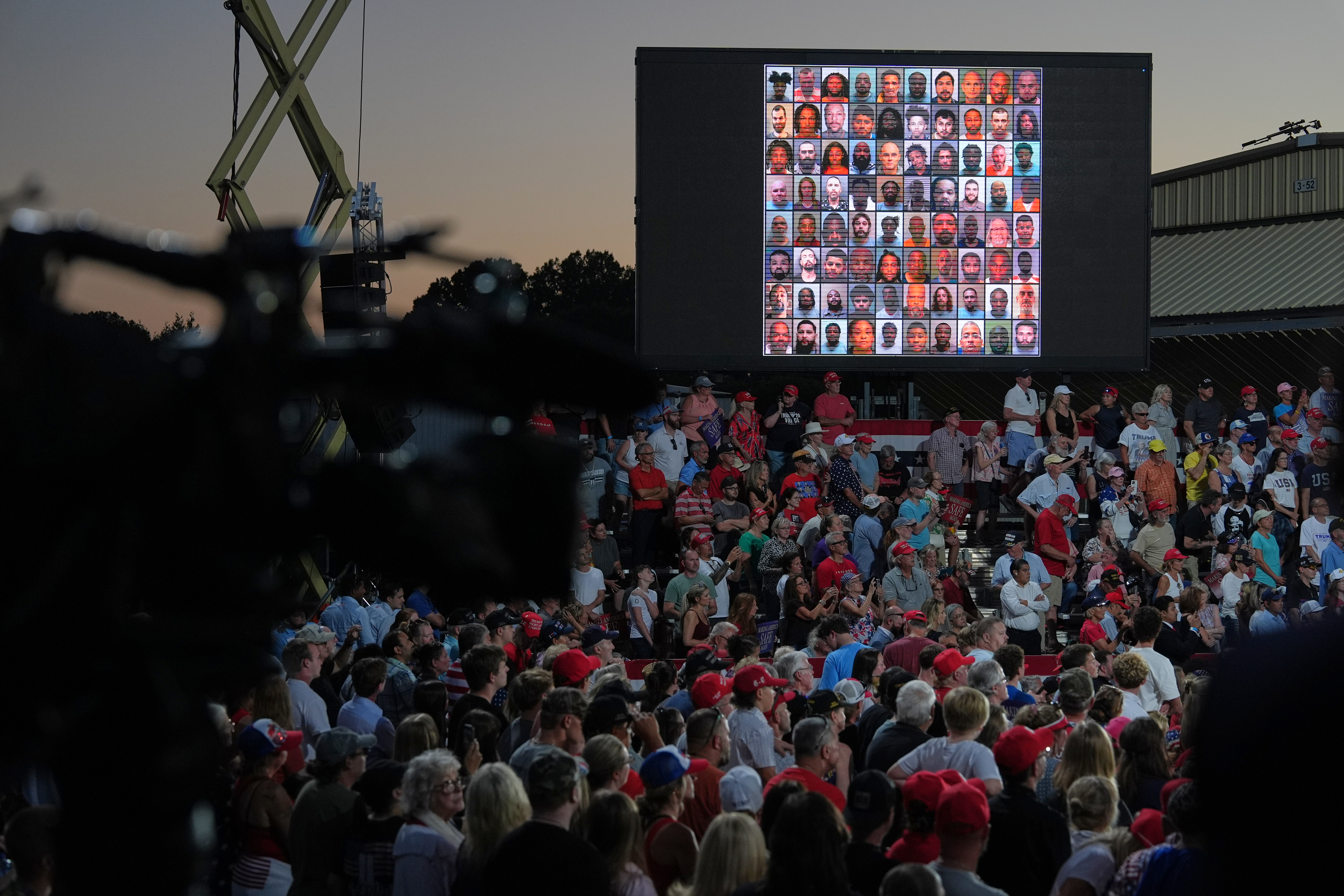
    During the Gastonia rally, a mosaic of mug shots was displayed on a large screen for the crowd. Trump claimed Cooper had cut a deal with “radical activists” to release “some of the worst criminals in the nation into North Carolina.”

    “He released these people. This is just a small group of them,” the president said, pointing to the mug shots that overwhelmingly featured Black people.

    Although it is unclear under what circumstances the people in the mug shots were released, state corrections officials have said Brown was not released early from prison or under Cooper’s COVID-era prisoner-release settlement that Trump referenced.

    Before fatally stabbing Zarutska, according to court records, Brown had been on a pretrial release over a misdemeanor offense that was ordered by a magistrate after Cooper left office.

    ‘Tapping into anger’

    Republicans are under pressure to win over swayable voters as the November midterms approach with Democrats pushing to gain control of the House, the Senate, or both. Some political strategists say part of the ploy of adding Horton to the North Carolina Senate campaign is to rile up Trump’s base.

    “He’s tapping into the anger to remind Republican voters of what he thinks their first principles are in hopes that will be successful for Republican candidates,” Gillespie said.

    “He’s doing this to try and divert attention away from criticism of how he’s governing at the moment,” she added. “Democrats want to make the story of this election Trump’s low approval numbers, the war in Iran, inflation, being preoccupied with things that don’t make a whole lot of sense when there are really serious things going on in the country.”

    Dewey Clayton, professor emeritus of political science at the University of Louisville, said Trump and other Republicans may be thinking that what worked before in the 2016 and 2024 elections presumably will work again in this year’s midterms.

    “It was very effective,” Clayton said. “You do not necessarily have to look at it as racial, in and of itself, although (race) clearly becomes a component. In 2026, talking about ads going back in the 1980s? I’m sure he had consultants that were basically saying this is tried and true.”

    The GOP may need the push in November, Gillespie warns. “I think the motivation by going back to these old strategies is there is real concern about Republican enthusiasm and you might see lower Republican turnout,” she said.

    Rhetoric attempts to divert voters’ attention from rising costs

    The tactic speaks to desperation by Trump and the Whatley campaign, according to Morgan Jackson, a partner with Nexus Strategies in Raleigh.

    “Trump brings up Willie Horton to stoke racial division, something he’s used for the last 10 years,” said Jackson, who is chief strategist for Cooper’s campaign. “It is very clear from the president’s speech last night their only goal is to sow division and hate and lies. Michael Whatley doubles down in support of that effort.”

    Jackson also said Trump and Whatley are trying to change the election’s message of “rising inflation and the cost of everything.”

    “They want to use inflammatory rhetoric, hate speech and lies to sow division in a chance to win an election,” he said. “By referencing Willie Horton, they are showing their hand very clearly.”

    The AP sent an email Thursday seeking comment from Whatley’s Senate campaign.

  • Republican House candidate removed from panel after repeatedly misgendering Rep. Sarah McBride

    Republican House candidate removed from panel after repeatedly misgendering Rep. Sarah McBride

    Republican U.S. House contender Joseph “Dr. Joe” Arminio was removed from a panel Thursday featuring candidates in Delaware races after he repeatedly misgendered Democratic U.S. Rep. Sarah McBride.

    McBride is the first openly transgender member of the U.S. House and was sworn in last year.

    Things unraveled at the Siegel Jewish Community Center in Wilmington, where the Jewish Federation of Delaware’s Jewish Community Relations Committee coordinates a candidates forum every two years. The event featured candidates for U.S. Senate, U.S. House of Representatives, attorney general, state treasurer, and auditor of accounts.

    McBride will face Republican Arminio in November for the state’s only U.S. House seat.

    Arminio, a Wilmington native, political scientist, author, and educator, campaigned largely on inflation. His responses to a 2026 voter questionnaire indicate several anti-LGBTQ+ policy positions. In 2008, he ran unsuccessfully for Congress in Maryland. He did not receive the Delaware GOP’s endorsement, which went to Earl Cooper.

    At the public event, Arminio repeatedly referred to McBride using he/him pronouns and later called her a “gentleman.”

    In the first incident, Arminio’s remarks were met with boos from the crowd. After he spoke, moderator Ken Grant warned him to follow the forum’s rules for proper decorum.

    “If you fail to show respect to anyone else on this stage, you’ll be asked to leave,” Grant said.

    Arminio acknowledged the incident during one of his forum responses.

    “I committed an error before,” he said. “I do acknowledge it. It’s not the first error I’ve made in this campaign, or at any point in my future life.”

    But minutes later, Arminio misgendered McBride again, pointing at her and Democratic Sen. Chris Coons and calling the two of them “gentlemen.” The crowd started booing again, and Arminio’s microphone was cut off.

    McBride said on stage she wanted Arminio to stay and be able to talk about his platform, but organizers held firm.

    Arminio told 6abc he planned to address the incident. He did not immediately respond to The Inquirer’s request for comment.

    The Human Rights Campaign describes the political climate for transgender people and the LGBTQ+ community as an ongoing crisis amid legislative hostility, federal rollbacks, and discrimination. The organization estimates there are more than 2 million transgender people across the country.

    Experts say misgendering a trans person can range in severity from a microaggression or macroaggression to explicit harassment depending on the intent, frequency, and context. Studies show the LGBTQ+ community is more likely to experience harassment, discrimination, and violence than cisgender and heterosexual people.

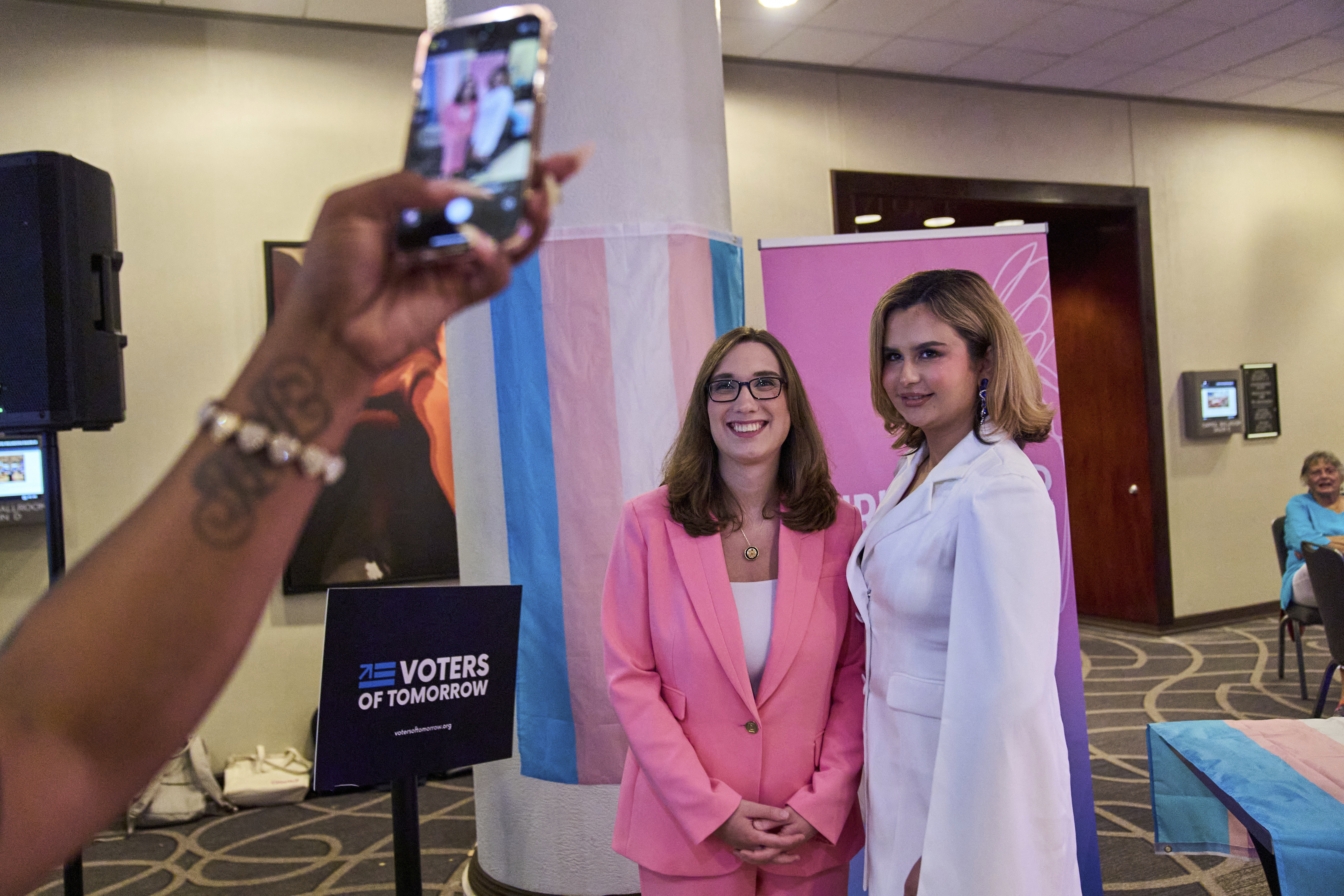
    Bella Bautista, 22, right, a trans woman, has a photo taken with Rep. Sarah McBride, D-Del., the first trans woman to be a member of Congress, during a reception held by the Christopher Project in June 2025.Jacquelyn Martin

    McBride, who was previously a state senator, has been targeted by transphobic attacks across her career.

    After being elected to Congress, Rep. Nancy Mace (R., S.C.) introduced a resolution banning transgender women from using women’s facilities in the U.S. Capitol. Speaker Mike Johnson also implemented a policy restricting restroom access in the Capitol and House offices to a person’s “biological sex,” which experts say is a politicized term to describe someone’s assigned sex at birth.

    The policies were viewed as a way to directly target McBride, the only openly trans person serving in either chamber. McBride has also been repeatedly misgendered.

    Last year, Rep. Keith Self (R., Texas) called McBride “Mr. McBride.” She quipped back, calling him “Madame Chair.” Others stepped in on McBride’s behalf, but the exchange got heated, and the session ended early with Self refusing to honor McBride’s identity.

    Other House Republicans have continued to use male pronouns and honorifics while referring to McBride during interviews, debates, and on social media.

    The representative has worked across the aisle with politicians whose views on the LGBTQ+ community don’t align with hers. She says her job in public office is to represent her state’s priorities and, in turn, normalize trans visibility.

    At the forum, Mike Katz, a former Democratic state senator and now the GOP’s endorsed candidate for U.S. Senate, said Arminio’s actions were uncalled for and apologized to the crowd. Following the event, in a lengthy Facebook post, he called for Arminio to withdraw from the race, calling it a matter of “respect.”

    Grant, the event’s moderator, said ground rules were shared with candidates in advance and were clear: “treat everyone on stage with respect.”

    “When a candidate declined to do so after a clear and public warning, the rules were applied — as they would have been for any candidate, of any party, on any subject,” he said. “I want the focus to remain where it belongs: on the nine candidates who spent the evening answering voters’ questions thoughtfully and civilly, and on the hundreds of Delawareans who came, in person and online, to listen.”

    McBride appears to be taking the incident in stride.

    “I am always so proud to represent Delaware and Delawareans,” she wrote in a statement Friday. “Nothing — and certainly not politicians seeking to go viral — will ever distract me from my laser focus on lowering the cost of gas, groceries, housing, childcare, and healthcare.”

  • Why Democrats are starting to feel bullish about a midterm wave

    Why Democrats are starting to feel bullish about a midterm wave

    Democrats’ wary optimism about the midterms gave way to growing confidence this week.

    The party has seen strong post-Labor Day polls in key battlegrounds — and even in traditionally red areas. Recent escalations in the war in Iran, including an attack on a major pipeline in Saudi Arabia, mean the rising gas prices bedeviling Republicans will not be going down anytime soon. Republicans have not been able to bring prices under control more generally. And President Donald Trump’s unpopularity is at near-record levels.

    Considering all this, Democrats now think conditions are right for the party to retake control of the House and possibly the Senate later this year.

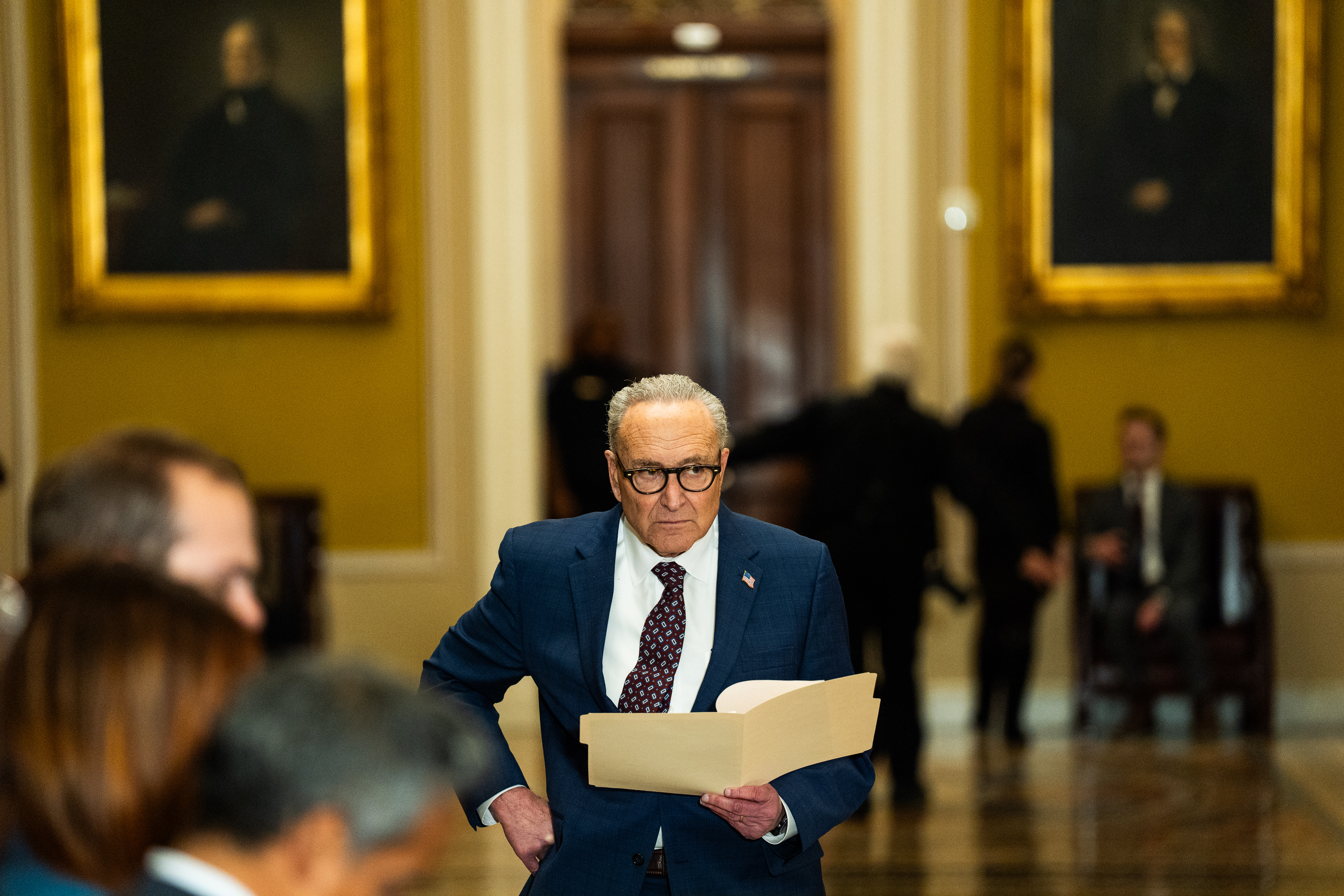
    “If the election were held today, we would win the majority,” Senate Minority Leader Chuck Schumer (New York) said in an interview with The Washington Post.

    Schumer said he felt “considerably more bullish” about Democrats’ chances of retaking the Senate than he did a few months ago. He described the environment as uncannily similar to 2006, when discontent with the war in Iraq helped Democrats recapture the Senate and the House.

    House Minority Whip Katherine Clark (D-Massachusetts) said Democrats’ recent momentum is driven by their focus on the economy, with voters believing that the party understands the financial pain they’ve felt in the years since Republicans swept into unified control.

    “That is what is driving these polls,” Clark told The Post on Thursday.

    Still, Democratic fears remain.

    Democrats need at least four more seats to take the Senate majority and would have to win at least two in states Trump carried by double-digit margins in 2024. Republicans are seeking to blunt any Democratic gains by flipping Democratic-held open seats in Michigan and New Hampshire, where polls show competitive races. The nonpartisan Cook Political Report shifted its rating of the Senate contest in New Hampshire from “Lean Democrat” to “Toss Up” this week.

    Republicans focused on keeping control of the House argue that they have a more favorable map, partly because a GOP redistricting effort has limited the number of battleground districts, and partly because they believe that Democratic primary voters nominated weak candidates in a handful of key races.

    Then there is the incoming flood of GOP money.

    Republicans are set to spend nearly $140 million more on ads than Democrats are in the nine most competitive races in the final weeks of the campaign, according to ad tracking firm AdImpact. The disparity is especially yawning in the Senate contest in Texas, where Republicans have reserved $39.6 million in ads and Democrats have reserved just $5.1 million.

    On the House side, the National Republican Congressional Committee plans to run coordinated ads in 39 districts, with more than $24 million in ads reserved.

    The Democratic Congressional Campaign Committee has plans for coordinated ads in 14 districts.

    “The Republican campaign engines are firing on all cylinders, and we are burying House Democrats in battleground districts across the country,” said Mike Marinella, spokesperson for House Republicans’ campaign arm. “Republicans have the historic fundraising advantage, a more favorable map, stronger candidates, and the firepower to defy history and grow our House majority.”

    Schumer acknowledged Republicans’ financial advantage but said it would not stop Democrats from retaking the Senate.

    “We don’t need as much money as them given the political climate, given the terrain,” he said. “All we need is enough to stay in the ballpark and be able to answer them.”

    Republicans have begun to openly acknowledge electoral concerns in recent weeks, particularly with polls showing that Democrats are far more eager to vote than Republicans are.

    Sen. John Kennedy (R-Louisiana) told reporters Thursday that he was going to Kansas, Nebraska and Iowa to raise money for GOP Senate candidates.

    “If you told me six months ago I was going to be having to spend my time in those three states, I wouldn’t have believed you. Those ought to be fat guy layups for us,” he said, though he predicted Republicans would hold those seats.

    “The far left, they’re angry,” Sen. Ted Cruz (R-Texas) said this week on the “Pod Force One” podcast, describing this as a “challenging environment” for his party. “They hate President Trump with a burning passion. And they’re going to crawl over broken glass to vote.”

    Senate Majority Leader John Thune (R-South Dakota) acknowledged Wednesday that Republicans are facing “headwinds” but said the Senate races that will decide control of the chamber remain competitive.

    “It’s not a great environment for us,” Thune said. “But we’ve got really quality candidates in all the competitive races, and the polling that we’re seeing in those races shows that these races are tight.”

    Republicans have been debating how to increase enthusiasm beyond spending more money. Some, largely those closely tied to the president and his political operation, argue that the path to victory is to re-create the electorate Trump built in 2024. Other Republicans — primarily those in battleground districts where private and public polls show that voters are deeply upset with the president — believe the way to win is to distance themselves from the administration and its policies, a difficult task following a decade of Trump remaking the party in his own image.

    “I’m asking you to pretend that I’m on the ballot,” Trump said during one of two speeches he gave at the Republicans’ midterm convention in Dallas recently. “Just one more time.”

    Trump has made it difficult for many candidates, especially those in tight races, to embrace this tactic. In large part, that’s because he has repeatedly dismissed the issue that voters say is their main stressor: prices. His trade war has raised prices on goods across the country. And gas prices, which have shot up because of the president’s war against Iran, are nearing $4.50 per gallon on average.

    However, speaking at a campaign rally Wednesday in North Carolina, a state he has won in three straight presidential elections, Trump said high fuel prices were “a very inexpensive price to pay for what we have done” in Iran.

    A Republican operative working on House races, speaking on the condition of anonymity to be candid, responded to Trump’s comments with an animated image of actor Bryan Cranston screaming, “F—!”

    The president has promised to get out the vote for Republican candidates, including those in trouble deep in Trump country. Some have taken him up on his offer, but not every candidate wants him around, and administration officials’ visits to red states have been seen as warning signs for Republicans.

    Vice President JD Vance traveled to Kansas this week to stump for Republican Sen. Roger Marshall, who is in a tighter-than-expected race against Democrat Adam Hamilton. Trump and Vance won Kansas by 16 percentage points in 2024.

    Vance is also set to campaign in Iowa on Friday. But the state’s Republican Senate nominee, Rep. Ashley Hinson, will not appear next to the vice president. A Hinson spokesperson cited previously scheduled events, but the absence comes as the candidate seeks to tout her bipartisan record in a state Trump won by 13 percentage points in 2024. Hinson is locked in a tight race against Democratic state Rep. Josh Turek.

    And in South Florida, an area Trump dominated in 2024, Republican Rep. María Elvira Salazar openly broke with the president Thursday.

    “Mr. President, some of your immigration enforcement efforts have gone too far,” Salazar says directly to the camera in a new campaign ad. “The same Hispanics who helped you get to the White House in 2024 feel betrayed today.”

    Democrats say they began to see a change during what was supposed to be Republicans’ hallmark 2026 event: the party’s unorthodox midterm convention. The gathering was billed as a way for the GOP to showcase its front-line candidates, but instead it featured Trump defending his record and pledging to give each American adult a $5,000 check if Republicans hold Congress this year, a proposal many Democrats saw as a sign of desperation.

    “We’re not measuring the drapes, but the ground has shifted,” said Xochitl Hinojosa, a longtime Democratic operative and top spokesperson at the Democratic National Committee after the 2016 election.

    Some Democratic operatives running campaigns said they had been waiting to see whether Republicans would coalesce around a clear affordability message during the Texas event. But when it became obvious that the event would be a Trump-centric celebration that offered no direct case for why Republicans deserved unified control for two more years, their confidence grew.

    “Turns out breaking all your campaign promises and doing everything possible to make life more expensive for everyone is bad politics,” said Viet Shelton, spokesperson for House Democrats’ campaign arm. “Shocker.”

    The last time Democrats experienced a wave election was in 2018, when the party swept into control of the House two years after Trump’s first presidential win.

    Meredith Kelly, a Democratic operative who was the top spokesperson at House Democrats’ campaign arm at the time, said that there are plenty of similarities between that year and this one — primarily around Trump’s unpopularity — but that the biggest difference is how Republicans’ worries are coming from voters who helped them win in 2024, such as rural voters and Black and Latino men.

    “Their coalition’s floor is falling out from underneath them,” said Kelly.

    The prospect of a wave election has Democratic candidates in districts once thought entirely unreachable for the party feeling like they may have a shot to do the unexpected in November.

    Eileen Laubacher, a retired Navy veteran running against GOP Rep. Lauren Boebert in a district that spans eastern Colorado, knows that her odds of winning have always been long. Trump won the district less than two years ago by 18 percentage points. But powered almost entirely by anger at Washington and voters’ fears about their personal finances, Laubacher thinks she has an opportunity to take down her outspoken Republican opponent.

    “People vote frequently about their pocketbooks and their wallets, but I think the situation is growing ever more fraught for people,” said Laubacher. “Every aspect of their life has become more expensive, and they do not feel that the government is doing anything about any of it.”

    Jarrell Dillard contributed to this report.

  • Postal Service chief says work stopped on computer system key to Trump effort to limit mail voting

    Postal Service chief says work stopped on computer system key to Trump effort to limit mail voting

    WASHINGTON — The top official at the U.S. Postal Service said Thursday that the agency has stopped work on developing a controversial computer system that was central to President Donald Trump’s effort to limit mail voting after the Supreme Court rejected his executive order this week.

    “There’s an injunction so we’re not doing anything,” postmaster general David Steiner told The Associated Press in an interview.

    Steiner, a onetime chief executive of Waste Management, has spent most of the past year atop the postal service navigating political and financial challenges. He’s pressing Congress for changes that would help him resolve what he has called a “liquidity crisis.”

    And Trump’s efforts to largely eradicate mail voting turned the postal service into an unlikely arbiter of who is eligible to vote just months before this year’s critical midterm elections, a role Steiner seemingly had little interest in playing. Unlike Trump, who was sharply critical of the Supreme Court decision and ridiculed some of the justices, Steiner offered no assessment of the court’s action.

    Steiner also declined to take a position on Trump’s policy, presenting himself as the leader of an “independent agency of the executive branch” whose influence over the president’s order was limited to operational concerns.

    “I don’t get to decide what rules that are put on us that I decide to accept or not accept,” he said. “I looked at it more from the execution side.”

    The postal service has asserted its independence in the past, including during a 2019 standoff when the first Trump administration sought to pressure the agency as the president was in a dispute with Amazon. Steiner said he wouldn’t get into the “nuance” of that.

    But the pressure has grown so intense at points that it’s fueled talk of whether Steiner might resign, a notion he denied.

    “There’s no truth to that,” he said. “I think I know the motivation behind it. I think it’s somebody that would like to see me out of a job.”

    Inserting the Postal Service into elections

    The executive order Trump signed in March directed several federal agencies to develop state citizenship lists. Those lists would have been delivered to an online portal at the Postal Service, which would have been allowed to send mail ballots only to voters who were cleared through the process. Steiner said he knew about the order about a month before it was unveiled but said his focus was largely on implementation, not the policy’s merits.

    A whistleblower report released earlier this month by Sen. Richard Blumenthal, D-Conn., argued the system was hastily built and riddled with errors.

    Steiner said he read “portions” of the whistleblower report and acknowledged the obstacles associated with building such a massive platform quickly. Still, he said he had confidence in colleagues working on the project and had planned to unveil it around Sept. 15.

    “There’s absolutely no doubt that we worked fast,” he said. “My personal opinion is it was a monumental task and I’m very proud of our IT department for being able to do it that fast.”

    In addition to the voter list, Trump’s order would have required states to adopt a uniform envelope style that included barcodes, something states said would have been arduous so close to the election.

    Following the Supreme Court’s ruling, a memo sent to all postal service employees Wednesday and obtained by the AP said the agency will “not be enforcing any of these new rules in the 2026 federal election.”

    “First and foremost, for Election Mail it is business as usual,” according to the memo. “We continue to follow established protocols, and we remain entirely focused on our core mission: delivering the mail safely and securely for voters and election officials across the country.”

    Though the Supreme Court rejected Trump’s executive order for this year’s election, Justice Brett Kavanaugh indicated he might rule in favor of the administration if the issue comes back before the court at a later time.

    Steiner encourages voters to cast ballots early

    Steiner said the postal service would still encourage the use of envelopes and barcodes in future elections, which it has long recommended. He said such changes wouldn’t be required but those who don’t comply may have to pay more.

    “If you use the barcode in the envelope, we’ll charge you a lower price,” he said. “If you don’t, we’re going to charge you a higher price because it’s harder for us to process.”

    While the postal service isn’t moving forward on Trump’s order, there are still concerns about postmark delays that could have an impact on this year’s elections. The number of ballots rejected for late postmarks has soared in the vote-by-mail states of Washington and Oregon, according to recently released data highlighting concerns about recent changes in postal service operations.

    Steiner said there were no plans to alter those operations and encouraged voters who use mail to get their ballots in early.

    “We say seven days,” he said. “Everything is solved if people vote early.”

  • Blanche’s partisan activity before midterms dismantles another principle

    Blanche’s partisan activity before midterms dismantles another principle

    WASHINGTON — Attorney General Todd Blanche has repeatedly participated in campaign events and spoken in partisan terms about the coming midterm elections since his confirmation last month, despite criticism that he violated a long-standing Justice Department principle of steering clear of electoral politics.

    This week, he waded again into those waters — twice.

    Since August, Blanche has come under fire for making campaign-tinged public appearances and comments. Last month, at a rally-style event on Long Island, he praised Bruce Blakeman, the Republican candidate for governor of New York. Last week, Blanche delivered remarks at the Republican Party’s midterm convention.

    On Tuesday, he stood at the White House podium and disparaged Democratic lawmakers while invoking the coming election, dismissing their concerns about artificial intelligence as “nothing but an effort to influence the midterms.”

    And Wednesday, Blanche spoke at a campaign rally for Michael Whatley, the Republican Senate candidate in North Carolina. Echoing his convention speech, he portrayed crime rates, which continued a long-term downward trend to reach new lows in 2025, as “President Trump and Vice President Vance delivering on a promise.”

    Worries about the Justice Department abandoning its long-held commitment to appear apolitical in order to maintain institutional credibility may seem beside the point. Since January 2025, dozens of judges have viewed its representations with suspicion, eroding the traditional bonds of trust, known as the “presumption of regularity,” that the courts typically grant the department.

    The second Trump administration has also unabashedly destroyed the post-Watergate norm of Justice Department independence from the White House in investigative decisions. Early on, Blanche’s predecessor, Pam Bondi, declared, “We are so proud to work at the directive of Donald Trump.” Last September, after Trump publicly demanded that she charge several perceived adversaries, the department pushed through short-lived indictments of two of them.

    Still, Blanche is dismantling another post-Watergate principle: that Justice Department leaders stay away from partisan politicking.

    Joseph Tirrell, the Justice Department’s senior ethics official until the Trump administration dismissed him in July 2025, this week criticized Blanche’s participation in the Republican convention. He called the attorney general’s comments at the White House briefing “borderline” unethical, and his participation in the North Carolina rally “terrible.”

    “In my former role, I would have advised the attorney general not to go to the White House and not to make comments about members of Congress within 45 days of an election,” Tirrell said. Referring to a law restricting partisan political activity by government employees, he added, “I’d say, ‘That rally sounds like a Hatch Act violation to me, and I’d advise you not to do it.’ I would want to scare that person straight.”

    Stephen Gillers, a New York University law professor who specializes in legal ethics, said Blanche’s political statements and activities were protected by the First Amendment and did not violate professional conduct rule, even if they were ill-advised.

    “Any attempt to discipline him will fail,” Gillers said. “That’s unfortunate. He has the ability to do what he’s doing, and he’s chosen to do it.”

    The Justice Department did not respond to a request for comment.

    When the group Public Citizen filed a Hatch Act complaint about Blanche’s comments praising Blakeman, the Justice Department told Government Executive in a statement that it was “baseless” and “a politically motivated complaint designed to weaponize the Hatch Act against the attorney general for his support of law enforcement.”

    And in response to criticism last week by Democrats on the House Judiciary Committee over Blanche’s convention appearance, the department shot back on social media, “Todd Blanche’s appearance this evening in his personal capacity is legal (and has been approved by ethics).”

    Legal questions center on the Hatch Act, which is ambiguous and difficult to enforce when an administration does not want to strictly adhere to it. The law and related regulations allow some political appointees, while off duty, to attend partisan events, like fundraisers and campaign rallies. Some law enforcement officials are restricted from any partisan activity, but the attorney general is not listed among them, and it is disputed whether that part of the legal limits applies to them.

    Even for those who can engage in political activity in a personal capacity, the traditional test is not just whether such officials say they are doing so, but whether people would reasonably perceive them as acting in their government roles.

    Cynthia Shaw, who ran the Justice Department’s ethics office throughout Trump’s first term, said the notion that high-ranking officials could simply say they are acting in a personal capacity to get around that threshold was a misunderstanding.

    “The bigger the job you get, the less personal capacity you have, because when you speak, people are going to see you in your official capacity and representing the agency that you are head of,” she said.

    Federal law enforcement needs to not just be fair, she added, but to be seen as fair for the long-term good of the department and society.

    For that reason, the Justice Department had long held itself to a higher standard than the Hatch Act and its ambiguities. For decades, its ethics policies went beyond the statute in pushing officials to avoid events like political fundraisers and campaign rallies.

    In 2022, Attorney General Merrick Garland flatly banned political appointees from participating in partisan activities — even in their personal capacities, and even if their family members were the candidates.

    But in March of this year, Bondi rescinded that policy, freeing political appointees to attend such events in their personal capacities subject only to the lower standards of the Hatch Act.

    That weakening of ethics rules is one reason the department’s claim that Blanche’s appearance at the Republican Party convention was “approved by ethics” merits scrutiny. Another is that the administration has changed who makes ethics recommendations.

    After firing Tirrell, the administration left his position vacant for nearly a year before appointing Kristina Spencer, a former aide to Vice President JD Vance who had no prior department experience.

    The office of the deputy attorney general can also overrule the ethics office’s recommendations. For decades, the decision-maker was a career official, but the Trump administration moved that authority to political appointees.

    The principle that the Justice Department should strive to appear apolitical took root after Watergate. President Richard Nixon’s first attorney general, John Mitchell — who later went to prison for his role in the scandal — was so deeply partisan that he resigned to run Nixon’s 1972 reelection campaign.

    The attorney general immediately after established the modern norm of not acting as a political operative while in office: Edward Levi, a University of Chicago legal scholar.

    Maintaining a nonpartisan image has proved difficult, partly because of the department’s power and an increasingly polarized political atmosphere. Under both parties, one attorney general after another has been accused by political opponents of politicizing the Justice Department.

    In 2013, Attorney General Eric H. Holder Jr. called himself President Barack Obama’s “wingman,” clashing with the principle of Justice Department independence. Asked last week about Blanche’s speech at the Republican convention, Holder said, “It’s unprecedented, and it’s disgraceful. Attorneys general don’t talk about political things. He shouldn’t be there.”

    Holder, while serving as attorney general, never spoke at the Democratic convention or at campaign rallies. Nor did Republican attorneys general frequently accused by Democrats of politicizing the department, including Attorney General William Barr during Trump’s first term.

    Gillers said that shifting standards for the conduct of attorneys general would harm the rule of law, especially if Blanche’s successors followed his example.

    “This is new,” he said. “The changing image of what an attorney general should be seen to do, and how officials high in the Justice Department should behave, will not be good. We just don’t know yet how bad it will be.”

    This article originally appeared in The New York Times.

  • Gov. Josh Shapiro spent more than $2.4 million on ads this week. His GOP opponent, Stacy Garrity, spent $672.

    Gov. Josh Shapiro spent more than $2.4 million on ads this week. His GOP opponent, Stacy Garrity, spent $672.

    Gov. Josh Shapiro is dominating Pennsylvania’s media markets in his reelection campaign, spending more than $24 million with less than seven weeks left until the Nov. 3 election — and trouncing his GOP challenger, State Treasurer Stacy Garrity, who has spent a small fraction of that on ads.

    Shapiro, a Democrat seeking reelection and potentially a 2028 White House bid, has spent more than $2.4 million on advertisements per week since Aug. 25 from his campaign war chest of more than $50 million, according to media tracking firm AdImpact. One ad pitches Garrity as “Pennsylvania’s #1 fan of data centers,” and in another, Shapiro boasts about his efforts to cap energy costs. He has also released a number of audience-specific ads to reach Black and Latino voters, including a radio advertisement in Spanish in the Lehigh Valley.

    A clearer picture of Shapiro’s full campaign haul will become public this week, with updated campaign financial filings due Tuesday. The last filing deadline for state candidates was in June. But Shapiro’s multimillion-dollar flurry of ad buys offers early insight into his strategy heading into November in a race where he holds a double-digit polling lead — and where he is hoping to achieve downballot wins in the statehouse and critical congressional districts.

    Garrity has spent just $743,000 on ad buys so far, and paid out only $672 last week, according to AdImpact. No top GOP groups, such as the Republican Governors Association or the Jeffrey Yass-backed Commonwealth Leaders Fund, have purchased TV ads supporting Garrity, and she has struggled to fundraise to compete with Shapiro, a popular incumbent who has raised more money than any governor since at least 2010.

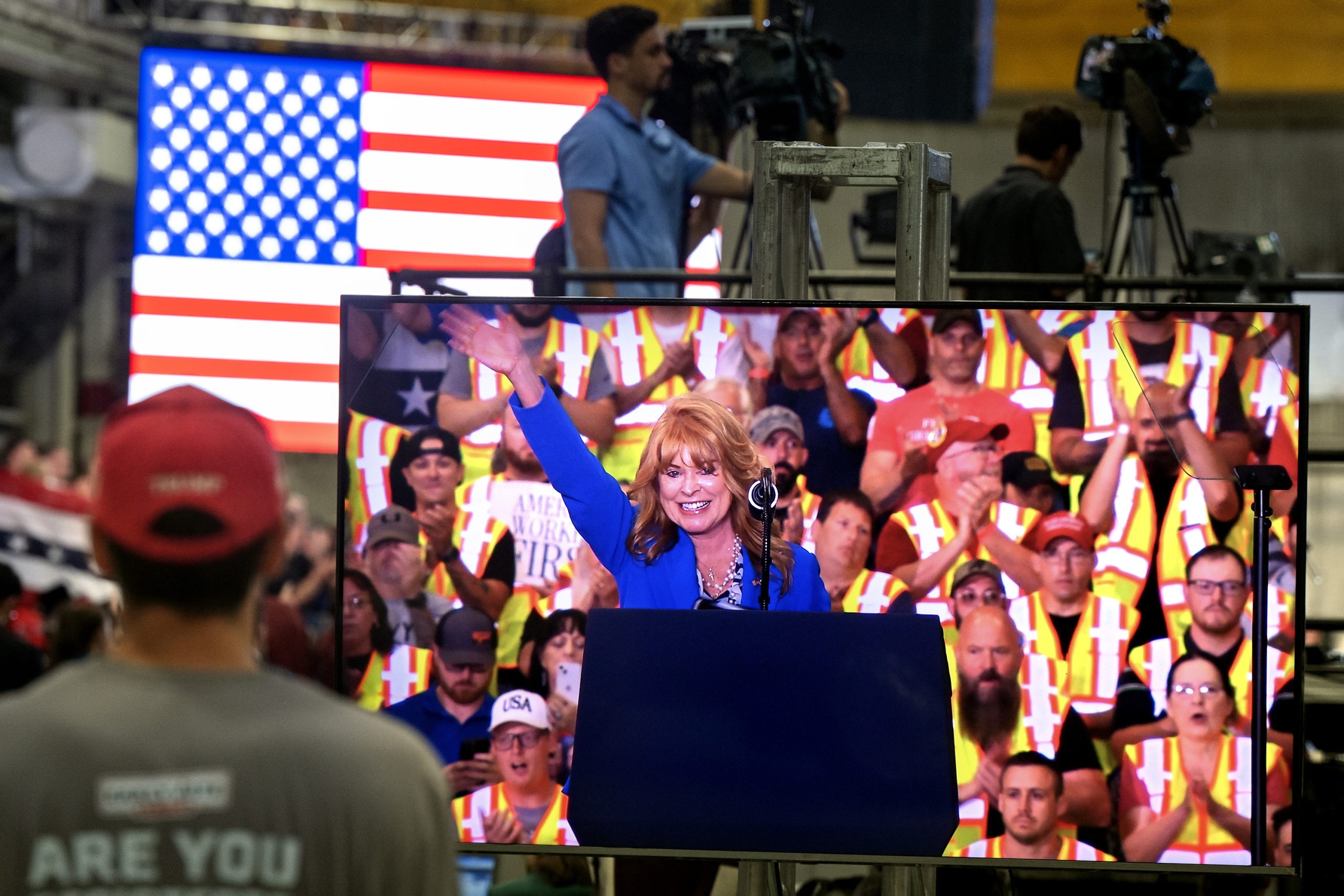
    State Treasurer and Republican candidate for governor Stacy Garrity is seen on a big screen as she speaks to supporters before the arrival of President Donald Trump at Mack Trucks in Macungie Tuesday, June 23, 2026. Tom Gralish / Staff Photographer

    Shapiro’s mass ad buys despite his commanding lead in the polls indicate the governor is a risk-averse politician, said Christopher Borick, a political science professor at Lehigh University.

    “He’s cautious. He wants to make sure nothing goes awry, and to do that, you buy insurance,” Borick said.

    “The governor has also been clear that the midterms run through Pennsylvania — and he is leading the fight to win critical races up and down the ballot in order to flip the House, put a check on Donald Trump’s chaos, cruelty, and corruption, and get even more stuff done,” said Manuel Bonder, a spokesperson for Shapiro’s campaign.

    Garrity, meanwhile, has spent the lion’s share of her ad buys on a digital social media video campaign called “Twilight Justice,” which promises the future release of bombshell details about Shapiro. She has also released an attack ad about Shapiro’s past support for data centers, but it has been seen by far fewer eyes than those Shapiro is reaching in his multimillion-dollar ad campaigns. Both Shapiro and Garrity initially embraced data centers, though both shifted their positions as the projects became increasingly unpopular among Democrats and Republicans.

    Matthew Beynon, a spokesperson for Garrity’s campaign, declined to comment on whether top GOP groups will get involved in the Pennsylvania governor’s race in the coming weeks. But he said any pro-Shapiro mailer or TV ad “is just another reminder to the people of Pennsylvania that Josh Shapiro sold them out.”

    “All the money in the world will not help Josh Shapiro paint over his administration’s failed economic record or erase his ethics scandals that have cost the taxpayers of Pennsylvania and embarrassed the entire commonwealth,” Beynon added.

    Data center power play

    The regulation of data centers and artificial intelligence have become key issues in midterm races nationwide, including in the Pennsylvania governor’s race, where Shapiro’s past support for the projects appeared to be the biggest test of his popularity.

    Shapiro changed his position last month and subsequently began running attack ads against Garrity for her past support of the unpopular centers. Garrity has also changed her position, from initially advocating for the rapid development of data centers around Pennsylvania to now calling for “a pause” on their development. Shapiro, in an executive order signed last month, will now require any prospective data center developers to meet a number of environmental and energy factors in order to build in Pennsylvania.

    “That’s why you’ve seen this enormous ad buy that she can’t even come close to matching, when, in reality, he’s as exposed as her on the issue, but she doesn’t have the resources,” Borick said.

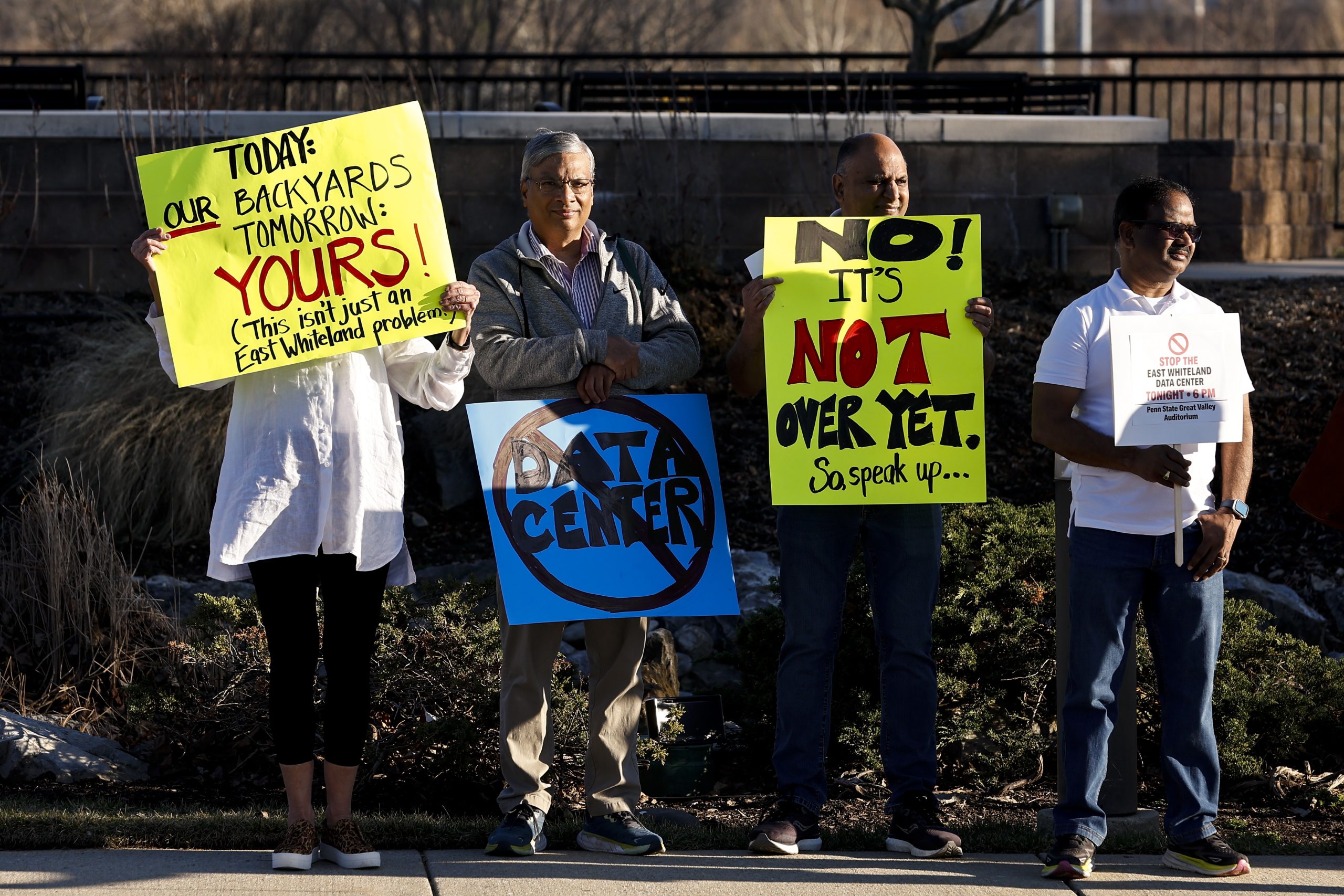
    People protest the expanded data center before the East Whiteland Planning Commission meeting held at Penn State Great Valley on Monday, March 9, 2026 in Malvern, Pa.Monica Herndon / Staff Photographer

    Pennsylvania Republicans endorsed Garrity in September 2025 — an unprecedented early nod that helped clear the field for her as the party’s nominee. President Donald Trump endorsed her in January, calling her an “America First Patriot.” She ran unopposed in the primary election, and top GOP leaders said they wanted to wage a stronger fight against Shapiro this time than in 2022, when far-right State Sen. Doug Mastriano (R., Franklin) won the endorsement in a crowded field and the state GOP largely did not financially support his candidacy.

    Despite all of the additional time to drum up support, Garrity has struggled to raise funds and has yet to be able to cash in on Trump’s backing. As of Thursday, she had spent just $300,000 more than Mastriano had at this point in the race. Shapiro, meanwhile, has spent less this election than he did at the same point in 2022, when he spent $28 million as of mid-September.

    “When you’re making comparisons to the amount of money Doug Mastriano raised, it’s a really troubling sign,” Borick added.

    Garrity and Shapiro will face off in a televised debate on Oct. 7 hosted by ABC27 in Harrisburg.

  • ‘Babies are dying’: How Pennsylvania’s measles outbreak changed the vaccine mindset of this Amish country midwife

    ‘Babies are dying’: How Pennsylvania’s measles outbreak changed the vaccine mindset of this Amish country midwife

    LANCASTER — Amish families peer into Roberta Devers’ Honda Passport as she drives between prenatal checkups along the rolling hills of Lancaster County. They ask her increasingly frequent questions about the vaccine: Do you have some measles in your car?

    Devers, 63, works as a traditional midwife in communities at the epicenter of Pennsylvania’s largest measles outbreak in more than 30 years. She belongs to a class of midwives who follow age-old practices and are unregulated by the state, unlike the state-licensed midwives one may find in a hospital. She received the full childhood vaccination schedule but, as an adult, chose not to vaccinate her son and is part of the rising number of people in Pennsylvania refusing to get vaccinated against preventable diseases due to unfounded concerns about their safety and necessity.

    But with the growing outbreak now linked to the deaths of two Amish infants and two adults in Pennsylvania — the first measles-related deaths in the state, and the most in the nation in more than three decades — Devers thinks everyone who can should get vaccinated against measles.

    And she thinks she should be able to offer the vaccine to her patients, as a trusted caretaker among Amish residents.

    “Babies are dying,” said Devers, who is not Amish but has been a traditional midwife for 38 years. She says she fears that Pennsylvania’s Amish community, one of the oldest and largest in the country, cannot wait to reach herd immunity. “You’re going to lose too many babies,” she said.

    Devers occupies a unique vantage point from the front lines of the nation’s largest measles outbreak this year. State health officials said the deaths of two local Amish infants were measles-related, sparking a clash between Democratic Gov. Josh Shapiro and President Donald Trump’s Health and Human Services secretary, Robert F. Kennedy Jr., over how to report the outbreak’s death toll. An 18-year-old from Mifflin County and a 40-year-old woman from Jefferson County also died from measles-related illnesses in recent days, according to the counties’ coroners.

    As of Wednesday, the state had reported 731 cases in 38 counties. Lancaster has recorded the highest number of known cases in Pennsylvania, as the highly contagious disease has spread among the area’s significant number of unvaccinated people, including many from communities beyond the county’s Amish population.

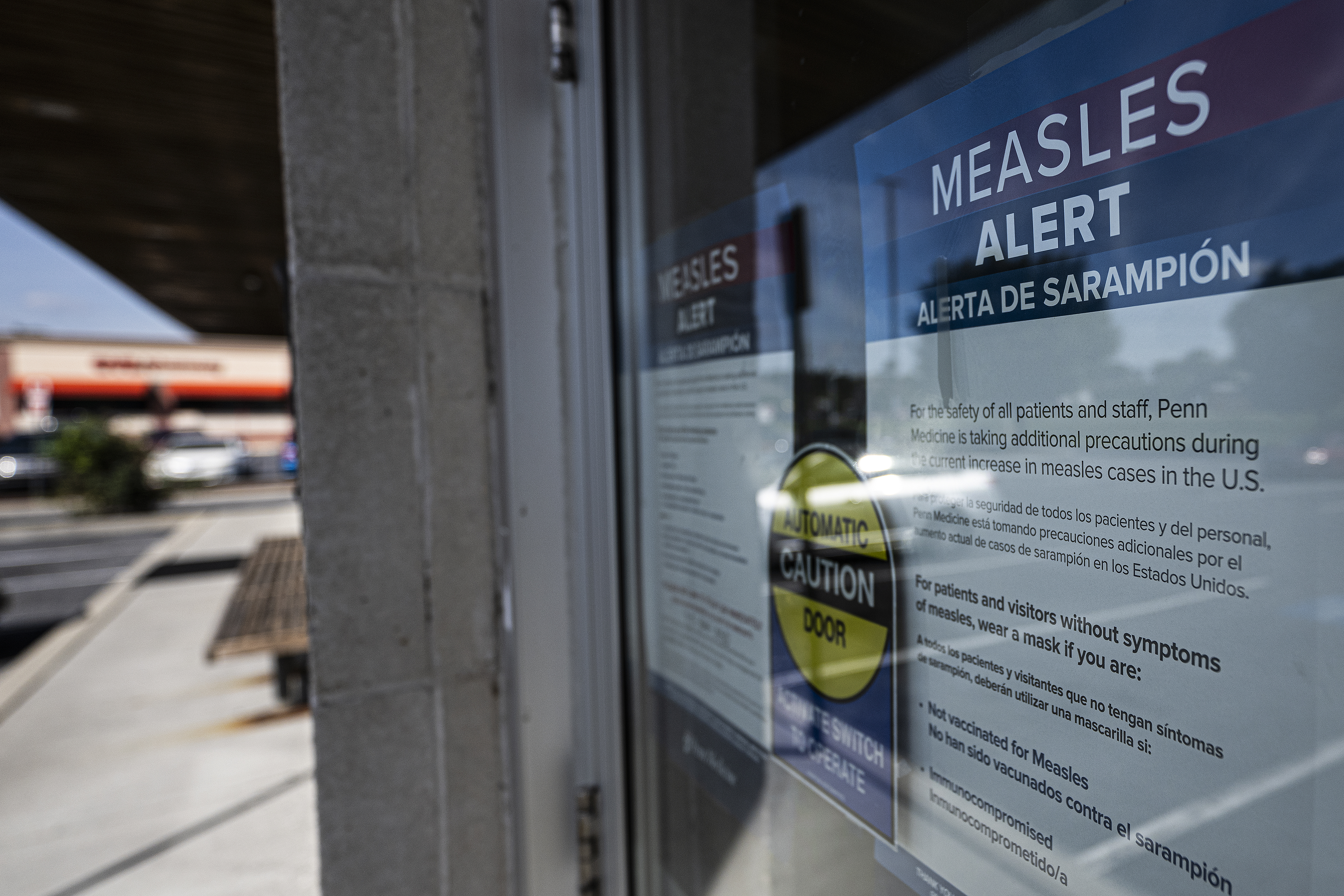
    Measles alert signs in English and Spanish are posted on the front doors of an urgent care facility Tuesday, Sept. 8, 2026, in Lancaster County, Pa., amid a measles outbreak that has affected local Amish and Mennonite communities.Jose F. Moreno / Staff Photographer

    Traditional midwives like Devers — also known as lay midwives or direct-entry midwives — broadly oppose being regulated by the modern medical system and often do not receive the medical and scientific training or college-level education required of certified nurse midwives and midwives. Because of this, top medical associations like the American College of Obstetrics and Gynecology oppose traditional midwives from being able to practice at all. State law also prohibits traditional midwives from practicing medicine, such as administering vaccines or sutures.

    Until this summer when it was quietly repealed in state budget documents, an unenforced 1929 law allowed traditional midwives to practice in Pennsylvania. A group of midwives have sued the state to formally recognize them, but that would still not permit them to practice medicine, including administering vaccines.

    Yet, traditional midwives are the main care providers who oversee home births in certain Amish communities, or for people who want their help with a personal and private birth experience. Their influence is particularly prominent in Pennsylvania, which has one of the nation’s highest rates of home births. Devers’ practice, Mount Laurel Midwifery, delivers about seven babies per month across south-central and Southeastern Pennsylvania, with a number of student midwives studying under her.

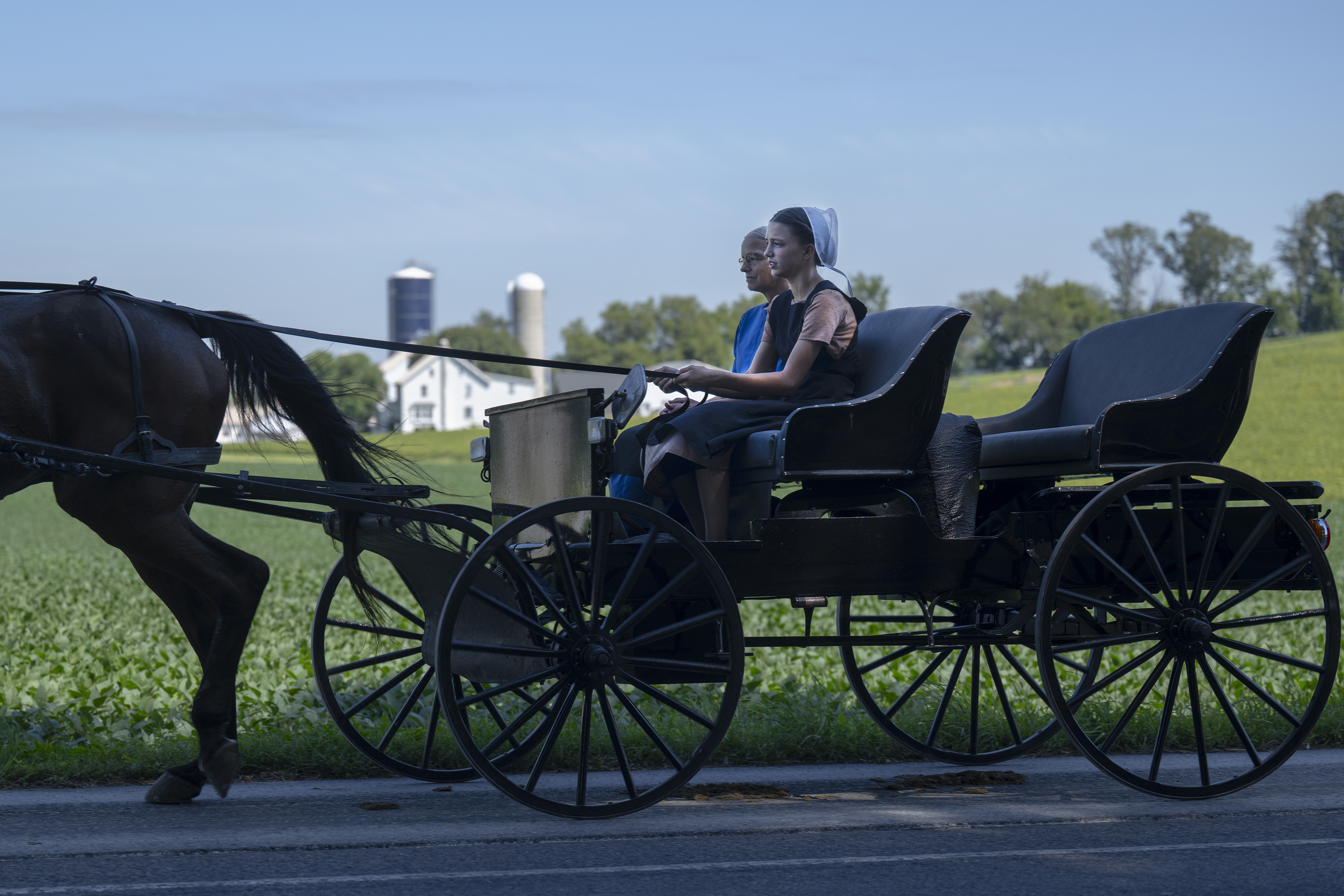
    An Amish woman drives a horse-drawn buggy along a road Monday, Sept. 7, 2026, in Lancaster County, Pa., amid a measles outbreak that has affected the local Amish and Mennonite communities.Jose F. Moreno / Staff Photographer

    In Lancaster, Devers’ clients are not talking about the political debate. Rather, their conversations center on the spread of measles — did she hear about the recent baby deaths, what should they do if they were exposed, does she have a vaccine with her?

    Two doses of the measles, mumps, and rubella vaccine have proven 97% effective at preventing the disease, the Centers for Disease Control and Prevention says. Nine in 10 unvaccinated people exposed to measles will acquire the disease.

    Pregnant people are not eligible to receive the vaccine.

    In her daily prenatal checkups, she is seeing moms who have the infection’s signature bumpy, red rash and fever, and families who have watched the sickness move through one family member to the next.

    About three in 1,000 children who contract measles will die, according to the CDC. Measles can cause severe complications, especially in young children, including pneumonia and brain swelling. And measles during pregnancy can lead to pregnancy loss, premature delivery, and low birth weight, according to the CDC.

    Devers said she recently saw a case in which a mother lost her baby at 17 weeks. The Amish woman was recovering from an active measles infection at the time of the miscarriage, in addition to at least one other underlying medical condition, Devers said.

    Amish families traditionally have funerals for stillborn babies or miscarried fetuses, sharing obituaries in the local newspaper. Devers attended the funeral for one such death, involving the 17-week-old fetus, last month.

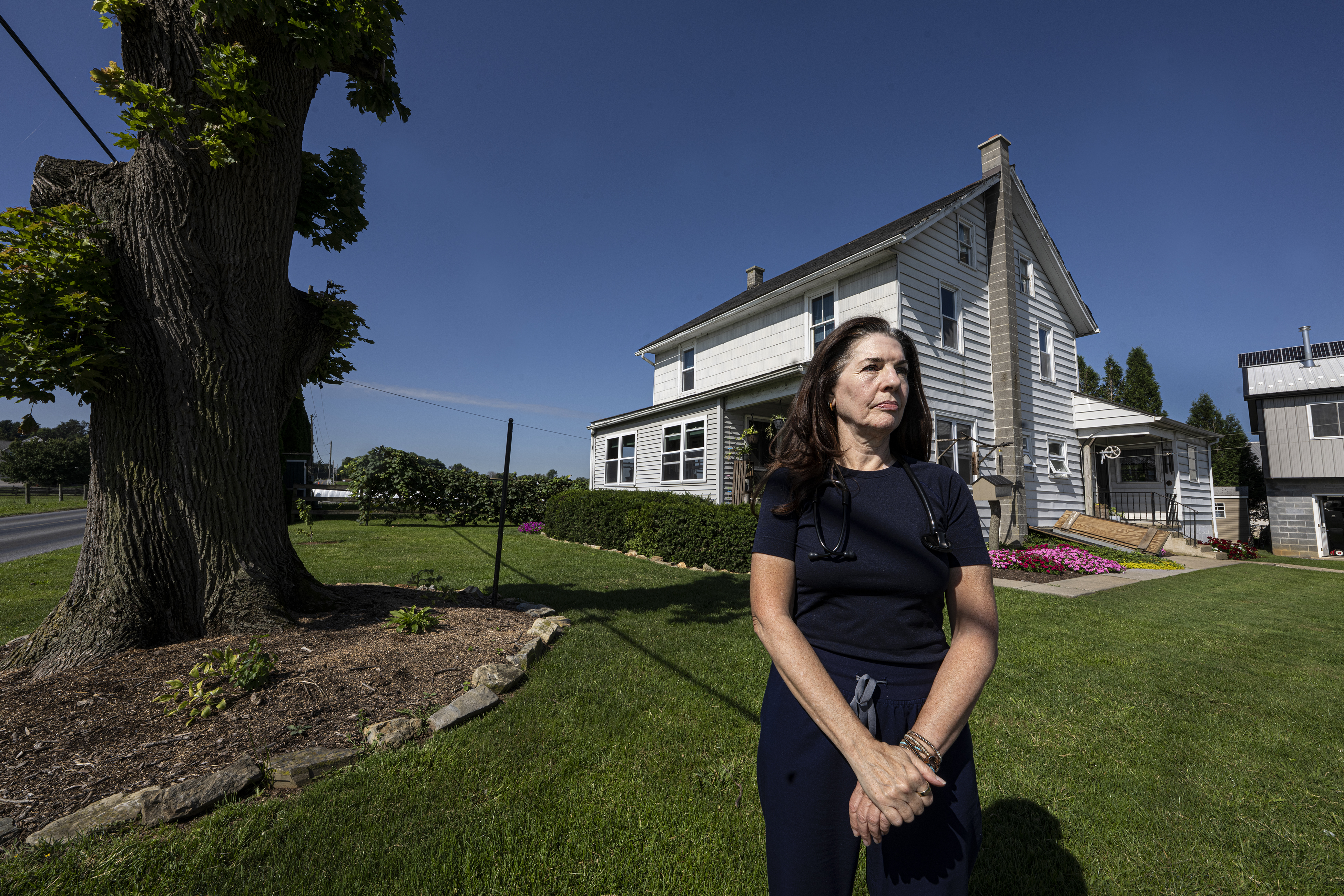
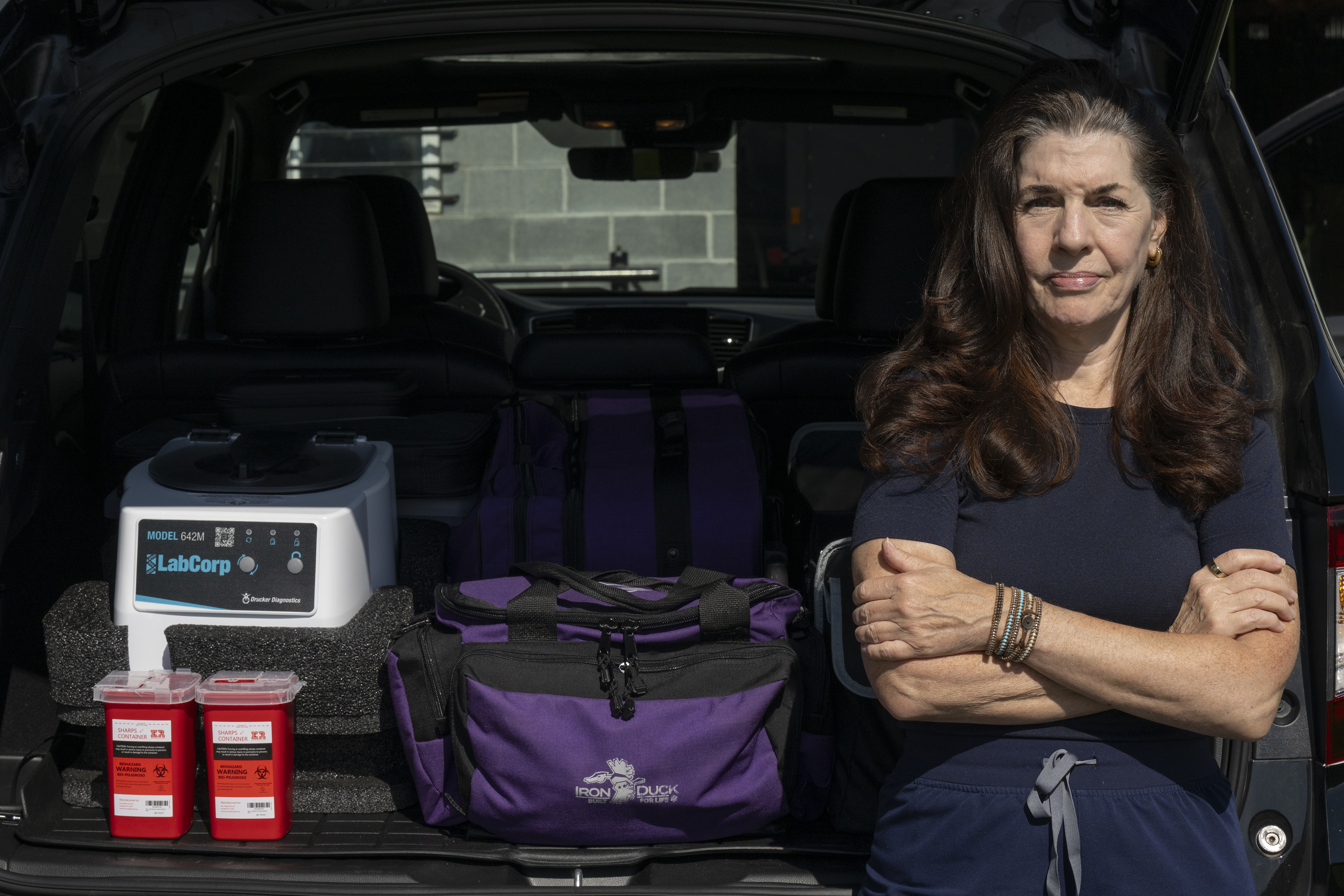
    Midwife Roberta Devers is photographed Tuesday, Sept. 8, 2026, near the home of one of her Amish patients in Lancaster, Pa. Devers, who primarily serves Amish mothers, discusses the measles outbreak and why she believes unlicensed midwives should be allowed to administer MMR booster shots.Jose F. Moreno / Staff Photographer

    During previous public health emergencies, state and federal governments have used limited emergency approvals to expand who is allowed to administer vaccines, though the authority was not extended to unregulated groups like traditional midwives.

    Now, Devers wants state or federal health officials to extend approval to allow traditional midwives to administer the measles, mumps, and rubella vaccine.

    But the Pennsylvania Department of Health says it does not have the authority to allow traditional midwives to administer vaccines, because they are not certified healthcare providers. Currently, state law allows licensed healthcare providers like doctors and certified nurse midwives to administer vaccines, and any expansion of the list would require an amendment to state law, spokesperson Stephanie Nojiri said in a statement.

    HHS and the CDC did not respond to requests for comment. Devers said she recently accepted an invitation from the CDC to participate in a paid interview to discuss how midwives serving Plain communities are approaching the measles outbreak. She sees the outreach as a signal of the agency’s interest in working with midwives.

    The Amish and vaccines

    Vaccination rates among Pennsylvania children have been falling for years. The spread of misinformation about vaccine safety reached the highest echelons of the U.S. government after Trump picked Kennedy, a longtime anti-vaccine activist, to lead the nation’s health agencies.

    In 2025, at least 249 Pennsylvania schools had vaccination rates below 95%, the level that scientists say is necessary to prevent the spread of measles.

    Amish communities do not have a religious objection to vaccinations, said Steven Nolt, a top Amish scholar at the Young Center for Anabaptist and Pietist Studies at Elizabethtown College.

    He said low vaccination rates in the groups, who dress in plain clothes and widely object to using technology in favor of a more traditional way of life, are due to their partial abstention from modern medicine, as well as a lack of nearby access given their rural lifestyles.

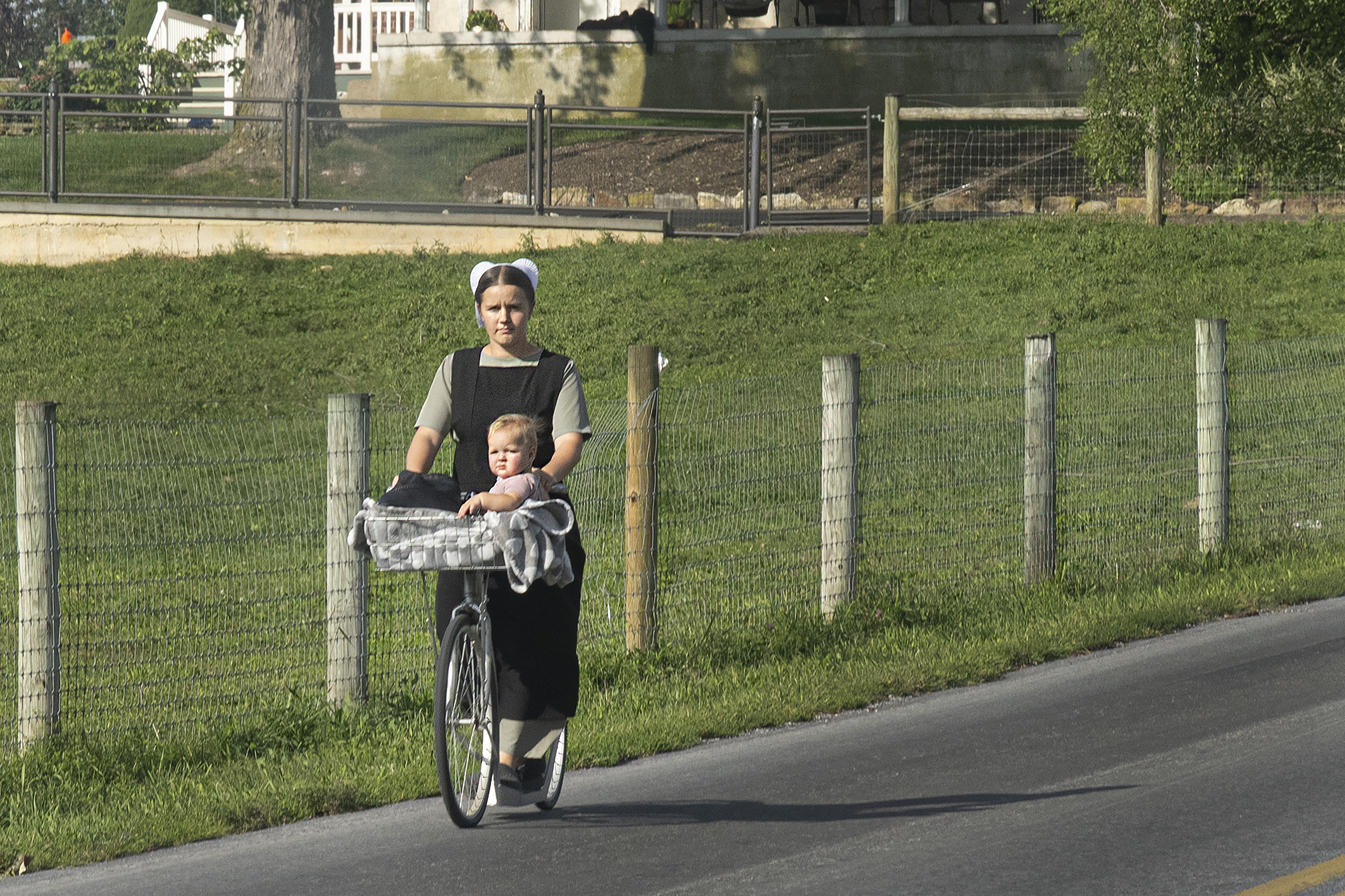
    An Amish woman rides a kick scooter with a baby secured in a front basket attached to the scooter Tuesday, Sept. 8, 2026, along a road in Lancaster County, Pa., amid a measles outbreak that has affected local Amish and Mennonite communities.Jose F. Moreno / Staff Photographer

    In Lancaster County, 30% of Amish families had their children vaccinated and believed vaccinations were safe and effective, according to a 2022 survey of 433 Amish and Old Order Mennonite residents, published by Elizabethtown College and conducted by Franklin and Marshall College.

    The numbers are much higher among Old Order Mennonites — a different religious group that similarly dresses in plain clothes — with 94% vaccinating their children and 72% believing they are safe and effective.

    When a 1991 rubella outbreak spread through Amish communities, families welcomed the booster shots, Nolt said. So did Amish groups during a polio outbreak in the 1970s.

    “When there would be an outbreak, that was a bit of a wake-up call,” he added. “Then people would come out for immunizations.”

    Another “wake-up call” has now arrived for Lancaster’s Amish residents, Devers said.

    Amish vendors work at their stands inside the popular Central Market in Lancaster, Pa., Tuesday, Sept. 8, 2026, amid a measles outbreak that has affected local Amish and Mennonite communities.Jose F. Moreno / Staff Photographer

    Amish groups broadly approach their health through a “medical pluralism” lens — a term coined by Martha King, a medical anthropologist at the University of North Carolina at Chapel Hill. This means Amish communities view medical doctors, chiropractors, midwives, and homeopathic remedies as all being “on the same playing field,” rather than being supplementary to a primary care physician, as is common among most Americans, Nolt said. Sometimes Amish people will choose treatments that contradict each other or lack any scientific backing.

    “They kind of all function in a way that doesn’t necessarily make sense the way many ‘normal’ Americans think about healthcare,” Nolt added.

    Prior to his appointment as HHS secretary, Kennedy helped lead anti-vaccination efforts across the country. During a 2021 speech in Lancaster County, he mocked measles as a serious threat.

    It is unclear what effect the efforts have had on Amish populations, Nolt said. During the COVID-19 pandemic, some anti-vaccine groups ran advertisements in Amish newspapers, discouraging the Amish from getting any immunizations, he added.

    Devers said she largely supports Kennedy, but believes Shapiro was right to raise alarm about the need to vaccinate against measles. She said she has been disappointed in Kennedy for downplaying the dangers of the outbreak.

    “My God, use your head,” Devers said. “He can’t mean this in the midst of an epidemic like this.”

    Pennsylvania’s health department, in partnership with local health systems, says it has been working with Amish communities. And Shapiro has emphasized that the outbreak stretches much further than just among any one community, now that confirmed cases have spread to more than half of Pennsylvania’s 67 counties.

    Since the start of the measles outbreak in Pennsylvania in April, state health officials have hosted 124 pop-up vaccination clinics across the state in locations like churches, fire halls, and private homes to give more than 4,100 doses of the MMR vaccine, Nojiri said. More pop-up clinics are planned in the near future.

    But traditional midwives should be part of the solution, too, Devers argued.

    “Different times call for a change in thinking,” she said.

    This story has been updated to remove identifying information.

  • Josh Shapiro’s not an AI ‘doomer,’ but the Pa. governor wants federal regulations for the industry

    Josh Shapiro’s not an AI ‘doomer,’ but the Pa. governor wants federal regulations for the industry

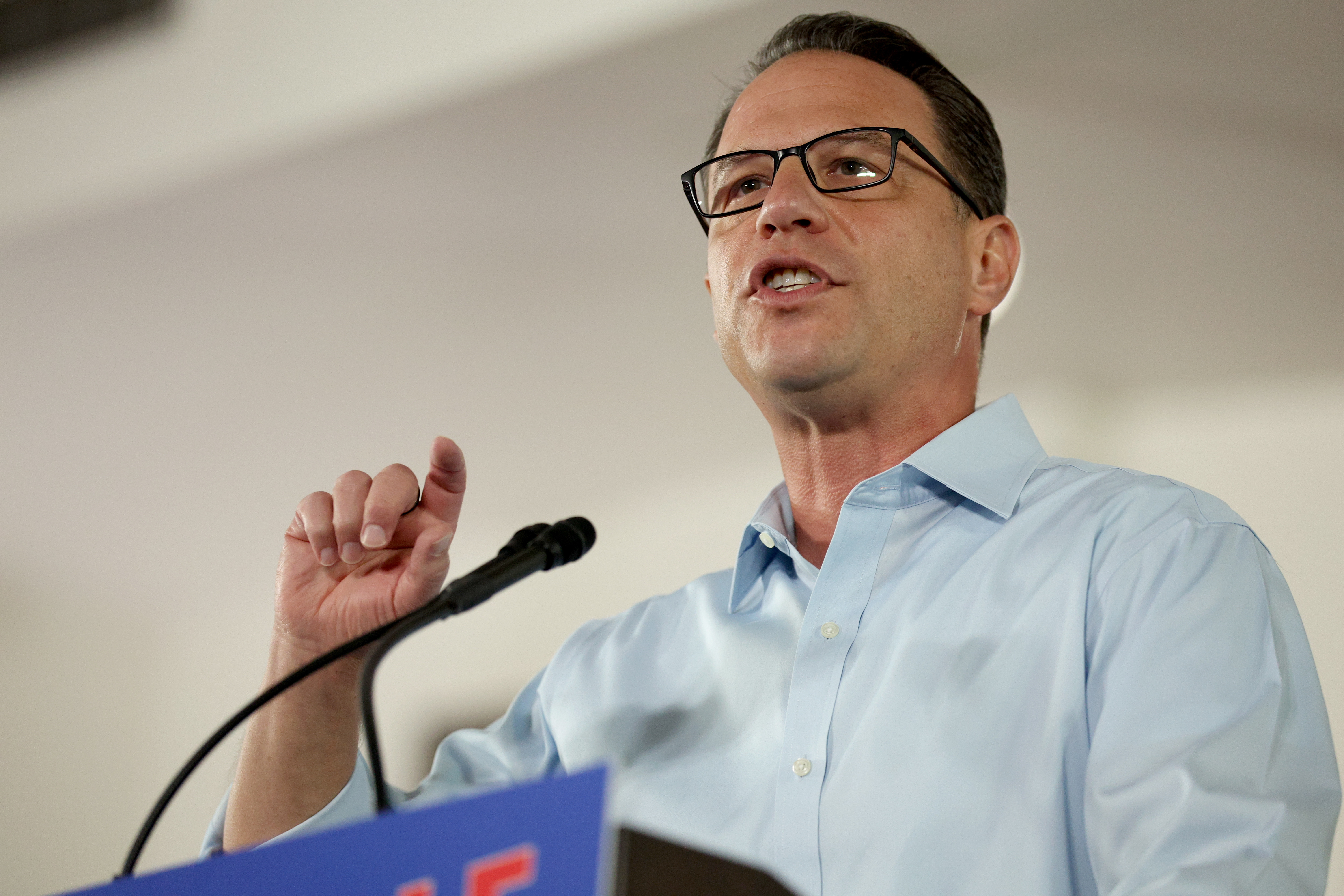
    Gov. Josh Shapiro on Thursday called on the federal government to enact new guardrails on artificial intelligence, days after a number of tech industry figures raised concerns about the danger posed by AI’s rapid development.

    As he spoke in Pittsburgh, the Democratic governor was critical of both House Speaker Mike Johnson (R., La.) and President Donald Trump for refusing to erect such safety measures “whether out of willful ignorance or personal greed.”

    And, he said, he does not believe that concern about this technology “is a hoax, as our president has called it.”

    But as he urged more regulation of the industry, he also warned against adopting an overly pessimistic view of the technology.

    “I am not a doomer. I don’t think it is inevitable that AI is going to take over the world, or that someone will misuse it to kill us all or to do harm,” Shapiro said.

    Shapiro’s appearance at the AI Horizons PGH Summit, sponsored by Microsoft and the Bank of New York, helps position the governor as a leader on the issue among Democrats.

    Last week, former President Barack Obama urged Democrats running for the White House to define the risks of AI, according to the Washington Post.

    That advice — and Shapiro’s speech — followed warnings from AI executives last week that the technology is developing too quickly, and that it poses threats to human life.

    “I won’t lie to you — there are real dangers,” said Anthropic CEO Dario Amodei, adding that the development of AI has accelerated much faster than he had expected.

    Shapiro — who has consistently led his November opponent, Stacy Garrity, in polls — is widely expected to pursue a presidential run in 2028 after this fall’s reelection contest.

    A growing concern among voters, AI is expected to continue being a significant issue for candidates, and Shapiro has shifted his stance in recent months to reflect questions about the technology.

    In August, he issued an executive order that restricts data center development in the state, a noticeable shift from when he enthusiastically supported a $20 billion commitment from Amazon last year to build at least two data centers in Bucks and Luzerne Counties.

    Shapiro now says future developments require local approval for projects to receive state permits, which in effect may block many developments from moving forward.

    “The real folks I listen to are the people of Pennsylvania,” Shapiro told Politico before Thursday’s speech.

    Six in 10 likely Pennsylvania voters oppose construction of data centers to house artificial intelligence, according to last month’s poll from The Inquirer, the New York Times, and Siena University.

    In contrast to the growing voices calling for AI guardrails, President Donald Trump on Monday wrote on social media that the only guardrail the industry needed it already had: “a STRONG AND SMART (High IQ!) PRESIDENT.”

    Shapiro, in his speech, said he is calling on the federal government to establish “strict rules of the road” regarding AI, and then to enforce those rules.

    “I’ve called on the federal government to step up and regulate the AI industry, just like they do for nearly every other industry,” he said.

    Industry leaders should not exclusively guide the regulatory process, Shapiro said. The government should also work with leading researchers.

    What is vital, Shapiro said, is establishing rules that require independent third-party oversight of “frontier” — most advanced — models, increasing transparency into the development of these models, and prioritizing safety.

    Protections might mean placing some limits on technology sharing and slowing down frontier AI development until we can be sure that these systems are safe, Shapiro said.

    Acknowledging that building a regulatory network from the ground up is hard work, Shapiro took a jab at Congress, and Johnson in particular, when he said “too many in Congress are content to do absolutely nothing.”

    Shapiro noted that the speaker adjourned the House until after the election just days after companies issued “apocalyptic” warnings about the real dangers of AI.

    “He has abdicated his responsibility to lead at a time when we cannot afford weakness and retreat,” Shapiro said of Johnson.

    The United States should work with other nations on an international consensus on how to use AI, but that is hard to do when Trump has “isolated” us from the world, Shapiro said.

    When Trump meets with Chinese President Xi Jinping next week, Shapiro said, he hopes Trump will “leave bluster and the showmanship at the door” and engage productively with him.

    As for the home front, Shapiro said, “I’ll be leading the conversation here in Pennsylvania for safe and responsible use of AI.”