Meta released its new personal AI agent on Tuesday and named it Muse (like this bot is going to inspire humanity to write the next great tragedy and not relegate us to become the lead characters in one).
Of course, Muse could refer to the act of thinking about something very carefully, but that would be even more ironic, given that some experts in the field have sounded alarm bells that AI is advancing faster than humanity is prepared for.
Admittedly, I didn’t hear about the launch until two days after its release (I’m not a tech reporter and still keep a paper calendar), but I was surprised by how it did come to my attention.
In a post on Threads, user @rpennone pointed out how similar Muse’s stroke-like “M” logo is to the logo of one our city’s most beloved institutions, Mural Arts Philadelphia.
View on Threads
I pulled up the two logos on my computer, put them side-by-side, and it painted a pretty clear picture.
Part of our DNA
Typically an “M” is two sets of arches, sometimes with a little rat tail on the upper left side for flair. But both of these Ms have three peaks and valleys with little rat-tail flairs at both ends. Granted, Muse’s logo is blue, while Mural Arts’ is typically purple (though like Gritty’s belly button, it can change colors), and the former’s logo also has more fluid lines, while the latter’s are more rigid. Still, the resemblance is enough to make you go “hmm…”
View on Threads
Given how much people are worried about AI copying everything we create, this isn’t going to help the situation. Maybe nobody outside of Philly would catch it, but Mural Arts is a part of the very fabric of this city, part of its DNA, and someone here was bound to notice the similarity and defend its honor. Nobody paints our baby into a corner.
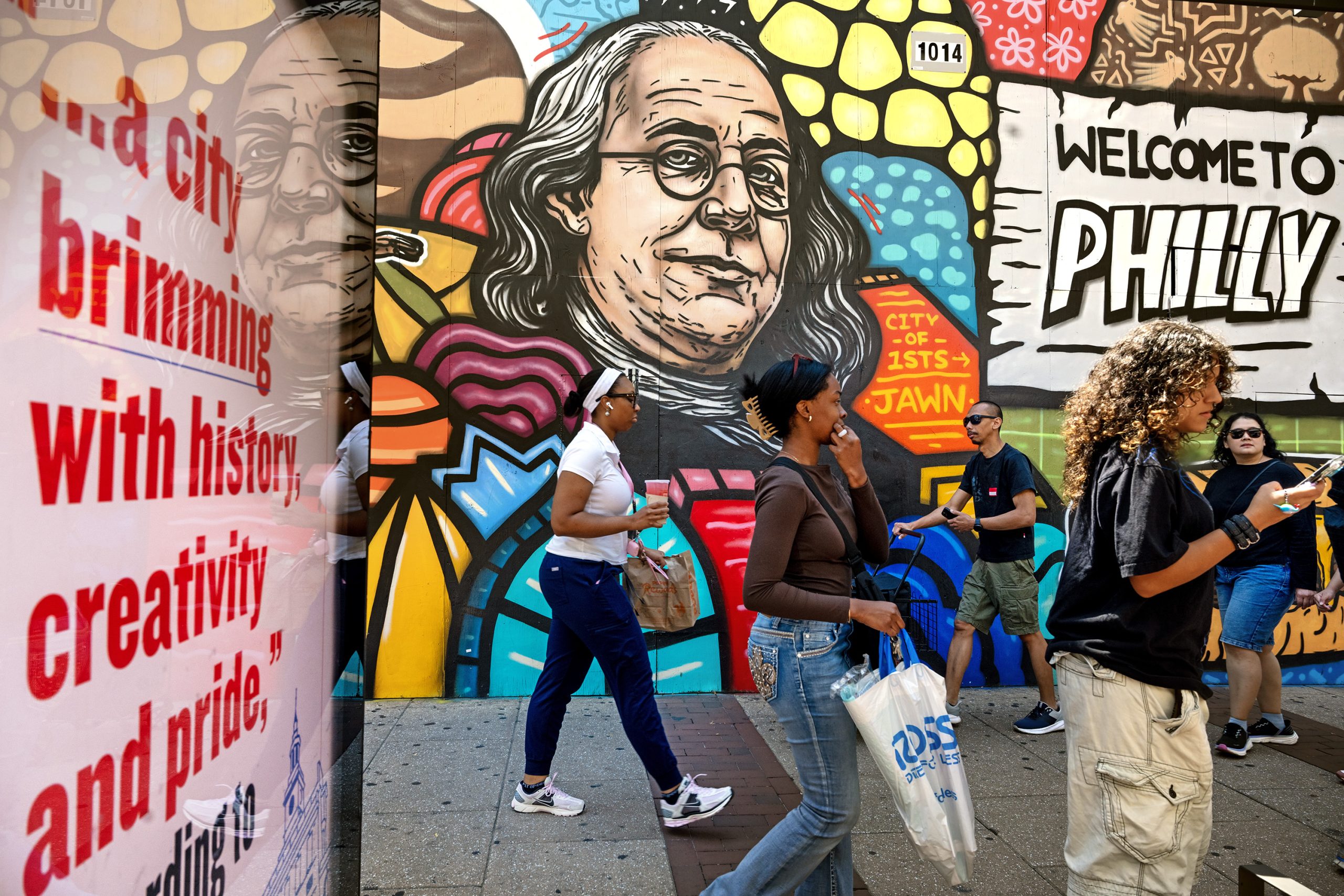
The 150-foot “Welcome to Philly” mural by artist Alloyius McIlwaine on the 1000 block of Market Street. The mural was a collaboration between Mural Arts Philadelphia, the Center City District, Comcast, HBSE, and the ownership group of the 76ers.Tom Gralish / Staff Photographer
For its part, Mural Arts was very diplomatic about the matter. Spokesperson Frank Luzi told me there’s no concern on the nonprofit’s part about copyright infringement and there are no plans for legal action.
“They feel like they are two very different organizations,” he said.
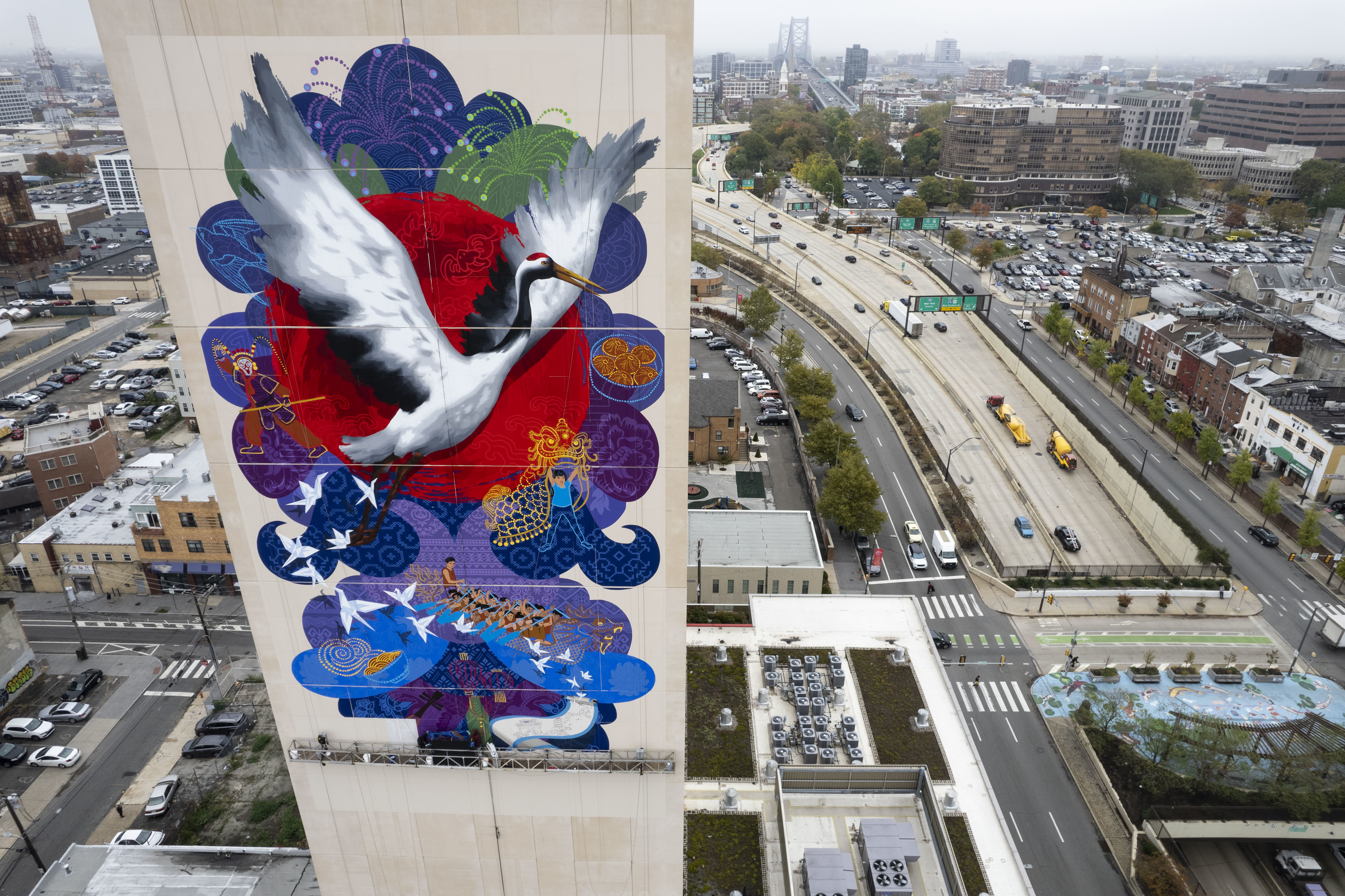
Designed by artist Chenlin Cai, “The Past Supporting the Future” mural in Chinatown was collaborative project by the Philadelphia Chinatown Development Corporation, Mural Arts Philadelphia, and the Philadelphia Housing Development Corporation.Monica Herndon / Staff Photographer
‘Definitely a resemblance’
Here’s the interesting thing, Muse’s logo was designed by a human who “cut my creative teeth in Philadelphia,” according to her website.
Jessica Hische is a lettering artist and author specializing in “typographical work for logos, film, books, and other commercial applications,” whose previous clients include companies like Target and Hallmark and people like Barack Obama and Wes Anderson. Based in Oakland, Calif., she graduated from Temple University’s Tyler School of Art and Architecture in 2006 with a bachelor’s degree in design and illustration.
I reached out to ask her about the similarities in the logos. In an e-mailed statement, she said Meta contacted her after doing its own sketch of an M inspired by a pen stroke or scribble. She said she refined the design by “playing with the stroke angles, end treatments, and vertical rhythm.”
Hische sent me a screenshot of the “M” Meta provided her and 30-plus variations she worked on until she landed on the final version.
I had to squint pretty hard to detect the differences, but lettering isn’t my field of expertise. Meta’s initial version does look more rigid and even more like Mural Arts’ logo, while Hische’s is more fluid.
Mural Arts Philadelphia lead teaching artist and muralist Jamee Grigsby (left) and an apprentice continue painting a mural focused around what accessible justice looks like, at the Mayfair Athletic Club in Russo Park on Edmund Street in Philadelphia on July 30, 2024.Elizabeth Robertson / Staff Photographer
Hische said she was familiar with the Mural Arts program from her time in Philly but hadn’t seen its logo, which was created by J2, a Philly-based branding company, and debuted in 2016.
“There’s definitely a resemblance (and it would have been even closer had we landed on the brushier versions of the “M” I had explored!) but ultimately what Meta hired me to do was to make the mark they had created less rigid and more fluid,” Hische wrote. “The rigidity, regularity, and perfect symmetry are defining qualities of the Mural Arts M (along with the brush stroke treatment), and it’s a great logo.”
Common threads
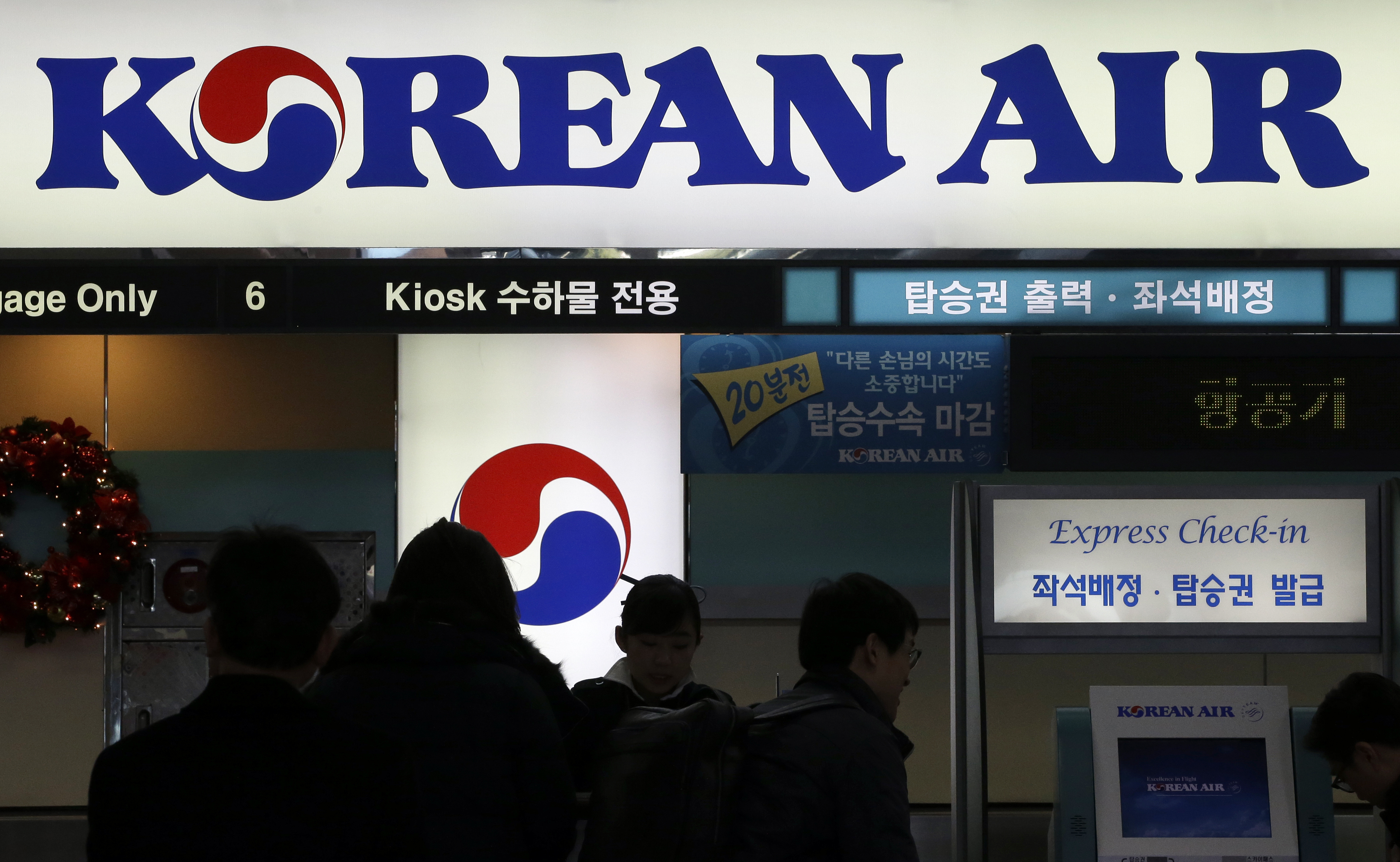
I appreciated Hische’s response and recognition of the resemblance. It’s not the first time logos have looked similar (Korean Air’s logo looks more like the Pepsi logo than the Pepsi logo does). It’s unclear where or how Meta came up with the original “M” logo Hische was asked to fine-tune. Meta did not return my requests for comment.
The logo for Korean Air bares an uncanny resemblance to Pepsi’s logo. Lee Jin-man
Later in the day, I saw Hische was catching flak online from people in her field for a completely different reason.
Because the digital world is a creepy stalker, as I was scrolling on Threads that evening, my feed suddenly become flooded with posts about Hische from people I don’t follow. Users on Threads — which is owned by Meta — were both condemning her for working on Meta’s AI project and defending her for working on it. Hische also penned her own nine-part Thread explaining her rationale, which includes the line “I have literally been touching grass more because of AI” and ends with a pitch for her latest children’s book.
I couldn’t help but wonder if this is right where Threads wanted me to end up. Why did that initial post about the logos from someone I didn’t follow pop up in my feed? Why did it also end up in the feed of an editor who sent it my way, confirming for me I should write this piece?
I thought I was pulling a thread, but maybe Threads was pulling me all along.
Former New Jersey Gov. Christine Todd Whitman will be 80 years old in a few weeks, with much to celebrate as she marks the moment.
She was twice elected governor and brought a Republican legislature with her both times. She cut income taxes by 30%. She turbo-charged the drive to save the state’s dwindling green space, earning her a seat in the cabinet of President George W. Bush, running the Environmental Protection Agency. She is a woman of grand accomplishment, a pioneer.
And she had the guts to compare Donald Trump to Adolf Hitler, way back in 2015, before it was stylish. So count me among those who would clap and hoot when she blows out the candles at her party.
But … but … but …
She also assured us, one week after the 9/11 attacks, that it was “safe to breathe” the air at ground zero. And we know now that was a mistake of epic proportions; that the dust covering Lower Manhattan was a toxic stew of asbestos, lead, mercury, arsenic, dioxin, and polychlorinated biphenyls. It scorched the lungs of thousands who breathed it, leaving them disabled, and planted the seeds for cancer in thousands more.
“The number of people who have died of 9/11-related health conditions has far surpassed the number of people who died on the day of the attacks,” the September 11th Victim Compensation Fund states in its most recent annual report.
As the illnesses began to pile up, Whitman became an object of scorn to those who felt she had been flat-out lying, bending to pressure from the White House, which was eager to get Wall Street back to work.
She was called before Congress to answer for this in June 2007, soon after Democrats had taken control of the House, and they were ready to pounce. It was a sweltering day in Washington, nearly 90 degrees, and she had to brave a mob of furious protesters screaming at her as she arrived. This was to be the darkest day of her career.
“Our government has knowingly exposed thousands of American citizens unnecessarily to deadly hazardous materials,” said Rep. Jerrold Nadler, the New York Democrat whose district included ground zero. “And because it has never admitted the truth, Americans remain at grave risk to this day.”
But was Whitman really that much of a monster? I had covered her for years as a columnist at the Star-Ledger in Newark, N.J., and I had my doubts. Even today, no one has ever proved she lied about what she knew, or knowingly put people in harm’s way. If she were that evil, it seemed to me, it would be a first.
Still, this episode will rightly be remembered as the low point for Whitman. She may not have been a monster, but she was surely a wimp. She stood back and let Vice President Dick Cheney spin the EPA’s scientific findings out of shape, as the EPA’s own inspector general established two years later. The EPA’s recommendation that homes and businesses hire professional cleaners to eradicate toxins was removed altogether.
The changes to the EPA’s draft news releases were made by the Orwellian-named President’s Council on Environmental Quality, which was effectively run by Cheney. The CEQ had final control of press releases, and the IG report spells out each change it made, every time diminishing the danger and adding reassurance about safety at ground zero. Whitman didn’t make a peep of protest.
She didn’t know for certain she was sending people to their doom, as critics like Nadler claimed. But she was going along with the spin, yielding to Cheney. And many people died who might have stayed away.
At that 2007 hearing, Whitman was having none of it, and was more defiant than I had ever seen her. She was not a liar, she insisted. She based her decision on the best science she had at the time. She had no regrets, and said she was still not sure the toxins at the site were causing illnesses.
I reached out to Whitman, and she offered a written statement saying, “Everyone at the EPA did the best they could with the information, tools, and knowledge available at the time.” But she declined to answer a more personal question: Does she feel she did anything wrong when she issued the all-clear?
My guess is that deep down, she does.
Tom Moran is the author of the Substack Jersey Lowdown and former editorial page editor of the Star-Ledger in Newark, N.J.
In the weeks after the Sept. 11, 2001, terror attacks, I went to New York to report on a story about Johanna Sigmund, a young woman from Wyndmoor who perished after one of the hijacked planes rammed the north tower.
Over the course of my career, I’ve spent more time than anyone would want writing pieces about people whose lives were cut short prematurely. One of the most memorable was Johanna, whose story and positive spirit remain seared into my soul.
Johanna’s parents invited me, a stranger, into their home at their worst hour. They took the time to tell me about their only daughter, and shared photograph after photograph after photograph — Johanna smiling after she ran the New York City Marathon, Johanna posing with her girlfriends at a wedding, and so on.
One image stood out.
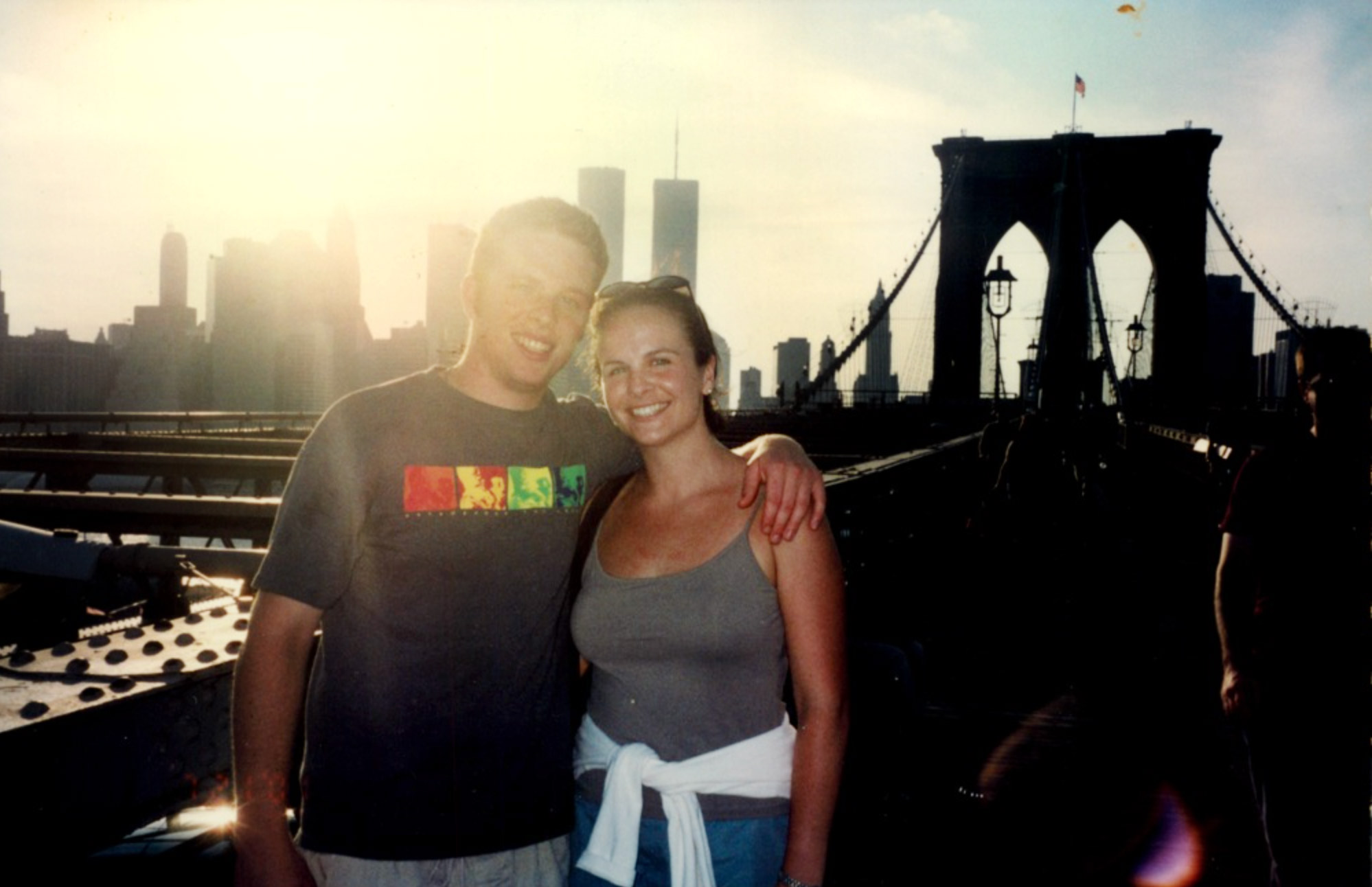
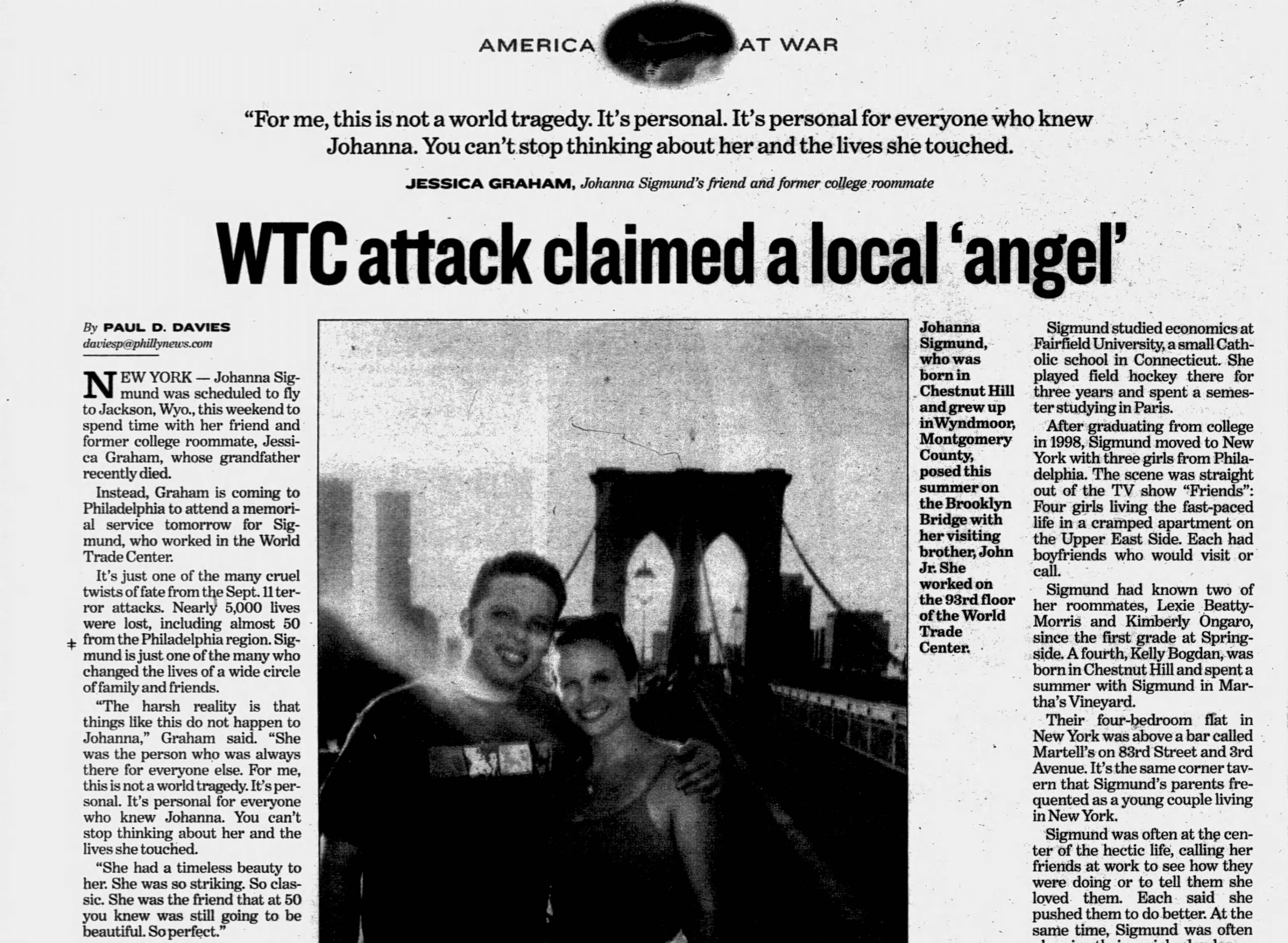
It was a photo of Johanna, 25, and her brother, John, 23, smiling while standing arm in arm at the foot of the Brooklyn Bridge. The photo was taken two months before the terror attacks. In the background loomed the twin towers.
An article by Paul Davies about Johanna Sigmund in the Oct. 19, 2001, edition of the Daily News.Staff
Johanna’s story has stuck with me for a quarter century, but her life is emblematic of the promise and potential of so many others who were lost. At least 40 people with ties to Philadelphia and its western suburbs were killed in the attacks, including 18 from Bucks County, 11 from Montgomery County, five in Chester County, eight from Delaware County, and three from Philadelphia. It may be impossible for any of us to fathom how many other lives were forever impacted by the horrors of that day.
I wondered how Johanna’s family and friends had fared over the years.
So much has been lost in the 25 years since 9/11. Johanna would have turned 50 on the first day of summer — the longest day of sunlight. Her elegant beauty remains frozen in time, and — all these years later — her life remains a catalyst for good.
A scholarship fund set up in her name continues to help students attend St. Malachy School in North Philadelphia, as well as another at her alma mater, Springside Chestnut Hill Academy.
Johanna packed a lot into her brief time here. She was the captain of the field hockey, lacrosse, and squash teams in high school. She studied economics and played field hockey at Fairfield University, and spent a semester in Paris before moving to New York in 1998 with three friends from Philadelphia.
When I met with Johanna’s roommates a few weeks after the attack, they shared stories of her love of cooking, dancing, and listening to U2, often replaying the song “Stuck in a Moment You Can’t Get Out Of” that begins, “I’m not afraid of anything in this world.”
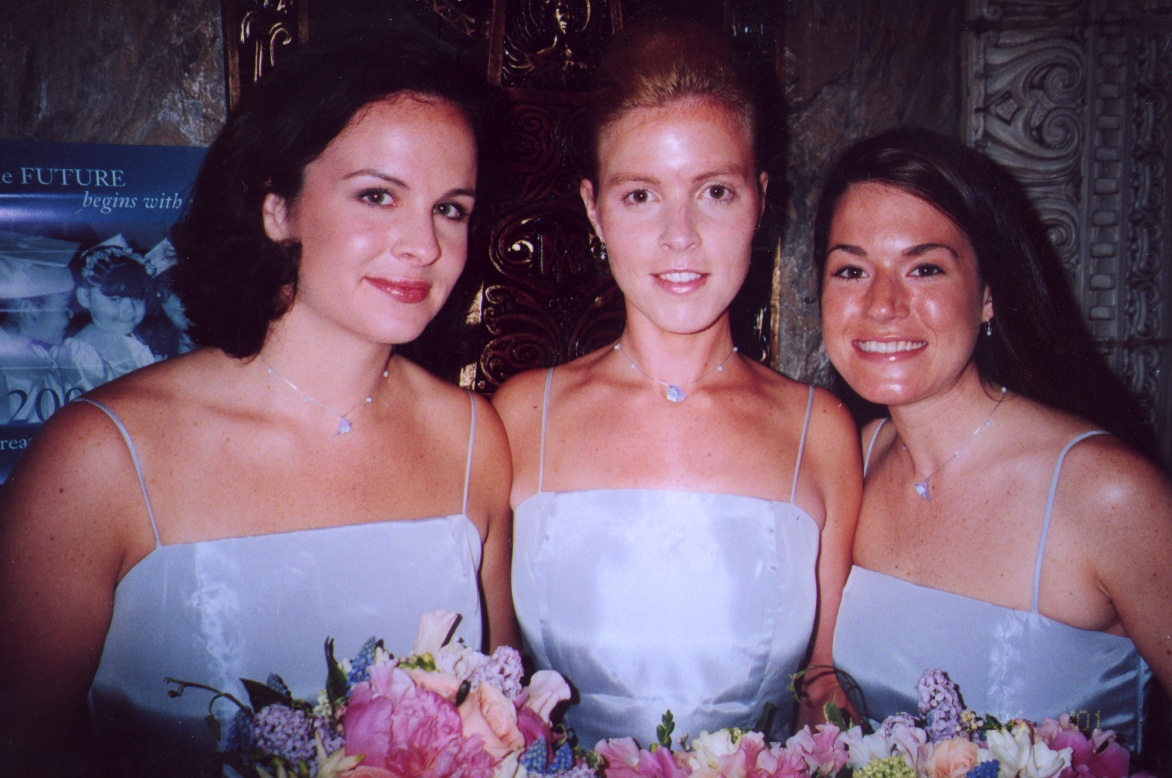
From left: Johanna Sigmund, Rory McDevitt, and Kim Ongaro were all bridesmaids at the wedding of their friend, Lexie Beatty, in May 2001. Sigmund was one of the victims in the 9/11 attacks.h
Johanna cared for others. She distributed pizza and McDonald’s to the homeless people in her neighborhood. She helped a woman who was thrown from a taxi get to a hospital. Johanna spent the night by her side and returned home in the morning with blood on her clothes.
Kimberly Ongaro, a roommate and friend from Springside, called her “an angel.”
The toughest interview in the weeks after the attack was with Johanna’s boyfriend, Joe Bonavita. They had dated for several years and had discussed marriage.
Their final weekend together was a whirlwind. They went to the Yankees game Friday night and drove to the U.S. Military Academy in West Point, N.Y., on Saturday, met up with friends, attended the Army football game, and walked through the cemetery for soldiers, which included Gen. George Armstrong Custer.
On Sunday, Johanna competed in a 5K race down Broadway before continuing on as part of her training for the Philadelphia Marathon. She and Joe shared dinner that night.
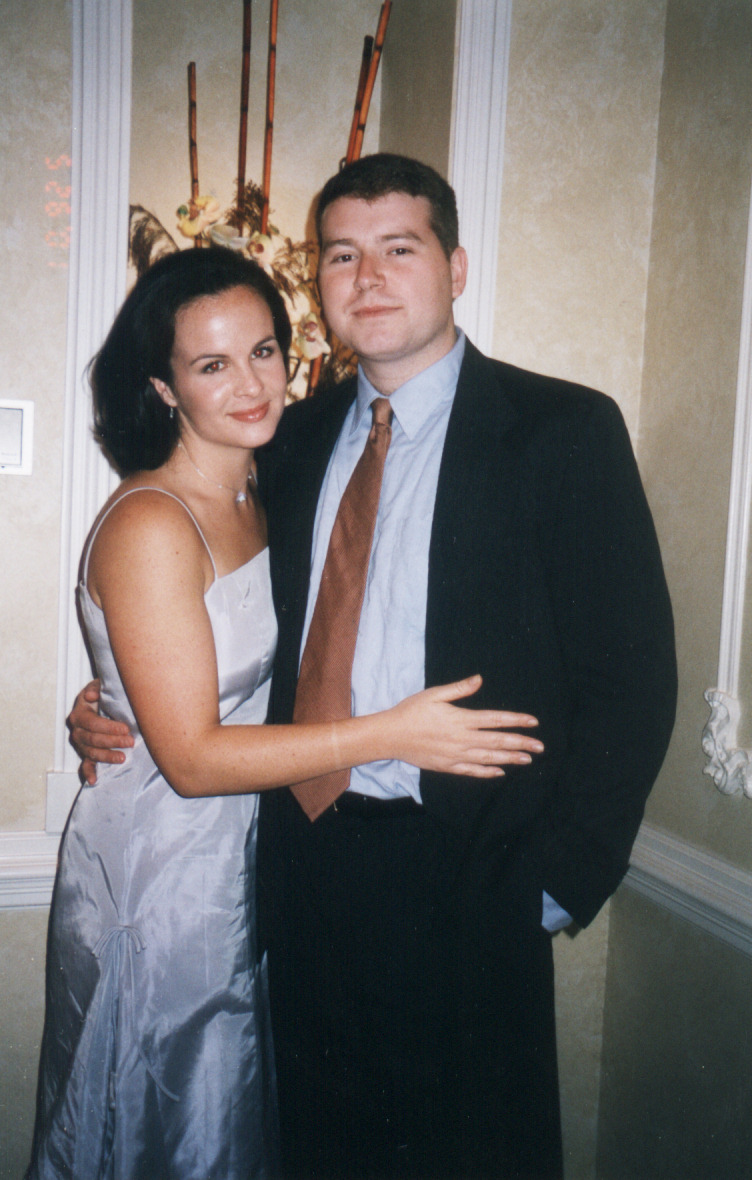
Johanna Sigmund and her boyfriend, Joe Bonavita, at the wedding of her friend Lexie Beatty Morris.
Johanna did not feel well on Monday, but went to work. When she was still under the weather on Tuesday — Sept. 11 — Joe urged her to stay home.
But she went into the office at an investment firm on the 93rd floor of the north tower.
Joe worked near the Trade Center. As he exited the subway, he saw the first plane smash into the north tower.
A life upended
I located her brother, John, and emailed him. He responded a few minutes later and graciously agreed to speak. When we connected after 25 years, it almost felt like old friends catching up.
John told me how 9/11 upended his life.
He had planned to move to New York after college, but lost interest after the attack. He visited ground zero to commemorate the first anniversary. President George W. Bush greeted families, including John’s aunt, who offered veiled advice regarding the plans to invade Iraq. “I hope you are making a prayerful decision,” she told the president.
Bush was taken aback, but continued shaking hands before circling back to tell John’s aunt that he prayed every day.
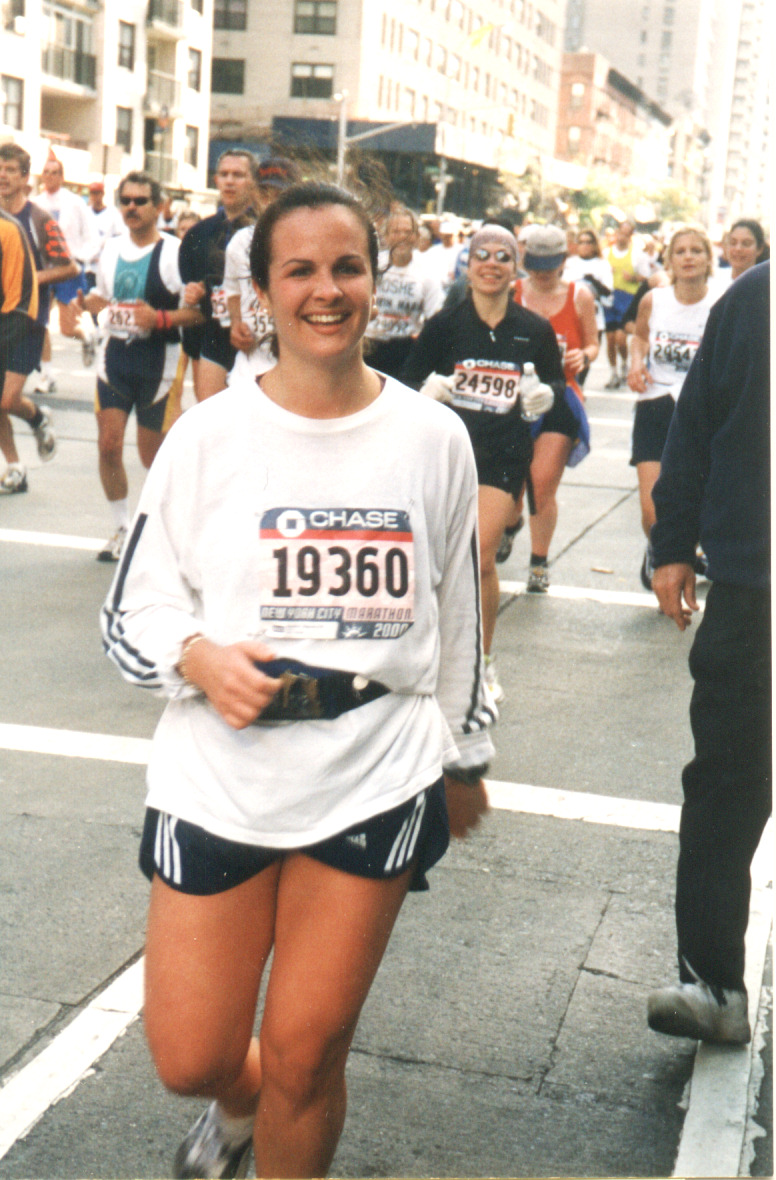
A photograph of Johanna Sigmund running in the New York City Marathon in November 2000.
After college, John, a Spanish speaker, spent a year with AmeriCorps teaching literacy to second graders in Kensington. After he explained to one class’s teacher why he wanted to take off for the anniversary of 9/11, she had her students write notes of support. John was struck by how many kids shared stories of loved ones they had lost to violence.
“Everyone has their 9/11,” he said.
Along the way, we all pay a price. Some more than others. But how one responds is a lesson for all as we navigate these trying times 25 years after 9/11.
John said he wonders how his life would have been different if not for Sept. 11. After a year teaching in Philadelphia, he moved to Texas, in part to get away. He earned a master’s degree in art education at the University of Texas in Austin before going on to teach at Say Sí, an after-school arts program in San Antonio.
John’s attempt to get away brought him back to New York. One of his students won an art award that included a trip for the student and teacher to Carnegie Hall. The artwork was displayed at the Winter Garden located near ground zero in May 2010.
“My heart sank,” John said. “I didn’t want to go anywhere near ground zero.”
Even then, nearly a decade after the towers fell, ground zero remained little more than a giant pit with the Freedom Tower slowly rising alongside it. In a macabre daily scene, tourists jammed the sidewalks, gawking and posing for pictures in front of what John could only see as a mass grave, while street hustlers sold photos of the hijacked planes crashing into the towers.
John tried to maintain his composure as he made his way through the gauntlet to the Winter Garden, but a man stepped in front of him and tried to sell him a fiery photo from the attack.
John snapped. He grabbed the stack of photos from the man, threw them in the air, and cussed him out. The two got into a tussle. After the fracas, John tried to gather himself by channeling his sister’s unflappable spirit.
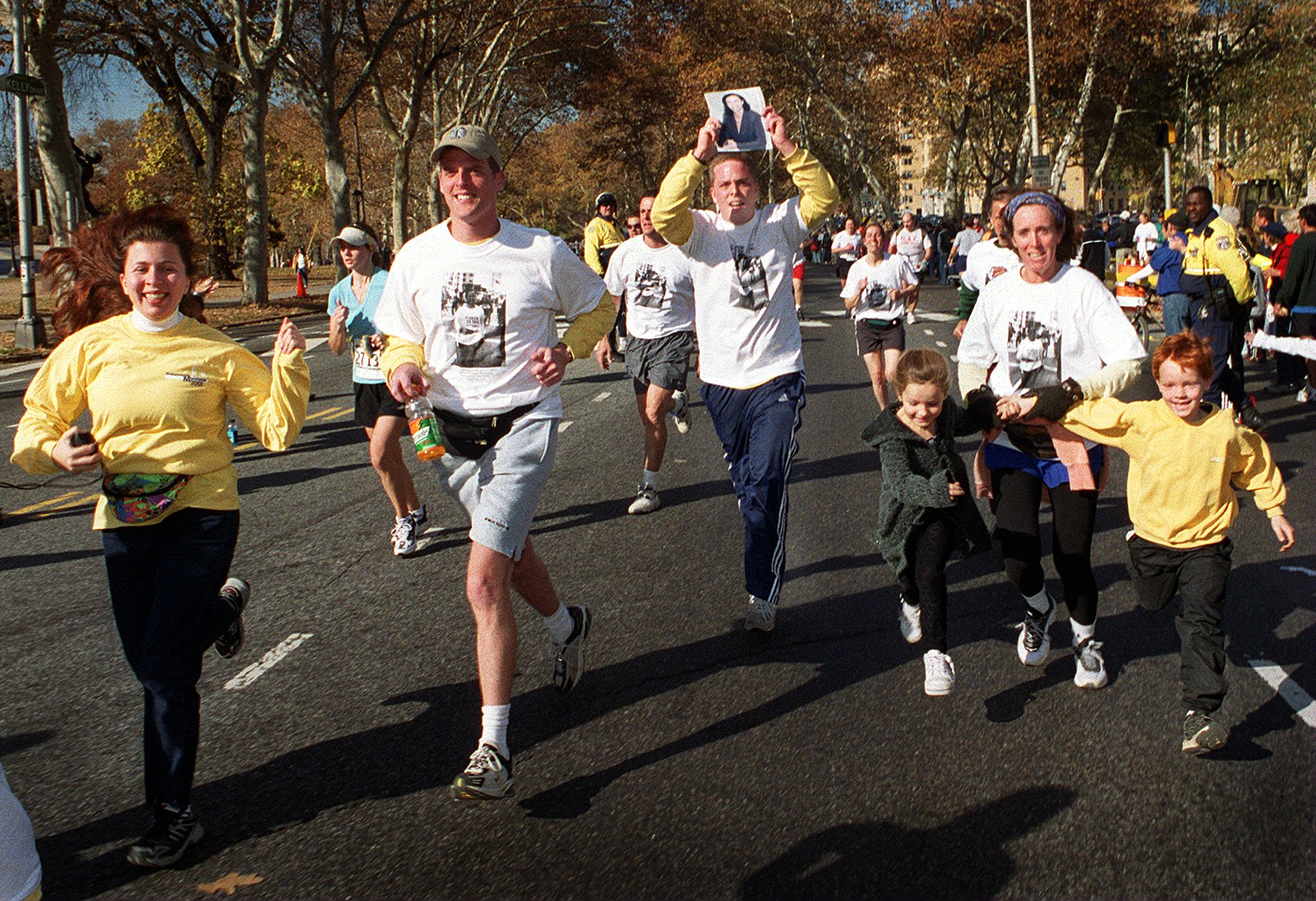
John Sigmund (center) holds a picture of his sister, Johanna, as he and his family run down Kelly Drive toward the finish line of the Philadelphia Marathon in November 2001.d
“Johanna, help me,” he said to himself while overlooking ground zero. “I need to get it together.”
‘Beyond coincidence’
John calmed down and carried on. After the event, he met friends at a nearby bar. John was telling them about the run-in with the street hustler when he suddenly saw Johanna’s old boyfriend, Joe Bonavita, across the bar.
Joe had moved to New Orleans but, in a twist of fate, was in town for a 9/11 event. The two were not close but quickly bonded. John viewed the reunion as his sister’s handiwork.
“Some things are beyond coincidence,” he said.
Eventually, John did move to New York. The city helped him better find himself. After years of worrying about disappointing his parents or adding to their suffering, John told them he was gay. His parents, who have a deep Catholic faith, were supportive.
Twelve years ago, John returned to Philadelphia and fell in love with the city, and especially Fairmount Park.
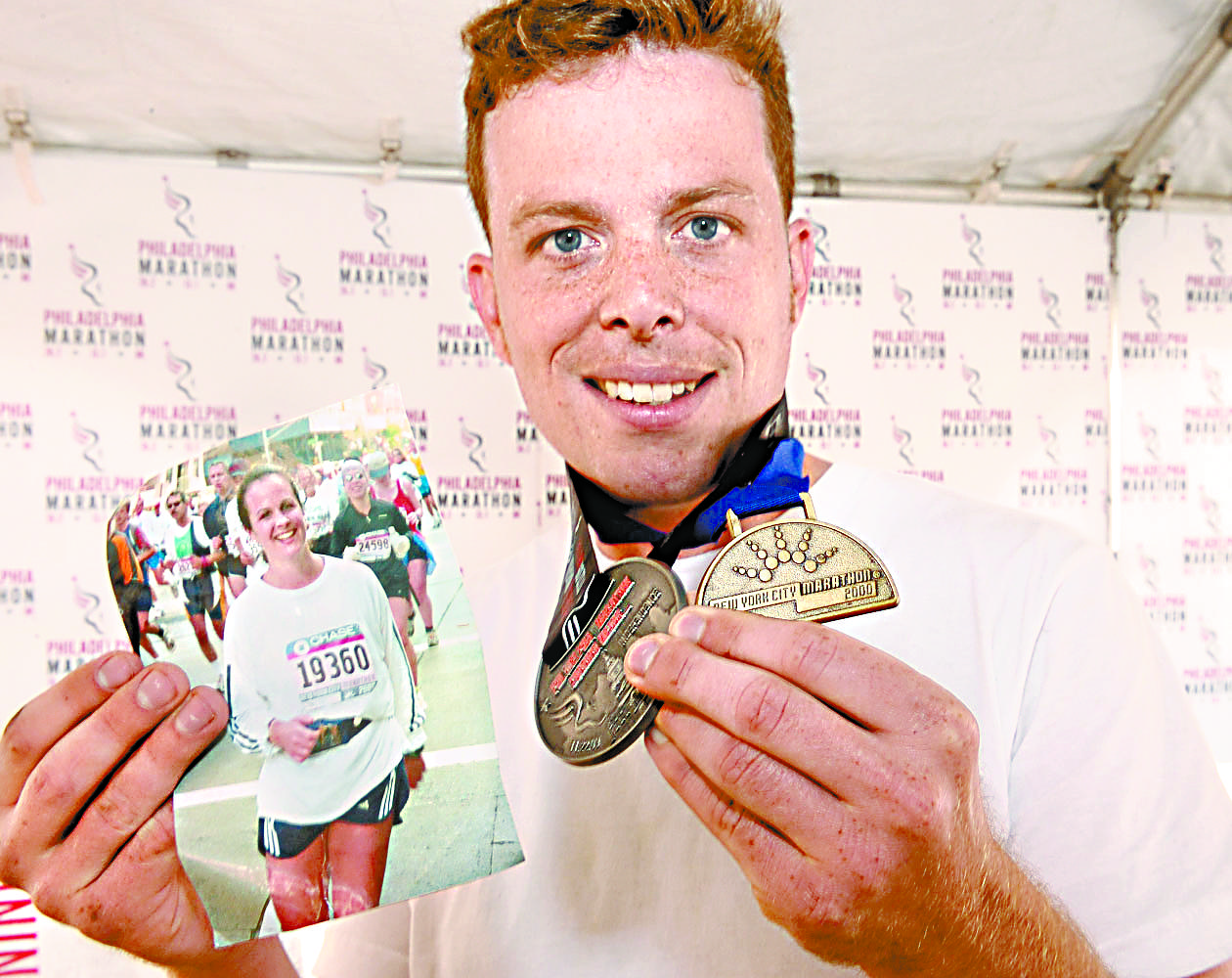
After running the Philadelphia Marathon in November 2001, John Sigmund holds a photo of his sister, Johanna, and wears two medals around his neck — one he earned after finishing the race and another his sister won after completing the New York City Marathon in November 2000.Courtesy of Tony Webb / Office of the City Representative
But tragedy struck again in September. Three days after the 20th anniversary of 9/11, his father died.
For John, September remains the cruelest month. But he credits a strong support network of cousins and friends for helping him navigate life’s challenges — and added that Johanna always feels close by.
“I have a thing with the wind,” John said. “When I think about her, the wind will kick up.”
After losing his sister and father in September, John and his partner, Jaime, decided to add some positivity to the month. They got married last Sept. 26 and are planning an anniversary party in a couple of weeks.
As we remember the tragedy of the 9/11 attacks 25 years ago, standing united on the principles of justice remains as vital today as it has been for the past 25 years. With the spread of misinformation, fearmongering, and political polarization, it has unfortunately become far too easy to focus on our differences and forget the struggles shared by all our fellow Americans. We are witnessing countless innocent lives lost around the world — each one reminding us of the devastating consequences of war.
As an Ahmadi Muslim American, it is my duty not only to condemn those who twist religion for their own political gain, but to stand up for all those whose rights are being usurped and attacked, be it a Muslim or non-Muslim alike. In his Farewell Sermon, the Holy Prophet Muhammad (may the peace and blessings of God be upon him) said, “Hurt no one so that no one may hurt you,” reaffirming the importance of all human life. In this crucial time when the most vulnerable among us are under attack, let us reaffirm our nation’s commitment to justice for all.
Ataul Wadood Bhatti, Philadelphia
. . .
I was getting ready to head to Northeast Philadelphia to photograph a story for The Inquirer, where I had been a staff photojournalist since 1993. With a cup of coffee in hand, I remember being somewhere between the kitchen and the living room when the phone rang.
The calm, distinct voice of Berford Gammon, assignment editor at the newspaper, came through at 8:55 that morning.
“I want you to head to New York,” he said.
“What’s going on?” I asked.
“Turn on your TV.”
I clicked on the remote, and a picture of smoke billowing from a tower of the World Trade Center framed against the background of a deep blue, cloudless New York skyline filled the screen. My eyes locked onto the grainy image as my wife stood close.
I remember saying, “What a tragic accident,” thinking a small plane probably had navigated off course. That thought vanished as quickly as it arrived at 9:03 a.m., when United Airlines Flight 175 slammed into the World Trade Center’s south tower. The morning talk shows quickly abandoned their banter as the unsettling words of terrorism, attacks, and deliberate filled the airwaves.
I grabbed my cameras and stepped out into the cool 60-degree morning.
I stopped briefly in the newsroom to pick up extra equipment. Small groups of people were gathered around television sets as American Airlines Flight 11 was identified as the first plane to hit the north tower.
I heard reports that hijackers had crashed American Airlines Flight 77 into the western facade of the Pentagon in Washington, D.C., at 9:37 a.m. Stunned, I instantly thought of Pearl Harbor and my father, who had told me what it was like on the morning of Dec. 7, 1941.
As I headed to New York, a report of a fourth plane, United Airlines Flight 93, had crashed at 10:07 a.m. into a field in Shanksville, Pa., with 40 passengers and crew on board.
As I pulled off the New Jersey Turnpike to take photographs, a changed New York skyline missing its twin vertical icons filled the viewfinder. It was hard to imagine the lives lost and the damage done.
The north tower burned for about 102 minutes and then collapsed. The south tower burned for almost an hour and then imploded. In the attacks on Sept. 11, nearly 3,000 lives were lost, and 10,000 people were treated for injuries.
I stayed in New York for the next seven days working with reporters from the paper and photographing what followed an unthinkable event.
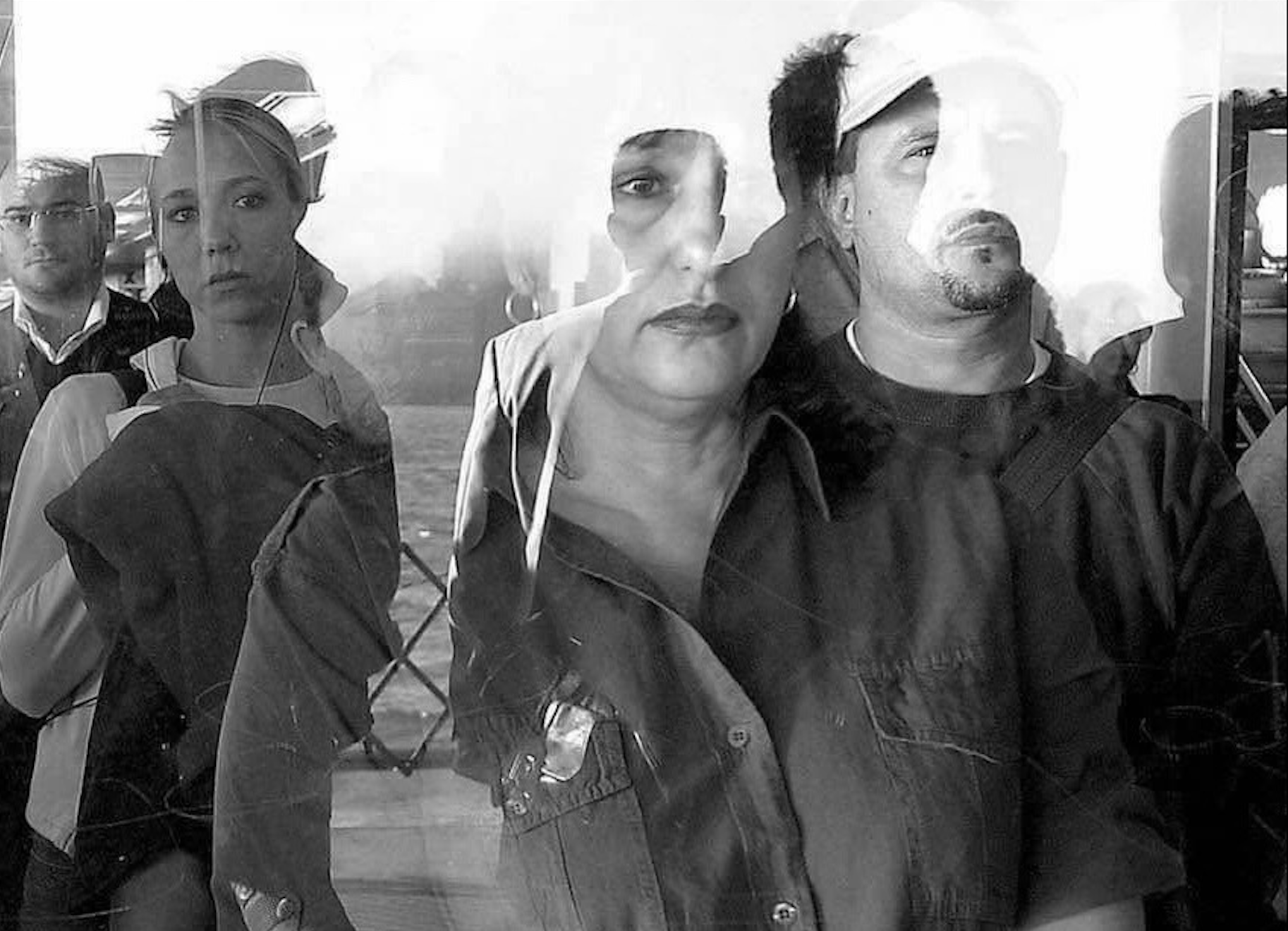
On Sept. 17, I caught a ferry from Staten Island with people heading back to the southern tip of Manhattan for the first time since the attacks. The mood was somber. Two men spoke a couple of sentences. Most passengers were silent for the 25-minute ride.
The world was a different place.
Peter Tobia,Philadelphia
The writer is a former visual journalist at The Inquirer.
. . .
Twenty-five years after 9/11, America needs to remember what once held us together.
For two weeks after the attacks, we opened the doors of our church in New York City every night. People came to pray, share their stories, search for information about friends and family members, and grieve. Some simply needed somewhere to sit with other people who understood what they were experiencing. The church was packed.
Those who did not live through those days in New York may not fully understand how quiet the city became. Manhattan was virtually cut off. Cell service was extremely limited. The normal machinery of everyday life simply stopped; fighter jets flew overhead. Smoke continued to rise from Lower Manhattan, and everywhere there were reminders that our city and our nation had been attacked.
Yet, amid the fear and devastation, something remarkable happened. We came together.
New Yorkers, famous for their impatience, became more patient. Strangers talked, and people helped each other. Churches filled. First responders ran toward danger while thousands of ordinary citizens searched for ways to serve. Political labels suddenly seemed less important. Race, class, neighborhood, and status became secondary to something larger. We knew we were together. We were New Yorkers, but more importantly, we were Americans.
As we mark the 25th anniversary of Sept. 11, I find myself wondering what happened to that spirit, not the fear or grief of that terrible day, but the unity that followed it. We don’t need another attack to remind us that there are things more important than our political parties, ideological tribes, and personal ambitions. But somehow that spirit must be recovered. America needs a new breed of patriotism — a mature patriotism that rises above personalities and political parties, allows honest disagreement, and acknowledges America’s failures while remaining committed to its promise and founding ideals.
Differences and debate are not the problem; they are essential to a free society. Americans will disagree about taxes and spending, immigration, education, the size and role of government, and a host of other issues. What concerns me is that disagreement has increasingly been replaced by distrust, contempt, and even hatred.
We no longer simply believe the other side is wrong. Too often we assume they are evil, stupid, un-American, or determined to destroy the country. Once we reach that point, compromise becomes impossible, friendships across political lines become suspect, and winning becomes more important than the principles we supposedly want our politicians to defend.
Michel J. Faulkner, Philadelphia
. . .
In the autumn of my mother’s sixth grade school year, an enemy of this country attacked Pearl Harbor and sent the world she knew into a spiral.
In the autumn of my sixth grade year, an enemy of democracy assassinated President John F. Kennedy and filled the world of my generation with sadness, anger, anxiety, and apprehension.
In the autumn of my daughter’s sixth grade year, an enemy of freedom used planes as missiles on Sept. 11, and the shockwaves from their attacks rippled across her small world — spilling into Girl Scout meetings and coursing over sidewalk playdates.
In each of those instances, the message being sent to each child was that the normal, the dependable, and the safe could be shaken — because there “were no innocent people.”
My mother got through it, I got through it, and my children have, too — with each of us carrying our own “I remember what it felt like when it happened” moment.
I have a 5-year-old grandson. Can’t help but wonder what will happen when he hits sixth grade. Or, in this accelerated world, sooner.
Keith Mason, Cinnaminson
Join the conversation: Send letters to letters@inquirer.com. Limit length to 150 words and include home address and day and evening phone number. Letters run in The Inquirer six days a week on the editorial pages and online.
On Sept. 11, 1990, President George H.W. Bush gave a speech to a joint session of Congress with his vision for a “New World Order.” He promised that instead of the spheres of influence and deadly competition that had dominated international politics, there would now be a future where “the rule of law supplants the rule of the jungle.”
For a while, it seemed like this could be true. War and conflict did not end in the 1990s, but peace seemed plausible.
A United Nations-sanctioned coalition pushed Saddam Hussein out of Kuwait. Israeli and Palestinian leaders signed the Oslo Accords, which promised a shared future of two states for two peoples. Genocidal leaders in Rwanda and Serbia were removed from power. Even the Irish conflict, famously “800 years” old, was ended with the Good Friday Agreement.
The United States reigned as the world’s sole superpower, and the next strongest militaries and economies mostly belonged to our allies. The Pax Americana seemed to have reached an unassailable zenith.
Then it all came crashing down.
When the planes hit the World Trade Center towers on Sept. 11, 2001, most of us did not realize it was the first step in the dismantling of the world we knew. I certainly did not. After all, I was only 12 years old.
My seventh-grade classmates and I initially had no idea what had happened. We knew that our teachers were upset, and we caught a glimpse of maneuvering warships on the faculty lounge TV. The next thing we knew, we were being told to head home. For me, that meant hopping on SEPTA’s 67 bus. My younger brother and I watched news coverage of the devastation from our living room couch.
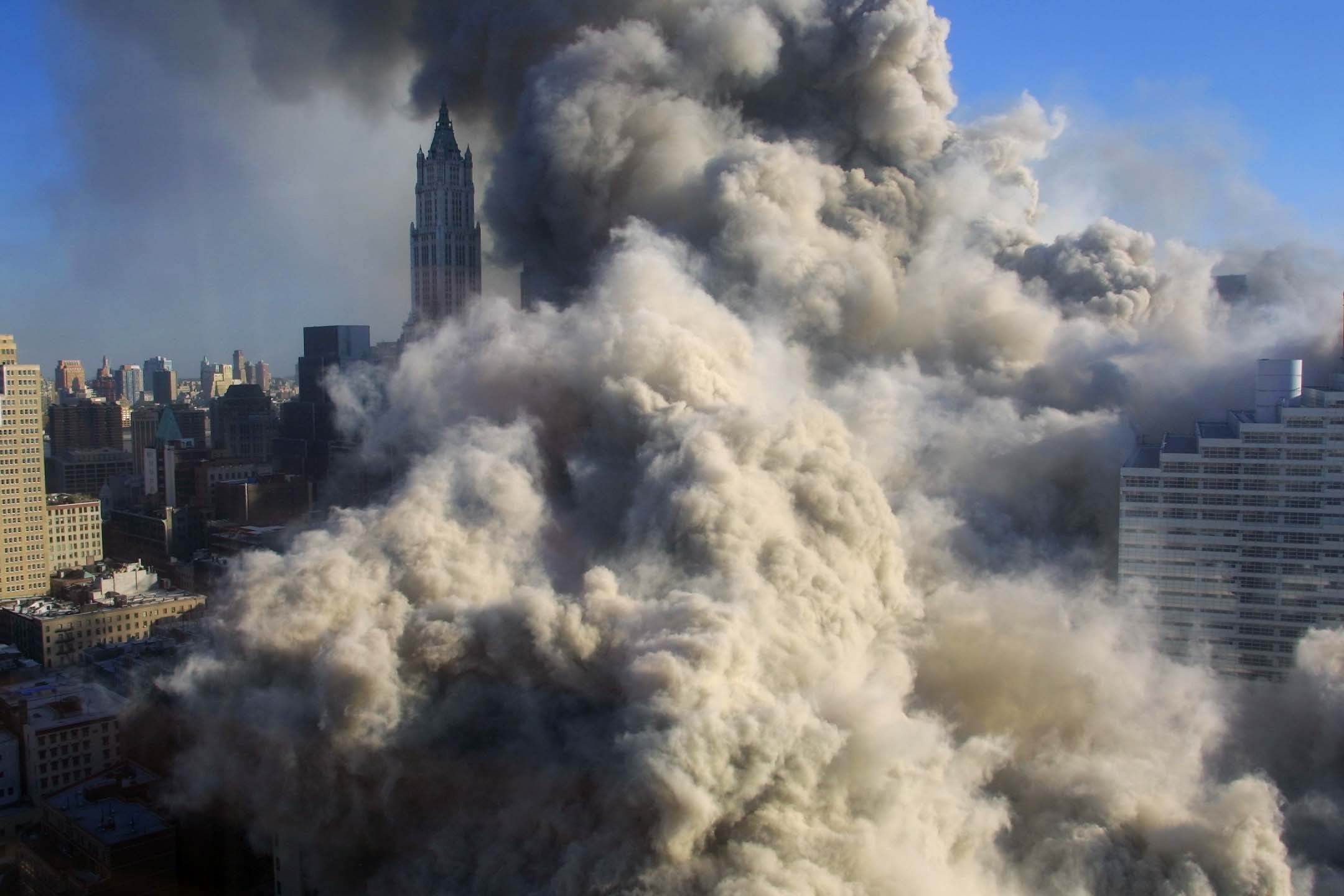
Smoke rises from the collapse of the World Trade Center buildings, seen from the west and framing the Woolworth Building in the distance, in Manhattan on Sept. 11, 2001.TING-LI WANG
At first, the attacks seemed to make the country stronger. We heard the inspiring story of the passengers who fought back on United 93, their plane crashing into a Pennsylvania field instead of its intended Washington target. When President George W. Bush threw out the first pitch at Yankee Stadium on Oct. 30 during the World Series, it felt like everyone was cheering him on, Republican or Democrat, Yankees fan or not. When he delivered a strike despite wearing a bulletproof vest under his pullover, it seemed like a promise that everything would get back to normal.
Much of what went wrong can be traced to our initial efforts to avenge the dead.
When the U.S.-led international coalition invaded Afghanistan in October 2001 to destroy al-Qaeda and bring its leader, Osama bin Laden, to justice, it seemed like a moral and strategic necessity. In March 2003, the Bush administration expanded the war on terror to Iraq under dubious claims of the existence of weapons of mass destruction. A year later, as the justification for the war was falling apart, revelations of brutal torture at Abu Ghraib prison in Iraq destroyed what little credibility and international goodwill Bush had left.
The reaction to 9/11 itself also presaged what was to come. While most Americans rallied to the flag after the attacks, a persistent subculture insisted they were faked in some way. The so-called 9/11 Truth Movement may have been a collection of cranky conspiracy theorists, but they represented a model for where America was heading — a time when people increasingly cannot agree on basic facts and no longer inhabit a shared reality.
President George W. Bush speaks aboard the aircraft carrier USS Abraham Lincoln off the California coast on May 1, 2003.J. Scott Applewhite
It isn’t just failures abroad that have fostered this sense of cynicism. In the ’90s, there was a great spirit of optimism about new technologies. The internet was heralded as a way to break down barriers and foster international cooperation. Initially, this also seemed to be true.
On message boards, once-lonely hobbyists found one another, sharing knowledge about topics as disparate as model trains, hiking, or fashion. Even fierce political opponents like Bill Clinton and Newt Gingrich could agree on letting the internet mostly regulate itself.
Today, 41% of Americans report having little to no confidence in tech companies. Instead of democratizing access to information, social media has flooded the zone with nonsense. Online ad revenue is reaped by tech companies while content providers fight over the scraps. Many local newspapers, their economic model upended, have either disappeared or been hollowed out. More and more, people are getting their news from short-form video apps like TikTok or Instagram, or from influencers who rarely cite their sources or explore the nuance behind any issue. The public’s distrust of Big Tech has somehow not spread to the figures the companies’ algorithms have pushed to the forefront.
The 2008 financial crisis also took a toll. Americans have disagreed over just about everything in our history, but the wave of foreclosures, stagnation in wages, and continued affluence for the country’s wealthiest sapped the public’s faith in the American dream. During the Great Depression, some wealthy figures like Charles Schwab and the Vanderbilts saw their fortunes shrink. During the Great Recession, the big banks received a $700 billion bailout, while 10 million ordinary Americans lost their homes.
Republican senators explain their opposition to President Barack Obama’s financial stimulus package during a news conference at the Capitol in January 2009.
In the 2000 election, both Democratic candidate Al Gore and Republican George W. Bush were viewed favorably by most of the American electorate. These days, a more divisive politics rules. Supporters of Donald Trump, convinced by the president that the 2020 election was stolen, stormed the U.S. Capitol. While it is true the 2000 election was itself controversial, with lawsuits about recounts in Florida ultimately reaching the U.S. Supreme Court, Gore conceded “for the sake of our unity as a people and the strength of our democracy.” Both Gore and President Bill Clinton attended Bush’s inauguration.
Of course, given the failures of the last 25 years, that establishment deserves to be questioned. The mainstream leaders of both parties share responsibility for the erosion in public confidence. Not only have they failed to anticipate the challenges of the 21st century, but their relentless partisanship has also made crafting sustainable solutions impossible. Nor have they offered new ideas that can compete with pledges to put every American on Medicare or claims that all our problems will disappear if we simply deport enough people.
That doesn’t mean the next 25 years can’t be better.
The beautiful thing about government of the people, for the people, and by the people is that we are in control. Just as our predecessors freed themselves from British rule, destroyed the power of slave holders that was corrupting our republic, reined in Gilded Age trusts, defeated fascism, and marched to finally make good on our nation’s stated belief that all men are created equal, those of us charged with the rights and responsibilities of citizenship today can also change our nation for the better. We must.
Even as the Russian invasion of Ukraine drags toward year five, radical Israeli settlers seize land meant for a Palestinian state, and our nation divides itself over every ginned-up bit of culture war ephemera, we retain the same qualities that made us the world’s hegemon in the first place — ingenuity, openness to risk, and drive.
Like the brave passengers on United Airlines Flight 93, we must recognize our predicament, find our resolve, and fight to ensure terror doesn’t win.
SCHUYLKILL HAVEN, Pa. — Brett Sell had a bad feeling about coming to work on July 28. The painting contractor was part of a small work crew rehabbing a two-story commercial property in Orwigsburg — a borough of just over 3,000 people in the heart of east-central Pennsylvania’s coal country — and workers had seen what looked like an unmarked law enforcement vehicle circling the site the day before.
“Yo, look up!” Sell said to his fellow painter, Orlando Rivera.
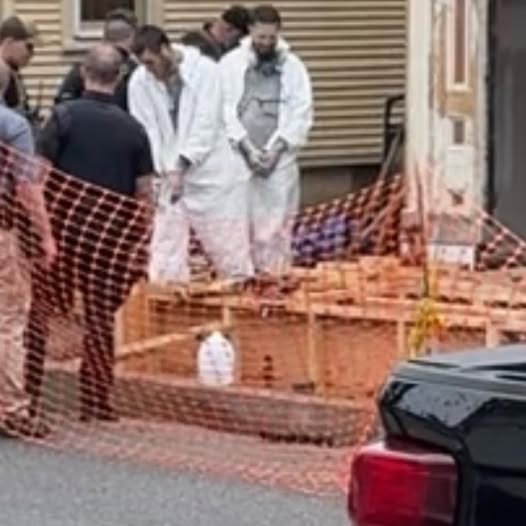
Police cars from Orwigsburg and neighboring Schuylkill Haven, lights flashing, blocked off the street while agents from U.S. Immigration and Customs Enforcement in tactical vests swarmed the work site. Sell was stunned as he and four other workers were quickly handcuffed by ICE agents — even though Sell and Rivera are native-born U.S. citizens.
Rivera, a biracial Puerto Rican who grew up in Bethlehem and now lives in another Schuylkill County borough, Tamaqua, said he was “embarrassed” as he stood in handcuffs while locals came out into the street to gawk. “I do a lot of work in that town,” he said, adding that “it made me feel like I was portrayed as a criminal.”
And he’s convinced he was handcuffed — even after offering to show the agents his ID — because of his race. “I get that my skin tone is tan,” he said, “but with the Fourth Amendment, they can’t go off my skin color, you know?”
Two workers were detained. One was later released, but the other — Catarino Hernandez Velasquez — a Mexican native who’s lived in Pottsville for at least 14 years, and a well-known contractor who poured concrete for the just-reopened 1928 Miners Hotel — was taken away and sent to ICE’s Moshannon Valley Detention Center in Central Pennsylvania, known for its overcrowding and complaints about lousy food and medical neglect. Kevin Medina, a leader of the local Latino community, bemoaned the arrest of a “very hardworking gentleman with a stable contracting business in the area … very busy.”
Now, gone … in a matter of minutes.
Painting contractors Brett Sell (left, white painting outfit) and Orlando Rivera are handcuffed during an ICE raid on a job site in Orwigsburg, Pa., on July 28. The men — both native-born U.S. citizens — were released without charges.Facebook
The Orwigsburg raid was a dramatic moment, yet such scenes are becoming increasingly common this summer in Schuylkill County, Pa., a constellation of rusty boroughs where coal was king in the 20th century, and Donald Trump got 71% of the vote in 2024.
‘In Schuylkill Haven, they can’t go there’
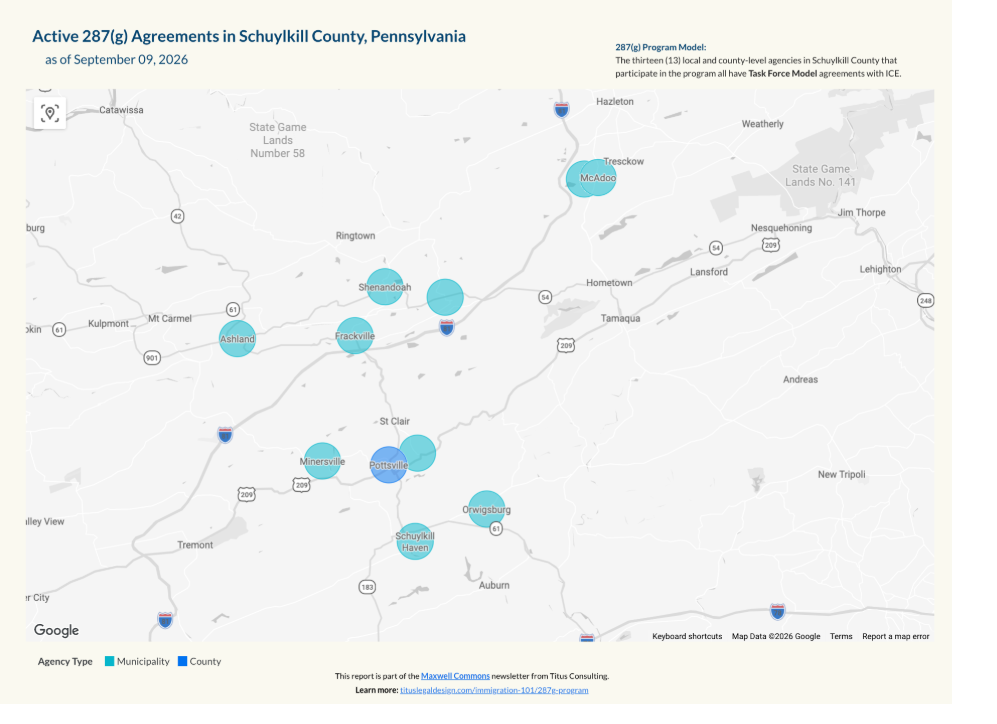
Since the start of the year, ICE — flush with a whopping windfall of $170 billion shoveled by Congress to the U.S. Department of Homeland Security to amp up immigration raids and detention — has dangled pledges to many tiny police departments. In Schuylkill County, which locals call “the Skook,” more than $1.5 million has been distributed to law enforcement. The police chief and pols all but publicly salivated at the chance — under the controversial program known as 287(g) — to buy a desperately needed new cruiser or other cop tools in return for working with ICE to arrest and hold local immigrants for the feds.
Some 14 law enforcement agencies — the most of any of Pennsylvania’s 67 counties — have inked 287(g) pacts with ICE, launching a new era of beat cops making immigration arrests that has roiled daily life in Schuylkill County. Practically overnight, cops were setting up truck inspections on a busy rural bypass or running checkpoints at places like the Freeze, a popular ice cream joint on the main drag, Route61. Officers were pouncing on immigrants who showed up at the county courthouse in Pottsville, or assisting ICE on workplace raids like the one in Orwigsburg.
Arrests leading to ICE detention and deportation cases skyrocketed across Schuylkill County — more than 100 since the start of the year, with most the result of ICE cooperation under 287(g) — leaving families torn apart while creating a climate of fear among what had been a rapidly growing Latino community in and around Pottsville. Suddenly, essential workers or their loved ones grew terrified that a busted taillight or failing to signal while shifting lanes could turn their world upside down.
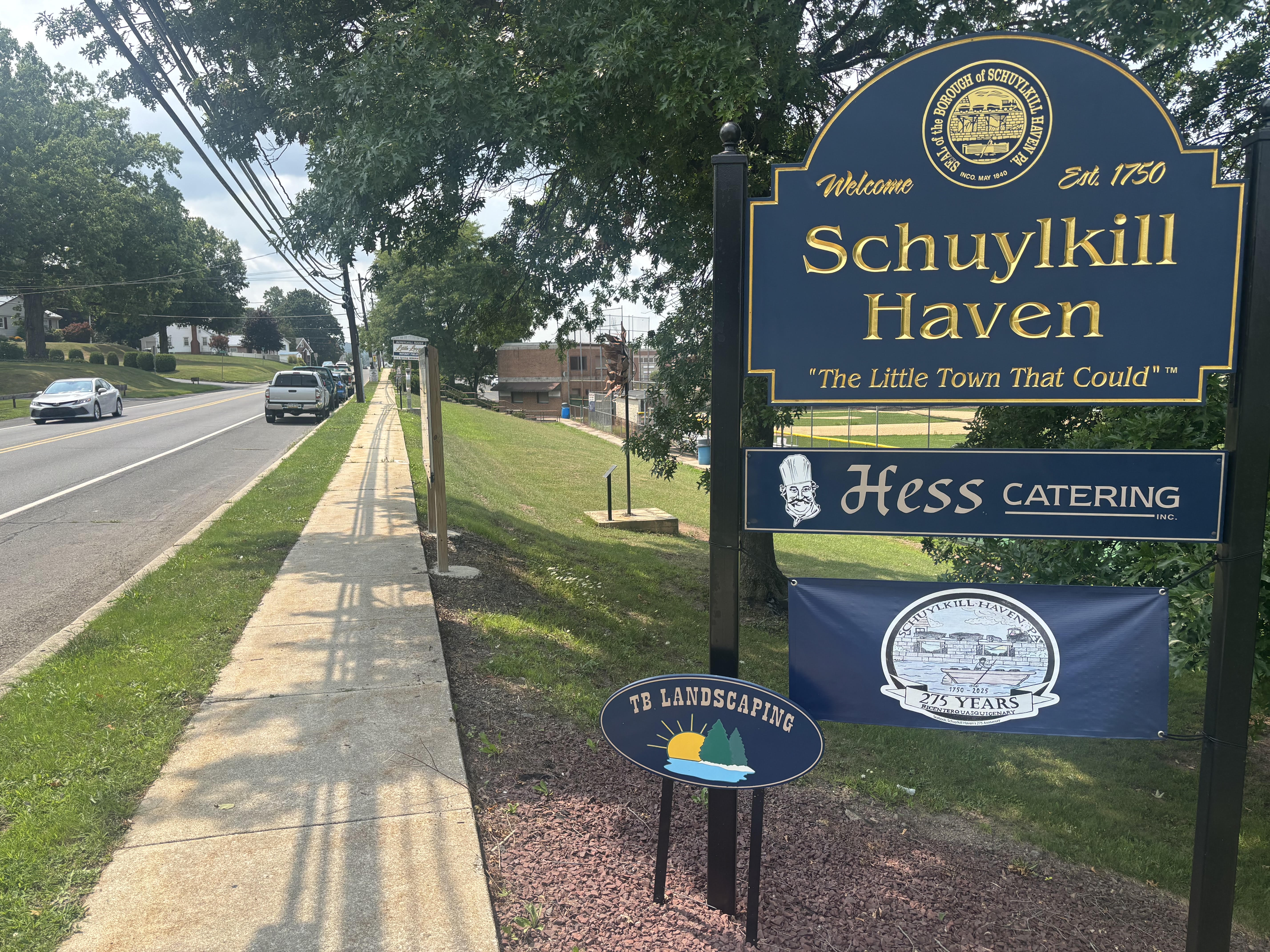
One borough with just over 5,000 residents — Schuylkill Haven — has seen at least 59 immigration arrests in about four months, a staggering number. The figures come from Chicago-based ICE watcher Andrew Thrasher, a law-firm staffer and data expert who regularly crunches federal statistics obtained by the Deportation Data Project through Freedom of Information Act (FOIA) requests.
“People are afraid to go out,” Medina — who immigrated to Schuylkill County from Honduras, became a U.S. citizen and a notary and insurance agent, and formed a local Latino support group, Puentes de Apoyo — told me when we met in a Hispanic-owned Pottsville pizza joint. “I’ve got one contractor who told me they’ve got to change routes because now they know that in Schuylkill Haven, even they can’t go over there. And the stress, mentally, that I’m seeing in these families of, ‘What am I goingto do if this happens?’”
A map, provided by immigration statistics expert Andrew Thrasher, showing 13 current Schuylkill County localities that have signed 287(g) cooperation agreements with ICE. A 14th, Mahanoy Township, is inactive.Andrew Thrasher
The wave of arrests has put Schuylkill County — mostly rural, mostly conservative, and far removed from the glare of media or the kind of organized ICE resistance you see in big cities — on the cutting edge of an aggressive new strategy for mass deportation. This approach is bringing a xenophobic Donald Trump regime closer to fulfilling its once-unthinkable goal of removing one million immigrants from the United States every year.
Trump Country embraces 287(g)
The tag team of local cops and tactical-gear-wearing ICE agents is the biggest reason why federal immigration arrests spiked in July to a Trump-era high of 49,571, or about 1,600 every day. Statisticians who are tracking mass deportation said that 287(g) arrests — named for the section of a 1996 law that authorized the program — involving local police went from less than 3% of the total under Joe Biden to about 15% now, and will only climb higher as hundreds of new departments sign up.
This year, about 58% of the people nabbed by cops and turned over to ICE under 287(g) have no criminal record or pending charges, a higher rate than the typical ICE arrestee. Thrasher found the number for Pennsylvania is even higher, about 70%.
While not as numerous as inbig and heavily conservative states like Texas and Florida, the Keystone State’s 1,216 arrests under the 287(g) program in the first seven months of 2026 rank the commonwealth fourth in the nation — on a Top 15 list made upof states almost exclusively south of the Mason-Dixon Line.
Pennsylvania’s outlier status is punctuated by the fact that two large bordering states — New York and Maryland — have moved, with some bumps, to ban their police agencies from signing 287(g) agreements. Almost all of the Pennsylvania arrests came from smaller cities, exurbs, or rural areas — especially the south-central and northeastern regions of the state, and a smattering of western localities — that voted heavily for Trump and his anti-immigrant message.
The small-town nature of this renewed push for mass deportation is a defining feature of the Trump regime strategy, and not a bug. The race among Schuylkill County’s police departments — many with just three or four cops, including the chief — to sign up for 287(g) and its pumped-up pile of cash came exactly as the two Minneapolis murders of U.S. citizens by immigration cops were fueling growing public outrage.
As a brutal ICE winter ended, the Trump regime ousted Homeland Security Secretary Kristi Noem and the notorious field general Greg Bovino, and ended an era of loud, publicity-seeking operations with catchy names in large blue cities that stirred up local protesters who blew whistles and filmed every move by the masked, armed agents.
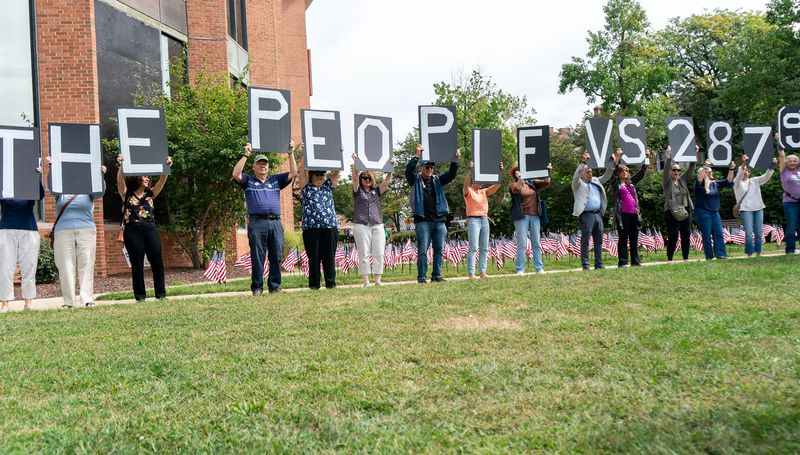
Immigrants’ rights advocacy group members and their supporters hold up letters that read “The people vs 287(g)” during a rally last September in Doylestown against the Bucks County sheriff’s efforts to implement a 287(g) program.Daniella Heminghaus | Bucks Coun
Under new DHS boss Markwayne Mullin, ICE and its allies are focused on what you might call small-batch immigration busts — in courthouses or on airport security lines, and thanks to 287(g), at local traffic stops or truck inspections. No one is blowing whistles, and few of these busts get caught on video. Yet, even here in blood-red Trump Country, some locals are troubled by the intense police focus on immigrants and what it’s doing to the moral fabric of their community.
‘Arrest them like the Gestapo’
“No one’s telling you not to arrest people — I’m telling you not to hunt for them, to do stops on the side of the road and arrest them like the Gestapo,” a Democratic city council member in Pottsville, Andy Wollyung, told me after he tried and failed to stop the county seat from joining 287(g). He later fretted that immigration arrests “will drive a wedge in people, you know? These aren’t unknown people. These are our neighbors.”
“When local police officers serve as a force multiplier for ICE, we know that people become more afraid to report crime,” Nayna Gupta, policy director at the American Immigration Council, told me. “They become less willing to cooperate with local law enforcement when it comes to investigations, including things like homicides. And there’s an overall mistrust of public institutions.”
The irony is that today’s Schuylkill County was built on the backs of immigrants — initially a wave of Irish who dug the 19th-century coal mines and were also persecuted, including six members of the infamous Molly Maguires who were hanged in Pottsville in 1877. They were followed by Eastern Europeans who filled the local mining towns like Mahanoy City and Shenandoah.
Those who stayed behind after the mines started closing in the 1950s and kept its hillside towns of striking Victorian architecture and utilitarian rowhouses alive got a booster shot in the 21st century with an unexpected new wave: Latinos. Many landed in Schuylkill County when seeking a place with cheaper housing and more job opportunities for hard workers than big cities like New York or Philadelphia.
Schuylkill Haven, with a population of just over 5,000, has arrested at least 59 people and turned them over on federal immigration charges since signing a so-called 287(g) agreement with U.S. Immigration and Customs Enforcement (ICE) this spring.Will Bunch
Four years ago, Pastor Luis Rivera and his wife bought a historic local church building in Pottsville and rechristened it as Iglesia Cristiana El Kairos, under the umbrella of the Evangelical New Life Church, to serve a Latino community now growing by leaps and bounds.
“You see a lot of traffic,” the pastor told me. “You see people remodeling more houses. And a lot of the stores are opening around here … It was really dead before, you know?” Today, it’s estimated that about 1,000 of Pottsville’s 14,000 residents are Latino.
A ‘stable’ life is upended
Six of the more recent arrivals were Venezuelan-born Carlos Moreno, his wife, Wendy Martínez, and their blended family of four teenagers. They’d been on the run from government persecution and armed conflict across South America when they came to America in 2023, and stayed in a cramped public shelter in New York City as the family sought asylum and obtained work permits.
When they moved to a narrow rowhouse on a rugged patch of Norwegian Street on the steep hillside up from downtown Pottsville, the couple found jobs at the county’s large Amazon warehouse and even started a small cleaning business, even though Moreno, 37, is legally blind and has severe hearing problems.
“For the first time in years, it felt like our lives were finally becoming stable,” Martínez would later write. “Then, in the fall of 2025, we learned that I was pregnant. It was an unexpected surprise, but a very welcome one.”
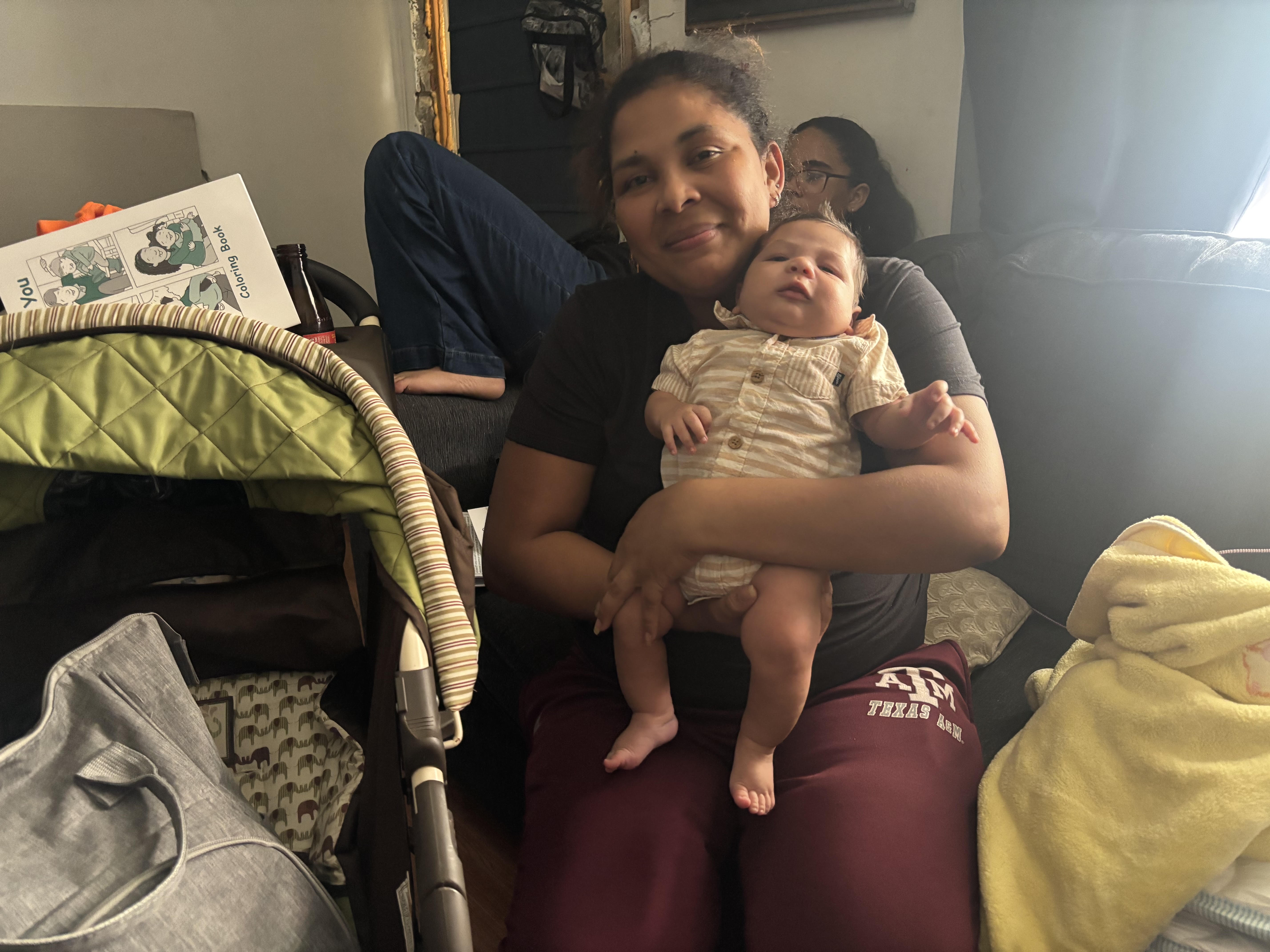
Wendy Martínez, whose husband, Carlos Moreno, a Venezuelan refugee, has been detained by immigration authorities since May after losing a misdemeanor noise complaint at the Schuylkill County Courthouse. She is holding her baby Noah, who was roughly 6 weeks old.Will Bunch
A bigger and less welcome surprise awaited. This spring, a neighbor called police to complain about noise —music from a small boom box — and Moreno received a summons. He decided to challenge it at the Schuylkill County Courthouse a few blocks away, and when he lost, he paid a fine, walked out of the courtroom — and right into ICE agents waiting to arrest him. He was sent to detention in the Cambria County Jail and stayed there as massive earthquakes halted deportations to Venezuela. He was locked up when his son, Noah, was born — on the Fourth of July.
Martínez was alternately rocking and bouncing her then-6-week-old son when I joined Medina in visiting their cluttered, narrow rowhouse in August. The windows were covered with thick blankets that let in only a sliver of light, and Martínez was bookended on a sofa by her two daughters, on their phones, who rarely leave home.
“They told him that he was a dangerous person,” Martínez said in Spanish, interpreted by Medina, as her baby babbled. “There hasn’t been any situation where he was against the law, or anything.” Struggling to pay her bills and support the five children, Martínez launched a GoFundMe page, but has only raised $2,695 of her $4,000 goal. Her husband was recently moved to ICE detention in Louisiana.
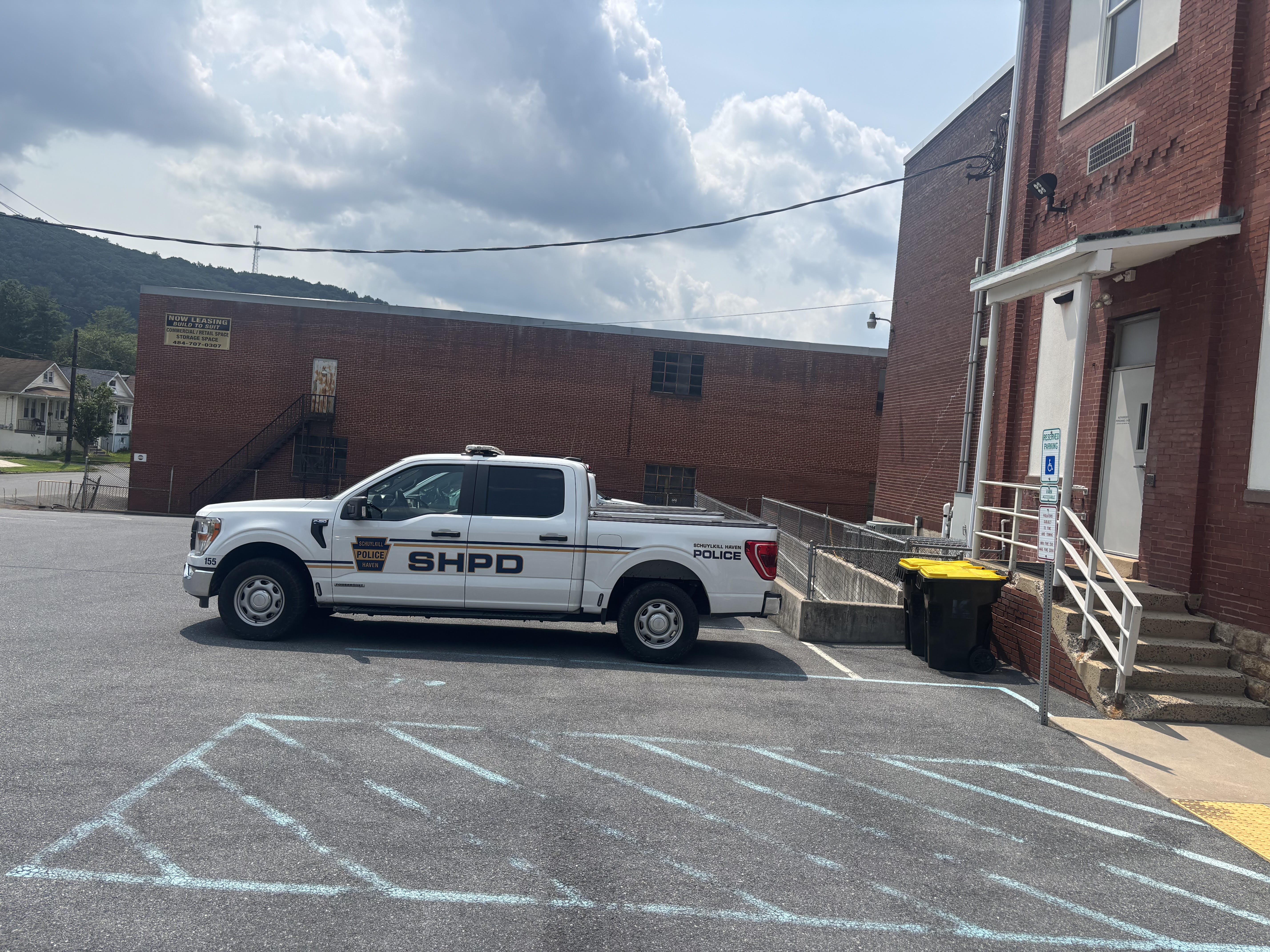
In August, Schuylkill Haven officials said they’re expecting a federal check for $152,000 — money the police department wants to spend on buying the currently leased police headquarters, pictured here.Will Bunch
Like most immigration arrests since 287(g) swept across Schuylkill County, there is an element of mystery about what exactly happened to Moreno. I twice called the Schuylkill County sheriff, Shawn Butler, to ask if his department — the first county agency to join 287(g), back in January — was involved, but he did not get back to me. Not once in a month of reporting did a police chief or municipal official return a call or email from this out-of-town columnist. Secrecy, and a lack of accountability, seems to be baked into the 287(g) program.
‘You don’t answer anything’
“Any Right-to-Know requests, any FOIA requests, anything — you defer that right down to the Department of Homeland Security,” Jody Long, the then-police chief in Mahanoy Township, told the Pottsville City Council when it was voting on a 287(g) agreement in May. “You don’t answer anything with that. That’s right from their legal team.”
In early September, I attended the bimonthly meeting of the Schuylkill Haven borough council hoping to ask Police Chief Jeffrey Walcott, Mayor John Williams, or other officials how and why their small borough just south of Pottsville had managed to make at least 59 immigration arrests since signing a 287(g) pact with ICE on April 5. I didn’t get very far.
In a brief conversation, Walcott suggested, interestingly, that commenting on 287(g) might bring protesters to Schuylkill Haven. When I asked Williams about the program after the meeting, the police chief interrupted our conversation to say there should be “a unified response,” and then later told me any information would need to come from Homeland Security or a FOIA request.
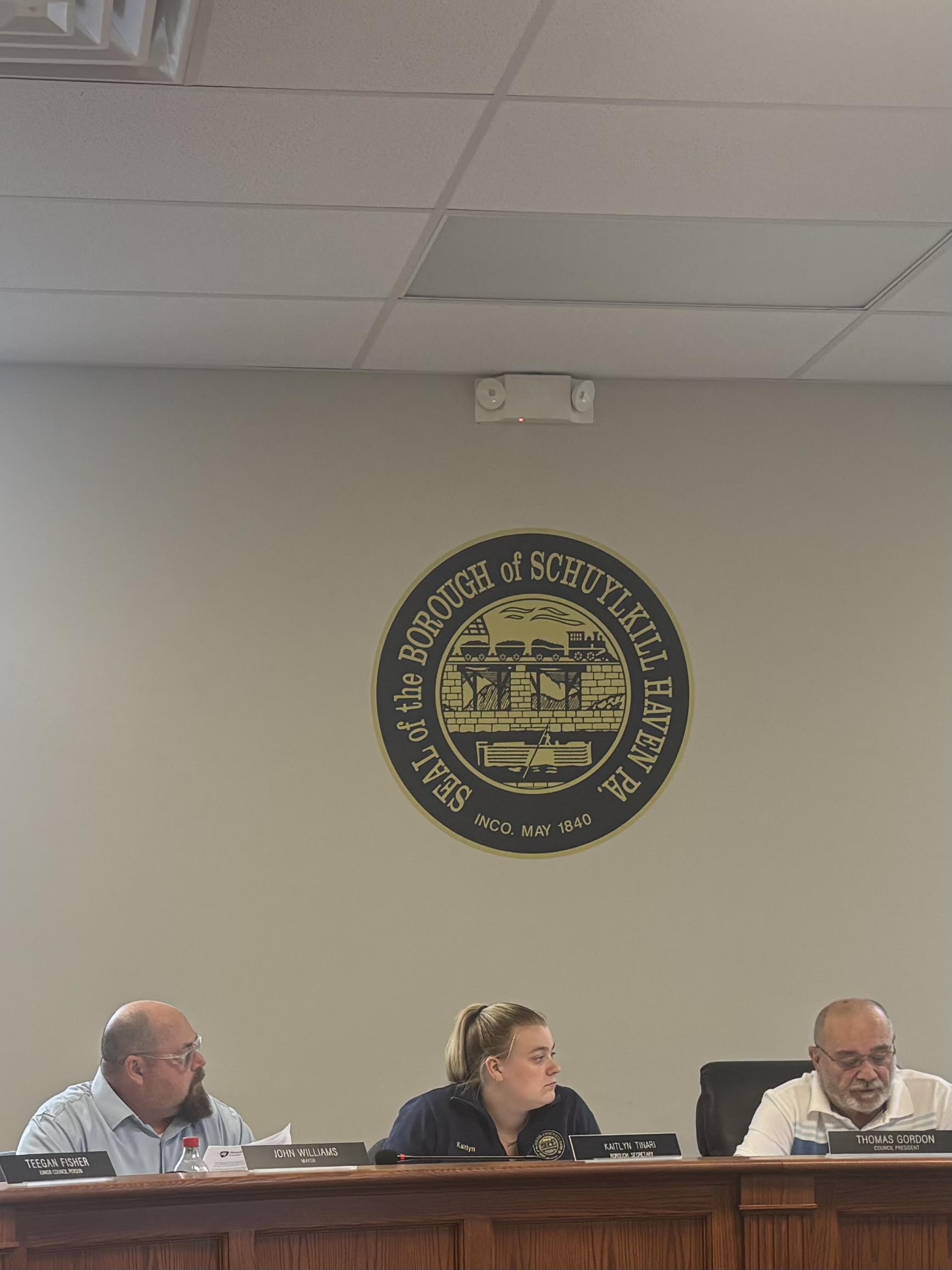
Schuylkill Haven Mayor John Williams (left) at a borough council meeting on Sept. 2. Next to him are borough secretary Kaitlyn Tinari (center) and council president Thomas Gordon (right). Williams said Schuylkill Haven’s cooperation with federal immigration enforcement is going well, but declined to elaborate.Will Bunch
Most of what citizens and the media in Schuylkill County know about the 287(g) programs comes from borough or township council meetings in which a police chief tells elected officials about all the sweeteners that cash-flush ICE added to the program when Congress and Trump enacted the so-called Big Beautiful Bill in 2025.
Police departments or county sheriffs who join the most common 287(g) Task Force model get $100,000 for vehicles or other equipment and $7,500 for each officer who undergoes 40 hours of mostly online training, as well as additional dollars for their time on immigration matters — all contingent on making actual arrests. In August, Schuylkill Haven officials said they’re expecting a federal check for $152,000 — money the borough wants to spend on buying the currently leased police headquarters.
The cash incentives have sparked a kind of deportation arms race across Pennsylvania, which has gone from just a few 287(g) programs at the start of the year to more than 130, with new ones coming online every day. Most of the council debates tread lightly on the question of liability for an officer who makes a bad arrest — a problem ICE is belatedly looking to fix with a proposal to insure each officer up to $500,000 — or the elevated risk that a traffic stop could lead to violence.
Fighting in the Schuylkill
That’s already happened. On May 20, a Schuylkill Haven cop stopped a car on Route61 after he claimed the driver had illegally dark-tinted windows. ICE agents who were in the borough and arrived at the stop ran the license of 34-year-old Yensy Rafael Santana Alvarez of New York City and determined he had an immigration removal order.
According to the Skook News, a court affidavit said the man handed over his car keys and stepped out of his car — then ran for it. Alvarez led the law officers on a wild foot chase across the Schuylkill and back, getting tased once, and allegedly pulling one officer underwater as another suffered minor injuries. He was eventually arrested, and felony charges were filed but then dropped.
Some local critics also questioned whether minimally trained cops making immigration arrests is a good idea in a county where some departments have a history of police abuses. “In northern Schuylkill County, over the last 10 years, we’ve had horrendous police … acting very unprofessional in different departments,” John Hampton, a lawyer who has worked with Mahanoy Township, told me.
A heated and emotional debate over the federal 287(g) immigration enforcement program dominated Monday night’s Pottsville Council meeting.
After initially failing in a 3-2 vote, the resolution was reopened moments later and ultimately passed following a council member changing… pic.twitter.com/kSW1QXhgqS
In 2022, two then-police officers in the borough of Minersville were indicted on still-pending federal police brutality charges for allegedly severely beating a man during a traffic stop and falsifying police reports to cover it up. That didn’t prevent ICE from signing a 287(g) agreement with Minersville police in May.
That same month, local activists pleaded with the Pottsville City Council during a meeting that lasted more than five hours not to join the 287(g) program, arguing that immigration arrests would make tourists and new businesses not want to come there. They thought they’d won in a 3-2 vote, only to have GOP council member Scott Price change his position and demand a revote that flipped the outcome, saying that, in the end, “I have to side with our police officers.”
One of the few pro-287(g) advocates who spoke at that May hearing was Mahanoy Township’s Long, who said his department had been “the leader in the county” by making 10 immigration arrests, mainly at what he called a truck-safety inspection point. “ICE does not come in and tell you what to do,” Long insisted. “We tell them what to do.”
He was joined by one of his officers, Anthony Maldonado, who cited his own heritage as a Puerto Rican to insist there is no racial profiling. “I have family members who are light-skinned, dark-skinned, everywhere in between, so I would take it very personally if we conducted ourself unprofessionally to that effect,” he said.
‘Because you look like a Mexican’
The room in Pottsville did not hear from Moe Montalvo, a gutter contractor from nearby Tamaqua who, in mid-April, passed through the checkpoint on Burma Road operated by cops from Mahanoy Township and assisted by adjacent Ryan Township officers. He said he was part of a two-truck convoy, and the first one with two white occupants was waved through, while his was stopped to allow the officers to ask Montalvo, a 28-year-old U.S. citizen who is half Puerto Rican and half Egyptian, for his ID and grill him about his identity.
Montalvo posted that day on Facebook that when he told an officer he was born in Montgomery County, the cop replied: “Are you sure? Because you look like a Mexican.” Montalvo also quoted the officer: “Why are you worried? The only thing you should be worried about is when I take my Taser out, because I’m going to aim right for your nose piercing.” I confirmed the incident with Montalvo, who told me that “it seems like there was no doubt that racial profiling was involved here.”
Weeks later, the Mahanoy Township Police Department went dark, at least temporarily, after Long, Maldonado, and its other officer all quit in a disagreement with supervisors. One of the supervisors, Republican Tony Merchlinsky, confirmed to me the entire force had resigned after a dispute with supervisors over its refusal to wear body cameras. He said it was triggered by a civilian complaint over an arrest that did not involve immigration, although he added that “it may have involved racial profiling.”
Maldonado took to Facebook to give his side of the story, saying that a different supervisor had told the township officers they were making too many arrests, and that, as quoted by Maldonado, he preferred “a [B]arney Fife department and have his police drive around and wave at people instead of making arrests.” Merchlinsky confirmed that Mahanoy Township — which recently hired a new, albeit part-time, police chief — has yet to see one dime from the feds of the more than $100,000 that was promised.
The checkpoint drama and police tensions in Mahanoy Township demonstrate some of the many problems when beat cops are drafted to join Trump’s mass deportation crusade. Are police really making their towns safer when one part of the community is taking long traffic detours and covering up their windows in terror of any contact with cops? Is the economic gloom over Pennsylvania’s fading coal country really going to be lifted by clamping down on immigrants who’d been flocking there to pour concrete and rehab old buildings?
Does a region whose very DNA is handed down by the immigrants who once came here to shovel anthracite now want to be known in the 21st century as a “show me your papers” police state?
Few of these questions are being asked as one former coal burg after another races to embrace a Trumpian bargain with the 287(g) program. The latest is Mahanoy Township’s next-door neighbor, Ryan Township, which in June voted conditionally to join the ICE mass deportation program, citing as the biggest incentive its need to replace its run-down Ford Explorer, one of the oldest police cars in Schuylkill County.
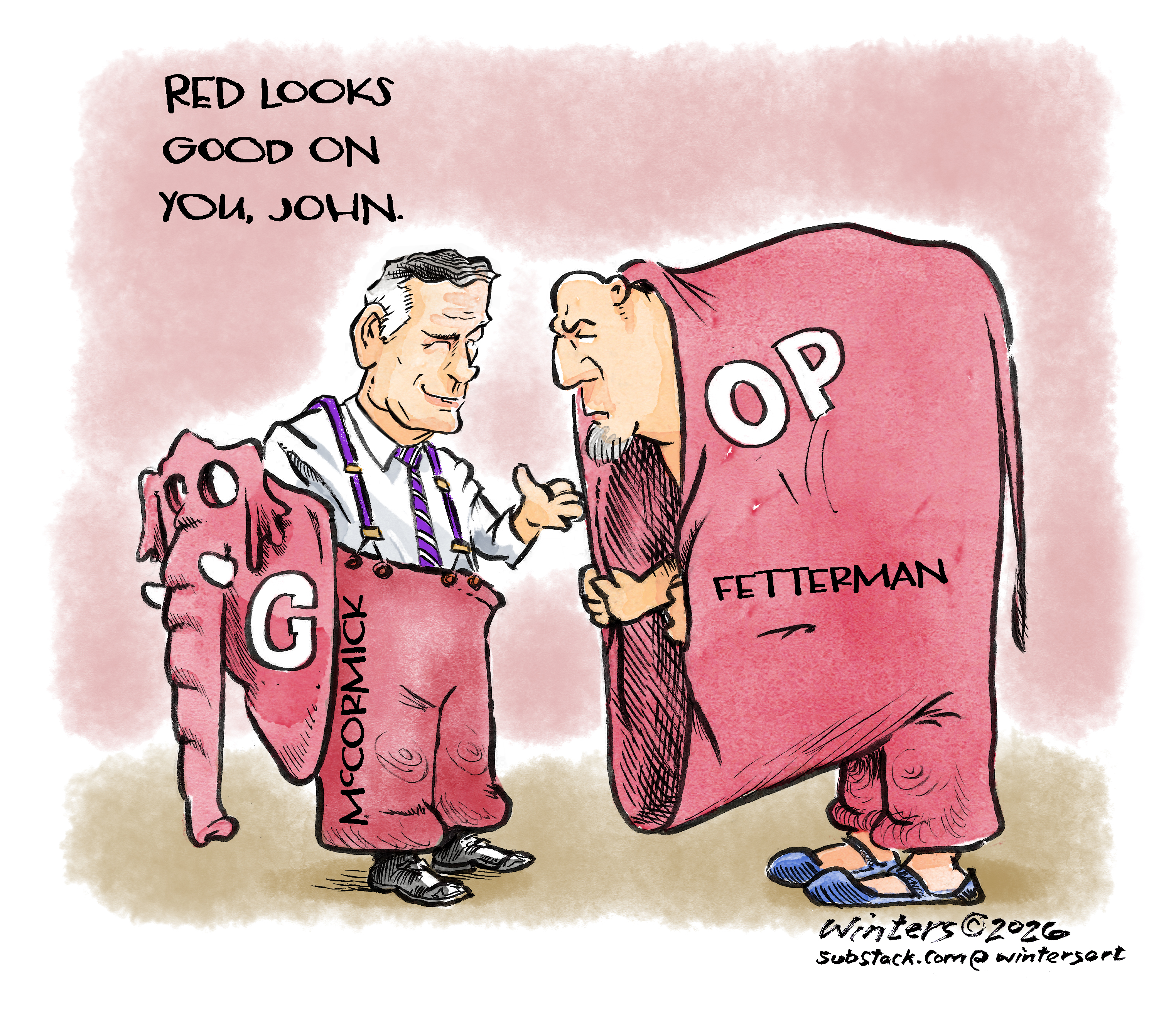
Fetterman’s disdain for the job — which comes with a $174,000 annual salary, free healthcare, and months off at taxpayer expense — has been well documented. He whined about missing a family beach trip during a lengthy debate last year over Donald Trump’s costly and harmful One Big Beautiful Bill.
Several major media outlets have chronicled the senator’s dysfunction. In May 2025, New York Magazine detailed Fetterman’s erratic behavior as staffers expressed concerns about his mental health since suffering a stroke. The New York Times quoted staffers who feared his mood swings and were warned not to get in the car if he is driving.
The Washington Post reported on Fetterman’s clashes with Democratic colleagues and increased isolation, while Politico detailed efforts by Republicans to get Fetterman to switch parties.
The Inquirer disclosed last year how Fetterman lashed out at representatives from the teachers’ union, and cited a half dozen former staffers who said he skipped meetings and spent hours alone in his office scrolling on his phone.
“It’s pretty impossible to overstate how disengaged he is,” a departed staffer said.
Last week, a devastating story in the Wall Street Journal underscored the senator’s disregard for voters and his job in a story headlined: “Behind Closed Doors, John Fetterman Shows Little Interest in the Work of a Senator.”
The story included text messages between Fetterman and staffers that showed him dismissing executives from Children’s Hospital of Philadelphia (CHOP) who wanted to discuss Medicaid cuts and changes to vaccine policy.
“Why do I have to keep having to meet with chop,” Fetterman texted an aide.
“Because they’re worried about Medicaid cuts,” the aide wrote.
Fetterman responded, “Well, I’m not,” before adding, “I’m convinced they just want free trips to DC.”
Fetterman later told CNN that comment was a “dumb joke, and for that, I sincerely apologize.”
In another exchange, Fetterman nixed a plan to attend a funeral for three police officers killed in the line of duty in York County, where he grew up. Apparently, Fetterman was put off by the time commitment.
“3 hours??” he wrote, before adding that attending the services “may be a nonstarter.” The senator did not go, but said he sent flowers and met with the families later.
The Journal reported that Fetterman also stiffed three disabled veterans who traveled to Washington to meet with him, alleging he was ill, only to appear later that day on Fox News to talk about Israel and the war in Iran.
Apparently, teachers, healthcare officials, police, and veterans take a backseat while Fox News and the Israel-Hamas war command Fetterman’s full attention. The senator has appeared on the conservative news outlet roughly 60 times this year and has gone on two junkets to Israel since 2024. (He even made a cameo at the GOP convention in Dallas Wednesday night to praise Trump and boost Republicans before the midterms.)
The Journal reported that Fetterman told aides he wanted to introduce a resolution to force lawmakers to vote on whether the war in Gaza constituted a genocide. But instead, Israel’s ambassador to the U.S., Yechiel Leiter, suggested he write an op-ed explaining his support for Israel, while many Democrats have turned against the country because of killings and destruction in Gaza.
Leiter even supplied the talking points. But Fetterman’s aides did not tell him about the talking points out of fear that the op-ed would violate the Foreign Agents Registration Act.
Fetterman did not publish the op-ed, but the incident reinforces the perspective of critics who argue that his tenure has been marked by complacency and carelessness: He was either unaware of the potential ramifications of penning the essay, or he chose to ignore them — both explanations should concern Pennsylvanians.
Like the previous reports, Fetterman called the Journal story a “hit piece.” The sad truth is the reports from his own staffers paint a picture of a lazy, unengaged, and unstable senator who is not up to the job.
Last year, this Editorial Board said Fetterman should either do his job effectivelyor step away.
In the private sector, most workers who fail to perform their basic job duties get fired. Unless Fetterman resigns, voters will get their chance to oust him in 2028.
Donald Trump wants to penalize private colleges that continue to consider diversity, equity, and inclusion in their admissions decisions. He says that approach discriminates against white students, and that he wants admission for those with the most merit. But merit is always defined by those in power. Unions give the first choice of plum jobs to those with the most seniority, not necessarily those who are the hardest workers. Civil service exams give extra points to veterans depending on their service records. Universities give some preference to low-income students who may also bring different perspectives into the classroom because it is good for the educational process. We all discriminate, consciously or unconsciously. Affirmative action and DEI are simply measures of accountability. If a bank robber is caught and says he will return the money, “Just trust me,” we would want to count the money returned, would we not?
John Kovach, Wallingford
Flock misguided
The controversy over Flock cameras is misguided. For example, if you live in Philadelphia, the chance you are picked up by a camera is already exceedingly high. The city has deployed hundreds of cameras. Added to that are hundreds more operated by the University of Pennsylvania, Temple, and Drexel — and hundreds more owned by businesses or private citizens. The issue isn’t about whether you are an innocent person whose picture suddenly appears in some database, because, in most cases, it’s already there. If you are in a public place, you have no expectation of privacy.
The real issue is policy around how the information is accessed and used, as well as the security of the data collected. Whenever a serious crime occurs, access to the camera data is often critical to arresting the perpetrator. Politicians should look to tighten the rules governing access to camera data rather than eliminating one of the most useful tools law enforcement has because, even if Flock cameras are banned, cameras are here to stay.
Charles Brennan,retired deputy commissioner, Philadelphia Police Department, Philadelphia
Philly’s loss
As a longtime volunteer at the Academy of Natural Sciences museum, I have been shocked and grieved at the neglect and inattention that went on there for years. The idea that Drexel University, with its financial woes, could adequately support this gem of a museum once it took over its administration was never realistic. There were minimal efforts to deal with the shabbiness, to make the place more comfortable for visitors, to give the public access to — and knowledge about — the many treasures hidden inside, including Thomas Jefferson’s fossils, a staggeringly beautiful collection of rocks and minerals, a chair sent by Albert Einstein’s daughter, and so on. Nevertheless, the museum was popular with tourists and a haven for parents who brought their young children. But there was no infusion of money to make the place as bright and inviting as it used to be.
During the Semiquincentennial celebrations, there has been much attention given to Philadelphia’s many firsts — but what about the oldest science museum in the United States? People are lamenting the closure of the museum — but the state, the city, the many foundations and philanthropists in the area, all seem to be turning a blind eye. And it’s a black eye for Philadelphia.
Carole W. Soskis, Bala Cynwyd
Join the conversation: Send letters to letters@inquirer.com. Limit length to 150 words and include home address and day and evening phone number. Letters run in The Inquirer six days a week on the editorial pages and online.
On Aug. 6, Philadelphia City Councilmember Isaiah Thomas held an Education Committee hearing on the crisis of preschool suspensions and expulsions, examining their devastating impact on families and possible policy solutions to this discriminatory practice, which research has shown is rife with racism and ableism.
At the advocacy organization where I serve as policy director, Education Law Center-PA, we help hundreds of families every year who are navigating preschool pushout. That includes families whose children — yes, even toddlers as young as 18 months old — have been suspended or expelled from preschool.
This shocking practice is common: Preschools suspend children at a rate three times higher than K-12 schools.
Suspensions and expulsions of our youngest learners, which are harmful to a child’s development and can profoundly impact their future, disproportionately harm Black and brown children, children with disabilities or developmental delays, and children sharing those identities.
Myriad preschool programs exist in Philadelphia and across the commonwealth, which can make it difficult to untangle how each program is regulated and which agency oversees it. This patchwork can also make it difficult for families to understand which protections apply to their children. The clearest safeguards exist when protections, in conjunction with legal requirements, are explicitly codified in preschool program regulations.
Head Start programs offer the strongest protections for our youngest learners, but in Philadelphia, those regulations only apply to 170 Head Start locations, a fraction of the city’s total early childcare settings.
Current Head Start policy, which Kennedy now seeks to rescind, prohibits the expulsion of students in its programs and severely restricts suspensions to extraordinary circumstances, with a host of steps that must be taken before any temporary exclusion.
During the recent City Council hearing, one of the most important policy suggestions offered by ELC-PA’s attorney, Rose Wehrman, included implementing the existing Head Start policy for all of the city’s preschool programs. It’s a policy that, if implemented with fidelity, could have afforded important protections for many families featured in our April report on preschool pushout.
Jennifer Garrison’s 4-year-old son, Terrell, is a constant source of joy for everyone around him. Garrison described him to members of City Council as “loving, gentle, and full of energy.” But Terrell, who is Black and has autism, was denied the most basic needs in his preschool and was effectively excluded from his program under conditions that would not have been permissible under Head Start’s regulations.
To hear Garrison talk about the juxtaposition of who Terrell is compared with how he was treated is gutting — and unfortunately too common.
Had Terrell been in a program with the protections explicitly outlined by Head Start’s now-in-jeopardy regulation prohibiting such exclusion, perhaps he and his family would not have endured such a traumatic experience. We don’t know that for sure, but we do know that Head Start’s policy is one that should be expanded to more programs.
The benefits of Head Start are comprehensive: The National Head Start Association outlines academic, social-emotional, and physical health benefits, and notes that the impacts are “particularly strong” among underserved students. This is, in part, due to strong policies around developmentally inappropriate practices like suspension and expulsion.
But Secretary Kennedy, in the name of “parental empowerment” and even “freedom,” wants to upend the foundations of a decades-long program with lifelong benefits, ranging from increased educational success through K-12 and beyond, as well as physical, emotional, and financial health.
Changes to Head Start proposed by Health and Human Services Secretary Robert F. Kennedy Jr. include deregulating nearly every facet of of the program, from appropriate staffing ratios to developmental screenings, writes Hillary Linardopoulos.Amanda Cuda
In addition to the rescission of the suspension and expulsion policy, Kennedy’s proposed rule changes would deregulate nearly every other facet of Head Start. This includes appropriate staffing ratios, developmental screenings, and a host of regulations that are central to the program.
Fortunately, these proposals are not final, and people can submit public comments (of any length or format) to the Department of Health and Human Services by Oct. 6 to oppose the deregulation of Head Start.
The existing federal regulations are the ones we should emulate right here in Philadelphia and across the commonwealth. We urge our fellow community members to join us by submitting comments opposing the gutting of Head Start regulations, which would destabilize this foundational program.
Meanwhile, our organization will continue to work to support families and expand the existing Head Start policies to include all programs educating our youngest learners across Philadelphia and the entire commonwealth.
Hillary Linardopoulos is the policy director for the Education Law Center-PA, a nonprofit organization dedicated to ensuring equal access to a quality public education for all children in Pennsylvania.