Here’s what you need to know about free speech on America’s college campuses: We’re all Marxists now.
No, we’re not those “crazy communists” whom President Donald Trump denounced at the Republican midterm convention in Dallas last week. I teach at the University of Pennsylvania, where nearly two-thirds of undergraduates enter finance, technology, or consulting. If I’m trying to convert them to Karl Marx, I’m doing a very poor job of it.
I’m talking about the comedian Groucho Marx, who authored the world’s funniest testament to hypocrisy. “These are my principles,” Groucho quipped, “and if you don’t like them … well, I have others.”
That’s the big takeaway from the annual report on campus free speech by the Philadelphia-based Foundation for Individual Rights and Expression (FIRE), which came out on the same day as Trump’s convention diatribe. We’re not communists or anarchists or any of the other slurs he lobbed at us. We’re hypocrites. All of us. On campus, and off of it.
Witness the response to the murder of conservative activist Charlie Kirk last fall. After complaining for years about “cancel culture” in American higher education, GOP politicians led the drive to fire or suspend professors and students who said the wrong thing about Kirk.
Meanwhile, left-leaning academics who had supported speech codes prohibiting “violent” speech insisted that comments praising the violence against Kirk must be protected. They were correct about that: Nobody should have been penalized for what they said about him. But there was no acknowledgment — none — that we had erred in trying to censor others.
Instead, as the FIRE report demonstrates, the censorship continued. Dozens of schools blocked conservative students from establishing chapters of Turning Point USA, the organization Kirk founded. And where chapters already existed, we tried to shut them down.
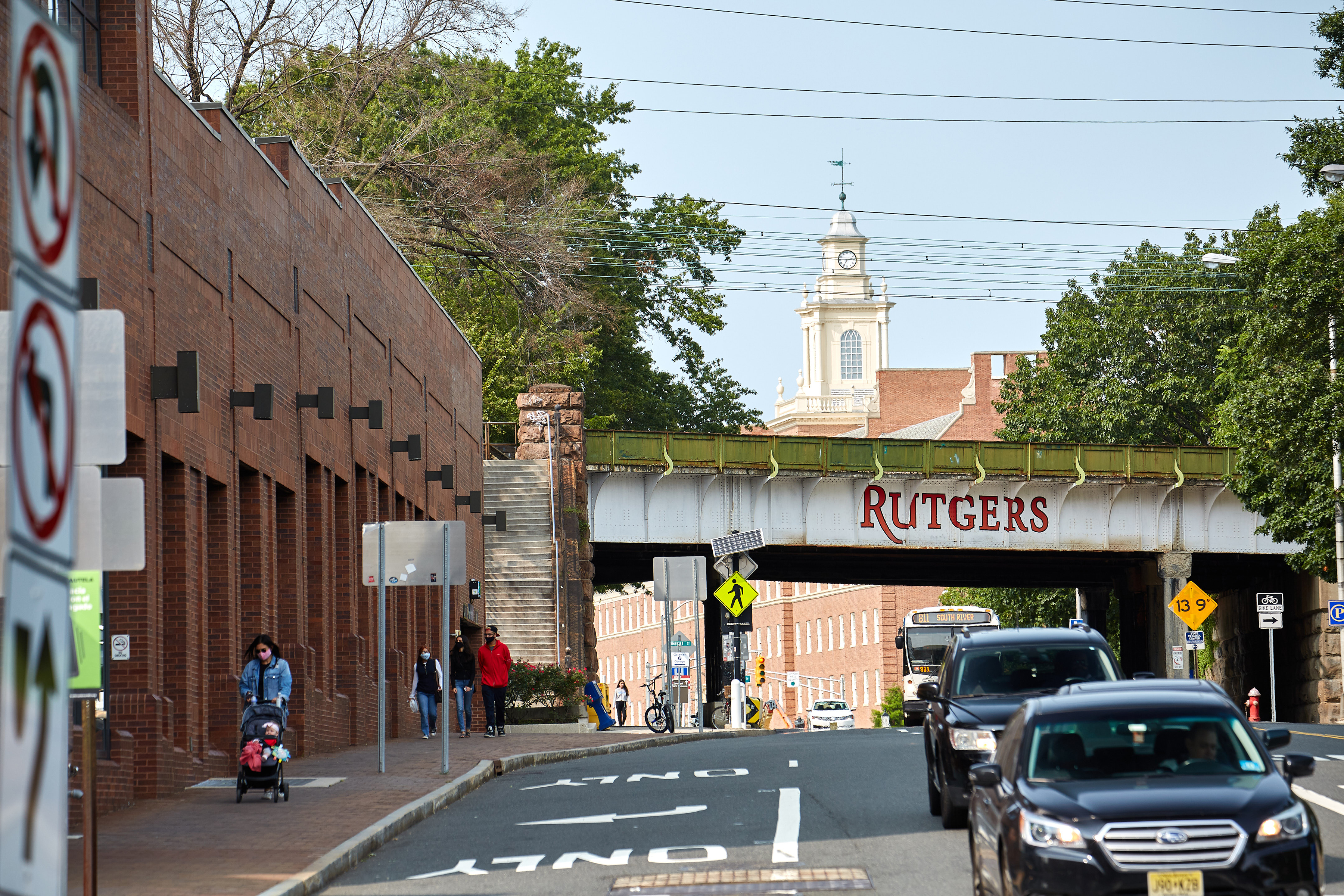
At Rutgers, for example, more than 7,000 people signed a petition asking the university to disband its TPUSA chapter because it made people feel unsafe. “It is imperative that we take decisive action to restore security and the feeling on inclusivity to the campus,” the petition declared.
Meanwhile, the Rutgers TPUSA chapter issued its own petition calling on the university to fire a history professor because of his alleged ties to antifa. Why? You guessed it: People felt unsafe. “Having a prominent leader of the Antifa movement on campus is a threat to conservative students,” the petition claimed.
Remember when right-wingers denounced liberal “snowflakes” on campus? Now everyone is a snowflake, just like we’re all (Groucho) Marxists. If you don’t like someone’s opinion, just say it threatens your safety. It will work.
And it will make everyone afraid to speak, no matter their politics. At Penn, the FIRE report notes, over half of surveyed students said they have self-censored on campus at least once or twice a month. “In classrooms, it is difficult at times to express full opinions without causing someone to become upset,” one Penn student told FIRE.
What’s wrong with that? If I write a column and nobody becomes upset, it was a lousy column. To be clear, I never go out of my way to offend anyone. But I take it for granted that if I have something meaningful to say, some readers will be angered or annoyed by it.
On our campuses, by contrast, causing upset has become a dangerous thing. Best to keep your big mouth shut, lest you get on the wrong side of anyone.
So both pro-Israel and pro-Palestinian students bite their tongues. And so do conservatives and — especially — Trump voters, who often stay in the closet instead of revealing their true selves.
I taught for 20 years at New York University, which was dead last in FIRE’s free speech ranking in this year’s report. I have taught for 10 years at Penn, which moved up slightly — from 261st to 227th — but still received an “F” grade from FIRE.
And I haven’t heard anyone at either institution acknowledge the report or pledge to do better. You would think the firing of professors for their comments about Kirk — or about gender fluidity, a frequent right-wing target — would make our heavily liberal professoriate rally around the principle of free speech.
But no. I’ve heard colleagues say Trump voters should keep quiet because they are racist and sexist and nobody wants to hear that. Other professors say scaredy-cat conservatives should just show some backbone instead of hiding in the shadows.
Please. Here’s the question we should pose to ourselves: If FIRE reported that any other sizable group of students — aside from political conservatives — felt too afraid to voice their views, how would we react? Would we see righteous protests across our campuses? Or would we tell those who were scared they should just suck it up?
“The secret of life is honesty and fair dealing,” Groucho Marx said. “If you can fake that, you’ve got it made.” We’ve got a lot of fake free speech warriors on our campuses right now. You either believe in it for everyone, or you don’t believe in it at all.
Jonathan Zimmerman teaches history and education at the University of Pennsylvania. He is the author of “Schooling Citizens: How Education Can Save Our Democracy,” which will be published in the spring by the American Philosophical Society Press.
Yet, if you look at the data, most Americans are united in their desire for change, and Congress — for all its faults and lack of follow-through — reliably puts forward bipartisan proposals.
That was the message at a recent discussion sponsored by the Garden State Immigration Policy Institute, which offered a glimmer of optimism amid the gloom.
But first, the challenges.
Even if Donald Trump were not in the White House, there are real obstacles to overcome, said Jennie Murray, president and CEO of the National Immigration Forum, a nonprofit immigration advocacy group.
“The reason why we haven’t been able to have bipartisan solutions at a grand scale yet is because I think we’re in a policy, a political, and a cultural disagreement,” she said.
On policy, finding the solution and building legislation to effect change is not an easy task, especially if, politically, the parties have used the issue to their advantage or to the detriment of their opponents. Culturally, Murray noted, for the last decade or so “we’ve had some really strong conversations about what it means to be American; who gets to come, who doesn’t get to come and join us.”
I’ll be much less diplomatic and say that the rise of Trump as a political figure, which infamously began with him accusing Mexican immigrants of bringing drugs and crime, has seen the president’s virulently anti-immigrant positions spread to some of his followers, making it hard to even discuss the positive impact of immigration.
But even under the current climate, polling consistently finds that fair, firm, and compassionate immigration solutions appeal to a majority of Americans, regardless of their political affiliation, Murray said.
This mirrors recent results by Commonsense American, a nonpartisan group dedicated to practical policy solutions, which found that cross-partisan supermajorities of survey respondents rejected blanket mass deportation and supported many individual immigration reform proposals.
These include legal status for immigrants who came to the U.S. as children, mandatory employer verification of immigration status, more worker visas, increased border security measures, and a pathway to legal status for long-term undocumented immigrants.
The group also asked participants to weigh in on how likely it would be for someone from the opposite political party to support a package of proposals that included lasting border security and enforcement, a modernized legal immigration system, and a path for undocumented immigrants to earn legal status.
“Republicans guessed it would be about 50% of Democrats, but it’s actually 86%,” said Keith Allred, founder and president of Commonsense American. “We similarly asked Democrats to guess what percentage of Republicans would support this proposal, and they guessed 45% when it’s actually 74%.”
That underlines that Americans are more divided in their perception of each other than in actual fact.
Another misperception is that Congress has given up on bipartisan immigration reform, said Theresa Cardinal Brown, who spent more than a decade working at the nonprofit Bipartisan Policy Center and is a distinguished immigration scholar at Cornell Law School.
Looking at the period of 2015 to 2024, across five Congresses, 309 bipartisan bills — defined as those having at least one Democratic and one Republican cosponsor — were introduced. Out of that total, 78% would have eased restrictions on legal immigration.
“Most bipartisan legislation runs toward legal expansion of legal pathways for immigration into the United States, and it’s worth noting again that workforce is the biggest area of bipartisan agreement,” she said.
So, if most Americans support immigration reform, and at least some in Congress believe in doing the work of legislating, why has meaningful change eluded the nation?
Immigration reform is not too big to fail, Cardinal Brown said. In many ways, it’s too big to succeed.
“Every part of the immigration system has proponents who really care about it, or it’s their one thing, and it has to be exactly right for them to support a bigger package if it’s in it,” she said. “But you can’t really govern if you have an ‘I win, you lose’ mentality. That’s not going to succeed in any way, and we’ve seen it from both parties.”
The Trump administration’s immigration policies are hurting the country. The full extent of that damage is yet to be seen, but repair efforts will have to go through Congress, and the perfect cannot be the enemy of the good.
Fortunately, the American people also have thoughts on what legislators should do when they eventually consider reform.
Democrats were asked by Commonsense American if their representatives should hold out to give more undocumented immigrants status; Republicans were asked if lawmakers should keep pushing for more enforcement and border security.
In both cases, the answer was clear: Don’t wait, take the deal.
Pennsylvania House Speaker Joanna McClinton was listening to a sketch by comedienne Zainab Johnson when Florida State Rep. Angie Nixon’s name came up. Johnson mentioned how Nixon, who is vying to become the Sunshine State’s first African American U.S. senator, had been attacked by a right-wing influencer named Laura Loomer.
McClinton is closely following Nixon’s race and immediatelywondered: “Who’s Laura Loomer? Who is she?”
McClinton found out soon enough.
Loomer, reportedly a close ally of President Donald Trump, has been publicly going after Black female legislators and other prominent women — including U.S. Supreme Court Justice Ketanji Brown Jackson — calling them “ghetto” and the B-word.
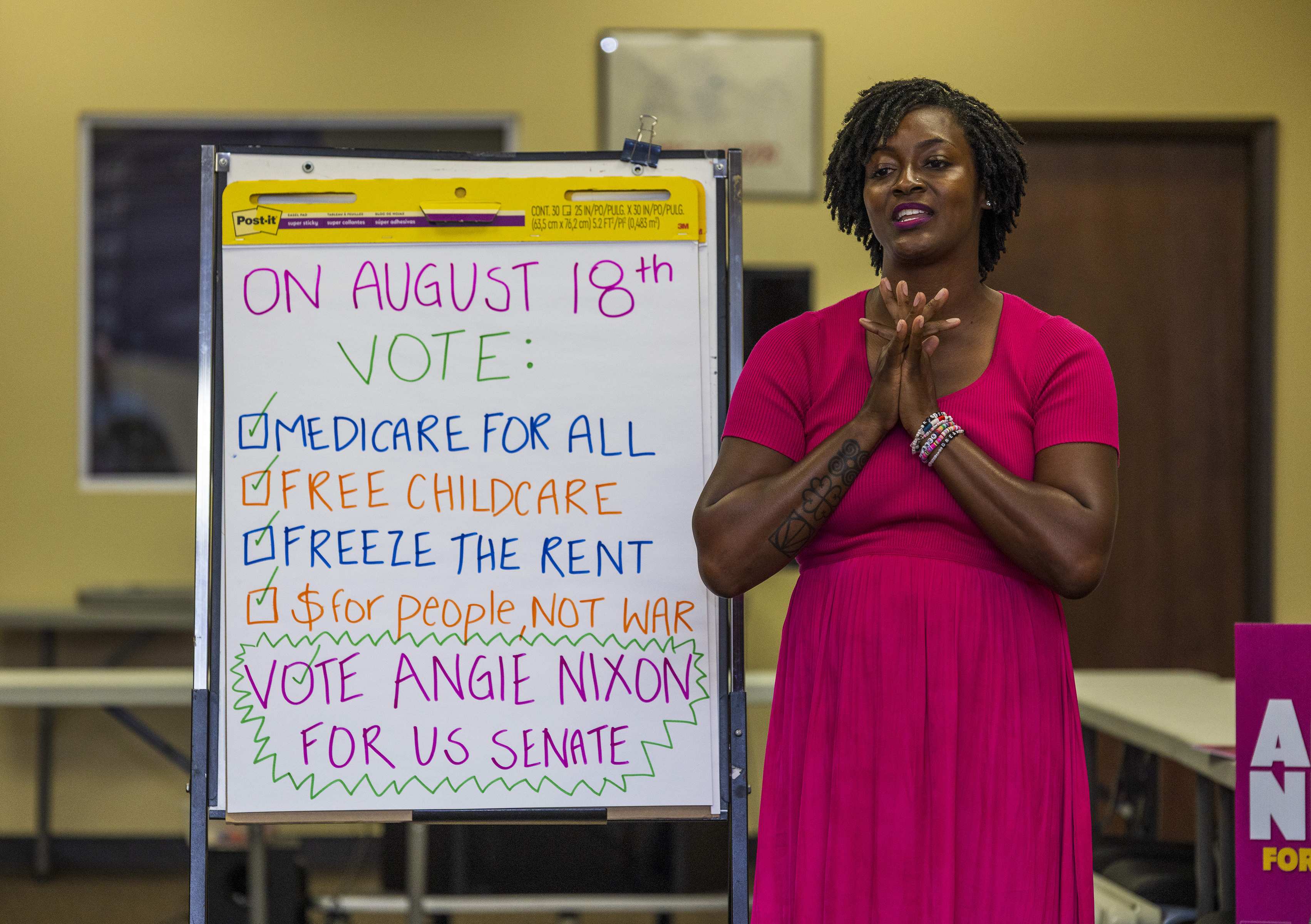
State Rep. Angie Nixon, a Democratic candidate for U.S. Senate, during a canvassing event in Fort Lauderdale, Fla., in August.SAUL MARTINEZ
The MAGA influencer zeroed in on Nixon last month after she won Florida’s Democratic Senate primary and accused her of using Ebonics. She also likened the former grassroots organizer to a dog, saying, “Maybe I need to bark at you and tug your leash and then you’ll finally understand.”
Loomer has also posted about Reps. Ilhan Omar, Ayanna Pressley, and LaMonica McIver, and former Rep. Cori Bush, saying they’re “entitled,” “destructive,” and “race-obsessed.”
I don’t know, Laura — you might want to look in the mirror to see who’s really “entitled,” “destructive,” and “race-obsessed.”
She made me mad.
A lot of people may have brushed it all off, but as you can tell, I haven’t.
Former Rep. Marjorie Taylor Greene has condemned Loomer. Where are the other Republicans who pride themselves on being civil and having family values? Every member of the GOP should speak out against what’s been happening.
House Speaker Joanna McClinton during a news conference at the Capitol in Harrisburg in February.Tom Gralish / Staff Photographer
“We need the president to condemn these comments,” McClinton told me, adding that U.S. Senate leadership should also act. “Unfortunately, attacking Black women is nothing new.”
She added, “We have been fighting with racism and misogyny for as long as we have been a democratic republic.”
I won’t repeat all of the racist things Loomer has uttered on her podcast or posted online lately about Black female politicos. If you’re curious, you can go on social media and see for yourself.
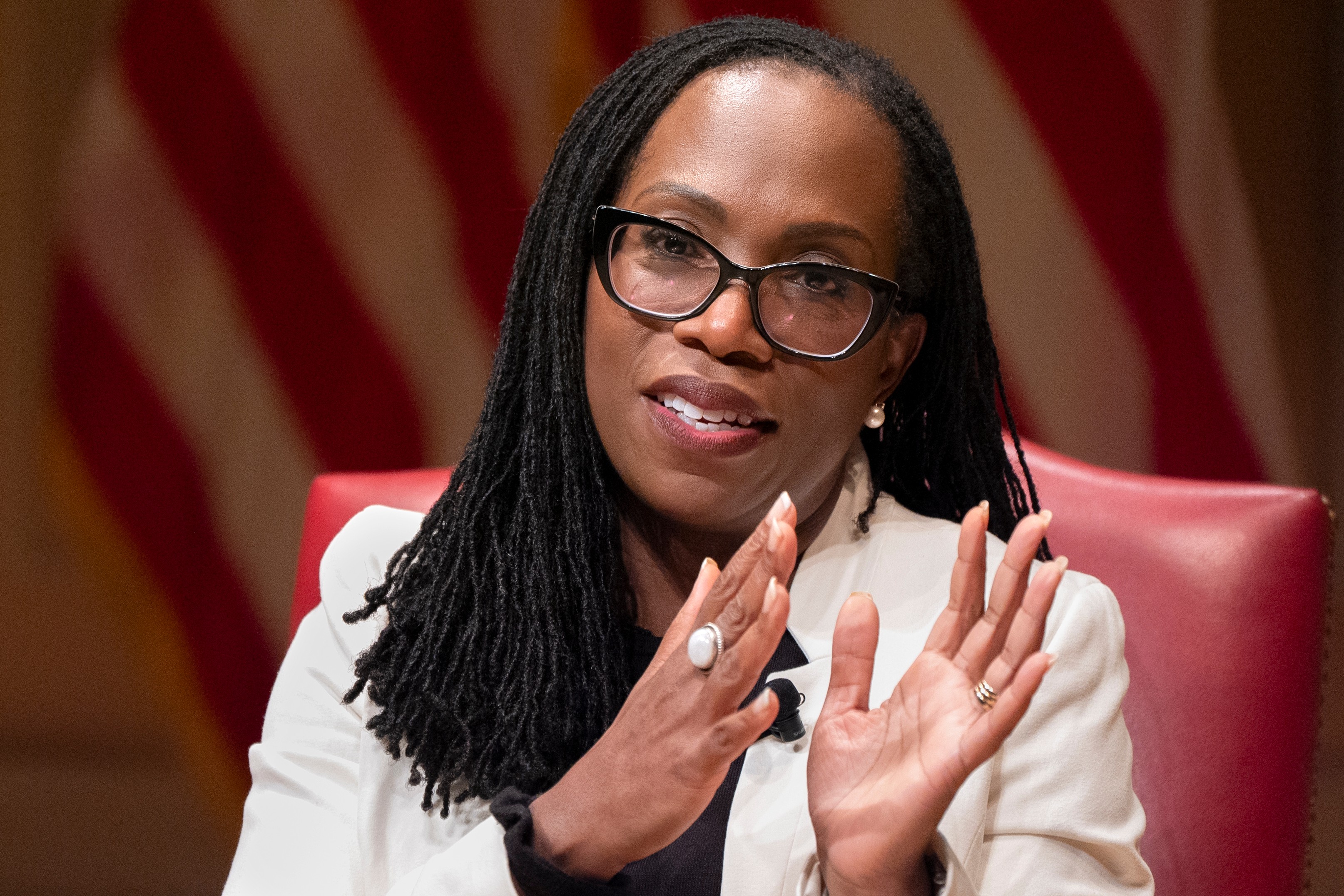
U.S. Supreme Court Justice Ketanji Brown Jackson speaks to the 2025 Supreme Court Fellows Program, Feb. 13, 2025, at the Library of Congress in Washington.Jacquelyn Martin
While you’re there, you can check out her Islamophobic posts.
I thought long and hard about ignoring what’s been happening and writing off Loomer as just another right-wing extremist.
But she has traveled with the president numerous times, visited Mar-a-Lago, and reportedly has Trump’s ear. Her platform is huge — nearly two million followers on X, the social media site formerly known as Twitter. And she doesn’t hesitate to use it.
That’s political currency — not just in Washington. In this era of the attention economy, the most strident voices get traction.
Maryland Gov. Wes Moore was spot on when he posted a statement directed at Loomer saying, “You attack and insult Black women because you believe peddling racism is good for your clicks and your business model.”
It felt good to see Moore, who is a possible presidential contender, defend Black lawmakers against Loomer’s looney tunes. Same with House Minority Leader Hakeem Jeffries, who called her a “stone-cold racist.”
Being a Black woman in traditionally white spaces can be challenging. Nixon appeared near tears during a recent appearance on Don Lemon’s YouTube show and said she was tired. “It’s become so normalized for people to continue to attack us,” she said.
Timothy N. Welbeck, director of Temple University’s Center for Anti-Racism, said he wasn’t surprised there hasn’t been a more fervent pushback against Loomer.
“Things like woke and DEI were politically expedient slurs to convey anti-Black sentiments,” he told me. “And now people like Laura Loomer are forgoing the veiled statements.”
It has felt like open season on Black women ever since Trump’s return to office.
We have been disproportionately impacted by widespread cuts to the federal workforce. Trump weaponized the U.S. Department of Justice to try to prosecute Federal Reserve Governor Lisa Cook and New York Attorney General Leticia James.
Black women are survivors, though. Ever since we were dragged through the Middle Passage and forced into bondage, we have managed to make a way out of no way, as my mother used to say.
This is our heritage.
This is our legacy.
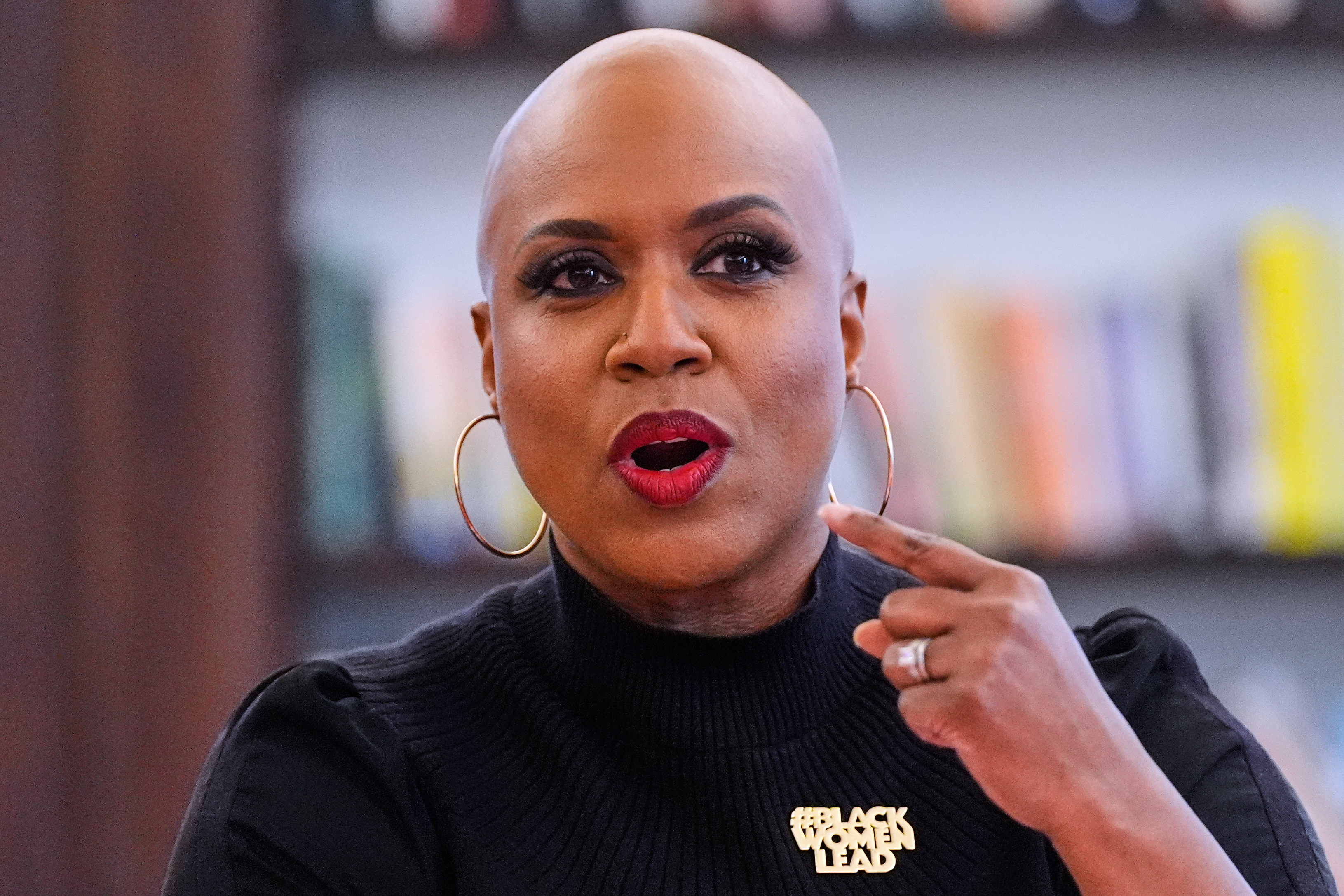
U.S. Rep. Ayanna Pressley (D., Mass.) gestures while addressing a gathering at a roundtable meeting in November in Boston.Charles Krupa
In the spirit of the late Shirley Chisholm, the first Black female member of Congress, and all of the other ancestors, we will get through the Trump era, too.
And we’ll be inspired by the passion of Nixon, the style and commitment of Pressley, and the sheer brilliance of Justice Jackson.
That’s what we do.
As Moore pointed out, “We will never let anyone steal our joy or let those that don’t matter too much, matter too much.”
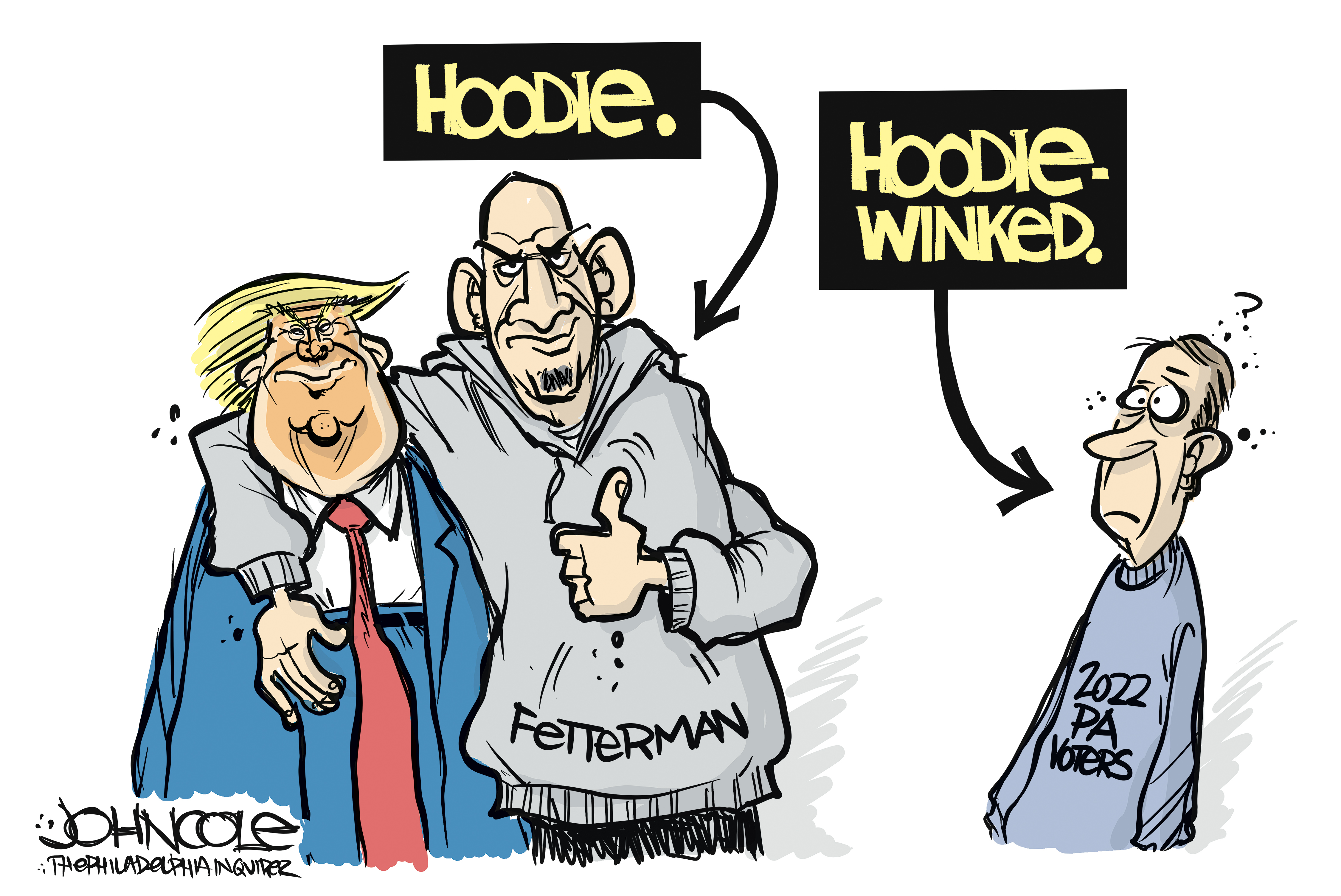
As a longtime subscriber to The Inquirer, I am extremely disappointed in the recent editorial about John Fetterman headlined “Fetterman’s shiftlessness is an insult to his office and all Pennsylvanians.” Calling him shiftless is an insult. The editorial was full of the same innuendo from anonymous, disgruntled former staff members, and it didn’t mention the many bills he has successfully sponsored, cosponsored, and introduced in the Senate. His political support for Israel may perhaps be adding to his staff’s burden, but I believe Fetterman is being honest in following his conscience. If the senator’s staff members are so unhappy with their job, why don’t they seek employment elsewhere? I, for one, will be very happy to vote for Fetterman again — he’s the kind of independent thinker the world needs.
Susie Sommovilla,Elkins Park
Party defection?
When I voted for John Fetterman to be my U.S. senator in 2022, I was willing to overlook his disastrous debate performance, his unkempt and undignified appearance, and his frequent use of profanity because I believed he would represent our state well and live up to Democratic values.
When Donald Trump returned to the White House last year, I expected my senator would challenge and criticize him because of all Trump has done — and is doing — to harm our nation and our fellow Americans. I, and millions of my fellow Pennsylvanians, were duped.
I look forward to the end of the Fetterman era in the United States Senate. It cannot come soon enough.
Oren Spiegler, Peters Township
Join the conversation: Send letters to letters@inquirer.com. Limit length to 150 words and include home address and day and evening phone number. Letters run in The Inquirer six days a week on the editorial pages and online.
There’s actually three things that are pretty certain in life: death, taxes, and the fact that the 22nd Amendment to the U.S. Constitution explicitly bars Donald Trump from seeking a third term as president.
Even Trump, for all his occasional pep-rally bluster and online merch about running in 2028, has kind of, sort of, begrudgingly acknowledged this reality. “You know the law is very strong on that,” the president admitted to reporters during a gaggle just last month.
That’s actually a good answer for Trump, because it avoids the obvious follow-up of how a president who’ll be 82 on Election Day in 2028, can barely stay awake now during important moments like a 9/11 memorial service, has probablyconsumed more Big Macs than the late Morgan Spurlock — and, oh, has a 32% approval rating — could expect to win, or even make it up the steps of his Qatari bribe jet in two years.
Still, I wish that one of those tarmac journalists would throw on a Peter Falk-style overcoat and ask, Columbo-like, just one more thing of the 47th and possibly last president:
If you’re not running for office ever again, why have you raised some $850 million — and counting — in campaign funds since your last and supposedly final campaign? Why are you sitting on most of this money? Are you planning to take it with you on Jan. 20, 2029?
I’d been mulling this column for a while when it was announced late last week that Trump’s best-known political action committee, the super PAC called MAGA Inc., with about $400 million in the bank, is finally cracking open the vault, slightly.
MAGA Inc. just transferred $49 million to yet another new PAC, No Going Back Inc. — the more money laundering, the better, apparently — that’s actually going to buy ads supporting some GOP candidates in the November midterms, especially in tight Senate races in Texas, Michigan, Ohio, and New Hampshire.
Indeed, expenditures like that are the only legitimate argument for Trump to have such a large political slush fund — to elect sympatico lawmakers who can support the president’s agenda, whatever that is. Whatever else happens in this election, two more years of a Republican-led Senate would allow Trump to keep appointing right-wing judges and at least limit the investigations of his gross misconduct.
Still, even some Republicans are acknowledging the $49 million, and presumably some additional funds over the next seven weeks, are too little and too late. In August, when voter opinions tend to harden ahead of the fall campaign season, MAGA Inc. spent a piddling $825,000 to prop up the new, Trump-supported South Carolina Sen. Darlene Graham in a GOP primary battle, and nothing more.
“Our threat level should be up and people are going to have an expectation that you deploy all your resources,” one GOP donor told Politico, before the $49 million drop was announced. “He’s sitting on hundreds of millions of dollars, not doing that. We’re in September.” Interestingly, MAGA Inc. has spent virtually nothing on House races, even though a Democratic House is likely to impeach Trump for the third time in 2027.
Republicans should be alarmed. We all should be alarmed, for a number of reasons. Boomers like me remember, vaguely, an old-school TV game show that was called You Don’t Say, with a tagline I’ve never forgotten: “Remember, it’s not what yousay. It’s what you don’t say.”
When it comes to MAGA Inc. — and several other massive piles of Trump-connected cash — political reporters ought to realize it’s not what you spend. It’s what you don’t spend.
If Trump is freeing up $49 million to try and sway close Senate races, where is the other $800 million going? And where am I getting this figure? It was buried in a recent MS Now article, which noted, correctly, that there is a separate, so-called dark-money arm of MAGA Inc. called Securing American Greatness that’s believed to hold as much as $450 million, most from secret donors.
That figure comes from Trump himself, who told reporters last month at an airport press gaggle: ”I’ve raised a lot, and nobody knows what it is, but I will tell you it’s about $850 million. I’ll be spending a lot of that money for — and my own money — but I’ll be spending a lot of that money for candidates that I think are good, Republican candidates.”
Nobody knows what it is. You can thank Trump’s pals on a right-wing rogue U.S. Supreme Court for a generation of bad rulings that have sold American elections to the highest, secret bidders.
The other thing about Trump’s comments is that, despite what he said, he’s actually so far not spending a lot of that money. Even though, by laws that are now honored in the breach, there’s supposed to be a clear separation between Trump and these super PACs, the president sees these funds as his own money.
“This is my money, that I control,” Trump told reporters earlier this month. Increasingly, anxious Republicans and other political observers worry Trump is hoarding the money not to elect GOP candidates, but to spend on his legal defense once those candidates lose and investigation-minded Democrats retake the House and maybe the Senate.
The law does say Trump can’t legally pocket the money when he leaves office. And we all know what a stickler Trump is for following the law, right?
Protest organizers gather in August 2025 outside the Moshannon Valley Processing Center, an ICE detention center near Philipsburg, Pa., run by the GEO Group, which contributed more than $1.4 million to a Trump-aligned PAC in June.Tom Gralish / Staff Photographer
It’s worth noting there are other piles of cash we know far too little about. For example, Trump’s 2025 inaugural committee raised a staggering $250 million — more than double his 2017 record — from the usual assortment of billionaires, tech companies, etc., and yet there’s been virtually no accounting of how that money was spent. And Team Trump is hoping to raise a gobsmacking $950 million by next year for his utterly amorphous plans for a presidential library, honoring a POTUS who doesn’t read.
Add it all up, and you’ve got a potential slush fund of roughly $2 billion. That’s appalling, but even worse with the knowledge that — and this cannot be repeated enough — with Trump never running for office again, the donors to these funds are almost all millionaires and billionaires who simply want something from the government for themselves or their corporations.
Earlier this year, reporters used tax records and other available reports to sleuth out three of the donors to the secretive Securing American Greatness Inc., including the Bitcoin Advocacy Project, which gave $2 million as Trump was boosting that industry through deregulation. The tech firm Qualcomm had been outed earlier as a $1 million donor to this massive fund that is largely a mystery.
There arenumerous examples of donors giving money to MAGA Inc. around the time of favorable government actions. For example, a subsidiary of the private-prison giant GEO Group gave $1.4 million to the Trump-aligned PAC in June at the same time U.S. Immigration and Customs Enforcement was awarding the firm $165 million in additional contracts. Michelle D’Souza, the chief executive officer of Pentagon contractor Unified Business Technologies, gave MAGA Inc. $4 million last October.
That’s in addition to the family members of those seeking presidential pardons, who made huge donations to MAGA Inc. right before Trump granted clemency to their relatives. That tally includes $3.5 million from the daughter of a Venezuelan billionaire who’d reached a plea bargain on federal bribery charges before he was freed by Trump, or Paul Walczak, a convicted tax cheat pardoned after his mom gave $1 million to MAGA Inc.
Many of MAGA Inc.’s donors are billionaires, and while some surely share Trump’s authoritarian worldview, many of them want something from the White House — and they are getting what they want. It is legal graft, a massive pay-to-play scheme that gets a giant shrug in the unholy world created by a right-wing master plan.
It’s time to stop shrugging. When Democrats retake the House, an almost certainty at this point, an investigation into Trump’s $1 billion to $2 billion in assorted slush funds, and whether any corruption laws were violated in raising all this cash, needs to pole vault to the top of their very long list of possible probes into this rogue president.
It’s kind of nuts when you think about it: A president corruptly raising hundreds of millions of dollars he’ll end up spending to hire lawyers to defend himself from the looming corruption charges. Maybe it would have been better — not just for the sake of democracy, but for Trump himself — not to have gone down this road in the first place?
But then, nothing makes sense anymore. And nothing makes less sense than the lack of energy, so far, in accounting for Trump’s pay-to-play dollars and how they are being spent. Keeping an American republic depends on answering these questions, and then making sure this never, ever happens again.
During a recent cable news appearance, Commerce Secretary Howard Lutnick claimed no American lives had been lost in the Iran war, an error he blamed on confusion with President Donald Trump’s earlier invasion of Venezuela. And perhaps it is difficult to keep one’s wars straight in an administration that has attacked seven countries in less than two years.
But while Lutnick’s claim was horribly wrong in fact, it was an accurate reflection of the administration’s consistently reprehensible diminishment of the costly war it started more than six months ago without congressional authorization or public support. The day after the secretary’s gaffe, Vice President JD Vance denied the very existence of the conflict, telling reporters, “I wouldn’t call it a war,” just days after an American bomb killed five civilians attending a wedding in southern Iran. The day after that, Trump himself dismissed the war as “small potatoes,” adding, “There’s no fighting,” even as the conflict continued to escalate, drive up energy prices, and threaten to draw in other countries.
In reality, the war has had tremendous repercussions for U.S. service members and civilians in the Middle East, American security and credibility, and global trade and stability. The only aspect of the conflict that is not serious is Trump’s handling of it.
The intangible costs aren’t small potatoes, either. Iran remains under the control of an emboldened regime able to fire on U.S. bases in the region, impede traffic through the crucial Strait of Hormuz, and resume its pursuit of a nuclear weapon without the international limits and monitoring Trump dismantled during his first administration.
The war has also depleted the military’s supplies of critical munitions, leaving us more vulnerable to adversaries, and strained our forces with marathon deployments and logistical disruptions. Rather than responding to these problems with the urgency they deserve, Defense Secretary Pete Hegseth appears preoccupied with hunting for those who disclosed them to the press, purging ranking personnel who might disagree with him, and blocking promotions of Black and female officers. The Army has lost half its four-star generals, its chief of staff, and its top civilian leader — Army Secretary Dan Driscoll — who reportedly warned the president of the force’s flagging experience, readiness, and morale on his way out.
Nor does the administration appear better prepared to end the war than it is to win it. Trump told the Republicans’ midterm convention Wednesday that the conflict was necessary to prevent an Iranian bomb and nearing its final stages. But peace negotiations have fizzled, the countries are exchanging strikes on warships and tankers, and Energy Secretary Chris Wright recently acknowledged that another deal on Tehran’s nuclear program may never be reached.
The trouble is that Trump and his lieutenants don’t appear to have a strategy for waging war on — or making peace with — Iran. What they have instead is a plan to manage the public relations fallout of the conflict by lying about its casualties, costs, and extent in the hope voters won’t punish their party for it in the midterm elections. It’s not even good PR, let alone defense or diplomacy.
In that sense, it’s not surprising Trump and Co. can’t figure out how to get out of the war they began. They would have to start by acknowledging they’re in it.
The city’s surviving legacy organizations are now working overtime to increase their visibility and bring in new audiences with community events and crowd-pleasing programs.
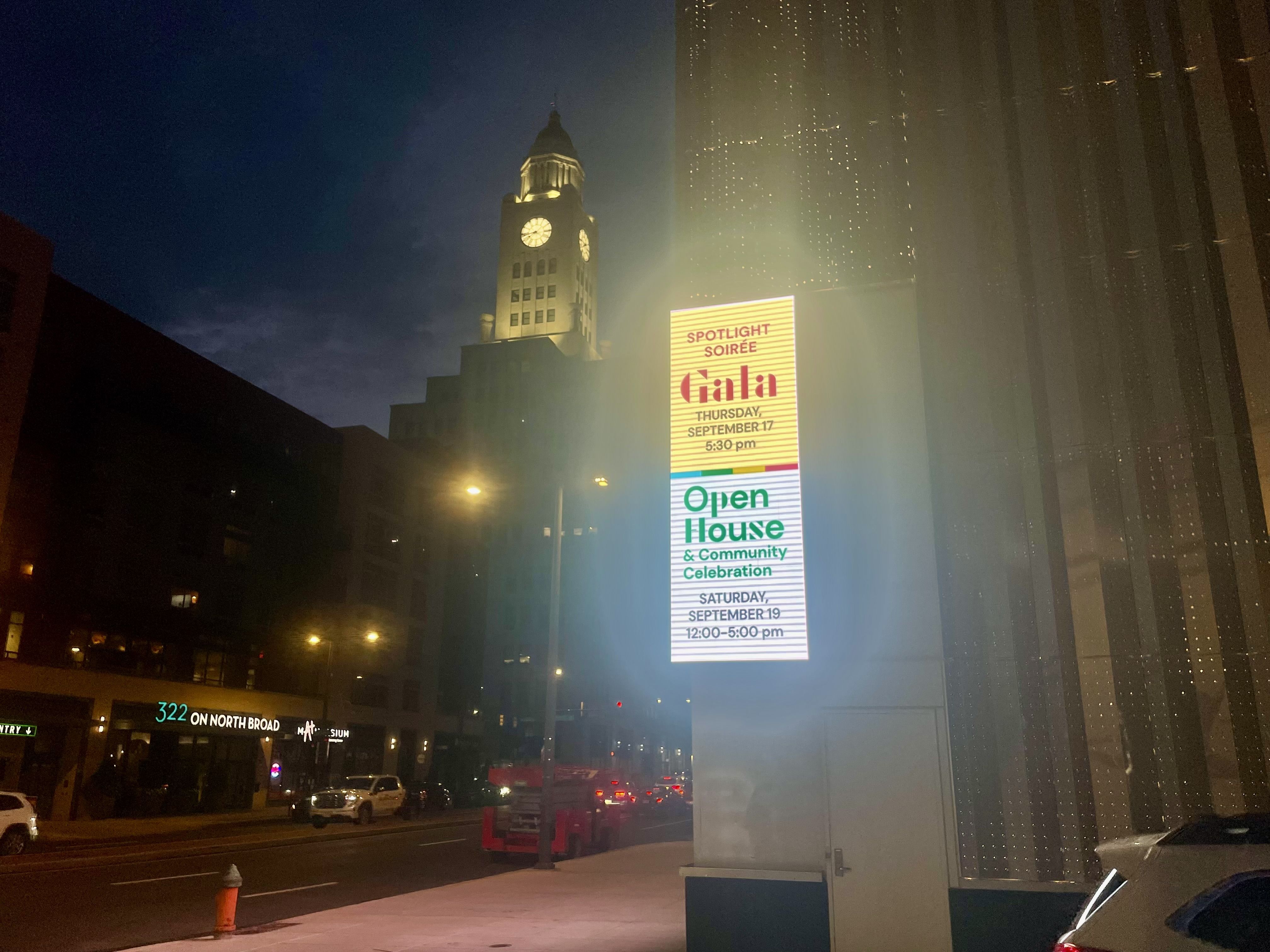
Nothing captures the public imagination quite like a new building, especially one with an address on Broad Street, the long, straight boulevard branded the Avenue of the Arts. After 19 years of trying, the Philadelphia Ballet will formally open its eye-catching new home just north of the Vine Street Expressway with a gala on Sept. 17.
In times like these, any new arts building in Philadelphia is cause for jubilation, whatever its flaws.
Although the Philadelphia Ballet Center for Dance is primarily a working building that provides the company with modern practice studios and support services, it also allows the ballet to operate its own public theater for the first time in its 63-year history. Shelly Power, the group’s CEO, rightly views the 150-seat space as a major opportunity for community-building outreach.
So, it’s frustrating to see the ballet repeat the architectural mistakes of an earlier generation of cultural venues. With its glass-enclosed rooftop studio and pleated metal facade, the building initially dazzles with shimmer and light, especially at night. But it quickly becomes clear that this is just another hermetic box that walls itself off and sabotages its own efforts to engage the public.
The absence of street-level windows on North Broad Street is particularly galling given the corridor’s spectacular revival over the last decade, including hundreds of apartments, the Met concert hall and the award-winning Honeysuckle restaurant.
With its glass-enclosed rooftop studio and pleated metal facade, the Philadelphia Ballet’s new Center for Dance initially dazzles us with shimmer and light, especially at night.Inga Saffron
Rising to new heights
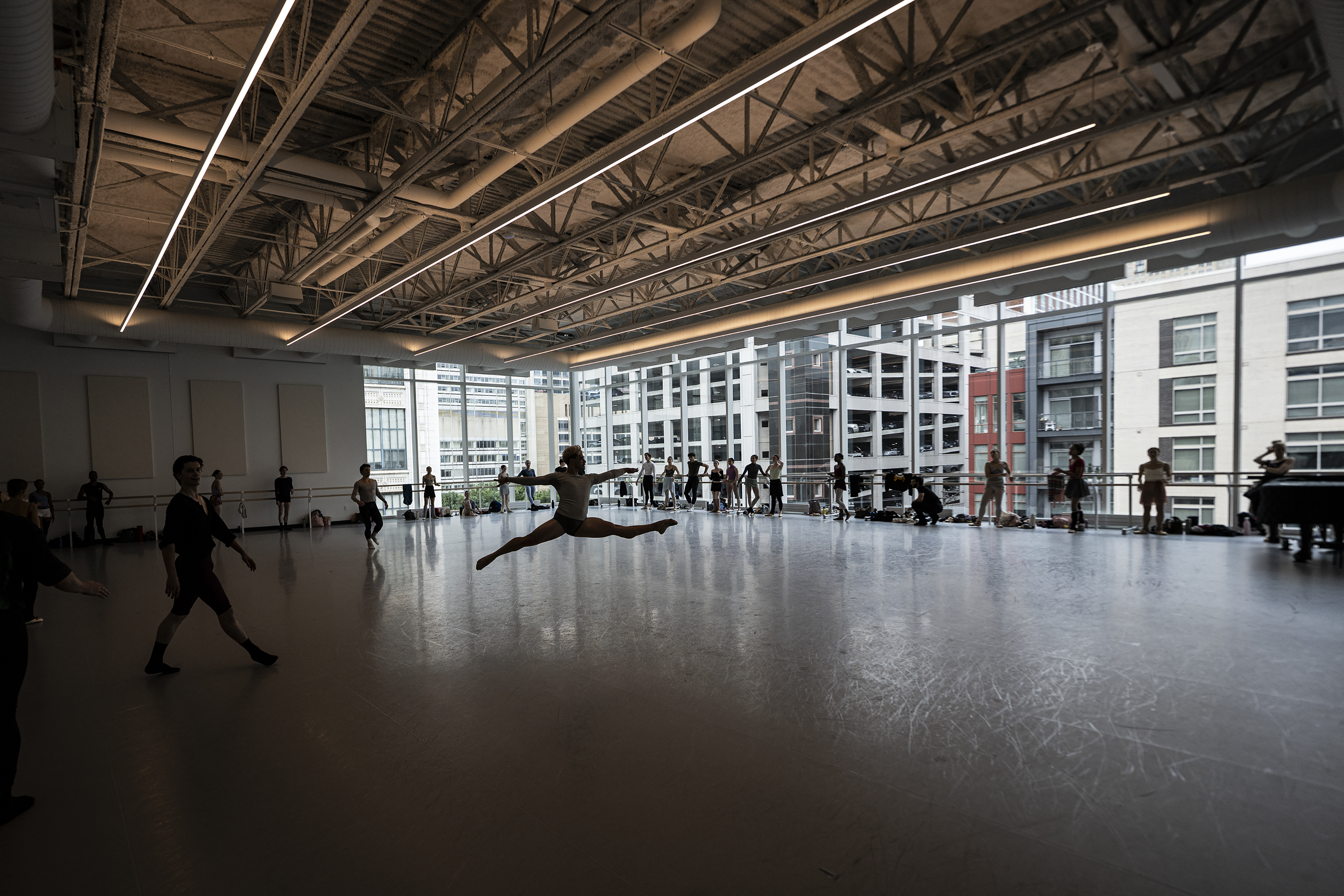
Designed by Varenhorst, a Philadelphia firm that toggles between high-end suburban homes and downtown apartments, the $45 million building is, in some ways, everything a big city ballet could want. The five-story structure does a great job at integrating the soaring, light-filled practice studios for elite dancers, with a dedicated classroom wing for the ballet’s school. Dancers are so energized by the scale of the new space, Power said, they can “jump higher.”
While the majestic Academy of Music will remain the ballet’s main performance space, the stripped-down, black box theater gives the company the opportunity to experiment with more intimately scaled works. And because the performance area is the same size as the Academy stage, the ballet can also do dress rehearsals there.
The new Philadelphia Ballet Center for Dance was built with four soaring practice studios, including this light-filled, double-height rooftop space overlooking North Broad Street.Jose F. Moreno / Staff Photographer
Having access to such an assortment of quality spaces promises to lift the ballet to new creative heights. Although the corps regularly ranks among America’s 10 best classical ballet companies, its dancers and school became itinerant after financial troubles forced the company to sell its old home at Broad and Washington in 1992. For many years, the school was housed in one location, dancers practiced in another, and administrators worked out of a third space. The lack of a stable home made it more challenging to woo top talent.
In 2007, the ballet purchased two small buildings at the corner of Wood Street with the goal of consolidating its operations under one roof. The Avenue of the Arts was just taking shape, and the location promised to give the northern stretch — always a bit of an afterthought — a marquee destination. As a longtime occupant of The Inquirer’s former North Broad Street home — the big white Tower of Truth (now the police headquarters) — I couldn’t wait to see human activity return to those sad blocks above Vine Street.
The design and the architects changed several times. The ballet, which, it is worth pointing out, received no city money for this important project, even lost its financing at one point. Architect Stephen Varenhorst, who signed on around 2016, deserves credit for sticking with the ballet through its many ups and downs.
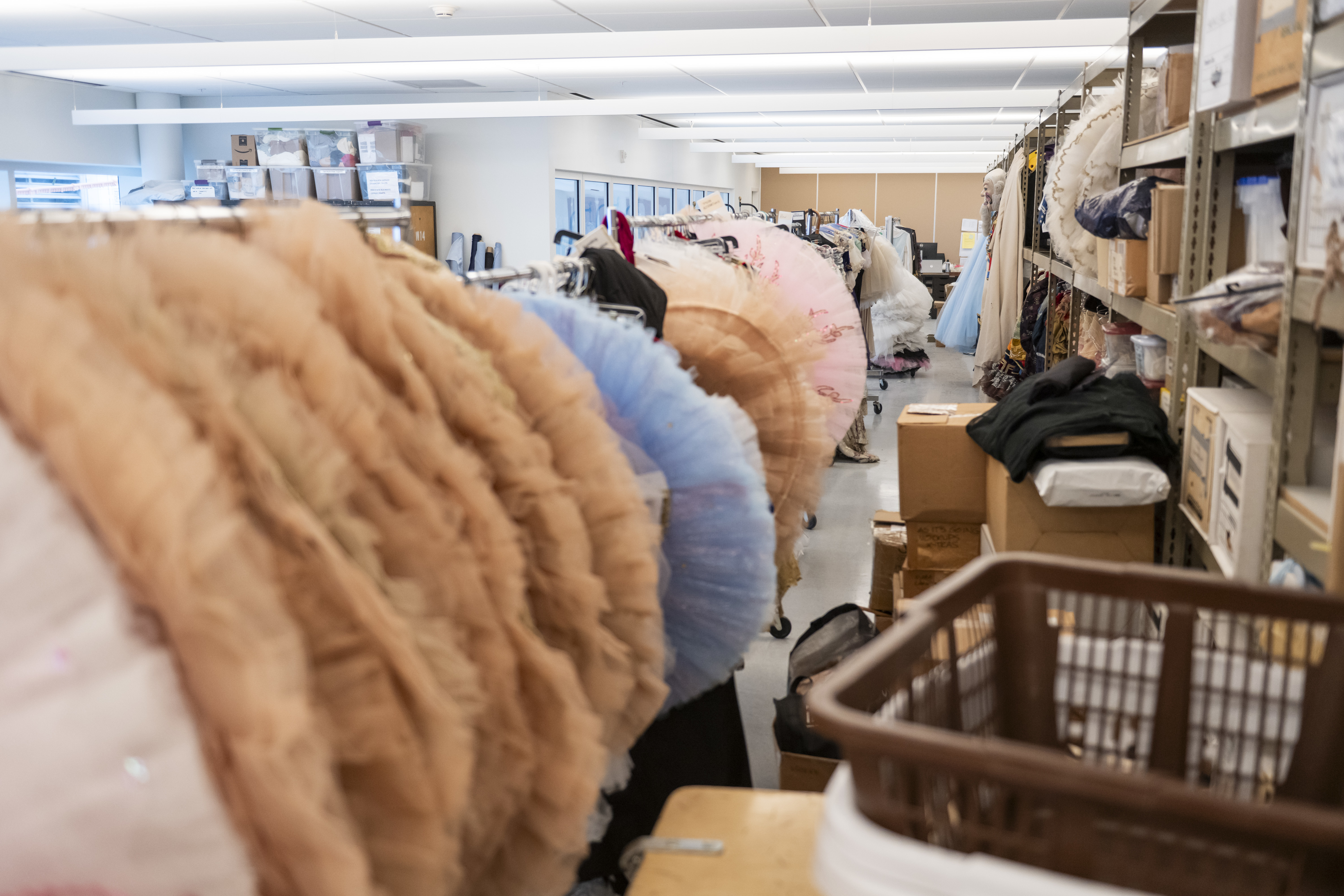
Maybe because the ballet was space-deprived for so long, his design was driven by a desire to make sure the company had the best of everything. Along with four large practice studios, the building is outfitted with a sprawling costume department, workshops for storing and dyeing dance shoes, a music room, and a generously equipped wellness spa.
Costumes line the wall in the wardrobe room in the Philadelphia Ballet’s new building on Broad Street.Allie Ippolito / For The Inquirer
To pack all this onto the deep, narrow site, Varenhorst put the ballet’s front door on Wood Street. Architects often prefer to locate the main entrance on the long side of a building because it’s easier to organize the interior circulation.
That arrangement definitely makes things more convenient for dancers and visitors, since Wood Street now effectively serves as an automobile drop-off. But it badly shortchanges the pedestrian experience on North Broad Street.
A daunting facade
Early in the design process, the ballet decided it would install the black box theater at the Broad Street end of the building. As the name suggests, black box theaters have no windows. That meant the most important facade, the one facing the Avenue of the Arts, would be a blank wall.
By putting the main entrance to Philadelphia Ballet Center for Dance on Wood Street, instead of North Broad Street, the architects at Varenhorst were able to create an automobile drop-off, a convenience for parents dropping off their children at the ballet school.Inga Saffron
To enliven the solid, four-story expanse, Varenhorst has covered the surface with a crimped, stainless-steel screen. The treatment is meant to suggest a theater curtain. Unfortunately, it’s a closed one.
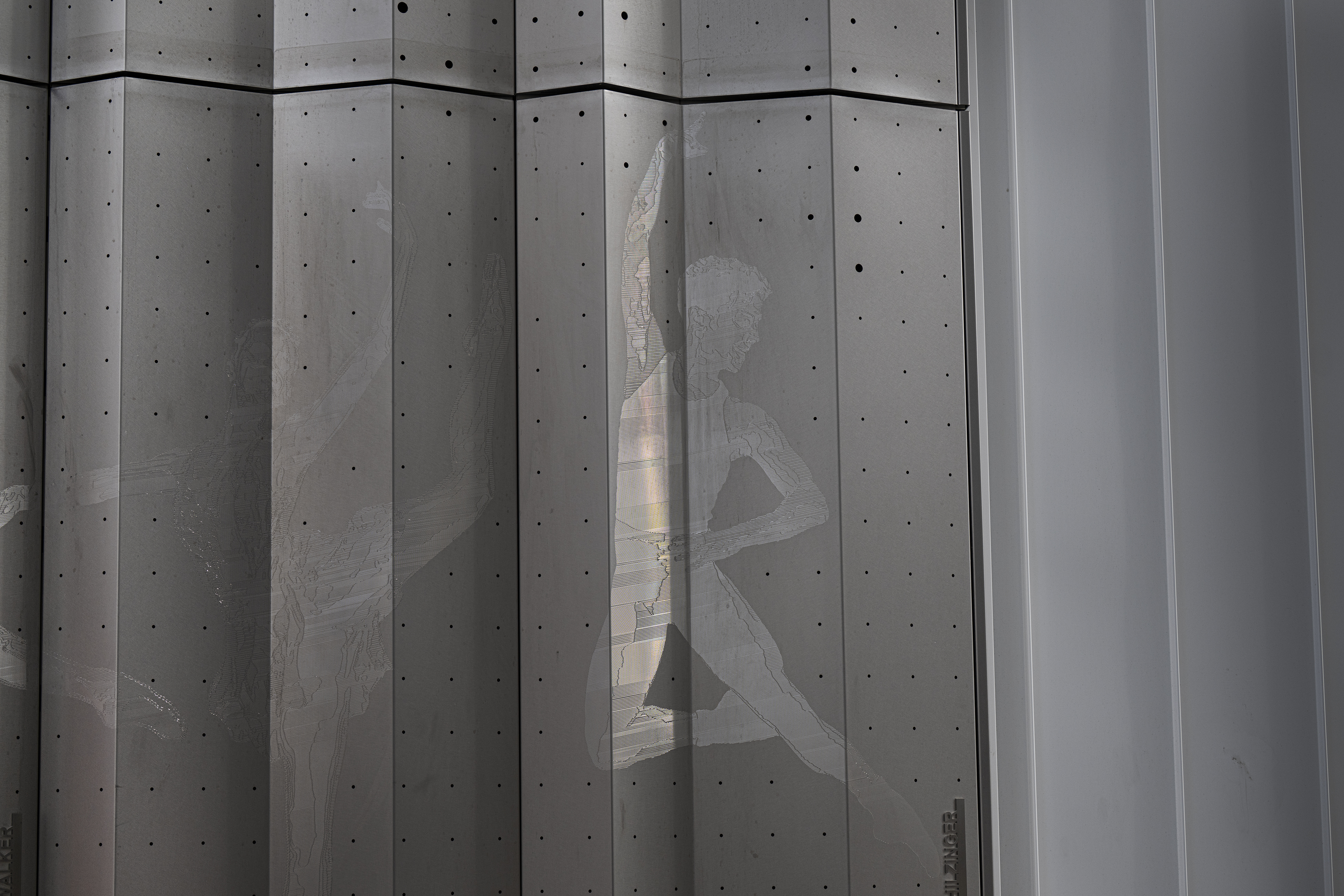
Varenhorst and the ballet have gone to great lengths to dress up the metal scrim. The stainless steel is good quality, manufactured by Zahner, the same firm that did Frank Gehry’s metalwork. The pleats are etched with ghostly figures of the corps’ dancers and perforated with pinholes that sparkle with fairy lights at night. If you crane your neck, you might be able to see dancers moving around the glass-walled studio on the top floor.
It’s about as good as a blank wall gets, but it’s still a daunting cliff.
To activate the large expanse of metal, the ballet clamped a digital sign onto the corner. The dance company plans to use it to advertise upcoming shows and display videos of dancers. We could just as easily stare down at our phones to get the same content.
Ghostly images of dancers have been etched into the pleated, stainless steel facade of the new Philadelphia Ballet Center for Dance on North Broad Street.Jose F. Moreno / Staff Photographer
What’s most disappointing about the design is that the ballet is not the first venue on the Avenue of the Arts to treat Broad Street as an afterthought. Although the Kimmel Center can at least claim a Broad Street entrance, its heavy brick facade was similarly unfriendly, especially when no performances were taking place. Those solid walls were one reason the Kimmel floundered in its early years. It took a series of interventions — a cafe, restaurant, and, yes, a digital sign — to make the large building feel more alive.
Moved by the same reasoning, the Wilma Theater also retrofitted its building to create a ground-floor cafe on Broad Street.
Arts administrators always promise us lively sidewalks when they announce a new building, yet there seems to be something in Philadelphia’s architectural DNA that produces the opposite result.
Take the Weitzman National Museum of American Jewish History on Sixth Street. Although it faces Independence Mall, a symbol of democratic openness, that facade is sheathed in opaque glass. Its main entrance is around the corner on Market Street.
The new Philadelphia Ballet Center for Dance is bracketed (left) by the Hanover apartments, which opened in 2017, and the former Packard Motor Car building, which was converted to apartments in 1986.Monica Herndon / Staff Photographer
Ironically, the three buildings — the ballet, Kimmel, and Weitzman — all follow the same format: Each features a transparent glass structure at the top, far from the madding crowd.
Why couldn’t the ballet have reversed this arrangement and put its black box theater on the upper level? That way, a glass-fronted practice studio could have faced Broad Street. Even if Wood Street remained the main entrance, the transparency would have enlivened the ground floor and made the ballet a visible presence in the city. Instead, the blank wall reinforces the idea that ballet is an elite form of culture.
Power and Varenhorst told me they briefly considered, then rejected, the arrangement because the company’s dancers would have objected to being put on display during stressful rehearsals.
But who says that a ground-floor studio could be used only by the ballet’s professional dancers? The Alvin Ailey American Dance Theater in Manhattan, which opened a six-story practice facility and school in 2005, got around that problem by making its transparent ground-floor studio a space for public classes. Watching the dance students go through their moves there has become so popular, Alvin Ailey installed a bench outside.
To compensate for the solid facade on its new North Broad Street building, the Philadelphia Ballet Center for Dance installed a digital sign at the corner of Wood Street. The former Philadelphia Inquirer tower, now the police headquarters, can be seen across the street.Inga Saffron
Like other cultural leaders, Power is now focused on using the building to build a community of dedicated ballet supporters, much as Anthony Roth Costanzo has done at Opera Philadelphia. She wants to hold public events with dancers on Wood Street and is looking into making Carlton Street a pedestrian walkway.
“Our challenge is this: How do we activate the building?” she said.
Good question. Unfortunately, the ballet missed a big opportunity to show, as well as tell, what’s going on in the Center for Dance. In sacrificing public urbanism for its own private needs, the ballet does everyone a disservice.
In response to Wim Orth’s recent op-ed, his suggestion that the U.S. should have a multiparty system has merit.
I would suggest returning to the way we elected presidents during the 1960s and earlier — that is, choosing our leaders at the conventions vs. anointing candidates via the party bosses. Any number of candidates could run for president, giving voters many more choices of candidates with different views.
At the end of the conventions, roll call votes can be taken, and the candidate with the majority would be the presidential candidate. We need many more candidates and perspectives involved in debates right up until the conventions. That would make for a much more democratic process.
Brian Reilly,Medford
Fund caregivers
I have, for many years, been a supporter of wages for housework, including wages for parents who care for their children, clean, cook, and do all the kinds of work needed at home. That work is real work and deserves monetary support. Some people pay others to do that work, which is proof of its financial value. Surprisingly, our government has embarked on a plan to pay stay-at-home parents.
One catch is that the wages will come from money earmarked for childcare subsidy programs, programs that already exist and are desperately needed by people who must work outside the home to survive. The other catch is that the money will go to married couples, while the current subsidies largely go to single mothers.
This robbing Peter to pay Paul scenario is utter cruelty — the same kind of cruelty that reduces money from Head Start, from Medicaid, from the Affordable Care Act, from the U.S. Agency for International Development, and many other programs. There is potentially enough money to pay wages for housework and to support childcare subsidies. To state the obvious, we just have to change our priorities. Why not create a special childcare tax for the rich? It’s past time for them to pay their fair share, and even a small tax could probably cover those who choose to work as full-time homemakers and those who must work outside the home to make ends meet, married or not.
Lynne Yermanock Strieb, Philadelphia
Great timing
It was interesting to note that during their recent trip to Ukraine, Steve Witkoff and Jared Kushner had a “delightful trip” and a “great time.” What’s more interesting is the fact that Russia and Ukraine stopped firing at each other while Witkoff and Kushner were visiting each country. If that is what it takes to have a ceasefire, perhaps they should have stayed longer.
Susan Ward,Marlton
Join the conversation: Send letters to letters@inquirer.com. Limit length to 150 words and include home address and day and evening phone number. Letters run in The Inquirer six days a week on the editorial pages and online.
People told me about a great street messiah, so I set out to find him.
The homeless men simply called him Zave, short for Xavier de la Huerta.
In the 1980s, he ran St. Joseph’s Shelter for homeless men where Front Street meets Kensington Avenue, beneath the rumble of the Market-Frankford El. He was a Franciscan friar assigned to nearby St. Francis Inn, the soup kitchen that survives on donations and still serves meals each day to homeless people, those who are unemployed, people battling substance use, struggling seniors, poor children, and anyone else with nowhere to turn.
The Franciscans have both priests and brothers, such as Zave, with the order saying it is dedicated to serving God where they are most needed. Guests don’t shuffle through a buffet line carrying plastic trays; instead, they sit at tables while volunteers deliver meals, restoring a measure of dignity of which they mayhave known very little.
The neighborhood itself foreshadowed what has made Kensington known today beyond its borders, through YouTube videos focused on exploiting images of poverty and the opioid crisis for clicks.
Once called “The Workshop of the World,” Kensington was one of America’s great manufacturing neighborhoods, home to textile mills, carpet factories, and the John B. Stetson Hat Co., which employed 5,000 people before it closed in 1971.
As factories evaporated, jobs vanished, families left. Investment in the neighborhood dried up and poverty settled over streets lined with crumbling rowhouses and inoperable, abandoned cars.
Before meeting Zave in 1989, I imagined him as a stern schoolmaster. The homeless men called him the “Mayor of Front Street,” and spoke of him with such reverence that I pictured a towering authority figure in a black cassock with half-glasses sliding to the edge of his nose.
I had been talking with the men on the corner when a crowd suddenly gathered around a little man about 5-foot-5wearing a bright red knit cap with a white pom-pom. The huddle of people trailed him like pigeons chasing breadcrumbs.
“Who’s that?” I asked.
“That’s Zave,” they said.
Brother Xavier de la Huerta opens the entrance gate so that people in need can access St. Francis Inn, in Kensington, in November 2011.Octavio Duran
I crossed the street, finding someone who seemed half my size, barrel-chested with a gleeful, disarming smile. He unlocked the shelter, empty during the afternoon before residents returned for the evening.
The building that housed St. Joseph’s Shelter was a narrow rowhouse that had once been Joe’s Bar, its name still preserved on the tile floor. Eight army barracks beds lined one wall. A small sitting room served as the heart of the house, where the men argued, laughed, mourned, and tried to help one another survive substance use and life on the streets.
I asked Zave what inspired him to dedicate his life to homeless men. Surely this had been his calling. He laughed.
“This is my assignment,” he said. “It’s where the Franciscans sent me.”
Brother Xavier de la Huerta listens to a homeless woman explaining how she needs assistance, outside St. Francis Inn in November 2011.Octavio Duran
I latervisited his sister, who lived near my Maryland home. She described her brother asa gentleman with innate kindness. When he stayed overnight at her home the first time, he asked her to replace the bed in the guest room because it was too comfortable. He rarely watched television because he lived upstairs at the shelter among the men, so he enjoyed viewing the old shows on his sister’s box.
She also told me a childhood story about a faithful dog who waited for youngZave at the school bus stop every afternoon. Neighbors were amazed at the canine’s devotion, but eventually learned the source.
On the walk home, Zave stopped at the butcher shop to collect discarded bones and carried them home for the waiting pup.
One homeless man who had spent a decade on Philadelphia’s streets described Zave to me in the most glowing terms.
Brother Xavier de la Huerta (right) shares a laugh with Brother Fred Dilger at Siena College in Loudonville, N.Y., in June 2014.Octavio Duran
“Brother Xavier, he’s like a saint,” he said. “He’s good people. Very good people. He’d take the coat off his back to give it to somebody. I feel like it’s Christmas whenever I see him; that’s the glow he has. I don’t know how somebody so little can do so much.”
One of the men I met at the shelter eventually entered drug treatment, moved into a halfway house, found sobriety, and rented an apartment. Another quiet soul Zave saved.
When I visited Zave again, he looked exhausted.
“What happened?” I asked.
“I broke one of my own rules,” he said.
He had agreed to hold one resident’s money so the man wouldn’t spend it on drugs.
“At 2 o’clock this morning,” Zave said, “he came pounding on the door demanding it back.”
There was no complaint in his voice, just another day.
Last year, Zave, now 90, celebrated 60 years as a Franciscan brother and now lives quietly in his order’s retirement home, the St. Lawrence Friary in Beacon, N.Y. He retired in 2016 after suffering a stroke, completing 37 years of Front Street duty.
Thirty years of newspaper reporting for major newspapers has introduced me to presidents, governors, celebrities, athletes, and thousands of fascinating people. Few taught me more about the meaning of a life than the little friar in the red knit cap.
Muhammad Ali once said, “The service you do for others on this earth is the rent you pay for your room in heaven.”