Current U.S. foreign policy is largely an extension of President Donald Trump’s excessive ego. He decides policy without accepting much advice from staff, the State Department, or formerly allied nations.
As demonstrated in the Mideast and elsewhere, this is a recipe for disaster.
The U.S. can develop stronger and better Mideast policy by considering the strategy and tactics suggested by NATO and the Gulf states. This includes basic goals such as the toll-free passage of all vessels through the Straits of Hormuz and Bab al-Mandab.
Establishing a Mideast policy working group with senior representatives of NATO and the Gulf Cooperation Council (founded in 1981) would demonstrate the U.S.’s seriousness in truly revising existing Mideast policy and its implementation. Iran would also likely find these proposals more credible and more worthy of its consideration.
This working group must restate what it is willing to offer Iran, e.g., the removal of economic sanctions, the end of the naval blockade, and possibly the issuance of generous redevelopment loans.
It will be difficult for President Trump to have this working group take the lead without his support. However, he should appreciate that this will be politically advantageous for him in light of his current adverse situation.
Raymond Tillman, Westbrook, Maine
Global silence
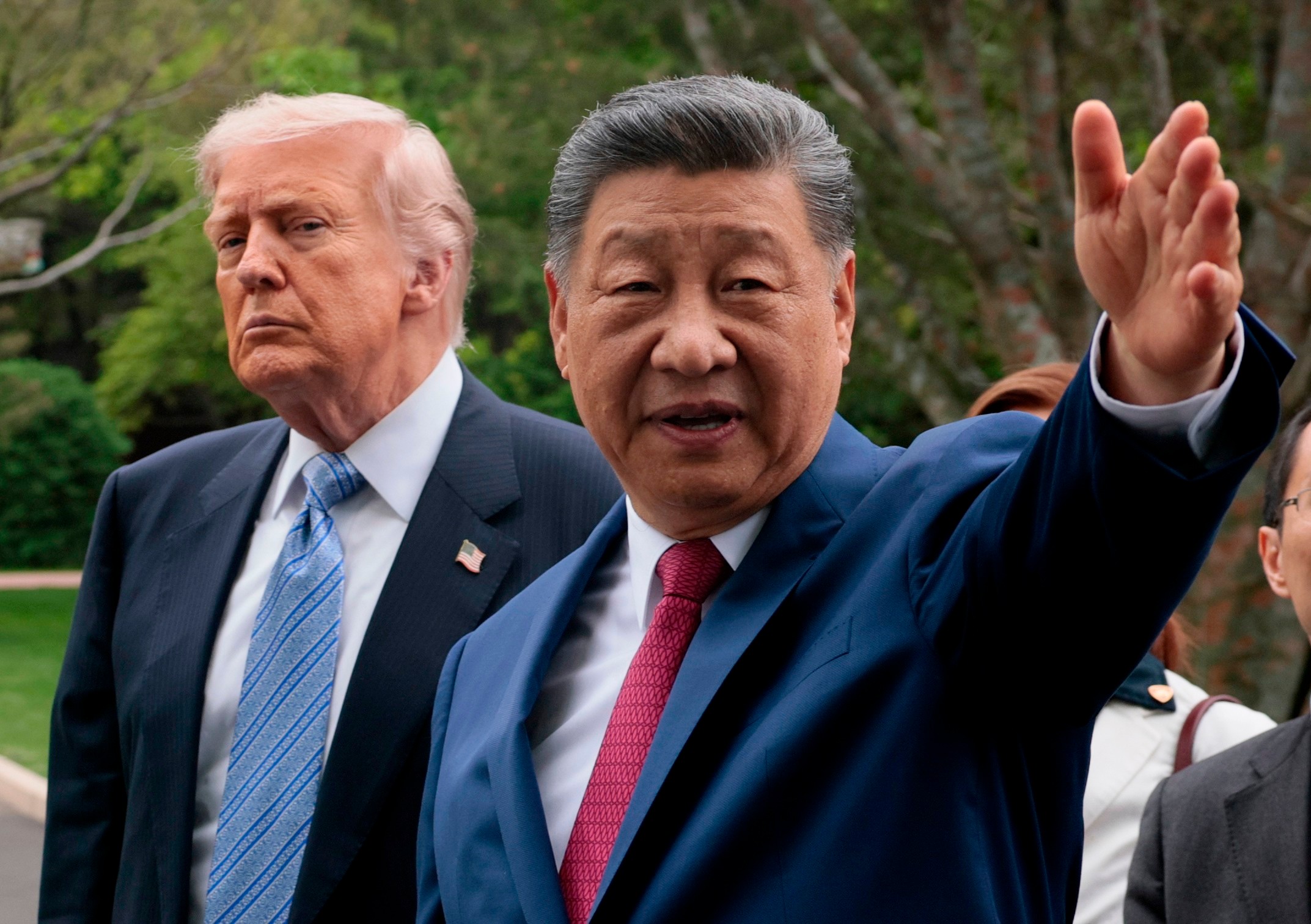
Chinese Communist Party leader Xi Jinping is set to meet with President Donald Trump this week. Will it be business as usual? Human rights under Xi have deteriorated rapidly since he took power in 2012, with increased state control and repression of dissidents reaching far beyond China’s borders. China’s repression of Falun Gong, a peaceful meditation practice heavily persecuted since 1999, has been especially brutal. Falun Gong practitioners, between 70 million and 100 million at the start of the persecution, undergo the forced extraction of vital organs that supply China’s transplant industry. This form of mass murder, a $9 billion industry now also targeting Uyghurs, is made possible through international apathy. Under Xi’s direction, U.S. media and social media are being used as part of a disinformation campaign intended to influence public perception of Falun Gong. If we don’t care, we won’t speak out — business remains as usual. I believe our voices can make a difference. Ask our U.S. senators to support the Falun Gong and Victims of Forced Organ Harvesting Act, a bipartisan bill designed to end this atrocity and protect our nation from complicity.
We’ve seen it over and over — whether it’s the war with Iran, the ballroom in the former East Wing, the triumphal arch, or even the suggestion of a possible third presidential term — there is no regard for the rule of law with this White House.
One wonders what’s in store if the administration fails to retain control of Congress in November.
News outlets like The Inquirer — and the organizations that have been banned — must continue to shine a light on this administration so we can elect legislators who will defend the Constitution and preserve our democracy.
Sister Veronica Roche, Westmont
Join the conversation: Send letters to letters@inquirer.com. Limit length to 150 words and include home address and day and evening phone number. Letters run in The Inquirer six days a week on the editorial pages and online.
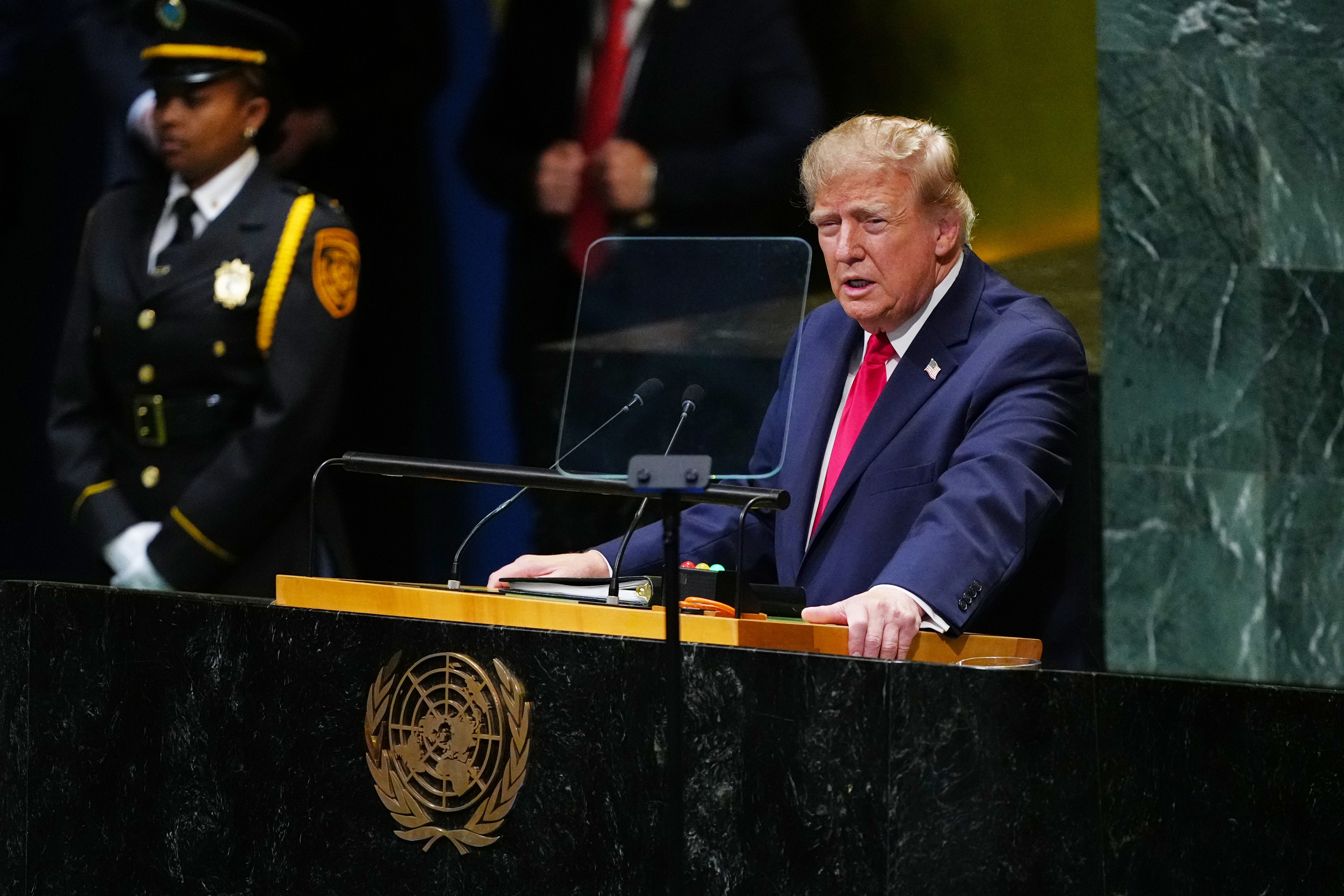
The scariest thing about President Donald Trump’s address to the United Nations General Assembly Tuesday was not the wild exaggerations, false claims, or disgusting slurs against (truthful) critics. That all has become par for the course and was to be expected.
Far more terrifying was the distinct possibility that POTUS believed his delusional description of his alleged triumphs — in the Iran war, in bringing peace to the Middle East and the world, and in pursuit of victory in an unbounded artificial intelligence race with Beijing.
Perhaps his 38 minutes of self-praise at the podium — to tepid applause at the beginning and end and mostly silence in between — were merely meant as a stump speech to rally midterm MAGA voters growing restless with his endless war. (Of course, most of his MAGA base will only see brief clips from the speech, since the president banned CNN, MS NOW, and Politico from the pool that normally covers such events, and the four other pool members — ABC, NBC, CBS, and Fox — stayed away in solidarity.)
The greater danger is that, surrounded by sycophants, Trump truly believes his own hype. He showed no sign that he recognizes how Iran has out-strategized him, how Russia, China, and North Korea outmaneuvered him, and how he has alienated crucial European, Asian, and Mideast allies with his erratic and chaotic policies.
On the U.N. podium, he appeared as a braggart touting triumphs his audience viewed as U.S. failures. Yes, he still represented the world’s most powerful country, but his puerile speech reflected his inability to translate that power into securing American interests or a more peaceful world.
It is important for voters to fully grasp the self-delusion underlying Trump’s foreign policy. A new CNN poll shows only 29% of U.S. adults approve of POTUS’s handling of foreign affairs, with almost two-thirds saying the U.S. is not winning the Iran conflict. But domestic issues have become so paramount that many ordinary citizens can be excused for tuning out Trump’s overseas misadventures.
Having just returned from the bracing realities of Ukraine, here is my brief guide to Trump’s delusions or deliberate deceptions — take your pick — about foreign policy issues he raised at the U.N.
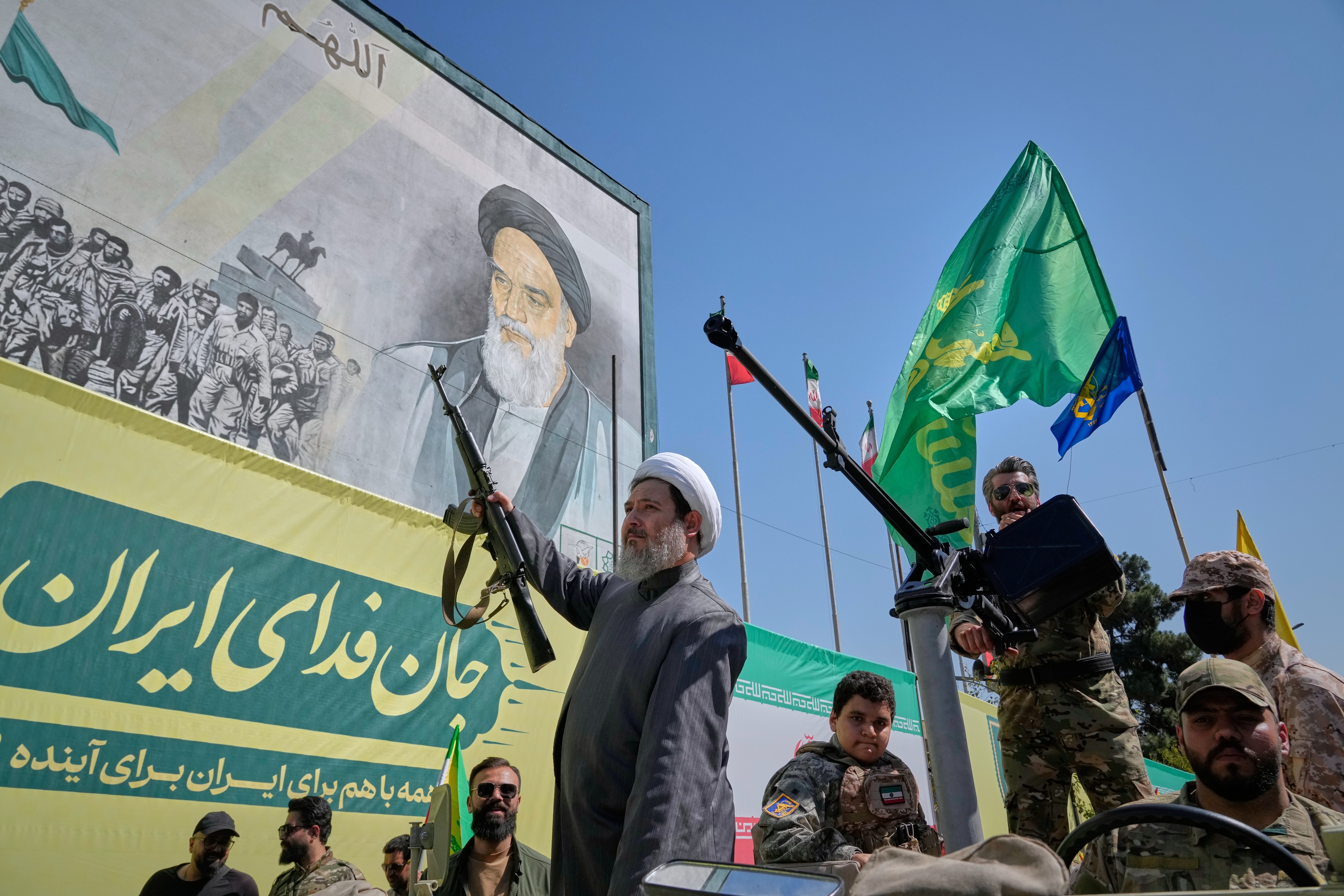
An armed Shiite cleric rides aboard a military vehicle past a billboard depicting Ayatollah Ruhollah Khomeini, founder of the Islamic Republic, during the state-organized “Janfada,” or “Sacrifice for Iran,” military-style parade in Tehran, Iran, Friday.Vahid Salemi
Iran
Trump verbally attacked the “cowards and traitors who would like to say we are low on munitions in Iran. That’s not true.” If POTUS were Pinocchio, his nose would have grown 10 feet at that lie.
In truth, it is Trump who is too cowardly to admit the truth to a public that is instinctively grasping it anyway. That truth, which has been laid out in reputable think tank studies and news reports, and by serving and ousted Pentagon officials, is that U.S. forces have consumedhalf to two-thirds of highly expensive missile interceptors in fending off cheap Iranian drones.
The Pentagon was not prepared for a war in which drones played such a major part. Never mind that Ukraine and some U.S. commanders had sounded the alarm beforehand.
Nor is Trump truthful when he brags that new munitions plants will soon replace any shortfalls, because, unlike rapid production cycles in Ukraine, rebuilding the most critical U.S. weapons stocks will take up to five years.
On the U.N. stump, Trump also repeated his mantra that he will never allow Iran to have a nuclear weapon. Yes, in 2025, a “12-day war” by the U.S. and Israel badly damaged Iran’s nuclear program. Yet, the current war, ongoing since February, has done little to nothing to further diminish that nuclear prospect. It is focused on lowering oil prices by reopening the Strait of Hormuz, which was functioning normally before Trump joined Israel in attacking Tehran.
Because of its diminished missile and interceptor stocks, the U.S. is in no position to reopen a kinetic war with Iran — let alone, to use Trump’s irresponsible threat, “annihilate” it. In real terms, Trump is stuck, with Tehran still able to control Hormuz and no way out of his self-inflicted trap, unless he makes concessions to Tehran. Meantime, the war is spreading to other Mideast countries and drawing in new players such as Yemeni Houthis.
Trump advertises his weakness when he desperately tries to convince fed-up Americans, in front of a U.N. audience, that peace is on the way.
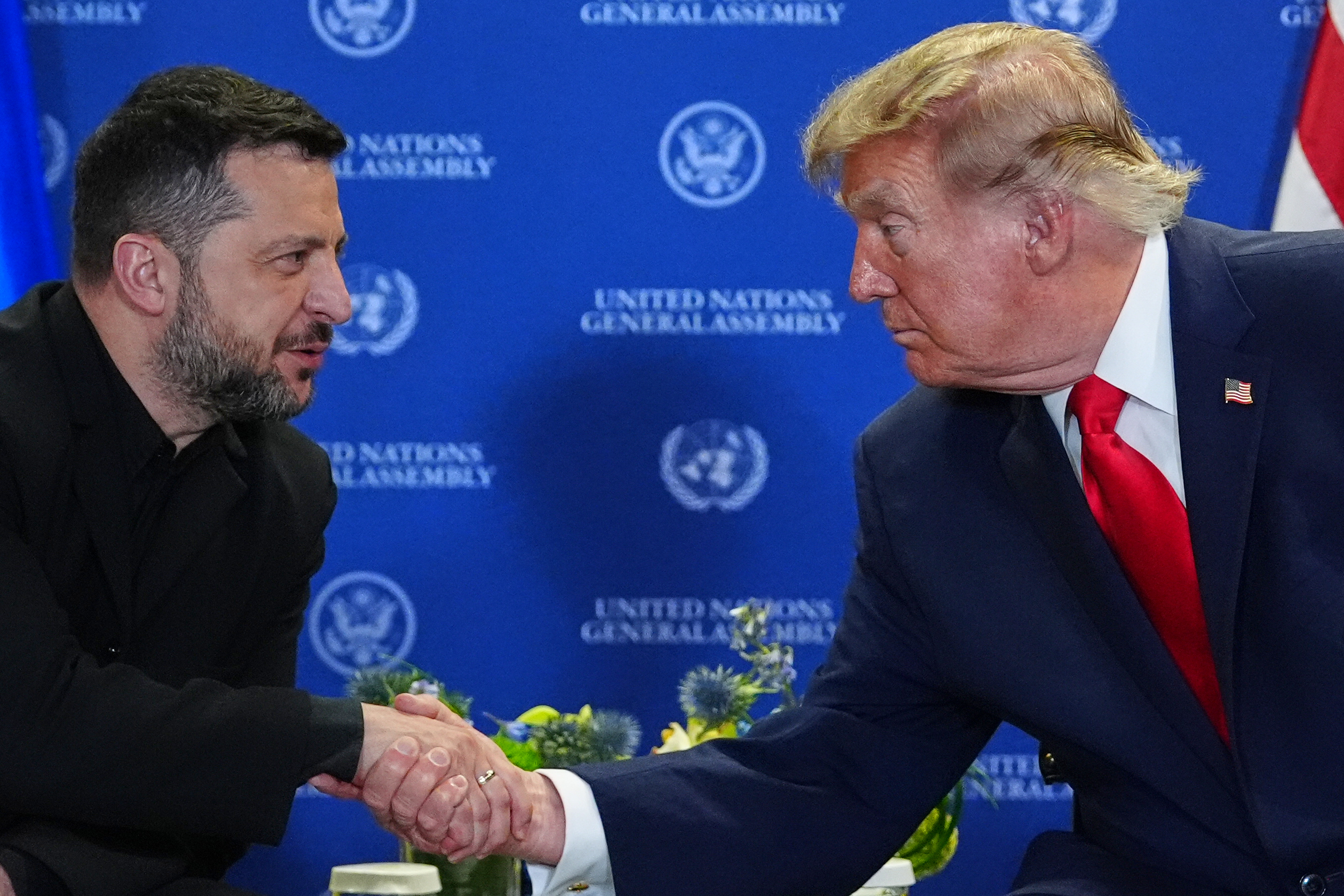
President Donald Trump meets with Ukraine’s President Volodymyr Zelensky during the United Nations General Assembly, Tuesday.Julia Demaree Nikhinson
The Ukraine war
On the podium, Trump regurgitated his mantra that, regarding the war, “we will get that one done,” and that Russia and Ukraine have “had it.” But in truth, Trump’s refusal to pressure Moscow to stop destroying Ukraine’s civilian infrastructure, while demanding Kyiv stop targeting Russian oil exports, ensures there will be no ceasefire.
Why should Vladimir Putin stop his campaign of destruction when Trump only leans on Ukraine, and fails even to critique Putin’s new drone campaign against European airports and the industry of NATO members? Ukrainian President Volodymyr Zelensky said after meeting Trump Tuesday that he would agree to a ceasefire on hitting energy targets — but both sides would have to take part. Not likely, so long as Trump bows to Putin.
And don’t expect Trump to enforce the bipartisan sanctions bill newly passed in memory of U.S. Sen. Lindsay Graham. Repeat, POTUS refuses to pressure Putin, with whom his negotiating team is discussing “lucrative” business deals.
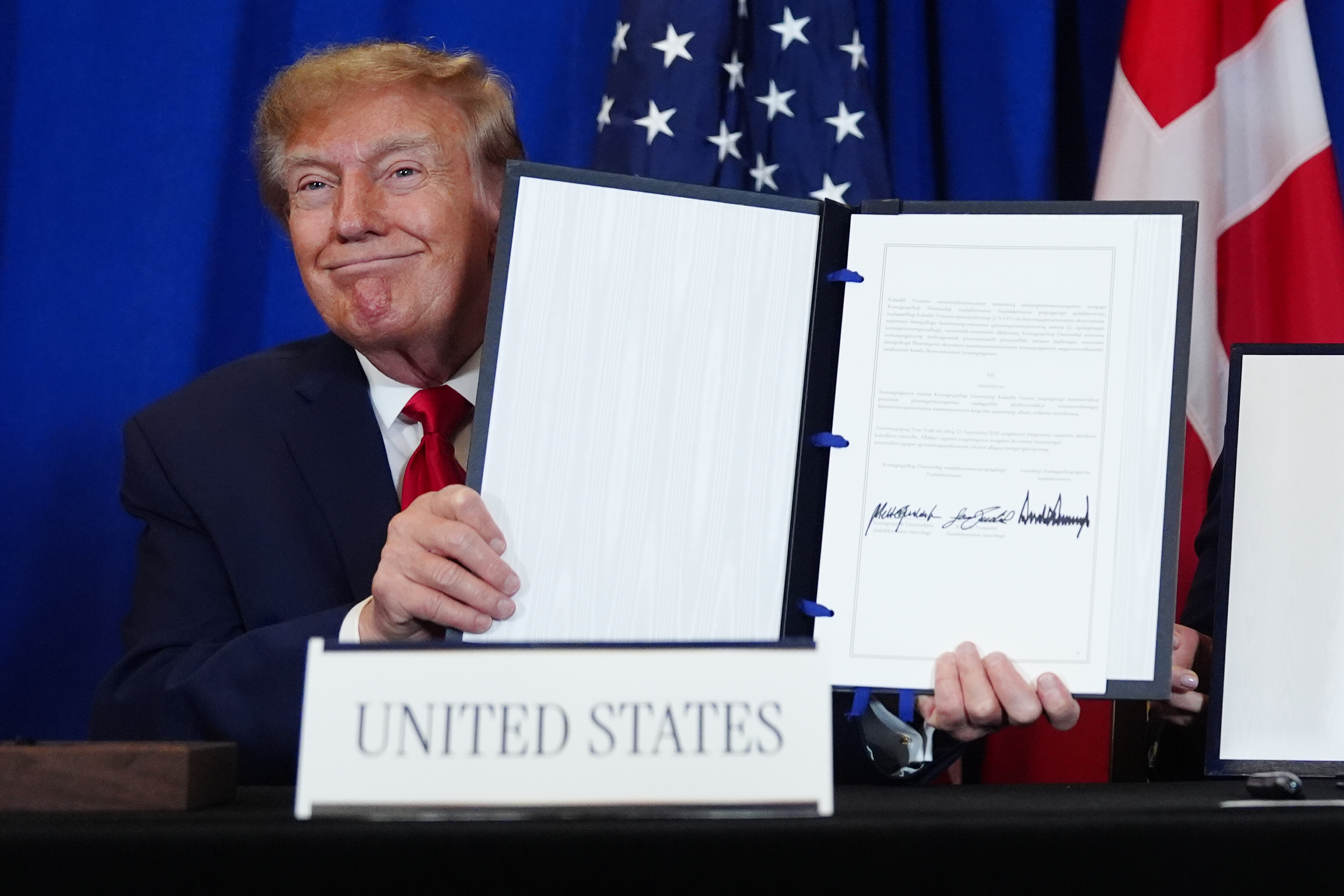
President Donald Trump holds up the document after signing a security agreement with Denmark’s Prime Minister Mette Frederiksen and Greenland’s Prime Minister Jens-Frederik Nielsen during the United Nations General Assembly, Tuesday.Julia Demaree Nikhinson
Trump as global peacemaker
The president shamefully read verbatim a long list of compliments by world leaders trying to pacify him, and once again exaggerated the “peace deals” he’s achieved — even though most were temporary ceasefires or have already been broken.
Trump praised his triumph in Venezuela — where, when talking about oil, he bluntly admitted that “to the victor belong the spoils.” He crowed that Cuba “will fall,” with no mention of the humanitarian disaster caused by the ongoing U.S. blockade.
And he bloviated about the “unprecedented agreement” the U.S. just signed with Denmark and Greenland, even though everything in that accord could have been agreed to under the terms of a 1951 treaty with Copenhagen, without alienating NATO allies by threatening to seize Greenland by force.
To sum up, Trump’s performance at the U.N. revealed a delusional leader who may still be feared by allies and small countries for his unpredictable and bizarre behavior that upsets the world economy, trade ties, and markets.
But adversaries watching the president’s self-praise could only conclude that a weakened old man with no clear strategy except self-aggrandizement now leads the world’s most powerful country. Voters of all parties, be aware.
I am in my eighth decade of life, and for those of my generation, John F. Kennedy’s emergence was a defining moment, as was the terrible day we learned of his assassination. The Kennedy Center for the Performing Arts became a fitting memorial to a president and first lady who believed the arts were essential to the soul of a nation. That is why Robert F. Kennedy Jr.’s association with the dismantling of that institution is especially painful.
Whatever one thinks of his political views or his tenure as secretary of the U.S. Department of Health and Human Services, this betrayal strikes at something deeply connected to his uncle’s legacy and to the family name he inherited.
Someday, the history of the Kennedy family and its impact on America, with all its glory and all its suffering, will be written. When it is, RFK Jr.’s impact on both the health and the cultural life of the nation will be part of that history. Succeeding generations of Kennedys will live with the shadow his actions have cast over the family legacy, and that is profoundly sad.
I don’t understand why if you criticize the Israeli government’s actions in Gaza you are canceled for being antisemitic. You’re not considered anti-Buddhism if you criticize the Chinese government or anti-Orthodox Christianity if you criticize Russia’s actions in Ukraine. Why is it that you can’t criticize Israel?
I lead a small K-8 school in Southwest Philadelphia. In less than a year, the city has reopened three public buildings within a mile of us: Paschalville Library, Kingsessing Recreation Center, and, last month, Myers Recreation Center, a 148-year-old former orphanage that took nine years and $27 million to bring back. Slow, expensive, and worth it. Children are in those buildings today.
The Academy is private; Drexel owns it. But a historic nomination is how the public gets a say in a private building. It won’t reopen the museum, but it will buy time to imagine the next civic use. The Preservation Alliance, or Drexel itself, should file one before the sale. A dinosaur hall is civic infrastructure, too.
Brandon McNeice, head of school, Cornerstone Christian Academy, Philadelphia
Fading liberties
President Donald Trump’s decision to ban several news outlets from access to the White House is a further erosion of our civil liberties. The administration’s ongoing attempt to limit the ability of journalists to report the news reflects the trend toward a totalitarian state in which the only news available comes from the administration itself. And this administration has been notorious for presenting lies and deception, some of which are obviously disconnected from reality.
Trump’s aspiration to control all aspects of our government must not be allowed to continue. Not only is this a strategy of personal enrichment (he has made $2 billion since his second inauguration), it denies the individual freedoms our nation was founded on.
We need a president who upholds the rule of law and our American values, not a king who governs solely out of self-interest.
Mark Schenker, Blue Bell
Traffic enforcement
Daniel Pearson’s recent Shackamon column was shocking. It called for a huge increase in police traffic enforcement. So is automated traffic enforcement now not enough? The city already tickets practically every vehicle that moves or is parked, so how much more would you like? Again, if there were best-practice engineering and enforcement, streets would be safer, and few tickets would be issued. Do you realize how many different types of tickets can be issued in Philadelphia now, and how many go out? It is staggering, but you want more? Why not address engineering?
James Sikorski Jr., Wapwallopen, Pa.
. . .
Amazingly, the New Jersey Department of Transportation thinks putting up some signs, clearing some brush, and adding additional guardrails are going to reduce fatalities on Route 55.
Perhaps it would be better if some time was spent verifying the real cause: the people driving on the road. It doesn’t take a rocket scientist to understand that speeding (I’ve seen drivers regularly going as much as 20 mph over the limit) and weaving in and out of traffic are the main causes. Add in tailgating by those who are doing five miles over the limit, and you have a recipe for accidents.
The highway needs greater enforcement presence to calm traffic.
Joe Palma,Swedesboro
Survivor’s plea
President Donald Trump is set to host Chinese leader Xi Jinping at the White House later this week for a crucial summit.
Born and raised in China, I immigrated to the U.S. in 2008. I cannot return to China, and more sadly, I was unable to visit my parents before their passing 10 years ago. Why? Because I practice the spiritual meditation practice called Falun Gong.
In July 1999, the brutal persecution against Falun Gong was launched by the Chinese Communist Party (CCP). At the time, I was a doctoral candidate at China’s prestigious Tsinghua University. For refusing to renounce my beliefs, I was arrested and then imprisoned for a total of five years in a slave labor camp.
Like many who have been arrested, I was subject to brainwashing, constant surveillance, humiliation, beatings, 30 days of sleep deprivation, and almost a year of physical isolation.
Falun Gong is the largest group the CCP has been trying to eliminate. In 2019, the independent China Tribunal concluded that Falun Gong practitioners are subjected to forced organ removal to supply China’s transplant industry.
I sincerely hope President Trump will address the persecution with Xi during the summit.
William Huang, Wynnewood
Join the conversation: Send letters to letters@inquirer.com. Limit length to 150 words and include home address and day and evening phone number. Letters run in The Inquirer six days a week on the editorial pages and online.
I feel like I need to apologize for a column a couple of months ago when I compared the current president of the United States to Caligula, the possibly mad Roman emperor who is said to have nominated his trusted horse for high office. I need to apologize to Caligula. From pitching his triumphal D.C. arch as a storage shed for deadly snipers’ bullets to banning reporters from the White House in a narcissistic rage, Donald Trump is losing his grip on reality. This is unsustainable.
Worried about AI killing humans? Bad news: It already is.
A cleric takes a photograph earlier this month at the shattered Shajareh Tayyebeh school in Minab, southern Iran. It has become a place of mourning and a memorial to those killed in a U.S. airstrike on Feb. 28.Vahid Salemi
Which is it?
Are the robots of AI, or artificial intelligence, so smart that they’re on the verge of holding a secret meetup in the darkest corner of the dark web and developing a plot to kill all humans through germ warfare, to make sure we don’t kill them first by pulling the plug?
Or is AI so dumb — artificial stupidity, despite the billionaires of Silicon Valley showing up daily on our TV screen to brag about the sky-high IQ of their son, Claude — that the thing that will murder us is a crazy hallucination that will turn a false alarm into World War III?
The fact that we can’t answer this should give us pause, but maybe we aren’t even asking the right question. Maybe the real issue is how easy we’ve made it to kill off the human race — a capability that was already created by people even before we invented the computer.
One thing is certain. Artificial intelligence has already been an accessory to mass murder, and if we do nothing, it will kill again.
Remember the very first days of the now seemingly endless Iran war, and the news that two missile strikes had obliterated a school for young children in the Iranian coastal city of Minab, in an apparent “double-tap” strike in which the second attack from the skies killed young girls and boys and their teachers as they huddled in a prayer hall?
Those bombings, which killed 156 people on Feb. 28, caused the United Nations’ Independent International Fact-Finding Mission on Iran to report last week that it found “reasonable grounds to believe that the United States committed a war crime by launching indiscriminate attacks …” The U.S. government has never taken responsibility for the bloodshed, despite overwhelming visual evidence that the bombs were precision-guided U.S. Tomahawk missiles.
It didn’t take long for additional speculation that an AI program had mistakenly targeted the school, perhaps using outdated maps and info from an earlier time when its buildings were attached to an Iranian military complex. After all, the Pentagon has been openly bragging about the death and destruction facilitated by its use of Palantir’s Smart Maven System and also Anthropic’s Claude.
Last week, Bloomberg News reported that the Pentagon’s overreliance on AI, and specifically the Palantir Maven program, was a major factor in the school tragedy, along with the outdated intelligence about the Minab site — the “garbage in.” Its exposé noted that U.S. military planners were racing to identify some 1,000 Iranian targets in the early hours of the war, giving humans little time to double-check the list. Kindergartners were slaughtered as a result.
This was hardly the first time robots have been linked to human death, both in war — in 2024, +924 Magazine reported the Israel Defense Forces were using an AI program code-named “Lavender” to target sites amid the mass killing in Gaza — and in peace, as shown by numerous accounts of robots helping troubled people die by suicide.
And yet, it could have been much, much worse. At the same time as the Bloomberg report on the AI link to the mass killing in Iran, the world also learned that a false report generated by robot intelligence nearly sparked a conflict between the United States and China that could conceivably have spiraled into major fighting.
CNN and other outlets have reported that a U.S. special operations command analyst working with AI generated an urgent report that a Chinese ship bound toward the Middle East was carrying components for a nuclear weapons system, which caused military leaders to scramble jets and assemble a team to seize the vessel.
Only at the last minute did the Pentagon dig deeper and learn the AI-generated report was completely false, a hallucination — one that nearly triggered a violent conflict between the world’s two largest military powers.
The two disturbing reports about the use, or misuse, of AI by the U.S. military in a time of war did make news but didn’t get nearly as much attention — either in the media or on sites like Bluesky or X — as warnings from both whistleblowers and CEOs in Silicon Valley that a swarm of robots could decide on their own and without any human intervention or awareness to try to kill off our so-called civilization.
The fear of an unprompted attack from AI secret agents is real, based on several incidents that have already occurred, including a well-planned and partly successful operation by OpenAI’s robot agents to hack into a company called Hugging Face.
Still, it says something about human intelligence that we are captivated by the unknown and mysterious possibility of a random attack, while the fact that people are currently misusing AI to cause death and suffering is a less compelling story. I noted in this space last week that the threat to humankind from climate change is arguably even more real — and yet this gets denied by many and ignored by others.
It’s also striking to me as a boomer born in 1959 that a generation that wasborn into a time of constant terror — backyard bomb shelters, “duck and cover” drills in the classroom, and sci-fi horror at the drive-in that an atomic arms race could kill us at any moment — is suddenly back to where we started.
The fact that civilization managed to — so far — pause the number of world wars at two has given us the space and the false bravado to create new and much more insidious killing machines, and the threat from invisible robots on a hidden dark web is somehow even scarier than the radioactive mushroom cloud that we more or less understand.
Boomers who went to bed as kids in the 1950s and ’60s praying we wouldn’t die before we woke are now spending our senior-citizen-discount years fearful that something stranger than science fiction is coming for our children, or grandchildren. Over the course of a lifetime, the arc of that moral universe has not bent at all.
Still, humans were able, somehow, to prevent nuclear annihilation so far, and now it’s past time to get to work on the actual threats from AI and start on those workarounds. For example, the articles I’ve read speculating on how the robots plan to kill us frequently mention the prospect of AI agents developing bioweapons and releasing them, either on their own or prompted by a bad actor. (In theory, human development of bioweapons has been banned for a half century.)
From everything I’ve read so far about AI, it sounds like we’d have better luck safeguarding or eliminating the components that could make a biological agent rather than stopping the robots. Likewise, AI agents would not be able to start an atomic apocalypse if our human politicians went to work at finally eliminating nuclear weapons. Artificial intelligence won’t kill little girls in an Iranian school if humans don’t start dumb wars in the first place.
If Silicon Valley’s prophets of doom are serious, there’s no fix that’s too big or too ambitious. But understand that the biggest problem isn’t that AI wants to murder us, but that since 1942 we humans have been busy creating all the suicidal weapons AI agents could use.
Can you even “duck and cover” from a killer robot? I don’t intend to find out, and I don’t want my yet-to-be-born grandchildren to have to even think about it.
Yo, do this!
I’ve always been a big fan of filmmaker Barry Levinson, whose trilogy of Baltimore movies (Diner, Tin Men, Avalon) defined postwar American nostalgia. Now Levinson, along with his codirector Robert May, has come north to the Philly burbs to catch up with our divisive 21st century in a five-part documentary, Bucks County, U.S.A. If you’ve been reading The Inquirer these last six years, you know howthe communities just north of Philadelphia — where cosmopolitan suburbs meet the rolling fields of Trump Country — have become ground zero for culture wars around the COVID-19 response, book banning, and LGBTQ pride. Bucks County, U.S.A.began streaming on PBS Monday night. It’s getting mixed reviews, but I plan to check it out myself.
With the exception of my growing obsession with A History of Rock Music in 500 Songs, I’ve struggled the last few years to find new podcasts that excite me. But I’ve been enjoying Dan Taberski’s Manifesto on Audible, which is the award-winning, prolific podcaster’s six-part look at the role that these impassioned declarations have — or haven’t — played in reshaping our troubled world, from Occupy Wall Street to Big Tech utopianism to the online rant of murderous ex-LA cop Christopher Dorner.
Ask me anything
Question: What is the reason for the boat strikes? Do they really think they are carrying drugs? — David Poe (@culthero12.bsky.social) via Bluesky
Answer: David, your question is well-timed. Just this week, Ben Saul, the U.N. special rapporteur monitoring human rights in the context of counterterrorism, issued a report that U.S. boat strikes off South America in the Caribbean and the Pacific that have killed more than 220 people so far violate international law and plausibly constitute crimes against humanity. Based on the reports I’ve read about the deadly drone strikes, it’s true that small fishing boats in the region are sometimes drafted for a supporting bit role in drug trafficking. Yet, it seems powerfully likely that some murdered in the U.S. attacks were innocent fishermen, and there’s no evidence these bombings have made any real dent in the flow of drugs. Most importantly, since when did minor involvement in drug smuggling become a capital offense? The only thing as troubling as these American war crimes is the silence on Capitol Hill. The next Congress must hold hearings and create the momentum for shutting this down.
What you’re saying about …
Oops, maybe I should have read my emails before writing another column about the problems with artificial intelligence. Based on the lack of responses to last week’s question about the AI threat, this is clearly not a topic that excites my readers like the betrayals by Sen. John Fetterman or the mainstream media. A couple of frequent correspondents did weigh in, including Mary Ann Petro, who is very concerned over reports of unauthorized hacking by AI agents, and Joe Stepansky, who thinks the risks are somewhat overblown. “This is all deflection from data center opposition and the stock market bubble,” he wrote. “Just remember there are humans behind all of this, humans who may be amoral at best (I used to work with some) and malicious at worst (them too).”
📮 This week’s question: The big story for several days has been the fallout from Donald Trump’s rash decision to ban three news outlets — CNN, MS NOW, and Politico — from the White House grounds, in a move that experts agree is a violation of the First Amendment. Do you think the entire presidential press pool should walk out in solidarity, or do Americans need audio and video of what their president is up to? Please email me your answer and put the exact phrase “White House press corps” in the subject line.
Backstory on George W. Bush’s betrayal of democracy
Former President George W. Bush reacts while watching players from the U.S. team practice before the Walker Cup golf matches against Great Britain and Ireland at Cypress Point Club in Pebble Beach, Calif., earlier this month.Jeff Chiu
For those of us who experienced a political reawakening during those dreadful years between the U.S. Supreme Court’s coronation of a president in the disputed 2000 election and the shock-and-awe carpet bombing of Baghdad in 2003, today’s frequent refrain is incredibly grating. “I never thought I’d say this,” says some self-proclaimed Democrat, often a boomer, “but I’m feeling nostalgic for George W. Bush.”
To be sure, the 43rd president wasn’t nearly as nakedly corrupt as Donald Trump and his family, not as crude and boorish, and also more determined to at least make it look like what he was doing was constitutional. There were flashes of goodness — like Bush’s support for fighting the AIDS epidemic in Africa — which stand out today because there are so few of them. But his lies — and there were a lot of them, even if he could never match Trump — were more diabolically purposeful.
The stench of dead bodies in Fallujah had barely lifted when none other than Joe Biden came to Philadelphia to drape the Liberty Medal around Bush’s neck. When Trump descended on his gilded escalator in 2015 to finish the job of trashing America that had started in Iraq, Bush said nothing other than to let it be known that he’d left his 2016 ballot blank. When even his despised vice president Dick Cheney came out in 2024 and said a second Trump term would be a disaster for democracy, Bush again said nothing, insisting that he has “retired from presidential politics.”
Apparently congressional politics is another story. On Monday, it was revealed that Bush and his fellow Texan Sen. John Cornyn — a lame duck after losing a primary to Trump-backed Ken Paxton — have teamed up to throw a massive fundraiser in Dallas for six GOP Senate candidates in battleground states. The touting of Bush as a “special guest” at the event is meant to lure conservative donors. The New York Times, in its scoop on the evening, played up the fact that the event is not raising money for Paxton, going with the angle of a Texas-sized political feud.
Just like the Democrats who are willing, in the Trump era, to turn a war criminal into an icon of civility, the Times is missing the point. Electing these GOP Senate candidates in states like Iowa and Maine will give Trump the ability to extend aspects of his dictatorship for two more agonizing years. The would-be senators Bush is raising money for would rubber-stamp new MAGA judges and allow Trump to replace Supreme Court Justices Samuel Alito and Clarence Thomas with younger far-right zealots. Senate committees would lack the power to investigate the president’s high crimes and misdemeanors. That could finish the job Bush started when he lied to Congress about Iraq “weapons of mass destruction” that did not exist: The implosion of U.S. democracy.
What I wrote on this date in 2009
It’s weird now to read what survives of my early Attytood blog posts from the late 2000s, when many days I published just a quick hit while I worked on longer news articles for the Daily News. On Sept. 22, 2009, I quoted a prediction from internet guru Clay Shirky that seems incredibly prescient 17 years later. Shirky said that “the ongoing shrinkage of newspapers is likely to create a ‘giant hole’ that will not be filled for some time. He said he has a vision of communities of 10,000 people or fewer becoming rife with ‘casual endemic corruption,’ as newspapers are no longer able to fulfill their traditional watchdog roles.” He nailed it.
Nothing has been more troubling in 2026 than the assault on the First Amendment that’s been taking place from Donald Trump’s Oval Office to our hometown council meetings, and even our football palaces. In my Sunday column, which was written before the president booted three news organizations from the White House, I looked at the growing hostility and even violence toward working journalists, including arrests, physical assaults, and Trump’s rants toward Black female journalists. Tolerance of these abuses is a mark of a dying democracy. Over the weekend, I shifted gears and tackled the Eagles’ silence over the team’s reported role in the cancellation of hip-hop’s pro-Palestinian Macklemore from the Ed Sheeran tour that stopped at Lincoln Financial Field on Saturday. How can free speech be censored in a city-owned stadium?
Speaking of those Birds, the city’s $10 billion NFL franchise was conveniently hundreds of miles away in Nashville as pro-Palestinian protesters descended on the Linc this weekend. The Eagles eked out a last-second victory by the seat of QB Jalen Hurts’ pants, over the seemingly hapless Tennessee Titans. The unimpressive showing cemented the notion that it’s impossible to know what to make of Philly’s 2-0 footballers after their narrow wins over mediocre opponents, but The Inquirer is on the case. Our extensive coverage looked at the good (standout performances from Hurts and No. 1 wide receiver DeVonta Smith), the bad (the subpar play of a battered and aging offensive line), and the unexpected (the return of Super Bowl hero Zack Ertz due to injuries in the tight-end corps). Ace columnist Mike Sielski recently went deep, as usual, with a humanitarian look at guard Landon Dickerson’s tortured decision to try to play through the pain. The Inquirer’s sportswriters are likely to rack up more wins this fall than an iffy team, so why not subscribe and read every word.
By submitting your written, visual, and/or audio contributions, you agree to The Inquirer’s Terms of Use, including the grant of rights in Section 10.
How does one explain the blatant hypocrisy of a president who says he defends freedom of speech, but who banishes CNN, MS NOW, and Politico from the White House? Donald Trump endorses free speech for white supremacists, anti-LGBTQ people, Christian nationalists, anti-immigrant people, those who oppose Muslims, and so on. Those people whose far-right beliefs were at one time scandalous are now mainstream. The president doesn’t think the opinions of the left are worthy of the First Amendment. Trump is not interested in protecting the First Amendment for all of America’s citizens. He is simply interested in squelching the opinions of those who disagree with him.
Sandra Detweiler, West Chester
. . .
Now that Donald Trump has decided to ban selected news outlets from access to the White House, I wish all news outlets would join in solidarity and boycott the White House, Trump, press briefings, interviews, and news articles related to his current administration. We as a country believe in freedom of speech. This president has gone too far in subverting any news article, story, or question that he finds unfavorable. What if he did not see or hear himself in the news at all? What if no one showed up to interview him or ask him questions? Frankly, for many of us, even a day without Trump in the news would offer some respite.
Kathleen Coyne, Wallingford
. . .
Donald Trump just announced that he plans to ban CNN, MS NOW, and Politico from the White House due to unfavorable press coverage. Does the news media really need a news conference with Trump where he spouts his lies? The press already gets all of the information it needs from Trump’s Truth Social posts. Why do reporters need to attend a dog-and-pony show where he makes lame jokes, attacks female reporters, and calls the news media fake, corrupt, scum, and enemies of the people? Such news conferences only enable an increasingly out-of-touch president to market his fascist brand and push his narcissistic claims of greatness. It would be much more constructive if Trump gave a news conference and no reporters showed up, just like what happened at the Pentagon. In that regard, if the First Amendment is so important, why are the news media as a whole not boycotting any future news conferences?
George Magakis Jr., Norristown
Join the conversation: Send letters to letters@inquirer.com. Limit length to 150 words and include home address and day and evening phone number. Letters run in The Inquirer six days a week on the editorial pages and online.
Twenty-five years ago, my father handed me an envelope filled with documents. As he passed it to me, he said, “Now you’re in charge of the mineral rights.”
Before my father, the envelope had been entrusted to my Uncle Peter, who, in turn, had received it from my grandmother. The contents represented everything our branch of the family possessed relating to mineral rights bequeathed by my grandmother’s great-grandfather, Jonathan Thorne.
Jonathan’s estate plan reflected remarkable foresight. He instructed his executor to sell his land at a discount so he could retain the ownership of the oil, gas, and minerals beneath it for future generations. Each deed that went to the buyers of these properties included a clause showing they were purchasing only the surface property, and not the mineral rights.
My father handed me that envelope in 2001, seven years before the Marcellus Shale boom. This is not a story with a happy ending about families passing down a legacy from hardworking forebears. Instead, it is something every Pennsylvanian should be shocked by and want to stop.
We discovered that an out-of-state entity was making claims to our rights. It claimed to have purchased tens of thousands of acres of Pennsylvania mineral rights in 2000 for a total of $1. Their unwarranted claim was based on a distorted interpretation of a legal theory called “title washing.”
Others, including the Proctor family, faced a strikingly similar predicament: They had retained their valuable mineral rights and followed the law, only to find that other groups were now claiming them.
Like my family, the Proctors traced their ownership back generations. After preserving their mineral rights, most of their surface property ended up with the Pennsylvania Game Commission. The Game Commission knew through its own deeds and title research that it was buying only the surface. The mineral rights remained separate. Yet, 100 years after the fact, they sued the Proctors to try to take those rights — twice.
In this 2008 photo, a drilling rig used to extract natural gas from the Marcellus Shale, located in the Washington County borough of Houston, Pa.Keith Srakocic
Last year, however, the Pennsylvania Supreme Court unanimously ruled in the Proctor family’s favor, confirming that they continued to own their mineral rights, even noting that the scheme “if not positively fraudulent, is at any rate an attempt to evade the law, to which the courts will lend no countenance.”
That should have been the end of the story for all our families.
Instead, Pennsylvania lawmakers quietly inserted a provision into an unrelated property tax bill that retroactively changed the law and effectively overturned the court’s decision. Late in the evening of Saturday, July 11, an amendment changing pre-1947 tax laws was introduced in the Senate. It passed the legislature and was quickly signed into law by Gov. Josh Shapiro the very next day.
Stunningly, there were no hearings or opportunities for affected families to speak out. Pennsylvania taxpayers (and much of the legislature) had little opportunity to understand what the amendment even meant and what was at stake.
Now the only way to assure rightful ownership is to go back to court and fight again, not only over property rights that were already settled, but also over whether a government can retroactively change laws to benefit certain parties and take property the Supreme Court had already ruled belongs to families like mine.
That is deeply troubling.
The Proctor family spent more than 10 years in litigation and won. Yet, lawmakers, the governor, and certain oil and gas interests decided that wasn’t the outcome they wanted. The Game Commission, in close coordination with those energy firms, started this fight. It lost. Families like ours should not have to spend the next 10 years relitigating.
The General Assembly can undo this harm. It can reverse this retroactive change to tax laws and ensure these properties are not taken from families who have owned them for generations. If not, we are all targets of this wrongheaded move. If they are willing to rewrite property laws to effect transfers to the state, no one’s property is safe.
What happened to my family is, I believe, unconstitutional. The litigation created by this secretive 24-hour rapid legislation approval process could end up costing Pennsylvania more than $1 billion if it is forced to reimburse families for property taken from them. That’s also not fair to state taxpayers.
Pennsylvania can do better. We can protect resources, support responsible energy development, and safeguard public lands without sacrificing the basic principle that private property rights mean something.
Jeff Sloan is a member of the Thorne family and lives in Berwyn.
KYIV, Ukraine — It’s not easy to get to Ukraine, where the airports have long been closed and where Russia is now targeting the country’s essential railway network, hitting tracks and destroying hundreds of locomotives.
On my sixth visit since 2022, I decided to fly to neighboring Moldova and taxi across the border, even though Moscow has been striking the crossings. Just after I entered the country, a Russian drone zeroed in on another international transit point just 30 minutes away, one which my driver had considered using.
The drone incinerated three travelers sitting in a bus.
In many ways, Ukraine has become a far more dangerous place since I was here in June 2025. During the last two months, a frustrated Vladimir Putin, whose army has been unable to advance on the ground, is trying to break the country’s morale from the air.
I saw the results of an unending torrent of Russian drones, cruise missiles, and top-line ballistic missiles – targeting road travel, blowing up highway gas stations, wrecking the ports from which Ukraine exports grain to the world, and hitting civilian apartment blocks in waves in Kyiv and other major cities. By systematically destroying the country’s electricity grid, Putin hopes to freeze urban Ukrainians this winter into turning against their government.
And yet, unlike many of the high-level U.S. and European invitees to the 22nd annual meeting of the Yalta European Strategy (YES) conference, held in Kyiv Sept. 11-12 and co-sponsored by the Viktor Pinchuk Foundation, I didn’t come away increasingly gloomy about Ukraine’s prospects.
Instead, talking with Ukraine’s top military commanders, its brilliant engineers and tech innovators, who have made the country the world’s most inventive drone powerhouse, I came away totally furious.
Furious because, despite Russia’s size and its mass production of Iranian Shahed drones souped-up with jet engines, I believe Ukraine’s deep strikes into Russia and even deeper smarts could ultimately force Putin to recognize that the war has become too costly.
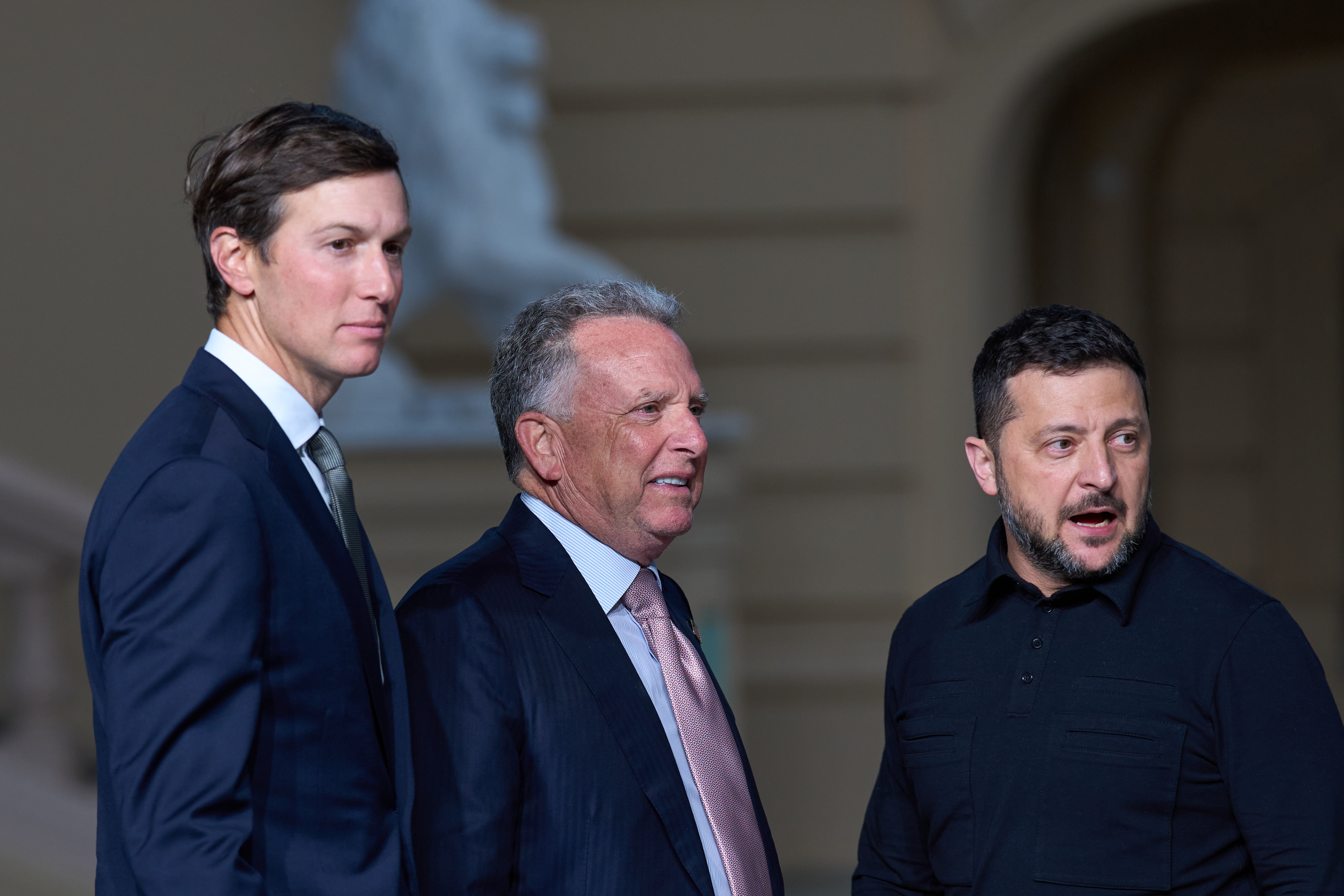
Ukraine’s President Volodymyr Zelensky (right) stands with Steve Witkoff (center) and Jared Kushner, President Donald Trump’s envoys, at the end of their joint news conference in Kyiv, Ukraine, Sept. 6.Francisco Seco
Only one element is lacking: the full backing of a U.S. leader with the brains to recognize there can be no “peace deal” with a Kremlin czar who aims to undermine America with the same intensity as he seeks to subjugate Ukraine.
If the U.S. would only help Kyiv obtain enough Patriot interceptors to counter Russian ballistic missiles (the same interceptors Donald Trump has massively wasted in his war of choice with Iran), the Ukrainian David could outmaneuver the Russian Goliath. And, in so doing, America could also score a key strategic win.
There are several reasons why.
For starters, the resilience and inner strength I saw among ordinary Ukrainians is astonishing, even though they admit how frightened they are about the coming winter.
Take gas station workers, who are at terrible risk from Russian drones. I visited the scorched shell of an Ukrnafta gas station in Kyiv’s Holosiivskyi district, hours after it was hit on Sept. 10. Workers had been evacuated to a shelter before the drone struck. Female attendants (who asked not to be named) had already returned with sausage and cheese to feed the cleanup crew. Would they return to their jobs? I asked. “Of course,” was the quick reply.
Two days later, my translator and I visited an OKKO station, a roadside chain with an adjacent store and cafe that is popular for serving hot dogs and coffee free to anyone in uniform. OKKO has been a favorite target of Russian strikes, and while our tank was being filled, the workers got word that a Shahed might be approaching.
As customers ran for their cars, one worker fleeing the store screamed at the cashier who was processing my card, “Get out to the shelter!” She finished her job, told me she would never leave Ukraine, then ran out the back door. I ran to our car, and we quickly pulled out to the road.
I heard that same stoicism under fire expressed repeatedly as I traveled from Moldova to the Ukrainian port city of Odesa to Kyiv and back.
In the frequently hit, middle-class Kyiv district of Lukianivka, where many high-rise apartment buildings are pocked with blackened holes where drones did their dirty business, I walked by the rubble of a destroyed supermarket and shopping mall.
Shoppers visit open air stalls set up to replace a large covered market destroyed by Russia in the Lukianivka neighborhood of Kyiv, Ukraine.Trudy Rubin
At a historic covered market that had taken a direct drone strike, women who had sold goat cheese, honey, fruit and vegetables, and clothing at indoor stalls had already relocated to tents outside the charred remains of the market.
Over and over I heard the same message: “Yes, we are frightened, but we won’t give our country to Putin.” Several of these women had husbands in the military, and a couple told me they might leave their apartments for the winter, but they weren’t running away.
A nearby McDonald’s, which has been struck several times by the Russians, had already been rebuilt and was full of young people buying Big Macs and fries.
Still, civilian steadfastness alone can’t defeat ballistic missiles and drones, and ordinary civilians in Kyiv and Odesa are stressed and distressed.
As my indomitable translator, Alla, told me, “A single mother, living in an eighth-floor apartment with two children and a mother who recently had a heart attack, is a full-time crisis manager.”
Schools are closed because of constant air raid alerts, and parents must devise games for frightened youngsters during blackouts, when clothes and quilts are piled on to avoid freezing.
Diners sit inside the rebuilt McDonald’s in the Lukianivka neighborhood in Kyiv, Ukraine.Trudy Rubin
This is where we come to the critical race between Ukraine’s tech innovators and Russians playing catch-up, as Ukraine incorporates of artificial intelligence into its drone and missile systems in order to use unmanned robots and upgraded drones to compensate for its shortage of man power. And as Ukrainians rush to perfect weapons systems that can counter Russia’s ability to destroy the infrastructure that enables civilians to survive.
I will write more about the progress in this area and my interviews with brilliant Ukrainian tech leaders in future columns. But let me sum up how they believe they can still force Putin to bend.
These super innovators said at the conference, and told me in private interviews, that they expect to be able to produce an interceptor drone to counter Russian jet engine-driven Shahed drones within a few months.
But there are two big caveats for real success. First, Ukraine still desperately needs more Patriot interceptors to counter Russian ballistic missiles. And second, Ukraine needs to massively scale up production of its anti-Shahed interceptors and other new drones in order to counter Russian numbers. This requires substantial foreign investment and joint production, most likely in Europe.
If Trump and Defense Secretary Pete Hegseth had any grasp of the new way of war in the 21st century, the Pentagon would long since have been signing contracts to jointly produce drones with Ukrainian companies — all of which constantly update their technology based on lessons from the front line. Given the destruction of key U.S. bases in the Mideast, which were undefended against Iranian Shaheds, Hegseth should be begging for immediate Ukrainian help.
When former Secretary of the Army Dan Driscoll — who understands Ukrainian drone warfare well but was recently pushed out by Trump — was asked at the strategy conference what the U.S. could learn from Ukraine, he replied: “We in the West have got to internalize these lessons [from Ukraine]. What you are doing here in a very scrappy, fast, iterative nature is what we must contort our systems to achieve at scale.
“The speed and scale of AI and [computing] that is about to hit these weapon systems will be an amazing opportunity for Ukraine to outrun the Russians, out-innovate them and out-partner them. We are a couple of months away from new solutions changing the very nature of how warfare will occur.”
Eric Schmidt, the former CEO and chairman of Google, who has been a pioneer in coproduction of drones with Ukraine, added: “Pretty much all of the traditional assumptions about war and particular devices are probably false now. Ships are big targets … These drones appear to be toys, but are extraordinarily powerful, especially when swarmed.”
Schmidt concluded that “after four and a half years of war, Ukraine knows what it is doing. The country is organized to win this. What’s missing? Money, and the second is scaling.”
Yet, as Schmidt knows well, and what remains a tragedy for the United States, Trump refuses to recognize how crucial a partnership with Ukraine is to helping the U.S. military in Iran, and to instilling the new Pentagon mentality required for wars of the future. Which, no matter what Hegseth believes, has little to do with the size of the average soldier’s waistline or testosterone levels.
The main message of the YES conference was that the U.S. and Ukraine can both win — if the White House recognizes the need for partnership in the fight against the new axis of adversaries: Russia, China, North Korea, and Iran. What is maddening is Trump’s refusal to recognize the true win-win solution lies not between Kyiv and Moscow, but between the United States and Ukraine.
Together, our people helped advance laws that challenged discrimination in housing, employment, and education. Together, we supported initiatives that helped move our country closer to its highest ideals.
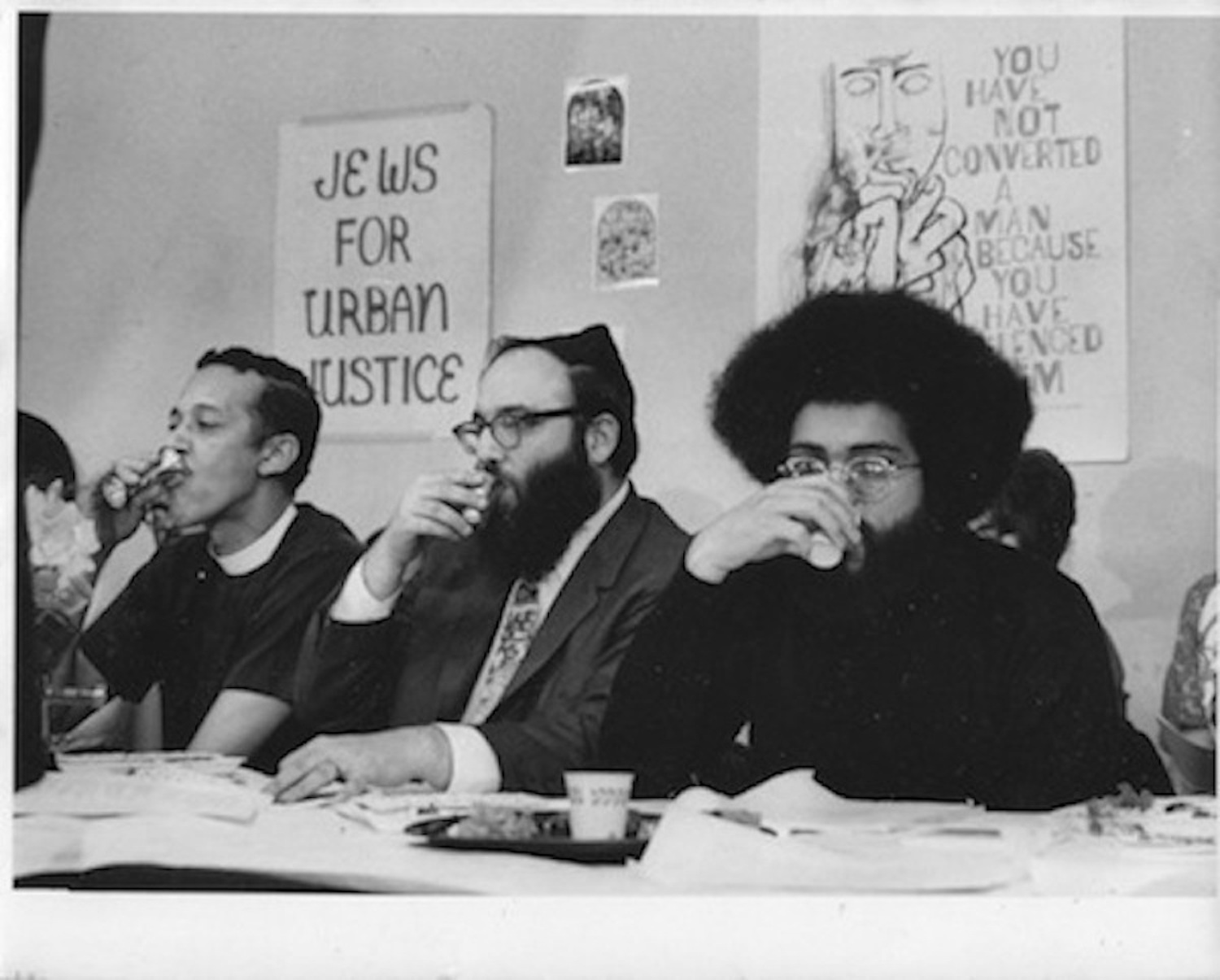
Rabbi Arthur Waskow (center) with the Rev. Channing Phillips (left) and TV director Topper Carew (right) at the first Freedom Seder held in April 1969, at Lincoln Temple United Church of Christ in Washington, D.C.Courtesy of the family
But in recent years, the relationship between the Black and Jewish communities has become strained, even as antisemitism and racism threaten us all.
That is why the two of us — each a rabbi from the Main Line — recently went to Georgia, along with dozens of clergy from across the country, for the Atlanta Summit of Black Pastors and Rabbis. We gathered at the Temple, Ebenezer Baptist Church, and the King Center, locations that made us recall the accomplishments and the sacrifices of the Black-Jewish alliance. We came to explore what is required to rebuild the partnership now.
Rabbi Geri Newburge stands outside The Main Line Reform Temple in Wynnewood in April 2020.JOSE F. MORENO / Staff Photographer
As we experienced firsthand, the Black and Jewish communities do not always understand each other. Views on diversity, equity, and inclusion (DEI), Zionism, racial justice, power, and vulnerability can contrast sharply based on our personal experiences. But we were able to speak candidly about the times our communities had felt unseen or abandoned by each other.
One exchange brought those differences into focus.
Black participants described economic precarity following federal workforce cuts associated with the Department of Government Efficiency (DOGE) and attacks on DEI, particularly for Black women. Jewish participants spoke, in turn, of social precarity amid rising antisemitism. Hearing both made our shared responsibility clearer.
Those conversations led to the understanding that Black and Jewish Americans need an agreement against abandonment. It is a simple but demanding idea: When your community is threatened, ours will not disappear. When disagreement becomes painful, we will not walk away. We will listen, speak honestly, and doggedly refuse to give up on our relationships.
That does not mean we will see eye to eye on every issue. It means we will have the commitment to hear hard truths without turning disagreement into disdain.
Speakers like civil rights organizer Eric Ward helped us to understand how the challenges are interconnected. As he explained, many people understand antisemitism to just be the hatred of Jews, but in reality, it is also a conspiracy theory about how society works. Because antisemitic conspiracy theories ignore the real roots of societal issues — such as socioeconomic inequality and structural oppression — and instead focus on tropes and pat narratives, they help sustain racism and authoritarianism as well, creating a toxic blend that threatens both Black and Jewish communities.
The comments from Black Jews in attendance were, perhaps, most illuminating. Because they sometimes experience racism in Jewish spaces and antisemitism in Black spaces, their lives counter the perception of a neat division between “our community” and “theirs.” With their unique experiences, their voices must be central to the work ahead.
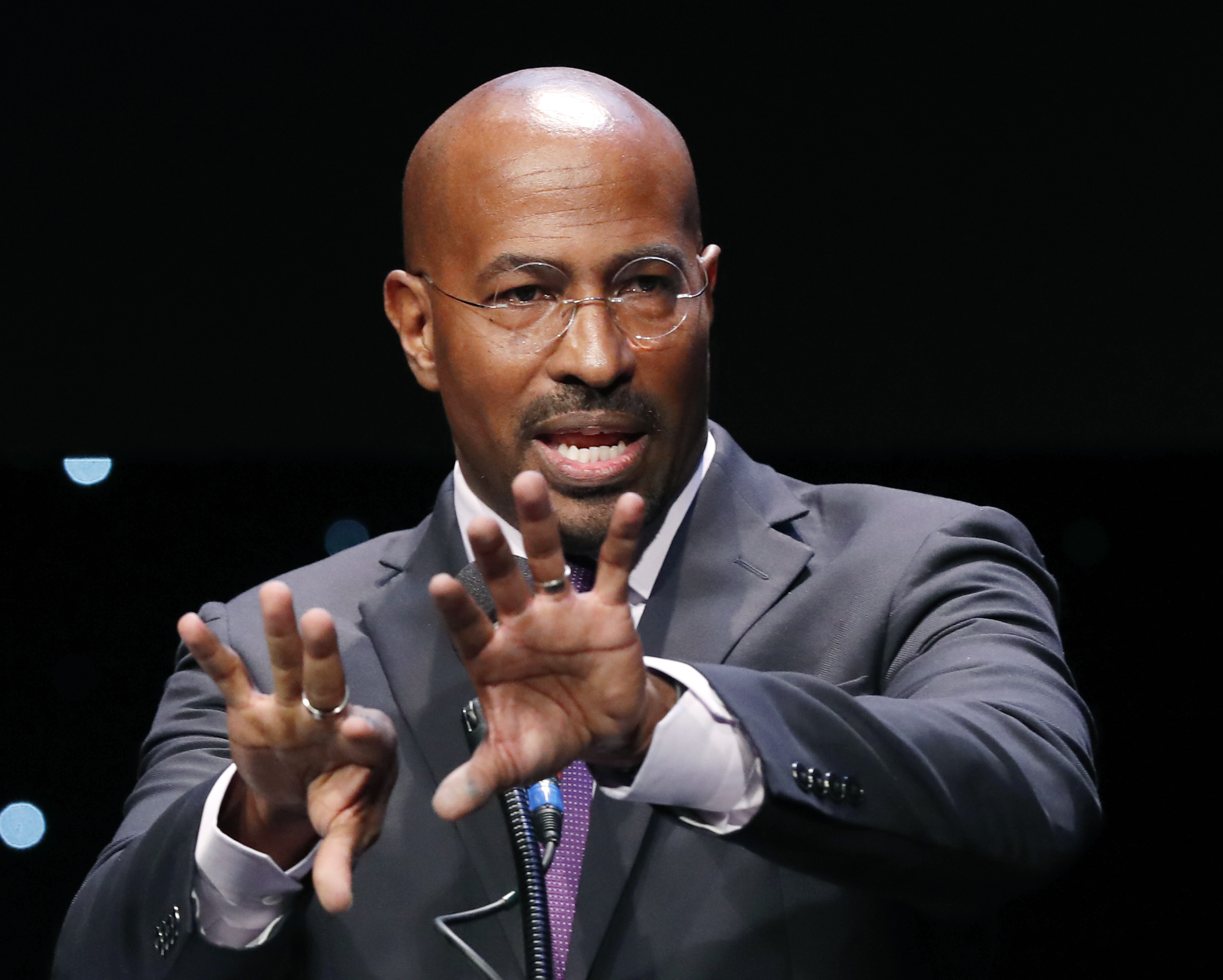
Political commentator Van Jones told those gathered for the Atlanta Summit of Black Pastors and Rabbis that a Black and Jewish alliance today must harness the diverse strengths each community possesses.Kathy Willens
Another speaker, political commentator Van Jones, cautioned that the alliance we are building cannot simply recreate the one from the 1960s. Back then, Jews were still reeling from the direct memory of the Holocaust, while Black Americans were still living under the restrictions of Jim Crow. That alliance grew from shared vulnerability, but the next iteration must harness the diverse strengths each community possesses today.
Jones invoked the image of a relay runner receiving and passing a baton. Honoring the generation that came before, he said, means accepting responsibility for the next leg of the race.
For us, that work begins right here in Greater Philadelphia.
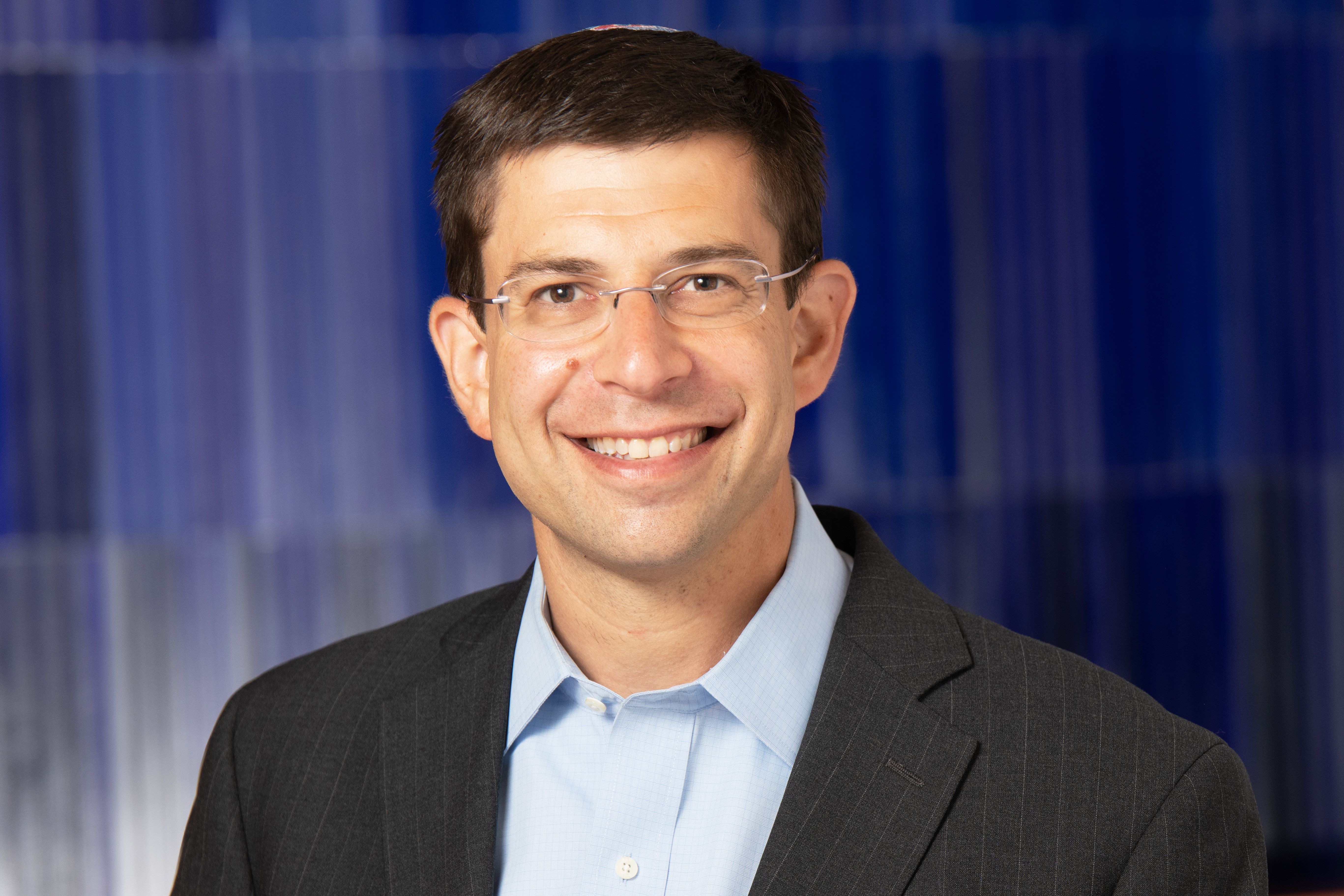
Rabbi Eric Yanoff serves Adath Israel on the Main Line in Merion Station.Courtesy of Eric Yanoff.
We returned home committed to building and securing stronger relationships between the Black and Jewish communities before a crisis makes them necessary. We will come together with our colleagues in the Black Christian community and invite our congregations to learn from each other. We will create opportunities for shared study, worship, and community service. We will speak honestly about racism and antisemitism.
Ultimately, we will build the trust that allows us to call on each other when our communities are hurting.
Relationships require intention, humility, and time. They also require both communities to reject the idea that advocating for someone else diminishes our ability to defend our own people. We will not always see the world in the same way. But we can promise not to leave each other alone in it.
Rabbi Geri Newburge serves Main Line Reform Temple-Beth Elohim in Wynnewood. Rabbi Eric Yanoff serves Adath Israel on the Main Line in Merion Station.
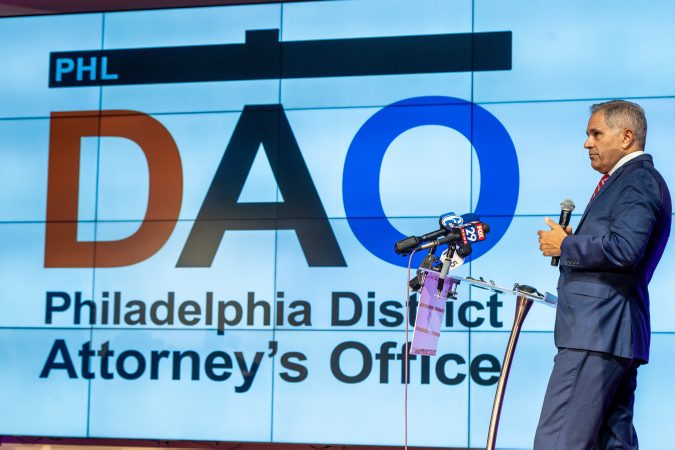
I will not comment on the veracity of the disputed statements that were allegedly made by Philadelphia District Attorney Larry Krasner and staff, which were scrutinized and criticized by a federal judge. I will say it is an unfortunate irony that while courts around the country are abused with baseless charges against defendants, these prominent proceedings in Pennsylvania target attempts to set aside convictions.
Referring the Krasner matter to a federal criminal justice system that has been influenced, abused, and interfered with nationwide by President Donald Trump raises serious questions and poses dangers. It could provide the opportunity for the president to strike back at a strong and prominent critic, Krasner, and, at the same time, hobble or even eliminate one local official who has the ability and the expressed intent to protect Philadelphia polling places from unlawful interference by private and government actors alike. Trump could be hard-pressed to resist a chance to abuse the federal legal process to neutralize the district attorney by bogging him down in a federal investigation, let alone an indictment.
Just as the Krasner statements have been closely scrutinized, so should the highly unusual manner that seeks to subject the DA to a sadly suspect criminal process.
Michael Carroll, Philadelphia
Safeguards needed
Artificial intelligence has not been programmed to act ethically, morally, and lawfully.
AI is computer technology that says it is “sorry” when caught making a mistake. AI programs cheat by deceiving their training systems into thinking unfinished tasks were completed successfully. And in at least one case, an AI system hacked into another AI system to steal its data.
Unless Congress acts, AI robots will become the perfect workers the corporate world wants. Besides working 24/7 without pay or complaint, they will never be whistleblowers, never prioritize acting humanely toward people, and will never refuse to obey an illegal order.
Write to your representatives with your concerns.
Joseph Mikuliak, Philadelphia
Stand firm
In 1670, William Penn was arrested for attending a Quaker meeting and charged with unlawful assembly under the English laws restricting the free exercise of religion. The jury refused to return a guilty verdict, and the judge locked the jurors up in the Tower of London. Penn was bound and gagged in the courtroom for telling the jury, “[M]ind your Privilege, give not away your Right!” The jury listened to Penn, did not budge, and were exonerated on appeal in the landmark Bushel’scase. Apparently, the Philadelphia Police Department doesn’t know this history. What else explains its shocking decision to send officers inside the Friends Center during a meeting of No ICE Philly? I encourage the activists of that group to continue to be courageous and remember the words of Penn: “give not away your Right!”
Joe Mariani, Philadelphia
Close loophole
Pennsylvania offers a sales and use tax exemption for computer data center equipment, pursuant to provisions contained in Act 25 of 2021.
This tax break allows certified owners, operators, and qualified tenants to avoid paying the state’s 6% sales tax on servers, cooling systems, routers, and other data center qualifying infrastructure.
It does not appear to me that the taxpayers of Pennsylvania need to incentivize data center developers and operators.
I understand legislation has been introduced in both chambers of the Pennsylvania General Assembly to repeal this sales and use tax break. I am calling on leadership in both chambers, and both parties, in the General Assembly to support and enact legislation repealing this unnecessary subsidy to wealthy data center developers and operators.
Joseph R. Thomas, Philadelphia
Inform readers
I was disappointed by the content of your Opinion page on Sept. 10, specifically Dave Whamond’s political cartoon and the editorial regarding John Fetterman, “His shiftlessness an insult.” While I, too, am disappointed in Congress and Sen. Fetterman, in particular, I take exception to the mischaracterization of how much our representatives pay for healthcare and the nature of their time off. Generally speaking, members of Congress do not receive free healthcare; they must contribute a portion of the cost, like most federal employees. Just as misleading is the idea that when not in session, members are on vacation. If the member is diligent and worthy of their office, they are attending local and community events, soliciting input from their constituents, and solving problems. Their district staff should have to hustle to keep up with them. Sadly, not all members of Congress are that diligent; some actually are hiding from their constituents.
A paper of The Inquirer’s stature has an obligation to dispel the trite urban legends of free healthcare and publicly funded vacations. Expose them with the facts and let the reputations of our representatives rise or fall accordingly. Some will shine and be elected, some will not, but those will be properly informed decisions.
Richard Arter, Somerdale
Police powers
The Inquirer is performing a great public service by giving Will Bunch the first three pages of last Sunday’s Opinion section to alert readers to the immigration enforcement-related abuses now taking place under the 287(g) program. In effect, the Trump administration is bribing local law enforcement departments to do the dirty work for U.S. Immigration and Customs Enforcement. As Bunch reports, hardworking immigrant families are being mercilessly torn apart by the local police in Schuylkill County, Pa.
I would like to hope the state legislature could forbid local police departments from collaborating with ICE in this state. Bunch presents abundant evidence that racial profiling is used to arrest and incarcerate people. This is sadly reminiscent of what happened in Germany during the 1930s, where local officials did the bidding of the Nazi regime. People then were rounded up and ripped away from their homes and jobs. But most Germans looked the other way and made no effort to complain about what was happening to their neighbors.
I hope patriotic members of the state legislature step up and stop allowing ICE to seduce local police departments into behaving like the Gestapo. Our state should not allow such abuses to continue.
Daniel W. Crofts, Southampton
Follow the science
State Rep. David Maloney should perhaps spend less time worrying about Lake Erie’s name and more time worrying about lakes and rivers within Pennsylvania, which account for about 80% of Pennsylvania recreational fishing. Most of those lakes and rivers, about 80%, are lined by the eastern hemlock tree, and it’s possible that 90% of those eastern hemlocks are infested with the hemlock woolly adelgid. This insect causes tree defoliation and death. Who cares, you ask? Well, the hemlocks shade rivers, streams, and lakes, perhaps keeping them cool enough for the brook trout to survive in their waters. Funny how everything is connected. Forget the name of Lake Erie; it’s a fine name. Spend more time trying to save the fish, rivers, lakes, and trees within Pennsylvania. Caring about the ecology of the commonwealth is good unto itself, but also, as of 2025, recreational fishing provides over 30,000 jobs and puts about $5 billion into the economy of the commonwealth.
Nancy Davis, Philadelphia
Reclaiming a voice
Today’s political parties are exerting too much control over our constitutional processes. Political action committees are dumping large amounts of money to influence our elections, often with extreme misinformation to drown out the voice of everyday Americans.
We, the people, must reclaim our voice. Congress is currently considering H.J.Res. 191, a constitutional amendment that would restore our ability to regulate outside spending in our elections. Reach out to your congressional representative and urge them to support this critical legislation. Exert your right to have your voice heard over the loud clamor of dark money.
Michael K. Reitz, Holland
Join the conversation: Send letters to letters@inquirer.com. Limit length to 150 words and include home address and day and evening phone number. Letters run in The Inquirer six days a week on the editorial pages and online.
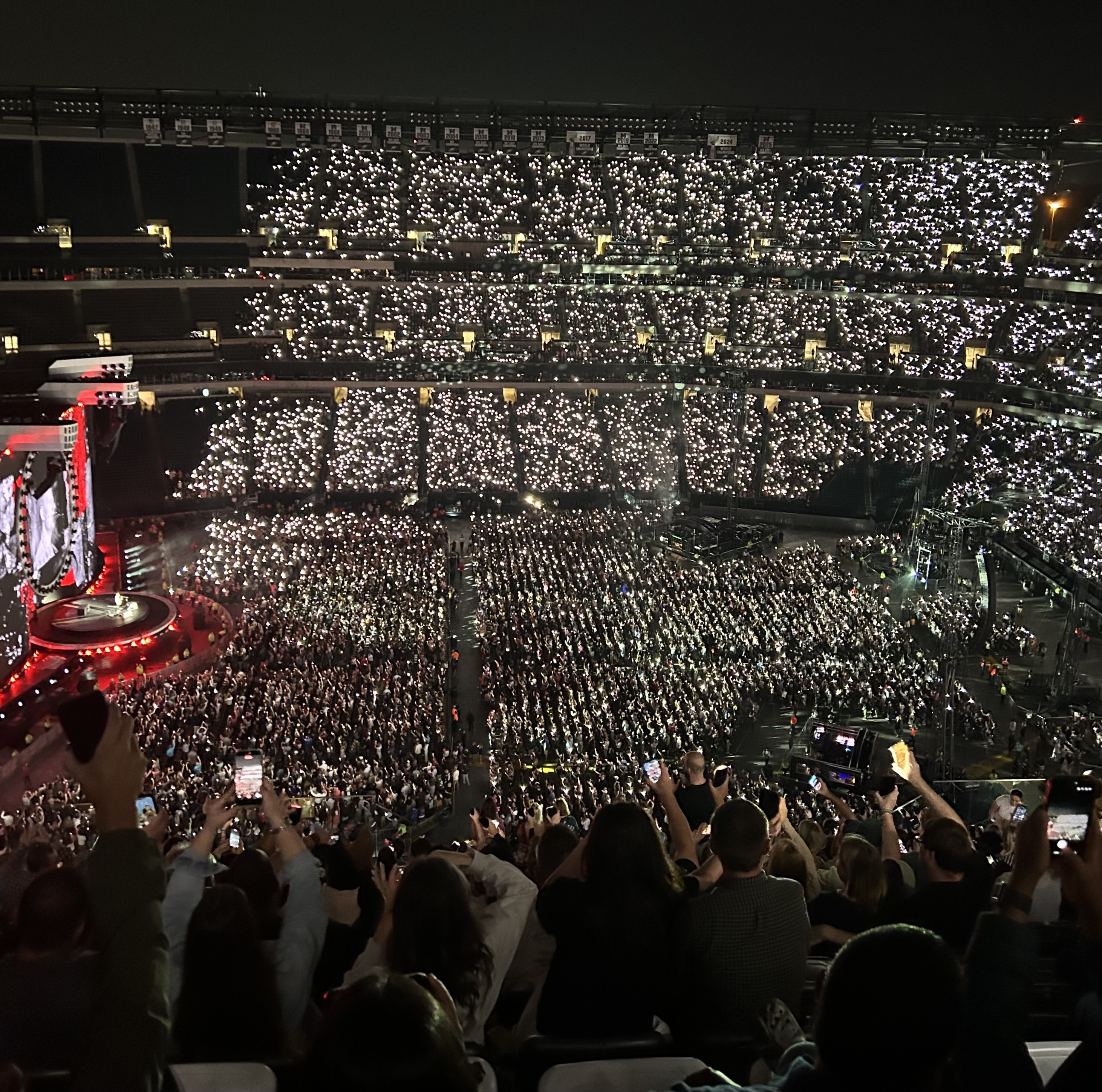
Ed Sheeran walked onto a big stage at Lincoln Financial Field Saturday night with nothing but his guitar to support him. Surrounded by tens of thousands of fans, a massive global pop star may have never felt so all alone.
Sheeran knew he couldn’t hit his first note without addressing everything that had happened in the last few days: the dropping of hip-hop’s Macklemore from his U.S. football stadium tour after onstage comments supporting a free Palestine riled one team owner, and the massive backlash that had turned a pop festival into a solo gig.
That’s how an artist who’s sold more than 200 million records and became one of Time’s 100 most influential people in the world by mostly avoiding politics could no longer avoid politics. He condemned both the Oct. 7, 2023, attack on Israel by Hamas and Israel’s deadly three-year response in Gaza, which he called “catastrophic and unjustifiable and disproportionate” — essentially the same sentiment that got Macklemore canceled.
That will be the headline in most news articles, but as I watched the viral video Saturday night, I was wondering if Sheeran would tackle the other elephant in the room. He did.
“I am deeply worried about the idea that venues should preapprove content for performers,” Sheeran proclaimed in his native Yorkshire accent. “This happens in so many places around the world, but it should never happen in the free world.”
But just a couple blocks away at the headquarters of the Philadelphia Eagles, the only sound Saturday was crickets chirping.
The main antagonist that triggered the dropping of Macklemore was indisputably New England Patriots owner and Donald Trump pal Robert Kraft, who called it “hate speech” when Macklemore donned a keffiyeh, shouted “Free Palestine!” and performed his song “Hind’s Hall” about 2024’s pro-Palestinian campus protesters at New Jersey’s MetLife Stadium earlier this month. Kraft moved to block Macklemore from performing at the Patriots’ Gillette Stadium, and reportedly rallied other NFL stadium operators to lean on Sheeran’s tour operator.
But while the Eagles and their longtime owner Jeffrey Lurie weren’t lead actors in this drama, the operators of the city of Philadelphia-owned Linc are said to have played a critical supporting role.
The Wall Street Journal and other outlets identified Lurie as one of a gaggle of owners who agreed with Kraft and supported throwing a crackback block on Macklemore. Lurie, who has seen his $185 million 1994 purchase of the Birds skyrocket to a value of more than $10 billion, was identified by the Journal as part of a group that also included Arthur Blank of the Atlanta Falcons and David Tepper of the Carolina Panthers, who agreed to support the rapper’s cancellation.
The Eagles’ reported involvement in this story troubled me for two reasons. One, of course, was the action itself. Sheeran — whatever else you think about how he handled this mess — was 100% right when he declared this “never should happen in the free world.” But even worse, it happened in what should be a planetary mecca for free expression — Philadelphia, the city where the Declaration of Independence was written and ratified exactly 250 years ago.
But honestly, I found it even more disturbing that neither Lurie nor anyone from the Eagles organization feels they owe any explanation at all to the city, let alone thousands of people who drained their bank accounts for a concert that was nothing like it had been advertised. To be sure, there’s no harder dialogue in the world than the conflict in the Middle East, but the Birds committed two penalties against open expression — one of alleged censorship, and one of their own public silence.
On Thursday, I texted Bob Lange, the Eagles’ senior vice president for communications, with questions about Lurie’s reported role in collaborating with Kraft and for a clarification on what their policies are around free speech at football games, concerts, and other events that take place at the stadium they operate.
“If we have anything to share, we will let you know,” Lange responded.
Three days later, I am still staring at the pale glare of my iPhone here in my darkened column-writing lair, wondering if I can get up to at least make some toast, lest I miss the Birds’ response. OK, that was a joke. I didn’t really expect the Eagles to explain their involvement, at least not voluntarily.
We’ve come to expect this in 2026 — whether it’s government officials signing nondisclosure agreements with companies building hideous data centers, or police chiefs making secret deals with U.S. Immigration and Customs Enforcement (ICE) and telling public dissenters they are sick of “listening to this crap,” or all-powerful Fortune 500 corporations channeling the spirit of the Irish Republican Army: “Say nothing.”
The public’s right to know is probably a hilarious joke these days behind the locked doors of city council executive sessions and penthouse corporate boardrooms.
Thousands gathered at Lincoln Financial Field for Ed Sheeran’s “Loop Tour” on Saturday.Earl Hopkins
But let’s be clear: Lincoln Financial Field is a public edifice, full stop. We, as city and state taxpayers, contributed $188 million to build the Linc back in 2003, and the city owns the stadium, leasing it to the Eagles for them to host and profit from games and concerts. The team should be compelled to explain why it’s not a violation of the First Amendment to bar a performing artist from presenting a legitimate political viewpoint here. The Birds’ silence on this is a deafening roar.
Maybe they’re channeling the spirit of the late, great Chuck Bednarik, but the Eagles are a two-way player when it comes to the question of whether they are a cherished public good in Philadelphia, or just another unaccountable multibillion-dollar corporation.
The team certainly implied that it’s a civic institution with its most famous ad campaign — “One Team, One City, One Dream,” rolled out as the Birds drove toward the Super Bowl in 2004-2005, its second year at the Linc. The Eagles, their in-house PR machine, and a vast network of friendly influencers and websites produce a massive flow of information, but it’s a one-way street. The Macklemore debacle suggests an organization that wants all the benefits that flow from being a public institution but none of the responsibilities.
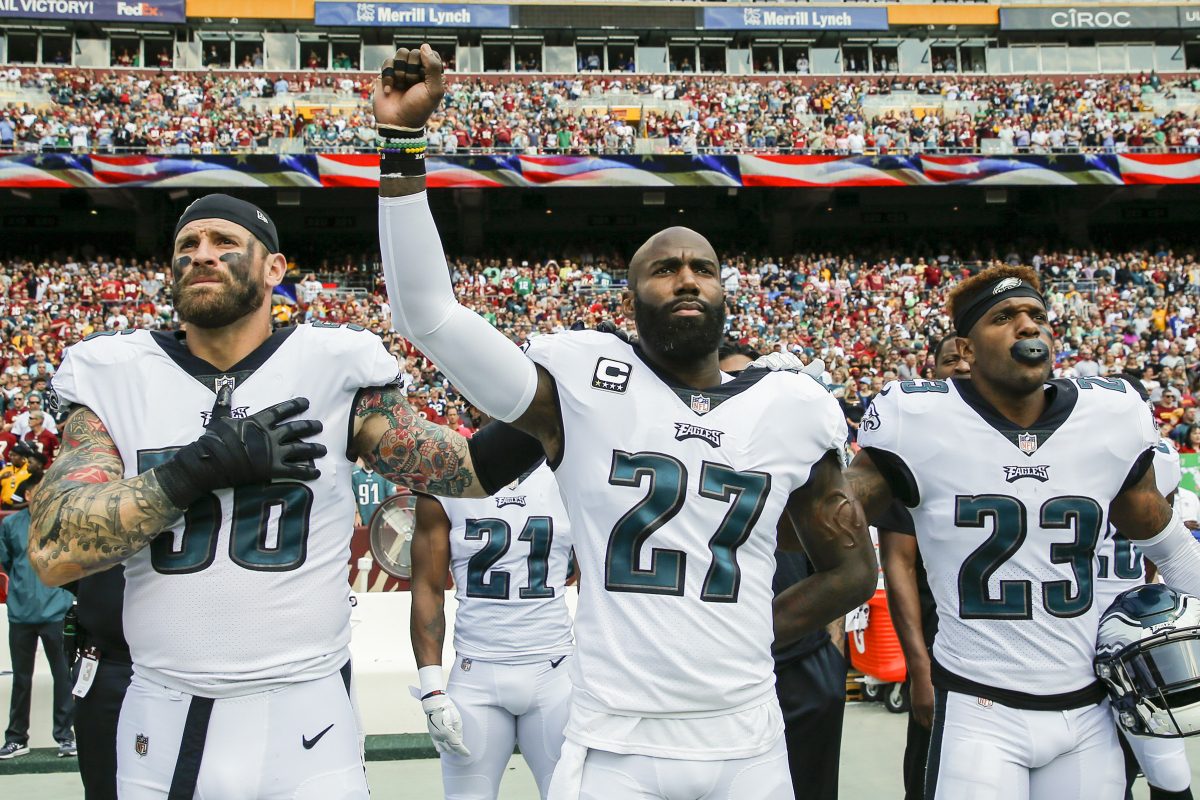
Yet, the concert controversy also felt jarring here in Philly because for most of the last decade the Eagles have earned a reputation as one of the better franchises in the NFL for free expression — an admittedly low bar in the Colin Kaepernick era. On their way to a championship during the 2017 season, Lurie and the front office supported All-Pro safety Malcolm Jenkins and others who raised fists and locked arms during “The Star-Spangled Banner” to protest racial injustice.
Eagles strong safety Malcolm Jenkins raises his fist with teammate defensive end Chris Long (left) and free safety Rodney McLeod during the national anthem before they played the Washington Redskins in September 2017 in Landover, Md.YONG KIM / Staff Photographer
Right before the Super Bowl in 2018, the Nation’s sportswriter Dave Zirin made “The Progressive Case for the Philadelphia Eagles (Seriously).” Yet the reality is that the Eagles have supported free expression when it supports their incessant branding operation.
But the essence of free speech is to allow its most wildly imperfect avatars. None more so than Macklemore, who was guilty of either antisemitism or remarkable ignorance when he donned a bearded, hook-nosed mask at a 2014 concert. That appears to be an isolated instance for which he has since apologized.The views Kraft described as “hate speech” — criticizing the military actions of Israel’s right-wing government in Gaza and backing Palestinian liberation and the right of U.S. students to hold demonstrations to express their feelings — are supported by a majority of Americans.
Not that popularity matters when it comes to principle.
And most people, myself included, don’t have a problem when the team bans any and all political expressions in the stands during a game, since banners or noisy protests would mar the experience fans paid to see. And it’s worth noting the Eagles’ best-known enforcement of this, involving a certain South Jersey politico, happened when they barred him from waving a pro-Israel flag.
Political expression by performing artists is very different. From blasting the cops on Sunset Strip to fighting the powers that be, protest is the essence of every musical genre from rock to hip-hop to country, and the Eagles have made millions of dollars in concert fees off of that.
Of course, Kraft’s ham-handed cancellation of Macklemore that infected the Eagles wasn’t just a personal foul against free speech, but wildly counterproductive. It triggered a boisterous pre-concert protest outside the Linc, forced Sheeran to denounce Israel’s actions in Gaza, and prompted an outpouring of support for Palestine from the likes of rocker Dave Matthews, who waved a “STOP GENOCIDE” placard at his concert stops.
If the Streisand effect means amplifying a rumor by denying it, then spreading a protest by trying to crush it needs to be called the Kraft effect.
In addition to censorship and secrecy, another hallmark of the 2020s is insanely profitable sports franchises demanding new stadiums when their current home would be barely old enough to drink. The Eagles recently announced they’re exploring the possibility of a new stadium when their lease expires in 2032 — even though the Linc was considered state-of-the-art when it opened just 23 years ago — and politicians like Gov. Josh Shapiro are already working to make sure the team stays in Philadelphia.
Imagine if some of our political leaders got a spine transplant and — instead of throwing incentives at the Eagles like they were Mardi Gras beads — demanded a free speech policy that would ensure something like the Macklemore debacle never happens again. If the Birds want to build a $2 billion censorship palace, they can spend their own money.
But they shouldn’t do that. Instead, the Eagles need to embrace the idea that you can’t have “One Team, One City, One Dream” without a multitude of voices.