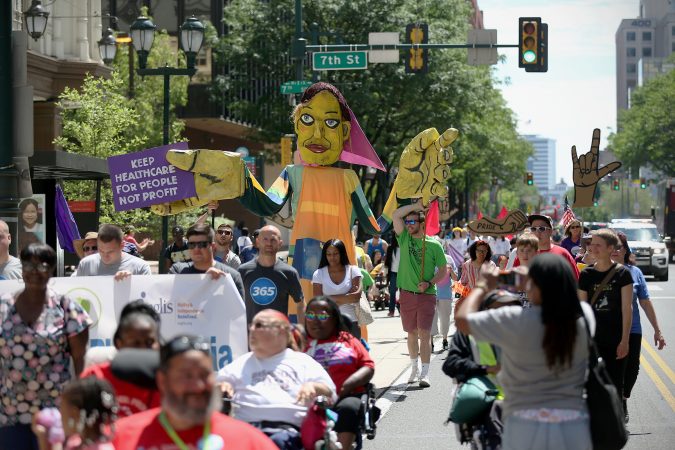
A few Saturdays ago, I ventured down to the Ben Franklin Parkway to attend and volunteer at Disability Pride Philly. This parade and festival launches more than a month of celebrations: July marks Disability Pride Month, honoring the Americans with Disabilities Act’s passage on July 26, 1990.
To some, “disability pride” sounds like an oxymoron, or a niche idea that may not touch them. As a person with multiple disabilities, I can tell you that disability pride matters more than you might think.
Accessible education, technology, rehabilitation, and civil rights protections let me live fully integrated into my workplace, community, and family. I hold a master’s degree and a doctorate. I do research on overlooked and unexamined issues that affect pediatricians and their patients. I live the life I choose, in the home I choose, with the job, hobbies, and community that I choose. These may seem like obvious rights for anyone to have. They are not.
Disability Pride Philly chose this year’s theme with precision: “We Belong Here and We’re Here to Stay.” This theme could not be more urgent or timely.
For most of American history, society separated people with disabilities like me from their families, schools, workplaces, and communities and placed them in institutions. Institutionalization confines children and adults with disabilities to restricted residential settings, cut off from family and community.
Disability pride rests on one central argument: Whomever you are, regardless of your body, mind, or circumstances, all of us deserve dignity, choice, joy, and freedom. In this photo from 2024, Tony Guyatory Brooks leads the Disability Pride March.Jay Outhier
Disability pride rests on one central argument: Whomever you are, regardless of your body, mind, or circumstances, all of us deserve dignity, choice, joy, and freedom. The disability rights movement spent generations fighting for laws to guarantee this. Those legal protections now face a coordinated challenge.
On June 18, the U.S. Department of Justice’s Office of Legal Counsel released a memo that claims the U.S. Supreme Court’s landmark 1999 decision in Olmstead v. L.C. did not require states to provide services in community settings rather than institutions. That interpretation contradicts 27 years of court decisions, federal enforcement, and disability rights advocacy grounded in the principle that unnecessary segregation of disabled people violates federal law.
The memo did not appear in a vacuum. Six states pursue active litigation in Texas v. Kennedy, a case that seeks to strip federal disability protections.
Two days before the memo dropped, the U.S. Department of Education announced plans to shift key disability and civil rights offices — including the Office for Civil Rights — out of Education and into other agencies. For Pennsylvania, where young people with disabilities make up a substantial share of the student population, this transfer reaches beyond bureaucratic reshuffling. It will affect families, schools, and students across the commonwealth.
A common assumption links these actions: home and community-based services cost too much, stretch too thin, or prove too difficult to sustain. When community supports seem unavailable, institutions get framed as the responsible alternative. But this scarcity did not arise on its own; it was manufactured.
Pennsylvania itself shows a different way.
Over decades, Pennsylvania moved steadily away from institutional settings and toward community integration.
When leaders invest in home and community-based services, people thrive. Earlier this year, the Shapiro administration announced that Pennsylvania cut its emergency waiting list for intellectual disability and autism services by 31%, and reached the lowest direct support professional vacancy rate in more than a decade.
The Pennsylvania Developmental Disabilities Council also supported innovative housing initiatives that help people with disabilities live in their communities rather than institutions. Several Pennsylvania counties expanded access to home and community-based supports, allowing more than 42,000 Pennsylvanians to receive services in their homes and communities; some counties eliminated their emergency waiting lists entirely.
These successes happened because Pennsylvania chose to fund home and community-based services. They matter nationally because they expose a flaw at the heart of the federal argument. Researchers document what they call the “Olmstead effect”: states that invest in home and community-based services see fewer people confined to institutions or at risk of landing in one.
Disability stands alone as the one minority group designation that anyone can join at any point in life, so this issue may eventually touch all of us. Aging, illness, and injury make disability part of the human experience. The policies behind community living, accessible education, and civil rights protections reach beyond abstract legal debates. They determine whether you, me, and the people we love can live independently, participate in our communities, and exercise meaningful choice over our own lives.
Domonique Howell (center) and her daughter, Rylee, 5, take part in the annual Disability Pride Parade along Market Street in Center City in, 2019. TIM TAI / Staff Photographer
This July, Disability Pride Month offers a concrete ask: learn about the disability rights movement and the policies that make community life possible. Speak up when these hard-won rights come under threat. And when policymakers claim that community inclusion costs too much or seems unrealistic, remember Pennsylvania’s example: When we invest, inclusion works.
Hannah Anderson is a writer and researcher and the founder of Learning Design Collective LLC. She lives with multiple disabilities, including vision and hearing impairment.
As I weigh the decision of whether to move my family to New Jersey or stay in Philadelphia, the newly signed Pennsylvania state budget makes moving across the Delaware River just that much more appealing. In Pennsylvania, House Bill 504, a solar energy initiative, was supported by Gov. Josh Shapiro but was held back by the Senate leadership.
But New Jersey is one of 24 states that have passed community solar legislation, enabling residents to save on their utility bills — even renters and others who can’t install solar panels can benefit as subscribers. Community solar facilities provide subscribers with access to clean and cheap solar energy, and a monthly credit on their utility bill. People shouldn’t have to put a solar panel on their own roof to benefit from the electricity it generates. And I want to live in a state where all my neighbors can access solar as a way to reduce their energy bills and live their values.
Community solar deserves consideration in the next legislative session. In the meantime, I’ll be on Zillow looking at houses in South Jersey.
Miranda Bennett,Philadelphia
The Gaza crisis
I want to thank The Inquirer for having the courage to publish two articles in the July 8 print edition talking about Israel. Being anti-genocide or even pro-Palestinian is not being antisemitic. Accordingly, honest conversations about Israel should not be taboo.
People may debate specific numbers and whether to use the term genocide, but what is clear is that there has been a hugely disproportionate use of force against Gaza.
On Oct. 7, 2023, there were a reported 1,200 deaths, 5,430 injuries, and 250 Israelis and other nationalities taken hostage. What occurred that day was horrific and cannot be condoned.
While criticizing Israel is an uncomfortable topic, looking away from this Gaza crisis (and what’s also going on in the West Bank and Lebanon) and pretending it is not happening is not going to make it better, so the more we know and talk about it openly and understand what is actually taking place, the better we will be able to decide whether we as taxpayers want to continue providing aid to the oppressor or the oppressed.
I remember when JRS started after I had left the U.S. House immigration and refugee subcommittee and started in the federal departments working on refugee matters. The views expressed by Ryan represent those of us who created the Refugee Act of 1980, which opened the legal door to refugees (and really just reestablished an American tradition that had been closed off by changes to our law).
The idea for the comprehensive 1980 act (the first comprehensive U.S. refugee law) was initiated by our subcommittee staff in the late 1970s, and we persuaded the Senate committee, headed by then-Sen. Edward Kennedy, and the Carter administration to support it.
The JRS and the events discussed by Ryan are part of a continuing story of the admission of refugees that is not only the humanitarian thing to do, not only consistent with American law and tradition, but also in our national interest in many ways.
And, as Ryan notes, it is tragic to see the destruction of the program under the current administration, both in the U.S. and abroad. We can correct this situation, and should work to see that we will.
Mark R. Zecca, Philadelphia
Labor shortage
What a disconnect in the print edition of The Inquirer Sunday: An editorial mentions the Trump administration’s target of arresting 2,000 immigrants each day. Meanwhile, an article in another section reports that the United States is facing what’s projected to become one of the largest labor shortages in its history. It quotes a labor market expert as saying this could hobble the American economy for years to come.
The article says there will be shortages of tens or even hundreds of thousands of nurses, physicians, teachers, engineers, pharmacists, mental health counselors, construction workers, and airplane mechanics. Forty-one percent of home health aids who are increasingly needed to care for the nation’s aging population have historically come from somewhere else, along with a fifth of nursing assistants, dentists, pharmacists, and registered nurses. Right here in Pennsylvania, we will face a shortage of 218,000 workers by the year 2032.
It seems obvious that a sane and well-managed immigration program is critical to our country’s future economic success. When will Congress figure this out?
Ann Clausen,Philadelphia
Zero-waste future
Thank you for your informative article on the mayor’s plan to renew Philadelphia’s contract to use the Chester incinerator. This renewal will combine waste incineration and landfilling with a rather vague reference to exploring “alternative methods for disposal.”
I highly recommend, as an alternative method, a citywide zero-waste program for composting food wastes, complemented by active recycling and upcycling of non-compostable wastes. This approach would solve multiple problems at the same time. It would avoid landfill methane emissions, thus proactively reducing the impact of climate change, and would eliminate the need for incineration as well, with its concomitant release of toxic emissions that cause deleterious public health impacts, especially on the citizens of Chester.
Moreover, my suggested initiative would create many more new jobs in waste handling compared with the current plan, which opponents of Councilmember Jamie Gauthier’s bill claimed would jeopardize 120 jobs. San Francisco, the gold standard for a comprehensive zero-waste program, supports approximately 1,000 union jobs dedicated to collecting, sorting, and processing recyclable and compostable materials. Philly’s population is approximately twice as large, suggesting that a comparable program would create about 2,000 jobs.
William M. Stigliani, Philadelphia
Shortsighted
The recent article about the “short war fallacy” was spot on. Donald Trump and his advisers ignored the Iraq-Iran War of the 1980s, reckoning Iran would quickly crumble when the U.S. attacked it. Iraq invaded Iran in September 1980, spurred by concerns about political and ideological tensions. With a superior military force, Iraq made quick inroads and expected an easy victory. However, by December its offense stalled. Buoyed by resurgent morale and military capability, Iran launched a counteroffensive into Iraq. Iraq’s perceived short war dragged on for years, resulting in a massive death toll. In 1988, the United Nations mediated a ceasefire. Estimates of war dead range from 500,000 to one million. Iran suffered the majority of fatalities. The war ultimately strengthened Iran’s Islamic Revolutionary Guard Corps. Iran’s ability to withstand military setbacks was well-documented and remains intact.
The administration’s failure to consider that conflict helped suck the U.S. into a war it is attempting to win by air superiority, an increasingly discredited notion. Air superiority isn’t control on the ground. Relying on that strategy exclusively will further draw down key air weapons stockpiles that are already seriously depleted. It may also cause the U.S. to start committing war crimes that military experts were warning against back in April. Trump and his advisers need to seriously consider ending the war with a hollow victory that will extricate the country from another hot spot where a short war victory is proving elusive and likely unattainable absent an escalation in hostilities. Such an escalation wouldn’t guarantee an actual victory. America doesn’t need another win like the ones it achieved in Vietnam, Afghanistan, and Iraq.
Stewart Speck, Wynnewood, speckstewart@gmail.com
Join the conversation: Send letters to letters@inquirer.com. Limit length to 150 words and include home address and day and evening phone number. Letters run in The Inquirer six days a week on the editorial pages and online.
If the summer of 2026 came with an Official Cliché™, it would have to be “glass half empty, half full.” Things could be better. Things could be worse. It’s people — many of whom are quite wonderful — doing our best in a world run by institutions that are rotten to the core. You’ll find no greater example than the World Cup that wrapped up Sunday with a well-deserved trophy for Spain. Will we remember the gross commercialism and rank corruption perpetuated by FIFA and its political twin, Donald Trump? Or the many remarkable moments on the pitch, and the joyous sense of internationalism in the stands and beyond? How do we get to a place where elite greed is crushed while mere mortals like us thrive?
U.S politics becomes a farcical unreality show. How worried should we be?
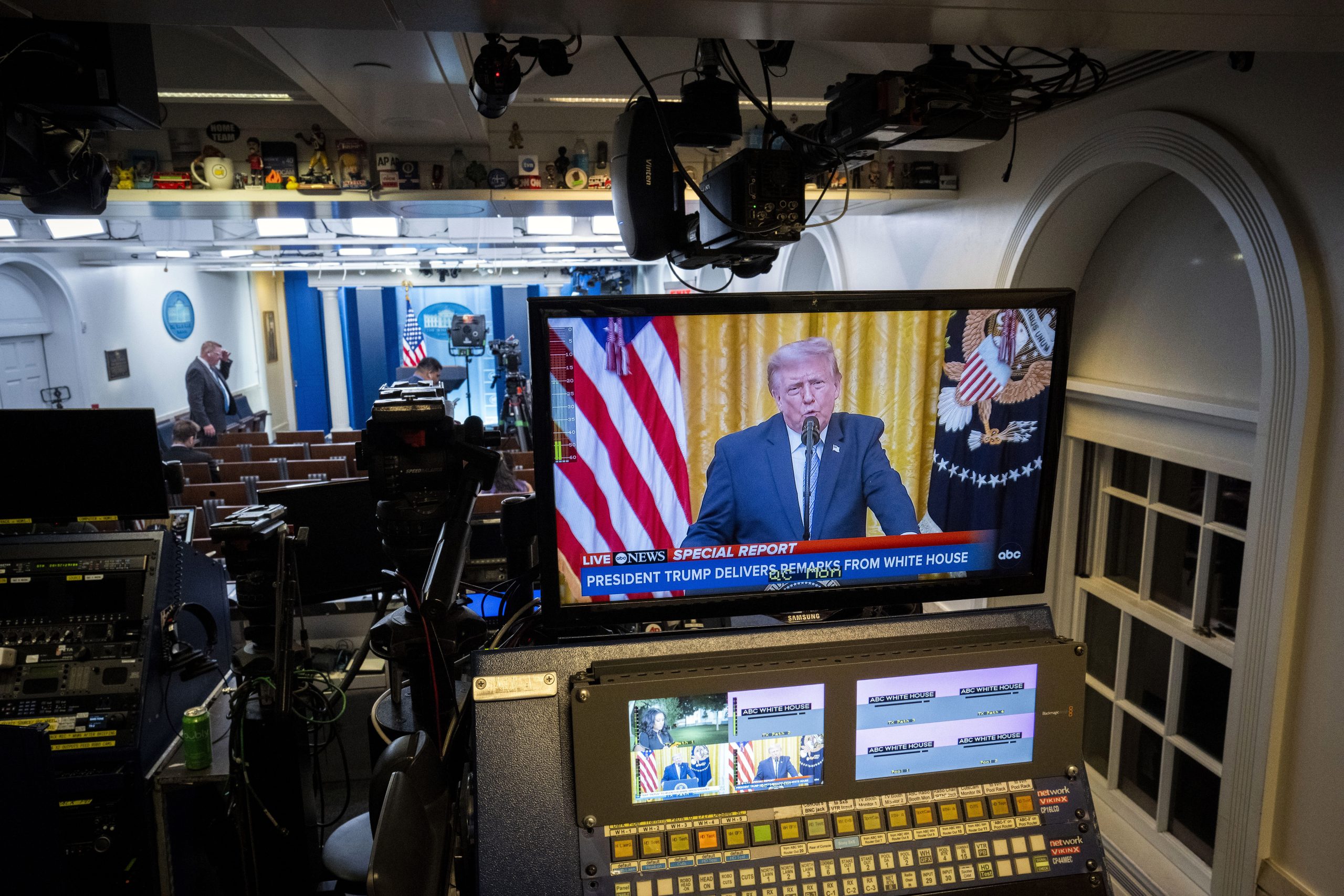
Video monitors in the White House briefing room in Washington carry a live feed of President Donald Trump as he addresses the nation on July, 16.DOUG MILLS
If you live inor near a big city and use mass transit to get around, you know this experience. You hop on a subway or a bus, focused only on getting from point A to point B, but there’s a man just a few feet away who demands your attention. He is talking loudly, repeating the same gibberish phrase over and over, seemingly arguing with someone until you realize he’s not even holding a phone. It’s just him. You feel a mix of emotions — sorry for the guy because clearly he’s going through something, yet mainly praying he will just stop yelling and give you some peace.
Trump commandeered 26 minutes of invaluable TV prime time (CBS and MS Now ran all or most of it; NBC, ABC, and even CNN declined) for a speech that arguably may be remembered as one of the most consequential ever delivered from the White House — but only for the Big Lie constructed on a foundation of half-truths.
Despite days of hype, which was sensibly ignored by most folks who know better after a decade of Trump’s political dishonesty, there was zero new evidence that China or any other foreign power consequentially interfered in the 2020 presidential election Trump lost fairly and squarely to Joe Biden. POTUS instead offered gross exaggerations around old reports that would have made the late red-baiter Joe McCarthy blush, with bizarre allegations about the CIA and other intel agencies while he was in charge of them in 2020.
There was a huge problem, however, with the president’s scare tactics: No one was scared. It’s not just that many among the 61% or so of Americans who disapprove of Trump’s job performance had expected the Thursday night monologue would include even worse lies or fabrications, or stronger threats — instead of a leader who was not just incoherent but weak.
But even the Republican politicians and right-wing opinion makers who were a main target of the White House address looked the other way in the immediate aftermath. We were all the mortified passengers on the same subway car, hoping the noise would just end.
Fox News host Sean Hannity, Trump’s longtime friend, was on the air when the speech ended and fairly quickly changed the topic, so eager to avoid the stench. Even worse, the president’s favorite show, Fox & Friends, which aired early the next morning, did not mention the address once in the three hours it was on.
I’ve lived through the 1980 men’s hockey gold medal and Watergate, the Iraq War and the legalization of gay marriage — so I know how it feels to be proud to be an American, and to be furious with our government. But I’ve never felt the sense of utter embarrassment that was the national mood at 9:30 p.m. last Thursday. The president gave a prime-time address that was complete fiction. Who will ever again take the United States seriously on a world stage?
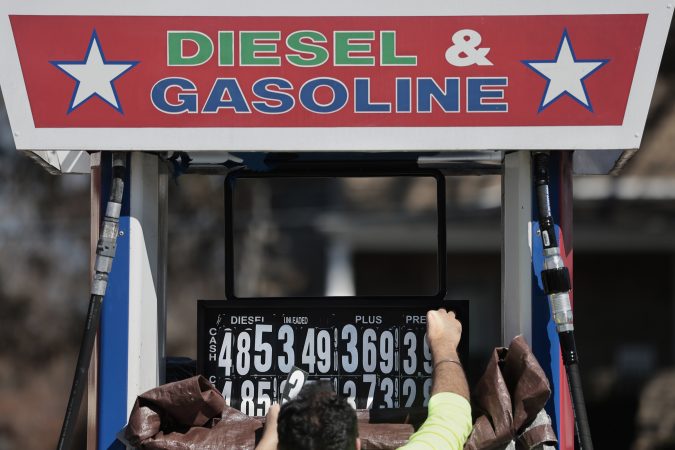
But there was also a dangerous flip side to America’s week of magical thinking. In delivering a speech about election integrity problems that don’t exist, there was also a pack of wild dogs that did not bark Thursday night. For one thing, Trump barely mentioned his unilateral decision to resume and escalate the war in Iran, even as three more U.S. troops would be dead by week’s end, and everyday Americans once again felt the pain of gas prices over $4 a gallon.
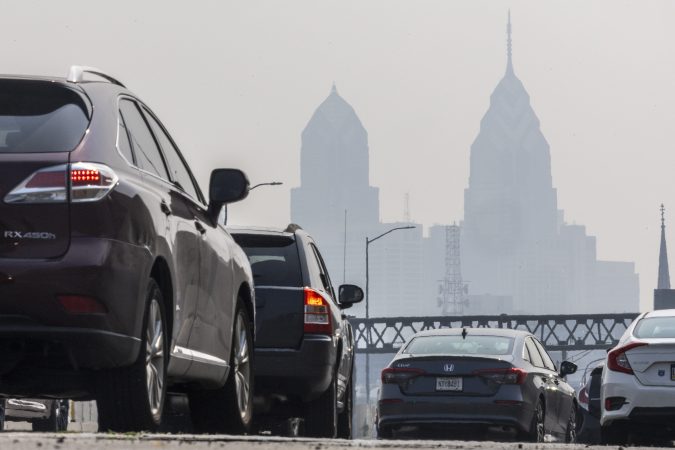
But Trump and his GOP allies were determined to ignore, deflect, or flat-out lie about the crisis that was literally right in their faces: the smoke from northern wildfires, mostly in rural, remote Canada, that shrouded huge swaths of the Midwest and Northeast in thick, wood-smelling smoke and led to orders for people to remain indoors.
Wildfires may be as old as the trees, but there’s only one reason why smoke from Canada has caused two major health emergencies in the United States since 2023, and that reason is climate change. Consistently warmer summers — even more extreme in northern Canada than elsewhere — have led to drought conditions that fuel these blazes. “The best way to solve it is to just stop burning fossil fuels,“ Jonathan Overpeck, a climate scientist and dean at the University of Michigan, told the CBC.
But suffocating smoke from the northlands is a jolly big problem, which nobody can deny. And so a president who’s been utterly skewered by South Park decided to rap, “Blame Canada.” The world’s climate-denier-in-chief was shocked, shocked,that “the United States is being unnecessarily invaded by filthy, polluted, and unhealthy air, the quality of which is dangerous, and totally unacceptable!”
Filmmaker Jim Pattiz called this — wait for it — America’s “latest global embarrassment.” He wrote, “The whole planet is watching an American president shake his fist at the sky and order a sovereign country to get its clouds under control.”
There’s two ways to look at all of this. For now, Trump’s lame efforts to frame the looming midterm election as rigged are coming off as sad and pathetic, a lot more Charlie Chaplin in The Great Dictator than an actual führer. He lacks both evidence and judges who will rule in his favor, while his political base is shrinking every day.
For now, Trump will not be ignored, like Glenn Close flipping the lamp switch on and off in Fatal Attraction. Neither the mortification of Thursday’s speech nor the death of three soldiers in his Iran war of choice could keep the president from bullying his way onto the main stage at Sunday’s World Cup final in New Jersey, ignoring the boos to shoehorn his way into Spain’s victory photos as if he had assisted on the winning goal.
Can a world superpower die from embarrassment? We are finding out in real time.
Yo, do this!
Blame — or thank — the Major League Baseball schedulers who seem determined to stop the Phillies from playing on Friday nights, but the baseball blackout forced me to go on Netflix and realize it has added an awesome documentary that came out in 2019 but is needed now more than ever: Raise Hell: The Life and Times of Molly Ivins. The film shows how the outspoken and relentlessly funny Texas journalist rebelled as a student in the 1960s against the hypocrisies of her privileged upbringing and never looked back until she was taken from us, way too young, in 2007. Every up-and-coming young journalist needs to watch this and discover a role model for life.
After that commercial that ran incessantly during the World Cup, the lyrical phrase “What the world needs now …” has been stuck in my head for weeks. Well, what the world needs now, with rising authoritarianism and ruthless capitalism, isn’t only love, sweet love, but also courage. What remarkable timing for Julia Angwin and Ami Fields-Meyer’s new book, On Courage: How to Be a Dissident in an Age of Fear. The authors tell the story of more than 100 dissidents all over the globe, from Hong Kong to Venezuela, to learn how everyday folks can find the gumption to resist oppression. It’s a must-read for Donald Trump’s America, and it is next on my list.
Ask me anything
Question: Why is [Donald Trump] being allowed to randomly declare tariffs on Canada again if the Supreme Court said that it was illegal? Do we have to have the same argument over and over again? — Stephanie King (@stephstephking.bsky.social) via Bluesky
Answer: Apparently we do. Section 338 of the 1930 Trade Act — known, notoriously, to history geeks as the Smoot-Hawley Act that only exacerbated the Great Depression — gives the president fairly broad powers to impose retaliatory tariffs if his administration concludes that a foreign country is discriminating against U.S. products. Thanks to the international trade war that Trump himself initiated, the president is now claiming Canada is punishing American autos, alcohol, and dairy products. It feels like the proposed 50% levy on many Canadian products is less about sound economics and more about a) answering GOP calls to blame Canada for the wildfires that are actually the result of climate change, and b) trying to change the subject from a disastrous week. They don’t take effect for 30 days, plenty of time for the next TACO (Trump Always Chickens Out) Tuesday.
What you’re saying about …
Last week’s question about how to respond to Trump’s Big Lie about election fraud that we all knew was coming in Thursday’s speech was probably, in hindsight, too wonky to generate much response. Those who did write agreed that a heavy burden falls on the news media to do everything to debunk — or, as longtime reader Rosalind Holtzman put it, “pre-bunk” — the president’s many falsehoods. She added: “Americans have the attention span of mayflies and need review and repetition. Revisit the events of the 2020 elections and how Trump’s claims all failed in court.” I couldn’t agree more.
📮 This week’s question: Optimists are already starting to ponder a world where Donald Trump is no longer president. But where would a Democratic successor even start to undo the damage caused by the many destructive policies of the Trump regime? What should be the Day One measures to start rebuilding U.S. democracy? Please email me your answer and put the exact phrase “Dems Day One agenda” in the subject line.
Backstory on Trump’s campaign cash and ‘explosive diarrhea’
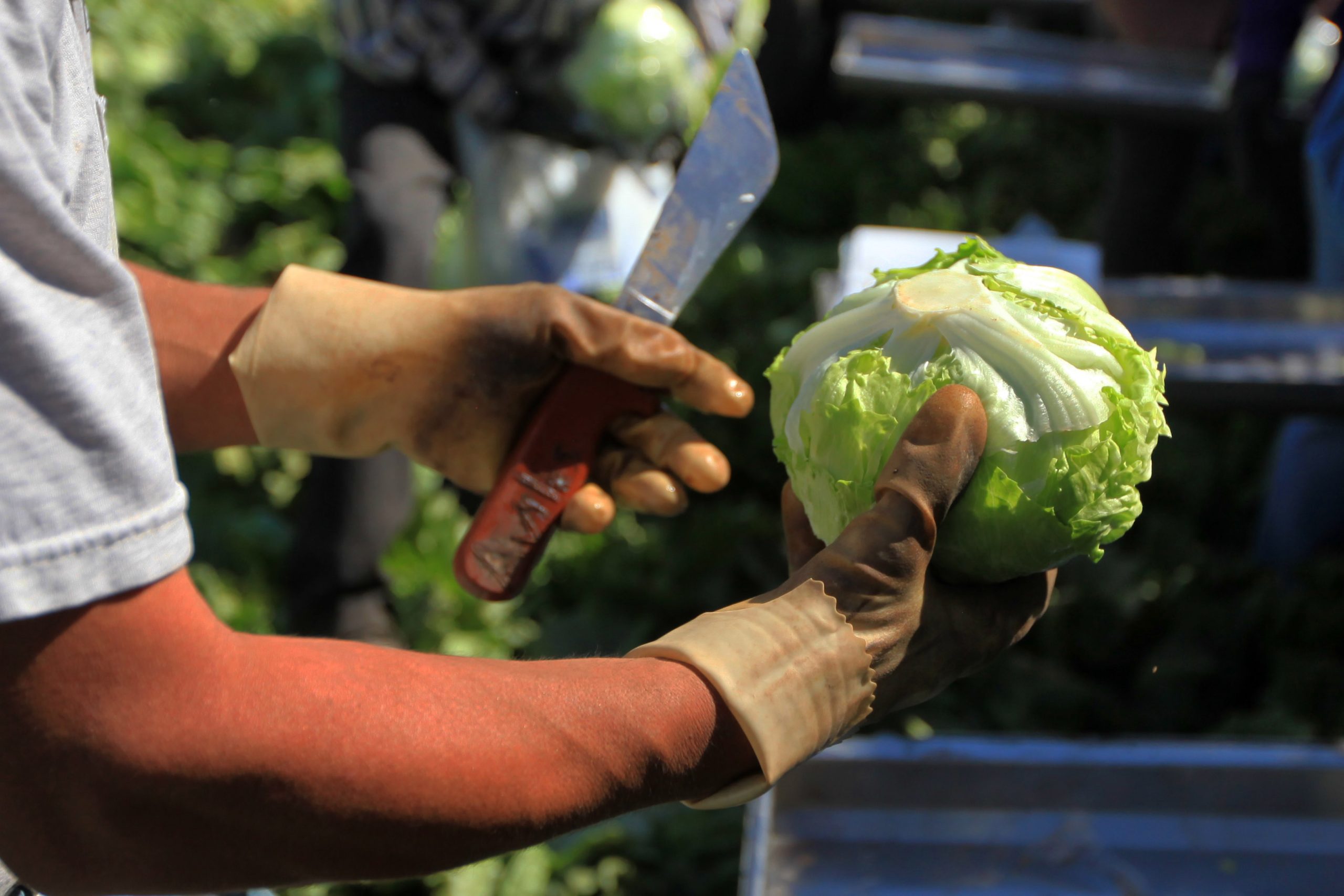
Federal health officials have linked a large cyclosporiasis outbreak to shredded lettuce served at Taco Bell. Is lettuce from grocery stores and restaurants OK to eat?NICOLE BENGIVENO
Before last week, most Americans had never heard of Taylor Farms, a California-based produce firm, and, for a company that supplies lettuce to large U.S. restaurant chains, anonymity was arguably good for business. There are no two words in the English language that can raise awareness of a brand — and destroy it — faster than “explosive diarrhea.” That’s the most alarming symptom from a foodborne illness linked to the parasite cyclospora that’s laid low thousands of Americans in multiple states. Since the early days of the outbreak, suspicion has focused on Taylor Farms after Taco Bell stores stopped using the iceberg lettuce it procures from the company. But the Food and Drug Administration (FDA) probe into the cause has so far been a mess — much of that the result of steep cuts to food safety by the Trump regime. But there are also ethical concerns.
Follow the money.
Regular folks might not have heard of Taylor Farms, but the world’s largest salad processor has made itself known in the corridors of the Trump regime since March 2025. That was right around the time the FDA surprised industry observers by postponing its Food Traceability Rule — drafted under the Biden administration to better track and remove contaminated products — for 30 months. Just six days after the industry-friendly move, Trump’s main political action committee, MAGA Inc., received a whopping $1 million donation from Taylor Farms.
What’s more, money buys access in Trump World. The Daily Beast has reported that last Thursday — despite the company’s nationwide lettuce recall — Taylor Farms executives met with White House and FDA officials and complained about the way the government has been investigating the outbreak. That meeting was followed by a bizarre weekend in which the FDA initially announced that testing of Taylor Farms produce from central Mexico had tested positive for cyclospora, then told the company one day later the result had been a “false positive.” The chaos means ongoing confusion about why so many Americans are getting sick, and whether it’s safe to eat lettuce. And that raises troubling questions about whether political cash has compromised food safety.
This was hardly the first time donations to Trump’s massive empire of political wealth — money raised for a man who is constitutionally barred from running for the presidency again — have overlapped with key policy decisions. For example, the New York Times reported this spring that tobacco company Reynolds American donated $5 million to MAGA Inc. just one week before an industry-friendly FDA ruling on e-cigarettes.
MAGA Inc. — just one of several ways billionaires and corporations can funnel money to Trump World, along with projects like his presidential library — had more than $400 million in the bank at the end of June, an astronomical sum. Its donors have included not only a who’s who of American industry, but also crypto dudes — whose industry has been largely deregulated under Trump — and wealthy pardon seekers. Some of those dollars will go to GOP candidates in November’s midterms, but what happens to most of this cash is a mystery. Trump may be leaving office on Jan. 20, 2029, but we’ll still be following the money for years to come.
What I wrote on this date in 2019
Trump’s second term has been so dangerous for democracy that we tend to forget the horrors of his first four years in the White House. On this date seven years ago, I joined a lot of other folks in shock and dismay over the raw racism of the 45th president’s campaign-style rally in South Carolina, where a diatribe against Rep. Ilhan Omar, a Somali refugee who became a U.S. citizen and represents a Minnesota district, sparked a frenzied chant: “Send her back!” I wrote about the tween girl in the crowd directly behind Trump, who looked around and joined the adults. “In front of national TV cameras, with the 45th president of the United States as maestro, we are witnessing the exact moment that the raging rabble of a Donald Trump rally has taught a child how to hate.”
No columns from me this past week as I spent time with family up and down the Eastern Seaboard, but my Inquirer colleagues have been hard at work. It turns out that the Philadelphia metro area has been ground zero for the latest bizarre business scheme that’s hopelessly intertwined with the Trump regime: a pop-up scheme of at least 25 gas stations rebranded as Trump-aligned Freedom Fuel that — at least for a week or two — were selling gasoline at much lower prices than their nearby rivals. The Inquirer has been all over this weird local story with national implications, and with more questions than answers. Where does this cheap gas come from? Who’s really behind the Freedom Fuel stations? On Tuesday, The Inquirer’s Ximena Conde and Rob Tornoe started to unravel the somewhat dubious past (surprise, surprise) of some of the folks connected to the gas stations, and how suddenly prices at Freedom Fuel aren’t as cheap as they used to be. I suspect the final chapters of this saga are going to be a doozy. The only way to stay on top of local news and support the in-depth journalism we do here is to become an Inquirer subscriber. Join us. It’s a gas.
By submitting your written, visual, and/or audio contributions, you agree to The Inquirer’s Terms of Use, including the grant of rights in Section 10.
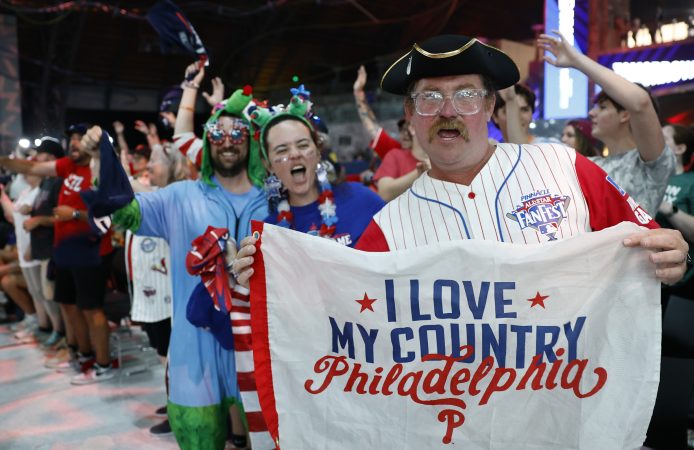
It’s been a big year for Philadelphia. The cradle of American democracy has been in the public eye during the nation’s Semiquincentennial and a series of sporting events that have brought visitors from across the world — all to rave reviews.
In a sign of how far we’ve come from the bad old days of apathy and deterioration, the City of Brotherly Love and Sisterly Affection rose to the challenge and then some.
Those in town for the PGA Tour in nearby Aronimink, the FIFA World Cup and Fan Festival at Lemon Hill, Major League Baseball’s All-Star Game, and the country’s 250th birthday mostly raved. A visiting Brazilian fan called Philadelphia “the most beautiful city” he’d ever seen. A level of effusive praise that stunned many residents who are accustomed to scorn, not admiration.
Officials must now take the planning, determination, and can-do attitude they brought to making the city succeed on the world stage and prove they can make Philadelphians proud even after the spotlight has dimmed.
Fifty years ago, during America’s Bicentennial, many in the city rightly felt its best days were long gone.
Then-Mayor Frank Rizzo, known for his brutal tactics as police commissioner, scared visitors away after he requested federal troops out of fear of protests. No soldiers came to the city, and the planned demonstrations went off without any bloodshed. Still, Rizzo’s warning did little to change the city’s blossoming reputation as a dead-end town.
Philadelphia could never lose its place in U.S. history, but its status as the workshop of the world would never return. Instead, it became known as a symbol of America’s urban decline. Blight spread, violence proliferated, employers left, and quality of life deteriorated. This, in turn, fostered the rise of the “negadelphian,” residents and former residents who expected the worst of the city, its teams, and its people at every turn.
Over time, this sentiment came to dominate conversations about our city. People who had never set foot in the Delaware Valley could all tell the story of how Eagles fans threw snowballs at Santa, while the terms “Filthadelphia” and “Killadelphia” became common.
That negativity was rarely in sight this summer, as Philadelphia put its best face forward to wow the crowds who focused on the city’s history, architecture, walkability, and friendliness. Even much-maligned and chronically underfunded SEPTA reopened long-closed concourses and seamlessly ferried fans to their destinations.
The challenge for city officials now is to keep the momentum going. After all, while the city’s faults may have been sanded down for guests, residents know them all too well.
Mayor Cherelle L. Parker has received positive feedback from residents on cleanliness, and homicide has declined to rates not seen since the 1960s, but many of the city’s day-to-day challenges remain. Taxes on workers and businesses are high enough to impede commercial activity and push residents out of the city and into the suburbs. A lack of job opportunities continues to be the top reason people leave our region.
Our city’s underfunded educational system is scheduled to close 17 schools soon. The city’s parks and libraries make do with fewer resources than their peers. Brutal transit service cuts could occur next year unless Harrisburg acts.
Fortunately, the summer of sports may also point to a way out of these long-standing issues.
Throughout the year, ordinary Philadelphians mobilized to help show off their city. Around 3,000 people signed up to serve as volunteers during the World Cup. Others chose to become Phambassadors through the Visitor Center, working to showcase the city.
This grassroots energy should be harnessed and turned into political power that can keep Philadelphia moving forward.
Ultimately, it isn’t enough to simply change the way outsiders talk about our city. For Philadelphia to truly move beyond its decades-long reputation, Philadelphians must truly believe the hype.
Pennsylvania State Trooper Michael E. Pahira Jr., 44, would still be alive if Michael Bon had not come here from Haiti. That is what the Trump administration wants people to focus on.
It was devastating enough that the veteran of nearly two decades with the state police was fatally struck on July 1 by a tractor-trailer the authorities say was driven by Bon.
But the administration, which since last year has consistently targeted immigrants with both bullets and blame, didn’t stop there.
Playing out the string on the White House’s misguided way of thinking would lead us to believe that this calamity would not have occurred if the law didn’t allow Bon to work while his immigration application made its way through the system.
Or if the Massachusetts Registry of Motor Vehicles had taken away Bon’s commercial driver’s license once his application for Temporary Protected Status was denied.
Or if the situation in Haiti, one of the poorest nations in the world thanks to colonialism and rampant exploitation by Spain, France, and the U.S., had not forced Bon and his family to look for a better life elsewhere.
If you want, you can even throw in the logistics industry, or our consumer culture that sees commercial trucks travel roughly more than 300 billion miles every year, resulting in 5,832 fatal crashes in 2022, according to the latest numbers from the U.S. Department of Transportation.
The question becomes: At which point in this list do we stop when assigning blame?
For the U.S. Department of Homeland Security, you send out a news release that stops at, “This illegal alien was granted a commercial driver’s license by the sanctuary state of Massachusetts.”
This thought exercise is hardly meant to diminish the passing of Pahira, who was, by all accounts, as Gov. Josh Shapiro noted, “one of our very finest.”
On the contrary: Pahira’s life and work would seem to deserve a richer memorial than being turned into one more talking point on the political right for how immigrants are dangerous. How the stand-up guy who had, as Fox News accurately described, “moved home to care for mom with cancer” must also play political pawn to the first half of that headline: “Illegal immigrant truck driver charged in death of trooper.”
No one disputes that Bon, 33, was in the country without authorization at the time of the incident, but that fact has nothing to do with the crash that killed Pahira.
Bon had applied for immigration relief and was denied, so by the time he applied for renewal of his Massachusetts commercial driver’s license, the Systematic Alien Verification for Entitlements, or SAVE, system should have flagged him as ineligible — but it didn’t, according to officials with the Massachusetts Department of Transportation. (That this same federal database is the one the Trump administration wants to use to check if people can vote is another problem for another time.)
Do immigrants commit crime? Of course, they are human beings who can make bad decisions. That they are less likely to do so than the U.S.-born is statistically proven.
It’s also cold comfort to victims when it does happen. However, our lives often progress in unpredictable — and, yes, painful — ways.
Whether you believe in a higher power or an indifferent universe, fate or random chance, Bon and Pahira fatally crossed paths along a stretch of Interstate 81 in Schuylkill County regardless of immigration status.
There is nothing wrong with calling for tighter commercial driver’s license laws — as a bipartisan group of Pennsylvania legislators in the U.S. House did last week — or implementing additional safety measures for those driving a fully loaded 40-ton vehicle. It is even fair to ask for restrictions on people who may only be in the country temporarily.
But fearmongering and casting all immigrants as threats is reckless.
Bon is being held on a $700,000 bond. Among other charges, he is accused of homicide by vehicle. He will be held accountable, evidence will be presented, and hopefully justice will be served. Whatever consequences come his way, he will face them as an individual.
Using Pahira’s death to further demonize immigrants debases a brave trooper’s memory — and is an insult to everyone else’s intelligence.
President Donald Trump and his appointees are obstructing the free press. Calling reporters the enemy of the state; suing newspapers that publish things he doesn’t like; demanding that television stations fire hosts; arresting and serving reporters with subpoenas — the attacks are real and often successful.
It’s hard to know what to do to protect freedom of the press, but in the Delaware Valley, there is a clear, straightforward action we can take to fight Trump’s censorship.
The Federal Communications Commission (FCC) is trying to exert control over which news gets on the air by threatening to withdraw the broadcast licenses that are required for stations to transmit their signals over the airwaves. Locally, it is reviewing the license held by WPVI, or 6abc.
Why ABC stations? Trump has long tried to force the Disney-owned company (which also owns the ABC network) to pull two shows that have been critical of him and his administration: The View and Jimmy Kimmel Live! — which both air on WPVI.
Unlike other attacks on the media, this one we can stop.
The FCC must seek “community input” before arriving at any decision about the fate of WPVI’s broadcast license. You can tell the FCC to stop attacking the free press by clicking here and filling out the one-page form. Take time to tell the Trump administration and the FCC that freedom of the press is a foundational principle.
A free press was so important to our “Founding Fathers” that it was listed in the First Amendment of the Bill of Rights: “Congress shall make no law respecting an establishment of religion, or prohibiting the free exercise thereof; or abridging the freedom of speech, or of the press; or the right of the people peaceably to assemble, and to petition the Government for a redress of grievances.”
Disney and WPVI are not perfect. There is plenty not to like, but the solution to the problem of corporate-controlled news is to break up the corporate giants, not to replace them with other corporate giants that will support Trump.
It’s unbelievable that those conservatives who so often talk about the original intention of the Constitution are silent as Trump destroys the constitutionally mandated freedom of the press.
It is appalling.
And too often, we can do nothing to support the free press under attack. This time, we can.
Lance Haver is the consumer reporter for the Philadelphia Hall Monitor, a worker-owned news service supported by the Lenfest Foundation. Lance@LanceHaver.com
More than 100 million Americans were under some form of smoke warning last week when Fearless Leader took to the airwaves to blow smoke at voters about his imaginary victory against Joe Biden in the 2020 presidential election. No apology for his “drill, baby, drill” policies, which play their part in creating the conditions that produce this hideous climate change. As for the election fraud allegations he repeats endlessly without proof, I am puzzled why his baseless claims are given any space, ink, or airtime. He is a seriously disturbed individual whose reckless claims are dangerously deployed for no other purpose but to place him in the news frame every day, and to give many readers a sense of competence he certainly does not deserve.
Michael J. Cummings,Philadelphia
Data center fallout
States don’t need to ban data centers; they just need to enact legislation that, first, requires any commercial or industrial facility above a certain size to also build a sustainable energy-generating plant that will completely power the facility. Second, no water can be used for cooling the facility. This will either stop construction of these data centers or force an evolution in technology, which will benefit everybody.
Also of concern: Taiwan manufactures over 90% of the world’s most advanced, high-end computer chips. This production is overwhelmingly dominated by a single company, the Taiwan Semiconductor Manufacturing Co. Overall, Taiwan accounts for about 60% of all global semiconductor manufacturing capacity. If (or more likely when) China invades Taiwan, it will then control the global supply of these chips. Why this is not a top priority national security issue for this country has baffled me for years.
Andrew Benton,Flourtown
Off-base
What I love about Marcus Hayes’ writing is that he doesn’t pull punches. But, boy, did he in one of last week’s columns.
No, Zach Wheeler is not “weird.” He is gobsmackingly entitled. First, he complains about the pitching rule that does not allow him to play in the All-Star Game. (Sorry, but a rule is a rule.) Then, he’s asked to participate after all, for whatever reason escapes me, but does it even matter? Clearly. They disrespected him. Oh, boo-hoo.
And Bryce Harper? How on God’s green earth can he also get a pass? He literally said the word FanDuel in the video he was asked to record. I personally have lost all respect for him. Being disingenuous is not “weird.”
I’m sorry, but he’s way off base, pun intended.
Ted Schmiechen, Philadelphia
Council theater
A recent article in The Inquirer indicated how several City Council members are probing the increased assessments on thousands of Philadelphia properties. How did City Hall think it was a good idea to raise property taxes at the same time the president’s policies cost the average family hundreds or thousands of dollars a year in increased food and gas costs? Many Philadelphians are seeing increases of thousands of dollars in additional property taxes — something that should never happen all at once. Council can do something positive by lowering the millage rate, which is the tax rate expressed as tax dollars per thousand dollars of assessed value. This rate is set by Council, so unless you see some brave City Council member put forth that idea, Council’s efforts are just window dressing.
Charles Brennan,Philadelphia
Join the conversation: Send letters to letters@inquirer.com. Limit length to 150 words and include home address and day and evening phone number. Letters run in The Inquirer six days a week on the editorial pages and online.
How does democracy and civic life play out, and what is it like to be a citizen?
This question was posed to former mayoral and gubernatorial candidate Sam Katz by Andrew Ferrett, the director of In Pursuit: Philadelphia and the Making of America. The three of us had been collaborating for years on documentary history films produced by Katz’s company, History Making Productions. But despite his experience as a newsmaker, Katz had categorically refused to be interviewed himself.
In September 2024, when we finally convinced Katz to move to the other side of the camera, we were in the final editorial phases of In Pursuit. This was going to be a legacy project, we argued, your voice is needed (he had enjoyed a front-row view of Philadelphia civic life since the 1960s).
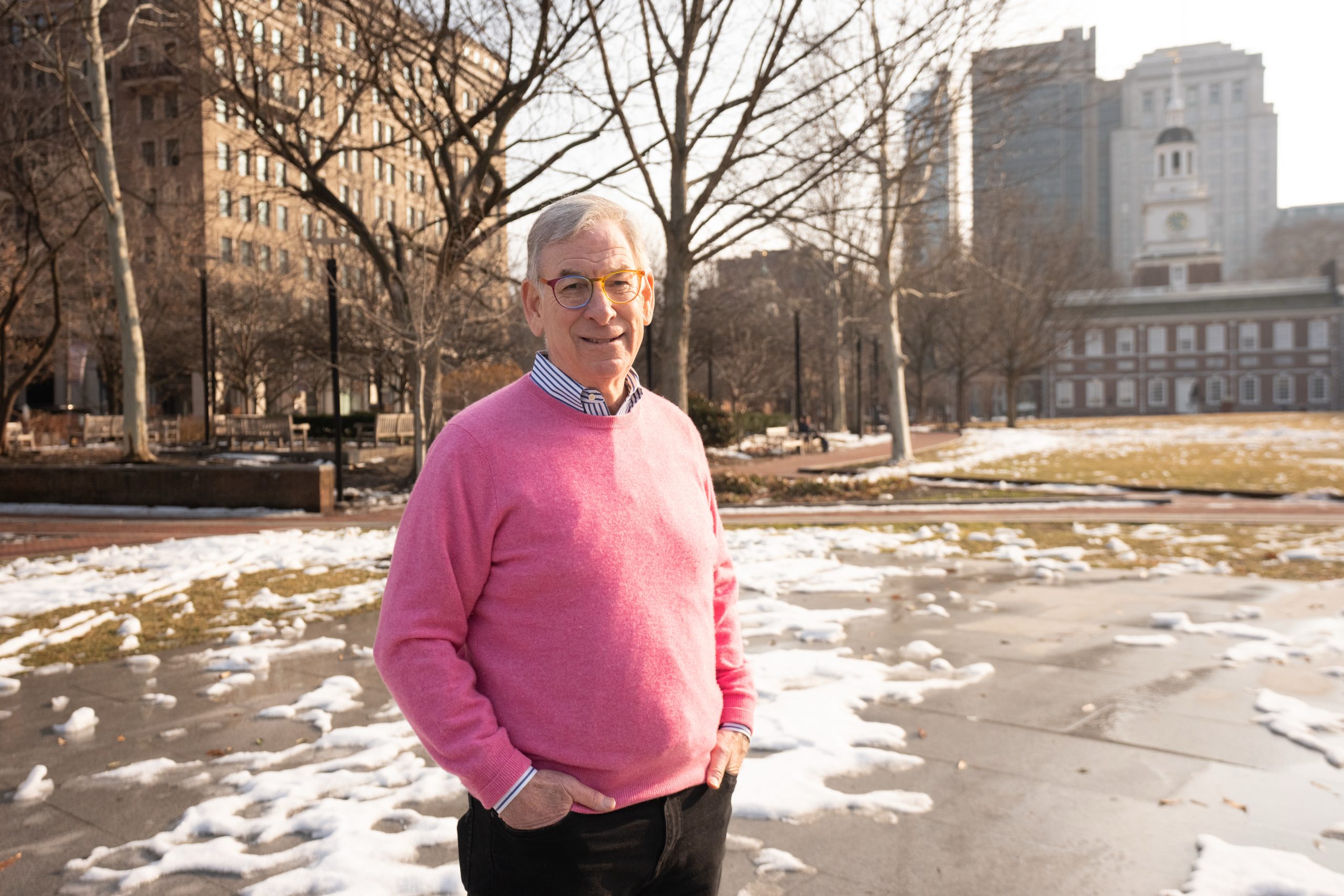
Sam Katz at Independence Hall in Philadelphia, Tuesday, Feb. 17, 2026.Jessica Griffin / Staff Photographer
“I would say that the most important job of a citizen, it’s to vote,” he began. We’d brought our crew up to a Fitzwater Street roof. The wind was blowing Katz’s peach tie; the skyline glinted behind him. “And in the sense of the use of the word democracy, even in its Greek origins, the only place where people could practice democracy was through voting.”
I recalled Katz’s remarks on democracy when I heard that President Donald Trump, taking another step to try to control November’s midterm elections (as The Inquirer argued recently), had fired the two remaining Democratic members of the federal Election Assistance Commission, and that the last remaining Republican member, Christy McCormick, had resigned.
The EAC was created in 2002 as a pro-democracy measure after the contested 2000 presidential election. As a bipartisan commission, it has set standards for voting machines, mail-in ballots, and cybersecurity. A U.S. Supreme Court ruling on June 29 overturned over a century of precedent, giving the president power to fire members of federal commissions like the EAC for political reasons and appoint loyalists.
Vacating the EAC won’t keep the midterms from happening in November, but it’s one more act in what former U.S. Reps. Richard Gephardt and Timothy Wirth call a “rolling coup.”
The firing of the commissioners was “deeply concerning in light of President Trump’s relentless efforts to try to interfere in elections,” said Michael Waldman, the president and chief executive of the Brennan Center for Justice at the New York University School of Law, the New York Times reported.
The dangers are real, as much to American democracy as to the spirit and meaning of citizenship, as Katz defines it. In Pursuit, a 10-part series being released throughout 2026, makes the consequences clear.
And yet, voting as a practice of democracy has almost always been threatened. In 1838, as Episode 4 of the series brings into dramatic focus, a new Pennsylvania Constitution determined that Black men, free men and landowners otherwise, no longer had the right to vote. Were no longer citizens.
In 1871, a year and a half after the 15th Amendment to the U.S. Constitution gave all Black men the franchise, a revanchist movement led by Philadelphia congressman and Speaker of the House Samuel Randall and his disciple, 4th Ward boss William McMullen, resulted in the murder of Black men trying to vote in the mayoral election, including civil rights leader Octavius V. Catto.
Episode 6 opens with Susan B. Anthony and a group of organized suffragists seizing the podium during the 100th anniversary reading of the Declaration of Independence, demanding what the 15th Amendment never delivered: women’s right to full citizenship (it would take another 44 years).
“I believe that I understood what citizenship meant from a very early age,” Katz continued. “My grandmother was legally blind. And so from the time I’m a young person, I took her to the polling place to vote.”
This familial joy, this right and responsibility, this tiny and also enormous act: it’s what defines our ability to be American. Lily Yeh, the founder of North Philadelphia’s Village of Arts and Humanities and an immigrant from Taiwan, says in Episode 10 of In Pursuit: “It reflects democracy and the essence I feel of America, which is most dear. One person, one vote.”
This is what’s fundamentally under threat. It’s a strange thing, as a filmmaker, to watch reality imitating all this history.
It was predictable, in the wake of victories by democratic socialist candidates throughout America, that a tsunami of red-baiting smears and falsehoods would quickly follow. But among the most outrageous were allegations made in Michael A. Livingston’s July 13 letter to the editor that democratic socialists, like textbook Marxists, advocate the “confiscation of wealth and class struggle.” This is a blatant, cynical lie. In reality, leaders of the movement call only for major, commonsense reforms like a national healthcare system, free daycare, a minimum wage increase, and increased taxes on the wealthy, all of which would benefit desperately struggling Americans.
Shame on the writer for trying to perpetrate such reactionary — and familiar — propaganda. And shame on The Inquirer for publishing such letters.
I have been a registered Democrat for approximately 55 years. Among my many “fors” as a Democrat, I am for universal healthcare, the end of forever wars, increased climate control, restricting the ownership of automatic weapons, and the separation of powers. I want the restoration of the Voting Rights Act. I do not need to provide a passport each time I vote. I’m still me, no matter how many times the president wants to know. President Donald Trump doesn’t vote in person. Should he?
If you want to learn about what a Democrat believes, go to the Democratic 2020 party platform. Democrats are not of the same stripe as socialists, but we share some of the same positions in my “fors,” and for that, Mr. Rayca thinks they will be unelectable for the midterms. Most Democrats hold moderate views, neither too far to the left nor too far to the right. Because some democratic socialist candidates won several primaries, Donald Trump labels us all as socialists and communists. Should we be calling everyone in the Republican Party fascists and Nazis based upon the actions of a racist “narcissistic sociopath”? George Conway’s words, not mine.
I am not wooed by the siren song of socialism, but I would never be swayed by the entreaties of a convicted criminal. For all those who continue to listen to his pleas for continued support under the scurrilous guise of purchasing merchandise and investing in his companies to enrich his family, shame on you.
Estelle Samberg, Warminster
Attack on the endangered
On July 10, the Trump administration finalized a rule that removes the long-standing regulatory definition of “harm” from the Endangered Species Act. This is the most monstrous attack ever on our nation’s most vulnerable species. For decades, that definition recognized that wildlife can be harmed not only through direct physical violence, but also when habitat destruction prevents animals from feeding, breeding, sheltering, or raising their young. Destroying an animal’s habitat is harmful.
Removing habitat destruction from the definition of harm will make it easier for reckless development to proceed in places that endangered and threatened species need to survive. Habitat loss is the No. 1 cause of extinction. When you remove habitat protections, you remove the Endangered Species Act’s most important safeguard. Habitat conservation is the cornerstone of wildlife conservation. Eliminating protection for the habitats of threatened and endangered species pushes them to extinction. This is a monstrous decision.
Stan Kotala,Altoona
Addiction exploited
Regarding the recent article about FanDuel sending a personalized message from Bryce Harper to a problem gambler, the conclusion is now inescapable: legalized sports betting harms the integrity of the game. Yet, losing an American pastime is nothing compared to the hidden human cost — the raw suffering inflicted on our families, friends, and neighbors.
Who is to blame? Our state lawmakers — even those from Philly — cynically claim that government-promoted gambling is the only way to fund public transit, our schools, and care for our elderly. They forget that the values we apply to spending public dollars should be the exact same values we use to raise public revenue. We deserve leaders who don’t actively exploit the vulnerable among us — that’s a democratic value we can all get behind.
Paul Boni,Philadelphia
History repeats
It’s 1979 all over again. Oil prices have spiked, and the United States, the world’s mightiest military power and most dominant economic engine, is being held hostage by an isolated regime thousands of miles away. Older Americans remember the long lines at gas stations and the live updates on broadcast television showing the occupied American Embassy in Tehran. A daring military rescue attempt was organized by special forces in the Iranian desert. The mission was called off after several mechanical problems plagued the helicopters. As they were preparing to return, an aircraft collided with one of the helicopters and exploded. Eight Americans were killed. In 1980, voters expressed their disgust for this incompetence. The incumbent party was swept out the door in a landslide. May it be so in 2026.
Alex Pearson,Merion
Another wake-up call
The tragic shooting that left multiple teenagers injured and a man dead is yet another devastating wake-up call for Philadelphia. While law enforcement investigates what happened, the rest of us must confront a more difficult question: Have we become too accustomed to these headlines?
This is not just a Philadelphia problem. So far in 2026, the United States has already experienced more than 200 mass shootings. Behind every statistic are lives forever changed, families left grieving, and neighborhoods struggling to heal. When these tragedies become a predictable part of the daily news cycle, we risk becoming numb to the value of every human life.
Restoring public safety requires effective policing, but enforcement alone cannot solve a crisis rooted in broken relationships, hopelessness, and violence. Lasting progress also depends on strong families, engaged communities, quality education, positive mentors, and a renewed commitment to teaching respect, responsibility, and compassion.
We must never accept gun violence as the price of living in a major American city. Philadelphia — and our nation — owes the next generation communities where character is strengthened, opportunity is expanded, and every life is valued.
Farid Ahmad,Philadelphia
Differing viewpoints
Regarding Jonathan Zimmerman’s column about the importance of exposing students to differing perspectives on U.S. history: While I agree it is useful to share differences of opinions with our students, I believe it is a mistake to, in any way, suggest that there is such a thing as an “alternative truth,” or that people can choose what they like to think when it is not subject to interpretation because facts are available.
There is no alternative truth to the fact that George Washington was an enslaver. There is no alternative truth to the fact that Joe Biden won the 2020 election.
Different countries can have varying opinions of why we dropped the bombs in Hiroshima and Nagasaki, but it is extremely disturbing to think there was another reason other than convincing the Japanese to end a horrific war. If this isn’t the truth, the American people are certainly entitled to know what it is.
Alexis Gerard Finger,Bala Cynwyd
For Pete’s sake
Regarding Pete Hegseth’s plan to test the testosterone levels of troops: While it’s unclear how his screening program will apply to female service members, Hegseth’s focus on testosterone is a thinly veiled message to women in the military: “Grow testes or get out.” What’s next, mandatory testing for the presence of a Y chromosome?
Jay Lynch,Pittsburgh
Join the conversation: Send letters to letters@inquirer.com. Limit length to 150 words and include home address and day and evening phone number. Letters run in The Inquirer six days a week on the editorial pages and online.
Not long ago, I was a celebrated exiled writer, one of the most visible faces at City of Asylum Pittsburgh — a grassroots organization that helps endangered writers build new homes and new lives in Pittsburgh. Today, I am alone, unable to find a job, without health insurance, and, if I remain in this situation, I may soon be unable to pay my rent and find myself — God forbid — homeless.
My story begins in Algeria — the country that prompted Salman Rushdie and other writers to first establish the “parliament of writers” internationally in 1993 because of the alarming number of attacks on, and assassinations of, writers in the country in the ’90s during the civil war. This is the same country that had earlier welcomed the international Black Panthers, and many African liberation movements since its independence from France.
In 2015, I was the first Algerian to call for the legalization of same-sex marriage. I started speaking up on taboo topics, crimes against children, for example, and family laws that relegated women to second-class citizens and prioritized men in the family. In 2017, I was interrogated for hours about one of my novels, which highlighted the participation of the LGBTQ community in the war of independence against the French — another taboo topic.
In 2019, I broke the greatest taboo of all in Algeria, calling for the truth to be told about the 20,000 young men kidnapped during the civil war.
I was tried and sentenced to pay a fine for using humor to criticize the presidential elections in 2020, and then in 2021 I was interrogated for hours about two articles I had written: one in which I criticized the president, the other, a call to liberate “God” from politics.
I was already in the U.S. when I was sentenced, in absentia, to a year in prison in Algeria for those same articles.
I say escape because I chose myself, for the first time in my life. I chose to live. In 2017, PEN International contacted me and proposed that I get in touch with the International Cities of Refuge Network, a Norwegian organization that has a network of many cities of asylum around the world. In 2021, I got Artist Protection Fund funding, and through that, I got a fellowship with the City of Asylum Pittsburgh and Carnegie Mellon University.
City of Asylum welcomed me in Pittsburgh and gave me an important period of safety and opportunity. During this period, I taught Arabic and worked at Carnegie Mellon, where I also studied translation as part of the employee educational benefits while holding a fellowship there. These opportunities changed my life, and I am grateful for them.
Elaine Moukhtefi with Anouar Rahmani in Pittsburgh in 2025. Moukhtefi — an American writer, translator, and activist — worked with Frantz Fanon in support of the anti-colonial Algerian National Liberation Front in the 1950s and ’60s. She helped welcome members of African national liberation movements, including Nelson Mandela and the international Black Panther members, to Algeria before she was forced to leave the country in 1974. Rahmani says that meeting her in Pittsburgh “was the most beautiful surprise in my life.”Courtesy of Anouar Rahmani
But eventually, as happens with fellowships, programs end, and the difficult question of what comes next begins.
Excitedly, I began applying for jobs related to my degrees and experience. When that didn’t pan out, I applied for translation jobs and positions requiring Arabic or French. I applied for work that matched my résumé, and for work that did not. Being an immigrant, I lowered my expectations and looked for work almost anywhere. To give you the full picture, I applied for cleaning jobs, including one cleaning hotel toilets in Pittsburgh.
I hoped to find anything that would protect me from the bitter winter cold and the eyes of racists. Above all, I wanted a job that would preserve my dignity and my life. I did not have many conditions. Any legal work would have been enough to begin my life again. But perhaps because of a curse, bad luck, or something beyond my ability to understand or predict, I was not successful.
Today, I live afraid, on the verge of homelessness, in debt, without health insurance, and without a passport because the Algerian Embassy will not renew mine. I do not know where to turn or what to do. All doors seem closed to me. And all that comes to mind is the applause of audiences at the many events where I was once a guest speaker, on days when I truly believed myself to be an “important” person. Now it seems like a joke.
Anouar Rahmani (left) and Kenya C. Dworkin y Méndez, from Carnegie Mellon University, in a public conversation and preview of Rahmani’s novel, “The End of the Third World,” at a City of Asylum Pittsburgh event in 2025.Courtesy of Anouar Rahmani
We do not matter much as immigrants. U.S. Immigration and Customs Enforcement hunts immigrants down, and politicians direct hateful rhetoric against us. We are labeled with the ugliest descriptions in the media. I am a queer immigrant from Algeria. I have become almost everything some politicians in this country hate.
After the Gaza War, many Arab and Muslim scholars and students spoke with me about their fears. When students were arrested during pro-Palestinian protests, many of us became afraid in a country that had promised us we would not need to be afraid again.
I am afraid. Do I have the right to say this? Or must I live within a diplomatic discourse that allows only gratitude to be expressed after a rescue?
I need to write about the difficult side of rescue, the “after the rescue” nobody speaks about.
This photo shows House Poem, a home painted by Huang Xiang, the first exiled writer in the City of Asylum Pittsburgh residency program, in December 2020. City of Asylum Pittsburgh is a nonprofit organization that is part of an international network of support to writers and artists threatened by a lack of freedom of expression in their home countries./ AP
My story is perhaps personal, but it is bigger than me. It is about exiles brought into this country with hope — who later discover how fragile their survival is. While we are often presented as examples of success, many exiles live in psychological, economic, and legal fragility and under indescribable pressure.
The danger for an exiled writer, scholar, or artist does not end simply because a fellowship ends. I do not doubt the sincerity of the people and the organization that brought me to America and sheltered me. I am not trying to blame my failures on it or on others. But I want us to reconsider the rescue model on which it is built and to work toward sustainable mechanisms of support.
Perhaps the end of a fellowship should be announced with the same energy as its beginning. When an exiled writer or artist arrives, organizations often use newsletters, social media, institutional networks, and public events to introduce the new fellow to a city. The arrival becomes news. But the departure, and the professional uncertainty that may accompany it, can happen almost silently. Why not use the same networks to announce that a fellowship is ending and that a writer, scholar, or artist is entering the job market? Visibility should not disappear precisely when it may be most vital to survival.
Snow welcomed the author when he first arrived in Pittsburgh as a City of Asylum and International Cities of Refuge Network fellow in January 2022.Courtesy of Anouar Rahmani
Host organizations can make introductions, advocate, and help open doors that are often inaccessible to a newcomer navigating a foreign labor market. Many exiles have advanced degrees, years of professional experience, and strong résumés. What they lack is access: knowledge of the hidden mechanisms of the local job market, professional references, institutional introductions, and networks capable of converting experience into employment.
Most importantly, the path toward employment after a fellowship should be treated as part of the fellowship. This work should begin even before the fellow arrives. What credentials may need recognition or supplementation in the host country’s labor market? What legal barriers to employment might exist? These questions should be asked from the beginning, revisited throughout the residency, and followed beyond its formal end.
I want to be clear about what I am saying. City of Asylum Pittsburgh helped me in many ways. I am not dismissing that assistance. The question is not whether individual people tried to help me. The question is whether the fellowship model itself is adequately designed for what happens after the fellowship ends.
What matters in the idea of rescue is not the moment of rescue itself, but the possibility of survival afterward. We do not want to remain symbols of rescue; we want to survive.
All of us want to be beings breathing under the sky — but not in fear that it is about to fall on our heads.
Anouar Rahmani is an Algerian novelist, writer, journalist, and internationally recognized defender of freedom of expression. Rahmani’s literary and public trajectory has positioned him as one of the most visible contemporary Algerian voices confronting censorship, religious and moral authoritarianism, and the criminalization of imagination.