Category: Opinion

  • Letters to the Editor | Aug. 26, 2026

    Letters to the Editor | Aug. 26, 2026

    Protect Head Start

    As developmental and behavioral pediatricians at Children’s Hospital of Philadelphia who care for children with disabilities, we know our patients are well served by Head Start — including the regulations that ensure their inclusion in the program. Head Start programs, which must reserve at least 10% of their enrollment slots for children with disabilities, serve many of our patients when other preschool programs fail to do so. As the article points out, many children will be harmed by the proposed regulations, and we argue that children with disabilities will be disproportionately negatively impacted.

    Rates of suspension and expulsion from preschool for children with disabilities are high, and a local Head Start program may be the only place that can accommodate their needs. Head Start programs cannot expel children for their behavior, and must engage mental health and community support before considering suspension.

    Developmental screening in trusted locations such as Head Start can identify delays, which, if addressed early, may resolve before a child enters kindergarten. Early intervention therapies for children ages 3 to 5 years old are delivered in preschools, including Head Start, allowing our patients to receive speech/language, occupational, or physical therapies. Head Start programs also help families coordinate care when their children need ongoing therapies.

    Lastly, all children benefit from inclusion — by learning and playing alongside each other, regardless of ability or disability. Head Start provides our patients and their families with critical access to programs that help them thrive. We urge our leaders to reconsider.

    Sarah Revak, Wilmington, and Kate E. Wallis, Philadelphia

    No extra innings

    The Phillies gave us an exciting ninth-inning, come-from-behind win Sunday — exciting because they kept getting on base and kept scoring before Kyle Schwarber’s walk-off home run. A friend of mine texted me, with a Philadelphian’s typically guarded optimism, “Phillies look to be peaking toward playoffs!” The media provided an extra-inning recap to revel in the moment. NBC Sports Philadelphia’s analysis noted the significance of getting runners on base to keep the pressure on the defense, while chalking up RBIs. The Inquirer was able to give us its great morning-after reporting, allowing those of us who watched the ending live to bask in the memory for a second or third time.

    Wayne Williams, Malvern

    Right to life, thrive

    Republicans claim to be the “right to life” party. They have not learned that being the pro-life party means they must protect their fellow Americans from birth until death. They have worked diligently to eliminate a woman’s right to terminate a pregnancy. They pride themselves on saving the lives of unborn children. Sadly, they are only the protectors of fetuses. When it comes to supporting life outside the womb, they have done little. The overhaul of programs like the Supplemental Nutrition Assistance Program has resulted in roughly four million fewer people receiving food stamps. Funding cuts for childcare and social services have taken billions of dollars away from the Temporary Assistance for Needy Families program. Regulatory changes threaten the future of early childhood development efforts like Head Start. The Trump administration has implemented funding cuts that target senior citizens, starting with Medicare long-term and in-home care. The cuts contained in the One Big Beautiful Bill mean millions will lose health insurance, and rural hospitals will be placed in jeopardy.

    We have to stop electing officials to both state and federal offices who claim to be pro-life and then put in place legislation that opposes safety net programs, health access, and commonsense gun laws — all of which sustain and protect life. When voters go to the polls in November, I urge them to think carefully about whether their senators and representatives deserve to be reelected. It is time to put in place elected officials who are not just pro-life in name only.

    Celeste D’Alonzo, Marlton

    Simply ballroom

    Last week, Chief Justice of the United States John Roberts once again stomped on the scales of justice by issuing a temporary order that allows construction of Donald Trump’s massive ballroom to continue. This ruling is in direct opposition to both a lower-court ruling and an appeals court ruling that directed that aboveground construction of Trump’s ballroom should be stopped, as the construction lacked congressional authorization for the massive project.

    In the vast majority of dispute cases, and as directed in the prior rulings related to this case, most judges’ initial instructions would be for the parties to temporarily stop what they are doing (i.e., do no further harm). Unfortunately, Chief Justice Roberts decided to put his thumb on the scales and, with a wink, essentially said, “Hey, Donald, keep building.”

    Roberts will claim that his “temporary” order does no harm and is only in place while the U.S. Supreme Court considers an emergency appeal. The problem is that he and everyone else in America knows it could take months for the case to be resolved, and meanwhile, taxpayer dollars are being spent every day on this unpopular Trump vanity project. Roberts and Trump know that by the time the court gets around to deciding the case, the ballroom will be substantially built, and it is unlikely to be torn down.

    I find it interesting that in his Supreme Court confirmation hearings, Roberts famously claimed that “a judge’s job is to call balls and strikes, not to pitch or bat.” Unfortunately, it seems Roberts needs to get his eyes checked, as he has a hugely distorted strike zone whenever Trump is at the plate.

    Kent Kingan, Malvern

    Untold history

    Thank you for the educational article in the Sunday Opinion section written by Cory James Young about President George Washington and how the complex relationship between enslaved and enslaver during colonial times is such an important part of our American history.

    Perhaps one day we will learn the name of the American veteran who Washington enslaved, who died from battle wounds near Pennsylvania’s Fort Necessity. I can’t help but think that the research that led to the opening of the President’s House on Independence Mall in 2010 has been an inspiration to the work of Young, perhaps especially given the debate over how the government has changed it. Let’s keep learning, Philly.

    Anne Patricia Minicozzi, Villanova

    Broken promise

    New Jersey Rep. Jeff Van Drew, who represents Salem, Cumberland, Cape May, Atlantic, and parts of Gloucester and Ocean Counties, said the Republican Party will “get killed” in the 2026 midterms if it does not address rising healthcare costs.

    “We need to deal with [healthcare] now because, No. 1, it’s the right thing to do, just morally,” Van Drew said on Nov. 7 on Fox Business’ Maria Bartiromo’s Wall Street. “No. 2, we’re going to get killed [in 2026].”

    A recent editorial from the New York Times provides one of the clearest explanations I’ve seen of how Republicans, including Van Drew, have slashed healthcare: They did it passively, by allowing the Affordable Care Act subsidies to expire, and they did it actively (with Van Drew’s vote) by slashing Medicaid in the One Beautiful Bill (although they cleverly provided that the cuts do not take effect until after the midterm election).

    Van Drew knows cutting healthcare is immoral — he essentially said so himself — yet he followed Donald Trump’s orders and voted for these cuts in one of the poorest districts in New Jersey. Van Drew put his “undying support” for Trump above the interests of his constituents. In his words, Republicans deserve to “get killed” in the upcoming election.

    Rich Hluchan, Cherry Hill

    Join the conversation: Send letters to letters@inquirer.com. Limit length to 150 words and include home address and day and evening phone number. Letters run in The Inquirer six days a week on the editorial pages and online.


  • ‘High heels to heaven’: Remembering Dolly Parton’s Philly shows

    ‘High heels to heaven’: Remembering Dolly Parton’s Philly shows

    Dolly Parton was a genius-level songwriter, a rhinestone-studded glittering country music queen from Sevier County, Tennessee. Her vaulting ambition manifested itself in down-home masterpieces that transcended the genre, like “Coat of Many Colors,” “Jolene,” and “I Will Always Love You.”

    She was an undeniable gracious force of nature and a multimedia star whose “aw-shucks” persona and disarming sense of humor — coupled with bountiful talent — made her that rarest of commodities in a bitterly divided time: a genuinely universally beloved public figure.

    Parton, who died at age 80, her nephew Brian Seaver announced in an Instagram post on Tuesday, was always ready with a self-deprecating quip about her flamboyant appearance. “It costs a lot of money to look this cheap,” was one of her favorites, and when asked what she hoped people would think of her 100 years from now, she would say: “Dang, she looks good for her age.”

    I met her once, back in 2001 for an interview at the Pierre Hotel in Manhattan. She was promoting Little Sparrow, the second of two excellent bluegrass albums she had released in a little over a year at a time when country radio had all but given up playing her music.

    Dolly Parton in New York, in 1975. Parton, the country singer, songwriter, entertainer, and entrepreneur whose rags-to-riches story, outsize persona, and prodigious vision and talent placed her in a class by herself, died in Nashville on Tuesday, Aug. 25, 2026. She was 80. (Jack Manning/The New York Times)JACK MANNING

    Like Johnny Cash and other icons of her generation, she had attained legendary status, but the industry wasn’t interested in the new music she was making, focusing on younger stars rather than golden greats.

    But the last thing Dolly Parton was going to do when Music City turned its back on her was pout or complain.

    “We’re older than God!” Parton, who was then 55, told me.

    “It ain’t like we ain’t had our day,” she said, referring to herself as well as fellow travelers like Cash and Merle Haggard. “It wasn’t like I didn’t have a great career.”

    “But we can’t last forever. And I always try to think ahead,” she said, adding that “ever since I got started in show business, I’ve always tried to pay attention to the business of the show.

    “I believe in progress. Change is going to happen … You can’t just stay the same way … I can’t just not sing because I’m not getting played on the radio,” she told me. “I can’t not write just because there’s no real place for me in Nashville.”

    Parton, who was the fourth of 12 children, wrote her first song when she was 7. “Little Tiny Tassel Top” was an ode to a corncob doll.

    Dolly Parton waves to her fans on May 5, 2022, at the Wilmington Public Library in Wilmington. Parton joined Delaware Gov. John Carney to promote her Imagination Library, a free book gifting program for children.JOSÉ F. MORENO / Staff Photographer

    When it came up in conversation, she couldn’t resist singing it.

    “I love you an awful lot, my little tiny tassel top,” she sang in a little girl’s crystalline voice. “You’re the only thing I’ve got. Hope you never go away, ’cause I want you to stay.”

    At the time, Parton said she planned on continuing to record music that brought her back to her hardscrabble roots because she knew it would resonate with audiences.

    “I’ll never do anything that’s as real, that I enjoy singing as much, and that I can sing as well as these songs” so close to her heart, she said.

    “These are the kind of statements you want to make. You know, long after you’re dead and people research your career and say ‘Damn, that was good!’ These are the things you want to leave behind.”

    I saw Parton sing for larger audiences than just me four more times over the next 15 years.

    In 2004, she played the Spectrum in South Philly. At that show, she played a banjo and fiddle while gender-flipping John Denver’s “Thank God I’m a Country Boy.” She accompanied herself on piano on “The Grass Is Blue” and played auto-harp on “Coat of Many Colors.”

    FILE – Singers Linda Ronstadt, from left, Dolly Parton, and Emmylou Harris pose in New York on Feb. 11, 1999. (AP Photo/Jim Cooper, File)Jim Cooper

    And of course, she made jokes, kidding about the size of her chest while referring to a Super Bowl halftime show wardrobe malfunction: “If I was to pull a Janet Jackson tonight, I’d take out everybody in the first three rows.”

    Before a show at the Mann Center in 2005, Parton spoke to The Inquirer about her album Those Were the Days, on which she covered folk and pop songs like “Imagine,” “Blowin’ in the Wind,” and “Turn, Turn Turn.”

    “I’m one of those people that love all kinds of music,” she said. “I was always listening to all styles of music, and still do.” She went on: “Those songs give you a kind of hope … I am getting that sappy in my old age, to kind of wish things could be better.”

    In 2008, Parton performed at the Borgata in Atlantic City in support of her album Backwoods Barbie. In addition to the aforementioned instruments, she also played penny whistle and dulcimer.

    She kidded about Whitney Houston’s success with Houston’s smash hit cover of “I Will Always Love You”: “She made me lots of money,” she said. “I will always love her.”

    In Atlantic City, Parton reaffirmed the theme that there was always more to her than meets the eye: “I’m just a backwoods Barbie, in push-up bra and heels,” she sang. “I might look artificial, but where it counts I’m real.”

    That night, she also talked about working hard on writing new songs for the musical 9 to 5, which opened on Broadway the next year. She predicted that her work ethic was going to compel her to keep clocking in until the end of her days.

    “I’ll fall dead on in the middle of a song in front of y’all,” she said cheerfully, “high heels to heaven.”

    Dolly Parton performs in concert on her “Pure & Simple Tour” at the Mann Center for the Performing Arts on June 15, 2016, in Philadelphia. (Photo by Owen Sweeney/Invision/AP)Owen Sweeney/Invision/AP

    Parton’s last Philadelphia concert was at the Mann Center in Fairmount Park in 2016.

    On that hot summer night, she was touring behind her 45th album, Pure & Simple, and told the story about writing both “Jolene” and “Coat of Many Colors” in one creative burst early in 1973.

    For an encore, she sang “Hello God,” a song of desperation and anger at the suffering that transpires on earth in heaven’s name: “We’re so selfish, cruel and blind / We fight and kill each other in your name, defending you / Do you love some more than others? / We’re so lost and confused.”

    Parton also played saxophone that evening, and sang about goosebump-inducing love and spirituality in Pure & Simple’s title cut, using words that could describe how her fans felt about her music:

    “It’s so pure it’s almost sacred / Simply put, it feels divine.”

  • When Dolly Parton and Patti LaBelle made music with their acrylic nails and reminded me of all my aunties

    When Dolly Parton and Patti LaBelle made music with their acrylic nails and reminded me of all my aunties

    A 1970s baby, I saw my mother (and all of the mother figures in my life) rocking big hair, glossy lips, sequins, and acrylic nails into the early 1990s.

    As did the celebrities who have been a part of my pop-culture consciousness as long as I’ve been alive.

    Women like Gladys Knight, Carol Burnett, Betty White, Patti LaBelle, and yes, Dolly Parton. These formidable women taught me my ABCs on Sesame Street, how to count on Electric Company, and random trivia on Password. These aunties in my head were just like my aunties, teaching me, guiding me, laughing with me, smiling with me, leaving powdery perfume trails of Jean Naté and White Shoulders in their wake.

    That’s why a video of Parton and LaBelle circulating on social media Tuesday afternoon made me pause and shed a tear.

    In the hours after Parton’s nephew Bryan Seaver announced on Instagram the beloved, buxom country music singer had died, a 46-second clip emerged from Parton’s 1987 short-lived ABC variety show, Dolly.

    It is pure, unadulterated ’80s joy.

    LaBelle in her crimped “On My Own” hair — the ‘do she debuted when she released the chart-topping hit with Doobie Brother Michael McDonald — is sitting across from Parton, whose trademark curly blond hair is piled high in a massive bouffant.

    The divas are dressed in elaborate black gowns drenched in sparkles. Parton’s features a sweetheart neckline and poofy shoulders ending in a lace sleeve that would give Madonna’s wardrobe a run for its money.

    The two look like they could be attending a prom, or a tacky wedding. (A Parton classic: ”It costs a lot of money to look this cheap.“) Wherever they are going, we know the vibe is going to be ’80s extravagant.

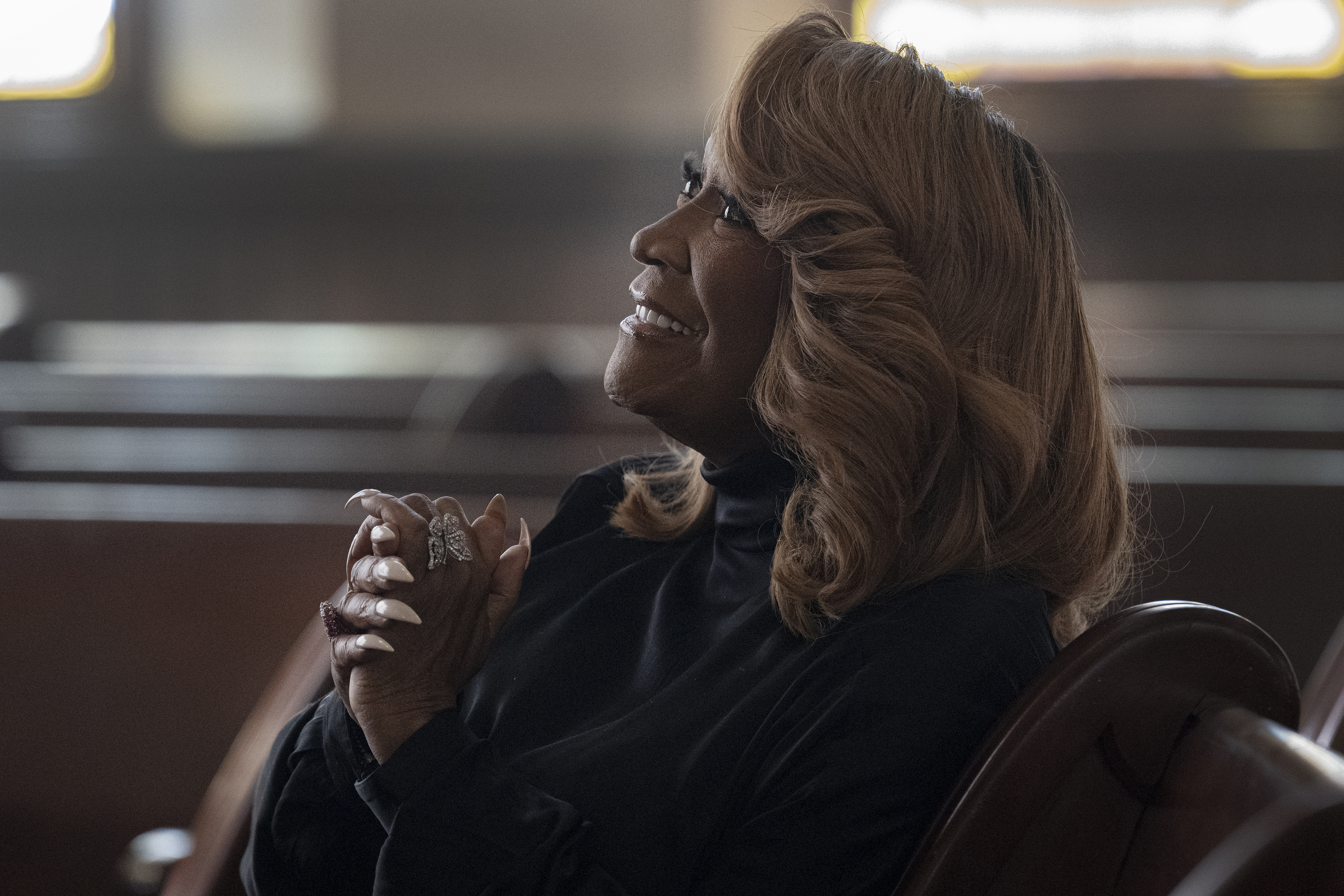
    Singer Patti LaBelle is photographed at Mother Bethel AME Church in Philadelphia, Thursday, Jan. 22, 2026, during a shooting campaign for Visit Philadelphia’s Indivisible initiative, part of an effort to celebrate the city’s communities of color during the nation’s 250th anniversary. LaBelle is starring in the campaign’s Black History Month promotion.Jose F. Moreno / Staff Photographer

    Parton, in her sweet melodic lilt, asks LaBelle if she would join her in using her acrylic nails as an instrument. The two women look like they are filing their nails as they strike up a rhythm.

    Parton, who was born in a log cabin in Tennessee, and LaBelle, a Southwest Philadelphian whose dad was born in Macon, Ga. and moved to the city during the Great Migration, bond over acrylic nails and sing the chorus of the countriest of country songs, “Short’nin’ Bread.”

    “Momma’s little baby loves short’nin’, short’nin’ / Momma’s little baby loves short’nin’ bread.”

    Nails clicking. Powerful voices crooning. Parton and LaBelle sing the hook of the folk song written by James Whitcomb in 1900 in perfect harmony, their voices blending so beautifully that it’s easy to forget historians’ assertions that Whitcomb “borrowed” the song from Black sharecroppers. Allegedly, he retooled and performed it in a minstrel show.

    The video speaks to Parton and LaBelle’s easy friendship and sisterhood.

    “I’m deeply saddened by the loss of my dear friend who was loved by all,” LaBelle said in a statement Tuesday. “Dolly’s artistry, brilliance, and extraordinary life inspired so many people including me. Her light will forever shine!”

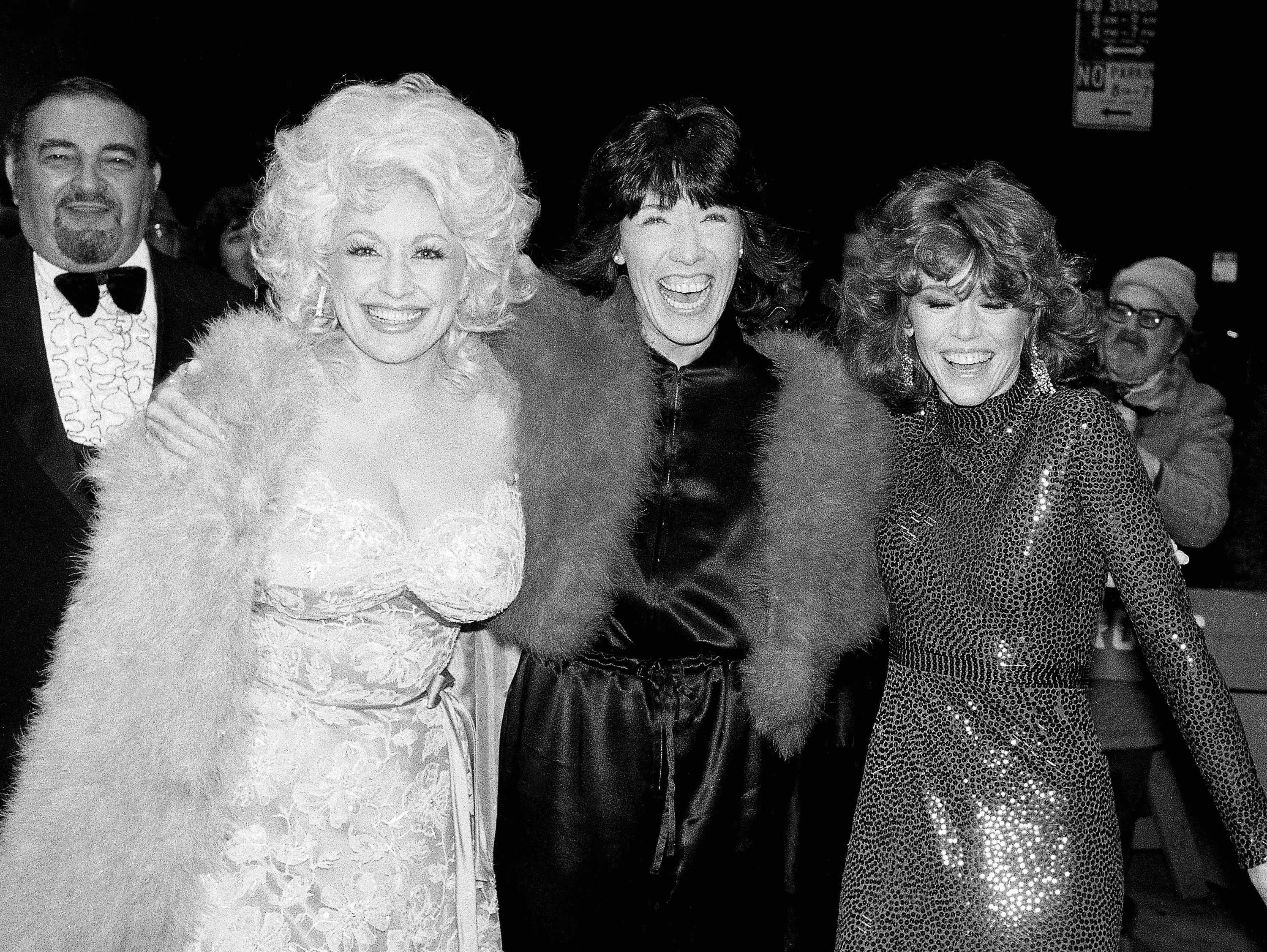
    Dolly Parton (left), Lily Tomlin (center), and Jane Fonda arrive for the premiere of their film “9 To 5” in New York on Dec. 14, 1980. (AP Photo/Richard Drew, File)Richard Drew

    When this performance was recorded almost 40 years ago, LaBelle and Parton had already been celebrities the better part of two decades. Both were already in their 40s. They’d reached auntie status.

    My grandmother used to sing the chorus of “Short’nin’ Bread” while she dealt cards or when she rocked my sister and me in her wooden chair. Parton has been a part of my life in much the same way. Teaching me what it meant to work 9 to 5, performing on musical specials and childhood shows with other aunties and friends like Linda Ronstadt, Emmylou Harris, Loretta Lynn, and the queen of Philadelphia aunties, Patti LaBelle.

    Parton was my country music auntie. She was America’s country music auntie.

    And we will always love her for it.

  • Why Trump’s attack on Stars and Stripes was a gut punch | Will Bunch Newsletter

    You’ve probably noticed that many of your favorite TV news anchors are on vacation right now, because the conventional wisdom is that nothing ever happens in August. That conventional wisdom has been wrong since Aug. 24, 79 A.D., when Mount Vesuvius erupted. The calendar has failed to stop natural disasters like Hurricane Katrina (see item below) or human-made ones like Richard Nixon, who resigned on Aug. 9, 1974. I’m going to tempt fate and take some vacation time next week, including a rare newsletter skip. I’ll see you in two weeks. What could possibly go wrong?

    If someone forwarded you this email, sign up for free here.

    Trump’s autocratic assault on Stars and Stripes isn’t just bad. It’s personal.

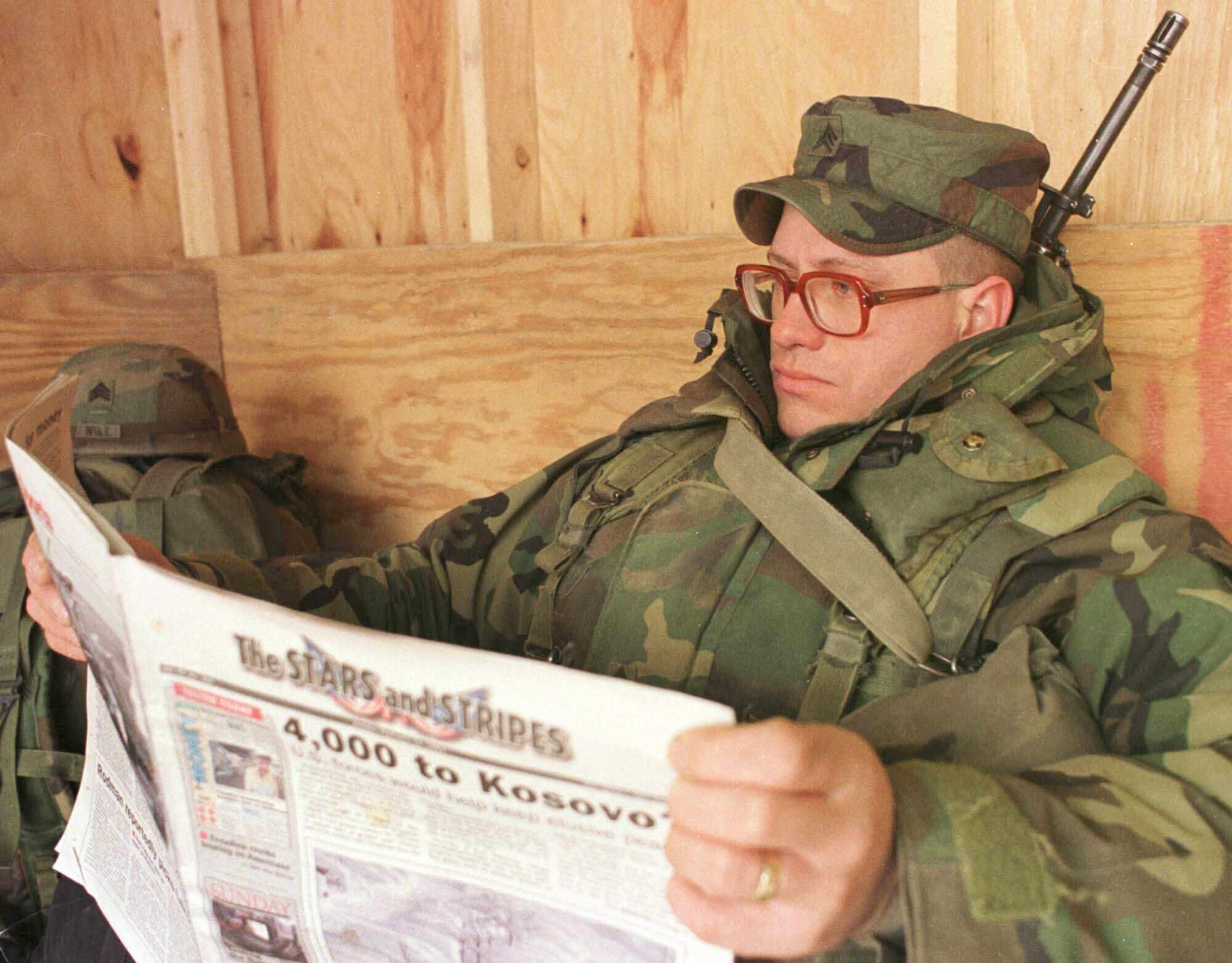
    Sgt. John Hubbuch of Versailles, Ky., one of the members of NATO-led peacekeeping forces in Bosnia, reads a copy of the Stars and Stripes in 1999.AMEL EMRIC

    Less than two months after the U.S. dropped the most powerful weapon humankind had ever invented — the atomic bomb — on the cities of Hiroshima and Nagasaki, the American military arrived in Japan to implement a very different kind of tool in the U.S. arsenal of democracy.

    A free and largely unfettered newspaper.

    The first edition of the Stars and Stripes Pacific newspaper was published from downtown Tokyo on Oct. 3, 1945, when the ink on the Japanese surrender that ended World War II was barely dry. This was the start of a decades-long run when print journalism was still the best way to get information that could be entertaining or essential out to hundreds of thousands of U.S. troops who initially occupied Japan and other Pacific outposts, and later would see combat in Korea and Vietnam.

    Stars and Stripes Pacific — like virtually everything tied to U.S. imperial might after the war — is part of a complicated legacy that overlapped with American censorship of local and outside media in Japan. Yet, U.S. soldiers managed to get their own information from a publication that celebrated the better angels of the First Amendment back home, with coverage of Tokyo’s war-crimes trial and later from the front lines in Korea.

    It was only part of a much grander legacy for Stars and Stripes, which has been the American military’s independent news source tracing all the way back to 1861 and the Slaveholder’s Rebellion.

    Famously, when legendary World War II Gen. George Patton threatened to jail editorial cartoonist Bill Mauldin over a cartoon lampooning him, his superior, Gen. Dwight D. Eisenhower, stopped him. “Stars and Stripes is the soldiers’ newspaper,” Ike reportedly said. “We will not interfere.” Mauldin was awarded a Pulitzer Prize for his wartime cartoons. In 2010, Stars and Stripes reporters exposed the Pentagon’s efforts to slant mainstream media coverage of the war in Afghanistan, and won a George Polk Award.

    That feisty spirit of Stars and Stripes runs deep in my family’s DNA. My maternal grandfather, Thomas Blender, who’d been a photo editor at the Peoria (Ill.) Journal Star before joining the Army, was sent to Tokyo in those early days to work as a top editor of the Pacific publication. I’ve always regretted, after Grandpa Tom died when I was only 11, that I never got to ask him about those days once I’d been infected with the family journalism bug I’d eventually pass on to my own son.

    That must be why it felt like a personal attack last Friday when the Pentagon of Donald Trump and his like-minded “Secretary of War” Pete Hegseth obliterated 155 years of editorial freedom by firing its editor, its publisher — who, seeing the writing on the wall, was about to retire — and its Middle East correspondent. That journalist, Lara Korte, said she was pink-slipped for an interview with CBS News about her reporting on the dreadful conditions for Navy sailors aboard the USS Abraham Lincoln.

    The fuse had already been lit back in January when Hegseth’s Pentagon gutted the regulations regarding the government-funded news organization by stripping language that called for “a free flow of news and information to its readership without news management or censorship.” The new rules, which instead said Stars and Stripes’ journalism “must be consistent with good order and discipline of the military,” were seen as an invitation for censorship. Sean Parnell, the formerly embattled Pennsylvania Republican who is now Hegseth’s chief spokesperson, blasted Stars and Stripes for “woke distractions.”

    Three months later, Jacqueline Smith, the internal editorial watchdog of Stars and Stripes at the Pentagon, criticized military brass for editorial interference and was promptly fired. But the last straw for the outlet came two weeks ago with its aggressive reporting about problems aboard the Lincoln, which spent nine months mostly at sea with dwindling supplies tied to Trump’s ill-advised war on Iran. Journalist Alison Bath reported that sailors’ families were growing deeply concerned about the mental health of the aircraft carrier’s exhausted crew.

    That work epitomized everything that has been good and decent about Stars and Stripes. What the newspaper has shown at its best is that — despite all the contradictions and moral failings of U.S. postwar imperialism — a democratic government can value the press freedom that its armed readers literally died for from Gettysburg to Omaha Beach. That high-minded ideal was a beacon to set us apart from our adversaries in Nazi Germany or Soviet Russia, who never would have permitted the kind of honest coverage Stars and Stripes offered for decades.

    Until America found itself with a government with the same philosophy as 1939 Berlin or 1949 Moscow. Just like his boss, Hegseth has shown nothing but contempt for the notion that his “warfighters” might actually serve to protect Americans’ right to the truth about their own government, including the foibles of his Pentagon.

    On Monday, it came out that the military’s U.S. Central Command told the Intercept that it maintains “a list of people to disregard,” a.k.a. a blacklist. This is the same U.S. Department of Defense — sorry, Pete, that is still its legal name — that also forced out any journalist who wouldn’t sign their integrity away to work in the press room at the Pentagon.

    The firings at Stars and Stripes and the Pentagon’s apparent desire to turn the award-winning newspaper into a Pravda-style propaganda sheet for Hegseth’s testosterone-dosed military feels like a new low on the road toward the utter obliteration of all press freedom.

    Since returning to power last year, Trump and his MAGA minions have waged war against journalists they’ve called “the enemy of the people” — and they’ve done so not through some grand Orwellian censorship edict, but through a mix of billionaire carrots and sticks that have inflicted a thousand small cuts. That means rewards for wealthy allies who buy prominent news organizations (think the Ellison family assuming control of CBS and being on the brink of getting CNN) or neuter them (Jeff Bezos at the Washington Post) — but lawsuits, obstacles, or straight-up bullying for everyone else.

    Another alarming example of the precarious state of the First Amendment came earlier this month when a lawyer for Trump threatened a $5 billion (with a “b”) lawsuit against a left-leaning think tank, the Center for American Progress (CAP), if it didn’t retract a factual report that the Trump regime’s deployments of National Guard troops to U.S. cities have not lowered crime rates.

    The CAP has stood its ground so far, but this reveals the state of play right now. MAGA World has already either bought off or intimidated much of the mainstream media, so now they are hoping they can crush the outliers like Stars and Stripes or CAP, one by one.

    The mission my grandfather was dispatched to Tokyo to carry out after World War II was on the fringe of an idea that came to be known as “soft power” — the now-quaint notion that America could form healthy alliances with the rest of the world through good things like vaccinating children or printing uncensored journalism, instead of dropping bombs. Other organizations meant to show people in oppressed lands that press freedom and democracy are things to fight for — like Radio Free Europe — have been forced to grapple with Trump-ordered cutbacks.

    The right knows exactly what it is doing — that truth and knowledge are kryptonite for its authoritarian project. Increasingly, they are saying the quiet parts out loud. The great Tennessee journalist Phil Williams recently unearthed a sound bite from a white supremacist confab in Rome in which the conversation turned to America’s growing number of news deserts where journalism has all but perished.

    “Local media has been dying all over America, which means that there’s essentially no real way to hold local governments accountable — and they can do whatever they want,” white nationalist Kevin DeAnna told the gathering. “You should be fantasizing about this. This is a good thing.”

    No, it’s not. The government’s bludgeoning of Stars and Stripes has truly — to borrow from a storied military campaign of yesteryear — crossed the Rubicon of no return for its all-out blitzkrieg against the truth. All of us, including the laggards of the mainstream media who continue to pretend this war doesn’t exist, need to fight back with everything we have.

    I never got to know my Grandpa Tom very well, but I know in my soul that this is what he would have wanted.

    Yo, do this!

    • Meep, meep! If timing is really everything, then the half-animated, half-real feature film Coyote vs. Acme, which hits theaters this week, will be the greatest motion picture of all time. The film is based on a 1990 New Yorker essay that imagines Warner Bros. cartoon icon Wile E. Coyote suing the giant Acme Corp. over years of faulty products that literally blew up in his face and ruined his shot at catching the speedy Road Runner. The fact that real-world corporate baloney delayed for several years the release of this film mocking the excesses of runaway capitalism is an unbelievable irony. I’m really looking forward to seeing it.
    • Books, despite their apparent looming extinction, remain a great way to track what humankind is thinking about. This summer, the hot topic is anxiety over AI and the unchecked power of Silicon Valley. In addition to the best-selling Nerd Reich, now there’s the great essayist and Harvard historian Jill Lepore with her new tome, The Rise and Fall of the Artificial State, out today. Lepore’s timely work tracks the rise of authoritarianism run not so much by a tinhorn dictator, but by machines, and how humanity can fight back.

    Ask me anything

    Question: Do PA Dems have a legit chance of freeing us from Joe Pittman’s reign of terror in the state Senate? — Travis (@unraptured.bsky.social) via Bluesky

    Answer: Travis, the answer is absolutely yes. Democrats in the Keystone State have managed to chip away at what once seemed like a permanent GOP majority in the upper chamber at the same time that they’ve recaptured the state House. The current Republican Senate edge is just 27-23, meaning Democrats have to flip only three more GOP seats among November’s 25 contests. Every arrow — Trump’s high disapproval, the popularity of Gov. Josh Shapiro at the top of the ticket, and special-election results like last week’s shocking Democratic House victory in a blood-red district in Western Pennsylvania — points toward a blue tsunami. The Democrats have reportedly targeted three suburban swing districts. The big question for 2027 may be whether Shapiro really wants a Harrisburg trifecta pushing him to the left.

    What you’re saying about …

    OK, last week’s question about Georgia Sen. Jon Ossoff’s pointed comments regarding Donald Trump’s corruption, including an eyebrow-raising mention of ever-present aide Natalie Harp, was kind of a slam dunk for readers of this newsletter. You saw nothing uncivil in the fighting spirit of his remarks, and a surprising number of you echoed back a phrase from my question: “a breath of fresh air.” Wrote Daniel Fleischer: “Jon Ossoff called Trump a ‘crook.’ If anything, that’s a euphemism understating Trump’s criminality.” Added Patricia Eisenberg: “What he said was undeniably true — the President chose this young woman to travel on his escape plane, not one of his cabinet members.”

    📮 This week’s question: It seems like the GOP’s got nothing ahead of the midterms beyond its opposition to what it calls “men playing women’s sports.” It’s kind of pathetic, but it does pose a question for Democrats: Do they strongly embrace transgender rights, or is that risking political defeat in today’s culture wars? I have a strong opinion on this, but what do you think? Please email me your answer and put the exact phrase “transgender politics” in the subject line.

    Backstory on Indiana’s new, outrageous Katrina

    A woman sits inside the City Life Center as she waits for food in Gary, Ind., on Aug. 20, more than a week after a deadly storm passed through the area.Nam Y. Huh

    Exactly 21 years ago today, a tropical storm in the Atlantic Ocean rapidly intensified into a hurricane — Hurricane Katrina — and raced across Florida on a path into the Gulf of Mexico, where it became a Category 5 monster. Still, many of us in 2005 briefly thought the Gulf Coast dodged a bullet when Katrina weakened slightly, and its center struck what looked like only a glancing blow on populated New Orleans. Then, one by one, the city’s levees began to break, and the water rose.

    The death and destruction in Katrina’s wake was covered around the clock on cable TV, yet it took a couple of days for news anchors to articulate what viewers were seeing with their own eyes. The thousands of people who crowded interstate overpasses or were trapped on roofs were almost all Black, and most were desperately poor.

    In These Times wrote the following week that “many Americans were surprised that most of the victims of the New Orleans flood were Black: Their image of the Crescent City had been one of jazz, tasty cuisine and the good-natured excesses of its lively festivals. Where did all those black people come from, they wondered; and where were the white victims?” Katrina triggered some long-overdue conversations about inequality and racism in America, and the inept response from the George W. Bush administration would start his steep decline in public approval. Long before the roughly 1,400 New Orleanians who died in the flooding or chaotic aftermath could be buried, many folks were asking how to prevent this from ever happening again.

    One generation later, it’s happening again.

    It wasn’t a hurricane that struck Gary, Ind., and surrounding communities in the state’s northwest corner exactly two weeks ago on Aug. 11 — just a thunderstorm — but the winds were nearly as intense, snapping trees and downing power lines across the region. Gary’s 67,000 predominantly Black residents hunkered down in the dark nights and blistering hot August days as their refrigerated food went bad, and waited for help. And waited.

    While life returned to normal across the rest of the storm-battered Midwest, the massive outage in the region that includes Gary that began with some 375,000 homes lacking electricity dwindled at a snail’s pace. After two weeks, there were still more than 5,000 families without power and struggling with spoiled food and closed schools and workplaces. There is growing anger among residents who say that Indiana’s heavily Republican power structure and Donald Trump’s federal government feel no sense of urgency to rescue a city that is mostly African American.

    “This isn’t a problem that started with the storm,” the hip-hop star Freddie Gibbs, who grew up in Gary, told MS Now Monday night. “We are a predominantly Black city that tends to get ignored.” It feels like Katrina redux — an island of utter despair in the world’s wealthiest nation, with a government’s inaction bordering on criminal neglect. But there is one big difference: This festering crisis has been mostly ignored by the national media. The tragedy isn’t just our inability to stop the next Katrina, but our inability to care.

    What I wrote on this date in 2022

    One of George Orwell’s greatest passages in 1984 concerns Winston Smith’s job of cutting out old newspaper articles and tossing them into “the memory hole” — inconvenient truths meant to be forgotten by civilization. That’s how it feels now reading news stories from those four years in the early 2020s when Donald Trump was out of power, and America took baby steps back toward normalcy that would later get crushed. On Aug. 25, 2022, I wrote about one of these: Joe Biden’s eventually failed plan to wipe out some $300 billion of the nation’s massive student loan debt. I wrote that “this week will be remembered as one giant leap toward an idea that can change everything — the notion that higher education should be a public good, not the privatized rat race that has demoralized our rising generations.”

    Dive into the memory hole to pull out: “Biden’s big move on student loans only a first step toward making American college great again.”

    Recommended Inquirer reading

    • Look what’s happening out in the streets, got a revolution — and it’s not the one anyone saw coming. Growing public rage against Big Tech — the intrusiveness of artificial intelligence and the noisy, polluting data centers that power it, and increasingly also against omnipresent surveillance cameras — has become the surprise issue of the 2026 midterms. Politicians in both parties are performing backflips to join the bandwagon. Over the weekend, I wrote about how voter anger against Silicon Valley and its billionaires is rapidly reshaping our politics, and what could happen if our broken system fails to deliver radical change.
    • For the first time in recent memory, August has been living up to its reputation as a slow news month (so far), but on the baseball diamond things have really been heating up as kids are drifting back to school. The Phillies’ just-ended nine-game winning streak has electrified a city that’s been having a pretty good summer in spite of everything. The Inquirer’s oft-cynical sports columnist Marcus Hayes even published a list of five reasons to believe the Phils can go deep into October with a reenergized starting lineup, world-class pitching, and improved defense. A stunning turnaround from long-anticipated rookie pitcher Andrew Painter has also been key to the team’s revival in the National League East. It’s an old-fashioned pennant race, and subscribing to The Inquirer is the best way to keep up.

    By submitting your written, visual, and/or audio contributions, you agree to The Inquirer’s Terms of Use, including the grant of rights in Section 10.

  • Doctors, not pharmacy benefit managers, should be determining the treatment for my cancer

    Doctors, not pharmacy benefit managers, should be determining the treatment for my cancer

    For the better part of two decades, I have been living with cancer. I’m grateful for the advances in treatment that have made that possible, but I also have faced denials and delays to my care that could have meant a different outcome for me.

    In 2010, I went to the doctor with what I thought was the flu. I was having trouble sleeping, frequent heartburn, and a persistent cough. My life quickly took an unexpected turn when I was diagnosed with chronic myelogenous leukemia (CML), a cancer that starts in the bone marrow.

    Again, the unexpected. Suddenly my family and I were navigating an unknown and scary world — multiple tests and treatments I couldn’t spell, countless decisions, and most unexpectedly, despite having insurance coverage, wondering how we’d be able to afford the treatments to save my life.

    For most of my adult life, like most people, I paid insurance premiums for my family, expecting that if my wife or I or one of my daughters gets sick, the money I’ve paid into that pool will be there to help cover what we need. But when I was diagnosed, I quickly realized this wasn’t the case.

    It turns out the insurance company had a treatment plan of its own for me, but not the one my actual oncologist had prescribed.

    I was told that before the insurer would grant coverage for the treatment my oncologist felt was best for me, I had to try and fail on medications the insurance company preferred. That practice is called step therapy, and for cancer patients, it can be deadly.

    I can’t speak for everyone, but for me, failure is not really a word you want to be part of the discussion when it comes to cancer. The companies driving it, pharmacy benefit managers like OptumRx, Express Scripts, and CVS Caremark, profit from controlling what drugs get covered and in what order.

    For patients with other blood cancers like chronic lymphocytic leukemia, the most common adult leukemia, the consequences can be even more severe. Delays and forced substitutions can allow the disease to evolve in ways that close the window on the best available treatment entirely.

    If I had been diagnosed 10 years earlier, the treatment for CML would have included chemotherapy or a bone-marrow transplant. Today, thanks to medical advances, the most effective treatment option for my type of leukemia is daily oral anti-cancer therapy.

    There are no comparable IV medications, and the self-administered pills allow me to continue to work and be an active person. In the last several years I’ve started running again, which has been a great outlet for me and another way to protect my health.

    Thankfully, when my insurance tried to force me to try and fail on their alternative treatment plan, my oncology team was able to get me enrolled in a program with a drug company through which I’m able to get my medication directly from them and at low cost. But without that option, I could be forced to deal with my insurer and likely face delays and denials for my care.

    Thanks to medical advances, the most effective treatment option for his type of leukemia is daily oral anti-cancer therapy, writes Paul O’Hara.Pongsak Tiantad/Dreamstime/TNS

    Congress has an opportunity to stop this from happening to cancer patients, and everyone else who has been put through the dangerous process of step therapy.

    The House Oversight Committee is already leading the charge. In a letter to Mehmet Oz, administrator of the Centers for Medicare and Medicaid Services (CMS), Oversight Committee Chair James Comer called on the centers to do more to protect Medicare Part D patients from insurer- and pharmacy benefit manager-imposed step therapy.

    Part D plans are already bound by national cancer treatment guidelines that make clear not all cancer drugs are interchangeable, yet insurers and their pharmacy benefit managers routinely substitute treatments for financial reasons rather than medical ones. CMS has the tools to crack down and needs to use them.

    Comer also played a critical role in crafting pharmacy benefit manager reforms. He and his colleagues should seize on the momentum of those successes by passing the Safe Step Act, which would ensure patients can receive timely exceptions when step therapy is medically inappropriate.

    The commitment to putting patients first should extend to ending fail-first policies that can delay access to the cancer treatments that physicians determine are most appropriate for their patients.

    All cancer patients want is to live life to its fullest, to see the other side of their diagnosis, and to get back to knowing what to expect out of each day. Patients deserve to know that their health insurance will provide the care their doctors say they need. I ask the Pennsylvania federal delegation to get behind the Safe Step Act. It is vitally important to the lives of American patients.

    Paul O’Hara is a Doylestown resident and the president of Connected Cloud LLC, an information technology consulting firm specializing in cybersecurity.

  • Letters to the Editor | Aug. 25, 2026

    Letters to the Editor | Aug. 25, 2026

    Broad mistake

    I couldn’t agree more with the op-ed on the complete lack of foresight used in the installation of concrete “planters” in the center of South Broad Street. In addition to the authors’ critique, let me add:

    Was any consideration given to the additional difficulties of snow removal and street maintenance?

    How about losing space for an emergency vehicle en route during heightened traffic?

    Was a thought given to further congesting a major artery already encumbered with bus and bike lanes?

    How about further strangulation by the inevitable appearance of that darling of the well-heeled — the streetery?

    Shall the Mummers be forced to separate into two groups?

    Another $150 million boondoggle destined to be removed by a head-scratching later generation. It would seem AI of a different sort has been at play on this one.

    J. Savage, Philadelphia

    Think for yourself

    What do students lose when artificial intelligence writes for them? Everything.

    Writing is thinking. You cannot write without thinking, and you cannot learn to think without writing.

    While it may be very hard mental work, especially at first, it gets better with practice. Students and others should not be deprived or deprive themselves of that training.

    When you write about anything, you research your facts and arguments (AI can help there). You explore counter facts and arguments that may change your perspective. You organize your thoughts in a coherent and appealing way. You learn how to spell, how to use proper grammar, and how to develop your own voice and style.

    This is how you develop critical thinking, which is sorely lacking in many of today’s adults. Writing really is an essential human skill. AI defeats that.

    I am a retired writer of one sort or another. At 81, I still write every day, and I still reject all efforts of the AI in my computers to do any of the writing for me. The pleasure — and it is a great pleasure — is in exercising that mental muscle, not letting a machine do it for me.

    Jodine Mayberry, Brookhaven

    It’s a magical world

    Instead of daylight saving time, I favor keeping standard time year-round. It’s better for schoolchildren in the winter, and in summer, as Calvin and Hobbes once pointed out on behalf of young children everywhere, “It’s a cruel season that makes you get ready for bed while it’s light out.”

    Stephen Bryant, Blue Bell

    Join the conversation: Send letters to letters@inquirer.com. Limit length to 150 words and include home address and day and evening phone number. Letters run in The Inquirer six days a week on the editorial pages and online.
  • Krasner’s candor problem started with his first exoneration win

    Krasner’s candor problem started with his first exoneration win

    A number of judges have called out District Attorney Larry Krasner’s office for lying and sloppy lawyering in several recent exoneration cases.

    A supervisor in Krasner’s office was disbarred last year for repeatedly lying while attempting to overturn a death penalty conviction. In June, another former supervisor was suspended from the region’s federal courts for three years for her role in attempting to mislead a judge in the same case. Last month, a former assistant district attorney said she was pressured to lie in court and instead resigned.

    But judges have raised concerns about a lack of candor dating back to the first exoneration Krasner secured after he became Philadelphia’s chief prosecutor in 2018, according to a review of judicial rulings, court transcripts, as well as internal district attorney’s office emails and other documents obtained through discovery in a lawsuit and shared with The Inquirer.

    Exoneration cases often take years to litigate. But just six weeks after Krasner was sworn in, his office vacated the first-degree murder conviction of Dontia Patterson. He was set free three months later.

    Patterson had spent 11 years in prison after being convicted in the shooting death of Antwine Jackson. Patterson’s first trial ended in a hung jury with an 11-1 vote in 2008, but he was convicted at a second trial the following year based largely on the testimony of two eyewitnesses.

    The Pennsylvania Innocence Project, along with pro bono lawyers, began working on Patterson’s post-conviction appeal well before Krasner was elected as district attorney on a promise to end mass incarceration and reexamine past cases. The focus of the group’s claim was ineffective defense counsel.

    Just weeks after he was sworn in as district attorney in January 2018, Larry Krasner secured an exoneration for Dontia Patterson, who was convicted in a 2007 murder.JESSICA GRIFFIN / Staff Photographer

    But Krasner’s office offered a bolder theory: In addition to the ineffective counsel, it claimed prosecutors working under then-District Attorney Lynne Abraham and police withheld evidence that would have bolstered Patterson’s defense.

    In May 2018, Anthony Voci, then the chief of Krasner’s homicide unit, signed a legal motion that called Patterson’s conviction “an egregious example of police and prosecutorial misconduct” and moved to drop the charges.

    Along the way, Voci began coordinating with the DA’s press officer to spread the word to the media. “I think this could be a great story for our office to tell,” Ben Waxman, then the DA’s director of communications, wrote in an email to Voci on Feb. 28, 2018.

    The district attorney’s office did not respond to requests to interview Krasner and Voci.

    Three months after Waxman’s email, in May 2018, Voci made a stirring speech in court that referenced the Declaration of Independence’s guarantees of life, liberty, and the pursuit of happiness and excoriated the former prosecutors, saying they were required to be right, sure, and fair.

    Richard Sax, the former prosecutor who oversaw Patterson’s conviction, denied any wrongdoing. He said jurors concluded Patterson was guilty beyond a reasonable doubt, and a previous appeal of the conviction was denied. He called Krasner’s exoneration of Patterson “a horrific travesty of justice.”

    Beth McCaffery, a former prosecutor who oversaw the first trial that ended in a hung jury, was offended by the attack on her character by Krasner’s office, and decided to fight to clear her name.

    Richard Sax, who oversaw the prosecution of Dontia Patterson, denied any wrongdoing in the case and called the district attorney’s office’s exoneration “a horrific travesty of justice.”David Maialetti / Staff Photographer

    McCaffery filed a Right-to-Know request in 2020 seeking access to the case file, which she believed would show she operated by the book. Krasner’s office initially denied the request, claiming the information was not public, even though it had shared the files with researchers at the New York University School of Law.

    At a hearing last year, McCaffery testified that she kept detailed notes and records of her cases that would show she acted properly.

    Voci, who signed the motion that blamed the former prosecutors, also took the stand. By then, his story had shifted.

    McCaffery’s attorney, Bryan Lentz, wanted to find out what sort of independent investigation Krasner’s office undertook before deciding to free Patterson.

    “Before signing the motion, what did you do?” Lentz asked. “What did you review personally to assure yourself of the facts in this motion?”

    Voci responded, “Virtually nothing.”

    Turns out, prosecutors didn’t interview the two eyewitnesses from the trial or the former prosecutors who tried the cases. They didn’t interview a police officer who lived near the shooting, heard the gunshots, and saw a man fleeing the scene.

    However, Voci did sit in on a PowerPoint presentation by attorneys from the Pennsylvania Innocence Project that focused on Patterson’s ineffective legal counsel, which the DA’s office largely adopted.

    In May 2018, Anthony Voci, then the chief of Krasner’s homicide unit, signed a legal motion that called Dontia Patterson’s conviction “egregious.” He later testified that he hadn’t read the document before signing it.David Maialetti / Staff Photographer

    To be sure, a case could have been made that Patterson, who was 17 at the time of the killing, should not spend his life behind bars. Or that his defense counsel was inadequate, and that eyewitness misidentifications have been found to be a major reason for many wrongful convictions.

    But Voci — who had previously criticized the prosecutors in court — testified that he didn’t believe everything he said.

    “Were you onboard with accusing Beth McCaffery of prosecutorial misconduct?” Lentz asked.

    “No,” Voci said.

    “But you signed the motion anyway, right?” Lentz asked.

    “I did,” Voci said.

    Voci revealed something even more stunning: “I didn’t draft this motion, and I didn’t review it before I signed it.”

    That would appear to violate the Pennsylvania Rule of Criminal Procedure, which makes clear that an attorney signing a motion certifies that he or she has read the document and believes the facts as stated.

    Ed Cameron spent four decades prosecuting cases for the district attorney’s office. He questioned efforts to secure an exoneration for Dontia Patterson.Laurence Kesterson / Staff Photographer

    Ed Cameron, who spent nearly 40 years in the district attorney’s office prosecuting mainly homicide cases, sent an email to Voci at 7:36 a.m. the day after Patterson was released. He said he was “up all night” and proceeded to question the exoneration.

    “A lot of mistakes and misstatements were made in the ‘investigation’ and filing by our Office,” Cameron wrote, adding that he was never consulted about the motion to exonerate Patterson and blame the former prosecutors. After Cameron died in 2020, he was praised for his honesty and experience handling high-profile cases.

    Voci’s testimony echoes a similar issue playing out in a separate exoneration case that is before U.S. District Judge Paul S. Diamond.

    In that case, one of Krasner’s former assistant district attorneys, Jaclyn Mason, testified that the DA’s office failed to do any independent investigation in another exoneration case involving a convicted murderer and instead accepted the arguments provided by the Pennsylvania Innocence Project.

    Mason testified she signed the legal document asserting the man’s conviction should be thrown out, but didn’t independently examine all the evidence. Instead, Mason testified, she followed the orders of her supervisor, Matthew Stiegler, who she said told her, “‘If it’s good enough for the Innocence Project, it’s good enough for me.’” That case is ongoing.

    Like Mason, Voci testified that he was just following orders, and that another lawyer in the office, Patricia Cummings, wrote the Patterson motion.

    Krasner hired Cummings in January 2018 — the same month he was sworn in — to oversee the city’s Conviction Integrity Unit, which was set up to review old cases for wrongful convictions. She came from Dallas, where she started a similar unit, and reported to Krasner.

    Cummings maintained a separate role while working in Krasner’s office as a research scholar at NYU School of Law — the same place that was granted access to the DA’s case files McCaffery had requested.

    Cummings helped research and draft a 180-page report released by NYU that detailed a long history of prosecutorial misconduct in Philadelphia, an apparent conflict of interest that seemingly undermines the report’s independence.

    Cummings had an opportunity to defend Patterson’s exoneration and the NYU report at McCaffery’s Right-to-Know hearing. But when called to testify, she failed to show up. (Cummings did not respond to questions I emailed her.)

    McCaffery sued Cummings and NYU for defamation. The case was dismissed and is now on appeal in the U.S. Court of Appeals for the Third Circuit.

    Separately, McCaffery’s effort to clear her name dragged on in court for four years. In March 2024, Common Pleas Court Judge Anne Marie Coyle issued a stemwinder of an opinion that stretched for 149 pages and found Krasner’s office unfairly accused McCaffery and Sax of misconduct.

    Dontia Patterson is shown at the Philadelphia Criminal Justice Center after a hearing in May 2018, at which a judge cleared him of a 2007 murder and agreed to drop the charges.Chris Palmer

    The judge said the claims by Krasner’s office that the two former prosecutors illegally withheld evidence to secure a wrongful conviction were “intentionally and maliciously created” and “had no good faith basis.”

    Coyle listed 11 scathing findings involving Patterson’s exoneration and the efforts to fight McCaffery’s Right-to-Know request, including that Krasner’s office “misplaced and/or destroyed requested records and relevant evidence.” She found the DA’s office “dishonorably publicly maligned” McCaffery and Sax.

    The judge’s opinion echoed a recent finding by the state Supreme Court in a separate exoneration case when she found “the DA’s office demonstrated a patterned lack of candor” to the courts through “misstatements” and by “omitting salient” facts related to the post-conviction review of Patterson’s case and McCaffery’s Right-to-Know appeal.

    Coyle said a culture existed within Krasner’s office “to denigrate prior prosecutors” and “prior administrations.”

    She fined Krasner’s office $120,000 and called on an appellate court to impose more penalties. The DA’s office is appealing to the Commonwealth Court of Pennsylvania.

    After Patterson’s release, he sued the city and received $1.7 million in a settlement for his time in prison. In 2023, Patterson was arrested for selling drugs in Kensington. He struck a plea deal with prosecutors in Krasner’s office and received two years probation.

    The Pennsylvania Innocence Project stands by its efforts to exonerate Patterson.

    “Before the Pennsylvania Innocence Project agrees to take a case, we conduct a thorough, often yearslong review of the facts and the record,” Nilam A. Sanghvi, the Innocence Project’s legal director, said in a statement. “In this case, the facts pointed to Dontia Patterson’s innocence, and his exoneration was the just result. We will continue to pursue justice for our wrongfully convicted clients based on the facts.”

    Krasner, a former defense attorney, has long railed against what he considered a win-at-all-cost mentality among police and prosecutors in the city. While Philadelphia has a fraught history of overreach by officers of the law and officers of the court, the remedy for any past abuses isn’t more of the same.

  • Server two masters | Editorial Cartoon

    John Cole spent 18 years as editorial cartoonist for The (Scranton) Times-Tribune, and now draws for various statesnewsroom.com sites.

  • Letters to the Editor | Aug. 24, 2026

    Letters to the Editor | Aug. 24, 2026

    Real fear

    Wondering if a situation I not long ago experienced in a Walmart would change Luis F. Carrasco’s mind about both sides having extreme ways we disagree. I saw a gentleman wearing the famous red MAGA hat. I said he looked like he supported Donald Trump. He looked at me and said, “You want to make something of it,” while pulling up his shirt — to show off the gun he was carrying. The fear Mr. Carrasco is talking about isn’t just a concern about being yelled at. It’s the same fear felt by liberals like me, judges, people in Congress, and others when we hear our president tell his supporters that violence is not just OK, but recommended.

    Joe Obelcz, Hatfield

    Preventive healthcare

    Earlier this summer, a Spotlight PA article detailed how advocates and lawmakers were trying to figure out how to keep the state’s children insured as the Trump administration’s Medicaid cuts loom. As children prepare to head back to school, I remain struck by how that article highlights an important reality: The most valuable healthcare is often the illness that never occurs because it was prevented.

    A pediatric well-child visit is far more than a physical exam. It is where developmental delays, postpartum depression, food insecurity, mental health concerns, and life-threatening illnesses may first be recognized. It is also where trusting relationships are built, relationships that help families feel comfortable discussing concerns, accepting recommended vaccinations, and seeking care before small problems become crises.

    Difficult budget decisions are inevitable, but how we make them matters. Protecting children’s access to pediatric primary care through Medicaid and Children’s Health Insurance Program is an investment in healthier families, lower healthcare costs, and stronger communities. Every child deserves the opportunity to grow up healthy, and that starts with ensuring they can see their pediatrician.

    Eliza Sitter, Philadelphia

    Unsung hero

    It’s recently been reported that the U.S. Navy is thinking about removing Doris Miller’s name from its newest aircraft carrier. Miller was a cook aboard the USS West Virginia during Japan’s attack on Pearl Harbor on Dec. 7, 1941. He also happened to be Black. On that day, Miller, in the face of enemy bombing, displayed extreme heroism by saving the life of the ship’s injured captain and manning an anti-aircraft gun that brought down at least one Japanese plane, if not more. He was later awarded the Navy Cross, the first Black American to receive it. Two years later, he made the ultimate sacrifice for his country when his carrier was torpedoed by a Japanese submarine and he went down with it.

    The “shocking” part of this story is that the U.S. Navy is seriously considering replacing Miller’s name with that of … wait for it … Donald J. Trump. And what heroism did Trump exhibit to warrant such an honor? Sure, he avoided military service during the Vietnam War because of “bone spurs.” But who knows, if not for such “bone spurs,” Trump may very well have saved more than one captain and brought down thousands of enemy planes, ending that war like he claims to have ended so many other wars during his second term in office. That counts for a lot among his cabinet members. And he certainly has been courageous, playing golf despite his “bone spurs” (by one tally, he’s spent about 22% of his second term golfing).

    Of course, none of this is shocking. Trump cares only about three things, and not one of them involves bettering the lives of the average American: enriching himself and his family at every opportunity, seeking retribution against his perceived enemies, and slapping his name on anything and everything he can. None of that would be possible if not for the compliance of this Congress and this Supreme Court. It’s time to put a stop to this nonsense and elect officials who are serious about the real issues facing our country — and who have solutions that put the American people first.

    Jeffrey Meyer, Chicago, Ill.

    …

    The possible renaming of the USS Doris Miller as the USS Donald J. Trump reflects the reality of the president’s second term. During his first term, Trump made an attempt to connect with African American voters despite his own pre-presidential comments and actions. In his second term, Confederate names on Army forts are in, woke is out — as are assistance to college students of color, Project Head Start, and other government programs aimed at giving marginalized people an opportunity to advance in our society. The disrespect shown to America’s first Black hero of World War II follows in the wake of Pete Hegseth’s purging our military of qualified Black and female generals and admirals. Trump 45 was challenging to endure, Trump 47 is moving our country closer to self-centered one-person rule.

    Paul L. Newman, Merion Station

    Blame game 2.0

    In the coming years, we may witness the return of one of America’s oldest and most reliable excuses — only updated for the digital age. For generations, students fell back on the classic line, “My dog ate my homework,” a phrase that became shorthand for avoiding responsibility with a smile. Today, we’re on the verge of adopting its modern successor: “The AI messed it up.”

    Already, artificial intelligence is being quietly positioned as a cultural scapegoat. A poorly worded email? Blame the AI assistant. An awkward social media post? Must have been the algorithm. A missed deadline? The chatbot must have misunderstood. The technology is new, but the impulse is ancient: when something goes wrong, point to anything except ourselves.

    The irony is that AI doesn’t remove human responsibility — it increases it. These tools are powerful, but they are not autonomous moral agents. They don’t decide our tone, our judgment, or our priorities. Yet we seem eager to hand them not only our tasks, but our accountability.

    If we’re not careful, “The AI did it” will become the next cultural reflex, allowing us to sidestep ownership of our words and actions. It may not be long before society looks back and realizes that the dog never ate the homework — and the AI didn’t write the email. We did.

    Steve Abramovitz, Cherry Hill

    Toeing the line

    Your recent editorial on how American troops are being strained for nothing during the Iran war, referred to Trump ducking service during the Vietnam War “with the reported assistance of a sympathetic Queens podiatrist.” The doctor in question had good reason to be sympathetic: his landlord was Fred Trump, Donald’s father.

    As The New York Times reported in 2018, the podiatrist, Dr. Larry Braunstein, died in 2007. But his daughters say their father often told the story of coming to the aid of a young Mr. Trump during the Vietnam War as a favor to his father. They said his role in Mr. Trump’s military exemption had long been the subject of discussions among relatives and friends. “It was family lore,” Elysa Braunstein told The Times. “It was something we would always discuss.”

    In keeping with his lifelong passion for telling the truth, Trump later claimed that it was a high draft lottery number that kept him from being called up — but he got the bone spurs deferment in 1968: the lottery wasn’t instituted until a year later.

    Isaac Segal, Cherry Hill

    Muscular politics

    Secretary of Defense Pete Hegseth says that his mandatory screening program for testosterone deficiency for the troops is “necessary to allow them to operate at their absolute best.” This is an inaccurate, inappropriate and irresponsible action from incompetent Trump cabinet officials, including the Health and Human Services Secretary Robert F. Kennedy Jr. As a practicing physician, I was alarmed by Hegseth’s plan, which goes against current guidelines issued by the Endocrine Society, American Urological Association, American College of Physicians and the Food and Drug Administration, all uniformly recommending against population-level screening, and advocating only for symptom-driven case detection at any age, in association with other medical illnesses including type 2 diabetes, chronic kidney disease, obesity, and chronic opioid and corticosteroid use. Testosterone replacement therapy, even if clinically warranted, has well documented serious side effects including fractures, pulmonary embolism (lung blood clots), and a potential increase for atrial fibrillation, a heart rhythm abnormality that is associated with blood clots including stroke. Unfortunately, our military continues to be led astray by an unqualified, self-serving weekend television host whose ego and ill-advised decision-making place our troops at increased risk of long-term health problems.

    Jay Klazmer, Cherry Hill

    Join the conversation: Send letters to letters@inquirer.com. Limit length to 150 words and include home address and day and evening phone number. Letters run in The Inquirer six days a week on the editorial pages and online.

  • Fighting AI and Flock, today’s Luddites are the revolutionaries we need

    Fighting AI and Flock, today’s Luddites are the revolutionaries we need

    It’s a good bet that a suburban Cincinnati man named Cody Morelock probably never heard of “Ned Ludd,” the mythical English weaver of the early 1800s who became the avatar of a movement to save society from the destructive force of a new technology.

    But Morelock was absolutely channeling the spirit of history’s Luddites, who smashed up the newfangled machines of the nascent Industrial Revolution, when he was allegedly captured on video toppling a Flock automatic license plate reader near his home and obliterating the high-tech device and the solar panel powering it.

    Morelock was arrested after the June incident, and then prosecutors in Clermont County, Ohio took what looked like an open-and-shut case — with surveillance tapes, credit card receipts, and other hard evidence connecting the 35-year-old man to the alleged crime — before a grand jury of his peers.

    But Morelock’s peers apparently didn’t see a crime in the wanton destruction of a Flock camera spying on their community. The grand jury refused to indict him — another victory for the 21st-century Luddites who’ve turned U.S. politics upside down with their rage against the machines.

    Public anger over the dystopia of omnipresent cameras tracking their every movement has caused more than 50 municipalities from coast to coast to cancel or reject contracts between local law enforcement and Georgia-based Flock Safety, the leading firm.

    But that’s just the tip of a political iceberg: What’s becoming a mass movement against Big Tech’s intrusiveness in our everyday lives has also seen activists in scores of communities beat back proposed data centers that power artificial intelligence, or AI. Suddenly, politicians in both parties are tripping over each other to oppose the advanced technology they were backing just months earlier.

    This weekend, I watched an online ad from a former Democratic state representative in Massachusetts running for the Bay State’s open congressional seat. The ad channels voter anger over Flock cameras, citing two local cases of police using them to stalk unsuspecting citizens. She slams an opponent for raising money from Big Tech sources.

    With a wicked Boston accent, Jamie Belsito says, “Flock cameras feed our movements into a massive searchable network that we know can be tapped into by ICE, and now — in our own backyards — we see how that power can be abused.”

    The uprising against Flock and government mass surveillance is merging with the already explosive movement against new data centers, which now sees a whopping 75% of Americans opposed to building one in their hometown — a kind of unity that in today’s bitterly divided nation you wouldn’t even see for cuddly puppies or ice cream sundaes.

    Here in Pennsylvania, which has become an epicenter of proposed data centers, a recent analysis by Spotlight PA found at least 20 state legislative races in November in which these facilities have become a pivotal issue.

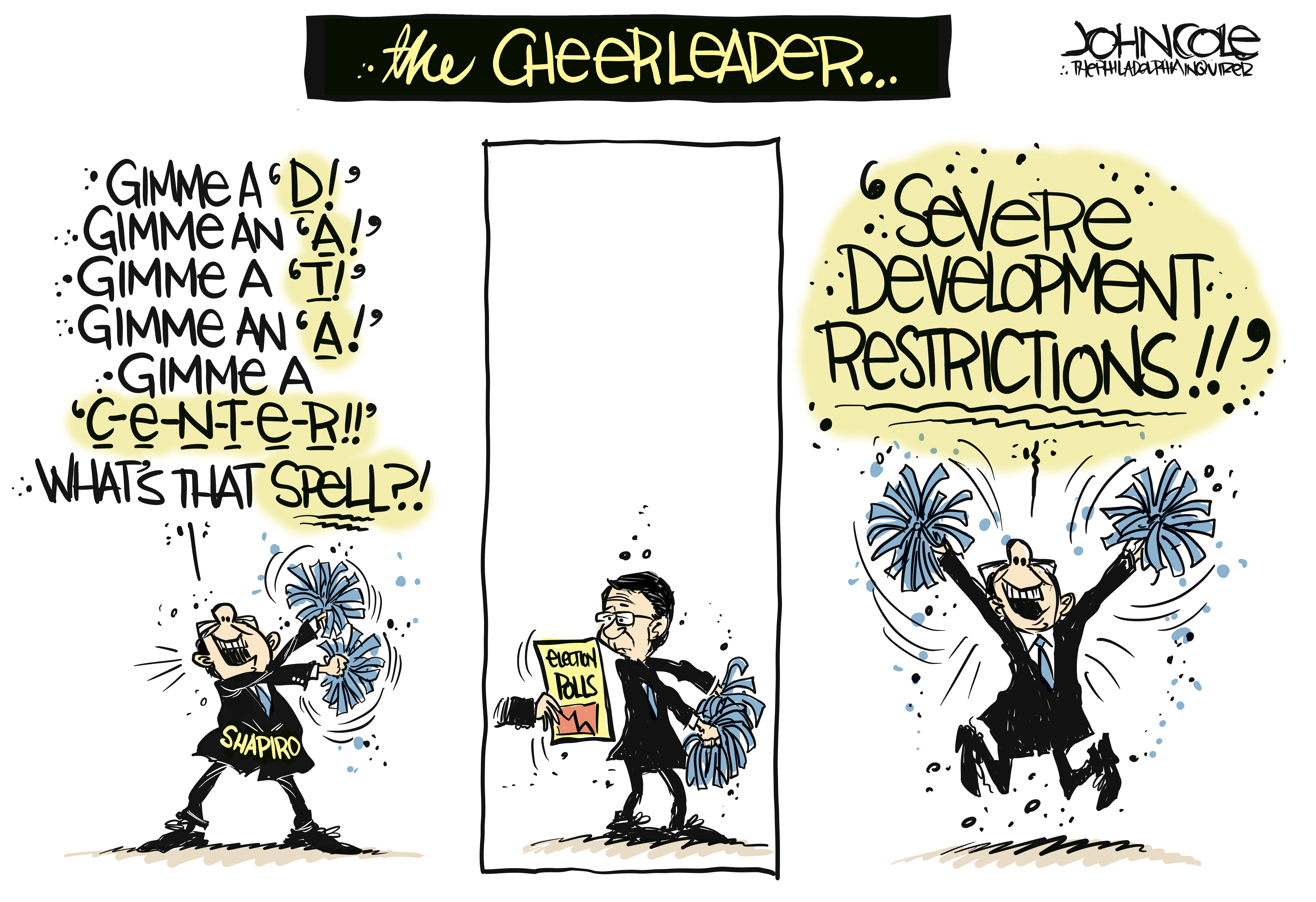
    A governor’s race that started with both candidates seen as data center advocates now has the GOP’s Stacy Garrity calling for a moratorium as Democratic Gov. Josh Shapiro — who in 2025 posed in front of earth movers to hail AI complexes as the Keystone State’s bright economic future — issued stringent new regulations while calling data centers “secretive … predators” and “bullies.”

    Did I mention that Shapiro is seriously considering running for president in 2028? Did I need to?

    Even right-wing and zealously pro-business red-state Republican governors like Texas’ Greg Abbott and Florida’s Ron DeSantis have turned sharply against data centers this year.

    It seems like the only U.S. politician with anything nice to say about these energy-sucking, polluting behemoths is Donald Trump, who told reporters last week, “If I were the mayor of a town or the governor of a state, and I had a chance to get a big plant in, an AI plant or a data center, I would absolutely want it because the jobs are enormous and the money paid, the taxes paid, are just enormous.”

    You don’t need Kalshi to bet that dozens of Democrats will feature Trump’s toxic words in their fall campaign ads.

    In the 21st century, the most exciting moments are the ones the TV pundits — who have more in common with their political drinking buddies or the cartoon villains of Silicon Valley than heartland voters — never saw coming. That list includes the progressive upheavals of 2011’s Occupy Wall Street, arguably a reaction not just to the Great Recession but Barack Obama’s tepid response, or 2017’s #MeToo movement after a man with multiple sexual misconduct allegations was elected president.

    But then Trump’s two terms, including his popular vote plurality in 2024, were also arguably the result of public fury at elites, even if a big chunk of that anger was against the ones calling out racism or sexism or homophobia. It’s worth noting, of course, that the progressive revolts, especially 2020’s Black Lives Matter marches, sparked intense backlash, yet Trump’s MAGA movement now seems in full meltdown.

    In one sense, the ability of billionaires and their endless money and their reactionary political allies to put down 21st-century unrest feels like a callback to the Luddites, whose revolution against the new machines changing the landscape of northern England in the early 19th century was also crushed, often violently, by the powers that be.

    But Fred Hampton famously said, “You can jail a revolutionary, but you can’t jail the revolution,” and the radical spirit of the Luddites continued to fuel pro-worker and pro-human rights movements for two centuries. On the whole, the Industrial Revolution won, but in 2026, revulsion over the way Silicon Valley — and especially AI — is changing our daily lives so quickly feels as if things could turn out differently.

    This moment was captured in a recent cartoon that roughly depicted George Jetson — whose world of flying cars was the future my generation of boomers was promised in the 1960s — doing the drudge work of vacuuming while Rosie the robot paints at an easel. Robots were supposed to free us to create beautiful music or write the great American novel in our leisure time, not do those things, as well.

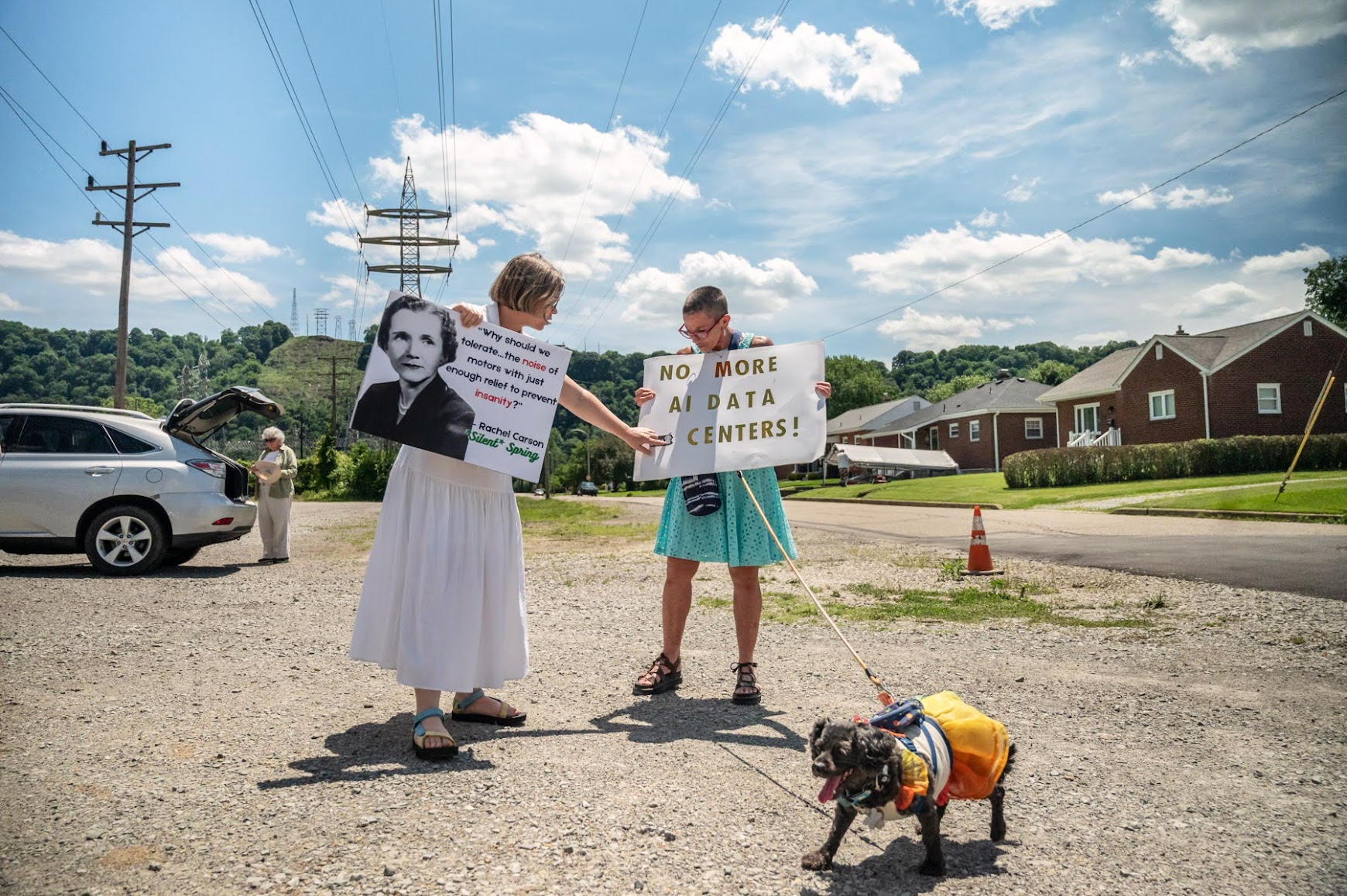
    Charolette Baierl (left), the Ohio River Valley regional organizer for Climate Reality Project, and Sally Simpson, a Ford City organizer, protest a planned data center near the Rachel Carson Riverfront Park in Cheswick, Pa., in June.Stephanie Strasburg

    To live in America in 2026 is to experience the constant anxiety of being watched by the government or big corporations — whether that’s on our phone or on the streets — and wondering when people stopped reading books, or whether that song was by a real person, or whether that video you just watched of the president (or from the president) is even real.

    This weekend came news of an actual event in China called the World Humanoid Robot Games in which one of the robots shattered Usain Bolt’s world record for the 100-meter dash. Who wants this? … other than a handful of billionaires who are also rapidly building their own remote high-tech cities to save themselves from the looming torches and pitchforks.

    They are going to need them. It was one thing when the Luddites trashed automated textile looms, when the meaning of work was up for grabs. That same threat is also posed by AI, which is starting to drag down the job market, but when robots take over track and field or pop music, people see that our fundamental humanity is under attack. That realization seems to have really kicked in this summer, and the future of our revolution is both exhilarating and somewhat scary.

    Acts of vandalism — like the Ohio attack on the Flock camera — or worse are becoming somewhat more commonplace. Acts of violence — like the gunshots fired into the home of an Indianapolis city council member who supported data centers — are reprehensible and not helpful to the larger cause. In the present moment, there is rising hope that AI can be reined in the right way: at the ballot box.

    When it comes to this issue, the ground beneath our feet may continue to keep shifting between now and Election Day. An article in Sunday’s New York Times described how the politics of data centers has scrambled a midterm election that was supposed to hinge on high gas prices and the growing threats to democracy. The piece noted that in Wisconsin and Florida — as well as Pennsylvania — the gubernatorial candidates from both major parties are now attacking the high-tech facilities.

    Yet, it’s hard to jibe the politicians’ embrace of populism with news that the AI industry and its related political action committees will spend as much as $200 million on the November elections. What will happen in 2027 and beyond if, and likely when, the American body politic doesn’t have the strength to slow down these sprinting robots? Will Morelock’s alleged destruction of one Flock camera seem like child’s play?

    The story of America in the 21st century has been a tale of widespread consensus that a grossly unequal and unfair nation is on the wrong track, yet bitter disagreement over whom to blame. Until now. The fight that no one saw coming — pitting everyday folks against billionaires and their robots, who can already outrun us — is about much more than an election for U.S. Congress. Today’s Luddites may be our best hope.